Q1(a) — Table-tennis net toppling problem
Figure 1.a.i shows the side-on view and Figure 1.a.ii the end-on view of a new type of table-tennis net. It consists of a thin piece of wood supported by two lead bars 100 mm long. The thickness of the ‘net’ is 5.0 mm, the width of the bars is 50.0 mm and the thickness of the lead is 3.0 mm. The net is 1600 mm wide and 137 mm tall (end-on view). Whilst playing, a ball strikes the top of the net horizontally with its centre in line with the top of the ‘net’. Assume the ball is not revolving when it hits the ‘net’. The mass of a table tennis ball is kg. The ball bounces back with 20% of its incident speed.
Calculate the fastest speed it can hit the ‘net’ without the ‘net’ toppling over. Assume the ‘net’ and the bars do not slide on the surface of the table.
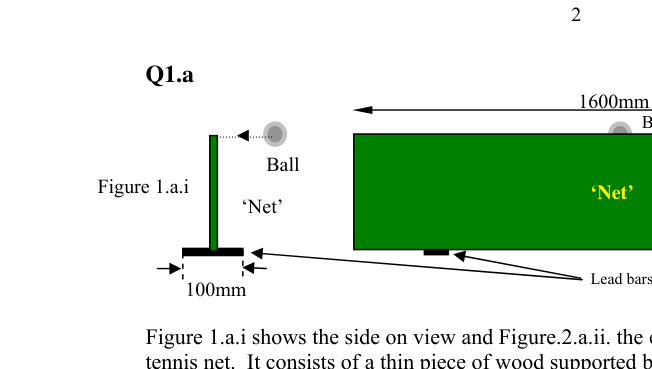 Side-on view of table-tennis net
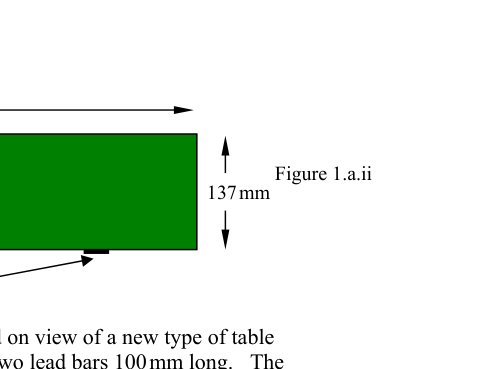 End-on view of table-tennis net
Topic: Newtonian Mechanics, Rigid Body Statics, Rotational Dynamics Metodi: Impulse-Momentum Theorem, Torque & Angular Momentum Analysis, Free-Body Diagram Competenze: Physical Reasoning, Mathematical Modeling Objects: Ball, Rod Fonte: Testo (PDF) — p.2
**Q1(a) ** Problema di rovesciamento della rete nel tennis da tavolo
La figura 1.a.i mostra la vista laterale e la figura 1.a.ii la vista laterale di un nuovo tipo di rete da tavolo. È costituito da un sottile pezzo di legno sostenuto da due barre di piombo di 100 mm di lunghezza. Lo spessore della “rete” è di 5,0 mm, la larghezza delle barre è di 50,0 mm e lo spessore del piombo è di 3,0 mm. La rete è larga 1600 mm e alta 137 mm (visto di fine-tempo). Durante il gioco, una palla colpisce orizzontalmente la parte superiore della rete con il suo centro in linea con la parte superiore della “rete”. Supponiamo che la palla non ruota quando colpisce la “rete”. La massa di una palla da tennis da tavolo è kg. La palla rimbalza con il 20% della sua velocità di incidente.
Calcolare la velocità più veloce che può colpire la ‘rete’ senza che la ‘rete’ si rovesci. Supponiamo che la “rete” e le barre non scivolino sulla superficie del tavolo.
*Vista laterale della rete di tennis da tavolo *
*Vista finale di rete di tennis da tavolo *
Topic: Newtonian Mechanics, Rigid Body Statics, Rotational Dynamics Metodi: Impulse-Momentum Theorem, Torque & Angular Momentum Analysis, Free-Body Diagram Competenze: Physical Reasoning, Mathematical Modeling Objects: Ball, Rod Fonte: Testo (PDF) — p.2
Q1(b) — Solar heating of seawater
The Sun shines vertically down on to static seawater (Figure 1.b). The fraction of the power absorbed by a thin layer of water of thickness at depth , per square metre of surface, is .
Write down an equation that connects the above variables.
The thermal conductivity of water, , relates the rate of heat flow due to a temperature gradient. Write down an equation for this relation.
Obtain a differential equation that relates the temperature of the water with the depth of the water . Assume there are no convection currents.
What is the condition for convection currents to start?
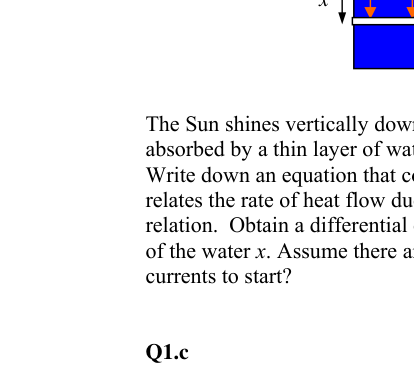 Sunlight absorbed in seawater layer at depth x
Topic: Thermodynamics, Fluid Mechanics Metodi: Differential Equations, First Law of Thermodynamics, Physical Modeling Competenze: Mathematical Modeling, Physical Reasoning Objects: — Fonte: Testo (PDF) — p.2
**Q1(b) ** riscaldamento solare dell’acqua di mare
Il sole splende verticalmente verso l’acqua di mare statica (Figura 1.b). La frazione di potenza assorbita da un sottile strato di acqua di spessore a profondità , per metro quadrato di superficie, è .
Scrivi un’equazione che connette le variabili sopra.
La conducibilità termica dell’acqua, , si riferisce al tasso di flusso di calore dovuto a un gradiente di temperatura. Scrivi un’equazione per questa relazione.
Ottenere un’equazione differenziale che correla la temperatura dell’acqua con la profondità dell’acqua . Supponiamo che non ci siano correnti di convezione.
Qual è la condizione per l’inizio delle correnti di convezione?
L’aspirazione solare nell’acqua di mare a profondità x
Topic: Thermodynamics, Fluid Mechanics Metodi: Differential Equations, First Law of Thermodynamics, Physical Modeling Competenze: Mathematical Modeling, Physical Reasoning Objects: — Fonte: Testo (PDF) — p.2
Q1(c) — Rotating liquid parabolic mirror
Figure 1.c shows a rotating glass cylinder containing a viscous liquid of density . The electric motor rotates the cylinder at an angular velocity .
Show that the liquid forms a parabolic surface and find the equation of the parabola.
Some astronomical telescopes use rotating dishes filled with mercury to produce a reflecting parabolic surface. Show that a parabolic mirror does produce a focus and derive an expression relating the angular velocity of rotation to the focal length of the mirror.
What type of advantages and disadvantages does this type of mirror have?
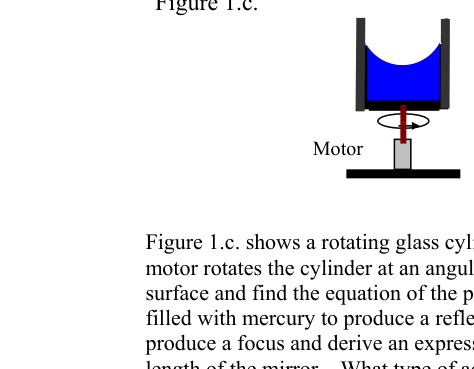 Rotating cylinder with viscous liquid and motor
Topic: Fluid Mechanics, Rotational Dynamics, Geometric Optics Metodi: Free-Body Diagram, Kinematic Equations, Ray Tracing Competenze: Physical Reasoning, Mathematical Modeling Objects: Cylinder, Mirror Fonte: Testo (PDF) — p.2
**Q1(c) ** Specchio parabolico liquido a rotazione
La figura 1.c mostra un cilindro rotativo di vetro contenente un liquido viscoso di densità . Il motore elettrico ruota il cilindro a velocità angolare .
Mostrare che il liquido forma una superficie parabolica e trovare l’equazione della parabola.
Alcuni telescopi astronomici utilizzano piatti rotanti pieni di mercurio per produrre una superficie parabolica riflessa. Mostra che uno specchio parabolico produce una concentrazione e derivi un’espressione che relaziona la velocità angolare di rotazione alla lunghezza focale dello specchio.
Quali sono i vantaggi e gli svantaggi di questo tipo di specchio?
Cilindro rotante con liquido viscoso e motore
Topic: Fluid Mechanics, Rotational Dynamics, Geometric Optics Metodi: Free-Body Diagram, Kinematic Equations, Ray Tracing Competenze: Physical Reasoning, Mathematical Modeling Objects: Cylinder, Mirror Fonte: Testo (PDF) — p.2
Q1(d) — Magnets falling through a coil (Faraday’s law)
A tube of disc magnets was dropped through a coil. The computer recorded the EMF generated in the coil (Figure 1.d.i). The coil is wound in a clockwise direction looking down (Figures 1.d.ii and 1.d.iii). The actual display is shown enlarged in Figure 1.d.i, where the horizontal axis is time in ms (range 0–100 ms) and the vertical axis is EMF.
The physical length of the tube of magnets was 8.0 cm. The coil had 100 turns and an average diameter of 10 cm and was 1 cm thick.
What quantitative and qualitative information can you obtain from the display?
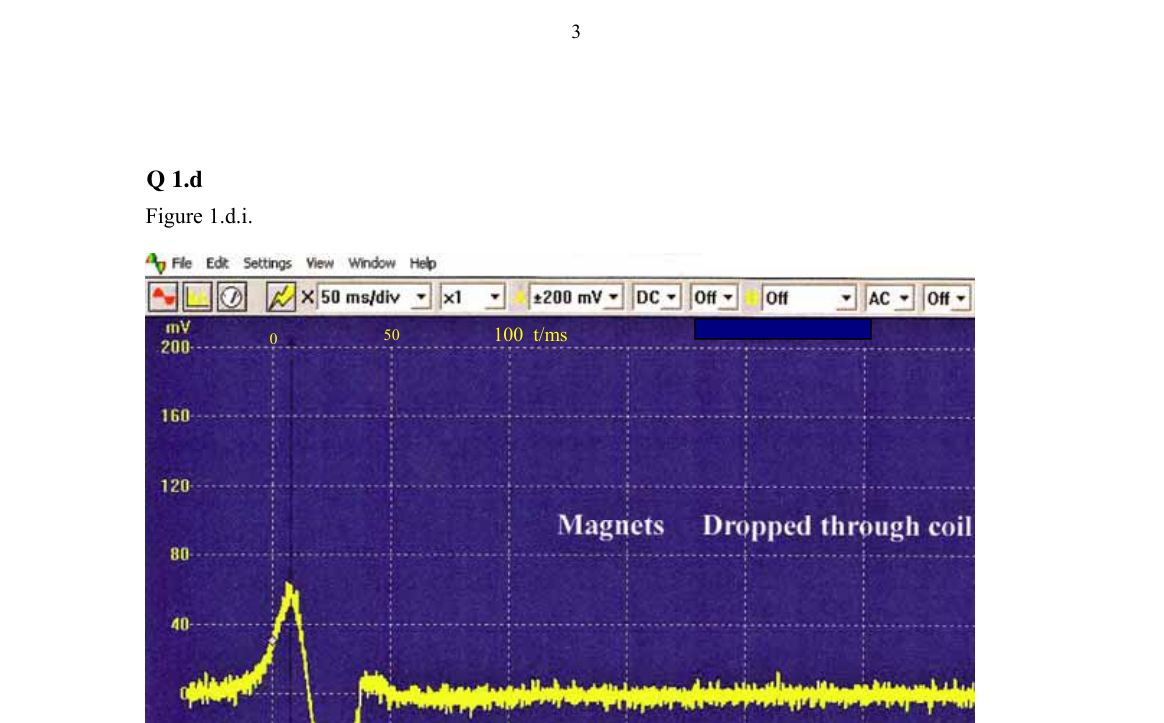 EMF vs time display and coil diagram for falling magnets
Topic: Electromagnetic Induction, Newtonian Mechanics Metodi: Faraday’s Law of Induction, Lenz’s Law, Experimental Data Analysis Competenze: Experimental Data Analysis, Physical Reasoning Objects: Magnet, Coil, Tube Fonte: Testo (PDF) — p.3
**Q1(d) ** Magnete che cadono attraverso una bobina (legge di Faraday)
Un tubo di magneti a disco è stato lanciato attraverso una bobina. Il computer registra la FEM generata nella bobina (Figura 1.d.i). La bobina è rotata in senso orario verso il basso (Figure 1.d.ii e 1.d.iii). Il display effettivo è mostrato ingrandito nella figura 1.d.i, dove l’asse orizzontale è il tempo in ms (intervallo 0100 ms) e l’asse verticale è il FEM.
La lunghezza fisica del tubo di magneti era di 8,0 cm. La bobina aveva 100 giri e un diametro medio di 10 cm ed era spessa 1 cm.
Quali informazioni quantitative e qualitative potete ottenere dall’esposizione?
EMF vs tempo di visualizzazione e diagramma della bobina per i magneti cadenti
Topic: Electromagnetic Induction, Newtonian Mechanics Metodi: Faraday’s Law of Induction, Lenz’s Law, Experimental Data Analysis Competenze: Experimental Data Analysis, Physical Reasoning Objects: Magnet, Coil, Tube Fonte: Testo (PDF) — p.3
Q1(e) — CD-ROM as a reflection diffraction grating
Figure 1.e shows a photo of a laser beam incident at 90° on a piece of CD-ROM. The laser has a wavelength of 620 nm. The dotted blue lines indicate the directions of the reflected laser light that strikes the paper at the red oblongs shown in the photo.
Find the effective reflection grating spacing and hence estimate the maximum number of bits (1 or 0) that might be stored on the CD-ROM.
(You can take measurements from the photo.)
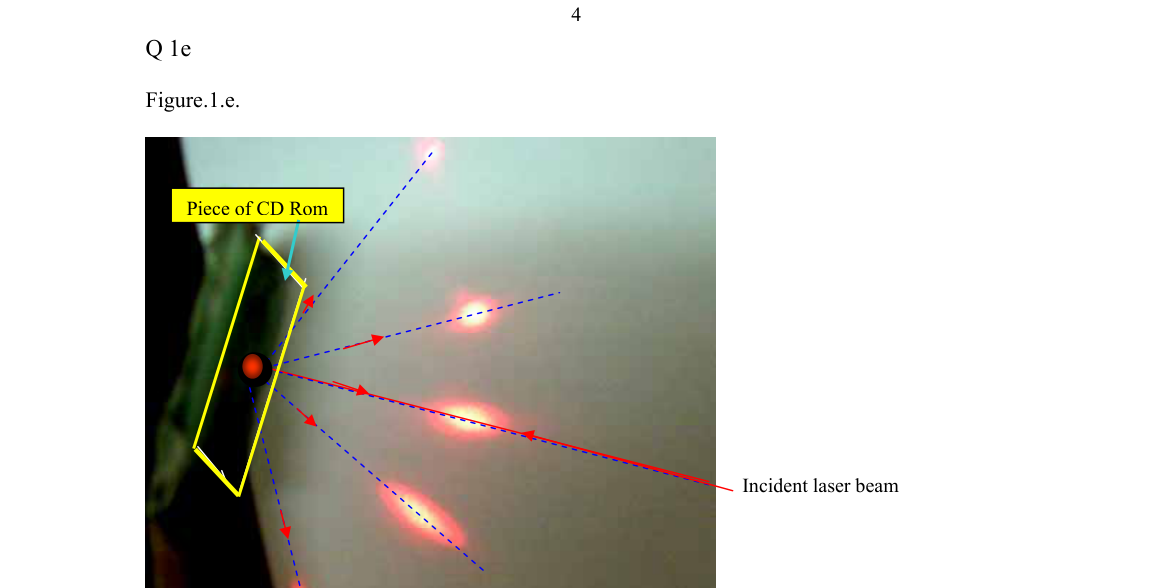 Laser beam reflecting off CD-ROM surface
Topic: Wave Optics, Modern-Quantum Physics Metodi: Interference & Diffraction Analysis, Order-of-Magnitude Estimation Competenze: Estimation & Approximation, Experimental Data Analysis Objects: Diffraction Grating Fonte: Testo (PDF) — p.4
**Q1(e) ** CD-ROM come griglia di diffrazione riflessiva
La figura 1.e mostra una foto di un incidente di fascio laser a 90° su un pezzo di CD-ROM. Il laser ha una lunghezza d’onda di 620 nm. Le linee blu puntate indicano le direzioni della luce laser riflessa che colpisce il foglio sulle lunghezza rosse mostrate nella foto.
Trova l’intervallo effettivo di ripiego e quindi stima il numero massimo di bit (1 o 0) che potrebbero essere memorizzati sul CD-ROM.
(Puoi prendere le misure dalla foto.)
Riflettere laser sulla superficie del CD-ROM
Topic: Wave Optics, Modern-Quantum Physics Metodi: Interference & Diffraction Analysis, Order-of-Magnitude Estimation Competenze: Estimation & Approximation, Experimental Data Analysis Objects: Diffraction Grating Fonte: Testo (PDF) — p.4
Q1(f) — Energy stored in capacitors and inductors; LHC electromagnet
Show that the energy stored in a capacitor storing a charge is where is the potential difference between the plates.
Show that the energy stored in a coil is where is the current in the coil and is the inductance.
Find the energy stored in the electromagnet of the CMS detector of the Large Hadron Collider. The inductance of the large magnet is , the normal current is , giving a magnetic field intensity at this current of .
Calculate the energy stored and the average power output if the circuit was broken and the current reduced to zero in 2 ms.
Topic: Circuits, Electromagnetism, Magnetism Metodi: Calculus-Integration, Energy Conservation Method, Physical Modeling Competenze: Mathematical Modeling, Physical Reasoning Objects: Capacitor, Inductor, Coil, Magnet Fonte: Testo (PDF) — p.4
**Q1(f) ** Energia immagazzinata nei condensatori e negli induttori; elettromagnetico del LHC
Indicare che l’energia immagazzinata in un condensatore che immagazzina una carica è in cui è la differenza potenziale tra le piastre.
Mostrare che l’energia immagazzinata in una bobina è in cui è la corrente nella bobina e è l’inductanza.
Trova l’energia immagazzinata nell’elettromagnetico del rilevatore CMS del Grande Collider ad Adroni. L’induttanza del grande magnete è , la corrente normale è , dando un campo magnetico di intensità a questa corrente di .
Calcolare l’energia immagazzinata e la potenza media di uscita se il circuito è rotto e la corrente ridotta a zero in 2 ms.
Topic: Circuits, Electromagnetism, Magnetism Metodi: Calculus-Integration, Energy Conservation Method, Physical Modeling Competenze: Mathematical Modeling, Physical Reasoning Objects: Capacitor, Inductor, Coil, Magnet Fonte: Testo (PDF) — p.4
Q2(a) — Gravitational lensing and deflection of light by the Sun
This question is about cold dark matter. Cold dark matter only affects ordinary matter by gravitational interaction. It will deflect light by gravitational interaction.
According to the General Theory of Relativity the gravitational field of the Sun alters the effective refractive index of outer space so that: where is a constant which, for the Sun, takes a value of and is the distance to the centre of the Sun.
Find the value of the effective refractive index close to the surface of the Sun.
Using a simple model, or otherwise, find the angular deflection of the light from a distant star as it passes very close to the Sun. Draw a clear diagram of your model.
(Figure 2.1.a.1 shows the Sun with the surrounding space shaded illustrating the increasing effective refractive index as the distance from the centre of the Sun is decreased. Figure 2.1.a.2 shows a photograph taken during the 1919 solar eclipse.)
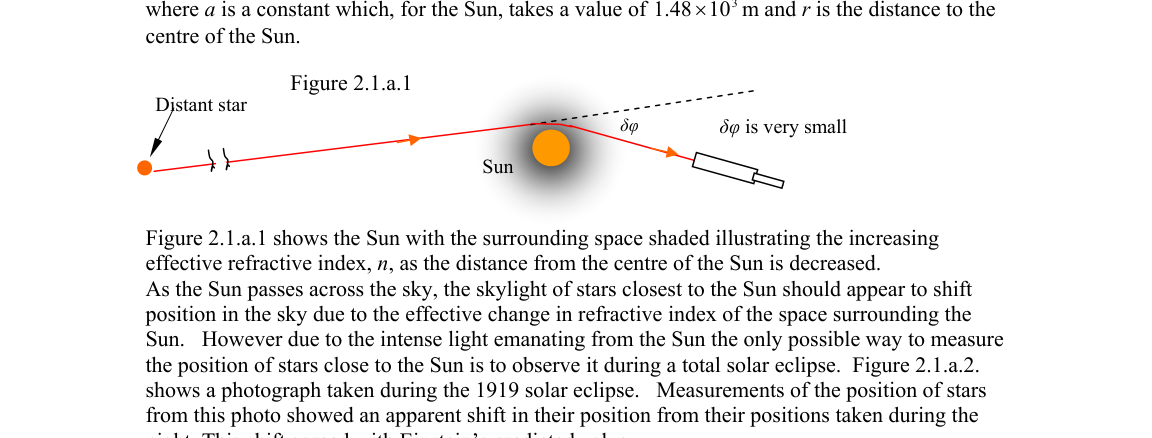 Diagram of light deflection near the Sun
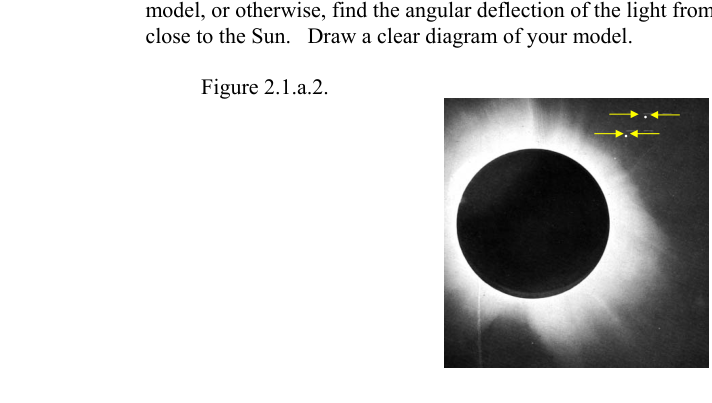 1919 solar eclipse photograph showing star positions
Topic: Gravitation, Geometric Optics, Special Relativity Metodi: Snell’s Law, Approximation & Series Expansion, Newton’s Law of Gravitation Competenze: Physical Reasoning, Mathematical Modeling Objects: Star, Photon Fonte: Testo (PDF) — p.5
**Q2(a) ** Lenti gravitazionali e la deflezione della luce da parte del Sole
Questa domanda riguarda la materia oscura fredda. La materia oscura fredda colpisce la materia ordinaria solo attraverso l’interazione gravitazionale. Svolterà la luce attraverso l’interazione gravitazionale.
Secondo la teoria generale della relatività, il campo gravitazionale del Sole altera l’indice di rifrazione efficace dello spazio esterno in modo che: dove è una costante che, per il Sole, assume un valore di e è la distanza al centro del Sole.
Trova il valore dell’indice di rifrazione efficace vicino alla superficie del Sole.
Usando un modello semplice, o altrimenti, trovare la deviazione angolare della luce da una stella lontana mentre passa molto vicino al Sole. Disegna un diagramma chiaro del tuo modello.
(La figura 2.1.a.1 mostra il Sole con l’ambiente circostante ombrato, illustrando l’indice di rifrazione efficace in aumento a mano a mano che la distanza dal centro del Sole diminuisce. La figura 2.1.a.2 mostra una fotografia scattata durante l’eclissi solare del 1919.)
Diagramma di deflezione della luce vicino al Sole
1919 fotografia di eclissi solare che mostra le posizioni delle stelle
Topic: Gravitation, Geometric Optics, Special Relativity Metodi: Snell’s Law, Approximation & Series Expansion, Newton’s Law of Gravitation Competenze: Physical Reasoning, Mathematical Modeling Objects: Star, Photon Fonte: Testo (PDF) — p.5
Q2(b) — Gauss’s law analogy: electric and gravitational shell theorems
Figure 2.b.1 shows a hollow metal sphere that is positively charged. The lines of electric field are connected to negative charges that are a long way away. Show that if the electric field from a very small charge is given by where is the dielectric constant of free space, then the electric field inside the sphere is zero.
Figure 2.b.2 shows an uncharged massive spherical shell. Show that the gravitational field inside the sphere due to the uniform massive shell is also zero.
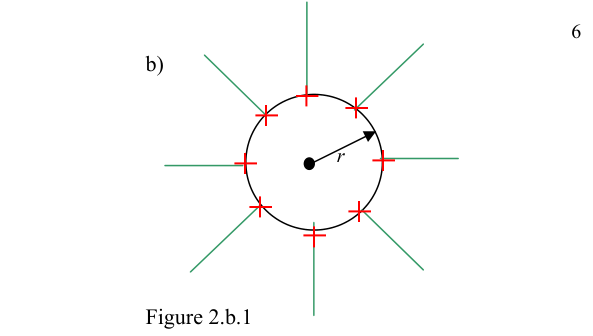 Charged hollow sphere with field lines
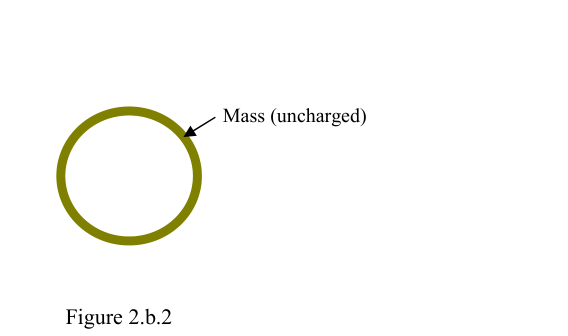 Massive uncharged spherical shell
Topic: Electrostatics, Gravitation Metodi: Gauss’s Law, Symmetry Argument, Newton’s Law of Gravitation Competenze: Physical Reasoning, Diagrammatic Reasoning Objects: Conducting Sphere Fonte: Testo (PDF) — p.6
**Q2(b) ** Analogia della legge di Gauss: teoremi della conchiglia elettrica e gravitazionale
La figura 2.b.1 mostra una sfera metallica vuota carica positivamente. Le linee di campo elettrico sono collegate a cariche negative che sono lontane. Indicare che se il campo elettrico da una carica molto piccola è dato da se è la costante dielettrica dello spazio libero, il campo elettrico all’interno della sfera è zero.
La figura 2.b.2 mostra un guscio sferico massiccio non caricato. Mostrare che il campo gravitazionale all’interno della sfera a causa della conchiglia massiccia uniforme è anche zero.
Sfera vuota carica con linee di campo
Massa conchiglia sferica non carica
Topic: Electrostatics, Gravitation Metodi: Gauss’s Law, Symmetry Argument, Newton’s Law of Gravitation Competenze: Physical Reasoning, Diagrammatic Reasoning Objects: Conducting Sphere Fonte: Testo (PDF) — p.6
Q2(c) — Consistency of Newton’s law of gravitation with solar system data
Show that, according to Newton’s theory of gravitation, the numerical values of the mass of the Sun and radius of the orbit of the Earth, given on the data page, are consistent.
Data: , , .
Topic: Gravitation, Newtonian Mechanics Metodi: Newton’s Law of Gravitation, Kepler’s Laws, Kinematic Equations Competenze: Physical Reasoning, Estimation & Approximation Objects: Planet, Star Fonte: Testo (PDF) — p.6
**Q2(c) ** Coerenza della legge di Newton sulla gravità con i dati del sistema solare
Mostrate che, secondo la teoria della gravitazione di Newton, i valori numerici della massa del Sole e del raggio di orbita della Terra, dati sulla pagina dei dati, sono coerenti.
Dati: , , .
Topic: Gravitation, Newtonian Mechanics Metodi: Newton’s Law of Gravitation, Kepler’s Laws, Kinematic Equations Competenze: Physical Reasoning, Estimation & Approximation Objects: Planet, Star Fonte: Testo (PDF) — p.6
Q2(d) — Galaxy rotation curves and dark matter
To perform a mathematical analysis of the distribution of stars and their angular velocity in a galaxy it is expedient to make a simple mathematical model of the galaxy. The model consists of a thin disc of stars (Figure 2.d.1.b), where the density of stars is roughly constant in the central area. Outside the central area the mass of stars per unit volume is given by where is a constant and is the distance from the galactic centre.
Determine a formula that relates the speeds of the stars with their distance from the centre of the galaxy.
Is your formula consistent with Figure 2.1.e.1 (the rotation curve of a typical spiral galaxy, showing predicted curve (A) and observed curve (B), with the difference attributed to dark matter)?
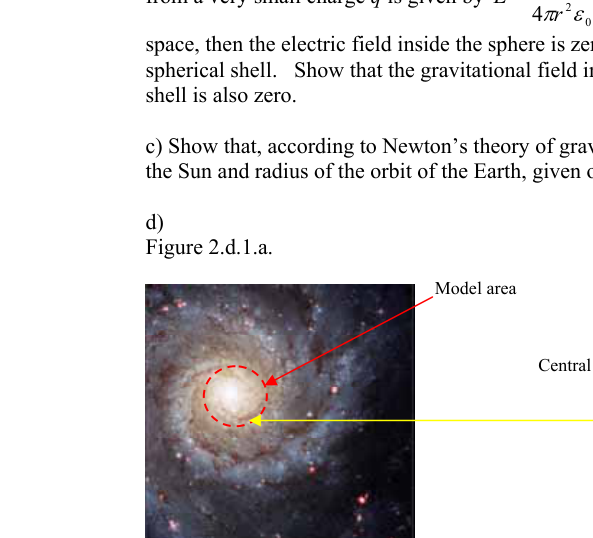 Spiral galaxy and disc model diagram
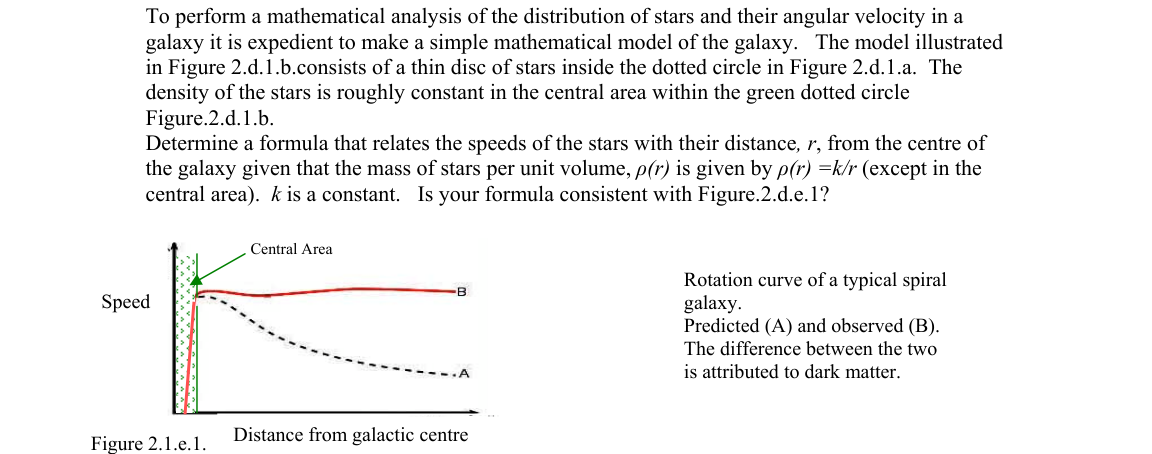 Galaxy rotation curve predicted vs observed
Topic: Astrophysics, Gravitation, Newtonian Mechanics Metodi: Newton’s Law of Gravitation, Calculus-Integration, Physical Modeling Competenze: Mathematical Modeling, Physical Reasoning Objects: Star, Disk Fonte: Testo (PDF) — p.6
**Q2(d) ** Corve di rotazione delle galassie e materia oscura
Per eseguire un’analisi matematica della distribuzione delle stelle e della loro velocità angolare in una galassia è opportuno fare un modello matematico semplice della galassia. Il modello consiste in un sottile disco di stelle (Figura 2.d.1.b), dove la densità delle stelle è praticamente costante nell’area centrale. Al di fuori dell’area centrale la massa delle stelle per unità di volume è data da dove è una costante e è la distanza dal centro galattico.
Determina una formula che correla le velocità delle stelle con la loro distanza dal centro della galassia.
La formula è coerente con la figura 2.1.e.1 (la curva di rotazione di una tipico galassia a spirale, che mostra la curva prevista (A) e la curva osservata (B), con la differenza attribuita alla materia oscura)?
Diagramma di modelli di galassie e di dischi a spirale
Curva di rotazione della galassia prevista vs osservata
Topic: Astrophysics, Gravitation, Newtonian Mechanics Metodi: Newton’s Law of Gravitation, Calculus-Integration, Physical Modeling Competenze: Mathematical Modeling, Physical Reasoning Objects: Star, Disk Fonte: Testo (PDF) — p.6