a) Physicists sometimes use the approximation that light travels in a vacuum at a speed of 1 foot in 1 ns. What is the percentage error in using this value? (1.000 m = 1.094 yards and 1.000 yard = 3.000 feet) [3]
Risposta: 1 foot/ns m s; error (using gains only 2/3 marks)
Soluzione:
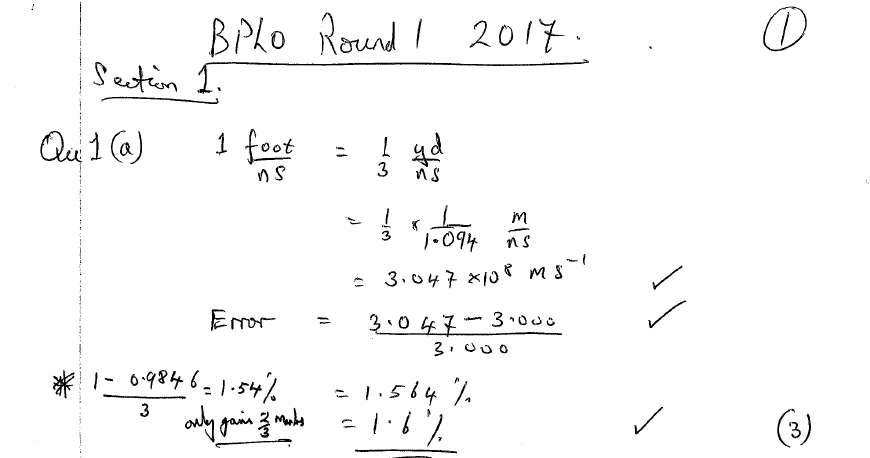
Official mark scheme (BPhO Round 1, November 2017, Section 1), from the official PDF — p. 2. © BPhO, CC BY 4.0.
Topic: Order-of-Magnitude Estimation Metodi: Order-of-Magnitude Estimation Competenze: Unit Conversion, Significant Figures Objects: — Fonte: Testo (PDF) — p.3 · Soluzione ufficiale (PDF) — p.2
a) I fisici usano talvolta l’approssimazione secondo cui la luce nel vuoto percorre 1 piede in 1 ns. Qual è l’errore percentuale che si commette usando questo valore? (1,000 m = 1,094 iarde e 1,000 iarda = 3,000 piedi) [3]
Risposta: 1 piede/ns m s; errore (con solo 2/3 dei punti)
Soluzione: La soluzione ufficiale completa (in inglese) è nella versione originale di questo quesito e nel PDF ufficiale.
Topic: Order-of-Magnitude Estimation Metodi: Order-of-Magnitude Estimation Competenze: Unit Conversion, Significant Figures Objects: — Fonte: Testo (PDF) — p.3 · Soluzione ufficiale (PDF) — p.2
b) A window cleaner’s ladder shown in Figure 1 is narrower at the top than the bottom. It has a weight of 350 N and a length of 5.0 m. When it lies flat on the ground, a force of 80 N is needed to lift the narrow end off the ground. (i) How far is the centre of mass from the narrow end? (ii) What force is required to lift the wide end of the ladder off the ground?
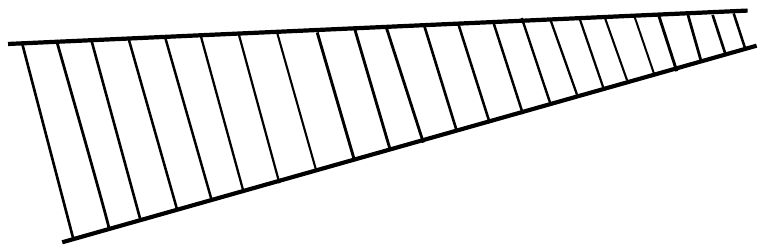
Figure 1 [5]
Risposta: as printed in the scheme (80 N at end B, at A): (i) moments about A, , m m; m, m m; (ii) N (or ); answers as fractions or to 2 s.f. are OK
Soluzione:
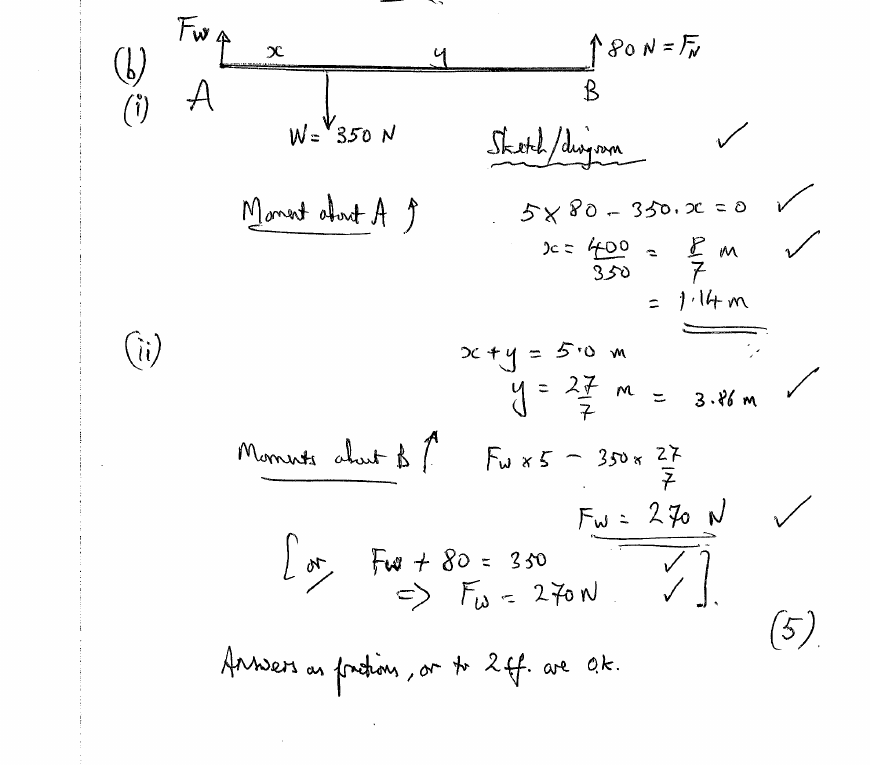
Official mark scheme (BPhO Round 1, November 2017, Section 1), from the official PDF — p. 2. © BPhO, CC BY 4.0.
Topic: Rigid Body Statics Metodi: Torque & Angular Momentum Analysis, Free-Body Diagram Competenze: Diagrammatic Reasoning Objects: Rod Fonte: Testo (PDF) — p.3 · Soluzione ufficiale (PDF) — p.2
b) La scala da lavavetri di Figura 1 è più stretta in cima che alla base. Pesa 350 N ed è lunga 5,0 m. Quando è distesa a terra, serve una forza di 80 N per sollevare da terra l’estremità stretta. (i) A che distanza dall’estremità stretta si trova il centro di massa? (ii) Quale forza serve per sollevare da terra l’estremità larga della scala?
Figura 1 [5]
Risposta: come stampato nello schema (80 N all’estremo B, in A): (i) momenti rispetto ad A, , m m; m, m m; (ii) N (oppure ); risposte in frazione o a 2 c.s. accettate
Soluzione: La soluzione ufficiale completa (in inglese) è nella versione originale di questo quesito e nel PDF ufficiale.
Topic: Rigid Body Statics Metodi: Torque & Angular Momentum Analysis, Free-Body Diagram Competenze: Diagrammatic Reasoning Objects: Rod Fonte: Testo (PDF) — p.3 · Soluzione ufficiale (PDF) — p.2
c) A particle moves in a straight line with an intial acceleration of 10 m s. The acceleration decreases uniformly with time until, after ten seconds, the acceleration is 5 m s, and from then on the acceleration remains constant. If the intial velocity is 100 m s, (i) find when the velocity has doubled; (ii) sketch a graph of the velocity against time. [7]
Risposta: (i) in the first 10 s average acceleration 7.5 m s, so m s at 10 s; the extra 25 m s at 5 m s takes 5 s: s after the start; (ii) curve up to 10 s, then linear, no kink (values not required)
Soluzione:
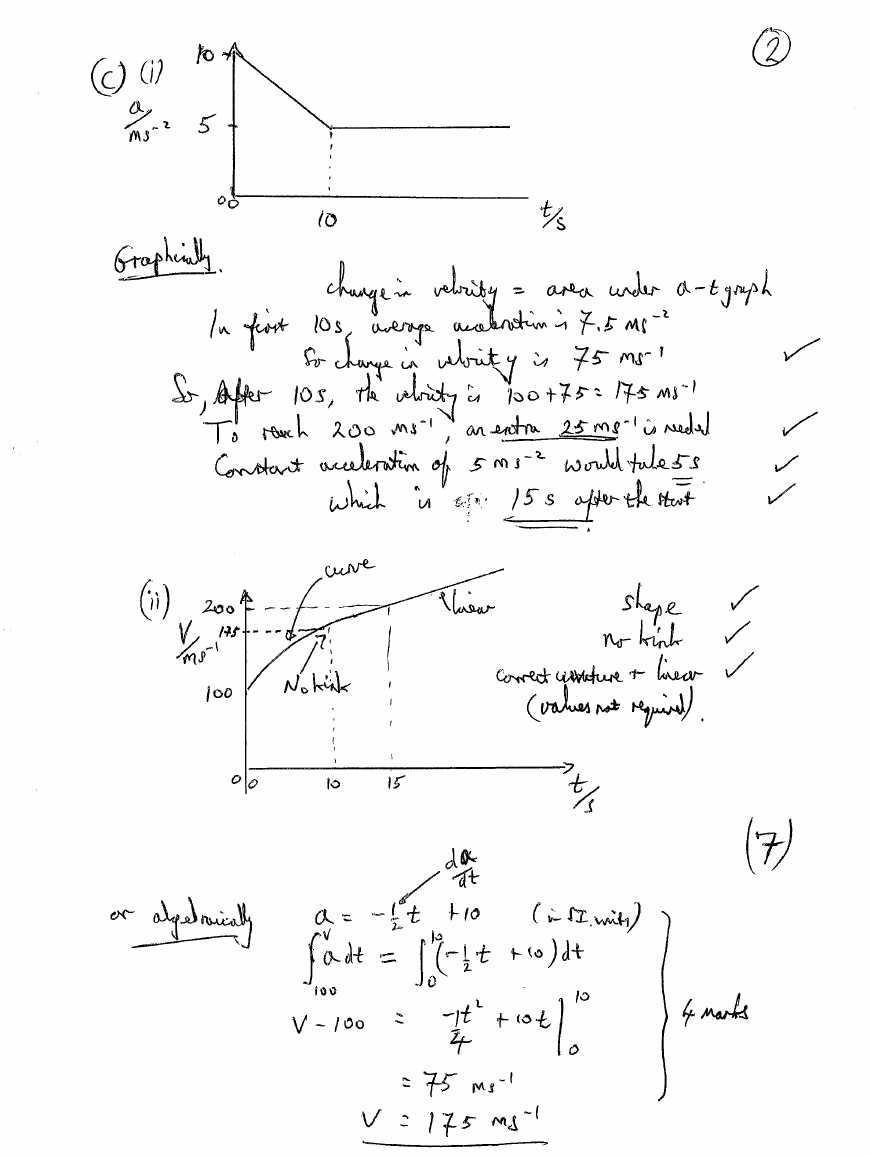
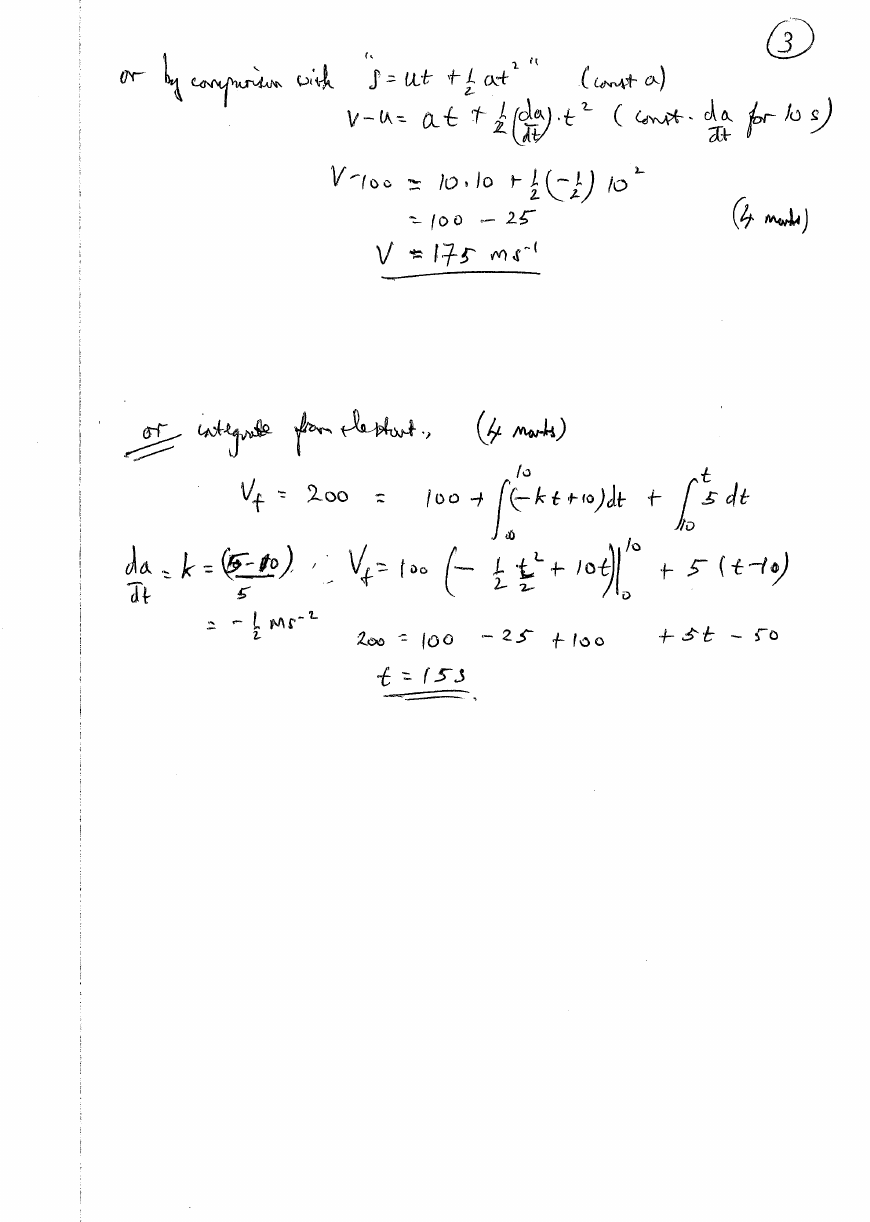
Official mark scheme (BPhO Round 1, November 2017, Section 1), from the official PDF — p. 3, 4. © BPhO, CC BY 4.0.
Topic: Newtonian Mechanics Metodi: Kinematic Equations, Calculus-Integration Competenze: Mathematical Modeling Objects: — Fonte: Testo (PDF) — p.3 · Soluzione ufficiale (PDF) — p.3
c) Una particella si muove in linea retta con accelerazione iniziale di 10 m s. L’accelerazione diminuisce uniformemente nel tempo finché, dopo dieci secondi, vale 5 m s, e da quel momento resta costante. Se la velocità iniziale è 100 m s, (i) trova quando la velocità è raddoppiata; (ii) disegna il grafico della velocità in funzione del tempo. [7]
Risposta: (i) nei primi 10 s accelerazione media 7,5 m s, quindi m s a 10 s; i 25 m s mancanti a 5 m s richiedono 5 s: s dalla partenza; (ii) curva fino a 10 s, poi retta, senza spigolo (valori non richiesti)
Soluzione: La soluzione ufficiale completa (in inglese) è nella versione originale di questo quesito e nel PDF ufficiale.
Topic: Newtonian Mechanics Metodi: Kinematic Equations, Calculus-Integration Competenze: Mathematical Modeling Objects: — Fonte: Testo (PDF) — p.3 · Soluzione ufficiale (PDF) — p.3
d) A student standing at a distance from a vertical wall kicks a ball from ground level with velocity at an angle to the horizontal in a plane perpendicular to that of the wall. The ball strikes the wall and rebounds. The coefficient of restitution for the collision is . The ball first strikes the ground at a distance from the wall. is the ratio of the components of velocity at normal incidence to the wall, before and after collision; . Find in terms of , and , the gravitational field strength. [6]
Risposta: horizontal speed before, after; ; vertical motion unaffected, : , i.e.
Soluzione:
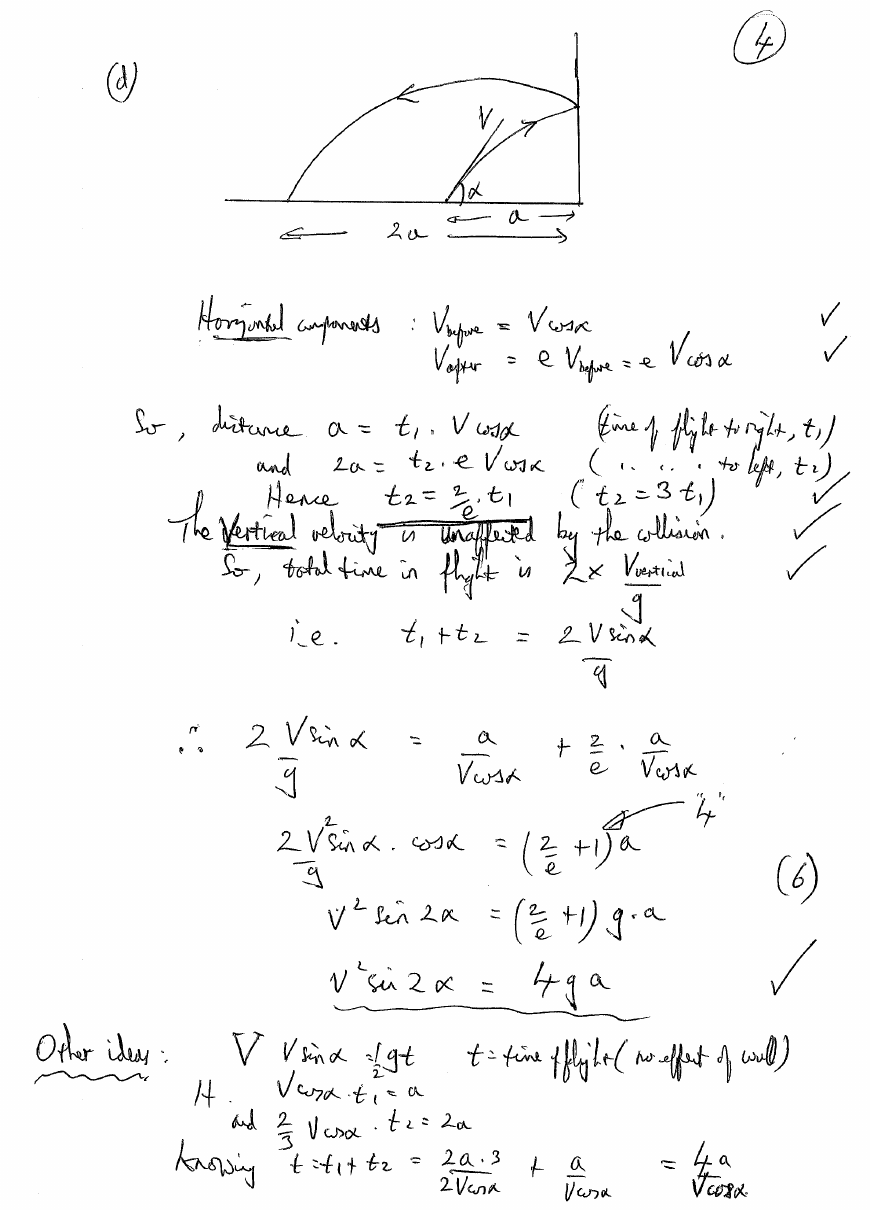
Official mark scheme (BPhO Round 1, November 2017, Section 1), from the official PDF — p. 5. © BPhO, CC BY 4.0.
Topic: Newtonian Mechanics, Conservation of Momentum Metodi: Kinematic Equations, Vector Decomposition Competenze: Mathematical Modeling Objects: Ball, Projectile Fonte: Testo (PDF) — p.3 · Soluzione ufficiale (PDF) — p.5
d) Uno studente, a distanza da un muro verticale, calcia un pallone da terra con velocità inclinata di sull’orizzontale, in un piano perpendicolare al muro. Il pallone colpisce il muro e rimbalza. Il coefficiente di restituzione dell’urto è . Il pallone tocca terra per la prima volta a distanza dal muro. è il rapporto tra le componenti della velocità normali al muro prima e dopo l’urto; . Trova in funzione di , e dell’intensità del campo gravitazionale . [6]
Risposta: velocità orizzontale prima, dopo; ; moto verticale non alterato, : , cioè
Soluzione: La soluzione ufficiale completa (in inglese) è nella versione originale di questo quesito e nel PDF ufficiale.
Topic: Newtonian Mechanics, Conservation of Momentum Metodi: Kinematic Equations, Vector Decomposition Competenze: Mathematical Modeling Objects: Ball, Projectile Fonte: Testo (PDF) — p.3 · Soluzione ufficiale (PDF) — p.5
e) A helicopter of total mass 1000 kg is able to remain in a stationary position by imparting a uniform downward velocity to a cylinder of air below it of effective diameter 6 m. Assuming the density of air to be 1.2 kg m, calculate the downward velocity of the air. [5]
Risposta: N; lift = rate of change of momentum, ; (as printed), m s
Soluzione:
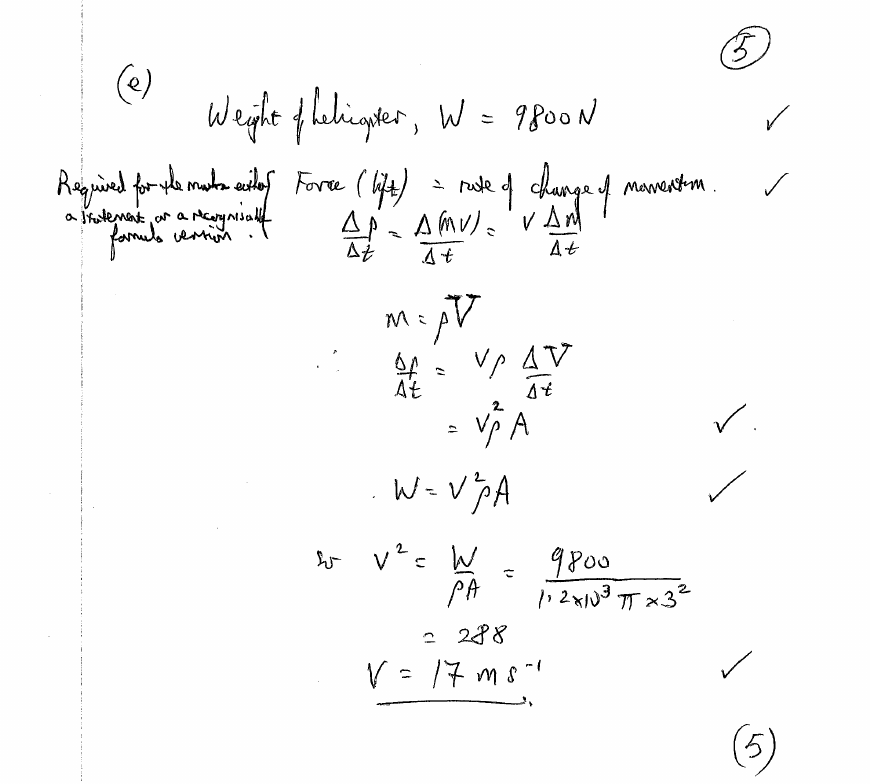
Official mark scheme (BPhO Round 1, November 2017, Section 1), from the official PDF — p. 6. © BPhO, CC BY 4.0.
Topic: Fluid Mechanics, Conservation of Momentum Metodi: Impulse-Momentum Theorem Competenze: Physical Reasoning Objects: — Fonte: Testo (PDF) — p.4 · Soluzione ufficiale (PDF) — p.6
e) Un elicottero di massa totale 1000 kg riesce a restare fermo in volo imprimendo una velocità uniforme verso il basso a un cilindro d’aria sottostante di diametro efficace 6 m. Assumendo per l’aria una densità di 1,2 kg m, calcola la velocità verso il basso dell’aria. [5]
Risposta: N; portanza = rapidità di variazione della quantità di moto, ; (come stampato), m s
Soluzione: La soluzione ufficiale completa (in inglese) è nella versione originale di questo quesito e nel PDF ufficiale.
Topic: Fluid Mechanics, Conservation of Momentum Metodi: Impulse-Momentum Theorem Competenze: Physical Reasoning Objects: — Fonte: Testo (PDF) — p.4 · Soluzione ufficiale (PDF) — p.6
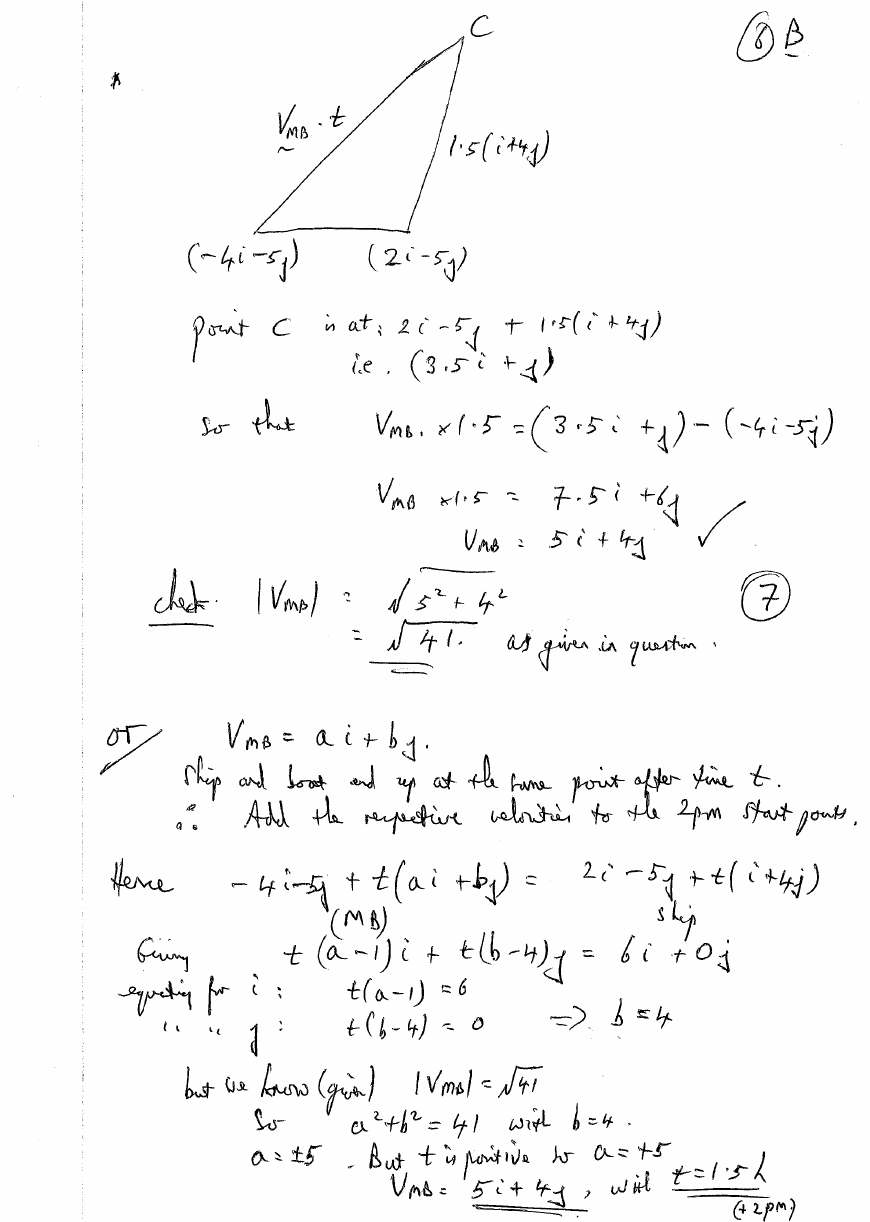
f) In this question, distances are measured in nautical miles and speeds in nautical miles per hour. A motor boat sets out at 2 p.m. from a point with position vector relative to a marker buoy (where and are two fixed perpendicular unit vectors) and travels at a steady speed of magnitude in a straight line to intercept a ship S. The ship S maintains a steady velocity vector and at 3 p.m. is at a position relative to the buoy. Find (i) the position vector of the ship at 2 p.m., (ii) the velocity vector of the motor boat, (iii) the time of interception. [7]
Risposta: (i) ; (iii) cosine rule, , h, interception at 3:30 pm; (ii) (magnitude )
Soluzione:
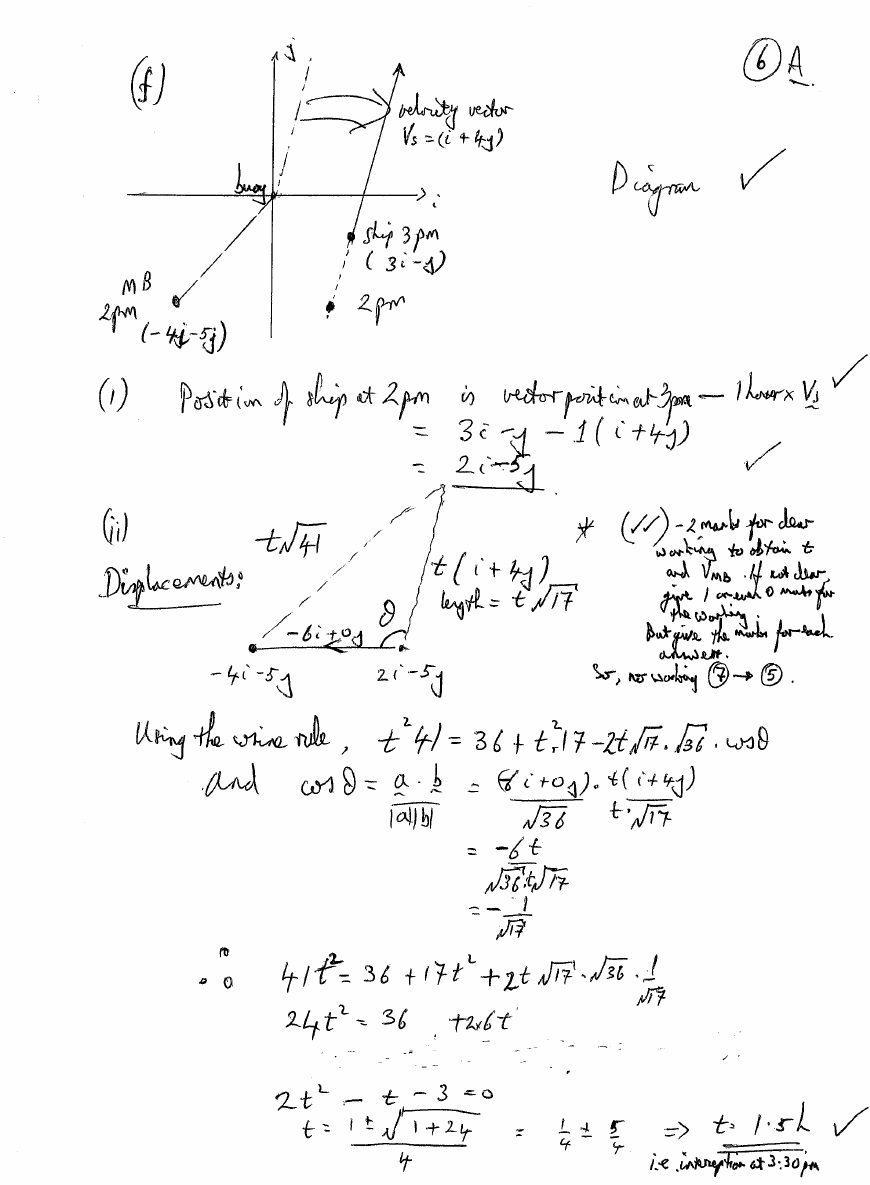
Official mark scheme (BPhO Round 1, November 2017, Section 1), from the official PDF — p. 7, 8. © BPhO, CC BY 4.0.
Topic: Newtonian Mechanics Metodi: Vector Decomposition, Kinematic Equations Competenze: Diagrammatic Reasoning, Mathematical Modeling Objects: — Fonte: Testo (PDF) — p.4 · Soluzione ufficiale (PDF) — p.7
f) In questo quesito le distanze sono in miglia nautiche e le velocità in miglia nautiche all’ora. Un motoscafo parte alle 14 da un punto di vettore posizione rispetto a una boa di segnalazione (dove e sono due versori fissi perpendicolari) e viaggia a velocità costante di modulo in linea retta per intercettare una nave S. La nave S mantiene il vettore velocità costante e alle 15 si trova nella posizione rispetto alla boa. Trova (i) il vettore posizione della nave alle 14, (ii) il vettore velocità del motoscafo, (iii) l’istante dell’intercettazione. [7]
Risposta: (i) ; (iii) teorema del coseno, , h, intercettazione alle 15:30; (ii) (modulo )
Soluzione: La soluzione ufficiale completa (in inglese) è nella versione originale di questo quesito e nel PDF ufficiale.
Topic: Newtonian Mechanics Metodi: Vector Decomposition, Kinematic Equations Competenze: Diagrammatic Reasoning, Mathematical Modeling Objects: — Fonte: Testo (PDF) — p.4 · Soluzione ufficiale (PDF) — p.7
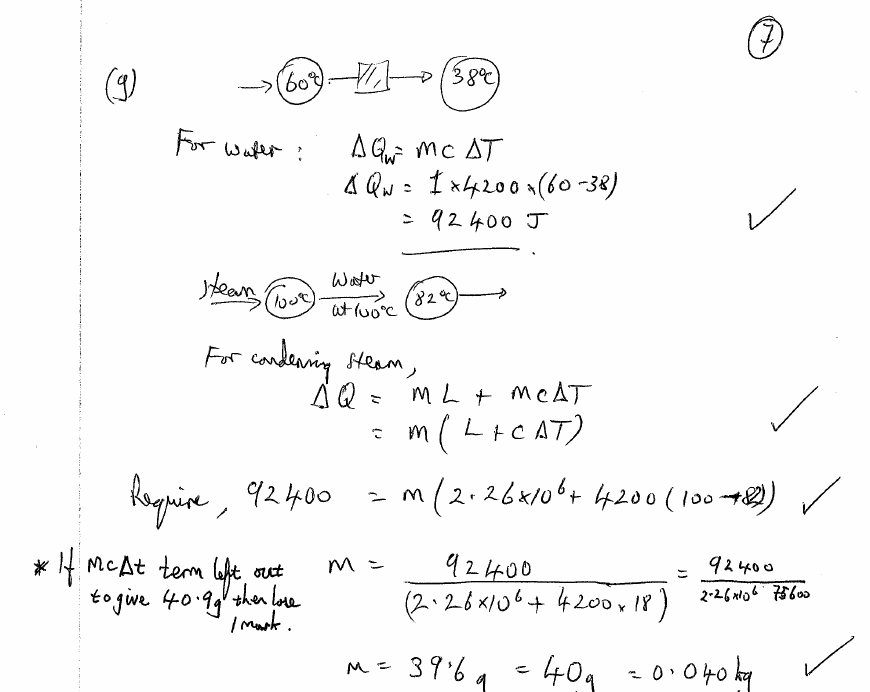
g) In a factory heating system, water enters the radiators at 60 °C and leaves at 38 °C. The system is replaced by one in which steam at 100 °C is condensed in the radiators, the condensed steam leaving at 82 °C. What mass of steam will supply the same heat energy as 1.00 kg of hot water described in the first instance? (The latent heat of vaporisation of water is J kg at 100 °C. The specific heat capacity of water is 4200 J kg °C.) [4]
Risposta: J; , g g kg (if the term is left out, 40.9 g loses 1 mark)
Soluzione:
Official mark scheme (BPhO Round 1, November 2017, Section 1), from the official PDF — p. 9. © BPhO, CC BY 4.0.
Topic: Thermodynamics Metodi: Conservation of Energy Competenze: Physical Reasoning Objects: Calorimeter Fonte: Testo (PDF) — p.4 · Soluzione ufficiale (PDF) — p.9
g) Nell’impianto di riscaldamento di una fabbrica l’acqua entra nei radiatori a 60 °C ed esce a 38 °C. L’impianto viene sostituito da uno in cui vapore a 100 °C condensa nei radiatori e la condensa esce a 82 °C. Quale massa di vapore fornisce la stessa energia termica di 1,00 kg di acqua calda del primo impianto? (Il calore latente di vaporizzazione dell’acqua è J kg a 100 °C; il calore specifico dell’acqua è 4200 J kg °C.) [4]
Risposta: J; , g g kg (se si omette il termine , 40,9 g perde 1 punto)
Soluzione: La soluzione ufficiale completa (in inglese) è nella versione originale di questo quesito e nel PDF ufficiale.
Topic: Thermodynamics Metodi: Conservation of Energy Competenze: Physical Reasoning Objects: Calorimeter Fonte: Testo (PDF) — p.4 · Soluzione ufficiale (PDF) — p.9
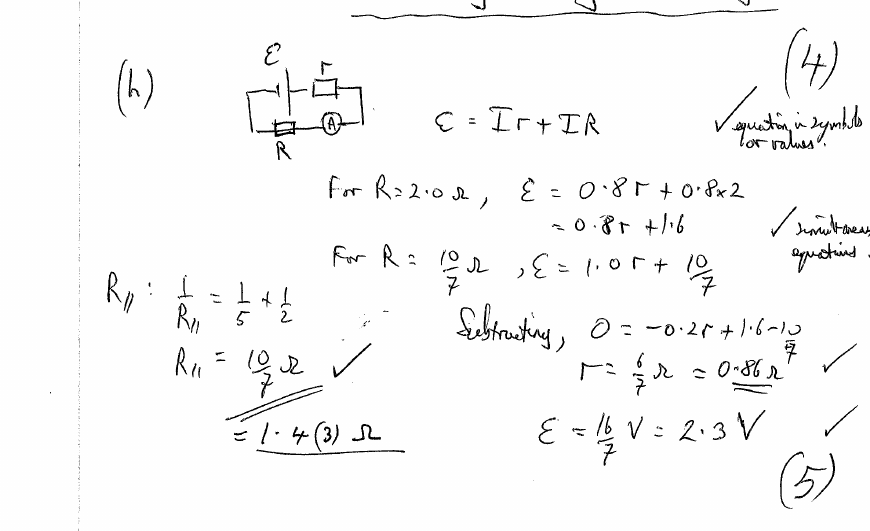
h) A cell, a resistor and an ammeter of negligible resistance are connected in series and a current of 0.80 A is observed to flow when the resistor has a value of 2.00 Ω. When a resistor of 5.00 Ω is connected in parallel with the 2.00 Ω resistor, the ammeter reading is 1.00 A. Calculate the emf and the internal resistance of the cell. [5]
Risposta: ; Ω Ω; : Ω Ω, V V
Soluzione:
Official mark scheme (BPhO Round 1, November 2017, Section 1), from the official PDF — p. 9. © BPhO, CC BY 4.0.
Topic: Circuits Metodi: Kirchhoff’s Laws, Equivalent Circuit Reduction Competenze: Mathematical Modeling Objects: Battery, Resistor Fonte: Testo (PDF) — p.4 · Soluzione ufficiale (PDF) — p.9
h) Una pila, un resistore e un amperometro di resistenza trascurabile sono collegati in serie; con il resistore da 2,00 Ω si osserva una corrente di 0,80 A. Quando si collega un resistore da 5,00 Ω in parallelo a quello da 2,00 Ω, l’amperometro segna 1,00 A. Calcola la f.e.m. e la resistenza interna della pila. [5]
Risposta: ; Ω Ω; : Ω Ω, V V
Soluzione: La soluzione ufficiale completa (in inglese) è nella versione originale di questo quesito e nel PDF ufficiale.
Topic: Circuits Metodi: Kirchhoff’s Laws, Equivalent Circuit Reduction Competenze: Mathematical Modeling Objects: Battery, Resistor Fonte: Testo (PDF) — p.4 · Soluzione ufficiale (PDF) — p.9
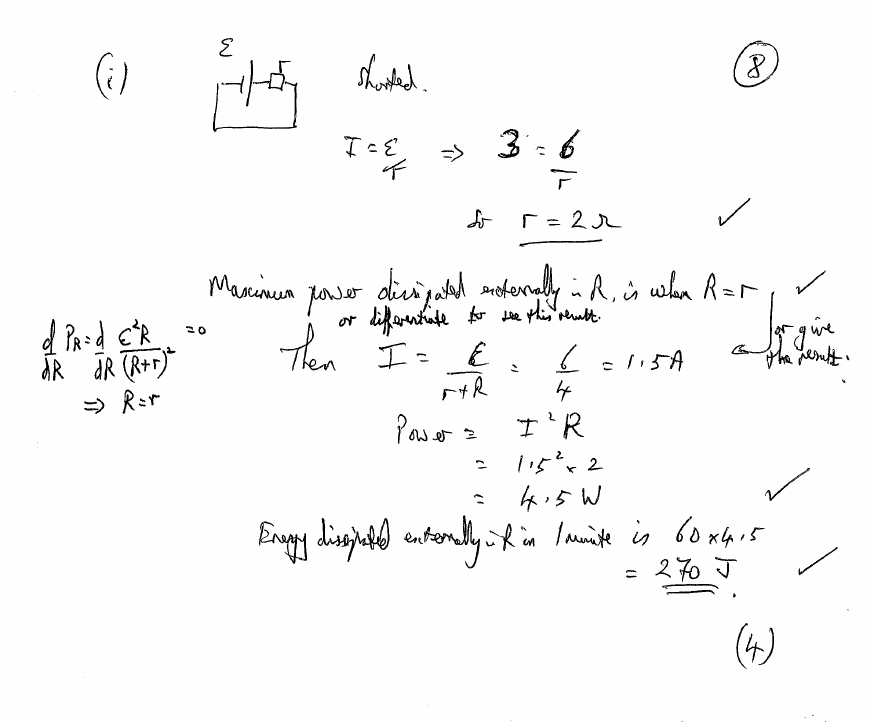
i) A battery with an emf of 6 V can produce a maximum current of 3 A. A resistor is connected to the terminals whose value is such that the power dissipated in it is a maximum. Calculate the maximum energy which can be dissipated in the external resistor in one minute. [4]
Risposta: shorted: , Ω; maximum power when : A, W; energy in 1 minute J
Soluzione:
Official mark scheme (BPhO Round 1, November 2017, Section 1), from the official PDF — p. 10. © BPhO, CC BY 4.0.
Topic: Circuits Metodi: Kirchhoff’s Laws Competenze: Mathematical Modeling Objects: Battery, Resistor Fonte: Testo (PDF) — p.4 · Soluzione ufficiale (PDF) — p.10
i) Una batteria con f.e.m. di 6 V può erogare una corrente massima di 3 A. Ai morsetti si collega un resistore di valore tale che la potenza in esso dissipata sia massima. Calcola l’energia massima che può essere dissipata nel resistore esterno in un minuto. [4]
Risposta: in cortocircuito: , Ω; potenza massima per : A, W; energia in 1 minuto J
Soluzione: La soluzione ufficiale completa (in inglese) è nella versione originale di questo quesito e nel PDF ufficiale.
Topic: Circuits Metodi: Kirchhoff’s Laws Competenze: Mathematical Modeling Objects: Battery, Resistor Fonte: Testo (PDF) — p.4 · Soluzione ufficiale (PDF) — p.10
j) Calculate the number of photons emitted in a one nanosecond ( s) pulse of light from a 0.5 mW laser of wavelength 639 nm. [3]
Risposta: Hz, J;
Soluzione:
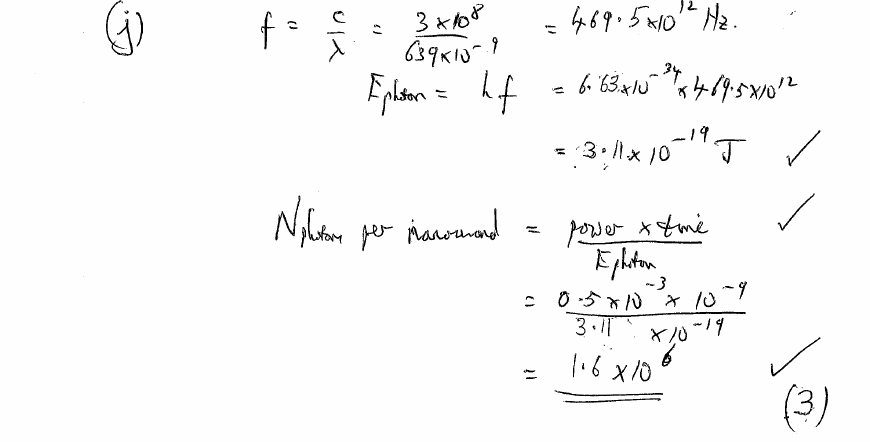
Official mark scheme (BPhO Round 1, November 2017, Section 1), from the official PDF — p. 10. © BPhO, CC BY 4.0.
Topic: Modern-Quantum Physics Metodi: Photon Energy Relation Competenze: Physical Reasoning Objects: Photon Fonte: Testo (PDF) — p.5 · Soluzione ufficiale (PDF) — p.10
j) Calcola il numero di fotoni emessi in un impulso di luce di un nanosecondo ( s) da un laser da 0,5 mW di lunghezza d’onda 639 nm. [3]
Risposta: Hz, J;
Soluzione: La soluzione ufficiale completa (in inglese) è nella versione originale di questo quesito e nel PDF ufficiale.
Topic: Modern-Quantum Physics Metodi: Photon Energy Relation Competenze: Physical Reasoning Objects: Photon Fonte: Testo (PDF) — p.5 · Soluzione ufficiale (PDF) — p.10
k) A lead ball is attached to the end of a light metal rod of length , the other end being attached to a horizontal axle of negligble friction. The rod is given an intial impulse and swings round in a vertical circle. When it is at the top of the circle, the tension in the rod is zero. What is the tension in the rod at the lowest point of its swing? [6]
Risposta: top: , ; energy: ;
Soluzione:
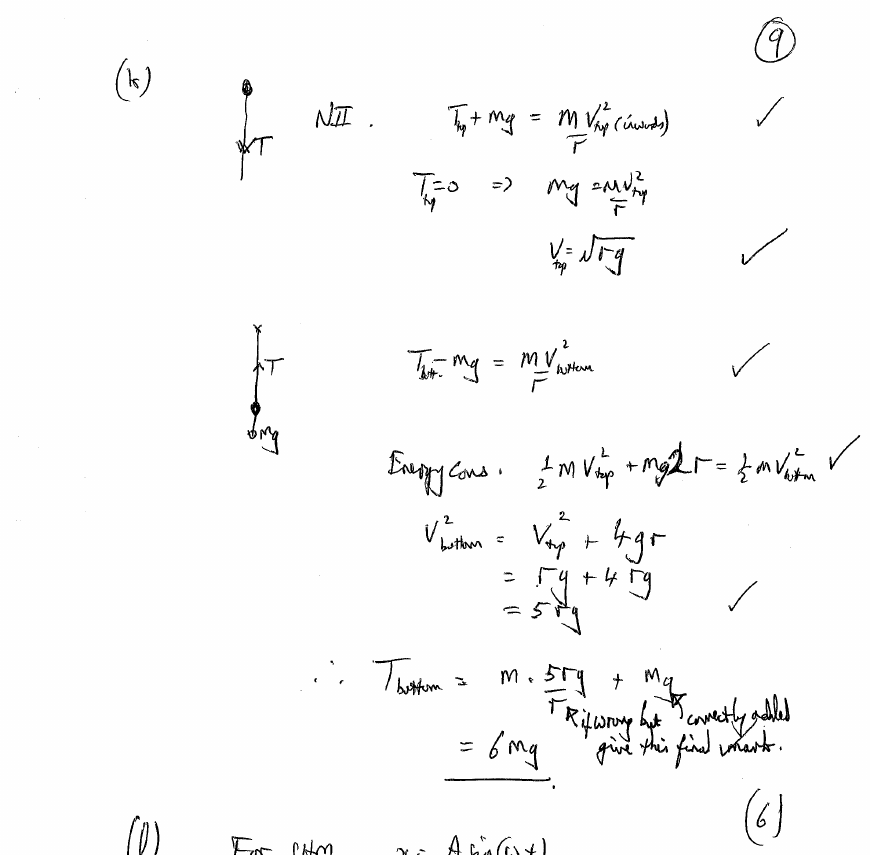
Official mark scheme (BPhO Round 1, November 2017, Section 1), from the official PDF — p. 11. © BPhO, CC BY 4.0.
Topic: Newtonian Mechanics, Conservation of Energy Metodi: Energy Conservation Method, Free-Body Diagram Competenze: Physical Reasoning Objects: Rod, Ball Fonte: Testo (PDF) — p.5 · Soluzione ufficiale (PDF) — p.11
k) Una sfera di piombo è fissata all’estremità di un’asta metallica leggera di lunghezza , la cui altra estremità è fissata a un asse orizzontale con attrito trascurabile. All’asta viene dato un impulso iniziale e la sfera percorre una circonferenza verticale. Nel punto più alto la tensione nell’asta è nulla. Qual è la tensione nell’asta nel punto più basso? [6]
Risposta: in alto: , ; energia: ;
Soluzione: La soluzione ufficiale completa (in inglese) è nella versione originale di questo quesito e nel PDF ufficiale.
Topic: Newtonian Mechanics, Conservation of Energy Metodi: Energy Conservation Method, Free-Body Diagram Competenze: Physical Reasoning Objects: Rod, Ball Fonte: Testo (PDF) — p.5 · Soluzione ufficiale (PDF) — p.11
l) Some sand is sprinkled onto a loudspeaker cone which is pointing vertically upwards. The louspeaker is driven in simple harmonic motion when attached to a signal generator and the frequency is gradually raised. At a particular frequency, when the amplitiude of oscillation is 0.20 mm, the sand begins to lose contact with the cone. At what frequency does this occur? [3]
Risposta: sand loses contact when the maximum acceleration equals : , , Hz
Soluzione:
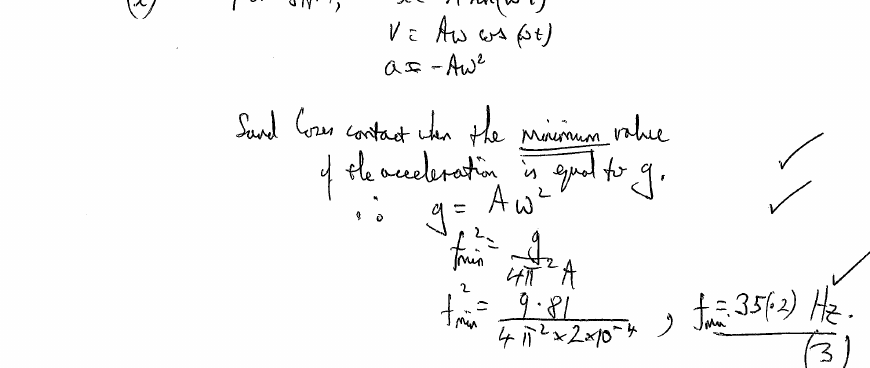
Official mark scheme (BPhO Round 1, November 2017, Section 1), from the official PDF — p. 11. © BPhO, CC BY 4.0.
Topic: Oscillations & Waves Metodi: Simple Harmonic Motion Analysis Competenze: Physical Reasoning Objects: — Fonte: Testo (PDF) — p.5 · Soluzione ufficiale (PDF) — p.11
l) Si cosparge di sabbia il cono di un altoparlante rivolto verticalmente verso l’alto. Collegato a un generatore di segnali, l’altoparlante oscilla di moto armonico semplice e la frequenza viene aumentata gradualmente. A una certa frequenza, quando l’ampiezza di oscillazione è 0,20 mm, la sabbia comincia a staccarsi dal cono. A quale frequenza accade? [3]
Risposta: la sabbia si stacca quando l’accelerazione massima è uguale a : , , Hz
Soluzione: La soluzione ufficiale completa (in inglese) è nella versione originale di questo quesito e nel PDF ufficiale.
Topic: Oscillations & Waves Metodi: Simple Harmonic Motion Analysis Competenze: Physical Reasoning Objects: — Fonte: Testo (PDF) — p.5 · Soluzione ufficiale (PDF) — p.11
m) Two radio stations on the equator, diametrically opposite each other, communicate by sending and receiving radio signals that are tangential to the Earth’s surface via two geostationary satellites in circular orbits at km above the Earth’s surface. Calculate the time delay between sending and receiving a signal. [6]
Risposta: as printed: km km; km m; s. If is taken as km: m, s, maximum 5 marks
Soluzione:
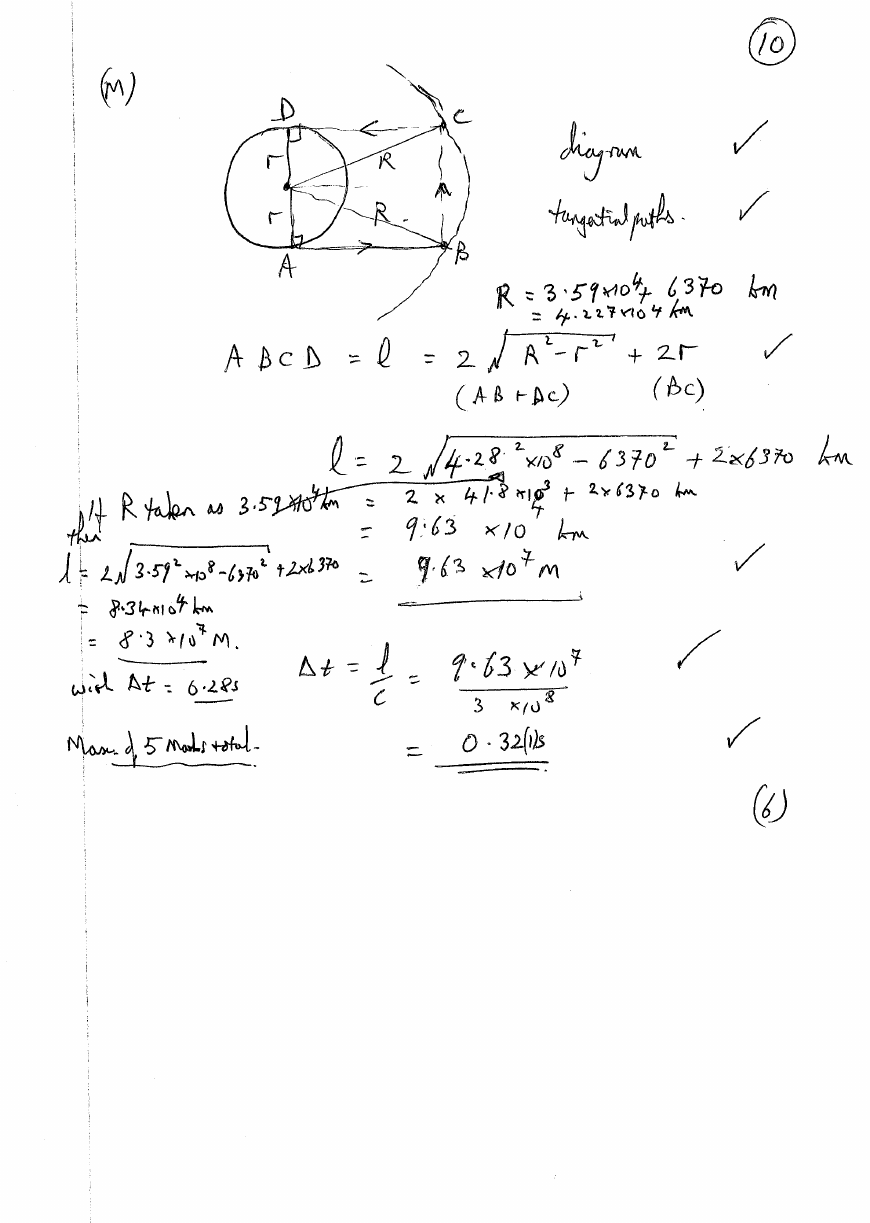
Official mark scheme (BPhO Round 1, November 2017, Section 1), from the official PDF — p. 12. © BPhO, CC BY 4.0.
Topic: Gravitation, Oscillations & Waves Metodi: Physical Modeling Competenze: Diagrammatic Reasoning Objects: Satellite, Planet Fonte: Testo (PDF) — p.5 · Soluzione ufficiale (PDF) — p.12
m) Due stazioni radio sull’equatore, diametralmente opposte, comunicano inviando e ricevendo segnali radio tangenti alla superficie terrestre tramite due satelliti geostazionari in orbita circolare a km sopra la superficie terrestre. Calcola il ritardo tra l’invio e la ricezione di un segnale. [6]
Risposta: come stampato: km km; km m; s. Se si prende km: m, s, al massimo 5 punti
Soluzione: La soluzione ufficiale completa (in inglese) è nella versione originale di questo quesito e nel PDF ufficiale.
Topic: Gravitation, Oscillations & Waves Metodi: Physical Modeling Competenze: Diagrammatic Reasoning Objects: Satellite, Planet Fonte: Testo (PDF) — p.5 · Soluzione ufficiale (PDF) — p.12
n) A thin film of transparent material of refractive index 1.52 and thickness 0.42 µm forms a thin coating on glass of refractive index 1.60. It is viewed by reflection with white light at normal incidence. What visible wavelength in vacuo is most strongly reflected? [5]
Risposta: phase change of at each reflecting surface, so none overall; , : gives 1280 nm (IR), gives nm (visible)
Soluzione:
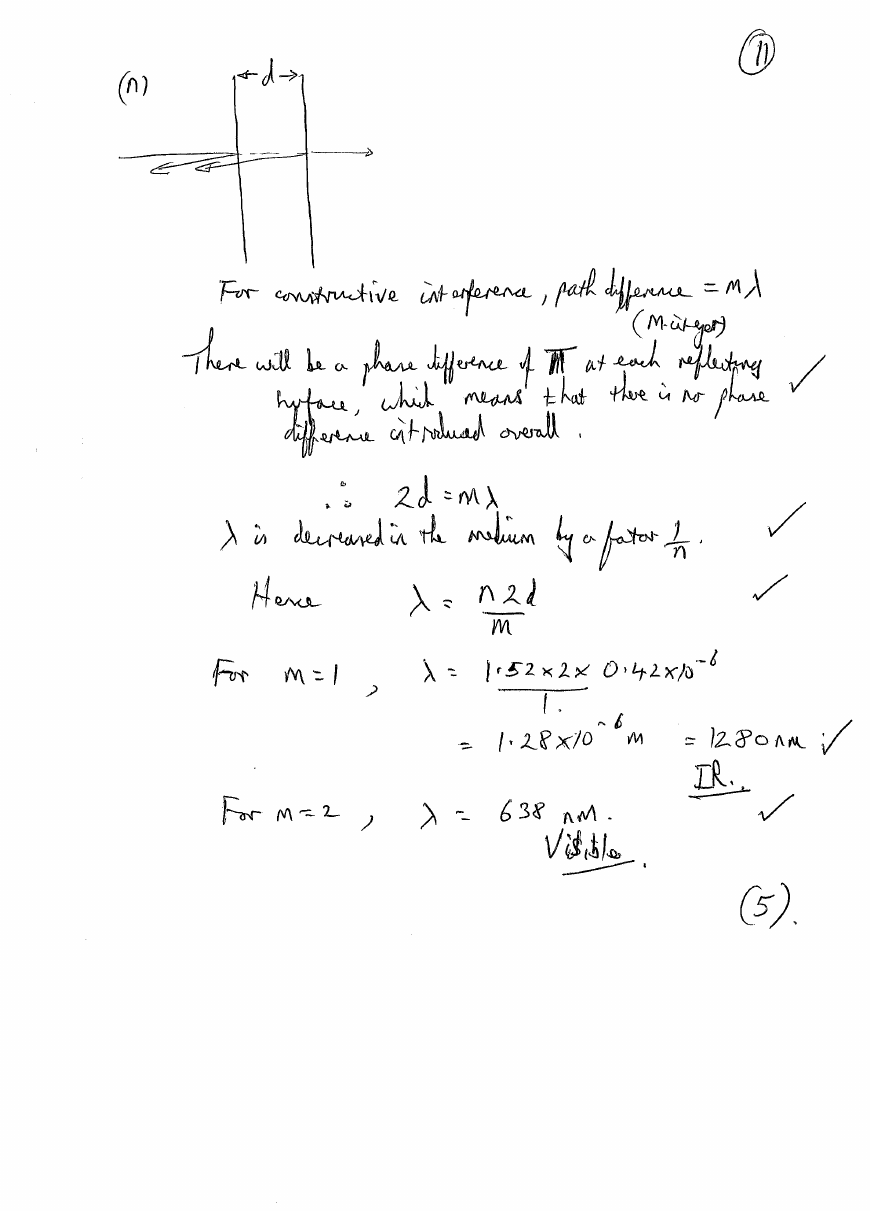
Official mark scheme (BPhO Round 1, November 2017, Section 1), from the official PDF — p. 13. © BPhO, CC BY 4.0.
Topic: Wave Optics Metodi: Interference & Diffraction Analysis Competenze: Physical Reasoning Objects: — Fonte: Testo (PDF) — p.5 · Soluzione ufficiale (PDF) — p.13
n) Una pellicola sottile di materiale trasparente, con indice di rifrazione 1,52 e spessore 0,42 µm, ricopre un vetro di indice di rifrazione 1,60. La si osserva in riflessione con luce bianca a incidenza normale. Quale lunghezza d’onda visibile (nel vuoto) viene riflessa più intensamente? [5]
Risposta: sfasamento di a ciascuna superficie riflettente, quindi nessuno complessivo; , : dà 1280 nm (IR), dà nm (visibile)
Soluzione: La soluzione ufficiale completa (in inglese) è nella versione originale di questo quesito e nel PDF ufficiale.
Topic: Wave Optics Metodi: Interference & Diffraction Analysis Competenze: Physical Reasoning Objects: — Fonte: Testo (PDF) — p.5 · Soluzione ufficiale (PDF) — p.13
o) Monochromatic light of wavelength 600 nm is incident on two vertical slits hence producing two coherent sources. Before the light leaving these slits overlaps and interferes, each beam passes through a tube 5.0 cm long. One of the tubes is now gradually evacuated and it is noted that the fringe pattern shifts 25 fringes. Calculate the refractive index of air. [5]
Risposta: 25 fringes = path change of ; , with :
Soluzione:
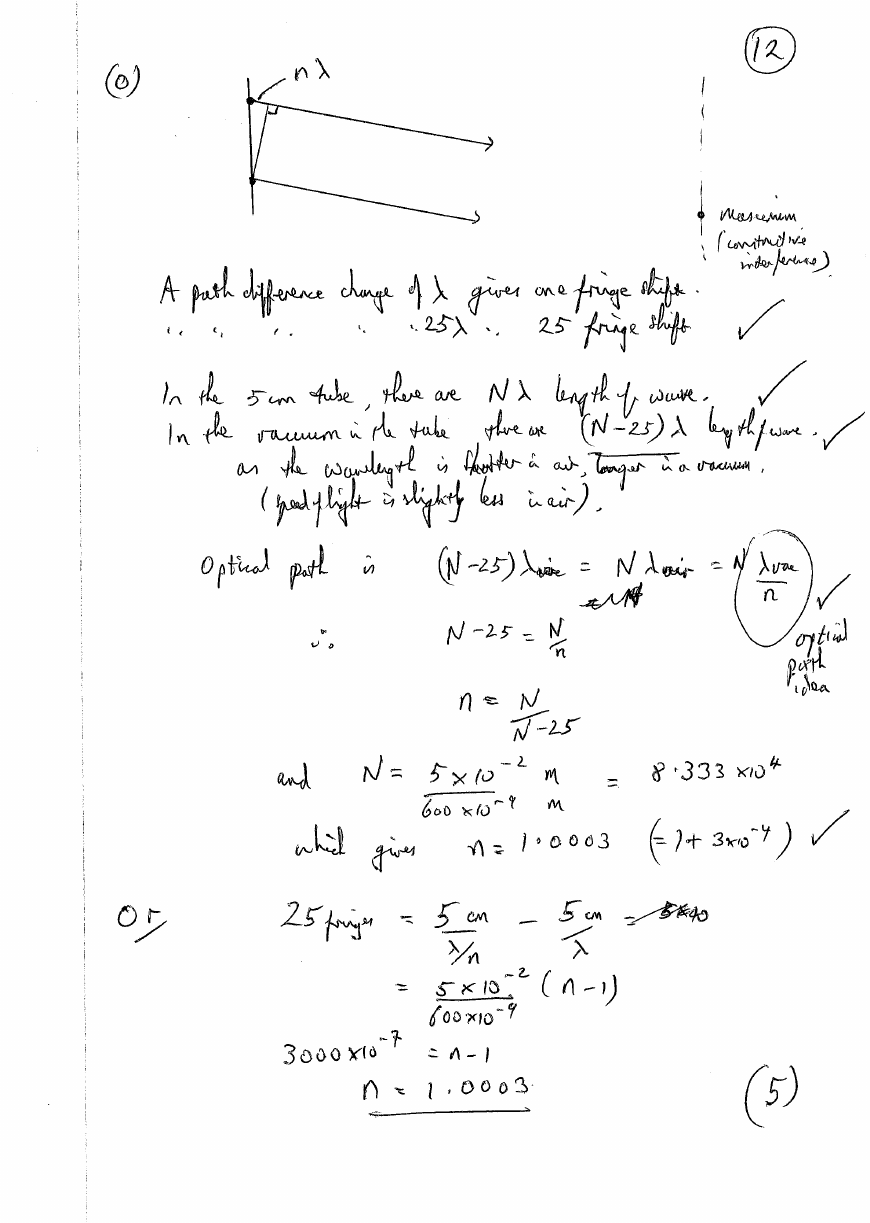
Official mark scheme (BPhO Round 1, November 2017, Section 1), from the official PDF — p. 14. © BPhO, CC BY 4.0.
Topic: Wave Optics Metodi: Interference & Diffraction Analysis Competenze: Physical Reasoning Objects: Slit, Tube Fonte: Testo (PDF) — p.5 · Soluzione ufficiale (PDF) — p.14
o) Luce monocromatica di lunghezza d’onda 600 nm incide su due fenditure verticali, che diventano così due sorgenti coerenti. Prima di sovrapporsi e interferire, ciascun fascio uscente dalle fenditure attraversa un tubo lungo 5,0 cm. Uno dei tubi viene gradualmente svuotato e si osserva che la figura di interferenza si sposta di 25 frange. Calcola l’indice di rifrazione dell’aria. [5]
Risposta: 25 frange = variazione di cammino di ; , con :
Soluzione: La soluzione ufficiale completa (in inglese) è nella versione originale di questo quesito e nel PDF ufficiale.
Topic: Wave Optics Metodi: Interference & Diffraction Analysis Competenze: Physical Reasoning Objects: Slit, Tube Fonte: Testo (PDF) — p.5 · Soluzione ufficiale (PDF) — p.14
p) A submerged wreck is lifted from a dock basin by means of a crane to which is attached a steel cable 10 m long of cross-sectional area 5.0 cm and Young modulus Pa. The material being lifted has a mass of kg and mean density 8000 kg m. Find the change in extension of the cable as the load is lifted clear of the water. Assume that at all times the tension in the cable is the same throughout its length. (Density of water is 1000 kg m.) [5]
Risposta: ; the change in extension is due to the upthrust : m (or: extension in air m, in water m; volume 1.25 m, upthrust 12,250 N, weight 98,000 N)
Soluzione:
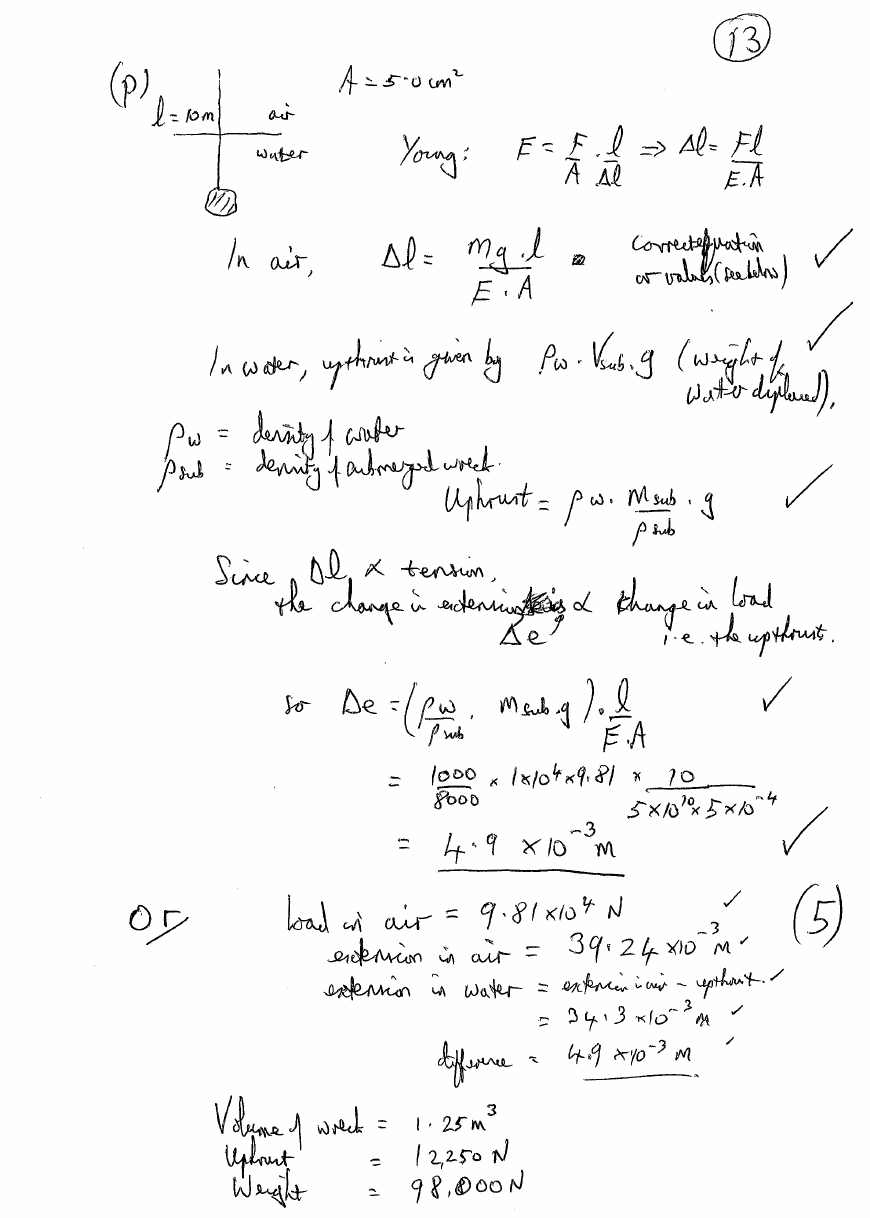
Official mark scheme (BPhO Round 1, November 2017, Section 1), from the official PDF — p. 15. © BPhO, CC BY 4.0.
Topic: Elasticity & Materials, Fluid Mechanics Metodi: Stress-Strain Analysis, Hydrostatic Equilibrium Competenze: Physical Reasoning Objects: String, Container Fonte: Testo (PDF) — p.6 · Soluzione ufficiale (PDF) — p.15
p) Un relitto sommerso viene sollevato da un bacino portuale con una gru a cui è attaccato un cavo d’acciaio lungo 10 m, di sezione 5,0 cm e modulo di Young Pa. Il materiale sollevato ha massa kg e densità media 8000 kg m. Trova la variazione dell’allungamento del cavo quando il carico esce completamente dall’acqua. Assumi che la tensione del cavo sia sempre la stessa lungo tutta la sua lunghezza. (Densità dell’acqua: 1000 kg m.) [5]
Risposta: ; la variazione di allungamento è dovuta alla spinta : m (oppure: allungamento in aria m, in acqua m; volume 1,25 m, spinta 12 250 N, peso 98 000 N)
Soluzione: La soluzione ufficiale completa (in inglese) è nella versione originale di questo quesito e nel PDF ufficiale.
Topic: Elasticity & Materials, Fluid Mechanics Metodi: Stress-Strain Analysis, Hydrostatic Equilibrium Competenze: Physical Reasoning Objects: String, Container Fonte: Testo (PDF) — p.6 · Soluzione ufficiale (PDF) — p.15
q) A uniform beam AOB, O being the midpoint of AB, mass , rests on three vertical springs with stiffness constants , , at A, O and B respectively. The bases of the springs are fixed to a horizontal platform. Determine the compression of the springs and their compressional forces in the following two instances: (i) and (ii) , and [8]
Risposta: (i) symmetric, level beam: , ; , ; (ii) total load, beam is linear () and moments about the centre (): , , ; , ,
Soluzione:
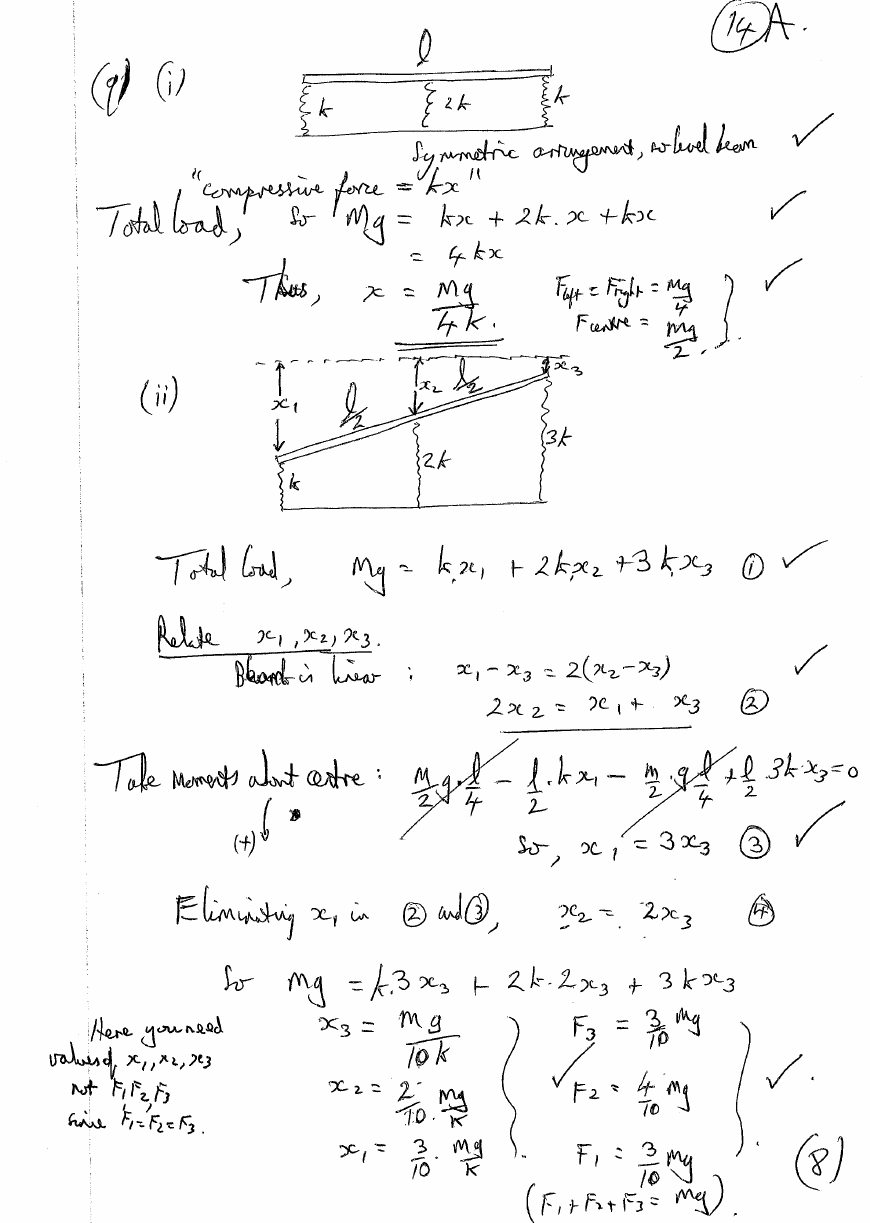
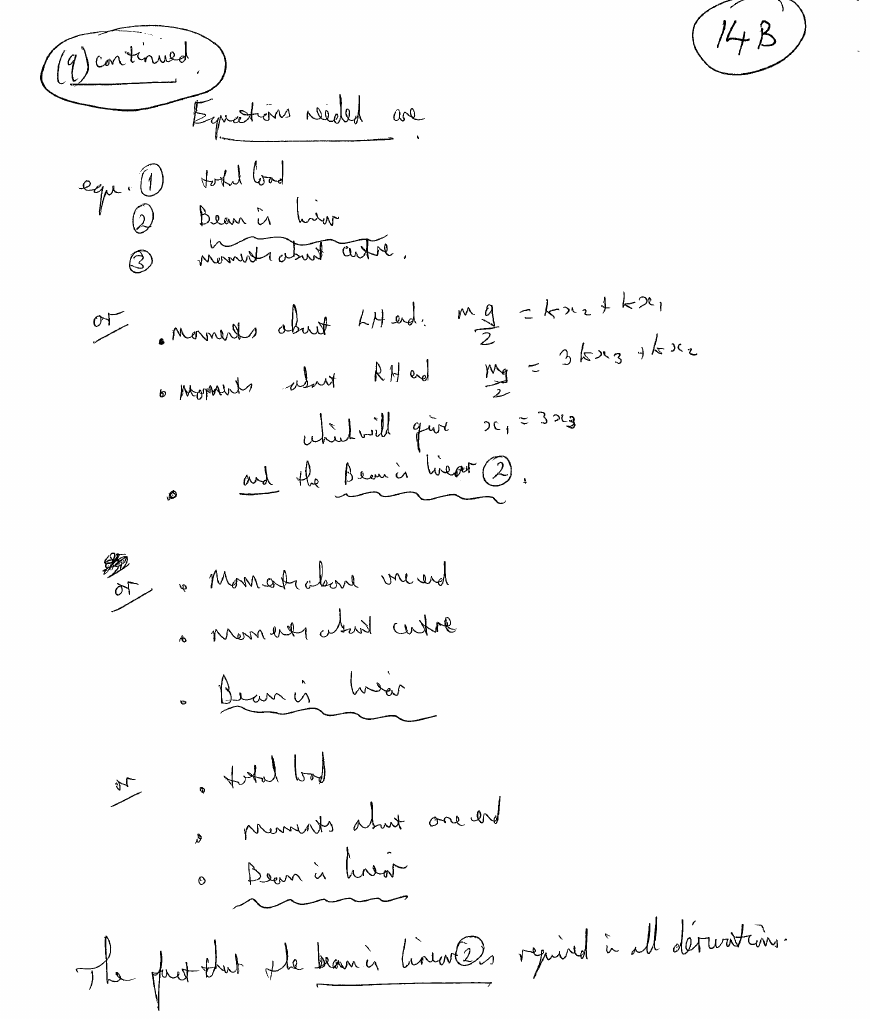
Official mark scheme (BPhO Round 1, November 2017, Section 1), from the official PDF — p. 16, 17. © BPhO, CC BY 4.0.
Topic: Rigid Body Statics Metodi: Hooke’s Law, Torque & Angular Momentum Analysis Competenze: Mathematical Modeling Objects: Beam, Spring Fonte: Testo (PDF) — p.6 · Soluzione ufficiale (PDF) — p.16
q) Una trave omogenea AOB di massa , con O punto medio di AB, poggia su tre molle verticali di costanti elastiche , , poste rispettivamente in A, O e B. Le basi delle molle sono fissate a una piattaforma orizzontale. Determina la compressione delle molle e le relative forze di compressione nei due casi seguenti: (i) e (ii) , e [8]
Risposta: (i) trave simmetrica e orizzontale: , ; , ; (ii) carico totale, trave rettilinea () e momenti rispetto al centro (): , , ; , ,
Soluzione: La soluzione ufficiale completa (in inglese) è nella versione originale di questo quesito e nel PDF ufficiale.
Topic: Rigid Body Statics Metodi: Hooke’s Law, Torque & Angular Momentum Analysis Competenze: Mathematical Modeling Objects: Beam, Spring Fonte: Testo (PDF) — p.6 · Soluzione ufficiale (PDF) — p.16
r) A pond is covered by a layer of ice 5 cm thick. How long will it be before the ice is 10 cm thick if the air temperature stays constant at −10 °C? Assume the density of ice = 900 kg m; the latent heat of fusion of ice = 330 kJ kg; the thermal conductivity of ice = 2.1 W m K. The power flowing perpendicular to the faces through a uniform material is given by power flow , in which is the thermal conductivity of the material, is the hotter temperature at one face of the material, is the colder temperature on the other face, is the area of a face, and is the thickness of the material. [7]
Risposta: ; integrating, s minutes hours
Soluzione:
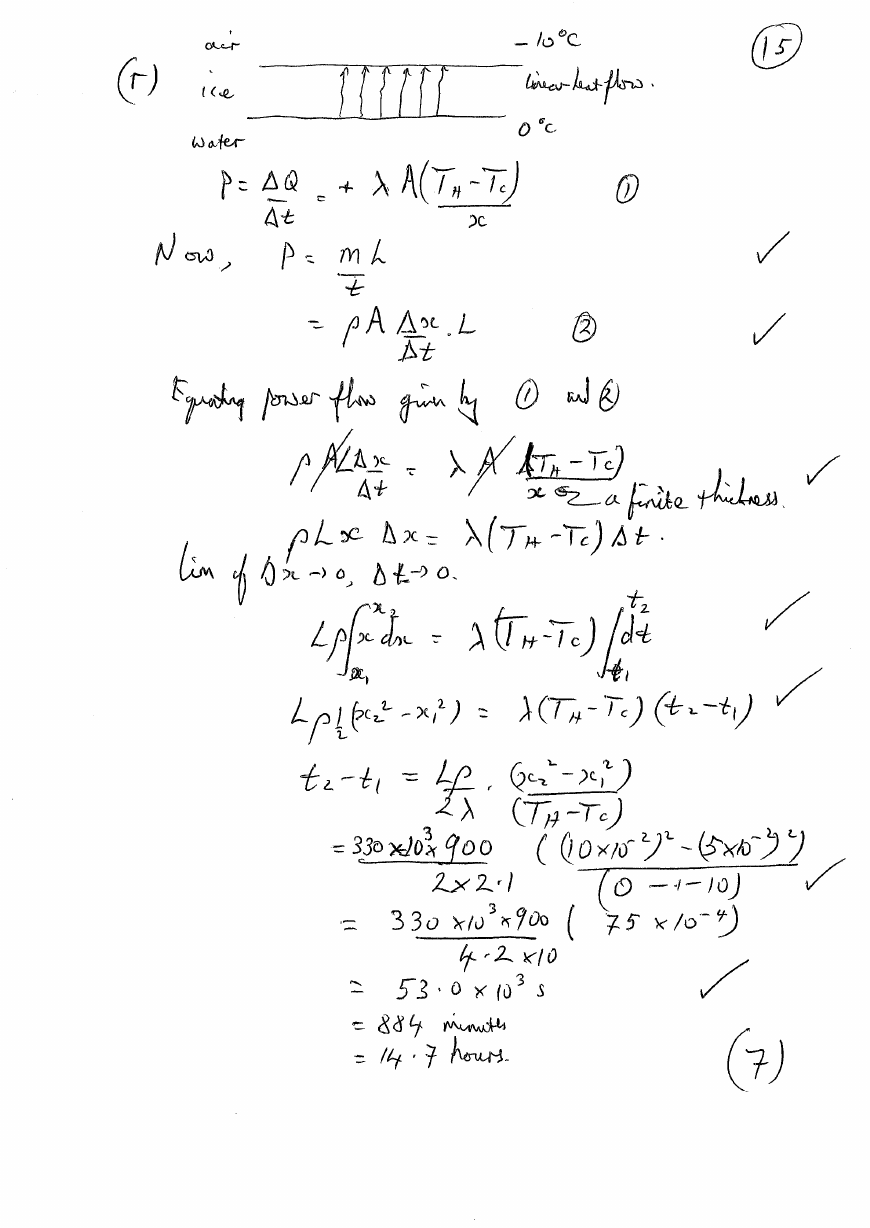
Official mark scheme (BPhO Round 1, November 2017, Section 1), from the official PDF — p. 18. © BPhO, CC BY 4.0.
Topic: Thermodynamics Metodi: Differential Equations, Calculus-Integration Competenze: Mathematical Modeling Objects: — Fonte: Testo (PDF) — p.6 · Soluzione ufficiale (PDF) — p.18
r) Uno stagno è coperto da uno strato di ghiaccio spesso 5 cm. Quanto tempo occorre perché il ghiaccio raggiunga 10 cm di spessore, se la temperatura dell’aria resta costante a −10 °C? Assumi densità del ghiaccio = 900 kg m; calore latente di fusione del ghiaccio = 330 kJ kg; conducibilità termica del ghiaccio = 2,1 W m K. La potenza che fluisce perpendicolarmente alle facce attraverso un materiale omogeneo è , dove è la conducibilità termica del materiale, la temperatura più alta su una faccia, la temperatura più bassa sull’altra faccia, l’area di una faccia e lo spessore del materiale. [7]
Risposta: ; integrando, s minuti ore
Soluzione: La soluzione ufficiale completa (in inglese) è nella versione originale di questo quesito e nel PDF ufficiale.
Topic: Thermodynamics Metodi: Differential Equations, Calculus-Integration Competenze: Mathematical Modeling Objects: — Fonte: Testo (PDF) — p.6 · Soluzione ufficiale (PDF) — p.18
Answers from the official BPhO Round 1 2017 mark scheme.
| Problem | Title | Risposta |
|---|---|---|
| 1 | 1 foot/ns m s; error (using gains only 2/3 marks) | |
| 2 | as printed in the scheme (80 N at end B, at A): (i) moments about A, , m m; m, m m; (ii) N (or ); answers as fractions or to 2 s.f. are OK | |
| 3 | (i) in the first 10 s average acceleration 7.5 m s, so m s at 10 s; the extra 25 m s at 5 m s takes 5 s: s after the start; (ii) curve up to 10 s, then linear, no kink (values not required) | |
| 4 | horizontal speed before, after; ; vertical motion unaffected, : , i.e. | |
| 5 | N; lift = rate of change of momentum, ; (as printed), m s | |
| 6 | (i) ; (iii) cosine rule, , h, interception at 3:30 pm; (ii) (magnitude ) | |
| 7 | J; , g g kg (if the term is left out, 40.9 g loses 1 mark) | |
| 8 | ; Ω Ω; : Ω Ω, V V | |
| 9 | shorted: , Ω; maximum power when : A, W; energy in 1 minute J | |
| 10 | Hz, J; | |
| 11 | top: , ; energy: ; | |
| 12 | sand loses contact when the maximum acceleration equals : , , Hz | |
| 13 | as printed: km km; km m; s. If is taken as km: m, s, maximum 5 marks | |
| 14 | phase change of at each reflecting surface, so none overall; , : gives 1280 nm (IR), gives nm (visible) | |
| 15 | 25 fringes = path change of ; , with : | |
| 16 | ; the change in extension is due to the upthrust : m (or: extension in air m, in water m; volume 1.25 m, upthrust 12,250 N, weight 98,000 N) | |
| 17 | (i) symmetric, level beam: , ; , ; (ii) total load, beam is linear () and moments about the centre (): , , ; , , | |
| 18 | ; integrating, s minutes hours |
Fonte: Testo e soluzioni (PDF)
Risposte tratte dal mark scheme ufficiale BPhO Round 1 2017.
| Problema | Titolo | Risposta |
|---|---|---|
| 1 | 1 piede/ns m s; errore (con solo 2/3 dei punti) | |
| 2 | come stampato nello schema (80 N all’estremo B, in A): (i) momenti rispetto ad A, , m m; m, m m; (ii) N (oppure ); risposte in frazione o a 2 c.s. accettate | |
| 3 | (i) nei primi 10 s accelerazione media 7,5 m s, quindi m s a 10 s; i 25 m s mancanti a 5 m s richiedono 5 s: s dalla partenza; (ii) curva fino a 10 s, poi retta, senza spigolo (valori non richiesti) | |
| 4 | velocità orizzontale prima, dopo; ; moto verticale non alterato, : , cioè | |
| 5 | N; portanza = rapidità di variazione della quantità di moto, ; (come stampato), m s | |
| 6 | (i) ; (iii) teorema del coseno, , h, intercettazione alle 15:30; (ii) (modulo ) | |
| 7 | J; , g g kg (se si omette il termine , 40,9 g perde 1 punto) | |
| 8 | ; Ω Ω; : Ω Ω, V V | |
| 9 | in cortocircuito: , Ω; potenza massima per : A, W; energia in 1 minuto J | |
| 10 | Hz, J; | |
| 11 | in alto: , ; energia: ; | |
| 12 | la sabbia si stacca quando l’accelerazione massima è uguale a : , , Hz | |
| 13 | come stampato: km km; km m; s. Se si prende km: m, s, al massimo 5 punti | |
| 14 | sfasamento di a ciascuna superficie riflettente, quindi nessuno complessivo; , : dà 1280 nm (IR), dà nm (visibile) | |
| 15 | 25 frange = variazione di cammino di ; , con : | |
| 16 | ; la variazione di allungamento è dovuta alla spinta : m (oppure: allungamento in aria m, in acqua m; volume 1,25 m, spinta 12 250 N, peso 98 000 N) | |
| 17 | (i) trave simmetrica e orizzontale: , ; , ; (ii) carico totale, trave rettilinea () e momenti rispetto al centro (): , , ; , , | |
| 18 | ; integrando, s minuti ore |
Fonte: Testo e soluzioni (PDF)