Question 2 — Gravitation: orbits, the Earth’s interior, planet formation [25 marks]
a) A planet has a radius and the gravitational field strength at its surface is . A satellite is placed in a circular orbit of radius around the planet. Obtain an expression for , the period of orbit of the satellite, in terms of , and , explaining the relevant physics in each of your steps. (3)
b) Both the Earth and Jupiter can be assumed to have circular orbits about the Sun. Jupiter has an orbital period, years. What is the orbital radius of Jupiter in au? Note: an au (astronomical unit) is the average distance between the Earth and the Sun. (1)
c) The density of the Earth changes sharply between the core and the mantle. By taking just two suitable values of the density of the core and mantle of the Earth from the graph in Figure 1, estimate a value of the mass of the Earth using this data. Your values and calculation must be shown. (3)
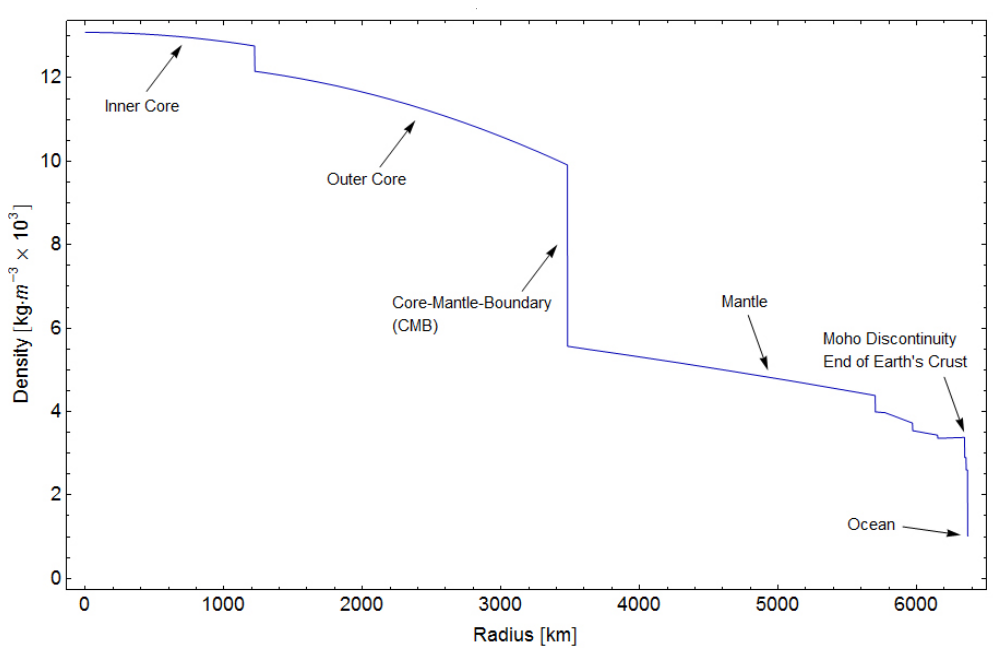
Figure 1 (credit: AllenMcC., CC BY 3.0, from Wikimedia Commons)
d) A planet of mass has an orbiting moon of mass . The mass of the moon is about 1/8 the mass of the planet.
(i) Sketch a set of equipotential lines for the planet-moon system. Ignore the orbital motion of the moon. Without detailed calculation, indicate on your sketch the relative positions of the neutral point (a point of zero field strength) and the centre of mass of the planet-moon system.
A rocket of mass is launched from the planet. The rocket engine is used very briefly at take-off when it is close to the planet’s surface, and it almost immediately reaches speed , after which the fuel is exhausted and there is no further propulsion. It is then in free-fall and will have just enough energy to reach the moon. Assume that you can ignore relative motion of the planet and moon, and ignore air resistance. Obtain expressions and calculate values for:
(ii) The distance, , from the planet’s centre, where the speed of the rocket is lowest.
(iii) The launch speed of the rocket from the planet, in terms of the variables , , the radius of the planet, , and the separation of the centres of the moon and planet, . For this question part, you may take kg, kg, m. (9)
e) The Earth can be considered to consist of concentric spheres of material, the outer sphere being the crust with a density of 2500 kg m. If the mass of the Earth is kg, what will be the fractional change in the gravitational field strength when descending to the bottom of a gold mine, a distance m below the surface of the Earth? Hint: the field inside a hollow spherical shell is zero. (4)
f) A planetary sized object similar to the Earth was formed from a very large spherical cloud of interstellar dust collapsing under gravity to form a spherical body of uniform density and radius
(i) Find an expression for the change in gravitational potential energy as the radius of the proto-planet increases from to by the formation of a thin spherical shell of material of mass .
(ii) Now derive an expression for the total transfer of gravitational potential energy in the formation of the planet. Use the following terms: the gravitational constant , and the final radius and mass, and respectively.
(iii) If all of this energy was used to heat the planet formed at a very low initial temperature, estimate the temperature that the planet would have reached. For this planet, take km, kg, and the average specific heat capacity of the material of the planet is 700 J kg K. (5)
Risposta: a) , . b) au. c) core radius m, density – kg m; mantle to – m, density – kg m: mass – kg. d) (i) centre of mass of the separation from the planet, neutral point about of the separation from the moon; (ii) m; (iii) , m s km s. e) (using instead gives 0.14%, allowed 3 marks). f) (i) ; (ii) ; (iii) K
Soluzione:
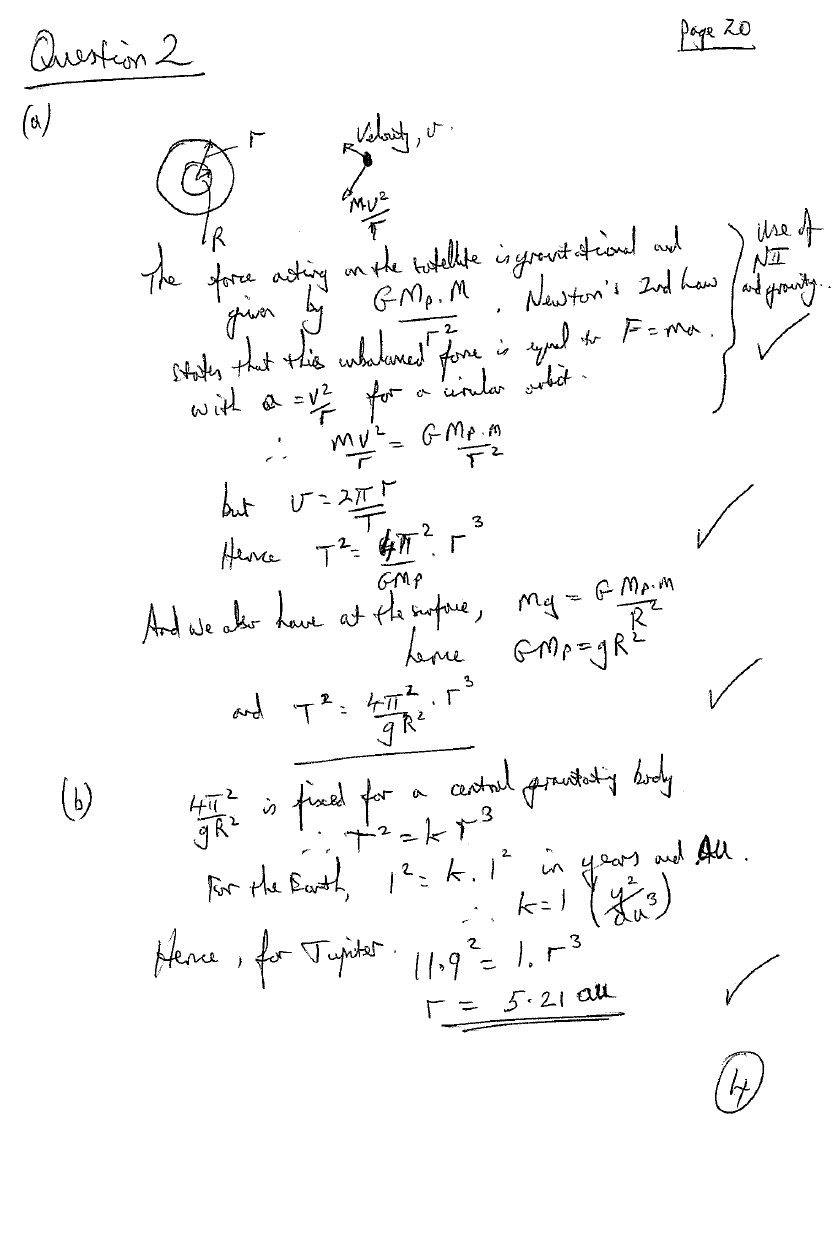
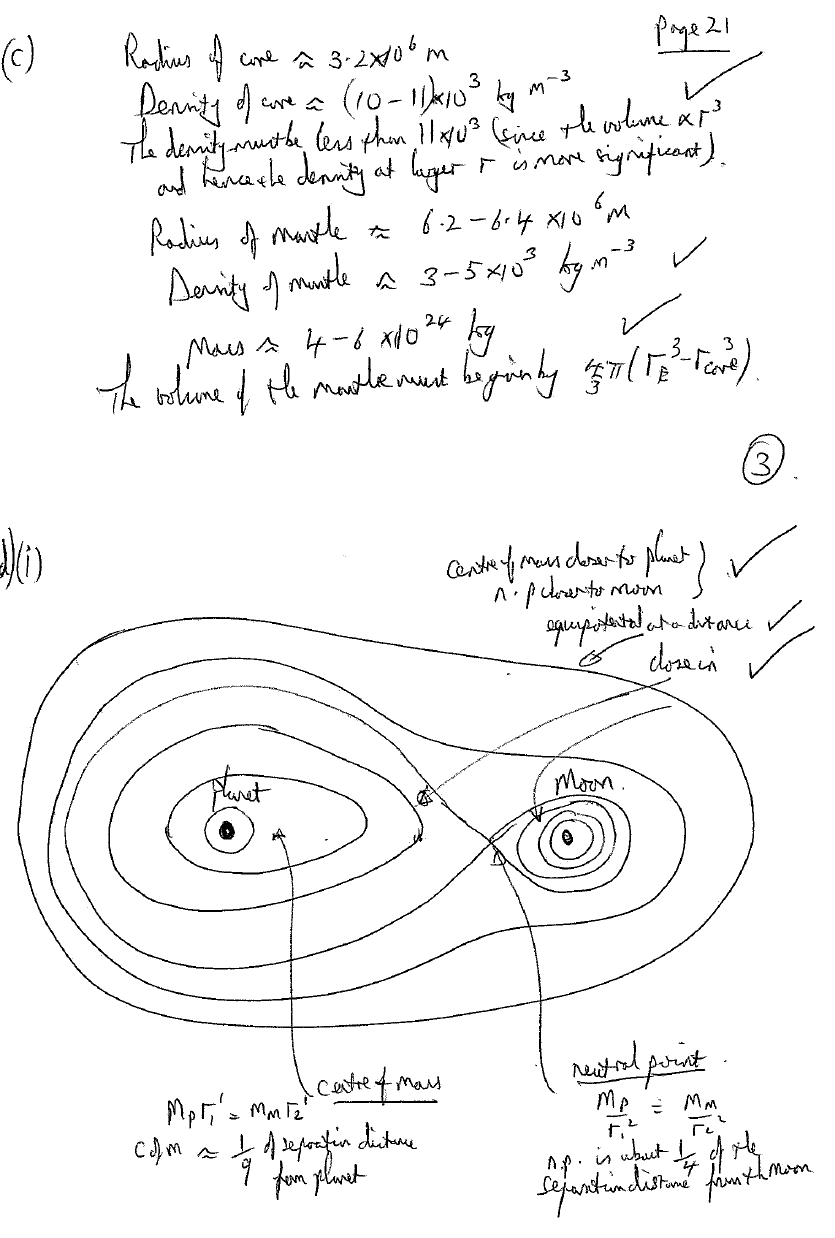
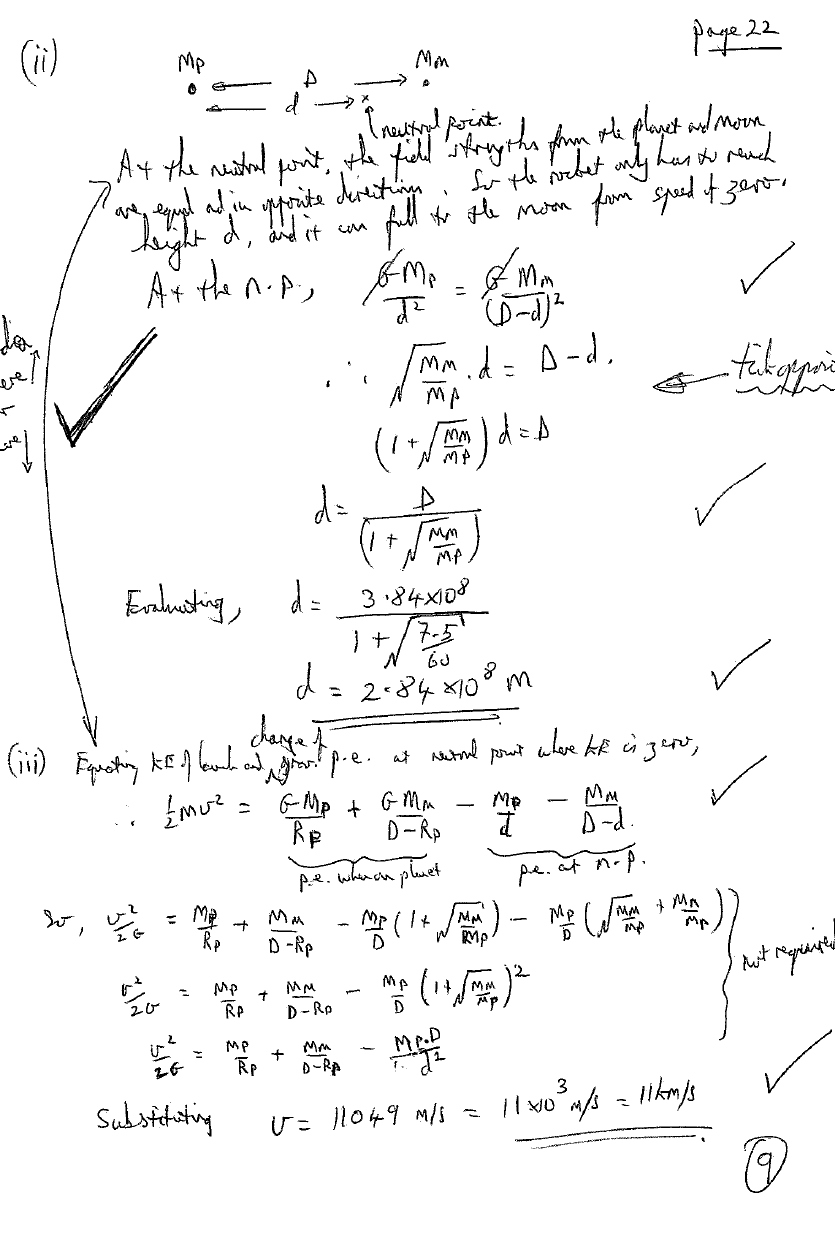
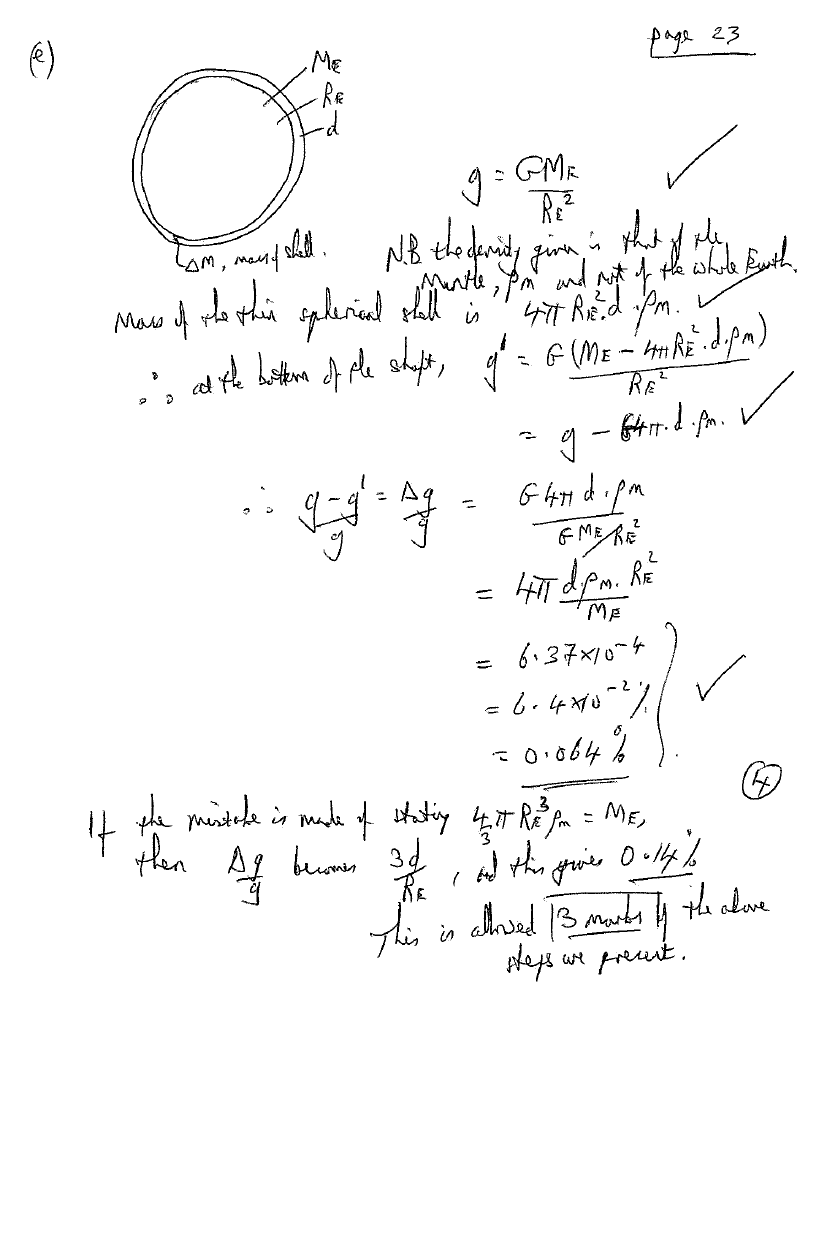
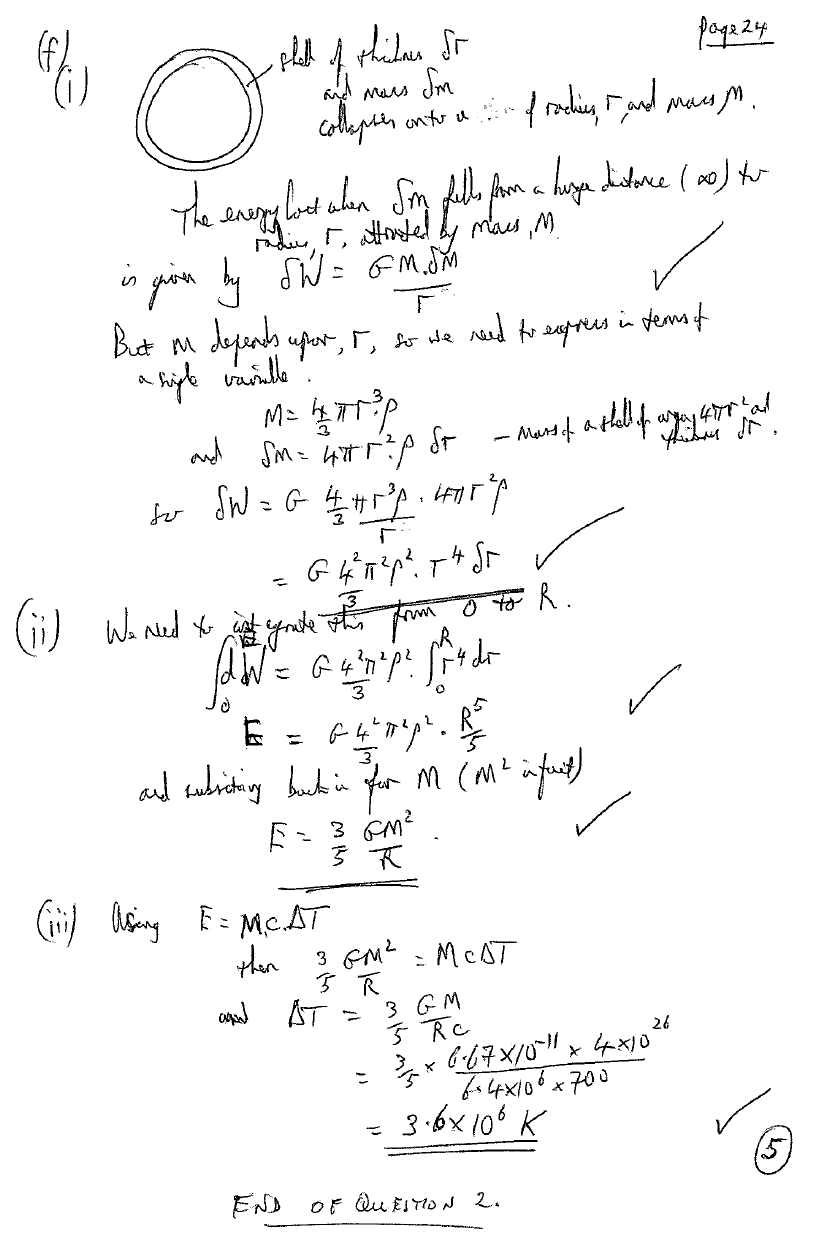
Official mark scheme (BPhO Round 1, November 2018, Section 2), from the official PDF — p. 21, 22, 23, 24, 25. © BPhO, CC BY 4.0.
Topic: Gravitation, Astrophysics, Thermodynamics Metodi: Newton’s Law of Gravitation, Kepler’s Laws, Energy Conservation Method, Calculus-Integration Competenze: Mathematical Modeling, Estimation & Approximation Objects: Planet, Satellite Fonte: Testo (PDF) — p.4 · Soluzione ufficiale (PDF) — p.21
Problema 2 — Gravitazione: orbite, interno della Terra, formazione dei pianeti [25 punti]
a) Un pianeta ha raggio e sulla sua superficie l’intensità del campo gravitazionale è . Un satellite è posto in orbita circolare di raggio attorno al pianeta. Ricava un’espressione del periodo orbitale del satellite in funzione di , e , spiegando la fisica di ciascun passaggio. (3)
b) Le orbite della Terra e di Giove attorno al Sole si possono considerare circolari. Il periodo orbitale di Giove è anni. Qual è il raggio dell’orbita di Giove in UA? Nota: l’UA (unità astronomica) è la distanza media tra la Terra e il Sole. (1)
c) La densità della Terra cambia bruscamente tra nucleo e mantello. Prendendo dal grafico di Figura 1 solo due valori adatti della densità del nucleo e del mantello, stima la massa della Terra. Devi mostrare i valori scelti e il calcolo. (3)
Figura 1 (fonte: AllenMcC., CC BY 3.0, da Wikimedia Commons)
d) Un pianeta di massa ha una luna di massa in orbita. La massa della luna è circa 1/8 di quella del pianeta.
(i) Disegna alcune linee equipotenziali del sistema pianeta-luna, ignorando il moto orbitale della luna. Senza calcoli dettagliati, indica sul disegno le posizioni relative del punto neutro (punto di campo nullo) e del centro di massa del sistema pianeta-luna.
Un razzo di massa viene lanciato dal pianeta. Il motore funziona per un tempo brevissimo al decollo, vicino alla superficie del pianeta, e il razzo raggiunge quasi subito la velocità ; poi il carburante è esaurito e non c’è altra propulsione. Il razzo è quindi in caduta libera e ha energia appena sufficiente per raggiungere la luna. Trascura il moto relativo di pianeta e luna e la resistenza dell’aria. Ricava espressioni e calcola i valori di:
(ii) la distanza dal centro del pianeta in cui la velocità del razzo è minima;
(iii) la velocità di lancio del razzo dal pianeta, in funzione di , , del raggio del pianeta e della distanza tra i centri della luna e del pianeta. Per questa parte puoi prendere kg, kg, m. (9)
e) La Terra si può considerare formata da sfere concentriche di materiale; la sfera più esterna è la crosta, di densità 2500 kg m. Se la massa della Terra è kg, quale sarà la variazione relativa dell’intensità del campo gravitazionale scendendo in fondo a una miniera d’oro, a una profondità m sotto la superficie terrestre? Suggerimento: il campo all’interno di un guscio sferico cavo è nullo. (4)
f) Un corpo di dimensioni planetarie simile alla Terra si è formato da una grandissima nube sferica di polvere interstellare che è collassata per gravità formando un corpo sferico di densità uniforme e raggio .
(i) Trova un’espressione della variazione di energia potenziale gravitazionale quando il raggio del protopianeta cresce da a per la formazione di un sottile guscio sferico di materiale di massa .
(ii) Ricava un’espressione dell’energia potenziale gravitazionale totale trasferita nella formazione del pianeta, usando la costante di gravitazione e il raggio e la massa finali, e .
(iii) Se tutta questa energia servisse a scaldare il pianeta, formatosi a una temperatura iniziale molto bassa, stima la temperatura che il pianeta raggiungerebbe. Per questo pianeta prendi km, kg e un calore specifico medio del materiale di 700 J kg K. (5)
Risposta: a) , . b) UA. c) raggio del nucleo m, densità – kg m; mantello fino a – m, densità – kg m: massa – kg. d) (i) centro di massa a della distanza dal pianeta, punto neutro a circa della distanza dalla luna; (ii) m; (iii) , m s km s. e) (usando invece si ottiene 0,14%, 3 punti). f) (i) ; (ii) ; (iii) K
Soluzione: La soluzione ufficiale completa (in inglese) è nella versione originale di questo quesito e nel PDF ufficiale.
Topic: Gravitation, Astrophysics, Thermodynamics Metodi: Newton’s Law of Gravitation, Kepler’s Laws, Energy Conservation Method, Calculus-Integration Competenze: Mathematical Modeling, Estimation & Approximation Objects: Planet, Satellite Fonte: Testo (PDF) — p.4 · Soluzione ufficiale (PDF) — p.21
Question 3 — Circular motion, elastic strings and oscillations [25 marks]
a) A particle is moving in a horizontal circle and is kept in its path by a string tied to a point at a height above the centre of the circle.
(i) Find the period of rotation in terms of and the gravitational field strength , explaining the physics of your derivation in words.
(ii) If the tension in the string is three times the weight of the particle, find the length of the string , in terms of . (5)
b) (i) A particle of mass is suspended by a thin elastic string of natural length in which a tension would produce an extension . Write down an expression for the period of oscillation of the mass in terms of and .
(ii) Two particles of equal mass on a smooth horizontal table are connected by the same thin elastic string of natural length . The particles are held at rest at a distance apart. i. Describe their motions between the time they are released and when they collide. ii. If the particles are released simultaneously, calculate the time elapsed before they collide, given m. (7)
c) A piece of elastic cord of length and cross-sectional area is stretched to twice its natural length. Assuming that the total volume remains constant, and that cross-sectional area is uniform along its length, and the Young’s modulus for the material remains constant,
(i) obtain an expression for the final tension in terms of and .
(ii) Show that the work done in stretching the elastic is given by . (5)
d) The behaviour of the boxing training ball shown in Figure 2 can be modelled as two identical vertical springs attached to a mass, . The springs each have a natural length , and a spring constant , such that an applied force of doubles the length of spring to . The top and bottom springs are attached to the ceiling and floor respectively in a room of height . Assume the radius of the ball, .

Figure 2 (image credit: Kangrui Sports)
(i) Determine the equilibrium position of the ball below the ceiling in terms of .
(ii) The ball is given a small vertical displacement and released. Find an expression for the period for the vertical oscillations.
(iii) The ball is given a small horizontal displacement. Using a suitable approximation provide an expression for the horizontal force exerted on the ball by the springs.
(iv) Find an expression for the period of the horizontal oscillations and evaluate the ratio (8)
Risposta: a) (i) ; (ii) . b) (i) ; (ii) i. they accelerate towards each other in SHM (a quarter cycle) until the separation is , then move at constant speed; ii. s. c) (i) ; (ii) (shown). d) (i) below the ceiling; (ii) ; (iii) ; (iv) ,
Soluzione:
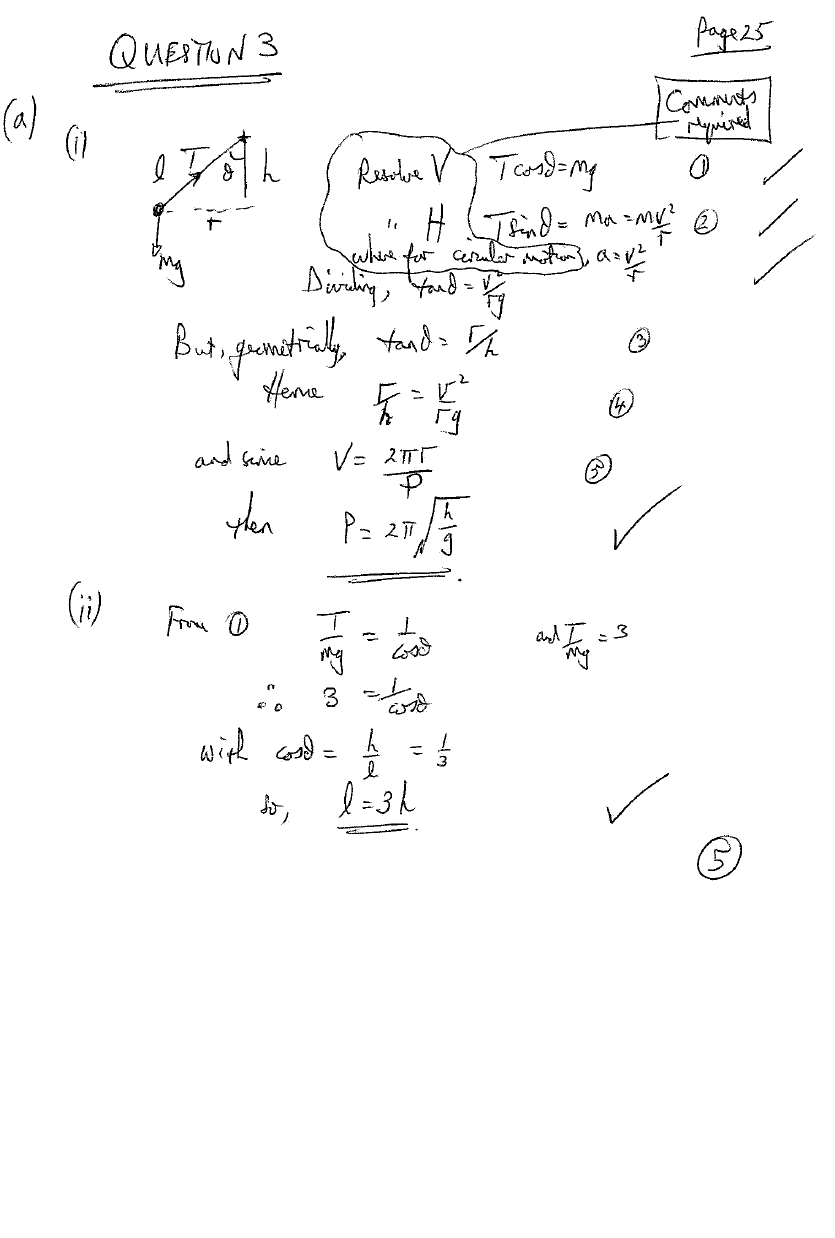
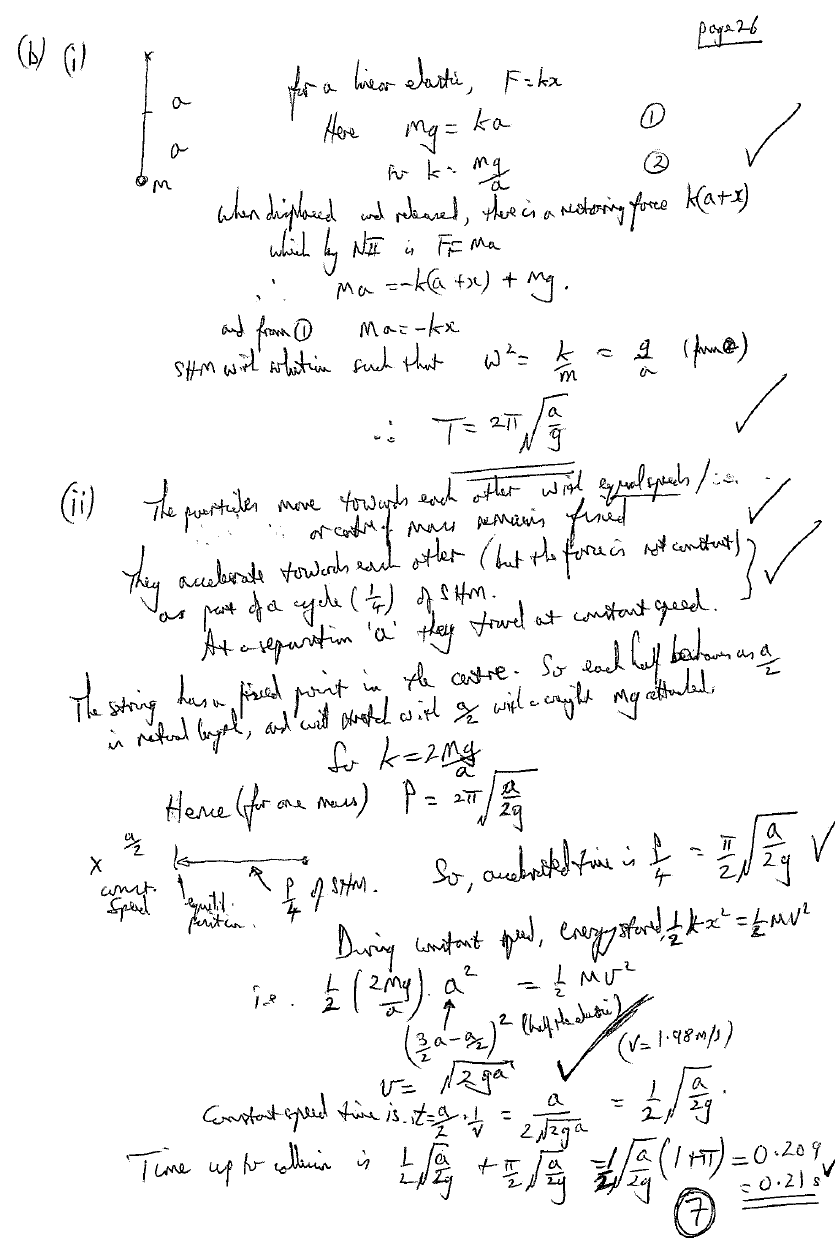
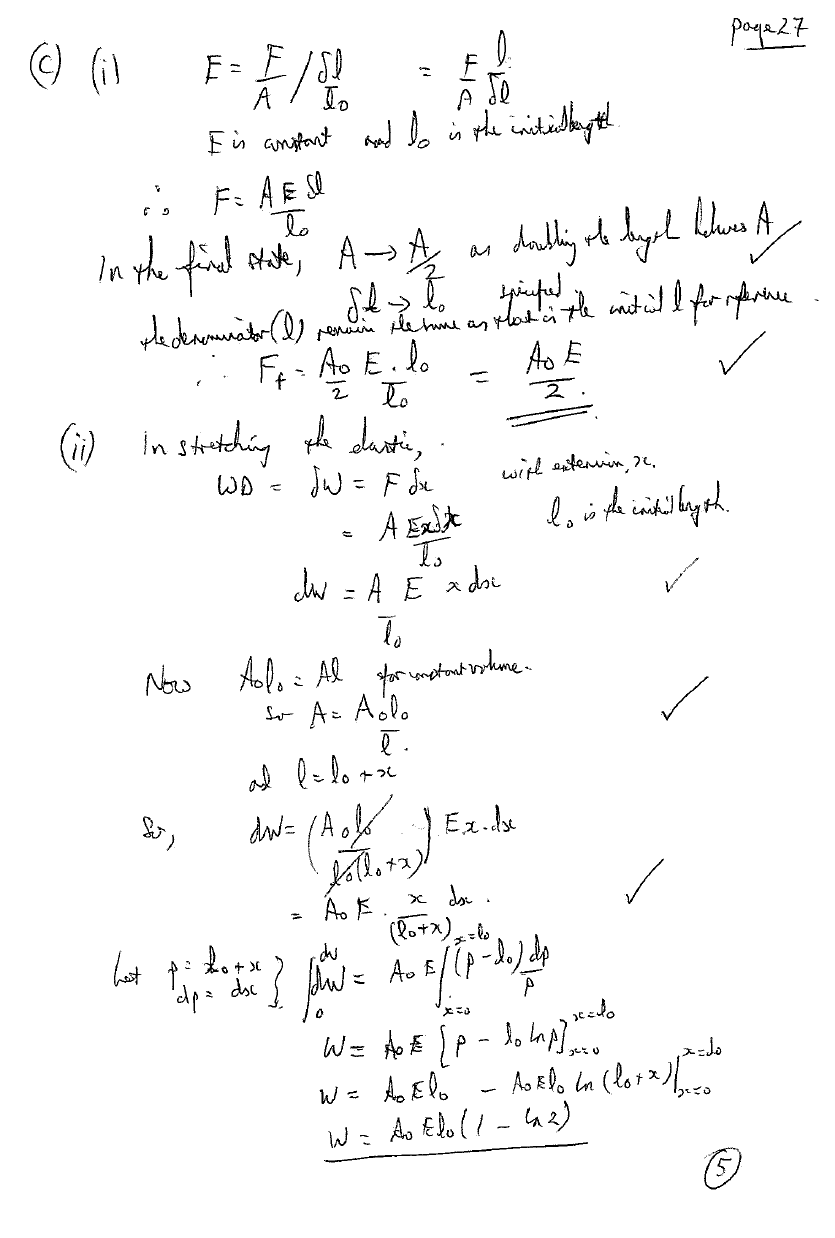
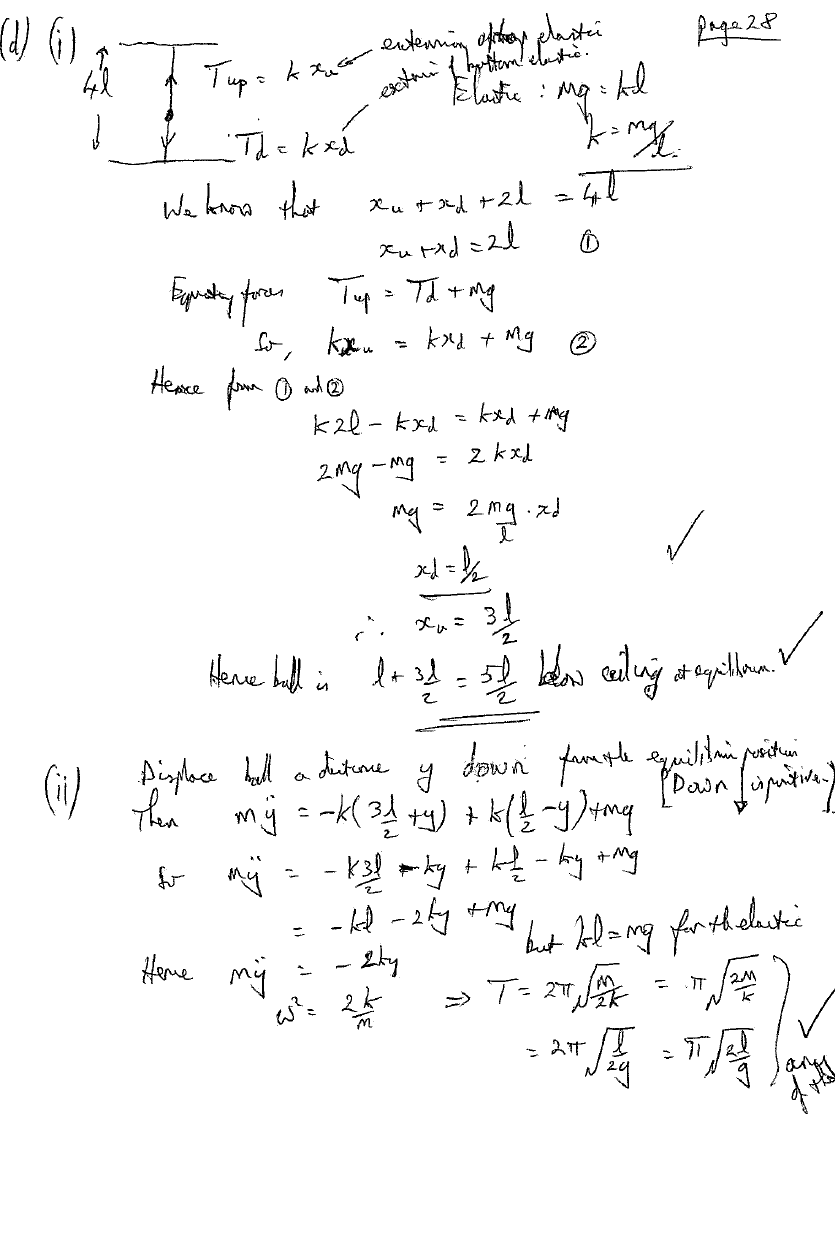
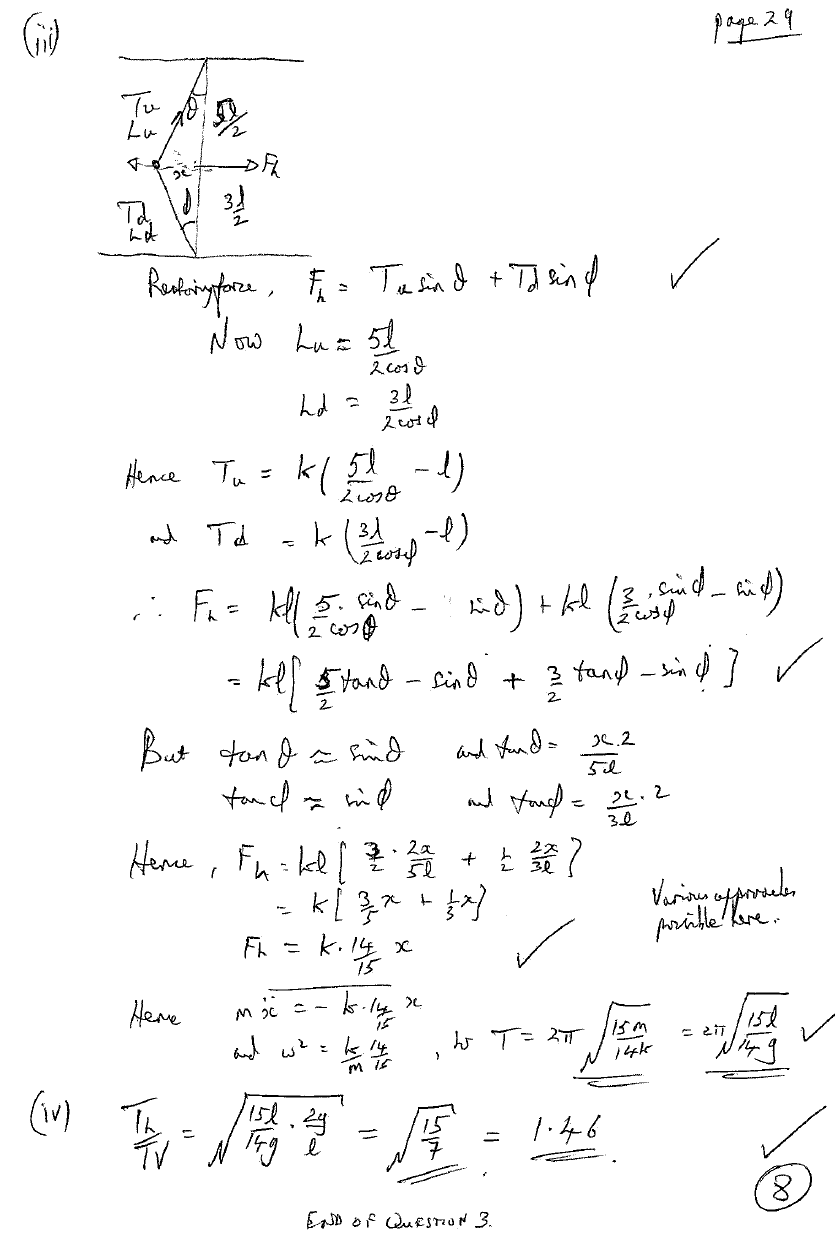
Official mark scheme (BPhO Round 1, November 2018, Section 2), from the official PDF — p. 26, 27, 28, 29, 30. © BPhO, CC BY 4.0.
Topic: Newtonian Mechanics, Oscillations & Waves, Elasticity & Materials Metodi: Simple Harmonic Motion Analysis, Hooke’s Law, Free-Body Diagram, Calculus-Integration, Small-Angle Approximation Competenze: Mathematical Modeling, Physical Reasoning Objects: Spring, String, Ball Fonte: Testo (PDF) — p.6 · Soluzione ufficiale (PDF) — p.26
Problema 3 — Moto circolare, fili elastici e oscillazioni [25 punti]
a) Una particella si muove lungo una circonferenza orizzontale, trattenuta da un filo legato a un punto posto all’altezza sopra il centro della circonferenza.
(i) Trova il periodo di rotazione in funzione di e dell’intensità del campo gravitazionale , spiegando a parole la fisica della derivazione.
(ii) Se la tensione del filo è tre volte il peso della particella, trova la lunghezza del filo in funzione di . (5)
b) (i) Una particella di massa è appesa a un sottile filo elastico di lunghezza a riposo , nel quale una tensione produrrebbe un allungamento . Scrivi un’espressione del periodo di oscillazione della massa in funzione di e .
(ii) Due particelle di uguale massa , su un tavolo orizzontale liscio, sono collegate dallo stesso filo elastico sottile di lunghezza a riposo . Le particelle sono tenute ferme a distanza . i. Descrivi il loro moto dall’istante in cui vengono lasciate fino all’urto. ii. Se le particelle vengono lasciate contemporaneamente, calcola il tempo che trascorre prima dell’urto, con m. (7)
c) Un tratto di cordone elastico di lunghezza e sezione viene allungato fino al doppio della lunghezza a riposo. Supponendo che il volume totale resti costante, che la sezione sia uniforme lungo il cordone e che il modulo di Young del materiale resti costante,
(i) ricava un’espressione della tensione finale in funzione di e ;
(ii) mostra che il lavoro per allungare l’elastico è . (5)
d) Il comportamento del pallone da allenamento per pugili di Figura 2 si può modellizzare con due molle verticali identiche collegate a una massa . Ciascuna molla ha lunghezza a riposo e costante elastica tale che una forza ne raddoppia la lunghezza fino a . Le molle superiore e inferiore sono fissate rispettivamente al soffitto e al pavimento di una stanza alta . Supponi che il raggio del pallone sia .
Figura 2 (immagine: Kangrui Sports)
(i) Determina la posizione di equilibrio del pallone sotto il soffitto in funzione di .
(ii) Il pallone riceve un piccolo spostamento verticale e viene lasciato. Trova un’espressione del periodo delle oscillazioni verticali.
(iii) Il pallone riceve un piccolo spostamento orizzontale. Con un’approssimazione adatta, scrivi un’espressione della forza orizzontale esercitata dalle molle sul pallone.
(iv) Trova un’espressione del periodo delle oscillazioni orizzontali e calcola il rapporto . (8)
Risposta: a) (i) ; (ii) . b) (i) ; (ii) i. accelerano l’una verso l’altra di moto armonico (un quarto di ciclo) finché la distanza è , poi procedono a velocità costante; ii. s. c) (i) ; (ii) (dimostrato). d) (i) sotto il soffitto; (ii) ; (iii) ; (iv) ,
Soluzione: La soluzione ufficiale completa (in inglese) è nella versione originale di questo quesito e nel PDF ufficiale.
Topic: Newtonian Mechanics, Oscillations & Waves, Elasticity & Materials Metodi: Simple Harmonic Motion Analysis, Hooke’s Law, Free-Body Diagram, Calculus-Integration, Small-Angle Approximation Competenze: Mathematical Modeling, Physical Reasoning Objects: Spring, String, Ball Fonte: Testo (PDF) — p.6 · Soluzione ufficiale (PDF) — p.26
Question 4 — Fluid pressure, buoyancy and floating bodies [25 marks]
a) (i) A tall cylinder of circular cross sectional area and height is filled with a liquid of uniform density . i. Derive an expression for the pressure at the bottom of the liquid in terms of the variables , and . Ignore atmospheric pressure. ii. Show that the units for each side of your derived equation are the same. iii. What would your result be if the liquid changed in density linearly from at the top to at the bottom of the cylinder? iv. If you used your formula for the pressure at ground level, at the bottom of the Earth’s atmosphere, which has a height of about 200 km, it would give an answer which is very far from correct. Explain why.
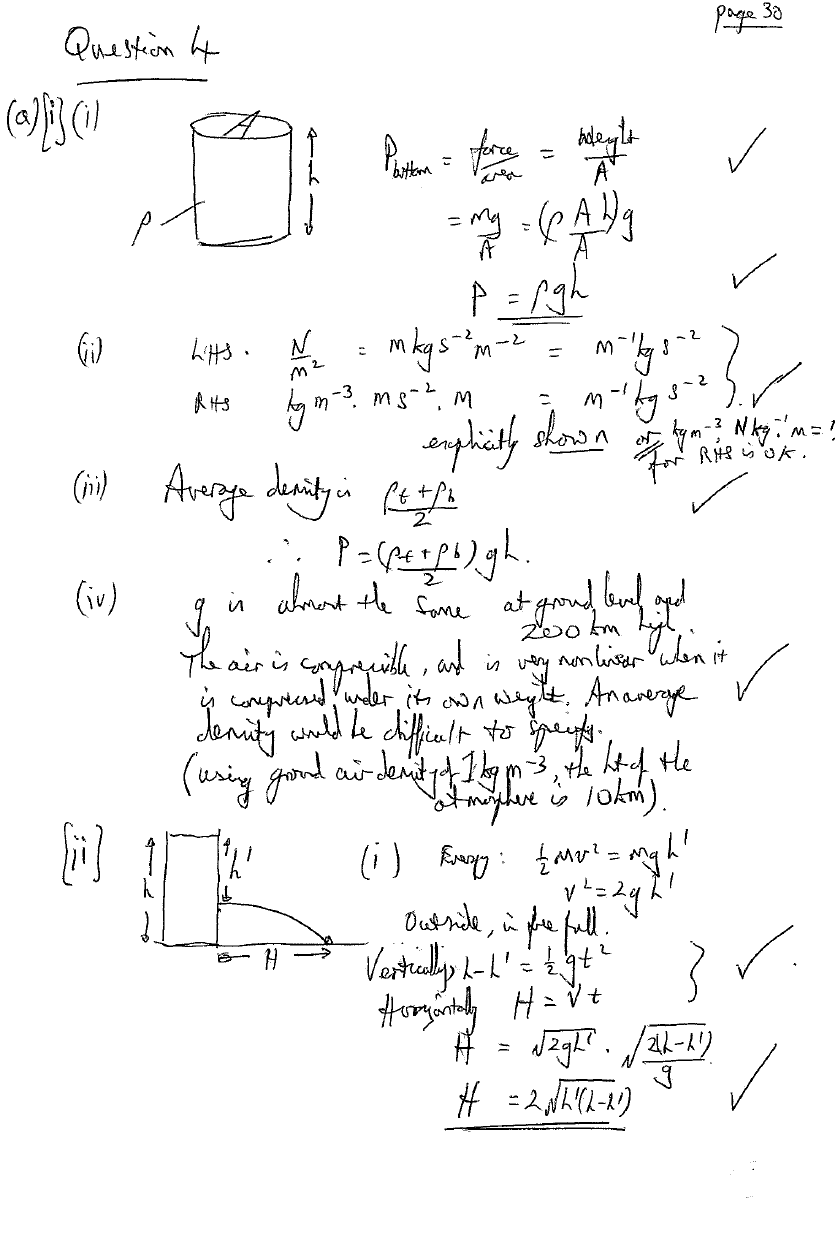
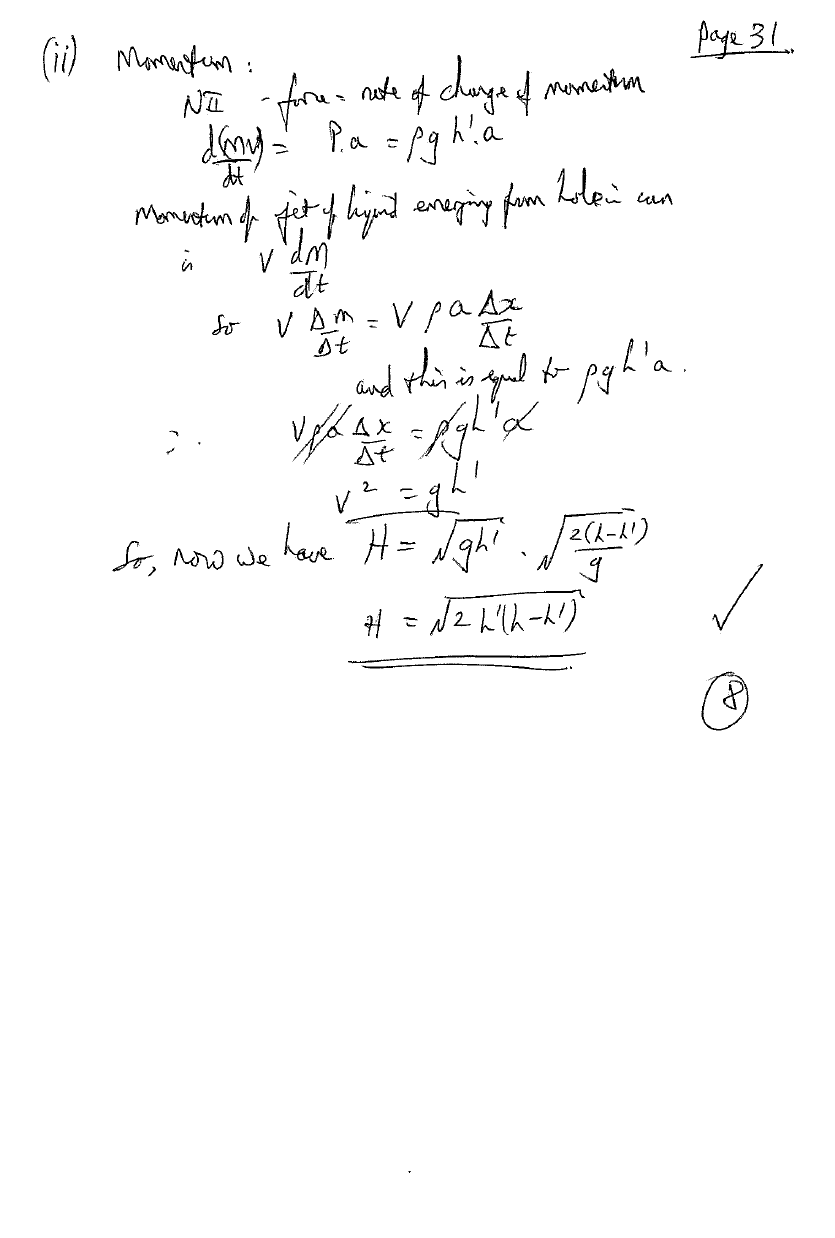
(ii) A water tank which sits on the ground is kept full of water to a depth of . Water is issuing horizontally from a hole which is in the sidewall of the tank, a distance below the surface. Determine the maximum horizontal distance from the hole in the can where the jet of water strikes the floor, by using arguments which assume only i. conservation of mechanical energy, assuming the water falls down through height , ii. conservation of momentum (using the pressure at depth ). (8)
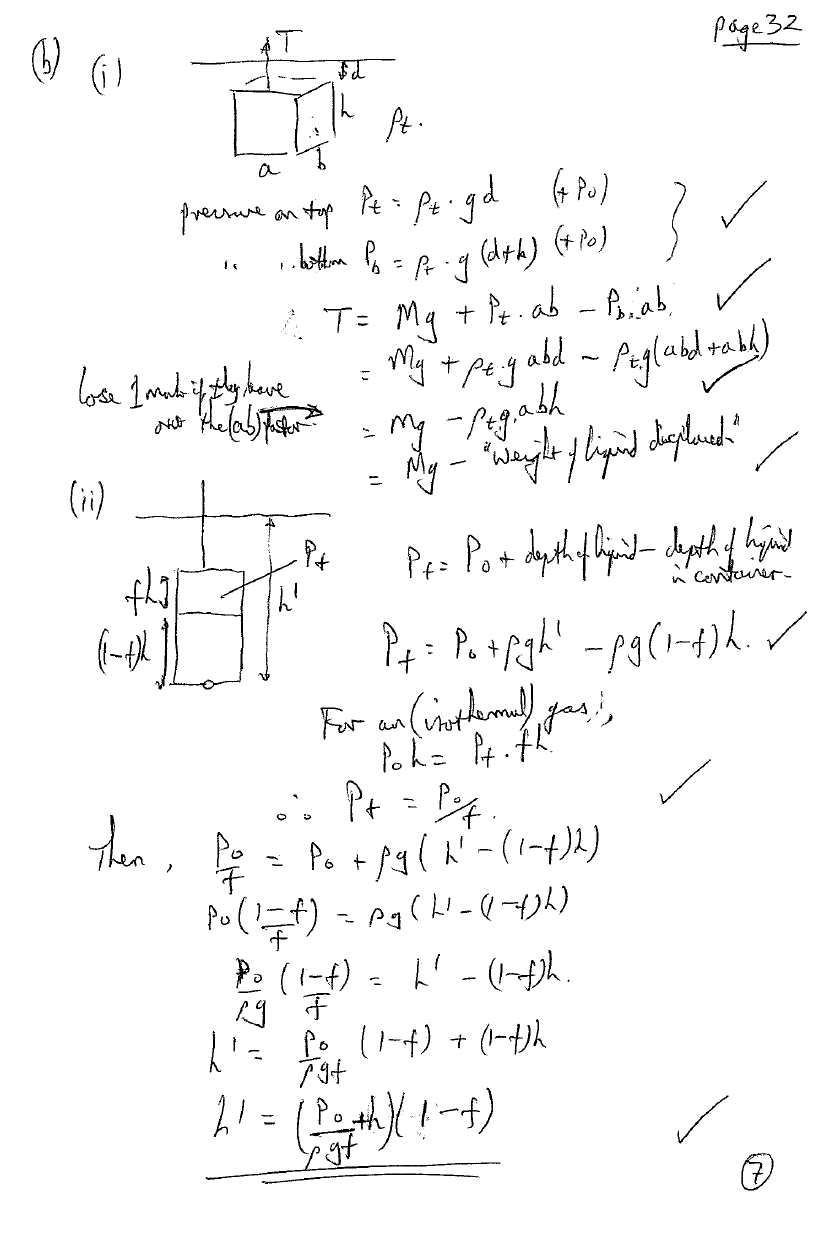
b) An empty, hollow cuboid container of mass and height , width , depth , is suspended upright from a thin cable in a liquid of density , as shown in Figures 3a and 3b.
(i) Find an expression for the tension, , in the cable by considering the force due to the pressure of the liquid on the top of the container, and the force due to the pressure of the liquid on the bottom of the container.
(ii) The cuboid container now has a small hole pierced in the bottom surface and the liquid leaks in until the air is now confined to the top part of the container, occupying a fraction of the volume, with a fraction of the volume inside now being filled with liquid. The pressure of the atmosphere at the surface of the liquid is and the density of the liquid is . Obtain an expression for the depth, of the bottom surface of the container in terms of , , , and .
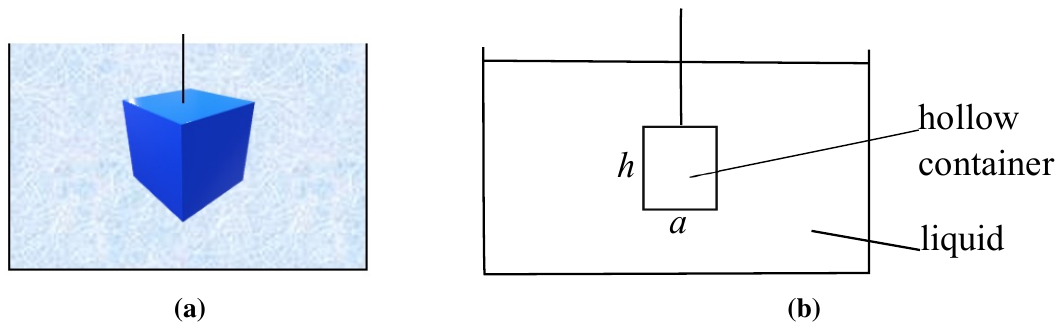
Figure 3 (7)
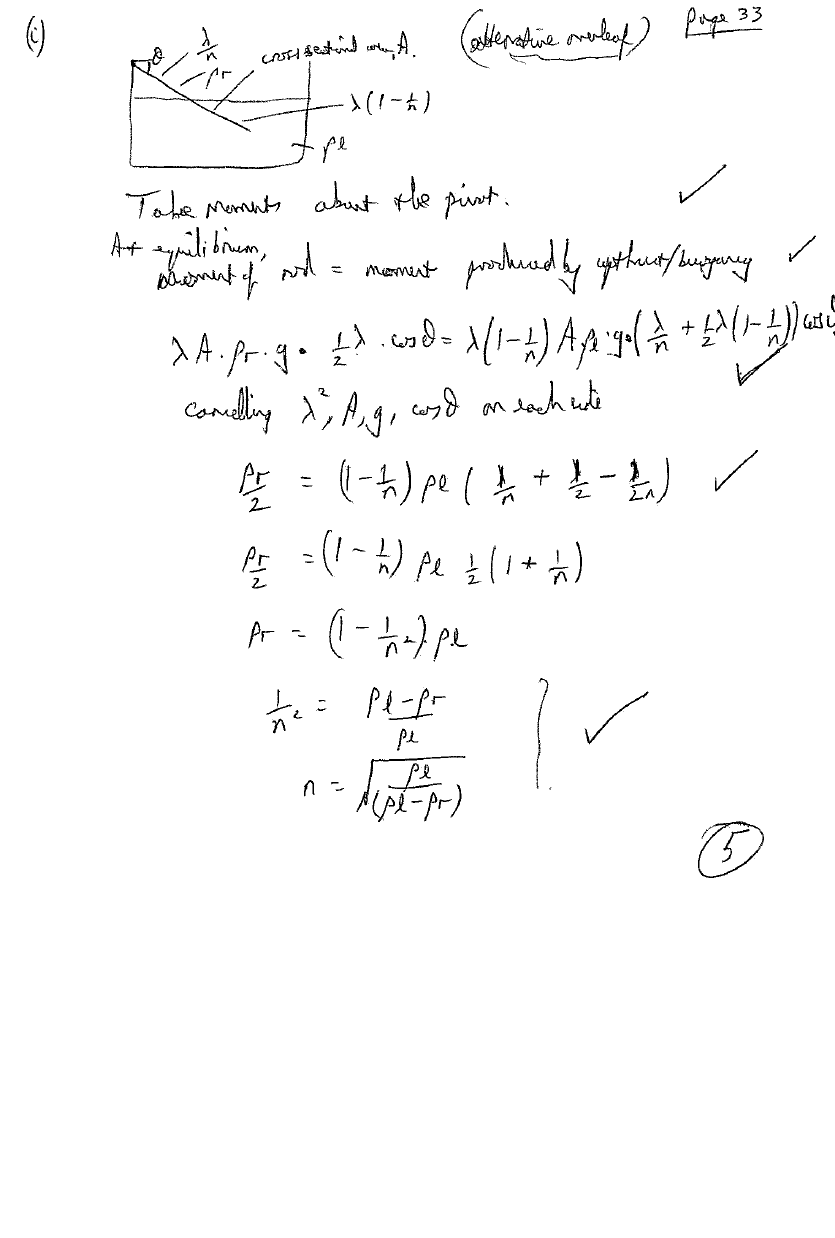
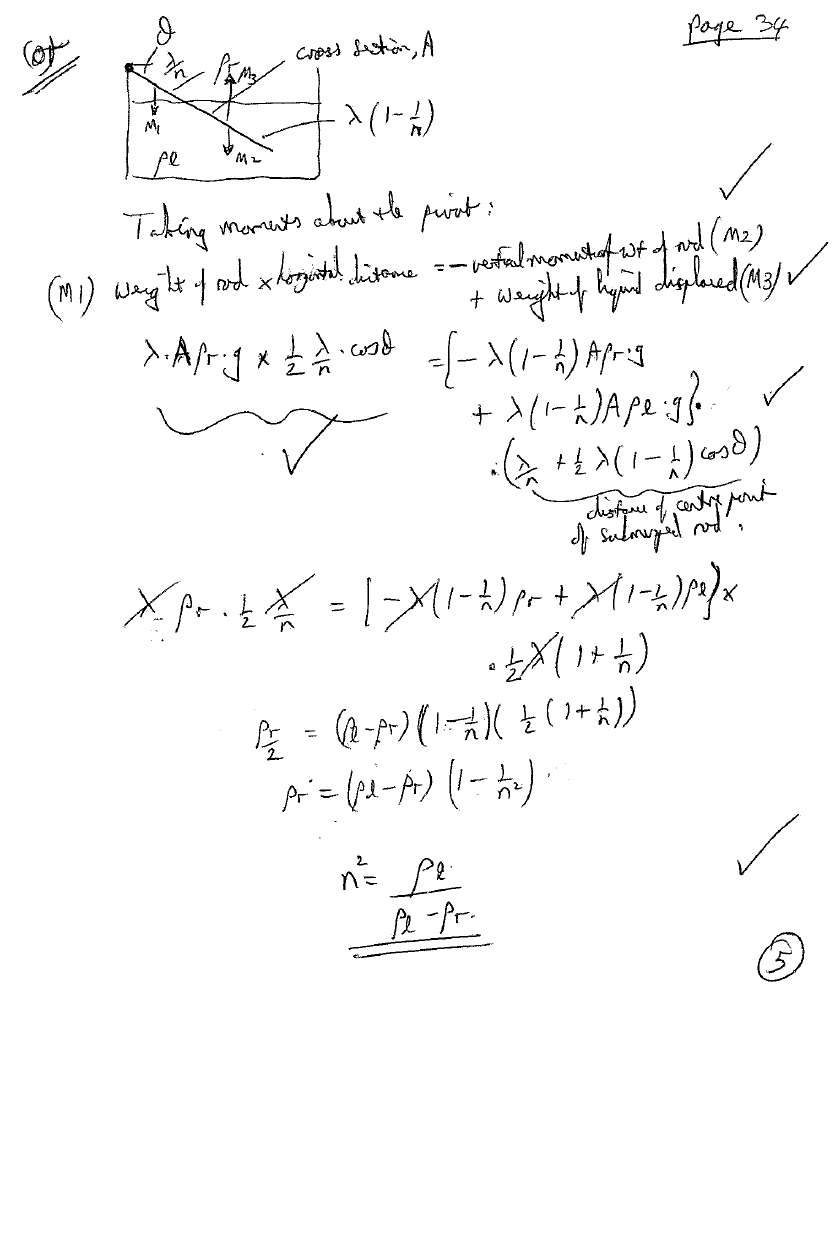
c) A rod of length and material density is pivoted by a hinge at a point on the wall of a container which has liquid of density , below the level of the pivot point. The rod floats without touching the bottom of the container. If a fraction of the rod is above the surface, determine in terms of and .
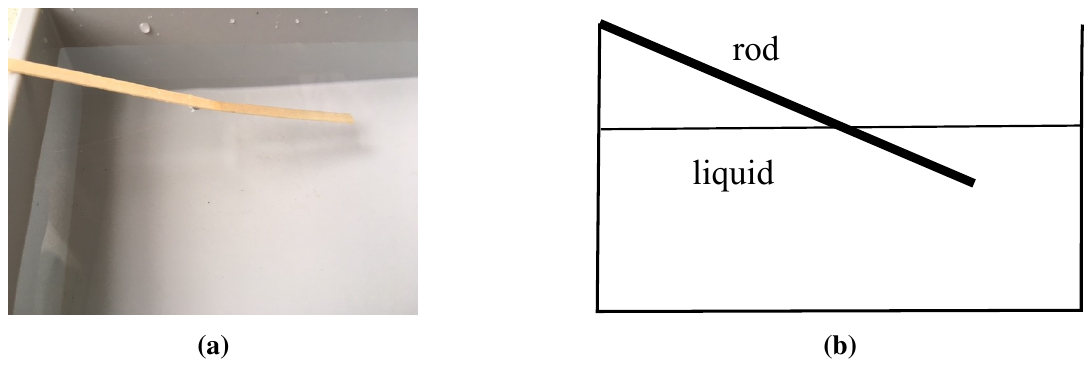
Figure 4 (5)
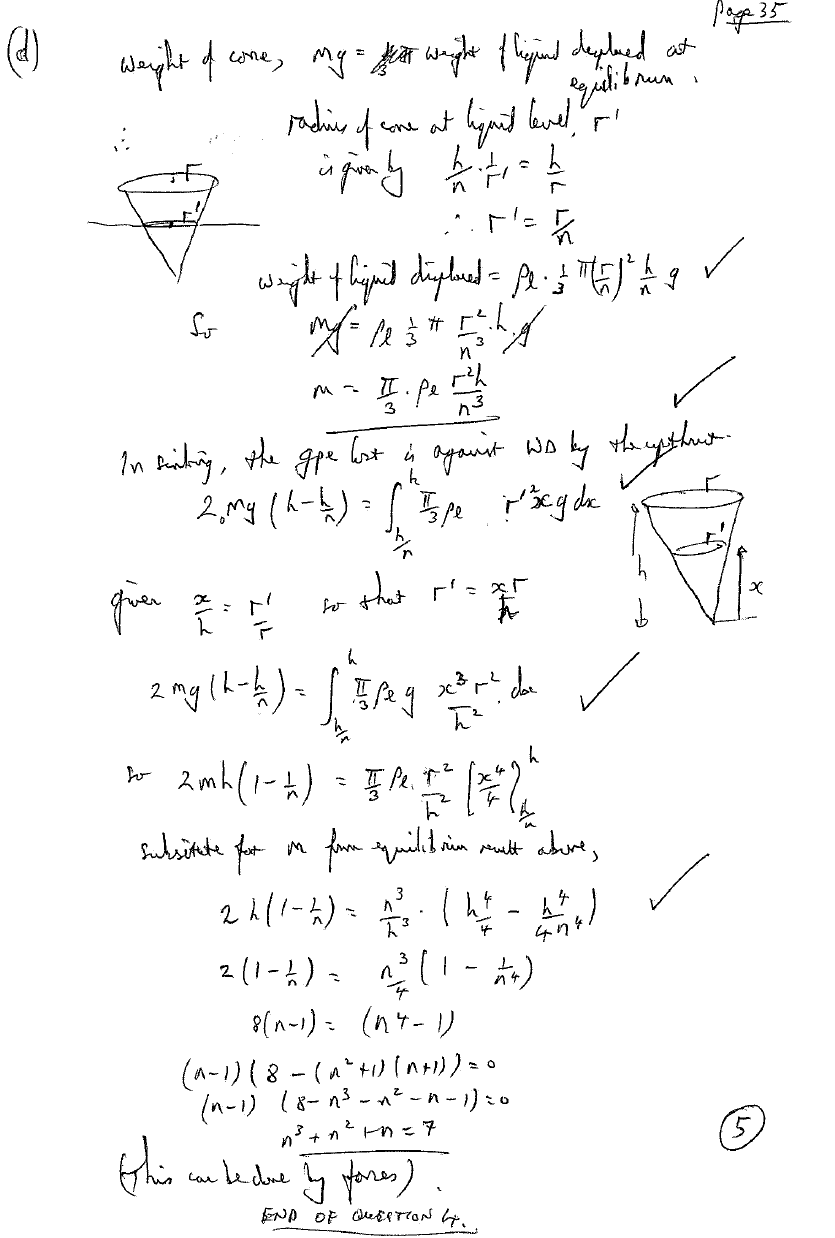
d) A solid circular cone of height , mass , radius of base, , is floating in a liquid of density with its axis vertical and vertex downwards, as shown in Figure 5. In the liquid, a height is submerged below the surface of the liquid.
(i) Obtain an expression relating the mass of the cone to the fraction submerged, , in terms of , , and The volume of a circular cone is given by .
(ii) A weight equal to the weight of the cone is placed on the base whilst it is floating, and it sinks until the base is just level with the liquid, and then it rises again. For this condition, show that You may neglect any effects of the inertia and viscosity of the liquid. Energy considerations may be helpful.
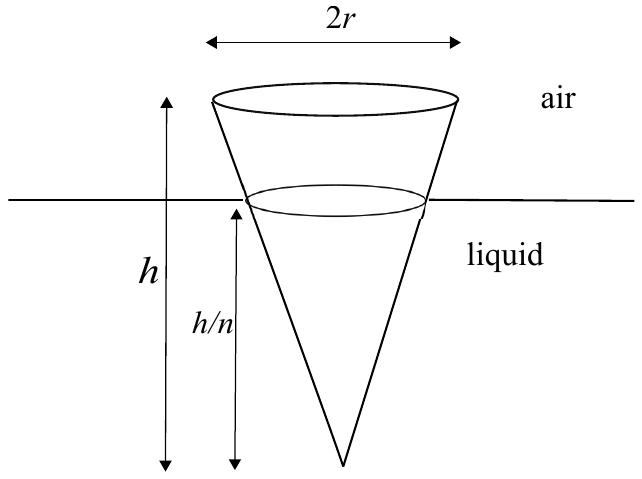
Figure 5 (5)
Risposta: a) (i) i. ; iii. ; iv. is almost the same, but air is compressible and its density varies very non-linearly with height; (ii) i. ; ii. as printed, momentum argument with : . b) (i) ( minus the weight of liquid displaced); (ii) . c) . d) (i) ; (ii) (shown)
Soluzione:
Official mark scheme (BPhO Round 1, November 2018, Section 2), from the official PDF — p. 31, 32, 33, 34, 35, 36. © BPhO, CC BY 4.0.
Topic: Fluid Mechanics, Rigid Body Statics Metodi: Hydrostatic Equilibrium, Dimensional Analysis, Energy Conservation Method, Torque & Angular Momentum Analysis, Ideal Gas Law Competenze: Mathematical Modeling, Physical Reasoning Objects: Container, Rod, Wedge Fonte: Testo (PDF) — p.8 · Soluzione ufficiale (PDF) — p.31
Problema 4 — Pressione nei fluidi, spinta e galleggiamento [25 punti]
a) (i) Un cilindro alto, di sezione circolare e altezza , è pieno di un liquido di densità uniforme . i. Ricava un’espressione della pressione sul fondo del liquido in funzione di , e , trascurando la pressione atmosferica. ii. Mostra che le unità di misura dei due membri dell’equazione ricavata sono le stesse. iii. Quale sarebbe il risultato se la densità del liquido variasse linearmente da in cima a sul fondo del cilindro? iv. Usando la tua formula per la pressione al suolo, alla base dell’atmosfera terrestre, alta circa 200 km, si otterrebbe un risultato molto lontano dal vero. Spiega perché.
(ii) Un serbatoio poggiato a terra è mantenuto pieno d’acqua fino a un’altezza . Da un foro nella parete laterale, a una profondità sotto la superficie, esce orizzontalmente un getto d’acqua. Determina la massima distanza orizzontale dal foro alla quale il getto colpisce il pavimento, usando argomenti basati solo su i. la conservazione dell’energia meccanica, supponendo che l’acqua scenda di un’altezza ; ii. la conservazione della quantità di moto (usando la pressione alla profondità ). (8)
b) Un contenitore vuoto a forma di parallelepipedo, di massa , altezza , larghezza e profondità , è appeso verticalmente a un cavo sottile in un liquido di densità , come nelle Figure 3a e 3b.
(i) Trova un’espressione della tensione del cavo considerando la forza dovuta alla pressione del liquido sulla faccia superiore del contenitore e quella dovuta alla pressione sulla faccia inferiore.
(ii) Nel fondo del contenitore si pratica ora un piccolo foro e il liquido entra finché l’aria resta confinata nella parte alta del contenitore, occupandone una frazione del volume, mentre la frazione è piena di liquido. La pressione atmosferica sulla superficie del liquido è e la densità del liquido è . Ricava un’espressione della profondità della faccia inferiore del contenitore in funzione di , , , e .
Figura 3 (7)
c) Un’asta di lunghezza e densità è incernierata in un punto della parete di un recipiente contenente un liquido di densità , sotto il livello della cerniera. L’asta galleggia senza toccare il fondo del recipiente. Se la frazione dell’asta sta sopra la superficie, determina in funzione di e .
Figura 4 (5)
d) Un cono circolare pieno di altezza , massa e raggio di base galleggia in un liquido di densità con l’asse verticale e il vertice in basso, come in Figura 5. Nel liquido è immersa un’altezza .
(i) Ricava una relazione tra la massa del cono e la frazione immersa , in funzione di , , e . Il volume di un cono circolare è .
(ii) Sulla base del cono che galleggia si pone un peso uguale al peso del cono: il cono affonda finché la base arriva appena al livello del liquido, poi risale. In questa condizione, mostra che Puoi trascurare gli effetti dell’inerzia e della viscosità del liquido. Possono essere utili considerazioni energetiche.
Figura 5 (5)
Risposta: a) (i) i. ; iii. ; iv. è quasi uguale, ma l’aria è comprimibile e la sua densità varia con l’altezza in modo molto non lineare; (ii) i. ; ii. come stampato, con la quantità di moto e : . b) (i) ( meno il peso del liquido spostato); (ii) . c) . d) (i) ; (ii) (dimostrato)
Soluzione: La soluzione ufficiale completa (in inglese) è nella versione originale di questo quesito e nel PDF ufficiale.
Topic: Fluid Mechanics, Rigid Body Statics Metodi: Hydrostatic Equilibrium, Dimensional Analysis, Energy Conservation Method, Torque & Angular Momentum Analysis, Ideal Gas Law Competenze: Mathematical Modeling, Physical Reasoning Objects: Container, Rod, Wedge Fonte: Testo (PDF) — p.8 · Soluzione ufficiale (PDF) — p.31
Question 5 — Resistor networks and strain gauges [25 marks]
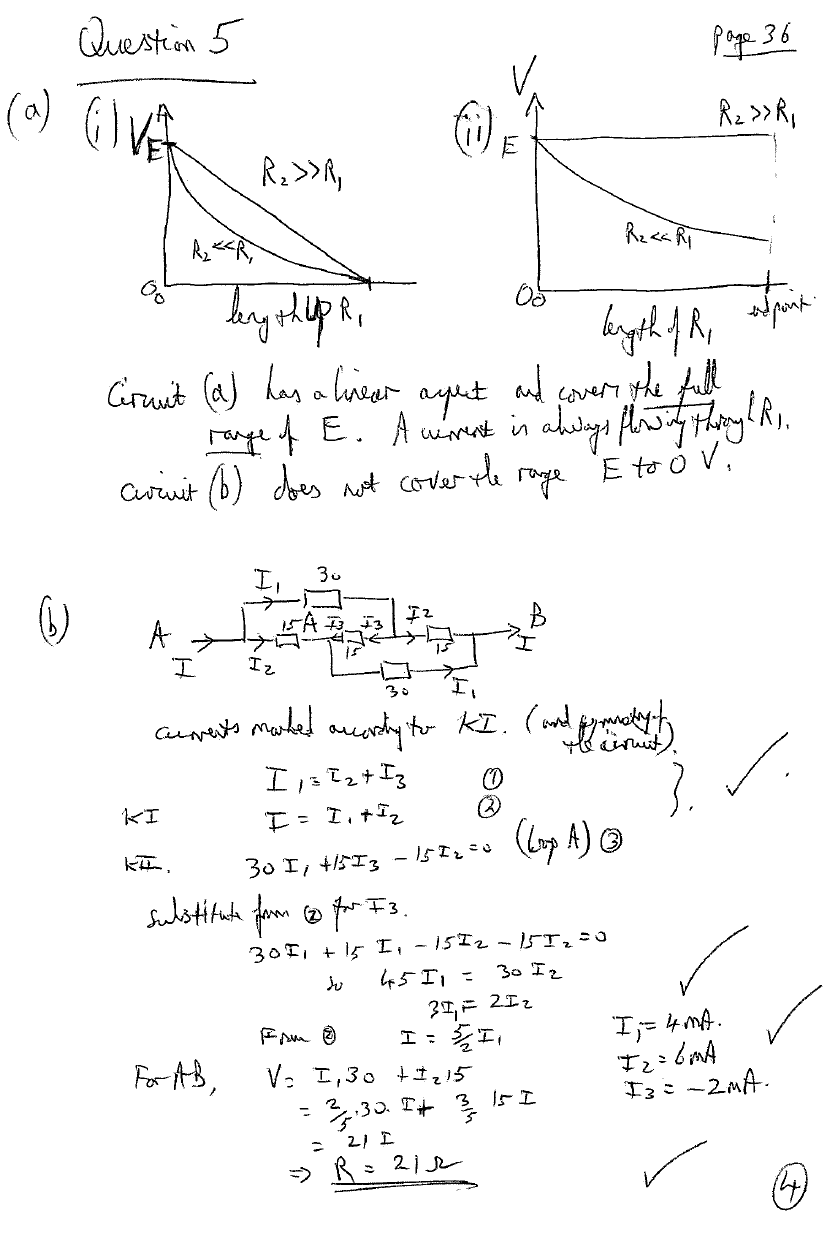
a) In the two circuits shown in Figures 6a and 6b below, a cell of e.m.f. and negligible internal resistance is connected across a pair of resistors, and . Resistor is a length of uniform resistance wire, and is a fixed resistor.
(i) For the circuit shown in Figure 6a, sketch two graphs on the same axes showing how the potential across varies with position of the sliding contact on for the cases i. when ii. when
(ii) Repeat part (i) above for the circuit shown in Figure 6b.
(iii) What are the relative advantages of each of these circuits when used to control the potential difference across ?
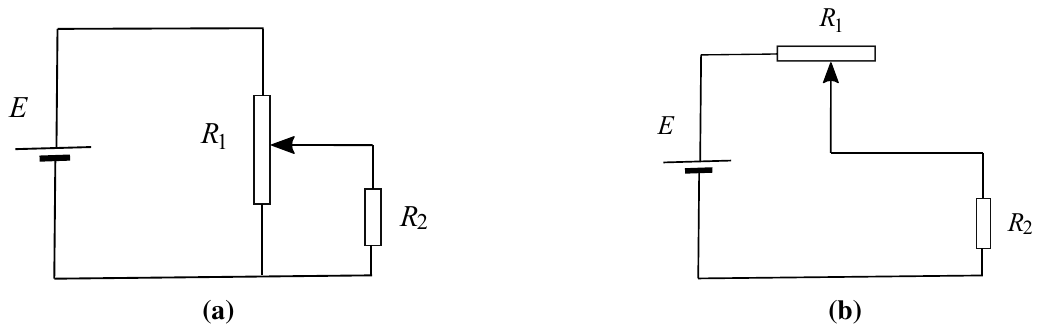
Figure 6 (5)
b) A resistance network is shown in Figure 7.
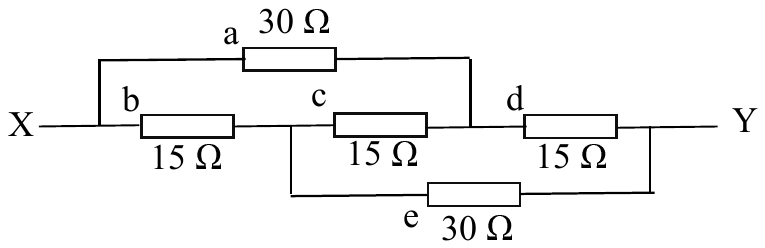
Figure 7
(i) A total current of 10 mA flows through the circuit. Determine the current in each of the resistors, a to e.
(ii) Hence find the total resistance between X and Y. (4)
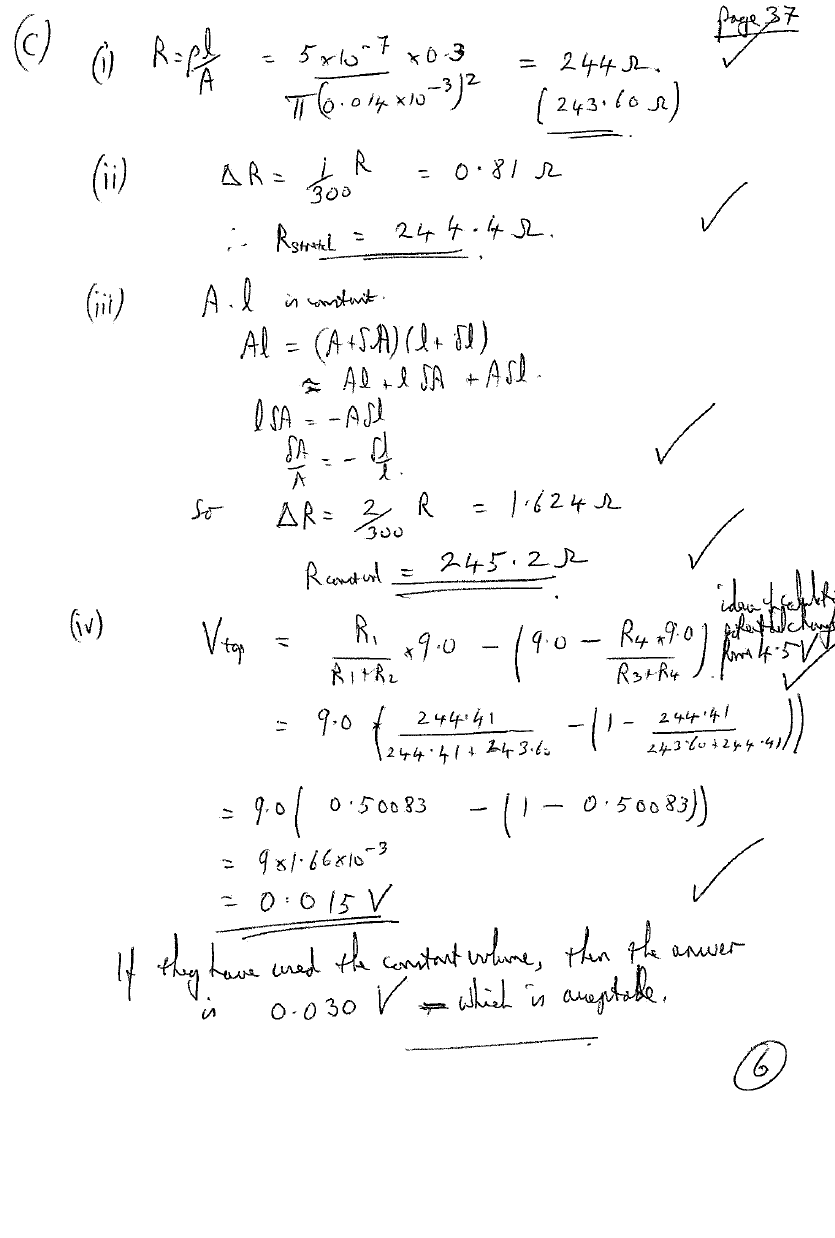
c) A strain gauge consists of a straight metal wire of length 0.30 m, diameter 0.028 mm and resistivity m. Calculate the resistance of the gauge when
(i) unstrained and
(ii) stretched by 1.0 mm. You may assume that the diameter of the wire does not change.
(iii) Calculate the resistance if the stretched wire maintained the same volume i.e. the diameter decreased in the process of stretching?
(iv) Four identical strain gauges as in c) (ii) above, labelled to , are arranged in a bridge circuit as shown in Figure 8, with a cell of e.m.f 9.0 V and of negligible internal resistance. and are stretched by 1.0 mm. Assuming the internal resistance of the power supply is negligible, calculate the reading on the voltmeter (which can be considered to have an infinite resistance).
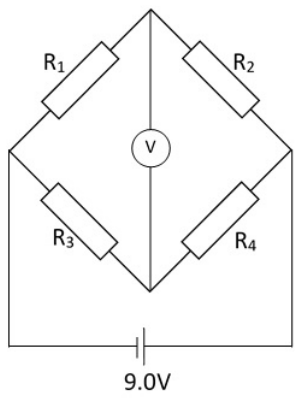
Figure 8 (6)
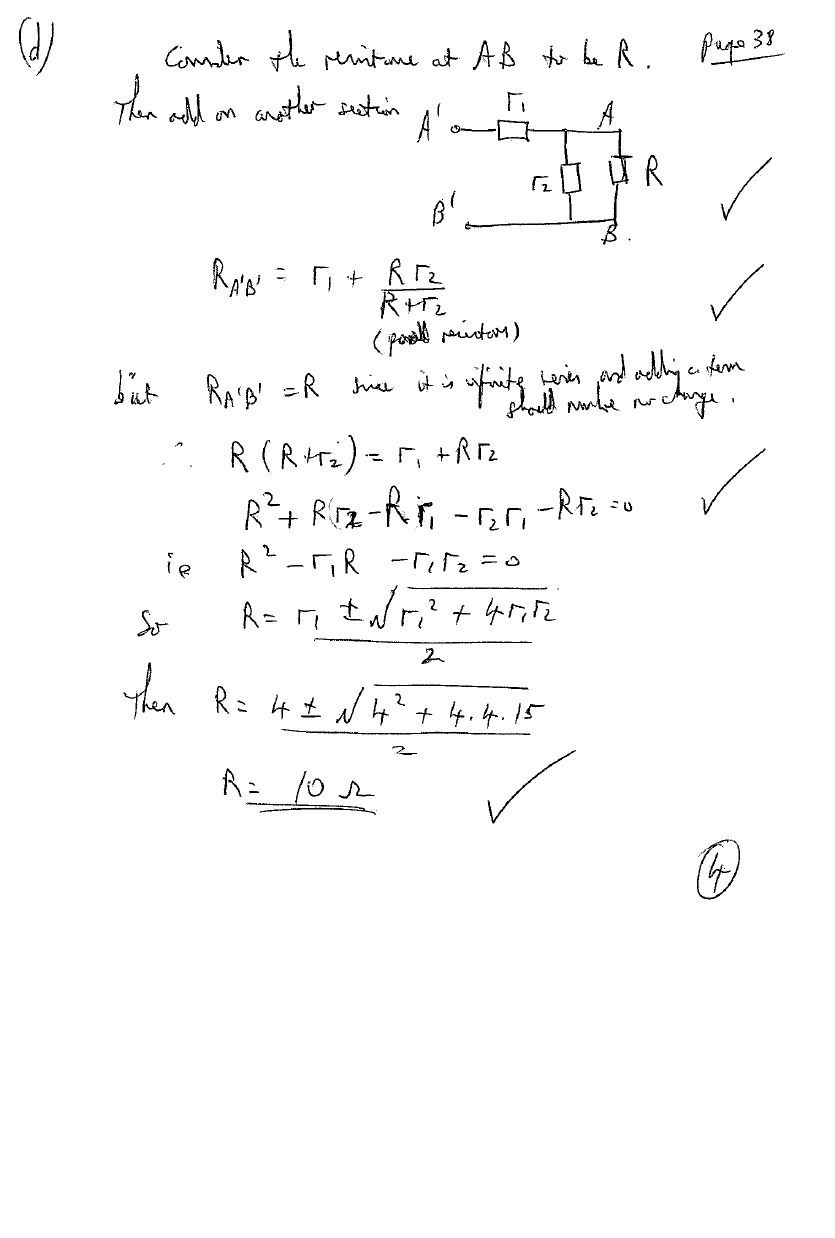
d) The following network shown in Figure 9 is infinite. Find an expression for the resistance between A and B in as simple a form as possible, and determine the resistance when and . Hint: consider adding new resistors and at the left end of the circuit shown.
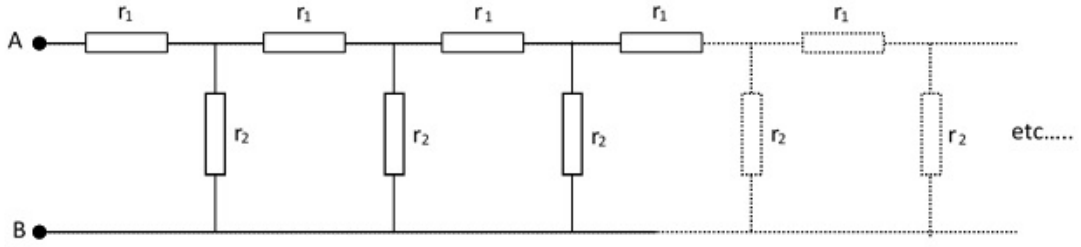
Figure 9 (4)
e) The network shown in Figure 10 consists of an infinite number of cells of e.m.f. and with corresponding internal resistances and respectively. A resistor of value , is connected to the end of the series. If the values of the e.m.f.s and resistances are V, V, , , determine the value of the current flowing through resistor .
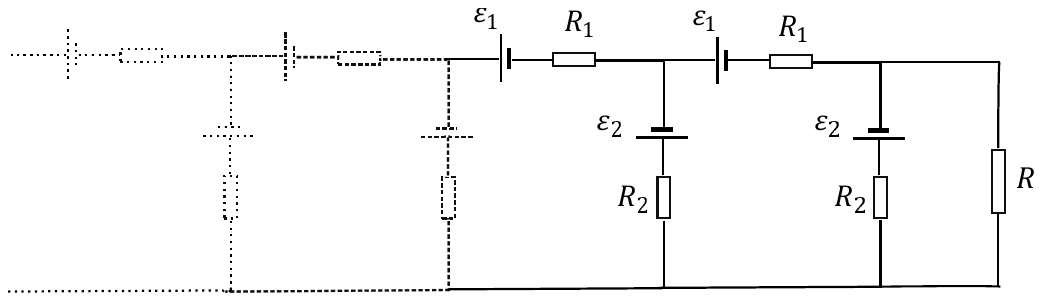
Figure 10 (6)
Risposta: a) (iii) circuit (a) is linear and covers the full range of (a current always flows through ); circuit (b) does not cover the range to 0 V. b) (i) mA (a, e), mA (b, d), mA (c) (signs may differ); (ii) . c) (i) (); (ii) , ; (iii) , ; (iv) V (0.030 V acceptable with the constant-volume value). d) , . e) : magnitude A
Soluzione:
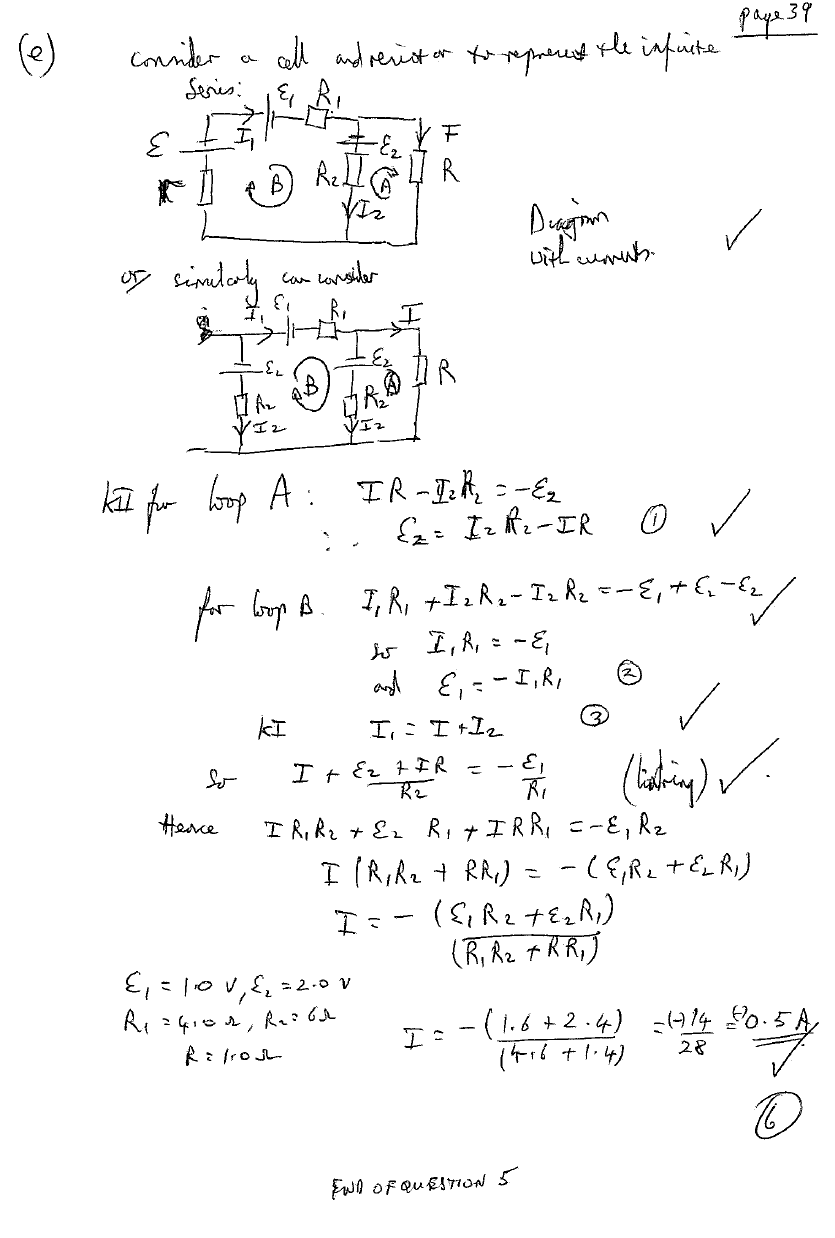
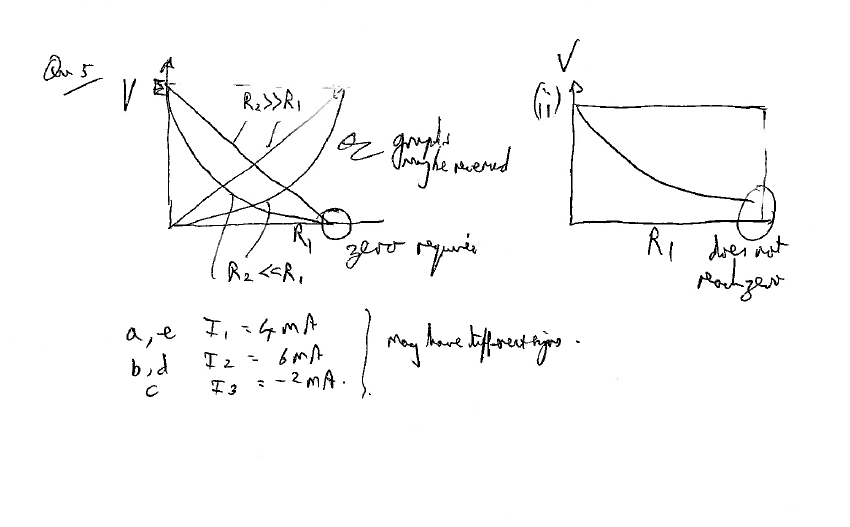
Official mark scheme (BPhO Round 1, November 2018, Section 2), from the official PDF — p. 37, 38, 39, 40. © BPhO, CC BY 4.0.
The last image is from the official mark scheme modification sheet of 22 November 2018 (PDF, p. 2).
Topic: Circuits Metodi: Kirchhoff’s Laws, Equivalent Circuit Reduction, Symmetry Argument Competenze: Mathematical Modeling, Diagrammatic Reasoning Objects: Resistor, Wire, Battery Fonte: Testo (PDF) — p.10 · Soluzione ufficiale (PDF) — p.37
Problema 5 — Reti di resistori ed estensimetri [25 punti]
a) Nei due circuiti delle Figure 6a e 6b una pila di f.e.m. e resistenza interna trascurabile è collegata a una coppia di resistori e . è un tratto di filo resistivo uniforme, un resistore fisso.
(i) Per il circuito di Figura 6a, disegna sugli stessi assi due grafici di come varia la tensione ai capi di al variare della posizione del contatto strisciante su , nei casi i. ii.
(ii) Ripeti la parte (i) per il circuito di Figura 6b.
(iii) Quali sono i vantaggi relativi dei due circuiti quando si usano per regolare la differenza di potenziale ai capi di ?
Figura 6 (5)
b) In Figura 7 è mostrata una rete di resistori.
Figura 7
(i) Nel circuito circola una corrente totale di 10 mA. Determina la corrente in ciascuno dei resistori da a a e.
(ii) Trova quindi la resistenza totale tra X e Y. (4)
c) Un estensimetro è formato da un filo metallico rettilineo lungo 0,30 m, di diametro 0,028 mm e resistività m. Calcola la resistenza dell’estensimetro
(i) a riposo e
(ii) allungato di 1,0 mm, supponendo che il diametro del filo non cambi.
(iii) Calcola la resistenza se il filo allungato mantenesse lo stesso volume, cioè se il diametro diminuisse durante l’allungamento.
(iv) Quattro estensimetri identici come in c) (ii), indicati con –, sono disposti in un circuito a ponte come in Figura 8, con una pila di f.e.m. 9,0 V e resistenza interna trascurabile. e sono allungati di 1,0 mm. Supponendo trascurabile la resistenza interna dell’alimentatore, calcola la lettura del voltmetro (che si può considerare di resistenza infinita).
Figura 8 (6)
d) La rete di Figura 9 è infinita. Trova un’espressione, la più semplice possibile, della resistenza tra A e B e calcolala per e . Suggerimento: considera di aggiungere nuovi resistori e all’estremità sinistra del circuito.
Figura 9 (4)
e) La rete di Figura 10 è formata da un numero infinito di pile di f.e.m. ed con resistenze interne e . All’estremità della serie è collegato un resistore . Con V, V, , , determina la corrente nel resistore .
Figura 10 (6)
Risposta: a) (iii) il circuito (a) è lineare e copre tutto l’intervallo di (in circola sempre corrente); il circuito (b) non copre l’intervallo da a 0 V. b) (i) mA (a, e), mA (b, d), mA (c) (i segni possono differire); (ii) . c) (i) (); (ii) , ; (iii) , ; (iv) V (accettato 0,030 V con il valore a volume costante). d) , . e) : in modulo A
Soluzione: La soluzione ufficiale completa (in inglese) è nella versione originale di questo quesito e nel PDF ufficiale.
Topic: Circuits Metodi: Kirchhoff’s Laws, Equivalent Circuit Reduction, Symmetry Argument Competenze: Mathematical Modeling, Diagrammatic Reasoning Objects: Resistor, Wire, Battery Fonte: Testo (PDF) — p.10 · Soluzione ufficiale (PDF) — p.37
Question 6 — Capacitors and charged spheres [25 marks]
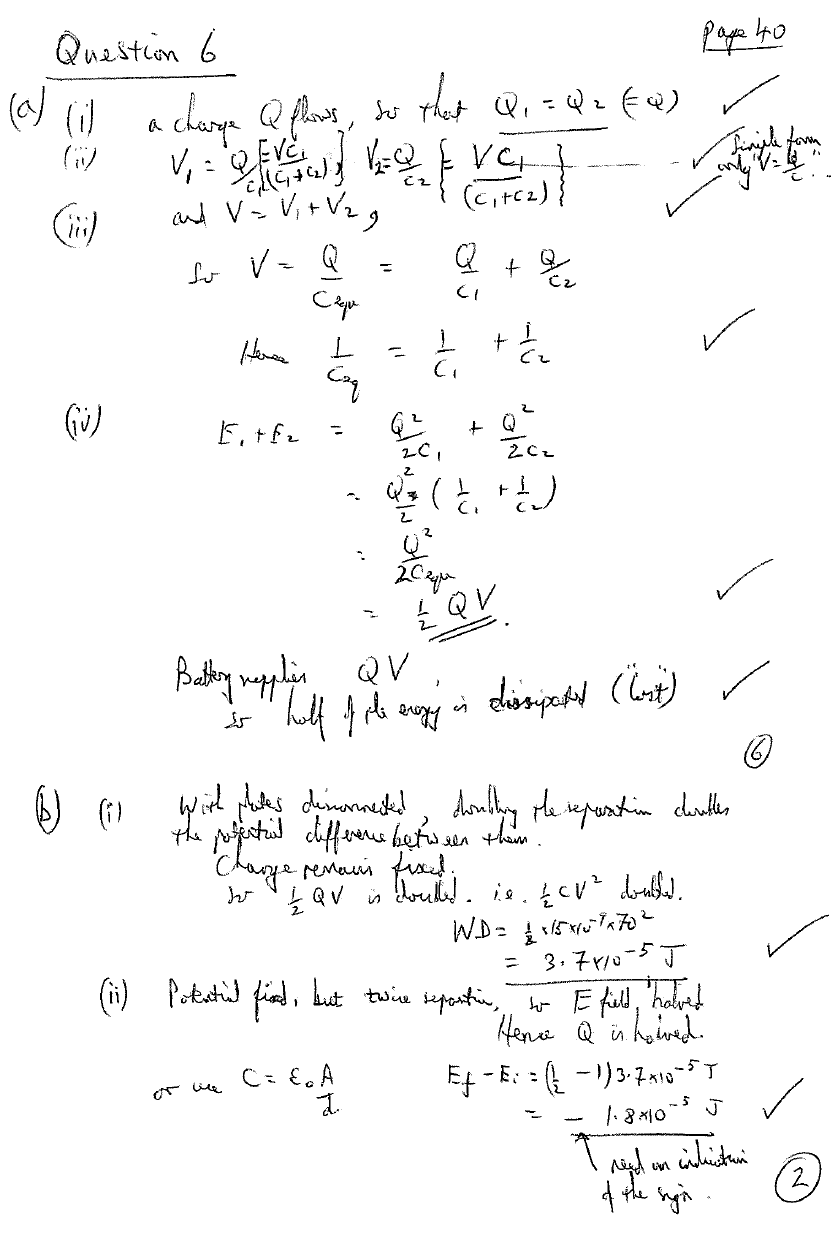
a) Two uncharged capacitors with values and , are connected in series with a battery of e.m.f. , and a switch. When the switch is closed there is a charge of and on the capacitors respectively.
(i) State the relationship between and .
(ii) State expressions for the potential differences across each capacitor, and
(iii) Hence derive an expression for the equivalent capacitance, produced by and in series.
(iv) Write down expressions for the total energy stored in the two capacitors, and the energy supplied by the battery, in terms of and , and comment on the difference (6)
b) A 15 nF parallel plate capacitor is connected across a 70 V battery, as in Figure 11. How much work must be done in order to double the plate separation
(i) with the battery disconnected,
(ii) with the battery connected?
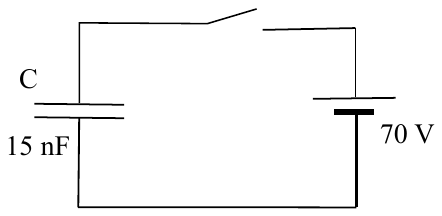
Figure 11 (2)
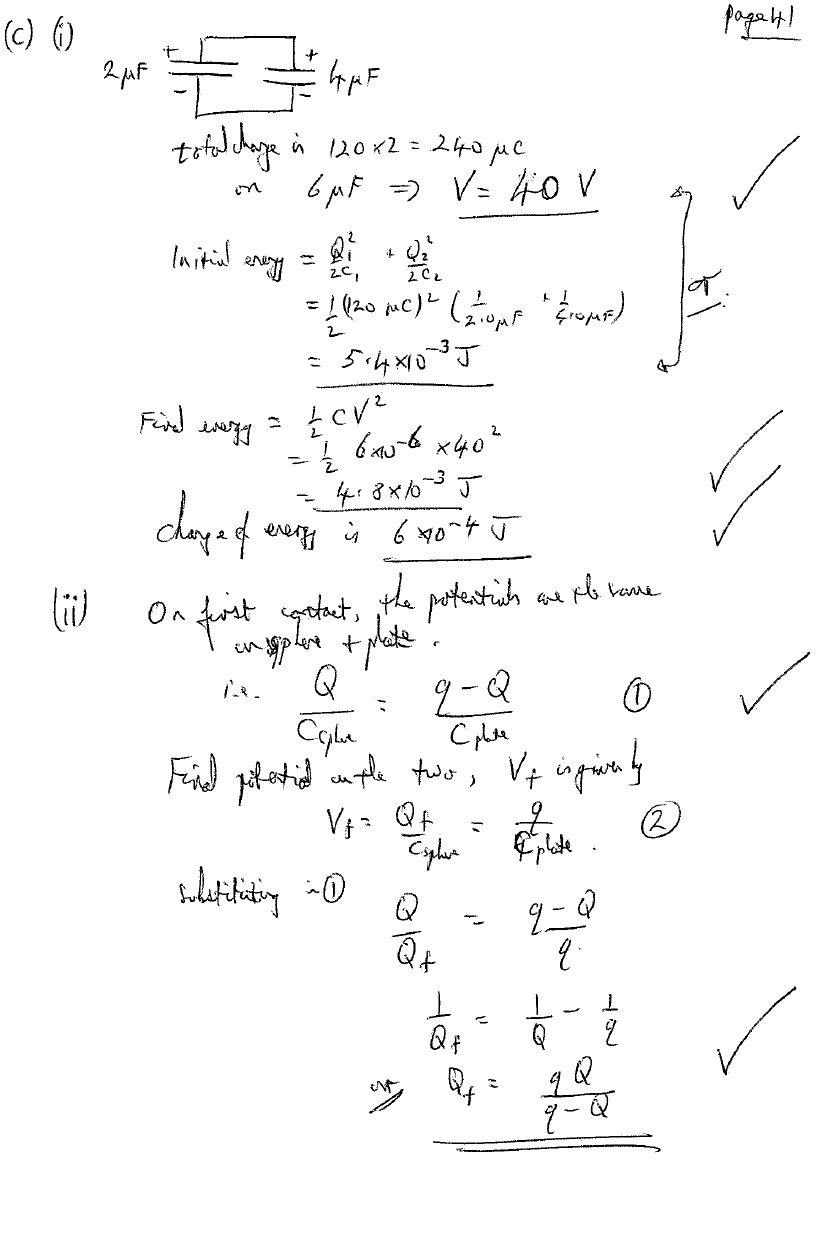
c) (i) Two capacitors, of capacitance 2.0 µF and 4.0 µF, are each given a charge of 120 µC. The positive sides are then connected, as are the negative sides. Calculate: i. The new potential difference across the plates. ii. The change in the energy stored.
(ii) A conducting metal sphere is insulated from the ground. It is initially charged by contact with a small metal disc which carries a charge , so that the sphere gains charge . The metal disc is then again given a charge , and is then touched on the sphere a second time. If this process is repeated indefinitely, what would be the final charge on the sphere, ?
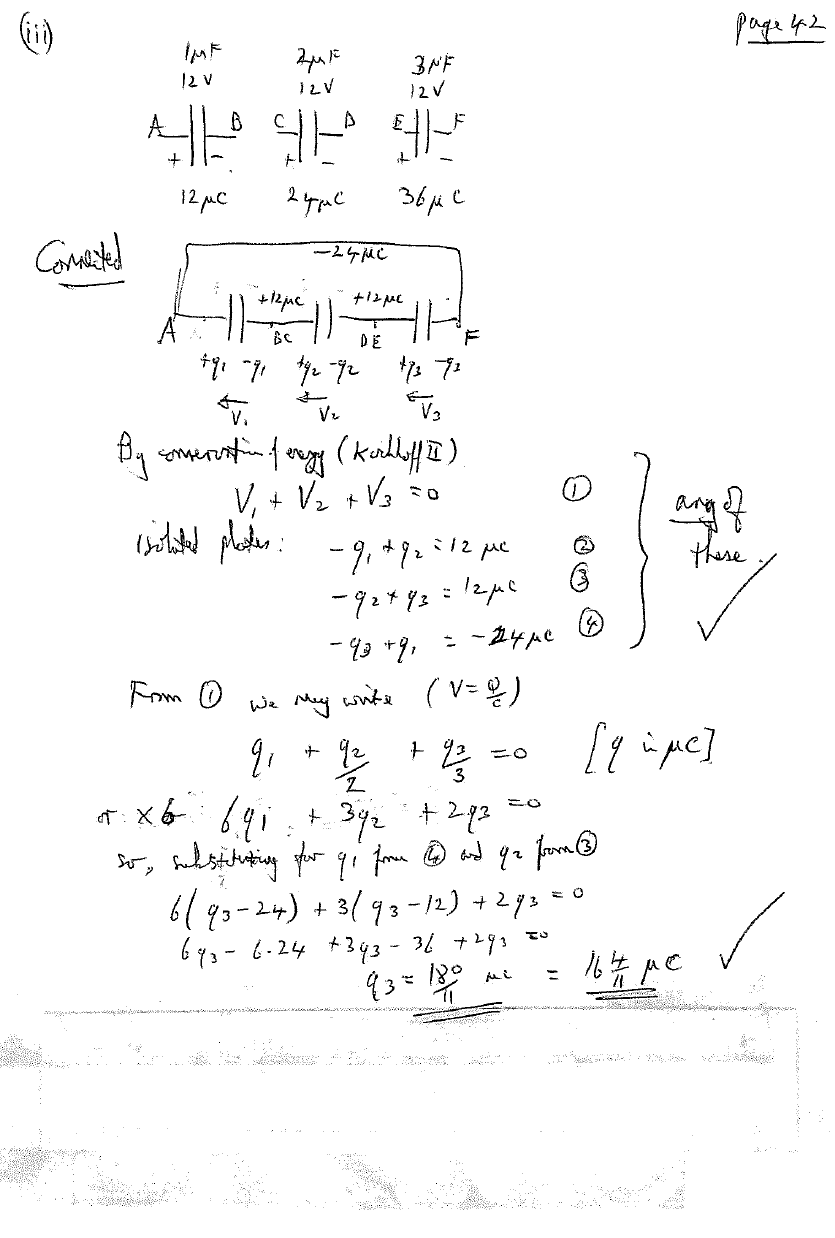
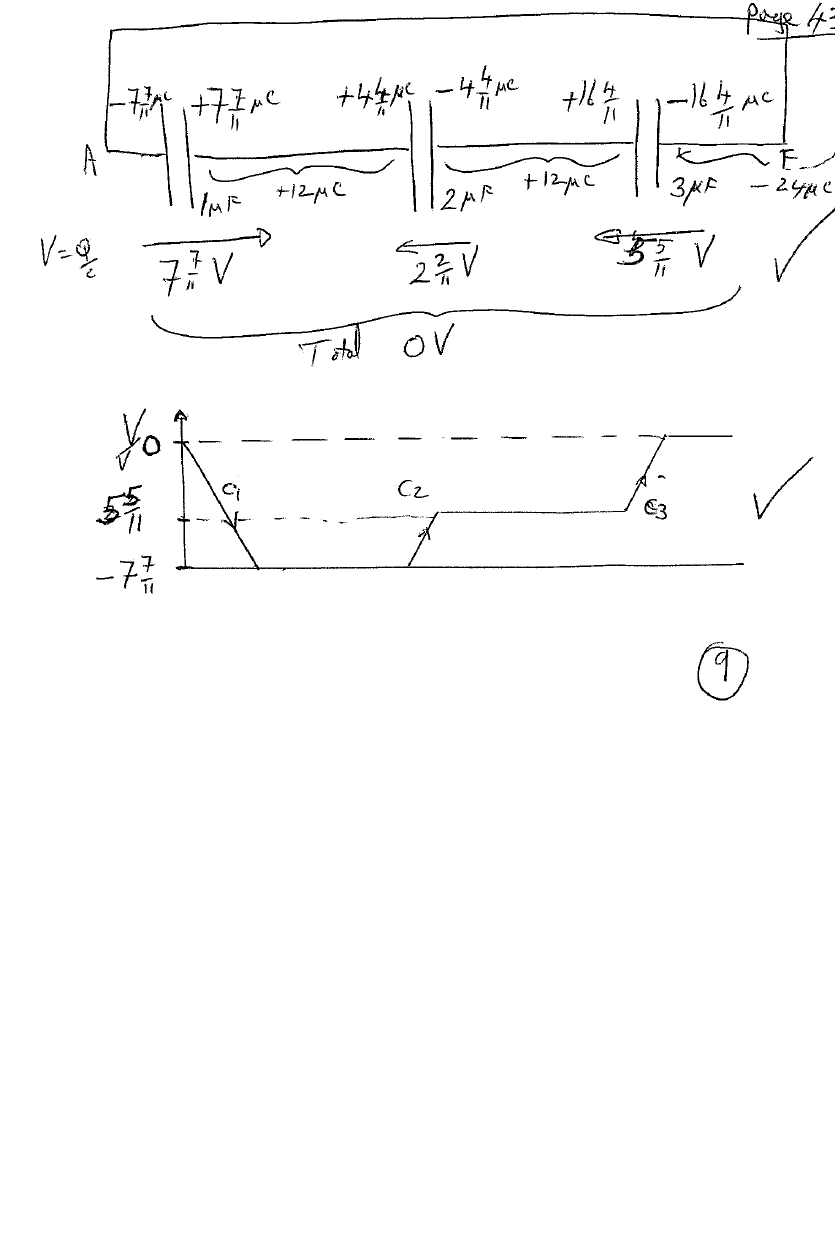
(iii) Three capacitors with leads AB, CD and EF of capacitances 1 µF, 2 µF and 3 µF respectively are each connected separately to a battery and charged to a potential of 12 V. The positively charged plates are A, C and E. The capacitors are joined in series so that B is connected to C, D is connected to E, and F is connected to A. i. Calculate the charges on each of the capacitors, indicating the values and signs on a diagram. ii. Sketch a graph to show the variation of potential around the circuit from A to F. (9)
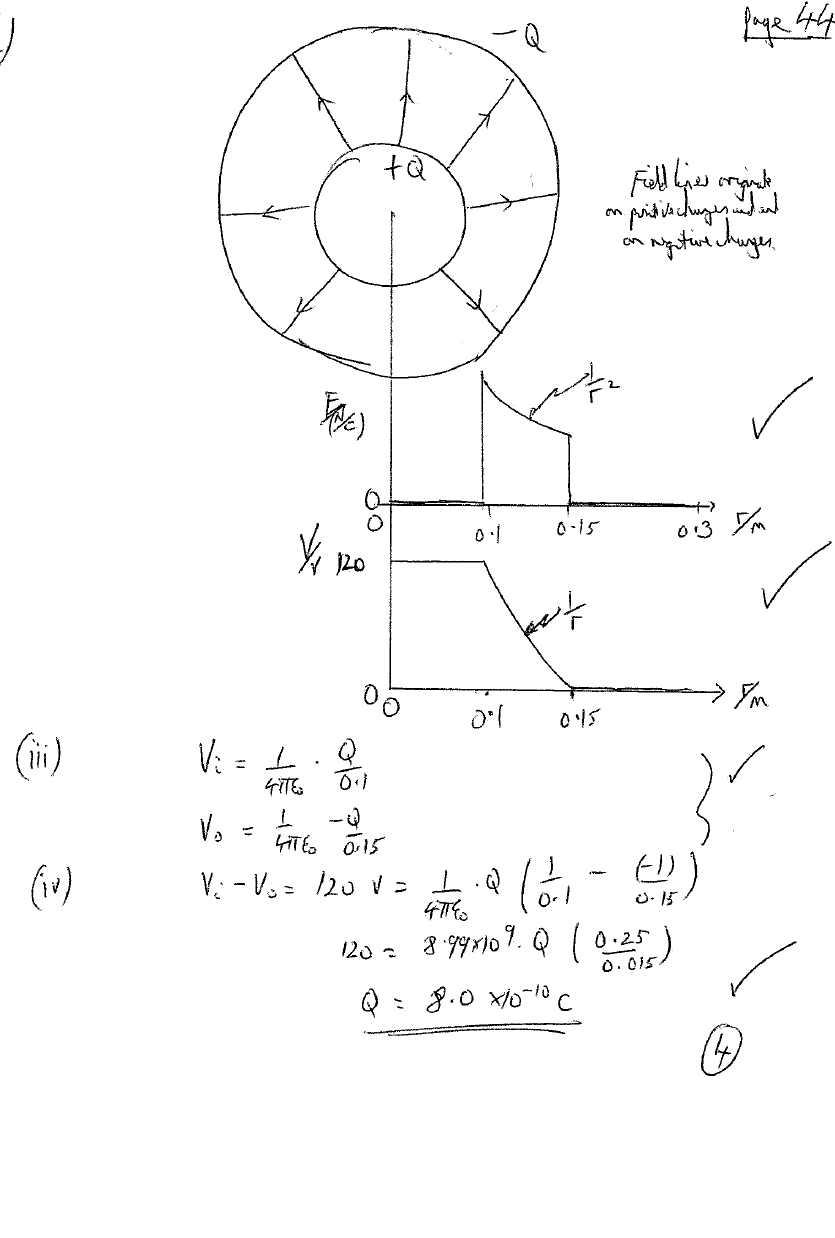
d) A pair of concentric conducting spheres have radii of 10 cm and 15 cm respectively. They are insulated from each other, and the potential difference between the spheres is 120 V. The spheres carry equal charges , with the inner sphere being positive..
(i) Sketch the shape of a graph of the electric field strength between cm and cm.
(ii) Sketch a graph of the potential between cm and cm.
(iii) Write down expressions for the potential on the inner charged sphere if the outer sphere were not present, and the potential for the outer charged sphere if the inner sphere were not present.
(iv) From these results, calculate the magnitude of the charge (4)
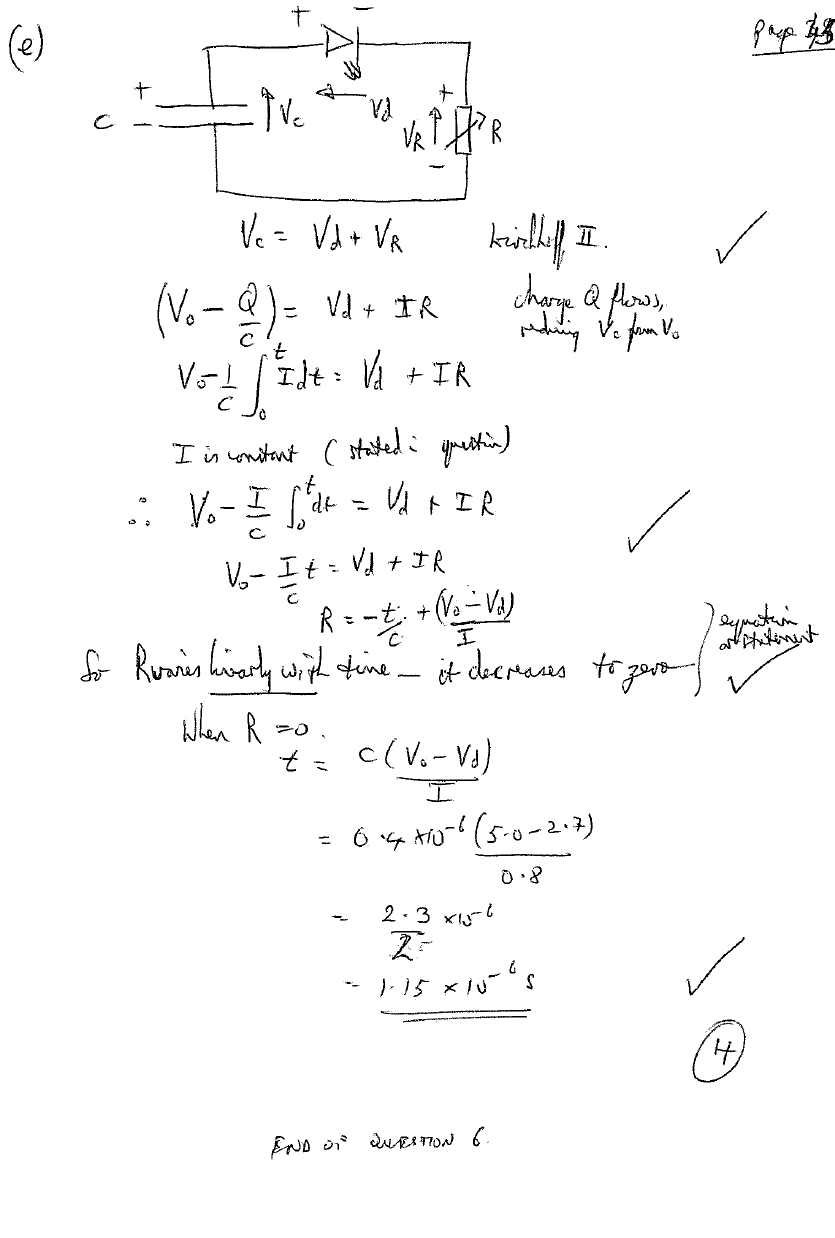
e) An LED is to be lit with a constant current of 800 µA supplied by a charged capacitor, , in series with a variable resistor, , as shown in Figure 12. The diode has a forward bias of 2.7 V, which means that when the diode is conducting a current, it has this fixed potential difference across it.
(i) What is the variation of the variable resistor against time, such that the constant current is maintained?
The initial potential difference across the capacitor is 5.0 V.
(ii) For how long would the LED remain lit if the value of the capacitor is 4000 µF?
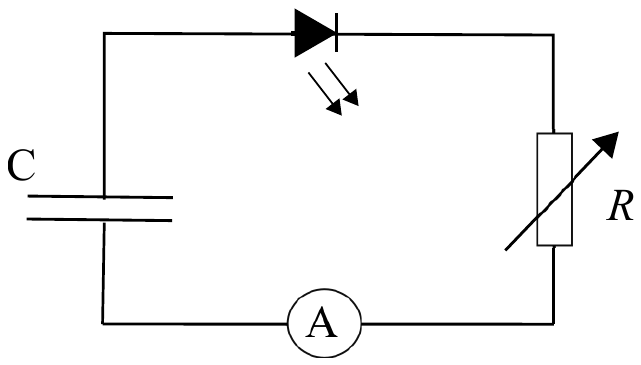
Figure 12 (4)
Risposta: a) (i) ; (ii) , ; (iii) ; (iv) stored , battery supplies : half the energy is dissipated. b) (i) J; (ii) J. c) (i) i. V; ii. J to J, change J; (ii) ; (iii) i. µC (1 µF), µC (2 µF), µC (3 µF); p.d.s V, V, V, total 0 V. d) (iv) C. e) (i) , decreasing linearly to zero; (ii) as printed s
Soluzione:
Official mark scheme (BPhO Round 1, November 2018, Section 2), from the official PDF — p. 41, 42, 43, 44, 45, 46. © BPhO, CC BY 4.0.
Topic: Electrostatics, Circuits Metodi: Conservation Laws, Electric Potential Method, Kirchhoff’s Laws, Gauss’s Law Competenze: Mathematical Modeling, Diagrammatic Reasoning Objects: Capacitor, Conducting Sphere, Battery, Resistor Fonte: Testo (PDF) — p.12 · Soluzione ufficiale (PDF) — p.41
Problema 6 — Condensatori e sfere cariche [25 punti]
a) Due condensatori scarichi, di capacità e , sono collegati in serie a una batteria di f.e.m. e a un interruttore. Chiuso l’interruttore, sui condensatori ci sono rispettivamente le cariche e .
(i) Indica la relazione tra e .
(ii) Scrivi le espressioni delle differenze di potenziale e ai capi di ciascun condensatore.
(iii) Ricava quindi un’espressione della capacità equivalente di e in serie.
(iv) Scrivi le espressioni dell’energia totale immagazzinata nei due condensatori e dell’energia fornita dalla batteria, in funzione di e , e commenta la differenza. (6)
b) Un condensatore piano da 15 nF è collegato a una batteria da 70 V, come in Figura 11. Quanto lavoro bisogna compiere per raddoppiare la distanza tra le armature
(i) con la batteria scollegata,
(ii) con la batteria collegata?
Figura 11 (2)
c) (i) Due condensatori da 2,0 µF e 4,0 µF ricevono ciascuno una carica di 120 µC. Si collegano poi tra loro le armature positive e quelle negative. Calcola: i. la nuova differenza di potenziale tra le armature; ii. la variazione dell’energia immagazzinata.
(ii) Una sfera metallica conduttrice è isolata da terra. Viene caricata inizialmente per contatto con un piccolo disco metallico che porta una carica , così che la sfera acquista la carica . Il disco riceve di nuovo una carica e tocca la sfera una seconda volta. Se il procedimento si ripete indefinitamente, quale sarà la carica finale della sfera, ?
(iii) Tre condensatori con terminali AB, CD ed EF, di capacità 1 µF, 2 µF e 3 µF, vengono caricati ciascuno separatamente da una batteria a 12 V. Le armature positive sono A, C ed E. I condensatori vengono poi collegati in serie unendo B con C, D con E e F con A. i. Calcola le cariche su ciascun condensatore, indicando valori e segni su un disegno. ii. Disegna un grafico dell’andamento del potenziale lungo il circuito da A a F. (9)
d) Due sfere conduttrici concentriche hanno raggi 10 cm e 15 cm. Sono isolate l’una dall’altra e la differenza di potenziale tra le sfere è 120 V. Le sfere portano cariche uguali e opposte , con la sfera interna positiva.
(i) Disegna l’andamento qualitativo dell’intensità del campo elettrico tra cm e cm.
(ii) Disegna il grafico del potenziale tra cm e cm.
(iii) Scrivi le espressioni del potenziale della sfera interna carica in assenza della sfera esterna e del potenziale della sfera esterna carica in assenza di quella interna.
(iv) Da questi risultati, calcola il modulo della carica . (4)
e) Un LED deve essere acceso con una corrente costante di 800 µA fornita da un condensatore carico in serie con un resistore variabile , come in Figura 12. Il diodo ha una tensione di soglia di 2,7 V: quando conduce, ai suoi capi c’è questa differenza di potenziale fissa.
(i) Come deve variare nel tempo il resistore variabile, , perché la corrente resti costante?
La differenza di potenziale iniziale ai capi del condensatore è 5,0 V.
(ii) Per quanto tempo il LED resterebbe acceso se la capacità del condensatore fosse 4000 µF?
Figura 12 (4)
Risposta: a) (i) ; (ii) , ; (iii) ; (iv) immagazzinata , la batteria fornisce : metà dell’energia è dissipata. b) (i) J; (ii) J. c) (i) i. V; ii. da J a J, variazione J; (ii) ; (iii) i. µC (1 µF), µC (2 µF), µC (3 µF); d.d.p. V, V, V, totale 0 V. d) (iv) C. e) (i) , che decresce linearmente fino a zero; (ii) come stampato s
Soluzione: La soluzione ufficiale completa (in inglese) è nella versione originale di questo quesito e nel PDF ufficiale.
Topic: Electrostatics, Circuits Metodi: Conservation Laws, Electric Potential Method, Kirchhoff’s Laws, Gauss’s Law Competenze: Mathematical Modeling, Diagrammatic Reasoning Objects: Capacitor, Conducting Sphere, Battery, Resistor Fonte: Testo (PDF) — p.12 · Soluzione ufficiale (PDF) — p.41
Answers from the official BPhO Round 1 2018 mark scheme.
| Problem | Title | Risposta |
|---|---|---|
| 2 | Question 2 — Gravitation: orbits, the Earth’s interior, planet formation [25 marks] | a) , . b) au. c) core radius m, density – kg m; mantle to – m, density – kg m: mass – kg. d) (i) centre of mass of the separation from the planet, neutral point about of the separation from the moon; (ii) m; (iii) , m s km s. e) (using instead gives 0.14%, allowed 3 marks). f) (i) ; (ii) ; (iii) K |
| 3 | Question 3 — Circular motion, elastic strings and oscillations [25 marks] | a) (i) ; (ii) . b) (i) ; (ii) i. they accelerate towards each other in SHM (a quarter cycle) until the separation is , then move at constant speed; ii. s. c) (i) ; (ii) (shown). d) (i) below the ceiling; (ii) ; (iii) ; (iv) , |
| 4 | Question 4 — Fluid pressure, buoyancy and floating bodies [25 marks] | a) (i) i. ; iii. ; iv. is almost the same, but air is compressible and its density varies very non-linearly with height; (ii) i. ; ii. as printed, momentum argument with : . b) (i) ( minus the weight of liquid displaced); (ii) . c) . d) (i) ; (ii) (shown) |
| 5 | Question 5 — Resistor networks and strain gauges [25 marks] | a) (iii) circuit (a) is linear and covers the full range of (a current always flows through ); circuit (b) does not cover the range to 0 V. b) (i) mA (a, e), mA (b, d), mA (c) (signs may differ); (ii) . c) (i) (); (ii) , ; (iii) , ; (iv) V (0.030 V acceptable with the constant-volume value). d) , . e) : magnitude A |
| 6 | Question 6 — Capacitors and charged spheres [25 marks] | a) (i) ; (ii) , ; (iii) ; (iv) stored , battery supplies : half the energy is dissipated. b) (i) J; (ii) J. c) (i) i. V; ii. J to J, change J; (ii) ; (iii) i. µC (1 µF), µC (2 µF), µC (3 µF); p.d.s V, V, V, total 0 V. d) (iv) C. e) (i) , decreasing linearly to zero; (ii) as printed s |
Fonte: Testo e soluzioni (PDF)
Risposte tratte dal mark scheme ufficiale BPhO Round 1 2018.
| Problema | Titolo | Risposta |
|---|---|---|
| 2 | Problema 2 — Gravitazione: orbite, interno della Terra, formazione dei pianeti [25 punti] | a) , . b) UA. c) raggio del nucleo m, densità – kg m; mantello fino a – m, densità – kg m: massa – kg. d) (i) centro di massa a della distanza dal pianeta, punto neutro a circa della distanza dalla luna; (ii) m; (iii) , m s km s. e) (usando invece si ottiene 0,14%, 3 punti). f) (i) ; (ii) ; (iii) K |
| 3 | Problema 3 — Moto circolare, fili elastici e oscillazioni [25 punti] | a) (i) ; (ii) . b) (i) ; (ii) i. accelerano l’una verso l’altra di moto armonico (un quarto di ciclo) finché la distanza è , poi procedono a velocità costante; ii. s. c) (i) ; (ii) (dimostrato). d) (i) sotto il soffitto; (ii) ; (iii) ; (iv) , |
| 4 | Problema 4 — Pressione nei fluidi, spinta e galleggiamento [25 punti] | a) (i) i. ; iii. ; iv. è quasi uguale, ma l’aria è comprimibile e la sua densità varia con l’altezza in modo molto non lineare; (ii) i. ; ii. come stampato, con la quantità di moto e : . b) (i) ( meno il peso del liquido spostato); (ii) . c) . d) (i) ; (ii) (dimostrato) |
| 5 | Problema 5 — Reti di resistori ed estensimetri [25 punti] | a) (iii) il circuito (a) è lineare e copre tutto l’intervallo di (in circola sempre corrente); il circuito (b) non copre l’intervallo da a 0 V. b) (i) mA (a, e), mA (b, d), mA (c) (i segni possono differire); (ii) . c) (i) (); (ii) , ; (iii) , ; (iv) V (accettato 0,030 V con il valore a volume costante). d) , . e) : in modulo A |
| 6 | Problema 6 — Condensatori e sfere cariche [25 punti] | a) (i) ; (ii) , ; (iii) ; (iv) immagazzinata , la batteria fornisce : metà dell’energia è dissipata. b) (i) J; (ii) J. c) (i) i. V; ii. da J a J, variazione J; (ii) ; (iii) i. µC (1 µF), µC (2 µF), µC (3 µF); d.d.p. V, V, V, totale 0 V. d) (iv) C. e) (i) , che decresce linearmente fino a zero; (ii) come stampato s |
Fonte: Testo e soluzioni (PDF)