Question 2 — Forces on dam walls and ultrasonic crack detection [25 marks]
This is about forces on dam walls and detecting cracks in them through wave reflection.
a) The dam shown in Fig. 1 is used to generate hydroelectric power. The difference in height between the water levels of the dam is 61 m, and the peak flow rate of the water through the dam is 3380 m s. Estimate the maximum power output of the hydroelectric facility. (3)
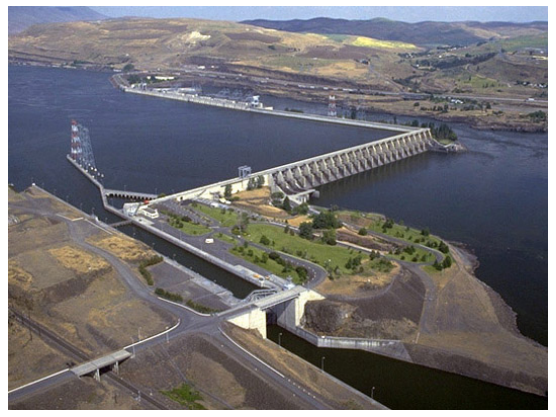
Figure 1: HEP dam (credit: Wikimedia Commons, EPA archives, The Dalles Dam).
b) In practice not all of the gravitational potential energy of the water behind the dam is transferred by the generators, and the water emerges from the dam with a velocity of 8.0 m s. Calculate the efficiency of the energy transfer process from the water. (3)
c) The dam can be considered to be a concrete prism of triangular cross-section, with height m, a base of thickness m, and a width of m. The cross-section of the dam is illustrated in Figure 2. Points F and C are at the bottom of the dam. The water level is at the top of the dam wall.
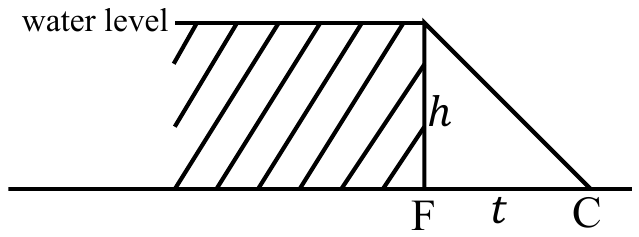
Figure 2
(i) Calculate the resultant force on the face of the dam due to water pressure in terms of , , and , where is the density of water.
(ii) Calculate the resultant moment (torque) about F due to this force, and calculate the effective height at which the resultant force acts to produce this moment.
The centre of mass of a uniform triangle is at the point of intersection of its medians (the lines joining its vertices to the midpoints of the opposite sides). Thus the centre of mass lies two-thirds of the way along each median.
(iii) For the dam, state the position of the centre of mass of the dam relative to F.
(iv) Calculate the two turning moments acting on the dam about C, due to the water pressure and the weight of the dam.
(v) The frictional force of the dam on the ground beneath is given by where is the normal reaction force of the ground, and . Calculate the minimum density of concrete that could be used so that the dam will not slide over the ground.
(vi) Calculate the minimum density of concrete used to construct the dam so that it will not tip up about point C.
Density of water is kg m (10)
d) There is a significant danger of cracks forming in dams, leading to catastrophic failure with little or no warning. One form of non-destructive testing uses ultrasonic waves to investigate the interior of the concrete. When a wave strikes a boundary (interface) between two different media it has to obey two constraints.
- the displacement of the material by the wave must be the same either side of the boundary.
- the energy transferred into the boundary must be the same as the total energy reflected and transmitted.
If an incident wave has an amplitude , the reflected wave amplitude and the transmitted wave amplitude , then we can write: The energy of a wave is proportional to the square of the amplitude, , and the rate of energy flow in a medium is given by , where stands for the acoustic impedance and is a parameter of the medium, and is a constant (it cancels in all our equations and can be ignored).
(i) From the energy flow through a boundary from medium 1 to medium 2, show that where and are the impedances of the media either side of the boundary, as illustrated in Figure 3.
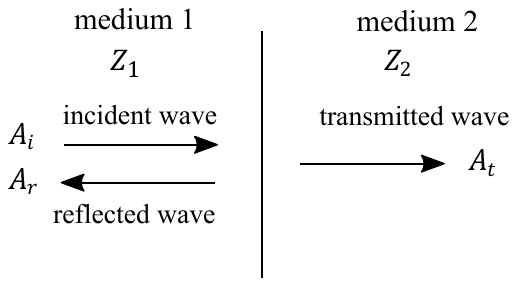
Figure 3
Using these two requirements (eq. (1) and (2)) for a wave crossing an interface between two media at normal incidence:
(ii) show that , and
(iii) derive an expression for in terms of and .
(iv) If , what can be said about the transmitted and reflected waves and the values of and ?
(v) When , what effect does this produce?
The energy reflected back can be used to characterise cracks in the concrete. The coefficient of reflection, , is the ratio of the reflected to the incident energy flow, such that . The coefficient of transmission, , is the ratio of the transmitted energy flow in medium 2 to the incident energy flow in medium 1.
(v) Obtain expressions for and in terms of and .
(vi) Calculate a value for .
For a medium, , where is the density of the medium, and is the speed of sound in the medium. Values for the densities and sound speeds in air, concrete and water are given in Table 1.
| medium | density / kg m | sound speed / m s |
|---|---|---|
| air | 1.2 | 330 |
| concrete | 2400 | 3700 |
| water | 1000 | 1480 |
Table 1
(vii) Calculate the percentage of ultrasound energy reflected from a crack in the concrete when i. the crack is filled with air, ii. the crack is filled with water. (9)
Risposta: a) W. b) wasted W, efficiency . c) (i) ; (ii) moment about F, acting at above F; (iii) 20 m above F and 20 m to its right; (iv) water: N m; weight: ; (v) sliding: kg m; (vi) tipping: kg m. d) (iii) ; (iv) no detectable boundary: , ; (v) negative, a phase change on reflection; (v) , ; (vi) ; (vii) air , water
Soluzione:
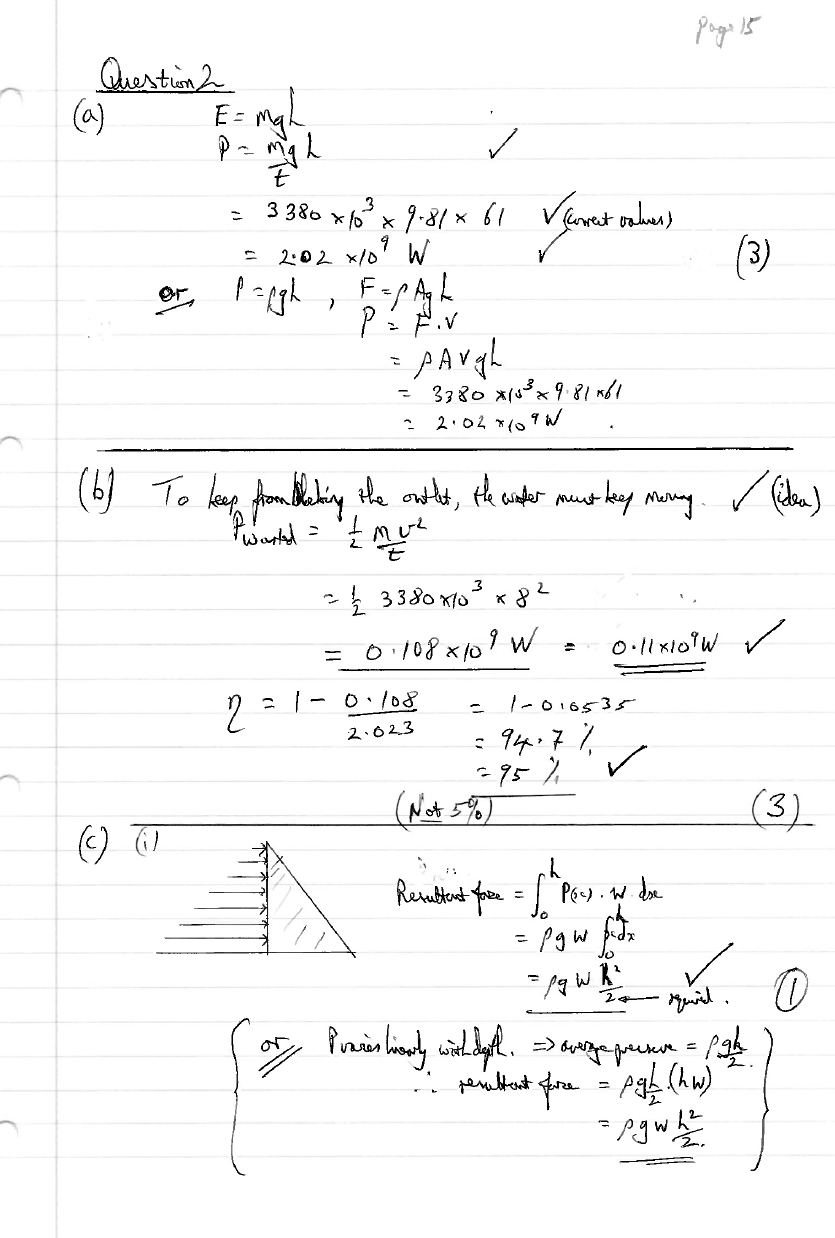
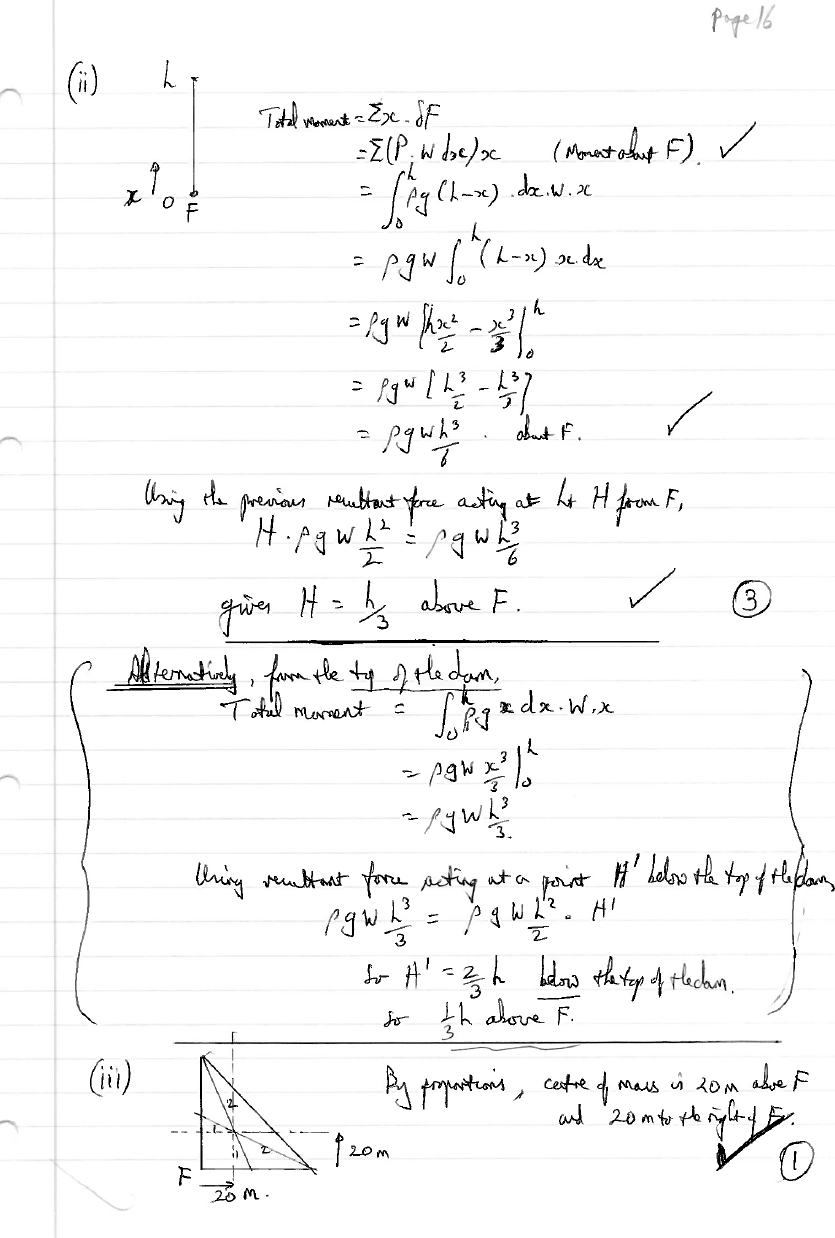
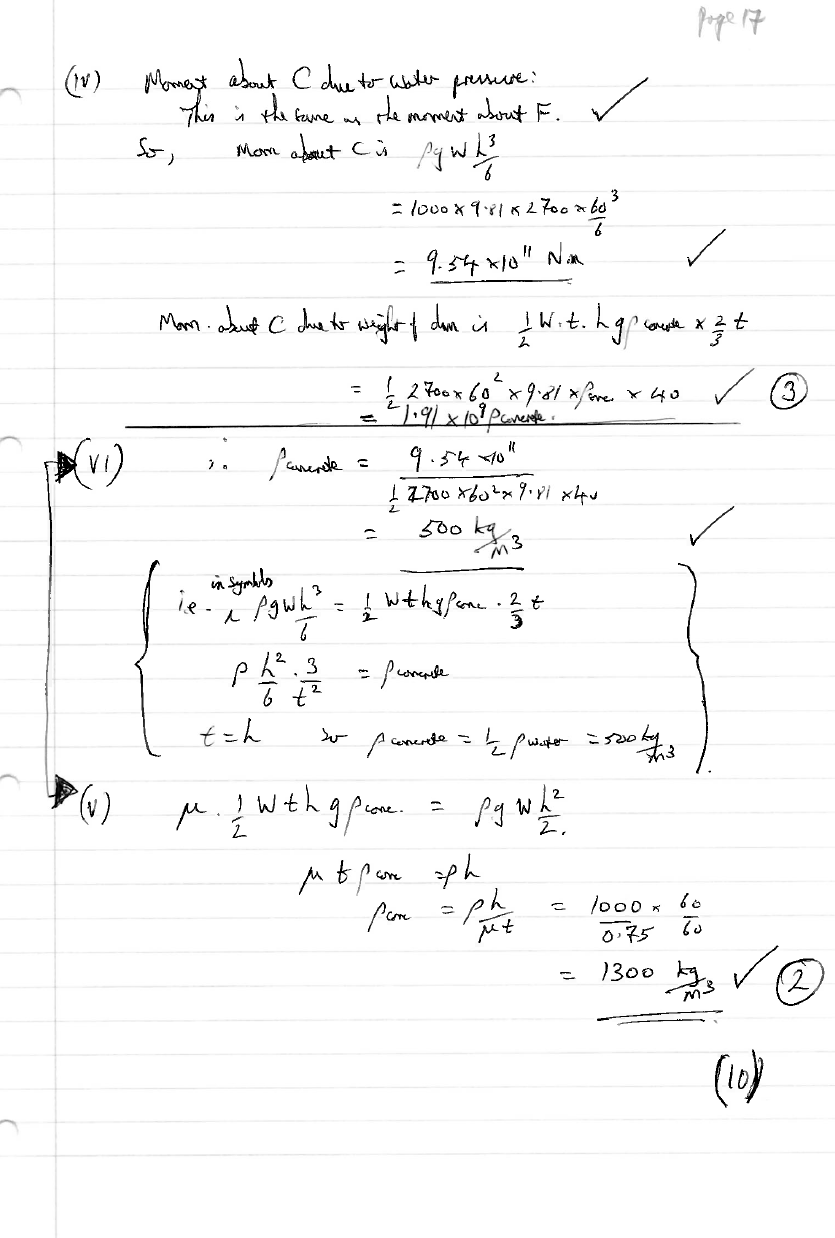
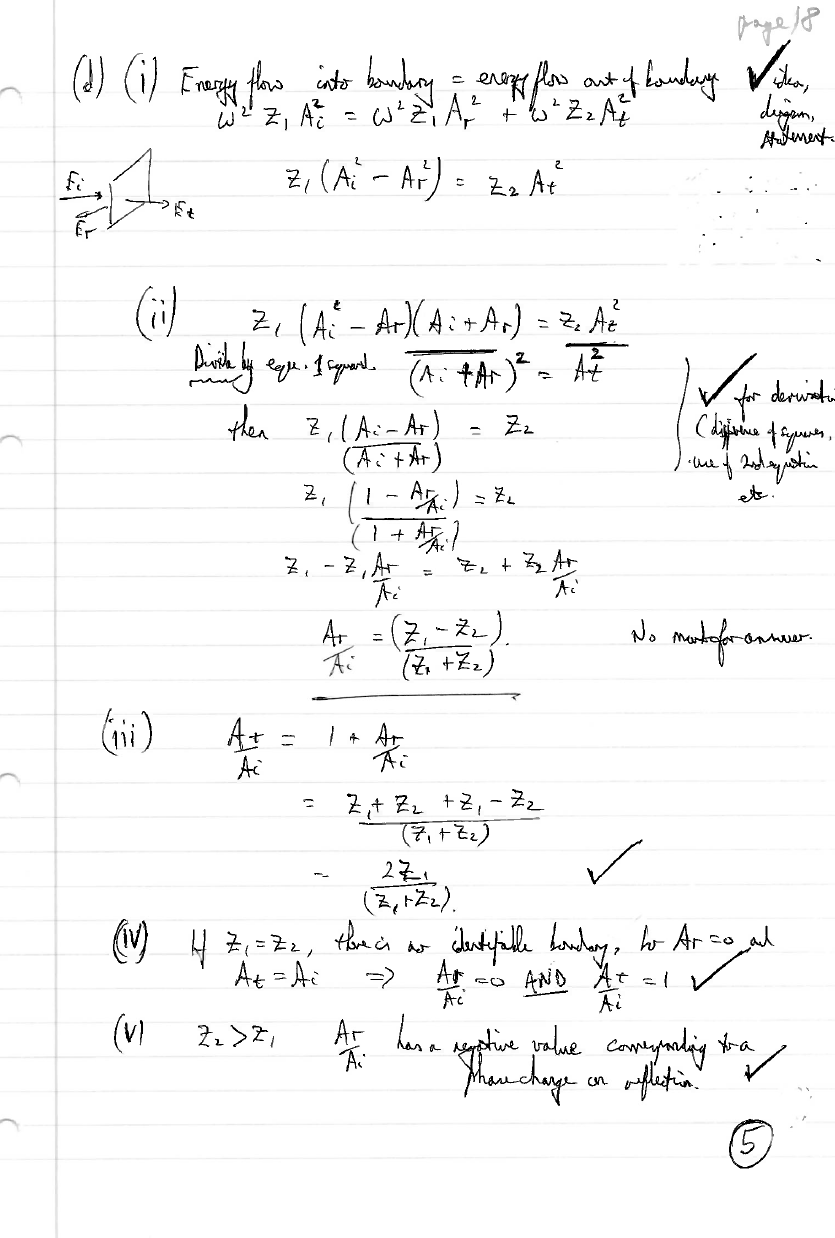
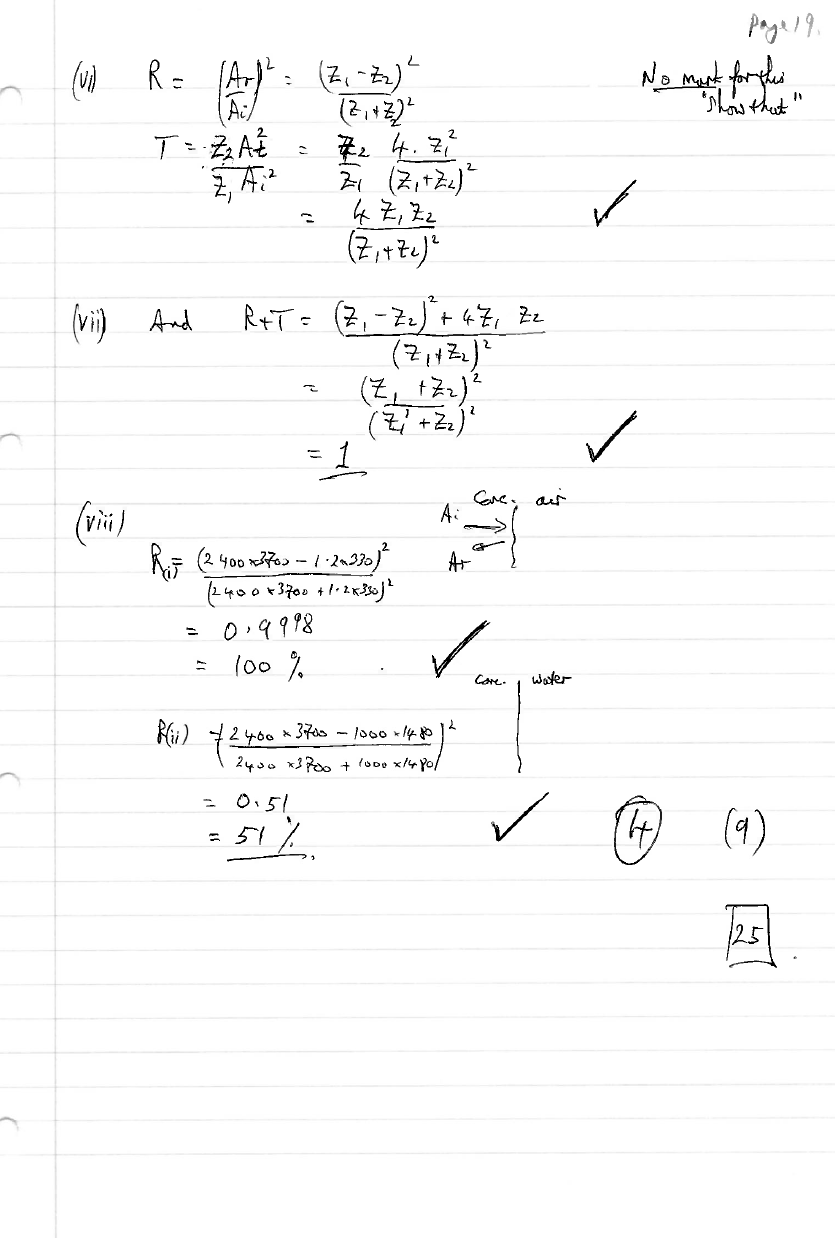
Official mark scheme (BPhO Round 1, November 2019, Section 2), from the official PDF — p. 16, 17, 18, 19, 20. © BPhO, CC BY 4.0.
Topic: Fluid Mechanics, Rigid Body Statics, Oscillations & Waves Metodi: Hydrostatic Equilibrium, Calculus-Integration, Torque & Angular Momentum Analysis, Conservation of Energy Competenze: Mathematical Modeling, Physical Reasoning Objects: Wedge Fonte: Testo (PDF) — p.3 · Soluzione ufficiale (PDF) — p.16
Problema 2 — Forze sulle dighe e ricerca di crepe con gli ultrasuoni [25 punti]
Il problema riguarda le forze sulle dighe e la ricerca di crepe al loro interno mediante la riflessione delle onde.
a) La diga di Fig. 1 serve a produrre energia idroelettrica. Il dislivello tra i due specchi d’acqua della diga è 61 m e la portata massima dell’acqua attraverso la diga è 3380 m s. Stima la potenza massima erogata dalla centrale idroelettrica. (3)
Figura 1: diga idroelettrica (fonte: Wikimedia Commons, archivio EPA, diga di The Dalles).
b) In pratica non tutta l’energia potenziale gravitazionale dell’acqua dietro la diga viene trasferita ai generatori, e l’acqua esce dalla diga con velocità 8,0 m s. Calcola il rendimento del trasferimento di energia dall’acqua. (3)
c) La diga si può considerare un prisma di calcestruzzo a sezione triangolare, di altezza m, base di spessore m e larghezza m. La sezione della diga è mostrata in Figura 2. I punti F e C sono alla base della diga. Il livello dell’acqua arriva in cima alla parete della diga.
Figura 2
(i) Calcola la forza risultante sulla parete della diga dovuta alla pressione dell’acqua in funzione di , , e , dove è la densità dell’acqua.
(ii) Calcola il momento risultante rispetto a F dovuto a questa forza e l’altezza efficace alla quale la forza risultante agisce producendo tale momento.
Il centro di massa di un triangolo omogeneo è nel punto d’incontro delle mediane (i segmenti che congiungono i vertici con i punti medi dei lati opposti); si trova quindi a due terzi di ciascuna mediana.
(iii) Indica la posizione del centro di massa della diga rispetto a F.
(iv) Calcola i due momenti che agiscono sulla diga rispetto a C, dovuti alla pressione dell’acqua e al peso della diga.
(v) La forza d’attrito tra la diga e il terreno sottostante è , dove è la reazione normale del terreno e . Calcola la densità minima del calcestruzzo perché la diga non scivoli sul terreno.
(vi) Calcola la densità minima del calcestruzzo perché la diga non si ribalti attorno al punto C.
Densità dell’acqua kg m (10)
d) Nelle dighe c’è un serio pericolo che si formino crepe, che possono portare a un cedimento catastrofico con poco o nessun preavviso. Un metodo di controllo non distruttivo usa onde ultrasoniche per esplorare l’interno del calcestruzzo. Quando un’onda incontra la superficie di separazione (interfaccia) tra due mezzi diversi deve rispettare due vincoli.
- lo spostamento del materiale prodotto dall’onda deve essere lo stesso ai due lati dell’interfaccia;
- l’energia che arriva sull’interfaccia deve essere uguale all’energia totale riflessa e trasmessa.
Se l’onda incidente ha ampiezza , l’onda riflessa e l’onda trasmessa , possiamo scrivere: L’energia di un’onda è proporzionale al quadrato dell’ampiezza, , e il flusso di energia in un mezzo è , dove è l’impedenza acustica, un parametro del mezzo, e è una costante (si semplifica in tutte le equazioni e si può ignorare).
(i) Dal flusso di energia attraverso un’interfaccia dal mezzo 1 al mezzo 2, mostra che dove e sono le impedenze dei mezzi ai due lati dell’interfaccia, come in Figura 3.
Figura 3
Usando questi due vincoli (eq. (1) e (2)) per un’onda che attraversa a incidenza normale l’interfaccia tra due mezzi:
(ii) mostra che , e
(iii) ricava un’espressione di in funzione di e .
(iv) Se , che cosa si può dire delle onde trasmessa e riflessa e dei valori di e ?
(v) Che effetto si ha quando ?
L’energia riflessa si può usare per caratterizzare le crepe nel calcestruzzo. Il coefficiente di riflessione è il rapporto tra il flusso di energia riflesso e quello incidente, . Il coefficiente di trasmissione è il rapporto tra il flusso di energia trasmesso nel mezzo 2 e quello incidente nel mezzo 1.
(v) Ricava le espressioni di e in funzione di e .
(vi) Calcola il valore di .
Per un mezzo, , dove è la densità del mezzo e la velocità del suono nel mezzo. Densità e velocità del suono in aria, calcestruzzo e acqua sono riportate in Tabella 1.
| mezzo | densità / kg m | velocità del suono / m s |
|---|---|---|
| aria | 1,2 | 330 |
| calcestruzzo | 2400 | 3700 |
| acqua | 1000 | 1480 |
Tabella 1
(vii) Calcola la percentuale di energia ultrasonica riflessa da una crepa nel calcestruzzo quando i. la crepa è piena d’aria, ii. la crepa è piena d’acqua. (9)
Risposta: a) W. b) potenza persa W, rendimento . c) (i) ; (ii) momento rispetto a F, applicato a sopra F; (iii) 20 m sopra F e 20 m alla sua destra; (iv) acqua: N m; peso: ; (v) scivolamento: kg m; (vi) ribaltamento: kg m. d) (iii) ; (iv) nessuna interfaccia rilevabile: , ; (v) negativo, cambio di fase nella riflessione; (v) , ; (vi) ; (vii) aria , acqua
Soluzione: La soluzione ufficiale completa (in inglese) è nella versione originale di questo quesito e nel PDF ufficiale.
Topic: Fluid Mechanics, Rigid Body Statics, Oscillations & Waves Metodi: Hydrostatic Equilibrium, Calculus-Integration, Torque & Angular Momentum Analysis, Conservation of Energy Competenze: Mathematical Modeling, Physical Reasoning Objects: Wedge Fonte: Testo (PDF) — p.3 · Soluzione ufficiale (PDF) — p.16
Question 3 — Mechanical fairground rides [25 marks]
Several mechanical fairground rides are analysed in this question.
a) A particle of mass moves at a constant rate in a horizontal circular path of radius . State why there must be a resultant force acting on the particle; indicate its direction on a diagram, and state its magnitude both in terms of its speed and its angular speed (2)
b) A fairground ride consists of a set of chairs hanging from cables of length m, which are attached to circular support of radius m, as shown in Figure 4 below. Each passenger sits in a light chair, with combined mass , which can be treated as a point mass at the end of each cable. The ride rotates at angular speed , and the cable hangs at an angle of to the vertical. Obtain an expression for the angular velocity in terms of , , and and then evaluate for the given values. (2)
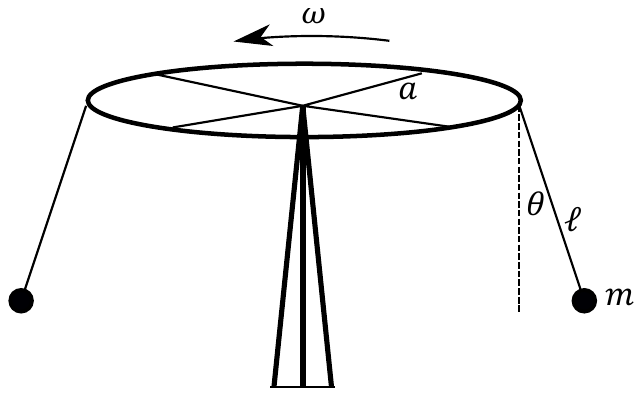
Figure 4
c) The “wall of death” ride consists of a m diameter drum which rotates at an angular rate , shown in Figure 5a. Passengers stand against the inside vertical, rough wall and as the ride speeds up to rate , they are held against the wall and cannot slide down due to friction with the wall.
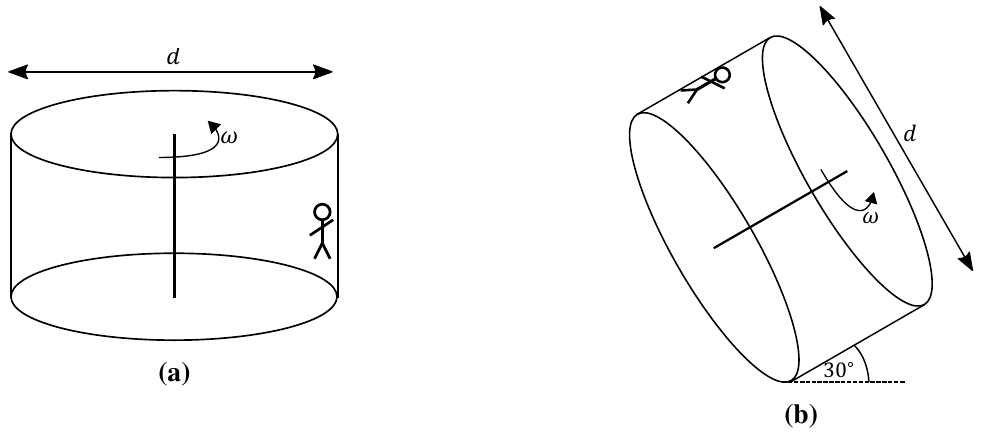
Figure 5
(i) Sketch a diagram of the three forces acting on a passenger who is held against the wall.
(ii) If the frictional force is given by where is the normal reaction force of the wall, and , calculate the minimum value of for the drum in order for passengers to be held against the wall.
(iii) The rotating drum is now tilted through 60° so that its axis of rotation is above the horizontal (Figure 5b). Sketch a diagram of the three forces acting on a passenger when they are at the highest point of the circular path.
(iv) The frictional force remains as with although the value of will be different as the wall is no longer vertical. Given this condition on , calculate the new value of the minimum angular velocity, of the drum so that passengers are held against the wall at the highest point. (6)
d) Roller coasters operate using gravity and are not powered. A roller coaster similar to that illustrated in Fig. 6 can be modelled as a circular loop of radius of 20 m connected to a straight sloping track, shown in Figure 7.
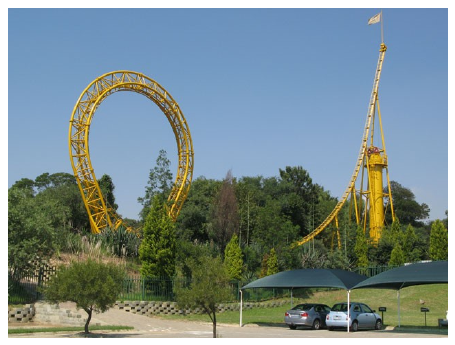
Figure 6 (credit: themeparkreview.com, Gold Reef City, Golden Loop)
(i) Now use the simplified model of Figure 7. Estimate the minimum height of the top of the slope from which a car must start in order to remain in contact with the track at all times when the car travels around the loop of radius m without falling. Friction can be neglected. Hint: consider the forces acting on the car at the top of the loop, and the minimum speed needed to remain in contact.
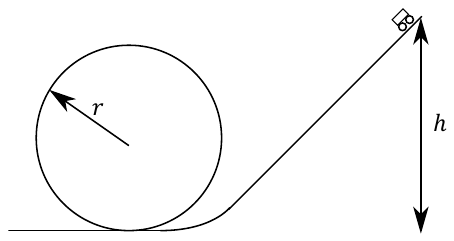
Figure 7
(ii) In this simplified model of the loop ride, the straight track joins on to the circular track at the bottom of the slope. Friction now acts on the carriage such that the frictional force is , where is the normal contact force of the track on the carriage and . i. Draw a force diagram for the resultant force acting on the carriage as it accelerates down the straight track. ii. For a track length m at an angle above the horizontal, by what percentage does friction reduce the speed of the carriage at the bottom of the sloped track?
(iii) We again neglect friction. The straight track now joins a curved track with a radius of curvature of . What would be the change in the normal contact force acting on a 60 kg passenger from his seat at the moment the carriage enters the curve? (8)
e) A student has an even more unusual idea for a fun-fair ride. This can be modelled as two bars (A and B) each of mass separated by two springs of negligible mass, each of spring constant and unstretched length . The springs are lightly damped to stop vibrations. This is similar to the example shown in Figure 8. The lower bar A is initially at a height of above the ground. The ride is then released from rest and falls freely under gravity.
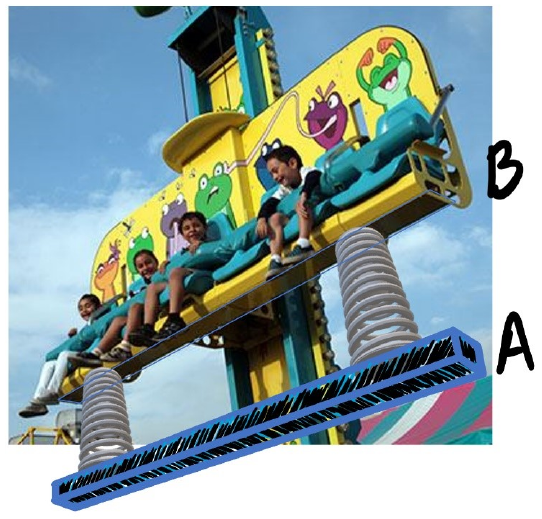
Figure 8 (credit: kerncountyfair.com)
(i) Find an expression for the speed of the bars immediately before they hit the ground.
(ii) Bar A strikes the ground and is brought to rest almost instantaneously, its kinetic energy all being transferred to heat and sound. Determine the total energy of the system, , in terms of the subsequent maximum compression of the springs , and gravitational potential energy.
After this, the springs extend again, and then at some moment bar A lifts off the ground.
(iii) By considering the forces acting on A determine the extension , of the springs at the instant A leaves the ground.
(iv) Hence, using energy considerations, deduce an expression for the condition the initial height must satisfy in order for A to leave the ground. (7)
Risposta: a) velocity constantly changes direction, so by N2 a force acts, towards the centre: . b) , rad s. c) (ii) , rad s; (iv) rad s. d) (i) m; (ii) ii. , loss in speed ; (iii) N N. e) (i) ; (ii) ; (iii) for each spring; (iv)
Soluzione:
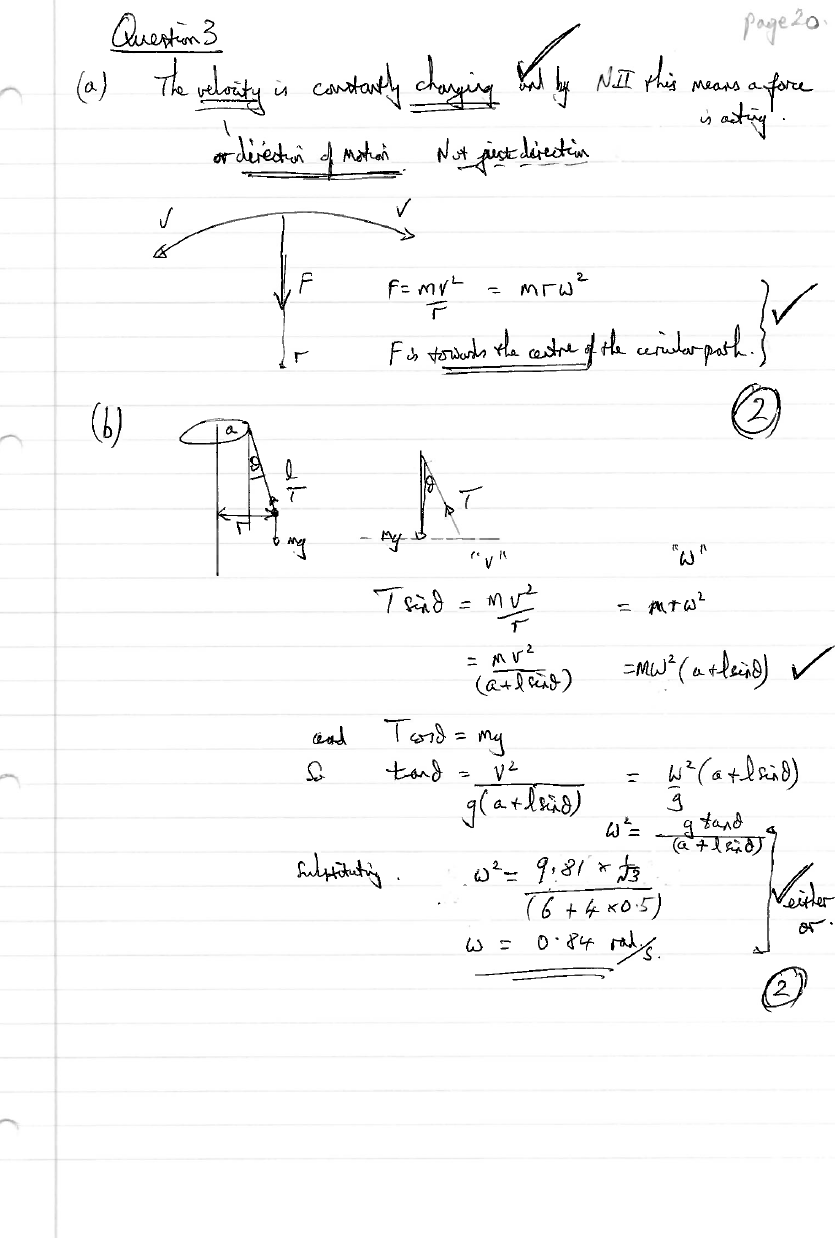
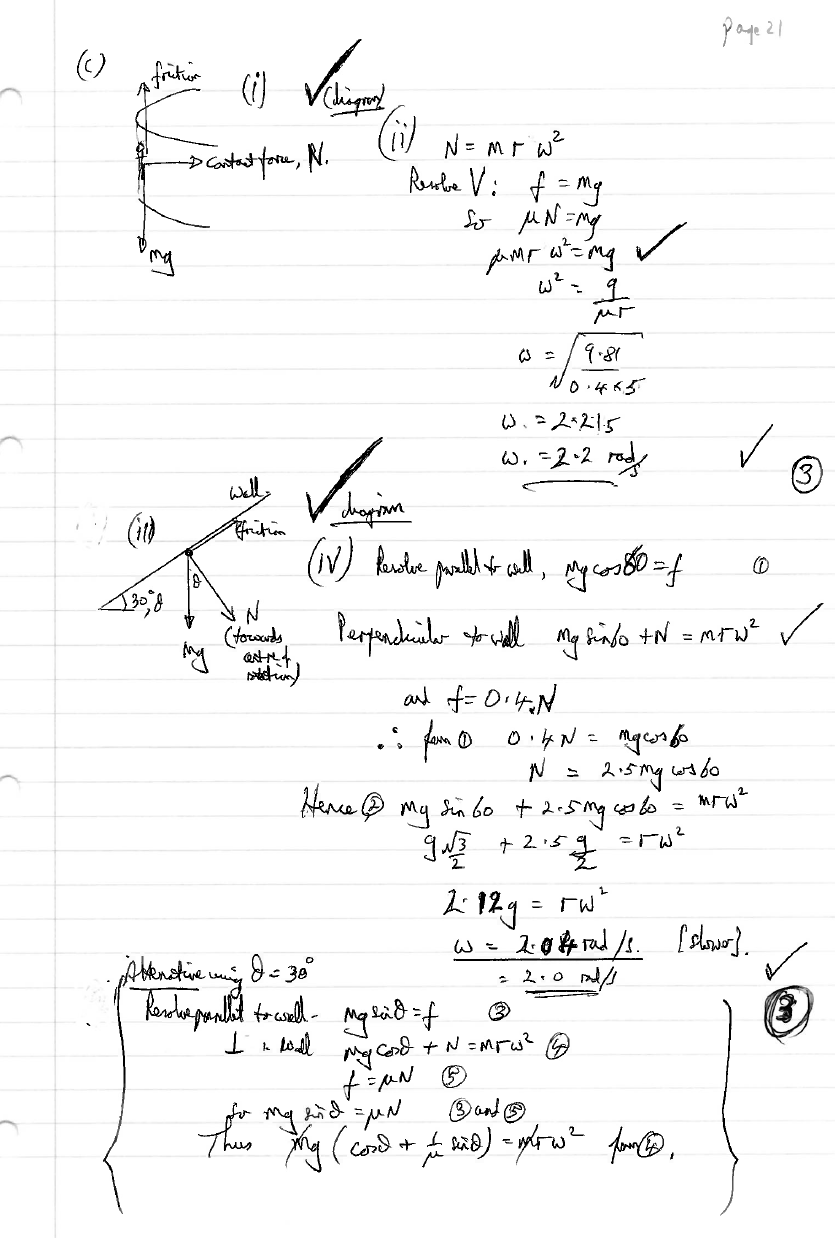
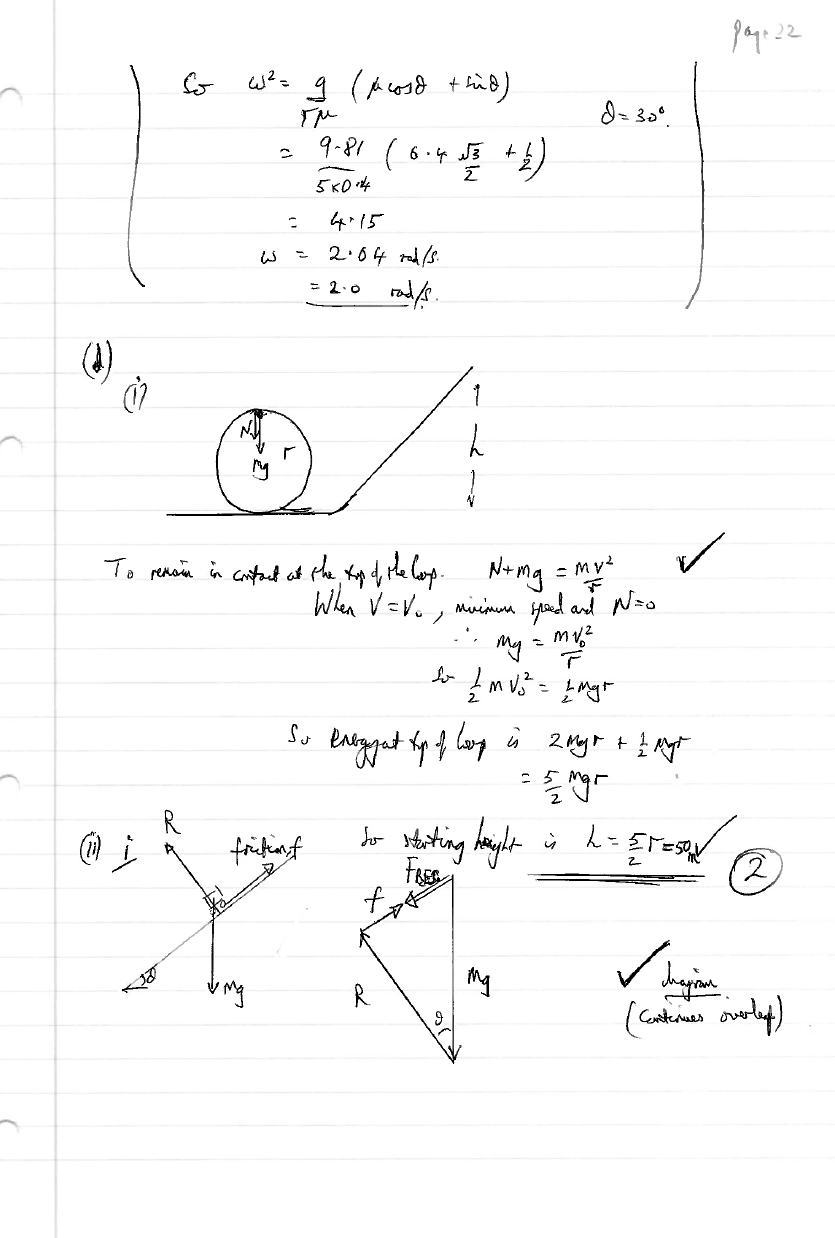
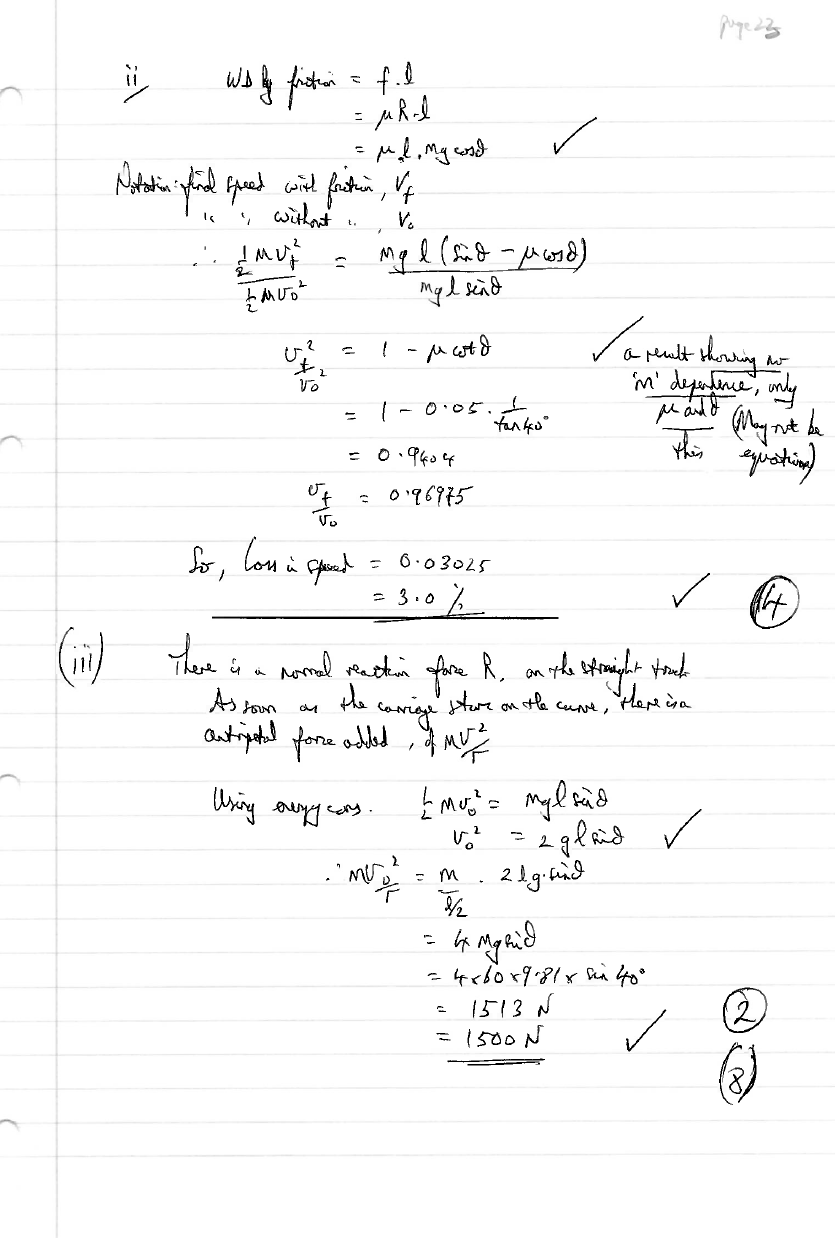
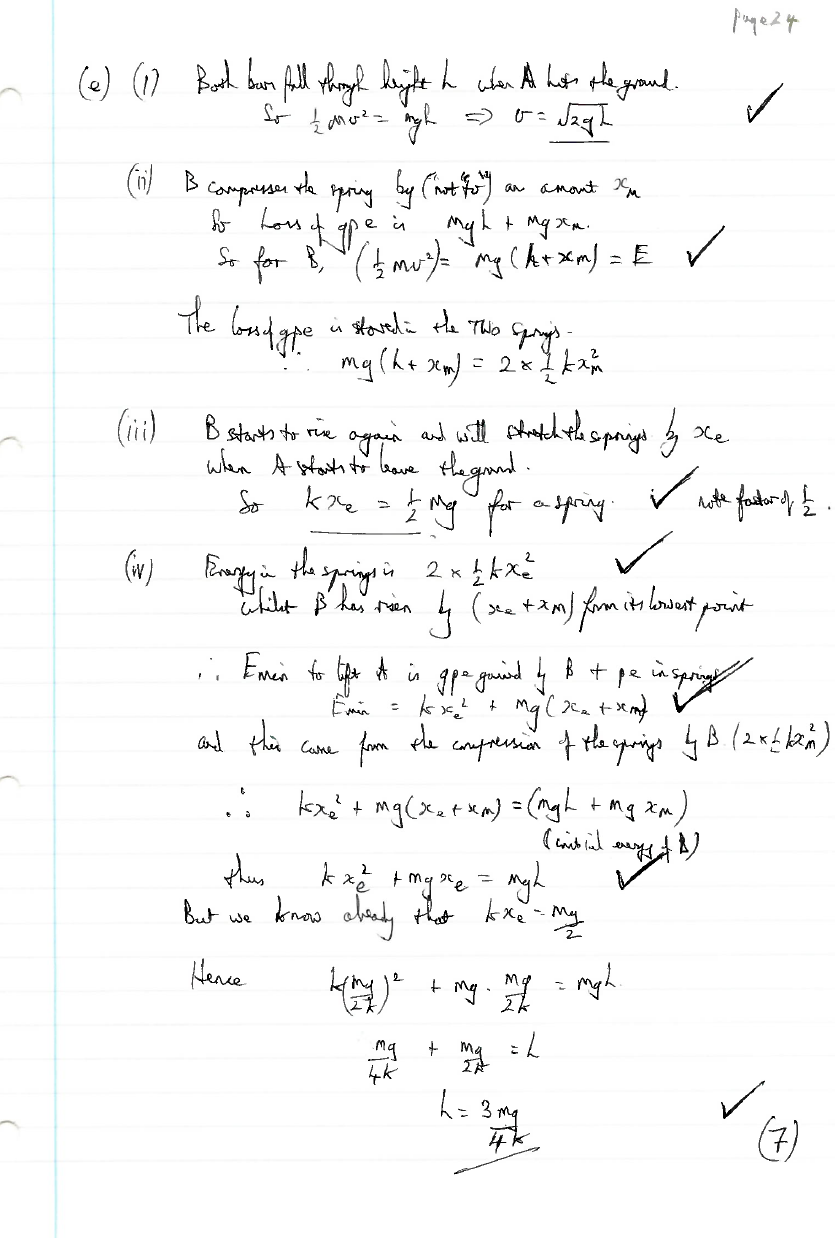
Official mark scheme (BPhO Round 1, November 2019, Section 2), from the official PDF — p. 21, 22, 23, 24, 25. © BPhO, CC BY 4.0.
Topic: Newtonian Mechanics, Conservation of Energy Metodi: Free-Body Diagram, Energy Conservation Method, Hooke’s Law, Vector Decomposition Competenze: Diagrammatic Reasoning, Mathematical Modeling Objects: Cylinder, Cart, Spring, String Fonte: Testo (PDF) — p.6 · Soluzione ufficiale (PDF) — p.21
Problema 3 — Giostre del luna park [25 punti]
In questo problema si analizzano diverse giostre meccaniche del luna park.
a) Una particella di massa si muove a velocità costante lungo una circonferenza orizzontale di raggio . Spiega perché sulla particella deve agire una forza risultante; indicane la direzione su un disegno e scrivine il modulo sia in funzione della velocità sia della velocità angolare . (2)
b) Una giostra è formata da seggiolini appesi a funi di lunghezza m, fissate a un supporto circolare di raggio m, come in Figura 4. Ogni passeggero siede su un seggiolino leggero; la massa complessiva si può trattare come puntiforme all’estremità della fune. La giostra ruota con velocità angolare e la fune forma un angolo con la verticale. Ricava un’espressione della velocità angolare in funzione di , , e e calcolala con i valori dati. (2)
Figura 4
c) Il «muro della morte» è un cilindro di diametro m che ruota con velocità angolare (Figura 5a). I passeggeri stanno in piedi contro la parete interna verticale e ruvida; quando la giostra raggiunge la velocità restano premuti contro la parete e non scivolano giù grazie all’attrito.
Figura 5
(i) Disegna le tre forze che agiscono su un passeggero premuto contro la parete.
(ii) Se la forza d’attrito è , dove è la reazione normale della parete, e , calcola il valore minimo di perché i passeggeri restino attaccati alla parete.
(iii) Il cilindro rotante viene ora inclinato di 60°, così che il suo asse di rotazione forma un angolo sopra l’orizzontale (Figura 5b). Disegna le tre forze che agiscono su un passeggero quando si trova nel punto più alto della traiettoria circolare.
(iv) La forza d’attrito resta con , anche se il valore di cambia perché la parete non è più verticale. Con questa condizione su , calcola il nuovo valore minimo della velocità angolare del cilindro perché i passeggeri restino attaccati alla parete nel punto più alto. (6)
d) Le montagne russe funzionano grazie alla gravità e non hanno motore. Un percorso come quello di Fig. 6 si può modellizzare con un giro della morte circolare di raggio 20 m collegato a una rampa rettilinea inclinata, come in Figura 7.
Figura 6 (fonte: themeparkreview.com, Gold Reef City, Golden Loop)
(i) Usa ora il modello semplificato di Figura 7. Stima l’altezza minima della cima della rampa da cui deve partire un vagoncino per restare sempre a contatto con il binario percorrendo il giro di raggio m senza cadere. L’attrito è trascurabile. Suggerimento: considera le forze sul vagoncino nel punto più alto del giro e la velocità minima per restare a contatto.
Figura 7
(ii) In questo modello semplificato il binario rettilineo si raccorda a quello circolare alla base della rampa. Ora sul vagoncino agisce l’attrito , dove è la forza normale del binario sul vagoncino e . i. Disegna il diagramma delle forze sul vagoncino mentre accelera lungo la rampa. ii. Per una rampa lunga m inclinata di sull’orizzontale, di che percentuale l’attrito riduce la velocità del vagoncino alla base della rampa?
(iii) Trascuriamo di nuovo l’attrito. La rampa rettilinea si raccorda ora a un tratto curvo con raggio di curvatura . Di quanto varia la forza normale esercitata dal sedile su un passeggero di 60 kg nell’istante in cui il vagoncino entra nella curva? (8)
e) Uno studente ha un’idea ancora più insolita per una giostra. Si può modellizzare con due barre (A e B), ciascuna di massa , separate da due molle di massa trascurabile, ciascuna di costante elastica e lunghezza a riposo . Le molle sono leggermente smorzate per eliminare le vibrazioni. È simile all’esempio di Figura 8. La barra inferiore A si trova inizialmente all’altezza dal suolo. La giostra viene lasciata cadere da ferma, in caduta libera.
Figura 8 (fonte: kerncountyfair.com)
(i) Trova un’espressione della velocità delle barre subito prima che urtino il suolo.
(ii) La barra A urta il suolo e si ferma quasi istantaneamente; tutta la sua energia cinetica si trasforma in calore e suono. Determina l’energia totale del sistema, , in funzione della successiva compressione massima delle molle e dell’energia potenziale gravitazionale.
In seguito le molle si riallungano e a un certo istante la barra A si stacca dal suolo.
(iii) Considerando le forze che agiscono su A, determina l’allungamento delle molle nell’istante in cui A lascia il suolo.
(iv) Usando considerazioni energetiche, ricava la condizione che l’altezza iniziale deve soddisfare perché A si stacchi dal suolo. (7)
Risposta: a) la velocità cambia continuamente direzione, quindi per il secondo principio agisce una forza, verso il centro: . b) , rad s. c) (ii) , rad s; (iv) rad s. d) (i) m; (ii) ii. , riduzione della velocità ; (iii) N N. e) (i) ; (ii) ; (iii) per ciascuna molla; (iv)
Soluzione: La soluzione ufficiale completa (in inglese) è nella versione originale di questo quesito e nel PDF ufficiale.
Topic: Newtonian Mechanics, Conservation of Energy Metodi: Free-Body Diagram, Energy Conservation Method, Hooke’s Law, Vector Decomposition Competenze: Diagrammatic Reasoning, Mathematical Modeling Objects: Cylinder, Cart, Spring, String Fonte: Testo (PDF) — p.6 · Soluzione ufficiale (PDF) — p.21
Question 4 — Electric fields and their application [25 marks]
This question is about electric fields and their application.
a) A thin, isolated, conducting, square metal sheet of area is given a charge .
(i) State where the charge on the sheet is to be found.
(ii) Sketch a set of electric field lines (with arrows) emerging from the sheet in the region near the surface and centre of the sheet (i.e. neglect edge effects).
(iii) How are the field lines qualitatively related to the magnitude of the electric field in a given region?
(iv) If the field strength near the sheet is , write down the force on a charge at a distance from the sheet, where , in terms of and . (4)
b) Consider a conducting spherical shell of radius given a charge .
(i) i. What is the charge density, (the charge per unit area), and the electric field strength at the surface of the sphere? ii. Hence write down an expression for the electric field strength in terms of and for the conducting, charged surface. How does depend upon ? iii. Hence, for an isolated, thin, plane, conducting surface carrying charge density , what is the electric field strength very near the surface?
(ii) A conducting, charged sphere has no field inside the surface for a charge on the surface, but a field on the outside surface. The repulsion of the surface charges will cause an outward force on the surface, which can be expressed as a pressure . Imagine that this sphere described has a small area removed, along with its associated charge , determined by the value of for the sphere, as illustrated in Figure 9. The field lines remain distributed as before since we are not in practice removing the small area. i. What is the value of the field strength on each side of the area , in terms of ? ii. Hence write down the field strength in the hole at the spherical surface, just inside where would sit, due to the charge on the rest of the sphere, in terms of . iii. Hence what is the force on the charge of the area when it is in place? iv. Now derive an expression for the surface pressure on the sphere due to the charge it carries in terms of and . (7)
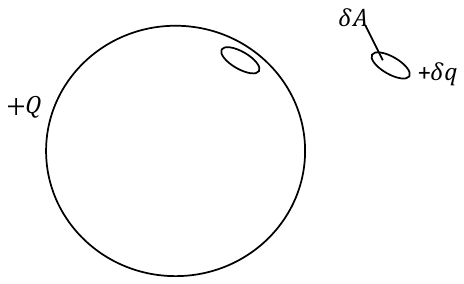
Figure 9
c) An electric field strength of greater than N C causes air to breakdown and conduct. Determine
(i) the radius of the smallest water drop (treated as a conducting spherical shell so that any excess charge resides on the surface) that can be charged to an electric potential of 7000 V,
(ii) the charge, and the surface charge density of the drop.
Charged drops of water are produced in a manner similar to that illustrated in Figure 10 with the capillary tube at −7.0 kV. The drop is released vertically and falls under gravity towards an earthed metal plate 10 cm below the tube where it was formed. Calculate
(iii) the speed of the drop when it reaches the earthed metal plate below,
(iv) the average current given a flow rate through the tube of 64 cm per hour. (7)
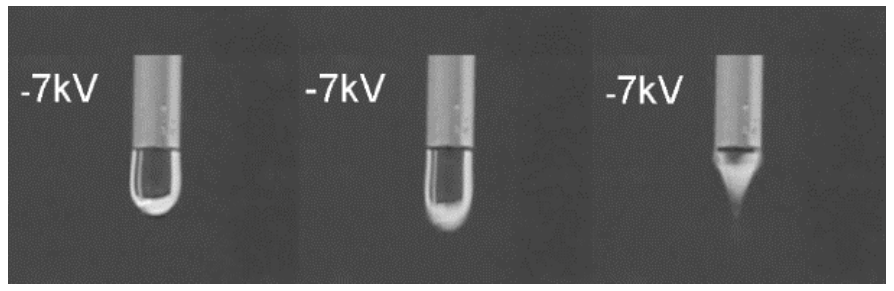
Figure 10 (credit: L. P. Santos, T. R. D. Ducati, L. B. S. Balestrin, F. Galembeck, “Water with Excess Electric Charge”, J. Phys. Chem. C 2011, 115, 11226–11232)
d) The intention is to study the motion of the falling drops by means of high speed photography, and one means of doing this is to use a rotating prism camera shutter. Figure 11 shows the general arrangement for the film passing through the camera at high speed. The continually moving film would blur the image, so a rotating cube of glass is used to move the image for a short time along the film at the same speed as the film travels through the camera.
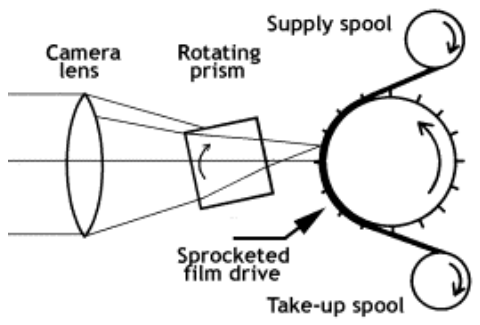
Figure 11 (credit: A. Davidhazy, An Overview of High Speed Photographic Imaging, Rochester Institute of Technology)
Figure 12 shows a ray of light entering the rotating cube of glass of side , with a refractive index .
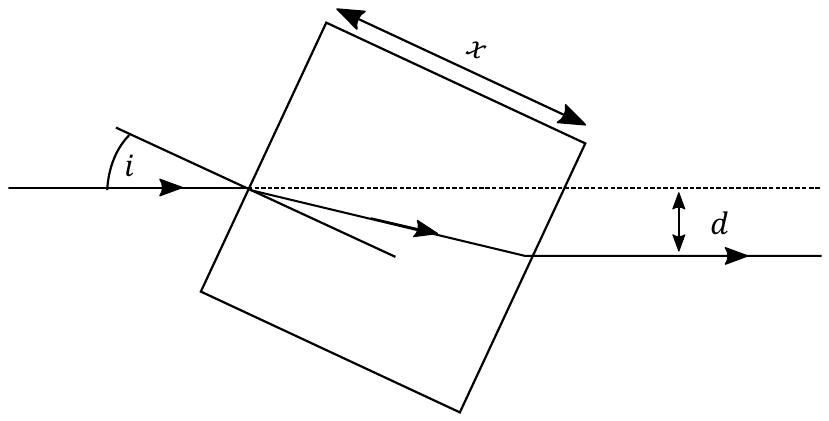
Figure 12
(i) Determine an expression for the lateral displacement , in terms of , , and the angle of incidence , which should be assumed to be small.
(ii) The prism rotates about an axis perpendicular to the plane of the diagram, such that the image is stationary relative to the moving film. How fast should the film move if cm, and the cube rotates at 200 Hz? (7)
Risposta: a) (i) on the surface (both faces); (iii) the denser the field lines, the stronger ; (iv) . b) (i) i. , ; ii. , independent of ; iii. (half the field on each face); (ii) i. ; ii. ; iii. ; iv. . c) (i) mm; (ii) C nC, C m; (iii) m s; (iv) A. d) (i) ; (ii) m s
Soluzione:
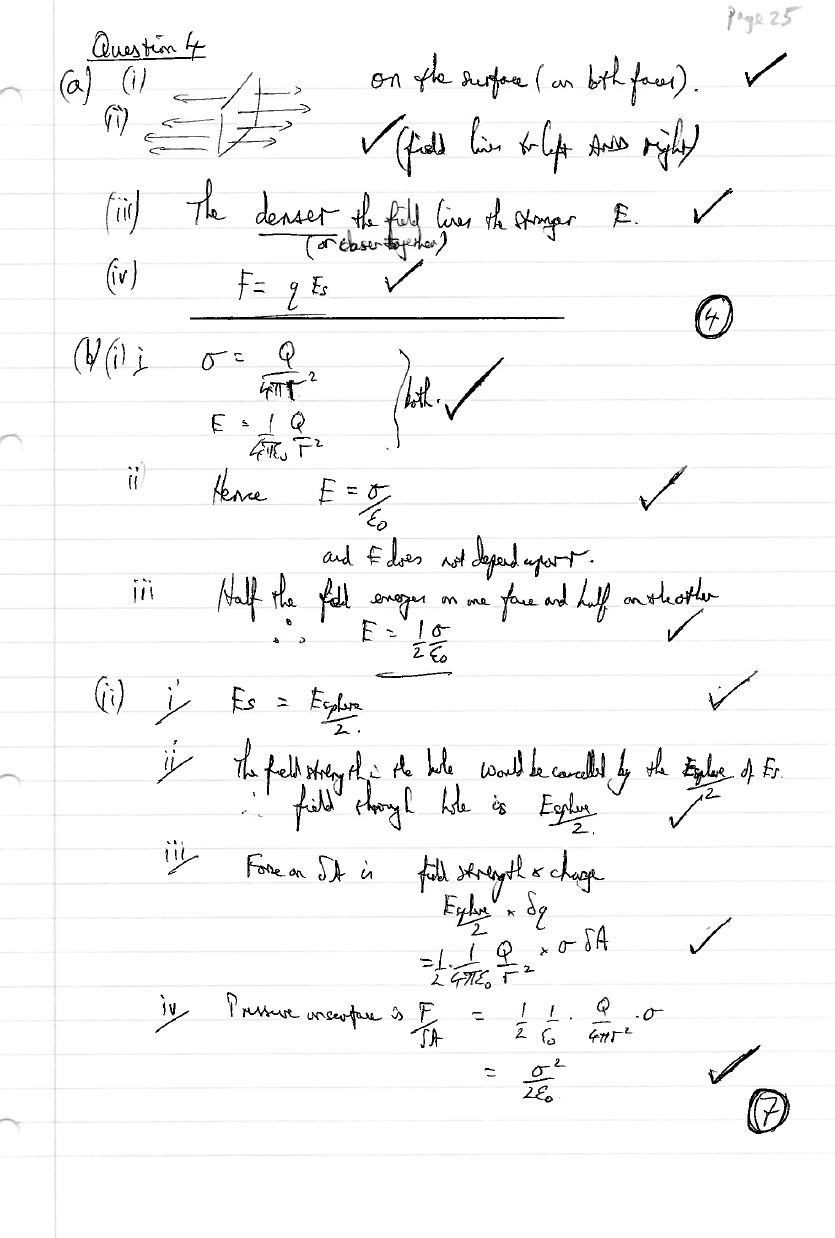
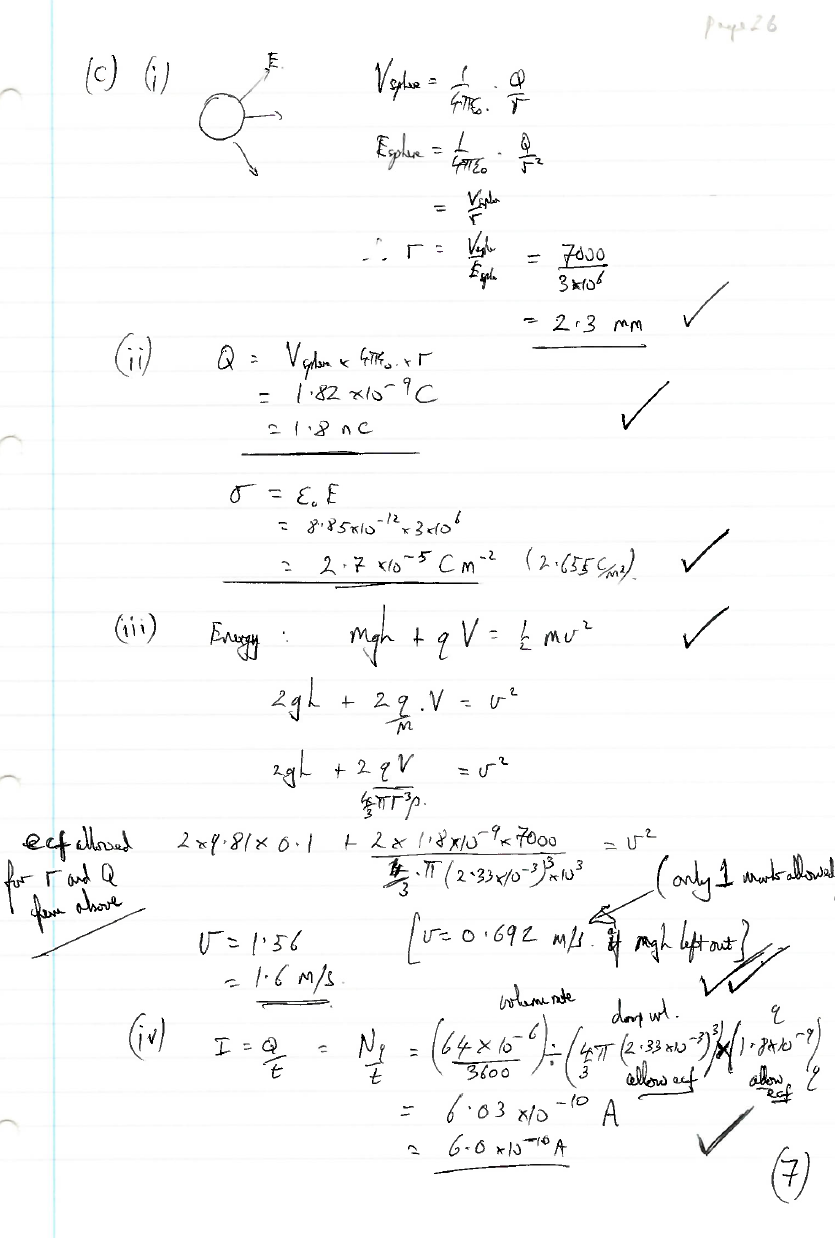
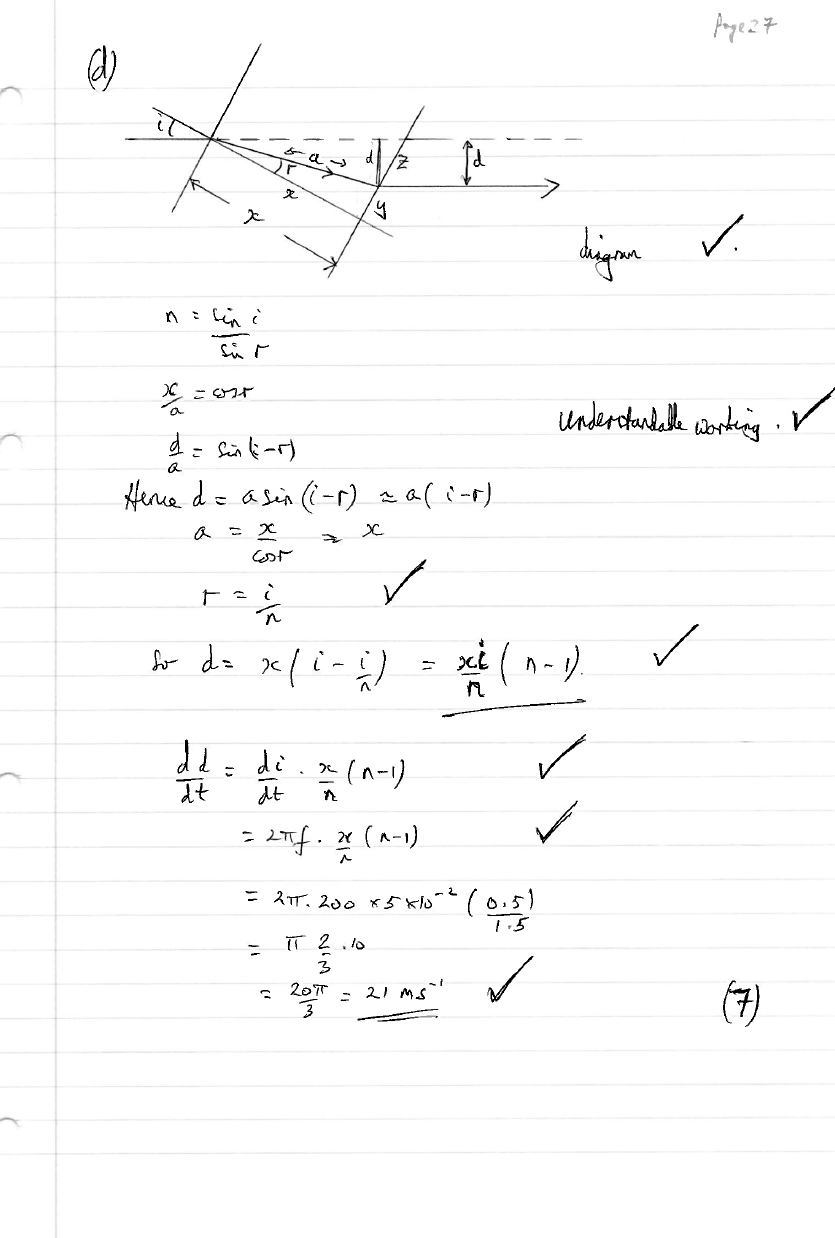
Official mark scheme (BPhO Round 1, November 2019, Section 2), from the official PDF — p. 26, 27, 28. © BPhO, CC BY 4.0.
Topic: Electrostatics, Geometric Optics Metodi: Gauss’s Law, Electric Potential Method, Energy Conservation Method, Snell’s Law, Small-Angle Approximation Competenze: Mathematical Modeling, Physical Reasoning Objects: Conducting Sphere, Droplet, Prism Fonte: Testo (PDF) — p.9 · Soluzione ufficiale (PDF) — p.26
Problema 4 — Campi elettrici e loro applicazioni [25 punti]
Il problema riguarda i campi elettrici e le loro applicazioni.
a) A una sottile lastra metallica quadrata, conduttrice e isolata, di area viene data una carica .
(i) Indica dove si trova la carica sulla lastra.
(ii) Disegna alcune linee di campo elettrico (con le frecce) che escono dalla lastra vicino alla superficie e al centro della lastra (cioè trascurando gli effetti di bordo).
(iii) Come sono legate qualitativamente le linee di campo all’intensità del campo elettrico in una data regione?
(iv) Se l’intensità del campo vicino alla lastra è , scrivi la forza su una carica a distanza dalla lastra, con , in funzione di e . (4)
b) Considera un guscio sferico conduttore di raggio con carica .
(i) i. Quali sono la densità di carica (carica per unità di superficie) e l’intensità del campo elettrico sulla superficie della sfera? ii. Scrivi quindi un’espressione dell’intensità del campo in funzione di e per la superficie conduttrice carica. Come dipende da ? iii. Quindi, per una superficie piana sottile, conduttrice e isolata, con densità di carica , qual è l’intensità del campo elettrico molto vicino alla superficie?
(ii) Una sfera conduttrice con carica sulla superficie non ha campo all’interno, ma ha un campo sulla superficie esterna. La repulsione tra le cariche superficiali produce una forza verso l’esterno sulla superficie, esprimibile come una pressione . Immagina di togliere dalla sfera una piccola area con la sua carica , determinata dal valore di della sfera, come in Figura 9. Le linee di campo restano distribuite come prima, perché in pratica non togliamo davvero la piccola area. i. Qual è l’intensità del campo da ciascun lato dell’area , in funzione di ? ii. Scrivi quindi l’intensità del campo nel foro sulla superficie sferica, appena all’interno di dove starebbe , dovuto alla carica del resto della sfera, in funzione di . iii. Qual è quindi la forza sulla carica dell’area quando è al suo posto? iv. Ricava infine un’espressione della pressione superficiale sulla sfera dovuta alla sua carica in funzione di e . (7)
Figura 9
c) Un campo elettrico di intensità superiore a N C provoca la scarica nell’aria, che diventa conduttrice. Determina
(i) il raggio della più piccola goccia d’acqua (trattata come un guscio sferico conduttore, quindi con l’eventuale carica in eccesso sulla superficie) che può essere caricata al potenziale di 7000 V;
(ii) la carica e la densità superficiale di carica della goccia.
Gocce d’acqua cariche vengono prodotte in modo simile a quello di Figura 10, con il tubo capillare a −7,0 kV. La goccia si stacca in verticale e cade per gravità verso una lastra metallica a terra posta 10 cm sotto il tubo in cui si è formata. Calcola
(iii) la velocità della goccia quando raggiunge la lastra a terra;
(iv) la corrente media, data una portata attraverso il tubo di 64 cm all’ora. (7)
Figura 10 (fonte: L. P. Santos, T. R. D. Ducati, L. B. S. Balestrin, F. Galembeck, «Water with Excess Electric Charge», J. Phys. Chem. C 2011, 115, 11226–11232)
d) Si vuole studiare il moto delle gocce in caduta con la fotografia ad alta velocità; un modo è usare un otturatore a prisma rotante. La Figura 11 mostra lo schema della pellicola che scorre ad alta velocità nella fotocamera. La pellicola sempre in movimento renderebbe l’immagine mossa, quindi si usa un cubo di vetro rotante che sposta per un breve tempo l’immagine lungo la pellicola alla stessa velocità con cui la pellicola scorre.
Figura 11 (fonte: A. Davidhazy, An Overview of High Speed Photographic Imaging, Rochester Institute of Technology)
La Figura 12 mostra un raggio di luce che entra nel cubo di vetro rotante, di lato e indice di rifrazione .
Figura 12
(i) Determina un’espressione dello spostamento laterale in funzione di , e dell’angolo di incidenza , da considerare piccolo.
(ii) Il prisma ruota attorno a un asse perpendicolare al piano del disegno in modo che l’immagine resti ferma rispetto alla pellicola in movimento. A che velocità deve scorrere la pellicola se cm, e il cubo ruota a 200 Hz? (7)
Risposta: a) (i) sulla superficie (su entrambe le facce); (iii) più le linee sono fitte, più è intenso; (iv) . b) (i) i. , ; ii. , indipendente da ; iii. (metà del campo su ciascuna faccia); (ii) i. ; ii. ; iii. ; iv. . c) (i) mm; (ii) C nC, C m; (iii) m s; (iv) A. d) (i) ; (ii) m s
Soluzione: La soluzione ufficiale completa (in inglese) è nella versione originale di questo quesito e nel PDF ufficiale.
Topic: Electrostatics, Geometric Optics Metodi: Gauss’s Law, Electric Potential Method, Energy Conservation Method, Snell’s Law, Small-Angle Approximation Competenze: Mathematical Modeling, Physical Reasoning Objects: Conducting Sphere, Droplet, Prism Fonte: Testo (PDF) — p.9 · Soluzione ufficiale (PDF) — p.26
Question 5 — Gravity and forces [25 marks]
This question is on gravity and forces.
a) In 2017 an object that became known as Oumuamua was observed in the Solar System. Figure 13 shows an artist’s impression.
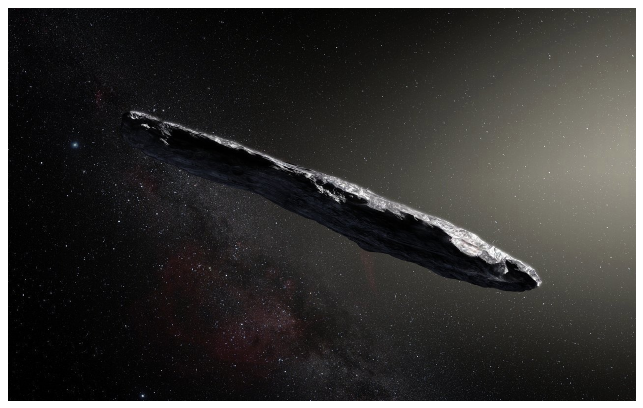
Figure 13 (Picture: ESO)
The speed of the object was measured to be 87.7 km s at a closest approach to the Sun of km and astronomers deduced that Oumuamua did not belong to the Solar System. Make a suitable calculation to confirm this deduction. (4)
b) In January 2019 the New Horizons spacecraft made a fly by of a distant object in the Solar System called Ultima Thule, shown in Figure 14 below. The planetoid consists of two lobes of diameters km and km. The period of rotation about its short axis is hours. (The long axis is a line passing through the centres of the two lobes, and a short axis is perpendicular to the long axis.)
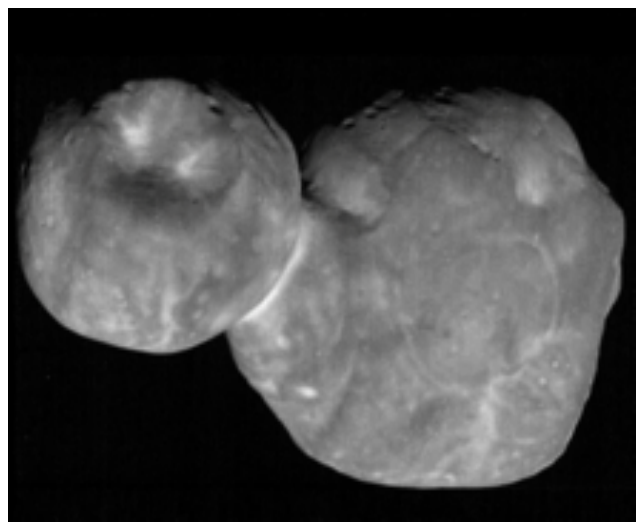
Figure 14: The two approximately spherical lobes making up Ultima Thule. Credits: NASA/Johns Hopkins Applied Physics Laboratory/Southwest Research Institute, National Optical Astronomy Observatory
If we assume that the two lobes are held together by a weak gravitational attraction, we can model the object as two spheres of the same density just touching.
(i) Find the centre of mass of Ultima Thule, as measured from the centre of the largest sphere.
(ii) By considering the resultant force acting on one sphere, estimate the density of Ultima Thule.
(iii) Using the fact that the density can be taken to be similar for the two lobes, sketch a graph of the gravitational field strength along the long axis. Note: the field strength varies linearly with radius inside a spherical body of uniform density. You may find it helpful to sketch the potential along the long axis. (8)
In fact, the two lobes are not bound by gravity, so the density and the masses of the lobes are not known. From the appearance of the two lobes, it looks as though they were moving at a low relative speed when they collided. As an example, consider two spherical iron masses with the same radii as the lobes of Ultima Thule. The masses are kg and kg for the larger and smaller lobes respectively. We can assume that they approached from a great distance apart along a line through their centres, with a negligible initial relative velocity.
(iv) Calculate the amount of energy liberated when these two iron spheres collided.
(v) Calculate the relative speed of approach. (7)
This energy of collision may have initially led to an increase in temperature of the two spheres (you may neglect any energy of rotation), which we could calculate from knowing the specific heat capacity of iron. However, at the very low temperatures of the outer Solar System the molar heat capacity of a material is not constant. For example, at low temperatures the molar heat capacity of iron, , varies as where:
- is the molar heat capacity in J mol K
- is the universal gas constant, J mol K
- is a constant, K for iron
- is the temperature in kelvin
- molar mass of iron = 56 g mol
(vi) Calculate the number of moles of iron involved in the collision.
(vii) Using your value of the energy liberated on collision, calculate the maximum temperature reached by the iron spheres, assuming the initial temperature was 4 K and radiative losses are in the first instance negligible. (6)
Risposta: a) km s, less than 87.7 km s, so not bound to the Sun. b) (i) m km; (ii) kg m; (iv) J; (v) m s, m s, relative speed m s; (vi) mol; (vii) K
Soluzione:
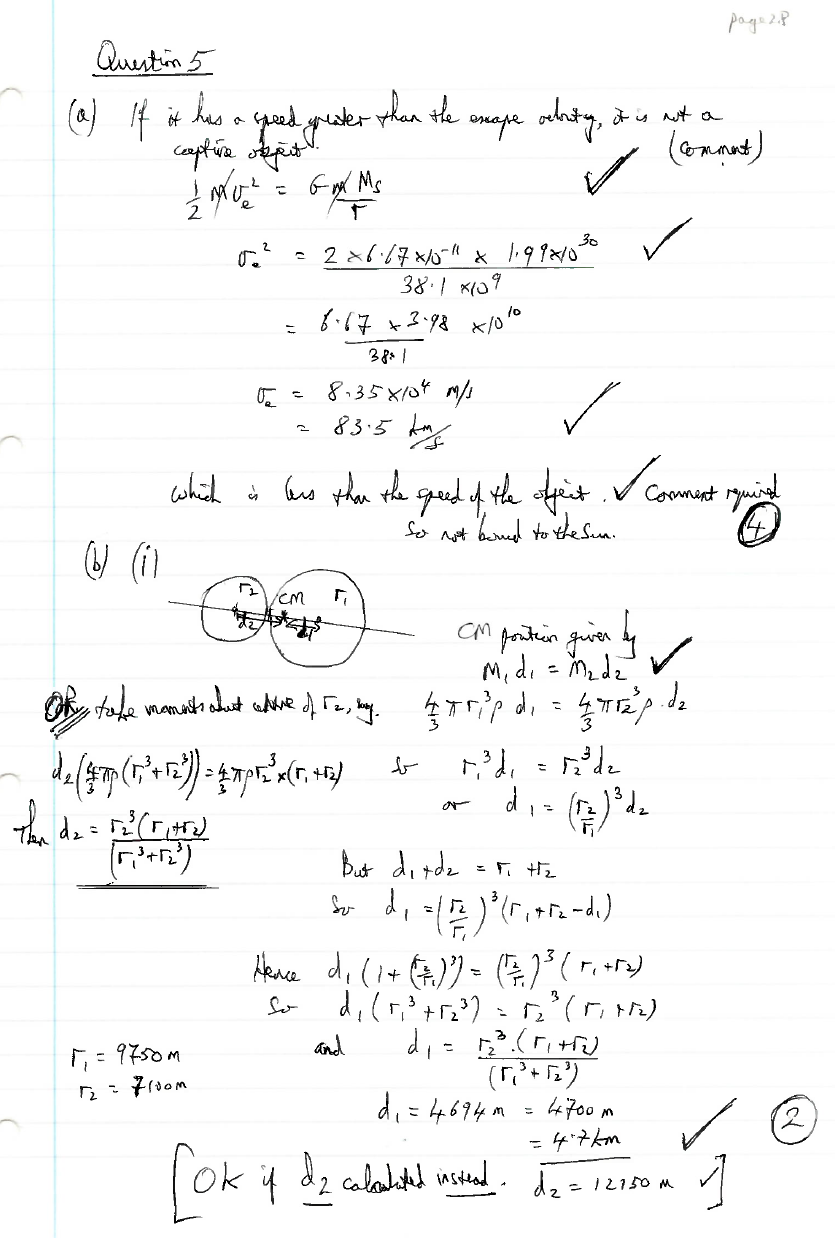
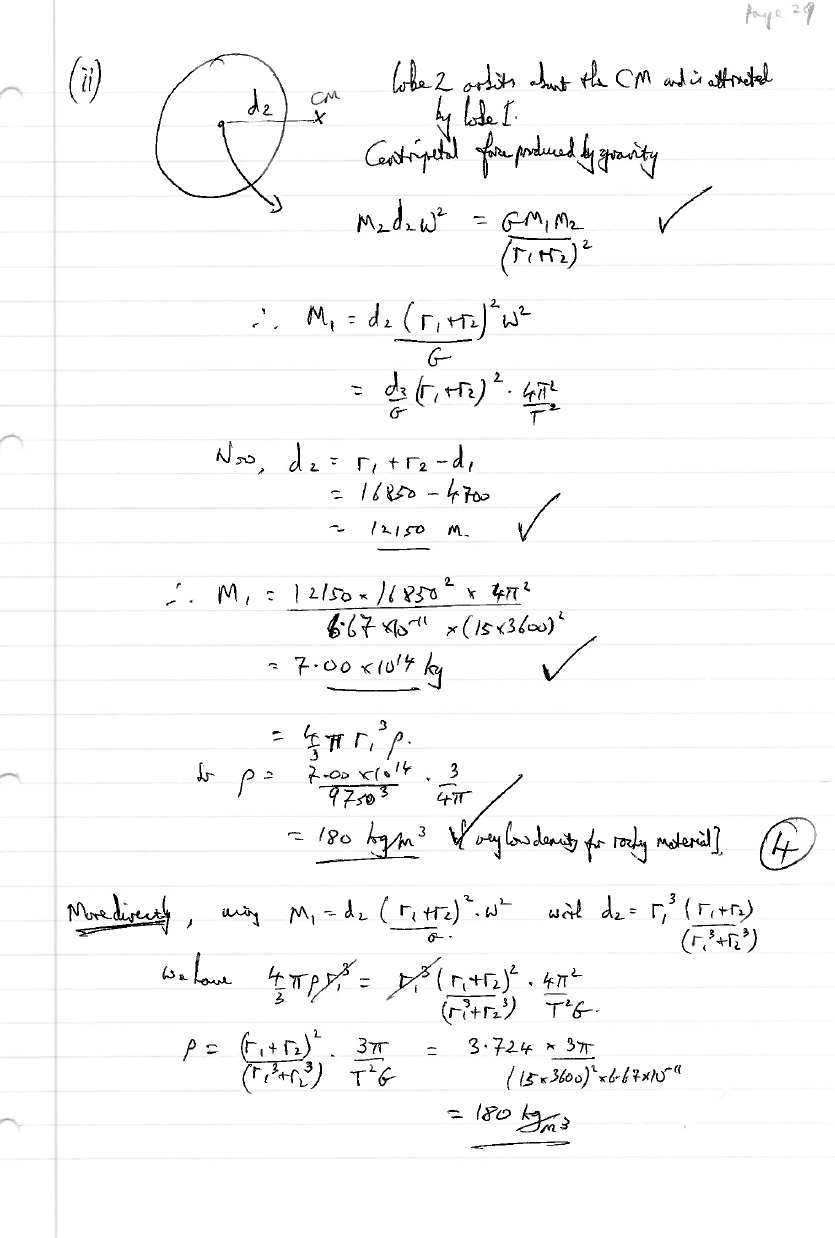
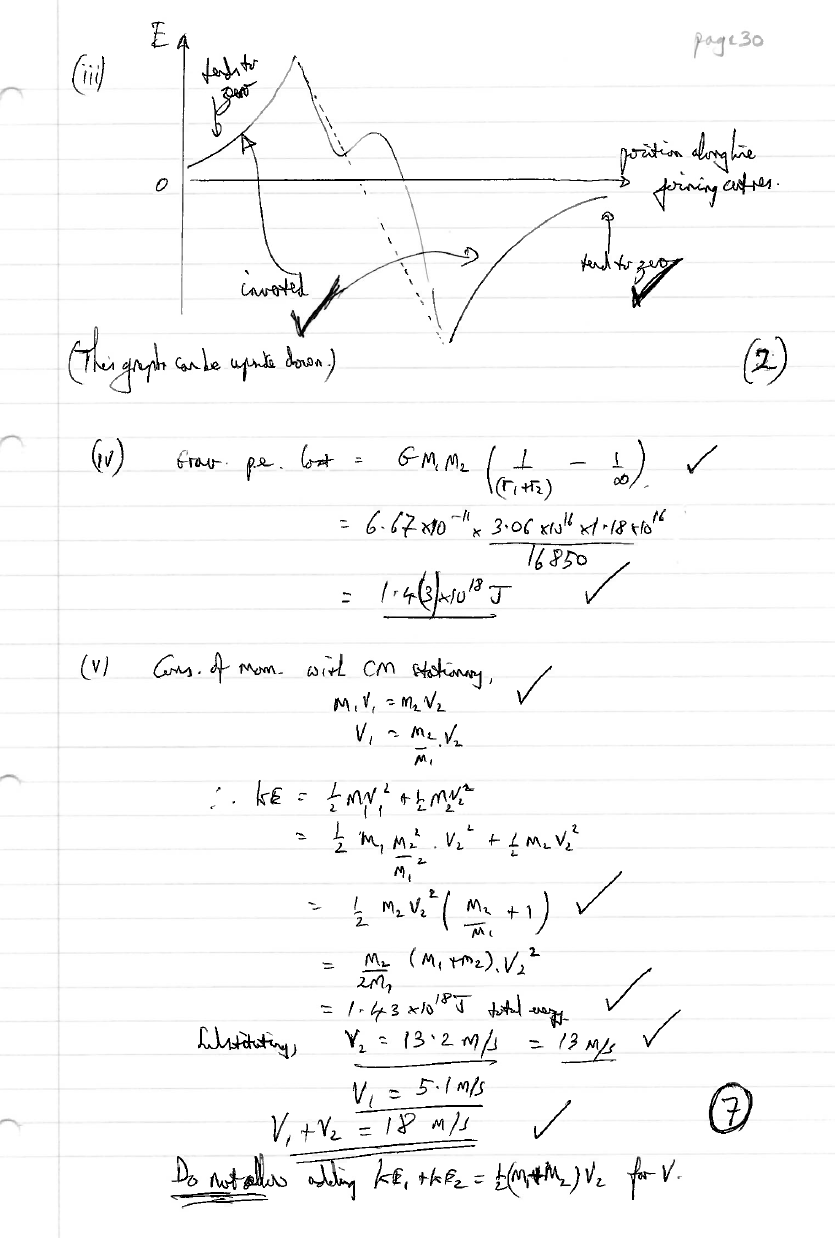
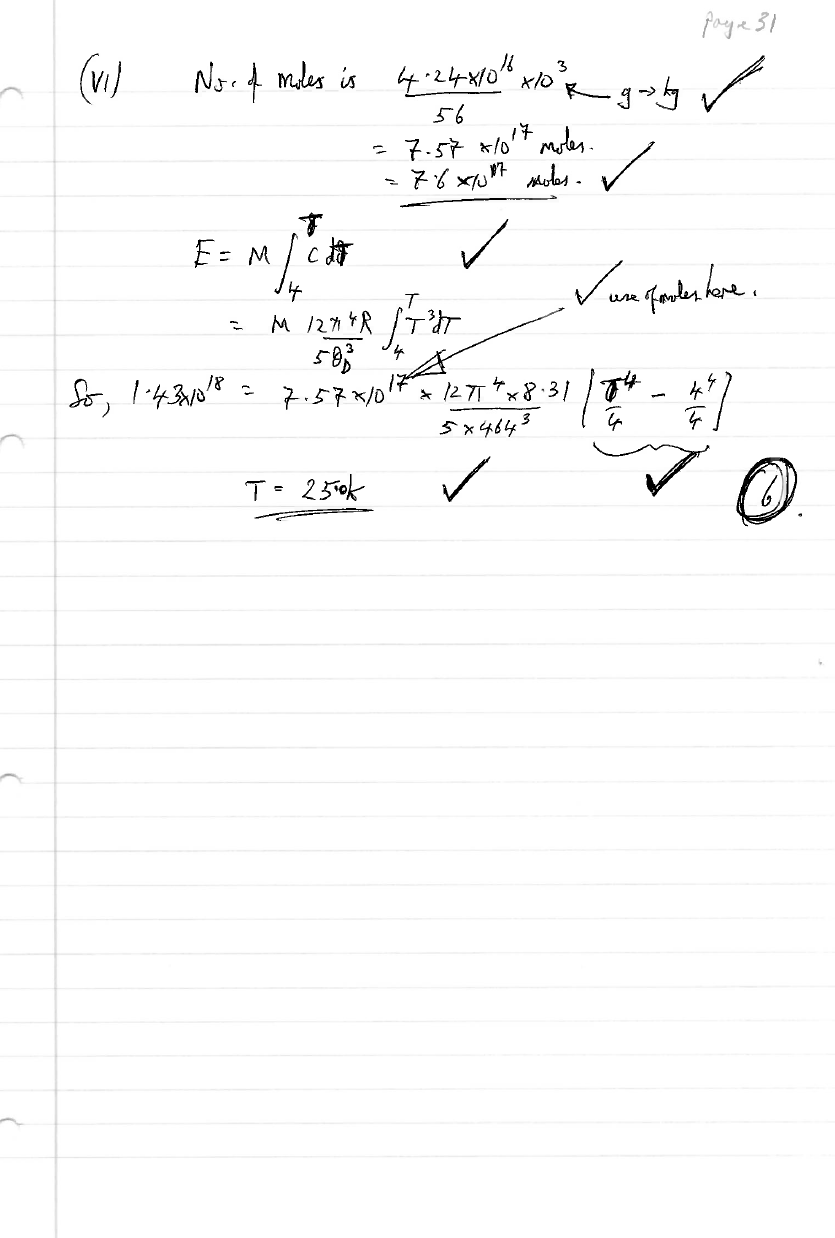
Official mark scheme (BPhO Round 1, November 2019, Section 2), from the official PDF — p. 29, 30, 31, 32. © BPhO, CC BY 4.0.
Topic: Gravitation, Thermodynamics, Astrophysics Metodi: Newton’s Law of Gravitation, Conservation of Momentum, Conservation of Energy, Calculus-Integration Competenze: Mathematical Modeling, Estimation & Approximation Objects: Planet, Sphere Fonte: Testo (PDF) — p.12 · Soluzione ufficiale (PDF) — p.29
Problema 5 — Gravità e forze [25 punti]
Il problema riguarda la gravità e le forze.
a) Nel 2017 nel Sistema Solare fu osservato un oggetto poi chiamato Oumuamua. La Figura 13 ne mostra una rappresentazione artistica.
Figura 13 (immagine: ESO)
La velocità dell’oggetto fu misurata in 87,7 km s alla minima distanza dal Sole, km, e gli astronomi dedussero che Oumuamua non apparteneva al Sistema Solare. Esegui un calcolo adatto a confermare questa deduzione. (4)
b) Nel gennaio 2019 la sonda New Horizons sorvolò un oggetto lontano del Sistema Solare chiamato Ultima Thule, mostrato in Figura 14. Il planetoide è formato da due lobi di diametri km e km. Il periodo di rotazione attorno all’asse corto è ore. (L’asse lungo passa per i centri dei due lobi; un asse corto è perpendicolare all’asse lungo.)
Figura 14: i due lobi approssimativamente sferici che formano Ultima Thule. Fonte: NASA/Johns Hopkins Applied Physics Laboratory/Southwest Research Institute, National Optical Astronomy Observatory
Se supponiamo che i due lobi siano tenuti insieme da una debole attrazione gravitazionale, possiamo modellizzare l’oggetto come due sfere della stessa densità appena a contatto.
(i) Trova il centro di massa di Ultima Thule, misurato dal centro della sfera più grande.
(ii) Considerando la forza risultante su una delle sfere, stima la densità di Ultima Thule.
(iii) Sapendo che la densità si può considerare simile per i due lobi, disegna il grafico dell’intensità del campo gravitazionale lungo l’asse lungo. Nota: all’interno di un corpo sferico di densità uniforme l’intensità del campo varia linearmente con il raggio. Può esserti utile disegnare il potenziale lungo l’asse lungo. (8)
In realtà i due lobi non sono legati dalla gravità, quindi densità e masse dei lobi non sono note. Dall’aspetto dei due lobi sembra che si muovessero a bassa velocità relativa quando si sono scontrati. Come esempio, considera due sfere di ferro con gli stessi raggi dei lobi di Ultima Thule. Le masse sono kg e kg per il lobo più grande e per quello più piccolo. Supponi che si siano avvicinate da grande distanza lungo la retta dei centri, con velocità relativa iniziale trascurabile.
(iv) Calcola l’energia liberata nell’urto tra le due sfere di ferro.
(v) Calcola la velocità relativa di avvicinamento. (7)
L’energia dell’urto potrebbe aver inizialmente aumentato la temperatura delle due sfere (trascura l’energia di rotazione), calcolabile conoscendo il calore specifico del ferro. Alle bassissime temperature del Sistema Solare esterno, però, la capacità termica molare di un materiale non è costante. Ad esempio, a basse temperature la capacità termica molare del ferro, , varia come dove:
- è la capacità termica molare in J mol K
- è la costante universale dei gas, J mol K
- è una costante, K per il ferro
- è la temperatura in kelvin
- massa molare del ferro = 56 g mol
(vi) Calcola il numero di moli di ferro coinvolte nell’urto.
(vii) Usando il valore dell’energia liberata nell’urto, calcola la temperatura massima raggiunta dalle sfere di ferro, supponendo che la temperatura iniziale fosse 4 K e che le perdite per irraggiamento siano, in prima approssimazione, trascurabili. (6)
Risposta: a) km s, minore di 87,7 km s: non è legato al Sole. b) (i) m km; (ii) kg m; (iv) J; (v) m s, m s, velocità relativa m s; (vi) mol; (vii) K
Soluzione: La soluzione ufficiale completa (in inglese) è nella versione originale di questo quesito e nel PDF ufficiale.
Topic: Gravitation, Thermodynamics, Astrophysics Metodi: Newton’s Law of Gravitation, Conservation of Momentum, Conservation of Energy, Calculus-Integration Competenze: Mathematical Modeling, Estimation & Approximation Objects: Planet, Sphere Fonte: Testo (PDF) — p.12 · Soluzione ufficiale (PDF) — p.29
Question 6 — Applications of wave interference [25 marks]
This question explores different applications of wave interference.
a) State the necessary conditions to be able to observe stable wave interference patterns. (2)
b) (i) Consider a ship that carries a radio receiver a height above the sea, which is anchored (stationary) a large distance away from the bottom of a cliff. Suppose on top of the cliff there is a radio transmitter at a height of above the sea and transmitting waves of wavelength . Assuming that the sea acts as a flat, perfectly reflecting surface, show that the signal strength received by the ship is a maximum when State any assumptions you make. Note that there is a phase change of (180°) when waves reflect at an interface going from a less dense to a denser medium. (4)
(ii) At high tide, the ship is 1.5 km away from the cliff and its receiver is at 20 m above the sea with the height of the transmitter above the sea at 80 m. The frequency of the radio waves is 70 MHz. i. By how much would the tide need to fall for the signal received by the ship to become a minimum? ii. The normal maximum tidal range (twice the amplitude) is 5 m. Would the signal strength change appreciably between low and high tides, and why? iii. What if the receiver height was just above sea level at 0.5 m? (4)
c) A simplified model of sodium chloride (salt) consists of a cubic arrangement of alternating sodium and chloride ions separated by distance . When a plane wave of X-rays is incident on the ions, each ion can be considered as a new source of spherically scattered new waves.
(i) Show that for plane waves of wavelength and incident at angle to be reflected from the crystal constructively they must satisfy where is a positive integer and is specified as the angle given in Figure 15. This is called the Bragg condition. (3)
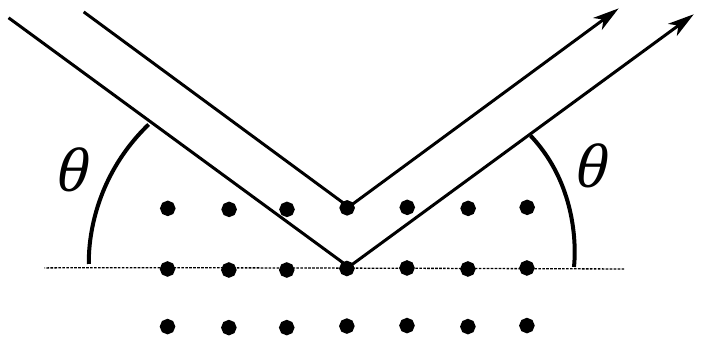
Figure 15: Bragg reflection (an interference condition) with angle specified. The dots denote the atomic layers.
(ii) The density of salt is 2.17 g cm with a molar mass of 58.4 g mol. Calculate the value of for salt. (3)
(iii) In an X-ray diffraction experiment, waves that are incident at a minimum angle of 25° are strongly reflected from a salt crystal. Calculate the wavelength of the X-rays. (2)
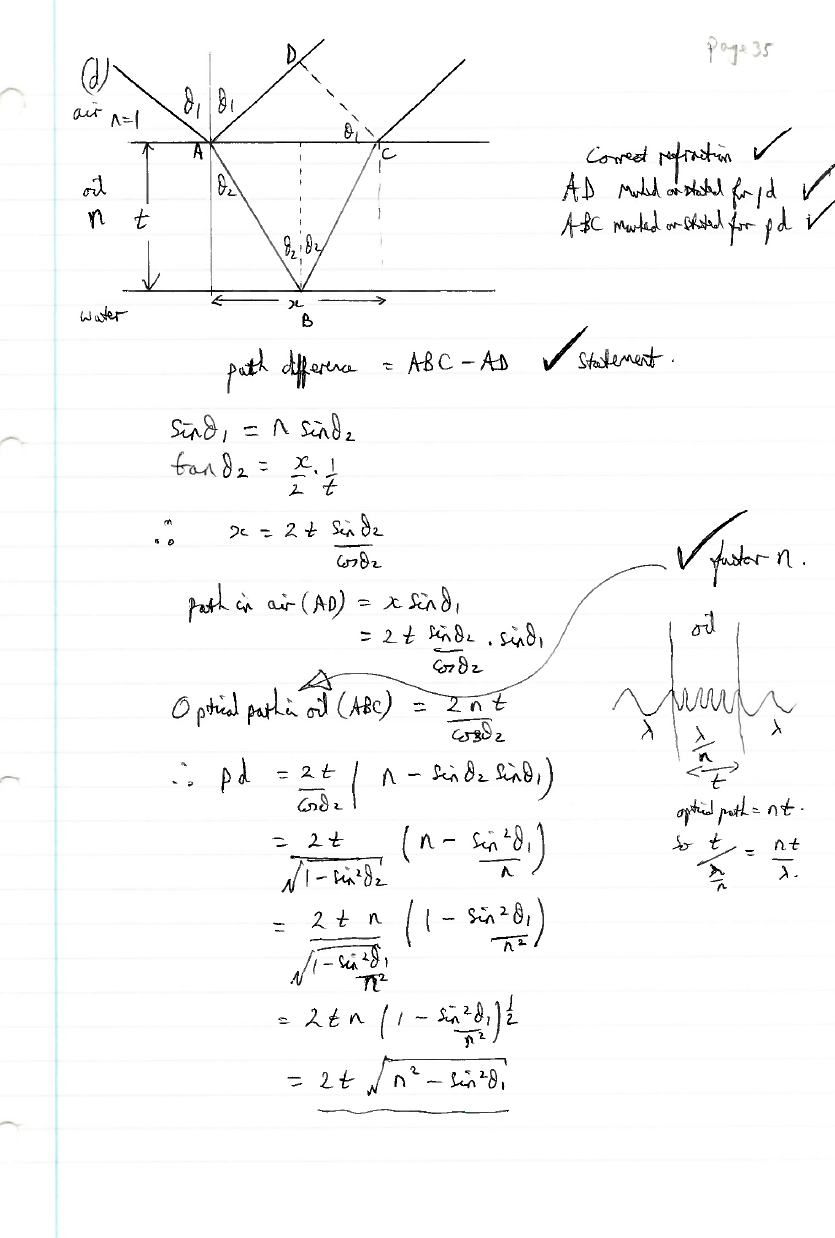
d) An oil film on water produces colourful interference effects, as shown in Figure 16.
(i) Sketch a diagram showing the path of a ray of light entering and leaving the oil film. Mark on two paths that are going to account for the interference effect observed.
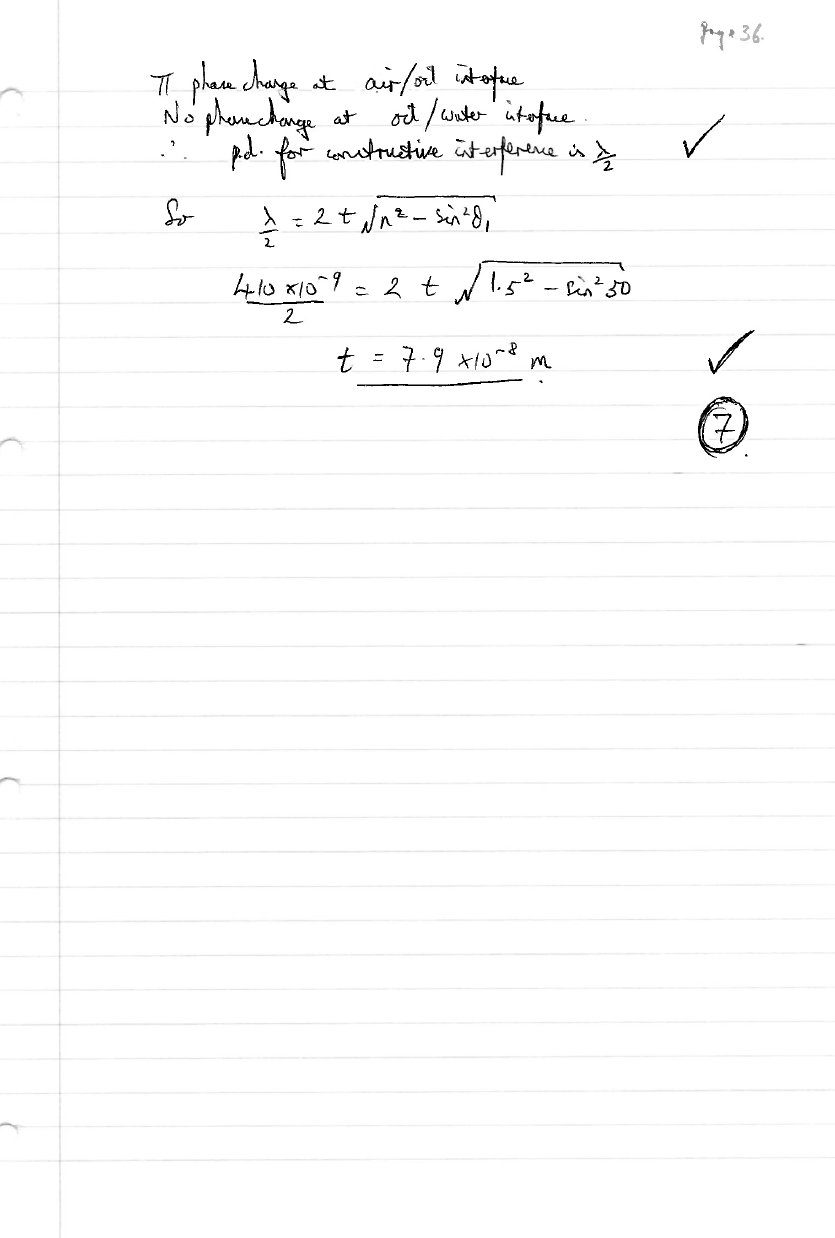
(ii) Calculate the minimum thickness of film needed to observe a strong reflection of violet light with a wavelength of 410 nm, at an angle of reflection of 50°. The refractive index of oil is 1.5, and that of water is 1.33. [7]
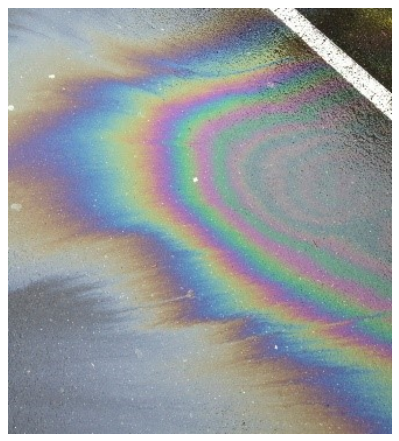
Figure 16: Oil on water. (image credit: E. Wiebe, climate.uvic.ca)
Risposta: a) constant frequency (same frequency), same type of waves, same polarisation, coherent, waves crossing. b) (i) path difference (with the phase change), so ; (ii) i. m, minimum at m, so the water level must fall by m; ii. path difference changes only from 2.13 m to 2.27 m (about 6%), little change in signal strength; iii. at m path difference m : the phase shift gives destructive interference, a minimum. c) (ii) m; (iii) m (). d) (ii) : m
Soluzione:
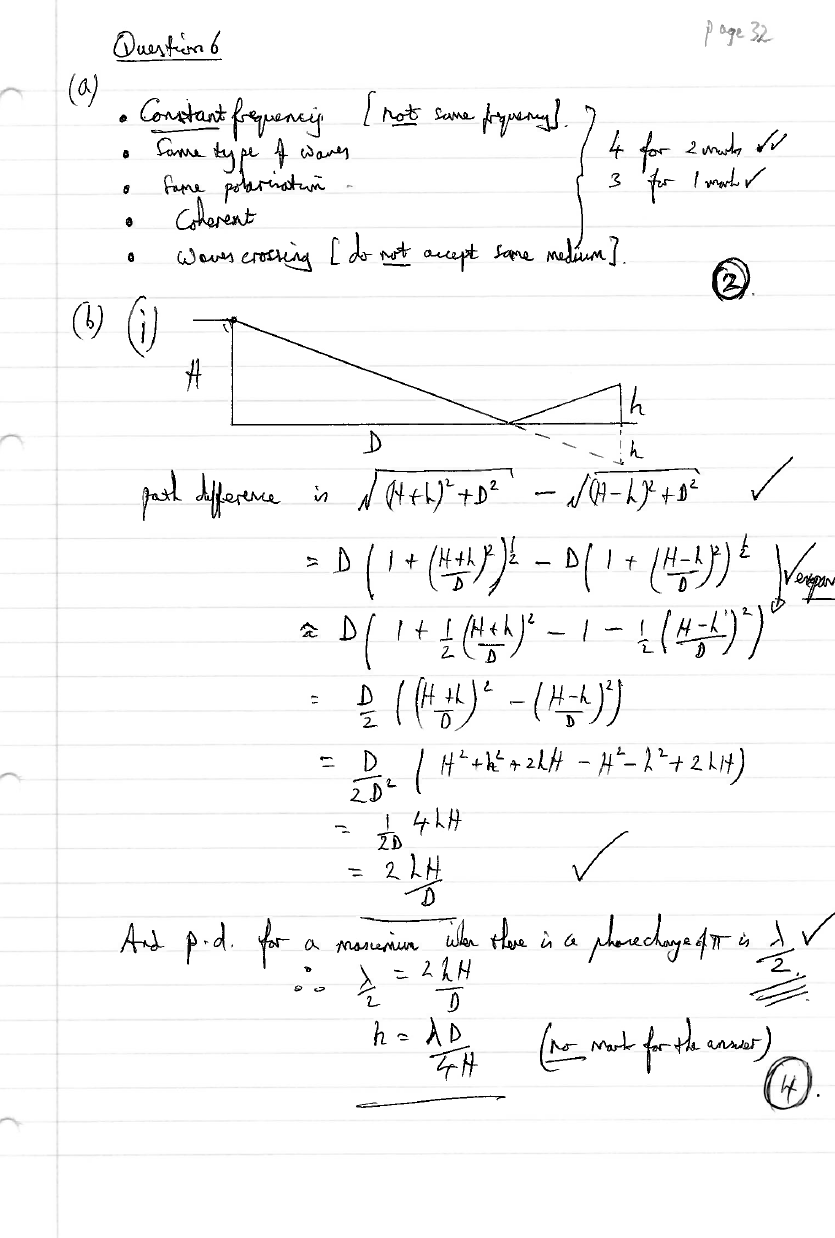
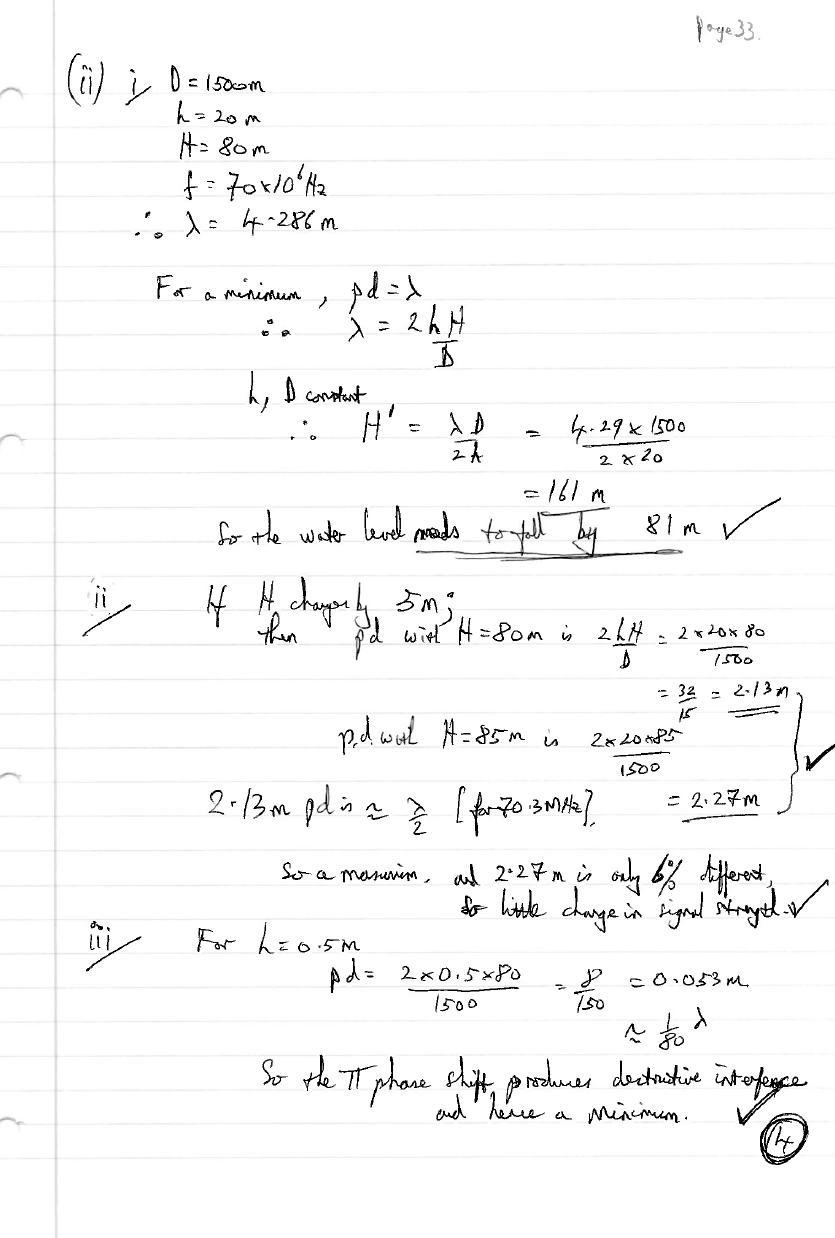
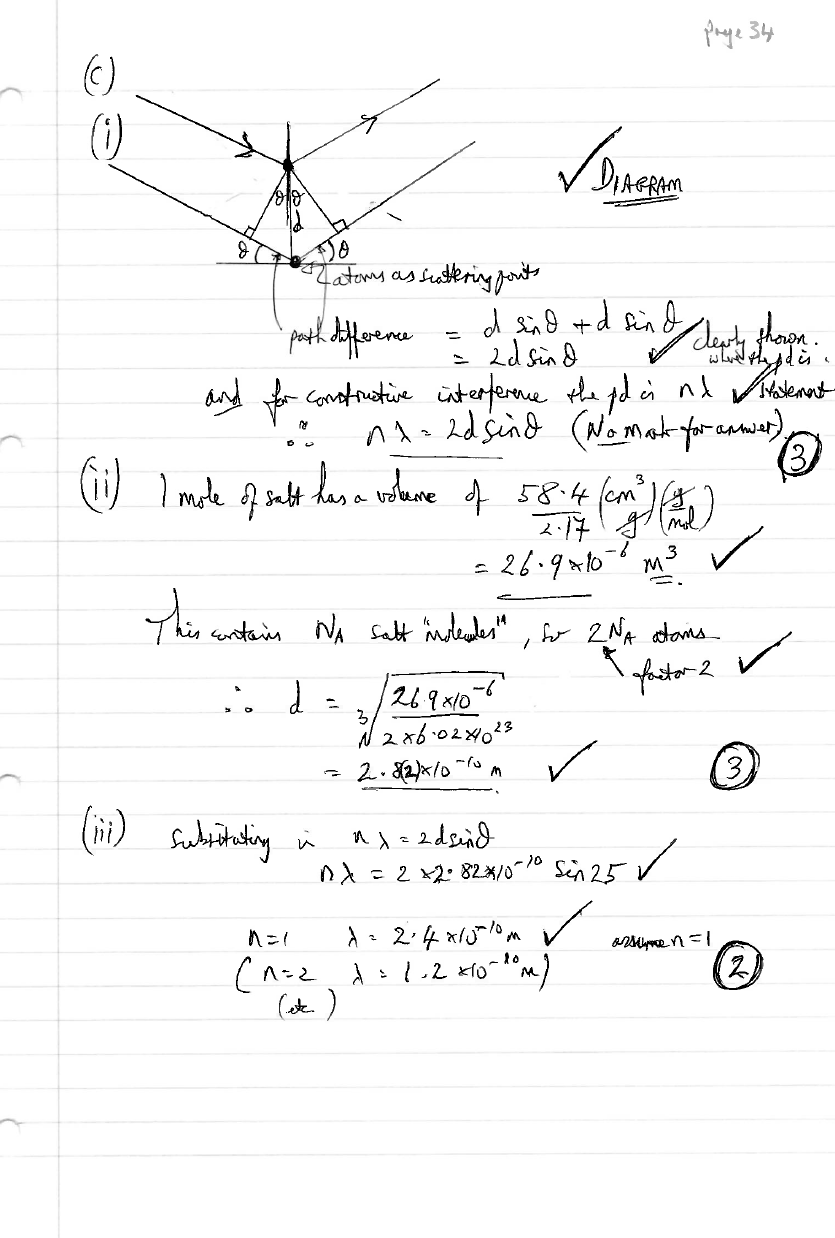
Official mark scheme (BPhO Round 1, November 2019, Section 2), from the official PDF — p. 33, 34, 35, 36, 37. © BPhO, CC BY 4.0.
Topic: Wave Optics, Oscillations & Waves Metodi: Interference & Diffraction Analysis, Approximation & Series Expansion, Snell’s Law Competenze: Mathematical Modeling, Diagrammatic Reasoning Objects: Atom, Membrane Fonte: Testo (PDF) — p.14 · Soluzione ufficiale (PDF) — p.33
Problema 6 — Applicazioni dell’interferenza delle onde [25 punti]
Il problema esplora diverse applicazioni dell’interferenza delle onde.
a) Indica le condizioni necessarie per osservare figure d’interferenza stabili. (2)
b) (i) Una nave con un ricevitore radio posto all’altezza sul mare è ancorata (ferma) a grande distanza dalla base di una scogliera. In cima alla scogliera c’è un trasmettitore radio, all’altezza sul mare, che trasmette onde di lunghezza d’onda . Supponendo che il mare si comporti come una superficie piana perfettamente riflettente, mostra che l’intensità del segnale ricevuto dalla nave è massima quando Indica le ipotesi che fai. Nota che c’è un cambio di fase di (180°) quando le onde si riflettono su un’interfaccia passando da un mezzo meno denso a uno più denso. (4)
(ii) Con l’alta marea, la nave è a 1,5 km dalla scogliera, il ricevitore è a 20 m sul mare e il trasmettitore a 80 m sul mare. La frequenza delle onde radio è 70 MHz. i. Di quanto dovrebbe scendere la marea perché il segnale ricevuto dalla nave diventi minimo? ii. L’escursione massima normale della marea (il doppio dell’ampiezza) è 5 m. L’intensità del segnale cambierebbe in modo apprezzabile tra bassa e alta marea? Perché? iii. E se il ricevitore fosse appena sopra il livello del mare, a 0,5 m? (4)
c) Un modello semplificato del cloruro di sodio (sale) è una disposizione cubica di ioni sodio e cloro alternati, a distanza l’uno dall’altro. Quando un’onda piana di raggi X incide sugli ioni, ogni ione si può considerare come una nuova sorgente di onde diffuse sfericamente.
(i) Mostra che perché onde piane di lunghezza d’onda , incidenti con angolo , siano riflesse costruttivamente dal cristallo deve valere dove è un intero positivo e è l’angolo indicato in Figura 15. È la condizione di Bragg. (3)
Figura 15: riflessione di Bragg (una condizione d’interferenza) con l’angolo indicato. I punti rappresentano i piani atomici.
(ii) La densità del sale è 2,17 g cm e la massa molare 58,4 g mol. Calcola il valore di per il sale. (3)
(iii) In un esperimento di diffrazione di raggi X, onde incidenti con un angolo minimo di 25° sono fortemente riflesse da un cristallo di sale. Calcola la lunghezza d’onda dei raggi X. (2)
d) Una pellicola d’olio sull’acqua produce effetti d’interferenza colorati, come in Figura 16.
(i) Disegna il percorso di un raggio di luce che entra ed esce dalla pellicola d’olio. Indica i due percorsi responsabili dell’effetto d’interferenza osservato.
(ii) Calcola lo spessore minimo della pellicola per osservare una forte riflessione di luce viola di lunghezza d’onda 410 nm, con angolo di riflessione di 50°. L’indice di rifrazione dell’olio è 1,5, quello dell’acqua 1,33. [7]
Figura 16: olio sull’acqua (foto: E. Wiebe, climate.uvic.ca)
Risposta: a) frequenza costante (uguale), onde dello stesso tipo, stessa polarizzazione, coerenti, onde che si sovrappongono. b) (i) differenza di cammino (con il cambio di fase ), quindi ; (ii) i. m, minimo per m: il livello dell’acqua dovrebbe scendere di m; ii. la differenza di cammino passa solo da 2,13 m a 2,27 m (circa 6%), poca variazione del segnale; iii. con m differenza di cammino m : lo sfasamento dà interferenza distruttiva, un minimo. c) (ii) m; (iii) m (). d) (ii) : m
Soluzione: La soluzione ufficiale completa (in inglese) è nella versione originale di questo quesito e nel PDF ufficiale.
Topic: Wave Optics, Oscillations & Waves Metodi: Interference & Diffraction Analysis, Approximation & Series Expansion, Snell’s Law Competenze: Mathematical Modeling, Diagrammatic Reasoning Objects: Atom, Membrane Fonte: Testo (PDF) — p.14 · Soluzione ufficiale (PDF) — p.33
Answers from the official BPhO Round 1 2019 mark scheme.
| Problem | Title | Risposta |
|---|---|---|
| 2 | Question 2 — Forces on dam walls and ultrasonic crack detection [25 marks] | a) W. b) wasted W, efficiency . c) (i) ; (ii) moment about F, acting at above F; (iii) 20 m above F and 20 m to its right; (iv) water: N m; weight: ; (v) sliding: kg m; (vi) tipping: kg m. d) (iii) ; (iv) no detectable boundary: , ; (v) negative, a phase change on reflection; (v) , ; (vi) ; (vii) air , water |
| 3 | Question 3 — Mechanical fairground rides [25 marks] | a) velocity constantly changes direction, so by N2 a force acts, towards the centre: . b) , rad s. c) (ii) , rad s; (iv) rad s. d) (i) m; (ii) ii. , loss in speed ; (iii) N N. e) (i) ; (ii) ; (iii) for each spring; (iv) |
| 4 | Question 4 — Electric fields and their application [25 marks] | a) (i) on the surface (both faces); (iii) the denser the field lines, the stronger ; (iv) . b) (i) i. , ; ii. , independent of ; iii. (half the field on each face); (ii) i. ; ii. ; iii. ; iv. . c) (i) mm; (ii) C nC, C m; (iii) m s; (iv) A. d) (i) ; (ii) m s |
| 5 | Question 5 — Gravity and forces [25 marks] | a) km s, less than 87.7 km s, so not bound to the Sun. b) (i) m km; (ii) kg m; (iv) J; (v) m s, m s, relative speed m s; (vi) mol; (vii) K |
| 6 | Question 6 — Applications of wave interference [25 marks] | a) constant frequency (same frequency), same type of waves, same polarisation, coherent, waves crossing. b) (i) path difference (with the phase change), so ; (ii) i. m, minimum at m, so the water level must fall by m; ii. path difference changes only from 2.13 m to 2.27 m (about 6%), little change in signal strength; iii. at m path difference m : the phase shift gives destructive interference, a minimum. c) (ii) m; (iii) m (). d) (ii) : m |
Fonte: Testo e soluzioni (PDF)
Risposte tratte dal mark scheme ufficiale BPhO Round 1 2019.
| Problema | Titolo | Risposta |
|---|---|---|
| 2 | Problema 2 — Forze sulle dighe e ricerca di crepe con gli ultrasuoni [25 punti] | a) W. b) potenza persa W, rendimento . c) (i) ; (ii) momento rispetto a F, applicato a sopra F; (iii) 20 m sopra F e 20 m alla sua destra; (iv) acqua: N m; peso: ; (v) scivolamento: kg m; (vi) ribaltamento: kg m. d) (iii) ; (iv) nessuna interfaccia rilevabile: , ; (v) negativo, cambio di fase nella riflessione; (v) , ; (vi) ; (vii) aria , acqua |
| 3 | Problema 3 — Giostre del luna park [25 punti] | a) la velocità cambia continuamente direzione, quindi per il secondo principio agisce una forza, verso il centro: . b) , rad s. c) (ii) , rad s; (iv) rad s. d) (i) m; (ii) ii. , riduzione della velocità ; (iii) N N. e) (i) ; (ii) ; (iii) per ciascuna molla; (iv) |
| 4 | Problema 4 — Campi elettrici e loro applicazioni [25 punti] | a) (i) sulla superficie (su entrambe le facce); (iii) più le linee sono fitte, più è intenso; (iv) . b) (i) i. , ; ii. , indipendente da ; iii. (metà del campo su ciascuna faccia); (ii) i. ; ii. ; iii. ; iv. . c) (i) mm; (ii) C nC, C m; (iii) m s; (iv) A. d) (i) ; (ii) m s |
| 5 | Problema 5 — Gravità e forze [25 punti] | a) km s, minore di 87,7 km s: non è legato al Sole. b) (i) m km; (ii) kg m; (iv) J; (v) m s, m s, velocità relativa m s; (vi) mol; (vii) K |
| 6 | Problema 6 — Applicazioni dell’interferenza delle onde [25 punti] | a) frequenza costante (uguale), onde dello stesso tipo, stessa polarizzazione, coerenti, onde che si sovrappongono. b) (i) differenza di cammino (con il cambio di fase ), quindi ; (ii) i. m, minimo per m: il livello dell’acqua dovrebbe scendere di m; ii. la differenza di cammino passa solo da 2,13 m a 2,27 m (circa 6%), poca variazione del segnale; iii. con m differenza di cammino m : lo sfasamento dà interferenza distruttiva, un minimo. c) (ii) m; (iii) m (). d) (ii) : m |
Fonte: Testo e soluzioni (PDF)