Question 2 — Photoelectric effect and radioactive decay [25 marks]
This question is on the photoelectric effect and radioactive decay.
a) When UV light is shone on a metal surface electrons are emitted.
(i) Write down an equation which illustrates conservation of energy for this situation, relating the work function , to the kinetic energy of the emitted electrons and the wavelength, , of the monochromatic light incident on the metal.
Two plane, large area, parallel conducting plates are placed 2.0 cm apart in a vacuum. The plates form part of a circuit containing a very sensitive ammeter (and amplifier) such that a current as low as 0.1 pA can be measured. One of the metal plates is illuminated with UV light of wavelength 280 nm, causing photoelectrons to be emitted. The current flow is reduced to zero by an applied potential of −0.82 V relative to the emitting plate.
(ii) How many electrons per second can the ammeter detect?
(iii) Calculate the work function of the metal plate.
(iv) Determine the speed of the most energetic photoelectrons emitted from the plate.
(v) If one of the photoelectrons with the maximum kinetic energy is emitted at an angle of 20° to the normal to the surface, calculate how far from its starting point it returns to the plate. (5)
b) A 300 m long evacuated pipe has a parallel beam of very low intensity monochromatic light from a laser of wavelength 585 nm directed along its axis from one end. A laser has a power of 1.2 mW and the power reaching the far end is required to be less than W. This can be achieved by a set of absorbing filters, each filter reducing the light intensity by a factor of 4.5.
(i) Calculate the minimum number of filters required to reduce the power to that required value.
(ii) State the resulting power of the light obtained.
(iii) Calculate the average number of photons reaching the far end each second.
(iv) Determine the average distance between photons travelling down the pipe.
(v) If a Young’s double slit arrangement was placed at the end of the tube and illuminated with this low intensity light, and the intensity pattern was recorded on a sensitive camera placed behind the slits, what would be the appearance of the pattern recorded on the camera?
(vi) How would your answer to part (iv) differ if the pipe was filled with a transparent medium of refractive index ? (8)
c) An uncharged copper sphere of radius 8.0 cm hangs from a thin, insulating thread in a vacuum. It is illuminated with light covering a range of wavelengths from 600 nm down to 150 nm and becomes charged. The work function of copper is 4.7 eV.
(i) What is the value of the final potential of the sphere?
(ii) Calculate the number of electrons that have been lost from the sphere.
(iii) If the light illuminating the sphere is reduced to a very low intensity, it is calculated that an electron might be emitted every 0.1 s on average. However, measurements show that an electron may be emitted a few nanoseconds after the illumination is switched on. Explain this observation.
(iv) The illumination is switched off and it is observed that the sphere discharges by a small current flowing through the supporting thread, which is not a perfect insulator. What is the value of its resistance if the sphere loses half of its charge in 20 s? (4)
d) The half-life of the long lived isotope Radium-226 was originally measured by allowing it to charge an insulated metal plate and measuring the time taken to reach a known potential, repeatedly, over a long period of time. Such an apparatus is shown schematically in Figure 1. The apparatus is supported on insulating rods and contained in a vacuum.
The Ra-226 is contained in the thin walled glass container in the form of 3.62 mg of newly prepared radium bromide (RaBr). As it beta decays, the metal plate that it sits on charges up and the flexible gold leaf rises until it reaches 220 V, when it touches the earthed electrode and is discharged. Assume that all beta particles escape through the glass and away from the apparatus. Measurements on the apparatus show that the potential on the gold leaf is proportional to the charge, with the constant of proportionality being 6.40 pC V. The relative atomic masses of radium and bromine atoms are 226 and 80 respectively. The gold leaf rises and falls every 85 seconds.
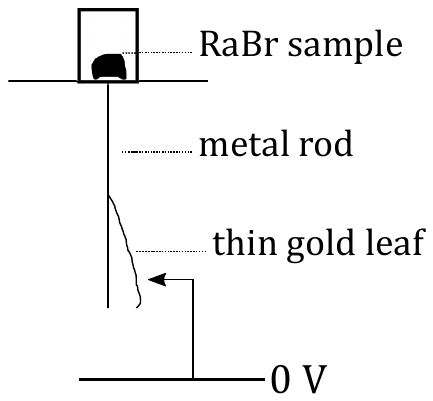
Figure 1
(i) Calculate the number of beta decays which occur for the flexible gold leaf to rise and make contact with the electrode.
(ii) Calculate the activity of the sample.
(iii) Hence determine the half-life of Ra-226.
(iv) What is the average current flow along the contact to earth during the first day?
(v) Comment on whether a similar gold leaf apparatus could be used to measure the initial current flow from the sphere used in part (c).
(vi) What would be the effect on the rise and fall of the gold leaf of replacing the radium bromide sample with a sample having the same initial activity but made from the isotope Ra-223 with a half life of 11.4 days? Sketch a graph of the rise and fall time, , of the gold leaf over a period of 50 days.
(vii) If this apparatus with the original Ra-226 sample was used as a clock, how long would it take for the clock to have slowed by one hour in a correctly measured 24 hour period? (8)
Risposta: a) (i) ; (ii) s; (iii) J eV; (iv) m s; (v) cm. b) (i) ; (ii) W; (iii) photons s; (iv) m m; (v) an interference pattern built up of individual spots; (vi) m, the spacing is less. c) (i) V; (ii) C, electrons; (iii) light arrives in photons, so no time is needed to accumulate energy; (iv) . d) (i) ; (ii) Bq; (iii) s ( years); (iv) pA; (v) no, it needs a high potential, never reached in the photoelectric effect; (vii) s
Soluzione:
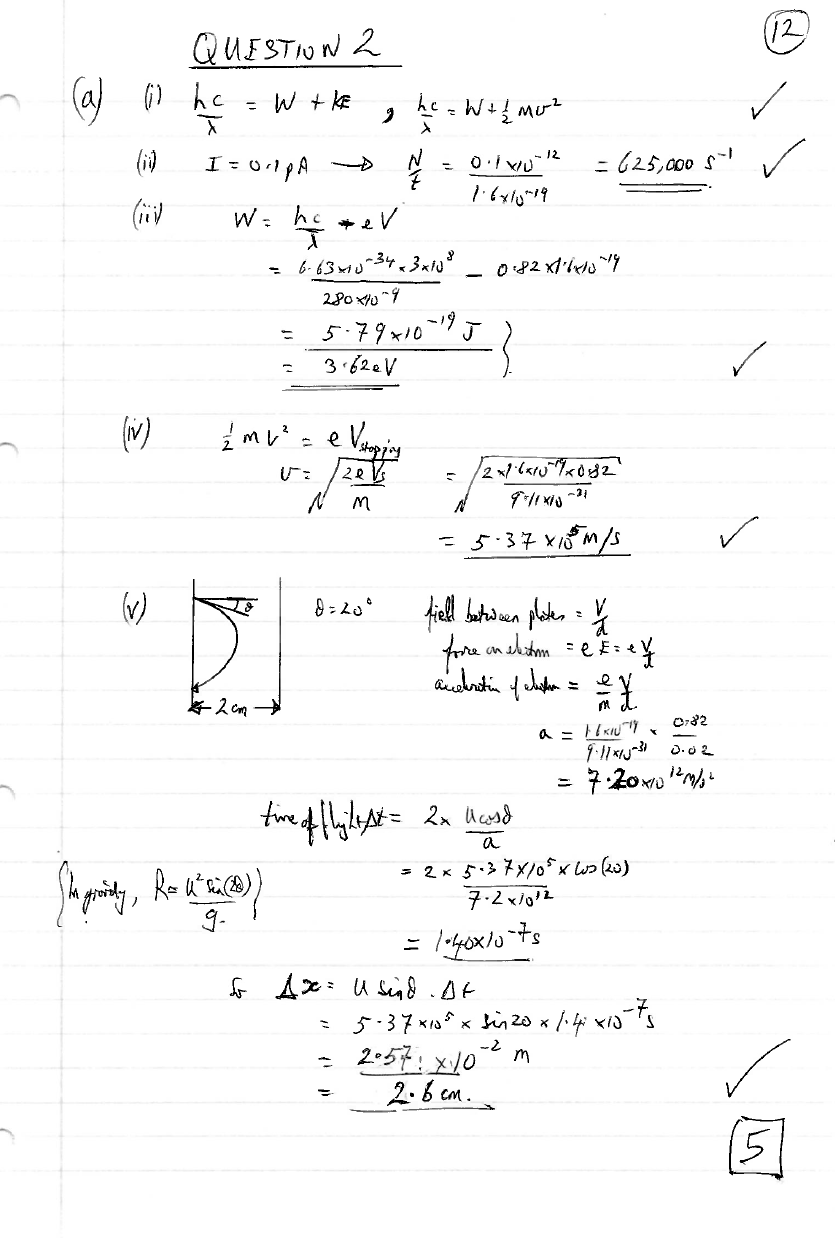
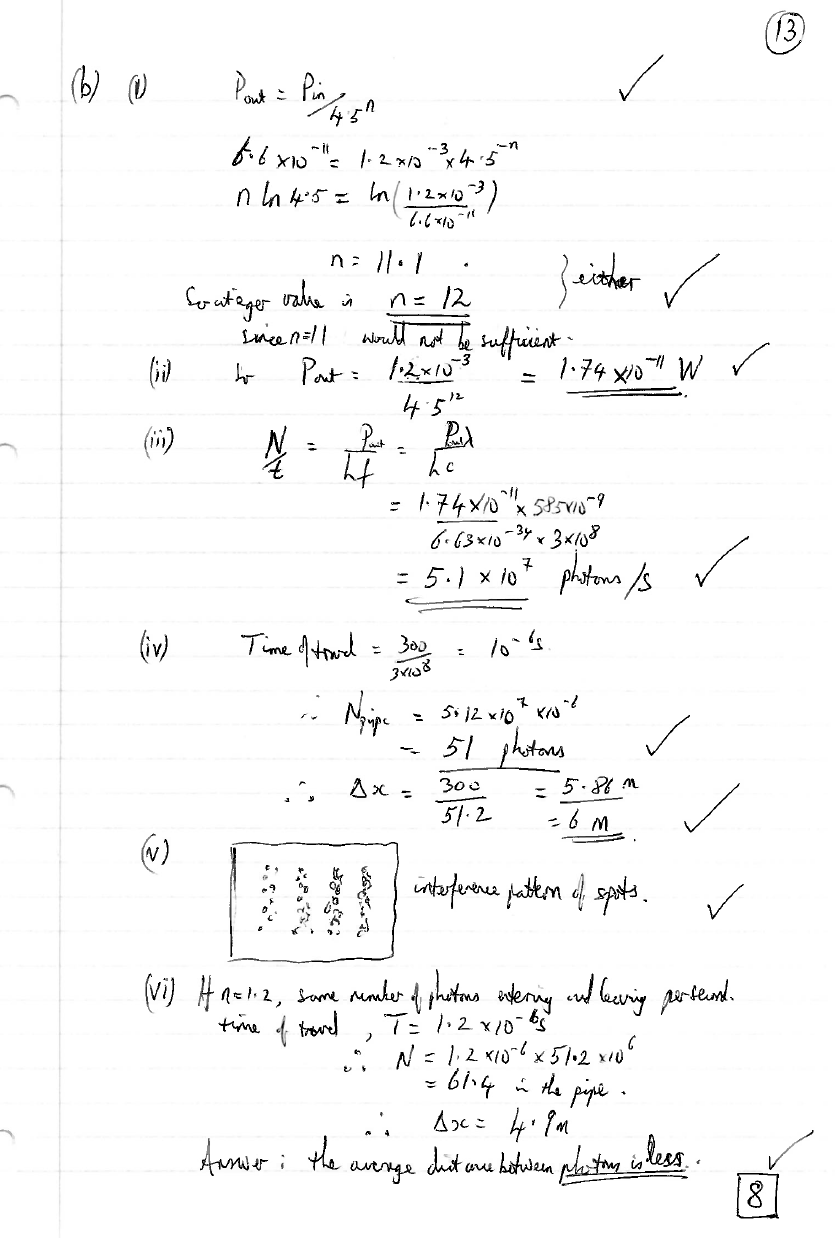
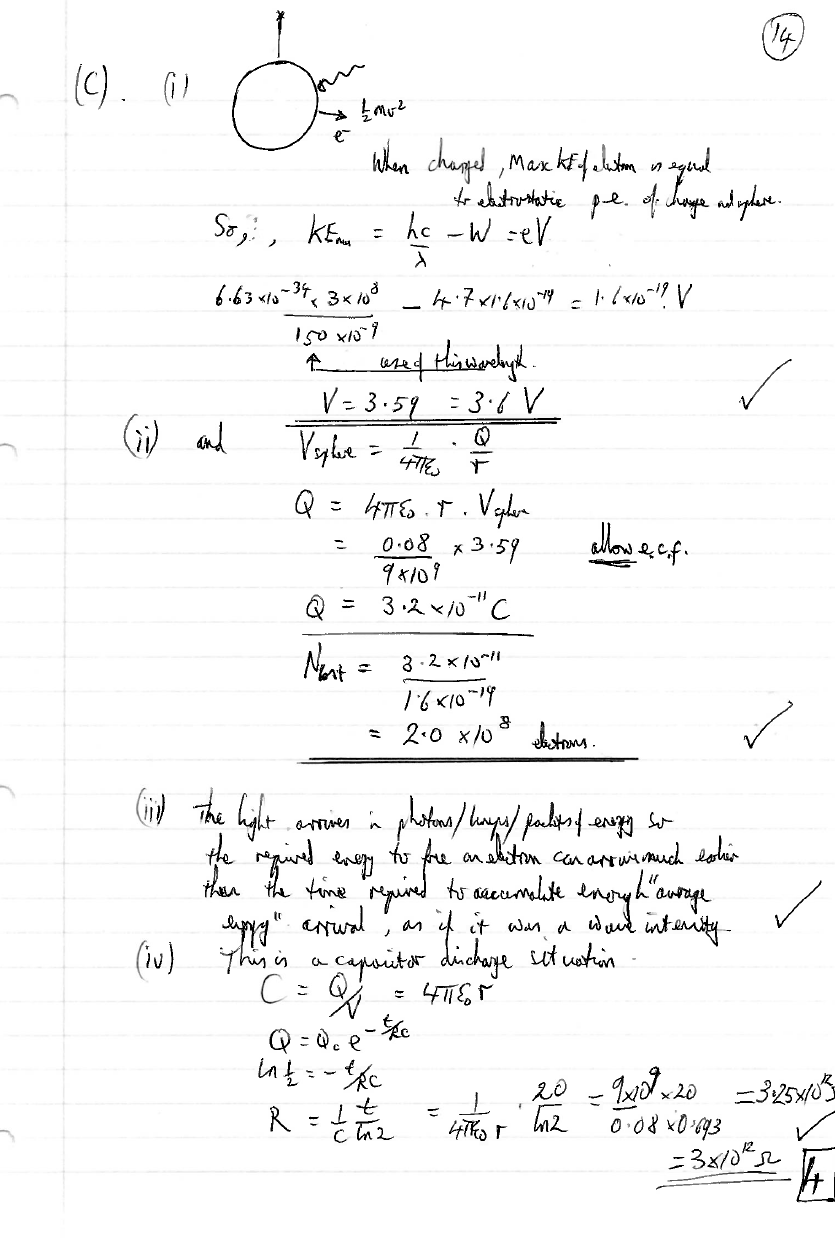
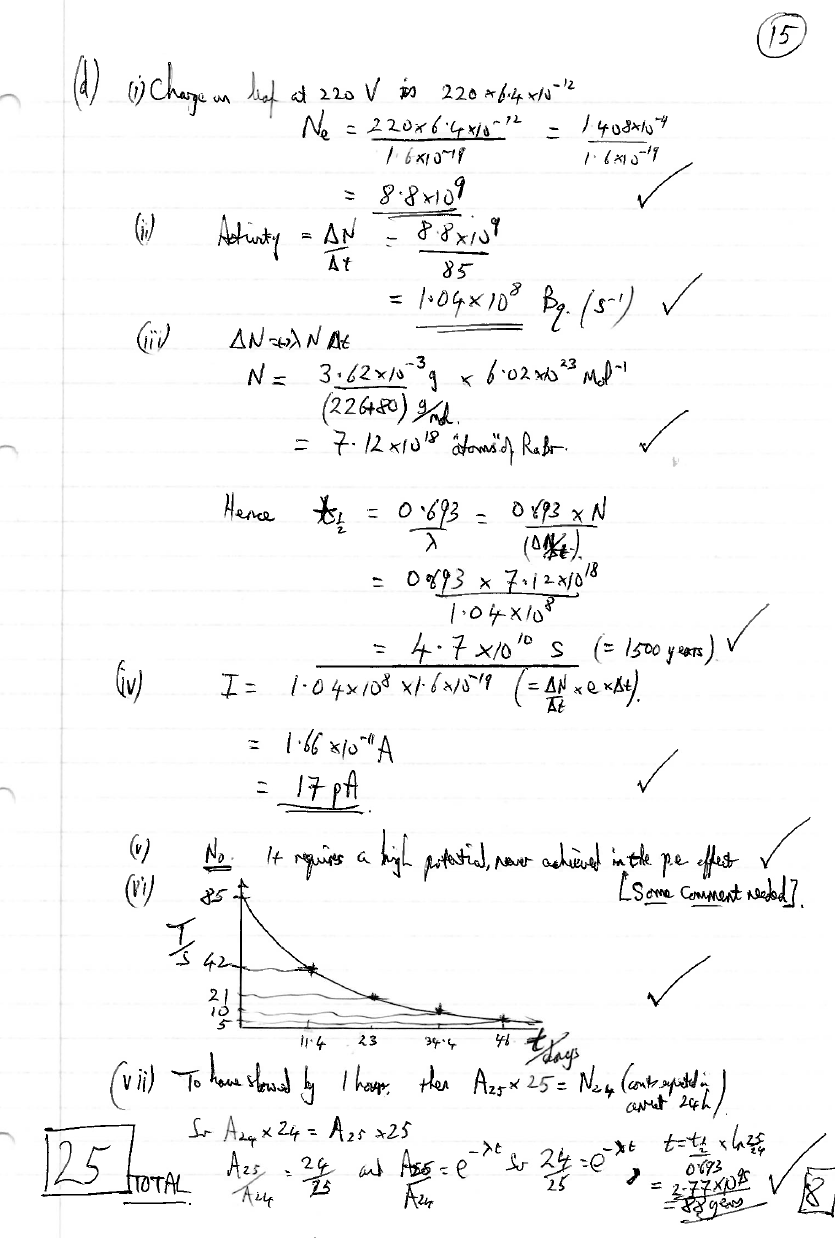
Official mark scheme (BPhO Round 1, November 2020, Section 2), from the official PDF — p. 12, 13, 14, 15. © BPhO, CC BY 4.0.
Topic: Modern-Quantum Physics, Nuclear & Particle Physics, Electrostatics Metodi: Photon Energy Relation, Radioactive Decay Law, Kinematic Equations Competenze: Mathematical Modeling, Physical Reasoning Objects: Photon, Electron, Conducting Sphere, Nucleus Fonte: Testo (PDF) — p.4 · Soluzione ufficiale (PDF) — p.12
Problema 2 — Effetto fotoelettrico e decadimento radioattivo [25 punti]
Questo problema riguarda l’effetto fotoelettrico e il decadimento radioattivo.
a) Quando una superficie metallica è illuminata con luce UV, emette elettroni.
(i) Scrivi un’equazione che esprima la conservazione dell’energia in questa situazione, legando il lavoro di estrazione all’energia cinetica degli elettroni emessi e alla lunghezza d’onda della luce monocromatica incidente sul metallo.
Due lastre conduttrici piane, parallele e di grande area, sono poste a 2,0 cm l’una dall’altra nel vuoto. Fanno parte di un circuito con un amperometro molto sensibile (e un amplificatore) in grado di misurare correnti fino a 0,1 pA. Una delle lastre è illuminata con luce UV di lunghezza d’onda 280 nm e emette fotoelettroni. La corrente si annulla applicando un potenziale di −0,82 V rispetto alla lastra emittente.
(ii) Quanti elettroni al secondo può rilevare l’amperometro?
(iii) Calcola il lavoro di estrazione della lastra metallica.
(iv) Determina la velocità dei fotoelettroni più energetici emessi dalla lastra.
(v) Se uno dei fotoelettroni con energia cinetica massima viene emesso a 20° rispetto alla normale alla superficie, calcola a che distanza dal punto di partenza ritorna sulla lastra. (5)
b) In un tubo vuoto lungo 300 m un fascio parallelo di luce monocromatica di intensità molto bassa, prodotto da un laser di lunghezza d’onda 585 nm, è diretto lungo l’asse da un’estremità. Il laser ha una potenza di 1,2 mW e la potenza che arriva all’altra estremità deve essere inferiore a W. Lo si ottiene con una serie di filtri assorbenti, ciascuno dei quali riduce l’intensità di un fattore 4,5.
(i) Calcola il numero minimo di filtri necessari per ridurre la potenza al valore richiesto.
(ii) Indica la potenza risultante.
(iii) Calcola il numero medio di fotoni che arrivano all’estremità opposta ogni secondo.
(iv) Determina la distanza media tra i fotoni che percorrono il tubo.
(v) Se all’estremità del tubo si ponesse una doppia fenditura di Young illuminata con questa luce debolissima, e la figura di intensità fosse registrata da una fotocamera sensibile posta dietro le fenditure, come apparirebbe la figura registrata?
(vi) Come cambierebbe la risposta alla parte (iv) se il tubo fosse riempito con un mezzo trasparente di indice di rifrazione ? (8)
c) Una sfera di rame scarica di raggio 8,0 cm è appesa nel vuoto a un sottile filo isolante. Viene illuminata con luce di lunghezze d’onda comprese tra 600 nm e 150 nm e si carica. Il lavoro di estrazione del rame è 4,7 eV.
(i) Qual è il potenziale finale della sfera?
(ii) Calcola il numero di elettroni persi dalla sfera.
(iii) Se l’intensità della luce viene ridotta moltissimo, si calcola che in media potrebbe essere emesso un elettrone ogni 0,1 s. Le misure mostrano però che un elettrone può essere emesso pochi nanosecondi dopo l’accensione della luce. Spiega questa osservazione.
(iv) Spenta la luce, si osserva che la sfera si scarica attraverso una piccola corrente nel filo di sostegno, che non è un isolante perfetto. Qual è la resistenza del filo se la sfera perde metà della carica in 20 s? (4)
d) Il tempo di dimezzamento del radio-226, isotopo a vita lunga, fu misurato originariamente lasciando che caricasse una lastra metallica isolata e misurando, ripetutamente e per un lungo periodo, il tempo necessario a raggiungere un potenziale noto. L’apparato è schematizzato in Figura 1; è sostenuto da barre isolanti e posto nel vuoto.
Il Ra-226 è contenuto in un recipiente di vetro a pareti sottili, sotto forma di 3,62 mg di bromuro di radio (RaBr) appena preparato. Con i decadimenti beta, la lastra metallica su cui poggia si carica e la sottile foglia d’oro si solleva fino a raggiungere 220 V, quando tocca l’elettrodo a terra e si scarica. Supponi che tutte le particelle beta attraversino il vetro e si allontanino dall’apparato. Le misure mostrano che il potenziale della foglia d’oro è proporzionale alla carica, con costante di proporzionalità 6,40 pC V. Le masse atomiche relative di radio e bromo sono 226 e 80. La foglia d’oro si solleva e ricade ogni 85 secondi.
Figura 1
(i) Calcola il numero di decadimenti beta necessari perché la foglia d’oro si sollevi e tocchi l’elettrodo.
(ii) Calcola l’attività del campione.
(iii) Determina quindi il tempo di dimezzamento del Ra-226.
(iv) Qual è la corrente media nel contatto a terra durante il primo giorno?
(v) Discuti se un apparato a foglia d’oro simile potrebbe servire a misurare la corrente iniziale della sfera della parte (c).
(vi) Che effetto avrebbe sul sollevarsi e ricadere della foglia d’oro sostituire il bromuro di radio con un campione della stessa attività iniziale ma di Ra-223, con tempo di dimezzamento 11,4 giorni? Disegna un grafico del tempo di salita e discesa della foglia nell’arco di 50 giorni.
(vii) Se questo apparato con il campione originale di Ra-226 fosse usato come orologio, dopo quanto tempo l’orologio accumulerebbe un ritardo di un’ora su un periodo di 24 ore misurato correttamente? (8)
Risposta: a) (i) ; (ii) s; (iii) J eV; (iv) m s; (v) cm. b) (i) ; (ii) W; (iii) fotoni s; (iv) m m; (v) una figura d’interferenza formata da singoli punti; (vi) m, la distanza è minore. c) (i) V; (ii) C, elettroni; (iii) la luce arriva in fotoni, non serve tempo per accumulare energia; (iv) . d) (i) ; (ii) Bq; (iii) s ( anni); (iv) pA; (v) no, servirebbe un potenziale elevato, mai raggiunto nell’effetto fotoelettrico; (vii) s
Soluzione: La soluzione ufficiale completa (in inglese) è nella versione originale di questo quesito e nel PDF ufficiale.
Topic: Modern-Quantum Physics, Nuclear & Particle Physics, Electrostatics Metodi: Photon Energy Relation, Radioactive Decay Law, Kinematic Equations Competenze: Mathematical Modeling, Physical Reasoning Objects: Photon, Electron, Conducting Sphere, Nucleus Fonte: Testo (PDF) — p.4 · Soluzione ufficiale (PDF) — p.12
Question 3 — Dynamics in nautical examples [25 marks]
This question is about dynamics in nautical examples.
a) An oil tanker as illustrated in Figure 2a will typically have a length of 272 m, a breadth of 48 m and a height from the bottom of the ship to the deck surface of 24 m. The mass of the ship alone is 22 000 tonnes. A typical full load would be 158 000 tonnes of crude oil with a density of 900 kg m. We model the tanker as a closed cuboid tank carrying oil at the bottom, of uniform cross-section, as shown in Figure 2b.
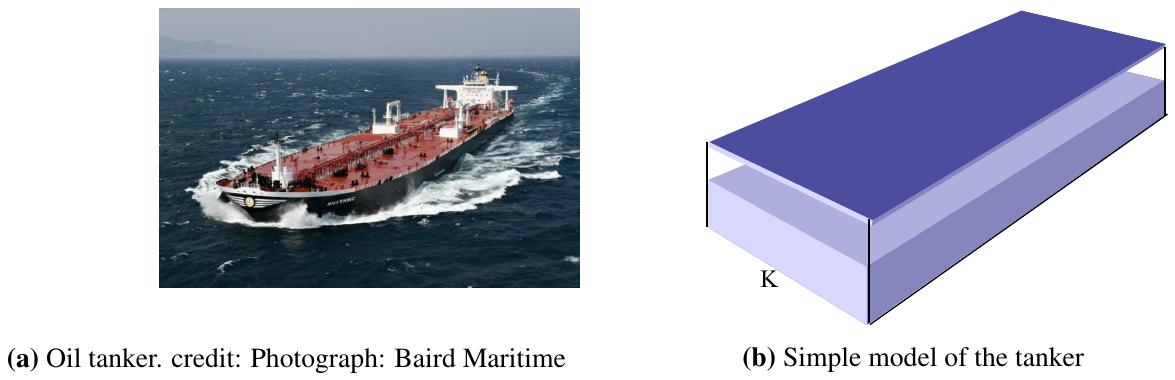
Figure 2: (a) Oil tanker (credit: Baird Maritime); (b) simple model of the tanker.
(i) Calculate the distance from the water line to the deck when the tanker is loaded with a full tank that occupies the lower part of the ship as shown in Figure 2b. Take the density of sea water to be 1025 kg m.
(ii) Calculate the height of the centre of mass of the loaded ship above the base centre point, K, shown in Figure 2b.
(iii) The ship lists to one side to the point where water just reaches the deck, as illustrated in Figure 3. Calculate the angle to the vertical , where is a small angle. [The buoyancy force acts at the centre of mass of the displaced water.]
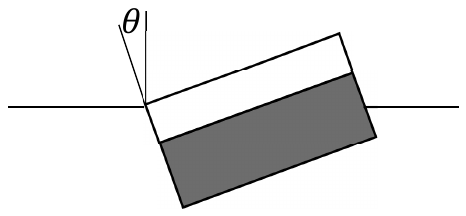
Figure 3: When the ship tilts, we assume the oil remains stationary inside due to internal baffles and walls.
(iv) Determine the resultant turning moment acting on the ship. (8)
b) A capstan (a rotating cylinder) on the ship pulls up a uniform heavy chain from the dockside by means of a much lighter thin rope of negligible mass, as in the photograph in Figure 4.
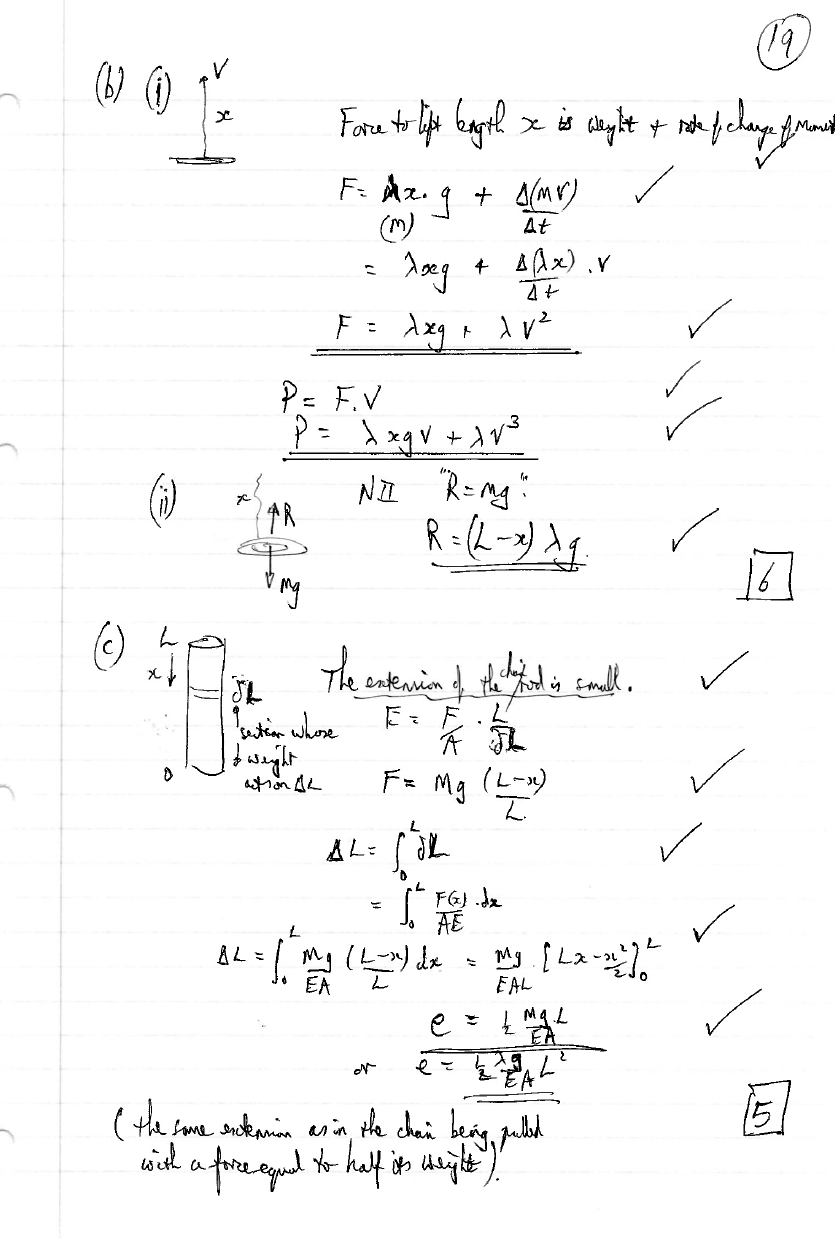
(i) The chain is pulled up from the ground at a constant speed . It has a mass per unit length of . If the length of heavy chain lifted from the ground and suspended from the rope is taken to be , find expressions for the force, , and the power, , supplied by the ship’s capstan in terms of , , and .
(ii) Find an expression for the upward contact force from the dockside, acting on the chain whilst it is being pulled up, taking the total length of chain to be . (6)
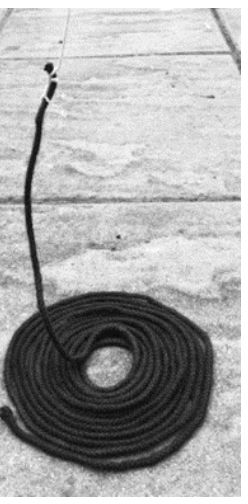
Figure 4
c) The heavy chain, with an effective cross-sectional area of , stretches under its own weight. Find an expression for the extension of the chain , as a function of its suspended length . The heavy chain has a mass per unit length , a Young’s modulus of , and the gravitational field strength is . The cross-sectional area of the chain is assumed to remain constant. (5)
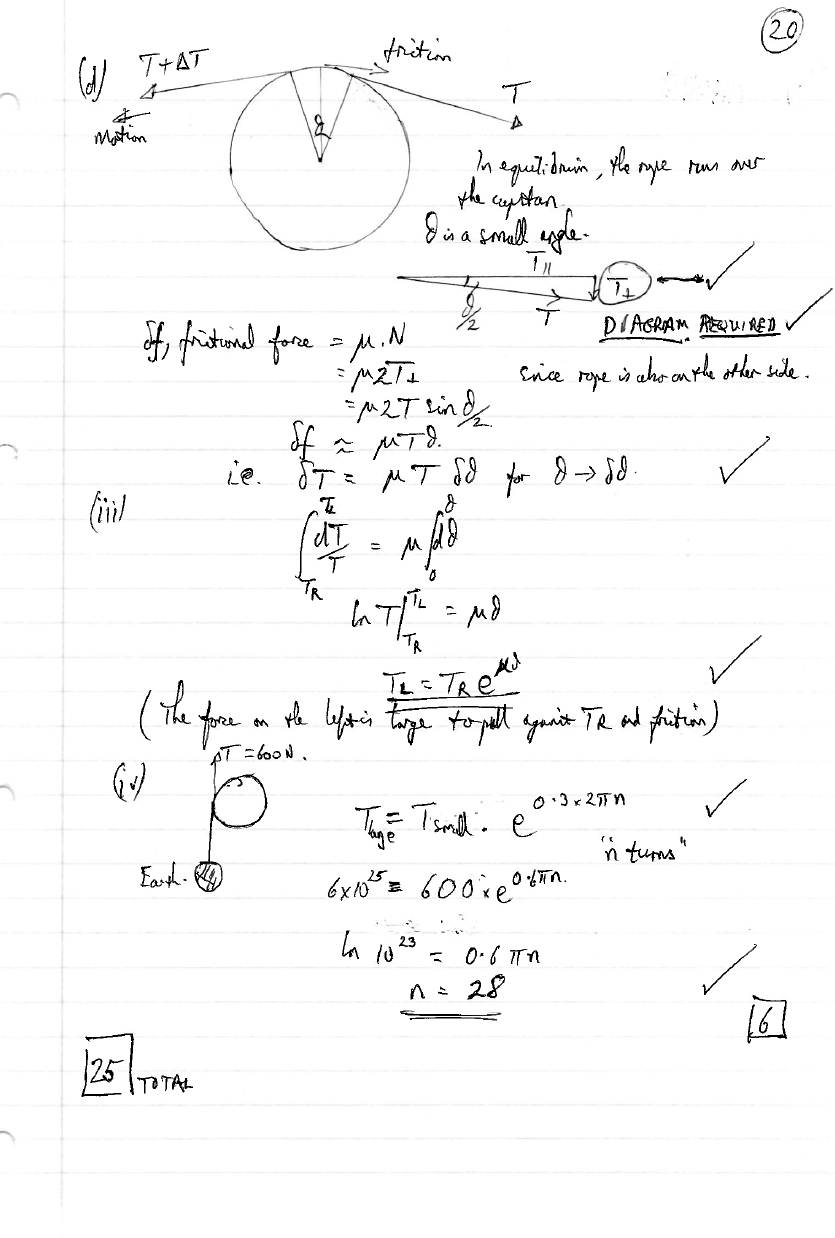
d) A strong rope can be used to pull on a large ship by wrapping the rope around a capstan (a cylinder) and holding the loose end of the rope with a small force. The friction of the rope on the capstan acts as a force multiplier. A rope is in contact with a cylinder with friction acting, as shown in Figure 5, in which the angle is small.
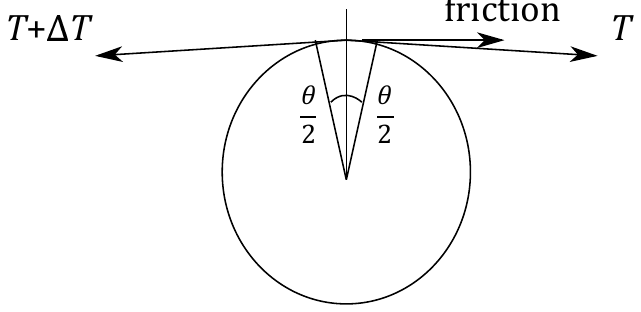
Figure 5
(i) Sketch a fully labelled diagram to show the normal component of the tension acting on the capstan from the rope.
(ii) Obtain an expression relating the tension in the rope , , and the coefficient of friction . The coefficient of friction is given by: frictional force = normal reaction force of the capstan.
(iii) By integrating your result relating and , obtain the relation between the tensions on the ends of the rope for large angles .
(iv) Approximately how many turns of a rope on a capstan for which the coefficient of friction would be required if you were to balance a person’s weight of N with a weight equivalent to the “weight of the Earth” ( N)? (6)
Risposta: a) (i) draught m, deck m above the water line; (ii) oil CM 6.72 m, ship CM 12 m: m m above the keel; (iii) ; (iv) N m N m. b) (i) , ; (ii) . c) (as printed) , the same as the chain pulled with half its weight. d) (ii) ; (iii) ; (iv) turns
Soluzione:
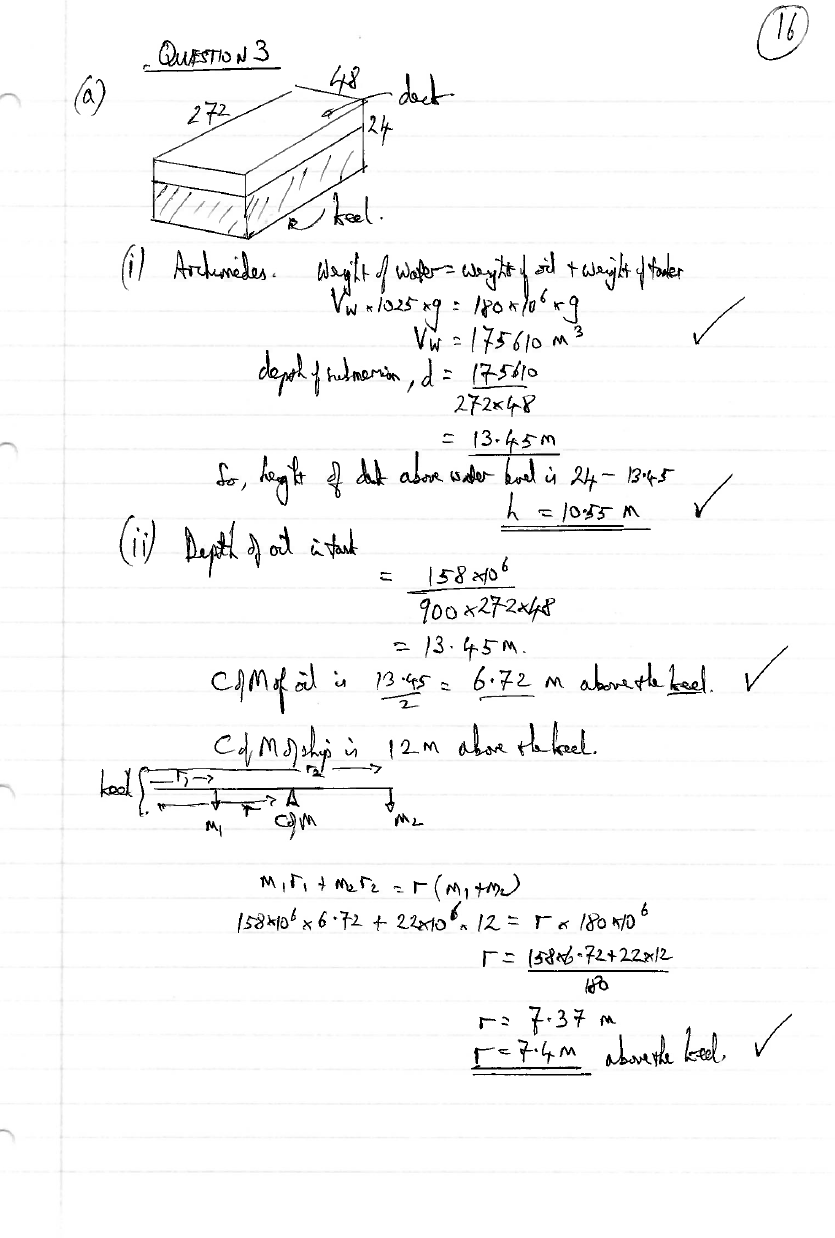
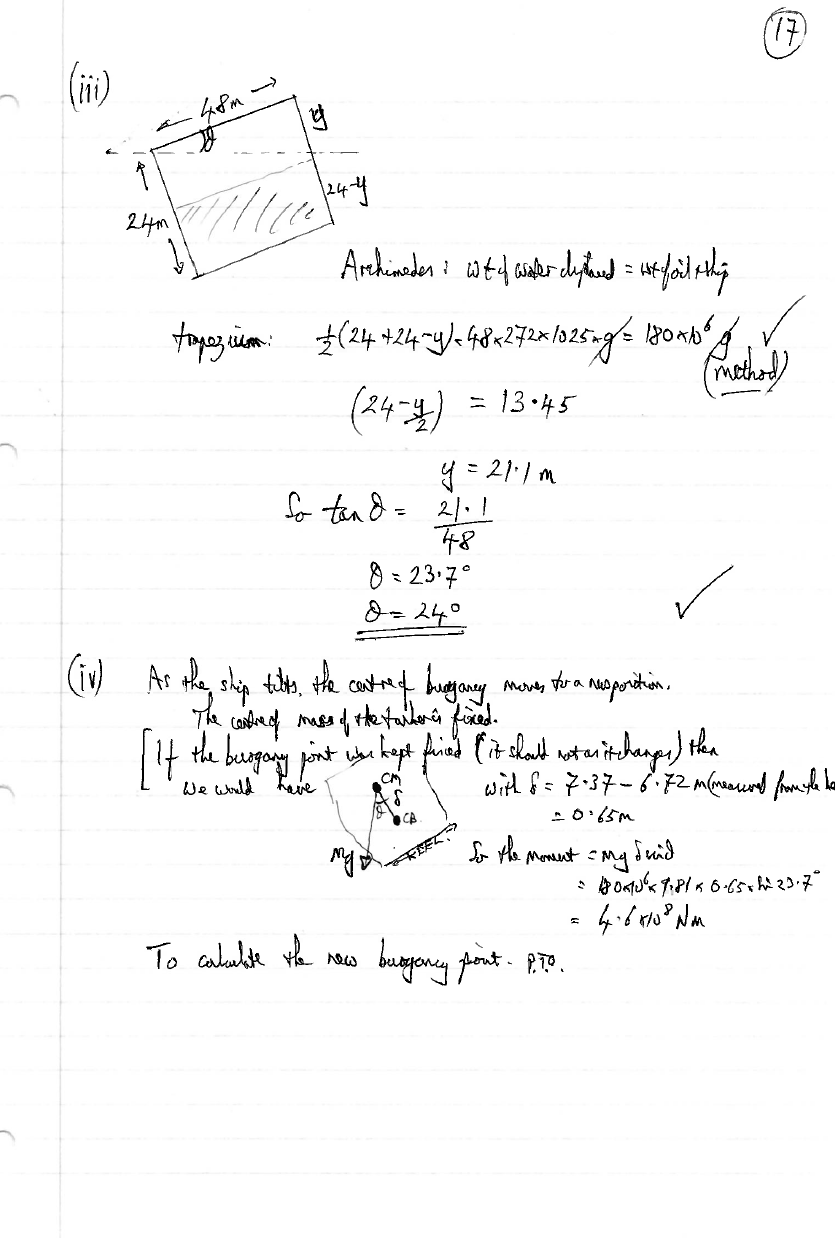
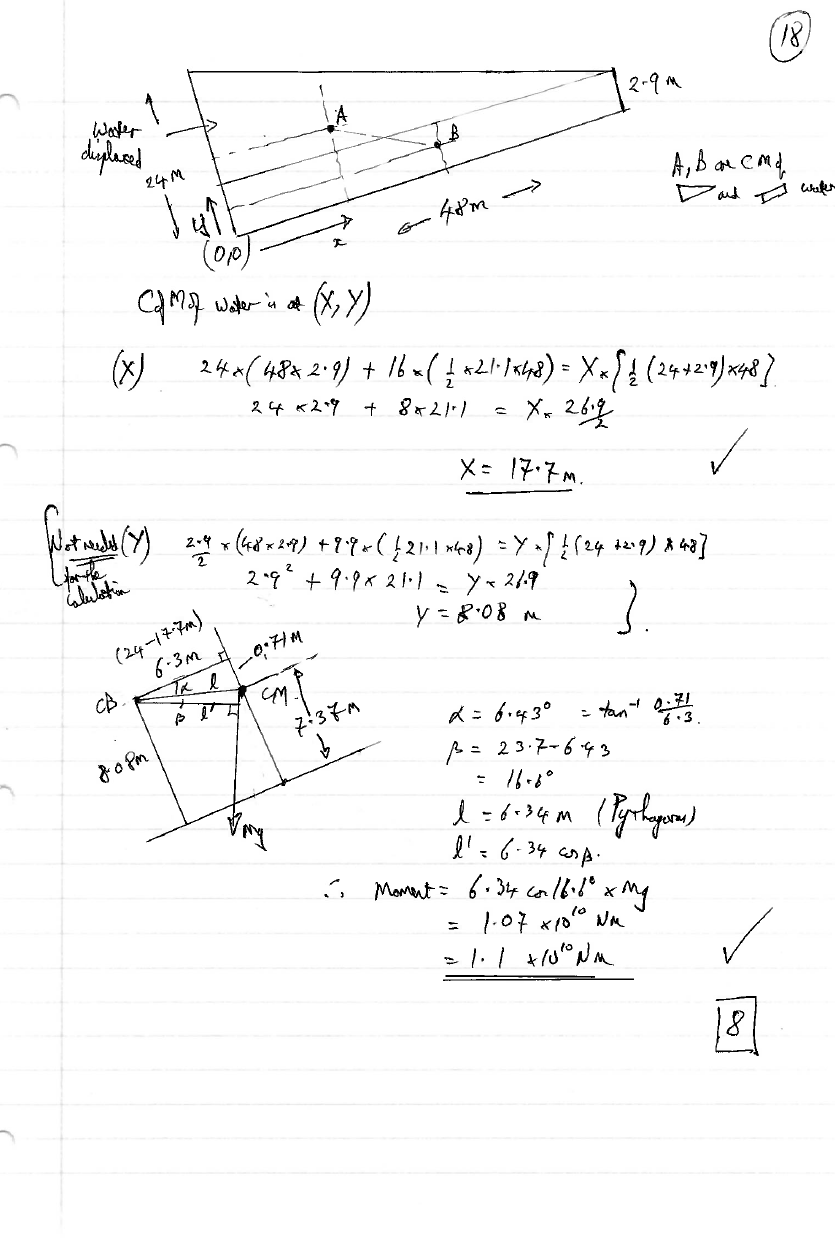
Official mark scheme (BPhO Round 1, November 2020, Section 2), from the official PDF — p. 16, 17, 18, 19, 20. © BPhO, CC BY 4.0.
Topic: Fluid Mechanics, Newtonian Mechanics, Elasticity & Materials, Rigid Body Statics Metodi: Hydrostatic Equilibrium, Torque & Angular Momentum Analysis, Calculus-Integration, Differential Equations Competenze: Mathematical Modeling, Physical Reasoning Objects: Container, String, Cylinder Fonte: Testo (PDF) — p.6 · Soluzione ufficiale (PDF) — p.16
Problema 3 — Dinamica in esempi nautici [25 punti]
Questo problema riguarda la dinamica in esempi nautici.
a) Una petroliera come quella di Figura 2a ha tipicamente lunghezza 272 m, larghezza 48 m e altezza dal fondo della nave al ponte di 24 m. La massa della sola nave è 22 000 tonnellate. Un carico pieno tipico è di 158 000 tonnellate di petrolio greggio di densità 900 kg m. Modellizziamo la petroliera come una cisterna chiusa a forma di parallelepipedo, a sezione uniforme, con il petrolio sul fondo, come in Figura 2b.
Figura 2: (a) petroliera (foto: Baird Maritime); (b) modello semplificato della petroliera.
(i) Calcola la distanza tra la linea di galleggiamento e il ponte quando la petroliera è carica, con il serbatoio pieno che occupa la parte bassa della nave come in Figura 2b. Densità dell’acqua di mare 1025 kg m.
(ii) Calcola l’altezza del centro di massa della nave carica sopra il punto centrale della base, K, indicato in Figura 2b.
(iii) La nave si inclina da un lato finché l’acqua raggiunge appena il ponte, come in Figura 3. Calcola l’angolo rispetto alla verticale, dove è un angolo piccolo. [La spinta di galleggiamento agisce nel centro di massa dell’acqua spostata.]
Figura 3: quando la nave si inclina, supponiamo che il petrolio resti fermo all’interno grazie a paratie e pareti interne.
(iv) Determina il momento risultante che agisce sulla nave. (8)
b) Un argano (un cilindro rotante) sulla nave tira su dalla banchina una catena pesante e uniforme per mezzo di una fune sottile molto più leggera, di massa trascurabile, come nella foto di Figura 4.
(i) La catena viene sollevata da terra a velocità costante e ha massa per unità di lunghezza . Detta la lunghezza di catena sollevata da terra e appesa alla fune, trova le espressioni della forza e della potenza fornite dall’argano in funzione di , , e .
(ii) Trova un’espressione della forza di contatto verso l’alto esercitata dalla banchina sulla catena mentre questa viene sollevata, detta la lunghezza totale della catena. (6)
Figura 4
c) La catena pesante, di sezione efficace , si allunga sotto il proprio peso. Trova un’espressione dell’allungamento della catena in funzione della lunghezza appesa . La catena ha massa per unità di lunghezza , modulo di Young , e l’intensità del campo gravitazionale è . Supponi che la sezione della catena resti costante. (5)
d) Una fune robusta può tirare una grande nave se avvolta attorno a un argano (un cilindro) tenendone l’estremità libera con una piccola forza: l’attrito della fune sull’argano fa da moltiplicatore di forza. Una fune è a contatto con un cilindro con attrito, come in Figura 5, dove l’angolo è piccolo.
Figura 5
(i) Disegna un diagramma completo di etichette che mostri la componente normale della tensione esercitata dalla fune sull’argano.
(ii) Ricava una relazione tra la tensione della fune , , e il coefficiente d’attrito . Il coefficiente d’attrito è definito da: forza d’attrito = reazione normale dell’argano.
(iii) Integrando la relazione tra e , ricava la relazione tra le tensioni alle estremità della fune per angoli grandi.
(iv) Circa quanti giri di fune su un argano con coefficiente d’attrito servirebbero per equilibrare con il peso di una persona, N, un peso pari al «peso della Terra» ( N)? (6)
Risposta: a) (i) pescaggio m, ponte m sopra la linea di galleggiamento; (ii) CM del petrolio 6,72 m, CM della nave 12 m: m m sopra la chiglia; (iii) ; (iv) N m N m. b) (i) , ; (ii) . c) (come stampato) , come la catena tirata con metà del suo peso. d) (ii) ; (iii) ; (iv) giri
Soluzione: La soluzione ufficiale completa (in inglese) è nella versione originale di questo quesito e nel PDF ufficiale.
Topic: Fluid Mechanics, Newtonian Mechanics, Elasticity & Materials, Rigid Body Statics Metodi: Hydrostatic Equilibrium, Torque & Angular Momentum Analysis, Calculus-Integration, Differential Equations Competenze: Mathematical Modeling, Physical Reasoning Objects: Container, String, Cylinder Fonte: Testo (PDF) — p.6 · Soluzione ufficiale (PDF) — p.16
Question 4 — Change in speed of a wave in a medium [25 marks]
The change in speed of a wave in a medium has many important aspects, some of which are illustrated in this question.
a) A prism of apex angle and refractive index has a monochromatic beam of light incident on a face as shown in Figure 6.
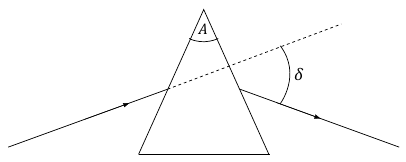
Figure 6
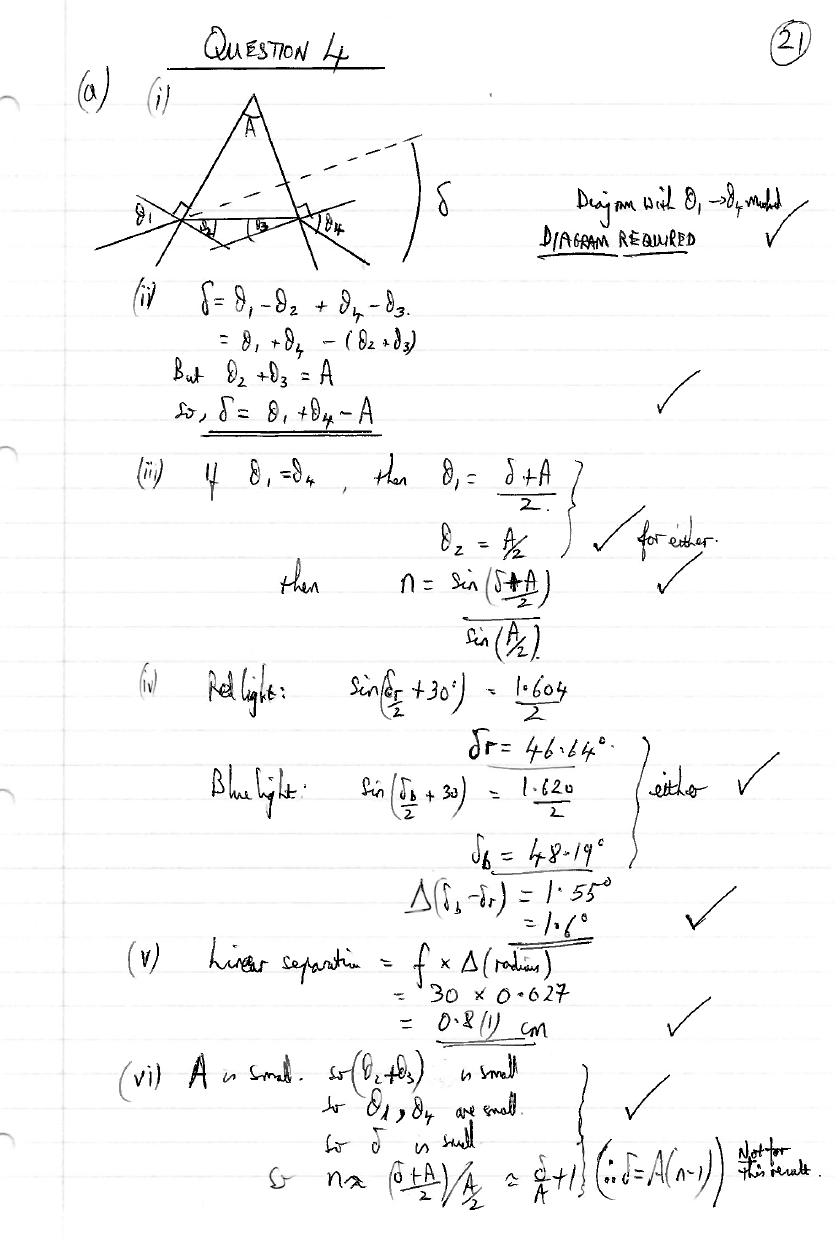
(i) Sketch a large diagram of the prism and draw the path of a ray passing through the prism. Mark on the angles of incidence for each face and the angles of refraction for each face for the ray, following the path of the ray with the angles in path order, , , and .
(ii) Obtain an expression for the angle of deviation, , between the incident ray and the emerging refracted ray in terms of the incident angle , the angle of refraction of the ray emerging from the second face, and .
The minimum angle of deviation, , occurs when the ray passes through the prism symmetrically. Then and .
(iii) By considering a symmetric ray passing through the prism, obtain an expression for the refractive index of the prism in terms of and .
(iv) For a prism with apex angle , what is the difference in the angle of deviation for red and blue light, for which the refractive indices are respectively and ? Assume each ray passes through the prism with minimum deviation.
(v) If the emerging rays are focused on to a screen by a lens with a focal length of 30 cm, what will be the linear separation of the images on the screen? [parallel rays passing through the centre of a lens are undeviated in direction but will be focused on the screen a focal length away]
(vi) Show that when the apex angle of the prism is small, then .
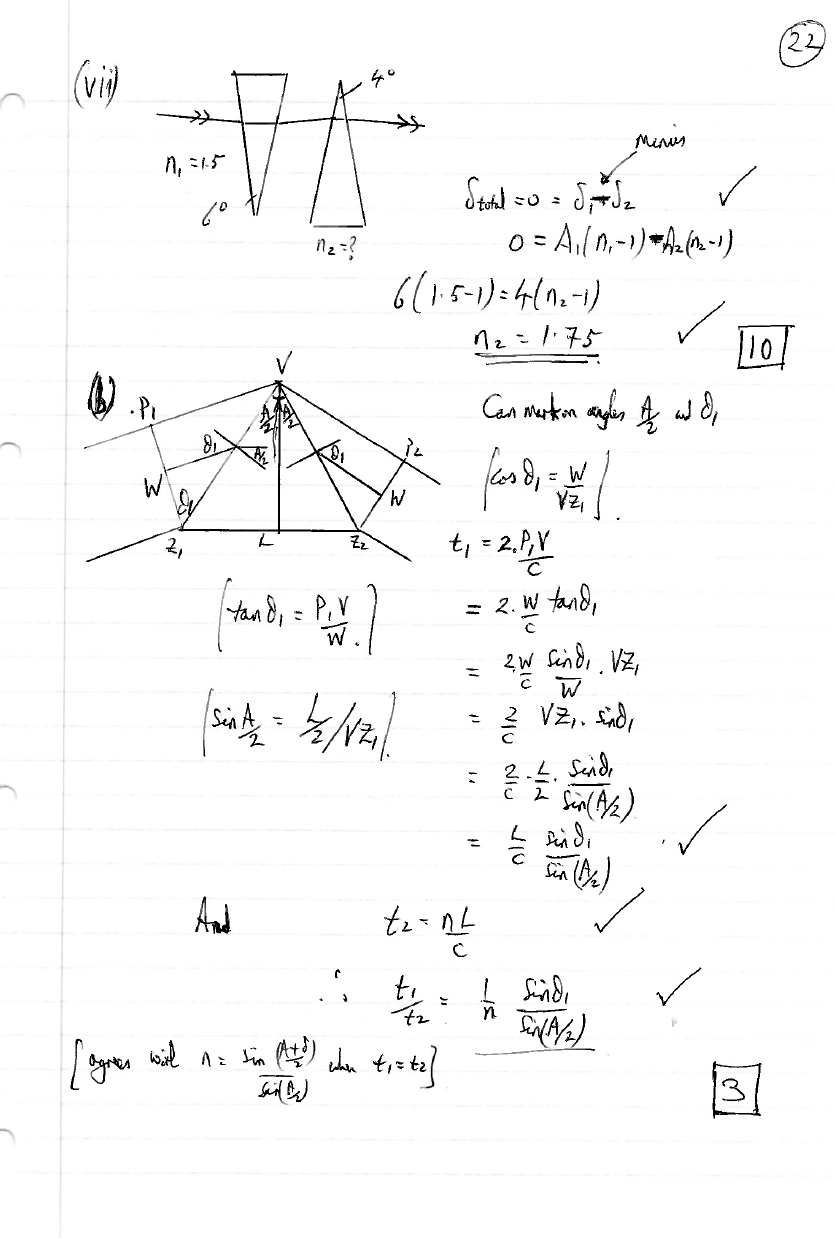
(vii) A glass prism of apex angle 6.0° and of refractive index is held with its apex downwards alongside another prism of apex angle 4.0° which has its apex upwards. A parallel beam of monochromatic light is at normal incidence to the first prism and emerges from the second, parallel to the original beam, but displaced. Calculate the refractive index of the second prism. The thin prism approximation of (vi) can be used for both prisms. (10)
b) In Figure 7, a parallel beam with a wavefront of width passes symmetrically through the isosceles prism. If is the time taken for the light to travel the path PVP, and is the time taken to travel ZZ (), obtain an expression for the ratio of the times in terms of the incident angle , and . (3)
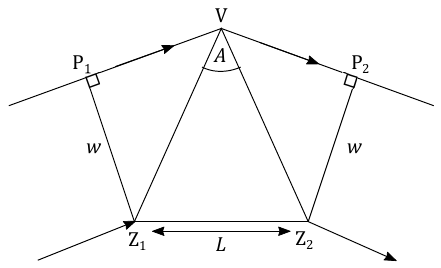
Figure 7
c) A thin lens has the characteristics of a thin prism. Using the result quoted earlier for a thin prism, , and the lengths and with corresponding small angles and shown in Figure 8, in which the top half of the lens is shown,
(i) obtain an expression relating , , , and the radius of the lens .
(ii) If a thin lens has a diameter of 5.0 cm, and , what is the value of the apex angle for the lens with a focal length of 40 cm? (The focal length is the distance from the lens where a set of parallel rays entering the lens would cross the axis.) (3)
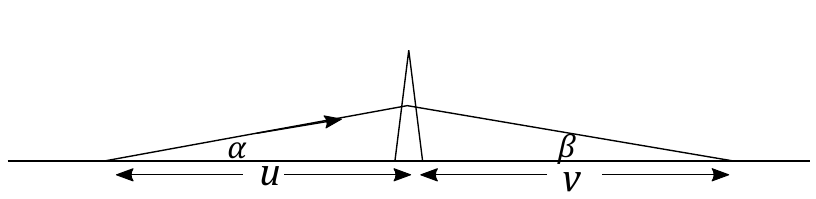
Figure 8
d) A 60 m tank of water has a stroboscope at one end producing white light in equal time on/off flashes at a frequency . The refractive index of water for red light is 1.33 and for blue light it is 1.35. Estimate the maximum flash frequency at which light pulses can enter the tank and emerge from the far end as separate flashes. (3)
e) From the Earth’s surface, a star can be observed through a telescope. However, the angle of the star measured from the vertical is shifted due to refraction by the Earth’s atmosphere, as indicated in the model in Figure 9. The true position of the star is at angle to the vertical, and the observed angle is at to the vertical, with the small difference in angle being given by , such that . It should be assumed that is a small angle.
(i) Obtain an expression relating and for the refracted light.
(ii) Hence find an expression for in terms of and , the refractive index of the atmosphere at the Earth’s surface. (6)
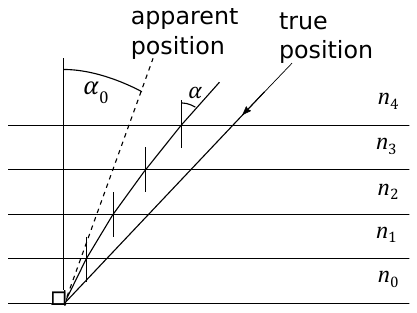
Figure 9: The atmosphere is treated as distinct horizontal layers of refractive index from , , … to at the top.
Risposta: a) (ii) ; (iii) ; (iv) , , difference ; (v) cm; (vi) ; (vii) , . b) . c) (i) ; (ii) rad . d) s, Hz. e) (i) ; (ii)
Soluzione:
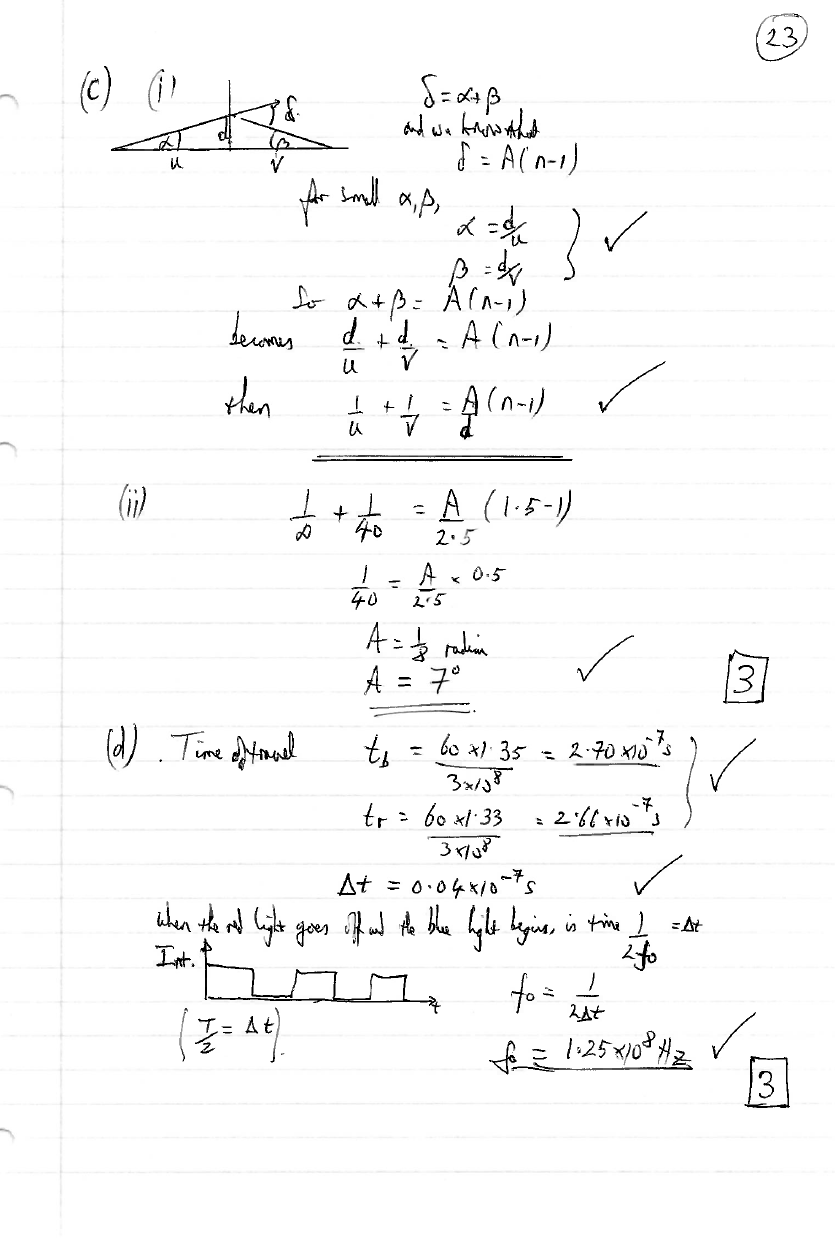
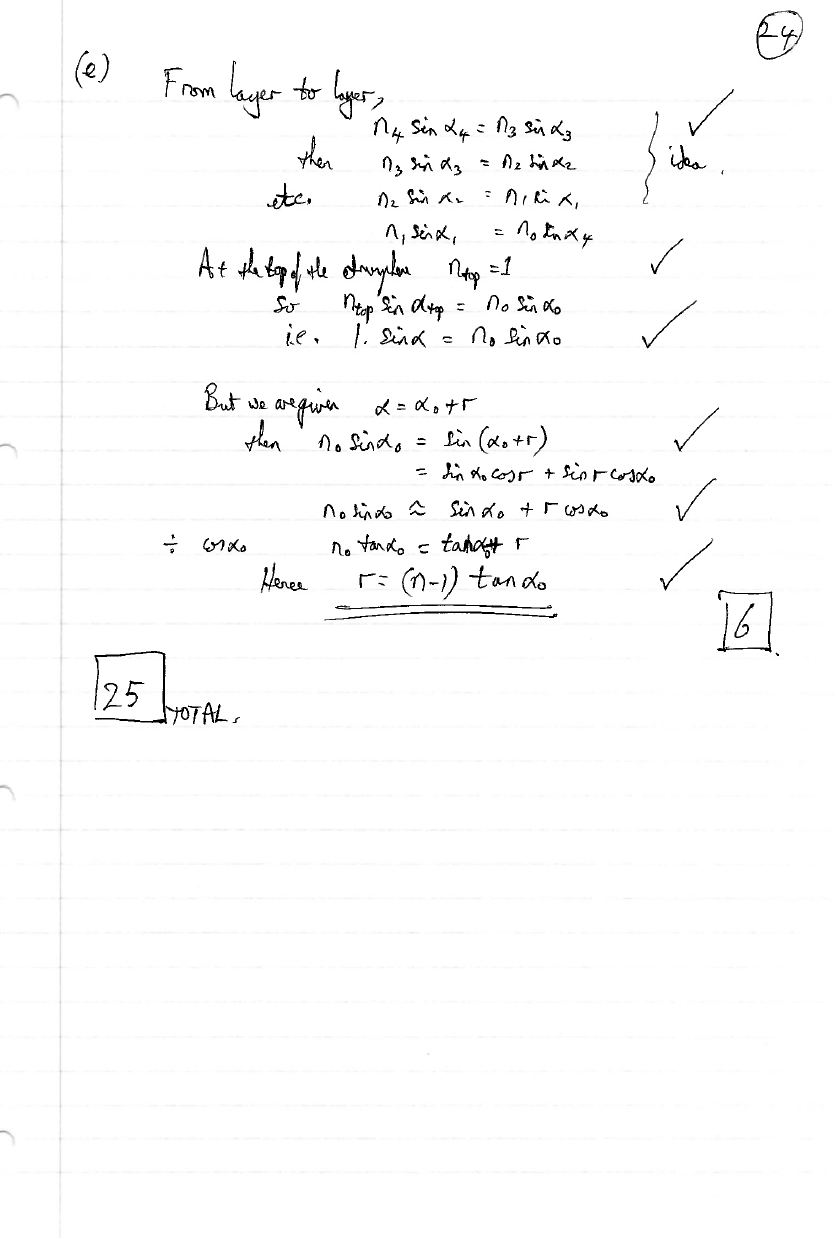
Official mark scheme (BPhO Round 1, November 2020, Section 2), from the official PDF — p. 21, 22, 23, 24. © BPhO, CC BY 4.0.
Topic: Geometric Optics Metodi: Snell’s Law, Ray Tracing, Small-Angle Approximation, Thin Lens & Mirror Equation Competenze: Diagrammatic Reasoning, Mathematical Modeling Objects: Prism, Lens Fonte: Testo (PDF) — p.8 · Soluzione ufficiale (PDF) — p.21
Problema 4 — Velocità di un’onda in un mezzo [25 punti]
Il cambiamento di velocità di un’onda in un mezzo ha molti aspetti importanti, alcuni dei quali sono illustrati in questo problema.
a) Su una faccia di un prisma di angolo al vertice e indice di rifrazione incide un fascio di luce monocromatica, come in Figura 6.
Figura 6
(i) Disegna in grande il prisma e il percorso di un raggio che lo attraversa. Indica gli angoli di incidenza e di rifrazione su ciascuna faccia, seguendo il percorso del raggio nell’ordine , , e .
(ii) Ricava un’espressione dell’angolo di deviazione tra il raggio incidente e quello emergente in funzione dell’angolo di incidenza , dell’angolo di rifrazione del raggio che esce dalla seconda faccia e di .
La deviazione minima si ha quando il raggio attraversa il prisma simmetricamente: allora e .
(iii) Considerando un raggio simmetrico, ricava un’espressione dell’indice di rifrazione del prisma in funzione di e .
(iv) Per un prisma con , qual è la differenza tra gli angoli di deviazione della luce rossa e di quella blu, con indici e ? Supponi che ciascun raggio attraversi il prisma con deviazione minima.
(v) Se i raggi emergenti sono focalizzati su uno schermo da una lente di focale 30 cm, quale sarà la distanza tra le immagini sullo schermo? [i raggi paralleli che passano per il centro di una lente non vengono deviati, ma sono focalizzati sullo schermo a una distanza focale]
(vi) Mostra che, quando l’angolo al vertice è piccolo, .
(vii) Un prisma di vetro con angolo al vertice 6,0° e indice è tenuto con il vertice in basso accanto a un altro prisma con angolo al vertice 4,0° e vertice in alto. Un fascio parallelo di luce monocromatica incide perpendicolarmente sul primo prisma ed esce dal secondo parallelo al fascio originale, ma spostato. Calcola l’indice di rifrazione del secondo prisma, usando per entrambi l’approssimazione del prisma sottile di (vi). (10)
b) In Figura 7 un fascio parallelo con fronte d’onda di larghezza attraversa simmetricamente il prisma isoscele. Se è il tempo impiegato dalla luce a percorrere PVP e quello per percorrere ZZ (), ricava un’espressione del rapporto in funzione dell’angolo di incidenza , di e di . (3)
Figura 7
c) Una lente sottile si comporta come un prisma sottile. Usando il risultato già visto per un prisma sottile, , e le lunghezze e con i corrispondenti piccoli angoli e di Figura 8, dove è mostrata la metà superiore della lente,
(i) ricava una relazione tra , , , e il raggio della lente.
(ii) Se una lente sottile ha diametro 5,0 cm e , qual è l’angolo al vertice per una focale di 40 cm? (La focale è la distanza dalla lente alla quale un fascio di raggi paralleli entrati nella lente incrocia l’asse.) (3)
Figura 8
d) A un’estremità di una vasca d’acqua lunga 60 m uno stroboscopio produce lampi di luce bianca, con intervalli di acceso e spento uguali, a frequenza . L’indice di rifrazione dell’acqua è 1,33 per la luce rossa e 1,35 per la blu. Stima la frequenza massima dei lampi per cui gli impulsi luminosi entrano nella vasca ed escono dall’altra estremità come lampi separati. (3)
e) Dalla superficie terrestre si osserva una stella al telescopio. L’angolo della stella misurato dalla verticale è però spostato dalla rifrazione dell’atmosfera, come nel modello di Figura 9. La posizione vera della stella forma un angolo con la verticale e quella osservata un angolo , con la piccola differenza tale che . Supponi che sia un angolo piccolo.
(i) Ricava una relazione tra e per la luce rifratta.
(ii) Trova quindi un’espressione di in funzione di e di , indice di rifrazione dell’atmosfera al suolo. (6)
Figura 9: l’atmosfera è schematizzata come strati orizzontali distinti di indice , , … fino a in cima.
Risposta: a) (ii) ; (iii) ; (iv) , , differenza ; (v) cm; (vi) ; (vii) , . b) . c) (i) ; (ii) rad . d) s, Hz. e) (i) ; (ii)
Soluzione: La soluzione ufficiale completa (in inglese) è nella versione originale di questo quesito e nel PDF ufficiale.
Topic: Geometric Optics Metodi: Snell’s Law, Ray Tracing, Small-Angle Approximation, Thin Lens & Mirror Equation Competenze: Diagrammatic Reasoning, Mathematical Modeling Objects: Prism, Lens Fonte: Testo (PDF) — p.8 · Soluzione ufficiale (PDF) — p.21
Question 5 — Circular motion and gravity [25 marks]
This question is about circular motion and gravity.
a) A hump-back bridge has a circular cross section. It crosses a river of width 18 m and the height of the centre of the bridge above the surrounding ground is 4.0 m. What is the maximum speed at which a car can drive over the bridge whilst still remaining in contact with it?
Hint: if two chords of a circle, AB and CD meet at a point S then AS·SB = CS·SD (3)
b) The Sun orbits the centre of the Milky Way galaxy at a radius of 30 000 light years, and a period of orbit about the galaxy of 200 million years. Assuming that the mass distribution of matter in the galaxy is concentrated mainly in a central uniform sphere and the Earth lies in one of the arms, as illustrated schematically in Figure 10,
(i) obtain an expression for the period of orbit of the Sun in terms of its radius of orbit, , and , the mass of the galaxy.
(ii) Determine a value of the mass of the galaxy.
(iii) If the Sun represents the mass of an average star, estimate the number of stars in the Milky Way. (3)
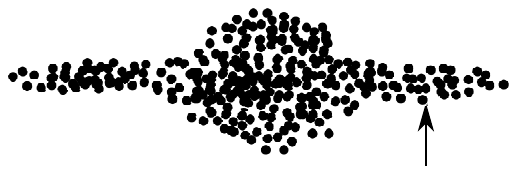
Figure 10: Schematic of the Milky Way galaxy, viewed in the plane, with the Sun along one ‘arm’, marked by the arrow.
c) A satellite orbits the spherical Earth of radius in a circular orbit of radius .
(i) Write down an expression for the speed of the satellite in terms of , and , the mass of the Earth, explaining the physics needed to obtain your expression.
(ii) Evaluate the speed of a satellite in a low orbit, if it was just grazing the Earth.
(iii) Calculate the period of the satellite orbit.
(iv) The satellite instead orbits at a height above the surface of the Earth. Obtain an expression for the fractional change of the orbital period in terms of and . Hence what is the period of orbit of the satellite orbiting at a height of 200 km?
(v) Sketch a graph of the period of orbit against for .
(vi) Show that when a large mass moving at speed collides elastically with a stationary small mass , the kinetic energy lost by is .
(vii) When a small satellite of mass and cross-sectional area passes through a gas of density it will make numerous elastic collisions with molecules of the gas. Obtain an expression for the rate of loss of energy of the satellite in terms of , and .
(viii) An Earth satellite of mass 20 kg is in a circular orbit at a height small compared to the radius of the Earth. If air resistance causes its total energy to decrease by 10 kJ per revolution, what is the fractional change in its speed per revolution?
(ix) By considering an expression for total energy of a satellite in orbit, show whether the speed increases or decreases.
(x) By simply using values for the period and speed of an Earth orbiting satellite in a grazing orbit, if the cross-sectional area of the satellite is 2.4 m, estimate the density of the atmosphere for this rate of energy loss. (14)
d) In the previous parts of this question, we assumed that the mass of the Earth was very much larger than the satellite. In the remainder of this question, we relax this approximation. Many stars are found as part of binary systems, consisting of two stars of unequal mass in circular orbits about one another.
(i) Draw a diagram of the orbits of such a binary system labelling the positions of the two stars at two successive times in their orbits.
(ii) Suppose the stars have mass and with , what are their relative orbital radii?
(iii) One day the more massive star explodes in a supernova. After the explosion, the masses of the stars are now equal, and the exploding material has moved to a great distance away. Describe using diagrams the motion of the star system if the binary system were to remain bound. Assume the supernova causes the larger star to lose mass in a spherically symmetrical manner.
(iv) Find the critical value of the initial mass ratio , above which the binary system becomes unbound after the explosion described in (iii). (5)
Risposta: a) m, m s. b) (i) ; (ii) kg ; (iii) stars. c) (i) ; (ii) km s; (iii) s; (iv) , s; (vii) ; (viii) ; (ix) , so the speed increases as decreases; (x) kg m. d) (ii) ; (iii) centre of mass moves to midway, the stars orbit the centre of mass, now midway, at the same separation; (iv) critical (bound for )
Soluzione:
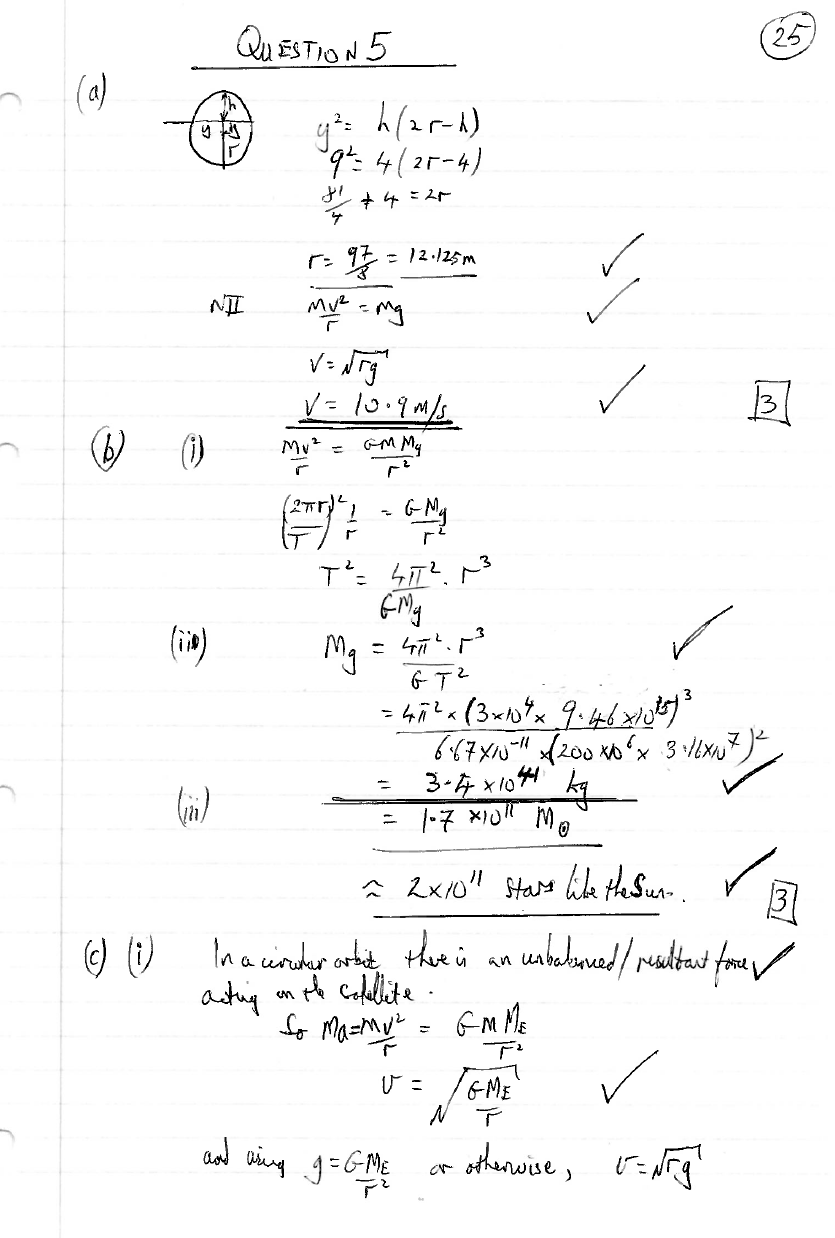
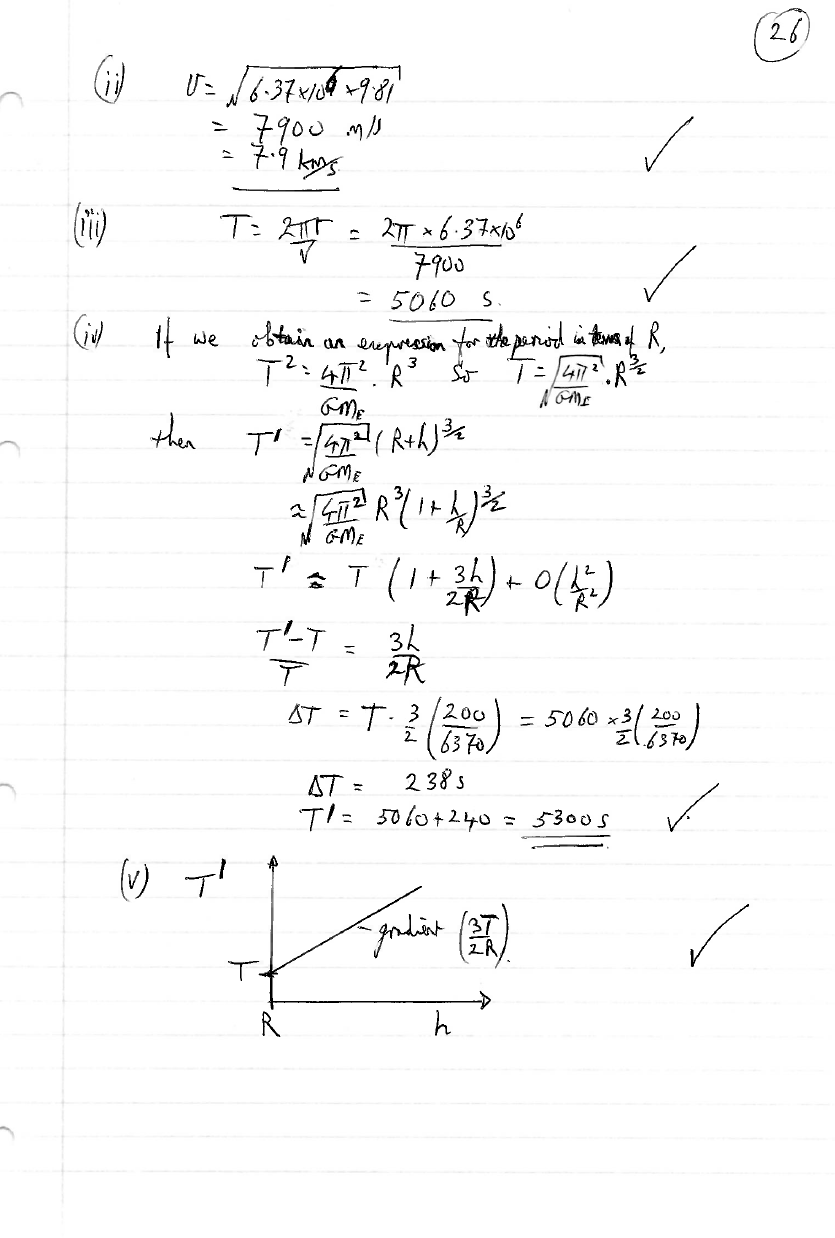
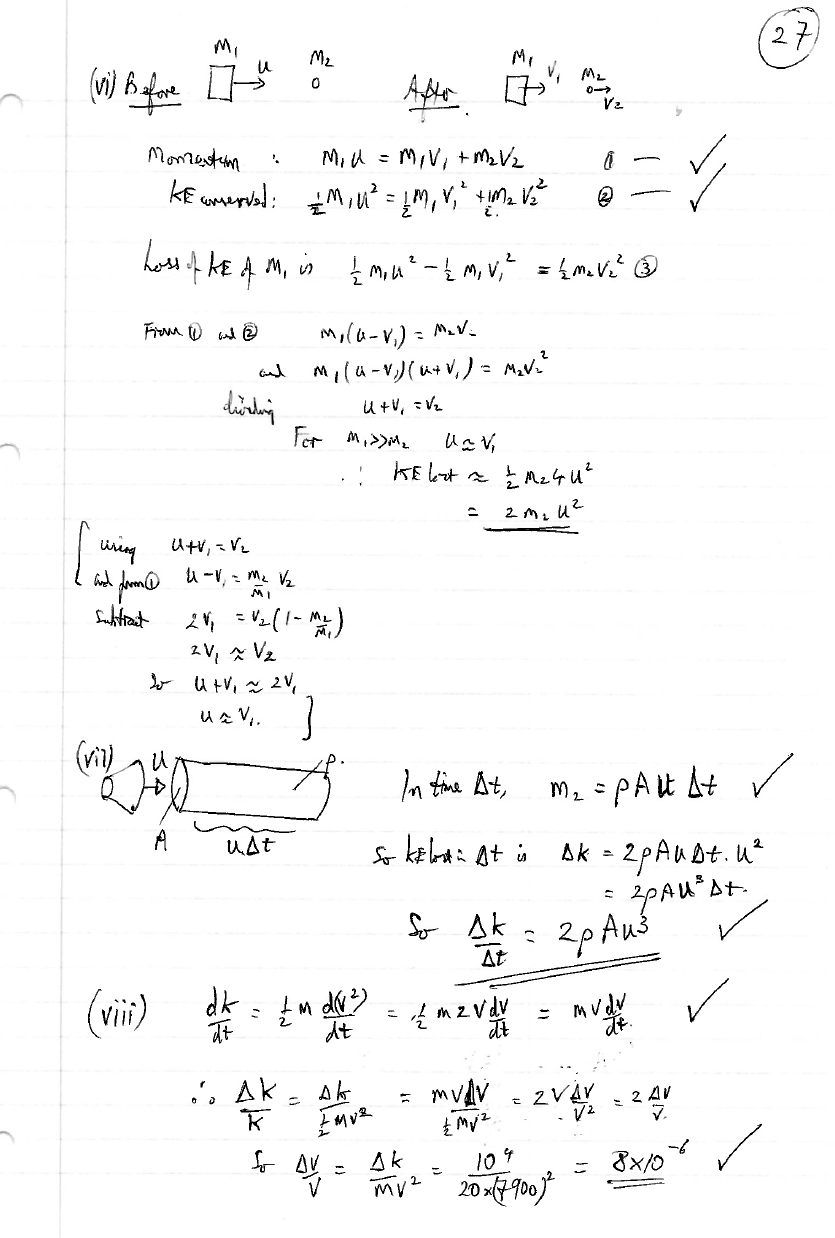
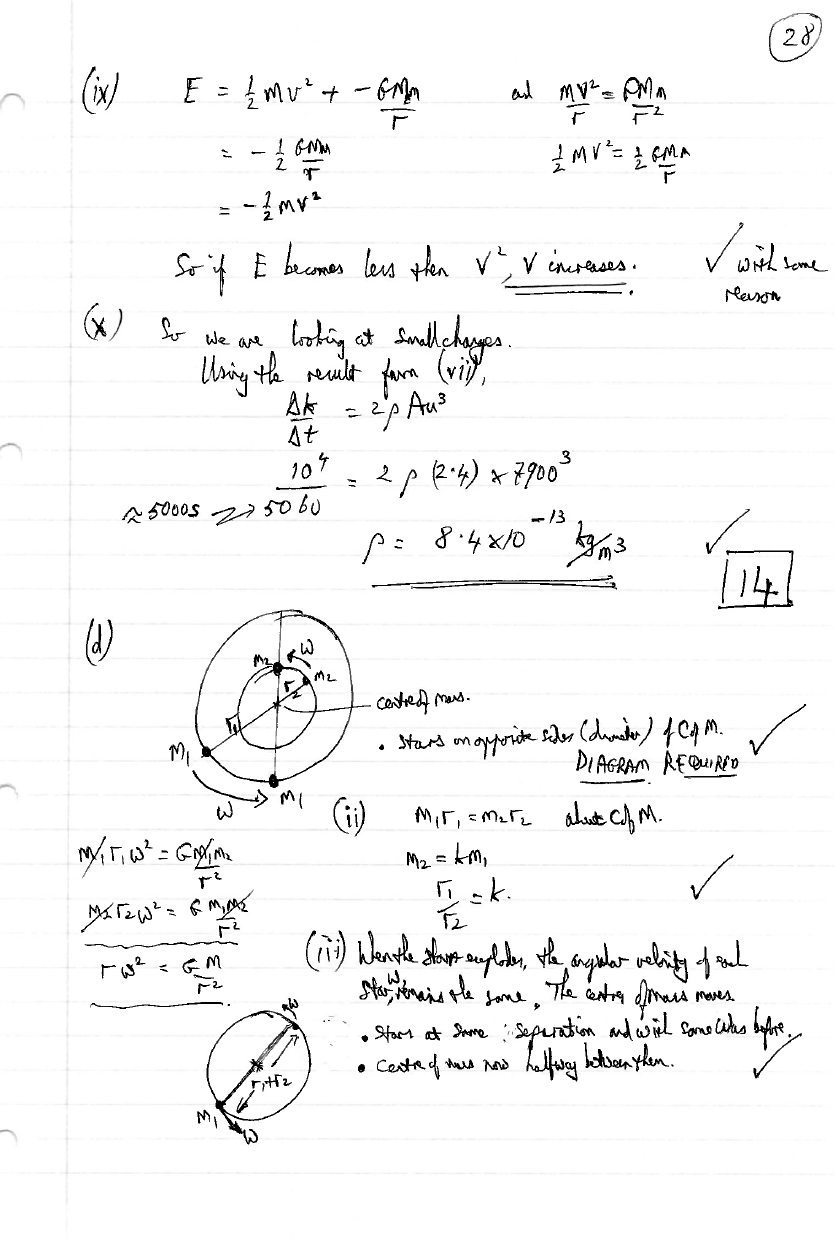
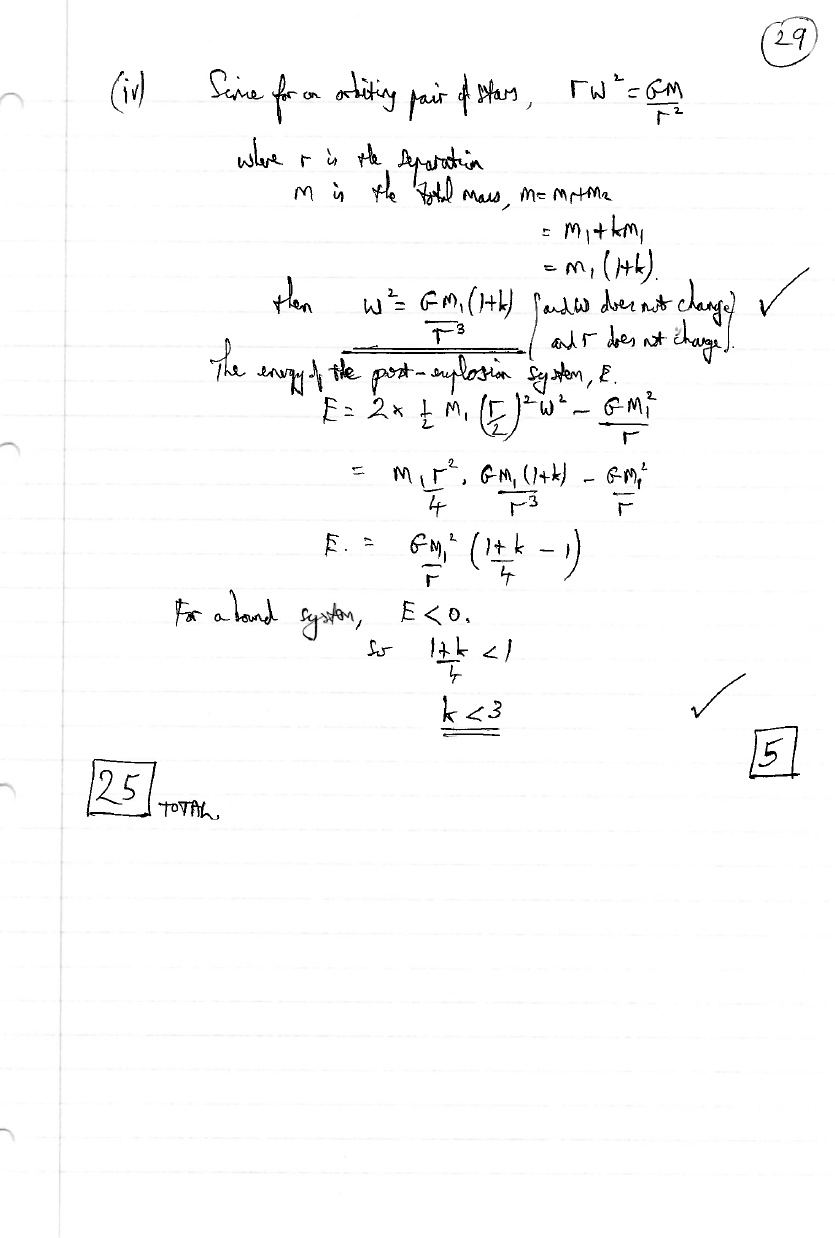
Official mark scheme (BPhO Round 1, November 2020, Section 2), from the official PDF — p. 25, 26, 27, 28, 29. © BPhO, CC BY 4.0.
Topic: Gravitation, Newtonian Mechanics, Astrophysics Metodi: Newton’s Law of Gravitation, Kepler’s Laws, Conservation of Momentum, Approximation & Series Expansion Competenze: Mathematical Modeling, Estimation & Approximation Objects: Satellite, Star Fonte: Testo (PDF) — p.10 · Soluzione ufficiale (PDF) — p.25
Problema 5 — Moto circolare e gravità [25 punti]
Questo problema riguarda il moto circolare e la gravità.
a) Un ponte a schiena d’asino ha sezione ad arco di circonferenza. Attraversa un fiume largo 18 m e il centro del ponte è 4,0 m più in alto del terreno circostante. Qual è la velocità massima con cui un’auto può percorrere il ponte restando a contatto con esso?
Suggerimento: se due corde di una circonferenza, AB e CD, si incontrano in un punto S, allora AS·SB = CS·SD (3)
b) Il Sole orbita attorno al centro della Via Lattea a un raggio di 30 000 anni luce, con un periodo di 200 milioni di anni. Supponendo che la massa della galassia sia concentrata soprattutto in una sfera centrale uniforme e che la Terra si trovi in uno dei bracci, come schematizzato in Figura 10,
(i) ricava un’espressione del periodo orbitale del Sole in funzione del raggio dell’orbita , di e della massa della galassia ;
(ii) determina un valore della massa della galassia;
(iii) se il Sole rappresenta la massa di una stella media, stima il numero di stelle della Via Lattea. (3)
Figura 10: schema della Via Lattea vista nel suo piano, con il Sole lungo un «braccio», indicato dalla freccia.
c) Un satellite descrive un’orbita circolare di raggio attorno alla Terra, sferica, di raggio .
(i) Scrivi un’espressione della velocità del satellite in funzione di , e della massa della Terra , spiegando la fisica che serve a ottenerla.
(ii) Calcola la velocità di un satellite in orbita bassa, radente alla Terra.
(iii) Calcola il periodo dell’orbita del satellite.
(iv) Il satellite orbita invece a un’altezza sopra la superficie terrestre. Ricava un’espressione della variazione relativa del periodo orbitale in funzione di e . Qual è quindi il periodo di un satellite che orbita a 200 km di quota?
(v) Disegna il grafico del periodo orbitale in funzione di per .
(vi) Mostra che quando una grande massa in moto con velocità urta elasticamente una piccola massa ferma, l’energia cinetica persa da è .
(vii) Quando un piccolo satellite di massa e sezione attraversa un gas di densità , compie numerosi urti elastici con le molecole del gas. Ricava un’espressione della rapidità con cui il satellite perde energia in funzione di , e .
(viii) Un satellite terrestre di 20 kg è in orbita circolare a una quota piccola rispetto al raggio terrestre. Se la resistenza dell’aria fa diminuire la sua energia totale di 10 kJ per giro, qual è la variazione relativa della sua velocità per giro?
(ix) Considerando l’espressione dell’energia totale di un satellite in orbita, stabilisci se la velocità aumenta o diminuisce.
(x) Usando semplicemente i valori di periodo e velocità di un satellite in orbita radente, e una sezione del satellite di 2,4 m, stima la densità dell’atmosfera che produce questa perdita di energia. (14)
d) Finora abbiamo supposto che la massa della Terra fosse molto maggiore di quella del satellite; nel resto del problema rimuoviamo questa approssimazione. Molte stelle fanno parte di sistemi binari, formati da due stelle di massa diversa in orbite circolari l’una attorno all’altra.
(i) Disegna le orbite di un tale sistema binario, indicando le posizioni delle due stelle in due istanti successivi.
(ii) Se le stelle hanno masse e con , qual è il rapporto tra i raggi delle loro orbite?
(iii) Un giorno la stella più massiccia esplode come supernova. Dopo l’esplosione le masse delle stelle sono uguali e il materiale espulso si è allontanato molto. Descrivi con diagrammi il moto del sistema nel caso in cui resti legato. Supponi che la supernova faccia perdere massa alla stella più grande in modo sfericamente simmetrico.
(iv) Trova il valore critico del rapporto iniziale delle masse oltre il quale il sistema binario diventa non legato dopo l’esplosione descritta in (iii). (5)
Risposta: a) m, m s. b) (i) ; (ii) kg ; (iii) stelle. c) (i) ; (ii) km s; (iii) s; (iv) , s; (vii) ; (viii) ; (ix) , quindi la velocità aumenta quando diminuisce; (x) kg m. d) (ii) ; (iii) il centro di massa si porta a metà strada, le stelle orbitano attorno al centro di massa, ora a metà strada, alla stessa separazione; (iv) critico (legato per )
Soluzione: La soluzione ufficiale completa (in inglese) è nella versione originale di questo quesito e nel PDF ufficiale.
Topic: Gravitation, Newtonian Mechanics, Astrophysics Metodi: Newton’s Law of Gravitation, Kepler’s Laws, Conservation of Momentum, Approximation & Series Expansion Competenze: Mathematical Modeling, Estimation & Approximation Objects: Satellite, Star Fonte: Testo (PDF) — p.10 · Soluzione ufficiale (PDF) — p.25
Question 6 — Atomic structure and electric fields [25 marks]
This question is about atomic structure and electric fields.
The sodium chloride crystal has a face centred cubic structure and we shall consider a unit cell (smallest repeating unit) which is in the octahedron shown shaded in Figure 11. For the purposes of this question we will consider the upper left octahedron, with the (blue/grey) circles at the corners to be the chlorine ions, and the (black) central ions to be sodium. The ions in the crystal lattice are held in place by electrostatic forces, and the ions are considered to be point charges. The charge on a sodium ion is ; the charge on a chlorine ion, . The distance , between any two adjacent chlorine ions is 0.564 nm.
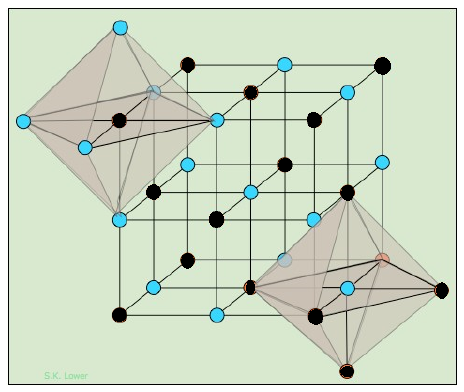
Figure 11 (credit: S K Lower).
a) What is the separation between nearest sodium and chlorine ions? (1)
b) Calculate the electric potential energy of the unit cell, considering it to be the building block for the solid, so that you can take its overall charge to be zero and assign an appropriate charge to each chlorine ion. If, in our very simple model, we ignore the interaction between chlorine ions, estimate the energy released when 1 mole of NaCl is formed. (3)
c) Now consider the octahedron shown in isolation. One sodium ion surrounded by six chlorine ions, the latter which we shall consider to be in fixed positions. If the sodium ion is displaced by a small distance towards one of the chlorine ions, it will experience a resultant force towards its equilibrium position. Using suitable approximations when , determine:
(i) An expression, in terms of the electronic charge , the unit cell dimension , the small displacement , and the constants and , for the resultant force acting on the sodium ion.
(ii) Estimate the frequency of oscillation, assuming it approximates to simple harmonic motion, and the mass of the ion to be 23 u. (6)
One surface of the sodium chloride crystal looks like Figure 12, and this surface can be investigated using electron diffraction.
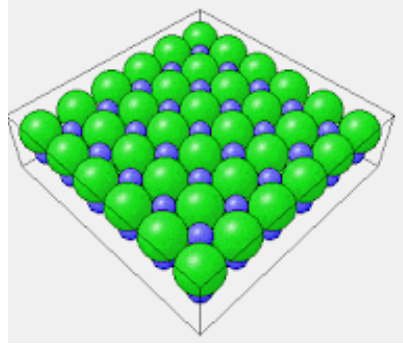
Figure 12
d) A beam of electrons accelerated through a potential of 100 V is directed normally on to the surface. The electrons scatter back elastically from the surface layer of ions. By considering the electrons to behave as waves diffracted by the surface, determine
(i) an expression for the angle of interference maxima (relative to the normal) along the principal directions shown by the box edges in the diagram. Use the standard notation of: for the separation of two adjacent scatterers, for order of diffraction, for diffraction angle of the interference maxima, for the mass of the electron, for the potential, and for Planck’s constant. [Note: it makes no difference if the beam originates on the same side of the surface when it undergoes scattering.]
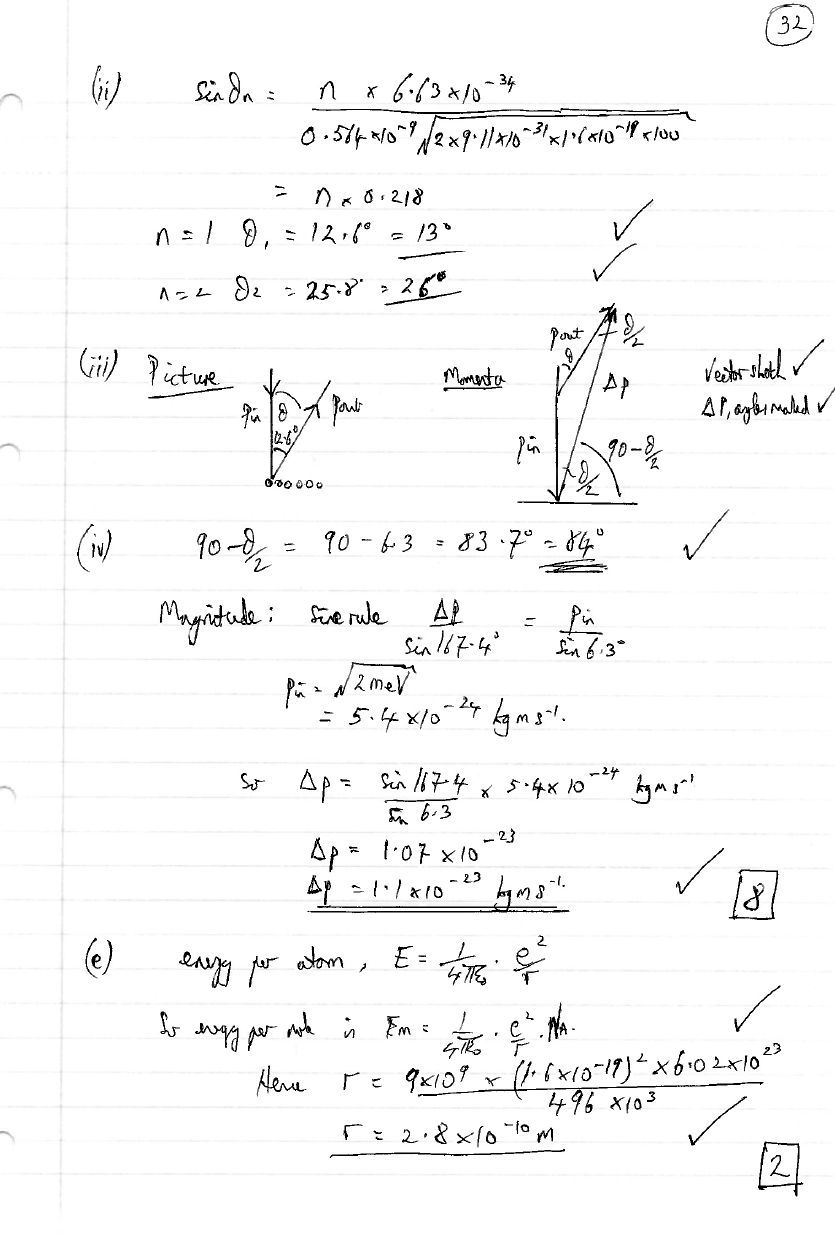
(ii) Calculate the angle of diffraction for the first and second orders.
Now consider the electron to be a particle with a momentum .
(iii) For the first order diffracted beam, draw a diagram using momentum vectors to show the change in momentum of the electron during collision with the surface. Record the angles between the vectors on your diagram.
(iv) Calculate the direction (relative to the surface) and magnitude of the momentum change. (8)
e) The sodium atom must be ionised to form sodium chloride. The first ionisation energy of sodium is 496 kJ mol. By considering the outermost electron to lie on the surface of a sphere, within which the remaining charge of the atom is contained, estimate the radius of the atom. (2)
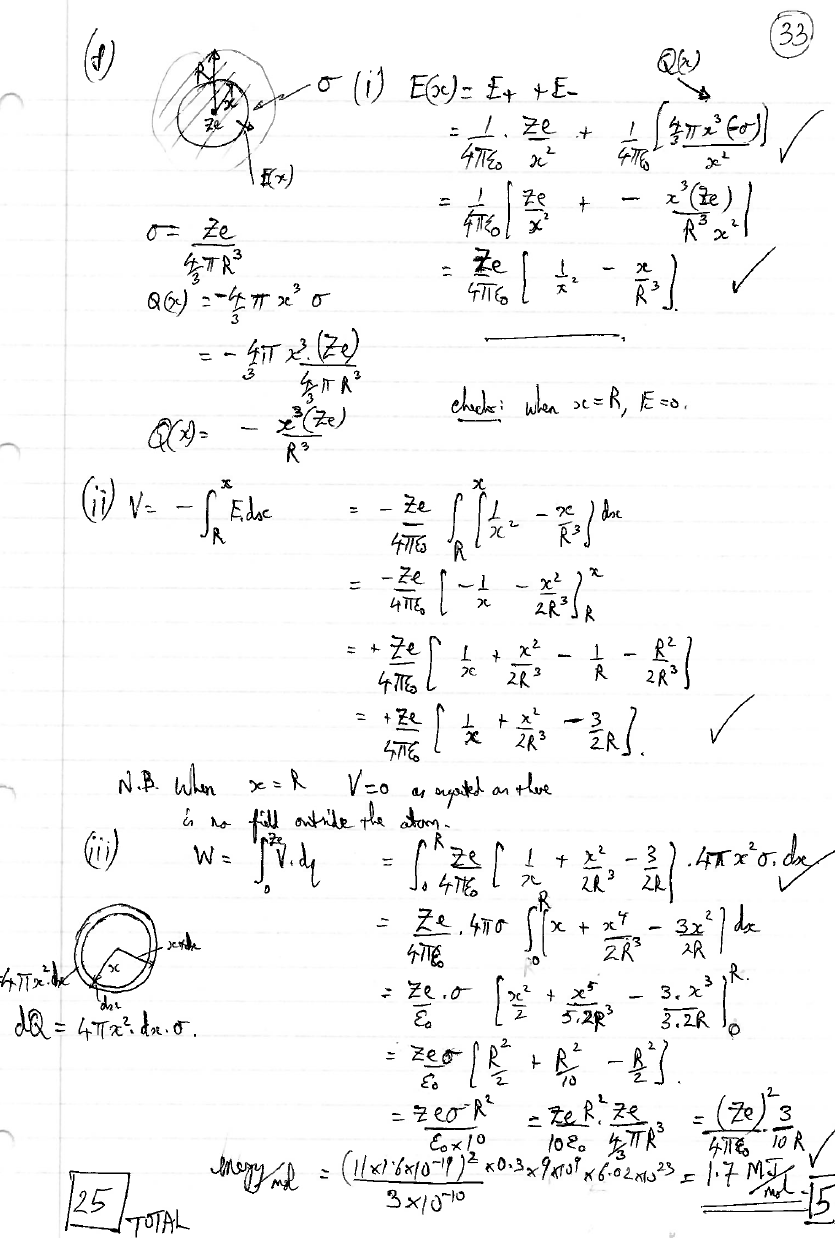
f) Now consider the sodium atom () to consist of a point like nucleus which contains all of the positive charge of the atom, and the electrons each of charge , evenly distributed within the atom, giving an average charge density of . The radius of the atom is .
(i) Determine an expression for the electric field strength within the atom as a function of distance , from the centre of the atom.
(ii) Subsequently find an expression for the electric potential within the atom, as a function of distance from the centre of the atom.
(iii) Finally, by considering the atom to consist of concentric spheres of constant charge density, find an expression for the work done assembling the atom, and provide a numerical estimate of the energy required to turn one mole of sodium into a fully ionised gas (a plasma) of electrons and nuclei. [Use your result from part (e) for the radius of the atom.] (5)
Risposta: a) . b) J; per mole kJ mol. c) (i) with , i.e. ; (ii) Hz. d) (i) ; (ii) , ; (iv) to the surface, kg m s. e) m. f) (i) ; (ii) ; (iii) , printed estimate MJ mol
Soluzione:
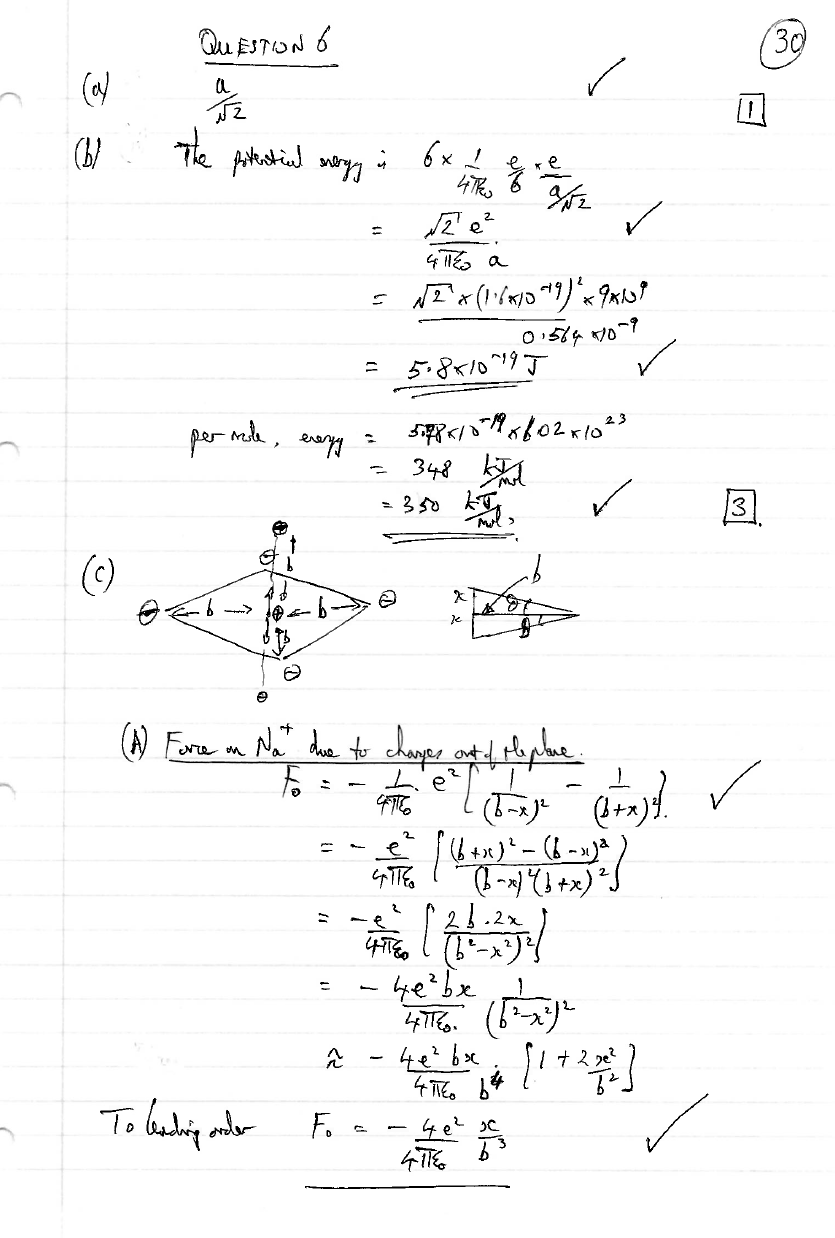
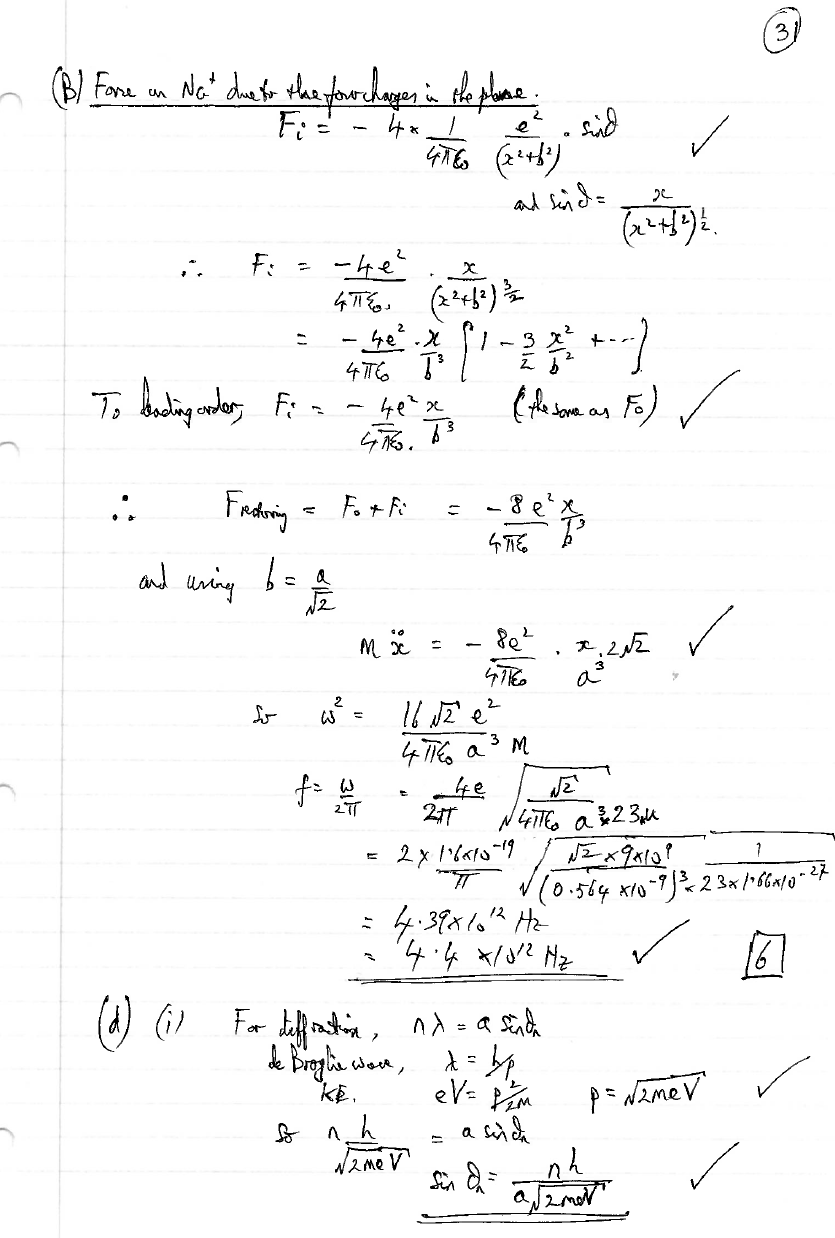
Official mark scheme (BPhO Round 1, November 2020, Section 2), from the official PDF — p. 30, 31, 32, 33. © BPhO, CC BY 4.0.
Topic: Electrostatics, Modern-Quantum Physics, Oscillations & Waves Metodi: Coulomb’s Law, Electric Potential Method, de Broglie Relation, Simple Harmonic Motion Analysis, Gauss’s Law Competenze: Mathematical Modeling, Estimation & Approximation Objects: Atom, Electron, Point Charge Fonte: Testo (PDF) — p.12 · Soluzione ufficiale (PDF) — p.30
Problema 6 — Struttura atomica e campi elettrici [25 punti]
Questo problema riguarda la struttura atomica e i campi elettrici.
Il cristallo di cloruro di sodio ha struttura cubica a facce centrate; consideriamo una cella unitaria (la più piccola unità che si ripete) contenuta nell’ottaedro ombreggiato in Figura 11. Ai fini del problema consideriamo l’ottaedro in alto a sinistra, con i cerchi (blu/grigi) ai vertici come ioni cloro e gli ioni centrali (neri) come sodio. Gli ioni del reticolo sono tenuti in posizione da forze elettrostatiche e sono considerati cariche puntiformi. La carica di uno ione sodio è , quella di uno ione cloro . La distanza tra due ioni cloro adiacenti è 0,564 nm.
Figura 11 (fonte: S K Lower).
a) Qual è la distanza tra uno ione sodio e lo ione cloro più vicino? (1)
b) Calcola l’energia potenziale elettrica della cella unitaria, considerandola come mattone del solido, in modo da poterne prendere nulla la carica complessiva e assegnare a ogni ione cloro una carica opportuna. Se, in questo modello molto semplice, si trascura l’interazione tra ioni cloro, stima l’energia liberata nella formazione di 1 mole di NaCl. (3)
c) Consideriamo ora l’ottaedro isolato: uno ione sodio circondato da sei ioni cloro, che supponiamo fissi. Se lo ione sodio si sposta di un piccolo tratto verso uno degli ioni cloro, subisce una forza risultante verso la posizione di equilibrio. Con opportune approssimazioni per , determina:
(i) un’espressione della forza risultante sullo ione sodio in funzione della carica elementare , della dimensione della cella , dello spostamento e delle costanti ed ;
(ii) una stima della frequenza di oscillazione, supponendo che sia approssimativamente armonica e che la massa dello ione sia 23 u. (6)
Una superficie del cristallo di cloruro di sodio appare come in Figura 12 e può essere studiata con la diffrazione di elettroni.
Figura 12
d) Un fascio di elettroni accelerati da una differenza di potenziale di 100 V incide perpendicolarmente sulla superficie. Gli elettroni sono diffusi all’indietro elasticamente dallo strato superficiale di ioni. Considerando gli elettroni come onde diffratte dalla superficie, determina
(i) un’espressione dell’angolo dei massimi di interferenza (rispetto alla normale) lungo le direzioni principali indicate dai lati del riquadro nel disegno. Usa la notazione: distanza tra due diffusori adiacenti, ordine di diffrazione, angolo dei massimi, massa dell’elettrone, potenziale, costante di Planck. [Nota: non fa differenza se il fascio proviene dallo stesso lato della superficie in cui avviene la diffusione.]
(ii) Calcola l’angolo di diffrazione del primo e del secondo ordine.
Consideriamo ora l’elettrone come una particella di quantità di moto .
(iii) Per il fascio diffratto del primo ordine, disegna un diagramma con i vettori quantità di moto che mostri la variazione della quantità di moto dell’elettrone nell’urto con la superficie, indicando gli angoli tra i vettori.
(iv) Calcola la direzione (rispetto alla superficie) e il modulo della variazione della quantità di moto. (8)
e) Per formare il cloruro di sodio l’atomo di sodio deve essere ionizzato. La prima energia di ionizzazione del sodio è 496 kJ mol. Considerando l’elettrone più esterno sulla superficie di una sfera che contiene il resto della carica dell’atomo, stima il raggio dell’atomo. (2)
f) Consideriamo ora l’atomo di sodio () come un nucleo puntiforme con tutta la carica positiva, più gli elettroni, ciascuno di carica , distribuiti uniformemente nell’atomo con densità di carica media . Il raggio dell’atomo è .
(i) Determina un’espressione dell’intensità del campo elettrico all’interno dell’atomo in funzione della distanza dal centro.
(ii) Trova poi un’espressione del potenziale elettrico all’interno dell’atomo in funzione di .
(iii) Infine, considerando l’atomo formato da sfere concentriche di densità di carica costante, trova un’espressione del lavoro necessario ad assemblare l’atomo e fornisci una stima numerica dell’energia necessaria a trasformare una mole di sodio in un gas completamente ionizzato (un plasma) di elettroni e nuclei. [Usa il raggio trovato nella parte (e).] (5)
Risposta: a) . b) J; per mole kJ mol. c) (i) con , cioè ; (ii) Hz. d) (i) ; (ii) , ; (iv) rispetto alla superficie, kg m s. e) m. f) (i) ; (ii) ; (iii) , stima stampata MJ mol
Soluzione: La soluzione ufficiale completa (in inglese) è nella versione originale di questo quesito e nel PDF ufficiale.
Topic: Electrostatics, Modern-Quantum Physics, Oscillations & Waves Metodi: Coulomb’s Law, Electric Potential Method, de Broglie Relation, Simple Harmonic Motion Analysis, Gauss’s Law Competenze: Mathematical Modeling, Estimation & Approximation Objects: Atom, Electron, Point Charge Fonte: Testo (PDF) — p.12 · Soluzione ufficiale (PDF) — p.30
Answers from the official BPhO Round 1 2020 mark scheme.
| Problem | Title | Risposta |
|---|---|---|
| 2 | Question 2 — Photoelectric effect and radioactive decay [25 marks] | a) (i) ; (ii) s; (iii) J eV; (iv) m s; (v) cm. b) (i) ; (ii) W; (iii) photons s; (iv) m m; (v) an interference pattern built up of individual spots; (vi) m, the spacing is less. c) (i) V; (ii) C, electrons; (iii) light arrives in photons, so no time is needed to accumulate energy; (iv) . d) (i) ; (ii) Bq; (iii) s ( years); (iv) pA; (v) no, it needs a high potential, never reached in the photoelectric effect; (vii) s |
| 3 | Question 3 — Dynamics in nautical examples [25 marks] | a) (i) draught m, deck m above the water line; (ii) oil CM 6.72 m, ship CM 12 m: m m above the keel; (iii) ; (iv) N m N m. b) (i) , ; (ii) . c) (as printed) , the same as the chain pulled with half its weight. d) (ii) ; (iii) ; (iv) turns |
| 4 | Question 4 — Change in speed of a wave in a medium [25 marks] | a) (ii) ; (iii) ; (iv) , , difference ; (v) cm; (vi) ; (vii) , . b) . c) (i) ; (ii) rad . d) s, Hz. e) (i) ; (ii) |
| 5 | Question 5 — Circular motion and gravity [25 marks] | a) m, m s. b) (i) ; (ii) kg ; (iii) stars. c) (i) ; (ii) km s; (iii) s; (iv) , s; (vii) ; (viii) ; (ix) , so the speed increases as decreases; (x) kg m. d) (ii) ; (iii) centre of mass moves to midway, the stars orbit the centre of mass, now midway, at the same separation; (iv) critical (bound for ) |
| 6 | Question 6 — Atomic structure and electric fields [25 marks] | a) . b) J; per mole kJ mol. c) (i) with , i.e. ; (ii) Hz. d) (i) ; (ii) , ; (iv) to the surface, kg m s. e) m. f) (i) ; (ii) ; (iii) , printed estimate MJ mol |
Fonte: Testo e soluzioni (PDF)
Risposte tratte dal mark scheme ufficiale BPhO Round 1 2020.
| Problema | Titolo | Risposta |
|---|---|---|
| 2 | Problema 2 — Effetto fotoelettrico e decadimento radioattivo [25 punti] | a) (i) ; (ii) s; (iii) J eV; (iv) m s; (v) cm. b) (i) ; (ii) W; (iii) fotoni s; (iv) m m; (v) una figura d’interferenza formata da singoli punti; (vi) m, la distanza è minore. c) (i) V; (ii) C, elettroni; (iii) la luce arriva in fotoni, non serve tempo per accumulare energia; (iv) . d) (i) ; (ii) Bq; (iii) s ( anni); (iv) pA; (v) no, servirebbe un potenziale elevato, mai raggiunto nell’effetto fotoelettrico; (vii) s |
| 3 | Problema 3 — Dinamica in esempi nautici [25 punti] | a) (i) pescaggio m, ponte m sopra la linea di galleggiamento; (ii) CM del petrolio 6,72 m, CM della nave 12 m: m m sopra la chiglia; (iii) ; (iv) N m N m. b) (i) , ; (ii) . c) (come stampato) , come la catena tirata con metà del suo peso. d) (ii) ; (iii) ; (iv) giri |
| 4 | Problema 4 — Velocità di un’onda in un mezzo [25 punti] | a) (ii) ; (iii) ; (iv) , , differenza ; (v) cm; (vi) ; (vii) , . b) . c) (i) ; (ii) rad . d) s, Hz. e) (i) ; (ii) |
| 5 | Problema 5 — Moto circolare e gravità [25 punti] | a) m, m s. b) (i) ; (ii) kg ; (iii) stelle. c) (i) ; (ii) km s; (iii) s; (iv) , s; (vii) ; (viii) ; (ix) , quindi la velocità aumenta quando diminuisce; (x) kg m. d) (ii) ; (iii) il centro di massa si porta a metà strada, le stelle orbitano attorno al centro di massa, ora a metà strada, alla stessa separazione; (iv) critico (legato per ) |
| 6 | Problema 6 — Struttura atomica e campi elettrici [25 punti] | a) . b) J; per mole kJ mol. c) (i) con , cioè ; (ii) Hz. d) (i) ; (ii) , ; (iv) rispetto alla superficie, kg m s. e) m. f) (i) ; (ii) ; (iii) , stima stampata MJ mol |
Fonte: Testo e soluzioni (PDF)