Question 2 — Solar energy, energy losses and capacitors [25 marks]
a) A simple experiment to estimate solar power output is conducted by a student on a clear sunny day in Spain. The setup is shown in Fig. 1, and consists of a thin aluminium walled matte black can filled with 300 g of water. A thermometer, fitted through a small hole in the black painted lid, measures the temperature of the water. The can, lid, water and thermometer are allowed to come to ambient temperature in the shade, before being placed on an insulating surface in full sunlight.
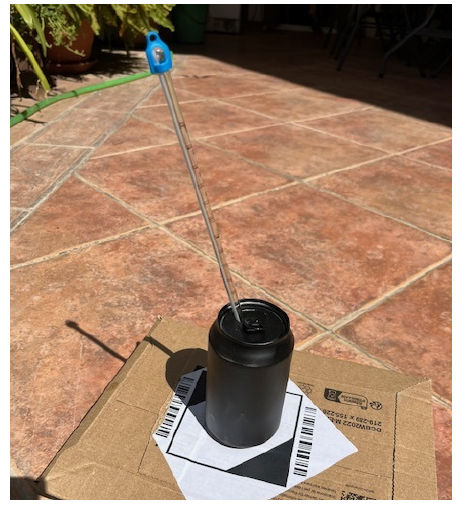
Figure 1: A water filled can with a lid and thermometer, sitting on an insulated base in the sunshine.
After 20 minutes, the temperature of the water in the can has risen from 27.0 °C to 30.0 °C. The angle of the sun to the horizontal is 50°. The can has a diameter of 6.0 cm and a height of 10.0 cm.
Neglecting the heat capacity of the can, lid and thermometer, calculate a value for the intensity (W m) of the Sun’s radiation. Ignore energy losses from the can. Assume that the can and lid absorb all of the incident radiation. [7]
b) (This part is about the capacitor circuit only, which is a model.) A student believes that it might be possible to model the behaviour of the energy transfer above by considering the can of water to be a capacitor being charged up with charge , and the energy losses to be a leak of current across the capacitor as shown in Fig. 2. We can determine the time constant for the circuit shown in terms of , and .
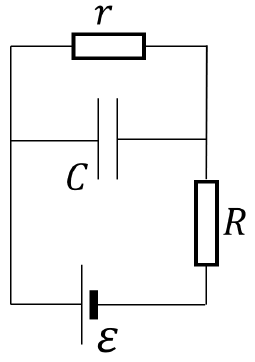
Figure 2: Circuit with a “leaky” capacitor.
(i) Write down the potential around the circuit, in terms of , the current through , and the potential across the capacitor from and its charge .
(ii) Now write down the current through (and the cell), , in terms of the current through (using the potential on ) and the current flowing onto , both in terms of .
(iii) Hence write an equation for in terms of and .
(iv) What is the expression for the time constant of this capacitor circuit? (You may read this off the differential equation without doing any integration.)
(v) By observation of the circuit diagram rather than an equation, what would be the steady state (equilibrium) charge, , on the capacitor after a long time, in terms of , , and ?
(vi) Sketch a graph of the charge on the capacitor against time, marking on and . [6]
c) Since the power reaching the can of water is constant, in our model the cell in Fig. 2 is replaced with a constant current supply (the device adjusts the voltage output to maintain a specified current). The circuit becomes that of Fig. 3, in which the source current is .
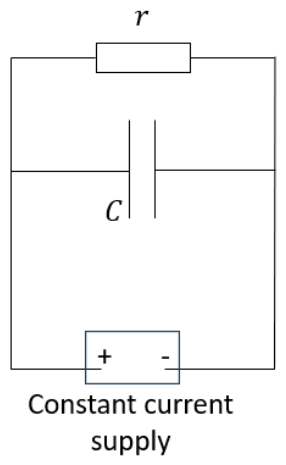
Figure 3: Circuit with a “leaky” capacitor and constant current supply.
(i) After a long time, the circuit will reach a steady state. By observation of the circuit diagram, what will be the maximum charge on the capacitor, and its energy stored, in terms of , and ?
The rate of flow of charge to the capacitor is analogous to the rate of increase in internal energy of the water in the can. The current through the resistor is analogous to the power lost to the surroundings, given by , where is the temperature difference between the water in the can and the surroundings and is a constant.
(ii) Write down an equation for the power absorbed by the can, , in terms of the rate of temperature increase of the water, the specific heat capacity of the water , the mass of water , the temperature excess and .
(iii) Using your result from part (ii), what is the simple expression for the steady state result for ?
(iv) Calculate the value of given that over 40 minutes the temperature of the can falls from 34.2 °C to 32.8 °C in an ambient temperature of 31.0 °C.
(v) Produce a new estimate for the power output of the Sun, this time accounting for energy losses from the can. [7]
d) The solar constant is the intensity of the Sun’s radiation at the top of the atmosphere, normal to the radial line between the Earth and the Sun, and has a value of 1360 W m. The Sun lies at a distance of m from the Earth and has a radius of 696 000 km.
(i) What is the power produced on average per cubic metre within the Sun?
(ii) Using the equation of mass-energy equivalence, , estimate how much mass the Sun loses each second through radiation. [5]
Risposta: a) projected area m², W, intensity W m; b) , , , , ; c) , energy ; , steady state ; – W °C; corrected power W, intensity W m (+16%); d) W, W m; kg s
Soluzione:
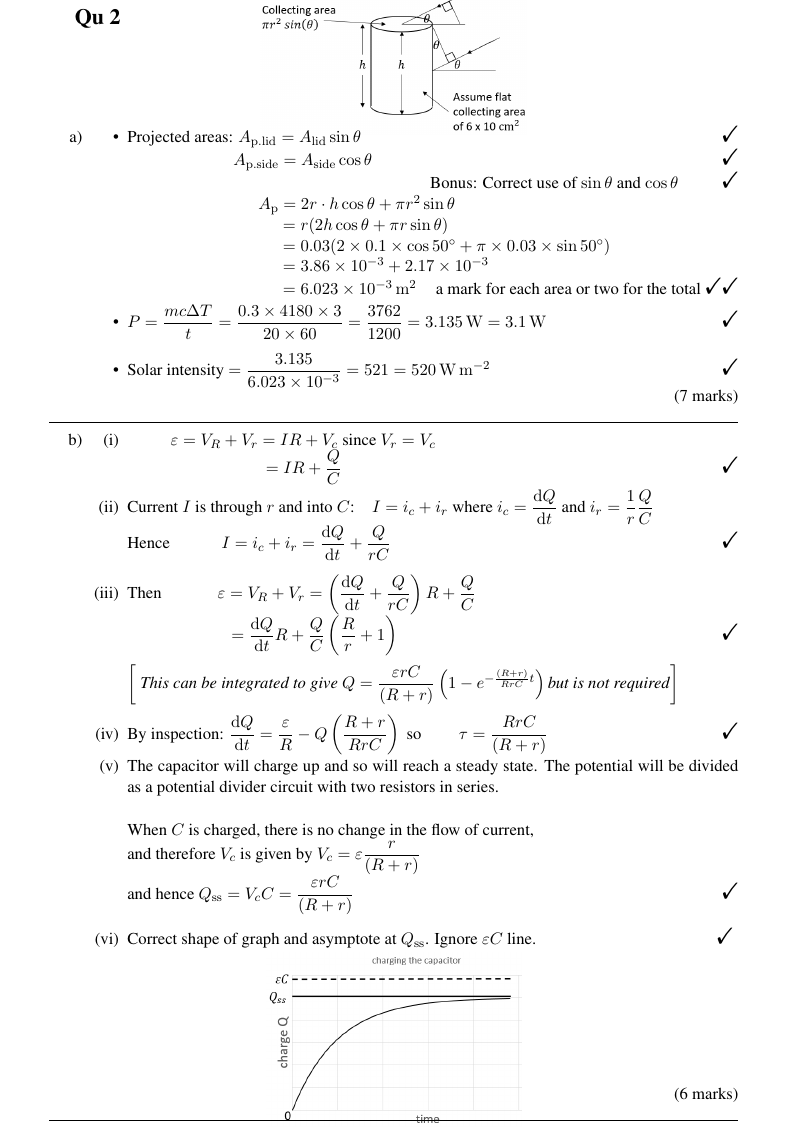
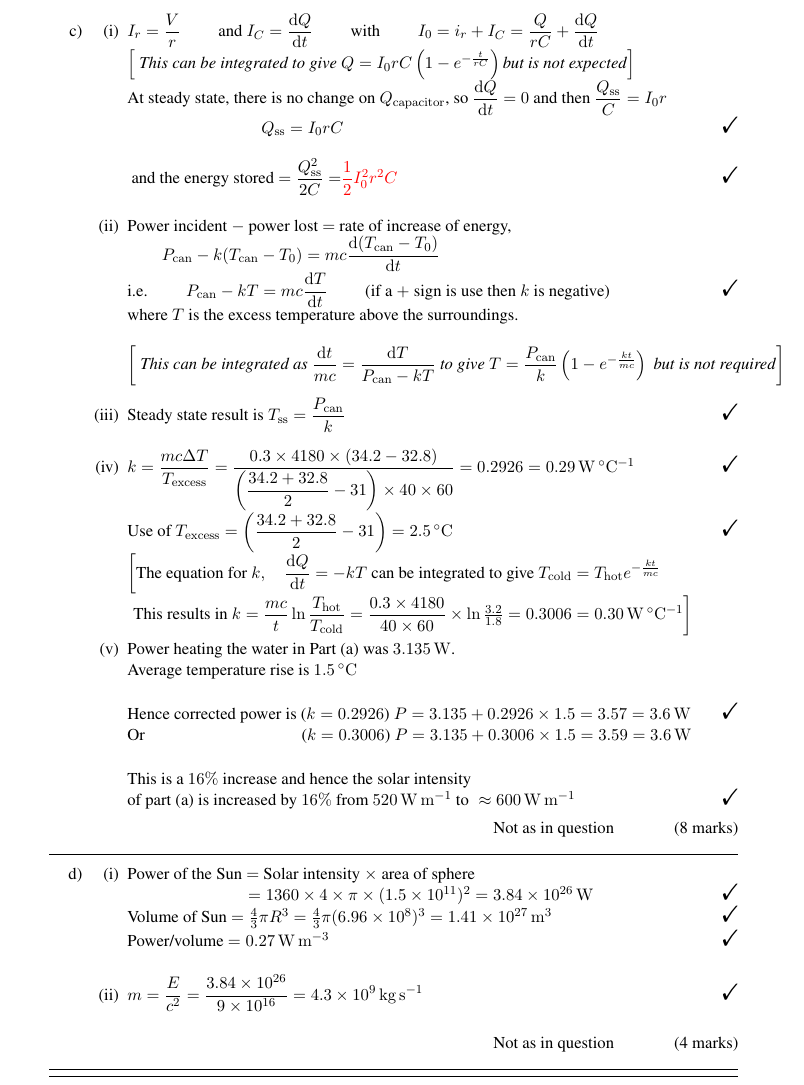
Official mark scheme (BPhO Round 1, November 2024, Section 2), from the official PDF — p. 3, 4. © BPhO, CC BY 4.0.
Topic: Thermodynamics, Circuits, Astrophysics Metodi: Energy Conservation Method, Differential Equations, Mass-Energy Equivalence Competenze: Mathematical Modeling, Experimental Data Analysis Objects: Capacitor, Resistor, Container, Star Fonte: Testo (PDF) — p.3 · Soluzione ufficiale (PDF) — p.3
Problema 2 — Energia solare, perdite di energia e condensatori [25 punti]
a) In una giornata limpida e soleggiata in Spagna uno studente esegue un semplice esperimento per stimare la potenza della radiazione solare. L’apparato è mostrato in Fig. 1: una lattina di alluminio a pareti sottili, nera opaca, contenente 300 g d’acqua. Un termometro, inserito attraverso un piccolo foro nel coperchio verniciato di nero, misura la temperatura dell’acqua. Lattina, coperchio, acqua e termometro vengono lasciati all’ombra fino a raggiungere la temperatura ambiente, poi vengono posti su una superficie isolante in pieno sole.
Figura 1: Una lattina piena d’acqua con coperchio e termometro, appoggiata su una base isolante al sole.
Dopo 20 minuti la temperatura dell’acqua nella lattina è salita da 27,0 °C a 30,0 °C. Il Sole è a 50° sull’orizzonte. La lattina ha diametro 6,0 cm e altezza 10,0 cm.
Trascurando la capacità termica di lattina, coperchio e termometro, calcola l’intensità (W m) della radiazione solare. Trascura le perdite di energia della lattina. Supponi che lattina e coperchio assorbano tutta la radiazione incidente. [7]
b) (Questa parte riguarda solo il circuito con il condensatore, che è un modello.) Uno studente pensa di poter modellizzare il trasferimento di energia descritto sopra considerando la lattina d’acqua come un condensatore che si carica con carica , e le perdite di energia come una corrente di dispersione attraverso il condensatore, come in Fig. 2. Si può determinare la costante di tempo del circuito in funzione di , e .
Figura 2: Circuito con un condensatore «che perde».
(i) Scrivi la somma delle tensioni lungo il circuito in funzione di , della corrente in e della tensione ai capi del condensatore, espressa con e la sua carica .
(ii) Scrivi la corrente in (e nella pila) in funzione della corrente in (usando la tensione su ) e della corrente che fluisce su , entrambe espresse tramite .
(iii) Scrivi quindi un’equazione per in funzione di e .
(iv) Qual è l’espressione della costante di tempo di questo circuito? (Puoi ricavarla direttamente dall’equazione differenziale, senza integrare.)
(v) Osservando lo schema del circuito, senza equazioni, quale sarà la carica di regime (di equilibrio) sul condensatore dopo molto tempo, in funzione di , , e ?
(vi) Traccia il grafico della carica del condensatore in funzione del tempo, indicando e . [6]
c) Poiché la potenza che arriva sulla lattina è costante, nel modello la pila di Fig. 2 viene sostituita da un generatore di corrente costante (il dispositivo regola la tensione in uscita per mantenere una corrente fissata). Il circuito diventa quello di Fig. 3, con corrente del generatore .
Figura 3: Circuito con un condensatore «che perde» e generatore di corrente costante.
(i) Dopo molto tempo il circuito raggiunge un regime stazionario. Osservando lo schema, quali saranno la carica massima sul condensatore e l’energia immagazzinata, in funzione di , e ?
La rapidità con cui la carica fluisce sul condensatore è l’analogo della rapidità di aumento dell’energia interna dell’acqua nella lattina. La corrente nel resistore è l’analogo della potenza dispersa nell’ambiente, data da , dove è la differenza di temperatura tra l’acqua nella lattina e l’ambiente e è una costante.
(ii) Scrivi un’equazione per la potenza assorbita dalla lattina, , in funzione della rapidità di aumento della temperatura dell’acqua, del calore specifico dell’acqua , della massa d’acqua , dell’eccesso di temperatura e di .
(iii) Usando il risultato del punto (ii), qual è la semplice espressione di a regime?
(iv) Calcola sapendo che in 40 minuti la temperatura della lattina scende da 34,2 °C a 32,8 °C, con temperatura ambiente di 31,0 °C.
(v) Fornisci una nuova stima della potenza della radiazione solare, tenendo conto questa volta delle perdite di energia della lattina. [7]
d) La costante solare è l’intensità della radiazione solare alla sommità dell’atmosfera, su una superficie perpendicolare alla congiungente Terra–Sole, e vale 1360 W m. Il Sole dista m dalla Terra e ha raggio 696 000 km.
(i) Qual è la potenza prodotta in media per metro cubo all’interno del Sole?
(ii) Usando l’equivalenza massa-energia , stima quanta massa perde il Sole ogni secondo a causa dell’irraggiamento. [5]
Risposta: a) area proiettata m², W, intensità W m; b) , , , , ; c) , energia ; , a regime ; – W °C; potenza corretta W, intensità W m (+16%); d) W, W m; kg s
Soluzione: La soluzione ufficiale completa (in inglese) è nella versione originale di questo quesito e nel PDF ufficiale.
Topic: Thermodynamics, Circuits, Astrophysics Metodi: Energy Conservation Method, Differential Equations, Mass-Energy Equivalence Competenze: Mathematical Modeling, Experimental Data Analysis Objects: Capacitor, Resistor, Container, Star Fonte: Testo (PDF) — p.3 · Soluzione ufficiale (PDF) — p.3
Question 3 — Bubbles, forces and rotation [25 marks]
a) A spherical soap bubble is filled with warm air but, due to the weight of the liquid film, the bubble sinks slowly at speed in the surrounding cooler air. As the soap film evaporates, the bubble becomes lighter and eventually starts to rise. We wish to determine the length of time it takes between it falling at speed in still air and then, a short time later, the bubble rising in still air at speed .

Figure 4: A bubble floating in air.
The heavier (sinking) and lighter (rising) masses of the bubble are and respectively. The bubble has a radius cm, the density of the soap solution is 998 kg m, and the soap film evaporates from the outer surface at a rate of kg m s.
(i) Using the fact that the magnitude of the drag force, , is the same when the bubble is falling as when it is rising, obtain two equations, for the buoyancy and for , acting on the bubble in terms of , and .
(ii) Calculate the magnitude of the buoyancy force when the air inside is at 25 °C and the cooler air in the room is at 17 °C. Take atmospheric pressure as Pa and the molar mass of the air inside and outside to be 28 g mol. Ignore the extra pressure due to the soap film, and the water vapour inside the bubble.
(iii) The slow speed of motion means that with N s m. Calculate how long it would take for sufficient mass of the soap film to have evaporated from the outside surface of the bubble so that the velocity changes from 6.0 cm s downwards to 6.0 cm s upwards.
(iv) Calculate the initial thickness of the bubble wall. [10]
b) (i) Four identical masses, , are attached to each other by four light strings of equal length , as in Fig. 5.
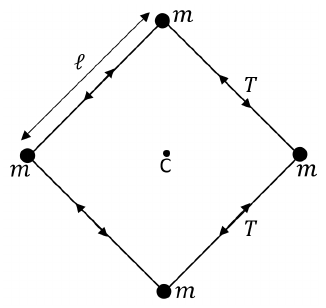
Figure 5: Deriving the tension in a rotating set of masses.
The system rotates in the plane of the masses about the centre C, with each mass moving at speed in a circle. Obtain expressions for the radial and tangential components of the tension in the string, in terms of , and .
When the masses are not discrete but continuous, a modified approach is used.
(ii) A thin circular hoop of mass and radius is rotated in a horizontal plane about its centre with speed as in Fig. 6. The hoop has a mass per unit length (linear density) of .
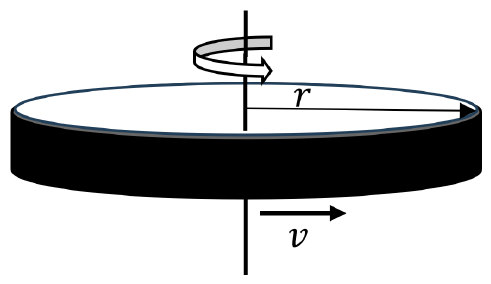
Figure 6: A thin hoop rotating at speed . The tension in the hoop prevents it breaking apart as it rotates.
The tension in the hoop holding it together is given by the expression , where is a dimensionless quantity. By considering the dimensions (or units) of the terms in this expression, and assuming , obtain an equation for .
(iii) A rubber band of mass 25 g which behaves linearly has an unstretched length of 15.0 cm and a spring constant of 2000 N m. It is stretched round a horizontal flywheel (a disc) of circumference 18.5 cm. At what speed of rotation of the disc will the band fall off? [10]
c) A thin, elastic ring of mass and radius (Fig. 7) oscillates at its lowest natural frequency in a radial direction, expanding and contracting. The circumferential tension in the ring is proportional to the extension of the circumference, i.e. , where is the extension of the ring circumference and is a constant. Determine an expression for the frequency of radial oscillations in terms of (the mass per unit length), and .
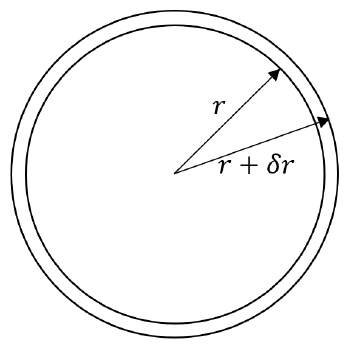
Figure 7: Radial oscillations of a ring. [5]
Risposta: a) , ; N; N, kg, s; kg, wall thickness m; b) , ; ; N, kg m, m s ( rad s); c)
Soluzione:
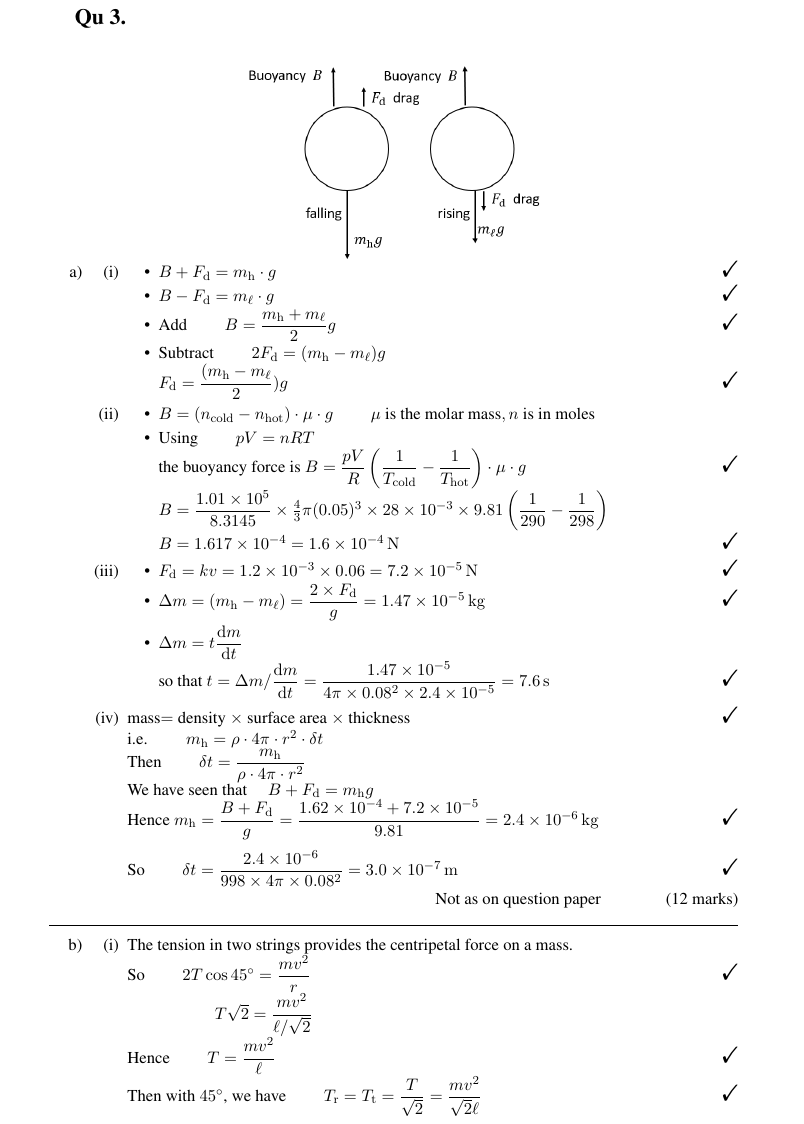
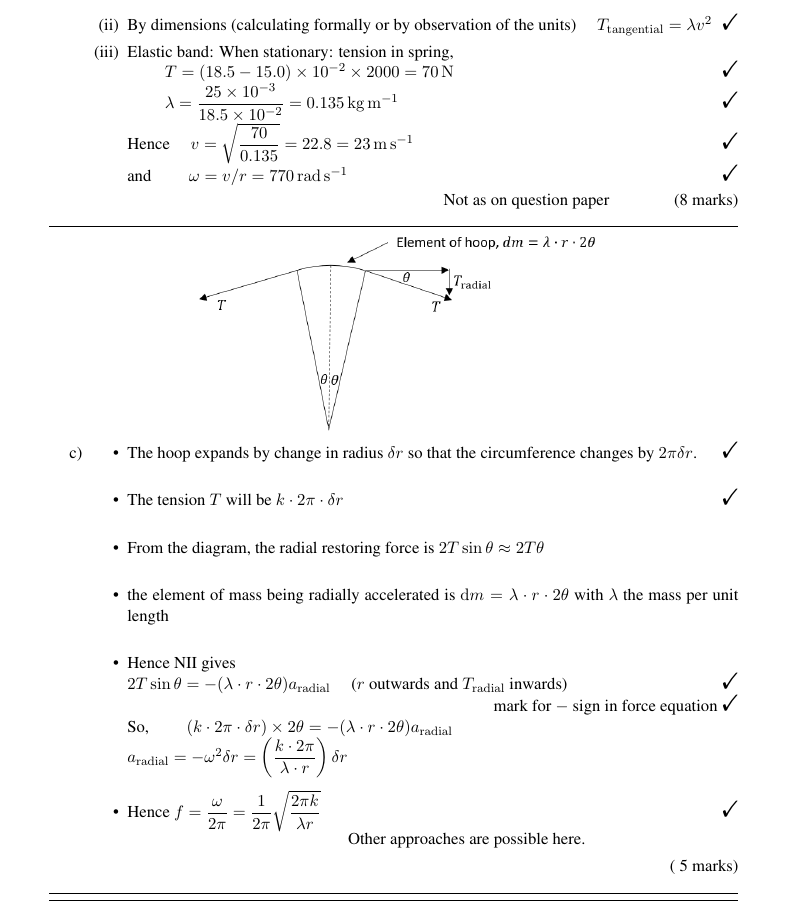
Official mark scheme (BPhO Round 1, November 2024, Section 2), from the official PDF — p. 5, 6. © BPhO, CC BY 4.0.
Topic: Fluid Mechanics, Rotational Dynamics, Oscillations & Waves Metodi: Ideal Gas Law, Free-Body Diagram, Dimensional Analysis, Simple Harmonic Motion Analysis Competenze: Mathematical Modeling, Physical Reasoning Objects: Bubble, String, Wheel Fonte: Testo (PDF) — p.6 · Soluzione ufficiale (PDF) — p.5
Problema 3 — Bolle, forze e rotazione [25 punti]
a) Una bolla di sapone sferica è piena d’aria calda ma, a causa del peso della pellicola liquida, scende lentamente con velocità nell’aria circostante più fredda. Man mano che la pellicola evapora, la bolla diventa più leggera e alla fine comincia a salire. Vogliamo determinare il tempo che passa tra la discesa a velocità in aria ferma e, poco dopo, la salita della bolla in aria ferma a velocità .
Figura 4: Una bolla sospesa in aria.
Le masse della bolla più pesante (che scende) e più leggera (che sale) sono rispettivamente e . La bolla ha raggio cm, la densità della soluzione saponosa è 998 kg m e la pellicola evapora dalla superficie esterna con una rapidità di kg m s.
(i) Sfruttando il fatto che il modulo della forza di resistenza è lo stesso quando la bolla scende e quando sale, ricava due equazioni, per la spinta di Archimede e per , in funzione di , e .
(ii) Calcola il modulo della spinta di Archimede quando l’aria interna è a 25 °C e l’aria più fredda della stanza è a 17 °C. Prendi la pressione atmosferica pari a Pa e la massa molare dell’aria, interna ed esterna, pari a 28 g mol. Trascura la sovrappressione dovuta alla pellicola e il vapore acqueo all’interno della bolla.
(iii) La bassa velocità implica con N s m. Calcola quanto tempo serve perché dalla superficie esterna della bolla evapori abbastanza pellicola da far passare la velocità da 6,0 cm s verso il basso a 6,0 cm s verso l’alto.
(iv) Calcola lo spessore iniziale della parete della bolla. [10]
b) (i) Quattro masse identiche sono collegate tra loro da quattro fili leggeri di uguale lunghezza , come in Fig. 5.
Figura 5: Ricavare la tensione in un sistema di masse in rotazione.
Il sistema ruota nel piano delle masse attorno al centro C, e ogni massa percorre una circonferenza con velocità . Ricava le espressioni delle componenti radiale e tangenziale della tensione nel filo, in funzione di , e .
Quando le masse non sono discrete ma distribuite con continuità, si usa un approccio modificato.
(ii) Un anello circolare sottile di massa e raggio ruota in un piano orizzontale attorno al suo centro con velocità , come in Fig. 6. L’anello ha massa per unità di lunghezza (densità lineare) .
Figura 6: Un anello sottile che ruota con velocità . La tensione nell’anello gli impedisce di rompersi durante la rotazione.
La tensione che tiene unito l’anello è data dall’espressione , dove è adimensionale. Considerando le dimensioni (o le unità) dei termini e ponendo , ricava un’equazione per .
(iii) Un elastico di massa 25 g, a comportamento lineare, ha lunghezza a riposo 15,0 cm e costante elastica 2000 N m. Viene teso attorno a un volano orizzontale (un disco) di circonferenza 18,5 cm. A quale velocità di rotazione del disco l’elastico si stacca? [10]
c) Un anello sottile ed elastico di massa e raggio (Fig. 7) oscilla alla sua frequenza propria più bassa in direzione radiale, espandendosi e contraendosi. La tensione lungo la circonferenza è proporzionale all’allungamento della circonferenza, cioè , dove è l’allungamento della circonferenza e una costante. Ricava un’espressione per la frequenza delle oscillazioni radiali in funzione di (massa per unità di lunghezza), e .
Figura 7: Oscillazioni radiali di un anello. [5]
Risposta: a) , ; N; N, kg, s; kg, spessore della parete m; b) , ; ; N, kg m, m s ( rad s); c)
Soluzione: La soluzione ufficiale completa (in inglese) è nella versione originale di questo quesito e nel PDF ufficiale.
Topic: Fluid Mechanics, Rotational Dynamics, Oscillations & Waves Metodi: Ideal Gas Law, Free-Body Diagram, Dimensional Analysis, Simple Harmonic Motion Analysis Competenze: Mathematical Modeling, Physical Reasoning Objects: Bubble, String, Wheel Fonte: Testo (PDF) — p.6 · Soluzione ufficiale (PDF) — p.5
Question 4 — Landing a craft on Titan [25 marks]
a) A Radioisotope Thermoelectric Generator (RTG) uses the heat produced during radioactive decay as a source of energy (as in NASA’s Dragonfly expedition to Saturn’s large moon Titan). The core of a typical unit consists of 4.8 kg of plutonium-238 dioxide. The energy is produced by the 5.5 MeV alpha decay of Pu-238, with a half-life of 87.7 years. Calculate the initial thermal power output. [3]
b) The ambient temperature on Titan is −179 °C. The inside of the landing craft is maintained at 0 °C, insulated with 5.0 cm thick Rohacell foam that has a thermal conductivity of 0.035 W m K. If the internal heat source is producing 2000 W of power, estimate the internal area of the lander.
Hint: the rate of heat flow through a conductor, , is proportional to the cross-sectional area it flows through, , the temperature difference, , and inversely proportional to the thickness of conductor, . The constant of proportionality is the thermal conductivity. [2]
c) The landing craft is equipped with eight rotors for the purpose of flying as a drone.
(i) The force acting on the air by all eight rotor blades, , is used to lift and drive the craft. Give an expression for the hovering lift force, , in terms of the speed of the air downwards, , the density of the atmosphere on Titan, , and the area swept out by the eight rotors, .
(ii) Hence obtain an expression for the power, , needed to hover, in terms of the mass of the craft , the gravitational field strength on Titan , and .
(iii) Using the data below, calculate the ratio of the power needed to hover on Titan to the power needed to hover on Earth, .
(iv) Calculate the hover power required by the craft on Titan.
Data: kg m; kg m; N kg; N kg; kg; length of each rotor blade 0.68 m.
(v) The efficiency of the conversion of heat to electrical energy is too low to allow the RTG to power flight. Estimate how long the onboard battery would need to be charged using the RTG at an efficiency of 6%, in order to complete a flight of 8 km at an altitude of 500 m at 10 m s, including ascending and descending. Assume the density of the atmosphere does not change over this altitude, there are no losses due to drag, and the craft can also rise and fall vertically at a constant 10 m s. In ascending it consumes power at its hovering rate plus the GPE gained, whilst in descending it consumes power only at its hovering rate. [10]
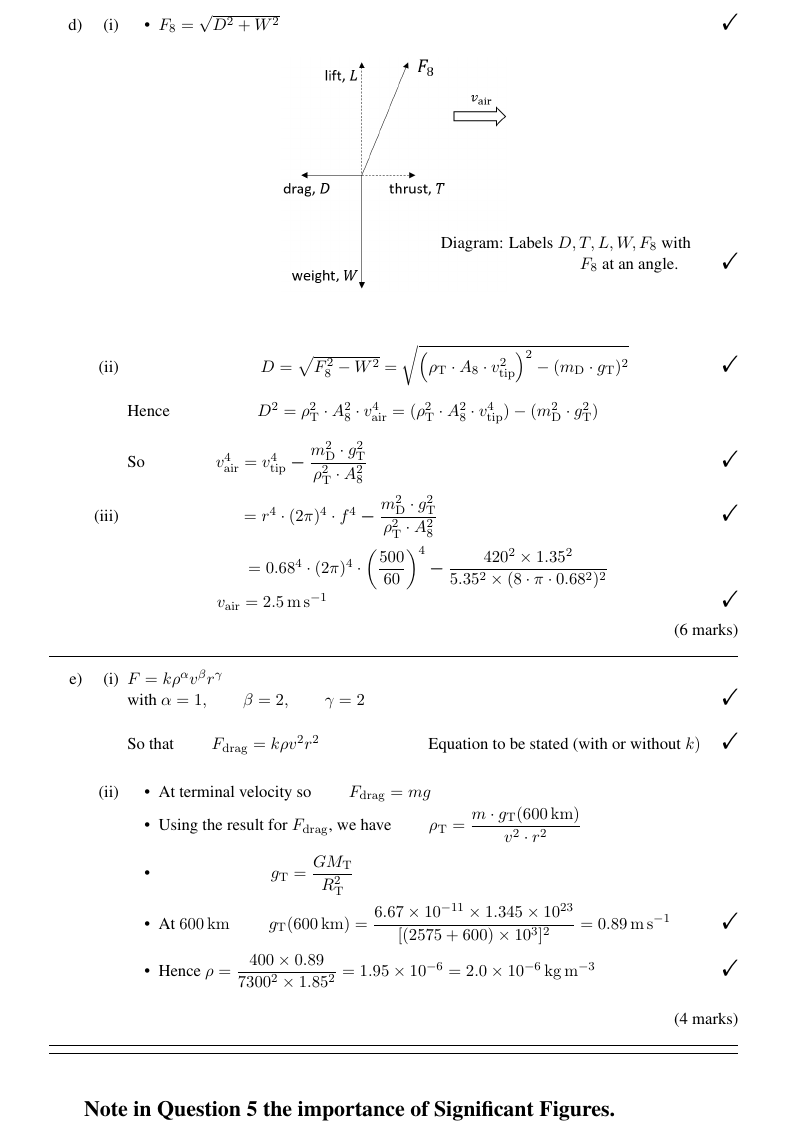
d) The rotor driving force, , is a function of , and the rotation speed of the tips of the rotors, , and is given by , where . The drag force, , on the landing craft can be approximated in a similar way, with , where is the airspeed of the craft and .
(i) When the craft is at constant speed in horizontal flight, the driving force of the rotors is required to counter the drag force by providing thrust , and to counter the weight of the craft by providing lift . Show all five of these forces, , , , , , on a diagram and write down an expression for the magnitude of in terms of and .
(ii) Substituting the expressions for each of these forces, obtain an expression for the airspeed in terms of , , , and .
(iii) From your expression calculate the velocity for horizontal flight given a rotor speed of 500 rpm. [6]
e) The space capsule containing the Dragonfly landing craft enters the atmosphere of Titan, and for much of its travel through the outer atmosphere of the moon the velocity is approximately constant at 7300 m s, as seen in the graph of Fig. 8. The resistance to motion provided by the tenuous atmosphere is determined by the turbulent flow of the atmosphere around the capsule.
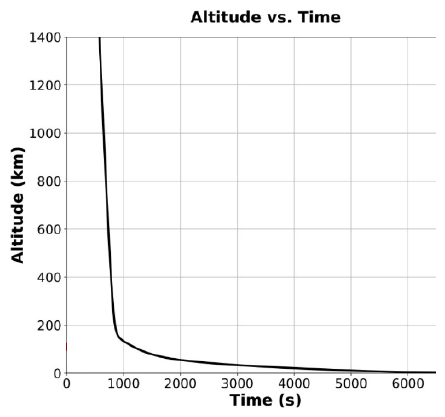
Figure 8: Graph of Dragonfly entering the atmosphere and landing (altitude vs time).
(i) The resistive force acting on the approximately spherical capsule, assuming turbulent flow, will be given by , where is a dimensionless constant, is the density of the atmosphere of Titan, is the speed of the capsule and is the radius of the capsule. Using dimensions or otherwise, determine the coefficients , , and write the equation for .
(ii) Taking and the diameter of the capsule to be 3.7 m, estimate the density of the atmosphere at an altitude of 600 km. Mass of Titan kg; mass of capsule = 400 kg; radius of Titan = 2575 km. [4]
Risposta: a) W; b) m²; c) , , , W, total energy J, charging time s h; d) , , m s; e) , , , ; m s, kg m
Soluzione:
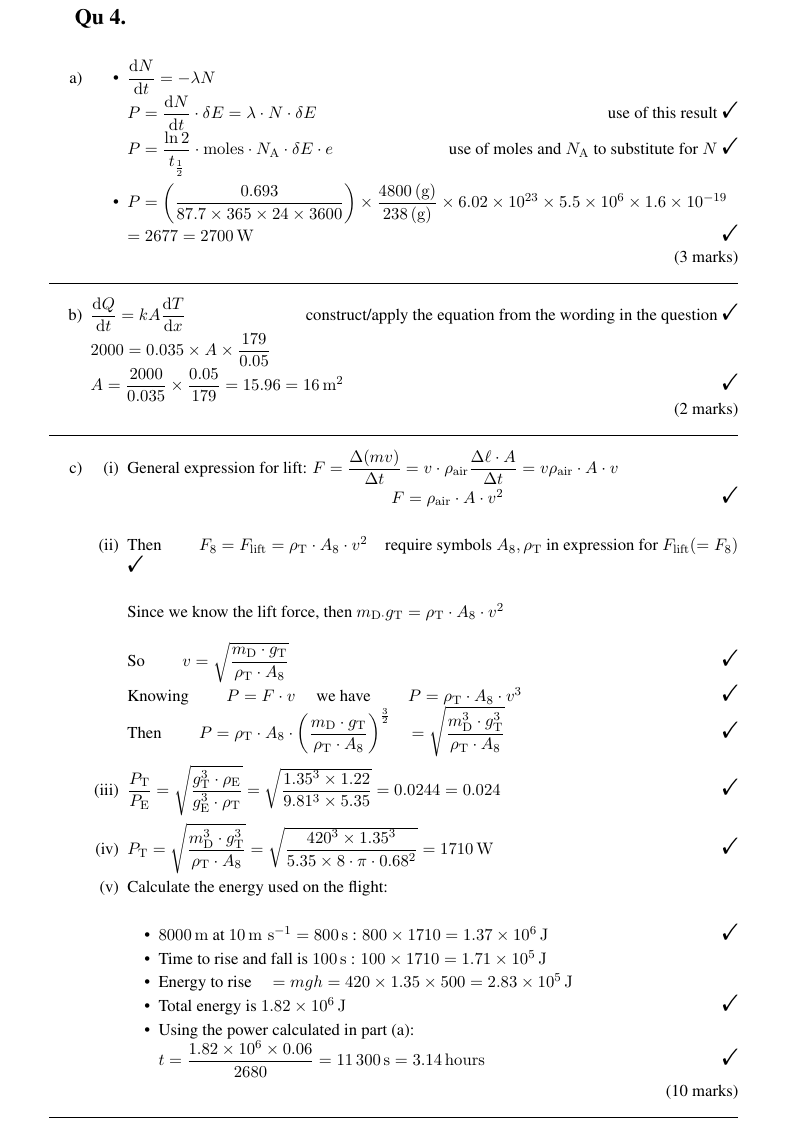
Official mark scheme (BPhO Round 1, November 2024, Section 2), from the official PDF — p. 7, 8. © BPhO, CC BY 4.0.
Topic: Nuclear & Particle Physics, Thermodynamics, Fluid Mechanics, Gravitation Metodi: Radioactive Decay Law, Impulse-Momentum Theorem, Dimensional Analysis, Newton’s Law of Gravitation Competenze: Mathematical Modeling, Estimation & Approximation Objects: Nucleus, Satellite Fonte: Testo (PDF) — p.8 · Soluzione ufficiale (PDF) — p.7
Problema 4 — Far atterrare un veicolo su Titano [25 punti]
a) Un generatore termoelettrico a radioisotopi (RTG) usa come fonte di energia il calore prodotto dal decadimento radioattivo (come nella missione Dragonfly della NASA verso Titano, la grande luna di Saturno). Il nucleo di un’unità tipica contiene 4,8 kg di diossido di plutonio-238. L’energia è prodotta dal decadimento alfa del Pu-238, da 5,5 MeV, con tempo di dimezzamento di 87,7 anni. Calcola la potenza termica iniziale. [3]
b) La temperatura ambiente su Titano è −179 °C. L’interno del lander è mantenuto a 0 °C ed è isolato con 5,0 cm di schiuma Rohacell, di conducibilità termica 0,035 W m K. Se la sorgente di calore interna produce 2000 W, stima l’area interna del lander.
Suggerimento: il flusso di calore attraverso un conduttore, , è proporzionale all’area della sezione attraversata, , e alla differenza di temperatura, , e inversamente proporzionale allo spessore del conduttore, . La costante di proporzionalità è la conducibilità termica. [2]
c) Il lander è dotato di otto rotori per poter volare come un drone.
(i) La forza esercitata sull’aria da tutte le otto pale, , serve a sollevare e spingere il veicolo. Scrivi un’espressione per la forza di sostentamento in volo stazionario, , in funzione della velocità dell’aria spinta verso il basso, , della densità dell’atmosfera di Titano, , e dell’area spazzata dagli otto rotori, .
(ii) Ricava quindi un’espressione per la potenza necessaria per il volo stazionario, in funzione della massa del veicolo , del campo gravitazionale su Titano , di e di .
(iii) Usando i dati sotto, calcola il rapporto tra la potenza necessaria per il volo stazionario su Titano e quella sulla Terra, .
(iv) Calcola la potenza necessaria al veicolo per il volo stazionario su Titano.
Dati: kg m; kg m; N kg; N kg; kg; lunghezza di ciascuna pala 0,68 m.
(v) Il rendimento della conversione del calore in energia elettrica è troppo basso perché l’RTG possa alimentare il volo. Stima per quanto tempo la batteria di bordo dovrebbe essere caricata dall’RTG, con rendimento del 6%, per completare un volo di 8 km a 500 m di quota a 10 m s, compresi salita e discesa. Supponi che la densità dell’atmosfera non cambi con la quota, che non ci siano perdite per resistenza dell’aria e che il veicolo salga e scenda in verticale a 10 m s costanti. In salita consuma la potenza del volo stazionario più l’energia potenziale guadagnata; in discesa consuma solo la potenza del volo stazionario. [10]
d) La forza motrice dei rotori, , dipende da , e dalla velocità delle estremità delle pale, , ed è data da , con . La forza di resistenza sul veicolo si può approssimare in modo simile: , dove è la velocità rispetto all’aria e .
(i) In volo orizzontale a velocità costante la forza motrice dei rotori deve bilanciare la resistenza fornendo una spinta e bilanciare il peso fornendo una portanza . Disegna tutte e cinque queste forze, , , , , , e scrivi un’espressione del modulo di in funzione di e .
(ii) Sostituendo le espressioni di queste forze, ricava un’espressione della velocità in funzione di , , , e .
(iii) Dalla tua espressione calcola la velocità di volo orizzontale con i rotori a 500 giri/min. [6]
e) La capsula spaziale che contiene il lander Dragonfly entra nell’atmosfera di Titano e per buona parte del percorso nell’atmosfera esterna la sua velocità è circa costante, 7300 m s, come si vede nel grafico di Fig. 8. La resistenza al moto dovuta all’atmosfera rarefatta è determinata dal flusso turbolento attorno alla capsula.
Figura 8: Grafico dell’ingresso in atmosfera e dell’atterraggio di Dragonfly (quota in funzione del tempo).
(i) La forza resistente sulla capsula, approssimativamente sferica, nell’ipotesi di flusso turbolento, è , dove è una costante adimensionale, la densità dell’atmosfera di Titano, la velocità della capsula e il suo raggio. Usando l’analisi dimensionale o in altro modo, determina gli esponenti , , e scrivi l’equazione di .
(ii) Ponendo e il diametro della capsula pari a 3,7 m, stima la densità dell’atmosfera a 600 km di quota. Massa di Titano kg; massa della capsula = 400 kg; raggio di Titano = 2575 km. [4]
Risposta: a) W; b) m²; c) , , , W, energia totale J, tempo di carica s h; d) , , m s; e) , , , ; m s, kg m
Soluzione: La soluzione ufficiale completa (in inglese) è nella versione originale di questo quesito e nel PDF ufficiale.
Topic: Nuclear & Particle Physics, Thermodynamics, Fluid Mechanics, Gravitation Metodi: Radioactive Decay Law, Impulse-Momentum Theorem, Dimensional Analysis, Newton’s Law of Gravitation Competenze: Mathematical Modeling, Estimation & Approximation Objects: Nucleus, Satellite Fonte: Testo (PDF) — p.8 · Soluzione ufficiale (PDF) — p.7
Question 5 — Gravity and collisions [25 marks]
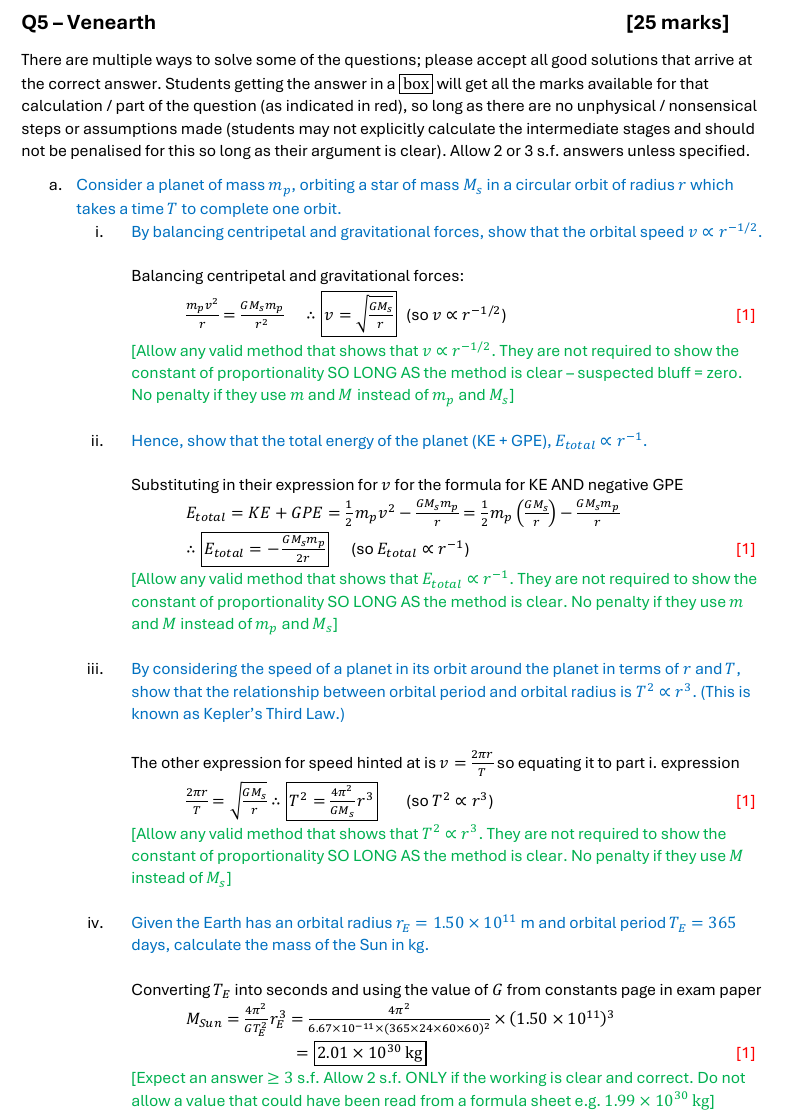
a) Consider a planet of mass orbiting a star of mass in a circular orbit of radius , which takes a time to complete one orbit.
(i) By balancing centripetal and gravitational forces, show that the orbital speed .
(ii) Hence, show that the total energy of the planet (KE + GPE), .
(iii) By considering the speed of the planet in its orbit in terms of and , show that the relationship between orbital period and orbital radius is . (This is known as Kepler’s Third Law.)
(iv) Given the Earth has an orbital radius m and orbital period days, calculate the mass of the Sun in kg.
Earth’s orbital properties can be given in different units, namely year and au (astronomical unit).
(v) Using your result from part (iii), if you use the Earth values au and year orbiting a star of mass , what is the value (and units) of in just these quantities and units? [5]
For the following calculations you may choose to work in standard SI units (and so use your value of from part (iv)), or in au, solar masses and years, as that can often greatly simplify the formulae (and so use your value of from part (v)).
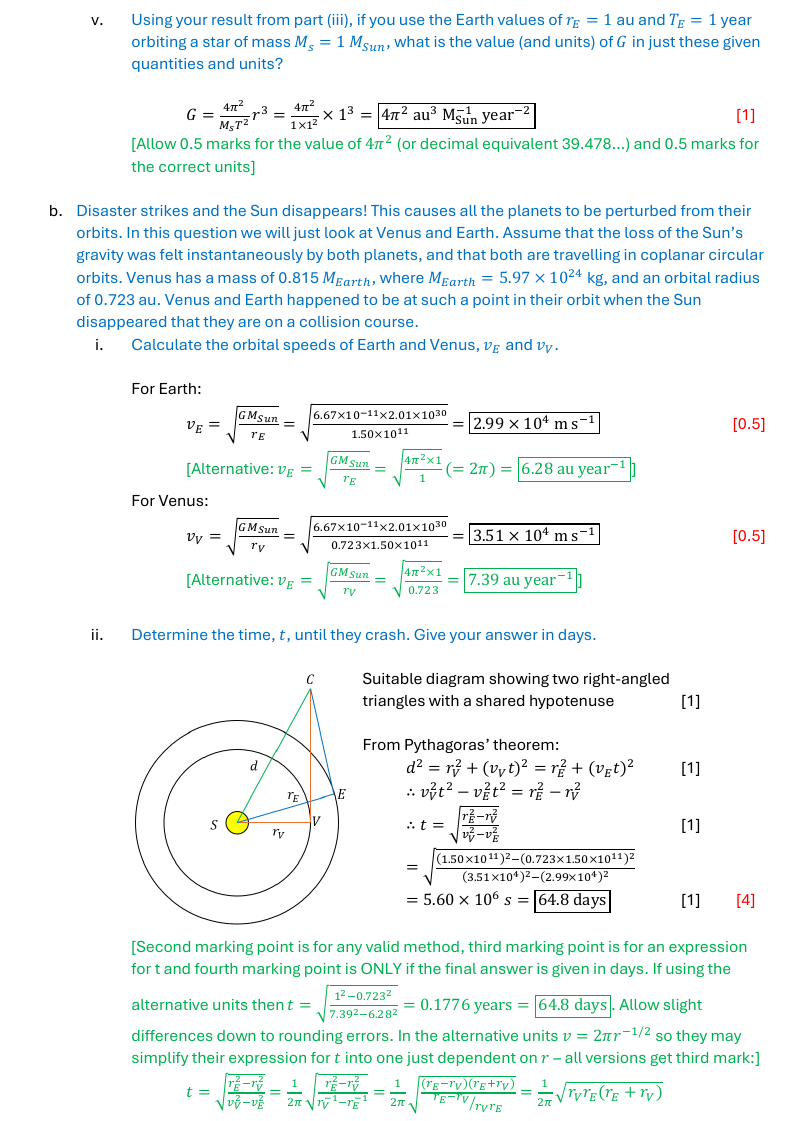
b) Disaster strikes and the Sun disappears! This causes all the planets to be perturbed from their orbits. In this question we will just look at Venus and Earth. Assume that the loss of the Sun’s gravity was felt instantaneously by both planets, and that both are travelling in coplanar circular orbits. Venus has a mass of , where kg, and an orbital radius of 0.723 au. Venus and Earth happened to be at such a point in their orbits when the Sun disappeared that they are on a collision course.
(i) Calculate the orbital speeds of Earth and Venus, and .
(ii) Determine the time until they crash. Give your answer in days.
(iii) Show that the distance from the Sun’s original location when they crash is au.
(iv) Show that the angle between their velocity vectors as they approach is .
(v) Find the Earth–Sun–Venus angle at the moment the Sun disappeared in order for this crash to occur. [8]
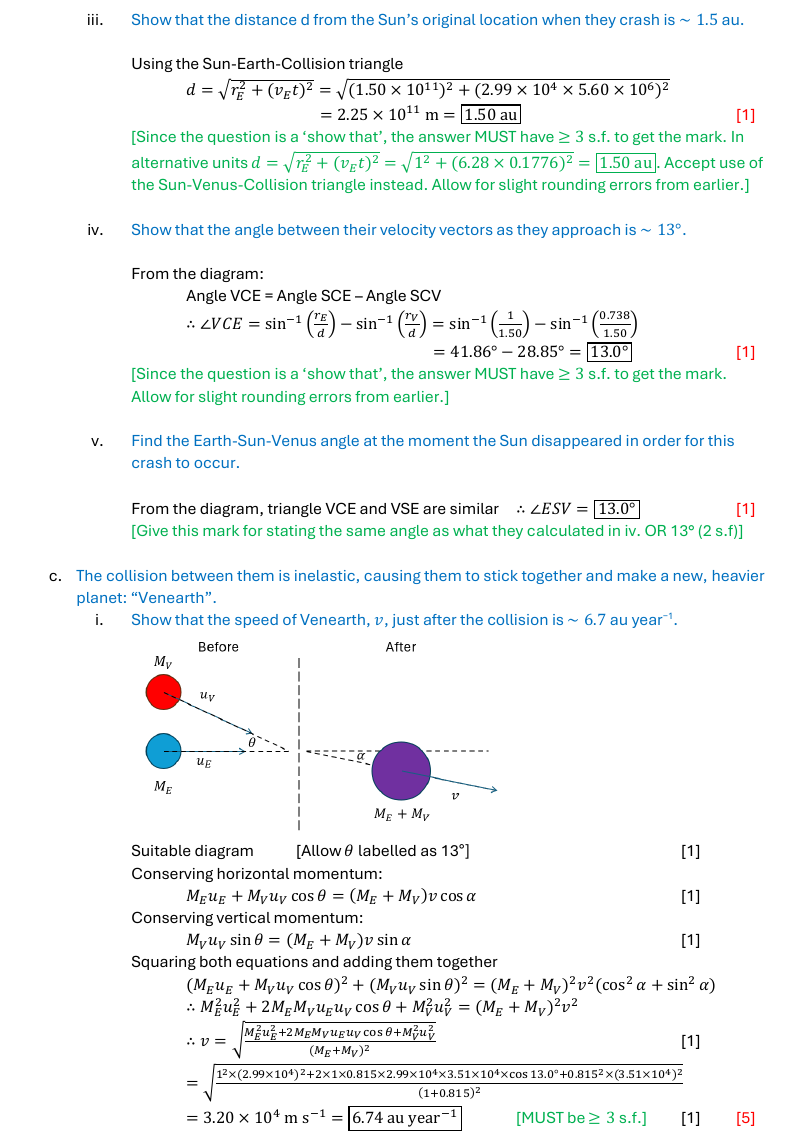
c) The collision between them is inelastic, causing them to stick together and make a new, heavier planet: “Venearth”.
(i) Show that the speed of Venearth, , just after the collision is au year.
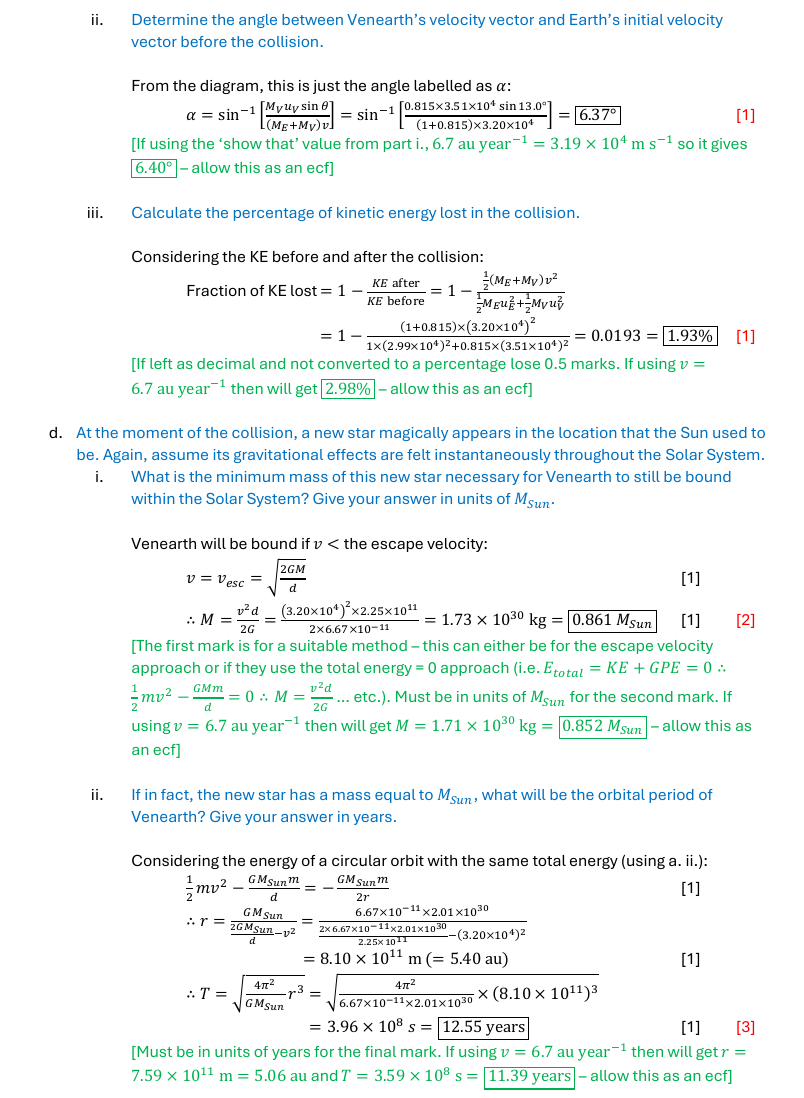
(ii) Determine the angle between Venearth’s velocity vector and Earth’s initial velocity vector before the collision.
(iii) Calculate the percentage of kinetic energy lost in the collision. [7]
d) At the moment of the collision, a new star magically appears in the location where the Sun used to be. Again, assume its gravitational effects are felt instantaneously throughout the Solar System.
(i) What is the minimum mass of this new star necessary for Venearth to still be bound within the Solar System? Give your answer in units of .
The new planet Venearth will follow an elliptical orbit whose orbital period will be equal to that of a circular orbit with the same total energy as Venearth.
(ii) If in fact the new star has a mass equal to , what will be the orbital period of Venearth? Give your answer in years. [5]
Risposta: a) , , ; kg; au year; b) m s (6.28 au/yr), m s (7.39 au/yr); s days; au; angle ; Earth–Sun–Venus angle ; c) m s au year; ; KE lost ; d) kg ; m (5.40 au), years
Soluzione:
Official mark scheme (BPhO Round 1, November 2024, Section 2), from the official PDF — p. 9, 10, 11, 12. © BPhO, CC BY 4.0.
Topic: Gravitation, Conservation of Momentum, Conservation of Energy Metodi: Kepler’s Laws, Newton’s Law of Gravitation, Conservation of Momentum, Vector Decomposition Competenze: Mathematical Modeling, Significant Figures Objects: Planet, Star Fonte: Testo (PDF) — p.10 · Soluzione ufficiale (PDF) — p.9
Problema 5 — Gravità e urti [25 punti]
a) Considera un pianeta di massa in orbita circolare di raggio attorno a una stella di massa , che compie un’orbita in un tempo .
(i) Uguagliando forza centripeta e forza gravitazionale, mostra che la velocità orbitale è .
(ii) Mostra quindi che l’energia totale del pianeta (cinetica + potenziale gravitazionale) è .
(iii) Considerando la velocità del pianeta nella sua orbita in funzione di e , mostra che tra periodo e raggio orbitale vale (terza legge di Keplero).
(iv) Sapendo che la Terra ha raggio orbitale m e periodo giorni, calcola la massa del Sole in kg.
Le grandezze orbitali della Terra si possono esprimere anche in altre unità: anno e au (unità astronomica).
(v) Usando il risultato del punto (iii), con i valori terrestri au e anno attorno a una stella di massa , quanto vale (con le unità) espressa solo in queste grandezze e unità? [5]
Nei calcoli seguenti puoi lavorare in unità SI (usando il valore di del punto (iv)) oppure in au, masse solari e anni, che spesso semplificano molto le formule (usando il valore di del punto (v)).
b) Disastro: il Sole scompare! Tutti i pianeti vengono deviati dalle loro orbite. Qui consideriamo solo Venere e la Terra. Supponi che la scomparsa della gravità del Sole sia avvertita istantaneamente da entrambi i pianeti e che entrambi percorrano orbite circolari complanari. Venere ha massa , con kg, e raggio orbitale 0,723 au. Al momento della scomparsa del Sole, Venere e la Terra si trovavano in posizioni tali da essere in rotta di collisione.
(i) Calcola le velocità orbitali di Terra e Venere, e .
(ii) Determina il tempo che manca all’urto. Dai la risposta in giorni.
(iii) Mostra che la distanza dalla posizione originaria del Sole al momento dell’urto è au.
(iv) Mostra che l’angolo tra i loro vettori velocità mentre si avvicinano è .
(v) Trova l’angolo Terra–Sole–Venere al momento della scomparsa del Sole necessario perché avvenga l’urto. [8]
c) L’urto è anelastico: i due pianeti restano uniti e formano un nuovo pianeta più pesante, «Venterra».
(i) Mostra che la velocità di Venterra, , subito dopo l’urto è au anno.
(ii) Determina l’angolo tra il vettore velocità di Venterra e il vettore velocità iniziale della Terra prima dell’urto.
(iii) Calcola la percentuale di energia cinetica persa nell’urto. [7]
d) Nell’istante dell’urto compare magicamente una nuova stella nel punto in cui si trovava il Sole. Di nuovo, supponi che i suoi effetti gravitazionali siano avvertiti istantaneamente in tutto il Sistema Solare.
(i) Qual è la massa minima della nuova stella perché Venterra resti legata al Sistema Solare? Dai la risposta in unità di .
Il nuovo pianeta Venterra seguirà un’orbita ellittica con periodo uguale a quello di un’orbita circolare con la stessa energia totale di Venterra.
(ii) Se la nuova stella ha massa pari a , quale sarà il periodo orbitale di Venterra? Dai la risposta in anni. [5]
Risposta: a) , , ; kg; au anno; b) m s (6,28 au/anno), m s (7,39 au/anno); s giorni; au; angolo ; angolo Terra–Sole–Venere ; c) m s au anno; ; energia cinetica persa ; d) kg ; m (5,40 au), anni
Soluzione: La soluzione ufficiale completa (in inglese) è nella versione originale di questo quesito e nel PDF ufficiale.
Topic: Gravitation, Conservation of Momentum, Conservation of Energy Metodi: Kepler’s Laws, Newton’s Law of Gravitation, Conservation of Momentum, Vector Decomposition Competenze: Mathematical Modeling, Significant Figures Objects: Planet, Star Fonte: Testo (PDF) — p.10 · Soluzione ufficiale (PDF) — p.9
Answers from the official BPhO Round 1 2024 mark scheme.
| Problem | Title | Risposta |
|---|---|---|
| 2 | Question 2 — Solar energy, energy losses and capacitors [25 marks] | a) projected area m², W, intensity W m; b) , , , , ; c) , energy ; , steady state ; – W °C; corrected power W, intensity W m (+16%); d) W, W m; kg s |
| 3 | Question 3 — Bubbles, forces and rotation [25 marks] | a) , ; N; N, kg, s; kg, wall thickness m; b) , ; ; N, kg m, m s ( rad s); c) |
| 4 | Question 4 — Landing a craft on Titan [25 marks] | a) W; b) m²; c) , , , W, total energy J, charging time s h; d) , , m s; e) , , , ; m s, kg m |
| 5 | Question 5 — Gravity and collisions [25 marks] | a) , , ; kg; au year; b) m s (6.28 au/yr), m s (7.39 au/yr); s days; au; angle ; Earth–Sun–Venus angle ; c) m s au year; ; KE lost ; d) kg ; m (5.40 au), years |
Fonte: Testo e soluzioni (PDF)
Risposte tratte dal mark scheme ufficiale BPhO Round 1 2024.
| Problema | Titolo | Risposta |
|---|---|---|
| 2 | Problema 2 — Energia solare, perdite di energia e condensatori [25 punti] | a) area proiettata m², W, intensità W m; b) , , , , ; c) , energia ; , a regime ; – W °C; potenza corretta W, intensità W m (+16%); d) W, W m; kg s |
| 3 | Problema 3 — Bolle, forze e rotazione [25 punti] | a) , ; N; N, kg, s; kg, spessore della parete m; b) , ; ; N, kg m, m s ( rad s); c) |
| 4 | Problema 4 — Far atterrare un veicolo su Titano [25 punti] | a) W; b) m²; c) , , , W, energia totale J, tempo di carica s h; d) , , m s; e) , , , ; m s, kg m |
| 5 | Problema 5 — Gravità e urti [25 punti] | a) , , ; kg; au anno; b) m s (6,28 au/anno), m s (7,39 au/anno); s giorni; au; angolo ; angolo Terra–Sole–Venere ; c) m s au anno; ; energia cinetica persa ; d) kg ; m (5,40 au), anni |
Fonte: Testo e soluzioni (PDF)