Rigid Body Collision
A small sphere of mass m and radius r collides with the far end B of a long homogeneous bar of mass M=4m and length b=9a, as shown in the figure.
Consider that the collision is elastic, that the coefficient of friction between the sphere and the bar is and that the angle between the initial velocity v_0 of the sphere and the axis of the bar is , as shown in the figure.
a) Determine, in terms of m, v_0 and , the value of the impulses J and K from the sphere on the bar, in the y and x directions, respectively. What is the angle formed between the axis of the bar and the velocity of the sphere immediately after the collision? What is the condition of so that the sphere moves upwards after the collision? (3 marks)
b) Determine the angular velocity of the sphere after the collision in terms of v_0, r and . (1.5 marks)
c) Determine the angular velocity and the velocity of the center of mass v_cm of the bar right after the collision. Express the results in terms of v_0, b and . (2 marks)
d) Determine the tension T in the rope (of length a) that holds the bar, immediately after the collision with the sphere. The local gravitational acceleration is g. Express the result in terms of m, g, v_0, a and . (3.5 marks)
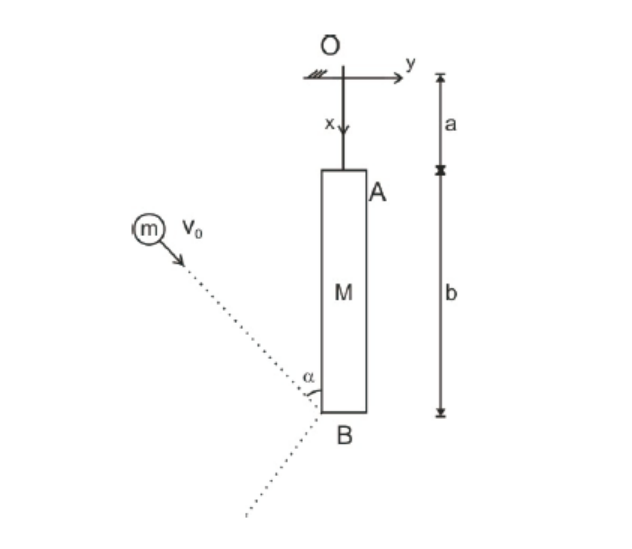 Sfera che colpisce barra appesa, angolo α
Topic: Newtonian Mechanics, Rotational Dynamics, Conservation of Momentum Metodi: Impulse-Momentum Theorem, Torque & Angular Momentum Analysis, Free-Body Diagram, Vector Decomposition Competenze: Diagrammatic Reasoning, Mathematical Modeling, Physical Reasoning Objects: Sphere, Rod, String Fonte: Testo (PDF) — p.1
Collizione rigida del corpo
Una piccola sfera di massa m e di raggio r si schianta con l’estremità B di un lungo bar omogeneo di massa M=4m e lunghezza b=9a, come mostrato nella figura.
Considerate che la collisione è elastica, che il coefficiente di attrito tra le la sfera e la barra è e che l’angolo tra la velocità iniziale v_0 della sfera e l’asse della barra è , come mostrato nella figura.
a) Determinare, in termini di m, v_0 e , il valore degli impulsi J e K provenienti dal sfera sulla barra, rispettivamente nelle direzioni y e x. Qual è l’angolo formato tra l’asse della barra e la velocità della sfera immediatamente dopo il
- Una collisione? Qual è la condizione di in modo che la sfera si muova verso l’alto dopo il
- Una collisione? (3 punti)
b) Determinare la velocità angolare della sfera dopo la collisione in termini di V_0, r e . 1, 5 punti)
c) Determina la velocità angolare e la velocità del centro di massa v_cm di
- Il bar subito dopo la collisione. Esprimere i risultati in termini di v_0, b e . (2 (Marchi)
d) Determina immediatamente la tensione T della corda (di lunghezza a) che tiene la barra dopo la collisione con la sfera. L’accelerazione gravitazionale locale è g. Espresso il risultato in termini di m, g, v_0, a e . 3,5 marchi)
Sfera che colpisce barra appesa, angolo
Topic: Newtonian Mechanics, Rotational Dynamics, Conservation of Momentum Metodi: Impulse-Momentum Theorem, Torque & Angular Momentum Analysis, Free-Body Diagram, Vector Decomposition Competenze: Diagrammatic Reasoning, Mathematical Modeling, Physical Reasoning Objects: Sphere, Rod, String Fonte: Testo (PDF) — p.1
- Electrostatic Analogy
The equations for many different physical situations have exactly the same looks. Obviously the symbols can be different (one letter substituted by another), but the mathematical form of the equations is the same. And the same equations have the same solutions! The equations of electrostatics, for example, appear in many other parts of physics, and, because of this, it is possible to solve problems of other areas with the same ease (or the same difficulty) of electrostatics.
The equations of electrostatics are:
where is the volumetric density of charge in a given point of space.
In this problem we will try to solve a situation of fluid dynamics with an electrostatic analogy. We need to highlight that this example isn’t the best, because, for this to be possible, we have to consider a case almost hypothetical, making approximations and assumptions that rarely are valid when we study real fluids. The mathematician John Von Neumann once said that those who study the equations proposed next are studying “dry water”.
Let us consider an incompressible, non-viscous and on a regime of non-turbulent flow. For an incompressible fluid we may write:
And for a non-turbulent fluid, that is, in laminar flow (also called irrotational) we have: Note that these are the same equations that govern electrostatics for the free space (without charges, that is, where ). To verify this, see the table below:
The problem: Consider a ball of radius R falling with a constant velocity (terminal) v_0 in an incompressible and non-viscous fluid, in a non-turbulent way. If the sphere descends too slowly, the viscous forces, and are being neglected, will become important. If, however, it descends with great speed, swirls will appear (turbulence phenomenon) and there will be circulation of the liquid, where . So, we will have to focus on a regime where the ball has an intermediate velocity between these 2 extreme situations, in such a way that our suppositions are acceptable.
Put yourself in the reference frame of the ball, in such a way that you see water flowing (upwards) around it. We will use the electrostatic analogy to determine what is the velocity of the liquid in every point of space!
a) We can consider as an electrostatic analogy a system where a sphere of radius R is immersed in a region that has a uniform electric field. In this case, what would theoretically be the dielectric constant , or the relative permittivity , of the sphere? (2 marks)
b) Assume that the electric field generated by this sphere, for , is equivalent to the electric field produced by a punctual electric dipole located in the center of the sphere. Determine the electric field generated by the sphere, in polar coordinates, in a point as a function of the electric dipole moment (that points in the upwards vertical direction). Consider that the medium where the sphere is located has a permittivity . (2 marks)
Obs: and indicate the versors in the radial and angular directions, respectively.
c) Calculate the total field , where is the uniform electric field in which the sphere is immersed, and points vertically upwards (the same direction of the vector in the figure. (1 mark)
d) Determine the value of . (2.5 marks)
e) Calculate in polar coordinates (that is, utilizing the versors and and the quantities and ) for , in terms of the modulus of the descent velocity v_0 and the radius R. (2.5 marks)
Obs: Vector field written in the cartesian system:
• Divergent operator of a vector field:
• Rotational operator of a vector field:
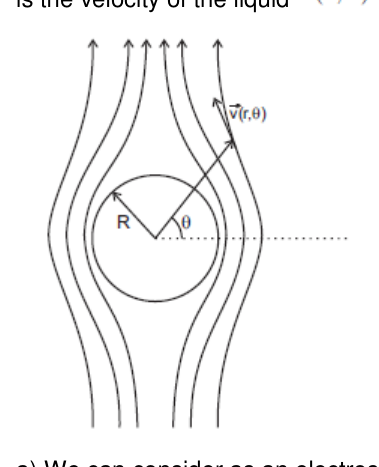 Sfera in fluido con linee di flusso
Topic: Fluid Mechanics, Electrostatics Metodi: Gauss’s Law, Coulomb’s Law, Superposition Principle, Physical Modeling Competenze: Mathematical Modeling, Physical Reasoning, Diagrammatic Reasoning Objects: Sphere, Point Charge Fonte: Testo (PDF) — p.2
- Analogia elettrostatica
Le equazioni per molte situazioni fisiche diverse hanno esattamente lo stesso aspetto. Ovviamente i simboli possono essere diversi (una lettera sostituita da un’altra), ma la La forma matematica delle equazioni è la stessa. E le stesse equazioni hanno Le stesse soluzioni! Le equazioni dell’elettrostatica, ad esempio, si trovano in molte altre La ricerca è stata condotta in parte dalla fisica e, a causa di questo, è possibile risolvere i problemi di altri settori con la stessa facilità (o la stessa difficoltà) di elettrostatica.
Le equazioni dell’elettrostatica sono:
dove è la densità volumetrica della carica in un dato punto dello spazio.
In questo problema cercheremo di risolvere una situazione di dinamica dei fluidi con un elettrostatico
- l’analogia. Dobbiamo sottolineare che questo esempio non è il migliore, perché, per questo essere E’ possibile, dobbiamo considerare un caso quasi ipotetico, facendo approssimazioni e ipotesi che raramente sono valide quando studiamo i fluidi reali. Il matematico John Von Neumann una volta disse che coloro che studiano le equazioni proposte successivamente sono studiare l’acqua secca.
Infine, la Commissione ha deciso di adottare un regolamento che stabilisce un regime di
- Il flusso. Per un fluido incompressibile possiamo scrivere:
E per un fluido non turbolento, cioè, nel flusso laminare (chiamato anche irrotativo) abbiamo: Si noti che queste sono le stesse equazioni che governano l’elettrostatica per lo spazio libero (senza spese, ovvero quando ). Per verificare questo, si veda la tabella seguente:
Il problema: Considera una palla di raggio R che cade a velocità costante (terminal) v_0 in un liquido incompressibile e non viscoso, in modo non turbolento. Se la sfera se scende troppo lentamente, le forze viscose, e sono state trascurate, diventeranno
- È importante. Se, tuttavia, scende con grande velocità, si manifestano turbolenze (turbolenze) Il fenomeno di “spazio” (spazio) e la circolazione del liquido, in cui . So, we dovrà concentrarsi su un regime in cui la palla ha una velocità intermedia tra In questo caso, la Commissione ha deciso di adottare un’azione di riforma.
Mettiti nel telaio di riferimento della palla, in modo tale che vedi l’acqua che scorrono intorno a esso. Useremo l’analogia elettrostatica per determinare che è la velocità del liquido in ogni punto dello spazio!
a) Possiamo considerare come analogia elettrostatica un sistema in cui una sfera di raggio R è immerso in una regione che ha un campo elettrico uniforme. In questo caso, cosa sarebbe teoricamente la costante dielettrica o la relativa autorizzabilità , del
- La sfera? 2 punti)
b) Supponiamo che il campo elettrico generato da questa sfera, per , è equivalente per il campo elettrico prodotto da un dipolo elettrico puntuale situato al centro della
-
La sfera. Determinazione del campo elettrico generati dalla sfera, in polarità coordinate, in un punto come funzione del momento di dipolo elettrico (che punti in direzione verticale verso l’alto). Considerate che il mezzo in cui la sfera è situato ha una permissività . 2 punti)
-
Notte: e indicare i versori rispettivamente nelle direzioni radial e angolare.
c) Calcolare il campo totale , dove è il campo elettrico uniforme in La spirazione è immersa nella superficie, e punta verticalmente verso l’alto (la stessa direzione di il vettore
- In figura. 1 punto
d) Determinare il valore di . 2,5 punti)
e) Calcolare in coordinate polari (cioè utilizzando i versori e e i quantitativi e ) per , in termini di modulo della velocità di discesa V_0 e raggio R. 2,5 punti)
Nota: campo vettoriale scritto nel sistema cartesiano:
• Operatore divergente di un campo vettoriale:
• Operatore di rotazione di un campo vettoriale:
*Sfera in fluido con linea di flusso *
Topic: Fluid Mechanics, Electrostatics Metodi: Gauss’s Law, Coulomb’s Law, Superposition Principle, Physical Modeling Competenze: Mathematical Modeling, Physical Reasoning, Diagrammatic Reasoning Objects: Sphere, Point Charge Fonte: Testo (PDF) — p.2
- Relativistic Rocket
a) (Classical Case) Consider a rocket free of external forces. It has an initial velocity v_i and initial mass m_i. Suppose that it ejects fuel at a constant velocity u, relative to the rocket, in the opposite direction of the initial velocity. Calculate the velocity of the rocket as a function of its mass. (2 marks)
b) Now, suppose that the rocket can reach relativistic speeds. Suppose, as in the previous question, that there are no external forces on the rocket. Suppose that the initial proper mass of the rocket is , that the rocket is ejected at a constant velocity u relative to the rocket and that it starts from rest.
Calculate the velocity of the rocket, as seen by a stationary observer, external to the rocket, as a function of the proper mass of the rocket. (4 marks)
c) Now consider that the rocket is moved by photons, that is, instead of ejecting fuel, it ejects photons of frequency f_0 (relative to an observer in the rocket). Let be the initial mass of the rocket. Calculate dv/dn, where v is the velocity of the rocket and n is the number of photons emitted by the rocket, as a function of v, n, and the necessary physical constants. (4 marks)
If necessary, use:
Topic: Special Relativity, Conservation of Momentum Metodi: Relativistic Energy-Momentum, Conservation of Momentum, Photon Energy Relation, Lorentz Transformation Competenze: Mathematical Modeling, Physical Reasoning Objects: Photon Fonte: Testo (PDF) — p.5
- Rocket relativistico
A) (Caso classico) Considerate un razzo libero da forze esterne. Ha una velocità iniziale . V_i e massa iniziale m_i. Supponiamo che esci il carburante a una velocità costante u, relativa al razzo, nella direzione opposta alla velocità iniziale. Calcolare la velocità di il razzo in funzione della sua massa. 2 punti)
b) Ora, supponiamo che il razzo possa raggiungere velocità relativistiche. Supponiamo che, come nel La domanda precedente, che non ci sono forze esterne sul razzo. Supponiamo che il la massa iniziale del razzo è , che il razzo è espulso a una costante velocità U rispetto al razzo e che parte dal riposo.
Calcolare la velocità del razzo, come osservato da un osservatore stazionario, esterno al il razzo, in funzione della massa corretta del razzo. (4 punti)
c) Ora consideriamo che il razzo è spostato da fotoni, cioè, invece di espellere combustibile, espone fotoni di frequenza f_0 (rispetto ad un osservatore nel razzo). Lascia che be la massa iniziale del razzo. Calcolare dv/dn, dove v è la velocità del razzo e n è il numero di fotoni emessi dal razzo, come funzione di v, n, e le necessarie costanti fisiche. (4 punti)
Se necessario, utilizzare:
Topic: Special Relativity, Conservation of Momentum Metodi: Relativistic Energy-Momentum, Conservation of Momentum, Photon Energy Relation, Lorentz Transformation Competenze: Mathematical Modeling, Physical Reasoning Objects: Photon Fonte: Testo (PDF) — p.5