- The Motion of a Top
The most fascinating aspect of tops is the fact that they can temporarily challenge gravity moving back and forth, and rising and descending until they eventually fall. Also, if it can spin fast enough, it can stay in a stationary position where its axis of rotation remains vertical.
In this problem, we will investigate the model of a top that has a spherical tip and that performs a movement of precession about a fixed axis. In the end, we investigate a rough model in the case where friction is considered.
1.1 Rolling without Friction
Consider the top shown in the figure below. It is composed by a sphere of radius r in its base, by a disc of radius R and thickness d and a very thin bar of length L and transverse area A. Each element is glued one above the other, as shown below.
Consider that all the top is made from a material of density .
In the first figure (1a), we have a diagram of the top. In the second one (1b), a movement of precession of the top with the main axis x_2 pointing outwards the plane of the paper.
a) Determine the distance D of the center of mass (CM) of the top to the center of the sphere. b) Determine the moments of inertia I_1, I_2 and I_3 of the top relative to its main axis and shown in figure 1a.
Consider figure 1b that shows only the sphere and all the rest of the top is indicated by a bar. The top performs a movement of precession where the CM spins around a circle of radius R. The point of contact between the sphere and the ground spins around a circle of radius a. The angular velocities of precession are indicated in figure 1b.
c) Considering that the radius of the sphere is small, so that the main axis can be considered those shown in figure 1b, determine the component of the top’s angular velocity in axis x_3 and the angular momentum L_3 in this axis.
d) Determine the friction force F needed to maintain the movement.
e) Write the equation of motion of the top in axis x_2.
f) What is the condition between and so there is pure rolling?
g) What is the condition on so that the movement is possible?
h) Determine the value of the angular velocity of precession as a function of the angle , the angular velocity and the other important quantities in this problem.
i) Investigate the case where .
1.2 Rolling with Friction
In this part of the problem we will make a quick visit to the problem of the rolling of a body when we consider the force of friction.
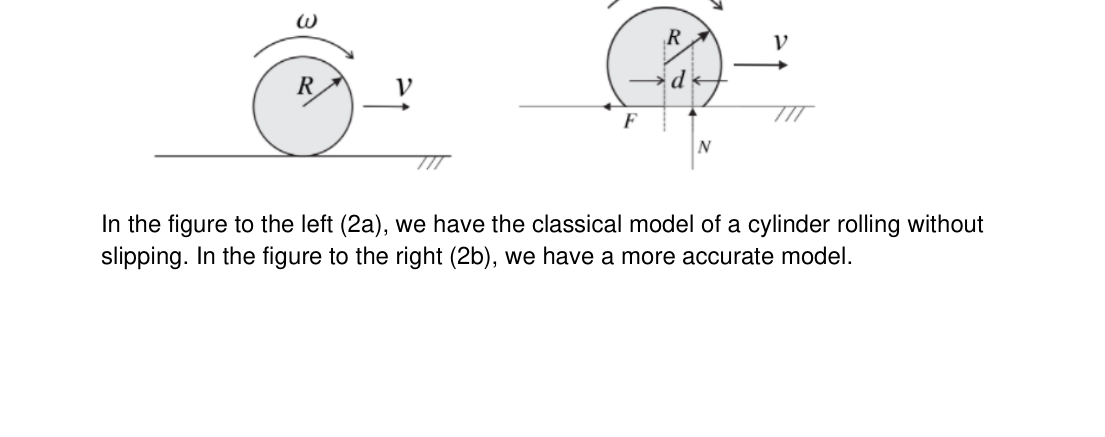
In the figure to the left (2a), we have the classical model of a cylinder rolling without slipping. In the figure to the right (2b), we have a more accurate model. j) According to figure 2a, determine what is the condition of pure rolling for a cylinder of radius R when its CM moves forward with velocity v and the angular velocity about the CM is .
When a friction force F acts on the cylinder, for figure 2a, it tends to modify both the velocity of the CM and the angular velocity of the cylinder.
k) Indicate in fig 2a where the friction force acts and show that if the torque of this force is considered this becomes incompatible with the pure rolling condition obtained in j).
To fix the problem found in the previous question, we can adopt the scheme shown in figure 2b, where the normal force on the cylinder has a horizontal displacement relative to the CM.
l) At what distance d should be the normal force N so that the pure rolling condition is satisfied?
m) What must be the minimal value of the coefficient of static friction for the motion to occur?
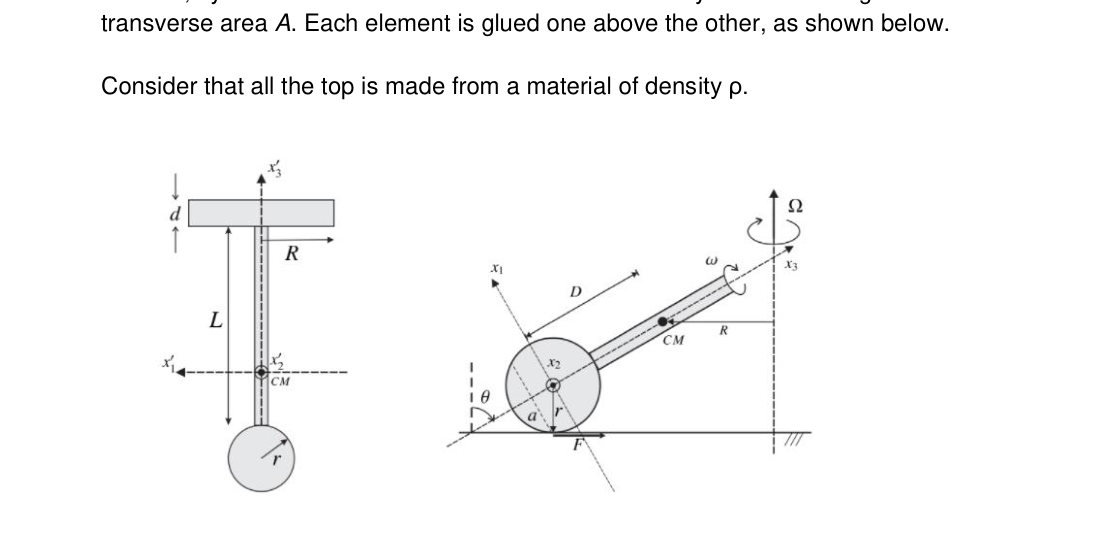 diagramma trottola (1a e 1b)
 cilindro che rotola senza/con attrito
Topic: Rotational Dynamics, Newtonian Mechanics, Rigid Body Statics Metodi: Torque & Angular Momentum Analysis, Free-Body Diagram, Kinematic Equations, Vector Decomposition Competenze: Mathematical Modeling, Diagrammatic Reasoning, Physical Reasoning Objects: Spinning Top, Sphere, Disk, Cylinder Fonte: Testo (PDF) — p.1
- Il movimento di una cima
L’aspetto più affascinante dei top è il fatto che possono temporaneamente sfidare la gravità si muove avanti e indietro, e si alza e scende fino a quando alla fine cadono. Inoltre, se può girare abbastanza velocemente, può rimanere in posizione stazionaria dove il suo asse di la rotazione rimane verticale.
In questo problema, esamineremo il modello di una parte superiore che ha una punta sferica e che esegue un movimento di precisione attorno ad un asse fisso. Alla fine, indaghiamo su un modello grezzo nel caso in cui si consideri l’attrito.
1.1 Rollo senza frizione
Considerate la figura in alto. È composto da una sfera di raggio r in la sua base, con un disco di raggio R e spessore d e una barra molto sottile di lunghezza L e area trasversale A. Ogni elemento è incollato l’uno sopra l’altro, come mostrato di seguito.
Si consideri che tutta la parte superiore sia fatta di un materiale di densità .
Nella prima figura (1a) abbiamo un diagramma della parte superiore. Nella seconda, paragrafo 1b, movimento della precisione della parte superiore con l’asse principale x_2 che punta verso l’esterno del piano
- Il giornale.
a) Determinare la distanza D del centro di massa (CM) della parte superiore al centro della
- La sfera. b) Determinare i momenti di inerzia I_1, I_2 e I_3 della parte superiore rispetto al suo asse principale e mostrato alla figura 1a.
Considerate la figura 1b che mostra solo la sfera e tutto il resto della parte superiore è indicato da un
- Il bar. La parte superiore esegue un movimento di precisione in cui il CM ruota intorno a un cerchio di radius R. Il punto di contatto tra la sfera e il suolo ruota intorno a un cerchio di radius a. Le velocità angolari di precisione sono indicate nella figura 1b.
c) Considerando che il raggio della sfera è piccolo, in modo che si possa considerare l’asse principale i dati riportati nella figura 1b determinano la componente della velocità angolare superiores nell’asse x_3 e il momento angolare L_3 in questo asse.
d) Determinare la forza di attrito F necessaria per mantenere il movimento.
e) Scrivere l’equazione di movimento della parte superiore nell’asse x_2.
f) Qual è la condizione tra e per ottenere il laminamento puro?
g) Qual è la condizione di per consentire il movimento?
h) Determinare il valore della velocità angolare di precisione come funzione dell’angolo , la velocità angolare e le altre quantità importanti di questo problema.
i) indagare il caso in cui .
1.2 Rollo con frattura
In questa parte del problema faremo una rapida visita al problema del rollolamento di un sistema di il corpo quando consideriamo la forza di attrito.
Nella figura a sinistra (2a) abbiamo il modello classico di un cilindro che ruota senza
- Scorreva. Nella figura a destra (2b) abbiamo un modello più preciso. j) Determinare, secondo la figura 2a, quale sia la condizione di rotolamento puro per un cilindro di raggio R quando il suo CM si muove in avanti con velocità v e la velocità angolare circa il CM è .
Quando una forza di attrito F agisce sul cilindro, per la figura 2a, tende a modificare sia il velocità del CM e velocità angolare del cilindro.
k) Indicare nella figura 2a dove agisce la forza di attrito e mostrare che se la coppia di questa la forza è considerata incompatibile con la condizione di rotolamento pura ottenuto in j).
Per risolvere il problema riscontrato nella domanda precedente, possiamo adottare il regime indicato nella figura 2b, quando la forza normale sul cilindro ha un spostamento orizzontale rispetto al CM.
L) A che distanza d deve essere la forza normale N in modo che la condizione di rotolamento pura sia soddisfatto?
m) Qual è il valore minimo del coefficiente di attrito statico per il movimento che si verificherà?
*diagramma di trottole (1a e 1b) *
- cilindro che rotola senza/con attrito*
Topic: Rotational Dynamics, Newtonian Mechanics, Rigid Body Statics Metodi: Torque & Angular Momentum Analysis, Free-Body Diagram, Kinematic Equations, Vector Decomposition Competenze: Mathematical Modeling, Diagrammatic Reasoning, Physical Reasoning Objects: Spinning Top, Sphere, Disk, Cylinder Fonte: Testo (PDF) — p.1
- Diamagnetic Levitation
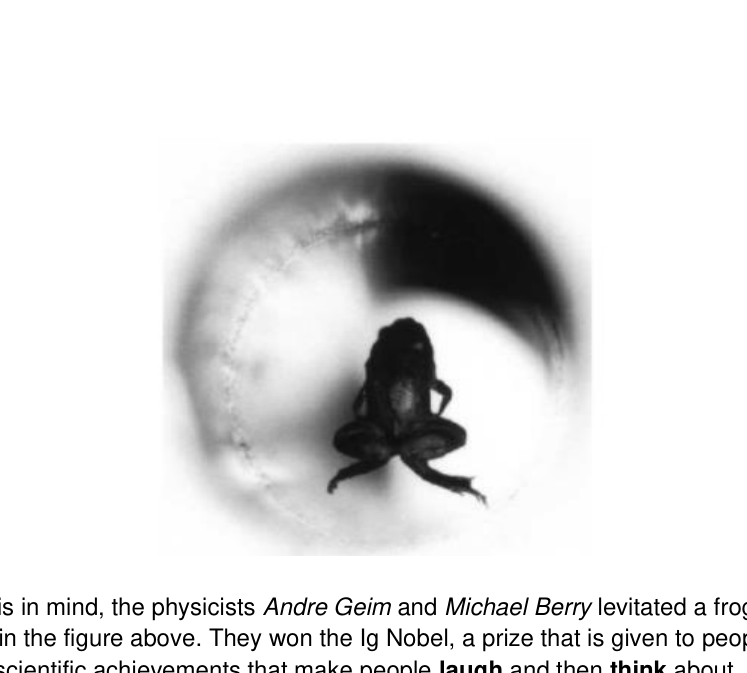
Apart from our intuition, substances that apparently are non-magnetic can levitate in the presence of magnetic fields. The majority of substances are weakly diamagnetic and small forces associated with them makes levitation possible. Living creatures consist basically of diamagnetic substances (like water and proteins) and can be levitated or feel weak “gravities”. With this in mind, the physicists Andre Geim and Michael Berry levitated a frog, as shown in the figure above. They won the Ig Nobel, a prize that is given to people that obtain scientific achievements that make people laugh and then think about science. A curious fact is that the physicist Andre Geim won the Nobel prize in Physics in 2010 for his job with grafen, a perfectly bidimensional stable sheet formed by carbon atoms.
2.1 Energy
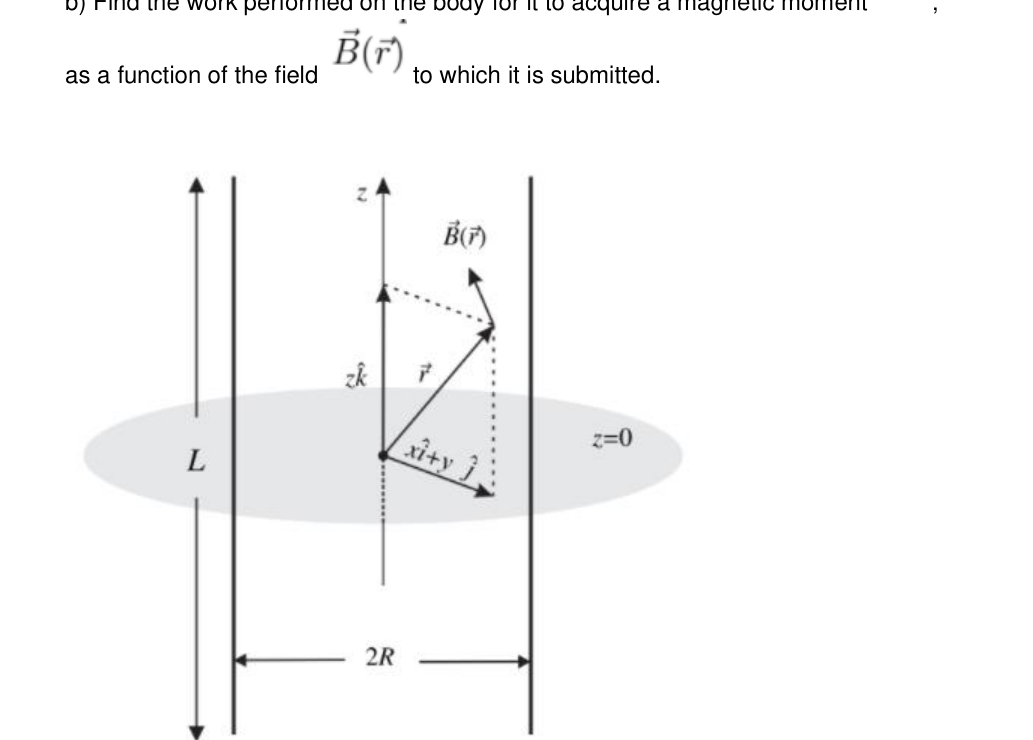
Consider a solenoid as shown in Figure 4. The magnetic field in position is with magnitude given by , and the gravitational acceleration is g.
The object to be levitated has mass M and volume V (density ) and susceptibility .
The magnetic moment of a body submitted to a magnetic field is given by the expression where is the magnetic permeability of vacuum and is its magnetic susceptibility.
a) What is the sign of the susceptibility of a diamagnetic body?
Suppose that the magnetic field on the body is slowly increased from zero to
b) Find the work performed on the body for it to acquire a magnetic moment , as a function of the field to which it is submitted.
Figure 4: Solenoid. Inside of it, there is a diamagnetic body that will be levitated.
c) Considering the gravitational potential energy mgz write down the expression for the total energy of the body. d) Find the net force on the body as a function of the data of the problem and of
e) Supposing that the magnetic field depends only on z, that is, , find the condition on so that the body remains in equilibrium.
2.2 Stability Conditions
Earnshaw’s theorem says that it is not possible for a particle to remain in stable equilibrium only due to forces that scale with the inverse of the square of the distance, that is, 1/r^2. The same result is valid for permanent magnets (ferromagnets) and paramagnetic bodies, but this is not true for diamagnetic bodies.
Suppose that in a region of magnetic field there is a magnetic body with magnetic moment given by
f) Starting from the expression for the interaction energy between the magnet and the magnetic field, find what is the condition on as a function of for the body to remain in stable equilibrium in the position
g) What is the condition on for stability to happen in the vertical direction? And the horizontal? Write your answer as a function of .
If we consider the cylindrical symmetry of the solenoid, it is possible to obtain relationships between the derivatives of the magnetic field both in the radial direction and the vertical direction
Suppose that the field is given by where
with the derivatives taken in the point where the body is levitating.
h) Verify if the equation is satisfied with the given terms.
Note: Remember that the cylindrical symmetry has to be considered.
i) Re-write the equilibrium conditions both in the vertical and the horizontal directions as functions of B_0, B_1 and B_2 only. In this question, consider that the body has mass m and magnetic moment . The local gravity is g.
 rana in levitazione diamagnetica
 solenoide con corpo diamagnetico levitante
Topic: Magnetism, Electromagnetism, Conservation of Energy Metodi: Energy Conservation Method, Physical Modeling, Differential Equations, Calculus-Integration Competenze: Mathematical Modeling, Physical Reasoning, Diagrammatic Reasoning Objects: Solenoid, Magnet Fonte: Testo (PDF) — p.3
- Levitazione diamagnetico
Oltre alla nostra intuizione, sostanze che apparentemente non sono magnetiche possono levitare in la presenza di campi magnetici. La maggior parte delle sostanze è debole di diamagnetic e le piccole forze associate a loro rendono possibile la levitata. Creature viventi sono costituiti essenzialmente da sostanze diamagnetico (come acqua e proteine) e possono essere Levità o sensazione di debolezza gravità. Con questo in mente, i fisici Andre Geim e Michael Berry hanno levitato una rana, come Il numero di persone che hanno ricevuto il certificato di autorizzazione è indicato nella figura precedente. Hanno vinto il premio Ig Nobel, un premio che viene assegnato a persone che ottenere risultati scientifici che fanno ridere le persone e poi pensare scienza. Un fatto curioso è che il fisico Andre Geim ha vinto il premio Nobel nel Fisica nel 2010 per il suo lavoro con il grafeno, una scheda stabile perfettamente bidimensionale formata per gli atomi di carbonio.
2.1 Energia
Considera un solenoide come mostrato nella figura 4. Il campo magnetico in posizione is con magnitudo data da , e l’accelerazione gravitazionale è g.
L’oggetto da levitare ha massa M e volume V (densità ) e sensibilità .
Il momento magnetico di un corpo sottoposto a un campo magnetico is data dall’espressione in cui è la permeabilità magnetica del vuoto e è la sua magneticità sensibilità.
a) Qual è il segno della sensibilità di un corpo diamagnetico?
Supponiamo che il campo magnetico sul corpo si incrementi lentamente da zero a
b) Trova il lavoro eseguito sul corpo per acquisire un momento magnetico , come funzione del campo alla quale è sottoposto.
Figura 4: Solenoide. All’interno di esso c’è un corpo diamagnetico che sarà levitato.
c) Considerando l’energia potenziale gravitazionale mgz, annotare l’espressione per l’energia totale del corpo. d) Trova la forza netta sul corpo in funzione dei dati del problema e del
e) Supponendo che il campo magnetico dipenda solo da z, cioè: , trovare la condizione su in modo che il corpo rimane in equilibrio.
2.2 Condizioni di stabilità
Il teorema di Earnshaw dice che non è possibile per una particella di rimanere in stabilità equilibrio solo a causa di forze che scala con l’inverso del quadrato del Distanza, cioè 1/r^2. Lo stesso risultato vale per i magneti permanenti (ferromagneti) e corpi paramagnetistici, ma questo non vale per i corpi diamagnetistici.
Supponiamo che in una regione di campo magnetico c’è un corpo magnetico con momento magnetico dato da
f) Partendo dall’espressione dell’energia di interazione tra il magnete e il Il campo magnetico, trovare qual è la condizione su come funzione di per il corpo per rimanere in equilibrio stabile nella posizione
g) Qual è la condizione di per la stabilità che si verifichi in la direzione verticale? E l’orizzontale? Scrivi la tua risposta come funzione di .
Se consideriamo la simmetria cilindrica del solenoide, è possibile ottenere Relazioni tra i derivati del campo magnetico sia nella direzione radial e la direzione verticale
Supponiamo che il campo sia dato da dove
con i derivati presi nel punto in cui il corpo levitano.
h) Verificare se l’equazione è soddisfatto dei termini indicati.
Nota: Ricorda che la simmetria cilindrica deve essere presa in considerazione.
i) Riscrevere le condizioni di equilibrio sia nella direzione verticale che orizzontale come funzioni di B_0, B_1 e B_2 solo. In questa domanda, si consideri che il corpo ha massa m e momento magnetico . La gravità locale è g.
rana in levitazione diamagnetica
- solenoide con corpo diamagnetico levitante *
Topic: Magnetism, Electromagnetism, Conservation of Energy Metodi: Energy Conservation Method, Physical Modeling, Differential Equations, Calculus-Integration Competenze: Mathematical Modeling, Physical Reasoning, Diagrammatic Reasoning Objects: Solenoid, Magnet Fonte: Testo (PDF) — p.3
- The Betatron
A betatron is an equipment that can be used to accelerate charged particles to high speeds with the application of a variable magnetic field. In this problem we will investigate the acceleration of ultrarelativistic electrons (electrons with speeds that approach the speed of light in vacuum c) under the influence of a magnetic field.
The betatron allows the electrons to be accelerated in a circular orbit of constant radius R varying only the flux of the magnetic field on the circle described by the electron. A scheme of this equipment is shown in the below figure. In point A, electrons are ejected from a filament and then they travel through a circular orbit of radius R. As the magnetic flux in the circle varies, the speed of the electron rises.
3.1 Maximum Velocity of the Electron
Suppose, unless stated otherwise, that the treated electrons are ultrarelativistic, that is, their velocity is close to c. Consider the figure 6 that shows the movement of the electron in the betatron.
a) Determine the Lorentz factor of the electron as a function of its orbital radius R and the magnetic field perpendicular to the plane of the orbit and in the position r=R, where the radius r is measured relative to the center of the electron orbit. If necessary, use basic natural constants such as the charge -e and the mass m_e of the electron and the speed of light in vacuum c.
b) Determine the electric field tangent to the orbit of the electron as a function of basic constants and of the temporal variation of the average magnetic field measured in the circle of the electron’s orbit, and also of the radius R of its orbit.
c) Determine what must be the relationship between the magnetic field B_z in the electron’s orbit and the average value in the circle described by the electron.
d) For example, show that if the field is given by
it will satisfy the condition obtained in the previous question.
Suppose that the electron radiates energy according to Larmor’s formula:
where a is the acceleration felt by the electron in its rest frame. The average power doesn’t change when we observe it from the lab’s frame, although the acceleration of the electron changes.
e) Determine the acceleration a_L suffered by the electron relative to the lab s frame if the acceleration in the rest frame is a. Write a_L as a function of a and .
f) Determine what must be the maximum value of obtained by the electron during the acceleration. Write your answer in terms of the temporal variation of the average field in the circle of the orbit, of the magnetic field B_z in the orbit, of the radius R of the orbit and of fundamental constants.
3.2 Stability Condition
Let us now not consider that the electron radiates energy during acceleration. Still consider that we are dealing with ultrarelativistic electrons.
We will investigate how the electron will move if it is slightly disturbed from its equilibrium orbit when the small displacements are in the z direction or the radial direction. Consider that there is displacement only in one direction at a time (for example, when it is disturbed in the radial direction it remains in z=0). Consider that the magnetic field to which the electron is submitted can be written as
Also define the gradient index of the magnetic field, n, as
that indicates the variation of the z component of the magnetic field that acts on the electron.
g) Write the radial equation of motion for the electron as a function of and of fundamental constants.
Let be the displacement of the electron in the radial direction, relative to its equilibrium position.
h) Find the equation of motion of x as a function of the angular frequency of the electron, of B_0, of the radius R of its original orbit and of .
i) What is the condition on the index n for the orbit to be stable?
Suppose now that the electron is slightly displaced in the z direction, keeping the same radius R of its orbit.
j) Write the equation of motion for z as a function of and of , and also of fundamental constants.
k) Knowing that in cylindrical coordinates is null in the plane of the electron’s orbit, show that
l) Re-write the result of question j) and determine the condition on the index n for the orbit to be stable.
m) Determine the period of the motions both in the radial direction and in the vertical direction as functions of n and . Show that this period is always larger than the orbital period of the electron in the betatron. Also determine what is the condition on n so that both movements (z direction and radial) have the same period.
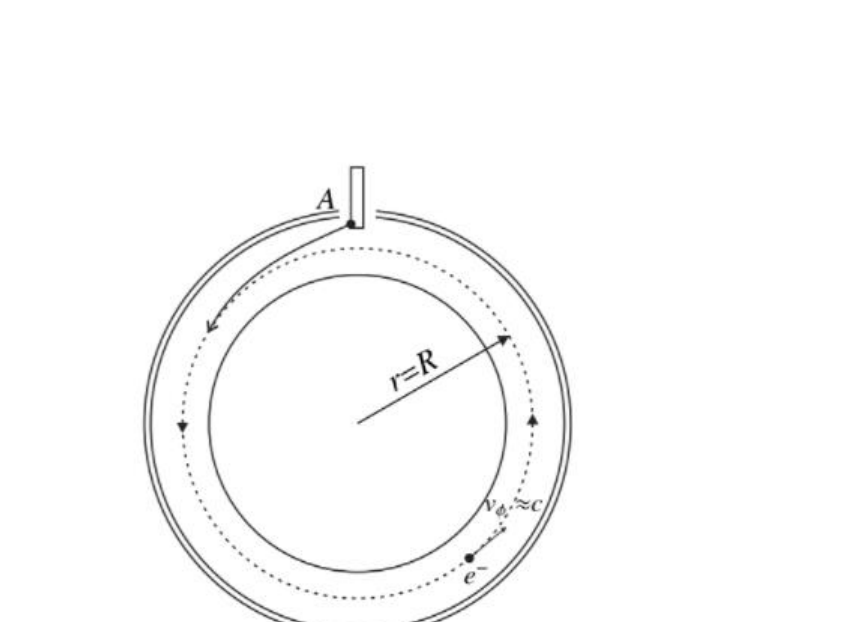 schema orbita circolare betatrone
Topic: Special Relativity, Electromagnetic Induction, Magnetism Metodi: Faraday’s Law of Induction, Lorentz Force Analysis, Relativistic Energy-Momentum, Differential Equations Competenze: Mathematical Modeling, Physical Reasoning, Diagrammatic Reasoning Objects: Electron, Magnet Fonte: Testo (PDF) — p.7
- Il Betatron
Un betatron è un equipaggiamento che può essere utilizzato per accelerare le particelle cariche fino ad alti livelli velocità con l’applicazione di un campo magnetico variabile. In questo problema studiare l’accelerazione degli elettroni ultrarrelativistici (elettroni con velocità che avvicinarsi alla velocità della luce nel vuoto c) sotto l’influenza di un campo magnetico.
Il betatron consente di accelerare gli elettroni in un’orbita circolare di costante radius R varia solo il flusso del campo magnetico sul cerchio descritto dalla
- Il suo numero è di 5 milioni. Un schema di questa attrezzatura è mostrato nella figura seguente. Nel punto A, gli elettroni vengono espulsi da un filamento e poi viaggiano attraverso un orbita circolare di raggio R. Poiché il flusso magnetico nel cerchio varia, la velocità della L’elettrone aumenta.
3.1 Velocità massima dell’elettrone
Supponiamo, salvo diversa indicazione, che gli elettroni trattati siano ultrarrelativistici, che La loro velocità è vicina a c. Considerate la figura 6 che mostra il movimento del l’elettrone nel betatron.
a) Determinazione del fattore Lorentz di un elettrone come funzione del suo raggio orbitale R e del campo magnetico perpendicolare alla piano dell’orbita e nella posizione r=R, dove il raggio r è misurato in relazione a il centro dell’orbita degli elettroni. Se necessario, utilizzare costanti naturali di base come il -e e la massa m_e dell’elettrone e la velocità della luce nel vuoto c.
b) Determinazione del campo elettrico tangente all’orbita dell’elettrone come funzione di costanti di base e di variazione temporale di un campo magnetico medio misurato nel cerchio dell’orbita degli elettroni, e di raggio R della sua orbita.
c) Determinare quale deve essere la relazione tra il campo magnetico B_z nel L’orbita degli elettroni e il valore medio nel cerchio descritto dall’elettrone.
d) Per esempio, mostrare che se il campo è dato da
la domanda precedente.
Supponiamo che l’elettrone irradia energia secondo la formula di Larmor:
dove a è l’accelerazione percepita dall’elettrone nel suo frame di riposo. La potenza media non cambia quando la osserviamo dal quadro del laboratorio. sebbene l’accelerazione degli elettroni cambie.
e) Determina l’accelerazione a_L subita dall’elettrone rispetto al laboratorio l’accelerazione del sistema di calcolo è a. Scrivere a_L come funzione di a e .
f) Determinare quale deve essere il valore massimo di ottenuto dall’elettrone durante il processo di l’accelerazione. Scrivi la tua risposta in termini di variazione temporale di cui al campo medio nel cerchio dell’orbita, del campo magnetico B_z nell’orbita, del radius R dell’orbita e delle costanti fondamentali.
3.2 Condizione di stabilità
Non consideriamo ora che l’elettrone irradia energia durante l’accelerazione. Ancora Considerate che abbiamo a che fare con elettroni ultrarelativi.
In questo modo si può vedere come si muove l’elettrone se viene leggermente disturbato dal suo Orbita di equilibrio quando i piccoli spostamenti sono nella direzione z o radial direzione. Considerate che vi è solo uno spostamento in una direzione alla volta (per ad esempio, quando viene disturbata nella direzione radial rimane in z=0). Considera che il campo magnetico a cui l’elettrone è sottoposto può essere scritto come
Definire anche l’indice di gradiente del campo magnetico, n, come
che indica la variazione della componente z del campo magnetico che agisce sul
- Il suo numero è di 5 milioni.
g) Scrivere l’equazione radial di movimento per l’elettrone come funzione di e delle costanti fondamentali.
Lascia che essere lo spostamento dell’elettrone nel radiale direzione, rispetto alla sua posizione di equilibrio.
h) Trova l’equazione di movimento di x come funzione della frequenza angolare di un’unità di massa di 0,0 mm, di un’unità di massa di 0,0 mm, di un’unità di massa di 0,0 mm, di un’unità di massa di 0,0 mm, di un’unità di massa di 0,0 mm, di un’unità di massa di 0,0 mm, di un’unità di massa di 0,0 mm, di un’unità di massa di 0,0 mm, di un’unità di massa di 0,0 mm, di un’unità di massa di 0,0 mm, di un’unità di massa di 0,0 mm, di un’unità di massa di 0,0 mm, di un’unità di massa di 0,0 mm, di un’unità di massa di 0,0 mm, di un’unità di massa di 0,0 mm, di un’unità di massa di 0,0 mm, di un’unità di massa di 0,0 mm, di un’unità di massa di 0,0 mm, di un’unità di massa di 0,0 mm, di un’unità di massa di 0,0 mm, di un’unità di un’unità di .
i) Qual è la condizione dell’indice n per la stabilità dell’orbita?
Supponiamo che l’elettrone sia leggermente spostato nella direzione z, mantenendo il lo stesso raggio R della sua orbita.
j) Scrivere l’equazione di movimento per z come funzione di e di , E anche delle costanti fondamentali.
k) Sapendo che nelle coordinate cilindriche è nullo nel piano dell’orbita degli elettroni, mostrare che
L) Riscrittere il risultato della domanda j) e determinare la condizione dell’indice n per il l’orbita deve essere stabile.
m) Determinare il periodo dei movimenti sia nella direzione radial che verticale direzione come funzioni di n e . Il periodo di riferimento è sempre maggiore del periodo di riferimento. periodo orbitale dell’elettrone nel betatron. Determina anche qual è la condizione n in modo che entrambi i movimenti (direzione z e radial) abbiano lo stesso periodo.
schema orbita circolare betatrone
Topic: Special Relativity, Electromagnetic Induction, Magnetism Metodi: Faraday’s Law of Induction, Lorentz Force Analysis, Relativistic Energy-Momentum, Differential Equations Competenze: Mathematical Modeling, Physical Reasoning, Diagrammatic Reasoning Objects: Electron, Magnet Fonte: Testo (PDF) — p.7