- Elastic Collision Between two Particles
When two particles interact, their movements are determined by the force law that describes their interaction. Such an interaction can be local, such as contact forces when two particles collide, or it can be from some field, such as the Coulomb force between two charged particles.
However, even without knowing the details about this interaction, we can still study some aspects of the collision. Assuming that the interaction is meaningful only when the two particles are sufficiently close, we can investigate what happens at large distances from the collision region. After all, independently from what kind of interaction is involved, it must be such that the total linear momentum of the system is conserved.
We will also suppose that no other particle is created, and that the collision is elastic, in the sense that there is no change of internal state of the particles in this process, that is, the rest mass of each particle is conserved.
For simplicity, consider that in the lab’s frame, where the things will be measured, one of the particles is initially at rest (we will call it particle 2). The other particle (particle 1) travels in its direction, until they collide and are eventually scattered.
The image below shows the situation and the basic parameters that describe it.
Particle 1 has rest mass m_1 and speed u_1 and collides with particle 2, of mass m_2, that is stationary in the lab’s frame (u_2=0). They leave with velocities v_1 and v_2, forming angles and with the direction of u_1. This problem is divided into 2 parts: one where we solve the problem classically (1.1) and other where we treat it relativistically (1.2).
1.1 Classical Scattering
a) Show that, in the classical context, the definition of elastic collision mentioned above translates to conservation of energy for the system.
b) It isn’t hard to see that this problem can be solved by a much simpler way in the center of mass frame. Make a diagram (like the one in the image above) for the collision as seen by this frame. Show how the conservation laws were used to make this diagram. If you find it convenient, solve questions c) and d) before this one.
c) Calculate the velocities and of the particles before the collision, as well as the velocities and after the collision, in the center of mass’ frame.
d) Suppose that particle 1 is scattered forming an angle relative to its initial velocity, in the center of mass reference frame. Is there any restriction for this angle? By what angle will particle 2 be scattered in this frame?
e) Relate the angle with the scattering angles in the lab frame, that is, and . Give your answers in terms only of , m_1 and m_2.
f) If particle 1 is scattered by a certain angle , in the lab’s frame, then how many solutions for exist? Note that there is no need to solve the equation, simply tell how many solutions there are.
g) What is the largest possible scattering angle for particle 1 in the lab’s frame, in the case m_1>m_2? The answer may depend only on the masses.
h) Discuss briefly the limits m_1>>m_2 and m_1<<m_2.
i) Show that if m_1=m_2 the particles will always be scattered in such a way that .
1.2 Relativistic Scattering j) Consider a system of particles of rest mass m_i moving arbitrarily with velocities , with total linear momentum , with , and total energy , for a given reference frame. Show that there always exist a frame (center of moment) for which the total linear momentum of the system is zero and the velocity of this frame, relative to the original frame, is given by
Note that this is analogous to the classical center of mass velocity, but with the rest masses substituted by the relativistic ones (that is, ).
k) A particle moves straight with velocity forming and angle with the x axis of a frame S. A second observer S’, that moves with velocity relative to S, sees the particle forming an angle with the x axis. Show that
l) Consider the questions b), c) and d) of part 1.1, but with “center of mass” substituted by “center of moment.” What corrections must be made in the answers?
m) Solve question e) of part 1.1 again, for the center of moment. Don’t worry about the form of the answer, just make sure that everything that appears in it depends only on the parameters given in the problem, such as the velocities in the lab’s frame and the rest masses (and, naturally, the angle ).
n) Suppose now that m_1=m_2. Show that the angle formed between the scattered particles, in the lab’s frame, is always less than . Verify that it tends to in the low velocity limits.
o) Now, let us suppose that a particle is created in the collision. For example, consider a proton (of rest mass M) hitting another proton, at rest. From the collision emerge these 2 protons and also a pion, of rest mass m. Such reaction can be written as . Assume that the electric interaction between the protons can be neglected. What is the minimum velocity v_0 that the incident proton must have so that this collision is possible?
p) How would you define the efficiency of such a reaction? With your definition, calculate the efficiency of the process above. Note that this question is open-ended, because you need to justify your definition.
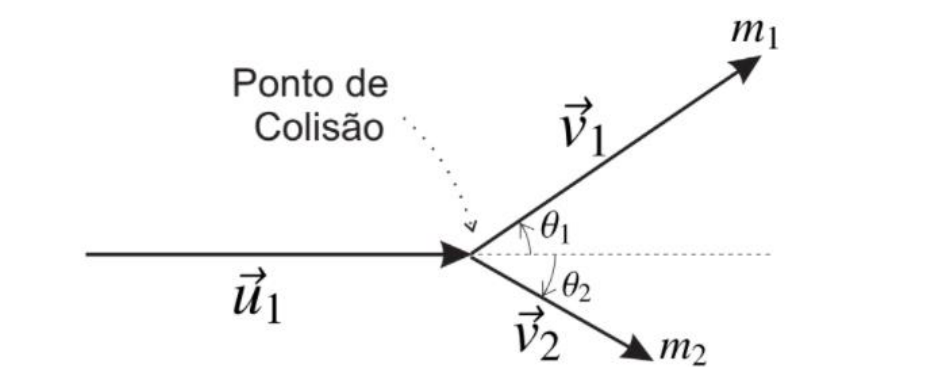 Collisione tra due particelle con angoli di scattering
Topic: Conservation of Momentum, Conservation of Energy, Special Relativity Metodi: Conservation Laws, Lorentz Transformation, Relativistic Energy-Momentum Competenze: Mathematical Modeling, Physical Reasoning, Diagrammatic Reasoning Objects: Nucleus Fonte: Testo (PDF) — p.1
- Collizione elastica tra due particelle
Quando due particelle interagiscono, i loro movimenti sono determinati dalla legge della forza che descrive la loro interazione. Tale interazione può essere locale, come le forze di contatto quando due particelle si incollano, o può essere da un campo, come la forza di Coulomb tra due particelle cariche.
Tuttavia, anche senza conoscere i dettagli di questa interazione, possiamo ancora studiare alcuni aspetti della collisione. Supponendo che l’interazione sia significativa solo quando Le due particelle sono abbastanza vicine, possiamo indagare su cosa succede in giro. distanze dalla regione di collisione. Infine, indipendentemente da quali tipi di se è coinvolta un’interazione, deve essere tale che la dinamica lineare totale del sistema
- è conservato.
Supponiamo anche che non sia creata altra particella, e che la collisione sia elastica, in senso che non vi è alcun cambiamento dello stato interno delle particelle in questo processo, Cioè, la massa del resto di ogni particella è conservata.
Per semplicità, consideriamo che nel laboratorio, dove le cose saranno misurate, una delle particelle è inizialmente in riposo (la chiameremo particella 2). L’altra particella (particole 1) si muove nella sua direzione, fino a quando non si scontrano e alla fine si disperdono.
L’immagine di seguito mostra la situazione e i parametri di base che la descrivono.
La particella 1 ha massa di riposo m_1 e velocità u_1 e si incollida con la particella 2, di massa m_2, cioè stazionario nel quadro del laboratorio (u_2=0). Partenza con velocità v_1 e v_2, formando angoli e con la direzione di u_1. Questo problema è diviso in 2 parti: una in cui risolviamo il problema in modo classico (1.1) e La relazione è stata pubblicata nel corso di una settimana.
1.1 Distribuzione classica
a) dimostrare che, nel contesto classico, la definizione di collisione elastica di cui sopra si traduce in risparmio energetico per il sistema.
b) Non è difficile vedere che questo problema può essere risolto in modo molto più semplice nel centro della struttura di massa. Fare un diagramma (come quello dell’immagine sopra) per la collisione come visto da
- Questa cornice. Mostra come le leggi sulla conservazione sono state utilizzate per realizzare questo diagramma. Se lo trovate
- La Commissione ha deciso di approvare la proposta di risoluzione.
c) Calcolare le velocità e delle particelle prima della collisione, nonché le velocità e dopo la collisione, nel centro della massa.
d) Supponiamo che la particella 1 sia dispersa formando un angolo rispetto alla sua velocità iniziale, nella centro del quadro di riferimento di massa. C’è qualche restrizione per questo angolo? Da quale angolo la particella 2 si disperderà in questo quadro?
e) Relazionare l’angolo con gli angoli di dispersione nel telaio di laboratorio, cioè e . - Dare le vostre risposte solo in termini di , m_1 e m_2.
f) Se la particella 1 è dispersa da un certo angolo , nel quadro del laboratorio, allora quante soluzioni per esistono? Si noti che non c’è bisogno di risolvere l’equazione, basta dire quante soluzioni
- Ci sono.
g) Qual è l’angolo di dispersione più grande possibile per la particella 1 nel quadro del laboratorio, in il caso m_1>m_2? La risposta può dipendere solo dalle masse.
h) Discutere brevemente i limiti m1>>m2 e m1<<m2.
i) Mostra che se m_1=m_2 le particelle saranno sempre disperse in modo tale che .
1.2 Distribuzione relativistica j) Considerare un sistema di particelle di massa di riposo m_i che si muovono arbitrariamente con velocità , con impatto lineare totale , con , e totale energia , per un determinato quadro di riferimento. Mostrare che esiste sempre un il quale la dinamica lineare totale del sistema è zero e il velocità di questo quadro, rispetto al quadro originale, è dato da
Si noti che questo è analogo al centro classico della velocità di massa, ma con le altre masse sostituito da quelli relativistici (cioè, ).
k) Una particella si muove dritta con velocità formazione e angolo con l’asse x di un telaio S. Un secondo osservatore S, che si muove con velocità relativa a S, vede la particella formando un angolo con l’asse x. Mostrami questo.
L) Considerare le domande b), c) e d) della parte 1.1, ma con il centro di massa sostituito da centro del momento. Quali correzioni devono essere apportate alle risposte?
m) Risolvere di nuovo la domanda e) della parte 1.1, per il centro del momento. Non preoccuparti del modulo. La risposta è che tutto ciò che viene inserito in esso dipende solo dalla I parametri forniti nel problema, come le velocità nel quadro del laboratorio e il resto massa (e, naturalmente, l’angolo ).
n) Supponiamo ora che m_1 = m_2. Mostra che l’angolo formato tra i dispersi le particelle, nel quadro del laboratorio, sono sempre inferiori a . Verificare che tende a nel basso limiti di velocità.
O) Ora, supponiamo che una particella sia creata nella collisione. Per esempio, considerate un protone (di massa di riposo M) colpisce un altro protone, in riposo. Dalla collisione emerge questi 2 Protoni e anche un pion, di massa di riposo m. Tale reazione può essere scritta come . Supponiamo che l’interazione elettrica tra i protoni possa essere
- Non sono stata presa in considerazione. Qual è la velocità minima v_0 che il protone incidente deve avere in modo che Questa collisione è possibile?
p) Come definiresti l’efficienza di tale reazione? Con la tua definizione, calcola il l’efficienza del processo di cui sopra. Si noti che questa domanda è aperta, perché è necessario giustifica la tua definizione.
*Collisione tra particelle con angoli di dispersione *
Topic: Conservation of Momentum, Conservation of Energy, Special Relativity Metodi: Conservation Laws, Lorentz Transformation, Relativistic Energy-Momentum Competenze: Mathematical Modeling, Physical Reasoning, Diagrammatic Reasoning Objects: Nucleus Fonte: Testo (PDF) — p.1
- Black Hole Engine
It is possible that two black holes unite to form another bigger black hole, in a process that increases the entropy of the universe. It is also possible that they are utilized as two thermal reservoirs from where it is possible to extract work. In this problem, we will investigate and isentropic process (at constant entropy) where two black holes unite forming another one, in a process where a certain amount of work can be extracted.
2.1 Thermal Reservoir
The entropy function proposed by Bekenstein for a black home is a function that depends on the square of the hole’s mass
where m_p is a basic constant of nature called Planck mass. It can be obtained as a function of only the basic constants (reduced Planck’s constant), c (speed of light in vacuum) and G (Newton’s constant of gravitation), and of no non-dimensional constants.
a) Determine m_p and its numerical value.
Consider a model in which a black hole is situated inside a box filled by electromagnetic radiation. The walls of the box are perfectly reflective, isolating the external world from the internal world, thus conserving the energy inside. Consider that the black hole is in equilibrium with the radiation.
The total energy of the system is
where the first term represents the energy of the black hole and the second one is the energy due to radiation, with V is the volume of the box and T is the temperature of the radiation. In the above equation, k is Boltzmann’s constant.
b) Find the temperature of the black hole and its Schwarzschild radius , express as a function of .
The total entropy of the system can be written as , where S_BN is the entropy of the black hole and S_rad is the entropy of the radiation field. This last one can be written as
c) Write the total entropy of the system radiation field + black hole as a function of its mass M and the total mass of the system , and basic constants.
The equilibrium condition for the existence of the black hole in this system is
d) Determine the equation that relates the mass M with the volume V in the equilibrium condition. What must be the condition on the volume V so that this condition can be satisfied, i.e, the box can be very large (small)?
2.2 Carnot Process
Let us consider the Carnot cycle performed by the system illustrated in the figure below, where the work substance used is radiation. The system is composed of two black holes, one big and one small, immersed in radiation fields cold and hot, respectively. The process consists of 4 stages:
-
The piston is opened in the hot reservoir and moves to increase the volume of the work substance up until .
-
The cylinder is isolated and the radiation expands adiabatically.
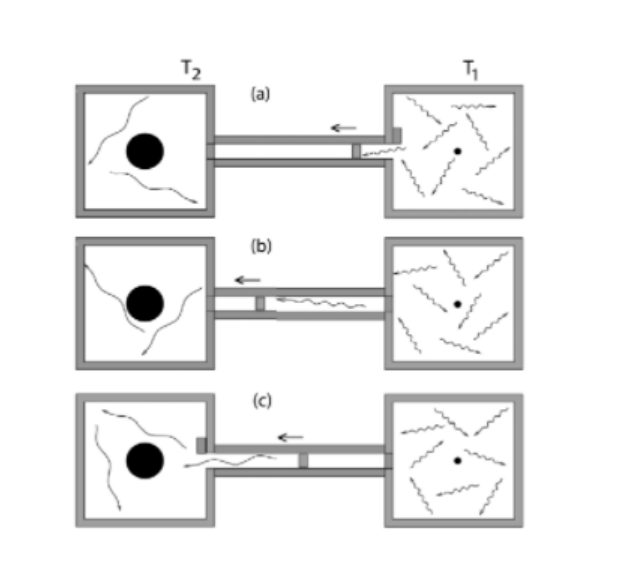 Ciclo di Carnot con due buchi neri e pistone
Topic: Thermodynamics, Astrophysics, Modern-Quantum Physics Metodi: Thermodynamic Cycle Analysis, Dimensional Analysis, Physical Modeling Competenze: Mathematical Modeling, Physical Reasoning, Estimation & Approximation Objects: Black Hole, Piston Fonte: Testo (PDF) — p.4
- Motore a buco nero
È possibile che due buchi neri si uniscano per formare un altro buco nero più grande, in un processo che aumenta l’entropia dell’universo. È anche possibile che siano utilizzati come due riserve da cui è possibile estrarre il lavoro. In questo problema, esamineremo e processo isentropico (a entropia costante) in cui due buchi neri si uniscono formando un altro, in un processo in cui si può estrarre una certa quantità di lavoro.
2.1 Reservatorio termico
La funzione di entropia proposta da Bekenstein per una casa nera è una funzione che dipende da il quadrato della massa del buco
dove m_p è una costante di base della natura chiamata massa di Planck. Può essere ottenuto come funzione di soli le costanti di base (constante di Plancks ridotta), c (velocità della luce nel vuoto) e G (constante di gravitazione di Newton) e di nessuna costante non dimensionale.
a) Determina m_p e il suo valore numerico.
Considerate un modello in cui un buco nero si trova all’interno di una scatola riempita da elettromagnetici
- La radiazione. Le pareti della scatola sono perfettamente riflettenti, isolando il mondo esterno dal il mondo interno, conservando così l’energia all’interno. Considera che il buco nero è in equilibrio con la radiazione.
L’energia totale del sistema è
Il primo termine rappresenta l’energia del buco nero e il secondo è il energia dovuta alla radiazione, con V è il volume della scatola e T è la temperatura della radiazione. Nella equazione di cui sopra, k è la costante di Boltzmann.
b) Trova la temperatura del buco nero e del suo raggio Schwarzschild , espresso in funzione del .
L’entropia totale del sistema può essere scritta come , dove S_BN è l’entropia del buco nero e S_rad è l’entropia del campo di radiazione. Quest’ ultima può essere scritta come
c) Scrivere l’entropia totale del campo di radiazione del sistema + buco nero come funzione della sua massa M e la massa totale del sistema , e costanti di base.
La condizione di equilibrio per l’esistenza del buco nero in questo sistema è
d) Determinare l’equazione che collega la massa M al volume V nell’equilibrio condizione. Qual è la condizione del volume V per poter essere soddisfatto, cioè la scatola può essere molto grande (piccola)?
2.2 Processo di Carnot
Consideriamo il ciclo di Carnot eseguito dal sistema illustrato nella figura seguente, se la sostanza di lavoro utilizzata è la radiazione. Il sistema è composto da due buchi neri, uno grande e uno piccolo, immersi in campi di radiazioni freddi e caldi, rispettivamente. Il processo consiste in 4 fasi:
-
Il pistone viene aperto nel serbatoio caldo e si muove per aumentare il volume del lavoro sostanza fino a .
-
Il cilindro è isolato e la radiazione si espandono adiabaticamente.
Ciclo di Carnot con due buchi e pistone
Topic: Thermodynamics, Astrophysics, Modern-Quantum Physics Metodi: Thermodynamic Cycle Analysis, Dimensional Analysis, Physical Modeling Competenze: Mathematical Modeling, Physical Reasoning, Estimation & Approximation Objects: Black Hole, Piston Fonte: Testo (PDF) — p.4
- The cylinder is opened in the cold reservoir and radiation is exchanged.
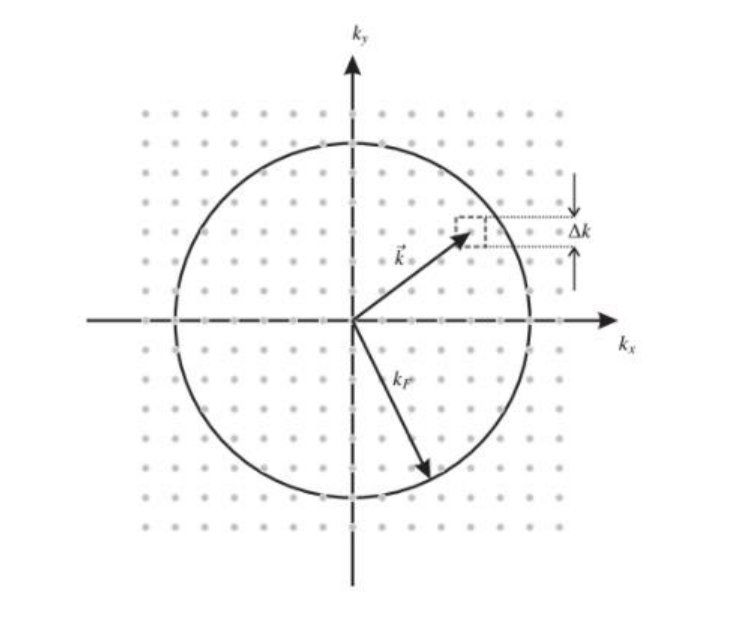 Spazio k 2D con cerchio di Fermi
Topic: Thermodynamics Metodi: Thermodynamic Cycle Analysis Competenze: Physical Reasoning Objects: — Fonte: Testo (PDF) — p.6
- Il cilindro viene aperto nel serbatoio freddo e viene scambiata la radiazione.
*Spazio k 2D con cerchio di Fermi *
Topic: Thermodynamics Metodi: Thermodynamic Cycle Analysis Competenze: Physical Reasoning Objects: — Fonte: Testo (PDF) — p.6
- The piston travels through the empty cylinder back to its initial position.
e) Considering that the cylinder that unites the two boxes has negligible volume and that the thermal radiation pressure is given by
,
draw the graph of the Carnot process performed by the work substance in a PV diagram (pressure X volume) and in an ST diagram (entropy X temperature).
f) Determine the total work performed in each stage of the cycle and the exchanged heat.
g) Find the efficiency of the process. 2.3 Energy Extraction
In the last part only one cycle was considered, where the properties of each reservoir practically don’t change. However, since in each cycle there is a change of energy in each reservoir, their properties change with time.
h) Determine the relationship between the exchanged heat and the loss (or gain) of mass in the processes 1 and 3 of the cycle described in the last part.
i) Determine the relationship between the masses obtained in the last question and the temperatures of each reservoir.
j) Show that the masses M_1 and M_2 of the reservoir are related with their initial masses M_10 and M_20 through the relationship
k) Show that, during the process, the hot reservoir loses mass and becomes hotter while the cold reservoir gains mass and becomes colder, although this is counterintuitive.
l) At the end of the process, when one of the black holes vanishes, what will be the total amount of work extracted from the system?
- White Dwarf
The Pauli Exclusion Principle is responsible for many properties of matter, both those that we are familiar with, such as the toughness of solid materials, and somewhat stranger things, such as the behavior of white dwarfs, that are very dense stars. In this problem you are challenged to obtain some important results in the study of these stars.
Matter in white dwarfs consists basically of electrons and atomic nuclei, that are basically carbon and oxygen. Because of the fact that they are neutral, the amount of protons and electrons is the same. Also, the number of protons and neutrons is also the same, due to the composition of the stars.
In this problem we will investigate the equilibrium of white dwarfs due to both gravitational interaction and statistical repulsion suffered by the fermions (electrons, protons and neutrons) that compose the star.
3.1 Kinetic Energy of the Star In this problem we will consider that the particles that compose the star are non-relativistic.
a) For a given particle of mass m (neutron, proton or electron), write its kinetic energy as a function of its mass, wave number and the necessary physical constants.
Now consider, as the model for the star, an infinite box, i.e. a cubic box of side L from where the particles cannot escape. This model is analogous to a rope tied in its ends.
In this model, each particle can only have discrete values of wave number k. The wave number is said quantized, in the x, y and z directions.
b) Determine the quantization condition of k_x, k_y and k_z in terms of quantum numbers n_x, n_y and n_z for each of the directions. Explain what these numbers mean.
Since the electron is the particle with the smallest mass, it is the particle that contributes the most to the total kinetic energy of the system. Let m_e be the electron mass and m_p the mass of protons and neutrons, considered identical in this problem.
c) Considering that the total mass of the star is M and the mass of the electrons is much larger than that of protons (and neutrons), determine the number of electrons N contained in the star.
d) Determine the smallest difference between the possible values of k_i (i=x, y, z).
It is possible to assign to each electron a cube of edge , calculated in the previous question, in the wave number space. This means that an electron with wave number occupies a cube of sides in the position , as shown in the figure below (the figure shows the particular case of 2 dimensions (2D))
The figure also shows the Fermi’s moment k_F of the system, that is the moment of the highest energy electron. In this figure, the square indicates the region that occupies two electrons, due to the Pauli exclusion principle.
e) Supposing that all the cubes are filled, starting from 0 up until the Fermi’s moment k_F with a max amount of 2 electrons per cube, find the value of the Fermi’s moment k_F of the system in terms of the electron density of the system. Consider that the length L is very large. Consider that only positive values of are allowed.
f) Find the total kinetic energy of the electrons in the system as a function of the Fermi’s moment and the number of electrons in the star.
g) Using the result obtained in the previous question, write the total kinetic energy of the components of the star as a function of its total mass M and radius R. Hint: Use the same result obtained previously, but substitute the volume V by the volume of the star, now considered spherical.
3.2 Potential energy
Now consider that the mass of the star is due entirely to the protons and neutrons. In this case, electrons don’t contribute to the gravitational attraction mechanism that keeps the star alive. h) Find the total gravitational potential energy of the star as a function of its mass M and radius R.
i) Sketch the graph of the total energy of the star as a function of the radius R.
j) Discuss which mechanism (gravity or statistical repulsion) is the most important, in the case where the radius R is small and in the case where it is big.
k) Find the stable equilibrium radius of the star, r_0.
Now, suppose that, somehow, it is possible to slightly compress all the mass of the star and shrink its radius to , with <<1, keeping the density uniform.
l) What will happen with the star? Will it collapse (i.e. the radius R will continuously shrink)? Will the radius vibrate harmonically? With what frequency? Discuss.
Topic: Modern-Quantum Physics, Gravitation, Astrophysics Metodi: Calculus-Integration, Energy Conservation Method, Simple Harmonic Motion Analysis Competenze: Mathematical Modeling, Physical Reasoning, Diagrammatic Reasoning Objects: Black Hole, Piston, Electron, Star Fonte: Testo (PDF) — p.6
- Il pistone si sposta attraverso il cilindro vuoto, tornando alla posizione iniziale.
e) considerando che il cilindro che unisce le due scatole ha un volume trascurabile e che il cilindro è la pressione della radiazione termica è data da
,
disegnare il grafico del processo di Carnot eseguito dalla sostanza di lavoro in un diagramma fotovoltaico (volume di pressione X) e in un diagramma ST (temperatura di entropia X).
f) Determinare il totale dei lavori effettuati in ciascuna fase del ciclo e il calore scambiato.
g) Trovare l’efficienza del processo. 2.3 Estrattione di energia
Nella parte precedente è stato considerato solo un ciclo, in cui le proprietà di ciascun serbatoio sono state
- Non cambiano quasi. Tuttavia, poiché in ogni ciclo vi è un cambiamento di energia in ogni ciclo, il La loro proprietà cambiano col tempo.
h) Determinare il rapporto tra il calore scambiato e la perdita (o il guadagno) di massa in i processi 1 e 3 del ciclo descritto nell’ultima parte.
i) Determinare il rapporto tra le masse ottenute nell’ultima domanda e le masse ottenute nell’ultimo le temperature di ciascun serbatoio.
j) dimostrare che le masse M_1 e M_2 del serbatoio sono correlate alle loro masse iniziali M_10 e M_20 attraverso la relazione
k) Mostra che, durante il processo, il serbatoio caldo perde massa e si calda mentre il serbatoio caldo è caldo. il serbatoio freddo aumenta di massa e diventa più freddo, anche se questo è contrario all’intuizione.
L) Alla fine del processo, quando uno dei buchi neri scompare, quale sarà il totale la quantità di lavoro estratta dal sistema?
- Nani Bianchi
Il principio di esclusione di Pauli è responsabile di molte proprietà della materia, sia quelle che La resistenza dei materiali solidi è un po’ più strana. cose, come il comportamento delle nane bianche, che sono stelle molto dense. In questo problema La ricerca di queste stelle è stata messa alla prova per ottenere risultati importanti.
La materia nelle nane bianche è costituita fondamentalmente da elettroni e nuclei atomici, che sono fondamentalmente carbonio e ossigeno. A causa del fatto che sono neutrali, la quantità di protoni e Gli elettroni sono uguali. Inoltre, il numero di protoni e neutroni è lo stesso, a causa della composizione delle stelle.
In questo problema esamineremo l’equilibrio delle nane bianche a causa di entrambi i due Interazione e respiro statistico dei fermioni (elettroni, protoni e neutroni) che compongono la stella.
3.1 Energia cinetica della stella In questo problema consideriamo che le particelle che compongono la stella sono non relativistiche.
a) Per una determinata particella di massa m (neutron, protone o elettrone), scrivere la sua energia cinetica come funzione della sua massa, numero d’onda e le necessarie costanti fisiche.
Ora, considerate, come modello per la stella, una scatola infinita, cioè una scatola cubica di lato L da dove Le particelle non possono scappare. Questo modello è analogo a una corda legata alle sue estremità.
In questo modello, ogni particella può avere solo valori discreti del numero d’onda k. L’onda Il numero viene detto quantizzato, nelle direzioni x, y e z.
b) Determinare la condizione di quantizzazione di k_x, k_y e k_z in termini di numeri quantistici n_x, n_y e n_z per ciascuna delle direzioni. Spiegate cosa significano questi numeri.
Poiché l’elettrone è la particella con la più piccola massa, è la particella che contribuisce alla la maggior parte dell’energia cinetica totale del sistema. Lasciate m_e essere la massa di elettrone e m_p il la massa dei protoni e dei neutroni, considerati identici in questo problema.
c) Considerando che la massa totale della stella è M e la massa degli elettroni è molto più grande di quello dei protoni (e dei neutroni), determina il numero di elettroni N contenuti in la stella.
d) Determinare la più piccola differenza tra i valori possibili di k_i (i=x, y, z).
È possibile assegnare ad ogni elettrone un cubo di borda , calcolato nel precedente La domanda, nello spazio numero d’onda. Ciò significa che un elettrone con numero d’onda occupa un cubo di lati in posizione , as mostrato nella figura seguente (la figura mostra il caso particolare di dimensioni 2 (2D))
La figura mostra anche il momento di Fermis k_F del sistema, cioè il momento della l’elettrone di energia più alta. In questa figura, il quadrato indica la regione che occupa due elettroni, a causa del Pauli Il principio di esclusione.
e) Supponendo che tutti i cubetti siano riempiti, a partire da 0 fino al momento di Fermi k_F con un massimo di 2 elettroni per cubo, trovare il valore del momento di Fermis k_F del sistema in termini di densità di elettroni del sistema. Considera che la lunghezza L è molto grande. Considerate che solo i valori positivi di
- Sono ammessi.
f) Trova l’energia cinetica totale degli elettroni nel sistema come funzione dei Fermis momento e numero di elettroni nella stella.
g) Con il risultato ottenuto nella domanda precedente, scrivere l’energia cinetica totale della componenti della stella in funzione della sua massa totale M e del suo raggio R. Suggerimento: Usa lo stesso Il risultato ottenuto in precedenza, ma sostituire il volume V con il volume della stella, ora considerato sferico.
3.2 Energia potenziale
Ora consideriamo che la massa della stella è interamente dovuta ai protoni e ai neutroni. In questo In questo caso, gli elettroni non contribuiscono al meccanismo di attrazione gravitazionale che mantiene la stella
- E’ vivo. h) Trova l’energia gravitazionale potenziale totale della stella in funzione della sua massa M e radius R.
i) Segna il grafico dell’energia totale della stella in funzione del raggio R.
j) Discutere quale meccanismo (gravità o respiro statistico) è il più importante, nel campo della nel caso in cui il raggio R è piccolo e nel caso in cui è grande.
k) Trova il raggio di equilibrio stabile della stella, r_0.
Ora, supponiamo che, in qualche modo, sia possibile comprimere leggermente tutta la massa della stella e ridurre il suo raggio di radio a , con <<1, mantenendo la densità uniforme.
L) Cosa succederà alla stella? Collasserà (cioè il raggio R diminuirà continuamente)? Il raggio vibrante’ armonicamente? Con che frequenza? - Discutete.
Topic: Modern-Quantum Physics, Gravitation, Astrophysics Metodi: Calculus-Integration, Energy Conservation Method, Simple Harmonic Motion Analysis Competenze: Mathematical Modeling, Physical Reasoning, Diagrammatic Reasoning Objects: Black Hole, Piston, Electron, Star Fonte: Testo (PDF) — p.6