La resultante, en centímetros, de la suma de los vectores de la figura es igual a
- A. 1
- B. 2
- C. 3
- D. 4
- E. 5
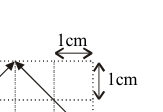 Two 1 cm vectors to be summed
Topic: Newtonian Mechanics Metodi: Vector Decomposition, Superposition Principle Competenze: Diagrammatic Reasoning, Mathematical Modeling Objects: — Fonte: Testo (PDF) — p.2
La risultante, in centimetri, della somma dei vettori della figura è uguale a
- A. 1
- B. 2
- C. 3
- D. 4
- E. 5
Two 1 cm vectors to be summed
Topic: Newtonian Mechanics Metodi: Vector Decomposition, Superposition Principle Competenze: Diagrammatic Reasoning, Mathematical Modeling Objects: — Fonte: Testo (PDF) — p.2
The resulting, in centimetres, of the sum of the vectors in the figure is equal to
- A. 1
- B. 2
- C. 3
- D. 4
- E. 5
Two 1 cm vectors to be summed
Topic: Newtonian Mechanics Metodi: Vector Decomposition, Superposition Principle Competenze: Diagrammatic Reasoning, Mathematical Modeling Objects: — Fonte: Testo (PDF) — p.2
De los siguientes fenómenos:
- La formación del arco iris un día de lluvia.
- La evaporación del agua en los ríos y mares.
- El reflejo de un árbol en la superficie de un lago.
- La erosión de las rocas por la acción del aire y del agua.
- La disolución de azúcar en leche.
- La disolución de sal en agua.
- La combustión de gas en una estufa.
- El encendido de una bombilla.
Son fenómenos químicos
- A. 2, 4, 5, 6 y 7
- B. 1, 3, 4, 5 y 7
- C. 2, 4, 6 y 8
- D. 5, 6 y 7
- E. 3 y 7
Topic: Thermodynamics Metodi: Physical Modeling Competenze: Physical Reasoning Objects: — Fonte: Testo (PDF) — p.2
Di:
- La formazione dell’arcobaleno in una giornata piovosa.
- L’evaporazione dell’acqua nei fiumi e nei mari.
- Il riflesso di un albero sulla superficie di un lago.
- L’erosione delle rocce da aria e acqua.
- La soluzione dello zucchero nel latte.
- La soluzione del sale in acqua.
- Il gas che brucia in una stufa.
- L’accensione di una lampada.
Sono fenomeni chimici
- A. 2, 4, 5, 6 y 7
- B. 1, 3, 4, 5 y 7
- C. 2, 4, 6 y 8
- D. 5, 6 y 7
- E. 3 y 7
Topic: Thermodynamics Metodi: Physical Modeling Competenze: Physical Reasoning Objects: — Fonte: Testo (PDF) — p.2
Of the following phenomena:
- The formation of the rainbow on a rainy day.
- The evaporation of water in rivers and seas.
- The reflection of a tree on the surface of a lake.
- Erosion of rocks by the action of air and water.
- The dissolving of sugar in milk.
- Dissolution of salt in water.
- The combustion of gas in a stove.
- The lighting of a light bulb.
They’re chemical phenomena.
- A. 2, 4, 5, 6 y 7
- B. 1, 3, 4, 5 y 7
- C. 2, 4, 6 y 8
- D. 5, 6 y 7
- E. 3 y 7
Topic: Thermodynamics Metodi: Physical Modeling Competenze: Physical Reasoning Objects: — Fonte: Testo (PDF) — p.2
En una balanza se mantienen en equilibrio un vaso de agua (densidad 1 g/cm³) y una pesa como muestra la figura A. Mediante un hilo sujeto al brazo de la balanza se mantiene sumergida en el agua una esfera de metal de densidad 2 g/cm³ y peso 5 N (figura B).
Para mantener el equilibrio hay que añadir en el otro plato una pesa de
- A. 0
- B. 2,5 N
- C. 5 N
- D. 10 N
- E. 15 N
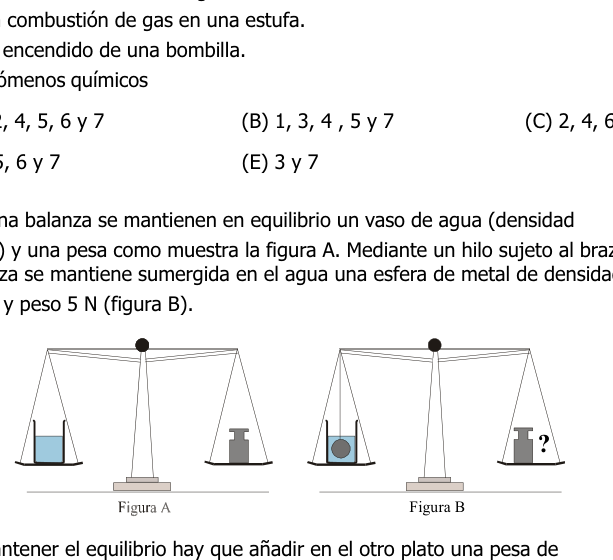 Balance scale with submerged metal sphere
Topic: Fluid Mechanics Metodi: Hydrostatic Equilibrium, Free-Body Diagram Competenze: Physical Reasoning, Diagrammatic Reasoning Objects: Sphere, Container, String Fonte: Testo (PDF) — p.2
In una bilancia si mantenono in equilibrio un bicchiere d’acqua (densità 1 g/cm3) e un pesce come mostra la figura A. Con un filo attaccato al braccio della bilancia è mantenuta immersa in acqua una sfera di metallo di densità 2 g/cm3 e peso 5 N (figura B).
Per mantenere l’equilibrio bisogna aggiungere all’altro piatto un peso di
- A. 0
- B. 2,5 N
- C. 5 N
- D. 10 N
- E. 15 N
Balance scale with submerged metal sphere
Topic: Fluid Mechanics Metodi: Hydrostatic Equilibrium, Free-Body Diagram Competenze: Physical Reasoning, Diagrammatic Reasoning Objects: Sphere, Container, String Fonte: Testo (PDF) — p.2
A glass of water (density 1 g/cm3) and a weighing scale are kept in balance as shown in Figure A. A metal sphere of 2 g/cm3 density and 5 N weight is kept submerged in water by means of a thread attached to the scale arm (Figure B).
To maintain balance, one must add to the other plate a weight of
- A. 0
- B. 2,5 N
- C. 5 N
- D. 10 N
- E. 15 N
Balance scale with submerged metal sphere
Topic: Fluid Mechanics Metodi: Hydrostatic Equilibrium, Free-Body Diagram Competenze: Physical Reasoning, Diagrammatic Reasoning Objects: Sphere, Container, String Fonte: Testo (PDF) — p.2
Se deja caer un cuerpo desde una altura . Despreciando la fricción y tomando como nivel cero de referencia el piso, la gráfica de energía potencial gravitacional del cuerpo () en función de la altura , es la indicada en la figura
- A. Gráfica A
- B. Gráfica B
- C. Gráfica C
- D. Gráfica D
- E. Gráfica E
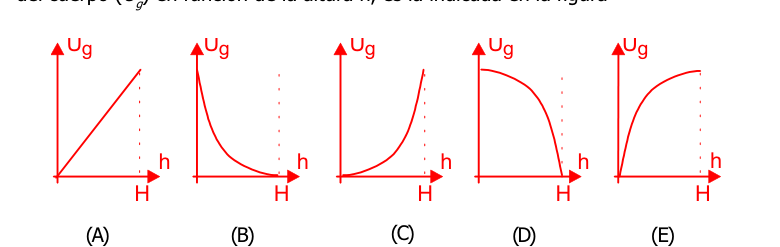 Five candidate vs graphs
Topic: Conservation of Energy Metodi: Energy Conservation Method Competenze: Physical Reasoning, Diagrammatic Reasoning Objects: — Fonte: Testo (PDF) — p.3
Si lascia cadere un corpo da un’altezza . Scommetendo la friczione e prendendo come livello di riferimento zero il pavimento, il grafico di energia potenziale gravitazionale del corpo () in funzione dell’altezza , è quello indicato nella figura
- A. Grafica A
- B. Grafico B
- C. Grafica C
- D. Grafica D
- E. Grafica E
Five candidate vs graphs
Topic: Conservation of Energy Metodi: Energy Conservation Method Competenze: Physical Reasoning, Diagrammatic Reasoning Objects: — Fonte: Testo (PDF) — p.3
A body is dropped from a height . If the friction is negligible and the floor is taken as the reference level, the graph of the gravitational potential energy of the body () based on the height is shown in Figure 1.
- A Graph A
- B. Graph B
- C. Graph C
- D. Graph D
- E. Graph E
Five candidate vs graphs
Topic: Conservation of Energy Metodi: Energy Conservation Method Competenze: Physical Reasoning, Diagrammatic Reasoning Objects: — Fonte: Testo (PDF) — p.3
Un tubo vertical de diámetro 3,14 cm gira alrededor de su eje vertical y tiene en su pared una perforación. Si en dirección perpendicular al eje del tubo ingresa por el orificio un proyectil con velocidad de 10 m/s, la velocidad angular mínima (en rad/s) con que debe girar el tubo para que el proyectil salga al otro lado por el mismo orificio, es
- A. 3,14
- B. 10
- C. 314
- D. 1000
- E. 3140
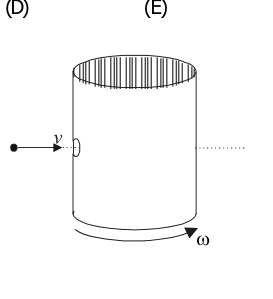 Rotating vertical tube with hole and
Topic: Newtonian Mechanics, Rotational Dynamics Metodi: Kinematic Equations Competenze: Physical Reasoning, Mathematical Modeling Objects: Tube, Projectile Fonte: Testo (PDF) — p.3
Un tubo verticale di 3,14 cm di diametro ruota intorno al suo asse verticale e ha una perforazione sul muro. Se, perpendicolare all’asse del tubo, un proiettile entra attraverso il foro a velocità di 10 m/s, la velocità angolare minima (in rad/s) con cui deve girare il tubo per far salire il proiettile dall’altro lato attraverso il foro stesso è:
- A. 3,14
- B. 10
- C. 314
- D. 1000
- E. 3140
Rotating vertical tube with hole and
Topic: Newtonian Mechanics, Rotational Dynamics Metodi: Kinematic Equations Competenze: Physical Reasoning, Mathematical Modeling Objects: Tube, Projectile Fonte: Testo (PDF) — p.3
A vertical tube with a diameter of 3.14 cm spins around its vertical axis and has a hole in its wall. If a projectile with a velocity of 10 m/s enters the hole in a direction perpendicular to the tube axis, the minimum angular velocity (in rad/s) at which the tube must be rotated for the projectile to exit the other side through the same hole is:
- A. 3,14
- B. 10
- C. 314
- D. 1000
- E. 3140
Rotating vertical tube with hole and
Topic: Newtonian Mechanics, Rotational Dynamics Metodi: Kinematic Equations Competenze: Physical Reasoning, Mathematical Modeling Objects: Tube, Projectile Fonte: Testo (PDF) — p.3
Una nave está ascendiendo verticalmente sobre la superficie del planeta X cuya aceleración gravitacional es de 2 m/s². Cuando se halla a 35 m de altura y tiene una velocidad de 2 m/s se le apagan repentinamente los motores. La rapidez en m/s con la que choca contra el suelo es
- A. 2
- B. 12
- C. 33
- D. 35
- E. 70
Topic: Newtonian Mechanics Metodi: Kinematic Equations, Energy Conservation Method Competenze: Mathematical Modeling, Physical Reasoning Objects: — Fonte: Testo (PDF) — p.3
Una nave sta saliendo verticalmente sulla superficie del pianeta X la cui accelerazione gravitazionale è di 2 m/s2. Quando si trova ad un’altezza di 35 m e ha una velocità di 2 m/s, i motori si spegne improvvisamente. La velocità in m/s con cui colpisce il suolo è
- A. 2
- B. 12
- C. 33
- D. 35
- E. 70
Topic: Newtonian Mechanics Metodi: Kinematic Equations, Energy Conservation Method Competenze: Mathematical Modeling, Physical Reasoning Objects: — Fonte: Testo (PDF) — p.3
A spacecraft is ascending vertically above the surface of planet X whose gravitational acceleration is 2 m/s2. When it’s 35m high and has a speed of 2m/s, its engines suddenly shut down. The speed in m/s at which it hits the ground is
- A. 2
- B. 12
- C. 33
- D. 35
- E. 70
Topic: Newtonian Mechanics Metodi: Kinematic Equations, Energy Conservation Method Competenze: Mathematical Modeling, Physical Reasoning Objects: — Fonte: Testo (PDF) — p.3
Desde el nivel del piso se lanzan simultáneamente dos esferas iguales A y B. A se lanza con velocidad vertical de 5 m/s y B con una velocidad de 10 m/s formando un ángulo de 30° con la horizontal. De las siguientes afirmaciones:
I. Las dos llegan simultáneamente a sus alturas máximas. II. Las dos alcanzan la misma altura máxima. III. B alcanza mayor altura que A. IV. Las dos retornan simultáneamente al piso.
Son correctas:
- A. I, II y IV
- B. I, III y IV
- C. III y IV
- D. sólo la II
- E. sólo la III
Topic: Newtonian Mechanics Metodi: Kinematic Equations, Vector Decomposition Competenze: Physical Reasoning, Mathematical Modeling Objects: Ball, Projectile Fonte: Testo (PDF) — p.3
Dal piano vengono lanciate contemporaneamente due sfere uguali A e B. A viene lanciata a velocità verticale di 5 m/s e B a velocità di 10 m/s formando un angolo di 30° con la orizzontale. Le seguenti affermazioni:
I. Entrambi raggiungono contemporaneamente i loro alti massimi. II. Entrambi raggiungono la stessa altezza massima. III. B raggiunge una altezza superiore a A. IV. Entrambi tornano al pavimento contemporaneamente.
Sono corrette:
- A. I, II y IV
- B. I, III e IV
- C. III e IV
- D. solo la II
- E. solo la III
Topic: Newtonian Mechanics Metodi: Kinematic Equations, Vector Decomposition Competenze: Physical Reasoning, Mathematical Modeling Objects: Ball, Projectile Fonte: Testo (PDF) — p.3
Two equal spheres A and B are thrown simultaneously from the floor level. A is thrown at a vertical speed of 5 m/s and B at a speed of 10 m/s forming an angle of 30° with the horizontal. Of the following statements:
I. Both reach their maximum heights simultaneously. II. Both reach the same maximum altitude. The Commission shall adopt the following: B reaches a higher altitude than A. IV. Both of them return to the floor simultaneously.
They ‘re right .
- A. I, II y IV
- B. I, III and IV
- C. III and IV
- D. only the II
- E. only the III
Topic: Newtonian Mechanics Metodi: Kinematic Equations, Vector Decomposition Competenze: Physical Reasoning, Mathematical Modeling Objects: Ball, Projectile Fonte: Testo (PDF) — p.3
La gráfica muestra el valor de la velocidad en función del tiempo para un cuerpo que se desplaza en trayectoria rectilínea. El intervalo durante el cual el cuerpo recorrió mayor distancia está localizado entre
- A. 0 y 1 s
- B. 1 y 2 s
- C. 2 y 3 s
- D. 3 y 4 s
- E. 4 y 5 s
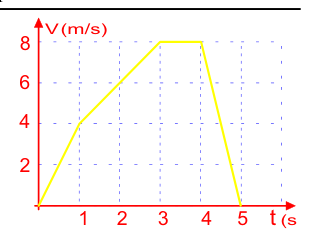 (m/s) vs (s) graph, 0–5 s
Topic: Newtonian Mechanics Metodi: Kinematic Equations Competenze: Diagrammatic Reasoning, Physical Reasoning Objects: — Fonte: Testo (PDF) — p.4
Il grafico mostra il valore della velocità in funzione del tempo per un corpo che si sposta in traccia rettilinea. L’intervallo in cui il corpo ha percorso più distanza è situato tra
- A. 0 y 1 s
- B. 1 y 2 s
- C. 2 y 3 s
- D. 3 y 4 s
- E. 4 y 5 s
(m/s) vs (s) grafico, 05 s
Topic: Newtonian Mechanics Metodi: Kinematic Equations Competenze: Diagrammatic Reasoning, Physical Reasoning Objects: — Fonte: Testo (PDF) — p.4
The graph shows the value of velocity as a function of time for a body moving in a straight path. The interval during which the body traveled the longest distance is located between
- A. 0 y 1 s
- B. 1 y 2 s
- C. 2 y 3 s
- D. 3 y 4 s
- E. 4 y 5 s
(m/s) vs (s) graph, 0–5 s
Topic: Newtonian Mechanics Metodi: Kinematic Equations Competenze: Diagrammatic Reasoning, Physical Reasoning Objects: — Fonte: Testo (PDF) — p.4
Se lanza una piedra verticalmente hacia arriba la cual después de alcanzar su altura máxima regresa al piso. Acerca de su aceleración durante el movimiento, una vez que queda libre, es correcto afirmar que
- A. es cero al momento de lanzarla y máxima en su máxima altura.
- B. es máxima al momento de lanzarla y disminuye mientras asciende.
- C. sólo toma el valor cero en la altura máxima.
- D. al llegar a la altura máxima cambia de dirección.
- E. es constante durante todo el movimiento.
Topic: Newtonian Mechanics Metodi: Kinematic Equations, Free-Body Diagram Competenze: Physical Reasoning Objects: — Fonte: Testo (PDF) — p.4
Si lancia una pietra verticalmente verso l’alto che dopo aver raggiunto la sua altezza massima torna al pavimento. In merito alla sua accelerazione durante il movimento, una volta che è libero, è corretto affermare che
- A. è zero al momento del lancio e massima a massima altezza.
- B. è massimo al momento di lanciarlo e diminuisce mentre sale.
- C. prende solo il valore zero all’altezza massima.
- D. al raggiungimento dell’altezza massima cambia direzione.
- E. è costante durante tutto il movimento.
Topic: Newtonian Mechanics Metodi: Kinematic Equations, Free-Body Diagram Competenze: Physical Reasoning Objects: — Fonte: Testo (PDF) — p.4
A stone is thrown vertically upwards which, after reaching its maximum height, returns to the floor. As to its acceleration during movement, once it is free, it is correct to state that
- A. is zero at launch and maximum at maximum height.
- B. is maximum at launch and decreases as it ascends.
- C. takes the zero value only at the maximum height.
- D. on reaching the maximum height changes direction.
- E. is constant throughout the movement.
Topic: Newtonian Mechanics Metodi: Kinematic Equations, Free-Body Diagram Competenze: Physical Reasoning Objects: — Fonte: Testo (PDF) — p.4
Una esfera de peso 10 N cuelga del techo mediante un hilo ligero y se mantiene separada de la vertical halándola con una fuerza de 3 N como indica la figura. Se puede afirmar que
- A.
- B.
- C.
- D.
- E.
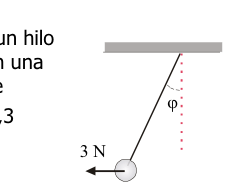 Sphere hanging from ceiling, pulled by 3 N
Topic: Newtonian Mechanics, Rigid Body Statics Metodi: Free-Body Diagram, Vector Decomposition Competenze: Diagrammatic Reasoning, Mathematical Modeling Objects: Sphere, String Fonte: Testo (PDF) — p.4
Una sfera di peso 10 N si appende al tetto con un filo leggero e si mantiene separata dalla verticale trovandola con una forza di 3 N come indicato nella figura. Si può affermare che
- A.
- B.
- C.
- D.
- E.
Sphere hanging from ceiling, pulled by 3 N
Topic: Newtonian Mechanics, Rigid Body Statics Metodi: Free-Body Diagram, Vector Decomposition Competenze: Diagrammatic Reasoning, Mathematical Modeling Objects: Sphere, String Fonte: Testo (PDF) — p.4
A sphere weighing 10 N hangs from the ceiling by a light thread and is kept separate from the vertical by a force of 3 N as shown in the figure. It can be said that
- A.
- B.
- C.
- D.
- E.
Sphere hanging from ceiling, pulled by 3 N
Topic: Newtonian Mechanics, Rigid Body Statics Metodi: Free-Body Diagram, Vector Decomposition Competenze: Diagrammatic Reasoning, Mathematical Modeling Objects: Sphere, String Fonte: Testo (PDF) — p.4
Una esfera maciza de 5 cm de diámetro flota en el agua sumergida hasta su plano ecuatorial. Su densidad en kg/m³ es igual a
- A.
- B. 2
- C. 5
- D. 500
- E. 1000
Topic: Fluid Mechanics Metodi: Hydrostatic Equilibrium Competenze: Physical Reasoning, Mathematical Modeling Objects: Sphere Fonte: Testo (PDF) — p.4
Una sfera massiccia di 5 cm di diametro galleggia nell’acqua immersa fino al suo piano equatoriale. La densità in kg/m3 è pari a
- A.
- B. 2
- C. 5
- D. 500
- E. 1000
Topic: Fluid Mechanics Metodi: Hydrostatic Equilibrium Competenze: Physical Reasoning, Mathematical Modeling Objects: Sphere Fonte: Testo (PDF) — p.4
A massive sphere 5 cm in diameter floats in the submerged water to its equatorial plane. Its density in kg/m3 is equal to
- A.
- B. 2
- C. 5
- D. 500
- E. 1000
Topic: Fluid Mechanics Metodi: Hydrostatic Equilibrium Competenze: Physical Reasoning, Mathematical Modeling Objects: Sphere Fonte: Testo (PDF) — p.4
Un dispositivo mide la gravedad mediante el disparo de cuerpos bajo las mismas condiciones iniciales. Al realizar el disparo en la Tierra la altura máxima alcanzada por el cuerpo es de 20 m. El dispositivo se lleva a otro planeta donde se realiza el experimento en condiciones idénticas. En este caso la altura alcanzada resulta ser de 4 m. La aceleración de la gravedad del planeta en m/s² es:
- A. 10
- B. 20
- C. 30
- D. 40
- E. 50
Topic: Newtonian Mechanics, Gravitation Metodi: Kinematic Equations Competenze: Physical Reasoning, Mathematical Modeling Objects: — Fonte: Testo (PDF) — p.4
Un dispositivo misura la gravità sparando corpi nelle stesse condizioni iniziali. Quando si fa il fuoco sulla Terra l’altezza massima raggiunta dal corpo è di 20 m. Il dispositivo viene portato su un altro pianeta dove l’esperimento viene eseguito in condizioni identiche. In questo caso l’altezza raggiunta è di 4 m. L’accelerazione della gravità del pianeta in m/s2 è:
- A. 10
- B. 20
- C. 30
- D. 40
- E. 50
Topic: Newtonian Mechanics, Gravitation Metodi: Kinematic Equations Competenze: Physical Reasoning, Mathematical Modeling Objects: — Fonte: Testo (PDF) — p.4
A device measures gravity by shooting bodies under the same initial conditions. When firing at Earth, the maximum height the body can reach is 20 m. The device is taken to another planet where the experiment is conducted under identical conditions. In this case the height reached is 4 m. The acceleration of the planet’s gravity in m/s2 is:
- A. 10
- B. 20
- C. 30
- D. 40
- E. 50
Topic: Newtonian Mechanics, Gravitation Metodi: Kinematic Equations Competenze: Physical Reasoning, Mathematical Modeling Objects: — Fonte: Testo (PDF) — p.4
Un cuerpo desciende por una pista sin fricción partiendo del reposo como muestra la figura. Terminado el descenso continúa moviéndose sobre el piso horizontal con fricción (coeficiente de fricción entre el cuerpo y el piso ). La distancia , en metros, a la que se detiene el cuerpo es
- A. 5
- B. 10
- C. 15
- D. 20
- E. 50
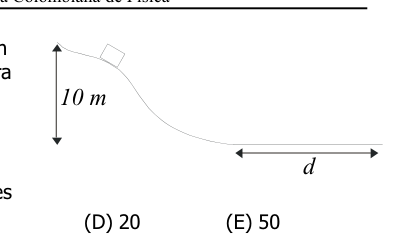 Frictionless ramp (10 m) followed by floor with friction
Topic: Conservation of Energy, Newtonian Mechanics Metodi: Energy Conservation Method, Free-Body Diagram Competenze: Physical Reasoning, Mathematical Modeling Objects: Inclined Plane, Block Fonte: Testo (PDF) — p.5
Un corpo scende su una pista senza attrito partendo dal riposo come mostra la figura. Dopo aver terminato la discesa continua a muoversi sul pavimento orizzontale con frizione (coefficiente di frizione tra corpo e pavimento ). La distanza , in metri, alla quale si ferma il corpo è
- A. 5
- B. 10
- C. 15
- D. 20
- E. 50
Ramp senza friczione (10 m) seguito da floor with friction
Topic: Conservation of Energy, Newtonian Mechanics Metodi: Energy Conservation Method, Free-Body Diagram Competenze: Physical Reasoning, Mathematical Modeling Objects: Inclined Plane, Block Fonte: Testo (PDF) — p.5
A body descends a frictionless track starting from rest as shown in the figure. After the descent is completed, the horizontal floor continues to move with friction (body-floor friction coefficient ). The distance , in metres, at which the body stops is
- A. 5
- B. 10
- C. 15
- D. 20
- E. 50
Frictionless ramp (10 m) followed by floor with friction
Topic: Conservation of Energy, Newtonian Mechanics Metodi: Energy Conservation Method, Free-Body Diagram Competenze: Physical Reasoning, Mathematical Modeling Objects: Inclined Plane, Block Fonte: Testo (PDF) — p.5
Un cuerpo de masa explota fragmentándose en 3 partes iguales como ilustra la figura. Si todos los fragmentos salen con la misma rapidez, el valor del ángulo es
- A. 30°
- B. 45°
- C. 60°
- D. 90°
- E. 120°
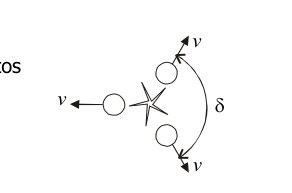 Mass splits into 3 equal fragments with speed
Topic: Conservation of Momentum Metodi: Conservation of Momentum, Vector Decomposition Competenze: Physical Reasoning, Mathematical Modeling Objects: — Fonte: Testo (PDF) — p.5
Un corpo di massa esplode fragmentandosi in 3 parti uguali come illustrato nella figura. Se tutti i frammenti uscivano alla stessa velocità, il valore dell’angolo è
- A. 30°
- B. 45°
- C. 60°
- D. 90°
- E. 120°
Mass splits into 3 equal fragments with speed
Topic: Conservation of Momentum Metodi: Conservation of Momentum, Vector Decomposition Competenze: Physical Reasoning, Mathematical Modeling Objects: — Fonte: Testo (PDF) — p.5
A mass body explodes fragmenting into 3 equal parts as illustrated in the figure. If all the fragments are coming out at the same speed, the angle value is
- A. 30°
- B. 45°
- C. 60°
- D. 90°
- E. 120°
Mass splits into 3 equal fragments with speed
Topic: Conservation of Momentum Metodi: Conservation of Momentum, Vector Decomposition Competenze: Physical Reasoning, Mathematical Modeling Objects: — Fonte: Testo (PDF) — p.5
Un cuerpo de 1 kg que parte del reposo se mueve por zonas donde actúan fuerzas horizontalmente. La magnitud de la fuerza en las zonas A es de 1 newton y en las zonas B no hay fuerzas. El valor de su velocidad en m/s, al salir de la tercera zona A es:
- A.
- B.
- C.
- D.
- E.
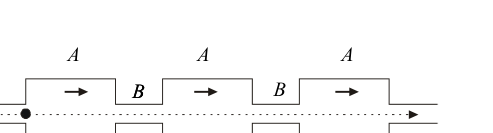 Alternating force zones A and no-force zones B
Topic: Newtonian Mechanics, Conservation of Energy Metodi: Kinematic Equations, Energy Conservation Method Competenze: Physical Reasoning, Diagrammatic Reasoning Objects: Block Fonte: Testo (PDF) — p.5
Un corpo di 1 kg che parte dal riposo si muove in zone dove le forze agiscono orizzontalmente. La forza in zone A è di 1 Newton e nelle zone B non ci sono forze. Il valore della sua velocità in m/s, quando esce dalla terza zona A è:
- A.
- B.
- C.
- D.
- E.
Alternating force zones A and no-force zones B
Topic: Newtonian Mechanics, Conservation of Energy Metodi: Kinematic Equations, Energy Conservation Method Competenze: Physical Reasoning, Diagrammatic Reasoning Objects: Block Fonte: Testo (PDF) — p.5
A 1 kg body that rests moves through areas where forces act horizontally. The magnitude of the force in zones A is 1 newton and in zones B there are no forces. The value of its speed in m/s, when leaving third zone A is:
- A.
- B.
- C.
- D.
- E.
The following shall be added to the list of alternating force zones:
Topic: Newtonian Mechanics, Conservation of Energy Metodi: Kinematic Equations, Energy Conservation Method Competenze: Physical Reasoning, Diagrammatic Reasoning Objects: Block Fonte: Testo (PDF) — p.5
La densidad del aire a presión de 1 atm y temperatura de 20 °C es 1,2 kg/m³. La masa del aire contenida en una habitación cuyo piso tiene forma rectangular: 4,0 m de ancho × 5,0 m de largo y altura de 3,0 m es:
- A. 60 kg
- B. 68 kg
- C. 72 kg
- D. 74 kg
- E. 120 kg
Topic: Fluid Mechanics Metodi: Physical Modeling Competenze: Physical Reasoning, Estimation & Approximation Objects: Gas Fonte: Testo (PDF) — p.5
La densità dell’aria sotto pressione di 1 atm e la temperatura di 20 °C è di 1,2 kg/m3. La massa dell’aria contenuta in una stanza il cui pavimento è rettangolare: 4,0 m di larghezza × 5,0 m di lunghezza e 3,0 m di altezza è:
- A. 60 kg
- B. 68 kg
- C. 72 kg
- D. 74 kg
- E. 120 kg
Topic: Fluid Mechanics Metodi: Physical Modeling Competenze: Physical Reasoning, Estimation & Approximation Objects: Gas Fonte: Testo (PDF) — p.5
The density of air under pressure of 1 atm and temperature of 20 °C is 1,2 kg/m3. The air mass contained in a room whose floor is rectangular: 4,0 m wide × 5,0 m long and 3,0 m high is:
- A. 60 kg
- B. 68 kg
- C. 72 kg
- D. 74 kg
- E. 120 kg
Topic: Fluid Mechanics Metodi: Physical Modeling Competenze: Physical Reasoning, Estimation & Approximation Objects: Gas Fonte: Testo (PDF) — p.5
Un auto de tracción delantera viaja con rapidez constante a lo largo de una carretera rectilínea. Las fuerzas que actúan sobre el auto se muestran en el diagrama. es la fuerza de fricción neta sobre el auto (proveniente del viento y el pavimento), es la fuerza total hacia arriba que ejerce el piso sobre las dos llantas traseras. La fuerza de rozamiento y la masa del auto son respectivamente
- A. 6000 N y 1000 kg
- B. 400 N y 1000 kg
- C. 400 N y 600 kg
- D. 10000 N y 640 kg
- E. 6400 N y 1000 kg
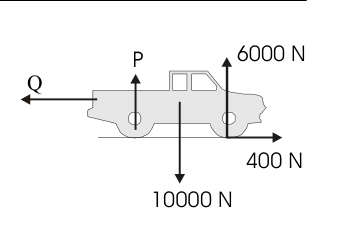 Front-wheel-drive car force diagram with , , weights
Topic: Newtonian Mechanics, Rigid Body Statics Metodi: Free-Body Diagram, Torque & Angular Momentum Analysis Competenze: Diagrammatic Reasoning, Mathematical Modeling Objects: — Fonte: Testo (PDF) — p.6
Una macchina a trazione anteriore viaggia a velocità costante lungo una strada rettilinea. Le forze che agiscono sull’auto sono mostrate nel diagramma. è la forza di attrito netta sull’auto (proveniente dal vento e dal pavimento), è la forza totale verso l’alto che esercita il pavimento sulle due ruote posteriori. La forza di rottura e la massa dell’auto sono rispettivamente
- A. 6000 N y 1000 kg
- B. 400 N y 1000 kg
- C. 400 N y 600 kg
- D. 10000 N y 640 kg
- E. 6400 N y 1000 kg
Front-wheel-drive car force diagram with , , weights
Topic: Newtonian Mechanics, Rigid Body Statics Metodi: Free-Body Diagram, Torque & Angular Momentum Analysis Competenze: Diagrammatic Reasoning, Mathematical Modeling Objects: — Fonte: Testo (PDF) — p.6
A front-wheel drive car travels at a constant speed along a straight road. The forces acting on the car are shown in the diagram. is the net friction force on the car (from wind and pavement), is the total upward force exerted by the floor on the two rear tires. The friction force and the mass of the vehicle are respectively
- A. 6000 N y 1000 kg
- B. 400 N y 1000 kg
- C. 400 N y 600 kg
- D. 10000 N y 640 kg
- E. 6400 N y 1000 kg
Front-wheel-drive car force diagram with , , weights
Topic: Newtonian Mechanics, Rigid Body Statics Metodi: Free-Body Diagram, Torque & Angular Momentum Analysis Competenze: Diagrammatic Reasoning, Mathematical Modeling Objects: — Fonte: Testo (PDF) — p.6
Un niño hala del extremo A y un adulto del extremo B de dos dinamómetros. Entre mayores sean las fuerzas con que se halen, mayores serán los estiramientos de los resortes y por tanto mayores las lecturas de los dinamómetros. De las siguientes afirmaciones la correcta es:
- A. Si niño y adulto halan simultáneamente entonces la lectura del dinamómetro izquierdo es menor que la del derecho pues el adulto ejerce mayor fuerza.
- B. Si el adulto mantiene fija su mano y el niño hala entonces la lectura del dinamómetro izquierdo es mayor que la del derecho pues el adulto no ejerce fuerza.
- C. Si el niño mantiene fija su mano y el adulto hala entonces la lectura del dinamómetro derecho es mayor que la del izquierdo pues el niño no ejerce fuerza.
- D. En toda situación los dos dinamómetros marcan lo mismo simultáneamente.
- E. No se puede afirmar nada hasta no conocer ningún dato numérico.
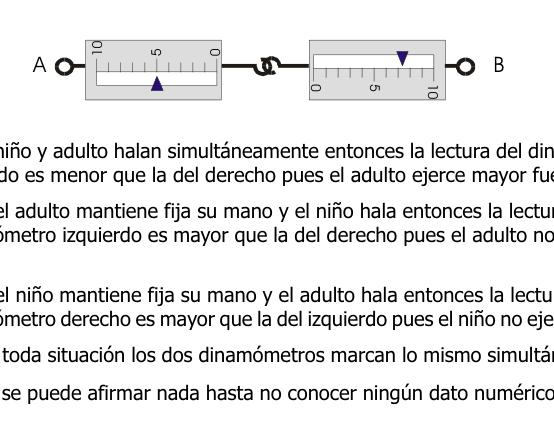 Two spring dynamometers pulled from ends A and B
Topic: Newtonian Mechanics Metodi: Free-Body Diagram Competenze: Physical Reasoning, Diagrammatic Reasoning Objects: Spring Fonte: Testo (PDF) — p.6
Un bambino fa il tiro dalla punta A e un adulto dalla punta B di due dinamometri. Più le forze con cui si tirano, più le estensioni delle sorgenti saranno maggiori e quindi maggiori le letture dei dinamometri. Tra le seguenti affermazioni, la corretta è:
- A. Se un bambino e un adulto parlano contemporaneamente, la lettura del dinamometro sinistro è inferiore a quella del dinamometro destro perché l’adulto esercita maggiore forza.
- B. Se l’adulto tiene ferma la mano e il bambino tira allora la lettura del dinamometro sinistro è maggiore di quella della destra perché l’adulto non esercita forza.
- C. Se il bambino tiene ferma la mano e l’adulto tira allora la lettura del dinamometro destro è maggiore di quella della sinistra perché il bambino non esercita forza.
- D. In ogni situazione i due dinamometri segnano la stessa cosa contemporaneamente.
- E. Non si può affermare nulla finché non si conoscono dati numerici.
Two spring dynamometers pulled from ends A and B
Topic: Newtonian Mechanics Metodi: Free-Body Diagram Competenze: Physical Reasoning, Diagrammatic Reasoning Objects: Spring Fonte: Testo (PDF) — p.6
A child is shooting at the A end and an adult at the B end with two dynamometers. The greater the forces with which they are held, the greater the stretches of the springs and therefore the greater the readings of the dynamometers. Of the following statements, the correct one is:
- A. If a child and an adult speak simultaneously then the reading of the left dynamometer is less than that of the right because the adult exerts more force.
- B. If the adult holds his hand fixed and the child is pulling then the reading of the left dynamometer is greater than that of the right because the adult does not exert force.
- C. If the child holds his hand fixed and the adult pulls then the reading of the right dynamometer is greater than that of the left because the child does not exert force.
- D. In all situations the two dynamometers mark the same at the same time.
- E. Nothing can be asserted until no numerical data is known.
Two spring dynamometers pulled from ends A and B
Topic: Newtonian Mechanics Metodi: Free-Body Diagram Competenze: Physical Reasoning, Diagrammatic Reasoning Objects: Spring Fonte: Testo (PDF) — p.6
La ley de gravitación universal de Newton dice que las fuerzas de atracción entre dos cuerpos son proporcionales al producto de sus masas e inversamente proporcionales al cuadrado de la distancia que los separa. Dos meteoritos iguales A y B se hallan en el espacio lejano separados una distancia de 1 km y se atraen con fuerzas iguales . Si de la masa de A se depositan sobre el meteorito B y la distancia de separación se conserva, la nueva fuerza gravitacional entre ellos vale
- A.
- B.
- C.
- D.
- E. no cambia.
Topic: Gravitation Metodi: Newton’s Law of Gravitation Competenze: Mathematical Modeling, Physical Reasoning Objects: — Fonte: Testo (PDF) — p.7
La legge di Newton sulla gravità universale dice che le forze di attrazione tra due corpi sono proporzionali al prodotto delle loro masse e inversivamente proporzionali al quadrato della distanza che li separa. Due meteorici uguali A e B si trovano nello spazio lontano separati a una distanza di 1 km e si attraggono con uguali forze . Se di massa di A si depositano sul meteorito B e la distanza di separazione viene conservata, la nuova forza gravitazionale tra di loro vale
- A.
- B.
- C.
- D.
- E. non cambia.
Topic: Gravitation Metodi: Newton’s Law of Gravitation Competenze: Mathematical Modeling, Physical Reasoning Objects: — Fonte: Testo (PDF) — p.7
Newton’s law of universal gravitation states that the forces of attraction between two bodies are proportional to the product of their masses and inversely proportional to the square of the distance between them. Two equal meteorites A and B are in distant space separated by a distance of 1 km and attract each other with equal forces . If of the mass of A are deposited on meteorite B and the distance of separation is maintained, the new gravitational force between them is
- A.
- B.
- C.
- D.
- E. does not change.
Topic: Gravitation Metodi: Newton’s Law of Gravitation Competenze: Mathematical Modeling, Physical Reasoning Objects: — Fonte: Testo (PDF) — p.7
Se atan 2001 esferitas de masa un gramo y se suspenden como muestra la figura. La separación entre las esferitas es de un centímetro. La energía potencial del sistema medida desde el punto O, en Julios es:
- A. 20
- B. 20,1
- C. 200,1
- D. 2001
- E. 2000,1
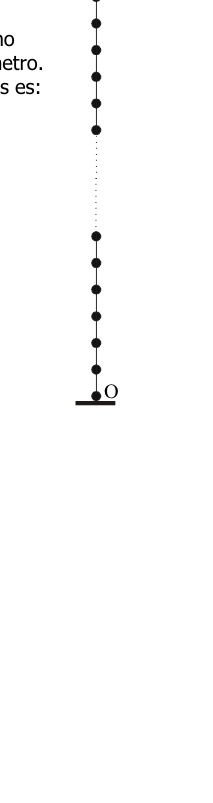 2001 small spheres suspended in a chain, reference point O
Topic: Gravitation, Conservation of Energy Metodi: Energy Conservation Method, Calculus-Integration Competenze: Mathematical Modeling, Physical Reasoning Objects: Sphere, String Fonte: Testo (PDF) — p.7
2001 si attaccano sfere di massa di un grammo e si sospendono come mostra la figura. La separazione tra le sfere è di un centimetro. L’energia potenziale del sistema misurata dal punto O, in Giulio è:
- A. 20
- B. 20,1
- C. 200,1
- D. 2001
- E. 2000,1
2001 small spheres suspended in a chain, reference point O*
Topic: Gravitation, Conservation of Energy Metodi: Energy Conservation Method, Calculus-Integration Competenze: Mathematical Modeling, Physical Reasoning Objects: Sphere, String Fonte: Testo (PDF) — p.7
2001 spheres of mass of one gram are bound and suspended as shown in the figure. The spheres are about a centimeter apart. The potential energy of the system measured from the point O, in July is:
- A. 20
- B. 20,1
- C. 200,1
- D. 2001
- E. 2000,1
2001 small spheres suspended in a chain, reference point O
Topic: Gravitation, Conservation of Energy Metodi: Energy Conservation Method, Calculus-Integration Competenze: Mathematical Modeling, Physical Reasoning Objects: Sphere, String Fonte: Testo (PDF) — p.7