Tomando el lado de una cuadrícula como unidad la suma de los vectores de la figura tiene un valor igual a:
- A. 0
- B. 2
- C. 10
- D.
- E. 20
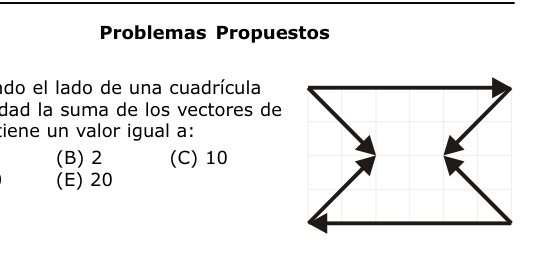 Grid with vectors to be summed
Topic: Newtonian Mechanics Metodi: Vector Decomposition, Superposition Principle Competenze: Diagrammatic Reasoning, Mathematical Modeling Objects: — Fonte: Testo (PDF) — p.2
Prendendo il lato di una rete come unità la somma dei vettori della figura ha un valore pari a:
- A. 0
- B. 2
- C. 10
- D.
- E. 20
Grid with vectors to be summed
Topic: Newtonian Mechanics Metodi: Vector Decomposition, Superposition Principle Competenze: Diagrammatic Reasoning, Mathematical Modeling Objects: — Fonte: Testo (PDF) — p.2
Taking the side of a grid as a unit the sum of the vectors in the figure has a value equal to:
- A. 0
- B. 2
- C. 10
- D.
- E. 20
Grid with vectors to be summed
Topic: Newtonian Mechanics Metodi: Vector Decomposition, Superposition Principle Competenze: Diagrammatic Reasoning, Mathematical Modeling Objects: — Fonte: Testo (PDF) — p.2
De las siguientes cantidades físicas:
- MASA
- FRECUENCIA ANGULAR
- ENERGÍA CINÉTICA
- TEMPERATURA
aquellas en cuya definición no interviene el TIEMPO, son:
- A. 1 y 2
- B. 2 y 3
- C. 3 y 4
- D. 1 y 4
- E. 2 y 4
Topic: Newtonian Mechanics Metodi: Dimensional Analysis Competenze: Physical Reasoning Objects: — Fonte: Testo (PDF) — p.2
di:
- MaSA
- Frequenza angolare
- Energia cinetica
- Temperatura
le quali non sono definite dal TEMPO sono:
- A. 1 y 2
- B. 2 y 3
- C. 3 y 4
- D. 1 y 4
- E. 2 y 4
Topic: Newtonian Mechanics Metodi: Dimensional Analysis Competenze: Physical Reasoning Objects: — Fonte: Testo (PDF) — p.2
Of the following physical quantities:
- The Commission shall adopt implementing acts.
- Angular frequency
- The Commission shall adopt delegated acts in accordance with Article 21 of this Regulation.
- The temperature
those for which the definition is not included in TIME are:
- A. 1 y 2
- B. 2 y 3
- C. 3 y 4
- D. 1 y 4
- E. 2 y 4
Topic: Newtonian Mechanics Metodi: Dimensional Analysis Competenze: Physical Reasoning Objects: — Fonte: Testo (PDF) — p.2
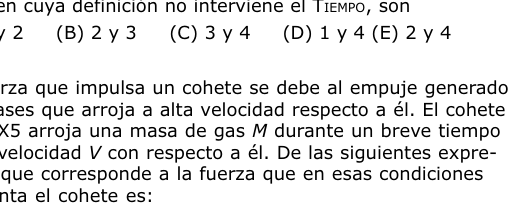
La fuerza que impulsa un cohete se debe al empuje generado por los gases que arroja a alta velocidad respecto a él. El cohete Neptuno X5 arroja una masa de gas durante un breve tiempo a una velocidad con respecto a él. De las siguientes expresiones la que corresponde a la fuerza que en esas condiciones experimenta el cohete es:
- A.
- B.
- C.
- D.
- E.
Topic: Newtonian Mechanics, Conservation of Momentum Metodi: Conservation of Momentum, Impulse-Momentum Theorem Competenze: Physical Reasoning, Mathematical Modeling Objects: Gas Fonte: Testo (PDF) — p.2
La forza che spinge un razzo è dovuta alla spinta generata dai gas che lancia ad alta velocità rispetto a esso. Il razzo Neptune X5 lancia una massa di gas per un breve tempo a una velocità rispetto a esso. Tra le seguenti espressioni, quella che corrisponde alla forza che il razzo sperimenta in queste condizioni è:
- A.
- B.
- C.
- D.
- E.
Topic: Newtonian Mechanics, Conservation of Momentum Metodi: Conservation of Momentum, Impulse-Momentum Theorem Competenze: Physical Reasoning, Mathematical Modeling Objects: Gas Fonte: Testo (PDF) — p.2
The force that drives a rocket is due to the thrust generated by the gases it throws at high speed relative to it. The Neptune X5 rocket throws a mass of gas for a short time at a speed with respect to it. Of the following expressions, the force exerted by the rocket under these conditions is:
- A.
- B.
- C.
- D.
- E.
Topic: Newtonian Mechanics, Conservation of Momentum Metodi: Conservation of Momentum, Impulse-Momentum Theorem Competenze: Physical Reasoning, Mathematical Modeling Objects: Gas Fonte: Testo (PDF) — p.2
Un auto que parte del reposo se mueve en línea recta con aceleración constante de valor . Si durante el primer segundo recorre una distancia igual a , la distancia total que recorre durante los dos primeros segundos será igual a:
- A.
- B.
- C.
- D.
- E.
 Car starting from rest, distances and
Topic: Newtonian Mechanics Metodi: Kinematic Equations Competenze: Mathematical Modeling, Physical Reasoning Objects: — Fonte: Testo (PDF) — p.2
Una macchina che parte dal riposo si muove in linea retta con un’accelerazione costante di valore . Se durante il primo secondo si percorre una distanza pari a , la distanza totale percorsa durante i primi due secondi sarà pari a:
- A.
- B.
- C.
- D.
- E.
Car starting from rest, distances and
Topic: Newtonian Mechanics Metodi: Kinematic Equations Competenze: Mathematical Modeling, Physical Reasoning Objects: — Fonte: Testo (PDF) — p.2
A car that starts at rest moves in a straight line with constant acceleration of . If during the first second it travels a distance equal to , the total distance travelled during the first two seconds shall be equal to:
- A.
- B.
- C.
- D.
- E.
Car starting from rest, distances and
Topic: Newtonian Mechanics Metodi: Kinematic Equations Competenze: Mathematical Modeling, Physical Reasoning Objects: — Fonte: Testo (PDF) — p.2
Cuatro esferas homogéneas cuyas masas están indicadas en la figura, están colocadas a lo largo de una línea recta y separadas entre sí por distancias de 1 metro. El centro de masa de las cuatro esferas está localizado:
- A. en el centro de la esfera 1.
- B. en el centro de la esfera 2.
- C. entre la esfera 2 y la esfera 3.
- D. en el centro de la esfera 3.
- E. entre la esfera 3 y la esfera 4.
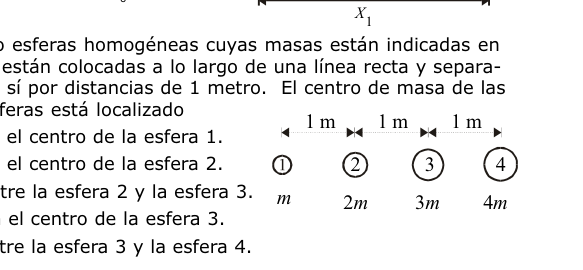 Four spheres m, 2m, 3m, 4m spaced 1 m apart
Topic: Newtonian Mechanics Metodi: Vector Decomposition, Physical Modeling Competenze: Mathematical Modeling, Physical Reasoning Objects: Sphere Fonte: Testo (PDF) — p.2
Quattro sfere omogenee, le cui masse sono indicate nella figura, sono posizionate lungo una linea retta e separate tra loro da distanze di 1 metro. Il centro di massa delle quattro sfere è situato:
- A. al centro della sfera 1.
- B. nel centro della sfera 2.
- C. tra la sfera 2 e la sfera 3.
- D. nel centro della sfera 3.
- E. tra la sfera 3 e la sfera 4.
Quattro sfere m, 2m, 3m, 4m spazzati 1 m all’interno
Topic: Newtonian Mechanics Metodi: Vector Decomposition, Physical Modeling Competenze: Mathematical Modeling, Physical Reasoning Objects: Sphere Fonte: Testo (PDF) — p.2
Four homogeneous spheres, whose masses are indicated in the figure, are placed along a straight line and separated from each other by distances of 1 meter. The center of mass of the four spheres is located:
- A. at the centre of sphere 1.
- B. at the centre of sphere 2.
- C. between sphere 2 and sphere 3.
- D. at the centre of sphere 3.
- E. between sphere 3 and sphere 4.
Four spheres m, 2m, 3m, 4m spaced 1m apart
Topic: Newtonian Mechanics Metodi: Vector Decomposition, Physical Modeling Competenze: Mathematical Modeling, Physical Reasoning Objects: Sphere Fonte: Testo (PDF) — p.2
Dos ciclistas que parten simultáneamente del mismo sitio se mueven con rapideces constantes de 4 m/s y 6 m/s respectivamente. Al cabo de 5 minutos la ventaja que el uno le lleva al otro es de:
- A. 600 m
- B. 180 m
- C. 120 m
- D. 60 m
- E. 24 m
Topic: Newtonian Mechanics Metodi: Kinematic Equations Competenze: Mathematical Modeling, Physical Reasoning Objects: — Fonte: Testo (PDF) — p.3
Due ciclisti che partono contemporaneamente dallo stesso sito si muovono a velocità costanti di 4 m/s e 6 m/s rispettivamente. Dopo 5 minuti il vantaggio che uno porta all’altro è di:
- A. 600 m
- B. 180 m
- C. 120 m
- D. 60 m
- E. 24 m
Topic: Newtonian Mechanics Metodi: Kinematic Equations Competenze: Mathematical Modeling, Physical Reasoning Objects: — Fonte: Testo (PDF) — p.3
Two cyclists departing simultaneously from the same site are moving at a constant speed of 4 m/s and 6 m/s respectively. After 5 minutes the advantage that one brings to the other is:
- A. 600 m
- B. 180 m
- C. 120 m
- D. 60 m
- E. 24 m
Topic: Newtonian Mechanics Metodi: Kinematic Equations Competenze: Mathematical Modeling, Physical Reasoning Objects: — Fonte: Testo (PDF) — p.3
Un balde lleno de agua está sostenido por dos resortes verticales paralelos que aplican fuerzas de 10 N y 20 N respectivamente, como muestra la primera figura. A continuación los resortes se colocan en serie para sostener el mismo balde como muestra la segunda figura. La masa de los resortes es despreciable. Los resortes no están oscilando.
De las siguientes afirmaciones acerca de esta última situación:
- La fuerza que aplica el resorte 2 es de 20 N.
- La fuerza indicada en la segunda figura vale 30 N.
- El resorte 1 aplica una fuerza de 30 N.
Son correctas:
- A. La 1 y la 2
- B. La 2 y la 3
- C. La 1, la 2 y la 3
- D. Sólo la 2
- E. Sólo la 1
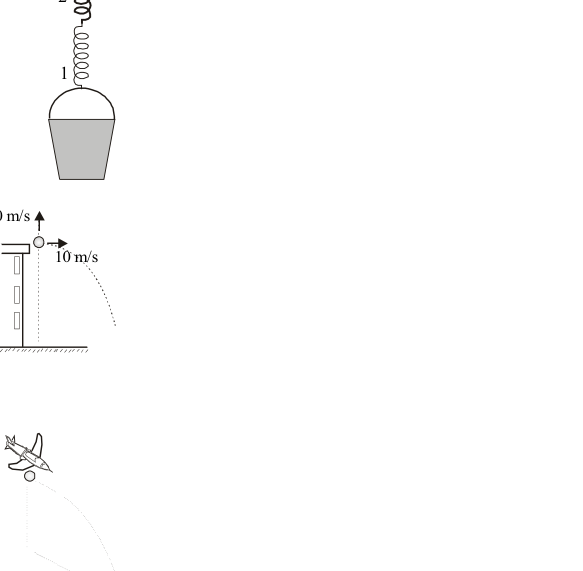 Springs 1 and 2 parallel (10 N, 20 N) then in series with force F
Topic: Newtonian Mechanics, Rigid Body Statics Metodi: Free-Body Diagram, Hooke’s Law Competenze: Physical Reasoning, Diagrammatic Reasoning Objects: Spring, Container Fonte: Testo (PDF) — p.3
Un vascello pieno di acqua è sostenuto da due sorgenti verticali parallele che applicano forze rispettivamente di 10 N e 20 N, come mostra la prima figura. Successivamente le sorgenti sono posizionate in serie per sostenere lo stesso bucato come mostra la seconda figura. La massa delle sorgenti è disprezzabile. Le sorgenti non oscillavano.
Le seguenti affermazioni riguardanti l’ultima situazione:
- La forza applicata dalla resorte 2 è di 20 N.
- La forza indicata nella seconda figura è di 30 N.
- La forza di forza 1 è di 30 N.
Sono corrette:
- A. La 1 y la 2
- B. La 2 y la 3
- C. La 1, la 2 y la 3
- D. Solo la 2
- E. Solo la 1
Springs 1 and 2 parallel (10 N, 20 N) then in series with force F
Topic: Newtonian Mechanics, Rigid Body Statics Metodi: Free-Body Diagram, Hooke’s Law Competenze: Physical Reasoning, Diagrammatic Reasoning Objects: Spring, Container Fonte: Testo (PDF) — p.3
A bucket full of water is held by two parallel vertical springs applying forces of 10 N and 20 N respectively, as shown in the first figure. The springs are then placed in series to hold the same bucket as shown in the second figure. The mass of springs is despicable. The springs aren’t swinging.
Of the following statements about the latter situation:
- The force applied by spring 2 is 20 N.
- The force shown in the second figure is 30 N.
- Spring 1 applies a force of 30 N.
They ‘re right .
- A. La 1 y la 2
- B. La 2 y la 3
- C. La 1, la 2 y la 3
- D Only the 2nd
- E. Only the 1
Springs 1 and 2 parallel (10 N, 20 N) then in series with force F
Topic: Newtonian Mechanics, Rigid Body Statics Metodi: Free-Body Diagram, Hooke’s Law Competenze: Physical Reasoning, Diagrammatic Reasoning Objects: Spring, Container Fonte: Testo (PDF) — p.3
Desde una azotea se lanza verticalmente hacia arriba una esfera con una rapidez inicial de 10 m/s la cual posteriormente llega al piso con una rapidez igual a 40 m/s. A continuación la esfera se lanza horizontalmente con una rapidez de 10 m/s. En este segundo caso llegará al piso con una rapidez igual a:
- A. 10 m/s
- B. 20 m/s
- C. 30 m/s
- D. 40 m/s
- E. 50 m/s
 Sphere thrown up at 10 m/s (left) and horizontally at 10 m/s (right) from rooftop
Topic: Newtonian Mechanics Metodi: Kinematic Equations, Energy Conservation Method Competenze: Mathematical Modeling, Physical Reasoning Objects: Sphere, Projectile Fonte: Testo (PDF) — p.3
Da un tetto viene lanciata verticalmente verso l’alto una sfera con una velocità iniziale di 10 m/s che successivamente arriva al pavimento con una velocità pari a 40 m/s. Successivamente la sfera viene lanciata orizzontalmente a una velocità di 10 m/s. In questo secondo caso arriverà al pavimento con una velocità pari a:
- A. 10 m/s
- B. 20 m/s
- C. 30 m/s
- D. 40 m/s
- E. 50 m/s
Sphere thrown up at 10 m/s (left) and horizontally at 10 m/s (right) from rooftop
Topic: Newtonian Mechanics Metodi: Kinematic Equations, Energy Conservation Method Competenze: Mathematical Modeling, Physical Reasoning Objects: Sphere, Projectile Fonte: Testo (PDF) — p.3
From a roof a sphere is thrown vertically upwards with an initial speed of 10 m/s which subsequently reaches the floor with a speed equal to 40 m/s. The sphere is then thrown horizontally at a speed of 10 m/s. In this second case, it will reach the floor at a speed equal to:
- A. 10 m/s
- B. 20 m/s
- C. 30 m/s
- D. 40 m/s
- E. 50 m/s
Sphere thrown up at 10 m/s (left) and horizontally at 10 m/s (right) from rooftop
Topic: Newtonian Mechanics Metodi: Kinematic Equations, Energy Conservation Method Competenze: Mathematical Modeling, Physical Reasoning Objects: Sphere, Projectile Fonte: Testo (PDF) — p.3
Un monomotor que vuela horizontalmente con una rapidez de 100 m/s a 500 metros de altura suelta una esfera de plomo de 20 kg de masa. El tiempo que tarda la esfera en tocar el piso (despreciando la fricción) es igual a:
- A. 10 s
- B. 15 s
- C. 20 s
- D. 25 s
- E. 30 s
Topic: Newtonian Mechanics Metodi: Kinematic Equations Competenze: Mathematical Modeling, Physical Reasoning Objects: Sphere, Projectile Fonte: Testo (PDF) — p.3
Un monomotore che vola orizzontalmente a velocità di 100 m/s a 500 metri di altezza rilascia una sfera di piombo di 20 kg di massa. Il tempo che la sfera impiega per toccare il pavimento (sottopregando la frizione) è uguale a:
- A. 10 s
- B. 15 s
- C. 20 s
- D. 25 s
- E. 30 s
Topic: Newtonian Mechanics Metodi: Kinematic Equations Competenze: Mathematical Modeling, Physical Reasoning Objects: Sphere, Projectile Fonte: Testo (PDF) — p.3
A single-engine aircraft flying horizontally at a speed of 100 m/s to 500 m in height releases a 20 kg lead ball. The time it takes the sphere to touch the floor (disregarding friction) is equal to:
- A. 10 s
- B. 15 s
- C. 20 s
- D. 25 s
- E. 30 s
Topic: Newtonian Mechanics Metodi: Kinematic Equations Competenze: Mathematical Modeling, Physical Reasoning Objects: Sphere, Projectile Fonte: Testo (PDF) — p.3
Un estudiante desciende sobre una patineta por una ladera inclinada 30° con la horizontal. Si la fricción es despreciable la aceleración con que desciende vale:
- A. 0
- B. 1 m/s²
- C. 5 m/s²
- D. 7,5 m/s²
- E. 10 m/s²
Topic: Newtonian Mechanics Metodi: Free-Body Diagram, Kinematic Equations Competenze: Physical Reasoning, Mathematical Modeling Objects: Inclined Plane Fonte: Testo (PDF) — p.4
Uno studente scende su una pattinetta su una pista inclinata con la orizzontale. Se la friczione è scarsa, l’accelerazione con cui scende vale:
- A. 0
- B. 1 m/s²
- C. 5 m/s²
- D. 7,5 m/s²
- E. 10 m/s²
Topic: Newtonian Mechanics Metodi: Free-Body Diagram, Kinematic Equations Competenze: Physical Reasoning, Mathematical Modeling Objects: Inclined Plane Fonte: Testo (PDF) — p.4
A student descends on a skateboard on a sloping slope with the horizontal. If the friction is negligible the acceleration with which it descends is:
- A. 0
- B. 1 m/s²
- C. 5 m/s²
- D. 7,5 m/s²
- E. 10 m/s²
Topic: Newtonian Mechanics Metodi: Free-Body Diagram, Kinematic Equations Competenze: Physical Reasoning, Mathematical Modeling Objects: Inclined Plane Fonte: Testo (PDF) — p.4
Una escalera de longitud 10 m y peso 100 N descansa en reposo contra una pared sin fricción formando un ángulo de 55° con el piso rugoso como muestra la figura. El diagrama que muestra adecuadamente las fuerzas que actúan sobre la escalera, con sus correspondientes valores es:
(; ; ; )
- A. N = 100 N, N_pared = 57 N, f = 81 N, f_piso = 70 N
- B. N = 100 N, N_pared = 110 N, f = 30 N, f_piso = 70 N
- C. N = 100 N, N_pared = 35 N, f_piso = 35 N
- D. N = 1000 N, N_pared = 700 N, f = 300 N
- E. N = 1000 N, N_pared = 142 N, f = 100 N, f_piso = 81 N, f_pared = 57 N
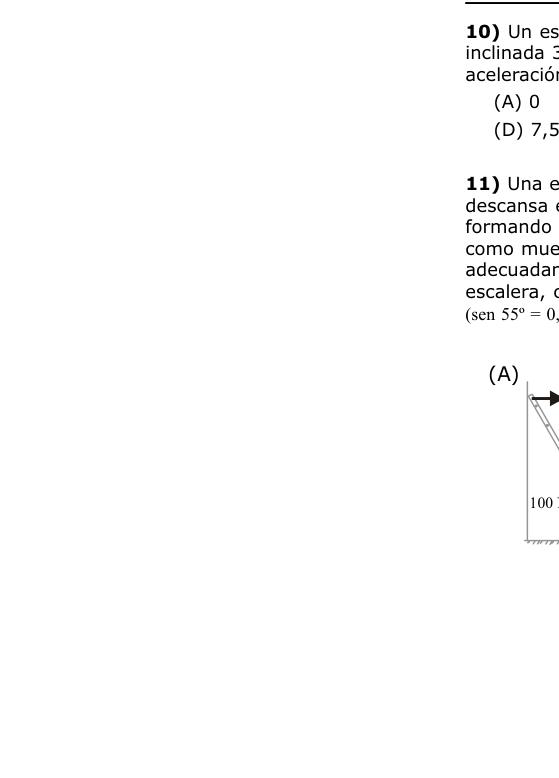 Ladder at 55° against frictionless wall, five candidate force diagrams (A)–(E)
Topic: Rigid Body Statics Metodi: Free-Body Diagram, Torque & Angular Momentum Analysis Competenze: Diagrammatic Reasoning, Mathematical Modeling Objects: Rod Fonte: Testo (PDF) — p.4
Una scala di lunghezza di 10 m e peso di 100 N si posa a riposo contro un muro senza attrito formando un angolo di 55° con il pavimento rugoso come mostra la figura. Il diagramma che mostra adeguatamente le forze che agiscono sulla scala, con i loro valori corrispondenti, è:
(; ; ; )
- A. N = 100 N, N_pared = 57 N, f = 81 N, f_floor = 70 N
- B. N = 100 N, N_pared = 110 N, f = 30 N, f_floor = 70 N
- C. N = 100 N, N_pared = 35 N, f_floor = 35 N
- D. N = 1000 N, N_pared = 700 N, f = 300 N
- E. N = 1000 N, N_pared = 142 N, f = 100 N, f_piso = 81 N, f_pared = 57 N
*Ladder at 55° against frictionless wall, five candidate force diagrams (A)(E) *
Topic: Rigid Body Statics Metodi: Free-Body Diagram, Torque & Angular Momentum Analysis Competenze: Diagrammatic Reasoning, Mathematical Modeling Objects: Rod Fonte: Testo (PDF) — p.4
A ladder of 10 m in length and 100 N in weight rests at rest against a frictionless wall forming an angle of 55° with the rough floor as shown in the figure. The diagram showing the proper forces acting on the ladder, with their corresponding values, is:
(; ; ; )
- A. N = 100 N, N_pared = 57 N, f = 81 N, f_floor = 70 N
- B. N = 100 N, N_pared = 110 N, f = 30 N, f_floor = 70 N
- C. N = 100 N, N_pared = 35 N, f_floor = 35 N
- D. N = 1000 N, N_pared = 700 N, f = 300 N
- E. N = 1000 N, N_pared = 142 N, f = 100 N, f_floor = 81 N, f_pared = 57 N
*Ladder at 55° against frictionless wall, five candidate force diagrams (A)(E) *
Topic: Rigid Body Statics Metodi: Free-Body Diagram, Torque & Angular Momentum Analysis Competenze: Diagrammatic Reasoning, Mathematical Modeling Objects: Rod Fonte: Testo (PDF) — p.4
Un cubo de madera de densidad 0,5 g/cm³ y peso 10 N flota en agua (densidad 1 g/cm³) como muestra la figura 1. La fuerza que es necesario aplicarle para mantenerlo sumergido a ras de agua, figura 2, es igual a:
- A. 1 N
- B. 5 N
- C. 10 N
- D. 15 N
- E. 20 N
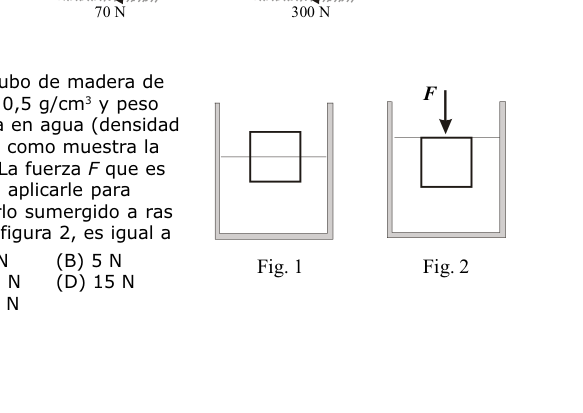 Wooden cube floating (Fig. 1) and submerged flush with force F (Fig. 2)
Topic: Fluid Mechanics Metodi: Hydrostatic Equilibrium, Free-Body Diagram Competenze: Physical Reasoning, Mathematical Modeling Objects: Block Fonte: Testo (PDF) — p.4
Un cubo di legno di densità 0,5 g/cm3 e peso 10 N galleggia in acqua (densità 1 g/cm3) come mostrato in figura 1. La forza che è necessaria per mantenerlo immerso in superficie, figura 2, è pari a:
- A. 1 N
- B. 5 N
- C. 10 N
- D. 15 N
- E. 20 N
Wooden cube floating (Fig. 1) e flush submerged with force F (Fig. 2)
Topic: Fluid Mechanics Metodi: Hydrostatic Equilibrium, Free-Body Diagram Competenze: Physical Reasoning, Mathematical Modeling Objects: Block Fonte: Testo (PDF) — p.4
A wood cube of 0,5 g/cm3 density and 10 N weight floats in water (1 g/cm3 density) as shown in Figure 1. The force required to keep it submerged under water, figure 2, is equal to:
- A. 1 N
- B. 5 N
- C. 10 N
- D. 15 N
- E. 20 N
The following table shows the results of the calculation of the weighted average weight of the product: 1) and submerged flush with force F (Fig. 2)*
Topic: Fluid Mechanics Metodi: Hydrostatic Equilibrium, Free-Body Diagram Competenze: Physical Reasoning, Mathematical Modeling Objects: Block Fonte: Testo (PDF) — p.4
La gráfica posición () vs. tiempo () de un cuerpo que se mueve en línea recta es la mostrada en la figura adjunta. La gráfica aceleración () vs. tiempo () correspondiente a este movimiento es:
- A. constante positiva
- B. constante negativa
- C. nula (línea en cero)
- D. creciente
- E. decreciente
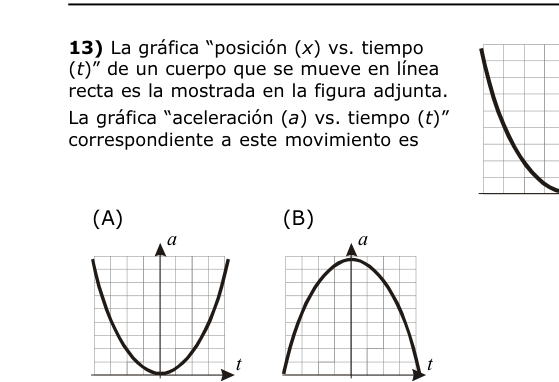 vs curve and five candidate vs graphs (A)–(E)
Topic: Newtonian Mechanics Metodi: Kinematic Equations Competenze: Diagrammatic Reasoning, Physical Reasoning Objects: — Fonte: Testo (PDF) — p.5
La posizione grafica () vs. Il tempo () di un corpo che si muove in linea retta è quello mostrato nella figura allegata. Il grafico di accelerazione () vs. il tempo () corrispondente a questo movimento è:
- A. costante positiva
- B. costante negativa
- C. zero (linea zero)
- D. crescente
- E. decrescente
vs curve and five candidate vs graphs (A)(E)
Topic: Newtonian Mechanics Metodi: Kinematic Equations Competenze: Diagrammatic Reasoning, Physical Reasoning Objects: — Fonte: Testo (PDF) — p.5
The graph position () vs. The time () of a body moving in a straight line is shown in the figure below. The acceleration graph () vs. The time () for this movement is:
- A. positive constant
- B. negative constant
- C. zero (line at zero)
- D increased
- E. decreasing
vs curve and five candidate vs graphs (A)–(E)
Topic: Newtonian Mechanics Metodi: Kinematic Equations Competenze: Diagrammatic Reasoning, Physical Reasoning Objects: — Fonte: Testo (PDF) — p.5
Un chico se lanza por el tobogán de radio m y altura m. Si no hay rozamiento el chico llega al punto A con rapidez igual a:
- A. 0
- B. 5 m/s
- C. 10 m/s
- D. 20 m/s
- E. 100 m/s
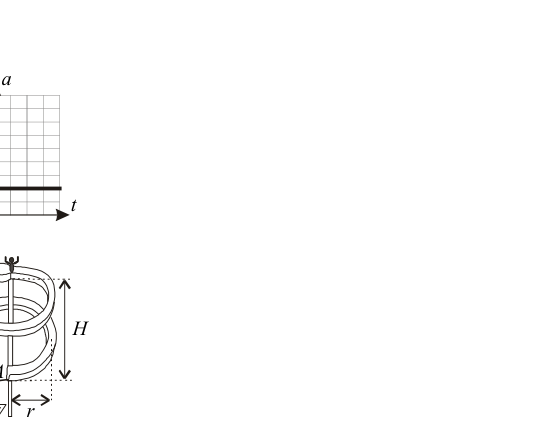 Slide of radius m and height m reaching point A
Topic: Conservation of Energy, Newtonian Mechanics Metodi: Energy Conservation Method Competenze: Physical Reasoning, Mathematical Modeling Objects: — Fonte: Testo (PDF) — p.5
Un chico se lanza por el tobogán de radio m y altura m. Se non c’è un taglio il ragazzo arriva al punto A con velocità pari a:
- A. 0
- B. 5 m/s
- C. 10 m/s
- D. 20 m/s
- E. 100 m/s
Slide of radius m and height m reaching point A
Topic: Conservation of Energy, Newtonian Mechanics Metodi: Energy Conservation Method Competenze: Physical Reasoning, Mathematical Modeling Objects: — Fonte: Testo (PDF) — p.5
Un chico se lanza por el tobogán de radio m y altura m. If there ‘s no bruising , the kid gets to point A with a speed equal to:
- A. 0
- B. 5 m/s
- C. 10 m/s
- D. 20 m/s
- E. 100 m/s
Slide of radius m and height m reaching point A
Topic: Conservation of Energy, Newtonian Mechanics Metodi: Energy Conservation Method Competenze: Physical Reasoning, Mathematical Modeling Objects: — Fonte: Testo (PDF) — p.5
Un paracaidista desciende con rapidez constante suspendido de 6 cuerdas del paracaídas. La masa del paracaidista es kg y el radio del paracaídas m. La tensión de cada cuerda es:
- A. 0
- B.
- C.
- D.
- E.
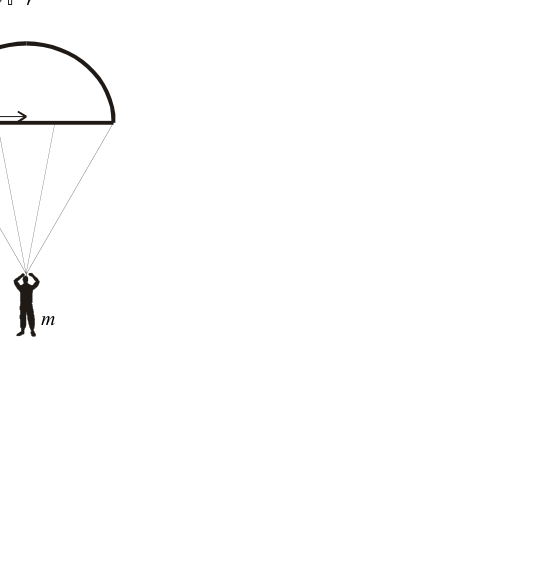 Parachutist on 6 cords, parachute radius R, hanging distance 2R
Topic: Newtonian Mechanics, Rigid Body Statics Metodi: Free-Body Diagram, Vector Decomposition Competenze: Physical Reasoning, Mathematical Modeling Objects: String Fonte: Testo (PDF) — p.5
Un paracadutista scende a velocità costante, sospeso da 6 corde del paracadutista. Il paracadutista ha una massa kg e un raggio di paracadutista m. La tensione di ogni corda è:
- A. 0
- B.
- C.
- D.
- E.
Paratroci su 6 corde, paracadute radius R, hanging distance 2R
Topic: Newtonian Mechanics, Rigid Body Statics Metodi: Free-Body Diagram, Vector Decomposition Competenze: Physical Reasoning, Mathematical Modeling Objects: String Fonte: Testo (PDF) — p.5
A parachute is descending at a constant speed suspended from six parachute ropes. The mass of the parachute is kg and the radius of the parachute m. The tension of each string is:
- A. 0
- B.
- C.
- D.
- E.
Paratrooper on 6 cords, parachute radius R, hanging distance 2R
Topic: Newtonian Mechanics, Rigid Body Statics Metodi: Free-Body Diagram, Vector Decomposition Competenze: Physical Reasoning, Mathematical Modeling Objects: String Fonte: Testo (PDF) — p.5
Un carrito de cuerda que parte del reposo en se mueve con una aceleración constante de 0,02 m/s² durante los 10 primeros segundos que le dura la cuerda. Si a partir de ese momento se desprecia el rozamiento, la distancia que recorre desde hasta s es igual a:
- A. 1 m
- B. 3 m
- C. 5 m
- D. 7 m
- E. 10 m
Topic: Newtonian Mechanics Metodi: Kinematic Equations Competenze: Mathematical Modeling, Physical Reasoning Objects: Cart Fonte: Testo (PDF) — p.6
Un carrello di corda che parte dal riposo in si muove con una costante accelerazione di 0,02 m/s2 per i primi 10 secondi di durata della corda. Se da allora si scongiura il taglio, la distanza da a s è uguale a:
- A. 1 m
- B. 3 m
- C. 5 m
- D. 7 m
- E. 10 m
Topic: Newtonian Mechanics Metodi: Kinematic Equations Competenze: Mathematical Modeling, Physical Reasoning Objects: Cart Fonte: Testo (PDF) — p.6
A rope wagon that starts at rest at moves at a constant acceleration of 0.02 m/s2 during the first 10 seconds of rope duration. If from that point on the grinding is neglected, the distance from to s is equal to:
- A. 1 m
- B. 3 m
- C. 5 m
- D. 7 m
- E. 10 m
Topic: Newtonian Mechanics Metodi: Kinematic Equations Competenze: Mathematical Modeling, Physical Reasoning Objects: Cart Fonte: Testo (PDF) — p.6
Si continuamente sopla un viento a razón de 50 m/s y un barco avanza respecto al agua a 10 m/s, ¿con qué rapidez horizontal en metros por segundo respecto al aire debe avanzar el helicóptero para posarse suavemente sobre el barco?
- A. 10
- B. 20
- C. 30
- D. 40
- E. 50
Topic: Newtonian Mechanics Metodi: Vector Decomposition, Kinematic Equations Competenze: Physical Reasoning, Mathematical Modeling Objects: — Fonte: Testo (PDF) — p.6
Se un vento continua a soffrire a 50 m/s e una nave si allontana dall’acqua a 10 m/s, a che velocità orizzontale in metri per secondo rispetto all’aria deve avanzare l’elicottero per atterrare con delicatezza sulla nave?
- A. 10
- B. 20
- C. 30
- D. 40
- E. 50
Topic: Newtonian Mechanics Metodi: Vector Decomposition, Kinematic Equations Competenze: Physical Reasoning, Mathematical Modeling Objects: — Fonte: Testo (PDF) — p.6
If a wind is continuously blowing at a rate of 50 m/s and a ship is moving with respect to water at 10 m/s, at what horizontal speed in metres per second with respect to air should the helicopter move to land gently on the ship?
- A. 10
- B. 20
- C. 30
- D. 40
- E. 50
Topic: Newtonian Mechanics Metodi: Vector Decomposition, Kinematic Equations Competenze: Physical Reasoning, Mathematical Modeling Objects: — Fonte: Testo (PDF) — p.6
¿Cuánto le pesa en newtons la maleta a Juanito mientras el ascensor sube con una aceleración de 5 m/s² si antes de subir al ascensor registró que la masa de la maleta es de 5 kg?
- A. 0
- B. 5
- C. 10
- D. 45
- E. 75
Topic: Newtonian Mechanics Metodi: Free-Body Diagram, Kinematic Equations Competenze: Physical Reasoning, Mathematical Modeling Objects: — Fonte: Testo (PDF) — p.6
Quanto pesa in newtons la valigia di Juanito mentre l’ascensore sale con un’accelerazione di 5 m/s2 se prima di salire sull’ascensore ha registrato che la massa della valigia è di 5 kg?
- A. 0
- B. 5
- C. 10
- D. 45
- E. 75
Topic: Newtonian Mechanics Metodi: Free-Body Diagram, Kinematic Equations Competenze: Physical Reasoning, Mathematical Modeling Objects: — Fonte: Testo (PDF) — p.6
How much in newtons does Juanito’s suitcase weigh while the elevator goes up with an acceleration of 5 m/s2 if before climbing the elevator he recorded that the mass of the suitcase is 5 kg?
- A. 0
- B. 5
- C. 10
- D. 45
- E. 75
Topic: Newtonian Mechanics Metodi: Free-Body Diagram, Kinematic Equations Competenze: Physical Reasoning, Mathematical Modeling Objects: — Fonte: Testo (PDF) — p.6
Si en el recipiente A de la situación mostrada en la figura se encuentra una masa de agua, para mantener el conjunto en equilibrio, en el recipiente B debe haber otra masa de agua igual a:
- A.
- B.
- C.
- D.
- E.
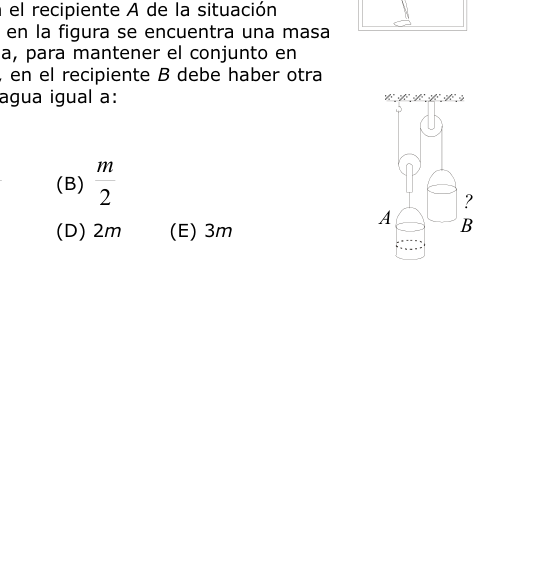 Balance/lever with water containers A and B
Topic: Fluid Mechanics, Rigid Body Statics Metodi: Hydrostatic Equilibrium, Torque & Angular Momentum Analysis Competenze: Physical Reasoning, Diagrammatic Reasoning Objects: Lever, Container Fonte: Testo (PDF) — p.6
Se nel recipiente A della situazione riportata nella figura si trova una massa di acqua, per mantenere l’insieme in equilibrio, nel recipiente B deve esserci un’altra massa di acqua pari a:
- A.
- B.
- C.
- D.
- E.
Balance/lever with water containers A and B
Topic: Fluid Mechanics, Rigid Body Statics Metodi: Hydrostatic Equilibrium, Torque & Angular Momentum Analysis Competenze: Physical Reasoning, Diagrammatic Reasoning Objects: Lever, Container Fonte: Testo (PDF) — p.6
If a mass of water is found in container A of the situation shown in Figure, to keep the whole in balance, container B must have another water mass equal to:
- A.
- B.
- C.
- D.
- E.
The following table shows the total amount of the aid:
Topic: Fluid Mechanics, Rigid Body Statics Metodi: Hydrostatic Equilibrium, Torque & Angular Momentum Analysis Competenze: Physical Reasoning, Diagrammatic Reasoning Objects: Lever, Container Fonte: Testo (PDF) — p.6
- [Texto no recuperable: el PDF está protegido con contraseña y la extracción de texto se interrumpe antes de este problema. Solo se dispone del fragmento «5 k» que podría corresponder a una anotación de figura.]
Topic: Newtonian Mechanics Metodi: Physical Modeling Competenze: Physical Reasoning Objects: — Fonte: Testo (PDF) — p.7
- [Testo non recuperabile: il PDF è protetto da password e l’estrazione di testo viene interrotta prima di questo problema. [Il frammento 5 k è disponibile solo per un’annotata figura.]
Topic: Newtonian Mechanics Metodi: Physical Modeling Competenze: Physical Reasoning Objects: — Fonte: Testo (PDF) — p.7
- [Non-recoverable text: the PDF is password protected and text extraction is stopped before this problem occurs. Only the fragment 5 k which could correspond to a figure annotation is available.]
Topic: Newtonian Mechanics Metodi: Physical Modeling Competenze: Physical Reasoning Objects: — Fonte: Testo (PDF) — p.7