Viaggio in galleria — 90 Punti
Per favorire la velocità degli spostamenti, un progettista molto fantasioso pensa di scavare una lunga galleria, perfettamente rettilinea che congiunge due località situate su meridiani opposti, alla stessa latitudine ; le pareti della galleria saranno prive di attrito e nella cavità sarà fatto il vuoto, cosicché — per la conservazione dell’energia — una capsula lanciata “cadere” da ferma ad un’estremità, raggiungerà l’altra estremità della galleria senza utilizzare alcun motore.
Inizialmente si schematizza la Terra come una sfera omogenea; sfruttando l’analogia formale con il campo elettrostatico di una distribuzione uniforme di carica negativa, è facile determinare l’andamento del campo e quindi l’energia potenziale (gravitazionale) in tutti i punti interni alla Terra.
-
Determinare l’espressione del campo gravitazionale nei punti interni della Terra, sapendo che sulla superficie il modulo del campo vale (accelerazione di gravità standard).
-
Quanto tempo dura il viaggio secondo il progettista che ha trascurato il fatto che la Terra ruota su se stessa?
-
Qual è la massima velocità raggiunta dalla capsula?
-
Di quanto varia la durata del viaggio, tenuto conto della rotazione terrestre?
Poiché l’attrito non è mai totalmente eliminabile si stima che in un viaggio si perda l’1% dell’energia potenziale in gioco, ovvero della differenza tra energia potenziale massima e minima lungo il percorso.
-
A che distanza dalla stazione di arrivo si fermerà la capsula?
-
Se non interviene un adeguato motore per riportare la capsula al punto di partenza, dopo quanti viaggi l’ampiezza dell’oscillazione sarebbe ridotta a metà?
-
Se si tiene conto del fatto che la distribuzione di massa della Terra non è omogenea, e si passa ad un modello ancora semplificato in cui il nucleo centrale sferico ha una densità uniforme maggiore di quella del mantello esterno, la durata del viaggio sarà maggiore, minore o uguale a quella calcolata sopra e il tipo di moto sarà lo stesso di prima o no? (È richiesta una risposta qualitativa.)
Suggerimento per la domanda 6: Se la variazione in un singolo viaggio è piccola, si può assumere — come ipotesi di lavoro — che la perdita di energia meccanica nel tempo sia continua ed uniforme; cioè che la potenza istantanea delle forze dissipative sia pari a quella media in un viaggio.
Topic: Newtonian Mechanics Metodi: Physical Modeling Competenze: Physical Reasoning Objects: Planet Fonte: Testo (PDF) — p.1 Soluzione: Soluzioni (PDF)
Viaggio in galleria — 90 Punti
Per favorire la velocità degli spostamenti, un progettista molto fantasioso pensa di scavare una lunga galleria, perfettamente rettilinea che congiunge due località situate su meridiani opposti, alla stessa latitudine ; le pareti della galleria saranno prive di attrito e nella cavità sarà fatto il vuoto, cosicché — per la conservazione dell’energia — una capsula lanciata “cadere” da ferma ad un’estremità, raggiungerà l’altra estremità della galleria senza utilizzare alcun motore.
Initially, the Earth is plotted as a homogeneous sphere; by exploiting the formal analogy with the electrostatic field of a uniform distribution of negative charge, it is easy to determine the field’s motion and thus the potential energy (gravity) at all points within the Earth.
-
Determine the expression of the gravitational field at the Earth’s interior points, knowing that on the surface the field module is (standard gravitational acceleration).
-
How long does the journey take, according to the designer who overlooked the fact that the earth rotates on itself?
-
What’s the maximum speed the capsule can reach?
-
How much does the duration of the journey vary, given the earth’s rotation?
Since friction is never totally eliminated, it is estimated that one trip loses 1% of the potential energy involved, or the difference between maximum and minimum potential energy along the route.
-
How far will the capsule stop from the arrival station?
-
If there is no adequate engine to bring the capsule back to its starting point, after how many trips would the range of oscillation be reduced by half?
-
If we take into account that the mass distribution of the Earth is not homogeneous, and we move to an even simpler model where the spherical core has a uniform density greater than that of the outer mantle, will the travel time be greater, less or equal to that calculated above and will the type of motion be the same as before or not? (A qualitative answer is required.)
*Suggest for Question 6: * If the variation in a single trip is small, it can be assumed as a working hypothesis that the loss of mechanical energy over time is continuous and uniform; that is, that the instantaneous power of the dissipative forces is equal to that of the average in a trip.
Topic: Newtonian Mechanics Metodi: Physical Modeling Competenze: Physical Reasoning Objects: Planet Fonte: Testo (PDF) — p.1 Soluzione: Soluzioni (PDF)
Ciclo termodinamico — 90 Punti
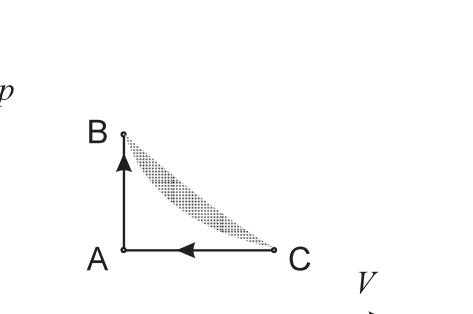
Una mole di gas perfetto biatomico esegue un ciclo termodinamico composto da: un riscaldamento isobaro reversibile, un’espansione adiabatica irreversibile, una compressione isobara reversibile.
- Nello stato iniziale A la temperatura del gas è .
- Per portarlo allo stato B, il gas viene riscaldato fino alla temperatura : il volume del gas viene mantenuto costante.
- Dallo stato B il gas viene fatto espandere rapidamente senza scambio di calore fino allo stato C, in cui il volume del gas è e la pressione è .
- Il ciclo viene chiuso raffreddando il gas in modo da riportarlo alla temperatura iniziale , mentre la pressione del gas resta costante.
Notate: il volume del gas nello stato B è fissato, la sua temperatura può essere scelta a piacere, purché sia più alta di .
-
Calcolare la temperatura dello stato C e la quantità totale di calore che il gas cede agli sorgenti per realizzare la trasformazione .
-
Calcolare l’intervallo di valori cui può essere scelto il valore della temperatura dello stato B, , in modo tale che il ciclo possa essere realizzato fisicamente.
Al variare della temperatura nell’intervallo trovato sopra, si osserva che l’energia scambiata sotto forma di lavoro tra il gas e l’ambiente cambia segno: si dice che il ciclo ha carattere termico se il gas fa lavoro sull’ambiente, mentre al contrario ha carattere frigorifero.
-
Determinare per quali valori della temperatura di B il ciclo è di tipo frigorifero e per quali si tratta di un ciclo termico.
-
Determinare come varia il rendimento del ciclo termico e l’efficienza frigorifera (definita come rapporto dove è il calore effettivamente assorbito ed il lavoro utilizzato nel ciclo) nell’intervallo di temperatura di trovato. Tracciare due grafici che mostrano l’andamento delle funzioni così ottenute, in funzione di , dopo averne calcolato i valori estremi.
Nota: Con riferimento alla domanda 2 si richiamano le definizioni di energia interna e di entropia:
a) L’energia interna di un gas perfetto è una variabile di stato la cui variazione è definita da dove ed indicano, rispettivamente, il calore assorbito e il lavoro compiuto sull’esterno.
b) L’entropia di un gas perfetto è una variabile di stato per cui vale la relazione dove ed indicano lo stato iniziale e lo stato finale di una trasformazione qualsiasi effettuata dal gas, e è il calore molare a volume costante.
p.2 — Diagramma p-V del ciclo ABC
Topic: Thermodynamics Metodi: First Law of Thermodynamics, Thermodynamic Cycle Analysis, Ideal Gas Law Competenze: Mathematical Modeling, Physical Reasoning, Graph Linearization Objects: Gas Fonte: Testo (PDF) — p.2 Soluzione: Soluzioni (PDF)
The temperature of the test chemical is the temperature of the test chemical.
A mole of perfect biatomic gas performs a thermodynamic cycle consisting of: a reversible isobaric heating, an irreversible adiabatic expansion, a reversible isobaric compression.
- In the initial state A the gas temperature is .
- To bring it to state B, the gas is heated to : the volume of the gas is kept constant.
- From state B the gas is expanded rapidly without heat exchange to state C, where the volume of the gas is and the pressure is .
- The cycle is closed by cooling the gas back to the initial temperature , while the gas pressure remains constant.
Note: the volume of gas in state B is fixed, its temperature can be chosen at will, provided it is higher than .
-
Calculate the temperature of state C and the total amount of heat the gas releases to the sources to achieve the transformation.
-
Calculate the range of values for which the state temperature value of B, can be chosen so that the cycle can be physically achieved.
When the temperature varies in the above range, it is observed that the energy exchanged as work between the gas and the environment changes sign: the cycle is said to be thermal if the gas is working on the environment, while the reverse is ** refrigerator**.
-
Determine for which temperature values of B the cycle is refrigerated and for which it is a heat cycle.
-
Determine how the heat cycle performance and refrigeration efficiency (defined as the ratio where is the heat actually absorbed and the work used in the cycle) varies within the temperature range of found. Draw two graphs showing the evolution of the functions thus obtained, in terms of , after calculating their extreme values.
The following definitions of internal energy and entropy are used for Question 2:
(a) The internal energy of a perfect gas is a state variable whose variation is defined by where and indicate, respectively, heat absorbed and work performed outside.
(b) The entropy of a perfect gas is a state variable for which the ratio is valid where and indicate the initial and final state of any transformation by the gas, and is the constant volume molar heat.
The following table shows the results of the calculation of the total number of cycles:
Topic: Thermodynamics Metodi: First Law of Thermodynamics, Thermodynamic Cycle Analysis, Ideal Gas Law Competenze: Mathematical Modeling, Physical Reasoning, Graph Linearization Objects: Gas Fonte: Testo (PDF) — p.2 Soluzione: Soluzioni (PDF)
Esplorando il fondo — 50 Punti
La profondità di una grande vasca è la stessa in ogni punto e vale . L’acqua è calma e limpida. Dal punto O, posto a pelo dell’acqua, si osserva un punto A del fondo della vasca (v. figura) con uno stretto fascio divergente di apertura angolare .
Suggerimento: Si consiglia di considerare, partendo dal punto A e arrivando in O, di formare un sistema ottico equivalente.
-
Determinare, in funzione di , ed (indice di rifrazione dell’acqua), la profondità dell’immagine virtuale del punto A, nel piano verticale passante per A e per O.
-
Determinare, al variare di , i valori e dell’immagine.
-
Determinare l’area della superficie complessiva del fondo della vasca che è possibile osservare dal punto O.
Topic: Geometric Optics Metodi: Snell’s Law, Ray Tracing Competenze: Physical Reasoning, Mathematical Modeling Objects: — Fonte: Testo (PDF) — p.3 Soluzione: Soluzioni (PDF)
Exploring the bottom 50 Points
The depth of a large tank is the same at each point and is . The water is calm and clear. From the O point, placed at the water’s edge, a point A of the bottom of the tank is observed (see. Figure 1) with a narrow divergent beam of angular aperture .
Suggest: It is recommended that an equivalent optical system be considered from point A to point O.
-
Determinare, in funzione di , ed (indice di rifrazione dell’acqua), la profondità dell’immagine virtuale del punto A, nel piano verticale passante per A e per O.
-
Determine, when varies, the values and of the image.
-
Determine the total surface area of the bottom of the tank that can be observed from O.
Topic: Geometric Optics Metodi: Snell’s Law, Ray Tracing Competenze: Physical Reasoning, Mathematical Modeling Objects: — Fonte: Testo (PDF) — p.3 Soluzione: Soluzioni (PDF)
Correnti in un anello — 70 Punti
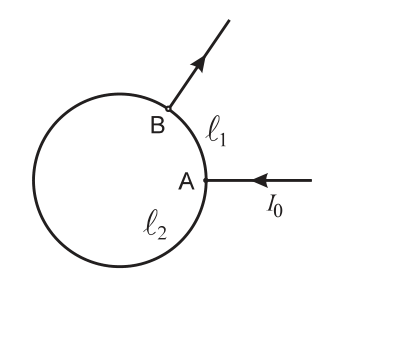
Un filo conduttore lungo è piegato in modo da formare un anello circolare (v. figura). Un filo conduttore rettilineo viene fissato sul piano A dell’anello e un secondo filo uguale al primo è collegato all’anello tramite un contatto scorrevole (punto B); i due fili giacciono nella stessa direzione si mantiene sempre radiale: tutti i fili giacciono nello stesso piano.
Siano ed le lunghezze dei due archi compresi tra i punti A e B e sia un parametro adimensionale che definisce la posizione del punto B.
I due fili rettilinei vengono collegati (a grande distanza) ad un generatore di corrente e si misura la d.d.p. tra i punti A e B: si trova che il massimo di tale d.d.p. è .
-
Determinare lo spessore (della sezione) del filo di costantana.
-
Tracciare il grafico della d.d.p. misurata tra A e B in funzione di .
-
Tracciare il grafico della potenza dissipata per effetto Joule nell’arco di lunghezza , in funzione di , e determinare il valore massimo, individuando la posizione del punto B.
-
Tracciare il grafico del modulo del campo magnetico al centro dell’anello, in funzione di .
-
Il secondo filo rettilineo applicato al contatto mobile B viene ora disposto perpendicolarmente al piano dell’anello e del primo filo. Rispondere alle domande precedenti nella nuova situazione.
p.3 — Anello conduttore con punti A, B
Topic: Circuits, Magnetism Metodi: Kirchhoff’s Laws, Equivalent Circuit Reduction, Biot-Savart Law Competenze: Physical Reasoning, Mathematical Modeling, Diagrammatic Reasoning Objects: Wire Fonte: Testo (PDF) — p.3 Soluzione: Soluzioni (PDF)
The value of the underlying asset shall be the sum of the outstanding exposures to the underlying asset.
A long conductive wire is bent to form a circular ring (see paragraphs 1 and 2). The Commission has not yet adopted a proposal. A straight conducting wire is fixed to the plane A of the ring and a second wire equal to the first is connected to the ring via a flowing contact (point B); the two wires lie in the same direction it always remains radial: all the wires lie in the same plane.
The lengths of the two arcs between points A and B shall be and and shall be a dimension parameter defining the position of point B.
The two straight wires are connected (long distance) to a current generator and the d.d.p. is measured. between points A and B: it is found that the maximum of such D.D.P. è .
-
Determine the thickness (section) of the constant thread.
-
Draw the chart of the D.D.P. measured between A and B as a function of .
-
Draw the graph of the Joule dissipation power in the length arc , as a function of , and determine the maximum value by determining the position of point B.
-
Draw the graph of the magnetic field module at the centre of the ring, according to .
-
The second straight wire applied to the mobile contact B is now laid perpendicular to the plane of the ring and the first wire. Answer the previous questions in the new situation.
The manufacturer shall ensure that the manufacturer is able to provide the manufacturer with the necessary information.
Topic: Circuits, Magnetism Metodi: Kirchhoff’s Laws, Equivalent Circuit Reduction, Biot-Savart Law Competenze: Physical Reasoning, Mathematical Modeling, Diagrammatic Reasoning Objects: Wire Fonte: Testo (PDF) — p.3 Soluzione: Soluzioni (PDF)