Problem 1 (40 points). A new car model must pass destructive testing before it can be approved for sale. In one particular test, a three-spoked wheel has one of its spokes knocked out. Its vertical cross section is shown in Figure 1.1. The wheel can be modelled as a combination of an annular lamina and two identical rods, all of which have uniform density. The lamina has an outer radius of and an inner radius of . The mass of each rod is and the mass of the lamina is . The wheel is released from rest from the position shown in the figure, after which it rolls without slipping. Find Figure 1.1: A broken wheel. (1) the initial angular acceleration of the wheel; and (2) the angular acceleration of the wheel, the normal force , and friction acting on the wheel by the ground, when the spoke OB first reaches a vertical position.
Chinese Physics Olympiad
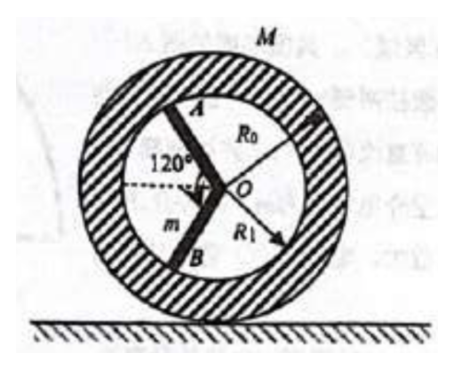 ruota rotta a tre razze
Topic: Rotational Dynamics, Newtonian Mechanics Metodi: Torque & Angular Momentum Analysis, Free-Body Diagram, Calculus-Integration, Conservation of Energy Competenze: Diagrammatic Reasoning, Mathematical Modeling, Physical Reasoning Objects: Wheel, Rod Fonte: Testo (PDF) — p.1
Problema 1 (40 punti). Un nuovo modello di auto deve superare le prove distruttive prima di poter essere approvato per la produzione di
- Vendita. In una prova particolare, una ruota a tre spine ha uno dei suoi spini colpito. La sua croce verticale Sezione 1.1 La ruota può essere modellata come una combinazione di lamina anulare e due barre identiche, tutte di densità uniforme. La lamina ha un raggio esterno di e un raggio interno radius di . La massa di ciascuna canna è e la massa della lamina è . La ruota è rilasciato dal riposo dalla posizione indicata nella figura, dopo di che ruota senza scivolare. Trova Figura 1.1: Una ruota rotta. (1) l’accelerazione angolare iniziale della ruota; e (2) l’accelerazione angolare della ruota, la forza normale e la frizione che agiscono sulla ruota per terra, quando la voce OB raggiunge per la prima volta una posizione verticale.
Olimpiada cinese di fisica
- rotta rotta a tre razze *
Topic: Rotational Dynamics, Newtonian Mechanics Metodi: Torque & Angular Momentum Analysis, Free-Body Diagram, Calculus-Integration, Conservation of Energy Competenze: Diagrammatic Reasoning, Mathematical Modeling, Physical Reasoning Objects: Wheel, Rod Fonte: Testo (PDF) — p.1
Problem 2 (40 points). Consider a cylinder-like solid whose base is described by a half-annulus of inner radius and outer radius . The solid is composed of two leaky dielectrics1, with parameters and for the region and parameters and for the region , as shown in Figure 2.1. Now we coat each flat rectangular face of the solid with a metallic film, apply a steady potential between the two conductors (see figure for polarity), and wait until the system reaches a steady state. We are given the vaccum permittivity , that and are large, and that and are small. Neglect any fringe effects. Take on the left metallic film. Figure 2.1: A leaky dielectric. (1) Find the magnitude of the electric field and the electric potential everywhere within the dielectric. (2) Find the total accumulated charge at . (3) Obtain the resistance and capacitance across the regions (, ) and (, ). (4) Suppose we disconnect the potential source at time . In order to model the subsequent behaviour, we can design a circuit based on the given parameters of the solid. Draw this circuit. Hence, find the time dependence of the potential difference between the metal films on each end. 1A leaky dielectric is a dielectric which is not a perfect insulator. Such a material can be described by two parameters: its relative permittivity and its conductivity .
Chinese Physics Olympiad
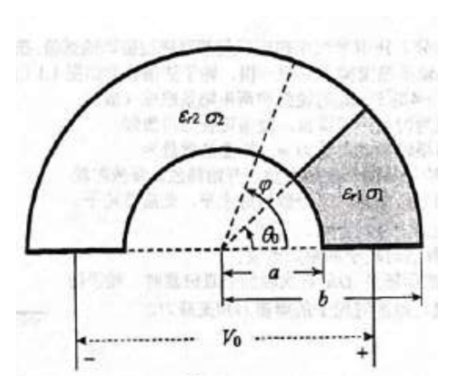 semianello dielettrico conduttivo
Topic: Electrostatics, Circuits, Electromagnetism Metodi: Gauss’s Law, Electric Potential Method, Equivalent Circuit Reduction, Differential Equations Competenze: Mathematical Modeling, Diagrammatic Reasoning, Physical Reasoning Objects: Capacitor, Resistor Fonte: Testo (PDF) — p.2
Problema 2 (40 punti). Considerate un solido simile a un cilindro la cui base è descritta da un semianello di radius e radius esterno . Il solido è composto da due dielettrici perdenti1, con parametri e per la regione e i parametri e per la regione , come mostrato nella figura 2.1. Ora rivestono ogni faccia piatta rettangolare del solido con un film metallico, applicando un potenziale costante tra i due conduttori (vedi figura per la polarità), e aspettare che il sistema raggiunga un livello di stabilità
- Lo stato. Ci viene data la permissività vaccum , che e sono grandi, e che e sono piccole. Non fare attenzione agli effetti frangiali. Prendere sul film metallico sinistro. Figura 2.1: Dielettrico perduto. (1) Trova la magnitudine del campo elettrico e il potenziale elettrico ovunque all’interno del campo elettrico
- Dielettrico. (2) Trova la carica totale accumulata a . (3) Ottenere la resistenza e la capacità nelle regioni (, ) e (, ). (4) Supponiamo di scollegare la fonte potenziale nel tempo . Per modellare le seguenti Se si tratta di un circuito basato sui parametri del solido, si può progettare un circuito basato sui parametri del solido. Disegna questo circuito. Quindi, trovare la dipendenza temporale della differenza potenziale tra i film metallici su ciascuna Finire. 1Un dielettrico perduto è un dielettrico che non è un isolante perfetto. Tale materiale può essere descritto con due parametri: la sua relativa autorizzabilità e la sua conducibilità .
Olimpiada cinese di fisica
semianello dielettrico conduttivo
Topic: Electrostatics, Circuits, Electromagnetism Metodi: Gauss’s Law, Electric Potential Method, Equivalent Circuit Reduction, Differential Equations Competenze: Mathematical Modeling, Diagrammatic Reasoning, Physical Reasoning Objects: Capacitor, Resistor Fonte: Testo (PDF) — p.2
Problem 3 (40 points). We investigate the applications of the superconducting gravimeter in this problem. The superconducting gravimeter can be used to obtain information about the Earth’s interior such as mantle dynamics, distribution of mass, crustal tides, groundwater, and distribution of minerals. It can also be used to monitor external phenomena such as the coastal tides and climate change. These data can be obtained through long-term, high-precision measurements of minute changes in the local gravitational acceleration using the superconducting gravimeter. The superconducting gravimeter is extremely sensitive (with an uncertainty of around ) and has good measurement stability, and is thus the primary instrument of Earth scientists wishing to measure the local gravitational acceleration accurately. New opportunities arise for the the development of Earth sciences and precision measurements of the gravitational force, as more superconducting gravimeters and communication networks are built around the world. The following questions concern the effects of ground water on the local gravitational acceleration and the operating principles of the superconducting gravimeter.
- We model the Earth as a uniform solid sphere of radius 6370 km, whose gravitational acceleration is . Suppose that a spherical underground lake of diameter 20 km whose centre is 15 km from the surface. Find the difference in gravitational acceleration on the surface, vertically above the centre of the lake, given the values of the gravitational constant and the density of water . Neglect the effects due to Earth’s rotation.
- The main component of the superconducting gravimeter is a spherical shell made of a cooled, superconducting niobium alloy, suspended in a magnetic field. For convenience, we model the shell as a superconducting ring (see Figure 3.1). The external magnetic field is supplied by a superconducting Helmholtz coil-like device, composed of an upper coil with turn number and a lower coil with turn number , where . The coils share the same radius and axis of symmetry, are separated by , and are connected in series to an external power source. Before a measurement begins, the currents in the Helmholtz coil and the ring are zero, the ring is in the same plane as the lower coil (), and it shares the same axis of symmetry with both coils. When a measurement is made, the power source slowly introduces a current to the Helmholtz coil, which induces a current in the ring. If we adjust the magnitude of , we can make the ring levitate such that it rests in the same plane as the upper coil (), as shown in Figure 3.1. As both the coil and the ring are superconductors (at a temperature of 4.2 K), steady currents can be maintained in both conductors, even if the power source is switched off. Figure 3.1: A model of the superconducting gravimeter. We are given the mass of the ring , its diameter (where ), and its self-inductance ; and that the radial and vertical components of the magnetic field generated by the Helmholtz
Chinese Physics Olympiad coil can be expressed as
where is the magnetic flux density at the centre of the upper coil, is the radial coefficient, and is the distance to the z-axis. Express (1) and ; (2) the induced current in the ring when it is in equilibrium at ; and (3) the local gravitational acceleration in terms of the given parameters of the coil and the ring, and the current in the coil. 3. We consider the gravimeter after the power source has been removed. In order to obtain precise measurements of the minute changes in the local gravitational acceleration, an ac bridge circuit is used in the construction of the superconducting gravimeter. To understand its operating principle and simplify the calculations involved, we make a number of approximations. We model the ring as a thin conducting plate of area , and fix two aluminium plates, each also of area , above and below the ring in a symmetrical manner (i.e. the plates are located at positions and ). The three plates combined can be modelled as two capacitors, one () composed of the upper plate and the superconductor, and another () composed of the lower plate and the superconductor, as shown in Figure 3.2. We then connect and to two inductors and capacitors to form a bridge circuit, and then connect it to an a.c. power source (whose frequency is far greater than the rate of change of the local gravitational acceleration), as shown in Figure 3.3. Suppose that at some instant, the local gravitational acceleration is , the ring is at , and the bridge circuit is balanced. At this instant, we apply an additional steady voltage across each capacitor and . When the gravitational acceleration changes by , the bridge circuit becomes unbalanced. If we increase the voltage across by and decrease the voltage across by , the bridge circuit becomes balanced again. Find the relationship between and . Neglect all fringe effects. Figure 3.2: The simplified model. Translation (from top to bottom): upper plate, ring, lower plate. Figure 3.3: The external circuit. and on the left, and on the right, at the bottom.
Chinese Physics Olympiad
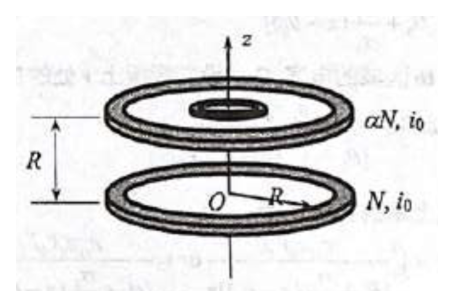 gravimetro superconduttore modello
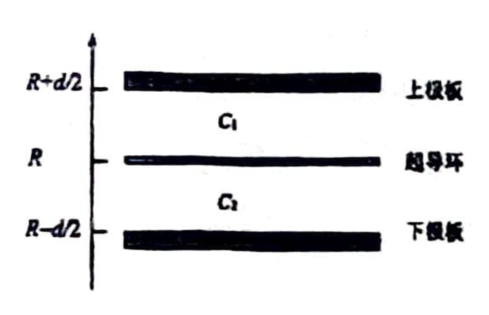 modello semplificato piastre condensatori
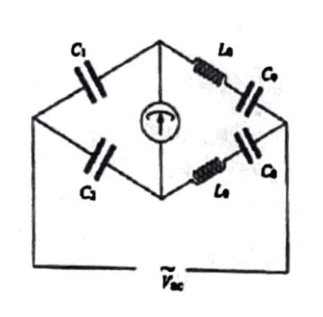 circuito esterno con C1 C2 L0 C0
Topic: Gravitation, Electromagnetism, Circuits Metodi: Newton’s Law of Gravitation, Faraday’s Law of Induction, Symmetry Argument, Equivalent Circuit Reduction Competenze: Mathematical Modeling, Physical Reasoning, Diagrammatic Reasoning Objects: Coil, Capacitor, Inductor Fonte: Testo (PDF) — p.3
Problema 3 (40 punti). In questo problema, studiamo le applicazioni del gravimetro superconduttore. Il gravimetro superconduttore può essere utilizzato per ottenere informazioni sull’interno della Terra come come la dinamica del mantello, la distribuzione di massa, le maree della crosta, le acque sotterranee e la distribuzione dei minerali. It possono essere utilizzate anche per monitorare fenomeni esterni come le maree costiere e il cambiamento climatico. Questi I dati possono essere ottenuti mediante misurazioni a lungo termine e ad alta precisione di piccoli cambiamenti nel l’accelerazione gravitazionale utilizzando il gravimetro superconduttore. Il gravimetro superconduttore è estremamente sensibile (con un’incertezza di circa ) e ha una buona stabilità di misurazione, ed è Quindi lo strumento principale degli scienziati della Terra che desiderano misurare l’accelerazione gravitazionale locale
- E’ preciso. Si creano nuove opportunità per lo sviluppo delle scienze della Terra e le misure precise della forza gravitazionale, come i gravimetri superconduttori e le reti di comunicazione sono costruite in tutto il mondo. Le seguenti domande riguardano gli effetti delle acque sotterranee sulle l’accelerazione gravitazionale e i principi di funzionamento del gravimetro superconduttore.
- Modelliamo la Terra come una sfera solida uniforme di raggio di 6370 km, la cui accelerazione gravitazionale is . Supponiamo che un lago sotterraneo sferico di diametro di 20 km il cui centro è a 15 km dalla superficie. Trova la differenza di accelerazione gravitazionale sul superficie, verticalmente sopra il centro del lago, dati i valori della costante gravitazionale e la densità dell’acqua . Non si accorgono degli effetti a causa della rotazione terrestre.
- Il componente principale del gravimetro superconduttore è una conchiglia sferica fatta di un raffreddamento, leghe di niobio superconduttore, sospese in un campo magnetico. Per comodità, modelliamo il conchiglia come anello superconduttore (vedere figura 3.1). Il campo magnetico esterno è fornito da un apparecchio superconduttore simile a bobina Helmholtz, composto da una bobina superiore con numero di turno e una bobina inferiore con numero di turno , dove . Le bobine condividono lo stesso raggio e l’asse di simmetria, sono separati da e sono collegati in serie a una fonte di alimentazione esterna. Prima di un iniziano le misure, le correnti nella bobina Helmholtz e l’anello sono zero, l’anello è nel lo stesso piano della bobina inferiore (), e condivide lo stesso asse di simmetria con entrambe le bobine. Quando viene effettuata una misurazione, la fonte di alimentazione introduce lentamente una corrente al Helmholtz bobina, che induce una corrente nell’anello. Se aggiustiamo la magnitudo di , possiamo fare l’anello levita in modo tale che si riposi nello stesso piano della bobina superiore (), come mostrato alla figura 3.1. As sia la bobina che l’anello sono superconduttori (a una temperatura di 4,2 K), le correnti costanti possono mantenere entrambi i conduttori, anche se la fonte di alimentazione è spenta. Figura 3.1: Modello del gravimetro superconduttore. Ci viene data la massa dell’anello , il suo diametro (dove ), e la sua auto-induzione ; e che i componenti radiali e verticali del campo magnetico generati dal Helmholtz
Olimpiada cinese di fisica la bobina può essere espressa come
se è la densità del flusso magnetico al centro della bobina superiore, è il coefficiente radial, e è la distanza all’asse z. Espresso (1) e ; 2) la corrente indotta nell’anello quando è in equilibrio a ; e (3) l’accelerazione gravitazionale locale in termini di parametri dati della bobina e dell’anello e della corrente nella bobina. 3. Considereremo il gravimetro dopo che la fonte di alimentazione è stata rimossa. Per ottenere precise misurazioni dei cambiamenti minuti dell’accelerazione gravitazionale locale, un circuito di ponte ac è utilizzato nella costruzione del gravimetro superconduttore. Per comprendere il suo principio di funzionamento E semplificare i calcoli, facciamo un certo numero di approssimazioni. Modelliamo l’ anello in forma di una sottile piastra conduttiva di superficie , e fissare due piastre di alluminio, ciascuna anche di superficie , sopra e sotto l’anello in modo simmetrico (cioè le piastre sono posizionate alle posizioni e ). Le tre piastre combinate possono essere modellate come due condensatori, uno () composto di una piastra superiore e del superconduttore, e di un’altra () composta dalla piastra inferiore e il superconduttore, come mostrato alla figura 3.2. Quindi colleghiamo e a due induttori e condensatori per formare un circuito ponte, e quindi collegarlo ad un a.c. fonte di energia (che la frequenza è molto superiore al tasso di variazione dell’accelerazione gravitazionale locale), come mostrato nella figura 3.3. Supponiamo che in un istante, l’accelerazione gravitazionale locale è , l’anello è a e il circuito del ponte è equilibrato. In questo momento, applichiamo un ulteriore costante volta su ciascun condensatore e . Quando l’accelerazione gravitazionale cambia di , il circuito del ponte diventa squilibrato. Se aumentamo la tensione di di e diminuire se la tensione è , il circuito del ponte diventa di nuovo equilibrato. Trova la relazione tra e . Lascia perdere tutti gli effetti frangiali. Figura 3.2: Modello semplificato. Traduzione (da cima a fondo): piastra superiore, anello, inferiore
- Piatto. Figura 3.3: Circuito esterno. e a sinistra, e a destra, alla
- Al fondo.
Olimpiada cinese di fisica
modello gravimetrico superconduttore
modello semplificato piastre condensatori
Circuito esterno con C1 C2 L0 C0
Topic: Gravitation, Electromagnetism, Circuits Metodi: Newton’s Law of Gravitation, Faraday’s Law of Induction, Symmetry Argument, Equivalent Circuit Reduction Competenze: Mathematical Modeling, Physical Reasoning, Diagrammatic Reasoning Objects: Coil, Capacitor, Inductor Fonte: Testo (PDF) — p.3
Problem 4 (40 points). An automobile is powered by the combustion of fuel in air occurring within combustion chambers in its engine. The power output of the engine is proportional to the mass of air taken in by the combustion chambers. Many automobiles are fitted with turbochargers (which compress air and thus increase air density) in order to maximise their power output. Automobiles may also be fitted with intercoolers, which cool the compressed air before it enters the combustion chamber, to further increase the air density. In a typical device composed of a turbocharger and an intercooler, air enters the turbocharger at pressure and temperature . The turbocharger makes the air undergo adiabatic compression and reach a pressure of . The air then passes through the intercooler, which cools the air at constant pressure to the external temperature , after which the air fills the combustion chamber. Model the air as an ideal gas. We are given the volume of the chamber, the molar mass of the air, the ratio of specific heats , and the universal gas constant . (1) Find the mass of air injected into the combustion chamber and compare it with the case where the device was not installed (). Write down the ratio . (2) Find the mass of air injected into the chamber for the case where no intercooler is present. Write down the ratio . (3) Find the work done on the injected air by the turbocharger () and the intercooler (). Find also the entropy change of the air due to the turbocharger () and the intercooler ().
Chinese Physics Olympiad
Topic: Thermodynamics Metodi: Ideal Gas Law, First Law of Thermodynamics, Thermodynamic Cycle Analysis Competenze: Mathematical Modeling, Physical Reasoning Objects: Gas Fonte: Testo (PDF) — p.5
Problema 4 (40 punti). Un’automobile è alimentato dalla combustione del combustibile nell’aria che si verifica all’interno di un’automobile. le camere di combustione del motore. La potenza di uscita del motore è proporzionale alla massa dell’aria Prenduto dalle camere di combustione. Molti automobili sono dotate di turbocompressori (che comprimono L’energia di produzione è di circa un milione di tonnellate di tonnellate di gas. Le auto possono essere equipaggiati con intercoolers, che raffreddano l’aria compressa prima di entrare nella camera di combustione, per aumentare ulteriormente la densità dell’aria. In un dispositivo tipico composto da un turbocompressore e da un intercooler, l’aria entra nel turbocompressore a pressione e temperatura . Il turbocompressore fa subire una compressione adiabatica dell’aria e raggiunge una pressione di . L’aria allora passa attraverso l’intercoolere, che raffredda l’aria a pressione costante alla temperatura esterna , dopo il quale l’aria riempie la camera di combustione. Modellare l’aria come un gas ideale. Ci viene data la volume della camera, massa molare dell’aria, rapporto di il calore e la costante universale del gas . (1) Trova la massa dell’aria iniettata nella camera di combustione e confrontala con il caso in cui il dispositivo non è stato installato (). Scrittore del rapporto . (2) Trovare la massa dell’aria iniettata nella camera per il caso in cui non sia presente un intercooler. Scrittore del rapporto . (3) Trova il lavoro effettuato sull’aria iniettata dal turbocompressore () e dall’intercooler (). Trova anche il cambiamento di entropia dell’aria dovuto al turbocompressore () e all’intercoolere ().
Olimpiada cinese di fisica
Topic: Thermodynamics Metodi: Ideal Gas Law, First Law of Thermodynamics, Thermodynamic Cycle Analysis Competenze: Mathematical Modeling, Physical Reasoning Objects: Gas Fonte: Testo (PDF) — p.5
Problem 5 (40 points). The 2018 Nobel Prize in Physics was awarded in part to Arthur Ashkin for his pioneering work on optical tweezers. Optical tweezers use focused laser beams to trap small particles (see Figure 5.1 for a schematic). The helium-neon (He-Ne) laser emits a beam with wavelength , beam diameter , and power . To enhance the trapping effect, we may place a beam expander in the path of the laser beam (which increases the beam diameter to ). The expanded beam reflects offof a mirror and is focused by a lens of focal length . It finally passes into a tank of distilled water, in which a certain quantity of spherical polystyrene particles are placed. We are given the following parameters: the diameter of one particle and its density , the refractive index of the glass tank wall, the refractive index of water, the thickness of the glass base, the distance between the focusing lens and glass base, the ambient temperature , the refractive index of air, the gravitational acceleration , and the Boltzmann constant . When a particle happens to cross the path of the laser beam, it may be trapped by the beam. Figure 5.1: A typical optical tweezer setup. Translation (top to bottom, left to right): polystyrene particle, sample tank, mm, mm, focusing lens, beam expander, mm, , He-Ne laser, reflector. (1) In the case where the beam expander is not used, find the diameter of the light spot after the beam passes through the focusing lens. (2) We use the beam expander hereafter. As shown in Figure 5.1, the expander consists of a concave lens of focal length and a convex lens of focal length . Find the diameter of the expanded beam, given that the constituent rays of the expanded beam are all parallel to each other. (3) We now focus the beam to a point inside the sample tank. Find, using the paraxial approximation, the distance of the effective focal point from the upper surface of the glass base and the diameter of the beam at the focal point. (4) Figure 5.2 shows a model of the effects of radiation pressure due to an optical gradient on a polystyrene particle immersed in water. The gradient is modelled with two light rays of different intensities. We treat the system using geometric optics. Light rays (power ) and (power ) travelling parallel to the x-axis fall upon the particle. Both rays are refracted by the particle and make angles with the x-axis as shown. Neglecting all losses due to reflection and absorption, find the optical-gradient force on the particle. Also write down the values of the ratios and .
Chinese Physics Olympiad Figure 5.2: Modelling radiation pressure with geometric optics. is the weak lower ray, while is the strong upper ray. Each refracted ray makes an angle of with the x-axis. (5) Find the rms speed of each polystyrene particle at room temperature 300 K. (6) We can also model the behaviour of the optical tweezers with the potential well produced by the optical gradient. The radial potential distribution due to the focused laser beam is given by
where is a constant, is the distance to the centre of the optical field, and . Find the maximum possible speed of a particle which can be trapped by the potential well. (7) The probability density function of the particle speed is given by
where and are the mass and speed of each particle respectively and is the absolute temperature. Suppose that two types of polystyrene particles are suspended in the sample tank, one of mass and another of mass . Compare the probabilities of each type of particle being trapped by the laser, and respectively.
Chinese Physics Olympiad
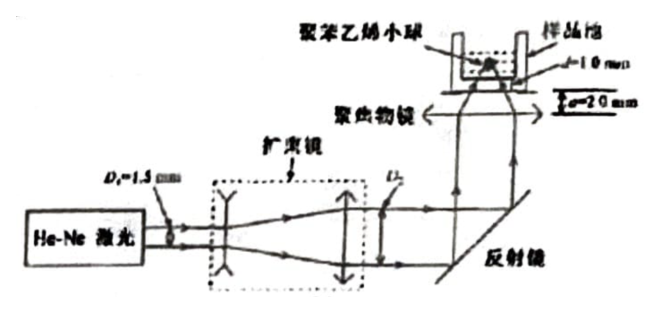 configurazione pinzette ottiche
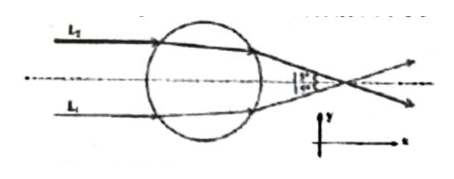 pressione radiazione ottica geometrica
Topic: Geometric Optics, Kinetic Theory, Modern-Quantum Physics Metodi: Ray Tracing, Thin Lens & Mirror Equation, Snell’s Law, Conservation of Momentum, Statistical Averaging Competenze: Mathematical Modeling, Physical Reasoning, Estimation & Approximation Objects: Mirror, Lens, Container Fonte: Testo (PDF) — p.6
Problema 5 (40 punti). Il Premio Nobel di Fisica 2018 è stato assegnato in parte a Arthur Ashkin per il suo lavoro pionieristico sulle pinzette ottiche. Le pinzette ottiche utilizzano raggi laser focalizzati per intrappolare piccole particelle (vedere Figura 5.1 per uno schema). Il laser di elio-neone (He-Ne) emette un raggio con lunghezza d’onda , diametro del fascio e potenza . Per migliorare l’effetto di intrappolamento, possiamo un amplificatore del fascio nel percorso del fascio laser (che aumenta il diametro del fascio a ). Il Il fascio ampliato riflette uno specchio ed è focalizzato da una lente di distanza focale . Finalmente passa in un serbatoio di acqua distillata, in cui si trovano determinate quantità di particelle di polistirolo sferiche
- Si è messo. Ci sono stati dati i seguenti parametri: il diametro di una particella e il suo densità , l’indice di rifrazione della parete del serbatoio di vetro, l’indice di rifrazione di acqua, lo spessore della base vetrata, la distanza tra le lenti di messa a fuoco e base vetrata, temperatura ambientale , indice di rifrazione dell’aria, l’accelerazione gravitazionale e la costante di Boltzmann . Quando una particella incrocia il percorso del raggio laser, può essere intrappolata dal raggio. Figura 5.1: tipico sistema di pinzette ottiche. Traduzione (da cima a fondo, da sinistra a destra): polistirolo particelle, serbatoio di campioni, mm, mm, lente di messa a fuoco, amplificatore del fascio, mm, , He-Ne Laser, riflettore. (1) Nel caso in cui non si utilizzi l’espansione del fascio, si trova il diametro della macchia di luce dopo la il raggio passa attraverso la lente di messa a fuoco. (2) Usamo l’espansione del fascio in seguito. Come mostrato alla figura 5.1, l’espansione è costituita da una concava Lenti a distanza focale e lenti convex a distanza focale . Trova il diametro del fascio ampliato, dato che i raggi costituenti del fascio ampliato sono tutti parallele tra loro. (3) Ora concentriamo il fascio su un punto all’interno del serbatoio di campione. Trova, usando l’approssimazione paracciale, la distanza del punto focale effettivo dalla superficie superiore della base vetrata e il diametro di raggi al punto focale. (4) La figura 5.2 mostra un modello degli effetti della pressione radiologica dovuta a un gradiente ottico su un particella di polistirolo immersa in acqua. Il gradiente è modellato con due raggi luminosi di
- le intensità. Trattamo il sistema usando l’ottica geometrica. Raggi luminosi (potenza ) e (potenza ) che viaggiano parallele all’asse x
- E’ il momento di cadere sulla particella. Entrambi i raggi sono rifracciati dalla particella e fanno angoli con l’asse x come
- E’ stato mostrato. Negli esseri umani, la forza di raggi di raggi è indicata nella tabella 2. la particella. Inoltre, annotare i valori dei rapporti e .
Olimpiada cinese di fisica Figura 5.2: Modellazione della pressione radiologica con l’ottica geometrica. è il raggio inferiore debole, mentre è il forte raggio superiore. Ogni raggio rifraccato fa un angolo di con l’asse x. (5) Trova la velocità di ogni particella di polistirolo a temperatura ambiente 300 K. (6) Possiamo anche modellare il comportamento delle pinzette ottiche con il potenziale di pozzo prodotto dalla gradiente ottico. La distribuzione del potenziale radial dovuto al fascio laser focalizzato è data da:
se è una costante, è la distanza al centro del campo ottico e . Trova la velocità massima possibile di una particella che può essere intrappolata dal pozzo potenziale. (7) La funzione di densità di probabilità della velocità delle particelle è data da
dove e sono la massa e la velocità di ciascuna particella rispettivamente e è la temperatura assoluta. Supponiamo che due tipi di particelle di polistirolo siano sospesi nel serbatoio campione, uno di massa e un’altra di massa . Confronta le probabilità di ogni tipo di particella essere intrappolata con il laser, rispettivamente e .
Olimpiada cinese di fisica
configurazione pinzette ottiche
pressione radiazione ottica geometrica
Topic: Geometric Optics, Kinetic Theory, Modern-Quantum Physics Metodi: Ray Tracing, Thin Lens & Mirror Equation, Snell’s Law, Conservation of Momentum, Statistical Averaging Competenze: Mathematical Modeling, Physical Reasoning, Estimation & Approximation Objects: Mirror, Lens, Container Fonte: Testo (PDF) — p.6
Problem 6 (80 points). The starry night has inflamed human imaginations for much of our history. As science and technology make progress over the years, human knowledge about the cosmos has expanded substantially, especially in light of the new insights of the 21st century, such as the resolution of the missing neutrino problem, direct observation of gravitational waves, and the first image of a black hole. These events have inspired interest among members of the public. How can humanity explain cosmic and stellar phenomena, when our means are limited by the size and nature of our apparatus? Can the public, whose knowledge is limited to the high school level, quantitatively understand both the internal and external features of stars, such as their size, their mass, their life cycle, their structure, and their mechanisms of power generation? This problem, in constructing a model of the Sun, progresses from simple to complex models and follows the arc of history. As we cannot directly observe the Sun’s interior, the models we consider must be tested by a manifold of observations, such as the Sun’s age, its radius, its surface temperature, its power output, and its emission of neutrinos. All these observations must conspire to produce an internally-consistent model. The following parameters are given: the radius of the Earth is 6370 km, the gravitational constant , the Stefan-Boltzmann constant , the Boltzmann constant , the elementary charge , the electron mass , the proton mass , the deuteron mass , the He mass , and the He mass .
- A 2000-year-old Chinese classic text on arithmetic, the Zhoubi Suanjing, describes a method of measuring the ratio between the solar diameter and the distance between the Sun and Earth AU. Take a long, straight bamboo rod and hollow out its interior such that the inner diameter is . Line up the axis of the rod with the Sun and adjust its length such that the solar disc just ‘fills up’ the end of the rod opposite to the observer.2 (1) Write down the relationship between the angular diameter of the solar disc , , and . (2) The rod should be long in order to minimise the experimental error. What other ways are there to further minimise the error? (3) We obtain the measurements inch and feet.3 Find the value of .
- On rare occasions (such as on 6 June 2012), Earth, Venus, and the Sun nearly lie on the same line (i.e. are collinear). If we observe the Sun at these times, Venus appears as a small black spot moving slowly across the solar disc. This is known as a transit of Venus, and a schematic is shown in Figure 6.1. The British astronomer Edmond Halley once suggested in 1716 that the angular diameter and the distance between the Sun and the Earth could be measured by collecting data from observations of the transit of Venus around the world at the same time. We are given that Earth and Venus orbit the Sun in the same direction with periods days and days respectively, that the inclination between the two orbital planes is small, and that Earth’s rotation can be neglected. (a) Suppose that both Earth and Venus orbit the Sun in circular orbits. Find the ratio of the Sun-Venus distance to the Sun-Earth distance . 2Warning. We are not advocating that you try this yourself. Following the given instructions may well result in blindness. 3Translator’s note. The Chinese paper specifies the measurements in ancient Chinese inches and feet for the sake of historical accuracy. It is given there that 10 inches make a foot (not 12 inches).
Chinese Physics Olympiad Figure 6.1: Transit of Venus on 6 June 2012. Translation (in order from left to right): Ingress, exterior, 6:10:10; Ingress, interior, 6:27:51; Greatest transit; Egress, interior, 12:31:57; Egress, exterior, 12:49:31. (b) On 6 June 2012, the transit of Venus is observed somewhere on Earth, with the key phases of the transit marked on Figure 6.1. The shadow of Venus traces out a chord of the solar disc. Find the ratio between the length of this chord and the Sun-Earth distance . Find also the angular diameter of the solar disc, given the distance of the chord from its centre. (c) The measurement of the distance between the Sun and Earth requires observing the same transit at different locations on Earth, as shown in Figure 6.2. Suppose that two observers and located on the same line of longitude observe the transit simultaneously, separated by a distance measured along the Earth’s surface. observes Venus tracing out a chord on the solar disc and measures a transit time of , while sees the chord and measures . Express in terms of , , , , , , and . (d) We are given the latitudes of Beijing, , and Hong Kong, , and their corresponding measured transit times, and . Use the given data and the result of (3) to obtain the numerical value of . 3. The observations of the transit of Venus in 1882 yielded the results km and km. The Earth receives solar radiation of intensity , when measured in a plane perpendicular to the direction of radiation transfer. Obtain: (1) the total solar energy received by the Earth per unit time; (2) the ratio between the total energy consumption of all seven (7) billion people on Earth and the total solar energy, assuming that each person consumes the energy equivalent of three (3) metric tonnes of coal, and that 1 kg of coal produces 4 kWh of energy;4 (3) the total energy emitted by the Sun per unit time; and (4) an estimate of the surface temperature of the Sun. 4Translator’s note. This exercise was first done by Helmholtz in 1854, to demonstrate that the energy of the Sun could not be generated by chemical reactions.
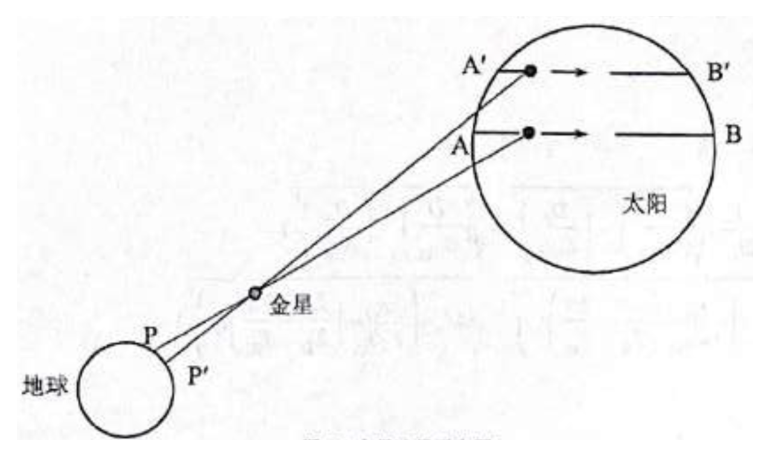
Chinese Physics Olympiad Figure 6.2: A method measuring the Sun-Earth distance. Translation (left to right): Earth, Venus, Sun. 4. (1) Obtain the solar mass and the average solar density. (2) If the energy emission of the Sun were caused by chemical processes, and assuming that the radiation emitted per unit mass were the same as the energy resulting from combustion of a unit mass of coal (see 3.2), for how long can the Sun continue to emit radiation in this manner? The Sun has existed as a star for five (5) billion years. How many times is the rate of energy production compared with the rate in the case where all the solar energy were accounted for by chemical reactions? 5. We know that the Sun is mainly composed of hydrogen due to spectral analysis. The fusion reactions hydrogen can be involved in are given by
In the above reactions, the positrons will be annihilated, while the neutrinos will escape the Sun. The atomic nuclei are positively charged and repel each other, unless they are at a very high temperature, in which case their kinetic energy may be able to overcome the electrostatic repulsion between them, thereby undergoing a fusion reaction. When the temperature is high enough, all the atoms are ionised, become free nuclei and electrons, and form a plasma. In this section, we neglect the energy carried away by the neutrinos and the unreacted hydrogen carried away by the solar wind. (1) How many protons are consumed per unit time to maintain the solar radiation? (2) At present, 71% of the Sun is composed of hydrogen. Assuming that the rate just obtained is maintained ever after, for how long can this consumption be maintained? Write down the probability per unit time of a proton-proton reaction. (3) The number of neutrinos escaping the Sun does not fall offduring transmission from the Sun to the Earth. How many neutrinos pass through a unit area on Earth,
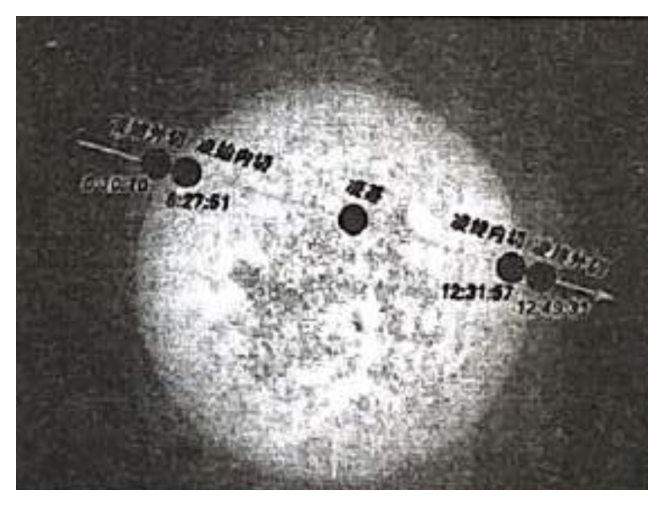 transito di Venere 6 giugno 2012
 metodo misura distanza Terra-Sole
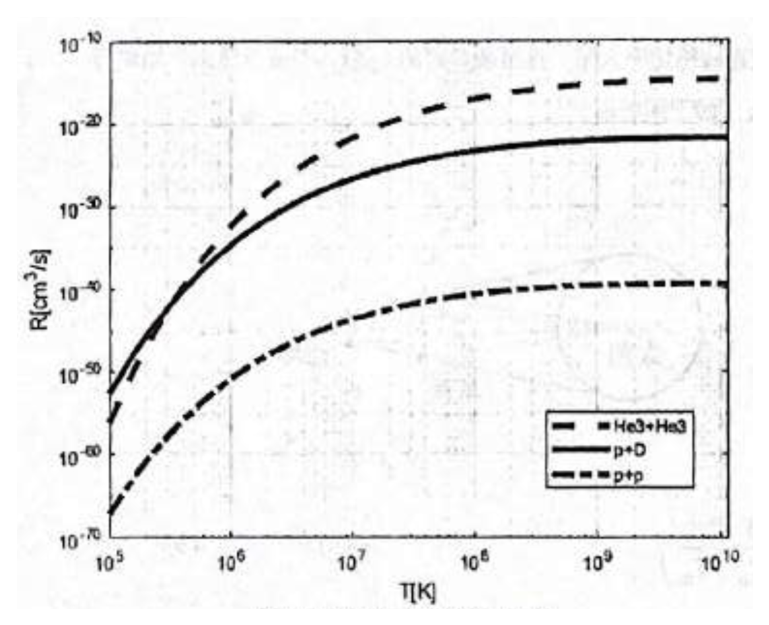 grafico velocita reazione vs temperatura plasma
Topic: Astrophysics, Nuclear & Particle Physics, Gravitation Metodi: Kepler’s Laws, Newton’s Law of Gravitation, Mass-Energy Equivalence, Order-of-Magnitude Estimation, Physical Modeling Competenze: Estimation & Approximation, Mathematical Modeling, Physical Reasoning Objects: Star, Planet, Nucleus Fonte: Testo (PDF) — p.8
Problema 6 (80 punti). Il cielo stellato ha infiammato l’immaginazione umana per gran parte della nostra storia. Con il progredire della scienza e della tecnologia nel corso degli anni, la conoscenza umana del cosmo si è ampliata notevolmente, soprattutto alla luce delle nuove scoperte del XXI secolo, come la soluzione del problema dei neutrini mancanti, l’osservazione diretta delle onde gravitazionali e la prima immagine di un buco nero. Questi eventi hanno suscitato interesse tra il pubblico. Come può l’umanità spiegare i fenomeni cosmici e stellari, quando i nostri mezzi sono limitati dalle dimensioni e dalla natura della nostra strumentazione? Può il pubblico, la cui conoscenza si limita al livello della scuola superiore, comprendere quantitativamente sia le caratteristiche interne sia quelle esterne delle stelle, come le loro dimensioni, la loro massa, il loro ciclo di vita, la loro struttura e i loro meccanismi di produzione di energia? Questo problema, nel costruire un modello del Sole, procede da modelli semplici a modelli complessi e segue il corso della storia. Poiché non possiamo osservare direttamente l’interno del Sole, i modelli che consideriamo devono essere verificati da una molteplicità di osservazioni, come l’età del Sole, il suo raggio, la sua temperatura superficiale, la sua potenza emessa e la sua emissione di neutrini. Tutte queste osservazioni devono concorrere a produrre un modello internamente coerente. Sono dati i seguenti parametri: il raggio della Terra è 6370 km, la costante di gravitazione universale , la costante di Stefan-Boltzmann , la costante di Boltzmann , la carica elementare , la massa dell’elettrone , la massa del protone , la massa del deutone , la massa dell’He e la massa dell’He .
- Un testo classico cinese di aritmetica di 2000 anni fa, lo Zhoubi Suanjing, descrive un metodo per misurare il rapporto tra il diametro solare e la distanza tra il Sole e la Terra AU. Si prenda una lunga asta di bambù diritta e se ne svuoti l’interno in modo che il diametro interno sia . Si allinei l’asse dell’asta con il Sole e se ne regoli la lunghezza in modo che il disco solare ‘riempia’ esattamente l’estremità dell’asta opposta all’osservatore.2 (1) Si scriva la relazione tra il diametro angolare del disco solare , e . (2) L’asta dovrebbe essere lunga per minimizzare l’errore sperimentale. In quali altri modi si può ridurre ulteriormente l’errore? (3) Otteniamo le misure pollice e piedi.3 Si determini il valore di .
- In rare occasioni (come il 6 giugno 2012), la Terra, Venere e il Sole giacciono quasi sulla stessa retta (cioè sono allineati). Se osserviamo il Sole in questi momenti, Venere appare come una piccola macchia nera che si muove lentamente sul disco solare. Questo fenomeno è noto come transito di Venere, e uno schema è mostrato nella Figura 6.1. L’astronomo britannico Edmond Halley suggerì nel 1716 che il diametro angolare e la distanza tra il Sole e la Terra potessero essere misurati raccogliendo dati dalle osservazioni del transito di Venere effettuate contemporaneamente in tutto il mondo. È dato che la Terra e Venere orbitano attorno al Sole nello stesso verso con periodi giorni e giorni rispettivamente, che l’inclinazione tra i due piani orbitali è piccola, e che la rotazione terrestre può essere trascurata. (a) Si supponga che sia la Terra sia Venere orbitino attorno al Sole su orbite circolari. Si determini il rapporto tra la distanza Sole-Venere e la distanza Sole-Terra . 2Attenzione. Non stiamo suggerendo di provarlo di persona. Seguire le istruzioni date potrebbe benissimo causare la cecità. 3Nota del traduttore. Il testo cinese specifica le misure in antichi pollici e piedi cinesi per fedeltà storica. In esso si dà che 10 pollici formano un piede (non 12 pollici).
Chinese Physics Olympiad Figura 6.1: Transito di Venere il 6 giugno 2012. Traduzione (in ordine da sinistra a destra): Ingresso, esterno, 6:10:10; Ingresso, interno, 6:27:51; Transito massimo; Uscita, interno, 12:31:57; Uscita, esterno, 12:49:31. (b) Il 6 giugno 2012 il transito di Venere è osservato da qualche punto sulla Terra, con le fasi principali del transito indicate nella Figura 6.1. L’ombra di Venere traccia una corda del disco solare. Si determini il rapporto tra la lunghezza di questa corda e la distanza Sole-Terra . Si determini inoltre il diametro angolare del disco solare, data la distanza della corda dal suo centro. (c) La misura della distanza tra il Sole e la Terra richiede di osservare lo stesso transito da luoghi diversi sulla Terra, come mostrato nella Figura 6.2. Si supponga che due osservatori e situati sullo stesso meridiano osservino il transito simultaneamente, separati da una distanza misurata lungo la superficie terrestre. osserva Venere tracciare una corda sul disco solare e misura un tempo di transito , mentre vede la corda e misura . Si esprima in funzione di , , , , , e . (d) Sono date le latitudini di Pechino, , e di Hong Kong, , e i corrispondenti tempi di transito misurati, e . Si usino i dati forniti e il risultato del punto (3) per ottenere il valore numerico di . 3. Le osservazioni del transito di Venere del 1882 hanno fornito i risultati km e km. La Terra riceve radiazione solare di intensità , misurata su un piano perpendicolare alla direzione di propagazione della radiazione. Si ottenga: (1) l’energia solare totale ricevuta dalla Terra per unità di tempo; (2) il rapporto tra il consumo energetico totale di tutti i sette (7) miliardi di persone sulla Terra e l’energia solare totale, assumendo che ogni persona consumi l’energia equivalente a tre (3) tonnellate di carbone, e che 1 kg di carbone produca 4 kWh di energia;4 (3) l’energia totale emessa dal Sole per unità di tempo; e (4) una stima della temperatura superficiale del Sole. 4Nota del traduttore. Questo esercizio fu svolto per la prima volta da Helmholtz nel 1854, per dimostrare che l’energia del Sole non poteva essere generata da reazioni chimiche.
Chinese Physics Olympiad Figura 6.2: Un metodo per misurare la distanza Sole-Terra. Traduzione (da sinistra a destra): Terra, Venere, Sole. 4. (1) Si ottengano la massa solare e la densità media del Sole. (2) Se l’emissione di energia del Sole fosse causata da processi chimici, e assumendo che la radiazione emessa per unità di massa fosse pari all’energia risultante dalla combustione di un’unità di massa di carbone (vedi 3.2), per quanto tempo il Sole potrebbe continuare a emettere radiazione in questo modo? Il Sole esiste come stella da cinque (5) miliardi di anni. Di quante volte è maggiore il tasso di produzione di energia rispetto al tasso nel caso in cui tutta l’energia solare fosse dovuta a reazioni chimiche? 5. Sappiamo, grazie all’analisi spettrale, che il Sole è composto principalmente di idrogeno. Le reazioni di fusione a cui l’idrogeno può partecipare sono date da
Nelle reazioni precedenti i positroni vengono annichilati, mentre i neutrini sfuggono dal Sole. I nuclei atomici sono carichi positivamente e si respingono a vicenda, a meno che non si trovino a temperatura molto elevata, nel qual caso la loro energia cinetica può essere in grado di vincere la repulsione elettrostatica tra loro, dando così luogo a una reazione di fusione. Quando la temperatura è sufficientemente alta, tutti gli atomi sono ionizzati, diventano nuclei ed elettroni liberi e formano un plasma. In questa sezione trascuriamo l’energia trasportata via dai neutrini e l’idrogeno non reagito trasportato via dal vento solare. (1) Quanti protoni vengono consumati per unità di tempo per mantenere la radiazione solare? (2) Attualmente il 71% del Sole è composto di idrogeno. Assumendo che il tasso appena ottenuto si mantenga per sempre, per quanto tempo può essere mantenuto questo consumo? Si scriva la probabilità per unità di tempo di una reazione protone-protone. (3) Il numero di neutrini che sfuggono dal Sole non diminuisce durante la propagazione dal Sole alla Terra. Quanti neutrini attraversano un’unità di area sulla Terra,
transito di Venere 6 giugno 2012
metodo misura distanza Terra-Sole
grafico velocita reazione vs temperatura plasma
Topic: Astrophysics, Nuclear & Particle Physics, Gravitation Metodi: Kepler’s Laws, Newton’s Law of Gravitation, Mass-Energy Equivalence, Order-of-Magnitude Estimation, Physical Modeling Competenze: Estimation & Approximation, Mathematical Modeling, Physical Reasoning Objects: Star, Planet, Nucleus Fonte: Testo (PDF) — p.8