Casa del hielo
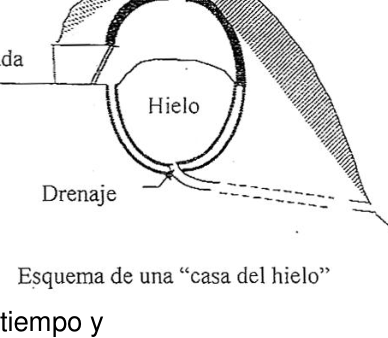
Problema 1: Casa del hielo. En aquellos lugares en donde se acumula mucho hielo durante el invierno, los habitantes que no tienen una heladera, juntan el hielo en un recinto conocido como “casa del hielo”. Esta se construye con ladrillos, parcialmente hundida en el suelo con paredes bien aisladas. La “casa del hielo” tiene una salida para el drenaje del agua que resulta de la fusión del hielo y una salida superior para el vapor de agua (ver dibujo). El hielo que se introduce en la “casa del hielo” es previamente molido y luego compactado dentro del recinto correspondiente en la casa.
Consignas: Considere despreciable la masa de aire que hay dentro de la casa y la sublimación del hielo y suponga que las paredes de la casa son perfectamente aislantes. Así, llamando: E a la energía por unidad de tiempo (potencia) que ingresa a la casa del hielo y que es absorbida por este, M la masa de hielo que se funde (se derrite) por unidad de tiempo en el interior de la casa, Mv a la masa de vapor de agua que se evapora a partir de esta agua por unidad de tiempo y MF a la masa de agua que finalmente fluye por unidad de tiempo al desagüe (drenaje), “la ecuación de la casa del hielo”, esto es la masa de hielo que se funde por unidad de tiempo es:
(1)
donde Lv y LF son los calores de evaporación del agua y de fusión del hielo, respectivamente.
a) Usando la conservación de la energía, deduzca la “ecuación de la casa del hielo” (ecuación 1). b) b1) De una expresión de la masa de hielo por unidad de tiempo (M1) que se fundiría si toda la potencia que ingresa a la casa de hielo solamente se empleara en fundir hielo; Mv = 0. b2) De una expresión de la masa de hielo por unidad de tiempo (M2) que se fundiría si toda el agua producida, finalmente, se transformara en vapor de agua; MF = 0. b3) Exprese el cociente entre M1 y M2 en términos de los datos y calcule su valor. b4) ¿Cuál de las dos situaciones es el menos favorable para la conservación del hielo?
Suponiendo que una fracción f de la masa de hielo derretido se evapora, lo que es equivalente a decir que la relación entre la masa de hielo que se derrite por unidad de tiempo (M) y la masa de agua que se evapora por unidad de tiempo (Mv) están vinculadas de la forma: (2)
OAF 2011 - 4 c) Demuestre que la ecuación (1) resulta:
donde
(3)
Considere que el lugar en donde se aloja el hielo, dentro de la “casa del hielo”, tiene la forma de un cilindro de radio r y profundidad h. Suponga que el intercambio de calor con el hielo se produce a través de una de las superficies circulares del cilindro; esto es, a través de una de las tapas de área A, dada por: (4)
Suponga que durante el proceso de fusión del hielo, la altura h permanece constante; es decir, la fusión del hielo solo modifica la sección del cilindro de hielo. Con estas condiciones, la energía por unidad de tiempo (E) que ingresa al hielo se puede expresar como: (5) donde k es una constante que representa el intercambio de calor con el exterior (coeficiente de conducción externa) y ΔT es la diferencia de temperatura (salto térmico) entre el hielo y el medio exterior con el que intercambia calor la “casa del hielo” (el hielo).
d) Utilizando ecuación (3) y las consideraciones expresadas en el párrafo anterior, demuestre que:
(5)
donde m es la masa de hielo presente en la “casa del hielo” al tiempo t y la densidad del hielo.
A partir de la ecuación (5) se puede obtener la forma en la que varia la masa total de hielo que hay dentro de la “casa del hielo”, m, en función del tiempo. Esta función es de la forma: (5) donde m0 es la masa inicial de hielo (la que se depositó en la “casa del hielo” al inicio) y b es una constante dada por:
(6)
e) A partir de las ecuaciones (5) y (6) encuentre el tiempo para el cual la masa de hielo se reduce a la mitad, en las condiciones siguientes: e1) Cuando f = 0 (no hay evaporación) e2) Cuando L = 2LF. Para esta situación, además, calcule el valor correspondiente de f. Exprese ambos resultados en años. e3) ¿Cuál de los dos casos es el más favorable para la conservación del hielo?
Los valores de las constantes para los cálculos son: k = 2 W / m2K LF = 0,33 x 10⁶ J / kg LV = 2,26 x 10⁶ J / kg = 800 kg / m3 ΔT = 20 K h = 5 m
OAF 2011 - 5
Topic: Thermodynamics Metodi: Conservation of Energy, Differential Equations, Calculus-Integration Competenze: Physical Reasoning, Mathematical Modeling Objects: Cylinder Fonte: Testo (PDF) — p.3
Casa di ghiaccio
Problema 1: Casa di ghiaccio. In quei luoghi dove si accumula molto ghiaccio durante l’inverno, i Gli abitanti che non hanno un frigorifero, raccolgono il ghiaccio in un recinto noto Come la casa del ghiaccio. Questa è costruita con mattoni, parzialmente immersa nel terreno con pareti. ben isolati. La casa di ghiaccio ha un’uscita per il drenaggio dell’acqua che La fonte di acqua è la fonte di vapore (vedi disegno). Il ghiaccio che viene introdotto nella casa di ghiaccio è precedentemente mollato e Poi compreso all’interno del corrispondente recinto della casa.
Consigni: Considerate dispregiata la massa di l’aria che c’è dentro la casa e la la sublimazione del ghiaccio e supponi che Le
-
Pareti de la casa Sono Perfetto . isolanti. Così, chiamando: E all’energia per unità di tempo. (potenza) che entra nella casa del gelo e che viene assorbita da questo, M la massa di ghiaccio che si fonde (si molli) per unità di tempo in all’interno della casa, Mv alla massa di vapore d’acqua che evapora da questa acqua per unità di tempo e MF alla massa di acqua che infine scorre per unità di tempo allo svantaggio (Drenaggio), l’equazione della casa di ghiaccio, questa è la massa di ghiaccio che si fonde per Un’unità di tempo è:
(1)
dove Lv e LF sono calori di evaporazione dell’acqua e di fusione del ghiaccio, rispettivamente.
a) Usando la conservazione dell’energia, dedurre l’equazione della casa di ghiaccio (equazione 1). b) b1) Di un’espressione di massa di ghiaccio per unità di tempo (M1) che si fonderebbe se tutta la potenza che entra nella casa di ghiaccio solo per fondere ghiaccio; Mv = 0. b2) Di un’espressione di massa di ghiaccio per unità di tempo (M2) che si fonderebbe se tutta l’acqua prodotta, alla fine, si fosse si trasforma in vapore d’acqua; MF = 0. b3) Esprimere il rapporto tra M1 e M2 in termini di dati e Calcola il suo valore. b4) Qual è la situazione meno favorevole per la conservazione del ghiaccio?
Supponiamo che una frazione f della massa di ghiaccio sciolto evapori, che E’ equivalente a dire che il rapporto tra la massa di ghiaccio che si scioglie per unità di tempo (M) e massa di acqua evaporata per unità di tempo (Mv) sono collegate in: (2)
OAF 2011 - 4 c) Dimostra che l’equazione (1) risulta:
dove
(3)
Considera che il luogo in cui si trova il ghiaccio, all’interno della casa del ghiaccio, ha la forma di un cilindro di radius r e profondità h. Supponiamo che il lo scambio di calore con il ghiaccio si verifica attraverso una delle superfici circolari del cilindro; cioè, attraverso una delle tappe di area A, data da: (4)
Supponiamo che durante il processo di fusione del ghiaccio, l’altezza h rimanga. La fusione del ghiaccio modifica solo la sezione del cilindro di
- Il ghiaccio. Con queste condizioni, l’energia per unità di tempo (E) che entra nel ghiaccio può essere espressa come: (5) dove k è una costante che rappresenta lo scambio di calore con l’esterno (coefficiente di conduzione esterna) e ΔT è la differenza di temperatura (salto Il calore è caldo (calore) tra il ghiaccio e l’ambiente esterno con cui la casa scambia calore. del ghiaccio.
d) utilizzando l’equazione (3) e le considerazioni espresse nel paragrafo precedente, dimostra che:
(5)
dove m è la massa di ghiaccio presente nella casa di ghiaccio al tempo t e densità del ghiaccio.
L’equazione (5) può indicare la variazione della massa. totale di ghiaccio all’interno della cassa di ghiaccio, m, in funzione del tempo. Questa funzione è la seguente: (5) dove m0 è la massa iniziale di ghiaccio (quella che è stata depositata nella casa di ghiaccio) inizio) e b è una costante data da:
(6)
e) Sulla base delle equazioni (5) e (6) trovi il tempo per il quale la la massa di ghiaccio è ridotta di metà, alle seguenti condizioni: e1) Quando f = 0 (non evaporazione) e2) Quando L = 2LF. Per questa situazione, calcola il valore corrispondente di f. Esprimete entrambi i risultati in anni. e3) Quale dei due casi è il più favorevole alla conservazione? del ghiaccio?
I valori delle costanti per i calcoli sono: k = 2 W / m2K LF = 0,33 x 10⁶ J / kg LV = 2,26 x 10⁶ J / kg = 800 kg / m3 ΔT = 20 K h = 5 m
OAF 2011 - 5
Topic: Thermodynamics Metodi: Conservation of Energy, Differential Equations, Calculus-Integration Competenze: Physical Reasoning, Mathematical Modeling Objects: Cylinder Fonte: Testo (PDF) — p.3
The following is the list of the Member States’ official data protection authorities:
Problem one: Ice house. In those places where a lot of ice accumulates during the winter, the People who don’t have a freezer, they’re gathering ice in a known enclosure. Like the house of ice. This one is built with bricks, partially sunk into the ground with walls. well isolated. The ice house has an outlet for draining water that It is the result of melting ice and an upper outlet for water vapour (see drawing). The ice that is introduced into the ice house is previously ground and then compacted within the corresponding enclosure in the house.
The following is the list of winners: Consider the mass of The air inside the house and the Sublimation of ice and assuming The Walls . de la house They are Perfectly . insulating. That’s it. Calling: And to the energy per unit of time. (power) entering the house of the ice and it is absorbed by this, M the melting ice mass melt) per unit of time in the inside the house, Mv to the water vapor mass which It evaporates from this water per unit of time and MF to the mass of water that finally flows per unit time to the drainage (Drainage), the equation of the ice house, this is the mass of ice that melts by Unit of time is:
(1)
where Lv and LF are the heat of water evaporation and ice melting, the Commission.
(a) Using energy conservation, deduce the equation of the house The amount of the product shall be calculated as follows: b) (b1) Of an expression of ice mass per unit time (M1) It would melt if all the power that enters the ice house only used in melting ice; Mv = 0. (b2) Of an expression of the ice mass per unit time (M2) It would melt if all the water produced, finally, were transformed into water vapour; MF = 0. (b3) Express the ratio between M1 and M2 in terms of data and Calculate its value. (b4) Which of the two situations is less favourable to the conservation of ice?
Assuming a fraction f of the melted ice mass evaporates, which is equivalent to saying that the ratio of the melting ice mass to the unit of time (M) and evaporated water mass per unit of time (Mv) are linked as follows: (2)
The following is the list of the countries of the European Union: (c) Show that equation (1) results in:
Where
(3)
Consider that the place where the ice is housed, inside the ice house, It’s shaped like a cylinder with a radius r and a depth h. Suppose the Heat exchange with ice occurs through one of the surfaces cylinder circulars; that is, through one of the area A caps, given by: (4)
Suppose during the melting process, the height h remains The resulting ice melting is constant, i.e. the melting ice only changes the cylinder section of the cylinder. I’m going to get ice. Under these conditions, the energy per unit time (E) entering the ice It can be expressed as: (5) where k is a constant that represents the heat exchange with the outside world. (external conduction coefficient) and ΔT is the temperature difference (jump The heat exchange between the ice and the outside environment is the heat exchange between the house and the ice. of ice (ice).
(d) Using equation (3) and the considerations set out in paragraph above, prove that:
(5)
where m is the mass of ice present in the ice house at time t and the density of the ice.
From the equation (5) the shape of the mass varies. total ice contained within the ice house, m, depending on the weather. This function is as follows: (5) where m0 is the initial mass of ice (the one that was deposited in the ice house) start) and b is a constant given by:
(6)
(e) From equations (5) and (6) find the time for which the the ice mass is halved under the following conditions: e1) When f = 0 (no evaporation) e2) When L = 2LF. For this situation, also calculate the value corresponding to f. Express both results in years. (e3) Which of the two cases is most favourable for conservation The ice?
The values of the constants for calculations are: k = 2 W / m2K LF = 0,33 x 10⁶ J / kg LV = 2,26 x 10⁶ J / kg = 800 kg / m3 ΔT = 20 K h = 5 m
The following points shall be added:
Topic: Thermodynamics Metodi: Conservation of Energy, Differential Equations, Calculus-Integration Competenze: Physical Reasoning, Mathematical Modeling Objects: Cylinder Fonte: Testo (PDF) — p.3
Shazam!
Problema 2: Shazam! Introducción y Generalidades. El movimiento del aire dentro de las nubes produce una separación de cargas eléctricas que luego son desplazadas a diferentes partes de la misma, generando múltiples celdas o centros de carga. Debido a la presencia de estos centros de carga en la nube, se generan en la tierra centros de carga de signo opuesto por un proceso de inducción ya que la tierra es un buen conductor. Así, centros de carga negativa se generan en la tierra como imagen de los centros de carga positiva en la nube y viceversa. Cuando la concentración de cargas positivas y/o negativas alcanza un nivel crítico, los electrones se mueven atraídos por alguna de las celdas de cargas positivas a través del camino de menor resistencia produciendo una descarga eléctrica. Algunas veces la descarga se produce entre la nube y la tierra, y otras veces entre centros de carga de nubes distintas o entre centros de una misma nube. Un rayo es una descarga entre un centro de carga de una nube y el centro de carga en la tierra. Cuando la diferencia de potencial entre algún centro de carga de la nube y la superficie terrestre alcanza el voltaje de ruptura del aire (ΔVr), se produce el rayo. El rayo comienza como una serie de pasos o segmentos de alrededor de 100 metros desde la nube hacia la tierra. Estos segmentos no transportan mucha carga y por lo tanto no emiten mucha luz pero son responsables de generar el canal por el cual se producirá el rayo. A medida que este canal se acerca a la superficie, una segunda descarga se propaga desde la tierra hacia la nube. Cuando las dos descargas hacen contacto se completa el canal produciendo un corto-circuito que baja la mayoría de la carga desde la nube a la tierra. Esta descarga, o corto-circuito, dura una milésima de segundo y se puede repetir varias veces a través del mismo canal. Lo que se conoce como rayo esta generalmente compuesto de varias descargas y dura una fracción de segundo. Cuando se produce un rayo, la descarga eléctrica deposita una gran cantidad de energía en el canal produciendo que este alcance una alta temperatura. Esta energía se deposita muy rápidamente (unas millonésimas de segundo) por lo cual la sección del canal no tiene tiempo de expandirse y la presión aumenta entre 10 y 100 veces. Esta gran presión rápidamente se propaga hacia el aire alrededor del canal produciendo una onda de choque que eventualmente se convierte en el sonido que llamamos trueno.
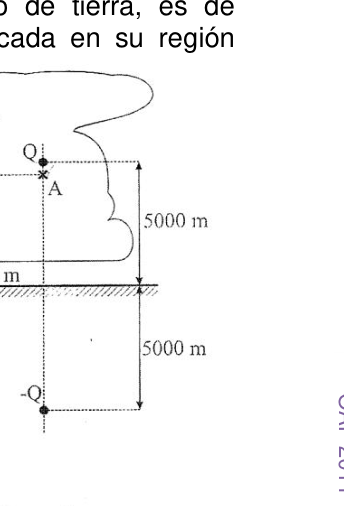
Problema La altura de la base de una nube de tormenta, respecto de tierra, es de aproximadamente 1000 m. La carga eléctrica negativa ubicada en su región inferior se puede considerar concentrada en un punto ubicado a una altura de 5000m sobre un eje que pasa por el centro de la nube y tiene una magnitud Q=-40C. La presencia de esta carga induce una densidad de carga sobre la superficie terrestre, la cual puede ser modelada por una carga puntual -Q ubicada a una distancia de 5000 m por debajo del nivel de tierra.
1- Determine el campo eléctrico, E, que producen estas cargas (Q y -Q) sobre el segmento que las une y a una altura h=4500M (Punto A) (Ver figura 1). 2- ¿Cuál es el valor que deberá tener Q
OAF 2011 - 6 para que en el punto A el campo eléctrico alcance el valor de ruptura?
Suponga que una vez alcanzado el valor Er en el punto A, se forma un canal ionizado entre dicho punto y la superficie terrestre. Este canal se comporta como un conductor que tiene una resistividad eléctrica de 50 Ω cm dentro de la nube y de 350 Ω cm fuera de la misma. Considerando que el canal es rectilíneo y que tiene un diámetro constante de 46 cm,
3- Calcule la resistencia eléctrica del canal dentro de la nube (Rc1) y fuera de la misma (Rc2). 4- Calcule la resistencia eléctrica total del canal (Rc). 5- Calcule la diferencia de potencial (ΔVr) entre los extremos del canal.
En este canal se establece una corriente eléctrica (ir) que baja carga desde la nube a la tierra. Suponiendo que la diferencia de potencial se mantiene constante durante la descarga eléctrica.
6- Calcule el valor de dicha corriente.
Suponga al aire como un gas ideal diatómico y que inicialmente todo el canal tiene una atmósfera de presión y una temperatura de 20°C.
7- Calcule el número de moles (n) de gas que hay en el canal.
El paso de corriente por el canal conductor incrementa la temperatura del mismo. Como el proceso es sumamente rápido (25 s) se puede considerar que el calentamiento del canal se produce sin que el mismo cambie su volumen. Despreciando la energía luminosa irradiada, esto es suponiendo que toda la energía recibida por el canal por el paso de la corriente se entrega al gas que forma el canal y que no se pierde energía por conducción al gas fuera del canal,
8- Calcule la temperatura final (Tf) del canal. 9- Calcule la presión final (Pf) dentro del canal.
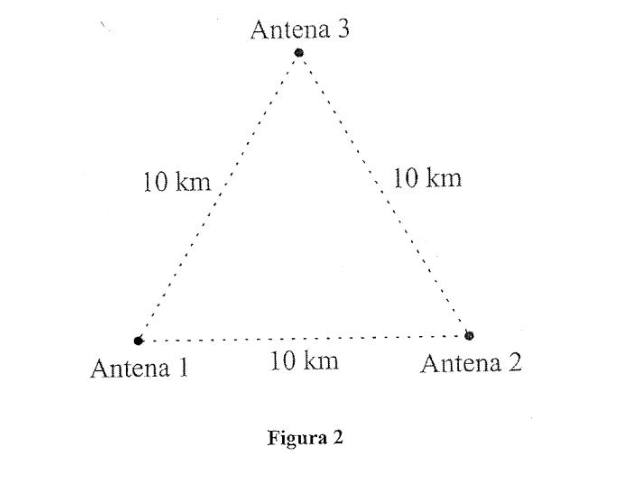
La diferencia de presión entre el interior y el exterior del canal provoca una onda de choque, cuya señal audible denominamos trueno. En una buena aproximación, se puede considerar que la señal audible que detectamos viaja desde su emisión (en el canal) hasta el detector, a la velocidad del sonido. Considere un sistema de detección y ubicación de rayos que consta de tres antenas. Las antenas se encuentran ubicadas en el los vértices de un triángulo equilátero de 10km de lado.
OAF 2011 - 7 Cada antena detecta la señal luminosa y la señal sonora producidas por el rayo. En buena aproximación, se puede suponer que las señales detectadas por las antenas son emitidas por el rayo a nivel del suelo. Cada antena mide la diferencia en el tiempo de llegada de las dos señales (Δt) con una precisión de 3 x 10⁻²s. Si la antena 1 midió un Δt1=24.43s, la 2 midió Δt2=15.51s y la antena 3 midió Δ3=38.85s,
10- Determine las distancias, sobre la superficie de la tierra, entre el lugar en donde cayó el rayo y cada una de las antenas. Exprese estas cantidades con su incerteza. 11- Determine gráficamente los lugares posibles de emisión de las señales detectadas por cada una de las antenas. Para ello, utilice la hoja milimetrada provista. En el gráfico indique la posición donde cayó el rayo. 12- Estime del gráfico el valor del error en la posición donde cayó el rayo.
Suponga que el campo de ruptura del aire es de 3000 V/mm. Suponga que la permitividad del aire es igual a la permitividad del vacío,
.
La constante universal de los gases es
.
Suponga que la velocidad de propagación de la señal luminosa es
y que la velocidad del sonido es
. Para un gas ideal diatómico la capacidad calorífica molar a volumen constante es
Exprese todos sus resultados en unidades correspondientes al sistema internacional.
Topic: Electrostatics, Thermodynamics Metodi: Coulomb’s Law, Ideal Gas Law, Superposition Principle Competenze: Physical Reasoning, Mathematical Modeling Objects: Point Charge, Gas Fonte: Testo (PDF) — p.3
Il programma di ricerca è stato sviluppato in modo da consentire la creazione di un’organizzazione di ricerca e di sviluppo.
Problema 2: Shazam! Introduzione e generali. Il movimento dell’aria dentro i nubi produce una separazione di cariche. elettrici che vengono poi spostate in diverse parti della stessa, generando più celle o centri di carica. A causa della presenza di questi Centri di carica nel cloud, generati in terra Centri di carica segnale Opposto, è un processo di induzione, perché la terra è un buon conduttore. Così, Centri di carica negativa sono generati sulla terra come immagine dei centri di carica positiva nel cloud e viceversa. Quando la concentrazione di carichi positivi e/o negativi raggiunge un livello Critico, gli elettroni si muovono attraenti da una delle cellule di carica. La resistenza è stata ridotta e il tasso di scarico è stato ridotto. elettrica. A volte il discarico si verifica tra il nuvo e la terra, e altre volte. volte tra centri di carico di nuvole diverse o tra centri di una stessa nuvola Nuvola. Un raggio è un scarico tra un centro di carica di un nuvo e il centro di carico sulla terra. Quando la differenza di potenziale tra un centro di carica La superficie terrestre raggiunge il tenore di rottura dell’aria (ΔVr), se produce il fulmine. Il raggio inizia come una serie di passi o segmenti di circa 100 Metri dal nuvo verso la terra. Questi segmenti non trasportano molto. carica e quindi non emettono molta luce ma sono responsabili di generare il il canale attraverso il quale produrrà il raggio. Mentre questo canale si avvicina alla La superficie, un secondo scarico si diffonde dalla terra verso il nubo. Quando i due scarichi si contattano il canale si completa producendo un cortocircuito che scarica la maggior parte del carico dal nuvo sulla terra. Questa è la mia . il discarico, o cortocircuito, dura un millennio di secondo e può essere ripetuto più volte attraverso lo stesso canale. Quello che si chiama “l’uragano” è questo. Generalmente composto da diversi scarichi e dura una frazione di secondo. Quando si produce un fulmine, il discarico elettrico deposita una grande quantità di l’energia nel canale, che lo porta ad una temperatura elevata. Questa è la mia . L’energia viene depositata molto rapidamente (circa un milionesimo di secondo) per il che la sezione del canale non ha tempo di espandersi e la pressione aumenta. tra 10 e 100 volte. Questa grande pressione si diffonde rapidamente verso l’aria. intorno al canale producendo un’onda di colpo che eventualmente si si trasforma nel suono che chiamiamo tuono.
Problema L’altezza della base di una nuvola di tempesta rispetto alla terra è di circa 1000 m. La carica elettrica negativa situata nella sua regione La concentrazione di un’unità inferiore può essere considerata concentrata in un punto situato ad un’altezza di 5000 m su un L’asse che passa attraverso il centro del nubo e ha una magnitudine Q=-40C. La presenza di questa carga induce una densidad de carga sobre la superficie terrestre, che può essere modellata. per un carico puntual -Q situato a una Distanza di 5000 m sotto il livello di terra.
1- Determina il campo elettrico, E, che producono queste cariche (Q e -Q) su il segmento che li unisce e a un’altezza h=4500M (punto A) (vedi figura 1). 2- Qual è il valore che deve avere Q
OAF 2011 - 6 per ottenere il valore di rottura al punto A?
Supponiamo che una volta raggiunto il valore Er al punto A, si forma un canale Ionizzato tra tale punto e la superficie terrestre. Questo canale si comporta come un conduttore che ha una resistività elettrica di 50 Ω cm all’interno del nuvo e di 350 Ω cm fuori di essa. Considerando che il canale è rettilineo e che ha un diametro costante di 46 cm,
3- Calcolare la resistenza elettrica del canale dentro e fuori del nuvo (Rc1) di cui al capitolo 2 del presente regolamento. 4- Calcolare la resistenza elettrica totale del canale (Rc). 5- Calcolare la differenza di potenziale (ΔVr) tra le estremità del canale.
In questo canale viene stabilito un corrente elettrica (ir) che riduce la carica dal Nuvola sulla terra. Supponendo che la differenza di potenziale si mantenga costante durante il discarico elettrico.
6- Calcolare il valore di tale corrente.
Supponiamo che l’aria sia un gas ideale diatomico e che inizialmente l’intero canale ha un’atmosfera di pressione e una temperatura di 20°C.
7- Calcolare il numero di molli di gas presenti nel canale.
Il passaggio di corrente attraverso il canale conduttore aumenta la temperatura del canale. Poiché il processo è estremamente veloce (25 s) si può considerare che il il riscaldamento del canale si verifica senza che esso cambie il volume. Scommetendo l’energia luminosa irradiata, questo è supponendo che tutta la luce L’energia ricevuta dal canale dal passaggio del corrente viene consegnata al gas che che forma il canale e che non si perde energia per la conduzione al gas fuori canale,
8- Calcolare la temperatura finale (Tf) del canale. 9- Calcolare la pressione finale (Pf) all’interno del canale.
La differenza di pressione tra l’interno e l’esterno del canale provoca un’onda. di colpo, il cui segnale udibile si chiama tuono. In una buona . Approximation, si può considerare che il segnale udibile che abbiamo rilevato viaggia dal suo emissione (in canale) al rilevatore, alla velocità del suono. Considerate un sistema di rilevamento e localizzazione dei raggi che comporti tre sistemi: antenne. Le antenne sono situate sui vertici di un triangolo.
- Un’equilaterale a 10 km da un lato.
OAF 2011 - 7 Ogni antenna rileva il segnale luminoso e il segnale sonoro prodotto dal raggio. In un buon approccio, si può presumere che i segnali rilevati dalle le antenne sono emesse dal raggio a livello del suolo. Ogni antenna misura la differenza nel tempo di arrivo dei due segnali (Δt) con una precisione di 3 x 10⁻²s. Se l’antenna 1 misurò un Δt1=24.43s, la 2 misurò Δt2=15.51s e l’antenna 3 ha misurato Δ3=38,85s,
10- Determina le distanze, sulla superficie della terra, tra il luogo dove il fulmine e ogni antenna sono caduti. Esprimi queste. La Commissione ha adottato una decisione che non è stata adottata. 11- Determina in modo grafico i possibili luoghi di emissione dei segnali rilevate da ciascuna antenna. Per questo, usa la foglia millimetro fornito. In grafico indicare la posizione in cui è caduto il
- Il fulmine. 12- Calcola dal grafico il valore dell’errore nella posizione in cui il fulmine è caduto.
Supponiamo che il campo di rottura dell’aria sia di 3000 V/mm. Supponiamo che la permisibilità dell’aria sia uguale alla permisibilità del vuoto.
.
La costante universale dei gas è
.
Supponiamo che la velocità di diffusione del segnale luminoso sia
e che la velocità del suono è
. Per un gas ideale diatomico la capacità calorifica mollare a volume costante es
Esprimere tutti i risultati in unità corrispondenti al sistema
- Internazionale.
Topic: Electrostatics, Thermodynamics Metodi: Coulomb’s Law, Ideal Gas Law, Superposition Principle Competenze: Physical Reasoning, Mathematical Modeling Objects: Point Charge, Gas Fonte: Testo (PDF) — p.3
I’m going to get the same thing.
Problem two: Shazam! Introduction and Generals. The movement of air within the clouds produces a charge separation. electrical devices which are then moved to different parts of the same, generating multiple cells or charge centers. Because of the presence of these Charging centers in the cloud, are generated on the ground sign charging centers The opposite is a process of induction because the earth is a good conductor. That’s it. Negative charge centers are generated on the ground as an image of the centers of positive charge in the cloud and vice versa. When the concentration of positive and/or negative charges reaches a level Critically, electrons are being pulled by some of the charging cells. Positive through the path of least resistance producing a discharge electrical. Sometimes the discharge occurs between the cloud and the earth, and other times. frequently between different cloud charging centres or between centres of the same The cloud. A lightning strike is a discharge between a cloud’s charge center and the cloud’s center. load on the ground. When the potential difference between any charge center The cloud and the land surface reaches the breakdown voltage of the air (ΔVr), se It produces lightning. The lightning starts as a series of steps or segments of about 100 Meters from the cloud to the ground. These segments don ‘t carry much . They do not emit much light but are responsible for generating the channel through which the lightning will be produced. As this channel approaches the On the surface, a second discharge spreads from the earth into the cloud. When the two discharges make contact the channel is completed producing a Short-circuit that loads most of the load from the cloud to the ground. This one . discharge, or short circuit, lasts a thousandth of a second and can be repeated Several times through the same channel. What ‘s known as lightning is this . It is usually composed of several discharges and lasts a fraction of a second. When a lightning strike occurs, the electrical discharge deposits a large amount of lightning. energy in the channel, causing it to reach a high temperature. This one . Energy is deposited very quickly (some millionths of a second) by the The section of the channel has no time to expand and the pressure increases. 10 to 100 times. This great pressure is rapidly spreading into the air. around the channel producing a shock wave that eventually gets It turns into the sound we call thunder.
It ‘s a problem . The base height of a storm cloud, relative to land, is approximately 1000 m. Negative electrical charge located in your region The lower one can be considered concentrated in a point located at an altitude of 5000m above a Axis that passes through the center of the cloud and has a magnitude of Q=-40C. The presence of this The load induces a load density over the surface area, which can be modelled by a point charge -Q located at a distance of 5000 m below the level of the earth.
1- Determine the electric field, E, which The resulting loads (Q and -Q) are The segment that connects them and at a height The following information is provided by the Commission: 2- What is the value of Q
The following is the list of the Member States’ financial statements: so that at point A the electric field reaches the breakdown value?
Suppose once the value Er is reached at point A, a channel is formed ionized between that point and the earth’s surface. This channel behaves like a conductor having an electrical resistance of 50 Ω cm within the cloud and 350 Ω cm outside the same. Considering that the channel is straight and that has a constant diameter of 46 cm,
3- Calculate the electrical resistance of the channel inside the cloud (Rc1) and outside of the same (Rc2). 4- Calculate the total electrical resistance of the channel (Rc). 5- Calculate the potential difference (ΔVr) between the ends of the channel.
In this channel an electric current (ir) is established which lowers the load from the cloud to earth. Assuming the potential difference remains constant during the electrical discharge.
6- Calculate the value of this current.
Suppose air is an ideal diatomic gas and that initially the whole channel has a pressure atmosphere and a temperature of 20°C.
7- Calculate the number of moles (n) of gas in the channel.
The flow of current through the conductive channel increases the temperature of the conductive channel. Since the process is extremely fast (25 s) it can be considered that the The heating of the channel is carried out without changing its volume. If we disregard the radiated light energy, this is assuming that all the light is The energy received by the channel through the current passage is delivered to the gas that The channel is formed and no energy is lost by conducting gas outside the channel.
8- Calculate the final temperature (Tf) of the channel. 9- Calculate the final pressure (Pf) inside the channel.
The pressure difference between the inside and outside of the channel causes a wave. The shock signal we call thunder. In a good one . Approximation, you can consider that the audible signal we detect travels from its emission (in the channel) to the detector, at the speed of sound. Consider a radiation detection and location system consisting of three antennas. The antennas are located at the vertices of a triangle. 10km side equilateral.
The following is the list of the Member States’ financial statements: Each antenna detects the light and sound signal produced by the lightning. In a good approximation, it can be assumed that the signals detected by the antennas are emitted by the beam at ground level. Each antenna measures the difference in the time of arrival of the two signals (Δt) with an accuracy of 3 x 10⁻²s. If antenna 1 measured a Δt1=24.43s, 2 measured Δt2=15.51s and antenna 3 measured Δ3=38.85s,
10- Determine the distances, above the earth’s surface, between the place where the lightning struck and each of the antennas. Express these . quantities with their uncertainty. 11- Graphically identify possible signal locations detected by each antenna. For this, use the sheet millimetre provided. In the graph, indicate the position where the The lightning. 12- Estimate the value of the error in the position where the lightning fell from the graph.
Suppose the air breaking field is 3000 V/mm. Suppose the permittivity of the air is equal to the permittivity of the vacuum.
.
The universal gas constant is
.
Suppose the speed of propagation of the light signal is
And the speed of sound is
. For an ideal diatomic gas the heat capacity to molar at constant volume es
Express all your results in units for the system The Commission is not a party to the agreement.
Topic: Electrostatics, Thermodynamics Metodi: Coulomb’s Law, Ideal Gas Law, Superposition Principle Competenze: Physical Reasoning, Mathematical Modeling Objects: Point Charge, Gas Fonte: Testo (PDF) — p.3
Un pendulo ingravido
Problema 3: Un péndulo ingrávido. El día miércoles 24 de agosto de este año, la nave espacial rusa Progress M- 112M, despegó desde el cosmódromo de Baikonur en Kazakhstan con destino en la estación espacial internacional (ISS). Sin embargo, luego de 325s de vuelo el cohete ruso Soyuz-U se apagó de manera imprevista y la carga de varias toneladas con suministros para al ISS se desintegró en la caída. La carga útil destruida, además de alimentos, combustible y suministros para el normal funcionamiento de la ISS, contenía varios experimentos científicos para ser realizados en el espacio. La siguiente nave con suministros, Progress M- 13M/Soyuz U, tiene previsto su vuelo recién para el 30 de octubre próximo. Por lo tanto, la tripulación 29 de la ISS en vuelo, compuesta por Sergey Volkov, Michael E. Fossum y Satoshi Furukawa, al no tener como realizar los experimentos previstos, dispone de más tiempo libre. Para entretenerse en sus ahora largos ratos de ocio, la tripulación se dispuso a diseñar un péndulo que funcione en las condiciones de ingravidez en la que se encuentra dentro de la ISS. A tal fin, recuperaron una esfera de material no conductor de radio R = 20 cm. Al frotarla con una tela sintética, la esfera adquirió una carga eléctrica positiva Q = 2 C, la cual puede suponerse que se encuentra homogéneamente distribuida sobre toda la superficie de la esfera. Luego, soldaron una diminuta esfera, de un metal pesado, cuya masa m = 50 g era conocida de antemano, a un muy fino alambre inextensible y no conductor de largo l = 2,30 m. Este hilo, a todo fin práctico, puede considerarse de masa
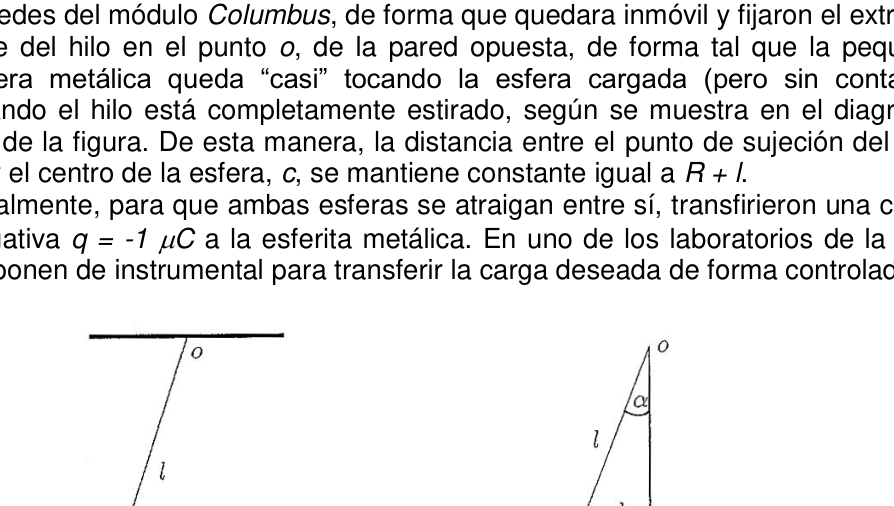
OAF 2011 - 8 despreciable. Para armar el péndulo, pegaron la esfera cargada en una de las paredes del módulo Columbus, de forma que quedara inmóvil y fijaron el extremo libre del hilo en el punto o, de la pared opuesta, de forma tal que la pequeña esfera metálica queda “casi” tocando la esfera cargada (pero sin contacto) cuando el hilo está completamente estirado, según se muestra en el diagrama (A) de la figura. De esta manera, la distancia entre el punto de sujeción del hilo, o, y el centro de la esfera, c, se mantiene constante igual a R + l. Finalmente, para que ambas esferas se atraigan entre sí, transfirieron una carga negativa q = -1 C a la esferita metálica. En uno de los laboratorios de la ISS, disponen de instrumental para transferir la carga deseada de forma controlada.
Preguntas: (a) Calcular la tensión del hilo en la posición de reposo en equilibrio estable. (b) Para calcular el período del péndulo, la primera idea consiste en recordar la similitud entre la ley de gravitación universal de Newton y la ley de Coulomb. Teniendo en cuenta la relación entre ambas leyes y el hecho de que la aceleración en ambos casos viene definida por la relación F = m a, donde a = g en el caso gravitatorio y a = ge en el caso eléctrico, calcular el valor de la correspondiente aceleración ge para el caso eléctrico. (c) A partir de la expresión del período de un péndulo simple en el caso gravitatorio, calcular el valor resultante para el correspondiente período del péndulo ingrávido.
Una vez construido el péndulo, los astronautas notaron que el período calculado difería bastante respecto del medido con un cronómetro, el cual resulta bastante más breve. Con buen criterio, Michael E. Fossum, que cuenta con una maestría en Física, concluyó que no se cumplen las condiciones bajo las cuales es válida la fórmula del período de un péndulo simple en el caso del péndulo ingrávido construido. Con el fin de encontrar la expresión correcta para este caso, procedió a realizar los siguientes cálculos que debemos reproducir:
(d) Se desplaza la esferita de masa m, de manera que el hilo forma un
pequeño ángulo α con respecto a la línea
. Dibujar un diagrama de
cuerpo aislado para la masa m, trazando cualitativamente todos los
vectores de las fuerzas que actúan sobre ella.
(e) En la situación del ítem anterior, escribir la expresión analítica para la
intensidad de la fuerza de atracción entre las esferas.
OAF 2011 - 9 (f) Utilizando el diagrama en el esquema (B) de la figura, descomponer los vectores fuerza en componentes a lo largo de la dirección del hilo (componente centrípeta) y perpendicular a esta (componente tangencial). (g) Escribir la segunda ley de Newton correspondiente a la dirección del hilo y a la dirección tangencial, utilizando las componentes calculadas en el ítem anterior. (h) Recordando que la aceleración tangencial, a, está relacionada con la aceleración angular, , según a = l , escribir la segunda ley de Newton correspondiente a la dirección tangencial para pequeñas oscilaciones del péndulo; es decir, en primer orden (o lineal) en el ángulo α. (i) Escribir la expresión para la frecuencia angular de pequeñas oscilaciones del péndulo ingrávido. (j) Calcular el valor numérico resultante para el período del péndulo, en el caso particular construido por los astronautas. (k) A partir de la expresión de la frecuencia angular calculada en el ítem (i), ¿qué condición debe cumplirse entre los valores de R y L para obtener el resultado calculado en el ítem (c)? (l) A partir de la expresión de la frecuencia angular calculada en el ítem (i), analizar como es la dependencia de la frecuencia angular en el caso límite en el cual l >> R.
Información útil: (1) La constante de Coulomb es , donde es la constante dieléctrica del vacío. Así, . (2) Las siguientes relaciones trigonométricas son siempre válidas: , . (3) Utilizando relaciones trigonométricas en el diagrama del esquema (B) de la figura, resulta: , . (4) Usando el teorema del coseno en el diagrama del esquema (B) de la figura, resulta: . (5) Si el ángulo es pequeño, y está expresado en radianes, son válidas las siguientes aproximaciones: , . (6) Si , entonces es válida la siguiente aproximación: . (7) La ecuación de movimiento de un péndulo para pequeñas oscilaciones, es decir en primer orden (o lineal) en el ángulo α, es .
OAF 2011 - 10
Instancia Nacional Prueba Experimental
OAF 2011 - 11 Introducción: Consideremos el péndulo que se muestra en la Fig. 1, formado por un aro de masa M, diámetro interior D y espesor e, y un fiel de alambre de masa m y longitud LF. El péndulo se encuentra suspendido de una cuchilla (C) como se muestra en la Fig. 1.
Figura 1. Esquema del péndulo a utilizar para medir la aceleración de la gravedad local. Las cantidades están definidas en el texto.
En el límite de pequeñas amplitudes de oscilación (0 < 5º) el período T de oscilación de un péndulo físico se puede aproximar de la siguiente manera:
gd
M
I
T
T
T
2
(1)
En donde hemos llamado IT al momento de inercia del péndulo (aro + fiel) con
respecto a su eje de rotación, d a la distancia entre el punto de suspensión y el
centro de masa del péndulo, MT a la masa total del péndulo y g a la aceleración
de la gravedad local.
Para el péndulo de la Fig. 1, escribiendo adecuadamente IT, MT y d en términos
de las cantidades a medir directamente (masas y distancias), se llega a la
siguiente expresión:
D L M m D L D L M m D e D e g D T F 2 1 2 6 1 1 2 2 2 2 (2)
L representa la distancia desde el eje de rotación hasta el centro de masa del fiel
(ver Fig. 1). Esta expresión se puede utilizar para medir g en término de las
restantes cantidades.
En el límite D >> e, D >> LF y M >> m, la ecuación se reduce a:
g e D T 2 4 (3)
D e LF L C
OAF 2011 - 12 Objetivo: Determinar experimentalmente la aceleración de la gravedad local y el espesor promedio de los aros.
Elementos disponibles
-
Pie con espejo graduado y cuchilla
-
10 aros de madera de distinto diámetro y aproximadamente el mismo espesor
-
Cronómetro
-
Papel milimetrado
-
Regla
Procedimiento
a) Mida el diámetro D de cada aro.
b) Mida el espesor e de cada aro.
Asiente cada aro suavemente sobre la cuchilla (no lo clave). Recuerde que la
oscilación se debe producir sobre el plano que contiene al aro. (Ver Figura 1)
c) Haga oscilar de manera adecuada cada aro y mida el período T de
oscilación. Informe en cada caso la amplitud máxima de oscilación (A).
d) Construya un tabla que contenga e, A, D, T y T2.
e) Grafique los datos experimentales de tal manera de obtener una
relación lineal.
f) A partir del gráfico determine el valor de g con su correspondiente
incertidumbre.
g) A partir del gráfico determine el valor de e con su correspondiente
incertidumbre.
h) A partir de los espesores medidos en el punto b, determine el espesor
promedio y compárelo con el obtenido a partir de la gráfica indicando si
estos valores son indistinguibles.
i) Concluya cual de los dos métodos utilizados es mejor para determinar
e. Justifique.
Datos útiles
- El error asociado a T2 es: T T T 2 ) ( 2 .
OAF 2011 - 13
Instancias Locales Problemas Teóricos
OAF 2011 - 14
Topic: Oscillations & Waves, Electrostatics Metodi: Simple Harmonic Motion Analysis, Coulomb’s Law, Small-Angle Approximation Competenze: Physical Reasoning, Mathematical Modeling Objects: Pendulum, Sphere Fonte: Testo (PDF) — p.3
Un pendolo gravato
Problema 3: Un pendolo non gravato. Mercoledì 24 agosto di quest’anno, la sonda spaziale russa Progress M- 112M, decollato dal cosmodromo di Baikonur in Kazakistan per la destinazione sulla Stazione Spaziale Internazionale (ISS). Tuttavia, dopo 325s di volo Il razzo russo Soyuz-U è stato spento in modo imprevisto e caricato da vari tonnellate di forniture per l’ISS si sono disintegrate nel crollo. Il carico utile distrutto, oltre a cibo, combustibile e forniture per il normale Il funzionamento della ISS, contenuto diversi esperimenti scientifici per essere realizzate nello spazio. La prossima nave con rifornimenti, Progress M- 13M/Soyuz U, ha previsto il suo volo solo per il prossimo 30 ottobre. Per Quindi, l’equipaggio 29 dell’ISS in volo, composto da Sergey Volkov, Michael E. Fossum e Satoshi Furukawa, non avendo come fare le loro
- Le esperimenti previsti, ha più tempo libero. Per divertirsi nei loro lunghi passaggi di tempo libero, l’equipaggio si è messo a disposizione progettare un pendolo che funzioni in condizioni di gravità in cui si si trova all’interno della ISS. Per questo, hanno recuperato una sfera di materiale non Conduzione radio R = 20 cm. La strofinando con un tessuto sintatico, la sfera si è acquisita. un carico elettrico positivo Q = 2 C, che può essere presunto che si trova distribuita uniformemente su tutta la superficie della sfera. Poi, Saldano una piccola sfera, di metallo pesante, il cui peso m = 50 g era La struttura è stata costruita in modo da permettere di utilizzare un’ottica di produzione di prodotti di base. lunghezza l = 2,30 m. Questo filo, per ogni finalità pratica, può essere considerato di massa.
OAF 2011 - 8
- Desprezioso. Per mettere in piedi il pendolo, hanno attaccato la sfera carica in una delle le pareti del modulo Columbus, così che rimase immobile e fissò l’estremità libero dal filo al punto o, dal muro opposto, in modo tale che la piccola La sfera metallica rimane quasi toccando la sfera carica (ma senza contatto) quando il filo è completamente stretto, come mostrato nel diagramma. (A) della figura. In questo modo, la distanza tra il punto di tenuta del filo, o, e il centro della sfera, c, rimane costante uguale a R + l. Infine, per far attraggere le due sfere, hanno trasferito un carico. negativo q = -1 C alla sfera metallica. In uno dei laboratori dell’ISS, dispongono di strumenti per trasferire il carico desiderato in modo controllato.
Domande: (a) Calcolare la tensione del filo in equilibrio in posizione di riposo Stabile. (b) Per calcolare il periodo del pendolo, la prima idea consiste nel Ricordare la somiglianza tra la legge di gravitazione universale di Newton e la La legge di Coulomb. Considerando la relazione tra le due leggi e il Il fatto che l’accelerazione in entrambi i casi è definita dalla Relazione F = m a, dove a = g nel caso gravitatorio e a = ge nel caso per l’accelerazione di un’accelerazione di un’elettricità, calcolare il valore dell’accelerazione ge corrispondente per il caso elettrico. (c) A partire dall’espressione del periodo di un semplice pendolo nel caso gravità, calcolare il valore risultante per il periodo di riferimento del pendolo ingravato.
Una volta costruito il pendolo, gli astronauti hanno notato che il periodo calcolato E’ stato molto diverso rispetto alla misura con un cronometro, che è molto diverso. più breve. Con buon giudizio, Michael E. Fossum, che ha un master In fisica, ha concluso che non sono soddisfatte le condizioni in cui è valida. la formula del periodo di un pendolo semplice nel caso del pendolo non gravato costruito. Per trovare la giusta espressione per questo caso, ha proceduto. Per fare i seguenti calcoli che dobbiamo riprodurre:
(d) spostare la sfera di massa m in modo che il filo formi un angolo piccolo α rispetto alla linea . Disegnare un diagramma di corpo isolato per la massa m, tracciando qualitativamente tutti vettori delle forze che agiscono su di essa. (e) Nella situazione di cui sopra, scrivere l’espressione analitica per l’intensità della forza di attrazione tra le sfere.
OAF 2011 - 9 (f) Utilizzando il diagramma di schema (B) della figura, decompone le Vettori di forza in componenti lungo la direzione del filo (componente centripede) y perpendicolare a Questa è la mia . (componente
- di cui alla lettera a). (g) Scrivere la seconda legge di Newton per la direzione del filo. e la direzione tangenziale, utilizzando i componenti calcolati in
- E’ stato prima. (h) Ricordando che l’accelerazione tangenziale, a, è correlata alla velocità di Accelerazione angolare, , secondo a = l , scrivere la seconda legge di Newton corrispondente alla direzione tangenziale per piccole oscillazioni di pendolo; cioè, in primo ordine (o lineare) all’angolo α. (i) Scrivere l’espressione per la frequenza angolare di piccole oscillazioni del pendolo gravitato. (j) Calcolare il valore numerico risultante per il periodo del pendolo, in Un caso particolare costruito dagli astronauti. (k) A partire dall’espressione della frequenza angolare calcolata nell’oggetto (i) quale condizione deve essere soddisfatta tra i valori di R e L per ottenere il risultato calcolato nell’articolo (c)? (l) A partire dall’espressione della frequenza angolare calcolata nell’oggetto (i) analizzare come sia la dipendenza della frequenza angolare nel caso limite in cui l >> R.
Informazioni utili: (1) La costante di Coulomb è , dove è la costante dieletrica del vuoto. Così, (2) Le seguenti relazioni trigonometriche sono sempre valide: , . (3) Utilizzando relazioni trigonometriche nel diagramma dello schema (B) La figura riporta: , . (4) Utilizzando il teorema del coseno nel diagramma dello schema (B) della figura, si ottiene: . (5) Se l’angolo è piccolo, ed è espresso in radiani, sono validi le seguenti approcci: , . (6) Se , allora vale la seguente approccio: . (7) L’equazione di movimento di un pendolo per piccole oscillazioni, cioè in primo ordine (o lineare) all’angolo α, è .
OAF 2011 - 10
Instanza nazionale Prova sperimentale
OAF 2011 - 11 Introduzione: Consideriamo il pendolo mostrato nella Figura 1. 1, formato per un anello di massa M, diametro interno D e spessore e, e un fiore di filo di massa m e lunghezza LF. Il pendolo è appeso a una cucchiaio (C) come viene mostrato nella Figura 1. 1.
Figura 1. Schema del pendolo da usare per misurare l’accelerazione della gravità locale. Le quantità sono definite nel testo.
Al limite di piccole amplitudine di oscillazione (0 < 5o) il periodo T di L’oscillazione di un pendolo fisico può essere avvicinata come segue:
gd M I T T T 2 (1) Dove abbiamo chiamato IT il momento di inerzia del pendolo (aro + fiel) con per quanto riguarda il suo asse di rotazione, d alla distanza tra il punto di sospensione e il centro di massa del pendolo, MT alla massa totale del pendolo e g all’accelerazione della gravità locale. Per il pendolo della Fig. 1, scrivendo correttamente IT, MT e d in termini La quantità di massa e di distanza da misurare direttamente si arriva alla la seguente espressione:
D L M m D L D L M m D e D e g D T F 2 1 2 6 1 1 2 2 2 2 (2)
L rappresenta la distanza dall’asse di rotazione al centro di massa del fiore (cfr. figura 1). Questa espressione può essere usata per misurare g in termini di le restanti quantità. Al limite D >> e, D >> LF e M >> m, l’equazione viene ridotta a:
g e D T 2 4 (3)
D e LF L C
OAF 2011 - 12 Obiettivo: determinare sperimentalmente l’accelerazione della gravità locale e il spessore medio degli anelli.
Elementi disponibili
-
Piede con specchio graduato e coltello .
-
10 anelli di legno di diametro diverso e circa lo stesso spessore
-
Cronometro .
-
Papero millimetrico .
-
Regola .
Procedura a) Misura il diametro D di ogni anello. b) Misura lo spessore e ogni anello. Siate delicatamente ogni anello sul coltello (non il chiave). Ricorda che la L’oscillazione deve avvenire sul piano che contiene l’anello. (Vedi Figura 1) c) Oscillare adeguatamente ogni anello e misurare il periodo T di oscillazione. In ogni caso, segnalare l’ampiezza massima di oscillazione (A). d) Costruire una tabella contenente e, A, D, T e T2. e) Graficare i dati sperimentali in modo da ottenere un’immagine Relazione lineare. f) Sulla base del grafico si determina il valore di g con il suo corrispondente l’incertezza. g) Sulla base del grafico si determina il valore di e con il suo corrispondente l’incertezza. h) Dalle spesse misurate al punto b, determinare la spessura La media è quella che si ottiene dal grafico indicando se Questi valori sono indistingubili. i) Concludi quale dei due metodi utilizzati sia meglio indicato. e. giustifica.
Dati utili
- L’ errore associato a T2 è: T T T 2 ) ( 2 .
OAF 2011 - 13
I servizi locali Problemi teorici
OAF 2011 - 14
Topic: Oscillations & Waves, Electrostatics Metodi: Simple Harmonic Motion Analysis, Coulomb’s Law, Small-Angle Approximation Competenze: Physical Reasoning, Mathematical Modeling Objects: Pendulum, Sphere Fonte: Testo (PDF) — p.3
A weightless pendulum
Problem three: a weightless pendulum. On Wednesday 24 August this year, the Russian spacecraft Progress M- 112M, took off from the Baikonur Cosmodrome in Kazakhstan with destination The International Space Station (ISS) is located in the International Space Station. However, after 325s of flight The Russian Soyuz-U rocket went off unexpectedly and loaded several tons of supplies for the ISS disintegrated in the fall. The payload destroyed, in addition to food, fuel and supplies for normal The ISS’s operation, contained several scientific experiments to be They’re made in space. The next ship with supplies, Progress M- 13M/Soyuz U, is scheduled to fly only for October 30th. By So, the 29th crew of the ISS in flight, composed of Sergey Volkov, Michael E. Fossum and Satoshi Furukawa, having no way to do the The projected experiments, you have more free time. To entertain themselves in their now long leisure mice, the crew set out to Design a pendulum that works under the unweighted conditions in which it is used. It’s inside the ISS. To that end, they recovered a sphere of material from the non- radio conductor R = 20 cm. By rubbing it with synthetic fabric, the sphere acquired a positive electrical charge Q = 2 C, which can be assumed to be uniformly distributed over the entire surface of the sphere. Then, They welded a tiny sphere, of a heavy metal, whose mass m = 50 g. The first is the use of a very fine, non-conductive wire. length l = 2,30 m. This thread, for all practical purposes, can be considered mass.
The following is the list of the countries of the European Union: I’m not a big fan of this. To put the pendulum together, they stuck the loaded sphere on one of the The walls of the Columbus module, so that it stayed still and fixed the end. free of the thread at the point or, on the opposite wall, so that the small Metal sphere is left almost touching the charged sphere (but without contact) when the thread is completely stretched, as shown in the diagram. (A) of the figure. This way, the distance between the thread’s grip point, o, and the center of the sphere, c, is kept constant equal to R + l. Finally, to attract both spheres to each other, they transferred a load. negative q = -1 C to the metal sphere. In one of the ISS labs, have the instrumentation to transfer the desired load in a controlled manner.
Questions: (a) Calculate the tension of the thread in the equilibrium resting position It’s stable. (b) To calculate the period of the pendulum, the first idea is to Remember the similarity between Newton’s law of universal gravitation and the law of motion. The Coulomb law. Given the relationship between the two laws and the The fact that acceleration in both cases is defined by the F = m a, where a = g in the gravitational case and a = ge in the case The electrical acceleration value is calculated for the electrical case. (c) From the expression of the period of a simple pendulum in the case gravitational, calculate the resulting value for the corresponding period from the ungrave pendulum.
Once the pendulum was built, the astronauts noticed that the calculated period It was quite different from the measurement with a chronometer, which is quite good. Shorter than that. With good judgment, Michael E. Fossum, who has a master’s degree. In physics, he concluded that the conditions under which it is valid are not met. the formula for the period of a simple pendulum in the case of the unweighted pendulum built. In order to find the right expression for this case, he proceeded. to perform the following calculations which we must reproduce:
(d) The mass sphere m is moved so that the thread forms a small angle α with respect to the line . Draw a diagram of body isolated for mass m, qualitatively mapping all vectors of the forces acting on it. (e) In the situation of the previous item, write the analytical expression for The intensity of the force of attraction between the spheres.
The following points shall be added: (f) Using the diagram in Schedule (B) of the figure, break down the force vectors in components along the direction of the wire (component (Centre) y Perpendicular to the a This one . (component The following is the list of the countries of the European Union: (g) Write Newton’s second law of motion for the direction of the wire. and tangential direction, using the components calculated in the I’m from before. (h) Recalling that the tangential acceleration, a, is related to the angular acceleration, , according to a = l , write Newton’s second law corresponding to the tangential direction for small oscillations of the pendulum; i.e. in the first order (or linear) at the angle α. (i) Write the expression for the angular frequency of small oscillations of the ungravid pendulum. (j) Calculate the resulting numerical value for the period of the pendulum, in the A particular case built by astronauts. (k) From the expression of the angular frequency calculated in the item (i) what condition must be met between the values of R and L for obtain the result calculated in item (c)? (l) From the expression of the angular frequency calculated in the item (i) to analyse how the angular frequency dependence on the limit case in which l >> R.
Useful information: (1) Coulomb ‘s constant is , where is the constant The vacuum dielectric. That’s it. (2) The following trigonometric relations are always valid: , . (3) Using trigonometric relations in the diagram of the scheme (B) The figure shows: , . (4) Using the cosine theorem in the diagram of the (B) scheme of the Figure 1 shows that: . (5) If the angle is small, and is expressed in radians, they are valid the following approaches: , . (6) If so , the following approximation is valid: . (7) The equation of motion of a pendulum for small oscillations, That is, in the first order (or linear) at the angle α, is .
The following points shall be added:
The National Court Experimental test
The following is the list of the Member States’ financial statements: Introduction: Consider the pendulum shown in Fig. 1, formed by a mass ring M, inner diameter D and thickness e, and a wire mesh of mass m and length LF. The pendulum is suspended from a blade (C) as shown in Fig. 1.
Figure 1 is shown. Scheme of pendulum to be used to measure the acceleration of local gravity. The quantities are The Commission shall adopt implementing acts in accordance with Article 21 of the Treaty.
In the limit of small oscillation amplitudes (0 < 5o) the period T of The oscillation of a physical pendulum can be approximated as follows:
gd M I T T T 2 (1) Where we called it the moment of inertia of the pendulum (aro + fidelity) with with respect to its rotation axis, d to the distance between the suspension point and the centre of mass of the pendulum, MT to the total mass of the pendulum and g to acceleration of local gravity. For the Fig pendulum. 1, correctly writing IT, MT and d in terms The quantities to be measured directly (masses and distances) are reached at the the following expression:
D L M m D L D L M m D e D e g D T F 2 1 2 6 1 1 2 2 2 2 (2)
L represents the distance from the rotation axis to the center of mass of the filament. (see Fig. 1). This expression can be used to measure g in terms of the the remaining quantities. At the limit D >> e, D >> LF and M >> m, the equation is reduced to:
g e D T 2 4 (3)
D e LF L C
The following is the list of the Member States’ financial statements: Objective: To experimentally determine the acceleration of local gravity and the average thickness of the rings.
Available items
-
Foot with graduated mirror and knife
-
10 wooden rings of different diameter and approximately the same thickness
-
The chronometer .
-
Millimeter paper .
-
Rule .
The procedure (a) Measure the diameter D of each ring. (b) Measure the thickness and of each ring. Place each ring gently over the blade (not the key). Remember that the The rotation shall occur over the plane containing the ring. (See Figure 1) (c) Have each ring swing properly and measure the period T of the The oscillation. In each case, report the maximum oscillation width (A). d) Build a table containing e, A, D, T and T2. (e) Graph the experimental data in such a way as to obtain a linear ratio. (f) From the graph, determine the value of g with its corresponding value Uncertainty. (g) From the graph, determine the value of e with its corresponding value Uncertainty. (h) From the thicknesses measured in point (b), determine the thickness Average and compare it to the graph showing if These values are indistinguishable. (i) Find out which of the two methods is best used to determine e. You justify it.
Useful data
- The error associated with T2 is: T T T 2 ) ( 2 .
The following is the list of the countries of the European Union:
Local authorities Theoretical problems
The following is the list of the countries of the European Union:
Topic: Oscillations & Waves, Electrostatics Metodi: Simple Harmonic Motion Analysis, Coulomb’s Law, Small-Angle Approximation Competenze: Physical Reasoning, Mathematical Modeling Objects: Pendulum, Sphere Fonte: Testo (PDF) — p.3
PT1. Escuela Juan H. Morán Eduardo Castex, La Pampa.
Hallar: a) La aceleración del conjunto. b) Realizar diagrama de cuerpo libre de
cada cuerpo c) La tensión en la cuerda 1-2 d) La tensión en la cuerda 2-3.Siendo
m1= 4kg m2=10Kg y m3=20 Kg. Los coeficientes de rozamientos son 1= 0.15
2= 0.22 y 3= 0.30 F= 1000 N y el ángulo de la misma = 38º.
Tomar g=10 m/s2
F
2 3
1 T12 T23
Topic: Newtonian Mechanics Metodi: Free-Body Diagram, Newton’s Law of Gravitation Competenze: Physical Reasoning Objects: Block, String Fonte: Testo (PDF) — p.3
PT1. Scuola Juan H. Morano Eduardo Castex, La Pampa.
Trovare: a) L’accelerazione dell’insieme. b) Realizzare un diagramma di corpo libero di Ogni corpo c) Tensione della corda 1-2 d) Tensione della corda 2-3. m1= 4kg m2=10Kg y m3=20 Kg. I coefficienti di ruggine sono 1= 0.15 2=0.22 e 3=0.30 F=1000 N e l’angolo della stessa =38o. Prendere g=10 m/s2 F
2 3
1 T12 T23
Topic: Newtonian Mechanics Metodi: Free-Body Diagram, Newton’s Law of Gravitation Competenze: Physical Reasoning Objects: Block, String Fonte: Testo (PDF) — p.3
PT1. School John H. Moran . Eduardo Castex, the Pampa.
Find: (a) The acceleration of the set. (b) Draw a free body diagram of Each body c) The tension on the rope 1-2 d) The tension on the rope 2-3. m1= 4kg m2=10Kg y m3=20 Kg. The coefficients of friction are 1=0.15 2=0.22 and 3=0.30 F=1000 N and the angle of the same =38o. Take g=10 m/s2 F
2 3
1 T12 T23
Topic: Newtonian Mechanics Metodi: Free-Body Diagram, Newton’s Law of Gravitation Competenze: Physical Reasoning Objects: Block, String Fonte: Testo (PDF) — p.3
PT2. Escuela Juan H. Morán Eduardo Castex, La Pampa.
Dado el circuito eléctrico, calcular las corrientes I1, I2, I3, I4, I5; y la potencia que consume en watt la resistencia R6 despreciando la resistencia interna de de batería.Siendo V= 24 volt, R1 = 10 ohms, R2 = 5 ohms , R3 =15 ohms , R4 = 10 ohms , R5 = 5 ohms , R6 =15 ohms .
                               R2


     R1
                                           R3                              R4                               R5


                  24V                R6
Topic: Circuits Metodi: Kirchhoff’s Laws, Equivalent Circuit Reduction Competenze: Physical Reasoning Objects: Resistor, Battery Fonte: Testo (PDF) — p.3
PT2. Scuola Juan H. Morano Eduardo Castex, La Pampa.
Dato il circuito elettrico, calcolare i correnti I1, I2, I3, I4, I5; e la potenza che consuma in watt la resistenza R6 disprezzando la resistenza interna di Batteria. Se V = 24 volt, R1 = 10 ohms, R2 = 5 ohms, R3 = 15 ohms , R4 = 10 Ohm , R5 = 5 ohm , R6 = 15 ohm .
                               R2


     R1
                                           R3                              R4                               R5


                  24V                R6
Topic: Circuits Metodi: Kirchhoff’s Laws, Equivalent Circuit Reduction Competenze: Physical Reasoning Objects: Resistor, Battery Fonte: Testo (PDF) — p.3
PT2. School John H. Moran . Eduardo Castex, the Pampa.
Given the electrical circuit, calculate the current I1, I2, I3, I4, I5; and the power It consumes in watts the resistance R6 disregarding the internal resistance of Battery. If V = 24 volts, R1 = 10 ohms, R2 = 5 ohms, R3 = 15 ohms, R4 = 10 Ohm , R5 is 5 ohms , R6 is 15 ohms .
                               R2


     R1
                                           R3                              R4                               R5


                  24V                R6
Topic: Circuits Metodi: Kirchhoff’s Laws, Equivalent Circuit Reduction Competenze: Physical Reasoning Objects: Resistor, Battery Fonte: Testo (PDF) — p.3
PT3. Escuela Juan H. Morán Eduardo Castex, La Pampa.
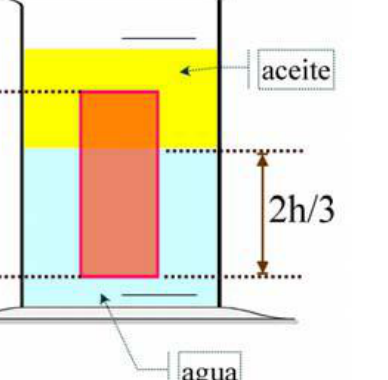
Un recipiente contiene una capa de agua dulce, sobre la que flota una capa de aceite de peso específico = 0,8 g/cm3, un objeto cilíndrico de densidad desconocida de radio R= 10 cm y altura h= 15 cm flota a 2/3 del agua como indica la figura.
Determinar el peso específico del cilindro.
OAF 2011 - 15
Topic: Fluid Mechanics Metodi: Hydrostatic Equilibrium Competenze: Physical Reasoning Objects: Cylinder Fonte: Testo (PDF) — p.3
PT3. Scuola Juan H. Morano Eduardo Castex, La Pampa.
Un recipiente contiene una pietra d’acqua dolce, sopra cui galleggia un piatto di olio. di peso specifico = 0,8 g/cm3, un oggetto cilindrico di radio di densità sconosciuta R= 10 cm e altezza h= 15 cm flotta a 2/3 del acqua come indica la figura.
Determinare il peso specifico del cilindro.
OAF 2011 - 15
Topic: Fluid Mechanics Metodi: Hydrostatic Equilibrium Competenze: Physical Reasoning Objects: Cylinder Fonte: Testo (PDF) — p.3
PT3. School John H. Moran . Eduardo Castex, the Pampa.
A container contains a layer of water. Sweet, floating on top of a layer of oil of a specific weight = 0,8 g/cm3, an object Unknown radio-density cylinder R=10 cm and height h=15 cm floats at 2/3 of the water as shown in the figure.
Determine the specific weight of the cylinder.
The following points shall be added:
Topic: Fluid Mechanics Metodi: Hydrostatic Equilibrium Competenze: Physical Reasoning Objects: Cylinder Fonte: Testo (PDF) — p.3
PT4. Escuela Técnica ORT Nro. 2 Ciudad de Buenos Aires.
Para no “quemar” la yerba del mate, el agua no debe pasar los 80°C. Si se calienta hasta esa temperatura 700 cm3 de agua, originalmente a 20°C. a. ¿Qué energía se le debe entregar al agua para llegar a la temperatura ideal para el mate? b. ¿Qué potencia debe tener el sistema para calentar el agua en 3 minutos? c. Si en cada cebada se agregan 15 g de agua, a qué temperatura se tomará el primer mate (dejando reposar al mate para que termalice) si el éste contiene 10 g de yerba, y la bombilla tiene una masa de 5 g Suponga que sólo la mitad de la bombilla queda sumergida en el agua, que ésta tiene un calor específico de 385 J/(kg°C) y la yerba de 0,25 cal/g°C y que están a temperatura ambiente (20°C) d. Para conservar la temperatura del agua, se la pone en un termo, que minimiza el flujo de calor con el ambiente. Pero no existen los termos perfectos, completamente adiabáticos. El que se usa, en particular, permite un flujo de calor de 300 cal/min con el ambiente. ¿A qué temperatura estarán los mates después de una hora?, ¿Cuánto tarda el agua en llegar a la temperatura ambiente?
Datos: Calor específico del agua 1cal/g°C 1 cal = 4,18 J
Topic: Thermodynamics Metodi: First Law of Thermodynamics Competenze: Physical Reasoning Objects: Container Fonte: Testo (PDF) — p.3
PT4. Scuola tecnica ORT Nro. 2 Città di Buenos Aires.
Per non bruciare l’erba del mate, l’acqua non deve superare 80°C. Si se il calore fino a quella temperatura di 700 cm3 di acqua, originariamente 20°C. a. Che energia deve essere consegnata all’acqua per raggiungere la temperatura? Ideale per il mate? b. Qual è la potenza del sistema per riscaldare l’acqua in 3? Minuti? c. Se si aggiungono 15 g di acqua a ogni cepa, a che temperatura si Prenderà il primo mate (lasciando riposare il mate per il termalizzo) se Il primo contiene 10 grammi di erba, e la lampada ha una massa di 5 grammi. Supponiamo che solo la metà della lampadina sia immersa nell’acqua. che ha un calore specifico di 385 J/(kg°C) e l’erba di 0,25 cal/g°C e che sono a temperatura ambiente (20°C) d. Per conservare la temperatura dell’acqua, si mette in un termo, che minimizza il flusso di calore con l’ambiente. Ma non esistono termosi. perfetti, completamente adiabatici. Il che viene usato, in particolare, permette un flusso di calore di 300 cal/min con l’ambiente. - A cosa? La temperatura sarà matta dopo un’ora? l’acqua raggiungendo la temperatura ambiente?
Dati: Calore specifico dell’acqua 1 cal/g°C 1 cal = 4,18 J
Topic: Thermodynamics Metodi: First Law of Thermodynamics Competenze: Physical Reasoning Objects: Container Fonte: Testo (PDF) — p.3
PT4. The technical school ORT Nro. 2 City of Buenos Aires.
To avoid burning the mate’s grass, the water must not exceed 80°C. Si se It is heated to that temperature of 700 cm3 of water, originally at 20°C. a. What energy must be delivered to the water to reach the temperature? Ideal for the mate? b. What power should the system have to heat water in 3
- What? c. If 15 g of water is added to each barley, at what temperature is it? Take the first mate (let the mate rest so that it thermalises) if This one contains 10 g of weed, and the bulb has a mass of 5 g. Suppose only half the light bulb is submerged in water. This is a specific heat of 385 J/(kg°C) and the grass of 0,25 cal/g°C and which are at room temperature (20°C) d. To preserve the water temperature, it is placed in a thermos, which is Minimizes heat flow with the environment. But there are no thermos . Perfect, completely adiabatic. The one used, in particular, It allows heat flow of 300 cal/min with the environment. What? temperature will be mated after an hour? water at room temperature?
Data: Specific water heat 1 cal/g°C 1 cal = 4,18 J
Topic: Thermodynamics Metodi: First Law of Thermodynamics Competenze: Physical Reasoning Objects: Container Fonte: Testo (PDF) — p.3
PT5. Escuela Técnica ORT Nro. 2 Ciudad de Buenos Aires.
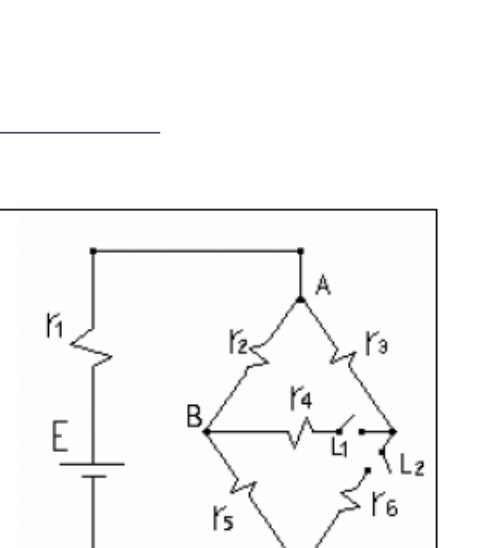
A partir del circuito representado en la figura:
Datos: E = 12 V r 1= 3 Ohms r 2= 5 Ohms r 3= 2 Ohms r 4= 4 Ohms r 5= 1 Ohms r 6= 3 Ohms r 7= 2 Ohms L1 interruptor L2 interruptor
a) Calcular las corrientes del circuito con los interruptores cerrado b) Calcular la corriente del circuito, L1 abierto y L2 cerrado c) Calcular la corriente del circuito, L1 cerrado y L2 abierto d) Calcular potencia del circuito de cada uno de los puntos anteriores e) Calcular Vabcd con los interruptores cerrado
OAF 2011 - 16
Topic: Circuits Metodi: Kirchhoff’s Laws, Equivalent Circuit Reduction Competenze: Physical Reasoning Objects: Resistor, Battery, Switch Fonte: Testo (PDF) — p.3
PT5. Scuola tecnica ORT Nro. 2 Città di Buenos Aires.
Dal circuito rappresentato in figura:
Datati: E = 12 V R 1 = 3 Ohms R 2= 5 Ohms r 3= 2 Ohms R 4= 4 Ohms r 5= 1 Ohms R 6 = 3 Ohms r 7= 2 Ohms L1 interruttore L2 interruttore
a) Calcolare i correnti di cui al Circuito con Le Scomutatori chiusi b) Calcolare il corrente del circuito, L1 aperto e L2 chiuso c) Calcolare il corrente del circuito, L1 chiuso e L2 aperto d) Calcolare la potenza del circuito di ciascuno dei punti precedenti e) Calcolare Vabcd con gli interruttori chiusi
OAF 2011 - 16
Topic: Circuits Metodi: Kirchhoff’s Laws, Equivalent Circuit Reduction Competenze: Physical Reasoning Objects: Resistor, Battery, Switch Fonte: Testo (PDF) — p.3
PT5. The technical school ORT Nro. 2 City of Buenos Aires.
From the represented circuit in the figure:
The data: E = 12 V R1 = 3 Ohms R2 = 5 Ohms R3 = 2 Ohms R4 = 4 Ohms R5 = 1 Ohms R 6 = 3 Ohms R7 = 2 Ohms L1 switch L2 switch
(a) Calculate the currents of the Circuit with The Switches closed . (b) Calculate the current of the circuit, L1 open and L2 closed (c) Calculate the current of the circuit, L1 closed and L2 open (d) Calculate the power of the circuit at each of the above points e) Calculate Vabcd with the switches closed
The following points shall be added:
Topic: Circuits Metodi: Kirchhoff’s Laws, Equivalent Circuit Reduction Competenze: Physical Reasoning Objects: Resistor, Battery, Switch Fonte: Testo (PDF) — p.3
PT6. Escuela Técnica ORT Nro. 2 Ciudad de Buenos Aires.
Una lancha tiene una masa de 3.250 kg. Se encuentra en el puerto, inicialmente, en reposo. La maneja un conductor de 80 kg Se acelera la lancha y ésta alcanza 23 nudos en 10 s, manteniendo la aceleración constante. Se desplaza posteriormente un minuto más a velocidad constante, luego el piloto apaga sus motores. La fuerza resistente del agua se la modeliza como directamente proporcional a la velocidad: F = k.v, con k = 155 kg/s. Considerá: 1 nudo = 1,8 km/h. a) Calculá la fuerza total que actúa sobre la embarcación mientras acelera en la primera parte. b) ¿Qué fuerza hace el motor para desplazar la lancha a velocidad constante? c) Graficá la velocidad de la lancha en función de la distancia, a partir de cuando apaga sus motores. d) ¿Cuántos metros recorre en total la lancha hasta detenerse? e) ¿Qué volumen de la lancha se encuentra sumergido cuando está en reposo? Suponé que no tiene tripulantes
Topic: Newtonian Mechanics Metodi: Kinematic Equations, Differential Equations, Free-Body Diagram Competenze: Physical Reasoning, Mathematical Modeling Objects: — Fonte: Testo (PDF) — p.3
PT6. Scuola tecnica ORT Nro. 2 Città di Buenos Aires.
Una barca ha una massa di 3.250 kg. Si trova al porto, inizialmente,
- In riposo. La guida di un pilota di 80 kg, la barca si accelera e raggiunge il punto di partenza. 23 nodi in 10 secondi, mantenendo l’accelerazione costante. Si muove dopo un minuto di più a velocità costante, poi il pilota spegne i suoi motori. La forza resistente dell’acqua è modellata come direttamente proporzionale alla resistenza dell’acqua. velocità: F = k.v, con k = 155 kg/s. Considerate: 1 nodo = 1,8 km/h. a) Calcola la forza totale che agisce sulla nave mentre accelera nella prima parte. b) Qual è la forza del motore per spostare la barca a velocità costante? c) Grafica la velocità della barca in funzione della distanza, a partire da quando spegne i motori. d) Quanti metri in totale percorre la barca fino al momento di fermarsi? e) Quale volume della barca è immerso quando è in
- Il riposo? Ho pensato che non avesse un equipaggio.
Topic: Newtonian Mechanics Metodi: Kinematic Equations, Differential Equations, Free-Body Diagram Competenze: Physical Reasoning, Mathematical Modeling Objects: — Fonte: Testo (PDF) — p.3
PT6. The technical school ORT Nro. 2 City of Buenos Aires.
A boat weighs 3,250 kg. It’s in the harbor, initially. I’m at rest. She ‘s driven by a 80 kg driver . She accelerates the boat and it reaches . 23 knots in 10 seconds, keeping the acceleration constant. It moves . Afterwards one more minute at constant speed, then the pilot turns off his The engines. The resistance of water is modelled as directly proportional to the speed: F = k.v, with k = 155 kg/s. Consider: 1 knot = 1,8 km/h. (a) Calculate the total force acting on the vessel as it accelerates In the first part. (b) What force does the engine make to move the boat at speed constantly? (c) Graph the speed of the boat according to distance, starting from When you turn off your engines. (d) How many metres in total does the boat go to stop? (e) What volume of boat is submerged when it is at
- I’m going to rest? I assumed you had no crew.
Topic: Newtonian Mechanics Metodi: Kinematic Equations, Differential Equations, Free-Body Diagram Competenze: Physical Reasoning, Mathematical Modeling Objects: — Fonte: Testo (PDF) — p.3
Bungee jumping
PT7. Colegio Nacional Dr. Arturo U. Illia
Colegio Mar del Plata de las Colinas
Colegio Santísima Trinidad
Instituto Albert Einstein
Mar del Plata, Buenos Aires.
Jugando, saltando, oscilando
Uno de los deportes de riesgo que ha
alcanzado una gran popularidad es el bungee
jumping, que consiste en dejarse caer colgado
de una cuerda elástica atada a un soporte fijo.
La cuerda es elástica por lo que va frenando
la caída y finalmente el saltador oscila colgado
de la cuerda.
Pepe el audaz, decide practicar este deporte
pero antes quiere verificar algunos cálculos
para estar seguro de que va a volver sano y
salvo.
La descripción del movimiento es sencilla, consiste en dejarse caer con una
velocidad inicial igual a cero atado a una cuerda elástica de longitud L desde un
puente de altura H sobre el agua (L < H, para evitar remojones). La caída tiene
varias partes; la primera es una caída libre donde se puede despreciar la fricción
del aire, con aceleración constante de la gravedad g. El largo de la caída libre es
L, en ese momento empieza el segundo tramo en que la cuerda comienza a
estirarse. En este momento la cuerda realiza una fuerza elástica de restitución o
recuperadora que va frenando la caída con una fuerza que aumenta linealmente
y la aceleración disminuye hasta anularse, cuando la fuerza que realiza la cuerda
anula el peso sobre el saltador.
En ese punto podemos considerar que comienza la tercera fase donde la
aceleración del movimiento comienza a ser hacia arriba hasta que frena
definitivamente al saltador, justo sobre el agua pero sin tocarla.
A continuación comienza un movimiento de oscilación hacia arriba y hacia abajo
debido a la elasticidad de la cuerda.
OAF 2011 - 17
Para hacer los cálculos y resolver el problema se harán algunas suposiciones, la
masa de la cuerda se considerará despreciable así como el roce del aire, el
saltador se considera una masa puntual M y no hay disipación de energía en el
movimiento.
a) Realice: i.- un esquema de la caída, donde se vea el alto del puente, el
largo de la cuerda y coloque un sistema de referencia.
ii.- un esquema de las fuerzas que actúan sobre Pepe en cada
uno de los tramos de la caída.
b) Calcule la velocidad que tendrá Pepe en el momento en que termina la
primera fase.
c) Como Pepe llega exactamente a rozar el agua en el punto más bajo de
la trayectoria, calcule la energía que almacena el resorte en función de
la energía inicial en ese momento.
d) Calcule la constante elástica de la cuerda sabiendo que la energía
elástica de una cuerda es la mitad de la constante del resorte,
multiplicada por el estiramiento de la cuerda al cuadrado. Se está
definiendo el estiramiento como la diferencia entre la longitud de la
cuerda estirada y cuando carece de estiramiento.
e) Realice un gráfico esquemático de la aceleración de Pepe en función
de la posición tomando como cero el punto inicial y positivo el eje hacia
abajo, distinguiendo las tres zonas señaladas en la introducción. Aclare
los signos de sus consideraciones, marcando en el gráfico el punto de
máxima velocidad.
f) Realice un gráfico cualitativo de la velocidad en función del tiempo.
g) Si ahora tomamos H= 60 m , L = 30 m M = 50 kg y g = 10 m/s2 calcule
la constante del resorte.
h) Pepe va con Pipo que tiene el doble de masa que Pepe, Pipo quiere
tirarse pero Pepe se lo prohíbe diciendo que se va a chocar
violentamente con el agua, justifica la observación de Pepe.
i) Pepe finalmente dobla la cuerda por la mitad para que Pipo pueda
saltar, calcula la nueva constante de la cuerda.
j) ¿Se mojará Pipo al saltar?
Topic: Conservation of Energy Metodi: Energy Conservation Method, Hooke’s Law Competenze: Physical Reasoning, Mathematical Modeling Objects: Spring Fonte: Testo (PDF) — p.3
Bungee jumping
PT7. Il Dr. Arturo U. Illia La scuola Mar del Plata de las Colinas La Santa Trinità L’Istituto Albert Einstein Mar del Plata, Buenos Aires.
Giocando, saltando, oscilando Uno dei sport a rischio che ha Un grande successo è il bungee. saltare, che consiste nel lasciarsi cadere appeso di una corda elastica legata a un supporto fisso. La corda è elastica , quindi frenata . La caduta e infine il saltatore oscilla appeso della corda. Pepe il coraggioso, decide di praticare questo sport Ma prima vuole verificare alcuni calcoli. Per essere sicuri che tornera ’ sano e sano Salvo. La descrizione del movimento è semplice, consiste nel farsi cadere con una velocità iniziale pari a zero legata a una corda a lungo L da un ponte di altezza H sull’acqua (L < H, per evitare scosse). La caduta ha La prima è una caduta libera dove si può disprezzare la frizione. di aria, con costante accelerazione della gravità g. Il lungo della caduta libera è L, a quel punto inizia il secondo tratto in cui la corda inizia a allungarsi. In questo momento la corda realizza una forza elastica di restituzione o Un’auto che si riprende frenando il caduto con una forza che aumenta linealmente e l’accelerazione diminuisce fino a che si annulla, quando la forza che fa la corda annulla il peso sul saltatore. A quel punto possiamo considerare che inizia la terza fase in cui la L’accelerazione del movimento inizia ad essere verso l’alto fino a frenare.
- Definitivamente al saltatore, proprio sopra l’acqua, ma senza toccarla. Poi inizia un movimento di oscillazione su e giù a causa dell’elasticità della corda.
OAF 2011 - 17 Per fare i calcoli e risolvere il problema si faranno alcune ipotesi, la La massa della corda sarà considerata dispreziosa così come il rastrello dell’aria, il il salter è considerato un punto M e non vi è dissipazione di energia movimento. a) Realizzare: i. un schema della caduta, dove si vede l’altezza del ponte, il lungo la corda e inserire un sistema di riferimento. ii. un schema delle forze che agiscono su Pepe in ogni uno dei tratti della caduta. b) Calcolare la velocità che Pepe avrà al termine della prima fase. c) Come Pepe arriva esattamente a spazzare l’acqua al punto più basso di il percorso, calcola l’energia che la primavera stocca in base a l’energia iniziale in quel momento. d) Calcolare la costante elastica della corda sapendo che l’energia l’elastica di una corda è metà della costante di primavera, moltiplicato per il quadrato della corda. È finita . definendo lo stretch come la differenza tra la lunghezza della quando la corda è allungata e quando non c’è. e) Realizzare un grafico schematico dell’accelerazione di Pepe in funzione La posizione di un punto di partenza è zero e l’asse verso l’altro è positivo. Sotto, distinguendo le tre zone indicate all’inizio. - Chiarificare I segni delle loro considerazioni, segnando nel grafico il punto di velocità massima. f) Realizzare un grafico qualitativo della velocità in base al tempo. g) Se adesso prendiamo H=60 m , L=30 m M=50 kg e g=10 m/s2 calcoli la costante della primavera. h) Pepe va con Pipo che ha doppio di massa che Pepe, Pipo vuole Ma Pepe gli dice che non lo farebbe. violentemente con l’acqua, giustifica l’osservazione di Pepe. I) Pepe finisce per piegare la corda in mezzo per permettere a Pipo di salta, calcola la nuova costante della corda. J) Pipo si bagnerà saltando?
Topic: Conservation of Energy Metodi: Energy Conservation Method, Hooke’s Law Competenze: Physical Reasoning, Mathematical Modeling Objects: Spring Fonte: Testo (PDF) — p.3
The Commission shall adopt implementing acts in accordance with Article 21 of the Financial Regulation.
PT7. National College Dr. - Arthur U. Illia College Mar del Plata of the Hills Holy Trinity College The Albert Einstein Institute The city of Mar del Plata, Buenos Aires.
Playing, jumping, swinging. One of the most dangerous sports he ‘s ever had . It’s a big hit. Jumping, which involves letting yourself fall hanging. of an elastic rope attached to a fixed support. The rope is elastic so it ‘s braking . The fall and finally the jumper swing hanging . of the rope. Pepe the bold, decides to practice this sport But first , you want to check some calculations . To make sure he ‘s going to come back healthy and except for the one. The description of the movement is simple, it’s about letting yourself fall with a 0-zero initial speed tied to an elastic rope of L length from a H-height bridge over water (L < H, to prevent boiling). The fall has . The first is a free fall where friction can be neglected. of air, with constant gravitational acceleration g. The length of the free fall is L, at that point the second stretch begins where the string begins to stretch out. At this point the rope performs an elastic force of restitution or A recovery machine that brakes the fall with a force that increases linearly And the acceleration slows down until it’s cancelled, when the force acting on the rope It cancels the weight on the jumper. At that point we can consider that the third phase begins where the The acceleration of the movement starts to be upwards until it brakes. Definitely the jumper, right over the water but without touching it. Then begins a swinging movement up and down. because of the elasticity of the rope.
The following is the list of the countries of the European Union: To make the calculations and solve the problem, some assumptions will be made, the The mass of the rope shall be considered despicable as well as the air friction, the The jumping is considered a point mass M and there is no energy dissipation in the The movement. (a) Perform: i. a diagram of the fall, showing the height of the bridge, the The length of the rope and place a reference system. ii. a scheme of the forces acting on Pepe at each One of the sections of the fall. (b) Calculate the speed that Pepe will have at the time the test is completed. Phase one. (c) As Pepe gets to spray water at the lowest point of the The trajectory, calculate the energy stored by the spring based on the initial energy at that moment. (d) Calculate the elastic constant of the rope knowing that the energy elasticity of a string is half the spring constant, multiplied by the square of the rope. He ‘s gone . Defining stretch as the difference between the length of the Stretched rope and when not stretched. (e) Perform a schematic graph of Pepe’s acceleration as a function The position of the starting point is taken as zero and the positive axis is taken as the direction of the axis. below, distinguishing the three areas indicated in the introduction. Clear it up . The Commission will also draw up a report on the implementation of the programme. maximum speed. (f) Draw a qualitative time-based speed chart. g) If we now take H=60 m , L=30 m M=50 kg and g=10 m/s2 calculate the spring constant. (h) Pepe goes with Pipo who has twice the mass that Pepe, Pipo wants But Pepe forbids it by saying it’s going to crash. The Commission’s proposal for a directive on the protection of workers’ rights in the Member States is a matter of urgency. (i) Pepe finally folds the rope in half so that Pipo can Jump, calculate the new constant of the string. (j) Will Pipo get wet when he jumps?
Topic: Conservation of Energy Metodi: Energy Conservation Method, Hooke’s Law Competenze: Physical Reasoning, Mathematical Modeling Objects: Spring Fonte: Testo (PDF) — p.3
Ciclotron
PT8. Colegio Nacional Dr. Arturo U. Illia
Colegio Mar del Plata de las Colinas
Colegio Santísima Trinidad
Instituto Albert Einstein
Mar del Plata, Buenos Aires.
Una vueltita por el ciclotrón La figura es un dibujo esquemático de un ciclotrón que es un dispositivo que se emplea para acelerar partículas cargadas, las partículas cargadas (iones) se mueven en el interior de dos recipientes metálicos semicirculares denominados Des (debido a su forma). Los recipientes están contenidos en una cámara de vacío en el interior de un campo magnético B proporcionado por un electroimán. En la región en la cual se mueven las partículas debe haberse realizado el vacío para que las partículas no pierdan energía y no sean dispersadas en choques con las moléculas del aire. Para acelerar las partículas se establece un campo eléctrico en la región entre las Des, como se muestra en la figura anterior. Para que pueda acelerar el ión el campo eléctrico E debe oscilar de forma tal que siempre acelera de D1 a D2 y de D2 a D1
OAF 2011 - 18
Para que la partícula pueda seguir acelerando entra en una zona con un campo magnético B constante cuya única finalidad es torcer la trayectoria para que el ión llegue a la zona entre las Des donde se acelera nuevamente. Una partícula cargada describe una semicircunferencia en un campo magnético uniforme. La fuerza sobre la partícula viene dada por el producto vectorial Fm = q · v x B, por lo tanto la fuerza centrípeta está dada por m.ac = m v2/r. El ión de carga q es acelerado por el campo eléctrico existente entre las Des. Incrementa su energía cinética en una cantidad igual al producto de su carga por la diferencia de potencial existente entre las Des. Cuando el ión completa una semicircunferencia, se invierte la polaridad por lo que es nuevamente acelerado por el campo existente en la región intermedia. De nuevo, incrementa su energía cinética en una cantidad igual al producto de su carga por la diferencia de potencial existente entre las Des. La energía final del ión es n.q.V, siendo n el número de veces que pasa por la región entre las Des. El campo magnético se ajusta de modo que el tiempo que se necesita para recorrer la trayectoria semicircular dentro del electrodo sea igual al semiperiodo de las oscilaciones. En consecuencia, cuando los iones vuelven a la región intermedia, el campo eléctrico habrá invertido su sentido y los iones recibirán entonces un segundo aumento de la velocidad al pasar al interior de la otra ‘De’. En nuestro caso tomaremos como partícula a acelerar un protón con carga q = 1,6 x 10⁻¹⁹ C y masa m = 1,67 x 10⁻²⁷ kg, el campo magnético B = 6 x 10⁻³ T y la diferencia de potencial máxima entre las Des, V = +100 V. a) Si el protón, de la figura anterior, parte del reposo y se acelera por la diferencia de potencial existente entre las dos Des. Calcule la velocidad que adquiere el protón al alcanzar a D2 inicialmente. b) Determine el radio r2 de la primera trayectoria semicircular que describe la partícula. c) ¿Qué tiempo, t, tarda la partícula en recorrer la semicircunferencia anterior? d) Calcule la velocidad v2 al alcanzar D1. e) Determine el radio r1 de la segunda trayectoria semicircular que describe la partícula. f) ¿Cuánto vale la energía cinética final de la partícula cuando sale del ciclotrón, mostrado en la figura, si realiza 4 semicircunferencias?
OAF 2011 - 19
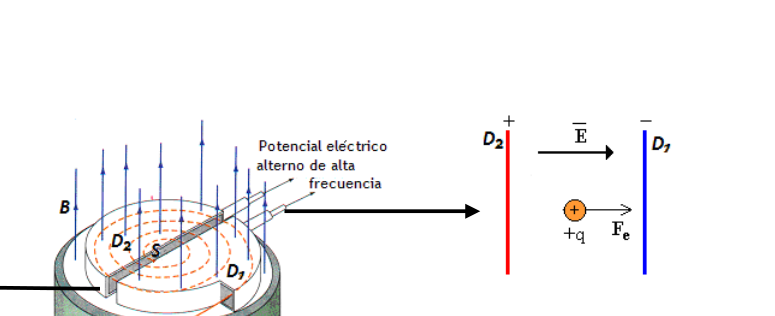
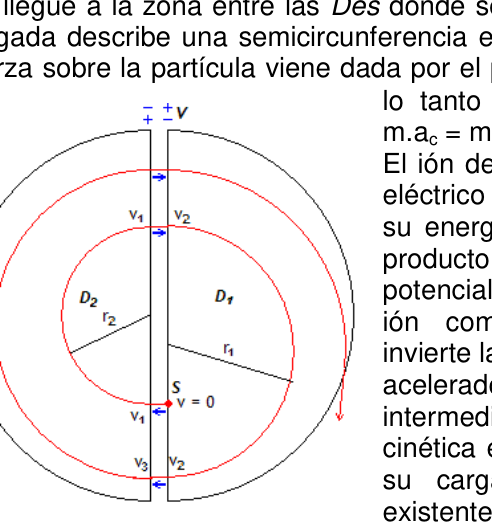
Topic: Electromagnetism Metodi: Lorentz Force Analysis, Conservation of Energy Competenze: Physical Reasoning Objects: Particle Beam, Magnet Fonte: Testo (PDF) — p.3
Ciclotron
PT8. Il Dr. Arturo U. Illia La scuola Mar del Plata de las Colinas La Santa Trinità L’Istituto Albert Einstein Mar del Plata, Buenos Aires.
Un giro per il ciclotrone La figura è un disegno schematico di un ciclotrone che è un dispositivo che si La velocità di accelerazione delle particelle cariche è determinata da un’accelerazione delle particelle cariche (ioni). si muovono all’interno di due recipienti metalliche semicircolari denominati Des (a causa della sua forma). I recipienti sono contenuti in una camera di vuoto all’interno di un campo magnetico B fornito da un elettromagnetico. Nella regione in cui si muovono le particelle deve esserci stato il vuoto. Così le particelle non perdono energia e non si disperdono in colpi. con le molecole dell’aria. Per accelerare le particelle si stabilirà un campo elettrico nella regione tra La Commissione ha adottato una decisione del Consiglio che prevede che le misure di cui all’articolo 1 del regolamento (UE) n. Per accelerare l’ion. Il campo elettrico E deve oscillare in modo tale che accelera sempre da D1 a D2 e da D2 a D1
OAF 2011 - 18
Per far sì che la particella possa continuare ad accelerare entra in un’area con un campo. Magnetico B costante il cui unico scopo è torcer la traccia in modo che il Ioni raggiungono la zona tra le Des dove si accelera di nuovo. Una particella Cargato descrive una semicirconferenza su un campo magnetico uniforme. La La forza sulla particella viene data dal prodotto vettoriale Fm = q · v x B, per Quindi la forza centripetal è data da m.ac = m v2/r. L’ion di carica q è accelerato dal campo La Commissione ha adottato una proposta di direttiva che prevede l’applicazione di un regime di controllo delle Incremento la sua energia cinetica in una quantità pari a prodotto del suo carico per la differenza di La Commissione ha adottato una proposta di regolamento che prevede che le misure di cui all’articolo 6 del regolamento di base siano state adottate. Quando il Il Consiglio europeo ha adottato una decisione che prevede che il Consiglio europeo di sicurezza europea si impegni a favore di un’organizzazione europea di sicurezza. Invertire la polarità per ciò che è di nuovo accelerato dal campo esistente nella regione
- Intermedio. Ancora una volta, aumenta la sua energia. di una quantità pari al prodotto di il suo carico per la differenza di potenziale La Commissione ha adottato una decisione che L’energia finale dell’ion è nq.V, essendo n il numero di volte che passa attraverso la Regione tra le Des. Il campo magnetico si regola in modo che il tempo necessario per percorrere la traccia semicircolare all’interno dell’elettrodo è pari al semiperiodo delle oscillazioni. Di conseguenza, quando gli ioni tornano nella regione In questo modo, il campo elettrico inverterà il suo senso e gli ioni riceveranno. Quindi un secondo aumento di velocità passando all’interno dell’altro De. Nel nostro caso, prendiamo come particella l’accelerazione di un protone con carico q = 1,6 x 10⁻¹⁹ C e massa m = 1,67 x 10⁻²⁷ kg, campo magnetico B = 6 x 10⁻³ T e la differenziazione di potenziale massimo tra le Des, V = +100 V. (a) Se il protone, nella figura precedente, parte dal riposo e si accelera per il La differenza di potenziale esistente tra le due Calcola la velocità che acquista il protone raggiungendo inizialmente D2. b) Determina il radio r2 della prima traccia semicircolare che descrive la particella. c) Quanto tempo, t, la particella impiega per percorrere la semicircumferenza
- Prima? d) Calcolare la velocità v2 raggiungendo D1. e) Determina il radio r1 della seconda tragittoria semicircolare che descrive la particella. f) Quanto vale l’energia cinetica finale della particella quando esce dal Ciclotron, mostrato nella figura, se fa 4 semicircoli?
OAF 2011 - 19
Topic: Electromagnetism Metodi: Lorentz Force Analysis, Conservation of Energy Competenze: Physical Reasoning Objects: Particle Beam, Magnet Fonte: Testo (PDF) — p.3
The following table shows the results of the tests:
PT8. National College Dr. - Arthur U. Illia College Mar del Plata of the Hills Holy Trinity College The Albert Einstein Institute The city of Mar del Plata, Buenos Aires.
A little spin on the cyclotron . The figure is a schematic drawing of a cyclotron which is a device that is The acceleration of charged particles is used to accelerate charged particles (ions). They move inside two semicircular metal containers called Des (because of its shape). The containers are contained in a chamber of vacuum inside a magnetic field B provided by an electromagnet. In the region where the particles move the vacuum must have been created So the particles don ‘t lose energy and not be scattered in collisions . with the molecules of the air. To accelerate the particles an electric field is established in the region between The Commission has already adopted a number of proposals for the So that I can accelerate the ion. The electric field E must oscillate in such a way that it always accelerates from D1 to D2 and from D2 a D1
The following is the list of the Member States’ financial statements:
So the particle can keep accelerating it enters a zone with a field. The magnetic constant B whose only purpose is to twist the path so that the ION reaches the area between the Des where it accelerates again. A particle . The charge describes a semicircular on a uniform magnetic field. La The force on the particle is given by the vector product Fm = q · v x B, by So the centrifugal force is given by m.ac = m v2/r. The charge ion q is accelerated by the field The electricity supply between the two Increases Its kinetic energy in an amount equal to product of its load by the difference of The potential of the When the The Commission will be consulted on the following issues: reverses polarity for what it is again accelerated by the existing field in the region The middle. Again, it increases your energy. kinetic energy in an amount equal to the product of its load by the potential difference The Commission has already adopted a number of proposals. The final energy of the ion is nq.V, being n the number of times it passes through the region between the Des. The magnetic field is adjusted so that the time it takes to The half-circular path within the electrode is equal to the half-period. of the oscillations. Consequently, when the ions return to the region In the middle, the electric field will have reversed its direction and the ions will receive Then a second increase in speed as you go inside the other De. In our case we’ll take as a particle the acceleration of a proton with charge q = The magnetic field B is 6 x 10⁻³ T and the mass m = 1.67 x 10⁻²⁷ kg. The maximum potential difference between the Des, V = +100 V. (a) If the proton in the figure above is at rest and accelerates by the The difference in potential between the two Calculate the speed It acquires the proton when it reaches D2 initially. (b) Determine the radius r2 of the first semi-circular path described the particle. (c) How long, t, does it take the particle to travel the semicircle? previously? (d) Calculate the speed v2 at the D1 reach. (e) Determine the radius r1 of the second semicircular path that It describes the particle. (f) What is the final kinetic energy of the particle when it leaves the Cyclotron, shown in Figure 1, if you perform 4 semicircles?
The following points shall be added:
Topic: Electromagnetism Metodi: Lorentz Force Analysis, Conservation of Energy Competenze: Physical Reasoning Objects: Particle Beam, Magnet Fonte: Testo (PDF) — p.3
Tetera electrica
PT9. Colegio Nacional Dr. Arturo U. Illia
Colegio Mar del Plata de las Colinas
Colegio Santísima Trinidad
Instituto Albert Einstein
Mar del Plata, Buenos Aires.
La tetera eléctrica y como medir el calor específico del hielo Este problema trata del funcionamiento de un calentador eléctrico de agua y de su uso para medir el calor específico del hielo. El diagrama muestra un calentador eléctrico de agua con su elemento calefactor (resistencia eléctrica) en su parte inferior. a) ¿Por qué está ubicado el elemento calefactor en la parte inferior y no más arriba? b) El elemento calefactor esta compuesto de dos resistencias eléctricas que transforman la energía eléctrica en calor. Cuando la tetera se enchufa en una fuente de corriente continua, esta comienza a calentar, sin embargo, por medio de un interruptor es posible hacer que funcione a baja o alta potencia. Dibuje un circuito eléctrico que muestre cómo puede utilizarse correctamente las dos resistencias, el interruptor y la fuente, para que proporcione alta potencia con el interruptor abierto y baja cuando se cierra. c) Con el interruptor conectado en alta la tetera disipa una potencia de 1100W conectado a una fuente de 220V. Calcule la corriente y la resistencia total del circuito durante su uso en esta posición.
Se utiliza la tetera analizada para estudiar los cambios de estados del agua. Para ello se toma 0,25 Kg de hielo triturado y se lo introduce en la tetera. El hielo recibe energía de la tetera conectada en baja. La temperatura se mide a medida que transcurre el tiempo t, el grafico a continuación muestra las mediciones obtenidas: d) En el grafico anterior, marque con una X el punto del grafico en el cual se ha derretido justamente todo el hielo. e) Calcular la potencia de la tetera conectada en baja sabiendo que el calor específico del agua liquida es de 4200 J/Kg.K. f) Determinar el calor especifico del hielo g) Determinar el calor latente de fusión del hielo
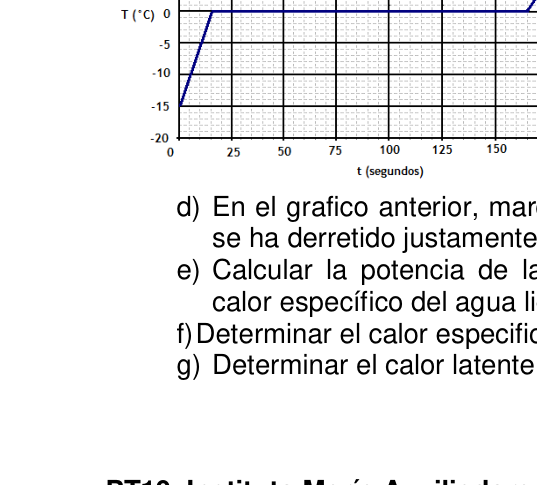
Topic: Thermodynamics, Circuits Metodi: First Law of Thermodynamics, Equivalent Circuit Reduction Competenze: Physical Reasoning, Mathematical Modeling Objects: Resistor, Calorimeter Fonte: Testo (PDF) — p.3
Tetera elettrica
PT9. Il Dr. Arturo U. Illia La scuola Mar del Plata de las Colinas La Santa Trinità L’Istituto Albert Einstein Mar del Plata, Buenos Aires.
Il tetto elettrico e come misurare il calore specifico del ghiaccio Il problema riguarda il funzionamento di un riscaldatore elettrico di acqua e di la sua utilizzazione per misurare la temperatura specifica del ghiaccio. Il diagramma mostra un riscaldatore elettrico di acqua con il suo elemento riscaldatore (resistenza elettrica) nella parte inferiore. a) Perché l’elemento è situato il riscaldatore in fondo e non più in alto? b) L’elemento riscaldatore è composto di due resistenze elettriche che trasformano l’energia elettrica in calore. Quando la tettera si inserisce in una fonte di corrente continua, questa inizia a riscaldarsi, senza Tuttavia, con un interruttore è possibile farlo funzionare. bassa o alta potenza. Disegni un circuito elettrico che mostri come La resistenza può essere correttamente utilizzata, il interruttore e la resistenza. fonte, per fornire alta potenza con il interruttore aperto e Scendi quando chiude. c) Con il interruttore collegato in alto, la tettera si dissolve una potenza di 1100W connesso a una fonte di 220V. Calcola la corrente e il resistenza totale del circuito durante l’uso in questa posizione.
Si utilizza la vasca analizzata per studiare i cambiamenti di stato del acqua. Per questo si prende 0,25 Kg di triturazione di ghiaccio e inserimento in Teterina. Il ghiaccio riceve energia dalla Teterera collegato en
- Scendi. La La temperatura è misurata a seconda che Il tempo passa t, il grafico a continuación muestra las mediciones ottenute: d) Nel grafico precedente, segna con X il punto del grafico in cui E’ stato il fatto che tutto il ghiaccio si sia sciolto. e) Calcolare la potenza della vasca a bassa connessione sapendo che il il calore specifico dell’acqua liquida è di 4200 J/Kg.K. f) Determinare la temperatura specifica dell’ice g) Determinazione del calore latente di fusione del ghiaccio
Topic: Thermodynamics, Circuits Metodi: First Law of Thermodynamics, Equivalent Circuit Reduction Competenze: Physical Reasoning, Mathematical Modeling Objects: Resistor, Calorimeter Fonte: Testo (PDF) — p.3
The following table shows the results of the calculations:
PT9. National College Dr. - Arthur U. Illia College Mar del Plata of the Hills Holy Trinity College The Albert Einstein Institute The city of Mar del Plata, Buenos Aires.
The electric kettle and how to measure specific ice heat This problem concerns the operation of an electric water heater and the use to measure specific ice temperature. The diagram shows an electric water heater with its heating element (Electrical resistance) at its bottom. (a) Why is the item located Heater at the bottom and not up? (b) The heating element is composite of two electrical resistors that transform electrical energy in heat. When the teapot It is plugged into a power source It’s still going on, it’s starting to heat up, without. However, by means of a switch it is possible to make it work low or high power. Draw an electrical circuit that shows how The two resistors, the switch and the source, to provide high power with the switch open and It comes down when it closes. (c) With the switch connected at high speed, the teapot dissipates a power of 1100W connected to a 220V power supply. Calculate the current and the current. the total resistance of the circuit during use in this position.
The analyzed teapot is used for study of changes in states of the
- What? For this purpose 0.25 kg of crushed ice and insert it into the I’m a teater. Ice receives energy from the
- I ‘m a teeter . connected en Get down there. La temperature is measured as Time passes t, the graph to The following shows the measurements obtained: d) In the above graph, mark with an X the point on the graph where The whole ice just melted. (e) Calculate the power of the low-connected teapot knowing that the The specific heat of liquid water is 4200 J/Kg.K. (f) Determine the specific heat of the ice (g) Determine the latent heat of ice melting
Topic: Thermodynamics, Circuits Metodi: First Law of Thermodynamics, Equivalent Circuit Reduction Competenze: Physical Reasoning, Mathematical Modeling Objects: Resistor, Calorimeter Fonte: Testo (PDF) — p.3
PT10. Instituto María Auxiliadora Santa Rosa, La Pampa.
Para medir el valor de una resistencia R desconocida con ayuda de un voltímetro y un amperímetro, podemos usar el montaje (a) o el montaje (b) que se muestra aquí. Considera que, contrariamente a lo que suele suceder, la resistencia interna del amperímetro y la corriente que pasa por el voltímetro no son despreciables. En estas condiciones, responde:
OAF 2011 - 20 a) En el montaje (a) ¿la lectura del amperímetro será mayor, menor o igual a la corriente que pasa por R? Explica tu conjetura. b) Entonces usando el montaje (a) el valor que obtendremos para R será mayor, menor o igual a su valor real? Explica tu conjetura. c) En el montaje (b) ¿la lectura del voltímetro será mayor, menor o igual al voltaje aplicado a R? Explica tu conjetura. d) Entonces utilizando el montaje (b) el valor que obtenemos para R será mayor, menor o igual a su valor real? Explica tu conjetura.
Topic: Circuits Metodi: Kirchhoff’s Laws Competenze: Physical Reasoning Objects: Resistor, Galvanometer Fonte: Testo (PDF) — p.3
PT10. Istituto Maria Assilliadora Santa Rosa, La Pampa.
Per misurare il valore di una resistenza R sconosciuta con un voltímetro e un amperimetro, possiamo usare il montaggio (a) o il montaggio (b) che viene visualizzato
- Qui. La Commissione ritiene che, contrariamente a quanto si verifica, la resistenza interna del l’amperiometro e il corrente che passa attraverso il voltimetro non sono dispregiati. En le condizioni, risponde:
OAF 2011 - 20 a) Nel montaggio a) lettura dell’ampiecatore sarà maggiore, minore o uguale al corrente che passa per R? Spiega la tua ipotesi. b) Quindi usando il montaggio (a) il valore che Otterremo per R sarà maggiore, minore o pari al suo valore reale? Spiega la tua ipotesi. c) Nel montaggio b) lettura del voltometro sarà superiore, inferiore o uguale alla volta applicata a R? Spiega la tua ipotesi. d) Quindi usando il montaggio (b) il valore che otteniamo per R sarà maggiore, minore o uguale al suo vero valore? Spiega la tua ipotesi.
Topic: Circuits Metodi: Kirchhoff’s Laws Competenze: Physical Reasoning Objects: Resistor, Galvanometer Fonte: Testo (PDF) — p.3
PT10. The Institute of Maria Auxiliadora Santa Rosa, the Pampa.
To measure the value of an unknown resistance R using a voltmeter And an ampere, we can use the assembly (a) or the assembly (b) that’s shown.
- I’ll see you in here. It considers that, contrary to what is usually the case, the internal resistance of the The ampere and the current passing through the voltmeter are not despicable. En These conditions, he answers:
The following points shall be added: (a) In the assembly (a) the reading of the ampere It will be greater, less or equal to the current than passes through R? Explain your guess. (b) Then using the assembly (a) the value that We get for R will be greater, less or equal to its real value? Explain your guess. (c) In the assembly (b) the reading of the voltmeter shall be greater than, less than or equal to the voltage applied to R? Explain your guess. (d) Then using the assembly (b) the value that We get for R will be greater, less or equal. to its true value? Explain your guess.
Topic: Circuits Metodi: Kirchhoff’s Laws Competenze: Physical Reasoning Objects: Resistor, Galvanometer Fonte: Testo (PDF) — p.3
PT11. Instituto María Auxiliadora Santa Rosa, La Pampa.
Martín tiene que hacer una experiencia demostrativa en la clase de física para
aprobar la materia y te pide ayuda, pues no le quedan claros algunos procesos
de transferencia de energía que se dan cuando coloca cubitos de hielo en un
vaso de agua para que se enfríe de manera tal que después ya no estén los
cubitos y obtengas agua fría.
Tú le pides alguna información y él enseguida se da cuenta que debe
tomar algunas mediciones para poder realizar la experiencia.
Al rato vuelve con estos datos: Volumen de agua 250cm3, Ti agua 18ºC ,
cinco cubitos de hielo de 2cmx1,5cmx3cm a Ti hielo = -5ºC, densidad del
hielo 0.92g/cm3; densidad del agua 1 g/cm3; Lf=80cal/g; cagua=1 cal/gºC;
chielo=0.5 cal/gºC
Le pides un momento y luego le confirmas que con estas consideraciones
va a lograr lo que quería, agua fría sin cubitos.
¿Cómo vas a explicarle a Martín por un lado los procesos puestos en
juego y luego la indicación aproximada que deberá darle el termómetro al
realizar la experiencia?
Topic: Thermodynamics Metodi: First Law of Thermodynamics Competenze: Physical Reasoning Objects: Calorimeter Fonte: Testo (PDF) — p.3
PT11. Istituto Maria Assilliadora Santa Rosa, La Pampa.
Martin deve fare un’esperienza dimostrativa in classe di fisica per approvare la materia e chiederti aiuto, perché non ha capito alcuni processi. di trasferimento di energia che si danno quando si mettono cubetti di ghiaccio in un un bicchiere d’acqua per raffreddarla in modo tale che dopo non ci siano più i
- E’ un po’ più di un po’ di acqua fredda. Gli chiedi informazioni e lui si rende conto che deve. prendere alcune misure per poter fare l’esperienza. In seguito torna con questi dati: volume d’acqua 250 cm3, Ti acqua 18 °C, 5 cubetti di ghiaccio di 2cmx1,5cmx3cm a Ti ghiaccio = -5oC, densità di g/cm3; densità dell’acqua 1 g/cm3; Lf=80 cal/g; acqua=1 cal/goC; il chielo=0,5 cal/goC Gli chiedi un momento e poi confermi che con queste considerazioni Avra’ quello che voleva, acqua fredda senza cucche. Come spiegherai a Martin, da un lato, i processi messi in atto? Il termometro deve essere assegnato al
- fare l’esperienza?
Topic: Thermodynamics Metodi: First Law of Thermodynamics Competenze: Physical Reasoning Objects: Calorimeter Fonte: Testo (PDF) — p.3
PT11. The Institute of Maria Auxiliadora Santa Rosa, the Pampa.
Martin has to do a demonstration experiment in physics class for He’s going to have to approve the matter and ask for help because he doesn’t understand some of the processes. The energy transfer that occurs when you put ice cubes in a A glass of water to cool it so that afterwards the water is no longer there. cubes and get cold water. You ask him for some information and he immediately realizes he must . Take some measurements so you can do the experiment. In the meantime, he comes back with these data: Water volume 250cm3, water 18oC, five ice cubes of 2cmx1,5cmx3cm to Ti ice = -5oC, density of The following conditions are met: The value of the product is calculated as follows: You ask him for a moment and then you confirm that with these considerations It’s gonna get what it wanted, cold water without any cubes. How are you going to explain to Martin the processes put on the side? The game and then the approximate indication that the thermometer must give to the to conduct the experiment?
Topic: Thermodynamics Metodi: First Law of Thermodynamics Competenze: Physical Reasoning Objects: Calorimeter Fonte: Testo (PDF) — p.3
PT12. Instituto María Auxiliadora Santa Rosa, La Pampa.
Una bola de 2kg se desliza sin fricción, por el tobogán ABCD. En A, la energía
cinética de la esfera es de 10J y su energía potencial de 54J. Cuáles de las
siguientes afirmaciones son ciertas y cuáles no. Explica claramente en que leyes
o principios basas tus respuestas.
a) La energía cinética de la bola al pasar por B
es de 64J.
b) La energía potencial de la bola en C es de
18J.
c) La energía cinética de la bola en C vale 46J.
d) La energía mecánica en D es de 64J.
e) La velocidad de la bola en D es de 8m/s-
OAF 2011 - 21
Topic: Conservation of Energy Metodi: Conservation Laws, Energy Conservation Method Competenze: Physical Reasoning Objects: Ball Fonte: Testo (PDF) — p.3
PT12. Istituto Maria Assilliadora Santa Rosa, La Pampa.
Una palla da 2 kg scivola senza attrito, attraverso il toboggan ABCD. In A, l’energia La cinetica della sfera è di 10J e la sua energia potenziale di 54J. Quali sono le le seguenti affermazioni sono vere e quelle che non sono. Spiega chiaramente in che leggi o principi su cui basare le tue risposte. a) L’energia cinetica della palla passando per B es de 64J. b) L’energia potenziale della palla in C è di 18J. c) L’energia cinetica della palla in C vale 46J. d) L’energia meccanica in D è di 64J. e) La velocità della palla in D è di 8m/s-
OAF 2011 - 21
Topic: Conservation of Energy Metodi: Conservation Laws, Energy Conservation Method Competenze: Physical Reasoning Objects: Ball Fonte: Testo (PDF) — p.3
PT12. The Institute of Maria Auxiliadora Santa Rosa, the Pampa.
A 2kg ball slides without friction through the ABCD slide. In A, the energy The kinetic energy of the sphere is 10J and its potential energy is 54J. Which of the following The following statements are true and which are not. It clearly explains what laws Or principles you base your answers on. (a) The kinetic energy of the ball as it passes through B es de 64J. (b) The potential energy of the ball in C is 18J. (c) The kinetic energy of the ball in C is 46J. d) The mechanical energy in D is 64J. (e) The speed of the ball in D is 8m/s-
The following points shall be added:
Topic: Conservation of Energy Metodi: Conservation Laws, Energy Conservation Method Competenze: Physical Reasoning Objects: Ball Fonte: Testo (PDF) — p.3
Para enfocar a un laser
PT13. Escuela Técnica Nro. 27 Hipólito Yrigoyen Ciudad de Buenos Aires.
Para enfocar a un láser Un rayo de luz láser incide desde el aire (n=1), paralelo al eje x, sobre una lente esférica, con un ángulo de incidencia de 5°. La lente tiene un índice de refracción n= 1,517 y radio 0,4 mm, siendo utilizada para enfocar al láser dentro de una fibra óptica. Determinar: a) Con qué ángulo se refracta dentro de la lente b) Con qué ángulo se refracta al salir de la lente. c) La distancia del punto de intersección del rayo sobre el eje x, medida desde el centro O de la lente. (distancia OD). d) El tiempo que tarda el rayo desde que ingresa en la lente hasta llegar al punto D. Dato: velocidad de propagación de la luz en el aire: 300000 km/seg
Topic: Geometric Optics Metodi: Snell’s Law, Ray Tracing Competenze: Physical Reasoning Objects: Lens Fonte: Testo (PDF) — p.3
Per focalizzare un laser
PT13. Scuola tecnica n.o. 27 Hippolytus Yrigoyen Città di Buenos Aires.
Per puntare un laser. Un raggio di luce laser incide dall’aria (n=1), parallelo all’asse x, su una lente spherical, con un angolo di incidenza di 5°. Il lente ha un indice di refraczione. n= 1,517 e radio 0,4 mm, utilizzato per focalizzare il laser all’interno di una fibra ottica. Determinare: a) A che angolo si rifracta all’interno della lente b) A che angolo si rifracca quando si esce dal lente. c) Distanza dal punto di intersezione del raggio sull’asse x, misurata dal centro O della lente. (distanza OD). d) Il tempo che il raggio passa dal momento in cui entra nel lente fino al momento in cui raggiunge il punto di accoglienza. punto D. Data: velocità di diffusione della luce in aria: 300000 km/sec
Topic: Geometric Optics Metodi: Snell’s Law, Ray Tracing Competenze: Physical Reasoning Objects: Lens Fonte: Testo (PDF) — p.3
To focus a laser
PT13. Technical school No. 27 Hippolytus Yrigoyen City of Buenos Aires.
To focus a laser . A laser beam of light hits from the air (n=1), parallel to the x-axis, over a lens. a spherical angle of incidence of 5°. The lens has a refractive index . n= 1,517 and a radius of 0.4 mm, being used to focus the laser within a The optical fiber. Determine: (a) At what angle does it refract inside the lens (b) At what angle does it refract when exiting the lens? (c) The distance from the beam intersection point on the x-axis, measured from the center O of the lens. (OD distance) (d) The time it takes for the beam to enter the lens until it reaches the the following points are added: Date: speed of propagation of light in the air: 300000 km/s
Topic: Geometric Optics Metodi: Snell’s Law, Ray Tracing Competenze: Physical Reasoning Objects: Lens Fonte: Testo (PDF) — p.3
Explorando el mundo submarino
PT14. Escuela Técnica Nro. 27 Hipólito Yrigoyen Ciudad de Buenos Aires.
Explorando el mundo submarino
Una empresa se dedica a realizar exploraciones submarinas. Para obtener datos
en las profundidades, utiliza una sonda, de forma esférica, de volumen= 4,19 m3
y una masa de 4291 kg. Al investigar una fosa marina de 3 km de profundidad, la
temperatura es de 20°C y desciende 1°C cada 180 m. La densidad del agua de
mar, en la superficie es de 1023 kg/m3 y su coeficiente de dilatación volumétrico
es 1,202 x 10-4 1/°C. Suponiendo que la sonda no se dilata.
a) Calcular la aceleración de la sonda en la superficie, al ser colocada en
el agua.
b) ¿Cuál es la densidad en el fondo de la fosa?
c) ¿Hasta qué profundidad podrá descender la sonda?
d) ¿Qué volumen de agua debería ingresar en la sonda para llegar al
fondo de la fosa?
Topic: Fluid Mechanics Metodi: Hydrostatic Equilibrium Competenze: Physical Reasoning, Mathematical Modeling Objects: Sphere Fonte: Testo (PDF) — p.3
Scoprire il mondo sottomarino
PT14. Scuola tecnica n.o. 27 Hippolytus Yrigoyen Città di Buenos Aires.
Esplorando il mondo sottomarino Una società si occupa di esplorazioni sottomarine. Per ottenere dati In profondità, utilizza una sonda, a forma di sfera, di volume= 4,19 m3. e una massa di 4291 kg. Quando si è studiato un fosso marino a 3 km di profondità, la La temperatura è 20°C e scende 1°C ogni 180 m. La densità dell’acqua di il suo coefficiente di dilatazione volumetrica è di 1023 kg/m3 es 1,202 x 10-4 1/°C. Supponendo che la sonda non si dilatasse. a) Calcolare l’accelerazione della sonda sulla superficie, quando è collocata su l’acqua. b) Qual è la densità al fondo del pozzo? c) A che profondità la sonda può scendere? (d) Che volume di acqua dovrebbe entrare nella sonda per raggiungere il il fondo del pozzo?
Topic: Fluid Mechanics Metodi: Hydrostatic Equilibrium Competenze: Physical Reasoning, Mathematical Modeling Objects: Sphere Fonte: Testo (PDF) — p.3
Exploring the underwater world
PT14. Technical school No. 27 Hippolytus Yrigoyen City of Buenos Aires.
Exploring the underwater world A company is engaged in underwater exploration. For data In the depths, it uses a spherical probe, volume = 4.19 m3. and a mass of 4291 kg. In investigating a 3 km deep sea trench, the The temperature is 20°C and falls to 1°C every 180 m. The water density of sea, at surface is 1023 kg/m3 and its volumetric coefficient of dilation es 1,202 x 10-4 1/°C. Assuming the probe doesn’t dilate. (a) Calculate the acceleration of the probe on the surface when placed at the water. (b) What is the density at the bottom of the pit? (c) How deep can the probe descend? (d) What volume of water should enter the probe to reach the The bottom of the pit?
Topic: Fluid Mechanics Metodi: Hydrostatic Equilibrium Competenze: Physical Reasoning, Mathematical Modeling Objects: Sphere Fonte: Testo (PDF) — p.3
Un problema electrico
PT15. Escuela Técnica Nro. 27 Hipólito Yrigoyen Ciudad de Buenos Aires.
Un problema electrico Se dispone de una batería de 12V y 30 Ampere-hora, con una resistencia interna ri = 0,02W, para armar un circuito. El circuito está formado por una lámpara L1 de 40W, un equipo de audio de 16W y dos llaves interruptoras, como muestra la figura. La lámpara y el equipo son para una tensión nominal de 12V. a) ¿Cuál es la resistencia nominal de cada uno? b) Suponiendo que las resistencias son iguales a su valor nominal, ¿qué corriente circula por cada uno cuando ambos se encuentran encendidos? c) Suponiendo que hay por lo menos uno de ellos encendido, calcular la Rmáx y Rmín del circuito. d) Calcular el tiempo máximo de duración de la batería, indicando en qué posición deben estar las llaves.
OAF 2011 - 22
Topic: Circuits Metodi: Equivalent Circuit Reduction, Kirchhoff’s Laws Competenze: Physical Reasoning Objects: Resistor, Battery, Switch Fonte: Testo (PDF) — p.3
Un problema elettrico
PT15. Scuola tecnica n.o. 27 Hippolytus Yrigoyen Città di Buenos Aires.
Un problema elettrico . Dispone di una batteria di 12V e 30 Ampere-ora, con resistenza interna Ri = 0,02W, per montare un circuito. Il circuito è costituito da una lampada L1 di 40W, un equipaggiamento audio da 16W e due chiavi interruttori, come mostra la
- Figura. La lampada e l’apparecchio sono per una tensione nominale di 12 V. a) Qual è la resistenza nominale di ciascuna? b) Supponendo che le resistenze siano uguali al loro valore nominale, che Corrente circola per ognuno di loro quando entrambi si trovano
- Incendi? c) Supponendo che almeno uno di essi sia acceso, calcolare la Rmax e Rmin del circuito. d) Calcolare la durata massima della batteria, indicando in che modo La posizione deve essere la chiave.
OAF 2011 - 22
Topic: Circuits Metodi: Equivalent Circuit Reduction, Kirchhoff’s Laws Competenze: Physical Reasoning Objects: Resistor, Battery, Switch Fonte: Testo (PDF) — p.3
A power failure
PT15. Technical school No. 27 Hippolytus Yrigoyen City of Buenos Aires.
There ‘s an electrical problem . It has a 12V and 30 ampere-hour battery with internal resistance. ri = 0.02W, to set up a circuit. The circuit is made up of an L1 lamp from 40W, a 16W audio equipment and two switch keys, as shown in the It’s a figure. The lamp and equipment are for a rated voltage of 12 V. (a) What is the nominal resistance of each? (b) Assuming that the resistors are equal to their nominal value, what Current flows through each of them when they meet.
- Are they on? (c) Assuming that at least one of them is on, calculate the Rmax and Rmin from the circuit. (d) Calculate the maximum battery life, indicating when position must be the keys.
The following is the list of the countries of the European Union:
Topic: Circuits Metodi: Equivalent Circuit Reduction, Kirchhoff’s Laws Competenze: Physical Reasoning Objects: Resistor, Battery, Switch Fonte: Testo (PDF) — p.3
Pendulo balistico
PT16. Instituto Primo Capraro San Carlos de Bariloche, Río Negro.
Ahí va la bala La figura muestra un péndulo balístico para medir la rapidez de una bala. La bala cuya masa es m, se dispara contra un bloque de madera de masa M, que cuelga de 2 hilos de masa despreciable, como un péndulo, y tiene un choque totalmente inelástico con él. Después del impacto, el bloque oscila hasta una altura máxima, llamada y.
a) Utilizando conservación de la energía demostrar que la rapidez (V) del
conjunto bloque - bala luego del impacto es:
b) Demostrar que la rapidez de la bala es:
Sabiendo que la masa de la bala es de 5 gramos, la masa del bloque de madera es de 2 kg y la altura y que alcanzan es de 3 cm. c) Calcular la rapidez de la bala. d) Suponiendo que en el impacto solamente hay transformación de energía en calor, determinar qué porcentaje de la energía cinética que tenía la bala antes del impacto se transformó en calor. e) Si la longitud de los hilos del péndulo es de 30 cm, calcular la tensión de los mismos en el instante en que el péndulo se encuentra en la posición más alta. f) Mientras el péndulo oscila, calcular la aceleración tangencial y la aceleración centrípeta del bloque en la posición más alta (cuando no tiene rapidez) y cuando pasa por la vertical (cuando su rapidez es máxima).
Nota: Usar g = 9,8 m/s2. En todo momento despreciar la fricción con el aire.
Topic: Conservation of Momentum, Conservation of Energy Metodi: Conservation of Momentum, Energy Conservation Method Competenze: Physical Reasoning Objects: Pendulum, Block, Projectile Fonte: Testo (PDF) — p.3
Pendolo balistico
PT16. Istituto Primo Capraro San Carlo di Bariloche, Rio Negro.
Ecco la pallottola La figura mostra un pendolo balistico per misurare la velocità di una pallottola. La pallottola. il cui massa è m, viene sparato su un blocco di legno di massa M, che pende di 2 fili di massa disprezzabile, come un pendolo, e ha un colpo totale. Inelastico con lui. Dopo l’impatto, il blocco oscilla fino a un’altezza massima. chiamata e.
a) Utilizzando la conservazione dell’energia dimostrare che la velocità (V) di blocco insieme - proiettile dopo l’impatto è: b) Dimostra che la velocità della pallottola è:
Sapendo che la massa della pallottola è di 5 grammi, la massa del blocco di legno. È di 2 kg e la altezza e che raggiungono è di 3 cm. Calcolare la velocità della pallottola. d) Supponendo che nell’impatto si verifichi solo una trasformazione di energia in calore, determinare quale percentuale di energia cinetica Aveva la pallottola prima che l’impatto si trasformasse in calore. (e) Se la lunghezza dei fili del pendolo è di 30 cm, calcolare la tensione di le stesse istanze in cui il pendolo si trova in posizione più alto. f) Mentre il pendolo oscilla, calcolare l’accelerazione tangenziale e la velocità di Accelerazione centripede del blocco in posizione più alta (quando non ha velocità) e quando passa verticale (quando la sua velocità è
- il massimo).
Nota: usare g = 9,8 m/s2. In ogni momento disprezza la frizione con l’aria.
Topic: Conservation of Momentum, Conservation of Energy Metodi: Conservation of Momentum, Energy Conservation Method Competenze: Physical Reasoning Objects: Pendulum, Block, Projectile Fonte: Testo (PDF) — p.3
The following information shall be provided:
PT16. The first is the Capraro Institute. St. Charles of Bariloche, Rio Negro.
There goes the bullet. The figure shows a ballistic pendulum to measure the speed of a bullet. The bullet . whose mass is m, is fired against a block of wood of mass M, which hangs Two threads of despicable mass, like a pendulum, and it has a total shock. I’m not very good with him. After impact, the block oscillates to a maximum height. call and.
(a) Using energy conservation to demonstrate that the speed (V) of the Joint block - bullet after impact is: (b) To prove that the speed of the bullet is:
Knowing the bullet’s mass is 5 grams, the mass of the wooden block. It’s 2 kg and the height and they reach 3 cm. (c) Calculate the velocity of the bullet. (d) Assuming that only transformation of energy in heat, determining what percentage of kinetic energy that I had the bullet before the impact turned into heat. (e) If the length of the pendulum threads is 30 cm, calculate the voltage of The same as the moment the pendulum is in position It’s higher. (f) As the pendulum oscillates, calculate the tangential acceleration and the The maximum acceleration of the block at the highest position (when not It has speed) and when it passes vertically (when its speed is The maximum
Note: Use g = 9.8 m/s2. At all times despise friction with the air.
Topic: Conservation of Momentum, Conservation of Energy Metodi: Conservation of Momentum, Energy Conservation Method Competenze: Physical Reasoning Objects: Pendulum, Block, Projectile Fonte: Testo (PDF) — p.3
Arquimedes y el petroleo
PT17. Instituto Primo Capraro San Carlos de Bariloche, Río Negro.
Arquímedes y el petróleo. Un buque petrolero estando muy próximo al muelle, encalla en un banco de arena. Para desencallarlo, el capitán del barco decide bombear parte del petróleo que transporta a barriles de acero con que cuenta en el barco que tienen una masa de 16 kg y una capacidad de 120 litros. El buque transporta dos tipos de petróleo crudo. El tipo A cuya densidad es de 730 kg/m3 y el tipo B cuya densidad es de 890 kg/m3. Uno de los operarios decide arrojar al río los barriles llenos de petróleo (sin mezclarlos entre ellos) y sellados suponiendo que al ser menos denso que el agua, flotarían.
OAF 2011 - 23 a) Determinar si los barriles flotan o se hunden. Considerar despreciable el volumen que ocupa el acero de los barriles. La densidad del agua es de 1000 kg/m3 y g = 9.8 m/s2. b) En el caso que algún barril flote, determinar qué fracción de su volumen estará por encima de la superficie. c) En el caso que algún barril se hunda determinar qué tensión mínima habría que ejercer con una cuerda para subir el barril del fondo del río. d) Si se pudiera mezclar el petróleo ¿cuántos litros de cada uno colocarías en un barril para que flote totalmente sumergido?
Topic: Fluid Mechanics Metodi: Hydrostatic Equilibrium Competenze: Physical Reasoning Objects: Container Fonte: Testo (PDF) — p.3
Archimedes e petrolio
PT17. Istituto Primo Capraro San Carlo di Bariloche, Rio Negro.
Archimede e il petrolio. Un petrolio vicino al molo, si trova in una banca di sabbia. Per scatenarlo, il capitano della nave decide di pompare parte del petrolio che trasporta a barriere di acciaio che ha sulla nave che hanno una massa di 16 kg e una capacità di 120 litri. La nave porta due persone. tipo di petrolio greggio. Il tipo A, la cui densità è di 730 kg/m3, e il tipo B, il cui la densità è di 890 kg/m3. Uno degli operatori decide di gettare i barili nel fiume. piene di petrolio (senza mescolare tra loro) e sigillate supponendo che essendo meno densa dell’acqua, flotarebbero.
OAF 2011 - 23 a) Determinare se i barili galleggiano o affondano. Considerare dispregiato il volume di acciaio dei barili. La densità dell’acqua è di 1000 kg/m3 y g = 9.8 m/s2. b) Se un barile flotta, determinare quale frazione del suo volume sarà sopra la superficie. c) In caso di affondamento di un barile si determina la tensione minima Dovrebbe essere esercitato con una corda per salire il barile dal fondo del fiume. d) Se si potesse mescolare l’olio, quanti litri di ciascun olio si metterebbero? In un barile per farla fluttuare completamente immersa?
Topic: Fluid Mechanics Metodi: Hydrostatic Equilibrium Competenze: Physical Reasoning Objects: Container Fonte: Testo (PDF) — p.3
Archymedes and petroleum
PT17. The first is the Capraro Institute. St. Charles of Bariloche, Rio Negro.
Archimedes and the oil. An oil tanker, very close to the dock, crashes into a bank of sand. To unlock it, the captain of the ship decides to pump some of the water. oil transported to steel barrels that are on board the ship They have a mass of 16 kg and a capacity of 120 litres. The ship carries two types of crude oil. Type A with a density of 730 kg/m3 and type B with a density of density is 890 kg/m3. One of the operators decided to throw the barrels into the river . filled with oil (without mixing them with each other) and sealed assuming that being less dense than water, they would float.
The following points shall be added: (a) Determine whether the barrels float or sink. Consider the disdainful volume of steel in barrels. The density of the water is 1000 kg/m3 y g = 9.8 m/s2. (b) In the event that a barrel floats, determine what fraction of its volume It’ll be above the surface. (c) In the event of a sinking of a barrel, determine the minimum voltage. You’d have to practice with a rope to get up the barrel from the bottom of the river. d) If you could mix the oil, how many liters of each would you put in? in a barrel so that it floats completely submerged?
Topic: Fluid Mechanics Metodi: Hydrostatic Equilibrium Competenze: Physical Reasoning Objects: Container Fonte: Testo (PDF) — p.3
La kermesse de la Octoberfest
PT18. Instituto Primo Capraro San Carlos de Bariloche, Río Negro.
La kermesse de la Octoberfest En la fiesta de la cerveza se realizan varios juegos. En uno de ellos se gana una jirafa de peluche lanzando una moneda en un platito. El plato está en una repisa más arriba del punto en que la moneda abandona la mano y a una distancia horizontal de 2.1 m de ese punto (ver figura). Si se lanza la moneda con una velocidad de 6.4 m/s a 60° sobre la horizontal, caerá en el plato. Puede ignorarse la resistencia del aire. a) Determinar la altura máxima alcanzada por la moneda. b) Indicar la velocidad de la moneda en el punto más alto de su trayectoria. c) ¿A qué altura está la repisa sobre el punto de partida de la moneda? d) ¿Qué componente vertical tiene la velocidad de la moneda justo antes de caer en el plato?
Topic: Newtonian Mechanics Metodi: Kinematic Equations Competenze: Physical Reasoning Objects: Projectile Fonte: Testo (PDF) — p.3
La kermesse dell’Octoberfest
PT18. Istituto Primo Capraro San Carlo di Bariloche, Rio Negro.
La kermesse dell’Octoberfest Alla festa della birra si svolgono diversi giochi. In uno di questi si guadagna una . giraffa peluche lanciando una moneta su un piatto. Il piatto è in un ripiano più in alto del punto in cui la moneta lascia la mano e a una distanza orizzontale di 2,1 m da quel punto (vedere figura). Se lanciate la moneta con una velocità di 6,4 m/s a 60° sul piano orizzontale, cadrà sul piatto. Potrebbe ignorare la resistenza dell’aria. a) Determinare la massima altezza raggiunta dalla moneta. b) Indicare la velocità della moneta al punto più alto del suo percorso. c) A che altezza si trova la rassegna sul punto di partenza della moneta? d) Qual è il componente verticale della velocità della moneta appena prima di cadere sul piatto?
Topic: Newtonian Mechanics Metodi: Kinematic Equations Competenze: Physical Reasoning Objects: Projectile Fonte: Testo (PDF) — p.3
The Octoberfest kermesse
PT18. The first is the Capraro Institute. St. Charles of Bariloche, Rio Negro.
The Octoberfest kermesse There are several games at the beer party. In one of them you win one . teddy giraffe throwing a coin on a plate. The dish is on a shelf . higher than the point where the coin leaves the hand and at a distance horizontal of 2.1 m from that point (see figure). If you throw the coin with a speed of 6.4 m/s at 60° over the horizontal, falling on the plate. You can . The air resistance is ignored. (a) Determine the maximum height reached by the currency. (b) Indicate the speed of the currency at the highest point of its trajectory. (c) What is the height of the overlay above the starting point of the currency? (d) What vertical component has the speed of the currency just before falling on the plate?
Topic: Newtonian Mechanics Metodi: Kinematic Equations Competenze: Physical Reasoning Objects: Projectile Fonte: Testo (PDF) — p.3
PT19. Colegio Nro. 1 Teodoro Sánchez de Bustamante San Salvador de Jujuy.
En la figura de este problema, la barra OB es uniforme
y pesa 400 kgf. El sistema está en equilibrio.
a) ¿Cuál es el valor de la tracción (tensión) en el
cable AB?;
b) ¿Cuál es el valor de la reacción ejercida por la
articulación O en la barra OB?
OAF 2011 - 24
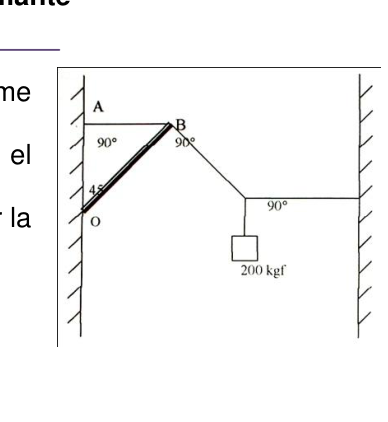
Topic: Rigid Body Statics Metodi: Torque & Angular Momentum Analysis, Free-Body Diagram Competenze: Physical Reasoning Objects: Beam, String Fonte: Testo (PDF) — p.3
PT19. - Scuola Nero. 1 Teodoro Sánchez di Bustamante San Salvatore di Jujuy.
Nella figura di questo problema, la barra OB è uniforme e pesa 400 kgf. Il sistema è in equilibrio. a) Qual è il valore della trazione (tensione) nel Cable AB? b) Qual è il valore della reazione esercitata da Articolo o nella barra OB?
OAF 2011 - 24
Topic: Rigid Body Statics Metodi: Torque & Angular Momentum Analysis, Free-Body Diagram Competenze: Physical Reasoning Objects: Beam, String Fonte: Testo (PDF) — p.3
PT19. School No. 1 Teodoro Sánchez de Bustamante is the first San Salvador de Jujuy. He is a saint.
In the figure of this problem, the OB bar is uniform and weighs 400 kgf. The system is in balance. (a) What is the value of the traction (voltage) in the cable AB? (b) What is the value of the reaction exerted by the Or in the OB bar?
The following is the list of the Member States’ financial statements:
Topic: Rigid Body Statics Metodi: Torque & Angular Momentum Analysis, Free-Body Diagram Competenze: Physical Reasoning Objects: Beam, String Fonte: Testo (PDF) — p.3
PT20. Colegio Nro. 1 Teodoro Sánchez de Bustamante San Salvador de Jujuy.
Los movimientos de tres autos A, B y C, en una calle, están representados en el
diagrama v(t) de la figura de este problema. En el instante t=0, los tres coches
se hallan uno al lado del otro, a una distancia de 140 m de una señal que dice
que “No hay paso”.
a) Describa el movimiento de cada auto,
b) Empleando el gráfico, verifique si alguno de ellos rebasó la señal.
Topic: Newtonian Mechanics Metodi: Kinematic Equations, Graph Linearization Competenze: Physical Reasoning Objects: — Fonte: Testo (PDF) — p.3
PT20. - Scuola Nero. 1 Teodoro Sánchez di Bustamante San Salvatore di Jujuy.
I movimenti di tre auto A, B e C, in una strada, sono rappresentati nel Il diagramma v (t) della figura di questo problema. In questo istante t=0, le tre auto sono vicini l’uno all’altro, a 140 metri da un segnale che dice che non c’è passaggio. a) Descrivere il movimento di ogni auto, b) Usando il grafico, verificate se uno di essi ha superato il segnale.
Topic: Newtonian Mechanics Metodi: Kinematic Equations, Graph Linearization Competenze: Physical Reasoning Objects: — Fonte: Testo (PDF) — p.3
PT20. School No. 1 Teodoro Sánchez de Bustamante is the first San Salvador de Jujuy. He is a saint.
The movements of three cars A, B and C, on one street, are represented in the The following table shows the figures for this problem. In the instant t=0, the three cars They’re next to each other, 140 meters away from a signal that says There’s no way around. (a) Describe the movement of each car, (b) Using the chart, check if any of them exceeded the signal.
Topic: Newtonian Mechanics Metodi: Kinematic Equations, Graph Linearization Competenze: Physical Reasoning Objects: — Fonte: Testo (PDF) — p.3
PT21. Colegio Nro. 1 Teodoro Sánchez de Bustamante San Salvador de Jujuy.
Mientras un ascensor se está moviendo hacia arriba por un cubo a una
velocidad de 3,00 m/s, se suelta una tuerca de un tornillo. La tuerca golpea el
fondo del cubo del ascensor en 2,00 s.
a) ¿A qué altura con respecto al fondo del cubo se encuentra el ascensor
cuando se desprende la tuerca?,
b) ¿Qué tan lejos del fondo estaba la tuerca a los 0,25 s después de
salirse de su sitio?
Topic: Newtonian Mechanics Metodi: Kinematic Equations Competenze: Physical Reasoning Objects: — Fonte: Testo (PDF) — p.3
PT21. - Scuola Nero. 1 Teodoro Sánchez di Bustamante San Salvatore di Jujuy.
Mentre un ascensore si sta muovendo verso l’alto per un cubo a un velocità di 3,00 m/s, si rilascia un nodo di uno scrocio. La cricca colpisce il fondo del cubo dell’ascensore in 2,00 s. a) A che altezza rispetto al fondo del cubo si trova l’ascensore quando la coccole si spalanca? b) Quanto lontano dal fondo era la noce a 0,25 s dopo
- E’ il suo posto?
Topic: Newtonian Mechanics Metodi: Kinematic Equations Competenze: Physical Reasoning Objects: — Fonte: Testo (PDF) — p.3
PT21. School No. 1 Teodoro Sánchez de Bustamante is the first San Salvador de Jujuy. He is a saint.
While an elevator is moving upwards through a cube to a speed of 3,00 m/s, a nut of a screw is released. The nut hits the . bottom of the lift cube in 2,00 s. (a) What height is the lift at with respect to the bottom of the cube? When the nut is removed? (b) How far from the bottom was the nut at 0.25 s after Get out of your seat?
Topic: Newtonian Mechanics Metodi: Kinematic Equations Competenze: Physical Reasoning Objects: — Fonte: Testo (PDF) — p.3
El exterminador
PT22. Colegio San Tarsicio Ciudad de Buenos Aires.
En una película de “El exterminador” vi a su protagonista lanzar una granada con su brazo extendido (o sea desde una altura de 2,05 m), con una velocidad de 200 m/s bajo un ángulo de 60º con la horizontal. a) ¿Cuál es la altura máxima que alcanzó? b) ¿Cuál es su desplazamiento cuando alcanza su altura máxima?
Al alcanzar su altura máxima se desintegra en tres trozos de igual masa, según esquema:
OAF 2011 - 25
Calcula:
c) la v3 y el ángulo
d) el tiempo que tarda cada trozo en llegar al suelo
d) la posición en la que cae cada uno de los trozos
Topic: Newtonian Mechanics, Conservation of Momentum Metodi: Kinematic Equations, Conservation of Momentum Competenze: Physical Reasoning Objects: Projectile Fonte: Testo (PDF) — p.3
L’estinitore
PT22. Colegio San Tarsicio Città di Buenos Aires.
In un film di “L’Etermitore” ho visto il suo protagonista lanciare una granata con il suo braccio esteso (ad esempio da una altezza di 2,05 m), con una velocità di 200 m/s sotto un angolo di 60° con la linea orizzontale. a) Qual è la massima altezza raggiunta? b) Qual è il suo spostamento quando raggiunge la sua altezza massima?
Al raggiungimento della sua altezza massima si disintegra in tre pezzi di uguale massa, secondo Schema:
OAF 2011 - 25
Calcola:
c) il v3 e l’angolo
d) il tempo necessario per raggiungere il suolo
d) la posizione in cui cadono ciascuna delle parti
Topic: Newtonian Mechanics, Conservation of Momentum Metodi: Kinematic Equations, Conservation of Momentum Competenze: Physical Reasoning Objects: Projectile Fonte: Testo (PDF) — p.3
The exterminator
PT22. The San Tarsicio School City of Buenos Aires.
In a movie of “The Exterminator”, I saw his protagonist throw a grenade with its extended arm (i.e. from a height of 2,05 m), with a speed of 200 m/s at a 60° angle with the horizontal. (a) What is the maximum height reached? (b) What is its displacement when it reaches its maximum height?
At its maximum height it breaks down into three equal pieces, according to Scheme:
The following points shall be added:
Calculate:
(c) v3 and angle
(d) the time it takes each piece to reach the ground
(d) the position in which each of the pieces falls
Topic: Newtonian Mechanics, Conservation of Momentum Metodi: Kinematic Equations, Conservation of Momentum Competenze: Physical Reasoning Objects: Projectile Fonte: Testo (PDF) — p.3
PT23. Colegio San Tarsicio Ciudad de Buenos Aires.
En el siguiente circuito circula una intensidad de corriente de 2 amp, mientras la llave está cerrada.
a) Calcula el valor de la fem de la fuente.
b) Cuánto indicará el voltímetro y el amperímetro colocado en el circuito,
cuando la llave está:
b1) cerrada
b2) abierta
Si todas las resistencias colocadas son foquitos de luz y se sabe que solo
transforman llave
el 10% de la energía recibida en luz y el resto en calor;
c) ¿Cuánto calor se desarrolla en 1 hora con la llave cerrada?
Topic: Circuits Metodi: Kirchhoff’s Laws, Equivalent Circuit Reduction Competenze: Physical Reasoning Objects: Resistor, Battery, Galvanometer Fonte: Testo (PDF) — p.3
PT23. Colegio San Tarsicio Città di Buenos Aires.
Il circuito successivo circola un’intensità di corrente di 2 amp, mentre il circuito successivo circola un’intensità di corrente di 2 amp. La chiave è chiusa.
a) Calcola il valore della fem della fonte. b) Quanto indicherà il voltometro e l’ampieometro inseriti nel circuito, quando la chiave è: b1) chiuso b2) aperto Se tutte le resistenze posizionate sono focali di luce e si sa che solo trasformano la chiave il 10% dell’energia ricevuta è luminosa e il resto calore; c) Quanto calore si sviluppa in 1 ora con la chiave chiusa?
Topic: Circuits Metodi: Kirchhoff’s Laws, Equivalent Circuit Reduction Competenze: Physical Reasoning Objects: Resistor, Battery, Galvanometer Fonte: Testo (PDF) — p.3
PT23. The San Tarsicio School City of Buenos Aires.
In the next circuit a current intensity of 2 amp is circulated, while the The key is locked.
(a) Calculate the value of the source fem. (b) The voltage and ampere placed in the circuit shall indicate how much, When the key is: (b1) closed (b2) open If all the resistors placed are flashlights and you know that only They turn the key . 10% of the energy received is in light and the rest is in heat; (c) How much heat is developed in 1 hour with the key closed?
Topic: Circuits Metodi: Kirchhoff’s Laws, Equivalent Circuit Reduction Competenze: Physical Reasoning Objects: Resistor, Battery, Galvanometer Fonte: Testo (PDF) — p.3
PT24. Colegio San Tarsicio Ciudad de Buenos Aires.
Calcula lo que indica el dinamómetro en cada una de las situaciones: a)
b)
OAF 2011 - 26 c) Dos esferas de 98000 dynas cada una se encuentran en los extremos de 2 hilos de igual longitud y masa despreciable. Cuando se les entrega la misma carga a cada una quedan formando un ángulo de 30° entre ellas. Calcula lo que marcaría un dinamómetro si se lo colocase en uno de los hilos.
Topic: Newtonian Mechanics, Electrostatics Metodi: Free-Body Diagram, Coulomb’s Law Competenze: Physical Reasoning Objects: Sphere, String Fonte: Testo (PDF) — p.3
PT24. Colegio San Tarsicio Città di Buenos Aires.
Calcola ciò che indica il dinamometro in ciascuna delle situazioni: a)
b)
OAF 2011 - 26 c) Due sfere di 98000 dinas si trovano ciascuna alle estremità di due fili di uguale lunghezza e massa scarsa. Quando viene consegnato . la stessa carica a ciascuna si forma un angolo di 30° tra
- Le loro. Calcola cosa segnerebbe un dinamometro se lo mettessi su di esso dei fili.
Topic: Newtonian Mechanics, Electrostatics Metodi: Free-Body Diagram, Coulomb’s Law Competenze: Physical Reasoning Objects: Sphere, String Fonte: Testo (PDF) — p.3
PT24. The San Tarsicio School City of Buenos Aires.
Calculate what the dynamometer indicates in each of the following situations: a)
b)
The following points shall be added: (c) Two spheres of 98000 dynas each are at the ends of two strands of equal length and scanty mass. When they ‘re delivered . The same load on each of them forms an angle of 30° between They’re the ones. Calculate what a dynamometer would mark if you put it on one . of the threads.
Topic: Newtonian Mechanics, Electrostatics Metodi: Free-Body Diagram, Coulomb’s Law Competenze: Physical Reasoning Objects: Sphere, String Fonte: Testo (PDF) — p.3
CUDA - Tiro con arco
PT25. Colegio Nacional de Buenos Aires Ciudad de Buenos Aires.
CUDA (Club Universitario de Arquería)
El tiro con arco es actualmente una práctica deportiva en la que se utiliza un arco
para disparar flechas. Su origen hay que buscarlo en el uso de este arma como
instrumento de caza y como instrumento bélico.
La evidencia más temprana del tiro con arco data de hace 5000 años. El arco
probablemente se inventó para usarse en la caza y luego fue adoptado como
instrumento de guerra. Fue una de las primeras muestras de artillería. Los arcos
finalmente terminaron sustituyendo el átlatl como sistema predominante de
lanzamiento de proyectiles.
- Comencemos con un modelo muy simplificado del problema. Supongamos que un arco puede pensarse a orden cero como lo indica la Fig.1. Si la tensión de la soga es 20 N construya un gráfico de fuerza, que debe ejercer el arquero, en función del ángulo de apertura α (con cuatro puntos alcanza).
Fig.1.1: Representación sencilla de un arco (a). Esquematización de la situación descripta en la situación 1 (b). Podría corresponder al tipo longbow o shortbow. Consideraremos la tensión de la cuerda constante para todos los ángulos de apertura.
El alcance de la flecha y la fuerza que el arquero
debe realizar para lograr la apertura depende del
tipo de arco y del tipo de flecha.
2) Desde que el arquero suelta la flecha la
misma se mantiene en contacto con el
arco durante 0.5 s, ¿cuál es la velocidad
con que sale despedida una flecha de 2
kg si consideramos que la fuerza
aplicada corresponde a 30º de apertura
en la situación descripta en el inciso
anterior?
3) Supongamos que, en la misma situación
anterior, el arquero inclina el brazo de
manera que la flecha forma 40º con la
horizontal, ¿cuál es la distancia a la que
habría que poner el paraflechas si el
blanco está a una altura de 1.2 m?
(Altura desde la que sale la flecha: 1.7 m)
Fig.1.2: Partes de un arco
compuesto.
OAF 2011 - 27 Podríamos hacer una clasificación sencilla de los diferentes tipos de arcos en:
- Longbow
- Shortbow
- Recurvado
- Compuesto
Un longbow es un tipo de arco largo (similar o mayor a la altura del arquero) y
tiene unas palas relativamente delgadas que son de sección circular o en forma
de D. Típicamente un longbow es más ancho en la empuñadura y es el tipo que
ha sido empleado en la caza y en la guerra, por muchas culturas del mundo
durante la Edad Media.
Un shortbow es una versión mucho más pequeña del longbow. Aunque es más
ligero y manejable, también tiene menos potencia y, por lo tanto, menos alcance.
Sin embargo, no necesita tanta intensidad de entrenamiento como el longbow y
es la razón por la cual fue usado en batallas por soldados poco experimentados.
El arco recurvado es el único tipo de arco que se utiliza en los Juegos Olímpicos. Su funcionamiento es similar al arco tradicional. Su principal rasgo es que las palas tienen una doble curva en forma de S (de ahí su nombre), lo que incrementa la fuerza del arco y suaviza el disparo. El arco compuesto está diseñado para reducir la fuerza que el arquero debe ejercer en el momento de abrir el arco. La mayor tensión se alcanza aproximadamente en la mitad del recorrido de la apertura; al llegar al final, debido al sistema de poleas, la fuerza se reduce entre un 60% a 80% (según el modelo de polea) lo que permite mantener la cuerda estirada y apuntar mayor cantidad de tiempo con menor esfuerzo. Esta característica permite utilizar arcos de gran potencia, lo que los ha convertido en muy populares para la caza.
Fig.1.3: Fuerza (en libras) en función del estiramiento (en pulgadas) para un arco compuesto (a) y uno recurvado (b).
- Dadas las curvas de fuerza en función del estiramiento estime el trabajo entregado por el arquero en cada uno de los dos tipos de arco cuyas curvas se muestran en la Fig.1.3.
- Si el tiempo que se demora en abrir el arco es el mismo en los dos tipos, calcule el cociente de potencias y concluya cuál de ellos logra el mayor alcance de la flecha (suponga flechas iguales para los dos tipos de arco).
Datos: lbs: libras - 1 kgf = 2 lbs - inch: pulgada - 2.5 cm = 1 inch
Ayuda: el área debajo de la curva de F vs distancia es el trabajo empleado.
0,0 2,5 5,0 7,5 10,0 12,5 15,0 0 5 10 15 20 25 30 35 40 45 0,0 2,5 5,0 7,5 10,0 12,5 15,0 0 10 20 30 40 50 60 (a)
Fuerza (lbs) Estiramiento (inch) (b)
Fuerza (lbs) Estiramiento (inch)
OAF 2011 - 28
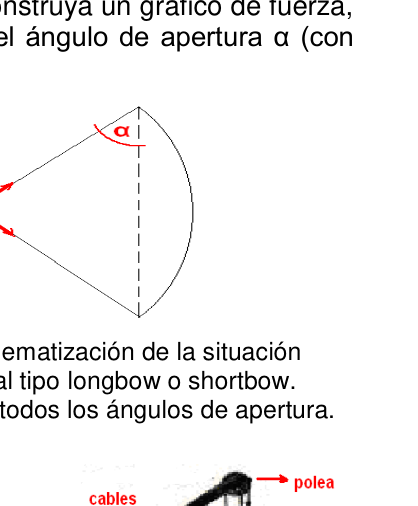
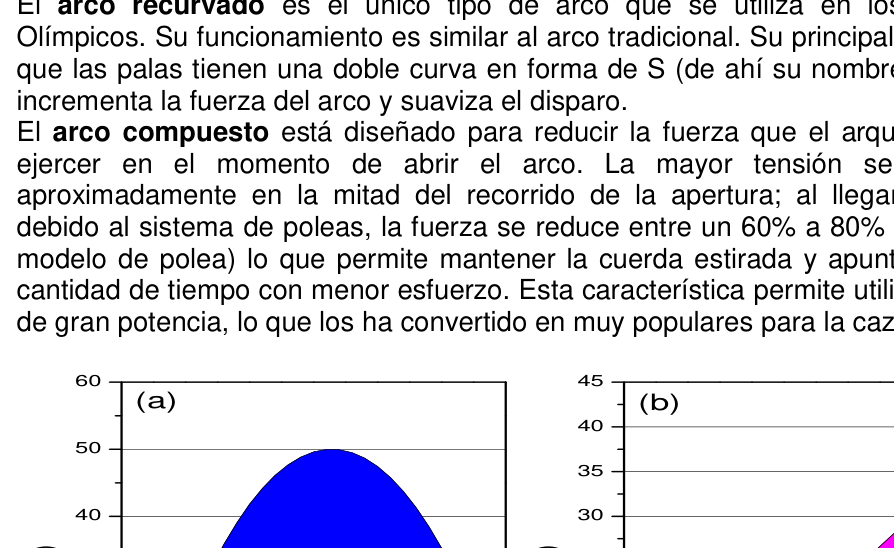
Topic: Newtonian Mechanics, Conservation of Energy Metodi: Kinematic Equations, Energy Conservation Method, Vector Decomposition Competenze: Physical Reasoning, Mathematical Modeling Objects: Projectile, String Fonte: Testo (PDF) — p.3
CUDA - Tiro con l’arco
PT25. Collegio Nazionale di Buenos Aires Città di Buenos Aires.
CUDA (Club universitario di archeria) Il tiro con l’arco è attualmente una pratica sportiva in cui si usa un arco. per sparare frecce. La sua origine deve essere cercata nell’uso di questa arma come un strumento di caccia e di guerra. Le prime prove del tiro con l’arco risalgono a 5000 anni fa. L’ arco Probabilmente fu inventato per la caccia e poi fu adottato come strumento di guerra. È stato uno dei primi esemplari di artiglieria. Gli archi. Infine, hanno sostituito l’atllatl come sistema predominante di lancio di proiettili.
- Iniziamo con un modello molto semplificato del problema. Supponiamo che un arco possa essere pensato a zero ordine come indica. la figura 1. Se la tensione della corda è 20 N costruisci un grafico di forza. che deve esercitare l’arcoere, a seconda dell’angolo di apertura α (con 4 punti raggiunge).
Fig.1.1: Rappresentazione semplice di un arco (a). Squammazione della situazione descritto nella situazione 1 (b). Potrebbe corrispondere al tipo longbow o shortbow. Considereremo la tensione della corda costante per tutti gli angoli di apertura.
La portata dell’arcia e la forza dell’arciere La Commissione ha deciso di adottare un’azione di ripartizione. tipo arco e tipo freccia. 2) Dall’arco che il tiratore lascia la freccia La stessa sta tenendo contatto con il Arco per 0,5 secondi, qual è la velocità? con cui viene licenziata una freccia di 2 kg se consideriamo che la forza applicata corrisponde a 30° di apertura in caso di situazione descritta in apposito punto
- Prima?
- Supponiamo che, nella stessa situazione precedente, l’arcoere inclina il braccio di Così la freccia si forma a 40° con la orizzontale, qual è la distanza da cui Dovrebbe essere messo il parafullo se il Il bianco è a 1,2 metri di altezza? (Altezza da cui usce l’arcia: 1,7 m) Fig.1.2: Parti di un arco composto.
OAF 2011 - 27 Potremmo fare una classificazione semplice dei diversi tipi di archi in:
- Longbow
- Shortbow
- Richiesto
- Composto Un longbow è un tipo di arco lungo (simile o superiore alla altezza dell’arcoio) e ha delle pale relativamente sottili che sono di sezione circolare o in forma de D. Tipicamente un longbow è più largo nel pugno ed è il tipo che È stato utilizzato nella caccia e nella guerra da molte culture del mondo. durante il Medioevo. Un shortbow è una versione molto più piccola del longbow. Anche se è più leggero e maneggevole, ha anche meno potenza e quindi meno portata. Tuttavia, non ha bisogno di un’intensità di allenamento come il longbow e è il motivo per cui è stato usato in battaglie da soldati poco esperti. L’arco curvo è l’unico tipo di arco usato nei Giochi. Olimpiadi. Il suo funzionamento è simile all’arco tradizionale. Il suo tratto principale è: che le pale hanno una doppia curva a forma di S (da qui il nome), che Aumenta la forza dell’arco e allenta il fuoco. L’ arco composto è progettato per ridurre la forza che l’ arciere deve. esercitare quando si apre l’arco. La maggiore tensione è raggiunta circa a metà del percorso di apertura; La forza è ridotta di 60 a 80% (secondo il sistema di pulley). modello di polea) che consente di mantenere la corda stretta e puntare più quantità di tempo con meno sforzo. Questa caratteristica consente di utilizzare archi. di grande potenza, che li ha resi molto popolari per la caccia. Fig.1.3: Forza (in sterline) in funzione della lunghezza (in pollici) per un arco composto da (a) e da un ricurvo (b).
- Date le curve di forza in funzione della tensione, stima il lavoro consegnato dal cecchino in ciascuno dei due tipi di arco che le curve sono riportate in Fig.1.3.
- Se il tempo impiegato per aprire l’arco è lo stesso per i due tipi, Calcola il coefficiente di potenze e concludi quale di esse ottiene il massimo. La portata dell’arcia (supponi che le frecce siano uguali per i due tipi di arcia) arco).
Dati: lbs: sterline - 1 kgf = 2 lbs - inch: inch - 2.5 cm = 1 inch Aiuto: l’area sotto la curva F vs distanza è il lavoro impiegato.
0,0 2,5 5,0 7,5 10,0 12,5 15,0 0 5 10 15 20 25 30 35 40 45 0,0 2,5 5,0 7,5 10,0 12,5 15,0 0 10 20 30 40 50 60 (a)
Forza (lbs) Tensione (inch) (b)
Forza (lbs) Tensione (inch)
OAF 2011 - 28
Topic: Newtonian Mechanics, Conservation of Energy Metodi: Kinematic Equations, Energy Conservation Method, Vector Decomposition Competenze: Physical Reasoning, Mathematical Modeling Objects: Projectile, String Fonte: Testo (PDF) — p.3
The following is the list of the main types of weapons used:
PT25. National College of Buenos Aires City of Buenos Aires.
CUDA (University Archery Club) Archery is currently a sport in which a bow is used. to shoot arrows. Its origin must be traced to the use of this weapon as hunting and warfare. The earliest evidence of archery dates back 5,000 years. The bow It was probably invented for hunting and then adopted as instrument of war. It was one of the first artillery displays. The bows . Finally they ended up replacing the atlas as the predominant system of launching of projectiles.
- Let’s start with a very simplified model of the problem. Suppose an arc can be thought of as a zero order as it indicates. the Figure 1. If the tension of the rope is 20 N build a force graph, which the bowman must exercise, according to the angle of opening α (with four points is reached).
Fig.1.1: Simple representation of an arc (a). The situation is being schematized described in situation 1 (b). It could be the longbow or shortbow type. We’ll consider the constant string voltage for all the opening angles.
The range of the arrow and the strength of the archer The Commission has already decided to open the procedure to the public. the bow type and the arrow type. 2) Since the archer releases the arrow She keeps in contact with the arc for 0.5 s, what’s the speed With a two-arrow firing . kg if we consider that force applied corresponds to 30° opening in the situation described in the recital previously? 3) Suppose, in the same situation Previously, the bowman bent the arm of So the arrow shapes 40 degrees with the horizontal, what is the distance to which I ‘d have to put the arrows on if the White is at a height of 1.2 meters? (Height from which the arrow comes out: 1.7 m) Fig.1.2: Parts of a bow composite.
The following points shall be added: We could do a simple classification of the different types of arcs in:
- Longbow .
- Shortbow .
- Recurred
- Compounded A longbow is a type of long bow (similar to or larger than the bowman’s height) and has relatively thin blades that are circular or shaped de D. Typically a longbow is wider in the handle and is the type that It has been used in hunting and warfare by many cultures around the world. during the Middle Ages. A shortbow is a much smaller version of the longbow. Although it ‘s more than that . It is lightweight and manageable, and also has less power and therefore less range. However, it doesn’t need as much training intensity as longbow and It’s the reason why it was used in battles by inexperienced soldiers. The curved bow is the only type of bow used in the Games. Olympic games. Its operation is similar to the traditional bow. Its main feature is The shells have a double S-shaped curve (hence their name), which Increases the bow force and smooths the shot. The compound bow is designed to reduce the force the bowman must. Exercise when opening the bow. The highest tension is reached . approximately halfway through the opening; at the end, The force is reduced by 60% to 80% (depending on the The pulley model) which allows the rope to be held out and aimed higher amount of time with less effort. This feature allows you to use arcs They’re very powerful, which makes them very popular for hunting. Fig.1.3: Strength (in pounds) by stretch (in inches) for a bow compound (a) and a recurved (b).
- Given the force curves based on the stretch estimate the work delivered by the bowman in each of the two types of bow whose curves are shown in Figure.1.3.
- If the time taken to open the bow is the same in both types, Calculate the power ratio and determine which one achieves the highest. Arrow range (assume arrows are equal for both types of The bow.
Data: lbs: pounds - 1 kgf = 2 lbs - inch: inch - 2.5 cm = 1 inch Help: The area below the F-distance curve is the work employed.
0,0 2,5 5,0 7,5 10,0 12,5 15,0 0 5 10 15 20 25 30 35 40 45 0,0 2,5 5,0 7,5 10,0 12,5 15,0 0 10 20 30 40 50 60 (a)
Other weight Stretching (inch) (b)
Other weight Stretching (inch)
The following points shall be added:
Topic: Newtonian Mechanics, Conservation of Energy Metodi: Kinematic Equations, Energy Conservation Method, Vector Decomposition Competenze: Physical Reasoning, Mathematical Modeling Objects: Projectile, String Fonte: Testo (PDF) — p.3
Festejo de cumpleanos
PT26. Colegio Nacional de Buenos Aires Ciudad de Buenos Aires.
Un festejo de cumpleaños poco habitual (Cualquier semejanza con la realidad es pura coincidencia)
Cierto día un grupo de chicos decide organizar un cumpleaños sorpresa. Se les
ocurre la idea de inflar globos para la fiesta. Si asumimos CNTP, que los mismos
son esféricos (R=10cm) y que el gas que los compone es oxígeno, i) ¿cuál es la
cantidad de moléculas que contiene cada globo? (R= 8.31 J/mol.K y
NA = 6.02*1023 mol-1)
Del Principio de Arquímedes puede deducirse que dados dos fluidos distintos
aquel que presente la menor densidad será el que reciba una fuerza neta
ascendente y, por lo tanto, se ubicará por encima del otro. ii) ¿Cuál será el
empuje que recibirá un globo de helio inmerso en una atmósfera perfecta (es
decir sin perturbaciones)? iii) ¿Cuántos globos serán necesarios para levantar a
la cumpleañera que pesa 50kgf?
Sustancia Densidad (kg/m3) Aluminio 2.7103 Hidrógeno 8.9910-2 Oxígeno 1.43 Aire 1.29 Helio 1.79*10-1 Tabla 2.1: Densidades de sustancias diversas.
iv) Calcule la energía que es preciso entregarle a los globos para que la presión
aumente un tercio (en el caso del oxígeno) sabiendo que el volumen pasa a ser
un 10% mayor. Recuerde que mO = 16 u.m.a.
Considere que en el salón además de los globos hay varios spots (habitualmente
verdes o rojos) que emiten luz láser en dirección horizontal. v) A partir del
esquema de la situación descripta, halle una expresión para la longitud del piolín
a partir de los parámetros indicados para que la reflexión sobre ellos no pueda
causar daño alguno en los asistentes al festejo. Represente en el mismo
esquema algunos globos ubicados por detrás del primero para seguir
satisfaciendo el requerimiento de seguridad, justifique.
Fig.2.1: Esquema de la situación a la que hace mención el inciso v). Los parámetros H, h, d y R deben ser considerados datos. Considere H-2R<L<H
OAF 2011 - 29
Topic: Kinetic Theory, Fluid Mechanics Metodi: Ideal Gas Law, Hydrostatic Equilibrium, First Law of Thermodynamics Competenze: Physical Reasoning, Mathematical Modeling Objects: Gas, Sphere Fonte: Testo (PDF) — p.3
Festa di compleanno
PT26. Collegio Nazionale di Buenos Aires Città di Buenos Aires.
Un raro compleanno . (Qualsiasi somiglianza con la realtà è pura coincidenza)
Un giorno un gruppo di ragazzi decide di organizzare un compleanno sorpresa. - Si ’ . E’ l’idea di gonfiare palloni per la festa. Se assumiamo CNTP, che gli stessi I gas di cui sono composti sono ossigeno, i) qual è la Quante molecole contiene ogni pallone? (R= 8,31 J/mol.K e La capacità di produzione di prodotti di acciaio di acciaio di acciaio di acciaio di acciaio di acciaio di acciaio di acciaio di acciaio di acciaio di acciaio di acciaio di acciaio di acciaio di acciaio di acciaio di acciaio di acciaio di acciaio di acciaio di acciaio di acciaio di acciaio di acciaio di acciaio di acciaio di acciaio di acciaio di acciaio di acciaio di acciaio di acciaio di acciaio di acciaio di acciaio di acciaio di acciaio di acciaio di acciaio di acciaio di acciaio di acciaio di acciaio di acciaio di acciaio di acciaio di acciaio di acciaio di acciaio di acciaio di acciaio di acciaio di acciaio di acciaio di acciaio di acciaio di acciaio di acciaio di acciaio di acciaio di acciaio di acciaio di acciaio di acciaio di acciaio di acciaio di acciaio di acciaio di acciaio di acciaio di acciaio di acciaio di acciaio di acciaio di acciaio di acciaio di acciaio di acciaio di acciaio di acciaio di acciaio di acciaio di acciaio di acciaio di acciaio di acciaio di acciaio di acciaio di acciaio di acciaio di acciaio di acciaio di acciaio di acciaio di acciaio di acciaio di acciaio di acciaio di acciaio di acciaio di acciaio di acciaio di acciaio di acciaio di acciaio di acciaio di acciaio di acciaio di acciaio di acciaio di acciaio di acciaio di acciaio di acciaio di acciaio di acciaio di acciaio di acciaio di acciaio di acciaio di acciaio di acciaio di acciaio di acciaio di acciaio di acciaio di Dal principio di Archimede si può dedurre che si danno due fluidi diversi. Chi presenta la più bassa densità riceverà una forza netta. ascendente e quindi si collocherà sopra l’altro. (ii) Qual è il giorno? spingere che riceverà un pallone di elio immerso in un’atmosfera perfetta (es
- non disturbato? (iii) Quanti palloni saranno necessari per sollevare La donna di compleanno che pesa 50 kgf?
sostanza Densità (kg/m3) Alumini 2.7*103
- Hidrogeno . 8.99*10-2 Oggene 1.43
- Aereo . 1.29 Helio 1.79*10-1 Tabella 2.1: Densità di sostanze diverse.
(iv) Calcolare l’energia che deve essere consegnata ai globuli per far pressione Aumentare di un terzo (nel caso dell’ossigeno) sapendo che il volume diventa un aumento del 10%. Ricordate che mO = 16 UA. Si consideri che nel salotto oltre ai palloncini ci sono diversi punti (di solito (verde o rosse) che emettono luce laser in direzione orizzontale. v) A partire dal schema della situazione descritta, trova un’espressione per la lunghezza del piatto La Commissione ha adottato una decisione che prevede che la Commissione non debba prendere misure per la riduzione delle emissioni di gas e che non debba essere adottata. causare qualche danno agli assistenti alla festa. Rappresentante in esso Schema alcuni globuli posizionati dietro il primo per seguire soddisfacendo il requisito di sicurezza, giustifica.
Fig.2.1: Schema della situazione di cui al punto v). I parametri H, h, d e R devono essere considerati dati. Considera H-2R<L<H
OAF 2011 - 29
Topic: Kinetic Theory, Fluid Mechanics Metodi: Ideal Gas Law, Hydrostatic Equilibrium, First Law of Thermodynamics Competenze: Physical Reasoning, Mathematical Modeling Objects: Gas, Sphere Fonte: Testo (PDF) — p.3
The Commission shall adopt delegated acts in accordance with Article 21 of this Regulation.
PT26. National College of Buenos Aires City of Buenos Aires.
An unusual birthday party . (Any resemblance to reality is pure coincidence)
One day a group of kids decide to throw a surprise birthday party. They ‘re getting it . The idea of inflating balloons for the party comes up. If we assume CNTP, that the same The two are spherical (R=10cm) and the gas that makes them up is oxygen. How many molecules each balloon contains? (R= 8.31 J/mol.K and The following table shows the results of the calculation of the total value of the assets: From Archimedes’ principle it can be deduced that given two different fluids The one with the lowest density will be the one with the highest net force. ascending and, therefore, will be placed above each other. (ii) What will be the push you will receive a helium balloon immersed in a perfect atmosphere (is I mean without disturbance? (iii) How many balloons will be needed to lift The birthday girl who weighs 50kgf?
Substance The following table shows the data used for the calculation of the total energy consumption of the product: Aluminium 2.7103 Hydrogen . 8.9910-2 Oxygen . 1.43 Air . 1.29 Helium . 1.79*10-1 Table 2.1: Densities of various substances.
(iv) Calculate the energy required to deliver the balloons to the pressure increase by one third (in the case of oxygen) knowing that the volume becomes 10% more than that. Remember that mO is equal to 16 u.m.a. Consider that in the living room besides the balloons there are several spots (usually green or red) that emit laser light in a horizontal direction. (v) From the The description of the situation is given in the diagram, find an expression for the length of the stump The Commission shall adopt a decision on the basis of the following criteria: cause any harm to the party attendees. Representative in the same Schematically, some balloons are located behind the first to follow. satisfying the safety requirement, justify.
Fig.2.1: Outline of the situation referred to in point (v). The H parameters, h, d and R should be considered data. Consider H-2R<L<H
The following points shall be added:
Topic: Kinetic Theory, Fluid Mechanics Metodi: Ideal Gas Law, Hydrostatic Equilibrium, First Law of Thermodynamics Competenze: Physical Reasoning, Mathematical Modeling Objects: Gas, Sphere Fonte: Testo (PDF) — p.3
PT27. Colegio Nacional de Buenos Aires Ciudad de Buenos Aires.
DBS, deep brain stimulation
Desde hace algunos años se viene trabajando en un tratamiento para trastornos
parecidos al mal de Parkinson. Si bien se trata de una técnica experimental, es
decir aun no se ha encontrado el sustento teórico de por qué funciona, logra
disminuir notablemente los síntomas más notorios.
Si bien este tipo de trastorno encuentra su origen en la muerte progresiva de un
grupo de células neuronales puede identificarse a partir de la señal eléctrica
neuronal. En la Fig. 1 pueden apreciarse las señales correspondientes a un
paciente “sano” (Fig.3.1a) y a un paciente enfermo (Fig.3.1b).
Fig.3.1: Señales eléctricas neuronales de un paciente “sano” (a) y uno enfermo (b).
a) Describa en términos “físicos” las diferencias entre las señales neuronales de una persona sana y una enferma. De ser posible, estime los parámetros característicos.
El tratamiento consiste en la aplicación de pulsos eléctricos en la base glandular del cerebro. De ese modo se opera al paciente colocándole un dispositivo (que por lo general se aloja en el pecho, detrás del tejido muscular) que controla el envío de estos pulsos cuyos contactos llegan hasta la cabeza. En la Fig. 3.2 puede verse una representación de dónde se ubicaría el mismo y cómo sería la conexión con el cerebro.
b) Si desea aplicarse una diferencia de potencial que aturda la señal neuronal del paciente parkinsoniano (a esta señal se la denomina “ruido blanco”) sin que la corriente Fig.3.2: Representación de cómo es el implante del dispositivo descripto.
OAF 2011 - 30 produzca daño en el cerebro, ¿cuál debería ser la resistencia del llamado “marcapasos neurológico”?
Categoría Intensidad Efecto* 1 menor a 25mA Tetanización sin influencia sobre el corazón. 2 de 25mA a 80mA Tetanización con posibilidad de parálisis temporal cardíaca y respiratoria. 3 de 80mA a 3A Zona peligrosa de fibrilación ventricular. 4 de 3A a 4A Umbral de corriente que puede causar depresión del sistema nervioso central. 5 mayor a 4A Parálisis cardíaca y respiratoria. Quemaduras graves. Tabla 3.1: Niveles de corriente soportados junto con el efecto que provocan en el cuerpo. *Otro factor a tener en cuenta es el tiempo de contacto.
c) Calcule la potencia disipada por este supuesto aparato (decimos “supuesto aparato” pues en la realidad no se trata de un dispositivo así de simple).
Más que una señal continua, lo que el dispositivo realmente hace es aplicar pulsos en un intervalo de tiempo reducido. Dicho intervalo debe ser menor a 0.75s que es el período cardíaco, típicamente del orden de la decena de ms.
d) Asumiendo que la capacidad calorífica de los tejidos musculares en los que se aloja el aparato es 2cal/K, calcule el aumento de temperatura que le produciría la presencia de éste. Ayuda: Por las unidades en la que se expresa la capacidad calorífica no necesita la masa del tejido (como si ya considerase la masa con la que está en contacto).
Datos: 0.1k = 20mV
Topic: Newtonian Mechanics Metodi: Free-Body Diagram Competenze: Physical Reasoning Objects: Spring Fonte: Testo (PDF) — p.3
PT27. Collegio Nazionale di Buenos Aires Città di Buenos Aires.
DBS, stimolazione cerebrale profonda Da qualche anno si sta lavorando su un trattamento per i disturbi. simili al morbo di Parkinson. Anche se si tratta di una tecnica sperimentale, è dire che non si è ancora trovato il sostentamento teorico per il perché funziona, riesce diminuire notevolmente i sintomi più evidenti. Mentre questo tipo di disturbo si nasce nella morte progressiva di un Il gruppo di cellule neuronali può essere identificato dal segnale elettrico. Neurale. - La Fig. 1 si possono valutare i segnali di un Il paziente è in buona salute (Fig.3.1a) e un paziente malato (Fig.3.1b).
Fig.3.1: Segnali elettrici neurali di un paziente sano (a) e un malato (b).
a) Descrive in termini fisici le differenze tra i segnali Neuroni di una persona sana e una malata. Se possibile, stima i parametri caratteristici.
Il trattamento consiste nell’ applicare pulsi elettrici nella base glandulare del cervello. Di quel il paziente viene operato con un dispositivo. (che si trova solitamente sul petto, dietro il Il sistema di controllo di queste sostanze è il sistema di controllo di queste sostanze. pulsi che raggiungono la testa. En la Fig. 3.2 si può vedere una rappresentazione di dove si lo stesso e come sarebbe la connessione con il il cervello.
b) Se si desidera applicare una differenza di Potenzialmente, il segnale neuronale di Il paziente Parkinson (a questo segnale si il rumore bianco non è più il corrente Fig.3.2: Rappresentazione di come è l’impianto del dispositivo descritto.
OAF 2011 - 30 Se produce danni al cervello, quale dovrebbe essere la resistenza del chiamato “capricci neurologici”?
Categoria Intensità Effetto* 1 inferiore a 25mA Tetanizzazione senza influenza sul cuore. 2 de 25mA a 80mA Tetanizzazione con possibilità di paralisi temporanea cardiaca e respiratoria. 3 de 80mA a 3A Zona pericolosa di fibrillazione ventricolare. 4 de 3A a 4A Teso corrente che può causare depressione del sistema nervoso centrale. 5 maggiore di 4A Paralisi cardiaca e respiratoria. Bruciature
- Sono gravi. Tabella 3.1: Livelli di corrente sostenuti insieme all’effetto che provocano sul corpo. Un altro fattore da tenere in considerazione è il tempo di contatto.
C) Calcola la potenza dissipata da questo presunto apparecchio (diciamo supposto apparato perché in realtà non si tratta di un dispositivo come questo di semplice).
Più che un segnale continuo, ciò che il dispositivo effettua è applicare pulsi in un breve intervallo di tempo. Tale intervallo deve essere inferiore a 0,75s che è il periodo cardiaco, tipicamente dell’ordine della decina di ms.
d) Supponendo che la capacità calorica dei tessuti muscolari nei che l’apparecchio è ospitato è di 2 cal/K, calcola l’aumento di temperatura che la sua presenza gli avrebbe prodotto. Aiuti: per le unità in che si esprime la capacità calorica non ha bisogno di massa del tessuto (come se considerasse già la massa con cui sta in contatto).
Dati: 0,1k = 20mV
Topic: Newtonian Mechanics Metodi: Free-Body Diagram Competenze: Physical Reasoning Objects: Spring Fonte: Testo (PDF) — p.3
PT27. National College of Buenos Aires City of Buenos Aires.
DBS, deep brain stimulation For some years he ‘s been working on a treatment for disorders . They’re like Parkinson’s disease. While this is an experimental technique, it is I mean, theoretical support for why it works hasn’t been found yet. The most noticeable symptoms are significantly reduced. Although this type of disorder is caused by the progressive death of a Neural cell group can be identified from the electrical signal Neural. In the Fig. 1 can be seen in the signals corresponding to a The patient is healthy (Fig.3.1a) and a sick patient (Fig.3.1b).
Fig.3.1: Neural electrical signals from a healthy patient (a) and a sick patient (b).
(a) Describe in physical terms the differences between the signals. Neural networks of a healthy person and a sick person. If possible, please consider it. the characteristic parameters.
The treatment consists of the application of pulses electrical in the glandular base of the brain. From that one . The patient is operated on by placing a device on the patient. (which is usually lodged in the chest, behind the The body’s own muscle tissue controls the delivery of these pulses whose contacts reach up to the head. En la Fig. 3.2 a representation of where it is I would locate the same and what would the connection be like with the The brain.
(b) If a difference of The potential to stun the neural signal of the Parkinson’ s patient (at this time the patient is It’s called white noise. Fig. 3.2: Representation of the What the implant looks like. the device described.
The following points shall be added: If it causes brain damage, what should the resistance be? It’s called neurological marcapas?
Category Intensity The effect* 1 less than 25mA Tetanisation without affecting the heart. 2 de 25mA a 80mA Tetanying with paralysis heart and respiratory temporal. 3 de 80mA a 3A Dangerous area of ventricular fibrillation. 4 de 3A a 4A Current threshold that can cause depression of the central nervous system. 5 greater than 4A Heart and respiratory failure. Burns . Serious. Table 3.1: Supported current levels together with their effect on the body. *Another factor to consider is contact time.
(c) Calculate the power dissipated by this supposed apparatus (we say supposed device for in reality it is not such a device (see also paragraphs 1 and 2).
More than a continuous signal, what the device actually does is apply pulses in a short time interval. This interval shall be less than 0.75s which is the heart period, typically the order of the decimal point.
(d) Assuming that the caloric capacity of muscle tissues in the The temperature of the device is 2 cal/K, calculate the temperature increase. That would produce his presence. Aid: For units in the The heat capacity is expressed without the tissue mass. (as if you already consider the mass you are in contact with).
The data are: 0.1k = 20mV
Topic: Newtonian Mechanics Metodi: Free-Body Diagram Competenze: Physical Reasoning Objects: Spring Fonte: Testo (PDF) — p.3
Escape from C.R.37
PT28. Escuela de Agricultura Colonia Alvear Oeste, Mendoza.
Nuestra nave después de largos días de viaje, al fin encuentra un lejano planeta,
destino del viaje. El paisaje gris del día en C.R.37 nos muestra que no hay
rastros de gases en este frío paraje. Luego del descenso nos disponemos a
realizar algunas determinaciones, que se agregan a la información ya disponible.
La masa del planeta es de 6,2 x 10²² kg, su forma esférica, la superficie sólida de
un material rojizo, aparentemente rico en hierro, parecido a algunas regiones de
mi país en la Tierra, de densidad promedio 4,5 g/cm3, la temperatura en el día
ronda los 250 K.
Después de permanecer algún tiempo decidimos emprender el regreso. El
combustible de nuestra nave cada vez es más escaso, por lo que decidimos
desprender parte del fuselaje al marcharnos de este lugar. La masa de la nave
es de 8 500 kg y la fuerza con que es impulsada es de 50 000 N. Acordamos que
a los 10 s del despegue se desprendan 500 kg de parte del tren de aterrizaje, ya
que podemos prescindir el ella, y continuaremos con la misma propulsión
durante 20 s más. Esperamos de esta forma escapar del campo gravitatorio de
C.R. 37 y seguir el ansiado camino a casa.
- Calcular la intensidad del campo gravitatorio existente en la superficie del planeta.
OAF 2011 - 31 2) Calcular la aceleración que adquiere la nave en los 10 primeros segundos y en los 20 segundos restantes. (considere despreciable las pérdidas de masa de combustible)
-
Calcular la velocidad con que se desprende el tren de aterrizaje.
-
Calcular el tiempo que permanece en vuelo el tren de aterrizaje y la altura sobre la superficie a la que llegará. (considere constante el valor de la intensidad de campo)
-
Calcular la energía con la que llega el tren de aterrizaje al suelo.
-
Calcula la velocidad final de la nave a los 30 s y a los 60 s.
-
Indica si la nave regresa al planeta o logra escapar del mismo.
Topic: Gravitation, Conservation of Momentum Metodi: Newton’s Law of Gravitation, Conservation of Momentum, Kinematic Equations Competenze: Physical Reasoning, Mathematical Modeling Objects: Projectile Fonte: Testo (PDF) — p.3
Escape from C.R.37
PT28. La scuola di agricoltura Colonia Alvear Ovest, Mendoza.
La nostra nave, dopo lunghi giorni di viaggio, trova finalmente un pianeta lontano. Il destino del viaggio. Il paesaggio grigio del giorno in C.R.37 ci mostra che non c’è tracce di gas in questo posto freddo. Dopo il decollo ci si prepara a La Commissione ha adottato una decisione che prevede che le misure di cui all’articolo 1 del regolamento (UE) n. La massa del pianeta è di 6,2 x 10²² kg, la sua forma sferica, la superficie solida di un materiale rosso, apparentemente ricco di ferro, simile a alcune regioni di la temperatura di ogni giorno. Circa 250 K. Dopo aver passato un po’ di tempo, abbiamo deciso di tornare. El Il combustibile della nostra nave sta diventando sempre più scarso, quindi abbiamo deciso
- Sbarazzarsi di parte del fusoliero, uscendo da questo posto. La massa della nave è di 8.500 kg e la forza con cui viene spinta è di 50.000 N. Accordiamo che a 10 secondi dal decollo si scendono 500 kg da parte del treno di atterraggio, già che possiamo dispense la stessa, e continueremo con la stessa propulsione. per 20 secondi in più. Speriamo di poter così sfuggire al campo gravitazionale di C.R. 37 e seguire la strada desiderata per tornare a casa.
- Calcolare l’intensità del campo gravitazionale esistente sulla superficie del pianeta.
OAF 2011 - 31 2) Calcolare l’accelerazione che la nave acquista nei primi 10 anni secondi e nei restanti 20 secondi. (considerate scandalose le perdite di massa di combustibile)
-
Calcolare la velocità di partenza del treno di atterraggio.
-
Calcolare il tempo di volo del treno di atterraggio e la durata del volo altezza sulla superficie che raggiungerà. (considerare costantemente il valore di intensità di campo)
-
Calcolare l’energia con cui il treno di atterraggio arriva al suolo.
-
Calcola la velocità finale della nave a 30 e 60 secondi.
-
Indica se la nave ritorna sul pianeta o riesce a sfuggire.
Topic: Gravitation, Conservation of Momentum Metodi: Newton’s Law of Gravitation, Conservation of Momentum, Kinematic Equations Competenze: Physical Reasoning, Mathematical Modeling Objects: Projectile Fonte: Testo (PDF) — p.3
The Commission shall adopt delegated acts in accordance with Article 21 of Regulation (EC) No 1290/2009.
PT28. School of Agriculture Colony Alvear West, Mendoza.
Our ship after long days of travel, finally finds a distant planet, The destination of the journey. The gray landscape of the day at CR37 shows us that there is no traces of gas in this cold place. After the descent we are ready to go. The Commission will also be able to make some determinations, which are added to the information already available. The mass of the planet is 6.2 x 10²² kg, its spherical shape, the solid surface of a reddish material, apparently rich in iron, similar to some regions of the world My country on Earth, with an average density of 4.5 g/cm3, the temperature in the day It’s about 250 K. After some time we decided to return. El Our ship’s fuel is becoming scarce, so we decided We’re gonna have to unload some of the fuselage as we leave this place. The mass of the ship It weighs 8,500 kg and the force it is driven with is 50,000 N. We agreed that At 10 s of take-off, 500 kg are removed from the landing gear, already We can do without it, and we’ll continue with the same propulsion. for 20 seconds more. We hope to escape the gravitational field of C.R. 37 and follow the longed-for road home.
- Calculate the intensity of the gravitational field on the surface of the planet.
The following points shall be added: 2) Calculate the acceleration the ship gains in the first 10 days seconds and in the remaining 20 seconds. (consider the Loss of fuel mass)
-
Calculate the speed at which the landing gear departs.
-
Calculate the time the landing train stays in flight and the time it takes to land. height above the surface it will reach. (consider constant the value of the field intensity)
-
Calculate the energy with which the landing gear reaches the ground.
-
Calculate the final speed of the craft at 30 s and 60 s.
-
Indicates whether the craft returns to the planet or escapes from it.
Topic: Gravitation, Conservation of Momentum Metodi: Newton’s Law of Gravitation, Conservation of Momentum, Kinematic Equations Competenze: Physical Reasoning, Mathematical Modeling Objects: Projectile Fonte: Testo (PDF) — p.3
Calefones electricos
PT29. Escuela de Agricultura Colonia Alvear Oeste, Mendoza.
Luis construye tres departamentos de un ambiente, uno a continuación del otro.
Cuando termina la construcción, descubre que la red de gas natural no está
disponible en la zona y le recomiendan colocar calefones eléctricos para calentar
agua en el baño.
En la instalación eléctrica no estaban previstos los calefones, por lo tanto, decide
hacer una nueva instalación como muestra la siguiente figura.
Consideramos despreciable el valor de la resistencia del cableado del circuito (ri)
debido a que la longitud de los conductores es pequeña.
Las llaves “S” son las encargadas de poner en funcionamiento el calefón de cada
departamento.
El departamento uno posee un calefón eléctrico en serie con una estufa eléctrica
para calefaccionar el baño; el departamento dos solamente posee el calefón
eléctrico y el departamento tres, posee el calefón eléctrico conectado en paralelo
con la estufa eléctrica.
Tener en cuenta que la estufa y el calefactor funcionan en simultáneo.
Determinar:
- La resistencia eléctrica del calefón y de la estufa, teniendo en cuenta la información que traen los aparatos de fábrica: potencia, calefón: 1200W y estufa: 1100W, ambos indican a 220V.
- La intensidad de corriente que detecta el amperímetro uno (A1) al cerrarse la llave uno (S1). CALEFON CALEFON CALEFON ESTUFA ESTUFA 220 V Llave 1 Llave 2 Llave 3 ri A3 A2 A1 A5 A4
OAF 2011 - 32
3) La caída de tensión que producen el calefón y la estufa conectados en
serie.
4) La intensidad de corriente que detecta el amperímetro dos (A2) al
cerrarse la llave dos (S2).
5) La intensidad de corriente que detecta el amperímetro tres (A3) al
cerrarse la llave tres (S3).
6) Al cerrarse la llave tres, ¿Que intensidad de corriente lee el amperímetro
cuatro?
7) Si las tres llaves permanecen cerradas, ¿Qué valor de intensidad de
corriente indicará el amperímetro cinco?
8) La potencia que disipa cada calefón del circuito.
9) Teniendo en cuenta que la capacidad del calefón 1 y 2 es de 20 L y el
calefón 3 es de 15 L de agua y la misma se encuentra a 20 °C, ¿Cuánto
tiempo tarda cada calefón adquirir una temperatura de 40 °C?
10)- ¿Qué interruptor termomagnético principal debo colocar en la
instalación del circuito de los calefones?
Topic: Circuits, Thermodynamics Metodi: Kirchhoff’s Laws, Equivalent Circuit Reduction, First Law of Thermodynamics Competenze: Physical Reasoning, Mathematical Modeling Objects: Resistor, Switch, Battery Fonte: Testo (PDF) — p.3
Telefoni elettrici
PT29. La scuola di agricoltura Colonia Alvear Ovest, Mendoza.
Luis costruisce tre appartamenti da un ambiente, uno dopo l’altro. Quando il progetto è finito, scopre che la rete di gas naturale non è ancora in funzione. La nostra guida è disponibile in zona e si consiglia di mettere dei caffoni elettrici per il riscaldamento. acqua nel bagno. La struttura elettrica non prevedeva caffoni, quindi decide realizzare un nuovo impianto, come mostra la figura seguente.
Riteniamo scarsa la resistenza del circuito (ri) perché la lunghezza dei conduttori è piccola. Le chiavi S sono quelle che si occupano di mettere in funzione il caffone di ogni
- Il dipartimento. L’appartamento uno possiede un caffone elettrico in serie con una stufa elettrica. per riscaldare il bagno; il reparto due possiede solo il caffone elettrico e il reparto tre, possiede il caffone elettrico collegato in parallelo con il forno elettrico. Si deve tenere presente che il stufa e il riscaldatore funzionano contemporaneamente. Determinare:
- Resistenza elettrica del calfone e della stufa, tenendo conto della Informazioni di fabbricazione: potenza, telefono: 1200W 1100W, entrambi indicano 220V.
- L’intensità di corrente che l’ampiecatore uno (A1) rileva al chiudere la chiave uno (S1). CALEFON CALEFON CALEFON La struttura è stata La struttura è stata 220 V
- Chiudi il codice
- Chiudici 2
- Chiudici 3 ri A3 A2 A1 A5 A4
OAF 2011 - 32 3) La caduta di tensione che produce il calfone e il stufa collegati in serie. 4) L’intensità di corrente che l’ampielitore 2 (A2) rileva al chiudere la chiave due (S2). 5) L’intensità di corrente che l’ampielitore tre (A3) rileva al chiudere la chiave tre (S3). 6) Quando si chiude la chiave tre, che intensità di corrente legge l’ampicometro Quattro? 7) Se le tre chiavi restano chiuse, che valore di intensità di corrente indicherà l’ampiezza cinque? 8) La potenza che dissipa ogni caffone del circuito. 9) Considerando che la capacità del caffone 1 e 2 è di 20 L e che il Il calefone 3 è di 15 litri di acqua e la stessa è a 20 °C, quanto tempo che ci vuole per un caffè per ottenere una temperatura di 40 °C? 10) - Quale interruttore termomagnetico principale devo inserire nella installazione del circuito dei caffoni?
Topic: Circuits, Thermodynamics Metodi: Kirchhoff’s Laws, Equivalent Circuit Reduction, First Law of Thermodynamics Competenze: Physical Reasoning, Mathematical Modeling Objects: Resistor, Switch, Battery Fonte: Testo (PDF) — p.3
The following table shows the number of electrical appliances:
PT29. School of Agriculture Colony Alvear West, Mendoza.
Luis builds three apartments from one environment, one after the other. When the construction is finished, you find that the natural gas network is not working. available in the area and you are advised to place electric heaters water in the bathroom. The electrical installation was not equipped with cafeterias, so it decided to make a new installation as shown in the following figure.
We consider the value of the circuit’s wire strength to be negligible. because the length of the conductors is small. The keys are responsible for putting the keys in operation. department. Apartment one has a serial electrical telephone with an electric stove. To heat the bathroom. Apartment two only has the phone. Electrical and department three, has the electrical cable connected in parallel. with the electric stove. Note that the stove and heater are running simultaneously. Determine:
- Electrical resistance of the stove and the stove, taking into account the Information from the factory equipment: power, speaker: 1200W and the stove: 1100W, both indicate 220V.
- The current intensity detected by the ampere one (A1) at the key one (S1) is closed. CALEFON CALEFON CALEFON The Commission shall adopt implementing acts. The Commission shall adopt implementing acts. 220 V Key 1 Key two Key 3 ri A3 A2 A1 A5 A4
The following is the list of the countries of the European Union: 3) The voltage drop produced by the connected cafeteria and stove in The series. 4) The current intensity detected by the amperemeter two (A2) to the key two (S2) is closed. 5) The current intensity detected by the three (A3) ampere at close the key three (S3). 6) When you close the key three, what current intensity read the amp? Four? 7) If all three keys remain closed, what is the intensity value of current will indicate the ampere five? 8) The power that dissipates each cable in the circuit. 9) Whereas the capacity of the 1 and 2 caffons is 20 L and the The water level is 15 L and the water level is 20 °C, how much How long does it take each calefone to gain a temperature of 40 °C? 10)- What main thermomagnetic switch should I put on the installation of the circuit of the callaphones?
Topic: Circuits, Thermodynamics Metodi: Kirchhoff’s Laws, Equivalent Circuit Reduction, First Law of Thermodynamics Competenze: Physical Reasoning, Mathematical Modeling Objects: Resistor, Switch, Battery Fonte: Testo (PDF) — p.3
Termometro de gas
PT30. Escuela de Agricultura Colonia Alvear Oeste, Mendoza.
En el taller de la escuela fabricamos un dispositivo como el de las figuras siguientes.
En la primer imagen se observa el dispositivo a 0 °C y en la segunda a una
temperatura superior.
Tuvimos que esforzarnos demasiado para lograr que el dispositivo no pierda el
gas encerrado dentro del cilindro. Como se observa, la intención es construir un
termómetro de gas. El gas se expande cuando aumenta la temperatura y de esta
forma asciende el émbolo que lleva el laser y la luz del mismo incide sobre una
escala que aún está sin graduar. Para eso te necesitamos!!!!!!
El cilindro tiene un diámetro de 10,00 cm y dentro del mismo se incorporan 1,875
g de nitrógeno gaseoso a 0 °C y una presión de una atmosfera. La presión
cambio al incorporar el émbolo con en laser y sus soporte. La masa de estos
aparatos es de 250,0 g.
ESCALA DE TEMPERATURAS
LASER
GAS
PISTON
BASE
VASTAGO
ESCALA DE TEMPERATURAS
LASER
PISTON
BASE
VASTAGO
GAS
OAF 2011 - 33
- Calcula la presión dentro del cilindro que ejerce el dispositivo teniendo en cuenta que la presión atmosférica en ese momento es de 0,987 atmosferas.
- Calcula el volumen que ocupa el gas dentro del cilindro con la presión existente (0 °C)
- Calcula la altura del émbolo en dichas condiciones.
- En el punto que marca el laser en las condiciones mencionadas, se coloca el cero de la escala de temperatura en °C. Luego se aumenta la temperatura en 10 °C, ¿Cuál es la altura sobre el punto cero de la escala que marca el laser en estas condiciones?
- ¿Cuál es la separación entre dos °C en la escala descrita en el punto anterior? Para mejorar la apreciación del dispositivo se realizan los siguientes cambios:
El punto de rotación se ubica a una distancia de un radio del centro del émbolo y
la escala está ubicada a dos diámetros del centro del cilindro. La masa del
dispositivo permanece constante y el punto sobre la nueva escala coincide con el
cero °C cuando la temperatura exterior tiene dicho valor.
6) Se aumenta la temperatura en 10 °C, ¿Cuál es la altura sobre el punto
cero de la escala que marca el laser en estas condiciones?
7) ¿Cuál es la separación entre dos °C en la nueva escala?
Topic: Thermodynamics, Kinetic Theory Metodi: Ideal Gas Law, Hydrostatic Equilibrium Competenze: Physical Reasoning, Mathematical Modeling Objects: Gas, Piston, Cylinder Fonte: Testo (PDF) — p.3
Termometro a gas
PT30. La scuola di agricoltura Colonia Alvear Ovest, Mendoza.
Nel laboratorio della scuola abbiamo costruito un dispositivo simile a quello delle figure. successivi.
Nella prima immagine si vede il dispositivo a 0 °C e nella seconda a temperatura superiore. Abbiamo dovuto sforzarci troppo per far sì che il dispositivo non perdesse il suo gas dentro il cilindro. Come si vede, l’intenzione è quella di costruire un termometro a gas. Il gas si espandono quando la temperatura aumenta e di questa La forma si eleva l’imbolo che porta il laser e la luce del laser incide su una La scala che non ha ancora la laurea. Per questo abbiamo bisogno di te!!!!!! Il cilindro ha un diametro di 10,00 cm e dentro di esso si incorporano 1,875 g di nitrogeno gassoso a 0 °C e una pressione di un’atmosfera. La pressione cambiamento quando si inserisce il cofano con laser e i suoi supporti. La massa di questi apparecchiature è di 250,0 g. Scala di temperatura Laser GAS PISTON Base VASTAGO Scala di temperatura Laser PISTON Base VASTAGO GAS
OAF 2011 - 33
- Calcola la pressione all’interno del cilindro che il dispositivo esercita considerando che la pressione atmosferica a quel momento è di 0,987 atmosfere.
- Calcola il volume del gas all’interno del cilindro con la pressione Esistenti (0 °C)
- Calcola l’altezza del tamburo in tali condizioni.
- Al punto che il laser segna nelle condizioni sopra citate, si il zero della scala di temperatura è °C. Poi si aumenta la temperatura in 10 °C, che è l’altezza sul punto zero della La scala che segna il laser in queste condizioni?
- Qual è la separazione tra due °C nella scala descritta al punto
- Prima? Per migliorare la valutazione del dispositivo vengono apportate le seguenti modifiche:
Il punto di rotazione è situato a una distanza di un raggio dal centro dell’imbolo e la scala è posizionata a due diametri dal centro del cilindro. La massa del Il dispositivo rimane costante e il punto sulla nuova scala coincide con il zero °C quando la temperatura esterna ha detto valore. 6) Aumentare la temperatura a 10 °C, Qual è l’altezza sopra il punto zero della scala che il laser segna in queste condizioni? 7) Qual è la separazione tra due °C nella nuova scala?
Topic: Thermodynamics, Kinetic Theory Metodi: Ideal Gas Law, Hydrostatic Equilibrium Competenze: Physical Reasoning, Mathematical Modeling Objects: Gas, Piston, Cylinder Fonte: Testo (PDF) — p.3
The following is the list of the gas-gas thermometers:
PT30. School of Agriculture Colony Alvear West, Mendoza.
In the school workshop we made a device like the figures . The following.
The first image shows the device at 0 °C and the second one shows a higher temperature. We had to work too hard to make sure the device didn ‘t lose its power . gas locked inside the cylinder. As you can see, the intention is to build a Gas thermometer. The gas expands as the temperature rises and this The shape rises the embolus carrying the laser and the light from it hits a scale that’s still ungraduated. That’s why we need you!!!!!! The cylinder has a diameter of 10.00 cm and 1,875 are incorporated inside it. g g g g g g g g g g g g g g g g g g g g g g g g g g g g g g g g g g g g g g g g g g g g g g g g g g g g g g g g g g g g g g g g g g g g g g g g g g g g g g g g g g g g g g g g g g g g g g g g g g g g g g g g g g g g g g g g g g g g g g g g g g g g g g g g g g g g g g g g g g g g g g g g g g g g g g g g g g g g g g g g g g g g g g g g g g g g g g g g g g g g g g g g g g g g g g g g g g g g g g g g g g g g g g g g g g g g g g g g g g g g g g g g g g g g g g g g g g g g g g g g g g g g g g g g g g g g g g g g g g g g g g g g g g g g g g g g g g g g g g g g g g g g g g g g g g g g g g g g g g g g g g g g g g g g g g g g g g g g g g g g g g g g g g g g g g g g g g g g g g g g g g g g g g g g g g g g g g g g g g g g g g g g g g g g g g g g g g g g g g g g g g g g g g g g g g g g g g g g g g g g g g g g g g g g g g g g g g g g g g g g g g g g g g g g g g g g g g g g g g g g g g g g g g g g g g g g g g g g g g g g g g g g g g g g g g g g g g g g g g g g g g g g g g g g g g g g g g g g g g g g g g g g g g g g g g g The pressure . change by incorporating the embolus with laser and its support. The mass of these The apparatus is 250.0 g. The temperature scale The laser GAS Piston Base The Commission shall adopt implementing acts. The temperature scale The laser Piston Base The Commission shall adopt implementing acts. GAS
The following points shall be added:
- Calculate the pressure inside the cylinder of the device by taking Considering that the atmospheric pressure at that time is 0.987 atmospheres.
- Calculate the volume of gas in the cylinder by the pressure The following information is provided for in Article 2 (1) of Regulation (EU) No 575/2013.
- Calculate the height of the embankment under these conditions.
- At the point where the laser marks under the conditions mentioned, The temperature scale is set to °C. Then the increase in the temperature at 10 °C, what is the height above the zero point of the The laser-marking scale in these conditions?
- What is the separation between two °C on the scale described in point previously? To improve the appraisal of the device, the following changes are made:
The rotation point is located at a radius of one radius from the centre of the embolus and The scale is located two diameters from the center of the cylinder. The mass of the The device remains constant and the point on the new scale matches the zero °C when the outside temperature has this value. 6) Increase the temperature by 10 °C, What is the height above the point Zero of the laser-marked scale under these conditions? 7) What is the separation between two °C on the new scale?
Topic: Thermodynamics, Kinetic Theory Metodi: Ideal Gas Law, Hydrostatic Equilibrium Competenze: Physical Reasoning, Mathematical Modeling Objects: Gas, Piston, Cylinder Fonte: Testo (PDF) — p.3
Aspa del molino
PT31. Escuela La Asunción
Colegio Santo Tomás de Aquino Ciudad de Santiago del Estero.
Las aspas de un molino de 20 m de diámetro giran en sentido antihorario con un
período de 1,5 s. Una de las aspas posee en su extremo una pieza que, debido a
una instalación inadecuada, esta a punto de soltarse.
Cuando el extremo de esta aspa esta pasando por el punto mas bajo de su
trayectoria, esta pieza comienza a desprenderse, separándose totalmente del
aspa cuando el eje longitudinal de la misma esta a 50° por debajo de la
horizontal que pasa por el eje del molino, el cual esta a 25 m del suelo.
En ese instante y a 10 m de la base del molino, un camión se aleja del mismo,
con la pieza volando sobre el.
ESCALA DE TEMPERATURAS
LASER
PISTON
BASE
VASTAGO
Punto de
rotacion
GAS
ESCALA DE TEMPERATURAS
LASER
PISTON
BASE
VASTAGO
Punto de
rotacion
GAS
OAF 2011 - 34
Determinar: a) Altura máxima alcanzada por la pieza desprendida, suponiendo nulo el rozamiento con el aire. b) Velocidad mínima que debería tener el camión para que la pieza suelta caiga en su caja, la cual mide 6 m de largo por 2,5 m de ancho. c) Velocidad de impacto de la pieza contra el suelo.
Topic: Newtonian Mechanics Metodi: Kinematic Equations, Vector Decomposition Competenze: Physical Reasoning, Mathematical Modeling Objects: Projectile, Wheel Fonte: Testo (PDF) — p.3
Aspa del mulino
PT31. Scuola La Asunción
Collegio Santo Tommaso d’ Aquino Città di Santiago del Estero.
Le aspe di un mulino di 20 m di diametro girano contro il tempo con un periodo di 1,5 s. Una delle aspa possiede alla sua estremità un pezzo che, a causa di un impianto inadeguato, sta per essere rilasciato. Quando l’estremità di questa aspa sta passando per il punto più basso del suo La traccia, questo pezzo inizia a disintegrarsi, completamente separandosi da Aspa quando l’asse longitudinale della stessa è 50° sotto la orizzontale che attraversa l’asse del mulino, che è a 25 m dal suolo. In quel momento, a 10 metri dalla base del mulino, un camion si allontana dal mulino. con la pezzo che vola sopra di lui. Scala di temperatura Laser PISTON Base VASTAGO Punto di rotazione GAS Scala di temperatura Laser PISTON Base VASTAGO Punto di rotazione GAS
OAF 2011 - 34
Determinare: a) Altura massima raggiunta dalla parte trascinata, supponendo che il Grossamento con l’aria. b) La velocità minima che il camion dovrebbe avere per scaricare la parte cade nella sua scatola, che misura 6 metri di lunghezza e 2,5 metri di larghezza. c) velocità di impatto della parte sul suolo.
Topic: Newtonian Mechanics Metodi: Kinematic Equations, Vector Decomposition Competenze: Physical Reasoning, Mathematical Modeling Objects: Projectile, Wheel Fonte: Testo (PDF) — p.3
Mill asphalt
PT31. School of the Assumption
St. Thomas Aquinas College The city of Santiago del Estero.
The axes of a 20 m diameter mill rotate counterclockwise with a period of 1,5 s. One of the aspas possesses at its end a piece which, due to An inadequate facility, it’s about to be released. When the end of this aspa is passing through the lowest point of its trajectory, this piece starts to detach, completely separating from the Aspa when its longitudinal axis is 50° below the horizontal passing through the axis of the mill, which is 25 m from the ground. At that instant, and 10 meters from the base of the mill, a truck moves away from it. with the piece flying over it. The temperature scale The laser Piston Base The Commission shall adopt implementing acts. Point of rotation GAS The temperature scale The laser Piston Base The Commission shall adopt implementing acts. Point of rotation GAS
The following is the list of the countries of the European Union:
Determine: (a) Maximum height reached by the part removed, assuming zero Rusting with air. (b) The minimum speed the truck should have to release the part It falls into its box, which measures 6 m long by 2.5 m wide. (c) The impact velocity of the piece against the ground.
Topic: Newtonian Mechanics Metodi: Kinematic Equations, Vector Decomposition Competenze: Physical Reasoning, Mathematical Modeling Objects: Projectile, Wheel Fonte: Testo (PDF) — p.3
Cubo de hielo
PT32. Escuela La Asunción
Colegio Santo Tomás de Aquino Ciudad de Santiago del Estero.
En un recinto aislado térmicamente, un cubo de hielo de 250 g parte del reposo desde el punto A y se desliza sin fricción por la plataforma mostrada, hasta salir despedido del recinto por un orificio en el punto E, que se abre cuando el cubo lo alcanza.
El cubo abandona el recinto con una rapidez de 31,3 m/s, para luego caer en un
recipiente colocado al nivel del suelo, que contiene 2 kg de agua destilada a
18° C.
a) Representa con diagramas de cuerpo libre, las fuerzas que actúan
sobre el cubo de hielo en los puntos A, B, C, y D.
b) Hallar las fuerzas que debe ejercer la superficie de la plataforma
sobre el cubo en el punto D, para mantenerlo en trayectoria circular.
c) Suponiendo que al abandonar el recinto el cubo se encuentra a 0° C
y que toda la energía mecánica que poseía se transforma en calor que
este absorbe mientras dura su vuelo, calcular la temperatura del
equilibrio cuando lo que queda del cubo se sumerge en el recipiente con
agua.
Datos: Ce (H2O) = 1 cal/g°C ; Ce (Hielo) = 0,5 cal/g°C ; Lf (H2O) = 80 cal/g
OAF 2011 - 35
Topic: Conservation of Energy, Thermodynamics Metodi: Conservation of Energy, Free-Body Diagram, First Law of Thermodynamics Competenze: Physical Reasoning, Mathematical Modeling Objects: Block Fonte: Testo (PDF) — p.3
Cube di ghiaccio
PT32. Scuola La Asunción
Collegio Santo Tommaso d’ Aquino Città di Santiago del Estero.
In un recinto termicamente isolato, un cubo di ghiaccio di 250 g parte del riposo dal punto A e scivola senza attrito sulla piattaforma mostrata, fino all’uscita. Il buco si apre quando il cubo lo
- Si’, basta.
Il cubo lascia l’area a una velocità di 31,3 m/s, per poi cadere in un contenente 2 kg di acqua distillata a 18° C. a) Rappresenta con diagrammi di corpo libero le forze che agiscono sul cubo di ghiaccio nei punti A, B, C e D. b) Indicare le forze che devono esercitare la superficie della piattaforma sul cubo al punto D, per mantenerlo in rotta circolare. c) Supponendo che il cubo sia 0° C all’uscita dal recinto e che tutta l’energia meccanica che possedeva si trasformava in calore che che assorbe durante il volo, calcola la temperatura del equilibrio quando il resto del cubo viene immerso nel recipiente con acqua. Dati: Ce (H2O) = 1 cal/g°C; Ce (Ice) = 0,5 cal/g°C; Lf (H2O) = 80 cal/g
OAF 2011 - 35
Topic: Conservation of Energy, Thermodynamics Metodi: Conservation of Energy, Free-Body Diagram, First Law of Thermodynamics Competenze: Physical Reasoning, Mathematical Modeling Objects: Block Fonte: Testo (PDF) — p.3
The following table shows the results of the calculation of the total weight of the product:
PT32. School of the Assumption
St. Thomas Aquinas College The city of Santiago del Estero.
In a thermally insulated enclosure, a 250 g ice cube is part of the rest. From point A and slide smoothly through the displayed platform, until it exits. dismissed from the enclosure by a hole at point E, which opens when the cube is It’s enough.
The cube leaves the enclosure at a speed of 31.3 m/s, then falls into a a ground level container containing 2 kg of distilled water 18° C. (a) It represents the forces acting with free-body diagrams. on the ice cube at points A, B, C, and D. (b) Find the forces to be exerted on the platform surface over the cube at point D, to keep it in a circular path. (c) Assuming that the cube is 0° C when leaving the enclosure And all the mechanical energy that he had turned into heat that This one absorbs while it’s on the air, calculates the temperature of the air. equilibrium when the remaining part of the cube is submerged in the container with
- What? The data are: Ce (H2O) = 1 cal/g°C; Ce (Ice) = 0,5 cal/g°C; Lf (H2O) = 80 cal/g
The following is the list of the countries of the European Union:
Topic: Conservation of Energy, Thermodynamics Metodi: Conservation of Energy, Free-Body Diagram, First Law of Thermodynamics Competenze: Physical Reasoning, Mathematical Modeling Objects: Block Fonte: Testo (PDF) — p.3
Conduccion de placas
PT32. Escuela La Asunción
Colegio Santo Tomás de Aquino Ciudad de Santiago del Estero.
Una placa de bronce de 2 cm de espesor (k = 105 W/K.m) esta sellada a una
hoja de vidrio (k = 0,80 W/K.m) de 0,46 mm de espesor, y esta a su vez esta
sellada a una placa de plástico (k = 0,50 W/K.m) de 0,1mm de espesor.
Las 3 placas son cuadradas y tienen igual área, igual a 1 m2. La cara expuesta
de la placa de bronce esta a 80 °C y la interfase entre el vidrio y el plástico esta
a 20 °C.
Calcular la temperatura de la cara expuesta del plástico.
Topic: Thermodynamics Metodi: Physical Modeling Competenze: Physical Reasoning, Mathematical Modeling Objects: — Fonte: Testo (PDF) — p.3
Conducenza delle lastre
PT32. Scuola La Asunción
Collegio Santo Tommaso d’ Aquino Città di Santiago del Estero.
Una scheda di bronzo di 2 cm di spessore (k = 105 W/K.m) è sigillata a una di una foglia di vetro (k = 0,80 W/K.m) di 0,46 mm di spessore, e questa è a sua volta questa sigillato su una scheda di plastica (k = 0,50 W/K.m) di 0,1 mm di spessore. Le 3 tavole sono quadrate e hanno la stessa superficie, pari a 1 m2. Il volto esposto . La superficie della piastra di bronzo è 80 °C e l’interfaccia tra vetro e plastica è a 20 °C. Calcolare la temperatura della faccia esposta della plastica.
Topic: Thermodynamics Metodi: Physical Modeling Competenze: Physical Reasoning, Mathematical Modeling Objects: — Fonte: Testo (PDF) — p.3
The manufacturer shall ensure that the manufacturer is able to provide the manufacturer with the necessary information.
PT32. School of the Assumption
St. Thomas Aquinas College The city of Santiago del Estero.
A 2 cm thick bronze plate (k = 105 W/K.m) is sealed to a glass sheet (k = 0,80 W/K.m) of 0,46 mm thick, and this in turn is sealed on a plastic plate (k = 0,50 W/K.m) of 0,1 mm thickness. The three plates are square and have the same area, equal to 1 m2. The exposed face . The copper plate is 80 °C and the interface between glass and plastic is a 20 °C. Calculate the temperature of the exposed plastic face.
Topic: Thermodynamics Metodi: Physical Modeling Competenze: Physical Reasoning, Mathematical Modeling Objects: — Fonte: Testo (PDF) — p.3
Globo aerostatico
PT33. Escuela Secundaria Nº 1 Clara Amstrong1 Instituto Pía Didoménico1 Colegio del Carmen y San José1 Instituto Superior FASTA Catamarca1 Colegio Padre Ramón de la Quintana1 Escuela Secundaria Nº 7 General José María Paz1 Escuela Preuniversitaria Fray Mamerto Esquiú1 Escuela Nº 4842 Escuela Secundaria Nº 21 República de Venezuela3 1San Fernando del Valle de Catamarca - 2Las Pirquitas - 3Andalgalá Provincia de Catamarca.
Arquímedes (287-212 aC) era un excéntrico científico que salió corriendo
desnudo de la bañera al grito de ¡Eureka!, es el descubridor del empuje y analizó
el problema de la flotación de los cuerpos.
Cuando un cuerpo se apoya o se sumerge en un fluido, recibe de éste una
fuerza vertical de abajo hacia arriba llamada empuje (E). El empuje puede ser
mayor, menor o igual al peso del cuerpo; es igual al peso del líquido desplazado
por el cuerpo.
Los globos aerostáticos se construían con gases
más livianos que el aire. De los que hay
disponibles helio es muy caro y difícil de
conseguir; y el hidrógeno también es caro y
además muy peligroso por su alta inflamabilidad.
El aire caliente también es más liviano que el aire
frío y común que tenemos en la atmósfera. Y el
aire es gratis (por ahora), de modo que sólo se
gasta en el combustible de un quemador que lo
calienta. Y así funcionan los globos modernos
que, por otro lado, sólo se consiguen pasajes de
primera clase. Las fuerzas que actúan sobre el
globo mientras flota en el aire son: su propio peso
total, PT, y la fuerza de sustentación, E, que no es otra que el empuje predicho
por Arquímedes, ya que el aire es un fluido. Para lograr mayor poder ascencional
se tiene que calentar bien el aire interior del globo (así pesa menos) o buscar
ambientes aéreos fríos (así aumenta el empuje).
Se quiere diseñar un globo aerostático que pueda levantar una carga de 200 kgf.
El aire en el interior del mismo se calienta con una llama de manera que su
densidad es 0,95 kg/m3 mientras que el aire exterior, más frío, tiene una
densidad de 1, 20 kg/m3.
OAF 2011 - 36 a) Determine el volumen del globo considerando que es aproximadamente igual a una esfera que tiene un radio de 576cm. b) Calcular el empuje, (el aire desalojado es aire frío) c) El peso del globo lleno de aire caliente.
Topic: Fluid Mechanics Metodi: Hydrostatic Equilibrium Competenze: Physical Reasoning, Mathematical Modeling Objects: Sphere Fonte: Testo (PDF) — p.3
Globe aereo
PT33. La scuola superiore n. 1 Clara Amstrong1 Istituto Pio Didomeno1 Colegio del Carmen e San José1 Istituto superiore FASTA Catamarca1 Scuola Padre Ramón de la Quintana1 Scuola secondaria n. 7 Generale José María Paz1 Preuniversità Fray Mamerto Esquiú1 Scuola n. 4842 Scuola secondaria n. 21 Repubblica del Venezuela3 1San Fernando del Valle di Catamarca - 2Le Pirquitas - 3Andalgalá Provincia di Catamarca.
Archimede (287-212 a.C.) era uno scienziato eccentrico che uscì correndo. Nuda dalla vasca da bagno al grido di Eureka! è il scopritore del push e ha analizzato Il problema della fluttuazione dei corpi. Quando un corpo si appoggia o si immerge in un fluido, ne riceve una. forza verticale da sotto verso l’alto chiamata spinta (E). Il pulso può essere maggiore, minore o uguale al peso corporeo; è uguale al peso del liquido spostato per il corpo. I palloni aerei venivano costruiti con gas. più leggeri dell’aria. Di quelli che ci sono. Gli eli disponibili sono molto costosi e difficili da l’idrogeno è costoso e E’ anche molto pericoloso per la sua alta infiammabilità. L’aria calda è anche più leggera dell’aria freddo e comune che abbiamo nell’atmosfera. Y el L’aria è gratuita (per ora), quindi solo si spende il combustibile di un bruciatore che lo
- È caldo. E così funzionano i globuli moderni. che, invece, si ottengono solo passaggi di prima classe. Le forze che agiscono sul il globo mentre galleggia in aria sono: il suo peso totale, PT, e la forza di supporto, E, che non è altro che la spinta prevista da Archimede, poiché l’aria è un fluido. Per ottenere un maggiore potere ascendente Si deve riscaldare bene l’aria interna del pallone (così si pesa meno) o cercare ambienti aerei freddi (in questo modo aumenta la spinta). Si vuole progettare un pallone aereo che possa sollevare un carico di 200 kgf. L’aria dentro di esso si riscalderà con una fiamma in modo che il suo La densità è di 0,95 kg/m3 mentre l’aria esterna, più fredda, ha un densità di 1,20 kg/m3.
OAF 2011 - 36 a) Determina il volume del globolo considerando che è approssimativo pari a una sfera che ha un raggio di 576 cm. b) Calcolare la spinta, (l’aria sfuggita è aria fredda) c) Il peso del pallone pieno di aria calda.
Topic: Fluid Mechanics Metodi: Hydrostatic Equilibrium Competenze: Physical Reasoning, Mathematical Modeling Objects: Sphere Fonte: Testo (PDF) — p.3
The following is the list of the airworthiness requirements for the aircraft:
PT33. High School No 1 Clara Armstrong1 The Spanish School of Economics The College of Carmen and San José1 The Spanish language is spoken by the Spanish. Father Ramón de la Quintana School Secondary School No 7 General José María Paz1 Fray Mamerto Esquiú Pre-university School1 School No 4842 Secondary School No 21 Republic of Venezuela3 1San Fernando del Valle de Catamarca - 2The Pirquitas - 3Andalgalá The Spanish government Province of Catamarca.
Archimedes (287-212 BC) was an eccentric scientist who came out running. naked from the bathtub screaming Eureka! is the discoverer of the thrust and analyzed The problem of body float. When a body rests or immerses itself in a fluid, it receives a fluid. vertical force from the bottom up called thrust (E). The thrust can be greater than, less than or equal to body weight; is equal to the weight of the displaced liquid For the body. Air balloons were built with gas. lighter than air. Of those there are Helium is very expensive and difficult to obtain. And hydrogen is also expensive and It’s also very dangerous because of its high flammability. Hot air is also lighter than air . cold and common we have in the atmosphere. Y el Air is free (for now), so you just get it. It spends on the fuel of a burner that it does. It’s hot. And that ‘s how modern balloons work . The Commission has already adopted a number of proposals for the First class. The forces acting on the balloon while floating in the air are: its own weight Total, PT, and support force, E, which is no other than the predicted thrust by Archimedes, since air is a fluid. To achieve greater ascension power You have to heat the air inside the balloon well (so it weighs less) or search for it. cold air environments (thus increasing thrust). They want to design a balloon that can lift a 200 kgf load. The air inside it is heated with a flame so that its The density is 0.95 kg/m3 while the outside air, colder, has a The following conditions shall apply:
The following points shall be added: (a) Determine the volume of the balloon as approximately equal to a sphere with a radius of 576 cm. (b) Calculate the thrust, (the air discharged is cold air) (c) The weight of the hot air balloon.
Topic: Fluid Mechanics Metodi: Hydrostatic Equilibrium Competenze: Physical Reasoning, Mathematical Modeling Objects: Sphere Fonte: Testo (PDF) — p.3
Caja con friccion
PT34. Escuela Secundaria Nº 1 Clara Amstrong1 Instituto Pía Didoménico1 Colegio del Carmen y San José1 Instituto Superior FASTA Catamarca1 Colegio Padre Ramón de la Quintana1 Escuela Secundaria Nº 7 General José María Paz1 Escuela Preuniversitaria Fray Mamerto Esquiú1 Escuela Nº 4842 Escuela Secundaria Nº 21 República de Venezuela3 1San Fernando del Valle de Catamarca - 2Las Pirquitas - 3Andalgalá Provincia de Catamarca.
Históricamente, el estudio del roce comienza con Leonardo da Vinci quien
dedujo las leyes que gobiernan el movimiento de un bloque rectangular que se
desliza sobre una superficie plana. Sin embargo, este estudio pasó
desapercibido. El roce entre dos superficies en contacto ha sido aprovechado
por nuestros antepasados más remotos para hacer fuego frotando maderas. Las
fuerzas de roce son fuerzas producidas entre cuerpos en contacto, y que por su
naturaleza oponen resistencia a cualquier tipo de movimiento de uno respecto al
otro.
Un hombre ejerce una fuerza horizontal constante de
magnitud de 250N sobre una caja que pesa 500N mientras
lo tira una distancia de 16m. Si el coeficiente de fricción
cinética entre la caja y el suelo es de 0,40.
a) Realice el diagrama de cuerpo libre mostrando todas las fuerzas
involucradas
b) Calcule la aceleración con que se mueve la caja
c) Determine el trabajo realizado por la fuerza de fricción.
d) El trabajo efectuado por el hombre
e) La energía cinética a los 16m.
Topic: Newtonian Mechanics, Conservation of Energy Metodi: Free-Body Diagram, Conservation of Energy Competenze: Physical Reasoning, Mathematical Modeling Objects: Block Fonte: Testo (PDF) — p.3
Cassa a frizione
PT34. La scuola superiore n. 1 Clara Amstrong1 Istituto Pio Didomeno1 Colegio del Carmen e San José1 Istituto superiore FASTA Catamarca1 Scuola Padre Ramón de la Quintana1 Scuola secondaria n. 7 Generale José María Paz1 Preuniversità Fray Mamerto Esquiú1 Scuola n. 4842 Scuola secondaria n. 21 Repubblica del Venezuela3 1San Fernando del Valle di Catamarca - 2Le Pirquitas - 3Andalgalá Provincia di Catamarca.
Storicamente, lo studio del rastrello inizia con Leonardo da Vinci che dedotto le leggi che governano il movimento di un blocco rettangolare che si scivola su una superficie piana. Tuttavia, questo studio è passato. Non si è accorto. Il frattamento tra due superfici in contatto è stato sfruttato. Per i nostri antenati più remoti, per far fuoco frottando legna. Le Le forze di rottura sono forze prodotte tra corpi in contatto, e che per il loro La natura si oppone a qualsiasi tipo di movimento di uno rispetto al Un altro. Un uomo esercita una forza orizzontale costante di Magnitude di 250 N su una scatola che pesa 500 N mentre Lo tira a 16 metri di distanza. Se il coefficiente di attrito la kinetica tra la scatola e il suolo è di 0,40. a) Realizzare il diagramma di corpo libero mostrando tutte le forze. coinvolte b) Calcolare l’ acceleramento della scatola c) Determina il lavoro effettuato dalla forza di attrito. d) Il lavoro svolto dall’uomo e) Energia cinetica a 16 m.
Topic: Newtonian Mechanics, Conservation of Energy Metodi: Free-Body Diagram, Conservation of Energy Competenze: Physical Reasoning, Mathematical Modeling Objects: Block Fonte: Testo (PDF) — p.3
The following table shows the results of the calculations:
PT34. High School No 1 Clara Armstrong1 The Spanish School of Economics The College of Carmen and San José1 The Spanish language is spoken by the Spanish language. Father Ramón de la Quintana College is located in Quintana. Secondary School No 7 General José María Paz1 Fray Mamerto Esquiú Pre-university School1 School No 4842 Secondary School No 21 Republic of Venezuela3 1San Fernando del Valle de Catamarca - 2The Pirquitas - 3Andalgalá The Spanish government Province of Catamarca.
Historically, the study of brushing begins with Leonardo da Vinci who deduced the laws governing the motion of a rectangular block that is It slides on a flat surface. However, this study passed. Unnoticed. The friction between two contact surfaces has been exploited For our most remote ancestors to make fire by rubbing wood. The Braking forces are forces produced between bodies in contact, and that by their Nature opposes resistance to any kind of movement of one’s with respect to the Another one. A man exerts a constant horizontal force of magnitude of 250N on a box weighing 500N while He throws it at a distance of 16 meters. If the friction coefficient kinetic between the box and the floor is 0.40. (a) Perform the free-body diagram showing all the forces. involved (b) Calculate the acceleration at which the box moves (c) Determine the work performed by the force of friction. (d) The work done by man (e) Kinetic energy at 16 m.
Topic: Newtonian Mechanics, Conservation of Energy Metodi: Free-Body Diagram, Conservation of Energy Competenze: Physical Reasoning, Mathematical Modeling Objects: Block Fonte: Testo (PDF) — p.3
Esfera entre placas
PT35. Escuela Secundaria Nº 1 Clara Amstrong1 Instituto Pía Didoménico1 Colegio del Carmen y San José1 Instituto Superior FASTA Catamarca1 Colegio Padre Ramón de la Quintana1 Escuela Secundaria Nº 7 General José María Paz1 Escuela Preuniversitaria Fray Mamerto Esquiú1 Escuela Nº 4842 Escuela Secundaria Nº 21 República de Venezuela3 1San Fernando del Valle de Catamarca - 2Las Pirquitas - 3Andalgalá Provincia de Catamarca.
En electrostática, dos cargas puntuales se ejercen fuerzas eléctricas de atracción o repulsión, dependiendo del signo de cada una de las cargas. Si enfrentamos dos cargas puntuales del mismo signo se repelen y de signos
OAF 2011 - 37 opuestos, se atraen. Cuando enfrentamos dos placas en forma paralela con igual carga pero de distinto signo, se logra crear un campo eléctrico constante en el espacio confinado entre ellas, cuya dirección y sentido va desde la placa positiva hacia la negativa. En la figura se muestra el perfil de dos placas paralelas entre las cuales se ha establecido un campo eléctrico de intensidad igual a 4000 N/C. Una esfera de carga positiva y masa 3mg se mantiene suspendida en el espacio comprendido entre las placas alcanzando la estabilidad cuando se desvía un ángulo de 30° con respecto a su posición de equilibrio. a) Realice el diagrama de cuerpo libre de la esfera. b) Calcule la carga (positiva, como lo indica la figura) de la esfera. c) Determine la fuerza eléctrica que experimenta la esfera. d) Compare la fuerza eléctrica y la fuerza gravitatoria que actúan sobre la esfera.
Topic: Electrostatics Metodi: Free-Body Diagram, Coulomb’s Law Competenze: Physical Reasoning, Mathematical Modeling Objects: Sphere, Capacitor Fonte: Testo (PDF) — p.3
Sfera tra le schede
PT35. La scuola superiore n. 1 Clara Amstrong1 Istituto Pio Didomeno1 Colegio del Carmen e San José1 Istituto superiore FASTA Catamarca1 Scuola Padre Ramón de la Quintana1 Scuola secondaria n. 7 Generale José María Paz1 Preuniversità Fray Mamerto Esquiú1 Scuola n. 4842 Scuola secondaria n. 21 Repubblica del Venezuela3 1San Fernando del Valle di Catamarca - 2Le Pirquitas - 3Andalgalá Provincia di Catamarca.
In elettrostatica, due cariche puntate sono esercitate forze elettriche di Attrazione o respiro, a seconda del segno di ciascuna delle cariche. Si Ci troviamo di fronte a due carichi puntuali dello stesso segno che si ripudiano e di segni.
OAF 2011 - 37 Oppusi, si attraggono. Quando si affrontano due assi in parallelo con uguali La carica è diversa, ma si riesce a creare un campo elettrico costante nel spazi confinati tra loro, la cui direzione e senso vanno dalla scheda positiva verso il negativo. La figura mostra il profilo di due schede parallele tra che hanno un campo elettrico di intensità pari a 4000 N/C. Una sfera di carica positiva e massa di 3 mg si si mantiene sospesa nello spazio compreso tra le plache raggiungendo la stabilità quando si allontana un angolo di 30° rispetto alla sua posizione di equilibrio. a) Realizzare il diagramma di corpo libero della sfera. b) Calcolare il carico (positivo, come indicato nella figura) della sfera. c) Determina la forza elettrica sperimentata dalla sfera. d) Confronta la forza elettrica e la forza gravitazionale che agiscono sulla sfera.
Topic: Electrostatics Metodi: Free-Body Diagram, Coulomb’s Law Competenze: Physical Reasoning, Mathematical Modeling Objects: Sphere, Capacitor Fonte: Testo (PDF) — p.3
The value of the underlying assets shall be reported in the following column:
PT35. High School No 1 Clara Armstrong1 The Spanish School of Economics The College of Carmen and San José1 The Spanish language is spoken by the Spanish language. Father Ramón de la Quintana College is located in Quintana. Secondary School No 7 General José María Paz1 Fray Mamerto Esquiú Pre-university School1 School No 4842 Secondary School No 21 Republic of Venezuela3 1San Fernando del Valle de Catamarca - 2The Pirquitas - 3Andalgalá The Spanish government Province of Catamarca.
In electrostatics, two point charges are electrically applied by attraction or repulsion, depending on the sign of each of the charges. Si We face two point charges of the same sign are repelled and of signs
The following is the list of the countries of the European Union: opposites, they attract each other. When we face two plates in parallel with the same The charge is different, but the signal is different, and you can create a constant electric field in the space between them, whose direction and direction goes from the positive plate. to the negative. The figure shows the profile of two parallel plates between which have an electric field of intensity established equal to 4000 N/C. A positive charge sphere and mass of 3mg are It is suspended in the space between the plates reaching stability when an angle of is deflected 30° with respect to its equilibrium position. (a) Draw the free-body diagram of the sphere. (b) Calculate the (positive, as shown in Figure) load of the The sphere. (c) Determine the electrical force experienced by the sphere. (d) Compare the electrical force and gravitational force acting on the The sphere.
Topic: Electrostatics Metodi: Free-Body Diagram, Coulomb’s Law Competenze: Physical Reasoning, Mathematical Modeling Objects: Sphere, Capacitor Fonte: Testo (PDF) — p.3
Basquet, halterofilia y gimnasta
PT36. Instituto Dr. José Ingenieros Ciudad de Buenos Aires.
A.- Un jugador de básquet tira a la canasta desde un punto situado a 5,5 m de la
vertical de la canasta que esta situada a 3,05 m del suelo. Lanza desde una
altura de 1,8 m con un ángulo de 45º.
a) ¿Con qué velocidad lanzó la pelota?
Un jugador del equipo contrario esta situado 2 m delante de la canasta
pretendiendo evitar el enceste saltando hasta 2,3 m.
b) ¿Logrará impedir la canasta? Justifica la respuesta.
B.- La Halterofilia o levantamiento olímpico de pesas es un deporte consistente en el levantamiento de la mayor cantidad de peso posible en una barra en cuyos extremos se fijan varios discos, los cuales determinan el peso final que se levanta. A dicho conjunto se denomina haltera. Existen dos modalidades de competición: arrancada y dos tiempos o envión. En la primera, se debe elevar, sin interrupción, la barra desde el suelo hasta la total extensión de los brazos sobre la cabeza. En la segunda, se ha de conseguir lo mismo, pero se permite una interrupción del movimiento cuando la barra se halla a la altura de los hombros. Un atleta en la modalidad de dos tiempos levantó 260 kg, elevándolos hasta 2,30 m sobre el suelo. a) ¿Qué potencia desarrolló el atleta si realizó el levantamiento en 5 segundos? b) Al dejar caer las pesas, ¿Qué energía cinética tenían al llegar al suelo?
C.- Un gimnasta gira sobre la barra alta, como se muestra
en la figura.
Arranca desde el reposo directamente sobre la barra, gira a
su alrededor mientras mantiene los brazos y piernas
estirados.
Tratando al gimnasta como si toda su masa estuviera
concentrada en un punto a 1,20 m de la barra.
Determina la rapidez del gimnasta cuando pasa debajo de
la barra en la posición A
OAF 2011 - 38
Topic: Newtonian Mechanics, Conservation of Energy Metodi: Kinematic Equations, Conservation of Energy Competenze: Physical Reasoning, Mathematical Modeling Objects: Ball, Projectile Fonte: Testo (PDF) — p.3
Basquet, halterophilia e ginnasta
PT36. Istituto Dr. José Ingenieros Città di Buenos Aires.
A.- Un giocatore di basket tira la cesta da un punto situato a 5,5 m dalla pista. verticale della cesta che si trova a 3,05 m dal suolo. Lancia da una altezza di 1,8 m con un angolo di 45°. a) A che velocità lanciò la palla? Un giocatore della squadra opposta è situato 2 m davanti al cestino
- E’ un’idea che non si possa fare. b) Riuscirà a impedire la canasta? giustifica la risposta.
B. La halterofilia o sollevamento di pesi olimpici è uno sport. Il metodo di sollevamento consiste nel sollevare il più peso possibile in una barra, le cui estremità sono fissate con diversi dischi, che determinano il peso fine che si alza. Tale insieme è chiamato haltera. Ci sono due modalità di competizione: scattare e due volte o inviare. La prima volta, la barra deve essere sollevata, senza interruzione, dal pavimento alla totale estensione delle braccia sulla testa. Nella seconda, bisogna ottenere lo stesso, ma è consentito un’interruzione del movimento quando la barra è E’ a spalle. Un atleta in due tempi ha sollevato 260 kg, portandoli a 2,30 M’in piedi. a) Che potenza ha sviluppato l’atleta se ha svolto il sollevamento in 5
- Secondi? b) Per cadere i pesi, che energia cinetica avevano quando arrivarono al suolo?
C.- Un ginnasta gira sulla barra alta, come si vede nella figura. Scaccia dal riposo direttamente sulla barra, gira verso intorno a lei mentre mantiene le braccia e le gambe
- Strette. Trattando il ginnasta come se tutta la sua massa fosse concentrata in un punto a 1,20 m dalla barra. Determina la velocità del ginnasta quando passa sotto la barra in posizione A
OAF 2011 - 38
Topic: Newtonian Mechanics, Conservation of Energy Metodi: Kinematic Equations, Conservation of Energy Competenze: Physical Reasoning, Mathematical Modeling Objects: Ball, Projectile Fonte: Testo (PDF) — p.3
Basketball, halterophilia and gymnastics
PT36. The Institute of Dr. Jose Ingenieros City of Buenos Aires.
A. A basketball player throws the basket from a point 5.5 m from the basket. vertical of the basket which is 3,05 m above ground. He throws from a . height of 1,8 m with an angle of 45°. (a) How fast did you throw the ball? A player from the opposing team is placed 2 m ahead of the basket . trying to avoid incest by jumping up to 2.3 m. (b) Will it be able to stop the basket? It justifies the answer.
B.- Halterophilia or Olympic weightlifting is a sport The main objective of the test is to lift as much weight as possible in a single The bar at the ends of which are fixed several discs, which determine the weight end that rises. This set is called a halter. There are two modes of competition: start and two times or send. In the first, the bar must be lifted from the ground to the ground without interruption. Total extension of the arms over the head. In the second, you have to get it. same, but a break in the movement is allowed when the bar is It’s at shoulder height. A two-time athlete lifted 260 kg, raising them to 2.30 I’m on the ground. (a) What power did the athlete develop if he performed the lift in 5? Seconds? (b) When the weights were dropped, what kinetic energy did they have when they reached the ground?
C.- A gymnast spins on the high bar, as shown In the figure. Start from rest directly on the bar, turn to around her while holding her arms and legs stretched. Treating the gymnast as if his whole body was there . concentrated at a point 1.20 m from the bar. Determines the speed of the gymnast when passing below the bar at position A
The Commission shall adopt delegated acts in accordance with Article 21 of Regulation (EU) No 1303/2013.
Topic: Newtonian Mechanics, Conservation of Energy Metodi: Kinematic Equations, Conservation of Energy Competenze: Physical Reasoning, Mathematical Modeling Objects: Ball, Projectile Fonte: Testo (PDF) — p.3
Remaches de aluminio
PT37. Instituto Dr. José Ingenieros Ciudad de Buenos Aires.
Juan tiene que presentar un trabajo de dilatación de sólidos y se le ocurrió
preparar el tema usando algunas partes de la maqueta de un horno que había
hecho su hermano mayor en la escuela. De la maqueta toma dos chapas
superpuestas unidas por remaches, comienza tomando medidas y haciéndose
preguntas.
Para mantener unidas las dos chapas que se superponen se utilizaron remaches
de aluminio de 6 mm de diámetro y 2 g de masa.
Las chapas poseen agujeros de 6,05 mm por los que se desplazan los
remaches (la temperatura ambiente en ese momento es de 20 ºC).
Toma uno de los remaches, lo calienta hasta 500 ºC y lo introduce en un
calorímetro sin pérdidas con 10 g de agua a 20 ºC.
a) ¿Cuál es el valor de la temperatura final (de equilibrio) entre el remache
y el agua?
Sabiendo que el aluminio se dilata de igual forma en todas direcciones,
b) ¿podría ingresar el remache que se encuentr a 500ºC en el agujero de
la chapa que esta a 20 ºC? Justifica la respuesta.
c) ¿Qué cantidad mínima de remaches a 500 ºC serían necesarios para
fundir totalmente 10 g de hielo a 0 ºC?
Suponiendo que, para asegurar un ajuste firme, los orificios de la chapa fueran
de 5,985 mm;
d) ¿A qué temperatura deberían estar los remaches para poder
introducirlos en los agujeros?
Datos:
Coeficiente de dilatación del aluminio: 2,38 . 10 -5 1 / º C
Calor específico del hielo = 0,5 cal/g C
Calor de fusión del hielo = 80 cal/g
Calor específico del agua = 1 cal/g C
Calor específico del aluminio = 0,22 cal/g C
Nota: Considere que no hay intercambio de calor con el entorno
Topic: Thermodynamics, Elasticity & Materials Metodi: First Law of Thermodynamics, Physical Modeling Competenze: Physical Reasoning, Mathematical Modeling Objects: Calorimeter Fonte: Testo (PDF) — p.3
Riecci di alluminio
PT37. Istituto Dr. José Ingenieros Città di Buenos Aires.
Juan ha presentato un lavoro di dilatazione dei solidi e gli è venuto in mente Preparare il tema usando alcuni pezzi del modello di un forno che c’era Ha fatto suo fratello maggiore a scuola. Da quel modello prende due tavole Le due parti sono superate da rimorchi, inizia prendendo misure e facendosi.
- Le domande. Per mantenere uniti i due strati che si sovrappongono sono stati utilizzati rimetti di alluminio di 6 mm di diametro e di massa di 2 g. Le lastre hanno dei fori di 6,05 mm per i quali si spostano i La temperatura ambiente è di 20 oC. Prende uno dei rimorchi, lo scalda fino a 500 oC e lo introduce in un caloriometro senza perdite con 10 g di acqua a 20 oC. a) Qual è il valore della temperatura finale (di equilibrio) tra il rimache E l’acqua? Sapendo che l’alluminio si dilata allo stesso modo in tutte le direzioni, b) potrebbe inserire il remache che si trova a 500°C nel buco di la copertura che è a 20 oC? giustifica la risposta. (c) Quanti ridotti minimi a 500 oC sarebbero necessari per Fondere completamente 10 g di ghiaccio a 0 oC? Supponiamo che, per assicurare un fissaggio fisso, i fori della lastra fossero de 5,985 mm; d) A che temperatura dovrebbero essere le rimesse per poter essere utilizzate?
- E metterli nei buchi? Datati: Coefficiente di dilatazione dell ’ alluminio: 2,38 . 10 -5 1 / º C Calore specifico del ghiaccio = 0,5 cal/g C Calore di fusione del ghiaccio = 80 cal/g Calore specifico dell’acqua = 1 cal/g C Calore specifico dell’alluminio = 0,22 cal/g C Nota: Considera che non c’è scambi di calore con l’ambiente
Topic: Thermodynamics, Elasticity & Materials Metodi: First Law of Thermodynamics, Physical Modeling Competenze: Physical Reasoning, Mathematical Modeling Objects: Calorimeter Fonte: Testo (PDF) — p.3
Other, of a kind used for the manufacture of goods of heading 8106
PT37. The Institute of Dr. Jose Ingenieros City of Buenos Aires.
Juan has to submit a solid dilation work and he came up with it . Preparing the subject using some parts of the model of an oven that was there made his big brother at school. From the model , he takes two plates . It starts by taking measures and making itself. You ask. To keep the two overlapping plates together, remaches were used. Aluminium of a diameter of 6 mm and a mass of 2 g. The plates have holes of 6.05 mm through which the The temperature of the room at that time is 20 oC. Take one of the remakes, heat it to 500 oC and put it in a heat meter without losses with 10 g of water at 20 oC. (a) What is the value of the final (balance) temperature between the remache And the water? Knowing that aluminum dilates equally in all directions, (b) could the remache at 500oC be inserted into the hole of The plate that’s at 20 degrees Celsius? It justifies the answer. (c) What minimum amount of remaches at 500 oC would be required for to completely melt 10 g of ice at 0 oC? Assuming that, to ensure a firm fit, the sheet holes were de 5,985 mm; (d) What temperature should the remaches be at in order to be able to Put them in the holes? The data: Aluminum dilation coefficient: 2.38 . 10 -5 1 / º C The specific heat of the ice = 0,5 cal/g C Heat of ice melting = 80 cal/g The specific heat of the water = 1 cal/g C The specific heat of the aluminium = 0,22 cal/g C Note: Consider that there is no heat exchange with the environment
Topic: Thermodynamics, Elasticity & Materials Metodi: First Law of Thermodynamics, Physical Modeling Competenze: Physical Reasoning, Mathematical Modeling Objects: Calorimeter Fonte: Testo (PDF) — p.3
Cubo sumergido
PT38. Instituto Dr. José Ingenieros Ciudad de Buenos Aires.
Un cubo “A” de 5 cm de arista tiene una masa de 20 kg se lo sumerge totalmente en agua quedando en equilibrio como se ve en la figura.
Despreciando cualquier rozamiento. Calcule,
a)
el peso del cuerpo “B”
b)
el peso específico del cuerpo “A”
A
B
50º agua
OAF 2011 - 39
Por alguna causa que se desconoce y se investigara, se corta el hilo y el cuerpo
“B” comienza a moverse por una superficie de coeficiente dinámico de
rozamiento 0,2; tardando 10 segundos en llegar a la base del plano inclinado.
c)
¿Con qué velocidad llega el cuerpo “B” a la base del plano inclinado?
Cuando el cuerpo “B” llega al plano horizontal, sin rozamiento, comienza a
frenarse debido a una fuerza constante de 10 N hasta detenerse.
d)
¿Cuánto tiempo tardará el cuerpo “B” en detenerse en el plano horizontal?
Datos: ρ agua = 1 gf / cm3 Nota: Considere g = 10 m / s2
Topic: Fluid Mechanics, Newtonian Mechanics Metodi: Hydrostatic Equilibrium, Free-Body Diagram, Kinematic Equations Competenze: Physical Reasoning, Mathematical Modeling Objects: Block, Inclined Plane Fonte: Testo (PDF) — p.3
Cubo immerso
PT38. Istituto Dr. José Ingenieros Città di Buenos Aires.
Un cubo di 5 cm di aristo ha una massa di 20 kg lo immerge E’ completamente in acqua, rimanendo in equilibrio, come si vede nella figura.
Sprezzando qualsiasi ruggine. Calcola, a) peso corporeo B b) peso specifico del corpo A A B
50º acqua
OAF 2011 - 39 Per qualche causa sconosciuta e da indagare, il filo e il corpo vengono tagliati. B inizia a muoversi su una superficie di coefficiente dinamico di 0,2 rasatura; occorre 10 secondi per raggiungere la base del piano inclinato. c) A che velocità il corpo B arriva alla base del piano inclinato? Quando il corpo B raggiunge il piano orizzontale, senza rottura, inizia a frenare a causa di una forza costante di 10 N fino a fermarsi. d) Quanto tempo ci vorrà per il corpo B fermarsi in piano orizzontale?
Data: ρ acqua = 1 gf / cm3 Nota: Considera g = 10 m / s2
Topic: Fluid Mechanics, Newtonian Mechanics Metodi: Hydrostatic Equilibrium, Free-Body Diagram, Kinematic Equations Competenze: Physical Reasoning, Mathematical Modeling Objects: Block, Inclined Plane Fonte: Testo (PDF) — p.3
The following is the list of the types of sub-contractors:
PT38. The Institute of Dr. Jose Ingenieros City of Buenos Aires.
A 5 cm edge cube has a mass of 20 kg and is submerged. It’s completely in water, balancing as shown in the figure.
Disdainful of any bruising. Calculate, a) body weight B b) the specific body weight A A B
50º Water
The following points shall be added: For some unknown cause and investigated, the thread and body are cut off. B starts moving over a dynamic coefficient surface of 0,2 friction; 10 seconds to reach the base of the inclined plane. c) How fast does the body B get to the base of the inclined plane? When the body reaches the horizontal plane, without rubbing, it begins to brake due to a constant force of 10 N until it stops. d) How long will it take the body to stop on the horizontal plane?
Data: ρ water = 1 gf / cm3 Note: Consider g = 10 m/s2
Topic: Fluid Mechanics, Newtonian Mechanics Metodi: Hydrostatic Equilibrium, Free-Body Diagram, Kinematic Equations Competenze: Physical Reasoning, Mathematical Modeling Objects: Block, Inclined Plane Fonte: Testo (PDF) — p.3
Cuerpos vinculados
PT39. Centro de Enseñanza Media Nro. 123
Colegio San Patricio San Carlos de Bariloche, Río Negro.
Dado el siguiente esquema de cuerpos vinculados: a. Realiza el diagrama de cuerpo libre para cada cuerpo. b. Calcular la aceleración de los cuerpos y la tensión que soporta la soga, cuya masa es despreciable y se supone inextensible.
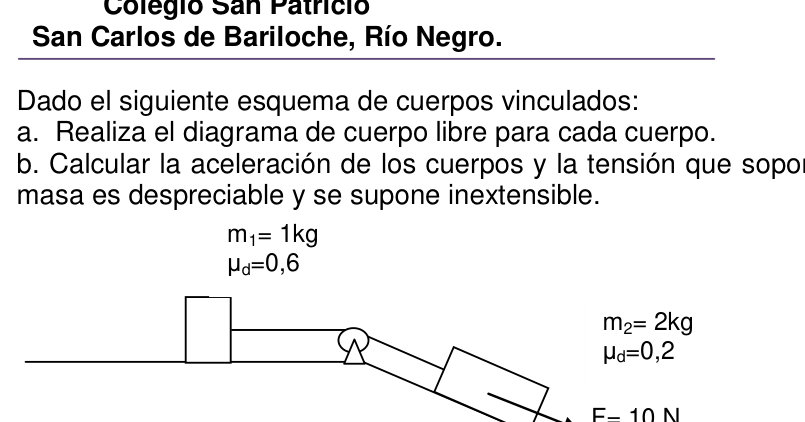
Topic: Newtonian Mechanics Metodi: Free-Body Diagram, Newton’s Law of Gravitation Competenze: Physical Reasoning, Mathematical Modeling Objects: Block, String, Pulley Fonte: Testo (PDF) — p.3
Corpi collegati
PT39. Centro di istruzione media Nro. 123
Scuola San Patrizio San Carlo di Bariloche, Rio Negro.
Dato il seguente schema di corpi collegati: a. Realizza il diagramma di corpo libero per ogni corpo. b. Calcolare l’accelerazione dei corpi e la tensione che sopporta la corda, la cui La massa è disprezzabile e presumibilmente estensibile.
Topic: Newtonian Mechanics Metodi: Free-Body Diagram, Newton’s Law of Gravitation Competenze: Physical Reasoning, Mathematical Modeling Objects: Block, String, Pulley Fonte: Testo (PDF) — p.3
The following is the list of the Member States’ financial statements.
PT39. The Centre for Middle School Nro. 123
St. Patrick’s College St. Charles of Bariloche, Rio Negro.
Given the following scheme of linked bodies: a. He does the free-body diagram for each body. b. Calculate the acceleration of the bodies and the stress that the rope bears, whose Mass is despicable and is supposedly unextractable.
Topic: Newtonian Mechanics Metodi: Free-Body Diagram, Newton’s Law of Gravitation Competenze: Physical Reasoning, Mathematical Modeling Objects: Block, String, Pulley Fonte: Testo (PDF) — p.3
Calor del cobre
PT40. Centro de Enseñanza Media Nro. 123
Colegio San Patricio San Carlos de Bariloche, Río Negro.
¿Qué cantidad de calor necesita absorber un trozo de cobre cuya masa es de 25 gramos, si se encuentra a una temperatura de 8 ºC y se desea que alcance los 100 ºC, sabiendo que el calor especifico del cobre es de 0.093 cal/gºC?
Topic: Thermodynamics Metodi: First Law of Thermodynamics Competenze: Physical Reasoning Objects: — Fonte: Testo (PDF) — p.3
Caldura del rame
PT40. Centro di istruzione media Nro. 123
Scuola San Patrizio San Carlo di Bariloche, Rio Negro.
Quanta calore ha bisogno di assorbire un pezzo di rame di massa 25 grammi, se si trova a una temperatura di 8 oC e si desidera che raggiunga la temperatura di 100 oC, sapendo che il calore specifico del rame è di 0,093 cal/goC?
Topic: Thermodynamics Metodi: First Law of Thermodynamics Competenze: Physical Reasoning Objects: — Fonte: Testo (PDF) — p.3
The heat of the copper **
PT40. The Centre for Middle School Nro. 123
St. Patrick’s College St. Charles of Bariloche, Rio Negro.
How much heat does a piece of copper whose mass is of 25 grams if it is at a temperature of 8 oC and is desired to reach 100 oC, knowing that the specific heat of copper is 0.093 cal/goC?
Topic: Thermodynamics Metodi: First Law of Thermodynamics Competenze: Physical Reasoning Objects: — Fonte: Testo (PDF) — p.3
Circuito con instrumentos
PT41. Centro de Enseñanza Media Nro. 123
Colegio San Patricio San Carlos de Bariloche, Río Negro.
a. Calcular los valores de tensión e intensidad que marcan los instrumentos (considerándolos como ideales y a la resistencia interna de la batería despreciable), en el siguiente circuito.
F= 10 N 30° m1= 1kg μd=0,6 m2= 2kg μd=0,2
OAF 2011 - 40 b. Calcular el valor de la resistencia R.
Topic: Circuits Metodi: Kirchhoff’s Laws, Equivalent Circuit Reduction Competenze: Physical Reasoning, Mathematical Modeling Objects: Resistor, Battery Fonte: Testo (PDF) — p.3
Circuito con strumenti
PT41. Centro di istruzione media Nro. 123
Scuola San Patrizio San Carlo di Bariloche, Rio Negro.
a. Calcolare i valori di tensione e intensità che segnano i strumenti (considerandoli ideali e resistenti all’interno) della batteria sconsiderata), nel circuito successivo.
F= 10 N 30° m1= 1kg μd=0,6 m2= 2kg μd=0,2
OAF 2011 - 40 b. Calcolare il valore della resistenza R.
Topic: Circuits Metodi: Kirchhoff’s Laws, Equivalent Circuit Reduction Competenze: Physical Reasoning, Mathematical Modeling Objects: Resistor, Battery Fonte: Testo (PDF) — p.3
**Instrumental circuit **
PT41. The Centre for Middle School Nro. 123
St. Patrick’s College St. Charles of Bariloche, Rio Negro.
a. Calculate the voltage and intensity values that mark the The main objective of the project is to develop and develop new technologies for the development of new technologies and to improve the efficiency of the use of new technologies. The next circuit.
F= 10 N 30° m1= 1kg μd=0,6 m2= 2kg μd=0,2
The following is the list of the countries of the European Union: b. Calculate the value of resistance R.
Topic: Circuits Metodi: Kirchhoff’s Laws, Equivalent Circuit Reduction Competenze: Physical Reasoning, Mathematical Modeling Objects: Resistor, Battery Fonte: Testo (PDF) — p.3
Anillo y eje
PT42. Escuela Nicolás Avellaneda
Escuela Media de Río Chico
Escuela de Educación Integral Sarmiento Aguilares – Río Chico – Juan Bautista Alberdi Provincia de Tucumán.
En un taller de herrería se debe colocar un anillo de aluminio en un eje de latón
que sostiene piezas que giran a altas revoluciones; por tal motivo el encastre
debe conferir mucha seguridad. Ante esta situación los técnicos optan por usar
un anillo de un diámetro inferior al eje.
El eje –construido en latón- es cilíndrico de 5,05cm de diámetro a 20°C y el anillo
–construido en aluminio- tiene un diámetro interno de 5,00cm a igual temperatura
y una masa de 40g.
a) ¿a qué temperatura se debe calentar el aluminio, para que entre en el
eje?
Nota: tenga en cuenta las constantes físicas que se consignen al final del
enunciado.
b) Determine la densidad que tendrá el aluminio a esa temperatura. (si no
pudo resolver el punto anterior, utilice la temperatura de fusión).
c) Calcule el calor necesario para aumentar la temperatura del aluminio,
obtenida en a).
d) ¿a que temperatura se deben elevar ambos metales, para que el anillo
se pueda deslizar dentro en el eje? (Es decir se calientan en forma
simultánea ambos metales).
e) Desde el punto de vista físico ¿es posible el procedimiento del punto a)
y del punto d)? Justifique la respuesta.
f) El obrero que atiende el horno, lo prepara para incrementar la
temperatura del aluminio en unos 2 . 103 K. Determine la cantidad de
calor que entregará en este proceso.
Constantes Físicas:
Coeficiente expansión lineal del latón L = 0,000019°C-1.
Datos del aluminio:
Coeficiente expansión lineal del Al = 0,000024°C-1.
Densidad a 0°C = 2700kg/m3.
Calor especifico en estado sólido: CE= 0,215cal/g °C
Punto de fusión 600°C - Punto de Ebullición: 2.450°C.
Calor de fusión CF = 3,97 . 105 J/Kg
Calor de vaporización Cv= 1,14 . 107 J/Kg
Calor especifico en estado líquido 400J/Kg K
R
12 kΩ
12 V
12 kΩ
20kΩ
4kΩ
0,3 mA
12 kΩ
A
V
OAF 2011 - 41
Topic: Thermodynamics, Elasticity & Materials Metodi: Physical Modeling, First Law of Thermodynamics Competenze: Physical Reasoning, Mathematical Modeling Objects: — Fonte: Testo (PDF) — p.3
Anello e asse
PT42. Scuola Nicola Avellaneda
Scuola media di Rio Chico
Scuola di istruzione integrale Sarmiento Aguilares Río Chico Juan Bautista Alberdi Provincia di Tucumán.
In un laboratorio di ferro si deve mettere un anello di alluminio su un asse di rame. Il sistema di controllo delle macchine è stato sviluppato in modo che il sistema di controllo delle macchine di controllo di controllo di controllo di controllo di controllo di controllo di controllo di controllo di controllo di controllo di controllo di controllo di controllo di controllo di controllo di controllo di controllo di controllo di controllo di controllo di controllo di controllo di controllo di controllo di controllo di controllo di controllo di controllo di controllo di controllo di controllo di controllo di controllo di controllo di controllo di controllo di controllo di controllo di controllo di controllo di controllo di controllo di controllo di controllo di controllo di controllo di controllo di controllo di controllo di controllo di controllo di controllo di controllo di controllo di controllo di controllo di controllo di controllo di controllo di controllo di controllo di controllo di controllo di controllo di controllo di controllo di controllo di controllo di controllo di controllo di controllo di controllo di controllo di controllo di controllo di controllo di controllo di controllo di controllo di controllo di controllo di controllo di controllo di controllo di controllo di controllo di controllo di controllo di controllo di controllo di controllo di controllo di controllo di controllo di controllo di controllo di controllo di controllo di controllo di controllo di controllo di controllo di controllo di controllo di controllo di controllo di controllo di controllo di controllo di controllo di controllo di controllo di controllo di controllo di controllo di controllo di controllo di controllo di controllo di controllo di controllo di controllo di controllo di controllo di controllo di controllo di controllo di controllo di controllo di controllo di controllo di controllo di controllo di controllo di controllo di controllo di controllo di controllo di controllo di controllo di controllo di controllo di controllo di controllo di controllo di controllo di controllo di controllo di controllo di controllo di controllo di controllo di controllo di controllo di controllo di controllo di controllo di controllo di controllo di controllo di controllo di controllo di controllo di controllo di controllo di controllo di controllo di controllo di controllo di controllo di controllo di controllo di controllo di controllo di controllo di controllo di controllo di controllo di controllo di controllo di controllo di controllo di controllo di controllo di controllo di controllo di controllo di controllo di controllo di controllo di controllo di controllo di controllo di controllo di controllo di controllo di controllo di controllo di controllo di controllo di controllo di controllo di controllo di controllo di controllo di controllo di controllo di controllo di controllo di controllo di controllo di controllo di controllo di controllo di controllo di controllo di controllo di controllo di controllo di controllo di controllo di controllo di controllo di controllo di controllo di controllo di controllo di controllo di controllo di controllo di controllo di. deve conferire molta sicurezza. In questo caso , i tecnici scelgono di usare un anello di diametro inferiore all’asse. L’asse è cilindrico di 5,05 cm di diametro a 20°C e l’anello è di latone. construito in alluminio- ha un diametro interno di 5,00 cm a temperatura uguale e una massa di 40 grammi. a) a che temperatura deve essere riscaldato l’alluminio per far entrare il
- L’asse? Nota: si tenga conto delle costanti fisiche che si registrano alla fine del
- La frase. b) Determina la densità dell’alluminio a quella temperatura. (si no Se non è possibile risolvere il punto precedente, si utilizza la temperatura di fusione). (c) Calcolare il calore necessario per aumentare la temperatura dell’alluminio, ottenuto in a). d) a che temperatura devono essere sollevate le due metalli, in modo che l’anello
- Si può scivolare dentro sull’asse? (Visto che si riscaldano in forma) (Sito di cui al capitolo 1. (e) Dal punto di vista fisico è possibile il procedimento di cui al punto (a) e del punto d)? giustifica la risposta. f) Il lavoratore che si occupa del forno, lo prepara per aumentare la produzione. Temperatura dell ’ alluminio in circa 2 . 103 K. Determina la quantità di calore che fornirà in questo processo.
Costanti fisiche:
Coefficiente di espansione lineare del latone L = 0,000019°C-1.
Datos dell’alluminio:
Coefficiente di espansione lineare di Al = 0,000024°C-1.
Densità a 0°C = 2700kg/m3.
Calore specifico in stato solido: CE= 0,215 cal/g °C
Punto di fusione 600°C - Punto di ebollizione: 2.450°C.
Calore di fusione CF = 3,97 . 105 J/Kg
Calore di vaporizzazione Cv = 1,14 . 107 J/Kg
Calore specifico in stato liquido 400J/Kg K
R
12 kΩ
12 V
12 kΩ
20kΩ
4kΩ
0,3 mA
12 kΩ
A
V
OAF 2011 - 41
Topic: Thermodynamics, Elasticity & Materials Metodi: Physical Modeling, First Law of Thermodynamics Competenze: Physical Reasoning, Mathematical Modeling Objects: — Fonte: Testo (PDF) — p.3
The value of the underlying assets shall be reported in the relevant information document.
PT42. School of Nicholas Avellaneda
Rio Chico High School
The school of comprehensive education Sarmiento The first is the “Rio Chico” Province of Tucumán.
In a blacksmith shop, an aluminum ring should be placed on a brass axis. The main purpose of the system is to support high-velocity rotating parts. It should give you a lot of security. In this situation , technicians choose to use a ring of a diameter less than the axis. The axis built in brass- is cylindrical with a diameter of 5.05 cm at 20°C and the ring built in aluminium- has an internal diameter of 5,00cm at the same temperature and a 40g mass. (a) at what temperature the aluminium must be heated to enter the Axis? Note: take into account the physical constants recorded at the end of the year The statement. (b) Determine the density of aluminium at that temperature. (si no You can solve the previous point, use the melting temperature. (c) Calculate the heat required to increase the temperature of the aluminium, obtained from a). (d) at what temperature both metals must be raised, so that the ring Can you slide in on the shaft? (I mean they heat up in shape simultaneously both metals). (e) Is the procedure under (a) physically possible? and point (d)? Justify the answer. (f) The worker who works in the oven prepares it to increase the quantity of the oven. Aluminum temperature in about 2 . 103 K. Determine the amount of heat that will deliver in this process.
Physical constants:
The brass linear expansion coefficient L = 0,000019°C-1.
Aluminium data:
The coefficient of linear expansion of Al = 0,000024°C-1.
The following is the list of the types of products that are used in the manufacture of the product:
The heat content of the product shall be determined by the following formulae:
The following is the list of the products of the product concerned:
Heat of fusion CF = 3.97 . 105 J/Kg
Heat of vaporization Cv = 1.14 . 107 J/Kg
Specific heat in liquid state 400J/Kg K
R
12 kΩ
12 V
12 kΩ
20kΩ
4kΩ
0,3 mA
12 kΩ
A
V
The following is the list of the countries of the European Union:
Topic: Thermodynamics, Elasticity & Materials Metodi: Physical Modeling, First Law of Thermodynamics Competenze: Physical Reasoning, Mathematical Modeling Objects: — Fonte: Testo (PDF) — p.3
Bala atraviesa madera
PT43. Escuela Nicolás Avellaneda
Escuela Media de Río Chico
Escuela de Educación Integral Sarmiento Aguilares – Río Chico – Juan Bautista Alberdi Provincia de Tucumán.
Un granjero dispara con un rifle para ahuyentar depredadores que amenazan su rebaño, que de noche bajan de una montaña cercana. Sabe que debe inclinarla para que el disparo pase sobre unos árboles, pero también que la bala pasará muy por arriba de un cerro cercano y no logrará su propósito, por lo que decide poner sobre un alambrado ubicado a 3m una madera de 0,04m de espesor, en forma perpendicular a la trayectoria de la bala con el fin de que al atravesarla disminuya la velocidad y logre hacerla caer en la ladera. El perfil topográfico de la montaña se observa en el dibujo.
La bala es de plomo, de forma esférica de 9mm de diámetro. Se sabe que la
bala sale del rifle con una velocidad de 480m/s y se estima que luego de
atravesar la madera emerge con una velocidad de 200m/s y es disparada con un
ángulo de 30° respecto de la horizontal sin que desvíe su trayectoria mientras
interactúa con la madera.
a) ¿Cuál es la masa de la bala? (la densidad del plomo es 11,3g/cm3.
Si en los 3m que separan la bala de la madera que atravesará, es insignificante
la trayectoria parabólica que describe por lo que se puede considerar recta y es
despreciable el rozamiento con el aire:
b) ¿En que tiempo recorre esos 3m?
Observando que llega con una velocidad y emerge con otra:
c) ¿Cuánto vale la fuerza promedio que actúa mientras atraviesa la
madera?
d) ¿Cuánto calor se genera mientras interactúa con la madera?
500 m
0,04m
5km
1000m
1000m
3 m
OAF 2011 - 42 Si el rifle tiene una masa de 2kg: e) ¿Cuál es la velocidad de retroceso al dispara la bala? En cuanto a la cuestión principal del problema y suponiendo que al momento del diparo corre un leve viento a favor que contrarresta los efectos de fricción: f) ¿logrará el granjero que la bala caiga en la ladera de la montaña? Demuestre numéricamente su respuesta. Ud. decide sugerir algo más. Para que la bala caiga a mitad de ladera (de pendiente uniforme) y suponiendo que la velocidad con que emerge la bala al atravesar la madera es directamente proporcional al espesor, g) ¿de qué espesor debe ser la madera?
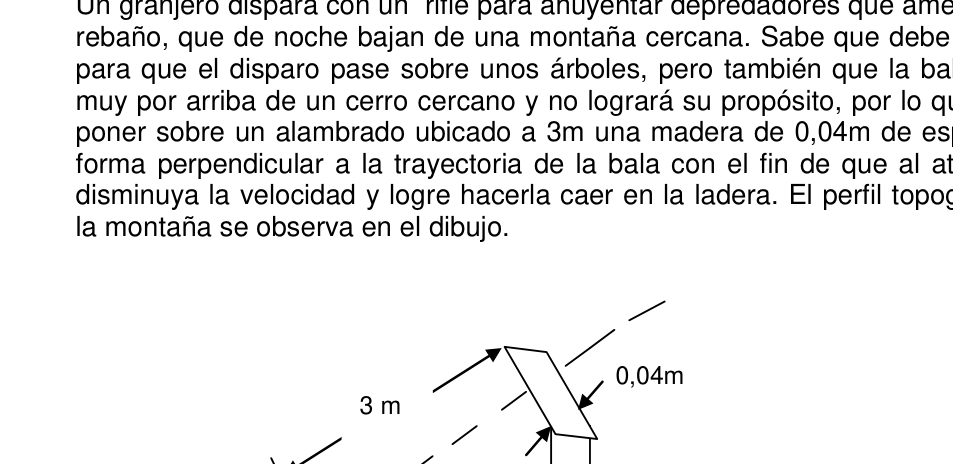
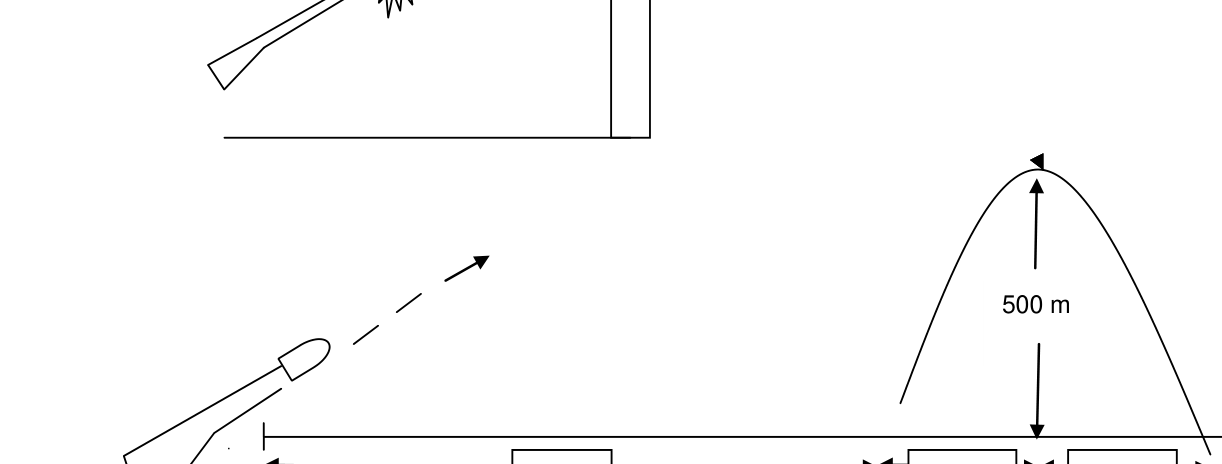
Topic: Newtonian Mechanics, Conservation of Momentum Metodi: Impulse-Momentum Theorem, Conservation of Momentum, Kinematic Equations Competenze: Physical Reasoning, Mathematical Modeling Objects: Projectile Fonte: Testo (PDF) — p.3
La pallina attraversa il legno
PT43. Scuola Nicola Avellaneda
Scuola media di Rio Chico
Scuola di istruzione integrale Sarmiento Aguilares Río Chico Juan Bautista Alberdi Provincia di Tucumán.
Un contadino spara con un fucile per respingere i predatori che minacciano il suo territorio. gregge che scendono di notte da una montagna vicina. Sa che deve inclinarla. Per far passare il colpo su alcuni alberi, ma anche per far passare la pallottola. E’ molto più alto di un colle vicino e non riuscirà a raggiungere il suo scopo, quindi decide mettere su un filo situato a 3 m di spessore un legno di 0,04 m, in forma perpendicolare al percorso della pallina in modo che quando la attraversa diminuisce la velocità e riesce a farla cadere sul pendio. Il profilo topografico di La montagna è osservata nel disegno.
La pallottola è di piombo, spherico di 9 mm di diametro. Si sa che La pallottola esce dal fucile a una velocità di 480m/s e si stima che dopo Attraversando il legno emerge a velocità di 200m/s e viene sparato con un angolo di 30° rispetto alla orizzontale senza deviare dal suo percorso mentre interagisce con il legno. a) Qual è la massa della pallottola? (la densità del piombo è di 11,3 g/cm3. Se a 3 metri separare la pallottola dal legno che attraverserà, è insignificante. La traccia parabolica che descrive ciò che può essere considerato retto e che è sconsiderato il ruggine con l’aria: b) In che tempo percorre quei 3 metri? Notando che arriva con una velocità e emerge con un’altra: (c) Quanto vale la forza media che agisce mentre attraversa la
- Legno?
d) Quanto calore si genera quando interagisce con il legno?
500 m
0,04m
5km
1000m
1000m 3 m
OAF 2011 - 42 Se il fucile ha una massa di 2 kg: e) Qual è la velocità di retrocesso quando il proiettile tira? In quanto al problema principale e, se si presume che al momento del Diparo corre un leggero vento a favore che contrasta gli effetti di attrito: f) il contadino riuscirà a far cadere la pallottola sul versante della montagna? Dimostra numericamente la tua risposta. Ud. decide di suggerire qualcos’altro. Per far cadere la pallottola a metà del fianco. (Signature) e supponendo che la velocità con cui la pallottola emerge al La crosta del legno è direttamente proporzionale allo spessore. g) di che spessore deve essere il legno?
Topic: Newtonian Mechanics, Conservation of Momentum Metodi: Impulse-Momentum Theorem, Conservation of Momentum, Kinematic Equations Competenze: Physical Reasoning, Mathematical Modeling Objects: Projectile Fonte: Testo (PDF) — p.3
The bullet passes through wood.
PT43. School of Nicholas Avellaneda
Rio Chico High School
The school of comprehensive education Sarmiento The first is the “Rio Chico” Province of Tucumán.
A farmer fires a rifle to drive away predators who threaten his life. Sheep, coming down from a nearby mountain at night. You know you should lean on her . So that the shot will pass over some trees, but also that the bullet will pass. far above a nearby hill and it won’t achieve its purpose, so he decides Put on a wire 3 m away a wood of 0.04 m thick, in shape perpendicular to the bullet’s trajectory so that when it passes through it slow down and get her down the hill. The topographic profile of The mountain is seen in the drawing.
The bullet is lead, spherical, 9mm in diameter. It is known that The bullet is coming out of the rifle at a rate of 480m/s and it is estimated that after Through the wood emerges at a speed of 200m/s and is fired with a angle of 30° with respect to the horizontal without deviating its path while interacts with the wood. (a) What is the mass of the bullet? (the lead density is 11.3 g/cm3. If within 3 meters of the bullet separating the wood it will pass through, it is insignificant. The parabolic path describes what can be considered straight and is Despicable the air-crushing: (b) How long does it take to travel those 3m? Observing that it comes at one speed and emerges at another: (c) What is the average force acting as it passes through the
- The wood?
(d) How much heat is generated while interacting with wood?
500 m
0,04m
5km
1000m
1000m 3 m
The following is the list of the Member States’ financial statements: If the rifle has a mass of 2 kg: (e) What is the recoil velocity when the bullet is fired? As regards the main question of the problem and assuming that at the time of the Diparo runs a slight wind in favour which counters the effects of friction: (f) Will the farmer get the bullet to fall on the mountain slope? Numerically prove your answer. Ud. He decides to suggest something else. So the bullet falls halfway down the hill (of The rate of the bullet’s emergence is the rate at which the bullet is pulled out. The wood is directly proportional to the thickness. (g) what thickness should the wood be?
Topic: Newtonian Mechanics, Conservation of Momentum Metodi: Impulse-Momentum Theorem, Conservation of Momentum, Kinematic Equations Competenze: Physical Reasoning, Mathematical Modeling Objects: Projectile Fonte: Testo (PDF) — p.3
Resistencia y temperatura
PT42. Escuela Nicolás Avellaneda
Escuela Media de Río Chico
Escuela de Educación Integral Sarmiento Aguilares – Río Chico – Juan Bautista Alberdi Provincia de Tucumán.
Una persona mientras viaja por una zona muy calurosa, en un día que la
temperatura es de 55ºC, encuentra que cierto voltaje aplicado a un alambre de
cobre produce una corriente de 1ampere. La misma persona viaja luego a una
zona austral muy fría y aplica el mismo voltaje al mismo alambre; si supone que
no hay cambios significativos en la forma y tamaño del alambre:
a) ¿Qué corriente registra si la temperatura es de -30ºC? (Para el cobre
α: coeficiente de variación de la resistencia en función de la temperatura
vale: 3,9 . 10 -3 ºC-1).
En la zona fría, la persona en su casilla rodante arma un circuito para
incrementar en 60ºC la temperatura de 5 litros de agua, con su improvisada
ducha. Si dispone de dos resistencias de 6 Ω y de 12 Ω lo que conectará a una
fuente de 120V y suponiendo que todo el calor generado es absorbido por el
agua:
b) ¿Cómo conectará éstas para calentar el agua en el menor tiempo
posible y cuanto es este tiempo?
El incremento de temperatura esperado es alcanzado, pero en un tiempo
diferente al calculado. Ocurre que la corriente que circula por un conductor
disminuye exponencialmente con el tiempo. Si suponemos que esta variación de
I está dada por la expresión:
I (t) = I0 . e –t/ donde I0 es la corriente inicial (en t = 0) y es una constante que tiene dimensiones de tiempo. Considere un punto de observación fijo dentro del conductor: c) ¿Cuánta carga pasa por ese punto entre t = 0 y t = ?
NOTA: recuerda que el número e es la base de logaritmo natural, pero en este problema sólo interesa expresar la carga q en función de I0, t y e.
Topic: Circuits Metodi: Equivalent Circuit Reduction, First Law of Thermodynamics Competenze: Physical Reasoning, Mathematical Modeling Objects: Resistor, Wire Fonte: Testo (PDF) — p.3
Restanza e temperatura
PT42. Scuola Nicola Avellaneda
Scuola media di Rio Chico
Scuola di istruzione integrale Sarmiento Aguilares Río Chico Juan Bautista Alberdi Provincia di Tucumán.
Una persona mentre viaggia in una zona molto calda, in un giorno che la La temperatura è di 55°C, trova che un certo voltage applicato a un filo di Il rame produce un corrente di 1 ampere. La stessa persona viaggia poi a una zona austral molto fredda e applica la stessa tensione allo stesso filo; se si suppone che non si verificano significativi cambiamenti nella forma e dimensione del filo: a) Qual è il corrente registrato se la temperatura è di -30°C? (Per il rame α: coefficiente di variazione della resistenza a temperatura vale: 3,9 . 10 -3 ºC-1). Nella zona fredda, la persona in carrozzina mette a fuoco un circuito per aumentare di 60°C la temperatura di 5 litri di acqua, con il suo improvviso
- Il bagno. Se ha due resistenze di 6 Ω e 12 Ω, si collega a una la fonte di calore di 120 V e supponendo che tutto il calore generato sia assorbito dal acqua: b) Come si collegano questi per riscaldare l’acqua nel minor tempo possibile E quanto tempo è possibile? L’aumento di temperatura previsto è raggiunto, ma in un certo tempo diverso dal calcolato. Si verifica che il corrente che circola attraverso un conducente diminuisce esponenzialmente nel tempo. Se supponiamo che questa variazione di I è dato dall’espressione:
I (t) = I0 . e –t/ dove i0 è il corrente iniziale (in t = 0) e è una costante che ha dimensioni del tempo. Considerare un punto di osservazione fisso all’interno del Conduzione: c) Quanti carichi passano da quel punto tra t = 0 e t = ?
NOTA: ricorda che il numero e è la base del logaritmo naturale, ma in questo Il problema è solo di esprimere la carica q in funzione di I0, t e.
Topic: Circuits Metodi: Equivalent Circuit Reduction, First Law of Thermodynamics Competenze: Physical Reasoning, Mathematical Modeling Objects: Resistor, Wire Fonte: Testo (PDF) — p.3
The following conditions shall apply:
PT42. School of Nicholas Avellaneda
Rio Chico High School
The school of comprehensive education Sarmiento The first is the “Rio Chico” Province of Tucumán.
A person traveling through a very hot area on a day that they The temperature is 55oC, finds that a certain voltage applied to a wire of Copper produces a current of 1 ampere. The same person then travels to one. The southern area is very cold and applies the same voltage to the same wire; if you assume that no significant changes in the shape and size of the wire: (a) What current is recorded if the temperature is -30°C? (For copper α: coefficient of variation of resistance to temperature It ‘s 3.9 . 10 -3 ºC-1). In the cold zone, the person in their wheelchair arms a circuit for Increase the temperature by 60°C by 5 litres of water, with its improvised Shower. If it has two resistors of 6 Ω and 12 Ω which will connect to a The energy output of the system is 120 V and assuming that all the heat generated is absorbed by the water: (b) How will you connect these to heat the water in the shortest time? What is this time? The expected temperature increase is reached, but in time different from the calculated. It happens that the current circulating through a conductor It decreases exponentially over time. If we assume that this variation of I is given by the expression:
I (t) = I0 . e –t/ where I0 is the starting current (in t = 0) and is a constant that has dimensions of time. Consider a fixed point of observation within the driver: (c) How much charge passes through that point between t = 0 and t = ?
NOTE: Remember that the number e is the base of the natural logarithm, but in this problem only concerns expressing the charge q as a function of I0, t and e.
Topic: Circuits Metodi: Equivalent Circuit Reduction, First Law of Thermodynamics Competenze: Physical Reasoning, Mathematical Modeling Objects: Resistor, Wire Fonte: Testo (PDF) — p.3
Resorte y tabla de datos
PT43. Escuela de Educación Secundaria Técnica Nro. 1 Navarro, Buenos Aires.
En una experiencia con un resorte, se cuelgan de él diferentes cargas y se mide la longitud que este tiene en cada caso
OAF 2011 - 43 La tabla con los resultados es:
Carga(N) 0 1 2 3 4 5 6 7 Longitud (mm) 50 58 70 74 82 92 102 125 Estiramiento(mm)
a. ¿Cuál es la longitud del resorte sin carga? b. Completar la tabla. c. Realizar un gráfico de estiramiento versus carga d. Una de las mediciones fue mal hecha y dio un resultado incorrecto. ¿Cuál es? ¿Cuánto supone que debería haber dado? e. Señalar en el gráfico cuál es el límite de carga a partir del cual el resorte deja de comportarse idealmente. f. ¿Qué carga producirá un estiramiento de 30mm? g. ¿Qué longitud tendrá el resorte con una carga de 4,5 N?
Topic: Elasticity & Materials, Mathematics Metodi: Hooke’s Law, Graph Linearization, Experimental Data Analysis Competenze: Physical Reasoning, Mathematical Modeling Objects: Spring Fonte: Testo (PDF) — p.3
Risorsa e tabella di dati
PT43. Scuola secondaria tecnica Nro. 1 Navarro, Buenos Aires.
In un esperimento con una primavera, vengono appesi da esso carichi diversi e misurati. la lunghezza che ha in ogni caso
OAF 2011 - 43 La tabella con i risultati è:
Carga 0 1 2 3 4 5 6 7 Lunghezza (mm) 50 58 70 74 82 92 102 125 Estensione (mm)
a. Qual è la lunghezza della primavera senza carico? b. Completare la tabella. c. Realizzare un grafico di tesazione versus carico d. Una delle misure è stata mal fatta e ha dato un risultato errato.
- Che cosa è? Quanto supponi che avrei dovuto dare? e. Indicare sul grafico quale è il limite di carico da cui il resortimento smette di comportarsi come si deve. f. Che carico produrrà un allungamento di 30 mm? g. Qual è la lunghezza della primavera con un carico di 4,5 N?
Topic: Elasticity & Materials, Mathematics Metodi: Hooke’s Law, Graph Linearization, Experimental Data Analysis Competenze: Physical Reasoning, Mathematical Modeling Objects: Spring Fonte: Testo (PDF) — p.3
The data set shall be reported in the following table:
PT43. Technical Secondary Education School Nro. 1 I’m from Navarro, Buenos Aires.
In an experiment with a spring, different loads are hung from it and measured. the length of the length of the length of the length of the length of the length of the length of the length of the length of the length of the length of the length of the length of the length of the length of the length of the length of the length of the length of the length of the length of the length of the length of the length of the length of the length of the length of the length of the length of the length of the length of the length of the length of the length of the length of the length of the length of the length of the length of the length of the length of the length of the length of the length of the length of the length of the length of the length of the length of the length of the length of the length of the length of the length of the length of the length of the length of the length of the length of the length of the length of the length of the length of the length of the length of the length of the length of the length of the length of the length of the length of the length of the length of the length of the length of the length of the length of the length of the length of the length of the length of the length of the length of the length of the length of the length of the length of the length of the length of the length of the length of the length of the length of the length of the length of the length of the length of the length of the length of the length of the length of the length of the length of the length of the length of the length of the length of the length of the length of the length of the length of the length of the length of the length of the length of the length of the length of the length of the length of the length of the length of the length of the length of the length of the length of the length of the length of the length of the length of the length of the length of the length of the length of the length of the length of the length of the length of the length of the length of the length of the length of the length of the length of the length of the length of the length of the length of the length of the length of the length of the length of the length of the length of the length of the length of the length of the length of the length of the length of the length of the length of the length of the length of the length of the length of the length of the length of the length of the length of the length of the
The following is the list of the Member States’ financial statements: The result table is:
Loaded 0 1 2 3 4 5 6 7 Length (mm) 50 58 70 74 82 92 102 125 The length of the length of the length of the length of the length of the length of the length of the length of the length of the length of the length of the length of the length of the length of the length of the length of the length of the length of the length of the length of the length of the length of the length of the length of the length of the length of the length of the length of the length of the length of the length of the length of the length of the length of the length of the length of the length of the length of the length of the length of the length of the length of the length of the length of the length of the length of the length of the length of the length of the length of the length of the length of the length of the length of the length of the length of the length of the length of the length of the length of the length of the length of the length of the length of the length of the length of the length of the length of the length of the length of the length of the length of the length of the length of the length of the length of the length of the length of the length of the length of the length of the length of the length of the length of the length of the length of the length of the length of the length of the length of the length of the length of the length of the length of the length of the length of the length of the length of the length of the length of the length of the length of the length of the length of the length of the length of the length of the length of the length of the length of the length of the length of the length of the length of the length of the length of the length of the length of the length of the length of the length of the length of the length of the length of the length of the length of the length of the length of the length of the length of the length of the length of the length of the length of the length of the length of the length of the length of the length of the length of the length of the length of the length of the length of the length of the length of the length of the length of the length of the length of
a. What is the length of the spring without load? b. Complete the table. c. Perform a stretch versus load chart d. One of the measurements was wrong and gave an incorrect result. What’s that? How much do you suppose I should have given? e. Indicate on the graph what the load limit is from which the spring is He’s not going to behave himself ideally. f. What charge will produce a 30mm stretch? g. What length will the spring have with a load of 4.5 N?
Topic: Elasticity & Materials, Mathematics Metodi: Hooke’s Law, Graph Linearization, Experimental Data Analysis Competenze: Physical Reasoning, Mathematical Modeling Objects: Spring Fonte: Testo (PDF) — p.3
Jabon en bacha esferica
PT44. Escuela de Educación Secundaria Técnica Nro. 1 Navarro, Buenos Aires.
Un jabón de 100 gr cae deslizando sobre una bacha esférica (radio = 50 cm). En el punto más bajo de la trayectoria, su velocidad es de 2 m/seg. ¿Cuánto vale la fuerza que en ese punto ejerce sobre él?
Topic: Newtonian Mechanics Metodi: Conservation of Energy, Free-Body Diagram Competenze: Physical Reasoning, Mathematical Modeling Objects: — Fonte: Testo (PDF) — p.3
Giappone in bacca sferica
PT44. Scuola secondaria tecnica Nro. 1 Navarro, Buenos Aires.
Un sapone di 100 gr cade scivolando su una bacca sferica (radio = 50 cm). En Il punto più basso del percorso, la sua velocità è di 2 m/sec. Quanto vale la la forza che a quel punto esercita su di lui?
Topic: Newtonian Mechanics Metodi: Conservation of Energy, Free-Body Diagram Competenze: Physical Reasoning, Mathematical Modeling Objects: — Fonte: Testo (PDF) — p.3
The following table shows the results of the calculation of the total weight of the product:
PT44. Technical Secondary Education School Nro. 1 I’m from Navarro, Buenos Aires.
A 100 g soap falls sliding over a spherical balsa (radio = 50 cm). En The lowest point on the trajectory, its speed is 2 m/s. How much is the force that at that point exerts upon him?
Topic: Newtonian Mechanics Metodi: Conservation of Energy, Free-Body Diagram Competenze: Physical Reasoning, Mathematical Modeling Objects: — Fonte: Testo (PDF) — p.3
Pez y refraccion
PT45. Escuela de Educación Secundaria Técnica Nro. 1 Navarro, Buenos Aires.
Un pescador observa sorprendida que un pez que se alejaba nadando bajo el
agua desaparece repentinamente de su vista.
Si el índice de refracción del agua donde está pescando es de 1,3; ¿entre que
valores de ángulo, respecto de la vertical, está observando el pez?
OAF 2011 - 44
Topic: Geometric Optics Metodi: Snell’s Law Competenze: Physical Reasoning, Mathematical Modeling Objects: — Fonte: Testo (PDF) — p.3
Peso e rifrazione
PT45. Scuola secondaria tecnica Nro. 1 Navarro, Buenos Aires.
Un pescatore osserva con sorpresa un pesce che si allontanava nuotando sotto il l’acqua scompare all’improvviso dalla sua vista. Se l’indice di refraczione dell’acqua in cui sta pescando è di 1,3; Valute di angolo, rispetto alla verticale, stai osservando il pesce?
OAF 2011 - 44
Topic: Geometric Optics Metodi: Snell’s Law Competenze: Physical Reasoning, Mathematical Modeling Objects: — Fonte: Testo (PDF) — p.3
Weight and refraction
PT45. Technical Secondary Education School Nro. 1 I’m from Navarro, Buenos Aires.
A fisherman observes surprised that a fish that was drifting away swimming under the sea . Water suddenly disappears from his sight. If the refractive index of the water where you are fishing is 1.3; angle values, relative to the vertical, are you looking at the fish?
The following points shall be added:
Topic: Geometric Optics Metodi: Snell’s Law Competenze: Physical Reasoning, Mathematical Modeling Objects: — Fonte: Testo (PDF) — p.3
Yo-yo y bala
PT46. Colegio del Sol San Miguel de Tucumán.
Jugando con un yo_yo. Un niño hace oscilar un Yo-Yo, con un ángulo de 30° formado con la vertical, cuya masa es de 300g. a) Encuentre la aceleración centrípeta del yo-yo
b) Si el ángulo disminuye a la mitad, ¿qué ocurre con la aceleración centrípeta? Justifique b) Calcular el tiempo que tarda el yo-yo en barrer un ángulo de 500°. (Considere el radio = 20cm) El yo-yo se detiene después de un tiempo y una bala perdida, de 3g, se dirige a él y una vez que impacta queda incrustado en él, haciendo que el sistema se eleve una altura de 5cm. c) Calcular la velocidad de la bala antes del choque.
d) Calcular la velocidad del sistema después del choque.
e) Si la bala hubiese atravesado el yo-yo y la velocidad de salida es la ½
de la velocidad de entrada. ¿Qué valor mínimo debería tener la
velocidad para que el yo-yo pueda girar un círculo vertical completo?
f) Calcular el valor de la tensión de la cuerda en el punto más alto del
círculo, para que lo atraviese sin caer.
Topic: Newtonian Mechanics, Conservation of Momentum Metodi: Conservation of Energy, Conservation of Momentum, Simple Harmonic Motion Analysis Competenze: Physical Reasoning, Mathematical Modeling Objects: Pendulum, Projectile Fonte: Testo (PDF) — p.3
Io-io e pallottola
PT46. La scuola del sole San Michele di Tucumán.
Giocando con un yo-yo. Un bambino oscilla un Yo-Yo, con un angolo di 30° formato verticale, il cui peso è di 300 g. a) Trova l’accelerazione centripeta del yo-yo
b) Se l’angolo diminuisce di metà, che cosa succede all’accelerazione Centripetto? Giustifica b) Calcolare il tempo impiegato dal yo-yo per spazzare un angolo di 500°. (Considera la radio = 20 cm) Il yo-yo si ferma dopo un po’ e una pallottola persa, di 3g, si dirige verso E una volta che colpisce, viene incastrato in esso, facendo sì che il sistema si alza un’altezza di 5 cm. c) Calcolare la velocità della pallottola prima dell’impatto.
d) Calcolare la velocità del sistema dopo l’impatto. e) Se la pallottola fosse passata attraverso il yo-yo e la velocità di uscita fosse 1⁄2 della velocità di ingresso. Qual è il valore minimo che dovrebbe avere velocità per il yo-yo di poter girare un cerchio verticale completo? f) Calcolare il valore della tensione della corda al punto più alto del circolo, così che lo attraversasse senza cadere.
Topic: Newtonian Mechanics, Conservation of Momentum Metodi: Conservation of Energy, Conservation of Momentum, Simple Harmonic Motion Analysis Competenze: Physical Reasoning, Mathematical Modeling Objects: Pendulum, Projectile Fonte: Testo (PDF) — p.3
I-I and bullet
PT46. College of the Sun St. Michael of Tucumán.
Playing with a yo-yo. A child oscillates a Yo-Yo, with an angle of 30° formed with the vertical, whose mass is 300 g. (a) Find the centrifugal acceleration of the yo-yo.
(b) If the angle decreases by half, what happens to the acceleration centrifuge? Justify it . (b) Calculate the time it takes the yo-yo to sweep an angle of 500°. (Consider the radius = 20cm) The yo-yo stops after a while and a lost bullet, 3g, is heading for It’s a system that’s built into it, and once it hits, it’s embedded in it, making the system go. It’s a little over 5cm high. (c) Calculate the speed of the bullet before impact.
(d) Calculate the system speed after impact. e) If the bullet had passed through the yo-yo and the exit speed is 1⁄2 of the input speed. What minimum value should the speed so the yo-yo can spin a complete vertical circle? (f) Calculate the value of the tension of the rope at the highest point of the circle, so that he could cross it without falling.
Topic: Newtonian Mechanics, Conservation of Momentum Metodi: Conservation of Energy, Conservation of Momentum, Simple Harmonic Motion Analysis Competenze: Physical Reasoning, Mathematical Modeling Objects: Pendulum, Projectile Fonte: Testo (PDF) — p.3
Globo de helio
PT47. Colegio del Sol San Miguel de Tucumán.
Trabajamos con helio.
Un globo lleno de Helio está atado a una cuerda de 2m de largo y 0,5kg de
masa. El globo es esférico y tiene un radio de 0,4m, cuando el globo está vacío
tiene una masa de 0,25 kg. Inicialmente el globo está sostenido con la mano
desde el punto de unión del globo con la cuerda, luego se suelta y asciende la
cuerda una altura h, donde permanece en equilibrio.( densidad del aire 1,03
kg/m3)
a) Calcular el empuje que recibe el globo del aire.
b) ¿Qué fuerza debe realizar la mano para que no se eleve?
c) Determinar el valor de h que alcanza una vez soltado.
El helio líquido tiene un punto de ebullición muy bajo 4,2 °K y un calor de
ebullición de 4,99 cal/g. Si se quiere transformar energía desde un calentador de
10W de potencia a un recipiente que contiene helio, para hacerlo hervir.
d) ¿Cuánto tiempo tardaría en hervir 1,5 kg de helio líquido?
OAF 2011 - 45
Si queremos armar este calentador eléctrico con una potencia de 10W de rendimiento, sabiendo que como energía calórica solo llega el 90% y el mismo será conectado a los 220V de la red domiciliaria. e) Calcular el valor de la resistencia que debe poseer este calentador. e) Para armar el circuito tengo 3 resistencias de 1400ῼ c/u, como conectaría estas resistencias para calentar el helio bajo las condiciones establecidas. Dibuje el circuito. f) Encuentre la expresión que permita calcular el valor de las resistencias, si estas estuviesen conectadas en paralelo, para poder calentar el helio. Explique que circuito seria mas conveniente.
Topic: Fluid Mechanics, Circuits Metodi: Hydrostatic Equilibrium, First Law of Thermodynamics, Equivalent Circuit Reduction Competenze: Physical Reasoning, Mathematical Modeling Objects: Sphere, String, Resistor Fonte: Testo (PDF) — p.3
Glufo di elio
PT47. La scuola del sole San Michele di Tucumán.
Lavoriamo con elio. Un pallone pieno di elio è attaccato a una corda lunga 2 metri e 0,5 kg di massa. Il globo è sferico e ha un raggio di 0,4 metri, quando il globo è vuoto. ha una massa di 0,25 kg. Inizialmente il pallone è sostenuto dalla mano dal punto di connessione del globo con la corda, poi si solleva e si alza la Raggiunta di un’altezza h, dove rimane in equilibrio. kg/m3) a) Calcolare la spinta che riceve il pallone d’aria. b) Che forza deve esercitare la mano per non alzarsi? c) Determinare il valore di h che raggiunge una volta rilasciato. L’elio liquido ha un punto di ebollizione molto basso 4,2 °K e un calore di ebollizione di 4,99 cal/g. Se si vuole trasformare l’energia da un riscaldatore di 10W di potenza in un recipiente contenente elio, per farli bollire. d) Quanto tempo ci vorrebbe per far bollire 1,5 kg di elio liquido?
OAF 2011 - 45
Se vogliamo mettere in braccio questo riscaldatore elettrico con una potenza di 10W di Per quanto riguarda il rendimento, sapendo che come energia calorica arriva solo il 90% e lo stesso sarà collegato al 220V della rete domestica. e) Calcolare il valore della resistenza che deve avere questo riscaldatore. e) Per mettere insieme il circuito ho 3 resistenze di 1400 c/u, come collegare queste resistenze per riscaldare l’elio in condizioni di
- Esistenti. Disegna il circuito. f) Trova l’espressione che permette di calcolare il valore delle resistenze, se queste fossero collegate in parallelo, per poter riscaldare l’elio. Spiegate quale circuito sarebbe più conveniente.
Topic: Fluid Mechanics, Circuits Metodi: Hydrostatic Equilibrium, First Law of Thermodynamics, Equivalent Circuit Reduction Competenze: Physical Reasoning, Mathematical Modeling Objects: Sphere, String, Resistor Fonte: Testo (PDF) — p.3
The following table shows the results of the calculation of the total weight of the product:
PT47. College of the Sun St. Michael of Tucumán.
We work with helium. A balloon full of helium is tied to a rope 2m long and 0.5kg wide. Mass. The balloon is spherical and has a radius of 0.4 m, when the balloon is empty. It weighs 0.25 kg. Initially the balloon is held by hand From the point of the balloon’s connection with the rope, then it loosens and goes up the Strings a height h, where it remains in balance. kg/m3) (a) Calculate the thrust the balloon receives. (b) What force must the hand exert to keep it from rising? (c) Determine the value of h which it reaches once released. Liquid helium has a very low boiling point 4,2 °K and a heat of boiling point of 4,99 cal/g. If you want to convert energy from a heater to a heater 10W of power to a container containing helium, to boil it. (d) How long would it take to boil 1.5 kg of liquid helium?
The following is the list of the countries of the European Union:
If we want to put this electric heater on with a power of 10W of The energy efficiency, knowing that as a calorie energy only reaches 90% and the same It will be connected to the 220V home network. (e) Calculate the value of the resistance to be used by this heater. e) To assemble the circuit I have 3 resistors of 1400 c/u, such as I would connect these resistors to heat the helium under the conditions. established. Draw the circuit. (f) Find the expression that allows the value of resistance to be calculated. If these were connected in parallel, so you could heat the helium. Explain which circuit would be more convenient.
Topic: Fluid Mechanics, Circuits Metodi: Hydrostatic Equilibrium, First Law of Thermodynamics, Equivalent Circuit Reduction Competenze: Physical Reasoning, Mathematical Modeling Objects: Sphere, String, Resistor Fonte: Testo (PDF) — p.3
Campos terrestres
PT48. Colegio del Sol San Miguel de Tucumán.
Campos Terrestres. Una pelota de masa m cae hacia la tierra con una aceleración g hasta llegar a la superficie de la tierra, si el radio terrestre es de 6,38 * 106m y la constante gravitacional es 6,67 * 10-11 Nm2/ kg2, se pide: a) calcular la masa de la tierra. b) Si un cuerpo sobre la superficie terrestre pesa 270N ¿Cuánto pesará a una altitud sobre la superficie terrestre igual al doble del radio de la tierra? c) Usando la expresión para calcular energía potencial gravitatoria E= G M m/r asociada con un objeto cuando que está a una altura h de la superficie terrestre y cae hasta llegar a la superficie de la tierra, encuentre la expresión matemática E = mgh. Sabemos que la tierra es un gran imán, cuyo polo norte geográfico coincide con el polo sur magnético y que el polo sur geográfico coincide con el polo norte magnético .Sobre la superficie de la tierra se colocan dos alambres paralelos entre sí, uno directamente sobre el otro , c/u con un peso por unidad de longitud de 1 * 10 -4 N/m. Los alambres están alineados en dirección norte sur de modo que el campo magnético terrestre no los afectará. d) Cuando la distancia de separación entre ambos alambres es de 0,1m¿cuál debe ser la intensidad de corriente en c/u de modo que el alambre inferior haga levitar al superior? ( las corrientes tienen igual magnitud y sentido contrario) e) Si la intensidad de corriente se duplica ¿cuál será ahora la separación de equilibrio de los 2 alambres? f) Ahora colocamos 4 conductores paralelos formando un cuadrado, se pide encontrar la magnitud , la dirección y el sentido del campo magnético en el punto P ubicado en el centro del cuadrado cuyos lados miden 0,2m. (µ0 = 4π. 10-7 T m/A)
g) Ahora a uno de los alambres se le da forma de espira circular con una circunferencia de 2m y se hace circular por ella una corriente de 17mA.
OAF 2011 - 46
De pronto un campo magnético de 0,8 T se dirige paralelo al plano de la
espira, provocando una torca.
Calcular la magnitud de la torca ejercida por el campo sobre la espira.
h) ¿Qué ocurre si el plano de la espira viaja perpendicular al campo
magnético? Y ¿Si ambos forman un ángulo de 25°?
Topic: Gravitation, Magnetism Metodi: Newton’s Law of Gravitation, Ampère’s Law, Biot-Savart Law Competenze: Physical Reasoning, Mathematical Modeling Objects: Wire, Coil Fonte: Testo (PDF) — p.3
Campos terrestri
PT48. La scuola del sole San Michele di Tucumán.
Campo terrestri. Una palla di massa m cade verso il suolo con un’accelerazione g fino a raggiungere la superficie della terra, se il raggio terrestre è di 6,38 * 106 m e la costante gravità è 6,67 * 10-11 Nm2/ kg2, si chiede: a) calcolare la massa della terra. b) Se un corpo sulla superficie terrestre pesa 270 N, quanto peserà un’altitudine sulla superficie terrestre pari a due volte il raggio di terra? c) Usando l’espressione per calcolare l’energia potenzialmente gravitazionale E= G M m/r associato ad un oggetto quando si trova ad un’altezza h della La superficie terrestre e cade fino a raggiungere la superficie terrestre, trova la espressione matematica E = mgh. Sappiamo che la Terra è un grande magnete, il cui polo nord geografico coincide con Il polo magnetico sud e che il polo geografico sud coincidono con il polo nord Magnetico. Sopra la superficie della terra si collocano due fili paralleli un peso per unità di lunghezza de 1 * 10 -4 N/m. I fili sono allineati in direzione nord-sud in modo che che il campo magnetico terrestre non li influenzerà. d) Quando la distanza di separazione tra i due fili è di 0,1 m’ che deve essere l’intensità di corrente in c/u in modo che il il filo inferiore fa levitare il superiore? (le correnti hanno la stessa differenza) (maggiore e senso contrario) e) Se l’intensità di corrente raddoppiasse, quale sarà ora la separazione di equilibrio dei due fili? f) Ora mettiamo 4 conduttori paralleli formando un quadrato, se Chiede di trovare la magnitudo , la direzione e il senso del campo . Magnetico al punto P situato al centro del quadrato i cui lati sono di 0,2 metri. (µ0 = 4π. 10-7 T m/A)
g) Ora uno dei fili è formato da spira circolare con una La circolazione di un’onda di 2 m e una corrente di 17 mA.
OAF 2011 - 46 All’improvviso un campo magnetico di 0,8 T si dirige in parallelo al piano della Terra. spira, provocando un torco. Calcolare la grandezza della torcia esercitata dal campo sulla spira. h) Che succede se il piano della spira viaggia perpendicolare al campo Magnetico? E se entrambi formassero un angolo di 25°?
Topic: Gravitation, Magnetism Metodi: Newton’s Law of Gravitation, Ampère’s Law, Biot-Savart Law Competenze: Physical Reasoning, Mathematical Modeling Objects: Wire, Coil Fonte: Testo (PDF) — p.3
The following is the list of the countries of the European Union:
PT48. College of the Sun St. Michael of Tucumán.
Fields of Earth. A ball of m mass falls to the ground at an acceleration of g until it reaches the surface of the earth, if the radius of the earth is 6,38 * 106m and the constant gravitational is 6.67 * 10-11 Nm2/ kg2, it is asked: (a) calculate the mass of the land. (b) If a body on the earth’s surface weighs 270N, how much will it weigh? an altitude above the land surface equal to twice the radius of the the earth? (c) Using the expression to calculate gravitational potential energy E= G M m/r associated with an object when it is at a height h of the Earth’s surface and falls to the surface of the earth, find the mathematical expression E = mgh. We know that the earth is a great magnet, whose geographic north pole matches the Earth’s magnetic field. The magnetic south pole and that the geographic south pole matches the north pole. Magnetic . Two parallel wires are placed above the earth ‘s surface . each other, one directly on top of the other, c/u with a weight per unit length de 1 * 10 -4 N/m. The wires are aligned in a north-south direction so that Earth’s magnetic field won’t affect them. (d) When the separation distance between the two wires is 0.1m what should be the current intensity in c/u so that the Lower wire makes the top levitate? (the currents are the same) magnitude and opposite direction) (e) If the current intensity doubles, what will the separation be now? The two wires? f) Now we put 4 parallel conductors forming a square, we It asks to find the magnitude , direction and direction of the field . magnetic at the point P located in the center of the square whose sides They are 0.2m. (µ0 = 4π. 10-7 T m/A)
(g) Now one of the wires is shaped into a circular spiral with a The current is 17 mA.
The following is the list of the Member States’ financial statements: Suddenly a magnetic field of 0.8 T is moving parallel to the plane of the Earth. It’s a little bit of a twitch. Calculate the magnitude of the torque exerted by the field on the spire. (h) What happens if the plane of the spire travels perpendicular to the field? magnetic? And if both form an angle of 25°?
Topic: Gravitation, Magnetism Metodi: Newton’s Law of Gravitation, Ampère’s Law, Biot-Savart Law Competenze: Physical Reasoning, Mathematical Modeling Objects: Wire, Coil Fonte: Testo (PDF) — p.3
Bloques y camion
PT49. Colegio Pablo Apóstol Yerba Buena, Tucumán.
Un bloque de 0,5kg se suelta del reposo en la parte superior de una vía sin
fricción a 2,5m sobre una mesa. A continuación choca con un bloque de 1,0kg
que está inicialmente en reposo sobre la mesa como se ve en la figura.
a) Determine la velocidad del bloque justo antes de chocar.
b) Determine las velocidades de los bloques justo después de chocar.
c) ¿Cuánto sube por la vía el bloque de 0,5kg al regresar después de la
colisión?
d) ¿A qué distancia de la mesa llegan ambos bloques, si la altura de la
mesa es de 2m?
e) Calcular la velocidad con la que llegan ambos bloques al piso.
f) Al caer el bloque de 1kg queda dentro de la caja de un camión de
juguete que inicialmente estaba en reposo. Averigua con que nódulo de
velocidad, dirección y sentido se mueve el camión después de chocar.
g) El camión luego de recorrer 4m se detiene, calcular el coeficiente de
rozamiento cinético entre el piso y el camión.
Considere que la masa del camión es de 3kg.
h) calcular la potencia desarrollada por el camión, mientras se mantuvo en
movimiento.
Topic: Conservation of Momentum, Conservation of Energy Metodi: Conservation of Momentum, Conservation of Energy, Kinematic Equations Competenze: Physical Reasoning, Mathematical Modeling Objects: Block, Cart Fonte: Testo (PDF) — p.3
Blocchi e camion
PT49. Colegio Paolo l’apostolo
- Buona erba, Tucumán.
Un blocco di 0,5 kg si scarica dal riposo nella parte superiore di un’uscita senza
- Friccio a 2,5 metri su un tavolo. Poi colpisce con un blocco di 1,0kg che inizia a riposare sul tavolo come si vede nella figura. a) Determina la velocità del blocco appena prima di colpire. b) Determina le velocità dei blocchi subito dopo l’impatto. c) Quanto si alza il blocco di 0,5 kg dopo il ritorno?
- Un incidente? d) A che distanza si trovano i due blocchi, se la altezza della tavola è La tavola è di 2 metri? e) Calcolare la velocità con cui i due blocchi arrivano al pavimento. f) Quando il blocco di 1 kg cade, rimane dentro la scatola di un camion di un giocattolo che inizialmente era a riposo. Scopri con quale nodo di velocità, direzione e senso il camion si muove dopo l’impatto. g) Il camion dopo aver percorso 4 m si ferma, calcolare il coefficiente di un’acciaio cinetico tra il pavimento e il camion. Considera che il peso del camion è di 3 kg. h) calcolare la potenza sviluppata dal camion, mentre è stato mantenuto in movimento.
Topic: Conservation of Momentum, Conservation of Energy Metodi: Conservation of Momentum, Conservation of Energy, Kinematic Equations Competenze: Physical Reasoning, Mathematical Modeling Objects: Block, Cart Fonte: Testo (PDF) — p.3
Blocks and trucks
PT49. Paul the Apostle College It’s good grass, Tucumán.
A block of 0.5 kg is released from the rest at the top of a freeway. friction at 2.5m on a table. Then hit a block of 1.0kg which is initially resting on the table as shown in the figure. (a) Determine the speed of the block just before impact. (b) Determine the velocities of the blocks immediately after impact. (c) How much of the 0.5kg block goes up the road when it returns after the collision? (d) How far from the table do both blocks reach if the height of the table is Table is 2m? (e) Calculate the speed at which both blocks reach the floor. (f) When the 1 kg block falls, it is placed inside the box of a truck. It was a toy that was initially resting. Find out which node to use speed, direction and direction the truck moves after impact. (g) The truck stops after 4 m, calculating the coefficient of kinetic friction between the floor and the truck. Consider that the mass of the truck is 3 kg. (h) calculate the power developed by the truck while it was maintained in The movement.
Topic: Conservation of Momentum, Conservation of Energy Metodi: Conservation of Momentum, Conservation of Energy, Kinematic Equations Competenze: Physical Reasoning, Mathematical Modeling Objects: Block, Cart Fonte: Testo (PDF) — p.3
Astronautas
PT50. Colegio Pablo Apóstol Yerba Buena, Tucumán.
Astronautas. Dos astronautas que tienen cada uno una masa de 75kg, están conectadas por una cuerda de 10m de masa despreciable. Están aislados en el espacio, moviéndose en círculo alrededor del punto ubicado a la mitad entre ellos a rapideces de 5m/s. Si los astronautas se tratan como si fueran partículas, calcule: a) la magnitud de la cantidad de movimiento angular b) la energía rotacional del sistema c) Cuando tiran la cuerda , los astronautas acortan la cuerda 5m, calcular la nueva cantidad del movimiento angular del sistema d) Calcular las nuevas rapideces. e) Calcular la nueva energía rotacional del sistema. f) ¿Cuánto trabajo es realizado por los astronautas al acortar las cuerdas? Estos astronautas llegan a un nuevo planeta, cuya gravedad es el 1,3 veces mayor a la gravedad de la tierra y cuyo radio es de 7200km. Se pide: g) Calcular la masa del planeta. h) Calcular la fuerza con que este planeta atrae a los astronautas. i) Si el periodo de traslación es de 2,5 veces el valor del periodo de traslación de la tierra, calcular a que distancia del sol se encuentra dicho planeta.
OAF 2011 - 47
Topic: Rotational Dynamics, Gravitation Metodi: Torque & Angular Momentum Analysis, Conservation Laws, Newton’s Law of Gravitation Competenze: Physical Reasoning, Mathematical Modeling Objects: String Fonte: Testo (PDF) — p.3
Astronauti
PT50. Colegio Paolo l’apostolo
- Buona erba, Tucumán.
Gli astronauti. Due astronauti che hanno una massa di 75 kg ciascuno, sono collegati da una corda di 10 metri di massa disprezzabile. Sono isolati nello spazio. muovendosi in cerchio attorno al punto posto a metà tra di loro velocità di 5 m/s. Se gli astronauti si trattano come se fossero particelle, Calcola: a) la portata della quantità di movimento angolare b) l’energia rotazionale del sistema c) Quando tirano la corda, gli astronauti abbreviano la corda di 5m, calcolando la nuova quantità di movimento angolare del sistema d) Calcolare le nuove velocità. e) Calcolare la nuova energia rotazionale del sistema. f) Quanto lavoro fanno gli astronauti nel tagliare le corde? Questi astronauti arrivano su un nuovo pianeta, la cui gravità è 1,3 volte superiore. maggiore della gravità terrestre e con un raggio di 7200 km. Si chiede: g) Calcolare la massa del pianeta. h) Calcolare la forza con cui questo pianeta attira gli astronauti. (i) Se il periodo di trasformazione è 2,5 volte il valore del periodo di Trasloco della terra, calcolare la distanza dal sole si trova quel pianeta.
OAF 2011 - 47
Topic: Rotational Dynamics, Gravitation Metodi: Torque & Angular Momentum Analysis, Conservation Laws, Newton’s Law of Gravitation Competenze: Physical Reasoning, Mathematical Modeling Objects: String Fonte: Testo (PDF) — p.3
The following is the list of the countries of the European Union:
PT50. Paul the Apostle College It’s good grass, Tucumán.
- Astronauts are. Two astronauts each weighing 75kg, are connected by A 10 meter rope of despicable mass. They’re isolated in space. moving in a circle around the point halfway between them to speed of 5 m/s. If astronauts treat each other like they’re particles, Calculate: (a) the magnitude of the angular motion quantity (b) the rotational energy of the system c) When the astronauts pull the rope, they shorten the rope by 5m, calculating the new amount of angular movement of the system (d) Calculate the new speeds. (e) Calculate the new rotational energy of the system. (f) How much work is done by astronauts in shortening the strings? These astronauts arrive on a new planet, whose gravity is 1.3 times. greater than the gravity of the earth and whose radius is 7200 kilometers. It asks: (g) Calculate the mass of the planet. h) Calculate the force with which this planet attracts astronauts. (i) If the transition period is 2.5 times the value of the transition period Earth’s translation, calculating how far away the sun is. That planet.
The following is the list of the Member States’ financial statements:
Topic: Rotational Dynamics, Gravitation Metodi: Torque & Angular Momentum Analysis, Conservation Laws, Newton’s Law of Gravitation Competenze: Physical Reasoning, Mathematical Modeling Objects: String Fonte: Testo (PDF) — p.3
Electricidad y calor
PT51. Colegio Pablo Apóstol Yerba Buena, Tucumán.
Electricidad y calor. Un termómetro de resistencia , que mide la temperatura por medio de la medición del cambio de resistencia de un conductor, está hecho de platino y tiene una resistencia de 50ῼ a 20°C. Cuando el dispositivo se sumerge en un recipiente que contiene indio fundido, su resistencia aumenta a 76,8ῼ. a) A partir de esta información encuentre el punto de fusión del indio. b) Que cantidad de calor recibió el termómetro hasta lograr medir la temperatura de fusión del indio? ( del platino, Ce = 0,0321 cal/g °C y la masa es de 0,4 kg) c) Qué masa de hielo se podría fundir con la cantidad de calor calculada anteriormente? Se dispone de 50g de material conductor para fabricar una resistencia de 1,5 ῼ cuya forma es de un alambre sólido cilíndrico. La resistividad del material es de 11*10-11ῼm y la densidad es de 7,86g/cm3 d) Qué longitud será necesaria para lograr dicha resistencia? e) ¿cuál debe ser el diámetro del alambre? Se logra fabricar con el material anterior 3 resistencias iguales a las solicitadas en el punto anterior y con ellas se construye un calentador que se va a usar para el desayuno. f) ¿Cómo deberían estar conectadas las resistencias para lograr la máxima energía posible? Justifique g) Este calentador es usado todos los días para hacer el desayuno junto a una tostadora de 1200W de potencia. Si estos aparatos se hacen funcionar durante ½ hora por día y el Kw.h cuesta 8 centavos , averiguar ¿cuánto gasta usted de energía para cocinar el desayuno todo el mes? h) Ahora quiere cambiar su tostadora por otra de 2400W de potencia, que tueste el doble, pero sabe que el interruptor del circuito en su cocina es de 20A ¿puede lograr este aumento? Justifique
Topic: Circuits, Thermodynamics Metodi: Equivalent Circuit Reduction, First Law of Thermodynamics Competenze: Physical Reasoning, Mathematical Modeling Objects: Resistor, Wire Fonte: Testo (PDF) — p.3
Elettricità e calore
PT51. Colegio Paolo l’apostolo
-
Buona erba, Tucumán.
-
L’elettricità e il calore. Un termometro di resistenza , che misura la temperatura con il misurazione del cambiamento di resistenza di un conducente, è fatta di platino e ha una resistenza di 50 a 20°C. Quando il dispositivo si immerge in un contenente indio fuso, la resistenza aumenta a 76,8. a) Sulla base di queste informazioni, trova il punto di fusione dell’indio. b) Quanta calore ha ricevuto il termometro fino a poter misurare la temperatura del calore. temperatura di fusione dell’indio? (di platino, Ce = 0,0321 cal/g °C e la massa è di 0,4 kg) c) Che massa di ghiaccio potrebbe fondere con la calcolata calorificità prima? 50 g di materiale conduttore sono disponibili per produrre una resistenza di 1,5
che ha la forma di un filo solido cilindrico. La resistenza del materiale è di 11*10-11m e la densità è di 7.86g/cm3 d) Quante lunghezze saranno necessarie per ottenere tale resistenza? e) qual è il diametro del filo? Si possono produrre con il materiale precedente 3 resistenze uguali alle richieste Il punto di riferimento è il caldaio che viene utilizzato per -
Il pranzo. f) Come dovrebbero essere collegate le resistenze per ottenere il massimo Potente energia? Giustifica g) Questo riscaldatore è usato ogni giorno per fare colazione insieme a un tostatore a 1200W di potenza. Se questi dispositivi si fanno
-
E ’ un Kw.h . Scoprire quanto energia spendi per cucinare la colazione
-
l’intero mese? h) Ora vuole cambiare il suo tostatore per un altro di 2400W di potenza, che Hai fatto il doppio, ma sai che il circuito della tua cucina è… 20A può ottenere questo aumento? Giustifica
Topic: Circuits, Thermodynamics Metodi: Equivalent Circuit Reduction, First Law of Thermodynamics Competenze: Physical Reasoning, Mathematical Modeling Objects: Resistor, Wire Fonte: Testo (PDF) — p.3
Electricity and heat
PT51. Paul the Apostle College It’s good grass, Tucumán.
Electricity and heat.
A resistance thermometer , which measures the temperature by means of the
The measurement of a driver’s resistance change, is made of platinum and
has a resistance of 50 to 20°C. When the device is submerged in a
container containing cast indium, its strength increases to 76,8.
(a) From this information, find the melting point of the Indian.
(b) How much heat was received by the thermometer to measure the temperature of the
The Indian’s melting temperature? (Platinum, Ce = 0,0321 cal/g °C and the
mass is 0,4 kg)
(c) What mass of ice could melt with the calculated amount of heat
Previously on “The Man Who Came to Earth”?
50 g of conductive material is available to produce a resistance of 1,5
which is shaped like a solid cylindrical wire. The resistivity of the material is
11*10-11m and the density is 7.86g/cm3
(d) What length will be required to achieve such resistance?
(e) what is the diameter of the wire?
The above material can be used to produce 3 resistors equal to those required.
In the previous point, a heater is built with them that will be used for
I’m going to eat breakfast.
(f) How should resistors be connected to achieve maximum
possible energy? Justify it .
g) This heater is used every day to make breakfast alongside
A 1200W power toaster. If these devices are made
It ‘s a half hour a day and the Kw.h costs 8 cents .
Find out how much energy you spend cooking breakfast.
the whole month?
h) Now he wants to change his toaster for another 2400W power, which
You’re double-clocking, but you know the circuit breaker in your kitchen is
Can you get this increase? Justify it
Topic: Circuits, Thermodynamics Metodi: Equivalent Circuit Reduction, First Law of Thermodynamics Competenze: Physical Reasoning, Mathematical Modeling Objects: Resistor, Wire Fonte: Testo (PDF) — p.3
Zoologico de Schrodinger
PT52. Escuela Técnica Philips Argentina Ciudad de Buenos Aires.
El zoológico de Schrödinger. Tras la fama obtenida con su famoso y paradójico gato, Schrödinger decidió instalar un zoológico de animales cuánticos. Al principio los cuidadores tenían grandes dificultades para comprender sus necesidades, pero con el tiempo desarrollaron modelos matemáticos que les permitieron entenderlos un poco más y descubrir que, en realidad, son muy simples. Algunas reglas básicas son las siguientes: Un observable en particular puede tomar determinados valores. Por ejemplo, la “actividad” (A) puede ser: dormido o despierto. Diremos que cada uno de estos resultados se corresponden con un estado propio de A mediante un vector: a1=(1,0) = despierto a2=(0,1) = dormido
En general, el estado de un animal puede no corresponder con el de un estado propio del observable en cuestión. En estos casos, el estado se
OAF 2011 - 48 representa mediante un vector v=(x,y), cuyo único requisito es estar normalizado: |v|=1. Tras observar que el animal está despierto (o dormido) su vector de estado pasa a ser, indefectiblemente, el observado: a1 (o a2, respectivamente), independientemente de cual fuera el anterior estado. Mientras el animal se encuentra en un estado v cualquiera, la probabilidad (ver aclaración) de observarlo despierto o dormido se calcula como (v * a1)² ó (v * a2)², respectivamente, donde “ * ” es el producto escalar entre vectores. a) ¿Cuáles son las probabilidades de encontrar al animal despierto o dormido, inmediatamente luego de haberlo observado despierto? b) ¿Qué ángulo forman dos vectores b1 y b2 que representan estados propios distintos de un mismo observable B? Ayuda: piense en la probabilidad de encontrarlo en un estado cuando está en el otro. Otro observable de interés es el “hambre” (H). Los posibles estados propios de H son hambriento (h1) o satisfecho (h2). Los cuidadores han notado que cuando está despierto, 3/4 de las veces lo encuentran hambriento y 1/4, satisfecho. c) Encuentre los vectores h1 y h2 de acuerdo con la información provista por los cuidadores y la condición encontrada en la pregunta 2. ¿Son únicos? d) ¿Cuáles son las probabilidades de hallarlo dormido cuando está satisfecho? Todo estado se puede expresar como combinación de los posibles estados propios de un observable. Por ejemplo, un estado v = (x,y) = x a1 + y a2. e) Exprese a1 y a2 como combinación de h1 y h2. (Es decir, encuentre x e y tales que a1 = x h1 + y h2, ídem para a2.) Decimos que el valor de un observable está “determinado” si se tiene total certeza sobre el mismo, es decir, si la probabilidad de obtener uno de los posibles resultados es 1, y el otro 0. f) Argumente si es posible determinar simultáneamente su actividad y su hambre. Aclaración: la probabilidad es un número entre 0 y 1 que representa la frecuencia con la que ocurre un dado evento aleatorio, si se repitiera una infinidad de veces en la mismas condiciones. Por ejemplo, 1 significa que ocurrirá siempre, 0, nunca, y 0.8 un 80% de las veces.
Topic: Modern-Quantum Physics, Mathematics Metodi: Physical Modeling, Statistical Averaging Competenze: Physical Reasoning, Mathematical Modeling Objects: — Fonte: Testo (PDF) — p.3
Zoologico di Schrodinger
PT52. Philips Technical School Argentina Città di Buenos Aires.
Lo zoo di Schrödinger. Dopo la fama ottenuta con il suo famoso e paradisiaco gatto, Schrödinger decise installare uno zoo di animali quantistici. All’inizio i nutratori avevano grande difficoltà a capire le loro esigenze, ma con il tempo Hanno sviluppato modelli matematici che li hanno permessi di capire un po ’ più e scoprire che, in realtà, sono molto semplici. Alcune regole di base sono le seguenti: • Un particolare osservativo può assumere determinati valori. Per Ad esempio, l’attività può essere: dormita o sveglia. Direi che Ogni risultato corrisponde ad un stato di A mediante un vettore: a1=(1,0) = sveglio a2=(0,1) = dormito
In generale, lo stato di un animale può non corrispondere a quello di un animale stato di proprietà dell’osservante in questione. In questi casi, lo stato si è
OAF 2011 - 48 rappresenta con un vettore v=(x,y), il cui unico requisito è essere norma: v = 1. Dopo aver osservato che l’animale è sveglio (o addormentato) il suo vettore di Il stato diventa, infine, l’osservato: a1 (o a2, Il governo ha deciso di adottare un’azione di riforma. Mentre l’animale è in uno stato v qualsiasi, la probabilità (vedi chiarimento) di osservarlo sveglio o addormentato se si calcola come (v * a1) 2 o (v * a2) 2 rispettivamente, dove * è il prodotto scalare tra i vettori. a) Quali sono le probabilità di trovare l’animale sveglio o dormito, immediatamente dopo averlo visto svegliato? b) Quale angolo formano due vettori b1 e b2 che rappresentano stati di proprietà diverse da uno stesso osservabile B? Aiuto: pensa alla probabilità di trovarlo in uno stato quando è nell’altro. Un altro osservato di interesse è il hambre (H). I possibili stati propri di H sono affamati (h1) o soddisfatti (h2). I curatori hanno notato che quando è sveglio, 3/4 delle volte lo trovano affamato e 1/4 soddisfatto. c) Trova i vettori h1 e h2 in base alle informazioni La condizione è stata riscontrata in domanda 2. Sono uniche? d) Quali sono le probabilità di trovarlo addormentato mentre è
- soddisfatto? Ogni stato può essere espresso come una combinazione di possibili stati. di un’osservabile. Ad esempio, uno stato v = (x,y) = x a1 + e a2. e) Esprimere a1 e a2 come combinazione di h1 e h2. (Voglio dire, trovare x e e talmente che a1 = x h1 + e h2, andate a2.) Diciamo che il valore di un osservabile è determinato se si ha totale certezza sullo stesso, cioè se la probabilità di ottenere uno dei I risultati possibili sono 1, e l’altro è 0. f) Sosteni se è possibile determinare simultaneamente la sua attività e la sua fame. Clarificazione: la probabilità è un numero tra 0 e 1 che rappresenta la frequenza che si verifica un dato evento casuale, se si ripete infinite volte.
- Le condizioni sono le stesse. Per esempio, 1 significa che accadrà sempre, 0, mai, e 0.8 un 80% delle volte.
Topic: Modern-Quantum Physics, Mathematics Metodi: Physical Modeling, Statistical Averaging Competenze: Physical Reasoning, Mathematical Modeling Objects: — Fonte: Testo (PDF) — p.3
The following is a list of the animals and their habitats:
PT52. Philips Technical School Argentina City of Buenos Aires.
The Schrödinger Zoo. After the fame he gained with his famous and paradoxical cat, Schrödinger decided I’m going to set up a quantum animal zoo. At first the caregivers had great difficulties in understanding their needs, but over time They developed mathematical models that allowed them to understand them a little bit. And then you find out that, actually, they’re very simple. Some basic rules are as follows: • A particular observable may take on certain values. By For example, the activity can be: asleep or awake. We ‘ll say that . Each of these results corresponds to a state of its own A by a vector: a1=(1,0) = awake a2=(0,1) = asleep
In general, the status of an animal may not correspond to that of a the state of the observable in question. In these cases, the state is
The following is the list of the Member States’ financial statements: represents by a vector v=(x,y), whose only requirement is to be This is a standard: After observing that the animal is awake (or asleep) its vector of The state becomes, indefectibly, the observed: a1 (or a2, The Commission has already adopted a number of proposals for a new directive on the protection of workers’ rights. While the animal is in any state v, the probability (see clarification) of observing you awake or asleep is calculated as (v * a1) 2 or (v * a2) 2 respectively, where * is the product to scale between vectors. (a) What are the chances of finding the animal awake or asleep, immediately after watching him awake? (b) What angle do two vectors b1 and b2 represent states form? owners other than the same observable B? Help: think about the probability of finding it in one state when it’s in the other. Another notable observable is the hambre (H). The possible own states of H are hungry (h1) or satisfied (h2). The caregivers have noticed that when He’s awake, 3/4 of the time they find him hungry and 1/4, satisfied. (c) Find vectors h1 and h2 according to the information The condition found in the Question two. Are they unique? d) What are the odds of finding you asleep when you’re awake?
- Are you satisfied? Each state can be expressed as a combination of possible states. The same as the observed. For example, a state v = (x,y) = x a1 + and a2. (e) Express a1 and a2 as a combination of h1 and h2. (I mean, find x e y such that a1 = x h1 + and h2 are for a2.) We say the value of an observable is determined if you have total certainty about the same, i.e. if the probability of getting one of the The possible outcome is 1, and the other one is 0. (f) Argue whether it is possible to determine its activity simultaneously and their hunger. Clarification: probability is a number between 0 and 1 representing frequency The result of a random event, if repeated infinitely many times. In the same conditions. For example, 1 means that it will always happen, 0, Never, and 0.8 an 80% of the time.
Topic: Modern-Quantum Physics, Mathematics Metodi: Physical Modeling, Statistical Averaging Competenze: Physical Reasoning, Mathematical Modeling Objects: — Fonte: Testo (PDF) — p.3
Pendulo invertido
PT53. Escuela Técnica Philips Argentina Ciudad de Buenos Aires.
Control automático para un péndulo invertido.
El objetivo de este problema es analizar algunas consideraciones físicas que
debemos tener en cuenta para diseñar el control automático de un péndulo
invertido. En este caso, entendemos por control automático, a un sistema que
nos permite mantener estabilizado al péndulo invertido de la figura que
presentamos a continuación (al final del problema se especifican algunos datos
necesarios para resolver el problema).
a) Determinar el momento de inercia del péndulo invertido respecto
del punto de rotación en función de y
b) Suponiendo que se libera al péndulo invertido desde un ángulo
inicial respecto del eje y positivo, determinar la aceleración
angular del cuerpo rígido en dicho instante en función de los
siguientes parámetros: y
OAF 2011 - 49
Para diseñar el péndulo invertido es necesario conocer el orden de magnitud de
la fuerza que debe hacer el vínculo para soportar al sistema en rotación pura. En
nuestro problema, el vínculo es el punto de rotación.
c) Determinar la fuerza que hace el vínculo en el instante que el
péndulo invertido se libera desde un ángulo inicial respecto del
eje y positivo. El resultado debe ser función de los siguientes
parámetros: y
El sistema de control permite mantener al péndulo invertido estabilizado dentro
de un rango determinado de condiciones. Si éste último es sometido a
condiciones físicas que exceden la capacidad del sistema de control, el péndulo
invertido caerá indefectiblemente por efectos de la gravedad. El péndulo
invertido también caerá por efectos de la gravedad cuando el sistema de control
es desconectado.
d) Determinar la velocidad angular del cuerpo rígido cuando este
pasa (por primera vez) por el eje y en sentido negativo. Suponer
que
el
péndulo
invertido
fue liberado
desde
un
ángulo
inicial respecto del eje y positivo. El resultado debe ser función
de los siguientes parámetros: y
Para pequeños ángulos de apartamiento del péndulo invertido respecto del eje y
positivo es posible encontrar como varía el ángulo en función del tiempo.
e) Suponiendo que se libera al péndulo invertido en tiempo nulo
desde una ángulo inicial respecto del eje y positivo determinar la
expresión para ángulos pequeños, donde es válida la siguiente
aproximación: . ¿Por qué se puede afirmar que el sistema
resulta ser inestable?
Se desea implementar un sistema de control utilizando un microcontrolador. Para
ello primero se monta al péndulo invertido sobre un carrito que se puede
desplazar en la dirección del eje x (tanto en sentido positivo como en sentido
negativo). El sistema de control estabiliza los corrimientos del péndulo invertido
respecto del eje vertical de la siguiente manera: a partir de un sensor de ángulo
(mide el ángulo de corrimiento) el microcontrolador detecta que tan apartado
está el péndulo invertido de la posición vertical y realiza las correcciones
adecuadas para contrarrestar los efectos de la gravedad a partir de movimientos
horizontales del carrito.
El sensor utilizado para medir el ángulo de corrimiento es resistivo (es decir varía
su resistencia en función del ángulo). Cuando el corrimiento respecto del eje
vertical es de 0° la resistencia del sensor es de , cuando el corrimiento es
OAF 2011 - 50
de la resistencia del sensor es de y cuando el corrimiento es de
la resistencia del sensor es de . Se sabe que la resistencia del sensor varía
linealmente con el ángulo en el rango de .
f) Hacer un gráfico de la resistencia del sensor en función del ángulo
y determinar la expresión matemática correspondiente. Trabajar
los ángulos en radiantes.
El microcontrolador trabaja internamente con información digital. Las señales
físicas son analógicas. Por este motivo se necesita utilizar el módulo conversor
analógico digital que tiene incluido el microcontrolador. Para ingresar al módulo
conversor analógico digital del microcontrolador se necesitan convertir las
variaciones de resistencia del sensor en variaciones de tensión. Por este motivo
se utiliza un puente de Wheatstone conectado como indica la figura (donde R2
es la resistencia variable del sensor).
g) Obtener el valor de tensión cuando R2 vale ,
y . La tensión de alimentación del circuito son 5V, las
resistencias R1, R3 y R4 tienen un valor de y la resistencia R
tiene un valor de
Datos:
Momento de inercia de la barra homogénea respecto del centro de
masa:
Para resolver el punto (e) puede utilizar la ayuda detallada a continuación. La ecuación diferencial (donde es aceleración, es posición, es el tiempo, y son constantes) tiene como resultado:
Donde y son constantes que dependen de las condiciones iniciales del problema. Cuando la velocidad en tiempo cero es nula y la posición en tiempo cero es , se pueden calcular las constantes utilizando las siguientes ecuaciones:
OAF 2011 - 51
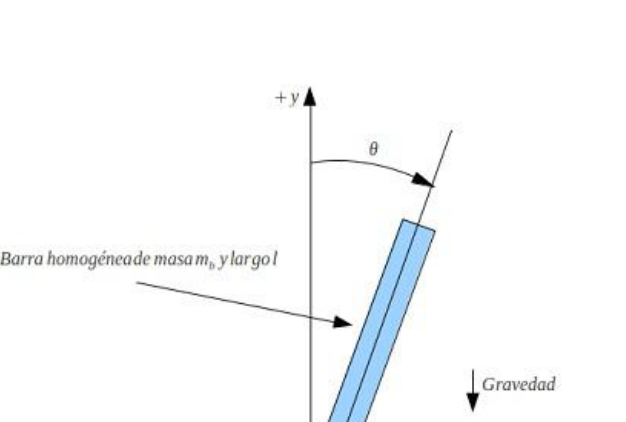
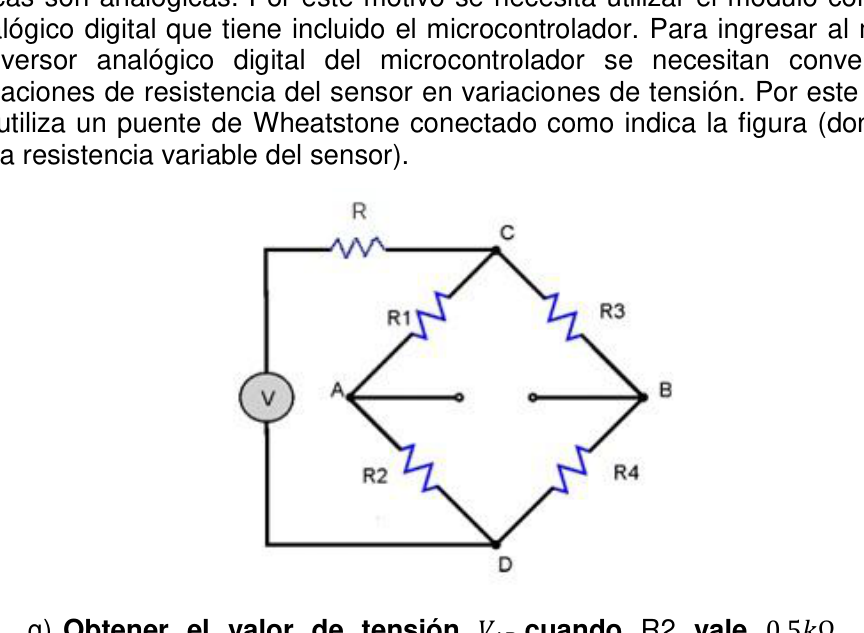
Topic: Rotational Dynamics, Circuits Metodi: Torque & Angular Momentum Analysis, Differential Equations, Small-Angle Approximation Competenze: Physical Reasoning, Mathematical Modeling Objects: Rod, Cart, Resistor Fonte: Testo (PDF) — p.3
Pendolo invertito
PT53. Philips Technical School Argentina Città di Buenos Aires.
Controllo automatico per un pendolo invertito. L’obiettivo di questo problema è analizzare alcune considerazioni fisiche che Dobbiamo considerare la progettazione di un controllo automatico di un pendolo inverso. In questo caso, il controllo automatico è un sistema che ci permette di mantenere stabilizzato il pendolo invertito della figura che La seguente (al termine del problema vengono specificati alcuni dati La Commissione ha adottato una decisione che non è stata adottata. a) Determinare il momento di inerzia del pendolo invertito rispetto a il punto di rotazione in funzione di y b) Supponendo che si rilasci il pendolo invertito da un angolo
- l’accelerazione iniziale rispetto all’asse e la positiva, determinare l’accelerazione Il corpo rigido è angolare in questo istante in funzione dei i seguenti parametri: e
OAF 2011 - 49
Per progettare il pendolo invertito è necessario conoscere l’ordine di grandezza di la forza che deve fare il legame per supportare il sistema in rotazione pura. En Il nostro problema è che il collegamento è il punto di rotazione. c) Determinare la forza del legame all’istante in cui il il pendolo invertito si libera da un angolo iniziale rispetto al
- Axi e positivo. Il risultato deve essere una funzione dei seguenti: parametri: e Il sistema di controllo consente di mantenere stabilizzato il pendolo inverso all’interno di una determinata gamma di condizioni. Se l’ultimo è sottoposto a condizioni fisiche che superano la capacità del sistema di controllo, il pendolo La gravità farà cadere il peso inverso. Il pendolo La gravità di questo sistema di controllo può anche far cadere il volume di energia investita. è disattivato. d) Determinare la velocità angolare del corpo rigido quando si sta passa (per la prima volta) sull’asse e in senso negativo. Supponiamo che che el pendolo Invertito E’ stato rilasciato. da un angolo
- prima rispetto all’asse e dopo la positiva. Il risultato deve essere funzione di: e Per piccoli angoli di allontanamento del pendolo invertito rispetto all’asse e positivo è possibile trovare come varia l’angolo in funzione del tempo. e) Supponendo che si rilasci il pendolo inverso in tempo zero da un angolo iniziale rispetto all’asse e positivo determinare la espressione per angoli piccoli, dove vale la seguente Approximamento: . Perché si può affermare che il sistema
- Non è stabile? Si desidera implementare un sistema di controllo utilizzando un microcontrollatore. Per Questo prima si monta sul pendolo invertito su un carrello che si può spostare in direzione dell’asse x (sia in senso positivo che in senso Negativo). Il sistema di controllo stabilisce le correnti del pendolo invertito per quanto riguarda l’asse verticale, come segue: a partire da un sensore angolare (misura l’angolo di corrimento) il microcontroller rileva che così lontano è il pendolo invertito della posizione verticale e fa le correzioni adeguate a contrastare gli effetti della gravità a partire da movimenti
- Le linee orizzontali del carrello. Il sensore utilizzato per misurare l’angolo di corrimento è resistente (cioè variabile la resistenza a seconda dell’angolo). Quando il corretto rispetto all’asse Verticale è di 0° la resistenza del sensore è di , quando il corrimento è
OAF 2011 - 50 di resistenza del sensore è di e quando il corretto è di La resistenza del sensore è di . La resistenza del sensore è nota variando. Linealmente con l’ angolo in grado di . f) Grafica della resistenza del sensore in base all’angolo e determinare l’espressione matematica corrispondente. Lavorare gli angoli in radianti. Il microcontroller lavora internamente con informazioni digitali. I segnali le fisiche sono analoghe. Per questo motivo è necessario utilizzare il modulo conversore il microcontroller è incluso. Per entrare nel modulo Il microcontroller ha bisogno di convertire i variazioni della resistenza del sensore in variazioni di tensione. Per questo motivo si utilizza un ponte di Wheatstone collegato come indicato nella figura (dove R2 è la resistenza variabile del sensore).
g) Ottenere il valore di tensione quando R2 vale , y . La tensione di alimentazione del circuito è di 5V, resistenze R1, R3 e R4 hanno un valore di e resistenza R ha un valore di Datati: Momento di inerzia della barra omogenea rispetto al centro di massa:
Per risolvere il punto (e) si può utilizzare l’aiuto dettagliato a Continuare. L’equazione differenziale (dove è l’accelerazione, è La posizione, è il tempo, e sono costanti) ha come risultato:
Dove e sono costanti che dipendono dalle condizioni iniziali del
- Non è un problema. Quando la velocità in tempo zero è nulla e la posizione in tempo 0 è , si possono calcolare le costanti utilizzando i seguenti
- Equazioni:
OAF 2011 - 51
Topic: Rotational Dynamics, Circuits Metodi: Torque & Angular Momentum Analysis, Differential Equations, Small-Angle Approximation Competenze: Physical Reasoning, Mathematical Modeling Objects: Rod, Cart, Resistor Fonte: Testo (PDF) — p.3
The following table shows the calculation of the weight of the vehicle:
PT53. Philips Technical School Argentina City of Buenos Aires.
Automatic control for an inverted pendulum. The objective of this problem is to analyse some physical considerations which We must consider designing the automatic control of a pendulum. Inverted. In this case, we mean by automatic control, a system that It allows us to keep the reverse pendulum of the figure stabilized. We present below (at the end of the problem some data are specified (i) the need to address the problem. (a) Determine the moment of inertia of the inverted pendulum with respect to the rotation point in relation to y (b) Assuming that the inverted pendulum is released from an angle The initial axis and positive axis, determining the acceleration The angle of the rigid body at that instant depends on the the following parameters: and
The following points shall be added:
To design the inverted pendulum, it is necessary to know the order of magnitude of the pendulum. The force that the link must make to support the pure rotating system. En Our problem, the link is the turning point. (c) Determine the force of the bond as soon as the The inverse pendulum is released from an initial angle with respect to the axis and positive. The result must be a function of the following parameters: and The control system allows the inverted pendulum to be kept stable inside. of a certain range of conditions. If the latter is subject to physical conditions exceeding the capacity of the control system, the pendulum The amount of money invested will fall indefinitely due to gravity. The pendulum . The reversed weight will also fall due to gravity effects when the control system It’s off. (d) Determine the angular velocity of the rigid body when it is It goes (for the first time) over the axis and in a negative direction. Suppose That el The pendulum Invested He was released. Since un angle Initial with respect to the axis and positive. The result must be function of the following parameters: and For small angles of separation of the pendulum inverted with respect to the axis and positive, it’s possible to find how the angle varies with time. (e) Assuming that the pendulum is released in inverted time From an initial angle to the axis and positive to determine the expression for small angles, where the following is valid Approximation: . Why can it be said that the system turns out to be unstable? A control system using a microcontroller is to be implemented. For It first mounted to the reverse pendulum on a cart that you can. Move in the direction of the x-axis (both in a positive and in a direction The following is the list of the countries of the European Union: The control system stabilizes the bends of the inverted pendulum. with respect to the vertical axis as follows: from an angle sensor (measures the angle of flow) the microcontroller detects that so far away is the pendulum inverted from the vertical position and makes the corrections They are suitable for countering the effects of gravity from motion. horizontal of the cart. The sensor used to measure the angle of flow is resistant (i.e. variable its resistance to angle). When the current with respect to the axis The sensor resistance is of , when the current is
The following is the list of the Member States’ financial statements: The resistance of the sensor is of and when the current is of The sensor ‘s resistance is of . Sensor resistance is known to vary. linearly with the angle in the range of . f) Draw a graph of the resistance of the sensor at the angle and determine the corresponding mathematical expression. Working . the angles in radiants. The microcontroller works internally with digital information. The signals . Physics is analog. For this reason, the converter module is needed. digital analogue device that includes the microcontroller. To enter the module The digital analogue converter of the microcontroller needs to be converted to the the resistance of the sensor variations in voltage variations. For this reason a connected Wheatstone bridge is used as shown in Figure (where R2 is the variable resistance of the sensor).
g) Get the voltage value when R2 is true , y . The circuit’s power voltage is 5V, the resistors R1, R3 and R4 have a value of and resistance R has a value of The data: Inertial moment of the homogeneous bar relative to the centre of the mass:
To resolve point (e) you can use the detailed help to The next step. The differential equation (where acceleration is, is position, is time, and are constant) results in:
Where and are constants that depend on the initial conditions of the It’s a problem. When the speed in zero time is zero and the position in time 0 is , the constants can be calculated using the following Equations:
The following is the list of the Member States’ financial statements:
Topic: Rotational Dynamics, Circuits Metodi: Torque & Angular Momentum Analysis, Differential Equations, Small-Angle Approximation Competenze: Physical Reasoning, Mathematical Modeling Objects: Rod, Cart, Resistor Fonte: Testo (PDF) — p.3
Lamparitas cosmicas
PT54. Escuela Técnica Philips Argentina Ciudad de Buenos Aires.
Lamparitas cósmicas.
La luz es una onda electromagnética. Se trata radiación que pertenece al
espectro electromagnético. Un cuerpo capaz de absorber toda la radiación
electromagnética que lo alcanza se llama cuerpo negro y su capacidad de
absorción es total al igual que su capacidad de emisión.
Un cuerpo negro que se encuentra a una temperatura absoluta , irradia energía
de modo que el máximo de intensidad de la onda electromagnética emitida por el
cuerpo responde a la ley de Wien:
Donde es la longitud de onda de la radiación emitida cuando se alcanza el
máximo de intensidad.
El brillo de una estrella depende la tasa a la cual irradia energía hacia el espacio.
Las estrellas se comportan como cuerpos negros y la energía radiada por unidad
de área y por segundo responde a la ley de Stefan-Boltzmann:
Donde es la temperatura absoluta superficial de la estrella y
es la constante de Stefan-Boltzmann.
La potencia total radiada por una estrella recibe el nombre de luminosidad
absoluta . Vista desde la Tierra, una estrella tiene una luminosidad aparente o
brillo aparente , que corresponde a la energía recibida por unidad de área y por
segundo. Como es de esperar, el brillo aparente de una estrella decrece a
medida que crece la distancia a la estrella.
a) Demuestre que, para una estrella que se encuentre a una
distancia ,
La Figura1 muestra un diagrama de Hertzsprung-Russell. Los astrónomos utilizan este diagrama para clasificar estrellas en función de su temperatura superficial/color y de su luminosidad. En dicho diagrama, se representan las luminosidades absolutas ( ) y las magnitudes aparentes ( ) de las estrellas en función de su temperatura superficial. Las estrellas frías se ven rojas mientras que las más calientes se ven azules. La zona diagonal que se extiende de abajo hacia arriba y de derecha a izquierda se llama secuencia principal. Corresponde de alguna forma a la evolución de las estrellas, las cuales pasan la mayor parte de su existencia en esta zona. Se podría decir que nuestro Sol se encuentra en una fase intermedia se su vida.
OAF 2011 - 52
Utilizando el diagrama H-R (excluyente) y toda información del texto anterior que
considere necesaria:
b) Estime el radio del Sol (en metros y con 3 cifras significativas)
c) Estime la distancia Sol-Tierra (en metros y con 3 cifras
significativas) sabiendo que la potencia que recibimos de nuestra
estrella por metro cuadrado en la superficie terrestre es de
El brillo de una estrella se computa en una escala que nace en la antigua Grecia
hace unos 2000 años y fue ideada por el astrónomo Hipparchus. Se trata de una
escala logarítmica cuya ecuación fue presentada por Pogson en 1856, permite
comparar el brillo relativo de dos estrellas y toma la siguiente forma:
Donde es la llamada magnitud aparente de una estrella. Así, la escala de
brillos estelares implica tomar una estrella o conjunto de estrellas como estándar
de brillo o patrón de luminosidad. Arbitrariamente se elije el cero de la escala de
magnitudes para el brillo de la estrella (Vega), aunque su magnitud es
en realidad de
Aunque una estrella parezca ser más brillante que otra a nuestros ojos, esto no
implica que la primera tenga una luminosidad intrínseca mayor, ya que el brillo
aparente depende de la distancia. Una estrella muy luminosa puede parecer
poco brillante si está muy lejos mientras que una estrella menos luminosa puede
tener un brillo aparente muy elevado si es que se encuentra muy cerca del
observador.
Se define la magnitud absoluta de una estrella como la magnitud aparente que
tendría si se encontrara a una distancia de :
Existe un tipo de estrellas cuyo brillo es variable de forma periódica. A este tipo
de estrellas pertenecen las llamadas Cefeidas que se encuentran en la Pequeña
Nube de Magallanes (galaxia satélite de la Vía Láctea cuyo nombre se debe a
que fueron observadas y estudiadas por Ferdinando de Magallanes y su
tripulación en sus viajes por el hemisferio Sur). Fue la brillante astrónoma
estadounidense Henrietta Leavitt quien en 1912 estudió las estrellas variables
Cefeidas y encontró que su luminosidad absoluta variaba de forma periódica.
Esto permitió que un año después Hertzprung analizara la relación período-
luminosidad y así pudo determinar, utilizando el brillo aparente, la distancia a la
que se encontraban varias cefeidas.
Las oscilaciones del brillo están definidas por la amplitud, es decir, por la
magnitud de la variación del brillo, y por la duración del período , la cual se
obtiene de las observaciones. Leavitt observó y catalogó muchas estrellas
variables lo cual le permitió determinar la relación entre la magnitud absoluta y el
período de estas estrellas. Dicha relación se observa en la figura 3 para un grupo
estelar.
La curva de variación del brillo de las cefeidas se caracteriza por la variación
continua del brillo, el cual suele aumentar con más rapidez de lo que disminuye.
La variación del brillo de una Cefeida se explica por las pulsaciones periódicas
de su superficie, es decir, por las variaciones periódicas de las dimensiones de la
estrella, que van acompañadas de una variación de la temperatura.
Las cefeidas poseen una propiedad notable: su luminosidad absoluta está
relacionada con la duración del periodo de variación del brillo. Esta variación se
puede apreciar en la figura 2 para el caso de la estrella variable (la
cual dio lugar al nombre que reciben estas estrellas variables).
OAF 2011 - 53
Utilizando las figuras 2 y 3,
d) Estime la distancia a la cual se encuentra de nuestro
planeta
Datos útiles
Rapidez de la luz en el vacío:
es la distancia que recorre, en el vacío, una onda
electromagnética durante un intervalo de tiempo igual a un año juliano
equivale exactamente a días, cada uno de
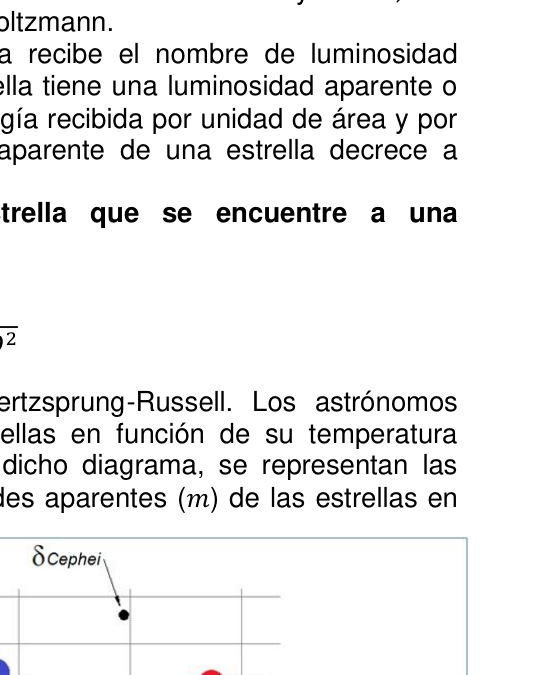
Topic: Astrophysics, Thermodynamics Metodi: Physical Modeling, Approximation & Series Expansion Competenze: Physical Reasoning, Mathematical Modeling Objects: Star Fonte: Testo (PDF) — p.3
Lampazzini cosmici
PT54. Philips Technical School Argentina Città di Buenos Aires.
Piccole lamparelle cosmiche. La luce è un’onda elettromagnetica. Si tratta di radiazioni appartenenti al Spettro elettromagnetico. Un corpo capace di assorbire tutta la radiazione. L’elettromagnetismo che lo raggiunge è chiamato corpo nero e la sua capacità di la capacità di assorbimento totale è pari alla sua capacità di emissione. Un corpo nero che si trova a temperatura assoluta , irradia energia . La massima intensità dell’onda elettromagnetica emessa dal corpo risponde alla legge di Wien:
Dove è la lunghezza d’onda della radiazione emessa quando si raggiunge il
- intensità massima. La luminosità di una stella dipende dalla velocità con cui irradia energia nello spazio. Le stelle si comportano come corpi neri e come energia che viene irradiata per unità. di area e per secondo risponde alla legge di Stefan-Boltzmann:
Dove è la temperatura superficiale assoluta della stella e è la costante di Stefan-Boltzmann. La potenza totale raggiunta da una stella è chiamata luminosità.
- Assolutamente . Veduto dalla Terra, una stella ha una luminosità apparente o luminosità apparente , corrispondente all ’ energia ricevuta per unità di area e per
- Secondo. Come si può aspettare, l’apparente luminosità di una stella diminuisce a A mano a mano che la distanza dalla stella aumenta. a) Dimostra che, per una stella che si trova a Distanza ,
La figura 1 mostra un diagramma di Hertzsprung-Russell. Gli astronomi Usano questo diagramma per classificare le stelle in base alla loro temperatura. superficiale/colore e luminosità. In questo diagramma, le Le luminosità assolute ( ) e le magnitudini apparenti ( ) delle stelle in funzione della sua temperatura superficiale. Le stelle I freddi sembrano rossi mentre che le più calde si
- Vedi ? Blu. La Zona diagonale che si estende Da sotto verso l’alto e da Destra a sinistra si chiama sequenza principale. Corrisponde a una delle due. forma a la evolución de le stelle, che passano la maggior parte di su Esistenza en Questa è la mia . zona. Si potrebbe dire che Il nostro Sole si trova In un periodo intermedio si la sua vita.
OAF 2011 - 52 Usando il diagramma H-R (esclusivo) e tutte le informazioni del testo precedente che ritiene necessario: b) Calcolare il raggio del Sole (in metri e con 3 cifre significative) c) Calcola la distanza Sole-Terra (in metri e con 3 cifre La nostra capacità di creare un’organizzazione di energia è molto significativa. La stella per metro quadrato sulla superficie terrestre è di Il brillo di una stella viene calcolato su una scala che nasce nell’antica Grecia. circa 2000 anni fa ed è stata ideata dall’astronomo Hipparco. Si tratta di una La scala logaristica, la cui equazione fu presentata da Pogson nel 1856, permette confrontare la luminosità relativa di due stelle e assumere la seguente forma:
Dove è la cosiddetta grandezza apparente di una stella. Quindi, la scala di brillanti stellari implica prendere una stella o un insieme di stelle come standard di luminosità o di luminosità. La scadenza è scelto arbitrariamente. Magnitudine per la luminosità della stella (Vega), anche se la sua magnitudine è In realtà di Anche se una stella sembra più brillante di un’altra ai nostri occhi, questo non lo è. Il primo ha una maggiore luminosità intrinseca, poiché il brillo apparentemente dipende dalla distanza. Una stella molto luminosa può sembrare poco brillante se è molto lontano mentre una stella meno luminosa può avere un’ apparente luminosità molto elevata se si trova molto vicino al osservatore. La grandezza assoluta di una stella è definita come la grandezza apparente che Se si trovasse a distanza di:
C’è un tipo di stelle il cui brillo varia periodicamente. A questo tipo . Le stelle appartengono alle cosiddette Cefeide che si trovano nel Piccolo. Nuvola di Magallanes (galassia satellitare della Via Lattea il cui nome deriva da che sono stati osservati e studiati da Ferdinando di Magallanes e il suo In questo caso, la Commissione ha deciso di non limitare la sua partecipazione al progetto di sviluppo. Era un brillante astronomo. americana Henrietta Leavitt che nel 1912 studiò le stelle variabili Cefeida e scoprì che la sua luminosità assoluta variava periodicamente. Questo ha permesso a Hertzprung di analizzare il rapporto periodo- L’aumento della luminosità è stato determinato con l’utilizzo della luminosità apparente, che ci sono stati diversi cefeidi. Le oscillazioni di luminosità sono definite dall’ampiezza, cioè dalla La variazione della luminosità è determinata dalla durata del periodo di variazione della luminosità. si ottiene dalle osservazioni. Leavitt ha osservato e catalogato molte stelle. Le variabili che gli hanno permesso di determinare il rapporto tra la grandezza assoluta e la grandezza totale periodo di queste stelle. Tale rapporto è osservato in figura 3 per un gruppo
- E’ una stella. La curva di variazione della luminosità delle cefeide è caratterizzata dalla variazione La luce continua a crescere più velocemente di quanto diminuisca. La variazione della luminosità di una Cefeida è spiegata dai pulsi periodici. La superficie della superficie, cioè le variazioni periodiche delle dimensioni della superficie La temperatura variabile delle stelle. Le cefeide hanno una proprietà notevole: la loro luminosità assoluta è di relativa alla durata del periodo di variazione della luminosità. Questa variazione è La variabile può essere valutata in figura 2 per il caso della stella variabile (la che ha dato origine al nome che queste stelle variabili ricevono).
OAF 2011 - 53
Usando le figure 2 e 3, d) Calcolare la distanza che si trova da noi. pianeta
Dati utili
Rapidità della luce nel vuoto:
è la distanza percorsa, nel vuoto, da un’onda
elettromagnetico per un intervallo di tempo pari a un anno giuliano
è esattamente pari a giorni, ognuno di
Topic: Astrophysics, Thermodynamics Metodi: Physical Modeling, Approximation & Series Expansion Competenze: Physical Reasoning, Mathematical Modeling Objects: Star Fonte: Testo (PDF) — p.3
The following is a list of the types of cosmic lamps:
PT54. Philips Technical School Argentina City of Buenos Aires.
Cosmic little lambs. Light is an electromagnetic wave. It is radiation that belongs to the electromagnetic spectrum. A body capable of absorbing all the radiation . The electromagnetic force that reaches it is called the black body and its ability to The absorption is total as is its emission capacity. A black body that is at an absolute temperature radiates energy . The maximum intensity of the electromagnetic wave emitted by the body responds to Wien law:
Where is the wavelength of the radiation emitted when the maximum intensity. The brightness of a star depends on the rate at which it radiates energy into space. Stars behave like black bodies and energy radiated per unit. The second is Stefan-Boltzmann’s law:
Where is the absolute surface temperature of the star and It’s the Stefan-Boltzmann constant. The total power radiated by a star is called luminosity. Absolutely . Viewed from Earth, a star has an apparent brightness or apparent brightness , which corresponds to the energy received per unit area and per Second. As you might expect, the apparent brightness of a star decreases to As the distance from the star grows. (a) Prove that, for a star that is a distance ,
Figure 1 shows a Hertzsprung-Russell diagram. The astronomers . They use this diagram to sort stars by their temperature. surface/color and its brightness. In this diagram, the following are represented: The absolute luminosities () and apparent magnitudes () of stars in function of its temperature It’s superficial. The stars . Cold looks red while The hottest ones are See ? Blue. La Area diagonal that extends From the bottom up and from Right to left is It’s called the main sequence. It ‘s a match . The development of the the stars, which They spend most of their time in the su existence en This one . area. You could say that Our sun is in. In the middle phase, the his life.
The following is the list of the countries of the European Union: Using the H-R (exclusive) diagram and all information from the above text that considers it necessary: (b) Estimate the radius of the Sun (in meters and with 3 significant figures) (c) Estimate the distance Sun-Earth (in meters and with 3 digits We are not going to be able to do this without the power of our own power. star per square metre on the Earth’s surface is The brightness of a star is calculated on a scale that originated in ancient Greece. It was invented by the astronomer Hipparchus about 2,000 years ago. It ‘s a . Logarithmic scale whose equation was presented by Pogson in 1856, allows Comparing the relative brightness of two stars, it takes the form
Where it’s the so-called apparent magnitude of a star. So the scale of Star glow involves taking a star or set of stars as standard. of brightness or pattern of brightness. The zero of the scale is arbitrarily chosen. magnitude for the star’s brightness (Vega), although its magnitude is Actually from Even if one star seems brighter than another in our eyes, this is not. It implies that the first one has a higher intrinsic brightness, since the brightness Apparent depends on the distance. A very bright star may seem like it . It ‘s not bright if it ‘s too far away while a less luminous star can . have a very high apparent brightness if it is very close to the The observer. The absolute magnitude of a star is defined as the apparent magnitude that It would if it were at a distance of:
There is a type of star whose brightness is periodically variable. This guy . The stars belong to the so-called Cepheids found in the Little One. Magellanic Cloud (a satellite galaxy of the Milky Way named after the Milky Way) which were observed and studied by Ferdinando de Magallanes and his crew on their journeys through the Southern Hemisphere). She was the brilliant astronomer . American Henrietta Leavitt who in 1912 studied variable stars Cefeidas and found that its absolute brightness varied periodically. This allowed Hertzprung to analyse the period-relation a year later. The lighting was very bright and he could thus determine, using the apparent brightness, the distance to the There were several cephalopods. The oscillations of brightness are defined by the amplitude, i.e. by the The amount of the change in brightness and the length of the period during which it is It’s getting from the observations. Leavitt observed and cataloged many stars . The results of the study were based on the results of the study. period of these stars. This relationship is shown in Figure 3 for a group star. The variation curve of the cephaloplasts’ brightness is characterised by the variation The brightness of the light is constant, which usually increases faster than it decreases. The variation in brightness of a Cepheid is explained by the periodic pulses. The average size of the surface of the earth is about 0. The star is a star, which is accompanied by a temperature change. Cephayids have a remarkable property: their absolute brightness is The amount of the exposure shall be calculated as follows: This variation is The variable star (the which gave rise to the name given to these variable stars).
The following is the list of the Member States’ financial statements:
Using Figures 2 and 3, (d) Estimate the distance from our planet
Useful data
Light speed in vacuum:
is the distance travelled in a vacuum by a wave
electromagnetic for a time interval equal to one Julian year
• exactly equal to days, each of which is
Topic: Astrophysics, Thermodynamics Metodi: Physical Modeling, Approximation & Series Expansion Competenze: Physical Reasoning, Mathematical Modeling Objects: Star Fonte: Testo (PDF) — p.3
Banda transportadora y proyectil
PT55. Escuela Normal Superior Juan B. Alberdi San Miguel de Tucumán.
En una industria se necesita depositar pequeñas piedras en un recipiente. Para ello se utiliza una banda transportadora que se mueve cuando el rodillo de 0,1 m de radio, gira tal como indica la Figura. Calcular: a) El tiempo que tardan las piedras en llegar al extremo superior del embudo b) La velocidad que debe tener la banda transportadora rara que las piedras caigan en el medio del recipiente (punto D) c) La velocidad angular del ,rodillo d) La aceleración de las piedras mientras caen
OAF 2011 - 54
Topic: Newtonian Mechanics, Rotational Dynamics Metodi: Kinematic Equations, Vector Decomposition Competenze: Physical Reasoning Objects: Projectile Fonte: Testo (PDF) — p.3
Banda trasportatrice e proiettile
PT55. Scuola Normale Superiore Juan B. Alberdi San Michele di Tucumán.
In un’industria è necessario depositare piccole pietre in un contenitore. Per si utilizza una banda trasportatrice che si muove quando il rotolo di 0,1 m La radio, gira come indicato nella figura. Calcolare: a) Il tempo necessario per raggiungere l’estremità superiore del funile b) La velocità che deve avere la banda trasportatrice raramente superiore a quella di le pietre cadono nel mezzo del recipiente (punto D) c) La velocità angolare del rodello d) Accelerazione delle pietre mentre cadono
OAF 2011 - 54
Topic: Newtonian Mechanics, Rotational Dynamics Metodi: Kinematic Equations, Vector Decomposition Competenze: Physical Reasoning Objects: Projectile Fonte: Testo (PDF) — p.3
Transporter and projectile band
PT55. Secondary school Juan B. Alberdi . St. Michael of Tucumán.
In an industry, small stones need to be deposited in a container. For This is done by using a conveyor belt which moves when the 0.1 m roll is The radius of the radius, rotating as shown in Figure 1. Calculation: (a) The time it takes the stones to reach the top of the The funnel (b) The speed of the conveyor belt should be less than the speed of the conveyor belt. stones fall into the middle of the container (point D) (c) The angular velocity of the wheel (d) The acceleration of the stones as they fall.
The following is the list of the Member States’ financial statements:
Topic: Newtonian Mechanics, Rotational Dynamics Metodi: Kinematic Equations, Vector Decomposition Competenze: Physical Reasoning Objects: Projectile Fonte: Testo (PDF) — p.3
Madera cayendo en aceite
PT56. Escuela Normal Superior Juan B. Alberdi San Miguel de Tucumán.
Un trozo de madera de 1 kg de peso y densidad 0,6 g/cm3 se lanza verticalmente hacia abajo con una velocidad de ,2 m/s desde un punto situado a 5m de altura sobre la superficie de un deposito. De aceite de densidad 0.9 g/cm3. Si se desprecian las resistencias del aire y del aceite. Calcular: a) La velocidad con la que llega a la superficie del líquido b) El empuje que sufre una vez sumergido c) La aceleración con que se mueve en el interior del líquido d) La profundidad a que desciende y el tiempo invertido en dicho descenso.
Topic: Fluid Mechanics, Newtonian Mechanics Metodi: Hydrostatic Equilibrium, Kinematic Equations Competenze: Physical Reasoning Objects: Block, Container Fonte: Testo (PDF) — p.3
Madre cadendo in olio
PT56. Scuola Normale Superiore Juan B. Alberdi San Michele di Tucumán.
Un pezzo di legno di 1 kg di peso e di densità 0,6 g/cm3 viene lanciato Verticalmente verso il basso a una velocità di ,2 m/s da un punto situato a 5 metri di altezza sulla superficie di un deposito. Olio di densità 0,9 g/cm3. Se si disprezza la resistenza dell’aria e dell’olio. Calcolare: a) La velocità con cui arriva alla superficie del liquido b) Il impulso che subisce una volta immerso c) L’accelerazione con cui si muove all’interno del liquido d) La profondità alla quale scende e il tempo impiegato per scendere.
Topic: Fluid Mechanics, Newtonian Mechanics Metodi: Hydrostatic Equilibrium, Kinematic Equations Competenze: Physical Reasoning Objects: Block, Container Fonte: Testo (PDF) — p.3
Made in oil
PT56. Secondary school Juan B. Alberdi . St. Michael of Tucumán.
A piece of wood weighing 1 kg and density 0.6 g/cm3 is thrown Vertically downwards at a speed of ,2 m/s from a point located at 5 m above the surface of a deposit. Of a density of 0.9 g/cm3. If you despise the resistance of air and oil. Calculation: (a) The speed at which it reaches the surface of the liquid (b) The thrust it suffers once submerged (c) The acceleration at which it moves inside the liquid (d) The depth to which it descends and the time spent on it.
Topic: Fluid Mechanics, Newtonian Mechanics Metodi: Hydrostatic Equilibrium, Kinematic Equations Competenze: Physical Reasoning Objects: Block, Container Fonte: Testo (PDF) — p.3
Electrolisis y calorimetro
PT57. Escuela Normal Superior Juan B. Alberdi San Miguel de Tucumán.
En un circuito eléctrico esta formado por las siguientes partes conectadas en serie y de una batería de acumuladores en la que cada elemento tiene 2 V de fem, una resistencia de 8 Ω introducida en un calorímetro con agua, cuya capacidad calorífica equivale a 500 g de agua , un voltímetro de agua acidulada, con electrodos de platino y otro de nitrato de plata con electrodos de plata. Calcular: a) La intensidad de la cte. eléctrica b) El volumen de hidrogeno producido durante 15 min en el voltámetro de agua acidulada, medido en Condiciones Normales c) El peso de plata depositado durante un cuarto de hora en el cátodo del voltímetro de AgNo3 d) El numero de elementos que tendrá la batería de acumuladores, sabiendo que la resistencia total del circuito es de 12 Ω Datos. Peso atómico de la Plata 108 g. Fuerza contraelectromotriz del voltámetro de agua 1,5 V. Para elevar un grado la temperatura de agua del calorímetro tiene que pasar la corriente durante 15 min.
OAF 2011 - 55
Topic: Circuits, Chemistry Metodi: Kirchhoff’s Laws, First Law of Thermodynamics Competenze: Physical Reasoning Objects: Battery, Resistor, Calorimeter Fonte: Testo (PDF) — p.3
Electrolisi e caloriometro
PT57. Scuola Normale Superiore Juan B. Alberdi San Michele di Tucumán.
In un circuito elettrico è costituito dalle seguenti parti collegate in serie e di una batteria di accumulatori in che ogni elemento ha 2 V di fem, una resistenza di 8 Ω inserita in un caloriometro ad acqua, la cui capacità calorificante equivale a 500 g di acqua , un Voltometro di acqua acidificata, con elettrodi di platino e di nitrato d’argento con elettrodi d’argento. Calcolare: a) L’intensità della cte. elettrica b) Il volume di idrogeno prodotto Per 15 minuti al voltometro di acqua acidolatto, misura en Condizioni normali (c) Peso d’ argento depositato durante Un quarto d’ora in catodo del Voltimetro di AgNo3 d) Il numero di elementi che avrà la Batteria de accumulatori, sapendo che la resistenza totale del Circuito è di 12 Ω Datati. Peso atomico dell’Argento 108 g. Forza controelettromotrice del voltometro di acqua di 1,5 V. Per aumentare di un grado la temperatura dell’acqua del calometro ha che passano il corrente per 15 minuti.
OAF 2011 - 55
Topic: Circuits, Chemistry Metodi: Kirchhoff’s Laws, First Law of Thermodynamics Competenze: Physical Reasoning Objects: Battery, Resistor, Calorimeter Fonte: Testo (PDF) — p.3
Electrolysis and calorimeter
PT57. Secondary school Juan B. Alberdi . St. Michael of Tucumán.
In an electrical circuit it is made up of the following parts connected in series and a battery of accumulators in which each element has 2 V of fem, one 8 Ω resistance introduced into a water heaters, the capacity of which is The heat equivalent is 500 g of water , one . Acid water voltmeter, with electrodes Platinum and other silver nitrate with silver electrodes. Calculation: (a) The intensity of the cte. electrical (b) The volume of hydrogen produced for 15 minutes at the voltmeter of Water acidic, measured en Normal conditions (c) The silver weight deposited during A quarter of an hour in the cathode of The following is the list of the components of the test: (d) The number of items it will have la Battery de the manufacturer’s name, Knowing that the total resistance of the The circuit is 12 Ω The data. Silver atomic weight 108 g. The voltage of the voltage is measured by the force of the electromagnetic force. of water of 1,5 V. To raise the temperature of the water in the calorimeter by one degree I’m going to go through the current for 15 minutes.
The following points shall be added:
Topic: Circuits, Chemistry Metodi: Kirchhoff’s Laws, First Law of Thermodynamics Competenze: Physical Reasoning Objects: Battery, Resistor, Calorimeter Fonte: Testo (PDF) — p.3
Desplazamiento desde grafico
PT58. EPES Nro. 56 San Miguel Ciudad de Formosa.
Determinar el desplazamiento total del móvil cuyo movimiento se describe en el gráfico
Topic: Newtonian Mechanics Metodi: Kinematic Equations, Experimental Data Analysis Competenze: Physical Reasoning Objects: — Fonte: Testo (PDF) — p.3
Svolta da grafico
PT58. - Non lo so. 56 San Michele Città di Formosa.
Determinare il spostamento totale del cellulare il cui movimento è descritto in grafico
Topic: Newtonian Mechanics Metodi: Kinematic Equations, Experimental Data Analysis Competenze: Physical Reasoning Objects: — Fonte: Testo (PDF) — p.3
The following table shows the number of samples taken from the sample:
PT58. The Commission shall adopt implementing acts in accordance with Article 21 of this Regulation. 56 San Miguel The city of Formosa.
Determine the total movement of the mobile whose movement is described in the Graph
Topic: Newtonian Mechanics Metodi: Kinematic Equations, Experimental Data Analysis Competenze: Physical Reasoning Objects: — Fonte: Testo (PDF) — p.3
Prensa hidraulica
PT59. EPES Nro. 56 San Miguel Ciudad de Formosa.
Determinar el radio que debe tener la superficie del pistón cilíndrico de una prensa hidráulica, si ejerce 500 N de fuerza; mientras que sobre el otro pistón, de 3 cm de radio se aplican 2 kgf
Topic: Fluid Mechanics Metodi: Hydrostatic Equilibrium Competenze: Physical Reasoning Objects: Piston Fonte: Testo (PDF) — p.3
Prensa idraulica
PT59. - Non lo so. 56 San Michele Città di Formosa.
Determinare il raggio che deve avere la superficie del pistone cilindrico di una la pressione idraulica, se esercita 500 N di forza; mentre sull’altro pistone, 3 cm di radius applicato 2 kgf
Topic: Fluid Mechanics Metodi: Hydrostatic Equilibrium Competenze: Physical Reasoning Objects: Piston Fonte: Testo (PDF) — p.3
The following table shows the number of units of the vehicle:
PT59. The Commission shall adopt implementing acts in accordance with Article 21 of this Regulation. 56 San Miguel The city of Formosa.
Determine the radius of the cylindrical piston surface of a Hydraulic presses, if they exert 500 N of force; whereas on the other piston, 3 cm radius is applied 2 kgf
Topic: Fluid Mechanics Metodi: Hydrostatic Equilibrium Competenze: Physical Reasoning Objects: Piston Fonte: Testo (PDF) — p.3
Masa de oro
PT60. EPES Nro. 56 San Miguel Ciudad de Formosa.
En una película de ladrones de bancos se observa que un delincuente llena
una mochila de 30 litros con monedas de oro. Si la densidad del oro es 19,32
g/cm3; ¿Cuál es la masa en kg que transporta el ladrón? ¿Cuál su peso? ¿Qué
opinas sobre la posibilidad de que en esta escena se transporte oro realmente?
Topic: Order-of-Magnitude Estimation, Fluid Mechanics Metodi: Order-of-Magnitude Estimation Competenze: Physical Reasoning Objects: — Fonte: Testo (PDF) — p.3
Massa d’oro
PT60. - Non lo so. 56 San Michele Città di Formosa.
In un film di ladri di banche si vede un criminale che riempie una borsa da 30 litri con monete d’oro. Se la densità dell’oro è 19,32 G/cm3; Qual è la massa in kg che il ladro porta? Qual è il suo peso? Cosa? Lei pensa che in questa scena si possa trasportare oro?
Topic: Order-of-Magnitude Estimation, Fluid Mechanics Metodi: Order-of-Magnitude Estimation Competenze: Physical Reasoning Objects: — Fonte: Testo (PDF) — p.3
The weight of gold
PT60. The Commission shall adopt implementing acts in accordance with Article 21 of this Regulation. 56 San Miguel The city of Formosa.
In a bank robbery movie , you see a criminal filling up . A 30-liter backpack with gold coins. If the gold density is 19.32 g/cm3; What mass in kg does the thief carry? What’s your weight? What? Do you think there’s a possibility that this scene actually carries gold?
Topic: Order-of-Magnitude Estimation, Fluid Mechanics Metodi: Order-of-Magnitude Estimation Competenze: Physical Reasoning Objects: — Fonte: Testo (PDF) — p.3
Trenes y cambio de via
PT61. Colegio María Auxiliadora
Instituto Privado San Luis Gonzaga
Escuela Normal Juan Pascual Pringles
Ciudad de San Luis.
Debido a problemas en el funcionamiento de los sistemas de control ferroviario, dos trenes viajan por la misma vía y en sentidos contrarios a gran velocidad. Uno de ellos transporta ácido sulfúrico proveniente de una planta de procesamiento de minerales y el otro transporta tanques con solventes altamente volátiles. El accidente, de producirse, tendría gravísimas consecuencias para las poblaciones vecinas y para el medioambiente en general. En este momento el tren que va hacia el sur pasa a tu lado y se mueve a 120km/h, mientras que el que va hacia el norte se desplaza a una rapidez de 90km/h y se encuentra a 20km de
OAF 2011 - 56 distancia del primero. A unos 11 kilómetros de tu actual posición, se halla una pequeña población en donde hay una vía paralela. Urgido por la necesidad de evitar esta catástrofe, llamas al técnico que está en esa estación ferroviaria advirtiendo de la fatal situación. El técnico al enterarse de los que podría suceder te dice que hacer el cambio de vías le levaría dos minutos. ¿Será posible evitar el accidente? a) Haga un esquema del problema planteado. b) Construye la respectiva gráfica posición versus tiempo y obtén el valor aproximado de la solución buscada. c) Escribe las respectivas ecuaciones de movimiento para cada tren. d) Encuentra analíticamente el momento y el lugar del cruce entre trenes. ¿Es coincidente este valor con el que obtuviste a partir de la gráfica posición versus tiempo?
Topic: Newtonian Mechanics Metodi: Kinematic Equations, Graph Linearization Competenze: Physical Reasoning Objects: — Fonte: Testo (PDF) — p.3
Treni e cambio di rotta
PT61. La scuola Maria Assillie Istituto Privato San Luis Gonzaga Scuola Normale Juan Pascual Pringles Città di San Luis.
A causa di problemi nel funzionamento dei sistemi di controllo ferroviario, due treni viaggiano sulla stessa pista e in direzioni opposte a grande velocità. Uno di cui trasporta acido sulfuro proveniente da un impianto di lavorazione Il primo porta i serbatoi con solventi altamente volatili. El Se si verificasse, l’incidente avrebbe gravi conseguenze per le popolazioni. per i nostri vicini e per l’ambiente in generale. In questo momento il treno sta andando verso sud passa da te e si muove a 120km/h, mentre quello che va verso Il nord si muove a 90 km/h e si trova a 20 km di distanza da
OAF 2011 - 56 Distanza da prima. Circa 11 chilometri dalla tua posizione attuale, c’è una piccola popolazione con una via parallela. Urgente per la necessità di E’ meglio che tu chiami il tecnico che sta in quella stazione. Avvertendo di una situazione fatale. Il tecnico , quando si accorge di ciò che potrebbe accadere . Ti dice che cambiare rotta gli ci vorrebbe due minuti. È possibile evitare? l’incidente? a) Sviluppa un schema del problema. b) Costruisce il rispettivo grafico posizione versus tempo e ottiene il valore approssimativo della soluzione richiesta. c) Escrivere le rispettive equazioni di movimento per ogni treno. d) Trova analisi del momento e del luogo del passaggio tra treni. Questo valore corrisponde a quello che hai ottenuto dal grafico? posizione contro tempo?
Topic: Newtonian Mechanics Metodi: Kinematic Equations, Graph Linearization Competenze: Physical Reasoning Objects: — Fonte: Testo (PDF) — p.3
Trains and change of route
PT61. Mary Help of Christians College Private Institute of San Luis Gonzaga The school is called Juan Pascual Pringles. City of St. Louis.
Due to problems with the operation of railway control systems, Two trains travel on the same track and in opposite directions at high speed. One . Of these, it carries sulphuric acid from a processing plant. The other carries tanks with highly volatile solvents. El The Commission has already taken a number of measures to ensure that the Community’s financial resources are used to finance the implementation of the programme. The Commission has already adopted a number of proposals for the directive. Right now the train is going It’s moving south and it’s moving at 120km/h, while the one that’s going south is moving to your side. The north is moving at a speed of 90km/h and is 20km from
The following is the list of the Member States’ financial statements: distance from the first. About 11 kilometers from your current position, there’s a small population where there is a parallel road. Urgently in need of To avoid this catastrophe, call the technician who is at that train station. warning of the terrible situation. The technician on learning of what might happen He tells you that changing routes would take him two minutes. Is it possible to avoid it? The accident? (a) Draw up a sketch of the problem. (b) Build the respective position versus time graph and get the approximate value of the solution sought. (c) Write the respective equations of motion for each train. (d) Find the time and place of the inter-train crossing analytically. Is this value matched to the one you got from the graph? position versus time?
Topic: Newtonian Mechanics Metodi: Kinematic Equations, Graph Linearization Competenze: Physical Reasoning Objects: — Fonte: Testo (PDF) — p.3
Tanque de agua y caudal
PT62. Colegio María Auxiliadora
Instituto Privado San Luis Gonzaga
Escuela Normal Juan Pascual Pringles
Ciudad de San Luis.
En la parte superior de una torre se
ha colocado un depósito de agua
capaz de contener un volumen
máximo
de
20.000
litros.
Ese
recipiente se llena con una cañería
proveniente de una bomba que es
capaz de incorporar 500 litros de
agua por minuto, provenientes de
una cisterna ubicada en la base de la
torre. Esta bomba luego de haber
aportado el volumen necesario para
llenar por completo el tanque, sufre
un desperfecto mecánico que a deja
inútil.
El agua de este tanque se utiliza
para regar una quinta de hortalizas,
mediante una cañería ubicada en la
base de la torre, dicha cañería tiene
2 pulgadas de diámetro y a las 8 de
la mañana el encargado de cuidar
esta huerta abre el grifo de riego.
Suponiendo que el operario no
vuelve a cerrar la canilla de riego, ¿cuánto tiempo tardará en vaciarse este
tanque? ¿Cuál es el caudal de esta cañería de riego? ¿Cuál es la velocidad de
salida del agua? ¿Cuál es la presión que experimenta el grifo que cierra a
cañería de riego cuando el tanque estaba completamente lleno de agua?
OAF 2011 - 57 -50 -40 -30 -20 -10 0 10 20 30 40 50 0 5 10 15 20 25 30 35 40 45 50 55 60 65 70 75 80 Tiempo (seg) Posición (m)
Topic: Fluid Mechanics Metodi: Bernoulli’s Equation, Continuity Equation Competenze: Physical Reasoning Objects: Container, Tube Fonte: Testo (PDF) — p.3
Tanca di acqua e flusso
PT62. La scuola Maria Assillie Istituto Privato San Luis Gonzaga Scuola Normale Juan Pascual Pringles Città di San Luis.
Sulla parte superiore di una torre si è Ha messo un serbatoio d’acqua. capace di contenere un volume massimo de 20.000 litri.
- Quello . Contenitore si riempie con un canne proveniente da una bomba che è capace di incorporare 500 litri di acqua per minuto, proveniente da una cisterna situata alla base della torre. Questa bomba dopo aver avuto
- il volume necessario per riempire completamente il serbatoio, soffre Un guasto meccanico che lo lascia.
- Non serve. L’acqua di questo serbatoio è utilizzata. per irrigare un quinto di verdura, mediante un tubo situato nella La base della torre, il canale ha 2 pollici di diametro e a 8 di Il mattino il responsabile della cura Questo orto apre il canale di irrigazione. Supponendo che l’operatore non chiude di nuovo la canale di irrigazione, quanto tempo ci vorrà per svuotare questo
- Un carro armato? Qual è il flusso di questo canale di irrigazione? Qual è la velocità di uscita dall’acqua? Qual è la pressione che il rubinetto che chiude a
- l’irrigazione quando il serbatoio era completamente pieno di acqua?
OAF 2011 - 57 -50 -40 -30 -20 -10 0 10 20 30 40 50 0 5 10 15 20 25 30 35 40 45 50 55 60 65 70 75 80 Tempo (seg) Posizione (m)
Topic: Fluid Mechanics Metodi: Bernoulli’s Equation, Continuity Equation Competenze: Physical Reasoning Objects: Container, Tube Fonte: Testo (PDF) — p.3
The following table shows the results of the calculation of the total capacity of the vessel:
PT62. Mary Help of Christians College Private Institute of San Luis Gonzaga The school is called Juan Pascual Pringles. City of St. Louis.
On top of a tower is He ‘s put a water tank . capable of containing a volume Maximum de 20.000 liters. That one . The container is filled with a pipe . It came from a bomb that is capable of incorporating 500 litres of water per minute, coming from A tank located at the base of the tower. This bomb after you ‘ve been The volume needed for Fill the tank full, suffer. A mechanical malfunction that leaves you. It’s useless. The water from this tank is used. to water a garden of vegetables, by a pipeline located at The base of the tower, that pipe has 2 inches in diameter and 8 inches in diameter . In the morning the caretaker . This garden opens the irrigation tap. Assuming the operator doesn ‘t . If you close the irrigation trough again, how long will it take to empty this one? What about the tank? What’s the flow rate of this irrigation pipe? What’s the speed of out of the water? What is the pressure on the tap that closes the tap? I mean, water pipes when the tank was completely filled with water?
The following is the list of the Member States’ financial statements: -50 -40 -30 -20 -10 0 10 20 30 40 50 0 5 10 15 20 25 30 35 40 45 50 55 60 65 70 75 80 Time (seconds) Position (m)
Topic: Fluid Mechanics Metodi: Bernoulli’s Equation, Continuity Equation Competenze: Physical Reasoning Objects: Container, Tube Fonte: Testo (PDF) — p.3
Grafico posicion-tiempo
PT63. Colegio María Auxiliadora
Instituto Privado San Luis Gonzaga
Escuela Normal Juan Pascual Pringles
Ciudad de San Luis.
A partir de la siguiente gráfica responde las preguntas que a continuación se te formulan: a) ¿Cuál es la posición inicial del móvil? b) ¿Estuvo este objeto alguna vez en reposo, si es afirmativa tu respuesta indica dónde y por cuánto tiempo? c) ¿Cuál es la distancia total recorrida por este móvil? d) ¿Cuál es el desplazamiento neto de este móvil durante los 80 segundos de recorrido? e) ¿Haz la respectiva gráfica velocidad versus tiempo en base a los datos aportados por la gráfica posición versus tiempo?
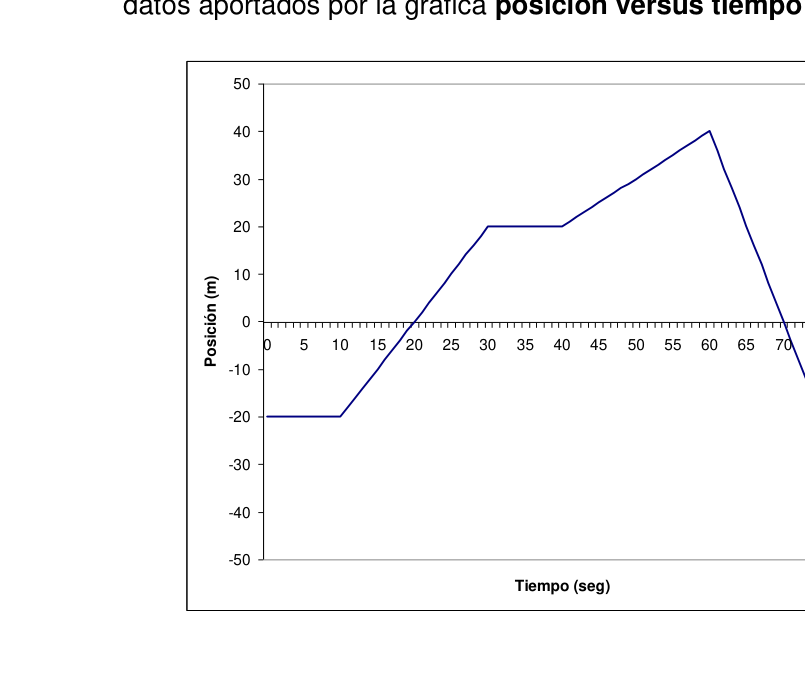
Topic: Newtonian Mechanics Metodi: Kinematic Equations, Experimental Data Analysis Competenze: Physical Reasoning Objects: — Fonte: Testo (PDF) — p.3
Grafico posizionamento-tempo
PT63. La scuola Maria Assillie Istituto Privato San Luis Gonzaga Scuola Normale Juan Pascual Pringles Città di San Luis.
Dal grafico seguente risponde alle domande che seguono formulare: a) Qual è la posizione iniziale del cellulare? b) È mai stato a riposo, se la tua risposta è affermativa indica dove e per quanto tempo? c) Qual è la distanza totale percorsa da questo mobile? d) Qual è il netto spostamento di questo cellulare per gli 80 secondi di viaggio? e) Fa la rispettiva grafica velocità versus tempo basata su dati forniti dal grafico posizione contro tempo?
Topic: Newtonian Mechanics Metodi: Kinematic Equations, Experimental Data Analysis Competenze: Physical Reasoning Objects: — Fonte: Testo (PDF) — p.3
The following table shows the position-time chart:
PT63. Mary Help of Christians College Private Institute of San Luis Gonzaga The school is called Juan Pascual Pringles. City of St. Louis.
From the following graph you will find answers to the questions below. The following formulae are given: (a) What is the initial position of the mobile phone? (b) Has this object ever been rested, if your answer is yes? Indicates where and for how long? (c) What is the total distance travelled by this mobile? (d) What is the net displacement of this mobile phone during 80 seconds?
- What? (e) Does the respective graph speed versus time based on the data provided by the position versus time graph?
Topic: Newtonian Mechanics Metodi: Kinematic Equations, Experimental Data Analysis Competenze: Physical Reasoning Objects: — Fonte: Testo (PDF) — p.3
Tres cargas puntuales
PT64. EPES Nro. 54 Gobernador Juan J. Silva Ciudad de Formosa.
Dos cargas puntuales q1 = 2µ y q2 = 8µC están ubicados a 30 cm de distancia.
En un punto A, situado entre ambas cargas y distante 10 cm de q2, se coloca
una carga q3 = 3 µC .
1- Esquematizar la situación.
2- Calcule el modulo de la fuerza F13 que q1 ejerce sobre q3
3- Calcule el modulo de la fuerza F23 que q2 ejerce sobre q3
4- Represente en su esquema las fuerzas halladas anteriormente.
5- Calcule el modulo de la fuerza total FT, que actúa sobre q3, debido al
sistema de cargas q1 y q2. represente vectorialmente a FT.
6- Existe un punto B donde sobre la recta que une q1 y q2 tal que si se
coloca q3 allí la FT se anula? Si / No
7- Si la carga q3 sale de la recta que une q1 con q2 (puede / no puede)
encontrar un punto donde la fuerza Total sea nula.
OAF 2011 - 58
Topic: Electrostatics Metodi: Coulomb’s Law, Superposition Principle Competenze: Physical Reasoning Objects: Point Charge Fonte: Testo (PDF) — p.3
Tre cariche puntate
PT64. - Non lo so. 54 Governatore Juan J. Silva Città di Formosa.
Due carichi puntuali q1 = 2μ e q2 = 8μC sono posizionati a 30 cm di distanza. In un punto A, situato tra le due cariche e distante 10 cm da q2, si colloca una carica q3 = 3 μC . 1- Squamatizzare la situazione. 2- Calcolare il modulo di forza F13 che q1 esercita su q3 3- Calcola il modulo della forza F23 che q2 esercita su q3 4- Rappresenta nel suo schema le forze precedentemente trovate. 5- Calcolare il modulo della forza totale FT, che agisce su q3, a causa di sistema di cariche q1 e q2. rappresenta vectoralmente FT. 6- C’è un punto B dove sulla retta che unisce q1 e q2 in modo che se si
- Si mette Q3 lì. - La FT viene annullata? Si / No
7- Se la carica q3 esce dalla retta che collega q1 a q2 (può / non può) trovare un punto dove la forza totale è nulla.
OAF 2011 - 58
Topic: Electrostatics Metodi: Coulomb’s Law, Superposition Principle Competenze: Physical Reasoning Objects: Point Charge Fonte: Testo (PDF) — p.3
The following is the list of the following:
PT64. The Commission shall adopt implementing acts in accordance with Article 21 of this Regulation. 54 Governor John J. Silva The city of Formosa.
Two point loads q1 = 2μ and q2 = 8μC are located 30 cm apart.
At a point A, located between both loads and 10 cm from q2, it is placed
a charge q3 = 3 μC .
1- Sketch the situation.
2- Calculate the force modulus F13 that q1 exerts on q3
3- Calculate the modulus of the force F23 that q2 exerts on q3
4- Represents in its scheme the forces previously found.
5- Calculate the modulus of total force FT, acting on q3, due to
The following conditions shall apply: is vectorally represented by FT.
6- There is a point B where on the straight line it joins q1 and q2 such that if
Put q3 there the FT is cancelled? Si / No
7- If the q3 load is out of the straight linking q1 to q2 (can/can’t)
Find a point where the total force is zero.
The following is the list of the Member States’ financial statements:
Topic: Electrostatics Metodi: Coulomb’s Law, Superposition Principle Competenze: Physical Reasoning Objects: Point Charge Fonte: Testo (PDF) — p.3
Imagen en lente biconvexa
PT65. EPES Nro. 54 Gobernador Juan J. Silva Ciudad de Formosa.
Halle gráficamente la imagen de una flecha de 2 cm de altura, ubicada a 5 cm de una lente delgada biconvexa, cuya distancia focal es de 3cm. La base de esta flecha esta sobre el eje principal y perpendicular al el.
Topic: Geometric Optics Metodi: Ray Tracing, Thin Lens & Mirror Equation Competenze: Physical Reasoning Objects: Lens Fonte: Testo (PDF) — p.3
Immagine biconvexa
PT65. - Non lo so. 54 Governatore Juan J. Silva Città di Formosa.
Trova graficamente l’immagine di un’arcia alta 2 cm, posizionata a 5 cm di distanza da una lente sottile biconvexa, la cui distanza focale è di 3 cm. La base di questa Arrow è sopra l’asse principale e perpendicolare all’asse.
Topic: Geometric Optics Metodi: Ray Tracing, Thin Lens & Mirror Equation Competenze: Physical Reasoning Objects: Lens Fonte: Testo (PDF) — p.3
Biconvex lens image
PT65. The Commission shall adopt implementing acts in accordance with Article 21 of this Regulation. 54 Governor John J. Silva The city of Formosa.
Find graphically the image of a 2 cm high arrow, located 5 cm from a biconvex thin lens, the focal length of which is 3 cm. The basis of this Arrow is over the main axis and perpendicular to the el.
Topic: Geometric Optics Metodi: Ray Tracing, Thin Lens & Mirror Equation Competenze: Physical Reasoning Objects: Lens Fonte: Testo (PDF) — p.3
Energia potencial y cinetica
PT66. EPES Nro. 54 Gobernador Juan J. Silva Ciudad de Formosa.
Calcule para un cuerpo de 50 kg de masa:
A cuando se encuentra en reposo a 30 m de altura:
Cual es su energía potencial en Joule.
Y cual es su energía mecánica?
B si se lo deja caer libremente, al descender 10 m
Cual es su energía potencial?
Cual es su energía cinética?
Cual es su energía mecánica?
C cuando llega al suelo:
Cual es su velocidad?
Cual es su energía cinética?
Cual es su energía mecánica?
Topic: Conservation of Energy Metodi: Conservation of Energy, Kinematic Equations Competenze: Physical Reasoning Objects: — Fonte: Testo (PDF) — p.3
Energia potenziale e cinetica
PT66. - Non lo so. 54 Governatore Juan J. Silva Città di Formosa.
Calcola per un corpo di 50 kg di massa: A quando si trova a riposo a 30 m di altezza: Qual è la sua energia potenziale in Joule. E qual è la sua energia meccanica? B se si lascia cadere liberamente, scendendo 10 m Qual è la sua energia potenziale? Qual è la sua energia cinetica? Qual è la sua energia meccanica? C quando arriva al suolo: Qual è la sua velocità? Qual è la sua energia cinetica? Qual è la sua energia meccanica?
Topic: Conservation of Energy Metodi: Conservation of Energy, Kinematic Equations Competenze: Physical Reasoning Objects: — Fonte: Testo (PDF) — p.3
The energy content of the test chemical is the same as that of the test chemical.
PT66. The Commission shall adopt implementing acts in accordance with Article 21 of this Regulation. 54 Governor John J. Silva The city of Formosa.
Calculate for a body of 50 kg mass: When at rest at 30 m altitude: What’s your potential energy in Joule? And what’s their mechanical energy? B if you let it fall freely, coming down 10 m What’s your potential energy? What’s your kinetic energy? What’s your mechanical energy? C when it reaches the ground: What’s your speed? What’s your kinetic energy? What’s your mechanical energy?
Topic: Conservation of Energy Metodi: Conservation of Energy, Kinematic Equations Competenze: Physical Reasoning Objects: — Fonte: Testo (PDF) — p.3
Comparacion de velocidades MRU
PT67. EPES Nro. 54 Gobernador Juan J. Silva Ciudad de Formosa.
Teniendo en cuenta que un móvil A desarrolla una velocidad de 88km/h, un
móvil B recorre 30 metros en 1 segundo, y un móvil C emplea 15 minutos en
recorrer 25 kilómetros. Los tres móviles con MRU. INDIQUE:
A cual es el móvil que desarrolla mayor velocidad?
B que distancia recorre el móvil C en 30 segundos?
C que tiempo emplea el móvil B en recorrer 8 km ?
D represente en un mismo grafico las velocidades de los tres móviles en
función del tiempo.
Topic: Newtonian Mechanics Metodi: Kinematic Equations Competenze: Physical Reasoning Objects: — Fonte: Testo (PDF) — p.3
Comparare le velocità MRU
PT67. - Non lo so. 54 Governatore Juan J. Silva Città di Formosa.
Considerando che un mobile A sviluppa una velocità di 88 km/h, un il cellulare B percorre 30 metri in un secondo, e il cellulare C percorre 15 minuti in percorrere 25 chilometri. I tre cellulari con MRU. Indicazione: A quale cellulare si sviluppa la velocità più elevata? B, che distanza percorre il cellulare C in 30 secondi? C. Quanto tempo ci vuole per il cellulare B per percorrere 8 km ? D rappresenta in un grafico le velocità dei tre mobili in funzione del tempo.
Topic: Newtonian Mechanics Metodi: Kinematic Equations Competenze: Physical Reasoning Objects: — Fonte: Testo (PDF) — p.3
The following shall be added to the list of the following:
PT67. The Commission shall adopt implementing acts in accordance with Article 21 of this Regulation. 54 Governor John J. Silva The city of Formosa.
Given that a mobile A develops a speed of 88km/h, a Mobile B travels 30 meters in 1 second, and mobile C travels 15 minutes in I’m going to walk 25 miles. All three phones with MRU. The following is the list of the countries of the European Union: Which mobile is the fastest? B, how far does cell phone C travel in 30 seconds? C What time does mobile B take to travel 8 km ? D represents the speeds of the three mobiles in function of time.
Topic: Newtonian Mechanics Metodi: Kinematic Equations Competenze: Physical Reasoning Objects: — Fonte: Testo (PDF) — p.3
Resultante de dos fuerzas
PT68. EPES Nro. 54 Gobernador Juan J. Silva Ciudad de Formosa.
Dos personas, mediante sogas, arrastran un automóvil con fuerzas F1= 600 N y
F2= 800 N, que forman entre si un ángulo de 60·
A Halle gráficamente la resultante
B calcule la intensidad de la fuerza que actúa sobre el automóvil
C si las personas se acercan entre si, disminuyendo el ángulo que forman
las sogas, que? Ocurre con la intensidad de la resultante?
OAF 2011 - 59
Topic: Newtonian Mechanics Metodi: Vector Decomposition Competenze: Physical Reasoning Objects: String Fonte: Testo (PDF) — p.3
Risultato di due forze
PT68. - Non lo so. 54 Governatore Juan J. Silva Città di Formosa.
Due persone, con le sue sue sue scia, trascinano un’auto con forze F1= 600 N e F2= 800 N, formando tra loro un angolo di 60· Trova graficamente la risultante B calcolare l’intensità della forza che agisce sull’auto C se le persone si avvicinano l’una all’altra, diminuendo l’angolo che formano Le sue scia, che? Si verifica con l’intensità del risultante?
OAF 2011 - 59
Topic: Newtonian Mechanics Metodi: Vector Decomposition Competenze: Physical Reasoning Objects: String Fonte: Testo (PDF) — p.3
Result of two forces
PT68. The Commission shall adopt implementing acts in accordance with Article 21 of this Regulation. 54 Governor John J. Silva The city of Formosa.
Two people, using a saw, drag a car with forces F1= 600 N and F2= 800 N, forming an angle of 60° between each other. Find the resulting graph. B calculate the intensity of the force acting on the car C if people are drawn closer to each other, decreasing the angle they form The needles, what? Does it occur with the intensity of the resulting?
The following points shall be added:
Topic: Newtonian Mechanics Metodi: Vector Decomposition Competenze: Physical Reasoning Objects: String Fonte: Testo (PDF) — p.3
Reflexion en espejo
PT69. EPES Nro. 54 Gobernador Juan J. Silva Ciudad de Formosa.
Una persona ilumina un espejo que esta colgado de una pared con una linterna
que emite un haz de rayos paralelos, si la linterna presenta un inclinación de
40· con respecto al plano del espejo.
A cual es el valor del ángulo de incidencia del haz luminoso?
B justifique su respuesta mediante un esquema.
Topic: Geometric Optics Metodi: Ray Tracing Competenze: Physical Reasoning Objects: Mirror Fonte: Testo (PDF) — p.3
Riflessione in specchio
PT69. - Non lo so. 54 Governatore Juan J. Silva Città di Formosa.
Una persona illumina uno specchio che è appeso a un muro con una lanterna che emetta un fascio di raggi paralleli, se il torchetto presenta un’inclinazione di 40· rispetto al piano dello specchio. Qual è il valore dell’angolo di incidenza del fascio luminoso? B giustifica la tua risposta con un schema.
Topic: Geometric Optics Metodi: Ray Tracing Competenze: Physical Reasoning Objects: Mirror Fonte: Testo (PDF) — p.3
The following table shows the results of the measurement of the measurement of the measurement of the measurement of the measurement of the measurement of the measurement of the measurement of the measurement of the measurement of the measurement of the measurement of the measurement of the measurement of the measurement of the measurement of the measurement of the measurement of the measurement of the measurement of the measurement of the measurement of the measurement of the measurement of the measurement of the measurement of the measurement of the measurement.
PT69. The Commission shall adopt implementing acts in accordance with Article 21 of this Regulation. 54 Governor John J. Silva The city of Formosa.
A person lights a mirror that is hung from a wall with a flashlight . a beam of parallel rays, if the flashlight is tilted to 40· with respect to the plane of the mirror. What is the angle of incidence of the beam of light? B justify your answer by a scheme.
Topic: Geometric Optics Metodi: Ray Tracing Competenze: Physical Reasoning Objects: Mirror Fonte: Testo (PDF) — p.3
MRUV de un auto
PT70. EPES Nro. 54 Gobernador Juan J. Silva Ciudad de Formosa.
Un auto parte del reposo, a los 5 s posee una velocidad de 90 km/h, si su aceleración es constante, calcular: a) ¿Cuánto vale la aceleración? c) ¿Qué velocidad tendrá los 11 s?
Topic: Newtonian Mechanics Metodi: Kinematic Equations Competenze: Physical Reasoning Objects: — Fonte: Testo (PDF) — p.3
MRUV di un’automobile
PT70. - Non lo so. 54 Governatore Juan J. Silva Città di Formosa.
Una macchina che parte dal riposo, a 5 secondi, ha una velocità di 90 km/h, se la sua Accelerazione è costante, calcolare: a) Quanto vale l’accelerazione? C) Qual è la velocità di 11 secondi?
Topic: Newtonian Mechanics Metodi: Kinematic Equations Competenze: Physical Reasoning Objects: — Fonte: Testo (PDF) — p.3
The vehicle shall be equipped with a ‘Motor Vehicle’ (Motor Vehicle) ’ and ‘Motor Vehicle’ (Motor Vehicle) ’ (Motor Vehicle) ’ (Motor Vehicle) ’ (Motor Vehicle) ’ (Motor Vehicle) ’ (Motor Vehicle) ’ (Motor Vehicle) ’ (Motor Vehicle) ’ (Motor Vehicle) ’ (Motor Vehicle) ’ (Motor Vehicle) ’ (Motor Vehicle) ’ (Motor Vehicle) ’ (Motor Vehicle) ’ (Motor Vehicle) ’ (Motor Vehicle) ’ (Motor Vehicle) ’ (Motor Vehicle) ’ (Motor Vehicle) ’ (Motor Vehicle) ’ (Motor Vehicle) ’ (Motor Vehicle) ’ (Motor Vehicle) ’ (Motor Vehicle) ’ (Motor Vehicle) ’ (Motor Vehicle) ’ (Motor Vehicle) ’ (Motor Vehicle) ’ (Motor Vehicle) ’ (Motor Vehicle) ’ (Motor Vehicle) ’ (Motor Vehicle) ’ (M) ’ (M)
PT70. The Commission shall adopt implementing acts in accordance with Article 21 of this Regulation. 54 Governor John J. Silva The city of Formosa.
A car that leaves the resting place at 5 s has a speed of 90 km/h, if its acceleration is constant, calculate: (a) How much is the acceleration worth? (c) What speed will the 11s have?
Topic: Newtonian Mechanics Metodi: Kinematic Equations Competenze: Physical Reasoning Objects: — Fonte: Testo (PDF) — p.3
Tiro vertical
PT71. EPES Nro. 54 Gobernador Juan J. Silva Ciudad de Formosa.
Se lanza una piedra verticalmente hacia arriba con una velocidad de 250 m/s, determinar: a) ¿Cuál es la velocidad a los 4 s? b) ¿Qué altura alcanzó en esos 4 s? c) ¿Cuánto tiempo tardará en alcanzar la altura máxima?
Topic: Newtonian Mechanics Metodi: Kinematic Equations Competenze: Physical Reasoning Objects: — Fonte: Testo (PDF) — p.3
Tiro verticale
PT71. - Non lo so. 54 Governatore Juan J. Silva Città di Formosa.
Si lancia una pietra verticalmente verso l’alto a una velocità di 250 m/s, determinare: a) Qual è la velocità a 4 secondi? b) Quanto è alto in questi 4 s? c) Quanto tempo ci vorrà per raggiungere la massima altezza?
Topic: Newtonian Mechanics Metodi: Kinematic Equations Competenze: Physical Reasoning Objects: — Fonte: Testo (PDF) — p.3
The following is the list of the vehicles used in the production of the vehicle:
PT71. The Commission shall adopt implementing acts in accordance with Article 21 of this Regulation. 54 Governor John J. Silva The city of Formosa.
A stone is thrown vertically upwards at a speed of 250 m/s. determine: (a) What is the speed at 4 s? (b) What height did he reach in those 4 seconds? (c) How long will it take to reach the maximum height?
Topic: Newtonian Mechanics Metodi: Kinematic Equations Competenze: Physical Reasoning Objects: — Fonte: Testo (PDF) — p.3
Movimiento circular
PT72. EPES Nro. 54 Gobernador Juan J. Silva Ciudad de Formosa.
La velocidad tangencial de un punto material situado a 0,6 m del centro de giro es de 15 m/s. Hallar: a) ¿Cuál es su velocidad angular? b) ¿Cuál es su período? c) ¿Cuál es la frecuencia?
Topic: Rotational Dynamics Metodi: Kinematic Equations Competenze: Physical Reasoning Objects: — Fonte: Testo (PDF) — p.3
Movimento circolare
PT72. - Non lo so. 54 Governatore Juan J. Silva Città di Formosa.
La velocità tangenziale di un punto materiale situato a 0,6 m dal centro di rotazione es de 15 m/s. Trovare: a) Qual è la sua velocità angolare? b) Qual è il suo periodo? c) Qual è la frequenza?
Topic: Rotational Dynamics Metodi: Kinematic Equations Competenze: Physical Reasoning Objects: — Fonte: Testo (PDF) — p.3
The following table shows the results of the calculation of the total value of the assets:
PT72. The Commission shall adopt implementing acts in accordance with Article 21 of this Regulation. 54 Governor John J. Silva The city of Formosa.
The tangential velocity of a material point located 0.6 m from the center of rotation es de 15 m/s. Find out: (a) What is its angular velocity? (b) What is your period? (c) What is the frequency?
Topic: Rotational Dynamics Metodi: Kinematic Equations Competenze: Physical Reasoning Objects: — Fonte: Testo (PDF) — p.3
Circuito con llaves y capacitor
PT73. Escuela Técnica ORT – Sede Almagro Ciudad de Buenos Aires.
E1 = 100 V R1 = 10Ω R2 = 20Ω R3 = R4 = 40Ω
OAF 2011 - 60 En el esquema de la figura las llaves K1 y K2 se encuentran originalmente cerradas y K3 abierta, a los 10 segundos de encendido el cronómetro se abre K1, 10 segundos después se abre K2 y otros 10 segundos después se cierra K3. Se pide:
- Calcular la resistencia final del circuito.
- Calcular la caída de potencial final en cada resistencia del circuito.
- Hacer los siguientes gráficos: a. Resistencia total-tiempo b. Corriente total-tiempo c. Potencia total-tiempo
- Calcular la energía total disipada a los 40 segundos.
- Suponga que K1, K2 y K3 están cerradas, que para abrir K2 se precisan
10 N de fuerza y que K2 dista 10 cm a R4 y que la misma es un
cortocircuito (no tiene resistencia) y la longitud de la llave K2 es de
5 mm. ¿Qué potencial habría que colocar en vez de E1 para que K2 se abra por fuerza de Lorentz? - Dejando todas las llaves abiertas y colocando un Capacitor de 2µF en el lugar de R3, calcule el τ (Tau) del circuito y de la expresión de la tensión en el capacitor respecto del tiempo.
Topic: Circuits Metodi: Equivalent Circuit Reduction, Kirchhoff’s Laws Competenze: Physical Reasoning Objects: Resistor, Capacitor, Switch Fonte: Testo (PDF) — p.3
Circuito con chiavi e condensatore
PT73. Scuola tecnica ORT Sede Almagro Città di Buenos Aires.
E1 = 100 V R1 = 10Ω R2 = 20Ω R3 = R4 = 40Ω
OAF 2011 - 60 Nella scheda della figura, le chiavi K1 e K2 si trovano originariamente Chiusi e K3 aperti, a 10 secondi dall’apertura del cronometro si apre K1, 10 secondi dopo si apre K2 e altri 10 secondi dopo si chiude K3. Se Chiede:
- Calcolare la resistenza finale del circuito.
- Calcolare la caduta di potenziale finale in ogni resistenza del circuito.
- Fare i seguenti grafici: a. Resistenza a tempo pieno b. Corrente a tempo pieno c. Potenza a tempo pieno
- Calcolare l’energia totale dissipata a 40 secondi.
- Supponiamo che K1, K2 e K3 siano chiusi, che per aprire K2 ci sia bisogno 10 N di forza e che K2 è distante 10 cm da R4 e che la stessa è un cortocircuito (non ha resistenza) e la lunghezza della chiave K2 è di 5 mm. Che potenziale dovrebbe essere posto al posto di E1 per K2
- Aprire con forza da Lorentz?
- Lasciando tutte le chiavi aperte e mettendo un condensatore di 2μF nel In questo caso, il valore di R3 è inferiore a quello di R3, calcola il τ (Tau) del circuito e l’espressione di tensione nel capacitore rispetto al tempo.
Topic: Circuits Metodi: Equivalent Circuit Reduction, Kirchhoff’s Laws Competenze: Physical Reasoning Objects: Resistor, Capacitor, Switch Fonte: Testo (PDF) — p.3
Circuit with keys and capacitor
PT73. ORT Technical School Headquarters Almagro City of Buenos Aires.
E1 = 100 V R1 = 10Ω R2 = 20Ω R3 = R4 = 40Ω
The following points shall be added: In the diagram of the figure the keys K1 and K2 are originally found Closed and K3 open, 10 seconds after the timer is turned on, K1 opens. 10 seconds later K2 opens and another 10 seconds later K3 closes. Se He asks:
- Calculate the final resistance of the circuit.
- Calculate the final potential drop in each resistance of the circuit.
- Make the following graphs: a. Full-time resistance b. Full-time current c. Total power time
- Calculate the total dissipated energy in 40 seconds.
- Suppose that K1, K2 and K3 are closed, that to open K2 they need to be open 10 N of force and K2 is 10 cm from R4 and the same is a short circuit (no resistance) and the length of the K2 key is 5 mm. What potential would I have to place instead of E1 for K2 to be You forced Lorentz to open?
- Leave all keys open and place a 2μF capacitor in the Instead of R3, calculate the τ (Tau) of the circuit and the expression of the voltage In the capacitor with respect to time.
Topic: Circuits Metodi: Equivalent Circuit Reduction, Kirchhoff’s Laws Competenze: Physical Reasoning Objects: Resistor, Capacitor, Switch Fonte: Testo (PDF) — p.3
Calorimetria agua-hielo-vapor
PT74. Escuela Técnica ORT – Sede Almagro Ciudad de Buenos Aires.
Se tiene un recipiente adiabático (no intercambia calor con el exterior), que
contiene inicialmente 500 gramos de Agua (Ce Agua= 1 cal/gºC) a 70 ºC y
300 gramos de Hielo (Ce Hielo= 0,505 cal/gºC) a -10 ºC. Lf = 80 cal/g.
Se pide:
- Explicar cuál es la diferencia, a nivel molecular, entre las moléculas de H2O del Hielo y las del Agua líquida.
- Hallar la temperatura que tendrán los 500 gramos de agua líquida cuando resten solamente 100 gramos de hielo en forma sólida.
- El sistema evoluciona hasta alcanzar el equilibrio, hallar la temperatura final, describir en qué estado se encuentran los componentes del recipiente, indicar, en caso de ser necesario, la cantidad de gramos en un estado y la cantidad de gramos en otro.
- Suponga que una vez alcanzado el estado final se coloca un mechero sobre una pequeña parte no adiabática y que la potencia del mechero es de 50 Watts. Calcule la cantidad de tiempo necesaria para transformar todo el contenido del recipiente en vapor de agua a 105 ºC. Ce Vapor= 0,498 cal/gºC; LV = 539 cal/g; 1 cal = 4,18 Joule
- Grafique calor-temperatura y tiempo-temperatura para el ejercicio anterior. Nota: utilice el mismo par de ejes coordenados, haga los gráficos en distintos colores de ser necesario, indicando debidamente las escalas.
Topic: Thermodynamics Metodi: First Law of Thermodynamics Competenze: Physical Reasoning Objects: Calorimeter Fonte: Testo (PDF) — p.3
Calorimetria acqua-ghiaccio-vapore
PT74. Scuola tecnica ORT Sede Almagro Città di Buenos Aires.
Si dispone di un recipiente adiabatico (non scambiano calore con l’esterno), che ha un contenuto iniziale di 500 grammi di acqua (Ce Agua= 1 cal/goC) a 70 oC e 300 grammi di ghiaccio (Ce Ghiaccio = 0,505 cal/goC) a -10 oC. Lf = 80 cal/g. Si chiede:
- Esprimi quale sia la differenza, a livello molecolare, tra le molecole di H2O del ghiaccio e dell’acqua liquida.
- Trovare la temperatura che avranno i 500 grammi di acqua liquida quando rimane solo 100 grammi di ghiaccio solido.
- Il sistema si evolve fino a raggiungere l’equilibrio, a trovare la temperatura La descrizione del livello di sicurezza dei componenti del sistema di controllo contenitore, indicare, se necessario, la quantità di gramme in uno stato e la quantità di grammo in un altro.
- Supponiamo che una volta raggiunto lo stato finale si inserisca un macchione. sulla piccola parte non adiabita e che la potenza del macchinista E’ di 50 watt. Calcolare il tempo necessario per trasformare l’intero contenuto del recipiente in vapore d’acqua a 105 oC. Ce Vapor = 0,498 cal/goC; LV = 539 cal/g; 1 cal = 4,18 Joule
- Grafica calore-temperatura e tempo-temperatura per l’esercizio precedente. Nota: utilizzare lo stesso paio di assi coordinati, fare i Grafica in diversi colori se necessario, indicando correttamente le scale.
Topic: Thermodynamics Metodi: First Law of Thermodynamics Competenze: Physical Reasoning Objects: Calorimeter Fonte: Testo (PDF) — p.3
The following table shows the results of the calculations:
PT74. ORT Technical School Headquarters Almagro City of Buenos Aires.
It has an adiabatic container (no heat exchange with the outside), which It contains initially 500 grams of Water (Ce Agua= 1 cal/goC) at 70 oC and 300 grams of ice (Ce Ice = 0,505 cal/goC) at -10 oC. Lf = 80 cal/g. It asks:
- Explain what is the difference, at the molecular level, between the molecules of H2O from ice and liquid water.
- Find the temperature of the 500 grams of liquid water When you only have 100 grams of ice in a solid form.
- The system evolves to reach equilibrium, find the temperature Finally, describe the state of the components of the container, indicate, if necessary, the amount of grams in One state and the amount of grams in another.
- Suppose that once the final state is reached a sprinkler is placed. On a small non-adiabatic part and that the power of the spark plunger It’s 50 watts. Calculate the amount of time needed to transform all the contents of the container into water vapor at 105 oC. The amount of the energy consumption of the product is calculated as the following:
- Draw heat-temperature and time-temperature for exercise previously. Note: use the same pair of coordinate axes, do the Graphics in different colours if necessary, indicating properly the scales.
Topic: Thermodynamics Metodi: First Law of Thermodynamics Competenze: Physical Reasoning Objects: Calorimeter Fonte: Testo (PDF) — p.3
Plano inclinado con polea
PT75. Escuela Técnica ORT – Sede Almagro Ciudad de Buenos Aires.
- Siendo α = 36° y M2 = 1 Kg, halle M1 tal que la aceleración del sistema sea 5 m/s2 para ambos lados. Nota: Considere μe = μd = 0.
OAF 2011 - 61
- Siendo α = 60°, M2 = 1 Kg y μe = 0,3 halle M1 máximo y mínimo tal que el sistema permanece en reposo.
- Si la polea tiene masa despreciable y radio r = 5 cm, halle la aceleración angular de la polea cuando M1 es igual a 2 veces la masa M1 máxima hallada en el ejercicio anterior y μd = 0,2.
- Si H = 1 m, halle, utilizando 2 métodos diferentes, la velocidad final que tendrá dicha masa para los valores del ejercicio anterior.
- Suponga que M1 = 3M2 y μe = 2 μd, halle α y μe tal que el sistema permanece en reposo, sabiendo que cuando α = 0° el sistema se mueve con una aceleración de 0,1g.
- Para los valores hallados en el ejercicio anterior suponga M1 = 4M2,
halle la ecuación que determina la energía cinética final y la que
determina la energía total disipada por rozamiento en función de M2, α,
μd y H. Encuentre dichos valores para H = 3 m, M2 = 1 Kg, α = 45° y
μd = 0,1.
Topic: Newtonian Mechanics, Conservation of Energy Metodi: Free-Body Diagram, Conservation of Energy Competenze: Physical Reasoning Objects: Inclined Plane, Pulley, Block Fonte: Testo (PDF) — p.3
Plano inclinato con polla
PT75. Scuola tecnica ORT Sede Almagro Città di Buenos Aires.
- Se α = 36° e M2 = 1 Kg, trovi M1 in modo che l’accelerazione del sistema 5 m/s2 per entrambi i lati. Nota: Considera μe = μd = 0.
OAF 2011 - 61
- Se α = 60°, M2 = 1 Kg e μe = 0,3 trovi M1 massimo e minimo in modo che il sistema rimane a riposo.
- Se la polla ha una massa scarsa e un raggio r = 5 cm, trova l’accelerazione angolo della pole quando M1 è uguale a 2 volte la massa massima di M1 La Commissione ha esaminato la situazione in cui si trovava il rischio di un’eventuale perdita di carico.
- Se H = 1 m, troverete, utilizzando 2 metodi diversi, la velocità finale che ha tale massa per i valori dell’esercizio precedente.
- Supponiamo che M1 = 3M2 e μe = 2 μd, trovi α e μe così che il sistema rimane a riposo, sapendo che quando α = 0° il sistema si muove con un’accelerazione di 0,1 g.
- Per i valori riscontrati nel precedente esercizio, supponga che M1 = 4M2, Trova l’equazione che determina l’energia cinetica finale e che determina l’energia totale dissipata da ruggine in funzione di M2, α, μd y H. Trova tali valori per H = 3 m, M2 = 1 Kg, α = 45° e μd = 0,1.
Topic: Newtonian Mechanics, Conservation of Energy Metodi: Free-Body Diagram, Conservation of Energy Competenze: Physical Reasoning Objects: Inclined Plane, Pulley, Block Fonte: Testo (PDF) — p.3
Plane tilted with pulley
PT75. ORT Technical School Headquarters Almagro City of Buenos Aires.
- If α = 36° and M2 = 1 Kg, find M1 such that the acceleration of the system be 5 m/s2 on both sides. Note: Consider that μe = μd = 0.
The following is the list of the countries of the European Union:
- If α = 60°, M2 = 1 Kg and μe = 0,3 find M1 maximum and minimum so that The system remains at rest.
- If the pulley has a despicable mass and radius r = 5 cm, find the acceleration angle of the pole when M1 is equal to 2 times the maximum mass of M1 The amount of the adjustment shall be calculated as follows:
- If H = 1 m, find, using 2 different methods, the final speed that shall have that mass for the values of the previous year.
- Suppose that M1 = 3M2 and μe = 2 μd, find α and μe such that the system remains at rest, knowing that when α = 0° the system moves with an acceleration of 0,1 g.
- For the values found in the previous year, assume M1 = 4M2, Find the equation that determines the final kinetic energy and the equation that determines the kinetic energy. determines the total energy dissipated by friction based on M2, α, μd y H. Find these values for H = 3 m, M2 = 1 Kg, α = 45° and μd = 0,1.
Topic: Newtonian Mechanics, Conservation of Energy Metodi: Free-Body Diagram, Conservation of Energy Competenze: Physical Reasoning Objects: Inclined Plane, Pulley, Block Fonte: Testo (PDF) — p.3
Equilibrio termico hielo-agua
PT76. Instituto Privado Lucio V. Mansilla Caleufú, La Pampa.
En un recipiente adiabático se encuentran 2kg de hielo a -10ºCy se le agrega4l
de agua destilada a 60ºC.
Calcular la temperatura de equilibrio térmico y graficar la situación problemática.
Cehielo: 0.5 cal/gºCCeagua: 1 cal/gºCLf: 80 cal/g dagua destilada: 1kg/l
Topic: Thermodynamics Metodi: First Law of Thermodynamics Competenze: Physical Reasoning Objects: Calorimeter Fonte: Testo (PDF) — p.3
Termico equilibrio acqua-ghiaccio
PT76. Istituto privato Lucio V. Maniglia Calluffo, La Pampa.
In un recipiente adiabatico si trovano 2 kg di ghiaccio a -10oC. di acqua distillata a 60 °C. Calcolare la temperatura di equilibrio termico e graficare la situazione problematica. Ghiaccio: 0,5 cal/goCCeacqua: 1 cal/goCLf: 80 cal/g di latte distillato: 1 kg/l
Topic: Thermodynamics Metodi: First Law of Thermodynamics Competenze: Physical Reasoning Objects: Calorimeter Fonte: Testo (PDF) — p.3
The heat output of the product shall be the heat output of the product.
PT76. Private institute Lucius V. Handkerchief It’s the heat, the pumpkin.
In an adiabatic container 2 kg of ice at -10oC is added4l of distilled water at 60 °C. Calculate the temperature of thermal equilibrium and chart the problem situation. Ice: 0.5 cal/goC water: 1 cal/goCLf: 80 cal/g of distilled water: 1 kg/l
Topic: Thermodynamics Metodi: First Law of Thermodynamics Competenze: Physical Reasoning Objects: Calorimeter Fonte: Testo (PDF) — p.3
Circuito RLC
PT77. Instituto Privado Lucio V. Mansilla Caleufú, La Pampa.
Dado el siguiente circuito R.L.C.
R1: 2Ω
R2: 3Ω
R3:4Ω
R4:2Ω
XL 0,6Ω XC: 0,4Ω
OAF 2011 - 62 Calcular: a) Impedancia del circuito. b) Corrientes en cada rama. c) La potencia disipada.
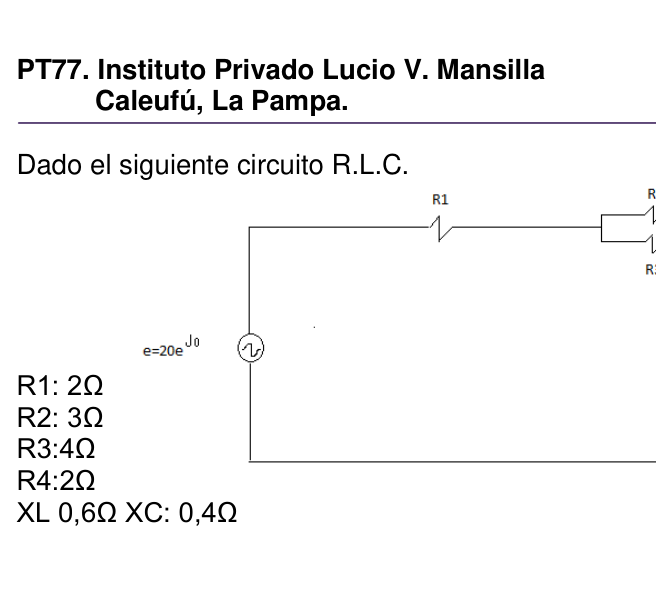
Topic: Circuits Metodi: Equivalent Circuit Reduction, Kirchhoff’s Laws Competenze: Physical Reasoning Objects: Resistor, Inductor, Capacitor Fonte: Testo (PDF) — p.3
Circuito RLC
PT77. Istituto privato Lucio V. Maniglia Calluffo, La Pampa.
Dato il circuito R.L.C.
R1: 2Ω
R2: 3Ω
R3:4Ω
R4:2Ω
XL 0,6Ω XC: 0,4Ω
OAF 2011 - 62 Calcolare: a) Impedanza del circuito. b) Correnti in ogni ramo. c) Potenza dissipata.
Topic: Circuits Metodi: Equivalent Circuit Reduction, Kirchhoff’s Laws Competenze: Physical Reasoning Objects: Resistor, Inductor, Capacitor Fonte: Testo (PDF) — p.3
The following is the list of the components of the engine:
PT77. Private institute Lucius V. Handkerchief It’s the heat, the pumpkin.
Given the next R.L.C. circuit.
R1: 2Ω
R2: 3Ω
R3:4Ω
R4:2Ω
XL 0,6Ω XC: 0,4Ω
The following is the list of the Member States’ financial statements: Calculation: (a) Impedance of the circuit. (b) Current in each branch. (c) Dispersed power.
Topic: Circuits Metodi: Equivalent Circuit Reduction, Kirchhoff’s Laws Competenze: Physical Reasoning Objects: Resistor, Inductor, Capacitor Fonte: Testo (PDF) — p.3
Encuentro de dos moviles
PT78. Instituto Privado Lucio V. Mansilla Caleufú, La Pampa.
Desde un punto A en sentido de abscisas crecientes parte un móvil con velocidad inicial de 20m/s y aceleración de sentido contrario de 2m/s2. Al mismo tiempo desde otro punto B distante 150m de A, y a su encuentro parte un móvil desde el reposo y con aceleración de 6m/s2. Calcular: a) Gráfica y analíticamente posición y tiempo del encuentro. b) Las velocidades de encuentro de ambos móviles c) Inferir conclusiones acerca de lo ocurrido en esta situación problemática
Topic: Newtonian Mechanics Metodi: Kinematic Equations Competenze: Physical Reasoning Objects: — Fonte: Testo (PDF) — p.3
Incontrare due movimenti
PT78. Istituto privato Lucio V. Maniglia Calluffo, La Pampa.
Da un punto A in senso di ascesa crescente parte un mobile con velocità iniziale di 20 m/s e accelerazione in senso contrario di 2 m/s2. Allo stesso tempo da un altro punto B distante 150m da A, e al suo incontro parte un mobile dal riposo e con un’accelerazione di 6m/s2. Calcolare: a) Grafica e analisi della posizione e del tempo dell’incontro. b) Le velocità di incontro di entrambi i cellulari c) Conclude su ciò che è accaduto in questa situazione problematica
Topic: Newtonian Mechanics Metodi: Kinematic Equations Competenze: Physical Reasoning Objects: — Fonte: Testo (PDF) — p.3
Meeting of two movements
PT78. Private institute Lucius V. Handkerchief It’s the heat, the pumpkin.
From a point A in the direction of increasing abscesses a mobile phone starts with The speed of the vehicle shall be determined by the following steps: At the same time from another point B 150m away from A, and to its meeting part a mobile from rest and with a 6m/s2 acceleration. Calculation: (a) Graphically and analytically the position and time of the meeting. (b) The meeting speeds of both mobiles (c) To draw conclusions on what has happened in this problematic situation
Topic: Newtonian Mechanics Metodi: Kinematic Equations Competenze: Physical Reasoning Objects: — Fonte: Testo (PDF) — p.3
Plano inclinado, rizo y choque
PT79. Instituto Industrial Luis A. Huergo Ciudad de Buenos Aires.
Un cuerpo 1 se desliza por un plano inclinado y pasa por el punto A con una rapidez de 2 m/s. Al llegar al pie del plano choca con un cuerpo 2 que venía moviéndose en sentido opuesto a él, con una rapidez de 1 m/s. El plano inclinado es la única superficie en la cual el rozamiento no es despreciable, siendo el coeficiente de fricción dinámico 0,1. a. ¿Cuál es la velocidad del cuerpo 1 al llegar al pie del plano inclinado? Luego del choque, el cuerpo 1 permanece en reposo, mientras que el cuerpo 2 se mueve en dirección al rizo de la pista. b. ¿Cuál es la velocidad mínima en el punto más alto del rizo, para que el cuerpo 2 pueda tomarlo? Decidí en base a tus cálculos, si el cuerpo 2 logra “rizar el rizo”. I) Si el cuerpo 2 no logra atravesar el rizo: c. Calculá la altura máxima alcanzada por 2 en el rizo. d. Clasificá el choque entre los cuerpos 1 y 2 en elástico, inelástico o plástico, en base a tus cálculos. II) Si el cuerpo 2 logra atravesar el rizo: Al llegar al punto D se encuentra con que la pista se ha terminado, y cae. c. Calculá el alcance del tiro. d. Calculá la velocidad con la que el cuerpo llega al piso, justo un instante antes de impactar con éste.
OAF 2011 - 63
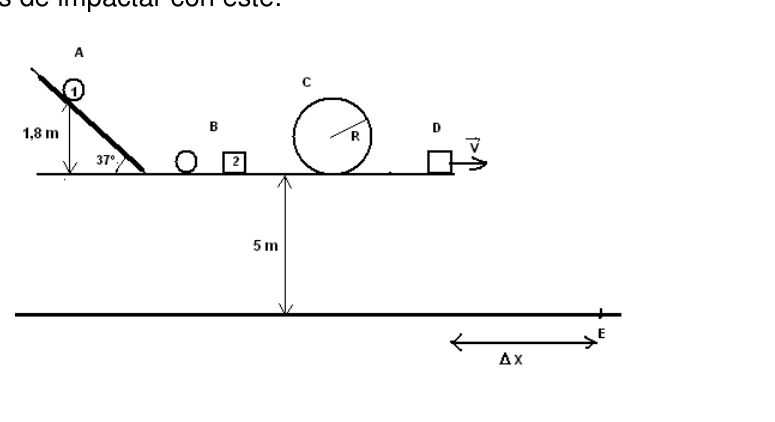
Topic: Conservation of Energy, Conservation of Momentum Metodi: Conservation of Energy, Conservation of Momentum Competenze: Physical Reasoning Objects: Inclined Plane, Block Fonte: Testo (PDF) — p.3
Plano inclinato, risato e colpiscente
PT79. Istituto industriale Luis A. - Hoorgo Città di Buenos Aires.
Un corpo 1 si scivola su un piano inclinato e passa attraverso il punto A con un velocità di 2 m/s. Arrivata al piano , si scontrò con un corpo 2 che veniva . si muove in direzione opposta, a velocità di 1 m/s. Il piano inclinato è l’unica superficie in cui il ruggine non è sconsiderato, il coefficiente di attrito dinamico è 0,1. a. Qual è la velocità del corpo 1 quando arriva al piede del piano inclinato? Dopo l’impatto, il corpo 1 resta a riposo, mentre il corpo 1 resta a riposo. Corpo 2 si muove verso il lato della pista. b. Qual è la velocità minima al punto più alto del riso, per cui il Corpo 2 può prenderlo? Ho deciso, basandomi sui tuoi calcoli, se il corpo 2 riesce a fare il riscio. I) Se il corpo 2 non riesce a attraversare il riso: c. Calcola la massima altezza raggiunta da 2 sul riso. d. Classifica il colpo tra i corpi 1 e 2 in elastico, inelastico o
- La plastica, secondo i tuoi calcoli. II) Se il corpo 2 riesce a attraversare il riso: Arrivata al punto D, si trova che la pista è finita, e cade. c. Calcola il raggio di tiro. d. Calcola la velocità con cui il corpo arriva al pavimento, solo un istante. prima di colpire questo.
OAF 2011 - 63
Topic: Conservation of Energy, Conservation of Momentum Metodi: Conservation of Energy, Conservation of Momentum Competenze: Physical Reasoning Objects: Inclined Plane, Block Fonte: Testo (PDF) — p.3
Included plane, ridge and impact
PT79. The Spanish Ministry of Foreign Affairs I ‘m not . City of Buenos Aires.
A body 1 slides over an inclined plane and passes through point A with a speed of 2 m/s. When he reached the foot of the plane he collided with a body 2 coming . moving in the opposite direction, at a speed of 1 m/s. The plane . sloping is the only surface where the friction is not despicable, where the dynamic friction coefficient is 0,1. a. What is the velocity of the body 1 as it reaches the base of the inclined plane? After the impact, body 1 remains at rest, while the Corps 2 is moving towards the ridge of the track. b. What is the minimum speed at the highest point of the ridge, so that the body 2 can take it? I decided based on your calculations, if body 2 He can make the rice roll. I) If body 2 fails to cross the ridge: c. Calculate the maximum height reached by 2 on the curve. d. Classify the impact between bodies 1 and 2 as elastic, inelastic or plastic, based on your calculations. If body 2 can get through the ridge: When you get to point D, you find the track is over, and you fall. c. Calculate the range of the shot. d. Calculate the speed at which the body reaches the floor, just for an instant. before you hit this one.
The following is the list of the Member States’ financial statements:
Topic: Conservation of Energy, Conservation of Momentum Metodi: Conservation of Energy, Conservation of Momentum Competenze: Physical Reasoning Objects: Inclined Plane, Block Fonte: Testo (PDF) — p.3
Resistencia de lampara
PT80. Instituto Industrial Luis A. Huergo Ciudad de Buenos Aires.
Para medir la resistencia de una lámpara de incandescencia se la conecta en serie en un circuito que tiene una resistencia total R = 10 Ω. El circuito está alimentado por una serie de acumuladores. En el circuito se intercala también un amperímetro que indica 1,4 A y, en paralelo, conectado a los bornes de la lámpara, un voltímetro que indica 110 V. a. ¿Qué valor se le atribuye a la resistencia de la lámpara? b. ¿Qué potencia consume la lámpara? Cuando se retira el voltímetro, el amperímetro marca 1,2 A. c. ¿Cuál es la verdadera resistencia de la lámpara? d. ¿Cuál es la resistencia del voltímetro? e. ¿Qué cantidad de calor disipa la lámpara al cabo de una hora?
Topic: Circuits Metodi: Kirchhoff’s Laws, Equivalent Circuit Reduction Competenze: Physical Reasoning Objects: Resistor, Battery Fonte: Testo (PDF) — p.3
Restanza lampada
PT80. Istituto industriale Luis A. - Hoorgo Città di Buenos Aires.
Per misurare la resistenza di una lampada incandescente si collega a serie in un circuito che ha una resistenza totale R = 10 Ω. Il circuito è in onda. alimentato da una serie di accumulatori. Il circuito intercala anche un Amperimetro che indica 1,4 A e, in parallelo, collegato ai bordi della lampada, un voltometro che indica 110 V. a. Che valore viene attribuito alla resistenza della lampada? b. Che potenza consuma la lampada? Quando si toglie il voltometro, l’ampielitro marca 1,2 A. c. Qual è la vera resistenza della lampada? d. Qual è la resistenza del voltímetro? e. Quanto calore dissipa la lampada dopo un’ora?
Topic: Circuits Metodi: Kirchhoff’s Laws, Equivalent Circuit Reduction Competenze: Physical Reasoning Objects: Resistor, Battery Fonte: Testo (PDF) — p.3
The following shall be added to the list of the following:
PT80. The Spanish Ministry of Foreign Affairs I ‘m not . City of Buenos Aires.
To measure the resistance of an incandescent lamp it is connected to series on a circuit that has a total resistance R = 10 Ω. The circuit is on . powered by a series of accumulators. In the circuit is also interchanged a Ampire indicating 1,4 A and, in parallel, connected to the terminals of the lamp, a voltmeter indicating 110 V. a. What value is attributed to the lamp’s strength? b. What power does the lamp consume? When the voltmeter is removed, the amp is 1.2 A. c. What’s the true resistance of the lamp? d. What’s the resistance of the voltmeter? e. How much heat does the lamp dissipate in an hour?
Topic: Circuits Metodi: Kirchhoff’s Laws, Equivalent Circuit Reduction Competenze: Physical Reasoning Objects: Resistor, Battery Fonte: Testo (PDF) — p.3
Columnas, dilatacion y fusion
PT81. Instituto Industrial Luis A. Huergo Ciudad de Buenos Aires.
Se dispone de un dispositivo formado por dos columnas cilíndricas; una de aluminio (A) y otra de hierro (H). Entre las dos sujetan una tabla por los extremos.
I) Se desea lograr que al soltar una bolita en el punto M llegue al punto N con una velocidad de 2 m/s. Siendo α el coeficiente de dilatación lineal para cada sustancia y si se desprecian el rozamiento y los efectos de rotación del cuerpo: ¿Cuál debe ser la longitud de cada columna a 0º C, para que se cumpla la condición pedida, a cualquier temperatura?
II) Se desea fundir la barra de aluminio. Se la retira del sistema y se realizan algunas mediciones. La barra de aluminio se quita del sistema a 0 ºC. A esa temperatura su diámetro es de 5 mm. Se conoce que la densidad del material a 18 ºC es 2,6g/cm3. a. Calculá la densidad del aluminio a 0 ºC. (Coeficiente de dilatación volumétrico es tres veces el coeficiente de dilatación lineal) La barra a 0 ºC se introduce en un recipiente que aprovecha el 75% de la energía suministrada como producto de la combustión de carbón cuyo poder calorífico es 7,8.103 cal/g. b. ¿Qué cantidad de carbón es necesaria quemar para fundir la barra de aluminio?
T fusión Al = 658 ºC L fusión Al = 94 cal/g C Al = 0,266 cal/g ºC
OAF 2011 - 64
Topic: Thermodynamics, Newtonian Mechanics Metodi: First Law of Thermodynamics, Kinematic Equations Competenze: Physical Reasoning Objects: Cylinder, Ball Fonte: Testo (PDF) — p.3
Colonne, dilatazione e fusione
PT81. Istituto industriale Luis A. - Hoorgo Città di Buenos Aires.
Si dispone di un dispositivo formato da due colonne cilindriche; di alluminio (A) e di ferro (H). Tra le due si tiene una tavola per i estremi.
I) Si desidera che, rilasciando una pallina al punto M, si raggiunga il punto N con una velocità di 2 m/s. Essendo α il coefficiente di dilatazione lineare per ogni La sostanza e se si disprezza il ruggine e gli effetti di rotazione del corpo: Qual è la lunghezza di ciascuna colonna a 0°C per soddisfare il condizione richiesta, a qualsiasi temperatura?
II) Si desidera fondere la barra di alluminio. Si toglie dal sistema e si fa.
- Alcune misure. La barra di alluminio viene rimossa dal sistema a 0 oC. A questa temperatura il suo diametro es de 5 mm. È noto che la densità del materiale a 18 oC è di 2,6 g/cm3. a. Calcola la densità dell’alluminio a 0 oC. (Cefficiente di dilatazione Il volume è tre volte il coefficiente di dilatazione lineare) La barra a 0 oC viene inserita in un recipiente che sfrutta il 75% della energia fornita come prodotto della combustione del carbone il cui potere calorificità è di 7,8.103 cal/g. b. Quanta carbone è necessario bruciare per fondere la barra di
- L’alluminio?
T fusione Al = 658 oC L fusione Al = 94 cal/g C Al = 0,266 cal/g oC
OAF 2011 - 64
Topic: Thermodynamics, Newtonian Mechanics Metodi: First Law of Thermodynamics, Kinematic Equations Competenze: Physical Reasoning Objects: Cylinder, Ball Fonte: Testo (PDF) — p.3
The following table shows the results of the calculation of the total weight of the product:
PT81. The Spanish Ministry of Foreign Affairs I ‘m not . City of Buenos Aires.
A device consisting of two cylindrical columns is provided; one of Aluminium (A) and iron (H). Between the two they hold a table for the Extremes.
(i) It is desirable to achieve that by releasing a ball at point M it reaches point N with a speed of 2 m/s. Where α is the linear dilation coefficient for each If the body’s friction and rotation effects are neglected: What should be the length of each column at 0°C, to meet the condition requested, at any temperature?
II) The aluminium bar is to be fused. It is removed from the system and performed. some measurements. The aluminium bar is removed from the system at 0 oC. At that temperature its diameter . es de 5 mm. The density of the material at 18 oC is known to be 2,6 g/cm3. a. Calculate the density of the aluminium at 0 oC. (Dilation coefficient The volume is three times the linear dilation coefficient) The bar at 0 oC is inserted into a container that takes 75% of the energy supplied as a result of the combustion of coal whose power is The heat capacity is 7.8103 cal/g. b. How much coal is needed to burn to melt the bar of What about aluminum?
T melting Al = 658 oC L melting Al = 94 cal/g C Al = 0,266 cal/g oC
The following is the list of the countries of the European Union:
Topic: Thermodynamics, Newtonian Mechanics Metodi: First Law of Thermodynamics, Kinematic Equations Competenze: Physical Reasoning Objects: Cylinder, Ball Fonte: Testo (PDF) — p.3
Carrera de drasters
PT82. EPET Nro. 4 Juan Agustín Larrús General Acha, La Pampa.
En una competencia de draster se encuentran dos en la línea de meta para hacer una competencia de 400 metros en cual uno tiene más peso que el otro y en largada por ser más pesado se quedara un instante patinando en el cual demorara 0,75 seg en partir. Al ser más pesado el reglamento le permite un motor con mayor potencia para equilibrar la carrera. El draster mas pesado tiene una aceleración de 8mts/seg² y el otro tiene una aceleración de 6.61 .mts/seg². Calcular:
- Quien llegara primero a la línea de meta
- En qué momento el que demora en largar pasa al otro
- Con que velocidad llegaran a la línea de meta expresarlo en km/h
- Representar gráficamente
Topic: Newtonian Mechanics Metodi: Kinematic Equations Competenze: Physical Reasoning Objects: — Fonte: Testo (PDF) — p.3
Carrera dei drastici
PT82. Il numero di EPET. 4 Juan Agustín Larrús Generale Acha, La Pampa.
In una gara di draster si trovano due nella linea di destinazione per fare una gara di 400 metri in cui uno pesa di più dell’altro e In un’altra parte , se si vede che è più pesante , si può pattinare per un istante . Ci vorranno 0,75 secondi per partire. Il regolamento, che è più pesante, permette di motore con maggiore potenza per bilanciare la gara. Il draster più pesante ha un’accelerazione di 8 mts/sec2 e l’altro ha un accelerazione di 6,61 .mts/sec2. Calcolare:
- Chi arriva prima alla linea di meta
- A che punto il più lento di tutti passa per l’altro?
- Con quale velocità raggiungeranno la linea di destinazione, espresso in km/h
- Rappresentare graficamente
Topic: Newtonian Mechanics Metodi: Kinematic Equations Competenze: Physical Reasoning Objects: — Fonte: Testo (PDF) — p.3
The following is the list of the types of drill bites used:
PT82. The following information shall be provided: 4 Juan Agustín Larrús General Acha, the Pampa.
In a draster competition there are two in the finish line for Do a 400-meter race where one weighs more than the other and In the long run for being heavier he would be left skating for a moment in which It will take 0.75 seconds to leave. The regulations are heavier and allow you to engine with more power to balance the race. The heaviest draster has an acceleration of 8mts/second2 and the other has a The speed limit of the vehicle shall be: Calculation:
- Whoever gets to the finish line first .
- When does the one who takes a long time to leave pass the other ?
- How fast would you get to the finish line, express it in km/h?
- Graphically represent
Topic: Newtonian Mechanics Metodi: Kinematic Equations Competenze: Physical Reasoning Objects: — Fonte: Testo (PDF) — p.3
Espejo concavo
PT83. EPET Nro. 4 Juan Agustín Larrús General Acha, La Pampa.
En un espejo cóncavo de 5 cm de altura y 8 cm de distancia focal se coloca un objeto a 25 cm del espejo. Calcular
- Distancia espejo e imagen
- Altura de la imagen
- Agrandamiento lateral.
Topic: Geometric Optics Metodi: Thin Lens & Mirror Equation, Ray Tracing Competenze: Physical Reasoning Objects: Mirror Fonte: Testo (PDF) — p.3
Specchio concavo
PT83. Il numero di EPET. 4 Juan Agustín Larrús Generale Acha, La Pampa.
In uno specchio concave di 5 cm di altezza e 8 cm di distanza focale si colloca un oggetto a 25 cm dallo specchio. Calcolare
- Distanza specchio e immagine
- Altura dell’immagine
-
- Ingrandimento laterale.
Topic: Geometric Optics Metodi: Thin Lens & Mirror Equation, Ray Tracing Competenze: Physical Reasoning Objects: Mirror Fonte: Testo (PDF) — p.3
The following table shows the results of the calculations:
PT83. The following information shall be provided: 4 Juan Agustín Larrús General Acha, the Pampa.
A concave mirror 5 cm high and 8 cm focal length is placed object 25 cm from the mirror. Calculate
- Mirror and image distance
- Image height
- Side enlargement.
Topic: Geometric Optics Metodi: Thin Lens & Mirror Equation, Ray Tracing Competenze: Physical Reasoning Objects: Mirror Fonte: Testo (PDF) — p.3
Resistencia faltante en plaqueta
PT84. EPET Nro. 4 Juan Agustín Larrús General Acha, La Pampa.
En un taller electrónica llevan ha reparar un plaqueta como se muestra en la figura
Se encuentran que la resistencia R5 esta destruida y no se puede ver el valor. Sacamos los siguientes dados del circuito R1= 10 Ohm R2= 15 Ohm R3= 9 Ohm R4= 3 Ohm VAB= 12 V
Calcular
El valor de la resistencia faltante
Si en le taller tenemos esta cantidad de
resistencia con los siguientes valores
2 de 28 Ohm
3 de 20 Ohm
3 de 7 Ohm
4 de 10 Ohm
¿Como podemos hacer el reemplazo para que el circuito vuelva ha funcionar
correctamente?
OAF 2011 - 65
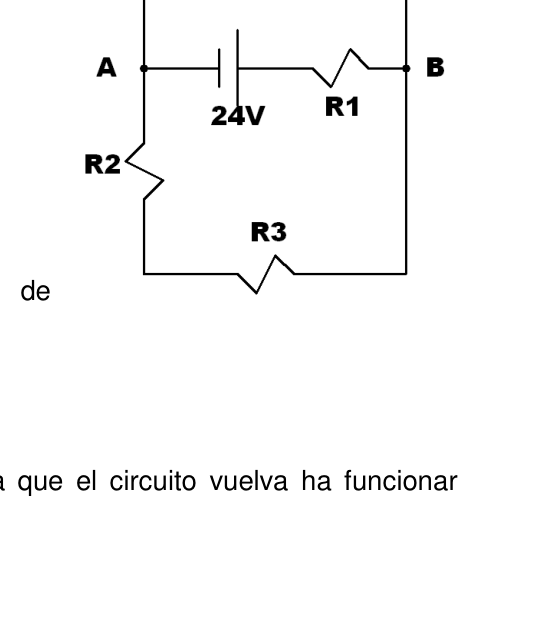
Topic: Circuits Metodi: Equivalent Circuit Reduction, Kirchhoff’s Laws Competenze: Physical Reasoning Objects: Resistor Fonte: Testo (PDF) — p.3
Ricorso di resistenza in scheda
PT84. Il numero di EPET. 4 Juan Agustín Larrús Generale Acha, La Pampa.
In un laboratorio di elettronica si è occupato di una riparazione la targa come mostrato nella figura
Si trovano che la resistenza R5 è distrutto e non si vede il valore. Prendiamo le seguenti dado dal circuito. R1 = 10 Ohm R2 = 15 Ohm R3 = 9 Ohm R4 = 3 Ohm VAB = 12 V
Calcolare Valore della resistenza mancante Se in questo laboratorio abbiamo questa quantità di resistenza con i seguenti valori 2 su 28 Ohm 3 su 20 Ohm 3 su 7 Ohm 4 su 10 Ohm Come possiamo fare la sostituzione per far funzionare il circuito di nuovo?
- Giusto?
OAF 2011 - 65
Topic: Circuits Metodi: Equivalent Circuit Reduction, Kirchhoff’s Laws Competenze: Physical Reasoning Objects: Resistor Fonte: Testo (PDF) — p.3
The following table shows the results of the test:
PT84. The following information shall be provided: 4 Juan Agustín Larrús General Acha, the Pampa.
In an electronics workshop they’ve been repairing a The plaque as shown in Figure
They found that the resistance R5 is destroyed and you can’t see the value. We take the following dice off the circuit. R1 = 10 Ohm R2 is equal to 15 Ohm R3 = 9 Ohm R4 = 3 Ohm VAB = 12 V
Calculate The value of the missing resistance If we have this amount in the workshop resistance with the following values 2 out of 28 Ohm 3 out of 20 ohms 3 out of 7 Ohm 4 out of 10 Ohm How can we make the replacement to get the circuit back to working? Right?
The following is the list of the countries of the European Union:
Topic: Circuits Metodi: Equivalent Circuit Reduction, Kirchhoff’s Laws Competenze: Physical Reasoning Objects: Resistor Fonte: Testo (PDF) — p.3
Lancio verticale di una pietra
PT85. Escuela Secundaria Nro. 41
Instituto Bernardino Rivadavia1
Instituto San Felipe2 1Villa Iris – 2Felipe Sola Provincia de Buenos Aires.
Desde la base de un edificio se arroja una piedra verticalmente hacia arriba con una velocidad de 10 m/s . Suponiendo que se desprecia la resistencia del aire y tomando la aceleración como 10 m/s2 . Obtenga las ecuaciones que determinan la variación de la posición y la velocidad con el tiempo tomando como sistema de referencia el punto de lanzamiento.. Calcule el tiempo que tarda la piedra en alcanzar su altura máxima. Calcule la altura máxima. Calcule la velocidad que lleva la piedra 1,5 s segundos después de haber sido arrojada . ¿Cómo interpreta los resultados?. Cuánto tardará en llegar al piso. Que velocidad tenía en el instante previo a tocar el piso.¿ Necesita hacer cuentas.?. Realice los gráficos que representan la variación de la velocidad y la posición en función del tiempo. Si el lanzamiento se realiza con la misma velocidad inicial, desde un balcón situado a una altura de 7.5 m sobre el piso. ¿Se modifican los resultados obtenidos ¿ Justifique sus respuestas. En el instante que la piedra alcanza su altura máxima ¿Cuáles de las siguientes afirmaciones son correctas?.
- Su velocidad y aceleración son nulas
- Su velocidad es nula y su aceleración no.
- Su aceleración es nula pero su velocidad no.
- Su velocidad y aceleración no varían. Si se lanza una segunda piedra verticalmente hacia arriba con el doble de velocidad inicial de la primera. Entonces la altura máxima alcanzada por la segunda será:
- El doble de la alcanzada por la primera
- El cuádruplo de la alcanzada por la primera
- Tiene un valor con la alcanzada por la primera que depende del valor de su velocidad inicial.
Topic: Newtonian Mechanics Metodi: Kinematic Equations, Free-Body Diagram Competenze: Physical Reasoning, Mathematical Modeling Objects: Projectile Fonte: Testo (PDF) — p.3
Lancio verticale ho dato una pietra
PT85. La scuola superiore Nro. 41
Il progetto di ricerca è stato realizzato dal
Istituto San Felipe2 1Villa Iris 2Felipe Sola Provincia di Buenos Aires.
Dal fondamento di un edificio si lancia una pietra verticalmente verso l’alto con Una velocità di 10 m/s . Supponiamo che si disprezzi la resistenza dell’aria e Prendendo l’ acceleration come 10 m/s2 . Ottenere le equazioni che determinano la variazione della posizione e la velocità nel tempo, prendendo come sistema di riferimento il punto
- Il lancio… Calcolare il tempo che la pietra impiega per raggiungere la massima altezza. • Calcolare la massima altezza. Calcolare la velocità della pietra a 1,5 secondi dopo
- che sono stata buttata . Come interpreta i risultati?
- Quanto tempo ci vorrà per arrivare al pavimento. Che velocità aveva l’istante precedente il tocco al pavimento. Necessità
- La nostra politica è quella di fare conti. Realizzare i grafici che rappresentano la variazione della velocità e la velocità di posizione in base al tempo. Se il lancio è effettuato con la stessa velocità iniziale, da un balcone situato ad un’altezza di 7,5 m sul pavimento. Le modifiche sono state apportate. Risultati ottenuti - giustifica le tue risposte. • L’istante in cui la pietra raggiunge la sua massima altezza Le seguenti affermazioni sono corrette?
- La sua velocità e l’ acceleration sono nulli
- La sua velocità è zero e la sua accelerazione no.
- La sua accelerazione è zero, ma la sua velocità no.
- La loro velocità e l’accelerazione non variano. Se si lancia una seconda pietra verticalmente verso l’alto con il doppio di velocità iniziale della prima. Allora l’altezza massima raggiunta per la seconda sarà:
- Il doppio di quello raggiunto dalla prima.
- Quadruple di quella raggiunta dalla prima.
- Ha un valore con il raggiunto per il primo che dipende dal valore della sua velocità iniziale.
Topic: Newtonian Mechanics Metodi: Kinematic Equations, Free-Body Diagram Competenze: Physical Reasoning, Mathematical Modeling Objects: Projectile Fonte: Testo (PDF) — p.3
I’m going to throw a rock.
PT85. High school No. 41
The first is the ‘Bernardino Rivadavia Institute’.
The San Felipe Institute2 1 Villa Iris 2Pelipe Sola Province of Buenos Aires.
From the base of a building a stone is thrown vertically up with a speed of 10 m/s . Assuming you despise the air resistance and Taking the acceleration as 10 m/s2 . Obtain the equations that determine the variation in position and the speed over time taking as reference system the point The launch… • Calculate the time it takes the stone to reach its maximum height. • Calculate the maximum height. Calculate the stone’ s velocity 1.5 seconds after I ‘m sorry , but I ‘m sorry . How do you interpret the results? How long will it take to get to the floor? What speed was he at the instant before he touched the floor. I’m going to do some accounting. • Draw graphs showing the variation in speed and the position based on time. If the launch is performed at the same initial speed, from a balcony located at a height of 7.5 m above the floor. Are the amendments made? The results obtained justify your answers. The moment the stone reaches its maximum height, which of the following is the The following statements are correct?
- Their speed and acceleration are zero .
- Their speed is zero and their acceleration is not.
- Their acceleration is zero, but their speed is not.
- Their speed and acceleration do not vary. If a second stone is thrown up vertically with the double The initial speed of the first. Then the maximum height reached for the second one will be:
- Twice as much as the first one .
- Four times the number of people who have been hit by the first one .
- It has a value with the first one reached that depends on the the value of its initial speed.
Topic: Newtonian Mechanics Metodi: Kinematic Equations, Free-Body Diagram Competenze: Physical Reasoning, Mathematical Modeling Objects: Projectile Fonte: Testo (PDF) — p.3
Hielo con bolita de hierro flotando
PT85. Escuela Secundaria Nro. 41
Instituto Bernardino Rivadavia1
Instituto San Felipe2 1Villa Iris – 2Felipe Sola Provincia de Buenos Aires.
En un recipiente cilíndrico y de un área igual a S, derramamos agua en la cual flota un pedazo de hielo con una bolita de hierro en su interior. El volumen del pedazo de hielo junto con la bolita es igual a V; sobre el nivel del agua sobresale 1/20 de dicho volumen. ¿Qué altura desciende el nivel del agua en el recipiente, una vez que el hielo se haya derretido?. Las densidades del agua, hielo e hierro se dan a conocer como dato.(Peso específico del agua 9.8 N/dm3) , Peso específico del Fe 7.85 Kgf/dm3 , Peso específico del hielo 0.917 Kgf/dm3 .).
OAF 2011 - 66
Topic: Fluid Mechanics Metodi: Hydrostatic Equilibrium, Physical Modeling Competenze: Physical Reasoning, Mathematical Modeling Objects: Container, Sphere Fonte: Testo (PDF) — p.3
Ghiaccio con pallina di ferro galleggiante
PT85. La scuola superiore Nro. 41
Il progetto di ricerca è stato realizzato dal
Istituto San Felipe2 1Villa Iris 2Felipe Sola Provincia di Buenos Aires.
In un recipiente cilindrico e di superficie pari a S, versare acqua in cui flotta un pezzo di ghiaccio con una pallina di ferro dentro. Il volume del Pezzo di ghiaccio insieme alla pallina è uguale a V; sopra il livello dell’acqua si spalanca 1/20 di tale volume. A che altezza scende il livello dell’acqua nel recipiente? Una volta che il ghiaccio si è sciolto? Densità dell’acqua, del ghiaccio e del ferro sono comunicati come dati.(Peso specifico dell’acqua 9.8 N/dm3) ,Peso Specificità del FEA 7.85 Kgf/dm3 .
OAF 2011 - 66
Topic: Fluid Mechanics Metodi: Hydrostatic Equilibrium, Physical Modeling Competenze: Physical Reasoning, Mathematical Modeling Objects: Container, Sphere Fonte: Testo (PDF) — p.3
Ice with floating iron ball
PT85. High school No. 41
The first is the ‘Bernardino Rivadavia Institute’.
The San Felipe Institute2 1 Villa Iris 2Pelipe Sola Province of Buenos Aires.
In a cylindrical container and an area equal to S, we pour water into which floats a piece of ice with a ball of iron inside. The volume of the piece of ice together with the ball is equal to V; above the water level it protrudes 1/20 of that volume. What height does the water level in the container go down? Once the ice has melted? The densities of water, ice and iron are given as data.(Specific water weight 9.8 N/dm3) , Weight The specific weight of the ice is 0.917 Kgf/dm3.)
The following points shall be added:
Topic: Fluid Mechanics Metodi: Hydrostatic Equilibrium, Physical Modeling Competenze: Physical Reasoning, Mathematical Modeling Objects: Container, Sphere Fonte: Testo (PDF) — p.3
Imagen amplificada con espejo esferico
PT85. Escuela Secundaria Nro. 41
Instituto Bernardino Rivadavia1
Instituto San Felipe2 1Villa Iris – 2Felipe Sola Provincia de Buenos Aires.
Se quiere proyectar la imagen de una lámpara , amplificada 5 veces, sobre una pared situada a 4 m de la lámpara. Determinar el tipo de espejo esférico .que se precisa y a que distancia se debe colocar.
Topic: Geometric Optics Metodi: Thin Lens & Mirror Equation, Ray Tracing Competenze: Physical Reasoning, Mathematical Modeling Objects: Mirror Fonte: Testo (PDF) — p.3
Immagine amplificata con specchio sferico
PT85. La scuola superiore Nro. 41
Il progetto di ricerca è stato realizzato dal
Istituto San Felipe2 1Villa Iris 2Felipe Sola Provincia di Buenos Aires.
Si vuole proiettare l’immagine di una lampada, amplificata 5 volte, su una parete situate a 4 m dalla lampada. Determinare il tipo di specchio sferico che si precisione e a che distanza deve essere posizionato.
Topic: Geometric Optics Metodi: Thin Lens & Mirror Equation, Ray Tracing Competenze: Physical Reasoning, Mathematical Modeling Objects: Mirror Fonte: Testo (PDF) — p.3
Amplified image with spherical mirror
PT85. High school No. 41
The first is the ‘Bernardino Rivadavia Institute’.
The San Felipe Institute2 1 Villa Iris 2Pelipe Sola Province of Buenos Aires.
You want to project the image of a lamp, amplified five times, over a wall located 4 m from the lamp. Determine the type of spherical mirror that is The precise distance and distance to be placed.
Topic: Geometric Optics Metodi: Thin Lens & Mirror Equation, Ray Tracing Competenze: Physical Reasoning, Mathematical Modeling Objects: Mirror Fonte: Testo (PDF) — p.3
Perdidos en el oceano
PT85. Colegio Nro. 3 Mariano Moreno Ciudad de Buenos Aires.
Perdidos en el océano. Los días pasaban. La superficie del mar era un espejo, el calor agobiaba, la brújula no funcionaba, y de viento… nada. El capitán del barco, Centenera, dio la orden a Saraza, el contramaestre, que anote en la bitácora: “la punta del dedo no se enfría. No hay viento. Quizás una solución sea poner marineros a soplar las velas”. El contramaestre, tras un gesto de asombro y confusión, finalmente comprendió la idea, sugirió (con todo respeto) que la estrategia no daría resultado y dibujó un esquema para demostrarlo. • Reproduzca el esquema realizado por el contramaestre indicando las fuerzas presentes en la situación. Ante tal evidencia, Centenera propuso otra solución: “¡Que sople toda la tripulación de La Nena hacia la popa de la Santa Marta Serralima!” El contramaestre hizo otro gesto (como de “…mmm, tampoco…”) y pidió permiso para consultar con el navegante tal posibilidad. Éste recurrió al Manual del Usuario de la Nao Serralima ( Marta modelo base, pack oceánico y ultrapack discovery) para obtener los datos necesarios para calcular la velocidad que los marineros sopladores debían imprimirle al aire para que el barco insignia navegue con su velocidad máxima. Aunque indicó también que esto dividiría a la flotilla.
Estimado usuario: Gracias por elegir Naos Serralima. Con su nueva Santa Marta usted podrá surcar los mares, navegar océanos desconocidos y descubrir sus propios continentes(1). Antes de hacerse a la mar asegúrese de leer esta Guía del usuario con detenimiento y atención. (1) Algunas tierras aún no descubiertas podrían ser confundidas con Las Indias. Capítulo 1. Conozca su nao.
- Palo mayor. Diámetro inf= 0,5m.
Altura= 10m - Vela de gavia, Vela Mayor, Vela de trinquete y Vela cebadera. Diseñadas para una densidad del aire дaire= 1,29 kg/m3. Superficie total del velamen: 105 m2
- Castillo de proa.
- Línea de flotación sin carga comercial ni botines. Masa de la nao con tripulación y enseres: 2,25x10⁵ kg. Ver Volúmenes sumergidos en gráfico de fig. 2. 5)Casco húmedo sin carga comercial ni botines. Velocidad máxima aprox. 10 nudos (5 m/s) en aguas de densidad дagua = 1020 kg/m3 . Ver coeficientes
OAF 2011 - 67 hidrodinámicos en la Tabla 1. 6) Timón. 7) Puente. 8) Vela de mesana
• Demuestre con un esquema de fuerzas que esta acción dividiría a la flotilla. • Calcule qué velocidad deben imprimirle los marineros de la Nena al aire para mover a la Santa Marta Serralima a su velocidad máxima. (¿Sería posible?)
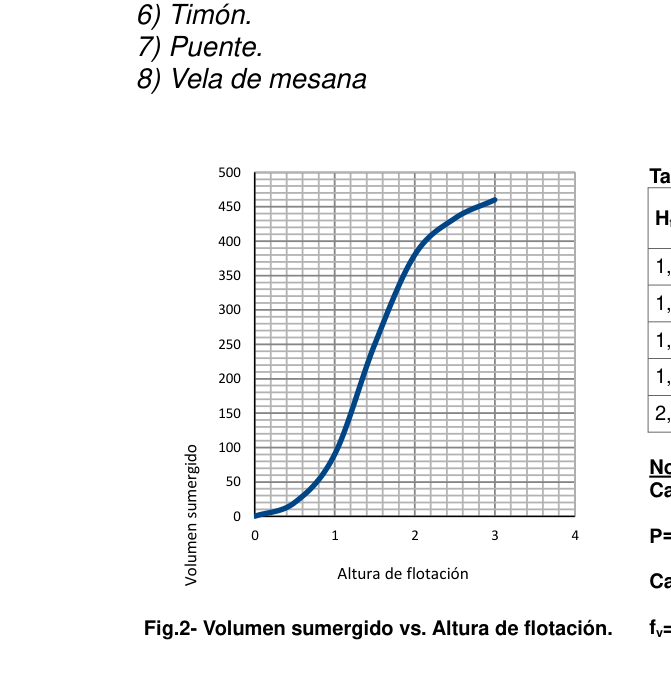
Topic: Fluid Mechanics, Newtonian Mechanics Metodi: Bernoulli’s Equation, Free-Body Diagram, Physical Modeling Competenze: Physical Reasoning, Mathematical Modeling Objects: Container Fonte: Testo (PDF) — p.3
Perdi in mare
PT85. - Scuola Nero. 3 Mariano Moreno Città di Buenos Aires.
Perdi nell’oceano. I giorni passavano. La superficie del mare era uno specchio, il calore si accolse, la La compassa non funzionava, e il vento… Niente di tutto. Il capitano della nave, Centenera, ha dato Ordina a Saraza, il contramestre, di scrivere sul biglietto: Non si raffredda. Non c’è vento. Forse una soluzione è mettere i marinai a soffiare . le candele. Il contromaniore, dopo un gesto di stupore e confusione, finalmente ha capito l’idea, ha suggerito (con tutto il rispetto) che la strategia non avrebbe dato E poi ha disegnato un schema per dimostrarlo. • Riproduci il schema del contromisario indicando le le forze presenti nella situazione. In vista di tale evidenza, Centenera proponeva un’altra soluzione: La Nena, a bordo della Santa Marta Serralima! Il contramestre ha fatto un altro gesto (come di …mmm, nemmeno…) e ha chiesto il permesso per consultare il navigatore su tale possibilità. Questo ha fatto ricorso al Manuale del Utente della Nao Serralima (Marta modello base, pack oceanico e ultrapack La velocità di accelerazione dei sistemi di accelerazione è stata calcolata in modo da ottenere i dati necessari per calcolare la velocità di accelerazione dei sistemi di accelerazione. I marinai che soffiano dovevano stamparlo in aria per farla il navetto insignia. navighi alla sua massima velocità. Anche se ha anche indicato che questo dividerebbe la Flotilla.
Apprezzato utente: Grazie per aver scelto Naos Serralima. Con la sua nuova Santa Marta potrai navigare sulle mari, navigare in oceani sconosciuti e scoprire i propri. continenti (). Prima di andare in mare, assicurati di leggere questa guida Utente con attenzione e attenzione. (1) Alcune terre ancora inesplorate potrebbero essere confuse con le Indie. Capitolo 1 Conosca il suo naso.
- Pallo maggiore. Diametro inf= 0,5 m. Altezza = 10 m
- Vela di gavia, Vela Maggiore, Vela di
- Una trincea e una vela d’oca. Disegnati per una densità dell’aria aerea = 1,29 kg/m3. Superficie totale del velamen: 105 m2
- Castello di proa.
- Linea di galleggiamento senza carico commerciale o
- Scazzi. Massa del navetto con equipaggio e Inserimento: 2,25x10⁵ kg. Vede volumi immersi in grafico di fig. 2.
- Cappello umido senza carico commerciale o sacchetti. Velocità massima approssimativa. 10 Nodi (5 m/s) in acque di densità idrica = 1020 kg/m3 . Vede coefficienti
OAF 2011 - 67 I dati di riferimento sono stati riportati nella tabella 1. 6) Capo. 7) Ponte. 8) Candela da tavola
• dimostrare con un schema di forze che tale azione dividerebbe la Flotilla. • Calcolare la velocità di stampa che i marinai della Nena devono effettuare in aria per spostare la Santa Marta Serralima alla sua massima velocità. (Sarebbe possibile?)
Topic: Fluid Mechanics, Newtonian Mechanics Metodi: Bernoulli’s Equation, Free-Body Diagram, Physical Modeling Competenze: Physical Reasoning, Mathematical Modeling Objects: Container Fonte: Testo (PDF) — p.3
Losses in the ocean
PT85. School No. 3 Mariano Moreno City of Buenos Aires.
Lost in the ocean. The days passed. The surface of the sea was a mirror, the heat was burning, the The compass didn’t work, and wind… I’m not doing anything. The captain of the ship, Centenera, gave command Saraza, the headmaster, to write on the slate: It’s not getting cold. There’s no wind. Maybe a solution is to get sailors to blow . the candles. The rear-mistress, after a gesture of astonishment and confusion, finally He understood the idea, suggested (with all due respect) that the strategy would not give And he drew a diagram to prove it. • Reproduce the scheme made by the counter-master indicating the forces present in the situation. In view of this evidence, Centenera proposed another solution: The crew of La Nena to the stern of Santa Marta Serralima! The headmaster made another gesture (like …mmm, neither…) and asked for permission. to consult the navigator about such a possibility. This one has recourse to the Manual of the User of the Nao Serralima (base model Marta, ocean pack and ultrapack The data used to calculate the speed of the The sailors had to print it in the air to make the ship flag . Navigate at your maximum speed. Although he also indicated that this would divide the The flotilla.
Dear user: Thank you for choosing Naos Serralima. With your new Santa Marta you can Surf the seas, sail unknown oceans and discover your own. The following is the list of countries: Before you go to sea, make sure you read this guide to the user with attention and attention. (1) Some undiscovered lands could be mistaken for the Indies. Chapter 1 Get to know your nose.
- The main stick. The diameter of the product shall be: Height = 10m
- Sail of gavion, sail of the sea, sail of the sea
- A barbecue and a barley sail. Designed for a density of air = 1,29 kg/m3. Total area of the sail: 105 m2
- Castle of bow.
- commercial unloaded floating line or The booty. Mass of the crew and Inserts: 2,25 x 10⁵ kg. See volumes So, we’re going to get a fig chart. 2.
- Wet hulls without commercial cargo or spoils. Maximum speed approx. 10 knots (5 m/s) in water density = 1020 kg/m3 . See coefficients
The following is the list of the Member States’ financial statements: The following table shows the hydrodynamic parameters: 6) Coaster. 7) Bridge. 8) Table sails
• Demonstrate with a scheme of forces that this action would divide the The flotilla. • Calculate the speed at which the Nena seamen must print the air to move Santa Marta Serralima at its maximum speed. (Would it be) (possibly?)
Topic: Fluid Mechanics, Newtonian Mechanics Metodi: Bernoulli’s Equation, Free-Body Diagram, Physical Modeling Competenze: Physical Reasoning, Mathematical Modeling Objects: Container Fonte: Testo (PDF) — p.3
Haciendo contacto
PT86. Colegio Nro. 3 Mariano Moreno Ciudad de Buenos Aires.
Haciendo contacto. Toda la tripulación de La Nena apretada en la popa, por orden de Centenera, tomó todo el aire que pudo y sopló. Milagrosamente las velas de la Santa marta Serralima se hincharon y la nao comenzó a moverse. Pero claro, no fue el soplido lo que impulsó la nave…Había vuelto el viento. Después de un tiempo de navegar, el grumete que estaba en la cola del vigía dio el aviso a viva voz de “¡Tieeerraaaa!”. Minutos más tarde se oyó: “canoooaaass”…”Con geeeeenteeeee”… “con poca rooopaaaaa”. En un principio, los naturales acompañaban a las naves de la expedición y hacían gestos que la tripulación interpretó como saludos amistosos. Luego siguieron cánticos y bailes, que se intensificaban a medida que bebían algo en unas extrañas vasijas con pelos (días después los recién llegados supieron que los naturales les llamaban “coco”). La efusividad de la bienvenida fue aumentando gradualmente. Comenzaron arrojando flores en el agua frente a las naves, luego ramilletes y guirnaldas que caían en las cubiertas, desconocidos frutos pequeños y dulces… Minutos después la bienvenida se tornó una lluvia de cocos que los nativos lanzaban con vehemencia entre gritos y aullidos, apuntando directamente a las cabezas de los tripulantes. Los cocos se acabaron pero la afectuosa bienvenida prosiguió. Comenzaron a caer desde la costa unos frutos gigantes esferoides con rayas verdes y amarillas (les llamaban sandías). Cuando el capitán del barco, Centenera, y Saraza, el contramaestre, vieron caer
Tabla 1 Hflot (Altura de flotación) Khid (Coeficiente hidrodinámico) 1,oo m 0,423 m2 1,25 m 1,195 m2 1,50 m 1,622 m2 1,75 m 1,943 m2 2,00 m 2,048 m2
Nota: Calcule la presión del aire sobre las velas según
P= ½ дaire V2 aire
Calcule la fuerza resistente del agua según
fv= ½ Khid дaguav2 max
Fig.2- Volumen sumergido vs. Altura de flotación.
0 1 2 3 4 0 50 100 150 200 250 300 350 400 450 500 Altura de flotación Volumen sumergido
OAF 2011 - 68 al vigía con una sandía de 3 kg incrustada en la cabeza, se preocuparon. Con sus catalejos apuntados a la playa alcanzaron a ver una estructura móvil erigiéndose justo al frente de la Santa Marta Serralima (como una catapulta), movimientos entre las palmas cercanas al extraño dispositivo, una hilera de nativos en taparrabo al pie de una de ellas y una pila de esas sandías. Repentinamente, una palma se flexionó, y al volver a su posición original un nativo salió disparado a unos 10 m/s hacia el extremo de la catapulta ( de unos 3 m de altura), esta giró sobre un eje, dando su extremo (con nativo y todo) contra la arena y propulsando una sandía hacia la flotilla. Al ver acercarse el proyectil, Centenera asustado, gritó: “huyaaamooooos, dad vuelta las velas para ir en reversa!”. Saraza, con un gesto de piedad, sugirió que simplemente viraran hasta salir de la línea de fuego (o mejor dicho sandías). Con el navegante estimaron que el indio promedio no podría tener más de 70 kg y que tal dispositivo no podría transferir a la sandía más del 50% de la energía recibida, con lo que calcularon fácilmente la mínima distancia a la costa que los sacaría de aquella ensalada de frutas. • Calcule a qué distancia de la costa comienza la zona libre de impactos de sandías.
Topic: Conservation of Energy Metodi: Conservation of Energy, Kinematic Equations, Conservation of Momentum Competenze: Physical Reasoning, Mathematical Modeling Objects: Projectile, Lever Fonte: Testo (PDF) — p.3
**Contratto **
PT86. - Scuola Nero. 3 Mariano Moreno Città di Buenos Aires.
- In contatto. L’intero equipaggio di La Nena stretta sullo stelo, per ordine di Centenera, Ha preso tutto l’aria che poteva e ha soffiato. Miracolosamente le candele di Santa Marta Serralima si gonfiò e la nave cominciò a muoversi. Ma, ovviamente, non era il Soffri quel che ha spinto la nave… il vento era tornato. Dopo un po’ di navigazione, il grumete che era alla coda del guardiano ha dato L’avviso in vivo di Tieeerraaaa!. Minuti dopo si sentì:
- Con la geeeeenteeee… Con poco rumo. En un In principio, i nativi accompagnavano le navi dell’espedita e facevano gesti che l’equipaggio interpretò come salutamenti amichevoli. Poi continuano. canzoni e balli, che si intensificavano mentre bevevano qualcosa in una Strani vasi di peli (di giorni dopo i nuovi arrivati hanno scoperto che i Le persone naturali le chiamavano “cocco”. L’effusività del benvenuto è aumentata. gradualmente. Hanno iniziato a gettare fiori in acqua davanti alle navi, poi… Ramosci e germoglie che cadevano sui copri, frutti piccoli sconosciuti. e dolci… Minuti dopo il benvenuto si trasformò in una pioggia di cocco che li ha spinto. nativi lanciavano con vehemenza tra urli e urli, puntando direttamente sulle teste degli uomini. I cocchi sono finiti, ma la Il benvenuto continuava. Cominciarono a cadere dalle coste dei frutti . giganti sferoidi con strisce verdi e gialle (le chiamavano watermeloni). Quando il capitano della nave, Centenera, e Saraza, il contromisario, hanno visto cadere
Tabella 1 Hflot (altezza di galleggiamento) Khid (Coefficiente) (idrodinamica) 1,oo m 0,423 m2 1,25 m 1,195 m2 1,50 m 1,622 m2 1,75 m 1,943 m2 2,00 m 2,048 m2
Nota: Calcolare la pressione dell’ aria sulle candele secondo
P= 1⁄2 aria V2 aria
Calcola la forza resistente dell’acqua in base a
Fv= 1⁄2 Khid daguav2 Max
Fig.2- Volume immerso vs. Altura di galleggiamento.
0 1 2 3 4 0 50 100 150 200 250 300 350 400 450 500 Altura di flottazione Volume immerso
OAF 2011 - 68 mentre la guardia aveva un’acqua da 3 kg incrustata nella testa, si preoccupavano. Con I suoi cataglieri puntati verso la spiaggia hanno visto una struttura mobile. Erogandosi proprio davanti alla Santa Marta Serralima (come una catapulta), movimenti tra le palme vicino al dispositivo estraneo, una fila di nativi in un tappo al piede di una di loro e un mucchio di quelle watermelons. All’improvviso, una palma si piega, e tornando alla sua posizione originale una Il nativo è uscito sparato a circa 10 m/s verso l’estremità della catapulta (circa 3 M di altezza), si è girata su un asse, dando il suo estremità (con nativo e tutto) contro La sabbia e spingendo una slitta verso la flotta. Vedendo il proiettile avvicinarsi, Centinaia spaventata, gridò: huyaaamooooos, girate le candele per andare in
- Invertito! Saraza, con un gesto di pietà, suggerì che si girassero semplicemente fino a uscire dalla linea di fuoco (o meglio, i watermeloni). Con il navigatore hanno stimato che l’indiano medio non poteva avere più di 70 kg e che tale dispositivo non Potrebbe trasferire alla watercolox più del 50% dell’energia ricevuta, con cui E’ stato facile calcolare la distanza minima verso la costa che li avrebbe portati fuori da quella. Salata di frutta. • Calcolare la distanza dalla costa che inizia la zona libera da impatti di bottiglie.
Topic: Conservation of Energy Metodi: Conservation of Energy, Kinematic Equations, Conservation of Momentum Competenze: Physical Reasoning, Mathematical Modeling Objects: Projectile, Lever Fonte: Testo (PDF) — p.3
**Contacting **
PT86. School No. 3 Mariano Moreno City of Buenos Aires.
Making contact. All the crew of La Nena pressed on the stern, by order of Centenera, He took all the air he could and blew. Miraculously the candles of Santa Marta The squirrels swelled and the nose started moving. But of course, it wasn’t the I blew what propelled the ship… the wind had returned. After a while of navigating, the whistle that was in the watchman’s tail gave The warning in the living voice of Tieeerraaaa!. Minutes later he heard: I’m not sure what I’m saying. With little rooopaaaaaa. En un At first, the natives accompanied the expedition ships and did gestures that the crew interpreted as friendly greetings. Then they went on . songs and dances, which intensified as they drank something in some Strange hairy vessels (days later the newcomers learned that they were They called them natural coconuts. The effusivity of the welcome was increasing. gradually. They started by throwing flowers in the water in front of the ships, then twigs and garlands falling on the decks, unknown little fruits and sweet… Minutes later the welcome turned into a coconut rain that killed them. Native people were throwing vehemently between screams and howls, aiming. directly to the crew’s heads. The coconuts are gone but the The warm welcome continued. Fruits began to fall from the shore . giant spheroid with green and yellow stripes (they were called watermelons). When the captain of the ship, Centenera, and Saraza, the rearmaster, saw the ship fall
Table 1 Hflot (floating altitude) Khid (Coefficient (hydrodynamic) 1,oo m 0,423 m2 1,25 m 1,195 m2 1,50 m 1,622 m2 1,75 m 1,943 m2 2,00 m 2,048 m2
Note: Calculate the air pressure on the candles according to
P = 1⁄2 air V2 Air .
Calculate the resistance of the water according to
The following is the list of the countries of the European Union: Max
Fig.2- Submerged volume vs. Floating altitude.
0 1 2 3 4 0 50 100 150 200 250 300 350 400 450 500 Floating height Submerged volume
The Commission shall adopt delegated acts in accordance with Article 21 of Regulation (EU) No 1303/2013. When he was watching with a three-pound watermelon embedded in his head, they were worried. With Their catalysts pointed at the beach and they could see a moving structure. Standing right in front of the Santa Marta Serralima (like a catapult), Movements between the palms near the foreign device, a row of Native people in a cork at the foot of one of them and a pile of those watermelons. Suddenly, a palm bent, and returning to its original position a The native was fired at about 10 m/s towards the end of the catapult (about 3 m high), this one turned on an axis, giving its end (with native and all) against The sand and propelling a watermelon towards the flotilla. Seeing the projectile approaching, Hundred-year-old scared, she shouted: huyaaamooooos, turn the candles to go in It’s the other way around! Saraza, with a gesture of pity, suggested that they simply turn up. Get out of the line of fire (or rather watermelons). With the navigator estimated The average Indian couldn’t weigh more than 70 kg and that such a device couldn’t. It could transfer to the watermelon more than 50% of the energy received, so They could easily calculate the minimum distance to the shore that would take them from that shore. fruit salad. • Calculate how far from the coast the impact free zone starts of watermelons.
Topic: Conservation of Energy Metodi: Conservation of Energy, Kinematic Equations, Conservation of Momentum Competenze: Physical Reasoning, Mathematical Modeling Objects: Projectile, Lever Fonte: Testo (PDF) — p.3
En la nueva tierra
PT87. Colegio Nro. 3 Mariano Moreno Ciudad de Buenos Aires.
En la nueva tierra. Cuando el capitán del barco, Centenera, y Saraza, quien le sostenía el catalejo, vieron que la fila de indios junto a la palmera ya no estaba (y vieron volar al último), tras el correspondiente sandiazo, creyeron que ya era seguro acercarse a la costa. Desembarcaron con algunas provisiones, herramientas y un cofre con objetos de valor para ofrecer a los nativos en muestra de buena voluntad y de paz. Esto escribió Centenera en su diario acerca del desembarco: -Tras el baile y el banquete (comimos muchas de esas “sandías”) nuestro navegante intentó intercambiar su brújula inútil por un taparrabo de coloridas plumas que le llamó la atención. El indio que lo vestía, en su lengua, dijo algo así como “¡Minga!¡Nofunca!”, que significa “no gracias”. Sin embargo señaló hacia la selva invitándonos a seguirlo. Aceptamos el convite y nos internamos en la espesura. Caminamos por la selva hasta un claro con una choza de un raro techo brillante. El indio le quitó de las manos la brújula al navegante y hundió con el dedo una especie de perilla al costado de la puerta. Se oyó un sonido como un “rrrrrrrriiiiiiiiinnnnn”. Una voz respondió “¡vaaaaaaa!” y apareció el mago: un extraño hombre muy alto con un vestido blanco hasta las rodillas cerrado por delante no con cordones o tientos sino con unas monedas blancas a las que llamó “botones”. Recibió la brújula y sonrió. En un raro español dijo algo así como “¡Bueh! Era hora” y me invitó a entrar a la choza. Adentro vide maravillas: tres botellitas que colgaban del techo, brillaban e iluminaban el ambiente (que el mago llamó lamparitas), un gran cofre del que al abrirlo salía frío (lo llamó heladera) y una cosa que hacía ruido y licuaba pedazos de sandía (licuadora). Además un par de tubos asomaban de las paredes de los cuales surgía agua…¡caliente! “¿Qué es toda esta magia” pregunté. El mago dijo: “magia no… aunque para vos sí, es magia. Pero tengo un problema, me saltan los tapones cuando prendo todo junto. Tengo que poner una llave térmica”.- • Sabiendo que el techo brillante de la choza son paneles solares que cargan una batería de 12V, que dos lamparitas son de 60W y la tercera de 45W, que la licuadora consume 300W y que la heladera 800W:
OAF 2011 - 69
- Haga un esquema del circuito eléctrico de la choza.
- Indique en el esquema dónde debe colocarse la llave térmica y la mínima intensidad de corriente con la que debe “saltar”.
- Si cada panel tiene 1 m2 y provee 120 W, de los cuales el 40% suministra energía eléctrica, indique la cantidad de paneles solares que hay sobre el techo de la choza.
- Si el resto de la energía se usa para calentar agua del arroyo de 20°C a 50°C, ¿cuánta agua por día pueden calentar los paneles?
Topic: Circuits, Thermodynamics Metodi: Kirchhoff’s Laws, First Law of Thermodynamics Competenze: Physical Reasoning, Mathematical Modeling Objects: Battery, Resistor Fonte: Testo (PDF) — p.3
In terra nuova
PT87. - Scuola Nero. 3 Mariano Moreno Città di Buenos Aires.
Nella nuova terra. Quando il capitano della nave, Centenera, e Saraza, che le sosteneva il catalogo, Hanno visto che la fila di indiani vicino alla palma non era più (e hanno visto il volo al) L’ultima volta che hanno visto il loro incontro, hanno pensato che fosse sicuro avvicinarsi.
- La costa. Sbarcarono con alcune provviste, strumenti e una cassaforte con oggetti di valore da offrire ai nativi in mostra di buona volontà e di
- La pace. Questo è quello che Centenera ha scritto nel suo diario sul disembarco:
- Dopo il ballo e il banchetto ( mangiamo molti di quei “sandie”) il nostro Il navigatore ha cercato di scambiare la sua inutile compassa per un tappo di colorati. le piume che le hanno attirato l’attenzione. L’indiano che lo indossava, nella sua lingua, disse qualcosa del genere. come “Minga! Non funziona!” che significa “no grazie”. Tuttavia ha indicato verso la La selva ci invita a seguirlo. Accettiamo l’invito e entriamo in spessore. Camminavamo nella foresta fino a un cespuglio con una capanna di un raro
- Un tetto lucido. L’ indiano tolse la compassa dalla mano del navigatore e affondò. con il dito una specie di perilla sul lato della porta. Si è sentito un suono Come un “rrrrrrrrrrrrrrrrrrrrrrrrrrrrrrrrrrrrrrrrrrrrrrrrrrrrrrrrrrrrrrrrr” Una voce rispose “vaaaaaaa!” E il mago apparve: Un uomo molto alto e strano con un vestito bianco fino ai ginocchia chiuso. davanti non con cordoni o tende ma con delle monete bianche a cui ha chiamato “botoni”. Ha ricevuto la compassa e ha sorriso. In un strano spagnolo ha detto qualcosa del genere. Come un buio! Era ora e mi ha invitato a entrare nella capanna. All’interno ho visto meraviglie: tre bottiglie che si accendevano dal tetto, illuminavano l’ambiente (che il il mago lo chiamò lamparitas), una grande cassaforte dalla quale all’apertura usciva freddo (lo chiamò e una cosa che fa rumore e si scarica pezzi di watermelon. Inoltre , un paio di tubi salivano dai muri da cui sorgeva . acqua… calda! “Che cosa è tutta questa magia?” Il mago ha detto: “La magia non… ma per voi è magia. Ma ho un problema, mi saltano le tappe quando tutto si riunisce. Devo mettere una chiave termico. • Sapendo che il tetto luminoso della capanna sono pannelli solari che Carregano una batteria da 12V, due lampade da 60W e la terza. di 45W, che la licuatoria consuma 300W e che il frigorifero 800W:
OAF 2011 - 69
- Spetta a te un diagramma del circuito elettrico della capanna.
- Indicare sullo schema dove si deve posizionare la chiave termico e la chiave termico. minima intensità di corrente con cui deve saltare.
- Se ogni pannello ha 1 m2 e fornisce 120 W, di cui il 40% fornire energia elettrica, indicare la quantità di pannelli sole che si trovano sul tetto della capanna.
- Se il resto dell’energia viene utilizzata per riscaldare l’acqua del torrente di 20°C a 50°C, quanta acqua al giorno possono riscaldare i pannelli?
Topic: Circuits, Thermodynamics Metodi: Kirchhoff’s Laws, First Law of Thermodynamics Competenze: Physical Reasoning, Mathematical Modeling Objects: Battery, Resistor Fonte: Testo (PDF) — p.3
In the new land
PT87. School No. 3 Mariano Moreno City of Buenos Aires.
In the new earth. When the captain of the ship, Centenera, and Saraza, who held her catalyst, They saw that the line of Indians by the palm tree was no longer there and they saw the flying Lastly, after the corresponding watershed, they thought it was safe to approach. to the coast. They landed with some supplies, tools and a safe with Value items to offer to the natives as a sign of goodwill and Peace. This is what Centenera wrote in his diary about the landing:
- After the dance and banquet (we eat a lot of those sandwiches) our The navigator tried to trade his useless compass for a colorful cork. Feathers that caught his attention. The Indian who was wearing it, in his language, said something like that. Like, “Minga! It doesn’t work!” which means “No thanks”. However, he pointed to the The jungle inviting us to follow him. We accepted the invitation and entered the thickness. We walked through the jungle to a clearing with a strange hut . The roof is shiny. The Indian took the navigator ‘s compass from his hands and sank . With his finger, a kind of a pin on the side of the door. There was a sound . Like a little bit of a whore. A voice answered aaaaaa! and the magician appeared: A strange man very tall with a white dress up to his knees closed by In front of you not with cords or stakes but with white coins to which you He called ‘button’. He got the compass and smiled. In a weird Spanish language he said something like that. Like a buff! It was time and he invited me into the hut. Inside I saw wonders: Three bottles hung from the ceiling, shining and illuminating the environment (which the Magician called lamparitas), a large chest from which when he opened it came out cold (he called it And a thing that made noise and licked bits of watermelon. And a couple of tubes popped out of the walls from which it sprang. Water… hot! What’s all this magic? I asked. The magician said, “No magic… Although to you, it’s magic. But I have a problem, my buttons are falling off. When I put it all together. I need to put a thermal key in. • Knowing that the shiny roof of the hut is solar panels that They charge a 12V battery, which is two 60W lamps and the third one. 45W, the liqueur consumes 300W and the refrigerator 800W:
The following is the list of the countries of the European Union:
- Make a sketch of the electrical circuit of the hut.
- Indicate in the diagram where the thermal key and the The minimum current intensity at which you should jump.
- If each panel is 1 m2 and provides 120 W, of which 40% supply electricity, indicate the number of panels The sunsets on the roof of the hut.
- If the rest of the energy is used to heat the water from the stream, 20°C to 50°C, how much water can the panels heat per day?
Topic: Circuits, Thermodynamics Metodi: Kirchhoff’s Laws, First Law of Thermodynamics Competenze: Physical Reasoning, Mathematical Modeling Objects: Battery, Resistor Fonte: Testo (PDF) — p.3
Volcanes, cenizas y aeropuertos
PT88. Escuela Superior de Comercio Carlos Pellegrini Ciudad de Buenos Aires.
Volcanes, cenizas, monstruos y aeropuertos.
Nahuelito estaba tranquilo en el fondo de su lago del sur (él es un monstruo
mitológico) cuando sintió unos temblores. Lo que ocurría es que una gran masa
de lava y vapores ingresaba a un volcán cercano, haciéndolo entrar en erupción.
El volcán está a 105km de distancia del lago con el cráter a 2240msnm y una
base de 2km de diámetro. La base del volcán y el lago están a 960msnm.
a) ¿Con qué velocidad llegaría la
lava a la base desde el cráter
sin pérdida de energía?
b) ¿Cuánto tardaría? ¿Y cuánto
tardaría en llegar al lago?
Pero la lava no sigue un movimiento sin pérdida de energía, sino que viaja según
su espesor y visosidad , 100.000 veces más grande que la del agua. La fórmula
de la velocidad para lava de espesor E en una pendiente de ángulo α es:
v=gE2 sen(α)/3.
c) ¿Cuál es la velocidad de la lava si llega a la base del volcán en un
minuto y medio?
d) ¿Cuál es su espesor? ¿Cuánto tardaría en llegar al lago?
Nahuelito hizo este cálculo y decidió escapar. Así que se transformó en Nahuel,
su forma humana, y se tomó un taxi al aeropuerto para tomar un avión. Mientras
tanto, en el volcán, que era de tipo “peleano”, es decir de lava muy viscosa que
se consolida con gran rapidez, se había formado un tapón de unas 200
toneladas y 50m de diámetro. Y en el interior del volcán se acumulaban gases
generando presión.
e) ¿Qué presión deben tener los gases del interior del volcán para que se
despegue el tapón?
f) ¿Cuál es la Temperatura de estos gases si su masa molar es 5 veces la
del agua y su densidad 3.10-3g/cm3? Considérelos como gases ideales
para realizar el cálculo.
Cuando se destapa el volcán, salen disparadas nubes de ceniza que van directo
hacia el aeropuerto a 80km/h, a orillas del lago. El avión tiene una aceleración de
18m/s2.
g) ¿Hasta cuánto tiempo después de la explosión debe patir el avión de
Nahuel para que no sea alcanzado por la nube de ceniza? ¿Y si la
velocidad máxima del avión durante el principio del vuelo es de
300km/h?
Datos:
g=9.8m/s2;
MrH20 = 18g/mol;
R=8,31 J/K.mol; agua = 0,001 N.s/m2
lava = 2.7g/cm3
OAF 2011 - 70
Topic: Conservation of Energy, Fluid Mechanics Metodi: Conservation of Energy, Ideal Gas Law, Kinematic Equations Competenze: Physical Reasoning, Mathematical Modeling Objects: Gas Fonte: Testo (PDF) — p.3
Vulcani, ceneri e aeroporti
PT88. Scuola superiore di commercio Carlos Pellegrini Città di Buenos Aires.
Vulcani, ceneri, mostri e aeroporti. Nahuelito era tranquillo sul fondo del suo lago meridionale (è un mostro)
- Quando sentiva dei tremori. Quello che succede è che una grande massa di lava e vapori che entravano in un vulcano vicino, facendo eruptare. Il vulcano è a 105 km dal lago con il cratere a 2240msnm e una base di 2 km di diametro. La base del vulcano e il lago sono a 960 msnm. a) A che velocità arriverebbe la Lava alla base dal cratere senza perdita di energia? b) Quanto tempo ci vorrebbe? E quanto? Ci vorrebbe molto per arrivare al lago? Ma la lava non segue un movimento senza perdita di energia, ma viaggia secondo il suo spessore e viscosità , 100.000 volte più grande di quella dell’acqua. La formula di velocità per lava di spessore E su un angolo di pendio α è: V = gE2 sen(α)/3. c) Qual è la velocità della lava se raggiunge la base del vulcano in un Un minuto e mezzo? d) Qual è il suo spessore? Quanto ci vorrebbe per arrivare al lago? Nahuelito fece questo calcolo e decise di scappare. Così si trasformò in Nahuel, la sua forma umana, e ha preso un taxi per l’aeroporto per prendere un aereo. Mentre tanto, nel vulcano, che era di tipo peleano, cioè di lava molto viscosa che Si è consolidata molto rapidamente, si era formato un tappo di circa 200 tonnellate e 50 metri di diametro. E all’interno del vulcano si accumulavano gas. che genera pressione. e) Che pressione devono avere i gas all’interno del vulcano per farsi
- Scaccia il tappo? f) Qual è la temperatura di questi gas se la loro massa molare è 5 volte quella di di acqua e densità di 3,10-3 g/cm3? Considerateli gas ideali. per effettuare il calcolo. Quando si scopre il vulcano, escono nuvole di cenere che vanno dritte. verso l’aeroporto a 80 km/h, sul lago. L’aereo ha un’accelerazione di 18m/s2. g) Quanto tempo dopo l’esplosione deve soffrire l’aereo di Nahuel, per non essere raggiunto dal nubo di cenere? ¿Y si la La velocità massima dell’aereo durante l’inizio del volo è di 300km/h? Datati:
g=9.8m/s2;
L’impiego di gas di cui al punto 1.2.1 è stato determinato.
R=8,31 J/K.mol; acqua = 0,001 N.s/m2
lava = 2,7 g/cm3
OAF 2011 - 70
Topic: Conservation of Energy, Fluid Mechanics Metodi: Conservation of Energy, Ideal Gas Law, Kinematic Equations Competenze: Physical Reasoning, Mathematical Modeling Objects: Gas Fonte: Testo (PDF) — p.3
The Commission shall adopt delegated acts in accordance with Article 21 of Regulation (EC) No 1272/2009.
PT88. The Carlos Pellegrini School of Commerce City of Buenos Aires.
Volcanoes, ashes, monsters and airports. Nahuelytus was quiet at the bottom of his southern lake (he’s a monster) Mythological) when he felt some tremors. What was happening was that a large mass The lava and vapor was entering a nearby volcano, causing it to erupt. The volcano is 105km away from the lake with the crater at 2240msnm and a base of 2 km in diameter. The base of the volcano and the lake are 960msnm. (a) How fast would the Laves to the base from the crater. without energy loss? (b) How long would it take? And how much? Would it take you long to get to the lake? But the lava doesn’t follow a motion without loss of energy, it travels according to Its thickness and viscosity are 100,000 times greater than water. The formula of the velocity for thick lava E at an angle slope α is: The following is the list of the following: (c) What is the speed of the lava if it reaches the base of the volcano at a One and a half minutes? (d) What is its thickness? How long would it take to get to the lake? Nahuelito made this calculation and decided to escape. So he transformed into Nahuel, He took a taxi to the airport to catch a plane. While So, in the volcano, it was of the type of peleano, that is, very viscous lava that It was consolidated very quickly, it had formed a cap of about 200 tons and 50 meters in diameter. And inside the volcano , gases were accumulating . It’s a pressure. (e) What pressure must the gases inside the volcano have to be pressurized to
- Take off the plug? (f) What is the temperature of these gases if their molar mass is 5 times the of water and its density of 3.10-3 g/cm3? Consider them ideal gases . to perform the calculation. When the volcano is exposed, clouds of ash are fired that go straight. to the airport at 80km/h, on the shores of the lake. The plane has an acceleration of 18m/s2. (g) How long after the explosion must the aircraft suffer? Nahuel so he won’t be caught by the ash cloud? ¿Y si la The maximum speed of the aircraft at the start of the flight is 300km/h? The data:
g=9.8m/s2;
The value of the product shall be calculated as follows:
R=8,31 J/K.mol; water = 0,001 N.s/m2
lava = 2.7g/cm3
The following points shall be added:
Topic: Conservation of Energy, Fluid Mechanics Metodi: Conservation of Energy, Ideal Gas Law, Kinematic Equations Competenze: Physical Reasoning, Mathematical Modeling Objects: Gas Fonte: Testo (PDF) — p.3
El hombre de acero
PT89. Escuela Superior de Comercio Carlos Pellegrini Ciudad de Buenos Aires.
El hombre de acero.
Un tren de 20 toneladas avanza a 60 km/h fatalmente hacia un precipicio de
1691m de altura.
a) ¿A qué distancia de la base del precipicio caería el tren?
Por suerte, en la base del precipicio Superman ve lo que está pasando, y en el
mismo momento que el tren empieza a caer, comienza a subir con una velocidad
de 120 m/s.
b) ¿A qué altura del precipicio atajará al tren? ¿Qué velocidad tiene el tren
en el encuentro?
Luego del choque con el tren, Superman queda inconciente por unos instantes, y
él y el tren comienzan a caer juntos. Teniendo en cuenta que Superman es el
hombre de acero y tiene un volumen corporal de 100dm3
c) ¿A qué velocidad salen el tren y Superman luego del choque?
Afortunadamente, Superman recobra el conocimiento 2 segundos más tarde.
Ahora quiere terminar de descender, pero generando una aceleración tal que
cuando lleguen al piso, lo hagan con velocidad 0.
d) ¿Qué fuerza debe realizar? ¿Y qué potencia debe tener?
Las cuentas hasta ahora no tuvieron en cuenta la forma del tren. Este tiene 20
vagones, de 10 metros de largo cada uno. Se observa que cuando hay N
vagones caídos, estos generan una fuerza sobre el “sistema tren”, que hace que
avance cada vez con más velocidad.
e) Calcule cuál es la aceleración que sufre el tren, según cuantos vagones
ya caídos hay.
Además, los vagones que no han caído todavía, producen un rozamiento con las
vías, cuyo índice de rozamiento es d = 0,4.
f) Calcule la fuerza de rozamiento total según cuantos vagones caídos hay.
Un superman en una dimensión alternativa (que no se había quedado distraído
pensando en Loise) llega antes de que el tren caiga y realiza, desde el momento
que el primer vagón está en la punta del precipicio, una fuerza constante Fs .
g) Escriba la expresión de la fuerza total que recibe el tren, y de su
aceleración, en función de los vagones caídos.
h) Escriba la expresión de la velocidad del tren, cuando termina de caerse
el vagón número N.
Superman logra frenar el tren cuando hay
10 vagones caídos y 10 todavía en las
vías.
i) ¿Cuál es la fuerza de Superman
Fs para lograr esto? ¿Cuál es el
trabajo que debió realizar?
Ayuda: 1+2+3+…+N=(N+1)*N/2
Datos: g=9.8m/s2; acero
7850 kg/m3
Topic: Newtonian Mechanics, Conservation of Momentum Metodi: Conservation of Momentum, Free-Body Diagram, Kinematic Equations Competenze: Physical Reasoning, Mathematical Modeling Objects: Block Fonte: Testo (PDF) — p.3
Il uomo di acciaio
PT89. Scuola superiore di commercio Carlos Pellegrini Città di Buenos Aires.
L’uomo d’acciaio. Un treno di 20 tonnellate si sta muovendo a 60 km/h fatalizzando verso un precipizio di Alti 1691 metri. a) A che distanza dalla base del precipizio sarebbe caduto il treno? Fortunatamente, alla base del precipizio Superman vede cosa sta succedendo, e nel Il momento in cui il treno comincia a cadere, comincia a salire a velocità. de 120 m/s. b) A che altezza del precipizio si raggiungerà il treno? Che velocità ha il treno?
- nel incontro? Dopo l’incidente con il treno, Superman resta insensibile per un istante, e lui e il treno iniziano a cadere insieme. Considerando che Superman è il uomo di acciaio e ha un volume corporeo di 100dm3 a) A che velocità il treno e Superman partono dopo l’incidente? Fortunatamente, Superman riprende la conoscenza due secondi dopo. Ora vuole finire di scendere, ma generando un’accelerazione tale che Quando arrivano al pavimento, lo fanno a velocità 0. d) Quali forze deve esercitare? E quale potenza dovrebbe avere? Le spese finora non hanno preso in considerazione la forma del treno. Questo ha 20 anni. vagoni, lunghi 10 metri ciascuno. Si osserva che quando c’ è N Carri caduti, questi generano una forza sul sistema ferroviario, che fa sì che Si sta avanzando sempre più velocemente. e) Calcolare l’accelerazione del treno in base al numero di vagoni Ci sono già caduti. Inoltre, i vagoni che non sono ancora caduti producono un’arruzione con le tracce, il cui tasso di rottura è d = 0,4. f) Calcolare la forza di rottura totale in base al numero di vagoni caduti. Un superuomo in un’altra dimensione (che non si era distratto) Loise) arriva prima che il treno crolla e si realizza, dal momento che il primo vagone è sulla punta del precipizio, una forza costante Fs. g) Scrivi l’espressione della forza totale che il treno riceve e della sua forza. Accelerazione, a seconda dei vagoni caduti. h) Scrivi l’espressione della velocità del treno, quando si è concluso il crollo il vagone numero N. Superman riesce a fermare il treno quando c’è. 10 vagoni caduti e 10 ancora in pista
- Le vie. I) Qual è la forza di Superman? Fs per ottenere questo? Qual è il suo? lavoro che avrebbe dovuto fare? Aiuto: 1+2+3+…+N=(N+1)*N/2 Data: g=9.8m/s2; acciaio =
7850 kg/m3
Topic: Newtonian Mechanics, Conservation of Momentum Metodi: Conservation of Momentum, Free-Body Diagram, Kinematic Equations Competenze: Physical Reasoning, Mathematical Modeling Objects: Block Fonte: Testo (PDF) — p.3
The man of steel
PT89. The Carlos Pellegrini School of Commerce City of Buenos Aires.
The man of steel. A 20-tonne train is moving at 60 km/h fatally towards a precipice of 1691m high. (a) How far from the base of the precipice would the train fall? Fortunately, at the base of the cliff, Superman sees what’s going on, and at the bottom, The moment the train starts to fall, it starts to rise at a fast speed. de 120 m/s. (b) How high from the precipice will the train be attached? How fast is the train? at the meeting? After the train crash, Superman is unconscious for a few moments, and He and the train start falling together. Considering Superman is the one Man of steel and has a body volume of 100dm3 (c) How fast do Superman and the train leave after the crash? Fortunately, Superman regains consciousness two seconds later. Now he wants to finish descending, but generating such an acceleration that When you get to the floor, do it at zero speed. (d) What force must it exert? And what power should it have? The accounts so far have not taken into account the shape of the train. This one ‘s 20 . wagons, each 10 meters long. It is noted that when there are Falling wagons, these generate a force on the train system, which makes the train It’s moving faster and faster. (e) Calculate the train’s acceleration according to the number of cars. There are already fallen ones. In addition, wagons that have not fallen yet, produce a friction with the tracks, the rate of which is d = 0,4. (f) Calculate the total force of friction according to the number of wagons that have fallen. A superman in an alternate dimension (who hadn ‘t been distracted) Thinking of Loise) arrives before the train falls and performs, from the moment That the first car is at the tip of the precipice, a constant force Fs. (g) Write down the expression of the total force received by the train and its acceleration, depending on the dropped wagons. (h) Write down the expression of the train speed when it has finished to fall. the N-car. Superman manages to stop the train when there is. 10 cars down and 10 still in the air . The tracks. i) What is Superman’s strength Fs to accomplish this? What is it? work he was supposed to do? The Commission shall adopt delegated acts in accordance with Article 21 of Regulation (EC) No 1272/2009. The data: g=9.8m/s2; steel
7850 kg/m3
Topic: Newtonian Mechanics, Conservation of Momentum Metodi: Conservation of Momentum, Free-Body Diagram, Kinematic Equations Competenze: Physical Reasoning, Mathematical Modeling Objects: Block Fonte: Testo (PDF) — p.3
Los monjes y el microondas
PT90. Escuela Superior de Comercio Carlos Pellegrini Ciudad de Buenos Aires.
Los monjes y el microondas. En el templo Budista Luókèshānà los monjes se disponen a tomar el té. A cada monje se le entrega una taza de vidrio, que puede ser vista como un cilindro de
OAF 2011 - 71
radio interior 3cm, 0,5cm de espesor, y 15cm de altura, llena con agua en un
85%.
a) Calcular la masa de agua y de vidrio de la taza.
Para preparar el té deben calentar el sistema a una temperatura de 95ºC, desde
20ºC de temperatura ambiente.
b) ¿Cuánta energía es necesario entregar al sistema para que alcance esa
temperatura?
El monje Kǎluòsī prepara un fuego para calentar su taza. El fuego que prepara
entrega una potencia de 200W aprovechables a la taza.
c) ¿Cuánto tarda en calentar su taza este monje?
El monje Pèidéluō, mucho más joven y actualizado, lleva su taza al microondas.
El microondas funciona haciendo oscilar un campo electromagnético en su
interior, a una frecuencia de 2,45GHz con una amplitud de E = 20000N/C. Este
es generado por un magnetrón e ingresa por una guía de ondas de 10cm2 de
abertura. La intensidad o densidad de energía por unidad de área y por unidad
de tiempo generada por una onda electromagnética es I = c0E2.
d) Calcule el flujo de energía por unidad de tiempo hacia el interior del
microondas.
El agua está formada por moléculas dipolares, que tienen un lado con carga
positiva y otro con carga negativa. Estas moléculas intentan en todo momento
alinearse con el campo electromagnético oscilante en el tiempo. Las ondas
electromagnéticas transfieren energía a las moléculas, elevando su velocidad de
rotación, aumentando así su temperatura.
e) ¿Cuál sería la velocidad de rotación de las moléculas si estas pueden
seguir al campo?
Suponiendo que el agua absorbe el 70% de la energía del campo
electromagnético en el microondas.
f)
¿Cuánto
tarda
en
calentar su taza este
monje?
El anciano monje Kǎluòsī le
gustaba también modernizarse y
le ponía dos hielos de 20cm3 a
0°C a su té, en lugar del mismo
volumen de agua, ya que tenía
muy sensibles sus encías al calor
y le gustaba tomar pronto su té a
85°C. La densidad del hielo es
0,9 veces la del agua líquida.
g) ¿Qué temperatura final
tiene el té de Kǎluòsī sin intercambio de calor con el medio ambiente?
Un día, Kǎluòsī intenta usar el microondas 180 seg, pero desafortunadamente
no tuvo en consideración que las moléculas de agua en estado sólido no tienen
la misma movilidad que en estado líquido, y en consecuencia no se las puede
calentar en el microondas.
h) ¿Qué temperatura final tiene el té de Kǎluòsī ese día? ¿Se quemará,
estará frío?
Datos: vidrio= 2,7 g/cm3;agua=1g/cm3; cvidrio=0,20 cal/(g.°C); cagua=1cal/(g.°C);
1Ghz= 109Hz; 0 = 8.85.10-12 C2/(Nm2); c = 3.108 m/s; chielo = 0,5 cal/(g.°C);
Lhielo.agua=80cal/g
OAF 2011 - 72
Topic: Thermodynamics, Electromagnetism Metodi: First Law of Thermodynamics, Wave Equation Competenze: Physical Reasoning, Mathematical Modeling Objects: Cylinder, Calorimeter Fonte: Testo (PDF) — p.3
I monaci e la microonde
PT90. Scuola superiore di commercio Carlos Pellegrini Città di Buenos Aires.
I monaci e la microonda. Nel tempio buddista Luókèshānà i monaci si preparano a bere il tè. A tutti . Il monaco riceve una tazza di vetro, che può essere vista come un cilindro di
OAF 2011 - 71 radius interno 3cm, 0,5cm di spessore, e 15cm di altezza, riempito di acqua in un 85%. a) Calcolare la massa di acqua e di vetro della tazza. Per preparare il tè, il sistema deve essere riscaldato a 95°C, da 20°C di temperatura ambiente. b) Quanta energia è necessaria per fornire al sistema per raggiungere tale energia Temperatura? Il monaco Kǎluòsī prepara un fuoco per riscaldare la sua tazza. Il fuoco che prepara fornisce una potenza di 200W utilizzata per la tazza. c) Quanto tempo ci vuole per riscaldare la sua tazza questo monaco? Il monaco Pèidéluō, molto più giovane e aggiornato, porta la sua tazza al microonde. Il microondo funziona facendo oscillare un campo elettromagnetico nel suo di una frequenza di 2,45 GHz con un’ampiezza di E = 20000N/C. Questo . viene generato da un magnetrone e viene inserito da una guida d’onda di 10 cm2 di apertura. L’intensità o la densità di energia per unità di area e per unità Il tempo generato da un’onda elettromagnetica è I = c0E2. d) Calcolare il flusso di energia per unità di tempo verso l’interno del microonde. L’acqua è costituita da molecole dipolari, che hanno un lato carico.
- Un’altra con carica negativa. Queste molecole cercano di farlo in ogni momento. allinearsi al campo elettromagnetico oscillante nel tempo. Le onde Le molecole elettro-magnetico trasferiscono energia alle molecole, aumentando la velocità di raggiungimento di la rotazione, aumentando così la temperatura. e) Qual è la velocità di rotazione delle molecole se queste possono
- Continuare a camminare? Supponiamo che l’acqua assorba il 70% dell’energia del campo elettromagnetico nel microonde. f) Quanto?
- Non è così . en riscaldare il suo calice questo
- Un monaco? Il vecchio monaco Kǎluòsī le Mi piaceva anche modernizzarsi e… Gli metteva due ghiaccio di 20 cm3 a. 0°C al suo tè, invece di quello stesso volume di acqua, come aveva Le gengive sono molto sensibili al calore. E lui amava bere il suo tè presto a 85°C. La densità del ghiaccio è 0,9 volte più di acqua liquida. g) Che temperatura finale ha il tè di Kǎluòsī senza scambi di calore con l’ambiente? Un giorno, Kǎluòsī cerca di usare il microonde per 180 secondi, ma purtroppo Non ha preso in considerazione che le molecole di acqua in stato solido non hanno La mobilità è uguale a quella in stato liquido, e quindi non si possono il riscaldamento a microonde. h) Qual è la temperatura finale del tè di Kǎluòsī quel giorno? Si brucerà,
- Sarà freddo? Dati: vidrio= 2,7 g/cm3; acqua=1g/cm3; cvidrio=0,20 cal/(g.°C); acqua=1cal/(g.°C); 1Ghz = 109Hz; 0 = 8.85.10-12 C2/(Nm2); c = 3.108 m/s; chillo = 0,5 cal/(g.°C); Il ghiaccio. acqua=80 cal/g
OAF 2011 - 72
Topic: Thermodynamics, Electromagnetism Metodi: First Law of Thermodynamics, Wave Equation Competenze: Physical Reasoning, Mathematical Modeling Objects: Cylinder, Calorimeter Fonte: Testo (PDF) — p.3
The monks and the microwave
PT90. The Carlos Pellegrini School of Commerce City of Buenos Aires.
The monks and the microwave. In the Buddhist temple of Luókèshānà the monks are preparing to drink tea. To each . The monk is given a glass cup, which can be seen as a cylinder of
The following is the list of the Member States’ financial statements: Inside radius 3cm, 0.5cm thick, and 15cm high, filled with water in a 85%. (a) Calculate the mass of water and glass in the cup. To make tea, the system must be heated to 95°C, from 20°C at room temperature. (b) How much energy is required to deliver to the system to achieve that energy? The temperature? The monk Kǎluòsī prepares a fire to heat his cup. The fire that prepares It delivers a 200W power that can be used to the cup. (c) How long does it take this monk to warm his cup? The monk Pèidéluō, much younger and updated, takes his cup to the microwave. The microwave works by oscillating an electromagnetic field in its In the case of a power source, the power source shall be the power source of the power source. This one . It is generated by a magnetron and enters through a 10cm2 wave guide of The opening. Energy intensity or density per unit area and per unit The time generated by an electromagnetic wave is I = c0E2. (d) Calculate the flow of energy per unit of time into the microwaves. Water is made up of dipolar molecules, which have a loaded side. positive and one with negative charge. These molecules are trying all the time. align with the oscillating electromagnetic field in time. The waves . electromagnetic energy transfer to the molecules, increasing their velocity by rotation, thus increasing its temperature. (e) What would be the speed of rotation of the molecules if they could Going to the country? Assuming water absorbs 70% of the field’s energy electromagnetic in the microwave. f) How much? It ‘s taking a while . en Warm up your cup this time Monk? The old monk Kǎluòsī le I also liked to modernize and I put two 20cm ice cubes on it . 0°C to your tea, instead of the same volume of water, as I had Very sensitive your gums to heat . And he liked to drink his tea early. 85°C. The density of the ice is 0.9 times that of liquid water. (g) What is the final temperature Does Kǎluòsī tea have no heat exchange with the environment? One day, Kǎluòsī tries to use the microwave 180 seconds, but unfortunately He didn ‘t take into account that solid-state water molecules don ‘t have The mobility of the liquid is the same as that of the liquid state, and therefore cannot be achieved. heat up in the microwave. (h) What is the final temperature of Kǎluòsī tea that day? Will it burn? Is it cold? The data are: glass=2.7 g/cm3; water=1g/cm3; cvidrio=0.20 cal/(g.°C); water=1cal/(g.°C); The following conditions are met: 1Ghz = 109Hz; 0 = 8.85.10-12 C2/(Nm2); c = 3.108 m/s; chile = 0.5 cal/(g.°C); Iced water = 80 cal/g
The following is the list of the countries of the European Union:
Topic: Thermodynamics, Electromagnetism Metodi: First Law of Thermodynamics, Wave Equation Competenze: Physical Reasoning, Mathematical Modeling Objects: Cylinder, Calorimeter Fonte: Testo (PDF) — p.3
La fuerza de Lorentz
PT91. Instituto Técnico San Miguel de Tucumán.
La fuerza de Lorentz. Un móvil se desliza por un plano inclinado sobre el que pende el conductor cilíndrico AC a una distancia h de la línea de máxima pendiente, tal como indica la figura. Aunque se trata de un objeto macroscópico, se considera al móvil simplemente como una partícula de masa m, cargada positivamente con una carga q. El plano inclinado se considera de material aislante, de manera que el móvil no se descargue, y el conductor cilíndrico de longitud infinita y de radio despreciable para simplificar el efecto de la corriente que lo recorre. En este problema se analiza el movimiento bajo la acción combinada de la gravedad, el campo electromagnético y el rozamiento, partiendo del reposo desde la parte superior del plano inclinado.
- Suponga despreciable el rozamiento entre el móvil y el plano. Por el
conductor circula una corriente eléctrica de intensidad I en el sentido de
A hacia C.
a. Haga un esquema indicando claramente el campo creado por la corriente y su valor en la posición del móvil.
b. Haga un nuevo esquema indicando todas las fuerzas que actúan sobre el móvil mientras desciende por el plano e indique el valor de cada una de ellas. c. Obtenga las ecuaciones del movimiento del móvil.
d. Demuestre que cuando la velocidad del móvil alcanza un cierto valor, éste se “despega” del plano. Obtenga el valor vd de esta velocidad.
e. Determine la distancia d recorrida por el móvil antes del despegue. - Considere en adelante que existe un coeficiente de rozamiento m entre
móvil y plano,
Determine la nueva velocidad de despegue v’d. - Suponga ahora que, también con rozamiento, se repite la experiencia
partiendo del reposo, pero con la corriente circulando en sentido
contrario, de C hacia A.
a. Demuestre que el móvil tiende a alcanzar una velocidad uniforme (velocidad límite). Obtenga el valor vl de esta velocidad.
b. Haga una gráfica en la que se muestre de forma cualitativa la velocidad del móvil en función del tiempo.
Topic: Magnetism, Newtonian Mechanics Metodi: Lorentz Force Analysis, Free-Body Diagram, Biot-Savart Law Competenze: Physical Reasoning, Mathematical Modeling Objects: Inclined Plane, Wire Fonte: Testo (PDF) — p.3
La forza di Lorentz
PT91. Istituto tecnico San Michele di Tucumán.
La forza di Lorentz. Un cellulare scivola per un piano inclinato su cui pendice il Conduzione cilindrica AC a distanza h della linea di massima pendenza, tal come indica la figura. Anche se si tratta di de un oggetto macroscopica, se considera il cellulare semplicemente come una particella di massa m, carica positivamente con una carica q. Il piano inclinato è considerato materiale. Il conducente cilindrico di L’effetto di corrente è semplificato. che lo attraversa. In questo problema si analizza il movimento sotto azione Gravità, campo elettromagnetico e ruggine combinati, partendo di riposo dalla parte superiore del piano inclinato.
- Supponi sconsiderato il ruggine tra il cellulare e il piano. Per il il conducente circola un corrente elettrica di intensità I in direzione di A verso C. a. Fate un schema che indichi chiaramente il campo creato dalla corrente e il suo valore nella posizione del cellulare. b. Fate un nuovo schema che indichi tutte le forze che agiscono. Sulla cellulare mentre scende lungo il piano e indica il valore di ognuna di esse. c. Ottieni le equazioni del movimento del cellulare. d. Dimostra che quando la velocità del cellulare raggiunge un certo Valore, questo si sposta dal piano. Ottieni il valore di questa . velocità. e. Determina la distanza d percorsa dal cellulare prima del decollo.
- Considerate che vi è un coefficiente di rasatura m tra mobile e piatto, Determina la nuova velocità di decollo vd.
- Supponiamo che, anche con il rasare, si ripeta l’esperienza. partendo dal riposo, ma con la corrente che circola in senso Al contrario, da C a A. a. Dimostra che il cellulare tende a raggiungere velocità uniforme (Limitazione di velocità). Ottieni il valore vl di questa velocità. b. Fate un grafico che mostri qualitativamente la velocità del cellulare in funzione del tempo.
Topic: Magnetism, Newtonian Mechanics Metodi: Lorentz Force Analysis, Free-Body Diagram, Biot-Savart Law Competenze: Physical Reasoning, Mathematical Modeling Objects: Inclined Plane, Wire Fonte: Testo (PDF) — p.3
The Lorentz force
PT91. Technical Institute St. Michael of Tucumán.
The strength of Lorentz. A cell phone slips through a plane. Leaning on which the hanging AC cylindrical conductor at a distance h of the slope line, such As shown in the figure. Although it is de un object The following table shows the results of the analysis: se You just think of mobile as a mass m particle, charged positive with a q charge. The sloping plane is considered material. The electrical system is insulated so that the mobile phone is not discharged, and the cylindrical driver is infinite length and a despicable radius to simplify the effect of the current It’s going through. This problem analyses the movement under action. combined with gravity, electromagnetic field and friction, starting The resting from the top of the slope.
- Assume the friction between the mobile and the plane is despicable. By the The driver circulates an electric current of I intensity in the direction of A to C. a. Draw a diagram clearly indicating the field created by the current and its value in the mobile position. b. Make a new scheme indicating all the forces acting . On the mobile as you descend the plane and indicate the value of each of them. c. Get the equations of motion of the mobile. d. Prove that when the mobile speed reaches a certain Value, this one is off the plane. Get the value of this one. speed. e. Determine the distance travelled by the mobile before take-off.
- Consider that there is a coefficient of friction m between mobile and flat, Determine the new take-off speed vd.
- Now suppose, even with a razor, the experience is repeated. Starting from the rest, but with the current moving in the direction On the contrary, from C to A. a. It proves that the mobile phone tends to reach a uniform speed. (speed limit). Get the value of this velocity. b. Make a graph showing qualitatively the the speed of the mobile phone depending on the time.
Topic: Magnetism, Newtonian Mechanics Metodi: Lorentz Force Analysis, Free-Body Diagram, Biot-Savart Law Competenze: Physical Reasoning, Mathematical Modeling Objects: Inclined Plane, Wire Fonte: Testo (PDF) — p.3
El vaso ebrio
PT92. Instituto Técnico San Miguel de Tucumán.
El vaso ebrio. Se tiene un recipiente cilíndrico de radio R = 5 cm con un agujero en su cara lateral a una altura h = 7 cm desde la base. Este recipiente se llena con agua hasta 4 cm de altura. Determine la fuerza que ejerce el agua sobre la base del recipiente. Realice un diagrama de cuerpo libre del recipiente si este, está apoyando en la alacena de la cocina.
OAF 2011 - 73 Se hace girar el recipiente hasta que el líquido llega al nivel del agujero: Establezca un sistema de referencia para realizar un estudio cualitativo. Realice un diagrama de cuerpo libre de un ‘elemento’ de agua en la superficie del líquido en esta situación. Determine cuál es la velocidad angular ω del recipiente cuando el líquido llega hasta este nivel h= 7 cm, indique su dirección. Indique la trayectoria que sigue un elemento de agua escapa del recipiente por el orificio. Calcule que distancia d horizontal recorre un elemento de agua que escapa por el orificio.
Topic: Fluid Mechanics, Rotational Dynamics Metodi: Hydrostatic Equilibrium, Free-Body Diagram Competenze: Physical Reasoning, Mathematical Modeling Objects: Container, Cylinder Fonte: Testo (PDF) — p.3
Il bicchiere ubriaco
PT92. Istituto tecnico San Michele di Tucumán.
Il bicchiere ubriaco. Si ha un recipiente cilindrico di radio R = 5 cm con un buco nella faccia laterale ad una altezza h = 7 cm dalla base. Questo contenitore si riempie di acqua fino a 4 cm di altezza. Determina la forza che l’acqua esercita sulla base del recipiente. Rendi un diagramma del corpo libero del recipiente, se è presente appoggiandosi sulla cucina.
OAF 2011 - 73 Si gira il recipiente fino a che il liquido raggiunge il livello del buco: istituire un sistema di riferimento per effettuare uno studio qualitativo. Realizzare un diagramma di corpo libero di un element di acqua sulla superficie del liquido in questa situazione. Determina la velocità angolare ω dal recipiente quando il liquido arriva fino a questo livello h= 7 cm, indicare il suo indirizzo. Indicare il percorso seguito da un elemento di acqua che scorre dal recipiente
- Per il foro. Calcolare la distanza d orizzontale percorsa un elemento d’acqua che scorre attraverso il
- Un buco.
Topic: Fluid Mechanics, Rotational Dynamics Metodi: Hydrostatic Equilibrium, Free-Body Diagram Competenze: Physical Reasoning, Mathematical Modeling Objects: Container, Cylinder Fonte: Testo (PDF) — p.3
The drunken glass
PT92. Technical Institute St. Michael of Tucumán.
The drunken glass. You have a cylindrical container with a radius R = 5 cm with a hole in its face side at a height of h = 7 cm from the base. This container is filled with water up to 4 cm high. Determine the force exerted by the water on the bottom of the container. Draw a free-body diagram of the container if it is, is Leaning on the kitchen sink.
The following is the list of the countries of the European Union: The vessel is rotated until the liquid reaches the hole level: Establish a reference system for The Commission shall take the necessary measures to ensure that the results of the evaluation are not misleading. • Make a free body diagram of the body. a water element on the surface of the liquid in this situation. Determine the angular velocity ω from the container when the liquid arrives to this level h= 7 cm, indicate your The address. • Indicate the trajectory of a Water element escapes from the container through the hole. Calculate the distance d horizontal travels A water element that escapes through the The hole.
Topic: Fluid Mechanics, Rotational Dynamics Metodi: Hydrostatic Equilibrium, Free-Body Diagram Competenze: Physical Reasoning, Mathematical Modeling Objects: Container, Cylinder Fonte: Testo (PDF) — p.3
Modelo del axon de una neurona
PT93. Instituto Técnico San Miguel de Tucumán.
Un modelo físico sencillo del funcionamiento del axón de una neurona. En la naturaleza hay una enorme cantidad de fenómenos que pueden representarse mediante circuitos eléctricos simples, como por ejemplo el flujo de iones a través de una membrana celular. Un sistema un poco más complejo es el axón o cilindro eje de una neurona. A pesar de que el sistema nervioso es una maravilla en lo que se refiere a la trasmisión de la información, vamos a considerar un circuito simple que represente la trasmisión de la señal a lo largo del axón. Una membrana celular, cuyo espesor es b = 7, 00 nm, cubre un axón que tiene forma de cilindro de radio a = 5, 00 µm. La diferencia de potencial entre el exterior y el interior de la membrana es V0 = 70,0 mV. La sustancia con la que está hecha la membrana (lípido) es un dieléctrico no ideal de constante
;
y resistividad .
Con esos datos podemos modelar la membrana como un circuito RC. El plasma
del axón es conductor (no perfecto), con resistividad . En vista de
que la membrana tiene corrientes de fuga radiales, cuando se transmite un
impulso eléctrico por el axón, este impulso se atenúa. Por ello la naturaleza ha
provisto una sustancia aislante que cubre la membrana del axón, llamada
mielina, que juega el papel de plástico aislante del hilo conductor. En este caso
la atenuación se debe solamente a la resistencia del plasma del axón y no a las
corrientes de fuga que se transmiten por la membrana. Por esa razón el impulso
debe ser regenerado cada cierta distancia. Para ello se origina un intercambio de
carga entre el exterior y el interior del axón (flujo de iones) a través de canales
en la membrana. En esos canales se tiene ausencia de mielina, y son llamados
nodos de Ranvier.
OAF 2011 - 74
- Suponiendo que la membrana se puede considerar un condensador
plano de espesor b, determine:
a) la magnitud del campo eléctrico en el interior de la membrana del
axón.
b) la densidad superficial de carga. - ¿Cuál es la capacidad (capacitancia) por unidad de superficie de la membrana?
- Calcula la conductancia radial (inversa de la resistencia) de la membrana por unidad de superficie.
- Calcula la constante de tiempo del circuito RC equivalente.
- Calcula la resistencia axial (longitudinal) del axón por unidad de longitud.
- Calcula la longitud crítica LC del axón para la cual su resistencia longitudinal es igual a la resistencia radial de la membrana.
- ¿Qué implicaciones tendría que la longitud del axón fuese mayor que la longitud crítica? Justifique.
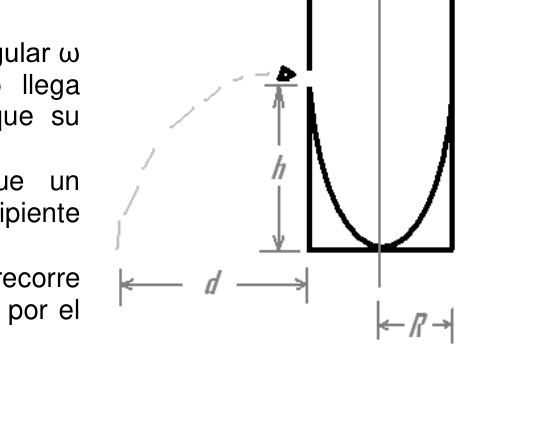
Topic: Circuits, Electrostatics Metodi: Equivalent Circuit Reduction, Electric Potential Method Competenze: Physical Reasoning, Mathematical Modeling Objects: Capacitor, Resistor Fonte: Testo (PDF) — p.3
Modello dell’asone di un neurone
PT93. Istituto tecnico San Michele di Tucumán.
Un modello fisico semplice del funzionamento dell’asse di un neurone. Nella natura ci sono un enorme numero di fenomeni che possono La corrente elettrica è rappresentata da semplici circuiti elettrici, come il flusso di Ioni attraverso una membrana cellulare. Un sistema un po ’ più complesso è il l’asse o cilindro di un neurone. Anche se il sistema nervoso è un meraviglia in quanto alla trasmissione delle informazioni, andiamo a Considerare un circuito semplice che rappresenta la trasmissione del segnale lungo dell’asse. Una membrana cellulare, il cui spessore è b = 7,00 nm, copre un asone che ha di forma cilindrica di raggio a = 5,00 μm. La differenza di potenziale tra il l’esterno e l’interno della membrana sono V0 = 70,0 mV. La sostanza con cui La membrana (lipido) è un dieletrico non ideale di costante
;
e resistenza . Con questi dati possiamo modellare la membrana come un circuito RC. Il plasma dell ’ assi è conduttore (non perfetto), con resistenza . In vista di che la membrana ha correnti di fuga radial, quando trasmette un impulso elettrico attraverso l’asse, questo impulso si attenua. Per questo la natura ha è stato fornito un materiale isolante che copre la membrana dell’axo, chiamato mielina, che svolge il ruolo di plastica isolante del filo conduttore. In questo caso L’ attenuazione è dovuta solo alla resistenza plasmatica dell’ axone e non alle correnti di fuga che si trasmettono attraverso la membrana. Per questo motivo la spinta deve essere rigenerato ogni certa distanza. Per questo si crea uno scambio di informazioni. carico tra l’esterno e l’interno dell’axo (flusso di ioni) attraverso i canali nella membrana. In questi canali si ha l’assenza di mielina, e sono chiamati
- No, non è vero.
OAF 2011 - 74
- Supponendo che la membrana possa essere considerata un condensatore piano di spessore b, determinare: a) la grandezza del campo elettrico all’interno della membrana del
- Axon. b) la densità superficiale della carica.
- Qual è la capacità (capacità) per unità di superficie della membrana?
- Calcola la conduttività radial (inverso resistenza) della membrana per unità di superficie.
- Calcola la costante di tempo del circuito RC equivalente.
- Calcola la resistenza azionaria (longitudinale) dell’asse per unità di lunghezza.
- Calcola la lunghezza critica LC dell’asse per la quale la sua resistenza longitudinale è uguale alla resistenza radial della membrana.
- Quali implicazioni avrebbe se la lunghezza dell’asse fosse superiore alla lunghezza dell’asse? lunghezza critica? giustifica.
Topic: Circuits, Electrostatics Metodi: Equivalent Circuit Reduction, Electric Potential Method Competenze: Physical Reasoning, Mathematical Modeling Objects: Capacitor, Resistor Fonte: Testo (PDF) — p.3
Axon model of a neuron
PT93. Technical Institute St. Michael of Tucumán.
A simple physical model of how the axon of a neuron works. In nature there are a huge number of phenomena that can The current is represented by simple electrical circuits, such as the flow of Ions through a cell membrane. A slightly more complex system is the axon or cylinder axis of a neuron. Even though the nervous system is a Wonderful when it comes to information transmission, let’s go to Consider a simple circuit representing the transmission of the signal along the of the axon. A cell membrane, whose thickness is b = 7,00 nm, covers an axon that has cylinder shape with a radius of 5,00 μm. The potential difference between the The outer and inner membrane is V0 = 70,0 mV. The substance with which The membrane (lipid) is a non-ideal constant dielectric
;
and resistance . With that data, we can model the membrane as an RC circuit. The plasma . The axon is conductive (not perfect), with resistivity . In view of The membrane has radial leakage currents, when a electrical impulse through the axon, this impulse is attenuated. That is why nature has provided an insulating substance covering the axon membrane, called Myelin, which plays the role of insulating plastic from the conductive thread. In this case The attenuation is due only to the plasma resistance of the axon and not to the leakage currents transmitted through the membrane. That ‘s why the momentum . It must be regenerated at a certain distance. The purpose of this is to create an exchange of charge between the outside and the inside of the axon (ionic flow) through channels in the membrane. In those channels you have a myelin absence, and they’re called The nodes of Ranvier.
The following is the list of the Member States’ financial statements:
- Assuming the membrane can be considered a capacitor thickness plane b, determine: (a) the magnitude of the electric field inside the membrane of the The axon. (b) the surface density of the load.
- What is the capacity (capacity) per unit area of the membrane?
- Calculates the radial conductivity (inverse resistance) of the membrane per unit area.
- Calculate the time constant of the equivalent RC circuit.
- Calculates the axial (longitudinal) resistance of the axon per unit length.
- Calculates the critical length LC of the axon for which its resistance The longitudinal resistance is equal to the radial resistance of the membrane.
- What implications would have had the length of the axon to be greater than the axon? critical length? You justify it.
Topic: Circuits, Electrostatics Metodi: Equivalent Circuit Reduction, Electric Potential Method Competenze: Physical Reasoning, Mathematical Modeling Objects: Capacitor, Resistor Fonte: Testo (PDF) — p.3
Lanzamiento vertical hacia abajo
PT94. Escuela Industrial Nro. 1 General Enrique Mosconi Caleta Olivia, Santa Cruz.
Si desde la terraza de un tercer piso, situado a 10 m por encima del suelo
,lanzas verticalmente hacia abajo un balón de 400 g con una velocidad de
5m.seg-1.
a) Determinar la energía mecánica en el punto de lanzamiento.
b) Calcular el valor de la energía cinética y su potencial gravitatoria ,
cuando se encuentra a una altura de 2m sobre el suelo ,
c) ¿Cuál es su energía mecánica total al llegar al suelo ? ¿Cuánto vale en
ese instante su velocidad?
Para comprobar si nuestros cálculos son correctos , se mide la velocidad del
balón al llegar al suelo, utilizando un fuelle , cuya constante elástica es de
k = 1,35.104 N.m-1 y se observa que, como consecuencia del impacto con el
balón , el fuelle se comprime 8 cm
d) ¿Cuál es el valor real de la velocidad del balón al llegar al suelo?
e) ¿ Qué ha ocurrido con la energía perdida?
f) Si en lugar de lanzar el balón hacia abajo lo lanzamos hacia arriba o
formando un ángulo de 60° con la horizontal .¿Cambiaria en algo la
resolución del problema ?
Topic: Conservation of Energy Metodi: Conservation of Energy, Hooke’s Law Competenze: Physical Reasoning, Mathematical Modeling Objects: Ball, Spring Fonte: Testo (PDF) — p.3
Lanzamento verticale verso il basso
PT94. Scuola industriale n.o. 1 Generale Enrique Mosconi
- Calma Olivia, Santa Cruz.
Se dal terrazzo di un terzo piano, situato a 10 m sopra il pavimento Lancia verticalmente verso il basso una pallina di 400 g a velocità di 5 metri, seg-1. a) Determinare l’energia meccanica al punto di lancio. b) Calcolare il valore della energia cinetica e il suo potenziale gravitazionale , Quando si trova ad un’ altezza di 2 metri sul suolo , c) Qual è la sua energia meccanica totale quando arriva al suolo? Quanto vale? che istante la sua velocità? Per verificare se i nostri calcoli sono corretti , si misura la velocità del La palla che arriva al suolo, usando un fuelle, la cui costante elastica è di k = 1,35.104 N.m-1 e si osserva che, in conseguenza dell’impatto con il
- Ballo , la fuelle si comprime 8 cm d) Qual è il valore reale della velocità della palla quando giunge al suolo? e) Che cosa è successo all’energia persa? f) Se invece di lanciare la palla verso il basso, la lanciamo verso l’alto o formando un angolo di 60° con la orizzontale. risolvere il problema ?
Topic: Conservation of Energy Metodi: Conservation of Energy, Hooke’s Law Competenze: Physical Reasoning, Mathematical Modeling Objects: Ball, Spring Fonte: Testo (PDF) — p.3
The following shall be added to the list of the following:
PT94. Industrial school No. 1 General Enrique Mosconi Put Olivia down, Santa Cruz.
If from the third floor terrace, located 10 m above the ground , you’re throwing a 400-g ball vertically down at a speed of 5m. sec-1. (a) Determine the mechanical energy at the launch point. (b) Calculate the value of kinetic energy and its gravitational potential , When you ‘re at a height of 2 meters above the ground , (c) What is your total mechanical energy when you reach the ground? How much is it worth in? That instant your speed? To check that our calculations are correct , we measure the speed of the ball on reaching the ground, using a fuelle, whose elastic constant is of k = 1,35.104 N.m-1 and it is observed that, as a result of the impact with the Ball , the fuelle is compressed 8 cm (d) What is the real value of the ball’s speed when it reaches the ground? (e) What has happened to the lost energy? (f) If instead of throwing the ball down we throw it up or forming an angle of 60° with the horizontal. How do you solve the problem ?
Topic: Conservation of Energy Metodi: Conservation of Energy, Hooke’s Law Competenze: Physical Reasoning, Mathematical Modeling Objects: Ball, Spring Fonte: Testo (PDF) — p.3
Mezcla de agua a distintas temperaturas
PT95. Escuela Industrial Nro. 1 General Enrique Mosconi Caleta Olivia, Santa Cruz.
Al mezclar 5 litros de agua a 40°C con 8 litros de agua a 25°C la temperatura final de la mezcla es de 29,5°C .¿Esta el recipiente aislado del exterior? Datos: Calor específico del agua Ca = 4,18.103 J kg-1 .K-1
OAF 2011 - 75
Topic: Thermodynamics Metodi: First Law of Thermodynamics, Statistical Averaging Competenze: Physical Reasoning, Mathematical Modeling Objects: Calorimeter Fonte: Testo (PDF) — p.3
Messione di acqua a diverse temperature
PT95. Scuola industriale n.o. 1 Generale Enrique Mosconi
- Calma Olivia, Santa Cruz.
Quando si mescolano 5 litri di acqua a 40°C con 8 litri di acqua a 25°C la temperatura fine della miscela è di 29,5°C. È il recipiente isolato dall’esterno? Dati: Calore specifico dell’acqua Ca = 4,18.103 J kg-1 .K-1
OAF 2011 - 75
Topic: Thermodynamics Metodi: First Law of Thermodynamics, Statistical Averaging Competenze: Physical Reasoning, Mathematical Modeling Objects: Calorimeter Fonte: Testo (PDF) — p.3
Mix of water at different temperatures
PT95. Industrial school No. 1 General Enrique Mosconi Put Olivia down, Santa Cruz.
When mixing 5 litres of water at 40°C with 8 litres of water at 25°C the temperature The final mixture is 29,5°C. Is this the container insulated from the outside? Data: Specific water heat Ca = 4,18.103 J kg-1 .K-1
The following points shall be added:
Topic: Thermodynamics Metodi: First Law of Thermodynamics, Statistical Averaging Competenze: Physical Reasoning, Mathematical Modeling Objects: Calorimeter Fonte: Testo (PDF) — p.3
Tuberia y teorema de Bernoulli
PT96. Escuela Industrial Nro. 1 General Enrique Mosconi Caleta Olivia, Santa Cruz.
Por una tubería que tiene un diámetro de 50 cm en la sección I y 25 cm en la sección II , siendo la presión en la primera de 1,7 kgf.cm-2 y la diferencia de altura entre ambas secciones es de 10 cm Suponiendo que circula un fluido de peso especifico =8,00 kgf.m-3 a razón de 0,1 m3.seg-1. (despreciar las perdidas por rozamiento). Responder: a) Extraer la información de parámetros e indicar sistemas de medidas- unidades. b) Diagramar la tubería , indicando la línea de corriente. c) Enuncia el soporte teórico que aplicas para la determinación de la presión en la sección II d) Calcula la Presión en la Sección II e) Mediante el Teorema de Bernoulli, escribe la ecuación para: e1) Flujo de régimen estable no viscoso (dar características del correspondiente flujo) e2) Flujo de régimen estable , irrotacional , incomprensible y no viscoso ( dar características ).
Topic: Fluid Mechanics Metodi: Bernoulli’s Equation, Continuity Equation Competenze: Physical Reasoning, Mathematical Modeling Objects: Tube Fonte: Testo (PDF) — p.3
Tuberia e teorema di Bernoulli
PT96. Scuola industriale n.o. 1 Generale Enrique Mosconi
- Calma Olivia, Santa Cruz.
Per un tubo di diametro di 50 cm nella sezione I e 25 cm nella sezione Sezione II , la pressione nella prima è di 1,7 kgf.cm-2 e la differenza di La altezza tra le due sezioni è di 10 cm. Supponiamo che circoli un fluido di peso specifico =8,00 kgf.m-3 a rapporto di 0,1 m3.seg-1. (spregiare le perdite da macchiatura). Risposta: a) Prendere le informazioni dei parametri e indicare sistemi di misurazione unità. b) Disegnare il tubo, indicando la linea di corrente. c) Indicare il supporto teorico che si applica per la determinazione della pressione nella sezione II d) Calcola la pressione nella sezione II e) Con il teorema di Bernoulli, scrivi l’equazione per: e1) Fluo di regime stabile non viscoso (dare caratteristiche di corrispondente flusso) e2) Fluo di regime stabile , irrotativo , incomprensibile e non viscoso (indicare i caratteri).
Topic: Fluid Mechanics Metodi: Bernoulli’s Equation, Continuity Equation Competenze: Physical Reasoning, Mathematical Modeling Objects: Tube Fonte: Testo (PDF) — p.3
The first is the “Tubers and the Bernoulli theorem”.
PT96. Industrial school No. 1 General Enrique Mosconi Put Olivia down, Santa Cruz.
For a pipe with a diameter of 50 cm in section I and 25 cm in the Section II , the pressure in the first being 1.7 kgf.cm-2 and the difference in The height between the two sections is 10 cm Assuming a specific weight fluid =8,00 kgf.m-3 circulates at a ratio of 0,1 The following is the list of the following: (disregarding the losses from rubbing). Answer: (a) To extract information from parameters and indicate systems of measurement; units. (b) Draw the pipe, indicating the current line. (c) State the theoretical support you apply for the determination of the pressure in section II (d) Calculate the pressure in Section II (e) Using Bernoulli’s theorem, write the equation for: (e1) Non-viscous stable flow rate (to give characteristics of the the corresponding flow) (e2) Steady , irrotational , incomprehensible and un- The following table shows the characteristics of the product:
Topic: Fluid Mechanics Metodi: Bernoulli’s Equation, Continuity Equation Competenze: Physical Reasoning, Mathematical Modeling Objects: Tube Fonte: Testo (PDF) — p.3
Circuito de entrenamiento de un atleta
PT97. Escuela Industrial Superior Ciudad de Santa Fe.
Un atleta se prepara para una competencia. Para ello practica en un circuito con
diferentes trayectos: empieza corriendo por uno recto de 1600m, luego baja por
una rampa con una inclinación de 10°.Finaliza la rampa con una rapidez de
9,0m/s. Con esa misma rapidez empieza a recorrer otro tramo horizontal de
200m hasta detenerse. Desde allí, y por último, ingresa a un río de 160m de
ancho, que corre de norte a sur, que debe cruzar a nado. Cuando deja el río,
concluye el circuito de entrenamiento. Suponiendo que practica un día en el que
no hay viento, resolver las siguientes consignas:
a) Si finaliza el primer tramo recto con una rapidez de 5,0m/s, hallar la
aceleración media.
b) Despreciando el rozamiento sobre la rampa, hallar su longitud.
c) Si el río se mueve con una velocidad de 1,0m/s, y la velocidad media
del atleta, perpendicular al río, es 2,4m/s, representar vectorialmente y
hallar la velocidad con la que el atleta llega a la orilla opuesta.
d) Halla la rapidez media del atleta en todo el recorrido.
e) ¿Llega el atleta a la otra orilla, justo enfrente de donde se tiró? .De no
ser así, explica y muestra qué debería hacer para lograrlo.
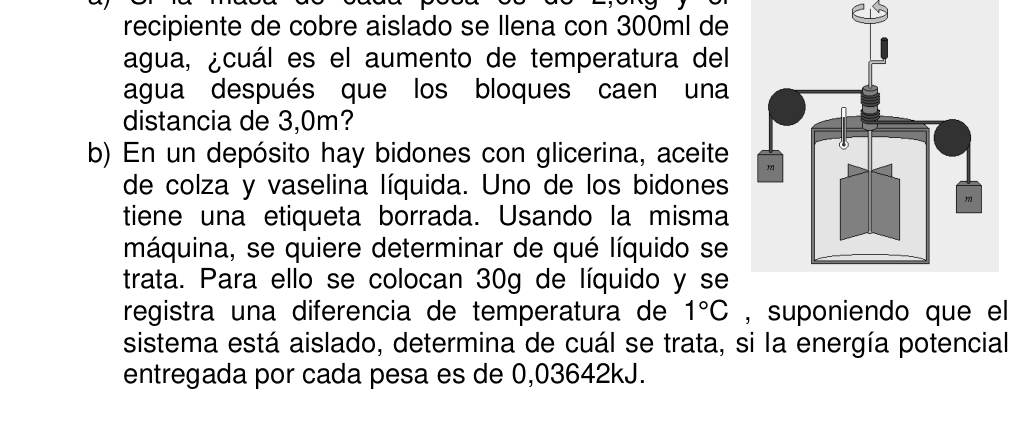
Topic: Newtonian Mechanics Metodi: Kinematic Equations, Vector Decomposition Competenze: Physical Reasoning, Mathematical Modeling Objects: — Fonte: Testo (PDF) — p.3
Circuito di allenamento di un atleta
PT97. Scuola superiore industriale Città di Santa Fe.
Un atleta si prepara per una competizione. Per questo pratica su un circuito con
- diversi percorsi: inizia correndo per un retto di 1600m, poi scende per una rampa con un’inclinazione di 10°. 9,0m/s. Con la stessa velocità inizia a percorrersi un altro tratto orizzontale di 200 metri fino a fermarsi. Da lì, e infine, entra in un fiume di 160m di La larghezza, che va da nord a sud, che deve attraversare nuotando. Quando lascia il fiume, conclude il circuito di allenamento. Supponiamo che pratichi un giorno in cui Non c’è vento, risolvi le seguenti consigli: a) Se si completa la prima parte retta a una velocità di 5,0 m/s, trovare la
- Accelerazione media. b) Sottopreparando il taglio sul rampo, trovare la sua lunghezza. c) Se il fiume si muove a una velocità di 1,0 m/s, e la velocità media L’atleta, perpendicolare al fiume, è di 2,4 m/s, rappresentazione vettoriale e trovare la velocità con cui l’atleta arriva al bordo opposto. d) Indicare la velocità media dell’atleta in tutta la corsa. e) L’atleta arriva all’altra riva, proprio di fronte a dove si è gettato? .De no se è così, spiega e mostra cosa dovrebbe fare per farlo.
Topic: Newtonian Mechanics Metodi: Kinematic Equations, Vector Decomposition Competenze: Physical Reasoning, Mathematical Modeling Objects: — Fonte: Testo (PDF) — p.3
Training circuit for an athlete
PT97. Higher Industrial School City of Santa Fe.
An athlete prepares for a competition. For this he practices on a circuit with Start running down a straight line of 1,600m, then down by a ramp with a slope of 10°. Finish the ramp at a speed of 9,0m/s. With the same speed , another horizontal stretch of the 200 meters to stop. From there, and finally, enters a 160m river from wide, running north to south, which must be crossed by swimming. When you leave the river, The training circuit ends. Assuming you practice one day when There’s no wind, solve the following slogans: (a) If the first straight section is completed at a speed of 5.0 m/s, find the The speed of the vehicle is not less than 50 km/h. (b) Find the length of the ramp by scratching the ramp. (c) If the river is moving at a speed of 1.0m/s, and the average speed The athlete’s perpendicular to the river is 2.4m/s, representing vectorally and Find the speed at which the athlete reaches the opposite shore. (d) Find the average speed of the athlete throughout the course. (e) Does the athlete reach the other shore, just opposite where he threw himself? .De no If you’re like that, explain and show what you should do to achieve it.
Topic: Newtonian Mechanics Metodi: Kinematic Equations, Vector Decomposition Competenze: Physical Reasoning, Mathematical Modeling Objects: — Fonte: Testo (PDF) — p.3
Equivalente mecanico del calor (Joule)
PT98. Escuela Industrial Superior Ciudad de Santa Fe.
Para poder cuantificar el trabajo mecánico, Joule utilizó una rueda de paletas que giraba por medio de pesas que caían. Al caer, las pesas perdían su energía potencial, proporcionando energía cinética a la rueda. Cuando la rueda de paletas giraba, revolvía el agua en un recipiente de cobre. Joule notó un aumento en la temperatura del agua cada vez que una pesa caía. Relacionando dicho aumento con la caída de las pesas, Joule pudo demostrar que la energía
OAF 2011 - 76 mecánica de las pesas que caían era convertida en energía calórica en el agua (equivalente mecánico del calor). Considerando el aparato de la figura, semejante a la máquina de Joule, resolver las siguientes consignas: a) Si la masa de cada pesa es de 2,0kg y el recipiente de cobre aislado se llena con 300ml de agua, ¿cuál es el aumento de temperatura del agua después que los bloques caen una distancia de 3,0m? b) En un depósito hay bidones con glicerina, aceite de colza y vaselina líquida. Uno de los bidones tiene una etiqueta borrada. Usando la misma máquina, se quiere determinar de qué líquido se trata. Para ello se colocan 30g de líquido y se registra una diferencia de temperatura de 1°C , suponiendo que el sistema está aislado, determina de cuál se trata, si la energía potencial entregada por cada pesa es de 0,03642kJ.
Datos: calores específicos, del aceite de colza 0,91kcal/kgºC y de la vaselina
0,056kcal/kgºC,de la glicerina 0,58kcal/kgºC.
1J=0,2389cal
c) Realiza el diagrama de cuerpo libre de cada pesa. d) Aplicando dicho equivalente, resuelve la siguiente situación: un esquiador de 70kg se mueve por la nieve en una trayectoria horizontal. Suponiendo que toda la energía generada por fricción derrite la nieve que se pega a sus esquíes y que está 0°, ¿cuántos metros deberá esquiar para derretir 2,0kg de esa nieve, si el coeficiente de fricción entre los esquíes y la nieve es 0,15? Dato: calor de fusión del hielo:80cal/g
Topic: Thermodynamics, Conservation of Energy Metodi: First Law of Thermodynamics, Conservation of Energy Competenze: Physical Reasoning, Mathematical Modeling Objects: Calorimeter, Block Fonte: Testo (PDF) — p.3
**Meccanico equivalente al calore (Joule) **
PT98. Scuola superiore industriale Città di Santa Fe.
Per poter quantificare il lavoro meccanico, Joule usò una ruota di palle. che girava attraverso pesanti che cadevano. Quando cadevano, i pesi perdono energia. Potenzialmente, fornendo energia cinetica alla ruota. Quando la ruota di le palle giravano, si girava l’acqua in un recipiente di rame. Joule ha notato un’altra. aumenta la temperatura dell’acqua ogni volta che un peso cade. Relazionando L’energia è aumentata con la caduta dei pesi.
OAF 2011 - 76 La meccanica dei pesanti che cadevano veniva trasformata in energia calorica nell’acqua. (equivalente meccanico del calore). Considerando l’apparato della figura, Come la macchina di Joule, risolvere i seguenti consigli: a) Se la massa di ciascun peso è di 2,0 kg e il Contenitore di rame isolato è riempito con 300ml di l’acqua, qual è l’aumento della temperatura del acqua dopo che i blocchi cadono una Distanza di 3 metri? b) In un deposito ci sono dei bidoni con glicerina, olio di colza e di vaselina liquida. Uno dei bidoni ha un tag cancellato. Usando la stessa . La macchina, si vuole determinare da quale liquido si
- Si tratta. Per questo si inseriscono 30 g di liquido e si si registra una differenza di temperatura di 1°C, supponendo che il Il sistema è isolato, determina quale è, se l’energia potenziale Consegna per ogni peso 0,03642 kJ.
Dati: calori specifici, di olio di colza 0,91kcal/kgoC e di vaselina 0,056 kcal/kgoC, della glicerina 0,58 kcal/kgoC. 1J=0,2389 cal
c) Realizza il diagramma di corpo libero di ogni peso. (d) Applicando tale equivalente, risolve la seguente situazione: lo sciatore da 70 kg si muove sulla neve in un percorso orizzontale. Supponiamo che tutta l’energia generata da attrito scioglia la neve. che si attacca alle sue sci e che è 0°, quanti metri deve sciare per sciogliere 2,0 kg di neve, se il coefficiente di attrito Tra gli sci e la neve è 0,15? Data: calore di fusione del g. 80 cal/g
Topic: Thermodynamics, Conservation of Energy Metodi: First Law of Thermodynamics, Conservation of Energy Competenze: Physical Reasoning, Mathematical Modeling Objects: Calorimeter, Block Fonte: Testo (PDF) — p.3
**Mechanical equivalent of heat (Joule) **
PT98. Higher Industrial School City of Santa Fe.
To quantify the mechanical work, Joule used a wheel of pallets. It was rotating through the weight of the falling. When the weights fell, they lost their energy. The potential, providing kinetic energy to the wheel. When the wheel of The water was in a copper container. Joule noticed a . The temperature of the water increases every time a weight falls. Relating to This increase with the weight drop, Joule was able to prove that energy
The following points shall be added: The mechanics of the weights falling was converted into calorie energy in the water. (mechanical equivalent of heat). Considering the apparatus of the figure, Like the Joule machine, solve the following slogans: (a) If the mass of each weight is 2.0 kg and the Insulated copper container is filled with 300ml of What is the temperature increase of the water? Water after the blocks fall one . distance of three metres? (b) In a tank there are cans of glycerin, oil of rapeseed and liquid vaseline. One of the buckets . It has a deleted tag. Using the same one. machine, you want to determine which liquid is from Try it. For this, 30 g of liquid is added and The temperature difference is 1°C, assuming that the temperature difference is The system is isolated, determines which one it is, if the potential energy delivered per weight is 0,03642kJ.
Data: specific heat, of rapeseed oil 0,91kcal/kgoC and of vaseline The amount of the product concerned shall be calculated as follows: 1J = 0.2389 cal
(c) Perform the free body diagram of each weighing. (d) Applying this equivalent, it solves the following situation: A 70 kg skier moves through the snow on a horizontal path. Assuming all the energy generated by friction melts the snow . If you are stuck to your skis and 0°, how many metres should you go? Skiing to melt 2 kg of that snow, if the friction coefficient Between the ski and the snow is 0.15? Date: heat from the melting of ice: 80 cal/g
Topic: Thermodynamics, Conservation of Energy Metodi: First Law of Thermodynamics, Conservation of Energy Competenze: Physical Reasoning, Mathematical Modeling Objects: Calorimeter, Block Fonte: Testo (PDF) — p.3
Reflexion en un prisma
PT99. Escuela Industrial Superior Ciudad de Santa Fe.
Un profesor de Física, desea mostrar a sus alumnos el fenómeno de la reflexión. Para ello introduce en una cuba de vidrio llena de agua un prisma equilátero, como indica la figura. Hace incidir un rayo láser en el punto A desde arriba, de modo que forma un ángulo de 35° con la normal. Si el índice de refracción del prisma es 1,66 y el del agua es 1,33, determinar: a) El ángulo de refracción en el punto A. b) Los ángulos de incidencia y refracción cuando el rayo llega a la otra cara. c) Marcar la marcha del rayo en el esquema. d) ¿Podrá mostrar el profesor el fenómeno de reflexión interna con el rayo que emerge del prisma cuando llega a la superficie que separa el agua del aire?
OAF 2011 - 77
Topic: Geometric Optics Metodi: Snell’s Law, Ray Tracing Competenze: Physical Reasoning, Mathematical Modeling Objects: Prism Fonte: Testo (PDF) — p.3
Riflessione in prisma
PT99. Scuola superiore industriale Città di Santa Fe.
Un professore di fisica vuole mostrare ai suoi studenti il fenomeno della riflessione. Per questo inserisce in un vassoio di vetro pieno di acqua un prisma equilaterale. come indica la figura. Fa incidere un raggio laser sul punto A dall’alto, di modulo che forma un angolo di 35° con la normale. Se l’indice di refraczione di Il prisma è 1,66 e quello dell’acqua è 1,33, determinare: a) L’angolo di rifrazione al punto A. b) Gli angoli di incidenza e di refraczione quando il raggio raggiunge l’altro
- Oh, mio cara. c) Indicare il passo del raggio nel schema. d) Il professore può mostrare il fenomeno di riflessione interna con il raggio che emerge dal prisma quando arriva alla superficie che separa l’acqua dell’aria?
OAF 2011 - 77
Topic: Geometric Optics Metodi: Snell’s Law, Ray Tracing Competenze: Physical Reasoning, Mathematical Modeling Objects: Prism Fonte: Testo (PDF) — p.3
Reflection in a prism
PT99. Higher Industrial School City of Santa Fe.
A physics professor wants to show his students the phenomenon of reflection. To do this, he inserts an equilateral prism into a glass cup full of water. As shown in the figure. It makes a laser beam shine at point A from above, from so that it forms an angle of 35° to the normal. If the refractive index of the prism is 1.66 and water is 1.33, determine: (a) The angle of refraction at point A. (b) The angles of incidence and refraction when the beam reaches the other.
- I’m not going to. (c) Marking the beam’s path in the diagram. (d) Will the teacher be able to show the internal reflection phenomenon with the lightning? It emerges from the prism when it reaches the surface separating the water. from the air?
The following points shall be added:
Topic: Geometric Optics Metodi: Snell’s Law, Ray Tracing Competenze: Physical Reasoning, Mathematical Modeling Objects: Prism Fonte: Testo (PDF) — p.3
Objetos encadenados
PT100. Colegio Universitario Central Ciudad de Mendoza.
Objetos encadenados. Un libro de 2 kg que se encuentra sobre una larga mesa, está unido por una cuerda a otro que cuelga verticalmente de la mesa, considerando despreciable la masa y el rozamiento con la mesa de esta cuerda. Cuando se deja caer el cuerpo que cuelga, que posee una masa de 2,5 kg, arrastra con él al cuerpo sobre la mesa. Sabiendo que el coeficiente dinámico entre la mesa y el cuerpo es de 0,25, determinar: a- La aceleración del sistema. b- La distancia recorrida durante los 0,5 s de caída, antes de golpear un rifle que dispara un proyectil. Si el proyectil de 0,196 N de peso atraviesa una pared de 20 cm de espesor, llegando a ella con una velocidad (horizontal)de 700 m/s y reaparece por el otro lado con una cierta velocidad (horizontal), luego golpea horizontalmente a un balde lleno de arena (que estaba en reposo) sujeto de una cuerda inextensible y de peso despreciable , se incrusta en él y lo hace subir 30cm. Si la fuerza de frenado del proyectil, dentro de la pared, es de 1500 N, determinar: c- la masa del balde.
Topic: Newtonian Mechanics, Conservation of Momentum Metodi: Free-Body Diagram, Conservation of Momentum, Impulse-Momentum Theorem Competenze: Physical Reasoning, Mathematical Modeling Objects: Block, String, Projectile Fonte: Testo (PDF) — p.3
Oggetti in catena
PT100. Collegio universitario centrale Città di Mendoza.
Oggetti in catena. Un libro di 2 kg che si trova su un lungo tavolo, è unito da un Un’altra corda che si appende verticalmente dal tavolo, considerando dispregiata la massaggio e rasatura con la tavola di questa corda. Quando si lascia cadere il corpo che pende, che possiede una massa di 2,5 kg, trascina il corpo sul tavolo. Sapendo che il coefficiente dinamico tra la tavola e il corpo è di 0,25, determinare: a- Accelerazione del sistema. b- La distanza percorsa durante i 0,5 s di caduta, prima di colpire un un fucile che tira un proiettile. Se il proiettile di peso 0,196 N attraversa un muro di 20 cm di spessore, Arrivo a velocità (orizzontale) di 700 m/s e ripresento dall’altro lato con una certa velocità (orizzontale), poi colpisce orizzontalmente un un vascello pieno di sabbia (che era a riposo) soggetto di una corda inestensibile e di peso dispregiato, si incrusta in esso e lo fa salire di 30 centimetri. Se la forza di frenata del proiettile, all’interno del muro, è di 1500 N, determinare: c- la massa del bucato.
Topic: Newtonian Mechanics, Conservation of Momentum Metodi: Free-Body Diagram, Conservation of Momentum, Impulse-Momentum Theorem Competenze: Physical Reasoning, Mathematical Modeling Objects: Block, String, Projectile Fonte: Testo (PDF) — p.3
The following table shows the number of items in the list of items:
PT100. Central University College The city of Mendoza.
Chained objects. A two-pound book that’s on a long table, is bound together by a rope to another one hanging vertically from the table, considering the Massage and rubbing with this table rope. When you drop the body that hangs, which has a mass of 2.5 kg, He drags the body with him to the table. Knowing that the dynamic coefficient between the table and the body is 0.25, determine: a- The acceleration of the system. b- The distance travelled during the 0.5 s fall before hitting a rifle firing a projectile. If the 0,196 N projectile passes through a wall 20 cm thick, reaching it at a (horizontal) speed of 700 m/s and reappearing by the other side with a certain speed (horizontal), then hits horizontally at a bucket full of sand (which was at rest) subjected to an unextended rope and It’s a scum of weight, it’s embedded in it and it’s raised 30cm. If the force of the projectile braking within the wall is 1500 N, determine: c- the mass of the bucket.
Topic: Newtonian Mechanics, Conservation of Momentum Metodi: Free-Body Diagram, Conservation of Momentum, Impulse-Momentum Theorem Competenze: Physical Reasoning, Mathematical Modeling Objects: Block, String, Projectile Fonte: Testo (PDF) — p.3
Una sustancia desconocida
PT101. Colegio Universitario Central Ciudad de Mendoza.
Una sustancia desconocida.
El siguiente gráfico corresponde a una sustancia sometida al aumento de
temperatura. Sabiendo que su calor específico al estado sólido es de
0,45 cal /gºC, Determinar:
a- La masa de la sustancia,
b- Qué cantidad de calor hay que suministrar a la muestra inicial para que
funda totalmente.
c- ¿Cuál es el calor específico al estado líquido?.
d- ¿Cuál es el calor latente de vaporización?
e- ¿Qué temperatura tendrá la sustancia cuando al cuerpo inicial se le
suministraron 150 cal?
OAF 2011 - 78
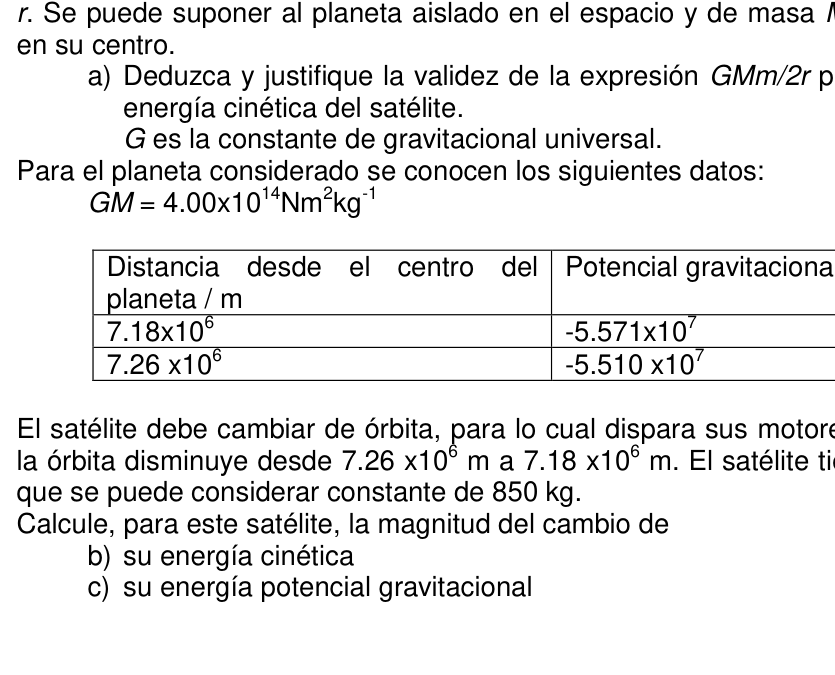
Topic: Thermodynamics Metodi: First Law of Thermodynamics, Graph Linearization Competenze: Physical Reasoning, Mathematical Modeling Objects: — Fonte: Testo (PDF) — p.3
Sostanza sconosciuta
PT101. Collegio universitario centrale Città di Mendoza.
Una sostanza sconosciuta. Il seguente grafico corrisponde a una sostanza che è stata sottoposta ad un aumento di temperatura. Sapendo che il suo calore specifico allo stato solido è di 0,45 cal /goC, Determinare: a- la massa della sostanza, b- Quanta calore deve essere fornito al campione iniziale per
- Si, si, si, si, si, si, si, si, si, si, si, si, si, si, si, si, si, si, si, si, si, si, si, si, si, si, si, si, si, si, si, si, si, si, si, si, si, si, si, si, si, si, si, si, si, si, si, si, si, si, si, si, si, si, si, si, si, si, si, si, si, si, si, si, si, si, si, si, si, si, si, si, si, si, si, si, si, si, si, si, si, si, si, si, si, si, si, si, si, si, si, si, si, si, si, si, si, si, si, si, si, si, si, si, si, si, si, si, si, si, si, si, si, si, si, si, si, si, si, si, si, si, si, si, si, si, si, si, si, si, si, si, si, si, si, si, si, si, si, si, si, si, si, si, si, si, si, si, si, si, si, si, si, si, si, si, si, si, si, si, si, si, si, si, si, si, si, si, si, si, si, si, si, si, si, si, si, si, si, si, si, si, si, si, si, si, si, si, si, si, si, si, si, si, si, si, si, si, si, si, si, si, si, si, si, si, si, si, si, si, si, si, si, si, si, si, si, si, si, si, si, si, si, si, si, si, si, si, si, si, si, si, si, si, c- Qual è il calore specifico dello stato liquido? d- Qual è il calore latente della vaporizzazione? e- Che temperatura avrà la sostanza quando il corpo iniziale sarà Hanno fornito 150 cal?
OAF 2011 - 78
Topic: Thermodynamics Metodi: First Law of Thermodynamics, Graph Linearization Competenze: Physical Reasoning, Mathematical Modeling Objects: — Fonte: Testo (PDF) — p.3
An unknown substance
PT101. Central University College The city of Mendoza.
An unknown substance. The following graph shows a substance subject to an increase in The temperature. Knowing that its specific heat to the solid state is of 0,45 cal/goC, Determine: a- The mass of the substance, b- How much heat must be supplied to the initial sample to It’s completely covered. c- What is the specific heat of the liquid state? d- What is the latent heat of vaporization? e- What temperature will the substance be at when the initial body is given They supplied 150 cal?
The following is the list of the Member States’ financial statements:
Topic: Thermodynamics Metodi: First Law of Thermodynamics, Graph Linearization Competenze: Physical Reasoning, Mathematical Modeling Objects: — Fonte: Testo (PDF) — p.3
Pendulo electrostatico
PT102. Colegio Universitario Central Ciudad de Mendoza.
Un péndulo electrostático. Una pequeña esfera de masa 0,2 g pende de un hilo inextensible y es colocado entre las placas de un capacitor cuyas dos láminas verticales paralelas están separadas 5 cm. La esfera tiene una carga de 6.10-9 C. ¿Que voltaje debe tener la fuente que carga el capacitor si quiero que el hilo del péndulo forme un ángulo de 30° con la vertical?
Topic: Electrostatics Metodi: Free-Body Diagram, Coulomb’s Law Competenze: Physical Reasoning, Mathematical Modeling Objects: Pendulum, Capacitor Fonte: Testo (PDF) — p.3
Pendolo elettrostatico
PT102. Collegio universitario centrale Città di Mendoza.
Un pendolo elettrostatico. Una piccola sfera di massa di 0,2 g è appesa a un filo inestensibile e collocata tra le schede di un capacitore le cui due schede verticali parallele sono separati di 5 cm. La sfera ha un carico di 6,10-9 C. Che voltazione deve avere la fonte che carica il capacitore se voglio che il filo del pendolo formino un angolo di 30° con la Verticale?
Topic: Electrostatics Metodi: Free-Body Diagram, Coulomb’s Law Competenze: Physical Reasoning, Mathematical Modeling Objects: Pendulum, Capacitor Fonte: Testo (PDF) — p.3
The following table shows the results of the calculation of the calculation of the value of the vehicle:
PT102. Central University College The city of Mendoza.
It’s an electrostatic pendulum. A small sphere of 0.2 g mass hangs from an unextended thread and is placed between the plates of a capacitor whose two parallel vertical sheets are 5 cm apart. The sphere has a charge of 6.10-9 C. What voltage should the source have? charge the capacitor if I want the pendulum thread to form an angle of 30° with the
- What?
Topic: Electrostatics Metodi: Free-Body Diagram, Coulomb’s Law Competenze: Physical Reasoning, Mathematical Modeling Objects: Pendulum, Capacitor Fonte: Testo (PDF) — p.3
Persecucion policial
PT103. Colegio Secundario Polimodal Ruralizado Colonia Santa María, La Pampa.
Por un control policial pasa un automóvil con velocidad constante de 150 km/h donde la velocidad permitida es de 60 km/h . 5 min. Después sale en persecución el móvil policial que demora 15 seg ha llegar a una velocidad de 160 km/h velocidad máxima del móvil teniendo combustible para 100 km ha esa velocidad.
- Llegara el móvil policial ha alcanzar el automóvil antes de quedarse sin combustible
- En qué momento alcanza la policía al automóvil
- ¿a qué velocidad debería ir el móvil para alcanzar al automóvil?
- Representar gráficamente el movimiento
Topic: Newtonian Mechanics Metodi: Kinematic Equations Competenze: Physical Reasoning, Mathematical Modeling Objects: — Fonte: Testo (PDF) — p.3
Persecuzione della polizia
PT103. La scuola superiore polimodal rurale Colonia Santa Maria, La Pampa.
Un’auto che passa per un controllo della polizia a velocità costante di 150 km/h dove la velocità consentita è di 60 km/h . Cinque minuti. Poi uscirà in Il cellulare della polizia che dura 15 secondi è arrivato a una velocità di 160 km/h velocità massima del cellulare con carburante per 100 km ha quella velocità.
- Arrivo il cellulare della polizia ha raggiunto l’auto prima di rimanere senza Fuel
- A che ora la polizia arriva alla macchina?
- a che velocità dovrebbe andare il cellulare per raggiungere l’auto?
- Rappresentare graficamente il movimento
Topic: Newtonian Mechanics Metodi: Kinematic Equations Competenze: Physical Reasoning, Mathematical Modeling Objects: — Fonte: Testo (PDF) — p.3
Police persecution
PT103. Rural Polymodal Secondary School Colony of Santa Maria, the Pampa.
A car with a constant speed of 150 km/h passes through a police check. where the speed limit is 60 km/h . - Five minutes. - What? Then he goes out on The police cell phone that takes 15 seconds has reached a speed of 160 km/h maximum speed of the mobile with fuel for 100 km is that speed.
- The police cell phone has reached the car before it is gone. Fuel
- What time does the police reach the car ?
- How fast should the mobile go to reach the car?
- Graphically represent the movement
Topic: Newtonian Mechanics Metodi: Kinematic Equations Competenze: Physical Reasoning, Mathematical Modeling Objects: — Fonte: Testo (PDF) — p.3
Circuito con mallas
PT104. Colegio Secundario Polimodal Ruralizado Colonia Santa María, La Pampa.
Nos encontramos con este circuito en una plaqueta de esta forma
OAF 2011 - 79 E1= 12V E2= 6 V E3= 10V E4= 9V E5=12V
r1= 3 Ohm
r2= 6 Ohm
r3= 4 Ohm
r4= 6 Ohm
r5= 3 Ohm
r6= 8 Ohm
r7= 10Ohm
r8= 12 Ohm
r9= 6 ohm
Determinar
- Debemos determinar los valores de la intensidad en cada unas de la mallas (I1, I2 y I3) para saber si el circuito esta en buenas condiciones
- Y que ocurre con las intensidades cuando el se abre el interruptor (Int.)
- calcular el VABCDE
Topic: Circuits Metodi: Kirchhoff’s Laws, Equivalent Circuit Reduction Competenze: Physical Reasoning, Mathematical Modeling Objects: Resistor, Battery, Switch Fonte: Testo (PDF) — p.3
Circuito con malle
PT104. La scuola superiore polimodal rurale Colonia Santa Maria, La Pampa.
Si trova questo circuito su una targa così.
OAF 2011 - 79 E1= 12V E2= 6 V E3= 10V E4= 9V E5=12V
R1 = 3 Ohm R2 = 6 Ohm R3 = 4 Ohm R4 = 6 Ohm R5 = 3 Ohm R6 = 8 Ohm R7= 10Ohm R8 = 12 Ohm R9 = 6 ohm
Determinare
- Dobbiamo determinare i valori di intensità in ciascuna delle I1 e I3 per verificare se il circuito è in buona condizione
- E che succede con le intensità quando si aprisce il interruttore (Int.)
- calcolare il VABCDE
Topic: Circuits Metodi: Kirchhoff’s Laws, Equivalent Circuit Reduction Competenze: Physical Reasoning, Mathematical Modeling Objects: Resistor, Battery, Switch Fonte: Testo (PDF) — p.3
The following table shows the number of units of the vehicle:
PT104. Rural Polymodal Secondary School Colony of Santa Maria, the Pampa.
We find this circuit on a plate like this.
The following is the list of the Member States’ financial statements: E1= 12V E2= 6 V E3= 10V E4= 9V E5=12V
R1 = 3 Ohm R2 = 6 Ohm R3 = 4 Ohm R4 = 6 Ohm R5 = 3 Ohm R6 = 8 Ohm R7 = 10Ohm R8 = 12 Ohm R9 = 6 ohms
Determine
- We must determine the intensity values in each of the The following information shall be provided:
- And what happens to the intensities when the switch is turned on (Int.)
- calculate the VABCDE
Topic: Circuits Metodi: Kirchhoff’s Laws, Equivalent Circuit Reduction Competenze: Physical Reasoning, Mathematical Modeling Objects: Resistor, Battery, Switch Fonte: Testo (PDF) — p.3
Calorimetria con bloque de platino
PT105. Colegio Secundario Polimodal Ruralizado Colonia Santa María, La Pampa.
Un bloque de platino de 60 g es retirado de un horno e inmediatamente colocado en un calorímetro de cobre de masa igual 100g y que contiene 340 g de agua.
- Calcular la Temp. del horno, sabiendo que la temp. Inicial del agua era 10 °C y que subió a 13 °C cuando se alcanzo el equilibrio térmico.
- Si en lugar de colocar platino hubiéramos colocado hierro con la misma temp. Cuanto hubiera sido la temperatura de equilibrio
Tabla del calor específico de algunas sustancias C agua = 1 cal/g.°C C hielo = 0,5 cal/g.°C C aire = 0,24 cal/g.°C C aluminio = 0,217 cal/g.°C C plomo = 0,03 cal/g.°C C hierro = 0,114 cal/g.°C C latón = 0,094 cal/g.°C C mercurio = 0,033 cal/g.°C C cobre = 0,092 cal/g.°C C plata = 0,056 cal/g.°C
Topic: Thermodynamics Metodi: First Law of Thermodynamics Competenze: Physical Reasoning, Mathematical Modeling Objects: Calorimeter Fonte: Testo (PDF) — p.3
Calorimetria con blocco di platino
PT105. La scuola superiore polimodal rurale Colonia Santa Maria, La Pampa.
Un blocco di platino di 60 g viene estratto da un forno e immediatamente posto. in un calometro di rame di massa pari a 100 g contenente 340 g di acqua.
- Calcolare il tempo. - Il forno, sapendo che il tempo. Inizialmente l’acqua era 10 °C e che è salito a 13 °C quando si è raggiunto l’equilibrio termico.
- Se invece di mettere il platino avessimo messo l’ ferro con esso Temp. Quanto sarebbe stata la temperatura di equilibrio ?
Tabella del calore specifico di alcune sostanze C acqua = 1 cal/g.°C C ghiaccio = 0,5 cal/g.°C C aria = 0,24 cal/g.°C C alluminio = 0,217 cal/g.°C C piombo = 0,03 cal/g.°C C ferro = 0,114 cal/g.°C C latone = 0,094 cal/g.°C C mercurio = 0,033 cal/g.°C C copro = 0,092 cal/g.°C C argento = 0,056 cal/g.°C
Topic: Thermodynamics Metodi: First Law of Thermodynamics Competenze: Physical Reasoning, Mathematical Modeling Objects: Calorimeter Fonte: Testo (PDF) — p.3
Calorimetry with platinum block
PT105. Rural Polymodal Secondary School Colony of Santa Maria, the Pampa.
A 60 g platinum block is removed from an oven and immediately placed. in a copper calorimeter of 100 g mass and containing 340 g of water.
- Calculate the Temp. The oven, knowing that the temp. Initial water was 10 °C and which rose to 13 °C when the thermal equilibrium was reached.
- If instead of platinum we had iron with it . Temp. How much would the equilibrium temperature have been ?
Table of specific heat of some substances C water = 1 cal/g.°C The amount of the product shall be calculated in accordance with the following formula: C air = 0,24 cal/g.°C The value of the product shall be calculated as follows: The value of the product concerned shall be the sum of the values of the product concerned. C iron = 0,114 cal/g.°C The value of the product is the value of the product concerned. The amount of the product concerned is calculated as follows: The value of the product shall be the value of the product concerned. C silver = 0,056 cal/g.°C
Topic: Thermodynamics Metodi: First Law of Thermodynamics Competenze: Physical Reasoning, Mathematical Modeling Objects: Calorimeter Fonte: Testo (PDF) — p.3
Energia cinetica de un satelite
PT106. Escuela de Educación Secundaria San Andrés Olivos, Buenos Aires.
Un satélite de masa m se encuentra orbitando un planeta. El radio de la órbita es r. Se puede suponer al planeta aislado en el espacio y de masa M concentrada en su centro. a) Deduzca y justifique la validez de la expresión GMm/2r para calcular la energía cinética del satélite. G es la constante de gravitacional universal. Para el planeta considerado se conocen los siguientes datos: GM = 4.00x10¹⁴Nm2kg-1
Distancia desde el centro del planeta / m Potencial gravitacional / J kg-1 7.18x10⁶ -5.571x10⁷ 7.26 x10⁶ -5.510 x10⁷
El satélite debe cambiar de órbita, para lo cual dispara sus motores. El radio de
la órbita disminuye desde 7.26 x10⁶ m a 7.18 x10⁶ m. El satélite tiene una masa
que se puede considerar constante de 850 kg.
Calcule, para este satélite, la magnitud del cambio de
b) su energía cinética
c) su energía potencial gravitacional
OAF 2011 - 80 d) su energía total Usando sus respuestas anteriores, responda y explique si los motores deben ser disparados para producir una fuerza en la dirección de movimiento del satélite o en la dirección opuesta.
Topic: Gravitation Metodi: Newton’s Law of Gravitation, Conservation of Energy Competenze: Physical Reasoning, Mathematical Modeling Objects: Satellite, Planet Fonte: Testo (PDF) — p.3
Energia cinetica di un satellite
PT106. Scuola di istruzione secondaria San Andrés Olivos, Buenos Aires.
Un satellite a massa m è in orbita intorno a un pianeta. Il raggio di orbita è r. Si può supporre che il pianeta sia isolato nello spazio e di massa concentrata M. al centro. a) Deduce e giustifica la validità dell’espressione GMm/2r per calcolare la energia cinetica del satellite. G è la costante gravitazionale universale. Per il pianeta in esame sono noti i seguenti dati: GM = 4.00x10¹⁴Nm2kg-1
Distanza dal centro del pianeta / m Potenzial gravitazionale / J kg-1 7.18x10⁶ -5.571x10⁷ 7.26 x10⁶ -5.510 x10⁷
Il satellite deve cambiare orbita, per cui spara i suoi motori. La radio di L’orbita diminuisce da 7,26 x10⁶ m a 7,18 x10⁶ m. Il satellite ha una massa. che può essere considerata costante di 850 kg. Calcola, per questo satellite, la portata del cambiamento di b) la sua energia cinetica c) la sua energia potenziale gravitazionale
OAF 2011 - 80 d) la sua energia totale Usando le tue risposte precedenti, rispondi e spiega se i motori devono essere Le scorte sono state effettuate per produrre una forza nella direzione del movimento del satellite o
- In direzione opposta.
Topic: Gravitation Metodi: Newton’s Law of Gravitation, Conservation of Energy Competenze: Physical Reasoning, Mathematical Modeling Objects: Satellite, Planet Fonte: Testo (PDF) — p.3
The kinetic energy of a satellite
PT106. San Andrés High School Olive trees, from Buenos Aires.
An m-mass satellite is orbiting a planet. The radius of the orbit is r. It can be assumed that the planet is isolated in space and has a concentrated mass of M. In the center. (a) deduce and justify the validity of the expression GMm/2r for calculating the The kinetic energy of the satellite. G is the universal gravitational constant. The following data are known for the planet in question: GM = 4.00x10¹⁴Nm2kg-1
Distance from the centre of the city planet / m Gravitational potential / J kg-1 7.18x10⁶ -5.571x10⁷ 7.26 x10⁶ -5.510 x10⁷
The satellite must change orbit, which is why it fires its engines. The radio of The orbit decreases from 7.26 x10⁶ m to 7.18 x10⁶ m. The satellite has a mass. which can be considered as constant at 850 kg. Calculate, for this satellite, the magnitude of change of (b) its kinetic energy (c) its gravitational potential energy
The following is the list of the countries of the European Union: (d) its total energy Using your previous answers, answer and explain whether the engines should be fired to produce a force in the direction of the satellite’s motion or In the opposite direction.
Topic: Gravitation Metodi: Newton’s Law of Gravitation, Conservation of Energy Competenze: Physical Reasoning, Mathematical Modeling Objects: Satellite, Planet Fonte: Testo (PDF) — p.3
Cohete de propulsion solar (xenon)
PT107. Escuela de Educación Secundaria San Andrés Olivos, Buenos Aires.
Una nave espacial tiene un cohete a propulsión solar que utiliza energía solar
para ionizar átomos de xenón y acelerarlos. Como respuesta a esa aceleración,
los iones son eyectados de la nave a una velocidad de 3.0 x10⁴ m/s.
a) El número másico del xenón es 131. Muestre que la masa de 1 ión de
xenón es de 2.2 x10⁻²⁵ kg.
b) La masa original de combustible es de 81 kg. Si los iones eyectados por
segundo son 7.7 x10¹⁸, calcule el tiempo de duración del combustible.
c) La masa de la nave es de 540 kg. Calcula su aceleración inicial.
d) EL gráfico representa la variación de la aceleración de la nave con el
tiempo. La propulsión solar es iniciada a t= 0, cuando la velocidad de la
nave es de 1200 m/s.
d) Explique por qué la aceleración varía y calcule la velocidad cuando el xenón se acaba.
Topic: Conservation of Momentum Metodi: Conservation of Momentum, Impulse-Momentum Theorem Competenze: Physical Reasoning, Mathematical Modeling Objects: Particle Beam Fonte: Testo (PDF) — p.3
**Rotante solare (xenone) **
PT107. Scuola di istruzione secondaria San Andrés Olivos, Buenos Aires.
Una nave spaziale ha un razzo a propulsione solare che utilizza energia solare. per ionizzare gli atomi di xenone e accelerarli. In risposta a questa accelerazione, gli ioni vengono ejectati dalla nave a una velocità di 3,0 x 10⁴ m/s. a) Il numero massico del xenone è 131. Mostra che la massa di 1 ion di Xenone è di 2,2 x 10⁻²⁵ kg. b) La massa di combustibile originale è di 81 kg. Se gli ioni emessi da secondo sono 7.7 x 10¹⁸, calcola il tempo di durata del carburante. c) La massa della nave è di 540 kg. Calcola la sua accelerazione iniziale. d) Il grafico rappresenta la variazione dell’accelerazione della nave con il tempo. La propulsione solare viene avviata a t=0, quando la velocità di La nave è a 1200 m/s.
d) Spiega perché l’accelerazione varia e calcola la velocità quando il Il xenone è finito.
Topic: Conservation of Momentum Metodi: Conservation of Momentum, Impulse-Momentum Theorem Competenze: Physical Reasoning, Mathematical Modeling Objects: Particle Beam Fonte: Testo (PDF) — p.3
The following is the list of the aircraft types used in the production of the aircraft:
PT107. San Andrés High School Olive trees, from Buenos Aires.
A spacecraft has a solar-powered rocket that uses solar energy. to ionize xenon atoms and accelerate them. In response to that acceleration, The ions are ejected from the ship at a speed of 3.0 x10⁴ m/s. (a) The mass number of xenon is 131. Show that the mass of 1 ion of Xenon is 2.2 x 10⁻²⁵ kg. (b) The original fuel mass is 81 kg. If the ions ejected by Second is 7.7 x 10¹⁸, calculate the fuel life time. (c) The mass of the vessel shall be 540 kg. Calculate its initial acceleration. (d) The graph represents the change in the ship’s acceleration with the time. The solar propulsion is initiated at t=0, when the speed of the The ship is 1200 m/s.
(d) Explain why the acceleration varies and calculate the speed when the speed is Xenon is running out.
Topic: Conservation of Momentum Metodi: Conservation of Momentum, Impulse-Momentum Theorem Competenze: Physical Reasoning, Mathematical Modeling Objects: Particle Beam Fonte: Testo (PDF) — p.3
Decaimiento radiactivo del iodo 131
PT108. Escuela de Educación Secundaria San Andrés Olivos, Buenos Aires.
El isótopo 131 del xenón (el combustible utilizado en el problema anterior) se produce por el decaimiento radiactivo del isótopo 131 de Iodo. a) Complete la siguiente reacción nuclear
OAF 2011 - 81 b) La Actividad A de una muestra recién preparada de iodo 131 es de 6.4x10⁵ Bq y su vida media es de 8.0 días. Grafique su decaimiento.
t / días
c) Determine la constante de decaimiento del isótopo 131 de Iodo. d) La muestra se va a usar para tratar un crecimiento de tiroides en un paciente. El isótopo no debería ser usado hasta que su actividad no sea de 0.5 x10⁵ Bq. Calcule el tiempo que habrá que esperar.
Topic: Nuclear & Particle Physics Metodi: Radioactive Decay Law Competenze: Physical Reasoning, Mathematical Modeling Objects: Nucleus Fonte: Testo (PDF) — p.3
Decalaggio radioattivo di iodo 131
PT108. Scuola di istruzione secondaria San Andrés Olivos, Buenos Aires.
L’isotopo 131 del xenone (il combustibile utilizzato nel problema precedente) è La decomposizione radioattiva dell’isotopo 131 di iodo. a) Completa la seguente reazione nucleare
OAF 2011 - 81 b) L’attività A di un campione di iodo 131 appena preparato è di 6.4x10⁵ Bq e la sua media di vita è di 8.0 giorni. Grafica il suo declino.
t / giorni
c) Determina la costante di decadenza dell’isotopo 131 di iodo. d) Il campione sarà usato per trattare una crescita della tiroide in un paziente. L’isotopo non deve essere usato finché non è stato attivato. de 0.5 x10⁵ Bq. Calcola il tempo che ci vorrà aspettare.
Topic: Nuclear & Particle Physics Metodi: Radioactive Decay Law Competenze: Physical Reasoning, Mathematical Modeling Objects: Nucleus Fonte: Testo (PDF) — p.3
The following table shows the results of the analysis of the effects of the test on the toxicity of the product:
PT108. San Andrés High School Olive trees, from Buenos Aires.
The isotope 131 of xenon (the fuel used in the above problem) is It is produced by the radioactive decay of the isotope 131 of iodine. (a) Complete the following nuclear reaction
The following is the list of the Member States’ financial statements: (b) Activity A of a freshly prepared sample of iodine 131 is of 6.4 x 10⁵ Bq and its mean life is 8.0 days. Graph their decay.
t / days
(c) Determine the decay constant of the isotope 131 of iodine. (d) The sample will be used to treat thyroid growth in a The patient. The isotope should not be used until its activity is not de 0.5 x10⁵ Bq. Calculate the time it will take to wait.
Topic: Nuclear & Particle Physics Metodi: Radioactive Decay Law Competenze: Physical Reasoning, Mathematical Modeling Objects: Nucleus Fonte: Testo (PDF) — p.3
Bola de fuego: relacion radio-tiempo (log-log)
PT109. Instituto San Jorge Quilmes, Buenos Aires.
Cuando un fuego arde dentro de un espacio confinado, el fuego puede a veces extenderse muy rápidamente en la forma de una bola de fuego circular. Conocer la velocidad a la que se pueden expandir estas bolas de fuego es de gran importancia para los bomberos. Para poder predecir esta velocidad, se ha llevado a cabo una serie de experimentos controlados en los que se prendió fuego a una cantidad conocida de petróleo contenida en un recipiente. El radio R de la bola de fuego resultante de la explosión del petróleo en el recipiente se midió en función del tiempo t. Los resultados del experimento para cinco volúmenes de petróleo se representan a continuación. (No se muestran las incertidumbres de los datos.)
OAF 2011 - 82
a. La hipótesis original era que, para un volumen dado de petróleo, el radio R de
la bola de fuego sería directamente proporcional al tiempo t después de la
explosión. Indique dos razones por las cuales los datos representados no
respaldan esta hipótesis.
i …….
ii …….
b. La incertidumbre en el radio es de 0,5 m. El añadido de barras de error a los
puntos de datos mostraría que de hecho existe un error sistemático en los datos
representados.
Sugiera una razón para este error sistemático.
c. Dado que los datos no respaldan la proporcionalidad directa entre el radio R
de la bola de fuego y el tiempo t, se sugiere una relación de la forma
R = k t n
donde k y n son constantes.
Con el fin de encontrar el valor de k y de n, se representa el lg(R) frente a lg(t). El
gráfico resultante, para un volumen dado de petróleo, se muestra a continuación.
(No se muestran las incertidumbres en los datos.)
Utilice este gráfico para deducir que el radio R es proporcional a t0,4. Explique su razonamiento. d. Se sabe que la energía liberada en la explosión es proporcional al volumen inicial de petróleo. Una hipótesis planteada por los experimentadores es que, en un instante dado, el radio de la bola de fuego es proporcional a la energía E liberada por la explosión. Con el fin de poner a prueba esta hipótesis, se representó el radio R de la bola de fuego 20 ms después de la explosión frente al volumen inicial V de petróleo que la provocó. El gráfico resultante se muestra a continuación.
OAF 2011 - 83 Se han incluido las incertidumbres en R. La incertidumbre en el volumen de petróleo es despreciable. i Describa cómo se obtienen los datos para el gráfico de arriba a partir del gráfico en a. ii Trace la línea de mejor ajuste para los puntos. iii Explique si los datos representados junto a las barras de error respaldan la hipótesis de que R es proporcional a V. e. El análisis muestra que la relación entre el radio R, la energía liberada E y el tiempo t viene de hecho dada por R5 = Et2. Utilice los datos del gráfico en d para deducir que la energía liberada por la combustión de 1,0 10–3 m3 de petróleo es de alrededor de 30 MJ.
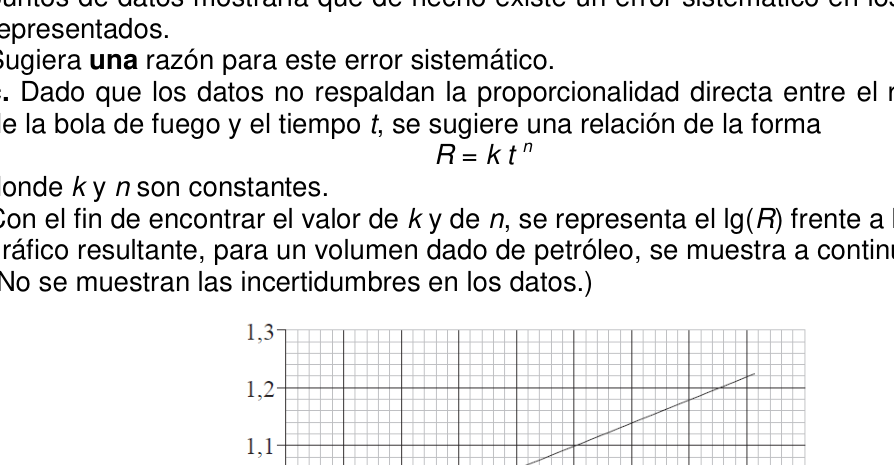
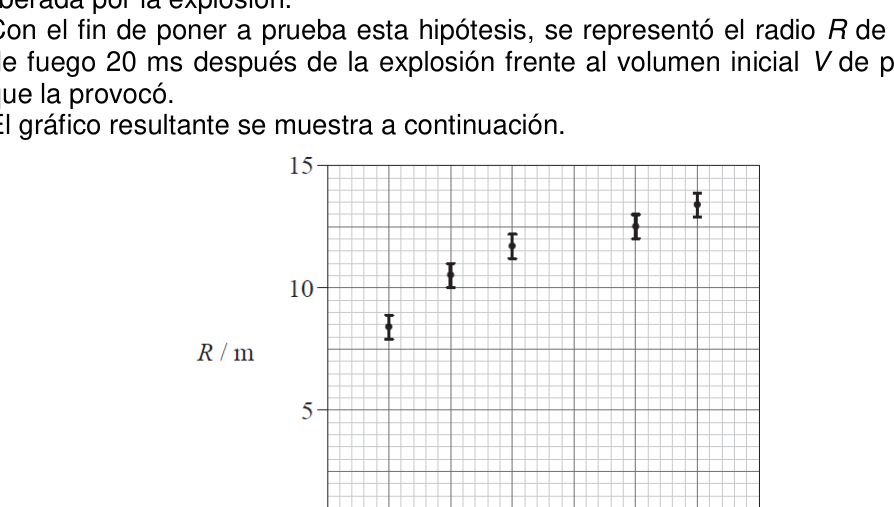
Topic: Order-of-Magnitude Estimation, Conservation of Energy Metodi: Graph Linearization, Curve Fitting, Dimensional Analysis Competenze: Physical Reasoning, Mathematical Modeling Objects: — Fonte: Testo (PDF) — p.3
**Bolla di fuoco: rapporto radio-tempo (log-log) **
PT109. Istituto San Jorge Quilmes, Buenos Aires.
Quando un fuoco brucia all’interno di uno spazio confinato, il fuoco può a volte si estendono molto rapidamente in forma di una palla di fuoco circolare. Conoscere La velocità con cui queste palline di fuoco possono espandersi è grande.
- E’ importante per i pompieri. Per poter prevedere questa velocità, si è Ha condotto una serie di esperimenti controllati in cui si è preso. un fuoco ad una quantità nota di petrolio contenuto in un recipiente. Il raggio R della pallina di fuoco risultante dall’esplosione del petrolio nel contenitore è stato misurato in base al tempo t. I risultati dell’esperimento per 5 volumi di petrolio sono riportati qui sotto. (Non sono mostrate le l’incertezza dei dati.)
OAF 2011 - 82 a. L’ipotesi originale era che, per un dato volume di petrolio, il raggio R di la palla di fuoco sarebbe direttamente proporzionale al tempo t dopo la
- Esplosione. Indicare due ragioni per cui i dati rappresentati non sostengono questa ipotesi. i ……. ii ……. b. L’incertezza in radio è di 0.5 m. L’aggiunta di barre di errore ai I punti di dati mostrerebbero che esiste infatti un errore sistematico nei dati rappresentati. Suggerisca una ragione per questo errore sistematico. c. Poiché i dati non supportano la diretta proporzionalità tra i radii R di una palla di fuoco e il tempo t, si suggerisce una relazione di forma R = k t n dove k e n sono costanti. Per trovare il valore di k e di n, si rappresenta l’lg(R) contro l’lg(t). El Il grafico risultante, per un dato volume di petrolio, è mostrato qui sotto. (Non sono mostrate incertezze nei dati.)
Utilizzare questo grafico per dedurre che il raggio R è proporzionale a t0,4. Spiega il suo il ragionamento. d. Si sa che l’energia rilasciata nell’esplosione è proporzionale al volume.
- Il petrolio iniziale. Un’ipotesi che gli esperimentatori hanno posto è che, in un istante dato, il raggio della pallina di fuoco è proporzionale all’energia E liberata dall’esplosione. Per mettere a prova questa ipotesi, è stato rappresentato il raggio R della palla. 20 minuti dopo l’esplosione rispetto al volume iniziale di petrolio V. che l’ha provocata. Il grafico risultante è mostrato qui sotto.
OAF 2011 - 83 Le incertezze sono state incluse in R. L’incertezza sul volume di Il petrolio è dispregiato. i Descrivi come si ottengono i dati per il grafico sopra dal grafico a. ii Tracciare la linea di miglior regolazione per i punti. iii Spiegare se i dati rappresentati accanto alle barre di errore supportano l’ipotesi che R sia proporzionale a V. e. L’analisi mostra che il rapporto tra radio R, energia liberata E e Il tempo t viene infatti dato da R5 = Et2. Utilizza i dati del grafico in d per dedurre che l’energia rilasciata da La combustione di 1,0 103 m3 di petrolio è di circa 30 MJ.
Topic: Order-of-Magnitude Estimation, Conservation of Energy Metodi: Graph Linearization, Curve Fitting, Dimensional Analysis Competenze: Physical Reasoning, Mathematical Modeling Objects: — Fonte: Testo (PDF) — p.3
The fire ball: radio-time log
PT109. The San Jorge Institute Quilmes, Buenos Aires is where I am.
When a fire burns within a confined space, the fire can sometimes It spreads very quickly in the form of a circular fireball. To know The speed at which these fireballs can expand is great. It’s important to the fire department. To be able to predict this speed, it has He was arrested in a series of controlled experiments. fire to a known amount of oil contained in a container. The radius R of the fireball resulting from the oil explosion in the container was measured based on time t. The results of the experiment for Five volumes of oil are shown below. (No data are shown Uncertainties in the data.)
The following is the list of the countries of the European Union: a. The original hypothesis was that for a given volume of oil, the radius R of The fireball would be directly proportional to the time t after the It’s going to explode. Please state two reasons why the data represented are not They support this hypothesis. i ……. ii ……. b. The uncertainty in the radio is 0.5 m. The addition of error bars to the Data points would show that there is indeed a systematic error in the data represented. Suggest a reason for this systematic error. c. Since the data do not support direct proportionality between the R radius of the fireball and time t, a relationship is suggested of the form R = k t n where k and n are constants. In order to find the value of k and of n, the lg(R) is represented against lg(t). El The resulting graph, for a given volume of oil, is shown below. (Uncertainties are not shown in the data.)
Use this graph to deduce that the radius R is proportional to t0.4. Explain his . The reasoning. d. It is known that the energy released in the explosion is proportional to the volume. The first oil. One hypothesis put forward by the experimenters is that, in In a given instant, the radius of the fireball is proportional to the energy E. released by the explosion. In order to test this hypothesis, the radius R of the ball was represented. 20 ms after the explosion versus the initial V volume of oil That provoked her. The resulting graph is shown below.
The following is the list of the Member States’ financial statements: Uncertainties have been included in R. Uncertainty in the volume of Oil is despicable. i Describe how data is obtained for the graph above from graph in a. ii Draw the line of best fit for the points. iii Explain whether the data represented next to the error bars support the assumption that R is proportional to V. e. The analysis shows that the ratio of radio R to the energy released E and the radius of the Time t is actually given by R5 = Et2. Use the data from the graph in d to deduce that the energy released by the The burning of 1,0 103 m3 of oil is about 30 MJ.
Topic: Order-of-Magnitude Estimation, Conservation of Energy Metodi: Graph Linearization, Curve Fitting, Dimensional Analysis Competenze: Physical Reasoning, Mathematical Modeling Objects: — Fonte: Testo (PDF) — p.3
Helicoptero en vuelo parado
PT110. Instituto San Jorge Quilmes, Buenos Aires.
El diagrama ilustra un modelo de helicóptero que se mantiene en vuelo parado en una posición estacionaria.
a. Las aspas en rotación del helicóptero hacen que una columna de aire se mueva hacia abajo. Explique cómo esto hace posible que el helicóptero permanezca quieto. b. La longitud de cada lámina del helicóptero en a. es los 0,70 m. Deduzca que el área que el barrido de las láminas hacia fuera como rotación es 1,5 m2. (Área de un círculo = πr2) c. Para el helicóptero en vuelo parado de a., se supone que todo el aire por debajo de las aspas es empujado en vertical hacia abajo con la misma velocidad de 4,0 ms–1. El resto del aire no se ve afectado. La densidad del aire es de 1,2 kg m–3. Calcule, para el aire desplazado hacia abajo por las aspas en rotación, i la masa por segundo. ii el ritmo de cambio del momento lineal d. Indique el módulo de la fuerza que el aire por debajo de las aspas ejerce sobre éstas. e. Calcule la masa del helicóptero y su carga. f. Con el fin de desplazarse hacia adelante, se hace que las aspas del helicóptero se inclinen formando un ángulo θ respecto a la horizontal, como se muestra esquemáticamente a continuación.
Mientras se mueve hacia adelante, el helicóptero no se desplaza en vertical hacia arriba ni hacia abajo. En el espacio en blanco proporcionado a
OAF 2011 - 84 continuación, dibuje un diagrama de fuerzas de cuerpo libre que muestre las fuerzas que actúan sobre las aspas del helicóptero en el momento en que éste empieza a moverse hacia adelante. En su diagrama, marque el ángulo con la letra θ. g. Utilice su diagrama en f. de la página anterior para explicar por qué una fuerza F hacia adelante ahora actúa sobre el helicóptero y deduzca que la aceleración inicial a del helicóptero viene dada por a = g tan donde g es la aceleración de la caída libre. h. El helicóptero es impulsado por un motor cuya potencia de salida útil es de 9,0 102 W. El motor alcanza 300 revoluciones por segundo. Deduzca que el trabajo efectuado en un ciclo es de 3,0 J.
Topic: Conservation of Momentum, Newtonian Mechanics Metodi: Impulse-Momentum Theorem, Free-Body Diagram, Conservation of Momentum Competenze: Physical Reasoning Objects: — Fonte: Testo (PDF) — p.3
Elicottero in volo fermo
PT110. Istituto San Jorge Quilmes, Buenos Aires.
Il diagramma illustra un modello di elicottero che si mantiene in volo fermo in posizione fissa.
a. Le aspe in rotazione dell’elicottero fanno sì che una colonna d’aria si spalanchi Muovetevi verso il basso. Spiegate come questo rende possibile l’elicottero
- Non fare niente. b. La lunghezza di ogni lamina dell’elicottero a. è di 0,70 m. Dall’esame si deduce che l’area che la spazzatura delle lastre verso l’esterno come rotazione è di 1,5 m2. (Area di un cerchio = πr2) c. Per l’elicottero in volo fermo di a., si suppone che tutto l’aria per Sotto le aspa si spinge verticalmente verso il basso con la stessa velocità de 4,0 ms–1. Il resto dell’aria non è interessato. La densità dell’aria è di 1,2 kg m3. Calcola, per l’aria spostata verso il basso dalle aspe in rotazione, e la massa al secondo. ii il ritmo di cambiamento del momento lineare d. Indicare il modulo di forza che l’aria sotto le aspe esercita su queste. e. Calcola la massa dell’elicottero e il suo carico. f. Per spostarsi in avanti, si fanno le aspa del gli elicotteri si inclinano formando un angolo θ rispetto alla orizzontale, come si mostrato schematicamente qui sotto.
Mentre si muove in avanti, l’elicottero non si muove verticalmente Non si può vedere. In bianco, a
OAF 2011 - 84
Poi disegna un diagramma delle forze del corpo libero che mostri le forze del corpo libero.
Le forze che operano sulle aspe dell’elicottero al momento in cui esso
comincia a muoversi verso l’avanguardia. Nel suo diagramma, segna l’angolo con
lettera θ.
g. Utilizzare il suo diagramma in f. La prima pagina spiega perché una forza
F avanti ora agisce sull’elicottero e deduce che l’accelerazione
l’inizio a elicottero viene dato da
a = g così
dove g è l’accelerazione della caduta libera.
h. L’elicottero è propulso da un motore con potenza di uscita utile di 9,0
102 W. Il motore raggiunge 300 giri al secondo. Dall’opera si deduce che
La durata di un ciclo è di 3,0 J.
Topic: Conservation of Momentum, Newtonian Mechanics Metodi: Impulse-Momentum Theorem, Free-Body Diagram, Conservation of Momentum Competenze: Physical Reasoning Objects: — Fonte: Testo (PDF) — p.3
Helicopter in flight at rest
PT110. The San Jorge Institute Quilmes, Buenos Aires is where I am.
The diagram illustrates a model helicopter that is kept in a stationary flight. in a stationary position.
a. The rotating spikes of the helicopter cause an air column to be Move down. Explain how this makes the helicopter possible . Stay still. b. The length of each helicopter sheet in a. It’s about 0.70 m. It follows that the area that the sheets are swept out as rotation is 1.5 m2. (Area of a circle = πr2) c. For the helicopter in a standby flight, all air is assumed to be by Under the sleeves is pushed vertically downwards at the same speed. de 4,0 ms–1. The rest of the air is not affected. The density of the air is 1.2 kg m3. Calculate, for the air displaced downward by the rotating spindles, And the mass per second. ii the rate of change of linear momentum d. Indicate the force modulus of air under the springs about these. e. Calculate the mass of the helicopter and its cargo. f. In order to move forward, the slashes of the The helicopter slope is formed by an angle θ with respect to the horizontal, as The following diagram shows.
While moving forward, the helicopter does not move vertically up or down. In the white space provided to
The following table shows the results of the evaluation:
Then draw a free-body force diagram showing the
forces acting on the helicopter’s tails at the time it is
It starts moving forward. On your diagram, mark the angle with the
letter θ.
g. Use your diagram in f. The first page explains why a force is
F forward now acts on the helicopter and deduces that acceleration
initial a of the helicopter is given by
a = g so
where g is the acceleration of the free fall.
h. The helicopter is powered by an engine with a useful output power of 9.0
102 W. The engine reaches 300 revolutions per second. It follows that the work
The average time of the cycle is 3.0 J.
Topic: Conservation of Momentum, Newtonian Mechanics Metodi: Impulse-Momentum Theorem, Free-Body Diagram, Conservation of Momentum Competenze: Physical Reasoning Objects: — Fonte: Testo (PDF) — p.3
Bateria con resistencia interna y dispositivo no ohmico
PT111. Instituto San Jorge Quilmes, Buenos Aires.
A. a. En el circuito siguiente un dispositivo eléctrico (carga) se conecta en serie con una batería de f.e.m. 2,5 V y resistencia interna r. La intensidad de corriente I en el circuito es de 0,10 A.
La potencia disipada en la carga es de 0,23 W. Calcule i la potencia total de la batería. ii la resistencia de la carga. iii la resistencia interna r de la batería. b. Una segunda batería idéntica se conecta al circuito como se muestra a continuación.
La corriente en este circuito es de 0,15 A. Deduzca que la carga es un dispositivo no óhmico.
B. a. En el espacio siguiente, dibuje un diagrama de circuito que se pueda utilizar para determinar las características corriente-voltaje (I–V) de un componente eléctrico X.
OAF 2011 - 85
b. El gráfico siguiente muestra las características I–V para el componente X.
El componente X se conecta ahora a través de los terminales de una batería de
f.e.m. 6,0 V y resistencia interna despreciable.
Utilice el gráfico para determinar
i la corriente en el componente X.
ii la resistencia del componente X.
c. Un resistor R de resistencia constante de 2,0Ω se conecta en serie a un
componente X tal como se muestra a continuación.
i En el gráfico de la página anterior, dibuje las características I–V para el resistor R. ii Determine la diferencia de potencial total E que debe aplicarse a través del componente X y a través del resistor R de modo que la corriente que pasa por X y R sea de 3,0 A.
OAF 2011 - 86
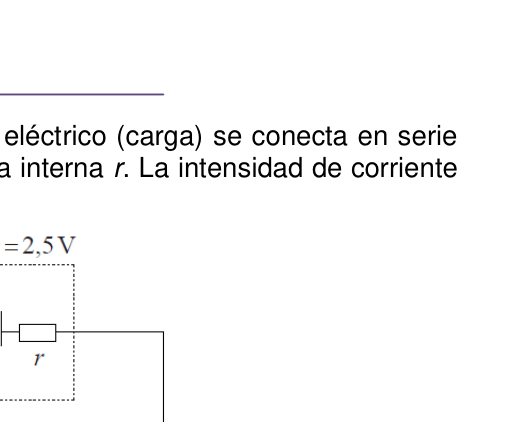
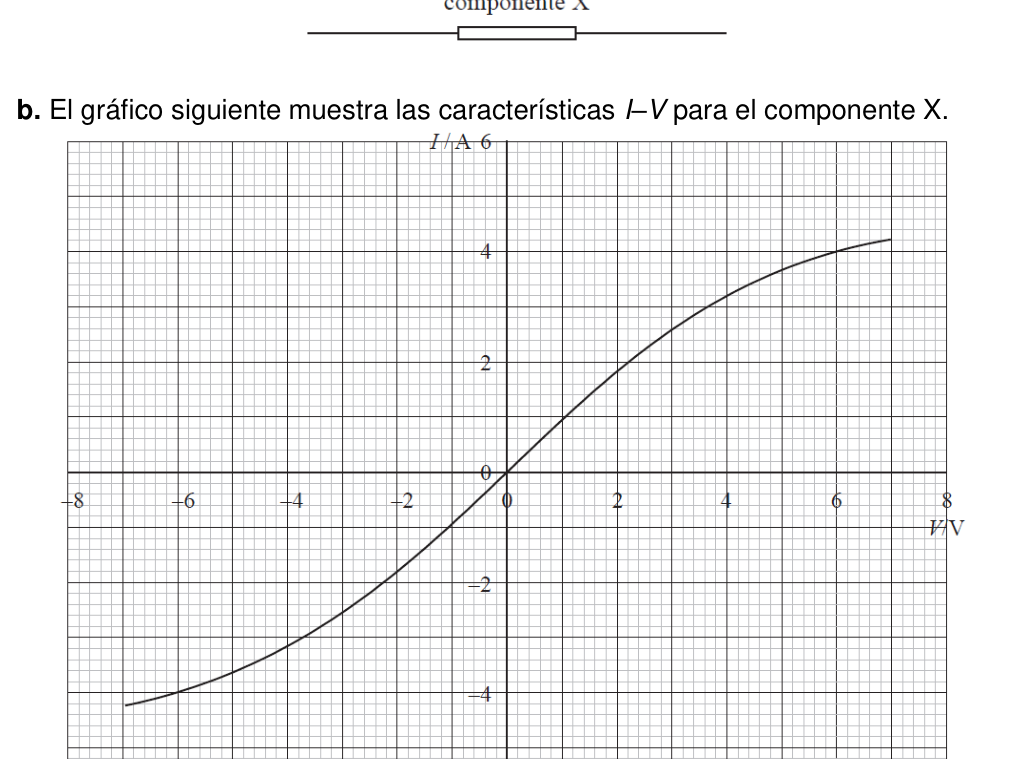
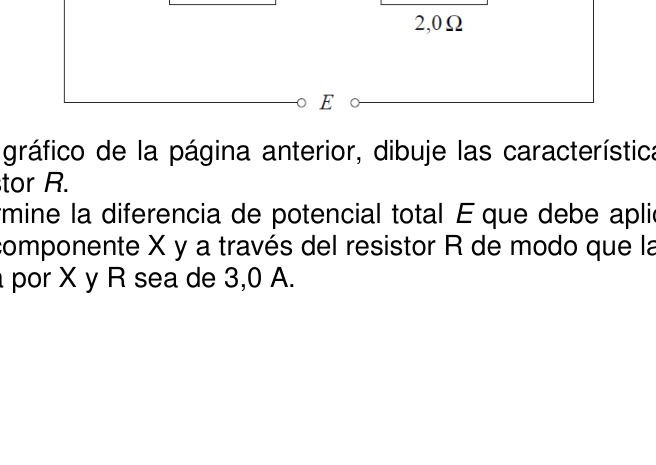
Topic: Circuits Metodi: Kirchhoff’s Laws, Equivalent Circuit Reduction Competenze: Physical Reasoning Objects: Battery, Resistor Fonte: Testo (PDF) — p.3
Batteria a resistenza interna e dispositivo non ohmico
PT111. Istituto San Jorge Quilmes, Buenos Aires.
A. a. Nel circuito successivo un dispositivo elettrico (carica) viene collegato in serie con una batteria a f.e.m. 2,5 V e resistenza interna r. L’intensità di corrente I sul circuito è di 0,10 A.
La potenza dissipata sulla carica è di 0,23 W. Calcola e la potenza totale della batteria. ii resistenza del carico. iii resistenza interna r della batteria. b. Una seconda batteria identica viene collegata al circuito come mostrato a Continuare.
Il corrente in questo circuito è di 0,15 A. Dall’ipotesi, la carica è un dispositivo non omico.
B. a. Nel seguente spazio, disegnate un diagramma di circuito che potete utilizzare per determinare le caratteristiche di corrente-voltaggio (IV) di un componente elettrico X.
OAF 2011 - 85
b. Il seguente grafico mostra le caratteristiche IV per il componente X. Il componente X viene ora collegato attraverso i terminali di una batteria di f.e.m. 6,0 V e una resistenza interna scarsa. Utilizzare il grafico per determinare i corrente nel componente X. ii resistenza della componente X. c. Un resistore R di resistenza costante di 2,0Ω si connette in serie a un componente X come mostrato di seguito.
i Nel grafico della pagina precedente, disegna le caratteristiche IV per il resistore R. ii Determina la differenza di potenziale totale E da applicare attraverso Il sistema di controllo è stato creato per la resistenza R, in modo che il corrente che passa per X e R è di 3,0 A.
OAF 2011 - 86
Topic: Circuits Metodi: Kirchhoff’s Laws, Equivalent Circuit Reduction Competenze: Physical Reasoning Objects: Battery, Resistor Fonte: Testo (PDF) — p.3
Battery with internal resistance and non-ohmic device
PT111. The San Jorge Institute Quilmes, Buenos Aires is where I am.
A. a. In the following circuit an electrical device (charge) is connected in series with an f.e.m. battery. 2,5 V and internal resistance r. The current intensity I in the circuit is 0.10 A.
The power dissipated on the charge is 0.23 W. Calculate and the total battery power. The load strength. The battery’s internal resistance r. b. A second identical battery is connected to the circuit as shown in The next step.
The current in this circuit is 0.15 A. It deduces that the load is a The device is not ohmic.
B. a. In the next space, draw a circuit diagram that you can. use to determine the current-voltage (IV) characteristics of a Electrical component X.
The following points shall be added:
b. The following graph shows the characteristics IV for component X. The X component is now connected through the terminals of a battery of f.e.m. 6.0 V and a disdainful internal resistance. Use the graph to determine i the current in component X. ii the strength of component X. c. A constant resistance R resistor of 2.0Ω is serial connected to a component X as shown below.
i In the graph on the previous page, draw the characteristics IV for the R resistor ii Determine the total potential difference E to be applied through The current is then passed through the resistor R so that the current is passes through X and R is 3.0 A.
The following points shall be added:
Topic: Circuits Metodi: Kirchhoff’s Laws, Equivalent Circuit Reduction Competenze: Physical Reasoning Objects: Battery, Resistor Fonte: Testo (PDF) — p.3
La fabrica de Danielito: cinta y rozamiento
PT112. Instituto de Educación Media Dr. Arturo Oñativia
Escuela del Cerro
Escuela San Pablo
Escuela Belgrano
Escuela Albert Einstein
Escuela Santa Rosa de Viterbo
Escuela Siglo 21
Escuela Benjamín Zorrilla
Escuela San Lucas
Escuela José Manuel Estrada
Ciudad de Salta.
La fábrica de Danielito. Cuenta la leyenda, en un pueblo lejano de la provincia de Salta, existe “La fábrica de Problemas de Fisica”, con Don Danielito el fundador y los duendes de la física, sus ayudantes. Allí se confeccionan cantidades industriales de problemas de física para luego ser acomodadas en cajas y ser distribuidas a los colegios de la zona. Cierto día, varios duendecitos al observar las maquinarias, se desafiaron a analizar el movimiento de unos sistemas peculiares trabajando con los modelos que se desprenden a continuación. Es aquí donde queda Ud. formalmente invitado a resolverlos.
Sistema 1
Los ayudantes encontraron una cinta transportadora que puede ser considerada
como una banda elástica, que va hundiéndose a medida que una caja avanza
sobre ella, llegando a su máxima profundidad en el medio. Mediante la relación
Y=A.sen(xπ/L) se puede describir la altura (Y) en función de la posición
horizontal (x) de la caja en un instante determinado, con A la máxima
deformación y L longitud de la cinta.
Las variaciones de altura producen cambios en la velocidad de la cinta, bajo la
expresión W=BαY, donde α es el ángulo que forma el centro de la caja con la
rueda de la primera oruga y B una constante.
Las dimensiones de la caja y la magnitud Y son despreciables con respecto a la longitud de la cinta, el radio de los cilindros giratorios es R. a) Realizar el diagrama de cuerpo libre de la caja. b) Encuentre la relación funcional existente entre W y la posición horizontal (x). c) Encontrar la relación funcional entre α y la posición horizontal (x). d) Expresar la velocidad de la caja en función de su posición.
Sistema 2 Los duendes, con ganas de explayar sus conocimientos sobre la fuerza de rozamiento, vieron dos cajas unidas por una cuerda, las cuales se apoyaban sobre una barra. Al aplicar una fuerza F sobre una de ellas observaron que la barra comenzaba a desplazarse,(figura)
OAF 2011 - 87 por lo que decidieron estudiar su efecto sobre un modelo en el que se considera: La cuerda es inextensible y se puede despreciar su masa. La barra es homogénea y su longitud es mucho más grande que los lados de las cajas. El valor de la masa del cuerpo 1 (caja1) es m1. El valor de la masa del cuerpo 2 (caja2) es m2. El valor de la masa de la barra es M. Siendo el coeficiente de roce dinámico entre el cuerpo 1 y la barra µ1, entre el cuerpo 2 y la barra µ2 y además, entre la barra y la superficie es µ3.
- Realizar un diagrama de cuerpo libre para cada parte del sistema, indicando, además, los pares de acción y reacción.
- Justificar porque se mueve la barra al aplicar la fuerza F.
- Encontrar el valor de la distancia recorrida por el centro de masa de la barra en un intervalo de tiempo ∆t, cuando la fuerza posee una magnitud tal que: a) Las cajas se desplazan con respecto a la barra. b) Las cajas no se desplazan con respecto a la barra.
- Calcular la distancia para el caso a) con los siguientes valores: M= 3.5 kg, m1= 1.5 kg, m2= 2.3 kg, µ1= 0.6, µ2= 0.7, µ3= 0.5, F= 20N, ∆t= 3 seg.
- Si aumenta F en el caso b), ¿qué le ocurre al valor de la aceleración de
la barra?
Importante: explicar las consideraciones que se hagan y detallar el razonamiento lo más claro posible.
Topic: Newtonian Mechanics Metodi: Free-Body Diagram, Vector Decomposition Competenze: Physical Reasoning Objects: Block, String, Wheel Fonte: Testo (PDF) — p.3
Fabbrica di Danielito: nastri e rasatura
PT112. Istituto di media educazione Dr. Arturo Oñativia La scuola del Cerro Scuola San Paolo Scuola Belgrano La scuola Albert Einstein Scuola Santa Rosa di Viterbo Scuola del 21° secolo Scuola Benjamin Zorrilla Scuola San Luca Scuola José Manuel Estrada Città di Salta.
La fabbrica di Danielito. La leggenda racconta che in un villaggio lontano della provincia di Salta, esiste la fabbrica di Problemi di Fisica, con Don Danielito il fondatore e i duende della fisica, i suoi assistenti. Lì si fabbricano quantitativi industriali di La fisica è stata messa in pratica e poi distribuita ai
- Le scuole della zona. Un giorno, alcuni piccoli sciocchi osservando le macchine, si sfidano a analizzare il movimento di sistemi particolari lavorando con i modelli che si rivelano di seguito. È qui che ti trovi. - formalmente invitato a risolverli.
Sistema 1 Gli assistenti hanno trovato un’uscita di cinta che può essere considerata. Come una banda elastica, che si affonda mentre una scatola si muove. sopra di essa, raggiungendo la sua massima profondità nel mezzo. Attraverso il rapporto Y=A.sen(xπ/L) può essere descritto come altitudine (Y) in funzione della posizione il contenitore è stato ripreso in un momento determinato, con A massima La deformazione e l’allungamento della cinta. Le variazioni di altezza producono variazioni nella velocità della cinta, sotto la espressione W=BαY, dove α è l’angolo che forma il centro della scatola con la la ruota della prima catena e B una costante.
Le dimensioni della scatola e la grandezza Y sono scarsa rispetto a la lunghezza della cinta, il raggio dei cilindri rotanti è R. a) Realizzare il diagramma del corpo libero della scatola. b) Trova il rapporto funzionale esistente tra W e posizione orizzontale (x). c) Trovare il rapporto funzionale tra α e la posizione orizzontale (x). d) Esprimere la velocità della scatola in funzione della sua posizione.
Sistema 2 I rane, desiderosi di far spargere i loro conoscenze su la forza de Raggiustamento, hanno visto due scatole unite da una corda, che si appoggiano. su una barra. Applicando una forza F Su una di esse hanno osservato che la La barra stava iniziando a spostarsi,
OAF 2011 - 87 Quindi hanno deciso di studiare il loro effetto su un modello che considera: La corda è inestensibile e si può disprezzare la sua massa. La barra è e la loro lunghezza è molto più grande dei lati delle scatole. El il valore della massa del corpo 1 (cassetta1) è m1. Valore della massa corporea 2 (cassetta2) è m2. Il valore di massa della barra è M. Essendo il coefficiente di rottura dinamica tra il corpo 1 e la barra μ1, tra il corpo 2 e la barra μ2 e Inoltre, tra la barra e la superficie è μ3.
- realizzare un diagramma di corpo libero per ogni parte del sistema, Indicando inoltre i pari di azione e reazione.
- giustificare perché la barra si muove quando si applica la forza F.
- Trovare il valore della distanza percorsa dal centro di massa della Bar in un intervallo di tempo ∆t, quando la forza possiede un di una grandezza tale che: a) Le scatole si spostano rispetto alla barra. b) Le scatole non si spostano rispetto alla barra.
- Calcolare la distanza per il caso a) con i seguenti valori: M= 3.5 kg, m1= 1.5 kg, m2= 2.3 kg, µ1= 0.6, µ2= 0.7, µ3= 0.5, F= 20N, ∆t = 3 secondi.
- Se F aumenta nel caso b, cosa succede al valore dell’accelerazione di la barra? Importante: spiegare le considerazioni che vengono prese e dettagliare il ragionamento il più chiaro possibile.
Topic: Newtonian Mechanics Metodi: Free-Body Diagram, Vector Decomposition Competenze: Physical Reasoning Objects: Block, String, Wheel Fonte: Testo (PDF) — p.3
The Danielito factory: tape and rubbing
PT112. The Institute of Middle Education Dr. Arturo Oñativia is a very good guy. Cerro School . St. Paul School . Belgrano School Albert Einstein School . The Santa Rosa School of Viterbo School of the 21st Century Benjamin Zorrilla School St. Luke ‘s School . School José Manuel Estrada Salt City.
The factory of Danielito. Legend has it that in a remote village in the province of Salta, there is La Factory of Physics Problems, with Don Danielito the founder and the goblins Physics, his assistants. Industrial quantities of Physics problems to be placed in boxes and distributed to the Schools in the area. One day, several small dwarfs, looking at the machinery, defied the To analyse the movement of particular systems by working with models which are shown below. This is where you stay. formally invited to solve them.
System 1 The assistants found a conveyor belt that can be considered. Like a rubber band, that sinks as a box moves forward. over it, reaching its maximum depth in the middle. By the relationship Y=A.sen(xπ/L) can be described as height (Y) depending on position horizontal (x) of the box at a given instant, with A maximum deformation and L length of the tape. Height variations produce changes in the speed of the tape, below the expression W=BαY, where α is the angle that forms the center of the box with the wheel of the first caterpillar and B a constant.
The dimensions of the box and the size of the Y are despicable in relation to the length of the ribbon, the radius of the rotating cylinders is R. (a) Draw the free body diagram of the box. (b) Find the functional relationship between W and horizontal position (x). (c) Find the functional relationship between α and the horizontal position (x). (d) Express the speed of the box according to its position.
System 2 The goblins, eager to spoil their knowledge on la Force de They saw two boxes attached by a rope, which they supported. on a bar. When applying force F On one of them they observed that the The bar was starting to move,
The following is the list of the countries of the European Union: So they decided to study its effect on a model that considers: The rope is unextractable and its mass can be disregarded. The bar is It’s homogeneous and its length is much larger than the sides of the boxes. El The value of body mass 1 (box1) is m1. The value of body mass 2 (box2) is m2. The mass value of the bar is M. Being the brushing coefficient dynamic between body 1 and bar μ1, between body 2 and bar μ2 and In addition, between the bar and the surface is μ3.
- To make a free body diagram for each part of the system, The following information is provided for in the Annex to this Regulation:
- Justify why the bar is moved when applying force F.
- Find the value of the distance travelled by the center of mass of the bar in a time interval ∆t, when the force has a a magnitude such that: (a) The boxes move relative to the bar. (b) The boxes do not move with respect to the bar.
- Calculate the distance for case a) with the following values: M= 3.5 kg, m1= 1.5 kg, m2= 2.3 kg, µ1= 0.6, µ2= 0.7, µ3= 0.5, F= 20N, ∆t = 3 seconds.
- If F increases in case b, what happens to the acceleration value of The bar? Important: explain the considerations and detail the As clear as possible.
Topic: Newtonian Mechanics Metodi: Free-Body Diagram, Vector Decomposition Competenze: Physical Reasoning Objects: Block, String, Wheel Fonte: Testo (PDF) — p.3
Mojojojo: optica y circuito
PT113. Instituto de Educación Media Dr. Arturo Oñativia
Escuela del Cerro
Escuela San Pablo
Escuela Belgrano
Escuela Albert Einstein
Escuela Santa Rosa de Viterbo
Escuela Siglo 21
Escuela Benjamín Zorrilla
Escuela San Lucas
Escuela José Manuel Estrada
Ciudad de Salta.
Mi villano favorito. El malvado simio Mojojojo está desarrollando su maléfico plan para destruir Saltadilla activando una bomba enterrada bajo la ciudad. Su laboratorio se encuentra ubicado sobre una montaña y desde allí decide disparar un rayo láser a un foto- receptor ubicado en la ciudad capaz de poner en funcionamiento el circuito eléctrico que activa el explosivo. Al calcular la trayectoria del haz, se da con que no puede hacerlo directamente al sensor, por lo que decide trabajar con un sistema óptico de corrección necesario para lograr su cometido. Plano de la ciudad
OAF 2011 - 88 Este sistema óptico se encuentra en el cerro San Bernardo a una altura H de la superficie de la tierra y está formado por dos acrílicos, con índices de refracción n1 y n2 respectivamente, donde n1>n2; un haz de luz de un láser incide perpendicularmente sobre una de las caras de longitud L y ancho A, a una altura Y tal como lo muestra la figura siguiente.
a) Calcular el ángulo de refracción en el medio 2.
b) A que altura Y debe incidir el haz para que luego de refractarse active el
foto sensor que se encuentra en el punto D de la ciudad.
Cuando el foto sensor detecta el laser, cierra la llave L1 del circuito de la bomba,
que trabaja con una fuente con una diferencia potencial V entre sus bornes y dos
resistencias R y R1, que cumplen la relación R1=K*R, configurado de la
siguiente forma:
Cuando llega a su laboratorio se da cuenta que solo tiene una resistencia R y muchas otras de valor r >R. Pero como Mojojojo sabe física, decide conectar las de valor r en paralelo y lograr así lo buscado. Es por eso que termina trabajando con el circuito que sigue:
Para activar la bomba, Mojojojo tiene que lograr que: la diferencia de potencial
sobre los puntos cd sean iguales a v1 y que la corriente que circula por el lazo
ab sea mayor al valor I1.
a)_ encuentre el valor de K,
b)_ Verifique que la corriente que circula en ab es la necesaria,
c)_Ayude a Mojojojo a encontrar la cantidad de mallas que debe hacer
para que la resultante de la suma de las resistencias en paralelo de r
sea igual a KR.
OAF 2011 - 89
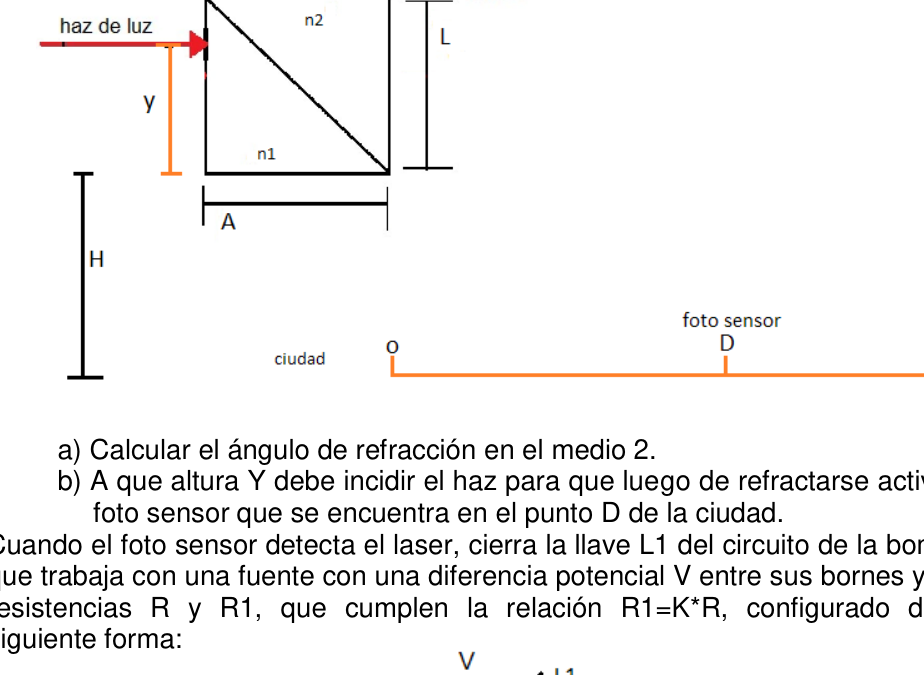
Topic: Geometric Optics, Circuits Metodi: Snell’s Law, Equivalent Circuit Reduction Competenze: Physical Reasoning Objects: Resistor, Battery Fonte: Testo (PDF) — p.3
Mojjojojo: ottica e circuito
PT113. Istituto di media educazione Dr. Arturo Oñativia La scuola del Cerro Scuola San Paolo Scuola Belgrano La scuola Albert Einstein Scuola Santa Rosa di Viterbo Scuola del 21° secolo Scuola Benjamin Zorrilla Scuola San Luca Scuola José Manuel Estrada Città di Salta.
Il mio villain preferito. Il malefico scimmia Mojojojo sta sviluppando il suo malefico piano per distruggere Scalare attivando una bomba sepolta sotto la città. Il suo laboratorio si è Si trova su una montagna e da lì decide di sparare un raggio laser. Un’autore di un’autore di foto-receizione situata in città, capace di mettere in funzione il circuito elettrico che attiva l’esplosivo. Al Calcolare la traccia del raggio, se
- Non può.
- Facciamolo direttamente. al sensore, quindi Decide di lavorare con un sistema ottico di correzione necessaria per
- ottenere su
- Commesso. Piano della città
OAF 2011 - 88 Questo sistema ottico si trova nel monte San Bernardo ad un’altezza H della La superficie della terra è costituita da due acrilici, con indici di rifrazione. n1 e n2 rispettivamente, dove n1>n2; un fascio di luce di un laser incide perpendicolare su una delle facce lunghezza L e larghezza A, ad un’altezza E come mostra la figura seguente.
a) Calcolare l’angolo di rifrazione nel mezzo 2. b) A che altezza deve incidere il fascio in modo che, dopo aver rifraccato, venga attivato il Il sensore fotografico che si trova nel punto D della città. Quando il sensore fotografico rileva il laser, chiude il chiave L1 del circuito della pompa. che lavora con una fonte con una differenza potenziale V tra i suoi terminali e due resistenza R e R1, che soddisfano il rapporto R1=K*R, configurato da di cui sopra:
Quando arriva al suo laboratorio si rende conto che ha solo una resistenza R e molti altri di valore r > R. Ma come Mojojojo sa la fisica, decide di collegare le di r in parallelo e ottenere così il risultato desiderato. Ecco perché finisce il suo lavoro. con il circuito seguente:
Per attivare la bomba, Mojojojo deve ottenere che: la differenza di potenziale i punti cd sono uguali a v1 e che il corrente che circola attraverso il lacciamento ab è superiore al valore I1. a)_ trovare il valore di K, b) Verificare che il corrente che circola in ab sia necessario, C) Aiuta Mojojojo a trovare quante maglie deve fare per che la risultante della somma delle resistenze in parallelo di r
- E’ uguale a KR.
OAF 2011 - 89
Topic: Geometric Optics, Circuits Metodi: Snell’s Law, Equivalent Circuit Reduction Competenze: Physical Reasoning Objects: Resistor, Battery Fonte: Testo (PDF) — p.3
Mojojojojo: optics and circuit
PT113. The Institute of Middle Education Dr. Arturo Oñativia is a great writer. Cerro School . St. Paul School . Belgrano School Albert Einstein School . The Santa Rosa School of Viterbo School of the 21st Century Benjamin Zorrilla School St. Luke ‘s School . School José Manuel Estrada Salt City.
My favorite villain. The evil Mojojo monkey is developing his evil plan to destroy Jump triggering a bomb buried under the city. His lab is . He finds it located on a mountain and from there he decides to shoot a laser beam. to a city-based photo-receiver capable of running the Electrical circuit which Activate the explosive. Al calculate la The beam’s path, se I mean , he can ‘t . Do it directly. The sensor, so He decides to work with an optical system of correction needed for achieving su I’m committed. City plan
The following is the list of the countries of the European Union: This optical system is located in the San Bernardo hill at an altitude of H The surface of the earth and is formed by two acrylics, with refractive indices n1 and n2 respectively, where n1>n2; a laser beam of light affects perpendicular to one of the sides of length L and width A, at a height And as shown in the following figure.
(a) Calculate the angle of refraction at the median 2. (b) At what height and should the beam be applied so that after refraction the beam is activated. photo sensor located at the D-spot of the city. When the photo sensor detects the laser, it closes the L1 key of the pump circuit. It works with a source with a potential difference V between its terminals and two R and R1 resistors, meeting the R1=K*R ratio, configured from the the following form:
When you get to your lab you realize you only have one R resistance and many others of R > R value. But since Mojojojo knows physics, he decides to connect the two. The value of r is parallel to the value of r and the result is achieved. That ‘s why he ends up working . with the following circuit:
To activate the bomb, Mojojojo has to achieve that: potential difference The current flowing through the loop is equal to v1 over the cd points. ab is greater than I1. (a)_ find the value of K, (b)_ Verify that the current circulating in ab is the necessary one, (c)_Help Mojojojo find the number of grids he needs to do so that the resulting sum of the parallel resistors of r equal to KR.
The following is the list of the Member States’ financial statements:
Topic: Geometric Optics, Circuits Metodi: Snell’s Law, Equivalent Circuit Reduction Competenze: Physical Reasoning Objects: Resistor, Battery Fonte: Testo (PDF) — p.3
Fluido isotermico de fresa
PT114. Instituto de Educación Media Dr. Arturo Oñativia
Escuela del Cerro
Escuela San Pablo
Escuela Belgrano
Escuela Albert Einstein
Escuela Santa Rosa de Viterbo
Escuela Siglo 21
Escuela Benjamín Zorrilla
Escuela San Lucas
Escuela José Manuel Estrada
Ciudad de Salta.
Willy Wonka, oompa loompas y el fluido isotérmico de fresa.
Cerca de la casa de Charlie se encuentra la fábrica de chocolate más grande del
mundo, propiedad de Willy Wonka. El Sr. Wonka es el mejor productor de
chocolate y es el más inventivo e innovador del mundo. Produce todo tipo de
delicias maravillosas, incluyendo algunas que parecen imposibles (como
el helado que nunca se derrite o la goma de mascar que nunca pierde el sabor).
Debido al espionaje industrial, que casi arruina la fábrica de chocolate, Wonka la
cerró al público y ahora solamente habitan en ella unos trabajadores misteriosos.
Willy Wonka, sorprendentemente, decide reabrir su fábrica al público, iniciando
una lotería. Cinco tabletas de chocolate Wonka llevan consigo “Boletos
Dorados”. Los cinco niños que los encuentren y un miembro de su familia, dos
como máximo, podrán entrar a la fábrica para una visita guiada por el mismo
Willy Wonka.
Un día, mientras Charlie iba caminando en la calle de regreso a su casa en un
día nevado, se encuentra con una moneda de 50 peniques y, va a comprar una
tableta de chocolate que finalmente es la ganadora.
Así fue como Charlie va a la fábrica de Wonka, donde descubren todas las
creaciones reposteras increíbles de Wonka. Una de ellas era el famoso FLUIDO
ISOTERMICO DE FRESA, cuya preparación es una verdadera curiosidad
científica. Esta maravillosa comida tiene la particularidad de que tras ser
sometido a un movimiento continúo y duradero, pierde una parte de él en forma
de gas, de tal forma que adquiere la propiedad de conservar su temperatura
inicial a pesar de cualquier circunstancia.
Los Oompas Loompas son trabajadores fieles e insaciables de labor. Ellos
mismos construyeron una máquina para la fabricación del producto con las
siguientes condiciones: (Véase Figura)
a) Dos tanques cilíndricos de radio R, que contienen cierta cantidad de un
fluido sabor fresa muy extraño, giran junto con el líquido alrededor de su
eje con la particularidad que la superficie no cambia. En la pared lateral
del recipiente se amarra un globo lleno del mismo fluido en que se
encuentra inmerso con una soga de longitud l de radio r. Durante la
rotación, el hilo forma con la pared el ángulo α.
- Determine la velocidad angular “w” de rotación
- Halle el valor de “w” en los casos particulares para cada
tanque.
b) La rotación de los cilindros tras largas horas y horas, tienen como
consecuencia que el peculiar caramelo liquido de fresa disocie una
pequeña parte en un gas. Dicho gas, se comporta como un gas ideal.
En el momento de la disociación, la presión de dicho gas sigue la ley: P (w) = A.e -λw , donde λ es una constante asociada a cada uno de los cilindros, medida por los cariñosos Oompa Loompas. - Encuentre la condición entre λ1 y λ2, para que la presión del gas producido por el cilindro 1 sea igual a la del cilindro 2.
OAF 2011 - 90
- En principio, según lo obtenido anteriormente. ¿En cuál de los dos cilindros se obtiene un gas a mayor presión? c) Lo más sorprendente de esta máquina, está relacionado con el auto- control de calidad del producto. Una vez que cada cilindro envía su gas a un compartimento, al gas de mayor presión se le disminuye para que sea igual al de menor. Una vez igualada. En cada sección separada por un embolo (fijo en el medio al inicio), hay el mismo tipo de gas, con mismo volumen, y misma temperatura.
- Cuando el embolo (de masa m y superficie S) deja de estar fijo, comienza a tener pequeñas vibraciones. Halle el periodo del mismo en función del λ que implica menor presión. Observación: Recuerde que para fuerzas F(x) = k.x, el periodo se calcula ζ = 2π (m/k)1/2
- Si para considerar que el producto esté en condiciones para su venta debe cumplir con la condición que el periodo del embolo debe estar en el rango fijado [1 seg, 2seg]. Determine la velocidad angular máxima y mínima permitida para la producción. Para esos casos, determine la presión del gas obtenido. d) Proponga una relación de la temperatura del caramelo terminado con los parámetros propuestos, teniendo en cuenta la propiedad intrínseca de dicho producto, ser “ISOTERMICO”.
Figura
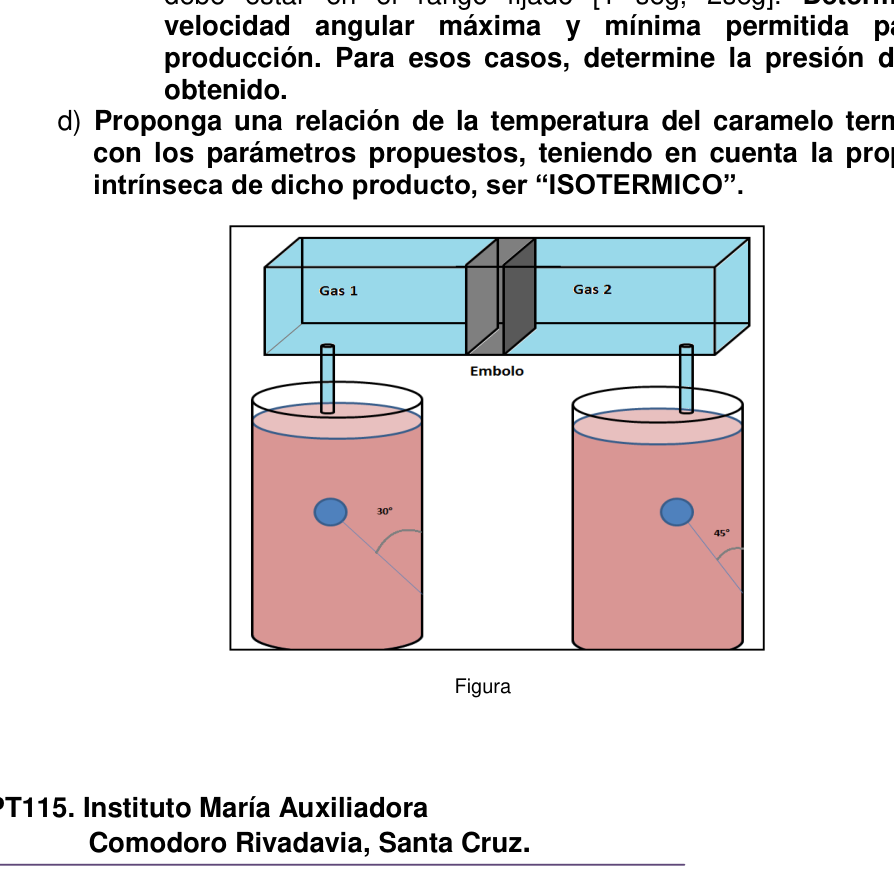
Topic: Thermodynamics, Fluid Mechanics Metodi: Ideal Gas Law, Simple Harmonic Motion Analysis Competenze: Physical Reasoning, Mathematical Modeling Objects: Cylinder, Gas, Piston Fonte: Testo (PDF) — p.3
**Lugido isotermica di frutta di frutta di frutta di frutta di frutta di frutta di frutta di frutta di frutta di frutta di frutta di frutta di frutta di frutta di frutta di frutta di frutta di frutta di frutta di frutta di frutta di frutta di frutta di frutta di frutta di frutta di frutta di frutta di frutta di frutta di frutta di frutta di frutta di frutta di frutta di frutta di frutta di frutta di frutta di frutta di frutta di frutta di frutta di frutta di frutta di frutta di frutta di frutta di frutta di frutta di frutta di frutta di frutta di frutta di frutta di frutta di frutta di frutta di frutta di frutta di frutta di frutta di frutta di frutta di frutta di frutta di frutta di frutta di frutta di frutta di frutta di frutta di frutta di frutta di frutta di frutta di frutta di frutta di frutta di frutta di frutta di frutta di frutta di frutta di frutta di frutta di frutta di frutta di frutta di frutta di frutta di frutta di frutta di frutta di frutta di frutta di frutta di frutta di frutta di frutta di frutta di frutta di frutta di frutta di frutta di frutta di frutta di frutta di frutta di frutta di frutta di frutta di frutta di frutta di frutta di frutta di frutta di frutta di frutta di frutta di frutta di frutta di frutta di frutta di frutta di frutta di frutta di frutta di frutta di frutta di frutta di frutta di frutta di frutta di frutta di frutta di frutta di frutta di frutta di frutta di frutta di frutta di frutta di frutta di frutta di frutta di frutta di frutta di frutta di frutta di frutta di frutta di frutta di frutta di frutta di frutta di frutta di frutta di frutta di frutta di frutta di frutta di frutta di frutta di frutta di frutta di
PT114. Istituto di media educazione Dr. Arturo Oñativia La scuola del Cerro Scuola San Paolo Scuola Belgrano La scuola Albert Einstein Scuola Santa Rosa di Viterbo Scuola del 21° secolo Scuola Benjamin Zorrilla Scuola San Luca Scuola José Manuel Estrada Città di Salta.
Willy Wonka, oompa loompas e il fluido isotermico di fragole. Vicino alla casa di Charlie si trova la più grande fabbrica di cioccolato del mondo. Il mondo, proprietà di Willy Wonka. El Sr. Wonka è il miglior produttore di e è il più creativo e innovativo del mondo. Produce ogni tipo di delizi meravigliosi, inclusi alcuni che sembrano impossibili (come il gelato che non si scioglie mai o la gomma da masticare che non perde mai il sapore). A causa dell’espionaggio industriale, che quasi rovina la fabbrica di cioccolato, Wonka la ha chiuso il suo ufficio al pubblico e ora solo un misterioso gruppo di lavoratori abita. Willy Wonka, sorprendentemente, decide di riaprire la sua fabbrica al pubblico, iniziando una lotteria. Cinque compresse di cioccolato Wonka portano con sé “Bolets Dorati”. I cinque bambini che li trovano e un membro della loro famiglia, due. al massimo, potranno entrare in fabbrica per una visita guidata da lui Willy Wonka. Un giorno, mentre Charlie camminava per la strada, tornava a casa in un Giorno nevoso, si trova con una moneta di 50 peni e, va a comprare una una compressa di cioccolato che alla fine vince. Così Charlie va alla fabbrica di Wonka, dove scopre tutte le… Incredible creazioni di Wonka. Uno di questi fu il famoso FLUIDO . Isothermic di Fresca, la cui preparazione è una vera curiosità. Scienziato. Questo cibo meraviglioso ha la caratteristica che dopo essere stato Sotto un movimento continuo e duraturo, perde una parte della sua forma. di gas, in modo tale da acquisire la proprietà di conservare la sua temperatura La Commissione ha deciso di adottare una decisione iniziale in ogni circostanza. Gli Oompas Loompas sono lavoratori fedeli e insaciabili del lavoro. - Sono loro. La loro costruzione di una macchina per la produzione del prodotto con le Condizioni: (Vedi figura) a) Due serbatoi cilindrici a radio R, contenenti una certa quantità di un Il liquido di sapore di frutta molto strano, girano insieme al liquido intorno a loro L’asse con la caratteristica che la superficie non cambia. Sul muro laterale il recipiente è attaccato un pallone pieno dello stesso liquido in cui si è si trova immerso in una corda di lunghezza l di radio r. Durante il rotativo, il filo forma con il muro l’angolo α.
- Determina la velocità angolare di rotazione w
- Trova il valore di w nei casi particolari per ciascun
- Un carro. b) La rotazione dei cilindri dopo lunghe ore e ore, hanno come Il risultato è che la peculiare caramella liquida di frutta disocche una piccola parte in un gas. Questo gas si comporta come un gas ideale. Al momento della dissociazione, la pressione di tale gas segue la legge: P (w) = A.e -λw , dove λ è una costante associata a ciascuna delle cilindri, misurati dai cari Oompa Loompas.
- Trova la condizione tra λ1 e λ2, così la pressione del gas prodotto dal cilindro 1 è uguale a quello del cilindro 2.
OAF 2011 - 90
- In principio, secondo quanto ottenuto prima. In quale dei due? Due cilindri ottengono un gas a maggiore pressione? c) La cosa più sorprendente di questa macchina è che si tratta di auto- controllo della qualità del prodotto. Una volta che ogni cilindro manda il suo gas in un compartimento, il gas di maggiore pressione viene abbassato in modo che
- E’ uguale a quello del minore. Una volta che si è igualata. In ogni sezione separata da un embolio (fissato nel mezzo all’inizio), c’è lo stesso tipo di gas, con lo stesso volume e la stessa temperatura.
- Quando l’embolo (di massa m e superficie S) si allontana dal fisso, inizia a avere piccole vibrazioni. Trova il periodo del la stessa funzione λ che implica una pressione inferiore. Nota: Ricorda che per le forze F(x) = k.x, il periodo il ζ = 2π (m/k)1/2 è calcolato
- Se per ritenere che il prodotto sia in condizioni di essere utilizzato La vendita deve soddisfare la condizione che il periodo di embolio deve essere nel range fissato [1 sec, 2 sec]. Determina la velocità angolare massima e minima consentite per la La produzione. Per questi casi, determina la pressione del gas. ottenuto. d) Proporre un rapporto di temperatura della caramella finita con i parametri proposti, tenendo conto della proprietà La produzione di tali prodotti è essenziale, essere isotermica.
Figura
Topic: Thermodynamics, Fluid Mechanics Metodi: Ideal Gas Law, Simple Harmonic Motion Analysis Competenze: Physical Reasoning, Mathematical Modeling Objects: Cylinder, Gas, Piston Fonte: Testo (PDF) — p.3
Isothermal strawberry fluid
PT114. The Institute of Middle Education Dr. Arturo Oñativia is a great writer. Cerro School . St. Paul School . Belgrano School Albert Einstein School . The Santa Rosa School of Viterbo School of the 21st Century Benjamin Zorrilla School St. Luke ‘s School . School José Manuel Estrada Salt City.
Willy Wonka, oompa loompas and the isothermal fluid strawberry. Near Charlie ‘s house is the world ‘s largest chocolate factory . The world, owned by Willy Wonka. El Sr. Wonka is the best producer of and it’s the most inventive and innovative thing in the world. It produces all kinds of wonderful delicacies, including some that seem impossible (such as ice cream that never melts or chewing gum that never loses its flavor). Because of industrial espionage, which almost ruins the chocolate factory, Wonka’s the It closed to the public and now it’s occupied only by mysterious workers. Willy Wonka, surprisingly, decides to reopen his factory to the public, starting A lottery. Five Wonka chocolate tablets carrying “Bills” Gold”. The five children who find them and a family member, two. At the most, you can enter the factory for a guided tour by the same Willy Wonka. What is it? One day, while Charlie was walking down the street back to his house in a On a snowy day, he finds a 50-pence coin and, he’s going to buy one. chocolate pill that’s finally the winner. That’s how Charlie goes to Wonka’s factory, where they discover all the Amazing re-creations of Wonka. One of them was the famous Fluid. FRESA’s isothermic, whose preparation is a real curiosity. The scientific. This wonderful food has the peculiarity of being after all Subjected to a continuous and lasting movement, he loses part of it in form. gas, so that it acquires the property of maintaining its temperature The Commission has already taken a number of measures to ensure that the Commission is able to take all necessary measures to ensure that the Commission is able to take all necessary measures to ensure that the Commission is able to take all necessary measures to ensure that the Commission is able to take the necessary measures. The Loompas Oompas are faithful and insatiable workers of labor. They ‘re … They built a machine for making the product themselves with the The following conditions: (See Figure) (a) Two R-radius cylindrical tanks containing a certain amount of a Very strange strawberry flavor fluid, rotate along with the liquid around your axis with the peculiarity that the surface does not change. On the side wall . A balloon filled with the same fluid is attached to the container. is immersed in a r-radius length l r r r r r r r r r r r r r r r r r r r r r r r r r r r r r r r r r r r r r r r r r r r r r r r r r r r r r r r r r r r r r r r r r r r r r r r r r r r r r r r r r r r r r r r r r r r r r r r r r r r r r r r r r r r r r r r r r r r r r r r r r r r r r r r r r r r r r r r r r r r r r r r r r r r r r r r r r r r r r r r r r r r r r r r r r r r r r r r r r r r r r r r r r r r r r r r r r r r r r r r r r r r r r r r r r r r r r r r r r r r r r r r r r r r r r r r r r r r r r r r r r r r r r r r r r r r r r r r r r r r r r r r r r r r r r r r r r r r r r r r r r r r r r r r r r r r r r r r r r r r r r r r r r r r r r r r r r r r r r r r r r r r r r r r r r r r r r r r r r r r r r r r r r r r r r r r r r r r r r r r r r r r r r r r r r r r r r r r r r r r r r r r r r r r r r r r r r r r r r r r r r r r r r r r r r r r r r r r r r r r r r r r r r r r r r r r r r r r r r r r r r r r r r r r r r r r r r r r r r r r r r r r r r r r r r r r r r r r r r r r r r r r r r r r r r r r r r r r r r r r r During the rotation, the thread forms with the wall the angle α.
- Determine the angular speed of rotation w
- Find the value of w in the individual cases for each tank. (b) The rotation of the cylinders after long hours and hours, have as The result is that the peculiar strawberry liquid candy dissociates a a small part in a gas. That gas, it behaves like an ideal gas. At the time of dissociation, the pressure of such gas follows the law: P (w) = A.e -λw , where λ is a constant associated with each of the cylinders, measured by the affectionate Oompa Loompas.
- Find the condition between λ1 and λ2, so that the gas pressure The output of cylinder 1 is equal to that of cylinder 2.
The following is the list of the countries of origin:
- In principle, as obtained above. Which one? Two cylinders, you get a higher pressure gas? (c) The most surprising thing about this machine is that it is related to the self- product quality control. Once each cylinder sends its gas In a compartment, the higher pressure gas is lowered so that be equal to the minor. Once you’ve matched. In each section separated by A plume (fixed in the middle at the start), there is the same type of gas, with same volume, and same temperature.
- When the embolus (m mass and surface S) ceases to be fixed, It starts to get a little bit vibrating. Find the period of The same as λ which implies lower pressure. Note: Remember that for forces F(x) = k.x, the period The value of the input data shall be calculated as follows:
- If you consider that the product is fit for your The sale must comply with the condition that the period of the embolling It must be within the fixed range [1 sec, 2 sec]. Determine the Maximum and minimum angular speed allowed for production. For these cases, determine the gas pressure obtained. (d) Propose a temperature ratio of the finished candy. with the proposed parameters, taking into account the property The product is intrinsically so, being ISOTERMIC.
Figure
Topic: Thermodynamics, Fluid Mechanics Metodi: Ideal Gas Law, Simple Harmonic Motion Analysis Competenze: Physical Reasoning, Mathematical Modeling Objects: Cylinder, Gas, Piston Fonte: Testo (PDF) — p.3
Proyectil desde acantilado
PT115. Instituto María Auxiliadora Comodoro Rivadavia, Santa Cruz.
Se dispara un proyectil de la forma
indicada en la figura con velocidad
inicial v0 y el ángulo de 37° con la
horizontal. El disparo se hace desde
un punto a 192 metros del borde del
acantilado
de
160
metros
de
profundidad. El proyectil pasa justo
por el borde del acantilado. Calcula:
a) Velocidad inicial de v0
b) Distancia x, y velocidad en
el momento del impacto con
OAF 2011 - 91 el suelo. c) Altura máxima alcanzada desde el punto de lanzamiento.
Topic: Newtonian Mechanics Metodi: Kinematic Equations, Vector Decomposition Competenze: Physical Reasoning Objects: Projectile Fonte: Testo (PDF) — p.3
Proiettore da roccia
PT115. Istituto Maria Assilliadora Comodoro Rivadavia, Santa Cruz.
Si spara un proiettile di questo tipo indicato nella figura con velocità V0 iniziale e angolo di 37° con la
- L’orizzontale. Il fuoco è stato fatto da Un punto a 192 metri dal bordo del roccia de 160 metri de profondità. Il proiettile passa proprio.
- Al margine del crinale. Calcola: a) Velocità iniziale di v0 b) Distanza x, e velocità in il momento dell’impatto con
OAF 2011 - 91 il pavimento. c) Altezza massima raggiunta dal punto di lancio.
Topic: Newtonian Mechanics Metodi: Kinematic Equations, Vector Decomposition Competenze: Physical Reasoning Objects: Projectile Fonte: Testo (PDF) — p.3
Project from the cliff
PT115. The Institute of Maria Auxiliadora Commodore Rivadavia, from Santa Cruz.
A projectile is fired in the form of indicated in the figure with speed The initial value of the input is the sum of the values of the input values of the input values of the input values of the input values of the input values of the input values of the input values of the input values of the input values of the input values of the input values of the input values of the input values of the input values of the input values of the input values of the input values of the input values of the input values of the input values of the input values of the input values of the input values of the input values of the input values of the input values of the input values of the input values of the input values of the input values of the input values of the input values of the input values of the input values of the input values of the input values of the input values of the input values of the input values of the input values of the input values of the input values of the input values of the input values of the input values of the input values of the input values of the input values of the input values of the input values of the input values of the input values of the input values of the input values of the input values of the input values of the input values of the input values of the input values of the input values of the input values of the input values of the input values of the input values of the input values of the input to the input values of the input. horizontal. The shooting has been going on since A point 192 metres from the edge of the The cliff de 160
- Meters . de depth. The projectile passes right through . By the edge of the cliff. Calculate: (a) Initial speed of v0 (b) Distance x, and speed in the time of impact with
The following is the list of the Member States’ financial statements: The floor. (c) Maximum height achieved from the point of launch.
Topic: Newtonian Mechanics Metodi: Kinematic Equations, Vector Decomposition Competenze: Physical Reasoning Objects: Projectile Fonte: Testo (PDF) — p.3
Pendulo, resorte y rozamiento
PT116. Instituto María Auxiliadora Comodoro Rivadavia, Santa Cruz.
Una masa m = 500g cuelga de un hilo de longitud l =2m. Se deja ir la masa cuando el hilo forma un ángulo α con la vertical, y cuando pasa por el punto más bajo su velocidad es de 3m/s. En este instante se rompe la cuerda y la masa m continua moviéndose en un plano horizontal hasta chocar con un resorte. La compresión máxima del resorte, debido al choque con la masa m, es de 40 cm. Luego esta misma masa es empujada en sentido contrario por el resorte sobre la superficie horizontal con un roce cuya constante es 0.25, hasta detenerse.
Calcule: a) La tensión de la cuerda antes de romperse. b) El valor del angulo α c) La constante del resorte k
Topic: Conservation of Energy, Newtonian Mechanics Metodi: Conservation of Energy, Hooke’s Law Competenze: Physical Reasoning Objects: Pendulum, Spring Fonte: Testo (PDF) — p.3
Pendello, resortimento e rasatura
PT116. Istituto Maria Assilliadora Comodoro Rivadavia, Santa Cruz.
Una massa m = 500 g è appesa a un filo di lunghezza l = 2 m. Lascia andare la massa quando il filo forma un angolo α con la verticale, e quando passa attraverso il punto più sotto la sua velocità è di 3m/s. In questo istante si rompe la corda e la massa m continua a muoversi in un piano orizzontale fino a colpire una primavera. La la compressione massima della molla, a causa del colpo con la massa m, è di 40 cm. Poi questa stessa massa viene spinta in senso contrario dalla primavera sulla superficie orizzontale con un arrotondamento della costante 0,25, fino a fermarsi.
Calcola: a) La tensione della corda prima di rompersi. b) Il valore dell’angolo α c) La costante di resortimento k
Topic: Conservation of Energy, Newtonian Mechanics Metodi: Conservation of Energy, Hooke’s Law Competenze: Physical Reasoning Objects: Pendulum, Spring Fonte: Testo (PDF) — p.3
Pendal, spring and grinding
PT116. The Institute of Maria Auxiliadora Commodore Rivadavia, from Santa Cruz.
A mass m = 500 g hangs from a thread of length l = 2 m. He lets the mass go. When the thread forms an angle α with the vertical, and when it passes through the point plus below its speed is 3m/s. In this instant the rope and mass m is broken It continues to move horizontally until it collides with a spring. La The maximum spring compression due to impact with mass m is 40 cm. Then this same mass is pushed in the opposite direction by the spring over the horizontal surface with a brush whose constant is 0.25, until it stops.
Calculate: (a) The tension of the rope before breaking. (b) The value of the angle α (c) The spring constant k
Topic: Conservation of Energy, Newtonian Mechanics Metodi: Conservation of Energy, Hooke’s Law Competenze: Physical Reasoning Objects: Pendulum, Spring Fonte: Testo (PDF) — p.3
Generador con resistencia interna
PT117. Instituto María Auxiliadora Comodoro Rivadavia, Santa Cruz.
La distancia recorrida hasta el punto de detención de la masa m. Sabiendo que el voltímetro del circuito representado que aparece en la figura marca V= 1.8V se pide: a) Intensidad que circula por el circuito y resistencia interna r del generador. b) Potencial útil generada del generador y la diferencia de potencial entre los extremos de la resistencia R1. c) Energía liberada en forma de calor en todo el circuito durante un intervalo de tiempo de 20 minutos.
OAF 2011 - 92
Topic: Circuits Metodi: Kirchhoff’s Laws, Equivalent Circuit Reduction Competenze: Physical Reasoning Objects: Battery, Resistor Fonte: Testo (PDF) — p.3
Generatore a resistenza interna
PT117. Istituto Maria Assilliadora Comodoro Rivadavia, Santa Cruz.
Distanza percorsa fino al punto di arresto della massa m. Sapendo che il voltometro del circuito rappresentato riportato nella figura V= 1.8V se Chiede: a) Intensità che circola nel circuito e resistenza interna
- Generatore. b) Potenzial utile generato dal generatore e differenza di potenziale tra le estremità della resistenza R1. c) Energia rilasciata in forma di calore in tutto il circuito per un periodo di tempo intervallo di tempo di 20 minuti.
OAF 2011 - 92
Topic: Circuits Metodi: Kirchhoff’s Laws, Equivalent Circuit Reduction Competenze: Physical Reasoning Objects: Battery, Resistor Fonte: Testo (PDF) — p.3
Internal resistance generator
PT117. The Institute of Maria Auxiliadora Commodore Rivadavia, from Santa Cruz.
The distance travelled to the point of stopping mass m. Knowing that the represented circuit voltmeter shown in the marking figure V= 1.8V se He asks: (a) Circulating circuit intensity and internal resistance r The generator. (b) The useful potential generated by the generator and the potential difference between the end of the resistance R1. (c) Energy released as heat throughout the circuit during a time interval of 20 minutes.
The following is the list of the countries of origin:
Topic: Circuits Metodi: Kirchhoff’s Laws, Equivalent Circuit Reduction Competenze: Physical Reasoning Objects: Battery, Resistor Fonte: Testo (PDF) — p.3
Electricidad y agua caliente
PT118. Instituto Politécnico Superior General San Martín Rosario, Santa Fe.
Electricidad y agua caliente.
La Empresa Provincial de Energía (EPE) suministra energía al domicilio de un
consumidor a partir de las líneas de transmisión interconectadas. Estas líneas
transportan
alta
tensión,
pero
mediante
estaciones
transformadoras
estratégicamente ubicadas, se reduce la tensión a 220V la cual llega a nuestros
domicilios para poder hacer utilizar todos los electrodomésticos de uso diario.
Desde la estación transformadora, y si uno contrata un servicio monofásico, la
energía nos llega al hogar mediante un par de alambres de cobres cuya
resistividad es de 1.7 x 10⁻⁸ Ω.m y un diámetro de 3,57mm
Si la distancia desde la estación transformadora hasta un hogar en particular es
de 300m, calcule:
a) La resistencia asociada a cada conductor en cuestión
b) Determine la tensión en el domicilio si se conecta una carga que
consume una corriente de 50A
c) Para la corriente del ítem anterior, ¿Cuánta potencia está recibiendo el
cliente y cuanta potencia está entregando la EPE?
Si en el domicilio se conecta un termotanque eléctrico cuyos valores de
chapa son: 220V/3000W y un rendimiento del 85%, si la tensión
domiciliaria es de 220V y que cada kW.h tiene un precio promedio de
$0.20,
d) ¿Cuánto dinero cuesta calentar con este calefón 50 litros de agua de
15⁰C hasta 70⁰C? (cagua=4,186 J/g.K)
e) ¿Cuánto tiempo demora en calentar dicha cantidad de agua si funciona
a máxima potencia?
f) ¿Cuánta corriente se le deberá entregar a este dispositivo para que
funcione a máxima potencia?
Topic: Circuits, Thermodynamics Metodi: Kirchhoff’s Laws, First Law of Thermodynamics Competenze: Physical Reasoning Objects: Resistor, Wire Fonte: Testo (PDF) — p.3
Elettricità e acqua calda
PT118. Istituto Politetnico Superiore Generale San Martín Rosario, Santa Fe.
L’elettricità e l’acqua calda.
L’EPA fornisce energia all’abitazione di un’azienda.
il consumatore a partire dalle linee di trasmissione interconnesse. Queste linee
trasportano
alta
tensione,
Ma…
mediante
Stazioni
trasformatori
La volta di questo sistema è ridotta a 220 V, che arriva a noi.
La Commissione ha adottato una decisione che prevede che le spese di trasporto per la costruzione di un’isola di lavoro siano state effettuate in modo da consentire l’uso di tutti gli apparecchi di uso quotidiano.
Dal punto di lavoro della stazione di trasformazione, e se si assume un servizio monopassiale, la
L’energia arriva a casa attraverso un paio di fili di copri che
Resistività è di 1,7 x 10⁻⁸ Ω.m e di diametro di 3,57mm
Se la distanza da una stazione di trasformazione a una particolare casa è
di 300 m, calcola:
a) La resistenza associata a ciascun conducente in questione
b) Determina la tensione in casa se si collega un carico che
Consuma un corrente di 50A
c) Per il corrente dell’oggetto precedente, quanta potenza sta ricevendo il
cliente e quanto potenza sta fornendo l’EPA?
Se in casa è collegato un termotank elettrico il cui valore di
La velocità di produzione è di 220 V/3000 W e un rendimento dell’85% se la tensione
La media di ogni kW.h è di 220 V.
$0.20,
d) Quanto costa riscaldare con questo caffone 50 litri di acqua di
150°C a 700°C? (acqua = 4.186 J/g.K.)
e) Quanto tempo ci vuole per riscaldare tale quantità di acqua se funziona
- A massima potenza? (f) Quanta corrente deve essere consegnata a questo dispositivo per consentirgli di funzionare a massima potenza?
Topic: Circuits, Thermodynamics Metodi: Kirchhoff’s Laws, First Law of Thermodynamics Competenze: Physical Reasoning Objects: Resistor, Wire Fonte: Testo (PDF) — p.3
Electricity and hot water
PT118. The French authorities have already confirmed that the Commission is not interested in the use of the information provided by the Commission. Rosario, Santa Fe.
Electricity and hot water.
The Provincial Energy Company (EPE) supplies energy to the home of a
the consumer from interconnected transmission lines. These lines .
They carry
High .
The following table shows the results of the tests:
But
by
stations
Transformers
strategically located, the voltage is reduced to 220V which reaches our
The Commission has also adopted a proposal for a directive on the protection of the environment.
From the transformation station, and if you hire a single-phase service, the
energy reaches our home through a pair of copper wires whose
Resistivity is 1.7 x 10⁻⁸ Ω.m and a diameter of 3.57mm
If the distance from the transformation station to a particular home is
of 300 m, calculate:
(a) The resistance associated with each driver in question
(b) Determine the voltage at the home if a load is connected that
It consumes a current of 50A
(c) For the current of the previous item, how much power is being received by the
customer and how much power is the EPE delivering?
If an electric thermostat is connected to the home, the values of the thermostat are:
The voltage is: 220V/3000W and an efficiency of 85%, if the voltage
The average price of a home is 220 V and the average price of a home is 220 V.
$0.20,
d) How much money does it cost to heat with this coffee cup 50 litres of water from
150 to 700 degrees? (water = 4,186 J/g.K.)
(e) How long does it take to heat that amount of water if it works?
At full power?
(f) How much current must be delivered to this device to enable it to
operate at full power?
Topic: Circuits, Thermodynamics Metodi: Kirchhoff’s Laws, First Law of Thermodynamics Competenze: Physical Reasoning Objects: Resistor, Wire Fonte: Testo (PDF) — p.3
Antonio Alcon y su rampa
PT119. Instituto Politécnico Superior General San Martín Rosario, Santa Fe.
Antonio ”Alcón” y su rampa. Además de ser un fanático por las acrobacias sobre patineta, Antonio es un físico nato. Durante el diseño de su nuevo truco aplica todos sus conocimientos. El objetivo es descender por una rampa hasta una sección tubular, recorrerla hasta salir despedido hacia el cielo y pasar sobre una pared de 5m de alto (ver figura 1). Para verificar que el truco funcione, decide arrojar un cilindro macizo de 20cm de radio y 10Kg de masa.
Figura 1
OAF 2011 - 93
Considerando que no existe fuerza de roce entre el cilindro y la superficie de la
rampa, se te pide que halles:
a) la velocidad del cilindro cuando entra en la rampa tubular
b) la velocidad del cilindro cuando sale de la rampa tubular
c) si el cilindro pasa sobre la pared o se incrusta en ella.
Repita los cálculos anteriores pero considerando que existe roce estático entre la
superficie y el cilindro.
Datos: r = 20cm, h = 10m, R = 5m, β = 120º, l = 10m, a = 5m y
Icilindro = 0,5 . M . r2.
Topic: Conservation of Energy, Rotational Dynamics Metodi: Conservation of Energy, Torque & Angular Momentum Analysis Competenze: Physical Reasoning Objects: Cylinder Fonte: Testo (PDF) — p.3
Antonio Alcon e la sua rampa
PT119. Istituto Politetnico Superiore Generale San Martín Rosario, Santa Fe.
Antonio Alcon e la sua rampa. Oltre ad essere un fanatico degli acrobazie su skate, Antonio è un fisico nato. Durante la progettazione del suo nuovo trucco applica tutte le sue conoscenze. L’obiettivo è scendere su una rampa fino a una sezione tubulare, percorrere la rampa. finché non uscirà spinto verso il cielo e passerà su un muro alto 5m (vedi ) Figura 1). Per verificare che il trucco funzioni, decide di lanciare un cilindro massiccio di 20 centimetri di radio e 10 kg di massa.
Figura 1
OAF 2011 - 93 Considerando che non esiste forza di frattura tra il cilindro e la superficie della Rampa, ti viene chiesto di trovare: a) velocità del cilindro quando entra nella rampa tubulare b) velocità del cilindro quando esce dal rampo tubulare c) se il cilindro passa sopra il muro o si incrusta in esso. Ripete i calcoli precedenti, ma considerando che esiste un’arresto statico tra le la superficie e il cilindro. Dati: r = 20cm, h = 10m, R = 5m, β = 120o, l = 10m, a = 5m e Il cilindro è 0,50 . M . r2.
Topic: Conservation of Energy, Rotational Dynamics Metodi: Conservation of Energy, Torque & Angular Momentum Analysis Competenze: Physical Reasoning Objects: Cylinder Fonte: Testo (PDF) — p.3
Antonio Alcon and his ramp
PT119. The French authorities have already confirmed that the Commission is not interested in the use of the information provided by the Commission. Rosario, Santa Fe.
Antonio Alcón and his ramp. Besides being a fan of skateboarding stunts, Antonio is a born physicist. During the design of his new trick he applies all his knowledge. The goal is to go down a ramp to a tubular section, walk through it. Until he gets fired up into the sky and passes over a 5m high wall (see The following table shows the following: To verify that the trick works, he decides to throw a massive cylinder of 20cm radius and 10kg mass.
Figure 1
The following is the list of the countries of the European Union: Whereas there is no friction force between the cylinder and the surface of the cylinder ramp, you’re asked to find: (a) the speed of the cylinder when entering the tubular ramp (b) the speed of the cylinder when exiting the tubular ramp (c) if the cylinder passes over the wall or is embedded in it. Repeat the previous calculations but considering that there is static friction between the surface and cylinder. Data: r = 20cm, h = 10m, R = 5m, β = 120o, l = 10m, a = 5m and Cylinder is 0.5 . M . r2.
Topic: Conservation of Energy, Rotational Dynamics Metodi: Conservation of Energy, Torque & Angular Momentum Analysis Competenze: Physical Reasoning Objects: Cylinder Fonte: Testo (PDF) — p.3
Para verte mejor: visor y lente
PT120. Instituto Politécnico Superior General San Martín Rosario, Santa Fe.
Para verte mejor (le dijo el biólogo al pez).
Un tanque de observación para investigación de un acuario, posee un visor de
vidrio plano, de espesor 8cm e índice n=1,6 para ver las especies en su interior.
a) Si un pez nada a 1m de la cara interna del visor, ¿a qué distancia dentro
del agua lo ve el biólogo que lo observa?
Otro biólogo propone reemplazar el vidrio plano por una lente convergente (de
dimensiones apropiadas a la pileta), para aumentar el tamaño de los objetos
observados, dado que las especies son de pequeño tamaño, y se dispone de
dos opciones: una lente de potencia 0,6δ y otra de 0,4δ, ambas potencias en
aire.
b) Si el espacio de observación tiene un ancho de 3m, ¿cuál lente
recomendaría usar ud? ¿por qué? (considere la lente como delgada)
c) Una vez decidida la lente, ¿de qué tamaño y a qué distancia observaría
un biólogo a un pez de 10cm de largo que nada a 1m del centro de la
lente? (considerar la misma como delgada para este cálculo)
Datos: nagua = 1.3; nvidrio = 1.6; naire = 1
Topic: Geometric Optics Metodi: Thin Lens & Mirror Equation, Snell’s Law Competenze: Physical Reasoning Objects: Lens Fonte: Testo (PDF) — p.3
Per vedere meglio: visore e lente
PT120. Istituto Politetnico Superiore Generale San Martín Rosario, Santa Fe.
Per farti vedere meglio (ha detto il biologo al pesce). Un serbatoio di osservazione per la ricerca di un acquario, ha un visore di vetro piano, spessore di 8 cm e indice n=1,6 per vedere le specie all’interno. a) Se un pesce nuota a 1 m dalla faccia interna del visore, a che distanza dentro l’acqua è vista dal biologico che lo osserva? Un altro biologico propone di sostituire il vetro piatto con un lente convergente (di dimensioni appropriate alla pila), per aumentare la dimensione degli oggetti Le specie sono di piccole dimensioni e sono disponibili due opzioni: una lente a potenza 0,6δ e un’altra a potenza 0,4δ, entrambe le potenze in aria. b) Se lo spazio di osservazione ha una larghezza di 3 m, quale lente Mi consiglierei di usarla? - Perché? (considera la lente sottile) c) Una volta deciso il tipo di lente, di quale dimensione e a che distanza osserverebbe un biologo a un pesce lungo 10 cm che nuota a 1 m dal centro della Lenti? (considerare la stessa come sottile per questo calcolo) Data: nagua = 1,3; nvidrio = 1,6; naire = 1
Topic: Geometric Optics Metodi: Thin Lens & Mirror Equation, Snell’s Law Competenze: Physical Reasoning Objects: Lens Fonte: Testo (PDF) — p.3
To see you better: viewfinder and lens
PT120. The French authorities have already confirmed that the Commission is not interested in the use of the information provided by the Commission. Rosario, Santa Fe.
To get a better look at you (the biologist told the fish). An observation tank for researching an aquarium, has a viewfinder for flat glass, 8cm thick and index n=1.6 to see the species inside. (a) If a fish swims within 1 m of the visor’s inner face, how far in The biologist who observes it? Another biologist proposes replacing flat glass with a convergent lens (of The size of the object is to be increased. The species are small and are available in a number of different sizes. Two options: one lens with a power of 0,6δ and another with a power of 0,4δ, both powered at Air. (b) If the observation space is 3m wide, what lens Would I recommend using you? Why? Why? (consider the lens thin) (c) Once the lens is decided, what size and distance would it be observing A biologist to a 10cm long fish that swims a meter from the center of the ocean. The lens? (consider it thin for this calculation) The data for the data set are: nagua = 1.3; nvidrio = 1.6; naire = 1
Topic: Geometric Optics Metodi: Thin Lens & Mirror Equation, Snell’s Law Competenze: Physical Reasoning Objects: Lens Fonte: Testo (PDF) — p.3
Calorimetria con hielo y calentador
PT121. Instituto Jesús María Ciudad de Córdoba.
En un recipiente cuya capacidad térmica es de 30 cal/ªC y se encuentra a 5 ºC, se colocan 200 g de agua a 5 ºC y otros 100 g de hielo a 0 ºC. Se desea calentar el conjunto hasta llegar a 20 ºC. a) Calcular la cantidad de Calor necesario, en Joules y calorías. b) Si para lograrlo se utiliza un calentador eléctrico cuya resistencia es de 100 ohm, conectado a la red domiciliaria, determinar la potencia del aparato. c) Calcular el tiempo necesario para realizar la operación. Ce del agua = 1 cal/g.ºC Calor de Fusión del hielo = 80 cal/g
Topic: Thermodynamics, Circuits Metodi: First Law of Thermodynamics Competenze: Physical Reasoning Objects: Calorimeter, Resistor Fonte: Testo (PDF) — p.3
Calorimetria con ghiaccio e riscaldatore
PT121. Istituto Gesù Maria Città di Córdoba.
In un recipiente con una capacità termico di 30 cal/aC e a 5 oC, si mettono 200 g di acqua a 5 oC e altri 100 g di ghiaccio a 0 oC. Si desidera riscaldare l’insieme fino a 20 oC. a) Calcolare la quantità di calore necessaria, in joules e calorie. b) Se per questo si utilizza un riscaldatore elettrico di resistenza di 100 ohm, collegato alla rete domestica, determinare la potenza del apparecchio. c) Calcolare il tempo necessario per effettuare l’operazione. C dell’acqua = 1 cal/g.oC Calore di fusione del ghiaccio = 80 cal/g
Topic: Thermodynamics, Circuits Metodi: First Law of Thermodynamics Competenze: Physical Reasoning Objects: Calorimeter, Resistor Fonte: Testo (PDF) — p.3
Calorimetry with ice and heater
PT121. Jesus Mary Institute The city of Cordoba.
In a container with a thermal capacity of 30 cal/aC and at 5 oC, 200 g of water at 5 oC and another 100 g of ice at 0 oC shall be placed. The whole is to be heated to 20 oC. (a) Calculate the amount of heat required, in Joules and calories. (b) If an electric heater with a resistance of 100 ohm, connected to the home network, determine the power of the The device. (c) Calculate the time required to perform the operation. The water content = 1 cal/g.oC Heat of melting ice = 80 cal/g
Topic: Thermodynamics, Circuits Metodi: First Law of Thermodynamics Competenze: Physical Reasoning Objects: Calorimeter, Resistor Fonte: Testo (PDF) — p.3
Ciclista que acelera y sube rampa
PT122. Instituto Jesús María Ciudad de Córdoba.
Un ciclista cuya masa es de 60 kg, montado sobre una bicicleta de 20 kg, se desplaza sobre una superficie horizontal con 5 m/s, cuando comienza a acelerar con 2 m/s2 durante 5 seg. El coeficiente de rozamiento cinético es 0,2.
OAF 2011 - 94 a) Calcular la Fuerza resultante. b) Calcular la Fuerza total aplicada, teniendo en cuenta el rozamiento. c) Calcular la distancia recorrida. Si a partir de allí, comienza a subir una rampa de 20 º, y deja de pedalear; d) Calcular el tiempo hasta detenerse e) Calcular la distancia recorrida sobre la rampa f) Calcular la Energía disipada por rozamiento a lo largo de todo el recorrido.
Topic: Newtonian Mechanics Metodi: Kinematic Equations, Free-Body Diagram Competenze: Physical Reasoning Objects: Inclined Plane Fonte: Testo (PDF) — p.3
Ciclista che accelera e sale la rampa
PT122. Istituto Gesù Maria Città di Córdoba.
Un ciclista di 60 kg, su una bicicletta di 20 kg, è si spostano su una superficie orizzontale a 5 m/s, quando iniziano ad accelerare con 2 m/s2 per 5 secondi. Il coefficiente di rottura cinetica è 0,2.
OAF 2011 - 94 a) Calcolare la forza risultante. b) Calcolare la forza totale applicata, tenendo conto del ruggine. c) Calcolare la distanza percorsa. Se da lì, inizia a salire un ramp di 20 o, e smette di pedalare; d) Calcolare il tempo fino a quando si ferma e) Calcolare la distanza percorsa sul rampo f) Calcolare l’energia dissipata da ruggine lungo tutto il ciclo di vita.
- Ho fatto un giro.
Topic: Newtonian Mechanics Metodi: Kinematic Equations, Free-Body Diagram Competenze: Physical Reasoning Objects: Inclined Plane Fonte: Testo (PDF) — p.3
Cyclist accelerating and ramp climbing
PT122. Jesus Mary Institute The city of Cordoba.
A cyclist weighing 60 kg, riding a 20 kg bicycle, is It moves over a horizontal surface at 5 m/s when it starts to accelerate with 2 m/s2 for 5 seconds. The kinetic friction coefficient is 0.2.
The following is the list of the countries of the European Union: (a) Calculate the resulting force. (b) Calculate the total force applied, taking into account the friction. (c) Calculate the distance travelled. If from there, you start to climb a 20-o ramp, and stop pedaling; (d) Calculate the time until stopping (e) Calculate the distance travelled over the ramp (f) Calculate the energy dissipated by friction throughout the whole process. I’ve been through.
Topic: Newtonian Mechanics Metodi: Kinematic Equations, Free-Body Diagram Competenze: Physical Reasoning Objects: Inclined Plane Fonte: Testo (PDF) — p.3
Esfera revoleada y resorte
PT123. Instituto Jesús María Ciudad de Córdoba.
Una esfera de 500 g atada a una cuerda de 1 m de largo, es revoleada en un plano horizontal, efectuando 10 vueltas en un minuto. a) ¿ Cuál es la velocidad angular? b) ¿Y la tangencial? c) ¿Qué fuerza centrípeta fue necesario aplicar? Si en determinado momento se corta la cuerda, d) Dibuje la trayectoria de la esfera hasta impactar un resorte, indicando las fuerzas sobre la esfera antes de cortarse y luego de ello. e) Calcule cuánto se comprimirá el resorte, luego que la esfera impacte sobre él, si su constante es de 100 N/cm
OAF 2011 - 95
Instancias Locales Problemas Experimentales
OAF 2011 - 96
Topic: Newtonian Mechanics, Conservation of Energy Metodi: Conservation of Energy, Hooke’s Law Competenze: Physical Reasoning Objects: Sphere, String, Spring Fonte: Testo (PDF) — p.3
Sfera svolta e risorsa
PT123. Istituto Gesù Maria Città di Córdoba.
Una sfera di 500 g legata a una corda lunga 1 m, viene svolta in un piano orizzontale, facendo 10 giri in un minuto. a) Qual è la velocità angolare? b) E il tangenziale? c) Quale forza centripeta è stata necessaria? Se a un certo punto la corda viene tagliata, d) Descrivere il percorso della sfera fino all’impatto di una primavera, indicando Le forze sulla sfera prima e dopo il taglio. e) Calcolare quanto si comprima la molla dopo che la sfera ha colpito su di esso, se la sua costante è di 100 N/cm
OAF 2011 - 95
I servizi locali Problemi sperimentali
OAF 2011 - 96
Topic: Newtonian Mechanics, Conservation of Energy Metodi: Conservation of Energy, Hooke’s Law Competenze: Physical Reasoning Objects: Sphere, String, Spring Fonte: Testo (PDF) — p.3
Flying sphere and spring
PT123. Jesus Mary Institute The city of Cordoba.
A 500 g sphere tied to a 1 m long rope, is rolled over in a horizontal plane, making 10 turns in a minute. (a) What is the angular velocity? (b) What about the tangential? (c) What centrifugal force was required? If at any given moment the rope is cut, (d) Draw the path of the sphere until it impacts a spring, indicating forces on the sphere before and after the cut. (e) Calculate how much the spring will compress after the sphere impacts over it, if its constant is 100 N/cm
The following points shall be added:
Local authorities Experimental problems
The following points shall be added:
Topic: Newtonian Mechanics, Conservation of Energy Metodi: Conservation of Energy, Hooke’s Law Competenze: Physical Reasoning Objects: Sphere, String, Spring Fonte: Testo (PDF) — p.3
Frasco de Mariotte: caudal constante
PE1. Escuela Juan H. Morán Eduardo Castex, La Pampa.
El frasco de Mariotte - Como conseguir un caudal constante
Introducción Teórica. De acuerdo con el teorema de Torricelli, la velocidad de salida de un líquido por un orificio practicado en su fondo es la misma que la que adquiere un cuerpo que cayese libremente en el vacío desde una altura h, siendo h la altura de la columna de fluido
A medida que el fluido sale por el orificio, la altura h de fluido en el depósito va
disminuyendo. Si S es la sección del orificio, el gasto Sv, o volumen de fluido que
sale por el orificio en la unidad de tiempo no es constante. Si queremos producir
un gasto constante podemos emplear el denominado frasco de Mariotte.
Consiste en un frasco lleno de fluido hasta una altura h0, que está cerrado por un tapón atravesado por un tubo cuyo extremo inferior está sumergido en el líquido. El fluido sale del frasco por un orificio practicado en el fondo del recipiente. En el extremo inferior B del tubo, la presión es la atmosférica ya que está entrando aire por el tubo, a medida que sale el líquido por el orificio. La velocidad de salida del fluido no corresponderá a la altura h0 desde el orificio a la superficie libre de fluido en el frasco, sino a la altura h o distancia entre el extremo inferior B del tubo y el orificio. Dado que h permanece constante en tanto que el nivel de líquido esté por encima del extremo inferior del tubo, la velocidad del fluido y por tanto, el gasto se mantendrán constantes. Cuando la altura de fluido en el frasco h0 es menor que h, la velocidad de salida v del fluido deja de ser constante La velocidad de salida v puede modificarse subiendo o bajando el extremo inferior del tubo AB en el frasco. Datos. Liquido: Agua Radio de la botella R= 5,3cm radio del orificio de salida r= 0,25cm
Desarrollo de la Expèriencia
- Dibujar el dispositivo de Mariotte con los elementos a disposición.
- Colocar la manguera a 10cm del orificio, llenar la botella y medir el tiempo t de caída desde una altura conveniente a otra.
- Calcular el volumen que salió y con el dato del tiempo resolver el caudal Q de salida y luego la velocidad de salida tomando la sección de salida del orificio.
- Repetir las mediciones y determinaciones en caso que te parezca necesario.
- Cambiar el valor de la altura h =9 cm repitiendo el proceso determinando otro valor de v.
- Tomar unas 10 alturas distintas en total, con sus correspondientes velocidades realizando un grafico v=f(h)
- Observar la variación del grafico determinando su tipo de función
- Que tipo de errores puede determinar para estas mediciones.
OAF 2011 - 97 Tabla de medición y cálculo de los datos.
H1cm
H2 cm
H3 cm
H4 cm
H5 cm
T1seg
T2seg
T3seg
T4seg
T5seg
Q1
Q2
Q3
Q4
Q5
V1
V2
V3
V4
V5
H6 cm
H7 cm
H8 cm
H9 cm
H10cm
T6seg
T7seg
T8seg
T9seg
T10seg
Q6
Q7
Q8
Q9
Q10
V6
V7
V8
V9
V10
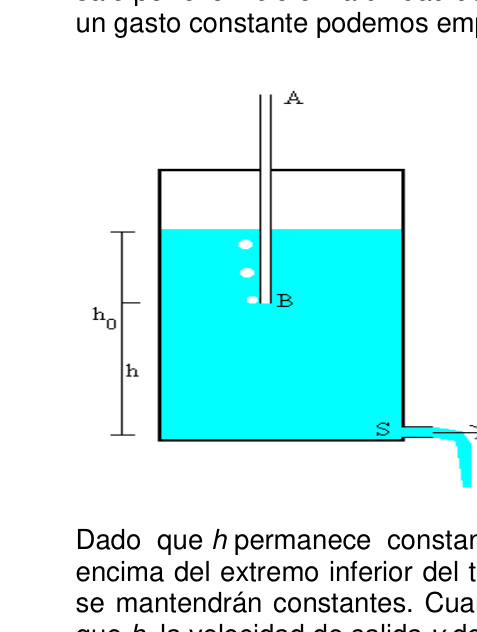
Topic: Fluid Mechanics Metodi: Bernoulli’s Equation, Experimental Data Analysis Competenze: Physical Reasoning, Experimental Data Analysis Objects: Container, Tube Fonte: Testo (PDF) — p.3
Folla di Mariotte: flussi costanti
PE1. Scuola Juan H. Morano Eduardo Castex, La Pampa.
Il frasco di Mariotte - Come ottenere un flusso costante
Introduzione teorica. Secondo il teorema di Torricelli, la velocità di uscita di un liquido per Un buco praticato nel fondo è lo stesso che si acquista un corpo. che cade liberamente nel vuoto da una altezza h, essendo h la altezza di colonna di fluido
Mentre il fluido esce dal foro, l’altezza h del fluido nel deposito va diminuendo. Se S è la sezione del foro, lo speso Sv, o volume di fluido che Scaccia attraverso il foro nell’unità di tempo non è costante. Se vogliamo produrre Se si tratta di una spesa costante, si può usare il cosiddetto frasco di Mariotte.
Consiste in un flacone pieno di liquido fino a un’altezza h0, che è chiusa da un un tappo attraversato da un tubo il cui L’estremità inferiore è immersa nel liquido. Il liquido viene fuori dal frasco per un Origine
- Praticato en el fondo di cui al contenitore. Al lato inferiore B del tubo, la pressione è atmosferica poiché l’aria entra attraverso il tubo, a misura. che il liquido esce dal foro. La velocità di uscita del fluido non corrisponde all’altezza h0 dal il foriolo alla superficie libera di fluido nel bottiglia, ma all’altezza h o distanza tra il la parte inferiore B del tubo e il foro. Poiché h rimane costante finché il livello di liquido è di sopra la punta inferiore del tubo, la velocità del fluido e quindi lo speso saranno costanti. Quando l’altezza di fluido in bottiglia h0 è inferiore che h, la velocità di uscita v del fluido non è più costante La velocità di uscita v può essere modificata saliendo o abbassando l’ estremità inferiore al tubo AB nel frasco. Datati. Liquido: Acqua radio della bottiglia R= 5,3 cm radio del foro di R = 0,25 cm
Sviluppo dell’esperienza
- Disegnare il dispositivo di Mariotte con gli elementi disponibili.
- Metti il tubo a 10 cm dal foro, riempire la bottiglia e misurare il T tempo di caduta da una altezza conveniente ad un’altra.
- Calcolare il volume uscito e con il tempo risolvere il flusso Q di uscita e poi velocità di uscita prendendo la sezione di uscita
- Il foro.
- Ripetere le misurazioni e le determinazioni nel caso vi sembrasse opportuno. necessaria.
- Cambiare il valore di altezza h = 9 cm ripetendo il processo determinando un altro valore di v.
- Prendere circa 10 altezze diverse in totale, con i loro corrispondenti velocità realizzando un grafico v=f(h)
- Osservare la variazione del grafico determinando il suo tipo di funzione
- Che tipo di errori può determinare per queste misurazioni.
OAF 2011 - 97 Tabella di misurazione e calcolo dei dati.
H1cm
H2 cm
H3 cm
H4 cm
H5 cm
T1seg
T2seg
T3seg
T4seg
T5seg
Q1
Q2
Q3
Q4
Q5
V1
V2
V3
V4
V5
H6 cm
H7 cm
H8 cm
H9 cm
H10cm
T6seg
T7seg
T8seg
T9seg
T10seg
Q6
Q7
Q8
Q9
Q10
V6
V7
V8
V9
V10
Topic: Fluid Mechanics Metodi: Bernoulli’s Equation, Experimental Data Analysis Competenze: Physical Reasoning, Experimental Data Analysis Objects: Container, Tube Fonte: Testo (PDF) — p.3
The following table shows the results of the calculation of the total volume of the sample:
PE1. John H. School Moran . Eduardo Castex, the Pampa.
The Mariotte bottle - How to get a steady flow rate
Theoretical introduction to the work. According to Torricelli’s theorem, the rate of a liquid’s discharge is A hole practiced at its bottom is the same as that which a body acquires. fall freely into the void from a height of h, h being the height of the fluid column
As the fluid exits the hole, the height h of the fluid in the reservoir goes It’s getting smaller. If S is the section of the hole, the expense Sv, or volume of fluid that It’s coming out of the hole in the time unit isn’t constant. If we want to produce We can use the so-called Mariotte jar for a constant expense.
It consists of a vial filled with liquid up to a height h0, which is closed by a a cap through a tube whose The lower end is submerged in the liquid. The fluid is coming out of the bottle by a The opening Practice en el The bottom of the container. At the lower end of B of the tube, the pressure is atmospheric since It’s getting air through the tube, on purpose. The fluid is coming out of the hole. The outflow velocity of the fluid is not shall correspond to the height h0 from the The fluid-free surface is drilled into the bottle, but at height h or distance between the B-bottom of the tube and the hole. Since h remains constant as long as the liquid level is per above the bottom end of the tube, the fluid speed and therefore the expense They will remain constant. When the fluid height in the vial h0 is lower where h, the output velocity v of the fluid ceases to be constant The output speed v can be changed up or down the end. lower AB tube in the vial. The data. Liquid: Water Bottle radius R= 5,3cm radius of the hole The output r= 0,25cm
The development of experience
- Draw the Mariotte device with the available elements.
- Place the hose 10 cm from the hole, fill the bottle and measure the t fall time from one convenient height to another.
- Calculate the volume that came out and with the time data solve the flow rate Q output and then the output speed taking the output section from the hole.
- Repeat the measurements and determinations if you feel like it . It is necessary.
- Change the value of the height h = 9 cm by repeating the process determining another value of v.
- Take about 10 different heights in total, with their corresponding heights velocities by performing a graph v=f(h)
- Observe the variation of the graph by determining its type of function
- What kind of errors can you determine for these measurements.
The following is the list of the countries of the European Union: Measurement table and calculation of data.
H1cm
H2 cm
H3 cm
H4 cm
H5 cm
T1second
T2second
T3se
T4se
T5second
Q1
Q2
Q3
Q4
Q5
V1
V2
V3
V4
V5
H6 cm
H7 cm
H8 cm
H9 cm
H10cm
T6second
T7se
T8se
T9se
T10seconds
Q6
Q7
Q8
Q9
Q10
V6
V7
V8
V9
V10
Topic: Fluid Mechanics Metodi: Bernoulli’s Equation, Experimental Data Analysis Competenze: Physical Reasoning, Experimental Data Analysis Objects: Container, Tube Fonte: Testo (PDF) — p.3
Medicion del indice de refraccion (ley de Snell)
PE2. Escuela Técnica ORT Nro. 2 Ciudad de Buenos Aires.
Ley de Snell Esta importante ley, llamada así en honor del matemático holandés Willebrord van Roijen Snell, afirma que: El producto del índice de refracción del primer medio y el seno del ángulo de incidencia de un rayo es igual al producto del índice de refracción del segundo medio y el seno del ángulo de refracción. El rayo incidente, el rayo refractado y la normal a la superficie de separación de los medios en el punto de incidencia están en un mismo plano.
En general, el índice de refracción de una sustancia transparente más densa es mayor que el de un material menos denso, es decir, la velocidad de la luz es menor en la sustancia de mayor densidad. Por tanto, si un rayo incide de forma oblicua sobre un medio con un índice de refracción mayor, se desviará hacia la normal, mientras que si incide sobre un medio con un índice de refracción menor, se desviará alejándose de ella. Los rayos que inciden en la dirección de la normal son reflejados y refractados en esa misma dirección.
Trabajo Experimental Se propone determinar el índice de refracción de la pieza de vidrio entregada, debiéndose incluir en el informe los siguientes ítems:
- Una descripción del procedimiento experimental.
- Tabla de los valores de las magnitudes medidas
- Valor obtenido del índice.
- Errores y sus causas.
OAF 2011 - 98
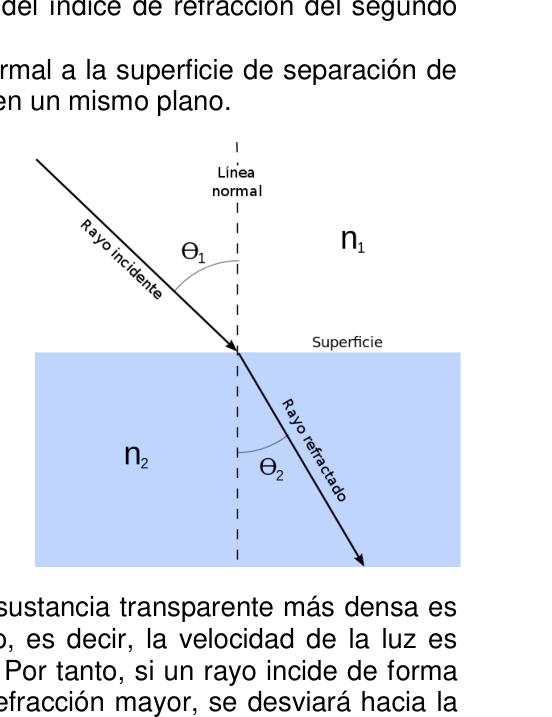
Topic: Geometric Optics Metodi: Snell’s Law, Experimental Data Analysis Competenze: Physical Reasoning, Experimental Data Analysis Objects: Prism Fonte: Testo (PDF) — p.3
**Messura dell’indice di refraczione (legge di Snell) **
PE2. Scuola tecnica ORT Nro. 2 Città di Buenos Aires.
Legge di Snell Questa importante legge, chiamata così in onore del matematico olandese Willebrord. Van Roijen Snell, afferma che: Il prodotto dell’indice di refraczione del primo mezzo e del seno dell’angolo di l’incidenza di un raggio è pari al prodotto dell’indice di refraczione del secondo. il centro e il seno dell’angolo di rifrazione. Il raggio incidente, il raggio refrattato e la normale superficie di separazione di I media al punto di incidenza sono nello stesso piano.
In generale, l’indice di refraczione di una sostanza trasparente più densa è più grande di quella di un materiale meno denso, cioè la velocità della luce è minore nella sostanza più densita. Quindi, se un raggio colpisce in modo La velocità di rifrazione è superiore a quella di un’onda di rifrazione superiore. La temperatura del sistema di refraczione è normale, mentre se incide su un mezzo con un indice di refraczione e si allontana da essa. I raggi che incidono nella direzione di La normale è riflessa e riflessa nella stessa direzione.
Lavorato sperimentale Si propone di determinare l’indice di refraczione della parte di vetro consegnata, La relazione dovrebbe includere i seguenti elementi:
- Una descrizione del procedimento sperimentale.
- Tabella dei valori delle dimensioni misurate
- Valore ottenuto dall’indice.
- Errori e loro cause.
OAF 2011 - 98
Topic: Geometric Optics Metodi: Snell’s Law, Experimental Data Analysis Competenze: Physical Reasoning, Experimental Data Analysis Objects: Prism Fonte: Testo (PDF) — p.3
Measurement of the refractive index (Snell’s law)
PE2. The technical school ORT Nro. 2 City of Buenos Aires.
Snell ‘s law . This important law, named after the Dutch mathematician Willebrord Van Roijen Snell, states that: The product of the refractive index of the first medium and the sine of the angle of The incidence of one ray is equal to the product of the refractive index of the second. The mean and the breast of the angle of refraction. The incident beam, refracted beam and normal to the separation surface of The media at the point of impact are on the same plane.
In general, the refractive index of a denser transparent substance is greater than that of a less dense material, that is, the speed of light is lower in the higher density substance. So if a lightning strike is formally The resulting surface is a surface with a higher refractive index. normal, whereas if it hits a medium with a refractive index The younger one will turn away from it. The lightning strikes in the direction of The normal ones are reflected and refracted in that same direction.
Experimental work The refractive index of the delivered glass part is to be determined, The following items should be included in the report:
- A description of the experimental procedure.
- Table of values of the measured quantities
- Value obtained from the index.
- Errors and their causes.
The following is the list of the Member States’ financial statements:
Topic: Geometric Optics Metodi: Snell’s Law, Experimental Data Analysis Competenze: Physical Reasoning, Experimental Data Analysis Objects: Prism Fonte: Testo (PDF) — p.3
Caja negra de resistencias
PE3. Colegio Nacional Dr. Arturo U. Illia
Colegio Mar del Plata de las Colinas
Colegio Santísima Trinidad
Instituto Albert Einstein
Mar del Plata, Buenos Aires.
Objetivo Analizar las resistencias conectadas en una “caja negra” como la mostrada, al conectar el sistema a una fuente de alimentación variable.
Procedimiento
Se sabe que en el interior de las cajas hay algunas resistencias conectadas entre AB y entre CDE
Sector 1.- P1 N1
- Conecte la fuente variable, junto al miliamperímetro, en los bornes P1 y N1. Verifique que la misma este apagada y el potencial (V) mínimo.
- Encienda la fuente y mida el potencial entre los puntos A-B (VAB) y la corriente (I) que entrega la misma.
- Complete la tabla 1 con los valores obtenidos, comenzando desde 1 V y aumentando de a 0,5 V.
Tabla 1 I ( )
VAB ( )
Se pide: a) Grafique la I (corriente) en función de VAB de la tabla 1. b) Analice la relación entre el la I y la V graficada ¿Se cumple la ley de ohm en algún sector del mismo? Si es así calcule la resistencia con el error correspondiente.
Sector 2.- P2 N2
En este último caso hay conectadas menos de cinco resistencias, R, de igual
valor.
4. Conecte ahora la fuente variable, junto al miliamperímetro, en los bornes P2
y N2. Verifique que la misma este apagada y el potencial (V) mínimo.
5. Encienda la fuente y lleve su valor a 6 V.
6. Complete la tabla 2 con los potenciales medidos: VPN, VCD, VDE, VCE e I,
indique el error en las mediciones.
Tabla 2 VPN ( ) VCD ( ) VDE ( ) VCE ( ) I ( )
OAF 2011 - 99 Se pide: c) Analice la tabla 2, teniendo en cuenta las referencias iniciales, y grafique el posible circuito entre los puntos CDE. d) Calcule el valor de R para el circuito del punto 3. e) Acote el error cometido al calcular R. f) Explique que sucede con las lecturas realizas si la temperatura de la caja sube 10 veces.
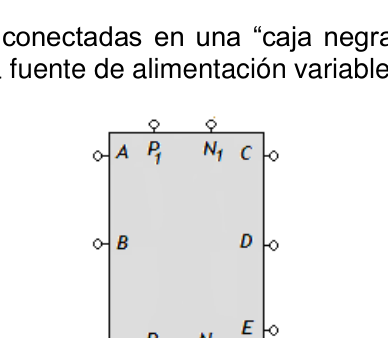
Topic: Circuits Metodi: Equivalent Circuit Reduction, Experimental Data Analysis Competenze: Physical Reasoning, Experimental Data Analysis Objects: Resistor Fonte: Testo (PDF) — p.3
Bassa casella nera di resistenza
PE3. Il Dr. Arturo U. Illia La scuola Mar del Plata de las Colinas La Santa Trinità L’Istituto Albert Einstein Mar del Plata, Buenos Aires.
Obiettivo Analizzare le resistenze collegate in una casella nera come quella mostrata, al collegare il sistema a una fonte di alimentazione variabile.
Procedura
Si sa che all’interno delle scatole ci sono alcune resistenze collegate. tra AB e tra CDE
Settore 1.- P1 N1
- Collegare la fonte variabile, accanto al miliamperietro, nei terminali P1 e N1. Verificare che sia spento e che il potenziale (V) sia minimo.
- Accendi la fonte e misura il potenziale tra i punti A-B (VAB) e il corrente (I) che la trasmette.
- Completa la tabella 1 con i valori ottenuti, a partire da 1 V e aumenti di 0,5 V.
Tabella 1 I ( )
VAB ( )
Si chiede: a) Grafica I (corente) in funzione del VAB di tabella 1. b) Analizzare il rapporto tra la I e la V graficata Ohm in un settore del genere? Se è così calcola la resistenza con il errore corrispondente.
Settore 2.- P2 N2 In questo ultimo caso ci sono meno di cinque resistenze collegate, R, uguale
- Il valore.
- Ora collegare la fonte variabile, accanto al miliampirimetro, nei terminali P2. y N2. Verificare che sia spento e che il potenziale (V) sia minimo.
- Accendi la fonte e porta il suo valore a 6 V.
- Completa la tabella 2 con i potenziali misurati: VPN, VCD, VDE, VCE e I, Indicare l’errore di misurazione.
Tabella 2 VPN () VCD ( ) VDE ( ) VCE ( ) I ( )
OAF 2011 - 99 Si chiede: c) Analizzare il tabello 2, tenendo conto dei riferimenti iniziali, e tracciare il possibile circuito tra i punti CDE. d) Calcolare il valore di R per il circuito del punto 3. e) Accordio l’errore commesso nel calcolo di R. f) Spiegare cosa accade con le letture effettuate se la temperatura del La cassa sale 10 volte.
Topic: Circuits Metodi: Equivalent Circuit Reduction, Experimental Data Analysis Competenze: Physical Reasoning, Experimental Data Analysis Objects: Resistor Fonte: Testo (PDF) — p.3
The following information shall be provided:
PE3. National College Dr. - Arthur U. Illia College Mar del Plata of the Hills Holy Trinity College The Albert Einstein Institute The city of Mar del Plata, Buenos Aires.
The objective Analyze the connected resistance in a black box such as the one shown on the screen. connect the system to a variable power supply.
The procedure
It is known that inside the boxes there are some connected resistors. between AB and between CDE
Sector 1.- P1 N1
- Connect the variable source, next to the millimeter, at the P1 and N1 terminals. Check that it is off and the potential (V) is minimal.
- Turn on the source and measure the potential between points A-B (VAB) and the current (I) that delivers it.
- Complete Table 1 with the values obtained, starting from 1 V and increasing to 0,5 V.
Table 1 I ( )
The following is the list of the countries of the European Union:
It asks: (a) Graph I (current) according to VAB of Table 1. (b) Analyze the relationship between the graphed I and V. Ohm in some sector of it? If so, calculate the resistance with the the corresponding error.
Sector 2.- P2 N2 In this latter case there are connected less than five resistors, R, equal The courage. 4. Now connect the variable source, next to the millimeter, to the P2 terminals. y N2. Check that it is off and the potential (V) is minimal. 5. Turn on the source and bring its value to 6 V. 6. Complete Table 2 with the measured potentials: VPN, VCD, VDE, VCE and I, indicate the measurement error.
Table 2 The following is a list of the countries of the European Union: The Commission shall adopt implementing acts in accordance with Article 21 of this Regulation. The European Parliament The Commission shall adopt implementing acts in accordance with Article 21 of this Regulation. I ( )
The following points shall be added: It asks: (c) Analyze Table 2, taking into account the initial references, and draw the possible circuit between the CDE points. (d) Calculate the R value for the circuit in point 3. (e) Accentuate the error made in calculating R. (f) Explain what happens with the readings you make if the temperature of the The box goes up 10 times.
Topic: Circuits Metodi: Equivalent Circuit Reduction, Experimental Data Analysis Competenze: Physical Reasoning, Experimental Data Analysis Objects: Resistor Fonte: Testo (PDF) — p.3
Medir la aceleracion del agua
PE4. Instituto María Auxiliadora Santa Rosa, La Pampa.
Objetivo: Medir la aceleración del agua
Materiales:
Botella de litro y medio de agua mineral
Clavo grueso
Pinza
Regla
Balde
Fósforos
Mechero
Cronómetro
Procedimiento: Con ayuda de la pinza, calienta el clavo en el mechero y haz un agujero en uno de los costados de la botella, cerca de la base. Tapa el agujero con el dedo y llena de agua la botella (sólo hasta donde la sección de la botella se mantenga uniforme) . Luego destapa el orificio para que el agua se derrame. Construye una tabla con varias posiciones de la superficie del agua y sus tiempos correspondientes.
Construye el plano X-T con los datos anteriores.
Calcula los Δx en cada ΔT como se indica en la tabla y luego la velocidad media
de cada intervalo de tiempo.
Construye el plano V-T
Mide las pendientes del grafico V-T y averigua que cantidad es la que acabas de
encontrar.
Repite la experiencia completa cambiando la altura del nivel de agua.
Que errores cometes? Consígnalos en la hoja.
Que conclusión extraes? Respecto al tipo de movimiento, a la velocidad con que
desciende el nivel de agua, a la aceleración del movimiento. Cuando cambias la
altura inicial ¿Qué cantidades cambian? Cuales permanecen constantes?
X(posición en cm) Δx T(Tiempo en seg.) ΔT
Vm=
Δx/ ΔT
xo
T0
x1 x1 - xo T1 T1-T0
x2 x2 - x1 T2 T2-T1
. .
.
. .
.
. .
.
OAF 2011 - 100
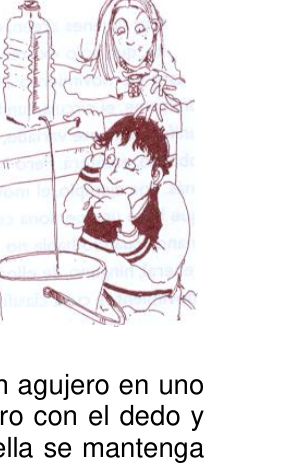
Topic: Fluid Mechanics, Newtonian Mechanics Metodi: Experimental Data Analysis, Graph Linearization Competenze: Physical Reasoning, Experimental Data Analysis Objects: Container Fonte: Testo (PDF) — p.3
Mettersi l’accelerazione dell’acqua
PE4. Istituto Maria Assilliadora Santa Rosa, La Pampa.
Obiettivo: Misurare l’accelerazione dell’acqua
Materiali: Bottolo di litro e mezzo di acqua minerale Un chiodo grosso Pinza Regola Balda Fosforo Mechero Cronometro
Procedura: Con l’aiuto della pinza, riscaldate il chiodo nella macchia e fate un buco in uno dai lati della bottiglia, vicino alla base. Coprite il buco con il dito e riempire l’ acqua della bottiglia (solo fino a quando la sezione della bottiglia è mantenuta) Uniforme . Poi sblocca il foro per far scorrere l’acqua. Costruisce una tabella con varie posizioni della superficie dell’acqua e le sue tempi corrispondenti.
Costruisce il piano X-T con i dati precedenti. Calcola i Δx in ogni ΔT come indicato nella tabella e quindi la velocità media di ogni intervallo di tempo. Costruisce il piano V-T Misura le pendenti del grafico V-T e scopri quale quantità hai appena ripreso.
- Trovare. Ripeti l’esperienza completa cambiando l’altezza del livello dell’acqua. Che errori fai? Consegnali sul foglio. Che conclusione ne tratti? Per quanto riguarda il tipo di movimento, la velocità con cui scende il livello dell’acqua, con l’accelerazione del movimento. Quando cambi la Altizza iniziale Quali quantità cambiano? Quali restano costanti?
X(positazione in cm) Δx T(Tempo in seg.) ΔT
Vm=
Δx/ ΔT
xo
T0
x1 x1 - xo T1 T1-T0
x2 x2 - x1 T2 T2-T1
. .
.
. .
.
. .
.
OAF 2011 - 100
Topic: Fluid Mechanics, Newtonian Mechanics Metodi: Experimental Data Analysis, Graph Linearization Competenze: Physical Reasoning, Experimental Data Analysis Objects: Container Fonte: Testo (PDF) — p.3
Measure the water acceleration
PE4. The Institute of Maria Auxiliadora Santa Rosa, the Pampa.
Objective: Measure the water acceleration
Materials: Bottle of one and a half liters of mineral water Thick nail . Pinza Rule
- You ‘re right . Phosphorus I ‘m a mechanic . The time-meter .
The procedure: With the help of the clamp, heat the nail in the spit and make a hole in one. from the sides of the bottle, near the base. Cover the hole with your finger and Fill the bottle with water (only as far as the section of the bottle is kept) uniform) Then unlock the hole so the water can spill. Build a table with various positions of the water surface and its the corresponding times.
He builds the X-T plane with the above data. Calculate the Δx in each ΔT as shown in the table and then the average velocity of each time interval. Build the V-T plane Measure the slopes on the V-T chart and find out what amount you just dropped. I’m going to find it. Repeat the full experience by changing the height of the water level. What mistakes do you make? Give them to me on the sheet. What conclusions do you draw? As regards the type of movement, the speed at which It drops the water level, as the movement accelerates. When you change the What quantities change? Which ones remain constant?
X(position in cm) Δx T(Time in sec.) ΔT
Vm=
Δx/ ΔT
xo
T0
x1 x1 - xo T1 T1-T0
x2 x2 - x1 T2 T2-T1
. .
.
. .
.
. .
.
The following is the list of the countries of the European Union:
Topic: Fluid Mechanics, Newtonian Mechanics Metodi: Experimental Data Analysis, Graph Linearization Competenze: Physical Reasoning, Experimental Data Analysis Objects: Container Fonte: Testo (PDF) — p.3
Tension superficial con tensiometro de Du Nouy
PE5. Escuela Técnica Nro. 27 Hipólito Yrigoyen Ciudad de Buenos Aires.
Determinación de la tensión superficial del agua destilada utilizando el Tensiómetro de Du Nouy, y cálculo del error cometido
Elementos utilizados: Tensiómetro de Du Nouy Agua destilada Caja de Petri Pesa fraccionada de 500 mg
Introducción: La superficie de los líquidos tiene un comportamiento similar al de una membrana en estado de tensión. Esto hace que si se quiere atravesar la superficie de un líquido deben vencerse las fuerzas contenidas en el plano de dicha superficie, definidas como tensión superficial () y que se distribuyen a lo largo del perímetro ó longitud de corte realizado a esa superficie. Es decir que:
= F/L siendo F: resultante de las fuerzas
L: Longitud de corte de la superficie del líquido
El aparato tiene un anillo hecho con un alambre de platino y se puede considerar
que su radio exterior es aproximadamente igual al interior (r) de modo que la
longitud de corte será 2r + 2r = 4r
El método consiste en medir la fuerza que hace el tensiómetro en el instante en
que el anillo se desprende del líquido.
Siendo T la fuerza hecha por el tensiómetro, deberá equilibrarse con F:
resultante de las fuerzas , por lo tanto:
= T /4r
Procedimiento:
a) Se debe cuidar de no tocar el aro del anillo con la mano, debe estar
perfectamente limpio y desengrasado
b) Dato:el radio promedio del anillo es r= 0,68cm 0,01 cm
c) Se coloca la escala en cero, observando que el vástago que sostiene al
anillo esté suspendido en posición horizontal.
d) Determinación de la constante de la escala: para saber a qué valor de
le corresponde a cada división: se coloca sobre el anillo (usando la
pinza) la pesa de 500 mg 5 mg. Se deplaza el índice sobre la escala
hasta que el vástago quede nuevamente suspendido en posición
horizontal, se leen el número de divisiones desplazadas “n” . n =
___
e) En ese momento, la fuerza realizada por el tensiómetro es igual al peso
de la pesa colocada. Trabajando en sistema CGS y considerando que la
gravedad es g= 980 cm/s2 5 cm/s2, el peso será: P= mg P=
La
tensión
superficial
correspondiente
será:
P /4r
__, para “n” divisiones
Luego para una división será: = _ (constante de la escala). f) Se retira la pesa y se coloca el índice en cero.
g) Medida de la tensión superficial: Se coloca el agua destilada en la caja de Petri, sobre la plataforma. Se eleva la plataforma hasta que el anillo se ponga en contacto con el agua destilada , sin quedar sumergido. Se
OAF 2011 - 101 desplaza al índice para despegar al anillo de la superficie del agua destilada, leyendo sobre la escala las divisiones desplazadas “N”.
Luego: =________ _________
Topic: Fluid Mechanics Metodi: Experimental Data Analysis, Error Propagation Competenze: Physical Reasoning, Experimental Data Analysis Objects: Droplet Fonte: Testo (PDF) — p.3
Tensione superficiale con tensione di Du Nouy
PE5. Scuola tecnica n.o. 27 Hippolytus Yrigoyen Città di Buenos Aires.
Determinazione della tensione superficiale dell’acqua distillata utilizzando Tensiometro di Du Nouy, e calcolo dell’errore commesso
Elementi utilizzati: Tensiometro di Du Nouy Acqua distillata Cassa di Petri Peso frazionato di 500 mg
Introduzione: la superficie dei liquidi ha un comportamento simile a quello di una membrana in stato di tensione. Questo fa sì che se si vuole attraversare la La superficie di un liquido deve essere superata dalle forze contenute nel piano di la superficie, definita come tensione superficiale () e distribuita al lunghezza del perimetro o della lunghezza di taglio effettuata su tale superficie. In altre parole:
= F/L essendo F: risultante delle forze
L: Lunghezza di taglio della superficie del liquido L’apparecchio ha un anello fatto con un filo di platino e può essere considerato che il suo raggio esterno è circa uguale all’interno (r) in modo che la La lunghezza di taglio sarà 2r + 2r = 4r Il metodo consiste nel misurare la forza che il tensioneometro fa all’ istante in che l’anello si sgancia dal liquido. Se T è la forza del tensione, deve essere bilanciata con F: risultante dalle forze , quindi:
= T /4r
Procedura:
a) Si deve fare attenzione a non toccare l’anello del anello con la mano, si deve essere
Perfetto e depeso.
b) Data:il raggio medio dell’anello è r= 0,68cm 0,01cm
(c) La scala è posta a zero, osservando che il tronco che sostiene il
il anello è sospeso in posizione orizzontale.
d) Determinazione della costante della scala: per sapere a che valore di
corrisponde a ciascuna divisione: si colloca sull’anello (usando la
Il peso di 500 mg è di 5 mg. L’indice si sposta sulla scala
fino a quando la trama non sarà di nuovo sospesa in posizione.
L’intervallo di un’area di divisioni di un’area di un’area di un’area di un’area di un’area di un’area di un’area di un’area di un’area di un’area di un’area di un’area di un’area di un’area di un’area di un’area di un’area di un’area di un’area di un’area di un’area di un’area di un’area di un’area di un’area di un’area di un’area di un’area di un’area di un’area di un’area di un’area di un’area di un’area di un’area di una di una di un’area di una di una di queste di un’area di una di una di queste di un’area di una di una di queste di un’area di una di una di un’area di una di una di una di queste di queste di un’area di una di un’area di una di una di un’area di una di una di una di queste di queste di queste di queste di un’aria. n =
___
e) A quel punto, la forza del tensionelitro è uguale al peso
di peso posto. Lavorando nel sistema CGS e considerando che il
gravità è g=980 cm/s2 5 cm/s2, il peso sarà: P=mg P=
La
tensione
superficiale
corrispondente
sarà:
P /4r
- per le divisioni
Quindi per una divisione sarà: = _________________ (constante della
- La scala. f) Togliere il peso e posizionare l’indice a zero.
g) Misura della tensione superficiale: l’acqua distillata viene messa nella scatola di Petri, sulla piattaforma. Si alza la piattaforma fino al ring si mette in contatto con l’acqua distillata, senza submergersi. Se
OAF 2011 - 101 spostare l’indice per decollare l’ anello dalla superficie dell’ acqua distilla, leggendo sulla scala le divisioni spostate N.
Quindi: =________ _________
Topic: Fluid Mechanics Metodi: Experimental Data Analysis, Error Propagation Competenze: Physical Reasoning, Experimental Data Analysis Objects: Droplet Fonte: Testo (PDF) — p.3
The surface tension with Du Nouy pressure gauge is **
PE5. Technical school No. 27 Hippolytus Yrigoyen City of Buenos Aires.
Determination of surface tension of distilled water using the Du Nouy’s tensometer, and calculation of the error made
Elements used: Du Nouy pressure gauge Distilled water Petrified Box Fractional weight of 500 mg
Introduction: The surface of liquids behaves similarly to that of a membrane in a stressed state. This makes it if you want to cross the The force contained in the plane of a liquid must be overcome. surface, defined as surface tension () and distributed to the length of the perimeter or cutting length made to that surface. I mean:
= F/L being F: resulting from the forces
L: Cutting length of the liquid surface The device has a ring made of a platinum wire and can be considered The radius of the outside is approximately equal to the inside (r) so that the The cut length shall be 2r + 2r = 4r The method consists of measuring the force exerted by the tensiometer in the instant in The ring is released from the liquid. If T is the force exerted by the pressure gauge, it shall be balanced with F: resulting from the forces , therefore:
= T /4r
The procedure:
(a) Care must be taken not to touch the ring ring with your hand, it must be
Perfectly clean and unfated
(b) Date:the average radius of the ring is r=0.68cm 0.01cm
(c) The scale is set to zero, observing that the stem supporting the
the ring is suspended in a horizontal position.
(d) Determination of the constant of the scale: to know what value of
corresponds to each division: it is placed on the ring (using the
The weight of the product is 500 mg 5 mg. The index moves over the scale
Until the stem is again suspended in position
The number of displaced divisions is read horizontally. n =
___
(e) At that time, the force exerted by the pressureometer is equal to the weight
of the weight placed. Working in the CGS system and considering that the
gravity is g=980 cm/s2 5 cm/s2, the weight will be: P=mg P=
La
The pressure
surface
corresponding
It shall be:
P /4r
________________, for n divisions
Then for a division it will be: = _________________ (constant of the (scale). (f) The weight is removed and the index is set to zero.
(g) Measurement of surface tension: Distilled water is placed in the box Petri, on the platform. Raise the platform until the ring . contact the distilled water without being submerged. Se
The following points shall be added: It displaces the index to take off the water surface ring . distilled, reading over the scale the displaced divisions N.
Then: =________ _________
Topic: Fluid Mechanics Metodi: Experimental Data Analysis, Error Propagation Competenze: Physical Reasoning, Experimental Data Analysis Objects: Droplet Fonte: Testo (PDF) — p.3
Pendulo fisico: momento de inercia
PE6. Instituto Primo Capraro San Carlos de Bariloche, Río Negro.
¡Qué MOMENTO Niembraa….!.
Consideraciones teóricas. El péndulo físico es cualquier péndulo real que usa un cuerpo de tamaño finito, en contraste con el modelo idealizado de péndulo simple en el que toda la masa se concentra en un punto. Para oscilaciones pequeñas de un péndulo físico se comprueba que:
Donde: T es el período de la oscilación. M es la masa del cuerpo que oscila, (en este caso una varilla de hierro). g es la aceleración de la gravedad. d es la distancia que hay entre el punto de suspensión del péndulo y en centro de gravedad del mismo. I se lo denomina momento de inercia del cuerpo y es una magnitud que depende de la distribución espacial de las masas del cuerpo.
La ecuación anterior es la base de un método común para determinar experimentalmente el momento de inercia de un cuerpo que tiene una forma compleja. Los investigadores en biomecánica usan este método para determinar los momentos de inercia de las patas de un animal. Esta información es importante para analizar como camina un animal, estimar la rapidez con que se desplazaba un animal ya extinguido, etc. Nosotros lo emplearemos para calcular el momento de inercia de una varilla delgada de hierro. La metodología es la siguiente: Localizar el centro de gravedad de la varilla por balanceo. Suspender la varilla por el orificio que tiene preparado para tal fin y hacerla oscilar libremente. Medir el período T de oscilación de amplitudes pequeñas de la varilla. Medir la masa de la varilla con una balanza. Medir la distancia d desde el punto de suspensión al centro de gravedad de la varilla. Utilizando la ecuación determinar al momento de inercia de la varilla respecto de un eje que pasa por el extremo del mismo (en nuestro caso el punto de suspensión).
OAF 2011 - 102 Objetivo de la experiencia: Determinar el momento de inercia de una varilla delgada de hierro, respecto a un eje que pasa por un extremo de la misma.
Elementos disponibles: Para realizar esta experiencia se dispone de: Una varilla de hierro perforada en uno de sus extremos. Un soporte universal con un taco y clavo pequeño para poder suspender la varilla. Balanza digital. Cinta métrica Cronómetro
Requerimientos: Al finalizar la experiencia se deberá entregar un informe donde conste: Planteo del problema Método experimental utilizado Resultados obtenidos y evaluación del error asociado Discusión y comentarios
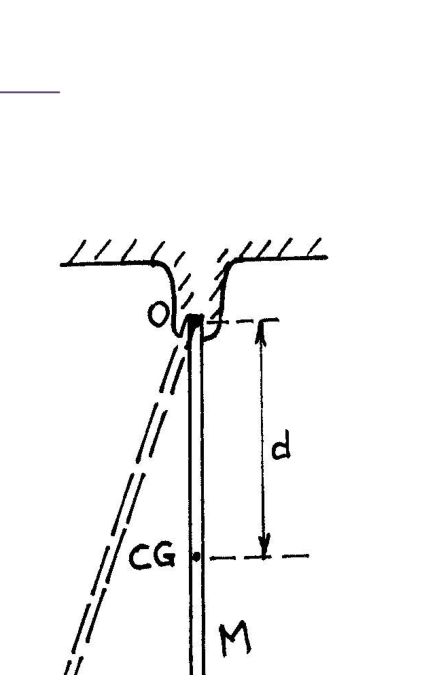
Topic: Oscillations & Waves, Rotational Dynamics Metodi: Simple Harmonic Motion Analysis, Experimental Data Analysis Competenze: Physical Reasoning, Experimental Data Analysis Objects: Pendulum, Rod Fonte: Testo (PDF) — p.3
Pendolo fisico: momento di inerzia
PE6. Istituto Primo Capraro San Carlo di Bariloche, Rio Negro.
Che momento di grandezza!
Considerazioni teoriche. Il pendolo fisico è qualsiasi pendolo reale che usa un corpo di dimensioni finite, in contrasto con il modello ideato di pendolo semplice in cui tutta la massa si concentra in un punto. Per piccole oscillazioni di un pendolo fisico si verifica che:
Dove: T è il periodo di oscillazione. M è la massa del corpo oscillante, (in questo
- in caso di bastone di ferro). g è l’accelerazione della gravità. d è la distanza tra il punto di sospensione del pendolo e centro di gravità di quello stesso. E ’ chiamato momento di inerzia del corpo . e è una grandezza che dipende dalla distribuzione spaziale delle masse corporee.
L’equazione precedente è la base di un metodo comune per determinare sperimentalmente il momento di inerzia di un corpo che ha una forma complesso. I ricercatori di biomeccanica usano questo metodo per determinare i momenti di inerzia delle zampe di un animale. Questa informazione è È importante per analizzare come cammina un animale, per stimare la velocità con cui cammina. lo spostare un animale già estinto, ecc. Lo useremo per calcolare. il momento di inerzia di un sottile bastone di ferro. La metodologia è la di seguito: • Localisare il centro di gravità del bastone per scalo. Sospendere la verga per il foro che ha preparato per tale scopo e La far oscillare liberamente. Misurare il periodo T di oscillazione di piccole ampiezze della
- La bacchetta. • Misurare la massa del bastone con una bilancia. Misurare la distanza d dal punto di sospensione al centro di gravità del bastone. Con l’ equazione di determinare il momento di inerzia della canna L’aereo è un’aereo che si trova in una direzione di un’aereo. caso il punto di sospensione).
OAF 2011 - 102 Obiettivo dell’esperienza: determinare il momento di inerzia di un bastone sottile di ferro, rispetto ad un asse che attraversa un’estremità della stessa.
Elementi disponibili: Per realizzare questa esperienza si dispone di: Una bacchetta di ferro perforata ad una delle sue estremità. Un supporto universale con un tacco e un piccolo chiodo per poter sospendere la
- La bacchetta. Sbalza digitale. Cintura metrica Cronometro
Requisiti: alla fine dell’esperienza deve essere fornito un rapporto in cui Contiene: La questione è stata sollevata. Metodo sperimentale utilizzato Risultati ottenuti e valutazione dell’ errore associato Discussione e commenti
Topic: Oscillations & Waves, Rotational Dynamics Metodi: Simple Harmonic Motion Analysis, Experimental Data Analysis Competenze: Physical Reasoning, Experimental Data Analysis Objects: Pendulum, Rod Fonte: Testo (PDF) — p.3
The following shall be added to the list of the following:
PE6. The first is the Capraro Institute. St. Charles of Bariloche, Rio Negro.
What a moment!
Theoretical considerations. The physical pendulum is any real pendulum that It uses a finite-sized body, in contrast to The idealized simple pendulum model in which The whole mass is concentrated at one point. For Small oscillations of a physical pendulum are verifies that:
Where: T is the period of oscillation. M is the body mass that oscillates, (in this In the case of an iron rod). g is the acceleration of gravity. d is the distance between the point of suspension of the pendulum and centre of gravity of the same. I call it the moment of inertia of the body. And it’s a magnitude that depends on the distribution. space of body masses.
The above equation is the basis for a common method of determining Experimentally the moment of inertia of a body that has a shape. It’s complicated. Biomechanical researchers use this method to determine The moments of inertia of an animal’s legs. This information is It’s important to analyze how an animal walks, to estimate how fast it walks. It was displacing an extinct animal, etc. We ‘ll use it to calculate . the moment of inertia of a thin iron rod. The methodology is the The following: • Locate the centre of gravity of the rod by swinging. Suspend the rod from the hole you have prepared for this purpose and to make it swing freely. Measuring the T-period of small amplitude oscillation of the The rod. • Measure the mass of the rod with a scale. Measure distance d from the suspension point to the centre of the vehicle gravity of the rod. Using the equation to determine the moment of inertia of the rod The axis of the axis is the axis of the axis. in case of the suspension point).
The following points shall be added: The purpose of the experiment: Determine the moment of inertia of a rod a thin iron axis, with respect to an axis passing through one end of it.
Available items: To carry out this experience: A iron rod punched in one end. A universal support with a small tail and nail so that it can suspend the The rod. The digital scale. Metric tape . The time-meter .
Requirements: At the end of the experience a report must be submitted where consists of: The problem is being raised. Experimental method used Results obtained and assessment of the associated error Discussion and comments
Topic: Oscillations & Waves, Rotational Dynamics Metodi: Simple Harmonic Motion Analysis, Experimental Data Analysis Competenze: Physical Reasoning, Experimental Data Analysis Objects: Pendulum, Rod Fonte: Testo (PDF) — p.3
Peso especifico de un cuerpo irregular
PE7. Colegio Nro. 1 Teodoro Sánchez de Bustamante San Salvador de Jujuy.
Objetivo del trabajo Determinar del peso específico de un cuerpo irregular (piedra).
Elementos a usar Probeta graduada Agua Cuerpo irregular (Piedra pequeña) Balanza Tanza
Requerimientos Solo podrá utilizar los elementos ofrecidos y ya mencionados en las recomendaciones. El informe debe contener: Planteo analítico del problema. Método experimental usado. Valores obtenidos en las mediciones efectuadas. Resultado experimental de lo solicitado.
Topic: Fluid Mechanics Metodi: Experimental Data Analysis, Error Propagation Competenze: Physical Reasoning, Experimental Data Analysis Objects: Container Fonte: Testo (PDF) — p.3
Peso specifico di un corpo irregolare
PE7. - Scuola Nero. 1 Teodoro Sánchez di Bustamante San Salvatore di Jujuy.
Obiettivo del lavoro Determinare il peso specifico di un corpo irregolare (pietra).
Elementi da utilizzare Provetta graduata Acqua Corpo irregolare (pietra piccola) Sbalzo Tanza
Richieste Le informazioni disponibili sono disponibili solo su quelle già indicate nelle raccomandazioni. Il rapporto deve contenere: Sulla base di un’analisi analitica del problema. Metodo sperimentale usato. Valori ottenuti dalle misurazioni effettuate. Risultato sperimentale della richiesta.
Topic: Fluid Mechanics Metodi: Experimental Data Analysis, Error Propagation Competenze: Physical Reasoning, Experimental Data Analysis Objects: Container Fonte: Testo (PDF) — p.3
Specific weight of an irregular body
PE7. School No. 1 Teodoro Sánchez de Bustamante is the first San Salvador de Jujuy. He is a saint.
Objective of the work Determine the specific weight of an irregular body (stone).
Elements to be used Graduated test Water The body is irregular (small stone) Weighing Tanza
Requirements You can only use the items already mentioned in the The Commission shall adopt the following recommendations: The report shall contain: Analytical approach to the problem. Experimental method used. Value obtained from measurements made. Experimental result of the requested.
Topic: Fluid Mechanics Metodi: Experimental Data Analysis, Error Propagation Competenze: Physical Reasoning, Experimental Data Analysis Objects: Container Fonte: Testo (PDF) — p.3
Pendulo simple: medir g
PE8. Colegio San Tarsicio Ciudad de Buenos Aires.
Objetivo:
Péndulo simple es una masa puntual sostenida de un hilo de masa despreciable
e inextensible que oscila en un plano. Cuando se la aparta de su posición de
equilibrio la masa efectúa un movimiento oscilatorio.
Se llama: amplitud al ángulo formado entre la vertical y la posición de máximo
alejamiento.
periodo al tiempo necesario para realizar una oscilación completa.
OAF 2011 - 103 En realidad el periodo del péndulo depende de la amplitud, pero si la amplitud es pequeña, es posible suponer que las oscilaciones son isócronas, o sea de igual duración. En este caso el movimiento pendular se asemeja bastante a un Movimiento Oscilatorio Armónico y se obtiene para el periodo la siguiente fórmula: T = 2 π √(l/g) Donde: l es la longitud del hilo g es la aceleración de la gravedad
Entonces este trabajo experimental estará dirigido a: a) verificar la relación entre el periodo y la longitud del hilo b) calcular la aceleración de la gravedad en CABA
Materiales: péndulo simple regla cronómetro
Procedimiento:
- Arma un péndulo dándole al hilo una longitud de 70 cm. Mide su periodo, es conveniente tomar como posición de referencia el pasaje del hilo del péndulo por su posición de equilibrio. El tiempo que transcurre entre dos pasajes sucesivos por esa posición y en el mismo sentido es el periodo del péndulo. Este método es mas preciso que si se toma como posición de referencia la de máxima elongación hacia uno u otro lado pues en ellas la velocidad es cero y el instante de inversión de la marcha es difícil de determinar. También debemos tener en cuenta que al medir un tiempo cometemos un error que se llama de reacción del orden de los 0,2 s, valor relativamente grande para los periodos que vamos a medir. Corregiremos este error de la siguiente manera: contamos entre 8 y 10 oscilaciones completas consecutivas y medimos el tiempo que tarda el péndulo en realizarlas y luego a ese tiempo lo dividimos, de esta manera el error también se divide, resultando ser menor cuanto mayor sea el número de periodos consecutivos que medimos.
- Confecciona un cuadro para ir volcando los datos que vas obteniendo
- Acorta la longitud del hilo en 5 cm. Mide su periodo y vuelca el valor en el cuadro.
- Repite el procedimiento anterior hasta completar 10 mediciones.
- Haz un grafico de T = f (l).
- Describe la grafica. Recuerda que si los puntos correspondientes a los datos sugieren una curva y no una recta, es muy difícil determinar la relación entre las variables en cuestión. Resulta prácticamente imposible extrapolar datos con precisión a partir de una curva. Los experimentadores intentan siempre obtener una recta, eligiendo para la nueva grafica las funciones apropiadas (cuadrado, cubo, logaritmo…) de las variables que usaron originalmente en los ejes. Cuando se logra obtener una recta, se puede determinar con más facilidad la relación entre las variables. La forma más sencilla de “linealizar” una curva consiste en observar si una de las variables es proporcional a una potencia de la otra variable. Si la grafica obtenida es una curva hacia arriba (con pendiente creciente), tal vez el periodo sea proporcional al cuadrado o cubo de la longitud. Si en cambio la curva es hacia abajo (pendiente decreciente), conviene intentar lo contrario: o sea elevar al cuadrado o cubo al periodo.
- Trata de linealizar la curva obtenida.
OAF 2011 - 104
8) Cual es la dependencia entre el periodo y la longitud del hilo?
9) Teniendo en cuenta la ecuación del periodo: que representa la
pendiente de la recta recién obtenida?
10)
Calcula la aceleración de la gravedad con su respectivo error.
Termina el trabajo presentando un informe detallado de todos los pasos que
seguiste.
En el mismo debe figurar:
Tus datos bien presentados
Los objetivos del trabajo
La experiencia realizada
Relato de todos los pormenores que ocurrieron durante las
mediciones y como realizaste cada una de ellas
Las graficas que obtuviste y su comentario
Las conclusiones
Topic: Oscillations & Waves Metodi: Simple Harmonic Motion Analysis, Experimental Data Analysis, Graph Linearization Competenze: Physical Reasoning, Experimental Data Analysis Objects: Pendulum Fonte: Testo (PDF) — p.3
Pendolo semplice: misura g
PE8. Colegio San Tarsicio Città di Buenos Aires.
Obiettivo: Un semplice pendolo è una massa puntuale sostenuta da un filo di massa disprezzabile. e inextensible che oscilla su un piano. Quando la si allontana dalla sua posizione di equilibrio la massa effettua un movimento oscillatorio. Si chiama: larghezza all’angolo formato tra la verticale e la posizione massima allontanamento. il periodo di tempo necessario per effettuare un oscillazione completa.
OAF 2011 - 103 In realtà il periodo del pendolo dipende dalla larghezza, ma se la larghezza è piccolo, si può supporre che le oscillazioni siano isocroni, cioè uguali. durata. In questo caso il movimento pendolare assomiglia molto a un Movimento oscillatorio armonico e si ottiene per il periodo successivo formula: T = 2 π √(l/g) Dove: l è la lunghezza del filo g è l’accelerazione della gravità
Quindi questo lavoro sperimentale sarà diretto a: a) verificare il rapporto tra il periodo e la lunghezza del filo b) calcolare l’accelerazione della gravità in CABA
Materiali: un semplice pendolo regola cronometro
Procedura:
- Armati un pendolo dando al filo una lunghezza di 70 cm. Se si misura il periodo, è opportuno prendere come posizione di riferimento il passaggio del filo del pendolo per la sua posizione di equilibrio. Il tempo che si svolge tra due passi successivi per quella posizione e nel lo stesso senso è il periodo del pendolo. Questo metodo è più La posizione di riferimento è quella di massima. L’allungamento verso l’uno o l’altro punto, poiché in questi punti la velocità è zero e l’istante di inversione della marcia è difficile da determinare. Dobbiamo anche tenere presente che nel misurare un tempo commettiamo un errore che si chiama reazione dell’ordine di 0,2 s. un valore relativamente grande per i periodi che misureremo. Correggeremo questo errore come segue: contare tra 8 e 10 oscillazioni complete consecutive e misuriamo il tempo che Ci vuole un po’ di tempo per realizzarli e poi lo dividiamo, di In questo modo l’errore si divide anche, risultando minore quanto più grande è il numero di periodi consecutivi che misuriamo.
- Crea un quadro per riversare i dati che stai ottenendo
- Accorci la lunghezza del filo di 5 cm. Misura il suo periodo e rovescia il valore
- sul quadro.
- Ripetere la procedura precedente fino a completare 10 misure.
- Fai un grafico di T = f (l).
- Descrive il grafico. Ricorda che se i punti corrispondenti ai dati suggeriscono una curva e Non è una linea retta, è molto difficile determinare il rapporto tra le variabili in questione. È praticamente impossibile estrapolare con precisione i dati da una
- Corvo. Gli esperimentatori cercano sempre di ottenere una linea retta, scegliendo per La nuova grafica rivela le funzioni appropriate (quadrato, cubo, logaritmo…) delle variabili che hanno usato originariamente sugli assi. Quando si riesce a ottenere una La relazione tra le variabili è più facile da determinare. Il modo più semplice di lineare una curva è osservare se una delle Le variabili sono proporzionali a una potenza dell’altra variabile. Se la grafica la curva verso l’alto (con inclinamento crescente), forse il periodo sia proporzionale al quadrato o a cubo di lunghezza. Se invece la curva è In questo caso, se si vuole fare un’esplosione di un’attività di lavoro, è meglio cercare di fare il contrario: al quadrato o a cubo al periodo.
- Cerca di linealizzare la curva ottenuta.
OAF 2011 - 104 8) Qual è la dipendenza tra il periodo e la lunghezza del filo? 9) Considerando l’equazione del periodo: pendice della retta appena ottenuta? 10) Calcola l’accelerazione della gravità con il suo errore.
Finisce il lavoro presentando un rapporto dettagliato di tutti i passi che
- Hai continuato. Il documento deve contenere: I dati ben presentati Gli obiettivi del lavoro L’esperienza acquisita Relato di tutti i dettagli che si sono verificati durante le le misure e come le avete eseguite. Le immagini che hai ottenuto e il suo commento • Le conclusioni
Topic: Oscillations & Waves Metodi: Simple Harmonic Motion Analysis, Experimental Data Analysis, Graph Linearization Competenze: Physical Reasoning, Experimental Data Analysis Objects: Pendulum Fonte: Testo (PDF) — p.3
The following table shows the results of the calculation of the total weight of the vehicle:
PE8. The San Tarsicio School City of Buenos Aires.
The objective: Simple pendulum is a pointed mass held by a scornful mass thread. It’s unpredictable, it’s unpredictable, it’s unpredictable, it’s unpredictable, it’s unpredictable, and it’s unpredictable, and it’s unpredictable, and it’s unpredictable, and it’s unpredictable, and it’s unpredictable, and it’s unpredictable, and it’s unpredictable, and it’s unpredictable, and it’s unpredictable, and it’s unpredictable, and it’s unpredictable, and it’s unpredictable. When you take her away from her position of The balance of mass makes an oscillatory motion. It is called: width to the angle formed between the vertical and the maximum position
- I’m going to move away. period of time necessary to perform a complete oscillation.
The following points shall be added: Actually the period of the pendulum depends on the width, but if the width is It is possible to assume that the oscillations are isochronous, that is, equal. the duration. In this case the pendulum motion is quite similar to a Harmonic oscillatory motion and is obtained for the following period formula: T = 2 π √(l/g) Where: l is the length of the thread g is the acceleration of gravity
Then this experimental work will be aimed at: (a) verify the relationship between the period and length of the thread (b) calculate the acceleration of gravity in CABA
Materials: simple pendulum rule the timepiece
The procedure:
- Arm a pendulum by giving the thread a length of 70 cm. It is appropriate to take as a reference position its period. the passage of the pendulum thread by its equilibrium position. The weather . which passes between two successive passages through that position and in the The same meaning is the period of the pendulum. This method is more The Commission has already taken the most important steps to ensure that the The length of the line is zero and the speed is zero. The moment of reversal of the gear is difficult to determine. We must also bear in mind that when measuring a time We’re making a mistake called a reaction of the order of 0.2 s. The value is relatively large for the periods we are going to measure. We’ll correct this error as follows: we count between 8 and 10 consecutive complete oscillations and we measure the time that It takes the pendulum to make them and then at that time we divide it, from This way the error is also divided, which turns out to be less than The greater the number of consecutive periods we measure.
- Create a chart to go over and over the data you’re getting
- Shorten the length of the thread by 5 cm. Measure its period and reverse the value. It’s in the painting.
- Repeat the previous procedure until 10 measurements are completed.
- Make a graph of T = f (l).
- Describe the graphic. Remember that if the points corresponding to the data suggest a curve and The relationship between the variables in question is very difficult to determine. It is almost impossible to extrapolate data accurately from a single source. Turn it up. Experimenters always try to get a straight line, choosing for The new graph shows the proper functions (square, cube, logarithm…) of the variables that they originally used on the axes. When you get a The relationship between the variables can be more easily determined. The simplest way to linearise a curve is to observe whether one of the variables is proportional to one power of the other variable. If you ‘re graphing it . The result is an upward curve (with increasing slope), perhaps the period be proportional to the square or cube of length. If instead the curve is If you want to go down (decreasing slope), try the opposite: square or cube to period.
- Try to linearise the curve obtained.
The following points shall be added: 8) What is the relationship between the period and the length of the thread? 9) Taking into account the period equation: which represents the The slope of the newly obtained straight? 10) Calculate the acceleration of gravity with its respective error.
It concludes the work by presenting a detailed report of all the steps that it has taken. You kept going. It shall contain: Your data well presented The objectives of the work Experience gained Reporting of all the details that occurred during the measurements and how you did each one of them. The graphs you obtained and their comment • The conclusions
Topic: Oscillations & Waves Metodi: Simple Harmonic Motion Analysis, Experimental Data Analysis, Graph Linearization Competenze: Physical Reasoning, Experimental Data Analysis Objects: Pendulum Fonte: Testo (PDF) — p.3
Resistance dependence on light and temperature (LDR, metals)
PE9. Colegio Nacional de Buenos Aires Ciudad de Buenos Aires.
¿Qué representa la resistencia de un material? La resistencia (para ser más precisos la resistividad) es un valor que solemos considerar constante para cada material. Se trata de un parámetro macroscópico que, en realidad, depende de algunas características intrínsecas del material (como por ejemplo la movilidad de los electrones en su estructura). Así planteado es sencillo comprender que dicho parámetro no es constante sino que depende de la iluminación, la temperatura, los campos a los que esté sometido, etc.
Los elementos con los que usted contará son los siguientes:
- LDR Light Dependent Resistor
- Multímetro
- Trozo de cobre
- Trozos de aluminio
- Conectores banana-coco
- Termómetro
- Vaso de precipitados
- Mechero
- Agua destilada
- Tubo plástico
- Cartón
Le proponemos realizar un estudio de las dependencias de la resistencia de un material.
Por un lado usted cuenta con un LDR que es un dispositivo muy sensible a la luz. Es decir su resistencia cubre un amplio rango de valores al pasar de la oscuridad total a un ambiente iluminado. Por otro, los trozos de material le permitirán analizar la dependencia respecto de la temperatura. Para ello cuenta con todo lo necesario para armarse un baño térmico y así caracterizar la variación con la temperatura.
OAF 2011 - 105 Se pretende que, en ambos casos, efectúe un primer abordaje cualitativo para familiarizarse con el material y luego pueda, de algún modo, cuantificar las dependencias mencionadas.
Los apéndices que se le entregan son: Descripción sucinta de cómo emplear el multímetro para la medición de resistencias y Data-sheet de un LDR. Este último le servirá para comparar una vez que haya logrado alguna conclusión respecto de la variación de la resistencia en función de la iluminación.
Topic: Circuits Metodi: Experimental Data Analysis, Graph Linearization Competenze: Physical Reasoning, Experimental Data Analysis Objects: Resistor Fonte: Testo (PDF) — p.3
**Resistance dependence on light and temperature (LDR, metalli) **
PE9. Collegio Nazionale di Buenos Aires Città di Buenos Aires.
Cosa rappresenta la resistenza di un materiale? La resistenza (per essere più precisi la resistenza) è un valore che si abituano a Considerare costante per ogni materiale. Si tratta di un parametro macroscopico che, in realtà, dipende da alcune caratteristiche intrinseche del materiale (come la mobilità degli elettroni nella loro struttura). Così . La proposta è semplice da capire che tale parametro non è costante ma che Dipende dalla luce, dalla temperatura, dai campi a cui è sottoposto. ecc.
Gli elementi che vi contano sono i seguenti:
- LDR Light Dependent Resistor
- Multimetro .
- Un pezzo di rame .
- Fragmenti di alluminio
- Conichi banana-cocco
- Termodermico .
- Un bicchiere di precipitazioni .
- Mechero
- Distillata .
- Più di plastica.
- Cartone
Vi proponiamo di fare uno studio sulle dipendenze della resistenza. di un materiale.
D’un lato hai un LDR che è un dispositivo molto sensibile alla luce. La resistenza copre un’ampia gamma di valori passando dalla oscurità totale in un ambiente illuminato. D’altra parte, i pezzi di materiale consentono di analizzare la dipendenza dalla temperatura. Per questo conta. La struttura è stata costruita con tutto il necessario per dotarsi di un bagno termico e così caratterizzare la variazione della temperatura.
OAF 2011 - 105 In entrambi i casi, è previsto che essa effettui un primo approccio qualitativo per La ricerca è stata condotta da un’organizzazione che si è occupata di una serie di progetti. le dipendenze menzionate.
Gli allegati che vi vengono forniti sono: un multimetro per la misurazione delle resistenze e un datasheet di un LDR. L’ultimo . vi servirà per confrontare una volta che avete raggiunto qualche conclusione in merito di variazione della resistenza a seconda dell’illuminazione.
Topic: Circuits Metodi: Experimental Data Analysis, Graph Linearization Competenze: Physical Reasoning, Experimental Data Analysis Objects: Resistor Fonte: Testo (PDF) — p.3
Resistance dependence on light and temperature (LDR, metals)
PE9. National College of Buenos Aires City of Buenos Aires.
What is the resistance of a material? Resistance (to be more precise, resistance) is a value we usually value. Consider constant for each material. It ‘s a macroscopic parameter . which, in fact, depends on some intrinsic characteristics of the material (such as the mobility of electrons in their structure). That ‘s it . The proposed parameters are not constant but are simple to understand. It depends on the lighting, the temperature, the fields to which it is subjected. and so on.
The elements you will have to rely on are the following:
- LDR Light Dependent Resistor
- Multi-meter .
- A piece of copper .
- Aluminum foil
- Banana and coconut connectors
- Thermometer .
- A glass of precipitate .
- Mechero .
- Distilled water .
- I got a plastic pipe .
- Cardboard .
We propose that you conduct a study of the resistance dependencies. of a material.
On the one hand you have an LDR which is a very sensitive device to the Light. That is, its resistance covers a wide range of values as it passes through the Total darkness to a lighted environment. On the other hand, the pieces of material are They will allow for the analysis of temperature dependence. That ‘s what it counts for . The main objective of the project is to develop a thermal bath and thus to characterize the variation with temperature.
The following points shall be added: In both cases, it is intended to take a first qualitative approach to The first step is to get acquainted with the material and then somehow quantify the the dependencies mentioned.
The appendices to the text are: The LDR is a multi-meter resistance measurement and data sheet. The latter . You will be able to compare once you have reached some conclusions about this. the variation in resistance according to the lighting.
Topic: Circuits Metodi: Experimental Data Analysis, Graph Linearization Competenze: Physical Reasoning, Experimental Data Analysis Objects: Resistor Fonte: Testo (PDF) — p.3
Volume contraction of water-alcohol mixtures
PE10. Escuela de Agricultura Colonia Alvear Oeste, Mendoza.
“Falta vino” Uno de los fenómenos más conocidos en la preparación de soluciones acuosas es el fenómeno de la contracción de volumen al efectuar la mezcla. Esto es, si se mezcla un volumen de alcohol (VB) con un volumen de agua (VA), el volumen total de la mezcla (VM) alcohol-agua resulta ser menor que la suma directa de los volúmenes componentes. Lo que matemáticamente se expresa como: VM < VA + VB De las propiedades molares parciales, se sabe que el volumen total de la mezcla se puede obtener con el número de moles (nA y nB) de cada componente y el volumen molar de cada uno de los componentes (vA y vB), mediante la siguiente operación: VM = vA nA + nB vB + ΔV Donde ΔV es el cambio de volumen observado en la mezcla. Este puede ser positivo, o negativo, según si se observa el fenómeno de dilatación, o contracción. Para el caso presente este valor será negativo, y es el que explica la desigualdad en la suma de volúmenes. En el caso particular de que ΔV = 0, significaría que no se produce el fenómeno de contracción (o dilatación) de mezclas, y para el presente caso representaría el llamado volumen ideal (Vi). En el cual, Vi = vA nA + nB vB = VA + VB La relación entre el volumen de la mezcla real y el ideal estará expresado como: ΔV = VM - Vi Se define como volumen específico (W) de una sustancia cualquiera, al volumen de la misma expresado por unidad de masa, es decir la inversa de la densidad: W = V / m = ρ-1 = 1/ ρ Empleando este concepto en las relaciones anteriores, se expresa la contracción de volumen en función de los volúmenes específicos, para poder obtener la contracción como función de las densidades de los componentes. De esta manera, se podrá determinar la contracción con sólo medir densidades a través de instrumentos especiales; que en el presente examen experimental será el densímetro. Se define como contracción (C) de la mezcla de alcohol y agua, o de una mezcla cualquiera, a la diferencia entre los volúmenes específicos ideal (Wi) y real (WM): C = Wi – WM
(I) Recordando que el volumen específico es la inversa de la densidad, el valor WM que es el real se puede calcular como la inversa de la densidad real, es decir de la mezcla: WM = 1/ ρM
(II)
OAF 2011 - 106 Mientras que el volumen específico ideal, se puede obtener recordando que la masa de la mezcla (M) no varía. Siendo (m) la suma de las masas de agua y de alcohol se puede deducir: m = mA + mB = ρAVA + ρB VB = ρi Vi =Vi/Wi Donde: ρA: densidad del agua ρB: densidad del alcohol ρi densidad ideal por lo que se puede despejar el volumen específico ideal como:
Wi = Vi
 cm3
                                         ρAVA + ρB VB        g
Dividiendo el numerador y el denominador de la ecuación anterior por Vi y llamando a las fracciones volumétricas de agua y alcohol respectivamente con:
XA = VA y XB = VB nos queda
     Vi

             Vi
Wi = 1
  cm3
                                         ρAXA + ρB XB
 g
Pero como se trata de la densidad ideal de agua y alcohol, medida a 4ºC en ambos casos, se puede deducir que la expresión anterior se simplifica si se emplean los valores de tablas de las densidades de ambas sustancias puras, a saber: ρA = 1 g/cm3 y ρB = 0,79 g/cm3 Razonando que: XA + XB = 1
ρA XA + ρB XB = (1 – XB ) + 0,79 XB = 1 - 0,21 XB
Reemplazando esta última expresión en la ecuación de Wi queda:
Wi = 1
cm3
(III)
(1 – 0,21 XB)
g
Reemplazando las ecuaciones (II) y (III) en la ecuación (I) se puede observar que la contracción es una función directa de la densidad de la mezcla y de la temperatura, a la cual se está trabajando:
C = Wi - WM = 1 - 1
(1 – 0,21 XB) ρM
Materiales provistos
Densímetro.
Probetas de 250 mL, 100 mL y 50 mL.
Vaso de precipitado de 500 mL.
Termómetro.
Matráz aforado de 250 mL, 200 mL y 100 mL.
Hojas milimetradas.
Hojas blancas.
Papel absorbente.
Alcohol absoluto y agua destilada.
OAF 2011 - 107 Procedimiento
-
Mida la densidad de mezclas de alcohol-agua con distintas concentración. Recuerde que solo dispone de un volumen de 300 ml de alcohol absoluto. Registre los datos obtenidos con el correspondiente error en una tabla. Sugerencia: realice por lo menos 6 diluciones.
-
Realice un esquema de con los elementos utilizados.
-
Completa la tabla:
X B % ρ Wi WM C
- Realice la grafica de la contracción del volumen de la mezcla en función de la concentración de cada componente.
- Determine a que concentración de alcohol se produce la mayor contracción de la mezcla.
- Si tenemos en cuenta que los vinos son una solución que contiene principalmente agua y alcohol (aprox. 12 % V/V), y que este último se produce a partir de la fermentación de los azúcares existentes en la uva, determine que volumen de vino se pierde por litro debido a la contracción de la mezcla.
Topic: Fluid Mechanics, Thermodynamics Metodi: Experimental Data Analysis, Curve Fitting, Error Propagation Competenze: Physical Reasoning, Experimental Data Analysis, Mathematical Modeling Objects: Container Fonte: Testo (PDF) — p.3
Volume contraction of water-alcohol mixtures
PE10. La scuola di agricoltura Colonia Alvear Ovest, Mendoza.
Falta di vino Uno dei fenomeni più noti nella preparazione di soluzioni acquose è il fenomeno della contrazione del volume durante la miscelazione. Questo è, se si un volume di alcool (VB) con un volume di acqua (VA), il volume Il totale della miscela (MMA) alcool-acqua risulta essere inferiore alla somma diretta di i volumi componenti. Ciò che matematicamente si esprime come: VM < VA + VB Dalle proprietà molari parziali, è noto che il volume totale della miscela si può ottenere con il numero di molli (nA e nB) di ciascun componente e il volume mollare di ciascun componente (vA e vB), mediante il seguente operazione: VM = vA nA + nB vB + ΔV Dove ΔV è il cambiamento di volume osservato nella miscela. Questo potrebbe essere positivo o negativo, a seconda del fenomeno di dilatazione osservato, o
- La contrazione. Per il caso di oggi questo valore sarà negativo, e questo è il valore che spiega la disparità nella somma dei volumi. Nel caso particolare in cui ΔV = 0, Il fenomeno di contrazione (o dilatazione) di La maggior parte dei prodotti sono prodotti a base di un volume di contenuti di contenuti di contenuti di contenuti di contenuti di contenuti di contenuti di contenuti di contenuti di contenuti di contenuti di contenuti di contenuti di contenuti di contenuti di contenuti di contenuti di contenuti di contenuti di contenuti di contenuti di contenuti di contenuti di contenuti di contenuti di contenuti di contenuti di contenuti di contenuti di contenuti di contenuti di contenuti di contenuti di contenuti di contenuti di contenuti di contenuti di contenuti di contenuti di contenuti di contenuti di contenuti di contenuti di contenuti di contenuti di contenuti di contenuti di contenuti di contenuti di contenuti di contenuti di contenuti di contenuti di contenuti di contenuti di contenuti di contenuti di contenuti di contenuti di contenuti di contenuti di contenuti di contenuti di contenuti di contenuti di contenuti di contenuti di contenuti di contenuti di contenuti di contenuti di contenuti di contenuti di contenuti di contenuti di contenuti di contenuti di contenuti di contenuti di contenuti di contenuti di contenuti di contenuti di contenuti di contenuti di contenuti di contenuti di contenuti di contenuti di contenuti di contenuti di contenuti di contenuti di contenuti di contenuti di contenuti di contenuti di contenuti di contenuti di contenuti di contenuti di contenuti di contenuti di contenuti di contenuti di contenuti di contenuti di contenuti di contenuti di contenuti di contenuti di contenuti di contenuti di contenuti di contenuti di contenuti di contenuti di contenuti di contenuti di contenuti di contenuti di contenuti di contenuti di contenuti di contenuti di contenuti di contenuti di contenuti di contenuti di contenuti di contenuti di contenuti di contenuti di contenuti di contenuti di contenuti di contenuti. En che, Vi = vA nA + nB vB = VA + VB Il rapporto tra il volume del miscelato reale e l’ideale è espresso come: ΔV = VM - Vi Si definisce come volume specifico (W) di una sostanza, al volume di quella stessa espressa in unità di massa, cioè l’inverso di densità: W = V / m = ρ-1 = 1/ ρ Applicando questo concetto nelle relazioni precedenti, si esprime la contrazione La produzione di prodotti di base di cui all’articolo 1 del regolamento (CE) n. la contrazione in funzione delle densità dei componenti. Di questa . La contrazione può essere determinata solo misurando le densità attraverso La Commissione ha adottato una proposta di regolamento (CEE) n. densitario. Definito come contrazione (C) della miscela di alcol e acqua, o di una miscela Qualsiasi, alla differenza tra i volumi specifici ideale (Wi) e reale (WM): C = Wi – WM
(I) Ricordando che il volume specifico è l’inverso della densità, il valore WM che è reale si può calcolare come l’inverso della densità reale, cioè di la miscela: WM = 1/ ρM
(II)
OAF 2011 - 106 Mentre il volume specifico ideale, si può ottenere ricordando che la massa della miscela (M) non varia. Essendo (m) la somma delle masse d’acqua e di Alcol può essere dedotto: m = mA + mB = ρAVA + ρB VB = ρi Vi =Vi/Wi Dove: ρA: densità dell’acqua ρB: densità di alcol Densità ideale per cui si può chiarire il volume specifico ideale come:
Wi = Vi
cm3
RAVA + ρB VB g
Dividendo il numeratore e il denominatore dell’equazione precedente per Vi e chiamando rispettivamente le frazioni volumetriche di acqua e di alcol con:
XA = VA y XB = VB
-
Ci resta solo un po ’ di tempo .
   Vi

           Vi
Wi = 1
cm3
ρAXA + ρB XB g
Ma poiché si tratta della densità ideale di acqua e alcol, misurata a 4°C in In entrambi i casi, si può dedurre che l’espressione precedente si semplifica se si utilizzano i valori di tabella delle densità di entrambe le sostanze pure, a sapere: ρA = 1 g/cm3 e ρB = 0,79 g/cm3 Sulla base di: XA + XB = 1
ρA XA + ρB XB = (1 – XB ) + 0,79 XB = 1 - 0,21 XB
Rimpiazzando questa ultima espressione nell’equazione di Wi viene:
Wi = 1
cm3
(III)
(1 – 0,21 XB)
g
Rimpiazzando le equazioni (II) e (III) nell’equazione (I) si può osservare che la contrazione è una funzione diretta della densità della miscela e della temperatura a cui si sta lavorando:
C = Wi - WM = 1 - 1
(1 – 0,21 XB) ρM
Materiali forniti • Densimetro. 250 mL, 100 mL e 50 mL. • 500 ml di bicchiere di precipitazione.
- Termodinamico. • Materasso risparmiato di 250 mL, 200 mL e 100 mL. • Foli millimetrici.
- fogli bianchi. • Papero assorbente. Alcol assoluto e acqua distillata.
OAF 2011 - 107 Procedura
-
Misurare la densità di miscele alcool-acqua con diverse concentrazione. Ricorda che dispone solo di un volume di 300 ml di Alcol assoluto. Registra i dati ottenuti con il corrispondente errore in una tabella. Suggerimento: fare almeno 6 diluizioni.
-
Sviluppa un schema degli elementi utilizzati.
-
Completa la tabella:
X B % ρ Wi WM C
- Sfruttare il grafico di contrazione del volume del miscelato in funzione di concentrazione di ciascun componente.
- Determina a quale concentrazione di alcol si produce il più alto contrazione della miscela.
- Considerando che i vini sono una soluzione che contiene La maggior parte delle risorse destinate all’alimentazione umana sono destinate a prodotti alimentari. 12 % V/V), e che l’ultimo sia produce a partire dal fermento dei zuccheri presenti nella uva, determina il volume di vino perso per litro a causa della contrazione della miscela.
Topic: Fluid Mechanics, Thermodynamics Metodi: Experimental Data Analysis, Curve Fitting, Error Propagation Competenze: Physical Reasoning, Experimental Data Analysis, Mathematical Modeling Objects: Container Fonte: Testo (PDF) — p.3
Volume contraction of water-alcohol mixtures
PE10. School of Agriculture Colony Alvear West, Mendoza.
Full of wine One of the most well-known phenomena in the preparation of aqueous solutions is the phenomenon of volume contraction in the mixture. This is, if you mix a volume of alcohol (VB) with a volume of water (VA), the volume The total alcohol-water mixture (MW) is less than the direct sum of the component volumes. Which mathematically is expressed as: VM < VA + VB From the partial molar properties, it is known that the total volume of the mixture is The number of moles (nA and nB) of each component and the molar volume of each component (vA and vB), by the following operation: VM = vA nA + nB vB + ΔV Where ΔV is the volume change observed in the mixture. This could be positive or negative, depending on whether the dilation phenomenon is observed, or The contraction. For the present case this value will be negative, and it is the one that explains The difference in the sum of the volumes. In the particular case where ΔV = 0, This would mean that the contraction (or dilation) of the The resulting volume is the so-called ideal volume (vi). En which, Vi = vA nA + nB vB = VA + VB The ratio of the actual mix volume to the ideal mix volume shall be expressed as: ΔV = VM - Vi It is defined as the specific volume (W) of any substance, at volume of the same mass expressed as a unit of mass, i.e. the inverse of density: W = V / m = ρ-1 = 1/ ρ Using this concept in the previous relationships, the contraction is expressed The volume of the product is determined by the specific volumes, so that the The contraction is a function of the densities of the components. Of this one . So, you can determine contraction by just measuring densities through The Commission has already adopted a number of proposals for special instruments. density. It is defined as contraction (C) of the mixture of alcohol and water, or of a mixture any, the difference between the specific ideal (Wi) and real volumes (WM): C = Wi – WM
(I) Remembering that the specific volume is the inverse of the density, the WM value which is the real can be calculated as the inverse of the real density, i.e. of the mixture: WM = 1/ ρM
(II)
The following points shall be added: While the ideal specific volume, it can be obtained by remembering that the The mass of the mixture (M) does not vary. Being (m) the sum of the water masses and of Alcohol can be deduced from: The following conditions shall apply: Where: ρA: density of water ρB: density of alcohol The ideal density so that the ideal specific volume can be cleared as:
Wi = Vi
cm3
The following table shows the results of the calculation:
Dividing the numerator and denominator of the above equation by Vi and calling the volumetric fractions of water and alcohol respectively with:
XA = VA y XB = VB We ‘re left with it .
     Vi

             Vi
Wi = 1
cm3
The following table shows the following: g
But since it’s the ideal density of water and alcohol, measured at 4°C in In both cases, it can be inferred that the above expression is simplified if use the density table values of both pure substances, a The following is the list of the following: Reasoning that: XA + XB = 1
ρA XA + ρB XB = (1 – XB ) + 0,79 XB = 1 - 0,21 XB
Replacing this last expression in the Wi equation is:
Wi = 1
cm3
(iii)
(1 – 0,21 XB)
g
By replacing the equations (II) and (III) in equation (I) you can see The contraction is a direct function of the density of the mixture and the temperature at which work is being done:
C = Wi - WM = 1 - 1
(1 – 0,21 XB) ρM
Materials provided • Density • 250 mL, 100 mL and 50 mL samples. • 500 ml water bottle. • Thermometer • Saved mattress of 250 mL, 200 mL and 100 mL. • Millimetered leaves. • White leaves. • Absorbent paper. • Absolute alcohol and distilled water.
The following points shall be added: The procedure
-
Measure the density of alcohol-water mixtures with different The focus. Remember that you only have a volume of 300 ml of I’m not drinking alcohol. Record the data obtained with the corresponding data error on a table. Suggestion: make at least 6 dilutions.
-
Draw a diagram of the elements used.
-
Complete the table:
X B % ρ Wi WM C
- Draw the graph of the volume contraction of the mixture as a function. the concentration of each component.
- Determine which alcohol concentration occurs most the contraction of the mixture.
- If we consider that wines are a solution that contains The main sources of water and alcohol (approx. The Commission has already adopted a proposal for a regulation on the It is produced by fermentation of the sugars present in the grape. determines the volume of wine lost per litre due to the the contraction of the mixture.
Topic: Fluid Mechanics, Thermodynamics Metodi: Experimental Data Analysis, Curve Fitting, Error Propagation Competenze: Physical Reasoning, Experimental Data Analysis, Mathematical Modeling Objects: Container Fonte: Testo (PDF) — p.3
Static friction coefficient via inclined ruler
PE11. Escuela La Asunción
Colegio Santo Tomás de Aquino Ciudad de Santiago del Estero.
Tema: Coeficiente de roce estático. Objetivo: Determinar el coeficiente estático. Materiales:
- Mesa de madera
- Regla de plástico
- Transportador
- Hilo fino
- Plomada
- Chinches
- Cinta adhesiva
- Cilindros de madera
- Hojas y útiles de escritura
- Hoja de papel milimetrado
- Calculadora Procedimientos: a) Fije el transportador y el alfiler (que servirá de soporte al hilo con la plomada) a un extremo de la regla, empleando cinta adhesiva. b) Ubique la regla sobre el borde de la mesa en forma paralela a ésta, fije el extremo libre de la regla a la mesa usando cinta adhesiva. c) Asegure la porción de cinta pegada a la mesa con dos o más chinches, las cuales servirán también de apoyo al extremo de la regla. d) Con la regla apoyada sobre la mesa, coloque sobre ella el cuerpo 1 y eleve lentamente el extremo de la regla, hasta que el cuerpo se ponga en movimiento: determine en ese instante el ángulo de inclinación de la regla.
OAF 2011 - 108 Repita la determinación del ángulo de inclinación de la regla 5 veces, consignando los valores obtenidos en la Tabla 1. Posteriormente, obtenga el valor más probable del ángulo (α), acotando su error (E), y complete la Tabla 2. e) Repita los pasos del apartado d), para los cuerpos 2 y 3
Tabla 1 CUERPO MASA (g) α1 α2 α3 α4 α5 1
2
3
Tabla 2 CUERPO α E α E 1
2
3
f) Calcule el coeficiente de roce estático entre cada uno de los cuerpos y la regla, y complete la Tabla 3.
Tabla 3 CUERPO e = tan α 1
2
3
g) Justifique analíticamente el uso de la expresión e = tan α para el cálculo del coeficiente de roce estático. h) ¿Puede concluir que el coeficiente de roce estático entre la madera y el plástico es el promedio de los 3 valores consignados en la Tabla 3? Justifique. i) Represente gráficamente α = f(masa) y e = f(masa). j) Enuncie alguna conclusión a partir del análisis de los resultados obtenidos en la experiencia. k) Mencione fuentes de error que, según su opinión, influyeron en el resultado de la determinación del coeficiente de roce estático.
Topic: Newtonian Mechanics Metodi: Experimental Data Analysis, Free-Body Diagram Competenze: Physical Reasoning, Experimental Data Analysis Objects: Inclined Plane, Cylinder Fonte: Testo (PDF) — p.3
Coefficiente di frizione statico via ruler inclinato
PE11. Scuola La Asunción
Collegio Santo Tommaso d’ Aquino Città di Santiago del Estero.
Tema: Coefficiente di rottura statica. Obiettivo: Determinare il coefficiente statico. Materiali:
- Tavola di legno .
- Regola di plastica.
- Trasportatore .
- Felle finte .
- Plomato .
- Cichoni .
- Fascia adesiva
- Cillindri di legno
- fogli e strumenti di scrittura
- Carta di carta di millimetro
- Calcolatore . Procedure: a) Fixare il trasportatore e il pin (che servirà da supporto al filo con la La linea di riferimento è la linea di riferimento di un’altra linea di linea. b) Metti la regola sul bordo della tavola in forma parallela a questa, fissa la punta libera della regola al tavolo usando la cinta adesiva. c) Assicurare la porzione di cinta attaccata al tavolo con due o più zanzare, che serviranno anche a sostenere l’estremità della regola. d) Con la regola appoggiata sul tavolo, collocare su di essa il corpo 1 e Svolga lentamente l’estremità della regola, finché il corpo non si mette. in movimento: determinare in quel momento l’angolo di inclinazione della regola.
OAF 2011 - 108 Ripete la determinazione dell’angolo di inclinazione della regola 5 volte, consignendo i valori ottenuti in Tabella 1. Successivamente, si ottiene il valore più probabile dell’angolo (α), abbatendo l’errore (E), e completare la tabella 2. e) Ripetere le fasi di cui al paragrafo d) per i corpi 2 e 3.
Tabella 1 Corpo . MASA (g) α1 α2 α3 α4 α5 1
2
3
Tabella 2 Corpo . α E α E 1
2
3
f) Calcolare il coefficiente di rottura statico tra ciascun corpo e la regola, e completa la tabella 3.
Tabella 3 Corpo . e = così α 1
2
3
g) giustificare analticamente l’uso dell’espressione e = tanto α per calcolo del coefficiente di rottura statico. h) Si può concludere che il coefficiente di rottura statico tra il legno e il La plastica è la media dei 3 valori riportati nella tabella 3? giustifica. (i) Rappresenta graficamente α = f(massa) e e = f(massa). j) Esprimere qualche conclusione dall’analisi dei risultati La Commissione ha adottato una decisione che non è stata adottata. k) Indicare le fonti di errore che, secondo lei, hanno influenzato il processo di risultato della determinazione del coefficiente di rottura statico.
Topic: Newtonian Mechanics Metodi: Experimental Data Analysis, Free-Body Diagram Competenze: Physical Reasoning, Experimental Data Analysis Objects: Inclined Plane, Cylinder Fonte: Testo (PDF) — p.3
The following shall be added to the list of the following:
PE11. School of the Assumption
St. Thomas Aquinas College The city of Santiago del Estero.
Subject: Static brushing coefficient The objective: Determine the static coefficient. Materials:
- A wooden table .
- Plastic rule .
- The transporter .
- Fine wool .
- Pluming .
- Chinches .
- The adhesive tape
- Wood cylinders
- Sheets and writing tools
- Millimeter sheet of paper
- Calculator . The following procedures: (a) Fix the conveyor and the pin (which will be used to support the wire with the The first step is to apply the adhesive tape to the end of the ruler. (b) Place the rule on the edge of the table parallel to it, fixed the free end of the rule to the table using tape. (c) Secure the portion of tape attached to the table with two or more bed bugs, The Commission will also be able to take the necessary steps to ensure that the Commission is able to take the necessary measures to ensure that the Commission is able to take the necessary measures to ensure that the Commission is able to take the necessary measures to ensure that the Commission is able to take the necessary measures to ensure that the Commission is able to take the necessary measures to ensure that the Commission is able to take the necessary measures to ensure that the Commission is able to take the necessary measures to ensure that the Commission is able to take the necessary measures to ensure that the results of the work are achieved. (d) With the rule resting on the table, place the body 1 and Slowly raise the tip of the rule, until the body is set. In motion: determine at that instant the angle of inclination of the The rule.
The following points shall be added: Repeat the determination of the angle of inclination of the rule 5 times, the values obtained in Table 1 are recorded. Then get the most likely value of the angle (α), by shortening the error (E) and complete Table 2. (e) Repeat the steps in paragraph (d) for bodies 2 and 3.
Table 1 Body . The following points shall be added: α1 α2 α3 α4 α5 1
2
3
Table 2 Body . α E α E 1
2
3
(f) Calculate the static friction coefficient between each body and The rule, and complete Table 3.
Table 3 Body . e = so α 1
2
3
(g) Analytically justify the use of the expression e = so α for calculation of the static brushing coefficient. (h) Can it be concluded that the static friction coefficient between wood and wood is plastic is the average of the 3 values listed in Table 3? You justify it. (i) Graphically represent α = f(mass) and e = f(mass). (j) Express any conclusions from the analysis of the results The Commission has already adopted a number of proposals. (k) Name the sources of error which, in your opinion, influenced the result of determination of the static friction coefficient.
Topic: Newtonian Mechanics Metodi: Experimental Data Analysis, Free-Body Diagram Competenze: Physical Reasoning, Experimental Data Analysis Objects: Inclined Plane, Cylinder Fonte: Testo (PDF) — p.3
Density of regular-shaped bodies
PE12. Escuela Secundaria Nº 1 Clara Amstrong1 Instituto Pía Didoménico1 Colegio del Carmen y San José1 Instituto Superior FASTA Catamarca1 Colegio Padre Ramón de la Quintana1 Escuela Secundaria Nº 7 General José María Paz1 Escuela Preuniversitaria Fray Mamerto Esquiú1 Escuela Nº 4842 Escuela Secundaria Nº 21 República de Venezuela3 1San Fernando del Valle de Catamarca - 2Las Pirquitas - 3Andalgalá Provincia de Catamarca.
Cálculo de la densidad de cuerpos de forma regular Objetivos: Calcular el volumen de cuerpos de forma regular. Calcular la densidad de los mismos.
OAF 2011 - 109 Lista de materiales: Cuerpos de forma regular. Regla, calibre. Balanza electrónica
Procedimiento: 1- Calcule su volumen de cada uno de los cuerpos geométricos que se le suministran: Utilice las ecuaciones del siguiente cuadro:
2- Mida la masa de cada cuerpo usando la balanza de precisión. 3- Calcule la densidad de cada cuerpo. 4- Completar la siguiente tabla:
Cuerpo Masa(g) Volumen(cm3 ) Densidad(g/cm3 ) Esfera
Cilindro
Prisma
Requerimentos: Al finalizar la experiencia deberá entregar un informe escrito con letra clara, que conste de: Planteo del problema Valores obtenidos en las mediciones, tablas, gráficos. Fuentes de error y análisis de como influyen en el resultado final. Resultado experimental de lo solicitado. Conclusiones. Comentarios que desee realizar referidos dificultades relacionadas a la realización de la experiencia.
OAF 2011 - 110
Topic: Fluid Mechanics Metodi: Experimental Data Analysis, Error Propagation Competenze: Physical Reasoning, Experimental Data Analysis Objects: Sphere, Cylinder Fonte: Testo (PDF) — p.3
Densità di corpi a forma regolare
PE12. La scuola superiore n. 1 Clara Amstrong1 Istituto Pio Didomeno1 Colegio del Carmen e San José1 Istituto superiore FASTA Catamarca1 Scuola Padre Ramón de la Quintana1 Scuola secondaria n. 7 Generale José María Paz1 Preuniversità Fray Mamerto Esquiú1 Scuola n. 4842 Scuola secondaria n. 21 Repubblica del Venezuela3 1San Fernando del Valle di Catamarca - 2Le Pirquitas - 3Andalgalá Provincia di Catamarca.
Calcolo della densità dei corpi in modo regolare Obiettivi: Calcolare il volume corporeo in modo regolare. Calcolare la densità di tali prodotti.
OAF 2011 - 109 Lista dei materiali:
- Corpi regolarmente.
- Regola, calibro. Balance elettronica
Procedura: 1- Calcolare il volume di ciascun corpo geometrico che viene dato fornire: Utilizzare le equazioni della tabella seguente:
2- Misurare la massa di ogni corpo usando la bilancia di precisione. 3- Calcola la densità di ogni corpo. 4- Completa la tabella seguente:
Corpo . Massa (g) Volume (cm3) Densità (g/cm3) Sfera
Cillico
Prisma
Requisiti: Al termine dell’esperienza dovrà presentare un rapporto scritto in chiaro, che è costituito da: Sorgere del problema Valori ottenuti in misurazioni, tabelle, grafici. Fonti di errore e analisi di come influenzano il risultato finale. Risultato sperimentale della richiesta. • Conclusioni. Commenti che desiderino fare riguardo alle difficoltà di cui trattasi realizzazione dell’esperienza.
OAF 2011 - 110
Topic: Fluid Mechanics Metodi: Experimental Data Analysis, Error Propagation Competenze: Physical Reasoning, Experimental Data Analysis Objects: Sphere, Cylinder Fonte: Testo (PDF) — p.3
Density of regular-shaped bodies
PE12. High School No 1 Clara Armstrong1 The Spanish School of Economics The College of Carmen and San José1 The Spanish language is spoken by the Spanish language. Father Ramón de la Quintana School Secondary School No 7 General José María Paz1 Fray Mamerto Esquiú Pre-university School1 School No 4842 Secondary School No 21 Republic of Venezuela3 1San Fernando del Valle de Catamarca - 2The Pirquitas - 3Andalgalá The Spanish government Province of Catamarca.
Calculation of body density on a regular basis Objectives: • Calculate body volume on a regular basis. • Calculate the density of the same.
The following points shall be added: List of materials: • Body on a regular basis.
- Rule, caliber. Electronic balance sheet
The procedure: 1- Calculate the volume of each geometric body given to you supply: Use the equations in the following table:
2- Measure the mass of each body using the precision scale. 3- Calculate the density of each body. 4- Complete the following table:
Body . Mass (g) The following table shows the results of the study: The following table shows the results of the calculation: Sphere
Cylinder
Prism
Requirements: At the end of the experience, you must submit a written report in clear writing, which consist of: Problem setting • Value obtained from measurements, tables, charts. Source of error and analysis of how they influence the final result. • Experimental result of the requested product. • Conclusions comments on the difficulties related to the The Commission will take the necessary steps to ensure that the results of the evaluation are achieved.
The following points shall be added:
Topic: Fluid Mechanics Metodi: Experimental Data Analysis, Error Propagation Competenze: Physical Reasoning, Experimental Data Analysis Objects: Sphere, Cylinder Fonte: Testo (PDF) — p.3
Period vs length of a simple pendulum
PE13. Escuela Secundaria Nº 1 Clara Amstrong1 Instituto Pía Didoménico1 Colegio del Carmen y San José1 Instituto Superior FASTA Catamarca1 Colegio Padre Ramón de la Quintana1 Escuela Secundaria Nº 7 General José María Paz1 Escuela Preuniversitaria Fray Mamerto Esquiú1 Escuela Nº 4842 Escuela Secundaria Nº 21 República de Venezuela3 1San Fernando del Valle de Catamarca - 2Las Pirquitas - 3Andalgalá Provincia de Catamarca.
Estudio de la relación existente entre la longitud y el período de oscilación
en un péndulo simple
Introducción
En un péndulo simple, la composición de las fuerzas que actúan da como
resultante una fuerza F tangente a la trayectoria, que tiende a restituirlo a su
posición de equilibrio y que es proporcional al desplazamiento con signo
negativo; por lo tanto el movimiento del péndulo se asemeja al movimiento
armónico simple.
Para pequeñas amplitudes la longitud del arco s sobre la trayectoria del péndulo
se asemeja a la distancia d y el período se puede calcular a partir de la
expresión:
g
l
T
.
2
que relaciona al período T con la longitud l del péndulo. Para estudiar esta dependencia construimos un péndulo con un cuerpo y un hilo, y medimos el período para distintas longitudes.
Objetivos:
Estudiar el movimiento de un péndulo y analizar la relación entre el
período y la longitud.
Lista de materiales:
Soporte
Esfera de madera o metal
Cronómetro
Transportador
Cinta métrica
Procedimiento:
a. Arme el dispositivo convenientemente
b. Mida el período de oscilación del péndulo. (Para reducir error tome el
tiempo que el péndulo realiza 10 oscilaciones y divida el resultado en
10)
OAF 2011 - 111 c. Cambie la longitud del péndulo y repita los pasos del item b. d. Repita los ítems b y c para diferentes longitudes elegidas a su criterio. e. Complete la siguiente tabla:
l(cm) t(s) T(s)=t/n* Tprom. (s) Tprom2 (s2)
f- Represente en un gráfico T2 =f(l). g- Qué tipo de función resulta?¿Cuál es la relación matemática respectiva? n*=nro de oscilaciones=10 Requerimentos: Al finalizar la experiencia deberá entregar un informe escrito con letra clara, que conste de : Planteo del problema Valores obtenidos en las mediciones, tablas, gráficos. Fuentes de error y análisis de como influyen en el resultado final. Resultado experimental de lo solicitado. Conclusiones Comentarios que desee realizar referidos dificultades relacionadas a la realización de la experiencia.
Topic: Oscillations & Waves Metodi: Experimental Data Analysis, Graph Linearization, Simple Harmonic Motion Analysis Competenze: Physical Reasoning, Experimental Data Analysis Objects: Pendulum, Sphere Fonte: Testo (PDF) — p.3
Period vs length of a simple pendulum
PE13. La scuola superiore n. 1 Clara Amstrong1 Istituto Pio Didomeno1 Colegio del Carmen e San José1 Istituto superiore FASTA Catamarca1 Scuola Padre Ramón de la Quintana1 Scuola secondaria n. 7 Generale José María Paz1 Preuniversità Fray Mamerto Esquiú1 Scuola n. 4842 Scuola secondaria n. 21 Repubblica del Venezuela3 1San Fernando del Valle di Catamarca - 2Le Pirquitas - 3Andalgalá Provincia di Catamarca.
Studiare il rapporto tra lunghezza e periodo di oscillazione In un semplice pendolo Introduzione In un semplice pendolo, la composizione delle forze che agiscono dà come Il risultato è una forza F tangente al percorso, che tende a restituirlo alla sua posizione di equilibrio e che è proporzionale al spostamento con segno negativo; quindi il movimento del pendolo assomiglia al movimento
- Un’armonia semplice. Per le piccole amplitudini la lunghezza dell’arco s sul percorso del pendolo si somiglia alla distanza d e il periodo può essere calcolato a partire da espressione: g l T . 2
che correla il periodo T con la lunghezza l del pendolo. Per studiare questa . costruire un pendolo con un corpo e un filo, e misurare il periodo per diverse lunghezze.
Obiettivi: studiare il movimento di un pendolo e analizzare il rapporto tra il periodo e lunghezza. Lista dei materiali: Supporto sfera di legno o metallo Cronometro Trasportatore Cintura metrica Procedura: a. Armati il dispositivo convenientemente b. Misura il periodo di oscillazione del pendolo. (Per ridurre l’errore, prendi il Il tempo che il pendolo fa 10 oscillazioni e divide il risultato in 10)
OAF 2011 - 111 c. Cambiare la lunghezza del pendolo e ripetere i passaggi dell’articolo b. d. Ripeti gli elementi b e c per le diverse lunghezze scelte a tuo giudizio. e. Completa la tabella seguente:
l(cm) t(s) T(s)=t/n* Pronto. (s) Tprom2 (s2)
f- Rappresentazione in un grafico T2 =f(l). G- Che tipo di funzione si ottiene? Qual è la relazione matematica rispettiva? n*=n di oscillazioni=10 Requisiti: Al termine dell’esperienza dovrà presentare un rapporto scritto in chiaro, che Consiste di: Sorgere del problema Valori ottenuti in misurazioni, tabelle, grafici. Fonti di errore e analisi di come influenzano il risultato finale. • Risultato sperimentale della richiesta. Conclusioni Commenti che desiderino fare riguardo alle difficoltà di cui trattasi realizzazione dell’esperienza.
Topic: Oscillations & Waves Metodi: Experimental Data Analysis, Graph Linearization, Simple Harmonic Motion Analysis Competenze: Physical Reasoning, Experimental Data Analysis Objects: Pendulum, Sphere Fonte: Testo (PDF) — p.3
The value of the input data shall be the sum of the values of the input data.
PE13. High School No 1 Clara Armstrong1 The Spanish School of Economics The College of Carmen and San José1 The Spanish language is spoken by the Spanish language. Father Ramón de la Quintana School Secondary School No 7 General José María Paz1 Fray Mamerto Esquiú Pre-university School1 School No 4842 Secondary School No 21 Republic of Venezuela3 1San Fernando del Valle de Catamarca - 2The Pirquitas - 3Andalgalá The Spanish government Province of Catamarca.
Study of the relationship between length and oscillation period In a simple pendulum . The first is the introduction. In a simple pendulum, the composition of the forces acting gives as The resulting force F is tangent to the trajectory, which tends to restore it to its The position of the balance is proportional to the sign shift. negative; therefore the motion of the pendulum resembles the motion It’s a simple harmonica. For small amplitudes the length of the arc s over the pendulum’s path The distance is equal to the distance d and the period can be calculated from the The expression: g l T . 2
which relates the period T to the length l of the pendulum. To study this one We build a pendulum with a body and a thread, and we measure the period for different lengths.
Objectives: Study the movement of a pendulum and analyse the relationship between the pendulum and the pendulum. period and length. List of materials: Support A wooden or metal sphere The timekeeper Carrier Metric tape The procedure: a. Arming the device conveniently b. Measure the period of oscillation of the pendulum. (To reduce error take the The time the pendulum takes is 10 oscillations and divides the result by 10)
The following points shall be added: c. Change the length of the pendulum and repeat the steps of item b. d. Repeat items b and c for different lengths chosen according to your criteria. e. Complete the following table:
l(cm) t(s) T(s)=t/n* I’ll see you later. (s) Tprom2 (s2)
(f- Represents in a graph T2 =f(l). g- What kind of function is the result? What is the mathematical relation to it? The value of the input data shall be the sum of the values of the input data. Requirements: At the end of the experience, you must submit a written report in clear writing, which consists of: Problem setting • Value obtained from measurements, tables, charts. Source of error and analysis of how they influence the final result. • Experimental result of the requested product. Conclusions comments on the difficulties related to the The Commission will be consulted on the following points:
Topic: Oscillations & Waves Metodi: Experimental Data Analysis, Graph Linearization, Simple Harmonic Motion Analysis Competenze: Physical Reasoning, Experimental Data Analysis Objects: Pendulum, Sphere Fonte: Testo (PDF) — p.3
Mixed DC circuit measurements
PE14. Escuela Secundaria Nº 1 Clara Amstrong1 Instituto Pía Didoménico1 Colegio del Carmen y San José1 Instituto Superior FASTA Catamarca1 Colegio Padre Ramón de la Quintana1 Escuela Secundaria Nº 7 General José María Paz1 Escuela Preuniversitaria Fray Mamerto Esquiú1 Escuela Nº 4842 Escuela Secundaria Nº 21 República de Venezuela3 1San Fernando del Valle de Catamarca - 2Las Pirquitas - 3Andalgalá Provincia de Catamarca.
Medición de las variables involucradas en un circuito mixto de corriente
continua
Objetivo:
Investigar las variables involucradas en la resolución de un circuito mixto
OAF 2011 - 112 Lista de materiales: Resistencias Cables Fuente variable(1.5 a 6V) Multímetro digital Procedimiento:
-
Dibuje esquemáticamente el circuito de corriente continua que se le provee, el mismo está compuesto por 4 (cuatro) resistencias, una pila y
cables de conexión. -
Calcule el valor de cada resistencia y el de la Resistencia equivalente del circuito, usando el código de colores (fig 1).
-
Mida con el multímetro (fig 2) el valor de cada resistencia y el de la resistencia equivalente del circuito.
-
Complete la siguiente tabla:
Resistencia Colores Valor Código (Ω) Valor medido (Ω) Error% Tolerancia 1º 2º 3º 4º R1
R2
R3
R4
- Calcule y mida la corriente total y la corriente que circula por cada resistencia. Asegúrese de conocer el valor correcto (teórico) de la corriente antes de conectar el multímetro al circuito, a fin de no dañar el mismo. Consulte al Coordinador antes de proceder a la conexión del multímetro.
- Mida la diferencia de potencial en cada resistencia.
OAF 2011 - 113 Requerimentos: Al finalizar la experiencia deberá entregar un informe escrito con letra clara, que conste de : Planteo del problema Valores obtenidos en las mediciones, tablas, gráficos. Fuentes de error y análisis de como influyen en el resultado final. Resultado experimental de lo solicitado. Conclusiones Comentarios que desee realizar referidos dificultades relacionadas a la realización de la experiencia.
Topic: Circuits Metodi: Experimental Data Analysis, Equivalent Circuit Reduction, Kirchhoff’s Laws Competenze: Physical Reasoning, Experimental Data Analysis Objects: Resistor, Battery Fonte: Testo (PDF) — p.3
Mixed DC circuit measurements
PE14. La scuola superiore n. 1 Clara Amstrong1 Istituto Pio Didomeno1 Colegio del Carmen e San José1 Istituto superiore FASTA Catamarca1 Scuola Padre Ramón de la Quintana1 Scuola secondaria n. 7 Generale José María Paz1 Preuniversità Fray Mamerto Esquiú1 Scuola n. 4842 Scuola secondaria n. 21 Repubblica del Venezuela3 1San Fernando del Valle di Catamarca - 2Le Pirquitas - 3Andalgalá Provincia di Catamarca.
Misurazione delle variabili coinvolte in un circuito mixto di corrente Continua Obiettivo: Ricerca delle variabili coinvolte nella risoluzione di un circuito misto
OAF 2011 - 112 Lista dei materiali: Resistenze Cavi Fonte variabile 1,5 a 6V) Multimetro digitale Procedura:
-
Disegna schematicamente il circuito di corrente continua che ti viene dato La prova è composta da 4 resistenze, una pila e Cable di connessione.
-
Calcola il valore di ogni resistenza e di quella di resistenza equivalente di circuito, utilizzando il codice di colore (fig. 1).
-
Misura con il multimetro (fig. 2) il valore di ciascuna resistenza e quello della resistenza. resistenza equivalente del circuito.
-
Completa la tabella seguente:
Resistenza Colori Valore Codice (Ω) Valore misura (Ω) % di errore Tolleranza 1º 2º 3º 4º R1
R2
R3
R4
- Calcolare e misurare il corrente totale e il corrente circolante per ciascuna resistenza. Assicurati di conoscere il giusto valore (teorico) della corrente prima di collegare il multimetro al circuito, in modo da non danneggiare il
- Proprio così. Consulta il coordinatore prima di collegare il sistema.
- Il multimetro.
- Misura la differenza di potenziale in ogni resistenza.
OAF 2011 - 113 Requisiti: Al termine dell’esperienza dovrà presentare un rapporto scritto in chiaro, che Consiste di: Sorgere del problema Valori ottenuti in misurazioni, tabelle, grafici. Fonti di errore e analisi di come influenzano il risultato finale. Risultato sperimentale della richiesta. Conclusioni Commenti che desiderino fare riguardo alle difficoltà di cui trattasi realizzazione dell’esperienza.
Topic: Circuits Metodi: Experimental Data Analysis, Equivalent Circuit Reduction, Kirchhoff’s Laws Competenze: Physical Reasoning, Experimental Data Analysis Objects: Resistor, Battery Fonte: Testo (PDF) — p.3
The following information shall be provided:
PE14. High School No 1 Clara Armstrong1 The Spanish School of Economics The College of Carmen and San José1 The Spanish language is spoken by the Spanish language. Father Ramón de la Quintana College is located in Quintana. Secondary School No 7 General José María Paz1 Fray Mamerto Esquiú Pre-university School1 School No 4842 Secondary School No 21 Republic of Venezuela3 1San Fernando del Valle de Catamarca - 2The Pirquitas - 3Andalgalá The Spanish government Province of Catamarca.
Measurement of the variables involved in a mixed current circuit It ‘s going on . The objective: Research the variables involved in the resolution of a mixed circuit
The following points shall be added: List of materials: Resistance Cables Variable source (from 1.5 to 6V) Digital multimeter The procedure:
-
Schematically draw the DC circuit to be given The same is made up of 4 (four) resistors, one stack and the connection cables.
-
Calculate the value of each resistor and the equivalent resistor the circuit, using the color code (figure 1).
-
Measure with the multimeter (figure 2) the value of each resistor and the value of the resistor. equivalent resistance of the circuit.
-
Complete the following table:
Resistance Colors Value Code (Ω) Value measured (Ω) Error % Tolerance . 1º 2º 3º 4º R1
R2
R3
R4
- Calculate and measure the total current and the current circulating for each resistance. Make sure you know the correct (theoretical) value of the current before connecting the multimeter to the circuit, so as not to damage the I’m not. Please consult the Coordinator before you connect the system. The multi-meter.
- Measure the potential difference in each resistance.
The following points shall be added: Requirements: At the end of the experience, you must submit a written report in clear writing, which consists of: Problem setting • Value obtained from measurements, tables, charts. Source of error and analysis of how they influence the final result. • Experimental result of the requested product. Conclusions comments on the difficulties related to the The Commission will take the necessary steps to ensure that the results of the evaluation are achieved.
Topic: Circuits Metodi: Experimental Data Analysis, Equivalent Circuit Reduction, Kirchhoff’s Laws Competenze: Physical Reasoning, Experimental Data Analysis Objects: Resistor, Battery Fonte: Testo (PDF) — p.3
Refractive index of water
PE15. Instituto Dr. José Ingenieros Ciudad de Buenos Aires.
Objetivo:
- Determinar experimentalmente el índice de refracción del agua
Materiales: Vaso de precipitado Trozo de cartón Alfileres 1 Regla: 200 mm ± 1mm 1 Transportador: 180º ± 1º Hojas de papel blanco Hojas de papel milimetrado Agua
Para lograr el objetivo deben seguir la siguiente secuencia:
Arma un sistema utilizando los materiales entregados para determinar el
índice de refracción del agua
Mide como mínimo 6 ángulos de incidencia y sus respectivos ángulos
de refracción con sus incertezas
Grafica sen i= f(sen r), calcula la constante de proporcionalidad con su
incerteza
Redacta el informe correspondiente
Contesta las siguientes preguntas
a) ¿Coincide el resultado experimental con el valor teórico?
b) ¿Cuáles pueden haber sido las causas de las incertezas presentes en el
trabajo que realizaste?
Topic: Geometric Optics Metodi: Experimental Data Analysis, Snell’s Law, Graph Linearization Competenze: Physical Reasoning, Experimental Data Analysis Objects: — Fonte: Testo (PDF) — p.3
Refractive index of water
PE15. Istituto Dr. José Ingenieros Città di Buenos Aires.
Obiettivo:
- Determinare sperimentalmente l’indice di refraczione dell’acqua
Materiali: Vaso di precipitazione Scartone Armature 1 Regola: 200 mm ± 1 mm 1 Trasportatore: 180o ± 1o fogli di carta bianca fogli di carta millimetrica Acqua
Per raggiungere l’obiettivo devono seguire la seguente sequenza: Armati un sistema utilizzando i materiali forniti per determinare il indice di refraczione dell’acqua Misurare almeno 6 angoli di incidenza e i loro rispettivi angoli di rifrazione con le sue incertezze Grafica senza i= f(sen r), calcola la costante di proporzionalità con la sua Incertezza redigere il rapporto di riferimento Rispondi alle seguenti domande
a) Il risultato sperimentale coincide con il valore teorico? b) Quali potrebbero essere le cause delle incertezze presenti nel lavoro che hai fatto?
Topic: Geometric Optics Metodi: Experimental Data Analysis, Snell’s Law, Graph Linearization Competenze: Physical Reasoning, Experimental Data Analysis Objects: — Fonte: Testo (PDF) — p.3
The water content of the product shall be determined by the following criteria:
PE15. The Institute of Dr. Jose Ingenieros City of Buenos Aires.
The objective:
- Experimentally determine the refractive index of water
Materials: Spray glass Slice of cardboard Glue-shaped 1 Rule: 200 mm ± 1 mm 1 Carrier: 180o ± 1o White paper sheets Millimeter sheets of paper Water
To achieve the objective, the following sequence must be followed: Arming a system using the materials delivered to determine the water refractive index Measure at least 6 angle of incidence and their respective angles of refraction with its uncertainties Graph without i=f without r), calculates the proportionality constant with its Uncertainty Draft the relevant report Answer the following questions
(a) Does the experimental result match the theoretical value? (b) What may have been the causes of the uncertainties present in the work you did?
Topic: Geometric Optics Metodi: Experimental Data Analysis, Snell’s Law, Graph Linearization Competenze: Physical Reasoning, Experimental Data Analysis Objects: — Fonte: Testo (PDF) — p.3
Density via Archimedes’ principle
PE16. Centro de Enseñanza Media Nro. 123
Colegio San Patricio San Carlos de Bariloche, Río Negro.
Introducción: Realizando mediciones con un dinamómetro y utilizando el Principio de Arquímedes es posible determinar el volumen de un cuerpo de forma irregular, y por consiguiente, obtener en forma indirecta el valor de su densidad.
OAF 2011 - 114 El principio de Arquímedes puede ser enunciado como: “Todo cuerpo sumergido en un fluido experimenta un empuje vertical, y dirigido hacia arriba, igual al peso del fluido desalojado”. Si el cuerpo se encuentra en equilibrio dentro del fluido es posible plantear una igualdad entre peso y empuje. Recordemos que:
donde: E es el empuje, f es la densidad del fluido y Vcsum es el volumen del cuerpo sumergido o sea que la densidad es masa sobre volumen.
Por otro lado al tomar la lectura en el dinamómetro del peso del cuerpo en el líquido, veremos una discrepancia con la lectura del dinamómetro en el aire. Esto se debe al empuje, entonces podemos plantear que
Pa-Pl=E
Donde Pa es el peso del cuerpo en el aire y Pl es el peso del cuerpo en el líquido. Igualando y despejando se puede calcular el valor de la densidad del cuerpo sumergido.
Objetivo: Determinar la sustancia que compone un cuerpo, usando el Principio de Arquímedes.
Materiales a disposición: Cuerpos de sustancia y masa desconocida Dinamómetro Calibre Vernier Probeta graduada Vaso de precipitado Soporte universal Nueces Agua
Procedimiento: a. Usando el dinamómetro, medir el peso del cuerpo en el aire y luego repetir la medición pero esta vez, cuando se encuentre completamente sumergido en el líquido (tenga cuidado que no haya rozamiento con las paredes) b. Medir el volumen del líquido que fue desplazado. c. Repetir los pasos anteriores todas las veces que considere necesario. d. Realice los cálculos, volcándolos en la siguiente tabla.
Cuerpo Peso en el aire Peso en el líquido Volumen del líquido desalojado Empuje Densidad calculada 1
2
3
OAF 2011 - 115 Conclusiones: a. Compare los valores obtenidos con los correspondientes a los tabulados. ¿Son razonables? b. De existir discrepancias, buscar posibles variables que las pudieron provocar. c. Realice un diagrama de cuerpo libre que muestre las fuerzas que actúan sobre el cuerpo dentro y fuera del agua. f. Realice un informe, detallando lo relazado, que incluya dibuja del dispositivo utilizado y las conclusiones de la experiencia.
Topic: Fluid Mechanics Metodi: Experimental Data Analysis, Hydrostatic Equilibrium Competenze: Physical Reasoning, Experimental Data Analysis Objects: Container Fonte: Testo (PDF) — p.3
Density via Archimedes’ principle
PE16. Centro di istruzione media Nro. 123
Scuola San Patrizio San Carlo di Bariloche, Rio Negro.
Introduzione: Per effettuare le misurazioni con un dinamometro e utilizzando il Principio di Archimede è possibile determinare il volume di un corpo in modo irregolare, e La densità di questo tipo di elementi è quindi indirettamente determinata.
OAF 2011 - 114 Il principio di Archimede può essere espresso come: in un fluido, si prova una spinta verticale, e diretta verso l’alto, uguale al peso. di liquido dislocato. Se il corpo è in equilibrio all’interno del fluido è possibile sollevare un pari peso e spinta. Ricordiamo che:
dove: E è la spinta, f è la densità del fluido e Vcsum è il volume di corpo immerso, cioè la densità è massa su volume.
D’altra parte, quando si prende la lettura sul dinamometro del peso corporeo liquido, vedremo una discrepanza con la lettura del dinamometro in aria. Questo. È dovuto al push, quindi possiamo pensare che
Pa-Pl=E
Dove Pa è il peso del corpo nell’aria e Pl è il peso del corpo nel liquido. Equalizando e dissipare si può calcolare il valore della densità del corpo. immerso.
Obiettivo: Determinare la sostanza che compone un corpo, usando il Principio di Archimede.
Materiali disponibili: Corpi di sostanza e massa sconosciuti Dinamometro Calibro Vernier Provetta graduata Vaso di precipitazione Supporto universale Nuci Acqua
Procedura: a. Usando il dinamometro, misurando il peso del corpo nell’aria e poi… Ripetere la misurazione, ma questa volta, quando si trova completamente. immerso nel liquido (fare attenzione che non si risciacchiate con le (muri) b. Misurare il volume del liquido spostato. c. Ripetere i passaggi precedenti ogni volta che lo ritiene necessario. d. Fate i calcoli, passandoli sulla tabella seguente.
Corpo . Peso in l’aria Peso in liquido Volume di liquido dislocato Spingete. Densità calcolato 1
2
3
OAF 2011 - 115 Conclusioni: a. Compare i valori ottenuti con quelli relativi ai tabellate. Sono ragionevoli? b. Se esistono discrepanze, cercare possibili variabili che le possano provocare. c. Fate un diagramma di corpo libero che mostri le forze che agiscono. sul corpo dentro e fuori dell’acqua. f. Rendi un rapporto, che descriva in dettaglio il rilascio, che include un disegno del la tecnologia utilizzata e le conclusioni dell’esperienza.
Topic: Fluid Mechanics Metodi: Experimental Data Analysis, Hydrostatic Equilibrium Competenze: Physical Reasoning, Experimental Data Analysis Objects: Container Fonte: Testo (PDF) — p.3
The following table shows the results of the calculations:
PE16. The Centre for Middle School Nro. 123
St. Patrick’s College St. Charles of Bariloche, Rio Negro.
The Commission has also adopted a proposal for a directive on the protection of workers’ rights. By performing measurements with a dynamometer and using the Principle of Archimedes is able to determine the volume of a body irregularly, and The resulting density is thus indirectly obtained.
The following is the list of the countries of the European Union: Archimedes’ principle can be stated as: All body submerged In a fluid, it experiences a vertical push, and it’s directed upwards, equal to the weight. the displaced fluid. If the body is in equilibrium within the fluid it is possible to raise a Equal weight and thrust. Let us remember:
where: E is the thrust, f is the density of the fluid and Vcsum is the volume of the So the density is mass over volume.
On the other hand, when taking the reading on the body weight dynamometer at the liquid, we’ll see a discrepancy with the dynamometer reading in the air. This one . It’s because of the push, so we can argue that
Pa-Pl=E
Where Pa is the body weight in the air and Pl is the body weight in the liquid. By matching and clearing the body density can be calculated. I’m going underwater.
The objective: Determine the substance that makes up a body, using the Principle of Archimedes is here.
Materials available: Unknown mass and substance bodies Dynamometer Calibre of Vernier Graduated test Spray glass Universal support Nuts Water
The procedure: a. Using the dynamometer, we measure the body weight in the air and then Repeat the measurement but this time, when you’re completely up. If you are not sure about the water, use the walls) b. Measure the volume of the liquid that was displaced. c. Repeat the above steps as often as you deem necessary. d. Do the calculations, rolling them over to the next table.
Body . Weight in The air . Weight in the liquid Volume of the liquid evicted Push it . Density calculated 1
2
3
The following points shall be added: Conclusions: a. Compare the figures obtained with those for the tabled. Are they reasonable? b. If there are discrepancies, look for possible variables that could have caused them. provoke. c. Make a free-body diagram showing the forces acting . over the body inside and outside the water. f. Make a report detailing the details of the relaunch, including a drawing of the The device used and the conclusions of the experience.
Topic: Fluid Mechanics Metodi: Experimental Data Analysis, Hydrostatic Equilibrium Competenze: Physical Reasoning, Experimental Data Analysis Objects: Container Fonte: Testo (PDF) — p.3
Spring constant by Hooke’s law and SHM
PE17. Escuela Nicolás Avellaneda
Escuela Media de Río Chico
Escuela de Educación Integral Sarmiento Aguilares – Río Chico – Juan Bautista Alberdi Provincia de Tucumán.
La consigna es determinar la constante de elasticidad de un resorte, por “dos
métodos” diferentes.
Para ello se le proveen los siguientes elementos:
Un soporte universal.
Un resorte.
Una regla.
Un cronómetro.
Tuercas de masas conocidas. Las pequeñas de m=(4,6 + 0,1)g y las
grandes de m=(24,5+0,2)g
Método N° 1: Aplicando la Ley de Hooke.
NOTA: Un resorte es un cuerpo que tiene propiedades elásticas, que se puede
comprimir y elongar, dentro de ciertos límites, para evitar la fatiga del material.
Cuando se cuelgan cuerpos de peso conocido, para que hagan fuerza (F), este
se estira y con una regla se van midiendo las distintas elongaciones (Δx), se
observará que siguen una determinada relación. Esto se debe a que los resortes
cumplen una ley física, conocida como Ley de Hooke que dice: “la elongación es
directamente proporcional a la fuerza aplicada”; su expresión es:
F = k . Δx
donde: F= fuerza aplicada.
K= constante de elasticidad.
Δx= elongación.
Para comprobarlo se te proveen distintos cuerpos (tuercas) y debes realizar las
mediciones según el orden que se indica a continuación:
colgar del resorte una tuerca y medir la elongación. Anotando los
valores en una tabla: peso vs. elongación.
Para el cálculo del peso de cada tuerca es suficiente utilizar
g= (979 + 1) cm/s2.
repite a continuación para dos tuercas, luego tres, cuatro, cinco y si
crees necesarios repetir con más cuerpos.
A medida que se realiza la experiencia, es necesario anotar los valores en una tabla. Valores de la elongación (en cm o mm) y fuerza (si bien tienes el peso de las tuercas, esta es la fuerza que estira el resorte).
OAF 2011 - 116
Por último debes realizar la siguiente actividad:
a) Representar gráficamente la fuerza en función de la elongación o sea:
F = K(Δx).
b) A partir de la gráfica dibujada, determina la constante del resorte.
Método N° 2: Aplicando M.A.S.
NOTA: Un tipo muy especial de movimiento ocurre cuando una fuerza es
proporcional al desplazamiento a partir de su posición de equilibrio. Si esta
fuerza actúa siempre orientada hacia dicha posición de equilibrio, el cuerpo
produce un movimiento repetitivo hacia arriba y abajo (en esta experiencia). Este
tipo de movimiento se conoce como “periódico”.
En el caso del resorte provisto, si se cuelga un peso, este adquiere una posición
de equilibrio. Al sacarla de esa posición, dándole una cierta “amplitud”
moderada y se suelta produce un movimiento periódico. Si se considera que la
amplitud se mantiene en un intervalo de tiempo, estamos en presencia de un
Movimiento Armónico Simple (M.A.S.).
Recuerde que en un movimiento periódico u oscilatorio, se llama período al
tiempo que tarda en efectuar una oscilación completa.
Para un sistema de una “masa unida al resorte” el período puede calcularse con:
T = 2π (m/k )½
donde:
T = período.
m = masa ligada al resorte.
K = constante de elasticidad
despejando K, resulta (1) k = 4 π2 m / T2
Para realizar la experiencia debes tomar las distintas masas y realizar las
mediciones según el orden que se indica a continuación:
colgar del resorte una o mas tuercas, esperar que alcance el equilibrio y
luego apartarla de la posición de equilibrio, soltarla para que oscile y
medir el período.
repite a continuación agregando una o dos tuercas más y mide el
período, luego tres, cuatro, cinco, etc. y en todos los casos medir el
período. (CUIDADO: Si agrega demasiadas tuercas puede producir
fatiga del material)
A medida que se realiza la experiencia, es necesario anotar los valores en una tabla. Valores de la masa m y período T.
Por último debes realizar la siguiente actividad: a) Representar gráficamente la masa en función del cuadrado del período. b) A partir de la gráfica dibujada y teniendo en cuenta la expresión (1), determina la constante del resorte.
Topic: Oscillations & Waves, Elasticity & Materials Metodi: Experimental Data Analysis, Hooke’s Law, Simple Harmonic Motion Analysis Competenze: Physical Reasoning, Experimental Data Analysis Objects: Spring Fonte: Testo (PDF) — p.3
Spring constant by Hooke’s law and SHM
PE17. Scuola Nicola Avellaneda
Scuola media di Rio Chico
Scuola di istruzione integrale Sarmiento Aguilares Río Chico Juan Bautista Alberdi Provincia di Tucumán.
La consigna è quella di determinare la costante di elasticità di una resorgenza, per do
- diversi metodi. Per questo è fornito il seguente: • Un supporto universale.
- Una primavera.
- Una regola. • Un cronometro. • Massicci massacres conosciuti. Le piccole di m=(4,6 + 0,1) g e le grandi di m=(24,5+0,2) g
Metodo N° 1: Applicando la legge di Hooke. NOTA: Una resorte è un corpo che ha proprietà elastica, che può essere comprimere e allungare, entro determinati limiti, per evitare la stanchezza del materiale. Quando si appendono corpi di peso conosciuto, per farsi forza (F), questo La misurazione di un’allungamento di un’allungamento di un’allungamento di un’allungamento di un’allungamento di un’allungamento di un’allungamento di un’allungamento di un’allungamento di un’allungamento di un’allungamento di un’allungamento di un’allungamento di un’allungamento di un’allungamento di un’allungamento di un’allungamento di un’allungamento di un’allungamento di un’allungamento di un’allungamento di un’allungamento di un’allungamento di un’allungamento di un’allungamento di un’allungamento di un’allungamento di un’allungamento di un’allungamento di un’allungamento di un’allungamento di un’altra allungamento di un’allungamento di un’allungamento di un’allungamento di un’allungamento di un’allungamento di un’allungamento di un’allungamento di un’allungamento di un’allungamento di un’allungamento di un’allungamento di un’allungamento di un’allungamento di un’allungamento di un’allungamento di un’allungamento di un’allungamento di un’allungamento di un’allungamento di un’allungamento di un’allungamento di un’allungamento di un’allungamento di un’allungamento di un’allungamento di un’allungamento di un’allungamento di un’allungamento di un’allungamento di un’allungamento di un’allungamento di un’allungamento di un’allungamento di un’allungamento di un’allungamento di un’allungamento di un’allungamento di un’allungamento di un’allungamento di un’allungamento di un’allungamento. osserverà che sono in una certa relazione. Questo è dovuto al fatto che le sorgenti si adempiono a una legge fisica, nota come legge di Hooke che dice: direttamente proporzionale alla forza applicata; la sua espressione è: F = k . Δx dove: F = forza applicata.
K = costante di elasticità.
Δx = allungamento.
Per provarlo, ti vengono forniti diversi corpi (turchi) e devi fare le seguenti operazioni: misurazioni secondo l’ordine indicato di seguito: • appendere una noce dalla primavera e misurare l’allungamento. Annotando i dati Valori in una tabella: peso vs. allungamento. Per calcolare il peso di ciascuna noccia basta utilizzare g= (979 + 1) cm/s2. Ripeti per due noci, poi tre, quattro, cinque e se Pensi che sia necessario ripetere con più corpi.
Come l’esperienza si realizza, è necessario annotare i valori in una
- La tavola. Valori di allungamento (in cm o mm) e forza (anche se hai il peso di le noci, questa è la forza che allunga la primavera).
OAF 2011 - 116 Infine, si deve svolgere l’attività seguente: a) Rappresentare graficamente la forza in funzione dell’allungamento, cioè: F = K(Δx). b) A partire dal grafico disegnato, determina la costante della primavera.
Metodo N° 2: Applicando M.A.S. NOTA: Un tipo molto speciale di movimento si verifica quando una forza è proporzionale al spostamento dalla sua posizione di equilibrio. Se è questo La forza agisce sempre orientata verso quella posizione di equilibrio, il corpo. produce un movimento ripetitivo verso l’alto e verso il basso (in questa esperienza). Questo . tipo di movimento è conosciuto come periodico. Nel caso della risorsa fornita, se si appende un peso, esso acquista una posizione di equilibrio. E’ come se la tirassimo fuori da quella posizione, dandoci una certa amplitudine. La sua temperatura è moderata e si rilascia produce un movimento periodico. Se si considera che la amplitude si mantiene in un intervallo di tempo, siamo in presenza di un Movimento armonico semplice (M.A.S.). Ricorda che in un movimento periodico o oscillatorio, si chiama periodo al tempo necessario per effettuare un’oscillazione completa. Per un sistema di una massa unita alla primavera il periodo può essere calcolato con: T = 2π (m/k )½ dove:
T = periodo.
m = massa legata alla primavera.
K = costante di elasticità
e la K viene eliminata, risultando (1) k = 4 π2 m / T2
Per fare l’esperienza, devi prendere le diverse masse e fare le misurazioni secondo l’ordine indicato di seguito: appendere una o più noci dalla primavera, aspettare che raggiunga il equilibrio e Poi allontanalo dalla posizione di equilibrio, rilasciarlo per oscillare e misurare il periodo. riproduci ulteriormente aggiungendo uno o due altri noduli e misura il periodo, poi tre, quattro, cinque, ecc. e in tutti i casi misurare il periodo. (CORTA: se aggiungi troppi noci può produrre Faticità del materiale)
Come l’esperienza si realizza, è necessario annotare i valori in una
- La tavola. Valori della massa m e periodo T.
Infine, si deve svolgere l’attività seguente: a) Rappresentare graficamente la massa in base al quadrato del periodo. b) Sulla base del grafico disegnato e tenendo conto dell’espressione (1) determina la costante della primavera.
Topic: Oscillations & Waves, Elasticity & Materials Metodi: Experimental Data Analysis, Hooke’s Law, Simple Harmonic Motion Analysis Competenze: Physical Reasoning, Experimental Data Analysis Objects: Spring Fonte: Testo (PDF) — p.3
Spring constant by Hooke’s law and SHM
PE17. School of Nicholas Avellaneda
Rio Chico High School
The school of comprehensive education Sarmiento The first is the “Rio Chico” Province of Tucumán.
The key is to determine the elasticity constant of a spring, by two The Commission has already adopted a number of proposals. The following elements are provided for this purpose: • Universal support. • A spring.
- A rule. • A timekeeper. • Known mass murders. The small ones of m=(4,6 + 0,1) g and the Other, not further worked than cold-rolled
Method N° 1: Applying Hooke’s Law. NOTE: A spring is a body that has elastic properties, which can be compress and elongate, within certain limits, to prevent fatigue of the material. When you hang bodies of known weight, to make force (F), this The length of the length of the length of the length of the length of the length of the length of the length of the length of the length of the length of the length of the length of the length of the length of the length of the length of the length of the length of the length of the length of the length of the length of the length of the length of the length of the length of the length of the length of the length of the length of the length of the length of the length of the length of the length of the length of the length of the length of the length of the length of the length of the length of the length of the length of the length of the length of the length of the length of the length of the length of the length of the length of the length of the length of the length of the length of the length of the length of the length of the length of the length of the length of the length of the length of the length of the length of the length of the length of the length of the length of the length of the length of the length of the length of the length of the length of the length of the length of the length of the length of the length of the length of the length of the length of the length of the length of the length of the length of the length of the length of the length of the length of the length of the length of the length of the length of the length of the length of the length of the length of the length of the length of the length of the length of the length of the length of the length of the length of the length of the length of the length of the length of the length of the length of the length of the length of the length of the length of the length of the length of the length of the length of the length of the length of the length of the length of the length of the length of the length of the length of the length of the length of the length of the length of the length of the length of the length of the length of the length of the length of the length of the length of the length of the length of the length of the length of the length of the length of the length of the length of the length of the length of the length of the length of the length of the length of the length of the length of the length of the length of the length of the length of the length of the length of the length of the length of the length of the length of the length of the You’ll notice that they’re in a certain relationship. This is because the springs They follow a physical law, known as Hooke’s Law, which says, the elongation is directly proportional to the force applied; its expression is: F = k . Δx where: F = force applied.
K is the elasticity constant.
Δx is elongation.
To check this, you are provided with different bodies (turkeys) and you must perform the following: measurements in the order given below: • hang a nut from the spring and measure elongation. Noting the values in a table: weight vs. The length of the length of the length of the length of the length of the length of the length of the length of the length of the length of the length of the length of the length of the length of the length of the length of the length of the length of the length of the length of the length of the length of the length of the length of the length of the length of the length of the length of the length of the length of the length of the length of the length of the length of the length of the length of the length of the length of the length of the length of the length of the length of the length of the length of the length of the length of the length of the length of the length of the length of the length of the length of the length of the length of the length of the length of the length of the length of the length of the length of the length of the length of the length of the length of the length of the length of the length of the length of the length of the length of the length of the length of the length of the length of the length of the length of the length of the length of the length of the length of the length of the length of the length of the length of the length of the length of the length of the length of the length of the length of the length of the length of the length of the length of the length of the length of the length of the length of the length of the length of the length of the length of the length of the length of the length of the length of the length of the length of the length of the length of the length of the length of the length of the length of the length of the length of the length of the length of the length of the length of the length of the length of the length of the length of the length of the length of the length of the length of the length of the length of the length of the length of the length of the length of the length of the length of the length of the length of the length of the length of the length of the length of the length of the length of the length of the length of the length of the length of the length of the length of the length of the length of the length of the length of the length of the length of the length of the length of the length of the length of the length of the length of the length of the length of the length of the length of the length of the length of the length of the length of the For the calculation of the weight of each nut, it is sufficient to use g= (979 + 1) cm/s2. • repeat next for two nuts, then three, four, five and if You think it’s necessary to repeat with more bodies.
As the experience is made, it is necessary to write down the values in a The board. Strength and elongation (in cm or mm) values (although you have the weight of the nuts, this is the force that stretches the spring).
The following is the list of the countries of the European Union: Finally , you must do the following: (a) Graphically represent the force in relation to elongation, i.e.: F = K(Δx). (b) From the drawn graph, determine the spring constant.
The following information is provided by the manufacturer: NOTE: A very special type of motion occurs when a force is proportional to the displacement from its equilibrium position. If this is it The force always acts in the direction of the equilibrium position, the body. It produces a repetitive upward and downward movement (in this experiment). This one . The type of movement is known as periodic. In the case of the spring provided, if a weight is hung, it takes a position The balance. By pulling it out of that position, giving it a certain amplitude. The average temperature is about 0. If it is considered that We’re in the presence of a Simple harmonic movement (M.A.S.). Remember that in a periodic or oscillatory motion, it’s called period to The time it takes to make a complete oscillation. For a mass-linked spring system the period can be calculated by: T = 2π (m/k )½ where:
T = period
m = mass bound to the spring.
K = elasticity constant
clearing K, it is (1) k = 4 π2 m/T2
To do the experiment you must take the different masses and perform the measurements in the order given below: hang one or more nuts from the spring, expect it to reach balance and Then pull it off the equilibrium position, let it swing and measuring the period. repeat then adding one or two more nuts and measure the period, then three, four, five, etc. and in all cases measure the period. (Caution: If you add too many nuts you can produce fatigue of the material)
As the experience is made, it is necessary to write down the values in a The board. Mass values m and period T.
Finally , you must do the following: (a) Graphically represent the mass in terms of the period square. (b) From the drawn graph and taking into account the expression (1), determines the spring constant.
Topic: Oscillations & Waves, Elasticity & Materials Metodi: Experimental Data Analysis, Hooke’s Law, Simple Harmonic Motion Analysis Competenze: Physical Reasoning, Experimental Data Analysis Objects: Spring Fonte: Testo (PDF) — p.3
Gas behavior at different temperatures; work and internal energy
PE18. Escuela de Educación Secundaria Técnica Nro. 1 Navarro, Buenos Aires.
Comportamiento de los gases, a distintas temperaturas
Propósito:
- Calcular el trabajo(L) de expansión realizado por el gas desde las primeras temperaturas hasta la última.
OAF 2011 - 117
- Calcular el calor recibido por el sistema en el proceso(Q)
- Calcular el cambio de energía(∆U) interna del gas Objetivo:
- Medir el trabajo de cambio de volumen en cuanto la expansión del aire contra presión atmosférica y calcular su cambio de energía interna. Materiales:
- Jeringa, tapón de goma grande, dos vasos de precipitados, un termómetro graduado de 0° a 100° C., aceite comestible, una capsula, papel secante, ,mortero, hielo. Precedimiento:
- Lave y seque él émbolo y la jeringa por separado. Coloque un poco de aceite sobre el émbolo antes de introducirlo en la jeringa, luego compruebe que este es hermética tapando el agujero con un dedo y comprimiendo el gas.( No debe haber perdida).
- Realice un orificio en el tapón de goma, cuidando que no pase de lado a lado, de diámetro igual al de la pinta de la jeringa.
- Ponga como mínimo 4 cm. de aire en la jeringa e introduzca su punta el orificio del tapón de goma, luego ubique el conjunto en el vaso de vidrio, de manera como muestra la figura. Coloque el termómetro dentro del mismo vaso
- Prepare en el otro vaso una mezcla de agua con hielo triturado, luego viértalo en le vaso, hasta el nivel indicado en figura. (Pruebe comprimir el gas para estudiar el razonamiento del émbolo).
- Anote la temperatura(T) y el volumen(V) al cabo, de 10 minutos. (Registre en una tabla de valores).
- Ponga agua a calentar, hasta llegar a punto de ebullición.
- Cambie el agua fría del vaso que tiene el dispositivo, por agua a temperatura ambiente hasta el mismo nivel y deje equilibrar su temperatura por 10 minutos. Repita el punto N° 5.
- Remplace la mitad de agua del vaso que contiene le dispositivo, por agua hirviendo y deje que se equilibre su temperatura durante 10 minutos. Repita el punto N° 5.
- Vuelque los datos obtenidos en un gráfico de volumen(V) en función de la temperatura(T).
Calcule las variables que se detallan como propósito. Concluya según los resultados obtenidos. Datos: d = 1,18 g/dm3 c = 1 J/kg.
Topic: Thermodynamics Metodi: Experimental Data Analysis, First Law of Thermodynamics Competenze: Physical Reasoning, Experimental Data Analysis Objects: Gas, Piston Fonte: Testo (PDF) — p.3
Gas behavior at different temperatures; work and internal energy
PE18. Scuola secondaria tecnica Nro. 1 Navarro, Buenos Aires.
Comportamento dei gas, a diverse temperature
Scopo:
- Calcolare il lavoro di espansione del gas da prima temperatura fino all’ultima.
OAF 2011 - 117
- Calcolare il calore ricevuto dal sistema nel processo
- Calcolare il cambio di energia interno del gas Obiettivo:
- Misurare il lavoro di cambio di volume in quanto espansione dell’aria contro la pressione atmosferica e calcolare il suo cambio di energia interna. Materiali:
- Seringa, un grosso tappo di gomma, due bicchieri di precipitati, un. termometro graduato da 0° a 100° C., olio da mangiare, una capsula, carta secca, mortero, ghiaccio. Precedente:
- Lavarsi e asciugare l’imbolo e la siringa separatamente. Metti un po ’ di olio sullo strumento prima di inserirlo nella siringa, poi Controlla che questo è ermetico, coprendo il buco con un dito e comprimendo il gas.
- Fai un buco nella tappa di gomma, assicurandoti che non si sposta da un lato all’altro. lato, di diametro pari al diametro della siringa.
- Metti almeno 4 cm. di aria nella la spina e inserisce la punta del foro del tappo di gomma, poi inserire l’insieme in Il bicchiere di vetro, come mostra la figura. Metti il termometro dentro il lo stesso vaso
- Preparare in un altro bicchiere una miscela di acqua con il ghiaccio tritato, poi versalo in un bicchiere, fino al livello indicato nella figura. (Prove) comprimere el gas per studiare el
- il ragionamento dell’imbolo).
- Nota la temperatura (T) e il volume (V) dopo 10 minuti. (Registra in una tabella di valori).
- Mettete l’acqua a caldo fino a quando si ebolli.
- Scalda l’acqua fredda del bicchiere che ha il dispositivo, con acqua a La temperatura ambiente è uguale e lasciate che il vostro equilibrio temperatura per 10 minuti. Ripeti il punto N° 5.
- Rimpiazzare la metà dell’acqua contenuta nel vaso con il dispositivo, per acqua bollente e lasciate che la temperatura si bilanci per 10 Minuti. Ripeti il punto N° 5.
- Rompere i dati ottenuti in un grafico di volume (V) in funzione di la temperatura (T).
Calcola le variabili che vengono dettagliate come scopo. Concludere secondo i risultati ottenuti. Dati: d = 1,18 g/dm3 c = 1 J/kg.
Topic: Thermodynamics Metodi: Experimental Data Analysis, First Law of Thermodynamics Competenze: Physical Reasoning, Experimental Data Analysis Objects: Gas, Piston Fonte: Testo (PDF) — p.3
Gas behaviour at different temperatures; work and internal energy
PE18. Technical Secondary Education School Nro. 1 I’m from Navarro, Buenos Aires.
The behaviour of gases at different temperatures
Purpose:
- Calculation of the expansion work carried out by the gas from the The first temperature to the last.
The following points shall be added:
- Calculate the heat received by the system in the process (Q)
- Calculate the internal energy change of the gas The objective:
- Measuring the volume change work as air expansion against atmospheric pressure and calculate its internal energy change. Materials:
- syringe, large rubber stopper, two glasses of precipitate, one. Grade thermometer from 0° to 100° C., edible oil, one capsule, Dry paper, mortar, ice. Previously on ”
- Wash and dry the embolus and syringe separately. Put some of it in . oil on the embolus before you put it in the syringe, then Check that this is airtight by covering the hole with a finger and Compressing the gas.
- Make a hole in the rubber stopper, making sure it doesn’t go side to side. side, the same diameter as the syringe’s tip.
- Put in at least 4 cm. Air in the syringe and insert your tip into the hole of the Rubber cap, then place the set in glass glass, as shown. The figure. Put the thermometer inside the The same glass
- Prepare a mixture of water in the other glass with crushed ice, then pour it into the glass, up to the level shown in Figure 1. (Trying to prove it) Compressing el Gas for studying el The Commission shall adopt the following measures:
- Write down the temperature (T) and volume (V) after 10 minutes. (Rekord in a value table).
- Keep water warm until it boils.
- Change the cold water from the glass that holds the device to water. Room temperature to the same level and let balance your temperature for 10 minutes. Repeat the N° 5 point.
- Replace half the water in the glass containing the device, by Boiling water and let it balance its temperature for 10
- I’ll be right back. Repeat the N° 5 point.
- Turn the data obtained in a volume graph ((V) according to the temperature (T).
Calculate the variables that are detailed as a purpose. Conclusion according to the results obtained. The data are: d = 1,18 g/dm3 c = 1 J/kg.
Topic: Thermodynamics Metodi: Experimental Data Analysis, First Law of Thermodynamics Competenze: Physical Reasoning, Experimental Data Analysis Objects: Gas, Piston Fonte: Testo (PDF) — p.3
Conservation of energy via bouncing ball
PE19. Colegio del Sol Colegio Pablo Apóstol Yerba Buena - San Miguel de Tucumán Provincia de Tucumán.
Conservación de la energía.
Objetivo: Verificar el Principio de Conservación de la energía
OAF 2011 - 118 Materiales:
- Pelotitas saltarinas
- Cinta métrica
- Goma espuma
- Marcador Procedimiento
-
Elegir y medir una altura conveniente desde la cual se dejará caer la pelotita y medir la altura que alcanza después de rebotar. Debe repetir para 10 mediciones diferentes de alturas. ( todas los parámetros que condicionen sus mediciones deben ser mencionadas en el informe)
-
Complete la tabla y grafique hf= f(hi)
1 2 3 4 5 6 7 8 9 10 hi
Hf
- Porqué la pelotita no alcanza la altura inicial. Justifique
- Escriba la ecuación de la recta obtenida en el gráfico e indique que representa en este caso la pendiente y la ordenada al origen.
- Calcule la velocidad con que la pelotita llega al piso y con la que emerge de él, luego de rebotar. ¿Qué podemos concluir?
- Usando los valores obtenidos se puede decir que se cumple el principio de conservación de energía.
- Tomar la pelotita y dejarla caer desde una altura y medir las distintas alturas que alcanza la pelotita luego de rebotar 4 veces. Graficar
- Repita la experiencia anterior usando en el piso una goma espuma para rebotar.
- Exprese matemáticamente la variación de altura que sufre la pelotita en los distintos rebote, comparando las experiencias cuando rebota en el piso y cuando lo hace sobre la goma espuma Redacte un informe.
Topic: Conservation of Energy Metodi: Experimental Data Analysis, Graph Linearization Competenze: Physical Reasoning, Experimental Data Analysis Objects: Ball Fonte: Testo (PDF) — p.3
Conservation of energy via bouncing ball
PE19. La scuola del sole Colegio Paolo l’apostolo Yerba Buena - San Miguel de Tucumán Provincia di Tucumán.
Conservazione dell’energia.
Obiettivo: Verificare il principio di conservazione dell’energia
OAF 2011 - 118 Materiali:
- Pellettini saltatori.
- Cintura metrica .
- Gomma schiuma .
- Marcatore . Procedura
-
Selezionare e misurare una altezza conveniente da cui cadere la la palla e misurare la altezza raggiunta dopo il rimbalzo. Deve ripetere per 10 diverse misurazioni di altezza. (Tutti i parametri che Le misure che si effettuano sono state indicate nel rapporto.
-
Completa la tabella e grafica hf= f(hi)
1 2 3 4 5 6 7 8 9 10 hi
Hf
- Perché la pallina non raggiunge l’altezza iniziale. Giustifica
- Scrivi l’equazione della retta ottenuta nel grafico e indichi che in questo caso rappresenta la pendenza e l’ordinanza all’origine.
- Calcolare la velocità con cui la palla arriva al pavimento e con cui emerge di lui, dopo aver ribaltato. Cosa possiamo concludere?
- Usando i valori ottenuti si può dire che si è rispettato il principio di conservazione dell’energia.
- Prendere la palla e lasciarla cadere da un’altezza e misurare le diverse altezza che raggiunge la palla dopo 4 rimbalzi. Grafica
- Ripetere l’esperienza precedente usando sul pavimento una gomma di schiuma per rimbalzare.
- Esprimere matematicamente la variazione di altezza subita dalla palla in La Commissione ha inoltre esaminato i diversi rimbalzi, confrontando le esperienze che hanno avuto quando si è rimbalzato nel campo di lavoro. e quando lo fa sul gomma spauma Scrivi un rapporto.
Topic: Conservation of Energy Metodi: Experimental Data Analysis, Graph Linearization Competenze: Physical Reasoning, Experimental Data Analysis Objects: Ball Fonte: Testo (PDF) — p.3
The Commission shall adopt delegated acts in accordance with Article 21 of Regulation (EC) No 1260/2000 laying down the rules for the application of this Regulation.
PE19. College of the Sun Paul the Apostle College Herba Buena - San Miguel de Tucumán is located in the city of Tucumán . Province of Tucumán.
Energy conservation.
Objective: Verify the principle of energy conservation
The following points shall be added: Materials:
- Jumping balls .
- Metric tape .
- Foam rubber .
- The marker . The procedure
-
Choose and measure a suitable height from which the drop will be dropped. The ball is small and the height it reaches after bouncing. You must repeat . for 10 different height measurements. (all parameters that (i) the conditions for measurements to be made in the report)
-
Complete the table and graph hf=f(hi)
1 2 3 4 5 6 7 8 9 10 hi
Hf
- Why the ball does not reach the initial height. Justify it .
- Write the equation of the straight obtained in the graph and indicate that in this case represents the slope and the order of origin.
- Calculate the speed at which the ball reaches the floor and emerges. of him, after bouncing back. What can we conclude?
- Using the figures obtained, the principle can be said to be fulfilled The Commission has already adopted a proposal for a regulation on the protection of the environment.
- Take the ball and drop it from a height and measure the different Heights that reach the ball after bouncing 4 times. Graphically
- Repeat the previous experience using a foam rubber on the floor to bounce back.
- Mathematically express the variation in height of the ball in The different reboots, comparing the experiences when rebooting in the Floor and when you do it on the foam rubber Write a report.
Topic: Conservation of Energy Metodi: Experimental Data Analysis, Graph Linearization Competenze: Physical Reasoning, Experimental Data Analysis Objects: Ball Fonte: Testo (PDF) — p.3
Stefan-Boltzmann constant from incandescent lamp
PE20. Escuela Técnica Philips Argentina Ciudad de Buenos Aires.
Objetivo: determinar el valor de la constante de Stephan-Boltzmann. Introducción Todo objeto absorbe parte de la radiación que recibe, y disipa energía térmica en forma de electromagnética. Este efecto es denominado radiación de cuerpo negro. La potencia total de radiación (P), en el caso ideal, vale
PCN = A σ T4 donde A es el área total que irradia, T es la temperatura absoluta y σ es la llamada constante de Stephan-Boltzmann.
OAF 2011 - 119 Una lámpara de filamento caliente se basa en este fenómeno para iluminar (aunque gran parte de la radiación emitida no es visible, sino infrarroja). En estos dispositivos existe otro efecto relacionado con la temperatura que se debe tener en cuenta: la resistencia del filamento varía con la temperatura.
Materiales
Lámpara halógena de tungsteno
Lupa
Resistencia de 2,2 Ω (valor nominal)
Fuente de tensión regulable
Voltímetro
Cables de conexión
Chapas niveladoras
Cartulina
Cinta métrica
Procedimiento Idee un método para determinar el área del filamento (ver ayuda). Realice un esquema del dispositivo experimental, incluyendo el circuito eléctrico. Mida las caídas de potencial sobre la resistencia y sobre la lámpara para distintas intensidades. Explique cómo se relacionan los potenciales medidos con la potencia PCN y con la resistencia de la lámpara. Utilice el gráfico provisto y calcule las temperaturas correspondientes a sus mediciones. Confeccione un gráfico apropiado que le permita obtener el valor de σ.
Advertencias Evite tocar la lámpara con las manos, la deposición de grasitud reduce su vida útil. Nunca supere los 12 V sobre la lámpara
Ayudas
El área de un helicoide de N
espiras de diámetro D separadas
una
distancia
L
entre
sí,
construida
con
alambre
de
diámetro d es:
.
Para las lámparas provistas, d =
(35±6) µm.
Si no puede medir R0 (ver gráfico),
utilice el valor (1,15±0,05) Ω.
Topic: Thermodynamics, Circuits Metodi: Experimental Data Analysis, Graph Linearization Competenze: Physical Reasoning, Experimental Data Analysis Objects: Resistor, Lens Fonte: Testo (PDF) — p.3
Stefan-Boltzmann constant from incandescent lamp
PE20. Philips Technical School Argentina Città di Buenos Aires.
Obiettivo: determinare il valore della costante di Stephan-Boltzmann. Introduzione Ogni oggetto assorbe parte della radiazione che riceve, e dissipa energia termica in in forma elettromagnetica. Questo effetto è chiamato radiazione del corpo.
- No, è nero. La potenza totale di radiazione (P) vale, nel caso ideale.
PCN = A σ T4 dove A è l’area totale che irradia, T è la temperatura assoluta e σ è la temperatura di chiamata costante di Stephan-Boltzmann.
OAF 2011 - 119 Una lampada a filamento caldo si basa su questo fenomeno per illuminare. (anche se gran parte della radiazione emessa non è visibile, ma infrarossa). In questi La temperatura deve essere determinata dal dispositivo. Attenzione: la resistenza del filamento varia con la temperatura.
Materiali Lampada di halogenina di tungsteno Lupa Resistenza di 2,2 Ω (valore nominale) Fonte di tensione regolabile Voltímetro Cable di connessione Plache di livellamento Cartolatina Cintura metrica
Procedura Ideare un metodo per determinare l’area del filamento (vedere aiuta). Rendi un diagramma del dispositivo sperimentale, compreso il circuito elettrico. Misurare le cascate di potenziale sulla resistenza e sulla lampada per diverse intensità. Spiegare come i potenziali misurati si correlatano con la potenza PCN e resistenza della lampada. Utilizzare il grafico fornito e calcolare le temperature corrispondenti a le sue misurazioni. Configgere un grafico appropriato per ottenere il valore di σ.
Avvertenze Evita di toccare la lampada con Le mani, la deposizione di grasso riduce la sua durata. Non superare mai i 12 V sulla lampada.
Aiuti L’area di un’elicoide di N spirale separate di diametro D Una . Distanza L tra sí, costruita con filo de diametro d è: . Per le lampade fornite, d = (35±6) µm. Se non riesci a misurare R0 (vedi grafico), utilizzare il valore (1,15±0,05) Ω.
Topic: Thermodynamics, Circuits Metodi: Experimental Data Analysis, Graph Linearization Competenze: Physical Reasoning, Experimental Data Analysis Objects: Resistor, Lens Fonte: Testo (PDF) — p.3
The following table shows the results of the tests carried out by the manufacturer:
PE20. Philips Technical School Argentina City of Buenos Aires.
Objective: to determine the value of the Stephan-Boltzmann constant. The first is the introduction. Each object absorbs some of the radiation it receives, and dissipates thermal energy in It’s electromagnetic. This effect is called body radiation. It’s black. The total radiation power (P) in the ideal case is
The following table shows the following: where A is the total area radiating, T is the absolute temperature and σ is the Stephan-Boltzmann’s constant call.
The following points shall be added: A hot filament lamp relies on this phenomenon to illuminate. (although much of the radiation emitted is not visible, but infrared). In these There is another temperature-related effect that should be had. Note: the resistance of the filament varies with temperature.
Materials Tungsten halogen lamp
- The lamp . Resistance of 2,2 Ω (nominal value) Adjustable voltage source Voltmeter Connecting cables Leveling sheets • Cartridges and other products Metric tape
The procedure Develop a method for determining the area of the filament (see Help). Draw a diagram of the experimental device, including the circuit electrical. Measure potential falls on the resistance and on the lamp for different intensities. • Explain how the potential measured relates to the potency PCN and with the lamp resistance. Use the chart provided and calculate the temperatures for your measurements. Create an appropriate graph to obtain σ.
Warnings Avoid touching the lamp with The hands, la fat deposition It reduces its shelf life. Never exceed 12 V On the lamp .
Help The area of a helicoid of N separate D-diameter springs One . Distance L between sí, Built . with Wire de diameter d is: . For lamps provided, d = (35±6) µm. If you can’t measure R0 (see graph), use the value (1,15±0,05) Ω.
Topic: Thermodynamics, Circuits Metodi: Experimental Data Analysis, Graph Linearization Competenze: Physical Reasoning, Experimental Data Analysis Objects: Resistor, Lens Fonte: Testo (PDF) — p.3
RC circuit characteristic time
PE21. Escuela Normal Superior Juan B. Alberdi San Miguel de Tucumán.
Circuito RC: Determinación del tiempo característico con el menor error posible.
OAF 2011 - 120 Elementos:
- Fuente de corriente continua
- Capacitor
- Resistencia
- Multímetro
- Cronómetro Observación: Se dispone resistencias de diferentes valores y distintos capacitores
- Diseñar el modelo del circuito
- Análisis de datos. Calculo de error
- Gráfica
- Determinación del tiempo característico con cálculo del error
Topic: Circuits Metodi: Experimental Data Analysis, Graph Linearization, Error Propagation Competenze: Physical Reasoning, Experimental Data Analysis Objects: Resistor, Capacitor Fonte: Testo (PDF) — p.3
RC circuit characteristic time
PE21. Scuola Normale Superiore Juan B. Alberdi San Michele di Tucumán.
Circuito RC: Determinazione del tempo caratteristico con il minor errore possibile.
OAF 2011 - 120 Elementi:
- Fonte di corrente continua
- Capacitore .
- Resistenza .
- Multimetro .
- Cronometro . Nota: si dispone di resistenze di valori diversi e differenti capacitores
- Progettare il modello del circuito
- Analisi dei dati. Calcolo errato
- Grafica .
- Determinazione del tempo caratteristico con calcolo dell’errore
Topic: Circuits Metodi: Experimental Data Analysis, Graph Linearization, Error Propagation Competenze: Physical Reasoning, Experimental Data Analysis Objects: Resistor, Capacitor Fonte: Testo (PDF) — p.3
The following information shall be provided:
PE21. Secondary school Juan B. Alberdi . St. Michael of Tucumán.
RC circuit: Determination of characteristic time with the least possible error.
The following points shall be added: The following elements:
- Continuous power source
- Trainer .
- Resistance .
- Multi-meter .
- The chronometer . Note: Resistance is available at different values and different values The following table shows the results of the evaluation:
- Design the circuit model.
- Data analytics is what it is. Error calculation
- Graphic .
- Determination of the characteristic time with calculation of error
Topic: Circuits Metodi: Experimental Data Analysis, Graph Linearization, Error Propagation Competenze: Physical Reasoning, Experimental Data Analysis Objects: Resistor, Capacitor Fonte: Testo (PDF) — p.3
Encounters in uniform rectilinear motion
PE22. EPES Nro. 56 San Miguel Ciudad de Formosa.
Sobre encuentros y desencuentros.
Confección del equipo para el estudio de encuentros:
Materiales:
Un listón de madera de 1 m aproximadamente, un metro de manguera
transparente, líquido de alta viscosidad como aceites sueltos para motor SAEW
25-50 multigrado, o 20-50; o vaselina líquida (en farmacias) municiones de
rulemanes viejos, botella descartable, tijera, martillo, tachuelas, punzón o rayo
de bicicleta con forma de L con una punta afilada, sella rosca para tubos de
polipropileno, corchos y cuchillo, papel de lija para madera o lima.
Armado:
Cortar tiras de 1,5 cm de ancho de la botella descartable y fijarlas por medio de
tachuelas separadas 16,7 cm aproximadamente. Adherir la manguera al listón de
madera y clavar las tachuelas restantes. Con el punzón, agujerear los trozos de
plástico para facilitar el clavado de las tachuelas.
Afinar usando cuchillos y lija o limas los trozos de corcho. Introducir uno de ellos
en un extremo de la manguera. Agregar sella rosca, o calor para evitar pérdidas
de líquido. Dejar secar. Verter con cuidado el aceite hasta 1 cm del borde
superior. Tirar una munición de diámetro inferior al de la manguera. Tapar el
extremo superior con otro trozo de corcho afinado y sellar. Es importante que
quede una burbuja de aire dentro de la manguera. Dejar secar 24 horas.
Experiencia:
Objetivo: Determinar grafica, analítica y experimentalmente los punto e instante
de encuentro de dos objetos que se mueven con movimiento rectilíneo uniforme.
Procedimiento:
1- Determinar las velocidades de ambos móviles. Para ello se debe
registrar el tiempo que demora en desplazarse cada uno de los móviles
(munición – burbuja). Después calcular el promedio de los tiempos de
cada uno y con éstos las respectivas velocidades. El listón de madera
debe girarse 180º y mantenerse lo más verticalmente posible durante
las mediciones.
Registro de resultados:
Distancia X = ………………..
Munición que cae
Nº
1
2
3
4
5
6
Tiempo
t1 (seg)
OAF 2011 - 121 Tiempo promedio
Velocidad de la munición
=
Distancia X = ………………..
Burbuja que sube
Nº
1
2
3
4
5
6
Tiempo
t2(seg)
Tiempo promedio
Velocidad de la burbuja
Análisis de resultados: Método Grafico: Representar los movimientos en un par de ejes cartesianos ubicando t en el eje de las abscisas y X en el de las ordenadas. ¿Qué valores de posición y tiempo de encuentro se obtienen? Método Analítico: Proponer ecuaciones que permitan determinar el tiempo y las distancias recorridas por al menos uno de los móviles hasta el lugar de encuentro. Método Experimental: Colocar el dispositivo verticalmente (burbuja arriba y munición debajo), e invertirlo rápidamente mientras se coloca en 0 el cronómetro. Registrar el tiempo transcurrido hasta el encuentro y marcar sobre el aparato el lugar. Medirlo. Completar la siguiente tabla con los valores Valores Obtenidos Método Grafico Método Analítico Método Experimental Tiempo
Posición
¿A que se pueden atribuir las diferencias si las hubiere?
Topic: Newtonian Mechanics Metodi: Experimental Data Analysis, Kinematic Equations Competenze: Physical Reasoning, Experimental Data Analysis Objects: Bubble, Tube Fonte: Testo (PDF) — p.3
Encounters in uniform rectilinear motion
PE22. - Non lo so. 56 San Michele Città di Formosa.
Di incontri e sconflitti. Confezione di attrezzature per lo studio di incontri: Materiali: Una lastra di legno di circa 1 m, un metro di tubo trasparente, liquido ad alta viscosità come olio libero per motore SAEW 25-50 multigrado, o 20-50; o vaselina liquida (in farmacia) munizioni di vecchi ruleman, bottiglia scaricabile, forbice, martello, taglia, pugno o fulmine bicicletta a forma di L con punta affilata, sigilla rossa per tubi di polipropilene, forchette e coltello, carta da scopa per legno o lino. Armato: Tagliare strisce di 1,5 cm di larghezza dal flaconcino scaricabile e fissarle con a) le tache separate di circa 16,7 cm. Adesione della manguera alla lamina di Legno e chiudere le restanti pinze. Con il pugno, fai un buco nei pezzi di plastica per facilitare la chiusura delle cuciture. Affine con i coltelli e si sciacchia o si liscia i pezzi di cork. Introdurre uno di loro all’estremità del tubo. Aggiungere un’asciugatura a rosca, o calore per evitare perdite. di liquido. Lasciare secco. Versa con cura l’ olio fino a 1 cm dal bordo superiore. Tirare una munizione di diametro inferiore a quello del tubo. - Cappare il l’estremità superiore con un altro pezzo di cork affine e sigillato. È importante che un’aria bollata dentro il tubo. Lasciare secco per 24 ore.
Esperienza: Obiettivo: Determinare graficamente, analiticamente e sperimentalmente i punti e istanti di incontro di due oggetti che si muovono con movimento rettilineo uniforme. Procedura: 1- Determinare le velocità di entrambe le cellule. Per questo è necessario registrare il tempo necessario per spostarsi su ogni cellulare (munition bubble). Quindi calcolare la media dei tempi di e con queste le rispettive velocità. La lastra di legno deve essere girato 180° e mantenuto il più verticale possibile durante le misure. Registrazione dei risultati: Distanza X = ………………..
- Cose che cadono . Nº 1 2 3 4 5 6 Tempo T1 (seg)
OAF 2011 - 121 Tempo medio
Velocità delle munizioni
= Distanza X = ………………..
- Un’aria di fuoco. Nº 1 2 3 4 5 6 Tempo t2(seg)
Tempo medio
La velocità della bolla
Analisi dei risultati: Metodo grafico: rappresentare i movimenti in un paio di assi cartesiani posizionando t sull’asse delle abscisse e X sull’asse delle ordinate. Quali valori di La posizione e il tempo di incontro si ottengono? Metodo analitico: Proporre equazioni che permettano di determinare il tempo e le condizioni di lavoro. Distanze percorse da almeno uno dei cellulari fino al luogo di destinazione
- Lo trovo. Metodo sperimentale: posizionare il dispositivo verticalmente (bolla sopra e munizione sotto), e invertirlo rapidamente mentre si colloca a 0 il
- Un cronometro. Registrare il tempo trascorso fino al incontro e segnare il
- Apparecchio per il posto. Misuralo. Completare la tabella seguente con i valori Valori Ottenuti Metodo grafico Metodo analitico Metodo Sperimentale Tempo
Posizione
A cosa si possono attribuire le differenze, se esistono?
Topic: Newtonian Mechanics Metodi: Experimental Data Analysis, Kinematic Equations Competenze: Physical Reasoning, Experimental Data Analysis Objects: Bubble, Tube Fonte: Testo (PDF) — p.3
The following is a list of the types of airports in which the airport is located:
PE22. The Commission shall adopt implementing acts in accordance with Article 21 of this Regulation. 56 San Miguel The city of Formosa.
About encounters and mismatches. Preparation of equipment for the study of encounters: Materials: A wooden slab of about 1 m, a meter of hose transparent, high viscosity liquid such as SAEW engine oil 25-50 multigrad or 20-50; or liquid vaseline (in pharmacies) ammunition of Old rulemans, disposable bottle, scissor, hammer, pin, punch or lightning L-shaped bicycle with a sharp tip, threaded sealing for tubes of Polypropylene, cork and knife, wood or lime sandpaper. Armed: Cut 1.5 cm wide strips of the disposable bottle and attach them by separate logs of approximately 16,7 cm. Adhere the hose to the bar of wood and nail the remaining bolts. With the punch, hole the pieces of plastic to facilitate the nailing of the stitches. Finish using knives and smooth or limes the cork pieces. Introduce one of them. At one end of the hose. Add a threaded seal, or heat to avoid losses of liquid. Let it dry. Carefully pour the oil up to 1 cm from the edge. higher. Throw an ammunition less than the diameter of the hose. Cover the . the upper end with another piece of cork finely sewn and sealed. It is important that There’s a bubble of air inside the hose. Let it dry for 24 hours.
Experience: Objective: To determine graphically, analytically and experimentally the point and moment of two objects moving with uniform straight motion. The procedure: 1- Determine the speeds of both mobiles. That is why it is necessary. record the time it takes each mobile phone to move around (munition bubble) Then calculate the average of the times of each and with these their respective speeds. The wooden board . The rotor must be rotated 180° and kept as vertical as possible during the the measurements. Record of results: The following shall be reported in the following table: Ammunition dropping . Nº 1 2 3 4 5 6 Time is running out . The following is the list of the following:
The following is the list of the countries of the European Union: Average time
Ammunition speed
= The following shall be reported in the following table: Bubble that ‘s rising . Nº 1 2 3 4 5 6 Time is running out . The following is the list of the countries of the European Union:
Average time
Bubble speed
Analysis of results: Graphic method: Representing movements in a pair of Cartesian axes placing t on the axis of the abscises and X on the axis of the ordinates. What values of position and time of meeting are obtained? Analytical method: Propose equations that allow determining time and the time Distances travelled by at least one of the mobiles to the place of I can find it. Experimental method: Place the device vertically (bubble up and ammunition below), and quickly reverse it as it is placed at 0 the The timepiece. Record the time elapsed until the match and mark on the I’ll get the place. Measure it. Complete the following table with values Values Obtained Graphic method The method of analysis The method Experimental Time is running out .
Position
What can be attributed to the differences if any?
Topic: Newtonian Mechanics Metodi: Experimental Data Analysis, Kinematic Equations Competenze: Physical Reasoning, Experimental Data Analysis Objects: Bubble, Tube Fonte: Testo (PDF) — p.3
Period vs length of a pendulum
PE23. Colegio María Auxiliadora
Instituto Privado San Luis Gonzaga
Escuela Normal Juan Pascual Pringles
Ciudad de San Luis.
Objetivo
Determinación del período de oscilación de un péndulo y su relación con la
longitud de la cuerda.
Materiales
Un soporte
Una pesa
1m de hilo
Un cronómetro
Una regla
Introducción teórica
El péndulo es un sistema físico que puede oscilar bajo la acción gravitatoria y
que está configurado por una masa suspendida de un punto mediante un hilo,
una varilla, u otro dispositivo.
OAF 2011 - 122
El período de oscilación de un péndulo se define como el tiempo necesario
para realizar una oscilación completa.
El astrónomo y físico italiano Galileo Galilei, observó que el período de oscilación
es independiente de la amplitud, al menos para pequeñas oscilaciones. En
cambio, éste depende de la longitud del hilo. El período de la oscilación de un
péndulo simple restringido a oscilaciones de pequeña amplitud puede
aproximarse por:
El objetivo del presente laboratorio es verificar la validez de esta expresión
Procedimiento
- Armar el péndulo con los elementos entregados
- Realizar las mediciones que crea conveniente para lograr el objetivo planteado
- Redactar un informe escrito con letra clara que contenga:
. Título
. Introducción
. Descripción del dispositivo experimental (texto y dibujo) . Detalles acerca de cómo se realizaron las mediciones . Mediciones / Tablas/Gráficas . Análisis de errores . Resultados obtenidos . Conclusiones
Topic: Oscillations & Waves Metodi: Experimental Data Analysis, Simple Harmonic Motion Analysis Competenze: Physical Reasoning, Experimental Data Analysis Objects: Pendulum Fonte: Testo (PDF) — p.3
Period vs length of a pendulum
PE23. La scuola Maria Assillie Istituto Privato San Luis Gonzaga Scuola Normale Juan Pascual Pringles Città di San Luis.
Obiettivo Determinazione del periodo di oscillazione di un pendolo e della sua relazione con l’esistenza di una pendola. lunghezza della corda. Materiali Un supporto Una pesante 1m di filo Un cronometro . Una regola . Introduzione teorica Il pendolo è un sistema fisico che può oscillare sotto l’azione gravitazionale e che è costituito da una massa sospesa da un punto mediante un filo, un bastone, o un altro dispositivo.
OAF 2011 - 122 Il periodo di oscillazione di un pendolo è definito come il tempo necessario per fare una oscillazione completa. L’astronomo e fisico italiano Galileo Galilei, ha osservato che il periodo di oscillazione è indipendente dalla larghezza, almeno per piccole oscillazioni. En La variazione è a seconda della lunghezza del filo. Il periodo di oscillazione di un Pendale semplice restritto a oscillazioni di piccola ampiezza può Approximare:
L’obiettivo del presente laboratorio è verificare la validità di questa espressione
Procedura
- Armarsi il pendolo con gli elementi consegnati
- effettuare le misure che ritiene opportuno per raggiungere l’obiettivo Proposto
- redigere un rapporto scritto in chiaro contenente: . Titolo . Introduzione . Descrizione del dispositivo sperimentale (testo e disegno) . Dettagli su come le misure sono state effettuate . Misure / Tabelle/Grafiche . Analisi degli errori . Risultati ottenuti . Conclusioni
Topic: Oscillations & Waves Metodi: Experimental Data Analysis, Simple Harmonic Motion Analysis Competenze: Physical Reasoning, Experimental Data Analysis Objects: Pendulum Fonte: Testo (PDF) — p.3
The following table shows the number of pendulum lengths:
PE23. Mary Help of Christians College Private Institute of San Luis Gonzaga The school is called Juan Pascual Pringles. City of St. Louis.
The objective Determination of the swing period of a pendulum and its relationship to the pendulum length of the rope. Materials A support . One weighs . 1m of thread A timekeeper . A rule . Theoretical introduction The pendulum is a physical system that can oscillate under gravitational action and which is configured by a mass suspended from a point by a thread, a stick, or some other device.
The following points shall be added: The period of oscillation of a pendulum is defined as the time required to make a complete oscillation. The Italian astronomer and physicist Galileo Galilei observed that the period of oscillation is the period of time between the Earth’s orbit and the Sun. It’s independent of the amplitude, at least for small oscillations. En The change depends on the length of the thread. The period of oscillation of a Simple pendulum restricted to small-width oscillations can approximate by:
The purpose of this laboratory is to verify the validity of this expression
The procedure
- Arming the pendulum with the items delivered
- Make the measurements you think are appropriate to achieve the objective proposed
- draw up a written report in clear writing containing: . Title . The first is the introduction. . Description of the experimental device (text and drawing) . Details of how the measurements were made . Measurements / Tables/Graphs . Error analysis . Results obtained . The Commission shall adopt the following measures:
Topic: Oscillations & Waves Metodi: Experimental Data Analysis, Simple Harmonic Motion Analysis Competenze: Physical Reasoning, Experimental Data Analysis Objects: Pendulum Fonte: Testo (PDF) — p.3
Center of gravity of plates
PE24. EPES Nro. 54 Gobernador Juan J. Silva Ciudad de Formosa.
Centro de gravedad.
Objetivo:
Materiales: placa trapezoidal, placa circular, …completar……
Procedimiento: por cualquiera de sus taladros suspender una placa de la
punta de la varilla eje. Un trozo de hilo cuelga de dicha punta tirada por una
pesa, a modo de plomada. Marcar en la placa la dirección del hilo. Realizar la
misma operación eligiendo otro taladro.
La intersección de las dos rectas da un punto. Puede comprobarse que al
suspender la placa por cualquiera de los otros taladros el hilo vertical pasa por el
punto anteriormente obtenido.
Hacer lo mismo con las otras placas.
A continuación colocar cualquier placa encima de una lapicera con punta o lápiz
negro y observar si se mantiene en equilibrio cuando el punto obtenido
anteriormente este sobre el apoyo.
Conclusiones:
Esquema:
OAF 2011 - 123
Topic: Rigid Body Statics Metodi: Experimental Data Analysis, Physical Modeling Competenze: Physical Reasoning, Experimental Data Analysis Objects: Pendulum Fonte: Testo (PDF) — p.3
Center of gravity of plates
PE24. - Non lo so. 54 Governatore Juan J. Silva Città di Formosa.
Centro di gravità.
Obiettivo:
Materiali: scheda trapezoidale, scheda circolare, …completare……
Procedura: per uno dei suoi fori, sospendere una scheda della punta del palo dell’asse. Un pezzo di filo si appende a quella punta tirata da una pesa, in forma di piombo. Indicare sulla targa l’indirizzo del filo. Realizzare il la stessa operazione scegliendo un altro forno. L’intersezione delle due linee rette dà un punto. Si può verificare che il Sospendere la scheda per qualsiasi altro forno il filo verticale passa attraverso il punto ottenuto in precedenza. Fate lo stesso con le altre targhe. Poi posizionare qualsiasi targa sopra un lapis con punta o una matita Negro e osservare se si mantiene in equilibrio quando il punto ottenuto Il primo è stato sul sostegno.
Conclusioni:
Schema:
OAF 2011 - 123
Topic: Rigid Body Statics Metodi: Experimental Data Analysis, Physical Modeling Competenze: Physical Reasoning, Experimental Data Analysis Objects: Pendulum Fonte: Testo (PDF) — p.3
The value of the underlying assets shall be reported in the relevant information.
PE24. The Commission shall adopt implementing acts in accordance with Article 21 of this Regulation. 54 Governor John J. Silva The city of Formosa.
Center of gravity.
The objective:
The following materials are used: trapezoidal plate, circular plate, …complete……
Procedure: by any of your drills suspend a plate from the the tip of the axle rod. A piece of thread hangs from that tip pulled by a Weighs, as a plume. Mark the direction of the thread on the plate. The implementation of the same operation by choosing another drill bit. The intersection of the two straight lines gives a point. It can be seen that the Suspend the plate by any of the other drills the vertical thread passes through the point previously obtained. Do the same with the other plates. Then place any plate on top of a pencil with a point or pencil black and observe if it is kept in balance when the point is obtained The previous one was on support.
Conclusions:
Schedule:
The following points shall be added:
Topic: Rigid Body Statics Metodi: Experimental Data Analysis, Physical Modeling Competenze: Physical Reasoning, Experimental Data Analysis Objects: Pendulum Fonte: Testo (PDF) — p.3
Density of a solid by Archimedes’ principle
PE25. EPES Nro. 54 Gobernador Juan J. Silva Ciudad de Formosa.
Densidad de un cuerpo sólido.
Objetivo: aplicar el principio de Arquímedes para calcular la densidad de un sólido
Materiales: agua, base soporte bola de latón con tornillo, cuerpo sólido, dinamómetro de 1 N, hilo de seda, nuez doble, probeta graduada de 100 cm3, varilla soporte, varilla soporte de 250 mm
Procedimiento, resultados y conclusiones: completar
Esquema: completar
Topic: Fluid Mechanics Metodi: Experimental Data Analysis, Hydrostatic Equilibrium Competenze: Physical Reasoning, Experimental Data Analysis Objects: Container Fonte: Testo (PDF) — p.3
Density of a solid by Archimedes’ principle
PE25. - Non lo so. 54 Governatore Juan J. Silva Città di Formosa.
Densità di un corpo solido.
Obiettivo: applicare il principio di Archimede per calcolare la densità di un solido
Materiali: acqua, base di supporto a sfera di rame con tornello, corpo solido, dinamometro 1 N, filo di seta, doppio noce, prova graduata di 100 cm3, a) un’armatura di un’armatura di un’armatura di un’armatura di un’armatura di un’armatura di un’armatura di un’armatura di un’armatura di un’armatura di un’armatura di un’armatura di un’armatura di un’armatura di un’armatura di un’armatura di un’armatura di un’armatura di un’armatura di un’armatura di un’armatura di un’armatura di un’armatura di un’armatura di un’armatura di un’armatura di un’armatura di un’armatura di un’armatura di un’armatura di un’armatura di un’armatura di un’armatura di un’armatura di un’armatura di un’armatura di un’armatura di un’armatura di un’armatura di un’armatura di un’armatura di un’armatura di un’armatura di una armatura di un’armatura di un’armatura di un’armatura di un’armatura di
Procedura, risultati e conclusioni: completare
Schema: completare
Topic: Fluid Mechanics Metodi: Experimental Data Analysis, Hydrostatic Equilibrium Competenze: Physical Reasoning, Experimental Data Analysis Objects: Container Fonte: Testo (PDF) — p.3
The value of the underlying material is the sum of the values of the underlying materials.
PE25. The Commission shall adopt implementing acts in accordance with Article 21 of this Regulation. 54 Governor John J. Silva The city of Formosa.
Density of a solid body.
Objective: apply Archimedes’ principle to calculate the density of a solid .
Materials: water, base brass ball support with screw, solid body, 1 N dynamometer, silk thread, double nut, graded test of 100 cm3, The following conditions shall apply:
Procedures, results and conclusions: complete
Scheme: to complete
Topic: Fluid Mechanics Metodi: Experimental Data Analysis, Hydrostatic Equilibrium Competenze: Physical Reasoning, Experimental Data Analysis Objects: Container Fonte: Testo (PDF) — p.3
Water equivalent of a calorimeter
PE26. EPES Nro. 54 Gobernador Juan J. Silva Ciudad de Formosa.
Calorimetro: su equivalente en agua.
Objetivo:
Materiales:
Procedimiento:
Tomar con el termometro la temperatura del conjunto del calorimetro,
normalmente sera la temperatura ambiente (ta). En el vaso de precipitados
calentar unos 300g de agua, que llamaremos M, hasta unos 90ªC y la
llamaremos t1
Tan pronto se toma esta ultima temperatura debe echarse el agua del vaso de
precipitados en el calorimetro, tapandolo y agitandolo suavemente. Tomar la
maxima temperatura que alcanza, sera esta te .
Para hallar el equivalente en agua que denominaremos m0 se emplea una
formula basada en el principio de conservación de la energia:
Q perdido = M.1. (t1 - te )
Q ganado = m0 . 1 . (te – ta )
De donde podes deducirla:
Debe repetirse la experiencia para otros valores de M, y hallar el valor medio
de m0.
Elaborar un cuadro de resultados.
Resultados y conclusiones:
Esquema:
OAF 2011 - 124
Topic: Thermodynamics Metodi: Experimental Data Analysis, Conservation of Energy Competenze: Physical Reasoning, Experimental Data Analysis Objects: Calorimeter Fonte: Testo (PDF) — p.3
Water equivalent of a calorimeter
PE26. - Non lo so. 54 Governatore Juan J. Silva Città di Formosa.
Calorimetro: il suo equivalente in acqua.
Obiettivo:
Materiali:
Procedura: Prendere con il termometro la temperatura del calometro insieme, Normalmente sarà la temperatura ambiente (ta). Nel bicchiere di precipitazioni. riscaldare circa 300 grammi di acqua, che chiameremo M, fino a circa 90°C e la temperatura di Chiameremo t1 Non appena si prende questa ultima temperatura si deve scaricare l’acqua dal bicchiere di che si precipitano nel caloriometro, tappolarlo e agitarlo delicatamente. Prendi la . La temperatura massima che raggiunge, sarà questo tè. Per trovare l’equivalente in acqua che chiameremo m0 si usa un formula basata sul principio della conservazione dell’energia: Q perduto = M.1. (t1 - te ) Q bestiame = m0 . 1 . (te – ta )
Da dove potete dedurre:
L’esperienza deve essere ripetuta per altri valori di M, e trovare il valore medio de m0. Preparare un quadro di risultati.
Risultati e conclusioni:
Schema:
OAF 2011 - 124
Topic: Thermodynamics Metodi: Experimental Data Analysis, Conservation of Energy Competenze: Physical Reasoning, Experimental Data Analysis Objects: Calorimeter Fonte: Testo (PDF) — p.3
Water equivalent of a calorimeter
PE26. The Commission shall adopt implementing acts in accordance with Article 21 of this Regulation. 54 Governor John J. Silva The city of Formosa.
Calorimetry: its equivalent in water.
The objective:
Materials:
The procedure: Take the temperature of the whole calorimeter with the thermometer. normally the ambient temperature (ta). In the cup of precipitation . Heat about 300g of water, which we’ll call M, to about 90 degrees Celsius and the We ‘ll call it t1 . As soon as this last temperature is taken the water from the glass must be drained The heat meter is pressed, taped and gently stirred. Take the Maximum temperature you can reach, this will be tea. To find the water equivalent we will call m0 we use a formula based on the principle of energy conservation: Q lost = M1. (t1 - te ) Q cattle = m0 . 1 . (te – ta )
Where can you deduce it:
The experiment should be repeated for other M values, and the mean value found. de m0. Develop a scoreboard.
Results and conclusions:
Schedule:
The following points shall be added:
Topic: Thermodynamics Metodi: Experimental Data Analysis, Conservation of Energy Competenze: Physical Reasoning, Experimental Data Analysis Objects: Calorimeter Fonte: Testo (PDF) — p.3
Heat and temperature; specific heat
PE27. EPES Nro. 54 Gobernador Juan J. Silva Ciudad de Formosa.
CALOR Y TEMPERATURA.
Objetivo: completar:
Materiales: completar
Procedimiento:
1ra PARTE:
A calentar 100g de agua midiendo la temperatura a intervalos iguales.
B repetir la operacion con 200g de agua y anotar y graficar en papel
mililmetrado.
2da PARTE:
Calentar a ebullición los cilindros, luego introducirlos en vasos de
precipitados con 100g de agua a temperatura ambiente, anotar las
temperaturas de equilibrio en un cuadro.
Resultados y conclusiones: completar
Esquema:
Topic: Thermodynamics Metodi: Experimental Data Analysis, Conservation of Energy Competenze: Physical Reasoning, Experimental Data Analysis Objects: Calorimeter, Cylinder Fonte: Testo (PDF) — p.3
Heat and temperature; specific heat
PE27. - Non lo so. 54 Governatore Juan J. Silva Città di Formosa.
Calore e temperatura.
Obiettivo: completare:
Materiali: completare
Procedura: PARTE 1 Calda 100 g di acqua misurando la temperatura a uguali intervalli. B ripetere l’operazione con 200 g di acqua e scrivere e graffiare su carta Mililimetri. Parte 2: Calmare a bollio i cilindri, poi inserirli in vasi di Precipitati con 100 g di acqua a temperatura ambiente, annotare le temperature di equilibrio in un quadro.
Risultati e conclusioni: completare
Schema:
Topic: Thermodynamics Metodi: Experimental Data Analysis, Conservation of Energy Competenze: Physical Reasoning, Experimental Data Analysis Objects: Calorimeter, Cylinder Fonte: Testo (PDF) — p.3
Heat and temperature; specific heat
PE27. The Commission shall adopt implementing acts in accordance with Article 21 of this Regulation. 54 Governor John J. Silva The city of Formosa.
Heat and temperature.
Objective: to complete:
Materials: complete
The procedure: Part 1 is: To heat 100 g of water by measuring the temperature at equal intervals. B repeat the operation with 200 g of water and write and graph on paper Millimeter. The Commission shall adopt implementing acts in accordance with Article 21 of this Regulation. Heat the cylinders to boil, then put them in cups of precipitated with 100 g of water at room temperature, note the equilibrium temperatures in a painting.
Results and conclusions: complete
Schedule:
Topic: Thermodynamics Metodi: Experimental Data Analysis, Conservation of Energy Competenze: Physical Reasoning, Experimental Data Analysis Objects: Calorimeter, Cylinder Fonte: Testo (PDF) — p.3
Refraction and eye defects
PE28. EPES Nro. 54 Gobernador Juan J. Silva Ciudad de Formosa.
Refraccion. Completar los aspectos indicados
Objetivos: -Observar la marcha de rayos en un ojo normal, miope e hipermétrope. -Proponer la forma de corrección de dichos defectos
Materiales:
Procedimiento: Se coloca el foco sobre el banco óptico, y a continuación la lente de f = +50 mm, el diafragma de tres ranuras y el disco de Hartl, luego: a) se ajusta la lente hasta obtener sobre el disco rayos paralelos. b) ….
Esquema:
Resultados y conclusiones:
Topic: Geometric Optics Metodi: Experimental Data Analysis, Ray Tracing Competenze: Physical Reasoning, Experimental Data Analysis Objects: Lens Fonte: Testo (PDF) — p.3
Refraction and eye defects
PE28. - Non lo so. 54 Governatore Juan J. Silva Città di Formosa.
Rifrazione. Completare gli aspetti indicati
Obiettivi:
- Osservare il movimento dei raggi in un occhio normale, miope e ipermetropo.
- Proporre come correggere tali difetti
Materiali:
Procedura: Si pone il focus sul banco ottico, e poi il lente di f = +50 mm, il diaframma a tre rotture e il disco di Hartl, quindi: a) regolare la lente fino a ottenere su disco raggi paralleli. b) ….
Schema:
Risultati e conclusioni:
Topic: Geometric Optics Metodi: Experimental Data Analysis, Ray Tracing Competenze: Physical Reasoning, Experimental Data Analysis Objects: Lens Fonte: Testo (PDF) — p.3
Refraction and eye defects
PE28. The Commission shall adopt implementing acts in accordance with Article 21 of this Regulation. 54 Governor John J. Silva The city of Formosa.
Refraction. Complete the aspects indicated
Objectives:
- Observe the movement of lightning in a normal, nearsighted and hypermetrical eye. -Propose a way to correct these defects
Materials:
The procedure: The focus is placed on the optical bench, and then the lens f = +50 mm, the three-slot diaphragm and Hartl’s disk, then: (a) the lens is adjusted to obtain parallel beams on the disc. b) ….
Schedule:
Results and conclusions:
Topic: Geometric Optics Metodi: Experimental Data Analysis, Ray Tracing Competenze: Physical Reasoning, Experimental Data Analysis Objects: Lens Fonte: Testo (PDF) — p.3
Refractive index of water with a lens
PE29. EPES Nro. 54 Gobernador Juan J. Silva Ciudad de Formosa.
Refraccion. Completar los aspectos indicados
OAF 2011 - 125 Objetivo: Determinar cuantitativamente el índice de refracción del agua.
Materiales:
Procedimiento: Se coloca el foco sobre el banco óptico, y a 10 cm la lente de f = +100cm el diafragma de tres ranuras, a continuación disco de Hartl y la pantalla opaca luego: a) se ajusta la lente hasta obtener sobre el disco rayos paralelos. b) ….
Resultados y conclusiones: Recordando la ecuación: 1 = (n – 1) 1 f R , obtener el índice de refracción
Esquema:
Topic: Geometric Optics Metodi: Experimental Data Analysis, Thin Lens & Mirror Equation Competenze: Physical Reasoning, Experimental Data Analysis Objects: Lens Fonte: Testo (PDF) — p.3
Refractive index of water with a lens
PE29. - Non lo so. 54 Governatore Juan J. Silva Città di Formosa.
Rifrazione. Completare gli aspetti indicati
OAF 2011 - 125 Obiettivo: Determinare quantitativamente l’indice di refraczione dell’acqua.
Materiali:
Procedura: Si pone il focus sul banco ottico, e a 10 cm la lente di f = +100cm il Diaframma a tre rotture, poi disco di Hartl e schermo opaco Poi: a) regolare la lente fino a ottenere su disco raggi paralleli. b) ….
Risultati e conclusioni: Ricordando l’equazione: 1 = (n – 1) 1 f R , per ottenere l’ indice di refraczione
Schema:
Topic: Geometric Optics Metodi: Experimental Data Analysis, Thin Lens & Mirror Equation Competenze: Physical Reasoning, Experimental Data Analysis Objects: Lens Fonte: Testo (PDF) — p.3
Refractive index of water with a lens
PE29. The Commission shall adopt implementing acts in accordance with Article 21 of this Regulation. 54 Governor John J. Silva The city of Formosa.
Refraction. Complete the aspects indicated
The following is the list of the countries of the European Union: The objective: Determine the water refractive index quantitatively.
Materials:
The procedure: The focus is placed on the optical bench, and at 10 cm the lens f = +100cm the lens is three-slot diaphragm, then Hartl disk and the opaque screen Then: (a) the lens is adjusted to obtain parallel beams on the disc. b) ….
Results and conclusions: Remembering the equation: 1 = (n – 1) 1 f R , obtain the refractive index
Schedule:
Topic: Geometric Optics Metodi: Experimental Data Analysis, Thin Lens & Mirror Equation Competenze: Physical Reasoning, Experimental Data Analysis Objects: Lens Fonte: Testo (PDF) — p.3
Density of a solid by Archimedes’ principle
PE30. EPES Nro. 54 Gobernador Juan J. Silva Ciudad de Formosa.
DENSIDAD. Completar los aspectos indicados
Objetivo:
Aplicar el Principio de Arquímedes para calcular la densidad de un sólido.
Materiales:
Procedimiento: a) El armado del equipo lo esquematizo así:
b) pesar el cuerpo que queremos calcular su densidad, con el dinamómetro apropiado, en el aire, y hacer lo mismo introducido en el agua, aplicando la fórmula se obtiene el resultado.
Deducir la ecuación a partir de las siguientes igualdades:
d = m/v E = p – p’ = v ∙ peso específico
Despejo v y sustituyo en la primer ecuación y finalmente recuerdo que P = m ∙ g
y que Pe = 1kg/dm3 cuando el líquido es agua.
Resultados y conclusiones:
OAF 2011 - 126
Topic: Fluid Mechanics Metodi: Experimental Data Analysis, Hydrostatic Equilibrium Competenze: Physical Reasoning, Experimental Data Analysis Objects: Container Fonte: Testo (PDF) — p.3
Density of a solid by Archimedes’ principle
PE30. - Non lo so. 54 Governatore Juan J. Silva Città di Formosa.
Densità. Completare gli aspetti indicati
Obiettivo: Applicare il Principio di Archimede per calcolare la densità di un solido.
Materiali:
Procedura: a) Gli armamenti dell’equipaggio lo schematizzerò così:
b) pesare il corpo che vogliamo calcolare la sua densità, con il dinamometro appropriato, nell’aria, e fare lo stesso inserito nell’acqua, applicando la formula si ottiene il risultato.
Deduire l’equazione dalle seguenti equazioni:
d = m/v E = p p = v ∙ peso specifico
Spago v e sostituisco nella prima equazione e finalmente ricordo che P = m ∙ g e che Pe = 1 kg/dm3 quando il liquido è acqua.
Risultati e conclusioni:
OAF 2011 - 126
Topic: Fluid Mechanics Metodi: Experimental Data Analysis, Hydrostatic Equilibrium Competenze: Physical Reasoning, Experimental Data Analysis Objects: Container Fonte: Testo (PDF) — p.3
The value of the underlying material is the sum of the values of the underlying materials.
PE30. The Commission shall adopt implementing acts in accordance with Article 21 of this Regulation. 54 Governor John J. Silva The city of Formosa.
Density. Complete the aspects indicated
The objective: Apply Archimedes’ Principle to calculate the density of a solid.
Materials:
The procedure: (a) The equipment’s armour is outlined as follows:
(b) weigh the body we want to calculate its density, using the dynamometer appropriate, in the air, and do the same introduced into the water, applying The formula gives the result.
To deduce the equation from the following equations:
The following shall be added to the list of the following:
I clear v and substitute in the first equation and finally I remember that P = m ∙ g And that Pe is 1kg/dm3 when the liquid is water.
Results and conclusions:
The following points shall be added:
Topic: Fluid Mechanics Metodi: Experimental Data Analysis, Hydrostatic Equilibrium Competenze: Physical Reasoning, Experimental Data Analysis Objects: Container Fonte: Testo (PDF) — p.3
Kinematics with a ticker-timer cart
PE31. EPES Nro. 54 Gobernador Juan J. Silva Ciudad de Formosa.
Cinematica: movimiento.
Objetivo:
Materiales: cronovibrador, carrito, cono de poleas, vástago de acero, fuente de alimentación, tornillo de mesa, eje tambor, motor con reductor, ……completar……
Procedimiento: realizado el montaje, esquematizo:
Explico los pasos a seguir: …….
Calculos y resultados: Como el número de marcas obtenidas en la cinta es excesivo, se consideran significativos los puntos 5, 10, 15, 20 etc. El tiempo que transcurre entre dos marcas consecutivas es de 0,02 s por lo tanto el tiempo que transcurre entre dos puntos significativos es de 0,002 × 5´= 0,1 seg. Para calcular las velocidades en cada punto Q se toma como intervalo de medida la distancia comprendida entre el punto anterior y el posterior a Q y a continuación se calcula la velocidad media en ese intervalo, A continuación: A confeccione la tabla de valores :
      puntos
          t
               d
           v
          0
          1
          2
B confeccione un grafico de velocidad en funcion del tiempo C elabore sus conclusiones
Topic: Newtonian Mechanics Metodi: Experimental Data Analysis, Kinematic Equations Competenze: Physical Reasoning, Experimental Data Analysis Objects: Cart Fonte: Testo (PDF) — p.3
Kinematics with a ticker-timer cart
PE31. - Non lo so. 54 Governatore Juan J. Silva Città di Formosa.
Cinematografia: movimento.
Obiettivo:
Materiali: cronovibratore, carrello, cono di pollice, ramo di acciaio, fonte di alimentazione, Scrocio de Tavola, Axe tamburo, motore con Riduzione, ……completare……
Procedura: montaggio realizzato, schema:
Spieghi i seguenti passi: …….
Calcoli e risultati: Poiché il numero di marchi ottenuti sulla cinta è eccessivo, sono considerati I punti 5, 10, 15, 20 e così via sono significativi. Il tempo che passa tra due La durata di un’intervallo di tempo tra i due anni e i due anni è di 0,02 s. due punti significativi è di 0,002 × 5′= 0,1 seg. Per calcolare le velocità in ogni punto Q si prende come intervallo di misura la distanza tra il punto precedente e quello successivo a Q e a Quindi si calcola la velocità media in quel intervallo, In seguito: Configgere il tabella di valori:
punti t d v 0 1 2
B. Configgere un grafico di velocità in funzione del tempo C elabora le sue conclusioni
Topic: Newtonian Mechanics Metodi: Experimental Data Analysis, Kinematic Equations Competenze: Physical Reasoning, Experimental Data Analysis Objects: Cart Fonte: Testo (PDF) — p.3
Kinematics with a ticker-timer cart
PE31. The Commission shall adopt implementing acts in accordance with Article 21 of this Regulation. 54 Governor John J. Silva The city of Formosa.
The film is motion.
The objective:
Materials: chrono-vibrator, cart, pulley cone, steel stem, source of food, Screw de Table, The axis Drum, engine with The following table shows the results of the calculations: The following information shall be provided:
The procedure: assembly, schematic:
I explain the following steps: …….
Calculations and results: As the number of marks obtained on the tape is excessive, they are considered The Commission has not yet taken any further action. The time between two consecutive marks is 0.02 s hence the time between two significant points is 0,002 × 5′= 0,1 sec. To calculate the velocities at each point Q is taken as the interval of Measures the distance between the point before and after Q and a Then the average speed at that interval is calculated. The following: Please set the table of values:
points t d v 0 1 2
B. Make a chart of speed based on time. C draw up its conclusions
Topic: Newtonian Mechanics Metodi: Experimental Data Analysis, Kinematic Equations Competenze: Physical Reasoning, Experimental Data Analysis Objects: Cart Fonte: Testo (PDF) — p.3
Perdida aparente de peso al sumergir
PE32. EPES Nro. 54 Gobernador Juan J. Silva Ciudad de Formosa.
Completar los aspectos indicados
Objetivo: Medir la perdida aparente de peso que sufre un cuerpo al sumergirlo en un líquido
Materiales:
Procedimieto:
a) introducir el cilindro aluminio en el cilindro hueco, con un rotulador
marcar sobre éste la altura del cilindro.
b) Colgar el conjunto del brazo de la balanza que no tiene el platillo
c) Poner pesitas en el platillo izquierdo hasta equilibrar
d) A continuación, con la balanza disparada se coloca el vaso de
precipitado y se le añade agua hasta cubrir el cilindro macizo. Anotar
qué sucede.
OAF 2011 - 127 e) En estas condiciones, con el cuentagotas se llena de agua el cilindro hueco hasta que la balanza se equilibre nuevamente. Observar qué nivel alcanza el agua dentro del cilindro.
Observaciones y conclusiones
Esquema:
Topic: Fluid Mechanics Metodi: Experimental Data Analysis, Hydrostatic Equilibrium Competenze: Physical Reasoning, Experimental Data Analysis Objects: Cylinder, Container Fonte: Testo (PDF) — p.3
Premere apparente di peso durante il tuffo
PE32. - Non lo so. 54 Governatore Juan J. Silva Città di Formosa.
Completare gli aspetti indicati
Obiettivo: Misurare la perdita di peso apparente che un corpo subisce immergendolo in un liquido
Materiali:
Procedura: a) inserire il cilindro in alluminio nel cilindro vuoto, con un segnalettore su questo, segnare l’altezza del cilindro. b) Colpire l’insieme del braccio della bilancia che non ha il piatto (c) Mettete pesci sul piatto sinistro fino a che si bilanci. d) Poi, con la bilancia sparata, si colloca il vaso di si precipita e si aggiunge acqua fino a coprire il cilindro massiccio. Notare
- Cosa succede?
OAF 2011 - 127 e) In queste condizioni, il cilindro viene riempito di acqua con il contatore di gocce Ho un buco fino a quando la bilancia non si equilibra di nuovo. Guardate cosa . livello raggiunge l’acqua all’interno del cilindro.
Le osservazioni e le conclusioni
Schema:
Topic: Fluid Mechanics Metodi: Experimental Data Analysis, Hydrostatic Equilibrium Competenze: Physical Reasoning, Experimental Data Analysis Objects: Cylinder, Container Fonte: Testo (PDF) — p.3
Apparent weight loss from diving
PE32. The Commission shall adopt implementing acts in accordance with Article 21 of this Regulation. 54 Governor John J. Silva The city of Formosa.
Complete the aspects indicated
The objective: Measuring the apparent weight loss a body suffers by immersing it in a liquid
Materials:
The procedure: (a) insert the aluminium cylinder into the hollow cylinder, with a labelling device mark the height of the cylinder on this one. (b) Hang the whole of the balance arm that does not have the plate (c) Put weights on the left plate until balanced (d) Then, with the shot scale, the glass of The water is added to the cylinder and the cylinder is covered. Write down What’s going on?
The following points shall be added: (e) Under these conditions, the cylinder is filled with water with the dropper. The balance is balanced again. See what level reaches the water inside the cylinder.
Observations and conclusions
Schedule:
Topic: Fluid Mechanics Metodi: Experimental Data Analysis, Hydrostatic Equilibrium Competenze: Physical Reasoning, Experimental Data Analysis Objects: Cylinder, Container Fonte: Testo (PDF) — p.3
Estabilidad de cuerpo apoyado
PE33. EPES Nro. 54 Gobernador Juan J. Silva Ciudad de Formosa.
Estabilidad cuerpo apoyado.
Objetivo: demostrar que un cuerpo apoyado no cambia su posición de equilibrio mientras que la proyección de su c.d.g. quede dentro de la base de sustentación.
Materiales:
Procedimiento:
Esquema:
Topic: Rigid Body Statics Metodi: Experimental Data Analysis, Free-Body Diagram Competenze: Physical Reasoning, Experimental Data Analysis Objects: Block Fonte: Testo (PDF) — p.3
Stabilità del corpo sostenuto
PE33. - Non lo so. 54 Governatore Juan J. Silva Città di Formosa.
Stabilità corpo appoggiato.
Obiettivo: dimostrare che un corpo appoggiato non cambia la sua posizione di equilibrio mentre la proiezione del suo c.d.g. rimane dentro la base di supporto.
Materiali:
Procedura:
Schema:
Topic: Rigid Body Statics Metodi: Experimental Data Analysis, Free-Body Diagram Competenze: Physical Reasoning, Experimental Data Analysis Objects: Block Fonte: Testo (PDF) — p.3
Sustainable body support
PE33. The Commission shall adopt implementing acts in accordance with Article 21 of this Regulation. 54 Governor John J. Silva The city of Formosa.
Stability body supported.
Objective: to demonstrate that a supported body does not change its position of position The balance of the projection of the c.d.g. Stay inside the base of support.
Materials:
The procedure:
Schedule:
Topic: Rigid Body Statics Metodi: Experimental Data Analysis, Free-Body Diagram Competenze: Physical Reasoning, Experimental Data Analysis Objects: Block Fonte: Testo (PDF) — p.3
Principio de accion y reaccion
PE34. EPES Nro. 54 Gobernador Juan J. Silva Ciudad de Formosa.
Principio de accion y reaccion.
Objetivo:
Materiales:
Procedimiento:
Colgar el vaso con agua por medio de un trozo recuerda, del extremo movil del
dinamometro y anotar su lectura.
Colgar el peso de otro dinamometro y comprobar su peso de 50g.
Suspendidos ambos, vaso y cuerpo de sus respectivos dinamómetros, introducir
este en el liquido de aquel, y leer los pesos marcados por los dos dinamómetros.
Resultados y conclusiones:
Esquema:
OAF 2011 - 128
Topic: Fluid Mechanics Metodi: Experimental Data Analysis, Hydrostatic Equilibrium Competenze: Physical Reasoning, Experimental Data Analysis Objects: Container Fonte: Testo (PDF) — p.3
Principio di azione e reazione
PE34. - Non lo so. 54 Governatore Juan J. Silva Città di Formosa.
Principio di azione e reazione.
Obiettivo:
Materiali:
Procedura: Appendere il bicchiere con acqua attraverso un pezzo di memoria, dall’estremità mobile del
- No, no, no, no. Colpire il peso di un altro dinamometro e verificare il peso di 50 grammi. Sospendenti entrambi, vaso e corpo dei rispettivi dinamometri, introdurre il liquido di quello, e leggere i pesi segnati dai due dinamometri.
Risultati e conclusioni:
Schema:
OAF 2011 - 128
Topic: Fluid Mechanics Metodi: Experimental Data Analysis, Hydrostatic Equilibrium Competenze: Physical Reasoning, Experimental Data Analysis Objects: Container Fonte: Testo (PDF) — p.3
The following shall be added to the list of the following:
PE34. The Commission shall adopt implementing acts in accordance with Article 21 of this Regulation. 54 Governor John J. Silva The city of Formosa.
Principle of action and reaction.
The objective:
Materials:
The procedure: Hanging the glass with water by a piece of memory, from the moving end of the glass. Dynamometer and write down your reading. Hang the weight of another dynamometer and check its 50g weight. Suspended both, glass and body of their respective dynamometers, introduce This one’s in the liquid of that one, and read the weights marked by the two dynamometers.
Results and conclusions:
Schedule:
The following points shall be added:
Topic: Fluid Mechanics Metodi: Experimental Data Analysis, Hydrostatic Equilibrium Competenze: Physical Reasoning, Experimental Data Analysis Objects: Container Fonte: Testo (PDF) — p.3
Bimetal
PE35. EPES Nro. 54 Gobernador Juan J. Silva Ciudad de Formosa.
Bimetal.
Objetivo: observar el comportamiento de un bimetal, como fundamento de un termómetro bimetálico.
Materiales:
Procedimiento: hacer el montaje correspondiente y proceder a calentar el
bimetal.
Recomendación: no conviene sobrepasar los 400 ºC.
Resultados y conclusiones:
Esquema:
Topic: Thermodynamics Metodi: Experimental Data Analysis, Physical Modeling Competenze: Physical Reasoning, Experimental Data Analysis Objects: — Fonte: Testo (PDF) — p.3
Bimetal
PE35. - Non lo so. 54 Governatore Juan J. Silva Città di Formosa.
Bimetallo.
Obiettivo: osservare il comportamento di un bimetallo, come base di un termometro bimetalico.
Materiali:
Procedura: effettuare l’assemblaggio e riscaldare il
- Bi-metallo. RICOMANDARE: non superare i 400 oC.
Risultati e conclusioni:
Schema:
Topic: Thermodynamics Metodi: Experimental Data Analysis, Physical Modeling Competenze: Physical Reasoning, Experimental Data Analysis Objects: — Fonte: Testo (PDF) — p.3
The following table shows the number of samples taken:
PE35. The Commission shall adopt implementing acts in accordance with Article 21 of this Regulation. 54 Governor John J. Silva The city of Formosa.
B-metal.
Objective: to observe the behavior of a bimetal, as the basis for a The thermometer is a bimetallic thermometer.
Materials:
The procedure: make the appropriate assembly and heat the It’s a b-metal. Recommendation: it is not appropriate to exceed 400 oC.
Results and conclusions:
Schedule:
Topic: Thermodynamics Metodi: Experimental Data Analysis, Physical Modeling Competenze: Physical Reasoning, Experimental Data Analysis Objects: — Fonte: Testo (PDF) — p.3
Velocidad de un movil
PE36. EPES Nro. 54 Gobernador Juan J. Silva Ciudad de Formosa.
Completar los aspectos indicados
Materiales:
Objetivos:
- Observar como un móvil realiza espacios iguales en tiempos iguales.
- Calcular la velocidad de un móvil en una trayectoria rectilínea. Procedimiento: Se coloca el carrito sobre la guía, y luego: a) …. b) ….. c) ….
Esquema:
Resultados y conclusiones:
Topic: Newtonian Mechanics Metodi: Experimental Data Analysis, Kinematic Equations Competenze: Physical Reasoning, Experimental Data Analysis Objects: Cart Fonte: Testo (PDF) — p.3
**Velocità di un veicolo **
PE36. - Non lo so. 54 Governatore Juan J. Silva Città di Formosa.
Completare gli aspetti indicati
Materiali:
Obiettivi:
- Guardare come un cellulare realizza gli stessi spazi allo stesso tempo.
- Calcolare la velocità di un cellulare in un percorso rettilineo. Procedura: Si mette il carrello sulla guida, e poi: a) …. b) ….. c) ….
Schema:
Risultati e conclusioni:
Topic: Newtonian Mechanics Metodi: Experimental Data Analysis, Kinematic Equations Competenze: Physical Reasoning, Experimental Data Analysis Objects: Cart Fonte: Testo (PDF) — p.3
The speed of a moving vehicle **
PE36. The Commission shall adopt implementing acts in accordance with Article 21 of this Regulation. 54 Governor John J. Silva The city of Formosa.
Complete the aspects indicated
Materials:
Objectives:
- Watching a mobile make equal spaces at equal times.
- Calculate the speed of a mobile on a straight path. The procedure: You put the cart over the guide, and then: a) …. b) ….. c) ….
Schedule:
Results and conclusions:
Topic: Newtonian Mechanics Metodi: Experimental Data Analysis, Kinematic Equations Competenze: Physical Reasoning, Experimental Data Analysis Objects: Cart Fonte: Testo (PDF) — p.3
Campo magnetico terrestre con bobina
PE37. Escuela Técnica ORT – Sede Almagro Ciudad de Buenos Aires.
Objetivo: El objetivo de esta práctica es la determinación de la intensidad del campo magnético terrestre. El campo magnético terrestre es un fenómeno natural originado por los movimientos de metales líquidos en el núcleo del planeta. Resulta de gran utilidad para la orientación de las personas mediante brújulas. Una brújula apunta en la dirección Sur-Norte por tratarse de una aguja imantada inmersa en el campo magnético terrestre: desde este punto de vista, la Tierra se comporta como un imán gigantesco y tiene polos magnéticos, los cuales, en la actualidad, no coinciden con los polos geográficos.
OAF 2011 - 129 El Polo Norte Magnético se encuentra a 1800 kilómetros del Polo Norte Geográfico. En consecuencia, una brújula no apunta exactamente hacia el Norte geográfico. Un campo magnético puede también estar generado por un imán o por una bobina. El campo generado por una bobina puede variar su intensidad en función de algunos parámetros como, por ejemplo: la intensidad de la corriente, el número de vueltas y el radio de la bobina. La relación matemática que los vincula es la siguiente:
Donde:
: es una constante que vale 10-7 Tesla metros / Ampere
N
: número de vueltas de la bobina
I
: corriente eléctrica que circula en Ampere
Rb
: radio de la bobina en metros
B
: Intensidad de campo magnético en Tesla
Para medir la intensidad del campo magnético terrestre se utilizara un campo magnético generado por una bobina. Orientados de manera tal que formen una ángulo de 90° entre si. Y se utilizara una brujula para medir el angulo que forma el campo magnetico resultante con respeco al campo magnetico terrestre. Como indica la figura 2
Figura 2: Orientación de los campos magnéticos. El sentido del campo magnético generado por la bobina puede estar en sentido contrario al que marca la figura 2.
Para generar el campo magnético de la bobina se construirá un circuito serie con la bobina, una resistencia, un amperímetro y una fuente de tensión variable como indica la figura 3
Figura 3: Circuito serie para generar el campo magnético de la bobina
Bb =
2 N I
Rb
B
B tierra
bobina
orientación de la brújula
OAF 2011 - 130
Lista de materiales
1 Multímetro (en modo amperímetro 20A)
Dispositivo de medición (bobina con una brújula centrada en su interior
(figura 1))
Fuente de tensión variable
1 Resistencia de 47Ω (10W)
1 Resistencia de 22Ω (10W)
Cables banana-banana
Lupa
Regla
Instrucciones Comentarios Generales:
- Antes de comenzar lea todas la instrucciones.
- Agregue en el informe los comentarios que aclaren el procedimiento exacto que utilizó en cada paso. En lo posible incluya también un esquema aclaratorio.
- Escriba en tablas los datos obtenidos en las mediciones.
- Aclare cualquier cambio o desvío respecto de las instrucciones, junto con una breve explicación de su motivo.
- Trate de ser prolijo.
- IMPORTANTE: no olvide alejar cualquier objeto metálico de la bobina.
Parte 1: Desarrollo de la experiencia:
- Oriente el dispositivo experimental de tal manera de tal manera que la brújula indique la dirección norte. De esta manera, estando la brújula en centro de la bobina, los cables de la bobina estarán orientados en la dirección sur-norte.
- Construya el circuito de la figura 3 utilizando inicialmente la resistencia de 22Ω. El amperímetro debe estar en el modo de medición para 20A.
- Prenda la fuente seleccionando 12V de tensión y mida la corriente que circula y el ángulo que indica en la brújula con respecto a la dirección norte (0° de la brújula). Importante: espere a que el indicador de la brújula este quieto para medir el ángulo. Si necesita utiliza la lupa para observar el angulo.
- Repita el punto 3) pero seleccionando en la fuente de tensión 9V, 6V, y 3V respectivamente. Apague la fuente para cambiar la tensión de salida y vuelva a encenderla una vez
- Apague la fuente y cambie la resistencia de 22Ω por la resistencia de 47Ω y repita los puntos 3) y 4)
- Mida el radio (R) y el numero de vueltas (N) de la bobina.
- Con los valores obtenidos de corriente y ángulo (φ) y las mediciones del punto 6) a) Construya un grafico de Bbobina en función de la tg φ. Y trace la las rectas máxima, minima y media b) Del ultimo grafico obtenga un valor para el campo magnetico terrestre y estime su error.
Parte 2: Realización de un informe. Escriba un informe de la experiencia realizada que posea la siguiente información: Título Introducción (breve)
OAF 2011 - 131 Descripción del dispositivo experimental (texto y dibujo) Detalles acerca de cómo se realizaron las mediciones (texto y dibujo) Mediciones / Tablas Gráficos (En hoja milimetrada) Cálculos Cálculos de errores Resultados obtenidos Comentarios finales Conclusiones Y cualquier otra información que considere relevante.
Topic: Magnetism Metodi: Experimental Data Analysis, Graph Linearization, Biot-Savart Law Competenze: Physical Reasoning, Experimental Data Analysis, Mathematical Modeling Objects: Coil, Resistor, Battery Fonte: Testo (PDF) — p.3
Campo magnetico terrestre con bobina
PE37. Scuola tecnica ORT Sede Almagro Città di Buenos Aires.
Obiettivo: L’obiettivo di questa pratica è determinare l’intensità del campo magnetico terrestre. Il campo magnetico terrestre è un fenomeno naturale originato dai movimenti di metalli liquidi nel nucleo del pianeta. E ’ un gran risultato. La Commissione ha adottato una decisione che prevede che il programma di lavoro di cui all’articolo 1 del regolamento (CE) n. Una compassa punta in direzione sud-nord perché è un ago magneto. La Terra si immerge nel campo magnetico terrestre: da questo punto di vista la Terra si Si comporta come un magnete gigante e ha i poli magnetici, che, nella La situazione attuale non è uguale ai poli geografici.
OAF 2011 - 129 Il Polo Magnetico Nord si è si trova a 1800 chilometri da Polo Nord
- Geografico. En Di conseguenza, una compassa non
- Si ’ , si ’ . Nord geografico. Un campo Magnetico
- Potrebbe? anche essere generato da un magnetico o con una bobina. Il campo generato da una bobina
- Potrebbe? variare su
- l’intensità di alcuni Per esempio: l’intensità del corrente, il numero di giri e raggio di il coil. La relazione matematica che li lega è la seguente:
Dove:
: è una costante che vale 10-7 Tesla metri / Ampere
N
: numero di giri della bobina
I
: corrente elettrica che circola in Ampere
Rb
: radius della bobina in metri
B
: Intensità del campo magnetico in Tesla
Per misurare l’intensità del campo magnetico terrestre si userebbe un campo. magnetico generato da una bobina. Orientati in modo tale da formare una angolo di 90° tra loro. E usate una stregua per misurare l’angolo che formano il campo magnetico risultante rispetto al campo magnetico terrestre. Come indica la figura 2
Figura 2: Orientazione dei campi magnetici. Il senso del campo Il magnetismo generato dalla bobina può essere in senso contrario al marcato. figura 2.
Per generare il campo magnetico della bobina si costruirà un circuito serie con la bobina, una resistenza, un amperimetro e una fonte di tensione variabile come indicato in figura 3
Figura 3: Circuito serie per generare il campo magnetico della bobina
Bb =
2 N I
Rb
B
B terra
bobina
orientamento della compassa
OAF 2011 - 130 Lista dei materiali 1 Multimetro (in modalità amperimetro 20A) Dispositivo di misura (bobina con compasso focalizzato all’interno) (Figura 1) Fonte di tensione variabile 1 Resistenza di 47Ω (10W) 1 Resistenza di 22Ω (10W) Cable banana-banana Lupa Regola
Instruzioni Commenti generali:
- Prima di iniziare, leggi tutte le istruzioni.
- Aggiungere alla relazione le osservazioni che chiariscono la procedura Esatto che ha usato in ogni passo. Se possibile, includete anche un’altra schema di chiarimento.
- Scrivi in tavola i dati ottenuti dalle misurazioni.
- Accontare qualsiasi modifica o deviazione rispetto alle istruzioni, insieme con una breve spiegazione del suo motivo.
- Cerca di essere prolico.
- IMPORTANTE: non dimenticate di allontanarvi ogni oggetto metallico
- Il coil.
Parte 1: Sviluppo dell’esperienza:
- Orientare il dispositivo sperimentale in modo tale che la Compasso indica la direzione nord. In questo modo, la compassa è in centro della bobina, i cavi della bobina saranno orientati verso la direzione sud-nord.
- Costruire il circuito di figura 3 utilizzando inizialmente la resistenza de 22Ω. L’ampiecatore deve essere in modalità di misura per 20A.
- Accendi la fonte selezionando 12V di tensione e misura il corrente che circola e l’angolo che indica la compassa rispetto alla direzione nord (0° della compassa). Importante: aspettate che l’indicatore di La compassa è qui per misurare l’angolo. Se avete bisogno, usate la luccia per osservare l’angolo.
- Ripetere il punto 3) ma selezionando nella fonte di tensione 9V, 6V, e 3V rispettivamente. Spegni la sorgente per cambiare la tensione di uscita e riattacca ancora una volta.
- Spegni la fonte e cambia la resistenza di 22Ω per la resistenza di 47Ω e ripeta i punti 3) e 4)
- Misura il raggio (R) e il numero di giri (N) della bobina.
- Con i valori ottenuti da corrente e angolo (φ) e le misure del punto 6) a) Costruire un grafico di Bbobina in base al tg φ. E traccia le
- per i limiti di velocità di un’onda di velocità di un’onda di velocità di un’onda di velocità di un punto di velocità di un punto di velocità di un punto di velocità di un punto di velocità di un punto di velocità di un punto di velocità di un punto di velocità di un punto di velocità di un punto di velocità di un punto di velocità di un punto di velocità di un punto di velocità di un punto di velocità di un punto di velocità di un punto di velocità di velocità di un punto di velocità di velocità di un punto di velocità di velocità di un punto di velocità di velocità di un punto di velocità di velocità di un punto di velocità di velocità di velocità di un punto di velocità di velocità di velocità di un punto di velocità di velocità di velocità di un punto di velocità di velocità di velocità di velocità di un punto di velocità di velocità di velocità di velocità di velocità di velocità di velocità di velocità di velocità di velocità di velocità di velocità di velocità di velocità di velocità di velocità di velocità di velocità di velocità di velocità di velocità di velocità di velocità di velocità di velocità di velocità di velocità di velocità di velocità di velocità di velocità di velocità di velocità di velocità di velocità di velocità di velocità di velocità di velocità di velocità di velocità di velocità di velocità di velocità di velocità di velocità di velocità di velocità di velocità di velocità di velocità di velocità di velocità di velocità di velocità di velocità di velocità di velocità di velocità di velocità di velocità di velocità di velocità di velocità di velocità di velocità di velocità di velocità di velocità di velocità di velocità di velocità di velocità di velocità di velocità di velocità di velocità di velocità di velocità di velocità di velocità di velocità di di velocità di velocità di velocità di di velocità di di di di di di di di di di di di di di di di di di di di di di di di di di di di di di di di di di di di di di di di b) Ottieni dal grafico ultimo un valore per il campo magnetico terrestri e riconosci il tuo errore.
Parte 2: Realizzazione di un rapporto. Scrivi un rapporto sull’esperienza che hai avuto: Informazioni: Titolo Introduzione (breve)
OAF 2011 - 131 Descrizione del dispositivo sperimentale (testo e disegno) Dettagli su come le misure sono state effettuate (testo e disegno) Misure / tabelle Grafiche (in foglio a millimetri) Calcoli Calcoli errori Risultati ottenuti Commenti conclusivi Conclusioni E qualsiasi altra informazione che ritenga rilevante.
Topic: Magnetism Metodi: Experimental Data Analysis, Graph Linearization, Biot-Savart Law Competenze: Physical Reasoning, Experimental Data Analysis, Mathematical Modeling Objects: Coil, Resistor, Battery Fonte: Testo (PDF) — p.3
The following shall be added to the list of the following:
PE37. ORT Technical School Headquarters Almagro City of Buenos Aires.
Objective: The objective of this practice is to determine the intensity of the the Earth’s magnetic field. Earth’s magnetic field is a natural phenomenon originating in the Movements of liquid metals in the core of the planet. It ‘s great . The Commission has also adopted a number of proposals for the establishment of a European Community framework for the management of the financial sector. A compass pointing in the south-north direction is a magnetic needle . The Earth’s magnetic field is immersed in the Earth’s magnetic field. It behaves like a giant magnet and has magnetic poles, which, in the The current, they do not match the geographic poles.
The following is the list of the countries of the European Union: The North Magnetic Pole is It ‘s 1,800 kilometers from the city . Polo . North . Geographically. En Consequently, a compass does not It points exactly at the Geographic north. Un field Magnetic You can . Also be generated by a magnet or a coil. The field generated by a Coil You can . vary su intensity depending on some The following parameters are used: The current intensity, the number of laps and radius of the coil. The mathematical relationship The link between them is as follows:
Where:
: is a constant that is worth 10-7 Tesla meters / Ampere
N
: number of turns of the coil
I
: electric current circulating in Ampere
Rb
: coil radius in metres
B
: Magnetic field intensity in Tesla
To measure the intensity of the Earth’s magnetic field, a field was used. magnetic generated by a coil. They are oriented in such a way that they form a angle of 90° to each other. And you used a magic wand to measure the angle that it forms. the magnetic field resulting from the magnetic field of the Earth. Like indicates the figure 2
Figure 2: Magnetic field orientation. The sense of the countryside The magnetic field generated by the coil may be in the opposite direction to the one marked. the figure 2.
To generate the magnetic field of the coil a serial circuit will be constructed with the coil, a resistor, an amp and a variable voltage source as shown in Figure 3
Figure 3: Series circuit to generate the magnetic field of the coil
Bb =
2 N I
Rb
B
B land
Coil
The compass orientation
The following points shall be added: List of materials • 1 Multi-meter (in 20A amperage mode) Measuring device (coil with a compass centered inside (Figure 1) Variable voltage source 1 Resistance of 47Ω (10W) 1 Resistance of 22Ω (10W) • Banana-banana cables
- The lamp . Rule
Instructions for the General comments:
- Read all the instructions before you start.
- Add to the report comments clarifying the procedure Exactly what he used at every step. If possible, include a The explanatory scheme.
- Write down the data obtained from the measurements in tables.
- Please clarify any changes or deviations from the instructions, together with with a brief explanation of why.
- Try to be prolific.
- IMPORTANT: Do not forget to remove any metal objects from the The coil.
Part 1: Developing experience:
- The experimental device is oriented in such a way that the Compass indicates the north direction. This way, the compass is in The coil’s centre, the coil’s cables will be oriented at the direction south-north.
- Build the circuit in Figure 3 using the resistance initially de 22Ω. The ampere shall be in measurement mode for 20A.
- Turn on the source by selecting 12V voltage and measure the current that is current. circle and the angle it indicates in the compass with respect to the direction north (0° of the compass). Important: wait for the indicator of the compass this still to measure the angle. If you need to use the magnifying glass for Look at the angle.
- Repeat point 3) but select at the voltage source 9V, 6V, and 3V respectively. Turn off the source to change the output voltage. And turn it on again .
- Turn off the source and change the resistance from 22Ω to 47Ω and repeat points 3 and 4.
- Measure the radius (R) and number of turns (N) of the coil.
- With the current and angle values (φ) and the measurements of the the following points are added: (a) Build a Bbobina graph based on the tg φ. And he traces the lines. maximum, minimum and average straight lines (b) Get a value for the magnetic field from the last graph Earth and appreciate your mistake.
Part 2: Preparation of a report. Write a report of the experience you have gained from the following: The following information: Title Introduction (short)
The following points shall be added: Description of the experimental device (text and drawing) Details of how the measurements were made (text and drawing) Measurements / Tables • Graphics (in millimetres) Calculations Error calculations • Results obtained Final comments Conclusions And any other information you consider relevant.
Topic: Magnetism Metodi: Experimental Data Analysis, Graph Linearization, Biot-Savart Law Competenze: Physical Reasoning, Experimental Data Analysis, Mathematical Modeling Objects: Coil, Resistor, Battery Fonte: Testo (PDF) — p.3
Ley de Hooke
PE38. Instituto Privado Lucio V. Mansilla Caleufú, La Pampa.
Ley de Hooke.
Esta Ley se utiliza para calcular la constante de elasticidad (K) de un resorte,
cuyo valor resulta:
K = F/Δx
Objetivos: Determinar experimentalmente la constante K de un resorte. Cronometrar la duración de las oscilaciones de un resorte, midiendo la deformaciónproducida en cada una de ellas
Elementos:
Resorte
Soporte
Pizarrón
2 reglas de pizarra
Cronómetro
Distintos pesos: 100g,200g,300g,400g,500g
Papel milimetrado
Procedimiento:
- Fija el resorte al soporte
- Ubica el soporte contra el pizarrón, donde se han adosado 2 reglas, de manera que el fiel del resorte esté en cero.
- Coloca las pesas en orden creciente: 100g, 200g, 300g, 400g, 500g y lee el alargamiento producido por cada una de ellas.
- Completa con los datos recogidos la siguiente tabla
Pesos
100g 200g
300g
400g
500g
Δx
- Estima el valor de la constante K, en forma analítica por los respectivos cocientes: P/Δx
- Realiza una gráfica Peso en función de Δx, en papel milimetrado.
- Halla la constante K de la gráfica.
OAF 2011 - 132 8. Con los valores de K obtenidos en el punto 4, calcula error absoluto , error relativo y da valor de K ajustado 9. Compara los valores obtenidos, emite conclusiones. 10. Con un peso de 150g retira el resortede su posición de equilibrio, 5 cm, suéltalo y mide el tiempo que dura la oscilación, como así los Δx. 11. Mide a continuación hasta 2, 3 y hasta 10 oscilaciones, midiendo los tiempos desde cero. 12. Graficar Δx en función del tiempo
Topic: Elasticity & Materials, Oscillations & Waves Metodi: Experimental Data Analysis, Hooke’s Law, Graph Linearization Competenze: Physical Reasoning, Experimental Data Analysis, Mathematical Modeling Objects: Spring Fonte: Testo (PDF) — p.3
Legge di Hooke
PE38. Istituto privato Lucio V. Maniglia Calluffo, La Pampa.
Legge di Hooke. Questa legge è usata per calcolare la costante di elasticità (K) di una resorte, il cui valore è: K = F/Δx
Obiettivi: Determinare sperimentalmente la costante K di una resorte. Timometrare la durata delle oscillazioni di una primavera, misurando la La deformazione prodotta in ciascuna di esse
Elementi: Risorsa Supporto Pizarrone 2 regole di tavola Cronometro Peso distinto: 100g, 200g, 300g, 400g, 500g Papero millimetrico
Procedura:
- Fissa la sorgente al supporto
- Si colloca il supporto contro il tavolo, dove sono state accoppiate 2 regole, di Così il fedele della primavera è a zero.
- Metti i pesi in ordine crescente: 100g, 200g, 300g, 400g, 500g e Legge l’allungamento prodotto da ciascuna di esse.
- Completa i dati raccolti nella tabella seguente
Peso
100g 200g
300g
400g
500g
Δx
- Calcola il valore della costante K, in modo analitico per i rispettivi I coefficienti: P/Δx
- Realizza un grafico Peso in funzione di Δx, su carta millimetrica.
- Trova la costante K della grafica.
OAF 2011 - 132 8. Con i valori di K ottenuti al punto 4 si calcola un errore assoluto , errore relativo e dà un valore di K aggiustato 9. Confronta i valori ottenuti, fa le conclusioni. 10. Con un peso di 150 g, il pesce si allontana dalla posizione di equilibrio. cm, lo lasciamo andare e misuriamo il tempo che dura l’oscillazione, così come i Δx. 11. Poi misura fino a 2, 3 e fino a 10 oscillazioni, misurando i tempi da zero. 12. Grafico Δx in funzione del tempo
Topic: Elasticity & Materials, Oscillations & Waves Metodi: Experimental Data Analysis, Hooke’s Law, Graph Linearization Competenze: Physical Reasoning, Experimental Data Analysis, Mathematical Modeling Objects: Spring Fonte: Testo (PDF) — p.3
The Commission shall adopt implementing acts in accordance with Article 21 of this Regulation.
PE38. Private institute Lucius V. Handkerchief It’s the heat, the pumpkin.
Hooke’s law. This law is used to calculate the elasticity constant (K) of a spring, the value of which is: K = F/Δx
Objectives: Experimentally determine the K constant of a spring. Timetable of the duration of a spring’s oscillations by measuring the The deformation produced in each of them
The following elements: Spring Support
- I ‘m not . 2 rules of the board The time-meter . The weight of the product shall be: Millimeter paper
The procedure:
- Fix the spring to the support.
- Place the support against the board, where two rules have been attached. So the spring faithful is zero.
- Place the weights in increasing order: 100g, 200g, 300g, 400g, 500g and It reads the elongation produced by each of them.
- Complete the data collected in the following table
Weights
100g 200g
300g
400g
500g
Δx
- Estimate the value of the constant K, analytically by the respective values The following is the list of the factors:
- Perform a graph Weight based on Δx, on millimeter paper.
- Find the K constant on the graph.
The following points shall be added: 8. With the values of K obtained in point 4 , calculate absolute error , relative error and gives adjusted K value 9. Compare the values obtained, draw conclusions. 10. With a weight of 150g, the spring removes its equilibrium position, 5 cm, release it and measure the time the oscillation lasts, as well as Δx. 11. Then measure up to 2, 3 and up to 10 oscillations, measuring the times from scratch. 12. Graph Δx as a function of time
Topic: Elasticity & Materials, Oscillations & Waves Metodi: Experimental Data Analysis, Hooke’s Law, Graph Linearization Competenze: Physical Reasoning, Experimental Data Analysis, Mathematical Modeling Objects: Spring Fonte: Testo (PDF) — p.3
Equivalente mecanico del calor
PE39. Instituto Industrial Luis A. Huergo Ciudad de Buenos Aires.
Objetivo: Determinación del equivalente mecánico del calor.
Materiales:
- Recipiente térmico 450 ml
- Probeta de 100 ml
- Calentador eléctrico
- Termómetro
- Amperímetro
- Voltímetro
- Cronómetro
- Agitador
Fundamento:
El calentador eléctrico de inmersión consta de una resistencia que transforma
energía eléctrica en calórica. Esta energía se utiliza para calentar agua
contenida en el recipiente térmico y las paredes del mismo. El calor absorbido
por el recipiente interior equivale, aproximadamente, al que absorberían 145 g
de agua (equivalente en agua del recipiente π).
El calor absorbido por la masa de agua y el recipiente es:
        Q = ma .Ca .(TF - Ti) + π .Ca .(TF - Ti)

        Q = (ma + π) .Ca .(TF - Ti)           (1)
El calentador tiene una potencia eléctrica P. El producto de P por el tiempo que está funcionando, es la energía eléctrica suministrada al calentador. La potencia podemos conocerla midiendo la intensidad de corriente (I) y la diferencia de potencial (V) a la cual se conectó el calentador.
P. t =V. I .t (energía eléctrica) (2)
Como la energía eléctrica se transforma en calor, se obtiene entonces:
I .V. t = (ma + π) Ca (TF - Ti) (3)
Procedimiento:
A partir del fundamento teórico diseñar una experiencia para encontrar una
equivalencia entre las unidades joule y caloría (a este valor se lo llama
equivalente mecánico del calor).
Para esto medí las variables necesarias con su correspondiente error
experimental y volcá los datos en una tabla.
OAF 2011 - 133 A partir de dichas mediciones, calculá el valor del equivalente mecánico del calor, expresándolo con su correspondiente error experimental.
Calor específico del agua (Ca) = 1 cal /g ºC
Topic: Thermodynamics Metodi: Experimental Data Analysis, First Law of Thermodynamics, Error Propagation Competenze: Physical Reasoning, Experimental Data Analysis Objects: Calorimeter, Resistor Fonte: Testo (PDF) — p.3
Meccanica equivalente al calore
PE39. Istituto industriale Luis A. - Hoorgo Città di Buenos Aires.
Obiettivo: Determinare l’equivalente meccanico del calore.
Materiali:
- Caccia termico 450 ml
- Provi di 100 ml
- Caldaio elettrico
- Termodermico .
- Amperimetro
- Voltímetro .
- Cronometro .
- Agitatore .
Fondamento: Il riscaldatore elettrico di immersione è costituito da una resistenza che trasforma energia elettrica in calorie. Questa energia viene utilizzata per riscaldare l’acqua. contenuto nel recipiente termico e nelle pareti del recipiente. Il calore assorbito per il recipiente interno equivale circa a quello che assorbirebbero 145 g. di acqua (equivalente in acqua del recipiente π). Il calore assorbito dalla massa dell’acqua e dal recipiente è:
        Q = ma .Ca .(TF - Ti) + π .Ca .(TF - Ti)

        Q = (ma + π) .Ca .(TF - Ti)           (1)
Il riscaldatore ha una potenza elettrica P. Il prodotto di P per il tempo che sta funzionando, è l’energia elettrica fornita al riscaldatore. La potenza può essere conosciuta misurando l’intensità di corrente (I) e la differenza di potenziale (V) alla quale è stato collegato il riscaldatore.
P. t =V. I.t (energia elettrica) (2)
Come l’energia elettrica si trasforma in calore, si ottiene quindi:
I .V. t = (ma + π) Ca (TF - Ti) (3)
Procedura: Dalla base teorica progettare un’esperienza per trovare una equivalenza tra unità joule e caloria (a questo valore viene chiamato (in termini di calore meccanico equivalente). Per questo ho misurato le variabili necessarie con il loro errore corrispondente. sperimentale e rivolgete i dati in una tabella.
OAF 2011 - 133 A partire da queste misurazioni, calcola il valore dell’equivalente meccanico di Il calore, esprimendolo con il suo errore sperimentale corrispondente.
Calore specifico dell’acqua (Ca) = 1 cal / g oC
Topic: Thermodynamics Metodi: Experimental Data Analysis, First Law of Thermodynamics, Error Propagation Competenze: Physical Reasoning, Experimental Data Analysis Objects: Calorimeter, Resistor Fonte: Testo (PDF) — p.3
Mechanical equivalent of heat
PE39. The Spanish Ministry of Foreign Affairs I ‘m not . City of Buenos Aires.
Objective: Determination of the mechanical equivalent of heat.
Materials:
- Heat boiler 450 ml
- 100 ml sample
- Electric heater
- Thermometer .
- The perimeter .
- Voltmeter .
- The chronometer .
- Shake it off .
The basis: The electric immersion heater consists of a resistance which transforms electrical energy in calories. This energy is used to heat water. contained in the heat sink and its walls. The absorbed heat . The amount of water in the container is approximately 145 g. water (water equivalent of the container π). The heat absorbed by the water mass and the container is:
        Q = ma .Ca .(TF - Ti) + π .Ca .(TF - Ti)

        Q = (ma + π) .Ca .(TF - Ti)           (1)
The heater has an electrical power P. The product of P for the time that It’s electrical power supplied to the heater. The power can be known by measuring the current intensity (I) and the current intensity (I). the difference in potential (V) to which the heater was connected.
P. t =V. I.t (electricity) (2)
As electrical energy is converted into heat, it is then obtained:
I .V. t = (ma + π) Ca (TF - Ti) (3)
The procedure: From the theoretical foundation to design an experiment to find one. The equivalent of the joule units and the calorie (called the joule unit) mechanical equivalent of heat). For this I measured the necessary variables with their corresponding error experimental and roll the data into a table.
The following points shall be added: From these measurements, calculate the value of the mechanical equivalent of the The first is the heat, which is expressed by its corresponding experimental error.
The specific heat of the water (Ca) = 1 cal / g oC
Topic: Thermodynamics Metodi: Experimental Data Analysis, First Law of Thermodynamics, Error Propagation Competenze: Physical Reasoning, Experimental Data Analysis Objects: Calorimeter, Resistor Fonte: Testo (PDF) — p.3
Potencia de lamparas
PE40. EPET Nro. 4 Juan Agustín Larrús General Acha, La Pampa.
Elementos
- 4 Portalámparas
- 4 Lámparas con su potencia borrada
- Fuente de 220 V
- Tester
- 2 interruptores Tenemos un circuito eléctrico de luces de colores (como muestra la figura) con lámparas de distintos valores pero no sabemos la potencia de las mismas
Desarrollo a) Armar el circuito como muestra la figura b) Conectarlo a la fuente con los interruptores abiertos c) Medir en cada lámpara la tensión de las mismas d) Luego medir con el interruptor I1 cerrado e) Después medir con los I1 Abierto Y I2 cerrado f) Una ves tomadas todas la medidas determinar el valor de la potencia de cada lámpara Calcular los errores experimentales.
Topic: Circuits Metodi: Experimental Data Analysis, Kirchhoff’s Laws, Error Propagation Competenze: Physical Reasoning, Experimental Data Analysis Objects: Resistor, Switch, Battery Fonte: Testo (PDF) — p.3
Potenza lampada
PE40. Il numero di EPET. 4 Juan Agustín Larrús Generale Acha, La Pampa.
Elementi
- 4 porte lampade
- 4 lampade con la loro potenza cancellata.
- Fonte di 220 V
- Tester
- Due interruttori . Abbiamo un circuito elettrico di luci colorate (come mostra la figura) con Le lampade hanno valori diversi, ma non sappiamo la potenza di queste.
Sviluppo a) Armatura del circuito come mostrato nella figura b) Connetterlo alla fonte con gli interruttori aperti c) Misurare la tensione di ciascuna lampada. d) Poi misurare con il interruttore I1 chiuso e) Poi misurare con I1 aperto e I2 chiuso f) Una volta effettuate tutte le misure per determinare il valore della potenza di ogni lampada Calcolare gli errori sperimentali.
Topic: Circuits Metodi: Experimental Data Analysis, Kirchhoff’s Laws, Error Propagation Competenze: Physical Reasoning, Experimental Data Analysis Objects: Resistor, Switch, Battery Fonte: Testo (PDF) — p.3
The following shall be added to the list of the following:
PE40. The following information shall be provided: 4 Juan Agustín Larrús General Acha, the Pampa.
Elements
- Four portals .
- Four lamps with their power erased .
- 220 V source
- The tester .
- Two switches . We have an electrical circuit of colored lights (as shown in the figure) with We have different values of lamps but we don ‘t know the power of the same .
Development (a) Arranging the circuit as shown in Figure (b) Connect it to the source with the switches open (c) Measure the voltage of each lamp. d) Then measure with the I1 switch closed e) Then measure with the I1 Open and I2 Closed (f) Once all measures have been taken to determine the power value of Every lamp . Calculate the experimental errors.
Topic: Circuits Metodi: Experimental Data Analysis, Kirchhoff’s Laws, Error Propagation Competenze: Physical Reasoning, Experimental Data Analysis Objects: Resistor, Switch, Battery Fonte: Testo (PDF) — p.3
Presion atmosferica y gravedad
PE41. Escuela Secundaria Nro. 41
Instituto Bernardino Rivadavia1
Instituto San Felipe2 1Villa Iris – 2Felipe Sola Provincia de Buenos Aires.
Objetivos: Determinación con exactitud, de la presión atmosférica y de la aceleración de la gravedad del lugar .Cálculo del error.
A: Determinación de presión atmosférica en Pa del lugar.. Materiales: Tubo de un metro de longitud, cubeta, embudo, regla milimetrada de un metro, mercurio.(Provistos por la cátedra) Procedimiento: Armado del barómetro de acuerdo a la experiencia de Torricelli. Explicar los procedimientos y cálculos adicionales. Cálculo del error.
OAF 2011 - 134 B.- Determinación de la aceleración de la gravedad del lugar. Materiales: Péndulo. (provisto por la cátedra).
Topic: Fluid Mechanics, Oscillations & Waves Metodi: Experimental Data Analysis, Hydrostatic Equilibrium, Simple Harmonic Motion Analysis Competenze: Physical Reasoning, Experimental Data Analysis Objects: Pendulum, Tube Fonte: Testo (PDF) — p.3
Pressione atmosferica e gravità
PE41. La scuola superiore Nro. 41
Il progetto di ricerca è stato realizzato dal
Istituto San Felipe2 1Villa Iris 2Felipe Sola Provincia di Buenos Aires.
Obiettivi: Determinazione accurata della pressione atmosferica e della temperatura Accelerazione della gravità del luogo. Calcolo dell’errore.
A: Determinazione della pressione atmosferica in Pa del luogo.. Materiali: tubo di un metro di lunghezza, cubo, funile, regola millimetrica di Un metro, mercurio. Procedura: Armatura del barometro secondo l’esperienza di Torricelli. Spiegare le procedure e i calcoli supplementari. Calcolo dell’errore.
OAF 2011 - 134 B. Determinazione dell’accelerazione della gravità del luogo. Materiali: pendolo. (provvisato dalla cattedra).
Topic: Fluid Mechanics, Oscillations & Waves Metodi: Experimental Data Analysis, Hydrostatic Equilibrium, Simple Harmonic Motion Analysis Competenze: Physical Reasoning, Experimental Data Analysis Objects: Pendulum, Tube Fonte: Testo (PDF) — p.3
The following table shows the results of the calculations:
PE41. High school No. 41
The first is the ‘Bernardino Rivadavia Institute’.
The San Felipe Institute2 1 Villa Iris 2Pelipe Sola Province of Buenos Aires.
Objectives: Accurate determination of atmospheric pressure and pressure Acceleration of the gravity of the place. Error calculation.
A: Determination of atmospheric pressure at Pa of the place.. Materials: tube of one metre length, bucket, funnel, mm rule of One meter, mercury. Procedure: Armed with the barometer according to Torricelli’s experience. Explain additional procedures and calculations. Calculating the error.
The following points shall be added: B. Determination of the acceleration of the place’s gravity. The following is the list of the products used: (provided by the chair).
Topic: Fluid Mechanics, Oscillations & Waves Metodi: Experimental Data Analysis, Hydrostatic Equilibrium, Simple Harmonic Motion Analysis Competenze: Physical Reasoning, Experimental Data Analysis Objects: Pendulum, Tube Fonte: Testo (PDF) — p.3
Campo magnetico terrestre - bobina
PE42. Colegio Nro. 3 Mariano Moreno Ciudad de Buenos Aires.
El triángulo de las bermudas. Diario del Capitán: “El mago siguió mostrándonos sus magias y brujerías hasta que en su raro castizo preguntó -¿Querés ver por qué te anda mal la brújula?- Y nos llevó fuera de la choza por una puerta trasera. Entramos a una especie de patio con árboles entre los que estaba aquella cosa: un gran triángulo de puntas redondeadas, parado sobre uno de sus vértices, hecho como de un enrollado de hilos metálicos. De los vértices superiores colgaba una soga y de ella unas coloridas prendas de extraños géneros con forma de calzones de piernas largas. - No se asusten che, no pasa nada, es el portal nomás- Pidió que atendiéramos a la brújula y moviendo perillas y palanquillas que brillaban y emitían extraños gorjeos, hacía girar la aguja a su voluntad.- ¡Habéis hecho un pacto con la oscuridad y ofrendáis tus raras prendas a los demonios de la selva!- grité entre susto y coraje. -¡Nooo, traaanquilo, es el bobiiinón! Y las bermudas las cuelgo ahí porque se secan más rápido. Perdón, ¿no se enojan si salgo un ratito? Voy a la ferretería y vuelvo- Y desapareció en el triángulo. Poderoso brujo aqueste. Creer o reventar.”
Objetivo: Determinar la intensidad del campo magnético terrestre en las islas caribeñas descubiertas por el capitán del barco, Centenera, y Saraza, su fiel contramaestre (si no le es posible viajar al Caribe determínela en el lugar donde se encuentre).
Materiales: Bobina de 20 y 50 vueltas con base para aguja magnética. Aguja magnética. Fuente variable 0V ~ 12V. Amperímetro. Discos de papel. Cables. Cinta métrica. Transportador.
Marco Teórico: Cuando circula corriente eléctrica por un conductor cada segmento elemental induce un campo magnético en el espacio que lo rodea. Las líneas de campo de su espectro son circulares y concéntricas (fig.1). La intensidad del campo disminuye con la distancia al conductor y aumenta con la intensidad de la corriente. El sentido de las líneas de campo responde a la llamada regla de la mano derecha: si con el pulgar derecho se
OAF 2011 - 135 señala el sentido de la corriente de cargas positivas, las puntas de los dedos restantes indica el sentido del campo. Si el conductor tiene forma de espira circular, cada uno de los segmentos elementales inducirá en el centro de la espira un campo igual que los de los demás, ya que por todos circula la misma corriente y están a la misma distancia del centro. El campo resultante de toda la longitud de la espira será la suma de todos ellos, su dirección será normal al plano de la espira y su sentido de acuerdo al sentido de la corriente (Fig. 2 y 3). La intensidad del campo magnético puede calcularse según la ecuación:
donde 0 es una constante llamada Permeabilidad magnética del vacío , I es la intensidad de corriente que circula por la espira y R es el radio de la misma.
Si al conductor se lo enrolla varias veces con un mismo radio, es decir, se hace una bobina circular, se tendrán tantas espiras con corriente como vueltas tenga el bobinado. Si se tienen N vueltas, la intensidad del campo en el centro de la bobina será:
Si a una bobina sin corriente se la dispone verticalmente y con el plano que la contiene orientado en dirección Norte-Sur, al colocar una aguja magnética en su centro, ambas quedarán alineadas. El campo magnético en ese punto será el terrestre ( ) y estará contenido en el plano de la bobina. Si se hace circular corriente, aparecerá el campo inducido por la bobina ( ) que será perpendicular a (Fig. 5). La aguja se orientará en la dirección del campo resultante que formará con un ángulo , tal que:
por lo que
reemplazando B
OAF 2011 - 136 Procedimiento:
- Coloque en la base del centro de la bobina un disco de papel y la aguja magnética .
- Conecte el material de manera conveniente a fin de medir intensidades de corriente en la bobina.
- Varíe la fem de la fuente variable para obtener distintas orientaciones de la aguja.
- Registre en el disco de papel las distintas posiciones de la aguja correspondientes a cada intensidad de corriente.
- Obtenga un valor para la intensidad del campo magnético terrestre.
Datos: Si se miden las longitudes en m (metro), intensidades de corriente en A (Ampère) e intensidades de campo magnético en T (Tesla), la permeabilidad magnética toma el valor:
Requerimientos: Sólo podrá utilizar los elementos dados, papel, lápiz y calculadora. En el informe deberá constar: Descripción del procedimiento utilizado.. Valores obtenidos en las mediciones realizadas. Resultado experimental indicando un intervalo de indeterminación. Descripción de las fuentes de error y un análisis de cómo influyen en el resultado final, indicando la forma de cálculo del intervalo o los fundamentos para la estimación del mismo. Comentarios que desee hacer.
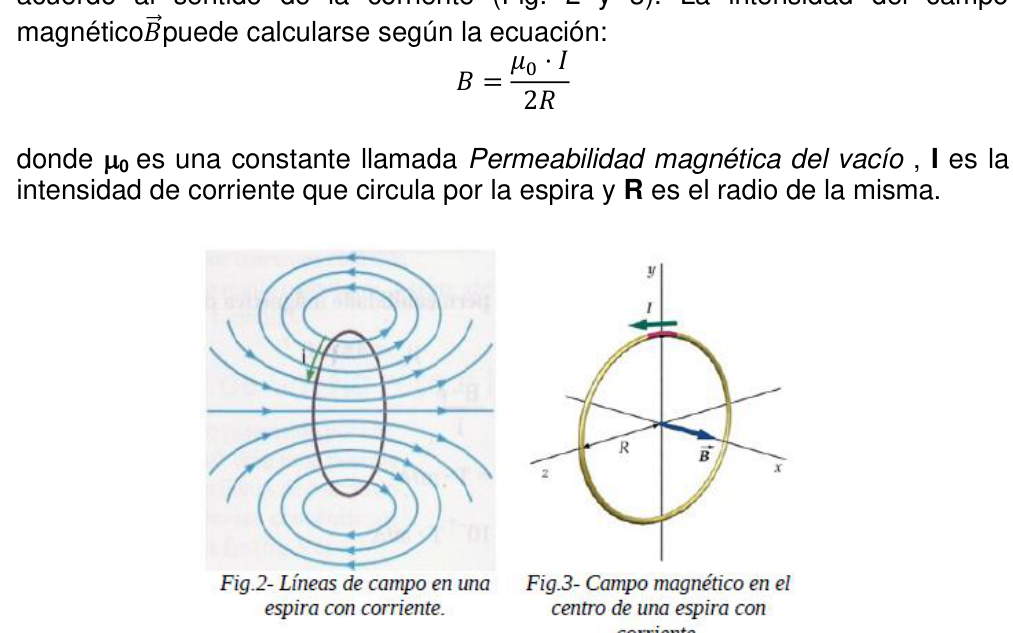
Topic: Magnetism Metodi: Experimental Data Analysis, Biot-Savart Law, Error Propagation Competenze: Physical Reasoning, Experimental Data Analysis, Mathematical Modeling Objects: Coil, Battery Fonte: Testo (PDF) — p.3
Campo magnetico terrestre - bobina
PE42. - Scuola Nero. 3 Mariano Moreno Città di Buenos Aires.
Il triangolo delle bermuda. Diario del Capitano: Il mago ci ha continuato a mostrare la sua magia e la sua stregoneria fino a quando non ha visto il suo strano Castello chiese: “Vuoi vedere perché la compassa ti sta male?” E ci portò fuori. dalla capanna attraverso una porta posteriore. Entrammo in un tipo di cortile con alberi. tra cui c’era quella cosa: un grande triangolo di punte rotonde, Sulla sua cima, fatta come un filo rotolato. metalliche. Dalle cime superiori appendeva una corda e da essa delle colori. vestiti di genere strano con forma di calze a piedi lunghi. - No se
- Non c’è problema, è il nostro portale. - Ha chiesto di prenderci cura della… Compassa e muovendo perli e palanche che splendono e emettono strani .
- Ha fatto un patto con la donna. oscurità e offri i tuoi vestiti strani ai demoni della foresta! paura e coraggio. - No, portalo via, è il coglione! E le bermuda li impicco .
- Perché si seccano più velocemente. Mi scusi, non vi arrabbiate se esco un po’? - Vado .
- E’ scomparsa nel triangolo. Questo è un potente mago. Credere o svenire.
Obiettivo: Determinare l’intensità del campo magnetico terrestre nelle isole Caribe scoperte dal capitano della nave, Centenera, e Saraza, il suo fedele contramestre (se non è possibile viaggiare nei Caraibi, determina la il luogo in cui si trova).
Materiali: Coil a 20 e 50 giri con base per ago magneto. • Aglio magnetico. Fonte variabile 0V ~ 12V. • Amperimetro. • Dischi di carta. • Cavi. • Cintura metrica. • Trasportatore.
Marco Teorico: Quando un corrente elettrica circola attraverso un Conduzione
- Ogni . Segmento elementare Induce un campo magnetico nello spazio. che lo circonda. Le linee di campo del suo lo spettro sono circolari e concentrici (Figura 1). La intensità di cui al campo diminuisce con la distanza dal conducente e aumenta con l’intensità della corrente. Il senso delle linee di campo risponde alla cosiddetta regola della mano destra: se con il pollice destro si
OAF 2011 - 135 indica il senso del flusso di cariche positive, le punte dei dita Le altre indica il senso del campo. Se il conducente ha una forma di spirale circolare, ciascuno dei segmenti L’elemento elementare induce al centro della spira un campo uguale a quello dei E’ la stessa corrente che circola in tutti gli altri, e sono a uguale distanza.
- Il centro. Il campo risultante dell’intera lunghezza della spira sarà la somma di Tutti, la sua direzione sarà normale al piano della spira e il suo senso di La corrente è in linea con il senso del corrente (Fig. 2 y 3). L’intensità del campo Magnetico può essere calcolato secondo l’equazione:
dove 0 è una costante chiamata magnetic permeabilità del vuoto , I è la L’intensità di corrente che circola attraverso la spira e R è il suo raggio.
Se il conducente viene rivolto più volte con lo stesso radio, si fa. Una bobina circolare, avrai le spire con corrente che hai. il rivolgimento. Se si hanno N giri, l’intensità del campo al centro della la bobina sarà:
Se si dispone di una bobina senza corrente Verticalmente e con il piano che la contiene. orientato verso nord-sud, all’impostazione un ago magnetico al suo centro, entrambi. saranno allineati. Il campo magnetico in quel punto sarà il terrestri ( ) e sarà contenuto nel piano della bobina. Si se Se fa circolare il corrente, apparirà il campo. Indotto dalla bobina ( ) che sarà Perpendicolare a (Fig. 5). Il ago si è orientare la direzione del campo risultante che si formera ’ ad un angolo , tale che:
Per cui
sostituendo B
OAF 2011 - 136 Procedura:
- Metti a fondo al centro della bobina un disco di carta e l’ago Magnetico .
- Connettere il materiale in modo conveniente per misurare le intensità di corrente nella bobina.
- Varia la fem della fonte variabile per ottenere diversi orientamenti di l’ago.
- Registrare sul disco di carta le diverse posizioni dell’ ago corrispondenti a ogni intensità di corrente.
- Ottieni un valore per l’intensità del campo magnetico terrestre.
Datati: Se si misurano le lunghezze in m (metro), le intensità di corrente in A (Ampère) e intensità di campo magnetico in T (Tesla), la Permeabilità magnetica prende il valore:
Requisiti: È possibile utilizzare solo i dati, la carta, la penna e il calcolatore. Nel rapporto deve contenere: Descrizione della procedura utilizzata. Valori ottenuti dalle misurazioni effettuate. Risultato sperimentale indicando un intervallo di indeterminazione. Descrizione delle fonti di errore e analisi di come influenzano il sistema di controllo risultato finale, indicando il modo di calcolare l’intervallo o i La Commissione ha adottato una decisione che prevede che il regime di pagamento dei contributi sia stato applicato. Commenti che vorrebbe fare.
Topic: Magnetism Metodi: Experimental Data Analysis, Biot-Savart Law, Error Propagation Competenze: Physical Reasoning, Experimental Data Analysis, Mathematical Modeling Objects: Coil, Battery Fonte: Testo (PDF) — p.3
The following shall be added to the list of the following:
PE42. School No. 3 Mariano Moreno City of Buenos Aires.
The Bermuda Triangle. The Captain ‘s diary: The magician kept showing us his magic and witchcraft until his strange Castillo asked, “Do you want to see why the compass is wrong?” And he took us out. From the hut through a back door. We entered a kind of yard with trees . And among them was this thing: a big triangle of rounded ends. Standing on one of its peaks, made like a thread wrapped. metallic. From the top he hung a rope and from it a colorful rope . clothing of strange sexes shaped like long-legged trousers. - No se He asked us to attend to the… Compass and moving knobs and levers that glittered and emitted strangers He was turning the needle at will. You made a pact with the woman. darkness and offer your rare clothes to the jungle demons! Fear and courage. - No, take him, he’s the fool! And the bermuda I hang them . They’re drier there because they dry faster. Excuse me, aren’t you guys upset if I go out for a little while? I ‘m going . I went to the hardware store and I came back… and he disappeared into the triangle. That powerful wizard. Believe it or not.
The objective: Determine the intensity of the Earth’s magnetic field on the islands Caribbean Islands discovered by the ship’s captain, Centenera, and Saraza, Your faithful counter-maester (if you cannot travel to the Caribbean, please check it out) the place where it is located).
Materials: 20 and 50-spin coil with magnetic needle base. • Magnetic needle. Variable source 0V ~ 12V. • Amperimeter • Paper discs. • Cables • Metric tape. • Carrier
Theoretical framework: When electric current is flowing through a driver Each segment The basic It induces a magnetic field in space. It’s all around him. The field lines of your Spectrum are circular and concentric. (Fig.1) La intensity of the field decreases with the distance to the driver and It increases with the current intensity. The sense of the field lines It responds to the so-called rule of hand . Right: if with the right thumb you are
The following points shall be added: points to the direction of the positive charge current, the tips of the fingers The remaining ones indicate the direction of the field. If the driver is circularly shaped, each segment The elemental field will induce a field equal to that of the center of the spiral. The other, since they all circulate the same current and are at the same distance. from the center. The resulting field of the entire length of the spindle is the sum of All of them, their direction will be normal to the plane of the spiral and their sense of The current direction (Fig. 2 y 3). The intensity of the field The magnetic field can be calculated by the equation:
where 0 is a constant called magnetic vacuum permeability , I is the The current intensity circulating through the spire and R is the radius of the spire.
If the driver is rolled several times with the same radius, that is, it is done. A circular coil, you’ll have as many current spirals as spins have. the coil. If you have N turns, the intensity of the field at the center of the coil shall be:
If a coil without power is disposed of vertically and with the plane containing it oriented north-south, when placing A magnetic needle in its center, both They’ll be lined up. The magnetic field in That point will be the terrestrial ( ) and it will be contained in the plane of the coil. Si se If you make a current circulate, the field will appear. induced by the coil ( ) which will be The following table shows the results of the study: 5). The needle is It will guide you in the direction of the resulting field which shall form at an angle , such that:
So what ?
replacing B
The following points shall be added: The procedure:
- Place a paper disc and needle at the base of the coil centre Magnetic .
- Connect the material conveniently to measure intensities current in the coil.
- Vary the fem of the variable source to obtain different orientations of the needle.
- Record the different positions of the needle on the paper disc The power consumption of the electricity generated by the electricity generated by the electricity generated by the electricity generated by the electricity generated by the electricity generated by the electricity generated by the electricity generated by the electricity generated by the electricity generated by the electricity generated by the electricity generated by the electricity generated by the electricity generated by the electricity generated by the electricity generated by the electricity generated by the electricity generated by the electricity generated by the electricity generated by the electricity generated by the electricity generated by the electricity generated by the electricity generated by the electricity generated by the electricity generated by the electricity generated by the electricity generated electricity generated by the electricity generated by the electricity generated electricity generated by the electricity generated by the electricity generated electricity generated by the electricity generated electricity generated by the electricity generated electricity generated by the electricity generated electricity generated by the electricity generated electricity generated by the electricity generated electricity generated by electricity.
- Get a value for the intensity of the earth’s magnetic field.
The data: If the lengths are measured in m (meter), current intensities in A (Ampère) and magnetic field intensities in T (Tesla), the Magnetic permeability takes the value:
Requirements: You can only use the data, paper, pen and calculator. In the report It shall contain: Description of the procedure used. • Values obtained from the measurements carried out. • Experimental result indicating an indeterminate interval. Description of the sources of error and an analysis of how they influence the final result, indicating the method of calculating the interval or the The Commission shall adopt the following measures: Any comments you want to make.
Topic: Magnetism Metodi: Experimental Data Analysis, Biot-Savart Law, Error Propagation Competenze: Physical Reasoning, Experimental Data Analysis, Mathematical Modeling Objects: Coil, Battery Fonte: Testo (PDF) — p.3
Helicopteros de papel
PE43. Escuela Superior de Comercio Carlos Pellegrini Ciudad de Buenos Aires.
Helicópteros de papel.
Objetivo:
La caída libre es un fenómeno estudiado formalmente desde la época de Galileo.
Este propuso que ante la sola presencia de la gravedad los objetos caen en el
mismo tiempo, sin importar su forma o tamaño.
Sin embargo, con la presencia del aire, se genera una fuerza extra de
rozamiento que frena el movimiento hasta llegar a una velocidad de caída
constante, que sí depende de la forma y tamaño del objeto.
En el caso de un helicóptero de papel, la fuerza de rozamiento provoca además
que el helicóptero gire con una velocidad de rotación constante. El objetivo en
esta experiencia es calcular esta velocidad de rotación.
Lista de materiales:
Dos hojas con el modelo para recortar nuestro helicóptero de papel
Tijeras
Cinta métrica
Hoja milimetrada
Cronómetro
OAF 2011 - 137 Comentarios generales: i. Antes de comenzar lea todas las instrucciones ii. Agregue en el informe los comentarios que aclaren el procedimiento exacto que utilizó en cada paso. En lo posible incluya también un dibujo aclaratorio. iii. Escriba en tablas los datos obtenidos en las mediciones junto con sus errores. iv. Aclare cualquier cambio o desvío respecto de las instrucciones, junto con una breve explicación de su motivo. v. Trate de ser prolijo.
Introducción teórica: Un objeto en caída libre recibe una fuerza hacia abajo igual a su peso P = mg. De existir un medio como lo es el aire, también habrá una fuerza de frenado, que en general es proporcional a la velocidad de caída F = f v. Luego de un aumento de velocidad desde el inicio de la caída, se llega a un régimen estacionario en donde la aceleración es nula: fv – mg = 0 ,
entonces la velocidad final o velocidad límite de caída es:
vlim = mg / f.
En consecuencia, la velocidad final depende tanto de la masa del cuerpo como de la constante f de la fuerza de rozamiento del aire. En el caso del helicóptero, f puede ser muy grande y la m muy pequeña, permitiendo velocidades finales pequeñas y tiempos de vuelo hasta el suelo medibles en el laboratorio con un cronómetro.
Parte 1: Diseño del helicóptero
En las hojas “helicóptero 1” y “helicóptero 2” tenemos dos tamaños de nuestro
helicóptero para recortar. Una vez cortado como indica allí se propone que vaya
reduciendo el contrapeso cortándolo desde abajo hasta conseguir un helicóptero
que gire con la velocidad más lenta posible y que tenga el mayor tiempo de
vuelo posible. Esta etapa previa de diseño le permitirá obtener mejores
mediciones y la satisfacción de haber armado su propio helicóptero de
experimental.
Parte 2: Tiempos de Caída y Número de Vueltas
- Elija entre 5 y 10 alturas distintas de caída entre 1m y 2,5m aproximadamente.
- Deje caer el helicóptero al menos 20cm por encima de la altura seleccionada con un leve impulso de giro, de modo de asegurarse llegue a la velocidad límite al pasar por la altura seleccionada. (para las alturas más grandes pida ayuda al profesor)
- Mida el tiempo de caída para cada altura seleccionada al menos 10 veces.
- Mida el número de giros de la hélice para cada altura seleccionada al menos 10 veces.
- Realice estadística de las mediciones anteriores.
Parte 3: Velocidad de Rotación Grafique en hoja milimetrada tiempos de caída versus el número de vueltas. Realice un ajuste adecuado con sus datos experimentales y calcule la velocidad de rotación de su helicóptero
OAF 2011 - 138 Parte 4: Confección de un informe (téngalo en cuenta al realizar la parte 1 y 2) Escriba un informe de la experiencia realizada que posea la siguiente información: a) Título b) Introducción (breve) c) Hipótesis d) Descripción del dispositivo experimental (texto y dibujo) e) Detalles acerca de cómo se realizaron las mediciones (texto y dibujo) f) Mediciones / Tablas g) Gráficos (en hoja milimetrada) h) Cálculos i) Cálculos de errores j) Resultados obtenidos k) Comentarios finales l) Conclusiones Y cualquier información que considere relevante
Topic: Newtonian Mechanics Metodi: Experimental Data Analysis, Curve Fitting, Free-Body Diagram Competenze: Physical Reasoning, Experimental Data Analysis, Mathematical Modeling Objects: Projectile Fonte: Testo (PDF) — p.3
Elicottero di carta
PE43. Scuola superiore di commercio Carlos Pellegrini Città di Buenos Aires.
Elicotteri di carta.
Obiettivo: La caduta libera è un fenomeno formalmente studiato fin dall’epoca di Galileo. Egli proponeva che solo in presenza della gravità gli oggetti cadessero nel allo stesso tempo, indipendentemente dalla forma o dalla dimensione. Tuttavia, con la presenza dell’aria, si genera un’ulteriore forza di un’acciaio che frenerebbe il movimento fino a raggiungere una velocità di caduta La costante, che dipende dalla forma e dalla dimensione dell’oggetto. Nel caso di un elicottero di carta, la forza di ruggine provoca anche che l’elicottero ruota a velocità di rotazione costante. L’obiettivo è Questa esperienza è calcolare questa velocità di rotazione.
Lista dei materiali:
- Due fogli con il modello per tagliare il nostro elicottero di carta Scaglie Cintura metrica foglio di millimetro Cronometro
OAF 2011 - 137 Commenti generali: i. Prima di iniziare, leggi tutte le istruzioni. ii. Aggiungere al rapporto le osservazioni che chiariscano la procedura Esatto che ha usato in ogni passo. Se possibile, includere anche un disegno
- Chiarazione. iii. Scrivi in tavola i dati ottenuti dalle misurazioni insieme ai dati ottenuti. errori. iv. Accertare qualsiasi modifica o deviazione rispetto alle istruzioni, insieme con una breve spiegazione del suo motivo. v. Cerca di essere prolico.
Introduzione teorica: Un oggetto in caduta libera riceve una forza verso il basso pari al suo peso P = mg. Se esiste un mezzo come l’aria, ci sarà anche una forza di frenata, che in generale è proporzionale alla velocità di caduta F = f v. Dopo un aumento La velocità di un’onda di velocità è di circa un milione di metri. in cui l’accelerazione è zero: fv – mg = 0 ,
la velocità finale o velocità limite di caduta è: vlim = mg / f.
Di conseguenza, la velocità finale dipende sia dalla massa del corpo che da di f costante della forza di ruggine dell’aria. Nel caso dell’elicottero, f può essere molto grande e la m molto piccola, consentendo velocità finali. I tempi di volo al suolo sono misurati in laboratorio con un
- Un cronometro.
Parte 1: Progettazione dell’elicottero Nella foglia “Helicopter 1” e “Helicopter 2” abbiamo due dimensioni del nostro
- Un elicottero per tagliare. Una volta tagliato come indica la proposta è di andare riducendo il contrappeso tagliandola dal basso fino a ottenere un elicottero che ruota a velocità più lente possibile e che abbia il più lungo tempo possibile di volo possibile. Questo primo stadio di progettazione vi permetterà di ottenere migliori risultati. La soddisfazione di aver costruito il proprio elicottero di
- Esperienziale.
Parte 2: tempi di caduta e numero di giri
- Scegli tra 5 e 10 altezze diverse da 1 m a 2,5 m di caduta
- Circa.
- Lasciare cadere l’elicottero almeno 20 cm sopra l’altezza Selezionata con un leggero impulso di rotazione, in modo da assicurarsi raggiungere la velocità limite passando per l’altezza selezionata. (per le Alti alti, chiedete aiuto al vostro insegnante)
- Misurare il tempo di caduta per ogni altezza selezionata almeno 10
- A volte.
- Misurare il numero di giri della propulsione per ogni altezza selezionata al meno 10 volte.
- Rendi statistiche delle misure precedenti.
Parte 3: velocità di rotazione Grafica in foglio millimetrico tempi di caduta contro il numero di giri. Fate un adeguato aggiustamento con i vostri dati sperimentali e calcolate la velocità di rotazione del suo elicottero
OAF 2011 - 138 Parte 4: Preparare un rapporto (tenete conto di questo quando si eseguono le parti 1 e 2) Scrivi un rapporto sull’esperienza che hai avuto: Informazioni: a) Titolo b) Introduzione (breve) c) ipotesi d) Descrizione del dispositivo sperimentale (testo e disegno) e) Dettagli su come le misure sono state effettuate (testo e disegno) f) Misure / tabelle g) Grafiche (in fogli di millimetro) h) Calcoli i) Calcoli di errori j) Risultati ottenuti k) Commenti conclusivi L) Conclusioni E qualsiasi informazione che ritenga rilevante
Topic: Newtonian Mechanics Metodi: Experimental Data Analysis, Curve Fitting, Free-Body Diagram Competenze: Physical Reasoning, Experimental Data Analysis, Mathematical Modeling Objects: Projectile Fonte: Testo (PDF) — p.3
The following is the list of the aircraft types used:
PE43. The Carlos Pellegrini School of Commerce City of Buenos Aires.
Paper helicopters.
The objective: The free fall is a phenomenon formally studied since the time of Galileo. He proposed that in the presence of gravity alone objects fall into the At the same time, no matter what shape or size. However, with the presence of air, an extra force of friction that slows movement until it reaches a falling speed It’s a constant, which depends on the shape and size of the object. In the case of a paper helicopter, the friction force also causes the helicopter rotates at a constant rotational speed. The objective in This experiment is to calculate this rotational speed.
List of materials: Two sheets with the model to cut our paper helicopter Shavers Metric tape Millimeter sheet The timekeeper
The following points shall be added: General comments: i. Before you start , read all the instructions . ii. Add to the report the comments clarifying the procedure Exactly what he used at every step. If possible, include a drawing The Commission has not yet adopted a proposal. (iii) the following: Write in tables the data obtained from the measurements together with their I’m not sure. iv. Please clarify any changes or deviations from the instructions, together with with a brief explanation of why. v. Try to be prolific.
Theoretical introduction: A free-falling object receives a downward force equal to its weight P = mg. If there is a medium such as air, there will also be a braking force, which In general, it is proportional to the drop velocity F = f v. After a raise . The speed from the start of the fall, reaching a steady-state in where acceleration is zero: fv – mg = 0 ,
then the final velocity or drop limit velocity is: The following table shows the results of the test:
Consequently, the final speed depends on both body mass and of the constant f of the friction force of the air. In the case of the helicopter, f It can be very large and the m very small, allowing for final speeds Small and ground-measurable flight times in the lab with a The timepiece.
Part 1: Design of the helicopter In the sheets Helicopter 1 and Helicopter 2 we have two sizes of our helicopter to cut. Once cut as it says there it is proposed to go Cutting down the counterweight from the bottom to get a helicopter. rotate at the slowest speed possible and have the longest time of possible flight. This preliminary design stage will allow you to get better measurements and satisfaction of having equipped his own helicopter of It’s experimental.
Part 2: Fall times and number of laps
- Choose between 5 and 10 different falling heights between 1m and 2.5m about.
- Drop the helicopter at least 20cm above the height selected with a slight torque to ensure reach the speed limit by passing the selected height. (for the (Over the years, you’ve been asking the teacher for help.)
- Measure the fall time for each selected height at least 10 Sometimes.
- Measure the number of turns of the propeller for each selected height at the minus 10 times.
- Statistics of previous measurements.
Part 3: Rotation speed Graph in millimetre sheet times of fall versus number of laps. Make an appropriate adjustment with your experimental data and calculate the speed The rotor of your helicopter
The following points shall be added: Part 4: Preparation of a report (take this into account when preparing Part 1 and 2) Write a report of the experience you have gained from the following: The following information: (a) Title (b) Introduction (short) (c) Hypothesis (d) Description of the experimental device (text and drawing) (e) Details of how measurements were made (text and drawing) (f) Measurements / Tables (g) Graphics (in millimetre sheet) (h) Calculations (i) Error calculations (j) Results obtained (k) Final comments (l) Conclusions And any information you deem relevant
Topic: Newtonian Mechanics Metodi: Experimental Data Analysis, Curve Fitting, Free-Body Diagram Competenze: Physical Reasoning, Experimental Data Analysis, Mathematical Modeling Objects: Projectile Fonte: Testo (PDF) — p.3
Distancia focal e indice de refraccion de una lente
PE44. Instituto Técnico San Miguel de Tucumán.
Determinación de la distancia focal f de una lente y del índice de refracción n del vidrio del que está hecha.
Desde que se inventaron las lentes hace ya cinco siglos, han sido utilizadas tanto para observar objetos muy lejanos (Astronomía) como para observar objetos muy pequeños (Microscopía).
OAF 2011 - 139 En esta prueba experimental se propone comprobar la denominada ley de las lentes y determinar las características fundamentales de una lupa (lente convergente).
Material: 1 lente convergente de vidrio (lupa con mango desmontable) 1 vela 2 soportes de madera para ambas cinta métrica pantalla de cartulina calibre con nonio 2 hojas de papel milimetrado pequeño material auxiliar (clips, palillos, encendedor,…)
Primera parte Comprobación experimental de la ley de las lentes Desde muy pronto, físicos como Galileo y Newton descubrieron una ley que se verifica en las lentes, consecuencia de la ley de la refracción de la luz: “Cuando se forma la imagen de un objeto en una pantalla a través de una lente, la suma de las inversas de la distancia objeto, s, y de la distancia imagen, s’, es una cantidad constante, característica de dicha lente”. En la Figura 1 se indica el esquema del montaje experimental que proponemos, así como las distancias s y s’.
Figura 1: Esquema del montaje experimental.
Operaciones a realizar:
- Una vez encendida la vela, colocar la lente a una distancia s y desplazar la pantalla hasta conseguir una imagen nítida de la llama. En estas condiciones medir la distancia s’ . Repetir la operación otras 4 veces más con valores distintos de s y consignar los datos en las dos primeras columnas de la Tabla 1.
- Hacer una representación gráfica en papel milimetrado de 1/ s’ frente a 1/s , y determinar la pendiente de la recta y la ordenada en el origen.
Tabla 1 s (cm) s’ (cm) 1/s (cm-1) 1/s’ (cm-1)
- A partir de la ordenada en el origen, determinar el valor de la distancia focal f’ de la lupa.
OAF 2011 - 140 4. Estimar las incertidumbres tanto en la pendiente de la recta como en la ordenada en el origen y en la distancia focal, indicando el método seguido para ello.
Segunda parte Determinación de la distancia focal por el método de Bessel Bessel ideó un procedimiento para determinar la distancia focal de una lente de manera más precisa, que consiste en lo siguiente: conocido un valor aproximado de la distancia focal (determinado, por ejemplo, por el método anterior), se fijan la vela y la pantalla a una distancia L mayor que cuatro veces la distancia focal. En estas condiciones, existen dos posiciones de la lente para las cuales se obtiene una imagen nítida de la vela, una de ellas de mayor tamaño que el objeto y otra de menor tamaño. Si llamamos D a la distancia que media entre estas dos posiciones, la distancia focal f’ se determina mediante la siguiente fórmula: 2 2 ’ 4 L D f L
Operaciones a realizar:
5. Elegir la distancia L entre la vela y la pantalla. Determinar la distancia D
entre las dos posiciones de la lente antes mencionadas con el mayor
cuidado posible. Determinar con ayuda de la fórmula anterior el valor de
f’.
Tabla 2 L (cm) D (cm) f’ (cm)
- Calcular la incertidumbre en f’.
Tercera parte Determinación del índice de refracción n del vidrio Los constructores de lentes podían diseñarlas con la distancia focal deseada para la aplicación concreta. Se valían para ello de una fórmula, deducida también a partir de la ley de la refracción de la luz, que tiene en cuenta los radios de curvatura de sus superficies, así como del índice de refracción del material transparente del que están hechas. En el caso que nos ocupa, la fórmula del constructor de lentes se reduce a: 1 2 ( 1) ’ n f R
donde R es el radio de curvatura de las superficies esféricas que constituyen las caras de la lente.
Operaciones a realizar:
7. Con ayuda de la Figura 2 y del
teorema
de
Pitágoras,
determinar la expresión de R
en función de las variables
indicadas en la Figura 2.
- Para la determinación experimental de h, e y eo, desmontar la lente desenroscando con cuidado el mango de la lupa y utilizar el Figura 2: Esquema geométrico para el cálculo de R.
OAF 2011 - 141 calibre. Consignar los resultados en las tres primeras columnas de la Tabla 3. A partir de estos valores, determinar el valor de R, indicando su incertidumbre. Tabla 3 h (cm) e (cm) eo (cm) R (cm)
- Aplicando la fórmula del constructor de lentes, determinar n, indicando también su incertidumbre.
Topic: Geometric Optics Metodi: Experimental Data Analysis, Thin Lens & Mirror Equation, Graph Linearization Competenze: Physical Reasoning, Experimental Data Analysis, Mathematical Modeling Objects: Lens, Screen Fonte: Testo (PDF) — p.3
Distanza focale e indice di refrazione di una lente
PE44. Istituto tecnico San Michele di Tucumán.
Determinazione della distanza focale f di un obiettivo e dell’indice di refraczione Non è il vetro di cui è fatto.
Da quando sono state inventate le lenti cinque secoli fa, sono state usate. sia per osservare oggetti molto lontani (Astronomia) sia per osservare oggetti molto piccoli (Microscopia).
OAF 2011 - 139 In questa prova sperimentale si propone di verificare la cosiddetta legge delle Lenti e determinare le caratteristiche fondamentali di una lente (lenti convergente).
Materiale: 1 lente convergente di vetro (lupa con maniglia scaricabile) 1 candela 2 supporti in legno per entrambi cinta metrica schermo di cartolina calibro con nonio 2 foglie di carta millimetrica piccolo materiale ausiliario (clips, bastoni, accenditore, ecc.)
Parte I Prova sperimentale della legge dei lenti Molto presto, fisici come Galileo e Newton scoprirono una legge che si Il risultato della legge della refraczione della luce è che: Quando si forma un’immagine di un oggetto su uno schermo attraverso un lente, La somma delle inverse della distanza oggetto, s, e della distanza immagine, s, è una quantità costante, caratteristica di tale lente. La figura 1 indica lo schema di montaggio sperimentale che proponiamo, e le distanze s e s.
Figura 1: schema di montaggio sperimentale.
Operazioni da svolgere:
- Una volta accesa la candela, posizionare la lente a una distanza s e spostare il display fino a ottenere un’immagine chiara della fiamma. In questi Condizioni di misurazione della distanza s . Ripetere l’ operazione 4 altre volte. più con valori diversi da s e registrare i dati nelle prime due Colonne della tabella 1.
- Rendere una rappresentazione grafica su carta millimetrica di 1/ s rispetto a 1/s, e determinare la pendice della retta e della ordinata all’origine.
Tabella 1 s (cm) s’ (cm) 1/s (cm-1) 1/s’ (cm-1)
- A partire dalla data di origine, determinare il valore della distanza focale f della lente.
OAF 2011 - 140 4. Estimare le incertezze sia nella pendizione della retta che nella ordinato all’origine e alla distanza focale, indicando il metodo seguita per questo.
Parte II Determinazione della distanza focale con il metodo di Bessel Bessel ha ideato un procedimento per determinare la distanza focale di un obiettivo di più precisamente, che consiste nel seguente: conosciuto un valore approssimativo La distanza focale (determinata, per esempio, dal metodo precedente) è fissata la vela e lo schermo a una distanza L superiore a quattro volte la distanza focale. In queste condizioni, esistono due posizioni della lente per le quali si Ottieni un’immagine chiara della vela, una delle quali più grande della sua oggetto e un altro di dimensioni minori. Se chiamiamo D alla distanza che media tra in queste due posizioni, la distanza focale f è determinata mediante la seguente formula: 2 2 ’ 4 L D f L
Operazioni da svolgere: 5. Scegliere la distanza L tra la vela e lo schermo. Determinare la distanza D tra le due posizioni del lente sopra menzionate con il maggiore
- Assicurarsi. Determinare con la formula precedente il valore di f’.
Tabella 2 L (cm) D (cm) f’ (cm)
- Calcolare l’incertezza in f.
Parte III Determinazione dell’indice di refraczione n del vetro I costruttori di lenti potevano progettarle con la distanza focale desiderata. per l’applicazione concreta. Per questo si utilizzò una formula, dedotta anche dalla legge della refraczione della luce, che tiene conto dei raggi. di curvatura delle loro superfici e di indice di rifrazione del materiale trasparente di cui sono fatte. Nel caso che ci riguarda, la formula del costruttore di lenti si riduce a: 1 2 ( 1) ’ n f R
dove R è il raggio di curvatura delle superfici sferiche che costituiscono le faccia della lente.
Operazioni da svolgere: 7. Con l’aiuto di Figura 2 e teorema de Pitagori, determinare l’espressione di R in base alle variabili di cui alla figura 2.
- Per la determinazione sperimentale di h, e e e, Sdistruggere la L’ occhiali Sfogliando con cura il Manovra la lucetta e utilizza il Figura 2: Schema geometrico per il calcolo di R.
OAF 2011 - 141 calibro. Rendere i risultati disponibili nelle prime tre colonne della Tabella 3. A partire da questi valori, determinare il valore di R, indicando il suo l’incertezza. Tabella 3 h (cm) e (cm) eo (cm) R (cm)
- Applicando la formula del costruttore di lenti, determinare n, indicando anche la sua incertezza.
Topic: Geometric Optics Metodi: Experimental Data Analysis, Thin Lens & Mirror Equation, Graph Linearization Competenze: Physical Reasoning, Experimental Data Analysis, Mathematical Modeling Objects: Lens, Screen Fonte: Testo (PDF) — p.3
Focal distance and refractive index of a lens
PE44. Technical Institute St. Michael of Tucumán.
Determination of focal length f of a lens and refractive index n of the glass from which it is made.
Since the lens was invented five centuries ago, it’s been used. Both for observing very distant objects (astronomy) and for observing Very small objects (microscopy).
The following points shall be added: In this experimental test it is proposed to test the so-called law of the Lenses and determine the fundamental characteristics of a magnifying glass (lens (combined).
Material: 1 converging glass lens (lamp with removable handle) 1 candle 2 wooden supports for both Metric tape Cardboard screen caliber with nonium 2 millimetre sheets of paper small auxiliary material (clips, sticks, lighter,…)
Part one Experimental testing of the law of lenses Very early on, physicists like Galileo and Newton discovered a law that was The effect of the law of refraction of light on the lens is to: When an image of an object on a screen is formed through a lens, The sum of the inverts of the distance object, s, and the distance image, s, is a constant quantity, characteristic of such a lens. Figure 1 shows the scheme of the experimental assembly we propose, as well as the distances s and s.
Figure 1: Scheme of the experimental assembly.
Operations to be carried out:
- Once the candle is lit, place the lens at a distance and move it. The screen until you get a clear picture of the flame. In these conditions to measure distance s . Repeat the operation 4 more times
- with values other than s and record the data in the first two columns of Table 1.
- Make a graphic representation on millimeter paper of 1/ s versus 1/s , and determine the slope of the straight and the ordered at the origin.
Table 1 s (cm) s’ (cm) 1/s (cm-1) 1/s’ (cm-1)
- From the order at the origin, determine the value of the distance focal length of the magnifying glass.
The following points shall be added: 4. Estimate uncertainties in both the slope of the straight line and the slope of the ordered in the source and focal length, indicating the method followed for it.
Part two Determination of the focal length by the Bessel method Bessel devised a procedure for determining the focal length of a lens of The most accurate way, which consists of the following: known approximate value The focal length (determined, for example, by the above method) is fixed The candle and the screen at a distance L greater than four times the focal length. In these conditions, there are two positions of the lens for which the lens is You get a clear picture of the candle, one of them larger than the other. object and one smaller. If we call D to the distance that it mediates between These two positions, the focal length f is determined by the following formula: 2 2 ’ 4 L D f L
Operations to be carried out: 5. Choose the distance L between the candle and the screen. Determine the distance D between the two positions of the lens mentioned above with the largest as carefully as possible. Determine the value of using the above formula f’.
Table 2 L (cm) D (cm) f’ (cm)
- Calculate the uncertainty in f.
Part three Determination of the refractive index of the glass Lens makers could design them with the focal length desired. for the concrete application. They were worth it by a formula, deduced Also from the law of refraction of light, which takes into account radii. The curvature of the surfaces and the refractive index of the material transparent of what they’re made of. In the case we’re dealing with, the formula for the lens manufacturer is reduced to: 1 2 ( 1) ’ n f R
where R is the radius of curvature of the spherical surfaces that constitute the Faces of the lens.
Operations to be carried out: 7. With the help of Figure 2 and Theorem de Pythagoras, determining the expression of R depending on the variables The following are the results of the calculation of the risk of the risk of injury:
- For la The Commission will take the necessary measures to ensure that the experimental of h, e and eo, dismantle la Lens Carefully unwrapping the handle the magnifying glass and use the Figure 2: Geometric scheme for the calculation of R.
The following points shall be added: caliber. The results are presented in the first three columns of the Table 3 is replaced by the following: From these values, determine the value of R, indicating its Uncertainty. Table 3 h (cm) e (cm) eo (cm) R (cm)
- Using the formula of the lens manufacturer, determine n, indicating And also its uncertainty.
Topic: Geometric Optics Metodi: Experimental Data Analysis, Thin Lens & Mirror Equation, Graph Linearization Competenze: Physical Reasoning, Experimental Data Analysis, Mathematical Modeling Objects: Lens, Screen Fonte: Testo (PDF) — p.3
Indice de refraccion con laser
PE45. Escuela Industrial Nro. 1 General Enrique Mosconi Caleta Olivia, Santa Cruz.
Resolver la siguiente situación experimental, utilizando el soporte teórico correspondiente
- Elementos necesarios: Refractómetro:
- 1 Puntero Láser
- 1 Trozo de vidrio grueso
- 1 Batería
- Soporte para el láser y para el vidrio
- 1 Base de madera o cartón Mediciones y Cálculos:
- 1 Regla o cinta métrica
- 1 Transportador
- 1 Calculadora científica
- Papel
- Cinta adhesiva
- Técnica: Ensamblar el aparato como se ve en la figura siguiente:
La experiencia consiste en utilizar el dispositivo para medir la desviación del láser al pasar del aire al vidrio y luego determinar el índice de refracción del vidrio. El papel se coloca debajo del vidrio como pantalla para visualizar mejor el efecto. 3) Procedimiento:
- Antes de colocar el vidrio, mide su espesor.
- Coloca el papel en una de las caras del vidrio. Puedes sujetarlo con cinta adhesiva.
- Coloca el vidrio en el refractómetro con el papel hacia abajo y ajusta las mariposas.
- Enciende el láser, observa cuidadosamente su desviación e intenta medirla
OAF 2011 - 142 4) Cuestionario: a) Determina el índice de refracción del vidrio y explica qué ley utilizaste para calcularlo. b) Con lo hallado en el inciso (a) intenta calcular la velocidad del láser en el vidrio. c) Ahora halla la velocidad del láser en el aire. d) Busca en la etiqueta del láser la longitud de onda mínima y máxima. Estos son valores de la longitud de onda para el láser en el aire especificados por el fabricante. Calcula la longitud de onda promedio en el aire. e) A partir de los resultados anteriores determina la frecuencia del láser. f) Finalmente, determina la longitud de onda del láser en el vacío y en el vidrio. g) Vuelca todos tus resultados en la siguiente tabla:
Frecuencia
Longitud de
onda
Velocidad de
la luz láser c
Índice de
refracción n
VACIO
299792458
1 AIRE
1,00029 VIDRIO
h) ¿Qué ocurre con la longitud de onda y la velocidad en distintos medios? i) ¿Qué podrías hacer para obtener una mejor medida del índice?
Topic: Geometric Optics Metodi: Experimental Data Analysis, Snell’s Law, Error Propagation Competenze: Physical Reasoning, Experimental Data Analysis Objects: Prism, Screen Fonte: Testo (PDF) — p.3
Indice di rifrazione laser
PE45. Scuola industriale n.o. 1 Generale Enrique Mosconi
- Calma Olivia, Santa Cruz.
Risolvere la seguente situazione sperimentale, utilizzando il supporto teorico corrispondente
- Gli elementi necessari: Rifractometro:
- 1 puntatore laser.
- 1 pezzo di vetro grosso
- 1 batteria .
- Supporto per laser e vetro
- 1 base in legno o cartone Misure e calcoli:
- 1 regola o nastro di misura
- 1 trasportatore
- 1 Calcolatore scientifico
- Papero .
- Fascia adesiva
- Tecnica: Assemblare l’apparecchio come si vede nella figura seguente:
L’esperienza consiste nell’utilizzo del dispositivo per misurare la deviazione del Il laser passa dall’aria al vetro e poi determina l’indice di refraczione del
- Il vetro. Il carta è posto sotto il vetro come schermo per visualizzare meglio l’effetto.
- Procedura:
- Prima di mettere il vetro, misura il suo spessore.
- Metti il foglio su una delle facce del vetro. Puoi tenerlo con la cinta. adesivo.
- Metti il vetro sul refratometro con la carta verso il basso e regola le
- Pappagalli.
- Accende il laser, osserva attentamente il suo deviamento e prova. misurare
OAF 2011 - 142 4) Questione: a) Determina il tasso di refraczione del vetro e spiega quale legge hai usato. per calcolare. b) Con il risultato di questo punto (a) si tenta di calcolare la velocità del laser in
- Il vetro. c) Ora trova la velocità del laser nell’aria. d) Cerca sulla etichetta del laser la lunghezza d’onda minima e massima. Questi sono i valori della lunghezza d’onda per il laser in aria. specificati dal fabbricante. Calcola la lunghezza d’onda media in l’aria. e) Sulla base dei risultati precedenti determina la frequenza del laser. f) Determina infine la lunghezza d’onda del laser nel vuoto e nel
- Il vetro. g) Rende tutti i risultati nella tabella seguente:
Frequenza
Lunghezza di
onda
Velocità di
la luce laser c
Indice di
rifrazione n
VACIO
299792458
1 AIRE
1,00029 VISTO
h) Che cosa succede alla lunghezza d’onda e alla velocità in diversi media? i) Cosa potresti fare per ottenere una migliore misura dell’indice?
Topic: Geometric Optics Metodi: Experimental Data Analysis, Snell’s Law, Error Propagation Competenze: Physical Reasoning, Experimental Data Analysis Objects: Prism, Screen Fonte: Testo (PDF) — p.3
The measurement of the measured mass shall be carried out in accordance with the following conditions:
PE45. Industrial school No. 1 General Enrique Mosconi Put Olivia down, Santa Cruz.
Solve the following experimental situation using theoretical support corresponding
- Necessary elements: Refractometer:
- 1 laser pointer
- 1 piece of thick glass
- One battery .
- Laser and glass support.
- 1 wood base or cardboard Measurements and Calculations:
- 1 rule or tape measure
- 1 carrier
- 1 Scientific calculator
- Paper .
- The adhesive tape
- Technical: Assemble the apparatus as shown in the following figure:
The experiment involves using the device to measure the deviation of the The laser is then applied to the glass and then the refractive index of the glass is determined. glass. The paper is placed under the glass as a screen to better visualize the effect. 3) Procedure:
- Before you put the glass, measure its thickness.
- Put the paper on one of the glass faces. You can tie it with tape . It’s a stick.
- Place the glass on the refractometer with the paper down and adjust the Butterflies.
- Turn on the laser, watch its deviation carefully and try. measuring it
The following is the list of the countries of the European Union: 4) Questionnaire: (a) Determine the refractive index of the glass and explain what law you used. to calculate it. (b) Using the information in subparagraph (a) (a) (b) (c) (d) (d) (d) (d) (d) (d) (e) (e) (e) (e) (e) (e) (e) (e) (e) (e) (e) (e) (e) (e) (e) (e) (e) (e) (e) (e) (e) (e) (e) (e) (e) (e) (e) (e) (e) (e) (e) (e) (e) (e) (e) (e) (e) (e) (e) (e) (e) (e) (e) (e) (e) (e) (e) (e) (e) (e) (e) (e) (e) (e) (e) (e) (e) (e) (e) (e) (e) (e) (e) (e) (e) (e) (e) (e) (e) (e) (e) (e) (e)) (e) (e) (e) (e) (e)) (e)) (e) (e) (e) (e)) (e)) (e) (e) (e) (e)) (e) (e)) (e) (e) (e) (e)) (e)) (e) (e)) (e) (e) (e)) (e) (e) (e) (e) (e)) (e) (e)) (e) (e) (e) (e) (e) (e)) (e) (e) (e)) (e) (e) (e) (e) (e)) (e) (e)) (e) (e)) (e) (e) (e) (e)) (e) (e) (e) (e) (e) (e) (e)) (e) (e)) (e)) (e)) (e)) (e) (e) (e) (e) (e) (e) (e) (e) glass. c) Now find the speed of the laser in the air. (d) Look for the minimum and maximum wavelength on the laser label. These are wavelength values for the laser in the air. specified by the manufacturer. Calculate the mean wavelength in the air. (e) Based on the above results, the laser frequency is determined. (f) Finally, it determines the wavelength of the laser in the vacuum and in the glass. g) Turn all your results back into the following table:
Frequency
Length of
wave
Speed of
The laser light c
Index of
refraction n
- What ?
299792458
1 AIRE
1,00029 The glass .
(h) What about wavelength and speed in different media? (i) What could you do to get a better measure of the index?
Topic: Geometric Optics Metodi: Experimental Data Analysis, Snell’s Law, Error Propagation Competenze: Physical Reasoning, Experimental Data Analysis Objects: Prism, Screen Fonte: Testo (PDF) — p.3
Velocidad de un chorro de agua
PE46. Escuela Industrial Superior Ciudad de Santa Fe.
Velocidad de un chorro de agua.
-
Objetivo: Estudiar experimentalmente el fenómeno de desagote de un líquido contenido en un cilindro con varios orificios. Asociar la caída libre de un cuerpo con el principio de Torricelli.
-
Lista de materiales:
- 1 cilindro de diámetro externo 100mm y 1m de altura
- agua
- 1 probeta de 1L
- Cinta métrica
- Teoría: El Principio de Torricelli establece: “La velocidad con la que sale un líquido por el orificio de un recipiente es igual a la que adquiriría un cuerpo que se dejara caer libremente desde la superficie libre del líquido hasta el nivel del orificio”. Este principio fue desarrollado en base al Teorema de Bernoulli, y su ecuación es la siguiente:
v: velocidad de salida del fluido por el orificio h: altura entre superficie libre del líquido y el orificio
Asimismo en un cuerpo en caída libre la componente de la velocidad inicial en la dirección vertical es nula. Considerando despreciable todo tipo de rozamiento, sobre el eje y, el movimiento es rectilíneo uniformemente variado con h g v 2
OAF 2011 - 143
aceleración igual a la de la gravedad y sobre el x, el movimiento es rectilíneo
uniforme. El resultado puede considerarse entonces como la superposición de
dos movimientos, y dado que ambos son independientes, pueden ser analizados
por separado. Además la distancia horizontal que se desplaza el cuerpo se
denomina alcance y generalmente se indica con R.
Por otro lado, el principio de conservación de la masa conduce a la conservación
del caudal, a partir de la cual puede establecerse que:
Q1: caudal del fluido en el orificio de salida Q2: caudal del fluido en la superficie libre v1: velocidad del fluido en el orificio S1: superficie del orificio V2: velocidad del fluido en la superficie libre S2: superficie libre
- Procedimiento experimental:
Recuerde realizar varias mediciones para minimizar errores y registre las mismas en una tabla.
Considere despreciable el rozamiento durante el movimiento. Se deben detallar los procedimientos y las consideraciones que tuvo en cuenta para el desarrollo del práctico (datos, unidades, ecuaciones generales y particulares del movimiento). 4-1. Llene el recipiente con agua hasta los 0,70m. Destape el primer orificio que corresponde a una altura de 0,50m y mida el alcance.
Consignas:
- Calcule la velocidad de salida del orificio con la ecuación de Torricelli.
- Calcule el tiempo para la altura dada aplicando las ecuaciones de caída libre.
- Calcule el alcance con los datos obtenidos en 1 y 2.
- Compare los resultados de los alcances obtenidos en forma teórica con los experimentales, halle el error y analice las posibles causas.
- Determine la velocidad de la superficie libre del líquido aplicando el Principio de Conservación de la masa.
- Compare las velocidades en la superficie libre y el orificio.
4-2. Mida los alcances correspondientes a los otros orificios, según las restantes alturas marcadas (0,50m; 0,40m y 0,30m), inmediatamente después de destapar la salida, llenando cada vez el recipiente hasta 0,70m. Confeccione una tabla con los valores de los distintos alcances y las velocidades calculadas con la ecuación de Torricelli, incluyendo el dato del alcance obtenido en 4-1. Consignas:
Conteste las siguientes preguntas, justificando en cada caso: a) ¿Qué relación encuentra entre los diferentes alcances y la velocidad de salida de la vena líquida?. b) Cómo varía la presión ejercida por el líquido correspondiente a cada altura?. c) Si la experiencia se realizara con un líquido cuya densidad es de 0,6g/mL, que relación de altura habría para que la presión sea la misma?.
- Datos
- Gravedad g = 9,8[m/s2]
- δ = 1g/mL
2 2 1 1 2 1 S v S v Q Q
OAF 2011 - 144
Topic: Fluid Mechanics Metodi: Experimental Data Analysis, Bernoulli’s Equation, Continuity Equation Competenze: Physical Reasoning, Experimental Data Analysis Objects: Container Fonte: Testo (PDF) — p.3
Velocità di un jet d’acqua
PE46. Scuola superiore industriale Città di Santa Fe.
La velocità di un jet d’acqua.
-
Obiettivo: studiare sperimentalmente il fenomeno di esaurimento di un liquido contenuto in un cilindro con diversi orizzonti. Associare la caduta libera di un corpo con il principio di Torricelli.
-
Lista dei materiali:
- 1 cilindro di diametro esterno di 100 mm e 1 m di altezza
- acqua
- 1 prova di 1L
- Cintura metrica .
- Teoria: Il Principio di Torricelli stabilisce: La velocità con cui un liquido esce dal Il foro di un contenitore è uguale a quello di un corpo che si lascia cadere liberamente dalla superficie libera del liquido fino al livello del buco. Questo . Il principio è stato sviluppato sulla base del teorema di Bernoulli, e la sua equazione è la di seguito:
v: velocità di uscita del fluido attraverso il foro h: altezza tra la superficie libera del liquido e il foro
In un corpo in caduta libera, la velocità iniziale è direzione verticale è nulla. Considerando disprezzabile ogni tipo di rasatura, sul filo e, il movimento è rettinario uniformemente variabile con h g v 2
OAF 2011 - 143 Accelerazione uguale a quella della gravità e su x, il movimento è rettilineo Uniforme. Il risultato può quindi essere considerato come la sovrapposizione di Due movimenti, e poiché entrambi sono indipendenti, possono essere analizzati. separatamente. Inoltre la distanza orizzontale che il corpo si sposta è si chiama “Range” e generalmente si indica con R. D’altra parte, il principio della conservazione della massa conduce alla conservazione di flusso, da cui si può stabilire che:
Q1: flusso del fluido nell’apertura di uscita Q2: flussi del fluido sulla superficie libera v1: velocità del fluido nel foro S1: superficie del foro V2: velocità del fluido sulla superficie libera S2: superficie libera
- Procedura sperimentale: Ricorda di effettuare diverse misurazioni per minimizzare gli errori e registrare le errori.
- Si trovano su una tavola. Considerate disprezzo il ruggimento durante il movimento. Le procedure e le considerazioni che ha preso in considerazione devono essere dettagliate Per lo sviluppo del pratico (dati, unità, equazioni generali e La Commissione ha adottato una decisione del Consiglio che prevede che le misure di vigilanza siano adottate in modo da consentire la libera circolazione di persone. 4-1. Riempire il recipiente di acqua fino a 0,70 m. Svelta il primo buco che corrisponde a una altezza di 0,50 m e misura la portata. Consigni:
- Calcolare la velocità di uscita del foro con l’equazione di Torricelli.
- Calcolare il tempo per la data altezza applicando le equazioni di caduta
- Sono libero.
- Calcolare la portata con i dati ottenuti in 1 e 2.
- Compare i risultati delle scoperte ottenute in teoria con I risultati sono stati ottenuti con la ricerca di un errore e l’analisi delle possibili cause.
- Determina la velocità della superficie libera del liquido applicando il Principio di conservazione della massa.
- Confronta le velocità sulla superficie libera e sul foro. 4-2. Misura i limiti di riferimento degli altri orifici, secondo i restanti altezza segnata (0,50 m; 0,40 m e 0,30 m), immediatamente dopo il sgancio la uscita, riempendo ogni volta il contenitore fino a 0,70 m. Configuri una tabella con i valori dei diversi ambiti e velocità Calcolati con l’equazione di Torricelli, inclusi i dati di portata ottenuti en 4-1. Consigni: Rispondi alle seguenti domande, giustificando in ogni caso: a) Che rapporto ha tra i diversi ambiti e la velocità di esordio della vena liquida? b) Come varia la pressione esercitata dal liquido per ciascuna Altezza? c) Se l’esperimento si svolge con un liquido di densità di 0,6 g/mL, quale rapporto di altezza sarebbe stato necessario per far sì che la pressione fosse la
- E’ stata lei stessa.
- Datos
- Gravità g = 9,8[m/s2]
- δ = 1g/mL
2 2 1 1 2 1 S v S v Q Q
OAF 2011 - 144
Topic: Fluid Mechanics Metodi: Experimental Data Analysis, Bernoulli’s Equation, Continuity Equation Competenze: Physical Reasoning, Experimental Data Analysis Objects: Container Fonte: Testo (PDF) — p.3
Speed of a water jet
PE46. Higher Industrial School City of Santa Fe.
Speed of a jet of water.
-
Objective: To experimentally study the phenomenon of liquid drainage contained in a cylinder with multiple holes. Associate the free fall of a body . with the Torricelli principle.
-
List of materials:
- 1 cylinder with an external diameter of 100 mm and a height of 1 m
- water .
- 1 sample of 1L
- Metric tape .
- Theory: Torricelli’s Principle states: The speed at which a liquid exits through the The hole in a container is the same as the one you would get if you dropped a body. freely from the free surface of the liquid to the hole level. This one . The principle was developed based on Bernoulli’s theorem, and its equation is the The following:
v: velocity of outflow of the fluid through the hole h: height between the free surface of the liquid and the hole
In a free-falling body, the initial velocity component in the vertical direction is zero. Considering contemptible all manner of grinding, over the y axis, the motion is evenly varying with h g v 2
The following points shall be added: acceleration equal to gravity and over x, the motion is right. uniform. The result can then be considered as the overlap of Two movements, and since both are independent, can be analyzed. separately. In addition, the horizontal distance the body travels is The name of the device is ‘R’ and is usually indicated by R. On the other hand, the principle of conservation of mass leads to conservation the flow rate, from which it can be established that:
Q1: Fluid flow in the output hole Q2: Fluid flow on the free surface v1: fluid speed in the hole S1: surface of the hole V2: velocity of the fluid on the free surface S2: free surface
- Experimental procedure: Remember to take several measurements to minimize errors and record errors. themselves on a board. Consider the grinding during movement despicable. The procedures and considerations taken into account should be detailed The main objective of the project is to develop practical data (data, units, general equations and The Commission has already adopted a number of proposals. 4-1. Fill the container with water up to 0.70 m. It unlocks the first hole that It is equal to a height of 0,50 m and measures the range. The following is the list of winners:
- Calculate the output velocity of the hole with the Torricelli equation.
- Calculate the time for the given height by applying the fall equations Free.
- Calculate the scope with the data obtained in 1 and 2.
- Compare the results of the theoretical achievements with The experimental ones, find the error and analyze the possible causes.
- Determine the free surface velocity of the liquid by applying the Principle of conservation of mass.
- Compare the speeds on the open surface and the hole. 4-2. Measure the ranges for the other holes, according to the remaining marked heights (0.50m; 0.40m and 0.30m), immediately after unloading the output, filling the container up to 0.70 m each time. Make a table with the values of the different ranges and speeds Calculated using the Torricelli equation, including the data of the range obtained en 4-1. The following is the list of winners: Answer the following questions, justifying in each case: (a) What is the relationship between the different ranges and the speed of the the liquid vein? (b) How the pressure exerted by the liquid for each fluid varies. Height? (c) If the experiment was performed with a liquid density of 0,6 g/mL, what height ratio would be for the pressure to be the It’s all about yourself.
- Data from the report
- Gravity g = 9,8[m/s2]
- δ = 1g/mL
2 2 1 1 2 1 S v S v Q Q
The following points shall be added:
Topic: Fluid Mechanics Metodi: Experimental Data Analysis, Bernoulli’s Equation, Continuity Equation Competenze: Physical Reasoning, Experimental Data Analysis Objects: Container Fonte: Testo (PDF) — p.3
Foco de una lupa
PE47. Colegio Universitario Central Ciudad de Mendoza.
Objetivo: Determinación del foco de una Lupa. Procedimiento: 1- Extendé sobre la mesa la cinta métrica. 2- Colocá en un extremo la vela encendida y a 50cm de ella la lupa, a esta distancia la llamarás S (distancia objeto-lupa). Es conveniente que la lupa esté elevada unos 3 cm por encima de la cinta . 3- Mové del otro lado de la lupa la pantalla hasta formar sobre ella una imagen de la vela lo mas nítida posible. 4- Medí sobre la cinta ,en cm, la distancia de la pantalla con la imagen a la lupa, a esta distancia la llamarás S’ (distancia imágen-lupa) 5- Anotá los valores de S y S’ en la tabla de abajo (Tabla I). 6- Dejá la vela en el extremo y corré la lupa a 80cm de ella S (distancia objeto-lupa). Es conveniente que la lupa esté elevada unos 3 cm por encima de la cinta . 7- Mové del otro lado de la lupa la pantalla hasta formar sobre ella una imagen de la vela lo mas nítida posible. 8- Medí sobre la cinta ,en cm, la distancia de la pantalla con la imagen a la lupa, a esta distancia la llamarás S’ (distancia imágen-lupa) 9- Anotá los valores de S y S’ en la tabla de abajo (Tabla I). 10- Repetí los mismos pasos hasta obtener 10 pares de valores de S y S’
1º
2º
3º
4º
5º
6º
7º
8º
9º
10º
S
S’
11- Cálculo del foco de la lupa Sabiendo que el foco de la lupa se calcula de la siguiente forma: f= S.S’/(S+S’) Calcula dicho valor, teniendo en cuenta el análisis de errores y su propagación.
Topic: Geometric Optics Metodi: Experimental Data Analysis, Thin Lens & Mirror Equation, Error Propagation Competenze: Physical Reasoning, Experimental Data Analysis Objects: Lens, Screen Fonte: Testo (PDF) — p.3
Focco di una lente di lucido
PE47. Collegio universitario centrale Città di Mendoza.
Obiettivo: Determinare il foco di un lucido. Procedura: 1- Ho steso la cinta di misura sul tavolo. 2- Metti in un’estremità la candela accesa e a 50 cm da essa la lucetta, a questa Distanza che chiamerai S (distanza oggetto-lupa). È opportuno che la L’ occhiale è alzato circa 3 cm sopra la cinta . 3- spostare dall’altra parte del lucchetto lo schermo fino a formare su di esso una immagine della candela il più nitida possibile. 4- Ho misurato sulla cinta, in cm, la distanza dello schermo con l’immagine alla Lupo, a questa distanza la chiamerete S (distanza immagine-lupa) 5- Indicare i valori di S e S nella tabella di seguito (Tabella I). 6- Lasciate la candela all’estremità e corro la luccia a 80 cm da essa S (distanza oggetto-lupa). È opportuno che la luccia sia alzata di circa 3 cm per
- sopra la cinta . 7- Movi il display dall’altra parte del lucchetto fino a formare su di esso una immagine della candela il più nitida possibile. 8- Ho misurato sulla cinta, in cm, la distanza dello schermo con l’immagine alla Lupo, a questa distanza la chiamerete S (distanza immagine-lupa) 9- Indicare i valori di S e S nella tabella di seguito (Tabella I). 10- Ripetiamo gli stessi passi fino a ottenere 10 pari di valori di S e S
1º
2º
3º
4º
5º
6º
7º
8º
9º
10º
S
S’
11- Calcolo del foco della lucetta Sapendo che il foco della lucetta si calcola come segue: f= S.S’/(S+S’) Calcola tale valore tenendo conto dell’analisi degli errori e dei loro effetti. diffusione.
Topic: Geometric Optics Metodi: Experimental Data Analysis, Thin Lens & Mirror Equation, Error Propagation Competenze: Physical Reasoning, Experimental Data Analysis Objects: Lens, Screen Fonte: Testo (PDF) — p.3
The focal length of a magnifying glass
PE47. Central University College The city of Mendoza.
Objective: Determination of the focus of a lens. The procedure: 1- I spread the tape over the table. 2- Place the lit candle at one end and 50cm away the magnifying glass, this one distance you call S (object-lamp distance). It is appropriate that the The magnifying glass is about three centimeters above the tape . 3- Move the screen from the other side of the magnifier until it forms a screen on top of it. The image of the candle as sharp as possible. 4- I measured on the tape, in cm, the distance from the screen to the image to the Lump, this distance you’ll call it S (image-lamp distance) 5- Write down the values of S and S in the table below (Table I). 6- Leave the candle at the end and I ran the magnifying glass 80cm from it S (distance The following is the list of the types of products used: It is advisable that the magnifying glass be raised about 3 cm by over the tape . 7- Move the screen from the other side of the magnifier until it forms a screen on top of it. The image of the candle as sharp as possible. 8- I measured on the tape, in cm, the distance from the screen to the image to the Lump, this distance you’ll call it S (image-lamp distance) 9- Write down the values of S and S in the table below (Table I). 10- I repeated the same steps until I got 10 pairs of S and S values.
1º
2º
3º
4º
5º
6º
7º
8º
9º
10º
S
S’
11- Calculation of the focus of the magnifying glass Knowing that the focus of the magnifying glass is calculated as follows: f= S.S’/(S+S’) It calculates this value, taking into account the error analysis and its The Commission will take the necessary measures to ensure that the information is available to the public.
Topic: Geometric Optics Metodi: Experimental Data Analysis, Thin Lens & Mirror Equation, Error Propagation Competenze: Physical Reasoning, Experimental Data Analysis Objects: Lens, Screen Fonte: Testo (PDF) — p.3
Densidad y rozamiento del aire de maderas
PE48. Colegio Secundario Polimodal Ruralizado Colonia Santa María, La Pampa.
Parte A
Determinar con los elementos que dispone la densidad y peso especifico de
distintas maderas (caldén, Álamos fibrofacil).
Elementos
Una balanza
regla
Tres trozos de los distintos de material de forma regular
Escalera
Cinta metrica
Cronometro
Desarrollo de la experiencia:
- Determinar el volumen de los trozos de madera y peso.
- Determinar experimentalmente la densidad de los materiales dados.
- Determinar experimentalmente el peso específico de los materiales dados.
OAF 2011 - 145 4. Calcular los errores experimentales.
Parte B
Determinar si el coeficiente de rozamiento del aire con los 3 tipo de madera. ¿es
el mismo o no?.
Paso ha seguir
a) Medir de la escalera la altura para poder tira cada uno de la maderas
b) Subir y tirar la madera tomando el tiempo que tarda en llegar al piso
Calcular los errores experimentales.
Topic: Fluid Mechanics, Newtonian Mechanics Metodi: Experimental Data Analysis, Error Propagation, Free-Body Diagram Competenze: Physical Reasoning, Experimental Data Analysis Objects: Block Fonte: Testo (PDF) — p.3
Densità e rottura dell’aria del legno
PE48. La scuola superiore polimodal rurale Colonia Santa Maria, La Pampa.
Parte A Determinare con i suoi elementi la densità e il peso specifici di Altri prodotti di legname (calden, almas fibrofacili). Elementi Un bilanciatore regola • Tre pezzi di materiale in modo regolare Scale Cintura metrica Cronometro Sviluppo dell’esperienza:
- Determinare il volume e il peso dei pezzi di legno.
- Determinare sperimentalmente la densità dei materiali dati.
- Determinare sperimentalmente il peso specifico dei materiali
- I dati.
OAF 2011 - 145 4. Calcolare gli errori sperimentali.
Parte B Determinare se il coefficiente di ruggine dell’aria con i tre tipi di legno. ¿es lo stesso o no? Il passo è andato avanti a) Misurare la altezza della scala per poter tirare ogni singolo legno. b) salire e buttare il legno prendendo il tempo necessario per arrivare al pavimento Calcolare gli errori sperimentali.
Topic: Fluid Mechanics, Newtonian Mechanics Metodi: Experimental Data Analysis, Error Propagation, Free-Body Diagram Competenze: Physical Reasoning, Experimental Data Analysis Objects: Block Fonte: Testo (PDF) — p.3
Density and friction of wood air
PE48. Rural Polymodal Secondary School Colony of Santa Maria, the Pampa.
Part A Determine the specific density and weight of Other wood (caldene, fibrofacil algae). Elements A balance sheet rule Three pieces of the different material on a regular basis Staircase Metric tape Timetable Experience development:
- Determine the volume of the wood and the weight.
- Determine experimentally the density of the given materials.
- Determine the specific weight of materials experimentally
- I’m not going to.
The following points shall be added: 4. Calculate the experimental errors.
Part B Determine whether the air friction coefficient with the 3 types of wood. ¿es The same or not? Step has continued (a) Measure the height of the stairs so that you can pull each of the wood. b) Go up and throw the wood by taking the time it takes to get to the floor Calculate the experimental errors.
Topic: Fluid Mechanics, Newtonian Mechanics Metodi: Experimental Data Analysis, Error Propagation, Free-Body Diagram Competenze: Physical Reasoning, Experimental Data Analysis Objects: Block Fonte: Testo (PDF) — p.3
Pendulos acoplados
PE49. Escuela de Educación Secundaria San Andrés Olivos, Buenos Aires.
En toda investigación científica, en todo fenómeno investigado, una larga lista de
variables afecta el acontecer de un fenómeno determinado. La típica
investigación científica consiste entonces en analizar un fenómeno e intentar
dilucidar la influencia individual de cada variable para establecer su relación
matemática con el fenómeno estudiado.
Es conocida por ejemplo la teoría que rige el movimiento de un péndulo simple
puntual, aquél donde una masa considerada concentrada en un punto oscila
alrededor de un punto de equilibrio cuando se encuentra vinculada a un punto
fijo a través de una cuerda de masa despreciable. En ese caso, el tiempo en el
que se repite un patrón de movimiento, llamado período T, sólo depende de la
longitud de esa cuerda y en menor medida de la amplitud del movimiento, algo
que se puede despreciar para ángulos pequeños (menores a 10°). En ese caso
la fórmula para determinar su período se puede expresar como
T = 2π (l/g)1/2 donde l es la longitud de la cuerda desde el punto pivot hasta la
masa puntual (su centro de masa de ser una masa no puntual), g la aceleración
de la gravedad en el lugar considerado y T el período del péndulo.
No tan conocido es el fenómeno de resonancia, en el cual una onda de
frecuencia determinada pone a vibrar a un sistema cuya frecuencia natural
coincida con la emitida, algo que puede observarse tanto en el caso de cuerdas
de guitarra (cuando la vibración de una puede poner a vibrar a otra igual, si está
afinada de la misma manera) como en ejemplos más dramáticos (aunque más
complejos de analizar) como la destrucción del Puente de Tacoma en los EEUU,
donde (simplificando el fenómeno) la frecuencia de la pulsación continua del
viento coincidió con la frecuencia natural del puente colgante y finalmente lo
destruyó.
Le proponemos estudiar un caso que conjuga los dos fenómenos, conocido en la
física como Péndulos acoplados. También es un caso más complejo donde la
vinculación (el acople) suele ser con resortes uniendo las masas de los
péndulos. En este caso vamos a estudiar un sistema de dos péndulos que
cuelgan de una misma soga de tensión constante. Ambos péndulos tienen igual
masa e igual longitud.
Cuando uno de ellos es desplazado del equilibrio y puesto a oscilar, ocurre algo
característico. El péndulo inicialmente oscilante pone a resonar al segundo hasta
que finalmente este segundo péndulo oscila y el primero se detiene, proceso que
se repite en forma continua aunque por la acción disipativa de las diferentes
fricciones encontradas cada resonancia es de menor amplitud.
Le proponemos estudiar como este fenómeno varía con la masa de los péndulos
y con su longitud.
OAF 2011 - 146 Por lo tanto, Ud. deberá realizar las dos siguientes investigaciones:
- Investigación de la dependencia de la transferencia de energía con la
masa (la masa de ambos, que serán iguales).
Llamaremos en este caso T, período de la transferencia de energía, al tiempo
que transcurre desde que ponemos a oscilar al péndulo 1, este se detiene
habiendo puesto a pendular al péndulo 2 que comenzó en reposo, y este
péndulo 2 se detuvo cuando el primero volvió a oscilar con una amplitud similar a
la inicial. Este proceso se repetirá hasta que las amplitudes de las oscilaciones
sean muy pequeñas.
a) Ud. dispone de varias masas de distintos valores en un rango de 10 a
500 gramos. También tiene plastilina y una balanza en caso de que
desee modificar los valores respecto de los que le proveemos.
Familiarícese con el fenómeno, utilizando dos péndulos de igual masa,
por ejemplo de 200 g cada uno, con una longitud determinada (igual en
ambos casos). Cuelgue los péndulos de la soga que une los pies,
asegurándose de colocar las dos pesas de 5kg sobre cada pie para
ayudar a la estabilidad del sistema.
b) Ponga a oscilar un péndulo y observe el fenómeno de la transferencia de energía. Note lo siguiente:
- Es importante definir un criterio para establecer el fin del período
- Es importante mantener todas las otras variables que pueden eventualmente afectar el fenómeno, constantes. c) Finalmente, realice el experimento tantas veces como considere necesarias para poder determinar una relación entre la masa de los péndulos y el período de transferencia de energía.
- Investigación de la dependencia de la transferencia de energía con la frecuencia (manipulando la longitud de ambos, que serán iguales). Repita los mismos pasos pero trabajando para un par de masas iguales, variando la frecuencia (la longitud) de los péndulos.
Finalmente, escriba el informe de laboratorio explicando sucintamente el control de variables, reporte todos los valores recogidos con las correspondientes incertezas y grafique los resultados para intentar obtener una conclusión como respuesta a la investigación. Puede trabajar con las net books si lo desea, particularmente para la producción de los gráficos.
Topic: Oscillations & Waves Metodi: Experimental Data Analysis, Simple Harmonic Motion Analysis, Curve Fitting Competenze: Physical Reasoning, Experimental Data Analysis, Mathematical Modeling Objects: Pendulum, Spring Fonte: Testo (PDF) — p.3
Coppi di pendolo
PE49. Scuola di istruzione secondaria San Andrés Olivos, Buenos Aires.
In ogni ricerca scientifica, in ogni fenomeno investigato, un lungo elenco di Le variabili influenzano l’incurrenza di un determinato fenomeno. La tipico . La ricerca scientifica consiste quindi nell’analisi di un fenomeno e nel tentativo di L’intero rapporto tra le variabili è stato definito in base alla relazione tra le variabili. matematica con il fenomeno studiato. È nota, per esempio, la teoria che governa il movimento di un semplice pendolo. puntal, quella in cui una massa considerata concentrata in un punto oscilla intorno a un punto di equilibrio quando è legata a un punto fissato attraverso una corda di massa disprezzabile. In questo caso, il tempo in che si ripete un modello di movimento, chiamato periodo T, dipende solo dalla La lunghezza di quella corda e, in misura minore, l’ampiezza del movimento, qualcosa di simile. che può essere disprezzato per angoli piccoli (meno di 10°). In questo caso La formula per determinare il suo periodo può essere espressa come T = 2π (l/g)1/2 dove l è la lunghezza della corda dal punto pivot fino alla massa puntante (il suo centro di massa di essere una massa non puntante), g l’accelerazione La gravità del punto di riferimento e T il periodo del pendolo. Non è così noto il fenomeno della risonanza, in cui un’onda di Una frequenza determinata mette a vibrare un sistema la cui frequenza naturale. che coincide con la emissione, cosa che si può osservare tanto nel caso delle corde. di chitarra (quando la vibrazione di uno può mettere a vibrare un altro simile, se è La sua forma di lavoro è stata così affiancata (come in esempi più drammatici, ma più La storia della storia del mondo è stata molto complicata. dove (semplificando il fenomeno) la frequenza di pulsazione continua del Il vento ha coinciso con la frequenza naturale del ponte e finalmente lo ha fatto.
- Ha distrutto. La nostra proposta è quella di studiare un caso che coniuga i due fenomeni, noto nel fisica come Penduli accoppiati. È anche un caso più complesso in cui la Il collegamento (l’accoppiamento) è solitamente con sorgenti che uniscono le masse dei pendolari. In questo caso, studiamo un sistema di due pendoli che si appoggiano alla stessa corda di costante tensione. Entrambi i penduli hanno la stessa caratteristica. massa e stessa lunghezza. Quando uno di loro viene spostato dall’equilibrio e messo a oscillare, succede qualcosa. caratteristica. Il pendolo inizialmente oscillante fa risuonare il secondo fino a che finalmente questo secondo pendolo oscilla e il primo si ferma, un processo che La formazione continua si ripete anche se per l’azione dissipatrice delle diverse le friczioni trovate ogni risonanza è di più piccola ampiezza. Proponiamo di studiare come questo fenomeno varia con la massa dei penduli. e con la sua lunghezza.
OAF 2011 - 146 Quindi, voi… deve effettuare le due seguenti indagini:
- La ricerca sulla dipendenza dal trasferimento di energia con la massa (la massa di entrambi, che saranno uguali). Chiameremo in questo caso T, periodo di trasferimento di energia, tempo che passa da quando mettiamo a oscillare il pendolo 1, questo si ferma. avendo messo a pendolo il pendolo 2 che ha iniziato a riposo, e questo Il pendolo 2 si è fermato quando il primo ha riversato un’ampiezza simile a l’iniziale. Questo processo si ripeterà fino a quando le amplitudini delle oscillazioni non saranno raggiunti. sono molto piccole. a) Ud. ha diverse masse di valori diversi in un intervallo da 10 a 500 grammi. Ha anche la plastilina e una bilancia in caso di se desidera modificare i valori rispetto a quelli che ti forniamo. Familiarizzatevi con il fenomeno, usando due pendoli di massa uguale, per esempio 200 g ciascuno, con una determinata lunghezza (equivalente a in entrambi i casi). Appendi i pendoli alla corda che unisce i piedi. assicurandosi di mettere i due pesi di 5 kg su ogni piede per contribuire alla stabilità del sistema. b) Poni in oscillazione un pendolo e osserva il fenomeno della trasferimento di energia. Nota:
- È importante definire un criterio per stabilire la fine del periodo È importante mantenere tutte le altre variabili che possono eventuali effetti sul fenomeno, costanti. c) Infine, eseguire l’esperimento quante volte si ritiene. La massa dei i pendoli e il periodo di trasferimento di energia.
- La ricerca sulla dipendenza dal trasferimento di energia con la frequenza (manipollando la lunghezza di entrambi, che saranno uguali). Ripete gli stessi passi ma lavorando per un paio di masse uguali, variando la frequenza (lenghezza) dei pendoli.
Infine, scrivete il rapporto di laboratorio che vi spiega brevemente il controllo. di variabili, riferire tutti i valori raccolti con i relativi In questo modo, si possono trovare le conclusioni più importanti: risposta all’indagine. Puoi lavorare con i netbook se vuoi. In particolare per la produzione di grafici.
Topic: Oscillations & Waves Metodi: Experimental Data Analysis, Simple Harmonic Motion Analysis, Curve Fitting Competenze: Physical Reasoning, Experimental Data Analysis, Mathematical Modeling Objects: Pendulum, Spring Fonte: Testo (PDF) — p.3
The following table shows the number of units of the vehicle:
PE49. San Andrés High School Olive trees, from Buenos Aires.
In all scientific research, in all phenomena investigated, a long list of The change in the rate of change of the rate of change of the rate of change of the rate of change of the rate of change of the rate of change of the rate of change of change of the rate of change of change of the rate of change of change of the rate of change of change of the rate of change of change of the rate of change of change of the rate of change of change of the rate of change of change of change of the rate of change of change of change of the rate of change of change of change of the rate of change of change of the rate of change of change of change of the rate of change of change of change of the rate of change of change of change of the rate of change of change of change of change of the rate of change of change of change of change of the rate of change of change of change of change of change of the rate of change of change of change of change of change of change of the rate of change of change of change of change of change of change of change of the rate of change of change of change of change of change of change of change of change of the rate of change of change of change of change of change of change of change of change of change of change of change of the rate of change of change of change of change of change of change of change of change of change of change of change of change of the rate of change of change of change of change of change of change of change of change of change of change of change of change of change of change of change of change of change of change of the rate of change of change of change of change of change of change of change of change of change of change of change of change of change of change of change of the rate of change of change of change of change of change of change of change of change of change of change of change of change of the rate of change of change of change of change of change of change of change of change of change of change of change of change of change of change of change of change of change of the rate of change of change of change of change of change of change of change of change of change of the rate of change of change of change of change of change of change of change of change of change of change of change of change of change of change of the rate of change of change of change of change of change of change of change of change of change of change of change of change of change of change of change of change of change of change of the change of The typical one . Scientific research then consists of analyzing a phenomenon and trying to to elucidate the individual influence of each variable to establish its relationship Mathematics with the phenomenon studied. For example, the theory governing the motion of a simple pendulum is known. point, where a mass considered concentrated at a point oscillates around a point of equilibrium when it is bound to a point fixed through a despicable mass rope. In that case, the time in the The time period T, which is a repeated pattern of movement, depends only on the length of that string and to a lesser extent the width of the motion, something which can be scorned for small angles (less than 10°). In that case , The formula for determining its period can be expressed as T = 2π (l/g)1/2 where l is the length of the rope from the pivot point to the point mass (its center of mass being a nonpoint mass), g the acceleration The gravity at the place concerned and T the period of the pendulum. Not so well known is the resonance phenomenon, in which a wave of A given frequency vibrates a system whose natural frequency is It matches the output, something that can be seen both in the case of strings. guitar (when the vibration of one can make another vibrate the same, if it is The first is that the new approach is not only a matter of the future, but also of the future. The problem is that the United States is not a single country. where (simplifying the phenomenon) the continuous pulsation frequency of the The wind matched the natural frequency of the suspension bridge and finally it did. He destroyed it. We propose that you study a case combining the two phenomena, known in the Physics like pendulums coupled. It is also a more complex case where the The linkage (the coupling) is usually with springs linking the masses of the The pendulum. In this case we’re going to study a two-pendulum system that They hang from the same constant tension rope. Both pendants have the same thing. mass and equal length. When one of them is moved off balance and set to oscillate, something happens. characteristic. The initially oscillating pendulum makes the second resonate to That finally this second pendulum oscillates and the first one stops, a process that The first is the use of the same method of measuring the amount of waste. The friction found is that each resonance is of a smaller amplitude. We propose that you study how this phenomenon varies with the mass of the pendulums. and its length.
The following points shall be added: So, you. The following two investigations shall be carried out:
- Research on the dependence of energy transfer with the mass (the mass of both of them, which shall be equal). We’ll call it T, the energy transfer period, in this case. It’s going to be a long time since we’ve started swinging the pendulum 1, and it’s going to stop. Having put pendulum 2 on which it began to rest, and this Pendulum 2 stopped when the first oscillated back at a similar width to The initial. This process will be repeated until the amplitudes of the oscillations are They’re very small. a) Ud. has several masses of different values in a range of 10 to 500 grams. It also has plasticine and a scale in case you You want to change the values we provide you with. Get familiar with the phenomenon, using two pendulums of equal mass, For example, 200 g each, with a given length (equal in both cases). Hang the pendulums from the rope that binds the feet, making sure to place the two 5kg weights on each foot for to help the stability of the system. (b) Push a pendulum and observe the phenomenon of The energy transfer. Note the following:
- It is important to define a criterion for determining the end of the period It is important to keep all other variables that can The effect of the phenomenon on the environment is constant. c) Finally, perform the experiment as many times as you think possible. The mass of the particles is the same as the mass of the particles. pendulums and the energy transfer period.
- Research on the dependence of energy transfer with the frequency (manipulating the length of both, which will be equal). Repeat the same steps but working for a pair of equal masses, variation in the frequency (length) of the pendulums.
Finally, write down the lab report briefly explaining the control. of variables, report all values collected with the corresponding values Uncertainties and chart the results to try to get a conclusion like the response to the investigation. You can work with the net books if you want. The Commission has also adopted a number of amendments to the Directive.
Topic: Oscillations & Waves Metodi: Experimental Data Analysis, Simple Harmonic Motion Analysis, Curve Fitting Competenze: Physical Reasoning, Experimental Data Analysis, Mathematical Modeling Objects: Pendulum, Spring Fonte: Testo (PDF) — p.3
Oscilaciones de una cadena de clips
PE50. Instituto San Jorge Quilmes, Buenos Aires.
Este experimento consiste en estudiar las oscilaciones de una cadena de clips.
a. i. Coloque firmemente un gancho, con la ayuda de una abrazadera, entre dos
pedazos de madera en un pie universal como se indica en la Figura 1.
ii. Cuelgue del gancho una cadena de n clips (ver Figura 1). El valor inicial
de n debe ser igual a 25
(n = 25).
iii. Desplace la cadena de su posición de equilibrio moviendo la misma
hacia a un costado usando para ello el clip que está más abajo.
Cuando la cadena se está moviendo suavemente, mida el valor del tiempo
t para veinte oscilaciones.
t : …….
iv. Estime la incerteza en la medición del valor de t y sugiera una manera
para reducir la misma.
OAF 2011 - 147
Figura 1
b. Cambie el valor de n y repita a. iii. hasta que tenga un número adecuado de
mediciones de t y n.
Incluya los valores del período T y
n para cada valor de n en su tabla de
resultados.
c. Para este oscilador se sugiere que las cantidades T y n están relacionadas por
la expresión:
c
n
k
T
,
en donde k y c son constantes.
i. Grafique T vs.
n .
ii. Determine los valores de k y c.
iii. Explique el sentido físico de las constantes k y c.
d. Una grúa que se usa para levantar pesos hasta la parte superior de un edificio
tiene una cadena de 700 eslabones como se ilustra en la Figura 2.
Figura 2
i. Use el modelo matemático propuesto y los valores obtenidos en c. iii. para calcular el período de oscilación para esta cadena. ii. Sugiera dos razones por las cuales la respuesta i. puede no ser válida.
OAF 2011 - 148
Topic: Oscillations & Waves Metodi: Experimental Data Analysis, Graph Linearization, Curve Fitting Competenze: Physical Reasoning, Experimental Data Analysis, Mathematical Modeling Objects: Pendulum Fonte: Testo (PDF) — p.3
Oscillazioni di una catena di clip
PE50. Istituto San Jorge Quilmes, Buenos Aires.
Questo esperimento consiste nello studio delle oscillazioni di una catena di clip. a. i. Metti saldamente un gancio, con l’aiuto di una abbraccia, tra due. pezzi di legno su un piede universale come indicato in figura 1. ii. Colpisce dal gancio una catena di n clip (vedere Figura 1). Valore iniziale di n deve essere pari a 25 (n = 25). iii. Spostare la catena della sua posizione di equilibrio spostando la stessa verso un lato usando il clip qui sotto. Quando la catena si muove lentamente, misura il valore del tempo. t per 20 oscillazioni. t : ……. iv. Estima l’incertezza nel misurare il valore di t e suggerisci un modo per ridurlo.
OAF 2011 - 147
Figura 1
b. Cambiare il valore di n e ripetere a. iii. fino a quando non ha un numero adeguato di misurazioni di t e n. Include i valori del periodo T e n per ogni valore di n nella sua tabella di risultati. c. Per questo oscillatore si suggerisce che le quantità T e n siano correlate da l’espressione: c n k T , dove k e c sono costanti. i. Grafico T vs. n . ii. Determina i valori di k e c. iii. Spiega il senso fisico delle costanti k e c. d. Un grilletto che si usa per sollevare pesanti fino alla cima di un edificio ha una catena di 700 collegamenti come illustrato in Figura 2.
Figura 2
i. Utilizzare il modello matematico proposto e i valori ottenuti in c. iii. per calcolare il periodo di oscillazione di questa catena. ii. Suggerisco due ragioni per cui la risposta i. - Potrebbe non essere valido.
OAF 2011 - 148
Topic: Oscillations & Waves Metodi: Experimental Data Analysis, Graph Linearization, Curve Fitting Competenze: Physical Reasoning, Experimental Data Analysis, Mathematical Modeling Objects: Pendulum Fonte: Testo (PDF) — p.3
Override of a chain of clips
PE50. The San Jorge Institute Quilmes, Buenos Aires is where I am.
This experiment involves studying the oscillations of a string of clips. a. i. Place a hook firmly, with the help of a clutch, between two. wood pieces on a universal foot as shown in Figure 1. ii. Hang a string of n clips from the hook (see Figure 1). The initial value of n must be equal to 25 (n = 25). (iii) the following: Move the chain from its equilibrium position moving the same. I’m going to use the clip below to make it to the side. When the chain is moving smoothly, measure the time value. t for 20 oscillations. t : ……. iv. Estimate the uncertainty in measuring t’s value and suggest a way to reduce it.
The following points shall be added:
Figure 1
b. Change the value of n and repeat to a. (iii) the following: Until you have an appropriate number of measurements of t and n. Include the values for period T and n for each value of n in its table of The results. c. For this oscillator it is suggested that the quantities T and n are related by the expression: c n k T , where k and c are constants. i. Graph T vs. n . ii. Determine the values of k and c. (iii) the following: Explain the physical meaning of the constants k and c. d. A crane used to lift weights to the top of a building It has a 700-link chain as shown in Figure 2.
Figure 2
i. Use the proposed mathematical model and the values obtained in c. (iii) the following: to calculate the oscillation period for this chain. ii. I suggest two reasons why the answer i. It may not be valid.
The following is the list of the Member States’ financial statements:
Topic: Oscillations & Waves Metodi: Experimental Data Analysis, Graph Linearization, Curve Fitting Competenze: Physical Reasoning, Experimental Data Analysis, Mathematical Modeling Objects: Pendulum Fonte: Testo (PDF) — p.3
Pendulo fisico
PE51. Instituto de Educación Media Dr. Arturo Oñativia
Escuela del Cerro
Escuela San Pablo
Escuela Belgrano
Escuela Albert Einstein
Escuela Santa Rosa de Viterbo
Escuela Siglo 21
Escuela Benjamín Zorrilla
Escuela San Lucas
Escuela José Manuel Estrada
Ciudad de Salta.
Péndulo Físico. Una pequeña bolilla de masa m está ubicada en el interior de un cilindro hueco a una distancia z del extremo superior del mismo (figura). Esta bolilla permanece en ese lugar gracias a que es soportada por un alambre que atraviesa el diámetro del tubo. Si se cuelga este sistema tubo-bolilla desde el punto O en un pivot, éste podrá oscilar en el plano vertical. El tubo tiene distintos agujeros enfrentados en forma diametral por lo que puede ser colocado en distintas posiciones variando la distancia z.
La ecuación que gobierna el movimiento de este sistema para pequeñas oscilaciones es: (1)
es la posición angular
es la aceleración angular
ICM es el momento de inercia
De esta manera el período de oscilación es:
(2)
OAF 2011 - 149 Donde (3)
Trabajando en 2, este puede quedar como: (3)
Graficando
Tenemos que la pendiente es:
Y la ordenada del origen:
Donde
Actividades:
1-Encontrar la posición del centro de masa del cilindro con la masa en el
interior en función de los parámetros que caracterizan al sistema.
2-Explique la metodología propuesta para obtener
a-El valor de la gravedad
b-La relación M /m
Se solicita además realizar el análisis de errores correspondientes de las
mediciones que realiza y de los resultados obtenidos.
Material
Ud. dispone de:
Un tubo hueco
Cronómetro
Regla
Una bolilla de acero
Trozos de alambres
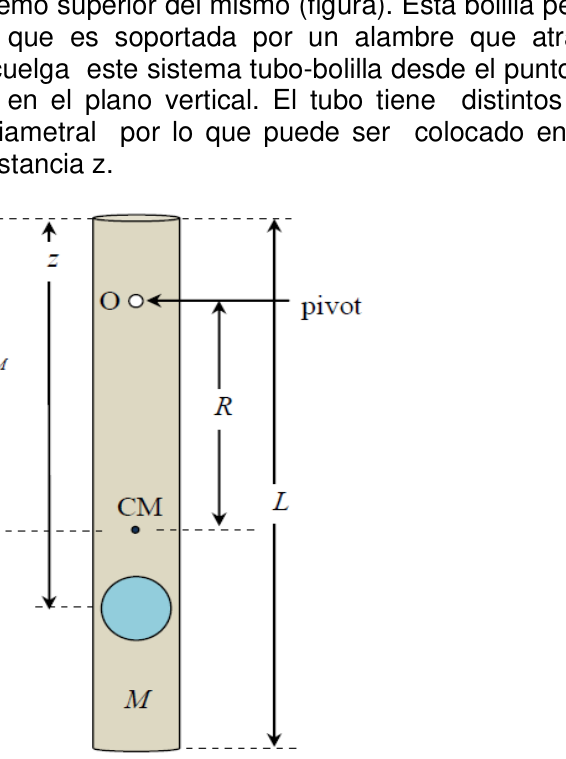
Topic: Oscillations & Waves, Rotational Dynamics Metodi: Experimental Data Analysis, Simple Harmonic Motion Analysis, Graph Linearization Competenze: Physical Reasoning, Experimental Data Analysis, Mathematical Modeling Objects: Cylinder, Sphere Fonte: Testo (PDF) — p.3
Pendolo fisico
PE51. Istituto di media educazione Dr. Arturo Oñativia La scuola del Cerro Scuola San Paolo Scuola Belgrano La scuola Albert Einstein Scuola Santa Rosa di Viterbo Scuola del 21° secolo Scuola Benjamin Zorrilla Scuola San Luca Scuola José Manuel Estrada Città di Salta.
Pendolo fisico. Un piccolo bollo di massa m è situato all’interno di un cilindro vuoto a una distanza z dalla parte superiore della stessa (figura). Questa bolla rimane. in quel luogo grazie alla quale è supportata da un filo che attraversa il diametro del tubo. Se si appende questo sistema tubo-boiler dal punto O in un pivot, che può oscillare in piano verticale. Il tubo ha diversi buchi. Le due parti sono diametralmente opposte, quindi possono essere collocate in diverse forme. posizioni che variano la distanza z.
L’equazione che governa il movimento di questo sistema per piccole oscillazioni è: (1)
è la posizione angolare è l’accelerazione angolare ICM è il momento di inerzia In questo modo il periodo di oscillazione è:
(2)
OAF 2011 - 149 Dove? (3)
Lavorando su 2, questo può essere così: (3)
Grafico
Dobbiamo avere la pendenza:
E l’ordine di origine:
Dove?
Attività: 1-Ricerca la posizione del centro di massa del cilindro con la massa in l’interno in funzione dei parametri che caratterizzano il sistema. 2-Scrivere la metodologia proposta per ottenere a-Il valore della gravità b-Relazione M / m Si chiede inoltre di analizzare gli errori corrispondenti delle le misure effettuate e i risultati ottenuti.
Materiale Ud. dispone di: Un tubo vuoto . Cronometro Regola Una ciotola di acciaio . Fabbricazioni di fili
Topic: Oscillations & Waves, Rotational Dynamics Metodi: Experimental Data Analysis, Simple Harmonic Motion Analysis, Graph Linearization Competenze: Physical Reasoning, Experimental Data Analysis, Mathematical Modeling Objects: Cylinder, Sphere Fonte: Testo (PDF) — p.3
The following table shows the results of the calculation of the weighted average weight of the vehicle:
PE51. The Institute of Middle Education Dr. Arturo Oñativia is the first Cerro School . St. Paul School . Belgrano School Albert Einstein School . The Santa Rosa School of Viterbo School of the 21st Century Benjamin Zorrilla School St. Luke ‘s School . School José Manuel Estrada Salt City.
It’s a physical pendulum. A small m-mass bowl is located inside a hollow cylinder. at a distance z from the upper end of the same (figure). This bowl stays. In that place, thanks to the fact that it is supported by a wire that runs through the diameter of the tube. If you hang this tube-boiler system from the O point on a pivot, this one can oscillate in the vertical plane. The tube has different holes . facing in a diametrical shape so it can be placed in different positions varying the distance z.
The equation that governs the motion of this system for small oscillations are: (1)
is the angular position is the angular acceleration ICM is the moment of inertia Thus the period of oscillation is:
(2)
The following points shall be added: Where ? (3)
Working on 2, this can look like: (3)
Graphically
We have to make the slope:
And the order of origin:
Where ?
Activities: 1-Find the position of the center of mass of the cylinder with the mass in the The system is designed to be integrated into the internal system according to the parameters that characterize the system. 2-Explain the proposed methodology for obtaining a-The value of gravity The M/m ratio The analysis of the corresponding errors in the the measurements it makes and the results obtained.
Material Ud. It has: A hollow tube . The time-meter . Rule A bowl of steel . Other, of a width of not more than 30 mm
Topic: Oscillations & Waves, Rotational Dynamics Metodi: Experimental Data Analysis, Simple Harmonic Motion Analysis, Graph Linearization Competenze: Physical Reasoning, Experimental Data Analysis, Mathematical Modeling Objects: Cylinder, Sphere Fonte: Testo (PDF) — p.3
Efecto Joule en agua
PE52. Instituto María Auxiliadora Comodoro Rivadavia, Santa Cruz.
Materiales provistos:
- fuente de 6v.
- vasos de precipitados de 250ml
- agua destilada c.n.
- cloruro de sodio c.n.
- termometro
OAF 2011 - 150
- alambre de cobre c.n.
- soporte para termometro.
- balanza
- cables conectores
Metodologia: Utilizando el alambre de cobre, la fuente electrica y los cables conectores realice un dispositivo tal que quepa en el vaso de precipitados con 150ml de agua destilada a temperatura ambiente, y coloque mediante fijacion al soporte provisto un termometro para registrar las diferencias de temperatura. Conecte los perros en forma adecuada a la bateria y a los extremos del alambre para realizar el dispositivo de transformacion de energia electrica en calorica. Proceda a la medicion de las temperaturas cada 5 minutos durante 30 minutos y coloquelos en una tabla . Grafique dichos datos. Resuelva: a- resistencia del alambre de cobre b- intensidad de circuito c- watts producidos en el proceso c- calor absorbido por la masa de agua destilada d- eficiencia del dispositivo. e- compare este proceso con un experimento paralelo con agua con cloruro de sodio al 10%. (solucion b) f- calcule los valores correspondientes a esta solucion b.
Topic: Thermodynamics, Circuits Metodi: Experimental Data Analysis, First Law of Thermodynamics, Error Propagation Competenze: Physical Reasoning, Experimental Data Analysis Objects: Wire, Battery, Calorimeter Fonte: Testo (PDF) — p.3
Effetto Joule in acqua
PE52. Istituto Maria Assilliadora Comodoro Rivadavia, Santa Cruz.
Materiali forniti:
- fonte di 6V.
- 250 ml di bicchieri di precipitati
- acqua distillata ecc.
- Cloruro di sodio e altri prodotti
- termometro .
OAF 2011 - 150
- fili di rame, ecc.
- supporto per il termometro.
- Sbalzo
- Cable di connessione Metodologia: Utilizzando il filo di rame, la fonte elettrica e i cavi di connessione realizza un dispositivo che si inserisce nel bicchiere di precipitazioni con 150 ml di acqua distillato a temperatura ambiente e inserito mediante fissaggio al supporto fornito un termometro per registrare le differenze di temperatura. Collegare i cani in modo appropriato alla batteria e alle estremità del sistema. il filo per realizzare il dispositivo di trasformazione dell’energia elettrica in calorici. Misurare le temperature ogni 5 minuti per 30 minuti e Mettila su una tavola . Grafica tali dati. Risoluzione: a- resistenza del filo di rame b- intensità di circuito c- watt prodotti nel processo c- calore assorbito dalla massa di acqua distillata d- efficienza del dispositivo. e- confrontare questo processo con un esperimento parallelo con l’acqua con il cloruro di sodio al 10%. (soluzione b) f- calcola i valori corrispondenti a questa soluzione b.
Topic: Thermodynamics, Circuits Metodi: Experimental Data Analysis, First Law of Thermodynamics, Error Propagation Competenze: Physical Reasoning, Experimental Data Analysis Objects: Wire, Battery, Calorimeter Fonte: Testo (PDF) — p.3
The Joule effect on water
PE52. The Institute of Maria Auxiliadora Commodore Rivadavia, from Santa Cruz.
Materials provided:
- 6V power supply.
- 250 ml water-sprayed cups
- distilled water, etc.
- sodium chloride and n.e.c.
- thermometer .
The following is the list of the Member States’ financial statements:
- Copper wire and other wire
- thermometer support.
- the balance
- connecting cables The methodology: Using copper wire, power source and connecting cables, it does a device such as this that it fits into the precipitated glass with 150ml of water distilled at room temperature and placed by attachment to the supplied support a thermometer to record temperature differences. Connect the dogs properly to the battery and the ends of the battery. Wire to perform the electrical energy transformation device in It’s calories. Continue to measure the temperature every 5 minutes for 30 minutes and Put them on a board . Graph that data. Resolves: a- resistance of copper wire b- circuit intensity c- watts produced in the process c- heat absorbed by the distilled water mass d- the efficiency of the device. e- compare this process with a parallel experiment with water with 10% sodium chloride (Solution b) f- calculate the values corresponding to this solution b.
Topic: Thermodynamics, Circuits Metodi: Experimental Data Analysis, First Law of Thermodynamics, Error Propagation Competenze: Physical Reasoning, Experimental Data Analysis Objects: Wire, Battery, Calorimeter Fonte: Testo (PDF) — p.3
Ondas resonantes en tubos
PE53. Instituto Politécnico Superior General San Martín Rosario, Santa Fe.
Ondas resonantes en tubos.
Introducción:
Un tipo de ondas que se encuentra con frecuencia en dispositivos tecnológicos,
instrumentos musicales como las guitarras o los pianos son las denominadas
ondas estacionarias, que se tienen cuando a las ondas se las confina a un medio
con límites rígidos que sólo permiten la reflexión.
El modo de representar matemáticamente este fenómeno consiste en considerar
la superposición de dos ondas de igual amplitud, frecuencia y dirección pero que
viajan en sentidos opuestos.
Si
y1( x,t)=Asen(kx−ωt);
(1) y2( x,t)=Asen(kx+ωt);
(2) Entonces su suma será y( x,t)=y1( x,t)+y2( x,t)= 2 Asen(kx ).cos( ωt)
(3)
El resultado ya no es más una onda que se propaga: cada punto x tiene un
movimiento armónico expresado por el factor cos (t) dependiente del tiempo, y
la amplitud varía de un punto a otro según el factor 2 A sen (kx)
La amplitud de este movimiento armónico será cero para algunos valores de x, y
las coordenadas de estos puntos que no vibran son:
2π
λ xn=nπ con n entero
(4)
entonces
xn=n λ
2
con n entero
(5)
OAF 2011 - 151
L
L
L
Se dice que la onda tiene nodos en esos valores de x, y la distancia entre dos
nodos consecutivos es igual a media longitud de onda (
λ
2)
La amplitud máxima será 2A y las coordenadas de estos puntos serán:
2π
λ xn= (2n−1) π
2
con n entero
(6) entonces xn= (2n−1) λ 4 con n entero
(7) A continuación se muestra una gráfica de la amplitud en función de la posición para distintos valores de t.
Fig.1 Onda estacionaria de amplitud 3cm y longitud de onda 1m
Para el caso de la onda confinada en un medio, las ondas viajeras de sentido
opuesto serán producidas por la reflexión en los límites. Si consideramos la
cuerda de una guitarra, ambos extremos son totalmente rígidos y no poseen
desplazamiento, por lo que serán nodos de las ondas estacionarias que se
formen. Para una longitud determinada de la cuerda, las frecuencias de las
ondas estacionarias que se pueden generar son fijas y dadas por las siguientes
ecuaciones.
v=f . λ⇒f= v
λ
(8)
Primer Armónico λ1= 2L⇒f 1= v 2 L
(9)
Segundo Armónico λ2=L⇒f 2= v L
(10)
Tercer Armónico λ3= 2L 3 ⇒f 3= 3v 2L
(11)
0 0.25 0.5 0.75 1 1.25 1.5 -3 -2.5 -2 -1.5 -1 -0.5 0 0.5 1 1.5 2 2.5 3 x (m) A (cm)
OAF 2011 - 152
Fig.2 Primeras 3 frecuencia de resonancia en tubo abierto
Donde se llega a la expresión para un armónico genérico
λn= 2L
n ⇒f n= nv
2L
(12) donde n indica el número de armónico
Para las ondas estacionarias en tubos, al igual que en la cuerda, el aire sólo
puede vibrar a determinadas frecuencias que dependen tanto de la longitud del
tubo como del aire dentro de él. Existen dos formas en que puede encontrarse
este tipo de ondas: que el tubo esté abierto en ambos extremos (tubo abierto) o
con un extremo abierto y el otro cerrado (tubo cerrado). Si el diámetro del cilindro
es pequeño comparado con la longitud de onda de la onda estacionaria, esta se
refleja en el otro extremo del cilindro y vuelve hacia el interior del tubo. La
superposición de estas ondas de igual amplitud y frecuencia da origen a las
ondas estacionarias en los tubos.
El extremo cerrado de una columna de aire es un nodo de desplazamiento
debido a que la pared en este extremo no permite el movimiento molecular. Este
extremo cerrado también corresponde a un antinodo de presión, es decir una
posición donde la variación de presión es máxima.
En cambio un extremo abierto es un antinodo de desplazamiento y un nodo de
presión, ya que la presión está fijada por la presión atmosférica.
Mientras que las ecuaciones y las gráficas de las ondas del tubo abierto son
idénticas a las que se establecen en una cuerda con ambos extremos rígidos, las
de un tubo cerrado en un único extremo difieren. A continuación se observan
gráficas y la formulas de la presión, donde se observan los distintos armónicos
para el tubo cerrado.
Primer Armónico λ1= 4⇒f 1= v 4L
(13)
Tercer Armónico λ3= 4L 3 ⇒f 3= 3v 4 L
(14)
Quinto Armónico λ5= 4L 5 ⇒f 5= 5v 4L
(15)
Fig.3 Primeras 3 frecuencia de resonancia en tubo cerrado.
Se puede observar que sólo se establecen armónicos impares y escribiéndolo en
forma general queda,
λn= 4L
n ⇒f n= n.v
4L
donde n indica el número de armónico (16)
Desarrollo Práctico
a. Materiales
a) Tubo de PVC
b) Probeta de 1000ml±10ml
L
L
L
OAF 2011 - 153 c) Agua del grifo d) Parlante de 8Ω con conector Jack e) Notebook con archivo de sonido Test.wav f) Fibra o fibron g) Regla o cinta métrica
b. Objetivos a) Hallar las dos frecuencias principales del contenido armónico del archivo Test.wav. b) Especificar los métodos utilizados y las incertezas asociadas a las mediciones.
c. Metodología a) Sumergir el tubo de PVC tal como muestra la figura para encontrar las frecuencias resonantes a medida que se varía la longitud efectiva del tubo. b) Recordar que una misma frecuencia puede resonar varias veces dentro del tubo, conforme varíe la distancia efectiva.
d. Conclusión Elaborar una memoria sobre el desarrollo del trabajo práctico, identificando las mayores fuentes de error, y como podría mejorarse; indicar hipótesis usadas.
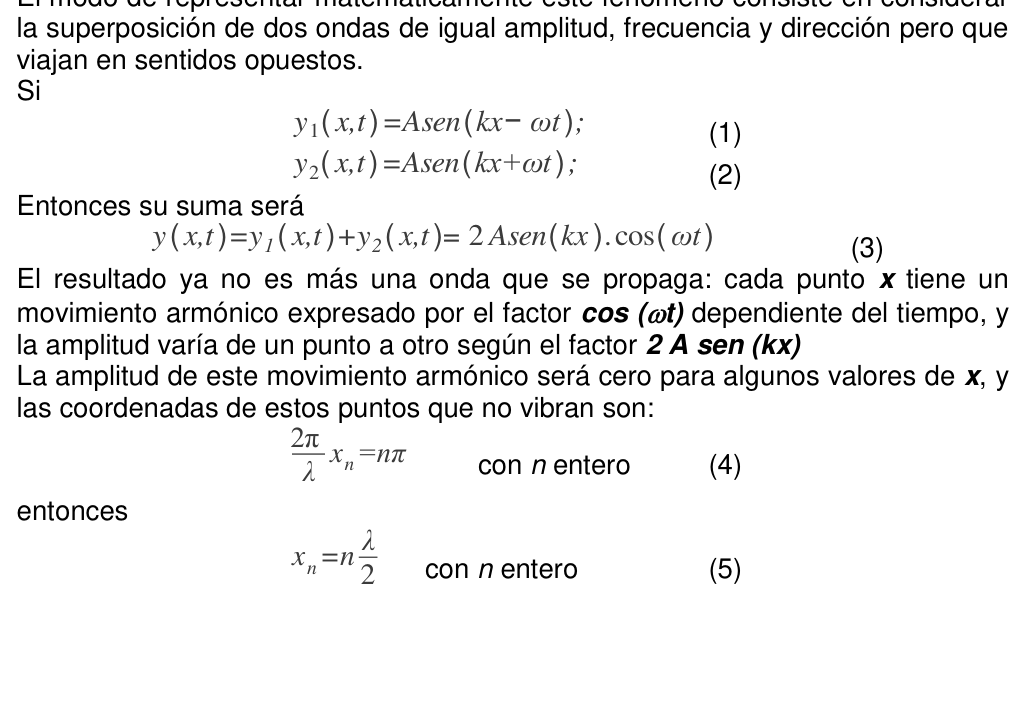
Topic: Oscillations & Waves Metodi: Experimental Data Analysis, Wave Equation, Error Propagation Competenze: Physical Reasoning, Experimental Data Analysis, Mathematical Modeling Objects: Tube Fonte: Testo (PDF) — p.3
onde risonanti in tubi
PE53. Istituto Politetnico Superiore Generale San Martín Rosario, Santa Fe.
onde risonanti in tubi. Introduzione: Un tipo di ondata che si trova spesso nei dispositivi tecnologici, Gli strumenti musicali come le chitarre o i pianini sono i cosiddetti onde stazionarie, che si hanno quando le onde sono confinate a un mezzo Con rigidi limiti che permettono solo la riflessione. Il modo matematico per rappresentare questo fenomeno consiste nel considerare La superposizione di due onde di stessa larghezza, frequenza e direzione, ma che viaggiano in direzioni opposte. Si e1(x,t)=Asen(kx−ωt);
(1) e2(x,t)=Asen(kx+ωt);
(2) Allora la sua somma sarà e(x,t) = y1(x,t) + y2(x,t) = 2 Assen(kx ).cos( ωt)
(3)
Il risultato non è più un’onda che si diffonde: ogni punto x ha un
movimento armonico espresso dal fattore cos (t) a seconda del tempo, e
l’ampiezza varia da punto a punto secondo il fattore 2A sen (kx)
L’ampiezza di questo movimento armonico sarà zero per alcuni valori di x, e
le coordinate di questi punti non vibranti sono:
2π
λ xn=nπ con n intero
(4)
Allora…
xn=n λ
2
con n intero
(5)
OAF 2011 - 151
L
L
L
Si dice che l’onda ha nodi in quei valori di x, e la distanza tra due
i nodi consecutivi sono uguali alla media di lunghezza d’onda (
λ
2)
La massima larghezza sarà 2A e le coordinate di questi punti saranno:
2π
λ xn= (2n−1) π
2
con n intero
(6) Allora… xn= (2n−1) λ 4 con n intero
(7) Qui di seguito è mostrato un grafico di larghezza in funzione della posizione per diversi valori di t.
Fig.1 Onda stazionaria di larghezza 3 cm e lunghezza d’onda 1 m Per l’onda confinata in un mezzo, le onde viaggiano in senso Il contrario sarà prodotto dalla riflessione nei limiti. Se consideriamo la Una corda di chitarra, entrambi gli estremi sono completamente rigidi e non possedono La velocità di movimento è molto elevata, quindi sono i nodi delle onde stazionarie che si formate. Per una determinata lunghezza della corda, le frequenze delle onde stazionarie che possono essere generate sono fisse e date dalle seguenti
- Equazioni.
v=f . λ⇒f= v
λ
(8)
Il primo Armonico λ1= 2L⇒f 1= v 2 L
(9)
Secondo Armonico λ2=L⇒f 2= v L
(10)
Terzo Armonico λ3= 2L 3 ⇒f 3= 3v 2L
(11)
0 0.25 0.5 0.75 1 1.25 1.5 -3 -2.5 -2 -1.5 -1 -0.5 0 0.5 1 1.5 2 2.5 3 x (m) A (cm)
OAF 2011 - 152
Fig.2 Primi 3 frequenze di risonanza in tubo aperto
Dove si arriva all’espressione per un armonico generico
λn= 2L
n ⇒f n= nv
2L
(12) dove n indica il numero di armonico
Per le onde stazionarie in tubi, come nella corda, l’aria solo
La frequenza di vibrazione può essere determinata a frequenze che dipendono tanto dalla lunghezza del
tubo come l’aria dentro di lui. Ci sono due modi in cui si può trovare.
il tipo di onde: il tubo è aperto a entrambe le estremità (più aperto) o
con un’estremità aperta e l’altra chiusa. Se il diametro del cilindro
è piccolo rispetto alla lunghezza d’onda dell’onda stazionaria, questo si
riflette all’altra estremità del cilindro e ritorna verso l’interno del tubo. La
La superposizione di queste onde di stessa larghezza e frequenza dà origine alle
onde stazionarie nei tubi.
L’estremità chiusa di una colonna d’aria è un nodo di spostamento.
perché il muro di questo lato non permette il movimento molecolare. Questo .
L’estremità chiusa corrisponde anche ad un antinodo di pressione, cioè un
posizione in cui la variazione di pressione è massima.
Un’estremità aperta invece è un antinodo di spostamento e un nodo di
la pressione, poiché la pressione è fissata dalla pressione atmosferica.
Mentre le equazioni e i grafici delle onde del tubo aperto sono
identiche a quelle che si trovano su una corda con entrambe le estremità rigide, le
di un tubo chiuso a una sola estremità differiscono. Di seguito sono riportati:
Le differenze di pressione sono note in grafici e formule di pressione, dove si osservano le diverse armoniche
per il tubo chiuso.
Il primo Armonico λ1= 4⇒f 1= v 4L
(13)
Terzo Armonico λ3= 4L 3 ⇒f 3= 3v 4 L
(14)
Quinto Armonico λ5= 4L 5 ⇒f 5= 5v 4L
(15)
Fig.3 Primi 3 frequenze di risonanza in tubo chiuso.
Si può osservare che solo armonici impar si stabiliscono e scrivendo in
La forma generale rimane,
λn= 4L
n ⇒f n= n.v
4L
dove n indica il numero di armonico (16)
Sviluppo pratico a. Materiali a) Più o meno di PVC b) Probata di 1000 ml±10 ml L L L
OAF 2011 - 153 c) Acqua del rubinetto d) Parlante a 8Ω con connettore Jack e) Notebook con file audio Test.wav Fibra o fibra g) Regola o nastro metrico
b. Obiettivi a) Trovare le due principali frequenze del contenuto Harmonico del file Test.wav. b) Specificare i metodi utilizzati e le incertezze associati alle misure.
c. Metodologia a) Immergere il tubo di PVC come mostrato nella figura per trovare le frequenze di risonanza a misura che varia la lunghezza effettiva del tubo. b) Ricordare che una stessa frequenza può risuonare più volte all’interno del tubo, a seconda della variazione della Distanza effettiva.
d. Conclusione Elaborare un memorandum sullo sviluppo del lavoro La Commissione ha adottato una decisione che non è stata adottata.
- la possibilità di migliorare le ipotesi utilizzate.
Topic: Oscillations & Waves Metodi: Experimental Data Analysis, Wave Equation, Error Propagation Competenze: Physical Reasoning, Experimental Data Analysis, Mathematical Modeling Objects: Tube Fonte: Testo (PDF) — p.3
The following shall be added to the list of the relevant technical specifications:
PE53. The French authorities have already confirmed that the Commission is not interested in the use of the information provided by the Commission. Rosario, Santa Fe.
Resonant waves in tubes. The Commission has also adopted a proposal for a directive on the protection of workers’ rights. A type of wave that is often found in technological devices, musical instruments such as guitars or pianos are the so-called stationary waves, which are obtained when the waves are confined to a medium. with strict limits that only allow reflection. The mathematical representation of this phenomenon is to consider The superposition of two waves of equal width, frequency and direction but which They travel in opposite directions. Si and1(x,t)=Asen(kx−ωt);
(1) The following table shows the results of the calculations:
(2) Then its sum will be and x,t) = y1(x,t) + y2(x,t) = 2 Asen(kx ).cos( ωt)
(3)
The result is no longer a wave that spreads: every point x has a
Harmonic motion expressed by the time-dependent cos (t) factor, and
the width varies from point to point according to factor 2A sen (kx)
The amplitude of this harmonic motion will be zero for some values of x, and
The coordinates of these non-vibrating points are:
2π
λ xn=nπ with n whole
(4)
Then
xn=n λ
2
with n whole
(5)
The following points shall be added:
L
L
L
It’s said that the wave has nodes in those x values, and the distance between two
consecutive nodes is equal to the mean wavelength (
λ
2)
The maximum width shall be 2A and the coordinates of these points shall be:
2π
λ xn= (2n−1) π
2
with n whole
(6) Then xn= (2n−1) λ 4 with n integer
(7) The following is a graph of the width based on position for different values of t.
Fig.1 Stationary wave width 3cm and wavelength 1m
For the case of the wave confined in a medium, the directional traveling waves
The other side will be produced by reflection in the boundaries. If we consider the
guitar string, both ends are totally rigid and do not possess
The first is the displacement of the wave, which is the result of the displacement of the wave.
form. For a given length of the string, the frequencies of the
The stationary waves that can be generated are fixed and given by the following
The equations.
v=f . λ⇒f= v
λ
(8)
First Harmonician λ1= 2L⇒f 1= v 2 L
(9)
Second Harmonic . λ2=L⇒f 2= v L
(10)
Third Harmonium . λ3= 2L 3 ⇒f 3= 3v 2L
(11)
0 0.25 0.5 0.75 1 1.25 1.5 -3 -2.5 -2 -1.5 -1 -0.5 0 0.5 1 1.5 2 2.5 3 x (m) A (cm)
The following points shall be added:
Fig.2 First 3 open tube resonance frequency
Where does the expression come from for a generic harmonic ?
λn= 2L
n ⇒f n= nv
2L
(12) where n indicates the harmonic number
For stationary waves in tubes, as in rope, air only.
It can vibrate at certain frequencies that depend so much on the length of the
pipe like the air inside it. There are two ways you can find it .
This type of wave: the tube is open at both ends (open tube) or
with one end open and the other end closed. If the diameter of the cylinder
It’s small compared to the wavelength of the stationary wave, this is it.
It reflects at the other end of the cylinder and turns back into the tube. La
The superposition of these waves of equal width and frequency gives rise to the
stationary waves in the tubes.
The closed end of an air column is a displacement node.
Because the wall at this end doesn’t allow molecular movement. This one .
The closed end also corresponds to a pressure antinode, i.e. a
position where the pressure variation is maximum.
An open end is an antinode of displacement and a node of
pressure, since the pressure is determined by the atmospheric pressure.
Whereas the equations and graphs of the open tube waves are
identical to those laid on a string with both stiff ends, the
The two main differences are the difference between the two. The following are observed
The pressure formulae and the graphs show the different harmonics.
for the closed tube.
First Harmonician λ1= 4⇒f 1= v 4L
(13)
Third Harmonium . λ3= 4L 3 ⇒f 3= 3v 4 L
(14)
Fifth Harmonium . λ5= 4L 5 ⇒f 5= 5v 4L
(15)
Fig.3 First 3 closed-tube resonance frequency.
You can see that only odd harmonics are established and written in
general form remains,
λn= 4L
n ⇒f n= n.v
4L
where n indicates the harmonic number (16)
Practical development a. Materials (a) PVC pipe (b) Sample of 1000ml±10ml L L L
The following points shall be added: (c) Tap water (d) 8Ω speaker with jack connector (e) Notebook with sound file Test.wav (f) Fiber or fibres (g) Metric tape or rule
b. Objectives (a) Find the two main frequencies of content harmonic from the Test.wav file. (b) Specify the methods used and the uncertainties associated with measurements.
c. The methodology (a) Submerge the PVC tube as shown in Figure to find the resonant frequencies tailored The actual length of the tube varies. (b) Remember that the same frequency can resonate several times inside the tube as the tube changes. effective distance.
d. The conclusion Develop a memoir on the development of the work The main sources of error are identified and how The Commission will examine the following questions:
Topic: Oscillations & Waves Metodi: Experimental Data Analysis, Wave Equation, Error Propagation Competenze: Physical Reasoning, Experimental Data Analysis, Mathematical Modeling Objects: Tube Fonte: Testo (PDF) — p.3
Densidad de un cuerpo solido
PE54. Instituto Jesús María Ciudad de Córdoba.
Objetivo:
. Determinar la densidad de un cuerpo sólido, mediante dos
procedimientos distintos.
Elementos:
. 1 soporte universal con una nuez con agarradera metálica.
. 1 regla milimetrada
. hilo
. vaso graduado
. cuerpo metálico
. agua
. dinamómetro
Requerimientos:
Sólo podrá utilizar los elementos provistos, papel, lapicera y calculadora no
progra mable.
Al finalizar el trabajo, deberá presentar un informe que incluya los siguientes
puntos:
Esquema de los dispositivos utilizados
Descripción y fundamentación de cada diseño utilizado
Cuadro de valores de las mediciones realizadas, con el mayor número
de mediciones posibles.
Resultados obtenidos con sus correspondientes errores
De todas las mediciones directas realizadas, ¿cuál es el factor que, de
hacer esta experiencia nuevamente, ud se preocuparía de medir con
menor error la próxima vez? Justifique.
Comentarios
L
Topic: Fluid Mechanics Metodi: Experimental Data Analysis, Hydrostatic Equilibrium, Error Propagation Competenze: Physical Reasoning, Experimental Data Analysis Objects: Container Fonte: Testo (PDF) — p.3
Densità di un corpo solido
PE54. Istituto Gesù Maria Città di Córdoba.
Obiettivo: . Determinare la densità di un corpo solido, utilizzando due
- procedure diverse. Elementi: . 1 supporto universale con un’aria di frutta con una colla metallica. . 1 regola di millimetro . Filo . Vaso graduato . corpo metallico . acqua . dinamometro Requisiti: Può utilizzare solo gli elementi forniti, carta, lapislatura e calcolatore non Progra mable. Al termine del lavoro, deve presentare un rapporto che include le seguenti informazioni: punti: Schema dei dispositivi utilizzati Descrizione e motivazione di ogni progetto utilizzato Tabella dei valori delle misurazioni effettuate, con il maggior numero di misurazioni possibili. Risultati ottenuti con i propri errori Di tutte le misure dirette effettuate, quale è il fattore che, di Se dovessi fare questa esperienza di nuovo, ti preoccuperei di misurare con
- E’ un piccolo errore la prossima volta? giustifica. Commenti L
Topic: Fluid Mechanics Metodi: Experimental Data Analysis, Hydrostatic Equilibrium, Error Propagation Competenze: Physical Reasoning, Experimental Data Analysis Objects: Container Fonte: Testo (PDF) — p.3
The mass of the solid body is less than 0,05 m/s.
PE54. Jesus Mary Institute The city of Cordoba.
The objective: . Determine the density of a solid body by using two methods. different procedures. The following elements: . 1 universal support with a nut with a metal grip. . 1 mm rule . The wire . Graduated glass . metal body . Water . The dynamometer Requirements: You may only use the items provided, paper, pencil and calculator not The Commission has not yet adopted a proposal. At the end of the work, you must submit a report which includes the following: points: Schedule of devices used Description and justification of each design used Table of values of the measurements carried out, with the largest number of possible measurements. Results obtained with their corresponding errors Of all the direct measurements made, what is the factor that, from Do this experiment again, you’d worry about measuring with Minor mistake next time? You justify it. Comments L
Topic: Fluid Mechanics Metodi: Experimental Data Analysis, Hydrostatic Equilibrium, Error Propagation Competenze: Physical Reasoning, Experimental Data Analysis Objects: Container Fonte: Testo (PDF) — p.3