De la Tierra a la Luna (Verne)
Problema 1
De la tierra a la luna, de Julio Verne.
En la novela De la tierra a la luna de Julio Verne (Nantes, 8 de febrero de 1828-
Amiens, 24 de marzo de 1905) se narranlas peripecias de los miembros del Club
de cañones de Baltimore, condenados a la inactividad después de terminar la
guerra civil de Norteamérica, para enviar a la luna una bala de cañón tripulada.
Para esto, los miembros del club decidieron construir un cañón colosal, cargarlo
con un proyectil hueco y, por medio de un disparo, lanzar este vagón-proyectil a
la luna.
El cañón construido tenía una longitud de 200 m y estaba enterrado
verticalmente en la tierra. Como vagón-proyectil se utilizó una esfera hueca de
aluminio de 4.60 m diámetro exterior y 0.30 m de espesor. La masa total del
vagón-proyectil, teniendo en cuenta la tripulación y la carga, era de 8000 kg.
Para efectuar el disparo, el cañón se cargó con 160000 kg de algodón pólvora.
En la novela se indica que el proyectil alcanzó, al momento de salir de la boca
del cañón, una velocidad de 16 km/s y que, debido al rozamiento con el aire de
la atmósfera terrestre, la velocidad disminuyó a 11 km/s al momento de
abandonar la misma.
Se propone realizar algunos cálculos y sacar algunas conclusiones.
a) Determinar la cantidad de energía liberada por kilogramo de algodón
pólvora. Suponer que no hay rozamiento entre el proyectil y el ánima del
cañón y que se pierde un 20% de energía por calor.
b) Calcular la aceleración que experimentan los pasajeros del vagón-
proyectil cuando recorren el ánima del cañón. Suponer que el
movimiento del vagón dentro del ánima del cañón es uniformemente
acelerado.
c) Estudios muestran que el cuerpo humano es capaz de soportar, por
cortos períodos de tiempo, 10 veces la aceleración de la gravedad sin
perjuicio para la salud. Determinar cuál debería ser la longitud del cañón
para que la tripulación sobreviva al disparo considerando la misma
velocidad de salida del caso anterior. Tomar como valor de aceleración
de la gravedad .
d) Establecer si el proyectil escapa del campo gravitatorio terrestre.
Despreciar la atracción gravitatoria de la luna.
NOTA: Entendemos por “velocidad de escape” a la velocidad inicial requerida
para ir desde un punto inicial en un campo gravitatorio (en nuestro caso el punto
inicial es el límite exterior de la atmósfera) y llegar al infinito con velocidad cero.
Cuando el vagón-proyectil se encuentre en el espacio exterior recibirá radiación
solar. Esta radiación será absorbida por el vagón-proyectil elevando su
temperatura. El flujo de radiación que recibirá el vagón-proyectil es
aproximadamente de
. Considerando que el vagón-proyectil se comporta como un cuerpo negro, éste irradiará una potencia dada por la siguiente fórmula:
Donde es la constante de Stefan-Boltzmann, es la superficie por la que se emite la radiación (superficie del cuerpo) y es la temperatura del cuerpo en Kelvin.
OAF 2013 - 4 e) Determinar la potencia de radiación que absorbe el vagón-proyectil. f) Determinar la temperatura que alcanza el vagón-proyectil. Suponer que el mismo ha alcanzado un estado estacionario en el cual la temperatura no cambia con el tiempo. g) Concluir si será necesario un sistema para refrigerar el vagón-proyectil o para calefaccionar el mismo. Para tener iluminación, el vagón-proyectil tiene un sistema que transforma parte de la energía recibida, en forma de radiación, en energía eléctrica. De esta forma se cuenta con una fuente de tensión continua de 24 V. Para la iluminación, se utilizarán lámparas “frías” que tienen una resistencia de trabajo de 200 y por las que puede circular una corriente máxima de 5 mA. h) Determinar el número mínimo de lámparas en serie que se deben conectar a la fuente para obtener la máxima cantidad de luz sin que ninguna se dañe. i) Calcular la potencia que disipa el circuito en estas condiciones. j) Calcular la potencia que entrega la fuente en estas condiciones.
Datos:
Longitud del cañón:
Diámetro exterior de la esfera hueca de aluminio:
Espesor de la esfera hueca de aluminio:
Masa total de la esfera más la tripulación:
Masa de algodón pólvora:
Velocidad de salida del proyectil en la boca del cañón:
Velocidad del proyectil al abandonar la atmósfera:
Masa de la tierra:
Radio de la tierra:
Altura de la atmósfera respecto de la superficie terrestre:
Aceleración de la gravedad:
Flujo de radiación solar:
Constante gravitatoria universal:
Constante de Stefan-Boltzmann:
NOTA: La superficie efectiva de absorción de una esfera de radio R, irradiada desde una única dirección, es
OAF 2013 - 5 Hoja de soluciones Problema 1: De la tierra a la luna, de Julio Verne.
a)
b)
c)
d)
e)
f)
g)
h)
i)
j)
OAF 2013 - 6
Topic: Newtonian Mechanics, Conservation of Energy Metodi: Kinematic Equations, Energy Conservation Method, Newton’s Law of Gravitation Competenze: Physical Reasoning, Mathematical Modeling Objects: Projectile, Cylinder Fonte: Testo (PDF) — p.3
**Dalla Terra alla Luna (Verne) **
Problema 1 Dalla terra alla luna, di Julio Verne. Nel romanzo De la terre à la lune di Julio Verne (Nantes, 8 febbraio 1828- Amiens, 24 marzo 1905) raccontano le vicende dei membri del Club di cannoni di Baltimore, condannati all’inazione dopo aver terminato il guerra civile americana, per inviare sulla luna un proiettile di cannone a bordo. Per questo, i membri del club hanno deciso di costruire un cannone colossale, caricarlo. con un proiettile vuoto e, con un colpo, lanciare questo vagone proiettile a la luna. Il cannone costruito aveva una lunghezza di 200 metri e era sepolto. Verticalmente sulla terra. Come vagone-proiettile è stata usata una sfera vuota di di alluminio di 4,60 m di diametro esterno e di 0,30 m di spessore. La massa totale del il carro-proiettile, tenendo conto dell’equipaggio e del carico, era di 8000 kg. Per eseguire il tiro, il cannone fu caricato con 160000 kg di cotone polveroso. Il romanzo dice che il proiettile è arrivato, quando è uscito dalla bocca. di un cannone, a una velocità di 16 km/s e che, a causa del ruggimento con l’aria di L’atmosfera terrestre, la velocità è diminuita a 11 km/s al momento di abbandonare la stessa. Si propone di fare alcuni calcoli e di trarre alcune conclusioni. a) Determinare la quantità di energia rilasciata per kg di cotone
-
Pozzetta. Supponiamo che non ci sia un’arruzione tra il proiettile e l’anima del e che si perde il 20% di energia per il calore. b) Calcolare l’accelerazione dei passeggeri del vagone Proiettile quando si attraversa l’anima del cannone. Supponiamo che il Il movimento del vagone all’interno dell’anima del cannone è uniforme.
-
Accelerato. (c) Gli studi mostrano che il corpo umano è in grado di sopportare, per
-
Per i tempi brevi, 10 volte l’accelerazione della gravità senza
-
l’inquinamento per la salute. Determinare la lunghezza del cannone Per far sopravvivere la schietta, considerando la stessa. velocità di uscita del precedente caso. Prendere come valore di accelerazione della gravità . d) stabilire se il proiettile sfugge dal campo gravitazionale terrestre. Sprezzare l’attrazione gravitazionale della luna. NOTA: Intendo per velocità di uscita alla velocità iniziale richiesta Per andare da un punto iniziale in un campo gravitazionale (in questo caso il punto La velocità iniziale è il limite esterno dell’atmosfera) e raggiungere l’infinito a velocità zero. Quando il vagone-proiettile si trova nello spazio esterno riceverà radiazioni.
-
Il sole. Questa radiazione sarà assorbita dal vagone proiettore alzando il suo temperatura. Il flusso di radiazioni che riceverà il vagone-proiettile è circa di
. Considerando che il carrozzino-proiettile si comporta come un corpo nero, questo irradiare una potenza data dalla seguente formula:
Dove è la costante di Stefan-Boltzmann, è la superficie per la quale si emette la radiazione (superficie corporea) e è la temperatura corporea in Kelvin, non è così.
OAF 2013 - 4 e) Determinare la potenza di radiazione assorbita dal vagone-proiettile. f) Determinare la temperatura raggiunta dal vagone-proiettore. Supponiamo che la stessa ha raggiunto uno stato stazionario in cui la temperatura non cambia col tempo. g) Conclude se sarà necessario un sistema di raffreddamento del vagone-proiettile o per riscaldarlo. Per avere illuminazione, il vagone-proiettore ha un sistema che trasforma parte. dell’energia ricevuta, sotto forma di radiazioni, in energia elettrica. In questo modo. ha una sorgente di tensione continua di 24 V. Per l’illuminazione, si Usano lampade fredde che hanno una resistenza di lavoro di 200 y per di cui sopra: h) Determinare il numero minimo di lampe in serie da utilizzare collegare alla fonte per ottenere la massima quantità di luce senza che nessuno si fa male. (i) Calcolare la potenza che dissipa il circuito in queste condizioni. j) Calcolare la potenza fornita dalla fonte in queste condizioni.
Datati: Lunghezza del cannone: Diametro esterno della sfera vuota in alluminio: Spessore della sfera vuota di alluminio: Massa totale della sfera più il personale: Massa di cotone polverosa: Velocità di uscita del proiettile nella bocca del cannone:
Velocità del proiettile all’ uscita dall’atmosfera:
Massa della terra: Radio della terra: Altura dell’atmosfera rispetto alla superficie terrestre: Accelerazione della gravità:
Fluo di radiazioni solari:
Costante gravitazionale universale:
Costante di Stefan-Boltzmann:
NOTA: superficie di assorbimento effettiva di una sfera di radio R, irradiata da una sola direzione, è
OAF 2013 - 5 L’articolo di Giulio Verne, “Dalla Terra alla Luna”.
a)
b)
c)
d)
e)
f)
g)
h)
i)
j)
OAF 2013 - 6
Topic: Newtonian Mechanics, Conservation of Energy Metodi: Kinematic Equations, Energy Conservation Method, Newton’s Law of Gravitation Competenze: Physical Reasoning, Mathematical Modeling Objects: Projectile, Cylinder Fonte: Testo (PDF) — p.3
The following is the list of the Member States’ official languages:
Problem 1 is From the Earth to the Moon, by Jules Verne. In the novel From the Earth to the Moon by Jules Verne (Nantes, 8 February 1828- Amiens, 24 March 1905) are the stories of the Club’s members. of Baltimore cannons, doomed to inactivity after finishing the American Civil War, to send a manned cannonball to the moon. For this, the club members decided to build a colossal cannon, load it. With a hollow projectile and, by means of a shot, throw this car-projective to The moon. The cannon built was 200 meters long and buried . Vertically on the ground. As a projectile carriage a hollow sphere of Aluminium with an external diameter of 4,60 m and a thickness of 0,30 m. The total mass of the The projectile car, taking into account the crew and cargo, was 8000 kg. To fire, the cannon was loaded with 160000 kg of powdered cotton. The novel indicates that the projectile reached, as it came out of the mouth. The speed of the canyon is 16 km/s and, due to the air friction of the canyon, the air is Earth’s atmosphere, the speed decreased to 11 km/s at the time of I’m leaving it. It is proposed to make some calculations and draw some conclusions. (a) Determine the amount of energy released per kilogram of cotton
-
It’s a gun. Assuming there is no friction between the projectile and the soul of the It’s a cannon and you lose 20% of your energy from heat. (b) Calculate the acceleration experienced by passengers in the carriage; A projectile when they’re moving through the soul of the cannon. Suppose that the The movement of the carriage within the spirit of the cannon is uniform. I’m going to speed it up. (c) Studies show that the human body is capable of supporting, by Short periods of time, 10 times the acceleration of gravity without health damage. Determine what the length of the cannon should be So the crew can survive the shooting while considering it . the output speed of the previous case. Take as an acceleration value of gravity . (d) Determine whether the projectile escapes the ground gravity field. To disregard the gravitational pull of the moon. NOTE: We mean by exhaust speed to the initial speed required to go from a starting point in a gravitational field (in our case the point The initial is the outer limit of the atmosphere) and reaches infinity at zero speed. When the car-propelled vehicle is in outer space it will receive radiation. The sun. This radiation will be absorbed by the projectile carriage raising its The temperature. The radiation flow that the carriage will receive is approximately
. Considering that the car-projection car behaves like a black body, this one radiate a power given by the following formula:
Where is the Stefan-Boltzmann constant, is the surface over which it is It emits radiation (body surface) and is the body temperature in Kelvin, what are you doing?
The following is the list of the countries of the European Union: (e) Determine the radiation absorbed by the projectile car. (f) Determine the temperature at which the projectile wagon reaches. Suppose that It has reached a steady state in which the temperature is It doesn’t change with time. (g) To conclude whether a system for cooling the projectile carriage is necessary or to heat it up. To have lighting, the projectile car has a system that transforms parts. The energy received, in the form of radiation, in electrical energy. This way . a continuous voltage source of 24 V. For lighting, you They will use cold lamps with a working resistance of 200 y/m2. a maximum current of 5 mA. (h) Determine the minimum number of series lamps to be fitted Connect to the source to get the maximum amount of light without having to None of them hurt. (i) Calculate the power dissipating the circuit under these conditions. (j) Calculate the power delivered by the source under these conditions.
The data: Length of the cannon: External diameter of the hollow aluminium sphere: Thickness of the hollow aluminium sphere: Total mass of the sphere plus crew: Other cotton powder: The projectile’s exit speed at the cannon’s mouth:
The speed of the projectile when it leaves the atmosphere:
Mass of the earth: Radio of the earth: Height of the atmosphere with respect to the earth’s surface: Acceleration of gravity:
Solar radiation flow:
Universal gravitational constant:
The constant of Stefan-Boltzmann:
NOTE: The effective absorption surface of an R-ray sphere, irradiated From a single address, it’s
The following is the list of the Member States’ financial statements: Problem 1: From the Earth to the Moon, by Jules Verne.
a)
b)
c)
d)
e)
f)
g)
h)
i)
j)
The following is the list of the Member States’ financial statements:
Topic: Newtonian Mechanics, Conservation of Energy Metodi: Kinematic Equations, Energy Conservation Method, Newton’s Law of Gravitation Competenze: Physical Reasoning, Mathematical Modeling Objects: Projectile, Cylinder Fonte: Testo (PDF) — p.3
Probando neumaticos
Problema 2 Probando Neumáticos
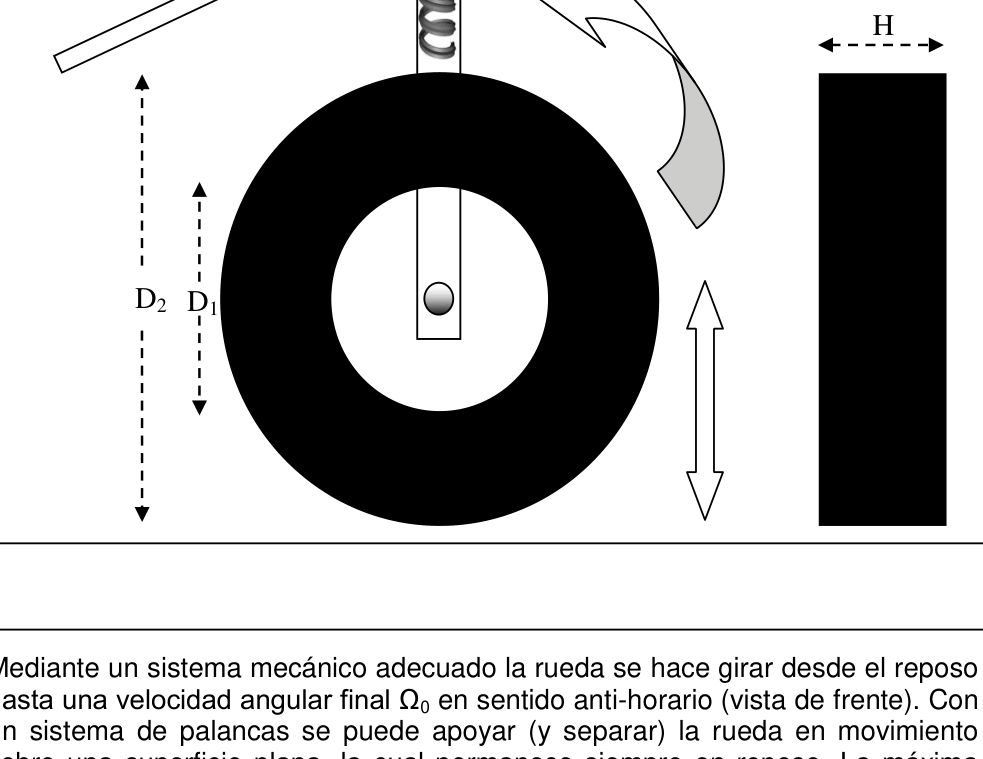
Una rueda de automóvil es expuesta a una serie de experimentos, con el fin de estudiar sus propiedades dinámicas. Uno de estos experimentos está representado en la figura adjunta.
Mediante un sistema mecánico adecuado la rueda se hace girar desde el reposo hasta una velocidad angular final Ω0 en sentido anti-horario (vista de frente). Con un sistema de palancas se puede apoyar (y separar) la rueda en movimiento sobre una superficie plana, la cual permanece siempre en reposo. La máxima fuerza normal, N, que puede ejercer el neumático sobre la superficie es 2500 N. El coeficiente de rozamiento dinámico, µdin entre la rueda y la superficie puede variar en el rango 0,055 (simulando el caso en que la superficie plana es hielo) hasta 0,8 (para el caso en que la superficie plana simula pavimento seco). Por efecto del rozamiento entre la rueda y la superficie, aquella se detiene tras un tiempo Δt, después de apoyarse sobre la superficie. Suponiendo que las dimensiones de la rueda son las detalladas en la Tabla 1, que la fuerza normal N es la máxima, que Ω0 corresponde a una velocidad lineal de 120km/h y que µdin = 0,4. a) Indique dirección, sentido y módulo de la fuerza de rozamiento. b) Calcule la energía total disipada por rozamiento, desde que la rueda se pone en contacto con la superficie plana, hasta que se detiene. c) Calcule el tiempo que tarda en frenarse la rueda. D2 D1 H
OAF 2013 - 7
d) Calcule el número de vueltas que da la rueda antes de detenerse y la
distancia de frenado teniendo en cuenta solo el rozamiento entre el
neumático y la superficie (es decir, sin la asistencia de un sistema de
frenos).
e) Calcule el número de moles de aire contenidos dentro del neumático.
Considere que el aire con el que se rellena el neumático se comporta
como un gas ideal. Suponga que la rueda se infló hasta una presión de
245kPa, a una temperatura ambiente igual a T=293 °K. Las
dimensiones de la llanta son las que se indican en la tabla 1. (constante
de los gases R = 8.31 J/(mol K))
f) Suponiendo que toda la energía disipada por el rozamiento entre el
neumático y la superficie plana, calculada en el punto c), genera el
calentamiento de la rueda (neumático y llanta) y del aire que contiene,
determine el cambio de temperatura del aire.
Considere que:
- el volumen del neumático se mantiene constante
- la rueda y el gas están siempre en equilibrio térmico
- el calor específico del aire a volumen constante es Cv = 717,7 J/°K kg
- la densidad media del aire es 1.19 Kg/m3
- la masa de la rueda es Mr = 14,2 kg
- la capacidad calorífica especifica media de la rueda es Cr= 1000 J/ºK kg.
g) Calcule el incremento de presión del aire dentro del neumático debido al incremento de la temperatura calculada en el punto anterior. h) Determine la máxima velocidad angular Ω0 con la que se puede realizar el ensayo a la rueda sin que explote, teniendo presente que la máxima presión que soporta el neumático es 392 kPa.
Diámetro interno (D1) 33,9 cm Diámetro externo (D2) 58,9 cm Ancho (H) 18,5 cm Espesor de la pared de caucho 2 cm Momento de inercia total de la rueda 1,012 kg m-2 Tabla 1
OAF 2013 - 8 Hoja de Soluciones Problema 2: Probando Neumáticos
a)
b)
c)
d)
e)
f)
g)
h)
OAF 2013 - 9
Topic: Rotational Dynamics, Newtonian Mechanics Metodi: Torque & Angular Momentum Analysis, Free-Body Diagram, Kinematic Equations Competenze: Physical Reasoning, Mathematical Modeling Objects: Wheel Fonte: Testo (PDF) — p.3
Provazione pneumatica
Problema 2 Provando pneumatici
Una ruota di auto viene esposta a una serie di esperimenti, con l’obiettivo di studiare le sue proprietà dinamiche. Uno di questi esperimenti è rappresentato nella figura allegata.
Con un sistema meccanico adeguato la ruota viene girata dal riposo fino a una velocità angolare finale Ω0 in senso antiorario (vista anteriore). Con un sistema di leva può sostenere (e separare) la ruota in movimento su una superficie piatta, che rimane sempre in riposo. La massima la forza normale, N, che può esercitare la gomma sulla superficie è di 2500 N. Il coefficiente di rottura dinamica, μdin tra la ruota e la superficie può variare nel range 0,055 (similando il caso in cui la superficie sia piana di ghiaccio) fino a 0,8 (per il caso in cui la superficie piana simula pavimentazione secca). Per effetto del ruggine tra la ruota e la superficie, che si ferma dopo un tempo Δt, dopo aver appoggiato la superficie. Supponiamo che le dimensioni della ruota siano quelle dettagliate nella Tabella 1, che la forza normale N è la massima, che Ω0 corrisponde a una velocità lineare di 120 km/h e che μdin = 0,4. a) Indicare la direzione, il senso e il modulo della forza di rottura. b) Calcolare l’energia totale dissipata da rottura, dal momento che la ruota è stata Sta in contatto con la superficie piana, fino a quando non si ferma. c) Calcolare il tempo necessario per frenare la ruota. D2 D1 H
OAF 2013 - 7 d) Calcolare il numero di giri che la ruota fa prima di fermarsi e il numero di giri che la ruota fa prima di fermarsi. Distanza di frenata tenendo conto solo del fratturazione tra il La superficie e la pneumatica (cioè senza l’assistenza di un sistema di freni). e) Calcolare il numero di molli d’aria contenuti all’interno della gomma. Considera che l’aria con cui si riempie la gomma si comporta come un gas ideale. Supponiamo che la ruota si sia gonfiata a una pressione di 245kPa, a temperatura ambiente pari a T=293 °K. Le Le dimensioni della gomma sono quelle indicate nella tabella 1. (constante di gas R = 8,31 J/(mol K)) f) Supponendo che l’energia totale dissipata dal fratturazione tra il La superficie di un pneumatico e di una superficie piana, calcolato al punto (c), genera il il riscaldamento della ruota (pneuma e pneumatico) e dell’aria contenuta, determina il cambiamento di temperatura dell’aria. Considera che:
- il volume della gomma è mantenuto costante
- la ruota e il gas sono sempre in equilibrio termico
- il calore specifico dell’aria a volume costante è Cv = 717,7 J/°K kg
- la densità media dell’aria è di 1,19 Kg/m3
- la massa della ruota è Mr = 14,2 kg
- la capacità calorifica specifica media della ruota è Cr= 1000 J/oK kg.
g) Calcolare l’aumento della pressione dell’aria all’interno del pneumatico a causa di aumento della temperatura calcolato nel punto precedente. h) Determina la velocità angolare massima Ω0 con cui si può effettuare il test sulla ruota senza esplosione, tenendo presente che la massima la pressione che il pneumatico sopporta è di 392 kPa.
Diametro interno (D1) 33,9 cm Diametro esterno (D2) 58,9 cm Larghezza (H) 18,5 cm Spessore del muro di gomma 2 cm Innesto totale della ruota: 1,012 kg m-2 Tabella 1
OAF 2013 - 8 Soluzione del problema 2: testare pneumatici
a)
b)
c)
d)
e)
f)
g)
h)
OAF 2013 - 9
Topic: Rotational Dynamics, Newtonian Mechanics Metodi: Torque & Angular Momentum Analysis, Free-Body Diagram, Kinematic Equations Competenze: Physical Reasoning, Mathematical Modeling Objects: Wheel Fonte: Testo (PDF) — p.3
The following conditions shall apply:
Problem two . Trying on the pneumatics.
A car wheel is exposed to a series of experiments, with the aim of study their dynamic properties. One of these experiments is represented in the figure attached.
By means of a suitable mechanical system the wheel is rotated from resting position up to a final angular velocity Ω0 in the anti-clockwise direction (front view). With a lever system can support (and separate) the moving wheel on a flat surface, which is always at rest. The maximum . The normal force, N, which the tyre can exert on the surface is 2500 N. The dynamic friction coefficient, μdin between wheel and surface can vary in the range of 0,055 (simultaneous to the case where the flat surface is ice) up to 0,8 (in the case where the flat surface simulates dry pavement). By The effect of friction between the wheel and the surface, which stops after a time Δt, after leaning over the surface. Assuming the dimensions of the wheel are those detailed in Table 1, where the normal force N is the maximum, where Ω0 is a linear velocity of 120 km/h and that μdin = 0,4. (a) Indicate the direction, direction and modulus of the friction force. (b) Calculate the total energy dissipated by friction, since the wheel is It comes into contact with the flat surface until it stops. (c) Calculate the time it takes for the wheel to brake. D2 D1 H
The following is the list of the Member States’ financial statements: (d) Calculate the number of turns the wheel makes before stopping and the speed of the wheel. braking distance taking into account only the friction between the The use of the system is not limited to the use of the tyres and the surface (i.e. without the assistance of a system of brakes). (e) Calculate the number of air springs contained within the tyre. Consider that the air you fill the tyre with behaves like an ideal gas. Suppose the wheel was inflated to a pressure of 245kPa, at an ambient temperature equal to T=293 °K. The The dimensions of the tyre are those shown in Table 1. (constantly The following is the list of gases: (f) Assuming that all energy dissipated by the friction between the The flat surface, calculated in point (c), generates the heating of the wheel (pneumatic and tyre) and the air it contains, determine the change in air temperature. Consider that:
- tyre volume is kept constant
- the wheel and the gas are always in thermal equilibrium
- the specific heat of the air at constant volume is Cv = 717.7 J/°K kg
- the average air density is 1.19 Kg/m3
- the mass of the wheel is Mr = 14.2 kg
- the average specific heat capacity of the wheel is Cr= 1000 J/oK kg.
(g) Calculate the increase in air pressure inside the tyre due to the increase in the temperature calculated at the previous point. (h) Determine the maximum angular velocity Ω0 at which it can be achieved the test on the wheel without exploding, taking into account that the maximum The tyre’s pressure is 392 kPa.
The following is the maximum value of the product: 33,9 cm The following is the maximum value of the product: 58,9 cm Width (H) 18,5 cm Rubber wall thickness 2 cm Total wheel moment of inertia 1,012 kg m-2 Table 1
The following points shall be added: Problem 2: Testing the pneumatics
a)
b)
c)
d)
e)
f)
g)
h)
The following is the list of the Member States’ financial statements:
Topic: Rotational Dynamics, Newtonian Mechanics Metodi: Torque & Angular Momentum Analysis, Free-Body Diagram, Kinematic Equations Competenze: Physical Reasoning, Mathematical Modeling Objects: Wheel Fonte: Testo (PDF) — p.3
Rascacielos peligroso (Walkie-Talkie)
Problema 3
Rascacielos peligroso.
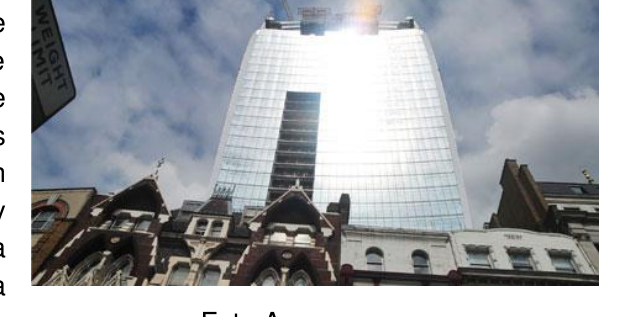
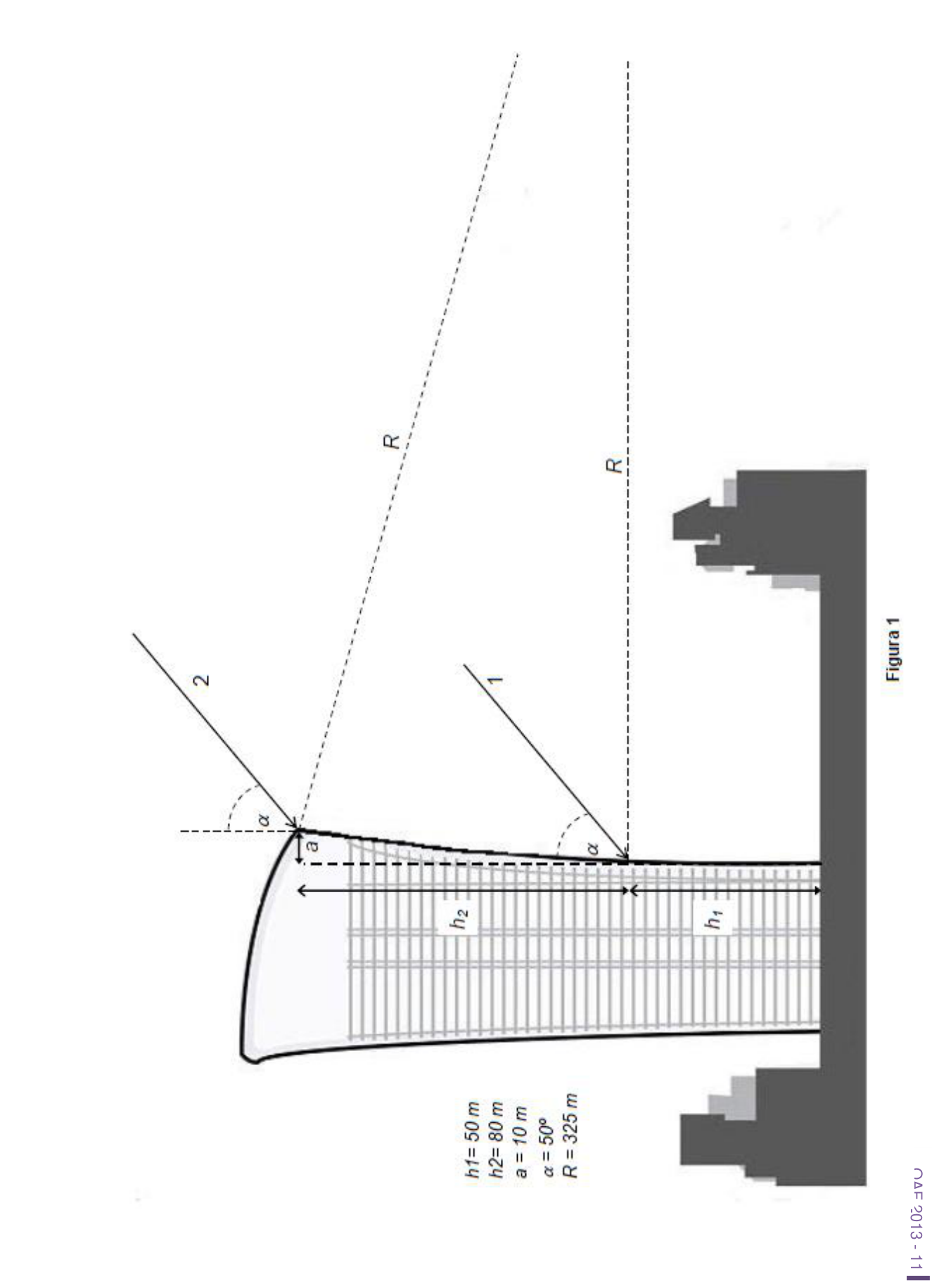
Un nuevo rascacielos de Londres, conocido informalmente como el “Walkie-Talkie” ha sido acusado de reflejar la luz que fundió las piezas de un coche estacionado en una calle cercana. Este edificio de 37 pisos diseñado por Rafael Viñoly, un arquitecto nacido en Uruguay y educado en Argentina, tiene la forma esquematizada en la Figura 1 (vista lateral de la Foto A).
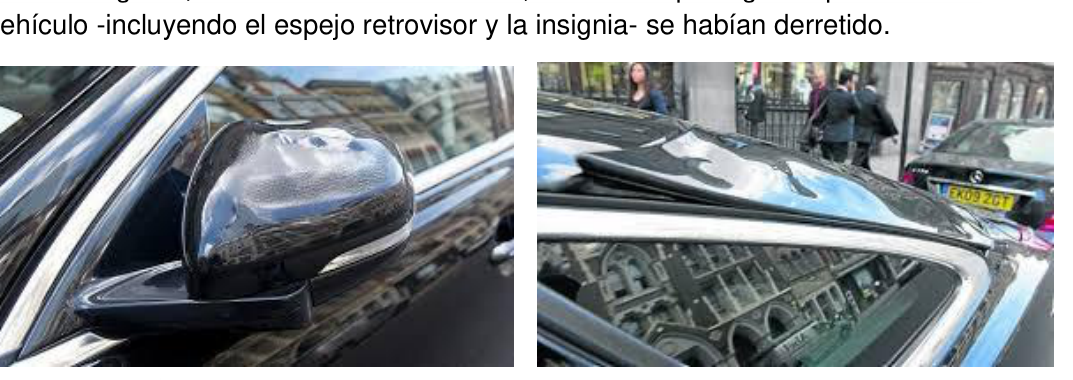
Foto A Martin Lindsay aparcó su Jaguar XJ negro en el centro financiero de Londres, también conocido como la City de Londres, el jueves 29 de agosto por la tarde. Cuando regresó, unas dos horas más tarde, descubrió que algunas partes de su vehículo -incluyendo el espejo retrovisor y la insignia- se habían derretido. Foto B
Foto C
La compañía de seguros de la empresa constructora, le ha encargado a Ud. que
determine si estos hechos son factibles para responder a los reclamos
económicos del damnificado.
Para ello los constructores le han facilitado el esquema de la Figura 1 que
representa una vista lateral del edificio, las dimensiones relevantes y algunas
características a tener en cuenta, a saber:
- En los primeros 50 m de altura el edificio es recto.
- En los últimos 80 metros, el perfil responden a una curvatura de radio R = 325 m
- A la hora que sucedió el hecho, los rayos solares inciden formando un ángulo de 50º respecto a la normal al suelo. Para cumplir con la tarea, le sugerimos realizar las siguientes consignas: a) Calcule a qué distancia del pie del edificio incide el rayo 1 reflejado.
OAF 2013 - 10 b) Calcule el ángulo que forma la recta tangente a la superficie del edificio con la normal al suelo en el punto de incidencia del rayo 2 . c) Calcule a qué distancia del pie del edificio incide el rayo 2 reflejado. d) Calcule el largo de la región donde se concentra la luz reflejada en el piso. e) Sabiendo que la intensidad de radiación solar promedio que llega a la superficie de la Tierra es de 198 W/m2 y que la reflectividad de la superficie del edificio es del 50%, calcule la intensidad de radiación en el sector iluminado. f) Sabiendo que el espejo retrovisor del auto está confeccionado con PBT, cuyas propiedades están dadas en la Tabla 1, y teniendo en cuenta que de acuerdo a la información brindada por Jaguar el volumen de PBT del espejo es V = 0.0005 m3 y que la superficie expuesta a la luz es S = 0.02 m2, calcule cuanto tiempo debe permanecer estacionado el auto para que comience a deformarse el espejo. (Suponga que la temperatura ambiente es de 20ºC)
Densidad del PBT 1.31 g/cm3 Coeficiente de absorción de radiación 70% Temperatura de inicio de deformación 90 ºC Calor específico del PBT 1500 J/(ºC kg) Tabla 1
OAF 2013 - 11
OAF 2013 - 12 Hoja de soluciones Problema 3: Rascacielos peligroso.
a)
b)
c)
d)
e)
f)
OAF 2013 - 13
Instancia Nacional Prueba Experimental
OAF 2013 - 14 Qué tubooo!!!
Marco teórico
Un tubo de Kundt es un dispositivo que permite estudiar ondas de sonido
estacionarias. El dispositivo consiste de un tubo cilíndrico, cerrado por ambos
extremos. En uno de los extremos se ubica un emisor de ondas sonoras de una
dada frecuencia ( ) y en el otro extremo, un detector de las mismas. El
funcionamiento del tubo de Kundt se basa en la generación de ondas
estacionarias en la región comprendida entre el emisor y el detector. Las ondas
estacionarias se producen al superponerse dos ondas de igual amplitud y
frecuencia ( ), que viajan paralelas al eje del tubo, una de ellas en el sentido
emisor-detector, y la otra en el sentido opuesto (esto es, en el sentido detector-
emisor). Esta última onda resulta de la reflexión de la primera onda (generada
por el emisor) en el extremo del tubo donde se encuentra ubicado el detector.
Las ondas estacionarias se caracterizan por la existencia de zonas donde la
onda tiene amplitud máxima (máximos o vientres) y otras con amplitud cero
(nodos), las cuales tienen posiciones constantes en el tiempo. El número de
nodos y máximos que se establecen dentro del tubo de Kundt depende de la
longitud del mismo y de la frecuencia de la onda emitida; sin embargo la
velocidad de propagación ( ) de la onda permanece constante. La distancia
existente entre dos nodos consecutivos, o entre dos máximos consecutivos,
siempre es igual a media longitud de onda.
La velocidad de propagación de la onda está relacionada con su longitud de
onda y con su frecuencia por la expresión:
[1]
Entonces, en base a la ecuación [1], un tubo de Kundt permite realizar mediciones para determinar la velocidad del sonido.
Descripción del dispositivo de medición El tubo de Kundt que se presenta aquí consiste de una cavidad cilíndrica, cuyos extremos están limitados por un emisor y por un detector de ondas de ultrasonido. La posición del detector se encuentra fija mientras que el emisor se encuentra ubicado en un émbolo cuya posición puede variarse respecto del detector. Esto permite variar la distancia entre el emisor y el detector y, por lo tanto, la longitud de la cavidad cilíndrica. El émbolo está montado sobre un Ondas estacionarias en un tubo Tubo ( cavidad) nodo máximo /2 /2 emisor detector Figura 1
OAF 2013 - 15 calibre (Ver Uso Calibre en Apéndice), mediante el cual se puede medir la separación entre dos posiciones diferentes del mismo Ver Figura 2.
Terminales de la
resistencia
Multímetro
posicionado para
medir
Perilla P, para
cambiar el valor
de
Figura 2
Terminales de
voltaje
Multímetro posicionado
para medir voltajes
OAF 2013 - 16 Emisor El emisor es un dispositivo que genera ondas sonoras en el rango de frecuencias entre 37000Hz y 42000Hz. El emisor se encuentra conectado a un circuito electrónico que permite variar la frecuencia de la onda de ultrasonido. Se puede modificar la frecuencia de la onda generada variando el valor de la resistencia que está conectada al mismo. La relación entre la frecuencia y el valor de la resistencia está dada por la siguiente fórmula:
[2]
donde está dada en kilo Hertz ( ) y en kilo Ohm ( ). Los valores de a y b son:
Nota:
Recuerde que la letra significa kilo = 1000 = 103
El valor de resistencia se puede ajustar rotando la perilla P (ver Figura 2) y se puede determinar utilizando un multímetro colocado en función de óhmetro () (Ver Uso Multímetro en Apéndice)
Detector Es un dispositivo que transforma la amplitud de ondas de ultrasonido a una señal de voltaje eléctrico continuo. Este voltaje se puede medir con un multímetro colocado en la función voltímetro (DCV) (Ver Uso Multímetro en Apéndice).
Funcionamiento Al fijar un valor de la resistencia conectada al generador de ondas, el emisor emite una onda de ultrasonido cuya frecuencia f está determinada por la ecuación [2], y se establecen ondas estacionarias en la cavidad cilíndrica. Modificando la posición del embolo se varía la longitud de la cavidad; cuando la distancia ( ) que separa el emisor del detector es un número entero de semi- longitudes de onda se tiene la denominada condición de resonancia, esto es cuando:
(n es: 1,2,3,4,…)
[3]
Por lo tanto, si se cambia , cambia la cantidad de nodos y máximos en el interior de la cavidad. Esto produce que la señal registrada por el detector varíe, alcanzando valores máximo o mínimos, dependiendo si la posición del detector se corresponde a un máximo o a un nodo de la onda estacionaria.
OAF 2013 - 17
Objetivo:
Determinar la velocidad del sonido.
Consignas
Parte 1
A- Determinar el rango de resistencias que está asociado al rango de
frecuencias ( ) en las que trabaja el equipo. Usar la ecuación 2.
B- Posicionar la perilla P de modo de leer en el multímetro un valor de que
esté dentro del rango de trabajo del equipo. Registrar este valor ( ) con
su correspondiente incerteza.
C- Determinar, usando la ecuación 2, el valor de frecuencia asociado a
. Registrar este valor ( ). con su correspondiente incerteza.
D- Repetir el procedimiento anterior para otros dos valores de resistencia
y . Registrar estos valores y los valores de frecuencia y
correspondientes
Parte 2
E- Posicionar la perilla P de modo de leer en el multímetro uno de los
valores de elegidos ( ).
F- Determinar la posición de un nodo, registrar esta posición.
G- Mover el émbolo y determinar el desplazamiento del emisor
correspondiente a detectar 5 nodos consecutivos de la cavidad cilíndrica.
H- Determinar la longitud de onda.
I- Calcular la velocidad del sonido.
Nota:
-Para realizar las mediciones de voltaje, conecte los cables de tal manera de
obtener una lectura positiva en el display.
- Los nodos están asociados a valores absolutos mínimos de voltaje; estos valores no necesariamente son nulos y tampoco son todos iguales.
- Los valores de voltaje pueden verse afectados por el contacto del operador con el equipo, para que el dato de voltaje sea más confiable no se debe tocar el equipo al registrar dicho valor.
Parte 3 J- Posicionar la perilla P de modo de leer en el multímetro otro de los valores de elegido ( ). K- Ubicar el emisor en una posición correspondiente a un nodo y registrar esta posición como posición inicial. L- Desplazar el emisor de la posición inicial una distancia que se corresponda al siguiente nodo, registrar esta posición. Desplazar nuevamente el embolo hasta el siguiente nodo y registrar esta posición. Realizar este procedimiento al menos 7 veces, esto es desplazar el embolo para encontrar la posición de 7 nodos consecutivos y registrarlas. M- Graficar las posiciones registradas en función del número de nodos que se detectan al desplazar el emisor. N- Ajustar los puntos graficados mediante una recta. O- Determinar la pendiente de la recta y determinar la longitud de onda del sonido dentro del tubo. P- Calcular la velocidad del sonido.
Parte 4 Q- Posicionar la perilla P de modo de leer en el multímetro el tercer valor de resistencia elegido ( ). R- Medir la variación de la señal de voltaje en la salida del detector en función de la posición del émbolo. Realizar el muestreo con intervalos no
OAF 2013 - 18 mayores a 0.5 mm para un rango no inferior a 20mm. Medir aproximadamente 40 valores. S- Hacer un grafico con los valores de voltaje medidos en función de las posiciones del émbolo. T- Determinar la longitud de onda utilizando el gráfico. U- Calcular la velocidad del sonido.
Parte 5 V- Comparar los valores de la velocidad del sonido encontrados. Determinar si estos valores son distinguibles o indistinguibles.
Apéndice:
Uso del calibre
El calibre provisto tiene una apreciación de 0,02mm.
A continuación se describe brevemente como realizar una lectura en el calibre.
Ubicar el cero del nonio (vernier, reglita desplazable)
Leer en la escala milimetrada la cantidad de milímetros que mejor aproxima (por debajo) a la posición del cero del nonio (M).
Determinar la raya del nonio que “coincide” con una correspondiente a la escala milimetrada. Contar el número de divisiones (N) que hay entre el cero del nonio y la raya que “coincide”.
Informar la lectura (M +N0.02) mm. En el ejemplo de la figura, la lectura es: (2+350.02)mm= 2,70mm.
Uso del multímetro A continuación se describe brevemente como realizar una lectura de resistencia.
Verificar que por la resistencia no esté circulando corriente (apagar la fuente).
Ubicar la perilla indicadora en el mayor valor de la escala de ohmios ().
Conectar los cables provistos en los lugares de conexión indicados como COM (cable negro) y en VHz (cable rojo).
Conectar o apoyar firmemente cada uno de los extremos libres de estos cables en los extremos de la resistencia desconocida.
Leer el display. Cambiar la escala, de ser posible, para aumentar la
precisión.
A continuación se describe brevemente como realizar una lectura de voltaje.
Ubicar la perilla indicadora en el mayor valor de la escala de VCC (V—).
Conectar los cables provistos en los lugares de conexión indicados como COM (cable negro) y en VHz (cable rojo).
Conectar o apoyar firmemente cada uno de los extremos libres de estos cables en los terminales en donde se desea medir el voltaje. Leer el display. Cambiar la escala, de ser posible, para aumentar la precisión.
OAF 2013 - 19 Hoja de soluciones
Parte 1 A-
Rango de resistencias.
B- Valor de con su correspondiente incerteza.
C- Valor de con su correspondiente incerteza.
D-
Valores de resistencia y con sus correspondientes incertezas
Valores de frecuencia y con sus correspondientes incertezas
Parte 2 E- NO TIENE PUNTAJE.
F-
Posición de un nodo
G-
El desplazamiento del emisor correspondiente a 5 nodos consecutivos
de la cavidad cilíndrica.
H- Longitud de onda. I- Valor de velocidad del sonido obtenido.
OAF 2013 - 20 Parte 3 J- NO TIENE PUNTAJE.
K- Posición correspondiente a un nodo (posición inicial).
L- Posiciones de 7 nodos consecutivos.
M- Gráfico. HOJA MILIMETRADA
N- Ajustar los puntos graficados mediante una recta. HOJA MILIMETRADA.
O- Pendiente de la recta y longitud de onda del sonido
P- Valor de velocidad del sonido obtenido. Parte 4 Q- NO TIENE PUNTAJE.
R- TABLA DE DATOS
OAF 2013 - 21
OAF 2013 - 22
S- Grafico HOJA MILIMETRADA
T- Longitud de onda obtenida a partir del gráfico.
U- Valor de velocidad del sonido obtenido. Parte 5 V- Son distinguibles o indistinguibles.
OAF 2013 - 23
Primer Prueba Preparatoria Mecánica
OAF 2013 - 24 Problema Teórico 1
Suponga dos cuerpos de masas m1 y m2
colgados, mediante hilos inextensibles y de
masa despreciable, como se muestra en la
figura.
a) Determine la tensión que soporta
cada uno de los hilos.
Considere la situación siguiente: la masa m2
se eleva una altura h (verticalmente) a partir
de la cual se la suelta. Suponiendo que los
hilos soportan una tensión máxima Tc (antes
de romperse) y que el proceso de
rompimiento se produce en un tiempo t*:
b) Cuál de los hilos se romperá primero?
Justifique
c) Cuál es la máxima altura que puede
elevarse la masa m2 antes de que se
den las condiciones para el
rompimiento del hilo?
Se reemplaza el hilo que une a m1 con m2
por un resorte de constante elástica k y
longitud natural l0.
d) Calcule el estiramiento del resorte que une ambas masas cuando el sistema está en equilibrio. Suponga que se eleva la masa m2 una altura h (en forma vertical).
e) Determine la tensión que soporta el hilo en términos del estiramiento del resorte que une ambas masas.
m1
m2
m1
m2
h
OAF 2013 - 25 Problema Teórico 2
Considere una viga de largo L y masa mb, apoyada como se muestra en la
figura 1.
a) Determine la reacción de cada uno de los apoyos (A1 y A2). Suponga que sobre la biga se apoya un cuerpo de masa mc.
b) Calcule la reacción de cada uno de los apoyos en función de la posición del objeto. En el caso a), si los apoyos de la viga consisten en resortes de constantes elásticas k1 y k2:
c) Encuentre las longitudes naturales de cada uno de los resortes para que la viga permanezca horizontal.
A1 mc A2 L1
L2
L3
A1 A2 L1 L2
Figura 1 Figura 2
OAF 2013 - 26 Problema Teórico 3
Una partícula puntual de masa m1 cae por la rampa de la figura e impacta contra otra partícula puntual de masa m2 que está suspendida mediante un hilo de largo L.
a) Si el choque es elástico (o sea que se conserva la energía mecánica), determine la amplitud de la oscilación de la masa que pendula y la componente horizontal de la velocidad de la masa m1 luego del choque. b) Si el choque es plástico (o sea que no se conserva la energía mecánica) y ambas partículas quedan pegadas, determine la amplitud de la oscilación de la masa que pendula. c) Calcule la frecuencia de oscilación del péndulo en cada uno de los casos anteriores. Suponga que m1 es mayor que m2.
m1
L
m2
OAF 2013 - 27 Problema Teórico 1 Hoja de respuestas.
Inciso
puntaje a)
b)
c)
d)
e)
OAF 2013 - 28 Problema Teórico 2 Hoja de respuestas.
Inciso
puntaje a)
b)
c)
OAF 2013 - 29 Problema Teórico 3 Hoja de respuestas.
inciso
puntaje a)
b)
c)
OAF 2013 - 30
Problema Experimental
Determinación del ángulo de reposo de materiales granulados.
Elementos disponibles
Acrílico (caja de CD)
Cinta adhesiva de papel
Un marcador (en lo posible indeleble)
Una regla, transportador.
Hojas en blanco, lápiz.
Una trincheta o cuchillo (para cortar las pestañas de acrílico). Recuerde
que su uso es peligroso y debe tener el máximo cuidado; en lo posible
esta tarea debe ser supervisada por el docente.
Un pequeño embudo de plástico o de papel
Sal fina, entrefina (parrillera) y gruesa.
Azúcar.
Balanza (optativa)
Figura 1. Consigna 1 Armar el aparato de medición (celda de Hele-Shaw). Procedimiento
- Desarme la caja de CD, quedándose sólo con las caras transparentes. Figura 1.
- Con la trincheta, haciendo presión, corte las pestañas de acrílico que hay en su interior (las que sostenían el plástico sobre el que va apoyado el CD).
- Corte la franja de las placas que corresponde a las pestañas en donde están las “bisagras” de la caja. Esta tarea es difícil y puede ser peligrosa, pida el asesoramiento del profesor.
- Una ambas placas, como si fuese a armar nuevamente la caja. Asegúrela y selle los bordes (excepto la boca) con la cinta adhesiva de papel. Figura
OAF 2013 - 31 Consigna 2 Determinar el ángulo de reposo de materiales granulados.
Figura 2 Procedimiento
- Determinar el ángulo de reposo de la sal fina.
- Cargue la “celda” con sal fina (mediante el embudo) hasta aproximadamente la mitad de su altura. Figura 3a.
- Sin que se pierda su contenido rote la celda hasta lograr que se forme una superficie plana horizontal. Figura 3b.
- Vuelva la celda a la posición de trabajo, rotándola suavemente. Figura 3c.
- Determine el ángulo de reposo de la sal fina.
- Repita este procedimiento, al menos 10 veces.
Consigna 3
- Determinar el ángulo de reposo de la sal entre-fina (parrillera), sal gruesa y del azúcar.
Figura 3a Figura 3b Figura 3c
OAF 2013 - 32 Consigna 4
- Determinar la densidad aparente de cada una de las “sales” usadas y, también, la del azúcar.
- Llene con sal un recipiente de volumen conocido.
- Determine la masa de sal empleada para llenar el recipiente.
- Calcule la densidad aparente de los materiales granulados que usó (sal, etc.).
Consigna 5
- Confeccionar un grafico “ángulo de reposo (ordenada) versus densidad aparente (abscisa)”
OAF 2013 - 33 Problema Experimental Hoja de respuestas. Consigna 1 inciso
puntaje
Dispositivo construido.
Consignas 2 y 3 inciso
puntaje
Tabla de valores medidos, correspondientes al ángulo de reposo de cada sal usada y del azúcar.
Consigna 4 inciso
puntaje
Tabla de valores medidos, correspondientes a la densidad aparente de cada una de las “sales” usadas y, también, la del azúcar.
Consigna 5 inciso
puntaje
Grafico “ángulo de reposo versus densidad aparente”
OAF 2013 - 34
Segunda Prueba Preparatoria Termodinámica, Electricidad y Magnetismo
OAF 2013 - 35 Problema Teórico 1
En un recipiente se han medido 300 cm3 de tolueno a la temperatura de 0 ºC y en otro recipiente se han medido 110 cm3 de tolueno a la temperatura de 100 ºC. El coeficiente de dilatación cúbica del tolueno es = 10-3 ºC-1. Se supone que en la mezcla de los líquidos no hay pérdidas de calor con el exterior. Si se mezclan los dos líquidos encuentre: a) una expresión para el Volumen de tolueno a 100 oC en función del volumen de tolueno a 0 oC, V0, y del coeficiente de dilatación cúbica b) la densidad del tolueno a 100 oC, c) la temperatura de equilibrio de la mezcla, d) la densidad del tolueno a la temperatura de equilibrio, e) el volumen de la mezcla,
OAF 2013 - 36 Problema Teórico 2
Una bombilla eléctrica de resistencia Ro = 2 funciona a un voltaje Uo= 4,5 V. Se conecta a una batería de resistencia interna despreciable y fuerza electromotriz U = 6 V mediante un reóstato de cursor que funciona como un potenciómetro. Se desea que la eficiencia (e = potencia consumida en la bombilla / Potencia total de la batería) no sea menor que 0,6.
a) Calcular el valor de la resistencia del reóstato.
b) ¿Cuál es la máxima eficiencia posible?
c) En la situación del inciso b) ¿Cómo se debe conectar la bombilla al
reóstato?
El esquema del circuito eléctrico es el de la figura 1.
OAF 2013 - 37 Problema Teórico 3
Un electrón de carga q = -1.6 x 10⁻¹⁹ C se mueve con una velocidad v = (0.5 x 10⁵ i + 0.5 x 10⁵ j) (m/s). En el momento en que pasa por el punto de coordenadas (1, 1) calcular:
a) El campo magnético B que el electrón crea en los puntos (-1, -1) y (0, 2).
La fuerza que sufre un protón situado en el punto (0, 2) si lleva una velocidad:
b) v = 2 x 10⁵ k (m/s)
c) v = 2 x 10⁵ j (m/s)
Datos: 0 = 4 x 10⁻⁷ Tm/A (Nota: los símbolos en negrita denotan vectores)
OAF 2013 - 38 Problema Teórico 1 Hoja de respuestas.
inciso
puntaje a)
V100 =
2p b)
100 =
2p c)
Te =
2p d)
equilibrio =
1p e)
Vmezcla =
3p
OAF 2013 - 39 Problema Teórico 2 Hoja de respuestas.
inciso
puntaje a)
R =
4p b)
emax =
4p c)
Diagrama
2p
OAF 2013 - 40 Problema Teórico 3 Hoja de respuestas.
inciso
puntaje a)
B(-1, -1) =
B( 0, 2) =
4p b)
v =
3p c)
v =
3p
OAF 2013 - 41 Problema Experimental Objetivo:
- Estudiar la potencia calórica de una vela.
Breve descripción
Una vela es un cilindro de cera con un pabilo en el eje para que pueda encenderse y como resultado de la combustión de la cera irradiar luz y calor. La llama de la vela tiene diferentes temperaturas (ver la figura) e irradia calor y luz en todas direcciones. Sin embargo, por el mecanismo de convección, el calor principalmente fluye en la dirección vertical (hacia donde apunta la llama). Figura 1
El flujo de calor que emite la
vela en la dirección de su eje
(vertical) se puede estudiar
mediante el dispositivo que
se esquematiza en la Figura
2. El mismo consiste de un
cubito de hielo, apoyado
sobre una chapa metálica
fina, que está ligeramente
inclinada. Por debajo de la
chapa y en coincidencia con
un eje que pasa por el centro
del cubito se coloca la vela.
La llama de esta última está
a una distancia d de la
chapa. En el extremo inferior
de la chapa se ubica una
jeringa graduada, sin émbolo
y con el extremo fino (donde
va la aguja) tapado (podría
ser reemplazada por una
probeta).
El agua producida por la fusión del hielo se recolecta en la jeringa y se determina
su volumen Va. Determinando Va en función del tiempo (t) y sabiendo el calor
latente del hielo (80cal/g), se puede estimar la cantidad de energía por unidad de
tiempo (potencia) que le ha llegado al hielo proveniente de la vela.
vela jeringa hielo chapa d agua Figura 2 plastilina
OAF 2013 - 42
Consignas
a) Enuncie algunas de las hipótesis que se han realizado en la descripción
previa y que no se han enunciado explícitamente. Algunas que
involucran a la chapa y se relacionan con sus dimensiones. Otras que
se relacionan con la temperatura del ambiente, del hielo, del agua.
b) Mida la temperatura ambiente.
c) Implemente el dispositivo propuesto.
d) Mida el aporte de calor proveniente del ambiente. Determine si es
despreciable o no.
e) Realice las mediciones de Va en función de t para, al menos, tres
distancias chapa-llama (d) diferentes. Cada conjunto debe estar
compuesto por no menos de diez pares (t, Va).
f) Haga un gráfico t vs masa de hielo fundido, correspondiente a cada
distancia d. Verifique si el comportamiento es aproximadamente lineal,
en tal caso ajuste una recta.
g) A partir de los gráficos anteriores estime la potencia (P) recibida por el
cubito de hielo en cada caso.
h) Presente estos resultados en un grafico (d vs P). Extrapole estos
resultados al valor d=0 y determine un valor PM.
Elementos que pueden resultar de utilidad:
- Chapa metálica fina (espesor despreciable).
- Cubitos de hielo (al menos 3).
- Plastilina (para evitar que el hielo deslice como consecuencia de la pendiente con la que se ha puesto la chapa).
- Vela (marca Ranchera o de calidad equivalente).
- Regla, papel milimetrado o cuadriculado, lápiz.
- Jeringa graduada de 10ml o más.
- Cronómetro.
- Soportes, pinzas de madera (tipo broches de los de colgar la ropa).
- Recipientes para agua.
OAF 2013 - 43 Problema Experimental Hoja de respuestas.
Consigna inciso
puntaje a) Hipótesis
b) Valor
c)
Esquema y elementos utilizados
d)
Método utilizado, resultados.
e)
Tablas de mediciones.
f)
Gráficos
g)
Tabla de resultados
h)
Gráfico y valor obtenido de PM
OAF 2013 - 44
Instancias Locales Problemas Teóricos
OAF 2013 - 45
Topic: Geometric Optics Metodi: Ray Tracing, Thin Lens & Mirror Equation Competenze: Physical Reasoning, Mathematical Modeling Objects: Mirror Fonte: Testo (PDF) — p.3
**Riscassari pericolosi (Walkie-Talkie) **
Problema 3
Scattezze pericolose.
Un nuovo palazzo di Londra, Conosciuto informalmente Come el “Walkie-Talkie” è stato accusato di riflettere la luce che ha fonduto i pezzi di Una macchina parcheggiata in una strada
- Non è che. Questo edificio di 37 piani progettato Per Raphael . Viñoly, un Architetto nato in Uruguay e educato in Argentina, ha la forma Il modello di riferimento è stato illustrato in figura 1 (vedere la parte laterale della Foto A).
Foto A Martin Lindsay ha parcheggiato la sua Jaguar XJ nera nel centro finanziario di Londra. nota anche come la City di Londra, giovedì 29 agosto pomeriggio. Quando tornò, circa due ore dopo, scoprì che alcune parti del suo Il veicolo - compreso lo specchio retrovisore e la segnaletica - si era sciolto. Foto B
Foto C La compagnia di assicurazione della società costruttrice, ha incaricato te di fare questo. che determinare se tali fatti sono fattibili per rispondere ai reclami
- La situazione economica del malato. Per questo i costruttori hanno fornito il schema di figura 1 che rappresenta una vista laterale del edificio, le dimensioni rilevanti e alcune caratteristiche da tenere conto, in particolare:
- Alti 50 metri, l’edificio è retto.
- Negli ultimi 80 metri, il profilo risponde ad una curvatura radio R = 325 m
- L’ora in cui è successo, i raggi solari incidono formando un angolo di 50° rispetto al normale sul suolo. Per fare il compito, ti consigliamo di fare le seguenti consigli: a) Calcolare la distanza dal piede del edificio che incide il raggio 1 riflesso.
OAF 2013 - 10 b) Calcolare l’angolo che forma la retta tangente alla superficie del Un edificio con la normalità sul suolo al punto di incidenza del raggio 2 . c) Calcolare la distanza dal piede del edificio che incide il raggio 2 riflesso. d) Calcolare la lunghezza della regione in cui si concentra la luce riflessa nel
- Piano. e) sapendo che l’intensità media di radiazione solare che raggiunge la La superficie della Terra è di 198 W/m2 e la riflettività della La superficie del edificio è del 50%, calcola l’intensità di radiazione in il settore illuminato. f) sapendo che il retrovisore della macchina è realizzato con PBT, Le proprietà di cui al punto 1 sono indicate in tabella 1, e considerando che Secondo le informazioni fornite da Jaguar il volume di PBT del lo specchio è V = 0,0005 m3 e la superficie esposta alla luce è S = Calcola quanto tempo deve rimanere parcheggiato. per iniziare a distorsione dello specchio. (Supponiamo che la temperatura ambiente è di 20°C)
Densità del PBT 1.31 g/cm3 Coefficiente di assorbimento delle radiazioni 70% Temperatura di inizio di deformazione 90 ºC Calore specifico del PBT 1500 J/(ºC kg) Tabella 1
OAF 2013 - 11
OAF 2013 - 12 Scheda di soluzione problema 3: pericolose scintillature.
a)
b)
c)
d)
e)
f)
OAF 2013 - 13
Instanza nazionale Prova sperimentale
OAF 2013 - 14 Che tubooo!!!
Marco teorico Un tubo Kundt è un dispositivo che permette di studiare le onde sonore.
- Stazionari. Il dispositivo consiste in un tubo cilindrico, chiuso da entrambi. estremi. In uno degli estremi si trova un emissione di onde sonore di una la frequenza () e all’altra estremità un rilevatore delle stesse. El Il funzionamento del tubo Kundt si basa sulla generazione di onde i dispositivi di stazionamento nella regione compresa tra l’emittente e il rilevatore. Le onde Le onde stazionarie si producono superponiendo due onde di uguale ampiezza e frequenza (), che viaggiano parallele all’asse del tubo, una delle quali in senso Il sistema di emissione è stato modificato in modo da consentire l’emissione di un’emissione di un’emissione di un’emissione di un’emissione di un’emissione di un’emissione di un’emissione di un’emissione di un’emissione di un’emissione di un’emissione di un’emissione di un’emissione di un’emissione di un’emissione di un’emissione di un’emissione di un’emissione di un’emissione di un’emissione di un’emissione di un’emissione di un’emissione di un’emissione di un’emissione di un’emissione di un’emissione di un’emissione di un’emissione di un’emissione di un’emissione di un’emissione di un’emissione di un’emissione di un’emissione di un’emissione di un’emissione di un’emissione di un’emissione di un’emissione di un’emissione di un’emissione di un’altra. emittente). Questa ultima onda è il risultato della riflessione della prima onda (generata) per l’emissione) all’estremità del tubo dove si trova il rilevatore.
Le onde stazionarie sono caratterizzate dall’esistenza di zone in cui l’onda stazionaria è L’onda ha l’ampiezza massima (massimi o ventri) e altre con l’ampiezza zero (nodoli), che hanno posizioni costanti nel tempo. Il numero di I nodi e i massimi che si stabiliscono all’interno del tubo di Kundt dipendono dalla La lunghezza stessa e la frequenza dell’onda emessa; tuttavia la La velocità di diffusione ( ) dell’onda rimane costante. La distanza esistente tra due nodi consecutivi o tra due massimi consecutivi, E’ sempre uguale alla media lunghezza d’onda. La velocità di diffusione dell’onda è correlata alla sua lunghezza di onda e con la sua frequenza per l’espressione:
[1]
Quindi, basandosi sull’equazione [1], un tubo di Kundt permette di eseguire misurazioni per determinare la velocità del suono.
Descrizione del dispositivo di misura Il tubo di Kundt che si presenta qui è costituito da una cavità cilindrica, Le estremità sono limitate da un emisore e da un rilevatore di onde di Ultrasonico. La posizione del rilevatore è fissa mentre l’emittente si si trova situato su un emblema la cui posizione può variare rispetto al
- Il rilevatore. Questo permette di variare la distanza tra l’emittente e il rilevatore e, quindi la lunghezza della cavità cilindrica. Il tamburo è montato su un onde stazionarie in un tubo Tubo (cavità) nodo massimo /2 /2 emittente Detettore Figura 1
OAF 2013 - 15 calibro (vedi Uso calibro nell’Appendice), con il quale si può misurare la Sezione 2 del medesimo grafico.
Termini della
resistenza
Multimetro
posizionato per
Misurare
Perilla P, per
Cambiare il valore
de
Figura 2
Termini di
Voltaggio
Multimetro posizionato
per misurare le tensioni
OAF 2013 - 16 Ismettitore L’emittente è un dispositivo che genera onde sonore nella gamma di frequenze comprese tra 37000 Hz e 42000 Hz. L’emittente è collegata a un circuito elettronico che permette di variare la frequenza dell’onda ultrasuonica. La frequenza dell’onda generata può essere modificata variando il valore di resistenza che è collegata a esso. Il rapporto tra frequenza e valore della resistenza è dato dalla formula seguente:
[2]
dove è data in kilo Hertz ( ) e in kilo Ohm (). I valori di a e b sono:
Nota: Ricorda che la lettera significa kilo = 1000 = 103
Il valore di resistenza può essere regolato rotando il perilo P (vedi Figura 2) e si può determinare utilizzando un multimetro posizionato in funzione di óhmetro () (Vedere Uso del multimetro nell’appendice)
- Il rilevatore È un dispositivo che trasforma l’ampiezza delle onde ultrasonore in un segnale. di tensione continua elettrica. Questo tensione può essere misurata con un multimetro inserito nella funzione voltometro (DCV) (vedere Uso multimetro nell’Appendice).
Funzionamento Quando si fissa un valore di resistenza collegato al generatore d’onda, l’emittente emette un’ onda ultrasonora la cui frequenza f è determinata dalla equità [2], e si stabiliscono onde stazionarie nella cavità cilindrica. Modificare la posizione dell’embolo varia la lunghezza della cavità; quando il La distanza ( ) che separa l’emissione dal sensore è un intero numero di semiconduzioni Le lunghezze d’onda hanno la cosiddetta condizione di risonanza, cioè quando:
(n es: 1,2,3,4,…)
[3]
Quindi, se si cambia, cambia il numero di nodi e massimi nel all’interno della cavità. Questo provoca che il segnale registrato dal rilevatore varia, raggiungendo valori massimi o minimi, a seconda che la posizione del rilevatore corrisponde a un massimo o a un nodo dell’onda stazionaria.
OAF 2013 - 17 Obiettivo: Determinare la velocità del suono. Consigne
Parte 1 A- Determinare il grado di resistenza associato al grado di resistenza frequenze ( ) in cui il team opera. Usare l’equazione 2. B- Posizione della pelle P in modo da leggere sul multimetro un valore di è entro il campo di lavoro della squadra. Registrare questo valore ( ) con la sua corrispondente incertezza. C- Determinare, usando l’equazione 2, il valore di frequenza associato a . Registrare questo valore (). con la sua corrispondente incertezza. D- Ripetere la procedura precedente per altri due valori di resistenza y . Registrare questi valori e i valori di frequenza e corrispondenti
Parte 2 E- Posizione della perla P in modo da leggere sul multimetro uno dei Valori di scelte (). F- Determinare la posizione di un nodo, registrare questa posizione. G- Movere l’embolo e determinare il spostamento dell’emittente per rilevare 5 nodi consecutivi della cavità cilindrica. H- Determinare la lunghezza d’onda. I- Calcolare la velocità del suono. Nota:
- Per effettuare le misurazioni di tensione, collegare i cavi in modo tale da ottenere una lettura positiva sul display.
- I nodi sono associati a valori assoluti di tensione minima; I valori non sono necessariamente nulli e non sono tutti uguali.
- I valori di voltazione possono essere influenzati dal contatto dell’operatore con l’apparecchio, per rendere il dato di voltage più affidabile non si deve toccare il il valore di cui al punto 1.
Parte 3 J- Posizionare la perla P in modo da leggere il multimetro di un altro Valori di scelto (). K- Posizionare l’emittente in una posizione corrispondente a un nodo e registrare la posizione iniziale. L- spostare l’emittente della posizione iniziale una distanza che si corrisponde al nodo successivo, registrare questa posizione. - Si spostano . Ritorna l’embolo al nodo successivo e registra questa posizione. Fare questo procedimento almeno 7 volte, cioè spostare il per trovare la posizione di 7 nodi consecutivi e registrarli. M- Grafizzare le posizioni registrate in base al numero di nodi che sono rilevati spostando l’emittente. N- Aggiustare i punti graficati con una retta. O- Determinare l’inclinazione della retta e determinare la lunghezza d’onda della il suono dentro il tubo. P- Calcolare la velocità del suono.
Parte 4 Q- Posizione della perla P in modo da leggere sul multimetro il terzo valore di resistenza scelta (). R- Misurare la variazione del segnale di voltazione all’uscita del rilevatore in funzione della posizione dell’embolo. Prendere il campionamento con intervalli non
OAF 2013 - 18 di dimensioni superiori a 0,5 mm per un intervallo non inferiore a 20 mm. Misurare circa 40 valori. S- Fare un grafico con i valori di voltage misurati in base alle posizioni del tamburo. T- Determinare la lunghezza d’onda utilizzando il grafico. U- Calcolare la velocità del suono.
Parte 5 V- Confronta i valori della velocità del suono trovati. Determinare se questi valori sono distinguibili o indistinguibili.
Appendice: Utilizzare il calibro Il calibro fornito ha un’apprezzamento di 0,02 mm. In seguito è descritto brevemente come eseguire una lettura in calibro.
Localizzazione del nonio (vernier, regolato mobile)
Leggi su scala millimetrica il numero di millimetri che meglio si avvicina (sotto) alla posizione di zero di nonio (M).
Determinare la linea di nonio che coincide con una corrispondente alla linea di nonio scala a millimetro. Contare il numero di divisioni (N) tra il Zero di nonio e la linea che coincide.
Indicare la lettura (M + N* 0.02) mm. Nell’esempio della figura, la lettura es: (2+35*0.02)mm= 2,70mm.
Uso del multimetro Qui di seguito è descritto brevemente come eseguire una lettura di resistenza.
Verificare che la resistenza non stia circolando corrente (spegnere la corrente). fonte).
Posizionare il perello indicativo nel valore più alto della scala di ommi ().
Collegare i cavi forniti nei punti di connessione indicati come COM (cabo nero) e VHz (cabo rosso).
Connettere o sostenere fermamente ogni estremità libera di questi Cavi a estremità di resistenza sconosciuta.
Leggere il display. Cambiare la scala, se possibile, per aumentare la
- Precisione. In seguito è descritto brevemente come eseguire una lettura di tensione.
Posizionare il perello indicativo nel valore più alto della scala VCC (V—).
Collegare i cavi forniti nei punti di connessione indicati come COM (cabo nero) e VHz (cabo rosso).
Connettere o sostenere fermamente ogni estremità libera di questi i cavi nei terminali in cui si desidera misurare la tensione. Leggere il display. Cambiare la scala, se possibile, per aumentare la precisione.
OAF 2013 - 19 Pagina di soluzioni
Parte 1 A-
Rango di resistenza.
B- Valore con la sua corrispondente incertezza.
C- Valore con la sua corrispondente incertezza.
D- Valori di resistenza e con i relativi incertezze Valori di frequenza e con i relativi incertezze
Parte 2 E- non ha punteggio.
F-
Posizione di un nodo
G- Il spostamento dell’emittente per 5 nodi consecutivi della cavità cilindrica.
H- Lunghezza d’onda. I- Valore di velocità del suono ottenuto.
OAF 2013 - 20 Parte 3 J- Non ha punteggio.
K- Posizione corrispondente a un nodo (posizione iniziale).
L- Posizioni di 7 nodi consecutivi.
M-Grafico. - L’aspetto è millimetrico .
N- Aggiustare i punti graficati con una retta. - La foglia millimetrica.
O- Spendiente della lunghezza d’onda del suono
P- Valore di velocità del suono ottenuto. Parte 4 Q- Non ha punteggio.
R- TABELLA DI DATI
OAF 2013 - 21
OAF 2013 - 22
S- Grafico di foglio millimetrico
T- L’onda di lunghezza ottenuta dal grafico.
U- Valore di velocità del suono ottenuto. Parte 5 V- Sono distinguibili o indistinguibili.
OAF 2013 - 23
Primo test preparativo Meccanica
OAF 2013 - 24 Problema teorico 1
Supponiamo due corpi di massa m1 e m2 Appoggiati, con fili inestensibili e di massa disprezzabile, come mostrato nella
- Figura.
a) Determina la tensione che si sopporta ogni filo. Considera la situazione seguente: massa m2 si alza un’altezza h (verticalmente) a partire da e da cui si libera. Supponendo che i I fili supportano una tensione massima Tc (precedentemente La struttura di un’impresa è stata La rottura si verifica in un tempo t*:
b) Quale filo si rompe prima? Giustifica c) Qual è la massima altezza che può
- Si può prendere il peso di un m2 prima di essere
- la condizione per il rompere il filo? Il filo che unisce m1 è sostituito da m2 per una sorgente di costante elastico k e lunghezza naturale l0.
d) Calcolare l’estensione della molla che unisce le due masse quando il Il sistema è in equilibrio. Supponiamo che la massa m2 sia sollevata ad un’altezza h (verticalmente).
e) Determina la tensione che il filo sopporta in termini di estensione del filo. una primavera che unisce le due masse.
m1
m2
m1
m2
h
OAF 2013 - 25 Problema teorico 2
Considera un viglio lungo L e con massa mb, appoggiato come mostrato in Figura 1.
a) Determina la reazione di ciascun supporto (A1 e A2). Supponiamo che sopra la biga si appoggi un corpo di massa mc.
b) Calcolare la reazione di ciascun supporto in base alla posizione dell’oggetto. In caso a), se i supporti del vigno sono costituiti da sorgenti di costanti di tipo:
(c) Trova le lunghezze naturali di ciascuna delle sorgenti per il vigillo resta orizzontale.
A1 mc A2 L1
L2
L3
A1 A2 L1 L2
Figura 1 Figura 2
OAF 2013 - 26 Problema teorico 3
Una particella puntuale di massa m1 cade dal rampo della figura e colpisce contro un’altra particella puntuale di massa m2 che è sospesa da un filo di L lungo.
a) Se il colpo è elastico (cioè si conserva l’energia meccanica), determina l’ampiezza di oscillazione della massa che pendola e la componente orizzontale della velocità di massa m1 dopo l’impatto. b) Se la collisione è plastica (cioè non si conserva l’energia meccanica) e entrambe le particelle rimangono incollate, determinando l’ampiezza della oscillazione della massa che si pendola. c) Calcolare la frequenza di oscillazione del pendolo in ogni caso precedenti. Supponiamo che m1 sia maggiore di m2.
m1
L
m2
OAF 2013 - 27 Problema teorico 1 Pagina di risposte.
Inciso
punteggio a)
b)
c)
d)
e)
OAF 2013 - 28 Problema teorico 2 Pagina di risposte.
Inciso
punteggio a)
b)
c)
OAF 2013 - 29 Problema teorico 3 Pagina di risposte.
inciso
punteggio a)
b)
c)
OAF 2013 - 30 Problema sperimentale Determinazione dell’angolo di riposo dei materiali granulati. Elementi disponibili Acrilico (cassa di CD) Tinta adesiva di carta Un marcatore (se possibile indelebile) Una regola, trasportatore. Foglie bianche, penna. Un tritone o un coltello (per tagliare le macchie di acrilico). Ricordate. che il suo uso è pericoloso e deve essere fatto con la massima attenzione; Questo compito deve essere supervisionato dal docente. Un piccolo funil di plastica o carta Sal fine, interfine e grossa. Zucchero. Balance (opzionale)
Figura 1. Consigna 1 Armarsi l’apparecchio di misurazione (cellula di Hele-Shaw). Procedura
- Sbarazzarmi della cassetta di CD, restando solo le facce trasparenti. Figura 1.
- Con la trincea, facendo pressione, taglia le macchie di acrilico che ci sono. all’interno (quelli che sostenevano il plastica su cui si appoggia il CD).
- Taglia la fascia delle placche che corrisponde alle lampadine in cui Ci sono i bisagri della scatola. Questo compito è difficile e può essere pericoloso. Chiedi il consiglio del professore.
- Una delle due targhe, come se fosse per riassemblare la scatola. Assicurati . e sigilla i bordi (esclusa la bocca) con la cinta adesiva di carta. Figura
OAF 2013 - 31 Consigna 2 Determinare l’angolo di riposo dei materiali granulati.
Figura 2 Procedura
- Determinare l’angolo di riposo del sale fino.
- Caricare la celda con sale sottile (attraverso il funile) fino a circa la metà della sua altezza. Figura 3a.
- Senza perdere il contenuto, ruota la cellula fino a che non si forma. una superficie piana orizzontale. Figura 3b.
- Ritorna la cella alla posizione di lavoro, girandola delicatamente. Figura 3c.
- Determina l’angolo di riposo del sale sottile.
- Ripeti questa procedura almeno 10 volte.
Consegna 3
- Determinazione dell’angolo di riposo del sale inter-finale (scalzone), del sale grossa e del zucchero.
Figura 3a Figura 3b Figura 3c
OAF 2013 - 32 Consegna 4
- Determinare la densità apparente di ciascuna delle sale usate e, inoltre, la zuccherina.
- Riempire di sale un recipiente di volume noto.
- Determina la massa di sale utilizzata per riempire il contenitore.
- Calcola la densità apparente dei materiali granulati che hai usato (sale, ecc.).
Consigna 5
- Confezionare un grafico angolo di riposo (ordinato) versus densità apparente (abscisa)
OAF 2013 - 33 Problema sperimentale Pagina di risposte. Consigna 1 inciso
punteggio
Dispositivo costruito.
Consigne 2 e 3 inciso
punteggio
Tabella dei valori misurati, corrispondenti all’angolo di riposo di ogni salato usato e di ogni zucchero.
Consegna 4 inciso
punteggio
Tabella dei valori misurati, corrispondenti alla densità apparente di ciascuna delle sale usate e anche quella dello zucchero.
Consigna 5 inciso
punteggio
Grafico angolo di riposo versus densità apparente
OAF 2013 - 34
Secondo test preparatorio Termodinamica, elettricità e Magnetismo
OAF 2013 - 35 Problema teorico 1
In un recipiente sono stati misurati 300 cm3 di tolueno a 0 oC e
in un altro contenitore sono stati misurati 110 cm3 di tolueno a 100 oC.
Il coefficiente di dilatazione cubica del tolueno è = 10-3 oC-1. Dovrebbe essere in
la miscela dei liquidi non ha perdite di calore con l’esterno.
Se si mescolano i due liquidi trovi:
a) un’espressione per il volume di tolueno a 100 oC in funzione del
volume di tolueno a 0 oC, V0 e coefficiente di dilatazione cubica
b) la densità del tolueno a 100 oC,
c) la temperatura di equilibrio della miscela
(d) la densità del tolueno alla temperatura di equilibrio,
e) il volume della miscela,
OAF 2013 - 36 Problema teorico 2
Una lampada elettrica di resistenza Ro = 2 funziona a un voltaggio Uo = 4,5 V. Si collega a una batteria di resistenza interna disprezzabile e forza U = 6 V tramite un reostato di cursore che funziona come un Potenzimetro. Si desidera che l’efficienza (e = potenza consumata in lampada / Potenza totale della batteria) non inferiore a 0,6.
a) Calcolare il valore della resistenza del reostato. b) Qual è la massima efficienza possibile? (c) In caso di sottoscritto (b) Come si deve collegare la lampada alla
- Un reostato?
Il diagramma del circuito elettrico è quello di cui alla figura 1.
OAF 2013 - 37 Problema teorico 3
Un elettrone carico q = -1,6 x 10⁻¹⁹ C si muove a una velocità v = (0,5 x 10⁵ i + 0.5 x 10⁵ j) (m/s). Il momento in cui passa il punto di coordinate (1, 1) calcolare:
a) Il campo magnetico B che l’elettrone crea nei punti (-1, -1) e (0, 2).
La forza che un protone situato al punto (0, 2) subisce se ha una velocità:
b) v = 2 x 10⁵ k (m/s)
c) v = 2 x 10⁵ j (m/s)
Dati: 0 = 4 x 10⁻⁷ Tm/A (Nota: i simboli in caratteri in caratteri in grassetto indicano vettori)
OAF 2013 - 38 Problema teorico 1 Pagina di risposte.
inciso
punteggio a)
V100 =
2p b)
100 =
2p c)
Te =
2p d)
equilibrio =
1p e)
- Mice =
3p
OAF 2013 - 39 Problema teorico 2 Pagina di risposte.
inciso
punteggio a)
R =
4p b)
- EMAX =
4p c)
Diagramma
2p
OAF 2013 - 40 Problema teorico 3 Pagina di risposte.
inciso
punteggio a)
B(-1, -1) =
B( 0, 2) =
4p b)
v =
3p c)
v =
3p
OAF 2013 - 41 Problema sperimentale Obiettivo:
- Studiare la potenza calorica di una candela.
Breve descrizione
Una candela è un cilindro di cera con un pavilone sull’asse per farlo
- Si può accendere e come ? Risultato della combustione della la cera irradia luce e calore. La fiamma della candela ha Le temperature diverse (vedi Figura 1) e radiare calore e luce in tutte le direzioni. Tuttavia, per il meccanismo di convezione, Il calore fluisce principalmente nella direzione verticale (in direzione di
- punta la fiamma). Figura 1
Il flusso di calore emesso dalla La vela si dirige verso l’asse. (verticale) si può studiare mediante il dispositivo che La figura è schematica 2. La stessa consiste in un un coperto di ghiaccio, appoggiato su una lastra di metallo
-
E’ un po’ più fino. inclinata. Sotto la La copertura è stata effettuata con l’aiuto di un’azienda di cui all’articolo 6 del regolamento (CE) n. Un asse che passa attraverso il centro dal cubo si pone la candela. La fiamma di quest’ultima è a una distanza d dalla
-
Lavatta. L’estremità inferiore della scheda si trova una Seringa graduata, senza embols e con l’estremità fine (dove Va la ago) tappo (potrebbe) essere sostituita da una
-
la prova). L’acqua prodotta dalla fusione del ghiaccio viene raccolta nella siringa e determinata. il volume va. Determinando il tempo di va (t) e conoscendo il calore La quantità di energia per unità di tempo che è arrivato al ghiaccio dalla vela.
-
Guarda ! Seringa ghiaccio la copertura d acqua Figura 2 plastilina
OAF 2013 - 42 Consigne a) Indicare alcune delle ipotesi che sono state fatte nella descrizione che non sono state espressamente menzionate. Alcuni che coinvolgono la lamiera e si relazionano alle sue dimensioni. Altri che sono correlati alla temperatura ambientale, al ghiaccio, all’acqua. b) Misura la temperatura ambiente. c) Implementare il dispositivo proposto. d) Misura l’apporto di calore proveniente dall’ambiente. Determina se è vero. disprezzabile o meno. e) eseguire le misurazioni di Va in base a t per almeno tre distanze di lampada-placca (d) diverse. Ogni set deve essere composto da non meno di dieci coppie (t, Va). f) Fare un grafico t vs massa di ghiaccio fuso, corrispondente a ciascuna Distanza d. Verifica se il comportamento è approssimativamente lineare, In tal caso, aggiusta una retta. g) Sulla base dei grafici precedenti, stima la potenza (P) ricevuta dal un cubito di ghiaccio in ogni caso. h) Presenta questi risultati in un grafico (d vs P). Extrapola questi. i risultati al valore d=0 e determinare un valore PM. Elementi che possono risultare utili:
- Sciacche metalliche sottili (spessore spregevole).
- Coperte di ghiaccio (almeno 3).
- Plastilina (per evitare che il ghiaccio scivoli a causa della la pendenza con cui è stata messa la lamiera).
- Vela (marchio Ranchera o di qualità equivalente).
- Regola, carta millimetrica o quadrata, penna.
- Seringa graduata di 10ml o più.
- Un cronometro.
- supporti, pinze di legno (tipo di pinze per appendere i vestiti).
- Ricevitori per l’acqua.
OAF 2013 - 43 Problema sperimentale Pagina di risposte.
Consigna inciso
punteggio a) Ipotesi
b) Valore
c)
Schema e elementi utilizzati
d)
Metodo usato, risultati.
e)
Tabelle di misura.
f)
Grafici
g)
Tabella dei risultati
h)
Grafico e valore ottenuto da PM
OAF 2013 - 44
I servizi locali Problemi teorici
OAF 2013 - 45
Topic: Geometric Optics Metodi: Ray Tracing, Thin Lens & Mirror Equation Competenze: Physical Reasoning, Mathematical Modeling Objects: Mirror Fonte: Testo (PDF) — p.3
The Commission has also adopted a number of measures to ensure that the Commission is able to take all necessary measures to ensure that the information provided is kept up to date.
Problem three .
Dangerous skyscrapers.
A new skyscraper in London, I know you . informally How el “Walkie-Talkie” has been charged with Reflect the light that melted the pieces of A car parked on a street. close. This 37-story building . Designed by Rafael .
- I’m going to go. un architect born in Uruguay and Educated in Argentina, he has the form The following is an overview of the main features of the side of photo A).
Photo A Martin Lindsay parked his black Jaguar XJ in the financial district of London. Also known as the City of London, Thursday 29th August afternoon. When he returned, about two hours later, he discovered that some parts of his The vehicle - including the rear-view mirror and the badge - had melted. Photo B
Photo C The insurance company of the construction company, has commissioned you. That determine whether these facts are feasible to respond to claims The economic situation of the damaged. For this purpose the builders have provided the diagram in Figure 1 which It represents a side view of the building, the relevant dimensions and some characteristics to be taken into account, namely:
- At the first 50 meters the building is straight.
- In the last 80 meters, the profile responds to a radial curvature R = 325 m
- At the time of the incident, the sun’s rays flashed forming a angle of 50° to the ground. To accomplish the task, we suggest you do the following: (a) Calculate how far from the foot of the building the reflected ray 1 hits.
The following is the list of the countries of the European Union: (b) Calculate the angle forming the tangent line to the surface of the Building with normal to the ground at the beam 2 incident point . (c) Calculate the distance from the foot of the building to which the reflected ray 2 hits. (d) Calculate the length of the region where the reflected light is concentrated in the The floor. (e) Knowing that the average solar radiation intensity reaching the The surface of the Earth is 198 W/m2 and the reflectivity of the The building surface is 50%, calculate the radiation intensity in The light sector. (f) Knowing that the rear-view mirror of the car is made of PBT, The following table shows the properties of the product: According to the information provided by Jaguar, the PBT volume of the The mirror is V = 0.0005 m3 and the surface exposed to light is S = 0.02 m2, calculate how long the car should be parked So the mirror starts to deform. (Suppose the The ambient temperature is 20°C)
Density of PBT 1.31 g/cm3 Radiation absorption coefficient 70% The temperature at which the deformation starts 90 ºC Heat specific to PBT 1500 J/(ºC kg) Table 1
The following is the list of the Member States’ financial statements:
The following is the list of the Member States’ financial statements: Problem 3: Dangerous skyscrapers.
a)
b)
c)
d)
e)
f)
The following is the list of the countries of the European Union:
The National Court Experimental test
The following is the list of the Member States’ financial statements: What a pipe!
Theoretical framework A Kundt tube is a device that allows you to study sound waves. The stationary ones. The device consists of a cylindrical tube, closed by both Extremes. At one end is a sound wave emitter of a The frequency (s) and at the other end, a detector of the same. El Kundt tube operation is based on wave generation stationary devices in the region between the emitter and the detector. The waves . The two waves of equal amplitude overlap and The frequency (s) travelling parallel to the tube axis, one of them in the direction The second is the detector-emitter and the other is the opposite direction. the issuer). This last wave is the result of the reflection of the first wave (generated by the The detector is located at the end of the tube.
The stationary waves are characterized by the existence of areas where the The wave has maximum width (maximum or belly) and others with zero width. (nodes), which have constant positions in time. The number of The number of knots and maxims established within the Kundt tube depends on the The length of the same and the frequency of the wave emitted; however The wave propagation rate ( ) remains constant. The distance exists between two consecutive nodes or between two consecutive maxima, It’s always equal to half the wavelength. The speed of wave propagation is related to its length of wave and its frequency by the expression:
[1]
So, based on the equation [1], a Kundt tube allows you to perform measurements to determine the speed of sound.
Description of the measuring device The Kundt tube shown here consists of a cylindrical cavity, whose The endpoints are limited by a transmitter and a wave detector of The ultrasound. The position of the detector is fixed while the emitter is is located on a plume whose position may vary from the The detector. This allows the distance between the transmitter and the detector to vary and, therefore So, the length of the cylindrical cavity. The embezzlement is mounted on a Stationary waves in a tube The tube (cavity) The knot Maximum /2 /2 issuer detector Figure 1
The following is the list of the Member States’ financial statements: calibre (see Use of Calibre in Appendix), by which the separation between two different positions of the same See Figure 2.
Terminals of the
Resistance
Multi-meter
positioned for
measuring
Perilla P, for
Change the value
de
Figure 2
Terminals of
voltage
Multi-meter positioned
to measure voltages
The following is the list of the Member States’ financial statements: Issuer The emitter is a device that generates sound waves in the range of Frequency ranging from 37000Hz to 42000Hz. The transmitter is connected to a an electronic circuit that allows the frequency of the ultrasonic wave to vary. The generated wave frequency can be modified by varying the value of the resistance that’s connected to it. The ratio of frequency to resistance value is given by the the following formula:
[2]
where it is given in kilo Hertz ( ) and kilo Ohm (). The values of a and b are:
Note: Remember that the letter means kilo = 1000 = 103
The resistance value can be adjusted by rotating the P-barrel (see Figure 2) and is can be determined using a multimeter placed on the basis of óhmetre () (See Use of the Multi-Meter in the Appendix)
Detector . It ‘s a device that transforms the amplitude of ultrasonic waves into a signal . a continuous electrical voltage. This voltage can be measured with a multimeter. The value of the test chemical is the value of the test chemical used in the test chemical.
Operations When setting a resistance value connected to the wave generator, the emitter emits an ultrasonic wave whose frequency f is determined by the equation [2], and stationary waves are established in the cylindrical cavity. Changing the position of the embolus varies the length of the cavity; when the The distance ( ) separating the emitter from the detector is an integer of half- Wavelengths have the so-called resonance condition, that is when:
(n es: 1,2,3,4,…)
[3]
So if you change, change the number of nodes and maxima in the inside the cavity. This causes the signal recorded by the detector to vary, reaching maximum or minimum values, depending on whether the detector position is a maximum or a stationary wave node.
The following is the list of the Member States’ financial statements: The objective: Determine the speed of sound. Consigns
Part 1 A- Determine the resistance range associated with the range of The frequency (s) at which the equipment operates. Use equation two. B- Position the p-bar so that a value of be within the team’s working range. Record this value ( ) with the corresponding uncertainty. C- Determine, using equation 2, the frequency value associated with . Record this value (). with its corresponding uncertainty. D- Repeat the previous procedure for two other resistance values y . Record these values and frequency values and the corresponding
Part 2 E- Position the P-bar so that it can be read on the multimeter one of the the values of the selected (). F- Determine the position of a node, record this position. G- Move the embolus and determine the displacement of the emitter The test results shall be presented in accordance with the following criteria: H- Determine the wavelength. I- Calculate the speed of sound. Note:
- To make the voltage measurements, connect the cables in such a way as to Get a positive reading on the display.
- The nodes are associated with absolute minimum voltage values; these values are not necessarily zeros and not all are the same.
- Voltage values may be affected by the operator’ s contact with The equipment, in order to make the voltage data more reliable, should not be touched the equipment when recording that value.
Part 3 J- Position the P-bar so that it can be read on the other of the the values of the chosen (). K- Position the issuer in a position corresponding to a node and register This position as the starting position. L- Move the issuer from the initial position a distance that is corresponds to the next node, record this position. Move around . again the hub to the next node and record this position. Do this procedure at least 7 times, that is, move the I’m going to try to find the position of seven consecutive nodes and record them. M- Graphing the positions recorded according to the number of nodes that are detected when moving the emitter. N- Adjust the points graphed by a straight line. O- Determine the slope of the straight line and determine the wavelength of the line. sound inside the tube. P- Calculate the speed of sound.
Part 4 Q- Position the P-barrel so that the third value of can be read on the multimeter. The resistance chosen (). R- Measuring the variation in the voltage signal at the output of the detector in the position of the embolus. Sampling with no intervals
The following points shall be added: greater than 0,5 mm for a range not less than 20 mm. Measuring approximately 40 values. S- Draw a graph with the voltage values measured in terms of the position of the emblem. T- Determine the wavelength using the graph. U- Calculate the speed of sound.
Part 5 V- Compare the values of the sound speed found. Determine whether these values are distinguishable or indistinguishable.
Appendix: Use of the caliber The caliber provided has an estimate of 0.02mm. The following brief description describes how to perform a caliber reading.
Locate the zero of the nonium (vernier, displayable reglite)
Read on the millimeter scale the number of millimeters you need best approaches (below) the position of the nodium (M) zero.
Determine the nonium line that coincides with one corresponding to the the millimetre scale. Count the number of divisions (N) between the Nonium zero and the corresponding line.
Report the reading (M + N0.02) mm. In the example in the figure, the reading es: (2+350.02)mm= 2,70mm.
Use of the multimeter The following brief description describes how to perform a resistance reading.
Check that the resistance is not running (turn off the power supply) (Source)
Locate the indicator beam at the highest value of the ohmium scale ().
Connect the cables provided at the connection points indicated as COM (black cable) and VHz (red cable).
Connect or firmly support each of the free ends of these cables at the ends of unknown resistance.
Read the display. Change the scale, if possible, to increase the The exactness. The following is a brief description of how to perform a voltage reading.
Locate the indicator beam at the highest value of the VCC scale (V—).
Connect the cables provided at the connection points indicated as COM (black cable) and VHz (red cable).
Connect or firmly support each of the free ends of these cables in the terminals where the voltage is to be measured. Read the display. Change the scale, if possible, to increase accuracy.
The following points shall be added: Solution sheet
Part 1 A-
Range of resistance.
B- Value of its corresponding uncertainty.
C- Value of its corresponding uncertainty.
D- Resistance values and their associated uncertainties Frequency values and their associated uncertainties
Part 2 E-He doesn’t have a score.
F-
Position of a node
G- The displacement of the issuer for 5 consecutive nodes of the cylindrical cavity.
H- Wavelength. I- Speed value of the sound obtained.
The following points shall be added: Part 3 J- He doesn’t have a score.
K- Position corresponding to a node (initial position).
L- Position of 7 nodes in a row.
M- graphic. Millimetered sheet .
N- Adjust the points graphed by a straight line. It’s a millimeter sheet.
O- Sound straight and wavelength pendent
P- Speed value of the sound obtained. Part 4 Q- He doesn’t have a score.
The following table shows the data:
The following is the list of the countries of the European Union:
The following is the list of the Member States’ financial statements:
S-Mill-sheet chart
T- Wavelength obtained from the graph.
U- Speed value of the sound obtained. Part 5 V- They are distinguishable or indistinguishable.
The following is the list of the Member States’ financial statements:
First Preparatory Test Mechanics
The following is the list of the Member States’ financial statements: Theoretical problem 1
Suppose two bodies of mass m1 and m2 Hanging, by means of unextended yarn and of The Commission has already adopted a number of proposals for a new directive on the protection of the environment. It’s a figure.
(a) Determine the stress you are under Each of the threads. Consider the following situation: mass m2 a height h (vertically) rises from from which it is released. Assuming that the Wire withstand a maximum Tc voltage (previously The process of breaking up is a process of breakdown occurs at a time t*:
(b) Which of the threads will break first? Justify it . (c) What is the maximum height you can get ? The mass of the m2 is raised before it is The Commission will also examine the The thread breaking? The thread connecting m1 is replaced by m2 by a spring of elastic constant k and Natural length l0.
(d) Calculate the spring stretch of the joint mass when the The system is in balance. Suppose the mass m2 is raised to a height h (vertically).
(e) Determine the stress that the yarn bears in terms of the tensile strength of the yarn. spring that unites the two masses.
m1
m2
m1
m2
h
The following is the list of the Member States’ financial statements: Theoretical problem 2
Consider an L-long beam and a mb mass, supported as shown in the The following table shows the following:
(a) Determine the reaction of each support (A1 and A2). Suppose a body of mass of mc is resting on the biga.
(b) Calculate the reaction of each support based on the position of the object. In case a), if the beam supports consist of constant springs a length of not more than 30 mm,
(c) Find the natural lengths of each spring so that The beam shall remain horizontal.
A1 mc A2 L1
L2
L3
A1 A2 L1 L2
Figure 1 Figure 2
The following points shall be added: Theoretical problem 3
A point particle of m1 mass falls off the figure ramp and impacts against the another m2 point particle suspended by a thread of I ‘m long .
(a) If the impact is elastic (i.e. mechanical energy is conserved), determines the width of the oscillation of the pendulous mass and the horizontal component of mass velocity m1 after impact. (b) If the impact is plastic (i.e. mechanical energy is not conserved) And both particles are stuck, determining the width of the oscillation of the mass that it is suspending. (c) Calculate the frequency of oscillation of the pendulum in each case. previously. Suppose m1 is greater than m2.
m1
L
m2
The following is the list of the Member States’ financial statements: Theoretical problem 1 Answer sheet.
Right .
Score a)
b)
c)
d)
e)
The following points shall be added: Theoretical problem 2 Answer sheet.
Right .
Score a)
b)
c)
The following is the list of the Member States’ financial statements: Theoretical problem 3 Answer sheet.
This section
Score a)
b)
c)
The following points shall be added: Experimental problem . Determination of the angle of repose of granulated materials. Available items Acryl (CD box) Paper adhesive tape A marker (where possible indelible) One rule, transporter. White papers, pencil. A trench or knife (to cut acrylic lashes). Remember that . that its use is dangerous and must be taken with the utmost care; This task must be supervised by the teacher. A small funnel of plastic or paper . Salt is fine, inter-fine and thick.
- Sugar. - What? Balance (optional)
Figure 1 is shown. Consigna 1 Arming the measuring device (Hele-Shaw cell). The procedure
- Unlock the CD box, leaving only the transparent faces. Figure 1 is shown.
- With the trench, pressing, cut the acrylic lashes that are there. The main features of the product are the use of the plastic on which the product is based. CD).
- Cut the strip of plates corresponding to the eyelashes where There’s the “bisagras” in the box. This task is difficult and can be dangerous. Ask the professor for advice.
- One of the two plates, like I’m going to reassemble the box. Secure it . and seal the edges (except the mouth) with the paper tape. Figure
The following points shall be added: Consigna 2 Determine the angle of repose of granulated materials.
Figure 2 The procedure
- Determine the angle of repose of the fine salt.
- Load the cellar with fine salt (through the funnel) until about half its height. Figure 3a.
- Without losing its contents, rotate the cell until it forms. a horizontal flat surface. Figure 3b.
- Return the cell to its working position, rotating it gently. Figure 3c.
- Determine the angle of repose of the fine salt.
- Repeat this procedure at least 10 times.
Consigna 3
- Determine the angle of repose of the intermediate salt (grill), coarse salt and salt sugar.
Figure 3a Figure 3b Figure 3c
The following is the list of the Member States’ financial statements: Consigna 4
- Determine the apparent density of each of the salts used and also The sugar.
- Fill a known volume container with salt.
- Determine the salt mass used to fill the container.
- Calculate the apparent density of the granulated materials you used (salt, and so on).
It is granted 5 .
- Create a chart rest angle (ordered) versus density apparent (abscise)
The following is the list of the countries of the European Union: Experimental problem . Answer sheet. Consigna 1 This section
Score
Device built.
Consignes 2 and 3 This section
Score
Table of measured values, corresponding to the angle of rest from every salt used and from sugar.
Consigna 4 This section
Score
Table of measured values, corresponding to apparent density of each of the salts used And also, the sugar.
It is granted 5 . This section
Score
Chart rest angle versus apparent density
The following is the list of the Member States’ financial statements:
Second Preparatory Test The Commission has also adopted a proposal for a regulation on the Magnetism .
The following points shall be added: Theoretical problem 1
300 cm3 of toluene has been measured in a container at 0 oC and
110 cm3 of toluene has been measured in another container at 100 oC.
The cubic dilation coefficient of toluene is = 10-3 oC-1. It’s supposed to be in
the mixture of liquids there is no heat loss with the outside.
If you mix the two liquids, find:
(a) an expression for the volume of toluene at 100 oC depending on the
volume of toluene at 0 oC, V0 and the cubic dilation coefficient
(b) the toluene density at 100 oC,
(c) the equilibrium temperature of the mixture,
(d) the toluene density at the equilibrium temperature,
(e) the volume of the mixture,
The following is the list of the Member States’ financial statements: Theoretical problem 2
An electric light bulb with resistance Ro = 2 works at a voltage Uo = 4,5 V. It connects to a battery of despicable internal resistance and strength . The electric motor U = 6 V by means of a cursor reostate which functions as a I’m not going to say. It is desirable that the efficiency (e = power consumed in the bulb / Total battery power) not less than 0.6.
(a) Calculate the resistance value of the reostat. (b) What is the maximum possible efficiency? (c) In the situation of subparagraph (b) How to connect the bulb to the What about the re-establishment?
The diagram of the electrical circuit is that of Figure 1.
The following is the list of the Member States’ financial statements: Theoretical problem 3
An electron of charge q = -1.6 x 10⁻¹⁹ C moves at a velocity v = (0.5 x 10⁵ i + 0.5 x 10⁵ j) (m/s). The moment it passes through the point of coordinates (1, 1) to calculate:
(a) The magnetic field B created by the electron at points (-1, -1) and (0, 2).
The force exerted by a proton at point (0, 2) if it is moving at a speed:
b) v = 2 x 10⁵ k (m/s)
c) v = 2 x 10⁵ j (m/s)
The data: 0 = 4 x 10⁻⁷ Tm/A (Note: the bold symbols denote vectors)
The Commission shall adopt implementing acts in accordance with Article 21 of Regulation (EU) No 1303/2013. Theoretical problem 1 Answer sheet.
This section
Score a)
V100 =
2p b)
100 =
2p c)
Te =
2p d)
balance =
1p e)
Mixing
3p
The following is the list of the Member States’ financial statements: Theoretical problem 2 Answer sheet.
This section
Score a)
R =
4p b)
The following is the list of the following:
4p c)
The diagram
2p
The following is the list of the countries of the European Union: Theoretical problem 3 Answer sheet.
This section
Score a)
B(-1, -1) =
B( 0, 2) =
4p b)
v =
3p c)
v =
3p
The following is the list of the Member States’ financial statements: Experimental problem . The objective:
- Study the caloric power of a candle.
Brief description
A candle is a wax cylinder . With a pavilion on the axis so that It can be turned on and like The result of the combustion of the Wax radiates light and heat. The flame of the candle has The temperature difference between the two is the temperature difference (see the Figure 1) and radiation of heat and light in All directions. However, by the convection mechanism, The heat mainly flows in the vertical direction (towards where point the flame). Figure 1
The heat flow emitted by the Watch in the direction of its axis (vertical) can be studied by the device which It is outlined in Figure 2. It consists of a ice sheet, supported On a sheet of metal . Fine, which is slightly inclined. Under the The same as the previously mentioned A shaft that passes through the center. The candle is placed from the lid. The flame of the latter is at a distance d from the It’s a plaque. At the lower end The plate is located one Graduated syringe, without plunger and with the fine end (where The needle is going to be covered . be replaced by a the test). The water produced by melting the ice is collected in the syringe and determined Your volume is going. Determining the time (t) and the heat The energy content of the ice (80 cal/g) can be estimated per unit of Time (power) that has reached the ice from the candle.
Look at that . syringe I ‘m not a big fan . The plate d Water Figure 2 Plastic
The Commission shall adopt delegated acts in accordance with Article 21 of Regulation (EU) No 1303/2013. Consigns (a) Give some of the hypotheses that have been made in the description The Commission has not yet made any specific proposals. Some of them They involve the sheet and relate to its dimensions. Other They’re related to the temperature of the environment, the ice, the water. (b) Measure the ambient temperature. (c) Implement the proposed device. (d) Measure the heat input from the environment. Determine if it is . Despicable or not. (e) Perform measurements of Va based on t for at least three different flame-plate distances (d). Each set must be composed of not less than ten pairs (t, Va). (f) Draw a graph t vs melting ice mass, corresponding to each distance d. Check if the behavior is approximately linear, In that case, adjust a straight line. (g) From the above graphs estimate the power (P) received by the ice cubes in each case. (h) Present these results in a graph (d vs P). Extrapolate these . results at d=0 and determine a PM value. Elements that may be useful:
- Fine sheet metal (despicable thickness).
- Ice cubes (at least 3).
- Plastiline (to prevent ice from slipping as a result of the The pendulum with which the plate is put).
- Sail (Ranchera mark or equivalent quality).
- Rule, millimeter paper or square, pencil.
- Graduated syringe of 10ml or more.
- It’s a timekeeper.
- Wood pins, wood pins (such as those for hanging clothes).
- Water receivers.
The Commission shall adopt delegated acts in accordance with Article 21 of Regulation (EU) No 1303/2013. Experimental problem . Answer sheet.
I ‘m giving it away . This section
Score a) Hypothesis
b) Value
c)
Scheme and elements used
d)
Method used, results.
e)
Measurement tables.
f)
Graphics
g)
Table of results
h)
Graph and value obtained from PM
The following is the list of the Member States’ financial statements:
Local authorities Theoretical problems
The following is the list of the Member States’ financial statements:
Topic: Geometric Optics Metodi: Ray Tracing, Thin Lens & Mirror Equation Competenze: Physical Reasoning, Mathematical Modeling Objects: Mirror Fonte: Testo (PDF) — p.3
Plano inclinado con rozamiento
PT1. Bachillerato Orientado Nro. 42 Pueblo Presidente Illia – Dos de Mayo, Misiones.
Sobre un plano inclinado de 5 metros de altura se encuentra un cuerpo cuya masa es de 15 kg. El ángulo de inclinación del plano es de 40° con respecto a la horizontal. El coeficiente de rozamiento entre ambas superficies es µ=0,12 y la aceleración del gravitatoria del lugar se considera g=9,8m/s2
Calcula la energía potencial gravitatoria del cuerpo a) Dibuja el diagrama de cuerpo libre b) Determina el valor de la fuerza de rozamiento c) ¿Qué aceleración recibe el cuerpo? d) ¿Cuánto tiempo emplea el cuerpo en llegar al final de la rampa?
Topic: Newtonian Mechanics, Conservation of Energy Metodi: Free-Body Diagram, Kinematic Equations, Energy Conservation Method Competenze: Physical Reasoning, Diagrammatic Reasoning Objects: Inclined Plane, Block Fonte: Testo (PDF) — p.3
Plano inclinato con rasatura
PT1. Laurea orientata Nro. 42 Il Presidente Illia Due di maggio, Missioni.
Su un piano inclinato di 5 metri di Altizza si trova un corpo il cui massa es de 15 kg. L’angolo di inclinazione del piano è di 40° rispetto alla
- L’orizzontale. Il coefficiente di rottura tra le due superfici è μ=0,12 e la l’accelerazione gravitazionale del luogo è considerata g=9,8m/s2
Calcola l’energia gravitazionale potenziale del corpo a) Disegna il diagramma di corpo libero b) Determina il valore della forza di rottura c) Che accelerazione riceve il corpo? d) Quanto tempo ci vuole per arrivare alla fine del ramp?
Topic: Newtonian Mechanics, Conservation of Energy Metodi: Free-Body Diagram, Kinematic Equations, Energy Conservation Method Competenze: Physical Reasoning, Diagrammatic Reasoning Objects: Inclined Plane, Block Fonte: Testo (PDF) — p.3
Tendered plane with friction
PT1. Bachelor of Education with a focus on education. 42 People President Illia Two of May, Missions.
On a sloping plane of 5 metres from Height is a body whose mass is found es de 15 kg. The angle of inclination of the The plane is 40° with respect to the horizontal. The coefficient of friction between the two surfaces is μ=0.12 and the The acceleration of the gravitational field of the place is considered g=9.8m/s2
Calculates the potential gravitational energy of the body. (a) Draw the free body diagram (b) Determine the value of the friction force (c) What acceleration does the body receive? (d) How long does it take the body to reach the end of the ramp?
Topic: Newtonian Mechanics, Conservation of Energy Metodi: Free-Body Diagram, Kinematic Equations, Energy Conservation Method Competenze: Physical Reasoning, Diagrammatic Reasoning Objects: Inclined Plane, Block Fonte: Testo (PDF) — p.3
Circuito con fuente y resistencias
PT2. Bachillerato Orientado Nro. 42 Pueblo Presidente Illia – Dos de Mayo, Misiones.
El siguiente circuito eléctrico está conectado a una fuente de 32voltios, con una resistencia interna de 1Ω
a) Determina el valor de la resistencia total b) Calcula la intensidad en cada rama c) Halla el valor de la potencia. d) ¿Cuál debe ser valor de la resistencia conectada entre los puntos A y B para que la potencia sea de 100 Watts?
Topic: Circuits Metodi: Kirchhoff’s Laws, Equivalent Circuit Reduction Competenze: Physical Reasoning Objects: Resistor, Battery Fonte: Testo (PDF) — p.3
Circuito con sorgente e resistenze
PT2. Laurea orientata Nro. 42 Il Presidente Illia Due di maggio, Missioni.
Il circuito elettrico seguente è collegato a una sorgente di 32 volt, con un resistenza interna di 1Ω
a) Determina il valore della resistenza totale b) Calcola l’intensità in ogni ramo c) Scopri il valore della potenza. d) Qual è il valore della resistenza collegata tra i punti A e B per avere una potenza di 100 watt?
Topic: Circuits Metodi: Kirchhoff’s Laws, Equivalent Circuit Reduction Competenze: Physical Reasoning Objects: Resistor, Battery Fonte: Testo (PDF) — p.3
Circuit with source and resistance
PT2. Bachelor of Education with a focus on education. 42 People President Illia Two of May, Missions.
The next electrical circuit is connected to a 32-volt source, with a internal resistance of 1Ω
(a) Determines the value of the total resistance (b) Calculate the intensity in each branch (c) Find the power value. (d) What is the value of the resistance connected between points A and B? So the power is 100 watts?
Topic: Circuits Metodi: Kirchhoff’s Laws, Equivalent Circuit Reduction Competenze: Physical Reasoning Objects: Resistor, Battery Fonte: Testo (PDF) — p.3
Calorimetria aluminio-agua
PT3. Bachillerato Orientado Nro. 42 Pueblo Presidente Illia – Dos de Mayo, Misiones.
Un recipiente que consideramos adiabático contiene 400g de aluminio a 15°C. Se agrega al recipiente una cantidad de agua a 100°C que eleva la temperatura del aluminio a 80°C a) Calcula la cantidad de calor absorbida por el aluminio b) Determina la masa de agua agregada al recipiente c) Si la masa de agua agregada fuese 10g. ¿Cuál sería la temperatura final del sistema? Datos: Calor específico del agua:
Calor específico del aluminio:
OAF 2013 - 46
Topic: Thermodynamics Metodi: First Law of Thermodynamics, Conservation of Energy Competenze: Physical Reasoning Objects: Calorimeter Fonte: Testo (PDF) — p.3
Calorimetria alluminio-acqua
PT3. Laurea orientata Nro. 42 Il Presidente Illia Due di maggio, Missioni.
Un recipiente che consideriamo adiabatico contiene 400 g di alluminio a 15°C. Aggiungi al contenitore una quantità di acqua a 100°C che aumenta la temperatura di alluminio a 80°C a) Calcola la quantità di calore assorbita dall’alluminio b) Determina la massa di acqua aggiunta al recipiente c) Se la massa di acqua aggiunta fosse di 10 g. Qual è la temperatura? fine del sistema? Datati: Calore specifico dell’acqua:
Calore specifico dell’alluminio:
OAF 2013 - 46
Topic: Thermodynamics Metodi: First Law of Thermodynamics, Conservation of Energy Competenze: Physical Reasoning Objects: Calorimeter Fonte: Testo (PDF) — p.3
The following table shows the results of the calculations:
PT3. Bachelor of Education with a focus on education. 42 People President Illia Two of May, Missions.
A container we consider adiabatic contains 400g of aluminum at 15°C. Add a quantity of water to the container at 100°C which raises the temperature Aluminium alloy to 80°C (a) Calculate the amount of heat absorbed by aluminium (b) Determine the mass of water added to the container (c) If the added water mass was 10 g. What would the temperature be? The end of the system? The data: Specific water heat:
Specific heat of aluminium:
The following is the list of the Member States’ financial statements:
Topic: Thermodynamics Metodi: First Law of Thermodynamics, Conservation of Energy Competenze: Physical Reasoning Objects: Calorimeter Fonte: Testo (PDF) — p.3
Pelota Super Duper Rebotina
PT4. Escuela Superior de Comercio Carlos Pellegrini Ciudad de Buenos Aires.
Pelota “Super Duper” Rebotina.
Allain se compró una pelota rebotina para hacer
experimentos. Primero las dejó caer al suelo desde una
altura de 1 m y de 2 m.
a) ¿Cuánto tiempo tarda la pelota en caer desde
esas alturas? ¿Con qué velocidad lo hace?
b) ¿Puede calcular cómo depende la velocidad final
de la altura? ¿Es proporcional?
Luego del rebote con el piso, la pelota invierte el sentido de su velocidad y pierde
una cantidad de energía, que se puede calcular en un 20%. Considere la altura
inicial como h0, la altura luego del primer rebote como h1, y luego del rebote n,
hn.
c) ¿A qué altura máxima llega la pelota luego del rebote para los casos del
item a): encontrar h1 para los casos h0 = 1 m y h0 = 2 m?
d) ¿Qué porcentaje de altura se llega a obtener? ¿Cómo es la función que
describe la altura máxima luego del siguiente rebote, según la altura
máxima previa: hn+1 = hn+1(hn)?
La caja promocional de esta pelota dice que se puede obtener una altura de más
de 20m.
e) ¿Con qué velocidad debe partir luego del rebote para poder obtener esa
altura? ¿Con qué velocidad debe lanzarla hacia el piso desde una altura
de 1m? ¿Usted se siente capaz de lograrlo?
Ahora Allain quiere calcular los tiempos entre cada salto.
f) ¿Cuál es el valor de t1 y t2, en función del valor de h0?
g) ¿Cuál es el valor de tn+1 = tn+1(tn)? ¿Puede calcular tn = tn(t1)?
Por los cálculos que hicimos hasta ahora, vemos que ningún tn vale
estrictamente 0, el tiempo total hasta que los rebotes se detienen es la suma
infinita T tot=∑tn , más el tiempo calculado en el item a). Sin embargo,
sabemos que el tiempo en que la pelota se la pasa rebotando es finito.
h) Calcule el Ttot que transcurre hasta que la pelota se detiene en el suelo
sabiendo que ∑rn= 1+r+r2+r3+…+rn=
1
1−r cuando r<1.
Datos g = 9,8 m/s² m = 50g
OAF 2013 - 47
Topic: Conservation of Energy, Newtonian Mechanics Metodi: Energy Conservation Method, Kinematic Equations Competenze: Physical Reasoning, Mathematical Modeling Objects: Ball Fonte: Testo (PDF) — p.3
Pilota Super Duper Rebotina
PT4. Scuola superiore di commercio Carlos Pellegrini Città di Buenos Aires.
Ball Super Duper Rebotino. Allain si è comprato una palla da rimbalzo per fare esperimenti. Prima li ha fatti cadere dal suolo di una altezza di 1 m e 2 m. a) Quanto tempo ci vuole per cadere dal palla?
- A quelle altezze? A che velocità lo fa? b) Può calcolare come dipende la velocità finale di altezza? È proporzionale? Dopo il rimbalzo con il pavimento, la palla inverte il senso della sua velocità e perde. una quantità di energia, che può essere calcolata al 20%. Considerate l’altezza. iniziale come h0, la altezza dopo il primo rimbalzo come h1, e dopo il rimbalzo n, hn. c) A che altezza massima raggiunge la palla dopo il rimbalzo per i casi di a): trovare h1 per i casi h0 = 1 m e h0 = 2 m? d) Quale percentuale di altezza si ottiene? Come funziona la funzione che descrive l’altezza massima dopo il successivo rimbalzo, in base all’altezza precedente massimo: hn+1 = hn+1(hn)? La cassa promozionale di questa palla dice che si può ottenere un’altezza superiore. de 20m. e) A che velocità deve partire dopo il rimbalzo per poter ottenere tale velocità?
- Altezza? A che velocità dovrebbe lanciarla verso il pavimento da un’altezza? de 1m? Ti senti capace di farlo? Allain vuole calcolare i tempi tra ogni salto. (f) Qual è il valore di t1 e t2 in funzione del valore di h0? g) Qual è il valore di tn+1 = tn+1(tn)? Puoi calcolare tn = tn(t1)? Dal calcolo che abbiamo fatto finora, vediamo che nessun tn vale Strictamente 0, il tempo totale fino a quando i rimbalzi si fermano è la somma infinito T tot=tn , più il tempo calcolato nell’ item a). Tuttavia, Sappiamo che il tempo che la palla passa a rimbalzare è finito. h) Calcolare il Ttot che passa fino a quando la palla si ferma sul pavimento sapendo che rn=1+r+r2+r3+…+rn= 1 1−r quando r<1.
Dati g = 9,8 m/s2 m = 50g
OAF 2013 - 47
Topic: Conservation of Energy, Newtonian Mechanics Metodi: Energy Conservation Method, Kinematic Equations Competenze: Physical Reasoning, Mathematical Modeling Objects: Ball Fonte: Testo (PDF) — p.3
The following is a list of the types of aircraft that are currently in service:
PT4. The Carlos Pellegrini School of Commerce City of Buenos Aires.
Super Duper, rebooted ball. Allain bought himself a bowl to make. experiments. First he dropped them to the ground from a 1 m and 2 m height (a) How long does it take the ball to fall from That height? How fast does he do it? (b) Can you calculate how the final speed depends from the height? Is it proportional? After the rebound with the floor, the ball reverses its sense of speed and loses. a quantity of energy, which can be calculated at 20%. Consider the height . initial as h0, the height after the first rebound as h1, and after rebound n, hn. (c) What is the maximum height the ball reaches after rebounding for the cases of the item a): find h1 for cases h0 = 1 m and h0 = 2 m? (d) What percentage of height is achieved? How is the function that describe the maximum height after the next bounce, according to the height previous maximum: hn+1 = hn+1(hn)? The promotional box on this ball says you can get a height higher. de 20m. (e) How fast must you leave after rebound to get that? Height? How fast should you throw it to the floor from a height? de 1m? Do you feel capable of achieving it? Now Allain wants to calculate the times between each jump. (f) What is the value of t1 and t2 according to the value of h0? (g) What is the value of tn+1 = tn+1(tn)? Can you calculate tn = tn(t1)? From the calculations we’ve made so far, we see that no tn is worth Strictly 0, the total time until the bounces stop is the sum infinite T tot = tn , plus the time calculated in item a). However, We know the time the ball is bouncing is finite. (h) Calculate the Ttot that passes until the ball stops on the ground Knowing that rn=1+r+r2+r3+…+rn= 1 1−r when r<1.
Data g = 9,8 m/s2 m = 50g
The following is the list of the Member States’ financial statements:
Topic: Conservation of Energy, Newtonian Mechanics Metodi: Energy Conservation Method, Kinematic Equations Competenze: Physical Reasoning, Mathematical Modeling Objects: Ball Fonte: Testo (PDF) — p.3
Experimento de Cavendish
PT5. Escuela Superior de Comercio Carlos Pellegrini Ciudad de Buenos Aires.
El experimento de Cavendish
A fines del siglo XVII, Isaac Newton publicó su trabajo donde describe la Ley de
gravitación universal, la cual indica que dos cuerpos de masas m y M, separados
una distancia d, se atraen con una fuerza de
F=G Mm
d 2
,
conclusiones a las que llegó en parte gracias al estudio del movimiento de los
planetas. Sin embargo, como la masa de la tierra era desconocida, fue 100 años
más tarde que Henry Cavendish, un investigador inglés, en 1798, midió
experimentalmente G, la constante de gravitación universal, a partir de la cual se
pudo obtener la masa de la Tierra. En la figura vemos el esquema del aparato
con el que midió la fuerza que sufrían dos bolas de masa m conocida en un
péndulo de torsión con una barra de longitud L, al acercarle otras fijas de masa
M conocidas también.
Las fórmulas que rigen un péndulo de torsión son las mismas que la de un
resorte, utilizando el desplazamiento angular en lugar del desplazamiento lineal,
el momento de inercia en lugar de la masa, la constante de torsión, en lugar de
la elástica y el Torque en lugar de la Fuerza.
a) Si se le aplica una fuerza a una bola de 0,00005N y se obtiene un
desplazamiento angular de 1 radian. ¿Cuánto vale la constante de
torsión?
b) Conociendo que el momento de incercia de una esfera es 2MR2/5 y que
tienen 50mm de radio R, calcule el momento de Inercia I del péndulo de
torsión. Desprecie la masa de la barra.
Cavendish tuvo que medir experimentalmente la constante de torsión a partir del
periodo de oscilación del péndulo.
c) ¿Qué periodo midió, según los datos calculados en los items anteriores?
Una vez caracterizado el péndulo introdujo todo en una cámara cerrada a prueba
de vibraciones, con dos masas M sujetas con otro sistema a una distancia d de
las del péndulo.
d) ¿Cuánto vale la Fuerza que
sienten las masas del péndulo
en función de G? ¿Y cuánto vale
el torque sobre el péndulo?
Las masas m se acercaron 9.6mm a las
M.
e) ¿Cuánto vale G según los datos
del experimento?
Como el sistema estaba adentro de una
caja, Cavendish utilizaba unas aberturas
para ver la torsión de la fibra, valiéndose
de una fuente de luz, un espejo y una
regla.
f) ¿Cuál es la lectura de desplazamiento que obtuvo en la regla si la
distancia utilizada es de 5 m desde el espejo a la fuente y la regla?
Esta constante nos permite calcular una magnitud sumamente interesante, que
fue una incógnita hasta el resultado de este experimento. Por suerte, el radio de
la Tierra RT necesario para su obtención ya se conocía desde que Eratóstenes lo
midió en el año 200 AC.
g) ¿Cuánto vale la masa de la Tierra?
Datos: g = 9,8 m/s² RT = 6370km M = 160kg m = 1kg d = 20 cm L = 1,8m
OAF 2013 - 48
Topic: Gravitation Metodi: Newton’s Law of Gravitation, Torque & Angular Momentum Analysis Competenze: Physical Reasoning, Mathematical Modeling Objects: Sphere Fonte: Testo (PDF) — p.3
Esperimento di Cavendish
PT5. Scuola superiore di commercio Carlos Pellegrini Città di Buenos Aires.
L’esperimento di Cavendish Alla fine del XVII secolo, Isaac Newton pubblicò il suo lavoro in cui descrive la Legge di Newton. Gravità universale, che indica che due corpi di massa m e M, separati una distanza d, si attraggono con una forza di F=G Mm d 2 , Le conclusioni che ha raggiunto sono state in parte grazie allo studio del movimento dei pianeti. Tuttavia, poiché la massa della terra era sconosciuta, era di 100 anni. più tardi che Henry Cavendish, un ricercatore inglese, nel 1798, misurò sperimentalmente G, la costante di gravitazione universale, da cui si ha potuto ottenere la massa della Terra. Nella figura si vede lo schema dell’apparecchio. con cui misurò la forza che soffrivano due palline di massa m nota in un pendolo di torsione con una barra di lunghezza L, avvicinandosi ad altre fisse di massa Anche io. Le formule che regolano un pendolo di torsione sono le stesse di una di scambio, utilizzando lo spostamento angolare invece che lo spostamento lineare, il momento di inerzia invece della massa, la costante di torsione invece di l’elastica e il Torque invece della Forza. a) Se si applica una forza a una palla di 0,00005N e si ottiene un spostamento angolare di 1 radian. Quanto vale la costante di Torsione? b) Sapendo che il momento di incertezza di una sfera è 2MR2/5 e che hanno 50 mm di raggio R, calcoli il momento di inerzia I del pendolo di Torsione. Sprezzate la massa della barra. Cavendish ha dovuto misurare sperimentalmente la costante di torsione a partire dal periodo di oscillazione del pendolo. c) Qual è il periodo misurato, secondo i dati calcolati nelle voci precedenti? Una volta caratterizzato il pendolo ha inserito tutto in una camera chiusa per prova. di vibrazioni, con due masse M collegate ad un altro sistema a una distanza d di Le di un pendolo. d) Quanto vale la Forza che Sentono le masse del pendolo
- in base a G? E quanto vale? il torque sul pendolo? Le masse m si sono avvicinate a 9.6 mm M. e) Quanto vale G secondo i dati? dell’esperimento? Come il sistema era all’interno di una Cassa, Cavendish usava delle aperture. per vedere la torsione della fibra, utilizzandosi di una fonte di luce, di uno specchio e di uno regola. (f) Qual è la lettura di spostamento ottenuta nella regola se la La distanza utilizzata è di 5 metri dallo specchio alla fonte e alla regola? Questa costante ci permette di calcolare una grandezza molto interessante, che era sconosciuta fino al risultato di questo esperimento. Per fortuna, la radio di La Terra RT necessaria per la sua obtenzione era già conosciuta da quando Eratosthenes lo si è misurata nel 200 a.C. g) Quanto vale la massa della Terra? Dati: g = 9,8 m/s2 RT = 6370km M = 160kg m = 1kg d = 20 cm L = 1,8m
OAF 2013 - 48
Topic: Gravitation Metodi: Newton’s Law of Gravitation, Torque & Angular Momentum Analysis Competenze: Physical Reasoning, Mathematical Modeling Objects: Sphere Fonte: Testo (PDF) — p.3
The results of the experiment were presented in the form of a summary of the results of the experiment.
PT5. The Carlos Pellegrini School of Commerce City of Buenos Aires.
The Cavendish experiment . In the late 17th century, Isaac Newton published his work describing the Law of Universal gravity, which indicates that two bodies of mass m and M, separated a distance d, they are attracted by a force of F=G Mm d 2 , The results of the study were based on the planets. However, as the mass of the earth was unknown, it was 100 years. Later, in 1798, Henry Cavendish, an English researcher, measured experimentally G, the universal gravitational constant, from which we It could get the mass of the Earth. In the figure we see the scheme of the apparatus With which he measured the force that two balls of known mass m suffered in a torsion pendulum with a length L bar, by bringing other mass fixes closer M-Known too. The formulae governing a torsion pendulum are the same as those of a spring, using angular displacement instead of linear displacement, The moment of inertia instead of mass, the torque constant instead of The elastic and torque instead of the Force. (a) If a ball is applied a force of 0,00005N and a angular displacement of 1 radian. How much is the constant of torsion? (b) Knowing that the moment of uncertainty of a sphere is 2MR2/5 and that They have 50mm radius R, calculate moment of inertia I of the pendulum of torsion. Disregard the mass of the bar. Cavendish had to experimentally measure the torsion constant from the period of oscillation of the pendulum. (c) What period did it measure, according to the data calculated in the previous items? Once characterized the pendulum inserted everything into a closed chamber for testing. of vibrations, with two M masses held together by another system at a distance of d from The ones on the pendulum. (d) How much is the Force worth? Feel the mass of the pendulum. based on G? And how much is it worth? the torque on the pendulum? The m masses approached 9.6mm to the M. (e) How much is G worth according to the data The experiment? As the system was inside a Box, Cavendish used some openings. To see the twist of the fiber, using of a light source, a mirror and a The rule. (f) What is the displacement reading you obtained in the rule if the The distance used is 5 m from the mirror to the source and the rule? This constant allows us to calculate an extremely interesting magnitude, which It was unknown until the outcome of this experiment. Luckily, the radio of The Earth RT needed for its obtaining was already known since Eratosthenes did it It was measured in 200 BC. (g) How much is the mass of the Earth worth? The data are presented in the following form:
The following is the list of the Member States’ financial statements:
Topic: Gravitation Metodi: Newton’s Law of Gravitation, Torque & Angular Momentum Analysis Competenze: Physical Reasoning, Mathematical Modeling Objects: Sphere Fonte: Testo (PDF) — p.3
Heladeras (bomba de calor)
PT6. Escuela Superior de Comercio Carlos Pellegrini Ciudad de Buenos Aires.
Heladeras La función de una máquina de refrigeración consiste en tomar el calor de un ambiente a baja temperatura y cederlo en el ambiente exterior, empleando una fuente de energía externa para mantener el proceso. Un refrigerador es una bomba de calor, impulsada generalmente por un motor eléctrico. Veremos paso a paso su modo de funcionamiento. La tubería que se ve en la figura, contiene al gas que es el ingrediente principal en el funcionamiento de una heladera. La tubería estirada, tendría aproximadamente 6 m de largo y 2cm de diámetro interno, la mitad corresponde a la parte fría y la otra a la caliente. a) Calcule el volumen interno de la tubería fría y de la caliente. Se coloca el gas tipo CFC diclorofluorometano CCl2F2 en la tubería. En funcionamiento se pueden estimar las condiciones de la parte caliente en 4 atm de presión y temperatura 47ºC y en la parte fría 0.5 atm y -23ºC. Consideramos el gas como ideal. b) Calcular la masa total de gas en el aparato, distinguiendo entre la parte caliente y la fría. En la parte fría de la tubería antes de la compresión en la bomba, el gas gana energía del interior de la heladera, llegando a 4ºC, que es la temperatura de funcionamiento normal. c) ¿Cuánta energía calórica toma en un ciclo completo todo el gas, variando -23ºC a 4ºC? Luego, la bomba recibe el gas frío a 4ºC y lo comprime en un proceso adiabático (no pierde ni gana energía calórica) con P.Vg=cte llevándolo a 47ºC en una cámara de 0,1 litros d) Calcule la diferencia de volumen que debe realizar el compresor sobre el gas sin considerar el trabajo. e) Calcular el trabajo realizado por la bomba en una compresión, y en un ciclo completo (todo el gas), con la presión promedio. f) Elija del diagrama la curva adiabática correspondiente a este proceso entre las punteadas A, B y C. Calcule g. En funcionamiento real, el gas se calienta aún más debido al trabajo realizado en la compresión. Este pierde energía en el ambiente a través del radiador, pasando de 47ºC a 20ºC que es la temperatura ambiente. El ciclo se completa al expandir el gas adiabáticamente reduciendo así su temperatura a -23ºC. g) Calcule la energía calórica cedida al ambiente en un ciclo completo. Sume el trabajo del compresor, que también se pierde como energía calórica. h) Si un ciclo completo dura 30 seg, ¿Cuántos Watts tiene la heladera dado que el motor tiene eficiencia del 10%?
OAF 2013 - 49
Imagine el interior de la heladera de 1m3 y que lo llena con agua.
i) ¿Cuánta energía es necesaria para congelar todo el agua? (sin pérdidas)
¿Cuánto tiempo necesito para completar el proceso ?
j) Por lo visto anteriormente, explique por qué al tener la heladera abierta,
el ambiente se calienta en lugar de enfriarse.
Datos 1J=0.24cal MrCl=35g MrC=12g MrF=19g cCFC=0.2 cal/gºC
1atm=101330N/m2 cH20=1 cal/gºC LH20liq-sol=80cal/g
dH20=1g/cm3 R=0.082atml/Kmol
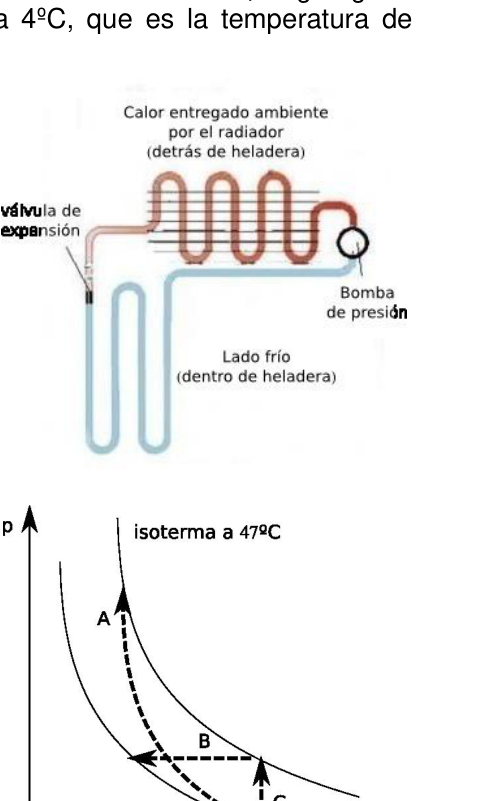
Topic: Thermodynamics Metodi: Thermodynamic Cycle Analysis, First Law of Thermodynamics Competenze: Physical Reasoning Objects: Heat Engine, Tube, Gas Fonte: Testo (PDF) — p.3
Frigoratori (pompa di calore)
PT6. Scuola superiore di commercio Carlos Pellegrini Città di Buenos Aires.
I gelatieri La funzione di una macchina frigorifera è quella di prendere il calore da un La temperatura di un ambiente a bassa temperatura e la cessione in ambiente esterno, utilizzando un fonte di energia esterna per mantenere il processo. Un frigorifero è un pompa di calore, generalmente alimentata da un motore elettrico. - Ci vediamo . a passo il suo modo di funzionare. Il tubo che vedete nella figura contiene il gas che è l’ingrediente principale. nel funzionamento di un frigorifero. Il tubo esteso, avrebbe avuto circa 6 m di lunghezza e 2 cm di diametro interno, metà corrisponde alla parte fredda e all’altra calda. a) Calcolare il volume interno del tubo freddo e caldo. Il gas di tipo CFC diclorofluorometano CCl2F2 è inserito nel tubo. En funzionamento si possono stimare le condizioni della parte calda in 4 atm di pressione e temperatura di 47oC e nella parte fredda di 0,5 atm e -23oC. Considerate Il gas come ideale. b) Calcolare la massa totale del gas nell’apparecchio, distinguendo tra la parte caldo e freddo. Nella parte fredda del tubo prima della compressione in pompa, il gas guadagna energia dall’interno del frigorifero, fino a 4°C, che è la temperatura di funzionamento normale. (c) Quanta energia calorica si prende in un ciclo completo di tutto il gas, -23°C a 4°C? Poi la bomba riceve il gas freddo a 4°C e lo compressione in un processo adiabatico (no
- Perde . ni Guadagna energia calorica) con P.Vg=te portandolo a 47°C in una camera di 0,1 litri d) Calcolare la differenza di volume che deve effettuare il compresso sul gas senza considerare il lavoro. e) Calcolare il lavoro svolto dalla pompa in una compressione, e in un ciclo completo (tutto il gas), con la pressione media. f) Scegli la curva adiabita del diagramma in questo processo tra le punteggi A, B e C. Calcola g. In realta’ il gas si riscalda. La Commissione ha adottato una proposta di regolamento (CE) n. compressione. Questo perde energia nel ambiente attraverso il radiatore, passando da 47°C a 20°C, che è la temperatura ambiente. Il ciclo si completa con l’espansione del gas adiabaticamente riducendo
- Così . su temperatura a -23°C. g) Calcolare l’energia calorica ceduta all’ambiente in un ciclo completo. Si aggiunge il lavoro del compressore, che viene anche perso come energia calorica. h) Se un ciclo completo dura 30 secondi, quanti watt ha il frigorifero visto che il motore ha un’efficienza del 10%?
OAF 2013 - 49 Immaginate l’interno del frigorifero di 1 metro di superficie e che lo riempi di acqua. (i) Quanta energia è necessaria per congelare tutta l’acqua? (senza perdite) Quanto tempo devo per completare il processo? j) Come visto sopra, spiegate perché avere il frigorifero aperto, l’ambiente si riscalderà invece di raffreddarsi.
Datos 1J=0.24cal MrCl=35g MrC=12g MrF=19g cCFC=0.2 cal/goC
1atm=101330N/m2 cH20=1 cal/goC LH20liq-sol=80 cal/g
DH20=1g/cm3 R=0.082atml/Kmol
Topic: Thermodynamics Metodi: Thermodynamic Cycle Analysis, First Law of Thermodynamics Competenze: Physical Reasoning Objects: Heat Engine, Tube, Gas Fonte: Testo (PDF) — p.3
**Fries (heat pump) **
PT6. The Carlos Pellegrini School of Commerce City of Buenos Aires.
I ‘m not a big fan . The function of a refrigerating machine is to take the heat from a The use of a low temperature environment and its release into the outdoor environment, using a external power source to maintain the process. A refrigerator is a heat pump, usually powered by an electric motor. We ‘ll see through . step by step how it works. The pipe you see in the figure, contains the gas which is the main ingredient. the operation of a refrigerator. The pipe stretched, I would have approximately 6 m long and 2 cm in diameter, half corresponding the cold side and the hot side. (a) Calculate the internal volume of the hot and cold pipe. The gas of the type CFC dichloropluoromethane CCl2F2 type is placed in the pipe. En operation the conditions of the hot part can be estimated in 4 atm The temperature and pressure of the water are 47 °C and the cold part is 0.5 atm and -23 °C. Let ‘s consider . The gas as ideal. (b) Calculate the total mass of gas in the apparatus, distinguishing between the parts Hot and cold. In the cold part of the pipe before compression in the pump, the gas gains energy from inside the freezer, reaching 4oC, which is the temperature of normal operation. (c) How much calorie energy does it take in A full cycle of all the gas, -23 to 4 degrees? Then the pump receives the cold gas at 4°C and it Compresses in an adiabatic process (not He loses . ni He wins . Energy calorific) with P.Vg=te taking it to 47oC in a chamber of 0,1 litres (d) Calculate the volume difference that The compressor must be placed on the gas without considering the job. (e) Calculate the work done by the pump in a compression, and in a Full cycle (all gas), with the average pressure. (f) Choose the adiabatic curve from the diagram This process is relevant between the points A, B and C. Calculate g. In real operation, the gas is heated. The work done in the field of The pressure is not enough. This one loses energy in the The environment through the radiator, going from 47oC to 20oC which is the room temperature. The cycle is completed by expanding the gas Adiabatically reducing That ‘s it . su The temperature is -23°C. (g) Calculate the calorie energy released into the environment in a complete cycle. It adds to the work of the compressor, which is also lost as energy It’s calorific. (h) If a full cycle lasts 30 seconds, how many watts does the freezer have? Since the engine is 10% efficient?
The following is the list of the Member States’ financial statements: Imagine the inside of a 1 m3 refrigerator and filling it with water. (i) How much energy is needed to freeze all the water? (no losses) How long do I need to complete the process? (j) As mentioned above, explain why, by having the freezer open, the atmosphere warms instead of cooling.
Data from the report The following table shows the results of the calculation of the total energy consumption of the product:
The following table shows the results of the calculations:
The following table shows the results of the studies:
Topic: Thermodynamics Metodi: Thermodynamic Cycle Analysis, First Law of Thermodynamics Competenze: Physical Reasoning Objects: Heat Engine, Tube, Gas Fonte: Testo (PDF) — p.3
Desarmando un flipper
PT7. Colegio Nacional Dr. Arturo Illia
Instituto Albert Einstein Mar del Plata, Buenos Aires.
Desarmando un Flipper
El pinball o flipper es un juego de salón mecánico,
electromecánico o electrónico a base una bola
impulsada por un resorte, en este caso se toma una
esfera P de masa m = 100 g que se desplaza por la
cara interior de un aro semicircular fijo de radio
R = 0,5 m y centro O dispuesto en el plano vertical
OXY, que puede considerarse sin fricción.
En el instante inicial la esfera se encuentra en la
posición P(0), se lanza mediante un disparador que
consiste en un resorte de longitud natural l0 = 25 cm
y constante recuperadora k = 500 N/m, que previamente se comprime una
distancia d = 20 cm.
a) Calcule la aceleración máxima que actúa sobre la masa en el momento
del disparo.
b) Realice un diagrama de fuerzas para el instante donde (t) = 45°.
c) Calcule la aceleración que actúa sobre la masa en el punto anterior.
d) ¿Qué velocidad alcanza el objeto en la parte superior del semicírculo.
e) Determine el valor de la fuerza que hace el riel sobre la masa al llegar al
punto más alto de la trayectoria.
f) Calcule el punto donde cruza la masa el eje X, después de salir del
dispositivo.
Topic: Conservation of Energy, Newtonian Mechanics Metodi: Energy Conservation Method, Hooke’s Law, Free-Body Diagram Competenze: Physical Reasoning Objects: Spring, Ball Fonte: Testo (PDF) — p.3
Disposando un flipper
PT7. Il Dr. Arturo Illia
L’Istituto Albert Einstein Mar del Plata, Buenos Aires.
Disarmando un Flipper Il pinball o flipper è un gioco di salotto meccanico. elettromeccanico o elettronico a base di una palla in questo caso si prende una sfera P di massa m = 100 g che si muove per faccia interna di un anello semicircolare fisso di radio R = 0,5 m e centro O disposti in piano verticale OXY, che può essere considerata senza attrito. All’istante iniziale la sfera si trova nella Posizione P(0), lanciato con un trigger che è costituito da una sorgente di lunghezza naturale l0 = 25 cm e costante recuperatore k = 500 N/m, che viene precedentemente compresso un Distanza d = 20 cm. a) Calcolare l’ accelerazione massima che agisce sulla massa al momento
- Il fuoco. b) Realizzare un diagramma delle forze per l’istante dove (t) = 45°. c) Calcolare l’accelerazione che agisce sulla massa nel punto precedente. d) Che velocità raggiunge l’oggetto nella parte superiore del semicircolo. e) Determina il valore della forza che il binario fa sulla massa al raggiungimento del punto più alto del percorso. f) Calcolare il punto in cui la massa attraversa l’asse X, dopo essere uscita dal dispositivo.
Topic: Conservation of Energy, Newtonian Mechanics Metodi: Energy Conservation Method, Hooke’s Law, Free-Body Diagram Competenze: Physical Reasoning Objects: Spring, Ball Fonte: Testo (PDF) — p.3
The following is the list of the types of flippers used:
PT7. National College Dr. Arturo Illia
The Albert Einstein Institute The city of Mar del Plata, Buenos Aires.
Disarming a Flipper . Pinball or flipper is a mechanical lounge game. Electromechanical or electronic ball-based This is a spring-powered, in this case a spring-powered spring. The mass of the sphere P m = 100 g moving through the The inner face of a fixed radius semi-circular ring R = 0,5 m and centre O set in the vertical plane OXY, which can be considered frictionless. At the initial moment the sphere is at the position P(0), is launched by a trigger that consists of a natural spring length l0 = 25 cm and constant recovery k = 500 N/m, which is previously compressed to a distance d = 20 cm. (a) Calculate the maximum acceleration acting on the mass at the moment from the shooting. (b) Draw a force diagram for the instant where (t) = 45°. (c) Calculate the acceleration acting on the mass at the previous point. (d) What speed does the object reach at the top of the semicircle? (e) Determine the value of the force exerted by the rail over the mass at the time of the The highest point of the trajectory. (f) Calculate the point where the mass crosses the X-axis after leaving the device.
Topic: Conservation of Energy, Newtonian Mechanics Metodi: Energy Conservation Method, Hooke’s Law, Free-Body Diagram Competenze: Physical Reasoning Objects: Spring, Ball Fonte: Testo (PDF) — p.3
Energia electrica en el barrio
PT8. Colegio Nacional Dr. Arturo Illia
Instituto Albert Einstein Mar del Plata, Buenos Aires.
Energía eléctrica en el barrio Un barrio periférico está formado por 30 casas idénticas, la energía eléctrica está provista por un generador. Si una casa típica tiene los siguientes electrodomésti- cos,
Electrodoméstico Potencia
(W)
Tensión de
alimentación (v)
Heladera
500
220
Lavarropas
900
220
Plancha
1000
220
10 lamparitas
15 (c/u)
220
televisor
700
220
OAF 2013 - 50 a) Dibuje el circuito correspondiente a una casa, suponiendo que los electrodomésticos son puramente resistivos. b) Dibuje el circuito eléctrico del generador y las casas. Suponga que el generador puede pensarse como una fuente ideal con su resistencia en serie. c) Calcule la corriente suministrada a una casa cuando se encuentran todos los dispositivos eléctricos funcionando. d) El generador es una fuente de corriente compuesta por un solenoide de 500 espiras, de 30 cm de radio. El alambre que forma el solenoide tiene 2,4 mm de radio ( ρ= 8. 10-8Ω.m, δ= 7 g/cm 3 y c =0,2 cal/g°C). Calcule la resistencia del generador. e) Si las 30 casas tienen todos sus electrodomésticos funcionando ¿cuánta energía suministra el generador durante 3 horas? f) El generador tiene un sistema de refrigeración que es capaz de disipar 0,7 MW. Calcule cuánto tarda el generador en calentarse 20°C al estar todos los dispositivos encendidos.
Topic: Circuits Metodi: Kirchhoff’s Laws, Equivalent Circuit Reduction Competenze: Physical Reasoning Objects: Resistor, Battery Fonte: Testo (PDF) — p.3
Energia elettrica nel quartiere
PT8. Il Dr. Arturo Illia
L’Istituto Albert Einstein Mar del Plata, Buenos Aires.
Energia elettrica nel quartiere Un quartiere periferico è composto da 30 case identiche, l’energia elettrica è fornito da un generatore. Se una casa tipica ha i seguenti apparecchiature domestiche, Cos,
Potenza elettrica (W) Tensione di alimentazione (v)
- Gelato. 500 220 Lavatrici 900 220 La piastra 1000 220 10 lampade 15 (c/u) 220 Televisione 700 220
OAF 2013 - 50 a) Disegna il circuito di una casa, supponendo che le I dispositivi per la casa sono puramente resistenti. b) Disegna il circuito elettrico del generatore e delle case. Supponiamo che il Il generatore può essere pensato come una fonte ideale con la sua resistenza in serie. c) Calcolare il corrente fornito a una casa quando si trovano tutti i dispositivi elettrici funzionanti. d) Il generatore è una fonte di corrente composta da un solenoide di 500 spirale, di 30 cm di raggio. Il filo che forma il solenoide ha 2,4 mm di raggio ( ρ= 8. 10-8Ω.m, δ=7 g/cm3 e c =0,2 cal/g°C). Calcola la resistenza del generatore. e) Se le 30 case hanno tutti gli elettrodomestici funzionanti Quanto energia fornisce il generatore per 3 ore? f) Il generatore ha un sistema di refrigerazione che è in grado di dissipare 0,7 MW. Calcola quanto tempo il generatore impiega per riscaldarsi 20°C all’interno tutti i dispositivi accesi.
Topic: Circuits Metodi: Kirchhoff’s Laws, Equivalent Circuit Reduction Competenze: Physical Reasoning Objects: Resistor, Battery Fonte: Testo (PDF) — p.3
Electricity in the neighbourhood
PT8. National College Dr. Arturo Illia
The Albert Einstein Institute The city of Mar del Plata, Buenos Aires.
Electricity in the neighborhood A peripheral neighborhood is made up of 30 identical houses, electricity is It’s powered by a generator. If a typical home has the following appliances: body,
Electrical power (W) Tensions of food (v) Iced milk . 500 220 Washing clothes 900 220 The board . 1000 220 10 lamps . 15 (c/u) 220 TV . 700 220
The following points shall be added: (a) Draw the circuit for a house, assuming that the The electrical appliances are purely resistant. (b) Draw the electrical circuit of the generator and the houses. Suppose the Generator can be thought of as an ideal source with its resistance in The series. (c) Calculate the current supplied to a house when they are in the same place. All the electrical devices are working. (d) The generator is a power source composed of a solenoid of 500 spires, 30 cm in radius. The wire that forms the solenoid has The radius of the vehicle is 2.4 mm ( ρ = 8. The average temperature of the test chemical is 10-8Ω.m, δ=7 g/cm3 and c =0,2 cal/g°C). Calculate the resistance of the generator. (e) If all 30 houses have all their appliances running How much power does the generator supply for three hours? (f) The generator has a cooling system capable of dissipating 0,7 MW. Calculate how long it takes the generator to heat up 20°C while in operation All devices on.
Topic: Circuits Metodi: Kirchhoff’s Laws, Equivalent Circuit Reduction Competenze: Physical Reasoning Objects: Resistor, Battery Fonte: Testo (PDF) — p.3
Esfera de vidrio - refraccion
PT9. Colegio Nacional Dr. Arturo Illia
Instituto Albert Einstein Mar del Plata, Buenos Aires.
Una esfera maciza de vidrio de 6
cm de diámetro tiene un índice de
refracción de valor n = 2. Sobre la
parte
superior
inciden
rayos
paralelos y coplanarios distancia-
dos entre sí 1 cm, uno de los
cuales pasa por su centro. Por la
parte inferior de la esfera penetra
un rayo, Ryi, de luz monocromática
en un ángulo de incidencia î
sufriendo una reflexión parcial en el
interior de la esfera antes de salir.
a) Calcule la velocidad de propagación de la luz por este vidrio.
b) ¿Cuántas ondas de luz roja de frecuencia 3, 68.1014 Hz entran en el
diámetro de esta esfera?
c) Determinar los puntos donde cada uno de estos rayos corta al rayo que
pasa por el centro.
d) ¿Qué valor debe tener el índice de refracción de la esfera para que el
rayo incidente a dos centímetros del eje emerja paralela al eje pero
2 cm por debajo de éste?
e) Calcular la desviación del rayo, Rye, emergente en relación al rayo, Ryi,
incidente por la parte inferior.
Topic: Geometric Optics, Wave Optics Metodi: Snell’s Law, Ray Tracing Competenze: Physical Reasoning, Mathematical Modeling Objects: Sphere Fonte: Testo (PDF) — p.3
Sfera di vetro - rifrazione
PT9. Il Dr. Arturo Illia
L’Istituto Albert Einstein Mar del Plata, Buenos Aires.
Una sfera di vetro massiccia di 6 di diametro di un centimetro ha un indice di rifrazione di valore n = 2. - La Parte superiore
- l’effetto
- Ragazzi paralleli e coplanari distanti- due a vicenda 1 cm, uno dei due che attraversa il suo centro. Per la La parte inferiore della sfera penetra un raggio, Ryi, di luce monocromatica in un angolo di incidenza î La situazione è stata parzialmente riflessa nel all’interno della sfera prima di uscire. a) Calcolare la velocità di diffusione della luce attraverso questo vetro. b) Quante onde di luce rossa di frequenza 3,68,1014 Hz entrano nel diametro di questa sfera? (c) Determinare i punti in cui ciascuno di questi raggi taglia il raggio che passa attraverso il centro. d) Qual è il valore dell’indice di refraczione della sfera per consentire alla Il raggio incidente a due centimetri dall’asse emerge parallelo all’asse ma Due centimetri sotto di questo? e) Calcolare la deviazione del raggio, Rye, emergente rispetto al raggio, Ryi, incidente nella parte inferiore.
Topic: Geometric Optics, Wave Optics Metodi: Snell’s Law, Ray Tracing Competenze: Physical Reasoning, Mathematical Modeling Objects: Sphere Fonte: Testo (PDF) — p.3
The following table shows the results of the calculation of the total weight of the product:
PT9. National College Dr. Arturo Illia
The Albert Einstein Institute The city of Mar del Plata, Buenos Aires.
A solid glass sphere of 6 . cm diameter has an index of The value of the product is not less than 0,05 On the Part higher They affect
- What ? parallels and distance coplanaries Two to each other 1 cm, one of the which passes through its center. By the The lower part of the penetration sphere A lightning bolt, Ryi, of monochrome light. at an angle of incidence î The Commission has already adopted a number of proposals for a new directive on the protection of workers’ rights. inside the sphere before you leave. (a) Calculate the speed of light propagation through this glass. (b) How many waves of red light of frequency 3.68.1014 Hz enter the diameter of this sphere? (c) Determine the points where each of these rays cuts the ray that It’s going through the center. (d) What value must the refractive index of the sphere have to be given to the incident lightning two centimeters from the axis emerges parallel to the axis but Two centimeters below this one? (e) Calculate the radiation deviation, Rye, emerging relative to the beam, Ryi, incident at the bottom.
Topic: Geometric Optics, Wave Optics Metodi: Snell’s Law, Ray Tracing Competenze: Physical Reasoning, Mathematical Modeling Objects: Sphere Fonte: Testo (PDF) — p.3
Bote cruzando canal
PT10. EET Nro. 1 Cnel M. A. Prado San Pedro, Jujuy.
Un bote cruza un canal de 30 m de ancho , moviéndose perpendicularmente a la
dirección de la corriente .Llega a la orilla opuesta habiéndose desplazado 14 m
en la dirección de la corriente, si la dirección de ésta es 2 m/seg.
Calcular la velocidad total y relativa del bote.
OAF 2013 - 51
Topic: Newtonian Mechanics Metodi: Vector Decomposition, Kinematic Equations Competenze: Physical Reasoning Objects: — Fonte: Testo (PDF) — p.3
**Bot transversale **
PT10. EET Nro. 1 Cnel M. A. Prado San Pietro, Jujuy.
Un’ imbarcazione attraversa un canale largo 30 metri , muovendosi perpendicularmente alla Direzione del corrente. Arriva al litorale opposto dopo aver spostato 14 m in direzione del corrente, se il suo orientamento è di 2 m/sec. Calcolare la velocità totale e relativa della barca.
OAF 2013 - 51
Topic: Newtonian Mechanics Metodi: Vector Decomposition, Kinematic Equations Competenze: Physical Reasoning Objects: — Fonte: Testo (PDF) — p.3
Both crossing the channel
PT10. The EET number. 1 Cnel M. A. Prado . St. Peter, Jujuy.
A boat crosses a channel 30 m wide , moving perpendicular to the The direction of the current. It reaches the opposite shore having moved 14 m. in the direction of the current if the current direction is 2 m/s. Calculate the total and relative speed of the boat.
The following is the list of the Member States’ financial statements:
Topic: Newtonian Mechanics Metodi: Vector Decomposition, Kinematic Equations Competenze: Physical Reasoning Objects: — Fonte: Testo (PDF) — p.3
Caja bajada de camion
PT11. EET Nro. 1 Cnel M. A. Prado San Pedro, Jujuy.
Una caja que pesa 600kg.debe bajarse de un camión que tiene 1,20 de altura,
haciéndola deslizar sobre tablones de 2,4 m de longitud. Si el coeficiente
dinámico de razonamiento entre la caja y los tablones es de 0,3 y debe
deslizarse a velocidad constante.
Responder:
¿Será necesario tirar la caja hacia abajo o sostenerla desde arriba?
¿Qué fuerza paralela al plano será precisa?
Topic: Newtonian Mechanics Metodi: Free-Body Diagram, Vector Decomposition Competenze: Physical Reasoning, Diagrammatic Reasoning Objects: Block, Inclined Plane Fonte: Testo (PDF) — p.3
Cassa di scarico del camion
PT11. EET Nro. 1 Cnel M. A. Prado San Pietro, Jujuy.
Una scatola che pesa 600 kg. deve scendere da un camion che ha 1,20 di altezza, che la fanno scivolare su tavole lunghe 2,4 metri. Se il coefficiente La dinamica di ragionamento tra la cassa e le tavole è di 0,3 e deve scivolare a velocità costante. Risposta: Dovrà tirare giù la scatola o tenerla dall’alto? Quale forza parallela al piano sarà precisa?
Topic: Newtonian Mechanics Metodi: Free-Body Diagram, Vector Decomposition Competenze: Physical Reasoning, Diagrammatic Reasoning Objects: Block, Inclined Plane Fonte: Testo (PDF) — p.3
The vehicle shall be equipped with a single-cylinder engine.
PT11. The EET number. 1 Cnel M. A. Prado . St. Peter, Jujuy.
A box weighing 600kg. Must be dropped off a truck that’s 1.20 in height, by sliding it over boards 2.4 m long. If the coefficient The reasoning dynamic between the box and the boards is 0.3 and must slide at a constant speed. Answer: Will it be necessary to pull the box down or hold it from above? What force parallel to the plane will be precise?
Topic: Newtonian Mechanics Metodi: Free-Body Diagram, Vector Decomposition Competenze: Physical Reasoning, Diagrammatic Reasoning Objects: Block, Inclined Plane Fonte: Testo (PDF) — p.3
Tornillo micrometrico
PT12. EET Nro. 1 Cnel M. A. Prado San Pedro, Jujuy.
Un tornillo micrométrico que se ajusta en sentido horario avanza por cada vuelta del tambor 0,5.El tambor tiene 50 divisiones y cuando se mide un diámetro de 12 mm el cero de l escala coincide con la división número 20 del tambor. ¿Cuál es la lectura final?
Topic: Mathematics Metodi: Dimensional Analysis Competenze: Physical Reasoning Objects: — Fonte: Testo (PDF) — p.3
Tornello micrometrico
PT12. EET Nro. 1 Cnel M. A. Prado San Pietro, Jujuy.
Un tornello micrometrico che si adatta in senso orario si avanza a ogni giro. Il tamburo ha 50 divisioni e quando si misura un diametro di 12 mm il zero della scala è la divisione numero 20 del tamburo. Qual è la lettura finale?
Topic: Mathematics Metodi: Dimensional Analysis Competenze: Physical Reasoning Objects: — Fonte: Testo (PDF) — p.3
The following is the list of the components of the engine:
PT12. The EET number. 1 Cnel M. A. Prado . St. Peter, Jujuy.
A micrometric screw that is timed moves forward with each turn . The drum has 50 divisions and when measured a diameter of 12 mm the zero of the scale corresponds to the 20th division of the drum. What’s the final reading?
Topic: Mathematics Metodi: Dimensional Analysis Competenze: Physical Reasoning Objects: — Fonte: Testo (PDF) — p.3
Dispositivo temporizador con gas
PT13. Colegio Santísimo Rosario Monteros, Tucumán.
Paula y Mariana, alumnas de 5º año del Colegio Santísimo Rosario, para la muestra de ciencias prepararon un dispositivo que permite controlar el tiempo que demora desde que se lo activa hasta que permite el paso de la corriente eléctrica. El mismo fue construido usando un inflador manual (ver figura) cuya válvula está cerrada. El émbolo, que puede deslizarse sin rozamiento, tiene una masa de 100 gramos y su volumen es despreciable. En el instante inicial el émbolo se halla libre a 5 cm del extremo superior del inflador, la presión ambiente es de 1 atmósfera y la temperatura ambiente de 20ºC. Con la ayuda de un gotero, agregan una gota de mercurio cada dos segundos en el espacio entre el émbolo y las paredes del inflador. A medida que se acumula el mercurio, el émbolo baja. El sistema se ha preparado de tal manera que cando el menisco de mercurio llega a 1 cm del borde superior de las paredes del inflador, se cierra el contacto que permite el paso de la corriente. Suponiendo que el aire dentro del inflador se comporta como un gas ideal y la temperatura se mantiene constante, para que el contacto no se cierre antes de que transcurran 20000 segundos desde que se depositó, calcule: a) Volumen de aire dentro del inflador. b) El tamaño máximo de la gota de mercurio. c) Repetir los cálculos, pero suponiendo que la experiencia se realiza en un día de verano, cuando la temperatura ambiente es de 35ºC. d) Si se reemplaza el mercurio por agua destilada, qué tamaño debe ser la gota?
OAF 2013 - 52
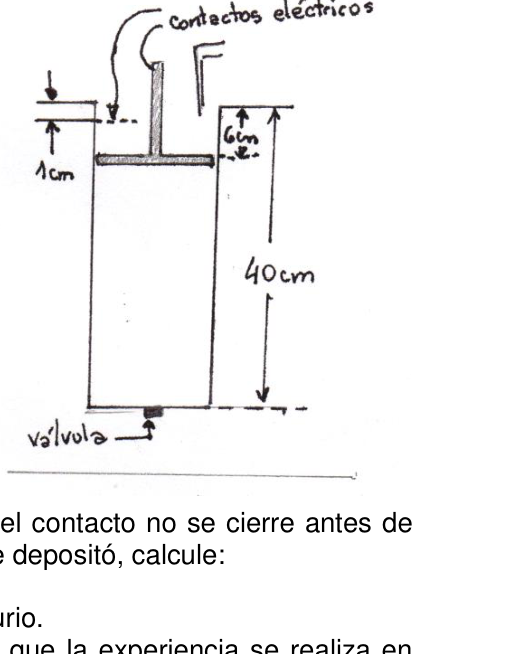
Topic: Thermodynamics, Kinetic Theory Metodi: Ideal Gas Law, Hydrostatic Equilibrium Competenze: Physical Reasoning Objects: Gas, Piston Fonte: Testo (PDF) — p.3
Dispositivo temporizzatore a gas
PT13. “Santa Rosario” Monteros, Tucumán.
Paula e Mariana, studenti di quinto anno del Santissimo Rosario College, per la I ricercatori hanno preparato un dispositivo che consente di controllare il tempo. che dura da quando viene attivato fino a quando permette il passaggio del corrente elettrica. Il suo è stato costruito utilizzando un gonfiatore manuale (vedi figura) il cui Valvola chiusa. Il pallone, che può scivolare senza rottura, ha un 100 grammi di massa e il volume è sconsiderato. All’ istante iniziale l’imbolo si trova libero a 5 cm dall’estremità superiore del
- Inflazione, la pressione ambientale è di 1 l’atmosfera e la temperatura ambiente di 20ºC. Con l’aiuto di un gocciolo, aggiungete un’altra. goccia di mercurio ogni due secondi in lo spazio tra l’imbolo e i muri. dell’inflatore. Come si accumula il Mercurio, l’imbolo scende. Il sistema si è ha preparato in modo tale che quando il Menisco di mercurio raggiunge 1 cm di altezza. Il bordo superiore dei muri del Il gonfiatore, chiude il contatto che permette il passaggio del corrente. Supponiamo che l’aria all’interno dell’inflatore si comporta come un gas ideale e la la temperatura è mantenuta costante, in modo che il contatto non si chiuda prima di che sono trascorsi 20000 secondi da quando è stato depositato, calcolare: a) Volume di aria all’interno dell’inflatore. b) La dimensione massima della goccia di mercurio. c) Ripetere i calcoli, ma supponendo che l’esperienza si svolga in un giorno d’estate, quando la temperatura ambiente è di 35°C. d) Se il mercurio viene sostituito con acqua distillata, quale dimensione deve essere la quantità di mercurio? goccia?
OAF 2013 - 52
Topic: Thermodynamics, Kinetic Theory Metodi: Ideal Gas Law, Hydrostatic Equilibrium Competenze: Physical Reasoning Objects: Gas, Piston Fonte: Testo (PDF) — p.3
The following table shows the number of units of the vehicle:
PT13. Holy Rosary College . Monteros, Tucumán. What is it?
Paula and Mariana, fifth-year students at the College Santissimo Rosario, for the Science has developed a device that controls time. It takes time from activation to allowing the current to flow. electrical. It was built using a manual inflator (see figure) whose The valve is closed. The plunger, which can slide without a scratch, has a 100 grams in mass and its volume is despicable. At the initial moment the emblem is located Free at 5 cm from the upper end of the Inflator, ambient pressure is 1 atmosphere and ambient temperature of 20ºC. With the help of a drip, add one. Mercury drops every two seconds in The space between the plinth and the walls the inflator. As the accumulation of Mercury, the plume is down. The system is It has been prepared in such a way that when the Mercury meniscus reaches 1 cm of the The upper edge of the walls of the The inflator closes the contact that allows the passage of the current. Assuming the air inside the inflator It behaves like an ideal gas and the temperature is kept constant, so that contact does not close before If 20000 seconds have elapsed since it was deposited, calculate: (a) Volume of air inside the inflator. (b) The maximum size of the mercury drop. (c) Repeat the calculations, but assuming that the experiment is done in A summer day, when the room temperature is 35 degrees. (d) If mercury is replaced by distilled water, what size should the drop?
The Commission shall adopt delegated acts in accordance with Article 21 of this Regulation.
Topic: Thermodynamics, Kinetic Theory Metodi: Ideal Gas Law, Hydrostatic Equilibrium Competenze: Physical Reasoning Objects: Gas, Piston Fonte: Testo (PDF) — p.3
Rayos en placas de caras paralelas
PT14. Colegio Santísimo Rosario Monteros, Tucumán.
Se dispone del dispositivo, donde dos
rayos
paralelos
de
luz
llegan
simultáneamente a los puntos P1 y P2
de dos placas de caras paralelas,
dispuestas como indica la figura. Al
emerger, los rayos son detectados por
dos sensores S1 y S2 . Cuando emerge
el primero, se pone en funcionamiento
un reloj que se detiene al emerger el
segundo.
Ambas placas son del mínimo espesor
y sus respectivos índices de refracción
n1 y n2.
a) Calcule el ángulo de refrac-
ción de cada rayo.
b) ¿Cuál de los dos rayos emerge antes? Justifique su respuesta.
c) Calcule el tiempo transcurrido desde que se puso en marcha el reloj
hasta que se detuvo.
d) ¿De qué forma se podría determinar el índice de refracción de la placa?
Proponga una modificación en el dispositivo de la figura (variando las
posiciones de las placas, eliminando partes, etc),
Datos:
n1= 1,6
n2 = 1,4
e = 3 cm
α = 30º
Topic: Geometric Optics Metodi: Snell’s Law, Ray Tracing Competenze: Physical Reasoning, Mathematical Modeling Objects: — Fonte: Testo (PDF) — p.3
Raggi in piastre a facce parallele
PT14. “Santa Rosario” Monteros, Tucumán.
Si dispone del dispositivo, dove due
- Ragazzi Paralleli de luce Arrivano simultaneamente ai punti P1 e P2 di due schede di facce parallele, Le parti sono disposte come indicato nella figura. Al emergere, i raggi sono rilevati da due sensori S1 e S2 . Quando emerge Il primo, viene messo in funzione. Un orologio che si ferma quando emerge il
- Secondo. Entrambe le placche sono di spessore minimo. e i loro rispettivi indici di refraczione n1 y n2. a) Calcolare l’angolo di rifrazione
- Un’altra volta.
b) Quale dei due raggi emerge prima? giustifica la tua risposta.
c) Calcolare il tempo trascorso dal momento in cui il orologio è stato avviato
finché non si è fermato.
d) Come si può determinare l’indice di refraczione della placca?
Propone una modifica del dispositivo della figura (variando le
posizioni delle placche, eliminando parti, ecc.),
Datati:
n1= 1,6
n2 = 1,4
e = 3 cm
α = 30º
Topic: Geometric Optics Metodi: Snell’s Law, Ray Tracing Competenze: Physical Reasoning, Mathematical Modeling Objects: — Fonte: Testo (PDF) — p.3
Lightning in parallel-faced plates
PT14. Holy Rosary College . Monteros, Tucumán. What is it?
The device is available where two
- What ?
parallels
de
Light
They ‘re coming .
simultaneously at points P1 and P2
Of a width of not more than 30 mm,
The following table shows the number of units in the list: Al
If the lightning is detected by the lightning, the lightning is detected by the lightning.
two S1 and S2 sensors . When it comes out
The first one, it gets started
A clock that stops when the clock comes out.
Second.
Both plates are of minimum thickness.
and their respective refractive indices
n1 y n2.
(a) Calculate the angle of refraction
The first is the first.
(b) Which of the two rays emerges first? Justify your answer.
(c) Calculate the time elapsed since the clock was started
until he stopped.
(d) How could the plate refractive index be determined?
Propose a change in the device of the figure (variating the
the position of the plates, removing parts, etc.),
The data:
n1= 1,6
n2 = 1,4
e = 3 cm
α = 30º
Topic: Geometric Optics Metodi: Snell’s Law, Ray Tracing Competenze: Physical Reasoning, Mathematical Modeling Objects: — Fonte: Testo (PDF) — p.3
Generador con solenoide barrio
PT15. Colegio Santísimo Rosario Monteros, Tucumán.
En un pequeño barrio formado por 40 familias que ocupan viviendas idénticas, cada familia posee exactamente los mismos electrodomésticos que sus vecinos. La energía eléctrica del barrio es provista por una única central la cual consta de un generador. Éste es una fuente de corriente continua en serie con un solenoide de 600 espiras, 0,25 m de radio y una longitud total de 3 m. El solenoide está construido con un alambre de una aleación de níquel cobre de 2,5 mm de radio ( resistividad: δ= 7x10⁻⁸ Ωm , densidad ρ= 8 g/cm3 y calor especifico c = 0,109 cal / gºC) . Vale decir que todo el generador es equivalente a una fuente en serie con una resistencia y un solenoide ideal (sin resistencia). La fuente de corriente continua está construida de manera tal que voltaje resultante entre ella y la caída de potencial en la resistencia siempre es de 220 V ( VAB = 220V, como se muestra en la figura. Este generador posee además un sistema de refrigeración capaz de disipar una potencia de 1,663 x 106 W. La siguiente es una lista de los artefactos eléctricos que existen en cada vivienda y sus respectivas características:
OAF 2013 - 53 APARATO CONSUMO (a 220V) VOLTAJE MIN/MÁX 1 heladera 10 bombitas de luz 1 lavavajilla 1 plancha 1 TV 400 W 100 W (c/u) 1500 W 900 W 70 W 210 – 250 V 210 – 250 V 210 – 250 V 210 – 280 V 210 – 230 V
a) Suponiendo que todos los electrodomésticos tienen un comportamiento
totalmente resistivo, dibuje:
Un diagrama equivalente de la red eléctrica, correspondiente a
cada casa;
Un diagrama que represente la red eléctrica de la comunidad
incluyendo el generador.
b) Calcule la corriente que entrega el generador mientras todos los
artefactos eléctricos funcionan en las 40 casas.
c) ¿Cuánto tiempo transcurrirá hasta que la temperatura en el generador
se haya elevado en 40 ºC?
Topic: Circuits, Electromagnetism Metodi: Kirchhoff’s Laws, Ampère’s Law Competenze: Physical Reasoning, Mathematical Modeling Objects: Solenoid, Resistor Fonte: Testo (PDF) — p.3
Generatore con solenoide di quartiere
PT15. “Santa Rosario” Monteros, Tucumán.
In un piccolo quartiere composto da 40 famiglie che occupano case identiche, Ogni famiglia possiede esattamente gli stessi elettrodomestici dei propri vicini. L’energia elettrica del quartiere è fornita da una sola centrale che è composta da: un generatore. Questa è una fonte di corrente continua in serie con un solenoide di 600 spirale, di 0,25 m di radio e di 3 m di lunghezza totale. El Solenoide è costruito con un filo di un’alleazione di nichel di rame di 2,5 mm di raggio (resistività: δ= 7x10⁻⁸ Ωm , densità ρ= 8 g/cm3 e calore specifico c = 0,109 cal / goC) . Significa che l’intero generatore è equivalente. a Una . fonte en serie con Una . resistenza e un solenoide ideale (senza resistenza). La fonte di corrente Continuo è costruito in questo modo. che voltazione risultante tra esso e la Riduzione di potenziale nella resistenza è sempre di 220 V (VAB = 220 V, come è mostrato nella figura. Questo generatore
- Ha un’altra proprietà. Inoltre un sistema de un raffreddamento capace di dissipare una potenza di 1.663 x 10⁶ W. Il seguente è un elenco degli strumenti elettrici che esistono in ogni abitazione. e le rispettive caratteristiche:
OAF 2013 - 53 Apparatore Consumo (a 220 V) Voltaggio MIN/MÁX 1 gelateria 10 bombelle di luce 1 lavandino 1 lavagna 1 TV 400 W 100 W (c/u) 1500 W 900 W 70 W 210 – 250 V 210 – 250 V 210 – 250 V 210 – 280 V 210 – 230 V
a) Supponendo che tutti gli elettrodomestici abbiano un comportamento Completamente resistente, disegna: Un diagramma equivalente della rete elettrica, corrispondente a ogni casa; Un diagramma che rappresenta la rete elettrica della comunità compresa la macchina generatrice. b) Calcolare il corrente che il generatore fornisce mentre tutti i I dispositivi elettrici funzionano nelle 40 case. c) Quanto tempo decorrerebbe prima che la temperatura del generatore è aumentato a 40 oC?
Topic: Circuits, Electromagnetism Metodi: Kirchhoff’s Laws, Ampère’s Law Competenze: Physical Reasoning, Mathematical Modeling Objects: Solenoid, Resistor Fonte: Testo (PDF) — p.3
Neighbourhood solenoid generator
PT15. Holy Rosary College . Monteros, Tucumán. What is it?
In a small neighborhood of 40 families living in identical housing, Each family owns exactly the same appliances as their neighbors. The electricity of the neighbourhood is provided by a single power station which consists of A generator. This is a serial DC power source with a a 600-spindle solenoid, 0,25 m in radius and a total length of 3 m. El Solenoid is constructed with a wire of a nickel copper alloy of 2.5 mm in radius (resistivity: δ=7x10⁻⁸ Ωm , density ρ=8 g/cm3 and heat specific c = 0,109 cal / goC) . It means that the entire generator is equivalent. a One . Source en series with One . The resulting strength and ideal solenoid (without (Reflections on the The power source It is constructed in such a way that What voltage is the result between it and the potential fall in resistance It’s always 220 V (VAB = 220 V, like This is shown in the figure. This generator . He owns it . Besides un system de A cooling system capable of dissipating a Power of 1,663 x 106 W. The following is a list of the electrical devices that exist in each home. and their respective characteristics:
The following is the list of the Member States’ financial statements: The machine . The following conditions shall apply: The following shall be added to the list of the following: 1 freezer 10 light bulbs . 1 dishwasher 1 board 1 TV 400 W 100 W (c/u) 1500 W 900 W 70 W 210 – 250 V 210 – 250 V 210 – 250 V 210 – 280 V 210 – 230 V
(a) Assuming that all appliances have a behavior Totally resistant, draw: An equivalent diagram of the electricity grid, corresponding to every house; A diagram representing the community’s electricity grid including the generator. (b) Calculate the current delivered by the generator while all the Electrical devices are working in all 40 homes. (c) How long will it take until the temperature in the generator is has been increased to 40 oC?
Topic: Circuits, Electromagnetism Metodi: Kirchhoff’s Laws, Ampère’s Law Competenze: Physical Reasoning, Mathematical Modeling Objects: Solenoid, Resistor Fonte: Testo (PDF) — p.3
Rally - cinematica
PT16. Colegio Nicolás Avellaneda Aguilares, Tucumán.
Durante al XIII Edición del Rally Nacional, 4° fecha 2013, el día domingo 9 de Junio de 2013, el cuarto Prime se largó desde la Colonia 10, localidad de Santa Ana (Prov. Tucumán), coordenadas GPS 27°30,613’ S y 65°42,322’ W. El piloto de la ciudad de Aguilares Juan José Gil De Marchi (ex alumno del Colegio N. Avellaneda) corrió a bordo de un Citroen DC3, categoría Maxi Rally. De mediciones realizadas y entrevistas se obtienen los siguientes datos: En el tramo AB, parte desde le reposo y alcanza una velocidad de 90km/h en tan solo 65m de recorrido. a1) Determine la aceleración del móvil. a2) Calcule el tiempo en recorrer el tramo.
OAF 2013 - 54
Luego entra en la primera curva de radio interno de unos 15m y ancho
de calzada de 10m, pero por la pericia del piloto, en general amplían el
desarrollo de la curva para lograr un radio de giro cercano a los 30m,
sobre el cual se desplazan y es el que se habrá de tener en cuenta. Si
la masa total de auto mas piloto y navegante es de 900kg y el
coeficiente de fricción es de 0,8 (aunque presumiblemente sea mayor)
determine:
b1) La fuerza Neta que actúa en el móvil mientras gira.
b2) El trabajo lateral que se hace, si hay un “derrape” transversal
estimado de 5m.
Al ser caminos enripiados de producción, las curvas no pueden tener
peraltes importantes. Si supone que la calzada en la curva tiene
superficie plana, que el auto tiene un ancho de 1,60m, que el centro de
masa se encuentra a unos 0,35m del piso, que en el plano horizontal al
masa se distribuye equidistante y que mantiene constante la velocidad
de 90km/h en esta primera curva, se le solicita que:
c1) al margen de la pericia del piloto e ignorando el derrape,
demuestre numéricamente que el auto no volcará, con los datos
considerados para la curva del punto anterior.
c2) realice un croquis del frente del auto y marque las fuerzas
actuantes en el giro y él o los puntos considerados en la
demostración anterior.
A continuación el coche avanza de B a C donde tomará la segunda curva, con
características similares, aunque con mayor velocidad ya que se observa un
importante derrape y levanta gran cantidad de tierra. Precisamente un
observador ubicado en E acciona un cronómetro al ver salir al auto desde el
punto C y determina lo siguiente:
que el tiempo en recorrer el tramo CF de 900m es de 22,5s. En ese
trayecto, en el punto D hay dos puentes alcantarillas cuyo perfil se
observa en el esquema, donde interesa conocer, si supone rapidez
constante:
d1) La velocidad media en tramo CF.
d2) la altura que se eleva el auto, respecto de la parte superior del
puente, teniendo en cuenta que en 10m el camino se eleva 1m.
d3) punto donde vuelve a tocar tierra, respecto del inicio del primer
puente.
OAF 2013 - 55 Al estar el auto en la parte mas alta, respecto de la nivel superior del puente, se observa que el sistema ruedas y piezas de suspensión (resortes) se “cuelga” del resto del chasis-motor. Se considerará que el chasis, más motor con accesorios, más piloto y navegante totalizan 800kg –que es la variable que comprimirán los resortes al impactar en el suelo-; que las ruedas, suspensión y sistemas anexos poseen 100kg; que la suspensión consiste en cuatro (4) resortes iguales de constante k= 105 N/m y cada uno soporta la cuarta parte del peso. En esas condiciones interesa saber: e1) ¿Cuánto se comprime cada resorte cuando el auto está en reposo? e2) ¿Cuanto se comprimirá el resorte al momento de tocar tierra, luego de “volar” sobre el primer puente?. En realidad el sistema de amortiguación dado por los resortes sólo puede comprimirse la mitad del valor obtenido en e2, antes de hacer “tope”; el resto es absorbido por las ruedas que dejan sus huellas en la calzada: En esta situación la fuerza sobre neumáticos es muy grande, si considera que el impacto dura 0,04s, entonces se le solicita: f1) Determine la cantidad de movimiento que posee el sistema chasis-motor, piloto y navegante, al instante de hacer tope el sistema de amortiguación. f2) La fuerza total que hace cada neumático contra la calzada.
Topic: Newtonian Mechanics Metodi: Kinematic Equations Competenze: Physical Reasoning Objects: — Fonte: Testo (PDF) — p.3
Rally - cinematica
PT16. Scuola Nicolás Avellaneda Aguilar, Tucumán.
Durante la XIII Edizione del Rally Nazionale, 4° data 2013, domenica 9 di Giugno 2013, il quarto Prime è partito dalla Colonia 10, località di Santa Ana (Prov. Tucumán), coordinate GPS 27°30,613 S e 65°42,322 W. Il pilota di Aguilares Juan José Gil De Marchi (ex allievo del Collegio N. Avellaneda) ha corso a bordo di una Citroen DC3, categoria Maxi Rally. De Le misure effettuate e le interviste ottengono i seguenti dati: Nel tratto AB, parte dal riposo e raggiunge una velocità di 90 km/h in soli 65 metri di percorso. a1) Determina l’accelerazione del cellulare. a2) Calcolare il tempo trascorso nel tratto.
OAF 2013 - 54 Poi entra nella prima curva di radius interno di circa 15m e largo La pista è di 10 metri, ma per l’abilità del pilota, in genere ampliano il campo. sviluppo della curva per raggiungere un raggio di rotazione vicino ai 30 m, su cui si muovono e che sarà tenuto conto. Si La massa totale dell’auto più pilota e navigatore è di 900 kg e il il coefficiente di attrito è di 0,8 (anche se presumibilmente superiore) determinare: b) La forza Neta che agisce sul cellulare mentre gira. b2) Il lavoro laterale che viene fatto, se c’è un’interruzione trasversale stimato di 5 m. Essendo strade di produzione strette, le curve non possono avere perle importanti. Se supponiamo che la strada in curva abbia superficie piana, che la macchina ha una larghezza di 1,60 m, che il centro di La massa si trova a circa 0,35 m dal pavimento, che in piano orizzontale al La massa è distribuita equidistante e che mantiene costante la velocità a 90 km/h in questa prima curva, si chiede di: c1) al di fuori della competenza del pilota e ignorando il decollo, dimostra numericamente che la macchina non si ribalta, con i dati considerati per la curva del punto precedente. c2) eseguire un’iscrizione della parte anteriore della macchina e segnare le forze i punti considerati nella rotazione e lui o i punti considerati nella rotazione dimostrazione precedente. Poi la macchina si sposta da B a C dove si prende la seconda curva, con Le caratteristiche sono simili, ma più veloci, visto che si osserva un La terra che si eretta e si solleva è molto importante. Proprio uno. Un osservatore situato in E attiva un cronometro quando vede la macchina uscire dal punto C e determina:
il tempo di percorrenza del tratto CF di 900 m è di 22,5 secondi. In quel Il percorso, al punto D, sono due ponti di fogna, il cui profilo è osserva nel schema, dove è interessante conoscere, se si presuppone velocità costante: d1) Velocità media in CF. d2) l’altezza che la macchina si eleva rispetto alla parte superiore del ponte, considerando che a 10 m la strada si alza di 1 m. d3) punto di ritorno, rispetto all’inizio del primo
- Il ponte.
OAF 2013 - 55 Quando la macchina è in cima, rispetto al livello superiore del Il sistema di sistema di pentole e parti di sospensione (risorsi) si stacca dal resto del carrozzino motore. Il Consiglio dovrà considerare che il Cassis, più motore con accessori, più pilota e navigatore totali 800 kg che è la variabile che le sorgenti comprimeranno quando colpiscono il
- il terreno; che le ruote, la sospensione e i sistemi adiacenti possedono 100 kg; che la sospensione è costituita da quattro (4) stelle di costante k= 105 N/m e ognuno porta un quarto del peso. In quelle . Condizioni interessanti: e1) Quanto viene compresso ogni primavera quando la macchina è in
- Il riposo? e2) Quanto si comprima la sorgente al momento di toccare la terra, Dopo aver volato sul primo ponte? In realtà il sistema di ammortizzazione dato dalle sorgenti può solo comprimere la metà del valore ottenuto in e2, prima di fare tope; il resto è Assorbita dalle ruote che lasciano le loro impronte sulla strada: In questa situazione la forza sulle gomme è molto grande, se se considera che l’impatto dura 0,04s, allora è richiesto: f1) Determina la quantità di movimento che il sistema possiede Cassis-motore, pilota e navigatore, immediatamente di fare top sistema di ammortizzazione. f2) La forza totale che ogni pneumatico fa contro la strada.
Topic: Newtonian Mechanics Metodi: Kinematic Equations Competenze: Physical Reasoning Objects: — Fonte: Testo (PDF) — p.3
The Commission shall adopt delegated acts in accordance with Article 21 of this Regulation.
PT16. Nicholas Avellaneda College The Eagles, Tucumán.
During the XIII edition of the National Rally, 4° date 2013, on Sunday 9th of June 2013, the fourth Prime left from Colonia 10, Santa (Prov. The following information is provided by the Commission in the form of a communication to the Commission on the implementation of the programme: The pilot . of the city of Aguilares Juan José Gil De Marchi (former student of the N. Avellaneda) raced on board a Citroen DC3, Maxi Rally category. De The following data are obtained from measurements and interviews: In the AB section, it starts at rest and reaches a speed of 90km/h in just 65m of travel. (a1) Determine the acceleration of the mobile. (a2) Calculate the time taken to travel the stretch.
The following is the list of the Member States’ financial statements: Then enter the first internal radius curve of about 15m wide The road is 10 metres long, but with the pilot’s skill, they generally extend the route. development of the curve to achieve a radius of rotation close to 30 m, upon which they move, and it is he who is to be observed. Si The total mass of the driver and navigator car is 900 kg and the The friction coefficient is 0,8 (although presumably higher) determine: b) The net force acting on the mobile as it spins. b2) The side work done, if there is a cross-sectional estimated at 5m. As they are winding production roads, the corners cannot have important pearls. If you assume the curve road has flat surface, which car has a width of 1.60m, which the center of The mass is about 0.35m from the floor, which in the horizontal plane to the Mass is distributed equidistantly and keeps the velocity constant at 90 km/h on this first corner, you are asked to: (c1) outside the pilot’s expertise and ignoring the crash, numerically prove the car won’t turn, with the data. The following is the list of the values of the values of the values of the values of the values of the values of the values of the values of the values of the values of the values of the values of the values of the values of the values of the values of the values of the values of the values of the values of the values of the values of the values of the values of the values of the values of the values of the values of the values of the values of the values of the values of the values of the values of the values of the values of the values of the values of the values of the values of the values of the values of the values of the values of the values of the values of the values of the values of the values of the values of the values of the values of the values of the values of the values of the values of the values of the values of the values of the values of the values of the values of the values of the values of the values of the values of the values of the values of the values of the values of the values of the values of the values of the values of the values of the values of the values of the values of the values of the values of the values of the values of the values of the values of the values of the values of the values of the values of the values of the values of the values of the values of the values of the values of the values of the values of the values of the values of the values of the values of the values of the values of the values of the values of the values of the values of the values of the values of the values of the values of the values of the values of the values of the values of the values of the values of the values of the values of the values of the values of the values of the values of the values of the values of the values of the values of the values of the values of the values of the values of the values of the values of the values of the values of the values of the values of the values of the values of the values of the values of the values of the values of the values of the values of the values of the values of the values of the values of the values of the values of the values of the first values of the values of the values of the values of the values of the values of the first values of the values of the values of the values of the values of the values of the values of the values of the first values of the values of the c2) draw a frontal sketch of the car and mark the forces. The rotation of the axis of rotation is the same as the rotation of the axis of rotation. previous demonstration. Next the car moves from B to C where it will take the second corner, with Similar characteristics, but faster as a result of a It’s a big land grab and a big land grab. Exactly one . An observer located at E turns on a timer when he sees the car exit from the point C and determines the following:
• the time taken to travel the 900m CF section is 22.5s. In that . The route, at point D there are two sewer bridges whose profile is The Commission’s proposal for a directive on the protection of workers’ rights in the Member States constant: (d1) Average speed in CF section. (d2) the height of the car, relative to the top of the vehicle. bridge, considering that in 10 m the road rises 1 m. d3) point where it touches the ground again, with respect to the beginning of the first The bridge.
The following is the list of the Member States’ financial statements: When the car is at the top of the vehicle, relative to the top of the vehicle. bridge, it is observed that the system wheels and suspension parts (resorts) is suspended from the rest of the engine chassis. It shall be considered that the Chassis, more engine with accessories, more pilot and navigator total 800kg which is the variable that springs will compress when impacting the floor-; the wheels, suspension and attached systems have 100 kg; that the suspension consists of four (4) equal springs of constant k=105 N/m and each carries a quarter of the weight. In those . conditions of interest: e1) How much is compressed each spring when the car is in
- I’m going to rest? e2) How much of the spring will be compressed at touchdown, After flying over the first bridge? In reality the buffer system given by the springs can only Compress half the value obtained in e2, before making top; the remainder is absorbed by the wheels that leave their footprints on the road: In this situation the force on the tyres is very high, if If the impact lasts 0.04s, then you are asked to: f1) Determine the amount of movement the system has engine chassis, pilot and navigator, instantly to top the the buffer system. f2) The total force applied by each tyre against the road.
Topic: Newtonian Mechanics Metodi: Kinematic Equations Competenze: Physical Reasoning Objects: — Fonte: Testo (PDF) — p.3
Dilatacion del aula y aire
PT17. Colegio Nicolás Avellaneda Aguilares, Tucumán.
Las aulas del Colegio, en su sector tradicional tienen las siguientes dimensiones: 7,00m de largo; 7,00m de ancho y 4,00m de altura, determinadas una fría mañana con temperatura ambiente T1 = 5 °C. Si con un calefactor se logra que la temperatura ascienda a T2 = 30 °C y sabiendo que el coeficiente de expansión lineal del concreto es = 12 . 10-6 °C-1, entonces: a) ¿Cuál será el volumen del aula a la temperatura T2? Exprese también la variación de volumen en litros. Considerando el volumen V1 de aire contenido en el aula a la temperatura T1; que la masa molar promedio del aire es 30g/mol y conociendo que la presión atmosférica normal en Aguilares es de 96.500Pa, la que se mantiene constante durante el cambio de temperatura a T2 y recordando que la constante universal de los gases es R= 8,31 J/mol . K, se solicita: b) Calcular la masa aire que sale del aula cuando la temperatura asciende a T2, considerando que no hay dilatación en las paredes y que el aula no es hermética. c) Calcular la masa aire que sale del aula cuando la temperatura asciende a T2, considerando la dilatación en las paredes y que el aula no es hermética. d) Calcular la densidad del aire a la temperatura T2. En una primera aproximación al modelo real, supondremos que las aberturas tienen comportamiento semejante al concreto, con lo cual se considerará compuesta en su totalidad por muros de 0,30m de espesor, en sus paredes laterales y que el aislamiento del techo es suficiente para no permitir la conducción del calor, al igual que el piso. En estas condiciones se solicita: e) Calcular el flujo de calor hacia el exterior. Para el concreto K= 0,8watt • m-1 • °C-1. Si ahora considera un modelo más real, donde en las paredes están insertas 3 ventanas de 1m de base y 1,5m de altura c/u, cuyo componente principal es
OAF 2013 - 56 Vidrio de 0,004m de espesor y una puerta de madera de 1m de base, 2m de altura y 0,04m de espesor; que para el vidrio la constante de conductividad térmica K es la misma que para el concreto y que para la madera es K= 0,08 watt • m-1 • °C-1, se le solicita: f) Calcular el flujo real de calor hacia el exterior. Dada las condiciones del aula descriptas en el punto anterior, si se disponen 3 estufas de 1200watt c/u. g) Calcular la máxima temperatura que se puede lograr en el aula.
Topic: Thermodynamics, Kinetic Theory Metodi: Ideal Gas Law, First Law of Thermodynamics Competenze: Physical Reasoning Objects: Gas Fonte: Testo (PDF) — p.3
Dilatazione della sala e dell’aria
PT17. Scuola Nicolás Avellaneda Aguilar, Tucumán.
Le aule del Collegio, nel loro settore tradizionale, hanno le seguenti dimensioni: 7,00m di lunghezza, 7,00m di larghezza e 4,00m di altezza, determinati da un freddo Domani con temperatura ambiente T1 = 5 °C. Se con un riscaldatore si riesce a la temperatura al di sopra di T2 = 30 °C e sapendo che il coefficiente di espansione Lineale del concreto è = 12 . 10-6 °C-1, quindi: a) Qual è il volume della sala a temperatura T2? Esprimi anche la variazione del volume in litri. Considerando il volume V1 di aria contenuta nella sala a temperatura T1; che la massa mollare media dell’aria è di 30 g/mol e sapendo che la pressione La temperatura normale atmosferica in Aguilares è di 96.500Pa, che è mantenuta costante. durante il cambio di temperatura a T2 e ricordando che la costante universale di gas è R= 8,31 J/mol . K, si richiede: b) Calcolare la massa di aria che esce dal salotto quando la temperatura aumenta T2, considerando che non c’è dilatazione nelle pareti e che la sala di studio Non è isolata. c) Calcolare la massa di aria che esce dal salotto quando la temperatura aumenta T2, considerando la dilatazione sui muri e che la sala non è
- Si’, è serrata. d) Calcolare la densità dell’aria a temperatura T2. In un primo approccio al modello reale, supponiamo che le aperture
- che hanno un comportamento simile al concreto, con cui si considererà composto interamente da muri di 0,30 m di spessore, nelle sue pareti La struttura è stata riposta in modo che la struttura sia stata riposta a un’isolazione laterale e che l’isolamento del tetto sia sufficiente a non consentire la la conduzione del calore, come il pavimento. In queste condizioni si richiede: e) Calcolare il flusso di calore verso l’esterno. Per il concreto K= 0,8watt • m-1 • °C-1. Se ora consideriamo un modello più reale, dove sono inseriti sui muri 3 finestre di base di 1 m e altezza di 1,5 m, il cui componente principale è
OAF 2013 - 56 Sfondo di 0,004 m di vetro e porta di legno di 1 m di base, 2 m di Altizza e spessore di 0,04 m; che per il vetro la costante conducibilità La temperatura K è la stessa di quella del cemento e quella del legno è K= 0,08 watt • m-1 • °C-1, si chiede: f) Calcolare il flusso reale di calore verso l’esterno. In considerazione delle condizioni di classe descritte nel punto precedente, se sono disponibili 3 stufe da 1200 watt a orario. g) Calcolare la temperatura massima che si può ottenere in aula.
Topic: Thermodynamics, Kinetic Theory Metodi: Ideal Gas Law, First Law of Thermodynamics Competenze: Physical Reasoning Objects: Gas Fonte: Testo (PDF) — p.3
Class and air dilution
PT17. Nicholas Avellaneda College The Eagles, Tucumán.
The classrooms of the College, in its traditional sector, have the following dimensions: 7.00m long, 7.00m wide and 4.00m high, determined by a cold Tomorrow with room temperature T1 = 5 °C. If you can get a heater to the temperature rises to T2 = 30 °C and knowing that the coefficient of expansion Linear concrete is = 12 . 10-6 °C-1, then: (a) What will be the volume of the classroom at T2 temperature? Please also express the volume variation in litres. Considering the volume of air contained in the classroom at T1 temperature; The average molar mass of air is 30 g/mol and knowing that the pressure The normal atmospheric pressure in Aguilares is 96,500Pa, which is constant During the temperature change to T2 and remembering that the universal constant of the gases is R= 8.31 J/mol . K, please: (b) Calculate the air mass exiting the classroom when the temperature rises T2, considering that there is no dilatation on the walls and that the classroom It’s not airtight. (c) Calculate the air mass exiting the classroom when the temperature rises T2, considering the dilatation on the walls and that the classroom is not It’s airtight. (d) Calculate the air density at T2 temperature. In a first approximation to the real model, we will assume that the openings have concrete behaviour, which will be considered composed entirely of 0.30 m thick walls on its walls The roof insulation is sufficient to prevent the heat conduction, just like the floor. Under these conditions, it is requested: (e) Calculate the outward heat flow. For concrete K= 0,8watt • m-1 • °C-1. If you now consider a more real model, where the walls are inserted 3 windows of 1 m base and 1,5 m height, the main component of which is
The Commission shall adopt delegated acts in accordance with Article 21 of Regulation (EU) No 1303/2013. Glass of 0,004m thick and a wooden door of 1m base, 2m of Height and thickness of 0.04m; that for glass the constant conductivity The thermal K is the same as for concrete and that for wood is K=0.08 watt • m-1 • °C-1, you are requested to: (f) Calculate the actual outward flow of heat. Given the classroom conditions described in the previous point, if available 3 a heating capacity of 1200 watts per hour; (g) Calculate the maximum temperature that can be achieved in the classroom.
Topic: Thermodynamics, Kinetic Theory Metodi: Ideal Gas Law, First Law of Thermodynamics Competenze: Physical Reasoning Objects: Gas Fonte: Testo (PDF) — p.3
Circuito para hervir agua (camping)
PT18. Colegio Nicolás Avellaneda Aguilares, Tucumán.
Dos jóvenes matrimonios se encuentran en un camping, de vacaciones en Tafí del Valle. Cierta mañana lluviosa cuando la temperatura era de 5ºC deciden tomar café, pero lamentablemente no tenían gas ni podían juntar leña para hervir el agua, entonces se les ocurre colocar varias resistencias eléctricas que sacan de otros aparatos y conectarlas a las baterías (12v) de sus respectivos autos, más una fuente extra de 9voltios que poseían. Arman un circuito, como el de la figura, Ud. –desde otra carpa- observa, pero por falta de confianza no les dice que hay otras formas de sacarle mas provecho:
Mientras ellos esperan que el agua hierva Ud. procede a calcular lo siguiente: a) La resistencia equivalente a R6 y R7. b) La resistencia equivalente a R3, R4 y R5. c) La resistencia R1 que Ud. sabe que es un alambre de nicromio calibre 22 (Radio=0,321mm) con una longitud de 1,07m; de resistencia específica 1,5 mm2/m. d) La intensidad de corrientes indicadas (asigne el sentido correspondiente). e) La potencia disipada por R6. Claro que Ud. supuso que las baterías de los autos tienen resistencia interna despreciables –excepto la de 9v - y decide no tomar en cuenta la variación de la resistencia con la temperatura. Transcurrido cerca de media hora, recién logran hacer hervir unos 550ml de agua. Ante semejante espera y viendo que Ud. hacía cálculos, le piden que les diseñe un circuito para que al otro día puedan hacer hervir igual volumen de agua, pero en menor tiempo. Teniendo en cuenta que en Tafí del Valle el agua hierve a 92ºC y que la temperatura inicial de ésta puede ubicarse en los 5ºC; que se utilizarán todas las resistencias dadas y todas las fuentes de energía (generadores – que estarán fuera del agua) se le solicita que indique:
OAF 2013 - 57
f) Como conectaría los generadores y las resistencias para que el agua hierva en el menor tiempo posible. Haga un esquema del circuito. g) El tiempo que tardará en hervir el agua. (En este diseño y cálculo, aunque la intensidad de corriente resultare demasiada elevada, considere que no estropeará ningún elemento del circuito).
Topic: Circuits, Thermodynamics Metodi: Kirchhoff’s Laws, Equivalent Circuit Reduction, First Law of Thermodynamics Competenze: Physical Reasoning Objects: Resistor, Battery Fonte: Testo (PDF) — p.3
**Circuito per il caldo dell’acqua (camping) **
PT18. Scuola Nicolás Avellaneda Aguilar, Tucumán.
Due giovani matrimoni si incontrano in un campeggio, in vacanza a Tafi della Valle. Un mattino piovoso , quando la temperatura era di 5°C , decidono . Beviamo caffè, ma purtroppo non avevano gas né legna per la cottura. l’acqua, poi si viene a pensare di mettere diverse resistenze elettriche che tirano fuori di altri apparecchi e li collegano alle batterie (12v) delle loro auto, E poi un’altra fonte di 9 volt che possedevano. Si costruisce un circuito, come quello della
- Figure, voi. di un’altra tenda- osserva, ma per mancanza di fiducia non gli dice che ci sono altri modi per trarne maggiori vantaggi:
Mentre aspettano che l’acqua ti ferisca. si procede a calcolare: a) resistenza equivalente a R6 e R7. b) Resistenza equivalente a R3, R4 e R5. c) La resistenza R1 che lei ha Sa che è un calibro di nitruro di filo . 22 (Radio=0,321mm) con una lunghezza di 1,07 m; resistente specifica 1,5 mm2/m. d) La intensità de corrente indicati (indica) el senso (corrispondente). e) Potenza dissipata per R6. Certo che lo sei. ha supposto che le batterie delle auto abbiano resistenza interna. La Commissione ha deciso di non prendere in considerazione la variazione della resistenza alla temperatura. Dopo circa mezz’ora, hanno appena fatto bollire circa 550ml di acqua. In un’attesa simile, e vedendo che tu… Fava calcoli, gli chiedevano di dargli Disegna un circuito per il giorno successivo, e poi potrai far bollire lo stesso volume di acqua, ma in meno tempo. Considerando che in Tafi del Valle l’acqua si bolle a 92 °C e che la temperatura del La temperatura iniziale di questa temperatura può essere di 5°C; resistenze date e tutte le fonti di energia (generatori che saranno fuori dall’acqua) è richiesto di indicare:
OAF 2013 - 57
f) Come collegare i generatori e le resistenze per far acqua fermento nel minor tempo possibile. Fate un diagramma del circuito. g) Il tempo necessario per far bollire l’acqua. (In questo progetto e calcolo, anche se l’intensità di corrente si rivela troppo (cfr. punto 1.6.1)
Topic: Circuits, Thermodynamics Metodi: Kirchhoff’s Laws, Equivalent Circuit Reduction, First Law of Thermodynamics Competenze: Physical Reasoning Objects: Resistor, Battery Fonte: Testo (PDF) — p.3
**Boiling water circuit (camping) **
PT18. Nicholas Avellaneda College The Eagles, Tucumán.
Two young couples meet at a campsite, on holiday in Tafi from the Valley. Some rainy morning when the temperature was 5 degrees decides They were drinking coffee, but unfortunately they had no gas or could gather wood to boil. the water, then they come up with the idea of placing various electrical resistors that pull out other appliances and connect them to the batteries (12v) of their respective cars, Plus an extra nine-volt source they owned. They’re building a circuit like the one in the Figure, you. from another tent— he watches, but for lack of confidence he doesn’t tell them There are other ways to make the most of it:
While they wait for the water to boil you. The following shall be calculated: (a) R6 and R7 equivalent strength. (b) Resistance equivalent to R3, R4 and R5. (c) The R1 resistance you You know it ‘s a caliber nickel wire . 22 (Radio=0,321mm) with a length of 1,07m; of resistance specifically 1,5 mm2/m. d) La intensity de current indicated (assigned el Meaning (including the relevant part). (e) The power dissipated by R6. Of course you do. I assumed the car batteries had internal resistance. The Commission has decided to take into account the variation in the resistance to temperature. After about half an hour, they just boiled about 550ml of
- What? In such a situation, I expect you to be He was doing calculations, they asked him to give them. Design a circuit so that the next day they can boil the same volume of water, but in less time. Taking into account that in Tafi del Valle the water boils to 92 °C and that the The initial temperature of the water can be 5°C; all the water The energy efficiency of the system is determined by the energy efficiency of the system. outside the water) you are asked to indicate:
The following is the list of the Member States’ financial statements:
f) How would you connect the generators and resistors to water boil as soon as possible. Make a circuit diagram. (g) The time it will take to boil the water. (In this design and calculation, although the current intensity will be too high If the circuit is high, consider that it will not break any of the circuit elements.
Topic: Circuits, Thermodynamics Metodi: Kirchhoff’s Laws, Equivalent Circuit Reduction, First Law of Thermodynamics Competenze: Physical Reasoning Objects: Resistor, Battery Fonte: Testo (PDF) — p.3
Bala - grafica fuerza vs tiempo
PT19. Colegio San Ignacio Río Cuarto, Córdoba.
Se dispara una bala de 32 g de masa desde un arma. La gráfica muestra la variación de la fuerza F sobre la bala en función del tiempo t mientras esta se desplaza a lo largo del cañón del arma.
Se dispara la bala en el instante t = 0 y la longitud del cañón es de 0,70 m. a. Indique y explique por qué no es apropiado utilizar la ecuación
,
para calcular la aceleración de la bala. b. Utilice la gráfica para b1) determinar la aceleración media de la bala durante los últimos 2,0 ms de la gráfica. b2) demostrar que el cambio en el momento de la bala, cuando esta se desplaza a lo largo del cañón, es de aproximadamente 9 Ns. c) Utilice la respuesta en b. ii. para calcular la c1) velocidad de la bala al salir del cañón. c2) potencia media suministrada a la bala. d) Utilice la tercera ley de Newton para explicar por qué un arma sufre retroceso cuando se dispara una bala.
OAF 2013 - 58
Topic: Conservation of Momentum, Newtonian Mechanics Metodi: Impulse-Momentum Theorem, Graph Linearization Competenze: Physical Reasoning, Mathematical Modeling Objects: Projectile Fonte: Testo (PDF) — p.3
Bolle - grafica forza vs tempo
PT19. Scuola San Ignacio Rio Cuarto, Córdoba.
Si spara una pallottola di 32 grammi di massa da una pistola. Il grafico mostra la variazione della forza F sul proiettile in funzione del tempo t mentre si sta si spostano lungo il cannone della pistola.
Il proiettile viene sparato all’istante t = 0 e la lunghezza del cannone è di 0,70 m. a. Indicare e spiegare perché non è appropriato utilizzare l’equazione
,
per calcolare l’accelerazione della pallottola. b. Utilizzare il grafico per b1) determinare l’accelerazione media della pallottola negli ultimi 2,0 anni. Più che grafica. b2) dimostrare che il cambiamento nel momento della pallottola, quando è si sposta lungo il canyon, è di circa 9 Ns. c) Usa la risposta in b. ii. per calcolare la c1) velocità della pallottola quando esce dal cannone. c2) potenza media fornita alla pallottola. d) Usa la terza legge di Newton per spiegare perché una pistola soffre quando viene sparato un proiettile.
OAF 2013 - 58
Topic: Conservation of Momentum, Newtonian Mechanics Metodi: Impulse-Momentum Theorem, Graph Linearization Competenze: Physical Reasoning, Mathematical Modeling Objects: Projectile Fonte: Testo (PDF) — p.3
The ball is a force vs. time graph.
PT19. St. Ignatius College The fourth river, Cordoba.
A bullet of 32 g mass is fired from a gun. The graph shows the variation of the force F on the bullet as t time is passed. It moves along the gun barrel.
The bullet is fired at the instant t = 0 and the length of the cannon is 0.70 m. a. Indicate and explain why it is not appropriate to use the equation
,
to calculate the bullet’s acceleration. b. Use the graph to (b1) determine the average bullet acceleration over the last 2.0 More than the graphics. b2) prove that the change in momentum of the bullet, when it is It’s moving along the canyon, it’s about 9 Ns. (c) Use the answer in (b). ii. to calculate the (c1) speed of the bullet as it exits the cannon. (c2) mean power supplied to the bullet. d) Use Newton ‘s third law to explain why a weapon suffers . I’m going backwards when a bullet is fired.
The Commission shall adopt implementing acts in accordance with Article 21 of Regulation (EU) No 1303/2013.
Topic: Conservation of Momentum, Newtonian Mechanics Metodi: Impulse-Momentum Theorem, Graph Linearization Competenze: Physical Reasoning, Mathematical Modeling Objects: Projectile Fonte: Testo (PDF) — p.3
Gas ideal en cilindro con embolo
PT20. Colegio San Ignacio Río Cuarto, Córdoba.
A. Una masa fija de gas ideal está encerrada en un cilindro con un émbolo. El rozamiento entre el émbolo y las paredes del cilindro es despreciable. Sobre el gas se llevan a cabo dos acciones. La cantidad de energía térmica proporcionada al gas es la misma en ambas acciones. Acción 1 El gas se calienta y se expande a presión constante, con el émbolo libre para moverse. La temperatura aumenta en 21 K. Acción 2 El gas es, ahora, devuelto a su estado inicial y calentado, de nuevo, con la posición del émbolo fija. La temperatura del gas aumenta en 35 K. a) Indique el nombre del proceso en la acción 2. b) Explique por qué el cambio en la temperatura es mayor en la acción 2 que en la acción 1. c) En la acción 1, ΔU cambia en +120 J. Utilice la primera ley de la termodinámica para calcular los valores que faltan en la siguiente tabla.
B. Una masa fija de gas ideal tiene un volumen inicial de 2,0×10⁻³ m3. El gas
experimenta una expansión adiabática hasta un volumen de 5,0×10⁻³ m3. Un gas
ideal idéntico experimenta el mismo cambio de volumen, pero esta vez
isotérmicamente.
La gráfica muestra la variación de la presión P con el volumen V para los dos
gases.
a) Utilizando los datos de la gráfica anterior, identifique qué gas, A o B,
experimenta la expansión isotérmica.
b) Utilizando la gráfica de la página anterior, estime la diferencia entre los
trabajos realizados por cada gas.
OAF 2013 - 59
Topic: Thermodynamics, Kinetic Theory Metodi: First Law of Thermodynamics, Ideal Gas Law Competenze: Physical Reasoning Objects: Gas, Cylinder, Piston Fonte: Testo (PDF) — p.3
Gas ideale in cilindro con embolio
PT20. Scuola San Ignacio Rio Cuarto, Córdoba.
A. Una massa fissa di gas ideale è chiusa in un cilindro con un embols. El Il frattamento tra il cilindro e le pareti del cilindro è sconsiderato. Due azioni sono state svolte sul gas. La quantità di energia termica proporzionato al gas è lo stesso in entrambe le azioni. Azione 1 Il gas si riscalderà ed espanderà a pressione costante, con l’imbolo libero di muoversi. La temperatura aumenta di 21 K. Azione 2 Il gas è, ora, tornato allo stato iniziale e riscaldato, di nuovo, con la posizione dell’embolo fisso. La temperatura del gas aumenta di 35 K. a) Indicare il nome del processo nell’azione 2. b) Spiegare perché il cambiamento di temperatura è maggiore nell’azione 2 che nell’azione 1. c) Nell’azione 1, ΔU cambia di +120 J. Usa la prima legge della legge. la termodinamica per calcolare i valori mancanti nella tabella seguente.
B. Un’immagine di massa fissa di gas ideale ha un volume iniziale di 2,0×10³ m3. Il gas si verifica un’espansione adiabatica fino a un volume di 5,0×10³ m3. Un gas l’ideale identico sperimenta lo stesso cambiamento di volume, ma questa volta Isotermicamente. Il grafico mostra la variazione della pressione P con il volume V per i due gas.
a) Sfruttando i dati del grafico precedente, identificare quale gas, A o B, si sperimenta l’espansione isotermica. b) Sfruttando il grafico della pagina precedente, stima la differenza tra i I lavori fatti per ogni gas.
OAF 2013 - 59
Topic: Thermodynamics, Kinetic Theory Metodi: First Law of Thermodynamics, Ideal Gas Law Competenze: Physical Reasoning Objects: Gas, Cylinder, Piston Fonte: Testo (PDF) — p.3
Ideal gas in cylinder with cylinder
PT20. St. Ignatius College The fourth river, Cordoba.
A. An ideal gas mass is locked in a cylinder with a plunger. El The friction between the hull and the cylinder walls is despicable. Two actions are being carried out on gas. The amount of thermal energy The ratio of the gas to the gas is the same in both shares. Action 1 The gas is heated and expanded at constant pressure, with the embolism free to move. The temperature rises by 21 K. Action 2 The gas is, now, returned to its initial state and heated, again, with the position of the emblem fixed. The gas temperature rises by 35 K. (a) Please indicate the name of the process in action 2. (b) Explain why the change in temperature is greater in action 2 That in action 1. (c) In action 1, ΔU changes at +120 J. Use the first law of the law. The following table shows the values of the missing values.
B. An ideal gas mass has an initial volume of 2,0×10³ m3. The gas . The test chemical is a chemical compound with a density of less than 0,5% by weight. A gas . The same ideal experiences the same volume change, but this time isothermically. The graph shows the variation of P pressure with volume V for both gases.
(a) Using the data in the above graph, identify which gas, A or B, It experiences isothermal expansion. (b) Using the chart on the previous page, estimate the difference between the two. The work done by each gas.
The following is the list of the Member States’ financial statements:
Topic: Thermodynamics, Kinetic Theory Metodi: First Law of Thermodynamics, Ideal Gas Law Competenze: Physical Reasoning Objects: Gas, Cylinder, Piston Fonte: Testo (PDF) — p.3
Bombilla de filamento I-V
PT21. Colegio San Ignacio Río Cuarto, Córdoba.
Los componentes mostrados a continuación se van a conectar a un circuito para investigar cómo varía la corriente I en una bombilla de filamento de wolframio, con la diferencia de potencial V a través de ella.
a) Construya un diagrama de circuito para mostrar cómo deben conectarse juntos los componentes con objeto de obtener un rango de valores lo más amplio posible para la diferencia de potencial a través de la bombilla. b) Sobre los ejes, esquematice una gráfica de I frente a V para una bombilla de filamento en el rango desde V=0 hasta su voltaje normal de funcionamiento.
c) La bombilla está marcada con los símbolos “1,25 V, 300 mW”. Calcule la
corriente en el filamento cuando está funcionando normalmente.
d) La resistividad del wolframio a la temperatura de funcionamiento normal
de la bombilla es 4×10⁻⁷ Ωm. La longitud total del filamento de wolframio
es 0,80 m. Estime el radio del filamento.
e) La pila se conecta a dos bombillas idénticas conectadas en paralelo. Las
bombillas se consideran de 1,25 V, 300 mW. La pila tiene una fem de
1,5 V y una resistencia interna de 1,2 Ω. Determine si las bombillas
lucirán normalmente
Topic: Circuits Metodi: Graph Linearization, Kirchhoff’s Laws Competenze: Physical Reasoning, Mathematical Modeling Objects: Resistor Fonte: Testo (PDF) — p.3
Lamma di filamento I-V
PT21. Scuola San Ignacio Rio Cuarto, Córdoba.
I componenti mostrati di seguito saranno collegati a un circuito per studiare come varia il corrente I in una lampada di filamento di wolframio, con la differenza di potenziale V attraverso di essa.
a) Costruire un diagramma di circuito per mostrare come devono essere collegati Un gruppo di valori di valore di un valore di un valore di un valore di un valore di un valore di un valore di un valore di un valore di un valore di un valore di un valore di un valore di un valore di un valore di un valore di un valore di un valore di un valore di un valore di un valore di un valore di un valore di un valore di un valore di un valore di un valore di un valore di un valore di un valore di un valore di un valore di un valore di un valore di un valore di un valore di un valore di un valore di un valore di un valore di un valore di un valore di un valore di un valore di un valore di un valore di un valore di un valore di un valore di un valore di un valore di un valore di un valore di un valore di un valore di un valore di un valore di un valore di un valore di un più ampio possibile per la differenza di potenziale attraverso il
- La lampadina. b) Scacciare su un’asse un grafico di I contro V per una lampada a filamento nella gamma V=0 fino alla sua volta normale di funzionamento.
c) La lampada è contrassegnata con i simboli 1,25 V, 300 mW. Calcola la corrente nel filamento quando funziona normalmente. d) Resistenza del wolframio alla temperatura di funzionamento normale di lampada è 4×10⁻⁷ Ωm. L’insieme della lunghezza del filamento di wolframio es 0,80 m. Valutate il raggio del filamento. e) La pila è collegata a due lampadine identiche collegate in parallelo. Le le lampe sono considerate di 1,25 V, 300 mW. La pila ha una fem di 1,5 V e una resistenza interna di 1,2 Ω. Determina se le lampadine
- Sono molto belle.
Topic: Circuits Metodi: Graph Linearization, Kirchhoff’s Laws Competenze: Physical Reasoning, Mathematical Modeling Objects: Resistor Fonte: Testo (PDF) — p.3
The following is the list of the components of the test:
PT21. St. Ignatius College The fourth river, Cordoba.
The components shown below are going to be connected to a circuit to to investigate how current I varies in a bulb of tungsten filament, with the potential difference V through it.
a) Build a circuit diagram to show how they should be connected The value of the components is the value of the value of the The potential difference is as wide as possible for the The light bulb. (b) On the axles, sketch a graph of I versus V for a filament bulb in the range from V=0 to its normal voltage of operation.
(c) The bulb is marked with the symbols 1,25 V, 300 mW. Calculate the current in the filament when it is operating normally. (d) The resistivity of tungsten to normal operating temperature The bulb is 4×10⁻⁷ Ωm. The total length of the wolframe filament es 0,80 m. Estimate the radius of the filament. (e) The battery is connected to two identical lamps connected in parallel. The light bulbs are considered to be 1.25 V, 300 mW. The pile has a fem of 1.5 V and an internal resistance of 1,2 Ω. Determine if the bulbs are They’ll look normal.
Topic: Circuits Metodi: Graph Linearization, Kirchhoff’s Laws Competenze: Physical Reasoning, Mathematical Modeling Objects: Resistor Fonte: Testo (PDF) — p.3
El baston del profesor
PT22. Instituto Superior Enrique Guillermo Hood(1)
Escuela Preuniversitaria Prof. Vicente Aguilera(1)
Colegio Padre Ramón de la Quintana(1)
Instituto Superior FASTA Catamarca(1) Colegio del Carmen y San José(1)
Escuela Secundaria Nº 21 República de Venezuela(2)
San Fernando del Valle(1) - Andalgalá(2), Catamarca.
El bastón del Profesor José José, un profesor de física jubilado, realiza un viaje de turismo a Catamarca con un grupo de amigos. El destino elegido son Las Termas de Fiambalá, ubicadas a 12 km de la Ciudad de Fiambalá, enclavada sobre la ladera de la Sierra de Fiambalá y acompañada por el imponente paisaje de la Cordillera de Los Andes.
OAF 2013 - 60
Las Termas están en un ambiente natural entre paisajes de ensueño con sus
encantadoras aguas terapéuticas. Durante su estancia el profe observó que
había 17 piletones naturales de roca cordillerana, que se disponen uno detrás de
otro en un cauce natural en nueve niveles, de modo que el agua va
descendiendo al mismo tiempo que se enfría. Las aguas surgen en lo alto de la
quebrada a 348 K, alcanzan el primer piletón a 125,6 °F y llegan a la última pileta
a 30°C, que es la temperatura tolerada.
Responder:
- Determine la variación de temperatura del agua que existe entre el origen y la primera pileta.
- Determine la variación de temperatura entre la primera y la última pileta.
Como era una tarde agradable (con una temperatura ambiente de 12°C) José
decide hacer una caminata acompañado de su viejo bastón, conformado por una
barra de aluminio de 78cm de largo y una empuñadura de madera. Se dirige
entonces hacia la última pileta y durante la caminata, casi llegando al lugar,
manipula y apoya el bastón sobre una piedra del camino de manera tal que el
cuerpo de aluminio del bastón se separa de la empuñadura cayendo la barra
dentro del piletón.
Responder:
3. El profe José recordó que el coeficiente de dilatación lineal del aluminio
es =2,4 10-5 (°C)-1 y como es muy curioso quiso determinar cuánto se
alargó la barra de su bastón al sacarlo de la pileta, ¿Qué valor
encontró?
4. ¿Cuál es la longitud final de la barra?
Por suerte pudo recuperar la barra y volver a armar su bastón para continuar su
caminata.
Topic: Oscillations & Waves Metodi: Simple Harmonic Motion Analysis, Small-Angle Approximation Competenze: Physical Reasoning, Mathematical Modeling Objects: Pendulum Fonte: Testo (PDF) — p.3
Il bastone del professore
PT22. Instituto Superior Enrique Guillermo Hood(1)
Scuola Preuniversitaria Prof. Vicente Aguilera (piccola)
Colegio Padre Ramón de la Quintana(1)
Istituto superiore FASTA Catamarca (Istituto superiore FASTA Catamarca) Colegio del Carmen e San José (CC) 1)
Scuola secondaria n. 21 Repubblica del Venezuela(2)
San Fernando del Valle (1) - Andalgalá (2), Catamarca.
Il bastone del Prof. José José, un professore di fisica in pensione, fa un viaggio turistico a Catamarca con un gruppo di amici. La destinazione scelta sono le Terme di Fiambalá, situate a 12 km dalla città di Fiambalá, inclavata sul fianco della Sierra de Fiambalá e accompagnata dal imponente paesaggio della Cordillera degli Andes.
OAF 2013 - 60 Le Terme sono in un ambiente naturale tra paesaggi di sogno con i suoi
- Le acque terapeutiche sono affascinanti. Durante il suo soggiorno il professore ha osservato che Ci sono 17 piletoni naturali di roccia montana, che si trovano uno dietro. Un altro in un canale naturale a nove livelli, così l’acqua va Scendendo al tempo stesso che si raffreddano. Le acque sorgono in alto la Se si rompe a 348 K, raggiungono il primo pilastro a 125,6 °F e arrivano all’ultimo pilastro a 30°C, che è la temperatura tollerata. Risposta:
- Determina la variazione della temperatura dell’acqua che esiste tra il origine e la prima pila.
- Determina la variazione di temperatura tra la prima e l’ultima pila.
Come era un pomeriggio piacevole (con una temperatura ambiente di 12°C) José Decide di fare una passeggiata accompagnata dal suo vecchio bastone, formato da una Una barra di alluminio lunga 78 cm e un pugno di legno. Si dirige Poi verso l’ultimo monte e durante la passeggiata, quasi arrivando al posto, manipola e appoggia il bastone su una pietra del cammino in modo tale che il Il corpo in alluminio del bastone si separa dal pugno cadendo la barra dentro il pollice. Risposta: 3. Il Prof. José ha ricordato che il coefficiente di dilatazione lineare dell’alluminio E’ il numero di persone che hanno un’attività di ricerca. Ha allungato la barra del suo bastone tirandolo fuori dalla pila, che valore
- Ha trovato?
- Qual è la lunghezza finale della barra? Fortunatamente riuscì a recuperare la barra e a rimettere il bastone per continuare il suo lavoro. camminare.
Topic: Oscillations & Waves Metodi: Simple Harmonic Motion Analysis, Small-Angle Approximation Competenze: Physical Reasoning, Mathematical Modeling Objects: Pendulum Fonte: Testo (PDF) — p.3
The teacher’s staff
PT22. The school is a private institution.
Pre-university school Prof. Vicente Aguilera (born 1 January 1943)
Father Ramón de la Quintana College (Father Ramón de la Quintana) is located in Quintana.
The following is the list of the institutions of higher education in Spain: College of Carmen and San José (s)
Secondary School No 21 Republic of Venezuela(2)
The following is a list of the regions of Spain and Portugal.
The staff of Professor Joseph José, a retired physics professor, makes a tourist trip to Catamarca with A group of friends. The destination chosen is Las Termas de Fiambalá, located at 12 km from Fiambalá City, nestled on the slope of the Sierra de Fiambalá and accompanied by the imposing landscape of the Andes Mountains.
The following points shall be added: The thermas are in a natural environment between dream landscapes with their Lovely therapeutic waters. During his stay the professor observed that There were 17 natural mountain rock pilets, one behind the other. Another one in a natural channel on nine levels, so the water goes It’s coming down at the same time it’s getting cold. The waters rise high above the sea. broken to 348 K, they reach the first piletone at 125,6 °F and reach the last piletone a 30°C, which is the tolerated temperature. Answer:
- Determine the variation in water temperature between the Origin and first batch.
- Determine the temperature variation between the first and last batch.
As it was a pleasant afternoon (with a room temperature of 12°C) Jose He decides to take a walk with his old cane, made of a 78cm long aluminum bar and a wooden handle. He ‘s heading . Then towards the last stack and during the walk, almost reaching the spot, manipulates and supports the stick on a roadstone in such a way that the The aluminum body of the stick separates from the handle by dropping the bar. inside the ball. Answer: 3. Professor Joseph recalled that the coefficient of linear dilation of aluminium So it’s =2.4 10-5 (°C)-1 and as it’s very curious, he wanted to determine how much is He stretched the bar of his stick out of the pile, what value? Did you find it? 4. What’s the final length of the bar? Fortunately he was able to recover the bar and reassemble his staff to continue his work. walk.
Topic: Oscillations & Waves Metodi: Simple Harmonic Motion Analysis, Small-Angle Approximation Competenze: Physical Reasoning, Mathematical Modeling Objects: Pendulum Fonte: Testo (PDF) — p.3
Nevo en Catamarca (calorimetria)
PT23. Instituto Superior Enrique Guillermo Hood(1)
Escuela Preuniversitaria Prof. Vicente Aguilera(1)
Colegio Padre Ramón de la Quintana(1)
Instituto Superior FASTA Catamarca(1) Colegio del Carmen y San José(1)
Escuela Secundaria Nº 21 República de Venezuela(2)
San Fernando del Valle(1) - Andalgalá(2), Catamarca.
¡Nevó en Catamarca! El domingo 21 de julio de 2013 nevó en la Ciudad de San Fernando del Valle de Catamarca. Este fenómeno no sucedía desde el 9 de julio de 2007 en esa ciudad. Aunque las condiciones de temperatura y presión no fueron las adecuadas para acumular grandes cantidades de nieve, en ciudades cercanas al Valle Central sí fue así. Es allí donde se encuentran dos hermanos, un niño y un adolescente, jugando en una región de pequeñas lomadas, planicies y pendientes, todas formaciones naturales cubiertas de nieve, como la que muestra la Figura 1. El juego consiste en dejarse deslizar cada uno sobre una tabla, idénticas entre sí.
OAF 2013 - 61 Datos: h1=3m h2=2m L=10m x=6m El sector de la pista entre A y B y la región posterior a C están cubiertos con una buena cantidad de nieve y puede considerarse que la fricción entre las tablas y la pista es nula. Sin embargo, el tramo BC tiene algo de gramilla y tierra mojada y la fuerza de roce debe considerarse.
Responder:
- El menor de los hermanos se deja caer en su tabla desde el punto A. ¿Con qué velocidad llega al punto B?
- El niño sigue su recorrido durante el tramo BC. Realice un diagrama de cuerpo libre de la situación.
- Si el niño alcanza el reposo en el punto C, ¿cuál es entonces el coeficiente de rozamiento entre la tabla y esa región de la pista?
- Al encontrarse en el punto C, el niño se deja caer nuevamente. Realice el diagrama de cuerpo libre de la situación.
- ¿Cuál es la inclinación del plano?
- ¿Con qué aceleración recorre el plano inclinado?
- ¿Con qué velocidad alcanza el extremo final del plano inclinado si tarda 1,4 segundos en llegar allí? Exprese el resultado en km/h.
- ¿Cómo cambian las respuestas anteriores cuando el hermano mayor repite exactamente el mismo juego si su masa duplica a la de su hermano menor?
Topic: Thermodynamics Metodi: First Law of Thermodynamics, Conservation of Energy Competenze: Physical Reasoning Objects: Calorimeter Fonte: Testo (PDF) — p.3
**Neve a Catamarca (calorimetria) **
PT23. Instituto Superior Enrique Guillermo Hood(1)
Scuola Preuniversitaria Prof. Vicente Aguilera (piccola)
Colegio Padre Ramón de la Quintana(1)
Istituto superiore FASTA Catamarca (Istituto superiore FASTA Catamarca) Colegio del Carmen e San José (CC) 1)
Scuola secondaria n. 21 Repubblica del Venezuela(2)
San Fernando del Valle (1) - Andalgalá (2), Catamarca.
Ha nevicato a Catamarca! Domenica 21 luglio 2013 ha nevicato nella città di San Fernando del Valle di Catamarca. Questo fenomeno non è stato verificato dal 9 luglio 2007 in quella regione. città. Anche se le condizioni di temperatura e di pressione non erano le stesse. La maggior parte delle città che si trovano vicino a Central Valley è così. È lì che si incontrano due fratelli, un bambino e un altro. adolescente, giocando in una regione di piccole schiere, pianure e Le pendici, tutte formazioni naturali ricoperte di neve, come quella che mostra la figura 1. Il gioco consiste nel lasciarsi scivolare su uno . tabella, identiche tra loro.
OAF 2013 - 61 Datati: h1=3m h2=2m L=10m x=6m Il settore del tracciato tra A e B e la regione successiva a C sono coperti da una La presenza di una buona quantità di neve e può essere considerata che la friczione tra le tavole e Il tracciato è nullo. Tuttavia, la parte BC ha un po’ di griglia e terra bagnata. e la forza di rottura deve essere considerata.
Risposta:
- Il più piccolo dei fratelli si lascia cadere sulla sua tavola dal punto A. A che velocità arriva al punto B?
- Il bambino continua il suo percorso durante il tratto BC. Fate un diagramma di
- Non ci sono più.
- Se il bambino raggiunge il riposo al punto C, qual è il punto di riposo? Coefficiente di rasatura tra la tavola e quella regione del tracciato?
- Al punto C, il bambino si lascia cadere di nuovo. Realizza il diagramma del corpo libero della situazione.
- Qual è l’inclinazione del piano?
- Con quale accelerazione si sposta il piano inclinato?
- A che velocità raggiungerà l’estremità finale del piano inclinato se tarda? 1,4 secondi per arrivare lì? Esprimere il risultato in km/h.
- Come cambiano le risposte precedenti quando il fratello maggiore Ripeta esattamente lo stesso gioco se la sua massa è doppia di quella del suo. fratello minore?
Topic: Thermodynamics Metodi: First Law of Thermodynamics, Conservation of Energy Competenze: Physical Reasoning Objects: Calorimeter Fonte: Testo (PDF) — p.3
The following is the list of the Member States’ official data for the period from 1 January to 31 December 2014:
PT23. The school is a private institution.
Pre-university school Prof. Vicente Aguilera (born 1 January 1943)
Father Ramón de la Quintana College (Father Ramón de la Quintana) is located in Quintana.
The following is the list of the institutions of higher education in Spain: College of Carmen and San José (s)
Secondary School No 21 Republic of Venezuela(2)
The following is a list of the regions of Spain and Portugal.
It was snowing in Catamarca! On Sunday 21 July 2013 snow fell in the City of San Fernando del Valle of Catamarca is here. This phenomenon had not occurred since 9 July 2007 in that The city. Although the temperature and pressure conditions were not the same The European Union has also adopted a number of measures to combat the spread of snow in cities close to the Mediterranean. Central Valley was like that. That’s where two brothers meet, a boy and a girl. teenager, playing in a region of small hills, plains and slopes, all natural snow-covered formations, such as the one in the This is shown in Figure 1. The game is to let each one slip on a piece of paper. table, identical to each other.
The following is the list of the Member States’ financial statements: The data: h1=3m h2=2m L=10m x=6m The track section between A and B and the region after C are covered with a The amount of snow and the friction between the boards and the The lead is zero. However, the BC stretch has some grill and wet soil. and the force of friction must be taken into account.
Answer:
- The youngest of the brothers is dropped on his board from point A. How fast does it get to point B?
- The child continues his route during the BC stretch. Draw a diagram of the The body is free from the situation.
- If the child reaches rest at point C, what is then the The coefficient of friction between the board and that region of the track?
- When he is at point C, the child falls again. I ‘m going to make it . The free-body diagram of the situation.
- What is the slope of the plane?
- How fast does it travel along the inclined plane?
- How fast does it reach the end of the slope if it takes time? 1.4 seconds to get there? Express the result in km/h.
- How do the previous answers change when the older brother repeat exactly the same game if your mass doubles that of your little brother?
Topic: Thermodynamics Metodi: First Law of Thermodynamics, Conservation of Energy Competenze: Physical Reasoning Objects: Calorimeter Fonte: Testo (PDF) — p.3
Proyector de diapositivas casero
PT24. Instituto Superior Enrique Guillermo Hood(1)
Escuela Preuniversitaria Prof. Vicente Aguilera(1)
Colegio Padre Ramón de la Quintana(1)
Instituto Superior FASTA Catamarca(1) Colegio del Carmen y San José(1)
Escuela Secundaria Nº 21 República de Venezuela(2)
San Fernando del Valle(1) - Andalgalá(2), Catamarca.
Propuesta: Construcción de un Proyector de Diapositivas Casero.
Pablo, Rodrigo, Lucas y Willy tienen entre 17 y 18 años, son compañeros del 5°
año en la escuela y juntos forman parte del Club de Ciencias “Albert Einstein” de
esa institución. Esta vez piensan en la propuesta “Construcción de un
Proyector de Diapositivas Casero” para llevar y mostrar a los alumnos de 6°
grado de su misma escuela, con la finalidad de invitarlos a formar parte del club
a partir del próximo año, cuando sean alumnos de la secundaria. Cuentan con
los siguientes materiales:
Varias resistencias de 15, 18 , 22, 27, 33, 39 y 47
SIMBOLO:
10 diodos LED de luz blanca de alta intensidad cada uno con una
tensión nominal de 3,4 V. SIMBOLO:
Una pila de 9 V montada en su respectivo porta pilas. SIMBOLO:
Dos lupas de 5 cm de distancia focal.
Imágenes y fotos en diapositivas.
Cartón, mucho cartón.
Además cuentan con todas las herramientas y demás materiales
necesarios para llevar a cabo el proyecto (pegamento, cinta aisladora,
cables, pelacables, cutters o trinchetas, cocodrilos, etc.) cuyas
especificaciones no son necesarias.
Una vez reunidos Pablo, Rodrigo, Lucas y Willy con los alumnos de 6° grado
alrededor de una mesa de trabajo de la sala del Club de Ciencias, comienza la
OAF 2013 - 62 demostración. Pablo se dirige a los niños y dice - Con estos elementos - mostrando los diodos LED, las resistencias y la pila - podemos construir una linterna, ¿se imaginan cómo? Los niños y niñas presentes responden un tímido - No… Uno de los niños pregunta – Y de todo eso, ¿qué es lo que da la luz?, a lo que otro responde – Podrían ser estos, parecen foquitos… Así, habiendo despertado la curiosidad de los niños, Pablo, Rodrigo, Lucas y Willy montan el siguiente circuito, contando con la participación de todos los presentes:
Figura 1. Circuito Nro. 1.
Los niños comprueban, efectivamente que los “foquitos” son los emisores de la
luz. Mientras el resto se entretiene abriendo y cerrando el circuito, una niña, muy
observadora por cierto, pregunta señalando la resistencia - ¿Qué es esto? –
Rodrigo contesta – Es un componente electrónico que se llama resistencia. La
niña pregunta - ¿Para qué sirve? - a lo que Rodrigo contesta – Aquí lo usamos
para no dañar o no “quemar” los diodos, es decir, los “foquitos”. La niña
repregunta - ¿Y por qué elegiste esa y no cualquier otra de ahí? – y Rodrigo
contesta – Eso forma parte de lo que aprendemos en el Club de Ciencias.
Usamos algunas fórmulas y podemos calcular que la resistencia que
necesitamos es esa y no otra.
Pablo, Rodrigo, Lucas y Willy saben que estos diodos pueden soportar una
corriente máxima de 25 mA pero pensaron el circuito de manera de que la
corriente que circule por cada diodo no sobrepase los 20 mA.
Responder:
- ¿Cuál es la caída de tensión en el conjunto de diodos?
- ¿Cuál es la caída de tensión en la resistencia?
- ¿Cuál es la corriente estimada para el conjunto de los diodos?
- ¿Cuál es el valor calculado para la resistencia?
- De todas las resistencias con las que cuentan para este proyecto, ¿cuál es la que usaron en el circuito?
- ¿Qué corriente circula efectivamente en el circuito?
- ¿Cuál es la corriente que circula por cada diodo?
- ¿Cuál es la potencia de cada diodo? La demostración continúa.- Como ven, hemos colocado los 10 “foquitos” uno al lado del otro en una conexión que se denomina “en paralelo”. Sin embargo, necesitaremos más adelante que nuestra linterna no sea tan larga – dijo Willy – Por eso haremos unas modificaciones – y con la ayuda de los niños montaron el siguiente circuito:
Figura Nro. 2: Circuito Nro. 2.
OAF 2013 - 63 Alguien toca el hombro de Rodrigo, él se vuelve y ve a la misma niña que le dice – Los foquitos siguen siendo los mismos que antes, pero ya me di cuenta que cambiaste la resistencia – y Rodrigo, sonriendo, le contesta – Muy bien y hemos usado las mismas fórmulas que usamos antes para calcular que es esta de aquí la que necesitamos y ninguna de las otras. Se consideran las mismas especificaciones de corriente que en el circuito anterior. Responder: 9. ¿Cuál es la caída de tensión en el conjunto de diodos? 10. ¿Cuál es la caída de tensión en la resistencia? 11. ¿Cuál es la corriente estimada para el conjunto de los diodos? 12. ¿Cuál es el valor calculado para la resistencia? 13. De todas las resistencias con las que cuentan para este proyecto, ¿cuál es la que usaron en el circuito? 14. ¿Qué corriente circula efectivamente en el circuito? 15. ¿Cuál es la corriente que circula por cada diodo? 16. ¿Cuál es la potencia de cada diodo? -Para completar este proyecto – dice Lucas – construiremos una caja de 38 cm de largo, 13 cm de altura y 13 cm de ancho, con el cartón disponible, como la que aparece en esta figura - y enseña la siguiente figura a los niños:
Figura Nro. 3: Proyector Casero.
-En el extremo izquierdo colocaremos nuestra linterna – explica, señalándola en la figura - en el extremo derecho una lente – señalando L2 - que desmontaremos de las lupas y colocaremos en estos cartones – y muestra trozo de cartón cuadrado de 13 cm x 13 cm con una perforación circular en el centro del tamaño de la lente. Continúa diciendo – Pondremos la lente restante a 15 cm de la anterior – señalando L1 en la figura - y el porta diapositivas entre la linterna y L1. Luego cerraremos la caja y… ¡tendremos listo nuestro Proyector de Diapositivas Casero! ¡Manos a la Obra! – termina Lucas. Todos colaboran en el armado, algunos cortan, otros pegan, otros simplemente contemplan… Cuando el proyector está finalmente terminado, se apagan las luces de la sala y todos miran expectantes hacia una pared cercana ubicada a 3 m de la lente L2. Los niños observan con asombro la imagen formada en la pared, sin embargo Pablo quita la tapa superior del proyector, mueve hacia atrás y hacia adelante la diapositiva hasta que la imagen proyectada adquiere mayor nitidez y vuelve a cerrar la caja. La misma niña se acerca a Rodrigo y le pregunta - ¿Por qué se ve mejor después de que movieron la diapositiva? – a lo que Rodrigo contesta – Esto también es algo que aprendemos en el Club de Ciencias. Usamos una fórmula que nos permite calcular dónde debe ubicarse el objeto, es decir, la diapositiva, para que la imagen se vea lo mejor posible. Se recuerda que las lupas se construyen con lentes convergentes y tenga en cuenta la disposición de las lentes, la distancia focal de las mismas y la distancia a la pared.
OAF 2013 - 64
Responda:
17. ¿A qué distancia de la linterna ubicó finalmente Pablo la diapositiva?
18. Realice el diagrama de rayos principales para la lente L1. Considere
como objeto, la flechita dibujada en la diapositiva.
19. Indique las características de la imagen formada entre las lentes por la
lente L1 (real o virtual, derecha o invertida).
20. Calcule el tamaño de la imagen formada entre las lentes por la lente
L1, suponiendo que el objeto tiene 3 cm de alto.
21. Realice el diagrama de rayos principales para la lente L2.
22. Indique las características de la imagen formada en la pared por la
lente L2 (real o virtual, derecha o invertida).
23. Calcule el tamaño de la imagen formada en la pared por la lente L2.
La jornada termina con un sencillo ágape. Pablo, Rodrigo, Lucas y Willy saben
que tendrán una curiosa compañera el próximo año dentro del Club.
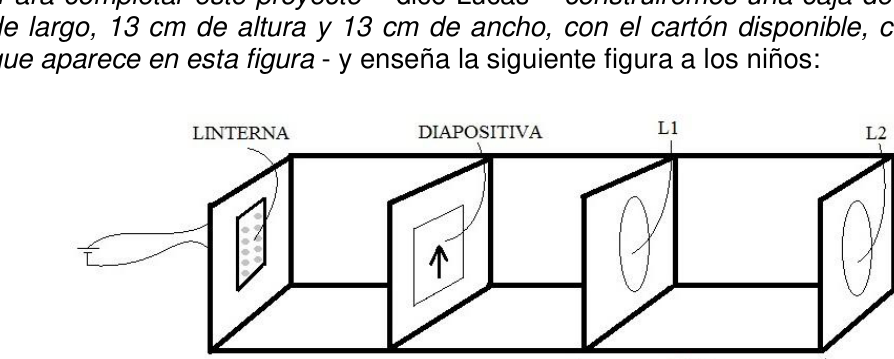
Topic: Geometric Optics Metodi: Thin Lens & Mirror Equation, Ray Tracing Competenze: Physical Reasoning, Diagrammatic Reasoning Objects: Lens, Screen Fonte: Testo (PDF) — p.3
Proiettore di diapositive domestici
PT24. Instituto Superior Enrique Guillermo Hood(1)
Scuola Preuniversitaria Prof. Vicente Aguilera (piccola)
Colegio Padre Ramón de la Quintana(1)
Istituto superiore FASTA Catamarca (Istituto superiore FASTA Catamarca) Colegio del Carmen e San José (CC) 1)
Scuola secondaria n. 21 Repubblica del Venezuela(2)
San Fernando del Valle (1) - Andalgalá (2), Catamarca.
Proposta: costruzione di un proiettore di schede caserme. Pablo, Rodrigo, Lucas e Willy hanno tra i 17 e i 18 anni, sono compagni del 5° anno a scuola e insieme fanno parte del Club delle Scienze di Albert Einstein
- l’istituzione. Questa volta pensano alla proposta di costruire un Proiettore di schede casermo per portare e mostrare agli studenti di 6° La scuola di cui si frequenta la scuola di scuola, per invitarli a far parte del club a partire dal prossimo anno, quando saranno studenti del liceo. Contiene i seguenti materiali: Vari resistenze di 15, 18, 22, 27, 33, 39 e 47 Simbolo: 10 diodi di luce bianca ad alta intensità LED con una a tensione nominale di 3,4 V. Simbolo: • Una pila da 9 V montata su una delle rispettive portabatteria. Simbolo: • Due lupe a 5 cm di distanza focale. • Immagini e foto su diapositive. • Cartone, molto cartone. Inoltre, hanno tutti i mezzi e i materiali necessari La struttura è stata costruita in modo da permettere l’accesso alle strutture di produzione. Cable, pelati, cutter o trench, crocodili, ecc.) le specifiche non sono necessarie. Una volta riuniti Pablo, Rodrigo, Lucas e Willy con gli studenti di 6° grado intorno a un tavolo da lavoro della sala del Club delle Scienze, inizia la
OAF 2013 - 62 dimostrazione. Paolo si rivolge ai bambini e dice: mostrando i diodi LED, le resistenze e la pila — possiamo costruire una
- L’incendio, immaginate come? I bambini presenti rispondono con timidezza. No. Uno dei bambini chiede: “E di tutto questo, cosa dà luce?” che un altro risponde Potrebbero essere questi, sembrano focali… Così, avendo svegliato la curiosità dei bambini, Pablo, Rodrigo, Lucas e Willy montano il il circuito seguente, con la partecipazione di tutti i presenti:
Figura 1. Circuito N. 1.
I bambini provano, infatti, che i focoliti sono gli emettitori della luce. Mentre il resto si diverte aprendo e chiudendo il circuito, una bambina, molto osservatore, per via della resistenza, chiede: – Rodrigo risponde: “È un componente elettronico chiamato resistenza. La La bambina chiede: “Per cosa serve?” - a quello che Rodrigo risponde. Per non danneggiare o non bruciare i diodi, cioè i foci. La bambina
- E perché hai scelto quella e non qualunque altra? e Rodrigo Risponde: “Questo fa parte di ciò che impariamo al Science Club. Usando alcune formule possiamo calcolare che la resistenza che Abbiamo bisogno di questo e non di un altro. Pablo, Rodrigo, Lucas e Willy sanno che questi diodi possono sopportare una 25 mA ma hanno pensato il circuito in modo che la corrente che circola per ogni diodo non superi i 20 mA. Risposta:
- Qual è la caduta di tensione nel gruppo diodico?
- Qual è la caduta di tensione nella resistenza?
- Qual è il corrente stimato per l’insieme dei diodi?
- Qual è il valore calcolato per la resistenza?
- Di tutte le resistenze che hanno per questo progetto, quale è? È quella che hanno usato sul circuito?
- Che corrente circola effettivamente nel circuito?
- Qual è il corrente che circola attraverso ogni diodo?
- Qual è la potenza di ogni diodo? La dimostrazione continua. Come vedete, abbiamo messo i 10 focali uno all’altro. un lato dall’altro in una connessione chiamata en parallelo. Tuttavia, Avremo bisogno di un’altra volta che il nostro lantern non sia così lungo. Per questo faremo alcune modifiche e con l’aiuto dei bambini montaremo il il circuito seguente:
Figura N. Circuito N. 2.
OAF 2013 - 63 Qualcuno tocca l’épaule di Rodrigo, si gira e vede la stessa bambina che gli dice I focali sono ancora gli stessi che erano prima, ma ho già capito che Hai cambiato resistenza e Rodrigo, sorridendo, risponde: Usando le stesse formule che abbiamo usato prima per calcolare questa qui. la quale abbiamo bisogno e nessuna delle altre. Sono considerate le stesse specifiche di corrente che si trovano nel circuito precedente. Risposta: 9. Qual è la caduta di tensione nel gruppo diodico? 10. Qual è la caduta di tensione nella resistenza? 11. Qual è il corrente stimato per l’insieme dei diodi? 12. Qual è il valore calcolato per la resistenza? 13. Di tutte le resistenze che hanno per questo progetto,
- Che tipo di circuito hanno usato?
- Che corrente circola effettivamente nel circuito?
- Qual è il corrente che circola attraverso ogni diodo?
- Qual è la potenza di ogni diodo? -Per completare questo progetto, dice Lucas, costruiremo una scatola di 38 cm. lunghe, 13 cm di altezza e 13 cm di larghezza, con la cartone disponibile, come la che viene mostrata in questa figura - e mostra ai bambini la seguente figura:
Figura N. 3: Progettore Casero.
-All’estremo sinistro posizioneremo il nostro lanterna la figura - all’estremità destra una lente indicando L2 - che smonteremo di lupe e metteremo in questi cartoni e mostra un pezzo di cartone 13 cm x 13 cm quadrato con una perforazione circolare al centro della dimensione della lente. Continua dicendo Posizioneremo il resto del lente a 15 cm dalla precedente indicando L1 nella figura - e la porta a slide tra la lampada e L1. Poi chiuderemo la scatola e avremo pronto il nostro Slide Projector.
- Casermo! Mani all’opera! - Finisce Lucas. Tutti collaborano nell’esercito. Alcuni tagliano, altri attaccano, altri semplicemente contemplano quando il Il proiettore è finalmente finito, le luci della sala si spegne e tutti Guardano gli spettatori verso un muro vicino a 3 m dalla lente L2. I I bambini guardano con stupore l’immagine formata sul muro, tuttavia Paolo togli la copertura superiore del proiettore, muove avanti e indietro la Il modello di visualizzazione è stato ripreso in un modo che non è stato possibile ottenere una maggiore trasparenza fino a quando l’immagine proiettata non è stata più chiara e non è stata ripreso in un modo che non è stato ripreso. chiudere la scatola. La stessa bambina si avvicina a Rodrigo e gli chiede:
- meglio dopo aver spostato la diapositiva? a cosa risponde Rodrigo
Questo è anche qualcosa che impariamo al Science Club. Usate una . formula che ci permette di calcolare dove si deve posizionare l’oggetto, cioè la Slide, per far vedere l’immagine al meglio. Ricordiamo che le lupe sono costruite con lenti convergenti e hanno in Il numero di punti di vista è il numero di punti di vista. - Al muro.
OAF 2013 - 64 Risposta: 17. A che distanza dalla lanterna Paolo finalmente posizionò la diapositiva? 18. Rendi il diagramma dei raggi principali per l’obiettivo L1. Considerate come oggetto, la freccia disegnata sul diapositivo. 19. Indicare le caratteristiche dell’immagine formata tra i lenti da Lenti L1 (reale o virtuale, destra o inversa). 20. Calcola la dimensione dell’immagine formata tra le lenti dal lente L1, se l’oggetto è alto 3 cm. 21. Rendi il diagramma dei raggi principali per l’obiettivo L2. 22. Indicare le caratteristiche dell’immagine formata sul muro da Lenti L2 (reali o virtuali, a destra o invertita). 23. Calcola il formato dell’immagine formata sul muro con l’obiettivo L2. La giornata si conclude con un semplice agape. Pablo, Rodrigo, Lucas e Willy lo sanno. che avranno una curiosa compagna all’interno del Club l’anno prossimo.
Topic: Geometric Optics Metodi: Thin Lens & Mirror Equation, Ray Tracing Competenze: Physical Reasoning, Diagrammatic Reasoning Objects: Lens, Screen Fonte: Testo (PDF) — p.3
The following table shows the results of the calculations:
PT24. The school is a private institution.
Pre-university school Prof. Vicente Aguilera (born 1 January 1943)
Father Ramón de la Quintana College (Father Ramón de la Quintana) is located in Quintana.
The following is the list of the institutions of higher education in Spain: College of Carmen and San José (s)
Secondary School No 21 Republic of Venezuela(2)
The following is a list of the regions of Spain and Portugal.
Proposal for a project to build a home slide projector. Pablo, Rodrigo, Lucas and Willy are between 17 and 18 years old, they are friends of the 5° year in school and together they are part of the Albert Einstein Science Club of That institution. This time they are thinking about the proposal Construction of a Home Slide Projector to take and show 6° students degree from their own school, in order to invite them to join the club Starting next year, when they’re high school students. They have the following materials: Various resistors of 15, 18, 22, 27, 33, 39 and 47 The symbol is: 10 high-intensity white light LED diodes each with one a rated voltage of 3,4 V. The symbol is: • A 9 V battery mounted on its respective battery carries. The symbol is: • Two 5 cm focal length lupes. • Slides and images. • Cardboard, lots of cardboard. • They also have all the tools and other materials The project is designed to provide a high level of quality and safety. Wire, coal, cutters or trenches, crocodiles, etc.) of which Specifications are not necessary. Once Pablo, Rodrigo, Lucas and Willy met with the students of 6° grade around a desk in the Science Club room, it starts the
The following is the list of the Member States’ financial statements: The demonstration. Paul addresses the children and says - with these elements - showing the LEDs, the resistance and the stack — we can build one. flashlight, can you imagine how? The boys and girls present responded timidly - One of the kids asks And of all that, what gives light to it? So, having these, they look like they’re focused. The children’s curiosity was aroused, and Paul, Rodrigo, Lucas and Willy rode the The following circuit, with the participation of all present:
Figure 1 is shown. Circuit number one. 1.
Children can see that the foci are the emitters of the Light. While the rest of us are having fun opening and closing the circuit, a girl, too. Observer by the way, asking pointing to resistance - what is this? – Rodrigo replies It’s an electronic component called resistance. La Girl asks - What’s it for? - to what Rodrigo answers Here we use it The use of the diodes is not to damage or burn the diodes, i.e. the foci. The girl . Reproves - And why did you choose that one and not any other one out there? and Rodrigo Answer: That’s part of what we learn at the Science Club. We use some formulas and we can calculate that the resistance that We need that one and not the other. Pablo, Rodrigo, Lucas and Willy know these diodes can withstand a Maximum current of 25 mA but they thought the circuit so that the the current circulating through each diode shall not exceed 20 mA. Answer:
- What is the voltage drop in the diode array?
- What’s the drop in resistance voltage?
- What is the estimated current for the set of diodes?
- What’s the calculated value for the resistance?
- Of all the resistance they have to this project, which one? Is that the one they used on the circuit?
- What current is actually circulating in the circuit?
- What is the current circulating through each diode?
- What is the power of each diode? The demonstration continues. As you can see, we’ve placed the 10 “focuses” one at a time. side by side in a connection called parallel. However, We’ll need our flashlight later not to be that long. So we’re going to make some modifications and with the help of the kids we put the the following circuit:
Figure number one. Second, Circuit No. 2.
The following is the list of the Member States’ financial statements: Someone touches Rodrigo’s shoulder, he turns and sees the same girl who tells him The focuses are still the same as before, but I’ve already realized that You changed the resistance and Rodrigo, smiling, replied to him. I used the same formulas we used before to calculate what this is right here. The one we need and none of the others. The same current specifications as in the circuit are considered previously. Answer: 9. What is the voltage drop in the diode array? 10. What’s the drop in resistance voltage? 11. What is the estimated current for the set of diodes? 12. What’s the calculated value for the resistance? 13. Of all the resistance they have to this project, Which one did you use on the circuit? 14. What current is actually circulating in the circuit? 15. What is the current circulating through each diode? 16. What is the power of each diode?
- To complete this project, Lucas says we’ll build a box of 38 cm. 13 cm long and 13 cm wide, with available cardboard, such as which appears in this figure - and shows the following figure to the children:
Figure number one. 3: Casero projector.
- At the far left we will place our flashlight explains, pointing it at
The figure - at the far right a lens pointing to L2 - that we’re going to disassemble
And we’ll put it in these boxes and show you a piece of cardboard.
square of 13 cm x 13 cm with a circular hole in the centre of the size
from the lens. He goes on to say We’ll put the remaining lens 15 cm from the
previous pointing to L1 in the figure - and the slide port between the flashlight and L1.
Then we’ll close the box and we’ll have our Slide Projector ready.
I’m the house guy! Hands to the Work! - It ends with Lucas. Everyone is in the military.
Some cut, some stick, others just look at the
The projector is finally finished, the room lights go out and everyone
They look forward to a nearby wall located 3 m from the L2 lens. The
Children look at the image on the wall in amazement, yet Paul
Remove the top cover of the projector, move the projector back and forth.
The slide is then sliding until the projected image becomes sharper and returns to the
close the box. The same girl comes up to Rodrigo and asks him - Why is he looking?
Better after they moved the slide? to what Rodrigo answers
This is also something we learn at the Science Club. We use one. This is a formula that allows us to calculate where the object should be located, i.e. the slide, so the image looks as good as it can. Remember that wolves are built with converging lenses and have in The lens’s position, focal length and distance are taken into account. To the wall.
The following is the list of the Member States’ financial statements: Answer: 17. How far from the flashlight did Paul finally place the slide? 18. Make the main beam diagram for L1 lens. Consider As an object, the arrow drawn on the slide. 19. Indicate the characteristics of the image formed between the lenses by the L1 lens (real or virtual, right or reverse). 20. Calculate the size of the image formed between the lenses by the lens L1, assuming the object is 3 cm high. 21. Make the main beam diagram for the L2 lens. 22. Indicate the characteristics of the image formed on the wall by the L2 lens (real or virtual, right or reverse). 23. Calculate the size of the image formed on the wall by the L2 lens. The day ends with a simple agape. Pablo, Rodrigo, Lucas and Willy know. They’ll have a curious companion next year inside the club.
Topic: Geometric Optics Metodi: Thin Lens & Mirror Equation, Ray Tracing Competenze: Physical Reasoning, Diagrammatic Reasoning Objects: Lens, Screen Fonte: Testo (PDF) — p.3
Picnic - enfriar agua (calorimetria)
PT25. EPET Nro. 5 Fray Luis Beltrán
Apóstoles, Misiones.
Un grupo de estudiantes de la EPET 5 de Apóstoles va de Picnic al Club
Ucraniano. En el camino de ida, se detienen en una estación de servicio a cargar
agua caliente para el mate y agua y hielo para el terere (Cargan un litro de agua
caliente a 90 ºC en un termo de 1,5 litros de capacidad y cargan con 1 litro de
agua y hielo a 0ºC un termo lar de 2 litros de capacidad).
Al llegar al sitio especificado, se dan cuenta que el agua para el mate debe estar
a 78ºC, por lo cual deben proceder a enfriar el agua que esta a 90ºC. Existen
dos soluciones posibles:
a) La primera es agregar parte del agua que esta a 0ºC en el termo lar
hasta llegar a los 78ºC. ¿Cuánta agua fría hay que agregar?
b) La segunda es agregar uno o varios cubitos de hielo de determinado
tamaño que permita bajar la temperatura a los 78ºC solicitados.
¿Cuántos gramos de hielo hay que agregar?
c) ¿Cuál es la mejor solución desde el punto de vista técnico?
d) ¿Cuál es la mejor solución desde el punto de vista social?
Topic: Thermodynamics Metodi: First Law of Thermodynamics, Conservation of Energy Competenze: Physical Reasoning Objects: Container Fonte: Testo (PDF) — p.3
**Picnic - raffreddamento dell’acqua (calorimetria) **
PT25. Il numero di EPET. 5 Fray Luis Beltrán
Apostoli, Missioni.
Un gruppo di studenti dell’EPET 5 degli Apostoli va dal picnic al club Ucraino. In viaggio di andata e ritorno, si fermano in una stazione di servizio per caricare acqua calda per il mate e acqua e ghiaccio per il terere (cargate un litro di acqua Caldo a 90 oC in un termolo di 1,5 litri di capacità e carico con 1 litro di acqua e ghiaccio a 0oC un termolococo di 2 litri di capacità). Arrivati al sito specificato, si rendono conto che l’acqua per il mate deve essere A 78°C, quindi devono procedere al raffreddamento dell’acqua a 90°C. Esistono. Due possibili soluzioni: a) Il primo è quello di aggiungere parte dell’acqua che è a 0°C nel termolo. fino a raggiungere i 78°C. Quanta acqua fredda è necessario aggiungere? b) Il secondo è quello di aggiungere uno o più cubetti di ghiaccio di determinato dimensioni che consentano di abbassare la temperatura a 78 °C richieste. Quanti grammi di ghiaccio ci si deve aggiungere? c) Qual è la soluzione migliore dal punto di vista tecnico? d) Qual è la soluzione sociale migliore?
Topic: Thermodynamics Metodi: First Law of Thermodynamics, Conservation of Energy Competenze: Physical Reasoning Objects: Container Fonte: Testo (PDF) — p.3
The following table shows the results of the calculation of the average daily daily daily daily daily daily daily daily daily daily daily daily daily daily daily daily daily daily daily daily daily daily daily daily daily daily daily daily daily daily daily daily daily daily daily daily daily daily daily daily daily daily daily daily daily daily daily daily daily daily daily daily daily daily daily daily daily daily daily daily daily daily daily daily daily daily daily daily daily daily daily daily daily daily daily daily daily daily daily daily daily daily daily daily daily daily daily daily daily daily daily daily daily daily daily daily daily daily daily daily daily daily daily daily daily daily daily daily daily daily daily daily daily daily daily daily daily daily daily daily daily daily daily daily daily daily daily daily daily daily daily daily daily daily daily daily daily daily daily daily daily daily daily daily daily daily daily daily daily daily daily daily daily daily daily daily daily daily daily daily daily daily daily daily daily daily daily daily daily daily daily daily daily daily daily daily daily daily daily daily daily daily daily daily daily daily daily daily daily daily daily daily daily daily daily daily daily daily daily daily daily daily daily daily daily daily daily daily daily daily daily daily daily daily daily daily daily daily daily daily daily daily daily daily daily daily daily daily daily daily daily daily daily daily daily daily daily daily daily daily daily daily daily daily daily daily daily daily daily daily daily daily daily daily daily daily daily daily daily daily daily daily daily daily daily daily daily daily daily daily daily daily daily daily daily daily daily daily daily daily daily daily daily daily daily daily daily daily daily daily daily daily daily daily daily daily daily daily daily daily daily daily daily daily daily daily daily daily daily daily daily daily daily daily daily daily daily daily daily daily daily daily daily daily daily daily daily daily daily daily daily daily daily daily daily daily daily daily daily daily daily daily daily daily daily daily daily daily daily daily daily daily daily daily daily daily daily daily daily daily daily daily daily daily daily daily daily daily daily daily daily daily daily daily daily daily daily daily daily daily daily daily daily daily daily daily daily daily daily daily daily daily daily daily daily daily daily daily daily daily daily daily daily daily daily daily daily daily daily daily daily daily daily daily daily daily daily daily daily daily daily daily daily daily daily daily daily daily daily daily daily daily daily daily daily daily daily daily daily daily daily daily daily daily daily daily daily daily daily daily daily daily daily daily daily daily daily daily daily daily daily daily daily daily daily daily daily daily daily daily daily daily daily daily daily daily daily daily daily daily daily daily daily daily daily daily daily daily daily daily daily daily daily daily daily daily daily daily
PT25. The following information shall be provided: 5 Fray Luis Beltran
Apostles, missions, what are you doing?
A group of students from EPET 5 of Apostles goes from picnic to club Ukrainian. On the way back, they stop at a gas station to load. Hot water for matte and water and ice for terere (Carry one liter of water heat at 90 oC in a 1.5 litre capacity heat exchanger and load with 1 litre of water and ice at 0oC a thermal power of 2 litres). When you get to the specified site, you realize that the water for the mate must be there. At 78°C, they must therefore cool the water to 90°C. They exist . Two possible solutions: (a) The first is to add some of the water at 0°C to the thermal home. until it reaches 78 degrees. How much cold water do you have to add? (b) The second is to add one or more ice cubes of a given ice. a size that allows the temperature to be lowered to the required 78 °C. How many grams of ice do you have to add? (c) What is the best solution from a technical point of view? (d) What is the best social solution?
Topic: Thermodynamics Metodi: First Law of Thermodynamics, Conservation of Energy Competenze: Physical Reasoning Objects: Container Fonte: Testo (PDF) — p.3
Calentar agua con lampara
PT26. EPET Nro. 5 Fray Luis Beltrán
Apóstoles, Misiones.
Luego de un breve rato de tomar mate en el Club Ucraniano, el grupo de amigos descubre que se les acabo el agua que tenían en el termo. Uno de ellos propone la siguiente idea: “Calentar en un recipiente el agua que todavía queda en el termo lar ((1 – X) litros de agua a 0ºC, ya que aun se observa un minúsculo trozo de hielo flotando en la misma). Para ello se decide utilizar la batería de 12 Voltios del Jeep, y una lámpara de 60W de la iluminación alta/baja del mismo. El equivalente mecánico del calor es 1 caloría = 4,186 Julios. El circuito es el siguiente:
OAF 2013 - 65
a) Calcular la intensidad de corriente que circula por la lámpara al
conectarse a la batería.
b) Calcular la resistencia interna de la lámpara, suponiendo que esta es
lineal.
c) Calcular el tiempo necesario para que el agua que esta a 0ºC pase a
estar a 78ºC, para poder tomar unos buenos mates.
d) Con el fin de acelerar el proceso anterior se deciden utilizar los dos
faros delanteros del Jeep y encender los filamentos de alta y baja a la
vez, con lo cual se cuenta con dos fuentes de calor de 120 W cada una.
¿A cuánto se reduce el tiempo de espera?. Dibujar el circuito eléctrico
correspondiente.
e) Dado que las soluciones planteadas en el ejercicio anterior, insumen
demasiado tiempo de calentamiento, otro de los alumnos del grupo
propone encender el Jeep durante 10 minutos, sacar agua del radiador,
colocarla en un recipiente que contenga al recipiente con el agua para el
mate y por convección calentar la misma (Proceso tipo “Baño María”).
Se supone que la transferencia de calor es optima y que el agua que se
extrae del radiador esta a 95ºC.
e1) ¿Qué cantidad de agua caliente se necesita para llevar los 846
cm3 de agua a 0ºC a 78ºC?
e2) ¿Qué solución intermedia puede proponerse?
Topic: Circuits, Thermodynamics Metodi: Kirchhoff’s Laws, First Law of Thermodynamics Competenze: Physical Reasoning Objects: Battery, Resistor Fonte: Testo (PDF) — p.3
Caldare l’acqua con lampada
PT26. Il numero di EPET. 5 Fray Luis Beltrán
Apostoli, Missioni.
Dopo un breve periodo di mate al Club ucraino, il gruppo di amici Scopre che non hanno più l’acqua del termostato. Uno di loro propone l’idea seguente: Riscaldare in un recipiente l’acqua che rimane ancora in term lar ((1 X) litri di acqua a 0oC, poiché si osserva ancora un piccolo pezzo di ghiaccio che galleggia in esso). Per questo si decide di utilizzare la batteria di 12 volt della Jeep, e una lampada di 60W di illuminazione alta/bassa di esso. L’equivalente meccanico del calore è 1 caloria = 4.186 luglio. Il circuito è il seguente:
OAF 2013 - 65 a) Calcolare l’intensità di corrente che circola attraverso la lampada al
- Si può collegare alla batteria. b) Calcolare la resistenza interna della lampada, supponendo che questa sia lineare. c) Calcolare il tempo necessario per far passare l’acqua a 0 °C a
- A 78°C, per poter prendere dei buoni matte. d) Per accelerare il processo precedente si decide di utilizzare le due I fari del Jeep e accendere i filamenti di alto e basso alla una volta, con due fonti di calore di 120 W ciascuna. Quanto è ridotto il tempo di attesa? Disegnare il circuito elettrico corrispondente. e) Dato che le soluzioni proposte nel corso dell’esercizio precedente Troppo tempo di riscaldamento, un altro dei ragazzi del gruppo Propone di accendere la Jeep per 10 minuti, togliere l’acqua dal radiatore, Mettere in un recipiente che contiene il recipiente con l’ acqua per il La temperatura del bagno è di circa 10 °C. Il trasferimento di calore è presunto ottimale e l’acqua che viene
- Si, si, si, si, si, si, si, si, si, si, si, si, si, si, si, si, si, si, si, si, si, si, si, si, si, si, si, si, si, si, si, si, si, si, si, si, si, si, si, si, si, si, si, si, si, si, si, si, si, si, si, si, si, si, si, si, si, si, si, si, si, si, si, si, si, si, si, si, si, si, si, si, si, si, si, si, si, si, si, si, si, si, si, si, si, si, si, si, si, si, si, si, si, si, si, si, si, si, si, si, si, si, si, si, si, si, si, si, si, si, si, si, si, si, si, si, si, si, si, si, si, si, si, si, si, si, si, si, si, si, si, si, si, si, si, si, si, si, si, si, si, si, si, si, si, si, si, si, si, si, si, si, si, si, si, si, si, si, si, si, si, si, si, si, si, si, si, si, si, si, si, si, si, si, si, si, si, si, si, si, si, si, si, si, si, si, si, si, si, si, si, si, si, si, si, si, si, si, si, si, si, si, si, si, si, si, si, si, si, si, si, si, si, si, si, si, si, si, si, si, si, si, si, si, si, si, si, si, si, si, si, si, si, si, si, si, si, si, si, si, si, si, si, si, si, si, si, si, si, si, si, si, si, si, si, e1) Quanta acqua calda è necessaria per trasportare i 846 cm3 di acqua a 0°C a 78°C? e2) Che soluzione intermedia può essere proposta?
Topic: Circuits, Thermodynamics Metodi: Kirchhoff’s Laws, First Law of Thermodynamics Competenze: Physical Reasoning Objects: Battery, Resistor Fonte: Testo (PDF) — p.3
Water heating with lamp
PT26. The following information shall be provided: 5 Fray Luis Beltran
Apostles, missions, what are you doing?
After a brief spell of mate at the Ukrainian Club, the group of friends He finds out they’re running out of water in the thermal. One of them proposes The following idea: Heat the water that remains in the container thermo lar ((1 X) litres of water at 0oC, since a tiny fraction is still observed of ice floating in it). For this purpose, the Jeep’s 12-volt battery and a light bulb are used. 60W of the high/low lighting of the same. The mechanical equivalent of heat is One calorie is 4,186 jules. The circuit is as follows:
The following is the list of the Member States’ financial statements: (a) Calculate the current intensity circulating through the lamp at the connect to the battery. (b) Calculate the internal resistance of the lamp, assuming that this is linear. (c) Calculate the time required for water at 0 °C to pass to I’m gonna be at 78 degrees, so I can get some good mates. (d) In order to speed up the above process, it is decided to use both The front lights of the Jeep and the up and down wires on the This is a very simple process, which is two heat sources of 120 W each. How much is the waiting time reduced? Draw the electrical circuit the corresponding. (e) Since the solutions proposed in the previous financial year include: Too much warming time, another of the group’s students He proposes to turn on the Jeep for 10 minutes, draw water from the radiator, Place it in a container containing the container with water for the The heat is then applied to the water and the water is then heated by convection (Typical process Banna Maria). The heat transfer is supposed to be optimal and the water that is being It’s 95 degrees Celsius out of the radiator. e1) How much hot water is needed to carry the 846 One cubic inch of water at 0 to 78 degrees Celsius? (e2) What intermediate solution can be proposed?
Topic: Circuits, Thermodynamics Metodi: Kirchhoff’s Laws, First Law of Thermodynamics Competenze: Physical Reasoning Objects: Battery, Resistor Fonte: Testo (PDF) — p.3
Circuito CC - Thevenin/Norton
PT27. EPET Nro. 5 Fray Luis Beltrán
Apóstoles, Misiones.
Dado el siguiente circuito eléctrico en Corriente Continua, resolver aplicando las leyes circuitales de Ohm y Kirchhoff y los teoremas de Thevenin y Norton.
R1 = 20 Ω R2 = 20 Ω R3 = 10 Ω R4 = 20 Ω R5 = 20 Ω UBAT1 = 10 V UBAT2 = 10 V
a. Hallar las intensidades de corriente IBAT1 e IBAT2 suministradas por las baterías y las intensidades de corriente que circulan por cada una de las resistencias (IR1, IR2, IR3, IR4 e IR5) b. Hallar las caídas de tensión en cada resistencia (UR1, UR2, UR3, UR4 y UR5) c. Hallar las potencias disipadas en cada resistencia (PR1, PR2, PR3, PR4 y PR5)
OAF 2013 - 66 d. Verificar que la suma de las potencias disipadas por las resistencias es igual a la suma de las potencias suministradas por las fuentes de tensión.
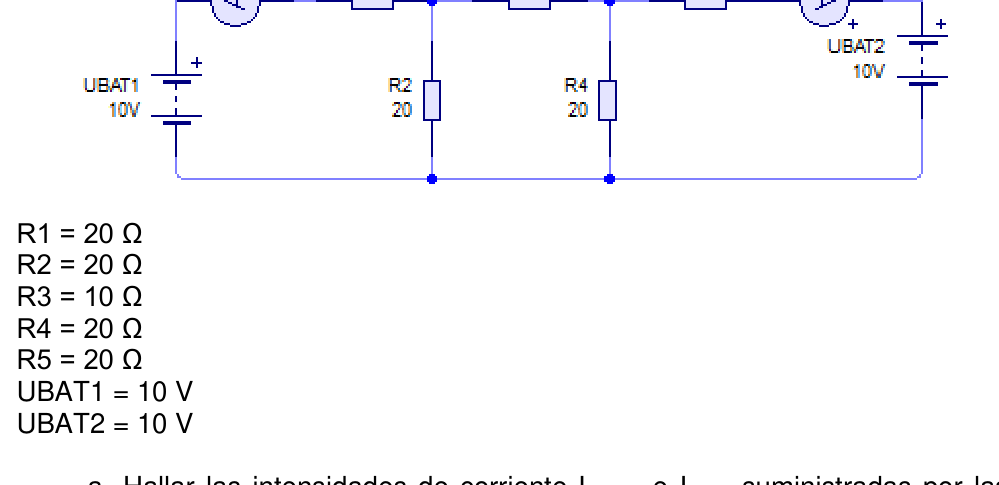
Topic: Circuits Metodi: Kirchhoff’s Laws, Equivalent Circuit Reduction Competenze: Physical Reasoning, Mathematical Modeling Objects: Resistor, Battery Fonte: Testo (PDF) — p.3
Circuito CC - Thevenin/Norton
PT27. Il numero di EPET. 5 Fray Luis Beltrán
Apostoli, Missioni.
Dato il seguente circuito elettrico in corrente continua, risolvere applicando le Le leggi di Ohm e Kirchhoff e i teoremi di Thevenin e Norton.
R1 = 20 Ω R2 = 20 Ω R3 = 10 Ω R4 = 20 Ω R5 = 20 Ω UBAT1 = 10 V UBAT2 = 10 V
a. Determinare le intensità di corrente IBAT1 e IBAT2 fornite dalle le batterie e le intensità di corrente che circolano per ciascuna delle resistenze (IR1, IR2, IR3, IR4 e IR5) b. Trovare le cadute di tensione in ogni resistenza (UR1, UR2, UR3, UR4 e UR5) c. Determinare le potenze dissipate in ciascuna resistenza (PR1, PR2, PR3, PR4 e PR5)
OAF 2013 - 66 d. Verificare che la somma delle potenze dissipate dalle resistenze sia pari alla somma delle potenze fornite dalle fonti di tensione.
Topic: Circuits Metodi: Kirchhoff’s Laws, Equivalent Circuit Reduction Competenze: Physical Reasoning, Mathematical Modeling Objects: Resistor, Battery Fonte: Testo (PDF) — p.3
The following is the list of the types of electrical equipment used:
PT27. The following information shall be provided: 5 Fray Luis Beltran
Apostles, missions, what are you doing?
Given the following electrical circuit in DC, solve by applying the Ohm and Kirchhoff’s circuit laws and Thevenin and Norton’s theorems.
R1 = 20 Ω R2 = 20 Ω R3 = 10 Ω R4 = 20 Ω R5 = 20 Ω The value of the vehicle shall be the value of the vehicle’s weight. The following is the list of the following:
a. Find the current intensities IBAT1 and IBAT2 supplied by the Batteries and the current intensities circulating through each of the The following shall be reported in the following table: b. Find the voltage drops in each resistance (UR1, UR2, UR3, UR4 and UR5) c. Find the dissipated forces in each resistance (PR1, PR2, PR3, PR4 and PR5)
The following is the list of the Member States’ financial statements: d. Verify that the sum of the powers dissipated by the resistors is equal to the sum of the powers supplied by the sources of The tension.
Topic: Circuits Metodi: Kirchhoff’s Laws, Equivalent Circuit Reduction Competenze: Physical Reasoning, Mathematical Modeling Objects: Resistor, Battery Fonte: Testo (PDF) — p.3
El locro (calorimetria)
PT28. Escuela Técnica Ort Nro. 2
Ciudad de Buenos Aires.
La Sra. Adriana hace el mejor locro de Belgrano, y
a pesar de no querer revelar los secretos de
preparación, nos facilitó los ingredientes de la
receta para que podamos comprender bien el
proceso de cocción. En primer lugar se ponen a
hervir 1kg de maíz (Ce=0,5 Cal/grºC) y 500gr de
porotos (Ce=0,2 Cal/grºC) en 3 litros de agua. La
temperatura inicial del sistema es 20ºC.
a) ¿Cuánta energía debe entregársele al sistema para que comience a
hervir el agua? (considerá que hervirá a 100ºC)
b) Si la hornalla tiene una potencia de 2200 w y la olla un “rendimiento” del
75% ¿cuánto tiempo le tomará al sistema romper hervor?
Si en CNPT (condiciones normales de presión y temperatura) 1 m3 de gas
natural produce 9300 Kcal y su densidad es 0,78kg/m3 y la receta pide hervir el
maíz y los porotos durante 1 hora
c) ¿Qué cantidad de gas será usado para realizar este proceso?
Al cabo de este tiempo se apaga el fuego y se agregan el resto de los
ingredientes: 1kg de zapallo (Ce=0,35 Cal/grºC), 200gr de panceta (Ce=0,18
Cal/grºC) y 400gr (Ce=0,4 Cal/gr*ºC) de carne sacados directo de la heladera a
8ºC, despreciando la masa de agua evaporada en el anterior proceso.
d) ¿A qué temperatura termalizará el sistema? si se desprecia el flujo de
calor con el ambiente en esos pocos minutos
Por último se lleva todo a hervor por otra hora, se condimenta y se apaga el
fuego dejando enfriar lentamente hasta que se pueda consumir SIN quemarnos
(a 60ºC). Despreciando la masa de agua evaporada durante el hervor y
considerando, ahora sí, el flujo de calor al ambiente 500 cal/seg
e) Desde que se apaga el fuego ¿Cuánto tiempo deberemos esperar para
poder comer? Observación: ser objetivos y despreciar los efectos del
hambre acumulados durante las largas horas de olfatear el delicioso
locro.
Topic: Thermodynamics Metodi: First Law of Thermodynamics, Conservation of Energy Competenze: Physical Reasoning Objects: Container Fonte: Testo (PDF) — p.3
Il locro (calorimetria)
PT28. Scuola tecnica Ort Nro. 2
Città di Buenos Aires.
La signora. Adriana fa il miglior folle di Belgrano, e Nonostante non voglia rivelare i segreti di La preparazione, ci ha facilitato gli ingredienti della La ricetta per capire bene il processo di cottura. Prima di tutto, mettetevi in Fabbricare 1 kg di mais (Ce=0,5 Cal/groC) e 500 gr di perotti (Ce=0,2 Cal/groC) in 3 litri d’acqua. La La temperatura iniziale del sistema è di 20°C. a) Quanta energia deve essere fornita al sistema per iniziare a fervere l’acqua? (considera che si ferverà a 100°C) b) Se il forno ha una potenza di 2200 w e la potta un rendimento di 75%, quanto tempo ci vorrà per rompere il sistema? Se in CNPT (condizioni normali di pressione e temperatura) 1 m3 di gas La ricetta richiede di bollire il calore. maiale e poroni per 1 ora c) Quanta gas sarà utilizzata per eseguire questo processo? Dopo questo tempo il fuoco si spegne e si aggiungono gli altri. Ingredienti: 1 kg di zapallo (Ce=0,35 Cal/groC), 200 gr di pancetta (Ce=0,18 Cal/groC) e 400gr (Ce=0,4 Cal/gr*oC) di carne estratta direttamente dal frigorifero a 8°C, disprezzando la massa di acqua evaporata nel processo precedente. D) A che temperatura il sistema termalizzerà? se si disprezza il flusso di calore con l’ambiente in quei pochi minuti Alla fine, tutto viene rimosso per un’altra ora, condimento e spento il Il fuoco si raffredda lentamente fino a quando non si può consumare senza bruciare. (a 60ºC). Scommetto la massa di acqua evaporata durante il rimbalzo e considerando, ora sì, il flusso di calore nell’ambiente 500 cal/sec e) Da quando il fuoco si spegne, quanto tempo dobbiamo aspettare per
- Potete mangiare? L’osservazione: essere obiettivi e disprezzare gli effetti del La fame accumulata durante le lunghe ore di odorare il delizioso.
- Sono pazza.
Topic: Thermodynamics Metodi: First Law of Thermodynamics, Conservation of Energy Competenze: Physical Reasoning Objects: Container Fonte: Testo (PDF) — p.3
The following table shows the results of the calculation of the weight of the product:
PT28. The technical school Ort Nro. 2
City of Buenos Aires.
Mrs. and Mrs. Adriana makes the best of Belgrano’s craziness, and Even though I don ‘t want to reveal the secrets of preparation, provided us with the ingredients of the The recipe is so we can understand the cooking process. First they put on boil 1 kg of maize (Ce=0.5 Cal/groC) and 500 grams of The product is not to be sold in the same container as the product. La The initial temperature of the system is 20oC. (a) How much energy must be delivered to the system to start boiling the water? (consider it to boil to 100 °C) (b) If the furnace has a power of 2200 w and the pot a performance of 75%. How long will it take the system to break? If in CNPT (normal pressure and temperature conditions) 1 m3 of gas Natural produce 9300 Kcal and its density is 0.78kg/m3 and the recipe calls for boiling the corn and porridge for 1 hour (c) How much gas will be used to carry out this process? After this time the fire is extinguished and the rest of the fire is added. The following ingredients are added: 1 kg of zapallo (Ce=0,35 Cal/groC), 200 gr of bacon (Ce=0,18 Cal/groC) and 400gr (Ce=0,4 Cal/groC) of meat directly taken from the freezer to 8°C, disregarding the mass of water evaporated in the previous process. (d) At what temperature will the system heat up? If you despise the flow of heat with the atmosphere in those few minutes Finally, it’s all taken to boil for another hour, seasoned and turned off. The fire slowly cooled down until it could be consumed without burning us. (a 60ºC). Disregarding the mass of water evaporated during the boiling and Considering, now yes, the heat flow to the environment 500 cal/sec (e) Since the fire is extinguished, how long should we wait for
- Can I eat? Observation: being objective and disregarding the effects of the Hunger accumulated during the long hours of sniffing the delicious. I’m going crazy.
Topic: Thermodynamics Metodi: First Law of Thermodynamics, Conservation of Energy Competenze: Physical Reasoning Objects: Container Fonte: Testo (PDF) — p.3
Dos pendulos en colision
PT29. Escuela Técnica Ort Nro. 2
Ciudad de Buenos Aires.
Dos péndulos de masas m1 y m2 alineados pueden chocar cuando se encuentran en su punto más bajo (ver figura), las cuerdas que lo sostienen tienen masa despreciable y longitud l2 y l2 respectivamente. Hay un campo gravitatorio con valor g. Se levanta al primero formando un ángulo Ѳ0 con la vertical y se lo suelta (inicialmente en reposo) dejándolo colisionar con el otro péndulo. a) Considerando el choque totalmente elástico, y suponiendo que el primer péndulo queda en reposo después de éste, calcular, en función de los parámetros dados, la altura a la que llegará el segundo péndulo. ¿Qué ángulo se formará con la vertical? b) Calcular la velocidad final (antes del impacto) del primer péndulo, y la inicial del segundo (inmediatamente después del choque)
OAF 2013 - 67 c) Si en cambio el choque fuera totalmente plástico, es decir los péndulos quedan pegados y se mueven juntos, ¿a qué altura máxima llegarían? d. Si t1 es el tiempo en que tarda el primer péndulo en hacer un cuarto de ciclo (desde que se lo suelta hasta que impacta) y l2 = 2 l1 ¿Cuánto valdrá el período del segundo péndulo?
Topic: Conservation of Momentum, Conservation of Energy Metodi: Conservation of Momentum, Energy Conservation Method Competenze: Physical Reasoning, Mathematical Modeling Objects: Pendulum Fonte: Testo (PDF) — p.3
Due pendoli in collisione
PT29. Scuola tecnica Ort Nro. 2
Città di Buenos Aires.
Due pendoli di massa m1 e m2 allineati possono colpirsi quando si trovano. al suo punto più basso (vedi figura), le corde che lo sostengono hanno massa
- di scarsa importanza e di lunghezza l2 e l2 rispettivamente. C’è un campo gravitazionale con valore g. Si alza al primo formando un angolo 0 con la verticale e lo rilascia (in primo luogo a riposo) lasciandolo colpire l’altro pendolo. a) Considerando che la collisione è totalmente elastica, e supponendo che la prima Il pendolo rimane a riposo dopo di esso, calcolato, in base ai parametri dati, l’altezza al quale raggiungerà il secondo pendolo. Cosa? angolo si forma con la verticale? b) Calcolare la velocità finale (prima dell’impatto) del primo pendolo, e inizio del secondo (immediatamente dopo l’impatto)
OAF 2013 - 67 c) Se invece il colpo fosse totale di plastica, es dire Le
- Gli appendoni rimangono. Collacciati e muoviti insieme, a che altezza?
- Come sarebbe? d. Se t1 è il tempo che dura il primo pendolo in La vita è un ciclo di un quarto (da quando viene rilasciato fino a quando non è stato rilasciato). che impatta) e l2 = 2 l1 Secondo pendolo?
Topic: Conservation of Momentum, Conservation of Energy Metodi: Conservation of Momentum, Energy Conservation Method Competenze: Physical Reasoning, Mathematical Modeling Objects: Pendulum Fonte: Testo (PDF) — p.3
Two pendulums in collision
PT29. The technical school Ort Nro. 2
City of Buenos Aires.
Two pendulums of m1 and m2 mass aligned can collide when they meet At its lowest point (see figure), the strings that hold it have mass. The following is the list of the categories of products concerned: There ‘s a gravitational field with value of g. It rises to the first forming an angle 0 with the vertical and releases it (initially at rest) letting it collide with the other pendulum. (a) Considering the shock is fully elastic, and assuming that the first The pendulum rests after this, calculated on the basis of the parameters given, the height to which the second pendulum will reach. What? angle will form with the vertical? (b) Calculate the final speed (before impact) of the first pendulum, and the initial of the second (immediately after the impact)
The following is the list of the Member States’ financial statements: (c) If the shock were total instead Plastic, es I mean , The The pendulum is left . They’re glued together and moving together, at what height? Maximum would you get? d. If t1 is the time it takes the first pendulum to The first step is to make a quarter cycle (from release to The amount of the period of the Second pendulum?
Topic: Conservation of Momentum, Conservation of Energy Metodi: Conservation of Momentum, Energy Conservation Method Competenze: Physical Reasoning, Mathematical Modeling Objects: Pendulum Fonte: Testo (PDF) — p.3
Circuito - instrumentos de medicion
PT30. Escuela Técnica Ort Nro. 2
Ciudad de Buenos Aires.
En el siguiente circuito a) Calcular qué valores darán los instrumentos de medición. b) ¿Cuánto vale R?
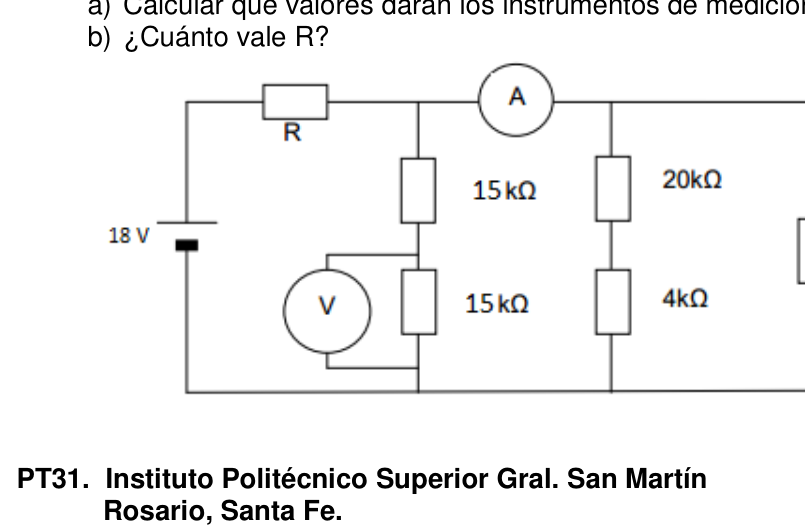
Topic: Circuits Metodi: Kirchhoff’s Laws, Equivalent Circuit Reduction Competenze: Physical Reasoning Objects: Resistor, Galvanometer Fonte: Testo (PDF) — p.3
Circuito - strumenti di misura
PT30. Scuola tecnica Ort Nro. 2
Città di Buenos Aires.
Al prossimo circuito. a) Calcolare i valori che gli strumenti di misurazione daranno. b) Quanto vale R?
Topic: Circuits Metodi: Kirchhoff’s Laws, Equivalent Circuit Reduction Competenze: Physical Reasoning Objects: Resistor, Galvanometer Fonte: Testo (PDF) — p.3
The following table shows the results of the calculations:
PT30. The technical school Ort Nro. 2
City of Buenos Aires.
On the next circuit . (a) Calculate the values to be given by the measuring instruments. (b) How much is R worth?
Topic: Circuits Metodi: Kirchhoff’s Laws, Equivalent Circuit Reduction Competenze: Physical Reasoning Objects: Resistor, Galvanometer Fonte: Testo (PDF) — p.3
Fleteros - planchas apiladas
PT31. Instituto Politécnico Superior Gral. San Martín
Rosario, Santa Fe.
Los fleteros
Gerbacio, Iraudo y Jarvinio tiene como objetivo llevar 4 planchas iguales de
maderas apiladas horizontalmente. Para ello disponen de un auto, un par de
“portatuttos” de última generación, un reloj digital y 3 tacos de madera.
Lamentablemente no cuentan
con soga para atarlos.
Por suerte los portatutos de
última generación cuentan con
una superficie ventosa que
permite agarrar firmemente la
primera plancha.
Lamentablemente las otras 3
quedan a la buena de dios (y
de nuestro amigo el roce).
Por suerte, los fleteros conocen los coeficientes de roces estático y dinámico
entre la planchas (ue=0,5 ud=0,2).
En el comienzo del recorrido no tienen mayores dificultades. Se desplazan sin
contratiempos ni dificultades por las calles de Rosario hasta que toman la Av Del
Bajo. A 200m se aproxima una curva cerrada de 20m de radio. Gerbie, al
volante, observa la velocidad con la que se desplaza, 64,8Km/h (sí, 4,8Km/h
excedido del máximo permitido) y dice a sus copilotos: “¡Rápido, díganme si
necesito bajar la velocidad para evitar un desprendimiento intencional de nuestra
carga!”
OAF 2013 - 68 Ayude a los copilotos.
- Determine cuál es la velocidad máxima a la cual pueden tomar la curva.
Por suerte sortean la curva sin dificultades y siguen desplazándose por la Av Del Bajo. Esta vez moderando su velocidad (unos modestos 54km/h). Sin embargo otro evento llama la atención de Gerbie. 20m antes de llegar a la senda peatonal en una esquina, el semáforo se pone en rojo. Acto seguido Gerbie comienza la maniobra de frenado. Suponiendo que sus reflejos son instantáneos (comienza a frenar instantáneamente) y que frena lo más fuerte posible (evitando que las maderas se desplacen). - Determine si logra frenar antes de la línea peatonal. Suponiendo que en vez de 54km/h, se desplazaban a 72km/h y que Gerbie frenaba en la línea peatonal,
- Calcular la velocidad con la que salen “proyectadas” las maderas.
Consideraciones para el punto anterior.
Solo desplazamiento horizontal (ignoramos el desplazamiento vertical). La longitud de las maderas es de 2m.
El coeficiente de roce, así como las normales no se modifican mientras se desplazan las maderas. Las maderas se consideran “proyectadas” cuando ya no tocan otras maderas. Ante semejante posibilidad, deciden elevar el portatutto delantero y otorgarle cierto ángulo de inclinación. - ¿Qué ángulo mínimo debe dársele para evitar la “proyección” de maderas en la situación anterior?
Topic: Newtonian Mechanics Metodi: Free-Body Diagram, Vector Decomposition Competenze: Physical Reasoning Objects: Block Fonte: Testo (PDF) — p.3
Flatto - piatti in piattaforma
PT31. Istituto Politetnico Superiore Gral. San Martino
Rosario, Santa Fe.
I flottaioli Gerbacio, Iraudo e Jarvinio si propongono di portare 4 assi uguali di legni a piombo orizzontale. Per questo hanno una macchina, un paio di
- Portatuttos di ultima generazione, un orologio digitale e 3 tacchi di legno. Sfortunatamente non conta. con una corda per legarli. Per fortuna i portafogli di La generazione successiva ha una superficie ventuosa che La forza di un’aria di un’aria di un’aria di un’aria di un’aria di un’aria di un’aria di un’aria di un’aria di un’aria di un’aria di un’aria di un’aria di un’aria di un’aria di un’aria di un’aria di un’aria di un’aria di un’aria di un’aria di un’aria di un’aria di un’aria di un’aria di un’aria di un’aria di un’aria di un’aria di un’aria di un’aria di un’aria di un’aria di un’aria di un’aria di un’aria di un’aria di un’aria di un’aria di un’aria di un’aria di un’aria di un’aria di un’aria di un’aria di un’aria di un’aria di un’aria di un’aria di un’aria di un’aria di un’aria di un’aria di un’aria di un’aria di un’aria di un’aria di un’aria di un’aria di un’aria di un’aria di un’aria di un’aria di un’aria di un’aria di un’aria di un’aria di un’aria di un’aria di un’aria di un’aria di un’aria di un’aria di un’aria di un’aria di un’aria di un’aria di un’aria di un’aria di un’aria di un’aria di un’aria di un’aria di un’aria di un’aria di un’aria di un’aria di un’aria di un’aria di un’aria di un’aria di un’aria di un’aria di prima lamina. Purtroppo le altre 3 restano alla buona di Dio (e Il nostro amico il rastrello). Fortunatamente, i fluttori conoscono i coefficienti di roccia statici e dinamici. tra le tavole (ue=0,5 ud=0,2). All’inizio del tour non hanno maggiori difficoltà. Si spostano senza Ma non ci sono problemi nelle strade di Rosario fino a quando non si prende l’Ave Del
- Scendi. A 200 metri si avvicina una curva chiusa di 20 metri di radio. Gerbie, al a volante, osserva la velocità con cui si muove, 64,8Km/h (sì, 4,8Km/h E dice ai suoi co-pilotti: “Spedite, dimmi se Ho bisogno di ridurre la velocità per evitare un intenzionale declino della nostra . carico!
OAF 2013 - 68 Aiuta i co-pilotti.
- Determina la velocità massima a cui possono fare la curva. Per fortuna, hanno sorteato la curva senza difficoltà e continuano a spostarsi sull’Ave del
- Scendi. Questa volta moderando la sua velocità (circa modesti 54km/h). Tuttavia Un altro evento attira l’attenzione di Gerbie. 20 metri prima di arrivare al sentiero pedonale In un angolo, il semaforo diventa rosso. L’atto successivo Gerbie inizia la manovra di frenata. Supponendo che i suoi riflessi siano istantanei (comincia a In questo modo, il sistema di frenata può essere utilizzato per frenare il freno (in modo da evitare che le freni siano più elevate). La legna si muove).
- Determina se riesce a frenare prima della linea pedonale. Supponiamo che invece di 54 km/h, si spostassero a 72 km/h e che Gerbie
- Si’, mi sono fermato sulla linea pedonale.
- Calcolare la velocità con cui i legni usciranno. Considerazioni per il punto precedente. Solo spostamento orizzontale (ignoriamo il spostamento Verticale). La lunghezza dei legni è di 2 m. Il coefficiente di rottura e le norme non sono modificate mentre i legni si spostano. Le legne sono considerate “proiettate” quando non toccano più altri legni. In presenza di tale possibilità, decidono di alzare il portatutto di fronte e di concedergli un certo angolo di inclinazione.
- Qual è l’angolo minimo da dare per evitare la proiezione di La Commissione ha adottato una decisione che non prevede la modifica della direttiva.
Topic: Newtonian Mechanics Metodi: Free-Body Diagram, Vector Decomposition Competenze: Physical Reasoning Objects: Block Fonte: Testo (PDF) — p.3
The following table shows the number of units of the type of the vehicle:
PT31. Gral Higher Polytechnic Institute. Saint Martin .
Rosario, Santa Fe.
The fleetmen . Gerbacius, Iraud and Jarvinius aim to carry 4 equal plates of wood stacked horizontally. They have a car, a couple of cars. The latest generation of portraits, a digital watch and 3 wooden sticks. Unfortunately , they don ‘t count . with rope to tie them. Luckily the portals of The last generation has been a windy surface which It allows you to hold onto the First plank. Unfortunately the other three They’re in God’s good hands. Our friend ‘s rubbing). Fortunately, fleetmen know the coefficients of static and dynamic rocks. between the plates (ue=0,5 ud=0,2). At the beginning of the tour, they have no major difficulties. They ‘re moving without . No problems or difficulties on the streets of Rosario until they take the Av Del
- Down there. A closed curve of 20m radius approaches 200m. Gerbie, the The speed of the vehicle is not less than 10 km/h. And he says to his co-pilots, “Quick, tell me if you can”. I need to slow down to avoid an intentional detachment of our . load!
The following is the list of the Member States’ financial statements: Help the co-pilots.
- Determine the maximum speed at which they can take the curve. Fortunately they draw the curve without difficulty and continue to move along the Av Del
- Down there. This time moderating its speed (some modest 54km/h). However Another event caught Gerbie’s eye. 20m before we get to the footpath. In a corner, the traffic light turns red. Act followed Gerbie begins the the braking maneuver. Assuming your reflexes are instantaneous (it starts at The brake is the brake that is used to brake the vehicle as quickly as possible (by preventing the brake from braking the vehicle). wood moving).
- Determine if you can brake before the pedestrian line. Assuming that instead of 54km/h, they were moving at 72km/h and that Gerbie Braking on the pedestrian line,
- Calculate the speed at which the timber is projected to come out. Consideration for the previous point. Only horizontal displacement (we ignore the displacement) The Commission shall adopt implementing acts in accordance with Article 21 of this Regulation. The length of the timbers is 2 m. The brushing coefficient and the normal ones are not changed while the timber is moving. Wood is considered projected when it no longer touches other wood. In the face of such a possibility, they decide to raise the front handkerchief and award it. a certain angle of inclination.
- What minimum angle should be given to prevent the projection of wood in the previous situation?
Topic: Newtonian Mechanics Metodi: Free-Body Diagram, Vector Decomposition Competenze: Physical Reasoning Objects: Block Fonte: Testo (PDF) — p.3
Tren electrico - caida de tension
PT32. Instituto Politécnico Superior Gral. San Martín
Rosario, Santa Fe.
Voy en tren, no voy en avión
La línea K de colectivos de Rosario sigue siendo una de las únicas con sistema
de tracción eléctrico de la Argentina, junto con Córdoba y Mendoza. Los coches
están equipados con motores de tracción eléctrica, que se alimentan con
corriente continua.
Éstos motores, marca Powertronics-Avibras, tienen una potencia de trabajo, en
condiciones normales, de 167CV y para poder funcionar correctamente necesi-
tan, como mínimo, 550V de tensión continua. Por otro lado las estaciones de
distribución de energía entregan al sistema de alimentación 650V de tensión, sin
embargo, la resistencia de los cables hace que, a medida que el colectivo se
aleje de las estaciones, disminuya la tensión aplicada en el motor. Cada coche
tiene una masa promedio total de 18 toneladas.
El sistema de cableado, Kummler & Matter, está compuesto por cables de cobre
cuya resistividad es de 1.70x10⁻⁸m y poseen una sección media de 100mm2.
Calcule:
- La distancia que recorre la K desde que sale de una estación transformadora hasta que deja de funcionar correctamente.
- La potencia entregada por la fuente y la eficiencia mínima del transporte eléctrico. El cambio entre una estación transformadora y otra sucede gracias la energía cinética del coche. Se observa el fenómeno, cuando queda el coche sin luz en el interior. Sin embargo el problema radica cuando circulan más de dos colectivos dentro de cada estación transformadora. Si se sabe que la frecuencia diurna, en hora pico,
OAF 2013 - 69 de la K es un coche cada 6 minutos, que la velocidad promedio de cada coche es de 5kmh-1, y que hay como máximo dos coches en cada tramo, calcule: 3. La distancia existente entre ambos coches y la distancia máxima entre cada uno de los coches y el generador, para que ambos puedan funcionar normalmente. Hoy día existen dispositivos llamados frenos regenerativos que permiten, al frenar, reconvertir la energía cinética del vehículo en energía eléctrica y almacenarla en baterías. Si la conversión de energía eléctrica obtenida a partir del frenado se hace con una eficiencia del 75%, 4. ¿Cuánta energía eléctrica es posible obtener a partir del frenado?
Topic: Circuits Metodi: Kirchhoff’s Laws, Equivalent Circuit Reduction Competenze: Physical Reasoning Objects: Wire, Resistor Fonte: Testo (PDF) — p.3
Tren elettrico - caduta di tensione
PT32. Istituto Politetnico Superiore Gral. San Martino
Rosario, Santa Fe.
Io vado in treno, non in aereo La linea K dei gruppi di Rosario è ancora una delle uniche con sistema di trazione elettrica dell’Argentina, insieme a Córdoba e Mendoza. Le auto . sono dotate di motori a trazione elettrica, che si alimentano da corrente continua. Questi motori, di marchio Powertronics-Avibras, hanno una potenza di lavoro, in
- di 167 CV e per poter funzionare correttamente almeno 550 V di tensione continua. Dall’altro lato, le stazioni di distribuzione di energia, che forniscono al sistema di alimentazione 650 V di tensione, senza Tuttavia, la resistenza dei cavi fa sì che, come il collectivo si allontanandosi dalle stazioni, riducendo la tensione applicata al motore. Ogni auto ha una massa media totale di 18 tonnellate. Il sistema di cablaggio, Kummler & Matter, è composto da cavi di rame. di una resistenza di 1,70 x 10⁻⁸m e di una sezione media di 100mm2. Calcola:
- La distanza che percorre la K dal momento che esce da una stazione trasformatore fino a quando non funziona correttamente.
- Potenza fornita dalla fonte e minima efficienza del trasporto elettrico. Il passaggio tra una stazione di trasformazione e un’altra è fatto grazie all’energia. la kinetica della macchina. Si osserva il fenomeno, quando la macchina viene senza luce nel interno. Tuttavia il problema è che più di due gruppi circolano all’interno di un’area. ogni stazione di trasformazione. Se si sa che la frequenza diurna, in orario di punta,
OAF 2013 - 69 di K è una macchina ogni 6 minuti, che la velocità media di ogni macchina è di 5 kmh-1, e che ci siano al massimo due auto in ogni tratto, calcola: 3. La distanza tra le due auto e la distanza massima tra Ogni auto e il generatore, così che entrambi possano funzionare normalmente. Oggi esistono dispositivi chiamati frenate rigenerative che permettono di frenare, riconvertire l’energia cinetica del veicolo in energia elettrica e la stoccano in batterie. Se la conversione di energia elettrica ottenuta da il frenaggio è effettuato con un’efficienza del 75%, 4. Quanta energia elettrica è possibile ottenere dal frenaggio?
Topic: Circuits Metodi: Kirchhoff’s Laws, Equivalent Circuit Reduction Competenze: Physical Reasoning Objects: Wire, Resistor Fonte: Testo (PDF) — p.3
The electric train - voltage drop
PT32. Gral Higher Polytechnic Institute. Saint Martin .
Rosario, Santa Fe.
I’m going by train, not by plane. Rosario’s K-line of collectives remains one of the only ones with system The Commission has already adopted a number of measures to combat the use of electricity in Argentina, along with Cordoba and Mendoza. The cars . They are equipped with electric traction motors, which are powered by It’s a continuous current. These engines, branded Powertronics-Avibras, have a working power, in In normal conditions, 167 hp and in order to be able to operate properly as low as 550 V of continuous voltage. On the other hand, the stations of The power distribution is delivered to the 650V voltage power supply system without However, the resistance of the cables makes that, as the collective is away from the stations, reduce the voltage applied to the engine. Every car . It has a total average mass of 18 tons. The wiring system, Kummler & Matter, is made up of copper wires. having a resistivity of 1.70x10⁻⁸m and having an average section of 100mm2. Calculate:
- The distance the K travels from leaving a station transformer until it stops working properly.
- Power delivered by source and minimum transport efficiency electrical. The change between one transforming station and another happens thanks to energy. the car’s kinetics. You see the phenomenon, when the car goes without light in the inside. However, the problem lies in the fact that more than two groups circulate within the every transforming station. If you know the frequency during the day, at peak hours,
The following is the list of the Member States’ financial statements: The K is a car every 6 minutes, that’s the average speed of each car. is 5kmh-1, and that there are no more than two cars in each section, calculate: 3. The distance between the two cars and the maximum distance between Each of the cars and the generator, so that both can It’s working normally. Today there are devices called regenerative brakes that allow, braking, converting the kinetic energy of the vehicle into electrical energy and stored in batteries. If the electrical energy conversion obtained from The braking system is made with an efficiency of 75%, 4. How much electricity can be obtained from the brake?
Topic: Circuits Metodi: Kirchhoff’s Laws, Equivalent Circuit Reduction Competenze: Physical Reasoning Objects: Wire, Resistor Fonte: Testo (PDF) — p.3
Calentando el reactor (Tokamak)
PT33. Instituto Politécnico Superior Gral. San Martín
Rosario, Santa Fe.
Calentando el reactor
Desde la explosión de la primera bomba termonuclear (o bomba H) en 1952 se
ha especulado con el uso de la fusión nuclear para la producción de energía. A
pesar de haber más de 400 centrales nucleares operando, aún hoy no existe una
que consista en procesos de fusión nuclear. El principal impedimento son las
altas temperaturas necesarias para mantener la reacción, no soportadas por
ningún material. Así, se han concebido varias opciones para su implementación,
siendo la más popular el reactor Tokamak que consiste en una cámara toroidal
donde se ingresa los gases a fusionar y que son contenidos mediante bobinas
magnéticas para que no toquen las paredes, evitando daños a la cámara.
Un toroide es una figura con forma de aro (o, para los más golosos, de rosquilla)
que posee un volumen
2
2
2
V
Ra
p
y un área 2 4 A Ra p
donde a es el radio menor del toroide y R el radio mayor. Como se observa en la figura 1, el radio menor es el radio de la circunferencia que forma la sección transversal, mientras que el radio mayor es la distancia del centro del toroide al centro de la circunferencia transversal.
Figura 1: Toroide con su radio menor a y radio mayor R.
Actualmente, se está construyendo el reactor de fusión más grande de la historia en el proyecto ITER. La cámara de vacío del mismo posee un radio menor de 4,1 m y un radio mayor de 13 m. En el mismo se proyecta ingresar 0,2 moles de Deuterio y 0,2 moles de Tritio a 3000ºC en estado de plasma.
- Calcule el volumen del gas considerando que ocupa toda la cámara al ingresar.
- Recordando que el plasma es un gas ionizado, lo que permite (bajo determinadas condiciones) tratarlo como un gas ideal, calcule la presión a la que se encuentra en el interior de la cámara. Al ser un gas ionizado, se ve afectado al aplicarle un campo magnético. El ITER va a tener bobinas superconductoras que generaran campos de hasta 13T que
OAF 2013 - 70
permiten comprimir uniformemente el plasma (reduciendo solamente a ). Para
que se produzca la fusión nuclear es necesario que los átomos se encuentren
muy cerca, motivo por el cual se necesita una densidad muy grande. Además el
choque entre átomos debe tener la energía suficiente para activar la reacción
nuclear, resultando necesaria una temperatura de 150 millones de Kelvin.
Haciendo uso de los campos magnéticos, rápidamente se comprime el gas hasta
alcanzar dicha temperatura.
3. ¿Qué volumen ocupará el gas al llegar a la temperatura necesaria para
la reacción nuclear?
Naturalmente, el sistema tendrá pérdidas de energía. Para los físicos e
ingenieros que trabajan en el proyecto, minimizar estas pérdidas llevará a un
mayor rendimiento del reactor, y por ende, a obtener una energía eléctrica más
barata. Además, los materiales deben soportar las altas temperaturas (como se
dijo, uno de los mayores impedimentos para la construcción de estos reactores).
Para lograr esto, los paneles de la cámara de vacío serán construidos con una
aleación de cobre y acero inoxidable que resiste hasta 3000ºC.
4. Calcula la pérdida de energía del plasma por emisión cuando el reactor
está funcionando. Para esto, desprecie la radiación emitida como
consecuencia de las reacciones nucleares.
5. Calcule la mínima potencia neta que pierde el gas por radiación.
6. Para hacer una estimación del espesor necesario de los paneles, se
realiza una prueba en laboratorio. Se toma un panel plano y se observa
que ese material soporta un flujo máximo de 5MW/m2. Si del lado
contrario al panel tengo imanes superconductores a 4,2K de
temperatura, ¿cuál debe ser el espesor mínimo?
Datos:
8,31
J
R
mol K
8 2 4 5,67.10 W m K
340 panel W k m K
0,35 plasma e
1,7 plasma
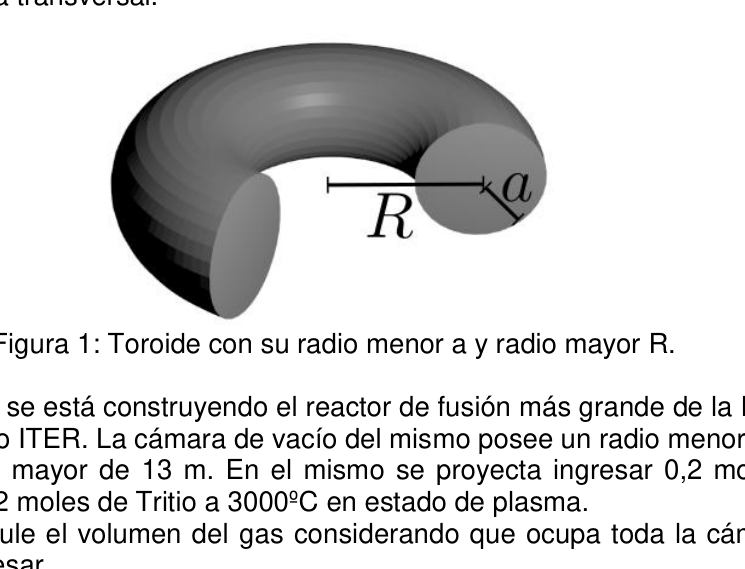
Topic: Nuclear & Particle Physics, Kinetic Theory Metodi: Kinetic Theory of Gases, Mass-Energy Equivalence Competenze: Physical Reasoning, Mathematical Modeling Objects: Gas Fonte: Testo (PDF) — p.3
**Riscaldamento del reattore (Tokamak) **
PT33. Istituto Politetnico Superiore Gral. San Martino
Rosario, Santa Fe.
Riscaldando il reattore Dall’esplosione della prima bomba termonucleare (o bomba H) nel 1952 si è ha speculato sull’uso della fusione nucleare per la produzione di energia. A Nonostante ci siano più di 400 centrali nucleari in funzione, non esiste ancora una. che consiste in processi di fusione nucleare. Il principale ostacolo sono le alte temperature necessarie per mantenere la reazione, non supportate da
- Non c’è materiale. In questo modo, sono state concepite diverse opzioni per la loro implementazione. Il più popolare è il reattore Tokamak, che consiste in una camera toroidale. dove vengono introdotti i gas da fondere contenuti con bobine Magnetico, che impedisce di toccare i muri, evitando danni alla telecamera. Un toroide è una figura a forma di anello (o, per i più deliziosi, di rosiccio) che possiede un volume 2 2 2 V Ra p = e un’area 2 4 A Ra p = dove a è la radio R il raggio maggiore. Come si vede in figura 1, la radio minore è il raggio di circonferenza che forma la sezione trasversale, mentre che il raggio maggiore è la distanza dal centro del toroide al centro della di circonferenza trasversale.
Figura 1: Toroide con radius minore a e radius maggiore R.
Attualmente, il più grande reattore di fusione della storia è in costruzione. nel progetto ITER. La camera di vuoto di questo apparecchio ha un raggio inferiore a 4,1 . m e un raggio superiore a 13 m. In questo caso, è previsto di introdurre 0,2 mol di Deuterium e 0,2 moli di tritio a 3000oC in stato di plasma.
- Calcola il volume del gas considerando che occupi l’intera camera al Entrare.
- Ricordando che il plasma è un gas ionizzato, che permette (sotto
- le condizioni di utilizzo sono determinate. la quale si trova all’interno della camera. Essendo un gas ionizzato, viene colpito applicandolo un campo magnetico. L’ITER avranno bobine superconduttrici che genereranno campi fino a 13T che
OAF 2013 - 70 La concentrazione di plasma è limitata a 0,5% per la durata di un periodo di tempo. Per Per la fusione nucleare si deve trovare l’atomo. molto vicino, motivo per cui è necessaria una densità molto elevata. Inoltre il L’impatto tra atomi deve avere energia sufficiente per attivare la reazione. nucleare, che richiede una temperatura di 150 milioni di Kelvin. Usando i campi magnetici, si comprime rapidamente il gas fino a raggiungere tale temperatura. 3. Qual è il volume di gas che occuperà quando raggiungerà la temperatura necessaria per la reazione nucleare? Naturalmente, il sistema avrà perdite di energia. Per i fisici e Gli ingegneri che lavorano sul progetto, ridurre al minimo queste perdite porterà a un maggiore rendimento del reattore e quindi una maggiore energia elettrica.
- Cheap. Inoltre, i materiali devono sopportare le alte temperature (come ha detto, uno dei maggiori ostacoli alla costruzione di questi reattori). Per questo, i pannelli della camera di vuoto saranno costruiti con un alloy di rame e acciaio inox resistente a 3000 °C.
- Calcola la perdita di energia del plasma per emissione quando il reattore Sta funzionando. Per questo, disprezza la radiazione emessa come La conseguenza delle reazioni nucleari.
- Calcola la minima potenza netta che il gas perde per radiazioni.
- Per stabilire il spessore necessario dei pannelli, si fa un test in laboratorio. Si prende un pannello piano e si osserva che tale materiale supporti un flusso massimo di 5MW/m2. Se del lato Opposto al pannello ho magneti superconduttori a 4.2K di temperatura, qual è lo spessore minimo? Datati: 8,31 J R Mol K
8 2 4 5,67.10 W m K
340 pannello W k m K
0,35 plasma e
1,7 plasma
Topic: Nuclear & Particle Physics, Kinetic Theory Metodi: Kinetic Theory of Gases, Mass-Energy Equivalence Competenze: Physical Reasoning, Mathematical Modeling Objects: Gas Fonte: Testo (PDF) — p.3
**Heating the reactor (Tokamak) **
PT33. Gral Higher Polytechnic Institute. Saint Martin .
Rosario, Santa Fe.
Heating the reactor. Since the explosion of the first thermonuclear bomb (or H-bomb) in 1952 it has been The Commission has been speculating on the use of nuclear fusion for energy production. A Despite the fact that there are over 400 nuclear power plants in operation, there is still no one. It is a nuclear fusion process. The main obstacle is the high temperatures necessary to maintain the reaction, not supported by No material at all. Thus, several options have been conceived for its implementation. The most popular of these is the Tokamak reactor, which consists of a torus chamber. where the gases to be fused are introduced and contained by coils magnetic to keep them from touching the walls, preventing damage to the camera. A toroid is a ring-shaped figure (or, for the most delicious, a toaster) which has a volume 2 2 2 V Ra p
And an area. 2 4 A Ra p
where a is the radio. R is the major radius. As shown in Figure 1, the radio The radius of the circumference of the cross-section is less than the radius of the circumference of the cross-section, while The greatest radius is the distance from the center of the toroid to the center of the the cross-circle.
Figure 1: Toroid with its radius minor a and radius major R.
Currently, the largest fusion reactor in history is being built. the ITER project. The vacuum chamber of the same has a radius less than 4.1 m and a radius greater than 13 m. It is projected to enter 0.2 moles of Deuterium and 0,2 moles of tritium at 3000oC in plasma.
- Calculate the volume of the gas as it occupies the entire chamber at the Get in there.
- Recalling that plasma is an ionized gas, which allows (below (c) treat it as an ideal gas, calculate the pressure The one inside the chamber. As an ionized gas, it is affected by applying a magnetic field. The ITER It’s going to have superconducting coils that generate fields up to 13T that
The following points shall be added: The plasma is then compressed evenly (reducing only to a). For For nuclear fusion to occur, it is necessary for atoms to be together. very close, which is why you need a very high density. In addition to the The impact between atoms must have enough energy to trigger the reaction. The nuclear power plant, which is required to have a temperature of 150 million Kelvin. Using magnetic fields, the gas is quickly compressed to the surface. reaching that temperature. 3. What volume will the gas take up when it reaches the required temperature for the nuclear reaction? Naturally, the system will have power losses. For physicists and engineers working on the project, minimizing these losses will lead to a The first is the increase in the efficiency of the reactor, and thus the extra electrical energy. It’s cheap. In addition, materials must withstand high temperatures (as He said, one of the biggest impediments to the construction of these reactors). To achieve this, the vacuum chamber panels will be constructed with a alloy of copper and stainless steel with a resistance of up to 3000 °C. 4. Calculates the plasma energy loss per emission when the reactor It’s working. For this, disregard the radiation emitted as The Commission has already adopted a number of proposals. 5. Calculate the minimum net power the gas loses from radiation. 6. To estimate the necessary thickness of the panels, He’s running a lab test. You take a flat panel and you observe it. that the material supports a maximum flow of 5MW/m2. If from the side I have superconducting magnets at 4.2K of temperature, what should be the minimum thickness? The data: 8,31 J R Other
8 2 4 5,67.10 W m K
340 panel W k m K
0,35 Plasma e
1,7 Plasma
Topic: Nuclear & Particle Physics, Kinetic Theory Metodi: Kinetic Theory of Gases, Mass-Energy Equivalence Competenze: Physical Reasoning, Mathematical Modeling Objects: Gas Fonte: Testo (PDF) — p.3
Empuje - bloque en petroleo
PT34. Instituto Eduardo L. Holmberg
Quilmes, Buenos Aires.
Un vaso de precipitados de masa mv que contiene una masa mp de petróleo (densidad petróleo = δp) se apoya sobre una balanza. Un bloque de hierro de masa mh se suspende de una balanza de resorte (dinamómetro) y se sumerge por completo en el petróleo, tal como se ve en la figura. a) Hacer el diagrama de cuerpo libre en los
OAF 2013 - 71 puntos A (soporte donde se cuelga el dinamómetro), B (bloque de hierro) y C (plato de la balanza) de la figura. b) Determinar cuáles serán las lecturas de las balanzas cuando el sistema está en equilibrio, expresando los resultados en función de las masas.
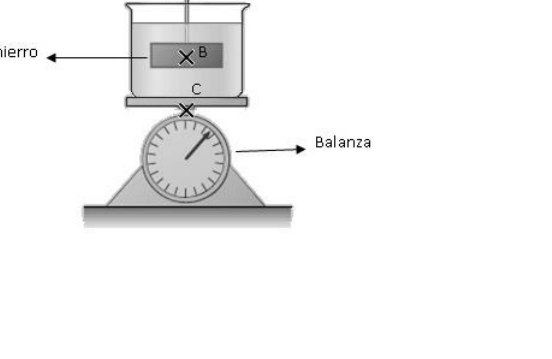
Topic: Fluid Mechanics Metodi: Hydrostatic Equilibrium, Free-Body Diagram Competenze: Physical Reasoning, Diagrammatic Reasoning Objects: Block, Container Fonte: Testo (PDF) — p.3
Push - blocco in petrolio
PT34. Istituto Eduardo L. Holmberg
Quilmes, Buenos Aires.
Un bicchiere di precipitati di massa mv che contiene una massa mp di petrolio (densità petrolifera = δp) Si appoggia su una bilancia. Un blocco di ferro di massa mh se Sospende da un’escalazione di primavera (dinamometro) y se Si immerge completamente nel petrolio, come si vede nella
- Figura. a) Sviluppare il diagramma di corpo Libero en Le
OAF 2013 - 71 punti A (supporto dove si appende il dinamometro), B (blocco di ferro) e C (placca di bilanciamento) della figura. b) Determinare quali saranno le letture delle balance quando il sistema è in equilibrio, esprimendo i risultati in base alle masse.
Topic: Fluid Mechanics Metodi: Hydrostatic Equilibrium, Free-Body Diagram Competenze: Physical Reasoning, Diagrammatic Reasoning Objects: Block, Container Fonte: Testo (PDF) — p.3
The following is the list of the types of fuel used:
PT34. The Institute Eduardo L. Holmberg
Quilmes, Buenos Aires is where I am.
A glass of mass precipitates . mv containing a mass mp of Oil (oil density = δp) It’s leaning on a scale. Un The mass of the iron block mh se suspends from a balance of spring (dynamometer) y se It completely dives into the oil, as seen in the It’s a figure. (a) Drawing the diagram of body Free . en The
The following is the list of the Member States’ financial statements: points A (support where the dynamometer is suspended), B (block of iron) and C (scale plate) of the figure. (b) Determine what the readings of the balances will be when the system It’s in balance, expressing the results in terms of the masses.
Topic: Fluid Mechanics Metodi: Hydrostatic Equilibrium, Free-Body Diagram Competenze: Physical Reasoning, Diagrammatic Reasoning Objects: Block, Container Fonte: Testo (PDF) — p.3
Tanque de agua - chorro
PT35. Instituto Eduardo L. Holmberg
Quilmes, Buenos Aires.
Debajo del tanque de agua que se ve en la figura de abajo hay una válvula que regula el paso del agua. Cuando esta válvula se abre, un chorro de agua sale por el punto B, ubicado en el extremo de un tubo a la derecha del dispositivo. Determinar: a) la altura máxima Δy que alcanza el chorro de agua sobre el punto B. b) la distancia horizontal que recorre el agua hasta el punto C, sabiendo que se encuentra 20,0 m por debajo del punto B. Datos: h = 10,0 m; L = 2,00 m; = 30,0° Asumir que el área de la sección transversal del tanque en el punto A es mucho mayor que el área de la sección transversal del tubo en el punto B.
Topic: Fluid Mechanics Metodi: Bernoulli’s Equation, Kinematic Equations Competenze: Physical Reasoning, Mathematical Modeling Objects: Container, Tube Fonte: Testo (PDF) — p.3
Tanca d’acqua - jet
PT35. Istituto Eduardo L. Holmberg
Quilmes, Buenos Aires.
Sotto il serbatoio d’acqua che vedete nella figura qui sotto c’è una valvola che regola il flusso dell’acqua. Quando questa valvola si apre, un ghiaccio d’acqua esce. per il punto B, situato all’estremità di un tubo sulla destra del dispositivo. Determinare: a) l’altezza massima Δy raggiunta dal jet d’acqua sul punto B. b) la distanza orizzontale che l’acqua percorre fino al punto C, sapendo che si trova a 20,0 m sotto il punto B. Data: h = 10,0 m; L = 2,00 m; = 30,0° Supponiamo che l’area della sezione trasversale del serbatoio al punto A sia molto maggiore dell’area della sezione trasversale del tubo al punto B.
Topic: Fluid Mechanics Metodi: Bernoulli’s Equation, Kinematic Equations Competenze: Physical Reasoning, Mathematical Modeling Objects: Container, Tube Fonte: Testo (PDF) — p.3
The following table shows the results of the calculation of the total cost of the vehicle:
PT35. The Institute Eduardo L. Holmberg
Quilmes, Buenos Aires is where I am.
Under the water tank as you see in the figure below is a valve that regulates the flow of water. When this valve opens, a jet of water comes out. by point B, located at the end of a tube to the right of the device. Determine: (a) the maximum height Δy reaching the water jet over point B. (b) the horizontal distance travelled by water to point C, knowing which is 20,0 m below point B. Data: h = 10,0 m; L = 2,00 m; = 30,0° Assume that the area of the tank’s cross section at point A is very much greater than the area of the tube’s cross section at point B.
Topic: Fluid Mechanics Metodi: Bernoulli’s Equation, Kinematic Equations Competenze: Physical Reasoning, Mathematical Modeling Objects: Container, Tube Fonte: Testo (PDF) — p.3
Cilindro con piston - compresion aire
PT36. Instituto Eduardo L. Holmberg
Quilmes, Buenos Aires.
Un cilindro que tiene 40,0 cm de radio y 50,0 cm de altura está lleno de aire a 20,0° y 1,00 atm, como se ve en la figura (a). Un pistón de 20,0 kg es liberado en la parte superior del cilindro provocando una compresión en el aire, como se ve en la figura (b). Luego, una persona de 75,0 kg se para sobre el pistón comprimiendo aún más el aire, que se mantuvo a 20,0° todo el tiempo; figura (c). a) Calcular la distancia Δh que descendió el pistón cuando la persona se paró sobre él. b) Determinar la temperatura a la que habría que calentar al aire para que el pistón vuela a la posición hi de la figura (b). c) Trazar el diagrama termodinámico P-V correspondiente a las dos evoluciones del gas. d) Indicar el nombre de estas evoluciones.
OAF 2013 - 72
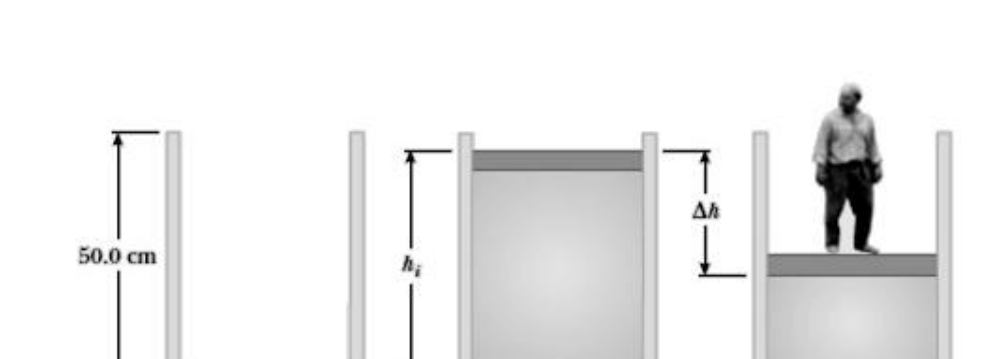
Topic: Thermodynamics, Kinetic Theory Metodi: Ideal Gas Law, First Law of Thermodynamics Competenze: Physical Reasoning Objects: Gas, Cylinder, Piston Fonte: Testo (PDF) — p.3
Cilindro a pistone - compressione dell’aria
PT36. Istituto Eduardo L. Holmberg
Quilmes, Buenos Aires.
Un cilindro di 40 cm di raggio e 50 cm di altezza è pieno di aria a 20,0° e 1,00 atm, come illustrato nella figura (a). Un pistone di 20,0 kg viene rilasciato in la parte superiore del cilindro causando una compressione nell’aria, come si vede in figura b). Poi una persona di 75 kg si ferma sul pistone la compressione dell’aria, che è stata mantenuta a 20,0° per tutto il tempo; figura (c). a) Calcolare la distanza Δh che è scesa il pistone quando la persona si è Si è fermato su di lui. b) Determinare la temperatura a cui l’aria dovrebbe essere riscaldata per il pistone vola alla posizione hi della figura (b). c) Tracciare il diagramma termodinamico P-V corrispondente alle due evoluzioni del gas. d) Indicare il nome di tali evoluzioni.
OAF 2013 - 72
Topic: Thermodynamics, Kinetic Theory Metodi: Ideal Gas Law, First Law of Thermodynamics Competenze: Physical Reasoning Objects: Gas, Cylinder, Piston Fonte: Testo (PDF) — p.3
The following table shows the results of the calculations:
PT36. The Institute Eduardo L. Holmberg
Quilmes, Buenos Aires is where I am.
A cylinder with a radius of 40.0 cm and a height of 50.0 cm is filled with air at 20,0° and 1,00 atm, as shown in Figure (a). A 20.0 kg piston is released in The top of the cylinder causing air compression, as you can see. in Figure (b). Then a 75.0 kg person stands on the piston. further compressing the air, which was kept at 20,0° all the time; figure (c). (a) Calculate the distance Δh that the piston descended when the person was He stood over it. (b) Determine the temperature at which the air should be heated to ensure that the the piston flies to the position hi of figure (b). (c) Draw the thermodynamic diagram P-V corresponding to both the evolution of the gas. (d) Name these developments.
The following is the list of the Member States’ financial statements:
Topic: Thermodynamics, Kinetic Theory Metodi: Ideal Gas Law, First Law of Thermodynamics Competenze: Physical Reasoning Objects: Gas, Cylinder, Piston Fonte: Testo (PDF) — p.3
Gas N2 - ley de gases ideales
PT37. Escuela Técnica Alfredo Carlos Passera
Mocoretá, Corrientes.
Problema aplicando la formula de los gases ideales, temperatura, presión y volumen constante. En un cilindro de 1000 cm3 se almacena nitrógeno molecular N2, a una presión inicial de 0,75 atmosfera, y a una temperatura inicial de 10 ºC. Luego de exponerlo al sol, al cabo de un tiempo, se obtiene una situación final de temperatura igual a 28 ºC y una presión final la cual se desea saber. a) Presión final. b) Temperatura inicial en k°. c) Temperatura final en k°.
Topic: Thermodynamics, Kinetic Theory Metodi: Ideal Gas Law Competenze: Physical Reasoning Objects: Gas, Cylinder Fonte: Testo (PDF) — p.3
Gasi N2 - legge dei gas ideali
PT37. Scuola tecnica Alfredo Carlos Passera
Mocoretá, Corrientes.
Il problema è quello di applicare la formula dei gas ideali, temperatura, pressione e volume costante. In un cilindro di 1000 cm3 viene immagazzinato l’azoto molecolare N2, a una pressione all’inizio di 0,75 atmosfere e a una temperatura iniziale di 10 oC. Dopo L’esposizione al sole, dopo un certo tempo, ottiene una situazione finale di temperatura pari a 28 oC e una pressione finale che si desidera sapere. a) Presione finale. b) Temperatura iniziale in k°. c) Temperatura finale in k°.
Topic: Thermodynamics, Kinetic Theory Metodi: Ideal Gas Law Competenze: Physical Reasoning Objects: Gas, Cylinder Fonte: Testo (PDF) — p.3
The following is the list of the types of gas used in the production of the product:
PT37. The school of technology Alfredo Carlos Passera
It’s a mockery, currents.
Problem by applying the formula of ideal gases, temperature, pressure and volume is constant. In a 1000 cm3 cylinder N2 molecular nitrogen is stored at a pressure The initial atmosphere is 0,75 °C and the initial temperature is 10 °C. After After a while, you get a final situation of temperature equal to 28 oC and a final pressure which is desired. (a) Final pressure. (b) Initial temperature at k°. (c) End temperature in k°.
Topic: Thermodynamics, Kinetic Theory Metodi: Ideal Gas Law Competenze: Physical Reasoning Objects: Gas, Cylinder Fonte: Testo (PDF) — p.3
Disco que gira - cinematica angular
PT38. Escuela Técnica Alfredo Carlos Passera
Mocoretá, Corrientes.
Suponga un disco de música que gira a 36,33 rpm, con un r=25cm, calcular: a) Su velocidad angular. b) Velocidad lineal en un punto de la circunferencia. c) Aceleración centrípeta. d) Tiempo en girar 820°. e) Tiempo en dar 15 vueltas. f) Graficar e indicar cada una de sus partes.
Topic: Rotational Dynamics Metodi: Kinematic Equations, Torque & Angular Momentum Analysis Competenze: Physical Reasoning Objects: Disk Fonte: Testo (PDF) — p.3
Disco rotativo - cinematica angolare
PT38. Scuola tecnica Alfredo Carlos Passera
Mocoretá, Corrientes.
Supponiamo un disco musicale che gira a 36,33 rpm, con un r=25cm, calcoliamo: a) La sua velocità angolare. b) velocità lineare in un punto della circonferenza. c) Accelerazione centripeta. d) Tempo di rotazione 820°. e) Tempo di 15 giri. f) Grafici e indicazioni di ciascuna delle parti.
Topic: Rotational Dynamics Metodi: Kinematic Equations, Torque & Angular Momentum Analysis Competenze: Physical Reasoning Objects: Disk Fonte: Testo (PDF) — p.3
The following table shows the results of the calculations:
PT38. The school of technology Alfredo Carlos Passera
It’s a mockery, currents.
Suppose a music record that spins at 36.33 rpm, with an r=25cm, calculate: (a) Its angular velocity. (b) Linear velocity at a point on the circumference. (c) Centrifugal acceleration. (d) Turn time 820°. (e) Time to make 15 laps. (f) Draw up and indicate each of its parts.
Topic: Rotational Dynamics Metodi: Kinematic Equations, Torque & Angular Momentum Analysis Competenze: Physical Reasoning Objects: Disk Fonte: Testo (PDF) — p.3
Solenoide - campo magnetico
PT39. Escuela Técnica Alfredo Carlos Passera
Mocoretá, Corrientes.
En un cilindro de 1000 cm3 se almacena nitrógeno molecular N2, a una presión inicial de 0,75 atmosfera, y a una temperatura inicial de 10 ºC. Luego de exponerlo al sol, al cabo de un tiempo, se obtiene una situación final de temperatura igual a 28 ºC y una presión final la cual se desea saber. a) Intensidad de campo magnético en el interior del solenoide. b) Inducción magnética en el núcleo del solenoide. c) Flujo magnético en el núcleo.
OAF 2013 - 73
Topic: Magnetism, Electromagnetism Metodi: Ampère’s Law, Biot-Savart Law Competenze: Physical Reasoning, Mathematical Modeling Objects: Solenoid Fonte: Testo (PDF) — p.3
Solenoide - campo magnetico
PT39. Scuola tecnica Alfredo Carlos Passera
Mocoretá, Corrientes.
In un cilindro di 1000 cm3 viene immagazzinato l’azoto molecolare N2, a una pressione all’inizio di 0,75 atmosfere e a una temperatura iniziale di 10 oC. Dopo L’esposizione al sole, dopo un certo tempo, ottiene una situazione finale di temperatura pari a 28 oC e una pressione finale che si desidera sapere. a) Intensità del campo magnetico all’interno del solenoide. b) Induzione magnetica nel nucleo del solenoide. c) Fluo magnetico nel nucleo.
OAF 2013 - 73
Topic: Magnetism, Electromagnetism Metodi: Ampère’s Law, Biot-Savart Law Competenze: Physical Reasoning, Mathematical Modeling Objects: Solenoid Fonte: Testo (PDF) — p.3
The following table shows the methodology used for calculating the value of the product:
PT39. The school of technology Alfredo Carlos Passera
It’s a mockery, currents.
In a 1000 cm3 cylinder N2 molecular nitrogen is stored at a pressure The initial atmosphere is 0,75 °C and the initial temperature is 10 °C. After After a while, you get a final situation of temperature equal to 28 oC and a final pressure which is desired. (a) Magnetic field intensity inside the solenoid. (b) Magnetic induction in the nucleus of the solenoid. (c) Magnetic flow in the core.
The following is the list of the Member States’ financial statements:
Topic: Magnetism, Electromagnetism Metodi: Ampère’s Law, Biot-Savart Law Competenze: Physical Reasoning, Mathematical Modeling Objects: Solenoid Fonte: Testo (PDF) — p.3
Calorimetria con calentador electrico
PT40. Instituto Jesús María
Ciudad de Córdoba.
En un recipiente cuya capacidad térmica es de 20 cal/ªC y se encuentra a 10 ºC, se colocan 300 g de agua a 10 ºC. a) Se desea calentar el conjunto hasta llegar a 50 ºC. Calcular la cantidad de Calor necesario, en Joules y calorías. b) Si en las condiciones iniciales se agregan otros 100 g de hielo a 0 ºC, calcular la cantidad de calor necesario. c) Si para lograrlo se utiliza un calentador eléctrico cuya resistencia es de 300 ohm, conectado a la red domiciliaria, determinar la potencia del aparato. d) Calcular el tiempo necesario para realizar la operación. Ce del agua = 1 cal/g.ºC Calor de Fusión del hielo = 80 cal/g
Topic: Thermodynamics, Circuits Metodi: First Law of Thermodynamics, Conservation of Energy Competenze: Physical Reasoning Objects: Calorimeter, Resistor Fonte: Testo (PDF) — p.3
Calorimetria con riscaldatore elettrico
PT40. Istituto Gesù Maria
Città di Córdoba.
In un recipiente con una capacità termico di 20 cal/aC e a 10 oC, 300 g di acqua sono messe a 10 oC. (a) Si desidera riscaldare l’insieme fino a 50 oC. Calcolare la quantità Calore necessario, in joules e calorie. b) Se si aggiungono altri 100 g di ghiaccio a 0 oC nelle condizioni iniziali, calcolare la quantità di calore necessaria. c) Se per questo si utilizza un riscaldatore elettrico di resistenza di 300 ohm, collegato alla rete domestica, determinare la potenza del apparecchio. d) Calcolare il tempo necessario per effettuare l’operazione. C dell’acqua = 1 cal/g.oC Calore di fusione del ghiaccio = 80 cal/g
Topic: Thermodynamics, Circuits Metodi: First Law of Thermodynamics, Conservation of Energy Competenze: Physical Reasoning Objects: Calorimeter, Resistor Fonte: Testo (PDF) — p.3
Calorimetry with electric heater
PT40. Jesus Mary Institute
The city of Cordoba.
In a container with a thermal capacity of 20 cal/aC and at 10 oC, 300 g of water at 10 oC shall be placed. (a) The whole is to be heated to 50 oC. Calculate the amount The amount of heat required in Joules and calories. (b) If 100 g of ice at 0 oC are added under the initial conditions, calculate the amount of heat required. (c) If an electric heater with a resistance of 300 ohm, connected to the home network, determine the power of the The device. (d) Calculate the time required to perform the operation. The water content = 1 cal/g.oC Heat of melting ice = 80 cal/g
Topic: Thermodynamics, Circuits Metodi: First Law of Thermodynamics, Conservation of Energy Competenze: Physical Reasoning Objects: Calorimeter, Resistor Fonte: Testo (PDF) — p.3
Esferita cargada con barras
PT41. Instituto Jesús María
Ciudad de Córdoba.
Una esferita metálica de 1 cm de radio y cuya masa es de 200 gramos, se
encuentra suspendida de dos barras rígidas aislantes que forman ambas 20 º
con la horizontal.
a) Calcular las tensiones en cada barra.
Si ahora se ubica 10 cm arriba de la esferita, en dirección vertical, un cuerpo con
una carga positiva de 1 micro coulomb, se pide:
b) Determinar el valor de la fuerza con que el cuerpo cargado atrae a la
esferita.
c) Explique porqué se produce esa fuerza
d) Calcule la intensidad del campo eléctrico sobre la esferita
e) Calcule nuevamente las tensiones en cada una de las barras, que
conservan el mismo ángulo.
Topic: Electrostatics, Rigid Body Statics Metodi: Coulomb’s Law, Free-Body Diagram Competenze: Physical Reasoning, Diagrammatic Reasoning Objects: Point Charge, Rod Fonte: Testo (PDF) — p.3
Sfera carica con barre
PT41. Istituto Gesù Maria
Città di Córdoba.
Una sfera metallica di 1 cm di raggio e di massa di 200 grammi, si si trova sospesa da due rigide barre isolanti che formano entrambi 20 o con la linea orizzontale. a) Calcolare le tensioni su ogni barra. Se ora si trova 10 cm sopra la sfera, in direzione verticale, un corpo con una carica positiva di 1 micro coulomb, si chiede: b) Determinare il valore della forza con cui il corpo carico attira la spiro. c) Spiegare perché si verifica tale forza d) Calcolare l’intensità del campo elettrico sulla sfera e) Calcolare nuovamente le tensioni su ciascuna delle barre, che mantengono lo stesso angolo.
Topic: Electrostatics, Rigid Body Statics Metodi: Coulomb’s Law, Free-Body Diagram Competenze: Physical Reasoning, Diagrammatic Reasoning Objects: Point Charge, Rod Fonte: Testo (PDF) — p.3
Bars-loaded sphere
PT41. Jesus Mary Institute
The city of Cordoba.
A metal sphere with a radius of 1 cm and a mass of 200 grams, is It is suspended by two rigid insulating bars forming both 20 or with the horizontal. (a) Calculate the voltages on each bar. If you now place it 10 cm above the sphere, in a vertical direction, a body with a positive charge of 1 micro coulomb, is required: (b) Determine the value of the force with which the loaded body attracts the It’s a sphere. (c) Explain why such force occurs. (d) Calculate the intensity of the electric field over the sphere. (e) Calculate the voltages on each bar again, which Keep the same angle.
Topic: Electrostatics, Rigid Body Statics Metodi: Coulomb’s Law, Free-Body Diagram Competenze: Physical Reasoning, Diagrammatic Reasoning Objects: Point Charge, Rod Fonte: Testo (PDF) — p.3
Tiro de esquina - cinematica y choque
PT42. Instituto Jesús María
Ciudad de Córdoba.
En un partido de fútbol, al realizarse un tiro de esquina, un jugador A se acerca hacia el arco con 5 m/s en línea recta. En el mismo instante, un jugador B del equipo contrario, ubicado a 10 m de A, parte en la misma dirección y sentido contrario con una aceleración de 0,5 m/s2. Calcular: a) tiempo en el que ambos chocarán. b) distancia recorrida por cada uno c) si los dos jugadores tienen la misma masa y se toman al saltar, determinar el sentido y magnitud de su velocidad luego de chocar
Topic: Newtonian Mechanics, Conservation of Momentum Metodi: Kinematic Equations, Conservation of Momentum Competenze: Physical Reasoning Objects: — Fonte: Testo (PDF) — p.3
Tiro da angolo - cinematica e colpo
PT42. Istituto Gesù Maria
Città di Córdoba.
In una partita di calcio, quando si fa un colonnello, un giocatore A si avvicina. verso l’arco a 5 m/s in linea retta. In quel momento, un giocatore B del equipaggiamento contrario, situato a 10 m da A, parte nella stessa direzione e direzione contraria ad un’accelerazione di 0,5 m/s2. Calcolare: a) il tempo in cui entrambi si scontreranno. b) distanza percorsa da ciascuna c) se i due giocatori hanno la stessa massa e si prendono a salto, determinare il senso e la magnitudine della sua velocità dopo l’impatto
Topic: Newtonian Mechanics, Conservation of Momentum Metodi: Kinematic Equations, Conservation of Momentum Competenze: Physical Reasoning Objects: — Fonte: Testo (PDF) — p.3
The following is the list of the main types of vehicles used in the production of the vehicle:
PT42. Jesus Mary Institute
The city of Cordoba.
In a football game, when a corner shot is made, a player A approaches. towards the bow with 5 m/s in a straight line. At the same moment, a B player from The opposite equipment, located 10 m from A, parting in the same direction and direction the opposite with an acceleration of 0,5 m/s2. Calculation: (a) time when both will collide. (b) distance travelled by each (c) if both players have the same mass and are taken by jumping, determine the direction and magnitude of its speed after impact
Topic: Newtonian Mechanics, Conservation of Momentum Metodi: Kinematic Equations, Conservation of Momentum Competenze: Physical Reasoning Objects: — Fonte: Testo (PDF) — p.3
Hombre bala - tiro parabolico
PT43. Escuela Técnica ORT - Sede Almagro
Ciudad de Buenos Aires.
En el circo de los hermanos Jacques & Pierre, el payaso Antoine tiene que probar las máquinas y la utilería que se utiliza en los distintos números del espectáculo, para ver que todo funcione bien. El primer número, es el del hombre bala. Uno de los payasos debe ser disparado desde un cañón, acertar en un aro que viene a funcionar de blanco, pasar por
OAF 2013 - 74 encima de las gradas donde se encuentra el público para finalmente caer sobre la red de seguridad. Antoine se puso a medir la ubicación del cañón y la altura del blanco. El blanco era un aro de 2m de diámetro cuya parte inferior se encontraba a 10m del suelo. Desde el suelo midió 25m hasta el cañón. Al no contar con ningún payaso para las pruebas utilizo una bala de aluminio de 0,4m de diámetro. La cantidad de pólvora que se debía colocar en el cañón dependía de la velocidad con la que se quisiera disparar la bala. Además decidió que el punto más alto de la trayectoria debía ser cuando la bala pasara por el centro del aro. a) Determinar el ángulo que debe colocarse el cañón con respecto al suelo y la velocidad de salida de la bala. Antoine se levantó muy temprano esa mañana y al hacer las cuentas olvido considerar al público y a la red de seguridad. Las gradas donde se sienta el público están ubicadas a 10m del punto del suelo de donde es elevado el aro. Y consta de 10 escalones de 90cm de ancho y 40cm de alto. b) Indicar si con los cálculos realizados por Antoine anteriormente la bala cae o no sobre el público. Ahora debe establecer donde es necesario colocar la red de seguridad. La misma mide 12m de largo y tiene que estar a una distancia mínima de 2m de suelo. c) Indicar cuál es el punto más alejado de las gradas que debe colocarse el primer extremo de la red de seguridad. d) Con que velocidad y que ángulo con respecto a la horizontal impacta la bala en la red de seguridad. La red de seguridad es elástica y puede variarse su coeficiente de elasticidad ajustándola más o menos. e) Indicar cuál es el mínimo coeficiente de elasticidad que debe establecerse para que la bala no toque el suelo. Para concluir se debe estar seguro de que luego de rebotar sobre la red de seguridad la bala no caiga afuera. En cada rebote sobre la red la bala pierde el 80% de su velocidad. f) Indicar donde impacta la bala luego de rebotar por primera vez sobre la red de seguridad. Densidad del aluminio=2700kg/m3
Topic: Newtonian Mechanics Metodi: Kinematic Equations, Vector Decomposition Competenze: Physical Reasoning, Mathematical Modeling Objects: Projectile Fonte: Testo (PDF) — p.3
Uomo proiettile - tiro parabolico
PT43. Scuola tecnica ORT - Sede Almagro
Città di Buenos Aires.
Nel circo dei fratelli Jacques & Pierre, il clown Antoine deve… testare le macchine e gli utensili utilizzati nei diversi numeri del per vedere se tutto funziona bene. Il primo numero, è quello dell’uomo della pallottola. Uno dei pazzi deve essere ucciso da un cannone, colpire un anello che viene a funzionare da bianco, passare per
OAF 2013 - 74 sopra le scale dove si trova il pubblico per finalmente cadere su la rete di sicurezza. Antoine si mise a misurare la posizione del cannone e l’altezza del bersaglio. Il bianco . Era un anello di 2 metri di diametro la cui parte inferiore era a 10 metri dal suolo. Da terra ha misurato 25 metri fino al cannone. Non avendo nessun pazzo per le prove uso una pallottola di alluminio di 0,4 metri di diametro. La quantità di polvere da mettere nel cannone dipendeva dalla quantità di polvere che si deve mettere nel cannone. velocità con cui si vuole sparare la pallottola. Inoltre ha deciso che il punto La posizione più alta del percorso doveva essere quando la pallottola passava attraverso il centro del cerchio. a) Determinare l’angolo che deve essere posto il cannone rispetto al suolo e la velocità di uscita della pallottola. Antoine si è alzato molto presto quella mattina e, facendo i conti, ha dimenticato. Considerare il pubblico e la rete di sicurezza. Le sale dove si siede il pubblico sono situate a 10 metri dal punto del pavimento. da dove è alzato l’anello. E consiste di 10 scale di 90 cm di larghezza e 40 centimetri di altezza. b) Indicare se con i calcoli effettuati da Antoine prima la pallottola che sia o meno colpito dal pubblico. Ora deve stabilire dove deve essere posta la rete di sicurezza. La La stessa misura è di 12 metri di lunghezza e deve essere a un minimo di 2 metri di distanza da
- No, non è così. c) Indicare quale sia il punto più lontano dalle scale da collocare il prima estremità della rete di sicurezza. d) A che velocità e quale angolo rispetto all’orizzontale incide la una pallottola nella rete di sicurezza. La rete di sicurezza è elastica e il suo coefficiente di elasticità può variare.
- Lo aggiustando più o meno. e) Indicare il minimo coefficiente di elasticità che deve Si stabilisce in modo che la pallottola non colpisca il pavimento. In conclusione, si deve essere sicuri che dopo aver ribaltato sulla rete di Sicurezza, la pallottola non cade fuori. Ogni volta che il proiettile rimbalza sulla rete, perde il suo. L’80% della sua velocità. f) Indicare dove colpisce la pallottola dopo aver ribaltato per la prima volta sulla rete di sicurezza. Densità dell’alluminio=2700kg/m3
Topic: Newtonian Mechanics Metodi: Kinematic Equations, Vector Decomposition Competenze: Physical Reasoning, Mathematical Modeling Objects: Projectile Fonte: Testo (PDF) — p.3
Man bullet - parabolic shot
PT43. The technical school ORT - Headquarters Almagro
City of Buenos Aires.
In the circus of the Jacques & Pierre brothers, the clown Antoine has to Testing of the machines and equipment used in the various issues of the show, to see if everything works out. Number one, it’s the bullet man. One of the clowns must be shot . From a cannon, hit a ring that comes running from the white, pass through.
The following is the list of the Member States’ financial statements: above the stairs where the public is to finally fall over the safety net. Antoine started measuring the location of the cannon and the target’s height. The white guy . It was a 2m diameter ring whose bottom was 10m from the ground. From the ground he measured 25m to the cannon. Since I don ‘t have any clowns for the tests , I use an aluminum bullet . 0.4m in diameter. The amount of gunpowder to be placed in the cannon depended on the the speed at which the bullet would be fired. He also decided that the point higher than the trajectory should be when the bullet passed through the center of the ring. (a) Determine the angle at which the cannon should be placed with respect to the ground. and the bullet’s rate of exit. Antoine got up very early that morning and when he did the math forgot. The Commission will take the necessary measures to ensure that the public and the safety net are taken into account. The stands where the public sits are located 10 meters from the ground . from which the ring is raised. And it consists of 10 steps 90cm wide and 40cm high. (b) Indicate whether the bullet was calculated by Antoine earlier It falls on the audience or not. Now you need to establish where the safety net needs to be placed. La It is 12m long and must be at least 2m from the I’m going to the ground. (c) Indicate the point farthest from the ladder to be placed on the ladder. The first end of the safety net. (d) At what speed and angle with respect to the horizontal impacts the bullet in the safety net. The safety net is elastic and its coefficient of elasticity may vary I’m sort of adjusting it. (e) Indicate the minimum elasticity coefficient to be used Set up so the bullet doesn’t touch the ground. To conclude, you must be sure that after bouncing over the network of Security, the bullet doesn’t fall out. With every rebound over the net the bullet loses its 80% of its speed. (f) Indicate where the bullet impacts after first bouncing over the bullet. The safety net. The weight of the product shall be calculated on the basis of the weight of the product.
Topic: Newtonian Mechanics Metodi: Kinematic Equations, Vector Decomposition Competenze: Physical Reasoning, Mathematical Modeling Objects: Projectile Fonte: Testo (PDF) — p.3
Canon de polvora - calorimetria
PT44. Escuela Técnica ORT - Sede Almagro
Ciudad de Buenos Aires.
Llego la hora de hacer andar el cañón Antoine tiene que utilizar la mezcla especial de pólvora del circo. Esta pólvora libera 15000cal/kg al combustionar. Tiene anotado que debe utilizar 2kg de la misma. La bala es una masa de aluminio de 90kg que tiene que ser disparada a 22m/s. El cañón es de hierro y tiene una masa de 300kg. Su temperatura inicial es 20°C. Ansioso por poner en marcha el dispositivo realiza una cuenta rápida. a) ¿Cuál es la temperatura que tiene la bala al salir disparada? Luego de disparar Antoine se acerca muy contento a buscar la bala. Cuando esta por tocarla se da cuenta que la temperatura es mucho mayor a la estimada. Se toma la cabeza por la torpeza cometida, ¡olvido considerar la presión dentro de la cavidad del cañón! Volvió a sus notas y encontró que el gas que se produce de la combustión, de
OAF 2013 - 75 2kg de pólvora, genera una presión constante de 4000atm hasta que la bala alcanza la velocidad de salida. Midió el volumen que queda entre la bala y el fondo del cañón antes de disparar y le dio 7500cm3. Considerando al gas producto de la combustión, como un gas ideal diatomico. b) Realice un diagrama Presión en función del Volumen para el proceso de disparo del cañón. c) ¿Cuál es el volumen entre el fondo del cañón y la bala cuando esta alcanza la velocidad de salida? Considerando que se producen mil moles de gas en la combustión d) ¿cuál es la cantidad de calor absorbida por el gas? e) ¿Cuál es la temperatura con la que sale la bala? Ce aluminio = 0,22 cal/g°C
Ce hierro = 0,11 cal/g°C
Topic: Thermodynamics, Conservation of Energy Metodi: First Law of Thermodynamics, Energy Conservation Method Competenze: Physical Reasoning Objects: Projectile Fonte: Testo (PDF) — p.3
Canon di polvere - caloriometria
PT44. Scuola tecnica ORT - Sede Almagro
Città di Buenos Aires.
È il momento di far funzionare il cannone Antoine deve usare la speciale miscela di polvere del circo. Questa polvere . si rilascia 15000 cal/kg al combustione. Ha scritto che deve usare 2 kg di
- Sì, è lei stessa. La pallottola è una massa di alluminio di 90 kg che deve essere sparata a 22m/s. Il cannone è di ferro e ha una massa di 300 kg. La sua temperatura iniziale è 20°C. Anzioso di avviare il dispositivo fa un conto rapido. a) Qual è la temperatura della pallottola quando viene sparata? Dopo aver sparato, Antoine si avvicina molto contento a cercare la pallottola. Quando quando la tocca, si accorge che la temperatura è molto superiore a quella stimata. Si prende la testa per la torpezza commessa, dimentica di considerare la pressione dentro.
- La cavità del cannone! Tornò alle sue note e scoprì che il gas che viene prodotto dalla combustione, di
OAF 2013 - 75 2 kg di polvere, genera una pressione costante di 4000 atm fino a quando la pallottola non si riempie. raggiunge la velocità di uscita. Ha misurato il volume che resta tra la pallottola e il fondo del cannone prima di sparare e gli ha dato 7500 cm3. Considerando il gas prodotto della combustione, come un gas ideale diatomico. b) Realizzare un diagramma di pressione in base al volume per il processo di
- Il cannone. c) Qual è il volume tra il fondo del cannone e la pallottola quando si trova raggiunge la velocità di uscita? Considerando che mille molli di gas vengono prodotti dalla combustione d) Qual è la quantità di calore assorbita dal gas? e) Qual è la temperatura alla quale la pallottola esce? Ce alluminio = 0,22 cal/g°C
C ferro = 0,11 cal/g°C
Topic: Thermodynamics, Conservation of Energy Metodi: First Law of Thermodynamics, Energy Conservation Method Competenze: Physical Reasoning Objects: Projectile Fonte: Testo (PDF) — p.3
The following table shows the results of the test:
PT44. The technical school ORT - Headquarters Almagro
City of Buenos Aires.
It ‘s time to move the cannon . Antoine has to use the special powder mix from the circus. This gun . It releases 15000 cal/kg when burned. You have a note that you must use 2kg of the I’m not. The bullet is a 90kg aluminum mass that has to be fired at 22m/s. The cannon is made of iron and weighs 300kg. Its initial temperature is 20°C. Eager to start the device makes a quick count. (a) What is the temperature of the bullet when it is fired? After Antoine fires, he comes forward very happy to find the bullet. When If you touch it, you realize the temperature is much higher than you’d expect. You take your head for the clumsiness committed, forget to consider the pressure inside. From the canyon cavity! He went back to his notes and found that the gas that comes from the combustion, of
The following is the list of the Member States’ financial statements: 2kg of gunpowder, generates a constant pressure of 4000 atm until the bullet reaches the output speed. He measured the volume between the bullet and the bottom of the cannon before firing and gave it 7500cm3. Considering the gas The Commission has already established that the Commission is not in a position to adopt a new proposal. (b) Perform a volume-based pressure diagram for the process of I’ll shoot the cannon. (c) What is the volume between the bottom of the cannon and the bullet when it is reaches the output speed? Considering that a thousand moles of gas are produced in combustion (d) What is the amount of heat absorbed by the gas? (e) What is the temperature at which the bullet is released? Aluminium = 0,22 cal/g°C
The value of the product shall be the value of the product concerned.
Topic: Thermodynamics, Conservation of Energy Metodi: First Law of Thermodynamics, Energy Conservation Method Competenze: Physical Reasoning Objects: Projectile Fonte: Testo (PDF) — p.3
Canon electrico - campo electrico
PT45. Escuela Técnica ORT - Sede Almagro
Ciudad de Buenos Aires.
Antoine decide reemplazar el cañón a pólvora por un cañón eléctrico.
Para el funcionamiento del mismo deberá cargar la esfera de aluminio con una
carga q de 5c.
La longitud del cañón es de 2m.
a) Realice un esquema indicando la dirección del campo eléctrico y como
debería colocarse la bala en el interior del cañón para que esta pueda
salir disparada.
b) ¿cuánto debe valer el campo eléctrico para que la bala de 90kg salga
por el extremo del mismo con una velocidad de 22m/s?
Antoine estaba más que contento con el nuevo cañón. Pero al querer utilizarlo
observo que la llave térmica de 10A que protegía el circuito se abría.
El cañón eléctrico estaba conectado en paralelo a los 4 reflectores de 500w que
iluminaban el lugar. La instalación es de 220V y el cañón siempre consume 10A
al utilizarlo.
Es hora de cambiar la llave térmica.
c) ¿Cuál es la corriente mínima que debe soportar la nueva llave térmica
para poder hacer funcionar el cañón?
Para mejorar la iluminación del lugar, Antoine decide colocar entre cada uno de
los reflectores una lamparita de colores que tienen una resistencia de 20 Ohm
cada una.
Al subir la llave térmica observa que las lamparitas iluminan distinto.
d) calcular la potencia sobre cada uno de los reflectores y las lamparitas.
e) indicar cuál de los reflectores ilumina más y porque
Topic: Electrostatics, Circuits Metodi: Electric Potential Method, Energy Conservation Method Competenze: Physical Reasoning, Mathematical Modeling Objects: Point Charge, Capacitor Fonte: Testo (PDF) — p.3
Canon elettrico - campo elettrico
PT45. Scuola tecnica ORT - Sede Almagro
Città di Buenos Aires.
Antoine decide di sostituire il cannone a polvere con un cannone elettrico. Per il funzionamento di tale sistema, la sfera di alluminio deve essere caricata con una carico q di 5c. La lunghezza del cannone è di 2 metri. a) Sviluppa un schema che indichi la direzione del campo elettrico e come Dovrebbe essere inserito il proiettile all’interno del cannone per permettere a quest’ultimo di poterlo usare.
- E’ stato sparato. b) quanto deve valere il campo elettrico per far uscire la pallottola da 90 kg per l’estremità di questo con una velocità di 22m/s? Antoine era più che contento del nuovo cannone. Ma volendo usarlo Ho notato che la chiave termico 10A che proteggeva il circuito si apre. Il cannone elettrico era collegato in parallelo ai 4 riflettori da 500w che illuminavano la casa. L’impianto è di 220 V e il cannone consuma sempre 10 A. quando lo usiamo. È ora di cambiare la chiave termico. c) Qual è il minimo corrente che la nuova chiave termico deve sopportare? Per poter far funzionare il cannone? Per migliorare l’illuminazione del luogo, Antoine decide di collocare tra ognuno di loro. I riflettori una lamparetta di colori che hanno una resistenza di 20 Ohm
- Ciascuno di loro. Sposta la chiave termico, osserva che le lampade illuminano diversamente. d) calcolare la potenza su ciascun riflettore e lampadina. e) indicare quale dei riflettori illumini più e perché
Topic: Electrostatics, Circuits Metodi: Electric Potential Method, Energy Conservation Method Competenze: Physical Reasoning, Mathematical Modeling Objects: Point Charge, Capacitor Fonte: Testo (PDF) — p.3
The following is the list of the types of electrical equipment used:
PT45. The technical school ORT - Headquarters Almagro
City of Buenos Aires.
Antoine decides to replace the gunpowder gun with an electric gun. For the operation of the same, the aluminium ball must be loaded with a The charge q of 5c. The length of the cannon is 2 meters. (a) Draw a diagram indicating the direction of the electric field and how The bullet should be placed inside the cannon so that this can . Get shot. (b) how much of the electric field must be worth to get the 90kg bullet out By the end of it at a speed of 22m/s? Antoine was more than happy with the new cannon. But to use it . I notice the 10A thermal key protecting the circuit was opening. The electric cannon was connected in parallel to the 4 500w reflectors that They lit up the place. The installation is 220V and the cannon always consumes 10A. when using it. It’s time to change the thermal key. (c) What is the minimum current to be supported by the new thermal wrench So I can run the cannon? To improve the lighting of the place, Antoine decides to place between each of them. The reflectors are a colored flashlight that have a resistance of 20 ohms Each one. When you lift the heat key, you notice that the lamps are illuminating differently. (d) calculate the power on each of the reflectors and lamps. (e) indicate which of the reflectors illuminates most and why
Topic: Electrostatics, Circuits Metodi: Electric Potential Method, Energy Conservation Method Competenze: Physical Reasoning, Mathematical Modeling Objects: Point Charge, Capacitor Fonte: Testo (PDF) — p.3
Equilibrio electromecanico
PT46. Escuela de Agronomía
Río Cuarto, Córdoba.
Equilibrio Electro Mecánico
A nivel Núcleo Atómico resulta difícil establecer con claridad la relativa
estabilidad que hace que protones y neutrones alcancen un equilibrio mecánico.
Un ejemplo que podría simular dicha interacción (atracción entre masas y entre
cargas) se muestra a continuación.
Dos masas iguales, dispuestas colgando de diferentes hilos de la misma longitud
y de un único nudo, como lo muestra la figura, tienen la misma carga logrando el
equilibrio electro mecánico, como se observa en la imagen. (Imagen 1).
Determinar:
a) Valor de q
OAF 2013 - 76 b) Ídem anterior si L= 1m c) Duplique el valor de la distancia a la que se encuentran separadas las cargas y calcule el valor nuevo de q ¿determine la linealidad o no de la relación q- α? Datos: m= 1 gr
d= 10 cm
L= 20 cm
Topic: Electrostatics, Rigid Body Statics Metodi: Coulomb’s Law, Free-Body Diagram Competenze: Physical Reasoning, Diagrammatic Reasoning Objects: Point Charge, String Fonte: Testo (PDF) — p.3
Equilibrio elettromeccanico
PT46. Scuola di Agronomia
Rio Cuarto, Córdoba.
Equilibrio elettro-meccanico A livello nucleare è difficile stabilire con chiarezza il relativo stabilità che permette a protoni e neutroni di raggiungere un equilibrio meccanico. Un esempio che potrebbe simulare tale interazione (attrazione tra masse e tra La Commissione ha presentato una proposta di regolamento (CE) n. Due masse uguali, disposte appese a fili diversi della stessa lunghezza e di un singolo nodo, come mostra la figura, hanno lo stesso carico ottenendo il equilibrio elettromeccanico, come si vede nell’immagine. (Figura 1). Determinare: a) Valore di q
OAF 2013 - 76 b) C’è un’altra volta se L= 1m (c) Duplica il valore della distanza tra le due parti. Calcola il nuovo valore di q determinando la linearità o no della Relazione q- α? Datati: m= 1 gr
d= 10 cm
L= 20 cm
Topic: Electrostatics, Rigid Body Statics Metodi: Coulomb’s Law, Free-Body Diagram Competenze: Physical Reasoning, Diagrammatic Reasoning Objects: Point Charge, String Fonte: Testo (PDF) — p.3
The following shall be added to the list of the following:
PT46. School of Agriculture
The fourth river, Cordoba.
The following is the list of the types of electrical equipment used: At the Atomic Nuclear level, it is difficult to establish clearly the relative stability that allows protons and neutrons to reach mechanical equilibrium. An example that could simulate such interaction (attraction between masses and between loads) is shown below. Two equal masses, arranged by hanging from different threads of the same length And of a single knot, as shown in the figure, they have the same load achieving the electromechanical balance, as seen in the image. (Figure 1) Determine: (a) Value of q
The following is the list of the Member States’ financial statements: (b) The previous edge if L= 1m (c) Double the value of the distance between the two The new value of q determines the linearity or not of the What is the q-α ratio? The data: m= 1 gr
d= 10 cm
L= 20 cm
Topic: Electrostatics, Rigid Body Statics Metodi: Coulomb’s Law, Free-Body Diagram Competenze: Physical Reasoning, Diagrammatic Reasoning Objects: Point Charge, String Fonte: Testo (PDF) — p.3
Red de resistencias con calentador
PT47. Escuela de Agronomía
Río Cuarto, Córdoba.
Red de luz con calentador eléctrico
Cada resistencia del circuito que se muestra en la Imagen 2 representan los
focos de iluminación de una red que se ha construido para vacacionar en carpa.
Excepto la resistencia del amperímetro, la cual ha sido modificada para
suministrar energía calórica y utlizarla como calentador multiuso.
Se pide, calcular:
a) Corrientes de mallas y de ramas con la llave C cerrada, despreciando la
resistencia del amperímetro.
b) Corrientes de mallas y de ramas con la llave C abierta, despreciando la
resistencia del amperímetro.
c) Diferencia de potencial a los costados del amperímetro y la potencia
que consume.
d) Cuanto tiempo se tarda en hervir 20 ml de agua a una temperatura
inicial de 22°C si se utilizara la energía disipada por la resistencia
interna del amperímetro.
Datos:
V1=V2= 9 volts -
V3=V4= 12 volts
R1=R2= 5Ω R3=R5= 10Ω
R4= 12Ω
r=0,01 Ω Calor especifico del agua= 1cal/ g °C
OAF 2013 - 77
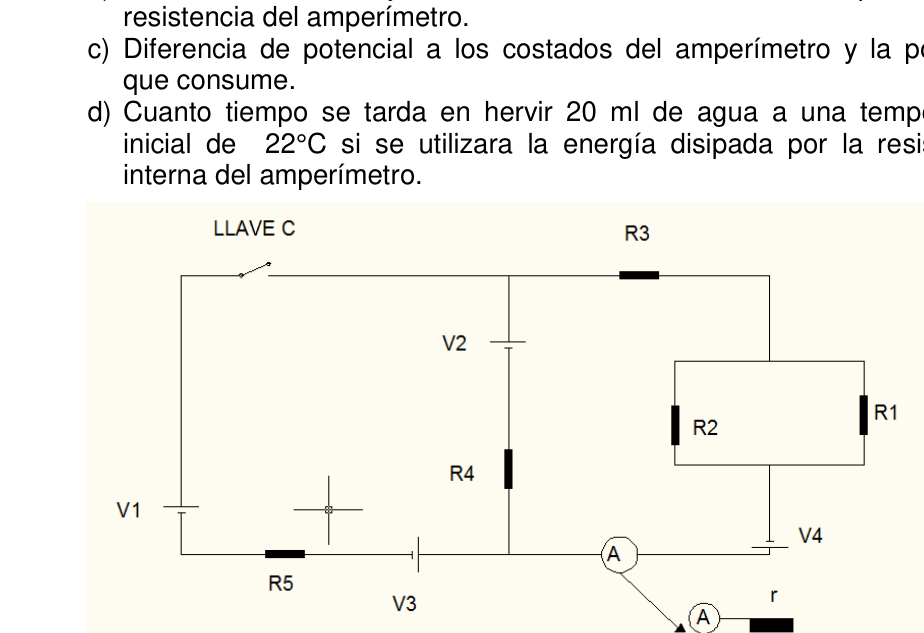
Topic: Circuits Metodi: Kirchhoff’s Laws, Equivalent Circuit Reduction Competenze: Physical Reasoning, Mathematical Modeling Objects: Resistor, Galvanometer, Switch Fonte: Testo (PDF) — p.3
Rete di resistenza con riscaldatore
PT47. Scuola di Agronomia
Rio Cuarto, Córdoba.
Rete luminosa con riscaldatore elettrico Ogni resistenza del circuito mostrata in immagine 2 rappresenta i foci di illuminazione di una rete costruita per andare in vacanza in una tenda. Ma non è la resistenza dell’ampiecatore, che è stata modificata per fornire energia calorica e utilizzarla come riscaldatore multiuso. Si chiede, calcolare: a) Strumenti di reti e di rami con chiave C chiusa, disprezzando la resistenza dell’ampiezzatore. b) Strumenti di reti e di rami con chiave C aperta, disprezzando la resistenza dell’ampiezzatore. c) Differenza di potenziale ai lati dell’ampielitore e potenza che consuma. d) Quanto tempo ci vuole per far bollire 20 ml di acqua a una temperatura iniziale di 22°C se si utilizza l’energia dissipata dalla resistenza interno dell’ampiecatore. Datati: V1=V2=9 volt - V3=V4=12 volt
R1=R2= 5Ω R3=R5= 10Ω
R4= 12Ω
r=0,01 Ω Calore specifico dell’acqua= 1 cal/ g °C
OAF 2013 - 77
Topic: Circuits Metodi: Kirchhoff’s Laws, Equivalent Circuit Reduction Competenze: Physical Reasoning, Mathematical Modeling Objects: Resistor, Galvanometer, Switch Fonte: Testo (PDF) — p.3
Heater resistance network
PT47. School of Agriculture
The fourth river, Cordoba.
Electric heater lighting network Each resistance of the circuit shown in Figure 2 represents the Lighting foci of a network that has been built to vacation in a tent. Except for the resistance of the amp, which has been modified for supplying heat energy and using it as a multi-use heater. It is requested, calculate: (a) Stroms of mesh and branches with key C closed, disregarding the the resistance of the ampere. (b) Net and branch streams with the C key open, disregarding the the resistance of the ampere. (c) Difference of potential on the sides of the ampere and power It consumes. d) How long it takes to boil 20 ml of water at a temperature initial 22°C if the energy dissipated by the resistance is used the internal part of the ampere. The data: V1=V2=9 volts - V3=V4=12 volts
R1=R2= 5Ω R3=R5= 10Ω
R4= 12Ω
r=0,01 Ω The specific heat of the water = 1 cal/ g °C
The following is the list of the Member States’ financial statements:
Topic: Circuits Metodi: Kirchhoff’s Laws, Equivalent Circuit Reduction Competenze: Physical Reasoning, Mathematical Modeling Objects: Resistor, Galvanometer, Switch Fonte: Testo (PDF) — p.3
Espectrometro de masas
PT48. Escuela de Agronomía
Río Cuarto, Córdoba.
Imitando un Espectrómetro de masa
Un espectrómetro es un aparato que utiliza los fenómenos del electromag-
netismo para determinar la relación carga/masa de algunas sustancias, entre
algunas de sus numerosas utilidades.
Con la intención de simular su funcionamiento se genera en una fuente un
electrón, el cual se libera desde el reposo de una placa cargada negativamente
hacia una cargada positivamente (Capacitor) que se ubica a una distancia L una
de la otra; de manera que este se acelera bajo la acción del campo eléctrico E
del capacitor. Posterior a eso ingresa inmediatamente en el campo magnético B
entrante al plano de la hoja y de modulo constante (como lo muestra la imagen)
y su trayectoria rectilínea es modificada a una circular e incide sobre una
pantalla a una distancia D de su ingreso al campo magnético.
Datos: E=45 N/C
L=1m
D=12,35 cm
-
B=170 T/m2
Determinar: a) La distancia D. b) La velocidad necesaria para que la distancia se reduzca a la mitad, ¿Cuánto debería valer el campo eléctrico? c) Repita los incisos a y b, comente que sucede si se cambia el electrón por un protón.
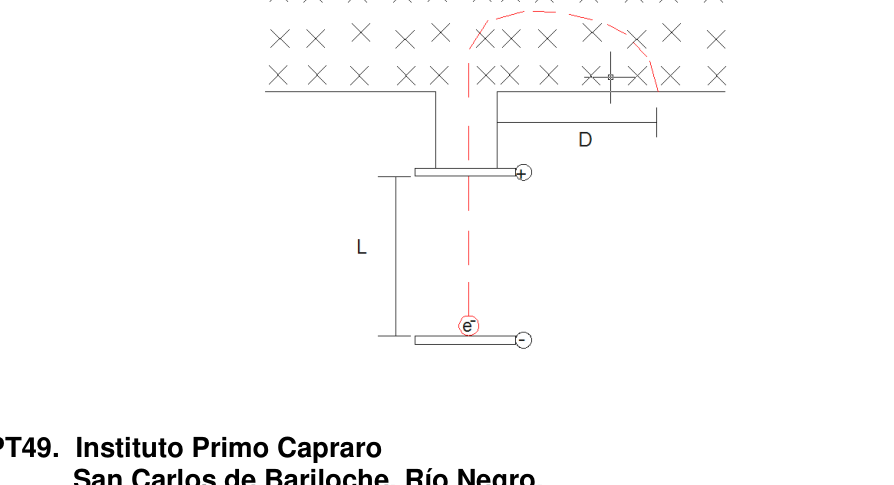
Topic: Electromagnetism, Magnetism Metodi: Lorentz Force Analysis, Energy Conservation Method Competenze: Physical Reasoning, Mathematical Modeling Objects: Electron, Capacitor Fonte: Testo (PDF) — p.3
Spettrometro di massa
PT48. Scuola di Agronomia
Rio Cuarto, Córdoba.
Imitando uno spettrometro di massa Uno spettrometro è un apparecchio che utilizza i fenomeni dell’elettromagnetismo. La capacità di determinare il rapporto carico/massa di alcune sostanze, tra alcuni dei suoi numerosi utili. Per simulare il suo funzionamento viene generato in una fonte un un elettrone, che viene rilasciato dal riposo di una placca carica negativamente verso un carico positivo (Capacitore) che si trova a una distanza L una La velocità di un’azione è di circa un milione di metri. del capacitore. Dopo di che entra immediatamente nel campo magnetico B Appunto a piatto della foglia e modulo costante (come mostrato nell’immagine) e la sua traccia rettilinea è modificata in una circolare e incide su una La sua presenza è a una distanza D dall’ingresso nel campo magnetico. Dati: E=45 N/C
L=1m
D=12,35 cm
-
B=170 T/m2
Determinare: a) Distanza D. b) La velocità necessaria per ridurre la distanza in metà; Quanto dovrebbe valere il campo elettrico? c) Ripete gli incisioni a e b, commenta che succede se si cambia l’elettrone per un protone.
Topic: Electromagnetism, Magnetism Metodi: Lorentz Force Analysis, Energy Conservation Method Competenze: Physical Reasoning, Mathematical Modeling Objects: Electron, Capacitor Fonte: Testo (PDF) — p.3
The following information is provided for in the Annex to Implementing Regulation (EU) No 1303/2013.
PT48. School of Agriculture
The fourth river, Cordoba.
By imitating a mass spectrometer . A spectrometer is an apparatus which uses the phenomena of electromagnetic Netizens to determine the load-to-mass ratio of some substances, between some of its many uses. With the intention of simulating its operation it is generated in a source a electron, which is released from the rest of a negatively charged plate towards a positively charged (Capacitor) located at a distance L one The electric field is accelerated by the action of the electric field E. The capacitor. After that it immediately enters the magnetic field B. entering the sheet plane and of constant modulus (as shown in the figure) and its straight path is modified to a circular one and it affects a screen at a distance D from its entrance to the magnetic field. Data: E=45 N/C
L=1m
D=12,35 cm
-
B=170 T/m2
Determine: (a) The distance D. (b) The speed required to reduce the distance by half, How much should the electric field be worth? (c) Repeat incisions a and b, comment on what happens if the electron is changed. by a proton.
Topic: Electromagnetism, Magnetism Metodi: Lorentz Force Analysis, Energy Conservation Method Competenze: Physical Reasoning, Mathematical Modeling Objects: Electron, Capacitor Fonte: Testo (PDF) — p.3
El infractor - cinematica
PT49. Instituto Primo Capraro
San Carlos de Bariloche, Río Negro.
El infractor Lamentablemente uno de los grandes flagelos que tenemos como sociedad es la poca importancia que le damos al respeto de las normas de tránsito, cuestión que nos hace liderar la cantidad de accidentes y muertes en las rutas y calles de nuestro país. En este caso analizaremos el exceso de velocidad de un automovilista que aprovechando un camino recto y sin pendiente decide acortar su tiempo de viaje superando la velocidad permitida en ese tramo sin importarle que puede ocasionar un accidente. Llamaremos al módulo de la velocidad constante con la que avanza el coche como vc. Para fortuna de los que viajamos por esa ruta y para desgracia del conductor, justo en el instante en que pasa por el cartel que dice “Respete las normas de tránsito, conduzca con cuidado” y que se encuentra al costado de la ruta, un policía motorizado que se encontraba detrás del mismo controlando el movimiento de autos, parte con su moto desde
OAF 2013 - 78 el reposo y acelera en forma constante con una aceleración am, tratando de darle alcance para realizarle la infracción correspondiente. a) Dibuje una gráfica de la posición en función del tiempo para ambos objetos. b) Demuestre que cuando la moto del policía alcanza al coche, tiene una rapidez equivalente al doble de la del coche, sea cual sea el valor de am. c) Represente el gráfico cartesiano de la velocidad en función del tiempo para ambos vehículos d) Si llamamos d a la distancia recorrida por la moto hasta alcanzar al coche. En función de d, ¿cuánto ha viajado el policía cuando su velocidad es igual a la del coche?. e) Dibuja los diagramas de cuerpo libre del coche y de la moto manteniendo una relación de escala aproximada entre las fuerzas actuantes en una misma dirección. f) El coche viajaba a 108 km/h mientras desarrollaba una potencia de 45 Kw. Determinar la fuerza de fricción actuante sobre el coche. g) La masa del policía más la moto es de 200 kg, sabiendo que tarda 20 s en alcanzar al coche y que la fricción actuante sobre el policía y su moto en ese instante es la tercera parte de la que actúa sobre el coche, se te pide determinar la potencia instantánea de la moto en el momento en que alcanza al coche.
Topic: Newtonian Mechanics Metodi: Kinematic Equations Competenze: Physical Reasoning Objects: — Fonte: Testo (PDF) — p.3
Il trasgressore - cinematica
PT49. Istituto Primo Capraro
San Carlo di Bariloche, Rio Negro.
Il trasgressore Purtroppo uno dei grandi flagelli che abbiamo come società è la La Commissione ha deciso di adottare un regolamento che non prevede che il regime di scambio di merci sia stato applicato. che ci fa guidare il numero di incidenti e morti nelle strade e strade di il nostro paese. In questo caso analizzeremo l’eccesso di velocità di un un autista che, sfruttando una strada retta e senza pendenti, decide di accorciare il tempo di viaggio in più della velocità consentita in quel tratto non importa che può causare un incidente. Chiameremo il modulo di velocità. costante con cui la macchina si muove come vc. Per fortuna di chi viaggia Per quel percorso e per il disgrazio del conducente, appena passa. il cartello che dice Ricordo le regole del traffico, guida con attenzione e che Si trova sul lato della strada, un poliziotto in macchina che si trovava dietro di lui controlla il movimento delle auto, parte con la sua moto da
OAF 2013 - 78 Il riposo e l’accelerazione costante con un’accelerazione am, cercando di dargli il grado di impatto dell’infrazione. a) Disegna un grafico della posizione in base al tempo per entrambi oggetti. b) Dimostra che quando la moto del poliziotto raggiunge la macchina, ha un’altra. velocità equivalente a due volte quella della macchina, qualunque sia il valore di am. (c) Rappresenta il grafico cartesiano della velocità in funzione del tempo per entrambi i veicoli d) Se chiamamo d alla distanza percorsa dalla moto fino a raggiungere il
- La macchina. In base a d, quanto tempo ha viaggiato il poliziotto quando ha… La velocità è uguale a quella della macchina? e) Disegna i diagrammi del corpo libero della macchina e della moto. mantenendo un rapporto di scala approssimativo tra le forze che agiscono nella stessa direzione. f) La macchina viaggiava a 108 km/h mentre sviluppava una potenza di 45 Kw. Determinare la forza di attrito attiva sulla macchina. g) Il peso del poliziotto più la moto è di 200 kg, sapendo che ci vogliono 20 secondi. in raggiungimento della macchina e che la friczione agendo sul poliziotto e la sua moto In quel momento è la terza parte che agisce sulla macchina, si te richiede di determinare la potenza istantanea della moto al momento in cui che raggiunge la macchina.
Topic: Newtonian Mechanics Metodi: Kinematic Equations Competenze: Physical Reasoning Objects: — Fonte: Testo (PDF) — p.3
The infringer - cinematic
PT49. The first is the Capraro Institute.
St. Charles of Bariloche, Rio Negro.
The offender Unfortunately one of the great scourges we have as a society is the The Commission has already made a number of proposals for a directive on the protection of workers’ rights. Which makes us the leader in the number of accidents and deaths on the roads and streets of Our country. In this case we will analyze the excess speed of a A motorist who takes advantage of a straight road and decides to shorten it . Your travel time exceeding the speed allowed on that stretch of road, no matter what. It could cause an accident. We ‘ll call the speed module . constant with which the car moves forward as vc. For the good fortune of those we travel And to the driver’s dismay, just as he passes by. The sign says Respect traffic rules, drive carefully and that He’s on the side of the road, a motorized cop who was there. behind the same controlling the movement of cars, starting with his motorcycle from
The Commission shall adopt delegated acts in accordance with Article 21 of Regulation (EU) No 1303/2013. The rest and acceleration constantly with an acceleration am, trying to give the extent to which the infringement is committed. (a) Draw a time-based position graph for both objects. (b) Proves that when the police motorcycle reaches the car, it has a speed equivalent to twice that of the car, whatever the value of am. (c) It represents the Cartesian time-speed graph for both vehicles d) If we call d to the distance travelled by the motorcycle to reach the car. Depending on d, how far the cop has traveled when his Speed is the same as the car’s. (e) Draw free body diagrams of the car and motorcycle maintaining an approximate scale relationship between forces Acting in the same direction. (f) The car travelled at 108 km/h while developing a power of 45 Kw. Determine the friction force acting on the car. g) The mass of the policeman plus the motorcycle is 200 kg, knowing that it takes 20 seconds In reaching the car and that friction acting on the cop and his motorcycle At that instant it’s the third part of it that acts on the car, you get it. It asks to determine the instantaneous power of the motorcycle at the time It’s reaching the car.
Topic: Newtonian Mechanics Metodi: Kinematic Equations Competenze: Physical Reasoning Objects: — Fonte: Testo (PDF) — p.3
Bandidos y el Llanero (energia/momento)
PT50. Instituto Primo Capraro
San Carlos de Bariloche, Río Negro.
Los bandidos y el Llanero Solitario Para seguir con la temática de gente con poco afecto al cumplimiento de la Ley, nos encontramos con un bandido que libera de los caballos una carreta con 2 cajas de oro macizo (masa total = 300 kg) que se encontraba en reposo 50 m cuesta arriba de una pendiente de 6° como se observa en la figura. El plan es que la carreta baje la cuesta, ruede por terreno plano y luego caiga en un cañón o barranco donde sus cómplices esperan para apoderarse del tesoro. En un árbol a 40 m del borde del barranco están el Llanero Solitario (m = 80 kg) y Toro (m = 60 kg) que se dejan caer verticalmente sobre la carreta al pasar ésta.
a) Realizar un diagrama de cuerpo libre de la carreta en el instante en que es desatada de los caballos. b) Encontrar la velocidad con que pasa la carreta por debajo del Llanero Solitario y de Toro. c) Si nuestros héroes necesitan de 5 s para tomar el oro y saltar, ¿lo lograrán antes que la carreta caiga por el barranco?. d) Cuando caen en la carreta ¿se conserva la energía cinética del sistema formado por los héroes y la carreta?. En caso afirmativo indicar el valor de dicha energía cinética. En caso negativo indicar si aumenta o disminuye y en cuánto?
OAF 2013 - 79 e) Determinar el impulso (módulo y dirección) que actúa sobre el Llanero Solitario cuando cae sobre la carreta, sabiendo que se dejó caer partiendo del reposo desde una altura de 2.45 m.
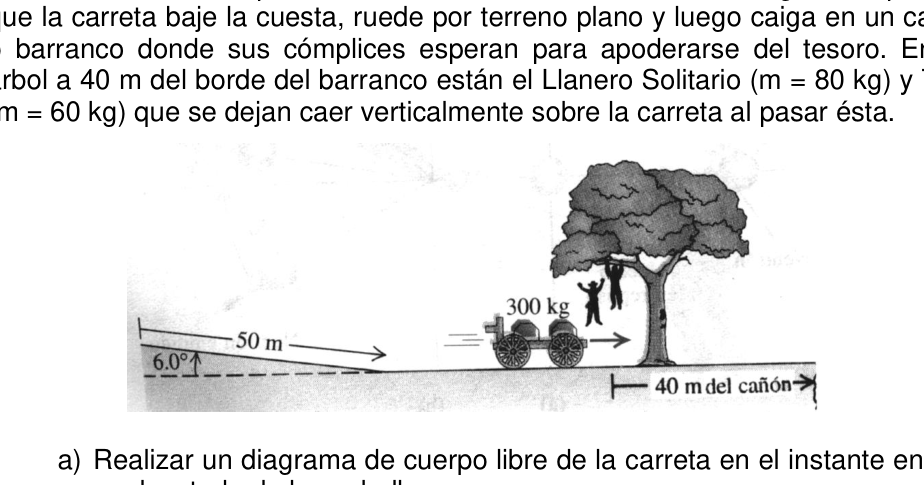
Topic: Conservation of Energy, Conservation of Momentum Metodi: Energy Conservation Method, Conservation of Momentum Competenze: Physical Reasoning, Mathematical Modeling Objects: Cart, Inclined Plane Fonte: Testo (PDF) — p.3
**Lanero e banditi (energia/momento) **
PT50. Istituto Primo Capraro
San Carlo di Bariloche, Rio Negro.
I banditi e il Piano Solitario Per continuare con il tema delle persone con poco interesse per l’osservanza della legge, Abbiamo incontrato un bandito che liberava dai cavalli un carro con due cacci di oro massiccio (massa totale = 300 kg) che si trovava a riposo 50 m si alza su una pendenza di 6° come si vede nella figura. Il piano è: Il carro scende la scogliera, gira su un terreno piatto e poi cade in un cannone. o una cavità dove i suoi complici aspettano di prendere il tesoro. En un Albero a 40 m dal bordo del canyon sono il Llanero Solitario (m = 80 kg) e Toro (m = 60 kg) che vengono lasciati cadere verticalmente sul carrello quando si passa.
a) Realizzare un diagramma del corpo libero del carrello nel momento in cui È sganciata dai cavalli. b) Trovare la velocità con cui il carro passa sotto il Llanero Solitario e Toro. c) Se i nostri eroi hanno bisogno di 5 secondi per prendere l’oro e saltare, lo farebbero? Ce la faranno prima che il carro cadga nel canyon. d) Quando cadono nel carrello, l’energia cinetica del sistema viene conservata. Formato dai eroi e dalla carrozza. Se sì, indicare il valore di tale energia cinetica. Se non è così indicare se si aumenta o diminuisce e in quanto?
OAF 2013 - 79 e) Determinare la forza (modulo e direzione) che agisce sul Llanero Solitario quando cade sul carro, sapendo che si è lasciato cadere. partendo dal riposo da un’altezza di 2,45 m.
Topic: Conservation of Energy, Conservation of Momentum Metodi: Energy Conservation Method, Conservation of Momentum Competenze: Physical Reasoning, Mathematical Modeling Objects: Cart, Inclined Plane Fonte: Testo (PDF) — p.3
**Bands and the Plain (energy/moment) **
PT50. The first is the Capraro Institute.
St. Charles of Bariloche, Rio Negro.
The bandits and the lonely meadow To continue with the theme of people with little regard for law enforcement, We meet a bandit who frees a wagon with two horses. gold boxes (total mass = 300 kg) that were at rest 50 m The slope of the slope is 6° as shown in Figure 1. The plan is The carriage goes down the hill, rolls over flat terrain and then falls into a canyon. Or a ravine where his accomplices wait to seize the treasure. En un The only tree 40 m from the edge of the gorge is the Lone Ranger (m = 80 kg) and Toro (m = 60 kg) which are dropped vertically on the cart when passing it.
(a) Draw a free body diagram of the cart as soon as it is It’s unleashed from the horses. (b) Find the speed at which the cart passes under the Llanero Lone and Bull. c) If our heroes need 5 seconds to take the gold and jump, will it? They’ll make it before the cart falls through the ravine. d) When they fall into the cart, the system’s kinetic energy is retained. Made up of heroes and the chariot. If so, indicate the value The energy of the kinetic energy. If not, indicate whether it increases or decreases and by how much?
The following points shall be added: (e) Determine the momentum (module and direction) acting on the Llanero Lonely when he falls on the cart, knowing he dropped himself. Starting from rest from a height of 2.45 m.
Topic: Conservation of Energy, Conservation of Momentum Metodi: Energy Conservation Method, Conservation of Momentum Competenze: Physical Reasoning, Mathematical Modeling Objects: Cart, Inclined Plane Fonte: Testo (PDF) — p.3
Puente de Wheatstone
PT51. Instituto Primo Capraro
San Carlos de Bariloche, Río Negro.
A seguir resistiendo (mientras se pueda)
Para hallar la resistencia Rx desconocida y representada en la figura, se arma un
circuito, conocido como el puente de Wheatstone, donde se utiliza una R0
conocida, un galvanómetro (aparato que mide la intensidad de corriente
eléctrica) que se conecta por medio de un contacto de corredera a un cable
conductor homogéneo de gran resistencia (hilo de resistencia) de longitud total
L = l1 + l2 . Dicho circuito puede observarse en la figura. El procedimiento indica
que desplazando la corredera D sobre el hilo de resistencia, se debe lograr que
el galvanómetro indique que no pasa más corriente por él. Se consideran
despreciables las resistencias de los conductores de conexión.
a) ¿Qué relación hay entre la intensidad de corriente eléctrica que pasa
por la Rx (ix) y la que pasa por la R0 (i0).
b) ¿Cómo es la relación entre la diferencia de potencial eléctrico que hay
entre los puntos A y C (VAC) comparada con la que hay entre los puntos
A y D (VAD)?.
c) Demostrar que en ausencia de corriente en el galvanómetro, tiene lugar
la relación:
d) Con el puente de Wheatstone se pudo comprobar que la resistencia desconocida Rx = 10 cuando la R0 = 4 utilizando un hilo de resistencia de 140 cm de longitud. Determinar la longitud l1 que hace que no pase corriente por el galvanómetro. e) Sabiendo que el hilo de resistencia se fabricó de plomo cuya resistividad ρ = 22·10-8 ·m y de forma cilíndrica, determinar el radio del cable de plomo.
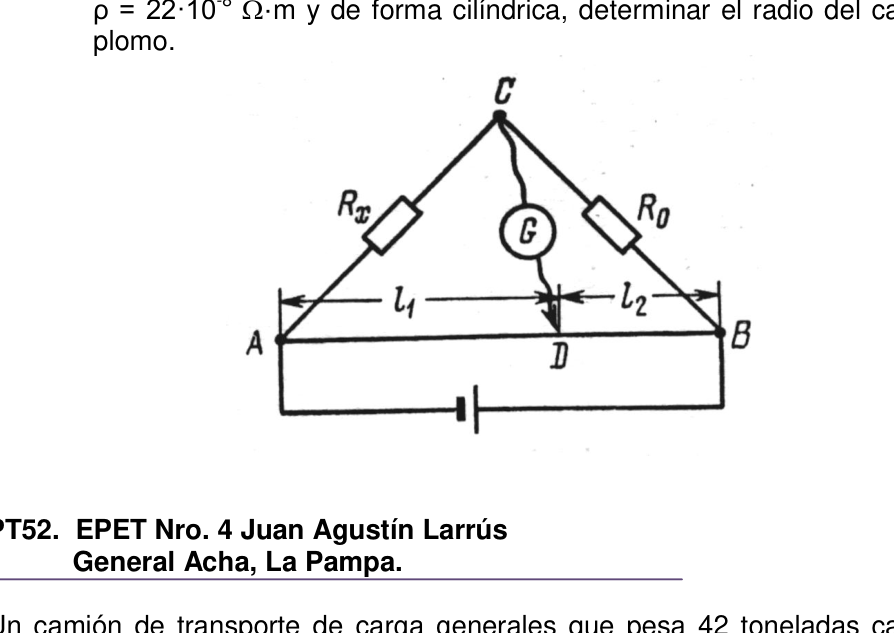
Topic: Circuits Metodi: Kirchhoff’s Laws, Equivalent Circuit Reduction Competenze: Physical Reasoning Objects: Galvanometer, Resistor, Wire Fonte: Testo (PDF) — p.3
Ponte di Wheatstone
PT51. Istituto Primo Capraro
San Carlo di Bariloche, Rio Negro.
Continuare a resistere (quando è possibile) Per trovare la resistenza Rx sconosciuta e rappresentata nella figura, si arma un Circuito, noto come il ponte di Wheatstone, dove viene utilizzata una R0 un galvanometro (apparecchio che misura l’intensità di corrente elettrica) che si collega con un contatto di pista a un cavo conduttore omogeneo di grande resistenza (filamento di resistenza) di lunghezza totale L = l1 + l2 . Tale circuito si può osservare nella figura. Il procedimento indica: che spostando la pista D sul filo di resistenza, si deve ottenere che il galvanometro indica che non passa più corrente. Si considerano Le resistenze dei conducenti di connessione sono scarsa. a) Qual è la relazione tra l’intensità di corrente elettrica che passa per la Rx (ix) e quella che passa per la R0 (i0). b) Qual è il rapporto tra la differenza di potenziale elettrico esistente tra i punti A e C (VAC) rispetto a quello tra i punti A e D (VAD) ? c) dimostrare che, in assenza di corrente nel galvanometro, si verifica Relazione:
d) Il ponte di Wheatstone ha dimostrato che la resistenza sconosciuta Rx = 10 quando R0 = 4 usando un filo di resistenza di 140 cm di lunghezza. Determinare la lunghezza l1 che fa che non passi corrente attraverso il galvanometro. e) Sapendo che il filo di resistenza è stato realizzato con piombo la cui resistenza ρ = 22·10-8 ·m e, in forma cilindrica, determinare il raggio del cavo di
- Piombo.
Topic: Circuits Metodi: Kirchhoff’s Laws, Equivalent Circuit Reduction Competenze: Physical Reasoning Objects: Galvanometer, Resistor, Wire Fonte: Testo (PDF) — p.3
The Commission shall adopt implementing acts in accordance with Article 21 of Regulation (EC) No 1272/2009.
PT51. The first is the Capraro Institute.
St. Charles of Bariloche, Rio Negro.
Keep fighting (as long as you can) To find the unknown Rx resistance represented in the figure, we’re arming a The circuit, known as the Wheatstone Bridge, where an R0 is used The current intensity of the current is measured by a galvanometer. Electrical) which is connected by a contact of a sling to a cable High strength homogeneous conductor (strength thread) of total length L = l1 + l2 . This circuit can be seen in the figure. The procedure indicates The first step is to ensure that the resistance is not reduced to the minimum. The galvanometer indicates that no current is passing through it. They are considered The resistance of the connecting conductors is despicable. (a) What is the relationship between the intensity of the electric current passing through for Rx (ix) and for R0 (i0). (b) What is the relationship between the difference in electric potential that exists between points A and C (VAC) compared to that between points A and D (VAD)? (c) To demonstrate that in the absence of current in the galvanometer, it takes place the relationship:
(d) The Wheatstone Bridge was able to test the resistance of the unknown Rx = 10 when R0 = 4 using a thread of resistance of 140 cm in length. Determine the length of the l1 it makes It’s not going to pass through the galvanometer. (e) Knowing that the resistance thread was made of lead whose resistance ρ = 22·10-8 ·m and in a cylindrical form, determine the radius of the wire of lead.
Topic: Circuits Metodi: Kirchhoff’s Laws, Equivalent Circuit Reduction Competenze: Physical Reasoning Objects: Galvanometer, Resistor, Wire Fonte: Testo (PDF) — p.3
Camion y automovil - cinematica/dinamica
PT52. EPET Nro. 4 Juan Agustín Larrús
General Acha, La Pampa.
Un camión de transporte de carga generales que pesa 42 toneladas cargado; parte del reposo de la ciudad de General Acha hacia el oeste. Recorriendo 3000 mts hasta llegar a la velocidad de 80 km/h reglamentario en rutas nacionales y después sigue su marcha con velocidad constante.
OAF 2013 - 80
Treinta minutos después de haber partido el camión pasa por dicha ciudad un
automóvil de peso 1,5 toneladas también con dirección oeste con una velocidad
constante de 110 km/h
Determinar
a) Aceleración del camión
b) Fuerza realizada por el motor del camión sabiendo que el coeficiente de
rozamiento de los neumáticos con el asfalto es de 0,4
c) Potencia desarrollada por el motor
d) Qué tiempo le lleva al auto pasar a el camion
e) Y a qué distancia de dicha ciudad lo alcanza
Topic: Newtonian Mechanics Metodi: Kinematic Equations, Free-Body Diagram Competenze: Physical Reasoning Objects: — Fonte: Testo (PDF) — p.3
Locchio e autovettura - cinematica/dinamica
PT52. Il numero di EPET. 4 Juan Agustín Larrús
Generale Acha, La Pampa.
Un camion di trasporto di merci generali che pesa 42 tonnellate caricate; parte del riposo della città del generale Acha verso ovest. - Viaggiando 3000 .
- il trasporto di merci fino a raggiungere la velocità di 80 km/h regolamentare su rotte nazionali; Poi continua a marciare a velocità costante.
OAF 2013 - 80 Trenta minuti dopo la partenza del camion passa per quella città un Auto di 1,5 tonnellate anche in direzione ovest con una velocità costante di 110 km/h Determinare a) Accelerazione del camion b) Forza esercitata dal motore del camion sapendo che il coefficiente di il rottura delle gomme con l’asfalto è di 0,4 c) Potenza sviluppata dal motore d) Quanto tempo ci vuole per passare dal camion alla macchina? e) E a che distanza da tale città
Topic: Newtonian Mechanics Metodi: Kinematic Equations, Free-Body Diagram Competenze: Physical Reasoning Objects: — Fonte: Testo (PDF) — p.3
The following is the list of the categories of vehicles used in the manufacture of the product:
PT52. The following information shall be provided: 4 Juan Agustín Larrús
General Acha, the Pampa.
A general cargo freight truck weighing 42 tons loaded; Part of the rest of General Acha’s city to the west. I ‘m going 3000 . The speed limit for the vehicle is set at 80 km/h on national routes. Then it continues its march at a constant speed.
The following is the list of the Member States’ financial statements: Thirty minutes after the truck left , a truck passes through the town . Car weighing 1.5 tons also westbound with a speed The speed of the vehicle shall be: Determine (a) Acceleration of the truck (b) Force exerted by the engine of the truck knowing that the coefficient of The rubber rubber rubber is 0.4 (c) Power developed by the engine d) How long does it take the car to get to the truck (e) And how far from that city is it
Topic: Newtonian Mechanics Metodi: Kinematic Equations, Free-Body Diagram Competenze: Physical Reasoning Objects: — Fonte: Testo (PDF) — p.3
Compresor de aire - gases
PT53. EPET Nro. 4 Juan Agustín Larrús
General Acha, La Pampa.
Al estar trabajando con herramientas neumáticas en el taller del colegio
alimentadas por el compresor vemos que su rendimiento se ha visto disminuido.
Al inspeccionar el mismo durante su funcionamiento comprobamos que la
temperatura del recipiente llega a los 80ºC.
Este compresor en su placa identificatoria tiene los siguientes datos,
una capacidad del deposito de 200 litros, 15kg/cm2 de presión de trabajo y una
capacidad 1500litros de aire a presión de trabajo y a temperatura de trabajo de
40 ºC.
Por lo tanto queremos averiguar lo siguiente:
a) ¿Qué volumen de aire tiene realmente el depósito?
b) Si logramos reducir la temperatura del depósito a 122º F al volumen
contenido del mismo ¿aumentaría o disminuirá? ¿en cuánto?
c) ¿Cuál es el peso del aire contenido en el depósito para ambas
temperaturas?
d) Si en vez de aire utilizáramos hidrogeno para llenar el depósito ¿a que
presión equipararíamos el peso de este con el del aire a 122º F?
Te aclaramos que ambos consideramos el comportamiento de estos gases
como ideales
Topic: Thermodynamics, Kinetic Theory Metodi: Ideal Gas Law Competenze: Physical Reasoning Objects: Gas, Container Fonte: Testo (PDF) — p.3
**Compressore a gas **
PT53. Il numero di EPET. 4 Juan Agustín Larrús
Generale Acha, La Pampa.
Mentre lavorava con gli strumenti pneumatici nel laboratorio della scuola Le macchine alimentate dal compresore mostrano un calo delle prestazioni. Quando l’ispezione è stata effettuata durante il suo funzionamento, abbiamo constatato che la la temperatura del recipiente raggiunge gli 80 °C. Questo compresso sulla sua scheda di identificazione ha i seguenti dati, una capacità di deposito di 200 litri, 15 kg/cm2 di pressione di lavoro e una Capacità 1500 litri di aria a pressione di lavoro e a temperatura di lavoro di 40 ºC. Quindi vogliamo scoprire: a) Che volume d’aria ha effettivamente il deposito? b) Se riusciamo a ridurre la temperatura del deposito a 122° F al volume Il contenuto di questo prodotto aumenterebbe o diminuirebbe? - In quanto? c) Qual è il peso dell’aria contenuta nel deposito per entrambi? temperature? d) Se invece di aria si utilizza idrogeno per riempire il deposito, a che scopo? La pressione di questo è uguale a quella dell’aria a 122° F? Ti chiediamo che entrambi consideriamo il comportamento di questi gas. come ideali
Topic: Thermodynamics, Kinetic Theory Metodi: Ideal Gas Law Competenze: Physical Reasoning Objects: Gas, Container Fonte: Testo (PDF) — p.3
The following table shows the calculation of the total weight of the product:
PT53. The following information shall be provided: 4 Juan Agustín Larrús
General Acha, the Pampa.
Working with pneumatic tools in the school workshop. We’re seeing that their performance has been reduced. When we inspected it during its operation we found that the the temperature of the container reaches 80 °C. This compressor on its identification plate has the following data, a storage capacity of 200 litres, 15 kg/cm2 of working pressure and a capacity 1500 litres of air at working pressure and at working temperature of 40 ºC. So we want to find out the following: (a) What volume of air does the reservoir actually have? (b) If we can reduce the temperature of the tank to 122°F to the volume The Commission will take the view that the Commission is not in a position to take any further action. How much? (c) What is the air weight in the tank for both? the temperature? (d) If we use hydrogen instead of air to fill the tank, what is the Pressure would we match the weight of this to that of air at 122 degrees F? We ‘re making it clear that we both consider the behavior of these gases . as ideals
Topic: Thermodynamics, Kinetic Theory Metodi: Ideal Gas Law Competenze: Physical Reasoning Objects: Gas, Container Fonte: Testo (PDF) — p.3
Placa con resistencias y pilas
PT54. EPET Nro. 4 Juan Agustín Larrús
General Acha, La Pampa.
En el taller de electrónica se encontró la siguiente placa electrónica, esta está compuesta por resistencia y alojamientos para pilas 1,5 volt en serie entre ellas.
E1= 3 pilas E2= 4 pilas E3= 2 pilas E4= 6 pilas E5= 1 pilas E6= 5 pilas
a) Averiguar el valor
de las resistencias
ya que solo vemos
sus colores
b) Determinar la co-
rriente que circula
por cada rama
c) Calcular la tensión
que tenemos entre
los puntos A y B
OAF 2013 - 81 d) Si R9 estuviese cortada como podemos reemplazarla si tenemos las siguientes resistencias
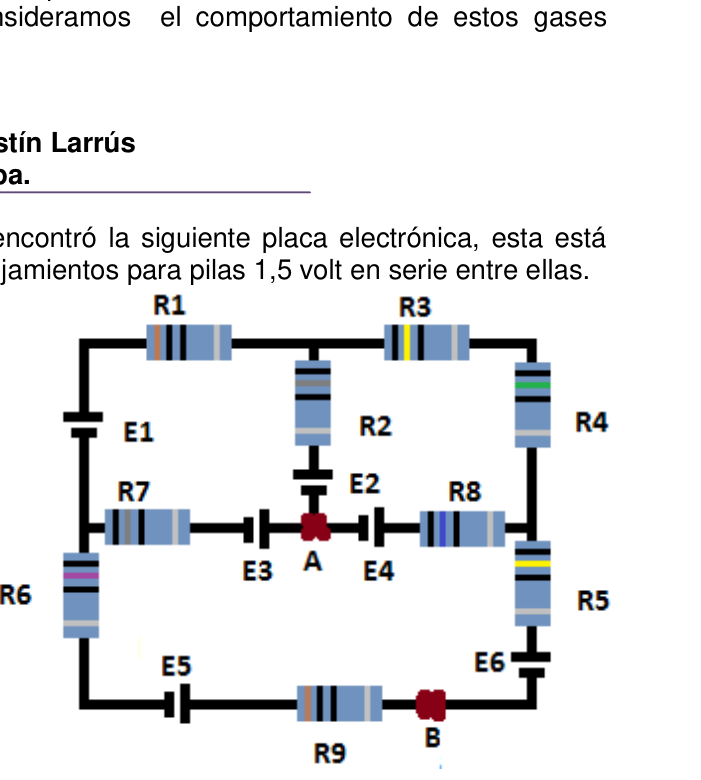
Topic: Circuits Metodi: Kirchhoff’s Laws, Equivalent Circuit Reduction Competenze: Physical Reasoning Objects: Resistor, Battery Fonte: Testo (PDF) — p.3
Platte con resistenze e batterie
PT54. Il numero di EPET. 4 Juan Agustín Larrús
Generale Acha, La Pampa.
Nel laboratorio di elettronica si è trovato il seguente pannello elettronico, questo è composto da resistenza e da accoglienti per batterie a 1,5 volt in serie tra di esse.
E1 = 3 batterie E2 = 4 batterie E3 = 2 batterie E4 = 6 batterie E5 = 1 batteria E6 = 5 batteria
a) Scoprire il valore di resistenza. visto che vediamo solo i suoi colori b) Determinare la co- Rentimento circolante per ogni ramo (c) Calcolare la tensione che abbiamo tra di noi. punti A e B
OAF 2013 - 81 d) Se R9 fosse tagliata come possiamo sostituirla se abbiamo le resistenze seguenti
Topic: Circuits Metodi: Kirchhoff’s Laws, Equivalent Circuit Reduction Competenze: Physical Reasoning Objects: Resistor, Battery Fonte: Testo (PDF) — p.3
Plate with resistors and batteries
PT54. The following information shall be provided: 4 Juan Agustín Larrús
General Acha, the Pampa.
In the electronics workshop, the following electronic plate was found, this is composed of resistance and 1,5 volt battery accommodation in series between them.
E1 = 3 batteries E2 = 4 batteries E3 = 2 batteries E4 = 6 batteries E5 = 1 battery E6 = 5 batteries
(a) Find the value of resistance Since we only see Its colors (b) Determine the co- circulating fluid For each branch (c) Calculate the voltage We have between points A and B
The following is the list of the Member States’ financial statements: d) If R9 is cut off how can we replace it if we have the following resistance
Topic: Circuits Metodi: Kirchhoff’s Laws, Equivalent Circuit Reduction Competenze: Physical Reasoning Objects: Resistor, Battery Fonte: Testo (PDF) — p.3
Combinacion de resistencias 45 ohm
PT55. Escuelas Técnicas Raggio
Ciudad de Buenos Aires.
Ud. necesita una resistencia de 45Ω pero el negocio de electricidad sólo tiene
resistencias de 20Ω y 50Ω.
a) ¿De qué manera puede conseguirse la resistencia deseada?
Esquematice.
b) Si se aplica a la conexión una diferencia de potencial de 15V. ¿Cuál es
el valor de la corriente total en el circuito?
c) ¿Qué valor de diferencia de potencial existe en los extremos de cada
resistencia?
d) ¿Qué corriente circula por cada resistencia?
e) ¿Qué potencia eléctrica disipa cada resistencia?
Topic: Circuits Metodi: Equivalent Circuit Reduction, Kirchhoff’s Laws Competenze: Physical Reasoning Objects: Resistor Fonte: Testo (PDF) — p.3
Combinante resistenza 45 ohm
PT55. Scuole tecniche Raggio
Città di Buenos Aires.
Ud. Ha bisogno di una resistenza di 45Ω, ma il business dell’elettricità ha solo resistenza di 20Ω e 50Ω. a) Come si può ottenere la resistenza desiderata?
- Scalza. b) Se si applica alla connessione una differenza di potenziale di 15 V. Che cos’è? il valore del corrente totale nel circuito? (c) Qual è il valore di differenza di potenziale che esiste alle estremità di ciascuna resistenza? d) Che corrente circola per ogni resistenza? e) Quale potenza elettrica dissipa ogni resistenza?
Topic: Circuits Metodi: Equivalent Circuit Reduction, Kirchhoff’s Laws Competenze: Physical Reasoning Objects: Resistor Fonte: Testo (PDF) — p.3
The test results shall be reported in accordance with the following formula:
PT55. Raggio Technical Schools
City of Buenos Aires.
Ud. You need a 45Ω resistance but the electrical business only has 20Ω and 50Ω resistors. (a) How can the desired resistance be achieved? It’s a squeeze. (b) If a 15V potential difference is applied to the connection. What is it? the value of the total current in the circuit? (c) What is the potential difference value at each end of the resistance? (d) What current is flowing through each resistor? (e) What electrical power dissipates each resistance?
Topic: Circuits Metodi: Equivalent Circuit Reduction, Kirchhoff’s Laws Competenze: Physical Reasoning Objects: Resistor Fonte: Testo (PDF) — p.3
Esfera de demolicion - caida libre
PT56. Escuelas Técnicas Raggio
Ciudad de Buenos Aires.
Una esfera de demolición se encuentra colgando en reposo de una grúa cuando
de pronto se rompe el cable que la sostiene. El tiempo que le toma a la esfera
caer la mitad del camino hacia el suelo es de 1,2 s. Suponiendo que se
desprecia la resistencia del aire:
a) Encontrar el tiempo que le toma a la esfera caer la mitad del camino
hacia el suelo.
b) Velocidad de la esfera al cabo de 1,2 s.
c) La velocidad en el instante que impacta con el suelo.
d) La altura desde que se inicia el movimiento.
Graficar la variación de v y posición en función del tiempo.
Topic: Newtonian Mechanics Metodi: Kinematic Equations Competenze: Physical Reasoning Objects: Ball Fonte: Testo (PDF) — p.3
Sfera di demolizione - caduta libera
PT56. Scuole tecniche Raggio
Città di Buenos Aires.
Una sfera di demolizione si trova appesa a riposo da un grilletto quando E il cavo che la tiene si rompe. Il tempo che ci vuole per la sfera cadere a metà strada verso il suolo è di 1,2 secondi. Supponendo che si disprezza la resistenza dell’aria: a) Trovare il tempo necessario per cadere la sfera a metà strada.
- E’ il mio figlio. b) Velocità della sfera dopo 1,2 s. c) La velocità all’istante in cui colpisce il suolo. d) L’altezza da quando si inizia il movimento. Graficare la variazione di v e posizione in funzione del tempo.
Topic: Newtonian Mechanics Metodi: Kinematic Equations Competenze: Physical Reasoning Objects: Ball Fonte: Testo (PDF) — p.3
The following is the list of the types of vehicles that are used in the manufacture of the product:
PT56. Raggio Technical Schools
City of Buenos Aires.
A demolition sphere is found hanging at rest from a crane when And suddenly the cable that holds it breaks. The time it takes for the sphere to be Falling halfway down to the ground is 1.2 seconds. Assuming that you are It despises the resistance of the air: (a) Find the time it takes the sphere to fall halfway down.
- Down to the ground. (b) Speed of the sphere after 1.2 s. (c) The speed at the instant it impacts the ground. (d) The height from the start of the movement. Graph the variation of v and position depending on the time.
Topic: Newtonian Mechanics Metodi: Kinematic Equations Competenze: Physical Reasoning Objects: Ball Fonte: Testo (PDF) — p.3
Electron entre placas
PT57. Escuelas Técnicas Raggio
Ciudad de Buenos Aires.
Un electrón viaja horizontalmente en el vacío y entra en una región entre dos placas metálicas horizontales como se muestra en la Figura.
OAF 2013 - 82 La placa inferior está conectada a tierra y la superior se encuentra a + 400 V de potencial. La separación entre las placas es de 0.80 cm. (me=9.11 x 10⁻³¹kg; qe=1.67 x 10⁻¹⁹C) El campo eléctrico entre las placas se considera uniforme y fuera de las mismas cero. a) En la Figura, a1) Dibuje una flecha en el punto P para indicar la dirección de la fuerza sobre el electrón debido al campo eléctrico entre las placas. a2) Esquematice el camino del electrón cuando pasa entre las placas y fuera de ellas. b) Determine la magnitud del campo eléctrico E entre las placas. c) Calcule, para cuando el electrón está entre las placas, la magnitud de c1) la fuerza sobre el electrón, c2) su aceleración. d) Si electrón ingresa a la región con una velocidad de 200 m/s, a una distancia de 0,60 cm de la placa de menor potencial. Calcular: d1) el tiempo que tarda en chocar contra una de las placas d2) la distancia recorrida horizontalmente
Topic: Electrostatics, Newtonian Mechanics Metodi: Electric Potential Method, Kinematic Equations Competenze: Physical Reasoning, Mathematical Modeling Objects: Electron, Capacitor Fonte: Testo (PDF) — p.3
Elettro tra schede
PT57. Scuole tecniche Raggio
Città di Buenos Aires.
Un elettrone viaggia orizzontalmente nel vuoto e entra in una regione tra due. plache metalliche orizzontali come mostrato nella Figura.
OAF 2013 - 82 La scheda inferiore è collegata alla terra e la scheda superiore è a + 400 V di Potenziale. La distanza tra le placche è di 0,80 cm. (me=9.11 x 10⁻³¹kg; qe=1.67 x 10⁻¹⁹C) Il campo elettrico tra le plache è considerato uniforme e fuori di esse.
- Zero. a) Nella figura, a1) Disegnare un’arcia nel punto P per indicare l’indirizzo della forza sull’elettrone a causa del campo elettrico tra le plache. a2) Scalda il percorso dell’elettrone quando passa tra le placche e fuori di loro. b) Determina la magnitudine del campo elettrico E tra le plache. c) Calcolare, per quando l’elettrone è tra le plache, la magnitudine di c1) la forza sull’elettrone, c2) la sua accelerazione. d) Se un elettrone entra nella regione a una velocità di 200 m/s, a una Distanza di 0,60 cm dalla scheda di minor potenziale. Calcolare: d1) il tempo necessario per scontrarsi con una delle targhe d2) la distanza percorsa orizzontalmente
Topic: Electrostatics, Newtonian Mechanics Metodi: Electric Potential Method, Kinematic Equations Competenze: Physical Reasoning, Mathematical Modeling Objects: Electron, Capacitor Fonte: Testo (PDF) — p.3
The value of the underlying assets shall be reported in the following column:
PT57. Raggio Technical Schools
City of Buenos Aires.
An electron travels horizontally in the vacuum and enters a region between two. horizontal metal plates as shown in Figure 1.
The following is the list of the countries of the European Union: The bottom plate is connected to the ground and the top plate is at + 400 V of The potential. The separation between the plates is 0.80 cm. (me=9.11 x 10⁻³¹kg; qe=1.67 x 10⁻¹⁹C) The electric field between the plates is considered uniform and outside the plates.
- What? (a) In Figure, a1) Draw an arrow at point P to indicate the direction of the force on the electron due to the electric field between the plates. a2) Squeeze the path of the electron as it passes between the plates and out of them. (b) Determine the magnitude of the electric field E between the plates. (c) Calculate, for when the electron is between the plates, the magnitude of (c1) the force on the electron, (c2) its acceleration. (d) If an electron enters the region at a speed of 200 m/s, at a a distance of 0,60 cm from the lowest potential plate. Calculation: (d1) the time it takes to collide with one of the plates d2) the distance travelled horizontally
Topic: Electrostatics, Newtonian Mechanics Metodi: Electric Potential Method, Kinematic Equations Competenze: Physical Reasoning, Mathematical Modeling Objects: Electron, Capacitor Fonte: Testo (PDF) — p.3
Colisiones - escopeta y plastilina
PT58. Escuela Escocesa San Andrés
Olivos, Buenos Aires.
- Esta pregunta se refiere a las colisiones. A. En un experimento, una escopeta de aire pellet se dispara en un bloque de plastilina que se apoya en una mesa.
La escopeta de aire sedimento permanece en el interior del bloque de la arcilla después del impacto. Como resultado de la colisión, el bloque de arcilla se desliza a lo largo de la mesa en una línea recta y la hora de descanso. Otros datos relativos a la experimento se dan a continuación. Masa de aire rifle pellet
= 2,0 g Masa del bloque de arcilla
= 56 g La velocidad de impacto del aire rifle pellet
= 140 ms-1
La distancia de frenado de bloque de arcilla
= 2,8 m a) Demostrar que la velocidad inicial del bloque de arcilla después de que el aire golpea rifle pellet es 4.8 ms-1. b) Calcular la fuerza de fricción promedio que la superficie de la mesa ejerce sobre el bloque de arcilla, mientras que el bloque de la arcilla se está moviendo. B. El experimento se repite con el bloque de arcilla colocado en el borde de la mesa de manera que se dispara fuera de la mesa. La velocidad inicial del bloque de arcilla es de 4,3 ms-1 horizontalmente. La superficie de la mesa es de 0,85 m por encima del suelo.
OAF 2013 - 83
a) Haciendo caso omiso de la resistencia del aire, calcular la distancia horizontal recorrida por el bloque de arcilla antes de que toque el suelo. b) El diagrama en (c) muestra la trayectoria de la secuencia de arcilla despreciando la resistencia del aire. En el diagrama, dibujar la forma aproximada de la ruta que el bloque de arcilla se llevará a suponer que los actos de resistencia de aire en el bloque de arcilla.
- Esta pregunta se refiere a los impulsos. A. Una bola de masa de 0.0750 kg se desplaza horizontalmente con una velocidad de 2.20 ms-1. Afecta a una pared vertical y horizontal rebotes.
Debido a la colisión con la pared, 20% de la energía cinética inicial de la pelota se disipa. a) Encontrar la velocidad de la pelota rebota en la pared. b) Demostrar que el impulso dado a la pelota junto a la pared es de 0.313 N s. B. La pelota golpea la pared en el momento t = 0 y deja la pared en el momen- to t = T. El esquema gráfico muestra cómo la fuerza F que ejerce la pared sobre la pelota se supone que varía con el tiempo t.
El tiempo T se mide electrónicamente a la igualdad de 0,0894 s. Usa el impulso dado en (b) (ii) para estimar el valor promedio de F.
OAF 2013 - 84
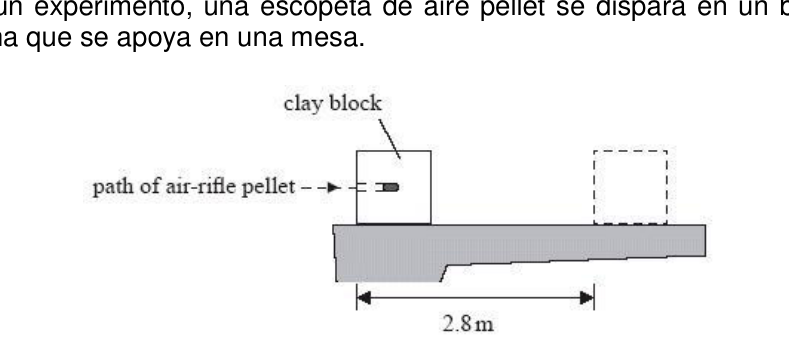
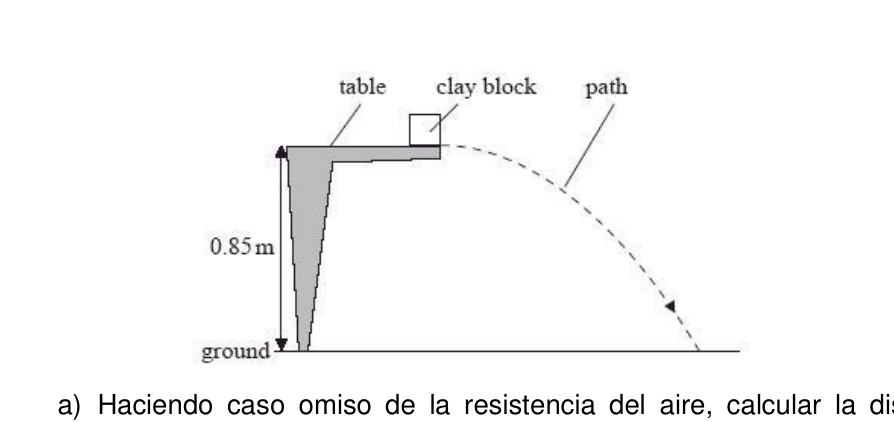
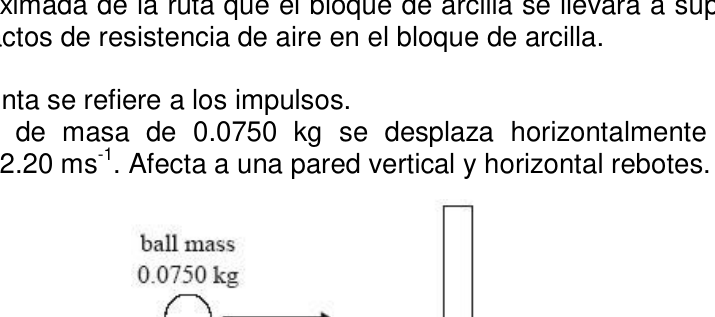
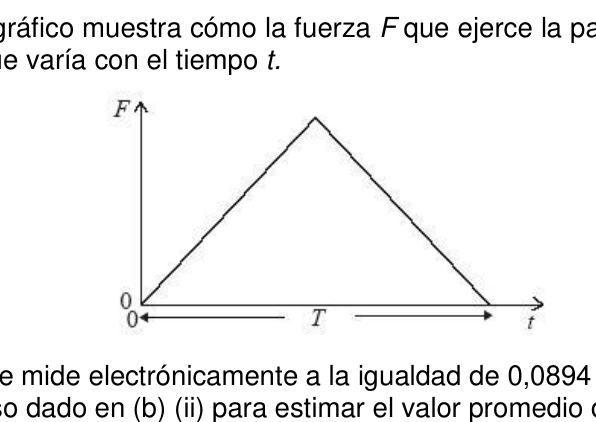
Topic: Conservation of Momentum, Newtonian Mechanics Metodi: Conservation of Momentum, Free-Body Diagram Competenze: Physical Reasoning, Mathematical Modeling Objects: Block, Projectile Fonte: Testo (PDF) — p.3
Collisioni - fucile e plastilina
PT58. Scuola scozzese San Andrés
Olivos, Buenos Aires.
- Questa domanda riguarda le collisioni. A. In un esperimento, un fucile aereo pellet viene sparato su un blocco di plastilina appoggiata su un tavolo.
La fucile di aria sedimentare rimane all’interno del blocco di argilla. dopo l’impatto. Come risultato della collisione, il blocco di argilla si scivola lungo la un tavolo in linea retta e l’ora di riposo. Altri dati relativi alla L’esperimento è seguito. Massa di aria del fucile pellet
= 2,0 g Massa del blocco di argilla
= 56 g La velocità di impatto del fucile aereo pellet
= 140 ms-1
Distanza di frenata di blocco di argilla
= 2,8 m a) Dimostra che la velocità iniziale del blocco di argilla dopo che Il colpo d’aria del fucile pellet è di 4,8 ms-1. b) Calcolare la forza di attrito media che la superficie del tavolo esercita sul blocco di argilla, mentre il blocco di argilla si
- Si sta muovendo. B. L’esperimento viene ripetuto con il blocco di argilla posto sul bordo della una tavola in modo da sparare fuori dal tavolo. La velocità iniziale del blocco La massa di argilla è di 4,3 ms-1 orizzontalmente. La superficie del tavolo è di 0,85 m.
- Sopra il pavimento.
OAF 2013 - 83
a) Oltre alla resistenza dell’aria, calcolare la distanza orizzontale percorso attraverso il blocco di argilla prima di toccare il suolo. b) Il diagramma di (c) mostra il percorso del sequenza di argilla Scommette la resistenza dell’aria. Nel diagramma, disegnare la forma Approximato del percorso che il blocco di argilla porterà a supporre che gli atti di resistenza all’aria nel blocco di argilla.
- Questa domanda riguarda gli impulsi. A. Una palla di massa di 0,0750 kg si muove orizzontalmente con una velocità di 2,20 ms-1. Colpisce un muro verticale e ribalta orizzontale.
A causa della collisione con il muro, il 20% dell’energia cinetica iniziale della palla si dissipa. a) Trovare la velocità della palla che rimbalza sul muro. b) Dimostra che la forza di impulso della palla vicino al muro è di 0.313. N s. B. La palla colpisce il muro al momento t = 0 e lascia il muro al momento to t = T. Il grafico mostra come la forza F che esercita il muro sulla palla Si suppone che varia con il tempo t.
Il tempo T viene misurato elettronicamente a 0,0894 s. Utilizzare il pulso di (b) (ii) per stimare il valore medio di F.
OAF 2013 - 84
Topic: Conservation of Momentum, Newtonian Mechanics Metodi: Conservation of Momentum, Free-Body Diagram Competenze: Physical Reasoning, Mathematical Modeling Objects: Block, Projectile Fonte: Testo (PDF) — p.3
Collisions - shotgun and plasticine
PT58. St. Andrew’s Scottish School
Olive trees, from Buenos Aires.
- This question concerns collisions. A. In one experiment, a pellet air rifle is fired at a block of plasticine that rests on a table.
The sediment air shot remains inside the clay block. after the impact. As a result of the collision, the clay block slides along the table in a straight line and rest time. Other data on the The experiment is given below. Mass air rifle pellet
= 2,0 g Mass of the clay block
= 56 g The impact velocity of the air rifle pellet
= 140 ms-1
The braking distance of the clay block
= 2,8 m (a) Demonstrate that the initial clay block velocity after the The air-strike gun pellet is 4.8 ms-1. (b) Calculate the average frictional force that the surface of the table has The clay block is applied to the clay block, while the clay block is applied to the clay block. It’s moving. B. The experiment is repeated with the clay block placed on the edge of the table so you shoot out of the table. The initial block speed The clay is 4.3 m-1 horizontally. The table surface is 0.85 m. above the ground.
The following is the list of the countries of the European Union:
(a) By ignoring the air resistance, calculate the distance horizontal path through the clay block before it touches the ground. (b) The diagram in (c) shows the trajectory of the clay sequence I’m not going to say anything about the air resistance. In the diagram, draw the shape approximate route that the clay block will lead to assume that the acts of air resistance on the clay block.
- This question is about impulses. A. A ball of mass of 0.0750 kg moves horizontally with a speed of 2.20 ms-1. It affects a vertical wall and horizontal bounces.
Because of the collision with the wall, 20% of the ball’s initial kinetic energy It’s going away. (a) Find the speed of the ball bouncing against the wall. (b) To prove that the momentum given to the ball by the wall is 0.313. N s. B. The ball hits the wall at the moment t = 0 and leaves the wall at the moment- to t = T. The graph shows how the F-force that the wall exerts on the ball. It’s supposed to vary with time t.
Time T is measured electronically at the equal of 0,0894 s. Use the momentum given in (b) (ii) to estimate the average value of F.
The following is the list of the Member States’ financial statements:
Topic: Conservation of Momentum, Newtonian Mechanics Metodi: Conservation of Momentum, Free-Body Diagram Competenze: Physical Reasoning, Mathematical Modeling Objects: Block, Projectile Fonte: Testo (PDF) — p.3
Particula alfa en campo electrico
PT59. Escuela Escocesa San Andrés
Olivos, Buenos Aires.
- Esta pregunta es sobre el movimiento de una partícula cargada en un campo eléctrico. A. Un α-partícula de masa 4 u y carga 2 e se acelera desde el reposo en un vacío a través de una diferencia de potencial de 2,4 kV. Demostrar que la velocidad final de la α-partícula es 4,8 × 10⁵ ms-1. B. La α-partícula se desplaza en una dirección paralela a y a mitad de camino entre dos placas de metal paralelas.
Las placas de metal son de longitud de 2,4 cm y su separación es de 0,80 cm. La diferencia de potencial entre las placas es de 600 V. El eléctrica fi campo es uniforme en la región entre las placas y es cero fuera de esta región. a) Cálculo de la magnitud del campo eléctrico entre las placas. b) Demostrar que la magnitud de la aceleración de la α-partícula por el campo eléctrico es 3,6 × 10¹² ms-2. C. a) Calcular el tiempo necesario para que la α-partícula en recorrer una distancia horizontal de 2,4 cm paralelas a las placas.
- Esta pregunta es sobre el movimiento en un campo magnético y la inducción electromagnética Un electrón, que se ha acelerado desde el reposo por una diferencia de potencial de 250 V, entra en una región del campo magnético de 0,12 T de la fuerza que está dirigida en el plano de la página.
A. El camino del electrón, mientras que en la región del campo magnético es un
cuarto de círculo. Demostrar que la
a) velocidad del electrón después de la aceleración es de 9,4 × 10⁶ ms-1.
b) radio de la trayectoria es de 4,5 × 10⁻⁴ m.
c) tiempo el electrón pasa en la región del campo magnético es de
7,5 × 10⁻¹¹ s.
B. El siguiente diagrama muestra el impulso del electrón, ya que entra y sale de
la zona de campo magnético. La magnitud del momento inicial y el impulso final
es 8,6 × 10⁻²⁴ Ns.
OAF 2013 - 85
a) En el diagrama anterior, dibuje una flecha para indicar el vector que
representa el cambio en el momento del electrón.
b) Demostrar que la magnitud del cambio en el momento del electrón es
1,2 × 10⁻²³ Ns.
c) Estimar la magnitud de la fuerza media sobre el electrón.
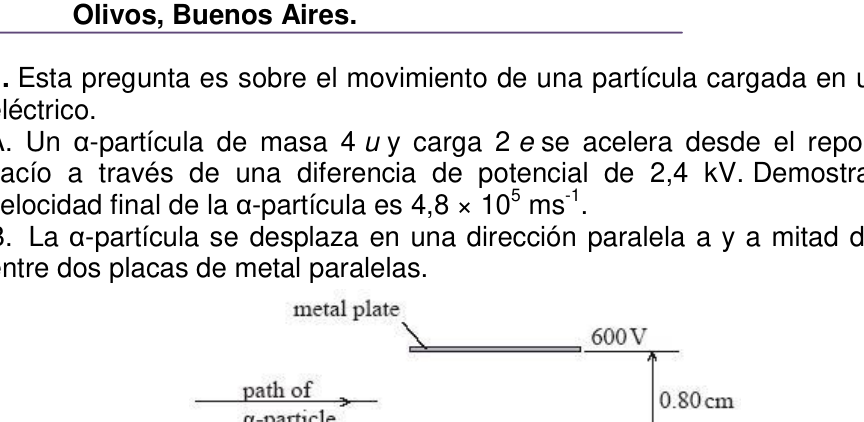
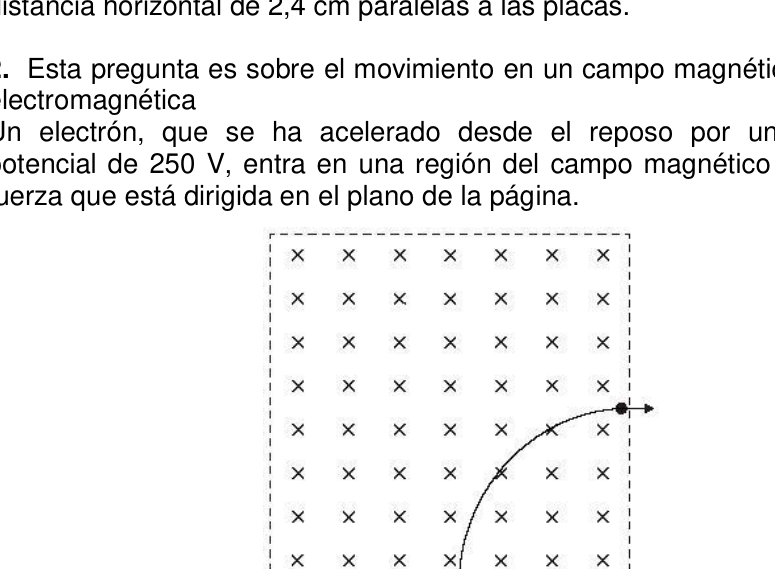
Topic: Electrostatics Metodi: Electric Potential Method, Energy Conservation Method Competenze: Physical Reasoning, Mathematical Modeling Objects: Particle Beam, Capacitor Fonte: Testo (PDF) — p.3
Particola alfa in campo elettrico
PT59. Scuola scozzese San Andrés
Olivos, Buenos Aires.
- Questa domanda riguarda il movimento di una particella carica in un campo. elettrico. A. Una α-particella di massa 4 u e carica 2 e si accelera dal riposo in un la vacuità attraverso una differenza di potenziale di 2,4 kV. Prove che la velocità finale della particella α è 4,8 × 10⁵ ms-1. B. La α-particella si muove in una direzione parallela a e a metà strada tra due lastre di metallo parallele.
Le lastre metalliche sono lunghe 2,4 cm e separate da 0,80 cm. La differenza di potenziale tra le plache è di 600 V. L’elettricità è finita è uniforme nella regione tra le placche e è zero fuori di questa regione. a) Calcolo della grandezza del campo elettrico tra le plache. b) Dimostra che la magnitudine di accelerazione della particella α per il il campo elettrico è 3,6 × 10¹² ms-2. C. a) Calcolare il tempo necessario per il percorso della α-particella in una Distanza orizzontale di 2,4 cm parallela alle placche.
- Questa domanda riguarda il movimento in un campo magnetico e l’induzione.
- L’elettromagnetico Un elettrone, che è stato accelerato dal riposo da una differenza di Potenzialmente 250 V, entra in una regione del campo magnetico di 0,12 T della forza che è diretta sul piano della pagina.
A. La via dell’elettrone, mentre nella regione del campo magnetico è un Quarto cerchio. Prove che a) la velocità dell’elettrone dopo l’accelerazione è di 9,4 × 10⁶ ms-1. b) il raggio di percorso è 4,5 × 10⁻⁴ m. c) il tempo che l’elettrone passa nella regione del campo magnetico è di 7,5 × 10⁻¹¹ s. B. Il diagramma seguente mostra l’impulso dell’elettrone, come entra e esce da la zona del campo magnetico. La grandezza del momento iniziale e l’ impulso finale es 8,6 × 10⁻²⁴ Ns.
OAF 2013 - 85
a) Nel diagramma precedente, disegna un’arcia per indicare il vettore che rappresenta il cambiamento del momento dell’elettrone. b) Dimostra che la magnitudine del cambiamento nel momento dell’elettrone è 1,2 × 10⁻²³ Ns. c) Estimare la magnitudine della forza media sull’elettrone.
Topic: Electrostatics Metodi: Electric Potential Method, Energy Conservation Method Competenze: Physical Reasoning, Mathematical Modeling Objects: Particle Beam, Capacitor Fonte: Testo (PDF) — p.3
The following information is provided for in the Annex to Implementing Regulation (EU) No 575/2013:
PT59. St. Andrew’s Scottish School
Olive trees, from Buenos Aires.
- This question is about the motion of a charged particle in a field. electrical. A. An α-particle of mass 4 u and charge 2 e accelerates from rest in a vacuum through a potential difference of 2.4 kV. Proving that The final speed of the α-particle is 4,8 × 10⁵ ms-1. B. The α-particle moves in a direction parallel to and halfway through the path. between two parallel plates of metal.
The metal plates are 2.4 cm long and 0.80 cm apart. cm. The potential difference between the plates is 600 V. The electrical field is fixed is uniform in the region between the plates and is zero outside this region. (a) Calculation of the magnitude of the electric field between the plates. (b) To demonstrate that the magnitude of the acceleration of the α-particle by the The electric field is 3,6 × 10¹² ms-2. C. (a) Calculate the time required for the α-particle to travel through a horizontal distance of 2,4 cm parallel to the plates.
- This question is about the motion in a magnetic field and induction. electromagnetic . An electron, which has been accelerated since rest by a difference of The potential of the magnetic field is 250 V, entering a region of 0.12 T of the magnetic field of the force that is directed at the plane of the page.
A. The path of the electron, while in the region of the magnetic field is a Fourth circle. Proving that (a) the electron speed after acceleration is 9,4 × 10⁶ ms-1. (b) the radius of the trajectory is 4,5 × 10⁻⁴ m. (c) the time the electron passes in the magnetic field region is of 7,5 × 10⁻¹¹ s. B. The following diagram shows the electron pulse as it enters and exits from the magnetic field zone. The magnitude of the initial momentum and the final momentum es 8,6 × 10⁻²⁴ Ns.
The following is the list of the countries of the European Union:
(a) In the diagram above, draw an arrow to indicate the vector that It represents the change in electron momentum. (b) To demonstrate that the magnitude of change in the momentum of the electron is 1,2 × 10⁻²³ Ns. (c) Estimate the magnitude of the mean force on the electron.
Topic: Electrostatics Metodi: Electric Potential Method, Energy Conservation Method Competenze: Physical Reasoning, Mathematical Modeling Objects: Particle Beam, Capacitor Fonte: Testo (PDF) — p.3
Gas ideal - ciclo PV
PT60. Escuela Escocesa San Andrés
Olivos, Buenos Aires.
- Esta pregunta trata de un gas ideal. A. El gráfico muestra una relación de presión-volumen (P-V) para una masa fija de un gas ideal.
El gas se somete a un ciclo de tres fases AB, BC y CA.
a) Identificar el isócoro (isovolumétrica) cambio de estado.
b) Utilizar los datos de la gráfica para mostrar que el cambio AB es
isotérmica.
c) Calcular el trabajo realizado por el gas en el cambio antes de Cristo.
B. La cantidad de gas en la parte (a) es de 0.74 mol.
Cálculo de la temperatura máxima del gas durante el ciclo en la parte (a).
C. La masa fija de gas se calienta desde la temperatura T1 a T2 a volumen
constante. Explicar por qué, si esta masa fija de gas se calienta de T1 a T2 a
presión constante, la cantidad de energía requerida es diferente.
- Esta pregunta trata interna en energía y la energía térmica (calor). A. Una pieza de hierro se coloca en un horno hasta que alcanza la temperatura θ del horno. El hierro se transfiere rápidamente al agua contenida
OAF 2013 - 86 en un recipiente aislado térmicamente. El agua se agita hasta que alcanza una temperatura constante. Los siguientes datos están disponibles. La capacidad térmica del ece pi de hierro = 60 JK-1 La capacidad térmica del agua
= 2,0 × 10³ JK-1 Temperatura inicial del agua
= 16 ° C Temperatura final del agua
= 45 ° C
La capacidad térmica del recipiente y el aislamiento es insignificante.
a) Indique una expresión, en términos de θ y los datos anteriores, para la
transferencia de energía de la plancha en el enfriamiento desde la
temperatura del horno a la temperatura final del agua.
b) Calcular el aumento de la energía interna del agua como el hierro se
enfría en el agua.
c) Utilice sus respuestas a (B) (a) y (B) (b) para determinar θ.
Topic: Thermodynamics, Kinetic Theory Metodi: Thermodynamic Cycle Analysis, First Law of Thermodynamics, Ideal Gas Law Competenze: Physical Reasoning, Mathematical Modeling Objects: Gas Fonte: Testo (PDF) — p.3
Gas ideale - ciclo PV
PT60. Scuola scozzese San Andrés
Olivos, Buenos Aires.
- Questa domanda riguarda un gas ideale. A. Il grafico mostra un rapporto pressione-volume (P-V) per una massa fissa di un gas ideale.
Il gas è sottoposto a un ciclo di tre fasi AB, BC e CA. a) Identificare il cambiamento di stato isocoro (isovolumetrico). b) Utilizzare i dati del grafico per mostrare che il cambiamento AB è Isotermico. c) Calcolare il lavoro svolto dal gas nel cambiamento prima di Cristo. B. La quantità di gas nella parte (a) è di 0,74 mol. Calcolo della temperatura massima del gas durante il ciclo in parte (a). C. La massa fissa del gas viene riscaldata da T1 a T2 a volume costante. Spiegare perché, se questa massa fissa di gas si riscaldasse da T1 a T2 a la pressione costante, la quantità di energia richiesta è diversa.
- Questa domanda riguarda l’energia interna e l’energia termica (calore). A. Un pezzo di ferro viene messo in un forno fino a raggiungere la temperatura θ del forno. Il ferro si trasferisce rapidamente nell’acqua contenuta
OAF 2013 - 86 in un recipiente termicamente isolato. L’acqua si agita fino a raggiungere un’azzurra. temperatura costante. I seguenti dati sono disponibili. La capacità termico dell’acciaio di ferro = 60 JK-1 La capacità termica dell’acqua
= 2,0 × 10³ JK-1 Temperatura iniziale dell’acqua
= 16 ° C Temperatura finale dell’acqua
= 45 ° C La capacità termico del recipiente e l’isolamento sono insignificanti. a) Indicare un’espressione, in termini di θ e dati precedenti, per trasferimento di energia dalla lamina in raffreddamento dal temperatura del forno alla temperatura finale dell’acqua. b) Calcolare l’aumento dell’energia interna dell’acqua come il ferro Fa freddo nell’acqua. c) Utilizzare le risposte a (B) (a) e (B) (b) per determinare θ.
Topic: Thermodynamics, Kinetic Theory Metodi: Thermodynamic Cycle Analysis, First Law of Thermodynamics, Ideal Gas Law Competenze: Physical Reasoning, Mathematical Modeling Objects: Gas Fonte: Testo (PDF) — p.3
The following conditions shall apply:
PT60. St. Andrew’s Scottish School
Olive trees, from Buenos Aires.
- This question is about an ideal gas. A. The graph shows a pressure-volume ratio (P-V) for a fixed mass of an ideal gas.
The gas undergoes a three-phase cycle AB, BC and CA. (a) Identify the isocor (isovolumetric) change of state. (b) Use the graph data to show that change AB is isothermal. (c) Calculate the work done by gas in the change before Christ. B. The amount of gas in part (a) is 0,74 mol. Calculation of the maximum gas temperature during the cycle in part (a). C. The fixed mass of the gas is heated from T1 to T2 at volume It’s constant. Explain why, if this fixed mass of gas is heated from T1 to T2 to constant pressure, the amount of energy required is different.
- This question deals internally with energy and thermal energy (heat). A. A piece of iron is placed in an oven until it reaches the the temperature θ of the oven. Iron is quickly transferred to the water contained.
The following is the list of the Member States’ financial statements: in a heat-insulated container. The water is stirred until it reaches a the temperature is constant. The following data are available. The thermal capacity of the iron ore = 60 JK-1 The thermal capacity of water
= 2,0 × 10³ JK-1 Initial water temperature
= 16 ° C Final water temperature
= 45 ° C The thermal capacity of the container and the insulation is insignificant. (a) Indicate an expression, in terms of θ and the above data, for The energy transfer from the plate to the cooling from the the temperature of the oven to the final water temperature. (b) Calculate the increase in the internal energy of water such as iron It’s cold in the water. (c) Use your answers to (B) (a) and (B) (b) to determine θ.
Topic: Thermodynamics, Kinetic Theory Metodi: Thermodynamic Cycle Analysis, First Law of Thermodynamics, Ideal Gas Law Competenze: Physical Reasoning, Mathematical Modeling Objects: Gas Fonte: Testo (PDF) — p.3
Trayectoria circular y resorte (energia)
PT61. Colegio Pablo Apóstol
Yerba Buena, Tucumán.
El objeto de la figura tiene 3 kg de masa y parte del reposo desde una altura de
8 metros, describiendo primero una trayectoria circular AB sin fricción
(radio = 6 m). A continuación describe una trayectoria horizontal BC con fricción
hasta detenerse comprimiendo un resorte de
4000
K
N m
. Calcula:
a) La velocidad del cuerpo cuando pasa por el punto B.
b) El valor de la reacción N en el punto B.
c) El trabajo que realizan las fuerzas de fricción.
d) La distancia x que comprime el resorte.
Luego de detenerse, el cuerpo es impulsado hacia atrás por el resorte. Calcula:
e) La fuerza que ejerce el resorte sobre el cuerpo.
f) La velocidad en el punto B.
g) La altura que alcanza el cuerpo en su camino hacia A.
h) Cuantas veces chocará contra el resorte hasta detenerse. Demuestre
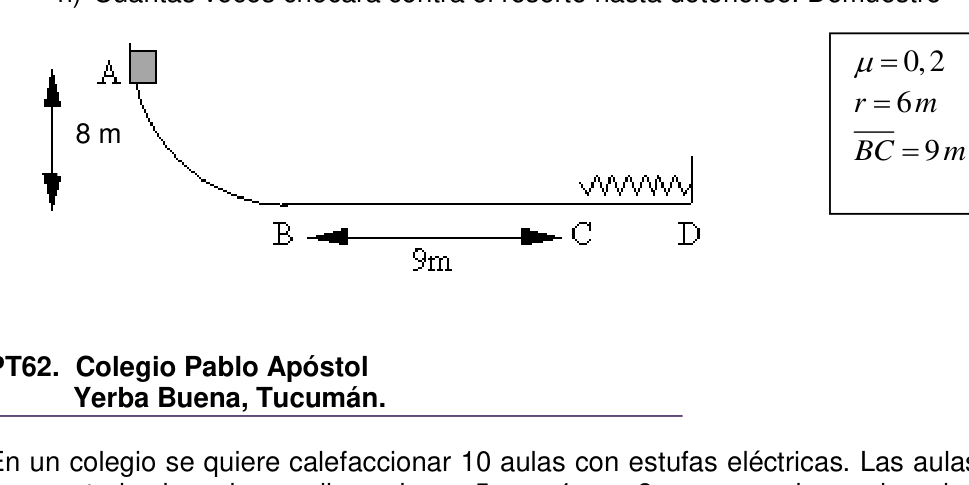
Topic: Conservation of Energy, Newtonian Mechanics Metodi: Energy Conservation Method, Hooke’s Law, Free-Body Diagram Competenze: Physical Reasoning Objects: Spring, Block Fonte: Testo (PDF) — p.3
**Circolare e scorsa (energia) **
PT61. Colegio Paolo l’apostolo
- Buona erba, Tucumán.
L’oggetto della figura ha 3 kg di massa e parte del riposo da un’altezza di 8 metri, descrivendo prima una rotta circolare AB senza attrito (radio = 6 m). Qui di seguito descrive un percorso orizzontale BC con frizione fino a fermarsi compresso un’uscita di 4000 K N m . Calcola: a) La velocità del corpo quando passa attraverso il punto B. b) Il valore della reazione N al punto B. c) Il lavoro svolto dalle forze di frizione. d) La distanza x che comprime la sorgente. Dopo l’arresto, il corpo viene spinto indietro dalla primavera. Calcola: e) La forza che la primavera esercita sul corpo. f) La velocità al punto B. g) L’altezza raggiunta dal corpo in direzione di A. h) Quante volte si sbatterà contro la sorgente fino a fermarsi. Dimostra
Topic: Conservation of Energy, Newtonian Mechanics Metodi: Energy Conservation Method, Hooke’s Law, Free-Body Diagram Competenze: Physical Reasoning Objects: Spring, Block Fonte: Testo (PDF) — p.3
The following table shows the results of the calculations:
PT61. Paul the Apostle College
It’s good grass, Tucumán.
The object in the figure has 3 kg of mass and rests from a height of 8 meters, first describing a circular path AB without friction (radio = 6 m). The following describes a horizontal BC path with friction until it stops by compressing a spring of 4000 K N m . Calculate: (a) The speed of the body as it passes through point B. (b) The value of the reaction N in point B. (c) The work performed by the frictional forces. d) The distance x compressing the spring. After stopping, the body is pushed backward by the spring. Calculate: (e) The force exerted by the spring on the body. (f) The speed at point B. (g) The height reached by the body on its way to A. (h) How many times will it hit the spring until it stops. Prove it
Topic: Conservation of Energy, Newtonian Mechanics Metodi: Energy Conservation Method, Hooke’s Law, Free-Body Diagram Competenze: Physical Reasoning Objects: Spring, Block Fonte: Testo (PDF) — p.3
Calefaccion - estufas electricas
PT62. Colegio Pablo Apóstol
Yerba Buena, Tucumán.
En un colegio se quiere calefaccionar 10 aulas con estufas eléctricas. Las aulas
poseen todas las mismas dimensiones 5 m × 4 m × 3 m y en cada una hay dos
ventanas.
Las estufas constan de 2 velas de cuarzo conectadas en paralelo y de 60 OHM
de resistencia cada una, las mismas se conectan a una tensión continua de
v = 220 v. y es utilizada para calentar el aire contenido en la habitación cuya
densidad y calor especifico son d = 1.3 Kg. / m3 y
Ce = 0.20 cal / g º K, respectivamente.
El rendimiento de las estufas es del 92,5 %.
8 m 0,2
6 r m
9 BC m
OAF 2013 - 87
Calcular:
a) La potencia entregada por cada estufa en forma de calor al medio
ambiente.
b) El calor que debe absorber el aire para elevar su temperatura en
10º C.
c) Sabiendo que el calor perdido por cada ventana y por unidad de tiempo
es de Q = 20 cal / s, hallar el tiempo necesario que debe estar
encendido la estufa para calentar el ambiente en 10º C.
d) ¿Que potencia entregara la estufa si se quitara una de las velas de
cuarzo, suponiendo que el rendimiento no variase?
e) ¿Cuál será el gasto que tendrá mensualmente el colegio si por mes
están prendidas 20 días durante 4 horas diarias? El valor del Kw. H =
0.00880$.
f) En el aula de los jardines de infante hay globos de un volumen de 600
cm3 aproximadamente algunos llenos de helio y otros de aire. ¿Qué
empuje recibe cada uno del aire del aula?
Un niño sostiene en una mano un globo de helio y en la otra un globo de aire.
g) ¿Qué fuerza realiza con cada mano para sostenerlos? (la masa del
globo sin aire es de 3g)
Topic: Circuits, Thermodynamics Metodi: Kirchhoff’s Laws, First Law of Thermodynamics Competenze: Physical Reasoning Objects: Resistor Fonte: Testo (PDF) — p.3
Calificazione - stufe elettriche
PT62. Colegio Paolo l’apostolo
- Buona erba, Tucumán.
In una scuola si vogliono riscaldare 10 aule con stufe elettriche. Le aule
tutte le stesse dimensioni 5 m × 4 m × 3 m e in ciascuna sono due
finestre.
Le stufe sono costituite da 2 candele di quarzo collegate in parallelo e da 60 OHM
di resistenza, ognuna connessa a una tensione continua di
v = 220 v. e viene utilizzata per riscaldare l’aria contenuta nella stanza
densità e calore specifici sono d = 1,3 Kg. / m3 y
Ce = 0,20 cal / g o K, rispettivamente.
Il rendimento dei stufe è del 92,5%.
8 m 0,2
6 r m
9 BC m
OAF 2013 - 87 Calcolare: a) La potenza fornita da ogni stufa in forma di calore al medio ambiente. b) Il calore che deve assorbire l’aria per elevarne la temperatura a 10º C. c) Sapendo che il calore perso per ogni finestra e per unità di tempo è di Q = 20 cal / s, trovare il tempo necessario per essere accendere il stufa per riscaldare l’ambiente a 10°C. d) Che potenza avrebbe fornito il stufa se una delle candele fosse stata rimossa? Quartzo, supponendo che il rendimento non varia? e) Qual è la spesa mensile che l’università avrà se per mese? Sono inceneriti 20 giorni per 4 ore al giorno? Il valore del Kw. H = 0.00880$. f) Nel corso dei corsi di giardinaggio ci sono palloni di 600 volumi. cm3 circa, alcuni pieni di elio e altri di aria. Cosa? Potenza riceve ognuno dall’aria della classe? Un bambino tiene in una mano un pallone di elio e nell’altra un pallone d’aria. g) Che forza fa con ciascuna mano per sostenerli? (la massa del il pallone senza aria è di 3g)
Topic: Circuits, Thermodynamics Metodi: Kirchhoff’s Laws, First Law of Thermodynamics Competenze: Physical Reasoning Objects: Resistor Fonte: Testo (PDF) — p.3
Chalection - electric stoves
PT62. Paul the Apostle College
It’s good grass, Tucumán.
In a school, you want to heat 10 classrooms with electric stoves. The classrooms.
They all have the same dimensions 5 m × 4 m × 3 m and in each there are two
windows.
The stoves consist of 2 quartz candles connected in parallel and 60 OHM
Each of these resistors is connected to a continuous voltage of
v = 220 v. and is used to heat the air contained in the room whose
The density and specific heat are d = 1.3 kg. / m3 y
Ce = 0.20 cal/g or K, respectively.
The efficiency of the stoves is 92.5%.
8 m 0,2
6 r m
9 BC m
The following is the list of the countries of the European Union: Calculation: (a) The power delivered by each stove in the form of heat to the medium The environment. (b) The heat that must be absorbed by the air to raise its temperature by 10º C. (c) Knowing that heat lost by each window and per unit of time is of Q = 20 cal/s, find the time needed to be The heaters are heated to 10°C. (d) What power would the stove deliver if one of the candles were removed from the stove? Quartz, assuming the yield does not vary? (e) What will the school have to spend on a monthly basis if for a month? Are they on fire for 20 days for 4 hours a day? The value of the Kw. H = 0.00880$. (f) In the nursery classroom there are balloons of 600 volumes. cm3 approximately some filled with helium and others with air. What? Does each one get the classroom air? A child holds a helium balloon in one hand and an air balloon in the other. (g) What force does each hand use to hold them? (the mass of the airless balloon is 3g)
Topic: Circuits, Thermodynamics Metodi: Kirchhoff’s Laws, First Law of Thermodynamics Competenze: Physical Reasoning Objects: Resistor Fonte: Testo (PDF) — p.3
Cubo electromagnetico
PT63. Colegio Pablo Apóstol(1)
Colegio del Sol(2)
(1)Yerba Buena – (2)San Miguel, Tucumán.
El cubo electromagnético Tenemos un cubo que está bajo la influencia de distintos campos. Es como un juguete donde aplicaremos distintos campos para jugar a mover objetos. Dentro del cubo existen tuberías y existe una esfera cargada con Q=0,12 C que queremos mover por el interior de las tuberías, utilizando la ayuda de los campos. En cada tubería existe una fuerza de rozamiento de 2,0 N. La idea es que queremos mover la esfera de tal manera que partiendo del reposo del inicio de la tubería llegue al extremo de esa misma tubería con velocidad igual a 0,0 m/s. Para eso contamos con un botón que al presionarlo permite generar una diferencia de potencial entre dos puntos de esa tubería. Luego, en la tubería que sigue, comienza de nuevo el sistema, con excepción de la última tubería que sale al exterior y queremos que la esfera termine saliendo con una velocidad cuyo módulo sea 1,0 m/s. En principio, dentro y fuera del cubo, no actúa la gravedad, sólo podemos generar diferencias de potencial en las tuberías y campos afuera. El cubo tiene 3,0 m de lado. La primera tubería va desde A hasta B, la segunda parte de B hasta una distancia de 5/7 del largo total, en dirección a C. De allí, baja hasta la mitad del alto del cubo en dirección a la base del cubo (E-F-G-H), luego gira horizontalmente hasta salir por la cara opuesta (A-D-H-E). a) ¿Cuánto vale la diferencia de potencial y hasta que distancia hay que aplicarla dentro de cada tubería para producir el efecto deseado? Recordar que son 4 tuberías. b) Cuando sale hacia el exterior por la última tubería, lo hace con una velocidad horizontal de 1,0 m/s. En el exterior del cubo, podemos aplicar un campo magnético para hacer que la esfera vuelva a ingresar al comienzo de la primera tubería en el vértice A. ¿Cuánto tiene que valer el campo magnético y que dirección y sentido debería tener? En este caso la esfera ingresaría al punto A con una velocidad distinta de cero.
OAF 2013 - 88 c) Supongamos que el extremo de la última tubería está curvada de forma que la esfera sale con la misma velocidad de 1,0 m/s y con un ángulo de 30° respecto de la superficie de la cara por donde sale. ¿Cuánto debe valer el campo E en el exterior del cubo que se debería aplicar para que la esfera vuelva a ingresar a la tubería en A? ¿qué dirección y sentido tiene que tener? d) Si ahora actúa la gravedad en el interior del cubo ¿qué resultados se modifican? ¿cuáles son los nuevos resultados?
Topic: Electromagnetism, Conservation of Energy Metodi: Lorentz Force Analysis, Energy Conservation Method Competenze: Physical Reasoning, Mathematical Modeling Objects: Point Charge Fonte: Testo (PDF) — p.3
Cubo elettromagnetico
PT63. Scuola Paolo apostolo(1)
Il college del sole (II)
(1) Yerba Buena (2) San Miguel, Tucumán.
Il cubo elettromagnetico Abbiamo un cubo che è sotto l’influenza di campi diversi. È come un… giocattolo in cui applichiamo campi diversi per giocare a muovere oggetti. - All’interno . Il cubo ha tubi e una sfera carica di Q=0,12 C che Vogliamo spostare l’interno dei tubi, usando l’aiuto dei campi. In ogni tubo esiste una forza di frattura di 2,0 N. L’idea è che Vogliamo spostare la sfera in modo tale che partendo dal riposo dell’inizio della il tubo raggiunge l’estremità di quel stesso tubo con velocità pari a 0,0 m/s. Per questo abbiamo un pulsante che, premendolo, genera una differenza di potenziale tra due punti di quel tubo. Poi, nel tubo che continua, ricomincia il sistema, eccetto l’ultimo tubo che E’ fuori e vogliamo che la sfera finisca per uscire a velocità. di un’altezza di 10 mm/s. In principio, dentro e fuori il cubo, non agisce la gravità, possiamo solo. generare differenze di potenziale nei tubi e nei campi esterni. Il cubo è a 3 metri dalla parte. Il primo tubo va da A a B, il secondo parte di B fino a una distanza di 5/7 della lunghezza totale, in direzione di C. Da lì, Sotto la metà della altezza del cubo in direzione della base del cubo (E-F-G-H), poi gira orizzontalmente fino a uscire dalla faccia opposta (A-D-H-E). a) Quanto vale la differenza di potenziale e fino a che distanza si deve applicarla all’interno di ogni tubo per produrre l’effetto desiderato? Ricordate che sono quattro tubi. b) Quando esce verso l’esterno attraverso l’ultima tubazione, lo fa con una velocità orizzontale di 1,0 m/s. All’esterno del cubo, possiamo applicare un campo magnetico per far entrare la sfera di nuovo nel inizio del primo tubo al vertice A. Quanto vale? Il campo magnetico, e quale direzione e senso dovrebbe avere? In questo . se la sfera entrerebbe nel punto A a velocità diversa da zero.
OAF 2013 - 88 c) Supponiamo che l’estremità dell’ultimo tubo sia curva in modo che la sfera esce alla stessa velocità di 1,0 m/s e con un angolo di 30° rispetto alla superficie della
- Faccia da dove viene. Quanto deve? Valorare il campo E all’esterno del La domanda di cui si tratta è stata presentata in un quadro di valutazione. La sfera entra di nuovo nel tubo. en A? Che senso ha?
- Che cosa? d) Se la gravità agisce ora sul all’interno del cubo, che risultati si
- Modifica? - Cosa c’è di nuovo? risultati?
Topic: Electromagnetism, Conservation of Energy Metodi: Lorentz Force Analysis, Energy Conservation Method Competenze: Physical Reasoning, Mathematical Modeling Objects: Point Charge Fonte: Testo (PDF) — p.3
The following shall be added to the list of the products:
PT63. The Apostle Paul College (p. 1)
College of the Sun (s)
(1) Yerba Buena (2) San Miguel, Tucumán.
The electromagnetic cube . We have a cube that is under the influence of different fields. It ‘s like a A toy where we’ll apply different fields to play moving objects. In there . There are pipes in the cube and there is a sphere loaded with Q=0.12 C which is We want to move through the inside of the pipes, using the help of the pipes. Fields. Each pipe has a force of 2,0 N. The idea is that We want to move the sphere in such a way that starting from the rest of the beginning of the pipe reaches the end of that same pipe at a speed equal to 0,0 m/s. For that we have a button that when you press it, you can generate a button. the potential difference between two points in that pipe. Then, in the pipeline that Continues, restarts the system, except for the last pipe that It goes out and we want the sphere to finish out at a speed . a module of 1,0 m/s. In principle, inside and outside the cube, gravity doesn’t act, we can only. generate potential differences in pipes and fields outside. The cube is 3 meters on the side. The first pipe goes from A to B, the second part of B up to a distance of 5/7 of the total length, in the direction of C. From there, down to half the height of the cube in the direction of the base of the cube (E-F-G-H), then rotate horizontally until it exits the opposite face (A-D-H-E). (a) What is the potential difference and how far is the distance to be apply it inside each pipe to produce the desired effect? Remember, it’s four pipes. (b) When it goes outwards through the last pipe, it does so with a horizontal speed of 1,0 m/s. On the outside of the cube, we can apply A magnetic field to make the sphere re-enter the Start of the first pipe at vertex A. How much does it have to be worth? The magnetic field and what direction and direction should it have? In this one . If the sphere were to enter point A at a speed other than zero.
The following is the list of the Member States’ financial statements: (c) Suppose the end of the last pipe is curved in a form The sphere is going out at the same speed of 1.0 m/s and at an angle. of 30° with respect to the surface of the I’ll look you in the eye. How much do you owe? Value field E on the outside of the The bucket should be applied to the The sphere is entering the pipe again. en A? What direction and meaning does it have? What do you have? (d) If gravity is now acting on the Inside the cube what results are you
- They change? What’s the new? What are the results?
Topic: Electromagnetism, Conservation of Energy Metodi: Lorentz Force Analysis, Energy Conservation Method Competenze: Physical Reasoning, Mathematical Modeling Objects: Point Charge Fonte: Testo (PDF) — p.3
Montaña rusa - dinamica circular
PT64. EEST Nro. 1 Gral. Manuel Savio
Navarro, Buenos Aires.
Un vehículo de una montaña rusa tiene una masa de 500Kg cuando está completamente cargado con pasajeros según como muestra la figura. a) Si el vehículo tiene una velocidad de 20.0 m/s en vehículo en (A) ¿Cuál es la magnitud de la fuerza en este punto? b) ¿Cuál es la máxima rapidez que el vehículo puede tener en (B) para que la gravedad lo mantenga sobre la vía?
Topic: Newtonian Mechanics, Conservation of Energy Metodi: Free-Body Diagram, Energy Conservation Method Competenze: Physical Reasoning, Diagrammatic Reasoning Objects: Cart Fonte: Testo (PDF) — p.3
Montaine russa - dinamica circolare
PT64. EAST Noro. 1 grallo. Manuel Savio
Navarro, Buenos Aires.
Un veicolo da una montagna russa ha una massa di 500 kg quando è in volo. Completamente carico di passeggeri come mostra la figura. a) Se il veicolo ha una velocità di 20,0 m/s in veicolo in (A) Qual è il è la magnitudine della forza a questo punto? b) Qual è la velocità massima che il veicolo può avere in (B) per che la gravità lo tenga in pista?
Topic: Newtonian Mechanics, Conservation of Energy Metodi: Free-Body Diagram, Energy Conservation Method Competenze: Physical Reasoning, Diagrammatic Reasoning Objects: Cart Fonte: Testo (PDF) — p.3
The following is a list of the regions of the European Union:
PT64. This is North East. 1 Gral. Manuel Savio
I’m from Navarro, Buenos Aires.
A roller coaster vehicle weighs 500kg when it ‘s on . fully loaded with passengers as shown in the figure. (a) If the vehicle has a speed of 20.0 m/s in a vehicle in (A) What is the magnitude of the force at this point? (b) What is the maximum speed the vehicle can have in (B) for That gravity keeps him on track?
Topic: Newtonian Mechanics, Conservation of Energy Metodi: Free-Body Diagram, Energy Conservation Method Competenze: Physical Reasoning, Diagrammatic Reasoning Objects: Cart Fonte: Testo (PDF) — p.3
Lamparas en serie con interruptor
PT65. EEST Nro. 1 Gral. Manuel Savio
Navarro, Buenos Aires.
Un circuito en serie está formado por tres lámparas idénticas conectadas a una batería, tal como en la figura. Cuando el interruptor S se cierra, ¿Qué le sucede a) A las intensidades de las lámparas A y B, b) A la intensidad de la lámpara C, c) A la corriente conducida en el circuito? d) ¿la potencia disipada en el circuito aumenta, disminuye o permanece igual? A B C D E G H
OAF 2013 - 89
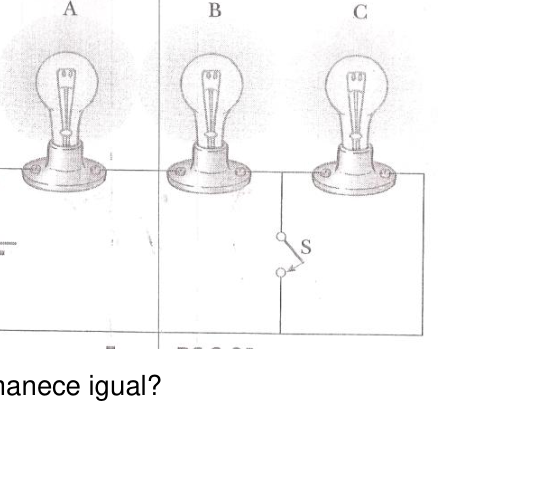
Topic: Circuits Metodi: Kirchhoff’s Laws, Equivalent Circuit Reduction Competenze: Physical Reasoning Objects: Resistor, Battery, Switch Fonte: Testo (PDF) — p.3
Lampette in serie con interruttore
PT65. EAST Noro. 1 grallo. Manuel Savio
Navarro, Buenos Aires.
Un circuito in serie è stato formato. Per Tre . Lampade identiche collegate ad una batteria, come nella figura. Quando il interruttore S Si chiude, che ne è di lei? a) A intensità di lampe A e B, b) L’intensità di lampada C, (c) Al corrente condotta in Il circuito? (d) la potenza dissipata nel Il circuito aumenta, diminuisce o rimane uguale? A B C D E G H
OAF 2013 - 89
Topic: Circuits Metodi: Kirchhoff’s Laws, Equivalent Circuit Reduction Competenze: Physical Reasoning Objects: Resistor, Battery, Switch Fonte: Testo (PDF) — p.3
Serial lamps with switch
PT65. This is North East. 1 Gral. Manuel Savio
I’m from Navarro, Buenos Aires.
A serial circuit is formed. by Three . Lamps identical connected to a battery, such as In the figure. When the switch is s It closes, what’s wrong with it? (a) At the intensities of the Lamps A and B, (b) At the intensity of the lamp C, (c) To the current being drawn in the circuit? (d) the power dissipated in the Circuit increases, decreases or remains the same? A B C D E G H
The following is the list of the Member States’ financial statements:
Topic: Circuits Metodi: Kirchhoff’s Laws, Equivalent Circuit Reduction Competenze: Physical Reasoning Objects: Resistor, Battery, Switch Fonte: Testo (PDF) — p.3
Conduccion termica oro-plata
PT66. EEST Nro. 1 Gral. Manuel Savio
Navarro, Buenos Aires.
Una barra de oro está en contacto térmico con una barra de plata de la misma longitud y área, como muestra la figura. Un extremo de la barra compuesta se mantiene a 80.0°C, y el extremo opuesto esta a 30.0°C. Cuando el flujo de energía alcanza estado estacionario, encuentre la temperatura en la unión.
Topic: Thermodynamics Metodi: First Law of Thermodynamics Competenze: Physical Reasoning Objects: Rod Fonte: Testo (PDF) — p.3
Conducenza termica oro-argento
PT66. EAST Noro. 1 grallo. Manuel Savio
Navarro, Buenos Aires.
Una barra d’oro è in contatto termico con una barra d’argento della stessa. lunghezza e superficie, come mostra la figura. Un’estremità della barra composta si il limite di riferimento è 80.0°C, e l’estremità opposta è 30.0°C. Quando il flusso di energia raggiunge lo stato stazionario, trova la temperatura nel nodo.
Topic: Thermodynamics Metodi: First Law of Thermodynamics Competenze: Physical Reasoning Objects: Rod Fonte: Testo (PDF) — p.3
The heat output of the product shall be the same as that of the product concerned.
PT66. This is North East. 1 Gral. Manuel Savio
I’m from Navarro, Buenos Aires.
A gold bar is in thermal contact with a silver bar of the same. length and area, as shown in the figure. One end of the composite bar is maintains 80.0°C, and the opposite end is 30.0°C. When the flow of energy reaches steady state, find the temperature in the junction.
Topic: Thermodynamics Metodi: First Law of Thermodynamics Competenze: Physical Reasoning Objects: Rod Fonte: Testo (PDF) — p.3
Esfera en riel curvo (energia)
PT67. Liceo Militar General Espejo
Ciudad de Mendoza.
Sobre un cubo de hielo a 0ºC se coloca una moneda de plata de 1,5 cm de
diámetro, de 15g que se encuentra a 85ºC; cuando la moneda está a 0ºC ha
descendido una altura h cm, manteniéndose en posición horizontal. Sin
considerar las pérdidas de calor al medio ambiente:
a) Calcule la masa de hielo derretida
b) Calcule la distancia h
Datos útiles
Topic: Conservation of Energy, Newtonian Mechanics Metodi: Energy Conservation Method Competenze: Physical Reasoning Objects: Sphere Fonte: Testo (PDF) — p.3
**Sfera in rotaia curva (energia) **
PT67. Liceo Militare Generale Specchio
Città di Mendoza.
Su un cubo di ghiaccio a 0°C si pone una moneta d’argento di 1,5 cm di diametro di 15 g che si trova a 85oC; quando la moneta è a 0oC ha Sceso di h cm, mantenendo la posizione orizzontale. Senza . considerare i perditi di calore nell’ambiente: a) Calcolare la massa di ghiaccio sciolto b) Calcolare la distanza h
Dati utili
Topic: Conservation of Energy, Newtonian Mechanics Metodi: Energy Conservation Method Competenze: Physical Reasoning Objects: Sphere Fonte: Testo (PDF) — p.3
The following table shows the results of the calculation of the total value of the input:
PT67. General Military High School Mirror
The city of Mendoza.
On top of an ice cube at 0°C, a silver coin of 1.5 cm is placed. The value of the currency is the value of the currency’s value. The vehicle shall be designed to be capable of operating at a maximum speed of 50 km/h. No . consider heat losses to the environment: (a) Calculate the melted ice mass (b) Calculate the distance h
Useful data
Topic: Conservation of Energy, Newtonian Mechanics Metodi: Energy Conservation Method Competenze: Physical Reasoning Objects: Sphere Fonte: Testo (PDF) — p.3
Puente de resistencias - galvanometro
PT68. Liceo Militar General Espejo
Ciudad de Mendoza.
El circuito que se aprecia en la figura, se utiliza para determinar el valor de un resistor desconocido X por comparación con tres resistores M, N y P cuyas resistencias se pueden modificar. Para cada arreglo, la resistencia de cada resistor se conoce con precisión. Con los interruptores K1 K2 cerrados, estos resistores se modifican hasta que la corriente en el galvanómetro G sea igual a cero, entonces se dice que el puente está equilibrado. a) Demuestre que en esta condición la resistencia desconocida está dada por X=MP/N. b) Si el galvanómetro G muestra una desviación nula cuando M=850 Ω, N=15Ω, P=33.48Ω, ¿Cuál es la resistencia desconocida X?
Topic: Circuits Metodi: Kirchhoff’s Laws, Equivalent Circuit Reduction Competenze: Physical Reasoning, Mathematical Modeling Objects: Resistor, Galvanometer, Switch Fonte: Testo (PDF) — p.3
Ponte di resistenza - galvanometro
PT68. Liceo Militare Generale Specchio
Città di Mendoza.
Il circuito che si vede nella figura viene utilizzato per determinare il valore di un resistore X sconosciuto rispetto a tre resistori M, N e P le resistenze possono essere modificate. Per ogni sistema, la resistenza di ogni resistente è conosciuto con precisione. Con i interruttori K1 K2 chiusi, questi i resistori sono modificati fino a che il corrente nel galvanometro G è uguale a zero, allora si dice che il ponte è equilibrato. a) Dimostra che in questa condizione la resistenza sconosciuta è data per X = MP/N. b) Se il galvanometro G mostra una deviazione zero quando M=850 Ω, N=15Ω, P=33.48Ω, qual è la resistenza sconosciuta X?
Topic: Circuits Metodi: Kirchhoff’s Laws, Equivalent Circuit Reduction Competenze: Physical Reasoning, Mathematical Modeling Objects: Resistor, Galvanometer, Switch Fonte: Testo (PDF) — p.3
The following shall be added to the list of the following:
PT68. General Military High School Mirror
The city of Mendoza.
The circuit shown in the figure is used to determine the value of a Unknown resistor X compared to three resistors M, N and P whose resistance can be modified. For each arrangement, the resistance of each resistor is known with precision. With the K1 K2 switches closed, these The resistors are modified until the current in the galvanometer G is equal to zero, then the bridge is said to be balanced. (a) Demonstrate that in this condition unknown resistance is given for X = MP/N. (b) If the galvanometer G shows a zero deviation when M=850 Ω, N=15Ω, P=33.48Ω, What is the unknown resistance X?
Topic: Circuits Metodi: Kirchhoff’s Laws, Equivalent Circuit Reduction Competenze: Physical Reasoning, Mathematical Modeling Objects: Resistor, Galvanometer, Switch Fonte: Testo (PDF) — p.3
Esfera deslizante - conceptos energeticos
PT69. Liceo Militar General Espejo
Ciudad de Mendoza.
Una esfera de 0,5 Kg desliza por un riel curvo como el de la figura partiendo desde el reposo en el punto A. El tramo desde A hasta B no tiene rozamiento
OAF 2013 - 90 (ideal) mientras que de B a C hay rozamiento (no ideal); determina utilizando exclusivamente conceptos energéticos: a) La velocidad de la esfera cuando llega al punto B. b) Si sabemos que la esfera se detiene al llegar a C, calcula el trabajo realizado por la fuerza de rozamiento en ese tramo BC. Señala si hubo pérdida de energía mecánica en BC.
Topic: Conservation of Energy Metodi: Energy Conservation Method Competenze: Physical Reasoning Objects: Sphere Fonte: Testo (PDF) — p.3
Slip sphere - concetti energetici
PT69. Liceo Militare Generale Specchio
Città di Mendoza.
Una sfera di 0,5 Kg scivola su un binario curvo come quello della figura partendo dal riposo al punto A. Il tratto da A a B non ha rottura
OAF 2013 - 90 (ideale) mentre da B a C c’è rasatura (non ideale); determina utilizzando esclusivamente concetti energetici: a) La velocità della sfera quando arriva al punto B. b) Se sappiamo che la sfera si ferma quando arriva a C, calcola il lavoro effettuato dalla forza di ruggine in quel tratto BC. Indica se c’è stato perdita di energia meccanica in BC.
Topic: Conservation of Energy Metodi: Energy Conservation Method Competenze: Physical Reasoning Objects: Sphere Fonte: Testo (PDF) — p.3
The Commission shall adopt delegated acts in accordance with Article 21 of Regulation (EC) No 1290/2006.
PT69. General Military High School Mirror
The city of Mendoza.
A 0.5 Kg sphere slides along a curved rail like the one in the figure starting from the rest at point A. The stretch from A to B is unraveling .
The following points shall be added: (ideal) whereas from B to C there is friction (not ideal); determines using exclusively energy concepts: (a) The speed of the sphere when it reaches point B. b) If we know that the sphere stops when it reaches C, calculate the work The force applied to the brush at that stretch BC. Point out if there was . Mechanical power loss in BC.
Topic: Conservation of Energy Metodi: Energy Conservation Method Competenze: Physical Reasoning Objects: Sphere Fonte: Testo (PDF) — p.3
Dispositivo de caida con friccion
PT70. Escuela Industrial Superior
Ciudad de Santa Fe.
Se deja caer, desde la parte más alta del dispositivo de la figura, un objeto de
masa m. El tramo sombreado en el circuito es el único que tiene rozamiento con
coeficiente µ.
a) Determinar la expresión de la velocidad en el punto A.
b) Encontrar la expresión para la velocidad en el punto B.
c) Hallar la expresión teórica del alcance X2.
d) Calcular todas las variables de los incisos a, b y c con los siguientes datos: H1 = 6 [m] H2 = 4 [m] µ = 0,3 X1= 3 [m] e) Encontrar una expresión para X1 tal que la velocidad en el punto B sea 0 (cero).
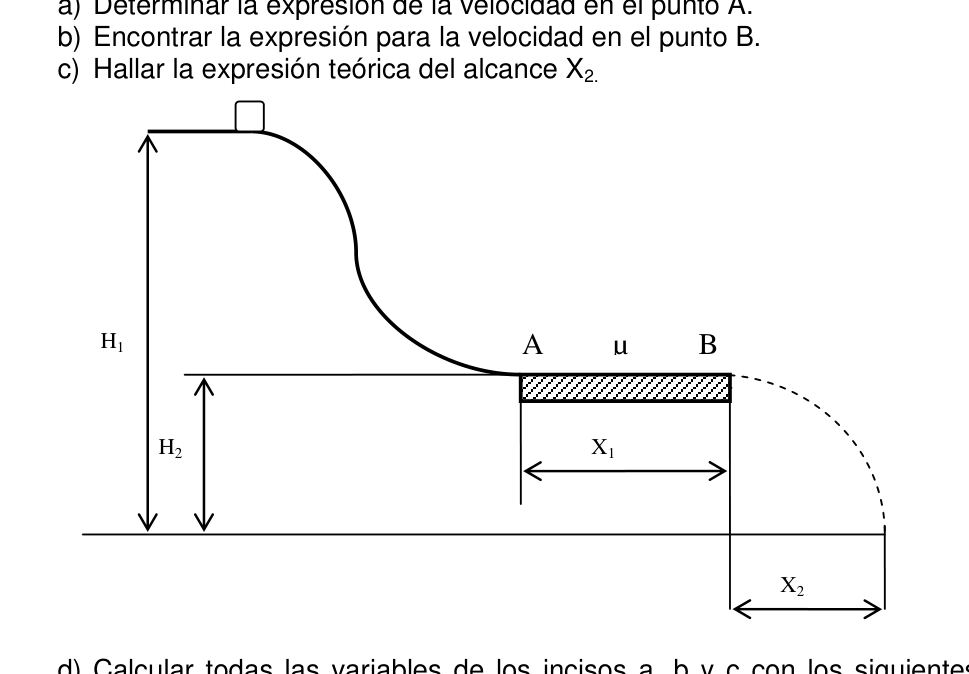
Topic: Conservation of Energy, Newtonian Mechanics Metodi: Energy Conservation Method, Kinematic Equations Competenze: Physical Reasoning, Mathematical Modeling Objects: Block Fonte: Testo (PDF) — p.3
Dispositivo di caduta a friczione
PT70. Scuola superiore industriale
Città di Santa Fe.
Si fa cadere, dalla parte superiore del dispositivo della figura, un oggetto di massa m. Il tratto ombreggiato del circuito è l’unico che ha un’arrestazione con Coefficiente μ. a) Determinare l’espressione della velocità nel punto A. b) Trovare l’espressione per velocità nel punto B. c) Trovare l’espressione teorica del raggio X2.
d) Calcolare tutte le variabili di a, b e c con le seguenti dati: H1 = 6 [m] H2 = 4 [m] µ = 0,3 X1= 3 [m] e) Trovare un’espressione per X1 tale che la velocità al punto B sia 0 (Zero)
Topic: Conservation of Energy, Newtonian Mechanics Metodi: Energy Conservation Method, Kinematic Equations Competenze: Physical Reasoning, Mathematical Modeling Objects: Block Fonte: Testo (PDF) — p.3
Friction drop device
PT70. Higher Industrial School
City of Santa Fe.
A figure is dropped from the top of the device. mass m. The shaded section in the circuit is the only one that has a scratch with coefficient μ. (a) Determine the expression of the velocity in point A. (b) Find the expression for speed in point B. (c) Find the theoretical expression of the range X2.
(d) Calculate all the variables in points (a), (b) and (c) by the following data: H1 = 6 [m] H2 = 4 [m] µ = 0,3 X1= 3 [m] e) Find an expression for X1 such that the velocity at point B is 0 (Zero)
Topic: Conservation of Energy, Newtonian Mechanics Metodi: Energy Conservation Method, Kinematic Equations Competenze: Physical Reasoning, Mathematical Modeling Objects: Block Fonte: Testo (PDF) — p.3
Bateria - autonomia (Peukert)
PT71. Escuela Industrial Superior
Ciudad de Santa Fe.
Juan tiene una heladera de 75 [W], 12 [V]. y una lámpara de 40 [W], 12[V]. Al conectar los artefactos en paralelo a una batería de plomo-acido de 12 [V] y, 60 [A.h]: a) Calcular la corriente total del circuito. b) Calcular potencia total. c) Suponiendo que la batería es ideal calcular su autonomía para este circuito. H1 X2 H2 µ X1 A B
OAF 2013 - 91 d) Si se conectaran los artefactos en serie. Calcular la autonomía de la batería. Explicar cuáles serían las ventajas y desventajas de este modo de conexión. e) Leer el anexo y calcular la autonomía del circuito paralelo aplicando la formula de Peukert.
Anexo: Cálculo de la autonomía en baterías de gel y plomo ácido
Aplicación de la fórmula y exponente de Peukert
Probablemente todos sepamos, ya sea por haberlo oído o experimentado en
“carne propia”, que la autonomía, mejor dicho, capacidad, de las baterías
recargables, fundamentalmente, en las de plomo-ácido (por ejemplo la de los
vehículos) y selladas de gel como las que usamos en modelos de RC, se reduce
drásticamente a medida que aumentamos el consumo, esto es, la corriente que
solicitamos de las mismas.
Obviamente no nos referimos al simple cálculo algebraico de dividir la capacidad
nominal o “de fábrica” por el consumo, lo cual solamente existiría en una batería
ideal, que solo es producto de la imaginación! Por ejemplo, si tenemos una
batería de 4AH (4 amperes-hora), podríamos tentarnos de afirmar que “si
consumo 1 A, me durará 4 horas, si consumo 2A, 2 horas, si le pido 4A, 1 hora,
etc. En la práctica, sabemos que esto no es así.
Las baterías de plomo-ácido, que tampoco escapan a este problema, ya existían
desde el siglo XIX, y el problema ya tenía a varios científicos pensando. Un
alemán, W. Peukert (pronúnciese póikert), estableció, en 1897 (sí, 1897) una
fórmula que, casi sin alterar es la que ha estado utilizando hasta el día de hoy, y
permite calcular con mucha aproximación la capacidad real, o bien, el tiempo de
autonomía, de una batería de plomo-ácido o de gel sellada, en función de la
autonomía nominal y el consumo al que la sometemos.
En cuanto a la fórmula en cuestión:
Que nos da el tiempo en horas de autonomía en función de cómo varia la
capacidad según el consumo. Los parámetros son:
t: es el tiempo en horas de autonomía que nos da la fórmula.
C: es la capacidad de la batería en AH (amperes-hora) indicada por el fabricante,
durante un tiempo de consumo determinado, que es el siguiente parámetro:
H: es el tiempo en horas indicado por el fabricante que indica en qué base
de tiempo está calculada la capacidad nominal. Ejemplo: una de 6V 4AH, si
además en la batería se indica 20H (en general son todas así), significa que
durante 20 horas puede entregar el equivalente a 4 amperes en una hora, o sea,
200mA o 0,2 A durante 20 horas. Esto es porque son diseñadas para backup en
caso de corte de energía y mantener el suministro de alimentación a circuitos
electrónicos o eléctricos de bajo consumo, como alarmas, UPS (fuentes para
PC), etc. En general, si no está impreso en la batería, podemos suponer que el
valor normalmente es de 20 horas.
I: es la intensidad de corriente que solicitaremos de la batería, en A (amperes), el
cual debemos conocerlo midiendo el consumo a velocidad promedio del modelo
con un amperímetro conectado en serie con el motor.
k: es el exponente de Peukert y es un valor inherente al tipo de batería y en
general debe ser indicado por el fabricante, aunque generalmente esto no es así.
No obstante, en general se puede afirmar que este valor está comprendido entre
1.1 (para baterías de gel de buena calidad) y 1.3 (para las de plomo-ácido). Si
existiera una batería ideal, el exponente seria 1, cosa que sencillamente no
existe. Cuanto menor sea, mejor rendimiento tendremos de la batería.
OAF 2013 - 92
Topic: Circuits Metodi: Kirchhoff’s Laws, Equivalent Circuit Reduction Competenze: Physical Reasoning, Mathematical Modeling Objects: Battery, Resistor Fonte: Testo (PDF) — p.3
**Batteria - autonomia (Peukert) **
PT71. Scuola superiore industriale
Città di Santa Fe.
Juan ha un frigorifero di 75 [W], 12 [V]. e una lampada da 40 [W], 12 [V]. Al collegare gli artefatti in parallelo a una batteria a piombo acido di 12 [V] e, 60 [A.h]: a) Calcolare il corrente totale del circuito. b) Calcolare la potenza totale. c) Supponendo che la batteria sia ideale per calcolare la sua autonomia per questo circuito. H1 X2 H2 µ X1 A B
OAF 2013 - 91 d) Se si collegano gli artefatti in serie. Calcolare l’autonomia della Batteria. Esprimi quali sarebbero i vantaggi e gli svantaggi di questo modo di connessione. e) Leggere l’allegato e calcolare l’autonomia del circuito parallelo applicando la seguente formula: formula di Peukert.
Anexo: Calcolo della autonomia in batterie a gel e a piombo acido Applicazione della formula e esponente di Peukert Probabilmente tutti lo sappiamo, sia per averlo sentito o sperimentato in carne propre, che l’autonomia, o meglio, la capacità, delle batterie La produzione di tali prodotti è stata effettuata in modo da ridurre la quantità di prodotti di cui sono stati trattati. La produzione di veicoli (e di marchi di gel come quelli che usiamo nei modelli RC, si riduce E’ il risultato di un aumento del consumo, cioè del flusso che
- Chiediamo le stesse. Ovviamente non si tratta del semplice calcolo algebrico di dividere la capacità. La produzione di energia elettrica è stata ridotta a circa un milione di tonnellate di tonnellate. Ideale, che è solo un prodotto dell’immaginazione! Per esempio, se abbiamo una Batteria 4AH (4 amperes-ora), potremmo tentare di affermare che 1A, mi porterà 4 ore, 2A, 2 ore, 4A, 1 ora, ecc. In pratica, sappiamo che non è così. Le batterie a piombo e acido, che non sono nemmeno in grado di sfuggire a questo problema, erano già in uso. dal XIX secolo, e il problema aveva già molti scienziati in mente. Un tedesco, W. Peukert (pronuncia póikert), stabilì, nel 1897 (sì, 1897) una formula che, quasi senza alterare, è quella che ha usato fino ad oggi, e La capacità reale, o il tempo di autonomia di una batteria di acido di piombo o di gel sigillato, a seconda della La nostra autonomia nominale e il consumo al quale la sottopondiamo. Per quanto riguarda la formula in questione:
Che ci dà il tempo in ore di autonomia in base a come varia la capacità a seconda del consumo. I parametri sono: t: è il tempo in ore di autonomia che ci dà la formula. C: è la capacità della batteria in AH (ampere-ora) indicata dal fabbricante, durante un determinato tempo di consumo, che è il seguente parametro: H: è il tempo in ore indicato dal fabbricante che indica su quale base la capacità nominale è calcolata. Esempio: una 6V 4AH, se Inoltre, la batteria indica 20H (in genere sono tutte così), significa che Per 20 ore può fornire l’equivalente di 4 amperes in un’ora, cioè, 200 mA o 0,2 A per 20 ore. Questo perché sono progettati per il backup in caso di interruzione dell’energia e mantenere la fornitura di alimentazione ai circuiti elettronica o elettrica a basso consumo, come allarmi, UPS (fonti per PC), ecc. In generale, se non è stampato sulla batteria, possiamo supporre che il Normalmente il valore è di 20 ore. I: è l’intensità di corrente che richiederemo dalla batteria, in A (amperi), il che dobbiamo conoscere misurando il consumo alla velocità media del modello con un amperiometro collegato in serie al motore. k: è l’esponente di Peukert ed è un valore intrinseco al tipo di batteria e in La maggior parte delle misure di sicurezza sono state adottate per la prima volta nel corso della durata del periodo di lavoro. Tuttavia, in generale si può affermare che tale valore si trova tra i seguenti: 1.1 (per batterie gel di buona qualità) e 1.3 (per quelle di piombo acido). Si Se ci fosse una batteria ideale, l’esponente sarebbe 1, cosa che semplicemente non esiste. esiste. Più piccolo è, migliore sarà la performance della batteria.
OAF 2013 - 92
Topic: Circuits Metodi: Kirchhoff’s Laws, Equivalent Circuit Reduction Competenze: Physical Reasoning, Mathematical Modeling Objects: Battery, Resistor Fonte: Testo (PDF) — p.3
The Commission shall adopt delegated acts in accordance with Article 21 of Regulation (EC) No 1272/2009.
PT71. Higher Industrial School
City of Santa Fe.
John has a 75 [W], 12 [V] refrigerator. and a lamp of 40 [W], 12 [V]. Al connect the devices in parallel to a 12 [V] lead-acid battery and, 60 [A.h]: (a) Calculate the total current of the circuit. (b) Calculate the total power. (c) Assuming that the battery is ideal to calculate its range for this The circuit. H1 X2 H2 µ X1 A B
The following points shall be added: (d) If the devices are connected in series. Calculate the autonomy of the I’m going to use the battery. Explain the advantages and disadvantages of this approach. The connection. (e) Read the Annex and calculate the autonomy of the parallel circuit by applying the following: The following is the Peukert formula.
Annex: Calculation of the battery life in gel and lead acid batteries Application of the Peukert formula and exponent Probably we all know, either by hearing it or experiencing it in own meat, which the battery’s autonomy, or rather capacity The main sources of energy from the production of these products are: The use of the same type of gel seals as in RC models is reduced. So, as we increase consumption, that is, the current that we’re using, We request the same. Obviously we’re not referring to the simple algebraic calculus of dividing capacity. The Commission has already adopted a proposal for a regulation on the use of the electricity sector in the Community. It’s an ideal, which is only the product of imagination! For example, if we have a 4AH battery (4 amp-hour), we might try to say that if I’ll take 4 hours, if I take 2A, 2 hours, if I ask 4A, 1 hour, and so on. In practice, we know this is not the case. Lead-acid batteries, which are not immune to this problem, already existed. And the problem had already had several scientists thinking. Un German, W. Peukert (pronounced póikert), established, in 1897 (yes, 1897) a formula that, almost unchanged, is the one he’s been using to this day, and The actual capacity, or time, of the The battery is equipped with a lead-acid or sealed gel battery, depending on the The Commission has already decided to adopt a proposal for a directive on the approximation of the laws of the Member States relating to the use of energy. As regards the formula in question:
Which gives us time in hours of autonomy depending on how the varies capacity according to consumption. The parameters are: t: is the time in hours of autonomy given by the formula. C: is the battery capacity in AH (amper-hour) as specified by the manufacturer, during a given consumption time, which is the following parameter: H: is the time in hours indicated by the manufacturer on which basis the nominal capacity is calculated. Example: a 6V 4AH, if Also, the battery says 20H (generally they’re all like this), which means that For 20 hours, it can deliver the equivalent of 4 amperes in an hour, that is, 200mA or 0.2A for 20 hours. This is because they’re designed to backup in power cutting and maintaining power supply to circuits Low-power electronics or electrical equipment such as alarms, UPS (sources for PC), etc. In general, if it is not printed on the battery, we can assume that the The value is normally 20 hours. I: is the current intensity we will request from the battery, in A (amps), the We should know this by measuring the consumption at the average speed of the model. with an ampere connected in series to the engine. k: is the Peukert exponent and is an inherent value to the type of battery and in The manufacturer must indicate the manufacturer’s specifications, although this is not usually the case. However, it can generally be said that this value is between 1.1 (for good quality gel batteries) and 1.3 (for lead-acid batteries). Si If there was an ideal battery, the exponent would be 1, which is simply not. It exists. The smaller the battery, the better the performance.
The following is the list of the Member States’ financial statements:
Topic: Circuits Metodi: Kirchhoff’s Laws, Equivalent Circuit Reduction Competenze: Physical Reasoning, Mathematical Modeling Objects: Battery, Resistor Fonte: Testo (PDF) — p.3
Parrilla electrica - calentar agua
PT72. Escuela Industrial Superior
Ciudad de Santa Fe.
Sobre una parrilla eléctrica de 2 [kW] de potencia, se coloca una olla de masa m y se desean calentar 1,5 litros de agua de 10 [ºC] a 65 [ºC] en un tiempo de 3 minutos, considere que el sistema no tiene pérdida de calor. a) Elegir uno de los siguientes materiales para la olla y explicar por que.
- Hierro: CFe = 0,112 [cal/gºC].
- Cobre: Ccu = 0,093 [cal/gºC].
- Aluminio: CAl = 0,217[cal/gºC]. b) Calcular la masa de la olla según el material que eligió. c) Calcular el tiempo que demora la parilla eléctrica para que el agua alcance su punto de ebullición. d) Calcular el tiempo que se necesita para convertir la mitad de la masa de agua en vapor. vapor = 540 [cal/g].
Topic: Thermodynamics, Circuits Metodi: First Law of Thermodynamics, Conservation of Energy Competenze: Physical Reasoning Objects: Container, Resistor Fonte: Testo (PDF) — p.3
Palle elettrica - riscaldamento dell’acqua
PT72. Scuola superiore industriale
Città di Santa Fe.
Su una griglia elettrica di 2 [kW] di potenza si colloca un pot di massa m e si desidera riscaldare 1,5 litri di acqua da 10 [oC] a 65 [oC] in un tempo di 3 Minuti, considera che il sistema non ha perdita di calore. a) Scegli uno dei seguenti materiali per il pot e spiega perché.
- Ferro: CFe = 0,112 [cal/goC].
- Copro: Ccu = 0,093 [cal/goC].
- Aluminio: CAl = 0,217 [cal/goC]. b) Calcolare la massa della pentola in base al materiale scelto. c) Calcolare il tempo necessario per far passare l’acqua raggiungono il punto di ebollizione. d) Calcolare il tempo necessario per convertire la metà della massa di acqua a vapore. vapore = 540 [cal/g].
Topic: Thermodynamics, Circuits Metodi: First Law of Thermodynamics, Conservation of Energy Competenze: Physical Reasoning Objects: Container, Resistor Fonte: Testo (PDF) — p.3
Electrical pulley - water heating
PT72. Higher Industrial School
City of Santa Fe.
On an electrical grill of 2 [kW] power, a mass pot is placed m and 1.5 liters of water are to be heated from 10 to 65 degrees in 3 minutes, consider that the system has no heat loss. (a) Choose one of the following materials for the pot and explain why.
- Iron: CFe = 0,112 [cal/goC].
- Copper: Ccu = 0,093 [cal/goC].
- Aluminium: CAl = 0,217[cal/goC]. (b) Calculate the mass of the pot according to the material chosen. (c) Calculate the time it takes the electrical grid to water reach its boiling point. (d) Calculate the time it takes to convert half the mass of water in steam. The amount of the product concerned shall be calculated on the basis of the following data:
Topic: Thermodynamics, Circuits Metodi: First Law of Thermodynamics, Conservation of Energy Competenze: Physical Reasoning Objects: Container, Resistor Fonte: Testo (PDF) — p.3
Cargas puntuales - fuerza electrica
PT73. EPES Nro. 54 Gobernador Juan J. Silva
Ciudad de Formosa.
Dos cargas puntuales q1 = 2µ y q2 = 8µC están ubicados a 30 cm de distancia.
En un punto A, situado entre ambas cargas y distante 10 cm de q2, se coloca
una carga q3 = 3 µC .
1- Esquematizar la situación.
2- Calcule el modulo de la fuerza F13 que q1 ejerce sobre q3
3- Calcule el modulo de la fuerza F23 que q2 ejerce sobre q3
4- Represente en su esquema las fuerzas halladas anteriormente.
5- Calcule el modulo de la fuerza total FT, que actúa sobre q3, debido al
sistema de cargas q1 y q2. represente vectorialmente a FT.
6- Existe un punto B donde sobre la recta que une q1 y q2 tal que si se
coloca q3 allí la FT se anula? Si / No
7- Si la carga q3 sale de la recta que une q1 con q2 (puede / no puede)
encontrar un punto donde la fuerza Total sea nula.
Topic: Electrostatics Metodi: Coulomb’s Law, Superposition Principle Competenze: Physical Reasoning, Diagrammatic Reasoning Objects: Point Charge Fonte: Testo (PDF) — p.3
Carga puntuale - forza elettrica
PT73. - Non lo so. 54 Governatore Juan J. Silva
Città di Formosa.
Due carichi puntuali q1 = 2μ e q2 = 8μC sono posizionati a 30 cm di distanza. In un punto A, situato tra le due cariche e distante 10 cm da q2, si colloca una carica q3 = 3 μC . 1- Squamatizzare la situazione. 2- Calcolare il modulo di forza F13 che q1 esercita su q3 3- Calcola il modulo della forza F23 che q2 esercita su q3 4- Rappresenta nel suo schema le forze precedentemente trovate. 5- Calcolare il modulo della forza totale FT, che agisce su q3, a causa di sistema di cariche q1 e q2. rappresenta vectoralmente FT. 6- C’è un punto B dove sulla retta che unisce q1 e q2 in modo che se si
- Si mette Q3 lì. - La FT viene annullata? Si / No
7- Se la carica q3 esce dalla retta che collega q1 a q2 (può / non può) trovare un punto dove la forza totale è nulla.
Topic: Electrostatics Metodi: Coulomb’s Law, Superposition Principle Competenze: Physical Reasoning, Diagrammatic Reasoning Objects: Point Charge Fonte: Testo (PDF) — p.3
The following shall be added to the list of the following:
PT73. The Commission shall adopt implementing acts in accordance with Article 21 of this Regulation. 54 Governor John J. Silva
The city of Formosa.
Two point loads q1 = 2μ and q2 = 8μC are located 30 cm apart.
At a point A, located between both loads and 10 cm from q2, it is placed
a charge q3 = 3 μC .
1- Sketch the situation.
2- Calculate the force modulus F13 that q1 exerts on q3
3- Calculate the modulus of the force F23 that q2 exerts on q3
4- Represents in its scheme the forces previously found.
5- Calculate the modulus of total force FT, acting on q3, due to
The following conditions shall apply: is vectorally represented by FT.
6- There is a point B where on the straight line it joins q1 and q2 such that if
Put q3 there the FT is cancelled? Si / No
7- If the q3 load is out of the straight linking q1 to q2 (can/can’t)
Find a point where the total force is zero.
Topic: Electrostatics Metodi: Coulomb’s Law, Superposition Principle Competenze: Physical Reasoning, Diagrammatic Reasoning Objects: Point Charge Fonte: Testo (PDF) — p.3
Dos sogas - resultante de fuerzas
PT74. EPES Nro. 54 Gobernador Juan J. Silva
Ciudad de Formosa.
Dos personas, mediante sogas, arrastran un automóvil con fuerzas F1= 600 N y
F2= 800 N, que forman entre si un ángulo de 60·
a) Halle gráficamente la resultante
b) calcule la intensidad de la fuerza que actúa sobre el automóvil
c) si las personas se acercan entre si, disminuyendo el ángulo que forman
las sogas, que? Ocurre con la intensidad de la resultante?
Topic: Newtonian Mechanics Metodi: Vector Decomposition Competenze: Physical Reasoning, Diagrammatic Reasoning Objects: String Fonte: Testo (PDF) — p.3
Due scia - risultante da forze
PT74. - Non lo so. 54 Governatore Juan J. Silva
Città di Formosa.
Due persone, con le sue sue sue scia, trascinano un’auto con forze F1= 600 N e F2= 800 N, formando tra loro un angolo di 60· a) Trova graficamente la risultante b) calcolare l’intensità della forza che agisce sull’auto c) se le persone si avvicinano, diminuendo l’angolo che formano Le sue scia, che? Si verifica con l’intensità del risultante?
Topic: Newtonian Mechanics Metodi: Vector Decomposition Competenze: Physical Reasoning, Diagrammatic Reasoning Objects: String Fonte: Testo (PDF) — p.3
Two drums - resulting from forces
PT74. The Commission shall adopt implementing acts in accordance with Article 21 of this Regulation. 54 Governor John J. Silva
The city of Formosa.
Two people, using a saw, drag a car with forces F1= 600 N and F2= 800 N, forming an angle of 60° between each other. (a) Find the resulting graph (b) calculate the intensity of the force acting on the car (c) if people are drawn closer to each other, decreasing the angle they form The needles, what? Does it occur with the intensity of the resulting?
Topic: Newtonian Mechanics Metodi: Vector Decomposition Competenze: Physical Reasoning, Diagrammatic Reasoning Objects: String Fonte: Testo (PDF) — p.3
Espejo y lente divergente
PT75. EPES Nro. 54 Gobernador Juan J. Silva
Ciudad de Formosa.
A. Una persona ilumina un espejo que esta colgado de una pared con una
linterna que emite un haz de rayos paralelos, si la linterna presenta un inclinación
de 40· con respecto al plano del espejo.
a) cual es el valor del ángulo de incidencia del haz luminoso?
b) justifique su respuesta mediante un esquema.
OAF 2013 - 93 B. Frente a una lente divergente de 3 cm de distancia focal, se coloca una flecha de 1,5 cm de altura perpendicular al eje principal y a una distancia igual al doble de la distancia focal. Con estos datos, halle gráficamente la imagen de la flecha y caracterícela.
Topic: Geometric Optics Metodi: Ray Tracing, Thin Lens & Mirror Equation Competenze: Physical Reasoning, Diagrammatic Reasoning Objects: Mirror, Lens Fonte: Testo (PDF) — p.3
Lens di specchio e divergente
PT75. - Non lo so. 54 Governatore Juan J. Silva
Città di Formosa.
A. Una persona illumina uno specchio che è appeso a un muro con un un lampione che emetta un fascio di raggi paralleli, se il lampione presenta un’inclinazione 40° rispetto al piano dello specchio. a) qual è il valore dell’angolo di incidenza del fascio luminoso? b) giustifica la sua risposta mediante uno schema.
OAF 2013 - 93 B. Di fronte a una lente divergente di 3 cm di distanza focale, si pone un’arcia di 1,5 cm di altezza perpendicolare all’asse principale e a distanza pari al doppio di distanza focale. Con questi dati, trova graficamente l’immagine dell’arcia e
- La caratterizza.
Topic: Geometric Optics Metodi: Ray Tracing, Thin Lens & Mirror Equation Competenze: Physical Reasoning, Diagrammatic Reasoning Objects: Mirror, Lens Fonte: Testo (PDF) — p.3
Diverective mirror and lens
PT75. The Commission shall adopt implementing acts in accordance with Article 21 of this Regulation. 54 Governor John J. Silva
The city of Formosa.
A. A person lights a mirror that is hung from a wall with a mirror. a flashlight emitting a beam of parallel rays, if the flashlight is inclined 40· with respect to the plane of the mirror. (a) what is the angle of incidence of the beam? (b) justify your answer by a scheme.
The Commission shall adopt delegated acts in accordance with Article 21 of Regulation (EU) No 1303/2013. B. In front of a divergent lens 3 cm from the focal length, an arrow is placed of a height of 1,5 cm perpendicular to the main axis and at a distance equal to twice of the focal length. With this data, you can graphically find the arrow image and characteristic of it.
Topic: Geometric Optics Metodi: Ray Tracing, Thin Lens & Mirror Equation Competenze: Physical Reasoning, Diagrammatic Reasoning Objects: Mirror, Lens Fonte: Testo (PDF) — p.3
Balanza extraña con pendulo
PT76. Instituto Industrial Luis A. Huergo
Ciudad de Buenos Aires.
Una balanza extraña Se dispone de un péndulo constituido por una esfera de masa = 2kg atada a una soga inextensible y de masa despreciable de longitud 1m. La soga tiene la particularidad de soportar tensiones hasta 40N, por encima de lo cual se rompe. a) ¿Cuál es la máxima amplitud (ángulo) desde la cual se puede soltar el péndulo sin romper la soga? En el laboratorio donde se encuentra el péndulo se rompió la única balanza disponible, así que los físicos idearon una forma alternativa de medir masas de cuerpos esféricos (M) utilizando únicamente el péndulo anterior y un instrumento de medición de ángulos. El procedimiento de medición es el siguiente: Se suelta el péndulo desde el ángulo máximo calculado anteriormente, y se coloca la masa (M) en el punto mínimo de la trayectoria del mismo, de tal forma que colisionen. Luego se mide la amplitud (ángulo máximo) con la que el péndulo oscila después del choque y se calcula la masa desconocida (M). Asumiendo que choque es perfectamente elástico: b) Hallar una expresión matemática que relacione la masa de la esfera (M) con la amplitud del ángulo de oscilación luego del choque. c) ¿Cuál será la masa de la esfera si luego del choque el péndulo permanece en reposo?
Topic: Oscillations & Waves, Newtonian Mechanics Metodi: Simple Harmonic Motion Analysis, Free-Body Diagram Competenze: Physical Reasoning, Mathematical Modeling Objects: Pendulum Fonte: Testo (PDF) — p.3
Casenza strana con pendolo
PT76. Istituto industriale Luis A. - Hoorgo
Città di Buenos Aires.
Una strana bilancia . Si dispone di un pendolo costituito da una sfera di massa = 2 kg legata a una una corda di massa scarsa e di lunghezza di 1 m. La corda ha la caratteristica di sopportare tensioni fino a 40N, sopra il che si rompe. a) Qual è l’angolo massimo da cui si può scaricare il
- Un pendolo senza rompere la corda? Nel laboratorio dove si trova il pendolo si è rotta la sola bilancia La quantità di massa di un nucleo di gas è disponibile, quindi i fisici hanno ideato un modo alternativo di misurare le masse di corpi sferici (M) utilizzando solo il pendolo precedente e un strumento di misurazione degli angoli. La procedura di misurazione è la seguente: Si scarica il pendolo dall’angolo massimo calcolato in precedenza, e si mette la massa (M) al punto minimo della sua traccia, in modo tale che collassano. Poi si misura l’ampiezza (angolo massimo) con cui il pendolo oscilla. dopo l’impatto e si calcola la massa sconosciuta (M). Supponendo che lo shock sia perfettamente elastico: b) Trovare un’espressione matematica che relaziona la massa della sfera (M) con l’angolo di oscillazione dopo l’impatto. c) Qual è la massa della sfera se dopo l’impatto il pendolo
- Rimane a riposo?
Topic: Oscillations & Waves, Newtonian Mechanics Metodi: Simple Harmonic Motion Analysis, Free-Body Diagram Competenze: Physical Reasoning, Mathematical Modeling Objects: Pendulum Fonte: Testo (PDF) — p.3
Extraneous balance with pendulum
PT76. The Spanish Ministry of Foreign Affairs I ‘m not .
City of Buenos Aires.
A strange scale . It has a pendulum consisting of a mass sphere = 2kg attached to a an unextended rope of a despicable mass of 1 m length. The rope has the particularity of supporting tensions up to 40N, above the which breaks. (a) What is the maximum width (angle) from which the hanging without breaking the rope? In the lab where the pendulum is located , the only scale was broken . So physicists came up with an alternative way to measure masses of spherical bodies (M) using only the upper pendulum and an instrument measuring angles. The measurement procedure is as follows: The pendulum is released from the maximum angle calculated above, and is puts the mass (M) at the minimum point of its trajectory, so that They collide. The width (maximum angle) with which the pendulum oscillates is then measured. after impact and the unknown mass (M) is calculated. Assuming the shock is perfectly elastic: b) Find a mathematical expression that relates the mass of the sphere (M) with the width of the angle of oscillation after the impact. (c) What will be the mass of the sphere if after the impact the pendulum is he still at rest?
Topic: Oscillations & Waves, Newtonian Mechanics Metodi: Simple Harmonic Motion Analysis, Free-Body Diagram Competenze: Physical Reasoning, Mathematical Modeling Objects: Pendulum Fonte: Testo (PDF) — p.3
Circuito - intensidades de corriente
PT77. Instituto Industrial Luis A. Huergo
Ciudad de Buenos Aires.
Circuito Se dispone del siguiente circuito:
Los componentes A y B se comportan como resistencias de valor R cada una. a) Hallar las intensidades de corriente que circulan a través de A, B y Ra (i1, i2 e i3 respectivamente) en función de R y Ra. Para el correcto funcionamiento del dispositivo del cual el circuito es parte, es necesario que la intensidad que pasa por B sea el triple de la que circula por A. b) Hallar Ra (en términos de R) para que esto ocurra.
OAF 2013 - 94 Además, se desea que las intensidades de corriente del circuito sean máximas, para lo cual es necesario que los valores de las resistencias sean mínimos. Sin embargo, se sabe que el circuito “se quema” si la potencia total disipada por el mismo excede los 25W. c) Hallar el mínimo valor de R que tolera el circuito.
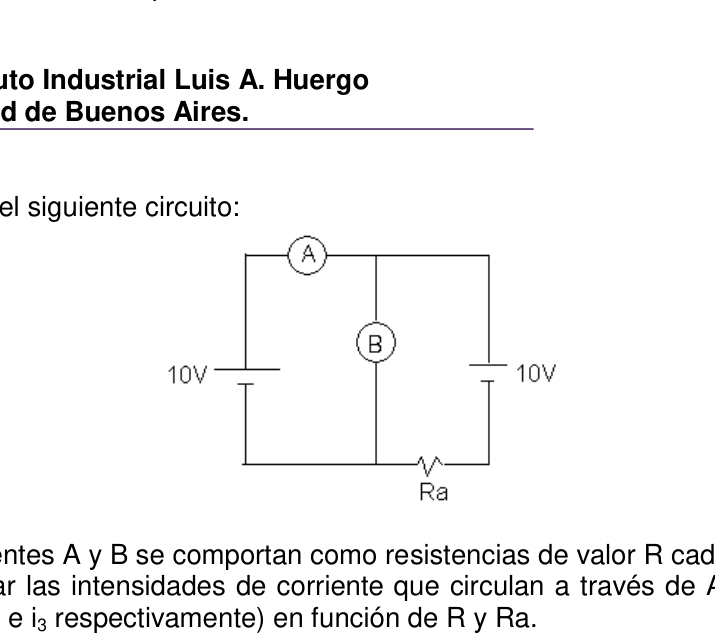
Topic: Circuits Metodi: Kirchhoff’s Laws, Equivalent Circuit Reduction Competenze: Physical Reasoning, Mathematical Modeling Objects: Resistor Fonte: Testo (PDF) — p.3
Circuito - intensità di corrente
PT77. Istituto industriale Luis A. - Hoorgo
Città di Buenos Aires.
Circuito Si dispone del circuito seguente:
I componenti A e B comportano come resistenze di valore R ognuno. a) Trovare le intensità di corrente che circolano attraverso A, B e Ra (i1, i2 e i3 rispettivamente) in funzione di R e Ra. Per il corretto funzionamento del dispositivo di cui il circuito è parte, è È necessario che l’intensità che passa per B sia triplo di quella che circola per A. b) Trovare Ra (in termini di R) per farlo accadere.
OAF 2013 - 94 Inoltre, si desidera che le intensità di corrente del circuito siano massime, La resistenza è una misurazione che si applica al livello di resistenza. Tuttavia, è noto che il circuito si brucia se la potenza totale si dissipa per la stessa è superiore ai 25W. c) Trovare il minimo valore R tollerato dal circuito.
Topic: Circuits Metodi: Kirchhoff’s Laws, Equivalent Circuit Reduction Competenze: Physical Reasoning, Mathematical Modeling Objects: Resistor Fonte: Testo (PDF) — p.3
The following shall be added to the list of the following:
PT77. The Spanish Ministry of Foreign Affairs I ‘m not .
City of Buenos Aires.
Circuit The following circuit is available:
Components A and B behave as resistors of R value each. (a) Find the current intensities circulating through A, B and Ra (i1, i2 and i3 respectively) according to R and Ra. For the proper functioning of the device of which the circuit is part, it is It is necessary that the intensity passing through B is triple that passing through A. (b) Find Ra (in terms of R) to make this happen.
The following is the list of the countries of the European Union: In addition, it is desirable that the current intensities of the circuit be maximum, The resistance values must be minimal. However, it is known that the circuit will burn if the total power dissipates by the same exceeds 25W. (c) Find the minimum R value that the circuit tolerates.
Topic: Circuits Metodi: Kirchhoff’s Laws, Equivalent Circuit Reduction Competenze: Physical Reasoning, Mathematical Modeling Objects: Resistor Fonte: Testo (PDF) — p.3
Ojo humano - lentes
PT78. Instituto Industrial Luis A. Huergo
Ciudad de Buenos Aires.
Ojo Humano
En forma aproximada, el ojo humano puede pensarse como una esfera que
contiene dos lentes en su
parte anterior.
La primer lente es cóncavo-
convexa
y
se
denomina
cornea.
La segunda es biconvexa y se
llama cristalino.
El cristalino tiene la propiedad
de poder variar su distancia
focal mediante el movimiento
de los músculos del ojo.
La distancia entre ambas
lentes es despreciable.
En la parte posterior del ojo se encuentra la retina, una superficie donde se
proyectan las imágenes generadas por las lentes.
Dependiendo de la distancia a la cual está el objeto observado por el ojo, el
cristalino ajusta su distancia focal de manera tal que los rayos provenientes de
dicho objeto se proyecten exactamente sobre la retina.
En un ojo sano, al estar lo músculos totalmente relajados, los rayos de luz
provenientes de un objeto lejano (o sea, desde el infinito) se proyectan
exactamente sobre la retina. Si, en cambio la imagen formada es anterior o
posterior, se dice que el individuo padece de miopía o hipermetropía
respectivamente.
Se midieron algunos parámetros del ojo de un sujeto.
Diámetro del ojo: 1,8 cm
Radios de curvatura de la cornea: 6,8mm (R1) y 7,5mm (R2)
Índice de refracción de la cornea: 1,5
Distancia focal del cristalino cuando el ojo se encuentra relajado: 10 cm.
a) Decidir si el individuo padece de algún trastorno visual e indicar cual.
Para solucionar esta disfuncionalidad, el médico le recomienda al sujeto el uso
de anteojos.
b) Hallar la distancia focal que deben poseer los lentes para que los rayos
procedentes de objetos lejanos se proyecten sobre la retina.
El material de fabricación disponible para los anteojos es vidrio “flint” que posee
un índice de refracción que depende de la longitud de onda (color) de los rayos
incidentes.
n (rojo) = 1,66
n (violeta) = 1,61
Asumiendo que el valor calculado en el ítem (b) corresponde al color rojo
c) Hallar la aberración cromática de la lente (esto es, la distancia entre las
imágenes formadas por rayos rojos y violetas)
OAF 2013 - 95
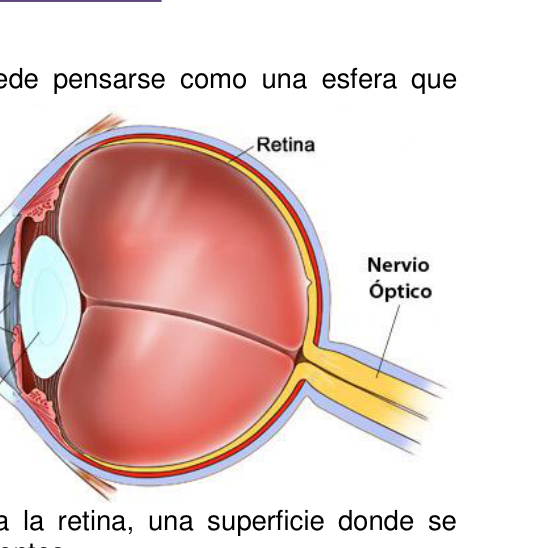
Topic: Geometric Optics Metodi: Thin Lens & Mirror Equation, Ray Tracing Competenze: Physical Reasoning, Mathematical Modeling Objects: Lens Fonte: Testo (PDF) — p.3
L’occhio umano - lenti
PT78. Istituto industriale Luis A. - Hoorgo
Città di Buenos Aires.
L’Occhio Umano In modo approssimativo, l’occhio umano può essere pensato come una sfera che contiene due lenti nel suo parte precedente. Il primo obiettivo è concave. convexa y se
- il nome cornea. La seconda è biconvexa e si chiama cristallino. Il cristallino ha la proprietà. di poter variare la distanza.
- Focalismo con movimento. dei muscoli dell’occhio. La distanza tra le due Lenti è dispregiato. Nella parte posteriore dell’occhio si trova la retina, una superficie dove si proiettano le immagini generate dai lenti. A seconda della distanza da cui si trova l’oggetto osservato, il Il cristalino regola la sua distanza focale in modo tale che i raggi provenienti da l’oggetto si proiettano esattamente sulla retina. In un occhio sano, essendo i muscoli completamente rilassati, i raggi di luce provenienti da un oggetto lontano (cioè dall’infinito) vengono proiettati esattamente sulla retina. Si, invece l’immagine formata è precedente o In seguito, si dice che l’individuo soffra di miopia o di lontananza. rispettivamente. Si sono misurati alcuni parametri dell’occhio di un soggetto. Diametro dell’occhio: 1,8 cm Radi di curvatura della cornea: 6,8 mm (R1) e 7,5 mm (R2) Indice di refraczione della cornea: 1,5 Distanza focale della cristalina quando l’occhio è rilassato: 10 cm. a) Decidere se l’individuo soffre di un disturbo visivo e indicare quale. Per risolvere questa disfunzionalità, il medico consiglia al soggetto di usare con gli occhiali. b) Determinare la distanza focale che devono avere i lenti per far raggiare i raggi. provenienti da oggetti lontani vengono proiettati sulla retina. Il materiale di fabbricazione disponibile per gli occhiali è il vetro flint che possiede un indice di refraczione che dipende dalla lunghezza d’onda (colore) dei raggi Incidenti. n (rosso) = 1,66 n (violetto) = 1,61 Supponendo che il valore calcolato nell’articolo (b) corrisponda al colore rosso c) Determina l’aberrazione cromatica della lente (cioè la distanza tra le immagini formate da raggi rossi e viola)
OAF 2013 - 95
Topic: Geometric Optics Metodi: Thin Lens & Mirror Equation, Ray Tracing Competenze: Physical Reasoning, Mathematical Modeling Objects: Lens Fonte: Testo (PDF) — p.3
The following table shows the results of the calculations:
PT78. The Spanish Ministry of Foreign Affairs I ‘m not .
City of Buenos Aires.
The Human Eye In a rough way, the human eye can be thought of as a sphere that It contains two lenses in its the previous part. The first lens is concave- convex y se The name of the company is cornea. The second is biconvex and is It’s called crystal. The lens has the property. I can vary their distance The focal point is the movement. The eye muscles. The distance between the two Lenses are despicable. The retina is located at the back of the eye, a surface where the retina is located. They project the images generated by the lenses. Depending on the distance from which the object is observed by the eye, the The lens adjusts its focal length in such a way that the rays coming from the The object is projected exactly over the retina. In a healthy eye, being the muscles totally relaxed, the rays of light coming from a distant object (i.e., from infinity) are projected Exactly over the retina. If, on the other hand, the image formed is previous or Later, the individual is said to be suffering from nearsightedness or farsightedness. the Commission. Some parameters of a subject’s eye were measured. The diameter of the eye: 1.8 cm Radius of curvature of the cornea: 6,8 mm (R1) and 7,5 mm (R2) Corneal refractive index: 1.5 Focal distance of the lens when the eye is relaxed: 10 cm. (a) Decide whether the individual has any visual impairment and indicate which. To correct this dysfunction, the doctor recommends the subject to use I’m wearing glasses. (b) Find the focal length of the lenses so that the rays are The retina is the surface of the retina. The manufacturing material available for the glasses is glass flint which it possesses a refractive index that depends on the wavelength (color) of the rays Incidents. N (red) = 1.66 The following table shows the following: Assuming that the calculated value in item (b) corresponds to the red colour (c) Find the chromatic aberration of the lens (i.e. the distance between the lens and the lens) images made up of red and purple rays)
The following is the list of the countries of the European Union:
Topic: Geometric Optics Metodi: Thin Lens & Mirror Equation, Ray Tracing Competenze: Physical Reasoning, Mathematical Modeling Objects: Lens Fonte: Testo (PDF) — p.3
Cazador y pajaro - tiro parabolico
PT79. Instituto de Enseñanza San Jorge
Colegio La Asunción
Colegio Santa Dorotea
Colegio Belén
Ciudad de Santiago del Estero.
Un pájaro vuela en línea recta a razón de 100 km/h. Un cazador, que posee un
cañón que dispara un proyectil que despliega una red, intenta atrapar al pájaro
disparándole mientras éste pasa sobre su posición a 50 m de altura. El cañón
dispara el proyectil con una rapidez inicial de 100 m/s y un ángulo de
lanzamiento de 75º.
El proyectil debe caer sobre el pájaro, para que la red se abra y lo atrape.
Suponiendo que el pájaro vuela en el plano de vuelo del proyectil.
a) Calcula en qué instante debe dispararse el cañón para que le red lo
atrape.
b) ¿A qué distancia del cazador caerá la red con el pájaro en caso de que
lo atrape
c) ¿A que distancia del cazador caerá la red en caso de no atraparlo?
Nota: se desprecia el roce con el aire. Considerar g = 10 m / s2
Topic: Newtonian Mechanics Metodi: Kinematic Equations, Vector Decomposition Competenze: Physical Reasoning, Mathematical Modeling Objects: Projectile Fonte: Testo (PDF) — p.3
Cacciatore e uccello - tiro parabolico
PT79. Istituto di istruzione San Jorge
La Asunción scuola
La scuola Santa Dorotea
La scuola di Belém
Città di Santiago del Estero.
Un uccello vola in linea retta a 100 km/h. Un cacciatore, che possiede un cannone che lancia un proiettile che lancia una rete, cerca di catturare l’uccello sparando a lui mentre lui passa sulla sua posizione ad un’altezza di 50 metri. Il cannone . Il proiettile lancia con una velocità iniziale di 100 m/s e un angolo di Lancio a 75°. Il proiettile deve cadere sul uccello, per aprire la rete e prenderlo. Supponiamo che il uccello vola nel piano di volo del proiettile. a) Calcola l’ istante in cui il cannone deve essere sparato per fargliela rete
- Prendila. b) A che distanza dal cacciatore la rete cade con l’uccello nel caso in cui Lo cattura. c) A che distanza dal cacciatore la rete cadrà se non viene catturata? Nota: si disprezza il fratturazione con l’aria. Considerare g = 10 m / s2
Topic: Newtonian Mechanics Metodi: Kinematic Equations, Vector Decomposition Competenze: Physical Reasoning, Mathematical Modeling Objects: Projectile Fonte: Testo (PDF) — p.3
Hunter and bird - parabolic shot
PT79. The San Jorge Institute of Education
School The Assumption
The College of St. Dorothy .
Bethlehem College
The city of Santiago del Estero.
A bird flies in a straight line at 100 km/h. A hunter, who owns a cannon firing a projectile that deploys a net, tries to catch the bird Shooting him as he passes over his position at 50 meters. The cannon . The projectile fires at an initial speed of 100 m/s and an angle of 75th launch. The projectile must fall on the bird, so that the net opens and catches it. Assuming the bird is flying in the plane of the projectile. (a) Calculate the time the cannon must be fired to make it network. It’s a trap. (b) How far from the hunter will the net fall with the bird if Catch him . (c) How far from the hunter will the net fall if it is not caught? Note: Air brushing is disregarded. Consider g = 10 m/s2
Topic: Newtonian Mechanics Metodi: Kinematic Equations, Vector Decomposition Competenze: Physical Reasoning, Mathematical Modeling Objects: Projectile Fonte: Testo (PDF) — p.3
Grua remolcando auto en pendiente
PT80. Instituto de Enseñanza San Jorge
Colegio La Asunción
Colegio Santa Dorotea
Colegio Belén
Ciudad de Santiago del Estero.
Una grúa de transito de masa m1 = 2000kg observa una auto en infracción, estacionado en doble mano sobre una calle de dirección única que tiene un desnivel con una pendiente de 30°. Su operario decide multar y remolcar el auto de masa m2 = 1000kg para llevarlo al playón de infractores. Una vez engancha- do este, procede a tirarlo con un cable de acero, ejerciendo una tensión T1, paralela al plano de la calle con ayuda de una polea (ver figura).
Luego de mover el automóvil la grúa acelera, gracias a que su motor ejerce una
fuerza de 25500 N. El coeficiente de rozamiento cinético entre el asfalto seco y
los neumáticos es µk= 0,7. En estas circunstancias:
a) Realiza el diagrama de cuerpo libre para la grúa y el automóvil.
b) Calcula la aceleración de la grúa.
c) Calcula la tensión del cable de acero.
Si la grúa avanzó durante 10 s en las mismas condiciones de la Figura 2,
d) ¿Cuál fue la potencia entregada por su motor?
Nota: Se desprecia el roce del cable en la polea y el peso del cable de acero.
Considerar g = 10 m/s²
OAF 2013 - 96
Topic: Newtonian Mechanics Metodi: Free-Body Diagram, Vector Decomposition Competenze: Physical Reasoning, Diagrammatic Reasoning Objects: Pulley, Inclined Plane, String Fonte: Testo (PDF) — p.3
Granella che trasporta auto in pendenza
PT80. Istituto di istruzione San Jorge
La Asunción scuola
La scuola Santa Dorotea
La scuola di Belém
Città di Santiago del Estero.
Un grilletto di massa di m1 = 2000 kg osserva una macchina in violazione, Parcato a mano doppia su una strada a direzione unica che ha un a livello di 30°. Il suo operatore decide di pagare e di rimorchiare la macchina. di massa m2 = 1000 kg per portarlo al lavaggio degli infrazioni. Una volta che si accende… il quale viene tirato con un cavo di acciaio, esercitando una tensione T1, parallelo al piano stradale con l’aiuto di una polea (vedere figura).
Dopo aver spostato l’auto, il grilletto accelera, grazie al suo motore che esercita un’accelerazione. forza di 25500 N. Il coefficiente di rottura cinetica tra l’asfalto secco e l’asfalto le gomme sono μk = 0,7. In queste circostanze: a) realizza il diagramma di corpo libero per il gru e l’auto. b) Calcola l’accelerazione del gru. c) Calcola la tensione del cavo in acciaio. Se il grilletto è andato avanti per 10 secondi nelle stesse condizioni di Figura 2, d) Qual è stata la potenza fornita dal suo motore? Nota: si disprezza il taglio del cavo nella polla e il peso del cavo in acciaio. Considerare g = 10 m/s2
OAF 2013 - 96
Topic: Newtonian Mechanics Metodi: Free-Body Diagram, Vector Decomposition Competenze: Physical Reasoning, Diagrammatic Reasoning Objects: Pulley, Inclined Plane, String Fonte: Testo (PDF) — p.3
Crew towing car on a slope
PT80. The San Jorge Institute of Education
School The Assumption
The College of St. Dorothy .
Bethlehem College
The city of Santiago del Estero.
A mass transit crane m1 = 2000kg observes a car in breach, Parked in double hand over a one-way street that has a level with a slope of 30°. Your operator decides to fine and tow the car. m2 = 1000kg to take to the offender pool. Once you get it… The test is carried out using a steel wire, with T1 stress. parallel to the street plane with the help of a pole (see figure).
After moving the car, the crane accelerates, thanks to its engine exercising a a force of 25500 N. The kinetic friction coefficient between dry asphalt and the tyres are μk=0.7. In these circumstances: (a) Draw the free-body diagram for the crane and the car. (b) Calculate the acceleration of the crane. (c) Calculate the voltage of the steel wire. If the crane went forward for 10 s in the same conditions as Figure 2, (d) What was the power delivered by your engine? Note: The brushing of the cable on the pole and the weight of the steel cable are neglected. Consider g = 10 m/s2
The following is the list of the Member States’ financial statements:
Topic: Newtonian Mechanics Metodi: Free-Body Diagram, Vector Decomposition Competenze: Physical Reasoning, Diagrammatic Reasoning Objects: Pulley, Inclined Plane, String Fonte: Testo (PDF) — p.3
Hielo y agua con calentador
PT81. Instituto de Enseñanza San Jorge
Colegio La Asunción
Colegio Santa Dorotea
Colegio Belén
Ciudad de Santiago del Estero.
En un recipiente aislado idealmente se agregan 250 g de hielo a 0°C y 600 g de
agua a 18°C. A partir de esta situación responda:
a) ¿Cuál es la temperatura final del sistema?
b) ¿Queda alguna cantidad de hielo sin fundirse?
Si luego de alcanzar la temperatura de equilibrio se quisiera llevar la mezcla a
una temperatura final de 10°C, empleando un calentador eléctrico de 1770 W,
c) ¿Cuánto tiempo debería conectarse el calentador?
Nota: En todo momento el recipiente no intercambia calor con el medio que lo
rodea. Se desprecia la masa del calentador eléctrico.
Ce H2O = 1 cal /g °C
Lf HIELO = 80 cal / g
Topic: Thermodynamics, Circuits Metodi: First Law of Thermodynamics, Conservation of Energy Competenze: Physical Reasoning Objects: Calorimeter, Resistor Fonte: Testo (PDF) — p.3
Ghiaccio e acqua con riscaldatore
PT81. Istituto di istruzione San Jorge
La Asunción scuola
La scuola Santa Dorotea
La scuola di Belém
Città di Santiago del Estero.
In un recipiente isolato si aggiungono idealmente 250 g di ghiaccio 0°C e 600 g di ghiaccio di ghiaccio. acqua a 18°C. Da questa situazione risponde: a) Qual è la temperatura finale del sistema? b) Rimane qualche quantità di ghiaccio non fonduto? Se dopo aver raggiunto la temperatura di equilibrio si vuole portare la miscela a una temperatura finale di 10°C, utilizzando un riscaldatore elettrico di 1770 W, c) Quanto tempo dovrebbe essere collegato il riscaldatore? Nota: In ogni momento il recipiente non scambia calore con il mezzo che lo
- In giro. Si disprezza la massa del riscaldatore elettrico. Ce H2O = 1 cal /g °C
Lf IGEL = 80 cal / g
Topic: Thermodynamics, Circuits Metodi: First Law of Thermodynamics, Conservation of Energy Competenze: Physical Reasoning Objects: Calorimeter, Resistor Fonte: Testo (PDF) — p.3
Ice and water with heater
PT81. The San Jorge Institute of Education
School The Assumption
The College of St. Dorothy .
Bethlehem College
The city of Santiago del Estero.
In an insulated container ideally 250 g of 0°C ice and 600 g of water at 18°C. From this situation, answer: (a) What is the final temperature of the system? (b) Is there any amount of ice left unmelted? If, after reaching the equilibrium temperature, you want to take the mixture to a final temperature of 10°C, using an electric heater of 1770 W, (c) How long should the heater be connected? Note: At all times the container does not exchange heat with the medium that it is used for. It’s all around. The mass of the electric heater is neglected. The following table shows the results of the calculations:
If ICE = 80 cal / g
Topic: Thermodynamics, Circuits Metodi: First Law of Thermodynamics, Conservation of Energy Competenze: Physical Reasoning Objects: Calorimeter, Resistor Fonte: Testo (PDF) — p.3
Motociclista salta rampa
PT82. Escuela Nacional Ernesto Sábato
Colegio Sagrada Familia
Tandil, Buenos Aires.
En una prueba de deporte extremo (al mejor estilo del programa de TV “5ta a Fondo”), un motociclista con una moto enduro salta al lecho de un río a través de una rampa ubicada en la costa. La rampa tiene una longitud de 30m, la parte más baja se encuentra prácticamente al mismo nivel del agua, mientras que el otro extremo tiene una altura de unos 9 m y justamente está ubicado en la barranca del río. El curso de agua tiene un ancho de aproximadamente unos 100 m y un caudal muy bajo por lo que se puede despreciar un arrastre por la corriente. El motociclista avanza llegando a la parte inferior de la rampa a una velocidad de 115 km/h momento en que se apaga el motor, recorre la rampa hasta que abandona la misma en la parte superior, hace unos movimientos acrobáticos y con muchos aplausos cae al agua. Teniendo en cuenta que el coeficiente de roce cinético entre los neumáticos de la moto y la rampa es de 0,3. Calcular: a) La velocidad con la que abandona la rampa. b) La altura máxima alcanzada por el motociclista. c) La distancia con respecto a la base de la rampa a la que cae. d) El valor de la velocidad con la que impacta en el agua. Pero no todo termina acá. No bien el arriesgado deportista cae al agua, todos los presentes se percatan que en la orilla opuesta y en la misma dirección del recorrido de la rampa hay un hambriento cocodrilo que entra al río en busca de su comida recién caída del cielo, avanzando con una velocidad de 1.2m/s. Al mismo tiempo, nuestro deportista comienza a nadar desesperado en sentido hacia la rampa. Considerando que con todo el equipo que lleva puesto es capaz de hacer 100m en 2 minutos en forma constante: e) ¿Cuánto tarda el motociclista en llegar a la orilla opuesta? f) ¿Qué tiempo le demora al cocodrilo llegar a la otra orilla? g) ¿Llegará a salvo a la orilla antes de ser la comida del reptil bajo la mirada de todo el público presente?
OAF 2013 - 97
Topic: Newtonian Mechanics, Conservation of Energy Metodi: Kinematic Equations, Energy Conservation Method Competenze: Physical Reasoning, Mathematical Modeling Objects: Inclined Plane, Projectile Fonte: Testo (PDF) — p.3
Motore che salta rampa
PT82. Scuola nazionale Ernesto sabato
Scuola Sagrada Familia
Tandil, Buenos Aires.
In una prova di sport estremo (al miglior stile del programma TV 5ta a 5ta a 5ta a 5ta a 5ta a 5ta a 5ta a 5ta a 5ta a 5ta a 5ta a 5ta a 5ta a 5ta a 5ta a 5ta a 5ta a 5ta a 5ta a 5ta a 5ta a 5ta a 5ta a 5ta a 5ta a 5ta a 5ta a 5ta a 5ta a 5ta a 5ta a Fondo), un motociclista con una moto induro salta sul letto di un fiume attraverso di un ramp situato sulla costa. La rampa ha una lunghezza di 30m, la parte La più bassa è praticamente al livello dell’acqua, mentre la più bassa è quasi al livello dell’acqua. L’altra estremità è alta circa 9 m e si trova proprio nella la vallata del fiume. Il corso d’acqua ha una larghezza di circa 100 e un flusso molto basso per cui si può disprezzare un arrastamento per la corrente. Il motociclista si sta muovendo fino alla parte inferiore della rampa a una velocità di 115 km/h al momento in cui si spegne il motore, percorri il rampo fino a che La lascia in alto, fa un movimento acrobatico e… con molti applausi cade in acqua. Considerando che il coefficiente di rottura cinetica tra i pneumatici di la moto e la rampa sono 0,3. Calcolare: a) La velocità con cui si lascia la rampa. b) L’altezza massima raggiunta dal motociclista. c) La distanza rispetto alla base del rampa a cui si trova. d) Il valore della velocità con cui colpisce l’acqua. Ma non tutto finisce qui. Non bene l’atleta rischioso cade in acqua, tutti I presenti si accorgono che sul margine opposto e nella stessa direzione del Il percorso del ramp è un coccodrillo affamato che entra nel fiume in cerca di Il suo cibo appena caduto dal cielo, si sta muovendo a una velocità di 1,2 metri al secondo. Al Allo stesso tempo, il nostro atleta inizia a nuotare disperatamente in senso. verso il ramp. Considerando che con tutto l’equipaggiamento che ha messo è capace di fare 100 metri in 2 minuti in modo costante: e) Quanto tempo ci vuole per raggiungere la riva opposta? f) Quanto tempo ci vuole per il coccodrillo di raggiungere l’altra riva? g) Arriverà a terra prima di essere cibo del rettile sotto la superficie. lo sguardo di tutto il pubblico presente?
OAF 2013 - 97
Topic: Newtonian Mechanics, Conservation of Energy Metodi: Kinematic Equations, Energy Conservation Method Competenze: Physical Reasoning, Mathematical Modeling Objects: Inclined Plane, Projectile Fonte: Testo (PDF) — p.3
Motorcyclist jumps ramp
PT82. Ernesto National School Saturday
Holy Family College .
I’m going to Tandil, Buenos Aires.
In an extreme sports test (the best style of the TV show 5ta to A motorcyclist with a hard bike jumps to the bed of a river across from a ramp on the coast. The ramp has a length of 30m, the part The lower part is at almost the same water level, while the lower part is at the same water level. The other end is about 9 m high and is located right on the River gorge. The watercourse is about 100 metres wide. m and a very low flow so you can disregard a drag by the current. The motorcyclist advances to the bottom of the ramp at a speed of 115 km/h when the engine is turned off, run the ramp until He leaves it at the top, makes some acrobatic moves and With a lot of applause, he falls into the water. Whereas the kinetic brake coefficient between the tyres of The bike and ramp is 0.3. Calculation: (a) The speed at which it leaves the ramp. (b) The maximum height reached by the motorcyclist. (c) The distance from the bottom of the ramp to which it falls. (d) The value of the speed at which it impacts water. But it doesn’t all end here. Not well the risky athlete falls into the water, all They are noticed that on the opposite shore and in the same direction of the There’s a hungry crocodile that’s coming into the river looking for it. His food just fell from the sky, moving forward at a speed of 1.2m/s. Al At the same time, our athlete begins to swim desperately in the direction to the ramp. Considering that with all the equipment he ‘s wearing , he ‘s capable . of doing 100m in 2 minutes in a constant fashion: (e) How long does it take the motorcyclist to reach the opposite shore? (f) How long does it take the crocodile to reach the other shore? (g) Will it reach shore safely before it is food for the reptile under the sea? The eyes of the whole audience?
The following is the list of the Member States’ financial statements:
Topic: Newtonian Mechanics, Conservation of Energy Metodi: Kinematic Equations, Energy Conservation Method Competenze: Physical Reasoning, Mathematical Modeling Objects: Inclined Plane, Projectile Fonte: Testo (PDF) — p.3
Carga de la Tierra - campo electrico
PT83. Escuela Nacional Ernesto Sábato
Colegio Sagrada Familia
Tandil, Buenos Aires.
La Tierra tiene una carga eléctrica neta que crea en los puntos cercanos a su superficie un campo igual a 150N/C y dirigido hacia su centro. a) ¿de qué magnitud y signo debería ser la carga neta del deportista del problema anterior (que tiene unos 70kg de masa) para compensar su peso con la fuerza que ejerce el campo eléctrico terrestre? b) ¿Cuál sería la fuerza de repulsión con el cocodrilo si este último estuviera cargado con la misma carga y a una distancia de 30 m?
Topic: Electrostatics Metodi: Coulomb’s Law, Electric Potential Method Competenze: Physical Reasoning Objects: Point Charge, Planet Fonte: Testo (PDF) — p.3
Carga della Terra - campo elettrico
PT83. Scuola nazionale Ernesto sabato
Scuola Sagrada Familia
Tandil, Buenos Aires.
La Terra ha una carica elettrica netta che crea nei punti vicini al suo la superficie di un campo pari a 150 N/C e rivolta al centro. a) di che magnitudo e segno dovrebbe essere il carico netto dello sportivo di Il problema precedente (che ha circa 70 kg di massa) per compensare il suo peso con la forza esercitata dal campo elettrico terrestre? b) Qual è la forza di respiro del coccodrillo se quest’ultimo se fosse caricato con lo stesso carico e a 30 metri di distanza?
Topic: Electrostatics Metodi: Coulomb’s Law, Electric Potential Method Competenze: Physical Reasoning Objects: Point Charge, Planet Fonte: Testo (PDF) — p.3
The Earth’s charge - electric field
PT83. Ernesto National School Saturday
Holy Family College .
I’m going to Tandil, Buenos Aires.
The Earth has a net electrical charge that creates in the points near its surface area of a field equal to 150 N/C and directed towards its centre. (a) what magnitude and sign should the net load be of the athlete in the The previous problem (which has about 70kg of mass) to compensate for its weight with the force exerted by the earth’s electric field? (b) What would be the repulsion force with the crocodile if the latter was loaded with the same load and at a distance of 30 meters?
Topic: Electrostatics Metodi: Coulomb’s Law, Electric Potential Method Competenze: Physical Reasoning Objects: Point Charge, Planet Fonte: Testo (PDF) — p.3
Conductividad termica de una casa
PT84. Escuela Nacional Ernesto Sábato
Colegio Sagrada Familia
Tandil, Buenos Aires.
La conductividad térmica de las paredes de una pequeña casa incluidas las ventanas es de 0,48 W/mºC con un espesor promedio de 21 cm. El techo tiene una conductividad de 0,31 W/mºC y un espesor promedio de 27 cm. Se requiere mantener una temperatura interior de 24 ºC cuando en el exterior la temperatura es de 5ºC. Despreciando las pérdidas de calor por radiación y a través del suelo y considerando que las dimensiones de la casa son de 6m de frente, 7 m de largo y 2,50 m de alto. a) ¿Qué potencia deberá tener un artefacto eléctrico a base de resistencias disipadoras de calor para mantener dicha temperatura? b) Considerando que estará conectado a una red domiciliaria (220 V), ¿cuál deberá ser el valor de la resistencia total de las resistencias disipadoras de calor? c) Considerando que la resistencia total se obtiene conectando n resistencias iguales en paralelo, ¿cual deberá ser el número n mínimo de resistencias para lograr la potencia requerida? d) ¿Cuál será la intensidad de corriente consumida por el artefacto eléctrico cuando se encuentra en funcionamiento?
Topic: Thermodynamics Metodi: First Law of Thermodynamics Competenze: Physical Reasoning, Mathematical Modeling Objects: — Fonte: Testo (PDF) — p.3
Conduttura termica di una casa
PT84. Scuola nazionale Ernesto sabato
Scuola Sagrada Familia
Tandil, Buenos Aires.
La conducibilità termica dei muri di una piccola casa incluse le le finestre sono di 0,48 W/moC con uno spessore medio di 21 cm. Il tetto ha… una conductività di 0,31 W/moC e uno spessore medio di 27 cm. È necessario. mantenere una temperatura interna di 24 oC quando all’esterno la temperatura es de 5ºC. Scommettere i perditi di calore da radiazioni e attraverso il suolo E considerando che le dimensioni della casa sono di 6m di fronte, 7m di lunghe e alte 2,5 metri. a) Qual è la potenza di un dispositivo elettrico a base di resistenze dissipative di calore per mantenere tale temperatura? b) considerando che sarà collegato a una rete domiciliare (220 V), Qual è il valore della resistenza totale delle resistenze?
- Scaldici? c) Considerando che la resistenza totale si ottiene collegando n resistenza pari in parallelo, quale deve essere il numero minimo n di resistenza per ottenere la potenza richiesta? d) Qual è l’intensità di corrente consumata dall’artefatto elettrico quando è in funzione?
Topic: Thermodynamics Metodi: First Law of Thermodynamics Competenze: Physical Reasoning, Mathematical Modeling Objects: — Fonte: Testo (PDF) — p.3
Heat conductivity of a house
PT84. Ernesto National School Saturday
Holy Family College .
I’m going to Tandil, Buenos Aires.
The thermal conductivity of the walls of a small house including the windows is 0,48 W/moC with an average thickness of 21 cm. The roof has a conductivity of 0,31 W/moC and an average thickness of 27 cm. It is required maintain an indoor temperature of 24 oC when outdoors the temperature es de 5ºC. Disregarding heat losses from radiation and through the soil . And considering the dimensions of the house are 6m in front, 7m in front. long and 2.50 m high. (a) What power shall an electrical device be powered on the basis of heat dissipation resistors to maintain that temperature? (b) Whereas it will be connected to a home network (220 V), What is the value of the total resistance of the resistors? heat exchangers? (c) Whereas total resistance is obtained by connecting n equal parallel resistance, which must be the minimum number n of resistance to achieve the required power? (d) What will be the current intensity consumed by the device electrical when it’s running?
Topic: Thermodynamics Metodi: First Law of Thermodynamics Competenze: Physical Reasoning, Mathematical Modeling Objects: — Fonte: Testo (PDF) — p.3
Skater - choque y energia
PT85. Colegio Nacional de Buenos Aires
Ciudad de Buenos Aires.
Lo que hay que saber para ser un buen “skater”
La figura 1 muestra una superficie sin roce. Se ve en ella a la izquierda un tramo
AB cuyo corte es un arco de circunferencia de radio R, en el medio un tramo
recto BC horizontal y a la derecha una otro arco de circunferencia (CD) también
de radio R.
Inicialmente se ubican dos pequeños cuerpos de masas m1 y m2 en reposo en
las posiciones indicadas en la figura. Luego se libera al cuerpo de masa m1,
desciende y enseguida choca con el cuerpo de masa m2. El choque está
caracterizado por un coeficiente de restitución e, y además se observa que el
cuerpo de masa m1 queda en reposo luego de la colisión. Calcule;
a) El valor del coeficiente e tomando como único dato n = m2/m1 = 7.
b) A qué altura en el tramo curvo de la derecha y respecto de la posición
más baja, la fuerza que ejerce la superficie sobre el cuerpo m2 es igual a
su peso
c) Ahora el cuerpo de masa m2 retorna a su punto de partida (después de
subir y bajar por el tramo curvo de la derecha CD) y choca con el otro,
OAF 2013 - 98 que había quedado en reposo en ese lugar. Este nuevo choque está caracterizado por el mismo coeficiente de restitución del choque anterior. Determine hasta qué ángulo máximo f ascenderá ahora el cuerpo de masa m1 sobre el arco de circunferencia AB tomando como datos el ángulo de partida del descenso inicial, 0 = 75º y el valor del cociente, n = m2/m1 = 7.
Tenga en cuenta que los valores de R y g no son conocidos. Es conveniente calcular cualquier resultado parcial que necesite con, al menos, cinco decimales. Como se ve en la figura, 0 y también f, se miden respecto de la dirección vertical.
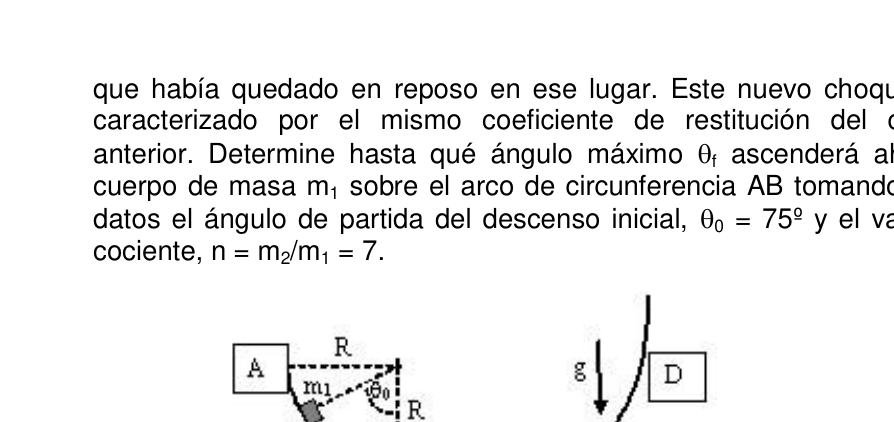
Topic: Conservation of Momentum, Conservation of Energy Metodi: Conservation of Momentum, Energy Conservation Method Competenze: Physical Reasoning, Mathematical Modeling Objects: Block Fonte: Testo (PDF) — p.3
Skater - colpo e energia
PT85. Collegio Nazionale di Buenos Aires
Città di Buenos Aires.
Cosa devi sapere per essere un buon pattinatore La figura 1 mostra una superficie senza rottura. Si vede in essa a sinistra un tratto AB il cui taglio è un arco di radius R di circonferenza, al centro un tratto BC retto orizzontale e a destra un altro arco di circonferenza (CD) anche radio R. Inizialmente si trovano due piccoli corpi di massa m1 e m2 a riposo in le posizioni indicate nella figura. Poi viene rilasciato al corpo di massa m1, scende e subito colpisce il corpo di massa m2. Il colpo è Il tasso di restituzione è pari a un tasso di restituzione e, inoltre, si osserva che il corpo di massa m1 rimane in riposo dopo la collisione. Calcola; a) Il valore del coefficiente e assumendo come singolo dato n = m2/m1 = 7. b) A che altezza nel tramo curvo a destra e rispetto alla posizione più basso, la forza che esercita la superficie sul corpo m2 è uguale a il suo peso c) Ora il corpo di massa m2 ritorna al suo punto di partenza (dopo (sopra e giù per la curva destra del CD) e colpisce l’altro,
OAF 2013 - 98 che era rimasto a riposo in quel luogo. Questo nuovo colpo è Caratterizzato dallo stesso coefficiente di restituzione dello shock precedente. Determina fino a che angolo massimo f salire ora il f corpo di massa m1 sull’arco di circonferenza AB prendendo come dati l’angolo di partenza dell’inizio di discesa, 0 = 75o e il valore di il coefficiente, n = m2/m1 = 7.
Si noti che i valori di R e g non sono noti. È conveniente. calcolare qualsiasi risultato parziale che sia necessario con almeno cinque decimali. Come si vede nella figura, 0 e anche f, sono misurati rispetto alla direzione Verticale.
Topic: Conservation of Momentum, Conservation of Energy Metodi: Conservation of Momentum, Energy Conservation Method Competenze: Physical Reasoning, Mathematical Modeling Objects: Block Fonte: Testo (PDF) — p.3
The following is the list of the following:
PT85. National College of Buenos Aires
City of Buenos Aires.
What you need to know to be a good skater Figure 1 shows a surface without rubbing. You can see it on the left a stretch AB whose cut is an arc of radius R, in the middle a section BC straight horizontal and to the right another arc of circumference (CD) also of radio R. Initially two small bodies of m1 and m2 mass are located at rest in the positions shown in the figure. Then it releases to the mass body m1, It descends and immediately collides with the m2 mass body. The shock is here . The Commission’s proposal for a regulation on the approximation of the laws of the Member States on the approximation of the laws of the Member States relating to the approximation of the laws of the Member States on the approximation of the laws of the Member States on the approximation of the laws of the Member States on the approximation of the laws of the Member States on the approximation of the laws of the Member States on the approximation of the laws of the Member States on the approximation of the laws of the Member States on the approximation of the laws of the Member States on the approximation of the laws of the Member States on the approximation of the laws of the Member States on the approximation of the laws of the laws of the Member States on the approximation of the laws of the mass body m1 rests after the collision. Calculate; (a) The value of the coefficient and taking as a single data n = m2/m1 = 7. (b) At what height on the curved right-hand side and relative to the position lower, the force exerted by the surface on the body m2 is equal to their weight (c) Now the m2 mass body returns to its starting point (after up and down the curved stretch of the right CD) and collides with the other,
The following points shall be added: that he had rested in that place. This new shock is characterised by the same impact return coefficient previously. Determine to what maximum angle f will now rise to f mass body m1 over the arc of circumference AB taking as The data shall be based on the starting angle of the initial descent, 0 = 75o and the value of The following is the list of the following:
Note that the values of R and g are unknown. It ‘s convenient . calculate any partial result you need with at least five decimals. As you can see in the figure, 0 and also f, are measured relative to the direction vertical.
Topic: Conservation of Momentum, Conservation of Energy Metodi: Conservation of Momentum, Energy Conservation Method Competenze: Physical Reasoning, Mathematical Modeling Objects: Block Fonte: Testo (PDF) — p.3
Termos caseros - calorimetria
PT86. Colegio Nacional de Buenos Aires
Ciudad de Buenos Aires.
Preparativos para el Día del Estudiante
Algunos alumnos del Colegio se están equipando para el pic-nic del día del
Estudiante y deciden fabricar sus propios termos y estudiar su funcionamiento.
Para ello emplean dos calorímetros idénticos cilíndricos con paredes aislantes y
altura h = 75 cm. Ambos se llenan hasta 1/3 de sus alturas. El primero con hielo,
formado al congelar agua directamente en el calorímetro, el segundo con agua a
Ta = 10°C.
El agua del segundo calorímetro se vierte en el primero y como resultado de ello
resulta lleno en 2/3 de su altura.
Luego de alcanzado el equilibrio resulta que el nivel ascendió en h = 0,5 cm.
a) Expresar la masa de hielo derretido o congelado, en función de la masa
original de hielo
b) ¿Qué cantidad de calor es capaz de ceder la masa inicial de agua del
calorímetro 2 para llegar a 0 °C sin congelarse?
c) Obtener una expresión para la cantidad de calor intercambiada por la
masa de hielo derretida o congelada
d) Hallar la temperatura inicial Th del hielo en el primer calorímetro.
Datos: La densidad del hielo es h = 0,9.agua, el calor específico de fusión del
hielo es = 340 kJ/kg, la capacidad calorífica específica del hielo es ch=2,1
kJ/(kg.K), la capacidad calorífica específica del agua es ca = 4,2 kJ/(kg.K).
Aclaración: No tener en cuenta el comportamiento anómalo del agua
Topic: Thermodynamics Metodi: First Law of Thermodynamics, Conservation of Energy Competenze: Physical Reasoning, Mathematical Modeling Objects: Calorimeter Fonte: Testo (PDF) — p.3
Termine domestiche - caloriametria
PT86. Collegio Nazionale di Buenos Aires
Città di Buenos Aires.
Preparazioni per lo Student Day Alcuni studenti del Collegio si stanno preparando per il picnic del giorno del Studenti e decidono di costruire i loro termosi e studiare il loro funzionamento. Per questo si impiegano due caloriometri cilindrici identici con pareti isolanti e altezza h = 75 cm. Entrambi si riempiono fino a 1/3 della loro altezza. Il primo con ghiaccio, formato congelaendo l’acqua direttamente sul calometro, il secondo con acqua a Ta = 10°C. L’acqua del secondo calometro viene versata nel primo e come risultato è pieno di due terzi della sua altezza. Dopo aver raggiunto l’equilibrio si scopre che il livello è salito a h = 0,5 cm. a) Esprimere la massa di ghiaccio fuso o congelato, a seconda della massa Originale di ghiaccio b) Quanti calori è capace di cedere la massa iniziale di acqua del Calorimetro 2 per raggiungere 0 °C senza congelare? (c) Ottenere un’espressione per la quantità di calore scambiata per la massa di ghiaccio meltato o congelato d) Trovare la temperatura iniziale Th del ghiaccio nel primo calometro. Dati: La densità del ghiaccio è h = 0,9.acqua, il calore specifico di fusione del il ghiaccio è = 340 kJ/kg, la capacità calorica specifica del ghiaccio è ch=2,1 kJ/(kg.K), la capacità calorifica specifica dell’acqua è ca = 4,2 kJ/(kg.K). Clarificazione: non tenere conto del comportamento anomalo dell’acqua
Topic: Thermodynamics Metodi: First Law of Thermodynamics, Conservation of Energy Competenze: Physical Reasoning, Mathematical Modeling Objects: Calorimeter Fonte: Testo (PDF) — p.3
The following table shows the results of the study:
PT86. National College of Buenos Aires
City of Buenos Aires.
Preparations for Student Day Some students at the school are getting ready for the day ‘s picnic . Student and they decide to make their own thermos and study how it works. For this purpose, two identical cylindrical heat meters with insulating walls are used. height h = 75 cm. Both fill up to 1/3 of their height. The first one with ice, formed by freezing water directly into the calorimeter, the second with water to Ta = 10°C. Water from the second calorimeter is poured into the first and as a result. It’s filled to 2/3 of its height. After the equilibrium is reached, the level rises to h = 0.5 cm. (a) Express the mass of melted or frozen ice, depending on the mass Original ice (b) What amount of heat is capable of yielding the initial water mass of the Calorimeter 2 to reach 0 °C without freezing? (c) Obtain an expression for the amount of heat exchanged by the melted or frozen ice mass (d) Find the initial temperature Th of the ice on the first calorimeter. Data: The density of ice is h = 0.9.water, the specific melting heat of the ice is h. ice is = 340 kJ/kg, the specific heat capacity of the ice is ch=2,1 The specific heat capacity of water is ca = 4,2 kJ/(kg.K. Clarification: Failure to take account of the abnormal behaviour of water
Topic: Thermodynamics Metodi: First Law of Thermodynamics, Conservation of Energy Competenze: Physical Reasoning, Mathematical Modeling Objects: Calorimeter Fonte: Testo (PDF) — p.3
Circuito - potencia en resistencias
PT87. Colegio Nacional de Buenos Aires
Ciudad de Buenos Aires.
Una profesión que requiere mucha potencia Usted es un ingeniero de diseño en una empresa de electrónica y se le ha pedido inspeccionar el circuito que se muestra en la figura 2.
OAF 2013 - 99
Las resistencias tienen una potencia de 0,5 W, lo que significa que se quema si
más de 0,5 W de potencia pasa a través de ellas.
a) ¿Cuál es la intensidad de corriente que circula en cada resistencia?
b) ¿Se quemará alguna de las resistencias del circuito? ¿Cuál?
c) ¿Cuál es la potencia total disipada en este circuito?
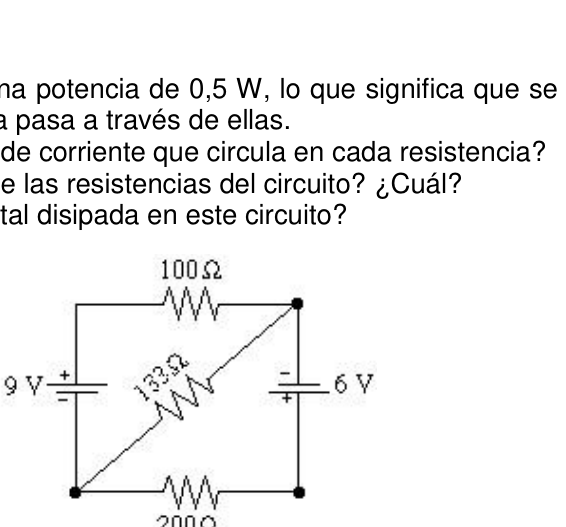
Topic: Circuits Metodi: Kirchhoff’s Laws, Equivalent Circuit Reduction Competenze: Physical Reasoning, Mathematical Modeling Objects: Resistor Fonte: Testo (PDF) — p.3
Circuito - potenza in resistenza
PT87. Collegio Nazionale di Buenos Aires
Città di Buenos Aires.
Una professione che richiede molta potenza Sei un ingegnere di progettazione in un’azienda di elettronica e hai richiesto di ispezionare il circuito mostrato in figura 2.
OAF 2013 - 99 Le resistenze hanno una potenza di 0,5 W, il che significa che si brucia se oltre 0,5 W di potenza passa attraverso di loro. a) Qual è l’intensità di corrente che circola in ogni resistenza? b) Bruceranno le resistenze del circuito? - Che cosa? c) Qual è la potenza totale dissipata in questo circuito?
Topic: Circuits Metodi: Kirchhoff’s Laws, Equivalent Circuit Reduction Competenze: Physical Reasoning, Mathematical Modeling Objects: Resistor Fonte: Testo (PDF) — p.3
The following shall be added to the list of the following:
PT87. National College of Buenos Aires
City of Buenos Aires.
A profession that requires a lot of power . You ‘re a design engineer at an electronics company and you ‘ve been given the circuit is inspected as shown in Figure 2.
The following points shall be added: The resistors have a power of 0.5 W, which means it burns if More than 0.5 W of power passes through them. (a) What is the current intensity circulating at each resistance? (b) Will any of the resistance in the circuit be burned? What’s the one? (c) What is the total dissolved power in this circuit?
Topic: Circuits Metodi: Kirchhoff’s Laws, Equivalent Circuit Reduction Competenze: Physical Reasoning, Mathematical Modeling Objects: Resistor Fonte: Testo (PDF) — p.3
Conflicto intergalactico (astrofisica)
PT88. Escuela de Educación Técnica Alberto Einstein - Escuela del Cerro
Instituto de Educación Integral - Colegio Madre María Sara Lona
Escuela de Educación Técnica República de la India
Colegio San Pablo - Escuela de Educación Técnica Capitán Lotufo
Colegio Estrada - Escuela de Educación Técnica Gra. Güemes
Colegio San Marcos - Colegio Santa Isabel de Hungría
Colegio Belgrano - Instituto Modelo
Colegio Belgrano 5095 - Colegio Arturo Illia
Ciudad de Salta.
Conflicto intergaláctico
El universo es generalmente definido como todo lo que existe físicamente: la
totalidad del espacio y el tiempo, de todas las formas de materia, la energía y el
impulso, y las leyes y constantes físicas que las gobiernan.
Observaciones astronómicas indican que el Universo tiene una edad edad entre
y mil millones de años y por lo menos mil millones de “años luz”
de extensión. El evento que dio inicio al universo se denomina Bing Bang. En
aquel instante toda la materia y la energía del universo estaban concentradas
en un punto de densidad infinita.
A gran escala, el universo está formado por la galaxia y agrupaciones de
galaxias. Las galaxias son agrupaciones de muchas estrellas, y son las
estructuras más grandes en las que se organiza el universo. A través del
telescopio se manifiestan como manchas luminosas de diferentes formas.
Tan sólo tres galaxias distintas a la nuestras son visibles a simple vista.
Tenemos la Galaxia Andrómeda, visible desde el Hemisferio Norte, la gran Nube
de Magallanes y la Pequeña Nube de Magallanes, en el Hemisferio Sur celeste.
Entre los planetas que hay en la Gran Nube de Magallanes, existen dos planetas
donde se halla vida similar a la del planeta Tierra, los llamados planetas Borto y
Sorda, cuyos habitantes padecían un gran conflicto de intolerancia e ira entre
ellos y periódicamente estaban en guerras que podían durar hasta 3 millones de
años.
La gobernante del planeta Sorda, llamada Emperatriz Nayarb en un nuevo
intento de conquistar al planeta Borto (bajo el dominio del Rey Leirbag), manda
una nave espacial para invadirlo.
Para defender su planeta el Rey Leirbag diseña un plan: utilizar un rayo LASER
mortal sobre la nave enemiga destruyendo así a todos sus tripulantes. El rayo
que pretenden utilizar es la última tecnología del planeta, un rayo denominado
G.O.F., que modifica la estructura molecular de cualquier material en estado
OAF 2013 - 100
sólido o líquido convirtiéndolo a un estado gaseoso. En otras palabras es un rayo
vaporizador.
El plan de ataque fue planeado de
manera que el rayo parta tangente-
mente a la superficie del planeta propa-
gándose por la atmosfera del planeta
hasta refractarse en su superficie para
luego dirigirse hacia la nave (ver
figura 1).
a) Sabiendo que el radio del Pla-
neta Borto es y que su
atmósfera tiene un ancho ,
determinar el ángulo de refrac-
ción mostrado en la Figura 1.
b) Determinar la distancia desde el centro del Planeta Borto hasta la nave.
Anticipando la medida que iba a implementar el Rey Leirbag, fieles
sirvientes de la Emperatriz Nayarb rociaron la atmosfera del Planeta
Borto con un spray para aumentar en un el índice de refracción de
la atmósfera.
c) ¿El rayo G.O.F. pasará por encima o por debajo de la nave?
d) ¿Qué distancia debería desplazarse verticalmente la nave para ser
destruida?
Ayuda: Puede resultar útil tener en cuenta la siguiente identidad trigonométrica:
Topic: Astrophysics, Gravitation Metodi: Newton’s Law of Gravitation, Kepler’s Laws Competenze: Physical Reasoning, Mathematical Modeling Objects: Star, Planet Fonte: Testo (PDF) — p.3
Il conflitto intergalattico (astrophysical)
PT88. Alberto Einstein School of Technical Education - Scuola del Cerro
Istituto di educazione integrale - Colegio Madre Maria Sara Lona
Scuola di istruzione tecnica Repubblica dell’India
Colegio San Paolo - Scuola di istruzione tecnica Capitano Lotufo
Colegio Estrada - Scuola di istruzione tecnica Gra. Gemmesi
Colegio San Marco - Colegio Santa Isabel d’Ungheria
Colegio Belgrano - Istituto Modello
Colegio Belgrano 5095 - Colegio Arturo Illia
Città di Salta.
Conflitto intergalattico L’universo è generalmente definito come tutto ciò che esiste fisicamente: la La totalità dello spazio e del tempo, di tutte le forme di materia, energia e l’impulso, e le leggi e le costanti fisiche che li governano. Le osservazioni astronomiche indicano che l’universo ha un’età di età compresa tra i e un miliardo di anni e almeno un miliardo di anni luce di estensione. L’evento che ha dato inizio all’universo si chiama Bing Bang. En In quel momento tutta la materia e l’energia dell’universo erano concentrate. in un punto di densità infinita. Su larga scala, l’universo è formato da galassie e raggruppamenti di Galaxie. Le galassie sono raggruppamenti di molte stelle, e sono le le strutture più grandi in cui si organizza l’universo. Attraverso il Il telescopio si manifesta come macchie luminose di diverse forme. Solo tre galassie diverse da noi sono visibili a simple vista. Abbiamo la Galassia Andromeda, visibile dall’emisfero nord, la grande Nuvola. di Magallanes e la Nuvola di Magallanes, nell’emisfero sud celeste. Tra i pianeti presenti nel Gran Nubo di Magallanes, ci sono due pianeti. dove si trova la vita simile a quella del pianeta Terra, i cosiddetti pianeti Borto e Sordo, i cui abitanti soffrivano di un grande conflitto di intolleranza e rabbia tra i due paesi. E periodicamente erano in guerre che potevano durare fino a 3 milioni di anni. anni. La governante del pianeta Sordo, chiamata Imperatrice Nayarb in un nuovo tentativo di conquistare il pianeta Borto (sotto il dominio del re Leirbag), manda Una nave spaziale per invaderlo. Per difendere il suo pianeta il Re Leirbag progetta un piano: usare un raggio laser. Mortale sulla nave nemico, distruggendo così tutti i suoi membri. Il fulmine che intendono usare è l’ultima tecnologia del pianeta, un raggio chiamato G.O.F., che modifica la struttura molecolare di qualsiasi materiale in stato
OAF 2013 - 100 solido o liquido, trasformandolo in uno stato gassoso. In altre parole , è un fulmine .
- vaporizzatore. Il piano di attacco è stato pianificato da Così il raggio si spalanca in tangente. La superficie del pianeta propa- Gettando per l’atmosfera del pianeta fino a che si rifracciano sulla sua superficie per Poi si dirigerà verso la nave (vedi Figura 1). a) Sapendo che il raggio del piano Netto Borto è e che il suo L’ atmosfera è larga , determinare l’angolo di refrazione Il numero di persone che hanno un’attività professionale è il numero di persone che hanno un’attività professionale professionale. b) Determinare la distanza dal centro del pianeta Borto alla nave. In anticipo alla misura che il re Leirbag avrebbe messo in atto, fedeli. I servitori dell’imperatrice Nayarb hanno spruzzato l’atmosfera del pianeta Sbarazzato con uno spray per aumentare il tasso di refraczione di un l’atmosfera. (c) Il raggio G.O.F. passerà sopra o sotto la nave? d) Che distanza deve spostare verticalmente la nave per essere distrutto? Aiuto: Potrebbe essere utile tenere conto della seguente identità trigonometrica:
Topic: Astrophysics, Gravitation Metodi: Newton’s Law of Gravitation, Kepler’s Laws Competenze: Physical Reasoning, Mathematical Modeling Objects: Star, Planet Fonte: Testo (PDF) — p.3
The first is the “Mother of the Universe”.
PT88. Albert Einstein Technical Education School - School of the Cerro
Institute of Integral Education - Mother Maria Sara Lona College
School of Technical Education Republic of India
St. Paul’s College - School of Technical Education Captain Lotufo
Road School - Technical Education School Gra. Gems
The school is located in the centre of the city.
Belgrano College - Model Institute
The first is the Belgrano College 5095 - Arturo Illia College.
Salt City.
Intergalactic conflict . The universe is generally defined as everything that exists physically: the The whole of space and time, of all forms of matter, energy and the impulse, and the physical laws and constants that govern them. Astronomical observations indicate that the universe has an age range between And a billion years and at least a billion light years. The Commission shall adopt implementing acts in accordance with Article 21 of this Regulation. The event that started the universe is called Bing Bang. En At that moment all the matter and energy in the universe were concentrated. In a point of infinite density. On a large scale, the universe is made up of galaxies and clusters of galaxies. galaxies. Galaxies are clusters of many stars, and they are the larger structures in which the universe is organized. Through the telescope manifest as light spots of different shapes. Only three galaxies other than ours are visible to the naked eye. We have the Andromeda Galaxy, visible from the Northern Hemisphere, the great cloud. of Magellanic and the Little Magellanic Cloud, in the celestial Southern Hemisphere. Between the planets in the Magellanic Cloud, there are two planets. where life is similar to that of planet Earth, the so-called Borto planets and Deaf, whose inhabitants suffered from a great conflict of intolerance and anger between They and periodically were in wars that could last up to 3 million years. years. The ruler of the deaf planet, called Empress Nayarb in a new attempting to conquer the planet Borto (under the rule of King Leirbag), commands A spacecraft to invade it. To defend his planet King Leirbag devises a plan: to use a laser beam. He was deadly on the enemy ship, destroying all of his crew. The lightning . They intend to use the latest technology on the planet, a beam called G.O.F., which modifies the molecular structure of any material in state
The following is the list of the countries of the European Union: solid or liquid, turning it into a gaseous state. In other words , it ‘s a lightning bolt . The vaporizer. The attack plan was planned from So the lightning is tangent. The planet’s surface is flat. Getting around the planet ‘s atmosphere . until it refracts to its surface for Then head towards the ship (see The following table shows the following: (a) Knowing that the radius of the Plan Borto’s granddaughter is and that’s her. The atmosphere is wide . determine the angle of refraction The number of samples is shown in Figure 1. (b) Determine the distance from the center of the Planet Borto to the spacecraft. Anticipating the measure King Leirbag was going to implement, faithful Empress Nayarb ‘s servants sprayed the atmosphere of the planet . I’m off with a spray to increase the refractive index by a. the atmosphere. (c) The G.O.F. beam will it pass above or below the ship? (d) What distance should the vessel travel vertically to be Destroyed? Help: It may be useful to consider the following trigonometric identity:
Topic: Astrophysics, Gravitation Metodi: Newton’s Law of Gravitation, Kepler’s Laws Competenze: Physical Reasoning, Mathematical Modeling Objects: Star, Planet Fonte: Testo (PDF) — p.3
Cubo flotando con resorte
PT89. Escuela de Educación Técnica Alberto Einstein - Escuela del Cerro
Instituto de Educación Integral - Colegio Madre María Sara Lona
Escuela de Educación Técnica República de la India
Colegio San Pablo - Escuela de Educación Técnica Capitán Lotufo
Colegio Estrada - Escuela de Educación Técnica Gra. Güemes
Colegio San Marcos - Colegio Santa Isabel de Hungría
Colegio Belgrano - Instituto Modelo
Colegio Belgrano 5095 - Colegio Arturo Illia
Ciudad de Salta.
Dispositivo aparatoso sólo para olimpiadas
En un balde rectangular, cuya base es un
cuadrado de lado , se vierte un líquido de
densidad hasta la altura . Luego se
sumerge dentro del líquido un cubo de lado
y densidad . Dicha cubo está unido a dos
resortes de longitud natural nula y constante
elástica . El primero de ellos tiene el otro
extremo fijado a la base del balde. El segundo
tiene el otro extremo fijo a un segundo cubo, de
lado y densidad , que flota en la superficie
del líquido. Bajo estas condiciones el sistema
está en equilibrio (ver Figura 2).
a) Al introducir, estos objetos dentro del recipiente el nivel del líquido
aumenta. Considerando despreciable el volumen de los resortes, si
denominamos a la longitud del primero y a la del segundo ¿cuánto
vale la suma ?.
OAF 2013 - 101 b) Realizar un diagrama de la situación dibujando todas las fuerzas que actúan sobre ambos cubos. Plantear las condiciones de equilibrio. c) Determinar las longitudes de los resortes y . Los resortes son conectados en serie a una batería de tensión como muestra la Figura 3. Cada resorte posee una resistencia y fueron conectados a la batería durante un intervalo de tiempo Δ . Todo el calor disipado en las resistencias es absorbido por el líquido del recipiente cuyo calor específico es y cuyo coeficiente de dilatación volumétrica es . d) Determinar el aumento de temperatura Δ del líquido. e) ¿Cuál es la nueva densidad del líquido? f) ¿Cuáles son los nuevos valores de las longitudes de los resortes?
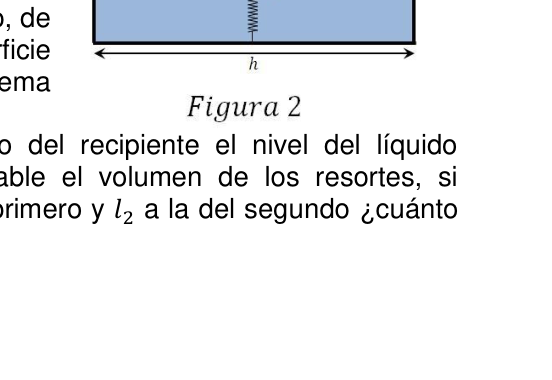
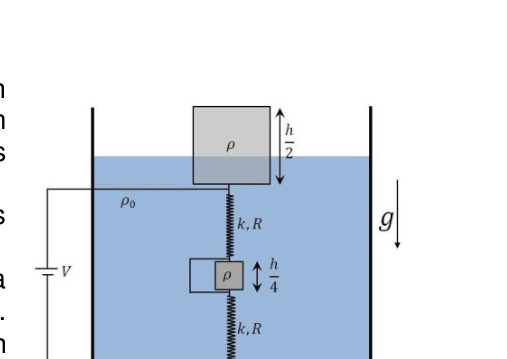
Topic: Fluid Mechanics Metodi: Hydrostatic Equilibrium, Hooke’s Law Competenze: Physical Reasoning, Diagrammatic Reasoning Objects: Spring, Block, Container Fonte: Testo (PDF) — p.3
Cubo galleggiante con resortimento
PT89. Alberto Einstein School of Technical Education - Scuola del Cerro
Istituto di educazione integrale - Colegio Madre Maria Sara Lona
Scuola di istruzione tecnica Repubblica dell’India
Colegio San Paolo - Scuola di istruzione tecnica Capitano Lotufo
Colegio Estrada - Scuola di istruzione tecnica Gra. Gemmesi
Il Centro di formazione di San Marco - Centro di formazione di Santa Isabel d’Ungheria
Colegio Belgrano - Istituto Modello
Colegio Belgrano 5095 - Colegio Arturo Illia
Città di Salta.
Dispositivo apparecchiato solo per le Olimpiadi In un vascello rettangolare, la cui base è un Quadrato a lato , si versano un liquido di densità fino all ’ altitudine . Poi si è immerge nel liquido un cubo laterale e densità . Questo cubo è unito a due. Fonte di lunghezza naturale zero e costante
- Elastico . Il primo di loro ha l’altro estremità fissata alla base del bidone. Il secondo . ha l’altra estremità fissa a un secondo cubo, di lato e densità , che galleggia sulla superficie del liquido. In queste condizioni il sistema La temperatura del sistema di calcolo è in equilibrio (vedi Figura 2). a) Quando si inseriscono gli oggetti all’interno del recipiente, il livello del liquido aumenta. Considerando disprezzabile il volume delle sorgenti, se La lunghezza della prima e quella della seconda è denominata vale la somma?
OAF 2013 - 101 b) realizzare un diagramma della situazione disegnando tutte le forze che agiscono su entrambi i cubi. - Sviluppare le condizioni di equilibrio. (c) Determinare le lunghezze dei
- E ’ un po ’ più grande . Le sorgenti sono collegate in serie a una la batteria di tensione come mostrato nella figura 3. Ogni primavera ha una resistenza e sono stati collegati alla batteria durante un intervallo di tempo Δ . Tutto il calore disperso nelle Le resistenze sono assorbe dal liquido del contenitore il cui specifico calore è e il cui coefficiente di dilatazione
- E ’ volumetrica . d) Determinare l’aumento della temperatura Δ del liquido. e) Qual è la nuova densità del liquido? f) Quali sono i nuovi valori delle lunghezze delle sorgenti?
Topic: Fluid Mechanics Metodi: Hydrostatic Equilibrium, Hooke’s Law Competenze: Physical Reasoning, Diagrammatic Reasoning Objects: Spring, Block, Container Fonte: Testo (PDF) — p.3
Floating cube with spring
PT89. Albert Einstein Technical Education School - School of the Cerro
Institute of Integral Education - Mother Maria Sara Lona College
School of Technical Education Republic of India
St. Paul’s College - School of Technical Education Captain Lotufo
Road School - Technical Education School Gra. Gems
The school is located in the centre of the city.
Belgrano College - Model Institute
The first is the Belgrano College 5095 - Arturo Illia College.
Salt City.
It ‘s an Olympic-only device . In a rectangular bucket, the base of which is a square side , pour a liquid of density to height . Then it ‘s gone . Soak a side cube into the liquid. and density . This cube is connected to two. Natural length springs of zero and constant length It ‘s elastic . The first one has the other . end fixed to the base of the bucket. The second one . has the other end fixed to a second cube, of side and density , floating on the surface of the liquid. Under these conditions the system The amount of the energy is in equilibrium (see Figure 2). (a) When entering the container, these objects shall measure the level of the liquid It’s going up. Considering the volume of springs despicable, if We call the length of the first and the length of the second how much Is it worth the sum?
The following points shall be added: (b) Draw a diagram of the situation Drawing all the forces that act . over both cubes. The Commission will take the necessary steps to implement the the conditions of equilibrium. (c) Determine the lengths of the springs and . The springs are serial connected to a voltage battery as shown in Figure 3. Each spring has a resistance and they were connected to the battery during an interval of time Δ . All the heat dissipated in the The resistance is absorbed by the liquid of the container with specific heat and dilation coefficient It ‘s volumetric . (d) Determine the increase in the temperature Δ of the liquid. (e) What is the new density of the liquid? (f) What are the new values for the lengths of springs?
Topic: Fluid Mechanics Metodi: Hydrostatic Equilibrium, Hooke’s Law Competenze: Physical Reasoning, Diagrammatic Reasoning Objects: Spring, Block, Container Fonte: Testo (PDF) — p.3
Descubrimiento del Dr. Periplokos
PT90. Escuela de Educación Técnica Alberto Einstein - Escuela del Cerro
Instituto de Educación Integral - Colegio Madre María Sara Lona
Escuela de Educación Técnica República de la India
Colegio San Pablo - Escuela de Educación Técnica Capitán Lotufo
Colegio Estrada - Escuela de Educación Técnica Gra. Güemes
Colegio San Marcos - Colegio Santa Isabel de Hungría
Colegio Belgrano - Instituto Modelo
Colegio Belgrano 5095 - Colegio Arturo Illia
Ciudad de Salta.
El insólito descubrimiento del Dr. Períplokos El Dr. Períplokos, arqueólogo de profesión, luego de un exhausto día de trabajo en una excavación en las afueras de Ankara, encontró un extraño armatoste. Habiendo desempolvado el aparato (había estado cavando con una cuchara sustraída del avión a causa del escaso “apoyo económico” para la investigación) se encontró con una segunda gran sorpresa: una figura humanoide emergía ante sus ojos. Después de una sopleteada rápida con una pajilla también “asaltada” de la aeronave, siguió desenterrando ese tesoro. Para estupor del Dr. Períplokos la figura se mostró en todo su esplendor, y el investigador no pudo menos que sonreír al hallarle un increíble parecido con un físico del 2000 A.C llamado Gofitas Daniellos Kordobasis. Para mayor desconcierto del científico la figura comenzó a hablar (y en su propio idioma) y con una voz de ultratiempo no dudó en plantearle el problema, aún no resuelto, referido al aparato con forma de palanca.
“En una habitación que se encuentra una temperatura se tiene una barra imponderable de longitud soportada por una cuña a una distancia de uno de sus extremos, sobre el cual reposa un bloque de tamaño despreciable de
OAF 2013 - 102 masa . En el otro extremo se encuentra una barra pequeña de longitud y masa . a) Realizar un diagrama de todas las fuerzas que actúan sobre cada cuerpo del sistema, indicando en cada caso los pares de acción y reacción. b) Encontrar la posición a la que se debe colocar la cuña para que el sistema se mantenga en equilibrio. Si la habitación aumenta su temperatura a un valor y la barra tiene un coeficiente de dilatación térmica : c) ¿Cuál deber ser el coeficiente de dilatación de la barra pequeña para que el sistema permanezca en equilibrio a dicha temperatura?” El Dr. Períplokos, respondió inmediatamente a los interrogantes del anciano. Refiriéndose a estos en un tono burlón. El personaje milenario, sorprendido, y mirándolo con un dejo de envidia, le respondió: “No crea usted que por responder unas burdas preguntas le concederé la victoria”; el científico replicó: “No estaba enterado que nuestra charla había desembocado en una contienda”, El anciano respondió: “Ahora lo es, pero debido a que usted presenta cualidades admirables, si me resuelve un último problema, le invito una copa”.
“Considere nuevamente el problema anterior, es decir, tenemos una barra
imponderable de longitud soportada por una cuña ubicada a la longitud de
uno de sus extremos en el cual reposa una bloque de tamaño despreciable y de
masa . En el otro extremo de la barra hay un recipiente cuya base es
cuadrada y de lado , que inicialmente contiene un volumen de un líquido de
densidad . De repente, un gotero ubicado por encima del recipiente comienza
a soltar gotitas de volumen con un período . ¿Qué parámetros del problema
cambiaría y como debe ser su dependencia en el tiempo para que el sistema
permanezca en equilibrio?”
Luego de su discusión, el doctor Períplokos le preguntó de dónde había sacado
un problema tan extraño; el anciano le respondió que lo había leído en un libro
ruso “Savchenko” que un viajante llamado Masi, le había entregado luego de una
partida de ajedrez.
El doctor percatándose que no estaba en condiciones de resolver el problema,
se vio obligado a rendirse ante el anciano e invitarlo él a beber una copa de
Ouzo.
Topic: Oscillations & Waves, Newtonian Mechanics Metodi: Simple Harmonic Motion Analysis Competenze: Physical Reasoning, Mathematical Modeling Objects: Pendulum Fonte: Testo (PDF) — p.3
La scoperta del dottor. Periplokos**
PT90. Alberto Einstein School of Technical Education - Scuola del Cerro
Istituto di educazione integrale - Colegio Madre Maria Sara Lona
Scuola di istruzione tecnica Repubblica dell’India
Colegio San Paolo - Scuola di istruzione tecnica Capitano Lotufo
Colegio Estrada - Scuola di istruzione tecnica Gra. Gemmesi
Colegio San Marco - Colegio Santa Isabel d’Ungheria
Colegio Belgrano - Istituto Modello
Colegio Belgrano 5095 - Colegio Arturo Illia
Città di Salta.
L’insolita scoperta del dottor. Periplocos El Dr. Periplokos, archeologo di professione, dopo una giornata di lavoro esausta in un’escavazione fuori Ankara, ha trovato un strano armatoste. Avendo dispolverato l’apparecchio (avevo scavato con una cucchiaio)
- il reato di un’aereo a causa della scarsa appoggio economico per la ricerca) E’ arrivato una seconda grande sorpresa: una figura umanoide emergeva davanti a lui. I suoi occhi. Dopo un rapido soffio con una pajina anche assalito dell’aeromobile, continuava a scavare quel tesoro. Per il grande piacere del dottor. Periplocos La figura si è mostrata in tutto il suo splendore, e il ricercatore non poteva meno che sorridendo trovandolo un’incredibile somiglianza con un fisico del 2000 a.C. chiamato Goffiti Daniello Kordobasis. Per il grande sconcertamento dello scienziato, la figura Ha iniziato a parlare (e nella sua lingua) e con una voce ultraterrestre non ha dubbi. La Commissione ha presentato un’azione di valutazione del problema, che non è ancora stata risolta, che si riferisce all’apparecchio in modo
- Levante.
In una stanza che ha una temperatura si ha una barra imponderabile di lunghezza sostenuta da un cucino a una distanza di uno delle sue estremità, su cui si trova un blocco di dimensioni dispregiate di
OAF 2013 - 102 massa . All’altra estremità si trova una piccola barra di lunghezza e massa . a) realizzare un diagramma di tutte le forze che agiscono su ciascuna Il sistema è stato sviluppato in modo da fornire informazioni su tutti i sistemi di controllo. reazione. b) Trovare la posizione in cui deve essere collocato il cucino per consentire alla il sistema è mantenuto in equilibrio. Se la stanza aumenta la temperatura a un valore e la barra ha un Coefficiente di dilatazione termico: (c) Qual è il coefficiente di dilatazione della piccola barra per che il sistema rimanga in equilibrio a tale temperatura? El Dr. Periplokos, rispose immediatamente alle domande dell’anziano. Riferendosi a questi in un tono burloso. Il personaggio millenario, sorpreso, e Guardandolo con un gesto di invidia, rispose: “Non credi che per rispondendo a domande grossolane, gli accorderò la vittoria. Non sapevo che il nostro discorso avesse portato a una lotta. L’anziano rispose: “Ora lo è, ma perché hai delle qualità Ammiraggibili, se risolve un ultimo problema, vi invito un drink.
Riconsiderate il problema precedente, cioè abbiamo una barra imponderabile di lunghezza supportato da una cucina situata a lunghezza di uno dei suoi estremi in cui si trova un blocco di dimensioni dispregiate e di massa . All’altra estremità della barra c’è un recipiente il cui fondamento è quadrato e laterale , che contiene inizialmente un volume di un liquido di densità . All’improvviso, una goccia posta sopra il recipiente inizia.
- a rilasciare gocce di volume con un periodo . Quali parametri del problema? cambierebbe e come deve essere la sua dipendenza nel tempo per il sistema Rimane in equilibrio? Dopo la discussione, il dottor Periplokos gli chiese da dove l’aveva preso. Un problema così strano; l’anziano gli rispose che l’aveva letto in un libro. russo Savchenko che un viaggiatore chiamato Masi, aveva consegnato dopo una gioco di scacchi. Il dottore, notando che non era in grado di risolvere il problema, Si è visto costretto a arrendersi davanti all’anziano e invitarlo a bere un bicchiere di
- Oh, è così.
Topic: Oscillations & Waves, Newtonian Mechanics Metodi: Simple Harmonic Motion Analysis Competenze: Physical Reasoning, Mathematical Modeling Objects: Pendulum Fonte: Testo (PDF) — p.3
The discovery of Dr. Other, including:
PT90. Albert Einstein Technical Education School - School of the Cerro
Institute of Integral Education - Mother Maria Sara Lona College
School of Technical Education Republic of India
St. Paul’s College - School of Technical Education Captain Lotufo
Road School - Technical Education School Gra. Gems
The school is located in the centre of the city.
Belgrano College - Model Institute
The first is the Belgrano College 5095 - Arturo Illia College.
Salt City.
The unusual discovery of Dr. Periplocos . El Dr. Periplokos, archaeologist by profession, after an exhausted day’s work In an excavation outside Ankara, he found a strange armatoste. Having dusted the apparatus (he had been digging with a spoon) (a) the aircraft was taken away from the aircraft because of the lack of economic support for the research) He came across a second big surprise: a humanoid figure emerging before him. His eyes. After a quick blow with a straw also assaulted From the aircraft, he kept digging up that treasure. To the surprise of Dr. Periplocos . The figure was shown in all its splendor, and the researcher could not but I smiled at him finding an incredible resemblance to a 2000 BC physicist named Goffits Daniels from Kordobasis. To the scientist ‘s greatest dismay , the figure He started to speak (and in his own language) and with an ultrathom voice he didn’t hesitate. The problem is not yet solved, referred to the apparatus in the form of
- The lever.
In a room that has a temperature you have a bar imponderable length supported by a wedge at a distance of one of its ends, upon which rests a block of despicable size of
The following is the list of the countries of the European Union: Mass . At the other end is a small length bar and Mass . (a) Draw a diagram of all the forces acting on each The system body, indicating in each case the action pairs and The reaction. (b) Find the position to which the wedge should be placed so that the The system is kept in balance. If the room increases its temperature to a value and the bar has a Coefficient of thermal dilation: (c) What should be the coefficient of dilation of the small bar for The system must be kept in equilibrium at that temperature. El Dr. Periplokos, she immediately answered the old man’s questions. Referring to these in a mocking tone. The millennial character, surprised, and Looking at him with envy, he replied, “Don’t you think that by answer some rude questions and I will grant you the victory. I wasn’t aware our conversation had led to a fight. The old man replied, “Now you are, but because you have qualities. Admirals, if you solve one last problem, I’ll buy you a drink.
Consider the previous problem again, i.e. we have a bar length imponderable supported by a wedge located at length of One of its ends on which rests a block of despicable size and of Mass . At the other end of the bar is a container whose base is square and side , which initially contains a volume of a liquid of density . Suddenly, a leak located above the container begins. to release volume droplets with a period . What parameters of the problem? It would change and how it should depend on time for the system to change. Stay in balance? After their discussion, Dr. Periplos asked him where he had gotten it. A strange problem; the old man replied that he had read it in a book. Russian Savchenko that a traveler named Masi, had delivered him after a chess game. The doctor realizing he was not in a position to solve the problem, He was forced to surrender to the old man and invite him to drink a glass of I heard.
Topic: Oscillations & Waves, Newtonian Mechanics Metodi: Simple Harmonic Motion Analysis Competenze: Physical Reasoning, Mathematical Modeling Objects: Pendulum Fonte: Testo (PDF) — p.3
Pelota contra pared - restitucion
PT91. Escuela Normal Superior Juan B. Alberdi
San Miguel de Tucumán.
Juan tira una pelota contra una pared vertical, alcanzándola en un punto situado 1 20 m por encima deí suelo, con una velocidad horizontal de 6 m/s. Después de
OAF 2013 - 103 rebotar en la pared, la pelota toca el suelo en un punto situado a 2,4 m delante de la pared (según muestra la figura) a) ¿Qué tipo de Choque se produjo’7 b) ¿Cua\ es el coeficiente de restitución? c) Si la pelota pesa 250 g ¿Que energía se perdió en el choque contra la pared? d) Luego choca contra el piso y se eleva verticalmente a que altura llega en el segundo rebote? e) ¿Se conserva la Energía cinética?
PARED VERTICAL
SUELO
Topic: Conservation of Momentum, Conservation of Energy Metodi: Conservation of Momentum, Kinematic Equations Competenze: Physical Reasoning Objects: Ball Fonte: Testo (PDF) — p.3
Pelleto contro parete - restituzione
PT91. Scuola Normale Superiore Juan B. Alberdi
San Michele di Tucumán.
Giovanni tira una palla contro un muro verticale, raggiungendola in un punto situato 1 20 metri sopra il suolo, con una velocità orizzontale di 6 m/s. Dopo
OAF 2013 - 103 rimbalzare sul muro, la palla tocca il pavimento in un punto situato a 2,4 m di fronte di un muro (come mostra la figura) a) Che tipo di scossa si è verificata’7 b) Qual è il coefficiente di restituzione? c) Se la palla pesa 250 g, che energia è stata persa colpendo la palla?
- Il muro? d) Colpisce il pavimento e si alza verticalmente fino alla sua altezza.
- Nel secondo rimbalzo? e) L’energia cinetica è conservata?
Muro Verticole
Sotto
Topic: Conservation of Momentum, Conservation of Energy Metodi: Conservation of Momentum, Kinematic Equations Competenze: Physical Reasoning Objects: Ball Fonte: Testo (PDF) — p.3
The amount of the loan shall be calculated as follows:
PT91. Secondary school Juan B. Alberdi .
St. Michael of Tucumán.
John throws a ball against a vertical wall, reaching it at a point located 1 20 m above the ground, with a horizontal speed of 6 m/s. After
The following is the list of the countries of the European Union: bounce against the wall, the ball hits the ground at a point located 2.4 m ahead of the wall (as shown in figure) (a) What kind of shock occurred? (b) What is the rate of refund? (c) If the ball weighs 250 g, what energy was lost in the impact against the ball? The wall? d) Then it hits the floor and rises vertically to the height it reaches on the second rebound? (e) Is kinetic energy conserved?
The vertical wall .
Floor
Topic: Conservation of Momentum, Conservation of Energy Metodi: Conservation of Momentum, Kinematic Equations Competenze: Physical Reasoning Objects: Ball Fonte: Testo (PDF) — p.3
Circuito con instrumentos y calorimetro
PT92. Escuela Normal Superior Juan B. Alberdi
San Miguel de Tucumán.
En el circuito de la figura, los amperímetros Al y A3 registran 6 A y 2 A respectivamente y el voltímetro V3 indica 30 V cuando la diferencia de potencial que proporciona la fuente Vesde110V a) Calcular considerando las lecturas de los instrumentos, et valor de RZ b) Considerando que en el calentamiento del liquido se invierte el 80% del calor emitido por la resistencia R2 del calorímetro ¿Cuánto vale el calor especifico del liquido si a los 10 minutos de fluir la corriente, el líquido se ha calentado 5° C ( masa del liquido 600 g)
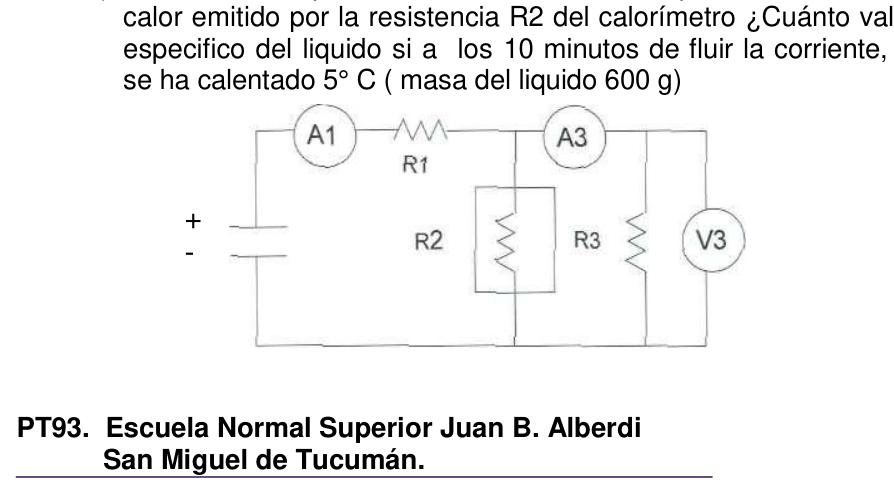
Topic: Circuits, Thermodynamics Metodi: Kirchhoff’s Laws, First Law of Thermodynamics Competenze: Physical Reasoning, Mathematical Modeling Objects: Resistor, Galvanometer, Calorimeter Fonte: Testo (PDF) — p.3
Circuito con strumenti e caloriometro
PT92. Scuola Normale Superiore Juan B. Alberdi
San Michele di Tucumán.
Nel circuito della figura, gli amperometri Al e A3 registrano 6 A e 2 A rispettivamente e il voltímetro V3 indica 30 V quando la differenza di potenziale che fornisce la fonte Vesde110V a) Calcolare tenuto conto delle letture degli strumenti, e valore di RZ b) considerando che il riscaldamento del liquido è investito nell’80% del Calore emesso dalla resistenza R2 del calometro specifico del liquido se dopo 10 minuti dal flusso, il liquido è stato riscaldato 5° C (massa del liquido 600 g)
Topic: Circuits, Thermodynamics Metodi: Kirchhoff’s Laws, First Law of Thermodynamics Competenze: Physical Reasoning, Mathematical Modeling Objects: Resistor, Galvanometer, Calorimeter Fonte: Testo (PDF) — p.3
Instrumental circuit and calorimeter
PT92. Secondary school Juan B. Alberdi .
St. Michael of Tucumán.
In the circuit of the figure, the amperes Al and A3 register 6 A and 2 A The V3 and V3 voltmeter indicate 30 V when the potential difference which provides the Vesde110V source (a) Calculate taking into account the readings of the instruments, and RZ value (b) Whereas 80% of the liquid is reversed in heating the heat emitted by the R2 resistance of the calorimeter The liquid is specific if, within 10 minutes of flow, the liquid is has been heated 5° C (liquid mass 600 g)
Topic: Circuits, Thermodynamics Metodi: Kirchhoff’s Laws, First Law of Thermodynamics Competenze: Physical Reasoning, Mathematical Modeling Objects: Resistor, Galvanometer, Calorimeter Fonte: Testo (PDF) — p.3
Dos alambres - campo magnetico
PT93. Escuela Normal Superior Juan B. Alberdi
San Miguel de Tucumán.
En la figura se muestran dos alambres conductores C, y C¿ de 2m de longitud cada uno, colocados perpendicularmente al plano de la hoja de papel. Por cada uno de ellos circulan comentes iguales de 2 A cada una. La comente que circula por C, entra al plano y la que circula por C¿ sale del plano de la figura. El punto P se encuentra en el punto medio entre los dos alambres que están separados entre si una distancia de 0,50 m y la permitividad magnética del niedio en el cual se encuentran los alambres es -4TT X1Q-7T tr/A a) Calcular el campo magnético resultante en el punto P +
OAF 2013 - 104 b) Indica que tipo de fuerzas magnéticas entre los conductores c) Calcular la fuerza magnética sobre el conductor C1
Topic: Magnetism, Electromagnetism Metodi: Ampère’s Law, Biot-Savart Law, Lorentz Force Analysis Competenze: Physical Reasoning, Diagrammatic Reasoning Objects: Wire Fonte: Testo (PDF) — p.3
Due fili - campo magnetico
PT93. Scuola Normale Superiore Juan B. Alberdi
San Michele di Tucumán.
La figura mostra due fili conduttori C e C, di 2 m di lunghezza. le parti sono collocate perpendicolare al piano della foglia. Per ogni uno di loro fa circolare commenti uguali di 2 A a ciascuna. Il commento che circola Per C, entra nel piano e per C, la circolazione esce dal piano della figura. Il punto P si trova nel punto medio tra i due fili che sono separati tra se una distanza di 0,50 m e la permisibilità magnetica del nizio in cui si Trovare i fili è -4TT X1Q-7T tr/A a) Calcolare il campo magnetico risultante al punto P +
OAF 2013 - 104 b) Indica il tipo di forza magnetica tra i conducenti c) Calcolare la forza magnetica sul conducente C1
Topic: Magnetism, Electromagnetism Metodi: Ampère’s Law, Biot-Savart Law, Lorentz Force Analysis Competenze: Physical Reasoning, Diagrammatic Reasoning Objects: Wire Fonte: Testo (PDF) — p.3
Two wires - magnetic field
PT93. Secondary school Juan B. Alberdi .
St. Michael of Tucumán.
The figure shows two conductive wires C, and C’ of 2 m length. Each of these is placed perpendicular to the plane of the sheet of paper. For each One of them circulates the same two-A comments each. The commentary circulating . For C, it enters the plane and for C, it goes out of the plane of the figure. The point P It is located in the middle between the two wires which are separated between If a distance of 0.50 m and the magnetic permittivity of the nivea in which it is Find the wires is -4TT X1Q-7T tr/A (a) Calculate the resulting magnetic field at point P +
The following is the list of the Member States’ financial statements: (b) Indicates the type of magnetic forces between the conductors (c) Calculate the magnetic force on the C1 conductor
Topic: Magnetism, Electromagnetism Metodi: Ampère’s Law, Biot-Savart Law, Lorentz Force Analysis Competenze: Physical Reasoning, Diagrammatic Reasoning Objects: Wire Fonte: Testo (PDF) — p.3
Selector de velocidades (haz electrones)
PT94. Escuela de Agricultura
General Alvear, Mendoza.
Un haz de electrones se mueve bajo la influencia de un campo eléctrico de 1,56·104 V/m y de un campo magnético de 4,62·10-3 T, ambos campos son normales entre sí y también al haz, de modo que no producen desviación sobre los electrones. En estas condiciones, a) ¿cuál es la rapidez del haz de electrones?
b) Dibuje en un diagrama la orientación relativa para esta situación particular de los vectores: velocidad campo eléctrico y campo magnético .
c) Dibuje el correspondiente diagrama de cuerpo libre indicando claramente las fuerzas aplicadas sobre un electrón del haz y su vector velocidad.
d) Si se eliminara el campo eléctrico, ¿Cuál sería el radio de la órbita del
electrón?
e) ¿Cuál sería el período del electrón?
Topic: Electromagnetism, Magnetism Metodi: Lorentz Force Analysis, Free-Body Diagram Competenze: Physical Reasoning, Diagrammatic Reasoning Objects: Particle Beam, Electron Fonte: Testo (PDF) — p.3
**Selettore di velocità (fa elettroni) **
PT94. La scuola di agricoltura
Generale Alvear, Mendoza.
Un raggio di elettroni si muove sotto l’influenza di un campo elettrico di 1,56·104 V/m e di un campo magnetico di 4,62·10-3 T, entrambi i campi sono Le due parti sono normali tra loro e anche al fascio, in modo da non produrre deviazioni su gli elettroni. In queste condizioni, a) qual è la velocità del fascio di elettroni?
b) Disegna su un diagramma la relativa orientamento per questa situazione Vettore particolare: velocità campo elettrico e campo Magnetico .
(c) Disegna il corrispondente diagramma di corpo libero indicando chiaramente le forze applicate su un elettrone del fascio e il suo vettore velocità.
d) Se si eliminasse il campo elettrico, quale sarebbe il raggio di orbita del
- Un elettrone? e) Qual sarebbe il periodo dell’elettrone?
Topic: Electromagnetism, Magnetism Metodi: Lorentz Force Analysis, Free-Body Diagram Competenze: Physical Reasoning, Diagrammatic Reasoning Objects: Particle Beam, Electron Fonte: Testo (PDF) — p.3
The following information shall be provided:
PT94. School of Agriculture
General Alvear, Mendoza, please.
An electron beam moves under the influence of an electric field of The magnetic field of the magnetic field is 1.56 V/m and the magnetic field of 4.62 T. The two components are normally in the same way as the other components, so that they do not deviate from each other. the electrons. Under these conditions, (a) What is the speed of the electron beam?
(b) Draw a diagram of the relative orientation for this situation particular vector: speed electric field and field Magnetic .
(c) Draw the corresponding free-body diagram indicating The force applied on an electron of the beam and its vector is clearly speed.
(d) If the electric field were removed, what would be the radius of the orbit of the Earth? What is the electron? (e) What would be the period of the electron?
Topic: Electromagnetism, Magnetism Metodi: Lorentz Force Analysis, Free-Body Diagram Competenze: Physical Reasoning, Diagrammatic Reasoning Objects: Particle Beam, Electron Fonte: Testo (PDF) — p.3
Carrito en via con loop (energia)
PT95. Escuela de Agricultura
General Alvear, Mendoza.
Un carrito de un juego de un parque de diversiones rueda sin fricción por la vía
(como lo muestra la figura), partiendo del reposo en A, a una altura h del piso.
a) ¿Qué valor mínimo debe tener h
(en términos de R) para que el
carrito se desplace sin caer en
la parte superior (el punto B)?
b) Si h =3.50 m y R = 20 m, calcule
la rapidez, aceleración radial y
aceleración tangencial de los
pasajeros cuando el carrito está
en el punto C,
c) Haga un diagrama a escala aproximada de las componentes de la
aceleración.
C1
P
OAF 2013 - 105
Topic: Conservation of Energy, Newtonian Mechanics Metodi: Energy Conservation Method, Free-Body Diagram Competenze: Physical Reasoning, Diagrammatic Reasoning Objects: Cart Fonte: Testo (PDF) — p.3
**Carico in rotta con loop (energia) **
PT95. La scuola di agricoltura
Generale Alvear, Mendoza.
Un carro da un parco divertimenti si sposta senza attrito sulla strada. (come mostra la figura), partendo dal riposo in A, ad un’altezza h del pavimento. a) Qual è il valore minimo che deve avere h (in termini di R) per che il Carro si sposta senza cadere in la parte superiore (punto B)? b) Se h = 3,50 m e R = 20 m, calcolare velocità, accelerazione radial e Accelerazione tangenziale dei Passeggeri quando il carrello è al punto C, (c) Sviluppa un diagramma a scala approssimativa dei componenti della Accelerazione. C1 P
OAF 2013 - 105
Topic: Conservation of Energy, Newtonian Mechanics Metodi: Energy Conservation Method, Free-Body Diagram Competenze: Physical Reasoning, Diagrammatic Reasoning Objects: Cart Fonte: Testo (PDF) — p.3
**Way wagon with loop (energy) **
PT95. School of Agriculture
General Alvear, Mendoza, please.
A game carriage from an amusement park wheels frictionlessly along the track. (as shown in the figure), starting from the rest in A, at a height of h from the floor. (a) What minimum value must h have? (in terms of R) so that the Carriage moves without falling in. the top (point B)? (b) If h = 3.50 m and R = 20 m, calculate speed, radial acceleration and tangential acceleration of the Passengers when the cart is ready. in point C, (c) Draw a roughly scale diagram of the components of the The acceleration. C1 P
The following is the list of the countries of the European Union:
Topic: Conservation of Energy, Newtonian Mechanics Metodi: Energy Conservation Method, Free-Body Diagram Competenze: Physical Reasoning, Diagrammatic Reasoning Objects: Cart Fonte: Testo (PDF) — p.3
Cubo de cobre - dilatacion y termodinamica
PT96. Escuela de Agricultura
General Alvear, Mendoza.
Un cubo de cobre de 2.00 cm de lado está sujeto de un cordón. El cubo se
calienta con un mechero de 20 °C a 90 °C. El aire que rodea al cubo está a
presión atmosférica (1.01 x 10⁵ Pa).
a) El aumento de volumen del cubo.
b) El trabajo mecánico efectuado por el cubo para expandirse contra la pre-
sión del aire circundante.
c) La cantidad de calor agregada al cubo.
d) El cambio de energía interna del cubo.
e) Con base en sus resultados, explique si hay una diferencia sustancial
entre los calores específicos Cp.(a presión constante) y Cv(a volumen
constante) del cobre en estas condiciones.
Topic: Thermodynamics, Elasticity & Materials Metodi: First Law of Thermodynamics, Stress-Strain Analysis Competenze: Physical Reasoning Objects: Cylinder Fonte: Testo (PDF) — p.3
Cubbia di rame - dilatazione e termodinamica
PT96. La scuola di agricoltura
Generale Alvear, Mendoza.
Un cubo di rame di 2 cm laterale è soggetto a un cordone. Il cubo si è il calore con un lampo da 20 °C a 90 °C. L’aria che circonda il cubo è a pressione atmosferica (1,01 x 10⁵ Pa). a) L’aumento del volume del cubo. b) Il lavoro meccanico svolto dal cubo per espandere contro la pre- la sione dell’aria circostante. c) La quantità di calore aggiunta al cubo. d) Scaldazione dell’energia interna del cubo. e) Sulla base dei risultati, spiegare se vi sia una differenza sostanziale tra i calori specifici Cp.(a pressione costante) e Cv(a volume La produzione di copro è costante in queste condizioni.
Topic: Thermodynamics, Elasticity & Materials Metodi: First Law of Thermodynamics, Stress-Strain Analysis Competenze: Physical Reasoning Objects: Cylinder Fonte: Testo (PDF) — p.3
Copper cube - dilation and thermodynamics
PT96. School of Agriculture
General Alvear, Mendoza, please.
A two-centimeter copper cube on the side is subject to a cord. The cube is Heat with a spray of 20 °C to 90 °C. The air around the cube is at atmospheric pressure (1.01 x 10⁵ Pa). (a) Increased volume of the cube. (b) The mechanical work carried out by the cube to expand against the pre- the surrounding air. (c) The amount of heat added to the cube. (d) The change in internal energy of the cube. (e) On the basis of your results, explain whether there is a substantial difference between the specific heat Cp.(at constant pressure) and Cv(at volume The same is true for copper under these conditions.
Topic: Thermodynamics, Elasticity & Materials Metodi: First Law of Thermodynamics, Stress-Strain Analysis Competenze: Physical Reasoning Objects: Cylinder Fonte: Testo (PDF) — p.3
Oscilaciones en la Luna (resorte)
PT97. Escuela Técnica Philips
Ciudad de Buenos Aires.
Oscilaciones en la Luna
Es el año 2050. Los seres humanos han establecido colonias en la Luna y en
ella viven familias en grandes domos
presurizados.
Los
adultos
desarrollan
actividades netamente científicas y existen
escuelas para los más pequeños.
El ambiente es diferente al de la Tierra, pero
las leyes de la física son las mismas y en una
clase, usted, que es profesor en una escuela
secundaria, le enseña a sus alumnos los
principios de las oscilaciones mecánicas.
Para tal fin, tiene armado un dispositivo como
el que se observa en la figura 1. Consiste en
un resorte de masa , constante elástica y
longitud natural , suspendido verticalmente
y en cuyo extremo libre se sujeta una nave
de juguete que tiene forma esférica y masa
. Las alas de la nave son móviles y pueden introducirse dentro del
fuselaje esférico.
En un primer experimento usted y los alumnos se encuentran fuera del domo,
con sus trajes de astronauta puestos y “rodeados” por el “vacío” que se
encuentra sobre el suelo lunar. La nave tiene las alas guardadas y cuando se
sujeta del resorte, éste se desplaza hacia abajo una distancia tal que el sistema
resorte-nave se equilibra cuando la longitud total del resorte es .
Si con el mismo sistema el experimento se llevara a cabo en la Tierra, explica
usted, el resorte se estiraría hasta alcanzar una longitud . Si las
aceleraciones gravitatorias de la Tierra y de la Luna se expresan de la
forma ,
a) Pruebe que
En un segundo experimento, usted desplaza la nave hacia abajo una pequeña
distancia y con el sistema en reposo, suelta la nave y ésta comienza a oscilar
verticalmente con un período
OAF 2013 - 106
b) Explique conceptualmente por qué el período de oscilación es
independiente de la aceleración gravitatoria
La figura 2 muestra la velocidad de la nave en función del tiempo para este
experimento. Si la masa de la nave es .
c) Determine el valor de la constante elástica
Si en este segundo experimento no entran en juego fenómenos disipativos
apreciables en el resorte, utilice consideraciones energéticas y:
d) Determine la máxima elongación del resorte respecto de su
posición de equilibrio
Usted le comenta a sus alumnos que, alcanzada cierta longitud crítica , el
resorte pasa a la fase plástica, es decir, pierde sus propiedades elásticas y
“queda estirado” sin recobrar su longitud natural. Si el sistema se pusiera en
rotación, habría una máxima rapidez angular Ω alcanzable antes de que el
resorte pasara a la fase plástica.
e) Pruebe que
Ω
En ausencia de cualquier tipo de fricción, le explica usted a sus alumnos, la
energía total del sistema permanece invariante. Pero si el sistema presenta
fricción con, por ejemplo un medio gaseoso, el sistema irá disipando
gradualmente su energía acumulada hasta que alcance el equilibrio estático.
Para demostrar esto usted lleva a sus alumnos dentro del domo y repite el primer
experimento pero esta vez en un ambiente con aire presurizado a . Para
obtener un efecto más notorio usted despliega las alas de la nave de modo que
entren en juego de forma evidente las fuerzas viscosas. Así, con este tercer
experimento usted le muestra claramente a sus alumnos que el movimiento del
sistema es amortiguado.
La fuerza viscosa que se opone al movimiento de la nave en todo momento se
puede escribir como:
Donde es la velocidad instantánea de la nave y es una constante que depende básicamente del medio y de la forma y tamaño de la nave.
OAF 2013 - 107
La figura 3 muestra la posición de la nave en función del tiempo tal y como se
registró en este último experimento.
Si la amplitud (máxima) instantánea de las oscilaciones responde a la expresión:
f) Determine el valor del coeficiente para este experimento.
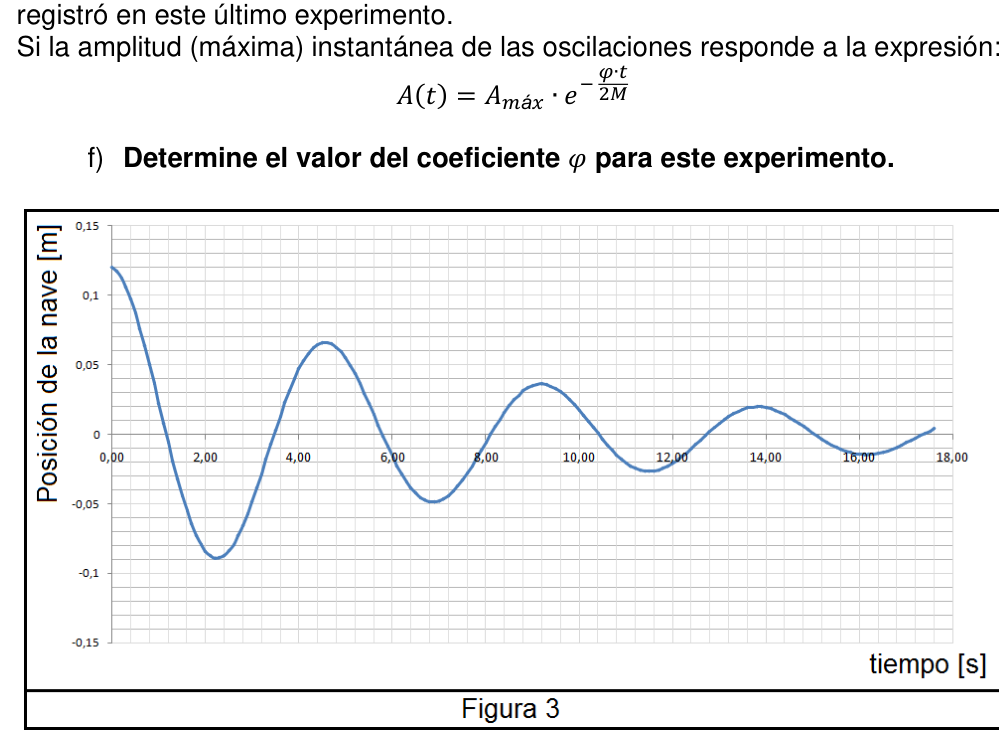
Topic: Oscillations & Waves Metodi: Simple Harmonic Motion Analysis, Hooke’s Law Competenze: Physical Reasoning, Mathematical Modeling Objects: Spring Fonte: Testo (PDF) — p.3
**Oscillazioni sulla Luna (risorsa) **
PT97. Philips Technical School
Città di Buenos Aires.
Oscillazioni sulla Luna E’ l’anno 2050. Gli esseri umani hanno stabilito colonie sulla Luna e in Lei vive in famiglie in case più grandi. presurizzato. I Adulti sviluppare Le attività sono puramente scientifiche e esistono scuole per i bambini. L’ambiente è diverso da quello della Terra, ma… Le leggi della fisica sono le stesse e in una classe, tu, che è un insegnante in una scuola La scuola media, insegna ai suoi alunni i I principi delle oscillazioni meccaniche. Per questo, ha un dispositivo come il che si osserva nella figura 1. Consiste in una sorgente di massa , costante e elastica lunghezza naturale , sospesa verticalmente e alla sua estremità libera si tiene una nave. di un giocattolo che ha forma sferica e massa. . Le ali della nave sono mobili e possono essere inserite all’interno della nave. fusoliera sferica. In un primo esperimento, tu e i tuoi studenti siete fuori dal domo. con i suoi costumi di astronauta messi e circondati dal vuoto che si trovava si trova sul suolo lunare. La nave ha le ali salvate e quando si Sotto la presa della sorgente, questa si sposta verso il basso una distanza tale che il sistema la primavera-nave si bilancia quando la lunghezza totale della primavera è . Se con lo stesso sistema si svolgesse l’esperimento sulla Terra, spiega. Tu, la primavera si estenderebbe fino a raggiungere una lunghezza. Se le Le accelerazioni gravitazionali della Terra e della Luna si espresso dalla forma , a) Provare che In un secondo esperimento, si sposta la nave verso il basso un piccolo La distanza e con il sistema a riposo, si lascia andare la nave e essa inizia a oscillare. Verticalmente con un periodo
OAF 2013 - 106 b) Esprimi concettualmente perché il periodo di oscillazione è indipendentemente dall’accelerazione gravitazionale La figura 2 mostra la velocità della nave in funzione del tempo per questo l’esperimento. Se la massa della nave lo è . c) Determina il valore della costante elastica Se in questo secondo esperimento non entrano in gioco fenomeni dissipatori
- la capacità di riprodurre i prodotti di cui all’articolo 1, paragrafo 1, della direttiva, (d) Determina il massimo allungamento della primavera rispetto al suo posizione di equilibrio
Lei commenta ai suoi studenti che, raggiunto un certo critico lunghezza, il La prima volta che il moltiplicatore di moltiplicazione di moltiplicatore di moltiplicatore di moltiplicatore di moltiplicatore di moltiplicatore di moltiplicatore di moltiplicatore di moltiplicatore di moltiplicatore di moltiplicatore di moltiplicatore di moltiplicatore di moltiplicatore di moltiplicatore di moltiplicatore di moltiplicatore di moltiplicatore di moltiplicatore di moltiplicatore di moltiplicatore di moltiplicatore di moltiplicatore di moltiplicatore di moltiplicatore di moltiplicatore di moltiplicatore di moltiplicatore di moltiplicatore di moltiplicatore di moltiplicatore di moltiplicatore di moltiplicatore di moltiplicatore di moltiplicatore di moltiplicatore di moltiplicatore di moltiplicatore di moltiplicatore di moltiplicatore di moltiplicatore di moltiplicatore di moltiplicatore di moltiplicatore di moltiplicatore di moltiplicatore di moltiplicatore di moltiplicatore di moltiplicatore di moltiplicatore di moltiplicatore di moltiplicatore di moltiplicatore di moltiplicatore di moltiplicatore di moltiplicatore di moltiplicatore di moltiplicatore di moltiplicatore di moltiplicatore di moltiplicatore di moltiplicatore di moltiplicatore di moltiplicatore di moltiplicatore di moltiplicatore di moltiplicatore di moltiplicatore di moltiplicatore di moltiplicatore di moltiplicatore di moltiplicatore di moltiplicatore di moltiplicatore di moltiplicatore di moltiplicare. Rimane allungato senza riprendere la sua lunghezza naturale. Se il sistema fosse stato messo in funzione La velocità angolare massima raggiungibile prima che il Primavera passerebbe alla fase plastica. e) Provare che Ω
In assenza di frattura, spiegate ai vostri studenti l’energia totale del sistema rimane invariata. Ma se il sistema presenta La friczione con, per esempio, un mezzo gassoso, il sistema si dissiperà. gradualmente la sua energia accumulata fino a raggiungere l’equilibrio statico. Per dimostrarlo, porta i suoi studenti all’interno del domo e ripete il primo. L’ esperimento è stato fatto in un ambiente con aria pressurizzata . Per Per ottenere un effetto più evidente si dispiegano le ali della nave in modo che Le forze viscosissime entrano in gioco. Così, con questo terzo L’esperimento mostra chiaramente ai suoi studenti che il movimento del Il sistema è ammortizzato. La forza viscosa che si oppone al movimento della nave in ogni momento è si può scrivere come:
Dove è la velocità istantanea della nave ed è una costante che dipende fondamentalmente dal mezzo e dalla forma e dalla dimensione della nave.
OAF 2013 - 107 La figura 3 mostra la posizione della nave in funzione del tempo come si è ha registrato in questo ultimo esperimento. Se l’ampiezza (massima) istantanea delle oscillazioni risponde all’espressione:
f) Determina il valore del coefficiente per questo esperimento.
Topic: Oscillations & Waves Metodi: Simple Harmonic Motion Analysis, Hooke’s Law Competenze: Physical Reasoning, Mathematical Modeling Objects: Spring Fonte: Testo (PDF) — p.3
The following is the list of the main sources of energy used for the calculation of the energy consumption of the product:
PT97. Philips Technical School
City of Buenos Aires.
Oscillations on the Moon It’s the year 2050. Humans have established colonies on the moon and on the moon. She lives families in big houses. pressurized. The Adults They develop The Commission has also adopted a number of proposals for the schools for the little ones. The environment is different from Earth’s, but The laws of physics are the same and in a class, you, who’s a teacher at a school High school, teaches his students the The principles of mechanical oscillations. To that end, he has a device like the one shown in Figure 1. It consists of a mass spring , constant elastic and Natural length , suspended vertically And at the free end of it is a ship held . A toy that ‘s spherical and massed . . The wings of the ship are mobile and can be inserted into the the spherical fuselage. In a first experiment, you and the students are outside the dome, With their astronaut suits on and surrounded by the void that is It’s on the lunar floor. The ship has its wings reserved and when it does The spring is held up and the spring moves down a distance such that the system spring-ship is balanced when the total length of the spring is . If the same system were to be used for the experiment on Earth, he explains. You, the spring would stretch to reach a length. If they are The gravitational accelerations of the Earth and the Moon are expressed by the shape , (a) Proves that In a second experiment, you move the ship down a little. At a distance and with the system at rest, he releases the ship and it starts to oscillate. vertically with a period
The following is the list of the countries of the European Union: (b) Explain conceptually why the oscillation period is independent of gravitational acceleration Figure 2 shows the speed of the ship in terms of time for this I’m going to try it. If the mass of the ship is . (c) Determine the value of the elastic constant If in this second experiment no dissipative phenomena are involved The energy efficiency of the product is not only measured in terms of energy efficiency but also in terms of energy efficiency. (d) Determine the maximum elongation of the spring relative to its Balance position
You tell your students that, at some critical length, the spring passes to the plastic phase, i.e. it loses its elastic properties and It is stretched without regaining its natural length. If the system were to be set on rotation, there would be a maximum angular velocity Ω achievable before the spring will move to the plastic phase. (e) Proves that Ω
In the absence of any friction, you explain to your pupils the The total energy of the system remains unchanged. But if the system presents If the system is at a disruption, the system will dissipate. gradually accumulates its energy until it reaches static equilibrium. To prove this you take your students inside the dome and repeat the first. Experiment but this time in an air-pressurized environment . For For a more noticeable effect you unfold the wings of the ship so that viscous forces are clearly at play. So, with this third The experiment shows your students clearly that the movement of the The system is cushioned. The viscous force that opposes the movement of the ship at all times is You can write:
Where is the instantaneous velocity of the spacecraft and is a constant that It depends basically on the medium and the shape and size of the ship.
The following is the list of the countries of the European Union: Figure 3 shows the position of the ship as it is positioned in time. He recorded in this last experiment. If the instantaneous (maximum) amplitude of the oscillations responds to the expression:
(f) Determine the coefficient value for this experiment.
Topic: Oscillations & Waves Metodi: Simple Harmonic Motion Analysis, Hooke’s Law Competenze: Physical Reasoning, Mathematical Modeling Objects: Spring Fonte: Testo (PDF) — p.3
La botella de agua (termodinamica)
PT98. Escuela Técnica Philips
Ciudad de Buenos Aires.
La botella de agua
Un sábado al mediodía, como muchos otros, Flavia va al shopping a almorzar
con su familia y ordena un sanguche vegetariano con agua mineral sin gas en El
Palacio de las Hamburguesas.
Inicialmente, la botella (de PET) que contiene al agua y el agua están a
A lo largo de todo el problema: Modelaremos al agua como agua pura.
Llamaremos sistema al conjunto de la botella con el agua y la mezcla de aire
(aire con vapor de agua) dentro. Modelaremos a la botella como un sistema
cerrado a presión constante ( ).
Nota: Hay tablas y datos al final del ejercicio.
Parte A: Al terminar de comer, los de agua que quedaron en la botella de Flavia están a ; suponga que la mezcla de aire y la botella también. Si después de un largo tiempo la botella (aun cerrada) y su contenido alcanzan los , a) Determine el volumen que ocupa el agua y el volumen que ocupa el aire
Parte B:
Cuando Flavia llega a su casa, deja la botella con el agua que quedó en su mesa
de luz. Un día después, nota que la botella se “empaña”. Muchos años ella
pensó que eran pequeños hongos, pero luego aprendió lo siguiente:
La presión de vapor es la presión de la fase gaseosa o vapor de una sustancia
cuando está en equilibrio con su fase líquida o sólida.
OAF 2013 - 108 Es la relación o ecuación de Clausius-Clayperon la que describe la transición de fase a presión constante de una sustancia pura. En otras palabras, es esta ecuación la que describe las curvas de coexistencia de fases (por ejemplo: líquida y vapor) de un diagrama de fases o diagrama P-T. Ecuación de Clausius-Clayperon:
Donde:
-
y son las presiones de vapor y temperaturas de dos estados
cualesquiera en los que haya coexistencia de fases.
- es la entalpía de cambio de fase. (La entalpía es calor intercambiado a presión constante). También se lo llama calor latente de cambio de fase.
- es la constante de gases ideales. Estando tanto la botella, la mezcla de aire (aire con vapor de agua) y el agua a 25ºC, b) Determine la presión parcial de vapor del agua en la mezcla de aire.
Parte C:
Considere que la cantidad de vapor de agua en la mezcla de aire se mantiene
constante en este proceso de enfriamiento rápido.
Ahora Flavia, queriendo tomar agua fría rápidamente, pone la botella en el
freezer.
c) Encuentre la temperatura a la cual la mezcla de aire está saturada
(dicha temperatura es llamada habitualmente punto de rocío).
Parte D:
Considere a la botella como un sistema cerrado a temperatura constante.
Desprecie la variación que produce en el volumen de agua líquida o sólida la
condensación del vapor de agua.
Flavia olvida su botella de agua mucho tiempo en el freezer, que mantiene una
temperatura de -20,0 ºC.
d) ¿Qué volumen ocupa el agua sólida? ¿Y la mezcla de aire?
e) ¿Qué trabajo hace el agua sobre la botella al pasar de 25ºC a -
20ºC? Interprete el signo del trabajo obtenido.
f) ¿Cuánto calor intercambia con el medio?
g) ¿Cuánto varía su energía interna?
Tabla 1: Presión de saturación de vapor de agua en aire en función de la
temperatura.
Temperatura
[ºC]
Presión de saturación de
vapor [Pa]
-20
102
-15
165
-10
259
-5
400
0
609
5
870
10
1225
15
1701
20
2331
25
3160
30
4232
OAF 2013 - 109 Tabla 2: Densidad del agua en función de la temperatura.
Temperatura [ºC] Densidad [kg/dm3] Agua Sólida -20 0.9194 -10 0.9189 0 0.9162 Agua Líquida 0 0.9998425 5 0.9999668 10 0.9997026 15 0.9991026 20 0.9982071 25 0.9970479 30 0.9956502
Datos útiles
Entalpía de vaporización del agua =
Volumen (interno) de la botella a
Constante de los gases ideales:
Coeficiente de dilatación volumétrica del agua:
Calor específico del agua en el rango :
Calor específico del plástico (PET):
El agua hierve a 100ºC cuando su presión de vapor es la presión
atmosférica.
Topic: Thermodynamics, Kinetic Theory Metodi: First Law of Thermodynamics, Ideal Gas Law Competenze: Physical Reasoning, Mathematical Modeling Objects: Container, Gas Fonte: Testo (PDF) — p.3
**Bottella d’acqua (termodinamica) **
PT98. Philips Technical School
Città di Buenos Aires.
La bottiglia d’acqua Un sabato a mezzogiorno, come molti altri, Flavia va a fare shopping per pranzo. Con la sua famiglia e ordina un sanguigno vegetariano con acqua minerale senza gas in El Palazzo delle hamburgerie. Inizialmente, la bottiglia (PET) che contiene l’acqua e l’acqua sono a Lungo tutto il problema: modelliamo l’acqua come acqua pura. Chiameremo sistema l’insieme della bottiglia con l’acqua e il mix di aria. (aria con vapore d’acqua) dentro. Modelleremo la bottiglia come un sistema chiuso a pressione costante (). Nota: Ci sono tabelle e dati alla fine dell’esercizio.
Parte A: Finiti a mangiare, quelli di acqua che sono rimasti in bottiglia di Flavia. Sono a; supponiamo che il mix di aria e la bottiglia anche. Se dopo un lungo periodo il flacone (anche chiuso) e il suo contenuto raggiungono i , a) Determina il volume di acqua occupata e il volume che
- Si occupano dell’aria.
Parte B: Quando Flavia arriva a casa, lascia la bottiglia con l’acqua che è rimasta sulla sua tavola. di luce. Un giorno dopo, nota che la bottiglia si spalanca. Molti anni lei Pensava che fossero piccoli funghi, ma poi ha imparato questo: La pressione di vapore è la pressione della fase gassosa o vapore di una sostanza. quando è in equilibrio con la sua fase liquida o solida.
OAF 2013 - 108 È la relazione o equazione di Clausius-Clayperon che descrive la transizione di fase a pressione costante di una sostanza pura. In altre parole, è questo. L’equatoria che descrive le curve di coesistenza di fasi (ad esempio: liquido e vapore) di un diagramma di fasi o di un diagramma P-T. Equazione Clausius-Clayperon:
Dove:
- e sono le temperature e le pressione di vapore di due stati. Qualsiasi fase in cui vi sia coesistenza di fasi.
- è l’entalpia di cambiamento di fase. (L’entalpia è calore scambiato) a pressione costante). Si chiama anche calore latente di cambio di fase.
- è la costante dei gas ideali. Essendo sia la bottiglia, il mix di aria (aria con vapore d’acqua) e l’acqua a 25ºC, b) Determina la pressione parziale di vapore dell’acqua nella miscela di aria.
Parte C: Considera che la quantità di vapore d’acqua nel mix di aria si mantiene. costante in questo processo di raffreddamento rapido. Ora Flavia, volendo bere acqua fredda rapidamente, mette la bottiglia nel
- Il congelatore. c) Trova la temperatura alla quale l’aria mixtura è saturazione (questa temperatura è comunemente chiamata punto di scarico).
Parte D: Considera la bottiglia come un sistema chiuso a temperatura costante. Scommette la variazione del volume di acqua liquida o solida che produce la condensamento del vapore d’acqua. Flavia dimentica la sua bottiglia di acqua per molto tempo nel congelatore, che mantiene una temperatura di -20,0 oC. d) Qual è il volume dell’acqua solida? E il mix di aria? e) Che lavoro fa l’acqua sulla bottiglia quando passa da 25°C a - 20ºC? Interpreta il segno del lavoro ottenuto. f) Quanti calori si scambiano con il mezzo? g) Quanto varia la sua energia interna?
Tabella 1: Pressione di saturazione di vapore d’acqua in aria a seconda della temperatura. Temperatura [ºC] Pressione di saturazione di a vapore [Pa] -20 102 -15 165 -10 259 -5 400 0 609 5 870 10 1225 15 1701 20 2331 25 3160 30 4232
OAF 2013 - 109 Tabella 2: Densità dell’acqua a temperatura.
Temperatura [oC] Densità [kg/dm3] Acqua solida -20 0.9194 -10 0.9189 0 0.9162 Acqua liquida 0 0.9998425 5 0.9999668 10 0.9997026 15 0.9991026 20 0.9982071 25 0.9970479 30 0.9956502
Dati utili Entalpia di vaporizzazione dell’acqua = Volume (interno) della bottiglia a Costante dei gas ideali: Coefficiente di dilatazione volumetrica dell’acqua: Calore specifico dell’acqua nel range: Calore specifico della plastica (PET): L’acqua si bolle a 100°C quando la sua pressione di vapore è la pressione
- Atmosferica.
Topic: Thermodynamics, Kinetic Theory Metodi: First Law of Thermodynamics, Ideal Gas Law Competenze: Physical Reasoning, Mathematical Modeling Objects: Container, Gas Fonte: Testo (PDF) — p.3
**Bottle of water (thermodynamics) **
PT98. Philips Technical School
City of Buenos Aires.
The water bottle . One Saturday at noon, like many others, Flavia goes shopping for lunch. With his family and order a vegetarian swastika with no gas mineral water in El The Palace of the Hamburger. Initially, the bottle (PET) containing water and water is at Throughout the whole problem: we’ll model water as pure water. We’ll call the whole bottle system with the water and the air mix. (air with water vapour) inside. We ‘ll model the bottle as a system . closed at constant pressure (). Note: There are tables and data at the end of the year.
Part A: After they finished eating, the water left in the bottle of Flavia. They’re at; suppose the air mixture and the bottle too. If after a long time the bottle (still closed) and its contents reach The , (a) Determine the volume of water and the volume of water It ‘s taking up the air .
Part B: When Flavia gets home, she leaves the bottle of water on her table. of light. A day later, he notices that the bottle is splashing. Many years she He thought they were little mushrooms, but then he learned this: Steam pressure is the pressure of the gaseous phase or vapor of a substance. when it’s in balance with its liquid or solid phase.
The following points shall be added: It is the Clausius-Clayperon relation or equation that describes the transition from phase at constant pressure of a pure substance. In other words, it’s this one. The equation describing the phase coexistence curves (e.g. The test results shall be presented in the form of a P-T diagram. The Clausius-Clayperon equation is:
Where:
- and it ‘s the vapor pressures and temperatures of two states . any phase coexistence.
- is the phase change enthalpy. (Enthalpia is heat exchanged at constant pressure). It’s also called latent heat of change. phase.
- is the ideal gas constant. The bottle is both mixed with air (air with water vapor) and water to 25ºC, (b) Determine the partial pressure of water vapour in the mixture of Air.
Part C: Consider that the amount of water vapor in the air mixture is maintained. constant in this rapid cooling process. Now Flavia, wanting to drink cold water quickly, puts the bottle in the The freezer. (c) Find the temperature at which the air mixture is saturated (this temperature is usually called dew point).
Part D: Consider the bottle as a closed system at constant temperature. It is a disregard for the variation in the volume of liquid or solid water in the water. condensation of water vapour. Flavia forgets her water bottle long in the freezer, which keeps a the temperature is -20,0 oC. (d) What volume does solid water occupy? What about the air mixture? (e) What does the water on the bottle do when it goes from 25°C to - 20ºC? Interpret the sign of the work obtained. (f) How much heat is exchanged with the medium? (g) How much does its internal energy vary?
Table 1: Satiation pressure of water vapour in air depending on the The temperature. Temperature [ºC] The saturation pressure of The following is the list of the products: -20 102 -15 165 -10 259 -5 400 0 609 5 870 10 1225 15 1701 20 2331 25 3160 30 4232
The following points shall be added: Table 2: Density of water according to temperature.
The following table shows the following: The following information shall be provided: Solid water -20 0.9194 -10 0.9189 0 0.9162 Liquid water 0 0.9998425 5 0.9999668 10 0.9997026 15 0.9991026 20 0.9982071 25 0.9970479 30 0.9956502
Useful data Water vaporization enthalpy = Volume (inner) of the bottle Constant of ideal gases: The volume dilation coefficient of water: Specific water heat in range: Plastic specific heat (PET): Water boils at 100°C when its vapor pressure is the pressure. atmospheric.
Topic: Thermodynamics, Kinetic Theory Metodi: First Law of Thermodynamics, Ideal Gas Law Competenze: Physical Reasoning, Mathematical Modeling Objects: Container, Gas Fonte: Testo (PDF) — p.3
Liberando electrones (fotoelectrico)
PT99. Escuela Técnica Philips
Ciudad de Buenos Aires.
Liberando electrones En 1886, Hertz descubrió el fenómeno por el cual, cuando un metal es iluminado con luz de ciertas características, la superficie de dicho metal emite electrones. El fenómeno se conoce con el nombre de efecto fotoeléctrico y la teoría que lo explica fue propuesta en 1905 por Einstein (por la cual obtuvo el premio Nobel en 1921) y demostrada por Millikan en 1916. Las características principales del fenómeno se resumen a continuación:
- El metal emite electrones siempre que la luz incidente tenga una frecuencia superior a un cierto valor llamada frecuencia umbral
- Superada la frecuencia umbral, la cantidad de electrones emitidos es proporcional a la intensidad de la luz
- La energía de los electrones emitidos es independiente de la intensidad
de la luz pero depende de su frecuencia y es proporcional a la
diferencia
En un experimento fotoeléctrico, una superficie metálica es radiada con luz de intensidad y la energía de cada uno de los electrones expulsados resulta ser de . Desde la perspectiva clásica, si los átomos del metal en cuestión tienen un radio y se supone una eficiencia de absorción del ,
a) Determine el tiempo mínimo necesario para que los electrones reciban los de energía. La figura 1 muestra un esquema del dispositivo fotoeléctrico. La placa está siendo iluminada y aun cuando la diferencia de potencial entre las placas y
es se observa que el galvanómetro indica una corriente distinta de cero con lo
OAF 2013 - 110
cual se concluye que desde la placa están siendo emitidos electrones. Cuando
se varía el voltaje de la fuente hasta que el potencial de la placa se vuelve
negativo respecto del de la placa , se alcanza un punto en el que el
galvanómetro ya no indica corriente. En estas condiciones el potencial de la
placa respecto de la placa es y se llama potencial de frenado, ya que
los electrones llegan a la placa con rapidez nula. Suponga nuevamente un
contexto clásico, un proceso de absorción 100% eficiente en la placa y
b) Pruebe que los electrones, para lograr alcanzar la placa ,
requieren ser emitidos a una rapidez máxima
Aunque según la teoría de Maxwell la luz se propagaba como una onda electromagnética, la teoría de Einstein que explicaba el efecto fotoeléctrico asumía que el campo electromagnético entregaba energía a los electrones del metal en cantidades discretas o cuantos cuya magnitud es proporcional a la frecuencia de la onda y vale:
Donde es una constante universal y se llama constante de Planck.
Así, según la teoría de Einstein, la luz incidente se comporta como una corriente
de cuantos de energía en forma de partículas o fotones, cada uno con una
energía y con igual probabilidad de expulsar un electrón del metal.
Si el metal de la placa se ilumina con un puntero laser de luz verde (
) y de de potencia,
c) Calcule el número de fotones que alcanzan la placa cada
segundo.
Según la teoría clásica, la máxima energía cinética de los electrones emitidos
debería incrementar a medida que incrementa la intensidad de la luz. Sin
embargo, es un hecho experimental que un aumento en la intensidad de la luz
produce un aumento en la cantidad de electrones emitidos pero no la energía
que porta cada electrón cuando es emitido, la cual incrementa sólo cuando se
incrementa la frecuencia de la luz.
La energía mínima que se requiere para que un electrón venza las fuerzas que
lo unen su átomo y sea emitido se llama función trabajo y es una constante para
cada material.
d) Pruebe que la mínima frecuencia que puede tener la luz que irradia
un metal para lograr extraer electrones por efecto fotoeléctrico es
Suponga que en un experimento fotoeléctrico se utiliza el dispositivo de la figura 1 y que la placa es un fotosensor de un material desconocido. Cuando se ilumina la placa con luz ultravioleta de longitud de onda se encuentra que se debe aplicar mediante la fuente un potencial de frenado de para que el galvanómetro no sense corriente alguna.
OAF 2013 - 111 Cuando la placa se ilumina con luz violeta-azulada de longitud de onda se encuentra que el potencial de frenado es de para que el galvanómetro no sense corriente. e) Encuentre la función trabajo del material desconocido que constituye el fotosensor y exprésela en
Datos útiles
Carga del electrón:
Constante de Planck:
Topic: Modern-Quantum Physics Metodi: Photon Energy Relation, de Broglie Relation Competenze: Physical Reasoning, Mathematical Modeling Objects: Photon, Electron Fonte: Testo (PDF) — p.3
**Liberazione di elettroni (fotoelettrico) **
PT99. Philips Technical School
Città di Buenos Aires.
Liberazione di elettroni Nel 1886, Hertz scoprì il fenomeno per cui, quando un metallo è illuminato la superficie di tale metallo emette elettroni alla luce di alcune caratteristiche. Il fenomeno è conosciuto come effetto fotoelettrico e la teoria che lo La teoria del concetto di “sciolare” fu proposta nel 1905 da Einstein (per il quale ottenne il premio Nobel). nel 1921) e dimostrato da Millikan nel 1916. Le principali caratteristiche del fenomeno sono riassunte di seguito:
- Il metallo emette elettroni sempre che la luce incidente ha un frequenza superiore a un certo valore chiamato frequenza soglia
- Al di là della frequenza soglia, il numero di elettroni emessi è proporzionale all’intensità della luce
- L’energia degli elettroni emessi è indipendente dall’intensità La frequenza della luce è proporzionale alla frequenza della luce. differenza In un esperimento fotoelettrico, una superficie metallica viene irradiata da luce di l’intensità e l’energia di ciascun elettrone espulso
- E ’ un vero . Dal punto di vista classico, se gli atomi del metallo in
La questione è che si tratta di un raggio di energia e si presume che l’efficienza di assorbimento del
,
a) Determina il tempo minimo necessario per far sì che gli elettroni I servizi di energia sono in servizio. La figura 1 mostra uno schema del dispositivo fotoelettrico. La targa è La differenza di potenziale tra le schede e i Si osserva che il galvanometro indica un corrente diversa da zero con il
OAF 2013 - 110 che conclude che dalla placca vengono emessi elettroni. Quando La volta della fonte varia fino a quando il potenziale della scheda si riforma. Negativo rispetto al quadro , si arriva a un punto in cui il Il galvanometro non indica più corrente. In queste condizioni il potenziale di la placca rispetto alla placca è e viene chiamata potenziale di frenata, poiché Gli elettroni raggiungono la scheda a velocità zero. Supponiamo di nuovo un Con un contesto classico, un processo di assorbimento 100% efficiente sulla scheda e b) Provare che gli elettroni, per raggiungere la placca, richiedono di essere emesse a massima velocità
Anche se secondo la teoria di Maxwell la luce si diffondeva come un’onda. l’elettromagnetismo, la teoria di Einstein che spiega l’effetto fotoelettrico. Il campo elettromagnetico fornì energia agli elettroni del metallo in quantità discrete o quanti la cui magnitudine sia proporzionale alla Frequenza e valore dell’onda:
Dove è una costante universale e si chiama costante di Planck. Quindi, secondo la teoria di Einstein, la luce incidente si comporta come un corrente. di quanti di energia in forma di particelle o fotoni, ognuno con una E’ probabile che si espulsa un elettrone dal metallo. Se il metallo della scheda è illuminato con un laser di luce verde ( ) e di potenza, c) Calcolare il numero di fotoni che raggiungono la placca per ogni
- Secondo. Secondo la teoria classica, la massima energia cinetica degli elettroni emessi dovrebbe aumentare con l’aumento dell’intensità della luce. Senza . Tuttavia, è un fatto sperimentale che un aumento dell’intensità della luce produce un aumento della quantità di elettroni emessi ma non l’energia che porta ogni elettrone quando viene emesso, che aumenta solo quando viene aumenta la frequenza della luce. L’energia minima necessaria per un elettrone a superare le forze che Unisce il suo atomo e viene emesso è chiamato funzione lavoro ed è una costante per ogni materiale. d) Provare che la frequenza minima che la luce che emette può avere Un metallo per ottenere l’estrazione di elettroni da effetto fotoelettrico è
Supponiamo che in un esperimento fotoelettrico si utilizzi il dispositivo di cui alla figura 1 e che la placca è un fotosensore di materiale sconosciuto. Quando si illumina la scheda con luce ultravioletta di lunghezza d’ onda. ritiene che sia necessario applicare al sorgente un potenziale di frenata di per non far sentire alcuna corrente al galvanometro.
OAF 2013 - 111 Quando la placca è illuminata con luce viola blu di lunghezza d’onda si trova che il potenziale di frenata è di per il galvanometro senza sensore di corrente. e) Trova la funzione di lavoro del materiale sconosciuto che costituisce il fotosensore e lo esprime in
Dati utili Carga dell’elettrone: Costante di Planck:
Topic: Modern-Quantum Physics Metodi: Photon Energy Relation, de Broglie Relation Competenze: Physical Reasoning, Mathematical Modeling Objects: Photon, Electron Fonte: Testo (PDF) — p.3
The electron is released by the electron (photoelectric)
PT99. Philips Technical School
City of Buenos Aires.
Releasing electrons In 1886, Hertz discovered the phenomenon by which, when a metal is illuminated. In light of certain characteristics, the surface of the metal emits electrons. The phenomenon is known as the photoelectric effect and the theory that it is It was proposed in 1905 by Einstein (for which he won the Nobel Prize). in 1921) and demonstrated by Millikan in 1916. The main features of the phenomenon are summarised below:
- The metal emits electrons whenever the incident light has a frequency greater than a certain value called threshold frequency
- Over the threshold frequency, the number of electrons emitted is proportional to the intensity of the light
- The energy of the electrons emitted is independent of the intensity
The frequency of the light depends on the frequency of the light and is proportional to the
The difference .
In a photoelectric experiment, a metal surface is radiated by light of
The intensity and energy of each of the ejected electrons.
It turns out to be . From a classical perspective, if the metal atoms in
The question is whether the radius of the sample is a given and whether the absorption efficiency of the sample is assumed.
,
(a) Determine the minimum time required for electrons to I’ll get the energy ones. Figure 1 shows a diagram of the photoelectric device. The sign is on . The potential difference between the plates and the The galvanometer indicates a different current from zero with the
The following points shall be added: which means that electrons are being emitted from the plate. When The voltage of the source varies until the plate potential is turned. negative for the plate , you reach a point where the The galvanometer no longer indicates current. In these conditions the potential of the plate relative to the plate is and is called braking potential, since electrons reach the plate at zero speed. Let ‘s say again . In classical context, a 100% efficient absorption process on the plate and (b) Proves that electrons, to reach the plate, They require to be issued at a maximum speed
Although according to Maxwell ‘s theory , light was propagating like a wave . electromagnetic, Einstein’s theory that explained the photoelectric effect. It assumed that the electromagnetic field would deliver energy to the electrons of the metal in discrete quantities or quantities whose magnitude is proportional to the The frequency of the wave and is:
Where it’s a universal constant and it’s called Planck’s constant. So, according to Einstein’s theory, incident light behaves like a current. of energy quantities in the form of particles or photons, each with a energy and with equal probability of ejecting an electron from the metal. If the metal on the plate is illuminated with a green light laser pointer ( ) and power, (c) Calculate the number of photons reaching the plate for each Second. According to classical theory, the maximum kinetic energy of the emitted electrons It should increase as the intensity of light increases. No . However, it is an experimental fact that an increase in light intensity It produces an increase in the number of electrons emitted but not the energy. It carries each electron when it is emitted, which increases only when it is It increases the frequency of light. The minimum energy required for an electron to overcome the forces that It’s called a function of work and it’s a constant for every piece of material. (d) Proves that the minimum frequency that light can have is radiating A metal for extracting electrons by photoelectric effect is
Suppose that in a photoelectric experiment the device in the figure is used 1 and the plate is a photosensor of unknown material. When you illuminates the plate with ultraviolet wavelength light. finds that a braking potential of so the galvanometer doesn’t feel any current.
The following points shall be added: When the plate is illuminated by a violet-blue wavelength light The braking potential is found to be for the The galvanometer does not sense current. (e) Find the work function of the unknown material which It is the photosensor and expresses it in
Useful data Electron charge: Planck constant is defined as:
Topic: Modern-Quantum Physics Metodi: Photon Energy Relation, de Broglie Relation Competenze: Physical Reasoning, Mathematical Modeling Objects: Photon, Electron Fonte: Testo (PDF) — p.3
Ascensor neumatico por vacio
PT100. Colegio del Sol
San Miguel de Tucumán.
Llegó el ascensor al Colegio del Sol
Después del receso de invierno, al llegar al colegio todos nos sorprendimos con
la instalación de un ascensor para ser usado por los alumnos con dificultades
motoras.
Una de la tarea era investigar el tipo de ascensor y su funcionamiento.
El tipo de ascensor es neumático por vacío, está formado por la combinación de
un conducto vertical y cilíndrico, de superficie interna lisa y una cabina en dicho
conducto que se desplaza en su interior.
La cabina tiene un techo que conforma un pistón circundado por un sello
deslizante y hermético que permite su desplazamiento con mínima fricción, la
cual asciende al generarse en lanzarte superior del conducto una depresión
neumática. Esto hace que la propia presión atmosférica, mayor que la existente
en el conducto y que actúa por debajo del pistón, aporta la fuerza de ascensión.
Una válvula que permite la entrada de aire a la parte superior del conducto,
regula la presión neumática que posibilita el descenso y controla la velocidad de
la cabina.
La parte inferior del conducto tiene una abertura que asegura la libre entrada y
salida del aire a presión atmosférica. El método de succión de aire es a través de
dos turbinas que tienen como finalidad establecer una diferencia de presión
entre la atmosférica y otra menor.
Tiene un sistema de freno( llamado paracaídas) que actúan en caso de haber
presión atmosférica en la parte superior del pistón, constituido por un diafragma
o pistón alojado en el techo de la cabina que acciona los dispositivos de freno
Las especificaciones técnicas del mismo son:
Velocidad nominal……………………….9m/min
Diámetro externo …………………………1338mm
Altura…………………………………..….2340mm
Masa del elevador y los dos paracaídas……526kg
Carga nominal………………………………238kg
Se pide :
a) Calcular la variación de presión que se genera entre la cabina inferior y
superior para mantenerlo en reposo sin carga.
b) Indicar el caudal de aire por tiempo que se le debe extraer o ingresar a
la cabina superior para que suba o baje el ascensor.
c) Describa la variación de presión para subir partiendo del reposo y llegar
al segundo piso con velocidad nula. La altura de cada piso es 3,2m
d) .¿Qué tipo de movimientos realiza? calcular las aceleración en cada
tramo.
Suponga que el ascensor se encuentra en el segundo piso y entra aire
desestabilizando al mismo y empieza a caer. Automáticamente, en el mismo
OAF 2013 - 112 instante comienza a actuar un freno de fricción contra las guías laterales del mismo que le aplica una fuerza de módulo constante de 1600 N. e) Indicar tipo de energía y valor de la misma antes caer. f) Calcular el trabajo de la fuerza de rozamiento durante la caída. Logrará detenerlo justo en planta baja? g) ¿Con qué tipo de energía llega la piso?. ¿Cuánto vale? h) Calcular la velocidad con la que llega . i) Calcule el peso de una persona de 80kg que se encuentra dentro del ascensor durante la caída. Explique Datos Presión atmosférica 101300 pa Densidad del aire 1.1993kg/m3
Topic: Fluid Mechanics, Thermodynamics Metodi: Hydrostatic Equilibrium, Ideal Gas Law Competenze: Physical Reasoning, Mathematical Modeling Objects: Piston, Cylinder, Gas Fonte: Testo (PDF) — p.3
Ascensione pneumatica a vuoto
PT100. La scuola del sole
San Michele di Tucumán.
L’ ascensore è arrivato al Sun College . Dopo la pausa invernale, arrivati a scuola, siamo tutti sorpresi con l’installazione di un ascensore per essere utilizzato dagli studenti con difficoltà motori. Uno dei compiti era di studiare il tipo di ascensore e il suo funzionamento. Il tipo di ascensore è pneumatico a vuoto, è formato dalla combinazione di un tubo verticale e cilindrico, di superficie interna liscia e una cabina in esso un condotto che si muove all’interno. La cabina ha un tetto che forma un pistone circondato da un sigillo. gli spostamenti con minima frizione, che si eleva generando in lancio su di un tubo di depressione.
- No, non è così. Questo fa sì che la pressione atmosferica sia superiore a quella esistente in condotto e che agisce sotto il pistone, fornisce la forza di ascensione. Una valvola che permette l’ingresso di aria verso l’alto del tubo, regola la pressione pneumatica che permette di scendere e controlla la velocità di La cabina. La parte inferiore del conducente ha un’apertura che assicura la libera ingresso e la pressione atmosferica dell’aria. Il metodo di succhia d’aria è attraverso due turbine che hanno lo scopo di stabilire una differenza di pressione tra l’atmosfera e un’altra minore. Ha un sistema di frenata chiamato paracadutista che agisce in caso di incidente. pressione atmosferica nella parte superiore del pistone, costituita da un diaframma o pistone alloggiato sul tetto della cabina che alimenta i dispositivi di frenata Le specifiche tecniche sono: Velocità nominale……………………….9m/min Il diametro esterno …………………………1338mm Altezza…………………………………….2340mm Massa dell’ascensore e dei due paracaduti……526kg Carga nominale………………………………238kg Si chiede: a) Calcolare la variazione di pressione generata tra la cabina inferiore e superiore a quella di mantenere il suo riposo senza carico. b) Indicare il flusso d’aria per il tempo che deve essere estratto o immesso in la cabina superiore per salire o scendere l’ascensore. c) Descrivi la variazione della pressione per salire dal riposo e arrivare al secondo piano a zero velocità. L’altezza di ogni piano è di 3,2 metri d) .Che tipo di movimenti fa? Calcolare le accelerazioni in ogni
- La trama. Supponiamo che l’ascensore sia al secondo piano e che venga aria. destabilizzando lo stesso e comincia a cadere. Automaticamente, nello stesso
OAF 2013 - 112 In istante inizia a funzionare un freno di frizione contro le guide laterali del la stessa che le applica una forza modulare costante di 1600 N. e) Indicare la tipologia di energia e il valore prima di cadere. f) Calcolare il lavoro della forza di rottura durante il caduta. Ce la farà .
- Fermarlo proprio al piano terra? g) Con quale tipo di energia arriva il pavimento? - Quanto vale? h) Calcolare la velocità con cui arriva . i) Calcolare il peso di una persona di 80 kg che si trova all’interno del ascensore durante il caduta. Spiegate. Datos Pressione atmosferica 101300 pa Densità dell’aria 1.1993kg/m3
Topic: Fluid Mechanics, Thermodynamics Metodi: Hydrostatic Equilibrium, Ideal Gas Law Competenze: Physical Reasoning, Mathematical Modeling Objects: Piston, Cylinder, Gas Fonte: Testo (PDF) — p.3
The vehicle shall be equipped with a single-cylinder engine.
PT100. College of the Sun
St. Michael of Tucumán.
The elevator came to the College of the Sun . After the winter break, when we got to school we were all surprised by installation of an elevator for use by students with difficulties The engine. One of the tasks was to investigate the type of elevator and how it works. The type of elevator is vacuum tyre, it is formed by the combination of a vertical and cylindrical pipe with a smooth internal surface and a cabin in it conduit moving inside it. The cab has a roof that forms a piston surrounded by a seal. sliding and airtight, allowing for minimal friction, the Which rises as it generates in the thrown upstream of a depression.
- I’m not going to. This makes the atmospheric pressure itself, higher than the existing one The piston is the main component of the piston. A valve that allows air to enter the top of the duct, It regulates the air pressure which allows the descent and controls the speed of the The cabin. The bottom of the duct has an opening that ensures free entry and the exhaust air at atmospheric pressure. The method of air suction is through two turbines to establish a pressure difference between atmospheric and a smaller one. It has a brake system called parachutes that act in case there is a problem. atmospheric pressure at the top of the piston, consisting of a diaphragm or piston housed on the roof of the cab which powers the brake devices The technical specifications of the same are: The following is the list of the types of vehicles that are included in the list: The following is the maximum diameter of the vehicle: The maximum height of the device is approximately 10 mm. Mass of the lift and two parachutes……526kg The weight of the vehicle shall be calculated on the basis of the weight of the vehicle. It is asked: (a) Calculate the pressure variation generated between the lower cab and the lower cab. higher to keep it at rest without load. (b) Indicate the air flow rate for the time to be extracted or entered into the the upper cabin to lift up or down. (c) Describe the variation in pressure to rise from rest and arrive. to the second floor at zero speed. The height of each floor is 3.2m (d) What kind of movements does he make? calculate the accelerations at each I’ll take the stretch. Suppose the elevator is on the second floor and air is coming in. It’s unstable and it starts to fall. Automatically, in the same
The following points shall be added: Instantly a friction brake starts to act against the side guides of the The same one that applies a constant modulus force of 1600 N. (e) Indicate the type of energy and value of the energy before falling. (f) Calculate the work of the friction force during fall. He will succeed . Stop him right downstairs? (g) What kind of energy does the floor come in with? How much is it worth? (h) Calculate the speed at which it arrives . (i) Calculate the weight of a person of 80 kg who is inside the Elevator during the fall. Explain . Data from the report Air pressure 101300 pa The following conditions shall apply:
Topic: Fluid Mechanics, Thermodynamics Metodi: Hydrostatic Equilibrium, Ideal Gas Law Competenze: Physical Reasoning, Mathematical Modeling Objects: Piston, Cylinder, Gas Fonte: Testo (PDF) — p.3
Jugando con un yo-yo
PT101. Colegio del Sol
San Miguel de Tucumán.
Jugando con un yo-yo
Un yo-yo tiene radio exterior 4cm y eje interno 1cm de radio. El yo-yo es dejado
caer mientras desenrolla ( el yo- yo rueda no desliza). Recuerde que el yo-yo
está formado por dos tapas en forma de disco y se o deja desenrollar 1cm. Se
pide:
a) Mostrar que la expresión que permite calcular
acm = 2gr2
2r2 +R2
b) Calcular la aceleración centrípeta con la que
cae.
c) Calcular la tensión de la cuerda
d) Calcular la velocidad lineal del centro de masa y
la velocidad angular.
e) Demostrar que el tiempo que tarda en caer una
determinada distancia es superior a la que tarda
un objeto en caída libre desde la misma altura.
f) Demostrar que el tiempo que tarda en caer es
independiente de la masa y el radio del disco.
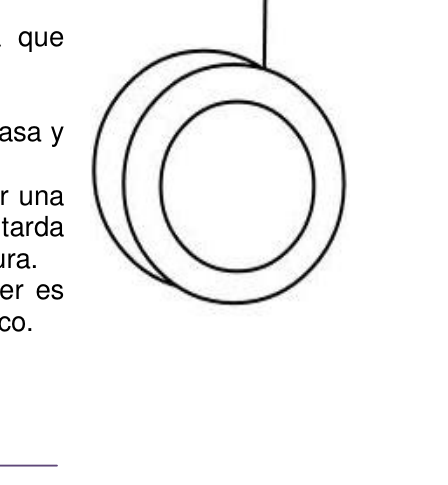
Topic: Rotational Dynamics Metodi: Torque & Angular Momentum Analysis, Energy Conservation Method Competenze: Physical Reasoning, Mathematical Modeling Objects: Disk Fonte: Testo (PDF) — p.3
Giocando con un yo-yo
PT101. La scuola del sole
San Michele di Tucumán.
Giocando con un yo-yo
Un yo-yo ha un radio esterno di 4 cm e un asse interno di 1 cm. Il yo-yo è lasciato
cadere mentre si svolge (la ruota io-io non scivola). Ricordate che il yo-yo
è costituito da due tappe in forma di disco e si scorre o si lascia scorrere 1 cm. Se
Chiede:
a) Mostrare che l’espressione che permette di calcolare
acm = 2gr2
2r2 +R2
b) Calcolare l’accelerazione centripeta con cui
- Si cade. (c) Calcolare la tensione della corda d) Calcolare la velocità lineare del centro di massa e la velocità angolare. e) dimostrare che il tempo necessario per cadere una Una certa distanza è superiore a quella che ci vuole. un oggetto in caduta libera dalla stessa altezza. f) dimostrare che il tempo necessario per cadere è indipendentemente dalla massa e dal raggio del disco.
Topic: Rotational Dynamics Metodi: Torque & Angular Momentum Analysis, Energy Conservation Method Competenze: Physical Reasoning, Mathematical Modeling Objects: Disk Fonte: Testo (PDF) — p.3
Playing with a yo-yo
PT101. College of the Sun
St. Michael of Tucumán.
Playing with a yo-yo
A yo-yo has an outside radius of 4cm and an inner axis of 1cm radius. The yo-yo is left behind.
falling as it unfolds (the self-self wheel does not slide). Remember that the yo-yo
It is made up of two disc-shaped caps and is either left unrolled 1 cm. Se
He asks:
(a) Show that the expression that allows calculation
The following is the list of the following:
2r2 +R2
(b) Calculate the centrifugal acceleration with which
It falls.
(c) Calculate the tension of the rope
(d) Calculate the linear velocity of the centre of mass and
the angular velocity.
(e) Provide that the time it takes to fall a
A certain distance is greater than it takes.
an object falling freely from the same height.
(f) To demonstrate that the time it takes to fall is
independent of the mass and radius of the disc.
Topic: Rotational Dynamics Metodi: Torque & Angular Momentum Analysis, Energy Conservation Method Competenze: Physical Reasoning, Mathematical Modeling Objects: Disk Fonte: Testo (PDF) — p.3
Carrera de destreza - rozamiento
PT102. Escuela Nro. 27 Hipólito Yrigoyen
Ciudad de Buenos Aires.
Esto no es una picada. Un corredor de autos está participando con su vehículo, de 800 kgf de peso, en una carrera de destreza. El reglamento de la competencia indica que la velocidad de los vehículos sobre la pista debe ser constante e igual a 108 km/h. Se sabe que el coeficiente de rozamiento estático entre los neumáticos y la pista es = 0,8. Un sector de la pista se muestra en la figura 1. Este sector de la pista comienza con un tramo recto horizontal AB, luego una rampa descendente BC y a continuación otro tramo horizontal CD, que termina en un escalón de 2m de altura, ubicado en D, como muestra la figura 2. a) ¿Qué fuerza debe implementar el vehículo a través de su conjunto motor-transmisión, para mantener su velocidad constante en 108 km/h en los tramos horizontales? b) Al circular por la rampa descendente BC, ¿qué valor tiene esa fuerza? ¿Debe aplicar los frenos? Justificar la respuesta.
OAF 2013 - 113 c) Al llegar a D el vehículo debe saltar el escalón de 2m de altura. ¿A qué distancia “d” vuelve a tocar la pista? d) Más adelante debe transitar por una curva horizontal, de forma circular, con radio interno = 110 m y radio externo = 120 m. si el conductor transita siguiendo una trayectoria circular, determinar el radio mínimo de esa circunferencia para que el vehículo no derrape.
Topic: Newtonian Mechanics Metodi: Free-Body Diagram, Kinematic Equations Competenze: Physical Reasoning, Diagrammatic Reasoning Objects: — Fonte: Testo (PDF) — p.3
Carrera di abilità - rasatura
PT102. Scuola Nero. 27 Hippolytus Yrigoyen
Città di Buenos Aires.
Questo non è un picco. Un corridore di auto sta partecipando con il suo veicolo, di 800 kgf, in una gara di abilità. Il regolamento sulla concorrenza indica che la Commissione la velocità dei veicoli su pista deve essere costante ed è pari a 108 km/h. È noto che il coefficiente di rottura statico tra le gomme e la pista es = 0,8. Un settore della pista è mostrato nella figura 1. Questo settore della pista inizia con un tratto retto orizzontale AB, poi un rampa discendente BC e poi un altro tratto orizzontale CD, che termina su una scala alta 2 m, situata in D, come mostra la figura 2. a) Che forza deve essere impostata dal veicolo attraverso il suo insieme motore-trasmissione, per mantenere la velocità costante a 108 km/h nei tratti orizzontali? b) Circolare sulla rampa discendente BC, che valore ha quella forza? Dovete appendere i freni? Giustificare la risposta.
OAF 2013 - 113 c) Arrivare a D il veicolo deve saltare il gradino di 2 m di altezza. - A cosa? Distanza d riattacca la pista? d) Successivamente deve passare per una curva orizzontale, in forma circolare, con radius interno = 110 m e radius esterno = 120 m. se il conducente transito in un percorso circolare, determinare il raggio minimo di la circonferenza per evitare che il veicolo colpisca.
Topic: Newtonian Mechanics Metodi: Free-Body Diagram, Kinematic Equations Competenze: Physical Reasoning, Diagrammatic Reasoning Objects: — Fonte: Testo (PDF) — p.3
The following is the list of the types of vehicles used in the manufacture of the product:
PT102. School No. 27 Hippolytus Yrigoyen
City of Buenos Aires.
This is not a stakeout. A racer is participating with his 800 kgf vehicle in A career in skill. The competition rules state that the competition authority must: the speed of vehicles on the track shall be constant and equal to 108 km/h. The static friction coefficient between the tyres and the track is known. es = 0,8. A sector of the track is shown in Figure 1. This section of the track starts with a horizontal straight AB, then a descending ramp BC and then another horizontal CD stretch, ending on a 2m high ladder, located in D, as shown in Figure 2. (a) What force must the vehicle implement across the whole? engine-transmission, to maintain its constant speed at 108 km/h In the horizontal sections? (b) When driving down the BC ramp, what is the value of that force? Do you have to apply the brakes? Justify the answer.
The following points shall be added: (c) When reaching D the vehicle must jump the 2m-high ladder. What? distance d again hits the track? (d) It must later pass through a horizontal curve, in a circular manner, with an internal radius of 110 m and an external radius of 120 m. If the driver transit on a circular path, determine the minimum radius of That’s the circumference so the vehicle doesn’t crash.
Topic: Newtonian Mechanics Metodi: Free-Body Diagram, Kinematic Equations Competenze: Physical Reasoning, Diagrammatic Reasoning Objects: — Fonte: Testo (PDF) — p.3
Matraz - dilatacion de liquido
PT103. Escuela Nro. 27 Hipólito Yrigoyen
Ciudad de Buenos Aires.
No se derrama ni una gota. Un matraz de vidrio está completamente lleno de un líquido a 20°C. La densidad del líquido a esa temperatura es = 1,26 g/cm3. En su parte superior se adapta un tubo delgado de sección S = 0,3 cm2, como muestra la figura. Se calienta el conjunto hasta 60°C. Determinar: a) El calor necesario por unidad de masa para calentar el conjunto hasta los 60°C. (suponer despreciables las pérdidas de calor). b) ¿Qué altura alcanzará el líquido dentro del tubo a los 60°C? c) ¿Cuál es la densidad del líquido a los 60°C? Datos:
coeficiente de dilatación lineal del vidrio = 3,2 x 10⁻⁶ °C-1
coeficiente de dilatación volumétrico del líquido = 0,5 x 10⁻³ °C-1
calor específico del vidrio cvid = 0,2 cal/g°C
calor específico del líquido cliq = 0,58 cal/g°C
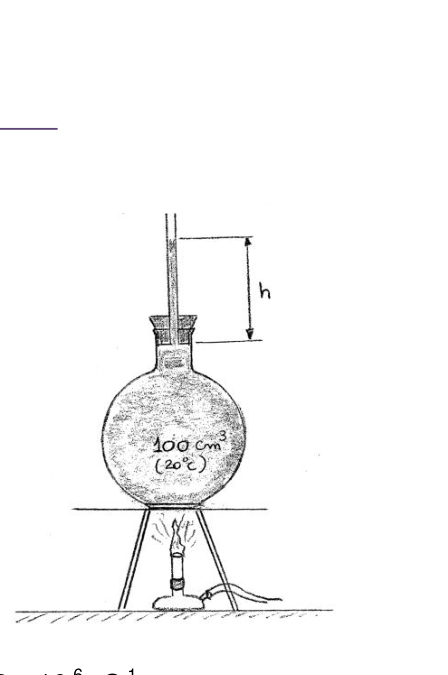
Topic: Thermodynamics, Fluid Mechanics Metodi: First Law of Thermodynamics Competenze: Physical Reasoning Objects: Container, Tube Fonte: Testo (PDF) — p.3
Matrazzo - dilatazione del liquido
PT103. Scuola Nero. 27 Hippolytus Yrigoyen
Città di Buenos Aires.
Non si scarica un goccio. Un materasso di vetro è completamente pieno di un liquido a 20°C. La densità del liquido a che la temperatura è di = 1,26 g/cm3. Per loro. Superiore si adatta un tubo sottile di sezione S = 0,3 cm2, come mostra la figura. Si scalda. il setto fino a 60°C. Determinare: a) Il calore necessario per unità di massa per riscaldare l’insieme fino ai 60°C. (supponiamo) sconsiderati Le perdite di calore). b) A che altezza raggiungerà il liquido dentro La capacità di trasmissione è di circa 10 km/h. (c) Qual è la densità del liquido a 60°C? Datati:
Il coefficiente di dilatazione lineare del vetro = 3,2 x 10⁻⁶ °C-1
Il coefficiente di dilatazione volumetrica del liquido = 0,5 x 10⁻³ °C-1
calore specifico del vetro cvid = 0,2 cal/g°C
calore specifico del liquido cliq = 0,58 cal/g°C
Topic: Thermodynamics, Fluid Mechanics Metodi: First Law of Thermodynamics Competenze: Physical Reasoning Objects: Container, Tube Fonte: Testo (PDF) — p.3
The following table shows the methodology used for the calculation of the net loss of the net loss of the net loss of the net loss of the net loss of the net loss of the net loss of net loss of net loss of net loss of net loss of net loss of net loss of net loss of net loss of net loss of net loss of net loss of net loss of net loss of net loss of net loss of net loss of net loss of net loss of net loss of net loss of net loss of net loss of net loss of net loss of net loss of net loss of net loss of net loss of net loss of net loss of net loss of net loss of net loss of net loss of net loss of net loss of net loss of net loss of net loss of net loss of net loss of net loss of net loss of net loss of net loss of net loss of net loss of net loss of net loss of net loss of net loss of net loss of net loss of net loss of net loss of net loss of net loss of net loss of net loss of net loss of net loss of net loss of net loss of net loss of net loss of net loss of net loss of net loss of net loss of net loss of net loss of net loss of net loss of net loss of net loss of net loss of net loss of net loss of net loss of net loss of net loss of net loss of net loss of net loss of net loss of net loss of net loss of net loss of net loss of net loss of net loss of net profit of net profit of net profit of net profit of net profit of net net profit of net profit of net profit of net profit of net profit of net profit of net profit of net profit of net profit of net profit of net profit of net profit of net profit of net profit of net profit of net profit of net profit of net profit of net profit of net profit of net profit of net profit of net profit of net profit of net profit of net profit of net profit of net profit of net profit of net profit of net profit of net profit of net profit of net profit of net profit of net profit of net profit of net profit of net profit of net profit of net profit of net profit of net profit of net profit of net profit of net profit of net profit of net profit of net profit of net profit of net profit of net profit of net profit of net profit of net profit of net profit of net profit of net profit of net profit of net profit of net
PT103. School No. 27 Hippolytus Yrigoyen
City of Buenos Aires.
It doesn’t spill a drop. A glass mattress is completely filled . of a liquid to 20°C. The density of the liquid at That temperature is = 1.26 g/cm3. On your part The upper part is fitted with a thin section tube S = 0.3 cm2, as shown in the figure. It ‘s getting hot . the set up to 60°C. Determine: (a) The heat required per unit mass to heat the whole up to the 60°C. (supposing Despicable . The heat loss). (b) How high will the liquid reach inside? The test chemical is the same as the test chemical. (c) What is the density of the liquid at the 60°C? The data:
The glass linear dilation coefficient = 3,2 x 10⁻⁶ °C-1
The test chemical shall be tested in accordance with the following conditions:
The specific heat of the cvid glass = 0,2 cal/g°C
The specific heat of the liquid cliq = 0,58 cal/g°C
Topic: Thermodynamics, Fluid Mechanics Metodi: First Law of Thermodynamics Competenze: Physical Reasoning Objects: Container, Tube Fonte: Testo (PDF) — p.3
Resistencias de repuesto - circuito
PT104. Escuela Nro. 27 Hipólito Yrigoyen
Ciudad de Buenos Aires.
Por las dudas, resistencias de repuesto. La potencia máxima que pueden disipar cada una de las resistencias del circuito de la figura 1 es de 4 Watt. Todas las resistencias son de 1 Ω y la resistencia interna de la fuente es ri=0,2 Ω.
OAF 2013 - 114 a) ¿Cuál es la intensidad máxima que puede circular por cada resistencia? b) Se las conecta a la fuente de V = 5V, como muestra la figura, con la llave LL cerrada. Indicar, justificando, si la llave LL puede quedar cerrada. c) Las resistencias R1 y R3 son reemplazadas por 2 reóstatos (resistencias variables) de mayor potencia, manteniendo las demás resistencias y la fuente de la situación original. (figura 2). Determinar el valor mínimo que deberán tener R1 y R3 (ambas iguales) para que las demás resistencias no superen la máxima corriente que soportan, trabajando con LL cerrada.
OAF 2013 - 115
Instancias Locales Problemas Experimentales
OAF 2013 - 116
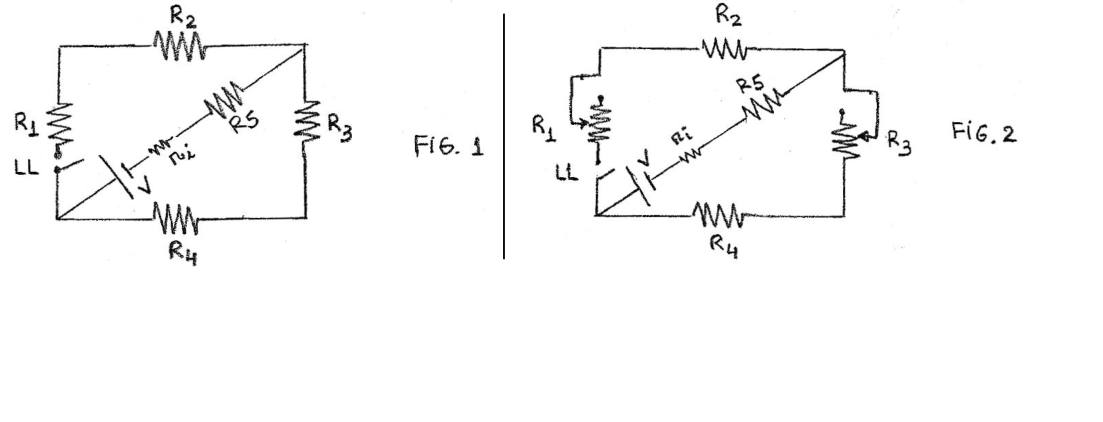
Topic: Circuits Metodi: Kirchhoff’s Laws, Equivalent Circuit Reduction Competenze: Physical Reasoning, Mathematical Modeling Objects: Resistor, Switch, Battery Fonte: Testo (PDF) — p.3
Ristrutture di ricambio - circuito
PT104. Scuola Nero. 27 Hippolytus Yrigoyen
Città di Buenos Aires.
Per il dubbio, resistenze di ricambio. La potenza massima che ogni resistenza del circuito può dissipare La figura 1 è di 4 watt. Tutte le resistenze sono di 1 Ω e la resistenza interno della fonte è ri=0,2 Ω.
OAF 2013 - 114 a) Qual è l’intensità massima che può circolare per ogni resistenza? b) Si collegano alla fonte di V = 5V, come illustrato nella figura, con la chiave LL Chiuso. Indicare, giustificando, se la chiave LL può rimanere chiusa. (c) Le resistenze R1 e R3 sono sostituite da 2 reostati (resistenze Le variabili di potenza più elevata, mantenendo le altre resistenze e la fonte di potenza. la situazione originale. (Figura 2). Determinare il valore minimo che devono avere R1 e R3 (ambedue uguali) affinché le altre resistenze non superino la massima corrente che supportano, lavorando con LL chiuso.
OAF 2013 - 115
I servizi locali Problemi sperimentali
OAF 2013 - 116
Topic: Circuits Metodi: Kirchhoff’s Laws, Equivalent Circuit Reduction Competenze: Physical Reasoning, Mathematical Modeling Objects: Resistor, Switch, Battery Fonte: Testo (PDF) — p.3
The following shall be added to the list of the components of the test:
PT104. School No. 27 Hippolytus Yrigoyen
City of Buenos Aires.
By the way, spare resistance. The maximum power they can dissipate each of the resistors in the circuit . Figure 1 is 4 watts. All resistors are 1 Ω and resistance The internal source is ri=0.2 Ω.
The following points shall be added: (a) What is the maximum intensity that can be circulated for each resistance? (b) Connect them to the V = 5V source, as shown in Figure, with the LL key It’s closed. Indicate, justifying, whether the LL key can be closed. (c) Resistance R1 and R3 are replaced by 2 reostats (resistance The main difference between the two is that the resistance is the same as the resistance. the original situation. (Figure 2) Determine the minimum value they must have R1 and R3 (both equal) so that the other resistors do not exceed the maximum Current they endure, working with LL closed.
The following is the list of the Member States’ financial statements:
Local authorities Experimental problems
The following is the list of the countries of the European Union:
Topic: Circuits Metodi: Kirchhoff’s Laws, Equivalent Circuit Reduction Competenze: Physical Reasoning, Mathematical Modeling Objects: Resistor, Switch, Battery Fonte: Testo (PDF) — p.3
Ley de crecimiento de mancha de aceite
PE1. Bachillerato Orientado Nro. 42 Pueblo Presidente Illia – Dos de Mayo, Misiones.
Ley de crecimiento de una mancha de aceite El objetivo de este trabajo es determinar la manera en cómo se expande una mancha de aceite sobre un papel en función de la cantidad de aceite derramada. Materiales:
- 1 recipiente cuenta gotas con aceite
- Hojas de papel A4 75g/m2
- 1 regla graduada
Consignas:
- Defina con un criterio razonable lo que llamará la extensión o “diámetro” de la mancha, d.
- Mida el diámetro de la mancha. Es claro que la fuente de error más importante en la medición de d proviene de la definición imprecisa de los contornos.
- Represente gráficamente el diámetro de la mancha en función del número de gotas.
- Represente el área de la mancha en función del la cantidad de aceite.
- Elabore un informe con sus conclusiones sobre el tipo de función que describe el crecimiento de
Topic: Fluid Mechanics Metodi: Graph Linearization, Curve Fitting, Experimental Data Analysis Competenze: Physical Reasoning, Experimental Data Analysis Objects: Droplet Fonte: Testo (PDF) — p.3
Legge di crescita della macchia di olio
PE1. Laurea orientata Nro. 42 Il Presidente Illia Due di maggio, Missioni.
Legge di crescita di un macchia di olio L’obiettivo di questo lavoro è determinare il modo in cui si espandono le macchia di olio su una carta in funzione della quantità di olio versata. Materiali:
- 1 contenitore contiene gocce di olio
- fogli di carta A4 75 g/m2
- 1 regola graduale
Consigni:
- Definisci con un criterio ragionevole ciò che chiamerà estensione o diametro di macchia, d.
- Misura il diametro della macchia. È chiaro che la fonte di errore più La definizione di un’impostazione di valore di d è l’imprecisione di i contorni.
- Rappresenta graficamente il diametro della macchia in funzione del numero di gocce.
- Rappresenta l’area della macchia in funzione della quantità di olio.
- Preparare un rapporto con le sue conclusioni sul tipo di funzione che descrive la crescita di
Topic: Fluid Mechanics Metodi: Graph Linearization, Curve Fitting, Experimental Data Analysis Competenze: Physical Reasoning, Experimental Data Analysis Objects: Droplet Fonte: Testo (PDF) — p.3
The following is a list of the species in the genus:
PE1. Bachelor of Education with a focus on education. 42 People President Illia Two of May, Missions.
The law of growing an oil stain The aim of this work is to determine how a oil stain on a paper based on the amount of oil spilled. Materials:
- 1 container contains drops of oil
- Sheets of paper A4 75 g/m2
- One gradual rule .
The following is the list of winners:
- Define with a reasonable criterion what you will call the extension or diameter of the stain, d.
- Measure the diameter of the spot. Of course the source of the error is more important in measuring d comes from the imprecise definition of the contours.
- Graphically represent the spot diameter according to number of drops.
- It represents the area of the stain depending on the amount of oil.
- Draw up a report with your conclusions on the type of function that you are It describes the growth of
Topic: Fluid Mechanics Metodi: Graph Linearization, Curve Fitting, Experimental Data Analysis Competenze: Physical Reasoning, Experimental Data Analysis Objects: Droplet Fonte: Testo (PDF) — p.3
Flujos de arena (clepsidra)
PE2. Escuela Superior de Comercio Carlos Pellegrini Ciudad de Buenos Aires.
Flujos de arena en el tiempo Objetivo El flujo de un material granular a través de un orificio se utilizó desde la antigüedad para medir el paso del tiempo. Por el contrario, el flujo de un líquido depende de la altura de la columna del mismo sobre el orificio. En este trabajo queremos averiguar cuál es la dependencia entre el flujo de arena con el tamaño del orificio del recipiente. También compararemos con el caso del agua.
Materiales
- Arena
- Agua
- Recipiente
- Tapas con distintos orificios
- Balanza
- Probeta
- Hoja milimetrada
- Cinta métrica
- Cinta adhesiva
- Tacho
- Cronómetro
Comentarios generales: i. Antes de comenzar lea todas las instrucciones ii. Agregue en el informe los comentarios que aclaren el procedimiento exacto que utilizó en cada paso. En lo posible incluya también un dibujo aclaratorio.
OAF 2013 - 117 iii. Escriba en tablas los datos obtenidos en las mediciones junto con sus errores. iv. Aclare cualquier cambio o desvío respecto de las instrucciones, junto con una breve explicación de su motivo. v. Trate de ser prolijo.
Introducción teórica La materia granular o materia granulada es aquella que está formada por un conjunto de partículas macroscópicas sólidas lo suficientemente grandes para que la única fuerza de interacción entre ellas sea la de fricción. Colectivamente, este tipo de materia presenta propiedades que pueden semejar, dependiendo del tipo de fuerzas a las que esté sometida, a las del estado sólido, el estado líquido o un gas. Una característica importante es que la materia granular tiende a disipar rápidamente la energía de sus partículas debido a la fuerza de fricción. Esto da lugar a fenómenos como las avalanchas o los atascamientos en descargas de silos. Como ejemplos de materia granular se encuentran los granos y semillas, la nieve, la arena. En cuanto a flujos al atravesar un orificio, existe una diferencia entre el flujo de agua y el flujo de arena. Para los líquidos el flujo depende de la altura de la columna, ya que cuanto más alta es la columna de líquido mas presión se ejerce en su base. En cambio para los materiales granulares el flujo es constante en el tiempo, debido a que en un material granular la presión en la parte inferior es independiente de la altura en una columna lo suficientemente alta. Esto se debe a que la fricción de las partículas con las paredes es suficiente para soportar el peso de de la columna. El flujo de arena por un orificio se calcula a partir de la masa dentro del recipiente de la siguiente relación: (ecuación 1), donde Flujo es cantidad de masa por unidad de tiempo que sale del recipiente. El valor del Flujo varía dependiendo del tamaño del orificio de esta forma:
donde K es una constante, es la densidad del material, g es la gravedad, D el
diámetro del orificio, yα un exponente que relaciona estas magnitudes. Aplicando
logaritmos a ambos miembros de la ecuación se obtiene:
log(Flujo)= log(K . ρg1/2)+α.log(D)
que tiene la forma
(ecuación 2)
Parte 1
- Coloque el tacho debajo del recipiente asegurándose que no se caiga arena al piso
- Realice marcas equiespaciadas a lo largo del recipiente y tape el orificio con cinta.
- Para determinar la cantidad de masa que corresponde a la arena que coloca entre cada marca, llene el recipiente de a pasos y pese la arena agregada.
- Quite la cinta y mida el tiempo que tarda la altura de la arena en llegar a cada marca.
- Convierta los datos de altura en masa y realice un gráfico de Masa vs Tiempo.
- Repita los pasos anteriores para al menos 4 orificios distintos. Utilice la misma hoja milimetrada para estos gráficos.
- Calcule de los gráficos el Flujo de arena para cada diámetro de orificio según ecuación 1. t Flujo – M = t M 0 . α 2 1 D ρg K = Flujo . . / X α
A
Y .
OAF 2013 - 118
8. Realice un gráfico de Y=log(Flujo) vs X=Log(D),(ecuación 2) y del
mismo calcule α
9. De la relación anterior, diga cuánta masa de arena es necesaria para
determinar un minuto de tiempo en un reloj de arena con un orificio de
0.5mm de diámetro. ¿Con qué incerteza lo puede determinar?
Parte 2
- Repita una medición como en la parte 1 con agua para el orificio más pequeño.
- Grafique Masa vs Tiempo y compruebe que la relación no es lineal
Parte 3: Confección de un informe (téngalo en cuenta al realizar la parte 1 y 2) Escriba un informe de la experiencia realizada que posea la siguiente información: a) Título b) Introducción (breve) c) Hipótesis d) Descripción del dispositivo experimental (texto y dibujo) e) Detalles acerca de cómo se realizaron las mediciones (texto y dibujo) f) Mediciones / Tablas g) Gráficos (en hoja milimetrada) h) Cálculos i) Cálculos de errores j) Resultados obtenidos k) Comentarios finales l) Conclusiones m) Y cualquier información que considere relevante
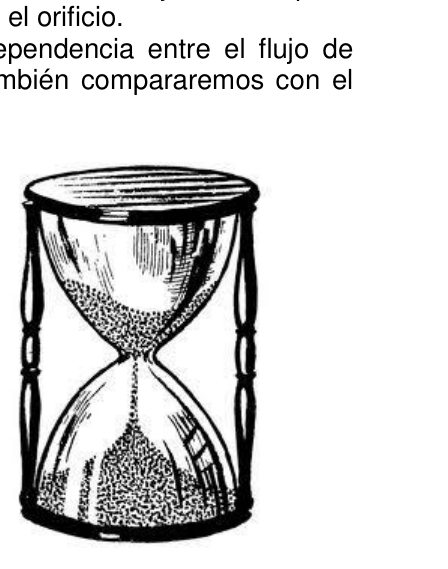
Topic: Fluid Mechanics Metodi: Graph Linearization, Curve Fitting, Experimental Data Analysis Competenze: Physical Reasoning, Experimental Data Analysis Objects: Container Fonte: Testo (PDF) — p.3
**Rufluzioni di sabbia (clepsidra) **
PE2. Scuola superiore di commercio Carlos Pellegrini Città di Buenos Aires.
Fluidi di sabbia nel tempo Obiettivo Il flusso di un materiale granulare attraverso un foro è stato utilizzato dal l’antichità per misurare il tempo. Al contrario, il flusso di un liquido dipende dalla altezza della colonna del suo orizzonte. In questo lavoro vogliamo capire quale sia la dipendenza tra il flusso di sabbia della dimensione del buco del recipiente. Compareremo anche con il
- Il caso dell’acqua.
Materiali
- Arena .
- Acqua .
- Ricevente
- Tape con diversi orizzonti
- Sbalzo .
- Prova .
- Carta di millimetro
- Cintura metrica .
- Fascia adesiva
- Tacho .
- Cronometro .
Commenti generali: i. Prima di iniziare, leggi tutte le istruzioni. ii. Aggiungere al rapporto le osservazioni che chiariscono la procedura Esatto che ha usato in ogni passo. Se possibile, includere anche un disegno
- Chiarazione.
OAF 2013 - 117 iii. Scrivi in tavola i dati ottenuti dalle misurazioni insieme ai dati ottenuti. errori. iv. Accertare qualsiasi modifica o deviazione rispetto alle istruzioni, insieme con una breve spiegazione del suo motivo. v. Cerca di essere prolico.
Introduzione teorica La materia granulare o materia granulata è quella che è costituita da un un insieme di particelle macroscopiche solide sufficientemente grandi da che l’unica forza di interazione tra loro sia quella di attrito. Collettivamente, Questo tipo di materia presenta proprietà che possono essere simili, a seconda di cui è sottoposto, di quelle dello stato solido, dello stato liquido o gas. Un’importante caratteristica è che la materia granulare tende La forza di attrito di queste particelle consente loro di dissipare rapidamente l’energia. Questo porta a fenomeni come le avalanche o gli ingorghi in scarichi di silo. Come esempi di materia granulare si trovano i Granelli e semi, neve, sabbia. Per quanto riguarda i flussi attraverso un foro, c’è una differenza tra il flusso di acqua e il flusso di sabbia. Per i liquidi il flusso dipende dall’altezza della la colonna, poiché più alta è la colonna di liquido più pressione viene esercitata
- alla sua base. Per i materiali granulari invece il flusso è costante nel tempo, perché in un materiale granulare la pressione in fondo è indipendentemente dall’altezza in una colonna sufficientemente alta. Questo è dovuto La friczione delle particelle con i muri è sufficiente a sopportare il peso della colonna vertebrale. Il flusso di sabbia attraverso un foro viene calcolato a partire dalla massa all’interno del contenitore della seguente relazione: (Equilibrio 1), dove Flusso è la quantità di massa per unità di tempo che esce dal recipiente. Il valore del flusso varia a seconda della dimensione del foro in questo modo:
dove K è una costante, è la densità del materiale, g è la gravità, D è il Il diametro del foro, eα un esponente che correla queste dimensioni. Applicando logaritmi a entrambi i membri dell’equazione si ottiene: log(fluo)= log(K. ρg1/2) +α.log(D) che ha la forma (Equilibrio 2)
Parte 1
- Metti il tappo sotto il recipiente , assicurati che non cadga . sabbia sul pavimento
- Fare segni spaziati lungo il recipiente e tappe il foro con la cinta.
- Per determinare la quantità di massa corrispondente alla sabbia che Mettere tra ogni marchio, riempire il contenitore a passo e pesare la sabbia
- Aggregazione.
- Togliete la cinta e misurate il tempo che ci vuole per arrivare alla altezza della sabbia a ogni marchio.
- Convertire i dati di altezza in massa e fare un grafico di massa vs Tempo.
- Ripeti i passaggi precedenti per almeno 4 orizzonti diversi. Usa il lo stesso foglio millimetrico per questi grafici.
- Calcola dal grafico il flusso di sabbia per ogni diametro di buco secondo l’equazione 1. t Flusso – M = t M 0 . α 2 1 D ρg K = Flusso . . / X α
A
Y .
OAF 2013 - 118 8. Rendi un grafico di Y=log(Flujo) vs X=Log(D),(equazione 2) e di Calcola tu stesso α 9. Dalla relazione precedente, dite quanta massa di sabbia è necessaria per determinare un minuto di tempo su un orologio di sabbia con un orizzonte di 0,5 mm di diametro. Con quale incertezza lo si può stabilire?
Parte 2
- Ripeti una misurazione come nella parte 1 con acqua per il foro più piccolo.
- Grafica Massa vs Tempo e verifica che il rapporto non è lineare
Parte 3: Preparare un rapporto (tenete conto di questo quando si eseguono le parti 1 e 2) Scrivi un rapporto sull’esperienza che hai avuto: Informazioni: a) Titolo b) Introduzione (breve) c) ipotesi d) Descrizione del dispositivo sperimentale (testo e disegno) e) Dettagli su come le misure sono state effettuate (testo e disegno) f) Misure / tabelle g) Grafiche (in fogli di millimetro) h) Calcoli i) Calcoli di errori j) Risultati ottenuti k) Commenti conclusivi L) Conclusioni m) E qualsiasi informazione che ritiene rilevante
Topic: Fluid Mechanics Metodi: Graph Linearization, Curve Fitting, Experimental Data Analysis Competenze: Physical Reasoning, Experimental Data Analysis Objects: Container Fonte: Testo (PDF) — p.3
The following table shows the results of the calculation of the risk of the risk of the risk of the risk of the risk of the risk of the risk of the risk of the risk of the risk of the risk of the risk of the risk of the risk of the risk of the risk of the risk of the risk of the risk of the risk of the risk of the risk of the risk of the risk of the risk of the risk of the risk of the risk of the risk of the risk of the risk of the risk of the risk of the risk of the risk of the risk of the risk of the risk of the risk of the risk of the risk of the risk of the risk of the risk of the risk of the risk of the risk of the risk of the risk of the risk of the risk of the risk of the risk of the risk of the risk of the risk of the risk of the risk of the risk of the risk of the risk of the risk of the risk of the risk of the risk of the risk of the risk of the risk of the risk of the risk of the risk of the risk of the risk of the risk of the risk of the risk of the risk of the risk of the risk of the risk of the risk of the risk of the risk of the risk of the risk of the risk of the risk of the risk of the risk of the risk of the risk of the risk of the risk of the risk of the risk of the risk of the risk of the risk of the risk of the risk of the risk of the risk of the risk of the risk of the risk of the risk of the risk of the risk of the risk of the risk of the risk of the risk of the risk of the risk of the risk of the risk of the risk of the risk of the risk of the risk of the risk of the risk of the risk of the risk of the risk of the risk of the risk of the risk of the risk of the risk of the risk of the risk of the risk of the risk of the risk of the risk of the risk of the risk of the risk of the risk of the risk of the risk of the risk of the risk of the risk of the risk of the risk of the risk of the risk of the risk of the risk of the risk of the risk of the risk of the risk of the risk of the risk of the risk of the risk of the risk of the risk of the risk of the risk of the risk of the risk of the risk of the risk
PE2. The Carlos Pellegrini School of Commerce City of Buenos Aires.
Sand flows in time The objective The flow of a granular material through a hole was used from the The ancient world is a time-scale. On the contrary, the flow of a liquid The length of the column above the hole depends on the height of the column above the hole. In this work we want to find out what the dependence between the flow of sand with the size of the container hole. We’ll also compare it to the The water case.
Materials
- Sand .
- Water .
- The receiver .
- Cover with different holes
- Weigh it .
- Try it .
- Millimeter sheet .
- Metric tape .
- The adhesive tape
- I ‘m not .
- The chronometer .
General comments: i. Before you start , read all the instructions . ii. Add to the report the comments clarifying the procedure Exactly what he used at every step. If possible, include a drawing The Commission is not prepared to accept the request.
The following points shall be added: (iii) the following: Write in tables the data obtained from the measurements together with their I’m not sure. iv. Please clarify any changes or deviations from the instructions, together with with a brief explanation of why. v. Try to be prolific.
Theoretical introduction The granular material or granulated material is that which is formed by a a set of solid macroscopic particles large enough to The only force of interaction between them is friction. Collectively, This type of material has properties that may resemble, depending on The type of forces to which it is subject, the solid state, the state liquid or gas. An important feature is that granular matter tends to It’s a very fast way to dissipate the energy of its particles due to the force of friction. This leads to phenomena such as avalanches or traffic jams in the discharges of silos. As examples of granular matter are found in the grains and seeds, snow, sand. As for the flow through a hole, there is a difference between the flow of water and the flow of sand. For liquids the flow depends on the height of the The higher the liquid column, the more pressure it exerted. At his base. In contrast, for granular materials the flow is constant at the time, because in a granular material the pressure at the bottom is independent of height on a sufficiently high column. This is because The friction of the particles with the walls is enough to support the weight of the spine. The sand flow through a hole is calculated from the mass inside the hole. container of the following ratio: (Equation 1), where Flow is the amount of mass per unit time that leaves the container. The flow rate varies depending on the size of the hole as follows:
where K is a constant, is the density of the material, g is gravity, D is the diameter of the hole, and a exponent that relates these magnitudes. Applying Logarithms to both members of the equation is obtained: The following is the list of the Member States’ official languages: The following table shows the results of the evaluation: It ‘s got the shape . (Equation 2)
Part 1
- Place the lid under the container to ensure it does not fall off. Sand on the floor .
- Make equally spaced marks along the container and seal the hole with tape.
- To determine the amount of mass corresponding to the sand that Put it between each mark, fill the container with steps and weigh the sand. the aggregate.
- Take the tape off and measure the time it takes the height of the sand to reach . to every brand.
- Convert the height data to mass and make a mass vs. graph It’s time.
- Repeat the above steps for at least 4 different holes. Use the same millimeter sheet for these charts.
- Calculate the sand flow from the graphs for each hole diameter according to equation 1. t Flow – M = t M 0 . α 2 1 D ρg K = Flow . . / X α
A
Y .
The following points shall be added: 8. Make a graph of Y=log(Flujo) vs X=Log(D),(equation 2) and of Calculate α 9. From the previous ratio, tell me how much sand mass is needed for Determine a minute of time on a sand clock with a hole in it. 0.5 mm in diameter. How uncertain can you be?
Part 2
- Repeat a measurement as in part 1 with water for the hole plus It’s small.
- Graph Mass vs Time and see that the relationship is not linear
Part 3: Preparation of a report (take this into account when preparing Part 1 and 2) Write a report of the experience you have gained from the following: The following information: (a) Title (b) Introduction (short) (c) Hypothesis (d) Description of the experimental device (text and drawing) (e) Details of how measurements were made (text and drawing) (f) Measurements / Tables (g) Graphics (in millimetre sheet) (h) Calculations (i) Error calculations (j) Results obtained (k) Final comments (l) Conclusions (m) And any information that it considers relevant
Topic: Fluid Mechanics Metodi: Graph Linearization, Curve Fitting, Experimental Data Analysis Competenze: Physical Reasoning, Experimental Data Analysis Objects: Container Fonte: Testo (PDF) — p.3
Periodo de pendulo de varilla
PE3. Colegio Nacional Dr. Arturo Illia
Instituto Albert Einstein Mar del Plata, Buenos Aires.
Objetivo Estudiar el periodo de oscilación de un péndulo de varilla.
Breve descripción:
En esta experiencia Ud. tratará de encontrar la expresión del período de un
péndulo de varilla, a partir de mediciones experimentales de longitudes y
tiempos. Se le proveerá un conjunto de 9 varillas de acero de diferente longitud,
que deberá poner a oscilar en el soporte.
Materiales:
Varillas de distintas longitudes
Soportes
Ganchos de sujeción
Cronómetro
Regla, papel milimetrado o cuadriculado, lápiz
Procedimiento:
a) Suspenda la varilla más larga y hágala oscilar , tome el tiempo de 10
oscilaciones para ángulos de 5° hasta 40 °, incrementando al ángulo de
OAF 2013 - 119 a 5°. Indique como varia el periodo de oscilación con la amplitud de la oscilación. b) Suspenda cada una de las varillas de longitud L0 , hágalas oscilar y tome el tiempo t de 10 oscilaciones completas (t = 10 T). A partir de estas mediciones, complete la siguiente tabla: L0
L
t0
t
T0
T
T0 2
T2
d) Realice un gráfico de T2 en función de la longitud de la varilla.
e) Obtenga la pendiente y la ordenada al origen del gráfico.
f) Escriba la relación funcional que relaciona el periodo y la longitud de la
varilla.
g) Si el período sigue la ley escrita más abajo, para pequeñas
oscilaciones, encuentre el valor de la aceleración de la gravedad a partir
de los resultados obtenidos del gráfico.
g
L
T
3
2
2
Topic: Oscillations & Waves Metodi: Simple Harmonic Motion Analysis, Graph Linearization, Experimental Data Analysis Competenze: Physical Reasoning, Experimental Data Analysis Objects: Pendulum, Rod Fonte: Testo (PDF) — p.3
Periodo di pendolo del bastone
PE3. Il Dr. Arturo Illia
L’Istituto Albert Einstein Mar del Plata, Buenos Aires.
Obiettivo Studiare il periodo di oscillazione di un pendolo di bastone.
Breve descrizione: In questa esperienza, si cerca di trovare l’espressione del periodo di un pendolo di bastone, a partire da misurazioni sperimentali di lunghezze e tempi. Vi verrà fornito un insieme di 9 bastone di acciaio di diverse lunghezze, che deve essere oscillata sul supporto.
Materiali: Basti di diverse lunghezze Supporti Cucchi di supporto Cronometro carta regola, carta millimetrica o quadrata, penna
Procedura: a) Sospendere la verga più lunga e farla oscillare , prendere il tempo di 10 oscillazioni per angoli 5° fino a 40 °, aumentando l’angolo di
OAF 2013 - 119 a 5°. Indicare come il periodo di oscillazione varia con l’ampiezza della oscillazione. b) Sospendere ciascuna delle bacche di lunghezza L0 , oscillare e prendere il tempo t di 10 oscillazioni complete (t = 10 T). A partire da queste. misurazioni, completa la tabella seguente: L0
L
t0
t
T0
T
T0 2
T2
d) Realizzare un grafico di T2 in base alla lunghezza della canna. e) Ottieni la pendenza e la pendenza ordinata all’origine del grafico. f) Scrivi il rapporto funzionale che relaziona il periodo e la lunghezza della
- La bacchetta. g) Se il periodo segue la legge scritta di seguito, per le piccole Oscillazioni, trova il valore dell’accelerazione della gravità a partire da I risultati ottenuti dal grafico. g L T 3 2 2
Topic: Oscillations & Waves Metodi: Simple Harmonic Motion Analysis, Graph Linearization, Experimental Data Analysis Competenze: Physical Reasoning, Experimental Data Analysis Objects: Pendulum, Rod Fonte: Testo (PDF) — p.3
The following conditions shall apply:
PE3. National College Dr. Arturo Illia
The Albert Einstein Institute The city of Mar del Plata, Buenos Aires.
The objective Study the oscillation period of a rod pendulum.
Brief description: In this experience you It will try to find the expression of the period of a The test results shall be based on the results of the experimental measurements of lengths and The times. You will be provided with a set of 9 steel rods of different lengths, which you must set to oscillate on the support.
Materials: Stakes of different lengths Support Holding hooks The timekeeper Rule, millimeter or square paper, pencil
The procedure: (a) Hang the longest rod and swing it , take the time of 10 The following shall be reported in the table:
The following points shall be added: a 5°. Indicate how the oscillation period varies with the width of the The oscillation. (b) Suspend each of the length rods L0 , swing them and take the time t of 10 complete oscillations (t = 10 T). From these . measurements, complete the following table: L0
L
t0
t
T0
T
T0 2
T2
(d) Draw a T2 graph based on the length of the rod. (e) Get the slope and the order at the source of the graph. (f) Write the functional relationship relating the period and length of the period of the The rod. (g) If the period follows the law written below, for small Find the value of gravitational acceleration from The results obtained from the graph. g L T 3 2 2
Topic: Oscillations & Waves Metodi: Simple Harmonic Motion Analysis, Graph Linearization, Experimental Data Analysis Competenze: Physical Reasoning, Experimental Data Analysis Objects: Pendulum, Rod Fonte: Testo (PDF) — p.3
Paralaje (medicion de distancias)
PE4. EET Nro. 1 Cnel M. A. Prado San Pedro, Jujuy.
Paralaje Propósito: Que los estudiantes “exploren” el concepto de PARALAJE, una técnica fundamental para la medición de distancias estelares.
Materiales: Cinta métrica
OAF 2013 - 120 Antecedentes y Teoría: Uno de los problemas más difíciles en la Astronomía es la determinación de distancias a objetos celestes. Existen cuatro métodos básicos de determinación de distancias: radar, paralaje, estándares lumínicos y la ley de Hubble. Cada uno de estos métodos es más útil a ciertas distancias: mientras que el radar es útil para los objetos más cercanos (por ejemplo, la Luna), la ley de Hubble es útil a escalas de distancia mayores. En este ejercicio, investigaremos el uso de la paralaje para determinar distancias. Aunque sean observadas con los telescopios más grandes, las estrellas siguen siendo puntos de luz. A pesar de que podamos decir mucho acerca de una estrella a través de su luz, estas observaciones no nos brindan una escala de referencia que podamos utilizar para determinar su distancia. Para ello, necesitamos hacer uso de un método con el cual ya te encuentras familiarizado: paralaje. Paralaje es un método puramente geométrico que depende de la distancia a la estrella, el tamaño de la órbita de la Tierra y la medición precisa del movimiento de la estrella bajo estudio relativo a las distantes estrellas de fondo que se encuentran casi fijas durante el curso de 6 meses.
Fig. 1. Paralaje de una estrella
Si podemos determinar el ángulo para una estrella próxima a partir de su movimiento aparente en el cielo al paso de 6 meses, dado que sabemos que la distancia Tierra-Sol es 1AU, podemos determinar la distancia a la estrella. Definición: El ángulo p subtendido por la distancia Tierra-Sol (1 AU) es de 1 segundo de arco (=1°/3600) si la distancia al objeto es de 1 parsec.
La estrella, el Sol y la Tierra forman un triángulo rectángulo a partir del cual, si el ángulo p y el cateto opuesto es conocido, el cateto adyacente puede ser calculado. Por trigonometría, tenemos:
OAF 2013 - 121
Si p=1°/3600, entonces d = ___________ AU = 1 parsec = 3.26 años luz. El grupo estelar más cercano se encuentra a una distancia mayor que 1 parsec, lo que quiere decir que todas las estrellas tienen paralajes menores que 1 segundo de arco.
Paralaje en el aula
Una buena forma de ilustrar el cálculo de distancias paralácticas es utilizando un
objeto sostenido con el brazo extendido directamente al frente de nuestros ojos.
Para esta actividad, sostendrás un lápiz o un bolígrafo con tu brazo extendido y
medirás la paralaje del objeto.
- Un miembro del grupo se colocará a una distancia de aproximadamente 15 pies del pizarrón o de alguna pared.
- Ese miembro del grupo sostendrá un lápiz verticalmente con su brazo extendido.
- Otro miembro del grupo medirá la distancia desde el lápiz hasta la frente, teniendo cuidado de resguardar sus ojos. L = ___ cm.
- Quien sostiene el lápiz se cubrirá un ojo y pedirá a otro miembro del grupo que trace una línea vertical en el pizarrón que esté alineada en correspondencia con el lápiz.
- Ahora se cubrirá el otro ojo y pedirá que marquen una segunda línea vertical. Podremos percibir que el lápiz parece cambiar de posición relativa al pizarrón debido a que estamos cambiando el punto de observación de un ojo al otro.
- Cuidadosamente, midan la distancia ojo-ojo. E = ___ cm
- Cada miembro del grupo sostendrá el lápiz, alineará su ojo derecho con la marca de la izquierda en el pizarrón y repetirá el mismo procedimiento con el otro ojo. ¿Se alinea el lápiz con la marca de la derecha en el pizarrón? Explica.
Calculen el desplazamiento angular del lápiz. Este es la paralaje del lápiz. Ese ángulo (α en la figura inferior) será el mismo ángulo que el formado por los ojos del observador y el lápiz (ver figuras inferiores). Por convención, para la paralaje se acostumbra determinar la mitad del ángulo: α/2.
Fig. 2. Vista superior ejerc. “Paralaje en el AULA”.
OAF 2013 - 122
Fig. 3. Vista amplificada una región de fig. anterior.
Para el triángulo sombreado, tenemos:
Utilizando esta fórmula y tus medidas de E (espaciamiento entre los ojos) y L (longitud del brazo), calcula el ángulo paraláctico α/2 (la mitad del ángulo subtendido por los ojos o por las marcas). tan(α/2) = ___ ------> α/2 = ___ degrees.
Si conocemos este ángulo y la distancia de ojo a ojo E pero no la longitud del brazo, podemos calcular la distancia del ojo al lápiz L utilizando la fórmula anterior. Para estrellas reales en lugar de lápices, si conocemos la distancia entre lugares en la órbita de la Tierra y el ángulo que una estrella describe relativo a las estrellas distantes, entonces utilizamos la fórmula obtenida previamente para calcular la distancia a la estrella. Conocemos el espacio angular de las estrellas distantes debido a su RA y DEC. Si percibimos movimiento de las estrellas cercanas relativo a las estrellas distantes durante un periodo de 6 meses, podemos determinar la distancia angular que se desplaza una estrella cercana. Entonces tenemos el ángulo, y conocemos un lado del triángulo (distancia Tierra-Sol), de modo que podemos resolver para la distancia a la estrella.
Paralaje simulado Este diagrama muestra cómo una estrella cercana cambia su posición relativa a las estrellas de fondo debido al movimiento de la Tierra.
Una vez que hayas comprendido en qué consiste el cálculo de la paralaje estelar, visita el siguiente sitio: http://highered.mcgrawhill.com/olcweb/cgi/pluginpop.cgi?it=swf::800::600::/sites/d l/free/007299181x/78778/Parallax_Nav.swf::Stellar%20Parallax%20Interactive
OAF 2013 - 123
- Familiarízate con la animación.
- La línea de visión de la Tierra a la estrella cercana cambia con relación a las estrellas más distantes. Esto es, las estrellas cercanas parecen moverse con relación a las estrellas más distantes que no muestrean movimiento aparente perceptible. Como sabemos la separación angular entre las estrellas distantes, podemos medir el movimiento angular aparente de las estrellas cercanas. Este es la paralaje de la estrella. Intenta describir con tus palabras el movimiento que percibirías como observador desde la estrella y desde la Tierra.
- Describe lo que ocurriría si la estrella se alejara del Sol lo más lejos posible ¿cómo cambia el movimiento visto desde la Tierra?
- En el cálculo de la paralaje realizado en el AULA, utilizamos nuestros ojos para cambiar la posición de visión. ¿Qué cambios ocurrirán en nuestra posición de visión en el caso de observaciones de la paralaje estelar?
- Imagina ahora que la estrella se encuentra lo más cerca del Sol posible. Describe cómo es la paralaje que podría medirse en relación con la que se obtendría en 3.
Contesta las siguientes preguntas (no olvides hacer evidente la fuente de información):
- ¿A qué estrella se le ha determinado el mayor ángulo paraláctico?
- ¿Cuál es el límite para la determinación de distancias utilizando esta técnica?
- ¿Podríamos obtener mejores resultados utilizando la técnica de la paralaje desde Marte?
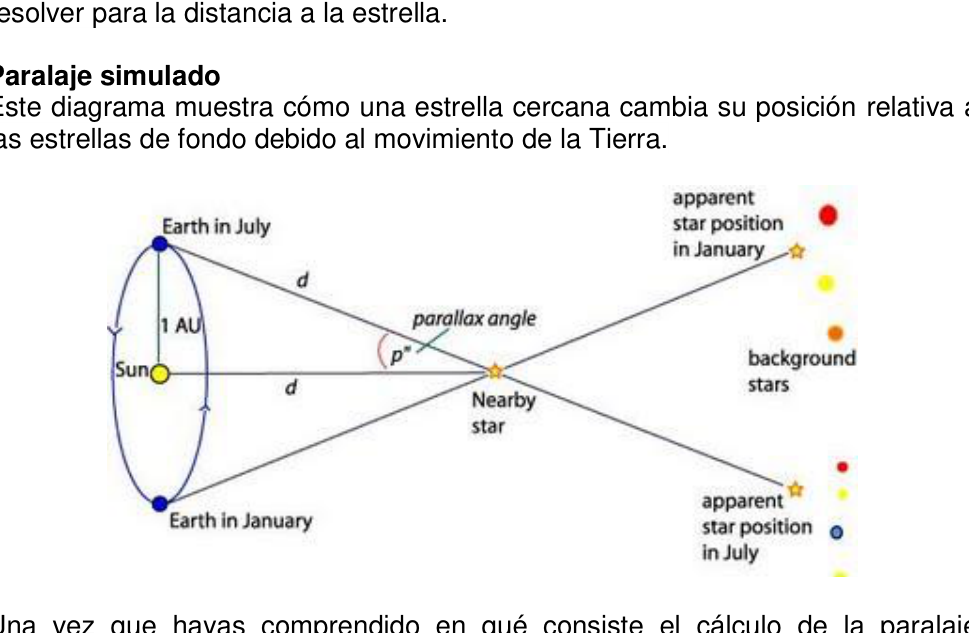
Topic: Astrophysics Metodi: Small-Angle Approximation, Order-of-Magnitude Estimation, Experimental Data Analysis Competenze: Physical Reasoning, Experimental Data Analysis Objects: Star Fonte: Testo (PDF) — p.3
Parallaggio (misura di distanze)
PE4. EET Nro. 1 Cnel M. A. Prado San Pietro, Jujuy.
Parallellamento Scopo: che gli studenti esplorino il concetto di PARALAGE, una tecnica fondamentale per la misurazione delle distanze stellari.
Materiali: nastro metrico
OAF 2013 - 120 Background and Theory: Uno dei problemi più difficili in astronomia è la determinazione delle distanze da oggetti celesti. Ci sono quattro metodi. I principi di base di determinazione delle distanze: radar, parallaggio, standard luminosi e La legge di Hubble. Ciascuno di questi metodi è più utile a certe distanze: mentre il radar è utile per gli oggetti più vicini (ad esempio, la Luna), la legge di Hubble è utile su scale di distanza più grandi. In questo esercizio,
- Cercheremo . el uso de la Parallaggio per determinare distanze. Anche se sono osservate con i più grandi telescopi, le stelle continuano a che sono punti di luce. Anche se possiamo dire molto di una Una stella attraverso la sua luce, queste osservazioni non ci danno una scala di Un riferimento che possiamo usare per determinare la sua distanza. Per questo, Dobbiamo usare un metodo che lei è già familiare: Parallaggio. Il parallelo è un metodo puramente geometrico che dipende dalla distanza alla la dimensione dell’orbita terrestre e la misurazione precisa del movimento. La luce che viene osservata nella luce è la luce che viene osservata nella luce. si trovano quasi fissi nel corso dei sei mesi.
Fig. 1. Parallelamento di una stella
Se possiamo determinare l’angolo di una stella vicina a partire dal suo movimento apparente nel cielo dopo sei mesi, dato che sappiamo che la La distanza Terra-Solo è 1AU, possiamo determinare la distanza dalla stella. Definizione: L’angolo p sottoscritto per la distanza Terra-Sol (1 AU) è di 1 secondo d’arco (=1°/3600) se la distanza dall’oggetto è di 1 parsec.
La stella, il sole e la terra formano un triangolo rettangolo da cui, se il angolo p e il cateto opposto è noto, il cateto adiacente può essere Calcolato. Per trigonometria, abbiamo:
OAF 2013 - 121
Se p=1°/3600, allora d = ___________ AU = 1 parsec = 3,26 anni luce. El Il gruppo stellare più vicino si trova a più di un parsec, il che significa che tutte le stelle hanno parallelità inferiori a 1 secondo. di arco.
Parallellamento in aula Un buon modo per illustrare il calcolo delle distanze parallattiche è utilizzare un oggetto sostenuto con il braccio stretto direttamente davanti ai nostri occhi. Per questa attività, tenete una penna o una penna con il braccio esteso e misurerai la parallaggio dell’oggetto.
- Un membro del gruppo si collocherà a una distanza di circa 15 piedi dal tavolo o da qualche muro.
- Quel membro del gruppo sosterrà una penna verticalmente con il braccio. diffuso.
- Un altro membro del gruppo misurerà la distanza dalla penna alla davanti, guardando attentamente i suoi occhi. L = ___ cm.
- Chi tiene la matita si coprirà un occhio e chiederà a un altro membro del gruppo. gruppo che traccia una linea verticale sullo schedino che è allineato in Corrispondenza con la matita.
- Ora coprirà l’altro occhio e chiederà di segnare una seconda linea. Verticale. Potremmo percepire che il matita sembra cambiare posizione relativa al tavolo perché stiamo cambiando il punto di osservazione da un occhio all’altro.
- Misurate con attenzione la distanza occhio-occhio. E = ___ cm
- Ogni membro del gruppo deve tenere la matita, allineare il proprio occhio destro con il marchio a sinistra sullo schedino e ripetere lo stesso procedura con l’altro occhio. La matita si allinea con il marchio della
- Giusto sul tavolo? Spiega.
Calcolare il spostamento angolare della matita. Questa è la parallaggio della matita. - Quello . L’angolo (α nella figura inferiore) sarà lo stesso angolo che è formato dagli occhi Il punto di riferimento è il punto di riferimento per il quale si deve utilizzare il crollo (vedi figure di seguito). Per convenzione, per il parallaggio. è usato per determinare la metà dell’angolo: α/2.
Fig. 2. Visto superiore esercitare. Parallaggio all’AULA.
OAF 2013 - 122
Fig. 3. Vista amplificata di una regione di fig. precedente.
Per il triangolo oscurato, abbiamo:
Usando questa formula e le tue misure di E (spazio tra gli occhi) e L (lenghezza dell’armo), calcola l’angolo parallattico α/2 (mezza angola sottoscritto dagli occhi o dai segni). il numero di gradi di riferimento è il numero di gradi di riferimento.
Se conosciamo questo angolo e la distanza occhio-occhio E ma non la lunghezza del Il braccio, possiamo calcolare la distanza dell’occhio dalla penna L usando la formula precedente. Per le stelle reali invece di penne, se conosciamo la distanza. tra i luoghi in orbita della Terra e l’angolo che una stella descrive per le stelle distanti, quindi usiamo la formula ottenuta. prima di calcolare la distanza dalla stella. Conosciamo lo spazio angolare delle stelle distanti a causa della loro RA e DEC. Se percepisci il movimento delle stelle vicine rispetto alle stelle Distanti per un periodo di 6 mesi, possiamo determinare la distanza angolare che muove una stella vicina. Quindi abbiamo l’angolo, e Conosciamo un lato del triangolo, quindi possiamo risolvere per la distanza dalla stella.
Simulazione parallela Questo diagramma mostra come una stella vicina cambia la sua posizione relativa a le stelle di fondo a causa del movimento della Terra.
Una volta che hai capito cosa è il calcolo del parallaggio Stellare, visita il sito: http://highered.mcgrawhill.com/olcweb/cgi/pluginpop.cgi?it=swf::800::600::/sites/d L’intera rete di comunicazione è stata creata dal progetto di programmazione di ricerca e sviluppo.
OAF 2013 - 123
- Familiarizzatevi con l’animazione.
- La linea di vista della Terra verso la stella vicina cambia in relazione. alle stelle più lontane. Cioè, le stelle vicine sembrano spostarsi rispetto alle stelle più distanti che non mostrano movimento apparente percepito. Come sappiamo la separazione angolare Tra le stelle distanti, possiamo misurare il movimento angolare. apparente dalle stelle vicine. Questa è la parallazia della stella. Cerca di descrivere con le tue parole il movimento che percepiresti come osservatore dalla stella e dalla terra.
- Descrive cosa accadrebbe se la stella si allontanarebbe dal Sole . possibile come cambia il movimento visto dalla Terra?
- Nel calcolo del parallaggio effettuato nell’AULA, abbiamo usato i nostri occhi per cambiare posizione visiva. Quali cambiamenti avverranno? La nostra posizione visiva nel caso di osservazioni di parallaggio
- La stella?
- Immaginate ora che la stella si trovi il più vicino possibile al Sole. Descrive come sia il parallaggio che potrebbe essere misurato rispetto a quello che E’ il numero di tre.
Rispondi alle seguenti domande (non dimenticare di indicare la fonte di informazioni:
- A quale stella è stato determinato l’angolo parallattico più grande?
- Qual è il limite per determinare le distanze utilizzando questa tecnica?
- Potremmo ottenere risultati migliori usando la tecnica della Parallaggio da Marte?
Topic: Astrophysics Metodi: Small-Angle Approximation, Order-of-Magnitude Estimation, Experimental Data Analysis Competenze: Physical Reasoning, Experimental Data Analysis Objects: Star Fonte: Testo (PDF) — p.3
The following information shall be provided:
PE4. The EET number. 1 Cnel M. A. Prado . St. Peter, Jujuy.
Parallels Purpose: To enable students to explore the concept of PARALAJE, a The method is fundamental for measuring stellar distances.
The following is a list of the products used:
The following points shall be added: Background and theory: One of the most difficult problems in astronomy is the determination of distances to celestial objects. There are four methods The following are the basic principles for determining distances: radar, parallax, lighting standards and The law of Hubble. Each of these methods is most useful at certain distances: While radar is useful for nearest objects (e.g. the Moon), Hubble’s law is useful at larger distance scales. In this exercise, We ‘ll investigate . el use de la Parallax for determining distance. Even if they’re observed with the biggest telescopes, the stars still remain. They’re being points of light. Although we can say a lot about a star through its light, these observations do not give us a scale of reference that we can use to determine its distance. For that, We need to use a method you’re already familiar with: Parallax. Parallelism is a purely geometric method that depends on the distance to the star, the size of the Earth’s orbit and precise measurement of motion The study of the star in question relates to the distant background stars that are They find almost fixed during the course of 6 months.
Fig. 1. Parallels of a star
If we can determine the angle for a nearby star from its apparent movement in the sky over the course of 6 months, since we know that the Earth-Sun distance is 1AU, we can determine the distance to the star. Definition: The angle p subtended by the Earth-Sun distance (1 AU) is 1 arc second (=1°/3600) if the distance to the object is 1 parsec.
The star, the sun and the earth form a rectangular triangle from which, if the angle p and the opposite cathetus is known, the adjacent cathetus may be Calculated. By trigonometry, we have:
The following is the list of the Member States’ financial statements:
If p=1°/3600, then d = ___________ AU = 1 parsec = 3.26 light years. El The nearest star group is more than 1 parsec away, the Which means all stars have parallaxes less than 1 second. of a bow.
Paralleling in the classroom A good way to illustrate the calculation of paractic distances is to use a object held with the arm stretched directly in front of our eyes. For this activity, you will hold a pencil or pen with your arm outstretched and You’ll measure the object’s parallax.
- A group member shall be placed at a distance of approximately 15 feet off the board or some wall.
- That group member will hold a pencil vertically with his arm . extended.
- Another member of the group will measure the distance from the pencil to the front, taking care to guard your eyes. L = ___ cm.
- Whoever holds the pencil will cover one eye and ask another member of the family. group that draws a vertical line on the board that is aligned at correspondence with the pencil.
- Now he ‘ll cover the other eye and ask you to mark a second line . vertical. We can sense that the pencil seems to change position. Relative to the board because we ‘re changing the point of observation from one eye to the other.
- Carefully measure the eye-to-eye distance. E = ___ cm
- Each member of the group will hold the pencil, align his right eye with The left mark on the dashboard and repeat the same procedure with the other eye. Does the pencil align with the mark of the Right on the board? - Explain that.
Calculate the angular displacement of the pencil. This is the pencil parallax. That one . angle (α in the figure below) will be the same angle as the angle formed by the eyes The observer and the pencil (see figures below). By convention, for parallax. The angle half is usually determined: α/2.
Fig. 2. Upper eye exercise. Parallel at the AULA.
The following is the list of the countries of the European Union:
Fig. 3. Amplified view of a fig region. previously.
For the shaded triangle, we have:
Using this formula and your measurements of E (eye spacing) and L (arm length) calculates the parabolic angle α/2 (half the angle Substantiated by the eyes or marks). The value of the input data is the sum of the values of the input data.
If we know this angle and the eye-to-eye distance E but not the length of the So, we can calculate the distance from the eye to the L pencil using the formula previously. For real stars instead of pencils, if we know the distance between places in Earth orbit and the angle a star describes. Relative to the distant stars, then we use the formula obtained. to calculate the distance to the star. We know the angular space of distant stars because of their RA and DEC. If we perceive the motion of nearby stars relative to the stars Distance over a period of 6 months, we can determine the distance angular movement of a nearby star. So we have the angle, and We know one side of the triangle, so we can resolve for distance to the star.
Simulated parallel This diagram shows how a nearby star changes its relative position to The background stars because of the Earth’s motion.
Once you understand what the calculation of the parallax is about Star, visit the following site: The Commission has also adopted a number of measures to ensure that the Commission is able to implement the measures in the light of the information provided by the Member States. The Commission has decided to extend the period of validity of the agreement to the Member States.
The following is the list of the countries of the European Union:
- Get familiar with the animation.
- The line of sight from Earth to the nearest star changes relative to to the most distant stars. I mean, the nearby stars look like Moving relative to the most distant stars that do not show The motion is apparently perceptible. How do we know the angular separation? Between the distant stars, we can measure angular motion. apparent from nearby stars. This is the star’s parallax. Try to describe in your own words the movement you would perceive as Observer from the star and from the earth.
- Describe what would happen if the star were to move as far away from the Sun as possible . How does the motion seen from Earth change?
- In the calculation of the parallax made at AULA, we used our eyes to change the position of vision. What changes will occur in Our position of vision in the case of parallax observations The star?
- Now imagine that the star is as close to the Sun as possible. Describe how the parallax could be measured relative to the You’d get it in 3.
Answer the following questions (please make clear the source of the The following information:
- Which star has the highest parallax angle?
- What is the limit for determining distances using this What about the technique?
- Could we get better results using the technique of Parallax from Mars?
Topic: Astrophysics Metodi: Small-Angle Approximation, Order-of-Magnitude Estimation, Experimental Data Analysis Competenze: Physical Reasoning, Experimental Data Analysis Objects: Star Fonte: Testo (PDF) — p.3
Equivalente electrico de la caloria
PE5. Colegio Santísimo Rosario Monteros, Tucumán.
Equivalente eléctrico de la caloría Introducción: El objetivo de esta práctica es calcular la capacidad térmica de un calorímetro y determinar el equivalente eléctrico de la caloría, a través del principio de conservación de la energía.
Materiales: Un calentador pequeño (potencia aproximada de 1200 W) Un vaso de telgopor. Un termómetro de mercurio. Un vaso de plástico graduado.
Procedimiento: Coloque 200 ml de agua en el calorímetro (vaso de telgopor), agítelo suavemente y mida la temperatura inicial del agua (Ti). Introduzca el calentador en el calorímetro y enciéndalo durante aproximadamente 1 minuto ( puede ser más tiempo) . Agite levemente el calorímetro y mida la temperatura final (Tf).
PASO 1: Escriba las expresiones matemáticas que relacionan: a) Capacidad térmica, calor y variación de la temperatura. b) Calor específico, capacidad térmica y masa. c) Potencia, energía y variación del tiempo.
OAF 2013 - 124 PASO 2: Utilizando las expresiones anteriores, calcule: a) El calor recibido por el agua (Q), durante el tiempo en el que el calentador permanece encendido, b) La energía gastada por el calentador ( E en Joules) durante el intervalo de tiempo Desprecie la capacidad térmica del calorímetro y la pérdida de calor hacia el ambiente, y suponga que todo el calor generado por el calentador sirvió para calentar el agua. Utilizando el principo de la conservación de la energía, determine cuántos joules corresponden a una caloría, en otras palabras, determine el equivalente eléctrico de la caloría (J).
PASO 3: tire el agua del Calorímetro y séquelo. Coloque 100 ml de agua en el calorímetro, y deje otros 50 ml en el vaso de plástico. Agite levemente el agua del vaso y mida su temperatura. Utilizando el calentador, caliente el agua del calorímetro hasta aproximadamente 50º C. Vierta el agua del vaso plástico en el calorímetro, agítelo suavemente y mida la temperatura de equilibrio. Utilizando las expresiones del PASO 1: a. Calcule el calor cedido por el agua caliente. b. Calcule el calor recibido por el agua fría. c. Escriba la expresión para el calor cedido por el calorímetro. Despreciando la pérdida de calor hacia el ambiente, considere el intercambio de calor entre el agua caliente, el agua fría y el calorímetro, y calcule la capacidad térmica (C ) del calorímetro. Para obtener un valor más preciso, puede repetir la experiencia por lo menos tres veces y calcular el valor promedio.
PASO 4: Retome los datos del PASO 2 y calcule el calor recibido por el agua y
por el calorímetro, durante los 2 minutos de calentamiento. Considere, ahora,
que la energía gastada por el calentador sirvió para calentar el agua y también el
calorímetro, y calcule nuevamente el equivalente eléctrico de la caloría.
PASO 5: Considere el valor para el equivalente eléctrico de la caloría como 4,18 J. Calcule el error porcentual entre el valor esperado y el resultado obtenido, en los PASOS 2 Y 4.
Redacte un informe de su experiencia donde consigne: Objetivos de su trabajo – Planteo analítico. Experiencia realizada – Diseño experimental utilizado. Valores, tablas obtenidos. Fuentes de errores y análisis de cómo influyen en los resultados finales acotados. Consideraciones y supuestos que haya realizado. Todo aquello que considere relevante para su informe.-
Topic: Thermodynamics, Circuits Metodi: First Law of Thermodynamics, Error Propagation, Experimental Data Analysis Competenze: Physical Reasoning, Experimental Data Analysis Objects: Calorimeter, Resistor Fonte: Testo (PDF) — p.3
Equivalente elettrico della caloria
PE5. “Santa Rosario” Monteros, Tucumán.
Calorico equivalente elettrico Introduzione: L’obiettivo di questa pratica è calcolare la capacità termico di un calometro e determinare l’equivalente elettrico della caloria, mediante il principio di la conservazione dell’energia.
Materiali: Un caldaio piccolo (potenza approssimativa di 1200 W) • Un bicchiere di telgopor. • Un termometro di mercurio. • Un bicchiere di plastica graduato.
Procedura: Metti 200 ml di acqua nel caloriometro (vaso di telgopor), agita il caloriometro. la temperatura iniziale dell’acqua (Ti) è misurata. Inserisci il riscaldatore. il caloriometro e accenderlo per circa 1 minuto (può essere
- più tempo). Agita leggermente il calometro e misura la temperatura finale (Tf).
PASSO 1: Scrivi le espressioni matematiche che ti collegano: a) Capacità termico, calore e variazione della temperatura. b) Calore specifico, capacità termico e massa. c) Potenza, energia e variazione del tempo.
OAF 2013 - 124 STAP 2: Usando le espressioni precedenti, calcola: a) Il calore ricevuto dall’acqua (Q), durante il tempo in cui l’acqua viene il riscaldatore rimane acceso, b) L’energia utilizzata dal riscaldatore (E in Joules) durante l’intervallo di tempo Scommette la capacità termico del caloriometro e la perdita di calore verso il e supponiamo che tutto il calore generato dal riscaldatore serviva per riscaldare l’acqua. L’obiettivo è quello di garantire la sicurezza e la sicurezza dei trasporti. determinare quanti joule corrispondono a una caloria, in altre parole, determina l’equivalente elettrico della caloria (J).
PASSO 3: togliere l’acqua dal Calorimetro e asciugare. Metti 100 ml di acqua nel caloriometro, e poi lasciate altri 50 ml nel bicchiere di plastica. Agita l’ acqua leggermente La temperatura del bicchiere è misurata. Utilizzando il riscaldatore, scaldate l’acqua del caloriometro fino a circa 50° C. Versare l’acqua del bicchiere di plastica nel caloriometro, agita il caloriometro con delicatezza e misura la temperatura di equilibrio. Usando le espressioni di PASSO 1: a. Calcola il calore ceduto dall’acqua calda. b. Calcola il calore che riceve l’acqua fredda. c. Scrivi l’espressione per il calore ceduto dal calometro. In particolare, il calore che si perde nell’ambiente è stato ridotto a circa un milione di unità. calore tra acqua calda, acqua fredda e calometro, e calcolare la capacità la temperatura (C) del caloriometro. Per un valore più preciso, puoi almeno ripetere l’esperienza. tre volte e calcoli il valore medio.
PASSO 4: riprendere i dati di PASSO 2 e calcolare il calore ricevuto dall’acqua e per il caloriometro, durante il riscaldamento di 2 minuti. Considerate, ora, che l’energia spesa dal riscaldatore serviva per riscaldare l’acqua e anche il caloriometro, e calcola di nuovo l’equivalente elettrico della caloria.
PASSO 5: Considerare il valore per l’equivalente elettrico della caloria come 4,18 J. Calcola l’errore percentuale tra il valore atteso e il risultato ottenuto, in I passi 2 e 4
Scrivi un rapporto sull’esperienza che contiene: Obiettivi del lavoro Piantagione analitica. Esperienza realizzata Disegno sperimentale utilizzato. Valori, tabelle ottenute. Fonti di errore e analisi di come influenzano i risultati finali
- Sotto le spalle. Considerazioni e supposizioni che abbiate fatto. Tutto ciò che ritiene rilevante per il suo rapporto.
Topic: Thermodynamics, Circuits Metodi: First Law of Thermodynamics, Error Propagation, Experimental Data Analysis Competenze: Physical Reasoning, Experimental Data Analysis Objects: Calorimeter, Resistor Fonte: Testo (PDF) — p.3
The value of the input data shall be reported in the following order:
PE5. Holy Rosary College . Monteros, Tucumán. What is it?
Electrical equivalent of calories The Commission has also adopted a proposal for a directive on the protection of workers’ rights. The purpose of this practice is to calculate the thermal capacity of a calorimeter and to calculate the thermal capacity of a heat meter. determine the electrical equivalent of the calorie, by the principle of The Commission will take the necessary measures to ensure that the energy efficiency of the Community is maintained.
Materials: A small heater (approximately 1200 W) • A glass of telgopor. • A mercury thermometer. • A graduated plastic glass.
The procedure: Place 200 ml of water in the calorimeter (telgopor glass), stir it gently and measure the initial water temperature (Ti). Put the heater in . In the heat meter and light it for about 1 minute (may be (more time) Shake the thermometer slightly and measure the final temperature (Tf).
STEP 1: Write the mathematical expressions that relate to: (a) Heat capacity, heat and temperature variation. (b) Specific heat, thermal capacity and mass. (c) Power, energy and time variation.
The following is the list of the countries of the European Union: Step 2: Using the above expressions, calculate: (a) The heat received by the water (Q), during the time in which the water is the heater remains on, (b) The energy expended by the heater (E in Joules) during the interval of time It neglects the heat capacity of the calorimeter and the heat loss towards the The heat generated by the heater was used for heat the water. Using the principle of energy conservation, determine how many joules correspond to a calorie, in other words, determine the electrical equivalent of the calorie (J).
Step 3: Remove the water from the Calorimeter and dry it. Place 100 ml of water in the heat meter, and leave another 50 ml in the plastic glass. Swing the water gently . Take the glass and measure its temperature. Using the heater, heat the water from the heat meter up to approximately 50 °C. Pour the water from the plastic glass into the heat meter, gently shake it and measure the equilibrium temperature. Using the expressions in step 1: a. Calculate the heat released by the hot water. b. Calculate the heat received by the cold water. c. Write the expression for the heat given off by the calorimeter. The Commission has already taken a number of measures to ensure that the heat between hot water, cold water and the calorimeter, and calculate the capacity The heat output of the heat meter is the heat output of the heat meter. For a more accurate value, you can repeat the experience at least three times and calculate the average value.
STEP 4: Retake the data from STEP 2 and calculate the heat received by the water and By the thermometer, during the 2 minutes of heating. Consider, now, The heaters used the energy to heat the water and also the heaters. Calorimeter, and calculate the electrical equivalent of the calorie again.
STEP 5: Consider the value for the electrical equivalent of the calorie as 4.18 J. Calculate the percentage error between the expected value and the result obtained, in Step 2 and 4.
Write a report of your experience where you say: Objectives of your work Analytical planning. Experience gained Experimental design used. • Value, tables obtained. Sources of errors and analysis of how they influence the final results
- I’m not going to. • Considerations and assumptions you have made. Anything you consider relevant to your report.
Topic: Thermodynamics, Circuits Metodi: First Law of Thermodynamics, Error Propagation, Experimental Data Analysis Competenze: Physical Reasoning, Experimental Data Analysis Objects: Calorimeter, Resistor Fonte: Testo (PDF) — p.3
Gravedad por hidrodinamica
PE6. Colegio Nicolás Avellaneda Aguilares, Tucumán.
Se desea determinar: aceleración de la gravedad, aplicando principios de hidrodinámica.
Para ello se le proveen los siguientes elementos:
- Un recipiente transparente, para depósito de agua.
- Un recipiente transparente de vidrio, de sección uniforme.
- Un embudo.
OAF 2013 - 125
- Cinta de papel
- Cronómetro.
- Regla.
- Calibre.
- Papel milimetrado.
- Lapicera con tinta indeleble.
- Soportes y apoyos para recipientes.
Marco teórico Una magnitud asociada al volumen de líquido que en un intervalo de tiempo pasa por la sección de un tubo (o un canal) se denomina caudal Q. Si su valor no cambia en el tiempo se lo define como el cociente entre el volumen de liquido V, que pasa a través de la sección y el tiempo empleado t. De manera que: Q = . V . En el sistema MKS sus unidades son m3/s. .
t
Por otro lado si se considera que el líquido fluye en la sección (1) con una velocidad v1, para recorrer un tramo de longitud L1, necesita un cierto tiempo t. El volumen transportado en ese trayecto será: V = S1 . L1
De manera que el caudal resultante es: Q = . S1. L1 . o sea Q = S1 . v1
t
Si la sección cambia, el volumen que entra en la sección (1) debe ser igual al que sale en la sección (2), por lo tanto al ser el caudal constante se cumple que: S1 . v1 = S2 . v2 = constante (*1)
Expresión conocida como ecuación de continuidad, que expresa que la velocidad de un fluido ideal que circula por un conducto es inversamente proporcional a la sección. Esta ecuación también se la conoce como de Castelli, quien fuera discípulo de Torricelli y éste discípulo de Galileo.
Teorema de Bernoulli En el estudio de la dinámica de los fluidos, Daniel Bernoulli encontró la relación fundamental entre presión, velocidad y altura para un fluido ideal. El teorema de Bernoulli demuestra que esas variables (p, v, h) no pueden modificarse independientemente una de las otras, sino que están determinadas por la energía mecánica del sistema. Si se considera un fluido de densidad que atraviesa un el tubo de sección y altura variable, como el de la figura:
v2 S1 v1 S2 L1
OAF 2013 - 126
Se verifica que en cualquier punto: la suma de la presión, más la energía cinética por unidad de volumen, más el energía potencial gravitatoria por unidad de volumen es constante. p1 + ½ v1 2 + g h1 = p2 + ½ v2 2 + g h2 = constante.
Aplicación de Bernoulli
Velocidad de salida de un fluido:
Si se tiene un depósito ancho con un orificio de salida pequeño en el fondo.
Como el diámetro del depósito es muy grande respecto del diámetro del orificio
de salida, la velocidad con que desciende la superficie libre del agua del
depósito es muy lenta comparada con la velocidad de salida, por lo tanto se
puede considerar v1 igual a cero. Por otro lado si el nivel de referencia se lo hace
coincidir con el nivel de salida del líquido, resulta h2 igual a cero; y teniendo en
cuenta que la presión en ambas secciones es la misma p= patm, entonces la
ecuación de Bernoulli queda:
g h1 = ½ v2
2 eliminando resulta
v2= (2 g h1) ½ (*2)
Experiencia Para obtener “g”, primero debe determinar: a) Velocidad de Salida del agua -de un depósito- por un orificio en la parte inferior. Aplicando la Ecuación de continuidad (*1). b) Aceleración de la gravedad, partiendo de los resultados de la experiencia (a). Aplicando el Teorema de Bernoulli, (*2)
v2 h2 p2 h1 v1 p1 h1 v2
OAF 2013 - 127 Método sugerido
-
Para determinar la velocidad v2 de salida del líquido se sugiere medir o calcular: a) Sección S1 del recipiente, donde caerá el agua. Teniendo en cuenta que tiene sección uniforme. b) La velocidad V1: con la cual se va llenado el recipiente. Para ello dispone de la regla y cronómetro, pudiendo -de ser posible- hacer varias mediciones y graficar espacio en función de tiempo. Confeccionando previamente una tabla de valores. c) Determinar la velocidad v2 aplicando la ecuación (*1). Siendo el diámetro del orificio de salida: d2 = (0,20 + 0,02) cm.
-
Para determinar la aceleración de la gravedad g, se sugiere determinar: a) Velocidad v2 de salida del depósito. Haciendo varias determinaciones desde distintas alturas h del liquido en el deposito. b) A partir de la ecuación (*2), escribir la ecuación con la que determinará g. c) Hacer una tabla de valores y graficar las variables que correspondan para obtener g.
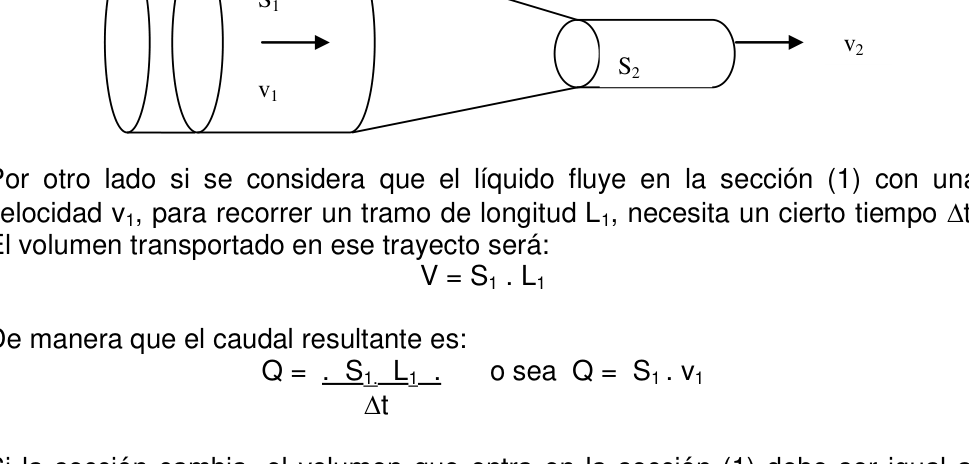
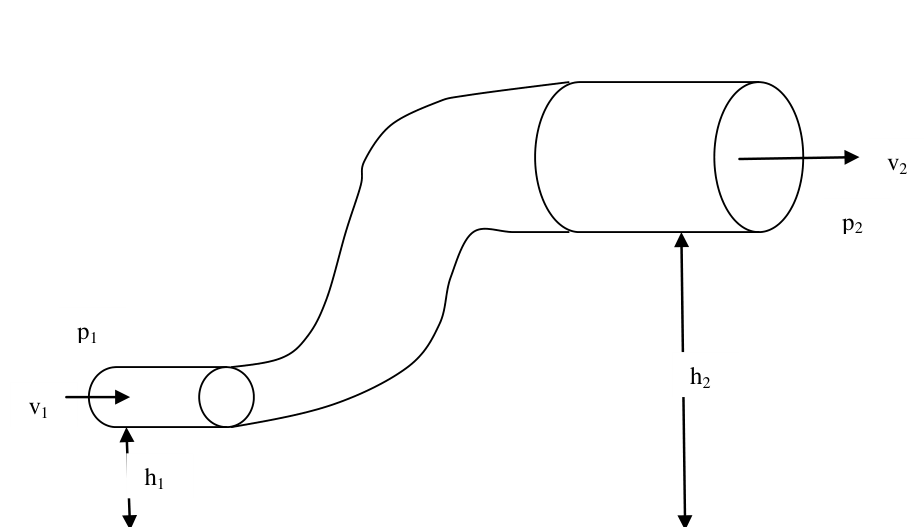
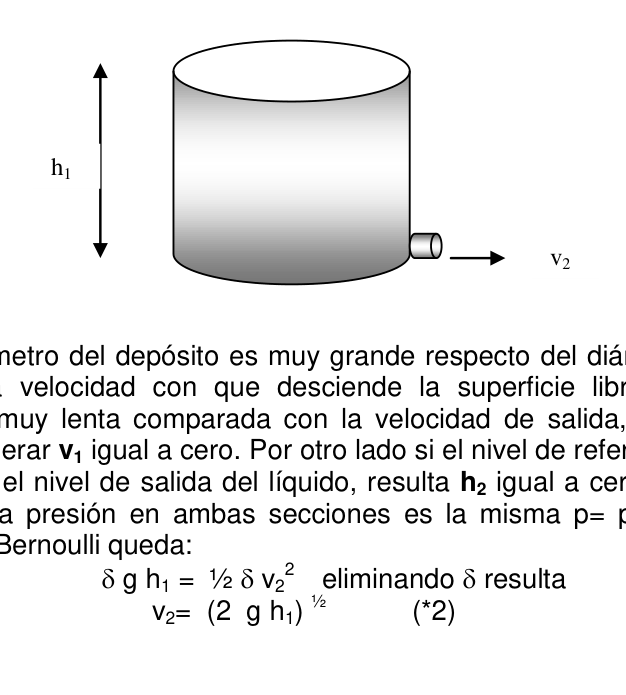
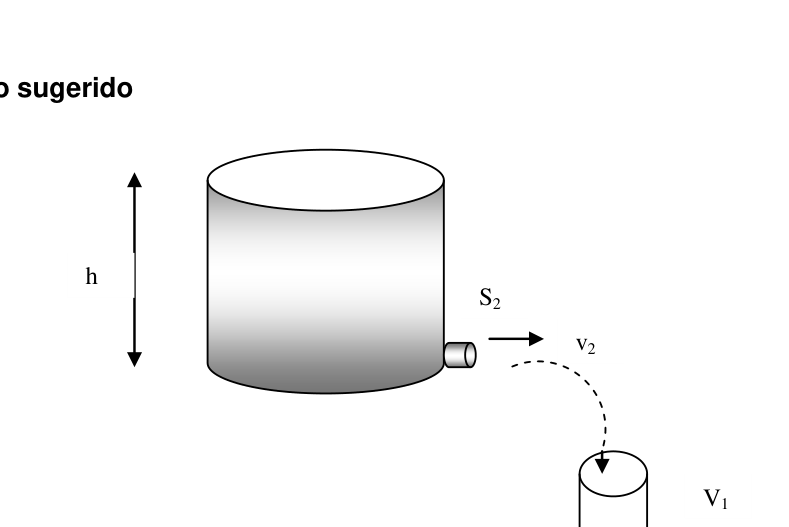
Topic: Fluid Mechanics Metodi: Bernoulli’s Equation, Graph Linearization, Experimental Data Analysis Competenze: Physical Reasoning, Experimental Data Analysis Objects: Container Fonte: Testo (PDF) — p.3
Gravità per idrodinamica
PE6. Scuola Nicolás Avellaneda Aguilar, Tucumán.
Si desidera determinare: accelerazione della gravità, applicando i principi di
- l’idrodinamica.
Per questo è fornito il seguente:
- Un recipiente trasparente per il deposito d’acqua.
- Un recipiente trasparente di vetro, di sezione uniforme.
- Un funile.
OAF 2013 - 125
- Stampo di carta
- Un cronometro.
- Regola.
- Calibro.
- Papero millimetrico.
- Un lapis con inchiostro indelebile.
- Cappelli e supporti per contenitori.
Marco teorico Una magnitudine associata al volume di liquido che in un intervallo di tempo passa attraverso la sezione di un tubo (o di un canale) è chiamato caudal Q. Se il suo valore Non cambia nel tempo. Lo definisce il coefficiente tra il volume di liquido. V, che passa attraverso la sezione e il tempo impiegato t. Quindi Q = . V . Nel sistema MKS le sue unità sono m3/s. .
t
Se invece si considera che il liquido scorre nella sezione (1) con un velocità v1, per percorrere un tratto di lunghezza L1, occorre un certo tempo t. Il volume trasportato in quel percorso sarà: V = S1 . L1
Quindi il flusso risultante è: Q = . S1. L1 . Quindi Q = S1 . v1
t
Se la sezione cambia, il volume che entra nella sezione (1) deve essere uguale a che esce dalla sezione (2), quindi essendo il flusso costante si ottengono che: S1 . v1 = S2 . V2 = costante (*1)
Espressione nota come equazione di continuità, che esprime che La velocità di un fluido ideale che circola attraverso un condotto è inversa. proporzionale alla sezione. Questa equazione è anche conosciuta come di Castelli, che era un discepolo di Torricelli e questo di Galileo.
Teorema di Bernoulli Nel suo studio della dinamica dei fluidi, Daniel Bernoulli ha trovato la relazione fondamentale tra pressione, velocità e altezza per un fluido ideale. Il teorema di Bernoulli dimostra che queste variabili (p, v, h) non possono essere modificate La Commissione ha adottato una proposta di direttiva che prevede che le misure adottate siano state adottate in modo indipendente da ciascuna delle altre parti, ma che siano determinate dalla energia meccanica del sistema. Se si considera un fluido di densità che attraversa un tubo sezione e Altizza variabile, come quella della figura:
v2 S1 v1 S2 L1
OAF 2013 - 126
Si verifica che in qualsiasi punto: la somma della pressione, più l’energia cinetica per unità di volume, più l’energia gravitatoria potenziale per unità di Il volume è costante. p1 + ½ v1 2 + g h1 = p2 + ½ v2 2 + g h2 = costante.
Applicazione di Bernoulli Velocità di uscita di un fluido: Se si dispone di un deposito largo con un piccolo orizzonte di uscita in fondo.
Poiché il diametro del deposito è molto grande rispetto al diametro del foro. di uscita, la velocità con cui scende la superficie libera dell’acqua del il deposito è molto lento rispetto alla velocità di uscita, quindi si si può considerare v1 pari a zero. Se invece il livello di riferimento lo fa se il livello di uscita del liquido coincide con quello del liquido, h2 è pari a zero; e si conta che la pressione in entrambi i sezioni è la stessa p=patm, quindi la L’equazione di Bernoulli è: g h1 = ½ v2 2 eliminando risulta v2= (2 g h1) ½ (*2)
Esperienza Per ottenere g, deve prima determinare: a) Velocità di uscita dell’acqua - da un deposito - da un orificio nella
- La parte inferiore. Applicando l’Equatoria di continuità (*1). b) Accelerazione della gravità, a partire dai risultati della ricerca esperienza (a). Applicando il teorema di Bernoulli, (*2)
v2 h2 p2 h1 v1 p1 h1 v2
OAF 2013 - 127 Metodo suggerito
-
Per determinare la velocità di uscita v2 del liquido si suggerisce di misurare o Calcolare: a) Sezione S1 del recipiente, dove si scende l’acqua. Avendo in dice che ha una sezione uniforme. b) V1 velocità con cui si riempie il contenitore. Per questo. Il programma di lavoro è stato sviluppato in modo da consentire ai giovani di vari misurazioni e grafici di spazio in base al tempo. Previamente realizzando una tabella di valori. c) Determinare la velocità v2 applicando l’equazione (*1). Essendo il diametro dell’apertura di uscita: d2 = (0,20 + 0,02) cm.
-
Per determinare l’accelerazione della gravità g, si suggerisce di determinare: a) Velocità v2 de
-
Esito di cui al
-
La stazione di deposito. Facendo vari
-
di determinare le variazioni di h del liquido in
-
La deposito. b) A partire dall’equazione (*2), scrivere l’equazione con cui determinerà g. c) Fare una tabella di valori e graficare le variabili che corrispondono per ottenere g.
Topic: Fluid Mechanics Metodi: Bernoulli’s Equation, Graph Linearization, Experimental Data Analysis Competenze: Physical Reasoning, Experimental Data Analysis Objects: Container Fonte: Testo (PDF) — p.3
The following shall be added to the list of the following:
PE6. Nicholas Avellaneda College The Eagles, Tucumán.
The determination of gravitational acceleration is to be made by applying the principles of The hydrodynamics.
The following elements are provided:
- A transparent container for water storage.
- A transparent glass container, with a uniform section.
- A funnel.
The following points shall be added:
- Paper tape .
- It’s a timekeeper.
- It’s a rule.
- It’s a caliber.
- It’s a millimeter piece of paper.
- A pencil with indelible ink.
- Supports and container supports.
Theoretical framework A magnitude associated with the volume of liquid that in a time interval passes through the section of a tube (or channel) is called flow Q. If your worth It does not change over time. It is defined as the ratio between the volume of liquid. V, passing through the section and time spent t. So Q is equal to . V . In the MKS system its units are m3/s. .
t
On the other hand, if the liquid is considered to flow in section (1) with a speed v1, to travel a L1 length stretch, it takes a certain time t. The volume transported on that route shall be: V = S1 . L1
So the resulting flow rate is: Q = . S1. L1 . So Q is S1 . v1
t
If the section changes, the volume entering section (1) shall be equal to the flow rate is constant, the following shall be fulfilled: S1 . v1 = S2 . The following is the list of the following:
An expression known as a continuity equation, which expresses that The speed of an ideal fluid flowing through a conduit is inversely proportional. proportionate to the section. This equation is also known as Castelli’s equation. who was a disciple of Torricelli and this disciple of Galileo.
The Bernoulli theorem . In the study of fluid dynamics, Daniel Bernoulli found the relationship It’s fundamental between pressure, speed and height for an ideal fluid. The theorem of Bernoulli shows that these variables (p, v, h) cannot be modified The two are independent of each other, but are determined by the mechanical energy of the system. If a density fluid is considered passing through a section tube and variable height, such as that in the figure:
v2 S1 v1 S2 L1
The following points shall be added:
It turns out that at any point: the sum of the pressure, plus the kinetic energy per unit of volume, plus the gravitational potential energy per unit of The volume is constant. p1 + ½ v1 2 + g h1 = p2 + ½ v2 2 + g h2 = constant.
The application of Bernoulli The speed of a fluid’s outlet: If you have a wide tank with a small exit hole at the bottom.
Because the diameter of the tank is very large relative to the diameter of the hole. The rate at which the free surface of water of the water falls The deposit is very slow compared to the output speed, therefore it is You can consider v1 to be equal to zero. On the other hand, if the reference level does so If the liquid is at the same level as the liquid, h2 is zero and having It counts that the pressure in both sections is the same p=patm, so the Bernoulli’s equation is: g h1 = ½ v2 2 by eliminating results v2= (2 g h1) ½ (*2)
Experience To obtain g, you must first determine: (a) Water exit speed from a reservoir through a hole in the water the lower part. The following is the list of the following: (b) Acceleration of gravity, based on the results of the experience (a). Applying the Bernoulli theorem, (*2)
v2 h2 p2 h1 v1 p1 h1 v2
The following points shall be added: Suggested method
-
To determine the v2 outlet velocity of the liquid it is suggested to measure or calculate: (a) Section S1 of the container where the water will fall. Having in He says he has a uniform section. (b) V1 speed at which the container is filled. For that . The Commission has a rule and a timekeeper, and if possible, it can do so. Several measurements and graphing space based on time. By pre-constructing a value table. (c) Determine the speed v2 by applying the equation (*1). Being the The output hole diameter: d2 = (0,20 + 0,02) cm.
-
To determine the acceleration of gravity g, it is suggested to determine: (a) Speed v2 de Out of the way of the The deposit. Doing it . several The following is a list of the different levels of liquidity in the I’m going to deposit. (b) Starting from the equation (*2), write the equation with which shall determine g. (c) Make a table of values and chart the variables that The values of the values of the values of the values of the values of the values of the values of the values of the values of the values of the values of the values of the values of the values of the values of the values of the values of the values of the values of the values of the values of the values of the values of the values of the values of the values of the values of the values of the values of the values of the values of the values of the values of the values of the values of the values of the values of the values of the values of the values of the values of the values of the values of the values of the values of the values of the values of the values of the values of the values of the values of the values of the values of the values of the values of the values of the values of the values of the values of the values of the values of the values of the values of the values of the values of the values of the values of the values of the values of the values of the values of the values of the values of the values of the values of the values of the values of the values of the values of the values of the values of the values of the values of the values of the values of the values of the values of the values of the values of the values of the values of the values of the values of the values of the values of the values of the values of the values of the values of the values of the values of the values of the values of the values of the values of the values of the values of the values of the values of the values of the values of the values of the values of the values of the values of the values of the values of the values of the values of the values of the values of the values of the values of the values of the values of the values of the values of the values of the values of the values of the values of the values of the values of the values of the values of the values of the values of the values of the values of the values of the values of the values of the values of the values of the values of the values of the values of the values of the values of the values of the values of the values of the values of the values of the values of the values of the values of the values of the values of the values of the values of the values of the values of the values of the values of the values of the values of the values of the values of the values of the
Topic: Fluid Mechanics Metodi: Bernoulli’s Equation, Graph Linearization, Experimental Data Analysis Competenze: Physical Reasoning, Experimental Data Analysis Objects: Container Fonte: Testo (PDF) — p.3
Resistividad de un alambre
PE7. Colegio San Ignacio Río Cuarto, Córdoba.
En este experimento se investigará la resistividad de un metro de alambre con- ductor. a) Conecte el circuito de la Figura 1 b) b1) Cierre el circuito de la Figura 1 para un dado valor de longitud x y mida los correspondientes valores de diferencia de potencial V y corriente I. Ι = V = b2) Determine por medio de un micrómetro el diámetro d del cable de alambre. d = h v2 V1 S1 S2
OAF 2013 - 128 b3) Estime los errores de medición de: d = Ι = V =
Figura 1
c) Ajuste el valor de longitud x y repita b. i. hasta tener un conjunto de
valores de I y V. Calcule para cada caso el valor de resistencia R del
alambre. Incluya todas las mediciones en una tabla.
Abra el circuito cuando haya terminado de realizar las mediciones.
d)
d1) Grafique R vs. x.
d2) Dibuje la línea de mejor ajuste.
e) La teoría sugiere que las cantidades R y x están relacionadas por la
ecuación:
ρ
,
donde R es la resistencia del alambre, la resistividad del material, A la
sección del alambre y x la longitud del mismo.
Determine el valor de con su respectivo error, sabiendo que la sección
del alambre está dado por A=×r2 en donde r es el radio del alambre.
=
Topic: Circuits Metodi: Graph Linearization, Error Propagation, Experimental Data Analysis Competenze: Physical Reasoning, Experimental Data Analysis Objects: Wire, Resistor Fonte: Testo (PDF) — p.3
Resività di un filo
PE7. Scuola San Ignacio Rio Cuarto, Córdoba.
In questo esperimento si esaminerà la resistenza di un metro di filo con
- Docente. a) Connettere il circuito di Figura 1 b) b1) Chiudere il circuito di Figura 1 per un dato valore di lunghezza x e misura i relativi valori di differenza di potenziale V e corrente I. Ι = V = b2) Determina con un micrometro il diametro d del cavo di
- Il filo. d = h v2 V1 S1 S2
OAF 2013 - 128 b) Valutare gli errori di misurazione di: d = Ι = V =
Figura 1
c) Aggiusta il valore di lunghezza x e ripeta b. i. fino a avere un insieme di Valori di I e V. Calcolare per ogni caso il valore di resistenza R di
- Il filo. Include tutte le misure in una tabella.
Apri il circuito quando hai finito di eseguire le misure.
d)
d1) Grafico R vs. x. d2) Disegnare la linea di miglior regolazione. e) La teoria suggerisce che le quantità R e x sono correlate da Equazione:
ρ
,
dove R è la resistenza del filo, la resistenza del materiale, A la
sezione del filo e x la sua lunghezza.
Determina il valore di con il relativo errore, sapendo che la sezione
di filo è dato da A=×r2 dove r è il raggio del filo.
=
Topic: Circuits Metodi: Graph Linearization, Error Propagation, Experimental Data Analysis Competenze: Physical Reasoning, Experimental Data Analysis Objects: Wire, Resistor Fonte: Testo (PDF) — p.3
The value of the underlying material shall be the sum of the values of the underlying materials.
PE7. St. Ignatius College The fourth river, Cordoba.
In this experiment, the resistance of a meter of wire with Doctor, please. (a) Connect the circuit in Figure 1 b) (b1) Close the circuit in Figure 1 for a given value of length x and measurement of the corresponding potential difference values V and current I. Ι = V = (b2) Determine by a micrometer the diameter of the wire of Wire. d = h v2 V1 S1 S2
The following is the list of the Member States’ financial statements: (b3) Estimate the measurement errors of: d = Ι = V =
Figure 1
(c) Adjust the length value x and repeat b. i. Until you have a set of
values of I and V. Calculate for each case the resistance value R of
Wire. Include all measurements in one table.
Open the circuit when you’re done with the measurements.
d)
(d1) Graph R vs. x.
d2) Draw the line of best fit.
e) The theory suggests that the quantities R and x are related by the
Equation:
ρ
,
where R is the resistance of the wire, the resistance of the material, A is the
section of wire and x length of wire.
Determine the value of with its respective error, knowing that the
of the wire is given by A=×r2 where r is the wire radius.
=
Topic: Circuits Metodi: Graph Linearization, Error Propagation, Experimental Data Analysis Competenze: Physical Reasoning, Experimental Data Analysis Objects: Wire, Resistor Fonte: Testo (PDF) — p.3
Densidad de un cuerpo geometrico
PE8. Instituto Superior Enrique Guillermo Hood(1)
Escuela Preuniversitaria Prof. Vicente Aguilera(1)
Colegio Padre Ramón de la Quintana(1)
Instituto Superior FASTA Catamarca(1) Colegio del Carmen y San José(1)
Escuela Secundaria Nº 21 República de Venezuela(2)
San Fernando del Valle(1) - Andalgalá(2), Catamarca.
Cálculo de la densidad de un cuerpo geometrico
Objetivos:
Calcular el volumen del cuerpo de forma regular.
Calcular la densidad del mismo.
Lista de materiales: Cuerpo de forma regular. Regla
OAF 2013 - 129 Balanza electrónica
Procedimiento: 1- Calcule el volumen del cuerpo geométrico, para ello utilice los siguientes datos:
Figura Esquema Volumen Prisma V = área base x h Área de la base= axb Donde h es la altura
2- Mida la masa de cada cuerpo usando la balanza de precisión.
3- Calcule la densidad de cada cuerpo de acuerdo a la ecuación:
V
m
D
,
donde D es la densidad, m es la masa y V el volumen del cuerpo
Requerimientos: Al finalizar la experiencia deberá entregar un informe escrito con letra clara, que conste de: Planteo del problema. Valores obtenidos en las mediciones, tablas, gráficos. Fuentes de error y análisis de como influyen en el resultado final. Resultado experimental de lo solicitado. Conclusiones. Comentarios que desee realizar referidos dificultades relacionadas a la realización de la experiencia.
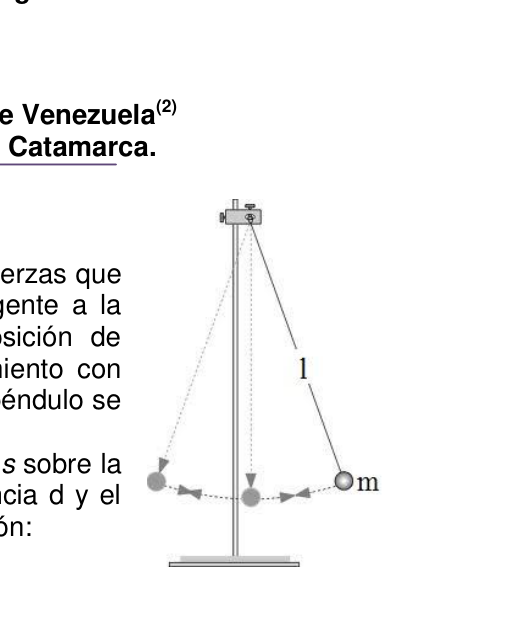
Topic: Fluid Mechanics Metodi: Error Propagation, Experimental Data Analysis Competenze: Physical Reasoning, Experimental Data Analysis Objects: Block Fonte: Testo (PDF) — p.3
Densità di un corpo geometrico
PE8. Instituto Superior Enrique Guillermo Hood(1)
Scuola Preuniversitaria Prof. Vicente Aguilera (1)
Colegio Padre Ramón de la Quintana(1)
Istituto superiore FASTA Catamarca (Istituto superiore FASTA Catamarca) Colegio del Carmen e San José (CC) 1)
Scuola secondaria n. 21 Repubblica del Venezuela(2)
San Fernando del Valle (1) - Andalgalá (2), Catamarca.
Calcolo della densità di un corpo geometrico Obiettivi: Calcolare il volume corporeo regolarmente. • Calcolare la densità di questo.
Lista dei materiali:
- Corpo in modo regolare. Regola
OAF 2013 - 129 Balance elettronica
Procedura: 1- Calcolare il volume del corpo geometrico, utilizzando i seguenti dati:
Figura schema Volume Prisma V = area base x h Area di base= axb Dove h è l’altezza
2- Misurare la massa di ogni corpo usando la bilancia di precisione. 3- Calcola la densità di ogni corpo secondo l’equazione: V m D , dove D è la densità, m è la massa e V il volume del corpo
Requisiti: Al termine dell’esperienza dovrà presentare un rapporto scritta in chiaro, che contiene: • La presentazione del problema. Valori ottenuti in misurazioni, tabelle, grafici. Fonti di errore e analisi di come influenzano il risultato finale. • Risultato sperimentale della richiesta. • Conclusioni. Commenti che desiderino fare riguardo alle difficoltà di cui trattasi realizzazione dell’esperienza.
Topic: Fluid Mechanics Metodi: Error Propagation, Experimental Data Analysis Competenze: Physical Reasoning, Experimental Data Analysis Objects: Block Fonte: Testo (PDF) — p.3
The value of the underlying material shall be the sum of the values of the underlying materials.
PE8. The school is a private institution.
Pre-university school Prof. Vicente Aguilera (born 1 January 1943)
Father Ramón de la Quintana College (Father Ramón de la Quintana) is located in Quintana.
The following is the list of the institutions of higher education in Spain: College of Carmen and San José (s)
Secondary School No 21 Republic of Venezuela(2)
The following is a list of the regions of Spain and Portugal.
Calculation of density of a geometric body Objectives: • Calculate your body volume on a regular basis. • Calculate the density of the sample.
List of materials: • Body on a regular basis. Rule
The following is the list of the countries of the European Union: Electronic balance sheet
The procedure: 1- Calculate the geometric body volume, using the following data:
Figure of the Scheme The volume Prism V = base area x h Base area = axb Where h is the height
2- Measure the mass of each body using the precision scale. 3- Calculate the density of each body according to the equation: V m D , where D is density, m is mass and V is body volume.
Requirements: At the end of the experience you must submit a report in clear writing, consisting of: • The problem is raised. • Value obtained from measurements, tables, charts. Source of error and analysis of how they influence the final result. • Experimental result of the requested product. • Conclusions comments on the difficulties related to the The Commission will be consulted on the following points:
Topic: Fluid Mechanics Metodi: Error Propagation, Experimental Data Analysis Competenze: Physical Reasoning, Experimental Data Analysis Objects: Block Fonte: Testo (PDF) — p.3
Medicion de g con pendulo simple
PE9. Instituto Superior Enrique Guillermo Hood(1)
Escuela Preuniversitaria Prof. Vicente Aguilera(1)
Colegio Padre Ramón de la Quintana(1)
Instituto Superior FASTA Catamarca(1) Colegio del Carmen y San José(1)
Escuela Secundaria Nº 21 República de Venezuela(2)
San Fernando del Valle(1) - Andalgalá(2), Catamarca.
Medición de g mediante un péndulo simple Introducción En un péndulo simple, la composición de las fuerzas que actúan da como resultante una fuerza F tangente a la trayectoria, que tiende a restituirlo a su posición de equilibrio y que es proporcional al desplazamiento con signo negativo; por lo tanto el movimiento del péndulo se asemeja al movimiento armónico simple. Para pequeñas amplitudes la longitud del arco s sobre la trayectoria del péndulo se asemeja a la distancia d y el período se puede calcular a partir de la expresión:
OAF 2013 - 130 g l T . 2
que relaciona al período T con la longitud l del péndulo, donde: T es el periodo, l es la longitud y g es la aceleración de la gravedad que se quiere determinar.
Objetivos:
Determinar el valor de g mediante el péndulo simple.
Lista de materiales: Soporte Esfera de metal Cronómetro Transportador Cinta métrica
Procedimiento:
a) Arme el dispositivo convenientemente
b) Mida el período de oscilación del péndulo. (Para reducir error tome el
tiempo que el péndulo realiza 10 oscilaciones y divida el resultado en
10)
c) Complete la siguiente tabla:
l(cm) t(s) T(s)=t/n* Tprom. (s) Tprom2 (s2)
n*=nro de oscilaciones=10
f- Calcule el valor de g.
Requerimentos: Al finalizar la experiencia deberá entregar un informe escrito con letra clara, que conste de : Planteo del problema Valores obtenidos en las mediciones, tablas, gráficos. Fuentes de error y análisis de como influyen en el resultado final. Resultado experimental de lo solicitado. Conclusiones Comentarios que desee realizar referidos dificultades relacionadas a la realización de la experiencia.
Topic: Oscillations & Waves Metodi: Simple Harmonic Motion Analysis, Graph Linearization, Experimental Data Analysis Competenze: Physical Reasoning, Experimental Data Analysis Objects: Pendulum Fonte: Testo (PDF) — p.3
Medizione di g con pendolo semplice
PE9. Instituto Superior Enrique Guillermo Hood(1)
Scuola Preuniversitaria Prof. Vicente Aguilera (1)
Colegio Padre Ramón de la Quintana(1)
Istituto superiore FASTA Catamarca (Istituto superiore FASTA Catamarca) Colegio del Carmen e San José (CC) 1)
Scuola secondaria n. 21 Repubblica del Venezuela(2)
San Fernando del Valle (1) - Andalgalá (2), Catamarca.
Misurazione di g con un semplice pendolo Introduzione In un semplice pendolo, la composizione delle forze che La forza F tangente alla La sua traccia, che tende a riportarlo alla sua posizione di equilibrio e che è proporzionale al spostamento con segno negativo; quindi il movimento del pendolo si assomiglia al semplice movimento armonico. Per piccole amplitudini la lunghezza dell’arco sopra la La traccia del pendolo si assomiglia alla distanza d e il periodo può essere calcolato a partire dall’espressione:
OAF 2013 - 130 g l T . 2
che correla il periodo T con la lunghezza l del pendolo, dove: T è il periodo, l è la lunghezza e g è l’accelerazione della gravità che si vuole determinare.
Obiettivi: Determinare il valore di g con il semplice pendolo.
Lista dei materiali: Supporto Sfera metallica Cronometro Trasportatore Cintura metrica
Procedura: a) Armati il dispositivo in modo appropriato b) Misura il periodo di oscillazione del pendolo. (Per ridurre l’errore, prendi il Il tempo che il pendolo fa 10 oscillazioni e divide il risultato in 10) c) Completa la tabella seguente:
l(cm) t(s) T(s)=t/n* Pronto. (s) Tprom2 (s2)
n*=n di oscillazioni=10
f- Calcolare il valore di g.
Requisiti: alla fine dell’esperienza dovrà presentare un rapporto scritta in carattere chiaro, che contiene: Sorgere del problema Valori ottenuti in misurazioni, tabelle, grafici. Fonti di errore e analisi di come influenzano il risultato finale. • Risultato sperimentale della richiesta. Conclusioni Commenti che desiderino fare riguardo alle difficoltà di cui trattasi realizzazione dell’esperienza.
Topic: Oscillations & Waves Metodi: Simple Harmonic Motion Analysis, Graph Linearization, Experimental Data Analysis Competenze: Physical Reasoning, Experimental Data Analysis Objects: Pendulum Fonte: Testo (PDF) — p.3
Measurement of g with simple pendulum
PE9. The school is a private institution.
Pre-university school Prof. Vicente Aguilera (born 1 January 1943)
Father Ramón de la Quintana College (Father Ramón de la Quintana) is located in Quintana.
The following is the list of the institutions of higher education in Spain: College of Carmen and San José (s)
Secondary School No 21 Republic of Venezuela(2)
The following is a list of the regions of Spain and Portugal.
Measurement of g by a simple pendulum The first is the introduction. In a simple pendulum, the composition of the forces that The resulting force F is tangent to the The Commission’s proposal for a directive on the protection of workers from the risks of unemployment The balance of the two is proportional to the displacement with the negative sign; therefore the movement of the pendulum is It’s like a simple harmonic movement. For small amplitudes the length of the arc s over the The pendulum path is similar to the distance d and the period can be calculated from the expression:
The following points shall be added: g l T . 2
which relates the period T to the length l of the pendulum, where: T is the period, l is the length and g is the acceleration of gravity that you want to determine.
Objectives: Determine the value of g using the simple pendulum.
List of materials: Support Metal sphere The timekeeper Carrier Metric tape
The procedure: (a) Arming the device appropriately (b) Measure the period of oscillation of the pendulum. (To reduce error take the The time the pendulum takes is 10 oscillations and divides the result by 10) (c) Complete the following table:
l(cm) t(s) T(s)=t/n* I’ll see you later. (s) Tprom2 (s2)
The value of the input data shall be the sum of the values of the input data.
f- Calculate the value of g.
Requirements: At the end of the experience you must submit a report written in clear writing, consisting of: Problem setting • Value obtained from measurements, tables, charts. Source of error and analysis of how they influence the final result. • Experimental result of the requested product. Conclusions comments on the difficulties related to the The Commission will be consulted on the following points:
Topic: Oscillations & Waves Metodi: Simple Harmonic Motion Analysis, Graph Linearization, Experimental Data Analysis Competenze: Physical Reasoning, Experimental Data Analysis Objects: Pendulum Fonte: Testo (PDF) — p.3
Variables de circuito mixto CC
PE10. Instituto Superior Enrique Guillermo Hood(1)
Escuela Preuniversitaria Prof. Vicente Aguilera(1)
Colegio Padre Ramón de la Quintana(1)
Instituto Superior FASTA Catamarca(1) Colegio del Carmen y San José(1)
Escuela Secundaria Nº 21 República de Venezuela(2)
San Fernando del Valle(1) - Andalgalá(2), Catamarca.
Medición de las variables involucradas en un circuito mixto de corriente
continua
Objetivo:
Investigar las variables involucradas en la resolución de un circuito
mixto
OAF 2013 - 131 Lista de materiales: Resistencias Cables Pilas Multímetro digital
Procedimiento:
- Dibuje esquemáticamente el circuito de corriente continua que se le provee, el mismo está compuesto por 3 (tres) resistencias, dos pilas (en portapilas) y cables de conexión.
- Mida con el multímetro (fig 2) el valor de cada resistencia y el de la resistencia equivalente del circuito.
- Calcule y mida la corriente total y la corriente que circula por cada resistencia. Asegúrese de conocer el valor correcto (teórico) de la corriente antes de conectar el multímetro al circuito, a fin de no dañar el mismo. Consulte al Coordinador antes de proceder a la conexión del multímetro.
- Calcule el error porcentual entre el valor medido y el valor calculado de la corriente. Explique sus resultados.
- Calcule y mida la diferencia de potencial y la corriente en cada resistencia.
Requerimientos: Al finalizar la experiencia deberá entregar un informe escrito con letra clara, que conste de : Planteo del problema Valores obtenidos en las mediciones, tablas, gráficos. Fuentes de error y análisis de como influyen en el resultado final. Resultado experimental de lo solicitado. Conclusiones Comentarios que desee realizar referidos dificultades relacionadas a la realización de la experiencia.
- Display de cristal líquido.
- Escala o rango para medir resis- tencia.
- Llave selectora de medición.
- Escala o rango para medir tensión
en continua (puede indicarse DC en vez de una línea continua y otra punteada). - Escala o rango para medir corrien-
te en continua (puede venir DC en
lugar de una línea continua y otra punteada).
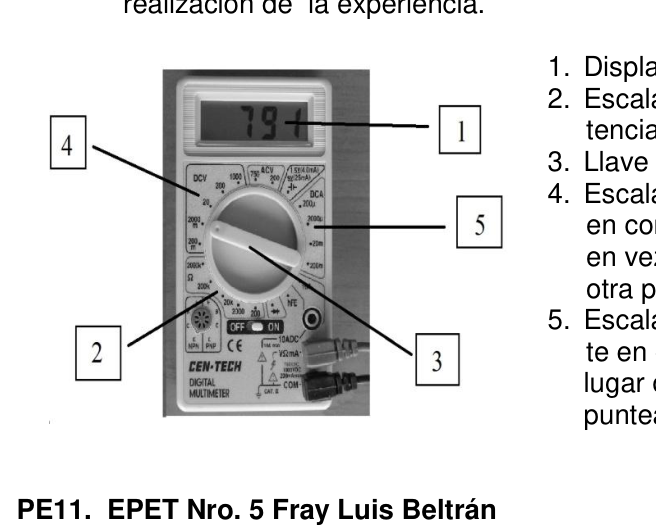
Topic: Circuits Metodi: Kirchhoff’s Laws, Error Propagation, Experimental Data Analysis Competenze: Physical Reasoning, Experimental Data Analysis Objects: Resistor, Battery Fonte: Testo (PDF) — p.3
Variabili di circuito misto CC
PE10. Instituto Superior Enrique Guillermo Hood(1)
Scuola Preuniversitaria Prof. Vicente Aguilera (1)
Colegio Padre Ramón de la Quintana(1)
Istituto superiore FASTA Catamarca (Istituto superiore FASTA Catamarca) Colegio del Carmen e San José (CC) 1)
Scuola secondaria n. 21 Repubblica del Venezuela(2)
San Fernando del Valle (1) - Andalgalá (2), Catamarca.
Misurazione delle variabili coinvolte in un circuito mixto di corrente Continua Obiettivo: Ricerca delle variabili coinvolte nella risoluzione di un circuito mixto
OAF 2013 - 131 Lista dei materiali: Resistenze Cavi Pilas Multimetro digitale
Procedura:
- Disegna schematicamente il circuito di corrente continua che ti viene dato La struttura è composta da 3 (tre) resistenze, due pilastri (in La Commissione ha adottato una decisione che prevede che le misure di cui all’articolo 6 del regolamento (CEE) n.
- Misura con il multimetro (fig. 2) il valore di ciascuna resistenza e quello della resistenza. resistenza equivalente del circuito.
- Calcolare e misurare il corrente totale e il corrente che circola per ciascuna resistenza. Assicurati di conoscere il giusto valore (teorico) della corrente prima di collegare il multimetro al circuito, in modo da non danneggiare il
- Proprio così. Consulta il coordinatore prima di collegare il sistema.
- Il multimetro.
- Calcola l’errore percentuale tra il valore misurato e il valore calcolato di
- Il corrente. Spiegate i risultati.
- Calcolare e misurare la differenza di potenziale e corrente in ciascuna resistenza.
Requisiti: Al termine dell’esperienza dovrà presentare un rapporto scritta in carattere chiaro, che contiene: Sorgere del problema Valori ottenuti in misurazioni, tabelle, grafici. Fonti di errore e analisi di come influenzano il risultato finale. • Risultato sperimentale della richiesta. Conclusioni Commenti che desiderino fare riguardo alle difficoltà di cui trattasi realizzazione dell’esperienza.
- Display di cristallo liquido.
- Scala o gamma per misurare la resistenza
- La tensione.
- Chiudice di misura.
- Scala o gamma per misurare la tensione continuità (potrebbe essere indicato DC invece di una linea continua e un’altra puntata).
- Scala o gamma per misurare corriere Ti in continua (può venire DC in luogo di una linea continua e un’altra puntata).
Topic: Circuits Metodi: Kirchhoff’s Laws, Error Propagation, Experimental Data Analysis Competenze: Physical Reasoning, Experimental Data Analysis Objects: Resistor, Battery Fonte: Testo (PDF) — p.3
The following shall be added to the list of the components of the engine:
PE10. The school is a private institution.
Pre-university school Prof. Vicente Aguilera (born 1 January 1943)
Father Ramón de la Quintana College (Father Ramón de la Quintana) is located in Quintana.
The following is the list of the institutions of higher education in Spain: College of Carmen and San José (s)
Secondary School No 21 Republic of Venezuela(2)
The following is a list of the regions of Spain and Portugal.
Measurement of the variables involved in a mixed current circuit It ‘s going on . The objective: Research the variables involved in the resolution of a circuit mixed
The following points shall be added: List of materials: Resistance Cables Pilas Digital multimeter
The procedure:
- Schematically draw the DC circuit to be given The same is composed of 3 (three) resistors, two batteries (in The Commission shall adopt implementing acts in accordance with Article 21 of Regulation (EC) No 1272/2006.
- Measure with the multimeter (figure 2) the value of each resistor and the value of the resistor. equivalent resistance of the circuit.
- Calculate and measure the total current and the current circulating for each resistance. Make sure you know the correct (theoretical) value of the current before connecting the multimeter to the circuit, so as not to damage the I’m not. Please consult the Coordinator before connecting the The multi-meter.
- Calculate the percentage error between the measured value and the calculated value of the current. Explain your results.
- Calculate and measure the potential and current difference in each resistance.
Requirements: At the end of the experience you must submit a report written in clear writing, consisting of: Problem setting • Value obtained from measurements, tables, charts. Source of error and analysis of how they influence the final result. • Experimental result of the requested product. Conclusions comments on the difficulties related to the The Commission will be consulted on the following points:
- Liquid glass display.
- Scale or range for measuring resis- I’m going to try.
- Measurement selector key.
- The scale or range for measuring voltage continuous (can be indicated as DC Instead of a straight line and Another one pointed .
- Scale or range for measuring run- You can come to DC in place of one continuous line and another (pointed).
Topic: Circuits Metodi: Kirchhoff’s Laws, Error Propagation, Experimental Data Analysis Competenze: Physical Reasoning, Experimental Data Analysis Objects: Resistor, Battery Fonte: Testo (PDF) — p.3
Mediciones con calibre - errores
PE11. EPET Nro. 5 Fray Luis Beltrán
Apóstoles, Misiones.
Medición con calibre - Cálculo del error - Aplicación de las leyes estadísticas Se realizan una cierta cantidad de mediciones de una pieza de un motor de combustión y se realiza la siguiente tabla:
OAF 2013 - 132 MEDICION VALOR MEDIDO (EN MILIMETROS) V1 78,3 mm V2 78,2 mm V3 78,3 mm V4 78,1 mm V5 78,1 mm V6 78,2 mm V7 78,2 mm
VN
a. Hallar el valor promedio de la medición VPROM.
(VPROM = (∑ VK ) / N CON 1 < K< N)
b. Calcular los errores absolutos de cada valor medido, respecto del VPROM (ErAbs K = VK – VPROM)
c. Calcular los errores relativos de cada valor medido. (ErRel K = ErAbs K / VPROM)
d. Calcular los errores relativos porcentuales de cada valor medido. (ErRel K % = ErRel K . 100 %)
e. Colocar en una única tabla todos los valores calculados en los incisos
anteriores.
f.
g. Calcular la Varianza σ 2 y la Desviación estándar σ para los valores
medidos.
(Desviación est ndar σ = (∑ (VK – VPROM)2 / (N- 1)) 0.5 y
Varianza σ 2 = ∑ (VK – VPROM)2 / (N-1))
h. Realizar un Grafico Estadístico donde se representen los valores medidos y la frecuencia de ocurrencia de los mismos.
i. Superponer sobre el Grafico anterior la Función Probabilística de Gauss o Campana de Gauss y comparar los resultados para una distancia σ, 2 σ, 3 σ, 4 σ y 5 σ.
Topic: Mathematics Metodi: Error Propagation, Statistical Averaging, Experimental Data Analysis Competenze: Physical Reasoning, Experimental Data Analysis Objects: — Fonte: Testo (PDF) — p.3
Messi con calibro - errori
PE11. Il numero di EPET. 5 Fray Luis Beltrán
Apostoli, Missioni.
Misura con calibro - Calcolo dell’errore - Applicazione delle leggi statistiche Si effettuano una certa quantità di misurazioni di un pezzo di un motore di la combustione e si fa la seguente tabella:
OAF 2013 - 132 MEDICIO VALORE MEDIATO (in millimetri) V1 78,3 mm V2 78,2 mm V3 78,3 mm V4 78,1 mm V5 78,1 mm V6 78,2 mm V7 78,2 mm
VN
a. Trovare il valore medio della misurazione VPROM. (VPROM = ( VK ) / N CON 1 < K< N)
b. Calcolare gli errori assoluti di ogni valore misurato, rispetto al VPROM (ErAbs K = VK VPROM)
c. Calcolare gli errori relativi di ogni valore misurato. (ErRel K = ErAbs K / VPROM)
d. Calcolare gli errori relativi percentuali di ogni valore misurato. (ErRel K % = ErRel K . 100 %)
e. Mettere in una sola tabella tutti i valori calcolati in allegato precedenti. f. g. Calcolare la Variazione σ 2 e la deviazione standard σ per i valori misurazioni. (Scigliazione est ndar σ = ( (VK VPROM) 2 / (N- 1)) 0.5 e Variazione σ 2 = (VK VPROM) 2 / (N-1))
h. Realizzare un grafico statistico che rappresenti i valori La misurazione e la frequenza di accadezza di tali misure.
i. Superpone la funzione probabilistica di Gauss sul grafico precedente o Campana di Gauss e confrontare i risultati per una distanza σ, 2 σ, 3 σ, 4 σ y 5 σ.
Topic: Mathematics Metodi: Error Propagation, Statistical Averaging, Experimental Data Analysis Competenze: Physical Reasoning, Experimental Data Analysis Objects: — Fonte: Testo (PDF) — p.3
The measurement of the measurement shall be carried out in accordance with the following steps:
PE11. The following information shall be provided: 5 Fray Luis Beltran
Apostles, missions, what are you doing?
Measurement with caliber - Error calculation - Law enforcement Statistics A certain number of measurements of a part of an engine are made. The following table is used:
The following is the list of the countries of the European Union: The average value of the medicinal product (in millimetres) is V1 78,3 mm V2 78,2 mm V3 78,3 mm V4 78,1 mm V5 78,1 mm V6 78,2 mm V7 78,2 mm
VN
a. Find the mean value of the VPROM measurement. The following table shows the results of the calculation of the total cost of the vehicle:
b. Calculate the absolute errors of each measured value, relative to the The Commission shall adopt implementing acts. The following is the list of the types of products which are subject to the approval of the competent authority:
c. Calculate the relative errors of each measured value. The following table shows the results of the tests:
d. Calculate the relative errors as a percentage of each measured value. (ErRel K % = ErRel K . 100 %)
e. Put all the values calculated in the incisos in a single table previously. f. g. Calculate the Variance σ 2 and the Standard Deviation σ for values measured. (Divolution is σ = ( (VK VPROM) 2 / (N- 1)) 0.5 and The following is the list of the values of the values of the values of the values of the values of the values of the values of the values of the values of the values of the values of the values of the values of the values of the values of the values of the values of the values of the values of the values of the values of the values of the values of the values of the values of the values of the values of the values of the values of the values of the values of the values of the values of the values of the values of the values of the values of the values of the values of the values of the values of the values of the values of the values of the values of the values of the values of the values of the values of the values of the values of the values of the values of the values of the values of the values of the values of the values of the values of the values of the values of the values of the values of the values of the values of the values of the values of the values of the values of the values of the values of the values of the values of the values of the values of the values of the values of the values of the values of the values of the values of the values of the values of the values of the values of the values of the values of the values of the values of the values of the values of the values of the values of the values of the values of the values of the first of the values of the first of the values of the values of the first values of the first values of the first values of the first values of the first values of the first values of the first values of the first values of the first values of the first values of the first values of the first of the first of the first of the first paragraph.
h. To produce a statistical chart representing the values The Commission shall adopt the following measures:
i. Overlay the Gauss probabilistic function over the previous graph or Gauss’s Bell and compare the results for a distance σ, 2 σ, 3 σ, 4 σ y 5 σ.
Topic: Mathematics Metodi: Error Propagation, Statistical Averaging, Experimental Data Analysis Competenze: Physical Reasoning, Experimental Data Analysis Objects: — Fonte: Testo (PDF) — p.3
Constante elastica de un resorte (Hooke)
PE12. Escuela Técnica Ort Nro. 2
Ciudad de Buenos Aires.
Determinación de la constante elástica de un resorte y Ley de Hooke. Objetivos
- Calcular experimentalmente la constante elástica K de un resorte por el método estático
- Describir los errores de la medición y explicar sus causas. -Hallar la constante elástica por el método dinámico de dos resortes iguales dispuestos en serie y en paralelo.
Materiales
Resorte, cuerpos de distintas masas, regla graduada, calibre, pie metálico, aro
metálico, cronómetro, balanza.
OAF 2013 - 133 Introducción El estiramiento de un resorte está determinado por la ley de Hooke, que establece que el desplazamiento que experimenta cualquier material elástico es proporcional a la fuerza aplicada.
(1)
Donde F es la fuerza aplicada, es la constante elástica y es el
estiramiento del resorte. La constante k depende del material del resorte, de su
forma geométrica y su construcción. Si la fuerza que se aplica sobre el resorte
supera un cierto límite, el mismo quedará deformado permanentemente y la ley
de Hooke ya no se cumpliría. Cuando a un resorte se le cuelga una pesa, se
estira; si luego se lo libera, el mismo realiza un movimiento oscilatorio que puede
caracterizarse como movimiento armónico simple (MAS).
Teniendo en cuenta que es un movimiento armónico, se puede relacionar el
período de oscilación (el tiempo que tarda el resorte en realizar una oscilación
completa), la velocidad angular, la constante elástica y el estiramiento mediante
las siguientes relaciones
(2)
Procedimiento Método Estático
- Colocar el resorte en posición vertical suspendido del soporte.
Considerar la longitud inicial del resorte. - Colgar del mismo una pesa de masa conocida.
- Medir el alargamiento que se produce al colocar la masa.
- Repetir los pasos anteriores con distintas masas
- Graficar la relación entre la fuerza que producen las distintas masas y el estiramiento (F vs. ).
- Realizar una tabla donde se incluya la masa, la fuerza que produce dicha masa, el estiramiento y los errores absolutos correspondientes a cada medición.
- Describir las fuentes de error cometidos e informarlos.
- A partir del gráfico, hallar la constante elástica K e informarla junto con su error, teniendo en cuenta que la pendiente de la recta hallada
- Informar la constante elástica con su error correspondiente.
Método Dinámico Realizar el siguiente procedimiento para los resortes puestos en serie, y en paralelo
- Colocar los resortes en posición vertical suspendidos del soporte.
Considerar la longitud inicial del resorte. - Colgar del mismo una pesa de masa conocida y estirar el resorte.
OAF 2013 - 134
3. Soltar los resortes en su posición de estiramiento y tomar el tiempo que
tarda en realizar 20 oscilaciones. Hallar el período de una oscilación.
4. Repetir los pasos anteriores con distintas masas conocidas.
5. Realizar una tabla donde se incluya la masa (m), la fuerza que produce
dicha masa (F), el período (T), el período al cuadrado (T2).
6. Graficar T2 vs. m. A partir de la relación entre período y masa, hallar la
constante elástica de los resortes a partir de la siguiente fórmula dada
en (2)
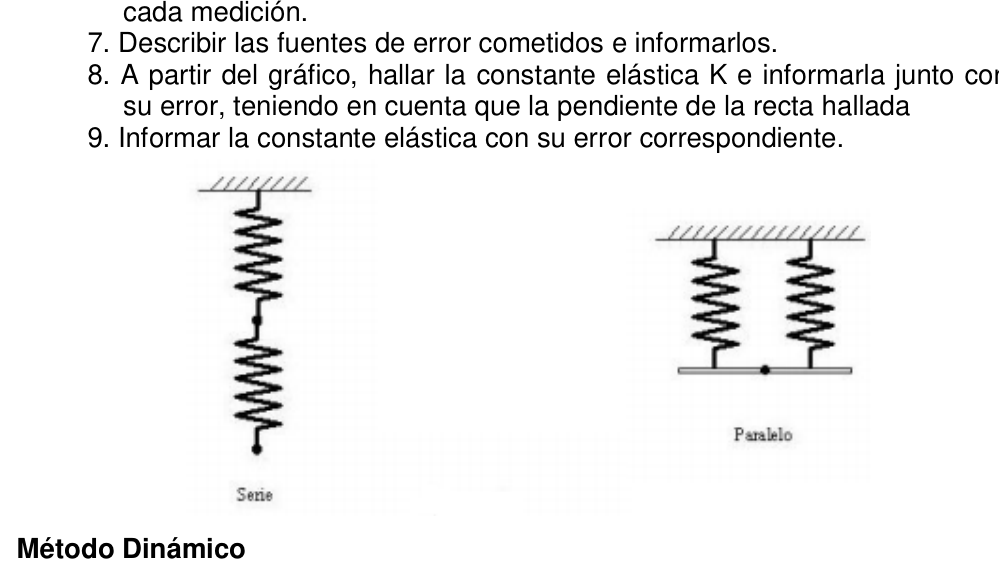
Topic: Oscillations & Waves, Elasticity & Materials Metodi: Hooke’s Law, Graph Linearization, Experimental Data Analysis Competenze: Physical Reasoning, Experimental Data Analysis Objects: Spring Fonte: Testo (PDF) — p.3
**Constante elastica di una resorte (Hooke) **
PE12. Scuola tecnica Ort Nro. 2
Città di Buenos Aires.
Determinazione della costante elastica di una primavera e legge di Hooke. Obiettivi
- Calcolare sperimentalmente la costante elastica K di una sorgente per il Metodo statico
- Descrivere gli errori di misurazione e spiegare le loro cause. -Scoprire la costante elastica con il metodo dinamico di due sorgenti uguali in serie e in parallelo.
Materiali Resorte, corpo di diverse masse, regola graduata, calibro, piede metallico, aro metallo, cronometro, bilancia.
OAF 2013 - 133 Introduzione L’estensione di una primavera è determinata dalla legge di Hooke, che stabilisce che il spostamento che ogni materiale elastico prova è proporzionale alla forza applicata.
(1) Dove F è la forza applicata, è la costante elastica ed è il allungamento della primavera. La costante k dipende dal materiale della sorgente, dal suo forma geometrica e la sua costruzione. Se la forza che si applica sulla primavera Se il limite è superato, la legge si distorsi per sempre. Hooke non si sarebbe più riunito. Quando un pesce viene appeso alla primavera, si Si estende; se poi si rilascia, lo stesso fa un movimento oscillatorio che può essere caratterizzato come movimento armonico semplice (MAS). Considerando che è un movimento armonico, si può correlare il periodo di oscillazione (il tempo necessario per effettuare un oscillazione durante la primavera La velocità angolare, la costante elastica e lo stretching le seguenti relazioni
(2)
Procedura Metodo statico
- Posizionare la molla in posizione verticale sospesa dal supporto. Considerare la lunghezza iniziale della primavera.
- Appendere di esso un peso di massa nota.
- Misurare l’allungamento che si verifica quando si colloca la massa.
- Ripetere i passaggi precedenti con diverse masse
- Graficare il rapporto tra la forza prodotta dalle diverse masse e il Tensione (F vs. ).
- Fare una tabella che includa la massa, la forza che produce la massa, lo stretto e gli errori assoluti relativi a ogni misurazione.
- Descrivere le fonti di errore commesse e informarle.
- Sulla grafica, trovare la costante elastica K e informarla insieme con il suo errore, considerando che la pendenza della retta trovata
- Informare la costante elastica con il suo errore corrispondente.
Metodo dinamico Per le sorgenti in serie, eseguire la seguente procedura: parallelo
- Posizionare le sorgenti in posizione verticale sospese dal supporto. Considerare la lunghezza iniziale della primavera.
- Appendere di esso un peso di massa conosciuta e allungare la molla.
OAF 2013 - 134 3. Lasciare le sorgenti nella loro posizione di allungamento e prendere il tempo che Ci vuole 20 oscillazioni. Trovare il periodo di una oscillazione. 4. Ripetere i passaggi precedenti con diverse masse note. 5. Realizzare una tabella che include la massa (m), la forza che produce la massa (F), il periodo (T), il periodo a quadrato (T2). 6. Grafica T2 vs. m. Dal rapporto periodo-massa, trovare la Costante elastica delle sorgenti a partire dalla formula seguente data en (2)
Topic: Oscillations & Waves, Elasticity & Materials Metodi: Hooke’s Law, Graph Linearization, Experimental Data Analysis Competenze: Physical Reasoning, Experimental Data Analysis Objects: Spring Fonte: Testo (PDF) — p.3
The value of the underlying assets shall be reported in the following column:
PE12. The technical school Ort Nro. 2
City of Buenos Aires.
Determination of the elastic constant of a spring and Hooke’s Law. Objectives
- Experimentally calculate the elastic constant K of a spring by the Static method
- Describe measurement errors and explain their causes.
- Find the elastic constant by the dynamic two-spring method equal in series and parallel.
Materials Resort, bodies of different masses, graduated rule, caliber, metal foot, ring metal, timekeeper, scale.
The following is the list of the Member States’ financial statements: The first is the introduction. The stretch of a spring is determined by Hooke’s law, which It states that the displacement experienced by any elastic material is proportional to the force applied.
(1) Where F is the applied force, it is the elastic constant and it is the The spring is stretched. The constant k depends on the material of the spring, its geometric shape and its construction. If the force applied on the spring If it exceeds a certain limit, it will be permanently distorted and the law will be broken. Hooke’s will is no longer being met. When a spring is hung from a weight, it is If you stretch it, then you release it, and it makes an oscillatory movement that can. characterised as simple harmonic movement (SMA). Given that it is a harmonic movement, you can relate the oscillation period (the time it takes the spring to oscillate) The total of the total of the test is approximately 0,05 kg. the following relationships
(2)
The procedure Static method
- Place the spring in a vertical position suspended from the support. Consider the initial length of the spring.
- Hanging a known mass from it.
- Measure the elongation that occurs when placing the mass.
- Repeat the previous steps with different masses
- Graph the relationship between the force produced by the different masses and the The following table shows the results of the calculations: ).
- Make a table that includes mass, the force it produces The total mass, stretch and absolute errors corresponding to every measurement.
- Describe the sources of error committed and report them.
- From the graph, find the elastic constant K and report it along with his error, considering that the slope of the straight found
- Report the elastic constant with its corresponding error.
Dynamic method The following procedure shall be carried out for the series springs, and in parallel
- Place the springs in a vertical position suspended from the support. Consider the initial length of the spring.
- Hang a known mass from it and stretch the spring.
The following is the list of the countries of the European Union: 3. Release the springs in their stretching position and take the time that you can It takes 20 oscillations. Find the period of a oscillation. 4. Repeat the previous steps with different known masses. 5. Make a table where the mass (m), the force it produces is included the mass (F), the period (T), the period squared (T2). 6. Graph T2 vs. m. From the period-mass relationship, find the The spring elastic constant from the following formula given en (2)
Topic: Oscillations & Waves, Elasticity & Materials Metodi: Hooke’s Law, Graph Linearization, Experimental Data Analysis Competenze: Physical Reasoning, Experimental Data Analysis Objects: Spring Fonte: Testo (PDF) — p.3
Pendulo simple - MAS
PE13. Instituto Politécnico Superior Gral. San Martín
Rosario, Santa Fe.
Introducción teórica Un péndulo simple es un sistema físico construido por un masa, de valor m, suspendida de un punto fijo, que llamaremos O, mediante un hilo inextensible y cuya masa es despreciable. Si se separa la masa de su eje de equilibrio estable y, sin aplicarle ningún impulso inicial se la suelta, la misma describe oscilaciones que bajo determinadas condiciones se denomina movimiento armónico simple. Este sistema fue descripto por el físico y astrónomo italiano Galileo, quien concluyó que el período de la oscilación de un péndulo no dependía de la amplitud, sino sólo de la longitud del hilo. Quizás fue este fenómeno quien condujo, años más tarde, a la creación de los primeros relojes de la historia. La figura 1 muestra una fotografía estroboscópica que muestra la oscilación de un péndulo, tomada a intervalos regulares de tiempo.
Los desarrollos teóricos que modelan la
descripción física del movimiento de un
péndulo han sido ampliamente desarrollados
y de éstos se deduce que, cuando la amplitud
es menor a 10º, el período de un péndulo
puede aproximarse con la siguiente expre-
sión:
2
L
T
g
(1)
donde L representa la longitud del hilo y g el
campo gravitatorio terrestre.
Sin embargo puede darse la situación de
interrumpir el movimiento mediante la incorpo-
ración de un obstáculo tal como se muestra en la
figura 2. En este caso, en el punto P se coloca un
clavo que interrumpe la oscilación y produce un
movimiento.
Como se muestra en la Figura 2 el movimiento se
puede dividir en dos partes: antes y después de
entrar en contacto con el clavo. Por este motivo
podemos considerar por un lado el caso del movimiento antes de la interrupción
como se observa en la Figura 3 (b), donde oscila con la extensión total L1 siendo
el período T1.
Figura 2
Figura 3. Péndulo interrumpido
OAF 2013 - 135 La segunda parte del movimiento, Figura 3(a), oscila con longitud L2 y le corresponde un período T2. Usando la ecuación (1) le corresponde a cada parte del movimiento el período:
1 1 2 1 2 2 2 2 L T g L L d T g g (2)
Cómo sabemos que un período completo de nuestro péndulo está formado por medio período con longitud L1 y medio período con L2, podemos expresar, 1 2 1 1 1 1 2 2 (3) T T L L d T g g T L L d g
Si grafica los datos obtenidos de un péndulo simple tendríamos una raíz cuadrada (ver ecuación 1). Por este motivo lo que se suele graficar es T2 en función de L ya que 2 2 4 L T g
Si nosotros queremos hacer lo mismo con la ecuación 3 tenemos un desarrollo
del binomio que queda,
2
2
2
1
1
2
2
1
1
1
1
2
2
2
1
1
1
2
2
1
1
1
2
2
2
1
2
2
1
T
L
L
d
g
T
L
L L
d
L
d
g
d
T
L
d
L
g
L
d
T
L
d
L
g
L
Usando la aproximación 1 1 a a cuando 1 a , se obtiene 2 2 1 1 1 1 2 2 1 2 d T L d L g L
2 2 1 4 2 T L d g (4)
Objetivos El objetivo del presente trabajo práctico es medir la longitud L1 indirectamente a partir de la medición del período del péndulo interrumpido. Figura 4 (a) Figura 3 (b)
OAF 2013 - 136
- Estudiar la validez del modelo expresado por la ecuación (4) en función de d y L1.
- Medir el período del péndulo interrumpido para distintas distancias de interrupción d. Tome mediciones para al menos 5 distancias distintas.
- Grafique T2 en función de d (T2 vs d).
- Extrapole la gráfica para d=0.
- A partir del valor extrapolado calcule la longitud L1.
Instrumentos a utilizar Tabla de madera de densidad media (MDF) pre-agujereada cada 5 centímetros como se muestra en la figura 4. Cronómetros Hilo inextensible Masa Balanza Clavo para sostener la masa Clavo para usar como obstáculo
Conclusiones Elabore un informe acerca del trabajo realizado donde conste claramente: procedimiento utilizado, estudio de incertezas analizando sus fuentes y posibles mejoras experimentales y/o físicas, análisis del resultado obtenido.
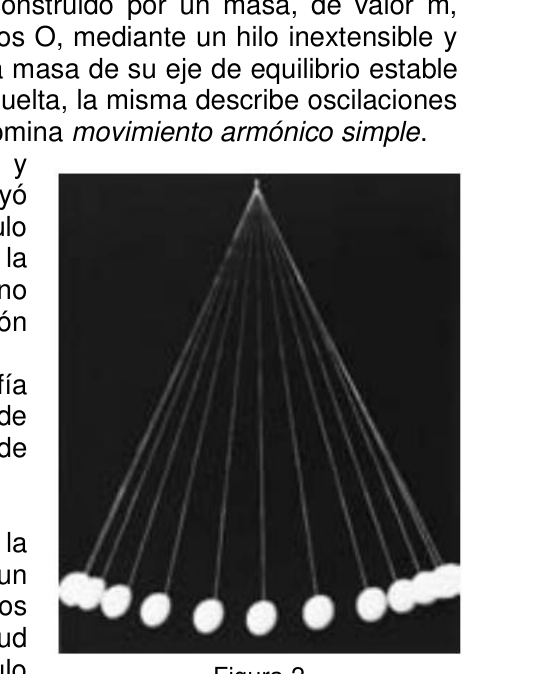
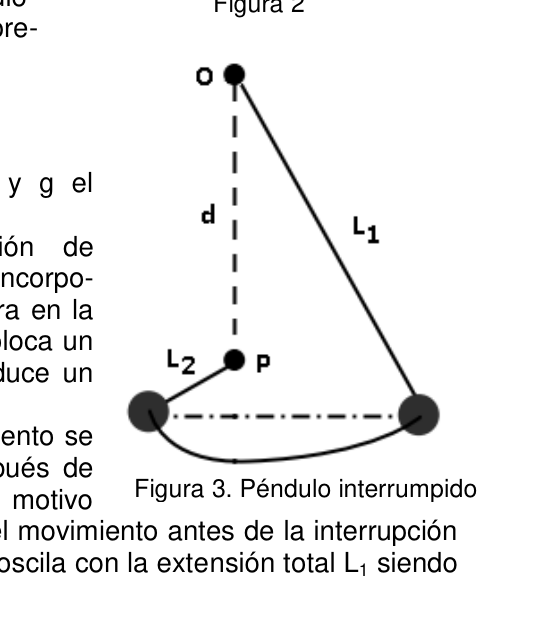
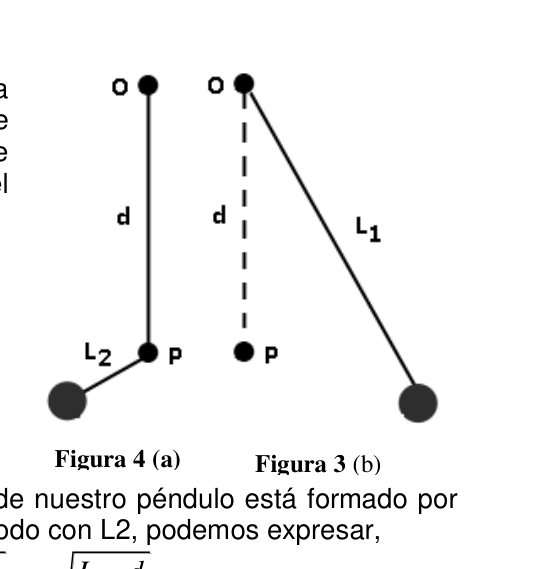
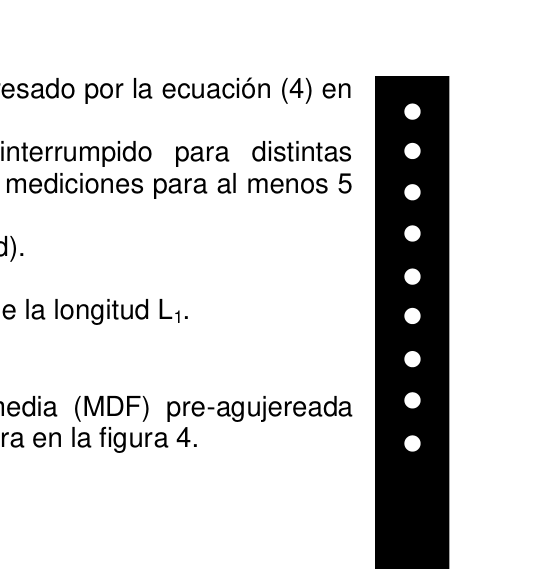
Topic: Oscillations & Waves Metodi: Simple Harmonic Motion Analysis, Graph Linearization, Experimental Data Analysis Competenze: Physical Reasoning, Experimental Data Analysis Objects: Pendulum Fonte: Testo (PDF) — p.3
Pendolo semplice - MAS
PE13. Istituto Politetnico Superiore Gral. San Martino
Rosario, Santa Fe.
Introduzione teorica Un semplice pendolo è un sistema fisico costruito da una massa, di valore m, Sospeso da un punto fisso, che chiameremo O, con un filo inestensibile e la cui massa è disprezzabile. Se si separa la massa del suo asse di equilibrio stabile E, senza applicare alcun impulso iniziale, la si rilascia, descrivendo oscillazioni. che, in determinate condizioni, è chiamato movimento armonico semplice. Questo sistema è stato descritto dal fisico e l’astronomo italiano Galileo, che ha concluso che il periodo di oscillazione di un pendolo Non dipendeva dalla larghezza, ma solo dalla lunghezza del filo. Forse è stato questo fenomeno. che, anni dopo, portò alla creazione. dei primi orologi della storia. La figura 1 mostra Una . Foto: stroboscopica che mostra l’ oscillazione di un pendolo, preso a intervalli regolari di tempo.
Gli sviluppi teorici che modellano la descrizione fisica del movimento di un il pendolo sono stati ampiamente sviluppati e da queste si deduce che, quando l’ampiezza è inferiore a 10°, il periodo di un pendolo La Commissione ha adottato una decisione che non può essere adottata. Sione: 2 L T g (1) dove L rappresenta la lunghezza del filo e g il campo gravitazionale terrestre. Tuttavia, si può trovare la situazione di
- interromper il movimento mediante l’incorpo- Ratio di un ostacolo come mostrato in Figura 2. In questo caso, il punto P è inserito un un chiodo che interrompe l’ oscillazione e produce un movimento. Come mostra la figura 2 il movimento si può essere divisa in due parti: prima e dopo entrare in contatto con il chiodo. Per questo motivo Possiamo considerare da un lato il caso del movimento prima dell’interruzione come si vede in Figura 3 (b), dove oscilla con l’estensione totale L1 essendo il periodo T1. Figura 2 Figura 3 Pendolo interromputo
OAF 2013 - 135 La seconda parte del movimento, Figura 3(a), oscilla con lunghezza L2 e corrisponde a un periodo T2. Usando l’equazione (1) le corresponde a cada parte del movimiento el Periodo:
1 1 2 1 2 2 2 2 L T g L L d T g g (2)
Come sappiamo che un intero periodo del nostro pendolo è formato da mezzo periodo con lunghezza L1 e mezzo periodo con L2, possiamo esprimere, 1 2 1 1 1 1 2 2 (3) T T L L d T g g T L L d g
Se grafichiamo i dati ottenuti da un semplice pendolo avremmo una radice. quadrato (vedi equazione 1). Per questo motivo, ciò che viene spesso graficato è T2 in funzione di L poiché 2 2 4 L T g
Se vogliamo fare lo stesso con l’equazione 3 abbiamo uno sviluppo del binomio che rimane, 2 2 2 1 1 2 2 1 1 1 1 2 2 2 1 1 1 2 2 1 1 1 2 2 2 1 2 2 1 T L L d g T L L L d L d g d T L d L g L d T L d L g L
Usando l’approccio 1 1 a a Quando 1 a , si ottiene 2 2 1 1 1 1 2 2 1 2 d T L d L g L
2 2 1 4 2 T L d g (4)
Obiettivi L’obiettivo del presente lavoro pratico è di misurare la lunghezza L1 indirettamente a a partire dalla misurazione del periodo del pendolo interromputo. Figura 4 (a) Figura 3 (b)
OAF 2013 - 136
- Studiare la validità del modello espresso dall’equazione (4) in funzioni di d e L1.
- Misurare il periodo di pendolo interromputo per diversi distanze di interruzione d. Prendi le misure per almeno 5 distanze diverse.
- Grafica T2 in funzione di d (T2 vs d).
- Extrapola la grafica per d=0.
- Dal valore extrapolato calcola la lunghezza L1.
Strumenti da utilizzare Tavola di legno di media densità (MDF) pre-perforazione ogni 5 centimetri come mostrato nella figura 4. Cronometri Felle inestensibili Massa Balance Chiodo per sostenere la massa Chiodo da usare come ostacolo
Conclusioni Preparare un rapporto sul lavoro svolto che indichi chiaramente: Il metodo utilizzato, lo studio delle incertezze, analizzando le loro fonti e possibili miglioramenti sperimentali e/o fisici, analisi del risultato ottenuto.
Topic: Oscillations & Waves Metodi: Simple Harmonic Motion Analysis, Graph Linearization, Experimental Data Analysis Competenze: Physical Reasoning, Experimental Data Analysis Objects: Pendulum Fonte: Testo (PDF) — p.3
The following table shows the results of the calculation of the weighted average weight of the product:
PE13. Gral Higher Polytechnic Institute. Saint Martin .
Rosario, Santa Fe.
Theoretical introduction A simple pendulum is a physical system constructed of a mass, m, suspended from a fixed point, which we shall call O, by an unextended thread and whose mass is despicable. If the mass of its stable equilibrium axis is separated And without any initial boost, it releases it, it describes oscillations. which under certain conditions is called a simple harmonic movement. This system was described by the physicist and Italian astronomer Galileo, who concluded than the period of oscillation of a pendulum It was not the breadth, but only the size. length of the thread. Maybe it was this phenomenon . who led, years later, to creation. of the earliest clocks in history. La Figure 1 sample One . I ‘m not a photographer . Stroboscopic showing the oscillation of a pendulum, taken at regular intervals from time.
The theoretical developments that shape the physical description of the motion of a pendulum have been extensively developed and from these it follows that, when the width is less than 10°, the period of a pendulum The following expre- The following is a list of the countries of the European Union: 2 L T g (1) where L represents the length of the thread and g the The gravitational field of the Earth. However, the situation of The Commission has already decided to take the necessary measures to prevent the The ratio of an obstacle as shown in the The following table shows the following: In this case, a is placed at point P. A nail that interrupts the oscillation and produces a The movement. As shown in Figure 2 the movement is It can be divided into two parts: before and after to come into contact with the nail. For this reason We can consider the case of the movement before the interruption on the one hand As shown in Figure 3 (b), where it oscillates with the total extension L1 being the T1 period. Figure 2 Figure 3 is shown. Interrupted pendulum
The following is the list of the Member States’ financial statements: The second part of the movement, Figure 3(a), oscillates along L2 and corresponds to a period of T2. Using the equation (1) i The following is the list of the movements: period:
1 1 2 1 2 2 2 2 L T g L L d T g g (2)
How do we know that a full period of our pendulum is formed by half-period with length L1 and half-period with L2, we can express, 1 2 1 1 1 1 2 2 (3) T T L L d T g g T L L d g
If you graph the data from a simple pendulum, we would have a root. The square of the distance from the centre of the circle to the centre of the circle is equal to the square of the distance from the centre of the circle. For this reason what is usually graphed is T2 in function of L since 2 2 4 L T g
If we want to do the same thing with equation 3, we have a development. of the remaining binomial, 2 2 2 1 1 2 2 1 1 1 1 2 2 2 1 1 1 2 2 1 1 1 2 2 2 1 2 2 1 T L L d g T L L L d L d g d T L d L g L d T L d L g L
Using the approximation 1 1 a a When 1 a , you get it . 2 2 1 1 1 1 2 2 1 2 d T L d L g L
2 2 1 4 2 T L d g (4)
Objectives The objective of this practical work is to measure the length L1 indirectly to from the measurement of the period of the pendulum interrupted. The following information is provided: The following table shows the results of the evaluation:
The following points shall be added:
- Study the validity of the model expressed by the equation (4) in function of d and L1.
- Measure the period of the pendulum interrupted for different The following conditions shall apply: Take measurements for at least 5 different distances.
- Graph T2 as a function of d (T2 vs d).
- Extrapolate the graph to d=0.
- From the extrapolated value calculate the length L1.
Instruments to be used Pre-drilled medium density wood (MDF) board every 5 centimetres as shown in Figure 4. Timers Unextended hair Mass Balance A nail to hold the mass Key to use as a barrier
Conclusions Make a report on the work carried out which clearly states: The method used, the study of uncertainties, analysing their sources and possible causes experimental and/or physical improvements, analysis of the result obtained.
Topic: Oscillations & Waves Metodi: Simple Harmonic Motion Analysis, Graph Linearization, Experimental Data Analysis Competenze: Physical Reasoning, Experimental Data Analysis Objects: Pendulum Fonte: Testo (PDF) — p.3
Pendulo - estudio experimental
PE14. Instituto Eduardo L. Holmberg
Quilmes, Buenos Aires.
Introducción El péndulo es un sistema físico que puede oscilar bajo la acción gravitatoria (u otra característica física) y que está configurado por una masa suspendida de un punto fijo mediante un hilo o una varilla. Existen muy variados tipos de péndulos que, atendiendo a su configuración y usos, reciben los nombres apropiados: péndulo simple, péndulo compuesto, péndulo cicloidal, doble péndulo, péndulo de Foucault, péndulo de Newton, pén- dulo balístico, péndulo de torsión, péndulo esférico, etcétera. Tal vez el más común sea el péndulo simple o matemático, también llama- do péndulo ideal, que está constituido por un hilo inextensible de masa despreciable, sostenido por su extremo superior de un punto fijo, con una masa puntual sujeta en su extremo inferior que oscila libremente en un plano vertical fijo. Al separar la masa pendular de su punto de equilibrio, oscila a ambos lados de dicha posición, desplazándose sobre una trayectoria circular con movimiento periódico. El astrónomo y físico italiano Galileo Galilei, observó que el período de oscilación es independiente de la amplitud, al menos para pequeñas oscilaciones. También es independiente de la masa; en cambio, el período depende de la longitud del hilo. El período de la oscilación de un péndulo simple para oscilaciones de pequeña amplitud puede aproximarse por:
Figura 5
OAF 2013 - 137 donde: T es el período, l es la longitud del péndulo, g es la aceleración de la gravedad. Reacomodando esta ecuación podría escribirse:
Donde se ve claramente que T2 es directamente
proporcional a l.
Ahora, trataremos de estudiar el comportamiento de
otro tipo de péndulo.
En este caso se trata de una varilla rígida de longitud l
y de masa mv que está suspendida de su extremo
superior desde un soporte fijo.
En el extremo inferior se ubica una masa fija de valor
m1 y que tiene otra masa de valor m2 que puede
cambiar de posición dentro de la varilla; es decir, puede
estar cerca de la masa m1 o puede elevarse y
acercarse al punto fijo superior. La distancia de la masa
m2 al punto fijo superior es x.
Objetivo El objetivo de esta investigación es buscar una relación (aproximada) entre el período de oscilación de este modelo de péndulo en función de la distancia x, para pequeñas amplitudes.
Elementos disponibles Pié universal. Grapa con nuez. Varilla metálica Dos masas. Regla. Cronómetro.
Procedimiento 1. Registrar los valores de las masas mv, m1 y m2. 2. Armar el péndulo como se ve en el diagrama anterior. 3. Medir la longitud l del péndulo. 4. Ubicar la masa m2 cerca del soporte superior; registrar la distancia x. 5. Alejar el péndulo de la posición de equilibrio una amplitud pequeña (10° a 15° pero no es necesario registrar su valor, sólo habrá que mantenerlo toda la experiencia). liberar el péndulo para que empiece a oscilar. 6. Registrar el tiempo de oscilación de 5 oscilaciones completar. 7. Repetir el registro del tiempo anterior. 8. Cambiar la posición de la masa m2; registrar la nueva distancia x. 9. Repetir los pasos 5 en adelante hasta obtener al menos 8 juegos de datos. 10. Todos los valores que se registren deben estar en una tabla adecuada. 11. Representar gráficamente las variables, tratando de encontrar una función que las represente. 12. Considerar las incertidumbres de las mediciones tanto en la tabla como en el gráfico. l x m1 m2
OAF 2013 - 138 13. Concluir, de ser posible, con una relación matemática entre el período de oscilación del péndulo T y la distancia x.
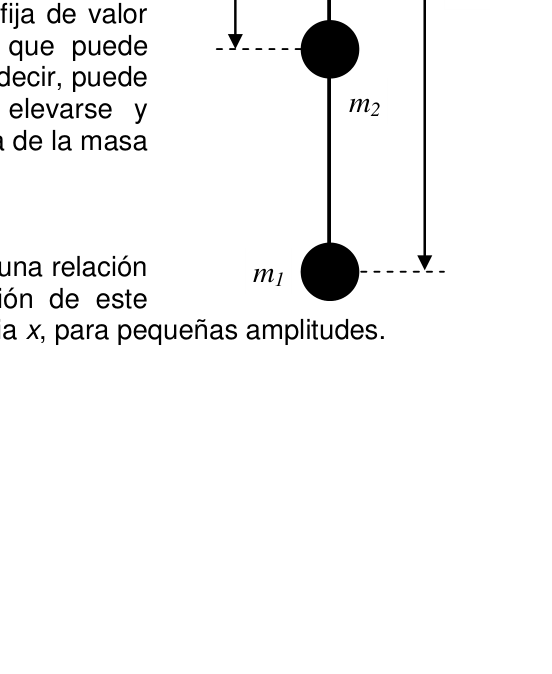
Topic: Oscillations & Waves Metodi: Simple Harmonic Motion Analysis, Graph Linearization, Experimental Data Analysis Competenze: Physical Reasoning, Experimental Data Analysis Objects: Pendulum Fonte: Testo (PDF) — p.3
Pendulo - studio sperimentale
PE14. Istituto Eduardo L. Holmberg
Quilmes, Buenos Aires.
Introduzione Il pendolo è un sistema fisico che può oscillare sotto l’azione gravitazionale (o Un’altra caratteristica fisica) e che è configurata da una massa sospesa di un punto fisso con un filo o un bastone. Esistono vari tipi di pendoli che, a seconda della loro configurazione e Applicazioni, riceve i nomi appropriati: pendolo semplice, pendolo composto, Pendale cicloide, doppio, pendolo di Foucault, pendolo di Newton, pen- di un’artigliatura balistica, di un pendolo di torsione, di un pendolo sferico, ecc. Forse il più comune è il pendolo semplice o matematico, chiamato anche Il pendolo ideale, costituito da un filo di massa inestensibile disprezzabile, sostenuto dalla sua estremità superiore di un punto fisso, con una massa puntuale tenuta alla sua estremità inferiore che oscilla liberamente in un piano verticale fisso. Separando la massa pendolare dal suo punto di equilibrio, oscilla su entrambi i lati di la posizione, spostandosi su un percorso circolare in movimento
- Il giornale. L’astronomo e fisico italiano Galileo Galilei ha osservato che il periodo di Oscillazione è indipendente de l’ampiezza, al
- meno per piccole oscillazioni. È anche indipendente dalla massa; invece, il periodo dipende dalla lunghezza del filo. Il periodo di oscillazione di un semplice pendolo per oscillazioni di piccole dimensioni amplitudine può essere avvicinata da:
Figura 5
OAF 2013 - 137 dove: T è il periodo, l è la lunghezza del pendolo, g è l’accelerazione della gravità. Riassumendo questa equazione si potrebbe scrivere:
Dove si vede chiaramente che T2 è direttamente proporzionale a l. Ora, cercheremo di studiare il comportamento di un altro tipo di pendolo. In questo caso si tratta di un bastone rigido di lunghezza l e di massa mv che è sospesa dal suo estremo superiore a un supporto fisso. Al fondo è posta una massa fissa di valore m1 e che ha un’altra massa di valore m2 che può cambiare posizione all’interno del bastone; cioè può essere vicino alla massa m1 o può essere elevato e avvicinarsi al punto fisso superiore. Distanza della massa m2 al punto fisso superiore è x.
Obiettivo L’obiettivo di questa ricerca è cercare una relazione. (approssimato) tra il periodo di oscillazione di questo modello di pendolo in funzione della distanza x, per piccole ampiezze.
Elementi disponibili • Piede universale. • Aggancio con noci. Settima metallica • Due masse.
- Regola.
- Cronometro.
Procedura 1. Registrare i valori delle masse mv, m1 e m2. 2. Armarsi il pendolo come si vede nel diagramma precedente. 3. Misurare la lunghezza l del pendolo. 4. Localizzare la massa m2 vicino al supporto superiore; registrare la distanza x. 5. Distogliere il pendolo dalla posizione di equilibrio una piccola larghezza (10° a 15° ma non è necessario registrarne il valore, solo che
- l’esperienza completa. Sganciare il pendolo per iniziare a oscillare.
Registrare il tempo di oscillazione di 5 oscillazioni complete. 7. Ripetere il record del tempo precedente. 8. Cambiare la posizione della massa m2; registrare la nuova distanza x. 9. Ripeti i passi 5 in avanti fino a ottenere almeno 8 giochi di dati. 10. Tutti i valori che vengono registrati devono essere in una tabella
- Proprio così.
- Rappresentare graficamente le variabili, cercando di trovare una funzione che li rappresenta.
- Considerare le incertezze delle misurazioni sia nella tabella Come in grafico. l x m1 m2
OAF 2013 - 138 13. Concludere, se possibile, con una relazione matematica tra il periodo di oscillazione del pendolo T e della distanza x.
Topic: Oscillations & Waves Metodi: Simple Harmonic Motion Analysis, Graph Linearization, Experimental Data Analysis Competenze: Physical Reasoning, Experimental Data Analysis Objects: Pendulum Fonte: Testo (PDF) — p.3
The following table shows the results of the experimental study:
PE14. The Institute Eduardo L. Holmberg
Quilmes, Buenos Aires is where I am.
The first is the introduction. The pendulum is a physical system that can oscillate under gravitational action (or other physical characteristic) and which is configured by a suspended mass of a a fixed point by means of a thread or rod. There are many different types of pendulums which, depending on their configuration and The use of the term ‘compound pendulum’ is not limited to the use of the term ‘compound pendulum’. The Commission has decided to adopt a proposal for a regulation on the approximation of the laws of the Member States relating to the use of the electricity sector in the electricity sector. ballistic paddle, torsion paddle, spherical paddle, and so on. Perhaps the most common is the simple pendulum or mathematical pendulum, also called the The ideal pendulum, which consists of an unobstructed mass thread contemptible, held by its upper end of a fixed point, with a pointed mass suspended at its lower end which oscillates freely at a The following table shows the following table: By separating the pendulum mass from its equilibrium point, it oscillates on both sides of This position, moving on a circular path with movement The newspaper. The Italian astronomer and physicist Galileo Galilei observed that the period of oscillation is Independent de the width, al less for small . The fluctuations. It is also mass-independent; instead, the period depends on the length of the thread. The period of oscillation of a simple pendulum for small oscillations the width can be approximated by:
Figure 5
The following points shall be added: where: T is the period, l is the length of the pendulum, g is the acceleration of the gravity. By reconciling this equation, we could write:
Where you can clearly see that T2 is directly proportional to l. Now, we’re going to try to study the behavior of another kind of pendulum. In this case it is a rigid rod of length l and mass mv which is suspended from its end higher than a fixed support. At the bottom end is a fixed mass of value m1 and that has another mass of m2 value that can change position within the rod; that is, you can be close to m1 mass or it can rise and approaching the upper fixed point. The distance of the mass m2 to the top fixed point is x.
The objective The aim of this research is to look for a relationship (approximate) between the period of oscillation of this pendulum model based on distance x, for small amplitudes.
Available items • Universal foot. • Grape with nut. Metal rod • Two masses.
- Rule. The time-lapse.
The procedure 1. Record the values of the masses mv, m1 and m2. 2. Arming the pendulum as shown in the diagram above. 3. Measure the length of the pendulum. 4. Place the m2 mass near the top support; record the distance x. 5. Move the pendulum away from the equilibrium position a small width (10° to 15° but it is not necessary to record its value, only that I’m not sure I’ll be able to keep it all the time. Release the pendulum so that it starts to swinging. 6. Record the oscillation time of 5 complete oscillations. 7. Repeat the previous time record. 8. Change the position of the mass m2; record the new distance x. 9. Repeat the 5 steps below until you get at least 8 sets of data. 10. All values recorded must be in a table It’s a good one. 11. Graphically represent the variables, trying to find a function that represents them. 12. Consider the measurement uncertainties both in the table As in the chart. l x m1 m2
The following information is provided: 13. If possible, conclude with a mathematical relationship between the period of oscillation of the pendulum T and distance x.
Topic: Oscillations & Waves Metodi: Simple Harmonic Motion Analysis, Graph Linearization, Experimental Data Analysis Competenze: Physical Reasoning, Experimental Data Analysis Objects: Pendulum Fonte: Testo (PDF) — p.3
Acople de resistencias (circuito)
PE15. Escuela Técnica Alfredo Carlos Passera
Mocoretá, Corrientes.
Construcción de Circuito “acople de resistencias” Objetivo: Construir un circuito con elementos de fácil acceso.
Breve descripción: El circuito consiste en la combinación mixta de resistencias fijas de carbón para lograr una resistencia total. Una experiencia muy práctica para comprender los conceptos necesarios de la Ley de Ohm y Ley de Watt. Este trabajo se realiza con una fuente de corriente continua con un voltaje de 9 voltios.
Lista de Materiales: Resistencias (1KΩ - 6KΩ). Filamentos de cobre. Soldador tipo Lápiz 40W. Estaño. Pinza fina. Alicate. Multi-tester. Fuente de Alimentación 9V – cc.
Consigna: Construir un circuito respetando el siguiente esquema, utilizando 8
(ocho) resistencias con valores determinados. Realizar con herramientas
adecuadas a la ocasión con las respectivas normas de seguridad. Una vez
finalizado el acoplamiento del circuito, calcular de forma analítica y práctica:
a) Valor de resistencia total, intensidad total y potencia total del circuito.
b) Valor de resistencia parcial (teniendo en cuenta la valoración de
colores), caída de tensión en cada resistencia, corriente eléctrica que
circula por cada resistencia y potencia disipada por cada resistencia
(potencia parcial).
c) Corroborar con el multi-tester los valores adquiridos.
d) Verificar con el software Electronic Workbench o Livewire.
OAF 2013 - 139
Topic: Circuits Metodi: Equivalent Circuit Reduction, Kirchhoff’s Laws, Experimental Data Analysis Competenze: Physical Reasoning, Experimental Data Analysis Objects: Resistor, Battery Fonte: Testo (PDF) — p.3
**Coppia di resistenza (circuito) **
PE15. Scuola tecnica Alfredo Carlos Passera
Mocoretá, Corrientes.
Costruzione di circuiti coppia di resistenze Obiettivo: costruire un circuito con elementi facilmente accessibili.
Breve descrizione: il circuito consiste nella combinazione miscela di resistenze Fissi di carbone per ottenere una resistenza totale. Un’esperienza molto pratica. per comprendere i concetti necessari della Legge di Ohm e della Legge di Watt. Questo lavoro viene effettuato con una fonte di corrente continua con una tensione di 9 Volti.
Lista dei materiali: • Resistenze (1KΩ - 6KΩ). • Filamenti di rame. • Soluzionatore tipo 40W.
- Stagno. • Pinza sottile. • Alicate. • Multi-tester. Fonte di alimentazione 9V cc.
Consegna: costruire un circuito rispettando il seguente schema, utilizzando 8 (otto) resistenze con valori determinati. Realizzare con i mezzi Le norme di sicurezza sono adeguate al momento in cui si applica. Una volta completato il collegamento del circuito, calcolare in modo analitico e pratico: a) Valore di resistenza totale, intensità totale e potenza totale del circuito. b) Valore di resistenza parziale (considerando la valutazione di Colori), caduta di tensione in ogni resistenza, corrente elettrica che circola per ogni resistenza e potenza dissipata per ogni resistenza (potenza parziale). c) Confirmare con il multi-tester i valori acquisiti. d) Verificare con il software Electronic Workbench o Livewire.
OAF 2013 - 139
Topic: Circuits Metodi: Equivalent Circuit Reduction, Kirchhoff’s Laws, Experimental Data Analysis Competenze: Physical Reasoning, Experimental Data Analysis Objects: Resistor, Battery Fonte: Testo (PDF) — p.3
The following shall be added to the list of the following:
PE15. The school of technology Alfredo Carlos Passera
It’s a mockery, currents.
Circuit construction couples of resistors Objective: To build a circuit with easily accessible elements.
Brief description: The circuit consists of the mixed combination of resistors coal-fired fixes to achieve total resistance. A very practical experience . to understand the necessary concepts of Ohm’s Law and Watt’s Law. This work is done with a continuous current source with a voltage of 9
- It’s a lot of fun.
List of Materials: The following conditions are met: • Copper filament, or copper filament, • 40W pen-type solder. • Tin. • Fine pinza. • Alicate. • Multi-tester. Power supply 9V cc.
Consequence: Build a circuit following the following scheme, using 8 (eight) resistance with determined values. Tools to do it . appropriate to the occasion with the respective safety standards. Once upon a time . The circuit coupling is completed, analytically and practically calculated: (a) Total resistance value, total intensity and total power of the circuit. (b) Partial resistance value (taking into account the valuation of The current is the current, the voltage drop at each resistance, the electric current that is It circulates at each resistance and power dissipates at each resistance . (partial power). (c) Confirm the values acquired with the multi-test. (d) Verify with the Electronic Workbench or Livewire software.
The following points shall be added:
Topic: Circuits Metodi: Equivalent Circuit Reduction, Kirchhoff’s Laws, Experimental Data Analysis Competenze: Physical Reasoning, Experimental Data Analysis Objects: Resistor, Battery Fonte: Testo (PDF) — p.3
Verificar ley de Hooke
PE16. Instituto Jesús María
Ciudad de Córdoba.
Objetivo
Verificar la ley de Hooke.
Elementos 1 soporte universal con una nuez con agarradera metálica 1 regla resorte 3 pesas balanza
Requerimientos
Sólo podrá utilizar los elementos provistos, papel, lapicera y calculadora no
programable.
Al finalizar el trabajo deberá presentar un informe que incluya los siguientes
puntos:
Esquema de los dispositivos experimentales utilizados
Descripción y fundamentación del diseño utilizado
Diagrama de cuerpo libre.
Cuadro de valores de las mediciones realizadas, con el mayor número
de pesos posibles.
Resultados obtenidos con sus correspondientes errores.
Gráfica deformación X peso.
Analizar dicha gráfica, indicando si existe un intervalo en que la
deformación ha seguido un comportamiento lineal.
Si es posible, determine la pendiente de la recta con su error del
resultado y error relativo porcentual.
Dicho valor, ¿es la denominada “constante del resorte”? Justifique.
De todas las mediciones directas realizadas, ¿cuál es el factor que, de
hacer esta experiencia nuevamente, ud. se preocuparía de medir con
menor error la próxima vez? Justifique.
Comentarios
Topic: Oscillations & Waves, Elasticity & Materials Metodi: Hooke’s Law, Graph Linearization, Experimental Data Analysis Competenze: Physical Reasoning, Experimental Data Analysis Objects: Spring Fonte: Testo (PDF) — p.3
Verificare la legge di Hooke
PE16. Istituto Gesù Maria
Città di Córdoba.
Obiettivo
Verificare la legge di Hooke.
Elementi 1 supporto universale con un’aria di noce con un aggancio metallico 1 regola primavera 3 p. bilancia
Richieste Può utilizzare solo gli elementi forniti, carta, lapislatura e calcolatore non programmabile. Al termine del lavoro, deve presentare un rapporto che includa le seguenti informazioni: punti: schema dei dispositivi sperimentali utilizzati Descrizione e motivazione del design utilizzato • Diagramma di corpo libero. Tabella dei valori delle misurazioni effettuate, con il maggior numero di peso possibile. • Risultati ottenuti con i propri errori. Grafica di deformazione X peso. Analizzare il grafico, indicando se esiste un intervallo in cui La deformazione ha seguito un comportamento lineare. Se possibile, determinare la pendenza della retta con il suo errore di Percentuale di risultato e errore relativo. Questo valore è il cosiddetto constant di primavera? giustifica. Di tutte le misure dirette effettuate, quale è il fattore che, di fare questa esperienza di nuovo, Ud. Mi preoccuperò di misurare con
- E’ un piccolo errore la prossima volta? giustifica. Commenti
Topic: Oscillations & Waves, Elasticity & Materials Metodi: Hooke’s Law, Graph Linearization, Experimental Data Analysis Competenze: Physical Reasoning, Experimental Data Analysis Objects: Spring Fonte: Testo (PDF) — p.3
Checking Hooke’s law
PE16. Jesus Mary Institute
The city of Cordoba.
The objective
• Check the Hooke’s law.
Elements 1 universal support with a nut with a metal grip 1 rule spring 3 pesos balance sheet
Requirements You may only use the items provided, paper, pencil and calculator not It’s programmable. At the end of the work, a report shall be submitted including the following: points: Schedule of experimental devices used Description and justification of the design used • Free body diagram. Table of values of the measurements carried out, with the largest number of possible weights. • Results obtained with their corresponding errors. Graphic deformation X weight. • Analyze the graph, indicating whether there is an interval in which the The deformation has followed a linear behavior. If possible, determine the slope of the straight line with your error of the The percentage of relative error and error. Is this value the so-called spring constant? You justify it. Of all the direct measurements made, what is the factor that, from Do this experience again, you know. I ‘d worry about measuring with Minor mistake next time? You justify it. • Comments
Topic: Oscillations & Waves, Elasticity & Materials Metodi: Hooke’s Law, Graph Linearization, Experimental Data Analysis Competenze: Physical Reasoning, Experimental Data Analysis Objects: Spring Fonte: Testo (PDF) — p.3
Ley de Joule y enfriamiento newtoniano
PE17. Escuela Técnica ORT - Sede Almagro
Ciudad de Buenos Aires.
Introducción El objetivo de la siguiente practica experimental es verificar el comportamiento de un circuito simple mediante la Ley de Joule y caracterizar el enfriamiento newtoniano de una masa de agua dada.
Materiales
- Resistencia de valor desconocido
- Cables Banana-Cocodrilo
- Fuente de Tensión
- Calorímetro de Poliuretano Expandido (Telgopor) con tapa.
- Termómetro de Mercurio
- Hojas Milimetradas
- Cronometro
- Vaso de precipitado con graduación
- Tijeras
OAF 2013 - 140 Procedimiento de Medición Para hallar los datos necesarios se procederá a ensamblar el dispositivo de medición. La tapa del calorímetro tiene dos ori cios, uno para pasar el termómetro y otro dispuesto para pasar la resistencia (y proveer una salida para los cables que van hacia la fuente). Es de suma importancia verificar que el calorímetro quede bien cerrado y que en su interior la resistencia no se toque con el termómetro (y que ambos estén sumergidos completamente en el agua que se agregará en el próximo paso). Una vez armado el dispositivo, se coloca una cantidad conocida de agua (medida con el vaso de precipitado). Se conecta en serie el amperímetro entre la resistencia y la fuente (con el dial en 9V). y se conecta al mismo tiempo que se enciende el cronómetro. Se empieza a registrar en la tabla 1 los datos Tiempo-Temperatura-Corriente en intervalos de tiempo (30 segundos ~ 1 minuto) de modo tal de que no haya variaciones mayores a 3°C de temperatura entre dos mediciones consecutivas. Se continúa midiendo hasta que el agua alcance una temperatura aproximada de 60ºC. Es recomendable revolver suavemente cada tanto para homogeneizar la temperatura. Una vez alcanzada esta temperatura, se apaga la fuente, se retira la tapa (con la resistencia), se reinicia el cronómetro y se deja el termómetro. Una vez realizado esto, se procede a llenar la tabla 2 con los datos de Tiempo-Temperatura. Se mide la Temperatura hasta que no se registren cambios en la misma por hasta al menos 3~5 mediciones consecutivas.
Objetivos de la Practica Los objetivos del presente experimento son:
- Medir el valor de la resistencia.
- Hallar el valor de la constante de enfriamiento newtoniano.
Introducción Teórica Midiendo el valor de la resistencia La energía a utilizada para calentar el agua proviene de la fuente de tensión, en forma de energía a eléctrica. El transductor que permite transformarla en calor es la resistencia eléctrica. La temperatura de una sustancia aumenta cuando esta recibe calor de acuerdo a la ecuación: Q = m.ce.ΔT
(1) donde Q es el calor medido en Joules, m la masa medida en gramos, T la diferencia de temperatura ocasionada (recordar ΔT = Tf - Ti), y ce una magnitud llamada Calor Específico que depende de cada sustancia y mide la cantidad de calor que debe recibir 1 gramo de sustancia para aumentar su temperatura en 1 grado centígrado (o Kelvin), por ende el calor específico se mide en J/gºC y para el caso del agua vale 4,18 J/gºC. Nótese entonces que Calor y Temperatura son magnitudes directamente proporcionales en una magnitud m.ce. Por otro lado la potencia (energía a o calor por unidad de tiempo) entregada por una resistencia es: P = ΔQ/Δt = I2 R
(2)
donde I2 R es la potencia y Δt es el tiempo transcurrido. De modo tal que si puede hallarse la variación de la temperatura respecto del tiempo, puede calcularse la variación de calor respecto del tiempo aplicando el factor de proporcionalidad m.ce y la misma debe responder a la potencia disipada por la resistencia (a menos de las perdidas del sistema). Hallando el valor de la constante de enfriamiento newtoniano Un enfriamiento newtoniano es un proceso de enfriamiento que sucede, por ejemplo, cuando se deja enfriar una sustancia caliente (a una temperatura T0) en
OAF 2013 - 141
un ambiente a una temperatura Tamb < T0. Si el ambiente es los suficientemente
grande respecto de la cantidad de sustancia a enfriar puede asumirse que el
ambiente no se calienta a medida que la sustancia se enfr a. La temperatura de
la sustancia va decreciendo y tendiendo hacia la del ambiente a medida que
pasa el tiempo bajo la ley:
T (t) = Tamb + (T0 - Tamb) e-αt
(3)
Donde la constante α es la constante de enfriamiento newtoniano.
Procedimiento de Análisis Valor de la Resistencia Se graficarán los datos temperatura-tiempos de la tabla 1 (con sus corres- pondientes cotas de error) y se procederá a calcular el valor de la pendiente de la recta con su correspondiente error, una vez hecho esto se calcular el valor de la resistencia que se colocó (multiplicando por m.ce/I2). Luego se procederá a llenar la columna 4 de la tabla 1 de la siguiente manera: comenzando desde la segunda celda se restará el valor de temperatura de esa fila con el de la anterior y se dividirá dicho valor con la resta entre el tiempo de esa fila y la anterior y se multiplicará todo por el factor de proporcionalidad m.ce. Matemáticamente: Δi = m.ce.(Tn – Tn-1)/(tn – tn-1) Luego se procederá a calcular el valor promedio de los Δi y su desvío estándar. Como puede verse, Δi representa a la variación de energía a por unidad de tiempo promedio, es decir, la potencia promedio. Utilizando este valor con su correspondiente error estadístico se procederá a calcular nuevamente el valor de R (dividiendo por I2) y se procederá a discutir y justificar cual de los dos métodos es mas eficiente para el calculo, se llamará este segundo valor calculado RΔ.
Tabla 1 Nº Tiempo (t) Temperatura (T) Corriente (I) Potencia Instantánea (Δi)
(seg) (ºC) (Amp) (Watt) 1
2
3
4
5
6
7
8
9
10
11
12
13
14
15
16
17
18
19
20
Pendiente de la recta (con su error):
OAF 2013 - 142 Valor de R (con su error): Δi (con su error): Valor de RΔ (con su error):
Tabla 2 Nº Tiempo (t) Temperatura (T)
(seg) (ºC) 1
2
3
4
5
6
7
8
9
10
11
12
13
14
15
16
17
18
19
20
Valor de α (con su error):
Topic: Thermodynamics, Circuits Metodi: First Law of Thermodynamics, Graph Linearization, Experimental Data Analysis Competenze: Physical Reasoning, Experimental Data Analysis Objects: Calorimeter, Resistor Fonte: Testo (PDF) — p.3
Legge di Joule e raffreddamento newtoniano
PE17. Scuola tecnica ORT - Sede Almagro
Città di Buenos Aires.
Introduzione L’obiettivo della pratica sperimentale successiva è quello di verificare il comportamento. di un circuito semplice con la legge di Joule e caratterizzare il raffreddamento Newton di una massa di acqua data.
Materiali
- Resistenza di valore sconosciuto
- Banana-Cocodrillo
- Fonte di tensione
- Calorimetro di poliuretano espandito (Telgopor) con copertura.
- Termodermico di Mercurio .
- Foli in millimetri
- Cronometro .
- Vaso di precipitato con gradimento
- Scaglie .
OAF 2013 - 140 Procedura di misurazione Per trovare i dati necessari, si procederà all’assemblaggio del dispositivo di misurazione. Il cappotto del calometro ha due orizzonti, uno per passare il calometro. termometro e un altro pronto a passare la resistenza (e fornire un’uscita per i cavi che vanno alla sorgente). È di massima importante verificare che il il caloriometro rimane ben chiuso e che all’interno la resistenza non si tocchi con il termometro (e che entrambi siano completamente immersi nell’acqua) che verrà aggiunto nel prossimo passo). Una volta che il dispositivo è stato installato, viene inserito una nota quantità di acqua. (misurato con il bicchiere di precipitazione). Si collega in serie l’ampie-metro tra la resistenza e sorgente (con il dial a 9V). e si collega allo stesso tempo che si accende il cronometro. Inizia a registrare in tabella 1 i dati Tempo-temperatura-corente in intervalli di tempo (30 secondi ~ 1 minuto) in modo tale che non vi sia variazioni di temperatura superiori a 3°C tra due misurazioni consecutive. Si continua a misurare fino a quando l’acqua raggiunge una temperatura approssimativa. de 60ºC. Si consiglia di rivelare le parti con un’aria più delicata per uniformizzare le parti. la temperatura. Una volta raggiunta questa temperatura, si spegne la fonte, si toglie la copertura (con la resistenza), si riavvia il cronometro e si lascia il termometro. Una volta realizzato Per questo, si procede a riempire la tabella 2 con i dati Tempo-temperatura. Se misura la temperatura fino a quando non si registrano cambiamenti in essa fino al meno 3~5 misurazioni consecutive.
Obiettivi della pratica Gli obiettivi del presente esperimento sono:
- Misurare il valore della resistenza.
- Trovare il valore della costante di raffreddamento newtonica.
Introduzione teorica Misurando il valore della resistenza L’energia utilizzata per riscaldare l’acqua viene da una fonte di tensione, in forma di energia elettrica. Il trasduttore che permette di trasformarla in calore è la resistenza elettrica. La temperatura di una sostanza aumenta quando è in stato di riceve calore secondo l’equazione: Q = m.ce.ΔT
(1) dove Q è il calore misurato in Joules, m la massa misurata in grammo, T la La differenza di temperatura causata (richiara ΔT = Tf - Ti), e ce una magnitudo Il calore specifico che dipende da ogni sostanza e misura la quantità di calore. Il calore che deve essere ricevuto da 1 grammo di sostanza per aumentare la sua temperatura di 1 . grado centigrado (o Kelvin), quindi il calore specifico è misurato in J/goC e per il caso dell’acqua è di 4,18 J/goC. Si noti allora che il calore e la temperatura sono magnitudini direttamente proporzionali a una magnitudo m.ce. La potenza (energia a o calore per unità di tempo) fornita da una resistenza è: P = ΔQ/Δt = I2 R
(2)
dove I2 R è la potenza e Δt è il tempo trascorso. In modo tale che si Si può trovare la variazione della temperatura rispetto al tempo, si può Calcolare la variazione di calore rispetto al tempo applicando il fattore di La proporzionalità m.ce e la stessa deve rispondere alla potenza dissipata dalla resistenza (esclusi i perditi del sistema). Trovando il valore della costante di raffreddamento newtonica Un raffreddamento newtoniano è un processo di raffreddamento che si verifica, per ad esempio, quando una sostanza calda (a una temperatura di T0) viene lasciata raffreddare in
OAF 2013 - 141 un ambiente a una temperatura Tamb < T0. Se l’ambiente è sufficiente La quantità di sostanza da raffreddare può essere considerata grande. L’ambiente non si riscaldano mentre la sostanza si raffredda. La temperatura di La sostanza si sta riducendo e si sta orientando verso quella dell’ambiente come passa il tempo sotto la legge: T (t) = Tamb + (T0 - Tamb) e-αt (3) Dove la costante α è la costante di raffreddamento newtonica.
Procedura di analisi Valore della resistenza I dati di temperatura-tempo della tabella 1 (con i loro corrispondenti dati) sono stati tracciati. L’intervallo di un’intera data di riferimento è stato calcolato per il valore di un’intervallo di un’intervallo di un’intervallo di un’intervallo di un’intervallo di un’intervallo di un’intervallo di un’intervallo di un’intervallo di un’intervallo di un’intervallo di un’intervallo di un’intervallo di un’intervallo di un’intervallo di un’intervallo di un’intervallo di un’intervallo di un’intervallo di un’intervallo di un’intervallo di un’intervallo di un’intervallo di un’intervallo di un’intervallo di un’intervallo di un’intervallo di un’intervallo di un’intervallo di un’intervallo di un’intervallo di un’intervallo di un’intervallo di un’intervallo di un’intervallo di un’intervallo di un’intervallo di un’intervallo di un’intervallo di un’intervallo di un’intervallo di un’intervallo di un’intervallo di un’intervallo di un’intervallo di un’intervallo di un’intervallo di. La retta con il suo errore corrispondente, una volta fatto questo si calcola il valore di la resistenza che è stata inserita (moltiplicata per m.ce/I2). La colonna 4 della tabella 1 è poi compilata come segue: a partire dalla seconda cella, si sottrae il valore di temperatura di quella cella La linea di riferimento è quella precedente e si divide tale valore con il restante tra il tempo di la prima fila e la prima e sarà moltiplicata per il fattore di proporzionalità m.ce. Matematicamente: Δi = m.ce.(Tn – Tn-1)/(tn – tn-1) Poi si calcola il valore medio dei Δi e la loro deviazione standard. Come si può vedere, Δi rappresenta la variazione di energia a per unità di tempo medio, cioè potenza media. Usando questo valore con il suo il corrispondente errore statistico viene ripreso il valore di R (divisione per I2) e si discuterà e si giustificherà quale dei due metodi se è più efficiente per il calcolo, si chiamerà questo secondo valore calcolato RΔ.
Tabella 1 Nº Tempo (t) Temperatura (T) Corrente (I) Potenza Instantaneo (Δi)
(seg) (ºC) (Amp) (Watt) 1
2
3
4
5
6
7
8
9
10
11
12
13
14
15
16
17
18
19
20
Spendiente della retta (con il suo errore):
OAF 2013 - 142 Valore di R (con il suo errore): Δi (con il suo errore): Valore di RΔ (con errore):
Tabella 2 Nº Tempo (t) Temperatura (T)
(seg) (ºC) 1
2
3
4
5
6
7
8
9
10
11
12
13
14
15
16
17
18
19
20
Valore di α (con il suo errore):
Topic: Thermodynamics, Circuits Metodi: First Law of Thermodynamics, Graph Linearization, Experimental Data Analysis Competenze: Physical Reasoning, Experimental Data Analysis Objects: Calorimeter, Resistor Fonte: Testo (PDF) — p.3
Joule’s law and Newtonian cooling
PE17. The technical school ORT - Headquarters Almagro
City of Buenos Aires.
The first is the introduction. The aim of the following experimental practice is to verify behaviour of a simple circuit by Joule’s law and characterizing cooling Newtonian of a given mass of water.
Materials
- Strength of unknown value
- Banana-Crocodile wires .
- The source of the tension .
- Calorimeters of expanded polyurethane (Telgopor) with lid.
- Mercury thermometer .
- Millimeter sheets .
- The timekeeper .
- A glass of precipitate with a graduation.
- Scissors .
The following points shall be added: Measurement procedure The device will be assembled to find the necessary data. measurement. The heat meter lid has two orifices, one to pass the heat. The thermometer and other ready to pass the resistance (and provide an exit for The cables that go to the source. It is of the utmost importance to verify that the The heat meter is closed and the resistance inside is not touched. With the thermometer (and both are completely submerged in water) which will be added in the next step). Once the device is set up, a known amount of water is placed. (measured with the precipitating glass). The amp is serial-connected between the resistance and source (with dial at 9V). And it connects at the same time as it does. Turn on the timer. The data Time-Temperature-Current is recorded in Table 1 starting at time intervals (30 seconds ~ 1 minute) such that there is no temperature variations greater than 3°C between two consecutive measurements. It is continued to be measured until the water reaches an approximate temperature. de 60ºC. It is recommended to gently roll from time to time to homogeneise . the temperature. Once this temperature is reached, the source is turned off, the lid is removed (with the resistance), restart the timer and leave the thermometer. Once done This is done by filling Table 2 with the Time-Temperature data. Se The temperature is measured until no changes are recorded in the temperature up to the minus 3 to 5 consecutive measurements.
Objectives of the practice The objectives of this experiment are:
- Measure the value of the resistance.
- Find the value of the Newtonian cooling constant.
Theoretical introduction Measuring the value of resistance The energy used to heat the water comes from the voltage source, in energy to electrical form. The transducer that allows it to be transformed into heat is the electrical resistance. The temperature of a substance increases when it is It gets heat according to the equation: Q = m.ce.ΔT
(1) where Q is the heat measured in Joules, m the mass measured in grams, T the The difference in temperature caused (record ΔT = Tf - Ti), and ce a magnitude Specific heat is a measure of the amount of heat that is used to measure the amount of heat that is used to measure the amount of heat. heat that must be given 1 gram of substance to increase its temperature by 1 The temperature of the product is the temperature of the product. the water case is 4,18 J/goC. Note then that Heat and Temperature are magnitude directly proportional to a magnitude m.ce. On the other hand, the power (heat or energy per unit time) delivered by a resistance is: P = ΔQ/Δt = I2 R
(2)
where I2 R is the power and Δt is the time elapsed. So that you do . The temperature variation over time can be found. The temperature change over time is calculated by applying the factor of The proportion of the energy consumption in the system must be proportional to the power consumption of the system. resistance (excluding system losses). Finding the value of the Newtonian cooling constant A Newtonian cooling is a cooling process that happens, by For example, when a hot substance (at a temperature of T0) is allowed to cool in
The following points shall be added: an environment at a temperature Tamb < T0. If the environment is good enough The amount of the substance to be cooled is large and it can be assumed that the The environment does not heat up as the substance cools. The temperature of The substance is decreasing and tending towards that of the environment as it Spends time under the law: T (t) = Tamb + (T0 - Tamb) e-αt (3) Where the constant α is the Newtonian cooling constant.
The Commission shall adopt the following measures: The Value of Resistance The temperature-time data in Table 1 (with their corresponding The value of the outstanding balance of the The line with its corresponding error, once done this is calculated the value of the resistance placed (multiplying by m.ce/I2). The following column 4 of Table 1 shall be filled in: starting from the second cell the temperature value of that cell shall be subtracted. row with the previous one and divide that value by the time between This row and the previous row and all multiplied by the proportionality factor m.ce. Mathematically: Δi = m.ce.(Tn – Tn-1)/(tn – tn-1) The mean value of the Δi and its standard deviation shall then be calculated. As you can see, Δi represents the energy change to a per unit of mean time, that is, mean power. Using this value with your The corresponding statistical error will be used to recalculate the value of R (divided by I2) and discussing and justifying which of the two methods will proceed. is more efficient for calculation, this second calculated value will be called RΔ.
Table 1 Nº Time (t) The temperature (T) Current (I) Power . Instantly . (Δi)
(second) (ºC) (Amp) (Watt) 1
2
3
4
5
6
7
8
9
10
11
12
13
14
15
16
17
18
19
20
Hanging straight (with his error):
The following points are added: R value (with its error): Δi (with its error): Value of RΔ (with error):
Table 2 Nº Time (t) The temperature (T)
(second) (ºC) 1
2
3
4
5
6
7
8
9
10
11
12
13
14
15
16
17
18
19
20
Value of α (with its error):
Topic: Thermodynamics, Circuits Metodi: First Law of Thermodynamics, Graph Linearization, Experimental Data Analysis Competenze: Physical Reasoning, Experimental Data Analysis Objects: Calorimeter, Resistor Fonte: Testo (PDF) — p.3
Determinar g con pendulo
PE18. Escuela de Agronomía
Río Cuarto, Córdoba.
Rio cuarto se encuentra levemente por encima del nivel del mar. Es por ello que algunas cantidades físicas ligadas a la altura respecto ese nivel se encuentran ligeramente distorsionadas. Como por ejemplo la presión atmosférica o la aceleración de la gravedad. Se conoce que un péndulo simple posee un Periodo que solo depende de la gravedad de la zona y la longitud del mismo como se muestra T=2π (l/g) 1I2 donde l representa la longitud de la cuerda. Se solicita determinar “g” en Rio Cuarto a partir de la lectura reiterada (por lo menos 10 datos) de T determinando el valor promedio de T y el error cometido en la lectura. Devolver g= g prom +- Error
Materiales
- Cuerda de 1 m de longitud
- Elemento a usar como péndulo, botella de 750 ml llena de agua
- Cronometro
OAF 2013 - 143 Consigna Construir el péndulo y realizar 10 mediciones de periodo completo. Si es posibles personas distintas. Utilizar esta fórmula T=2π (l/g) 1I2 para obtener los valores de g. Calcular promedio y error (desviación estandar) de g
Topic: Oscillations & Waves Metodi: Simple Harmonic Motion Analysis, Error Propagation, Experimental Data Analysis Competenze: Physical Reasoning, Experimental Data Analysis Objects: Pendulum Fonte: Testo (PDF) — p.3
Determine g con pendolo
PE18. Scuola di Agronomia
Rio Cuarto, Córdoba.
Rio Quarto si trova leggermente sopra il livello del mare. Ecco perché Alcune quantità fisiche legate all’altezza rispetto a quel livello si trovano leggermente distorte. Come per esempio la pressione atmosferica o la pressione atmosferica. l’accelerazione della gravità. È noto che un semplice pendolo possiede un periodo che dipende solo dalla gravità della zona e la sua lunghezza come mostrato T=2π (l/g) 1I2 dove l rappresenta la lunghezza della corda. Si chiede di determinare g in Rio Cuarto a partire dalla lettura ripetuta (per il
- 10 dati) di T determinando il valore medio di T e l’ errore commesso nella lettura. Ritorna g = g prom +- Errore
Materiali
- 1 m di corda di lunghezza
- Elemento da usare come pendolo, 750 ml di acqua
- Cronometro .
OAF 2013 - 143 Consigna Costruire il pendolo e fare 10 misure a tempo pieno. Se possibile persone diverse. Utilizzare questa formula T=2π (l/g) 1I2 per ottenere i valori di g. Calcolare media e errore (sandardo di deviazione) di g
Topic: Oscillations & Waves Metodi: Simple Harmonic Motion Analysis, Error Propagation, Experimental Data Analysis Competenze: Physical Reasoning, Experimental Data Analysis Objects: Pendulum Fonte: Testo (PDF) — p.3
Determining g with a pendulum
PE18. School of Agriculture
The fourth river, Cordoba.
Rio Quarto is slightly above sea level. That is why I am Some physical quantities linked to height with respect to that level are found slightly distorted. For example, atmospheric pressure or the acceleration of gravity. A simple pendulum is known to have a period that depends only on the The area’s gravity and length as shown T=2π (l/g) 1I2 where I represents the length of the rope. The number of people who have been killed in the Rio Cuarto is to be determined from the re-read (for example, minus 10 data) of T by determining the mean value of T and the error committed in reading. Return g = g prom +- Error
Materials
- 1 m long rope
- Element to use as a pendulum, 750 ml bottle full of water
- The timekeeper .
The following is the list of the countries of the European Union: I ‘m giving it away . Build the pendulum and perform 10 full-period measurements. If possible . different people. Use this formula T=2π (l/g) 1I2 to obtain the values of g. Calculation of average and error (standard deviation) of g
Topic: Oscillations & Waves Metodi: Simple Harmonic Motion Analysis, Error Propagation, Experimental Data Analysis Competenze: Physical Reasoning, Experimental Data Analysis Objects: Pendulum Fonte: Testo (PDF) — p.3
Flotabilidad de un objeto de madera
PE19. Escuela de Agronomía
Río Cuarto, Córdoba.
Determinar las condiciones de flotabilidad de un objeto de madera. Los objetos flotantes se encuentran en equilibrio estable sobre un líquido. Ello en virtud de que el empuje que el líquido realiza supera al peso del cuerpo. Otra forma sencilla de establecer la flotación es probar que la densidad del líquido no es superada por la del cuerpo.
Materiales
- Un objeto de madera de dimensiones sencillas
- Escalimetro
- Balanza
- Contenedor de capacidad un litro
- Tinta colorante
- Papel para forrar
Consigna
- Determinar las dimensiones del objeto de madera y su peso. Calcular a partir que allí la densidad del cuerpo.
- Colocar el contenedor lleno de líquido hasta el borde sobre la balanza. Tarar.
- Colocar el objeto lentamente sobre la superficie del líquido y pesar el líquido desalojado. Establecer la condición de flotabilidad.
- A traves de la medición de la densidad del liquido probar que esta supera a la del cuerpo.
- Determinar el volumen sumergido a través de la medición de la marca colorante sobre el papel hacerlo desde el punto de vista teórico y comparar los resultados
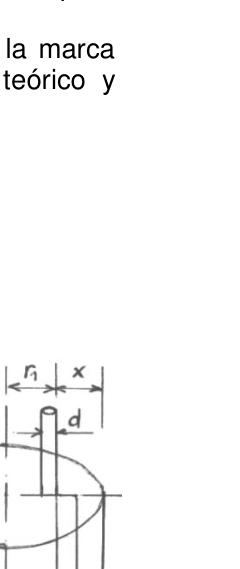
Topic: Fluid Mechanics Metodi: Hydrostatic Equilibrium, Error Propagation, Experimental Data Analysis Competenze: Physical Reasoning, Experimental Data Analysis Objects: Block, Container Fonte: Testo (PDF) — p.3
Flutabilità di un oggetto di legno
PE19. Scuola di Agronomia
Rio Cuarto, Córdoba.
Determinare le condizioni di navigabilità di un oggetto di legno. Gli oggetti galleggianti si trovano in equilibrio stabile su un liquido. - Che cosa ? La forza di spinta del liquido supera il peso del corpo. Un’altra . Un modo semplice per stabilire la flottazione è provare che la densità del liquido non è è superata da quella del corpo.
Materiali
- Un oggetto di legno di dimensioni semplici.
- Scalagrada
- Sbalzo .
- Contenitore di una capacità di un litro
- Tinta colorante .
- Papero da rivestimento .
Consigna
- Determinare le dimensioni dell’oggetto in legno e il suo peso. Calcolare a la densità del corpo.
- Mettete il contenitore pieno di liquido fino al bordo sulla bilancia.
- Che c’è?
- Metti l’ oggetto lentamente sulla superficie del liquido e pesate il peso. liquido dislocato. Stabilire la condizione di navigabilità.
- Attraverso la misurazione della densità del liquido provare che questo supera a quella del corpo.
- Determinazione del volume immerso mediante la misurazione del marchio colorante sul carta farlo dal punto di vista teorico e confrontare i risultati
Topic: Fluid Mechanics Metodi: Hydrostatic Equilibrium, Error Propagation, Experimental Data Analysis Competenze: Physical Reasoning, Experimental Data Analysis Objects: Block, Container Fonte: Testo (PDF) — p.3
Flotability of a wooden object
PE19. School of Agriculture
The fourth river, Cordoba.
Determine the conditions of buoyancy of a wooden object. Floating objects are in stable equilibrium on a liquid. That ‘s it . The force of the fluid exceeds the body weight. Another one . A simple way to establish the float is to prove that the density of the liquid is not It’s outnumbered by the body.
Materials
- A simple wooden object .
- The escalator .
- Weigh it .
- One litre capacity container
- Colorful ink .
- Paper to lining .
I ‘m giving it away .
- Determine the dimensions of the wooden object and its weight. Calculate a The density of the body is there.
- Place the liquid-filled container to the edge above the scale.
- I’m going to take a shit.
- Place the object slowly on the surface of the liquid and weigh the discharged liquid. Establish the condition of buoyancy.
- By measuring the density of the liquid to prove that it exceeds the body.
- Determine the volume submerged by measuring the mark The coloring on the paper does it theoretically and comparing the results
Topic: Fluid Mechanics Metodi: Hydrostatic Equilibrium, Error Propagation, Experimental Data Analysis Competenze: Physical Reasoning, Experimental Data Analysis Objects: Block, Container Fonte: Testo (PDF) — p.3
Indice de refraccion del agua (varilla)
PE20. Instituto Primo Capraro
San Carlos de Bariloche, Río Negro.
Se quiebra, se separa, pero no se rompe! Marco teórico El aparente quiebre de una varilla cilíndrica colocada “fuera del centro” de un recipiente (también cilíndrico) que está lleno de agua, puede usarse para medir el índice de refracción del agua (o de otro líquido transparente). Para ello utilizaremos un recipiente cilíndrico transparente conteniendo agua y un conjunto de varillas cilíndricas de distintos diámetros. Si se sostiene la varilla en el centro, con una parte de su longitud sumergida y se observa la varilla al mismo nivel horizontal que la superficie del agua, se puede notar que la parte sumergida se ve más ancha. Puede demostrarse fácilmente que la “magnificación” de la porción sumergida de la varilla, localizada en el centro (o en un plano que
OAF 2013 - 144 atraviese el centro) es (el índice de refracción del agua). Esto quiere decir que si la varilla tiene un diámetro , la parte sumergida se verá con un diámetro igual a . Ahora, si movemos la varilla alejándola del centro, en ángulo recto a tu línea de visión, notarás un aparente quiebre en la misma al nivel de la superficie del agua. Cuando la varilla se ubique a una distancia crítica x a partir del borde del recipiente, el quiebre (desplazamiento) será suficiente para que, como se muestra en la figura, el borde interno de la parte sumergida coincida con el borde externo de la parte no sumergida. Si se moviera la varilla un poco más del borde del recipiente, las porciones superior e inferior de la varilla aparecerían completamente separadas. Inténtalo (este efecto solamente puede observarse si el ancho de la varilla no es mayor que alrededor de un décimo del diámetro del recipiente). Si registramos la distancia crítica (x) entre el borde derecho de la varilla y el borde del recipiente cilíndrico, podremos determinar el índice de refracción del líquido. Para que la medición sea confiable, es esencial que el centro de la varilla se encuentre a lo largo de un diámetro perpendicular a tu línea de visión. Además, la varilla debe estar en posición vertical al plano de la superficie del agua. Para poder encontrar una expresión que nos permita obtener el índice de refracción buscado, podemos hacer las siguientes consideraciones:
- El ancho de la porción sumergida “magnificada” de la varilla es d n .
- Por el mismo criterio será 1 2 r n r (ver figura).
- En consecuencia como se aprecia en el gráfico: 1 2 r r d n
1 1 r r n d n
Si agrupamos los términos con y sacamos factor común nos queda: d n r n r 1 1
d r n r 1 1
(Ecuación 1) Pero, si observamos nuevamente en la figura, vemos que:
x D r 2 1
(Ecuación 2) Por lo que podemos reemplazar de la ecuación 2 en la ecuación 1, y despejar nuestra incógnita que es . Esto significa que si medimos con la regla el diámetro de la varilla ( ), el diámetro del recipiente ( ) y la distancia entre los bordes de la varilla y el recipiente ( ), podremos determinar el índice de refracción del líquido utilizado, que en este caso es agua. Para una mayor precisión se han medido los diámetros de las varillas cilíndricas con un calibre y se obtuvieron los valores indicados al final de la hoja.
Objetivo de la experiencia Determinar el índice de refracción ( ) del agua aprovechando las propiedades de la refracción de la luz en un recipiente cilíndrico.
Elementos disponibles Para realizar esta experiencia se dispone de:
Un recipiente cilíndrico transparente.
Un conjunto de 5 varillas cilíndricas de distintos diámetros.
Un broche para sostener las varillas.
Un taco de madera y cinta para fijar el broche
Una escuadra milimetrada.
Una hoja oficio cuadriculada
OAF 2013 - 145
Agua.
Requerimientos
- Se te pide que reemplaces r1 de la ecuación 2 en la ecuación 1 y despejes el índice de refracción n, con el fin de encontrar la expresión que te permita determinarlo.
- Determinar el índice de refracción del agua, con su correspondiente error asociado.
- Al finalizar la experiencia se deberá entregar un informe donde conste: 31.Planteo del problema.
- Método experimental utilizado.
- Resultados obtenidos y evaluación del error asociado.
- Discusión y comentarios.
Datos Diámetros de las varillas cilíndricas: d1 = 3.1 mm 0.1 mm d2 = 3.9 mm 0.1 mm d3 = 5.0 mm 0.1 mm d4 = 6.0 mm 0.1 mm d5 = 7.0 mm 0.1 mm
Recomendaciones Asegúrate que la mesa de trabajo se encuentre nivelada horizontalmente. Utiliza la escuadra para colocar las varillas perpendiculares a la mesa, lo que nos asegurará que la varilla se encuentre en posición vertical En el caso de derramar agua, secá la mesa con un trapo. Coloca debajo del recipiente cilíndrico la hoja cuadriculada en la que tienes marcada una línea que representará el diámetro del recipiente y sobre la cual realizarás los desplazamientos. Colócate para realizar las observaciones, siempre perpendicular al diámetro del recipiente y a nivel de la superficie del agua. Trabaja en forma ordenada y prolija.
Topic: Geometric Optics Metodi: Snell’s Law, Graph Linearization, Experimental Data Analysis Competenze: Physical Reasoning, Experimental Data Analysis Objects: Rod, Container Fonte: Testo (PDF) — p.3
**Indice di refraczione dell’acqua (varella) **
PE20. Istituto Primo Capraro
San Carlo di Bariloche, Rio Negro.
Si rompe, si separa, ma non si rompe! Marco teorico L’apparente rottura di un bastone cilindrico posto fuori di un recipiente (anche cilindrico) che è ricca di acqua, può essere usata per misurare l’indice di refraczione dell’acqua (o di un altro liquido trasparente). Per Per questo usiamo un contenitore cilindrico trasparente. contenente acqua e un insieme di bastone cilindrici di diversi diametri. Se si tiene il bastone al centro, con una parte del suo La lunghezza immersa e la verga osservata allo stesso livello L’acqua è più alta che la superficie, si può notare che la superficie è più alta che la superficie. la parte immersa sembra più ampia. Si può dimostrare. facilmente che la magnificazione della porzione immersa di una verga, situata al centro (o in un piano che
OAF 2013 - 144 (indice di refraczione dell’acqua) Questo significa che Se la bacchetta ha un diametro , la parte immersa verrà vista con un diametro uguale . a . Ora, se muoviamo la bacchetta allontanandola dal centro, a un angolo retto alla tua linea di La visione, noterai un’apparente rottura in esso a livello della superficie del acqua. Quando la verga è situata a una distanza critica x dal bordo del Il contenitore, la rottura (sosposizione) sarà sufficiente per che, come si mostra nella figura, il bordo interno della parte immersa coincide con il bordo esterno della parte non immersa. Se si muove il bastone un po’ più sul bordo del recipiente, le porzioni la parte superiore e inferiore del bastone appariranno completamente separate. Provaci. (questo effetto può essere osservato solo se la larghezza della canna non è maggiore) che circa un decimo del diametro del recipiente). Se registriamo la distanza critica (x) tra il bordo destro della bacchetta e il Il margine del recipiente cilindrico, possiamo determinare l’indice di refraczione del liquido. Per rendere la misurazione affidabile, è essenziale che il centro della misura sia il centro di La bacchetta si trova lungo un diametro perpendicolare alla tua linea di la visione. Inoltre, la vernice deve essere in posizione verticale al piano della superficie dell’acqua. Per poter trovare un’espressione che ci permetta di ottenere l’indice di La rifraczione ricercata, possiamo fare le seguenti considerazioni:
- La larghezza della porzione immersa magnificata della canna è d n .
- Per lo stesso criterio sarà 1 2 r n r (vedi figura).
- Di conseguenza, come si vede nel grafico: 1 2 r r d n
1 1 r r n d n
Se mettiamo insieme i termini con e togliendo il fattore comune, abbiamo: d n r n r 1 1
d r n r 1 1
(Equilibrio 1) Ma, se ci ripensiamo nella figura, vediamo che:
x D r 2 1
(Equilibrio 2) Quindi possiamo sostituire l’equazione 2 all’equazione 1 e chiarire la nostra incognita che è . Questo significa che se misuriamo con la regola il Il diametro del bastone ( ), il diametro del recipiente ( ) e la distanza tra i i bordi del bastone e del recipiente (), possiamo determinare l’indice di la refraczione del liquido utilizzato, che in questo caso è acqua. Per un’altra donna. Precisione sono stati misurati i diametri delle bacche cilindriche con un calibro e i valori indicati alla fine del foglio sono stati ottenuti.
Obiettivo dell’esperienza Determinare l’indice di refraczione () dell’acqua utilizzando le proprietà di la refraczione della luce in un recipiente cilindrico.
Elementi disponibili Per realizzare questa esperienza si dispone di:
Un recipiente cilindrico trasparente.
Un insieme di 5 bastone cilindrici di diversi diametri.
Una pinza per sostenere le bacche.
Un palo di legno e una cinta per fissare la pinza
Un esercito di millimetri.
Un foglio di lavoro quadricillato
OAF 2013 - 145
- L’acqua.
Richieste
- Vi viene chiesto di sostituire r1 dell’equazione 2 nell’equazione 1 e
- e’ il primo passo che si deve fare. che ti permetta di determinarlo.
- Determinare l’indice di refraczione dell’acqua, con il relativo errore associato.
- Al termine dell’esperienza è necessario presentare un rapporto che contiene: 31.Sostituzione del problema.
- Metodo sperimentale utilizzato.
- Risultati ottenuti e valutazione dell’errore associato.
- Discussioni e commenti.
Datos Diametri dei bastoni cilindrici: d1 = 3.1 mm 0.1 mm d2 = 3.9 mm 0.1 mm d3 = 5.0 mm 0.1 mm d4 = 6.0 mm 0.1 mm d5 = 7.0 mm 0.1 mm
Raccomandazioni Assicurarsi che la Tavola de lavoro se Trova
- Equazione
- Orisontale. Utilizzare il palo per mettere le bacche perpendicolari al tavolo, che ci assicurerà che la bacchetta sia in posizione verticale. Se si versa acqua, asciugate il tavolo con un mantello. Metti sotto il recipiente cilindrico la foglia quadricolata in cui hai una linea che rappresenta il diametro del recipiente e sulla quale effettuerai i viaggi. Colocate per fare le osservazioni, sempre perpendicolare al il diametro del recipiente e a livello della superficie dell’acqua. • Lavorare in modo ordinato e prolifico.
Topic: Geometric Optics Metodi: Snell’s Law, Graph Linearization, Experimental Data Analysis Competenze: Physical Reasoning, Experimental Data Analysis Objects: Rod, Container Fonte: Testo (PDF) — p.3
The water refractive index (bar) of the water ****
PE20. The first is the Capraro Institute.
St. Charles of Bariloche, Rio Negro.
It breaks, it breaks apart, but it doesn’t break! Theoretical framework The apparent breakdown of a cylindrical rod placed outside the centre of a container (also cylindrical) which is full of water, can be used to measure the index of refraction of water (or other transparent liquid). For This will be done using a transparent cylindrical container. containing water and a set of cylindrical rods of the diameter of the vehicle. If you hold the stick in the center, with a part of it The length of the submerged rod and the rod are observed at the same level horizontal than the water surface, it can be noted that the The submerged part looks wider. It can be proven . easily that the magnification of the submerged portion The rod is located in the centre (or in a plane which is
The following points shall be added: The average water refractive index (WIR) is the average water refractive index (WIR) of the water. This means that If the rod has a diameter , the submerged part will be seen with an equal diameter . a . Now, if we move the rod away from the center, at right angles to your line of In the field of vision, you’ll notice an apparent break in it at the surface level of the
- What? When the rod is located at a critical distance x from the edge of the The break (displacement) will be sufficient for the vessel to be In the figure, the inner edge of the submerged part matches the edge the outer part of the unsubmerged part. If you move the rod a little further from the edge of the container, the portions The upper and lower rods would appear completely separate. Try it . (this effect can only be observed if the width of the rod is not greater (approximately one tenth of the diameter of the container). If we record the critical distance (x) between the right edge of the rod and the The cylindrical vessel edge, we can determine the refractive index of the liquid. For measurement to be reliable, it is essential that the centre of the measurement is The rod is located along a diameter perpendicular to your line of vision. In addition, the rod must be in a vertical position to the plane of the surface of the water. To be able to find an expression that allows us to get the index of The following considerations can be made:
- The width of the submerged portion of the rod is magnified d n .
- By the same criteria it will be 1 2 r n r (see figure).
- Consequently as shown in the graph: 1 2 r r d n
1 1 r r n d n
If we group the terms with and take the common factor we have: d n r n r 1 1
d r n r 1 1
(Equation 1) But if we look again at the figure, we see that:
x D r 2 1
(Equation 2) So we can replace equation 2 in equation 1, and clear it up. our unknown that it is . This means that if we measure with the rule the The diameter of the rod ( ), the diameter of the container ( ) and the distance between the two The edges of the rod and the container ( ), we can determine the index of The resulting liquid is refracted, which is water. For an older woman . The diameter of the cylindrical rods with a caliber and a diameter of 50 mm or more are measured with precision. the values indicated at the end of the sheet were obtained.
The purpose of the experience Determine the refractive index () of water using the properties of the refraction of light in a cylindrical container.
Available items To carry out this experience:
A transparent cylindrical container.
A set of 5 cylindrical rods of different diameters.
A brooch to hold the rods.
A wooden stick and tape to fix the brooch .
A millimeter squad.
A square sheet of paper .
The following is the list of the countries of the European Union:
- It’s water.
Requirements
- You are asked to replace r1 of equation 2 in equation 1 and Clear the refractive index n, in order to find the expression I’ll let you determine that.
- Determine the refractive index of water, with its corresponding the associated error.
- At the end of the experience a report shall be submitted which shall contain: 31.Problem setting.
- Experimental method used.
- Results obtained and assessment of the associated error.
- Discussion and commentary.
Data from the report Diameter of cylindrical rods: d1 = 3.1 mm 0.1 mm d2 = 3.9 mm 0.1 mm d3 = 5.0 mm 0.1 mm d4 = 6.0 mm 0.1 mm d5 = 7.0 mm 0.1 mm
Recommendations for the future • Be sure That la Table de I work . se Find it . leveling horizontally. Use the squad to place the rods perpendicular to the table, Which will ensure that the rod is in a vertical position. • If water is spilled, dry the table with a cloth. Place the square sheet under the cylindrical container on which You have a line marked that will represent the diameter of the container and which you will travel over. Place the observations in a position always perpendicular to the the diameter of the container and at the level of the water surface. • Work in an orderly and prolific manner.
Topic: Geometric Optics Metodi: Snell’s Law, Graph Linearization, Experimental Data Analysis Competenze: Physical Reasoning, Experimental Data Analysis Objects: Rod, Container Fonte: Testo (PDF) — p.3
El tronco-movil (rodadura)
PE21. EPET Nro. 4 Juan Agustín Larrús
General Acha, La Pampa.
El tronco-móvil Los Picapiedra (Pedro y Pablo) caminando encontraron un huevo de dinosaurio, al verlo lo empujaron y se dieron cuenta que giro. Desde ese momento comenzaron a pensar como construir su tronco-móvil; haciendo distintas experiencias para poder trasladarse sin hacer tanta fuerza en los pies. Buscando encontraron un huevo con una forma muy esférica, un trozo de piedra con forma redonda, un trozo de tronco con forma irregular; y llevaron todo lo encontrado a una pendiente y empezaron a probar que se deslizaba con mayor rapidez y poder hacer mas liviano su tronco-móvil. Si nosotros hacemos esa experiencia podemos ayudarlos a determinar que es mejor.
Experiencia 1
2 trozo de madera planas
1 bolita
OAF 2013 - 146
1 tuerca
1 trozo de tronco irregular
1 cronometro
1 transportador
1 cinta métrica
1 balanza
Se debe armar un plano inclinado formando la pendiente no mayor a 45º que
encontraron los Picapiedra
Calcular
- La velocidad con que los objetos llegan al final del plano
- Aceleración al final del plano
- Coeficiente de rozamiento de la superficie con los materiales
- Energía cinética
- Energía potencial
- Energía mecánica
- Potencia
- Aplicar teoría de errores
Experiencia 2 Si quisiéramos hacer una rueda perfectamente cilíndrica de cada uno de los materiales, con 1 mts de diámetro, 20 cm de ancho y con un orificio central de 200 Mm.
- Que peso tendría la rueda al ser construida de cada uno de los
materiales anteriores
Materiales
Probeta graduada
Materiales anteriores
Topic: Rotational Dynamics Metodi: Torque & Angular Momentum Analysis, Energy Conservation Method, Experimental Data Analysis Competenze: Physical Reasoning, Experimental Data Analysis Objects: Cylinder, Sphere Fonte: Testo (PDF) — p.3
**Trumpo-movimento (rottura) **
PE21. Il numero di EPET. 4 Juan Agustín Larrús
Generale Acha, La Pampa.
Il tronco-mobile I Picciopiole (Pedro e Paolo) camminando hanno trovato un uovo di dinosauro, Quando lo videro, lo spinsero e si accorsero che girava. Da quel momento in poi Hanno iniziato a pensare a come costruire il loro tronco-mobile; facendo diverse. esperienze per potersi spostare senza fare tanta forza ai piedi. Cercando hanno trovato un uovo con una forma molto sferica, un pezzo di pietra. in forma rotonda, un pezzo di tronco in forma irregolare; e portarono tutto. Hanno trovato un pendolo e hanno provato che gli scivoli erano più forti. velocezza e la capacità di rendere più leggero il suo tronco mobile. Se facciamo questa esperienza possiamo aiutarli a capire che cosa è.
- È meglio.
Esperienza 1 2 pezzi di legno piatto 1 bolletta
OAF 2013 - 146 1 tortuga 1 pezzo di tronco irregolare 1 cronometro 1 trasportatore 1 striscia metrica 1 bilanci Un piano inclinato deve essere montato formando un’inclinazione non superiore a 45° che Hanno trovato le pietre piccole. Calcolare
- La velocità con cui gli oggetti arrivano alla fine dello schema
- Accelerazione alla fine dello schema
- Coefficiente di rasatura della superficie con i materiali
- Energia cinetica
- Potenzialmente energia
- Energia meccanica
- Potenza
- Applicare la teoria degli errori
Esperienza 2 Se volessimo fare una ruota perfettamente cilindrica di ognuno di loro materiali, di 1 mts di diametro, 20 cm di larghezza e con un orificio centrale di 200 Mm.
- Che peso avrebbe la ruota se fosse stata costruita da ognuno di loro materiali precedenti Materiali Provetta graduata Materiali precedenti
Topic: Rotational Dynamics Metodi: Torque & Angular Momentum Analysis, Energy Conservation Method, Experimental Data Analysis Competenze: Physical Reasoning, Experimental Data Analysis Objects: Cylinder, Sphere Fonte: Testo (PDF) — p.3
The following table shows the number of units of the vehicle:
PE21. The following information shall be provided: 4 Juan Agustín Larrús
General Acha, the Pampa.
The trunk-mobile The Stone-Stuckers walking around found a dinosaur egg. When they saw him, they pushed him and they realized he was turning. From that moment on They started thinking about how to build their trunk-mobile; making different things. I’m going to have to do some experimenting so I can move around without putting so much pressure on my feet. Looking for an egg with a very spherical shape, a piece of stone. round, a piece of trunk with an irregular shape; and they carried all. They found a slope and started to prove it sliding higher. speed and be able to make your mobile trunk lighter. If we do that experiment we can help them determine what it is. I’m better off.
Experience 1 2 pieces of flat wood 1 ballot
The following is the list of the Member States’ financial statements: 1 nut 1 piece of irregular trunk 1 timekeeper 1 carrier 1 tape measure 1 balance sheet A sloping plane shall be arranged forming the slope not greater than 45°. They found the Stone . Calculate
- The speed at which objects reach the end of the plane
- Acceleration at the end of the plane
- Coefficient of surface friction with materials
- Kinetic energy
- Potential energy
- Mechanical energy
- Power .
- Apply error theory
Experience 2 If we wanted to make a perfectly cylindrical wheel of each of them. materials, 1 m in diameter, 20 cm in width and with a central hole of 200 Mm.
- What weight would the wheel have if it were built from each of them? previous materials Materials Graduated test • Previous materials
Topic: Rotational Dynamics Metodi: Torque & Angular Momentum Analysis, Energy Conservation Method, Experimental Data Analysis Competenze: Physical Reasoning, Experimental Data Analysis Objects: Cylinder, Sphere Fonte: Testo (PDF) — p.3
Determinar valores de resistencias
PE22. Escuelas Técnicas Raggio
Ciudad de Buenos Aires.
Usted dispone de 3 resistencias de valores desconocidos, un amperímetro y una
fuente regulable que indicar la tensión entregada. El objetivo de esta práctica
consiste en la determinación del valor de cada resistencia. Para ello usted
deberá hacer uso de su conocimiento teórico de la ley física involucrada y de su
conocimiento práctico sobre la forma más adecuada de conectar y medir las
variables necesarias. Diseñará el experimento con la única condición de que la
fuente solo se puede ajustar a los siguientes valores de tensión: 1, 2, 3, 4, 5, 6 y
7 V.
Se evaluará:
La identificación y correcta aplicación de la ley física involucrada
La correcta conexión de los componentes
La medición de las magnitudes necesarias
La interpretación y uso de los valores medidos
El valor final obtenido para cada resistencia
Topic: Circuits Metodi: Kirchhoff’s Laws, Error Propagation, Experimental Data Analysis Competenze: Physical Reasoning, Experimental Data Analysis Objects: Resistor, Galvanometer, Battery Fonte: Testo (PDF) — p.3
Determare i valori di resistenza
PE22. Scuole tecniche Raggio
Città di Buenos Aires.
Hai 3 resistenze di valori sconosciuti, un amperimetro e un fonte regolabile che indichi la tensione consegnata. L’obiettivo di questa pratica consista nel determinare il valore di ogni resistenza. Per questo, lei. La legge fisica coinvolta e la sua conoscenza teorica La Commissione ha inoltre adottato una proposta di direttiva che prevede che le misure adottate per la gestione dei rischi siano state adottate in modo adeguato. variabili necessarie. La sua progettazione dell’esperimento è condannata a condizione che la La fonte può essere regolata solo ai seguenti valori di tensione: 1, 2, 3, 4, 5, 6 e 7 V. Si valuta: Identificazione e corretta applicazione della legge fisica coinvolta La corretta connessione dei componenti Misura delle dimensioni necessarie Interpretazione e utilizzo dei valori misurati Valore finale ottenuto per ogni resistenza
Topic: Circuits Metodi: Kirchhoff’s Laws, Error Propagation, Experimental Data Analysis Competenze: Physical Reasoning, Experimental Data Analysis Objects: Resistor, Galvanometer, Battery Fonte: Testo (PDF) — p.3
The following shall be added to the list of the following:
PE22. Raggio Technical Schools
City of Buenos Aires.
You have 3 resistors of unknown values, an amp and a adjustable source indicating the delivered voltage. The aim of this practice The value of each resistance is determined. For that you . You must make use of your theoretical knowledge of the physical law involved and your knowledge of the physical law. practical knowledge on how to best connect and measure the necessary variables. It will design the experiment on the sole condition that the The source can only be adjusted to the following voltage values: 1, 2, 3, 4, 5, 6 and 7 V. The following shall be assessed: Identification and correct application of the physical law involved The correct connection of the components Measurement of the necessary quantities Interpretation and use of measured values The final value obtained for each resistance
Topic: Circuits Metodi: Kirchhoff’s Laws, Error Propagation, Experimental Data Analysis Competenze: Physical Reasoning, Experimental Data Analysis Objects: Resistor, Galvanometer, Battery Fonte: Testo (PDF) — p.3
Pendulo de oscilacion interrumpida
PE23. Escuela Escocesa San Andrés
Olivos, Buenos Aires.
En este experimento, se investiga cómo el movimiento de un péndulo cuya oscilación es interrumpida depende de su longitud.
OAF 2013 - 147 (A) a) Colocar el péndulo junto a la regla y utilizar el lápiz para hacer una marca en la cadena para que la distancia L es de 0,180 m, como se muestra en la figura. 1.1.
b) La instalación del equipo, la fijación de la cadena en el tapón de división para que la cadena se encuentra tocar la varilla de madera en la marca que ha realizado. Figura 1.2 muestra una vista lateral y una vista frontal del aparato
El centro de la plomada debe ser de aproximadamente 5 cm por encima de la mesa. La distancia x entre la parte inferior del tapón y el centro de la sacudida debe ser aproximadamente 55 cm.
OAF 2013 - 148 La marca de la cadena debe estar a nivel con el centro de la barra. c) Medir y registrar la distancia x. x = … m
(B) a) mover el lado bob a través de una distancia de aproximadamente 5 cm, como se muestra en la figura. 1.3.
b) Suelte el bob y observar su movimiento. La sacudida se moverá a la derecha y luego a la izquierda de completar de nuevo una media vuelta, como se muestra en la figura. 1.4. Deje que la oscilación del péndulo de aquí para allá, contando el número de oscilaciones.
Medir y registrar el tiempo durante por lo menos 10 cambios consecutivos. Registre suficientes lecturas para determinar un valor exacto para el tiempo T necesario para un swing completo. T =
(C) Reduzca la distancia x. Mantenga constante L, mediante el ajuste de la altura de la varilla de madera si necesario. Repita (A) (c) y (B) hasta que tienen seis conjuntos de valores de x y T. Incluir los valores de x en su tabla.
OAF 2013 - 149
(D)
a) Trazar la curva de T en el eje y en contra de x en el eje de las x.
b) Dibuje la recta de mejor ajuste.
c) Determinar la pendiente y la intersección de esta línea.
pendiente =
ordenada al origen =
(E)
Las cantidades T y x están relacionados por la ecuación
T = P x + Q
donde P y Q son constantes.
Con las respuestas de (D) (c), determinar los valores de P y Q.
Dale unidades apropiadas.
P =
Q =
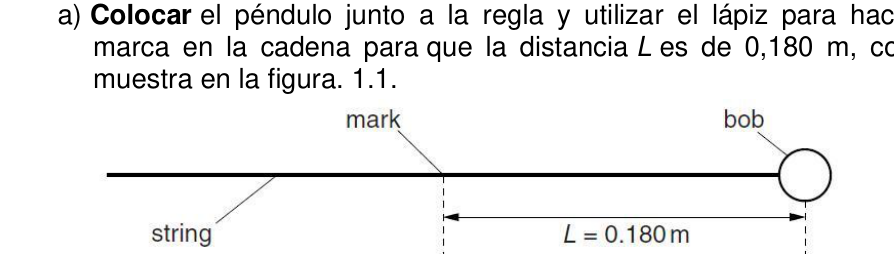
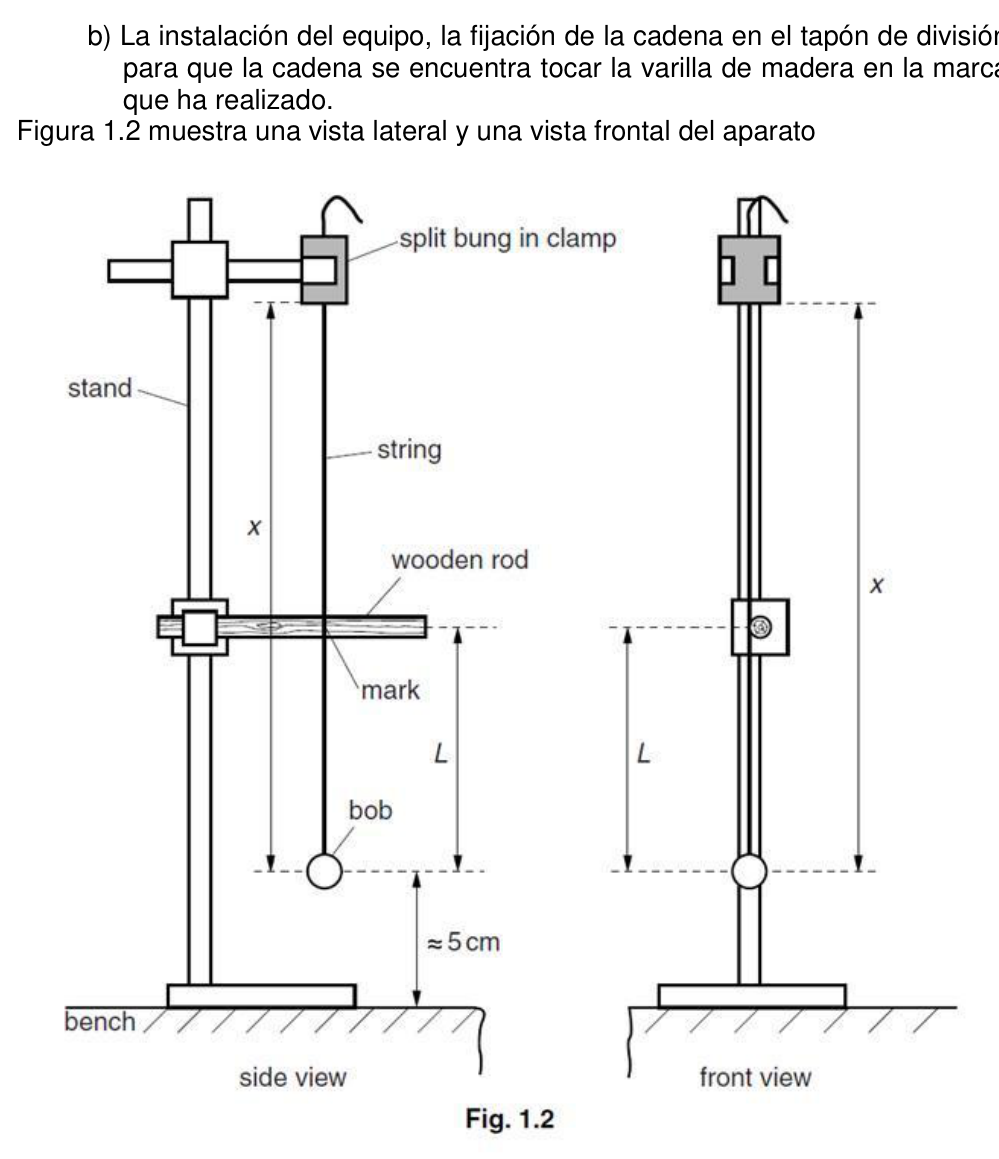
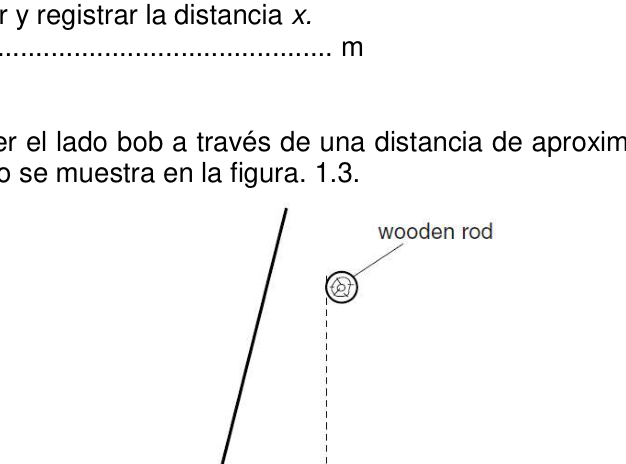
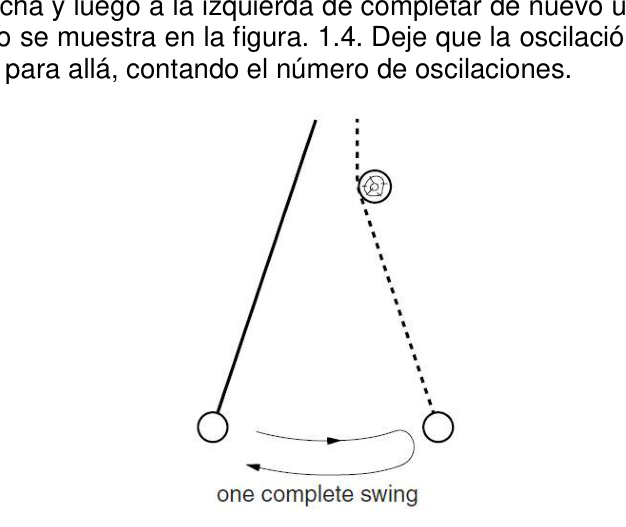
Topic: Oscillations & Waves Metodi: Simple Harmonic Motion Analysis, Graph Linearization, Experimental Data Analysis Competenze: Physical Reasoning, Experimental Data Analysis Objects: Pendulum Fonte: Testo (PDF) — p.3
Pendolo di oscillazione interrotta
PE23. Scuola scozzese San Andrés
Olivos, Buenos Aires.
In questo esperimento, si studia come il movimento di un pendolo che L’oscillazione è interrotta a seconda della sua lunghezza.
OAF 2013 - 147 (A) a) Metti il pendolo accanto alla regola e usa la penna per fare una Segna sulla catena che la distanza L sia di 0,180 m, come si mostra nella figura. 1.1.
b) l’installazione dell’apparecchio, il fissaggio della catena al tappo di divisione per che la catena si trova toccare il bastone di legno nel marchio che ha realizzato. Figura 1.2 mostra una vista laterale e una vista frontale dell’apparecchio
Il centro della piuma deve essere di circa 5 cm sopra la
- Il tavolo. La distanza x tra la parte inferiore del tappo e il centro del colpo deve essere circa 55 cm.
OAF 2013 - 148 Il marchio della catena deve essere a livello del centro della barra. c) Misurare e registrare la distanza x. x = … m
(B) a) muovere il lato bob attraverso una distanza di circa 5 cm, come viene mostrato nella figura. 1.3.
b) Smettila di fare e osserva il suo movimento. La scossa si muoverà verso il a destra e poi a sinistra di completare di nuovo un semiraponto, come viene mostrato nella figura. 1.4. Lascia che l’oscillazione del pendolo di qui e là, contando il numero di oscillazioni.
Misurare e registrare il tempo per almeno 10 cambiamenti consecutivi. Registra le letture sufficienti per determinare un valore preciso per il T tempo necessario per uno swing completo. T =
(C) Riduce la distanza x. Mantenere costante L, regolare l’altezza di il bastone di legno se necessario. Ripeti (A) (c) e (B) finché non hanno sei Set di valori di x e T. Include i valori di x nella tabella.
OAF 2013 - 149 (D) a) Tracciare la curva di T sull’asse e contro x sull’asse delle x. b) Disegnare la linea più adatta. c) Determinare la pendice e l’intersezione di questa linea. pendente = ordinato all’origine =
(E)
T e x sono correlati dall’equazione
T = P x + Q
dove P e Q sono costanti.
Con le risposte di (D) (c), determinare i valori di P e Q.
Datemi le unità appropriate.
P =
Q =
Topic: Oscillations & Waves Metodi: Simple Harmonic Motion Analysis, Graph Linearization, Experimental Data Analysis Competenze: Physical Reasoning, Experimental Data Analysis Objects: Pendulum Fonte: Testo (PDF) — p.3
The following shall be added to the list of the following:
PE23. St. Andrew’s Scottish School
Olive trees, from Buenos Aires.
In this experiment, it investigates how the motion of a pendulum whose oscillation is interrupted depending on its length.
The following is the list of the Member States’ financial statements: (A) a) Place the pendulum next to the rule and use the pencil to make a mark on the chain so that the distance L is 0,180 m, as is It’s shown in the figure. 1.1.
(b) Installation of equipment, attachment of the chain to the partition cap So the chain is located touching the wooden rod on the mark which he has accomplished. Figure 1.2 shows a side view and a front view of the apparatus
The centre of the plume shall be approximately 5 cm above the The table. The distance x between the bottom of the cap and the centre of the shaking shall be approximately 55 cm.
The following is the list of the Member States’ financial statements: The chain mark shall be in line with the centre of the bar. (c) Measure and record the distance x. x = … m
(B) (a) move the bob side through a distance of approximately 5 cm, As shown in the figure. 1.3.
(b) Release the bob and observe its movement. The shake will move to the Right and then left to complete a half-turn again, As shown in the figure. 1.4. Let the swing of the pendulum of Here and there, counting the number of oscillations.
Measure and record time for at least 10 consecutive changes. Record enough readings to determine an exact value for the T time needed for a full swing. T =
(C) Reduce the x distance. Keep constant L by adjusting the height of the wooden rod if necessary. Repeat (A) (c) and (B) until they have six sets of values of x and T. Include the values of x in your table.
The following is the list of the Member States’ financial statements: (D) (a) Draw the curve of T on the y axis against x on the x axis. (b) Draw the best fit line. (c) Determine the slope and intersection of this line. slope = ordered to origin =
(E)
The quantities T and x are related by the equation
T = P x + Q
where P and Q are constants.
With the answers in (D) (c), determine the values of P and Q.
Give him proper units.
P =
Q =
Topic: Oscillations & Waves Metodi: Simple Harmonic Motion Analysis, Graph Linearization, Experimental Data Analysis Competenze: Physical Reasoning, Experimental Data Analysis Objects: Pendulum Fonte: Testo (PDF) — p.3
Pendulo conico (atraccion de feria)
PE24. Escuela Escocesa San Andrés
Olivos, Buenos Aires.
Una atracción de feria transporta pasajeros en sillas que están unidas por varillas de metal a un polo central de rotación, como se muestra en la Fig. B2.1. Cuando el polo gira con velocidad angularω, las varillas hacer un ángulo θ con la vertical.
Se sugiere que cos θ es inversamente proporcional a ω 2. Diseñar un experimento de laboratorio, usando un pequeño objeto para representar una silla ocupada, aprobar la relación entre θ y ω. Yo u debe dibujar un diagrama, en la página 3, que muestra el disposición de su equipo. En su cuenta se debe prestar especial atención a a) el procedimiento que ha de seguirse, b) las medidas que deben adoptarse, c) el control de las variables, d) el análisis de los datos, e) que se tomen las medidas de seguridad.
OAF 2013 - 150
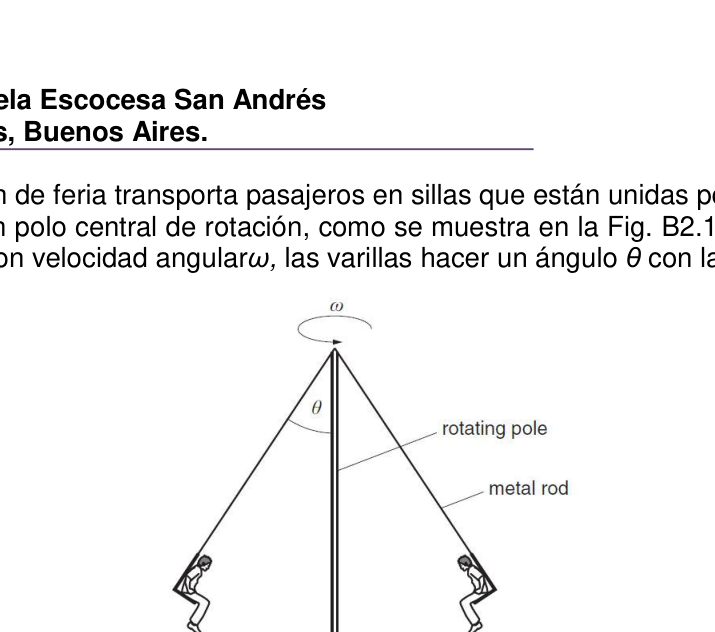
Topic: Oscillations & Waves, Newtonian Mechanics Metodi: Simple Harmonic Motion Analysis, Graph Linearization, Experimental Data Analysis Competenze: Physical Reasoning, Experimental Data Analysis Objects: Pendulum Fonte: Testo (PDF) — p.3
**Pendolo conico (attrazione di fiera) **
PE24. Scuola scozzese San Andrés
Olivos, Buenos Aires.
Un’attrazione di fiera trasporta passeggeri in sedie legate da bastoni di metallo a un polo centrale di rotazione, come mostrato in Figura 1. B2.1. Quando il polo gira a velocità angolareω, le bacche fanno un angolo θ con la verticale.
Si suggerisce che cos θ sia inversamente proporzionale a ω 2. Progettare un esperimento di laboratorio, usando un piccolo oggetto per rappresentare una sedia occupata, approvare il rapporto tra θ e ω. Io o devo disegnare un diagramma, a pagina 3, che mostra la disposizione del vostro equipaggio. En su cuenta se debe prestar especial atención a a) la procedura da seguire, b) le misure da adottare; (c) il controllo delle variabili; (d) l’analisi dei dati; e) che siano prese misure di sicurezza.
OAF 2013 - 150
Topic: Oscillations & Waves, Newtonian Mechanics Metodi: Simple Harmonic Motion Analysis, Graph Linearization, Experimental Data Analysis Competenze: Physical Reasoning, Experimental Data Analysis Objects: Pendulum Fonte: Testo (PDF) — p.3
The following table shows the results of the tests:
PE24. St. Andrew’s Scottish School
Olive trees, from Buenos Aires.
A fairground attraction carries passengers in chairs that are joined by rods. The metal to a central rotation pole, as shown in Fig. B2.1. When The pole rotates at angular velocityω, the rods make an angle θ with the vertical.
It is suggested that cos θ is inversely proportional to ω 2. Design a lab experiment, using a small object to represent an occupied chair, approve the relation between θ and ω. I ought to draw . a diagram, on page 3, showing the layout of your equipment. En su Special attention should be paid to (a) the procedure to be followed, (b) the measures to be taken; (c) the control of variables; (d) data analysis, (e) security measures are taken.
The Commission shall adopt implementing acts in accordance with Article 21 of Regulation (EU) No 1303/2013.
Topic: Oscillations & Waves, Newtonian Mechanics Metodi: Simple Harmonic Motion Analysis, Graph Linearization, Experimental Data Analysis Competenze: Physical Reasoning, Experimental Data Analysis Objects: Pendulum Fonte: Testo (PDF) — p.3
Pendulos - choque elastico
PE25. Colegio Pablo Apóstol
Yerba Buena, Tucumán.
Péndulos Objetivo: Encontrar las relaciones entre alturas de dos péndulos que chocan elásticamente.
Materiales
- Regla, papel milimetrado
- balanza
- hilo inextensible
- soporte
Procedimiento Dos péndulos simples de masas M1 y M2 están suspendidos del mismo punto e inicialmente en posición vertical. Se levanta la masa M1 una altura h1 y se deja libre, tal como se presenta en la figura. Tras un choque elástico entre ambas masas, se observa que la masa M2 asciende una altura h2
a) realizar
varias
mediciones
de
ambas alturas y armar tabla de valores
b) graficar h2 = f ( h1 ).
c) Obtener la ecuación de la recta y explicar que representa.
d) Medir las alturas h1 antes del choque y H1 a la que asciende el cuerpo
1 después del choque.
e) Grafica la altura que asciende la masa 1 tras la colisión; H1 = f( h1 )
f) Encuentra la expresión de dicha recta y explicar que representan sus
parámetros.
g) Elaborar conclusiones.
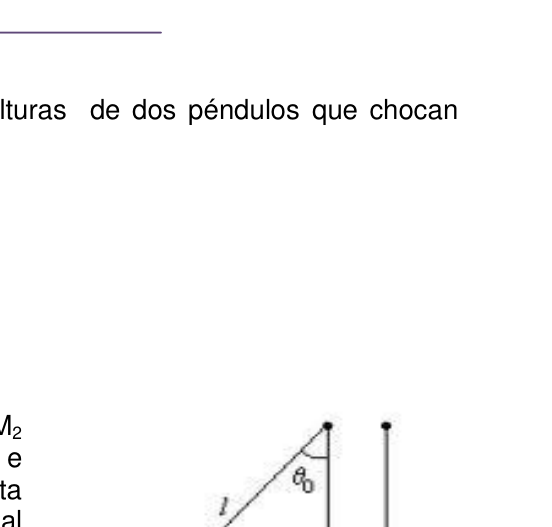
Topic: Conservation of Momentum, Conservation of Energy Metodi: Conservation of Momentum, Graph Linearization, Experimental Data Analysis Competenze: Physical Reasoning, Experimental Data Analysis Objects: Pendulum Fonte: Testo (PDF) — p.3
Pensolini - colpo elastico
PE25. Colegio Paolo l’apostolo
- Buona erba, Tucumán.
Pendili Obiettivo: Trovare le relazioni tra altezze di due pendoli che si scontrano
- Elastico.
Materiali
- Regola, carta millimetrica.
- Sbalzo
- filo inestensibile
- supporto
Procedura Due pendoli semplici di massa M1 e M2 sono sospesi dallo stesso punto e inizialmente in posizione verticale. Si alza. la massa M1 a una altezza h1 e viene lasciata libera, come come viene mostrato nella figura. Dopo un’ colpo elastico tra le due masse, se osserva che la massa M2 si eleva a un’altezza h2
a) realizzare vari misurazioni de
- E ’ un’altra cosa . b) graficare h2 = f (h1 ). c) Ottenere l’equazione della retta e spiegare che rappresenta. d) Misurare le altezze H1 prima dello scontro e H1 fino a cui il corpo si eleva 1 dopo l’incidente. e) Grafica dell’altezza che raggiunge la massa 1 dopo l’impatto; H1 = f(h1 ) f) Trova l’espressione di tale linea e spiega che le sue I parametri. (g) Esprimere conclusioni.
Topic: Conservation of Momentum, Conservation of Energy Metodi: Conservation of Momentum, Graph Linearization, Experimental Data Analysis Competenze: Physical Reasoning, Experimental Data Analysis Objects: Pendulum Fonte: Testo (PDF) — p.3
The following table shows the results of the calculation of the weighted average weight of the product:
PE25. Paul the Apostle College
It’s good grass, Tucumán.
The pendulum . Objective: Find the relationships between heights of two pendulums that collide elastically.
Materials
- Rule, millimeter paper.
- the balance
- unextended thread
- support .
The procedure Two simple pendulums of M1 and M2 masses are suspended from the same point and initially in vertical position. He ‘s getting up . The mass M1 a height h1 and is left free, such as shown in the figure. After a elastic shock between the two masses, se observes that the mass M2 rises to a height h2
(a) to carry out
several
measurements
de
both heights and set up a value table
(b) graph h2 = f (h1 ).
(c) Obtain the equation of the straight line and explain what it represents.
(d) Measure the heights h1 before impact and H1 up to which the body rises
1 after the crash.
(e) Graph the height of mass 1 after the collision; H1 = f(h1 )
(f) Find the expression of the statement and explain that it represents its
the parameters.
(g) Draw conclusions.
Topic: Conservation of Momentum, Conservation of Energy Metodi: Conservation of Momentum, Graph Linearization, Experimental Data Analysis Competenze: Physical Reasoning, Experimental Data Analysis Objects: Pendulum Fonte: Testo (PDF) — p.3
Sistema oscilante - constante elastica
PE26. EEST Nro. 1 Gral. Manuel Savio
Navarro, Buenos Aires.
Objetivos Estudiar el comportamiento de un sistema mecánico oscilante bajo diversas condiciones. Realizar los análisis correspondientes para obtener la constante elástica de un resorte
Introducción Los sistemas que se encuentran en equilibrio estable, oscilan al ser apartados de una posición de reposo. En general los sistemas físicos oscilan armónicamente si son perturbados levemente respecto de su posición de equilibrio. En estas condiciones se puede definir una frecuencia de oscilación determinada por los parámetros del sistema físico, e independiente de las condiciones específicas en las que se pone a oscilar el sistema.
Consignas Hallar la posición de equilibrio de un sistema formado por un objeto que cuelga de un resorte, para diversos pesos del objeto suspendido. A partir de la
OAF 2013 - 151 dependencia de dicha posición como función del peso del cuerpo se puede determinar las características dinámicas del resorte (constante de elasticidad y longitud en reposo) mediante un ajuste lineal de los resultados, en un gráfico (∆L vs P).
Materiales
Pesas de 10 g
Dinamómetro
Regla
Soporte para colgar el dinamómetro.
Topic: Oscillations & Waves Metodi: Simple Harmonic Motion Analysis, Hooke’s Law, Experimental Data Analysis Competenze: Physical Reasoning, Experimental Data Analysis Objects: Spring Fonte: Testo (PDF) — p.3
Sistema oscilante - costante elastica
PE26. EAST Noro. 1 grallo. Manuel Savio
Navarro, Buenos Aires.
Obiettivi Studiare il comportamento di un sistema meccanico oscillante sotto diverse Condizioni. Per ottenere la costante l’elastico di una stazione di resorte
Introduzione I sistemi che sono in equilibrio stabile oscilano all’interno se separati. di una posizione di riposo. In genere i sistemi fisici oscilano armoniosamente se sono disturbati. leggermente rispetto alla sua posizione di equilibrio. In queste condizioni si può definire una frequenza di oscillazione determinata dai parametri del sistema La situazione è stata molto difficile da trovare. oscillare il sistema.
Consigne Trovare la posizione di equilibrio di un sistema formato da un oggetto che si appende di una sorgente, per vari pesi dell’oggetto sospeso. A partire dal
OAF 2013 - 151 La dipendenza da tale posizione come funzione del peso corporeo può essere determinare le caratteristiche dinamiche della stazione di resortimento (constantina di elasticità e L’intervallo di tempo di lavoro (L) è stato effettuato con un’adeguata lineare dei risultati, su un grafico (∆L vs P).
Materiali Pese di 10 g Dinamometro Regola • Supporto per appendere il dinamometro.
Topic: Oscillations & Waves Metodi: Simple Harmonic Motion Analysis, Hooke’s Law, Experimental Data Analysis Competenze: Physical Reasoning, Experimental Data Analysis Objects: Spring Fonte: Testo (PDF) — p.3
The following shall be added to the list of the following:
PE26. This is North East. 1 Gral. Manuel Savio
I’m from Navarro, Buenos Aires.
Objectives Study the behaviour of a oscillating mechanical system under various conditions conditions. Perform the corresponding analyses to obtain the constant a spring elastic
The first is the introduction. Systems that are in stable equilibrium oscillate when separated. of a resting position. In general , physical systems oscillate harmoniously if disturbed . slightly relative to its equilibrium position. Under these conditions you can define a oscillation frequency determined by the system parameters The Commission has already taken a number of measures to ensure that the oscillating the system.
Consigns Find the equilibrium position of a system formed by a suspended object of a spring, for various weights of the suspended object. From the
The following points shall be added: Dependence on the position as a function of body weight can be determining the dynamic characteristics of the spring (elasticity constant and The results of the study were presented in a linear graph (∆L ). vs P).
Materials Weights of 10 g Dynamometer Rule • Support for the dynamometer to be hung.
Topic: Oscillations & Waves Metodi: Simple Harmonic Motion Analysis, Hooke’s Law, Experimental Data Analysis Competenze: Physical Reasoning, Experimental Data Analysis Objects: Spring Fonte: Testo (PDF) — p.3
Tecnica calorimetrica
PE27. Liceo Militar General Espejo
Ciudad de Mendoza.
La técnica calorimétrica es una de las más empleadas dentro de la
termodinámica como una herramienta de utilidad para realizar la caracterización
de los sistemas que generan o absorben energía térmica. Debido a la diversidad
de sistemas y a la manera como se generan los efectos térmicos, se presentan
diversidad de equipos calorimétricos.
El recipiente utilizado para efectuar las medidas de calor se denomina
calorímetro, que en su forma más sencilla es una vasija de paredes aisladas que
aloja en su interior el termómetro y agitador. Además contiene un líquido
calorimétrico que generalmente es agua. El cambio de temperatura experimenta-
do por un objeto cuando absorbe cierta cantidad de energía está controlado por
su capacidad calorífica. La constante de proporcionalidad C se denomina
capacidad calorífica del sistema.
ΔQ =C• ΔT
Esta capacidad calorífica se refiere a la cantidad de calor que hay que
suministrar a toda la extensión de una sustancia para elevar su temperatura en
una unidad (kelvin o grado Celsius), es una constante para cada calorímetro. Se
define calor específico c como la cantidad de calor que hay que proporcionar a
un gramo de sustancia para que eleve su temperatura en un grado centígrado.
En el caso particular del agua c vale 1 cal/(g ºC) ó 4186 J(kg ºK).
La cantidad de calor recibido o cedido por un cuerpo se calcula mediante la
siguiente fórmula
Q= m•c•(Tf-Ti)
Donde m es la masa, c es el calor específico, Ti es la temperatura inicial y Tf la
temperatura final.
Materiales
- Calorímetro
- Termómetros
- Estufa
- Agua
- Beaker
- Cubos metálico de diferentes materiales
- Balanza
Montaje: procedimiento
- De acuerdo con los materiales suministrados. Tome primero los datos de la temperatura inicial dentro del calorímetro el cual contiene una masa conocida de agua a temperatura ambiente.
- Agregue agua caliente al calorímetro, registrando previamente la temperatura máxima.
OAF 2013 - 152 3. Espere que la temperatura registrada en el termómetro se estabilice y registre la temperatura de equilibrio. (ver figura a) 4. Repita el procedimiento tres veces y reporte los datos en la tabla 1. 5. Para la determinación del calor específico de cada bloque: de nuevo mida la temperatura inicial del calorímetro con agua a temperatura ambiente, mida sus masas. También mida la masa del bloque y posteriormente sumérjalo en agua caliente por unos pocos minutos, hasta que alcance la misma temperatura del agua caliente. Antes de sacar el bloque para introducirlo en el calorímetro que contiene agua a temperatura ambiente mida la temperatura del agua caliente, luego si introduzca lo más rápido posible el bloque en el calorímetro y espere a que el sistema alcance la temperatura de equilibrio (ver figura b). Reporte estos datos en la tabla 2
Tabla 1 Masa agua fría m a ( kg ) Masa calorímetro m cal ( kg ) Masa agua calienta m c ( kg ) Temperatura agua fría Ta ( oC ) Temperatura agua caliente Tc (oC ) Temperatura mezcla Te (oC ) Calor especifico calorímetro ( J /kg oC )
Tabla 2 Tipo de sólid o Masa Calorímet ro m cal (kg) Mas a agu a fría m a (kg ) Calor Especifico Calorímet ro (J/kg oC) Masa del bloqu e m b ( kg ) Temperatu ra agua fría Ta ( oC ) Temperatu ra sólido Tc (oC ) Temperatu ra mezcla Te (oC ) Calor Especi fi co c x (J / kg oC)
Análisis y resultados ¿Cuál es el error porcentual cometido en la medida del calor específico de cada sólido con respecto al valor reportado en los textos? ¿Qué tipos de procesos termodinámicos están presentes en el método de mezclas?
Topic: Thermodynamics Metodi: First Law of Thermodynamics, Error Propagation, Experimental Data Analysis Competenze: Physical Reasoning, Experimental Data Analysis Objects: Calorimeter Fonte: Testo (PDF) — p.3
Tegnica calorimetrica
PE27. Liceo Militare Generale Specchio
Città di Mendoza.
La tecnica calorimetrica è una delle più utilizzate all’interno della Termodinamica come strumento di utilità per la caratterizzazione dei sistemi che generano o assorbono energia termica. A causa della diversità La struttura dei sistemi e il modo in cui vengono generati gli effetti termici, si presentano la diversità di attrezzature calometriche. Il recipiente utilizzato per effettuare le misure di calore è denominato Calorimetro, che nella sua forma più semplice è un vaso a pareti isolate che alloggia all’interno il termometro e l’agitatore. E contiene un liquido. calometrico che è generalmente acqua. Il cambiamento di temperatura si verifica Quando un oggetto assorbe una certa quantità di energia, è controllato da la sua capacità calorica. La costante di proporzionalità C è denominata capacità calorifica del sistema. ΔQ =C• ΔT Questa capacità calorica si riferisce alla quantità di calore che occorre fornire a tutta la portata di una sostanza per elevare la sua temperatura a un’unità (kelvin o grado Celsius), è una costante per ogni calometro. Se definisce calore specifico c come la quantità di calore da fornire a un grammo di sostanza per alzare la temperatura di un grado centigrado. Nel caso particolare dell’acqua c vale 1 cal/(g oC) o 4186 J(kg oK). La quantità di calore ricevuta o ceduta da un corpo viene calcolata mediante formula seguente Q= m•c•(Tf-Ti) Dove m è la massa, c è il calore specifico, Ti è la temperatura iniziale e Tf la temperatura di riferimento. temperatura finale.
Materiali
- Calorimetro
- Termodinamici
-
- Il forno .
- Acqua
- Beaker
- Cubi metallici di diversi materiali
- Sbalzo
Montaggio: procedura
- Secondo i materiali forniti. Prendi i dati prima. di temperatura iniziale all’interno del calometro che contiene un una massa nota di acqua a temperatura ambiente.
- Aggiungi acqua calda al caloriometro, registrando in anticipo la temperatura. temperatura massima.
OAF 2013 - 152 3. Aspettate che la temperatura registrata sul termometro si stabilizzi e registrare la temperatura di equilibrio. (vedi figura a) 4. Ripetere la procedura tre volte e riportare i dati in tabella 1. 5. Per la determinazione della temperatura specifica di ogni blocco: misura la temperatura iniziale del caloriometro con acqua a temperatura ambiente, misurare le loro masse. Misura anche la massa del blocco e poi immergeteli in acqua calda per qualche minuto, fino a raggiungere la stessa temperatura dell’acqua calda. Prima di togliere il blocco per inserirlo nel calorilitore contenente acqua a Temperatura ambiente misura la temperatura dell’acqua calda, quindi se Inserisci il blocco nel caloriometro il prima possibile e aspetta che che il sistema raggiunga la temperatura di equilibrio (vedere figura b). Relazione di questi dati in tabella 2
Tabella 1 Massa acqua Fredda . m a ( kg ) Massa caloriometro M cal ( kg ) Massa acqua Caldo m c ( kg ) Temperatura Acqua fredda Ta ( oC ) Temperatura acqua calda Tc (oC ) Temperatura miscela Te (oC ) Calore specifico caloriometro ( J /kg oC )
Tabella 2 Tipo … de Sottile o Massa Calorimetro ro M cal (kg) Ma a Agua a Fredda . m a (kg ) Calore Specifico Calorimetro ro (J/kg oC) Massa di cui al blocco e m b ( kg ) Temperatura ra acqua Fredda . Ta ( oC ) Temperatura
- solido Tc (oC ) Temperatura Ra miscela Te (oC ) Calore Specificamente fi co c x (J / kg oC)
Analisi e risultati Qual è l’errore percentuale commesso nel calore specifico di ciascuna solido rispetto al valore riportato nei testi? Quali tipi di processi termodinamici sono presenti nel metodo di
- Micheli?
Topic: Thermodynamics Metodi: First Law of Thermodynamics, Error Propagation, Experimental Data Analysis Competenze: Physical Reasoning, Experimental Data Analysis Objects: Calorimeter Fonte: Testo (PDF) — p.3
The following table shows the results of the calculation of the value of the product:
PE27. General Military High School Mirror
The city of Mendoza.
The calorimetric technique is one of the most widely used in the field of The use of thermodynamics as a useful tool for characterization of the systems that generate or absorb heat energy. Because of diversity The main problems of the system are the production of heat and the way in which the thermal effects are generated. the diversity of thermal equipment. The container used for the heat measurements is called Calorimeter, which in its simplest form is an insulated wall vessel that It houses the thermometer and shaker inside. It also contains a liquid. It’s a calorimetric system that’s usually water. The change in temperature is experi When an object absorbs a certain amount of energy it is controlled by its heat capacity. The proportionality constant C is called the heat capacity of the system. ΔQ =C• ΔT This heat capacity refers to the amount of heat that is needed to heat the supply the full extent of a substance to raise its temperature by a unit (kelvin or degree Celsius), is a constant for each calorimeter. Se defines specific heat c as the amount of heat to be provided to a gram of substance to raise its temperature by one degree Celsius. In the particular case of water c is 1 cal/g oC or 4186 J(kg oK). The amount of heat received or given by a body is calculated by the following formula Q= m•c•(Tf-Ti) Where m is the mass, c is the specific heat, Ti is the initial temperature and Tf is the The final temperature.
Materials
- Calorimeter
- Thermometers .
- It ‘s hot .
- Water
- Beaker .
- Metal cubes of different materials
- Weighing
Assembly: procedure
- According to the supplied materials. Take the data first . The temperature of the starting temperature within the calorimeter which contains a known mass of water at room temperature.
- Add hot water to the calorimeter, pre-recording the temperature. maximum temperature is reached.
The following is the list of the Member States’ financial statements: 3. Wait for the temperature recorded on the thermometer to stabilize and record the equilibrium temperature. (see figure a) 4. Repeat the procedure three times and report the data in Table 1. 5. For the determination of the specific heat of each block: again Measure the initial temperature of the thermometer with water at temperature environment, measure their masses. Also measure the block mass and Then dip it in hot water for a few minutes. until it reaches the same temperature as hot water. Before Remove the block to put it in the water-containing calorimeter. Room temperature measures the temperature of the hot water, then if Insert the block as quickly as possible into the thermometer and wait for the system reaches the equilibrium temperature (see figure b). Report this data in Table 2
Table 1 Mass Water It ‘s cold . m a ( kg ) Mass Calorimeter I ‘m not . ( kg ) Mass Water It ‘s hot . m c ( kg ) Temperature Cold water Ta ( oC ) Temperature Hot water Tc (oC ) Temperature mixing Te (oC ) Heat . Specific Calorimeter ( J /kg oC )
Table 2
- What ? de solid o Mass Calorimetry ro I ‘m not . (kg) But a water a It ‘s cold . m a (kg ) Heat . Specific Calorimetry ro (J/kg oC) Mass of the The following table shows the following: e m b ( kg ) Temperature ra Water It ‘s cold . Ta ( oC ) Temperature The following table shows the results of the study: Tc (oC ) Temperature The mixing Te (oC ) Heat . Specifically fi co c x (J / kg oC)
Analysis and results What is the percentage error made in measuring the specific heat of each solid in relation to the value reported in the texts? What types of thermodynamic processes are present in the method of mixed?
Topic: Thermodynamics Metodi: First Law of Thermodynamics, Error Propagation, Experimental Data Analysis Competenze: Physical Reasoning, Experimental Data Analysis Objects: Calorimeter Fonte: Testo (PDF) — p.3
Volumenes, densidades y empujes
PE28. Escuela Industrial Superior
Ciudad de Santa Fe.
Objetivos Determinar volúmenes, densidades y empujes utilizando diferentes métodos y realizando una comparación de los resultados.
OAF 2013 - 153 Elementos Probeta graduada. Cilindro metálico. Calibre. Agua. Sal Fina. Balanza.
Consigna 1: Determinar el volumen del cilindro por 2 métodos diferentes y comparar los resultados, teniendo en cuenta el error. (sin utilizar la balanza)
Consigna 2: Determinar la densidad de:
a) 80 [ml] de agua.
b) 80 [ml] de agua + 10 gramos de sal.
c) 80 [ml] de agua + 15 gramos de sal.
d) 80 [ml] de agua +20 gramos de sal.
e) 80 [ml] de agua + 25 gramos de sal.(conservar la muestra)
Consigna 3: Construir una gráfica de la densidad en función de la concentración de sal en la solución.
Consigna 4: Calcular con los datos obtenidos anteriormente y sin utilizar la balanza el empuje del cilindro para: a) Agua. b) Agua + 25 gramos de sal.
Consigna 5: Utilizando la balanza determinar el empuje que produce el líquido en el cilindro cuando se lo sumerge en: a) Agua. b) Agua + 25 gramos de sal. c) Explique el procedimiento utilizado.
Topic: Fluid Mechanics Metodi: Hydrostatic Equilibrium, Error Propagation, Experimental Data Analysis Competenze: Physical Reasoning, Experimental Data Analysis Objects: Cylinder, Container Fonte: Testo (PDF) — p.3
Volumi, densità e impulsioni
PE28. Scuola superiore industriale
Città di Santa Fe.
Obiettivi Determinare i volumi, le densità e i impulsi utilizzando differenti La Commissione ha adottato una proposta di regolamento che prevede che i metodi di valutazione e la comparazione dei risultati siano utilizzati.
OAF 2013 - 153 Elementi • Provetta graduata. • cilindro metallico.
- Calibro. • Acqua. Sal Fina. • Sbalzo.
Consegno 1: Determinare il volume del cilindro con 2 metodi diversi e confrontare i risultati, tenendo conto dell’errore. (senza usare il bilanciatore)
Consegno 2: Determinare la densità di: a) 80 [ml] di acqua. b) 80 [ml] di acqua + 10 grammi di sale. c) 80 [ml] di acqua + 15 grammi di sale. d) 80 [ml] di acqua + 20 grammi di sale. e) 80 [ml] di acqua + 25 grammi di sale.
Consegna 3: Costruire un grafico di densità in base alla concentrazione di sale nella soluzione.
Consegna 4: Calcolare con i dati ottenuti prima e senza utilizzare Sbalza la spinta del cilindro per: a) acqua. b) Acqua + 25 grammi di sale.
Consegna 5: utilizzando la bilancia per determinare la spinta che produce il liquido sul cilindro quando viene immerso in: a) acqua. b) Acqua + 25 grammi di sale. c) Spiega la procedura utilizzata.
Topic: Fluid Mechanics Metodi: Hydrostatic Equilibrium, Error Propagation, Experimental Data Analysis Competenze: Physical Reasoning, Experimental Data Analysis Objects: Cylinder, Container Fonte: Testo (PDF) — p.3
Volumes, densities and thrust
PE28. Higher Industrial School
City of Santa Fe.
Objectives Determine volumes, densities and thrust using different The Commission will be able to draw up a report on the results of the evaluation.
The following is the list of the countries of the European Union: Elements • Graduated test subject. • Metal cylinder.
- Calibration • Water. • Fine salt. • Balance.
Consignment 1: Determine the cylinder volume by 2 different methods and The results are compared, taking into account the error. (without using the scale)
Consignment 2: Determine the density of: (a) 80 [ml] of water. (b) 80 [ml] of water + 10 grams of salt. (c) 80 [ml] of water + 15 grams of salt. (d) 80 [ml] of water + 20 grams of salt. (e) 80 [ml] of water + 25 grams of salt.
Consignment 3: Build a density graph based on concentration salt in the solution.
Consignment 4: Calculate using previously obtained data and without using the balance the cylinder thrust to: (a) Water. (b) Water + 25 grams of salt.
Consignment 5: Using the scale to determine the thrust produced by the liquid in the cylinder when immersed in: (a) Water. (b) Water + 25 grams of salt. (c) Explain the procedure used.
Topic: Fluid Mechanics Metodi: Hydrostatic Equilibrium, Error Propagation, Experimental Data Analysis Competenze: Physical Reasoning, Experimental Data Analysis Objects: Cylinder, Container Fonte: Testo (PDF) — p.3
Perdida aparente de peso (empuje)
PE29. EPES Nro. 54 Gobernador Juan J. Silva
Ciudad de Formosa.
Completar los aspectos FALTANTES.
Tema:
Objetivo:
- Medir la perdida aparente de peso que sufre un cuerpo al sumergirlo en un líquido
Materiales:
Procedimieto:
a) introducir el cilindro aluminio en el cilindro hueco, con un rotulador
marcar sobre éste la altura del cilindro.
b) Colgar el conjunto del brazo de la balanza que no tiene el platillo
c) Poner pesitas en el platillo izquierdo hasta equilibrar
d) A continuación, con la balanza disparada se coloca el vaso de
precipitado y se le añade agua hasta cubrir el cilindro macizo. Anotar
qué sucede.
OAF 2013 - 154 e) En estas condiciones, con el cuentagotas se llena de agua el cilindro hueco hasta que la balanza se equilibre nuevamente. Observar qué nivel alcanza el agua dentro del cilindro.
Observaciones y conclusiones:
Esquema:
Topic: Fluid Mechanics Metodi: Hydrostatic Equilibrium, Experimental Data Analysis Competenze: Physical Reasoning, Experimental Data Analysis Objects: Cylinder, Container Fonte: Testo (PDF) — p.3
**Proprio apparente perdita di peso (push) **
PE29. - Non lo so. 54 Governatore Juan J. Silva
Città di Formosa.
Completare gli aspetti mancanti.
Tema:
Obiettivo:
- Misurare la perdita di peso apparente che un corpo subisce immergendolo in un liquido
Materiali:
Procedura: a) inserire il cilindro in alluminio nel cilindro vuoto, con un segnalettore su questo, segnare l’altezza del cilindro. b) Colpire l’insieme del braccio della bilancia che non ha il piatto (c) Mettete pesci sul piatto sinistro fino a che si bilanci. d) Poi, con la bilancia sparata, si colloca il vaso di si precipita e si aggiunge acqua fino a coprire il cilindro massiccio. Notare
- Cosa succede?
OAF 2013 - 154 e) In queste condizioni, il cilindro viene riempito di acqua con il contatore di gocce Ho un buco fino a quando la bilancia non si equilibra di nuovo. Guardate cosa . livello raggiunge l’acqua all’interno del cilindro.
Le osservazioni e le conclusioni:
Schema:
Topic: Fluid Mechanics Metodi: Hydrostatic Equilibrium, Experimental Data Analysis Competenze: Physical Reasoning, Experimental Data Analysis Objects: Cylinder, Container Fonte: Testo (PDF) — p.3
**Apparent weight loss (push) **
PE29. The Commission shall adopt implementing acts in accordance with Article 21 of this Regulation. 54 Governor John J. Silva
The city of Formosa.
Complete the missing aspects.
Subject:
The objective:
- Measuring the apparent weight loss a body suffers by immersing it in a liquid
Materials:
The procedure: (a) insert the aluminium cylinder into the hollow cylinder, with a labelling device mark the height of the cylinder on this one. (b) Hang the whole of the balance arm that does not have the plate (c) Put weights on the left plate until balanced (d) Then, with the shot scale, the glass of The water is added to the cylinder and the cylinder is covered. Write down What’s going on?
The following points shall be added: (e) Under these conditions, the cylinder is filled with water with the dropper. The balance is balanced again. See what level reaches the water inside the cylinder.
Observations and conclusions:
Schedule:
Topic: Fluid Mechanics Metodi: Hydrostatic Equilibrium, Experimental Data Analysis Competenze: Physical Reasoning, Experimental Data Analysis Objects: Cylinder, Container Fonte: Testo (PDF) — p.3
Centro de gravedad de placas
PE30. EPES Nro. 54 Gobernador Juan J. Silva
Ciudad de Formosa.
Completar los aspectos FALTANTES.
Centro de gravedad
Objetivo:
Materiales: placa trapezoidal, placa circular,..completar……
Procedimiento: por cualquiera de sus taladros suspender una placa de la
punta de la varilla eje. Un trozo de hilo cuelga de dicha punta tirada por una
pesa, a modo de plomada. Marcar en la placa la dirección del hilo. Realizar la
misma operación eligiendo otro taladro.
La intersección de las dos rectas da un punto. Puede comprobarse que al
suspender la placa por cualquiera de los otros taladros el hilo vertical pasa por el
punto anteriormente obtenido.
Hacer lo mismo con las otras placas.
A continuación colocar cualquier placa encima de una lapicera con punta o lápiz
negro y observar si se mantiene en equilibrio cuando el punto obtenido
anteriormente este sobre el apoyo.
Conclusiones:
Esquema:
Topic: Rigid Body Statics Metodi: Torque & Angular Momentum Analysis, Experimental Data Analysis Competenze: Physical Reasoning, Experimental Data Analysis Objects: Beam Fonte: Testo (PDF) — p.3
Centro di gravità delle lastre
PE30. - Non lo so. 54 Governatore Juan J. Silva
Città di Formosa.
Completare gli aspetti mancanti.
Centro di gravità
Obiettivo:
Materiali: scheda trapezoidale, scheda circolare, completare
Procedura: per uno dei suoi fori, sospendere una scheda della punta del palo dell’asse. Un pezzo di filo si appende a quella punta tirata da una pesa, in forma di piombo. Indicare sulla targa l’indirizzo del filo. Realizzare il la stessa operazione scegliendo un altro forno. L’intersezione delle due linee rette dà un punto. Si può verificare che il Sospendere la scheda per qualsiasi altro forno il filo verticale passa attraverso il punto ottenuto in precedenza. Fate lo stesso con le altre targhe. Poi posizionare qualsiasi targa sopra un lapis con punta o una matita Negro e osservare se si mantiene in equilibrio quando il punto ottenuto Il primo è stato sul sostegno.
Conclusioni:
Schema:
Topic: Rigid Body Statics Metodi: Torque & Angular Momentum Analysis, Experimental Data Analysis Competenze: Physical Reasoning, Experimental Data Analysis Objects: Beam Fonte: Testo (PDF) — p.3
The value of the underlying material shall be the sum of the values of the underlying materials.
PE30. The Commission shall adopt implementing acts in accordance with Article 21 of this Regulation. 54 Governor John J. Silva
The city of Formosa.
Complete the missing aspects.
Center of gravity
The objective:
Materials: trapezoidal plate, circular plate, complete … …
Procedure: by any of your drills suspend a plate from the the tip of the axle rod. A piece of thread hangs from that tip pulled by a Weighs, as a plume. Mark the direction of the thread on the plate. The implementation of the same operation by choosing another drill bit. The intersection of the two straight lines gives a point. It can be seen that the Suspend the plate by any of the other drills the vertical thread passes through the point previously obtained. Do the same with the other plates. Then place any plate on top of a pencil with a point or pencil black and observe if it is kept in balance when the point is obtained The previous one was on support.
Conclusions:
Schedule:
Topic: Rigid Body Statics Metodi: Torque & Angular Momentum Analysis, Experimental Data Analysis Competenze: Physical Reasoning, Experimental Data Analysis Objects: Beam Fonte: Testo (PDF) — p.3
Densidad de solido (Arquimedes)
PE31. EPES Nro. 54 Gobernador Juan J. Silva
Ciudad de Formosa.
Completar los aspectos FALTANTES.
Densidad de un cuerpo sólido
Objetivo: aplicar el principio de Arquímedes para calcular la densidad de un sólido
Materiales: agua, base soporte, bola de latón con tornillo, cuerpo sólido, dinamómetro de 1 N, hilo de seda, nuez doble, probeta graduada de 100 cm3, varilla soporte, varilla soporte de 250 mm
Procedimiento, resultados y conclusiones: completar
Esquema: completar
OAF 2013 - 155
Topic: Fluid Mechanics Metodi: Hydrostatic Equilibrium, Experimental Data Analysis Competenze: Physical Reasoning, Experimental Data Analysis Objects: Container Fonte: Testo (PDF) — p.3
**Densità di solido (Archimedes) **
PE31. - Non lo so. 54 Governatore Juan J. Silva
Città di Formosa.
Completare gli aspetti mancanti.
Densità di un corpo solido
Obiettivo: applicare il principio di Archimede per calcolare la densità di un solido
Materiali: acqua, supporto base, palla di rame con tornello, corpo solido, dinamometro 1 N, filo di seta, doppio noce, prova graduata di 100 cm3, a) un’armatura di un’armatura di un’armatura di un’armatura di un’armatura di un’armatura di un’armatura di un’armatura di un’armatura di un’armatura di un’armatura di un’armatura di un’armatura di un’armatura di un’armatura di un’armatura di un’armatura di un’armatura di un’armatura di un’armatura di un’armatura di un’armatura di un’armatura di un’armatura di un’armatura di un’armatura di un’armatura di un’armatura di un’armatura di un’armatura di un’armatura di un’armatura di un’armatura di un’armatura di un’armatura di un’armatura di un’armatura di un’armatura di un’armatura di un’armatura di un’armatura di un’armatura di un’armatura di una armatura di un’armatura di un’armatura di un’armatura di un’armatura di
Procedura, risultati e conclusioni: completare
Schema: completare
OAF 2013 - 155
Topic: Fluid Mechanics Metodi: Hydrostatic Equilibrium, Experimental Data Analysis Competenze: Physical Reasoning, Experimental Data Analysis Objects: Container Fonte: Testo (PDF) — p.3
The following is the list of the types of materials used in the manufacture of the product:
PE31. The Commission shall adopt implementing acts in accordance with Article 21 of this Regulation. 54 Governor John J. Silva
The city of Formosa.
Complete the missing aspects.
Density of a solid body
Objective: apply Archimedes’ principle to calculate the density of a solid .
Materials: water, support base, screw-based brass ball, solid body, 1 N dynamometer, silk thread, double nut, graded test of 100 cm3, The following conditions shall apply:
Procedures, results and conclusions: complete
Scheme: complete
The following is the list of the Member States’ financial statements:
Topic: Fluid Mechanics Metodi: Hydrostatic Equilibrium, Experimental Data Analysis Competenze: Physical Reasoning, Experimental Data Analysis Objects: Container Fonte: Testo (PDF) — p.3
Equivalente en agua de calorimetro
PE32. EPES Nro. 54 Gobernador Juan J. Silva
Ciudad de Formosa.
Completar los aspectos FALTANTES.
Calorimetro: su equivalente en agua
Objetivo:
Materiales:
Procedimiento:
Tomar con el termómetro la temperatura del conjunto del calorímetro,
normalmente será la temperatura ambiente (ta). En el vaso de precipitados
calentar unos 300g de agua, que llamaremos M, hasta unos 90ºC y la
llamaremos t1
Tan pronto se toma esta ultima temperatura debe echarse el agua del vaso de
precipitados en el calorímetro, tapándolo y agitándolo suavemente. Tomar la
máxima temperatura que alcanza, será esta te .
Para hallar el equivalente en agua que denominaremos m0 se emplea una
formula basada en el principio de conservación de la energía:
Q perdido = M.1. (t1 - te )
Q ganado = m0 . 1 . (te – ta )
De donde podes deducirla:
Debe repetirse la experiencia para otros valores de M, y hallar el valor medio
de m0.
Elaborar un cuadro de resultados.
Resultados y conclusiones:
Esquema:
Topic: Thermodynamics Metodi: First Law of Thermodynamics, Error Propagation, Experimental Data Analysis Competenze: Physical Reasoning, Experimental Data Analysis Objects: Calorimeter Fonte: Testo (PDF) — p.3
Equivalente in acqua calometrica
PE32. - Non lo so. 54 Governatore Juan J. Silva
Città di Formosa.
Completare gli aspetti mancanti.
Calorimetro: il suo equivalente in acqua
Obiettivo:
Materiali:
Procedura: Prendere con il termometro la temperatura del calometro insieme, la temperatura ambiente (ta) è normalmente la temperatura ambiente. Nel bicchiere di precipitazioni. riscaldare circa 300 grammi di acqua, che chiameremo M, fino a circa 90°C e la temperatura di Chiameremo t1 Non appena si prende questa ultima temperatura si deve scaricare l’acqua dal bicchiere di precipitate sul caloriometro, coprendo e agitando delicatamente. Prendi la . La temperatura massima raggiungibile, sarà questo tè. Per trovare l’equivalente in acqua che chiameremo m0 si usa un formula basata sul principio della conservazione dell’energia: Q perduto = M.1. (t1 - te ) Q bestiame = m0 . 1 . (te – ta ) Da dove potete dedurre:
L’esperienza deve essere ripetuta per altri valori di M, e trovare il valore medio de m0. Preparare un quadro di risultati.
Risultati e conclusioni:
Schema:
Topic: Thermodynamics Metodi: First Law of Thermodynamics, Error Propagation, Experimental Data Analysis Competenze: Physical Reasoning, Experimental Data Analysis Objects: Calorimeter Fonte: Testo (PDF) — p.3
Equivalent in water of the calorimeter
PE32. The Commission shall adopt implementing acts in accordance with Article 21 of this Regulation. 54 Governor John J. Silva
The city of Formosa.
Complete the missing aspects.
Calorimeters: their water equivalent
The objective:
Materials:
The procedure: Take the temperature of the whole calorimeter with the thermometer, the temperature of the room (ta) is normally the temperature. In the cup of precipitation . Heat about 300g of water, which we’ll call M, to about 90°C and the We ‘ll call it t1 . As soon as this last temperature is taken the water from the glass must be drained They’re just running into the heat meter, covering it up and gently shaking it. Take the The maximum temperature it can reach, it will be this tea. To find the water equivalent we will call m0 we use a formula based on the principle of energy conservation: Q lost = M1. (t1 - te ) Q cattle = m0 . 1 . (te – ta ) Where can you deduce it:
The experiment should be repeated for other M values, and the mean value found. de m0. Develop a scoreboard.
Results and conclusions:
Schedule:
Topic: Thermodynamics Metodi: First Law of Thermodynamics, Error Propagation, Experimental Data Analysis Competenze: Physical Reasoning, Experimental Data Analysis Objects: Calorimeter Fonte: Testo (PDF) — p.3
Calor y temperatura (calentamiento)
PE33. EPES Nro. 54 Gobernador Juan J. Silva
Ciudad de Formosa.
Completar los aspectos FALTANTES.
Calor y temperatura
Objetivo: completar:
Materiales: completar
Procedimiento:
1ra PARTE:
a) calentar 100g de agua midiendo la temperatura a intervalos iguales.
b) repetir la operación con 200g de agua y anotar y graficar en papel
milimetrado.
2da PARTE:
Calentar a ebullición los cilindros, luego introducirlos en vasos de
precipitados con 100g de agua a temperatura ambiente, anotar las
temperaturas de equilibrio en un cuadro.
OAF 2013 - 156 Resultados y conclusiones: completar
Esquema:
Topic: Thermodynamics Metodi: First Law of Thermodynamics, Graph Linearization, Experimental Data Analysis Competenze: Physical Reasoning, Experimental Data Analysis Objects: Calorimeter Fonte: Testo (PDF) — p.3
Calore e temperatura (calore)
PE33. - Non lo so. 54 Governatore Juan J. Silva
Città di Formosa.
Completare gli aspetti mancanti.
Calore e temperatura
Obiettivo: completare:
Materiali: completare
Procedura: PARTE 1 a) riscaldare 100 g di acqua misurando la temperatura a uguali intervalli. b) riproporre l’operazione con 200 g di acqua e annotare e graffiare su carta millimetro. Parte 2: Calmare a bollio i cilindri, poi inserirli in vasi di Precipitati con 100 g di acqua a temperatura ambiente, annotare le temperature di equilibrio in un quadro.
OAF 2013 - 156 Risultati e conclusioni: completare
Schema:
Topic: Thermodynamics Metodi: First Law of Thermodynamics, Graph Linearization, Experimental Data Analysis Competenze: Physical Reasoning, Experimental Data Analysis Objects: Calorimeter Fonte: Testo (PDF) — p.3
**Heat and temperature (heating) **
PE33. The Commission shall adopt implementing acts in accordance with Article 21 of this Regulation. 54 Governor John J. Silva
The city of Formosa.
Complete the missing aspects.
Heat and temperature
Objective: to complete:
Materials: complete
The procedure: Part 1 is: (a) heat 100 g of water by measuring the temperature at equal intervals. (b) repeat the operation with 200 g of water and write and draw on paper. It’s a millimeter. The Commission shall adopt implementing acts in accordance with Article 21 of this Regulation. Heat the cylinders to boil, then put them in cups of precipitated with 100 g of water at room temperature, note the equilibrium temperatures in a painting.
The following is the list of the Member States’ financial statements: Results and conclusions: complete
Schedule:
Topic: Thermodynamics Metodi: First Law of Thermodynamics, Graph Linearization, Experimental Data Analysis Competenze: Physical Reasoning, Experimental Data Analysis Objects: Calorimeter Fonte: Testo (PDF) — p.3
Refraccion - defectos del ojo
PE34. EPES Nro. 54 Gobernador Juan J. Silva
Ciudad de Formosa.
Completar los aspectos FALTANTES.
Refraccion
OBJETIVOS: -Observar la marcha de rayos en un ojo normal, miope e hipermétrope. -Proponer la forma de corrección de dichos defectos
Materiales:
Procedimiento: Se coloca el foco sobre el banco óptico, y a continuación la lente de f = +50 mm, el diafragma de tres ranuras y el disco de Hartl, luego: a) se ajusta la lente hasta obtener sobre el disco rayos paralelos. b) ….
Esquema:
Resultados y conclusiones:
Topic: Geometric Optics Metodi: Ray Tracing, Snell’s Law, Experimental Data Analysis Competenze: Physical Reasoning, Experimental Data Analysis Objects: Lens Fonte: Testo (PDF) — p.3
Refrazione - difetti dell’occhio
PE34. - Non lo so. 54 Governatore Juan J. Silva
Città di Formosa.
Completare gli aspetti mancanti.
Rifrazione
Obiettivi:
- Osservare il movimento dei raggi in un occhio normale, miope e ipermetropo.
- Proporre come correggere tali difetti
Materiali:
Procedura: Si pone il focus sul banco ottico, e poi il lente di f = +50 mm, il diaframma a tre rotture e il disco di Hartl, quindi: a) regolare la lente fino a ottenere su disco raggi paralleli. b) ….
Schema:
Risultati e conclusioni:
Topic: Geometric Optics Metodi: Ray Tracing, Snell’s Law, Experimental Data Analysis Competenze: Physical Reasoning, Experimental Data Analysis Objects: Lens Fonte: Testo (PDF) — p.3
Refraction - defects of the eye
PE34. The Commission shall adopt implementing acts in accordance with Article 21 of this Regulation. 54 Governor John J. Silva
The city of Formosa.
Complete the missing aspects.
Refraction
Objectives:
- Observe the movement of lightning in a normal, nearsighted and hypermetrical eye. -Propose a way to correct these defects
Materials:
The procedure: The focus is placed on the optical bench, and then the lens f = +50 mm, the three-slot diaphragm and Hartl’s disk, then: (a) the lens is adjusted to obtain parallel beams on the disc. b) ….
Schedule:
Results and conclusions:
Topic: Geometric Optics Metodi: Ray Tracing, Snell’s Law, Experimental Data Analysis Competenze: Physical Reasoning, Experimental Data Analysis Objects: Lens Fonte: Testo (PDF) — p.3
Indice de refraccion del agua (banco optico)
PE35. EPES Nro. 54 Gobernador Juan J. Silva
Ciudad de Formosa.
Completar los aspectos FALTANTES.
Refraccion
Objetivo: Determinar cuantitativamente el índice de refracción del agua.
Materiales:
Procedimiento: Se coloca el foco sobre el banco óptico, y a 10 cm la lente de f = +100cm el diafragma de tres ranuras, a continuación disco de Hartl y la pantalla opaca luego: a) se ajusta la lente hasta obtener sobre el disco rayos paralelos. b) ….
Resultados y conclusiones: Recordando la ecuación: 1 = (n – 1) 1 f R , obtener el índice de refracción.
Esquema:
OAF 2013 - 157
Topic: Geometric Optics Metodi: Snell’s Law, Experimental Data Analysis Competenze: Physical Reasoning, Experimental Data Analysis Objects: Lens Fonte: Testo (PDF) — p.3
**Indice di refraczione dell’acqua (banco ottico) **
PE35. - Non lo so. 54 Governatore Juan J. Silva
Città di Formosa.
Completare gli aspetti mancanti.
Rifrazione
Obiettivo: Determinare quantitativamente l’indice di refraczione dell’acqua.
Materiali:
Procedura: Si pone il focus sul banco ottico, e a 10 cm la lente di f = +100cm il Diaframma a tre rotture, poi disco di Hartl e schermo opaco Poi: a) regolare la lente fino a ottenere su disco raggi paralleli. b) ….
Risultati e conclusioni: Ricordando l’equazione: 1 = (n – 1) 1 f R , per ottenere l’indice di refraczione.
Schema:
OAF 2013 - 157
Topic: Geometric Optics Metodi: Snell’s Law, Experimental Data Analysis Competenze: Physical Reasoning, Experimental Data Analysis Objects: Lens Fonte: Testo (PDF) — p.3
The following is the list of the requirements for the ‘Operation of the ‘Operation of the ‘Operation of the ‘Operation of the ‘Operation of the ‘Operation of the ‘Operation of the ‘Operation of the ‘Operation of the ‘Operation of the ‘Operation of the ‘Operation of the ‘Operation of the ‘Operation of the ‘Operation of the ‘Operation of the ‘Operation of the ‘Operation of the ‘Operation of the ‘Operation of the ‘Operation of the ‘Operation of the ‘Operation of the ‘Operation of the ‘Operation of the ‘Operation of the ‘Operation of the ‘Operation of the ‘Operation of the ‘Operation of the ‘Operation of the ‘Operation of the ‘Operation of the ‘Operation of the ‘Operation of the ‘Operation of the ‘Operation of the ‘Operation of the ’:
PE35. The Commission shall adopt implementing acts in accordance with Article 21 of this Regulation. 54 Governor John J. Silva
The city of Formosa.
Complete the missing aspects.
Refraction
The objective: Determine the water refractive index quantitatively.
Materials:
The procedure: The focus is placed on the optical bench, and at 10 cm the lens f = +100cm the lens is three-slot diaphragm, then Hartl disk and the opaque screen Then: (a) the lens is adjusted to obtain parallel beams on the disc. b) ….
Results and conclusions: Remembering the equation: 1 = (n – 1) 1 f R , get the refractive index.
Schedule:
The following points shall be added:
Topic: Geometric Optics Metodi: Snell’s Law, Experimental Data Analysis Competenze: Physical Reasoning, Experimental Data Analysis Objects: Lens Fonte: Testo (PDF) — p.3
Densidad por Arquimedes (dinamometro)
PE36. EPES Nro. 54 Gobernador Juan J. Silva
Ciudad de Formosa.
Completar los aspectos FALTANTES.
Densidad
Objetivo:
Aplicar el Principio de Arquímedes para calcular la densidad de un sólido.
Materiales:
Procedimiento: a) El armado del equipo lo esquematizo así:
b) pesar el cuerpo que queremos calcular su densidad, con el dinamómetro
apropiado, en el aire, y hacer lo mismo introducido en el agua, aplicando
la fórmula se obtiene el resultado.
Deducir la ecuación a partir de las siguientes igualdades:
d = m/v E = p – p’ = v ∙ peso específico
Despejo v y sustituyo en la primer ecuación y finalmente recuerdo que P = m ∙ g
y que Pe = 1kg/dm3 cuando el líquido es agua.
Resultados y conclusiones:
Topic: Fluid Mechanics Metodi: Hydrostatic Equilibrium, Experimental Data Analysis Competenze: Physical Reasoning, Experimental Data Analysis Objects: Container Fonte: Testo (PDF) — p.3
**Densità per Archimede (dinamometro) **
PE36. - Non lo so. 54 Governatore Juan J. Silva
Città di Formosa.
Completare gli aspetti mancanti.
Densità
Obiettivo: Applicare il Principio di Archimede per calcolare la densità di un solido.
Materiali:
Procedura: a) Gli armamenti dell’equipaggio lo schematizzerò così:
b) pesare il corpo che vogliamo calcolare la sua densità, con il dinamometro appropriato, nell’aria, e fare lo stesso inserito nell’acqua, applicando la formula si ottiene il risultato. Deduire l’equazione dalle seguenti equazioni: d = m/v E = p p = v ∙ peso specifico Spago v e sostituisco nella prima equazione e finalmente ricordo che P = m ∙ g e che Pe = 1 kg/dm3 quando il liquido è acqua.
Risultati e conclusioni:
Topic: Fluid Mechanics Metodi: Hydrostatic Equilibrium, Experimental Data Analysis Competenze: Physical Reasoning, Experimental Data Analysis Objects: Container Fonte: Testo (PDF) — p.3
The following table shows the data of the data set used for the calculation of the data set.
PE36. The Commission shall adopt implementing acts in accordance with Article 21 of this Regulation. 54 Governor John J. Silva
The city of Formosa.
Complete the missing aspects.
Density
The objective: Apply Archimedes’ Principle to calculate the density of a solid.
Materials:
The procedure: (a) The equipment’s armour is outlined as follows:
(b) weigh the body we want to calculate its density, using the dynamometer appropriate, in the air, and do the same introduced into the water, applying The formula gives the result. To deduce the equation from the following equations: The following shall be added to the list of the following: I clear v and substitute in the first equation and finally I remember that P = m ∙ g And that Pe is 1kg/dm3 when the liquid is water.
Results and conclusions:
Topic: Fluid Mechanics Metodi: Hydrostatic Equilibrium, Experimental Data Analysis Competenze: Physical Reasoning, Experimental Data Analysis Objects: Container Fonte: Testo (PDF) — p.3
Cinematica con cronovibrador
PE37. EPES Nro. 54 Gobernador Juan J. Silva
Ciudad de Formosa.
Completar los aspectos FALTANTES.
Cinematica: movimiento
Objetivo:
Materiales: cronovibrador, carrito, cono de poleas, vástago de acero, fuente de alimentación, tornillo de mesa, eje tambor, motor con reductor, ……completar……
Procedimiento: realizado el montaje, esquematizo: Explico los pasos a seguir: …….
Calculos y resultados: Como el número de marcas obtenidas en la cinta es excesivo, se consideran significativos los puntos 5, 10, 15, 20 etc. El tiempo que transcurre entre dos marcas consecutivas es de 0,02 s por lo tanto el tiempo que transcurre entre dos puntos significativos es de 0,002 × 5´= 0,1 seg. Para calcular las velocidades en cada punto Q se toma como intervalo de medida la distancia comprendida entre el punto anterior y el posterior a Q y a continuación se calcula la velocidad media en ese intervalo,
OAF 2013 - 158 A continuación: a) confeccione la tabla de valores :
      puntos
          t
               d
           v
          0
          1
          2
b) confeccione un grafico de velocidad en funcion del tiempo c) elabore sus conclusiones
Topic: Newtonian Mechanics Metodi: Kinematic Equations, Graph Linearization, Experimental Data Analysis Competenze: Physical Reasoning, Experimental Data Analysis Objects: Cart Fonte: Testo (PDF) — p.3
Cinematica con cronovibratore
PE37. - Non lo so. 54 Governatore Juan J. Silva
Città di Formosa.
Completare gli aspetti mancanti.
Cinematografia: movimento
Obiettivo:
Materiali: cronovibratore, carrello, cono di pollice, ramo di acciaio, fonte di alimentazione, Scrocio de Tavola, Axe tamburo, motore con Riduzione, ……completare……
Procedura: montaggio realizzato, schema: Spieghi i seguenti passi: …….
Calcoli e risultati: Poiché il numero di marchi ottenuti sulla cinta è eccessivo, sono considerati I punti 5, 10, 15, 20 e così via sono significativi. Il tempo che passa tra due La durata di un’intervallo di tempo tra i due anni e i due anni è di 0,02 s. due punti significativi è di 0,002 × 5′= 0,1 seg. Per calcolare le velocità in ogni punto Q si prende come intervallo di misura la distanza tra il punto precedente e quello successivo a Q e a Quindi si calcola la velocità media in quel intervallo,
OAF 2013 - 158 In seguito: a) compilare il tabella dei valori:
punti t d v 0 1 2
b) realizzare un grafico di velocità in funzione del tempo c) elabora le sue conclusioni
Topic: Newtonian Mechanics Metodi: Kinematic Equations, Graph Linearization, Experimental Data Analysis Competenze: Physical Reasoning, Experimental Data Analysis Objects: Cart Fonte: Testo (PDF) — p.3
The following table shows the number of films and their respective dimensions:
PE37. The Commission shall adopt implementing acts in accordance with Article 21 of this Regulation. 54 Governor John J. Silva
The city of Formosa.
Complete the missing aspects.
Cinematica: movement
The objective:
Materials: chrono-vibrator, cart, pulley cone, steel stem, source of food, Screw de Table, The axis Drum, engine with The following table shows the results of the calculations: The following information shall be provided:
The procedure: assembly, schematic: I explain the following steps: …….
Calculations and results: As the number of marks obtained on the tape is excessive, they are considered The Commission has not yet taken any further action. The time between two consecutive marks is 0.02 s hence the time between two significant points is 0,002 × 5′= 0,1 sec. To calculate the velocities at each point Q is taken as the interval of Measures the distance between the point before and after Q and a Then the average speed at that interval is calculated.
The Commission shall adopt delegated acts in accordance with Article 21 of this Regulation. The following: (a) set up the value table:
points t d v 0 1 2
(b) draw up a time-based speed chart (c) draw up its conclusions
Topic: Newtonian Mechanics Metodi: Kinematic Equations, Graph Linearization, Experimental Data Analysis Competenze: Physical Reasoning, Experimental Data Analysis Objects: Cart Fonte: Testo (PDF) — p.3
Cp/Cv del aire (Clement-Desormes)
PE38. Instituto Industrial Luis A. Huergo
Ciudad de Buenos Aires.
Objetivo: Determinar la relación Cp/Cv del aire (γ) por el método de Clement-Desormes.
Elementos:
- Recipiente de vidrio con tapa hermética.
- Mangueras
- Broche
- Papel milimetrado
- Soporte de madera
- Cera (utilizada para el sellado del recipiente)
- Barómetro para medir la presión atmosférica.
Fundamentación teórica:
Se dispone de un dispositivo formado por un recipiente de vidrio sellado al que
se le conectan dos mangueras, una de ellas anexada a un manómetro de rama
abierta (construido con una manguera fijada al soporte de madera en forma de
“U”)
Por la otra manguera se insufla aire dentro del recipiente y luego se cierra con un
broche (ver Figura).
El aire dentro del recipiente, por lo tanto,
se
encuentra
a
una
presión
P1
ligeramente superior a la atmosférica (P0)
Esta sobre-presión puede leerse por la
diferencia de altura H1 entre las ramas
del manómetro.
P1 = P0 + δ.g.H1
Donde g es el valor de la aceleración de
la gravedad y δ la densidad del agua.
La temperatura del aire dentro del
recipiente
en
estas
condiciones
es
T1 = Temperatura ambiente.
Al abrir el broche, permitiendo la salida de aire, la presión interior se equilibra con la atmosférica. P2 = P0 => H2 = 0 El resto del aire que queda en el recipiente, por lo tanto, sufre una expansión. Si esta expansión es rápida no se intercambia calor con el medio, y el trabajo de expansión se hace a expensas de la energía interna, por lo cual la temperatura desciende a un valor T2.
OAF 2013 - 159 Si inmediatamente que el aire se ha expandido se cierra nuevamente el dispositivo, el volumen de aire permanece constante, y como su temperatura T2 es menor que la del ambiente, intercambiará calor con él y aumentará su temperatura hasta T3 = T1 = T ambiente y la presión se elevará a un valor P3 lo que da lugar a una diferencia de altura H3 entre las ramas del manómetro. P3 = P0 + δ.g.H3
Diagrama P-V del experimento:
Se considerará que en el breve tiempo que dura le experiencia no varían las condiciones del ambiente (presión atmosférica y temperatura ambiente) Como el estado inicial y final (1 y 3) se encuentran sobre la isoterma, para esa masa de aire se cumple que: P1 . V1 = P3 . V3 Y como V3 = V2 1 2 3 1 V V P P (I) Como la transformación 1-2 es adiabática: 1 2 2 1 V V P P (II) Luego, por (I): 3 1 2 1 P P P P
Y teniendo en cuenta que: P1 = P0 + δ.g.H1 P2 = P0 P3 = P0 + δ.g.H3 Entonces: 3 0 1 0 0 1 0 … … H g P H g P P H g P
Finalmente: 3 0 1 0 0 1 … . ln … 1 ln H g P H g P P H g
V1 P V P0 P1 P3 V2=V3 T1=T3 T2 1 2 3
OAF 2013 - 160
Procedimiento experimental:
Paso 1:
Medir la presión atmosférica mediante el barómetro.
Paso 2:
Insuflar aire dentro del dispositivo y cerrarlo abrochando la manguera libre.
Esperar a que el sistema alcance el equilibrio y medir la diferencia de
alturas H1 en el manómetro de rama abierta.
Paso 3:
Abrir el broche permitiendo la salida de aire hasta que la diferencia de
alturas en el manómetro sea cero y luego cerrar nuevamente el sistema
(esta operación debe hacerse rápidamente)
Paso 4:
Esperar a que el sistema alcance el nuevo equilibrio y medir la diferencia
de alturas H3 en el manómetro.
Paso 5:
Repetir los pasos 2, 3 y 4 para 4 diferentes valores de H1
Paso 6:
Graficar:
3
0
1
0
…
.
ln
H
g
P
H
g
P
(abscisas) vs.
0
1
.
.
1
ln
P
H
g
(ordenadas)
Paso 7:
Mediante el análisis de la pendiente del gráfico, hallar el valor de γ y su
error.
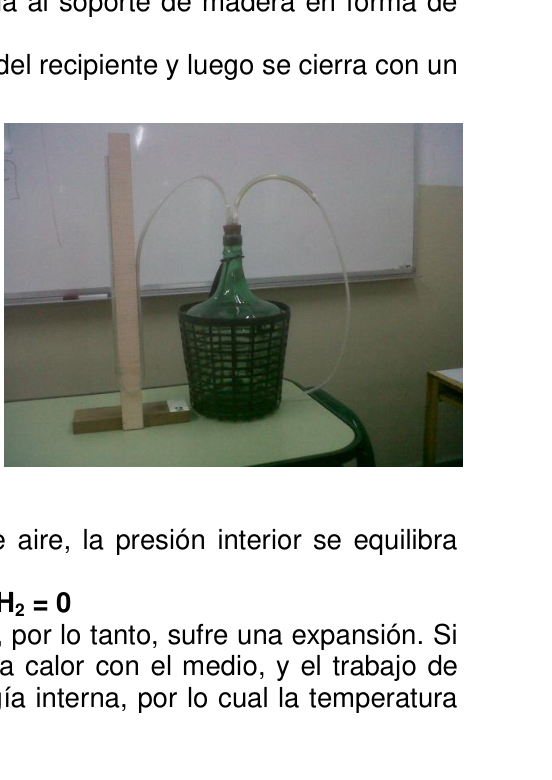
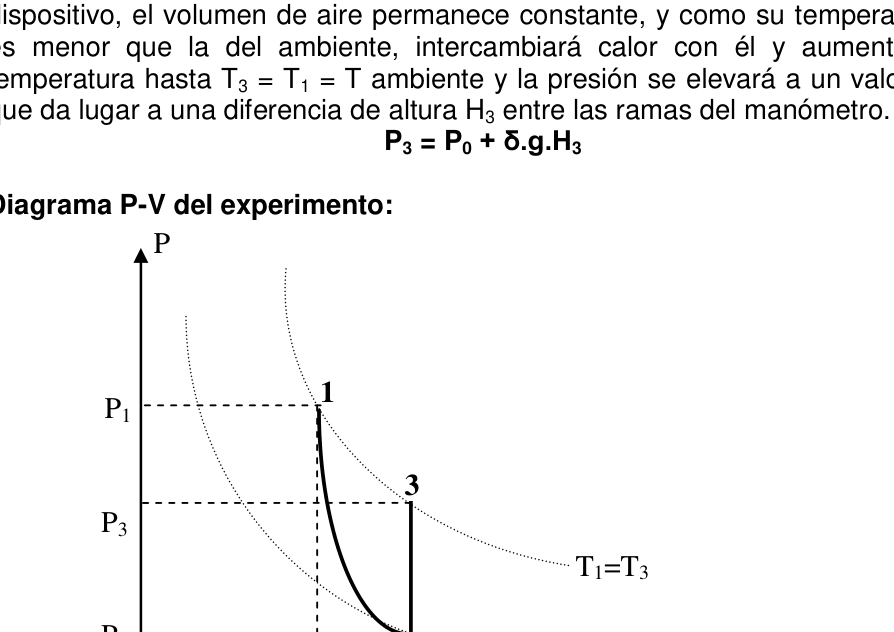
Topic: Thermodynamics, Kinetic Theory Metodi: First Law of Thermodynamics, Ideal Gas Law, Experimental Data Analysis Competenze: Physical Reasoning, Experimental Data Analysis Objects: Gas, Manometer, Container Fonte: Testo (PDF) — p.3
**Cp/Cv dell’aria (Clement-Desormes) **
PE38. Istituto industriale Luis A. - Hoorgo
Città di Buenos Aires.
Obiettivo: Determinare il rapporto Cp/Cv dell’aria (γ) con il metodo Clement-Desormes.
Elementi:
- Un recipiente in vetro con copertura chiusa.
- Mangia .
- Broche .
- Papero millimetrico .
- Supporto in legno
- Ceretta (utilizzata per il sigillo del recipiente)
- Barometro per misurare la pressione atmosferica.
Fondamento teorico: Si dispone di un dispositivo formato da un recipiente di vetro sigillato al quale si può sono collegati a due manichi, uno di essi collegato a un manometro di rampa aperta (con costruzione di un tubo fissato al supporto in legno in forma di “U”) L’altro tubo viene infuso con aria dentro il recipiente e viene chiuso con un La struttura è stata riposta in un numero di punti. L’aria all’interno del recipiente, quindi, se Trova a Una .
- Presione P1 leggermente superiore all’atmosfera (P0) Questa sovraccarico può essere letta dalla differenza di altezza H1 tra i rami
- Il manometro. P1 = P0 + δ.g.H1 Dove g è il valore dell’accelerazione di la gravità e δ la densità dell’acqua. La temperatura dell’aria all’interno del contenitore en
- Sono questi .
Condizioni
es
T1 = temperatura ambiente.
Aprendo la pinza, permettendo l’uscita di aria, la pressione interna si bilancia. con l’atmosfera. P2 = P0 => H2 = 0 Il resto dell’aria rimasta nel recipiente, quindi, subisce un’espansione. Si Questa espansione è rapida non si scambia calore con il mezzo, e il lavoro di L’espansione è fatta a spese dell’energia interna, quindi la temperatura si riduce a un valore T2.
OAF 2013 - 159 Se immediatamente dopo che l’aria si è espanduta, si chiude di nuovo il dispositivo, il volume di aria rimane costante, e come la sua temperatura T2 è inferiore a quella dell’ambiente, scambierà calore con lui e aumenterà il suo La temperatura fino a T3 = T1 = T ambiente e la pressione aumenterà a un valore P3 il che dà luogo a una differenza di altezza H3 tra i rami del manometro. P3 = P0 + δ.g.H3
Diagramma P-V dell’esperimento:
Si ritiene che nel breve periodo di esperienza le condizioni di vita non variano. condizioni ambientali (pressione atmosferica e temperatura ambiente) Come lo stato iniziale e finale (1 e 3) si trovano sopra l’isoterma, per quella massa di aria è soddisfatta che: P1 . V1 = P3 . V3 E come V3 = V2 1 2 3 1 V V P P (I) Come la trasformazione 1-2 è adiabatica: 1 2 2 1 V V P P (II) Poi, per (I): 3 1 2 1 P P P P
E tenendo presente che: P1 = P0 + δ.g.H1 P2 = P0 P3 = P0 + δ.g.H3 Allora: 3 0 1 0 0 1 0 … … H g P H g P P H g P
Infine: 3 0 1 0 0 1 … . ln … 1 ln H g P H g P P H g
V1 P V P0 P1 P3 V2=V3 T1=T3 T2 1 2 3
OAF 2013 - 160 Procedura sperimentale: Passo 1: Misurare la pressione atmosferica con il barometro. Passo 2: Insalare l’aria all’interno del dispositivo e chiuderla aprendo il tubo libero. Attendere che il sistema raggiunga l’equilibrio e misurare la differenza di Altezze H1 sul manometro di ramma aperta. Passo 3: Apri la pinna permettendo l’aria di uscita fino a quando la differenza di Altezze sul manometro è zero e poi chiudere di nuovo il sistema (questa operazione deve essere effettuata rapidamente) Passo 4: Aspettare che il sistema raggiunga il nuovo equilibrio e misurare la differenza di altezza H3 sul manometro. Passo 5: Ripetere i passi 2, 3 e 4 per 4 valori diversi di H1 Passo 6: Grafica: 3 0 1 0 … . ln H g P H g P (spacci) vs. 0 1 . . 1 ln P H g (ordini) Passo 7: L’analisi della pendenza del grafico permette di trovare il valore di γ e di errore.
Topic: Thermodynamics, Kinetic Theory Metodi: First Law of Thermodynamics, Ideal Gas Law, Experimental Data Analysis Competenze: Physical Reasoning, Experimental Data Analysis Objects: Gas, Manometer, Container Fonte: Testo (PDF) — p.3
The air pressure of the air is measured at the level of the air pressure of the air.
PE38. The Spanish Ministry of Foreign Affairs I ‘m not .
City of Buenos Aires.
The objective: Determine the Cp/Cv ratio of air (γ) by the Clement-Desormes method.
The following elements:
- Glass container with a sealed lid.
- You eat .
- Broche .
- Millimeter paper .
- Wood support
- Candle (used for sealing the container)
- Barometer to measure atmospheric pressure.
Theoretical foundation:
A device consisting of a sealed glass container is provided to which the
Two hoses are connected to it, one of them attached to a branch manometer.
open (built with a hose fixed to the wooden support in the shape of a
“U”)
The other hose is inflated into the container and then closed with a
The following table shows the results of the study:
The air inside the container, therefore,
se
Find him .
a
One .
Pressure
P1
slightly above atmospheric (P0)
This overpressure can be read by the
H1 height difference between branches
The manometer.
P1 = P0 + δ.g.H1
Where g is the acceleration value of
the gravity and δ the density of the water.
The temperature of the air inside the
container
en
These are the ones .
conditions
es
T1 = ambient temperature
When the spray is opened, allowing air to escape, the pressure inside is balanced. with the atmosphere. P2 = P0 => H2 = 0 The remaining air left in the container, therefore, undergoes expansion. Si This expansion is rapid. There is no heat exchange with the medium, and the work of The expansion is done at the expense of internal energy, so the temperature decreases to a value of T2.
The following is the list of the Member States’ financial statements: If immediately the air has expanded the air is closed again device, the air volume remains constant, and as its temperature T2 It’s smaller than the ambient heat, it’ll exchange heat with it and increase its temperature. temperature up to T3 = T1 = T ambient and the pressure will rise to a value P3 the which results in a H3 height difference between the manometer branches. P3 = P0 + δ.g.H3
P-V diagram of the experiment:
It shall be considered that in the short term the experience does not vary. environmental conditions (atmospheric pressure and ambient temperature) As the initial and final states (1 and 3) are located above the isotherm, for that air mass is met that: P1 . V1 = P3 . V3 And as V3 is V2 1 2 3 1 V V P P (I) As the transformation 1-2 is adiabatic: 1 2 2 1 V V P P (II) Then by (I): 3 1 2 1 P P P P
And considering that: P1 = P0 + δ.g.H1 P2 = P0 P3 = P0 + δ.g.H3 So: 3 0 1 0 0 1 0 … … H g P H g P P H g P
Finally: 3 0 1 0 0 1 … . ln … 1 ln H g P H g P P H g
V1 P V P0 P1 P3 V2=V3 T1=T3 T2 1 2 3
The following points shall be added: Experimental procedure: Step one: Measure the atmospheric pressure using the barometer. Step two: Inhale air into the device and close it by clamping the free hose. Wait for the system to reach balance and measure the difference between H1 heights in the open-branch manometer. Step three: Open the pin allowing air to escape until the difference of Heights on the manometer is zero and then close the system again (This operation must be done quickly) Step four: Wait for the system to reach the new balance and measure the difference. H3 heights on the manometer. Step five: Repeat steps 2, 3 and 4 for 4 different H1 values Step 6: Graphing: 3 0 1 0 … . ln H g P H g P (abscises) vs. 0 1 . . 1 ln P H g (Orders) Step seven: By analysing the slope of the graph, find the value of γ and its It’s a mistake.
Topic: Thermodynamics, Kinetic Theory Metodi: First Law of Thermodynamics, Ideal Gas Law, Experimental Data Analysis Competenze: Physical Reasoning, Experimental Data Analysis Objects: Gas, Manometer, Container Fonte: Testo (PDF) — p.3
Ley de Ohm y materiales no-ohmicos
PE39. Instituto de Enseñanza San Jorge
Colegio La Asunción
Colegio Santa Dorotea
Colegio Belén
Ciudad de Santiago del Estero.
Objetivo:
Verificar la ley de Ohm. Observar el comportamiento de ciertos materiales no-
óhmicos.
Lista de Materiales:
- Batería de 9V y fuente de CC
- Cables y pinzas cocodrilo.
- Resistencia variable de 1Kῼ (Potenciómetro)
- Voltímetro y amperímetro.
- Papel milimetrado.
- 1 Resistencia de valor desconocido.
- Resistencias de 330 ῼ.- 56 ῼ. - 69ῼ.- 33ῼ - 22ῼ - 470ῼ - 397ῼ - 12ῼ
- 1 diodos Led.
- Portalámpara y lámpara de 2,2V-0,25A
Descripción: En 1826 el físico alemán Georg Simon Ohm (1787-1854) descubrió que la corriente que circula por un conductor es directamente proporcional al potencial aplicado a los extremos del mismo, siempre que la temperatura se mantenga constante. Matemáticamente esta relación se expresa: V R i 1
OAF 2013 - 161 donde R es la resistencia del conductor. Este descubrimiento es conocido como Ley de OHM. Existen muchos materiales que conducen la corriente eléctrica pero no todos cumplen con la ley de Ohm. Una forma de determinar si un conductor es o no óhmico es someterlo a distintos potenciales y observar si la relación con la corriente que circula por el muestra una representación lineal.
Procedimiento:
- Arme el circuito de la figura 1.
Figura 1.
- Conecte los extremos de la resistencia de valor desconocido en los terminales a y b. Mida el voltaje aplicado y la corriente que circula por el resistor para distintas posiciones del cursor del potenciómetro (tomar un mínimo de 10 lecturas), registrando las mediciones en una tabla.
- Haga una gráfica de Intensidad de corriente en función de la diferencia de potencial en el papel milimetrado usando los datos volcados en la tabla. Verifica si el comportamiento es aproximadamente lineal y en tal caso ajusta los puntos graficados a una recta.
- Determina el valor de la resistencia desconocida conectada en los terminales a y b, a partir de la pendiente de la recta graficada; teniendo en cuenta que m R 1 , siendo m la pendiente de la recta y R el valor de la resistencia.
- Realiza los pasos 2, 3 colocando el LED entre los terminales a y b, con la precaución de conectar en serie con éste, una resistencia limitadora de corriente RL tal como muestra la figura 2. Compara la gráfica obtenida con la realizada para la resistencia.
Figura 2.
- Arma el circuito de la Figura 3, donde V0 es la tensión de la fuente de alimentación del circuito. Mida el voltaje aplicado y la corriente que circula por la lámpara para distintos valores de R (tomar un mínimo de 10 lecturas), registrando las mediciones en una tabla.
- Haga una gráfica de Intensidad de corriente en función de la diferencia de potencial en el papel milimetrado usando los datos volcados en la tabla.
OAF 2013 - 162
Figura 3.
Nota
Varía el valor de la resistencia R entre 40ῼ y 150ῼ. Para ello piense como puede
conseguir estos valores de resistencia con los valores de resistencia que se
proveyó.
El funcionamiento óptimo de las lámparas es para una diferencia de potencial de
2,2 V y una corriente de 0.25A. Para estos valores de corriente, la potencia
disipada por las resistencias puede ser muy alta por lo tanto las mismas se van a
calentar. Tenga cuidado de no quemarse. No utilice el potenciómetro para armar
estos circuitos pues se puede quemar. Para medir estos valores de corriente
utiliza el borne de 10A del amperímetro. Utiliza una fuente de corriente continua
en lugar de la batería.
Requerimientos:
a) Realiza el montaje de la experiencia en forma correcta, prolija y
ordenada minimizando las posibles causas de errores y cuidando los
instrumentos de medición.
b) Efectúa la propagación de errores adecuadamente para cada caso.
c) Analiza y detalla las fuentes de error que tienen mayor incidencia en el
resultado obtenido.
d) Efectúa las 3 tablas de mediciones y sus correspondientes gráficos con
las unidades y escalas adecuadas.
e) Determina el valor de la RESISTENCIA desconocida con su
correspondiente error.
f) De acuerdo a los gráficos obtenidos determina si los tres elementos
empleados en el circuito cumplen con la ley de ohm. Justifica.
Símbolos de componentes electrónicos. Figura 4
OAF 2013 - 163
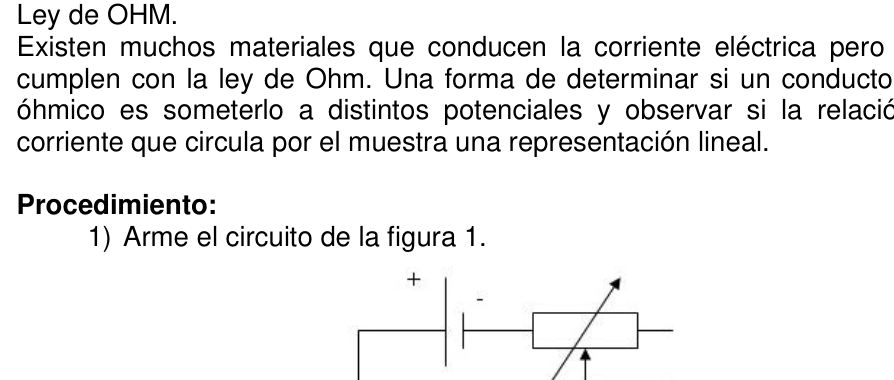
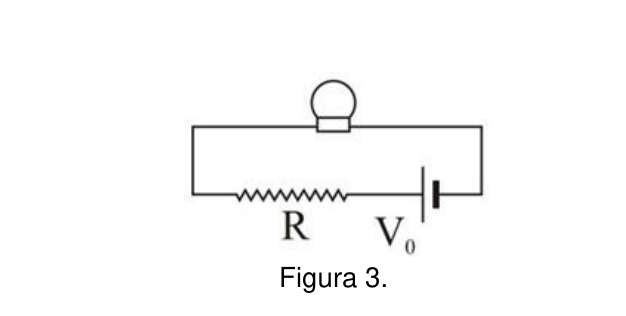
Topic: Circuits Metodi: Graph Linearization, Kirchhoff’s Laws, Experimental Data Analysis Competenze: Physical Reasoning, Experimental Data Analysis Objects: Resistor, Battery Fonte: Testo (PDF) — p.3
Legge di Ohm e materiali non ohmici
PE39. Istituto di istruzione San Jorge
La Asunción scuola
La scuola Santa Dorotea
La scuola di Belém
Città di Santiago del Estero.
Obiettivo: Verificare la legge di Ohm. Osservare il comportamento di alcuni materiali non Ohmico.
Lista dei materiali:
- Batteria a 9 V e fonte di corrente continua
- Cable e pinze crocodrillo.
- Resistenza variabile di 1K (potenziometro)
- Voltímetro e ampímetro.
- Papero millimetrico.
- 1 resistenza di valore sconosciuto.
- Resistenze di 330 - 56 . - 69ῼ.- 33ῼ - 22ῼ - 470ῼ - 397ῼ - 12ῼ
- 1 diodo Led.
- Porta lampada e lampada 2,2V-0,25A
Descrizione: Nel 1826 il fisico tedesco Georg Simon Ohm (1787-1854) scoprì che la Il corrente che circola attraverso un conduttore è direttamente proporzionale al potenziale Applicato alle estremità, purché la temperatura sia mantenuta costante. Matematicamente questa relazione si esprime: V R i 1
OAF 2013 - 161 dove R è la resistenza del conducente. Questa scoperta è nota come Legge di OHM. Ci sono molti materiali che conducono il corrente elettrica ma non tutti. si adempiscono alla legge di Ohm. Un modo per determinare se un conducente è o non è L’ottima idea è sottoporlo a diversi potenziali e osservare se la relazione con l’ambiente è corrente che circola attraverso il campione una rappresentazione lineare.
Procedura:
- Armar il circuito di figura 1.
Figura 1.
- Connettere le estremità della resistenza di valore sconosciuto nei terminali a e b. Misura la tensione applicata e il corrente che circola attraverso il resistore per diverse posizioni del cursore del potenziometro (prendere un minimo di 10 letture), registrando le misurazioni in una tabella.
- Fare un grafico di intensità di corrente in base alla differenza La capacità di riproduzione di un’informazione è di circa un milione di euro.
- La tavola. Verifica se il comportamento è approssimativamente lineare e in tal modo il caso regola i punti grafici a una retta.
- Determina il valore della resistenza sconosciuta collegata ai a) le terminali a e b, a partire dal pendio della retta graffitiata; considerando che m R 1 , M è la pendenza della retta e R il valore della resistenza.
- Eseguire i passi 2, 3 mettendo l’ LED tra i terminali a e b, con la precauzione di collegarsi in serie con questo, una resistenza limitante di corrente RL come mostrato in figura 2. Confronta il grafico ottenuto con quello realizzato per la resistenza.
Figura 2
- Armati il circuito di Figura 3, dove V0 è la tensione della fonte di alimentazione del circuito. Misura la tensione applicata e il corrente che circola per la lampada per diversi valori di R (prendere un minimo di 10 letture), registrando le misurazioni in una tabella.
- Fare un grafico di intensità di corrente in base alla differenza La capacità di riproduzione di un’informazione è di circa un milione di euro.
- La tavola.
OAF 2013 - 162
Figura 3
Nota Il valore della resistenza R varia tra 40 e 150. Per questo , pensa come puoi . ottenere questi valori di resistenza con i valori di resistenza che si
- E’ stato lui. Il funzionamento ottimale delle lampade è per una differenza di potenziale di 2,2 V e una corrente di 0,25A. Per questi valori di corrente, la potenza La resistenza può essere molto alta, quindi si allontana.
- Si scaldano. - Non bruciare. Non usare il potenziometro per armare. Questi circuiti possono essere bruciati. Per misurare questi valori di corrente utilizza il terminale 10A dell’ampiezza. Utilizzare una fonte di corrente continua invece della batteria.
Requisiti: a) realizza l’assemblaggio dell’esperienza in modo corretto, prolifico e L’organizzazione di un sistema di controllo di sicurezza e di sicurezza, che si occupa di una rete di controllo di sicurezza, è stata ordinata riducendo al minimo le possibili cause di errori e curando i problemi di sicurezza. strumenti di misurazione. b) Effettuare la diffusione degli errori in modo adeguato per ogni caso. c) analizza e descrive in dettaglio le fonti di errore che hanno maggiore incidenza nel risultato ottenuto. d) Effettui le 3 tabelle di misura e i relativi grafici con le unità e le scale adeguate. e) Determina il valore della resistenza sconosciuta con il suo corrispondente errore. f) Sulla base dei grafici ottenuti determina se i tre elementi I dipendenti del circuito rispettano la legge di Ohm. - Giustifica.
Simboli di componenti elettronici. Figura 4
OAF 2013 - 163
Topic: Circuits Metodi: Graph Linearization, Kirchhoff’s Laws, Experimental Data Analysis Competenze: Physical Reasoning, Experimental Data Analysis Objects: Resistor, Battery Fonte: Testo (PDF) — p.3
Ohm’s law and non-ohmic materials
PE39. The San Jorge Institute of Education
School The Assumption
The College of St. Dorothy .
Bethlehem College
The city of Santiago del Estero.
The objective: Check the Ohm’s law. The Commission has also adopted a proposal for a regulation on the Ohmish.
List of Materials:
- 9V battery and DC source
- Cables and crocodile clamps.
- Variable resistance of 1K (potentiometer)
- Volt and amp.
- It’s a millimeter piece of paper.
- 1 Resistance of unknown value.
- Resistance of 330 - 56 . - 69ῼ.- 33ῼ - 22ῼ - 470ῼ - 397ῼ - 12ῼ
- One LED diode.
- 2.2V-0.25A lamp and lamp
The following is the list of the categories of products: In 1826 the German physicist Georg Simon Ohm (1787-1854) discovered that the Current circulating through a conductor is directly proportional to the potential applied to the ends of the same, provided the temperature is maintained It’s constant. Mathematically this relationship is expressed as: V R i 1
The following points shall be added: where R is the resistance of the driver. This discovery is known as The OHM Act. There are many materials that conduct electricity but not all . They comply with Ohm’s law. A way to determine whether a driver is or is not The main idea is to put it under different potentials and to see if the relationship with the current circulating through the sample a linear representation.
The procedure:
- Arm the circuit in Figure 1.
Figure 1 is shown.
- Connect the ends of resistance of unknown value to the terminals a and b. Measure the applied voltage and current circulating through the The resistor for different positions of the cursor of the potentiometer (take a minimum 10 readings), recording the measurements in a table.
- Make a current intensity chart based on the difference The potential for paper in millimetres using data in the The board. Check whether the behaviour is approximately linear and in such a way If the graphed points are aligned to a straight line, the graphed points are aligned to a straight line.
- Determines the value of the unknown resistance connected in the terminals a and b, starting from the slope of the graphed straight line; having Whereas m R 1 , m is the slope of the straight line and R is the resistance value.
- Perform steps 2, 3 by placing the LED between terminals a and b, with The precaution of serial connection with this, a limiting resistance RL current as shown in Figure 2. Compare the graph obtained with the graph for resistance.
Figure two.
- Arm the circuit in Figure 3, where V0 is the voltage of the source of power supply of the circuit. Measure the applied voltage and current that The lamp is rotated for different R values (take a minimum of 10 readings), recording the measurements in a table.
- Draw a current intensity chart based on the difference The potential for paper in millimetres using data in the The board.
The following is the list of the countries of the European Union:
Figure 3 is shown below.
Note The resistance value R varies between 40 and 150. For that , think how you can . The resistance values are the same as the resistance values. He provided. The optimum functioning of the lamps is for a potential difference of 2.2 V and a current of 0.25A. For these current values, the power The resistance can be very high so they go to warm up. Be careful not to burn yourself. Don ‘t use the power meter to arm . These circuits can be burned. To measure these current values uses the 10A terminal of the ampere. It uses a direct current source Instead of the battery.
Requirements: (a) It is correct, prolific and The Commission has also taken into account the fact that the Commission has not yet adopted a proposal for a directive on the protection of workers in the field of transport. measuring instruments. (b) Effects the propagation of errors appropriately for each case. (c) Analyze and detail the sources of error most prevalent in the result obtained. (d) It applies the 3 measurement tables and their corresponding graphs with the appropriate units and scales. (e) Determines the value of the resistance unknown to its the corresponding error. (f) According to the graphs obtained, it determines whether all three elements are The circuit’s employees comply with Ohm’s law. It justifies it.
Symbols of electronic components. Figure 4
The following is the list of the Member States’ financial statements:
Topic: Circuits Metodi: Graph Linearization, Kirchhoff’s Laws, Experimental Data Analysis Competenze: Physical Reasoning, Experimental Data Analysis Objects: Resistor, Battery Fonte: Testo (PDF) — p.3
Redes de resistencias con grafito
PE40. Escuela Nacional Ernesto Sábato
Colegio Sagrada Familia
Tandil, Buenos Aires.
Redes de resistencias construidas con trazos de grafito Equipamiento recomendado: Un multímetro con capacidad de medir resistencia (óhmetro). Lápiz de grafito. Papel de textura suave.
Introducción teórica Las minas de los lápices negros están hechas de una mezcla de grafito, arcilla y cera. El grafito es un material conductor de la electricidad, no así la arcilla ni la cera. Por esta razón una línea trazada con un lápiz común no siempre es conductora de la electricidad o tiene una resistencia que varía erráticamente. En cambio, cuando se utiliza un lápiz de grafito puro (que puede adquirirse en los negocios que venden artículos de artes gráficas), o bien un lápiz tipo B6 (mina muy blanda), es posible obtener trazos de resistencias bien definidas. En este experimento se propone caracterizar la resistencia de trazos de grafito en función de la longitud, y luego formar una red de resistores construidos con líneas de grafito.
Desarrollo experimental Para lograr que los trazos de grafito sean homogéneos, es conveniente usar papel de textura lisa y realizar los trazos usando una regla, cuidando de pasar al menos cuatro veces por el mismo trazo hasta obtener una línea completamente negra y uniforme. Con un poco de práctica es posible lograr trazos de grafito de resistencia bien definidas y uniformes a lo largo de su longitud. a) Usando un multímetro en modo óhmetro, determine la resistencia de los trazos como función de su longitud. Es conveniente para este experimento usar puntas romas para el multímetro. b) Tomando tramos de igual longitud sobre el trazo, de 1 ó 2 cm por ejemplo, pero en distintas posiciones a lo largo, caracterice mediante un histograma la uniformidad de las resistencias por unidad de longitud para el trazo estudiado. Calcule el valor medio de esta resistencia por unidad de longitud y su dispersión. c) Suponiendo una resistividad para el grafito de aproximadamente 5 .m, estime el espesor del trazo de grafito sobre el papel (el grafito es un conductor anisótropo, de modo que su conductividad varía según la dirección en que circula la corriente respecto de su estructura. Las impurezas en el grafito también alteran su resistividad). d) Usando un lápiz de grafito, construya una red de resistencias, de aproximadamente 20 x 20 cm, con retículos de 1 cm de lado, como se indica en la figura (Fig.1). Mida las resistencias e los tramos libres y determine el valor medio de la resistencia unitaria R0 (resistencia de un trazo de 1 cm de longitud) y caracterice su dispersión. e) Verifique que la resistencia entre dos puntos adyacentes de la red (puntos A y B por ejemplo) tenga una resistencia equivalente igual a R0/2. Este resultado puede justificarse fácilmente usando el principio de superposición. f) Represente en un gráfico cómo varía la resistencia en función de la distancia para diferentes puntos a lo lardo de una línea central (como la HH’). g) Realice el mismo estudio para puntos orientados a lo largo de una diagonal (línea DD’). h) Interprete sus resultados teóricamente.
OAF 2013 - 164 LASER PANTALLA RANURA D
Fig. 1. Malla o red de grafito. Esta red también puede construirse usando resistencias comerciales de 10 k por ejemplo
Topic: Circuits Metodi: Equivalent Circuit Reduction, Graph Linearization, Experimental Data Analysis Competenze: Physical Reasoning, Experimental Data Analysis Objects: Resistor Fonte: Testo (PDF) — p.3
Rete di resistenza con graffito
PE40. Scuola nazionale Ernesto sabato
Scuola Sagrada Familia
Tandil, Buenos Aires.
Reti di resistenza costruite con tratti di graffito Equipaggiamento consigliato: un multimetro con capacità di misurare la resistenza (ohmetro). Una penna di graffito. Papero di texture morbide.
Introduzione teorica Le miniere di penna nera sono fatte di un misto di graffito, argilla e la cera. Il graffito è un materiale che conduce l’elettricità, non l’argilla né la la cera. Per questo motivo una linea tracciata con un matita comune non è sempre la resistenza variabile erratica. En La modifica è necessaria quando si utilizza una penna di graffito puro (che può essere acquistata in Le imprese che vendono articoli di arte grafica), o una penna tipo B6 (mina La resistenza è molto bassa, molto molle, e si possono ottenere tratti di resistenza ben definiti. In questo . L’esperimento si propone di caratterizzare la resistenza di tratti di graffito in La funzione della lunghezza, e poi formare una rete di resistori costruiti con linee di graffito.
Sviluppo sperimentale Per rendere gli strisci di graffito omogenei, è opportuno utilizzare La carta è di texture lisce e si fanno i tratti usando una regola, facendo attenzione a passare al meno quattro volte per lo stesso tracciato fino a ottenere una linea completamente nero e uniforme. Con un po ’ di pratica è possibile ottenere tratti di graffito di resistenza ben definita e uniforme lungo la sua lunghezza. a) Determina la resistenza dei polveri mediante un multimetro in modalità oometrica. tracciati in funzione della loro lunghezza. È conveniente per questo. Ho sperimentato l’uso di puntate di Roma per il multimetro. b) Prendendo tratti di uguale lunghezza sul tracciato, da 1 o 2 cm per L’esemplare di un’operazione di cui si tratta è il Istogramma l’uniformità delle resistenze per unità di lunghezza per il tratto studiato. Calcola il valore medio di questa resistenza per unità di lunghezza e dispersione. c) Supponendo una resistività per il graffito di circa 5 .m, Calcola il spessore del tracciato di graffito sul carta (il graffito è un La conduzione è anisotropica, in modo che la sua conducibilità varia a seconda della direzione in cui circola la corrente rispetto alla sua struttura. Le Le impurità nel graffito alterano anche la resistenza). d) Con un penna di graffito, costruire una rete di resistenza, circa 20 x 20 cm, con reticuli di 1 cm a lato, come si indica la figura (Fig.1). Misura le resistenze e i tratti liberi e determina il valore medio della resistenza unitaria R0 (resistenza di un 1 cm di lunghezza) e caratterizza la sua dispersione. e) Verificare che la resistenza tra due punti vicini della rete (punti A e B, per esempio) ha una resistenza equivalente a R0/2. Questo risultato può essere facilmente giustificato usando il principio di superposizione. f) Rappresenta in un grafico come la resistenza varia in funzione della Distanza per diversi punti lungo una linea centrale (come la HH’). g) eseguire lo stesso studio per punti orientati lungo un’orbita di tempo. diagonale (linea DD). h) Interpreta i risultati teoricamente.
OAF 2013 - 164 Laser Pantalone RANURA D
Fig. 1. Scafo o rete di graffito. Questa rete può anche essere costruita usando resistenza commerciale di 10 k per esempio
Topic: Circuits Metodi: Equivalent Circuit Reduction, Graph Linearization, Experimental Data Analysis Competenze: Physical Reasoning, Experimental Data Analysis Objects: Resistor Fonte: Testo (PDF) — p.3
Graphite resistance grids
PE40. Ernesto National School Saturday
Holy Family College .
I’m going to Tandil, Buenos Aires.
Resistance nets constructed from graphite strokes Recommended equipment: A multi-meter capable of measuring resistance (ohm) It’s a graphite pencil. Soft-tissue paper.
Theoretical introduction The black pencil mines are made of a mixture of graphite, clay and
- What? Graphite is an electrical conductive material, not clay or clay.
- What? For this reason a line drawn with a common pencil is not always electrical conductor or has a resistance that varies erratically. En change, when using a pure graphite pencil (which can be purchased at the businesses selling graphic arts items), or a B6 pencil (mine The resulting resistance is very soft, and it is possible to obtain well-defined resistance traits. In this one . The experiment is intended to characterize the resistance of graphite strokes in function of length, and then form a network of resistors built with graphite lines.
Experimental development To make the graphite strokes homogeneous, it is advisable to use smooth texture paper and make the strokes using a rule, taking care to pass to the minus four times the same line until you get a line completely. Black and uniform. With a little practice it is possible to achieve graphite strokes of well-defined and uniform resistance throughout its length. (a) Using a multimeter in ohm mode, determine the resistance of the The length of the line is the length of the line. It ‘s convenient for this one . I’m experimenting with using a rubber tip for the multimeter. (b) Taking equal lengths of 1 to 2 cm per line. For example, in different positions along the length, characterizes by a histogram the uniformity of resistance per unit length for the trace studied. Calculate the mean value of this resistance by unit of length and its dispersion. (c) Assuming a resistivity for graphite of approximately 5 .m, estimate the thickness of the graphite strip on the paper (graphite is a An anisotropic conductor, so that its conductivity varies according to the direction in which the current is flowing relative to its structure. The impurities in graphite also alter its resistivity). (d) Using a graphite pencil, build a network of resistors, from approximately 20 x 20 cm, with 1 cm side reticles, as The following table shows the number of samples taken: Measure resistance and free-slice and determines the mean value of the unit resistance R0 (resistance of a The length of the line is 1 cm) and the dispersion is characterised. (e) Check that the resistance between two adjacent points of the network is (points A and B for example) has a resistance equivalent to R0/2. This result can be easily justified by using the principle of overlap. (f) It shows in a graph how resistance varies depending on the distance for different points along a central line (such as the HH’). (g) Do the same study for oriented points along a the diagonal (line DD). (h) Interpret its results theoretically.
The following is the list of the Member States’ financial statements:
- What ?
- The coat . RANURA D
Fig. 1. A grass or graphite net. This network can also be built using For example, trade resistance of 10 k
Topic: Circuits Metodi: Equivalent Circuit Reduction, Graph Linearization, Experimental Data Analysis Competenze: Physical Reasoning, Experimental Data Analysis Objects: Resistor Fonte: Testo (PDF) — p.3
Longitud de onda laser por difraccion
PE41. Colegio Nacional de Buenos Aires
Ciudad de Buenos Aires.
Pequeñas dimensiones
Objetivo:
- Determinar la longitud de onda de un puntero láser utilizando un cd como red de difracción
- Determinar el grosor de un cabello por difracción de luz láser
Breve descripción Los punteros láser menos costosos utilizan un diodo de láser rojo profundo. La luz láser está constituida por haces con igual longitud de onda, amplitud y fase. Esto determina su monocromaticidad, coherencia espacial, temporal y direccionalidad. La difracción y la interferencia son dos fenómenos ondulatorios. El primero consiste en la desviación de los haces de un rayo de luz cuando se enfrenta a un obstáculo o abertura, del mismo orden de su longitud de onda. El segundo se trata de la superposición de ondas en el tiempo y el espacio. En algunos casos particulares, esta superposición da lugar a una interferencia constructiva (la amplitud de la onda resultante se intensifica) y en otros, a una interferencia destructiva (la resultante se anula). El caso más sencillo es la difracción de Fraunhofer, en la que el obstáculo es una ranura estrecha, la onda que llega a la abertura es plana, y la pantalla se encuentra a gran distancia de ésta (ver figura 1).
Figura 1. Difracción por una ranura
OAF 2013 - 165
L
PUNTERO
CD
PANTALLA
α
D
b
Si se hace incidir luz monocromática, luego de difractarse en la ranura, los haces
se dispersan e interfieren formando máximos y mínimos de intensidad. Este
patrón de interferencia se puede recoger en una pantalla como se ve en la
figura 2.
Figura 2 – Patrón de difracción por una rendija
Conociendo la longitud de onda (λ), la distancia (D) desde la ranura hasta la pantalla, y midiendo la distancia (L) entre los máximos de 1er orden (n=1) que se encuentran contiguos al máximo central, se puede obtener el ancho de la ranura (d). L D d . .. 2
Ecuación 1 Por otra parte, el principio de Babinet establece que, en las condiciones de Fraunhofer, la figura de difracción de un cuerpo opaco es idéntica al de un objeto con un agujero del mismo tamaño y forma al cuerpo. Si se aumenta el número de ranuras, se muestra un patrón de máximos de intensidad más estrechos e intensos. Y con más ranuras, se llega a una red de difracción, que tiene un gran número de ranuras extremadamente estrechas. Los discos compactos (CD, DVD o Blue Ray) están formados por múltiples surcos (ranuras) donde almacenan la información, los cuales conforman una red de difracción por reflexión. Las redes de difracción permiten medir con gran precisión longitudes de onda (λ), pues podemos obtenerla conociendo la distancia entre ranuras (d) y el ángulo α que forman los sucesivos máximos de interferencia (n). Ver figura 3. n sen d .
con n=1,2,3…
Ecuación 2
Figura 3 – Dispositivo experimental para obtener la longitud de onda del puntero láser
El ángulo α puede obtenerse con la distancia del CD a la pantalla (D), y la distancia (b) desde el máximo central y el máximo de 1er orden (n=1) por trigonometría y Pitágoras obtenemos
OAF 2013 - 166 2 2 D b b sen
Ecuación 3 y combinando la Ecuación 2 con la Ecuación 3 d D b b 2 2 .
Ecuación 4
Consignas a) Armar el dispositivo experimental de la figura 3 para determinar la longitud de onda de un puntero láser b) Sabiendo que un CD tiene (700 ± 30) surcos por mm, obtener la distancia (d) entre surcos con su incerteza. Expresarla en nm (10-9 m). c) Para distintas distancias del CD a la pantalla, completar la siguiente tabla:
b ɛb D εD
(ver Anexo)
ε
(cm)
(cm)
(cm)
(cm)
(cm/nm)
(cm/nm)
Tabla 1 – Datos obtenidos para los máximos de 1er orden
d) Expresar los factores de incerteza que contemplaste para determinar las mediciones directas e) Realizar el gráfico de b en función de d D b 2 2
f) Obtener la pendiente y su incerteza (λ ± ελ) g) Armar el dispositivo de la figura 1, donde la ranura será reemplazada por un cabello, con el fin de obtener su espesor h) Obtener el espesor del cabello con su incerteza, aplicando el principio de Babinet i) Realizar un breve informe
Elementos que pueden resultar de utilidad Barra, distintos soportes, cinta métrica, cinta adhesiva, nueces y morsas para sostener el puntero láser, gomas de borrar (por arriba y abajo del puntero, para d D b 2 2 d D b 2 2
OAF 2013 - 167 presionar sobre el botón de encendido), cartulina para hacer de pantalla, porta diapositiva (para sostener el pelo), marcador. CD. Puntero Láser
Anexo Incerteza de
d d D b D D b d D b D b d b d D b 2 2 2 2 2 2 2 2 2 … .
Sugerencia: Obtener la incerteza para la distancia D más estrecha y para la más extensa. Utilizar el máximo valor hallado de incerteza entre ambas medidas.
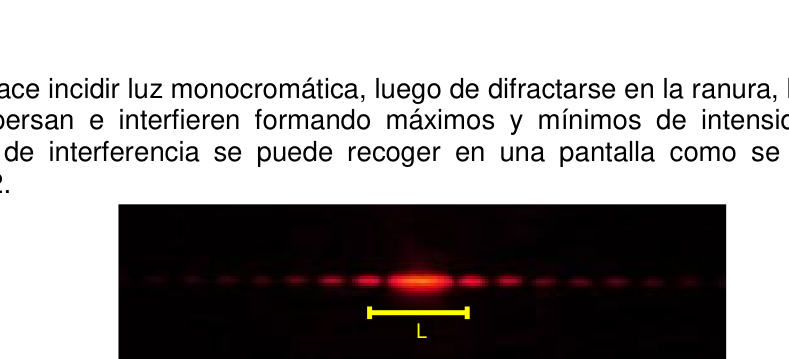
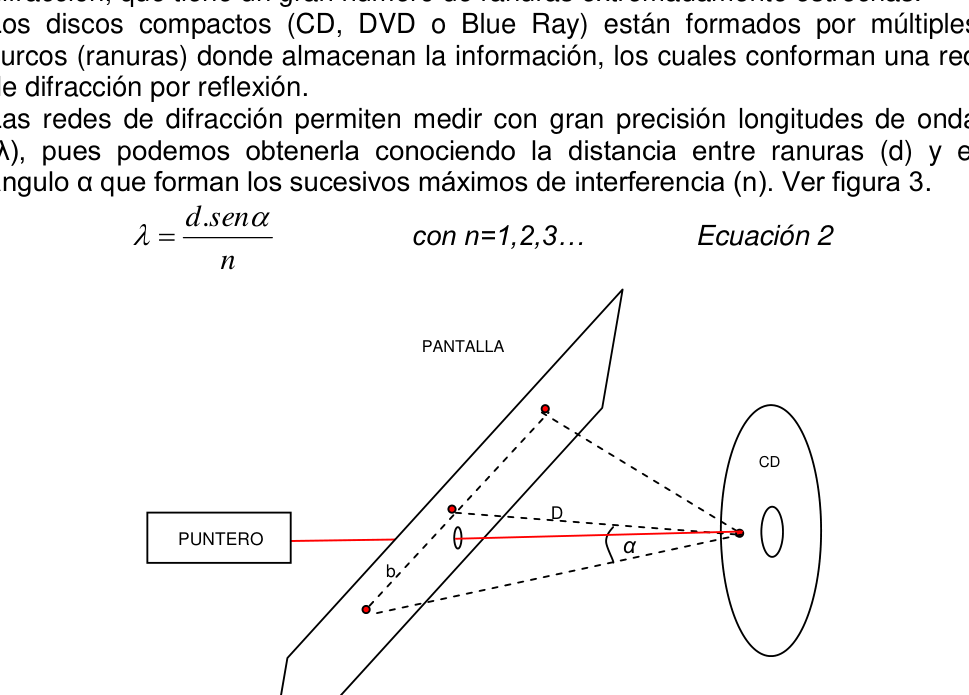
Topic: Wave Optics Metodi: Interference & Diffraction Analysis, Graph Linearization, Experimental Data Analysis Competenze: Physical Reasoning, Experimental Data Analysis Objects: Diffraction Grating, Slit, Screen Fonte: Testo (PDF) — p.3
Lenghe d’onda laser per diffrazione
PE41. Collegio Nazionale di Buenos Aires
Città di Buenos Aires.
Piccole dimensioni
Obiettivo:
- Determinazione della lunghezza d’onda di un puntatore laser utilizzando un cd come rete di diffrazione
- Determinare lo spessore di un capello mediante diffrazione laser.
Breve descrizione I puntatori laser meno costosi utilizzano un diodo laser rosso profondo. La La luce laser è costituita da fasci con uguale lunghezza d’onda, larghezza e fase. Questo determina la sua monocromaticità, la coerenza spaziale, temporale e
- direzionalità. La diffrazione e l’interferenza sono due fenomeni ondulativi. Il primo. consiste nel deviare i raggi di un raggio di luce quando si trova di fronte a un un ostacolo o un’apertura, dello stesso ordine della sua lunghezza d’onda. Il secondo si è Si tratta dell’instaurazione di onde nel tempo e nello spazio. In alcuni casi La superposizione di tali elementi produce un’interferenza costruttiva (la L’ampiezza dell’onda risultante si intensifica) e in altri, ad un’interferenza La Commissione ha adottato una decisione che non prevede alcuna modifica. Il caso più semplice è la diffrazione di Fraunhofer, in cui l’ostacolo è una ranura stretta, l’onda che arriva all’apertura è piana, e lo schermo si La maggior parte delle persone che si trovano in questo paese, si trovano a una grande distanza da questo (vedi figura 1).
Figura 1. Difrazione per un slot
OAF 2013 - 165
L
Punterò
CD
Pantalone
α
D
b
Se si accende una luce monocromatica, dopo averla diffratta nel slot, si fanno.
si disperdono e interferiscono formando massimi e minimi di intensità. Questo .
Il modello di interferenza può essere ripreso su uno schermo come si vede in
Figura 2.
Figura 2 Patrono di diffrazione da una spazia
Conoscendo la lunghezza d’onda (λ), la distanza (D) dal slot all’area di La misurazione di un’intervallo di tempo di un’intervallo di tempo è la misurazione di un’intervallo di tempo di un’intervallo di tempo di un’intervallo di tempo di un’intervallo di tempo di un’intervallo di tempo di un’intervallo di tempo di un’intervallo di tempo di un’intervallo di tempo di un’intervallo di tempo di un’intervallo di tempo di un’intervallo di tempo di intervallo di tempo di intervallo di un’intervallo di tempo di intervallo di tempo di intervallo di un’intervallo di tempo di intervallo di un’intervallo di tempo di intervallo di un’intervallo di tempo di intervallo di un’intervallo di tempo di intervallo di intervallo di tempo di intervallo di intervallo di un’intervallo di tempo di intervallo di intervallo di intervallo di tempo di intervallo di intervallo di intervallo di un’intervallo di intervallo di intervallo di intervallo di intervallo di intervallo di intervallo di intervallo di intervallo di intervallo di intervallo di intervallo di intervallo di intervallo di intervallo di intervallo di intervallo di intervallo di intervallo di intervallo di intervallo di intervallo di intervallo di intervallo di intervallo di intervallo di intervallo di intervallo di intervallo di intervallo di intervallo di intervallo di intervallo di intervallo di intervallo di intervallo di intervallo di intervallo di intervallo di interlo di intervallo di intervallo di intervallo di interlo di interst. si trovano adiacenti al massimo centrale, si può ottenere la larghezza del slot (d). L D d . .. 2
Equatoria 1 Inoltre, il principio di Babinet stabilisce che, in condizioni di Fraunhofer, la figura di diffrazione di un corpo opaco è identica a quella di un oggetto. con un buco della stessa dimensione e forma del corpo. Se si aumenta il numero di rotture, si mostra un modello di massimi di intensità più stretta e intensa. E con più slot, si arriva a una rete di diffrazione, che ha un gran numero di rancette estremamente strette. I CD (CD, DVD o Blue Ray) sono composti da più dischi. Rete (rotte) dove si memorizzano le informazioni, che costituiscono una rete di diffusione per riflessione. Le reti di diffrazione permettono di misurare con grande precisione le lunghezze d’onda. (λ), poiché si può ottenere conoscendo la distanza tra le rotture (d) e il angolo α che costituiscono i successivi massimi di interferenza (n). Vedi figura 3. n sen d .
con n=1,2,3…
Equità 2
Figura 3 Dispositivo sperimentale per ottenere la lunghezza d’onda Il puntatore laser
L’angolo α può essere ottenuto con la distanza dal CD allo schermo (D), e la Distanza (b) dal massimo centrale e dal massimo di primo ordine (n=1) per trigonometria e Pitagora otteniamo
OAF 2013 - 166 2 2 D b b sen
Equazione 3 e combinando l’Equazione 2 con l’Equazione 3 d D b b 2 2 .
Equità 4
Consigne a) Disporre il dispositivo sperimentale di cui alla figura 3 per determinare la lunghezza d’onda di un puntatore laser b) Sapendo che un CD ha (700 ± 30) rimpiezzi per mm, ottenere la Distanza (d) tra le trincee con la loro incertezza. Esprimete in nm (10-9 m). c) Per le diverse distanze dal CD allo schermo, compilare il seguente tabella:
b ɛb D εD
(vedere allegato)
ε
(cm)
(cm)
(cm)
(cm)
(cm/nm)
(cm/nm)
Tabella 1 Datos ottenuti per i massimi di primo ordine
d) Esprimere i fattori di incertezza che hai considerato per determinare le misurazioni dirette e) Realizzare il grafico di b in base a d D b 2 2
f) Ottenere la pendenza e la sua incertezza (λ ± ελ) g) Armarsi il dispositivo di figura 1, dove il slot sarà sostituito per un capello, per ottenere il suo spessore h) Ottenere il spessore dei capelli con l’incertezza, applicando il principio di Babinet i) Fare un breve rapporto
Elementi che possono risultare utili Barre, supporti diversi, nastro metrico, nastro adesivo, noci e marsiche per sostenere il puntatore laser, gommi da cancellare (sopra e sotto il puntatore, per d D b 2 2 d D b 2 2
OAF 2013 - 167 premere il pulsante di accensione), cartolina per fare schermo, porta Slide (per sostenere i capelli), marcatore. CD. Punte laser
Allegato Incertezza di
d d D b D D b d D b D b d b d D b 2 2 2 2 2 2 2 2 2 … .
Suggerimento: Ottenere l’incertezza per la distanza D più stretta e per la distanza D più
- E’ molto ampio. Utilizzare il massimo risultato di incertezza tra le due misure.
Topic: Wave Optics Metodi: Interference & Diffraction Analysis, Graph Linearization, Experimental Data Analysis Competenze: Physical Reasoning, Experimental Data Analysis Objects: Diffraction Grating, Slit, Screen Fonte: Testo (PDF) — p.3
The following shall be reported:
PE41. National College of Buenos Aires
City of Buenos Aires.
Small size
The objective:
- Determine the wavelength of a laser pointer using a cd as a diffraction network.
- Determine the thickness of a hair by laser light diffraction
Brief description Less expensive laser pointers use a deep red laser diode. La Laser light is made up of beams with equal wavelength, width and phase. This determines its monochromaticity, spatial, temporal and The Commission shall adopt implementing acts in accordance with Article 21 of this Regulation. Diffraction and interference are two wavy phenomena. The first one . It consists of the deviation of beams from a beam of light when facing a an obstacle or opening, of the same order as its wavelength. The second is It’s about the superposition of waves in time and space. In some cases In particular, this overlap results in constructive interference (the The resulting wave amplitude is intensified) and in others, to an interference the resultant is annulled. The simplest case is the Fraunhofer diffraction, in which the obstacle is A narrow slot, the wave that reaches the opening is flat, and the screen is The first is the distance between the two points.
Figure 1 is shown. Diffraction through a slot
The following is the list of the Member States’ financial statements: L I ‘m not sure . CD
- The coat .
α
D b If you have monochrome light flashed, after diffracting into the slot, you make them. They disperse and interfere forming maximum and minimum intensities. This one . interference pattern can be picked up on a screen as seen in the The following table shows the following:
Figure 2 Diffraction pattern by a cleft
Knowing the wavelength (λ), the distance (D) from the slot to the The first step is to measure the distance (L) between the first order maxims (n=1) that are They are adjacent to the central maximum, so you can get the width of the slot (d). L D d . .. 2
Equation 1 The Babinet principle also states that, under the conditions of Fraunhofer, the diffraction figure of an opaque body is identical to that of an object. with a hole the same size and shape as the body. If the number of slots is increased, a pattern of maximum of narrower and more intense intensity. And with more slots, you get to a network of diffraction, which has a large number of extremely narrow slots. Compact discs (CD, DVD or Blue Ray) are made up of multiple discs. The information is stored in a network. of diffraction by reflection. Diffraction networks allow for very precise measurement of wavelengths (λ), because we can get it by knowing the distance between slots (d) and the angle α forming the successive interference maxims (n). See figure 3. n Other d .
with n = 1,2,3…
Equation 2
Figure 3 Experimental device for obtaining wavelength The laser pointer .
The angle α can be obtained by the distance from the CD to the screen (D), and the distance (b) from the central maximum and the first order maximum (n=1) by trigonometry and Pythagoras we get
The following points shall be added: 2 2 D b b Other
Equation 3 and combining Equation 2 with Equation 3 d D b b 2 2 .
Equation 4
Consigns (a) To set up the experimental device in Figure 3 to determine the Wavelength of a laser pointer (b) Knowing that a CD has (700 ± 30) grooves per mm, obtain the distance (d) between grooves with their uncertainty. Express it in nm (10-9 m). (c) For different distances from CD to screen, complete the following Table:
b ɛb D εD
(see Annex)
ε
(cm)
(cm)
(cm)
(cm)
(cm/nm)
(cm/nm)
Table 1 Data obtained for first order maximum
(d) Express the uncertainty factors you considered to determine the Direct measurements (e) To perform the graph of b in terms of d D b 2 2
(f) Obtaining the slope and its uncertainty (λ ± ελ) (g) Armour the device in Figure 1, where the slot will be replaced By a hair, in order to get its thickness (h) Obtaining hair thickness with uncertainty by applying the principle from Babinet (i) To produce a short report
Elements that may be useful Bar, different supports, metric tape, adhesive tape, walnuts and walnuts for Hold the laser pointer, rubber wipers (up and down the pointer, for d D b 2 2 d D b 2 2
The following points shall be added: Press the power button), cardboard to make screen, port The following is the list of the products used in the manufacture of the product: CD. Laser pointer .
Annex Uncertainty of
d d D b D D b d D b D b d b d D b 2 2 2 2 2 2 2 2 2 … .
Suggestion: Get the uncertainty for the narrowest distance D and for the most It’s wide. Use the maximum uncertainty value found between the two measures.
Topic: Wave Optics Metodi: Interference & Diffraction Analysis, Graph Linearization, Experimental Data Analysis Competenze: Physical Reasoning, Experimental Data Analysis Objects: Diffraction Grating, Slit, Screen Fonte: Testo (PDF) — p.3
Impacto astronomico (Alvarez)
PE42. Escuela de Educación Técnica Alberto Einstein - Escuela del Cerro
Instituto de Educación Integral - Colegio Madre María Sara Lona
Escuela de Educación Técnica República de la India
Colegio San Pablo - Escuela de Educación Técnica Capitán Lotufo
Colegio Estrada - Escuela de Educación Técnica Gra. Güemes
Colegio San Marcos - Colegio Santa Isabel de Hungría
Colegio Belgrano - Instituto Modelo
Colegio Belgrano 5095 - Colegio Arturo Illia
Ciudad de Salta.
Impácto de laboratorio (Impacto astronómico) Introducción En el año 1980 un grupo de investigadores liderados por el físico Luis Álvarez estudiaron muestras tomadas por todo el mundo de las capas intermedias entre los períodos Cretácico y Terciario hace 65 millones de años. Para su sorpresa descubrieron en ellas concentraciones de iridio cientos de veces más alta que lo normal. El iridio es un metal escaso en la Tierra, pero abundante en meteoritos y asteroides. Teniendo en cuenta que el final del cretáceo coincide con la extinción de los dinosaurios, este descubrimiento dio lugar a la llamada Hipótesis de Álvarez: el impacto de un objeto astronómico supermasivo es el causante de la extinción de los dinosaurios. Luego de que Álvarez y su equipo publicaran un trabajo exponiendo su descubrimiento, la hipótesis de la extinción debida a un impacto astronómico continuó siendo tema de debate en la comunidad científica. Una de las mayores objeciones era que no se conocía un cráter cuyas dimensiones correspondieran al tamaño calculado, que debería tener entre 150 y 200 kilómetros de diámetro. Sin embargo, revisando estudios geológicos realizados desde 1960 se pudo detectar la existencia de un cráter de 180 kilómetros de diámetro en la península de Yucatán: el cráter de Chicxulub. El cráter de Chicxulub fue descubierto en 1978 por los geofísicos Camargo y Penfield mientras trabajaban en Yucatán en busca de yacimientos de petróleo. La edad de las rocas y los análisis isotópicos mostraron que esta estructura data de finales del período Cretácico. Así, la Hipótesis de Álvarez se convirtió en la hipótesis sobre la extinción de los dinosaurios más aceptada por la comunidad científica. El cráter de Chicxulub es un ejemplo de los tantos cráteres de impacto que hay en la tierra. Un cráter es el único testigo mudo del que se puede obtener información sobre un impacto astronómico, que a su vez es un fenómeno muy complejo por la cantidad de factores que intervienen en él. Sin embargo, como todo físico, podemos comenzar a estudiar un impacto astronómico haciendo el d D b 2 2
OAF 2013 - 168 modelo más simple que se nos ocurra. En primera instancia es de esperar que el tamaño de un cráter nos brinde información sobre la energía con la que impacto el asteroide y podemos considerar que una parte de esa energía fue utilizada para formarlo y otra se disipó en forma de calor o por otros fenómenos intervinientes, como puede ser la destrucción misma del asteroide. En esta experiencia y con el pretexto de intentar comprender algo de los impactos astronómicos, vamos a estudiar un fenómeno análogo que podemos reproducir cuantas veces queramos en el laboratorio. Por ello, a este fenómeno le llamaremos Impacto de Laboratorio y pretende ser un primer estudio de los impactos astronómicos.
Materiales Disponibles Regla y calibre. Papel cuadriculado. Esfera metálica. Plastilina.
Desarrollo experimental Consideremos una esfera metálica de masa y diámetro , sometida a un campo gravitatorio de aceleración , que se encuentra a cierta altura de una plataforma constituida por un material deforma- ble (Figura 1). Cuando la esfera se suelta con sin velocidad inicial comienza a descender hasta impactar de forma totalmente inelástica formando un cráter de diámetro y profundidad en la plataforma. Despreciando el rozamiento de la esfera con el aire, la energía cinética de impacto coincide con su energía potencial gravitatoria cuando se encontraba a la altura :
Es de esperar que el tamaño del cráter aumente a medida que aumenta la altura a la cual se coloca inicialmente la esfera: Nuestro objetivo es estudiar dicha dependencia. Para ello vamos suponer que la energía de impacto se relaciona con la profundidad del cráter mediante:
donde y son constantes positivas. Las relaciones (1) y (2) determinan la dependencia entre la profundidad del cráter y la altura desde la que es lanzada la esfera. a) Demostrar que la profundidad del cráter está relacionada con el diámetro del mismo y con el diámetro de la esfera mediante:
b) Con los materiales a disposición estudiar el rango de valores de que sea el más adecuado para observar su dependencia con el diámetro del cráter. Explicite la evidencia que le permite sacar sus conclusiones. c) A partir de las relaciones (1) y (2) demuestre que ,
OAF 2013 - 169 donde ,
y .
d) Elija 8 (ocho) valores de dentro del rango definido en b) y mida 10 (diez) veces el diámetro del cráter formado para cada uno de dichos valores. Luego realice una tabla como la siguiente: e)
donde indica el error de medición de la magnitud correspondiente y es el promedio de las 10 (diez) mediciones del diámetro del cráter correspondientes a un valor de . f) Realizar un gráfico de la dependencia entre y . g) Determinar el valor de la pendiente con su respectivo error.
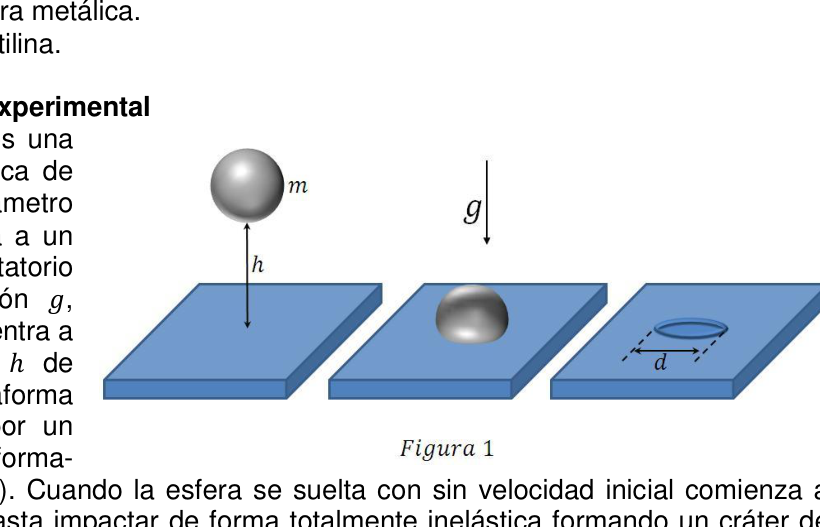
Topic: Astrophysics, Order-of-Magnitude Estimation Metodi: Order-of-Magnitude Estimation, Energy Conservation Method, Experimental Data Analysis Competenze: Physical Reasoning, Experimental Data Analysis Objects: Projectile, Planet Fonte: Testo (PDF) — p.3
**Impacco astronomico (Alvarez) **
PE42. Alberto Einstein School of Technical Education - Scuola del Cerro
Istituto di educazione integrale - Colegio Madre Maria Sara Lona
Scuola di istruzione tecnica Repubblica dell’India
Colegio San Paolo - Scuola di istruzione tecnica Capitano Lotufo
Colegio Estrada - Scuola di istruzione tecnica Gra. Gemmesi
Colegio San Marco - Colegio Santa Isabel d’Ungheria
Colegio Belgrano - Istituto Modello
Colegio Belgrano 5095 - Colegio Arturo Illia
Città di Salta.
Impatto di laboratorio (impatto astronomico) Introduzione Nel 1980 un gruppo di ricercatori guidato dal fisico Luis Álvarez studiarono campioni prelevati in tutto il mondo dalle strati intermedi tra i periodi Cretatico e Terciario 65 milioni di anni fa. Per la sua sorpresa. Hanno scoperto concentrazioni di iridio in questi tipi di grassi centinaia di volte più alte di quelle di
- Normalmente. L’iridio è un metallo scarso sulla Terra, ma abbondante in meteoriti e
- Gli asteroidi. Considerando che la fine del Cretæo coincide con l’estinzione. di dinosauri, questa scoperta ha dato luogo alla cosiddetta ipotesi di Alvarez: l’impatto di un oggetto astronomico supermassiccio è il causante della l’estinzione dei dinosauri. Dopo che Alvarez e il suo team hanno pubblicato un lavoro che mostra il suo La scoperta, l’ipotesi di estinzione dovuta ad un impatto astronomico è stato oggetto di discussione nella comunità scientifica. Una delle più grandi . Le obiezioni erano che non si conosceva un cratere delle dimensioni corrispondenti. alla dimensione calcolata, che dovrebbe avere tra i 150 e i 200 chilometri di diametro. Tuttavia, rivedere gli studi geologici condotti dal 1960 è stato possibile
- Sottostrire l’esistenza di un cratere di 180 chilometri di diametro sulla penisola. di Yucatán: il cratere di Chicxulub. Il cratere di Chicxulub è stato scoperto nel 1978 dai geofisici Camargo e Penfield mentre lavoravano nel Yucatan alla ricerca di giacimenti petroliferi. L’età delle rocce e gli isotopici hanno dimostrato che questa struttura data della fine del periodo Cretatico. Così l’ipotesi di Alvarez divenne la I più accettati della comunità sono le ipotesi sull’estinzione dei dinosauri. Scienziato. Il cratere di Chicxulub è un esempio di tanti crateri d’impatto che ci sono. sulla terra. Un cratere è l’unico testimone muto da cui si possa ottenere. informazioni sull’impatto astronomico, che è un fenomeno molto complesso per la quantità di fattori che lo coinvolgono. Tuttavia, come Se si tratta di un’impatto fisico, possiamo iniziare a studiare un impatto astronomico facendo il d D b 2 2
OAF 2013 - 168 modello più semplice che ci si possa immaginare. In primo luogo si spera che il La dimensione di un cratere ci dà informazioni sull’energia con cui colpisce l’asteroide e possiamo considerare che parte di quella energia è stata utilizzata per formare un altro e si è dissipato sotto forma di calore o da altri fenomeni. Interventi, come può essere la distruzione stessa dell’asteroide. In questa esperienza, e con il pretesto di cercare di capire qualcosa di Gli impatti astronomici, studiamo un fenomeno analogo che possiamo riprodurre quante volte vogliamo in laboratorio. Per questo, a questo fenomeno Lo chiameremo Impacto di laboratorio e intende essere il primo studio di gli impatti astronomici.
Materiali disponibili • Regola e calibro. • Carta quadricolata. • Sfera metallica. • Plastilina.
Sviluppo sperimentale Considerate una . sfera metallica di massa e diametro , sottoposto a un campo gravitazionale di accelerazione , che si trova a una certa altezza di Una . piattaforma costituita da un materiale di deformazione La Commissione ha adottato una decisione che non può essere adottata. Quando la sfera si solleva senza velocità iniziale inizia a Scendere fino a colpire in modo totalmente inelastico formando un cratere di diametro e profondità sulla piattaforma. Scommetendo il ruggine della sfera con l’aria, l’energia cinetica di L’impatto coincide con la sua energia gravitazionale potenziale quando si trovava a l’altezza:
Si può aspettare che il cratere si accresca a mano a mano che aumenta l’altezza. Il nostro obiettivo è studiare la sfera. dipendenza. Per questo supponiamo che l’energia di impatto sia correlata. con la profondità del cratere mediante:
dove e sono costanti positive. Le relazioni (1) e (2) determinano la La differenza tra la profondità del cratere e l’altezza da cui è lanciò la sfera. a) dimostrare che la profondità del cratere è correlata al diametro di esso e diametro della sfera mediante:
b) Con i materiali disponibili studiare la gamma di valori di cui La dimensione di un’area di riferimento è più adatta per osservare la sua dipendenza dal diametro di un’area di riferimento. cratere. Spiegare le prove che consentono di trarre le sue conclusioni. c) Sulla base delle relazioni (1) e (2) dimostra che ,
OAF 2013 - 169 dove ,
y .
d) Selezionare 8 (otto) valori all’interno del range definito in b) e misurare 10 (dieci) volte il diametro del cratere formato per ciascuna di queste. Valori. Quindi, fai una tabella come questa: e)
indica l’errore di misurazione della dimensione corrispondente e è la media delle 10 (dieci) misurazioni del diametro del cratere corrispondenti a un valore di . f) Realizzare un grafico della dipendenza tra e . g) Determinare il valore della pendenza con il suo errore.
Topic: Astrophysics, Order-of-Magnitude Estimation Metodi: Order-of-Magnitude Estimation, Energy Conservation Method, Experimental Data Analysis Competenze: Physical Reasoning, Experimental Data Analysis Objects: Projectile, Planet Fonte: Testo (PDF) — p.3
The following is a list of the countries of the European Union.
PE42. Albert Einstein Technical Education School - School of the Cerro
Institute of Integral Education - Mother Maria Sara Lona College
School of Technical Education Republic of India
St. Paul’s College - School of Technical Education Captain Lotufo
Road School - Technical Education School Gra. Gems
The school is located in the centre of the city.
Belgrano College - Model Institute
The first is the Belgrano College 5095 - Arturo Illia College.
Salt City.
The following is a list of the main types of energy sources used in the production of energy: The first is the introduction. In 1980 a group of researchers led by the physicist Luis Álvarez They studied samples taken from around the world from the intermediate layers between the Cretaceous and Tertiary periods 65 million years ago. To your surprise . They found iridium concentrations hundreds of times higher than the It’s normal. Iridium is a rare metal on Earth, but abundant in meteorites and The asteroids. Considering that the end of the Cretaceous coincides with extinction In the early dinosaurs, this discovery led to what is called the hypothesis of Alvarez: The impact of a supermassive astronomical object is the cause of the The extinction of the dinosaurs. After Alvarez and his team published a paper exposing his The discovery, the hypothesis of extinction due to an astronomical impact. It has continued to be a topic of debate in the scientific community. One of the biggest . Objections were that no crater of corresponding dimensions was known. The size of the estimated, which should be between 150 and 200 kilometers in diameter. However, by reviewing geological studies carried out since 1960 it was possible to Detect the existence of a 180-kilometer-diameter crater on the peninsula The Yucatan: the Chicxulub crater. Chicxulub crater was discovered in 1978 by geophysicists Camargo and Penfield while they were working in the Yucatan looking for oil fields. The age of rocks and isotopic analysis showed that this structure dates from the The first of these is the late Cretaceous period. Thus, the Alvarez Hypothesis became the The most commonly accepted hypothesis about the extinction of dinosaurs The scientific. The Chicxulub crater is an example of the many impact craters that exist. on the ground. A crater is the only silent witness you can get from . The report also highlights the importance of the European Union’s efforts to promote the development of the European Union. complex by the number of factors involved in it. However, as So, if you’re a physicist, you can start studying an astronomical impact by doing the d D b 2 2
The following is the list of the Member States’ financial statements: simplest model we can think of. In the first instance it is to be hoped that the The size of a crater gives us information about the energy it impacts. And we can consider that some of that energy was used. to form it and another dissipated in the form of heat or other phenomena. The first is that the asteroid itself is destroyed. In this experience and under the pretext of trying to understand some of the astronomical impacts, let’s study a similar phenomenon that we can reproduce as many times as we want in the lab. This is why we are talking about this phenomenon. We’ll call it Laboratory Impact and it’s intended to be the first study of the The astronomical impact.
Materials Available • Rule and caliber. • Quadricle paper. • Metallic sphere. • Plastiline.
Experimental development Let us consider one . The metal sphere of mass and diameter , subjected to a Gravitational field of acceleration , which is located at a certain height of One . Platform It is composed of a deforming material The Commission has also adopted a number of proposals for the When the sphere is released with no initial velocity it starts at The impact of the crater is almost inelastic. diameter and depth on the platform. Despite the friction of the sphere with the air, the kinetic energy of the The impact coincides with its gravitational potential energy when it was at height:
It is expected that the size of the crater will increase as the height increases. The first step is to study the sphere. dependence. For this we will assume that impact energy is related with the depth of the crater by:
where and are positive constants. The relationships (1) and (2) determine the Dependence between the depth of the crater and the height from which it is Throw the sphere. (a) To demonstrate that the depth of the crater is related to the diameter of the same and with the diameter of the sphere by:
(b) With the materials available to study the range of values from which It is most suitable for observing its dependence on the diameter of the crater. Explain the evidence that allows you to draw your conclusions. (c) From the relationships (1) and (2) prove that ,
The following is the list of the countries of the European Union: Where ,
y .
(d) Select 8 (eight) values from within the range defined in (b) and measure 10 (ten) times the diameter of the crater formed for each of these. values. Then make a table like this: e)
where the measurement error of the corresponding magnitude is indicated and is the average of the 10 (ten) measurements of the diameter of the crater corresponding to a value of . (f) Draw a graph of the dependence between y . (g) Determine the value of the pendulum with its respective error.
Topic: Astrophysics, Order-of-Magnitude Estimation Metodi: Order-of-Magnitude Estimation, Energy Conservation Method, Experimental Data Analysis Competenze: Physical Reasoning, Experimental Data Analysis Objects: Projectile, Planet Fonte: Testo (PDF) — p.3
Calor especifico de un solido
PE43. Escuela Normal Superior Juan B. Alberdi
San Miguel de Tucumán.
Midiendo calor especifico de un sólido (metal) de masa desconocida y amorfo Elementos
Cuerpo
Balanza
Termómetros
Vaso de precipitación
Calorímetro ( Recipiente de telgopor)
Mechero Sugerencias a) Enuncie e indique el principio de conservación que nos asegura que en un sistema aislado la energía cedida por una parte de sistema es adquiri- da íntegramente por el resto del mismo b) Mencione posibles causas de errores experimentales c) De una estimación del error experimental de la medición realizada d) Anote todas las observaciones mientras trabaja y redacte un informe
Topic: Thermodynamics Metodi: First Law of Thermodynamics, Error Propagation, Experimental Data Analysis Competenze: Physical Reasoning, Experimental Data Analysis Objects: Calorimeter Fonte: Testo (PDF) — p.3
Calore specifico di un solido
PE43. Scuola Normale Superiore Juan B. Alberdi
San Michele di Tucumán.
Misurando il calore specifico di un solido (metallo) di massa sconosciuta e amorfo Elementi
Corpo .
Sbalzo
Termodinamici
Vaso di precipitazione
Calorimetro (ricevitore di telgopor)
Mechero Suggerimenti a) Esprimere e indicare il principio di conservazione che ci assicura che in Un sistema isolato l’energia ceduta da una parte del sistema è acquisita
- l’intero resto del libro. b) Indicare le possibili cause di errori sperimentali c) Una stima dell’errore sperimentale della misurazione effettuata d) Notare tutte le osservazioni durante il lavoro e redigere un rapporto
Topic: Thermodynamics Metodi: First Law of Thermodynamics, Error Propagation, Experimental Data Analysis Competenze: Physical Reasoning, Experimental Data Analysis Objects: Calorimeter Fonte: Testo (PDF) — p.3
Specific heat of a solid
PE43. Secondary school Juan B. Alberdi .
St. Michael of Tucumán.
Measuring specific heat of an unknown and amorphous mass solid (metal) Elements
Body .
Weighing
Thermometers .
Rain glass
Calorimeters (Telgopore receiver)
I ‘m a mechanic . Suggestions (a) state and indicate the principle of conservation which assures us that in In an isolated system, the energy transferred by a part of the system is acquired by the It is entirely for the rest of the same. (b) Name possible causes of experimental errors (c) An estimate of the experimental measurement error performed (d) Take note of all observations while working and report
Topic: Thermodynamics Metodi: First Law of Thermodynamics, Error Propagation, Experimental Data Analysis Competenze: Physical Reasoning, Experimental Data Analysis Objects: Calorimeter Fonte: Testo (PDF) — p.3
Lineas de campo y equipotenciales
PE43. Escuela de Agricultura
General Alvear, Mendoza.
Objetivos
- Determinar las propiedades de las líneas de campo eléctrico y líneas equipotenciales.
Breve Descripción El campo eléctrico una cantidad vectorial, es la fuerza por unidad de carga que se ejerce sobre una carga de prueba en cualquier punto, siempre que la carga de prueba sea tan pequeña que no perturbe las cargas que generan el campo. El campo eléctrico producido por una carga puntual está dirigido radialmente hacia fuera de la carga o hacia ella.
OAF 2013 - 170 .
La magnitud del campo eléctrico es
El potencial es la energía potencial por unidad de carga. Se define el potencial V en cualquier punto en el campo eléctrico como la energía potencial U por unidad de carga asociada con una carga de prueba q0 en ese punto:
El potencial eléctrico V se puede explorar directamente con la punta del voltímetro que puede tocar cualquier punto del plano. El campo eléctrico se obtiene a partir de V, usando el concepto de gradiente.
Esto se lee: E es el negativo del gradiente de V o E es igual al gradiente negativo de V”. La cantidad se llama gradiente de potencial.
Materiales
- Un multimetro digital.
- Tres cables banana-caimán
- Un recipiente descartable
- Varios electrodos metálicos con distintas características: planos, cilíndri- cos, etc.
- Una fuente de CC
- Hoja Milimetrada Plastificadas
- 3 Hojas Milimetradas.
Consigna 1 a) Prepare el recipiente con agua, en el cual debe sumergir la hoja milimetrada (plastificada).Colocando los electrodos sobre el agua, Conecte los mismos a la fuente de CC (cada uno a un terminal de la fuente). Observe la figura como guía b) Conecte el multimetro y mida algunos potenciales para verificar su funcionamiento. Luego quite los electrodos.
OAF 2013 - 171 Nota: Es importante que el nivel del agua sea 3 o 4 milímetros (desde la base la cual sería la hoja milimetrada). De esta manera cuando los electrodos se coloquen en el agua solo quedaran sumergidos 2 o 3 milímetros.
Consigna 2 c) Introduzca un par de electrodos metálicos en el recipiente con agua, de manera tal que la separación entre ellos sea mayor que las dimensiones de dichos electrodos). Aplique una diferencia de potencial de 15 V(DC). Utilice el voltímetro para localizar puntos de igual potencial sobre el agua. Ubique los puntos sobre la hoja milimetrada tomando como referencia las medidas de la hoja milimetrada en el agua. Une los puntos que sean del mismo potencial con líneas, de tal forma que se obtengan representadas las líneas equipotenciales existentes. localice al menos cinco líneas equipotenciales. d) Realice los mismos pasos indicados en el punto anterior, para diferentes combinaciones de electrodos con distinta geometría.(2 combinaciones) e) Mida el potencial en el electrodo que es una superficie cerrada.
Consigna 3 f) ¿Los electrodos son superficies equipotenciales? ¿por qué? g) ¿Existe diferencia de potencial dentro y fuera de los electrodos conformados por superficies cerradas, en las diferentes configuraciones probadas en la práctica? h) ¿Qué relación geométrica hay entre una línea equipotencial y una línea de campo eléctrico en los puntos en que ambas líneas se cruzan? i) ¿Cómo es la distribución de carga en el interior y en el exterior de un cuerpo conductor cerrado? ¿y el campo? j) Trace las líneas de campo eléctrico formado en cada configuración de electrodos. k) ¿Cómo se relaciona el concepto de potencial con el concepto de campo eléctrico?
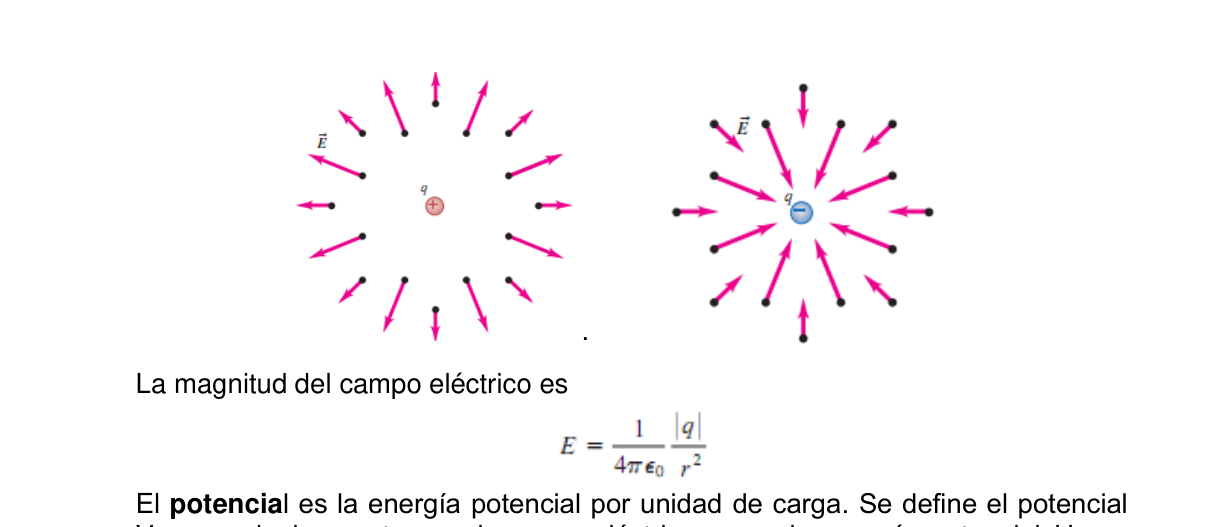
Topic: Electrostatics Metodi: Electric Potential Method, Experimental Data Analysis Competenze: Physical Reasoning, Experimental Data Analysis Objects: Point Charge Fonte: Testo (PDF) — p.3
Line di campo e equipotenziali
PE43. La scuola di agricoltura
Generale Alvear, Mendoza.
Obiettivi
- Determinare le proprietà delle linee di campo elettrico e delle linee
- Equipotenziali.
Breve descrizione Il campo elettrico, una quantità vettoriale, è la forza per unità di carica che si esercita su un carico di prova in qualsiasi punto, sempre che il carico la prova è così piccola da non disturbare le cariche che generano il campo. Il campo elettrico prodotto da una carica puntuale è diretto radialmente. all’esterno o verso il carico.
OAF 2013 - 170 .
La magnitudo del campo elettrico è
Il potenziale è l’energia potenziale per unità di carica. Si definisce il potenziale V in qualsiasi punto del campo elettrico come l’energia potenziale U per unità di carico associata ad un carico di prova q0 a quel punto:
Il potenziale elettrico V può essere esplorato direttamente con la punta del un voltometro che può toccare qualsiasi punto del piano. Il campo elettrico si è si ottiene da V, usando il concetto di gradiente.
Questo si legge: E è il negativo del gradiente di V o E è uguale al gradiente negativo di V. Quanti Si chiama gradiente di potenziale.
Materiali
- Un multimetro digitale.
- Tre cavi banana-caiman
- Un recipiente scaricabile .
- Vari elettrodi metallici con caratteristiche diverse: cos, ecc.
- Una fonte di CC
- Folite di millimetro plastica
- Tre foglie di millimetro.
Consigna 1 a) Preparare il recipiente con acqua, in cui deve immergere la foglia mm (plastificato). Collegate le stesse alla fonte di CC (ogni una alla terminal della fonte). Guarda la figura come guida. b) Connettere il multimetro e misurare alcuni potenziali per verificare il suo funzionamento. Poi togliere gli elettrodi.
OAF 2013 - 171 Nota: è importante che il livello dell’acqua sia di 3 o 4 mm (da base a base) che sarebbe la foglia a millimetro). In questo modo quando gli elettrodi sono Se mettono in acqua, rimangono immersi solo 2 o 3 millimetri.
Consigna 2 c) Inserire un paio di elettrodi metallici nel recipiente con acqua, di in modo tale che la separazione tra loro sia maggiore delle dimensioni di tali elettrodi). Applica una differenza di potenziale di 15 V(DC). Usa il voltometro per individuare punti di uguale potenziale sul acqua. Locare i punti sul foglio millimetrico prendendo come riferisce le misure della foglia millimetrica in acqua. Unisce i due punti con uguale potenziale con linee, in modo che si La linea equipotenziale esistente è rappresentata. Localizzando almeno cinque linee equipotenziali. (d) eseguire gli stessi passi indicati nel punto precedente, per diversi combinatori di elettrodi con geometrie diverse. combinazioni) e) Misura il potenziale nell’elettrodo che è una superficie chiusa.
Consegna 3 f) Gli elettrodi sono superfici equipotenziali? - Perché? g) C’è differenza di potenziale all’interno e all’esterno degli elettrodi? costituite da superfici chiuse, in diverse configurazioni provate in pratica? h) Qual è la relazione geometrica tra una linea equipotenziale e una linea di campo elettrico nei punti in cui le due linee si incrociano? (i) Come è la distribuzione di carico all’interno e all’esterno di un’unità? corpo conduttore chiuso? E il campo? j) Traccia le linee di campo elettrico formate in ogni configurazione di elettrodi. k) Come si relaziona il concetto di potenziale con il concetto di campo elettrico?
Topic: Electrostatics Metodi: Electric Potential Method, Experimental Data Analysis Competenze: Physical Reasoning, Experimental Data Analysis Objects: Point Charge Fonte: Testo (PDF) — p.3
The following shall be added to the list of the following:
PE43. School of Agriculture
General Alvear, Mendoza, please.
Objectives
- Determine the properties of electric field lines and lines The Commission will take the necessary measures to ensure that the Commission is able to take all necessary measures to ensure that the measures are implemented.
Brief description The electric field is a vector quantity, is the force per unit charge that is applied on a test load at any point, provided that the load The test is so small that it does not disturb the loads generated by the field. The electric field produced by a point charge is radially directed. out of the load or towards it.
The following points shall be added: .
The magnitude of the electric field is
Potential is the potential energy per unit of charge. The potential is defined. V at any point in the electric field as the potential energy U per Unit of load associated with a test load q0 at that point:
The electric potential V can be explored directly with the tip of the A voltmeter that can touch any point on the plane. The electric field is So you get it from V, using the concept of gradient.
So this reads: E is the negative of the gradient of V or E is equal to the gradient. negative of V. The quantity It’s called the potential gradient.
Materials
- It’s a digital multimeter.
- Three banana-caiman wires .
- A disposable container .
- Several metallic electrodes with different characteristics: flat, cylindrical, the body, etc.
- A source of CC
- Plasticised millimetre sheet
- Three millimeters of leaf.
Consigna 1 (a) Prepare the container with water, into which the leaf should be submerged. The electrodes are placed on the water. Connect them to the DC source (each to a terminal of the (Source) Look at the figure as a guide. (b) Connect the multimeter and measure some potential to verify its operation. Then remove the electrodes.
The following points shall be added: Note: It is important that the water level is 3 or 4 mm (from the base to the water table) What would be the millimeter blade? This way when the electrodes are Put them in the water, they’ll only be submerged 2 or 3 millimeters.
Consigna 2 (c) Insert a pair of metal electrodes into the water container, from So that the separation between them is greater than the dimensions. of such electrodes). Apply a potential difference of 15 V(DC). Use the voltmeter to locate points of equal potential on the
- What? Place the dots on the millimeter sheet by taking as Reference to measurements of the millimetre sheet in water. - Put them together . points of the same potential with lines, so that they are The corresponding equation is the same as the equation. Locally at least five equipotential lines. (d) Perform the same steps as indicated in the previous point, for different combinations of electrodes with different geometry. combinations) (e) Measure the potential in the electrode which is a closed surface.
Consigna 3 (f) Are electrodes equipotential surfaces? Why? Why? (g) Is there any difference in potential inside and outside the electrodes? The following are the main features of the system:
- Proven in practice? (h) What is the geometrical relationship between an equipotencial line and a line? of electric field at the points where both lines intersect? (i) What is the distribution of load inside and outside a vehicle? closed conducting body? And the countryside? (j) Traces the electric field lines formed in each configuration of electrodes. (k) How does the concept of potential relate to the concept of field electrical?
Topic: Electrostatics Metodi: Electric Potential Method, Experimental Data Analysis Competenze: Physical Reasoning, Experimental Data Analysis Objects: Point Charge Fonte: Testo (PDF) — p.3
Densidad del cobre (Arquimedes)
PE44. Escuela Técnica Philips
Ciudad de Buenos Aires.
Objetivo: determinar la densidad del cobre
Introducción Cada elemento, sustancia o material tiene una densidad característica para determinadas presión y temperatura. La densidad es una magnitud que mide la razón masa-volumen y puede expresarse, por lo tanto, como:
Por otro lado, de acuerdo al principio de Arquímedes, todo cuerpo sumergido en el seno de un líquido y bajo la acción de un campo gravitatorio experimenta una fuerza de igual dirección que el campo pero de sentido contrario. A dicha fuerza se la conoce con el nombre de empuje o fuerza de flotación y su magnitud se puede expresar matemáticamente como:
Donde es la densidad del líquido, es la aceleración de la gravedad asociada al mencionado campo y es el volumen de la porción del cuerpo que se encuentra sumergida en el líquido.
OAF 2013 - 172 Materiales Cilindros de cobre Dinamómetro Soporte universal Recipiente plástico Agua
Procedimiento
Idee un método para determinar la densidad del cobre
Realice un esquema del dispositivo asociado al método diseñado
Mida los pesos en aire y aparente de cada cilindro
Confeccione un gráfico apropiado que le permita obtener el valor de .
Datos La densidad del agua utilizada es
Topic: Fluid Mechanics Metodi: Hydrostatic Equilibrium, Error Propagation, Experimental Data Analysis Competenze: Physical Reasoning, Experimental Data Analysis Objects: Container Fonte: Testo (PDF) — p.3
**Densità del rame (Archimedes) **
PE44. Philips Technical School
Città di Buenos Aires.
Obiettivo: determinare la densità del rame
Introduzione Ogni elemento, sostanza o materiale ha una densità caratteristica per determinate pressione e temperatura. La densità è una magnitudo che misura la Rason massa-volume e può quindi essere espresso come:
D’altra parte, secondo il principio di Archimede, ogni corpo immerso in Il seno di un liquido e sotto l’azione di un campo gravitazionale sperimenta una forza della stessa direzione del campo ma in senso contrario. A tale forza La forza di spinta è nota come forza di fluttuazione e la sua magnitudo è può essere espresso matematicamente come:
Dove è la densità del liquido, è l’accelerazione della gravità associata. Il campo di riferimento è il volume della porzione del corpo che viene si trova immersa nel liquido.
OAF 2013 - 172 Materiali cilindri di rame Dinamometro Supporto universale contenitore in plastica Acqua
Procedura Ideare un metodo per determinare la densità del rame Sviluppa un diagramma del dispositivo associato al metodo progettato Misurare i pesi in aria e apparentemente di ogni cilindro • Configgere un grafico appropriato che ti permetta di ottenere il valore di .
Datos La densità dell’acqua utilizzata è
Topic: Fluid Mechanics Metodi: Hydrostatic Equilibrium, Error Propagation, Experimental Data Analysis Competenze: Physical Reasoning, Experimental Data Analysis Objects: Container Fonte: Testo (PDF) — p.3
The following is the list of the types of copper and copper alloys used:
PE44. Philips Technical School
City of Buenos Aires.
Objective: to determine the density of copper
The first is the introduction. Each element, substance or material has a characteristic density for the pressure and temperature. Density is a magnitude that measures the mass-volume ratio and can therefore be expressed as:
On the other hand, according to Archimedes’ principle, every body immersed in The breast of a liquid and under the action of a gravitational field experiences a force of the same direction as the field but in the opposite direction. That ‘s the strength . It is known as the thrust or floating force and its magnitude is It can be expressed mathematically as:
Where the density of the liquid is, it’s the acceleration of the associated gravity. The volume of the body part that is It’s submerged in the liquid.
The following is the list of the Member States’ financial statements: Materials Copper cylinders Dynamometer Universal support Plastic container Water
The procedure Develop a method for determining copper density Draw a diagram of the device associated with the method designed Measure the air and apparent weights of each cylinder • Create an appropriate chart to obtain the value of .
Data from the report The density of water used is
Topic: Fluid Mechanics Metodi: Hydrostatic Equilibrium, Error Propagation, Experimental Data Analysis Competenze: Physical Reasoning, Experimental Data Analysis Objects: Container Fonte: Testo (PDF) — p.3
Gravedad con chorro de agua
PE45. Colegio del Sol
San Miguel de Tucumán.
Yo mido la gravedad ¡con un chorro de agua! Objetivo: Medir la aceleración del la gravedad
Materiales:
- Regla
- Cronómetro
Procedimiento: Por un grifo sale un chorro de agua y desciende en caída libre
debido a la gravedad g. Por lo tanto se cumple que:
v2 –v0
2= 2gh
El chorro de agua se estrecha conforme cae y adquiere forma troncocónica. El
diámetro del chorro a la salida del grifo es D0 y el diámetro tras la caída es D.
Por conservación de la masa, el caudal C (volumen por unidad de tiempo) es el
mismo arriba y abajo y se puede calcular mediante las expresiones:
C = Vol = π D2 v = π D0
2 v0
t 4 4
a) Demuestra que la gravedad puede calcularse como
g = 8C2 ( 1 - 1 )
hπ2 D4 D0
4 b) Tomamos varias medidas experimentales abriendo el grifo más o menos para tener distintos caudales. En cada caso medimos con una regla los diámetros del chorro (a la salida del grifo y tras la caída) y la altura de caída, y medimos el volumen de agua recogido en un recipiente y con un cronómetro el tiempo. Volcar todas las medidas experimentales en una tabla.
Grifo
D0
(mm)
D
(mm)
h
(mm)
Vol
(ml)
t
(s)
Caudal(l/h)
Gravedad
(m/s2 )
c) Calcula los caudales, para los 4 casos, en litros/hora d) Calcula el valor de g con las medidas tomadas. Y calcula el valor medio. e) ¿Qué medida es más inexacta? Recalcula el valor de g eliminando dicha medida.
OAF 2013 - 173 f) ¿Qué magnitud crees que influye más en el error cometido al determinar g con este procedimiento?
Topic: Fluid Mechanics Metodi: Continuity Equation, Graph Linearization, Experimental Data Analysis Competenze: Physical Reasoning, Experimental Data Analysis Objects: Tube Fonte: Testo (PDF) — p.3
Gravità con jet d’acqua
PE45. La scuola del sole
San Michele di Tucumán.
Mi misura la gravità con un jet d’acqua! Obiettivo: Misurare l’accelerazione della gravità
Materiali:
- Regola .
- Cronometro .
Procedura: Un jet d’acqua scende da un rubinetto e scende in caduta libera
a causa della gravità g. Si compie quindi che:
v2 –v0
2= 2gh
Il jet di acqua si restringe quando cade e assume forma troncoconia. El
Il diametro del jet all’uscita del rubinetto è D0 e il diametro dopo il caduto è D.
Per conservazione della massa, il flusso C (volume per unità di tempo) è il
e può essere calcolato usando le espressioni:
C = Vol = π D2 v = π D0
2 v0
t 4 4
a) Dimostra che la gravità può essere calcolata come
g = 8C2 ( 1 - 1 )
hπ2 D4 D0
4 b) Prendiamo varie misure sperimentali aprendo il rubinetto più o meno per avere flussi diversi. In ogni caso misuriamo con una regola i diametri del jet (all’uscita del rubinetto e dopo il cadere) e E’ stato così che abbiamo misurato il volume di acqua raccolta in un Con un cronometro, il tempo. Invertire tutte le misure sperimentali su una tavola.
Grifo
D0
(mm)
D
(mm)
h
(mm)
Vol
(ml)
t
(s)
Fossità
Gravità
(m/s2 )
c) Calcola i flussi, per i 4 casi, in litri/ora d) Calcola il valore di g con le misure adottate. E calcola il valore medio. e) Quale misura è più inexacta? Raccalcola il valore di g eliminando la misura.
OAF 2013 - 173 f) Che misura pensi che influisca maggiormente sull’errore commesso nel determinare con questa procedura?
Topic: Fluid Mechanics Metodi: Continuity Equation, Graph Linearization, Experimental Data Analysis Competenze: Physical Reasoning, Experimental Data Analysis Objects: Tube Fonte: Testo (PDF) — p.3
**Gravity with water jet **
PE45. College of the Sun
St. Michael of Tucumán.
I measure gravity with a jet of water! Objective: Measure the acceleration of gravity
Materials:
- Rule .
- The chronometer .
Procedure: A water jet comes out of a tap and descends in free fall.
due to gravity g. It is therefore fulfilled that:
v2 –v0
2= 2gh
The water jet narrows as it falls and takes on a truncokonic shape. El
The jet diameter at the outlet of the faucet is D0 and the diameter after the fall is D.
For conservation of mass, the flow rate C (volume per unit time) is
the same up and down and can be calculated by the following expressions:
The following is the list of the following:
2 v0
t 4 4
(a) It shows that gravity can be calculated as
g = 8C2 ( 1 - 1 )
hπ2 D4 D0
4 (b) We take several experimental measures by opening the faucet plus or less so that they have different flows. In each case we measure with a The flow rate is the flow rate of the jet (at the exit of the faucet and after the fall) and the flow rate of the jet. We’re going to take a drop in the water, and we’re going to measure the volume of water collected in a container and with a time timer. Reverse all measures The experimental ones on a table.
Griffin .
D0
(mm)
D
(mm)
h
(mm)
Flying
(ml)
t
(s)
The following table shows the following:
Gravity
(m/s2 )
(c) Calculate the flow rates, for all 4 cases, in litres/hour (d) Calculate the value of g with the measures taken. And calculate the mean. (e) Which measure is more inaccurate? Calculate the value of g by removing the measure.
The following points shall be added: (f) What extent do you think influences the error made in determining the g with this procedure?
Topic: Fluid Mechanics Metodi: Continuity Equation, Graph Linearization, Experimental Data Analysis Competenze: Physical Reasoning, Experimental Data Analysis Objects: Tube Fonte: Testo (PDF) — p.3
Indice de refraccion de lente plano-convexa
PE45. Escuela Nro. 27 Hipólito Yrigoyen
Ciudad de Buenos Aires.
Determinar el índice de refracción de una lente plano convexa.
Materiales utilizados
- Lente plano convexa
- Cartón
- Papel cuadriculado
- Alfileres
- Transportador
- Regla
Introducción Cuando un rayo de luz incide sobre la superficie que separa 2 medios A y B, parte de ese rayo ingresa al medio B desviándose de su trayectoria original. Este fenómeno se conoce como la refracción de la luz. Se verifican 2 leyes:
- Los rayos incidente, refractado y la normal son coplanares
- La relación: sen i / sen r es un valor constante para cada par de medios que se llama índice de refracción relativo del medio B respecto del medio A (llamado nBA). Es decir:
sen i / sen r = nBA Si el medio A (desde donde incide el rayo) es el aire o el vacío (n=1), entonces el índice de refracción pasa a ser el absoluto del medio B, y se escribe directamente como “n”. O sea: sen i / sen r = n
Desarrollo
-
Disponer los materiales de acuerdo a la siguiente figura:
-
Medir los ángulos de incidencia y de refracción, utilizando los alfileres, repitiendo el procedimiento para 5 ángulos de incidencia diferentes. (Se deberá entregar la hoja cuadriculada donde se hicieron las mediciones)
OAF 2013 - 174 3. Completar las siguientes tablas: (Apreciación del transportador: ± 1°) Medición 1 i ± Δi R ± Δr sen i = sen imáx = sen imín = sen r = sen rmáx = sen rmín = nmáx = nmín = n ± Δn
Medición 2 i ± Δi R ± Δr sen i = sen imáx = sen imín = sen r = sen rmáx = sen rmín = nmáx = nmín = n ± Δn
Medición 3 i ± Δi R ± Δr sen i = sen imáx = sen imín = sen r = sen rmáx = sen rmín = nmáx = nmín = n ± Δn
Medición 4 i ± Δi R ± Δr sen i = sen imáx = sen imín = sen r = sen rmáx = sen rmín = nmáx = nmín = n ± Δn
Medición 5 i ± Δi R ± Δr sen i = sen imáx = sen imín = sen r = sen rmáx = sen rmín = nmáx = nmín = n ± Δn
- A partir de los 5 valores de n obtenidos, determinar el índice de refracción n con su error.
- Graficar sen i = f (sen r), con sus respectivos errores, y dar el valor del índice de refracción “n” a través de la pendiente del gráfico, determinando su error.
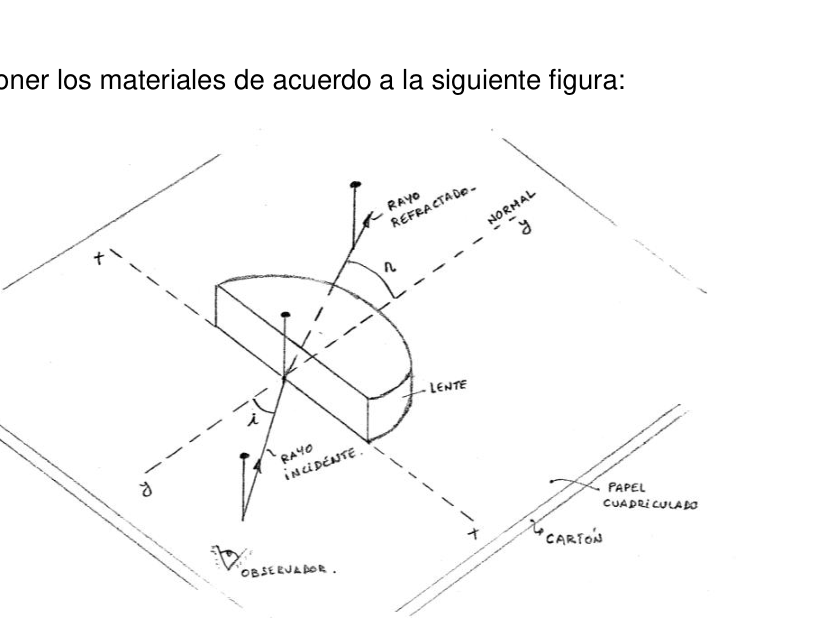
Topic: Geometric Optics Metodi: Snell’s Law, Thin Lens & Mirror Equation, Experimental Data Analysis Competenze: Physical Reasoning, Experimental Data Analysis Objects: Lens Fonte: Testo (PDF) — p.3
Indice di refrazione di lente piatto-convexa
PE45. Scuola Nero. 27 Hippolytus Yrigoyen
Città di Buenos Aires.
Determinare l’indice di refraczione di una lente piana convexa.
Materiali utilizzati
- Lente piatta convexa .
- Cartone
- Carta quadrata
- Alfileri .
- Trasportatore .
- Regola .
Introduzione Quando un raggio di luce colpisce la superficie che separa due media A e B, parte di quel raggio entra nel mezzo B, allontanandosi dalla sua traccia originale. Questo . Il fenomeno è conosciuto come la refraczione della luce. Due leggi sono verificate:
- I raggi incidenti, refratti e normali sono coplanari.
- Relazione: sen i / sen r è un valore costante per ogni coppia di media che si chiama indice di refraczione relativa del mezzo B rispetto al mezzo A (chiamato nBA). Insomma:
sen i / sen r = nBA Se il mezzo A (da dove incide il raggio) è l’aria o il vuoto (n=1), allora il L’indice di refraczione diventa l’assoluto del mezzo B, e si scrive direttamente come n. Cioè: sen i / sen r = n
Sviluppo
-
Disporre i materiali secondo la seguente figura:
-
Misurare gli angoli di incidenza e di refraczione, utilizzando gli alfileri, ripetendo la procedura per 5 angoli di incidenza diversi. (Se deve consegnare la scheda quadricolata in cui sono state effettuate le misure)
OAF 2013 - 174 3. Completa le tabelle seguenti: (Valutazione del trasportatore: ± 1°) Misura 1 i ± Δi R ± Δr sen i = senza immagine = Sen imín = senza r = senza rmax = senza rmin = nmax = Nmin = n ± Δn
Misurazione 2 i ± Δi R ± Δr sen i = senza immagine = Sen imín = senza r = senza rmax = senza rmin = nmax = Nmin = n ± Δn
Misurazione 3 i ± Δi R ± Δr sen i = senza immagine = Sen imín = senza r = senza rmax = senza rmin = nmax = Nmin = n ± Δn
Misurazione 4 i ± Δi R ± Δr sen i = senza immagine = Sen imín = senza r = senza rmax = senza rmin = nmax = Nmin = n ± Δn
Misurazione 5 i ± Δi R ± Δr sen i = senza immagine = Sen imín = senza r = senza rmax = senza rmin = nmax = Nmin = n ± Δn
- A partire dai 5 valori di n ottenuti, determinare l’indice di N di refraczione con il suo errore.
- Graficare sen i = f (sen r), con i loro rispettivi errori, e dare il valore di Indice di refraczione n attraverso la pendenza del grafico, determinando il suo errore.
Topic: Geometric Optics Metodi: Snell’s Law, Thin Lens & Mirror Equation, Experimental Data Analysis Competenze: Physical Reasoning, Experimental Data Analysis Objects: Lens Fonte: Testo (PDF) — p.3
The measurement of the measurement of the measurement of the measurement of the measurement of the measurement of the measurement of the measurement of the measurement of the measurement of the measurement of the measurement of the measurement of the measurement of the measurement of the measurement of the measurement of the measurement of the measurement of the measurement of the measurement of the measurement of the measurement of the measurement of the measurement of the measurement of the measurement of the measurement of the measurement of the measurement of the measurement of the measurement of the measurement of the measurement of the measurement of the measurement of the measurement of the measurement of the measurement of the measurement of the measurement of the measurement of the measurement of the measurement of the measurement of the measurement of the measurement of the measurement of the measurement of the measurement of the measurement of the measurement of the measurement.
PE45. School No. 27 Hippolytus Yrigoyen
City of Buenos Aires.
Determine the refractive index of a convex flat lens.
Materials used
- Convex flat lens .
- Cardboard .
- Paperwork is on the cards .
- The pulleys .
- The transporter .
- Rule .
The first is the introduction. When a ray of light hits the surface separating two media A and B, Part of that beam enters medium B by deviating from its original path. This one . This phenomenon is known as refraction of light. Two laws are verified:
- The incident, refractory and normal rays are coplanar.
- The ratio: sen i / sen r is a constant value for each media pair This is called the mean relative refractive index of B with respect to medium A (called nBA). I mean:
The following is the list of the following: If the medium A (from which the lightning strikes) is air or vacuum (n=1), then the refractive index becomes absolute of medium B, and it is written directly as n. That is: Sen i / sen r = n
Development
-
The materials shall be arranged according to the following figure:
-
Measure the angle of incidence and refraction using the pins, repeating the procedure for 5 different angle of incidence. (Se (a) the measurement sheet must be provided with the square sheet where the measurements were made)
The following is the list of the countries of the European Union: 3. Complete the following tables: (Carrier rating: ± 1°) Measure 1 i ± Δi R ± Δr without i = without image = without immin = without r = without rmax = The following is the list of the categories of products: nmax = The following is the list of the countries of the European Union: n ± Δn
Measurement 2 i ± Δi R ± Δr without i = without image = without immin = without r = without rmax = The following is the list of the categories of products: nmax = The following is the list of the countries of the European Union: n ± Δn
Measure 3 i ± Δi R ± Δr without i = without image = without immin = without r = without rmax = The following is the list of the categories of products: nmax = The following is the list of the countries of the European Union: n ± Δn
Measure 4 i ± Δi R ± Δr without i = without image = without immin = without r = without rmax = The following is the list of the categories of products: nmax = The following is the list of the countries of the European Union: n ± Δn
Measurement 5 i ± Δi R ± Δr without i = without image = without immin = without r = without rmax = The following is the list of the categories of products: nmax = The following is the list of the countries of the European Union: n ± Δn
- From the 5 values of n obtained, determine the index of refraction n with its error.
- Graphing sen i = f (sen r), with their respective errors, and giving the value of refractive index n through the slope of the graph, Determining your error.
Topic: Geometric Optics Metodi: Snell’s Law, Thin Lens & Mirror Equation, Experimental Data Analysis Competenze: Physical Reasoning, Experimental Data Analysis Objects: Lens Fonte: Testo (PDF) — p.3