Globo meteorologico
Problema 1
Globo meteorológico.
Aunque parezca simple programar el lanzamiento de un globo
meteorológico, comparado con el lanzamiento de un satélite, es
necesario hacer una diagramación correcta pues es muy importante
el equipamiento que lleva suspendido como la información que se
desea obtener. Debido a que resolver el problema real es complejo,
te desafío a que hagamos algunos cálculos preliminares, lo cual
implicará realizar algunas aproximaciones para simplificar los
cálculos, que nos permitan estimar el comportamiento del globo
meteorológico. Un globo meteorológico, usualmente construido de
látex y lleno con hidrógeno (H2) por su bajo costo, se utiliza para
elevar equipamiento que permite medir distintos parámetros de
interés meteorológico en función de la altura (presión, temperatura,
humedad relativa, velocidad y dirección del viento, concentración
de ozono, etc.). Debido a que la presión atmosférica disminuye con
la altura el globo aumenta su volumen hasta que se rompe, lo que
determina la altura máxima que alcanzará. Puede llegar
aproximadamente a una altura de 30000 m y en algunos casos
alcanzar alturas del orden de 50000m
Para los cálculos vamos a suponer que el globo que utilizaremos tiene forma esférica y
que el gas en su interior (H2) se comporta como un gas ideal, el cual está sometido a la
presión atmosférica y a la presión que le ejerce el globo. La presión que ejerce el globo
sobre el gas depende del radio r que tiene el globo y puede aproximarse por
7
0
0
)
(
r
r
r
r
K
r
P
donde K es una constante que depende del globo y ro es su radio interno cuando no está inflado.
Los datos que disponemos para realizar los cálculos son:
Presión atmosférica: 97000 Pa
Temperatura ambiente: 17 ºC
K = 80000 N/m2
ro= 10 cm
Densidad del latex : 0,96 g/cm3
Espesor de la pared del globo
desinflado: 1,5 mm
Densidad del aire: 1.29 kg/m3
Masa molar del H2: 2 g/mol
Masa del equipamiento suspendido:
440 g
a) Calcule cuántos moles de H2 contiene el globo cuando se lo infla hasta un diámetro
interno de 1m.
b) Determine el peso total del globo inflado
c) Calcule el empuje que se ejerce sobre el globo en el momento de lanzarlo.
d) Calcule cuál es la fuerza neta aplicada sobre el globo meteorológico (incluido el
equipamiento) al momento de lanzarlo.
e) Determine la aceleración del globo al momento de lanzarlo.
Sabemos que cuando el globo asciende el aire le ejerce un rozamiento (fuerza viscosa) cuyo módulo para una esfera es Fv= 6 R v, donde R es el radio de la esfera, es la viscosidad del aire y v es la velocidad del globo.
f) Calcule cuál es la velocidad límite que alcanzaría el globo en su ascenso (sólo teniendo en cuenta los parámetros al momento del lanzamiento)
6 - OAF 2015 Si el mínimo espesor de la pared del globo para que el globo no se rompa es 0,02 mm. g) Calcule cuál es el radio del globo justo antes de explotar.
Constantes que le pueden ser de utilidad: R = 8.31 J/(mol K) = 1,71 10-5 Pa.s g = 10 m/s2
Topic: Fluid Mechanics, Thermodynamics Metodi: Hydrostatic Equilibrium, Ideal Gas Law, Free-Body Diagram Competenze: Physical Reasoning, Mathematical Modeling Objects: Bubble, Gas Fonte: Testo (PDF) — p.5
Globe meteorologico
Problema 1
Un pallone meteorologico. Anche se sembra semplice programmare il lancio di un globo. meteorologica, rispetto al lancio di un satellite, è È necessario fare un diagramma corretto perché è molto importante. l’apparecchiatura che porta sospesa come l’informazione che si vuole ottenere. Perché risolvere il problema reale è complesso, Ti sfido a fare qualche calcolo preliminare, che è La Commissione ha adottato una proposta di regolamento che prevede che i paesi terzi possano essere oggetto di una procedura di valutazione. Calcoli che ci permettono di stimare il comportamento del globo
- Meteorologia. Un globo meteorologico, solitamente costruito da La sua produzione è molto lenta e piena di idrogeno (H2) per il suo basso costo. Alzare l’attrezzatura che permette di misurare diversi parametri di Interesse meteorologico a seconda dell’altezza (pressione, temperatura, Umidità relativa, velocità e direzione del vento, concentrazione di ozono, ecc.). Poiché la pressione atmosferica diminuisce con L’altezza del globo aumenta il suo volume fino a quando non si rompe, che determina la massima altezza che raggiungerà. Può arrivare circa a un’altitudine di 30000 m e in alcuni casi raggiungere altezze dell’ordine di 50000m Per i calcoli, supponiamo che il pallone che useremo abbia una forma sferica e che il gas all’interno (H2) si comporta come un gas ideale, che è sottoposto alla la pressione atmosferica e la pressione che il globo esercita su di lei. La pressione esercitata dal globo Il gas dipende dal raggio r del globolo e può avvicinarsi a 7 0 0 ) ( r r r r K r P
dove K è una costante che dipende dal globo e ro è il suo raggio interno quando non è gonfiato.
I dati disponibili per effettuare i calcoli sono:
Pressione atmosferica: 97000 Pa
Temperatura ambiente: 17 oC
K = 80000 N/m2
ro= 10 cm
Densità del lattice: 0,96 g/cm3
Spessore della parete del globo
di cui:
Densità dell’aria: 1,29 kg/m3
Massa molare di H2: 2 g/mol
Massa dell’apparecchio sospeso:
440 g
a) Calcolare quanti molli di H2 contengono il pallone quando viene inflato fino a un diametro 1 m di interno. b) Determina il peso totale del pallone gonfiato c) Calcolare la spinta che si esercita sul pallone al momento di lanciarlo. d) Calcolare la forza netta applicata sul globo meteorologico (inclusi i Equipaggiamento) al momento del lancio. e) Determina l’accelerazione del pallone al momento del lancio.
Sappiamo che quando il pallone sale l’aria lo stringe. il cui modulo per una sfera è Fv=6 Rv, dove R è il raggio della sfera, è la viscosità dell’aria e v è la velocità del globo.
f) Calcola la velocità limite che il globo raggiungerebbe in ascensione (solo considerando i parametri al momento del lancio)
6 - OAF 2015 Se il minimo spessore del muro del pallone per non rompere il pallone è di 0,02 mm. g) Calcolare il raggio del pallone appena prima di esplodere.
Costanti che possono essere utili: R = 8,31 J/(mol K) = 1,71 10-5 Pa.s g = 10 m/s2
Topic: Fluid Mechanics, Thermodynamics Metodi: Hydrostatic Equilibrium, Ideal Gas Law, Free-Body Diagram Competenze: Physical Reasoning, Mathematical Modeling Objects: Bubble, Gas Fonte: Testo (PDF) — p.5
The following is the list of the Member States’ airports in the Union:
Problem 1 is
The weather balloon. Although it seems simple to program a balloon launch . The weather, compared to a satellite launch, is It is necessary to make a correct diagram because it is very important. The equipment you carry suspended as information is being You want to get it. Because solving the real problem is complex, I challenge you to do some preliminary calculations, which is It will involve making some approaches to simplify the Calculations, which allow us to estimate the behavior of the globe. The weather. A weather balloon, usually built of It is a latex and hydrogen-filled (H2) because of its low cost, used for To raise equipment to measure different parameters of the The weather interest depends on the altitude (pressure, temperature, relative humidity, wind speed and direction, concentration of ozone, etc.). Because the atmospheric pressure decreases with The height the balloon increases its volume until it breaks, which determines the maximum height it will reach. He can come . approximately at an altitude of 30000 m and in some cases reaching heights of the order of 50000m For the calculations, let’s assume that the balloon we’re going to use is spherical and The gas inside (H2) behaves like an ideal gas, which is subject to the atmospheric pressure and the pressure exerted on the balloon. The pressure exerted by the balloon The gas depends on the radius r of the balloon and can be approximated by 7 0 0 ) ( r r r r K r P
where K is a constant that depends on the globe and ro is its internal radius when it’s not. inflated.
The data we have available for calculations are:
Air pressure: 97000 Pa
The temperature of the room: 17 oC
K = 80000 N/m2
ro= 10 cm
Density of latex: 0.96 g/cm3
The thickness of the balloon wall .
deflated: 1,5 mm
Air density: 1.29 kg/m3
Molar mass of H2: 2 g/mol
Mass of suspended equipment:
440 g
(a) Calculate how many moles of H2 the balloon contains when inflated to a diameter 1m interior. (b) Determine the total weight of the inflated balloon (c) Calculate the thrust exerted on the balloon at the time of launch. (d) Calculate the net force applied to the weather balloon (including the The Commission has already decided to adopt a new proposal for a directive on the protection of the environment. (e) Determine the acceleration of the balloon at the time of launch.
We know that when the balloon rises the air exert a friction. whose modulus for a sphere is Fv=6 Rv, where R is the radius of the sphere, is the The viscosity of the air and v is the velocity of the balloon.
f) Calculate the maximum speed the balloon would reach on its ascent (only taking into account the parameters at launch)
The Commission shall adopt delegated acts in accordance with Article 21 of this Regulation. If the minimum wall thickness of the balloon to prevent the balloon from breaking is 0,02 mm. (g) Calculate the radius of the balloon just before it explodes.
Constants that may be useful: R = 8.31 J/(mol K) = 1,71 10-5 Pa.s g = 10 m/s2
Topic: Fluid Mechanics, Thermodynamics Metodi: Hydrostatic Equilibrium, Ideal Gas Law, Free-Body Diagram Competenze: Physical Reasoning, Mathematical Modeling Objects: Bubble, Gas Fonte: Testo (PDF) — p.5
Diseno de un vehiculo electrico
Problema 2
Diseño de un vehículo eléctrico.
En los últimos años ha habido un gran auge en la fabricación de automóviles eléctricos.
Casi todas las marcas más importantes tienen modelos ya a la venta o modelos
diseñados para el futuro. Las prestaciones de algunos de ellos son extraordinarias. Sin
embargo la historia del automóvil eléctrico para nada es una historia que comenzó en los
últimos años. Por el contrario en las dos primeras décadas del siglo XX hubo una
proliferación de modelos de automóviles eléctricos, llegando en muchos casos a avances
notables. El objetivo del presente problema es estudiar, desde el punto de vista de la
física, algunas cuestiones mecánicas y eléctricas en el diseño de un automóvil eléctrico
antiguo.
Las características generales del vehículo son:
i) Motor eléctrico de CC, 24 Volts y 1HP de potencia. La máxima velocidad de giro del
eje del motor es 1750 RPM (revoluciones por minuto).
ii) La masa del vehículo es de 400 kg.
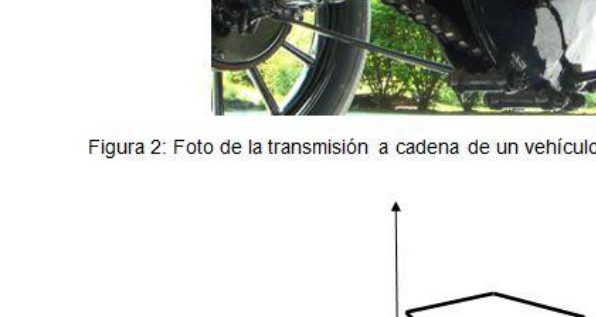
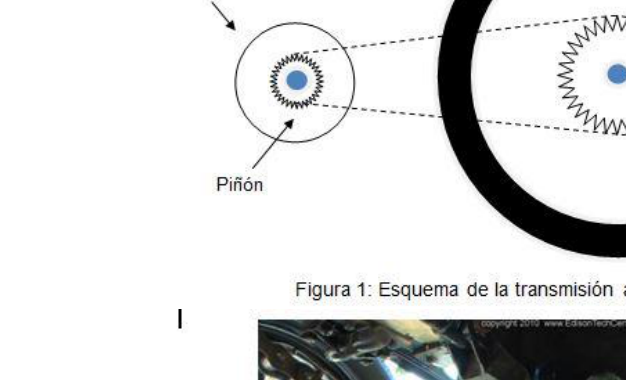
iii) El vehículo posee una transmisión a cadena, formada por un piñón de 6cm de
diámetro, montado sobre el eje del motor, y una corona de 24 cm, montada sobre el
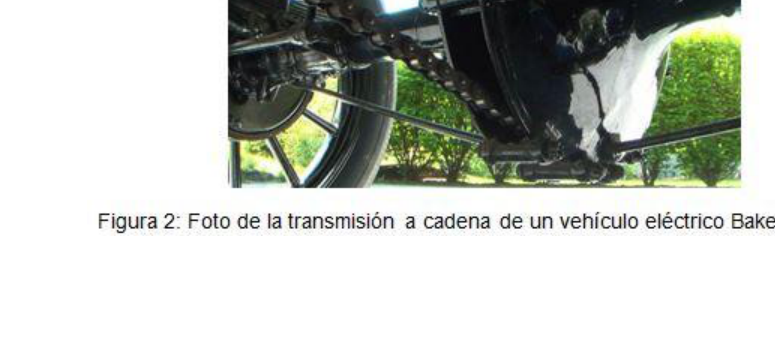
eje trasero del vehículo. El esquema de la transmisión se muestra en la figura 1. La
foto de la figura 2 muestra esta transmisión para el caso de un vehículo Baker de
1907. La corona está montada de forma tal que tracciona sobre los dos semiejes
traseros, y por lo tanto sobre las dos ruedas traseras.
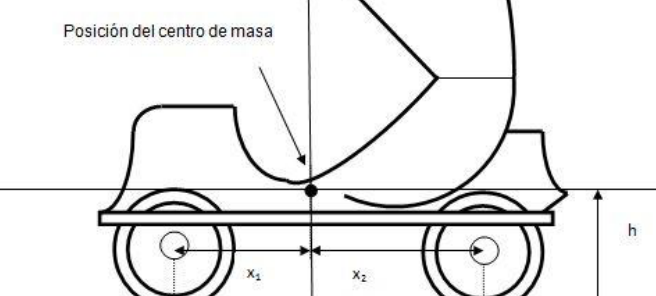
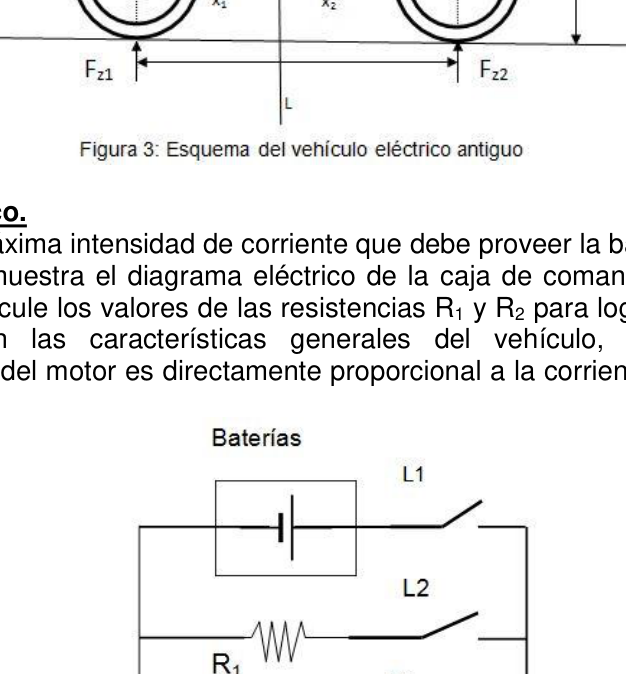
iv) La distancia entre los ejes del vehículo es L= 175cm y la posición del centro de
masa está dada por las coordenadas x1= 75cm y h= 85cm (ver figura 3).
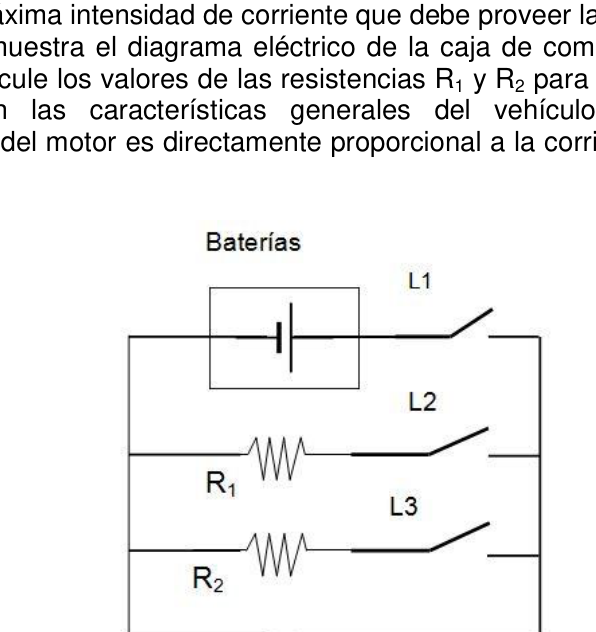
v) El vehículo tiene tres velocidades hacia adelante, controladas a través de
resistencias – como se muestra en el diagrama de la figura 4 – y marcha atrás. Con
el uso de esas resistencias, y de acuerdo a la posición de las llaves L1, L2 y L3, se
logra que las velocidades de giro del eje del motor sean: 1a marcha --- 1/3 de la
velocidad máxima de giro del eje del motor; 2a marcha --- 2/3 de la velocidad
máxima de giro del eje; 3a marcha --- velocidad máxima de giro del eje, es decir
1750 RPM.
vi) Las ruedas de este vehículo son de 75cm de diámetro y de masa m = 35 kg cada
una. Considérelas como un cilindro macizo.
I.- Diseño Mecánico
a) Calcule la fuerza que ejerce el pavimento sobre cada una de las ruedas delanteras
(Fz1) y sobre cada una de las ruedas traseras (Fz2), cuando el vehículo está en
reposo. Suponga que el peso del vehículo se distribuye de tal forma que las fuerzas
sobre las ruedas traseras son iguales entre sí, y las fuerzas sobre las ruedas
delanteras son iguales entre sí. Ver figura 3.
b) Encuentre expresiones para estas fuerzas, Fz1 y Fz2, cuando el vehículo tiene una
aceleración ax, a lo largo del eje x. Para este cálculo tenga presente que el vehículo
es de tracción trasera.
c) Teniendo en cuenta los datos provistos en las características del vehículo, calcule
el torque capaz de entregar el motor. Aquí tenga presente que 1HP corresponde a
0.764 Kilowatts.
d) Calcule el torque que la corona transmite a las ruedas traseras.
e) Calcule la aceleración máxima que pueden proveer el motor y la transmisión
instalados en el vehículo.
OAF 2015 - 7 Datos a tener en cuenta: i) El momento de inercia, de un cilindro macizo de radio b y masa m, a lo largo del eje del cilindro es: 𝐼= 1 2 𝑚𝑏2
ii) En el punto f) desprecie el momento de inercia del eje que une las ruedas traseras.
iii) Suponga que sobre ninguna parte mecánica móvil del vehículo hay rozamiento.
8 - OAF 2015
II.- Diseño eléctrico.
f) Calcule la máxima intensidad de corriente que debe proveer la batería del vehículo.
g) La figura 4 muestra el diagrama eléctrico de la caja de comando de nuestro auto
eléctrico. Calcule los valores de las resistencias R1 y R2 para lograr las velocidades
indicadas en las características generales del vehículo, Suponga que las
revoluciones del motor es directamente proporcional a la corriente eléctrica que por
él circula.

Topic: Rotational Dynamics, Circuits Metodi: Torque & Angular Momentum Analysis, Free-Body Diagram, Kirchhoff’s Laws Competenze: Physical Reasoning, Mathematical Modeling Objects: Wheel, Resistor Fonte: Testo (PDF) — p.5
Design di un veicolo elettrico
Problema 2
Progettazione di un veicolo elettrico. Negli ultimi anni c’è stato un grande aumento nella produzione di auto elettriche. Quasi tutte le principali marche hanno già modelli in vendita o modelli progettati per il futuro. I risultati di alcuni di loro sono straordinari. Senza . Tuttavia la storia dell’auto elettrica per niente è una storia che ha avuto inizio negli anni ‘80. negli ultimi anni. Al contrario, nei primi due decenni del XX secolo c’è stata una La diffusione dei modelli di auto elettriche, in molti casi, ha portato a progressi notevoli. L’obiettivo del problema è quello di studiare, dal punto di vista della La struttura della macchina elettrica è molto più elevata.
- Antico. Le caratteristiche generali del veicolo sono: (i) Motore elettrico a corrente continua, 24 volti e 1 HP di potenza. La velocità massima di rotazione di L’asse del motore è di 1750 RPM (rivoluzioni al minuto). (ii) La massa del veicolo è di 400 kg. (iii) Il veicolo è dotato di una trasmissione a catena, costituita da un pignone di 6 cm di diametro. diametro, montato sull’asse del motore, e una corona di 24 cm, montata sul il rear axle del veicolo. Il schema della trasmissione è mostrato in figura 1. La Foto in figura 2 mostra questa trasmissione per il caso di un veicolo Baker di
- La corona è montata in modo tale che traccia su due semieiezzi. le spalle, e quindi sulle due ruote posteriori. iv) La distanza tra gli assi del veicolo è L= 175 cm e la posizione del centro del veicolo. La massa è data dalle coordinate x1=75cm e h=85cm (vedi figura 3). v) Il veicolo ha tre velocità in avanti, controllate attraverso resistenze come mostrato nel diagramma di figura 4 e retrocesso. Con L’uso di tali resistenze, e secondo la posizione delle chiavi L1, L2 e L3, si che permette alle velocità di rotazione dell’asse del motore di essere: 1° marcia --- 1/3 della velocità di rotazione del motore velocità massima di rotazione dell’asse del motore; 2a corsa --- 2/3 della velocità 3a rotazione --- velocità massima di rotazione dell’asse, cioè 1750 RPM. (vi) Le ruote di questo veicolo sono di 75 cm di diametro e di massa m = 35 kg ciascuna.
- Uno. Considerateli come un cilindro massiccio.
I.- Disegno meccanico a) Calcolare la forza esercitata dal pavimento su ciascuna delle ruote anteriori (Fz1) e su ciascuna delle ruote posteriori (Fz2), quando il veicolo è in Riposo. Supponiamo che il peso del veicolo sia distribuito in modo tale che le forze sulle ruote posteriori sono uguali tra loro, e le forze sulle ruote Le facce sono uguali tra loro. Vedi figura 3. b) Trova espressioni per queste forze, Fz1 e Fz2, quando il veicolo ha una Accelerazione aX, lungo l’asse x. Per questo calcolo, si noti che il veicolo È a trazione posteriore. (c) Considerando i dati forniti nelle caratteristiche del veicolo, calcolare la coppia che può produrre il motore. Si noti che 1HP corrisponde a 0,764 kilowatt. d) Calcolare la torsione che la corona trasmette alle ruote posteriori. e) Calcolare la massima accelerazione che il motore e la trasmissione possono fornire installati nel veicolo.
OAF 2015 - 7 Dati da tenere conto: (i) Il momento di inerzia di un cilindro massiccio di radio b e di massa m, lungo il L’asse del cilindro è: 𝐼= 1 2 𝑚𝑏2
(ii) al punto (f) disprezza il momento di inerzia dell’asse che unisce le ruote
- Le sue sedute.
(iii) Supponi che non vi sia lacerazione su nessuna parte meccanica mobile del veicolo.
8 - OAF 2015 II. Progettazione elettrica. f) Calcolare la massima intensità di corrente da fornire dalla batteria del veicolo. g) La figura 4 mostra il diagramma elettrico del comando della nostra auto. elettrico. Calcola i valori delle resistenze R1 e R2 per ottenere le velocità Le caratteristiche generali del veicolo sono indicate: La velocità di rotazione del motore è direttamente proporzionale al corrente elettrico che per
- E’ in circolazione.
Topic: Rotational Dynamics, Circuits Metodi: Torque & Angular Momentum Analysis, Free-Body Diagram, Kirchhoff’s Laws Competenze: Physical Reasoning, Mathematical Modeling Objects: Wheel, Resistor Fonte: Testo (PDF) — p.5
Design of an electric vehicle
Problem two .
Design of an electric vehicle. In recent years there has been a huge boom in the manufacture of electric cars. Almost all major brands have models already on sale or models Designed for the future. The performance of some of them is extraordinary. No . However the history of the electric car for nothing is a story that began in the In recent years. On the contrary, in the first two decades of the 20th century there was a The proliferation of electric car models, in many cases making progress The two are remarkable. The aim of this problem is to study, from the point of view of the Physics, some mechanical and electrical issues in the design of an electric car old. The general characteristics of the vehicle are: (i) Electric motor of a DC power output of 24 volts and 1 hp. The maximum rotational speed of the The engine axle is 1750 RPM (revolution per minute). (ii) The mass of the vehicle shall be 400 kg. (iii) The vehicle has a chain transmission, consisting of a 6 cm piston of diameter, mounted on the engine axle, and a 24 cm crown, mounted on the the rear axle of the vehicle. The transmission scheme is shown in Figure 1. La The picture in Figure 2 shows this transmission for the case of a Baker vehicle from 1907. The crown is mounted in such a way that it tracks over the two semis. rear wheels, and therefore on the two rear wheels. (iv) The distance between the axles of the vehicle is L= 175 cm and the centre position of the vehicle. mass is given by the coordinates x1=75cm and h=85cm (see figure 3). (v) The vehicle has three forward speeds, controlled by resistance as shown in Figure 4 and backwards. With The use of these resistors, and according to the position of the L1, L2 and L3 keys, are achieves the torque of the engine axle at: 1st gear --- 1/3 of the Maximum speed of engine axle rotation; 2nd gear --- 2/3 of the speed Maximum axle speed; 3rd gear --- maximum axle speed, i.e. 1750 RPM. (vi) The wheels of this vehicle are 75 cm in diameter and m = 35 kg each. One of them. Consider them a massive cylinder.
I.- Mechanical design (a) Calculate the force exerted by the pavement on each of the front wheels (Fz1) and on each rear wheel (Fz2), when the vehicle is in I’m going to rest. Suppose the weight of the vehicle is distributed in such a way that the forces are On the rear wheels are equal to each other, and the forces on the wheels are equal. The front is equal to each other. See figure 3. (b) Find expressions for these forces, Fz1 and Fz2, when the vehicle has a axis acceleration, along the x axis. For this calculation, please note that the vehicle It’s rear-wheel drive. (c) Taking into account the data provided in the vehicle characteristics, calculate the torque capable of delivering the engine. Please note that 1HP corresponds to The value of the electricity from the gasoline generated by the gasoline generated by the gasoline generating unit is: (d) Calculate the torque that the crown transmits to the rear wheels. (e) Calculate the maximum acceleration that the engine and transmission can provide installed in the vehicle.
The Commission shall adopt implementing acts in accordance with Article 21 of the Financial Regulation. Data to be taken into account: (i) The moment of inertia of a mass cylinder of radius b and mass m, along the length of the cylinder. The axis of the cylinder is: 𝐼= 1 2 𝑚𝑏2
(ii) In point (f) disregard the moment of inertia of the axle joining the wheels The backs.
(iii) Assume that no moving mechanical part of the vehicle is bruised.
8 - OAF 2015 II. Electrical design. (f) Calculate the maximum current intensity to be supplied by the vehicle battery. g) Figure 4 shows the electrical diagram of the control box of our car electrical. Calculate the resistance values R1 and R2 to achieve the speeds The vehicle’s general characteristics are indicated. The engine rotations are directly proportional to the electric current that is He’s circulating.
Topic: Rotational Dynamics, Circuits Metodi: Torque & Angular Momentum Analysis, Free-Body Diagram, Kirchhoff’s Laws Competenze: Physical Reasoning, Mathematical Modeling Objects: Wheel, Resistor Fonte: Testo (PDF) — p.5
Hagamos danzar a los imanes de los nucleos
Problema 3
Hagamos danzar a los imanes de los núcleos.
Los núcleos de los átomos poseen una propiedad física cuántica, sin análogo clásico,
denominada espín nuclear. Una particularidad del espín nuclear es que, ante la
presencia de un campo magnético estático y homogéneo 𝐵0
, se comportan como si
fueran pequeños imanes con un momento magnético 𝜇 = 𝛾ℏ𝐼 , donde 𝐼 es el ―vector
cuántico‖ momento angular del espín nuclear, la constante geomagnética del núcleo y ℏ
la constante de Planck dividido 2. Al valor del espín nuclear se lo denota por la letra I y
se llama número cuántico de espín. Excepto por el hecho que la proyección de 𝐼 en la
dirección del campo magnético externo, ver Figura 1, adopta solo ciertos valores
discretos (cuantificación) el comportamiento del momento magnético de los espines se
puede modelar por las reglas del electromagnetismo clásico.
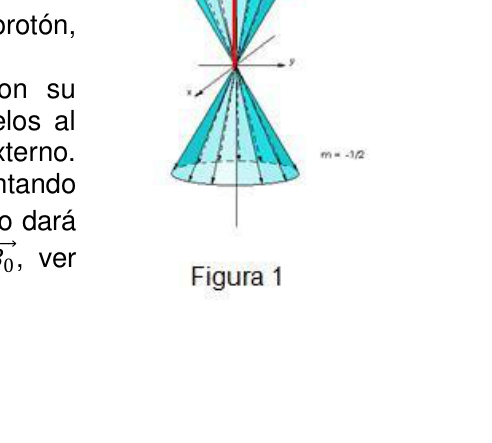
Vamos a tratar con núcleos de Hidrógeno (protones), que son
muy abundantes en el cuerpo humano. Para estos núcleos I =
½.
La proyección de 𝐼 sobre el eje z, toma para el caso del protón,
dos valores m=+1/2 y m=-1/2.
Esto quiere decir que tendremos algunos espines con su
proyección sobre la dirección del eje z apuntado paralelos al
campo externo y otros apuntado antiparalelos al campo externo.
Por cuestiones energéticas tendremos mas espines apuntando
paralelos al campo 𝐵0
que antiparalelos al campo 𝐵0
. Esto dará
origen a una magnetización neta en la dirección de 𝐵0
, ver
Figura 1.
OAF 2015 - 9
La magnetización total que surge de los espines nucleares de la muestra, es una
cantidad vectorial y está dada por
𝑀 = 𝜇 𝑖
𝑖
(ec. 1)
donde 𝜇 𝑖 es el momento magnético del núcleo i.
Usando que 𝜇 𝑖= 𝛾ℏ𝐼 𝑖, la magnetización de la muestra se puede escribir como
𝑀 = 𝛾ℏ𝐽
(ec. 2)
donde 𝐽 = 𝐼 𝑖
𝑖
es el momento angular total de espín de la muestra. Si la muestra se
coloca en presencia de un campo magnético 𝐵 0 uniforme, como es el caso de un
experimento de Resonancia Magnética Nuclear (RMN), se ejerce un torque 𝑇 𝑀 sobre el
vector magnetización donde el torque está dado por
𝑇 𝑀= 𝑀 × 𝐵 0
(ec.3)
Se puede mostrar que la magnetización precesa (movimiento de trompo) alrededor del
campo magnético a una frecuencia angular constante de módulo
𝜔= 𝛾𝐵0
(ec.4) (ver Figura 2).
La expresión de la magnetización inducida por los espines nucleares de protones a
temperatura ambiente (𝑇𝑎 ) es
𝑀=
𝜇0𝛾2ℏ2𝑛
4𝑘𝐵𝑇𝑎 𝐵0 = 4.04 × 10⁻⁹𝐵0
(ec.5)
Donde n es el número de espines nucleares de protones por unidad de volumen, 𝜇0 la
permeabilidad magnética del vacío, 𝑘𝐵 la constante de Boltzmann y 𝑇𝑎 la temperatura
ambiente en K. La unidad de M es el Tesla (1 Tesla = 1 V.s/m2).
En un experimento de RMN se usa sacar del equilibrio la magnetización M mediante la
aplicación de un campo magnético alterno 𝐵 1 perpendicular al campo externo 𝐵 0. Este
campo 𝐵 1 se aplica durante unos pocos microsegundos. La situación luego de aplicar
este campo 𝐵 1 es la que se muestra en la Figura 3. Entonces la magnetización 𝑀 girará
alrededor del campo 𝐵 0 en el plano xy.
Para detectar la señal generada por los núcleos en un experimento de RMN se coloca una bobina, digamos a lo largo del eje x, de modo que esta detecte la variación de flujo de campo magnético a través de ella, generada por la magnetización rotante 𝑀 en el
10 - OAF 2015 plano xy. En nuestro caso particular la magnitud de la magnetización a lo largo del eje de la bobina tendrá una dependencia temporal dada por la ecuación 6 𝑀 𝑡 = 𝑀0𝑠𝑒𝑛(𝜔𝑡)
(ec.6) con = 64.2 x 2 MHz (MHz = 1 x 10⁶ Hz). Para simplificar los cálculos supondremos que 𝑀 𝑡 varía linealmente con el tiempo, es decir aproximamos la función seno por una función diente de sierra, ver Figura 4.
Asumiendo que la relación entre campo magnético y magnetización está dado por BM = M
(ec.7) y el valor máximo de M a lo largo de la bobina es M = 6.06 x 10⁻⁹ T (1 Tesla = 1 V.s/m2).
a) A partir de la ecuación 5 encuentre el valor de 𝐵0.
b) Determine el periodo de 𝑀 𝑡 (ecuación 6).
El circuito resonante La bobina utilizada en un experimento de RMN forma parte de un circuito eléctrico, que en su forma más simple puede ser descrito por un circuito tipo RLC serie. c) Encuentre una expresión para la impedancia compleja de un circuito RLC serie, recuerde que ZL=iL ZR = R y ZC =-i/(C). Donde i es la unidad imaginaria.
Se dice que un circuito RLC está en resonancia cuando la frecuencia de trabajo es tal que la parte imaginaria de Z es cero.
d) Asumiendo que para nuestro circuito es: C = 10 pF (p = pico = 1 x 10-12),
R = 50 ohm y la frecuencia de trabajo = 64.2 x 2 MHz (MHz = 1 x 10⁶ Hz)
encuentre el valor de L.
La relajación En RMN existen parámetros físicos que cuantifican el retorno al equilibrio de la magnetización M generada por los núcleos. Uno de ellos es la constante de relajación T2. Esta constante es utilizada para diferenciar entre tejido biológico sano y tejido biológico enfermo. Para obtener el valor de esta constante se hacen experimentos donde se observa el decaimiento temporal de la magnetización. En esos experimentos la dependencia temporal de la magnetización es como lo indica la ecuación 7.
𝑀 𝑡 = 𝑀0exp(− 𝑡 𝑇2)
(ec.7)
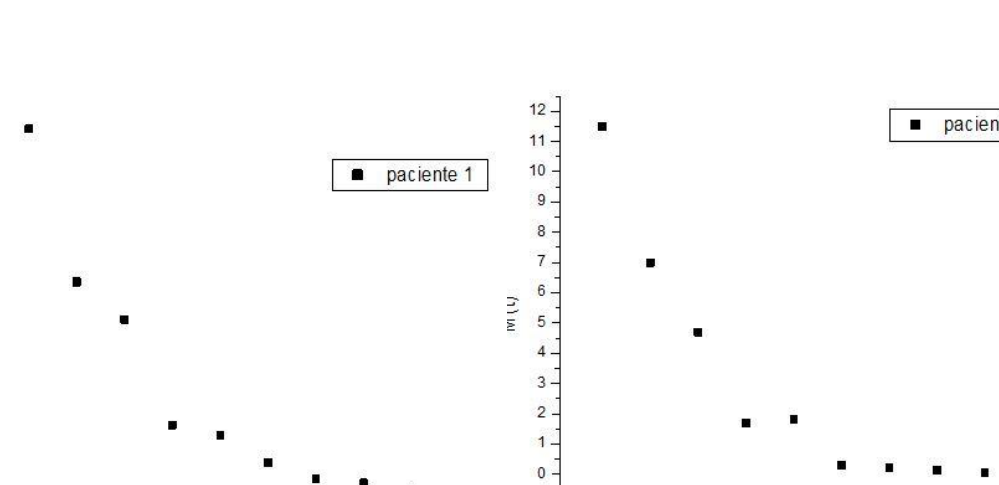
En las gráficas siguientes se muestran dos mediciones experimentales de esos decaimientos. Los valores son reproducidos en la Tabla 1.
OAF 2015 - 11
Tabla 1: Experimentos de relajación T2 de la magnetización
Paciente 1 Paciente 2 tiempo (ms) Intensidad de magnetización (10-9 T) Intensidad de magnetización (10-9 T) 0,0 11±1 12±1 111,1 6,5±0,6 7,0±0,7 222,2 5,4±0,5 4,7±0,5 333,3 2,3±0,5 1,7±0,3 444,4 2,0±0,4 0,3±0,5 555,6 1,2±0,2 0,3±0,5 666,7 0,7±0,3 0,21±0,08 777,7 0,6±0,2 0,13±0,05 888,8 0,3±0,1 0,05±0,02 1000,0 0,20±0,08 0,03±0,01
e) Obtenga a partir de los datos experimentales los valores de T2 para ambos tipo de tejidos. Recuerde que el tiempo t` para el cual la magnetización ha decaído a un 37% de su valor inicial es t´=T2.
f) Sabiendo que T2 para tejido sano es T2 >220 ms y para tejido enfermo es T2 < 220 ms, indique cuál de las curvas corresponde al tejido sano y cual al tejido enfermo.
12 - OAF 2015
OAF 2015 - 13
Instancia Nacional Prueba Experimental Nivel 1
14 - OAF 2015
OAF 2015 - 15
Topic: Magnetism, Circuits Metodi: Torque & Angular Momentum Analysis, Faraday’s Law of Induction, Curve Fitting Competenze: Physical Reasoning, Mathematical Modeling Objects: Magnetic Dipole, Coil Fonte: Testo (PDF) — p.5
Danziamo i magneti dei nuclei
Problema 3
Facciamo ballare i magneti dei nuclei. I nuclei degli atomi hanno una proprietà fisica quantistica, senza analogo classico, chiamata spina nucleare. Un’altra caratteristica della spina nucleare è che, in vista della presenza di un campo magnetico statico e omogeneo B0 , si comportano come se Si trattava di piccoli magneti con un momento magnetico μ = γħI , dove I è il ― vector Quantum ‖ momento angolare della spina nucleare, la costante geomagnetico del nucleo e ħ La costante di Planck divisa 2. Il valore della spina nucleare è indicato dalla lettera I e Si chiama numero quantistico spin. La proiezione di I in Direzione del campo magnetico esterno, vedere Figura 1, adotta solo determinati valori La misurazione del tempo magnetico delle spine è può modellare secondo le regole dell’elettromagnetismo classico. Tracciamo nuclei di idrogeno (protoni), che sono molto abbondanti nel corpo umano. Per questi nuclei I = ½. La proiezione di I sull’asse z, prende per il caso del protone, due valori m=+1/2 e m=-1/2. Questo significa che avremo qualche spina con lui. Proiezione sulla direzione dell’asse z puntata in parallelo al campo esterno e altri mirati antiparalleli al campo esterno. Per questioni energetiche avremo più spine a puntare. paralleli al campo B0 che controparale il campo B0 . Questo darà origine di una magnetizzazione netta nella direzione di B0 , vedere Figura 1.
OAF 2015 - 9 La magnetizzazione totale che emerge dalle spine nucleari del campione, è una Quantità vettoriale e è data da 𝑀 = 𝜇 𝑖 𝑖
(ec. 1) dove μ i è il momento magnetico del nucleo i. Usando che μ i= γħI i, la magnetizzazione del campione può essere scritta come M = γħJ
(ec. 2) dove J = I i 𝑖 è il momento angolare totale di spin del campione. Se il campione è La presenza di un campo magnetico B 0 uniforme, come nel caso di un L’esperimento di risonanza magnetica nucleare (RMN) si effettua con un torque T M sul Vettore di magnetizzazione dove il torque è dato da 𝑇 𝑀= 𝑀 × 𝐵 0
(ec.3) Si può mostrare che la magnetizzazione precesi (movimento del tubo) intorno al campo magnetico ad una frequenza angolare costante di modulo 𝜔= 𝛾𝐵0
(ec.4) (vedi figura 2).
L’espressione della magnetizzazione indotta dai spini nucleari dei protoni a temperatura ambiente (Ta) è 𝑀= 𝜇0𝛾2ℏ2𝑛 4kBTa B0 = 4.04 × 10⁻⁹B0 (ec.5) Dove n è il numero di spine nucleari di protoni per unità di volume, μ0 la Permeabilità magnetica del vuoto, kB la costante di Boltzmann e Ta la temperatura ambiente in K. L’unità di M è la Tesla (1 Tesla = 1 V.s/m2). In un esperimento di RMN si utilizza per togliere dall’equilibrio la magnetizzazione M mediante la Applicazione di un campo magnetico alternativo B1 perpendicolare al campo esterno B0. Questo . campo B 1 viene applicato per pochi microsegondi. La situazione dopo l’applicazione Questo campo B 1 è quello che mostra la figura 3. Allora la magnetizzazione M girerà intorno al campo B 0 sul piano xy.
Per rilevare il segnale generato dai nuclei in un esperimento di RMN si colloca una bobina, diciamo lungo l’asse x, così che questo rileva la variazione di flusso di campo magnetico attraverso di essa, generato dalla magnetizzazione rotante M in
10 - OAF 2015 piano xy. Nel nostro caso particolare la magnitudine della magnetizzazione lungo l’asse di la bobina avrà una dipendenza temporale data dall’equazione 6 M t = M0sen(ωt)
(ec.6) con = 64,2 x 2 MHz (MHz = 1 x 10⁶ Hz). Per semplificare i calcoli supponiamo che M t varia linealmente con il tempo, è Quindi, per esempio, si approssimano la funzione seno per una funzione dentale di gerda, vedere Figura 4.
Supponendo che il rapporto tra campo magnetico e magnetizzazione sia dato da BM = M
(ec.7) e il valore massimo di M lungo la bobina è M = 6,06 x 10⁻⁹ T (1 Tesla = 1 V.s/m2).
a) A partire dall’equazione 5 trovi il valore di B0.
b) Determina il periodo di M t (equazione 6).
Il circuito risonante La bobina utilizzata in un esperimento di RMN fa parte di un circuito elettrico, che in forma più semplice può essere descritto da un circuito tipo serie RLC. c) Trova un’espressione per l’impedenza complessa di un circuito RLC serie, Ricorda che ZL=iL ZR = R e ZC =-i/(C). Dove i è l’unità immaginaria.
Si dice che un circuito RLC sia in risonanza quando la frequenza di lavoro è tale. che la parte immaginaria di Z è zero.
d) Supponendo che per il nostro circuito sia: C = 10 pF (p = picco = 1 x 10-12), R = 50 ohm e la frequenza di lavoro = 64.2 x 2 MHz (MHz = 1 x 10⁶ Hz)
- Trova il valore di L.
Il relax. In RMN esistono parametri fisici che quantificano il ritorno all’equilibrio della Magnetizzazione M generata dai nuclei. Uno di questi è la costante di rilassamento T2. Questa costante è usata per distinguere tra tessuto biologico sano e tessuto biologico Malata. Per ottenere il valore di questa costante si fanno esperimenti dove si osserva il declino temporale della magnetizzazione. In questi esperimenti la La dipendenza temporale della magnetizzazione è come indicato nell’equazione 7.
M t = M0exp(− 𝑡 𝑇2)
(ec.7)
I grafici seguenti mostrano due misurazioni sperimentali di questi. decadimenti. I valori sono riportati nella tabella 1.
OAF 2015 - 11
Tabella 1: Experimenti di rilassamento T2 della magnetizzazione
Il paziente 1 Paziente 2 Tempo (ms) Intensità di magnetizzazione (10-9 T) Intensità di magnetizzazione (10-9 T) 0,0 11±1 12±1 111,1 6,5±0,6 7,0±0,7 222,2 5,4±0,5 4,7±0,5 333,3 2,3±0,5 1,7±0,3 444,4 2,0±0,4 0,3±0,5 555,6 1,2±0,2 0,3±0,5 666,7 0,7±0,3 0,21±0,08 777,7 0,6±0,2 0,13±0,05 888,8 0,3±0,1 0,05±0,02 1000,0 0,20±0,08 0,03±0,01
e) Ottieni dai dati sperimentali i valori di T2 per entrambi i tipi di tessuti. Ricordate che il tempo t` per il quale la magnetizzazione è decaduta a un Il 37% del suo valore iniziale è t’=T2.
f) Sapendo che T2 per tessuti sani è T2 > 220 ms e per tessuti malati è T2 < 220 ms, indicare quale delle curve corrisponde al tessuto sano e quale al tessuto Malata.
12 - OAF 2015
OAF 2015 - 13
Instanza nazionale Prova sperimentale Livello 1
14 - OAF 2015
OAF 2015 - 15
Topic: Magnetism, Circuits Metodi: Torque & Angular Momentum Analysis, Faraday’s Law of Induction, Curve Fitting Competenze: Physical Reasoning, Mathematical Modeling Objects: Magnetic Dipole, Coil Fonte: Testo (PDF) — p.5
Let’s get the magnetic nuclei dancing
Problem three .
Let’s dance the magnets of the cores. The nuclei of atoms have a quantum physical property, with no classical analog, The nuclear spine. A peculiarity of the nuclear spine is that, in the face of the presence of a static and homogeneous magnetic field B0 , they behave as if They were small magnets with a magnetic moment μ = γħI , where I is the ― vector . quantum ‖ angular momentum of the nuclear spine, the geomagnetic constant of the nucleus and ħ Planck’s constant divided by 2. The value of the nuclear spindle is indicated by the letters I and It’s called the spin quantum number. Except for the fact that the projection of I in the The direction of the external magnetic field, see Figure 1, only takes certain values The magnetic moment behaviour of the spines is discrete (quantitative). You can model by the rules of classical electromagnetism. We’re going to deal with hydrogen nuclei, which are very abundant in the human body. For these nuclei I = ½. The projection of I over the z-axis, takes for the case of the proton, two values m=+1/2 and m=-1/2. This means we ‘ll have some thorns with her . projection on the direction of the z axis pointed parallel to external field and other counterparts to the external field. For energy reasons we ‘ll have more thorns pointing . parallel to the field B0 which are counterparallel to field B0 . This will give origin of net magnetisation in the direction of B0 See ? Figure 1 is shown.
The Commission shall adopt delegated acts in accordance with Article 21 of the Financial Regulation. The total magnetization that arises from the nuclear spines in the sample, is a vector quantity and is given by 𝑀 = 𝜇 𝑖 𝑖
(ec. 1) where μ i is the magnetic moment of core i. Using that μ i= γħI i, the magnetization of the sample can be written as M = γħJ
(ec. 2) where J = I i 𝑖 is the total angular moment of spin of the sample. If the sample is puts in the presence of a uniform magnetic field B 0 as is the case with a The test results of the test are given in the following table: magnetization vector where torque is given by 𝑇 𝑀= 𝑀 × 𝐵 0
(ec.3) It can be shown that the magnetization precesses (tube movement) around the magnetic field at a constant angular frequency of the module 𝜔= 𝛾𝐵0
(ec.4) (see Figure 2).
The expression of the magnetization induced by the proton nuclear spines to The ambient temperature (Ta) is 𝑀= 𝜇0𝛾2ℏ2𝑛 The following table shows the following: (ec.5) Where n is the number of proton nuclear spins per unit volume, μ0 the The magnetic permeability of the vacuum, kB the Boltzmann constant and Ta the temperature environment in K. The unit of M is the Tesla (1 Tesla = 1 V.s/m2). In an MRI experiment, the magnetization M is used to remove the balance by Application of an alternating magnetic field B1 perpendicular to the external field B0. This one . Field B 1 is applied for a few microseconds. The situation after application This field B 1 is the one shown in Figure 3. Then the magnetization M will rotate around the field B 0 in the plane xy.
To detect the signal generated by the nuclei in an MRI experiment, it is placed a coil, let’s say along the x-axis, so that it detects the flow variation magnetic field through it, generated by rotating magnetization M at the
10 - OAF 2015 plane xy. In our particular case the magnitude of the magnetization along the axis of The coil will have a temporary dependence given by equation 6 M t = M0sen(ωt)
(ec.6) with = 64.2 x 2 MHz (MHz = 1 x 10⁶ Hz). To simplify the calculations we will assume that M t varies linearly over time, is So we’re going to approximate the sinus function by a saw tooth function, see Figure 4.
Assuming that the relationship between magnetic field and magnetization is given by BM = M
(ec.7) and the maximum value of M along the coil is M = 6.06 x 10⁻⁹ T (1 Tesla = 1 V.s/m2).
(a) From equation 5 find the value of B0.
(b) Determine the period of M t (e.g. equation 6).
The resonant circuit . The coil used in an MRI experiment is part of an electrical circuit, which In its simplest form it can be described by a series RLC type circuit. (c) Find an expression for the complex impedance of a serial RLC circuit, Remember that ZL=iL ZR=R and ZC=-i/(C). Where i is the imaginary unit.
An RLC circuit is said to be in resonance when the working frequency is such that That the imaginary part of Z is zero.
d) Assuming that for our circuit is: C = 10 pF (p = peak = 1 x 10-12), R = 50 ohms and the working frequency = 64.2 x 2 MHz (MHz = 1 x 10⁶ Hz) Find the value of L.
The relaxation . In NMR there are physical parameters that quantify the return to equilibrium of the Magnetization M generated by the nuclei. One of them is the T2 relaxation constant. This constant is used to differentiate between healthy biological tissue and biological tissue. I’m sick of it. To get the value of this constant, experiments are done where they are It observes the temporary decay of the magnetization. In these experiments, the The time dependence of magnetization is as shown in equation 7.
M t = M0exp(− 𝑡 𝑇2)
(ec.7)
The following graphs show two experimental measurements of these. decay. The values are shown in Table 1.
The Commission shall adopt delegated acts in accordance with Article 21 of the Financial Regulation.
Table 1: T2 relaxation experiments of the magnetization
Patient 1 Patient 2 Time . (ms) Magnetization intensity (10-9 T) Magnetization intensity (10-9 T) 0,0 11±1 12±1 111,1 6,5±0,6 7,0±0,7 222,2 5,4±0,5 4,7±0,5 333,3 2,3±0,5 1,7±0,3 444,4 2,0±0,4 0,3±0,5 555,6 1,2±0,2 0,3±0,5 666,7 0,7±0,3 0,21±0,08 777,7 0,6±0,2 0,13±0,05 888,8 0,3±0,1 0,05±0,02 1000,0 0,20±0,08 0,03±0,01
(e) Get from experimental data the T2 values for both types of tissues. Remember that the time t` for which the magnetization has fallen to a 37% of its initial value is t’=T2.
(f) Knowing that T2 for healthy tissue is T2 > 220 ms and for diseased tissue is T2 < 220 ms, indicate which curve corresponds to healthy tissue and which to healthy tissue I’m sick of it.
The Commission shall adopt delegated acts in accordance with Article 21 of Regulation (EU) No 1295/2015.
The Commission shall adopt delegated acts in accordance with Article 21 of the Financial Regulation.
The National Court Experimental test Level 1
The Commission shall adopt delegated acts in accordance with Article 21 of this Regulation.
The following points shall be added:
Topic: Magnetism, Circuits Metodi: Torque & Angular Momentum Analysis, Faraday’s Law of Induction, Curve Fitting Competenze: Physical Reasoning, Mathematical Modeling Objects: Magnetic Dipole, Coil Fonte: Testo (PDF) — p.5
Pendulo de Torsion
Péndulo de Torsión.
Introducción. Un péndulo de torsión consiste de un cuerpo suspendido de un alambre o de un resorte. Cuando se hace girar el cuerpo, alrededor del eje del alambre, experimentará un torque que tiende hacerlo volver a la posición de equilibrio. Si se deja libre al cuerpo este comenzará a oscilar alrededor de la posición de equilibrio. Para pequeñas amplitudes el periodo del péndulo de torsión es:
)1( 2 K I T
Donde I es el momento de inercia del cuerpo respecto al eje de rotación y K es la constante de torsión del alambre o resorte.
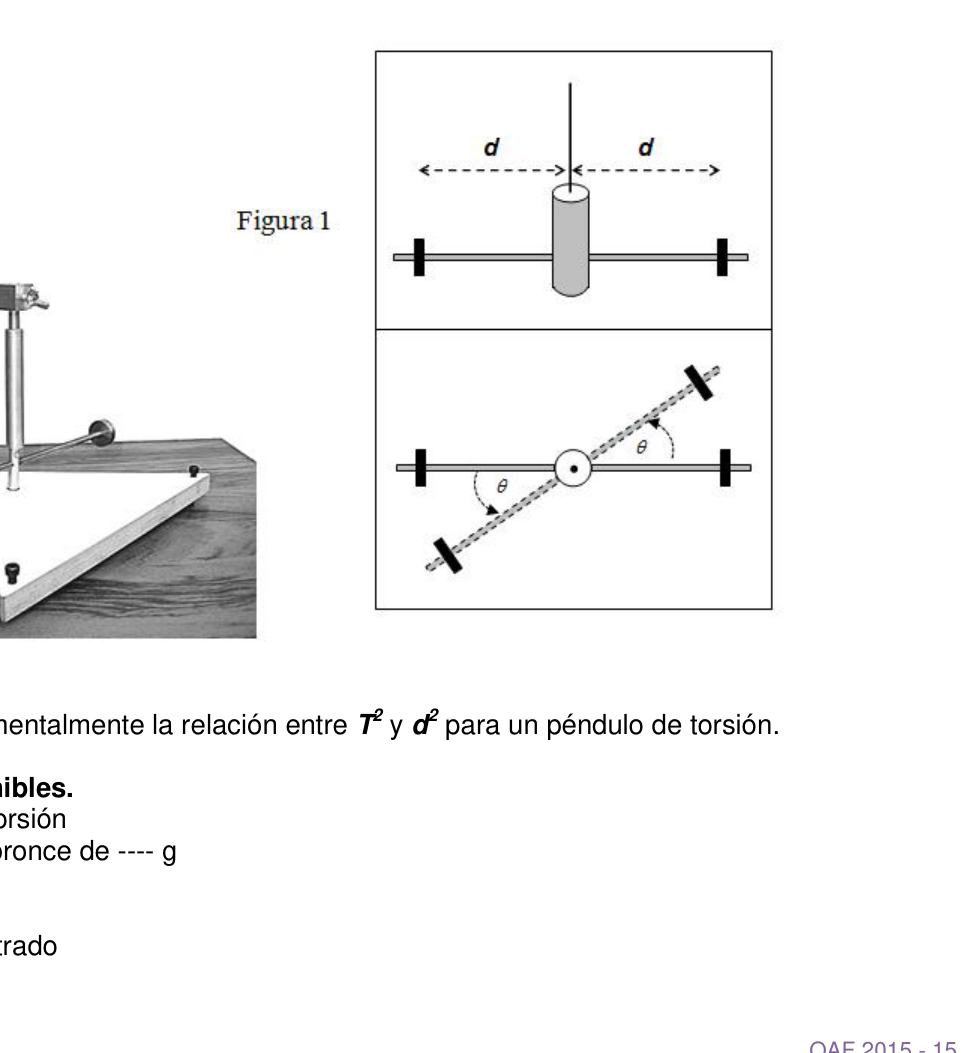
Si el cuerpo es como el de la figura, constituido por un cilindro vertical, el cual es
atravesado por una varilla roscada, y dos masas puntuales (M) el momento de inercia
será:
)
2
(
2
2
d
M
I
I
a
Donde Ia es el momento de inercia del cilindro atravesado por la varilla roscada y Md2 es el momento de inercia de cada una de las masas cilíndricas de bronce que se encuentran a una distancia d del eje de rotación.
Objetivo. Determinar experimentalmente la relación entre T2 y d2 para un péndulo de torsión.
Elementos disponibles.
-
Péndulo de torsión
-
2 masas de bronce de ---- g
-
Cronómetro
-
Regla
-
Papel milimetrado
16 - OAF 2015 Procedimiento.
- Nivele la base con los tornillos para que el cilindro de aluminio no toque las paredes del hueco en la base de madera.
- Mida el periodo del péndulo sin masas.
- Coloque las masas en la varilla roscada como se muestra en la Figura 1.
- Mida la distancia d y el período de oscilación.
- Repita el punto 4 para distintos valores de d.
Consignas.
- Construya una tabla con todos los valores medidos.
- Construya una tabla con los valores de d2 y T2.
- Grafique T2 en función de d2.
- Indique el tipo de relación que existe entre estas dos variables.
Datos útiles.
Incertidumbre asociada a la función x2:
x
x
x
2
2
OAF 2015 - 17
Instancia Nacional Prueba Teórica Nivel 2
18 - OAF 2015
OAF 2015 - 19
Topic: Oscillations & Waves, Rotational Dynamics Metodi: Simple Harmonic Motion Analysis, Experimental Data Analysis, Graph Linearization Competenze: Physical Reasoning, Experimental Data Analysis Objects: Pendulum, Cylinder Fonte: Testo (PDF) — p.5
Pendolo di Torsione
Pendale Torsion.
Introduzione. Un pendolo a torsione consiste in un corpo sospeso da un filo o da una molla. Quando si gira il corpo, intorno all’asse del filo, si sperimenterà un torque. che tende a riportarlo alla posizione di equilibrio. Se si lascia libero il corpo questo inizierà a oscillare attorno alla posizione di equilibrio. Per piccole amplitudini il periodo del pendolo di torsione è:
)1( 2 K I T
Dove I è il momento di inerzia del corpo rispetto all’asse di rotazione e K è il momento di inerzia del corpo rispetto all’asse di rotazione. Costante torsione del filo o della sorgente.
Se il corpo è come quello della figura, costituito da un cilindro verticale, che è Attraversato da un bastone a rottura, e due masse puntate (M) il momento di inerzia sarà: ) 2 ( 2 2 d M I I a
Dove Ia è il momento di inerzia del cilindro attraversato dalla canna e Md2 è il momento di inerzia di ciascuna delle masse cilindriche di bronzo che si trovano a una distanza d dall’asse di rotazione.
Obiettivo. Determinare sperimentalmente il rapporto tra T2 e d2 per un pendolo di torsione.
Elementi disponibili.
- Pendale a torsione
- 2 masse di bronzo di ---- g
- Cronometro .
- Regola .
- Papero millimetrico .
16 - OAF 2015 Procedura.
- Scale la base con gli screw per evitare che il cilindro di alluminio tocchi i muri del buco nella base in legno.
- Misura il periodo del pendolo senza masse.
- Metti le masse sul bastone roscato come mostrato in Figura 1.
- Misura la distanza d e il periodo di oscillazione.
- Ripeti il punto 4 per diversi valori di d.
Consigni.
- Costruisci una tabella con tutti i valori misurati.
- Costruisci una tabella con i valori di d2 e T2.
- Grafica T2 in funzione di d2.
- Indicare il tipo di relazione che esiste tra queste due variabili.
Dati utili. Incertezza associata alla funzione x2: x x x 2 2
OAF 2015 - 17
Instanza nazionale Prova Teoretica Livello 2
18 - OAF 2015
OAF 2015 - 19
Topic: Oscillations & Waves, Rotational Dynamics Metodi: Simple Harmonic Motion Analysis, Experimental Data Analysis, Graph Linearization Competenze: Physical Reasoning, Experimental Data Analysis Objects: Pendulum, Cylinder Fonte: Testo (PDF) — p.5
The following conditions shall apply:
Torsion pendulum.
I’ll give you an introduction. A torsion pendulum consists of a body suspended from a wire or spring. When the body is rotated around the wire axis, it will experience torque. which tends to bring it back to the equilibrium position. If you let this body go free It will begin to oscillate around the equilibrium position. For small amplitudes the The torsion pendulum period is:
)1( 2 K I T
Where I is the moment of inertia of the body with respect to the axis of rotation and K is the The wire or spring torque constant.
If the body is like the figure, consisting of a vertical cylinder, which is through a threaded rod, and two point masses (M) the moment of inertia It shall be: ) 2 ( 2 2 d M I I a
Where Ia is the moment of inertia of the cylinder through the rod and Md2 is The moment of inertia of each of the cylindrical bronze masses found at a distance d from the rotating axis.
Goal. Experimentally determine the relationship between T2 and d2 for a torsion pendulum.
Available items.
- Torsion pendulum .
- 2 masses of bronze of ---- g
- The chronometer .
- Rule .
- Millimeter paper .
16 - OAF 2015 The procedure.
- Level the base with the screws so that the aluminum cylinder does not touch the walls. The hole in the wooden base.
- Measure the period of the pendulum without mass.
- Place the masses on the threaded rod as shown in Figure 1.
- Measure distance d and oscillation period.
- Repeat point 4 for different values of d.
You’re giving up.
- Build a table with all the measured values.
- Build a table with the values of d2 and T2.
- Graph T2 as a function of d2.
- Indicate the type of relationship that exists between these two variables.
Useful data. Uncertainty associated with function x2: x x x 2 2
The Commission shall adopt delegated acts in accordance with Article 21 of the Financial Regulation.
The National Court Theoretical proof Level 2 .
The Commission shall adopt delegated acts in accordance with Article 21 of this Regulation.
The following points shall be added:
Topic: Oscillations & Waves, Rotational Dynamics Metodi: Simple Harmonic Motion Analysis, Experimental Data Analysis, Graph Linearization Competenze: Physical Reasoning, Experimental Data Analysis Objects: Pendulum, Cylinder Fonte: Testo (PDF) — p.5
Globo meteorologico
Problema 1
Globo meteorológico.
Aunque parezca simple programar el lanzamiento de un globo
meteorológico, comparado con el lanzamiento de un satélite, es
necesario hacer una diagramación correcta pues es muy importante
el equipamiento que lleva suspendido como la información que se
desea obtener. Debido a que resolver el problema real es complejo,
te desafío a que hagamos algunos cálculos preliminares, lo cual
implicará realizar algunas aproximaciones para simplificar los
cálculos, que nos permitan estimar el comportamiento del globo
meteorológico. Un globo meteorológico, usualmente construido de
látex y lleno con hidrógeno (H2) por su bajo costo, se utiliza para
elevar equipamiento que permite medir distintos parámetros de
interés meteorológico en función de la altura (presión, temperatura,
humedad relativa, velocidad y dirección del viento, concentración
de ozono, etc.). Debido a que la presión atmosférica disminuye con
la altura el globo aumenta su volumen hasta que se rompe, lo que
determina la altura máxima que alcanzará. Puede llegar
aproximadamente a una altura de 30000 m y en algunos casos
alcanzar alturas del orden de 50000m
Para los cálculos vamos a suponer que el globo que utilizaremos tiene forma esférica y
que el gas en su interior (H2) se comporta como un gas ideal, el cual está sometido a la
presión atmosférica y a la presión que le ejerce el globo. La presión que ejerce el globo
sobre el gas depende del radio r que tiene el globo y puede aproximarse por
7
0
0
)
(
r
r
r
r
K
r
P
donde K es una constante que depende del globo y ro es su radio interno cuando no está inflado.
Los datos que disponemos para realizar los cálculos son:
Presión atmosférica: 97000 Pa
Temperatura ambiente: 17 ºC
K = 80000 N/m2
ro= 10 cm
Densidad del latex : 0,96 g/cm3
Espesor
de
la
pared
del
globo
desinflado: 1,5 mm
Densidad del aire: 1.29 kg/m3
Masa molar del H2: 2 g/mol
Masa del equipamiento suspendido: 440 g
a) Calcule cuántos moles de H2 contiene el globo cuando se lo infla hasta un diámetro
interno de 1m.
b) Determine el peso total del globo inflado
c) Calcule el empuje que se ejerce sobre el globo en el momento de lanzarlo.
d) Calcule cuál es la fuerza neta aplicada sobre el globo meteorológico (incluido el
equipamiento) al momento de lanzarlo.
e) Determine la aceleración del globo al momento de lanzarlo.
Sabemos que cuando el globo asciende el aire le ejerce un rozamiento (fuerza viscosa) cuyo módulo para una esfera es Fv= 6 R v, donde R es el radio de la esfera, es la viscosidad del aire y v es la velocidad del globo.
f) Calcule cuál es la velocidad límite que alcanzaría el globo en su ascenso (sólo teniendo en cuenta los parámetros al momento del lanzamiento)
20 - OAF 2015
Si el mínimo espesor de la pared del globo para que el globo no se rompa es 0,02 mm.
g) Calcule cuál es el radio del globo justo antes de explotar.
h) Suponiendo que el gas en su ascenso ha sufrido una expansión adiabática,
determine cuál sería la temperatura del gas en el interior del globo justo antes de
explotar.
i) Si el instrumental indica que la temperatura externa es de -60 ºC ¿es válida la
suposición del punto anterior?
j) Suponiendo que la temperatura del gas en el interior del globo justo antes de
explotar es igual a la externa, determine la presión del gas en el interior del globo.
Sabiendo que la presión atmosférica varía con la altura de acuerdo a la expresión h o at e P h P ) (
donde Po es la presión atmosférica a nivel del piso y = 0,116 Km-1
k) calcule la máxima altura que alcanza el globo antes de estallar.
Constantes que le pueden ser de utilidad:
R = 8.31 J/(mol K)
= 1,71 10-5 Pa.s
g = 10 m/s2
= cp/cv = 7/5
Topic: Fluid Mechanics, Thermodynamics Metodi: Hydrostatic Equilibrium, Ideal Gas Law, Free-Body Diagram Competenze: Physical Reasoning, Mathematical Modeling Objects: Bubble, Gas Fonte: Testo (PDF) — p.5
Globe meteorologico
Problema 1
Un pallone meteorologico. Anche se sembra semplice programmare il lancio di un globo. meteorologica, rispetto al lancio di un satellite, è È necessario fare un diagramma corretto perché è molto importante. l’apparecchiatura che porta sospesa come l’informazione che si vuole ottenere. Perché risolvere il problema reale è complesso, Ti sfido a fare qualche calcolo preliminare, che è La Commissione ha adottato una proposta di regolamento che prevede che i paesi terzi possano essere oggetto di una procedura di valutazione. Calcoli che ci permettono di stimare il comportamento del globo
- Meteorologia. Un globo meteorologico, solitamente costruito da La sua produzione è molto lenta e piena di idrogeno (H2) per il suo basso costo. Alzare l’attrezzatura che permette di misurare diversi parametri di Interesse meteorologico a seconda dell’altezza (pressione, temperatura, Umidità relativa, velocità e direzione del vento, concentrazione di ozono, ecc.). Poiché la pressione atmosferica diminuisce con L’altezza del globo aumenta il suo volume fino a quando non si rompe, che determina la massima altezza che raggiungerà. Può arrivare circa a un’altitudine di 30000 m e in alcuni casi raggiungere altezze dell’ordine di 50000m Per i calcoli, supponiamo che il pallone che useremo abbia una forma sferica e che il gas all’interno (H2) si comporta come un gas ideale, che è sottoposto alla la pressione atmosferica e la pressione che il globo esercita su di lei. La pressione esercitata dal globo Il gas dipende dal raggio r del globolo e può avvicinarsi a 7 0 0 ) ( r r r r K r P
dove K è una costante che dipende dal globo e ro è il suo raggio interno quando non è gonfiato.
I dati disponibili per effettuare i calcoli sono:
Pressione atmosferica: 97000 Pa
Temperatura ambiente: 17 oC
K = 80000 N/m2
ro= 10 cm
Densità del lattice: 0,96 g/cm3
Spessore
de
la
- Parete di cui al
- Il globo di cui: Densità dell’aria: 1,29 kg/m3 Massa molare di H2: 2 g/mol Massa dell’apparecchio sospeso: 440 g
a) Calcolare quanti molli di H2 contengono il pallone quando viene inflato fino a un diametro 1 m di interno. b) Determina il peso totale del pallone gonfiato c) Calcolare la spinta che si esercita sul pallone al momento di lanciarlo. d) Calcolare la forza netta applicata sul globo meteorologico (inclusi i Equipaggiamento) al momento del lancio. e) Determina l’accelerazione del pallone al momento del lancio.
Sappiamo che quando il pallone sale l’aria lo stringe. il cui modulo per una sfera è Fv=6 Rv, dove R è il raggio della sfera, è la viscosità dell’aria e v è la velocità del globo.
f) Calcola la velocità limite che il globo raggiungerebbe in ascensione (solo considerando i parametri al momento del lancio)
20 - OAF 2015 Se il minimo spessore del muro del pallone per non rompere il pallone è di 0,02 mm. g) Calcolare il raggio del pallone appena prima di esplodere. h) Supponendo che il gas in salita abbia subito un’espansione adiabatica, determinare quale sarebbe la temperatura del gas all’interno del globo appena prima di esplodere. (i) Se l’instrumento indica che la temperatura esterna è di -60 oC, la temperatura è valida.
- la supposizione del punto precedente? j) Supponendo che la temperatura del gas all’interno del globo sia appena prima di esplodere è uguale all’esterno, determina la pressione del gas all’interno del globo.
Sapendo che la pressione atmosferica varia con l’altezza secondo l’espressione h o at e P h P ) (
dove Po è la pressione atmosferica a livello di pavimento e = 0,116 Km-1
k) Calcolare la massima altezza raggiunta dal pallone prima di esplodere.
Costanti che possono essere utili:
R = 8,31 J/(mol K)
= 1,71 10-5 Pa.s
g = 10 m/s2
= cp/cv = 7/5
Topic: Fluid Mechanics, Thermodynamics Metodi: Hydrostatic Equilibrium, Ideal Gas Law, Free-Body Diagram Competenze: Physical Reasoning, Mathematical Modeling Objects: Bubble, Gas Fonte: Testo (PDF) — p.5
The following is the list of the Member States’ airports in the Union:
Problem 1 is
The weather balloon. Although it seems simple to program a balloon launch . The weather, compared to a satellite launch, is It is necessary to make a correct diagram because it is very important. The equipment you carry suspended as information is being You want to get it. Because solving the real problem is complex, I challenge you to do some preliminary calculations, which is It will involve making some approaches to simplify the Calculations, which allow us to estimate the behavior of the globe. The weather. A weather balloon, usually built of It is a latex and hydrogen-filled (H2) because of its low cost, used for To raise equipment to measure different parameters of the The weather interest depends on the altitude (pressure, temperature, relative humidity, wind speed and direction, concentration of ozone, etc.). Because the atmospheric pressure decreases with The height the balloon increases its volume until it breaks, which determines the maximum height it will reach. He can come . approximately at an altitude of 30000 m and in some cases reaching heights of the order of 50000m For the calculations, let’s assume that the balloon we’re going to use is spherical and The gas inside (H2) behaves like an ideal gas, which is subject to the atmospheric pressure and the pressure exerted on the balloon. The pressure exerted by the balloon The gas depends on the radius r of the balloon and can be approximated by 7 0 0 ) ( r r r r K r P
where K is a constant that depends on the globe and ro is its internal radius when it’s not. inflated.
The data we have available for calculations are:
Air pressure: 97000 Pa
The temperature of the room: 17 oC
K = 80000 N/m2
ro= 10 cm
Density of latex: 0.96 g/cm3
- The thickness . de la The wall . of the The balloon . deflated: 1,5 mm Air density: 1.29 kg/m3 Molar mass of H2: 2 g/mol Mass of suspended equipment: 440 g
(a) Calculate how many moles of H2 the balloon contains when inflated to a diameter 1m interior. (b) Determine the total weight of the inflated balloon (c) Calculate the thrust exerted on the balloon at the time of launch. (d) Calculate the net force applied to the weather balloon (including the The Commission has already decided to adopt a new proposal for a directive on the protection of the environment. (e) Determine the acceleration of the balloon at the time of launch.
We know that when the balloon rises the air exert a friction. whose modulus for a sphere is Fv=6 Rv, where R is the radius of the sphere, is the The viscosity of the air and v is the velocity of the balloon.
f) Calculate the maximum speed the balloon would reach on its ascent (only taking into account the parameters at launch)
The Commission shall adopt delegated acts in accordance with Article 21 of Regulation (EU) No 1303/2013. If the minimum wall thickness of the balloon to prevent the balloon from breaking is 0,02 mm. (g) Calculate the radius of the balloon just before it explodes. (h) Assuming that the gas on its rise has undergone adiabatic expansion, determine what the temperature of the gas inside the balloon would be just before I’m going to explode. (i) If the instrument indicates that the external temperature is -60 °C, is the the assumption of the previous point? (j) Assuming that the gas temperature inside the balloon just before explode is equal to the outside, determines the gas pressure inside the balloon.
Knowing that the atmospheric pressure varies with altitude according to the expression h o at e P h P ) (
where Po is the atmospheric pressure at floor level and = 0.116 Km-1
(k) calculate the maximum height the balloon reaches before it explodes.
Constants that may be useful:
R = 8.31 J/(mol K)
= 1,71 10-5 Pa.s
g = 10 m/s2
= cp/cv = 7/5
Topic: Fluid Mechanics, Thermodynamics Metodi: Hydrostatic Equilibrium, Ideal Gas Law, Free-Body Diagram Competenze: Physical Reasoning, Mathematical Modeling Objects: Bubble, Gas Fonte: Testo (PDF) — p.5
Diseno de un vehiculo electrico
Problema 2
Diseño de un vehículo eléctrico. En los últimos años ha habido un gran auge en la fabricación de automóviles eléctricos. Casi todas las marcas más importantes tienen modelos ya a la venta o modelos diseñados para el futuro. Las prestaciones de algunos de ellos son extraordinarias. Sin embargo la historia del automóvil eléctrico para nada es una historia que comenzó en los últimos años. Por el contrario en las dos primeras décadas del siglo XX hubo una proliferación de modelos de automóviles eléctricos, llegando en muchos casos a avances notables. El objetivo del presente problema es estudiar, desde el punto de vista de la física, algunas cuestiones mecánicas y eléctricas en el diseño de un automóvil eléctrico antiguo.
Las características generales del vehículo son:
i) Motor eléctrico de CC, 24 Volts y 1HP de potencia. La máxima velocidad de giro del
eje del motor es 1750 RPM (revoluciones por minuto).
ii) La masa del vehículo es de 400 kg.
iii) El vehículo posee una transmisión a cadena, formada por un piñón de 6cm de
diámetro, montado sobre el eje del motor, y una corona de 24 cm, montada sobre el
eje trasero del vehículo. El esquema de la transmisión se muestra en la figura 1. La
foto de la figura 2 muestra esta transmisión para el caso de un vehículo Baker de
1907. La corona está montada de forma tal que tracciona sobre los dos semiejes
traseros, y por lo tanto sobre las dos ruedas traseras.
iv) La distancia entre los ejes del vehículo es L= 175cm y la posición del centro de
masa está dada por las coordenadas x1= 75cm y h= 85cm (ver figura 3).
v) El vehículo tiene tres velocidades hacia adelante, controladas a través de
resistencias – como se muestra en el diagrama de la figura 4 – y marcha atrás. Con
el uso de esas resistencias, y de acuerdo a la posición de las llaves L1, L2 y L3, se
logra que las velocidades de giro del eje del motor sean: 1a marcha --- 1/3 de la
velocidad máxima de giro del eje del motor; 2a marcha --- 2/3 de la velocidad
máxima de giro del eje; 3a marcha --- velocidad máxima de giro del eje, es decir
1750 RPM.
vi) Las ruedas de este vehículo son de 75cm de diámetro y de masa m = 35 kg cada
una. Considérelas como un cilindro macizo.
OAF 2015 - 21
I.- Diseño Mecánico
a) Calcule la fuerza que ejerce el pavimento sobre cada una de las ruedas delanteras
(Fz1) y sobre cada una de las ruedas traseras (Fz2), cuando el vehículo está en
reposo. Suponga que el peso del vehículo se distribuye de tal forma que las fuerzas
sobre las ruedas traseras son iguales entre sí, y las fuerzas sobre las ruedas
delanteras son iguales entre sí. Ver figura 3.
b) Encuentre expresiones para estas fuerzas, Fz1 y Fz2, cuando el vehículo tiene una
aceleración ax, a lo largo del eje x. Para este cálculo tenga presente que el vehículo
es de tracción trasera.
c) Calcule la aceleración máxima posible para este vehículo, sin que las ruedas
traseras comiencen a patinar. Suponga que el coeficiente de fricción entre los
neumáticos y el pavimento es =1.
d) Teniendo en cuenta los datos provistos en las características del vehículo, calcule
el torque capaz de entregar el motor. Aquí tenga presente que 1HP corresponde a
0.764 Kilowatts.
e) Calcule el torque que la corona transmite a las ruedas traseras.
f) Calcule la aceleración máxima que pueden proveer el motor y la transmisión
instalados en el vehículo.
g) Compare esta aceleración con la obtenida en el punto c) y en base a este resultado,
diga si el vehículo ha sido diseñado correctamente o no.
Datos a tener en cuenta: iv) El momento de inercia, de un cilindro macizo de radio b y masa m, a lo largo del eje del cilindro es: 𝐼= 1 2 𝑚𝑏2
v) En el punto f) desprecie el momento de inercia del eje que une las ruedas traseras.
vi) Suponga que sobre ninguna parte mecánica móvil del vehículo hay rozamiento.
22 - OAF 2015
II.- Diseño eléctrico.
h) Calcule la máxima intensidad de corriente que debe proveer la batería del vehículo.
i) La figura 4 muestra el diagrama eléctrico de la caja de comando de nuestro auto
eléctrico. Calcule los valores de las resistencias R1 y R2 para lograr las velocidades
indicadas en las características generales del vehículo, Suponga que las
revoluciones del motor es directamente proporcional a la corriente eléctrica que por
él circula.

Topic: Rotational Dynamics, Circuits Metodi: Torque & Angular Momentum Analysis, Free-Body Diagram, Kirchhoff’s Laws Competenze: Physical Reasoning, Mathematical Modeling Objects: Wheel, Resistor Fonte: Testo (PDF) — p.5
Design di un veicolo elettrico
Problema 2
Progettazione di un veicolo elettrico. Negli ultimi anni c’è stato un grande aumento nella produzione di auto elettriche. Quasi tutte le principali marche hanno già modelli in vendita o modelli progettati per il futuro. I risultati di alcuni di loro sono straordinari. Senza . Tuttavia la storia dell’auto elettrica per niente è una storia che ha avuto inizio negli anni ‘80. negli ultimi anni. Al contrario, nei primi due decenni del XX secolo c’è stata una La diffusione dei modelli di auto elettriche, in molti casi, ha portato a progressi notevoli. L’obiettivo del problema è quello di studiare, dal punto di vista della La struttura della macchina elettrica è molto più elevata.
- Antico.
Le caratteristiche generali del veicolo sono: (i) Motore elettrico a corrente continua, 24 volti e 1 HP di potenza. La velocità massima di rotazione di L’asse del motore è di 1750 RPM (rivoluzioni al minuto). (ii) La massa del veicolo è di 400 kg. (iii) Il veicolo è dotato di una trasmissione a catena, costituita da un pignone di 6 cm di diametro. diametro, montato sull’asse del motore, e una corona di 24 cm, montata sul il rear axle del veicolo. Il schema della trasmissione è mostrato in figura 1. La Foto in figura 2 mostra questa trasmissione per il caso di un veicolo Baker di 1907. La corona è montata in modo tale che traccia su due semieiezzi. le spalle, e quindi sulle due ruote posteriori. iv) La distanza tra gli assi del veicolo è L= 175 cm e la posizione del centro del veicolo. La massa è data dalle coordinate x1=75cm e h=85cm (vedi figura 3). v) Il veicolo ha tre velocità in avanti, controllate attraverso resistenze come mostrato nel diagramma di figura 4 e retrocesso. Con L’uso di tali resistenze, e secondo la posizione delle chiavi L1, L2 e L3, si che permette alle velocità di rotazione dell’asse del motore di essere: 1° marcia --- 1/3 della velocità di rotazione del motore velocità massima di rotazione dell’asse del motore; 2a corsa --- 2/3 della velocità 3a rotazione --- velocità massima di rotazione dell’asse, cioè 1750 RPM. (vi) Le ruote di questo veicolo sono di 75 cm di diametro e di massa m = 35 kg ciascuna.
- Uno. Considerateli come un cilindro massiccio.
OAF 2015 - 21 I.- Disegno meccanico a) Calcolare la forza esercitata dal pavimento su ciascuna delle ruote anteriori (Fz1) e su ciascuna delle ruote posteriori (Fz2), quando il veicolo è in Riposo. Supponiamo che il peso del veicolo sia distribuito in modo tale che le forze sulle ruote posteriori sono uguali tra loro, e le forze sulle ruote Le facce sono uguali tra loro. Vedi figura 3. b) Trova espressioni per queste forze, Fz1 e Fz2, quando il veicolo ha una Accelerazione aX, lungo l’asse x. Per questo calcolo, si noti che il veicolo È a trazione posteriore. c) Calcolare la massima velocità possibile per questo veicolo, senza che le ruote le sue posteriori iniziano a pattinare. Supponiamo che il coefficiente di attrito tra i le gomme e il pavimento è =1. d) Considerando i dati forniti nelle caratteristiche del veicolo, calcolare la coppia che può produrre il motore. Si noti che 1HP corrisponde a 0,764 kilowatt. e) Calcolare la torsione che la corona trasmette alle ruote posteriori. f) Calcolare la massima accelerazione che il motore e la trasmissione possono fornire installati nel veicolo. g) Compare questa accelerazione con quella ottenuta al punto (c) e sulla base di questo risultato, dire se il veicolo è stato progettato correttamente o meno.
Dati da tenere conto: iv) Il momento di inerzia di un cilindro massiccio di radio b e massa m, lungo il L’asse del cilindro è: 𝐼= 1 2 𝑚𝑏2
v) al punto f) disprezza il momento di inerzia dell’asse che unisce le ruote
- Le sue sedute.
(vi) Supponiamo che non ci sia lacerazione su nessuna parte meccanica mobile del veicolo.
22 - OAF 2015
II. Progettazione elettrica. h) Calcolare la massima intensità di corrente che deve essere fornita dalla batteria del veicolo. i) La figura 4 mostra il diagramma elettrico della casella di comando della nostra auto elettrico. Calcola i valori delle resistenze R1 e R2 per ottenere le velocità Le caratteristiche generali del veicolo sono indicate: La velocità di rotazione del motore è direttamente proporzionale al corrente elettrico che per
- E’ in circolazione.
Topic: Rotational Dynamics, Circuits Metodi: Torque & Angular Momentum Analysis, Free-Body Diagram, Kirchhoff’s Laws Competenze: Physical Reasoning, Mathematical Modeling Objects: Wheel, Resistor Fonte: Testo (PDF) — p.5
Design of an electric vehicle
Problem two .
Design of an electric vehicle. In recent years there has been a huge boom in the manufacture of electric cars. Almost all major brands have models already on sale or models Designed for the future. The performance of some of them is extraordinary. No . However the history of the electric car for nothing is a story that began in the In recent years. On the contrary, in the first two decades of the 20th century there was a The proliferation of electric car models, in many cases making progress The two are remarkable. The aim of this problem is to study, from the point of view of the Physics, some mechanical and electrical issues in the design of an electric car old.
The general characteristics of the vehicle are: (i) Electric motor of a DC power output of 24 volts and 1 hp. The maximum rotational speed of the The engine axle is 1750 RPM (revolution per minute). (ii) The mass of the vehicle shall be 400 kg. (iii) The vehicle has a chain transmission, consisting of a 6 cm piston of diameter, mounted on the engine axle, and a 24 cm crown, mounted on the the rear axle of the vehicle. The transmission scheme is shown in Figure 1. La The picture in Figure 2 shows this transmission for the case of a Baker vehicle from 1907. The crown is mounted in such a way that it tracks over the two semis. rear wheels, and therefore on the two rear wheels. (iv) The distance between the axles of the vehicle is L= 175 cm and the centre position of the vehicle. mass is given by the coordinates x1=75cm and h=85cm (see figure 3). (v) The vehicle has three forward speeds, controlled by resistance as shown in Figure 4 and backwards. With The use of these resistors, and according to the position of the L1, L2 and L3 keys, are achieves the torque of the engine axle at: 1st gear --- 1/3 of the Maximum speed of engine axle rotation; 2nd gear --- 2/3 of the speed Maximum axle speed; 3rd gear --- maximum axle speed, i.e. 1750 RPM. (vi) The wheels of this vehicle are 75 cm in diameter and m = 35 kg each. One of them. Consider them a massive cylinder.
The Commission shall adopt delegated acts in accordance with Article 21 of the Financial Regulation. I.- Mechanical design (a) Calculate the force exerted by the pavement on each of the front wheels (Fz1) and on each rear wheel (Fz2), when the vehicle is in I’m going to rest. Suppose the weight of the vehicle is distributed in such a way that the forces are On the rear wheels are equal to each other, and the forces on the wheels are equal. The front is equal to each other. See figure 3. (b) Find expressions for these forces, Fz1 and Fz2, when the vehicle has a axis acceleration, along the x axis. For this calculation, please note that the vehicle It’s rear-wheel drive. (c) Calculate the maximum acceleration possible for this vehicle, without the wheels The rear ends start to skate. Suppose that the coefficient of friction between the two The tyre and the pavement is =1. (d) Taking into account the data provided in the vehicle characteristics, calculate the torque capable of delivering the engine. Please note that 1HP corresponds to The value of the electricity from the gasoline generated by the gasoline generated by the gasoline generating unit is: (e) Calculate the torque that the crown transmits to the rear wheels. (f) Calculate the maximum acceleration that the engine and transmission can provide installed in the vehicle. (g) Compare this acceleration with that obtained under point (c) and based on this result, tell me if the vehicle has been properly designed or not.
Data to be taken into account: (iv) The moment of inertia of a mass cylinder of radius b and mass m, along the length of the cylinder. The axis of the cylinder is: 𝐼= 1 2 𝑚𝑏2
v) In point (f) disregard the moment of inertia of the axle joining the wheels The backs.
(vi) Assume that no moving mechanical part of the vehicle is bruised.
The Commission shall adopt delegated acts in accordance with Article 22 of the Financial Regulation.
II. Electrical design. (h) Calculate the maximum current intensity to be supplied by the vehicle battery. (i) Figure 4 shows the electrical diagram of the control box of our car electrical. Calculate the resistance values R1 and R2 to achieve the speeds The vehicle’s general characteristics are indicated. The engine rotations are directly proportional to the electric current that is He’s circulating.
Topic: Rotational Dynamics, Circuits Metodi: Torque & Angular Momentum Analysis, Free-Body Diagram, Kirchhoff’s Laws Competenze: Physical Reasoning, Mathematical Modeling Objects: Wheel, Resistor Fonte: Testo (PDF) — p.5
Hagamos danzar a los imanes de los nucleos
Problema 3
Hagamos danzar a los imanes de los núcleos. Los núcleos de los átomos poseen una propiedad física cuántica, sin análogo clásico, denominada espín nuclear. Una particularidad del espín nuclear es que, ante la presencia de un campo magnético estático y homogéneo 𝐵0 , se comportan como si fueran pequeños imanes con un momento magnético 𝜇 = 𝛾ℏ𝐼 , donde 𝐼 es el ―vector
OAF 2015 - 23
cuántico‖ momento angular del espín nuclear, la constante geomagnética del núcleo y ℏ
la constante de Planck dividido 2. Al valor del espín nuclear se lo denota por la letra I y
se llama número cuántico de espín. Excepto por el hecho que la proyección de 𝐼 en la
dirección del campo magnético externo, ver Figura 1, adopta solo ciertos valores
discretos (cuantificación) el comportamiento del momento magnético de los espines se
puede modelar por las reglas del electromagnetismo clásico.
Vamos a tratar con núcleos de Hidrógeno (protones), que son muy
abundantes en el cuerpo humano. Para estos núcleos I = ½.
La proyección de 𝐼 sobre el eje z, toma para el caso del protón, dos
valores m=+1/2 y m=-1/2.
Esto quiere decir que tendremos algunos espines con su proyección
sobre la dirección del eje z apuntado paralelos al campo externo y
otros apuntado antiparalelos al campo externo. Por cuestiones
energéticas tendremos mas espines apuntando paralelos al campo
𝐵0
que antiparalelos al campo 𝐵0
. Esto dará origen a una
magnetización neta en la dirección de 𝐵0
, ver Figura 1.
La magnetización total que surge de los espines nucleares de la muestra, es una
cantidad vectorial y está dada por
𝑀 = 𝜇 𝑖
𝑖
(ec. 1)
donde 𝜇 𝑖 es el momento magnético del núcleo i.
Usando que 𝜇 𝑖= 𝛾ℏ𝐼 𝑖, la magnetización de la muestra se puede escribir como
𝑀 = 𝛾ℏ𝐽
(ec. 2)
donde 𝐽 = 𝐼 𝑖
𝑖
es el momento angular total de espín de la muestra. Si la muestra se
coloca en presencia de un campo magnético 𝐵 0 uniforme, como es el caso de un
experimento de Resonancia Magnética Nuclear (RMN), se ejerce un torque 𝑇 𝑀 sobre el
vector magnetización donde el torque está dado por
𝑇 𝑀= 𝑀 × 𝐵 0
(ec.3)
Se puede mostrar que la magnetización precesa (movimiento de trompo) alrededor del
campo magnético a una frecuencia angular constante de módulo
𝜔= 𝛾𝐵0
(ec.4) (ver Figura 2).
La expresión de la magnetización inducida por los espines nucleares de protones a
temperatura ambiente (𝑇𝑎 ) es
𝑀=
𝜇0𝛾2ℏ2𝑛
4𝑘𝐵𝑇𝑎 𝐵0 = 4.04 × 10⁻⁹𝐵0
(ec.5)
Donde n es el número de espines nucleares de protones por unidad de volumen, 𝜇0 la
permeabilidad magnética del vacío, 𝑘𝐵 la constante de Boltzmann y 𝑇𝑎 la temperatura
ambiente en K. La unidad de M es el Tesla (1 Tesla = 1 V.s/m2).
En un experimento de RMN se usa sacar del equilibrio la magnetización M mediante la
aplicación de un campo magnético alterno 𝐵 1 perpendicular al campo externo 𝐵 0. Este
24 - OAF 2015 campo 𝐵 1 se aplica durante unos pocos microsegundos. La situación luego de aplicar este campo 𝐵 1 es la que se muestra en la Figura 3. Entonces la magnetización 𝑀 girará alrededor del campo 𝐵 0 en el plano xy.
Para detectar la señal generada por los núcleos en un experimento de RMN se coloca una bobina, digamos a lo largo del eje x, de modo que esta detecte la variación de flujo de campo magnético a través de ella, generada por la magnetización rotante 𝑀 en el plano xy. En nuestro caso particular la magnitud de la magnetización a lo largo del eje de la bobina tendrá una dependencia temporal dada por la ecuación 6 𝑀 𝑡 = 𝑀0𝑠𝑒𝑛(𝜔𝑡)
(ec.6) con = 64.2 x 2 MHz (MHz = 1 x 10⁶ Hz). Para simplificar los cálculos supondremos que 𝑀 𝑡 varía linealmente con el tiempo, es decir aproximamos la función seno por una función diente de sierra, ver Figura 4.
Asumiendo que la relación entre campo magnético y magnetización está dado por BM = M
(ec.7) y el valor máximo de M a lo largo de la bobina es M = 6.06 x 10⁻⁹ T (1 Tesla = 1 V.s/m2).
a) A partir de la ecuación 5 encuentre el valor de 𝐵0.
b) Determine el periodo de 𝑀 𝑡 (ecuación 6).
c) Calcule la fuerza electromotriz inducida (fem), debido a la variación temporal de M a lo largo del eje de la bobina. Considere una bobina de forma cilíndrica de 4 vueltas y 0.01 m de diámetro. Calcule la fem durante ¼ del período inicial mostrado en la Figura 4.
OAF 2015 - 25 Recuerde que la fuerza electromotriz inducida, en una espira de área A, es el cociente, con signo menos, entre el cambio del flujo de campo magnético sobre el área de la espira, y el intervalo de tiempo en que ese cambio ocurre.
El circuito resonante La bobina utilizada en un experimento de RMN forma parte de un circuito eléctrico, que en su forma más simple puede ser descrito por un circuito tipo RLC serie.
d) Encuentre una expresión para la impedancia compleja de un circuito RLC serie, recuerde que ZL=iL ZR = R y ZC =-i/(C). Donde i es la unidad imaginaria.
Se dice que un circuito RLC está en resonancia cuando la frecuencia de trabajo es tal que la parte imaginaria de Z es cero.
e) Asumiendo que para nuestro circuito es: C = 10 pF (p = pico = 1 x 10-12),
R = 50 ohm y la frecuencia de trabajo = 64.2 x 2 MHz (MHz = 1 x 10⁶ Hz)
encuentre el valor de L.
La relajación En RMN existen parámetros físicos que cuantifican el retorno al equilibrio de la magnetización M generada por los núcleos. Uno de ellos es la constante de relajación T2. Esta constante es utilizada para diferenciar entre tejido biológico sano y tejido biológico enfermo. Para obtener el valor de esta constante se hacen experimentos donde se observa el decaimiento temporal de la magnetización. En esos experimentos la dependencia temporal de la magnetización es como lo indica la ecuación 7. 𝑀 𝑡 = 𝑀0exp(− 𝑡 𝑇2)
(ec.7) En las gráficas siguientes se muestran dos mediciones experimentales de esos decaimientos. Los valores son reproducidos en la Tabla 1.
Tabla 1: Experimentos de relajación T2 de la magnetización
Paciente 1 Paciente 2 tiempo (ms) Intensidad de magnetización (10-9 T) Intensidad de magnetización (10-9 T) 0,0 11±1 12±1 111,1 6,5±0,6 7,0±0,7 222,2 5,4±0,5 4,7±0,5 333,3 2,3±0,5 1,7±0,3 444,4 2,0±0,4 0,3±0,5 555,6 1,2±0,2 0,3±0,5
26 - OAF 2015 666,7 0,7±0,3 0,21±0,08 777,7 0,6±0,2 0,13±0,05 888,8 0,3±0,1 0,05±0,02 1000,0 0,20±0,08 0,03±0,01
f) Obtenga a partir de los datos experimentales los valores de T2 para ambos tipo de tejidos.
g) Estime una incerteza para T2 en ambos casos. Exprese los valores de T2 con sus respectivas incertezas. Recuerde que (ln(M)) = M/M.
h) Sabiendo que T2 para tejido sano es T2 >220 ms y para tejido enfermo es
T2 < 220 ms, indique cuál de las curvas corresponde al tejido sano y cual al tejido
enfermo.
Sugerencia: Obtenga el valor de T2 linealizando los datos de la Tabla 1 y encontrando en forma gráfica la recta que mejor represente a los datos experimentales.
Alternativamente: El tiempo t` para el cual la magnetización ha decaído a un 37% de su valor inicial es t´=T2.
OAF 2015 - 27
Instancia Nacional Prueba Experimental Nivel 2
28 - OAF 2015
OAF 2015 - 29
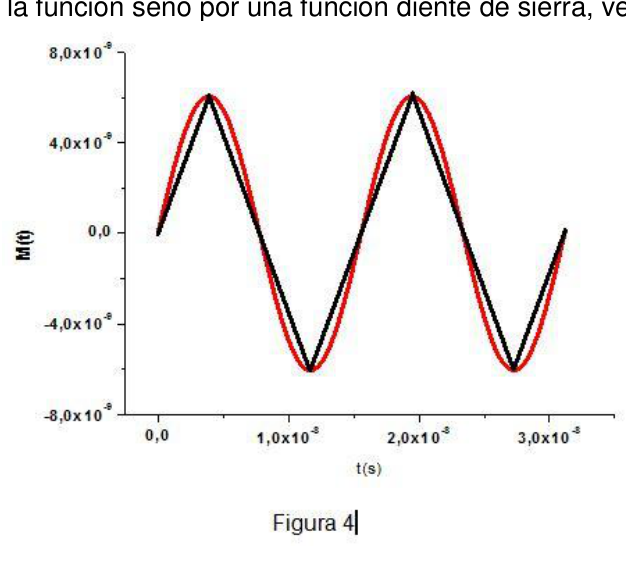
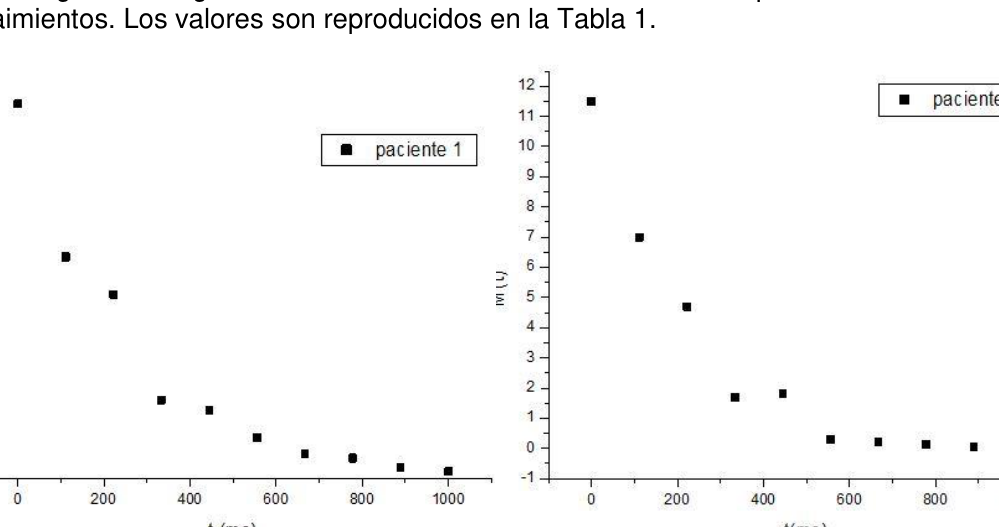
Topic: Magnetism, Circuits Metodi: Torque & Angular Momentum Analysis, Faraday’s Law of Induction, Curve Fitting Competenze: Physical Reasoning, Mathematical Modeling Objects: Magnetic Dipole, Coil Fonte: Testo (PDF) — p.5
Danziamo i magneti dei nuclei
Problema 3
Facciamo ballare i magneti dei nuclei. I nuclei degli atomi hanno una proprietà fisica quantistica, senza analogo classico, chiamata spina nucleare. Un’altra caratteristica della spina nucleare è che, in vista della presenza di un campo magnetico statico e omogeneo B0 , si comportano come se Si trattava di piccoli magneti con un momento magnetico μ = γħI , dove I è il ― vector
OAF 2015 - 23 Quantum ‖ momento angolare della spina nucleare, la costante geomagnetico del nucleo e ħ La costante di Planck divisa 2. Il valore della spina nucleare è indicato dalla lettera I e Si chiama numero quantistico spin. La proiezione di I in Direzione del campo magnetico esterno, vedere Figura 1, adotta solo determinati valori La misurazione del tempo magnetico delle spine è può modellare secondo le regole dell’elettromagnetismo classico. Tracciamo nuclei di idrogeno (protoni), che sono molto sono abbondanti nel corpo umano. Per questi nuclei I = 1⁄2. La proiezione di I sull’asse z, prende per il caso del protone, due Valori m=+1/2 e m=-1/2. Questo significa che avremo qualche spina con la sua proiezione. sulla direzione dell’asse z puntata parallele al campo esterno e Altri mirati antiparalleli al campo esterno. Per questioni In energia avremo più spine che puntano in parallelo al campo 𝐵0 che controparale il campo B0 . Questo darà origine a una Magnetizzazione netta nella direzione di B0 , vedere Figura 1.
La magnetizzazione totale che emerge dalle spine nucleari del campione, è una Quantità vettoriale e è data da 𝑀 = 𝜇 𝑖 𝑖
(ec. 1) dove μ i è il momento magnetico del nucleo i. Usando che μ i= γħI i, la magnetizzazione del campione può essere scritta come M = γħJ
(ec. 2) dove J = I i 𝑖 è il momento angolare totale di spin del campione. Se il campione è La presenza di un campo magnetico B 0 uniforme, come nel caso di un L’esperimento di risonanza magnetica nucleare (RMN) si effettua con un torque T M sul Vettore di magnetizzazione dove il torque è dato da 𝑇 𝑀= 𝑀 × 𝐵 0
(ec.3) Si può mostrare che la magnetizzazione precesi (movimento del tubo) intorno al campo magnetico ad una frequenza angolare costante di modulo 𝜔= 𝛾𝐵0
(ec.4) (vedi figura 2).
L’espressione della magnetizzazione indotta dai spini nucleari dei protoni a temperatura ambiente (Ta) è 𝑀= 𝜇0𝛾2ℏ2𝑛 4kBTa B0 = 4.04 × 10⁻⁹B0 (ec.5) Dove n è il numero di spine nucleari di protoni per unità di volume, μ0 la Permeabilità magnetica del vuoto, kB la costante di Boltzmann e Ta la temperatura ambiente in K. L’unità di M è la Tesla (1 Tesla = 1 V.s/m2). In un esperimento di RMN si utilizza per togliere dall’equilibrio la magnetizzazione M mediante la Applicazione di un campo magnetico alternativo B1 perpendicolare al campo esterno B0. Questo .
24 - OAF 2015 campo B 1 viene applicato per pochi microsegondi. La situazione dopo l’applicazione Questo campo B 1 è quello che mostra la figura 3. Allora la magnetizzazione M girerà intorno al campo B 0 sul piano xy.
Per rilevare il segnale generato dai nuclei in un esperimento di RMN si colloca una bobina, diciamo lungo l’asse x, così che questo rileva la variazione di flusso di campo magnetico attraverso di essa, generato dalla magnetizzazione rotante M in piano xy. Nel nostro caso particolare la magnitudine della magnetizzazione lungo l’asse di la bobina avrà una dipendenza temporanea data dall’equazione 6 M t = M0sen(ωt)
(ec.6) con = 64,2 x 2 MHz (MHz = 1 x 10⁶ Hz). Per semplificare i calcoli supponiamo che M t varia linealmente nel tempo, è Quindi, per esempio, si approssimano la funzione seno per una funzione dentale di siera, vedere Figura 4.
Supponendo che il rapporto tra campo magnetico e magnetizzazione sia dato da BM = M
(ec.7) e il valore massimo di M lungo la bobina è M = 6,06 x 10⁻⁹ T (1 Tesla = 1 V.s/m2).
a) A partire dall’equazione 5 trovi il valore di B0.
b) Determina il periodo di M t (equazione 6).
c) Calcolare la forza elettromotrice indotta (fem) a causa della variazione temporale da M a lungo l’asse della bobina. Considera un cilindro a 4 giri e di 0,01 m di diametro. Calcolare la fem per 1⁄4 del periodo iniziale mostrato in Figura 4
OAF 2015 - 25 Ricordate che la forza elettromotrice indotta, in una spira di area A, è il coefficiente, con segno meno, tra il cambiamento del flusso di campo magnetico sull’area della il respiro, e l’intervallo di tempo in cui si verifica quel cambiamento.
Il circuito risonante La bobina utilizzata in un esperimento di RMN fa parte di un circuito elettrico, che in forma più semplice può essere descritto da un circuito tipo serie RLC.
d) Trova un’espressione per l’impedenza complessa di un circuito RLC serie, Ricorda che ZL=iL ZR = R e ZC =-i/(C). Dove i è l’unità immaginaria.
Si dice che un circuito RLC sia in risonanza quando la frequenza di lavoro è tale. che la parte immaginaria di Z è zero.
e) Supponendo che per il nostro circuito sia: C = 10 pF (p = picco = 1 x 10-12), R = 50 ohm e la frequenza di lavoro = 64.2 x 2 MHz (MHz = 1 x 10⁶ Hz)
- Trova il valore di L.
Il relax. In RMN esistono parametri fisici che quantificano il ritorno all’equilibrio della Magnetizzazione M generata dai nuclei. Uno di questi è la costante di rilassamento T2. Questa costante è usata per distinguere tra tessuto biologico sano e tessuto biologico Malata. Per ottenere il valore di questa costante si fanno esperimenti dove si osserva il declino temporale della magnetizzazione. In questi esperimenti la La dipendenza temporale della magnetizzazione è come indicato nell’equazione 7. M t = M0exp(− 𝑡 𝑇2)
(ec.7) I grafici seguenti mostrano due misurazioni sperimentali di questi. decadimenti. I valori sono riportati nella tabella 1.
Tabella 1: Experimenti di rilassamento T2 della magnetizzazione
Il paziente 1 Paziente 2 Tempo (ms) Intensità di magnetizzazione (10-9 T) Intensità di magnetizzazione (10-9 T) 0,0 11±1 12±1 111,1 6,5±0,6 7,0±0,7 222,2 5,4±0,5 4,7±0,5 333,3 2,3±0,5 1,7±0,3 444,4 2,0±0,4 0,3±0,5 555,6 1,2±0,2 0,3±0,5
26 - OAF 2015 666,7 0,7±0,3 0,21±0,08 777,7 0,6±0,2 0,13±0,05 888,8 0,3±0,1 0,05±0,02 1000,0 0,20±0,08 0,03±0,01
f) Ottieni dai dati sperimentali i valori di T2 per entrambi i tipi di tessuti.
g) Estimare un’incertezza per T2 in entrambi i casi. Esprimere i valori di T2 con i suoi Le loro incertezze. Ricorda che (ln(M)) = M/M.
h) Sapendo che T2 per tessuti sani è T2 > 220 ms e per tessuti malati è T2 < 220 ms, indicare quale delle curve corrisponde al tessuto sano e quale al tessuto Malata.
Suggerimento: Ottieni il valore di T2 linealizzando i dati di Tabella 1 e trovando in la linea che meglio rappresenta i dati sperimentali.
Alternativamente: il tempo t` per il quale la magnetizzazione è decresciuta al 37% del suo Il valore iniziale è t’=T2.
OAF 2015 - 27
Instanza nazionale Prova sperimentale Livello 2
28 - OAF 2015
OAF 2015 - 29
Topic: Magnetism, Circuits Metodi: Torque & Angular Momentum Analysis, Faraday’s Law of Induction, Curve Fitting Competenze: Physical Reasoning, Mathematical Modeling Objects: Magnetic Dipole, Coil Fonte: Testo (PDF) — p.5
Let’s get the magnetic nuclei dancing
Problem three .
Let’s dance the magnets of the cores. The nuclei of atoms have a quantum physical property, with no classical analog, The nuclear spine. A peculiarity of the nuclear spine is that, in the face of the presence of a static and homogeneous magnetic field B0 , they behave as if They were small magnets with a magnetic moment μ = γħI , where I is the ― vector .
The Commission shall adopt delegated acts in accordance with Article 21 of the Financial Regulation. quantum ‖ angular momentum of the nuclear spine, the geomagnetic constant of the nucleus and ħ Planck’s constant divided by 2. The value of the nuclear spindle is indicated by the letters I and It’s called the spin quantum number. Except for the fact that the projection of I in the The direction of the external magnetic field, see Figure 1, only takes certain values The magnetic moment behaviour of the spines is discrete (quantitative). You can model by the rules of classical electromagnetism. We’re going to deal with hydrogen nuclei (protons), which are very They’re abundant in the human body. For these nuclei I is 1⁄2. The projection of I over the z axis, takes for the proton case, two The values m=+1/2 and m=-1/2. This means we ‘ll have some thorns with his projection . on the direction of the pointed z axis parallel to the external field and Other anti-parallel targets to the outer field. For the sake of questions We ‘ll have more spines pointing parallel to the field . 𝐵0 which are counterparallel to field B0 . This will give rise to a Net magnetisation in the direction of B0 The following is the list of the countries of the European Union.
The total magnetization that arises from the nuclear spines in the sample, is a vector quantity and is given by 𝑀 = 𝜇 𝑖 𝑖
(ec. 1) where μ i is the magnetic moment of core i. Using that μ i= γħI i, the magnetization of the sample can be written as M = γħJ
(ec. 2) where J = I i 𝑖 is the total angular moment of spin of the sample. If the sample is puts in the presence of a uniform magnetic field B 0 as is the case with a The test results of the test are given in the following table: magnetization vector where torque is given by 𝑇 𝑀= 𝑀 × 𝐵 0
(ec.3) It can be shown that the magnetization precesses (tube movement) around the magnetic field at a constant angular frequency of the module 𝜔= 𝛾𝐵0
(ec.4) (see Figure 2).
The expression of the magnetization induced by the proton nuclear spines to The ambient temperature (Ta) is 𝑀= 𝜇0𝛾2ℏ2𝑛 The following table shows the number of units of the unit: (ec.5) Where n is the number of proton nuclear spins per unit volume, μ0 the The magnetic permeability of the vacuum, kB the Boltzmann constant and Ta the temperature environment in K. The unit of M is the Tesla (1 Tesla = 1 V.s/m2). In an MRI experiment, the magnetization M is used to remove the balance by Application of an alternating magnetic field B1 perpendicular to the external field B0. This one .
The Commission shall adopt delegated acts in accordance with Article 21 of this Regulation. Field B 1 is applied for a few microseconds. The situation after application This field B 1 is the one shown in Figure 3. Then the magnetization M will rotate around the field B 0 in the plane xy.
To detect the signal generated by the nuclei in an MRI experiment, it is placed a coil, let’s say along the x-axis, so that it detects the flow variation magnetic field through it, generated by rotating magnetization M at the plane xy. In our particular case the magnitude of the magnetization along the axis of The coil will have a temporary dependence given by equation 6 M t = M0sen(ωt)
(ec.6) with = 64.2 x 2 MHz (MHz = 1 x 10⁶ Hz). To simplify the calculations we will assume that M t varies linearly over time, is So we’re going to approximate the sinus function by a saw tooth function, see Figure 4.
Assuming that the relationship between magnetic field and magnetization is given by BM = M
(ec.7) and the maximum value of M along the coil is M = 6.06 x 10⁻⁹ T (1 Tesla = 1 V.s/m2).
(a) From equation 5 find the value of B0.
(b) Determine the period of M t (e.g. equation 6).
(c) Calculate the induced electromotive force (fem) due to the time variation from M to along the coil axis. Consider a cylindrical coil of 4 turns. and 0.01 m in diameter. Calculate the fem for 1⁄4 of the initial period shown in the Figure 4 is shown.
The Commission shall adopt delegated acts in accordance with Article 21 of this Regulation. Remember, the induced electromotive force, in a spindle of area A, is the quotient, with less sign, between the change in the magnetic field flow over the area of the breath, and the time interval in which that change occurs.
The resonant circuit . The coil used in an MRI experiment is part of an electrical circuit, which In its simplest form it can be described by a series RLC type circuit.
d) Find an expression for the complex impedance of a serial RLC circuit, Remember that ZL=iL ZR=R and ZC=-i/(C). Where i is the imaginary unit.
An RLC circuit is said to be in resonance when the working frequency is such that That the imaginary part of Z is zero.
e) Assuming that for our circuit is: C = 10 pF (p = peak = 1 x 10-12), R = 50 ohms and the working frequency = 64.2 x 2 MHz (MHz = 1 x 10⁶ Hz) Find the value of L.
The relaxation . In NMR there are physical parameters that quantify the return to equilibrium of the Magnetization M generated by the nuclei. One of them is the T2 relaxation constant. This constant is used to differentiate between healthy biological tissue and biological tissue. I’m sick of it. To get the value of this constant, experiments are done where they are It observes the temporary decay of the magnetization. In these experiments, the The time dependence of magnetization is as shown in equation 7. M t = M0exp(− 𝑡 𝑇2)
(ec.7) The following graphs show two experimental measurements of these. decay. The values are shown in Table 1.
Table 1: T2 relaxation experiments of the magnetization
Patient 1 Patient 2 Time . (ms) Magnetization intensity (10-9 T) Magnetization intensity (10-9 T) 0,0 11±1 12±1 111,1 6,5±0,6 7,0±0,7 222,2 5,4±0,5 4,7±0,5 333,3 2,3±0,5 1,7±0,3 444,4 2,0±0,4 0,3±0,5 555,6 1,2±0,2 0,3±0,5
The Commission shall adopt delegated acts in accordance with Article 21 of this Regulation. 666,7 0,7±0,3 0,21±0,08 777,7 0,6±0,2 0,13±0,05 888,8 0,3±0,1 0,05±0,02 1000,0 0,20±0,08 0,03±0,01
(f) Get from the experimental data the T2 values for both types of tissues.
(g) Estimate uncertainty for T2 in both cases. Express the values of T2 with your the uncertainties involved. Remember that (ln(M)) = M/M.
h) Knowing that T2 for healthy tissue is T2 > 220 ms and for diseased tissue is T2 < 220 ms, indicate which curve corresponds to healthy tissue and which to healthy tissue I’m sick of it.
Suggestion: Get the value of T2 by linearising the data from Table 1 and finding in The graph of the straight line that best represents the experimental data.
Alternatively: The time t` for which the magnetisation has fallen to 37% of its The initial value is t = T2.
The Commission shall adopt delegated acts in accordance with Article 21 of the Financial Regulation.
The National Court Experimental test Level 2 .
The Commission shall adopt delegated acts in accordance with Article 21 of this Regulation.
The following points shall be added:
Topic: Magnetism, Circuits Metodi: Torque & Angular Momentum Analysis, Faraday’s Law of Induction, Curve Fitting Competenze: Physical Reasoning, Mathematical Modeling Objects: Magnetic Dipole, Coil Fonte: Testo (PDF) — p.5
Pendulo de Torsion
Péndulo de Torsión.
Introducción. Un péndulo de torsión consiste de un cuerpo suspendido de un alambre o de un resorte. Cuando se hace girar el cuerpo, alrededor del eje del alambre, experimentará un torque que tiende hacerlo volver a la posición de equilibrio. Si se deja libre al cuerpo este comenzará a oscilar alrededor de la posición de equilibrio. Para pequeñas amplitudes el periodo del péndulo de torsión es:
)1( 2 K I T
Donde I es el momento de inercia del cuerpo respecto al eje de rotación y K es la constante de torsión del alambre o resorte.
Si el cuerpo es como el de la figura, constituido por un cilindro vertical, el cual es
atravesado por una varilla roscada, y dos masas puntuales (M) el momento de inercia
será:
)
2
(
2
2
d
M
I
I
a
Donde Ia es el momento de inercia del cilindro atravesado por la varilla roscada y Md2 es el momento de inercia de cada una de las masas cilíndricas de bronce que se encuentran a una distancia d del eje de rotación.
Objetivo. Determinar experimentalmente el momento de inercia Ia y la constante de torsión K.
Elementos disponibles
-
Péndulo de torsión
-
2 masas de bronce de ---- g
-
Cronómetro
-
Regla
-
Papel milimetrado
30 - OAF 2015 Procedimiento
- Nivele la base con los tornillos para que el cilindro de aluminio no toque las paredes del hueco en la base de madera.
- Mida el periodo del péndulo sin masas.
- Coloque las masas en la varilla roscada como se muestra en la Figura 1.
- Mida la distancia d y el período de oscilación.
- Repita el punto 4 para distintos valores de d.
Consignas
- Construya una tabla con todos los valores medidos.
- Grafique estos datos experimentales de tal manera de obtener una relación lineal. Use para ello la expresión (1).
- A partir del gráfico determine el valor de la pendiente y de la ordenada al origen
con sus correspondientes incertidumbres. - Determine el valor de la constante elástica de torsión K con su correspondiente incertidumbre.
- Determine el valor del momento de inercia Ia con su correspondiente incertidumbre.
OAF 2015 - 31
Primer Prueba Preparatoria Mecánica
32 - OAF 2015
OAF 2015 - 33
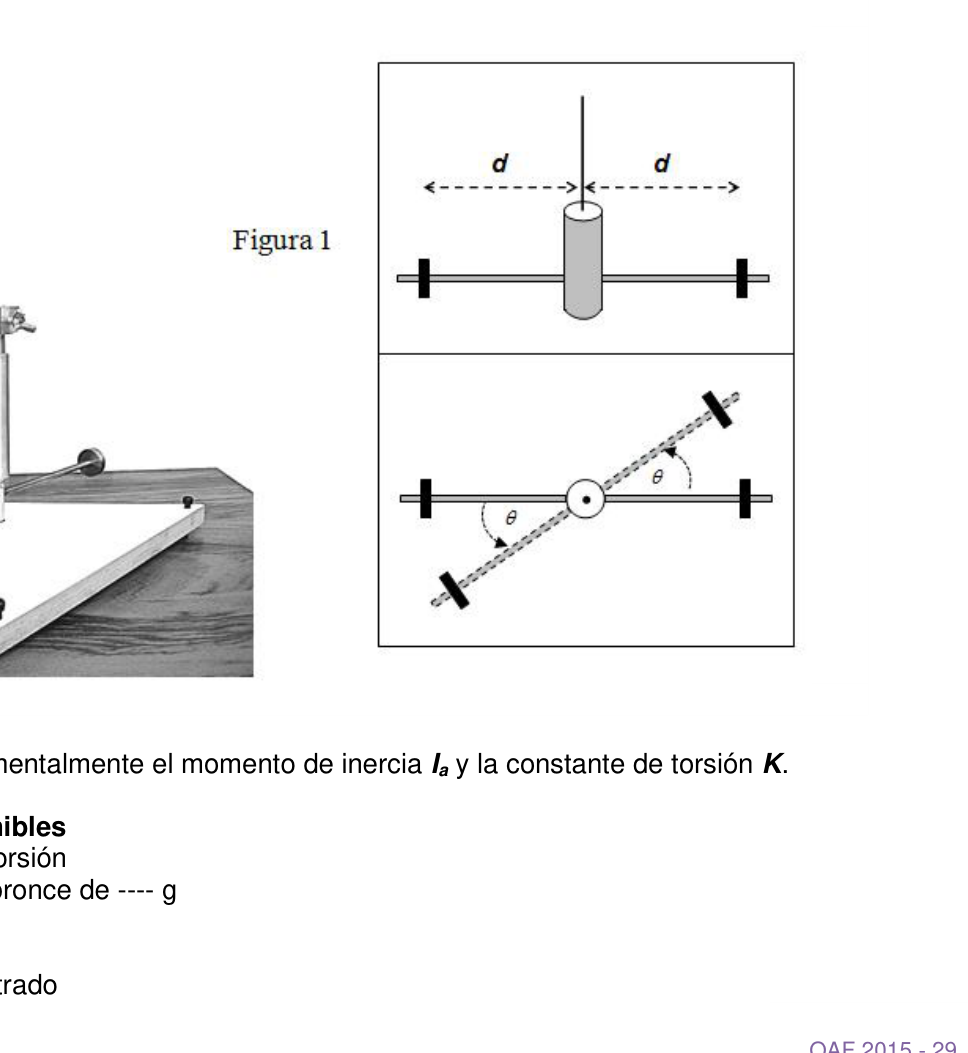
Topic: Oscillations & Waves, Rotational Dynamics Metodi: Simple Harmonic Motion Analysis, Experimental Data Analysis, Graph Linearization Competenze: Physical Reasoning, Experimental Data Analysis Objects: Pendulum, Cylinder Fonte: Testo (PDF) — p.5
Pendolo di Torsione
Pendale Torsion.
Introduzione. Un pendolo a torsione consiste in un corpo sospeso da un filo o da una molla. Quando si gira il corpo, intorno all’asse del filo, si sperimenterà un torque. che tende a riportarlo alla posizione di equilibrio. Se si lascia libero il corpo questo inizierà a oscillare attorno alla posizione di equilibrio. Per piccole amplitudini il periodo del pendolo di torsione è:
)1( 2 K I T
Dove I è il momento di inerzia del corpo rispetto all’asse di rotazione e K è il momento di inerzia del corpo rispetto all’asse di rotazione. Costante torsione del filo o della sorgente.
Se il corpo è come quello della figura, costituito da un cilindro verticale, che è Attraversato da un bastone a rottura, e due masse puntate (M) il momento di inerzia sarà: ) 2 ( 2 2 d M I I a
Dove Ia è il momento di inerzia del cilindro attraversato dalla canna e Md2 è il momento di inerzia di ciascuna delle masse cilindriche di bronzo che si trovano a una distanza d dall’asse di rotazione.
Obiettivo. Determinare sperimentalmente il momento di inerzia Ia e la costante di torsione K.
Elementi disponibili
- Pendale a torsione
- 2 masse di bronzo di ---- g
- Cronometro .
- Regola .
- Papero millimetrico .
30 - OAF 2015 Procedura
- Scale la base con gli screw per evitare che il cilindro di alluminio tocchi i muri del buco nella base in legno.
- Misura il periodo del pendolo senza masse.
- Metti le masse sul bastone roscato come mostrato in Figura 1.
- Misura la distanza d e il periodo di oscillazione.
- Ripeti il punto 4 per diversi valori di d.
Consigne
- Costruisci una tabella con tutti i valori misurati.
- Graficate questi dati sperimentali in modo da ottenere una relazione lineare. Per questo usate l’espressione (1).
- Sulla base del grafico , determina il valore della pendenza e della pendenza ordinata all’origine con le relative incertezze.
- Determina il valore della costante elastica di torsione K con la sua corrispondente l’incertezza.
- Determina il valore del momento di inerzia Ia con la relativa incertezza.
OAF 2015 - 31
Primo test preparativo Meccanica
32 - OAF 2015
OAF 2015 - 33
Topic: Oscillations & Waves, Rotational Dynamics Metodi: Simple Harmonic Motion Analysis, Experimental Data Analysis, Graph Linearization Competenze: Physical Reasoning, Experimental Data Analysis Objects: Pendulum, Cylinder Fonte: Testo (PDF) — p.5
The following conditions shall apply:
Torsion pendulum.
I’ll give you an introduction. A torsion pendulum consists of a body suspended from a wire or spring. When the body is rotated around the wire axis, it will experience torque. which tends to bring it back to the equilibrium position. If you let this body go free It will begin to oscillate around the equilibrium position. For small amplitudes the The torsion pendulum period is:
)1( 2 K I T
Where I is the moment of inertia of the body with respect to the axis of rotation and K is the The wire or spring torque constant.
If the body is like the figure, consisting of a vertical cylinder, which is through a threaded rod, and two point masses (M) the moment of inertia It shall be: ) 2 ( 2 2 d M I I a
Where Ia is the moment of inertia of the cylinder through the rod and Md2 is The moment of inertia of each of the cylindrical bronze masses found at a distance d from the rotating axis.
Goal. Experimentally determine the moment of inertia Ia and the torsion constant K.
Available items
- Torsion pendulum .
- 2 masses of bronze of ---- g
- The chronometer .
- Rule .
- Millimeter paper .
The Commission shall adopt delegated acts in accordance with Article 21 of Regulation (EU) No 1303/2013. The procedure
- Level the base with the screws so that the aluminum cylinder does not touch the walls. The hole in the wooden base.
- Measure the period of the pendulum without mass.
- Place the masses on the threaded rod as shown in Figure 1.
- Measure distance d and oscillation period.
- Repeat point 4 for different values of d.
Consigns
- Build a table with all the measured values.
- Graph these experimental data in such a way as to get a linear relationship. Use the expression (1).
- From the graph , determine the value of the slope and the order at the origin . with its corresponding uncertainties.
- Determine the value of the elastic torque constant K with its corresponding Uncertainty.
- Determine the value of the moment of inertia Ia with its corresponding uncertainty.
The Commission shall adopt delegated acts in accordance with Article 21 of this Regulation.
First Preparatory Test Mechanics
The Commission shall adopt delegated acts in accordance with Article 32 of the Financial Regulation.
The following is the list of the countries of the European Union:
Topic: Oscillations & Waves, Rotational Dynamics Metodi: Simple Harmonic Motion Analysis, Experimental Data Analysis, Graph Linearization Competenze: Physical Reasoning, Experimental Data Analysis Objects: Pendulum, Cylinder Fonte: Testo (PDF) — p.5
Problema Teorico 1
Problema Teórico 1
Durante la Segunda Guerra Mundial un barco enemigo está anclado en el lado Oeste de una isla montañosa. El barco se encuentra a 2500 m de distancia de la cima del monte, cuya altura es de 1800 m, y puede disparar proyectiles con un ángulo de 45°. Del lado Este, la orilla está a 300 m de la cima (ver Figura). Suponga que la altura del barco y del cañón es despreciable.
a) Elija un sistema de coordenadas e indíquelo claramente en el dibujo. En base al sistema elegido por Usted, escriba la aceleración, velocidad y posición de un proyectil en función del tiempo, si el mismo sale desde el barco enemigo con velocidad inicial v0.
b) Determine la trayectoria (y(x)) del proyectil.
c) Si la velocidad del disparo (v0) es igual 720 km/h, indique si el proyectil supera la cima de la montaña. En caso afirmativo, determine a qué distancia de la orilla Este el proyectil cae al agua. En caso negativo, determine la altura a la cual el proyectil impacta en la montaña.
d) Determine la velocidad inicial mínima del proyectil para que supere la cima de la montaña.
e) Indique cuál es el rango de distancias, medidas desde la orilla Este, para las cuáles un barco está fuera del alcance de los proyectiles disparados por la embarcación enemiga.
Nota: Considerar que la aceleración de la gravedad es 10 m/s2.
Topic: Newtonian Mechanics Metodi: Kinematic Equations, Vector Decomposition Competenze: Physical Reasoning Objects: Projectile Fonte: Testo (PDF) — p.5
Problema Teorico 1
Problema teorico 1
Durante la Seconda Guerra Mondiale una nave nemico è ancorata sul lato occidentale di un’isola montana. La nave si trova a 2500 m dalla cima del monte, che ha un’altezza di 1800 m e può lanciare proiettili con un angolo di 45°. Dall’altra parte . Questo, la riva è a 300 m dalla cima (vedi Figura). Supponiamo che la altezza della nave e del il cannone è disprezzabile.
a) Scegli un sistema di coordinate e indica chiaramente il sistema nel disegno. In base al sistema scelto da te, scrivi l’accelerazione, la velocità e la posizione di un Proiettile a seconda del tempo, se lo stesso usce dal navetta nemico con velocità iniziale v0.
b) Determina il percorso (y(x)) del proiettore.
c) Se la velocità di lancio (v0) è pari a 720 km/h, indicare se il proiettile supera la velocità di lancio (v0) La cima della montagna. Se sì, determinare a che distanza dalla costa orientale Il proiettile cade in acqua. In caso negativo, determina l’altezza alla quale il proiettile è stato lanciato. colpisce la montagna.
d) Determina la velocità iniziale minima del proiettile per superare la cima della montagna.
e) Indicare quale sia il range di distanze, misurati dalla costa orientale, per quali Una nave è fuori dalla portata dei proiettili sparati dalla nave. Il nemico.
Nota: Considera che l’accelerazione della gravità è di 10 m/s2.
Topic: Newtonian Mechanics Metodi: Kinematic Equations, Vector Decomposition Competenze: Physical Reasoning Objects: Projectile Fonte: Testo (PDF) — p.5
The following is the list of the main types of data that are used:
Theoretical problem 1
During World War II an enemy ship is anchored on the west side of A mountainous island. The boat is located 2500 m away from the top of the mountain, which is 1800 m high and can fire projectiles at an angle of 45°. On the side . This, the shore is 300 m from the top (see Figure). Suppose the height of the ship and the cannon is despicable.
(a) Choose a coordinate system and clearly indicate it in the drawing. Based on the system chosen by you, type the acceleration, speed and position of a projectile based on time, if the same comes out of enemy ship with The initial speed is v0.
(b) Determine the trajectory (y(x)) of the projectile.
(c) If the rate of fire (v0) is equal to 720 km/h, indicate whether the projectile exceeds the The top of the mountain. If so, determine how far from the East Bank The projectile falls into the water. If not, determine the height at which the projectile is It’s impacting the mountain.
(d) Determine the minimum initial velocity of the projectile to exceed the top of the The mountain.
(e) Indicate the range of distances measured from the East Bank for which A ship is out of range of the projectiles fired by the vessel. The enemy.
Note: Consider that the acceleration of gravity is 10 m/s2.
Topic: Newtonian Mechanics Metodi: Kinematic Equations, Vector Decomposition Competenze: Physical Reasoning Objects: Projectile Fonte: Testo (PDF) — p.5
Problema Teorico 2
Problema Teórico 2
Los bloques de la figura están conectados por medio de una cuerda sin masa que pasa por poleas sin fricción. La aceleración del sistema es 2.0 m/s2 hacia la izquierda y la superficie sobre la que apoya el bloque de masa m2 es rugosa.
34 - OAF 2015 a) Realice el diagrama de cuerpo aislado de cada uno de los bloques indicando claramente las fuerzas que actúan sobre los mismos.
b) Escriba las ecuaciones de movimiento de los bloques.
c) Determine la tensión en la cuerda.
d) Determine la fuerza de roce dinámico sobre el bloque de masa m2.
e) Determina el coeficiente de fricción entre el bloque de masa m2 y la superficie.
Nota: Considerar que la aceleración de la gravedad es 10 m/s2.
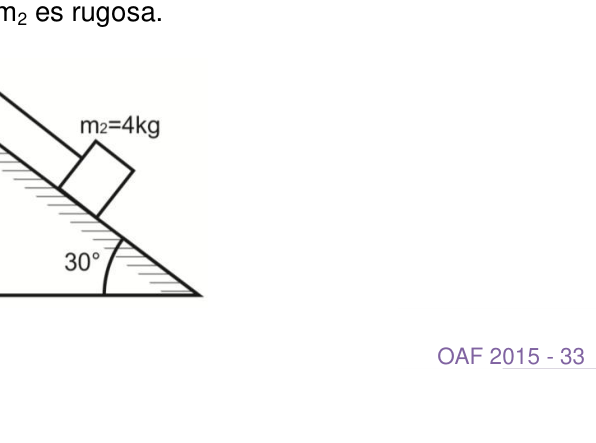
Topic: Newtonian Mechanics Metodi: Free-Body Diagram, Kinematic Equations Competenze: Physical Reasoning Objects: Block, Pulley, String Fonte: Testo (PDF) — p.5
Problema Teorico 2
Problema teorico 2
I blocchi della figura sono collegati da una corda senza massa che passa per pole senza attrito. L’accelerazione del sistema è di 2.0 m/s2 verso sinistra e la la superficie su cui si appoggia il blocco di massa m2 è rugosa.
34 - OAF 2015 a) Sviluppa il diagramma del corpo isolato di ciascun blocco indicando e chiaramente le forze che agiscono su di loro.
b) Scrivi le equazioni di movimento dei blocchi.
c) Determina la tensione della corda.
d) Determina la forza di rottura dinamica sul blocco di massa m2.
e) Determina il coefficiente di frizione tra il blocco di massa m2 e la superficie.
Nota: Considera che l’accelerazione della gravità è di 10 m/s2.
Topic: Newtonian Mechanics Metodi: Free-Body Diagram, Kinematic Equations Competenze: Physical Reasoning Objects: Block, Pulley, String Fonte: Testo (PDF) — p.5
The following is the list of the types of data that are used:
Theoretical problem 2
The blocks in the figure are connected by a massless string that passes through. by frictionless pulleys. The acceleration of the system is 2.0 m/s2 to the left and the left. the surface on which the m2 block of mass rests is rough.
The Commission shall adopt delegated acts in accordance with Article 21 of Regulation (EU) No 1303/2013. (a) Draw the isolated body diagram of each block indicating The Commission has already made a number of proposals.
(b) Write the equations of motion of the blocks.
(c) Determine the tension on the rope.
(d) Determine the dynamic brushing force on the m2 mass block.
(e) Determines the friction coefficient between the m2 mass block and the surface.
Note: Consider that the acceleration of gravity is 10 m/s2.
Topic: Newtonian Mechanics Metodi: Free-Body Diagram, Kinematic Equations Competenze: Physical Reasoning Objects: Block, Pulley, String Fonte: Testo (PDF) — p.5
Problema Teorico 3
Problema Teórico 3
En un cierto instante de tiempo un bloque de m = 0.2 kg pasa justo por la cima de una loma de altura h1 = 1.20 m, con una velocidad de 4 m/s en dirección hacia un resorte R1 de constante elástica k1 = 125 N/m, como se muestra en la figura. El resorte R1 está sobre una superficie plana a una altura h2 = 0.75 m. Toda la superficie, desde la pared donde está enganchado el resorte R1 hasta el punto B, es totalmente lisa. Entre los puntos B y C existe una superficie horizontal rugosa donde el coeficiente de rozamiento dinámico es d = 0.13 entre el bloque y el piso. La distancia L entre B y C, es igual a 5 m. Luego del punto C hay un segundo resorte R2 de constante elástica k2=100 N/m, como se muestra en la figura.
Calcular:
a) La velocidad del bloque en el punto A.
b) La longitud máxima que se comprime el resorte R1.
c) La velocidad del bloque en la cima de la loma después de que ha rebotado en el resorte R1.
d) La velocidad del bloque en el punto B y en el punto C.
e) Después de rebotar en el segundo resorte, ¿el bloque tiene energía suficiente para superar la elevación h1? Si no es así, ¿hasta qué altura llega?
Nota: Considerar que la aceleración de la gravedad es 10 m/s2.
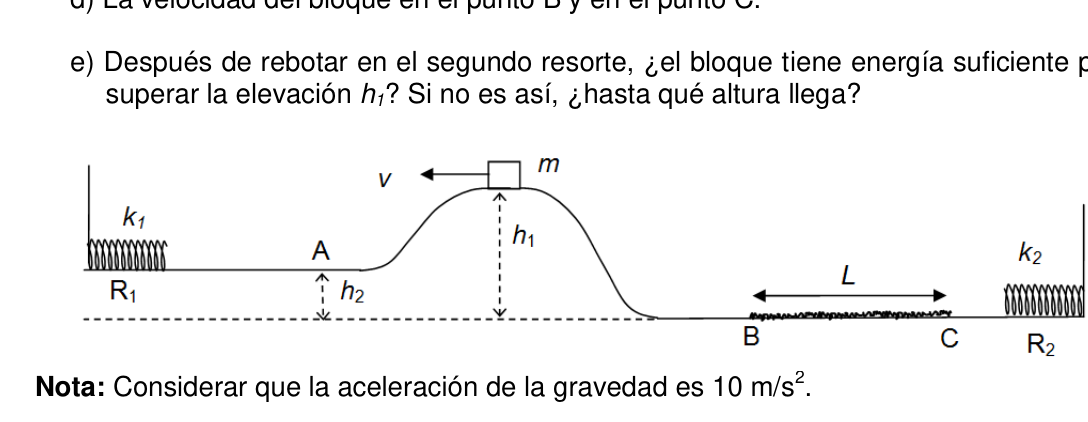
Topic: Conservation of Energy Metodi: Energy Conservation Method, Hooke’s Law Competenze: Physical Reasoning Objects: Spring, Block Fonte: Testo (PDF) — p.5
Problema Teorico 3
Problema teorico 3
In un certo istante di tempo un blocco di m = 0.2 kg passa proprio sulla cima di una Luma di altezza h1 = 1,20 m, con velocità di 4 m/s in direzione di una sorgente R1 di costante elastica k1 = 125 N/m, come mostrato nella figura. La sorgente R1 è su una superficie piana ad un’altezza h2 = 0,75 m. L’intera superficie, dal muro dove è collegato il resortimento R1 al punto B, è
- Completamente liscia. Tra i punti B e C c’è una superficie orizzontale rugosa dove il il coefficiente di rottura dinamica è d = 0,13 tra il blocco e il pavimento. Distanza L tra B e C, è pari a 5 m. Dopo il punto C c’è un secondo risorgimento R2 di costante k2 = 100 N/m, come mostrato nella figura.
Calcolare:
a) La velocità del blocco al punto A.
b) La lunghezza massima di compressione della sorgente R1.
c) La velocità del blocco in cima alla loma dopo che ha rimbalzato in R1 di primavera.
d) La velocità del blocco al punto B e al punto C.
e) Dopo il rimbalzo nella seconda primavera, il blocco ha energia sufficiente per superare l’elevazione H1? Se non è così, fino a che punto arriva?
Nota: Considera che l’accelerazione della gravità è di 10 m/s2.
Topic: Conservation of Energy Metodi: Energy Conservation Method, Hooke’s Law Competenze: Physical Reasoning Objects: Spring, Block Fonte: Testo (PDF) — p.5
Theoretical problem 3
Theoretical problem 3
In a certain moment of time a block of m = 0.2 kg passes right over the top of a h1 height slope = 1.20 m, with a speed of 4 m/s in the direction of a spring R1 of elastic constant k1 = 125 N/m, as shown in Figure 1. The spring R1 is on a flat surface at a height of h2 = 0.75 m. The whole thing . surface, from the wall where spring R1 is hooked up to point B, is It’s totally smooth. Between points B and C there is a rough horizontal surface where the The dynamic friction coefficient is d = 0.13 between the block and the floor. The distance L Between B and C, it’s equal to 5 m. After point C there is a second spring R2 of constant The following is the sample of the sample:
Calculation:
(a) The block speed at point A.
(b) The maximum length for compressing spring R1.
(c) The speed of the block at the top of the ridge after it has bounced back on the The following information shall be provided:
(d) The block speed at point B and point C.
(e) After bouncing in the second spring, does the block have enough energy to over the h1 elevation? If not, how far does it go?
Note: Consider that the acceleration of gravity is 10 m/s2.
Topic: Conservation of Energy Metodi: Energy Conservation Method, Hooke’s Law Competenze: Physical Reasoning Objects: Spring, Block Fonte: Testo (PDF) — p.5
Parte Experimental
Parte Experimental
Objetivo: Determinar la masa de un cuerpo sin usar una balanza comercial.
Elementos:
- Una regla plástica de 30 cm.
OAF 2015 - 35
- Una tapita de gaseosa o agua mineral
- Una jeringa descartable de 10 cm3.
- Agua (densidad = 1g/cm3)
- Mesa, libro, trozo de madera (con bordes bien rectos)
Teoría: El principio de funcionamiento de una balanza de brazos es el equilibrio de los momentos de los pesos (ver Figura 1).
Con los elementos solicitados, podemos construir nuestra propia balanza, como se muestra en la Figura 2. Para ello utilizamos el borde de una mesa o un libro o un trozo de madera. Para cualquier opción, el borde debe ser lo más recto posible.
Considerando la regla como una masa puntual, cuya masa está concentrada en su centro de masa, y colocando en un extremo de la regla un peso (tapa), para que el sistema completo esté en equilibrio se debe cumplir que:
(1)
donde M es la masa de la regla, D la distancia del centro de masa de la regla al centro de momentos, m la masa de la tapa y d la distancia del centro de masa de la tapa al centro de momentos . Si llenamos la tapa con una masa conocida de agua ma, para que el sistema se encuentre en equilibrio, se debe cumplir que: (2)
Combinando las ecuaciones (1) y (2) resulta que:
(3)
Procedimiento
1- Determine el centro de masa (CM) de la regla y márquelo con una fibra o lápiz sobre la regla.
2- Marque en la tapa vista de costado el centro de la misma.
3- Coloque la tapa vacía centrada sobre una de las marcas de la regla (por ejemplo 1 cm) y sobre el borde de la mesa haga que el sistema regla+tapa quede en equilibrio.
4- Determine la distancia D del CM de la regla al centro de momentos (borde de la mesa) y la distancia d del centro de masa de la tapa al centro de momentos.
36 - OAF 2015 5- Repita la medición, pero ahora con la tapa conteniendo 5 cm3 de agua y determine D’ y d’.
6- A partir de la expresión (3) y de los valores medidos, determine la masa M de la regla.
7- Repita los pasos 1-6 para al menos 10 posiciones distintas de la tapa en la regla.
8- De un valor de M con su correspondiente incertidumbre o error.
OAF 2015 - 37
Segunda Prueba Preparatoria Termodinámica, Electricidad y Magnetismo
38 - OAF 2015
OAF 2015 - 39
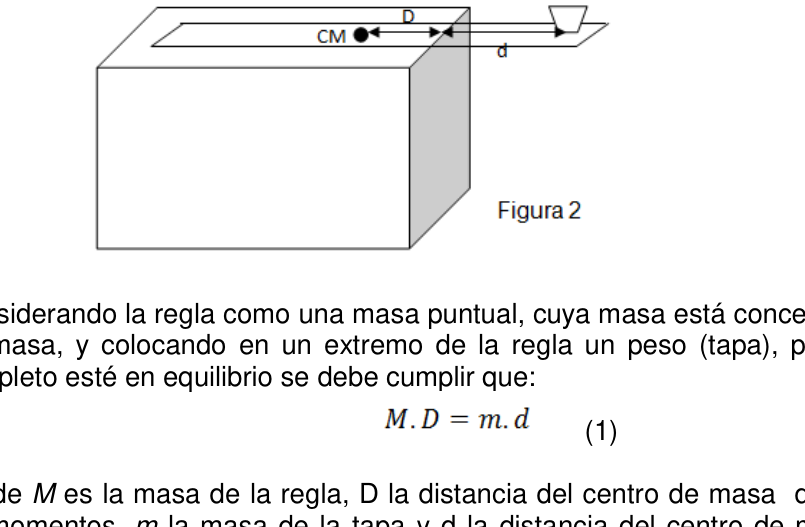
Topic: Rigid Body Statics Metodi: Torque & Angular Momentum Analysis, Experimental Data Analysis Competenze: Physical Reasoning, Experimental Data Analysis Objects: Lever, Rod Fonte: Testo (PDF) — p.5
Parte sperimentale
Parte sperimentale
Obiettivo: determinare la massa di un corpo senza usare una bilancia commerciale.
Elementi:
- Una regola di plastica di 30 centimetri.
OAF 2015 - 35
- Un tappeto di gas o acqua minerale
- Una siringa da scaricare di 10 cm3.
- Acqua (densità = 1 g/cm3)
- Tavola, libro, pezzo di legno (con bordi ben retti)
Teoria: Il principio di funzionamento di una bilancia d’armo è il equilibrio dei momenti dei pesci (vedere Figura 1).
Con gli elementi richiesti, possiamo costruire la nostra. Sbalzo, come mostrato in Figura 2. Per questo utilizziamo il Il bordo di un tavolo o di un libro o di un pezzo di legno. Per Qualsiasi opzione, il bordo deve essere il più retto possibile.
Considerando la regola come una massa puntuale, la cui massa è concentrata al suo centro. di massa, e mettendo su un’estremità della regola un peso (cappa), in modo che il sistema il sistema di controllo è completo, è necessario che:
(1)
dove M è la massa della regola, D la distanza dal centro di massa della regola al centro di momenti, m la massa della copertura e d la distanza dal centro di massa della copertura al centro dei momenti . Se riempiamo la copertura con una massa nota di acqua ma, il sistema si se è in equilibrio, deve essere rispettato che: (2)
Combinando le equazioni (1) e (2) si ottiene che:
(3)
Procedura
1- Determina il centro di massa (CM) della regola e contrassegnalo con una fibra o una penna sulla regola.
2- Marcare sullo schermo veduto lateralmente il centro del dispositivo.
3- Metti la tapa vuota focalizzata su uno dei segni della regola (ad esempio 1 cm) e sul bordo del tavolo, mantenere in equilibrio il sistema regola+tap.
4- Determina la distanza D dal CM dalla regola al centro dei momenti (orlo della La distanza da un punto di riferimento è la distanza da un punto di riferimento.
36 - OAF 2015 5- Ripeti la misura, ma ora con la copertura contenente 5 cm3 di acqua e determinare D e d.
6- Sulla base dell’espressione (3) e dei valori misurati, determinare la massa M della regola.
7- Ripeti i passi 1-6 per almeno 10 posizioni diverse dalla copertura nella regola.
8- Un valore di M con la relativa incertezza o errore.
OAF 2015 - 37
Secondo test preparatorio Termodinamica, elettricità e magnetismo
38 - OAF 2015
OAF 2015 - 39
Topic: Rigid Body Statics Metodi: Torque & Angular Momentum Analysis, Experimental Data Analysis Competenze: Physical Reasoning, Experimental Data Analysis Objects: Lever, Rod Fonte: Testo (PDF) — p.5
The test results shall be presented in accordance with the following formula:
Experimental part
Objective: Determine the mass of a body without using a commercial scale.
The following elements:
- A plastic rule of 30 cm.
The Commission shall adopt delegated acts in accordance with Article 21 of the Financial Regulation.
- A tapestry of soda or mineral water
- A disposable syringe of 10 cm3.
- Water (density = 1 g/cm3)
- Table, book, piece of wood (with straight edges)
Theory: The principle of operation of an arm balance is the balance of the moments of weights (see Figure 1).
With the items requested, we can build our own. The balance, as shown in Figure 2. For this we use the edge of a table or a book or a piece of wood. For Whatever the option, the edge should be as straight as possible.
Considering the rule as a point mass, whose mass is concentrated at its center The mass of the system is the mass of the system, and the mass of the system is the mass of the system. complete balance must be met if:
(1)
where M is the mass of the rule, D is the distance from the center of mass of the rule to the center m the mass of the cap and d the distance from the center of mass of the cap to center of moments . If we fill the lid with a known mass of water, ma, so that the system is If the balance is reached, it must be met that: (2)
Combining equations (1) and (2) results in:
(3)
The procedure
1- Determine the centre of mass (CM) of the rule and mark it with a pen or fibre about the rule.
2- Mark the centre of the cover from the side.
3- Place the blank lid centered on one of the markings of the rule (e.g. 1 cm) and on the edge of the table make the rule+lap system in balance.
4- Determine the distance D from the CM of the rule to the centre of moments (edge of the Table) and distance d from the centre of mass of the lid to the centre of moments.
The Commission shall adopt delegated acts in accordance with Article 36 of the Financial Regulation. 5- Repeat the measurement, but now with the lid containing 5 cm3 of water and determine D and d.
6- From the expression (3) and the measured values, determine the mass M of the The rule.
7- Repeat steps 1-6 for at least 10 different positions from the lid in the rule.
8- Of a value of M with its corresponding uncertainty or error.
The Commission shall adopt delegated acts in accordance with Article 21 of the Financial Regulation.
Second Preparatory Test Thermodynamics, electricity and magnetism
The Commission shall adopt delegated acts in accordance with Article 21 of this Regulation.
The following is the list of the countries of the European Union:
Topic: Rigid Body Statics Metodi: Torque & Angular Momentum Analysis, Experimental Data Analysis Competenze: Physical Reasoning, Experimental Data Analysis Objects: Lever, Rod Fonte: Testo (PDF) — p.5
Problema Teorico 1
Problema Teórico 1
Sea el circuito que se muestra en la figura.
Sabiendo que el amperímetro indica una corriente de 6 mA,
a) Escriba una expresión para la resistencia equivalente (RP) del paralelo formado por las resistencias RA y RB.
b) Escriba una expresión que vincule las corrientes iA e iB que circulan por las resistencias RA y RB, respectivamente, con las resistencias RA y RB.
c) Escriba la expresión que vincula la corriente i que circula por la fuente con las corrientes iA e iB.
d) Escriba una relación entre las caídas de tensión a los bornes de R y de RP y el voltaje entregado por la fuente (VF).
e) A partir de los puntos anteriores, determine el valor de la resistencia RA.
f) Determine el valor de la corriente que circula por la fuente.
g) Determine el valor de la resistencia Re que disipa la misma energía por unidad de tiempo que las tres resistencias del circuito.
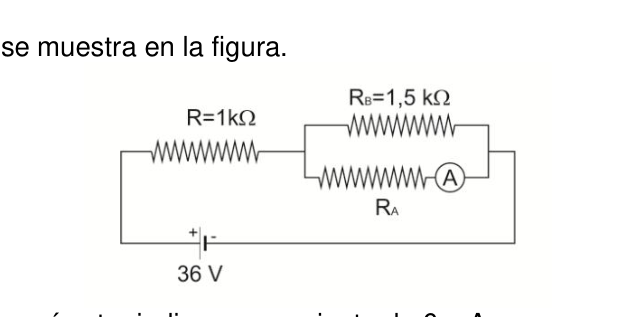
Topic: Circuits Metodi: Equivalent Circuit Reduction, Kirchhoff’s Laws Competenze: Physical Reasoning Objects: Resistor, Battery Fonte: Testo (PDF) — p.5
Problema Teorico 1
Problema teorico 1
Che sia il circuito che viene mostrato nella figura.
Sapendo che l’ampielitro indica un corrente di 6 mA,
a) Scrivi un’espressione per la resistenza equivalente (RP) del parallelo formato da le resistenze RA e RB.
b) Scrivi un’espressione che collega i correnti iA e iB che circolano tra i le resistenze RA e RB, rispettivamente, con le resistenze RA e RB.
c) Scrivi l’espressione che collega il flusso i che circola attraverso la fonte con i iA e iB.
d) Scrivere un rapporto tra le cadute di tensione ai bordi di R e di RP e il voltage fornita dalla sorgente (VF).
e) A partire dai punti precedenti, determina il valore della resistenza RA.
f) Determina il valore del corrente che circola attraverso la fonte.
g) Determina il valore della resistenza Re che dissipa la stessa energia per unità di tempo che le tre resistenze del circuito.
Topic: Circuits Metodi: Equivalent Circuit Reduction, Kirchhoff’s Laws Competenze: Physical Reasoning Objects: Resistor, Battery Fonte: Testo (PDF) — p.5
The following is the list of the main types of data that are used:
Theoretical problem 1
Be the circuit shown in the figure.
Knowing that the amp indicates a current of 6 mA,
(a) Write an expression for the equivalent resistance (RP) of the parallel formed by the RA and RB resistance.
(b) Write an expression linking the currents iA and iB circulating through the The test chemical shall be tested in accordance with the following conditions:
(c) Write the expression linking the current i circulating through the source to the current i. current iA and iB.
(d) Write a relationship between the voltage drops at the R and RP terminals and the voltage drop at the R and RP terminals. the voltage delivered by the source (VF).
(e) From the above points, determine the RA resistance value.
(f) Determine the value of the current flowing through the source.
(g) Determine the value of the resistance Re dissipating the same energy per unit of Time than the three resistors of the circuit.
Topic: Circuits Metodi: Equivalent Circuit Reduction, Kirchhoff’s Laws Competenze: Physical Reasoning Objects: Resistor, Battery Fonte: Testo (PDF) — p.5
Problema Teorico 2
Problema Teórico 2
En un termo de vidrio (rígido y adiabático), con un volumen total de 750 cm3, se colocan 250 cm3 de agua a 4°C y se completa con hielo a -20°C.
a) Determine la masa de hielo utilizada.
b) Determine el estado final del sistema agua-hielo.
c) Determine si el termo se rompe.
Topic: Thermodynamics Metodi: First Law of Thermodynamics Competenze: Physical Reasoning Objects: Container Fonte: Testo (PDF) — p.5
Problema Teorico 2
Problema teorico 2
In un termo vetro (rigido e adiabatico), con un volume totale di 750 cm3, si collocano 250 cm3 di acqua a 4°C e viene completato con ghiaccio a -20°C.
a) Determina la massa di ghiaccio utilizzata.
b) Determina lo stato finale del sistema acqua-ghiaccio.
c) Determina se il termostato si rompe.
Topic: Thermodynamics Metodi: First Law of Thermodynamics Competenze: Physical Reasoning Objects: Container Fonte: Testo (PDF) — p.5
The following is the list of the types of data that are used in the database:
Theoretical problem 2
In a glass thermos (rigid and adiabatic) with a total volume of 750 cm3 they are placed 250 cm3 of water at 4°C and completed with ice at -20°C.
(a) Determine the mass of ice used.
(b) Determine the final state of the water-ice system.
(c) Determine whether the thermos is broken.
Topic: Thermodynamics Metodi: First Law of Thermodynamics Competenze: Physical Reasoning Objects: Container Fonte: Testo (PDF) — p.5
Problema Teorico 3
Problema Teórico 3
En la figura se representan dos hilos paralelos conductores muy largos. Por ―A‖ circula una corriente eléctrica de 12 A en sentido indicado en la figura.
a) Calcular el valor y sentido de la corriente eléctrica que circula por ―B‖, teniendo en cuenta que el campo magnético en el punto Q es nulo.
b) ¿Cuál es el valor, dirección y sentido del campo magnético en el punto P?
40 - OAF 2015 c) ¿Qué fuerza por unidad de longitud, se ejercen los hilos entre sí? ¿Se atraen o se repelen?
Constantes:
Densidad del agua 1000 kg m-3
Densidad del hielo 900 kgm-3
Calor específico del agua 1 cal gr-1 °C-1
Calor específico del hielo 0,5 cal gr-1 °C-1
Calor latente de fusión 80 cal gr-1
Permeabilidad magnética del vacío 4π × 10-7 N A-2
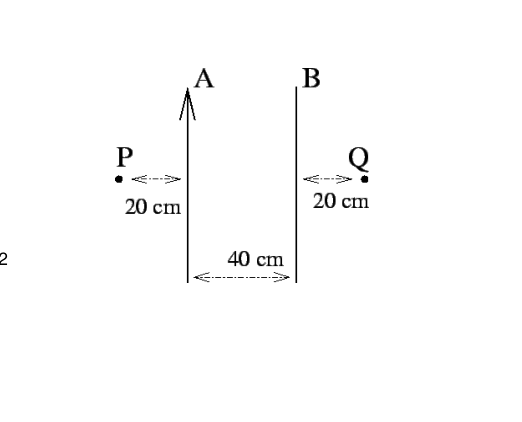
Topic: Magnetism Metodi: Ampère’s Law, Lorentz Force Analysis Competenze: Physical Reasoning Objects: Wire Fonte: Testo (PDF) — p.5
Problema Teorico 3
Problema teorico 3
La figura mostra due fili conduttori paralleli molto lunghi. Per “A” circola un corrente elettrica di 12 A nel senso indicato nella figura.
a) Calcolare il valore e il senso del corrente elettrica che circola per ―B‖, tenendo in si stima che il campo magnetico al punto Q è zero.
b) Qual è il valore, la direzione e il senso del campo magnetico al punto P?
40 - OAF 2015 c) Qual è la forza per unità di lunghezza che i fili esercitano tra loro? Si attraggono o si attraggono?
- Ti respingi?
Costanti:
Densità dell’acqua 1000 kg m-3
Densità del ghiaccio 900 kgm-3
Calore specifico dell’acqua 1 cal gr-1 °C-1
Calore specifico del ghiaccio 0,5 cal gr-1 °C-1
Calore latente di fusione 80 cal gr-1
Permeabilità magnetica del vuoto 4π × 10-7 N A-2
Topic: Magnetism Metodi: Ampère’s Law, Lorentz Force Analysis Competenze: Physical Reasoning Objects: Wire Fonte: Testo (PDF) — p.5
Theoretical problem 3 is that the problem is not a problem.
Theoretical problem 3
The figure shows two parallel very long conductive threads. By “A” circulate a current of 12 A in the direction indicated in the figure.
(a) Calculate the value and direction of the electric current circulating by ―B‖, having in It tells us that the magnetic field at point Q is zero.
(b) What is the value, direction and direction of the magnetic field at point P?
The Commission shall adopt delegated acts in accordance with Article 21 of Regulation (EU) No 1303/2013. (c) What force per unit length do the threads exert on each other? Are they attracted or are they? Do you want to get back?
The following is the list of the main components:
Density of water 1000 kg m-3
The density of the ice is 900 kgm-3
The specific heat of the water 1 cal gr-1 °C-1
Specific heat of ice 0,5 cal gr-1 °C-1
Latent heat of fusion 80 cal gr-1
The test chemical shall be tested in accordance with the following conditions:
Topic: Magnetism Metodi: Ampère’s Law, Lorentz Force Analysis Competenze: Physical Reasoning Objects: Wire Fonte: Testo (PDF) — p.5
Parte Experimental
Parte Experimental
Objetivo: Determinar el calor latente de fusión del agua.
Elementos
- Recipiente aislante (vaso de café)
- Jeringa descartable de 10 cm3
- Agua a temperatura ambiente
- Cubos de hielo a 0°C (Se obtiene poniendo el hielo en agua y esperando unos minutos para que el sistema agua + hielo llegue al equilibrio)
Elementos en el aula
- Termómetro (provisto por el Profesor)
Teoría Cuando dos cuerpos a distintas temperaturas se ponen en contacto térmico en un recinto adiabático (esto es, que no permite el intercambio de calor con el exterior), calor fluye del cuerpo de mayor temperatura al de menor temperatura hasta que ambos cuerpos alcanzan una misma temperatura (temperatura de equilibrio). En caso que uno de los cuerpos alcance la temperatura que corresponde a un cambio de fase de la sustancia que lo compone, el calor entregado o recibido por el cuerpo no le modifica su temperatura, que permanece constante, sino que es utilizado para cambiar de una fase a la otra. La cantidad de calor necesaria para que un gramo de la sustancia cambie de una fase a la otra se denomina calor latente.
Con los elementos solicitados, se pretende determinar el calor latente de fusión del agua (f).
a) Escriba las ecuaciones calorimétricas correspondientes a la situación planteada. Suponga que el recipiente es adiabático y que la temperatura de equilibrio de una mezcla de agua y hielo es 0°C. Desprecie efectos debido al cambio de la densidad de agua con la temperatura.
b) Coloque una cantidad de hielo a 0°C en el recipiente y agregue una volumen de agua conocido (Va), a temperatura ambiente. Agite la mezcla por al menos 15 segundos, teniendo cuidado de que siempre haya una mezcla de agua y hielo. Utilizando la jeringa, determine el nuevo volumen de agua (Vf). Repita la medición al menos 10 veces.
c) A partir del análisis teórico realizado y de las mediciones, determine el valor de f con su incerteza.
OAF 2015 - 41
Instancias Locales Problemas Teóricos
42 - OAF 2015
OAF 2015 - 43
Topic: Thermodynamics Metodi: First Law of Thermodynamics, Experimental Data Analysis Competenze: Physical Reasoning, Experimental Data Analysis Objects: Calorimeter Fonte: Testo (PDF) — p.5
Parte sperimentale
Parte sperimentale
Obiettivo: Determinare il calore latente di fusione dell’acqua.
Elementi
- recipiente isolante (copo di caffè)
- 10 cm3 di siringa scaricabile
- Agua a temperatura ambiente
- Cubi di ghiaccio a 0°C (Si ottiene mettendo il ghiaccio in acqua e aspettando un po’ di minuti per il sistema acqua + ghiaccio raggiungere l’equilibrio)
Elementi in classe
- Termometro (forniti dal Professore)
Teoria Quando due corpi a temperature diverse si mettono in contatto termico in un recinto adiabatic (cioè che non permette lo scambio di calore con l’esterno), il calore scorre dal corpo a più alta temperatura a più bassa temperatura fino a quando entrambi i corpi raggiungono la stessa temperatura (temperatura di equilibrio). In caso uno di loro corpi raggiungono la temperatura corrispondente a un cambiamento di fase della sostanza Il calore che il corpo trasmette o riceve non modifica il suo corpo. La temperatura, che rimane costante, ma è usata per passare da una fase a l’altra. La quantità di calore necessaria per un grammo di sostanza cambiare da una La fase successiva è chiamata calore latente.
Con gli elementi richiesti si intende determinare il calore latente della fusione dell’acqua (f).
a) Scrivi le equazioni calorimetriche corrispondenti alla situazione in questione. Supponiamo che il contenitore sia adiabatico e che la temperatura di equilibrio di una miscela di acqua e ghiaccio è 0°C. Sprezzare gli effetti a causa del cambiamento di densità dell’acqua con la temperatura.
b) Mettete una quantità di ghiaccio 0°C nel recipiente e aggiungete un volume di acqua nota (Va), a temperatura ambiente. Agita il mix per almeno 15 secondi, facendo attenzione che ci sia sempre un mix di acqua e ghiaccio. Utilizzando la siringa, determinare il nuovo volume d’acqua (Vf). Ripetere la misurazione almeno 10 volte.
c) Sulla base dell’analisi teorica effettuata e delle misurazioni, determinare il valore di f con la sua incertezza.
OAF 2015 - 41
I servizi locali Problemi teorici
42 - OAF 2015
OAF 2015 - 43
Topic: Thermodynamics Metodi: First Law of Thermodynamics, Experimental Data Analysis Competenze: Physical Reasoning, Experimental Data Analysis Objects: Calorimeter Fonte: Testo (PDF) — p.5
The test results shall be presented in accordance with the following formula:
Experimental part
Objective: Determine the latent heat of water melt.
Elements
- Insulating container (coffee glass)
- 10 cm3 disposable syringe
- Water at room temperature
- Ice cubes to 0°C (Originally obtained by putting ice in water and waiting for some minutes for the water + ice system to reach equilibrium)
Elements in the classroom
- Thermometer (provided by Professor)
The theory . When two bodies at different temperatures come into thermal contact in a compound The heat is not absorbed by the air, but by the air. The lower body is the higher the temperature until both bodies are They reach the same temperature (balance temperature). In case one of the bodies reach the temperature corresponding to a phase change of the substance The heat delivered or received by the body does not alter its composition. temperature, which remains constant, but is used to change from one phase to The other one. The amount of heat required to change one gram of the substance from one phase to phase is called latent heat.
The elements requested are intended to determine the latent melting heat of the water (f).
(a) Write the calorimetric equations corresponding to the situation in question. Suppose the container is adiabatic and the equilibrium temperature of a mix of water and ice is 0°C. It ‘s disregarding effects due to the change in density . of water with temperature.
(b) Place an amount of ice 0°C in the container and add a volume of known water (Va), at room temperature. Shake the mixture for at least 15 Second, making sure there’s always a mixture of water and ice. Using the syringe, determine the new water volume (Vf). Repeat the measurement at least 10 times.
(c) From the theoretical analysis and measurements, determine the value of f with their uncertainty.
The Commission shall adopt delegated acts in accordance with Article 21 of the Financial Regulation.
Local authorities Theoretical problems
The Commission shall adopt delegated acts in accordance with Article 21 of this Regulation.
The following is the list of the countries of the European Union:
Topic: Thermodynamics Metodi: First Law of Thermodynamics, Experimental Data Analysis Competenze: Physical Reasoning, Experimental Data Analysis Objects: Calorimeter Fonte: Testo (PDF) — p.5
PT1. Instituto de Enseñanza Privada Yapeyú1
Escuela Técnica UOCRA Islas Malvinas1
Escuela Mariano Ferreyra Proyecto Especial BLA2 1Ciudad de Corrientes - 2Resistencia, Chaco.
Circuitos eléctricos Sea el circuito de la siguiente figura
Datos 𝑉= 10𝑉 𝑅1 = 10 Ω 𝑅2 = 5 Ω 𝑅3 = 15 Ω
a. Calcula la resistencia equivalente para las resistencia 𝑅2 y 𝑅3. b. Calcula la resistencia equivalente del circuito. c. Calcula la intensidad de Corriente que atraviesa el circuito. d. Calcula la diferencia de potencial en extremos de cada una de las resistencias y el valor de la intensidad que las atraviesa.
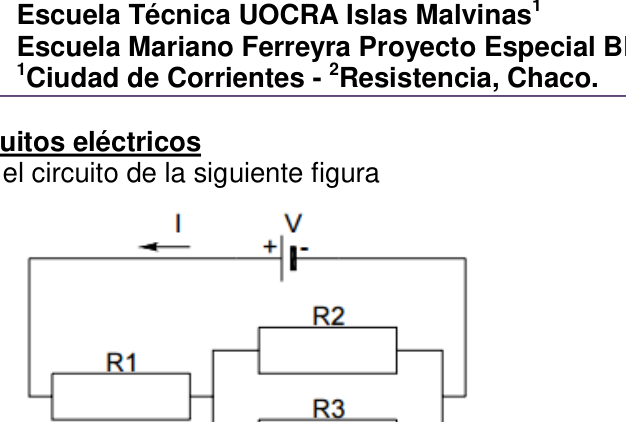
Topic: Circuits Metodi: Equivalent Circuit Reduction, Kirchhoff’s Laws Competenze: Physical Reasoning Objects: Resistor Fonte: Testo (PDF) — p.5
PT1. Istituto privato di istruzione Yapeyú1
UOCRA Isole Malvine1
Scuola Mariano Ferreyra Progetto speciale BLA2 1Città di Corrientes - 2Resistenza, Chaco.
Circuiti elettrici Che sia il circuito di questa figura.
Datos 𝑉= 10𝑉 𝑅1 = 10 Ω 𝑅2 = 5 Ω 𝑅3 = 15 Ω
a. Calcola la resistenza equivalente per le resistenze R2 e R3. b. Calcola la resistenza equivalente del circuito. c. Calcola l’intensità di corrente che attraversa il circuito. d. Calcola la differenza di potenziale in estremi di ciascuna resistenza e il Valore dell’intensità che attraversa.
Topic: Circuits Metodi: Equivalent Circuit Reduction, Kirchhoff’s Laws Competenze: Physical Reasoning Objects: Resistor Fonte: Testo (PDF) — p.5
PT1. Private teaching institute Yapeyú1
The UOCRA Technical School islands of the Falkland Islands1
School Mariano Ferreyra Special Project BLA2 1City of currents - 2Resistance, Chaco.
Electrical circuits Let the circuit be the following figure
Data from the report 𝑉= 10𝑉 𝑅1 = 10 Ω 𝑅2 = 5 Ω 𝑅3 = 15 Ω
a. Calculate the equivalent resistance for resistance R2 and R3. b. Calculate the equivalent resistance of the circuit. c. Calculate the intensity of current running through the circuit. d. Calculates the potential difference at each end of the resistance and the The value of the intensity that passes through them.
Topic: Circuits Metodi: Equivalent Circuit Reduction, Kirchhoff’s Laws Competenze: Physical Reasoning Objects: Resistor Fonte: Testo (PDF) — p.5
PT2. Instituto de Enseñanza Privada Yapeyú1
Escuela Técnica UOCRA Islas Malvinas1
Escuela Mariano Ferreyra Proyecto Especial BLA2 1Ciudad de Corrientes - 2Resistencia, Chaco.
Evitando un accidente. Un hombre que venía manejando su auto no se dio cuenta que una niña se encontraba jugando en la calle. Cuando la logro observar inmediatamente el conductor pisó el freno para detener su auto y así evitar el choque. La velocidad antes de pisar el freno era de 50 km/h. Al detenerse completamente el conductor bajo de su auto y observo que la longitud de las marcas de las ruedas era de 35m. Teniendo en cuenta que la masa del automóvil con el conductor es de 1550 kg, el coeficiente de rozamiento entre el pavimento y las ruedas es de 0,5 y que la inclinación de la calle respecto de la horizontal es de 10° a favor del deslizamiento. a. Realiza un diagrama de cuerpo libre del automóvil con el conductor, indicando todas las fuerzas que intervienen en la situación. b. Calcula: i. La aceleración de frenado. ii. La fuerza de frenado. iii. La fuerza de rozamiento entre el pavimento y las ruedas.
Topic: Newtonian Mechanics Metodi: Free-Body Diagram, Kinematic Equations Competenze: Physical Reasoning Objects: Wheel Fonte: Testo (PDF) — p.5
PT2. Istituto privato di istruzione Yapeyú1
UOCRA Isole Malvine
Scuola Mariano Ferreyra Progetto speciale BLA2 1Città di Corrientes - 2Resistenza, Chaco.
Evitando un incidente. Un uomo che stava guidando la sua auto non si accorse che c’ era una bambina . giocando in strada. Quando l’ho osservata, l’autista ha premuto il freno. per fermare la sua auto e evitare l’impatto. La velocità prima di premere il freno era di 50 km/h. Sosta completamente il conducente basso della sua auto e osservo che la lunghezza Le tracce delle ruote erano di 35 metri. Considerando che la massa dell’auto con il conducente è di 1550 kg, il il coefficiente di rottura tra pavimento e ruote è di 0,5 e che l’inclinazione La velocità di movimento della strada rispetto al orizzonte è di 10° in favore dello sliding. a. Sviluppa un diagramma del corpo libero dell’auto con il conducente, indicando tutte le forze coinvolte nella situazione. b. Calcola: i. L’accelerazione frenata. ii. La forza di frenata. iii. La forza di rottura tra pavimento e ruote.
Topic: Newtonian Mechanics Metodi: Free-Body Diagram, Kinematic Equations Competenze: Physical Reasoning Objects: Wheel Fonte: Testo (PDF) — p.5
PT2. Private teaching institute Yapeyú1
The UOCRA Technical School islands of the Falkland Islands1
School Mariano Ferreyra Special Project BLA2 1City of currents - 2Resistance, Chaco.
Avoiding an accident. A man driving his car didn ‘t realize a girl was there . Playing in the street. When I got to see her immediately the driver stepped on the brake. to stop his car and avoid the crash. The speed before stepping on the brake was 50 . km/h. When the driver stops completely the low of his car and I observe that the length The wheel mark was 35 meters. Given that the mass of the driver car is 1550 kg, the The friction coefficient between the pavement and the wheels is 0.5 and the slope The street angle from the horizontal is 10° in favour of sliding. a. Draw a body diagram of the car with the driver, indicating All forces involved in the situation. b. Calculate: i. The braking acceleration. ii. The braking force. (iii) the following: The friction force between the pavement and the wheels.
Topic: Newtonian Mechanics Metodi: Free-Body Diagram, Kinematic Equations Competenze: Physical Reasoning Objects: Wheel Fonte: Testo (PDF) — p.5
PT3. Instituto de Enseñanza Privada Yapeyú1
Escuela Técnica UOCRA Islas Malvinas1
Escuela Mariano Ferreyra Proyecto Especial BLA2 1Ciudad de Corrientes - 2Resistencia, Chaco.
Calorimetría. Se tienen 200 g de alcohol etílico a 60℃ de temperatura. Se introducen en un calorímetro que tiene 100g de agua a 20℃. Teniendo en cuenta que el calor especifico del agua es de 4180 𝐽 𝐾𝑔℃ y que el calor especifico del alcohol etílico es de 2500 𝐽 𝐾𝑔℃
44 - OAF 2015 a. Calcule la temperatura final de la mezcla.
Seguidamente se introdujo en la mezcla un tornillo de aluminio de 40 gramos de masa a 70℃ de temperatura. Se sabe que la temperatura de equilibrio entre la mezcla y el tornillo era de 50℃. Teniendo en cuenta que el calor especifico del aluminio es de 899 𝐽 𝐾𝑔℃
b. Determine la cantidad de calor intercambiado en el tornillo.
c. Calcule el calor específico de la mezcla.
Suponga que no existe influencia de las condiciones ambientales y que no hay pérdida de calor en el calorímetro.
Topic: Thermodynamics Metodi: First Law of Thermodynamics Competenze: Physical Reasoning Objects: Calorimeter Fonte: Testo (PDF) — p.5
PT3. Istituto privato di istruzione Yapeyú1
UOCRA Isole Malvine
Scuola Mariano Ferreyra Progetto speciale BLA2 1Città di Corrientes - 2Resistenza, Chaco.
Calorimetria. Si hanno 200 g di alcol etilico a 60°C di temperatura. Si inseriscono in un calometro che ha 100 grammi di acqua a 20°C. Considerando che il calore specifico dell’acqua è de 4180 𝐽 Kg°C e che il calore specifico dell’alcol etilico è di 2500 𝐽 𝐾𝑔℃
44 - OAF 2015 a. Calcola la temperatura finale del miscelato.
Successivamente è stato introdotto nel miscela un ruotino di alluminio di 40 grammi di massa a 70°C di temperatura. Si sa che la temperatura di equilibrio tra il miscela e lo scrocio Era di 50°C. Considerando che il calore specifico dell’alluminio è di 899 𝐽 𝐾𝑔℃
b. Determina la quantità di calore scambiata nello schermo. c. Calcola il calore specifico della miscela.
Supponiamo che non vi sia alcuna influenza delle condizioni ambientali e che non vi sia alcuna perdita di calore nel caloriometro.
Topic: Thermodynamics Metodi: First Law of Thermodynamics Competenze: Physical Reasoning Objects: Calorimeter Fonte: Testo (PDF) — p.5
PT3. Private teaching institute Yapeyú1
The UOCRA Technical School islands of the Falkland Islands1
School Mariano Ferreyra Special Project BLA2 1City of currents - 2Resistance, Chaco.
Calorimetry. They have 200 g of ethyl alcohol at 60°C. They ‘re put in a thermometer . It’s got 100g of water at 20°C. Considering that the specific heat of the water is de 4180 𝐽 Kg°C and the specific heat of ethyl alcohol is 2500 𝐽 𝐾𝑔℃
The following points shall be added: a. Calculate the final temperature of the mixture.
A 40 g aluminium screw was then introduced into the mixture. 70°C of temperature. It is known that the equilibrium temperature between the mixture and the screw is It was 50 degrees. Given that the specific heat of aluminium is 899 𝐽 𝐾𝑔℃
b. Determine the amount of heat exchanged in the screw. c. Calculate the specific heat of the mixture.
Assume that there is no influence of environmental conditions and no loss of heat in the thermometer.
Topic: Thermodynamics Metodi: First Law of Thermodynamics Competenze: Physical Reasoning Objects: Calorimeter Fonte: Testo (PDF) — p.5
PT4. Colegio Champagnat Ciudad de Buenos Aires.
Se tiene un sistema como el de la figura, donde la masa M1 parte del reposo y baja sobre un plano inclinado con un coeficiente de rozamiento dinámico de 0,3, luego colisiona con otra masa M2 de tal manera que esta sigue por la superficie horizontal sin rozamiento y luego gira por una via sin rozamiento, con un radio de 2 metros para luego caer una altura de 3 metros. M1 = 20 Kg y M2 = 10 Kg
Hallar: a) La velocidad mínima inicial del bloque M2 para que no se suelte en la parte alta del giro b) La altura h mínima suponiendo que el choque entre M1 y M2 es perfectamente elástico. c) La velocidad del bloque M1 después del choque d) Hallar el Δx
Topic: Conservation of Energy, Conservation of Momentum Metodi: Energy Conservation Method, Conservation of Momentum Competenze: Physical Reasoning Objects: Block, Inclined Plane Fonte: Testo (PDF) — p.5
PT4. La Champagnat College Città di Buenos Aires.
Si ha un sistema come quello della figura, dove la massa M1 parte dal riposo e scende su un piano inclinato con un un coefficiente di rottura dinamica di 0,3, Poi colpisce con un’altra massa M2 di questo tipo il modo in cui questa continua sulla superficie
- Originale senza scratte e poi gira per una via senza scarichi, con un raggio di 2 metri e poi cadere a 3 metri di altezza. metri. M1 = 20 Kg y M2 = 10 Kg
Trovare: a) La velocità minima iniziale del blocco M2 per non rilasciare nella parte superiore del blocco
- Ritorno b) L’altezza minima h, supponendo che la collisione tra M1 e M2 sia perfetta
- Elastico. c) La velocità del blocco M1 dopo l’impatto d) Trovare il Δx
Topic: Conservation of Energy, Conservation of Momentum Metodi: Energy Conservation Method, Conservation of Momentum Competenze: Physical Reasoning Objects: Block, Inclined Plane Fonte: Testo (PDF) — p.5
PT4. Champagnat College City of Buenos Aires.
You have a system like the figure, where the mass M1 leaves rest and descends on un
- It ‘s flat . Tilted with un Dynamic friction coefficient of 0,3, Then it collides with another mass M2 of this kind The way it follows the surface. horizontal without grinding and then rotate through a non-raised track, with a radius of 2 Meters to fall a height of 3 feet. M1 = 20 Kg y M2 = 10 Kg
Find out: (a) The minimum initial speed of the M2 block so that it does not release at the top of the Turn around (b) The minimum height h assuming that the impact between M1 and M2 is perfectly It’s very flexible. (c) The speed of the M1 block after impact (d) Find the Δx
Topic: Conservation of Energy, Conservation of Momentum Metodi: Energy Conservation Method, Conservation of Momentum Competenze: Physical Reasoning Objects: Block, Inclined Plane Fonte: Testo (PDF) — p.5
PT5. Colegio Champagnat Ciudad de Buenos Aires.
En un tanque abierto a la atmosfera de grandes dimensiones de acuerdo a la figura, se producen dos orificios en un costado del mismo a 60 cm y 70 cm del suelo.
Hallar la altura h necesaria para que los chorros de líquido toquen el piso en el mismo punto (igual Δx), para el caso de que el líquido sea: a) agua (d = 1000 Kg/m3) b) una mezcla de agua y petróleo (d = 700 Kg/m3) sabiendo que la altura del agua es de 65 cm
OAF 2015 - 45
Topic: Fluid Mechanics Metodi: Bernoulli’s Equation, Kinematic Equations Competenze: Physical Reasoning Objects: Container Fonte: Testo (PDF) — p.5
PT5. La Champagnat College Città di Buenos Aires.
In un serbatoio aperto all’atmosfera di dimensioni grandi secondo la Figura 1, si producono due fori in una di lato di esso a 60 cm e 70 cm di
- No, non è così.
Trovare l’altezza h necessaria per i Giochi di liquido toccano il pavimento lo stesso punto (equivalente a Δx), nel caso in cui il liquido sia: a) acqua (d = 1000 Kg/m3) b) un mix di acqua e petrolio (d = 700 Kg/m3) sapendo che l’altezza dell’acqua è de 65 cm
OAF 2015 - 45
Topic: Fluid Mechanics Metodi: Bernoulli’s Equation, Kinematic Equations Competenze: Physical Reasoning Objects: Container Fonte: Testo (PDF) — p.5
PT5. Champagnat College City of Buenos Aires.
In a tank open to the atmosphere of large dimensions according to the Figure, two holes are produced in one side of the same at 60 cm and 70 cm of the I’m going to the ground.
Find the height h needed to make them Fluid jets touch the floor in the same point (equal to Δx), in the case of liquid: (a) water (d = 1000 Kg/m3) (b) a mixture of water and oil (d = 700 Kg/m3) knowing that the height of the water is de 65 cm
The following is the list of the countries of the European Union:
Topic: Fluid Mechanics Metodi: Bernoulli’s Equation, Kinematic Equations Competenze: Physical Reasoning Objects: Container Fonte: Testo (PDF) — p.5
PT6. Colegio Champagnat Ciudad de Buenos Aires.
Se tiene el siguiente circuito eléctrico
E1 = 10 V E2 = 20 V i5 = 0,5 A
Hallar el valor de: a) R b) i1 c) i2 d) i3 e) i4
Topic: Circuits Metodi: Kirchhoff’s Laws Competenze: Physical Reasoning Objects: Resistor, Battery Fonte: Testo (PDF) — p.5
PT6. La Champagnat College Città di Buenos Aires.
Si ha il circuito elettrico seguente
E1 = 10 V E2 = 20 V i5 = 0,5 A
Calcolare il valore di: a) R b) i1 c) i2 d) i3 e) i4
Topic: Circuits Metodi: Kirchhoff’s Laws Competenze: Physical Reasoning Objects: Resistor, Battery Fonte: Testo (PDF) — p.5
PT6. Champagnat College City of Buenos Aires.
You have the following electrical circuit.
E1 = 10 V E2 = 20 V i5 = 0,5 A
Find the value of: a) R b) i1 c) i2 d) i3 e) i4
Topic: Circuits Metodi: Kirchhoff’s Laws Competenze: Physical Reasoning Objects: Resistor, Battery Fonte: Testo (PDF) — p.5
PT7. Escuela Provincial de Educación Técnica Nro. 16 Dos de Mayo, Misiones.
Sobre un plano inclinado de 5 metros de longitud se encuentra un cuerpo cuya masa es
de 15 kg. La base horizontal del triángulo rectángulo cuya hipotenusa es el plano
inclinado es de 2,5 metros. El coeficiente de rozamiento entre ambas superficies es µ=0,2
y la aceleración del gravitatoria del lugar se considera g=9,8m/s2. La altura a la que se
encuentra el cuerpo es 6 metros.
Cuando el cuerpo abandona el plano inclinado se desliza por una superficie curva sin
rozamiento, salvo en el sector D, que mide 8m y tiene un coeficiente de rozamiento µ=0,2
a. Caula la energía potencial gravitatoria del cuerpo b. Dibuja el diagrama de cuerpo libre c. Determina el valor de la fuerza de rozamiento en el plano inclinado d. ¿Qué aceleración recibe el cuerpo en el plano inclinado? e. ¿Cuánto tiempo emplea el cuerpo en llegar al final del plano inclinado? f. Determina la velocidad con que llega el cuerpo al punto A g. Determina si el cuerpo puede pasar el tramo D. Si es así calcula su velocidad de salida. De lo contrario indica la distancia recorrida en ese tramo.
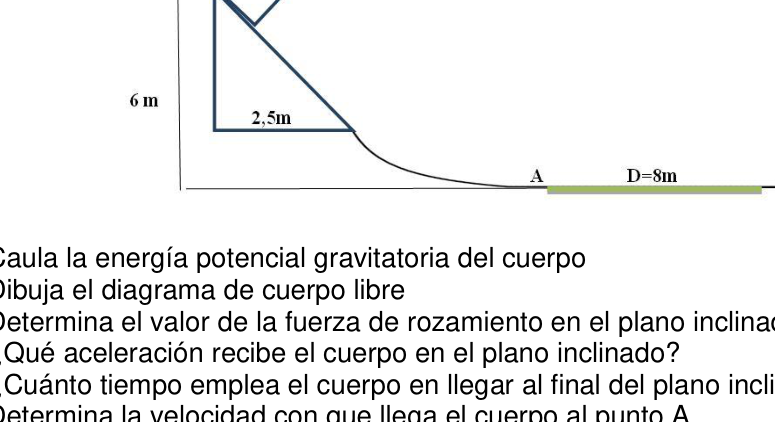
Topic: Conservation of Energy Metodi: Energy Conservation Method, Free-Body Diagram Competenze: Physical Reasoning Objects: Block, Inclined Plane Fonte: Testo (PDF) — p.5
PT7. Scuola Provinciale di Educazione Tecnica Nro. 16 Due maggio, missioni.
Su un piano inclinato di 5 metri di lunghezza si trova un corpo il cui massa è de 15 kg. La base orizzontale del triangolo rettangolo la cui ipotenusa è il piano inclinato è di 2,5 metri. Il coefficiente di ruggine tra le due superfici è μ=0,2 e l’accelerazione gravitazionale del luogo è considerata g=9,8m/s2. L’altezza di cui si Trova il corpo, è di 6 metri. Quando il corpo abbandona il piano inclinato, si scivola su una superficie curva senza Rottura, tranne nel settore D, di 8 m e con un coefficiente di rottura μ=0,2
a. Causa l’energia gravitazionale potenziale del corpo b. Disegna il diagramma del corpo libero. c. Determina il valore della forza di ruggine sul piano inclinato d. Che accelerazione riceve il corpo in piano inclinato? e. Quanto tempo ci vuole per arrivare alla fine del piano inclinato? f. Determina la velocità con cui il corpo arriva al punto A. g. Determina se il corpo può passare il tratto D. Se è così, calcola la velocità di
- Esito. Altrimenti indica la distanza percorsa in quel tratto.
Topic: Conservation of Energy Metodi: Energy Conservation Method, Free-Body Diagram Competenze: Physical Reasoning Objects: Block, Inclined Plane Fonte: Testo (PDF) — p.5
PT7. Provincial school of technical education nro. 16 May 2nd, missions.
On an inclined plane of 5 meters long lies a body whose mass is de 15 kg. The horizontal base of the triangle whose hypotenuse is the plane It’s about two and a half meters. The coefficient of friction between the two surfaces is μ=0,2 and the acceleration of the gravitational pull of the place is considered g=9.8m/s2. The height at which it is He finds the body is 6 meters. When the body leaves the sloping plane it slides over a curved surface without any grinding, except in sector D, measuring 8m and having a grinding coefficient μ=0,2
a. Causes the gravitational potential energy of the body. b. Draw the free-body diagram . c. Determine the value of the friction force on the slope plane d. What acceleration does the body receive on the inclined plane? e. How long does it take the body to reach the end of the inclined plane? f. Determines the speed at which the body reaches point A. g. Determine if the body can pass the D-section. If so, calculate your speed of
- Out of the way. Otherwise it shall indicate the distance travelled in that stretch.
Topic: Conservation of Energy Metodi: Energy Conservation Method, Free-Body Diagram Competenze: Physical Reasoning Objects: Block, Inclined Plane Fonte: Testo (PDF) — p.5
PT8. Escuela Provincial de Educación Técnica Nro. 16 Dos de Mayo, Misiones.
El siguiente circuito eléctrico está conectado a una fuente de 32voltios (que consideraremos sin resistencia interna), con una resistencia total de desconocida y una potencia de 128 Watts
a. Determina el valor de la resistencia total
46 - OAF 2015 b. Calcula la intensidad en cada rama c. ¿Cuál debe ser valor de la resistencia X para que la potencia sea de 128 Watts? d. ¿Qué cantidad de energía consume el circuito si permanece conectado durante una hora?
Topic: Circuits Metodi: Equivalent Circuit Reduction, Kirchhoff’s Laws Competenze: Physical Reasoning Objects: Resistor Fonte: Testo (PDF) — p.5
PT8. Scuola Provinciale di Educazione Tecnica Nro. 16 Due maggio, missioni.
Il circuito elettrico seguente è collegato a una fonte. di 32 volt (che considereremo senza resistenza interna), Con una resistenza totale sconosciuta e una potenza di 128 Watts
a. Determina il valore della resistenza totale
46 - OAF 2015 b. Calcola l’intensità in ogni ramo c. Qual è il valore della resistenza X per rendere la potenza 128 watt? d. Quanto energia il circuito consuma se rimane connesso per un periodo di tempo?
- Ora?
Topic: Circuits Metodi: Equivalent Circuit Reduction, Kirchhoff’s Laws Competenze: Physical Reasoning Objects: Resistor Fonte: Testo (PDF) — p.5
PT8. Provincial school of technical education nro. 16 May 2nd, missions.
The next electrical circuit is connected to a source. 32 volts (which we shall consider to be without internal resistance), With a total strength of unknown and a power of 128 Watts
a. Determine the value of the total resistance
The Commission shall adopt delegated acts in accordance with Article 21 of Regulation (EU) No 1303/2013. b. Calculate the intensity in each branch. c. What must be the value of the resistance X for the power to be 128 Watts? d. How much energy does the circuit consume if it stays connected for a period of time? What time?
Topic: Circuits Metodi: Equivalent Circuit Reduction, Kirchhoff’s Laws Competenze: Physical Reasoning Objects: Resistor Fonte: Testo (PDF) — p.5
PT9. Escuela Provincial de Educación Técnica Nro. 16 Dos de Mayo, Misiones.
Con la intención de preparar un mate un señor pone a calentar exactamente 1000g de agua que inicialmente está a 15°C. Su temperatura óptima para el mate es 85°C. El agua fue calentada por una resistencia eléctrica durante 320 segundos a. Calcula la cantidad de calor que tiene que ser absorbida por el agua para llegar a la temperatura deseada. b. Cuando decide preparar el mate, se da cuenta que el agua estaba a punto de ebullición. ¿Cuántas calorías de más ingresaron al sistema? c. Determina la potencia del sistema eléctrico utilizado para calentar el agua. d. ¿Cuál es el valor de la resistencia del calentador? e. ¿Cuánta agua caliente, (100°C) debe ser remplazada por agua fría (15°C) para tener 1000g de agua a la temperatura ideal (85°C) Datos: Calor específico del agua: 𝑐= 1 𝑐𝑎𝑙 𝑔°𝐶
- Temperatura de ebullición del agua 100°C 1cal=4,18J
Topic: Thermodynamics, Circuits Metodi: First Law of Thermodynamics, Kirchhoff’s Laws Competenze: Physical Reasoning Objects: Resistor Fonte: Testo (PDF) — p.5
PT9. Scuola Provinciale di Educazione Tecnica Nro. 16 Due maggio, missioni.
Con l’intenzione di preparare un mate un signore mette a riscaldare esattamente 1000g di acqua che è inizialmente 15°C. La sua temperatura ottimale per il mate è 85°C. L’acqua fu riscaldata da una resistenza elettrica per 320 secondi. a. Calcola la quantità di calore che deve essere assorbita dall’acqua per arrivare alla temperatura di temperatura desiderata. b. Quando decide di preparare il mate, si rende conto che l’acqua era quasi finita.
-
Boccatura. Quante calorie in più sono entrate nel sistema? c. Determina la potenza del sistema elettrico utilizzato per riscaldare l’acqua. d. Qual è il valore della resistenza del riscaldatore? e. Quanto acqua calda (100°C) deve essere sostituita con acqua fredda (15°C) per avere 1000 g di acqua a temperatura ideale (85°C) Datati: Calore specifico dell’acqua: c= 1 cal 𝑔°𝐶
-
Temperatura di ebollizione dell’acqua 100°C 1 cal = 4,18J
Topic: Thermodynamics, Circuits Metodi: First Law of Thermodynamics, Kirchhoff’s Laws Competenze: Physical Reasoning Objects: Resistor Fonte: Testo (PDF) — p.5
PT9. Provincial school of technical education nro. 16 May 2nd, missions.
In order to prepare a mate a gentleman sets to heat exactly 1000g of water initially at 15°C. Its optimal temperature for matte is 85°C. The water . It was heated by electrical resistance for 320 seconds. a. Calculate the amount of heat that needs to be absorbed by the water to reach the water temperature. the desired temperature. b. When he decides to prepare the mate, he realizes that the water was about to go down. boiling. How many extra calories did they get into the system? c. Determine the power of the electrical system used to heat water. d. What is the heater’s resistance value? e. How much hot water (100°C) should be replaced with cold water (15°C) for have 1000g of water at the ideal temperature (85°C) The data: Specific heat of water: c= 1 cal 𝑔°𝐶
- Boiling temperature of the water 100° C 1 cal = 4.18J
Topic: Thermodynamics, Circuits Metodi: First Law of Thermodynamics, Kirchhoff’s Laws Competenze: Physical Reasoning Objects: Resistor Fonte: Testo (PDF) — p.5
PT10. Escuela Técnica Nro. 27 Hipólito Yrigoyen Ciudad de Buenos Aires.
Conduciendo con destreza. Un corredor de autos está participando con su vehículo, de 800 kgf de peso, en una carrera de destreza. El reglamento de la competencia indica que la velocidad de los vehículos sobre la pista debe ser constante e igual a 108 km/h. Se sabe que el coeficiente de rozamiento estático entre los neumáticos y la pista es µ = 0,8. Un sector de la pista se muestra en la figura 1.
Fig.1
Fig.2
Este sector de la pista comienza con un tramo recto horizontal AB, luego una rampa descendente BC y a continuación otro tramo horizontal CD, que termina en un escalón de 2m de altura, ubicado en D, como muestra la figura 2.
OAF 2015 - 47 a) ¿Qué fuerza debe implementar el vehículo a través de su conjunto motor- transmisión, para mantener su velocidad constante en 108 km/h en los tramos horizontales? b) Al circular por la rampa descendente BC, ¿qué valor tiene esa fuerza? ¿Debe aplicar los frenos? Justificar la respuesta. c) Al llegar a D el vehículo debe saltar el escalón de 2m de altura. ¿A qué distancia ―d‖ vuelve a tocar la pista? d) Más adelante debe transitar por una curva horizontal, de forma circular, con radio interno = 110 m y radio externo = 120 m. Si el conductor transita siguiendo una trayectoria circular, determinar el radio mínimo de esa circunferencia para que el vehículo no derrape.
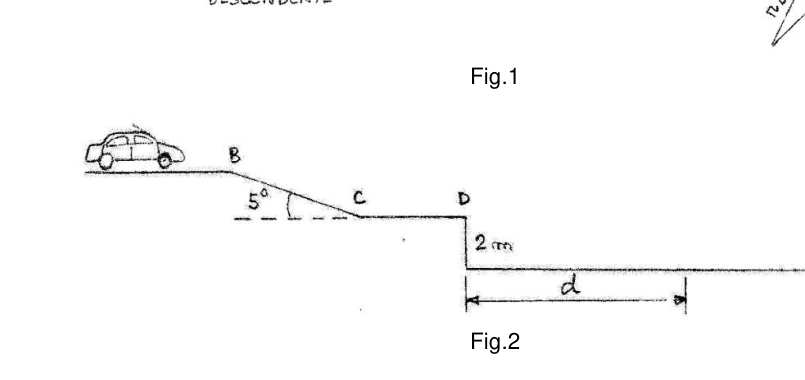
Topic: Newtonian Mechanics Metodi: Free-Body Diagram, Kinematic Equations Competenze: Physical Reasoning Objects: Wheel Fonte: Testo (PDF) — p.5
PT10. Scuola tecnica n.o. 27 Hippolytus Yrigoyen Città di Buenos Aires.
Guidando con abilità. Un corridore di auto sta partecipando con il suo veicolo, di 800 kgf, in una La carriera di destrezza. Il regolamento di concorrenza indica che la velocità dei i veicoli sulla pista devono essere costanti e pari a 108 km/h. Si sa che il il coefficiente di rottura statica tra le gomme e la pista è μ = 0,8. Un settore di il segnale è mostrato in figura 1.
Fig.1
Fig.2
Questo settore della pista inizia con un tratto retto orizzontale AB, poi una rampa discendente BC e poi un altro tratto orizzontale CD, che termina su uno scafo di Alti 2 m, situati in D, come mostra la figura 2.
OAF 2015 - 47 a) Che forza deve essere impostata dal veicolo attraverso il suo insieme motore trasmissione, per mantenere la sua velocità costante a 108 km/h in tratti
- Orisontali? b) Circolare sulla rampa discendente BC, che valore ha quella forza? - Dovrebbe? Applicare i freni? Giustificare la risposta. c) Arrivare a D il veicolo deve saltare il gradino di 2 m di altezza. A che distanza?
- Riproduce il tracciato? (d) Successivamente deve attraversare una curva orizzontale, in forma circolare, con radius La radius interna è di 110 m e la radius esterna è di 120 m. Se il conducente sta passando in un’altra direzione Il percorso circolare, determinare il raggio minimo di quella circonferenza in modo che il Il veicolo non si spalanca.
Topic: Newtonian Mechanics Metodi: Free-Body Diagram, Kinematic Equations Competenze: Physical Reasoning Objects: Wheel Fonte: Testo (PDF) — p.5
PT10. Technical school No. 27 Hippolytus Yrigoyen City of Buenos Aires.
Driving well. A racer is taking part with his 800 kg vehicle in a race. The race of skill. The competition rules state that the speed of the vehicles on the track shall be constant and equal to 108 km/h. It is known that The static friction coefficient between the tyres and the track is μ = 0,8. A sector of the lead is shown in Figure 1.
Figure 1
Figure 2
This section of the track starts with a horizontal straight AB section, then a ramp descending BC and then another horizontal stretch CD, ending at a ladder of 2m high, located in D, as shown in Figure 2.
The Commission shall adopt delegated acts in accordance with Article 21 of this Regulation. (a) What force must the vehicle implements through its engine assembly? transmission, to maintain its constant speed at 108 km/h on the sections What about horizontal? (b) When driving down the BC ramp, what value does that force have? Should you? apply the brakes? Justify the answer. (c) When reaching D the vehicle must jump the 2m-high ladder. How far away is d? You play the track again? (d) It must then pass through a horizontal, circular curve with radius The internal radius is 110 m and the external radius is 120 m. If the driver is travelling following a The circle path is the minimum radius of that circumference so that the Vehicle does not crash.
Topic: Newtonian Mechanics Metodi: Free-Body Diagram, Kinematic Equations Competenze: Physical Reasoning Objects: Wheel Fonte: Testo (PDF) — p.5
PT11. Escuela Técnica Nro. 27 Hipólito Yrigoyen Ciudad de Buenos Aires.
Acerca de un elevador.
A un bloque de acero se le ha practicado una cavidad, de forma cilíndrica, dentro del cual
puede desplazarse un pistón de plomo. La cavidad cilíndrica queda sellada por el pistón y
puede llenarse con un gas, cuya presión puede ser regulada. El pistón, a través de un
émbolo, puede sostener y elevar una carga. La masa total del sistema formado por el
pistón, el émbolo y la carga es de 2000 kg.
a) Suponiendo que todo el sistema se encuentra a la presión externa de una
atmósfera y que no hay rozamiento entre el pistón y la pared del cilindro, determinar
la presión p del gas que se necesita para mantener la carga en reposo.
b) A la temperatura de 15ºC, el radio de la cavidad y del pistón son iguales al valor
r = 6 cm y la altura del pistón h= 9 cm. La temperatura de trabajo es de 16ºC.
Calcular, a la temperatura de trabajo (16ºC) el radio y el volumen del pistón de plomo, si
éste se encontrara fuera del cilindro. Calcular, además, el radio de la cavidad cilíndrica a
esa temperatura.
c) Calcular el radio y la altura del pistón dentro de la cavidad cilíndrica, cuando todo el
sistema está a la temperatura de trabajo. (Suponer que la deformación del pistón
dentro de la cavidad es a volumen constante y la deformación del bloque de acero
bajo la presión del pistón es despreciable).
d) Calcular la presión P que la cavidad hace sobre el pistón a la temperatura de
trabajo.
Nota: esta presión se calcula mediante la expresión:
P = Y ΔR/R
Donde Y es el módulo de Young del material ; R es el radio del pistón no deformado
e) Calcular el máximo valor posible para la fuerza de rozamiento estática entre el pistón y la cavidad, a la temperatura de trabajo f) Teniendo en cuenta el rozamiento entre el pistón y el cilindro, calcular entre que valores puede variar la presión del gas para que la carga se mantenga en reposo a la temperatura de trabajo.
Valores que pueden ser útiles: Coef de dilatación Acero λac = 1,4 x 10⁻⁵(ºC )-1 Plomo λPb = 2,9 x 10⁻⁵(ºC )-1
48 - OAF 2015 Coef. de rozamiento estático del plomo sobre el acero µe = 0,95 Módulo de Young Plomo Ypb = 1,47x 10⁴ N/mm2 Aceleración de la gravedad g = 9,8 m/s2 Presión atmosférica pa= 1,033 kgf/cm2 = 1013 hPa
Topic: Elasticity & Materials, Thermodynamics Metodi: Stress-Strain Analysis, Ideal Gas Law Competenze: Physical Reasoning Objects: Piston, Cylinder, Gas Fonte: Testo (PDF) — p.5
PT11. Scuola tecnica n.o. 27 Hippolytus Yrigoyen Città di Buenos Aires.
- Si tratta di un ascensore. Un blocco di acciaio è stato formato da una cavità cilindrica, all’interno della quale un pistone di piombo può spostarsi. La cavità cilindrica viene sigillata dal pistone e può riempirsi di un gas, la cui pressione può essere regolata. Il pistone, attraverso un
- Imballo, può sostenere e sollevare un carico. La massa totale del sistema formato dal Piston, pallone e carico sono 2000 kg. a) Supponendo che l’intero sistema sia sottoposto alla pressione esterna di una atmosfera e che non vi sia lacerazione tra il pistone e il muro del cilindro, determinare la pressione p del gas necessaria per mantenere la carica a riposo. b) A 15°C, il raggio della cavità e del pistone sono uguali al valore r = 6 cm e l’altezza del pistone h = 9 cm. La temperatura di lavoro è di 16°C. Calcolare, alla temperatura di lavoro (16°C), il raggio e il volume del pistone di piombo, se Questo si trovava fuori dal cilindro. Calcolare, inoltre, il raggio della cavità cilindrica a quella temperatura. (c) Calcolare il raggio e l’altezza del pistone all’interno della cavità cilindrica, quando tutto il Il sistema è a temperatura di lavoro. (Suppone che la deformazione del pistone all’interno della cavità è a volume costante e la deformazione del blocco di acciaio sotto la pressione del pistone è sconsiderato). d) Calcolare la pressione P che la cavità fa sul pistone a temperatura di
- lavoro. Nota: questa pressione viene calcolata con l’espressione: P = Y ΔR/R Dove Y è il modulo di Young del materiale; R è il raggio del pistone non deformato
e) Calcolare el massimo Valore Potrebbe essere per la forza de Raggiunta di un’attività di lavoro Piston e cavità, a temperatura di lavoro f) Avendo en Conti el Rottura tra il pistone e il cilindro, Calcolare tra che Le valori possono variare la pressione di gas per il carico di
- Non si può fare. temperatura di lavoro.
Valori che possono essere utili: Coef di dilatazione Acciaio λac = 1,4 x 10⁻⁵ L’aumento di tensione è pari a 2,9 x 10⁻⁵
48 - OAF 2015
- Coef. di rottura statica del piombo sul ferro µe = 0,95 Modulo di Young Piombo Ypb = 1,47x 10⁴ N/mm2 Accelerazione della gravità g = 9,8 m/s2 Pressione atmosferica Pa= 1,033 kgf/cm2 = 1013 hPa
Topic: Elasticity & Materials, Thermodynamics Metodi: Stress-Strain Analysis, Ideal Gas Law Competenze: Physical Reasoning Objects: Piston, Cylinder, Gas Fonte: Testo (PDF) — p.5
PT11. Technical school No. 27 Hippolytus Yrigoyen City of Buenos Aires.
About an elevator. A steel block has been drilled into a cylindrical cavity inside which a lead piston can be moved. The cylindrical cavity is sealed by the piston and It can be filled with a gas, the pressure of which can be regulated. The piston, through a Emballed, it can hold and lift a load. The total mass of the system formed by the piston, piston and load is 2000 kg. (a) Assuming that the whole system is under the external pressure of a atmosphere and that there is no friction between the piston and the cylinder wall, determine the p pressure of the gas needed to keep the load at rest. (b) At 15 °C, the radius of the cavity and piston are equal to the value r = 6 cm and the height of the piston h = 9 cm. The working temperature is 16oC. Calculate, at working temperature (16oC) the radius and volume of the lead piston, if This one was outside the cylinder. Calculate, furthermore, the radius of the cylindrical cavity to That temperature. (c) Calculate the piston radius and height within the cylindrical cavity when all the piston is The system is at working temperature. (Suppose the piston deformation is inside the cavity is at constant volume and deformation of the steel block under piston pressure is despicable). (d) Calculate the pressure P the cavity puts on the piston at a temperature of I’m working. Note: this pressure is calculated by the expression: P = Y ΔR/R Where Y is the Young module of the material; R is the radius of the undeformed piston
(e) Calculate el Maximum Value possible for la Force de Static friction between the piston and the cavity, to the working temperature (f) Having en It counts . el friction between the piston and the piston The cylinder, calculate between That values can vary the pressure The gas so that the load is Keep the rest working temperature.
Value that may be useful: Coef of dilation Steel λac = 1,4 x 10⁻⁵ ((oC) - 1 Lead λPb = 2.9 x 10⁻⁵ ((oC) - 1
48 - OAF 2015 Coef, you know what? of a kind used for the manufacture of electrical equipment on steel µe = 0,95 Young’s module Lead Ypb = 1,47x 10⁴ N/mm2 Acceleration of gravity g = 9,8 m/s2 Air pressure The following shall be added to the list of the following:
Topic: Elasticity & Materials, Thermodynamics Metodi: Stress-Strain Analysis, Ideal Gas Law Competenze: Physical Reasoning Objects: Piston, Cylinder, Gas Fonte: Testo (PDF) — p.5
PT12. Escuela Técnica Nro. 27 Hipólito Yrigoyen Ciudad de Buenos Aires.
Entre Hooke y Tesla. Una barra metálica conductora AB, de longitud 50 cm y peso 5N, está suspendida por 2 resortes de constante elástica K = 5 N/m. Los resortes sostienen solo a la barra, mediante 2 mordazas aislantes, de manera que no puede circular corriente eléctrica por los mismos. En esa zona existe un campo de inducción magnética B, perpendicular a la barra y saliente al plano del dibujo. Determinar: a) Si la llave está abierta, ¿cuánto se estira cada resorte? b) Al cerrar la llave, queda conectada a una fuente de tensión de 220V, circulando una corriente eléctrica de 6A. Despreciando la resistencia interna de la fuente y del cableado ¿cuál es la resistencia de la barra conductora? c) Calcular la cantidad de calor por unidad de tiempo generada al circular esa corriente. d) Estando la llave cerrada, calcular la intensidad B de inducción magnética para que los resortes, en el equilibrio, queden estirados 20 cm.
Topic: Magnetism Metodi: Lorentz Force Analysis, Hooke’s Law Competenze: Physical Reasoning Objects: Spring, Rod Fonte: Testo (PDF) — p.5
PT12. Scuola tecnica n.o. 27 Hippolytus Yrigoyen Città di Buenos Aires.
Tra Hooke e Tesla. Una barra metallica conduttrice AB, di lunghezza 50 5N, è sospesa per 2 spruzzature di costante elastica K = 5 N/m. Le sorgenti sostengono solo la barra, con due mordite. Isolatori, in modo che non possa circolare la corrente elettrica per loro. In quella zona . esiste un campo di induzione magnetica B, perpendicolare alla barra e sbocciante al piano del
- lo disegno. Determinare: a) Se la chiave è aperta, quanto si estende ogni primavera? b) Quando si chiude la chiave, viene collegata a una fonte di tensione di 220 V, circolando una corrente elettrica di 6A. Sottopregando la resistenza interna della fonte e della E’ il cavo, qual è la resistenza della barra di guida? c) Calcolare la quantità di calore per unità di tempo generata circolando tale calore. corrente. d) Calcolare l’intensità B di induzione magnetica, Le sorgenti, in equilibrio, restano stese 20 cm.
Topic: Magnetism Metodi: Lorentz Force Analysis, Hooke’s Law Competenze: Physical Reasoning Objects: Spring, Rod Fonte: Testo (PDF) — p.5
PT12. Technical school No. 27 Hippolytus Yrigoyen City of Buenos Aires.
Between Hooke and Tesla. A conductive metal bar AB, length 50 cm and weight 5N, is suspended for 2 springs of The following shall be reported: The springs They only hold the bar, with two bites. Insulators, so you can’t circulate. electrical current by the same. In that area . There is a magnetic induction field B, perpendicular to the bar and outward to the plane of the I draw. Determine: (a) If the key is open, how long does it stretch? every spring? (b) When the key is closed, it is connected to a a 220V voltage source, circulating a 6A electric current. Disregarding the internal resistance of the source and the Wire what is the resistance of the conductive bar? (c) Calculate the amount of heat per unit of time generated by circulating that heat. current. (d) Calculate the magnetic induction intensity B with the key closed so that The springs, in balance, are stretched 20 cm.
Topic: Magnetism Metodi: Lorentz Force Analysis, Hooke’s Law Competenze: Physical Reasoning Objects: Spring, Rod Fonte: Testo (PDF) — p.5
PT13. Colegio Juan Humberto Morán Eduardo Castex, La Pampa.
Un cañón montado sobre una plataforma de radio r =2.5 metros dispara balas con una velocidad de salida de Vs=50 m/seg y cada una a un tiempo de Ts= 0.2 seg. La plataforma parte del punto A y gira con una velocidad angular constante ω= π / 12 rad/seg hasta llegar al punto B. Determiar: a) Cuantos disparos realiza y en que ángulos α los hace desde A hasta B b) Cual es la velocidad tangencial Vt de la bala en intensidad y dirección en cada uno c) Cual es la velocidad Resultante Vr en intensidad y dirección en cada disparo, realizar un grafico. d) Determinar el lugar donde impacta cada una, en una pared que se encuentra a una distancia D=10 m
OAF 2015 - 49
Topic: Rotational Dynamics, Newtonian Mechanics Metodi: Kinematic Equations, Vector Decomposition Competenze: Physical Reasoning Objects: Projectile Fonte: Testo (PDF) — p.5
PT13. Colegio Juan Humberto Morán Eduardo Castex, La Pampa.
Un cannone montato su una . piattaforma radio r = 2,5 metri
- Si ’ , ma non è vero . uscita di Vs=50 m/sec e ciascuna a un tempo di Ts= 0,2 secondi. La piattaforma parte dal punto A e gira con Una . velocità angolare Constante ω= π / 12 rad/seg fino a arrivare al punto B. Determinare: a) Quanti colpi fa e in che angoli α li fa da A a B b)
- Che cosa ? es la velocità tangenziale Vt della pallottola in intensità e direzione in ciascuno di loro c) Qual è la velocità risultante Vr in intensità e direzione in ogni tiro, realizzare un grafico. d) Determinare il luogo in cui si impatta ciascuna, su un muro che si trova a una distanza Distanza D=10 m
OAF 2015 - 49
Topic: Rotational Dynamics, Newtonian Mechanics Metodi: Kinematic Equations, Vector Decomposition Competenze: Physical Reasoning Objects: Projectile Fonte: Testo (PDF) — p.5
PT13. The school is called Juan Humberto Morán. Eduardo Castex, the Pampa.
A cannon mounted on a . Radio platform r =2.5 meters He fires bullets at a speed of The output of Vs=50 m/sec and each at a time of Ts=0.2 seconds. La Platform starts at point A and turns with One . speed angular The value of the test chemical shall be calculated as follows: to get to point B. Determine: (a) How many shots he fires and in which angle α makes them from A to B b) What ? es la speed tangential Vt of the bullet in intensity and direction in each (c) What is the resulting velocity Vr in intensity and direction at each shot, I’m going to draw a graph. (d) Determine the place where each impacts, on a wall located at a distance of one distance D=10 m
The following is the list of the Member States’ financial statements:
Topic: Rotational Dynamics, Newtonian Mechanics Metodi: Kinematic Equations, Vector Decomposition Competenze: Physical Reasoning Objects: Projectile Fonte: Testo (PDF) — p.5
PT14. Colegio Juan Humberto Morán Eduardo Castex, La Pampa.
Sobre la superficie de un cilindro de madera de altura h=0.4m y radio r=5 cm que flota
sobre un liquido, se apoya un laser, que dispara un rayo y refleja sobre un espejo de
radio R= 2 m. Determinar si el rayo ingresa a la cuba luego de dar en el espejo y en caso
positivo en que lugar lo hace del fondo. Datos: ηaire=1 ηliquido=1.5050 H=1m
δmadera=0.85 grs/cm3 δliquido=1.2 grs/cm3
Topic: Geometric Optics, Fluid Mechanics Metodi: Snell’s Law, Hydrostatic Equilibrium Competenze: Physical Reasoning Objects: Mirror, Cylinder Fonte: Testo (PDF) — p.5
PT14. Colegio Juan Humberto Morán Eduardo Castex, La Pampa.
Sulla superficie di un cilindro di legno di altezza h=0,4 m e di raggio r=5 cm che galleggia su un liquido, si appoggia un laser, che spara un raggio e riflette su uno specchio di radius R= 2 m. Determinare se il raggio entra nella cuba dopo averlo visto nello specchio e nel caso in cui positivo in che luogo lo fa dal fondo. Dati: ηaire=1 ηliquid=1.5050 H=1m L’industria dell’industria dell’industria dell’industria dell’industria dell’industria dell’industria dell’industria dell’industria dell’industria dell’industria dell’industria dell’industria dell’industria dell’industria dell’industria dell’industria dell’industria dell’industria dell’industria dell’industria dell’industria dell’industria dell’industria dell’industria dell’industria dell’industria dell’industria dell’industria dell’industria dell’industria dell’industria dell’industria dell’industria dell’industria dell’industria dell’industria dell’industria dell’industria dell’industria dell’industria dell’industria dell’industria dell’industria dell’industria dell’industria dell’industria dell’industria dell’industria dell’industria dell’industria dell’industria dell’industria dell’industria dell’industria dell’industria dell’industria dell’industria dell’industria dell’industria dell’industria dell’industria dell’industria dell’industria dell’industria dell’industria dell’industria dell’industria dell’industria dell’industria dell’industria dell’industria dell’industria dell’industria dell’industria dell’industria dell’industria dell’industria dell’industria dell’industria dell’industria dell’industria dell’industria dell’industria dell’industria dell’industria dell’industria dell’industria dell’industria dell’industria dell’industria dell’industria dell’industria dell’industria dell’industria dell’industria dell’industria dell’industria dell’industria dell’industria dell’industria dell’industria dell’industria dell’industria dell’industria dell’industria dell’industria dell’industria dell’industria dell’industria dell’industria dell’industria dell’industria dell’industria dell’industria dell’industria dell’industria dell’industria dell’industria dell’industria dell’industria dell’industria dell’industria dell’industria dell’industria dell’industria dell’industria dell’industria dell’industria dell’industria dell’industria dell’industria dell’industria dell’industria dell’industria dell’industria dell’industria dell’industria dell’industria dell’industria dell’industria dell’ultimo del 2000
Topic: Geometric Optics, Fluid Mechanics Metodi: Snell’s Law, Hydrostatic Equilibrium Competenze: Physical Reasoning Objects: Mirror, Cylinder Fonte: Testo (PDF) — p.5
PT14. The school is called Juan Humberto Morán. Eduardo Castex, the Pampa.
Over the surface of a floating wooden cylinder h=0.4m high and a radius r=5 cm On a liquid, a laser is supported, which fires a lightning bolt and reflects on a mirror of radius R = 2 m. Determine if the beam enters the cube after it is reflected in the mirror and if so positive in which place it does it from the bottom up. The data are from the following sources: The amount of the aid shall be calculated as follows:
Topic: Geometric Optics, Fluid Mechanics Metodi: Snell’s Law, Hydrostatic Equilibrium Competenze: Physical Reasoning Objects: Mirror, Cylinder Fonte: Testo (PDF) — p.5
PT15. Colegio Juan Humberto Morán Eduardo Castex, La Pampa.
Por circuito circula una corriente I, con una bateria de 24 Volt, la resistencia R3 calienta medio litro de agua durante 20 minutos en un recipiente adiabático cerrado, que se encontraba inicialmente a 20°C. Si R1=0. 5Ω ; R2=0.7 Ω y R3=0.5 Ω ohms. Calcular:
- La corriente I que marca el amperímetro y en cada rama
- La potencia en Watt que desarrolla el circuito en ese tiempo
- La cantidad de calor que recibe el agua pasando por R3
- La temperatura final y el estado del agua.
Topic: Circuits, Thermodynamics Metodi: Kirchhoff’s Laws, First Law of Thermodynamics Competenze: Physical Reasoning Objects: Resistor Fonte: Testo (PDF) — p.5
PT15. Colegio Juan Humberto Morán Eduardo Castex, La Pampa.
Per circuito circola un corrente I, con un Batteria da 24 Volt, resistenza R3 calda mezzo litro di acqua per 20 minuti in un contenitore adiabatic chiuso, che se La temperatura di riferimento è stata di 20°C. Si R1=0. 5Ω ; R2 = 0,7 Ω e R3 = 0,5 Ω ohms. Calcolare:
- Il corrente I che segna l’ampie-metro e in ogni ramo
- La potenza in Watt che sviluppa il Circuito in quel momento
- La quantità di calore che l’acqua riceve passando per R3
- La temperatura finale e lo stato dell’acqua.
Topic: Circuits, Thermodynamics Metodi: Kirchhoff’s Laws, First Law of Thermodynamics Competenze: Physical Reasoning Objects: Resistor Fonte: Testo (PDF) — p.5
PT15. The school is called Juan Humberto Morán. Eduardo Castex, the Pampa.
A circuit is a current I, with a 24 Volt battery, R3 resistance is hot. Half a liter of water for 20 minutes in a container Adiabatic closed, That se It was initially 20°C. Si R1=0. 5Ω ; R2 = 0.7 Ω and R3 = 0.5 Ω ohms. Calculation:
- The current I marking the ampere and In each branch
- Power in Watt that develops the circuit at that time
- The amount of heat that water receives passing through R3
- The final temperature and water status.
Topic: Circuits, Thermodynamics Metodi: Kirchhoff’s Laws, First Law of Thermodynamics Competenze: Physical Reasoning Objects: Resistor Fonte: Testo (PDF) — p.5
PT16. Colegio Nacional Dr. Arturo U. Illia
Colegio Albert Einstein Mar del Plata, Buenos Aires.
Panamericanos Toronto 2015. El equipo de nacional de hockey se encuentra entrenando, uno de sus jugadores lanza una pelota de 160 g contra un cono de 200 g de masa ubicado sobre una superficie lisa sin rozamiento. La pelota suponemos que avanza, paralela a la horizontal a 10 cm del piso, a velocidad constante. Luego de impactar contra el cono sale despedida verticalmente con una velocidad de 6 m/s, como indica la figura. La distancia entre el jugador y el cono es de 6 metros.
a) ¿Qué altura máxima alcanzará la pelota? b) ¿Cuál es el tiempo que permanece en el aire la pelota luego del choque? c) ¿Con qué velocidad llega al piso la pelota?
50 - OAF 2015 d) ¿Cuál es el valor de la velocidad del cono inmediatamente después del choque? e) ¿Qué tiempo le toma a la pelota alcanzar el cono luego de dejar el stick (palo de hockey) del jugador? f) ¿Cuánta energía cinética adquiere el cono luego del impacto?
Topic: Conservation of Momentum, Newtonian Mechanics Metodi: Conservation of Momentum, Kinematic Equations Competenze: Physical Reasoning Objects: Ball, Projectile Fonte: Testo (PDF) — p.5
PT16. Il Dr. Arturo U. Illia
Albert Einstein College Mar del Plata, Buenos Aires.
Panamericani Toronto 2015. La squadra nazionale di hockey si trova allenando, uno dei suoi giocatori lancia un pallina di 160 g contro un cono di 200 g di massa situata su una superficie liscia senza
- Raggiudicazione. Il pallone si avanza, perline a 10 cm dal pavimento, a velocità costante. Dopo aver colpito contro Il cono viene dismesso verticalmente con una velocità di 6 m/s, come indicato nella figura. La distanza tra il giocatore e il cono è di 6 metri.
a) A che altezza massima raggiungerà la palla? b) Quanto tempo rimane in aria la palla dopo il colpo? c) A che velocità la palla arriva al pavimento?
50 - OAF 2015 d) Qual è il valore della velocità del cono immediatamente dopo l’impatto? e) Quanto tempo ci vuole per raggiungere il cono dopo aver lasciato il stick (stick) Hockey) del giocatore? f) Quanta energia cinetica acquista il cono dopo l’impatto?
Topic: Conservation of Momentum, Newtonian Mechanics Metodi: Conservation of Momentum, Kinematic Equations Competenze: Physical Reasoning Objects: Ball, Projectile Fonte: Testo (PDF) — p.5
PT16. National College Dr. - Arthur U. Illia
Albert Einstein College . The city of Mar del Plata, Buenos Aires.
Pan American Toronto 2015 is the first of its kind. The national hockey team is in . While training, one of his players throws a 160 g ball against a 200 g cone of mass on a smooth surface without The roasting. The ball is supposed to move, parallel to the horizontal at 10 cm from the floor, a constant speed. After impacting against The cone is dismissed vertically with a speed of 6 m/s, as shown in Figure 1. The distance between the player and the cone is 6 . feet.
(a) What is the maximum height the ball will reach? (b) How long does the ball remain in the air after impact? (c) How fast does the ball hit the floor?
50 - OAF 2015 (d) What is the value of the cone speed immediately after the impact? (e) How long does it take the ball to reach the cone after leaving the stick (stick) The player? (f) How much kinetic energy does the cone acquire after impact?
Topic: Conservation of Momentum, Newtonian Mechanics Metodi: Conservation of Momentum, Kinematic Equations Competenze: Physical Reasoning Objects: Ball, Projectile Fonte: Testo (PDF) — p.5
PT17. Colegio Nacional Dr. Arturo U. Illia
Colegio Albert Einstein Mar del Plata, Buenos Aires.
Seleccionando núcleos de helio.
Núcleos de helio avanzan (ejes de las y positivas),en un
dispositivo selector de cargas como indica la figura, hacia
un sistema formado por dos placas paralelas cargadas (I y
D)generando un campo eléctrico entre ellas de 50.000 N/C
y dos piezas polares (N y S), con un campo magnético
uniforme e igual a 0,5 T entre ellas. Algunos de los núcleos
siguen una trayectoria rectilínea convelocidad v0y pasan
por un orificio en la placa P, luego de recorrer 5 cm llegan
sin velocidad a la placa Q.
Datos: 4
2He ,𝑚𝑛≅𝑚𝑝= 1,67. 10−27𝑘𝑔, 𝑞𝑝= 1,6. 10−19𝐶
a) Grafique todas las magnitudes vectoriales que actúan
sobre las cargas que atraviesan el sistema placas-
polos.
b) Calcule la velocidad de las cargas que avanzan
siguiendo la trayectoria recta.
c) Indique si la velocidad, de los núcleos a y b,es mayor
menor o igual que v0. Justifique su respuesta.
d) Determine el radio de giro delos núcleosque avanzan
rectilíneamente si se cancela el campo eléctrico entre
placas.
e) Calcule la aceleración que detiene a los núcleos.
f) Determine la diferencia de potencial entre las placas P
y Q, indique la polaridad de las mismas.
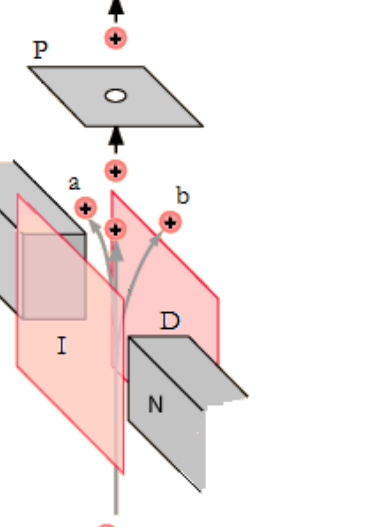
Topic: Electromagnetism Metodi: Lorentz Force Analysis, Electric Potential Method Competenze: Physical Reasoning Objects: Point Charge, Capacitor Fonte: Testo (PDF) — p.5
PT17. Il Dr. Arturo U. Illia
Albert Einstein College Mar del Plata, Buenos Aires.
Selezionando nuclei di elio. I nuclei di elio avanzano (assi di e e positivi), in un dispositivo di selezione delle cariche, come indicato nella figura, verso un sistema costituito da due schede parallele caricate (I e D) generando un campo elettrico di 50.000 N/C tra di essi e due pezzi polari (N e S), con un campo magnetico uniforme e pari a 0,5 T tra loro. Alcuni dei nuclei Seguono un percorso rettilineo con velocità v0 e passano Per un foro nella scheda P, dopo 5 cm arrivano senza velocità alla scheda Q. Datino: 4 2He ,𝑚𝑛≅𝑚𝑝= 1,67. 10−27𝑘𝑔, 𝑞𝑝= 1,6. 10−19𝐶 a) Graficare tutte le dimensioni vettoriali che agiscono
- per i carichi che attraversano il sistema delle plache - Poli. b) Calcolare la velocità dei carichi in movimento seguendo la retta via. c) Indicare se la velocità dei nuclei a e b è maggiore inferiore o uguale a v0. giustifica la tua risposta. d) Determina il raggio di rotazione dei nuclei che avanzano per la linea retta se si cancella il campo elettrico tra
- Le targhe. e) Calcolare l’accelerazione che ferma i nuclei. f) Determina la differenza di potenziale tra le schede P e Q, indicare la polarità delle stesse.
Topic: Electromagnetism Metodi: Lorentz Force Analysis, Electric Potential Method Competenze: Physical Reasoning Objects: Point Charge, Capacitor Fonte: Testo (PDF) — p.5
PT17. National College Dr. - Arthur U. Illia
Albert Einstein College . The city of Mar del Plata, Buenos Aires.
Selecting helium nuclei. Helium nuclei move forward (positive and y axes), in a The load selector as shown in the figure, towards a system consisting of two parallel plates loaded (I and D) generating an electric field of 50,000 N/C between them and two polar pieces (N and S), with a magnetic field uniform and equal to 0,5 T between them. Some of the cores Follow a straight path with velocity v0 and pass. through a hole in the P plate, after 5 cm they arrive No speed to the Q plate. The following data are available: 2He ,𝑚𝑛≅𝑚𝑝= 1,67. 10−27𝑘𝑔, 𝑞𝑝= 1,6. 10−19𝐶 (a) Graph all the vector magnitudes acting. The loads passing through the plate system The poles. (b) Calculate the speed of the loads moving Following the right path. (c) Indicate whether the speed of the cores a and b is greater less than or equal to v0. Justify your answer. (d) Determine the radius of rotation of the moving nuclei. In the case of a power failure, the electric field is switched off in the right direction. The plates. (e) Calculate the acceleration that stops the cores. (f) Determine the potential difference between P-plates and Q, indicate the polarity of the same.
Topic: Electromagnetism Metodi: Lorentz Force Analysis, Electric Potential Method Competenze: Physical Reasoning Objects: Point Charge, Capacitor Fonte: Testo (PDF) — p.5
PT18. Colegio Nacional Dr. Arturo U. Illia
Colegio Albert Einstein Mar del Plata, Buenos Aires.
Calefaccionando una cabaña. Estamos en invierno y se nos pide que calculemos el tiempo que tardaremos encalentar una pequeña cabaña. Suponga que la misma es un prisma rectangular de 7,00 m x 5,00m x 2,50 m de altura, que tiene una puerta de 1,20 m. 2,20 m enel medio de una de las paredes y dos ventanas de 2,00m. 1,40 m en las otras dos paredes, quedando una de las paredes sin aberturas. Considere que las paredes, el piso y el techo, así como las aberturas son completamente aislantes y su calor específico es nulo. Dispone de un calefactor de 12000 cal/h. El calefactor tiene un diseño que recircula el aire de forma tal que la temperatura es homogénea en toda la cabaña de forma inmediata. Suponga que la cabaña ha estado abandonada y comienza a calentarse, en medio de una ola polar que mantiene durante una semana la temperatura exterior en 2 ºC.
a) Calcule la masa de aire presente en la cabaña que se considera aislada si la densidad del aire es de 1 kg/m3
OAF 2015 - 51 b) Calcule el tiempo que tardará en calentar la habitación hasta una temperatura de 20ºC si el calor específico del aire es de 240 cal/ºC kg. Si no hay pérdidas de ningún tipo.
c) El dispositivo tiene un termómetro que permite medir la temperatura del interior y se obtiene la siguiente tabla. Como puede observarse la tasa de calentamiento es menor a la esperada. Tiempo ( horas) 0 12 24 36 48 60 Temperatura (ºC) 2,0 7,8 12,4 15,9 18,8 21,2
Realice un gráfico de la temperatura real de la cabaña en función del tiempo y obtenga el tiempo que deberá mantenerse prendido el calefactor para alcanzar una temperatura de 20ºC.
d) Calcule explicando los cálculos realizados como obtendría a partir de los datos, la cantidad de calor perdida en función del tiempo y complete la siguiente tabla:
Tiempo( horas)
Calor
entregado
por el calefactor
Calor perdido
Calor perdido/hora
e) Si se sabe que el calor perdido por hora (Δ Q /Δ t) depende de la superficie en contacto con el exterior (A), del espesor del material de contacto entre el exterior y el interior (d), la diferencia de temperatura entre el interior (T) y el exterior (Te) a través de la siguiente expresión:
∆𝑄 ∆ 𝑡= 𝑘𝐴 𝑑(𝑇−𝑇𝑒)
Grafique ΔQ /Δ t en función de T y obtenga el valor de k suponiendo que toda la pérdida se produce por las aberturas que tiene 10 cm de espesor.
Topic: Thermodynamics Metodi: First Law of Thermodynamics, Curve Fitting Competenze: Physical Reasoning, Experimental Data Analysis Objects: Gas Fonte: Testo (PDF) — p.5
PT18. Il Dr. Arturo U. Illia
Albert Einstein College Mar del Plata, Buenos Aires.
- Caldazione di una cabina. Siamo in inverno e ci viene chiesto di calcolare il tempo che ci vorrà per riscaldare una piccola cabina. Supponiamo che sia un prisma rettangolare di 7.00 m x 5,00 m x 2,50 m di altezza, che ha una porta di 1,20 m. 2,20 m nel mezzo di una di le pareti e due finestre di 2,00 metri. 1,40 metri sulle altre due pareti, restando una di pareti senza aperture. Considera che i muri, il pavimento e il tetto, così come le Le aperture sono completamente isolanti e il loro calore specifico è zero. Ha un’altra. caldaio a 12000 cal/h. Il riscaldatore è progettato per recircolare l’aria in modo tale. che la temperatura è immediatamente uniforme in tutta la cabina. Supponiamo che La cabina è stata abbandonata e si sta riscaldando, in mezzo a un’onda polare. che mantiene la temperatura esterna a 2 oC per una settimana.
a) Calcolare la massa di aria presente nella cabina che è considerata isolata se la densità dell’aria è di 1 kg/m3
OAF 2015 - 51 b) Calcolare il tempo necessario per riscaldare la stanza a una temperatura di 20 °C se il calore specifico dell’aria è di 240 cal/oC kg. Se non ci sono perdite di
- Non è un tipo.
c) Il dispositivo ha un termometro che permette di misurare la temperatura interna e si si ottiene la tabella seguente. Come si può vedere il tasso di riscaldamento è meno di quanto si aspettasse. Tempo (orari) 0 12 24 36 48 60 Temperatura (oC) 2,0 7,8 12,4 15,9 18,8 21,2
Sfrutta il grafico della temperatura reale della cabina in base al tempo e ottieni il tempo che il riscaldatore deve essere tenuto acceso per raggiungere una temperatura di 20ºC.
(d) Calcolare spiegando i calcoli effettuati come si otterrebbe dai dati, quantità di calore perso in funzione del tempo e completa la tabella seguente:
Tempo (orari) Calore consegnato per il riscaldatore Calore perso Calore perso/ora
e) Se si sa che il calore perso per ora (Δ Q /Δ t) dipende dalla superficie in di spessore del materiale di contatto tra l’esterno e l’interno (d), la differenza di temperatura tra l’interno (T) e l’esterno (Te) a attraverso la seguente espressione:
∆𝑄 ∆ 𝑡= 𝑘𝐴 𝑑(𝑇−𝑇𝑒)
Grafica ΔQ /Δ t in funzione di T e ottieni il valore di k supponendo che l’intera perdita si produce per le aperture di 10 cm di spessore.
Topic: Thermodynamics Metodi: First Law of Thermodynamics, Curve Fitting Competenze: Physical Reasoning, Experimental Data Analysis Objects: Gas Fonte: Testo (PDF) — p.5
PT18. National College Dr. - Arthur U. Illia
Albert Einstein College . The city of Mar del Plata, Buenos Aires.
Heating up a cabin. It ‘s winter and we ‘re being asked to calculate how long it will take to warm up . A little cabin. Suppose it’s a rectangular prism of 7.00 m x. 5,00m x 2,50m high, which has a 1.20m door. 2.20 m in the middle of a The walls and two windows are two metres high. 1.40 m on the other two walls, leaving one from the walls without openings. Consider the walls, floor and ceiling as well as the The openings are completely insulating and their specific heat is zero. It has a Heating system with a capacity of 12000 cal/h. The heater is designed to circulate air in such a way that The temperature is uniform throughout the cabin immediately. Suppose that The cabin has been abandoned and it’s starting to heat up, in the middle of a polar wave. which maintains the outside temperature at 2 oC for one week.
(a) Calculate the air mass present in the cabin which is considered to be isolated if the cabin is the air density is 1 kg/m3
The Commission shall adopt delegated acts in accordance with Article 21 of the Financial Regulation. (b) Calculate the time it will take to heat the room to a temperature of 20oC if the specific air temperature is 240 cal/oC kg. If there are no losses of No one.
(c) The device has a thermometer which allows the measurement of the temperature inside and is You get the next table. As you can see the rate of warming is less than expected. Time (hours) 0 12 24 36 48 60 The temperature (oC) 2,0 7,8 12,4 15,9 18,8 21,2
Make a chart of the actual temperature of the cabin based on the weather and get the The heater must be kept on for a time to reach a temperature of 20ºC.
(d) Calculate by explaining the calculations made as you would get from the data, the the amount of heat lost over time and complete the following table:
Time (hours) Heat . delivered by the heater Lost heat . Heat lost/hour
(e) If it is known that the heat lost per hour (Δ Q /Δ t) depends on the surface in contact with the outside (A), the thickness of the contact material between the outside and the interior (d), the temperature difference between the interior (T) and the exterior (Te) to by the following expression:
∆𝑄 ∆ 𝑡= 𝑘𝐴 𝑑(𝑇−𝑇𝑒)
Graph ΔQ /Δ t as a function of T and get the value of k assuming that all loss It is produced by openings that are 10 cm thick.
Topic: Thermodynamics Metodi: First Law of Thermodynamics, Curve Fitting Competenze: Physical Reasoning, Experimental Data Analysis Objects: Gas Fonte: Testo (PDF) — p.5
PT19. Instituto Educativo Génesis Posadas, Misiones.
Se tiene un sistema integrado de la Fig. en el cuál se desea hallar la fuerza F que permite el movimiento del sistema completo y lograr deslizar así el bloque del plano inclinado con velocidad constante, permitiendo dicho movimiento mediante el sistema de poleas. Las poleas 1-2-3-4 son móviles y la polea 5 es fija, considerando a todas las poleas ideales.
Nota: Tener en cuenta que el sistema se mueve con velocidad constante, por lo tanto su aceleración es cero, implicando así que la fuerza resustante sea cero; se dice que el sistema se encuentra en
52 - OAF 2015 equilibrio dinámico. En el plano inclinado considerar que la fuerza de fricción es cero. Por otra parte, si las poleas son ideales, entonces las mismas son consideradas sin masa y sin roce, por lo cuál la función de las poleas solo es cambiar la dirección de la tensión en la cuerda. Considerar a la barra homogénea sin peso, y es allí la fuerza (F) que se debe calcular y permite mover el sistema completo.
Hallar: a) Graficar : a.1) Diagrama de cuerpo libre de las poleas. a.2) Diagrama de cuerpo libre del bloque ubicado en el plano inclinado. b) Hallar la fuerza necesaria para mover el bloque ubicado en el plano inclinado. c) Hallar la fuerza necesaria para mover el sistema completo (ubicado en el extremo derecho de la barra homogénea).
Topic: Newtonian Mechanics, Rigid Body Statics Metodi: Free-Body Diagram, Conservation Laws Competenze: Physical Reasoning Objects: Pulley, Block, Inclined Plane Fonte: Testo (PDF) — p.5
PT19. Istituto Educativo Genesi Posate, Missioni.
Ha un sistema integrato di Fig. in cui si desidera trovare la forza F che permette il Movimento del sistema completo e conseguimento di un slitto così il blocco del piano inclinato con velocità La velocità di movimento è costante, consentendo tale movimento mediante il sistema di pole. I polemici 1-2-3-4 sono mobili e il polemice 5 è fisso. considerando tutte le polemiche ideali.
Nota: Si noti che il sistema si muove con velocità costante, quindi la sua accelerazione è zero, implicando così che la forza resistente sia Zero; si dice che il sistema si trova in
52 - OAF 2015 equilibrio dinamico. Sul piano inclinato considerare che la forza di attrito è zero. D’altra parte, se le polea sono ideali, allora le polea sono considerate senza massa. e senza rottura, quindi la funzione dei polemici è solo cambiare la direzione della tensione.
- La corda. Considerare la barra omogenea senza peso, ed è lì che la forza (F) deve essere calcolata e permette di spostare l’intero sistema.
Trovare: a) Grafica: a.1) Diagramma di corpo libero da polemiche. a.2) Diagramma di corpo libero del blocco situato sul piano inclinato. b) Trovare la forza necessaria per muovere il blocco situato sul piano inclinato. c) Trovare la forza necessaria per muovere l’intero sistema (situato all’estremità) diritto della barra omogenea).
Topic: Newtonian Mechanics, Rigid Body Statics Metodi: Free-Body Diagram, Conservation Laws Competenze: Physical Reasoning Objects: Pulley, Block, Inclined Plane Fonte: Testo (PDF) — p.5
PT19. The Genesis Education Institute The inn, the missions.
You have an integrated system of Fig. In which The force F is desired to be found which allows the Moving the entire system and getting sliding So the block of plane tilted with speed The same is true for the the pulley system. The pulleys 1-2-3-4 are mobile and the pulley 5 is fixed. Considering all the ideal pulleys.
Note: Note that the system moves with constant speed, therefore its acceleration is The resulting force is zero, thus implying that the resistive force is The system is said to be located at
The Commission shall adopt delegated acts in accordance with Article 21 of this Regulation. The dynamic balance. On the slanted plane consider that the friction force is zero. On the other hand, if pulleys are ideal, then they are considered massless. And without brushing, so the function of the pulleys is just to change the direction of the voltage. on the rope. Consider the homogeneous weightless bar, and that’s where the force (F) is to be calculated and It allows the entire system to move.
Find out: (a) Drawing: a.1) Body diagram free of pulleys. a.2) Free-body diagram of the block located on the slope. (b) Find the force necessary to move the block located on the slope. (c) Find the force needed to move the entire system (located at the end) right of the homogeneous bar).
Topic: Newtonian Mechanics, Rigid Body Statics Metodi: Free-Body Diagram, Conservation Laws Competenze: Physical Reasoning Objects: Pulley, Block, Inclined Plane Fonte: Testo (PDF) — p.5
PT20. Instituto Educativo Génesis Posadas, Misiones.
a) La presión P para una masa determinada de un gas ideal con comportamiento
isocórico, es directamente proporcional a la temperatura de dicho gas, esto es:
P α T.
Indicar la relación que existe entre:
a.1) La presión P y el volumen V, cuando el gas tiene comportamiento
isotérmico.
a.2) El volumen V y la temperatura T, cuando el gas tiene comportamiento
isobárico.
b) El gas de comportamiento ideal se mantiene en un recipiente con un pistón móvil.
La presión del gas es P1, su volumen V1 y la temperatura T1.
El recipiente es calentado a V=constante hasta una presión P2, y temperatura T1’.
Luego es calentado a P=constante hasta un volumen V2 y temperatura T2.
Esquematizar la situación e indicar la relación entre:
b.1) P1, P2, T1 y T1’
b.2) V1, V2, T1’ y T2
c) Con lo que se obtuvo en el punto anterior, demostrar que para un gas ideal se
cumple:
P. V = N. T, siendo N = cte.
d) Para un gas ideal que contiene 5 moles, y sus presiones y volúmenes son:
P1 = 2 atm, P2 = 5 atm, V1 = 10 litros y V2 = 15 litros.
Calcular T1 y T2.
Topic: Thermodynamics, Kinetic Theory Metodi: Ideal Gas Law Competenze: Physical Reasoning Objects: Gas, Piston Fonte: Testo (PDF) — p.5
PT20. Istituto Educativo Genesi Posate, Missioni.
a) La pressione P per una determinata massa di un gas ideale con comportamento Isocorico, è direttamente proporzionale alla temperatura di tale gas, cioè: P α T. Indicare il rapporto tra: a.1) Presione P e volume V, quando il gas ha un comportamento Isotermico. a.2) Volume V e temperatura T, quando il gas ha un comportamento Isobarico. b) Il gas di comportamento ideale è conservato in un recipiente con pistone mobile. La pressione del gas è P1, il volume V1 e la temperatura T1. Il recipiente è riscaldato a V=constante fino a una pressione P2, e temperatura T1. Poi viene riscaldato a P=constante fino a un volume V2 e temperatura T2. Squammatizzare la situazione e indicare il rapporto tra: b.1) P1, P2, T1 y T1’ b.2) V1, V2, T1’ y T2 (c) Con quanto ottenuto nel punto precedente, dimostrare che per un gas ideale si è si compie: P. V = N. T, essendo N = cte. d) Per un gas ideale contenente 5 mol, le sue pressioni e i suoi volumi sono: P1 = 2 atm, P2 = 5 atm, V1 = 10 litri e V2 = 15 litri. Calcolare T1 e T2.
Topic: Thermodynamics, Kinetic Theory Metodi: Ideal Gas Law Competenze: Physical Reasoning Objects: Gas, Piston Fonte: Testo (PDF) — p.5
PT20. The Genesis Education Institute The inn, the missions.
(a) The P-pressure for a given mass of an ideal gas with behaviour isocoric, is directly proportional to the temperature of that gas, i.e.: P α T. Indicate the relationship between: (a.1) Pressure P and volume V, when the gas behaves isothermal. (a.2) Volume V and temperature T, when the gas behaves isobaric. (b) The ideal behaviour gas is kept in a container with a moving piston. The pressure of the gas is P1, its volume V1 and the temperature T1. The container is heated to V=constant to a pressure of P2, and temperature T1. It is then heated to P=constant to a volume V2 and temperature T2. Sketch the situation and indicate the relationship between: b.1) P1, P2, T1 y T1’ b.2) V1, V2, T1’ y T2 (c) By the above, prove that for an ideal gas it is comply with: P. V = N. T, where N = cte. (d) For an ideal gas containing 5 moles, its pressures and volumes are: The following conditions shall apply: Calculate T1 and T2.
Topic: Thermodynamics, Kinetic Theory Metodi: Ideal Gas Law Competenze: Physical Reasoning Objects: Gas, Piston Fonte: Testo (PDF) — p.5
PT21. Instituto Educativo Génesis Posadas, Misiones.
Un bloque de 10 kg se libera desde el punto A. considerar que la pista no tiene fricción excepto en el tramo B-C que tiene una longitud de 6 metros. El bloque golpea el resorte en el extremo opuesto con 2250 N/m de constante de fuerza y comprime el resorte 0,3 m desde su posición de equilibrio antes de momentáneamente llegar al reposo.
OAF 2015 - 53 Se desea determinar: a) Calcular con que energía llega el bloque al punto B. b) Determinar el coeficiente de fricción cinética entre el bloque y la superficie rugosa B-C. Calcular con que velocidad toca el bloque al resorte antes de comprimirlo.
Topic: Conservation of Energy Metodi: Energy Conservation Method, Hooke’s Law Competenze: Physical Reasoning Objects: Block, Spring Fonte: Testo (PDF) — p.5
PT21. Istituto Educativo Genesi Posate, Missioni.
Un blocco di 10 kg è libera dal punto A. Considerare che il tracciato non ha frizione eccetto nel Stramo B-C che ha un lunghezza di 6 metri. El Blocco colpisce la primavera in l’estremità opposta con 2250 N/m di costante forza e compressa la sorgente 0,3 m dalla sua posizione di equilibrio prima di arrivare al riposo.
OAF 2015 - 53 Si desidera determinare: a) Calcolare con quale energia il blocco arriva al punto B. b) Determinare il coefficiente di frizione cinetica tra il blocco e la superficie rugosa B-C. Calcolare la velocità con cui il blocco tocca la sorgente prima di comprimere.
Topic: Conservation of Energy Metodi: Energy Conservation Method, Hooke’s Law Competenze: Physical Reasoning Objects: Block, Spring Fonte: Testo (PDF) — p.5
PT21. The Genesis Education Institute The inn, the missions.
A block of 10 kg is Releases from point A. Consider that the lead is not It has friction except in the B-C section that has a length of 6 meters. El Block hits the spring in The opposite end with 2250 N/m of constant force and compress the spring 0,3 m from its position of balance before momentarily reaching rest.
The Commission shall adopt delegated acts in accordance with Article 21 of this Regulation. The following should be determined: (a) Calculate the energy with which the block reaches point B. (b) Determine the kinetic friction coefficient between the block and the rough surface B-C. Calculate how fast the block hits the spring before compressing it.
Topic: Conservation of Energy Metodi: Energy Conservation Method, Hooke’s Law Competenze: Physical Reasoning Objects: Block, Spring Fonte: Testo (PDF) — p.5
PT22. Escuelas Técnicas Raggio Ciudad de Buenos Aires.
Un recipiente, que puede considerarse adiabático (no intercambia calor con el medio ambiente), Contiene 1 Kg de agua a temperatura ambiente. Un termómetro de mercurio, que se encuentra sumergido en el agua, indica que la temperatura del sistema es de 27°C. En el recipiente se vierte agua en estado de ebullición (100°C) y, cuando la temperatura del agua se estabiliza, el Termómetro indica que la temperatura del sistema es de 50°C. La transferencia de calor al recipiente puede considerarse despreciable. a) ¿Cuál es la masa de agua en estado de ebullición que se agregó al recipiente? Tenga en cuenta que el calor específico del agua es cagua = 1 cal/(°C g), y la masa de agua equivalente para el termómetro de mercurio es meq=10 g. b) Ahora se extraen de un congelador tres cubitos de hielo, de 20 g de masa cada uno y a una temperatura de -20°C, y se agregan al recipiente. Calcular la temperatura que indicará el termómetro cuando el sistema alcance el equilibrio. Datos: Calor latente de fusión del hielo hielo = 80 cal/g,
Calor específico del hielo: chielo = 0.53cal/(°C g)
Topic: Thermodynamics Metodi: First Law of Thermodynamics Competenze: Physical Reasoning Objects: Calorimeter Fonte: Testo (PDF) — p.5
PT22. Scuole tecniche Raggio Città di Buenos Aires.
Un recipiente, che può essere considerato adiabatico (non scambiano calore con il mezzo ambiente), Contiene 1 kg di acqua a temperatura ambiente. Un termometro di mercurio, che si se si trova immerso nell’acqua, indica che la temperatura del sistema è 27°C. En el il recipiente è versato acqua in stato di ebollizione (100°C) e, quando la temperatura del Se l’acqua si stabilizza, il termometro indica che la temperatura del sistema è 50°C. La il trasferimento di calore nel recipiente può essere considerato sconsiderato. a) Qual è la massa di acqua in stato di ebollizione che è stata aggiunta al recipiente? Si noti che il calore specifico dell’acqua è acqua = 1 cal/(°C g), e la massa di acqua equivalente per il termometro di mercurio è meq=10 g. b) Ora si tirano fuori da un congelatore tre cubetti di ghiaccio, di 20 g di massa ciascuno e a una temperatura di -20°C, e vengono aggiunte al contenitore. Calcolare la temperatura che indicherà il termometro quando il sistema raggiunge l’equilibrio. Data: Calore latente di fusione del ghiaccio ghiaccio = 80 cal/g,
Calore specifico del ghiaccio: ghiaccio = 0,53 cal/(°C g)
Topic: Thermodynamics Metodi: First Law of Thermodynamics Competenze: Physical Reasoning Objects: Calorimeter Fonte: Testo (PDF) — p.5
PT22. Raggio Technical Schools City of Buenos Aires.
A container, which may be considered adiabatic (does not exchange heat with the medium Environment), It contains 1 kg of water at room temperature. A mercury thermometer, which is If the system is submerged in water, it indicates that the system temperature is 27°C. En el The water is poured into the boiling water (100°C) and, when the temperature of the water is water is stabilized, the thermometer indicates that the system temperature is 50°C. La heat transfer to the container may be considered negligible. (a) What is the boiling water mass added to the container? Note that the specific heat of water is water = 1 cal/(°C g), and the mass water equivalent for the mercury thermometer is meq=10 g. (b) Three ice cubes of 20 g of mass are now extracted from a freezer. and at a temperature of -20°C, and added to the container. Calculate the temperature which will indicate the thermometer when the system reaches equilibrium. Data: Latent heat of melting of ice ice = 80 cal/g,
The heat specific to the ice: chilled = 0,53 cal/(°C g)
Topic: Thermodynamics Metodi: First Law of Thermodynamics Competenze: Physical Reasoning Objects: Calorimeter Fonte: Testo (PDF) — p.5
PT23. Escuelas Técnicas Raggio Ciudad de Buenos Aires.
Una pelota de tenis tiene una masa de 70 g y se aproxima a una raqueta con una rapidez
de 6 m.s-1 . La pelota rebota y regresa por el mismo camino por donde venía con una
rapidez de 5 m.s-1. La pelota está en contacto con la raqueta durante 0.2 s. Calcular:
A) El momento final e inicial de la pelota; a) el impulso transmitido a la pelota; b) la
fuerza promedio proporcionada por la raqueta a la pelota.
B) Dos pelotas de masa M y 2M se aproximan, una hacia la otra, en direcciones
opuestas con la misma rapidez U sobre el eje horizontal y tienen una colisión
elástica. ¿ Cuáles son las velocidades de ambas masas luego de la colisión ?
Topic: Conservation of Momentum Metodi: Impulse-Momentum Theorem, Conservation of Momentum Competenze: Physical Reasoning Objects: Ball Fonte: Testo (PDF) — p.5
PT23. Scuole tecniche Raggio Città di Buenos Aires.
Una palla di tennis ha una massa di 70 g e si avvicina ad una racket in fretta. de 6 m.s-1 . La palla rimbalza e torna sullo stesso sentiero da cui veniva con una . velocità di 5 m.s.-1. La palla è in contatto con la racket per 0,2 secondi. Calcolare: A) Il momento finale e iniziale della palla; a) l’impulso trasmesso alla palla; b) la forza media fornita dalla racket alla palla. B) Due palle di massa M e 2M si avvicinano, una verso l’altra, in direzioni Opposte alla stessa velocità U sull’asse orizzontale e hanno un colpiscio
- Elastico. Qual è la velocità di entrambe le masse dopo la collisione ?
Topic: Conservation of Momentum Metodi: Impulse-Momentum Theorem, Conservation of Momentum Competenze: Physical Reasoning Objects: Ball Fonte: Testo (PDF) — p.5
PT23. Raggio Technical Schools City of Buenos Aires.
A tennis ball weighs 70 g and approaches a racket at a rapid rate. de 6 m.s-1 . The ball bounces back and back the same way it came with a . speed of 5 m.s.-1. The ball is in contact with the racket for 0.2 seconds. Calculation: (a) the moment of the final and initial play of the ball; (a) the momentum transmitted to the ball; (b) the momentum of the ball. average force provided by the racket to the ball. B) Two balls of mass M and 2M approach, one towards the other, in the direction They are opposite at the same speed U over the horizontal axis and have a collision. It’s rubbery. What are the speeds of both masses after the collision ?
Topic: Conservation of Momentum Metodi: Impulse-Momentum Theorem, Conservation of Momentum Competenze: Physical Reasoning Objects: Ball Fonte: Testo (PDF) — p.5
PT24. Escuelas Técnicas Raggio Ciudad de Buenos Aires.
Un pequeño trineo cuya masa es de 10 kg, se encuentra inicialmente en reposo sobre una plataforma plana cubierta de hielo, en el que µ = 0,05. Un niño que pesa 40 kgf, empuja el trineo aplicándole una fuerza horizontal constante de 30 N durante 3 segundos y luego sube en él. El trineo recorre un total de 30 m sobre la plataforma, para caer luego por una pista descendente con nieve, de 35° de pendiente y 40 m de largo en el que µ = 0,1 (suponer que en el recorrido de esta pista los cuerpos no ―vuelan‖). Al finalizar este plano inclinado, empalman con otra superficie horizontal, cuya longitud es tal que permite que por rozamiento, una velocidad al final sea el 90 % de la que tenía al pie del plano inclinado, y posee un µ = 0,25. Los cuerpos impactan finalmente contra un resorte comprimiéndolo 0,5 m, siendo para este tramo µ = 0,3. Calcular:
- ¿Cuál es la aceleración que le imprime el niño al trineo?
- ¿Con qué velocidad inicia el descenso?
- ¿Cuál es el valor de la fuerza de roce 2 m antes de iniciar el descenso?
54 - OAF 2015
4) ¿Cuál es el valor de la fuerza neta o resultante, que acelera al trineo durante el
descenso?
5) ¿Cuál es el trabajo de la fuerza de roce en este trayecto? ¿Qué cantidad de hielo se
transforma en agua en la pendiente, debajo del trineo?
6) ¿Con qué velocidad llega al pie del plano? Justificar.
7) ¿Cuál es la distancia horizontal recorrida antes de comprimir el resorte?
8) ¿Qué trabajo de rozamiento se realiza, en el trayecto que se comprime el resorte?
9) Calcular la constante elástica del resorte.
10) ¿Con qué velocidad son empujados, niño y trineo por el resorte, cuando se
descomprime éste?
Topic: Newtonian Mechanics, Conservation of Energy Metodi: Free-Body Diagram, Energy Conservation Method Competenze: Physical Reasoning Objects: Cart, Spring, Inclined Plane Fonte: Testo (PDF) — p.5
PT24. Scuole tecniche Raggio Città di Buenos Aires.
Un piccolo scivolo di 10 kg è inizialmente a riposo su una piattaforma piana ricoperta di ghiaccio, in cui μ = 0,05. Un bambino che pesa 40 kgf, spinge il treno applicandone una forza orizzontale costante di 30 N per 3 secondi e poi salire su di lui. Il bagliotto percorre un totale di 30 metri sopra la piattaforma, per cadere dopo per una pista discendente con neve, di 35° di pendenza e di 40 m di lunghezza in cui μ = 0,1 (supponendo che nel percorso di questa pista i corpi non “volano”). Alla fine di questo piatto inclinato, incollati con un’altra superficie orizzontale, la cui lunghezza è tale da consentire che per il rossaggio, una velocità alla fine è il 90% di quella che avevo al piano. inclinato, e ha un μ = 0,25. I corpi finalmente colpiscono una sorgente compressione di 0,5 m, per questo tramo μ = 0,3. Calcolare:
- Qual è l’accelerazione che il bambino impone al sciatto?
- A che velocità inizia la discesa?
- Qual è il valore della forza di rottura di 2 m prima di iniziare la discesa?
54 - OAF 2015 4) Qual è il valore della forza netta o risultante che accelera il schizzo durante il
- Scesa?
- Qual è il lavoro della forza di frattura in questo percorso? Quanta ghiaccio è? si trasforma in acqua sulla pendice, sotto lo scioglimento?
- A che velocità arriva al piano? Giustificare.
- Qual è la distanza orizzontale percorsa prima di comprimere la scorsa?
- Che lavoro di rasatura si fa nel percorso di compressione della primavera?
- Calcolare la costante elastica della primavera.
- A che velocità sono spinti, bambino e scivolano per la primavera, quando si
- Questo si scongiura?
Topic: Newtonian Mechanics, Conservation of Energy Metodi: Free-Body Diagram, Energy Conservation Method Competenze: Physical Reasoning Objects: Cart, Spring, Inclined Plane Fonte: Testo (PDF) — p.5
PT24. Raggio Technical Schools City of Buenos Aires.
A small sled with a mass of 10 kg is initially resting on the a flat plate covered with ice, on which μ = 0,05. A boy weighing 40 kgf, Push the slide by applying a constant horizontal force of 30 N for 3 seconds And then he goes up on it. The sled runs a total of 30 m above the platform, to fall later. for a snow-covered slope down track of 35° slope and 40 m in length where μ = 0.1 (assuming that on the course of this runway the bodies do not “fly”). At the end of this one . slanted plane, wrapped with another horizontal surface, the length of which is such as to permit That by friction, a speed at the end is 90 percent of what you had at the bottom of the plane. slope, and has a μ = 0,25. The bodies finally collide with a spring . compressing it to 0,5 m, for this section μ = 0,3. Calculation:
- What is the child’s impression of speed on the sled?
- How fast does the descent begin?
- What is the value of the brushing force of 2 m before starting the descent?
The Commission shall adopt delegated acts in accordance with Article 21 of this Regulation. 4) What is the value of the net or resulting force, which accelerates the slide during the
- The descent?
- What is the work of the brushing force in this process? How much ice is it? Turns into water on the slope, under the sleigh?
- How fast does it reach the bottom of the plane? Justify it.
- What is the horizontal distance travelled before compressing the spring?
- What grind is done in the process of compressing the spring?
- Calculate the spring elastic constant.
- How fast are you pushed, boy and sleigh through the spring, when you are decompress this one?
Topic: Newtonian Mechanics, Conservation of Energy Metodi: Free-Body Diagram, Energy Conservation Method Competenze: Physical Reasoning Objects: Cart, Spring, Inclined Plane Fonte: Testo (PDF) — p.5
PT25. EPES Nro. 59 Prof. Pabla Idoyaga Ciudad de Formosa.
En una feria, se gana una jirafa de peluche lanzando una moneda a un platito, el cual está en una repisa más arriba en que la moneda abandona la mano y a una distancia horizontal de 2,1 m de ese punto (grafico 1). Si lanza la moneda con velocidad de 6,4 m/s, 60° sobre la horizontal, caerá en el platito. Puede despreciarse la resistencia del aire.
a) Elija un sistema de coordenadas e indíquelo claramente en el dibujo. En base al sistema elegido por Usted, escriba la aceleración, velocidad y posición de la moneda en función del tiempo. b) Determinar la altura máxima alcanzada por la moneda. c) Determinar la velocidad de la moneda en el punto más alto de su trayectoria. d) ¿A qué altura está la repisa sobre el punto de partida de la moneda? e) ¿Qué componente vertical tiene la velocidad de la moneda justo antes de caer en el platito?
Topic: Newtonian Mechanics Metodi: Kinematic Equations, Vector Decomposition Competenze: Physical Reasoning Objects: Projectile Fonte: Testo (PDF) — p.5
PT25. - Non lo so. 59 Prof. Pabla Idoyaga Città di Formosa.
In una fiera, si vince una giraffa di peluche lanciando una moneta su un piatto, che E ’ su una scaffale più alta che la La moneta abbandona la mano e a distanza orizzontale di 2,1 m da quel punto (grafico 1). Se lancia la moneta a velocità di 6,4 m/s, 60° sullo strato orizzontale, cadrà sul
- Oh, è tutto buono. Si può disprezzare la resistenza del aria.
a) Scegli un sistema di coordinate e indica chiaramente il sistema nel disegno. In base al sistema scelto da te, scrivi l’accelerazione, la velocità e la posizione della valuta a seconda del tempo. b) Determinare la massima altezza raggiunta dalla moneta. c) Determinare la velocità della moneta al punto più alto della sua traccia. d) A che altezza si trova la rassegna sul punto di partenza della moneta? e) Qual è il componente verticale che ha la velocità della moneta appena prima di cadere sul mercato?
- Un po’ di piatto?
Topic: Newtonian Mechanics Metodi: Kinematic Equations, Vector Decomposition Competenze: Physical Reasoning Objects: Projectile Fonte: Testo (PDF) — p.5
PT25. The Commission shall adopt implementing acts in accordance with Article 21 of this Regulation. 59 Prof. Idoyaga is a young man . The city of Formosa.
At a fair, you win a teddy bear giraffe. Throwing a coin at a plate, which It ‘s on a shelf higher than the . Money leaves the hand and a distance . horizontal of 2.1 m from that point (Chart 1). If you throw the coin at a speed of 6.4 m/s, 60° above the horizontal, will fall into the It’s a little bit. The resistance of the Air.
(a) Choose a coordinate system and clearly indicate it in the drawing. Based on the system chosen by you, type the acceleration, speed and position of the currency depending on the time. (b) Determine the maximum height reached by the currency. (c) Determine the speed of the currency at the highest point of its trajectory. (d) What is the height of the overlay on the currency’s starting point? (e) What vertical component has the currency’s speed just before it falls on the What’s that?
Topic: Newtonian Mechanics Metodi: Kinematic Equations, Vector Decomposition Competenze: Physical Reasoning Objects: Projectile Fonte: Testo (PDF) — p.5
PT26. EPES Nro. 59 Prof. Pabla Idoyaga Ciudad de Formosa.
Una piedra de 15 kg baja deslizándose por una colina nevada, partiendo del puinto A con una rapidez de 10 m/s. no hay friccion en la colina entre los puntos A y B, pero si en el terreno plano en la base, entre B y la pared. Después de entrar en la regio áspera, la piedra recorre 100 m y choca con un resorte muy largo y ligero cuya constante de fuerza es de 2 N/m. los coeficientes de friccion cinética y estática entre la piedra y el suelo horizontal son de 0,20 y 0,80, respectivamente.
a) ¿Qué rapidez tiene la piedra al llegar al punto B? b) ¿Qué distancia comprimirá la piedra el resorte? c) ¿La piedra se moverá luego de haber sido detenida por el resorte?
OAF 2015 - 55
Topic: Conservation of Energy Metodi: Energy Conservation Method, Hooke’s Law Competenze: Physical Reasoning Objects: Spring, Block Fonte: Testo (PDF) — p.5
PT26. - Non lo so. 59 Prof. Pabla Idoyaga Città di Formosa.
Una pietra di 15 kg in basso scivola per una collina nevosa, partendo dal punto A con una velocità di 10 m/s. Non c’è friczione sulla collina tra i punti A e B, ma se sul terreno piatto in base, tra B e il muro. Dopo aver entrato in Regio aspra, la pietra percorre 100 m e si scontrerà con una primavera molto lunga e leggera la cui costante di la forza è di 2 N/m. i coefficienti di attrito Cinetica e statica tra la pietra e il suolo I valori orizzontali sono di 0,20 e 0,80, rispettivamente.
a) Quanto veloce è la pietra quando arriva al punto B? b) A che distanza la pietra comprima la primavera? c) La pietra si muoverà dopo essere stata fermata dalla primavera?
OAF 2015 - 55
Topic: Conservation of Energy Metodi: Energy Conservation Method, Hooke’s Law Competenze: Physical Reasoning Objects: Spring, Block Fonte: Testo (PDF) — p.5
PT26. The Commission shall adopt implementing acts in accordance with Article 21 of this Regulation. 59 Prof. Idoyaga is a young man . The city of Formosa.
A 15kg stone down slipping by a Snow-covered hill, starting from A with a speed of 10 m/s. There ‘s no friction on the hill between . points A and B, but if on the flat ground in the Base, between B and the wall. After you get in the The stone runs 100 m and collides with A very long and light spring whose constant of force is 2 N/m. the friction coefficients kinetic and static between the stone and the ground horizontal are 0,20 and 0,80, respectively.
(a) How fast does the stone go to point B? (b) How far will the stone compress the spring? (c) Will the stone move after being stopped by the spring?
The following points shall be added:
Topic: Conservation of Energy Metodi: Energy Conservation Method, Hooke’s Law Competenze: Physical Reasoning Objects: Spring, Block Fonte: Testo (PDF) — p.5
PT27. EPES Nro. 59 Prof. Pabla Idoyaga Ciudad de Formosa.
Un trozo de 500 g de metal desconocido, que ha estado en agua durante varios minutos,
se deja caer rápidamente en un vaso de poliestireno aislante que contiene 1 kg de agua a
temperatura ambiente (20° C). Después de esperar y agitar suavemente durante 5
minutos, se observa que la temperatura del agua ha alcanzado un valor constante de
22° C.
a) Suponiendo que el vaso absorbe una cantidad de calor despreciable y que no se
pierde calor al entorno, ¿qé calor específico tiene el metal?
b) ¿Qué es más útil para almacenar calor, este metal o un peso igual de agua?
Explique.
Suponga que el calor absorbido por el vaso no es despreciable, ¿qué tipo de error tendría
el calor específico calculado en el apartado (a) (sería demasiado grande, demasiado
pequeño o correcto)? Explique.
Topic: Thermodynamics Metodi: First Law of Thermodynamics Competenze: Physical Reasoning Objects: Calorimeter Fonte: Testo (PDF) — p.5
PT27. - Non lo so. 59 Prof. Pabla Idoyaga Città di Formosa.
Un pezzo di metallo sconosciuto di 500 g, che è stato in acqua per diversi minuti. si scende rapidamente in un bicchiere di poliester isolante contenente 1 kg di acqua a temperatura ambiente (20° C). Dopo aver aspettato e agitato delicatamente per 5 Minuti, si osserva che la temperatura dell’acqua ha raggiunto un valore costante di 22° C. a) Supponendo che il bicchiere assorba una quantità di calore dispregiata e che non si perdono calore nell’ambiente, che calore specifico ha il metallo? b) Cosa è più utile per conservare il calore, questo metallo o un peso uguale all’acqua? Spiegami. Supponiamo che il calore assorbito dal bicchiere non sia scarsa, che tipo di errore avrebbe? la calore specifica calcolata in (a) (sarebbe troppo grande, troppo piccolo o corretto)? Spiegami.
Topic: Thermodynamics Metodi: First Law of Thermodynamics Competenze: Physical Reasoning Objects: Calorimeter Fonte: Testo (PDF) — p.5
PT27. The Commission shall adopt implementing acts in accordance with Article 21 of this Regulation. 59 Prof. Idoyaga is a young man . The city of Formosa.
A piece of 500 g of unknown metal, which has been in water for several minutes, is quickly dropped into an insulating polyester glass containing 1 kg of water. The temperature of the air is not less than ± 1 °C. After waiting and gently waving for 5 minutes, it is observed that the water temperature has reached a constant value of 22° C. (a) Assuming that the glass absorbs a negligible amount of heat and that it is not It loses heat to the environment, what specific heat does the metal have? (b) What is more useful for storing heat, this metal or an equal weight of water?
- Explain that. Suppose the heat absorbed by the glass is not despicable, what kind of mistake would it make? the specific heat calculated in paragraph (a) (would be too large, too large small or correct)? - Explain that.
Topic: Thermodynamics Metodi: First Law of Thermodynamics Competenze: Physical Reasoning Objects: Calorimeter Fonte: Testo (PDF) — p.5
PT28. Escuela Normal Superior Juan B. Alberdi San Miguel, Tucumán.
En la pista de la figura hay 2 bloques A y B, de masas 3 kg y 2 kg respectivamente, que pueden moverse con rozamiento despreciable salvo en el tramo CD de 1 m de longitud y cuyo µCD= 0,15.
a) Desde que altura deberá dejarse caer el bloque A para que pase por el punto E con la mínima velocidad, sin caerse de la pista. (Radio = 1m) b) Después de pasar por E can esa velocidad, se encuentra con el bloque B que estaba en reposo y se enganchan con que velocidad se moverán luego de engancharse? c) Se dirigen juntos, los bloques, hacia el resorte de constante elástica de K = 1800 N/m que longitud se comprimirá el resorte.
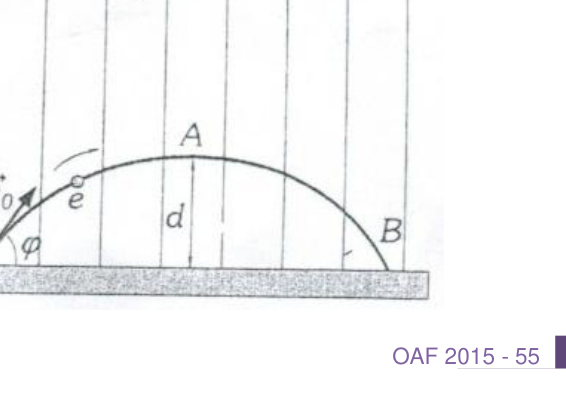
Topic: Conservation of Energy, Conservation of Momentum Metodi: Energy Conservation Method, Conservation of Momentum Competenze: Physical Reasoning Objects: Block, Spring Fonte: Testo (PDF) — p.5
PT28. Scuola Normale Superiore Juan B. Alberdi San Miguel, Tucumán.
Nella pista della figura sono presenti 2 blocchi A e B, rispettivamente di massa 3 kg e 2 kg, che possono muoversi con scarsa ruggine eccetto nel tramo CD di 1 m di lunghezza e di cui il μCD è 0,15.
a) Da che altezza deve essere abbassato il blocco A per passare attraverso il punto E con la velocità minima, senza cadere dal binario. (Radio = 1 m) b) Dopo aver superato E può quella velocità, si trova con il blocco B che Era a riposo e si accolgono a che velocità si muoveranno dopo
- Si accoppiano? c) Si dirigono insieme, i blocchi, verso la sorgente di costante elastica di K = 1800 N/m che lunghezza è compresa la molla.
Topic: Conservation of Energy, Conservation of Momentum Metodi: Energy Conservation Method, Conservation of Momentum Competenze: Physical Reasoning Objects: Block, Spring Fonte: Testo (PDF) — p.5
PT28. Secondary school Juan B. Alberdi . San Miguel, Tucumán.
In the track shown in the figure there are 2 blocks A and B, weighing 3 kg and 2 kg respectively, which They can move with a slightly scratchy feel except in the 1 m long CD section and The mass of the product is not less than 0,15 μC.
(a) From what height block A must be dropped to pass through point E with minimum speed, without falling off the track. (Radio = 1m) (b) After passing through E can that speed, you find the block B that I was at rest and they ‘re hooked up to what speed they ‘ll move after . get hooked up? c) They are directed together, the blocks, towards the spring of the elastic constant of K = 1800 N/m which length the spring shall be compressed.
Topic: Conservation of Energy, Conservation of Momentum Metodi: Energy Conservation Method, Conservation of Momentum Competenze: Physical Reasoning Objects: Block, Spring Fonte: Testo (PDF) — p.5
PT29. Escuela Normal Superior Juan B. Alberdi San Miguel, Tucumán.
Una
placa
conductora
cargada
positivamente crea en sus proximidades un
Campo Eléctrico Uniforme E = 1000 V/m, tal
como se indica la figura. Desde un punto
sobre la placa se lanza un electrón con
V0 = 107 m/s formando un ángulo φ = 60°
con dicha placa, de forma que el electrón
describirá una trayectoria como la indicada
en la figura.
a) En el punto A, el más alejado de la placa, ¿Con que velocidad se mueve
56 - OAF 2015 el electrón? b) En el punto A, respecto al punto inicial ¿Cuánto ha variado su energía potencial electrostática? c) Calcular la distancia entre el punto A y la placa. d) Calcula la velocidad (modulo y orientación) del electrón cuando choca con la placa (punto B) e) Calcula el Alcance
Datos: K = 9x10⁹ Nm2 /C2, e = -1,6x10⁻¹⁹ y me = 9,1x10⁻³¹ kg
Topic: Electrostatics Metodi: Electric Potential Method, Kinematic Equations Competenze: Physical Reasoning Objects: Electron Fonte: Testo (PDF) — p.5
PT29. Scuola Normale Superiore Juan B. Alberdi San Miguel, Tucumán.
Una .
- La scheda Conduzione carica
- E’ un’idea che si possa avere. Campo elettrico uniforme E = 1000 V/m, tal come indica la figura. Da un punto di vista Su questa scheda viene lanciato un elettrone con V0 = 107 m/s formando un angolo φ = 60° con tale scheda, in modo che l’elettrone descriverà un percorso come indicato. nella figura.
a) Al punto A, il più lontano da La scheda, a che velocità si muove?
56 - OAF 2015 l’elettrone? b) Al punto A, rispetto al punto iniziale, quanto è varia la sua energia potenziale
- l’elettrostatica? c) Calcolare la distanza tra il punto A e la scheda. d) Calcola la velocità (modulo e orientamento) dell’elettrone quando colpisce la scheda (punto B) e) Calcola la portata
Datati: K = 9x10⁹ Nm2 /C2, e = -1,6x10⁻¹⁹ y me = 9,1x10⁻³¹ kg
Topic: Electrostatics Metodi: Electric Potential Method, Kinematic Equations Competenze: Physical Reasoning Objects: Electron Fonte: Testo (PDF) — p.5
PT29. Secondary school Juan B. Alberdi . San Miguel, Tucumán.
One .
- The plaque . driver loaded Positively believes in its proximity a Uniform electric field E = 1000 V/m, such as shown in the figure. From a point of view On the plate an electron is thrown with V0 = 107 m/s forming an angle φ = 60° with this plate, so that the electron It will describe a trajectory as indicated. In the figure.
(a) In point A, the farthest from the plate, how fast does it move?
56 - OAF 2015 the electron? (b) In point A, with respect to the starting point, how much has its potential energy varied What about electrostatic? (c) Calculate the distance between point A and the plate. d) Calculates the electron’s velocity (module and orientation) when it hits the plate (point B) (e) Calculate the Scope
The data: K = 9x10⁹ Nm2 /C2, e = -1,6x10⁻¹⁹ y me = 9,1x10⁻³¹ kg
Topic: Electrostatics Metodi: Electric Potential Method, Kinematic Equations Competenze: Physical Reasoning Objects: Electron Fonte: Testo (PDF) — p.5
PT30. Escuela Normal Superior Juan B. Alberdi San Miguel, Tucumán.
En el circuito de la figura, los amperímetros A1 y A3 registran 6 A y 2 A respectivamente y el voltímetro V; indica 80 V cuando la diferencia de potencial que proporciona la fuente es de 110V
a) Calcular considerando las lecturas de los instrumentos, el valor de R2 b) Considerando que el calentamiento se invierte el 80% del calor emitido por la resistencia R2 del calorímetro ¿Cuánto vale el calor específico del líquido si a los 10 minutos del fluir la corriente, el líquido se ha calentado 5°C? (masa del líquido 800g)
Topic: Circuits, Thermodynamics Metodi: Kirchhoff’s Laws, First Law of Thermodynamics Competenze: Physical Reasoning Objects: Resistor, Galvanometer Fonte: Testo (PDF) — p.5
PT30. Scuola Normale Superiore Juan B. Alberdi San Miguel, Tucumán.
Nel circuito della figura, gli amperometri A1 e A3 registrano 6 A e 2 A rispettivamente e il voltímetro V; indica 80 V quando la differenza di potenziale che Provvede la fonte è di 110V
a) Calcolare, tenuto conto delle letture degli strumenti, il valore di R2 b) considerando che il riscaldamento è invertito per l’80% del calore emesso dalla resistenza R2 del caloriametro Minuti dopo il flusso corrente, il liquido è stato riscaldato 5°C? (massa del liquido) 800g)
Topic: Circuits, Thermodynamics Metodi: Kirchhoff’s Laws, First Law of Thermodynamics Competenze: Physical Reasoning Objects: Resistor, Galvanometer Fonte: Testo (PDF) — p.5
PT30. Secondary school Juan B. Alberdi . San Miguel, Tucumán.
In the figure circuit, the ampheters A1 and A3 They record 6A and 2A respectively and the voltmeter V; indicates 80 V when the potential difference Provides the source is 110V
(a) Calculate, taking into account the readings of the instruments, the value of R2 (b) Whereas heating is reversed by 80% of the heat emitted by the heat source. R2 resistance of the thermometer What is the specific heat value of the liquid if at 10 minutes of current flow, the liquid has warmed 5°C? (mass of liquid 800g)
Topic: Circuits, Thermodynamics Metodi: Kirchhoff’s Laws, First Law of Thermodynamics Competenze: Physical Reasoning Objects: Resistor, Galvanometer Fonte: Testo (PDF) — p.5
PT31. Escuela de Agricultura General Alvear, Mendoza.
Un cuerpo de masa M, que se encuentra inicialmente en reposo a una altura H, el mismo se encuentra en contacto con un resorte (constante k1) comprimido 0,2m de su posición de equilibrio, luego asciende una altura H y vuelve a bajar. Después desciende por la superficie curva mostrada en la figura. Todos los movimientos se realizan en el plano vertical. Considere que la pista está libre de rozamiento, salvo en la zona marcada de longitud d. Suponga que la masa M es puntual.
a) Haga el diagrama de cuerpo aislado al pasar por los puntos A, B y C.
b) En esos puntos el vector aceleración total es ¿igual o diferente de cero?
c) Dibuje un vector aceleración total posible cuando pasa por C.
d) Calcule el vector aceleración total en el punto C.
e) Suponga que la masa M llegó al punto D ¿Cuánto vale el trabajo realizado por la
fuerza de rozamiento sobre la masa M?
f) Calcule el vector velocidad en el punto D.
g) ¿Cuánto comprime la masa M al resorte 2?
h) ¿Hasta dónde llega la masa M luego de dejar el resorte?
Datos:
M = 1 kg
OAF 2015 - 57
H =0,5 m
μ = 0,2 (coeficiente de rozamiento dinámico)
d = 1 m
g = 9,8 m/s2 (aceleración de la gravedad)
k 1= 500 N/m. (constante elástica del resorte)
k 2= 350 N/m. (constante elástica del resorte)
Topic: Conservation of Energy Metodi: Energy Conservation Method, Hooke’s Law Competenze: Physical Reasoning Objects: Spring, Block Fonte: Testo (PDF) — p.5
PT31. La scuola di agricoltura Generale Alvear, Mendoza.
Un corpo di massa M, che si trova inizialmente a riposo ad un’altezza H, lo stesso si trova in contatto con una sorgente (constante k1) compressa 0,2 m dalla sua posizione di equilibrio, poi sale un’altezza H e scende di nuovo. Poi scende per la superficie curva mostrata nella figura. Tutti i movimenti sono fatti in piano. Verticale. Considera che la pista è libera da macchia, eccetto nella zona segnata da lunghezza d. Supponiamo che la massa M sia puntuale.
a) Sviluppa il diagramma del corpo isolato passando per i punti A, B e C. b) In quei punti il vettore di accelerazione totale è uguale o diverso da zero? c) Disegna un vettore di accelerazione totale possibile quando passa per C. d) Calcolare il vettore di accelerazione totale al punto C. e) Supponiamo che la massa M sia arrivata al punto D. forza di ruggine sulla massa M? f) Calcolare il vettore di velocità al punto D. g) Quanto compressa la massa M alla primavera 2? h) Quanto raggiunge la massa M dopo aver lasciato la primavera?
Datati: M = 1 kg
OAF 2015 - 57
H =0,5 m
μ = 0,2 (coefficiente di ruggine dinamico)
d = 1 m
g = 9,8 m/s2 (accelerazione della gravità)
k 1= 500 N/m. (constante elastica della primavera)
k 2= 350 N/m. (constante elastica della primavera)
Topic: Conservation of Energy Metodi: Energy Conservation Method, Hooke’s Law Competenze: Physical Reasoning Objects: Spring, Block Fonte: Testo (PDF) — p.5
PT31. School of Agriculture General Alvear, Mendoza, please.
A M-mass body, which is initially resting at a height of H, the same is in contact with a spring (constant k1) compressed 0.2m from its position It goes up a height of H and then it goes down again. Then it goes down the road. curved surface as shown in Figure 1. All the moves are made in the plane. vertical. Consider that the track is free of friction except in the marked area of length d. Suppose the mass M is pointed.
(a) Draw the isolated body diagram by passing through points A, B and C. (b) At those points is the total acceleration vector equal to or different from zero? (c) Draw a possible total acceleration vector when passing through C. (d) Calculate the total acceleration vector at point C. (e) Suppose mass M reached point D. force of friction over mass M? (f) Calculate the velocity vector at point D. (g) How much does mass M compress to spring 2? (h) How far does mass M go after leaving the spring?
The data: M = 1 kg
The Commission shall adopt delegated acts in accordance with Article 21 of the Financial Regulation.
H =0,5 m
The following is the list of the following elements:
d = 1 m
The following shall be added to the list of the following:
k 1= 500 N/m. (spring elastic constant)
k 2= 350 N/m. (spring elastic constant)
Topic: Conservation of Energy Metodi: Energy Conservation Method, Hooke’s Law Competenze: Physical Reasoning Objects: Spring, Block Fonte: Testo (PDF) — p.5
PT32. Escuela de Agricultura General Alvear, Mendoza.
Una bola de masa m y de radio R, está dentro de una esfera hueca de misma masa m y radio interno 2R. La combinación se halla en reposo sobre la parte superior de una mesa como se ve en la figura a. Al soltar la bola esta gira hacia adelante y hacia atrás en el interior, hasta que finalmente se detiene en el fondo como se indica en la figura b.
a) ¿Cuál será el desplazamiento de la esfera hueca? b) ¿Cuál es la ubicación del centro de masa luego del desplazamiento? c) ¿Qué sucedería si se desprecia la fricción?
Topic: Conservation of Momentum Metodi: Conservation of Momentum, Symmetry Argument Competenze: Physical Reasoning Objects: Sphere, Ball Fonte: Testo (PDF) — p.5
PT32. La scuola di agricoltura Generale Alvear, Mendoza.
Una palla di massa m e radio R, è dentro di una sfera vuota di massa uguale a m e radio interno 2R. La combinazione è in riposo. sulla parte superiore di un tavolo come se si vede nella figura a. Quando si lascia andare la palla si gira avanti e indietro all’interno, finché non si ferma alla fine in fondo. come indicato nella figura b.
a) Qual è il spostamento della sfera vuota? b) Qual è la posizione del centro di massa dopo il spostamento? c) Cosa accadrebbe se si disprezza la friczione?
Topic: Conservation of Momentum Metodi: Conservation of Momentum, Symmetry Argument Competenze: Physical Reasoning Objects: Sphere, Ball Fonte: Testo (PDF) — p.5
PT32. School of Agriculture General Alvear, Mendoza, please.
A ball of mass m and radio R, it’s inside of a hollow sphere of the same mass m and radius The following is the list of the categories of products: The combination is at rest. On top of a table like this . see Figure a. When you drop the ball , it turns . Back and forth inside, Until it finally stops at the bottom as shown in Figure b.
(a) What will be the displacement of the hollow sphere? (b) What is the location of the centre of mass after displacement? (c) What would happen if friction was neglected?
Topic: Conservation of Momentum Metodi: Conservation of Momentum, Symmetry Argument Competenze: Physical Reasoning Objects: Sphere, Ball Fonte: Testo (PDF) — p.5
PT33. Escuela de Agricultura General Alvear, Mendoza.
Una carga puntual (3e-) se desplaza en la dirección
positiva x con una velocidad de 1,5.106 m/s. Cuando
se halla en el origen, calcule el campo magnético en
a) P1: x=0, y=0, z=2cm.
b) P2: x=0, y=2cm, z=0
c) P3: x=1cm, y=1cm, z=1cm.
Si al desplazarse en dicha dirección se encuentra
con un campo magnético (perpendicular) B de
2.10-3 T.
d) ¿Cuál será la dirección de la carga?
e) Realice una grafica del movimiento de la carga
puntual.
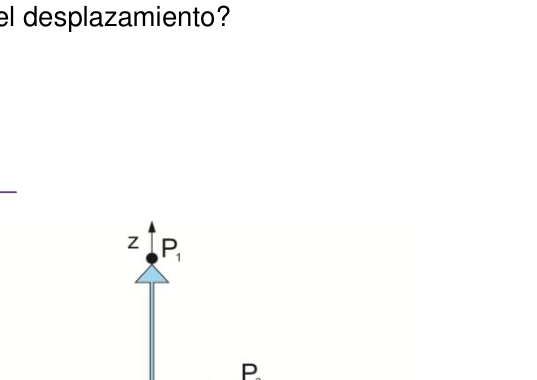
Topic: Magnetism Metodi: Biot-Savart Law, Lorentz Force Analysis Competenze: Physical Reasoning Objects: Point Charge Fonte: Testo (PDF) — p.5
PT33. La scuola di agricoltura Generale Alvear, Mendoza.
Un carico puntuale (3e-) si sposta in direzione
X positivo con una velocità di 1,5,106 m/s. Quando
si trova all’origine, calcola il campo magnetico in
a) P1: x=0, y=0, z=2cm.
b) P2: x=0, y=2cm, z=0
c) P3: x=1cm, y=1cm, z=1cm.
Se, spostandosi in tale direzione, si trova
con un campo magnetico (perpendicolare) B di
2.10-3 T.
d) Qual è l’indirizzo del carico?
e) Rendi un grafico del movimento della carica
puntuale.
Topic: Magnetism Metodi: Biot-Savart Law, Lorentz Force Analysis Competenze: Physical Reasoning Objects: Point Charge Fonte: Testo (PDF) — p.5
PT33. School of Agriculture General Alvear, Mendoza, please.
A point load (3e-) is shifted in the direction
positive x with a speed of 1,5,106 m/s. When
It’s at the source, calculate the magnetic field at
a) P1: x=0, y=0, z=2cm.
b) P2: x=0, y=2cm, z=0
c) P3: x=1cm, y=1cm, z=1cm.
If you are travelling in that direction you find yourself
with a magnetic (perpendicular) field B of
2.10-3 T.
(d) What will be the direction of the cargo?
(e) Draw a graph of the load movement
I’m on time.
Topic: Magnetism Metodi: Biot-Savart Law, Lorentz Force Analysis Competenze: Physical Reasoning Objects: Point Charge Fonte: Testo (PDF) — p.5
PT34. Colegio Padre Ramón de la Quintana
ENET Nro. 1 Prof. Vicente Aguilera
Colegio Del Carmen y San José
Instituto Superior FASTA Catamarca
Escuela Secundaria Gustavo G. Levene
Escuela Pre-Universitaria Fray Mamerto Esquiú
San Fernando del Valle, Catamarca.
Juan es un obrero de la construcción que reside en la ciudad de San Fernando del Valle de Catamarca y los siguientes problemas se encuadran en los acontecimientos de un caluroso día viernes de trabajo.
Juan utiliza a diario una cinta métrica de acero profesional. Pueden leerse en una etiqueta las indicaciones del fabricante acerca de las dimensiones de la cinta y la
58 - OAF 2015 temperatura de referencia a la que dichas dimensiones han sido determinadas experimentalmente. La etiqueta dice: Dimensiones:
25 m de largo
1,5 cm de ancho
0,8mm de espesor
Temperatura de referencia:
68°F.
a) Obtenga la temperatura de referencia en °C.
b) ¿Qué longitud total tiene la cinta métrica a una temperatura de 40 °C? Coeficiente
de dilatación lineal del acero, =1,2 10-5 °C-1.
c) Juan utiliza su cinta de acero para medir una cierta longitud y obtiene como
resultado 15,794 m. Determine la distancia real considerando que la medición se
realizó a una temperatura de 40°C.
d) Determine el valor de la diferencia entre la longitud real y la medida por Juan en el
inciso c.
e) Calcule la masa de la cinta métrica. Densidad del acero, acero= 7,8 g/cm3.
f) ¿Qué cantidad de calor fue suministrada a la cinta métrica si al comienzo de la
jornada la temperatura era de 55°F y la temperatura actual es de 40°C? Calor
especifico del acero, Ce = 460 J/Kg K
g) Exprese la cantidad de calor en calorías.
Topic: Thermodynamics, Elasticity & Materials Metodi: Stress-Strain Analysis, First Law of Thermodynamics Competenze: Physical Reasoning Objects: Rod Fonte: Testo (PDF) — p.5
PT34. Colegio Padre Ramón de la Quintana
- Il numero di rete. 1 Prof. Vicente Aguilera
Colegio del Carmen e San José
Istituto superiore FASTA Catamarca
Scuola secondaria Gustavo G. Prendila .
Preuniversità Fray Mamerto Esquiu
San Fernando del Valle, Catamarca.
Juan è un costruttore che risiede nella città di San Fernando del Valle La situazione di Catamarca e dei seguenti problemi si trovano negli eventi di un’incidente di un freddo di lavoro caldo.
Juan usa quotidianamente una cinta metrica di acciaio professionale. Si possono leggere in una etichettare le indicazioni del fabbricante sulle dimensioni della cinta e
58 - OAF 2015 temperatura di riferimento alla quale sono state determinate tali dimensioni sperimentalmente. L’etichetta dice: Dimensioni:
25 metri di lunghezza 1 centimetro di larghezza 0,8 mm di spessore Temperatura di riferimento: 68°F.
a) Ottieni la temperatura di riferimento a °C. b) Qual è la lunghezza totale della cinta metrica a una temperatura di 40 °C? Coefficiente di dilatazione lineare dell’acciaio, =1,2 10-5 °C-1. c) Juan usa la sua cinta di acciaio per misurare una certa lunghezza e ottiene come 15,794 m di altezza. Determina la distanza reale considerando che la misurazione è ha effettuato a una temperatura di 40°C. d) Determina il valore della differenza tra la lunghezza reale e la misura da Giovanni nel inciso c. e) Calcolare la massa della cinta metrica. Densità dell’acciaio, acciaio = 7,8 g/cm3. f) Quanta calore è stato fornito alla cinta di misura se all’inizio della La temperatura era 55°F e la temperatura attuale è 40°C? Calore specifico per l’acciaio, Ce = 460 J/Kg K g) Indicare la quantità di calore calorica.
Topic: Thermodynamics, Elasticity & Materials Metodi: Stress-Strain Analysis, First Law of Thermodynamics Competenze: Physical Reasoning Objects: Rod Fonte: Testo (PDF) — p.5
PT34. Father Ramon de la Quintana College is located in the city of Quintana.
The Commission shall adopt delegated acts in accordance with Article 21 of this Regulation. 1 Prof. Vicente Aguilera is a great man .
College of Carmen and San José
The Spanish Ministry of Education
High school Gustavo G. Take it off .
Pre-university school Fray Mamerto Esquiú
San Fernando del Valle, Catamarca. It was a great day.
Juan is a construction worker who resides in the city of San Fernando del Valle The following problems are found in the events of a Hot Friday work.
Juan uses a professional steel tape every day. You can read them in one . label the manufacturer’s instructions on the dimensions of the tape and the
The Commission shall adopt delegated acts in accordance with Article 21 of this Regulation. the reference temperature at which these dimensions have been determined experimentally. The label says: Size:
25 m long 1.5 cm wide 0,8 mm thick Reference temperature: 68°F.
(a) Obtain the reference temperature at °C. (b) What is the total length of the metric tape at 40 °C? Coefficient The steel is of a linear dilatation of =1,2 10-5 °C-1. c) John uses his steel tape to measure a certain length and gets as The result was 15,794 m. Determine the actual distance by taking into account that the measurement is It was carried out at a temperature of 40°C. (d) Determine the value of the difference between the actual length and the measurement by John in the the following points are added: (e) Calculate the mass of the tape. The steel density, steel = 7,8 g/cm3. (f) What amount of heat was supplied to the tape at the beginning of the test? The temperature was 55°F and the current temperature is 40°C? Heat . specific to steel, Ce = 460 J/Kg K (g) Express the amount of heat in calories.
Topic: Thermodynamics, Elasticity & Materials Metodi: Stress-Strain Analysis, First Law of Thermodynamics Competenze: Physical Reasoning Objects: Rod Fonte: Testo (PDF) — p.5
PT35. Colegio Padre Ramón de la Quintana
ENET Nro. 1 Prof. Vicente Aguilera
Colegio Del Carmen y San José
Instituto Superior FASTA Catamarca
Escuela Secundaria Gustavo G. Levene
Escuela Pre-Universitaria Fray Mamerto Esquiú
San Fernando del Valle, Catamarca.
Juan es un obrero de la construcción que reside en la ciudad de San Fernando del Valle de Catamarca y los siguientes problemas se encuadran en los acontecimientos de un caluroso día viernes de trabajo.
Una vez terminada su jornada de trabajo, Juan regresa en su moto a su hogar. Para ello recorre la Av. Sánchez Oviedo en dirección ESTE – OESTE, es decir, de manera tal que el camino presenta una pendiente ascendente. Se encuentra detenido frente a la luz roja del semáforo con la avenida totalmente despejada (nada impide a Juan seguir una trayectoria rectilínea). Al cambiar el semáforo a la luz verde avanza 200m con una aceleración constante de 0,8 m/s2 y a partir de ese punto tarda 5 segundos en detenerse frente al siguiente semáforo, que le indica la luz roja.
a) Calcule la velocidad alcanzada antes de comenzar el frenado. b) Exprese la velocidad del inciso a. en km/h. c) ¿Cuánto tiempo tarda en recorrer esos 200m? d) Obtenga la aceleración de frenado. e) Calcule la distancia necesaria para el frenado frente al segundo semáforo. f) Escriba la ecuación para la posición, la velocidad y la aceleración en función del tiempo correspondientes a la primera etapa del movimiento. g) Escriba la ecuación para la posición, la velocidad y la aceleración en función del tiempo correspondientes a la segunda etapa del movimiento. h) Realice una gráfica de x=x(t), v=v(t) y a=a(t) que represente el movimiento completo, es decir, contemple ambas etapas del movimiento en un único gráfico.
OAF 2015 - 59 Recuerde que Juan y su moto están recorriendo una pendiente ascendente. Considere que Juan tiene una masa igual a 80 Kg y su moto tiene 90 Kg. Si el coeficiente de rozamiento entre las ruedas del ciclomotor y el asfalto de la Av. Sánchez Oviedo es de 0,5: i) Realice el diagrama de cuerpo libre de la situación, suponiendo que la avenida tiene un ángulo de inclinación de 20°. Denote la fuerza que realiza el motor como FM. j) Considere la primera etapa del movimiento. Determine el valor de la fuerza que realiza el motor de la moto. k) ¿Cuál sería el valor de la fuerza del motor si el camino no tuviera pendiente en este tramo del movimiento?
Topic: Newtonian Mechanics Metodi: Kinematic Equations, Free-Body Diagram Competenze: Physical Reasoning Objects: Wheel, Inclined Plane Fonte: Testo (PDF) — p.5
PT35. Colegio Padre Ramón de la Quintana
- Il numero di rete. 1 Prof. Vicente Aguilera
Colegio del Carmen e San José
Istituto superiore FASTA Catamarca
Scuola secondaria Gustavo G. Prendila .
Preuniversità Fray Mamerto Esquiu
San Fernando del Valle, Catamarca.
Juan è un costruttore che risiede nella città di San Fernando del Valle La situazione di Catamarca e dei seguenti problemi si trovano negli eventi di un’incidente di un freddo di lavoro caldo.
Una volta terminata la giornata di lavoro, Juan torna a casa in moto. Per questo.
- Si tratta dell’Avenue. Sanchez Oviedo in direzione ESTE OESTE, cioè in modo tale che la strada presenta una pendice ascendente. Si trova fermo davanti alla luce rossa. Il semaforo con l’avvenida completamente sgranata (nulla impedisce a Juan di seguire un’altra strada) La velocità di movimento è di circa un milione di metri. Cambiando il semaforo alla luce verde si avanza 200 metri con una Accelerazione costante di 0,8 m/s2 e da quel punto ci vogliono 5 secondi per fermarsi davanti al semaforo successivo, che indica il punto di riferimento.
a) Calcolare la velocità raggiunta prima di iniziare il frenaggio. b) Indicare la velocità di a. en km/h. c) Quanto tempo ci vuole per percorrere quei 200 metri? d) Ottenere l’accelerazione frenata. e) Calcolare la distanza necessaria per il frenaggio rispetto al secondo semaforo. f) Scrivi l’equazione per la posizione, la velocità e l’accelerazione in funzione di tempo corrispondente al primo stadio del movimento. g) Scrivi l’equazione per la posizione, la velocità e l’accelerazione in funzione di tempo corrispondente al secondo stadio del movimento. h) Rendi un grafico di x=x(t), v=v(t) e a=a(t) che rappresenta il movimento Completo, cioè contempla entrambe le fasi del movimento in un unico grafico.
OAF 2015 - 59 Ricorda che Juan e la sua moto stanno percorrendo una pendice ascendente. Considerate che Juan ha un peso pari a 80 kg e la sua moto ha 90 kg. Se il coefficiente di Rottura tra le ruote della moto e l’asfalto dell’Ave. Sanchez Oviedo è di 0,5: i) Sviluppa il diagramma di corpo libero della situazione, supponendo che l’avvenuta abbia un angolo di inclinazione 20°. Deteni la forza che il motore produce come FM. j) Considerare la prima fase del movimento. Determina il valore della forza che
- Fa’ il motore della moto. k) Qual è il valore della forza del motore se la strada non avesse una pendenza in questo
- Il tratto del movimento?
Topic: Newtonian Mechanics Metodi: Kinematic Equations, Free-Body Diagram Competenze: Physical Reasoning Objects: Wheel, Inclined Plane Fonte: Testo (PDF) — p.5
PT35. Father Ramon de la Quintana College is located in the city of Quintana.
The Commission shall adopt delegated acts in accordance with Article 21 of this Regulation. 1 Prof. Vicente Aguilera is a great man .
College of Carmen and San José
The Spanish Ministry of Education
High school Gustavo G. Take it off .
Pre-university school Fray Mamerto Esquiú
San Fernando del Valle, Catamarca. It was a great day.
Juan is a construction worker who resides in the city of San Fernando del Valle The following problems are found in the events of a Hot Friday work.
After his workday is over, Juan returns home on his motorcycle. For that . It’s on the Av. Sanchez Oviedo in the direction of ESTE OESTE, that is, in such a way that The road has an upward slope. He ‘s stopped in front of the red light . The streetlight is completely cleared (nothing stops John from following a road) The following is the list of the following: By switching the traffic light to green light , he moves 200m with a constant acceleration of 0.8 m/s2 and from that point it takes 5 seconds to stop In front of the next traffic light, which points to the red light.
(a) Calculate the speed achieved before starting braking. (b) Express the speed of subparagraph (a). en km/h. (c) How long does it take to cross those 200 metres? (d) Get the braking acceleration. (e) Calculate the distance required for braking in front of the second traffic light. (f) Write the equation for position, speed and acceleration based on the time corresponding to the first stage of the movement. (g) Write the equation for position, speed and acceleration based on the time corresponding to the second stage of the movement. h) Perform a graph of x=x(t), v=v(t) and a=a(t) that represents the motion Complete, that is, it contemplates both stages of movement in a single graph.
The Commission shall adopt delegated acts in accordance with Article 21 of this Regulation. Remember, Juan and his motorcycle are going up a slope. Consider That Juan weighs 80 kg and his bike is 90 kg. If the coefficient of friction between the wheels of the motorcycle and the asphalt of the Av. Sanchez Oviedo is from 0,5: (i) Make the free-body diagram of the situation, assuming the avenue has a slope of 20°. Denote the force that the engine performs as FM. (j) Consider the first stage of the movement. Determine the value of the force that It’s the motorcycle engine. k) What would be the value of the engine force if the road had no slope on this one the movement?
Topic: Newtonian Mechanics Metodi: Kinematic Equations, Free-Body Diagram Competenze: Physical Reasoning Objects: Wheel, Inclined Plane Fonte: Testo (PDF) — p.5
PT36. Colegio Padre Ramón de la Quintana
ENET Nro. 1 Prof. Vicente Aguilera
Colegio Del Carmen y San José
Instituto Superior FASTA Catamarca
Escuela Secundaria Gustavo G. Levene
Escuela Pre-Universitaria Fray Mamerto Esquiú
San Fernando del Valle, Catamarca.
Juan es un obrero de la construcción que reside en la ciudad de San Fernando del Valle de Catamarca y los siguientes problemas se encuadran en los acontecimientos de un caluroso día viernes de trabajo.
Al llegar a su casa, colabora con los preparativos del festejo del cumpleaños de su hermano menor. Para ello, debe realizar una conexión de cierta cantidad de focos con el fin de iluminar el ambiente donde se llevará a cabo el festejo. Debido a la localización de los tomacorrientes del lugar, decide que hará conexiones de dos focos entre sí con un cable. En su caja de herramientas tiene un cable de cobre de diámetro igual a 1,29 mm. La extensión necesaria para el armado de la conexión es de 5m.
a) Si la resistividad del cobre es igual a 1,78 10-8 m ¿Cuál es la resistencia de los 5m de cable? b) Suponga que la resistencia del punto anterior es medida a 20°C. ¿Cuál será la resistencia del cable a 0°C? ¿a 45°C? coeficiente de la temperatura de resistividad del cobre, = 0,00393 °C-1.
Las resistencias respectivas de dos focos son 400 y 800. Juan decide que probará primero conectando los dos focos en serie a una línea de 155V de tensión eficaz (es decir, suponga que esta tensión es continua). Al responder las siguientes preguntas, desprecie la resistencia ofrecida por el cable de cobre utilizado en la conexión:
c) Realice el esquema representativo del circuito. d) Obtenga la corriente y la caída de potencial en cada foco. e) Determine la potencia que disipa cada foco. f) Calcule la potencia total disipada por el conjunto.
Ahora, Juan realiza una prueba conectando los focos en paralelo a la línea de 155V, nuevamente, desprecie la resistencia del cable:
g) Realice el esquema del circuito. h) Determine la corriente a través de cada bombillo. i) Calcule la potencia disipada por cada foco y la potencia total.
60 - OAF 2015 Determine cuáles son las conclusiones que obtuvo Juan al comparar las dos situaciones respondiendo las siguientes preguntas:
j) Considere la conexión en serie, ¿cuál de los focos posee mayor luminosidad? k) Considere la conexión en paralelo, ¿cuál de los focos posee mayor luminosidad? l) ¿Qué combinación (serie o paralelo) produce mayor luminosidad en conjunto?
Topic: Circuits Metodi: Equivalent Circuit Reduction, Kirchhoff’s Laws Competenze: Physical Reasoning Objects: Resistor, Wire Fonte: Testo (PDF) — p.5
PT36. Colegio Padre Ramón de la Quintana
- Il numero di rete. 1 Prof. Vicente Aguilera
Colegio del Carmen e San José
Istituto superiore FASTA Catamarca
Scuola secondaria Gustavo G. Prendila .
Preuniversità Fray Mamerto Esquiu
San Fernando del Valle, Catamarca.
Juan è un costruttore che risiede nella città di San Fernando del Valle La situazione di Catamarca e dei seguenti problemi si trovano negli eventi di un’incidente di un freddo di lavoro caldo.
Quando arriva a casa sua, collabora con i preparativi per il compleanno di sua figlia. fratello minore. Per questo, è necessario collegare una certa quantità di foci al sistema di per illuminare l’ambiente in cui si svolgerà la festa. A causa della posizione di I prese di corrente del posto, decide che farà connessioni di due foci tra loro con un Cable. Nella sua cassa utensili ha un cavo di rame di diametro pari a 1,29 mm. La L’estensione necessaria per il rivestimento della connessione è di 5 m.
a) Se la resistenza del rame è pari a 1,78 10-8 m, qual è la resistenza dei 5 metri di cavo? b) Supponiamo che la resistenza del punto precedente sia misurata a 20°C. Qual è la data? resistenza del cavo a 0°C? ¿a 45°C? Coefficiente di temperatura di resistività di cui:
Le resistenze rispettive di due foci sono 400 e 800. Juan decide di provare. prima collegando i due foci in serie a una linea di 155V di tensione efficace (es Cioè, supponiamo che questa tensione sia continua). Rispondendo alle seguenti domande, disprezza la resistenza offerta dal cavo di rame utilizzato per la connessione:
c) realizzare il diagramma rappresentativo del circuito. d) Ottieni il flusso e la caduta di potenziale in ogni foco. e) Determina la potenza di diffusione di ogni foco. f) Calcolare la potenza totale dissipata per l’insieme.
Ora, Juan fa un test collegando i foci in parallelo alla linea di 155V, Ancora una volta, disprezza la resistenza del cavo:
g) Sviluppa il circuito. h) Determina il flusso attraverso ogni lampadina. i) Calcolare la potenza dissipata per ogni foco e la potenza totale.
60 - OAF 2015 Determina quali sono le conclusioni che Juan ha ottenuto confrontando le due situazioni. rispondendo alle seguenti domande:
j) Considerare la connessione in serie, quale dei foci ha la maggiore luminosità? k) Considerare la connessione parallela, quale dei foci ha la maggiore luminosità? L) Quale combinazione (serial o parallelo) produce la maggiore luminosità complessiva?
Topic: Circuits Metodi: Equivalent Circuit Reduction, Kirchhoff’s Laws Competenze: Physical Reasoning Objects: Resistor, Wire Fonte: Testo (PDF) — p.5
PT36. Father Ramon de la Quintana College is located in the city of Quintana.
The Commission shall adopt delegated acts in accordance with Article 21 of this Regulation. 1 Prof. Vicente Aguilera is a great man .
College of Carmen and San José
The Spanish Ministry of Education
High school Gustavo G. Take it off .
Pre-university school Fray Mamerto Esquiú
San Fernando del Valle, Catamarca. It was a great day.
Juan is a construction worker who resides in the city of San Fernando del Valle The following problems are found in the events of a Hot Friday work.
When he gets home, he helps with the preparations for his birthday party. little brother. For this purpose, you must connect a certain number of focuses to the to illuminate the environment in which the celebration will take place. Due to the location of The current-takers of the place, decides that it will make connections of two foci to each other with a cable. In its toolbox it has a copper wire of 1.29 mm diameter. La The length required for the connection armament is 5m.
(a) If the copper resistivity is equal to 1.78 10-8 m, what is the resistance of the copper resistivity? 5m of cable? (b) Assume that the resistance of the above point is measured at 20°C. What will be the The cable shall be capable of holding up to 0°C. ¿a 45°C? Resistivity temperature coefficient The value of the product concerned shall be calculated on the basis of the following data:
The resistance of two foci is 400 and 800 respectively. Juan decides he ‘ll try . First, connecting the two series foci to a 155V effective voltage line (is I mean, suppose this tension is continuous. By answering the following questions, It ignores the resistance offered by the copper cable used in the connection:
(c) Perform the representative circuit scheme. (d) Get the current and the potential drop at each focus. (e) Determine the power dissipated by each focus. (f) Calculate the total power dissipated by the set.
Now, Juan does a test by connecting the flashlights parallel to the 155V line, Again, disregard the strength of the cable:
(g) Draw the circuit. (h) Determine the current through each bulb. (i) Calculate the power dissipated by each focus and the total power.
The following points shall be added: Determine what conclusions John drew from comparing the two situations. by answering the following questions:
(j) Consider the serial connection, which of the foci has the highest luminosity? k) Consider the parallel connection, which of the foci has the highest luminosity? (l) Which combination (serial or parallel) produces the highest overall brightness?
Topic: Circuits Metodi: Equivalent Circuit Reduction, Kirchhoff’s Laws Competenze: Physical Reasoning Objects: Resistor, Wire Fonte: Testo (PDF) — p.5
PT37. Instituto Jesús María
Escuela Nueva Juan Mantovani
Ciudad de Córdoba.
Un ciclista cuya masa es de 70Kg, montado sobre una bicicleta de 10 kg, se desplaza
sobre una superficie horizontal con una rapidez de 5m/s, cuando comienza a acelerar a 2
m/s2 durante 5 seg. El coeficiente de rozamiento cinético con el aire es 0,2 en los dos
tramos.
a) Realice el diagrama de cuerpo libre del conjunto ciclista-bicicleta, e identifique cuál
es el cuerpo que produce la aceleración.
b) Calcular la Fuerza resultante.
c) Calcular la Fuerza total aplicada, teniendo en cuenta el rozamiento con el aire.
d) Calcular la distancia recorrida.
Si a partir de allí, comienza a subir una rampa de 20º, y deja de pedalear:
e) Calcular el tiempo que transcurre hasta detenerse.
f) Calcular la distancia recorrida sobre la rampa.
g) Calcular la Energía disipada por rozamiento a lo largo de todo el recorrido.
Topic: Newtonian Mechanics, Conservation of Energy Metodi: Free-Body Diagram, Kinematic Equations Competenze: Physical Reasoning Objects: Wheel, Inclined Plane Fonte: Testo (PDF) — p.5
PT37. Istituto Gesù Maria
Scuola Nuova Juan Mantovani
Città di Córdoba.
Un ciclista di 70 kg, su una bicicletta di 10 kg, si muove su una superficie orizzontale a velocità di 5 m/s, quando inizia ad accelerare a 2 m/s2 per 5 secondi. Il coefficiente di rottura cinetica con l’aria è di 0,2 per i due.
- Si’, ci siamo. a) Sviluppa il diagramma del corpo libero del gruppo ciclista-bicicletta e identifica quale. è il corpo che produce l’accelerazione. b) Calcolare la forza risultante. c) Calcolare la forza totale applicata, tenendo conto del ruggine con l’aria. d) Calcolare la distanza percorsa. Se da lì, inizia a salire una rampa di 20°, e smette di pedalare: e) Calcolare il tempo che passa fino a quando si ferma. f) Calcolare la distanza percorsa sul rampo. g) Calcolare l’energia dissipata da ruggine lungo l’intero percorso.
Topic: Newtonian Mechanics, Conservation of Energy Metodi: Free-Body Diagram, Kinematic Equations Competenze: Physical Reasoning Objects: Wheel, Inclined Plane Fonte: Testo (PDF) — p.5
PT37. Jesus Mary Institute
The New Juan Mantovani School
The city of Cordoba.
A cyclist weighing 70 kg, riding a 10 kg bike, moves around. on a horizontal surface at a speed of 5m/s, when it starts to accelerate at 2 m/s2 for 5 seconds. The coefficient of kinetic friction with air is 0.2 on both sides We’re going to cut it. (a) Draw the free body diagram of the cyclist-bicycle set and identify which one. It’s the body that produces the acceleration. (b) Calculate the resulting force. (c) Calculate the total force applied, taking into account the friction with the air. (d) Calculate the distance travelled. If from there, you start climbing a 20 degree ramp, and stop pedaling: (e) Calculate the time it takes to stop. (f) Calculate the distance travelled over the ramp. (g) Calculate the energy dissipated by friction throughout the course.
Topic: Newtonian Mechanics, Conservation of Energy Metodi: Free-Body Diagram, Kinematic Equations Competenze: Physical Reasoning Objects: Wheel, Inclined Plane Fonte: Testo (PDF) — p.5
PT38. Instituto Jesús María
Escuela Nueva Juan Mantovani
Ciudad de Córdoba.
Tres cargas eléctricas, de intensidad Q1, Q2 y -Q3 se encuentran en un espacio ideal vacío. Están separadas entre ellas como muestra la Figura 1. Considerando despreciable el efecto de la gravedad, se pide:
- Encontrar una expresión para la fuerza resultante aplicada sobre Q1, y otra expresión para la fuerza resultante aplicada sobre Q2.
- Encuentre una expresión para la intensidad de la carga Q3 en función de Q2 modo tal que la carga Q1 se encuentre en equilibrio.
- Si el valor de las cargas es, respectivamente, 3µC, 5µC y -8µC, calcular la aceleración que recibirá Q3 suponiendo que la masa de las tres cargas es de 0,1g.
- Calcular la aceleración que recibirá Q3 suponiendo que las cargas se encuentran dispuestas formando un triángulo rectángulo como muestra la figura 2.
Datos:
2 2 2 9 10 9 C m N x
k
OAF 2015 - 61
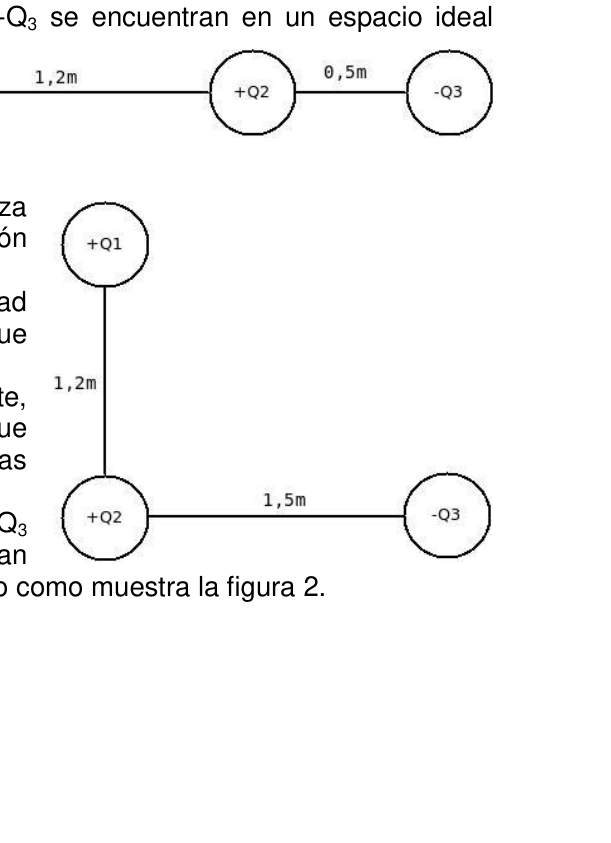
Topic: Electrostatics Metodi: Coulomb’s Law, Superposition Principle Competenze: Physical Reasoning Objects: Point Charge Fonte: Testo (PDF) — p.5
PT38. Istituto Gesù Maria
Scuola Nuova Juan Mantovani
Città di Córdoba.
Tre cariche elettriche, di intensità Q1, Q2 e -Q3, si trovano in uno spazio ideale.
- Vazio. Sono separati tra loro. e loro come mostra la Figura 1. Considerando disprezzabile il effetto della gravità, si chiede:
- Trovare un’espressione per la forza risultante applicato su Q1, e un’altra espressione per la forza risultante applicata su Q2.
- Trova un’espressione per l’intensità. di carico Q3 in funzione di Q2 modo in modo tale che la carica Q1 è in equilibrio.
- Se il valore dei carichi è rispettivamente: 3μC, 5μC e -8μC, calcolare l’accelerazione che riceverà Q3 supponendo che la massa delle tre cariche è di 0,1 g.
- Calcolare l’ accelerazione che riceverà Q3 Supponendo che i carichi si trovino Le parti di cui al punto 1.2.1 sono di tipo triangolare retagonale, come mostrato nella figura 2.
Datati:
2 2 2 9 10 9 C m N x
k
OAF 2015 - 61
Topic: Electrostatics Metodi: Coulomb’s Law, Superposition Principle Competenze: Physical Reasoning Objects: Point Charge Fonte: Testo (PDF) — p.5
PT38. Jesus Mary Institute
The New Juan Mantovani School
The city of Cordoba.
Three electrical charges, of intensity Q1, Q2 and -Q3 are in an ideal space. It’s empty. They ‘re separated between . And they’re like the ones in Figure 1. Considering the disdainful The effect of gravity is asked:
- Find an expression for strength The result applied to Q1, and another expression for the resulting force applied to Q2.
- Find an expression for intensity . of the Q3 load in Q2 mode such that The Q1 load is in equilibrium.
- If the value of the loads is, respectively, 3μC, 5μC and -8μC, calculate the acceleration that The mass of the Three loads is 0.1g.
- Calculate the acceleration that Q3 will receive Assuming the loads are located arranged to form a rectangular triangle as shown in Figure 2.
The data:
2 2 2 9 10 9 C m N x
k
The following is the list of the countries of the European Union:
Topic: Electrostatics Metodi: Coulomb’s Law, Superposition Principle Competenze: Physical Reasoning Objects: Point Charge Fonte: Testo (PDF) — p.5
PT39. Instituto Jesús María
Escuela Nueva Juan Mantovani
Ciudad de Córdoba.
Una pieza metálica de cobre de 900g se encuentra a una temperatura de 40ºC y experimenta los siguientes procesos:
- Etapa 1: Es colocada en un horno durante 5 minutos hasta que alcanza una
temperatura de
700ºC. - Etapa 2: Es arrojada a un recipiente que contiene 10 litros de agua destilada a 15ºC.
- Etapa 3: Es colocada en otro horno cuya potencia es de 400 Kcal/h durante 15 minutos.
Suponiendo que las pérdidas de calor mientras ocurren las transiciones entre etapas es despreciable y que los hornos y el recipiente de la ETAPA 2 son adiabáticos, se pide: a) Calcular la potencia del horno utilizado en la ETAPA 1 (en Kcal/h). b) Calcular la temperatura que adquiere el cobre luego de cumplirse la ETAPA 2. c) Explicar en qué estado final queda el material luego de realizarse todo el proceso.
Datos:
Ce del Cobre: 0,093
cal
gºC (en todos los estados)
Punto de Fusión del Cobre: 1083ºC
Punto de Ebullición del Cobre: 2595ºC
Calor de Fusión del Cobre: 42
cal
g
Calor de Vaporización del Cobre: 1200
cal
g
Densidad del Agua Destilada: 1000
g
l
Topic: Thermodynamics Metodi: First Law of Thermodynamics Competenze: Physical Reasoning Objects: Calorimeter Fonte: Testo (PDF) — p.5
PT39. Istituto Gesù Maria
Scuola Nuova Juan Mantovani
Città di Córdoba.
Un pezzo di rame di 900 g si trova a una temperatura di 40 °C e si verifica i seguenti processi:
- Fase 1: Si mette in un forno per 5 minuti fino a raggiungere un temperatura di 700ºC.
- Fase 2: viene gettata in un recipiente contenente 10 litri di acqua distillata a 15°C.
- Fase 3: viene messa in un altro forno di 400 Kcal/h per 15 Minuti.
Supponendo che i perditi di calore durante le transizioni tra fasi si verificino è che il forno e il recipiente di ETAPA 2 siano adiabatici, si chiede: a) Calcolare la potenza del forno utilizzato in ETAPA 1 (in Kcal/h). b) Calcolare la temperatura che il rame acquista dopo il rispetto di ETAPA 2. c) Esprimi in che stato finale rimane il materiale dopo l’intero processo.
Datati: Ce del Cobre: 0,093 cal
- il numero di persone che hanno partecipato alla riunione
Punto di fusione del rame: 1083oC
Punto di ebollizione del rame: 2595oC
Calore di fusione del rame: 42
cal
g
Calore di vaporizzazione del rame: 1200 cal g
Densità dell’acqua distillata: 1000 g l
Topic: Thermodynamics Metodi: First Law of Thermodynamics Competenze: Physical Reasoning Objects: Calorimeter Fonte: Testo (PDF) — p.5
PT39. Jesus Mary Institute
The New Juan Mantovani School
The city of Cordoba.
A 900g copper metal piece is at a temperature of 40°C and It experiences the following processes:
- Stage 1: It is placed in an oven for 5 minutes until it reaches a temperature of 700ºC.
- Stage 2: It is thrown into a container containing 10 liters of distilled water at 15°C.
- Stage 3: It is placed in another oven with a power of 400 Kcal/h for 15
- I’ll be right back.
Assuming heat losses as transitions between stages occur is the oven and the container of ETAPA 2 are adiabatic, it is requested: (a) Calculate the power of the oven used in ETAPA 1 (in Kcal/h). (b) Calculate the temperature acquired by copper after ETAPA 2 is met. (c) Explain the final state of the material after the entire process has been completed.
The data:
The copper content: 0,093
Cal
(in all states)
The copper melting point is 1083oC.
Boiling point of copper: 2595oC
Heat of the Copper Fusion: 42
Cal
g
Heat of vaporization of copper: 1200
Cal
g
Distilled water density: 1000
g
l
Topic: Thermodynamics Metodi: First Law of Thermodynamics Competenze: Physical Reasoning Objects: Calorimeter Fonte: Testo (PDF) — p.5
PT40. Escuela Técnica ORT Nro. 2
Ciudad de Buenos Aires.
José el nadador está entrenando para las Olimpíadas de Pekín en el 2008. Para eso
decidió ir a entrenar a un río. El ancho del río es de 100m. José tiene una masa de 80kg.
a) ¿Cuál es el tiempo que tarda José en cruzar el río si su velocidad es constante y de
5 km/h y quiere hacerlo en el menor tiempo posible? Indique en un esquema la
trayectoria del nadador.
José quería ir del punto A al B que están exactamente enfrentados, pero no tuvo en cuenta la corriente del río que lo desplazó para la derecha y es de 4 km/h b) Determine la distancia que hay desde el punto A al C de tal modo que partiendo de C José llegue al punto B en el mismo tiempo que antes. Grafique la trayectoria.
Pero no todo es tan sencillo como parece, después de medio minuto de nadar desde C José reduce su velocidad en medio kilómetro por hora por el cansancio. c) ¿Cuánto tiempo tarda ahora en llegar al otro lado? ¿A qué distancia de B llega?
Los problemas no terminan y al lugar a dónde llegó José la orilla es intransitable y apenas puede recorrerse a pie, y para él su única opción es volver al punto B, ya que hay una cascada más a la derecha. Para que sea más complicado, en esa zona la velocidad de la corriente es de 6km/h. Por suerte no fue poco precavido y su amigo Martín que estaba cerca le lanzó dos patas de rana. José regresa a B en 6 segundos sólo valiéndose de las patas de rana. Suponemos que ejerce una fuerza constante con las mismas. d)¿Cuál es la fuerza que tiene en las piernas José? ¿Cuál es la potencia de nuestro nadador?
62 - OAF 2015 Ahora José decide regresar al punto A. Pero en este caso no lo hará mirando hacia la orilla opuesta sino que lo hará formando un ángulo. La corriente del río en este momento es de 2,5 km/h y José está tan bien que no se cansará en el medio e)¿Qué ángulo debe formar con la orilla para llegar justo al punto A? ¿Cuánto tiempo tarda en cruzar?
Topic: Newtonian Mechanics Metodi: Vector Decomposition, Kinematic Equations Competenze: Physical Reasoning Objects: Projectile Fonte: Testo (PDF) — p.5
PT40. Scuola tecnica ORT Nro. 2
Città di Buenos Aires.
Il nuotatore José sta allenando per le Olimpiadi di Pechino nel 2008. Per questo . Ha deciso di andare ad allenarsi in un fiume. La larghezza del fiume è di 100 metri. José ha una massa di 80 kg. a) Quanto tempo ci vuole per attraversare il fiume se la sua velocità è costante e di 5 km/h e vuoi farlo nel minor tempo possibile? Indicare in un schema la il percorso del nuotatore.
José voleva andare dal punto A al punto B che sono esattamente di fronte, ma non ha avuto in conta il flusso del fiume che lo ha spostato a destra ed è di 4 km/h b) Determina la distanza da A a C in modo tale che a partire da C José arriva al punto B nello stesso tempo in cui prima. Grafica il percorso.
Ma non è tutto così semplice come sembra, dopo mezzo minuto di nuoto da C José riduce la sua velocità di mezzo chilometro all’ora per la stanchezza. c) Quanto tempo ci vuole per arrivare all’altra parte? A che distanza da B arriva?
I problemi non finiscono e il posto dove arrivò José la riva è impassibile e appena può percorrere a piedi, e per lui la sua unica opzione è tornare al punto B, poiché c’è una Cascata più a destra. Per complicare la situazione, in quella zona la velocità della corrente è di 6 km/h. Fortunatamente non fu poco cauto e suo amico Martin che era vicino lanciò due zampe di rana. José torna a B in 6 secondi solo usando le le zampe di rana. Supponiamo che eserciti una forza costante con le stesse. d) Qual è la forza che ha nelle gambe di Giuseppe? Qual è la potenza del nostro
- Nuotatore?
62 - OAF 2015 Ora José decide di tornare al punto A. Ma in questo caso non lo farà guardando verso la riva opposta, ma lo farà formando un angolo. Il flusso del fiume in questo momento È di 2,5 km/h e José è così bene che non si stancherà in mezzo. e) Quale angolo deve formare il bordo per arrivare proprio al punto A? Quanto tempo?
- Ti prolunghi a passare?
Topic: Newtonian Mechanics Metodi: Vector Decomposition, Kinematic Equations Competenze: Physical Reasoning Objects: Projectile Fonte: Testo (PDF) — p.5
PT40. The technical school ORT Nro. 2
City of Buenos Aires.
Jose the swimmer is training for the Beijing Olympics in 2008. That ‘s what it ‘s for . decided to go to a river to train. The river’s width is 100 meters. Jose weighs 80kg. (a) How long does it take Joseph to cross the river if his speed is constant and of 5 km/h and you want to do it in the shortest time possible? Indicate in a diagram the the swimmer’s trajectory.
Jose wanted to go from point A to point B that they’re exactly facing, but he didn’t have in. It’s the current of the river that drove it to the right and it’s 4 km/h. (b) Determine the distance from point A to point C such that starting from C Jose reaches point B at the same time as before. Graph the trajectory.
But not everything is as simple as it seems, after half a minute of swimming from C. Joseph slows down his speed by half a kilometer an hour because of fatigue. (c) How long does it take to get to the other side now? How far from B is it?
The problems do not end and the place where Joseph came the shore is impassable and barely He can walk around, and for him his only option is to return to point B, since there’s a waterfall further to the right. To make matters more complicated, in that area the speed of the Current is 6km/h. Fortunately , he was not too cautious and his friend Martin was . nearby, he threw two frog legs at him. Joseph returns to B in 6 seconds using only the Frog legs. Suppose you exert a constant force with them. (d) What strength is in Joseph’s legs? What is the power of our swimmer?
The following points shall be added: Now Joseph decides to return to point A. But in this case it won ‘t do looking at the opposite shore but it will do it forming an angle. The current of the river at this time It’s 2.5 miles an hour and Jose is so fine he won’t get tired in the middle. (e) What angle should it form with the shore to reach just to point A? How long?
- It takes you long to cross?
Topic: Newtonian Mechanics Metodi: Vector Decomposition, Kinematic Equations Competenze: Physical Reasoning Objects: Projectile Fonte: Testo (PDF) — p.5
PT41. Escuela Técnica ORT Nro. 2
Ciudad de Buenos Aires.
Péndulo Balístico.
La figura muestra un péndulo balístico para medir la
rapidez de una bala. La bala cuya masa es m, se
dispara contra un bloque de madera de masa M, que
cuelga de 2 hilos de masa despreciable, como un
péndulo, y tiene un choque totalmente inelástico con él.
Después del impacto, el bloque oscila hasta una altura
máxima, llamada y.
a) Utilizando conservación de la energía demostrar que la rapidez (V) del conjunto
bloque - bala luego del impacto es:
b) Demostrar que la rapidez de la bala es:
Sabiendo que la masa de la bala es de 5 gramos, la masa del bloque de madera es de 2 kg y la altura y que alcanzan es de 3 cm. c) Calcular la rapidez de la bala. d) Suponiendo que en el impacto solamente hay transformación de energía en calor, determinar qué porcentaje de la energía cinética que tenía la bala antes del impacto se transformó en calor. e) Si la longitud de los hilos del péndulo es de 30 cm, calcular la tensión de los mismos en el instante en que el péndulo se encuentra en la posición más alta. f) Mientras el péndulo oscila, calcular la aceleración tangencial y la aceleración centrípeta del bloque en la posición más alta (cuando no tiene rapidez) y cuando pasa por la vertical (cuando su rapidez es máxima).
Datos: g = 9,8 m/s2 En todo momento despreciar la fricción con el aire.
Topic: Conservation of Momentum, Conservation of Energy Metodi: Conservation of Momentum, Energy Conservation Method Competenze: Physical Reasoning Objects: Pendulum, Projectile Fonte: Testo (PDF) — p.5
PT41. Scuola tecnica ORT Nro. 2
Città di Buenos Aires.
Pendale balistico. La figura mostra un pendolo balistico per misurare la velocità di una pallottola. La pallottola con massa m, si spara contro un blocco di legno di massa M, che Appeso a due fili di massa disprezzabile, come un e ha un colpo totalmente inelastico con lui. Dopo l’impatto, il blocco oscilla fino ad un’altezza. massimo, chiamata y. a) Utilizzando la conservazione dell’energia dimostrare che la velocità (V) del complesso Blocco - proiettile dopo l’impatto è:
b) Dimostra che la velocità della pallottola è:
Sapendo che il peso della pallottola è di 5 grammi, il peso del blocco di legno è di 2 grammi. kg e la altezza e che raggiungono è di 3 cm. Calcolare la velocità della pallottola. d) Supponendo che nell’impatto si verifichi solo la trasformazione di energia in calore, determinare quale percentuale di energia cinetica la pallottola aveva prima dell’impatto si è trasformata in calore. (e) Se la lunghezza dei fili del pendolo è di 30 cm, calcolare la tensione dei fili il momento in cui il pendolo è nella posizione più alta. f) Mentre il pendolo oscilla, calcolare l’accelerazione tangenziale e l’accelerazione Centripetto del blocco in posizione più alta (quando non ha velocità) e quando passa per la verticale (quando la sua velocità è massima).
Data: g = 9,8 m/s2 In ogni momento disprezza la frizione con l’aria.
Topic: Conservation of Momentum, Conservation of Energy Metodi: Conservation of Momentum, Energy Conservation Method Competenze: Physical Reasoning Objects: Pendulum, Projectile Fonte: Testo (PDF) — p.5
PT41. The technical school ORT Nro. 2
City of Buenos Aires.
Ballistic pendulum. The figure shows a ballistic pendulum to measure the speed of a bullet. The bullet whose mass is m, se Shoots at a block of wood of mass M, which Hanging from two threads of scornful mass, like a And it’s got a totally inelastic shock to it. After impact, the block oscillates to a height. maximum, called y. (a) Using energy conservation to demonstrate that the velocity (V) of the set Block - bullet after impact is:
(b) To prove that the speed of the bullet is:
Knowing that the bullet’s mass is 5 grams, the mass of the wooden block is 2 grams. kg and height and they reach 3 cm. (c) Calculate the velocity of the bullet. (d) Assuming that the impact only translates energy into heat, Determine what percentage of kinetic energy the bullet had before impact. turned into heat. (e) If the length of the strands of the pendulum is 30 cm, calculate the tension of the strands. the moment the pendulum is at its highest position. (f) As the pendulum oscillates, calculate the tangential acceleration and the acceleration. The block centrifuge at the highest position (when not fast) and when passes vertically (when its speed is maximum).
The data: g = 9,8 m/s2 At all times despise friction with the air.
Topic: Conservation of Momentum, Conservation of Energy Metodi: Conservation of Momentum, Energy Conservation Method Competenze: Physical Reasoning Objects: Pendulum, Projectile Fonte: Testo (PDF) — p.5
PT42. Escuela Técnica ORT Nro. 2
Ciudad de Buenos Aires.
Un recipiente, que puede considerarse adiabático (no intercambia calor con el medio ambiente), contiene 1 Kg de agua a temperatura ambiente. Un termómetro de mercurio, que se encuentra sumergido en el agua, indica que la temperatura del sistema es de 27ºC. En el recipiente se vierte agua en estado de ebullición (100ºC) y, cuando la temperatura del agua se estabiliza, el termómetro indica que la temperatura del sistema es de 50ºC. La transferencia de calor al recipiente puede considerarse despreciable.
OAF 2015 - 63
a) ¿Cuál es la masa de agua en estado de ebullición que se agregó al recipiente?
Tenga en cuenta que el calor específico del agua es Cagua = 1 cal/(ºC g), y la masa
de agua equivalente para el termómetro de mercurio es meq=10 g.
b) Ahora se extraen de un congelador tres cubitos de hielo, de 20 g de masa cada uno
y a una temperatura de -20ºC, y se agregan al recipiente. Calcular la temperatura
que indicará el termómetro cuando el sistema alcance el equilibrio.
Datos: Calor latente de fusión del hielo Lhielo = 80 cal/g,
calor específico del hielo: Chielo = 0.53 cal/(oC g),
Topic: Thermodynamics Metodi: First Law of Thermodynamics Competenze: Physical Reasoning Objects: Calorimeter Fonte: Testo (PDF) — p.5
PT42. Scuola tecnica ORT Nro. 2
Città di Buenos Aires.
Un recipiente, che può essere considerato adiabatico (non scambiano calore con il mezzo ambiente), contiene 1 kg di acqua a temperatura ambiente. Un termometro di mercurio, che è immerso nell’acqua, indica che la temperatura del sistema è di 27ºC. Nel recipiente si versa acqua in stato di ebollizione (100oC) e, quando il La temperatura dell’acqua si stabilizza, il termometro indica che la temperatura del sistema es de 50ºC. Il trasferimento di calore nel recipiente può essere considerato sconsiderato.
OAF 2015 - 63 a) Qual è la massa di acqua in stato di ebollizione che è stata aggiunta al recipiente? Si noti che il calore specifico dell’acqua è Cagua = 1 cal/(oC g), e la massa di acqua equivalente per il termometro di mercurio è meq=10 g. b) Ora si tirano fuori da un congelatore tre cubetti di ghiaccio, di 20 g di massa ciascuno e a una temperatura di -20°C, e vengono aggiunte al contenitore. Calcolare la temperatura che indicherà il termometro quando il sistema raggiunge l’equilibrio. Dati: Calore latente di fusione del ghiaccio Ghiaccio = 80 cal/g, calore specifico del ghiaccio: Chielo = 0,53 cal/(oC g),
Topic: Thermodynamics Metodi: First Law of Thermodynamics Competenze: Physical Reasoning Objects: Calorimeter Fonte: Testo (PDF) — p.5
PT42. The technical school ORT Nro. 2
City of Buenos Aires.
A container, which may be considered adiabatic (does not exchange heat with the medium The water content is 1 kg at room temperature. A mercury thermometer, If the system is submerged in water, it indicates that the system temperature is 27ºC. In the container, water is poured in boiling state (100°C) and, when the The temperature of the water is stabilized, the thermometer indicates that the system temperature is es de 50ºC. The transfer of heat to the container may be considered despicable.
The Commission shall adopt delegated acts in accordance with Article 21 of this Regulation. (a) What is the boiling water mass added to the container? Note that the specific heat of water is water = 1 cal/ ((oC g), and the mass water equivalent for the mercury thermometer is meq=10 g. (b) Three ice cubes of 20 g of mass are now extracted from a freezer. and at a temperature of -20°C, and they are added to the container. Calculate the temperature which will indicate the thermometer when the system reaches equilibrium. Data: Latent heat of ice melting Ice = 80 cal/g, specific heat of ice: Chillow = 0,53 cal/(oC g),
Topic: Thermodynamics Metodi: First Law of Thermodynamics Competenze: Physical Reasoning Objects: Calorimeter Fonte: Testo (PDF) — p.5
PT43. EPES Nro. 54 Gobernador Juan José Silva
Ciudad de Formosa.
Un bloque A de masa 1 kg se empuja contra un muelle de constante de recuperación 1000 N/m comprimiéndolo 20 cm. Se deja libre y el muelle proyecta la masa sobre una superficie horizontal lisa y luego asciende por una inclinada 40° sobre la horizontal, que presenta un coeficiente de rozamiento con el bloque de 0,3.
-
Estudiar el movimiento del objeto de siguiendo los siguientes pasos: a) Represente las fuerzas que actúan sobre A cuando el muelle está comprimido, en el ascenso y en el descenso.
b) Determinar la velocidad del bloque en el tramo horizontal.
c) La distancia desde la base que recorre en el plano inclinado hasta detenerse. -
Si en la parte horizontal hay un bloque B de 2 kg en reposo y con el que colisiona A elásticamente después de descender y deslizarse por la parte horizontal, calcular las velocidades finales de cada bloque después del choque e indique el sentido de movimiento de cada uno.
Topic: Conservation of Energy, Conservation of Momentum Metodi: Energy Conservation Method, Conservation of Momentum Competenze: Physical Reasoning Objects: Block, Spring, Inclined Plane Fonte: Testo (PDF) — p.5
PT43. - Non lo so. 54 Governatore Juan José Silva
Città di Formosa.
Un blocco A di massa di 1 kg viene spinto contro un molo di recupero costante 1000 N/m compresso a 20 cm. Si lascia libero e il molo proietta la massa su una superficie orizzontale liscia e poi si eleva per un inclinamento 40° sopra l’orizzontale, che presenta un coefficiente di rottura con il blocco di 0,3.
-
Studiare il movimento dell’oggetto seguendo i seguenti passaggi: a) Rappresenta le forze che agiscono su A quando il molo è compresso, in ascesa e discesa. b) Determinare la velocità del blocco nel tratto orizzontale. c) La distanza dalla base che percorre il piano inclinato fino a un’ostazione.
-
Se sulla parte orizzontale c’è un blocco B di 2 kg a riposo e colpisce A a livello di un’area di velocità di velocità di velocità di velocità di velocità di velocità di velocità di velocità di velocità di velocità di velocità di velocità di velocità di velocità di velocità di velocità di velocità di velocità di velocità di velocità di velocità di velocità di velocità di velocità di velocità di velocità di velocità di velocità di velocità di velocità di velocità di velocità di velocità di velocità di velocità di velocità di velocità di velocità di velocità di velocità di velocità di velocità di velocità di velocità di velocità di velocità di velocità di velocità di velocità di velocità di velocità di velocità di velocità di velocità di velocità di velocità di velocità di velocità di velocità di velocità di velocità di velocità di velocità di velocità di velocità di velocità di velocità di velocità di velocità di velocità di velocità di velocità di velocità di velocità di velocità di velocità di velocità di velocità di velocità di velocità di velocità di velocità di velocità di velocità di velocità di velocità di velocità di velocità di velocità di velocità di velocità di velocità di velocità di velocità di velocità di velocità di velocità di velocità di velocità di velocità di velocità di velocità di velocità di velocità di velocità di velocità di velocità di velocità di velocità di velocità di velocità di velocità di velocità di velocità di velocità di velocità di velocità di velocità di velocità di velocità di velocità di velocità di velocità di velocità di velocità di velocità di velocità di velocità di velocità di velocità di velocità di velocità di velocità di velocità di velocità di velocità di velocità di velocità di velocità di velocità di velocità di velocità di velocità di velocità di velocità di velocità di velocità di velocità di velocità di velocità di velocità di velocità di velocità di velocità di velocità di velocità di velocità di velocità di velocità di velocità di velocità di velocità di velocità di velocità di velocità di velocità di velocità di velocità di le velocità finali di ogni blocco dopo l’impatto e indicare il senso di movimento di ognuno.
Topic: Conservation of Energy, Conservation of Momentum Metodi: Energy Conservation Method, Conservation of Momentum Competenze: Physical Reasoning Objects: Block, Spring, Inclined Plane Fonte: Testo (PDF) — p.5
PT43. The Commission shall adopt implementing acts in accordance with Article 21 of this Regulation. 54 Governor Juan José Silva
The city of Formosa.
A block A of 1 kg mass is pushed against a constant recovery dock 1000 N/m by compressing it 20 cm. It is released and the dock projects the mass over a a smooth horizontal surface and then rises by a slope 40° above the horizontal, which has a coefficient of friction with the block of 0,3.
-
Study the object ‘s motion by following the following steps: (a) Represents the forces acting on A when the dock is compressed, in the ups and downs. (b) Determine the block speed in the horizontal section. (c) The distance from the base that runs on the inclined plane to the stop.
-
If on the horizontal side there is a 2 kg block B at rest and which collides with A After descending and sliding horizontally, calculate The final speeds of each block after impact and indicate the direction of the movement of each.
Topic: Conservation of Energy, Conservation of Momentum Metodi: Energy Conservation Method, Conservation of Momentum Competenze: Physical Reasoning Objects: Block, Spring, Inclined Plane Fonte: Testo (PDF) — p.5
PT44. EPES Nro. 54 Gobernador Juan José Silva
Ciudad de Formosa.
Consideremos la Tierra como una esfera de radio R=6370 km que gira en torno a su eje y
está aislada de interacciones gravitatorias externas. Se quiere poner en órbita un satélite
artificial de 90 kg de masa a una distancia de la superficie de la Tierra igual a 2R en el
plano del ecuador moviéndose en la mima dirección que la Tierra. Para ello se lanza el
satélite desde un punto del ecuador dirigiendo el mismo verticalmente hacia arriba en el
momento del despegue. Consideremos que el valor de la gravedad en el punto de
lanzamiento es 9,8 m/s2.
Calcular:
a) La velocidad que debe llevar el satélite para permanecer en la órbita deseada
b) La energía que ha habido que proporcionar al satélite para colocarlo en órbita.
c) Tiempo que tarda el satélite en completar una órbita alrededor de la Tierra.
d) Si se quiere reposicionar el satélite en una órbita que sea 5 veces el radio de la
Tierra, ¿Qué energía suplementaria hay que proporcionarle?
Topic: Gravitation Metodi: Newton’s Law of Gravitation, Kepler’s Laws Competenze: Physical Reasoning Objects: Satellite, Planet Fonte: Testo (PDF) — p.5
PT44. - Non lo so. 54 Governatore Juan José Silva
Città di Formosa.
Consideriamo la Terra come una sfera di raggio R=6370 km che ruota attorno al suo asse e è isolato dalle interazioni gravitazionali esterne. Si vuole mettere in orbita un satellite 90 kg di massa artificiale a una distanza dalla superficie terrestre pari a 2R in piano dell’equatore che si muove nella stessa direzione della Terra. Per questo viene lanciato il Il satellite da un punto dell’equatore diretto verticalmente verso l’alto in momento di decollo. Consideriamo che il valore di gravità al punto di lancio è di 9,8 m/s2. Calcolare: a) La velocità che il satellite deve percorrere per rimanere in orbita desiderata b) L’energia che è stata fornita al satellite per metterlo in orbita. c) Il tempo impiegato dal satellite per completare un’orbita attorno alla Terra. d) Se si vuole riposare il satellite in un’orbita che sia 5 volte il raggio di Terra, che energia supplementare deve essere fornita?
Topic: Gravitation Metodi: Newton’s Law of Gravitation, Kepler’s Laws Competenze: Physical Reasoning Objects: Satellite, Planet Fonte: Testo (PDF) — p.5
PT44. The Commission shall adopt implementing acts in accordance with Article 21 of this Regulation. 54 Governor Juan José Silva
The city of Formosa.
Consider the Earth as a sphere of radius R=6370 km that orbits its axis and It’s isolated from external gravitational interactions. They want to put a satellite into orbit . The mass of the Earth is 90 kg at a distance of 2R from the surface of the Earth. The equator plane is moving in the same direction as the Earth. The European Commission has launched a new programme for the The satellite from a point on the equator pointing up vertically at the equator. time of takeoff. Consider that the value of gravity at the point of launch is 9.8 m/s2. Calculation: (a) The speed at which the satellite must travel to remain in the desired orbit (b) The energy that has been required to provide the satellite for its placement in orbit. (c) Time taken by the satellite to complete an orbit around the Earth. (d) If the satellite is to be repositioned in an orbit 5 times the radius of the Earth Earth, what extra energy do you have to provide?
Topic: Gravitation Metodi: Newton’s Law of Gravitation, Kepler’s Laws Competenze: Physical Reasoning Objects: Satellite, Planet Fonte: Testo (PDF) — p.5
PT45. EPES Nro. 54 Gobernador Juan José Silva
Ciudad de Formosa.
Por el punto medio entre las placas de un condensador plano, penetra un haz de electrones previamente acelerados por la aplicación de una diferencia de potencial de 1500V. Entre las placas separadas una distancia d=4 cm y de longitud 6cm hay una tensión de 120V.
64 - OAF 2015
Calcular:
a) La velocidad de los electrones al penetrar en el condensador.
b) El campo eléctrico entre las armaduras, la velocidad y la desviación vertical que
sufren los electrones a la salida del condensador, y1.
c) Si a 50 cm de la salida del condensador se sitúa una pantalla fluorescente,
determinar la desviación vertical del punto donde inciden los electrones respecto a
la dirección inicial.
Topic: Electrostatics Metodi: Electric Potential Method, Kinematic Equations Competenze: Physical Reasoning Objects: Electron, Capacitor Fonte: Testo (PDF) — p.5
PT45. - Non lo so. 54 Governatore Juan José Silva
Città di Formosa.
Per il punto medio tra le plache di un condensatore piano, penetra un raggio di elettroni precedentemente accelerati dall’applicazione di una differenza di potenziale di 1500V. Tra le placche separate una distanza d=4 cm e di lunghezza di 6 cm c’è una a tensione di 120 V.
64 - OAF 2015 Calcolare: a) La velocità degli elettroni quando penetrano nel condensatore. b) Il campo elettrico tra le armature, la velocità e la deviazione verticale che i suoi elettroni subiscono l’uscita del condensatore, e1. c) Se a 50 cm dall’uscita del condensatore si trova uno schermo fluorescente, determinare la deviazione verticale del punto di incidenza degli elettroni rispetto a l’indirizzo iniziale.
Topic: Electrostatics Metodi: Electric Potential Method, Kinematic Equations Competenze: Physical Reasoning Objects: Electron, Capacitor Fonte: Testo (PDF) — p.5
PT45. The Commission shall adopt implementing acts in accordance with Article 21 of this Regulation. 54 Governor Juan José Silva
The city of Formosa.
Through the middle between the plates of a flat capacitor, penetrate a beam of electrons previously accelerated by the application of a potential difference of 1500V. Between the separate plates a distance d=4 cm and a length of 6 cm is a The voltage of the vehicle shall be 120 V.
The following points shall be added: Calculation: (a) The speed of electrons as they penetrate the capacitor. (b) The electric field between the armor, the speed and the vertical deviation which The electrons are affected at the output of the capacitor, and1. (c) If a fluorescent display is placed 50 cm from the capacitor output, determine the vertical deviation from the point where the electrons are affected with respect to the initial address.
Topic: Electrostatics Metodi: Electric Potential Method, Kinematic Equations Competenze: Physical Reasoning Objects: Electron, Capacitor Fonte: Testo (PDF) — p.5
PT46. Colegio San Jorge
Quilmes, Buenos Aires.
Un avión que se mueve a una velocidad horizontal (respecto de la superficie de la tierra)
de 720 km/h, deja caer una caja de 85 kg de masa.
A los 20 segundos el paracaídas se despliega. Considerando despreciable el efecto del
viento antes de la apertura del paracaídas, determinar:
a) El desplazamiento horizontal y vertical de la caja con respecto al punto donde el
avión la deja caer al momento de la apertura del paracaídas.
b) Calcular el módulo y el ángulo respecto de la horizontal de la velocidad de la caja
justo en el momento en que el paracaídas comienza a desplegarse.
Una vez que el paracaídas se desplegó, y luego de unos segundos, se encontró que la velocidad vertical de la caja era 25 Km/h (constante). c) Realizar un diagrama de cuerpo libre e indicar la magnitud de la fuerza de rozamiento. d) Sabiendo que la caja recorre 400 metros verticales con el paracaídas abierto, determinar la energía total perdida a causa del rozamiento y el porcentaje de pérdida respecto del momento de lanzamiento.
Finalmente la caja entra en contacto con una rampa que, sin generarle pérdida energética, la desvía a una trayectoria horizontal. De ese modo, la caja impacta contra otra deformable de 180 Kg de masa. Luego del impacto, ambas cajas se desplazan juntas (ver diagrama) por una superficie con rozamiento. Sabiendo que el coeficiente de rozamiento dinámico entre la caja deformable y la superficie es de 0,45, determinar: e) La velocidad de las dos cajas justo después del impacto (antes de ingresar a la zona de rozamiento) f) la distancia recorrida por la zona de rozamiento al momento de detenerse.
Nota: la masa del paracaídas es despreciable respecto de la masa de la caja.
Topic: Newtonian Mechanics, Conservation of Momentum Metodi: Kinematic Equations, Conservation of Momentum Competenze: Physical Reasoning Objects: Projectile, Block Fonte: Testo (PDF) — p.5
PT46. - Scuola San Giorgio.
Quilmes, Buenos Aires.
Un aereo che si muove a velocità orizzontale (rispetto alla superficie della terra) A 720 km/h, si scende una scatola di 85 kg di massa. A 20 secondi il paracaduto si schianta. Considerando disprezzabile l’effetto del vento prima dell’apertura del paracadute, determinare: a) Il movimento orizzontale e verticale della scatola rispetto al punto in cui il L’aereo la fa cadere quando apre il paracadute. b) Calcolare il modulo e l’angolo rispetto al orizzonte della velocità della scatola Proprio quando il paracaduto inizia a schierarsi.
Una volta che il paracaduto si è schiantato, e dopo pochi secondi, si è scoperto che la La velocità verticale della cassa era di 25 Km/h (constante). (c) realizzare un diagramma di corpo libero e indicare la grandezza della forza di
- Raggiudicazione. d) sapendo che la cassa percorre 400 metri verticali con il paracadute aperto, determinare la perdita totale di energia da macchia e la percentuale di perdita rispetto al momento del lancio.
Alla fine la scatola entra in contatto con una rampa che, senza generare perdite energia, la sposta verso una traiettoria orizzontale. In questo modo, la cassa colpisce contro un altro deformabile di 180 Kg di massa. Dopo l’impatto, entrambe le casse si spostano. unite (vedi diagramma) su una superficie con rasatura. Sapendo che il coefficiente di il rottura dinamico tra la cassa deformabile e la superficie è di 0,45, determinare: e) La velocità delle due casse subito dopo l’impatto (prima di entrare in zona di rasatura) f) la distanza percorsa dalla zona di rasatura al momento dell’arresto.
Nota: la massa del paracadute è scarsa rispetto alla massa della scatola.
Topic: Newtonian Mechanics, Conservation of Momentum Metodi: Kinematic Equations, Conservation of Momentum Competenze: Physical Reasoning Objects: Projectile, Block Fonte: Testo (PDF) — p.5
PT46. St. George’s School
Quilmes, Buenos Aires is where I am.
An aircraft moving at a horizontal speed (with respect to the earth’s surface) At 720 km/h, it drops a box of 85 kg of mass. In 20 seconds, the parachute deploys. Considering the effect of the wind before opening the parachute, determine: (a) The horizontal and vertical movement of the box with respect to the point where the plane drops it when the parachute opens. (b) Calculate the module and angle with respect to the horizontal of the gearbox speed Just as the parachute begins to deploy.
Once the parachute deployed, and after a few seconds, it was found that the The vertical speed of the box was 25 Km/h (constant). (c) Draw a free-body diagram and indicate the magnitude of the force of the The roasting. (d) Knowing that the box runs 400 metres vertically with the parachute open, determining the total energy lost due to friction and the percentage of loss with respect to launch time.
Finally the box comes into contact with a ramp that, without causing it loss energy, it diverts it to a horizontal path. That way, the box hits against another deformable 180 kg mass. After the impact, both boxes move. together (see diagram) on a surface with a scratch. Knowing that the coefficient of The dynamic friction between the deformable case and the surface is 0,45, determine: (e) The speed of the two boxes immediately after impact (before entering the area of grinding) (f) distance travelled by the area of friction at the time of stopping.
Note: The parachute mass is negligible relative to the mass of the box.
Topic: Newtonian Mechanics, Conservation of Momentum Metodi: Kinematic Equations, Conservation of Momentum Competenze: Physical Reasoning Objects: Projectile, Block Fonte: Testo (PDF) — p.5
PT47. Colegio San Jorge
Quilmes, Buenos Aires.
Con el fin de construir una bobina de calentamiento, se utiliza un cable de sección circular de 2,75 x 10⁻⁴ m de diámetro. El material del cable tiene una resistividad de 1,4 x 10⁻⁶Ωm. Se espera que el calentador disipe 950 w cuando se conecta a una fuente de 200 v cc.
OAF 2015 - 65 a) Calcular la resistencia total de la bobina. b) Calcular la longitud del cable de la bobina.
Tres calentadores idénticos se conectan de modo que dos de ellos queden en paralelo y el restante en serie. c) Determinar la resistencia total del circuito.
La energía disipada por ese sistema (utilizando una fuente de 200 v cc) se utiliza para calentar 40 litros de glicerol que se encontraban a 20 ºC en un tanque de aluminio de 9 kg. d) Calcular la temperatura final del glicerol luego de 3 minutos de calentamiento.
Datos: δ glicerol = 1261 kg/m3; Punto de ebullición del glicerol= 290 ºC; Calor específico del glicerol = 2430 J.Kg-1.K-1. Calor específico del aluminio =897 J.Kg-1.K-1.
Topic: Circuits, Thermodynamics Metodi: Kirchhoff’s Laws, First Law of Thermodynamics Competenze: Physical Reasoning Objects: Resistor, Wire Fonte: Testo (PDF) — p.5
PT47. - Scuola San Giorgio.
Quilmes, Buenos Aires.
Per costruire una bobina di riscaldamento si utilizza un cavo a sezione circolare di 2,75 x 10⁻⁴ m di diametro. Il materiale del cavo ha una resistività di 1,4 x 10⁻⁶Ωm. Si prevede che il riscaldatore si dissolva a 950 w quando si collega a una fonte di 200 v cc.
OAF 2015 - 65 a) Calcolare la resistenza totale della bobina. b) Calcolare la lunghezza del cavo della bobina.
Tre riscaldatori identici si collegano in modo che due di essi rimangano in parallelo e il resto in serie. c) Determinare la resistenza totale del circuito.
L’energia dissipata da tale sistema (utilizzo di una fonte di 200 v cc) viene utilizzata per riscaldare 40 litri di glicerolo che si trovavano a 20 oC in un serbatoio di aluminio di 9 kg. d) Calcolare la temperatura finale del glicerolo dopo 3 minuti di riscaldamento.
Dati: δ glicerolo = 1261 kg/m3; punto di ebollizione del glicerolo = 290 oC; calore specifico di glicerolo = 2430 J.Kg-1.K-1. Calore specifico dell’alluminio =897 J.Kg-1.K-1.
Topic: Circuits, Thermodynamics Metodi: Kirchhoff’s Laws, First Law of Thermodynamics Competenze: Physical Reasoning Objects: Resistor, Wire Fonte: Testo (PDF) — p.5
PT47. St. George’s School
Quilmes, Buenos Aires is where I am.
In order to build a heating coil, a circular section cable is used of a diameter of 2,75 x 10⁻⁴ m. The cable material has a resistivity of 1,4 x 10⁻⁶Ωm. The heater is expected to dissipate 950 w when connected to a 200 cc source.
The Commission shall adopt delegated acts in accordance with Article 21 of this Regulation. (a) Calculate the total resistance of the coil. (b) Calculate the length of the coil cable.
Three identical heaters are connected so that two of them are parallel and The rest in series. (c) Determine the total resistance of the circuit.
The energy dissipated by this system (using a 200 v cc source) is used for heat 40 litres of glycerol which were at 20 oC in an aluminium tank of 9 kg. (d) Calculate the final glycerol temperature after 3 minutes of heating.
Data: δ glycerol = 1261 kg/m3; boiling point of glycerol = 290 oC; specific heat The amount of glycerol = 2430 J.Kg-1.K-1. The specific heat of aluminium =897 J.Kg-1.K-1.
Topic: Circuits, Thermodynamics Metodi: Kirchhoff’s Laws, First Law of Thermodynamics Competenze: Physical Reasoning Objects: Resistor, Wire Fonte: Testo (PDF) — p.5
PT48. Colegio San Jorge
Quilmes, Buenos Aires.
Una barra de masa uniforme de 12 kg y 10 m pivotea en uno de sus extremos con el suelo. En el otro extremo se encuentra sujeta a una viga superior fija mediante un resorte que se encuentra 30 cm estirado respecto de su posición de equilibrio. Además, a ¾ partes de su longitud, la viga se encuentra unida al suelo mediante un cable cuya tensión es 200 N. Observando el diagrama, determinar: a) La constante del resorte. b) La fuerza horizontal y vertical que realiza el pivote sobre la barra.
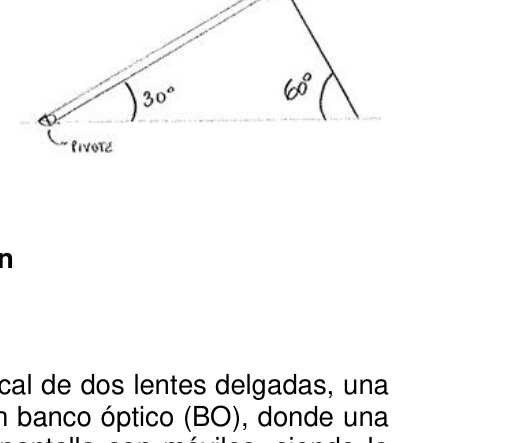
Topic: Rigid Body Statics Metodi: Torque & Angular Momentum Analysis, Free-Body Diagram Competenze: Physical Reasoning Objects: Beam, Spring, String Fonte: Testo (PDF) — p.5
PT48. - Scuola San Giorgio.
Quilmes, Buenos Aires.
Una barra di massa uniforme di 12 kg e 10 m piove in una delle sue estremità col suolo. L’altra estremità è si trova attaccato ad un fascio superiore fisso mediante un la primavera che si trova a 30 cm di distanza rispetto al suo posizione di equilibrio. Inoltre, a 3⁄4 delle sue L’albero è legato al suolo con un Cable a tensione di 200 N. Guardando il diagramma, determinare: a) La costante di primavera. b) La forza orizzontale e verticale che fa il pivote sulla barra.
Topic: Rigid Body Statics Metodi: Torque & Angular Momentum Analysis, Free-Body Diagram Competenze: Physical Reasoning Objects: Beam, Spring, String Fonte: Testo (PDF) — p.5
PT48. St. George’s School
Quilmes, Buenos Aires is where I am.
A uniform mass bar of 12 kg and 10 m pivotes in One of its ends with the ground. At the other end of the spectrum. is attached to a fixed upper beam by a spring that is 30 cm stretched from its The balance position. In addition, three quarters of your length, the beam is attached to the ground by a a voltage of 200 N. Looking at the diagram, determine: (a) The spring constant. (b) The horizontal and vertical force of the pivot on the bar.
Topic: Rigid Body Statics Metodi: Torque & Angular Momentum Analysis, Free-Body Diagram Competenze: Physical Reasoning Objects: Beam, Spring, String Fonte: Testo (PDF) — p.5
PT49. Instituto Politécnico Superior General San Martín
Rosario, Santa Fe.
Las Polilentes.
Un alumno del Politécnico desea averiguar la distancia focal de dos lentes delgadas, una
positiva (LD+) y una negativa (LD-); para ello recurre a un banco óptico (BO), donde una
lámpara fija oficia de objeto, mientras el portalente y la pantalla son móviles, siendo la
longitud del banco de 5m.
a) En primera instancia, coloca la LD+ en el portalente, y moviendo este, logra formar
imagen en la pantalla en varias ocasiones, con distintas combinaciones de
distancias objetos e imágenes; en una de las combinaciones, observa que con una
distancia objeto de 1,5m, se forma imagen sobre la pantalla cuando esta se
encuentra 0,75m detrás de la lente.
a.1) ¿Cuál es la distancia focal de la LD+?
a.2) Muestre en un esquema el trazado de rayos que permite la formación de la
imagen para este caso.
a.3) ¿Qué tipo de imagen se formó sobre la lente? (posición, tamaño y naturaleza)
a.4) ¿Cuál es la máxima distancia objeto que podría usar en el BO para formar
imagen dentro del mismo?
b) En segunda instancia, intenta con la LD- , pero no logra recolectar imagen en la
pantalla. ¿Podría recolectar imagen con un BO más extenso? Explique.
c) Un compañero de la carrera de Óptica le recomienda adosar ambas lentes, y repetir
el experimento; al hacerlo, resulta que recolecta imágenes con varias combinacio-
66 - OAF 2015 nes, y observa que con la lente a 2m de la lámpara, la imagen se forma 2m después de la lente. ¿Cuál es la distancia focal de la LD-?
Topic: Geometric Optics Metodi: Thin Lens & Mirror Equation, Ray Tracing Competenze: Physical Reasoning Objects: Lens, Screen Fonte: Testo (PDF) — p.5
PT49. Istituto Politetnico Superiore Generale San Martín
Rosario, Santa Fe.
Le Polienti. Un allievo del Politecnico vuole capire la distanza focale di due lenti sottili, una La funzione di un banco ottico (BO) è quella di un banco ottico (LD+) e di un banco ottico (LD-); La lampada fissa è l’oggetto ufficiale, mentre il portatore e lo schermo sono mobili, essendo la lunghezza del banco di 5 m. a) In primo luogo, inserisce l’LD+ nel portante e, spostandolo, riesce a formare immagine sullo schermo più volte, con diverse combinazioni di distanze oggetti e immagini; in una delle combinazioni, osserva che con una Distanza di oggetto di 1,5m, si forma un’immagine sullo schermo quando questo è trova 0,75m dietro la lente. a.1) Qual è la distanza focale dell’LD+? a.2) Mostra in un schema il tracciato dei raggi che permette la formazione della immagine per questo caso. a.3) Che tipo di immagine si è formata sullo stento? (posizione, dimensione e natura) a.4) Qual è la massima distanza di oggetto che potrebbe utilizzare nel BO per formare immagine all’interno di esso? b) In secondo luogo, prova con l’LD- ma non riesce a raccogliere l’immagine in schermo. Potresti raccogliere un’immagine con un BO più ampio? Spiegami. c) Un compagno di gara di ottica consiglia di mettere in comune entrambi gli obiettivi e di ripeterlo. L’esperimento, in tal modo, si rivela che raccoglie immagini con diverse combinazioni di
66 - OAF 2015 e osserva che con il lente a 2 metri dalla lampada, l’immagine si forma a 2 metri dopo la lente. Qual è la distanza focale dell’LD-?
Topic: Geometric Optics Metodi: Thin Lens & Mirror Equation, Ray Tracing Competenze: Physical Reasoning Objects: Lens, Screen Fonte: Testo (PDF) — p.5
PT49. The French authorities have already confirmed that the Commission is not interested in the use of the information provided by the Commission.
Rosario, Santa Fe.
The Polients. A student at the Polytechnic wants to find out the focal length of two thin lenses, one The first is the optical bank (BO), where a The lamp is fixed as an object, while the gate and the screen are mobile, being the length of the bench of 5 m. (a) In the first instance, the LD+ is placed on the portal, and by moving it, it is able to form The image on the screen several times, with different combinations of distance objects and images; in one of the combinations, note that with a object distance of 1.5m, an image is formed on the screen when this is Finds 0.75m behind the lens. a.1) What is the focal length of the LD+? (a.2) Show in a diagram the tracing of rays that allows the formation of the image for this case. (a.3) What kind of image was formed on the lens? (position, size and nature) a.4) What is the maximum object distance you could use in the BO to form image inside it? (b) In the second instance, he tries with the LD- but fails to collect image in the screen. Could you take a picture with a larger BO? - Explain that. c) A fellow optics racer recommends that you pair both lenses, and repeat The experiment, in doing so, turns out to collect images with several combinations of
The following points shall be added: And you see that with the lens 2m from the lamp, the image is 2m. after the lens. What’s the focal length of the LD-?
Topic: Geometric Optics Metodi: Thin Lens & Mirror Equation, Ray Tracing Competenze: Physical Reasoning Objects: Lens, Screen Fonte: Testo (PDF) — p.5
PT50. Instituto Politécnico Superior General San Martín
Rosario, Santa Fe.
La dieta de Germán.
En los últimos meses Germán ha engordado bastante, alcanzando su récord de 85 kg.
Por este motivo, va empezar a hacer ejercicios y decide instalar una barra para poder
ejercitar los brazos. Observa diversos modelos comerciales, y decide construir uno
similar. La mayoría de estos consisten en dos cilindros concéntricos, con un resorte que
fuerza que se separen (como se observa en la Figura 1) limitado por las paredes. Compra
un resorte de longitud natural 1,5m para disponer entre los 80 cm de distancia entre las
paredes.
Cuando logra construirla se da cuenta que no está tan fuera de estado, ya que logra
elevar su cuerpo 10 veces, una altura de 30 cm, en 1 minuto.
Figura 1: Esquema de la barra fabricada dispuesta entre dos paredes
a) Dibuje un diagrama de cuerpo libre del sistema. Por facilidad se recomienda,
considerar al sistema cilindros+resorte como una entidad única.
b) Encuentre una expresión de la fuerza máxima que puede sostener la barra en
función de la constante k del resorte. ¿Cuál será entonces el valor mínimo de k para
que Germán no se caiga?
c) ¿Cuánto trabajo realizó Germán para elevar su cuerpo? ¿Cuánta potencia fue
necesaria?
Figura 2: Esquema de la posición al girar con el cuerpo contraído y su modelización.
Como los ejercicios de brazo estaban avanzando, Germán decide probar que tal se le da hacer volteretas. Así, va corriendo hacia la barra con la velocidad tal que cuando se cuelga le alcanza con lo justo para dar una vuelta. Como Germán flexionó sus piernas al llegar a la barra (izquierda en la Figura 2), una forma fácil de modelar al cuerpo humano es como una masa puntual (derecha en la Figura 2), responda
d) ¿Cuánta energía cinética tiene Germán en el punto más alto?
e) ¿Cuál es la velocidad inicial para que pueda dar una vuelta completa?
f) ¿Es necesario modificar el k del resorte? Justifique. En caso afirmativo diga cuanto
debería valer.
Si Germán no se contrae al girar, posiblemente un modelo más acertado sería pensarlo como un prisma de las dimensiones que se observan en la Figura 3.
g) ¿Cuál sería la energía cinética en el punto más alto si el movimiento empezó con la misma velocidad, la del ítem 5?
OAF 2015 - 67
Figura 3: Esquema de la posición al girar con el cuerpo estirado y su modelización.
Datos: El momento de inercia de un prisma respecto a un eje que pasa por el centro de masa es
donde a y b son las longitudes de los lados del prisma que son perpendiculares al eje de rotación
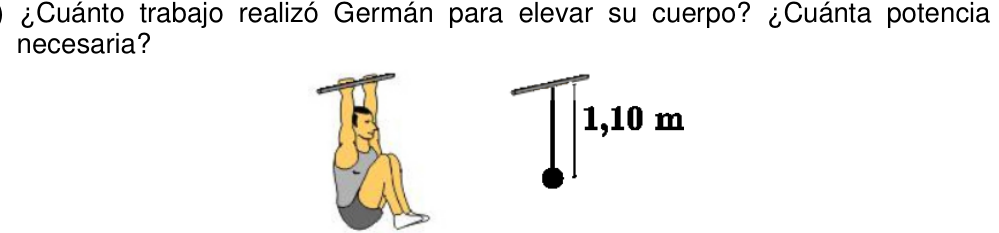
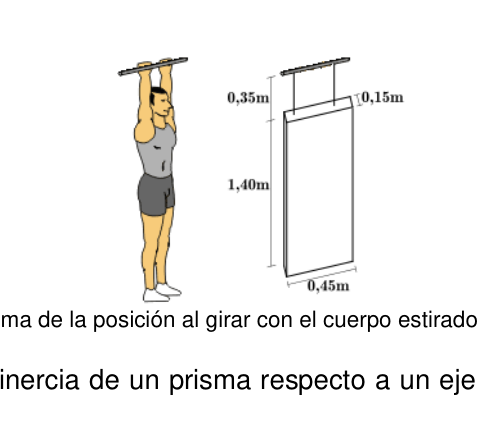
Topic: Conservation of Energy, Rotational Dynamics Metodi: Energy Conservation Method, Hooke’s Law Competenze: Physical Reasoning Objects: Spring, Cylinder Fonte: Testo (PDF) — p.5
PT50. Istituto Politetnico Superiore Generale San Martín
Rosario, Santa Fe.
La dieta di Germán. Negli ultimi mesi Germán è diventato molto grasso, raggiungendo il suo record di 85 kg. Per questo, inizia a fare esercizi e decide di installare una barra per poterlo fare. esercitare le braccia. Guarda diversi modelli commerciali, e decide di costruirne uno. simile. La maggior parte di questi sono costituiti da due cilindri concentrici, con una resorte che La forza che si separa (come si vede in Figura 1) è limitata dai muri. Compra Una sorgente di 1,5 m di lunghezza naturale per disporre di una distanza di 80 cm tra le
- Le pareti. Quando riesce a costruirla si rende conto che non è così fuori stato, perché riesce. alzare il corpo 10 volte, a un’altezza di 30 cm, in un minuto.
Figura 1: Schema della barra fabbricata disposta tra due pareti
a) Disegnare un diagramma del corpo libero del sistema. Per facilità si consiglia, Considerare il sistema cilindri+risorsa come un’unica entità. b) Trova un’espressione della massima forza che la barra può sostenere in funzione della costante k della primavera. Qual è il valore minimo di k per che Germán non cadesse? c) Quanto lavoro fece Germán per alzare il suo corpo? Quanto potenza ha avuto? necessaria?
Figura 2: Schema della posizione giratoria con il corpo contraccato e la sua modellazione.
Mentre gli esercizi dell’armo stavano avanzando, Germán decide di provare che si dà. fare le torte. Così, va correndo verso la barra con velocità tale che quando si E’ abbastanza per un giro. Come Germán fleccò le gambe al arrivare alla barra (a sinistra nella Figura 2), un modo facile di modellare il corpo umano è come una massa puntuale (destra in Figura 2), risponde
d) Quanta energia cinetica ha Germán al punto più alto? e) Qual è la velocità iniziale per poter fare un giro completo? f) È necessario modificare il k della primavera? giustifica. Se sì, dite quanto. Dovrebbe valere.
Se Germán non si contrae a girare, forse un modello più efficace sarebbe pensare a questo. come un prisma delle dimensioni che si vedono in Figura 3.
g) Qual sarebbe l’energia cinetica al punto più alto se il movimento iniziasse con la La stessa velocità dell’itomo 5?
OAF 2015 - 67
Figura 3: Schema della posizione giratoria con il corpo stretto e la sua modellazione.
Dati: Il momento di inerzia di un prisma rispetto ad un asse che passa attraverso il centro di massa è
dove a e b sono le lunghezze dei lati del prisma che sono perpendicolari all’asse di rotazione
Topic: Conservation of Energy, Rotational Dynamics Metodi: Energy Conservation Method, Hooke’s Law Competenze: Physical Reasoning Objects: Spring, Cylinder Fonte: Testo (PDF) — p.5
PT50. The French authorities have already confirmed that the Commission is not interested in the use of the information provided by the Commission.
Rosario, Santa Fe.
The German diet. In recent months, Germán has gained quite a bit of weight, reaching his record 85 kg. So he’s gonna start exercising and he decides to install a bar so he can Exercise your arms. He looks at various business models, and decides to build one. similar. Most of these consist of two concentric cylinders, with a spring that The force of the separation (as shown in Figure 1) is limited by the walls. Buy it . A natural spring of 1.5 m length to be arranged between the two walls. When he manages to build it, he realizes he’s not so out of state, because he does. raise your body 10 times, a height of 30 cm, in one minute.
Figure 1: Scheme of the manufactured bar arranged between two walls
(a) Draw a free-body diagram of the system. It is recommended for ease of use, consider the cylinder+resort system as a single entity. (b) Find an expression of the maximum strength that the bar can hold in function of the spring constant k. What is the minimum value of k for ? That Germán won’t fall? (c) How much work did Germán do to lift his body? How much power was it?
- What?
Figure 2: Scheme of the rotating position with the contracted body and its modelling.
As the arm exercises were progressing, Germán decided to prove that he was given one. I’m going to do some flirting. So, it’s running towards the bar at such speed that when it does Hanging is enough to get you to turn around. As Germán bent his legs to the to get to the bar (left in Figure 2), an easy way to model the human body It’s like a point mass (right in Figure 2), responds
(d) How much kinetic energy does Germán have at the highest point? (e) What is the initial speed so that you can make a full lap? (f) Is the spring k needed to be modified? You justify it. If yes , how much ? It should be worth it.
If Germán doesn’t contract while spinning, perhaps a more accurate model would be to think so. as a prism of the dimensions seen in Figure 3.
(g) What would the kinetic energy at the highest point be if the motion started with the Same speed as the item 5?
The Commission shall adopt delegated acts in accordance with Article 21 of the Financial Regulation.
Figure 3: Schedule of rotating position with the body stretched and its modelling.
Data: The moment of inertia of a prism with respect to an axis passing through the centre of the lens. Mass is
where a and b are the lengths of the sides of the prism that are perpendicular to the axis of rotation
Topic: Conservation of Energy, Rotational Dynamics Metodi: Energy Conservation Method, Hooke’s Law Competenze: Physical Reasoning Objects: Spring, Cylinder Fonte: Testo (PDF) — p.5
PT51. Instituto Politécnico Superior General San Martín
Rosario, Santa Fe.
El instrumento casero. Cuando un conductor es circulado por una corriente y se lo somete a un campo magnético, se produce una interacción de carácter magnético. Uno de los primeros que experimentó sobre estas cuestiones fue Michael Ampère. La expresión que describe la fuerza de interacción entre la corriente y el campo magnético se escribe a través del siguiente producto vectorial:
donde
representa un vector cuyo módulo coincide con la longitud total del cable y su
sentido está dado por la circulación de la corriente; I representa la corriente que circula
por el conductor y
el campo magnético medido en Tesla (T).
Con este principio se construye un dispositivo que
permite medir la magnitud del campo magnético B.
El mismo consta de una fuente de voltaje de 72V y una
resistencia interna de 1Ω, a través de unos cables se
conecta una varilla conductora. Los cables son lo
suficientemente delgados y tienen resistividad y masa
despreciable.
La varilla conductora es maciza, cilíndrica, con un largo
de 1m y un diámetro de 1,95mm, tiene una masa de
150g uniformemente distribuida. La aleación, con la cual
fue
fabricada,
presenta
una
resistividad
de
.
Además cuelga mediante un pivote de libre fricción en
el cual puede rotar libremente un ángulo θ desde su posición de reposo, si la fuerza
magnética actúa sobre ella. Cuando entra en equilibrio, a través de la medición de dicho
ángulo es posible determinar el campo magnético B.
a) ¿Cuál es el sentido de circulación de la corriente proveniente de la fuente de voltaje
para la situación descripta en la figura?
b) Esquematice las fuerzas actuantes a través de un diagrama de cuerpo libre.
c) Encuentre la expresión del instrumento que vincula el campo magnético con el
ángulo a medir.
68 - OAF 2015
d) ¿Qué intensidad de corriente circula por el instrumento?
e) Para un ángulo
, ¿cuál el valor del campo magnético existente?
f) ¿Cuál es el valor máximo de campo magnético que puede medirse con este
instrumento?
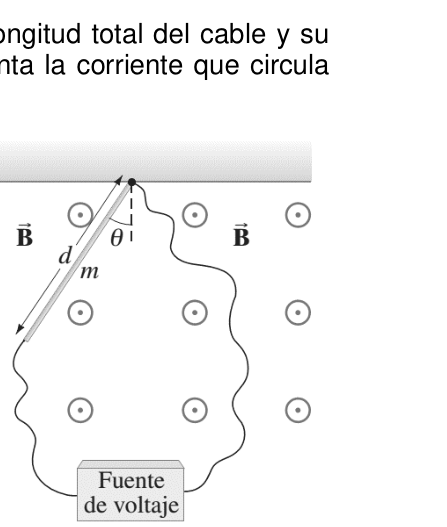
Topic: Magnetism Metodi: Lorentz Force Analysis, Torque & Angular Momentum Analysis Competenze: Physical Reasoning Objects: Rod, Battery Fonte: Testo (PDF) — p.5
PT51. Istituto Politetnico Superiore Generale San Martín
Rosario, Santa Fe.
L’instrumento domestico. Quando un conducente viene circolato da un corrente e viene sottoposto a un campo La presenza di un’interazione magnetica è un’interazione magnetica. Uno dei primi a l’esperimento su questi temi è stato Michael Ampère. L’espressione che descrive la forza di interazione tra corrente e campo Magnetico si scrive attraverso il seguente prodotto vettoriale:
dove rappresenta un vettore il cui modulo corrisponde alla lunghezza totale del cavo e il suo Il senso è dato dal flusso di corrente; I rappresenta il flusso che circola dal conducente e il campo magnetico misurato in Tesla (T). Con questo principio si costruisce un dispositivo che permette di misurare la magnitudine del campo magnetico B. Il suo contenuto è costituito da una fonte di tensione di 72 V e una resistenza interna di 1Ω, attraverso dei cavi se connesse un bastone di conduttore. I cavi sono il sufficientemente sottili e hanno resistenza e massa
- Desprezioso. La canna conduttrice è massiccia, cilindrica, con una lunga di 1 m e di diametro di 1,95 mm, ha una massa di 150g uniformemente distribuiti. L’allea, con cui
- È stato . fabbricato, presenta Una . resistenza de . Inoltre, si appende con un pivot di libero frizione in che può girare liberamente un angolo θ dalla sua posizione di riposo, se la forza la magneticità agisce su di essa. Quando si entra in equilibrio, attraverso la misurazione di detto angolo è possibile determinare il campo magnetico B. a) Qual è il senso di circolazione del corrente proveniente dalla fonte di tensione per la situazione descritta nella figura? b) Squamatizzare le forze attive attraverso un diagramma di corpo libero. (c) Trova l’espressione dell’istrumento che collega il campo magnetico con il angolo da misurare.
68 - OAF 2015 d) Qual è l’intensità di corrente che circola attraverso l’impianto? e) Per un angolo Qual è il valore del campo magnetico esistente? f) Qual è il massimo valore di campo magnetico che può essere misurato con questo strumento?
Topic: Magnetism Metodi: Lorentz Force Analysis, Torque & Angular Momentum Analysis Competenze: Physical Reasoning Objects: Rod, Battery Fonte: Testo (PDF) — p.5
PT51. The French authorities have already confirmed that the Commission is not interested in the use of the information provided by the Commission.
Rosario, Santa Fe.
The home instrument. When a conductor is circulated by a current and subjected to a field The magnetic field is the magnetic field. One of the first to The first person to experiment on these issues was Michael Ampère. The expression describing the force of interaction between the current and the field The magnetic is written through the following vector product:
Where It represents a vector whose module matches the total length of the cable and its The direction is given by the current circulation; I represents the current circulating by the driver and the magnetic field measured in Tesla (T). This principle is used to build a device that It allows measuring the magnitude of the magnetic field B. It consists of a 72V voltage source and a Internal resistance of 1Ω, through a few cables connects a conductive rod. The cables are the thing . They are thin enough to have resistance and mass. I’m not a big fan of this. The conductive rod is solid, cylindrical, with a long 1m and a diameter of 1.95mm, has a mass of 150g evenly distributed. The alloy, with which It was . Manufactured, It presents One . Resistivity de . It also hangs by a free-friction pivot on the which can freely rotate an angle θ from its resting position if the force magnetic action on it. When it comes into balance, through measuring it. angle it is possible to determine the magnetic field B. (a) What is the direction of flow of the current coming from the voltage source for the situation described in the figure? (b) Schematize the acting forces through a free-body diagram. (c) Find the expression of the instrument linking the magnetic field to the magnetic field. angle to measure.
The Commission shall adopt delegated acts in accordance with Article 21 of Regulation (EU) No 1303/2013. (d) What current intensity is flowing through the instrument? (e) For an angle What’s the value of the existing magnetic field? (f) What is the maximum magnetic field value that can be measured with this The instrument?
Topic: Magnetism Metodi: Lorentz Force Analysis, Torque & Angular Momentum Analysis Competenze: Physical Reasoning Objects: Rod, Battery Fonte: Testo (PDF) — p.5
PT52. Colegio Universitario Central Gral. José de San Martín
Ciudad de Mendoza.
En el interior de un ascensor es abandonada una pequeña esfera A desde una altura de
2,0 m en relación al piso del ascensor. En el mismo instante y sobre la misma vertical es
lanzada del piso del elevador otra esfera B con velocidad inicial v0=5,0 m/s en dirección a
la esfera A.
Desprecie la resistencia del aire, tome la aceleración de gravedad como g=10m/s2 y
considere que la velocidad v0 es dada siempre en relación al piso del ascensor.
Determine a qué distancia del piso del ascensor ocurre el encuentro entre las esferas
para los siguientes casos: Analice los siguientes casos,
a) El ascensor está parado en relación al suelo
b) El ascensor sube acelerado con a1 = 2,0 m/s2
c) El ascensor baja acelerado con a2= 12,0 m/s2
Topic: Newtonian Mechanics Metodi: Kinematic Equations Competenze: Physical Reasoning Objects: Ball Fonte: Testo (PDF) — p.5
PT52. Gral Central University. José de San Martín
Città di Mendoza.
All’interno di un ascensore è abbandonata una piccola sfera A da un’altezza di 2,0 m rispetto al pavimento dell’ascensore. Lo stesso istante e sulla stessa verticale è lanciato dal pavimento dell’ascensore un’altra sfera B con velocità iniziale v0=5,0 m/s in direzione di la sfera A. Sprezzate la resistenza dell’aria, prendete l’accelerazione gravitazionale come g=10m/s2 e Considerare che la velocità v0 è sempre data in relazione al pavimento dell’ascensore. Determina a che distanza dal pavimento dell’ascensore si verifica l’incontro tra le sfere per i seguenti casi: analizzare i seguenti casi, a) L’ascensore è fermo rispetto al pavimento b) L’ascensore salire accelerato con a1 = 2,0 m/s2 c) L’ascensore a bassa velocità a2= 12,0 m/s2
Topic: Newtonian Mechanics Metodi: Kinematic Equations Competenze: Physical Reasoning Objects: Ball Fonte: Testo (PDF) — p.5
PT52. Gral Central High School. Joseph of San Martin
The city of Mendoza.
Inside an elevator a small sphere A from a height of 2.0 m in relation to the floor of the elevator. At the same instant and over the same vertical is Other sphere B with initial velocity v0=5,0 m/s in the direction of the sphere A. Take the air resistance, take the gravitational acceleration as g=10m/s2 and Consider that the speed v0 is always given in relation to the floor of the lift. Determine how far from the elevator floor the encounter between the spheres occurs for the following cases: Analyze the following cases, (a) The elevator is stationary relative to the ground. (b) The elevator is accelerated up with a1 = 2.0 m/s2 (c) The accelerated low lift with a2= 12,0 m/s2
Topic: Newtonian Mechanics Metodi: Kinematic Equations Competenze: Physical Reasoning Objects: Ball Fonte: Testo (PDF) — p.5
PT53. Colegio Universitario Central Gral. José de San Martín
Ciudad de Mendoza.
Efren Reyes uno de los mejores jugadores de billar de
la historia realiza el tiro que se representa en la figura.
La bola 2 se encuentra inicialmente en reposo y la bola
1, antes del choque, tiene una velocidad 𝑣1 en la
dirección que se indica. Después del choque la bola 2
sale en la dirección indicada con una rapidez 𝑣2
′ . Las
masas de las bolas son idénticas.
Recuerde que el coeficiente de restitución ―e‖ es una medida del grado de conservación
de la energía cinética en un choque entre partículas clásicas, una expresión para el
mismo es:
𝑒= −𝑣2𝑓−𝑣1𝑓
𝑣2𝑖−𝑣1𝑖
(Ayuda: en la expresión anterior se debe tener en cuenta que la velocidad es una magnitud vectorial)
a) Determine la mínima rapidez posible 𝑣2
′ en función de 𝑣1.
b) Si v1 = 4
m
s y e = 0,5 determine la rapidez v2
′ .
c) Con los datos calculados en ítem b halle el ángulo β.
Topic: Conservation of Momentum Metodi: Conservation of Momentum, Vector Decomposition Competenze: Physical Reasoning Objects: Ball Fonte: Testo (PDF) — p.5
PT53. Gral Central University. José de San Martín
Città di Mendoza.
Efren Reyes, uno dei migliori giocatori di biliardo del mondo. la storia fa il colpo che viene rappresentato nella figura. La palla 2 è inizialmente in riposo e la palla è in ritardo. 1, prima dello scontro, ha una velocità v1 in indirizzo indicato. Dopo il colpo la palla 2 si sposta nella direzione indicata con velocità v2 ′ . Le Le masse delle palle sono identiche. Ricorda che il coefficiente di restituzione ―e‖ è una misura del grado di conservazione La prima è che il sistema di energia cinetica in un colpiscio tra particelle classiche, un’espressione per il
- E ’ proprio: 𝑒= −𝑣2𝑓−𝑣1𝑓 𝑣2𝑖−𝑣1𝑖
(Aiuto: nella espressione precedente si deve tenere presente che la velocità è un grandezza vettoriale)
a) Determina la velocità minima possibile v2 ′ in funzione di v1. b) Si v1 = 4 m s e e = 0,5 determinano la velocità v2 ′ . c) Con i dati calcolati in punto b, trova l’angolo β.
Topic: Conservation of Momentum Metodi: Conservation of Momentum, Vector Decomposition Competenze: Physical Reasoning Objects: Ball Fonte: Testo (PDF) — p.5
PT53. Gral Central High School. Joseph of San Martin
The city of Mendoza.
Efren Reyes one of the best pool players of The story takes the shot that’s pictured in the figure. Ball 2 is initially at rest and the ball is at rest. 1, before the collision, it has a velocity v1 at the the address indicated. After the impact the ball 2 It is going in the direction indicated at a speed of v2 ′ . The The masses of the balls are identical. Remember that the restitution coefficient ―e‖ is a measure of the degree of conservation The first is the kinetic energy in a collision between classical particles, an expression for the It is: 𝑒= −𝑣2𝑓−𝑣1𝑓 𝑣2𝑖−𝑣1𝑖
(Help: in the above expression it should be noted that the speed is a (Victorial magnitude)
(a) Determine the minimum speed possible v2 ′ according to v1. b) Si v1 = 4 m s and e = 0,5 determine the speed v2 ′ . (c) Find the angle β with the data calculated in item b.
Topic: Conservation of Momentum Metodi: Conservation of Momentum, Vector Decomposition Competenze: Physical Reasoning Objects: Ball Fonte: Testo (PDF) — p.5
PT54. Colegio Universitario Central Gral. José de San Martín
Ciudad de Mendoza.
1- Radiación Electromagnética. Todo cuerpo, aún a temperaturas ordinarias, emite energía en forma de radiación electromagnética. La intensidad (potencia por unidad de área) irradiada por un cuerpo a una temperatura absoluta T se puede expresar con la ley de Stefan-Boltzmann como sigue: I=eσT4
donde σ es una constante física fundamental llamada constante de Stefan-Boltzmann (cuyo valor numérico es 5.67X10⁻⁸ W/m2K4), y e es la emisividad, un numero
OAF 2015 - 69
adimensional entre 0 y 1 que depende de la naturaleza de la superficie. Los objetos para
los cuales e es igual a 1, se llaman cuerpos negros.
Una propiedad importante de la intensidad transmitida por ondas electromagnéticas es
que, como en todo fenómeno ondulatorio, si las ondas se propagan igualmente en todas
las direcciones a partir de una fuente puntual, las intensidades I1 y I2 a distancias r1 y r2
(respectivamente) de la fuente satisfacen la siguiente relación:
𝐼2
𝐼1
= 𝑟1
2
𝑟22
Radiación Solar. La principal fuente de calor que recibe la tierra proviene del sol, el cual
está continuamente radiando energía en forma de ondas electromagnéticas. Sin
embargo, no toda la radiación interceptada por la tierra es absorbida, ya que una fracción
de la energía incidente es reflejada de regreso al espacio, principalmente por las nubes
(20%), por los constituyentes atmosféricos (6%), y por la superficie terrestre (4%). La
temperatura en la superficie del sol es de aproximadamente 5790 °C, su radio es
6.96X10⁸m, la distancia entre los centros del sol y la tierra 1.5X10¹¹m, y el radio terrestre
es 6.4X10⁶m.
a) Calcule la potencia electromagnética que absorbe la Tierra debido a la radiación
solar, suponiendo que sol emite como cuerpo negro y como una fuente puntual
desde su centro, y que el área de absorción de la Tierra es el de un disco circular
de radio terrestre.
b) Calcule la temperatura (en °C) de equilibrio en la superficie de la Tierra, suponiendo
que la tierra emite como cuerpo negro y su área de emisión es el de una esfera.
(Ayuda: la temperatura de equilibrio es aquella para la cual la potencia total
absorbida es igual a la potencia total emitida)
Efecto Invernadero. La vida en la tierra es posibilitada por la presencia de ciertos gases
atmosféricos, llamados ―gases de invernadero‖, que absorben la radiación infrarroja
emitida por la superficie terrestre. Parte de esta radiación absorbida es reemitida hacia
las partes superiores de la atmósfera, mientras que otra parte es reemitida hacia la
superficie de la tierra calentándola por encima del valor de temperatura calculado en b).
Teniendo en cuenta que la potencia absorbida por la superficie terrestre debida a esta
reemisión infrarroja de los gases de invernadero es 1.66X10¹⁷W y que, además, la
superficie terrestre absorbe el 29% de la radiación solar absorbida por la Tierra (calculada
en el ejercicio a):
c) Calcule la temperatura de equilibrio (°C) en la superficie de la Tierra.
2- Una de las teorías sobre el cambio climático afirma que por causa del aumento
excesivo de los gases de invernadero en la atmósfera se están derritiendo los glaciares.
Con el fin de analizar la veracidad de la afirmación anterior, un grupo de científicos
recrean en su laboratorio un paisaje glaciar, extraen un gran trozo de hielo de masa m1
del Perito Moreno1 y lo colocan en un tanque aislado con una masa m2 de agua a 10°C.
Teniendo en cuenta que el fragmento de hielo se encuentra a una temperatura inicial de -
20°C, calcule la relación entre las masas (m1/m2) para los siguientes casos:
a) el equilibrio térmico se obtiene con todo hielo a -5 °C
b) el equilibrio térmico se obtiene con todo líquido a 0 °C
c) el equilibrio térmico se obtiene con todo líquido a 5 °C
Constantes termodinámicas de las sustancias implicadas: Calor específico del hielo: 2.093 J/gK Calor latente de fusión del hielo: 333.7 J/g Calor específico del agua del tanque es: 4.186 J/gK
1 El glaciar Perito Moreno es una gruesa masa de hielo ubicada en el departamento Lago Argentino de la provincia de Santa Cruz, en el sudoeste de la Argentina, en la región de la Patagonia.
70 - OAF 2015
Topic: Thermodynamics, Astrophysics Metodi: Statistical Averaging, First Law of Thermodynamics Competenze: Physical Reasoning, Mathematical Modeling Objects: Star, Planet Fonte: Testo (PDF) — p.5
PT54. Gral Central University. José de San Martín
Città di Mendoza.
1-Radiamento elettromagnetico. Ogni corpo, anche a temperature normali, emette energia sotto forma di radiazioni elettromagnetiche. L’intensità (potenza per unità di L’area) irradiata da un corpo a una temperatura assoluta T può essere espressa con la legge di Stefan-Boltzmann come segue: I=eσT4
dove σ è una costante fisica fondamentale chiamata costante di Stefan-Boltzmann (il cui valore numerica è 5.67X10⁻⁸ W/m2K4), e e è l’emissività, un numero
OAF 2015 - 69 dimensionale tra 0 e 1, a seconda della natura della superficie. Gli oggetti per che e è uguale a 1, sono chiamati corpi neri. Una proprietà importante dell’intensità trasmessa dalle onde elettromagnetiche è che, come in ogni fenomeno ondulativo, se le onde si diffondono ugualmente in tutte le direzioni da una fonte puntuale, le intensità I1 e I2 a distanze r1 e r2 (rispettivamente) della fonte soddisfano il seguente rapporto: 𝐼2 𝐼1 = 𝑟1 2 𝑟22
- Radiamento solare. La principale fonte di calore che riceve la Terra viene dal sole, che sta continuamente emettendo energia sotto forma di onde elettromagnetiche. Senza . Tuttavia, non tutta la radiazione intercettata dalla terra viene assorbita, poiché una frazione L’energia incidente viene riflessa indietro nello spazio, principalmente dalle nuvole. La superficie terrestre è di circa 4%. La La temperatura sulla superficie del sole è di circa 5790 °C, il suo raggio è 6.96x10⁸m, la distanza tra i centri del sole e la terra 1.5x10¹¹m, e il raggio terrestre es 6.4X10⁶m. a) Calcolare la potenza elettromagnetica che la Terra assorbe a causa della radiazione. il sole, supponendo che il sole emetta come corpo nero e come fonte puntuale La Terra è un disco circolare. radio terrestre. b) Calcolare la temperatura di equilibrio (in °C) sulla superficie della Terra, supponendo che la terra emette come un corpo nero e la sua area di emissione è quella di una sfera. (Aiuto: la temperatura di equilibrio è quella per la quale la potenza totale (Tutta la potenza emessa)
Effetto serra. La vita sulla terra è possibile dalla presenza di alcuni gas atmosferici, chiamati “gassi serra”, che assorbono la radiazione infrarossa emessa dalla superficie terrestre. Parte di questa radiazione assorbita viene reemessa verso Le parti superiori dell’atmosfera, mentre un’altra parte viene emessa verso l’atmosfera. la superficie del terreno riscaldata al di sopra del valore di temperatura calcolato in b). Considerando che la potenza assorbita dalla superficie terrestre è dovuta a questa La reemissione infrarossa dei gas serra è di 1.66X10¹⁷W e che, inoltre, la La superficie terrestre assorbe il 29% della radiazione solare assorbita dalla Terra (calcolato nel periodo a): c) Calcolare la temperatura di equilibrio (°C) sulla superficie della Terra.
2- Una delle teorie sul cambiamento climatico afferma che a causa dell’aumento L’eccesso di gas serra nell’atmosfera sta sciogliendo i ghiacciai. Per analizzare la veridicità dell’affermazione precedente, un gruppo di scienziati Riproduce in laboratorio un paesaggio glaciale, estraggono un grande pezzo di ghiaccio di massa di 1 m. di Perito Moreno1 e lo mettono in un serbatoio isolato con una massa di acqua di m2 a 10°C. Considerando che il frammento di ghiaccio si trova ad una temperatura iniziale di - 20°C, calcola il rapporto di massa (m1/m2) per i seguenti casi: a) l’equilibrio termico si ottiene con tutto il ghiaccio a -5 °C b) il calore termico si ottiene con tutto il liquido a 0 °C c) il calore di equilibrio si ottiene con tutto il liquido a 5 °C
Costanti termodinamiche delle sostanze coinvolte: Calore specifico del ghiaccio: 2.093 J/gK Calore latente della fusione del ghiaccio: 333,7 J/g Calore specifico dell’acqua del serbatoio è: 4.186 J/gK
1 Il ghiacciaio Perito Moreno è una grossa massa di ghiaccio situato nel dipartimento Lago Argentino di la provincia di Santa Cruz, nel sud-ovest dell’Argentina, nella regione della Patagonia.
70 - OAF 2015
Topic: Thermodynamics, Astrophysics Metodi: Statistical Averaging, First Law of Thermodynamics Competenze: Physical Reasoning, Mathematical Modeling Objects: Star, Planet Fonte: Testo (PDF) — p.5
PT54. Gral Central High School. Joseph of San Martin
The city of Mendoza.
1- Electromagnetic radiation. Every body, even at ordinary temperatures, emits energy in the form of electromagnetic radiation. The intensity (power per unit of The radiation from a body at an absolute temperature T can be expressed by the law The following is the text of Stefan-Boltzmann: I = eσT4
where σ is a fundamental physical constant called the Stefan-Boltzmann constant. (whose numerical value is 5.67X10⁻⁸ W/m2K4), and e is the emissivity, a number
The Commission shall adopt delegated acts in accordance with Article 21 of this Regulation. dimension between 0 and 1 depending on the nature of the surface. The objects for which is equal to 1, they’re called black bodies. An important property of the intensity transmitted by electromagnetic waves is That, as with any wave phenomenon, if the waves spread equally in all Directions from a point source, intensities I1 and I2 at distances r1 and r2 (respectively) the source satisfy the following relationship: 𝐼2 𝐼1 = 𝑟1 2 𝑟22
Solar radiation is coming. The earth’s main source of heat comes from the sun, which is the source of the sun. It’s continuously radiating energy in the form of electromagnetic waves. No . However, not all the radiation intercepted by the earth is absorbed, as a fraction of the radiation is absorbed by the earth. Incident energy is reflected back into space, mainly by clouds. The Commission has also adopted a proposal for a regulation on the approximation of the laws of the Member States relating to the use of certain substances. La The temperature on the surface of the sun is approximately 5790 °C, its radius is 6.96 x 10⁸m, the distance between the centers of the sun and the earth 1.5 x 10¹¹m, and the earth’s radius es 6.4X10⁶m. (a) Calculate the electromagnetic power absorbed by the Earth due to radiation. Solar, assuming the sun emits as a black body and as a point source. From its center, and that the Earth’s absorption area is that of a circular disk. The radio spectrum is the same as the radio spectrum. (b) Calculate the temperature (in °C) of equilibrium on the Earth’s surface, assuming The Earth emits as a black body and its emission area is that of a sphere. (Help: the equilibrium temperature is the one for which the total power absorbed is equal to the total power emitted)
Greenhouse effect. Life on earth is made possible by the presence of certain gases. atmospheric gases, called “greenhouse gases”, which absorb infrared radiation emitted by the earth’s surface. Some of this absorbed radiation is re-emitted to the The upper parts of the atmosphere, while another part is re-emitted towards the surface of the earth by heating above the temperature value calculated in (b). Whereas the power absorbed by the earth’s surface is due to this Infrared emissions of greenhouse gases are 1.66X10¹⁷W and that, in addition, the The Earth’s surface absorbs 29% of the solar radiation absorbed by the Earth (calculated in year a): (c) Calculate the equilibrium temperature (°C) on the surface of the Earth.
2- One of the theories about climate change states that because of the increase in The excess greenhouse gases in the atmosphere are melting glaciers. In order to analyse the veracity of the above statement, a group of scientists They recreate a glacial landscape in their lab, extract a large piece of ice of m1 mass. The water is then removed from the peritoneum and placed in an isolated tank with a water mass of 10° C. Whereas the ice fragment is at an initial temperature of - 20°C, calculate the mass ratio (m1/m2) for the following cases: (a) the thermal balance is obtained with all ice at -5 °C (b) the thermal balance is obtained with all liquid at 0 °C (c) the thermal balance is obtained with all liquid at 5 °C
Thermodynamic constants of the substances involved: Specific heat of ice: 2,093 J/gK Latent heat from melting ice: 333.7 J/g The specific heat of the tank water is: 4,186 J/gK
1 The Perito Moreno Glacier is a thick mass of ice located in the Argentine Lake department of Santa Cruz province, in southwestern Argentina, in the Patagonian region.
The following points shall be added:
Topic: Thermodynamics, Astrophysics Metodi: Statistical Averaging, First Law of Thermodynamics Competenze: Physical Reasoning, Mathematical Modeling Objects: Star, Planet Fonte: Testo (PDF) — p.5
PT55. Instituto Nuestra Señora de Lourdes
Porteña, Córdoba.
Considere una barra rígida de largo L = 4 m y
masa mb = 20 kg, apoyada como se indica en la
figura. Un cuerpo de masa mc = 50 kg se apoya
sobre el extremo C de la barra, a una distancia
L1 = 1 m al punto de apoyo A.
a) Determine la fuerza que se debe aplicar en el extremo B de la barra para
lograr una situación de equilibrio como la indicada en la figura.
b) Determine la reacción del piso sobre el apoyo (A).
Topic: Rigid Body Statics Metodi: Torque & Angular Momentum Analysis, Free-Body Diagram Competenze: Physical Reasoning Objects: Beam, Block Fonte: Testo (PDF) — p.5
PT55. Istituto Nostra Signora di Lourdes
Porteña, Cordoba.
Considera una barra rigida di lunghezza L = 4 m e massa mb = 20 kg, appoggiata come indicato nella
- Figura. Un corpo di massa mc = 50 kg si appoggia sopra l’estremità C della barra, a una distanza L1 = 1 m al punto di appoggio A. a) Determina la forza da applicare alla punta B della barra per raggiungere una situazione di equilibrio come indicata nella figura. b) Determina la reazione del pavimento al supporto (A).
Topic: Rigid Body Statics Metodi: Torque & Angular Momentum Analysis, Free-Body Diagram Competenze: Physical Reasoning Objects: Beam, Block Fonte: Testo (PDF) — p.5
PT55. Our Lady of Lourdes Institute
The gate, Cordoba.
Consider a rigid bar of L = 4 m length and mass mb = 20 kg, supported as indicated in It’s a figure. A body of mass mc = 50 kg is supported above the C-end of the bar, at a distance L1 = 1 m to support point A. (a) Determine the force to be applied to end B of the bar for achieve a balance situation as shown in the figure. (b) Determine the reaction of the floor to support (A).
Topic: Rigid Body Statics Metodi: Torque & Angular Momentum Analysis, Free-Body Diagram Competenze: Physical Reasoning Objects: Beam, Block Fonte: Testo (PDF) — p.5
PT56. Instituto Nuestra Señora de Lourdes
Porteña, Córdoba.
Calcular las intensidades de la corriente:
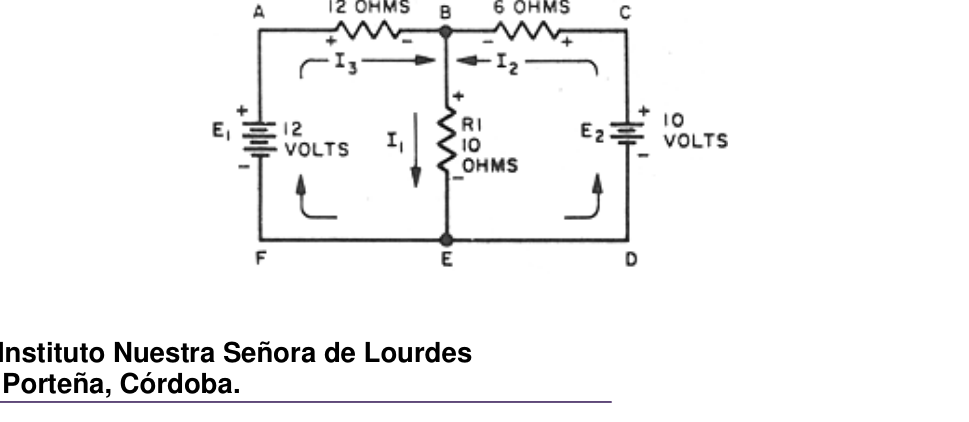
Topic: Circuits Metodi: Kirchhoff’s Laws Competenze: Physical Reasoning Objects: Resistor Fonte: Testo (PDF) — p.5
PT56. Istituto Nostra Signora di Lourdes
Porteña, Cordoba.
Calcolare le intensità del corrente:
Topic: Circuits Metodi: Kirchhoff’s Laws Competenze: Physical Reasoning Objects: Resistor Fonte: Testo (PDF) — p.5
PT56. Our Lady of Lourdes Institute
The gate, Cordoba.
Calculate the current intensities:
Topic: Circuits Metodi: Kirchhoff’s Laws Competenze: Physical Reasoning Objects: Resistor Fonte: Testo (PDF) — p.5
PT57. Instituto Nuestra Señora de Lourdes
Porteña, Córdoba.
Para tomar un buen mate algunos dicen que el agua debe estar a 85ºC por eso cuando Guillermo se dispuso a tomar mate, puso a calentar 800g de agua que se encontraba inicialmente a 20ºC. a) ¿Qué cantidad de calorías debe absorber el agua para llegar a la temperatura ideal para el mate de Guillermo? b) ¿Qué potencia debe tener su sistema para calentar el agua que puso Guillermo en 120 segundos?
Topic: Thermodynamics Metodi: First Law of Thermodynamics Competenze: Physical Reasoning Objects: Calorimeter Fonte: Testo (PDF) — p.5
PT57. Istituto Nostra Signora di Lourdes
Porteña, Cordoba.
Per prendere un buon mate alcuni dicono che l’acqua deve essere a 85°C per questo Quando Guillaume si dispose a prendere il mate, ha messo a riscaldare 800 grammi di acqua che si. Inizialmente si trovava a 20°C. a) Quante calorie deve assorbire l’acqua per raggiungere la temperatura ideale
- Per il matto di Guillermo? b) Che potenza deve avere il suo sistema per riscaldare l’acqua che William ha messo in 120 secondi?
Topic: Thermodynamics Metodi: First Law of Thermodynamics Competenze: Physical Reasoning Objects: Calorimeter Fonte: Testo (PDF) — p.5
PT57. Our Lady of Lourdes Institute
The gate, Cordoba.
To get a good mate some say the water must be at 85 degrees because of that When William was ready to take mate, he put 800g of water to heat it up. It was initially 20 degrees. (a) How many calories should water absorb to reach the ideal temperature? for William’s mate? (b) What power should your system have to heat the water William put in? 120 seconds?
Topic: Thermodynamics Metodi: First Law of Thermodynamics Competenze: Physical Reasoning Objects: Calorimeter Fonte: Testo (PDF) — p.5
PT58. EPET Nro. 4 Juan Agustín Larrus
Colegio Secundario Valle Argentino
General Acha, La Pampa.
Desafío eco. La escuela epet nº 4 esta participando, este año en el campeonato argentino de auto desafio eco, en el cual participan autos con motor electrico de 36 volt que es alimentado con 3 baterias de 12 volt y 12 amper hora. Dichas baterias no pueden ser recargada en ningun momento de la competencia.
Consigna a) ¿de qué forma se deben conectar las baterias para poder alimentar el motor y cual será su corriente y tensión?
OAF 2015 - 71
b) La carrera con la clasificacion dura 1:45 horas. Si el rendimiento del auto es óptimo
¿qué corriente debería ir consumindo para llegar al final de la misma?
c) Si el auto fuera consumiendo 8 amper ¿llegará al final?
d) La potencia del motor es de 350 watt ¿cual sería la resistencia que produce el
motor en cada caso anterior?
Topic: Circuits Metodi: Equivalent Circuit Reduction, Kirchhoff’s Laws Competenze: Physical Reasoning Objects: Battery, Resistor Fonte: Testo (PDF) — p.5
PT58. Il numero di EPET. 4 Juan Agustín Larrus
Scuola Secundaria Valle Argentino
Generale Acha, La Pampa.
Sfida l’eco. La scuola epet n. 4 sta partecipando, quest’anno al campionato argentino di Auto Challenge Eco, in cui partecipano auto con motore elettrico da 36 volt che è alimentato da 3 batterie di 12 volt e 12 amperes orari. Queste batterie non possono essere ricaricata in nessun momento della competizione.
Consigna a) come le batterie devono essere collegate per poter alimentare il motore e quale sarà il suo corrente e tensione?
OAF 2015 - 71 b) La gara con la classificazione dura 1:45 ore. Se la performance della macchina è ottimale Che corrente dovrebbe consumare per arrivare alla fine di essa? c) Se la macchina consumava 8 amperes, sarebbe finita? d) La potenza del motore è di 350 watt. motore in ogni precedente caso?
Topic: Circuits Metodi: Equivalent Circuit Reduction, Kirchhoff’s Laws Competenze: Physical Reasoning Objects: Battery, Resistor Fonte: Testo (PDF) — p.5
PT58. The following information shall be provided: 4 John Agustin Larrus
High School Valle Argentino
General Acha, the Pampa.
I challenge the echo. The school epet no 4 is participating, this year in the Argentine championship of The challenge is an eco-auto challenge, in which cars with 36 volt electric motors are involved. Powered by 3 12-volt and 12 amp-hour batteries. These batteries cannot be used. be recharged at any time during the competition.
I ‘m giving it away . (a) how the batteries must be connected to power the engine and which will be its current and voltage?
The Commission shall adopt implementing acts in accordance with Article 21 of this Regulation. (b) The qualifying race lasts 1:45 hours. If the performance of the car is optimal What current should I be consuming to get to the end of it? c) If the car was consuming 8 ampers, will it come to an end? (d) The power of the engine is 350 watts. What would be the resistance produced by the engine? engine in each of the previous cases?
Topic: Circuits Metodi: Equivalent Circuit Reduction, Kirchhoff’s Laws Competenze: Physical Reasoning Objects: Battery, Resistor Fonte: Testo (PDF) — p.5
PT59. EPET Nro. 4 Juan Agustín Larrus
Colegio Secundario Valle Argentino
General Acha, La Pampa.
Una nadadora de general acha participa en colombia de un campeonato olímpico panamericano y llega a las finales de 100 metros. Ésta chica sabe que llega en 5 seg a su velocidad máxima que es de 2,5 m/s. Siguiendo con velocidad constante hasta el final. Su rival que le puede ganar tarda 4,5 seg en llegar a su velocidad maxima que es 2,45 m/s. También siguiendo con velocidad constante hasta el final.
Consigna a) ¿qué aceleración tiene cada una las nadadoras? b) ¿qué distancia necesitan para llegar a su máximo de velocidad? c) ¿cuánto tarda cada una de las nadadoras para llegar a los 100 metros? d) ¿en qué momento se encuentra antes de los 100 metros? ¿o necesita más distancia? Determinar los valores. e) Realizar un gráfico
Topic: Newtonian Mechanics Metodi: Kinematic Equations Competenze: Physical Reasoning Objects: — Fonte: Testo (PDF) — p.5
PT59. Il numero di EPET. 4 Juan Agustín Larrus
Scuola Secundaria Valle Argentino
Generale Acha, La Pampa.
Una nuotatrice di generale acha partecipa in Colombia a un campionato olimpico e arriva alla fine dei 100 metri. Questa ragazza sa che arriva a 5 seg alla sua velocità massima che è di 2,5 m/s. Continuando a velocità costante fino alla fine. Il suo rivale che può vincere le richiede 4,5 secondi per raggiungere la sua velocità massima che è 2,45 m/s. Anche seguendo a velocità costante fino alla fine.
Consigna a) che velocità hanno le nuotatrici? b) che distanza hanno bisogno per raggiungere la loro velocità massima? c) Quanto ci vuole per ogni nuotatrice per raggiungere i 100 metri? d) a che punto si trova prima dei 100 metri? O ha bisogno di più? Distanza? Determinare i valori. e) realizzare un grafico
Topic: Newtonian Mechanics Metodi: Kinematic Equations Competenze: Physical Reasoning Objects: — Fonte: Testo (PDF) — p.5
PT59. The following information shall be provided: 4 John Agustin Larrus
High School Valle Argentino
General Acha, the Pampa.
A general aching swimmer participates in Colombia’s Olympic championship Pan-American and reaches the finals of the 100 meters. This girl knows she’s coming in at 5. seg at its maximum speed which is 2,5 m/s. Continuing at a constant speed until the end. Your rival who can beat you takes 4.5 seconds to reach his maximum speed which is 2,45 m/s. Also continuing at a steady pace to the end.
I ‘m giving it away . (a) what is the speed of each swimmer? (b) what distance do they need to reach their maximum speed? (c) How long does it take each swimmer to reach 100 metres? (d) at what time is it before 100 metres? Or do you need more? distance? Determine the values. (e) Draw a graph
Topic: Newtonian Mechanics Metodi: Kinematic Equations Competenze: Physical Reasoning Objects: — Fonte: Testo (PDF) — p.5
PT60. EPET Nro. 4 Juan Agustín Larrus
Colegio Secundario Valle Argentino
General Acha, La Pampa.
El aire en la rama cerrada de un barómetro a presión normal, alcanza a un volumen que equivale a 65 cm. ¿cuál será el nuevo nivel si la presión ejercida fuera de 40 kgf/cm² y cuánto se elevará el hg?
Topic: Thermodynamics, Fluid Mechanics Metodi: Ideal Gas Law, Hydrostatic Equilibrium Competenze: Physical Reasoning Objects: Manometer, Gas Fonte: Testo (PDF) — p.5
PT60. Il numero di EPET. 4 Juan Agustín Larrus
Scuola Secundaria Valle Argentino
Generale Acha, La Pampa.
L’aria nel ramo chiuso di un barometro a pressione normale, raggiunge un volume pari a 65 cm. Qual è il nuovo livello se la pressione esercitata fuori da 40 kgf/cm2 e quanto aumenterà l’hg?
Topic: Thermodynamics, Fluid Mechanics Metodi: Ideal Gas Law, Hydrostatic Equilibrium Competenze: Physical Reasoning Objects: Manometer, Gas Fonte: Testo (PDF) — p.5
PT60. The following information shall be provided: 4 John Agustin Larrus
High School Valle Argentino
General Acha, the Pampa.
The air in the closed branch of a barometer at normal pressure, reaches a volume equal to 65 cm. What will be the new level if the pressure is exerted? out of 40 kgf/cm2 and how much will the hg rise?
Topic: Thermodynamics, Fluid Mechanics Metodi: Ideal Gas Law, Hydrostatic Equilibrium Competenze: Physical Reasoning Objects: Manometer, Gas Fonte: Testo (PDF) — p.5
PT61. Colegio Nicolás Avellaneda
Aguilares, Tucumán.
Removiendo escombros.
En el Colegio Nicolás Avellaneda necesitan remover
unos escombros que quedaron después de reformar
algunas aulas.
Para ello y facilitar la tarea, hacen ingresar por el
patio trasero una grúa.
La grúa debe soportar aproximadamente un peso
de 2500 𝑘𝑔
en posición tal que 𝛽= 60°.
El peso de la grúa es de 800 𝑘𝑔
. Con estos datos y
observando la figura se pide calcular:
a) El valor de la tensión en la cuerda BC.
b) El valor de la tensión en la cuerda BD.
c) La reacción en el punto a y sus componentes
vertical y horizontal.
d) La tensión en la pared RD.
72 - OAF 2015
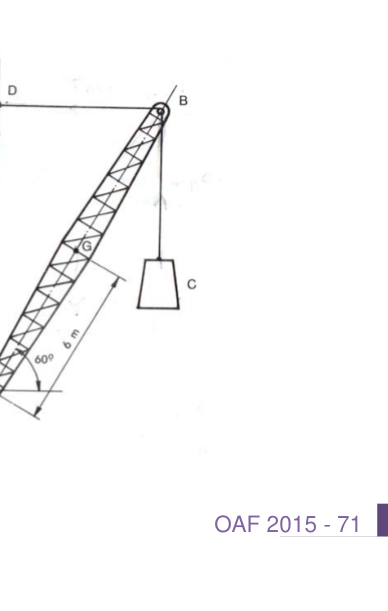
Topic: Rigid Body Statics Metodi: Torque & Angular Momentum Analysis, Free-Body Diagram Competenze: Physical Reasoning Objects: String, Beam Fonte: Testo (PDF) — p.5
PT61. Scuola Nicolás Avellaneda
Aguilar, Tucumán.
Rimuovendo i detriti. Al college Nicolas Avellaneda devono essere rimossi.
- Un po ’ di rovine che sono rimasti dopo la riforma.
- Alcune classi. Per questo e per facilitare il compito, fanno entrare il Un grilletto. Il grilletto deve sopportare circa un peso. de 2500 𝑘𝑔 in posizione tale che β = 60°. Il peso del grilletto è di 800 kg . Con questi dati e osservando la figura si chiede di calcolare: a) Il valore della tensione nella corda BC. b) Il valore della tensione nella corda BD. c) La reazione al punto a e i suoi componenti Verticale e orizzontale. d) La tensione sul muro RD.
72 - OAF 2015
Topic: Rigid Body Statics Metodi: Torque & Angular Momentum Analysis, Free-Body Diagram Competenze: Physical Reasoning Objects: String, Beam Fonte: Testo (PDF) — p.5
PT61. Nicholas Avellaneda College
The Eagles, Tucumán.
Removing debris. At Nicholas Avellaneda College , they need to remove it . Some debris left after the reform . Some classes. To do this and facilitate the task, they make entries by the Backyard a crane. The crane must support approximately one weight de 2500 𝑘𝑔 in such a position that β = 60°. The weight of the crane is 800 kg . With this data and The following figure is used to calculate: (a) The value of the voltage on the BC string. (b) The value of the voltage on the BD rope. (c) The reaction at point a and its components vertical and horizontal. (d) The voltage on the RD wall.
The following points shall be added:
Topic: Rigid Body Statics Metodi: Torque & Angular Momentum Analysis, Free-Body Diagram Competenze: Physical Reasoning Objects: String, Beam Fonte: Testo (PDF) — p.5
PT62. Colegio Nicolás Avellaneda
Aguilares, Tucumán.
Un deporte de invierno en bariloche.
Una típica práctica durante el invierno en el Cerro Catedral de Bariloche son los saltos de
esquí. En esta modalidad deportiva, los espectadores se mantienen atentos desde que el
atleta inicia el descenso por la pista hacia el trampolín hasta que, tras saltar al “vacío”,
realiza un estético vuelo, aterriza suavemente, frena y se detiene.
En la figura 1, se representa la pista de saltos que consta de cuatro partes: la primera es
la zona de aceleración, sin velocidad inicial, descienden por una pronunciada pendiente
hasta el trampolín, en el que la pendiente se reduce hasta un ángulo α. En el borde S del
trampolín, el saltador inicia el vuelo sobre la zona de salto, que tiene forma
aproximadamente parabólica y una longitud L característica de la instalación: se habla así
de pistas de 50, 80 o 90 m.
La tercera zona, P - K, es la de aterrizaje, de longitud M y pendiente constante de ángulo
β. A partir del límite K de esta región, el denominado punto crítico, se inicia la cuarta
zona, de frenado, en la que no debe producirse el aterrizaje pues disminuye rápidamente
la pendiente y el impacto sería peligroso.
Se fija la altura 0 del punto de salida respecto al borde S del trampolín. Los principales
parámetros de un gran trampolín, (L ≈ 90 m), se encuentran indicados en el cuadro de
datos de la figura 1.
a) Suponiendo que en el descenso por la zona de aceleración (desde la salida hasta el
punto S), el rozamiento con el suelo y el aire disipan una energía Q que es igual al
20 % de la energía mecánica inicial, determine y calcule el módulo de la velocidad
de despegue del saltador, 𝑣0, sabiendo que ha iniciado el descenso, sin velocidad
inicial, desde una salida con la altura 0 dada en los datos que se encuentran
debajo de la figura.
Figura 1
Datos:
𝐻= 43 𝑚
𝑁= 49 𝑚
𝑀= 22 𝑚
𝐻= 43 𝑚
𝑑= 4 𝑚
𝛼= 7°
𝛽= 40°
0 = 46 𝑚
𝑔= 9,8 𝑚/𝑠2
b) A pesar de que el trampolín tiene una pendiente final descendente α, la velocidad real de salida del saltador,𝑣𝑠, es prácticamente horizontal, pues se da un impulso perpendicular a la pista justo antes de iniciar el vuelo. Para ello, el saltador
OAF 2015 - 73 desciende con las piernas flexionadas y las extiende en el extremo final del trampolín, haciendo un gesto similar al de un salto, sin carrera, perpendicular al suelo. Así, además de descender en una postura más aerodinámica, consigue imprimirse una velocidad 𝑣𝑛 perpendicular al trampolín y alargar el salto. (Observa el diagrama vectorial indicado en la (Figura 1). Calcule cuál debe ser el valor de la velocidad 𝑣𝑛. c) Sobre la figura 2, haga una representación gráfica de la trayectoria y determine aproximadamente el punto C de aterrizaje, con sus correspondientes coordenadas 𝑥𝑐 e 𝑦𝑐. d) Determine las componentes de la velocidad 𝑣𝑓del saltador cuando toca la pista en la zona de aterrizaje. Calcule el ángulo ϕ que forma la velocidad con el eje OX. e) Determine y calcule el ángulo, φ, que forma la velocidad final 𝑣𝑓con la pista.
Figura 2
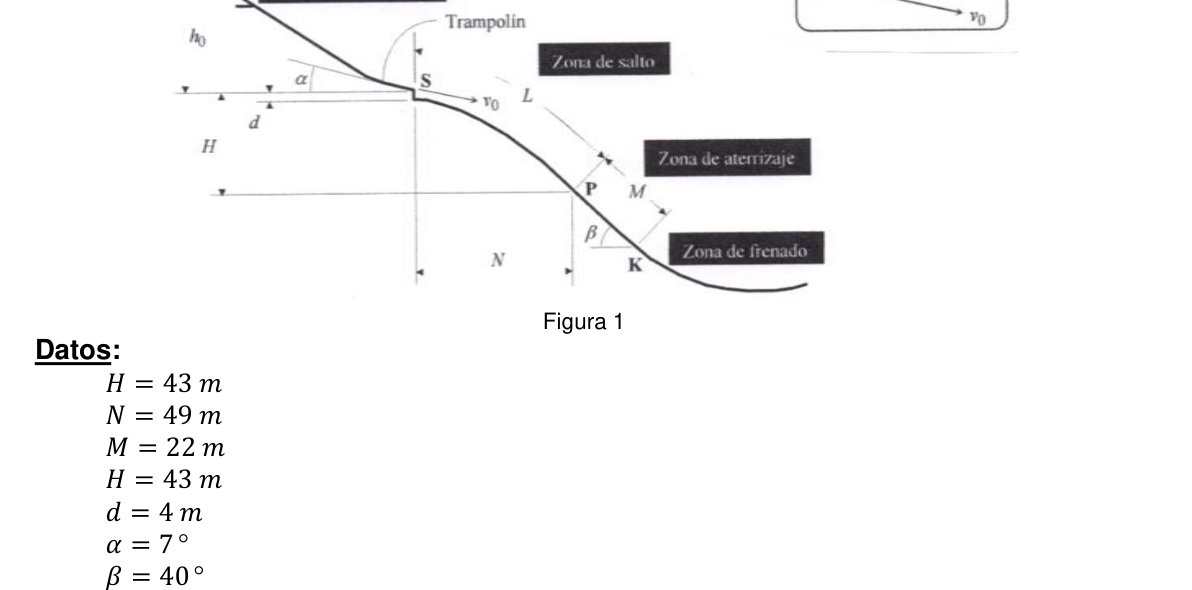
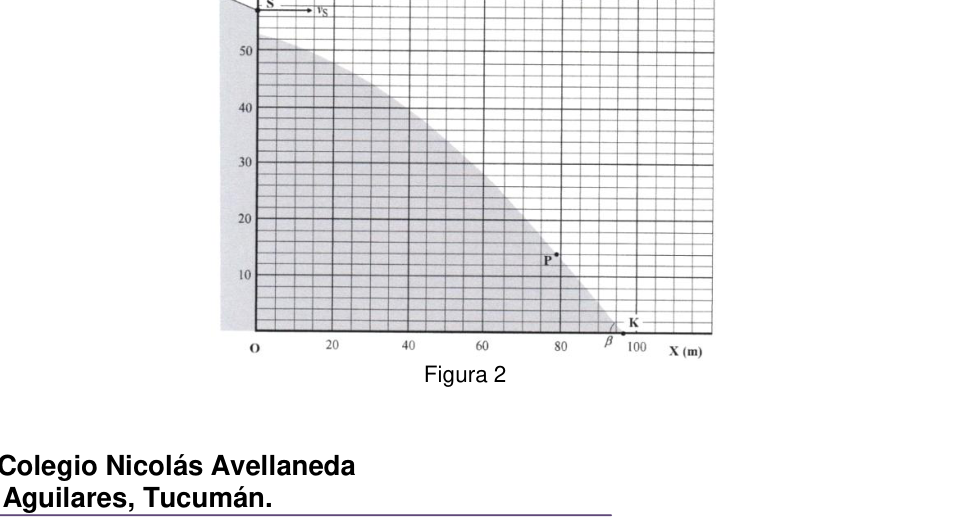
Topic: Newtonian Mechanics, Conservation of Energy Metodi: Energy Conservation Method, Kinematic Equations Competenze: Physical Reasoning Objects: Projectile Fonte: Testo (PDF) — p.5
PT62. Scuola Nicolás Avellaneda
Aguilar, Tucumán.
Un sport invernale in bariloche. Una pratica tipica durante l’inverno nel Cerro Cattedrale di Bariloche sono i salti di Sciare. In questa modalità sportiva, gli spettatori sono stati attenti da quando il l’atleta inizia la discesa per la pista verso il trampolino di lancio fino a che, dopo aver saltato al “vazio”, fa un volo estetico, atterra’ con calma, frenerà e si fermerà. La figura 1 mostra il pista di salto che comprende quattro parti: la prima è la zona di accelerazione, senza velocità iniziale, scendono per una pronunciata pendice fino al trampolino, in cui la pendenza si riduce ad un angolo α. Al bordo S del trampolino, il saltatore inizia il volo sopra la zona di salto, che ha forma Circa perbolica e una lunghezza L caratteristica dell’impianto: si parla così di piste di 50, 80 o 90 m. La terza zona, P - K, è quella di atterraggio, con lunghezza M e pendenza costante di angolo β. Dal limite K di questa regione, il punto critico, inizia il quarto zona frenata in cui non deve avvenire l’atterraggio, poiché si riduce rapidamente l’inclinazione e l’impatto sarebbero pericolosi. Si fissa l’altezza 0 del punto di partenza rispetto al bordo S del trampolino. I principali I parametri di un grande trampolino, (L ≈ 90 m), sono indicati nella tabella di dati di cui alla figura 1. a) Supponendo che nella discesa per la zona di accelerazione (dall’uscita fino al punto S), il ruggine con il suolo e l’aria dissipa un’energia Q che è uguale a 20 per cento dell’energia meccanica iniziale, determinare e calcolare il modulo di velocità V0, sapendo di aver iniziato la discesa, senza velocità. iniziale, da un’uscita con l’altezza 0 data nei dati presenti sotto la figura.
Figura 1
Datati:
𝐻= 43 𝑚
𝑁= 49 𝑚
𝑀= 22 𝑚
𝐻= 43 𝑚
𝑑= 4 𝑚
𝛼= 7°
𝛽= 40°
0 = 46 𝑚
𝑔= 9,8 𝑚/𝑠2
b) Anche se il trampolino ha una pendice finale discendente α, la velocità Il salto reale di uscita del saltatore,vs, è praticamente orizzontale, poiché si dà un impulso perpendicolare al pistone appena prima di iniziare il volo. Per questo, il saltatore
OAF 2015 - 73 scende con le gambe piegate e le estende all’estremità finale del trampolino, facendo un gesto simile a quello di un salto, senza corsa, perpendicolare al
- No, non è così. Così, oltre a scendere in una postura più aerodinamica, riesce a stamparsi. una velocità di velocità perpendicolare al trampolino e allungare il salto. (Vedi il diagramma) Il vector indicato nella (Figura 1). Calcola quale deve essere il valore della velocità vn. c) Sulla figura 2, fare una rappresentazione grafica del percorso e determinare circa il punto di atterraggio C, con le sue coordinate corrispondenti 𝑥𝑐 e 𝑦𝑐. d) Determina i componenti della velocità vf del saltatore quando tocca la pista in la zona di atterraggio. Calcola l’angolo φ che forma la velocità con l’asse OX. e) Determina e calcola l’angolo, φ, che forma la velocità finale vf con la pista.
Figura 2
Topic: Newtonian Mechanics, Conservation of Energy Metodi: Energy Conservation Method, Kinematic Equations Competenze: Physical Reasoning Objects: Projectile Fonte: Testo (PDF) — p.5
PT62. Nicholas Avellaneda College
The Eagles, Tucumán.
A winter sport in a barrel. A typical practice during the winter at the Cerro Cathedral of Bariloche is the jumps of I’m going skiing. In this sport, spectators have been keeping an eye on the sport since the The athlete starts the descent down the track towards the trampoline until, after jumping into the “vacuum”, It makes an aesthetic flight, lands smoothly, brakes and stops. Figure 1 shows the jump track in four parts: the first is the acceleration zone, without initial speed, descends down a steep slope to the trampoline, where the slope is reduced to an angle α. On the S-edge of the The hopper starts the flight over the jump zone, which has a shape. approximately parabolic and a characteristic length L of the installation: it is spoken as of 50, 80 or 90 m track length. The third zone, P - K, is the landing zone, with length M and steady angle slope β. From the K boundary of this region, the so-called critical point, the fourth begins The braking zone is the area where landing must not take place as it decreases rapidly The slope and impact would be dangerous. The height 0 of the starting point shall be fixed with respect to the S-rope of the trampoline. The main ones The parameters of a large trampoline (L ≈ 90 m) are shown in the table data from Figure 1. (a) Assuming that in the descent through the acceleration zone (from the start to the The ground and air friction dissolve an energy Q equal to 20 percent of the initial mechanical energy, determine and calculate the speed module The jump start, v0, knowing that you’ve started the descent, no speed. initial, from an output with the height 0 given in the data found under the figure.
Figure 1
The data:
𝐻= 43 𝑚
𝑁= 49 𝑚
𝑀= 22 𝑚
𝐻= 43 𝑚
𝑑= 4 𝑚
𝛼= 7°
𝛽= 40°
0 = 46 𝑚
𝑔= 9,8 𝑚/𝑠2
(b) Although the trampoline has a descending end slope α, the speed The actual output of the jumper,vs, is practically horizontal, as it gives a boost perpendicular to the runway just before the flight begins. For that, the jumper.
The Commission shall adopt delegated acts in accordance with Article 21 of this Regulation. He descends with his legs bent and stretches them out at the end of the trampoline, making a gesture similar to that of a jump, without a run, perpendicular to the I’m going to the ground. So, in addition to descending into a more aerodynamic posture, he gets to print himself. a velocity vn perpendicular to the trampoline and lengthen the jump. (See diagram) The vector is shown in Figure 1. Calculate what the value of the velocity vn should be. (c) On Figure 2, make a graphical representation of the trajectory and determine approximately the landing point C, with its corresponding coordinates 𝑥𝑐 e 𝑦𝑐. (d) Determine the components of the speed vf of the jumper when touching the track at the landing zone. Calculate the angle φ forming the velocity with the OX axis. (e) Determine and calculate the angle, φ, which forms the final velocity vf with the track.
Figure 2
Topic: Newtonian Mechanics, Conservation of Energy Metodi: Energy Conservation Method, Kinematic Equations Competenze: Physical Reasoning Objects: Projectile Fonte: Testo (PDF) — p.5
PT63. Colegio Nicolás Avellaneda
Aguilares, Tucumán.
En el laboratorio de Física de nuestro colegio realizamos una experiencia con nuestros alumnos que practican para las Olimpiadas. Dentro de un calorímetro cuyo equivalente en agua es 25 g, colocamos 60 g de agua a 25 ° C, y le agregamos 100 g de hielo a - 10°C y dos bolillas de acero de 10mm de diámetro a 20 °C. Sumergimos en el líquido una resistencia eléctrica conformada por un rollo de alambre de cobre de 60 cm de longitud y de 0,04 mm de diámetro, que se encuentra a una temperatura de 20°C. La resistencia se alimenta con un porta pilas de 2 elementos conectados en serie de 1,5V y 𝜂= 0,05Ω cada uno. El calorímetro se tapa y se considera un sistema adiabático. Accionamos el interruptor cerrando el circuito eléctrico de la resistencia hasta que el termómetro que registra la temperatura del interior del calorímetro indica 60° C. a) ¿Cuál es la intensidad de la corriente que circula por la resistencia? b) ¿Qué tiempo debe funcionar la resistencia? c) ¿Cuánto de energía consume la resistencia, si el rendimiento del calorímetro es del 98%?
Datos:
𝝆𝒄𝒖= 𝟏, 𝟕 . 𝟏𝟎𝟔Ω.cm
𝑪𝒆𝑯𝟐𝒐= 𝟒𝟏𝟖𝟎
J
Kg.K
𝑪𝒆𝒄𝒖= 𝟎, 𝟎𝟎𝟗𝟐
Kcal
Kg.°C
𝑪𝒚𝒉𝒊𝒆𝒍𝒐= 𝟎, 𝟓𝟑
𝑐𝑎𝑙
𝑔°𝐶
𝛅𝐡𝟐𝐎= 1 g/𝑐𝑚3
𝑪𝒇𝒉𝒊𝒆𝒍𝒐= 80 𝑐𝑎𝑙 𝑔
74 - OAF 2015
Topic: Thermodynamics, Circuits Metodi: First Law of Thermodynamics, Kirchhoff’s Laws Competenze: Physical Reasoning Objects: Calorimeter, Resistor Fonte: Testo (PDF) — p.5
PT63. Scuola Nicolás Avellaneda
Aguilar, Tucumán.
Nel laboratorio di fisica della nostra scuola abbiamo fatto un esperimento con i nostri studenti che si allenano per le Olimpiadi. All’interno di un calometro il cui equivalente in acqua è 25 g, mettiamo 60 g di acqua a 25 ° C, e aggiungiamo 100 g di ghiaccio a — 10°C e due palline in acciaio di 10 mm di diametro a 20 °C. Abbiamo immerso nel liquido una resistenza elettrica costituita da un rollo di filo. di cui all’appendice n. temperatura di 20°C. La resistenza viene alimentata da un porta batteria a 2 elementi collegati in serie di 1,5V e η= 0,05Ω ciascuno. Il calometro si copre e si considera un sistema adiabatico. Accendiamo l’interruttore. chiudendo il circuito elettrico della resistenza fino a che il termometro che registra la resistenza non la temperatura all’interno del caloriometro indica 60° C. a) Qual è l’intensità del corrente che circola per resistenza? b) Per quanto tempo deve funzionare la resistenza? (c) Quanto energia consuma la resistenza, se il calometro è di 98%?
Datati:
ρcu = 1,7 . 𝟏𝟎𝟔Ω.cm
CeH2o = 4180
J
Kg.K
Cecu = 0, 0092
Calore
Kg.°C
Cichelo = 0, 53
cal
𝑔°𝐶
𝛅𝐡𝟐𝐎= 1 g/𝑐𝑚3
Cfhielo = 80 cal 𝑔
74 - OAF 2015
Topic: Thermodynamics, Circuits Metodi: First Law of Thermodynamics, Kirchhoff’s Laws Competenze: Physical Reasoning Objects: Calorimeter, Resistor Fonte: Testo (PDF) — p.5
PT63. Nicholas Avellaneda College
The Eagles, Tucumán.
In the physics lab at our school we conducted an experiment with our Students who practice for the Olympics. Within a calorimeter whose equivalent In water it’s 25 g, we put 60 g of water at 25 ° C, and we add 100 g of ice to — 10°C and two 10 mm steel balls with a diameter of 20 °C. We submerge in the liquid an electrical resistance formed by a roll of wire. Of copper, 60 cm long and 0,04 mm in diameter, located at a distance of The temperature of the test chemical is 20°C. The resistance is fed by a battery port of 2 connected elements in series of 1.5V and η = 0.05Ω each. The calorimeter is covered and considered an adiabatic system. We turn on the switch. The resistance electrical circuit is closed until the thermometer registers the resistance. The temperature inside the thermometer is 60° C. (a) What is the intensity of the current circulating through the resistance? (b) How long should the resistor work? (c) How much energy is consumed by the resistance if the performance of the calorimeter is 98%?
The data:
ρcu is 1.7 . 𝟏𝟎𝟔Ω.cm
The value of the product is not less than EUR 5 million.
J
Kg.K
The value of the underlying equation is 0,0092
Other
Kg.°C
Cyclo = 0, 53
Cal
𝑔°𝐶
𝛅𝐡𝟐𝐎= 1 g/𝑐𝑚3
Cfhielo = 80 Cal 𝑔
The following points shall be added:
Topic: Thermodynamics, Circuits Metodi: First Law of Thermodynamics, Kirchhoff’s Laws Competenze: Physical Reasoning Objects: Calorimeter, Resistor Fonte: Testo (PDF) — p.5
PT64. Escuela Técnica ORT - Sede Almagro
Ciudad de Buenos Aires.
En el circo están pensando un nuevo show para la función que se estrenará en la próxima temporada. Saben que el lugar del show tiene dos colinas, una de altura h y otra de altura hr. Entre ambas colinas de encuentra una sección plana por la cual debe pasar una alfombra de largo d y coeficiente de rozamiento 𝜇, el esquema de la sala se puede ver en la figura.
La idea del show es poner al payaso del circo en lo alto de una colina con una bicicleta (que vamos a modelar como una masa puntual), luego de la alfombra poner una gran pelota de manera tal que cuando el payaso la choque la misma suba hasta lo alto de la segunda colina en donde se encuentra un resorte industrial de dureza K que se contraerá y volverá a mandar la pelota hacia el payaso para finalmente tirarlo al piso en simultáneo con el comienzo de la banda del circo. Para determinar la viabilidad del acto deciden hacer física. Pesan al payaso y a la pelota determinando sus masas enm1 y m2 respectivamente. Se pide: a) Calcular la velocidad en la base de la colina en función de h, m1, g. b) Calcular la velocidad del payaso luego de pasar por la alfombra. ¿Cuál debe ser la longitud de la alfombra para que el payaso quede quieto luego de ese trayecto? c) Si la longitud de la alfombra no logra frenarlo, ¿cuál es la velocidad de la pelota luego del choque (si se considera perfectamente elástico)? d) La pelota, ¿llega a lo alto de la colina para comprimir el resorte? e) Calcular cuánto se comprime el resorte en función de los datos.
Topic: Conservation of Energy, Conservation of Momentum Metodi: Energy Conservation Method, Conservation of Momentum Competenze: Physical Reasoning Objects: Ball, Spring Fonte: Testo (PDF) — p.5
PT64. Scuola tecnica ORT - Sede Almagro
Città di Buenos Aires.
Il circo sta pensando a un nuovo show per… La funzione che verrà premiata nel prossimo stagione. Sapete che il posto dello spettacolo ha due colline, una alta h e un’altra alta hr. Tra le due colline si trova una sezione Piano per il quale deve passare un tappeto di d lunghezza e coefficiente di rottura μ, il Lo schema della sala si può vedere nella figura.
L’idea dello show è di mettere il clown del circo in cima a una collina con una bicicletta (che modelliamo come una massa puntuale), poi il tappeto mette una grande La palla in modo tale che quando il clown la colpisce, la stessa si alza fino al massimo della seconda collina dove si trova una stagione industriale di durezza K che si contrairà E poi, di nuovo, lancia la palla verso il clown per poi gettarlo al pavimento contemporaneamente. con l’inizio del circo. Per determinare la fattibilità dell’atto, decidono di fare fisica. Pesano il clown e la palla determinando le loro masse inm1 e m2 rispettivamente. Si chiede: a) Calcolare la velocità alla base della collina in base a h, m1, g. b) Calcolare la velocità del clown dopo aver attraversato il tappeto. Qual è la La lunghezza del tappeto per far stare il clown fermo dopo quel viaggio? c) Se la lunghezza del tappeto non riesce a frenarlo, qual è la velocità della palla dopo l’impatto (se considerato perfettamente elastico)? d) La palla arriva al vertice della collina per comprimere la primavera? e) Calcolare quanto viene compresso il risorgere in base ai dati.
Topic: Conservation of Energy, Conservation of Momentum Metodi: Energy Conservation Method, Conservation of Momentum Competenze: Physical Reasoning Objects: Ball, Spring Fonte: Testo (PDF) — p.5
PT64. The technical school ORT - Headquarters Almagro
City of Buenos Aires.
The circus is thinking of a new show for you. The feature that will be released next year. season. You know the show place has two hills, one h-height and one hr-height. Between the two hills you find a section flat through which a carpet of d length and coefficient of friction μ, the The diagram of the room can be seen in the figure.
The idea of the show is to put the circus clown on top of a hill with a bicycle. (which we’re going to model as a point mass), then the carpet put a big one ball so that when the clown hits it it goes up to the top of the The second hill where a hardness industrial spring K is located will shrink And he’ll send the ball back to the clown to finally throw it on the floor at the same time. With the start of the circus band. To determine the feasibility of the act, they decide to do physical. They ‘re weighing the clown and the ball . determining their masses in m1 and m2 respectively. It asks: (a) Calculate the speed at the base of the hill based on h, m1, g. (b) Calculate the speed of the clown after passing through the carpet. What should be the The length of the carpet so the clown would stay still after that journey? (c) If the length of the carpet fails to brake, what is the speed of the ball after the impact (if considered perfectly elastic)? d) Does the ball reach the top of the hill to compress the spring? (e) Calculate how much the spring is compressed based on the data.
Topic: Conservation of Energy, Conservation of Momentum Metodi: Energy Conservation Method, Conservation of Momentum Competenze: Physical Reasoning Objects: Ball, Spring Fonte: Testo (PDF) — p.5
PT65. Escuela Técnica ORT - Sede Almagro
Ciudad de Buenos Aires.
Un motor de vapor puede modelarse de manera esquemática como un gas ideal en un recinto cilíndrico de volumen V y un pistón en la tapa del mismo. El ciclo del motor puede modelarse de la siguiente manera:
- Se calienta el gas a volumen Vconstante desde la presión inicial p1 hasta que ésta se duplica.
- Luego se expande isotérmicamente hasta que la presión alcanza su valor inicial.
- Por último se disminuye el volumen a presión constante hasta el valor inicial. Si todos los procesos son reversibles, se pide: a) Representar estas transformaciones en el plano pV y en el pT. b) Calcular el trabajo que se entrega en la transformación si p1 = 2atm y V1 = 4m3 c) Indique por cuál proceso o conjunto de procesos deberá ser reemplazado el último de ellos para que, llevando el sistema a su estado inicial, el trabajo total sea nulo.
Topic: Thermodynamics Metodi: Thermodynamic Cycle Analysis, Ideal Gas Law Competenze: Physical Reasoning Objects: Gas, Piston, Cylinder Fonte: Testo (PDF) — p.5
PT65. Scuola tecnica ORT - Sede Almagro
Città di Buenos Aires.
Un motore a vapore può essere schematicamente modellato come un gas ideale in un un rivestimento cilindrico di volume V e un pistone nella sua copertura. Il ciclo del motore può modellare in modo seguente:
- Il gas viene riscaldato a volume costante dalla pressione iniziale p1 fino a quando essa è
- Doppio.
- Poi si espandono isotermicamente fino a quando la pressione raggiunge il suo valore iniziale.
- Infine, il volume a pressione costante viene ridotto al valore iniziale. Se tutti i processi sono reversibili, si chiede: a) Rappresentare queste trasformazioni sul piano pV e pT. b) Calcolare il lavoro che viene fornito nella trasformazione se p1 = 2atm e V1 = 4m3 c) Indicare quale processo o insieme di processi deve essere sostituito l’ultimo di loro, in modo che, portando il sistema al suo stato iniziale, il lavoro totale sia nullo.
Topic: Thermodynamics Metodi: Thermodynamic Cycle Analysis, Ideal Gas Law Competenze: Physical Reasoning Objects: Gas, Piston, Cylinder Fonte: Testo (PDF) — p.5
PT65. The technical school ORT - Headquarters Almagro
City of Buenos Aires.
A steam engine can be schematically modelled as an ideal gas in a a cylindrical V-volume enclosure and a piston on the lid of the same. The engine cycle can modelling as follows:
- The gas is heated at a constant volume from the initial pressure p1 until it is double the number.
- Then it expands isothermically until the pressure reaches its initial value.
- Finally, the volume at constant pressure is reduced to the initial value. If all processes are reversible, it is asked: (a) Representing these transformations in the PV and the PT plane. (b) Calculate the work delivered in the transformation if p1 = 2atm and V1 = 4m3 (c) Indicate which process or set of processes is to be replaced by the latter So that, taking the system to its initial state, the total work is zero.
Topic: Thermodynamics Metodi: Thermodynamic Cycle Analysis, Ideal Gas Law Competenze: Physical Reasoning Objects: Gas, Piston, Cylinder Fonte: Testo (PDF) — p.5
PT66. Escuela Técnica ORT - Sede Almagro
Ciudad de Buenos Aires.
Ernesto quiere diseñar el sistema eléctrico de su habitación. Considerando el uso que le va a dar a la misma determinó que sólo necesita un enchufe y una lamparita, por lo que una aproximación a su diseño puede verse en la figura 2. Como no confía del todo en su diseño decide consultar con un electricista que le recomienda agregar una resistencia más para regular la corriente como se muestra en la
OAF 2015 - 75 figura 3. Ernesto, desconfiado de la recomendación del electricista decide estudiar el circuito.
Considerando el voltaje V como dato, se pide: a) Calcular la corriente y la potencia sobre cada uno de los elementos del circuito. ¿Cuál es el rol de Rc? ¿Por qué? b) Ernesto se pone en contacto con la empresa que le brinda el servicio de luz y averigua que en días de tormentael voltaje que le brinda la empresa puede tener un pico del 25% por sobre el valor normal. Si sabe que el equipoque va a conectar (simbolizado por R1) soporta una corriente máxima dada por Imax, ¿cuál debe ser el valor deRcpara que la corriente sobre el equipo sea siempre más chica que Imax? c) Ahora se decide instalar un dimmer para poder regular la luz de la lamparita (como se puede ver en la figura 4),por lo que se agrega antes de R2 una resistencia variable cuyo valor es proporcional a su longitud: Rd = (1-x)R,con x 𝜖 [0; 1]. Calcular la potencia disipada en la lamparita R1en función de los datos. Compararla con el casoen el que no está el dimmer. d) Si los valores que toman las resistencias son: Rc = R/2, R1 = 2R y R2 = R/4, graficar la potencia disipada en R2en función de los datos. ¿Existe un máximo de consumo para la lamparita con el dimmer? Justificar.
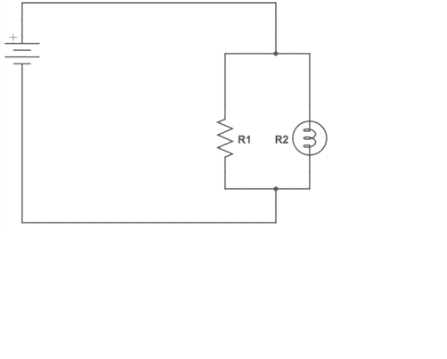
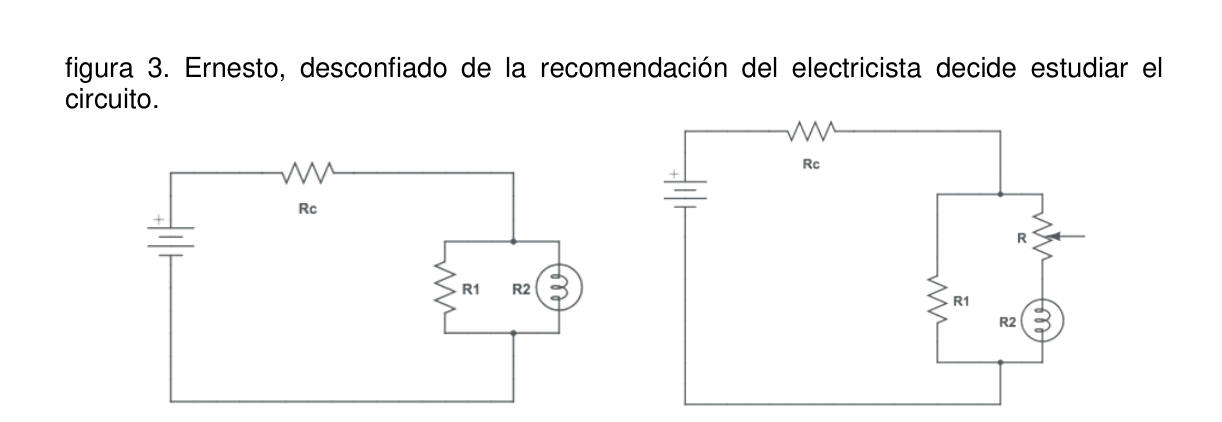
Topic: Circuits Metodi: Kirchhoff’s Laws, Equivalent Circuit Reduction Competenze: Physical Reasoning Objects: Resistor Fonte: Testo (PDF) — p.5
PT66. Scuola tecnica ORT - Sede Almagro
Città di Buenos Aires.
Ernesto vuole progettare il sistema elettrico della sua stanza. Considerando l’uso che gli darà la stessa determinato che ha bisogno solo di un connettore e di una lampadina, quindi… Un approccio al suo design può essere visto nella figura 2. Non si è mai fidato del suo design, quindi ha deciso di consultare con un elettricista che ti consiglia di aggiungere una resistenza più per regolare il corrente come mostrato in
OAF 2015 - 75 figura 3. Ernesto, scrupoloso della raccomandazione dell’elettricista, decide di studiare il circuito.
Considerando la volta V come dato, si chiede: a) Calcolare la corrente e la potenza su ciascun elemento del circuito. Qual è il ruolo di Rc? - Perché? b) Ernesto si rivolge all’impresa che gli fornisce il servizio di luce e Scopri che in giorni di tempesta la tensione che la compagnia ti fornisce può avere un
- il 25% del valore normale. Se sa che il team che sta per collegare (Simbolato da R1) sopporta un corrente massima data da Imax, che deve essere il Il valore di Rc per il flusso sull’equipaggio è sempre più piccolo di Imax? c) Si decide ora di installare un dimmer per poter regolare la luce della lamparita (come La resistenza è quindi aggiunta prima di R2. variabile il cui valore è proporzionale alla sua lunghezza: Rd = (1-x)R,con x ε [0; 1]. Calcolare la potenza dissipata nella lamparita R1 secondo i dati. - Compararla con il suo .
- In caso non ci sia il dimmer. d) Se i valori dei resistenti sono: Rc = R/2, R1 = 2R e R2 = R/4, graficare la potenza dissipata in R2 secondo i dati. C’è un consumo massimo? per la lampadina con il dimmer? Giustificare.
Topic: Circuits Metodi: Kirchhoff’s Laws, Equivalent Circuit Reduction Competenze: Physical Reasoning Objects: Resistor Fonte: Testo (PDF) — p.5
PT66. The technical school ORT - Headquarters Almagro
City of Buenos Aires.
Ernesto wants to design the electrical system in his room. Considering the use you ‘re going to give it determined It just needs a plug and a flashlight, so A close approximation to its design can be seen in Figure 2. Since he doesn’t trust his design at all, he decides to consult with An electrician recommends you add a resistance. More to regulate the current as shown in the
The Commission shall adopt delegated acts in accordance with Article 21 of this Regulation. The following table shows the following: Ernesto, distrustful of the electrician’s recommendation, decides to study the The circuit.
Considering the voltage V as a data, it is asked: (a) Calculate the current and power on each of the circuit elements. What’s the role of RC? - Why? - I don’t know. (b) Ernesto contacts the lighting company and Find out that on stormy days the voltage the company provides you can have a The average value of the product is 25% above the normal value. If you know the team you’re gonna connect (symbolized by R1) supports a maximum current given by Imax, which should be Rcc’s value for the current on the equipment to be always smaller than Imax? (c) It is now decided to install a dimmer to regulate the light of the lamp (such as As can be seen in Figure 4), a resistance is added before R2. variable whose value is proportional to its length: Rd = (1-x) R,with x ε [0; 1]. Calculate the power dissipated in the R1 lamp according to the data. Compare it to the I’ll take the one that’s not dimmer. (d) If the values taken by the resistors are: Rc = R/2, R1 = 2R and R2 = R/4, graph The power dissipation in R2 is based on the data. Is there a maximum consumption? for the dimmer lamp? Justify it.
Topic: Circuits Metodi: Kirchhoff’s Laws, Equivalent Circuit Reduction Competenze: Physical Reasoning Objects: Resistor Fonte: Testo (PDF) — p.5
PT67. Escuela Escocesa San Andrés
Olivos, Buenos Aires.
Esta pregunta es acerca de la mecánica y la física térmica.
- El gráfico muestra la variación con el tiempo t de la velocidad v de una bola de masa de 0,50 kg, que ha sido liberado del reposo sobre la superficie de la Tierra.
La fuerza de resistencia del aire no es despreciable. Suponga que la aceleración de caída libre es g = 9,81 ms -2. a) Estado, sin ningún cálculo, cómo el gráfico podría ser utilizado para determinar la distancia caído. b) i) En el siguiente espacio, dibujar y flechas de la etiqueta para representar las fuerzas sobre la pelota en 2.0 s.
76 - OAF 2015
ii) utilizar el gráfico opuesto al mostrar que la aceleración de la pelota en 2.0 s es de aproximadamente 4 ms -2. iii) Calcular la magnitud de la fuerza de resistencia del aire en la pelota en 2,0 s. iv) Estado y explique si la resistencia del aire en la pelota en t = 5.0 s es menor, igual o mayor que la resistencia del aire en t = 2.0 s. c) Después de 10 s que la pelota ha caído 190 m. i) Demuestre que la suma de las energías potencial y cinética de la pelota se ha reducido en 780 J. 2. El calor específico de la bola es 480 J kg -1 K -1. Estimar el aumento de la temperatura de la pelota.
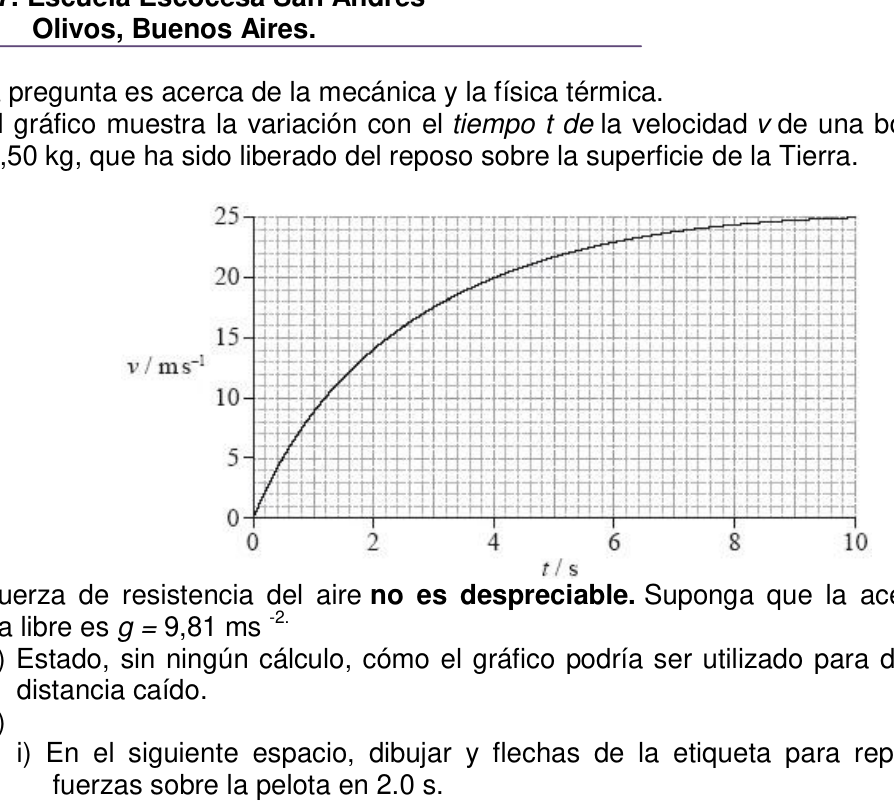
Topic: Newtonian Mechanics, Thermodynamics Metodi: Free-Body Diagram, First Law of Thermodynamics Competenze: Physical Reasoning, Experimental Data Analysis Objects: Ball Fonte: Testo (PDF) — p.5
PT67. Scuola scozzese San Andrés
Olivos, Buenos Aires.
Questa domanda riguarda la meccanica e la fisica termica.
- Il grafico mostra la variazione nel tempo t della velocità v di una palla di massa di 0,50 kg, che è stato liberato dal riposo sulla superficie terrestre.
La resistenza dell’aria non è scarsa. Supponiamo che l’accelerazione di caduta libera è g = 9,81 ms -2. a) Indicare, senza alcun calcolo, come il grafico potrebbe essere utilizzato per determinare la Distanza caduta. b) (i) Nel seguente spazio, disegnare e arricchire la taglia per rappresentare le Forze sulla palla in 2.0 s.
76 - OAF 2015
(ii) utilizzare il grafico opposto mostrando che l’accelerazione della palla a 2.0 s è di circa 4 ms -2. (iii) Calcolare la forza di resistenza dell’aria nella palla in 2,0 s. iv) Indicare e spiegare se la resistenza dell’aria nella palla a t = 5,0 s è minore, pari o superiore alla resistenza dell’aria a t = 2,0 s. c) Dopo 10 secondi la palla è caduta 190 m. i) Dimostra che la somma delle energie potenziali e cinetiche della palla è stata ridotto a 780 J. 2. Il calore specifico della palla è di 480 J kg -1 K -1. Estimare l’aumento della temperatura
- La palla.
Topic: Newtonian Mechanics, Thermodynamics Metodi: Free-Body Diagram, First Law of Thermodynamics Competenze: Physical Reasoning, Experimental Data Analysis Objects: Ball Fonte: Testo (PDF) — p.5
PT67. St. Andrew’s Scottish School
Olive trees, from Buenos Aires.
This question is about mechanics and thermal physics.
- The graph shows the time t variation of the velocity v of a mass ball of 0.50 kg, which has been released from rest on the Earth’s surface.
The air’s resistance is not despicable. Suppose the acceleration of free fall is g = 9.81 ms -2. (a) State, without any calculation, how the chart could be used to determine the distance dropped. b) (i) In the following space, draw and arrow the label to represent the Force on the ball in 2.0 s.
The Commission shall adopt delegated acts in accordance with Article 21 of Regulation (EU) No 1303/2013.
(ii) use the opposite graph to show that the acceleration of the ball at 2.0 s is approximately 4 ms -2. (iii) Calculate the magnitude of the air resistance force on the ball in 2.0 s. (iv) State and explain whether the air resistance in the ball at t = 5.0 s is less, equal to or greater than the air resistance at t = 2.0 s. c) After 10 seconds the ball has fallen 190 m. (i) Demonstrate that the sum of the potential and kinetic energies of the ball has been Reduced to 780 J. 2. The specific heat of the ball is 480 J kg -1 K -1. Estimate the increase in temperature The ball.
Topic: Newtonian Mechanics, Thermodynamics Metodi: Free-Body Diagram, First Law of Thermodynamics Competenze: Physical Reasoning, Experimental Data Analysis Objects: Ball Fonte: Testo (PDF) — p.5
PT68. Escuela Escocesa San Andrés
Olivos, Buenos Aires.
Esta pregunta es sobre el movimiento circular.
Una bola de masa de 0,25 kg se une a una cadena y se hace girar con la velocidad v constante a lo largo de un círculo horizontal de radio r = 0,33 m. La cadena está unida al techo y hace un ángulo de 30 ° con la vertical.
a) Determinar la velocidad de rotación de la bola.
Topic: Newtonian Mechanics Metodi: Free-Body Diagram, Vector Decomposition Competenze: Physical Reasoning Objects: Ball, String Fonte: Testo (PDF) — p.5
PT68. Scuola scozzese San Andrés
Olivos, Buenos Aires.
Questa domanda riguarda il movimento circolare.
Una palla di massa di 0,25 kg si attacca a una catena e si fa girare a velocità v costante lungo un cerchio di radius orizzontale r = 0,33 m. La catena è legata al tetto e… fa un angolo di 30 ° con la verticale.
a) Determinare la velocità di rotazione della palla.
Topic: Newtonian Mechanics Metodi: Free-Body Diagram, Vector Decomposition Competenze: Physical Reasoning Objects: Ball, String Fonte: Testo (PDF) — p.5
PT68. St. Andrew’s Scottish School
Olive trees, from Buenos Aires.
This question is about circular motion.
A ball of 0.25 kg mass is attached to a chain and made rotate at constant v speed along a circle horizontal radius r = 0,33 m. The chain is attached to the ceiling and The angle of 30 ° with the vertical.
(a) Determine the speed of rotation of the ball.
Topic: Newtonian Mechanics Metodi: Free-Body Diagram, Vector Decomposition Competenze: Physical Reasoning Objects: Ball, String Fonte: Testo (PDF) — p.5
PT69. Escuela Escocesa San Andrés
Olivos, Buenos Aires.
Esta pregunta es sobre el movimiento de una partícula cargada en un campo eléctrico.
a) Un α-partícula de masa y la carga 4 u 2 e se acelera desde el reposo en un vacío a través de una diferencia de potencial de 2,4 kV. Demostrar que la velocidad final de la α-partícula es 4.8 × 10 5 ms -1. b) La α-partícula está viajando en una dirección paralela a y a medio camino entre dos placas de metal paralelas.
(no a escala)
Las placas de metal son de longitud de 2,4 cm y su separación es de 0,80 cm. La diferencia de potencial entre las placas es de 600 V. El campo eléctrico es uniforme en la región entre las placas y es cero fuera de esta región. i) calcular la magnitud del campo eléctrico entre las placas.
OAF 2015 - 77 ii) Demostrar que la magnitud de la aceleración de la α-partícula por el campo eléctrico es de 3,6 × 10 12 ms -2. c) i) Calcular el tiempo que tarda la α-partículas a viajar una distancia horizontal de 2,4 cm paralelo a las placas.
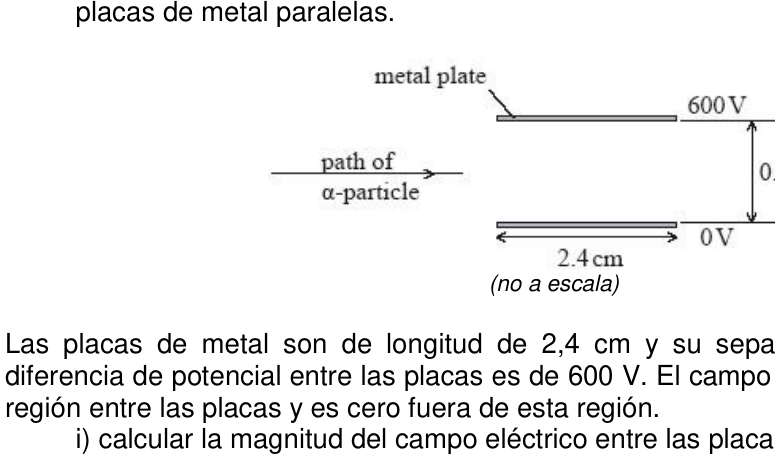
Topic: Electrostatics Metodi: Electric Potential Method, Kinematic Equations Competenze: Physical Reasoning Objects: Particle Beam, Capacitor Fonte: Testo (PDF) — p.5
PT69. Scuola scozzese San Andrés
Olivos, Buenos Aires.
Questa domanda riguarda il movimento di una particella carica in un campo elettrico.
a) Una α-particella di massa e carico 4 o 2 e si accelera dal riposo in un vuoto a attraverso una differenza di potenziale di 2,4 kV. Dimostra che la velocità finale di la particella α è 4.8 × 10 5 ms -1. b) La α-particella è in viaggio in direzione parallela a e a metà strada tra due plache di metallo parallele.
(non a scala)
Le lastre di metallo sono lunghe 2,4 cm e la loro separazione è di 0,80 cm. La La differenza di potenziale tra le plache è di 600 V. Il campo elettrico è uniforme nella la regione tra le placche ed è zero fuori da questa regione. (i) calcolare la grandezza del campo elettrico tra le schede.
OAF 2015 - 77 (ii) dimostrare che la magnitudine dell’accelerazione della particella α per il campo La velocità di un’elettricità di 3,6 × 10 12 ms -2. c) i) Calcolare il tempo necessario per il viaggio delle α-particelle a una distanza orizzontale di 2,4 cm parallelo alle targhe.
Topic: Electrostatics Metodi: Electric Potential Method, Kinematic Equations Competenze: Physical Reasoning Objects: Particle Beam, Capacitor Fonte: Testo (PDF) — p.5
PT69. St. Andrew’s Scottish School
Olive trees, from Buenos Aires.
This question is about the motion of a charged particle in an electric field.
(a) An α-particle mass and charge 4 or 2 and accelerates from rest in a vacuum to through a potential difference of 2.4 kV. Prove that the final velocity of The α-particle is 4.8 × 10 5 ms -1. (b) The α-particle is traveling in a parallel direction to and halfway between two parallel plates of metal.
(not at scale)
The metal plates are 2.4 cm long and 0.80 cm apart. La The potential difference between the plates is 600 V. The electric field is uniform in the region between the plates and is zero outside this region. (i) calculate the magnitude of the electric field between the plates.
The Commission shall adopt delegated acts in accordance with Article 21 of this Regulation. (ii) To demonstrate that the magnitude of the acceleration of the α-particle by the field The electrical current is 3,6 × 10 12 ms -2. c) (i) Calculate the time it takes the α-particles to travel a horizontal distance of 2.4 cm parallel to the plates.
Topic: Electrostatics Metodi: Electric Potential Method, Kinematic Equations Competenze: Physical Reasoning Objects: Particle Beam, Capacitor Fonte: Testo (PDF) — p.5
PT70. Escuela Escocesa San Andrés
Olivos, Buenos Aires.
Esta pregunta es sobre el movimiento en un campo magnético y la inducción electromagnética
Un electrón, que se ha acelerado desde el reposo por una diferencia de potencial de 250 V, entra en una región de campo magnético de fuerza 0,12 T que se dirige hacia el plano de la página.
a) El camino del electrón mientras que en la región de campo magnético es un cuarto
de círculo. Demostrar que la
i) la velocidad del electrón después de la aceleración es de 9,4 × 10 6 ms -1.
ii) el radio de la trayectoria es de 4,5 × 10 -4 m.
iii) el tiempo que el electrón pasa en la región del campo magnético es de
7,5 × 10 -11 s.
b) El siguiente diagrama muestra el momento del electrón, ya que entra y sale de la
región de campo magnético. La magnitud del momento inicial y el impulso final es
8.6 × 10 -24 Ns.
i) En el diagrama anterior, dibuje una flecha para indicar el vector que representa el
cambio en el momento del electrón.
ii) Demostrar que la magnitud del cambio en el impulso del electrón es
1.2 × 10 -23 ns.
iii) Estimar la magnitud de la fuerza media sobre el electrón.
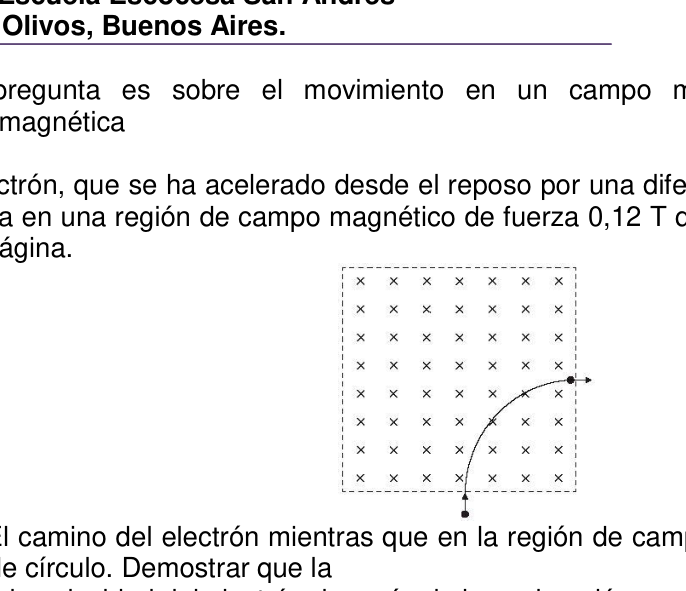
Topic: Magnetism Metodi: Lorentz Force Analysis, Impulse-Momentum Theorem Competenze: Physical Reasoning Objects: Electron Fonte: Testo (PDF) — p.5
PT70. Scuola scozzese San Andrés
Olivos, Buenos Aires.
Questa domanda riguarda il movimento in un campo magnetico e l’induzione.
- L’elettromagnetico
Un elettrone, che è stato accelerato dal riposo per una differenza di potenziale di 250 V, entra in una regione di campo magnetico di forza 0,12 T che si dirige verso il piano della pagina.
a) Il percorso dell’elettrone mentre nella regione del campo magnetico è un quarto di cerchio. Prove che i) la velocità dell’elettrone dopo l’accelerazione è 9,4 × 10 6 ms -1. (ii) il raggio di percorso è 4,5 × 10 -4 m. (iii) il tempo che l’elettrone passa nella regione del campo magnetico è di 7,5 × 10 -11 s. b) Il diagramma seguente mostra il momento dell’elettrone, in quanto entra e esce dalla regione di campo magnetico. La grandezza del momento iniziale e l’impulso finale è 8.6 × 10 -24 Ns.
(i) Nel diagramma precedente, disegna un’arcia per indicare il vettore che rappresenta il cambiamento nel momento dell’elettrone. (ii) dimostrare che la magnitudine del cambiamento di impulso dell’elettrone è 1.2 × 10 -23 ns. iii) Estimare la grandezza della forza media sull’elettrone.
Topic: Magnetism Metodi: Lorentz Force Analysis, Impulse-Momentum Theorem Competenze: Physical Reasoning Objects: Electron Fonte: Testo (PDF) — p.5
PT70. St. Andrew’s Scottish School
Olive trees, from Buenos Aires.
This question is about the motion in a magnetic field and induction. electromagnetic .
An electron, which has been accelerated from rest by a potential difference of 250 V, enters a magnetic field region of force 0.12 T that is directed toward the plane from the page.
(a) The path of the electron while in the magnetic field region is a quarter It’s a circle. Proving that (i) the electron speed after acceleration is 9,4 × 10 6 ms -1. (ii) the radius of the trajectory is 4,5 × 10 -4 m. (iii) the time the electron spends in the magnetic field region is 7,5 × 10 -11 s. (b) The following diagram shows the moment of electron as it enters and exits the magnetic field region. The magnitude of the initial momentum and the final momentum is 8.6 × 10 -24 Ns.
(i) In the diagram above, draw an arrow to indicate the vector representing the change in the momentum of the electron. (ii) To demonstrate that the magnitude of the change in the electron momentum is 1.2 × 10 -23 ns. (iii) Estimate the magnitude of the mean force on the electron.
Topic: Magnetism Metodi: Lorentz Force Analysis, Impulse-Momentum Theorem Competenze: Physical Reasoning Objects: Electron Fonte: Testo (PDF) — p.5
PT71. Escuela Escocesa San Andrés
Olivos, Buenos Aires.
Esta pregunta es acerca de un gas ideal.
a) El gráfico muestra una presión-volumen (P-V) la relación de una masa fija de un gas ideal.
78 - OAF 2015
El gas se somete a un ciclo de tres etapas AB, BC y CA. i) Identificar el isocórico (isovolumétrica) cambio de estado. ii) el uso de datos de la gráfica para mostrar que el cambio AB es isotérmico. iv) Calcule el trabajo realizado por el gas en el cambio antes de Cristo. b) La cantidad de gas en la parte (a) es 0,74 mol. Calcular la temperatura máxima del gas durante el ciclo en la parte (a). c) La masa fija de gas se calienta desde la temperatura T 1 a T 2 a volumen constante. Explicar por qué, si esta masa fija de gas se calienta desde 1 a T T 2 a presión constante, la cantidad de energía requerida es diferente.
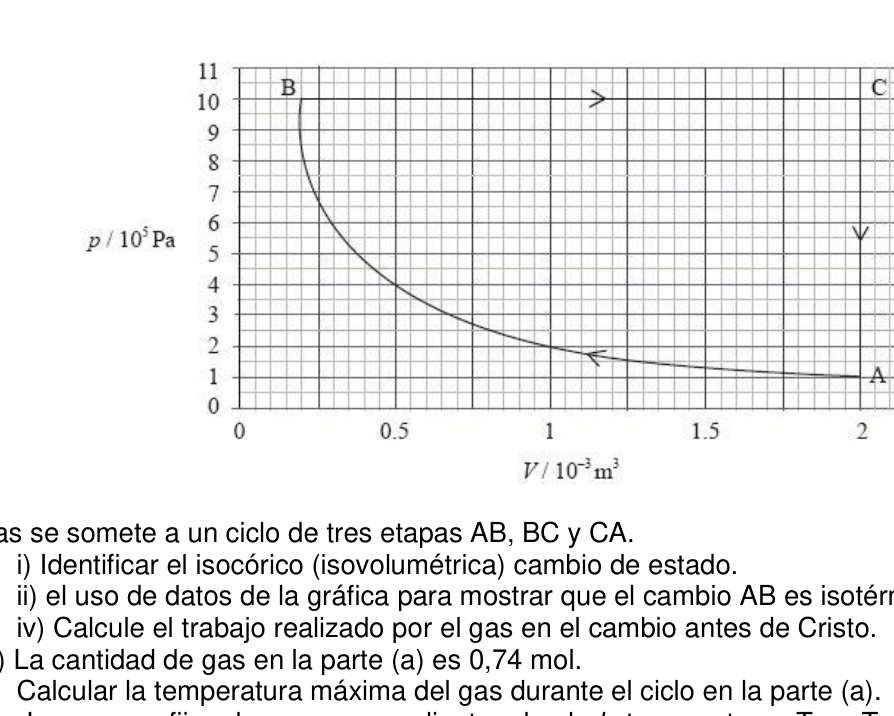
Topic: Thermodynamics, Kinetic Theory Metodi: Ideal Gas Law, Thermodynamic Cycle Analysis Competenze: Physical Reasoning Objects: Gas Fonte: Testo (PDF) — p.5
PT71. Scuola scozzese San Andrés
Olivos, Buenos Aires.
Questa domanda riguarda un gas ideale.
a) Il grafico mostra un rapporto pressione-volume (P-V) per una massa fissa di un gas Ideale.
78 - OAF 2015
Il gas si sottopone a un ciclo di tre fasi AB, BC e CA. i) Identificare il cambiamento di stato isocorico (isovolumetrico). (ii) l’uso dei dati del grafico per mostrare che il cambiamento AB è isotermica. (iv) Calcola il lavoro svolto dal gas nel cambiamento prima di Cristo. b) La quantità di gas di parte (a) è di 0,74 mol. Calcolare la temperatura massima del gas durante il ciclo in parte (a). c) La massa fissa del gas è riscaldata da T1 a T2 a volume costante. Spiegare perché, se questa massa fissa di gas si riscaldasse da 1 a T T 2 a la pressione costante, la quantità di energia richiesta è diversa.
Topic: Thermodynamics, Kinetic Theory Metodi: Ideal Gas Law, Thermodynamic Cycle Analysis Competenze: Physical Reasoning Objects: Gas Fonte: Testo (PDF) — p.5
PT71. St. Andrew’s Scottish School
Olive trees, from Buenos Aires.
This question is about an ideal gas.
(a) The graph shows a pressure-volume (P-V) ratio of a fixed mass of a gas It’s perfect.
The Commission shall adopt delegated acts in accordance with Article 21 of Regulation (EU) No 1303/2013.
The gas undergoes a three-stage cycle AB, BC and CA. (i) Identify the isocoric (isovolumetric) change in state. (ii) the use of graph data to show that the change AB is isothermal. (iv) Calculate the work done by the gas in the change before Christ. (b) The amount of gas in part (a) is 0,74 mol. Calculate the maximum gas temperature during the cycle in part (a). (c) The gas mass is heated from T1 to T2 at volume It’s constant. Explain why, if this fixed mass of gas is heated from 1 to T T 2 to constant pressure, the amount of energy required is different.
Topic: Thermodynamics, Kinetic Theory Metodi: Ideal Gas Law, Thermodynamic Cycle Analysis Competenze: Physical Reasoning Objects: Gas Fonte: Testo (PDF) — p.5
PT72. Escuela Escocesa San Andrés
Olivos, Buenos Aires.
Esta pregunta se refiere a la energía interna y energía térmica (calor).
b) una pieza de hierro se coloca en un horno hasta que alcanza la temperatura θ del
horno. El hierro se transfiere rápidamente a agua contenida en un recipiente aislado
térmicamente. El agua se agita hasta que alcanza una temperatura constante. Se
dispone de los siguientes datos.
La capacidad térmica de la pieza de hierro = 60 JK -1
La capacidad térmica del agua = 2,0 × 10 3 JK -1
La temperatura inicial del agua = 16 ° C
Temperatura final del agua = 45 ° C
La capacidad térmica del recipiente y el aislamiento es insignificante.
i) Estado una expresión, en términos de datos y theta lo anterior, para la transferencia
de energía del hierro en enfriamiento desde la temperatura del horno a la
temperatura final del agua.
ii) Calcular el aumento de la energía interna del agua como el hierro se enfría en el
agua.
iii) Utilice sus respuestas a (b) (i) y (b) (ii) para determinar θ.
Topic: Thermodynamics Metodi: First Law of Thermodynamics Competenze: Physical Reasoning Objects: Calorimeter Fonte: Testo (PDF) — p.5
PT72. Scuola scozzese San Andrés
Olivos, Buenos Aires.
La domanda riguarda l’energia interna e la energia termica (calore).
b) un pezzo di ferro viene messo in un forno fino a raggiungere la temperatura θ di Forno. Il ferro si trasferisce rapidamente in acqua contenuta in un recipiente isolato. termicamente. L’acqua si agita fino a raggiungere una temperatura costante. Se ha i seguenti dati: La capacità termico della pezzo di ferro = 60 JK -1 La capacità termico dell’acqua = 2,0 × 10 3 JK -1 La temperatura iniziale dell’acqua = 16 ° C Temperatura finale dell’acqua = 45 ° C La capacità termico del recipiente e l’isolamento sono insignificanti. i) Statuto un’espressione, in termini di dati e di quanto precede, per il trasferimento di energia del ferro in raffreddamento dalla temperatura del forno alla temperatura del temperatura finale dell’acqua. (ii) Calcolare l’aumento dell’energia interna dell’acqua come il ferro si raffredda nel acqua. iii) Utilizzare le risposte a (b) (i) e (b) (ii) per determinare θ.
Topic: Thermodynamics Metodi: First Law of Thermodynamics Competenze: Physical Reasoning Objects: Calorimeter Fonte: Testo (PDF) — p.5
PT72. St. Andrew’s Scottish School
Olive trees, from Buenos Aires.
This question concerns internal energy and thermal energy (heat).
(b) a piece of iron is placed in an oven until it reaches the temperature θ of the the oven. Iron is quickly transferred to water contained in an insulated container thermal. The water is stirred until it reaches a constant temperature. Se the following data are available to you. The thermal capacity of the iron part = 60 JK -1 The thermal capacity of the water = 2,0 × 10 3 JK -1 The initial water temperature = 16 ° C The final water temperature = 45 ° C The thermal capacity of the container and the insulation is insignificant. (i) State an expression, in terms of data and theta above, for the transfer The heat output of the iron energy in the cooling from the oven temperature to the the final water temperature. (ii) Calculate the increase in the internal energy of water as iron is cooled in the
- What? (iii) Use your answers to (b) (i) and (b) (ii) to determine θ.
Topic: Thermodynamics Metodi: First Law of Thermodynamics Competenze: Physical Reasoning Objects: Calorimeter Fonte: Testo (PDF) — p.5
PT73. Instituto Tecnológico del Comahue
Escuela Provincial de Educación Técnica Nro. 14
Ciudad de Neuquén.
Considerando una máquina de pinball: Sí se tiene en cuenta que consiste en un tablero en el cual una bolilla de metal de masa m es lanzada por un lanzador mecánico accionado por la energía acumulada en un resorte debajo del mismo (con una constante de 1,20 N/cm).
OAF 2015 - 79 La superficie sobre la que se mueve la bola esta inclinada a 15° respecto de la horizontal. Se desprecia la fuerza de rozamiento de la bolilla con el tablero, la fricción y la masa del embolo. Nota: Considerar que la aceleración de la gravedad es 10 m/s2.
a) Analizar y expresar cuanto será necesario comprimir el resorte para que la bolilla llegue a una altura máxima, si la masa de la misma es de 100 gramos y el largo del tablero es de 1,05 metros.
b) Plantear el diagrama de cuerpo libre para la bolilla si se encuentra en los puntos A, B y C.
c) Averiguar el valor de la fuerza que atrae a la bolilla hacia el depósito inferior una vez alcanzado la altura máxima.
Averiguar la fuerza que es necesaria hacer para comprimir al resorte de forma tal que al soltarlo llegue al punto A, B y C. La distancia entre A y C es de 46cm.
Topic: Conservation of Energy Metodi: Energy Conservation Method, Hooke’s Law Competenze: Physical Reasoning Objects: Spring, Ball, Inclined Plane Fonte: Testo (PDF) — p.5
PT73. L’Istituto Tecnologico del Comahue
Scuola Provinciale di Educazione Tecnica Nro. 14
Città di Neuquén.
Considerando una macchina da pinball: Si tiene conto che consiste in un tavolo in cui un bollo di metallo di massa m viene lanciato da un lanciatore meccanico azionato dall’energia accumulata in un di un’alta tensione di calore di 1,20 N/cm.
OAF 2015 - 79 La superficie su cui si muove la palla è inclinata a 15° per quanto riguarda il orizzontale. Si disprezza la forza di ruggine della ciotola con il tavolo, la la friczione e la massa del busto. Nota: Considera che l’accelerazione della gravità è di 10 m/s2.
a) Analizzare e esprimere quanto sarà necessario comprimere il Primavera per far arrivare la ciotola a un’altezza massima, se la massa di questo è di 100 grammi e la lunghezza di Il tavolo è di 1,05 metri.
b) Presentare il diagramma di corpo libero per la bolla se si trova nei punti A, B e C.
c) Scoprire il valore della forza che attira la bozza verso il deposito inferiore una volta raggiunto l’altezza massimo.
Scoprire la forza che occorre fare per comprimere il di cui al punto A, B e C. La distanza tra A e C è di 46 cm.
Topic: Conservation of Energy Metodi: Energy Conservation Method, Hooke’s Law Competenze: Physical Reasoning Objects: Spring, Ball, Inclined Plane Fonte: Testo (PDF) — p.5
PT73. The Comahue Institute of Technology
Provincial school of technical education nro. 14
The city of Neuquén.
Considering a pinball machine: It is noted that it consists of a board on which a metal bowl of mass m is launched by a mechanical launcher powered by the energy accumulated in a spring below it (with a constant of 1,20 N/cm).
The Commission shall adopt delegated acts in accordance with Article 21 of this Regulation. The surface on which the ball moves is tilted to 15° the horizontal. It scorned the force of the bowl’s grinding with the board, the friction and mass of the embossed. Note: Consider that the acceleration of gravity is 10 m/s2.
(a) Analyze and express how much compression will be needed. spring so that the bowl reaches a maximum height, If the mass of the same is 100 grams and the length of the board is 5 feet tall.
(b) Set the free body diagram for the bowl if is located in points A, B and C.
(c) Find the value of the force that attracts the bowl. towards the lower reservoir once the height is reached. Maximum.
Find out the force that is needed to compress the spring so that when released it reaches points A, B and C. The distance between A and C is 46cm.
Topic: Conservation of Energy Metodi: Energy Conservation Method, Hooke’s Law Competenze: Physical Reasoning Objects: Spring, Ball, Inclined Plane Fonte: Testo (PDF) — p.5
PT74. Instituto Tecnológico del Comahue
Escuela Provincial de Educación Técnica Nro. 14
Ciudad de Neuquén.
Si se desea medir una resistencia eléctrica se puede utilizar un voltímetro y un amperímetro y luego aplicar ley de ohm para establecer el valor de dicha resistencia. El problema de éste método se basa en que el voltímetro no cuenta con una resistencia infinita en su interior y la resistencia interna del amperímetro no es nula, por lo tanto al usar este método se está introduciendo un error en la medición. Ese error depende de cómo se conecten los instrumentos, dependiendo de esa conexión tenemos dos tipos de conexiones para medir la resistencia con un amperímetro y un voltímetro:
Ilustración 1: Conexión Larga
Ilustración 2: Conexión Corta
a) Considerando a Riv y a Ria como resistencias internas del voltímetro y amperímetro respectivamente, encuentra una expresión para determinar el valor de R en cada conexión. b) Determina una expresión que permita calcular el error relativo en cada conexión. c) ¿Cuál es el valor del error para cada tipo de conexión si los instrumentos tienen Riv de 1500 Ω y Ria de 100 Ω y se desea medir una resistencia cercana a los 700 Ω?
80 - OAF 2015
Topic: Circuits Metodi: Kirchhoff’s Laws, Error Propagation Competenze: Physical Reasoning Objects: Resistor, Galvanometer Fonte: Testo (PDF) — p.5
PT74. L’Istituto Tecnologico del Comahue
Scuola Provinciale di Educazione Tecnica Nro. 14
Città di Neuquén.
Se si desidera misurare una resistenza elettrica si possono utilizzare un voltometro e un per determinare il valore di tale resistenza. El Il problema di questo metodo è che il voltometro non ha resistenza. infinito all’interno e la resistenza interna dell’ampiecatore non è nulla, quindi al Se si usa questo metodo si introduce un errore di misurazione. L’errore dipende da Come si collegano gli strumenti, a seconda di quella connessione abbiamo due tipi di connessioni per misurare la resistenza con un amperetro e un voltetro:
Illocazione 1: Connexion lunga
Illocazione 2: Corto collegamento
a) Considerando Riv e Ria come resistenze interne del voltímetro e dell’ampielitro rispettivamente, trova un’espressione per determinare il valore di R in ogni connessione. b) Determina un’espressione che permetta di calcolare l’errore relativo in ogni connessione. (c) Qual è il valore di errore per ogni tipo di connessione se gli strumenti hanno Riv di 1500 Ω e Ria di 100 Ω e si desidera misurare una resistenza vicina a 700 Ω?
80 - OAF 2015
Topic: Circuits Metodi: Kirchhoff’s Laws, Error Propagation Competenze: Physical Reasoning Objects: Resistor, Galvanometer Fonte: Testo (PDF) — p.5
PT74. The Comahue Institute of Technology
Provincial school of technical education nro. 14
The city of Neuquén.
If you want to measure an electrical resistance you can use a voltmeter and a The first thing to do is to measure the resistance of the resistor. El The problem with this method is that the voltmeter has no resistance infinite inside and the internal resistance of the amp is not zero, therefore at Using this method is introducing an error in the measurement. That error depends on How the instruments are connected, depending on that connection, we have two types of connections for measuring resistance with an ampere and voltmeter:
Illustration 1: Long connection
Illustration 2: Short connection
(a) Considering Riv and Ria as internal resistance of the voltmeter and ampere respectively, finds an expression to determine the value of R in each connection. (b) Determine an expression that allows the relative error to be calculated in each connection. (c) What is the error value for each connection type if the instruments have Riv 1500 Ω and 100 Ω Ria and you want to measure a resistance close to 700 Ω?
The following points shall be added:
Topic: Circuits Metodi: Kirchhoff’s Laws, Error Propagation Competenze: Physical Reasoning Objects: Resistor, Galvanometer Fonte: Testo (PDF) — p.5
PT75. Instituto Tecnológico del Comahue
Escuela Provincial de Educación Técnica Nro. 14
Ciudad de Neuquén.
La densidad de la gasolina es 7,3 x 10² Kg/m3 a 0°C. Su coeficiente de expansión de volumen promedio es de 9,6 x 10⁻⁴ 1/°C y considere que 1 galón (gal) es 0,0038 m3. a) Calcula la masa de 10 galones de gas a 0°C. b) Si 1 m3 de gasolina a 0°C se calienta a 20°C, calcule su nuevo volumen. c) Utilizando la respuesta del inciso anterior, calcule la densidad de la gasolina a 20°C. d) Calcule la masa de 10 gal de gasolina a 20°C. e) ¿Cuántos kilogramos extra de gasolina obtendría si comprara 10 gal de gasolina a 0°C en vez de a 20°C?
Topic: Thermodynamics Metodi: Ideal Gas Law Competenze: Physical Reasoning Objects: — Fonte: Testo (PDF) — p.5
PT75. L’Istituto Tecnologico del Comahue
Scuola Provinciale di Educazione Tecnica Nro. 14
Città di Neuquén.
La densità della benzina è di 7,3 x 10² Kg/m3 a 0°C. Il suo coefficiente di espansione di Il volume medio è di 9,6 x 10⁻⁴ 1/°C e considera che 1 gallone (gal) è di 0,0038 m3. a) Calcola la massa di 10 galloni di gas a 0°C. b) Se 1 m3 di benzina 0°C è riscaldato a 20°C, calcola il nuovo volume. c) Calcolare la densità della benzina a 20°C. d) Calcolare la massa di 10 galloni di benzina a 20°C. e) Quanti chili extra di benzina otterrebbe se comprasse 10 galloni di benzina a 0°C invece di 20°C?
Topic: Thermodynamics Metodi: Ideal Gas Law Competenze: Physical Reasoning Objects: — Fonte: Testo (PDF) — p.5
PT75. The Comahue Institute of Technology
Provincial school of technical education nro. 14
The city of Neuquén.
The density of the gasoline is 7,3 x 10² Kg/m3 at 0°C. Its expansion coefficient of The average volume is 9.6 x 10⁻⁴ 1/°C and consider 1 gallon (gal) to be 0,0038 m3. (a) Calculate the mass of 10 gallons of gas at 0°C. (b) If 1 m3 of gasoline at 0°C is heated at 20°C, calculate its new volume. (c) Using the answer in the previous paragraph, calculate the gasoline density to 20°C. (d) Calculate the mass of 10 gallons of gasoline at 20°C. (e) How many extra kilograms of gasoline would you get if you bought 10 gallons of gasoline from 0°C instead of 20°C?
Topic: Thermodynamics Metodi: Ideal Gas Law Competenze: Physical Reasoning Objects: — Fonte: Testo (PDF) — p.5
PT76. Instituto María Auxiliadora
Comodoro Rivadavia, Chubut.
En una jugada de un partido de básquet el jugador A arroja el balón con una velocidad de 10 m/s, formando un ángulo de 45° con la horizontal, desde una altura inicial de 2,5m. El jugador B, del mismo equipo, se encuentra a 14m de A, y el jugador C, del equipo contrario a 8m, como se muestra en la figura. Los tres jugadores están alineados en el mismo plano vertical en el que se realiza el tiro.
a) Escribir las ecuaciones x(t) e y(t) que describen la posición del balón en función del
tiempo.
b) Escribir la expresión que relaciona la altura del balón como función de su posición
horizontal y(x).
c) Hallar el tiempo que tarda el balón en volver a tener la altura inicial.
d) Si el jugador B corre con velocidad constante desde el momento que A arroja el
balón ¿a qué velocidad debe correr para atraparlo cuando vuelve a estar a la
misma altura que tenía cuando lo arrojó el jugador A?
e) En el instante en que el balón pasa sobre su cabeza, el jugador C salta hacia arriba
alcanzando sus manos una altura de 4m. Determinar analíticamente si logra
obstaculizar la trayectoria del balón.
Nota: Considerar que la aceleración de la gravedad es de 10 m/s2.
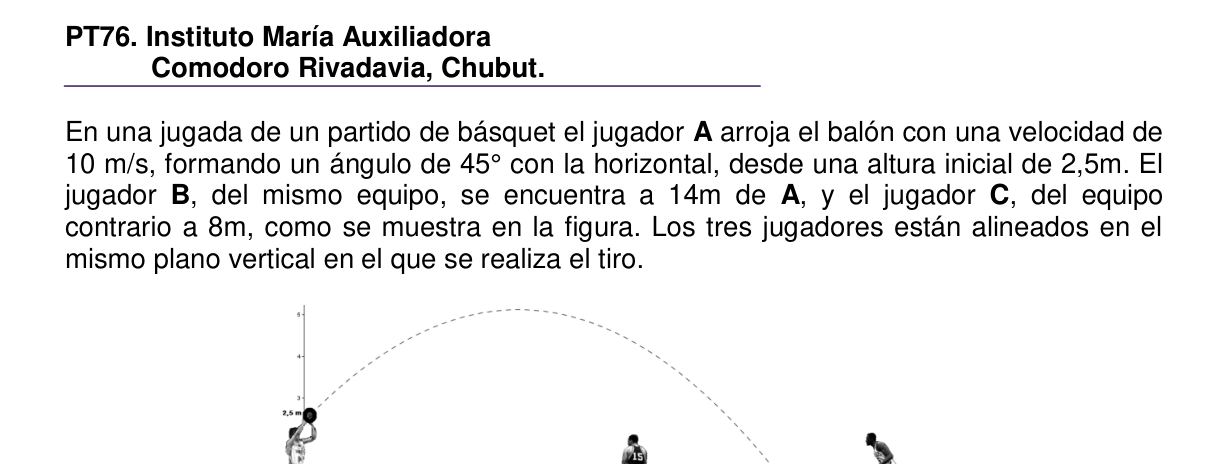
Topic: Newtonian Mechanics Metodi: Kinematic Equations, Vector Decomposition Competenze: Physical Reasoning Objects: Ball, Projectile Fonte: Testo (PDF) — p.5
PT76. Istituto Maria Assilliadora
Comodoro Rivadavia, Chubut.
In un gioco di basket il giocatore A lancia il pallone a velocità di 10 m/s, formando un angolo di 45° con la linea orizzontale, da un’altezza iniziale di 2,5 m. El Il giocatore B della stessa squadra è a 14 metri da A, e il giocatore C della squadra contraria a 8 m, come mostra la figura. I tre giocatori sono allineati in campo. lo stesso piano verticale in cui si fa il tiro.
a) Scrivere le equazioni x(t) e y(t) che descrivono la posizione della palla in funzione del tempo. b) Scrivere l’espressione che relaziona l’altezza della palla a seconda della sua posizione il livello di riferimento è il livello di riferimento di riferimento. c) Calcolare il tempo necessario per riprendere la altezza iniziale della palla. d) Se il giocatore B corre a velocità costante dal momento in cui A lancia il ballo a che velocità deve correre per prenderlo quando torna a essere La stessa altezza di quando lo ha lanciato il giocatore A? e) L’istante in cui la palla passa sopra la sua testa, il giocatore C salta verso l’alto raggiungendo le sue mani a un’altezza di 4 metri. Determinare analiticamente se riesce impedire il percorso della palla. Nota: Considerare che l’accelerazione della gravità è di 10 m/s2.
Topic: Newtonian Mechanics Metodi: Kinematic Equations, Vector Decomposition Competenze: Physical Reasoning Objects: Ball, Projectile Fonte: Testo (PDF) — p.5
PT76. The Institute of Maria Auxiliadora
Commodore Rivadavia, Chubut.
In a game of basketball player A throws the ball at a speed of 10 m/s, forming an angle of 45° with the horizontal, from an initial height of 2,5 m. El Player B, of the same team, is 14m from A, and player C, of the team. as opposed to 8m, as shown in the figure. All three players are lined up in the the same vertical plane on which the shot is fired.
(a) Write the equations x(t) and y(t) describing the position of the ball according to time. (b) Write the expression relating the height of the ball as a function of its position horizontal and x). (c) Find the time it takes the ball to return to its initial height. (d) If player B is running at a constant speed from the moment A throws the ball, how fast should you run to catch it when it gets back to the The same height he was when Player A threw him? (e) The moment the ball passes over his head, player C jumps upwards reaching his hands a height of 4 meters. Determine analytically if you can to obstruct the course of the ball. Note: Consider that the acceleration of gravity is 10 m/s2.
Topic: Newtonian Mechanics Metodi: Kinematic Equations, Vector Decomposition Competenze: Physical Reasoning Objects: Ball, Projectile Fonte: Testo (PDF) — p.5
PT77. Instituto María Auxiliadora
Comodoro Rivadavia, Chubut.
Un plano inclinado tiene 2m de altura y forma un ángulo de 30° con el plano horizontal. Desde el extremo más alto se suelta un bloque que tiene 1 Kg de masa. El coeficiente de rozamiento entre el plano inclinado y el bloque es 0,173. Al final del plano el bloque continúa su movimiento sobre una superficie horizontal sin rozamiento, hasta que se detiene comprimiendo 10 cm el resorte que se muestra en la figura, que está sujeto a una pared.
OAF 2015 - 81 a) Realizar el diagrama de cuerpo libre del bloque cuando se encuentra sobre el plano inclinado. b) Hallar el valor de la fuerza de rozamiento cuando se desliza sobre el mismo. c) Determinar la aceleración del bloque cuando resbala sobre la rampa. d) Planteando conservación de la energía determinar la velocidad del bloque al llegar al punto inferior. e) Calcular el valor de la constante elástica del resorte que lo detiene. Nota: Considerar que la aceleración de la gravedad es de 10 m/s2.
Topic: Conservation of Energy Metodi: Energy Conservation Method, Hooke’s Law Competenze: Physical Reasoning Objects: Block, Spring, Inclined Plane Fonte: Testo (PDF) — p.5
PT77. Istituto Maria Assilliadora
Comodoro Rivadavia, Chubut.
Un piano inclinato ha una altezza di 2 m e forma un angolo di 30° con il piano orizzontale. Dall’estremità superiore si scatta un blocco di 1 Kg di massa. Il coefficiente di il rottura tra il piano inclinato e il blocco è di 0,173. Alla fine del piano il blocco continua a muoversi su una superficie orizzontale senza rottura, fino a quando non si si ferma compresso 10 cm la primavera mostrata nella figura, che è soggetta a una
- Il muro.
OAF 2015 - 81 a) Realizzare il diagramma di corpo libero del Blocca quando si trova sul piano inclinato. b) Determinare il valore della forza di rottura quando si scivola sopra di esso. c) Determinare la Accelerazione di cui al blocco quando scivola sul rampo. d) Sulla base della conservazione dell’energia determinare la velocità del blocco all’arrivo al punto inferiore. e) Calcolare il valore della costante elastica della sorgente che la detiene. Nota: Considerare che l’accelerazione della gravità è di 10 m/s2.
Topic: Conservation of Energy Metodi: Energy Conservation Method, Hooke’s Law Competenze: Physical Reasoning Objects: Block, Spring, Inclined Plane Fonte: Testo (PDF) — p.5
PT77. The Institute of Maria Auxiliadora
Commodore Rivadavia, Chubut.
An inclined plane is 2 m high and forms an angle of 30° with the horizontal plane. From the top end a block with 1 kg of mass is released. The coefficient of The friction between the slope plane and the block is 0.173. At the end of the plan the block It continues to move over a horizontal surface without any rusting until it is The spring shown in the figure, which is subject to a The wall.
The Commission shall adopt delegated acts in accordance with Article 21 of this Regulation. (a) To draw up the free body diagram of the Block when it’s on the plane. I’m not going to lie. (b) Determine the value of the friction force When it slides over it. (c) Determine la Acceleration of the Block When it slips over the ramp. d) By considering energy conservation determine the speed of the block upon arrival to the bottom. (e) Calculate the value of the elastic constant of the spring that holds it. Note: Consider that the acceleration of gravity is 10 m/s2.
Topic: Conservation of Energy Metodi: Energy Conservation Method, Hooke’s Law Competenze: Physical Reasoning Objects: Block, Spring, Inclined Plane Fonte: Testo (PDF) — p.5
PT78. Instituto María Auxiliadora
Comodoro Rivadavia, Chubut.
En el circuito que se muestra en la figura la fuerza electromotriz del generador es de 200V, R1= 3Ω, R2= 3Ω, R3= 1Ω, R4= 2Ω, y R5= 2Ω. a) Hallar la resistencia equivalente a todo el circuito. b) Calcular VAB, VBC . c) Determinar las intensidades i1, i2, i5 en los cables que se indican. d) Si la resistencia R1, representa un calentador eléctrico, hallar su potencia. e) Si está en funcionamiento 1 hora, calcular el calor producido, expresado en Joulle y calorías.
Topic: Circuits, Thermodynamics Metodi: Equivalent Circuit Reduction, First Law of Thermodynamics Competenze: Physical Reasoning Objects: Resistor Fonte: Testo (PDF) — p.5
PT78. Istituto Maria Assilliadora
Comodoro Rivadavia, Chubut.
Il circuito che mostra la forza l’elettromotrice del generatore è di 200 V, R1= 3Ω, R2= 3Ω, R3= 1Ω, R4= 2Ω, y R5= 2Ω. a) Trovare la resistenza equivalente all’intero circuito. b) Calcolare VAB, VBC. (c) Determinare le intensità i1, i2, i5 nei i cavi che si indicano. d) Se la resistenza R1 rappresenta un riscaldatore elettrico, trovare la sua potenza. e) Se è in funzione per 1 ora, calcolare il calore prodotto, espresso in Joulle e calorie.
Topic: Circuits, Thermodynamics Metodi: Equivalent Circuit Reduction, First Law of Thermodynamics Competenze: Physical Reasoning Objects: Resistor Fonte: Testo (PDF) — p.5
PT78. The Institute of Maria Auxiliadora
Commodore Rivadavia, Chubut.
In the circuit shown in the figure the force The generator electromotive power is 200V, R1 = 3Ω, R2= 3Ω, R3= 1Ω, R4= 2Ω, y R5= 2Ω. (a) Find the resistance equivalent to the whole The circuit. (b) Calculate VAB, VBC. (c) Determine the intensities i1, i2, i5 in the The wires are indicated. (d) If the resistance R1 is a heater electrical, find its power. (e) If it is running for 1 hour, calculate the heat produced, expressed in Joulle and Calories.
Topic: Circuits, Thermodynamics Metodi: Equivalent Circuit Reduction, First Law of Thermodynamics Competenze: Physical Reasoning Objects: Resistor Fonte: Testo (PDF) — p.5
PT79. Escuela Técnica Nro. 9 Ing. Luis A. Huergo
Ciudad de Buenos Aires.
Un barco petrolero transporta 200 millones de litros de petróleo. Determinar el volumen
que deben tener las bodegas para contener todo el petróleo si se estima que durante el
viaje (ver el gráfico) habrá una diferencia máxima de temperatura de 10°C.
( γpetróleo = 0,0009 1/°C)
a) Extraiga los datos e indique las unidades y el sistema al que pertenecen.
b) Realice las conversiones necesarias.
c) Escriba la fórmula general a aplicar.
d) Determine el volumen mínimo necesario.
Topic: Thermodynamics Metodi: Ideal Gas Law Competenze: Physical Reasoning Objects: Container Fonte: Testo (PDF) — p.5
PT79. Scuola tecnica n.o. 9 Ing. Luis A. - Hoorgo
Città di Buenos Aires.
Una nave petrolifera trasporta 200 milioni di litri di petrolio. Determinare il volume che devono avere le cantine per contenere tutto il petrolio se si stima che durante il per il viaggio (vedi grafico) ci sarà una differenza massima di temperatura di 10°C. (G/petroleum = 0,0009 1/°C) a) Scavare i dati e indicare le unità e il sistema di cui appartengono. b) effettuare le necessarie conversioni. c) Scrivi la formula generale da applicare. d) Determina il volume minimo necessario.
Topic: Thermodynamics Metodi: Ideal Gas Law Competenze: Physical Reasoning Objects: Container Fonte: Testo (PDF) — p.5
PT79. Technical school No. 9 Ing. Louis A. I ‘m not .
City of Buenos Aires.
An oil tanker carries 200 million litres of oil. Determine the volume The oil reserves must be contained in the cellars if it is estimated that during the The maximum temperature difference of 10°C shall be recorded. (G/O) The value of the product concerned is the value of the product concerned. (a) Extract the data and indicate the units and the system to which they belong. (b) Make the necessary conversions. (c) Write down the general formula to be applied. (d) Determine the minimum volume required.
Topic: Thermodynamics Metodi: Ideal Gas Law Competenze: Physical Reasoning Objects: Container Fonte: Testo (PDF) — p.5
PT80. Escuela Técnica Nro. 9 Ing. Luis A. Huergo
Ciudad de Buenos Aires.
Un perro de trineo de nieve promedio debe ser capaz de recorrer una distancia de hasta 129 Km diarios, en un rango de velocidad entre 9,7 y 23 km/h, que puede variar de acuerdo a la distancia y las condiciones del sendero. Los numerosos tipos de razas que
82 - OAF 2015 se utilizan para este fin, poseen en común un pelaje denso que los hace resistentes al frío y aptitud para trabajar disciplinadamente en equipo. Es por esto que un hombre de 63 kg desea realizar un viaje de 327 km con un trineo de 15 kg que es arrastrado por un perro con una fuerza de 87 N. El trineo alcanza una velocidad de 3 m/s al cabo de 10 segundos de recorrido, habiendo partido del reposo. La masa del perro es de 27 kg: a) Realiza el diagrama de cuerpo libre correspondiente al trineo y el perro, con el correspondiente nombre y valor de cada una de las fuerzas que actúan en la dirección vertical sobre ellos. b) ¿Qué valor posee la fuerza de rozamiento que existe entre el trineo y el suelo? c) Determina la tensión de la cuerda para antes y después de los 10 segundos. d) ¿Qué fuerza debe aplicar el perro, a partir de los 10 segundos, para continuar con movimiento uniforme?
Topic: Newtonian Mechanics Metodi: Free-Body Diagram, Kinematic Equations Competenze: Physical Reasoning Objects: Cart, String Fonte: Testo (PDF) — p.5
PT80. Scuola tecnica n.o. 9 Ing. Luis A. - Hoorgo
Città di Buenos Aires.
Un cane da snowboard medio deve essere in grado di percorrere una distanza fino a 129 Km di giorno, in un intervallo di velocità compresa tra 9,7 e 23 km/h, che può variare da secondo la distanza e le condizioni del sentiero. I numerosi tipi di razze che
82 - OAF 2015 sono utilizzati per questo scopo, hanno in comune un denso pelato che li rende resistenti al freddo e capacità di lavorare in team con disciplina. Ecco perché un uomo di 63 kg vuole fare un viaggio di 327 km su un bagliotto di 15 kg che viene trascinato da un cane con una forza di 87 N. Il scivolo raggiunge una velocità di 3 m/s dopo 10 secondi di percorso, dopo aver partito dal riposo. La la massa del cane è di 27 kg: a) realizza il diagramma di corpo libero per il bagliardo e il cane, con il il nome e il valore corrispondenti di ciascuna delle forze che agiscono in direzione verticale su di loro. b) Qual è il valore della forza di ruggine che esiste tra il treno e il suolo? c) Determina la tensione della corda prima e dopo i 10 secondi. d) Qual è la forza che il cane deve applicare dopo 10 secondi per continuare con movimento uniforme?
Topic: Newtonian Mechanics Metodi: Free-Body Diagram, Kinematic Equations Competenze: Physical Reasoning Objects: Cart, String Fonte: Testo (PDF) — p.5
PT80. Technical school No. 9 Ing. Louis A. I ‘m not .
City of Buenos Aires.
An average snow sled dog must be able to walk a distance of up to 129 km/h, at a speed range of 9.7 to 23 km/h, which may vary from according to the distance and conditions of the trail. The numerous types of breeds that
82 - OAF 2015 They are used for this purpose, they have a dense coat in common which makes them cold-resistant. and a skill to work disciplinedly as a team. That is why a 63-kg man wants to make a 327-kilometer journey on a sleigh. 15 kg that is dragged by a dog with a force of 87 N. The sled reaches a . speed of 3 m/s after 10 seconds of travel, having left the resting place. La The weight of the dog is 27 kg: (a) Draw the free body diagram for sledding and the dog, with the The corresponding name and value of each of the forces acting in the vertical direction over them. (b) What is the value of the friction force between the slip and the ground? (c) Determine the tension of the rope for before and after 10 seconds. (d) What force should the dog apply after 10 seconds to continue with uniform movement?
Topic: Newtonian Mechanics Metodi: Free-Body Diagram, Kinematic Equations Competenze: Physical Reasoning Objects: Cart, String Fonte: Testo (PDF) — p.5
PT81. Escuela Técnica Nro. 9 Ing. Luis A. Huergo
Ciudad de Buenos Aires.
A las 7:30h, un automóvil parte dede Bs. As. Rumbo a Mendoza y a las 8:15h parte otro automóvil desde Mendoza rumbo a Bs. As.. Suponiendo que ambos se desplacen con velocidades contantes de 60km/h y 80km/h respectivamente, en direcciones supuestamente rectilíneas, determinar; a) ¿A qué hora se cruzan? b) ¿a qué hora llega a Mendoza el que salió desde Bs. As.? c) ¿a qué hora llega a Bs. As. el que salió desde Mendoza ? d) ¿a qué distancia de ambas ciudades se produce el cruce? e) Graficar, para ambos móviles V = f(t) y X = f(t) DATO: la distancia entre Bs. As. y Mendoza es de 1100km
Topic: Newtonian Mechanics Metodi: Kinematic Equations Competenze: Physical Reasoning Objects: — Fonte: Testo (PDF) — p.5
PT81. Scuola tecnica n.o. 9 Ing. Luis A. - Hoorgo
Città di Buenos Aires.
Alle 7:30 un’auto parte da Bs. As. Rumbo a Mendoza e alle 8:15 parte l’altra Auto da Mendoza verso Bs. As.. Supponiamo che entrambi si muovano con velocità contanti di 60 km/h e 80 km/h rispettivamente, in direzioni presumibilmente rettilineo, determinare; a) A che ora si incrociano? b) a che ora arriva a Mendoza il partito da Bs. As.? c) l’ora di arrivo a Bs. As. - l’ uomo che è uscito da Mendoza ? d) a che distanza si trova il passaggio tra le due città? e) Grafica, per entrambi i movili V = f(t) e X = f(t) DATTO: la distanza tra Bs. As. e Mendoza è di 1100 km
Topic: Newtonian Mechanics Metodi: Kinematic Equations Competenze: Physical Reasoning Objects: — Fonte: Testo (PDF) — p.5
PT81. Technical school No. 9 Ing. Louis A. I ‘m not .
City of Buenos Aires.
At 7:30, a car leaves the bus. As. I’m heading to Mendoza and at 8:15 another part. car from Mendoza heading to Bs. As.. Assuming you both move around with Cash speeds of 60km/h and 80km/h respectively, in directions presumably straight, to determine; (a) What time do they cross? b) What time does the man who left Bs arrive in Mendoza? As.? (c) when to arrive at Bs. As. The one that came out of Mendoza ? (d) How far from both cities is the crossing? e) Graphing, for both mobiles V = f(t) and X = f(t) DATE: the distance between Bs. As. And Mendoza is 1100km away.
Topic: Newtonian Mechanics Metodi: Kinematic Equations Competenze: Physical Reasoning Objects: — Fonte: Testo (PDF) — p.5
PT82. Escuela de Biología Marina y Laboratorista Nro. 1 Atlántico Sur
Caleta Olivia, Santa Cruz.
Dos masas, de 20kg y 30kg respectivamente, se encuentran unidas por una cuerda ideal y apoyadas sobre una superficie nivelada. Los coeficientes de fricción de ellas sobre la superficie son µ1= 0.40 y µ2= 0.20. Un perro arrastra las masas con una fuerza horizontal de 30N de magnitud. a) Realice un dibujo representando la situación. b) Trace el diagrama de fuerzas que actúan sobre la masa de 20kg. c) Trace otro diagrama para las fuerzas que actúan sobre la segunda masa. d) ¿Se acelerará el sistema? De ser así, determine la magnitud de la aceleración e) ¿Qué magnitud de fuerza se requiere para que el sistema formado por las dos masas se acelere 1.2m/s2?
Topic: Newtonian Mechanics Metodi: Free-Body Diagram, Conservation Laws Competenze: Physical Reasoning Objects: Block, String Fonte: Testo (PDF) — p.5
PT82. Scuola di Biologia Marina e Laboratoriista Nro. 1 Atlantico Sud
- Calma Olivia, Santa Cruz.
Due masse, rispettivamente di 20 kg e 30 kg, sono legate da una corda ideale e appoggiati su una superficie di piattaforma. I coefficienti di attrito di tali elementi sulla La superficie è di μ1=0.40 e μ2=0.20. Un cane trascina le masse con una forza orizzontale . di magnitudo 30N. a) Disegnare un disegno che rappresenti la situazione. b) Descrive il diagramma delle forze che agiscono sulla massa di 20 kg. c) Tracciare un altro diagramma delle forze che agiscono sulla seconda massa. d) Accelererà il sistema? Se è così, determina la grandezza dell’accelerazione e) Che forza è richiesta per far sì che il sistema formato dalle due parti Mass accelerare 1,2 m/s2?
Topic: Newtonian Mechanics Metodi: Free-Body Diagram, Conservation Laws Competenze: Physical Reasoning Objects: Block, String Fonte: Testo (PDF) — p.5
PT82. School of Marine and Laboratory Biology Nro. 1 South Atlantic
Put Olivia down, Santa Cruz.
Two masses, of 20 kg and 30 kg respectively, are joined by an ideal rope and resting upon a level surface. The coefficients of friction of the two surfaces over the surface are μ1=0.40 and μ2=0.20. A dog drags the masses with a horizontal force . of a magnitude of 30N. (a) Draw a picture of the situation. (b) Draw the diagram of forces acting on the mass of 20 kg. (c) Draw another diagram for the forces acting on the second mass. (d) Will the system be accelerated? If so, determine the magnitude of the acceleration. (e) What force is required for the system to be formed by the two mass is accelerating 1.2m/s2?
Topic: Newtonian Mechanics Metodi: Free-Body Diagram, Conservation Laws Competenze: Physical Reasoning Objects: Block, String Fonte: Testo (PDF) — p.5
PT83. Escuela de Biología Marina y Laboratorista Nro. 1 Atlántico Sur
Caleta Olivia, Santa Cruz.
Un recipiente contiene 100g de hidrógeno (c = 2.4cal.g-1.°C-1) a 2 at de presión y 7°C. Se
lo calienta isométricamente hasta que la temperatura es de 27°C.
a) Realiza la representación gráfica.
b) ¿Qué cantidad de calor se entregó?
c) ¿Cuál es el trabajo realizado por el gas?
d) ¿Cuál es la variación de la energía interna del gas?
e) Determinar la presión final del gas.
OAF 2015 - 83
Topic: Thermodynamics, Kinetic Theory Metodi: First Law of Thermodynamics, Ideal Gas Law Competenze: Physical Reasoning Objects: Gas Fonte: Testo (PDF) — p.5
PT83. Scuola di Biologia Marina e Laboratoriista Nro. 1 Atlantico Sud
- Calma Olivia, Santa Cruz.
Un contenitore contiene 100 g di idrogeno (c = 2.4 cal.g-1.°C-1) a 2 at di pressione e 7°C. Se il calore è isometrico fino a 27°C. a) Realizza la rappresentazione grafica. b) Quanta calore è stato consegnato? c) Qual è il lavoro svolto dal gas? d) Qual è la variazione dell’energia interna del gas? e) Determinare la pressione finale del gas.
OAF 2015 - 83
Topic: Thermodynamics, Kinetic Theory Metodi: First Law of Thermodynamics, Ideal Gas Law Competenze: Physical Reasoning Objects: Gas Fonte: Testo (PDF) — p.5
PT83. School of Marine and Laboratory Biology Nro. 1 South Atlantic
Put Olivia down, Santa Cruz.
One container contains 100 g of hydrogen (c = 2.4 cal.g-1.°C-1) at 2 at pressures and 7°C. Se It is heated isometrically until the temperature is 27°C. (a) Performs the graphic representation. (b) How much heat was delivered? (c) What is the work done by gas? (d) What is the variation in the internal energy of the gas? (e) Determine the final gas pressure.
The following is the list of the countries of the European Union:
Topic: Thermodynamics, Kinetic Theory Metodi: First Law of Thermodynamics, Ideal Gas Law Competenze: Physical Reasoning Objects: Gas Fonte: Testo (PDF) — p.5
PT84. Escuela de Biología Marina y Laboratorista Nro. 1 Atlántico Sur
Caleta Olivia, Santa Cruz.
Dos resistencias están montadas en paralelo en un circuito conectado a una batería con
una resistencia interna de 1Ω, la que entrega una corriente de 500mA.
Por una de las resistencias, de 50 Ω, circula una corriente de 400mA; mientras que la otra
resistencia está en el interior de un calorímetro.
El calorímetro contiene 300g de una sustancia cuyo calor específico es 0.5cal/g.°C, que
eleva su temperatura al circular la corriente por la resistencia.
a) Realiza un esquema representando la situación.
b) Calcula el valor de la resistencia que se encuentra dentro del calorímetro.
c) Determinar la resistencia total del circuito.
d) Calcular el valor de la FEM de la batería.
e) ¿Cuánto tiempo tarda la resistencia del calorímetro en elevar la temperatura de la
sustancia 5°C?
Topic: Circuits, Thermodynamics Metodi: Kirchhoff’s Laws, First Law of Thermodynamics Competenze: Physical Reasoning Objects: Resistor, Calorimeter, Battery Fonte: Testo (PDF) — p.5
PT84. Scuola di Biologia Marina e Laboratoriista Nro. 1 Atlantico Sud
- Calma Olivia, Santa Cruz.
Due resistenze sono montate in parallelo in un circuito collegato a una batteria con una resistenza interna di 1Ω, che fornisce una corrente di 500mA. Per una resistenza, di 50 Ω, si circola un corrente di 400mA; mentre l’altra La resistenza è all’interno di un calometro. Il calorimetro contiene 300 g di una sostanza il cui calore specifico è di 0,5 cal/g.°C, che aumenta la temperatura circolando la corrente per resistenza. a) realizza un schema che rappresenti la situazione. b) Calcola il valore della resistenza all’interno del calometro. c) Determinare la resistenza totale del circuito. d) Calcolare il valore FEM della batteria. e) Quanto tempo fa a far salire la temperatura del caloriometro? sostanza 5°C?
Topic: Circuits, Thermodynamics Metodi: Kirchhoff’s Laws, First Law of Thermodynamics Competenze: Physical Reasoning Objects: Resistor, Calorimeter, Battery Fonte: Testo (PDF) — p.5
PT84. School of Marine and Laboratory Biology Nro. 1 South Atlantic
Put Olivia down, Santa Cruz.
Two resistors are mounted parallel in a circuit connected to a battery with an internal resistance of 1Ω, which delivers a current of 500mA. For one of the resistors, of 50 Ω, a current of 400mA circulates; while the other resistance is inside a calorimeter. The calorimeter contains 300 g of a substance whose specific heat is 0.5 cal/g.°C, which It raises its temperature by circulating the current through resistance. (a) Draw a diagram representing the situation. (b) Calculate the value of the resistance within the calorimeter. (c) Determine the total resistance of the circuit. (d) Calculate the FEM value of the battery. (e) How long does it take the resistance of the thermometer to raise the temperature of the Substance 5°C?
Topic: Circuits, Thermodynamics Metodi: Kirchhoff’s Laws, First Law of Thermodynamics Competenze: Physical Reasoning Objects: Resistor, Calorimeter, Battery Fonte: Testo (PDF) — p.5
PT85. Instituto Industrial Luis A. Huergo
Ciudad de Buenos Aires.
En el punto A del riel de la figura, un cuerpo de masa igual a 5 kg comienza un movimiento de vaivén. En los tramos BC y DE hay rozamiento entre el cuerpo y el riel.
Tomando como aceleración de la gravedad el valor g = 10 m/s2, y sabiendo que el tramo
BC está sobre la Tierra, que la altura del punto A es de 4 metros, que la parte horizontal
DE está a una altura de 2 metros, que el tramo BC tiene una longitud de 5 metros, que el
tramo DE tiene una longitud de 4 metros, que la fuerza de rozamiento en el tramo BC es
de 1 Newton, y que la fuerza de rozamiento en el tramo DE es de 2 Newton, calcular para
el cuerpo:
a) La altura que alcanza sobre la rampa de la derecha cuando llega a ella por primera
vez.
b) El porcentaje de la altura inicial al que llega cuando vuelve por primera vez a la
rampa de la izquierda.
c) La velocidad que alcanza cuando pasa por tercera vez por el punto medio del
segmento DE.
d) La posición dónde se detiene.
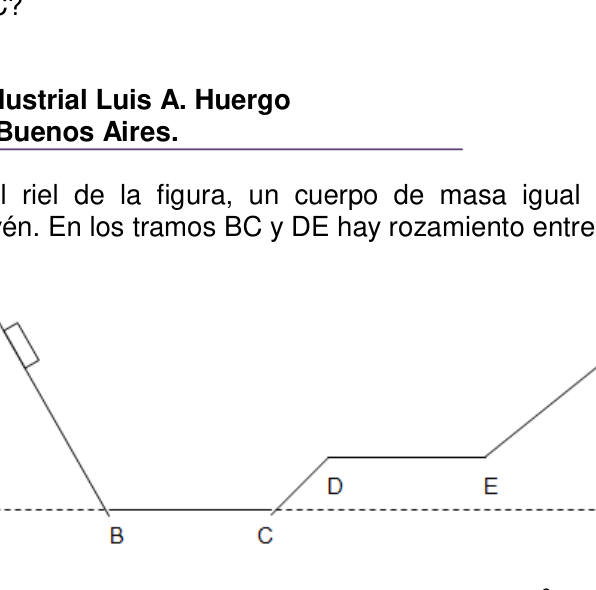
Topic: Conservation of Energy Metodi: Energy Conservation Method, Free-Body Diagram Competenze: Physical Reasoning Objects: Block, Inclined Plane Fonte: Testo (PDF) — p.5
PT85. Istituto industriale Luis A. - Hoorgo
Città di Buenos Aires.
Al punto A del binario della figura, un corpo di massa pari a 5 kg inizia un movimento di vagabondaggio. Nei tratti BC e DE c’è un’arricchimento tra il corpo e il riel.
Prendendo come accelerazione della gravità il valore g = 10 m/s2, e sapendo che il tratto BC è sopra la Terra, che l’altezza del punto A è di 4 metri, che la parte orizzontale L’EO è a 2 metri di altezza, il tramo BC ha una lunghezza di 5 metri, che il Il tratto DE ha una lunghezza di 4 metri, che la forza di ruggine nel tratto BC è di 1 Newton, e che la forza di rottura nel tratto DE è di 2 Newton, calcolare per corpo: a) L’altezza raggiunta sul rampo di destra quando si arriva prima
- Una volta. b) Percentuale dell’altezza iniziale raggiunta quando si torna per la prima volta alla rampa sinistra. (c) La velocità raggiunta quando passa per la terza volta per il punto medio del Segmento DE. d) La posizione in cui si ferma.
Topic: Conservation of Energy Metodi: Energy Conservation Method, Free-Body Diagram Competenze: Physical Reasoning Objects: Block, Inclined Plane Fonte: Testo (PDF) — p.5
PT85. The Spanish Ministry of Foreign Affairs I ‘m not .
City of Buenos Aires.
At the rail point A of the figure, a body of mass equal to 5 kg begins a The motion of the wave. In the B.C. and E.D. sections there is a friction between the body and the rail.
Taking as gravitational acceleration the value g = 10 m/s2, and knowing that the stretch BC is above Earth, where the height of point A is 4 meters, where the horizontal part The DE is 2 metres high, the BC section is 5 metres long, the DE section has a length of 4 meters, which the force of friction on the BC section is of 1 Newton, and that the friction force in the DE-section is 2 Newton, calculate for The body: (a) The height reached above the right ramp when it first reached it Once again. (b) The percentage of initial height reached when first returning to the ramp on the left. (c) The speed reached when passing the middle of the line for the third time. The following is the list of the categories of products: (d) The position where it stops.
Topic: Conservation of Energy Metodi: Energy Conservation Method, Free-Body Diagram Competenze: Physical Reasoning Objects: Block, Inclined Plane Fonte: Testo (PDF) — p.5
PT86. Instituto Industrial Luis A. Huergo
Ciudad de Buenos Aires.
Dos resistencias están conectadas en paralelo a una pila. La intensidad de corriente eléctrica del circuito es 0,5 A y una de las resistencias está sumergida en el interior de un calorímetro, produciendo 288 cal en 10 minutos (1 Joule = 0,24 cal). a) Sabiendo que la intensidad de la corriente eléctrica que pasa por la resistencia R1 es de 0,4 A; calcular el valor de la resistencia introducida en el calorímetro.
84 - OAF 2015 b) Calcular la resistencia equivalente a las dos conectadas en paralelo. c) Calcular la FEM de la pila capaz de mantener en el circuito una intensidad de corriente eléctrica de 0,5 A, siendo la resistencia interna de la pila 1 Ω. d) Si se sustituyen la dos resistencias conectadas en paralelo por un conductor cilíndrico de 32,805 g; calcular su longitud para que no se modifique su intensidad. (Resistividad del conductor: 1,8 .10-6 Ω.cm; densidad del metal: 9 g/cm3) e) Si el calorímetro contiene medio litro de agua, y cuando se reemplaza las resistencias por el conductor cilíndrico la temperatura del agua es 28°C. Calcular el tiempo que debería estar conectado el conductor a la pila para derretir totalmente un trozo de hielo de masa 5 g y una temperatura de -1°C que se introduce dentro del calorímetro.
Calor latente de fusión del hielo = 80 cal/g Calor específico del agua = 1 cal/g°C Calor específico del hielo = 0,53 cal/g°C Equivalente en agua del calorímetro = 12 g Densidad del agua = 1g/cm3
Topic: Circuits, Thermodynamics Metodi: Kirchhoff’s Laws, First Law of Thermodynamics Competenze: Physical Reasoning Objects: Resistor, Calorimeter Fonte: Testo (PDF) — p.5
PT86. Istituto industriale Luis A. - Hoorgo
Città di Buenos Aires.
Due resistenze sono collegate in parallelo ad una pila. L’intensità di corrente L’elettricità del circuito è di 0,5 A e una delle resistenze è immersa all’interno di un caloriometro, che produce 288 cal in 10 minuti (1 Joule = 0,24 cal). a) Sapendo che l’intensità del corrente elettrico che passa attraverso la resistenza R1 è di 0,4 A; calcolare il valore della resistenza inserita nel caloriametro.
84 - OAF 2015 b) Calcolare la resistenza equivalente a due collegati in parallelo. c) Calcolare l’EMF della pila in grado di mantenere in circuito un’intensità di corrente elettrica di 0,5 A, la resistenza interna della pila 1 Ω. d) Se le due resistenze collegate in parallelo sono sostituite da un conducente cilindrico di 32,805 g; calcolare la sua lunghezza in modo da non modificare l’intensità. (Ricistività del conduttore: 1,8 .10-6 Ω.cm; densità del metallo: 9 g/cm3) (e) se il caloriometro contiene mezzo litro di acqua e quando vengono sostituite le calorie resistenza per il conduttore cilindrico la temperatura dell’acqua è 28°C. Calcolare il tempo che dovrebbe essere connesso il Conductor alla pila per mollare completamente un pezzo di ghiaccio di massa di 5 g e una temperatura di -1°C che viene inserita all’interno del caloriometro.
Calore latente di fusione del ghiaccio = 80 cal/g Calore specifico dell’acqua = 1 cal/g°C Calore specifico del ghiaccio = 0,53 cal/g°C Equivalente in acqua del calometro = 12 g Densità dell’acqua = 1 g/cm3
Topic: Circuits, Thermodynamics Metodi: Kirchhoff’s Laws, First Law of Thermodynamics Competenze: Physical Reasoning Objects: Resistor, Calorimeter Fonte: Testo (PDF) — p.5
PT86. The Spanish Ministry of Foreign Affairs I ‘m not .
City of Buenos Aires.
Two resistors are connected in parallel to a stack. The current intensity The electrical current of the circuit is 0.5 A and one of the resistors is submerged inside a The caloriferous material is a calorifier, producing 288 cal in 10 minutes (1 Joule = 0.24 cal). (a) Knowing that the intensity of the electric current passing through the resistance R1 is 0,4 A; calculate the value of the resistance entered in the calorimeter.
The following points shall be added: (b) Calculate the resistance equivalent to the two connected in parallel. (c) Calculate the FEM of the battery capable of maintaining an intensity of electric current of 0,5 A, the internal resistance of the battery being 1 Ω. (d) If the two parallel connected resistors are replaced by a driver a cylinder of 32,805 g; calculate its length so that its intensity is not changed. (Conductor resistivity: 1,8 .10-6 Ω.cm; metal density: 9 g/cm3) (e) If the calorimeter contains half a liter of water, and when the calorific values are replaced resistance by the cylindrical conductor the water temperature is 28°C. Calculate the Time that should be connected the The driver to the battery to melt completely. a piece of ice of 5 g mass and one The temperature of -1°C is entered inside the thermometer.
Latent heat of ice melting = 80 cal/g The specific heat of the water = 1 cal/g°C The specific heat of the ice = 0,53 cal/g°C Water equivalent of the calorimeter = 12 g Density of water = 1 g/cm3
Topic: Circuits, Thermodynamics Metodi: Kirchhoff’s Laws, First Law of Thermodynamics Competenze: Physical Reasoning Objects: Resistor, Calorimeter Fonte: Testo (PDF) — p.5
PT87. Instituto Industrial Luis A. Huergo
Ciudad de Buenos Aires.
Un pistón contiene aire a temperatura ambiente y está conectado a un manómetro de rama abierta. Sobre el tabique del pistón se encuentra una pesa que permite que el gas encerrado en el mismo se encuentre a una presión levemente superior a la presión atmosférica, la misma puede medirse por la diferencia de altura en el manómetro de rama abierta el cual contiene un líquido de densidad (ver esquema). Se retira la pesa produciendo un cambio de presión del gas sin transferencia de calor (pues los procesos de intercambio de calor son relativamente lentos) y se produce una expansión adiabática y cuasi-estática. El gas comprimido en el recipiente tiene que efectuar un trabajo para permitir la expansión del mismo. Por lo tanto, al ser la transferencia de calor despreciable, el trabajo se realiza a expensas de una disminución de la energía interna. Además, en los gases ideales, la variación de energía interna es solo función de la temperatura, por lo tanto la temperatura del gas disminuye por debajo de la temperatura ambiente. Si se espera un tiempo suficiente sin realizar modificaciones adicionales, el aire evoluciona aumentando la temperatura a volumen constante hasta alcanzar nuevamente la temperatura ambiente donde se encuentra el equilibrio termodinámico. La presión se incrementa. a) Representar la tranformación en un diagrama p-v. b) A partir de las expresiones termodinámicas de la evolución, hallar la expresión del valor del índice en función de la densidad del líquido y de las alturas alcanzadas por el mismo en el manómetro de rama abierta. Sabiendo que el volumen del recipiente es de 25 litros , la temperatura ambiente es de 23 C y cuando se encuentra la pesa sobre el pistón el desnivel entre las ramas del manómetro es de 15,5 cm (la presión atmosférica es la normal), determinar: c) La cantidad de calor intercambiada en el proceso. d) La variación de energía interna.
OAF 2015 - 85 e) El trabajo del trabajo total realizado en el proceso.
Cp = 0,237 cal /g C
= 1,4 Masa molar del aire = 28,9 g /mol
agua = 1 g /cm3 R = 0,082 atm l / K mol
1atm = 1033,6 gf /cm2 101300 Pascales
1 joule = 0,24 cal
Topic: Thermodynamics, Fluid Mechanics Metodi: First Law of Thermodynamics, Hydrostatic Equilibrium Competenze: Physical Reasoning Objects: Manometer, Piston, Gas Fonte: Testo (PDF) — p.5
PT87. Istituto industriale Luis A. - Hoorgo
Città di Buenos Aires.
Un pistone contiene aria a temperatura ambiente. e è collegato a un manometro di rampa.
- Si’, è aperta. Sull’apertura del pistone si
trova un peso che permette al gas di
Inchiuso in esso si trova una
pressione leggermente superiore alla pressione
La temperatura atmosferica può essere misurata per
differenza di altezza nel manometro di rampa
aperta contenente un liquido di densità
(vedi schema). Si toglie il peso producendo un cambiamento di pressione del gas senza trasferimento di calore. (perché i processi di scambio di calore sono relativamente lenti) e si verifica una Espansione adiabatica e quasi-statica. Il gas compresso nel recipiente deve svolgere un lavoro per consentire la l’espansione del suo. Quindi, essendo il trasferimento di calore scarsa, il lavoro La Commissione ha deciso di non limitare la produzione di energia a prezzi elevati. Inoltre, nei gas ideali, la variazione di energia interna è solo una funzione della temperatura, quindi la temperatura del gas scende al di sotto della temperatura ambiente. Se si aspetta abbastanza tempo senza effettuare ulteriori modifiche, l’aria si evolve aumentando la temperatura a volume costante fino a raggiungere di nuovo la temperatura ambiente in cui si trova l’equilibrio termodinamico. La pressione si è - Si, aumenta. a) Rappresentare la trasformazione in un diagramma p-v. b) Sulla base delle espressioni termodinamiche dell’evoluzione, trovare l’espressione di Valore dell’indice in funzione della densità del liquido e delle altezze raggiunte per il manometro di rampa aperta. Sapendo che il volume del recipiente è di 25 litri , la temperatura ambiente è di 23 . C e quando si trova il peso sul pistone la differenza tra i rami del Manometro è di 15,5 cm (la pressione atmosferica è normale), determinare: c) La quantità di calore scambiata nel processo. d) variazione dell’energia interna.
OAF 2015 - 85 e) Il lavoro totale del lavoro svolto nel processo.
Cp = 0,237 cal /g C
= 1,4 Massa mollare dell’aria = 28,9 g/mol
acqua = 1 g /cm3 R = 0,082 atm l / K mol
1atm = 1033,6 gf /cm2 101300 Pascale 1 joule = 0,24 cal
Topic: Thermodynamics, Fluid Mechanics Metodi: First Law of Thermodynamics, Hydrostatic Equilibrium Competenze: Physical Reasoning Objects: Manometer, Piston, Gas Fonte: Testo (PDF) — p.5
PT87. The Spanish Ministry of Foreign Affairs I ‘m not .
City of Buenos Aires.
A piston contains air at room temperature.
And it’s connected to a branch manometer.
It’s open. Over the piston partition is
Find a weight that allows the gas to
Locked in it finds a
slightly higher than the pressure
The atmospheric pressure can be measured by the
height difference in the branch manometer
open which contains a density liquid
(see diagram).
The weight is removed producing a change in gas pressure without heat transfer.
(because heat exchange processes are relatively slow) and a
Adiabatic and quasi-static expansion.
The compressed gas in the container must be used to enable the
The expansion of the same. Therefore, being the despicable heat transfer, work
The Commission has already decided to adopt a proposal for a directive on the approximation of the laws of the Member States relating to the use of energy.
In addition, in ideal gases, the variation in internal energy is only a function of the
temperature, therefore the gas temperature decreases below the temperature
The environment.
If you wait long enough without making any further modifications, the air will be airtight.
It evolves by increasing the temperature to a constant volume until it reaches again.
the ambient temperature where the thermodynamic equilibrium is located. The pressure is
It’s going up.
(a) To represent the transformation in a p-v diagram.
(b) From the thermodynamic expressions of evolution, find the expression of the
value of the index in terms of liquid density and heights reached
by the same on the open-branch manometer.
Knowing that the volume of the container is 25 liters , the room temperature is 23 liters .
C and when the weight is found on the piston the gap between the branches of the piston
The manometer is 15.5 cm (air pressure is normal), determine:
(c) The amount of heat exchanged in the process.
(d) The variation in internal energy.
The following points shall be added: (e) The total work carried out in the process.
The following table shows the results of the calculations:
= 1,4 Molar mass of air = 28,9 g/mol
water = 1 g/cm3 R = 0,082 atm l / K mol
1atm = 1033.6 gf /cm2 101300 Passages 1 joule = 0,24 cal
Topic: Thermodynamics, Fluid Mechanics Metodi: First Law of Thermodynamics, Hydrostatic Equilibrium Competenze: Physical Reasoning Objects: Manometer, Piston, Gas Fonte: Testo (PDF) — p.5
PT88. Colegio Nacional de Monserrat
Ciudad de Córdoba.
Un automóvil de 1000kg llega a la bocacalle en un cruce, moviéndose a 2 m/s en
dirección Norte-Sur y también llega un camión de 3000kg, moviéndose a 0,5 m/s en
dirección Oeste- Este. Suponiendo que chocan y quedan enganchados:
a) Determinar la cantidad de movimiento inicial de cada uno y la del sistema formado
por ambos vehículos.
b) Determinar con qué velocidad se moverán después de chocar.
Topic: Conservation of Momentum Metodi: Conservation of Momentum, Vector Decomposition Competenze: Physical Reasoning Objects: — Fonte: Testo (PDF) — p.5
PT88. Il collegio nazionale di Monserrat
Città di Córdoba.
Un’auto da 1000 kg arriva in un incrocio, a 2 m/s in velocità. Il gruppo di lavoro ha iniziato a lavorare su un’ottica di sviluppo. direzione West-East. Supponiamo che si colpiscano e si accoppiano: a) Determinare la quantità di movimento iniziale di ciascuna e di quella del sistema formato per entrambi i veicoli. b) Determinare la velocità con cui si muoveranno dopo l’impatto.
Topic: Conservation of Momentum Metodi: Conservation of Momentum, Vector Decomposition Competenze: Physical Reasoning Objects: — Fonte: Testo (PDF) — p.5
PT88. National College of Monserrat
The city of Cordoba.
A 1000kg car reaches the street at a crossroads, moving at 2 m/s at The North-South direction and also a 3000kg truck arrives, moving at 0.5 m/s in West-East direction. Assuming they collide and get hooked up: (a) Determine the initial movement of each and the system formed. For both vehicles. (b) Determine how fast they will move after impact.
Topic: Conservation of Momentum Metodi: Conservation of Momentum, Vector Decomposition Competenze: Physical Reasoning Objects: — Fonte: Testo (PDF) — p.5
PT89. Colegio Nacional de Monserrat
Ciudad de Córdoba.
Hallar a qué distancia entre la Luna y la Tierra debería colocarse un objeto para que las fuerzas de atracción gravitatoria sobre el mismo se compensaran mutuamente. ¿Depende de la masa del objeto? ¿Qué le ocurrirá allí al objeto? Masa de la Tierra: 6 x1024 kg Masa de la Luna: 7,38 x 10²²kg Distancia entre la Tierra y la Luna: 384000kg
Topic: Gravitation Metodi: Newton’s Law of Gravitation Competenze: Physical Reasoning Objects: Planet, Satellite Fonte: Testo (PDF) — p.5
PT89. Il collegio nazionale di Monserrat
Città di Córdoba.
Scoprire a che distanza tra la Luna e la Terra si dovrebbe posizionare un oggetto per permettere loro di Le forze di attrazione gravitazionale su di esso si compenseranno reciprocamente. Dipende dalla massa dell’oggetto? Cosa accadrà all’oggetto lì? Massa della Terra: 6 x 1024 kg Massa della Luna: 7,38 x 10²² kg Distanza tra la Terra e la Luna: 384000 kg
Topic: Gravitation Metodi: Newton’s Law of Gravitation Competenze: Physical Reasoning Objects: Planet, Satellite Fonte: Testo (PDF) — p.5
PT89. National College of Monserrat
The city of Cordoba.
Find out how far between the moon and the earth an object should be placed so that the gravitational forces on it would compensate each other. Does it depend on the mass of the object? What will happen to the object there? The mass of the Earth: 6 x 1024 kg Mass of the Moon: 7.38 x 10²²kg Distance between Earth and the Moon: 384000kg
Topic: Gravitation Metodi: Newton’s Law of Gravitation Competenze: Physical Reasoning Objects: Planet, Satellite Fonte: Testo (PDF) — p.5
PT90. Colegio Nacional de Monserrat
Ciudad de Córdoba.
Se llena una manguera con nafta y se cierra por sus
dos extremos. Se introduce un extremo en un depósito
de nafta a 0,3 m por debajo de la superficie y el otro a
0,2m por debajo del primer extremo y se abren ambos
extremos. El tubo tiene una sección transversal interior
de área 4x10⁻⁴m2. La densidad de la nafta es 680kgm-
3.
a) ¿Cuál es la velocidad inicial de la nafta?
b) ¿Cuál es el caudal inicial del flujo?
Topic: Fluid Mechanics Metodi: Bernoulli’s Equation, Continuity Equation Competenze: Physical Reasoning Objects: Tube Fonte: Testo (PDF) — p.5
PT90. Il collegio nazionale di Monserrat
Città di Córdoba.
Si riempie un tubo di nafta e si chiude per i suoi due estremi. Si inserisce un’estremità in un deposito di nafta a 0,3 m sotto la superficie e l’altro a 0,2 m sotto il primo lato e si aprono entrambi. estremi. Il tubo ha una sezione trasversale interna. di superficie di 4x10⁻⁴m2. La densità della nafta è di 680 kgm- 3. a) Qual è la velocità iniziale della nafta? b) Qual è il flusso iniziale?
Topic: Fluid Mechanics Metodi: Bernoulli’s Equation, Continuity Equation Competenze: Physical Reasoning Objects: Tube Fonte: Testo (PDF) — p.5
PT90. National College of Monserrat
The city of Cordoba.
It fills a hose with naphtha and closes for its own sake . two extremes. It ‘s a tip in a tank . of naphtha at 0.3 m below the surface and the other at 0.2m below the first end and both open. Extremes. The tube has an inner cross section. of an area of 4x10⁻⁴m2. The density of the naphtha is 680 kgm- 3. (a) What is the initial speed of the naphtha? (b) What is the initial flow rate?
Topic: Fluid Mechanics Metodi: Bernoulli’s Equation, Continuity Equation Competenze: Physical Reasoning Objects: Tube Fonte: Testo (PDF) — p.5
PT91. Escuela Técnica Alfredo Passera
Mocoretá, Corrientes.
Rueda Giratoria. Una rueda con aceleración angular constante de 4.7 rad/seg2. a) Si la rapidez angular de la rueda es 3 rad/seg, en t=0.
-
¿Qué desplazamiento angular gira en 2 seg? b) ¿Cuantas revoluciones ha girado la rueda durante este intervalo? c) ¿Cuál es la rapidez angular de la rueda en t=2seg?
-
¿Qué pasaría si? Suponga que una partícula se mueve a lo largo de una recta con aceleración constante de 4,7m/s2. Si la velocidad de la partícula es de 3
86 - OAF 2015 m/s en t=0. ¿Qué desplazamiento se mueve la partícula en 2seg? ¿Cuál es la velocidad de la partícula en t=2seg?
Una partícula en un cuerpo rígido en rotación se mueve de A – B a lo largo del arco de un círculo. En el intervalo…………………………… el radio vector barre un desplazamiento angular………………………………
Topic: Rotational Dynamics Metodi: Kinematic Equations, Torque & Angular Momentum Analysis Competenze: Physical Reasoning Objects: Wheel Fonte: Testo (PDF) — p.5
PT91. Scuola tecnica Alfredo Passera
Mocoretá, Corrientes.
Ruota rotante. Una ruota con un’accelerazione angolare costante di 4,7 rad/sec2. a) Se la velocità angolare della ruota è di 3 rad/sec, in t=0.
- Che spostamento angolare gira in due secondi? b) Quante rivoluzioni ha girato la ruota durante questo intervallo? c) Qual è la velocità angolare della ruota in t=2sec?
- E se fosse così? Supponiamo che una particella si muova lungo una linea retta ad accelerazione costante. de 4,7m/s2. Se la velocità della particella è di 3
86 - OAF 2015 m/s en t=0. Che spostamento la particella si muove in 2 secondi? Qual è la velocità? della particella in t=2sec?
Una particella in un corpo rigido in rotazione si si muove da A B lungo l’arco di un cerchio. Nel intervallo …………………………… la radio Vettore barre un spostamento ………………………………
Topic: Rotational Dynamics Metodi: Kinematic Equations, Torque & Angular Momentum Analysis Competenze: Physical Reasoning Objects: Wheel Fonte: Testo (PDF) — p.5
PT91. Alfredo Passera Technical School
It’s a mockery, currents.
Wheel of the Spinning Wheel. A wheel with a constant angular acceleration of 4.7 rad/seg2. (a) If the wheel’s angular velocity is 3 rad/sec, at t=0.
- What angular displacement spins in 2 seconds? (b) How many revolutions has the wheel sped during this interval? (c) What is the angular speed of the wheel at t=2seconds?
- What if I did? Suppose a particle moves along a straight line with constant acceleration. de 4,7m/s2. If the velocity of the particle is 3
The following points shall be added: m/s en t=0. What shift does the particle move in 2 seconds? What’s the speed? of the particle at t=2second?
A particle in a rotating rigid body is moves from A to B along the arc of a circle. In the range…………………………… the radio vector
- Barring un movement The following table shows the number of units of the unit of measurement for each unit of measurement:
Topic: Rotational Dynamics Metodi: Kinematic Equations, Torque & Angular Momentum Analysis Competenze: Physical Reasoning Objects: Wheel Fonte: Testo (PDF) — p.5
PT92. Escuela Técnica Alfredo Passera
Mocoretá, Corrientes.
Determinar los valores parciales y totales de resistencia, intensidades, tención y potencia.
R V I P R1
R2 100Ω
R3 3KΩ
R4 6KΩ
R5 2KΩ
R6
R7
18 V 6 m A
R8
RT
54 V 42 m A
OAF 2015 - 87
Topic: Circuits Metodi: Equivalent Circuit Reduction, Kirchhoff’s Laws Competenze: Physical Reasoning Objects: Resistor Fonte: Testo (PDF) — p.5
PT92. Scuola tecnica Alfredo Passera
Mocoretá, Corrientes.
Determinare i valori parziali e totali di resistenza, intensità, tensione e potenza.
R V I P R1
R2 100Ω
R3 3KΩ
R4 6KΩ
R5 2KΩ
R6
R7
18 V 6 m A
R8
RT
54 V 42 m A
OAF 2015 - 87
Topic: Circuits Metodi: Equivalent Circuit Reduction, Kirchhoff’s Laws Competenze: Physical Reasoning Objects: Resistor Fonte: Testo (PDF) — p.5
PT92. Alfredo Passera Technical School
It’s a mockery, currents.
Determine the partial and total values of resistance, intensity, voltage and power.
R V I P R1
R2 100Ω
R3 3KΩ
R4 6KΩ
R5 2KΩ
R6
R7
18 V 6 m A
R8
RT
54 V 42 m A
The following is the list of the countries of the European Union:
Topic: Circuits Metodi: Equivalent Circuit Reduction, Kirchhoff’s Laws Competenze: Physical Reasoning Objects: Resistor Fonte: Testo (PDF) — p.5
PT93. Escuela Técnica Alfredo Passera
Mocoretá, Corrientes.
Cilindro de un motor diésel. a) En un cilindro de un motor diésel se comprime de una presión inicial de 1atm y volumen de 800cm3 a un volumen de 60cm3. Suponga que el aire se comporta como un gas ideal con γ=1,40 y que la compresión es adiabática. Aire 20°C Encuentre la presión y temperatura final de aire. b) Explique el factor de aumento en su temperatura. c) Grafique un diagrama P-V para una compresión adiabática.
Topic: Thermodynamics Metodi: Ideal Gas Law, Thermodynamic Cycle Analysis Competenze: Physical Reasoning Objects: Gas, Cylinder, Piston Fonte: Testo (PDF) — p.5
PT93. Scuola tecnica Alfredo Passera
Mocoretá, Corrientes.
Ccilindro di un motore diesel. a) In un cilindro di un motore diesel si comprime a una pressione iniziale di 1 atm e di 800 cm3 a un volume di 60 cm3. Supponiamo che l’aria si comporti come un gas ideale con γ=1,40 e che la compressione è adiabatica. Air 20°C Trova la pressione finale e la temperatura dell’aria. b) Spiega il fattore di aumento della sua temperatura. c) Grafica un diagramma P-V per una compressione adiabatica.
Topic: Thermodynamics Metodi: Ideal Gas Law, Thermodynamic Cycle Analysis Competenze: Physical Reasoning Objects: Gas, Cylinder, Piston Fonte: Testo (PDF) — p.5
PT93. Alfredo Passera Technical School
It’s a mockery, currents.
Cylinder of a diesel engine. (a) In a diesel engine cylinder, the initial pressure is compressed at 1 atm and The following is the list of the products used in the manufacture of the product: Suppose the air behaves . as an ideal gas with γ=1.40 and that compression is adiabatic. Air 20°C Find the final air pressure and temperature. (b) Explain the factor of increase in temperature. (c) Draw a P-V diagram for adiabatic compression.
Topic: Thermodynamics Metodi: Ideal Gas Law, Thermodynamic Cycle Analysis Competenze: Physical Reasoning Objects: Gas, Cylinder, Piston Fonte: Testo (PDF) — p.5
PT94. Escuela Industrial Superior
Ciudad de Santa Fe.
Una niña de masa m inicia desde el reposo y se desliza sin fricción desde una altura h a lo largo de un tobogán con agua, como muestra la figura. El extremo del tobogán se encuentra a una altura h/5 sobre el nivel del agua, punto desde el cual la niña sale despedida.
a) ¿Se conserva la energía mecánica? ¿Por qué?
b) Expresar la Energía Potencial y Energía cinética de la pequeña en función de m, g y
h en las siguientes posiciones: A, B y C.
c) Determinar la velocidad inicial VB en función de g y h.
d) Determinar la altura máxima hmax en el aire en términos de g, h y la velocidad
horizontal vx
e) Utilice la componente en x de VB para expresar la altura máxima en términos de h
y ɵ.
Topic: Conservation of Energy Metodi: Energy Conservation Method, Kinematic Equations Competenze: Physical Reasoning Objects: Projectile Fonte: Testo (PDF) — p.5
PT94. Scuola superiore industriale
Città di Santa Fe.
Una bambina di massa m inizia dal riposo e scivola senza attrito da un’altezza h a lungo un scivolo d’acqua, come mostra la figura. L’estremità del toboggan è si trova ad un’altezza h/5 sul livello dell’acqua, punto da cui la bambina esce.
- Ciao, ciao.
a) L’energia meccanica è conservata? - Perché? b) Esprimere l’energia potenziale e l’energia cinetica della piccola in funzione di m, g e h nelle posizioni A, B e C: c) Determinare la velocità iniziale VB in funzione di g e h. d) Determinare l’altezza massima hmax in aria in termini di g, h e velocità Vx orizzontale e) Utilizzare la componente in x di VB per esprimere l’altezza massima in termini di h y ɵ.
Topic: Conservation of Energy Metodi: Energy Conservation Method, Kinematic Equations Competenze: Physical Reasoning Objects: Projectile Fonte: Testo (PDF) — p.5
PT94. Higher Industrial School
City of Santa Fe.
A mass girl starts from rest and slides frictionlessly from a height of h to along a water slide, as shown in the figure. The end of the slide is It’s h/5 above the water level, the point from which the girl comes out. I’ll say goodbye to you.
(a) Is mechanical energy conserved? - Why? - I don’t know. (b) Express the Potential Energy and Kinetic Energy of the small in terms of m, g and h in the following positions: A, B and C. (c) Determine the initial VB speed based on g and h. (d) Determine the maximum height hmax in air in terms of g, h and speed horizontal vx (e) Use the component in x of VB to express the maximum height in terms of h y ɵ.
Topic: Conservation of Energy Metodi: Energy Conservation Method, Kinematic Equations Competenze: Physical Reasoning Objects: Projectile Fonte: Testo (PDF) — p.5
PT95. Escuela Industrial Superior
Ciudad de Santa Fe.
100 g de una aleación de oro y cobre, a 00la temperatura de 75.5ºC se introducen en un
calorímetro con 502 g de agua a 25ºC, la temperatura del equilibrio es de 25.5ºC.
a) Realizar un planteo calórico teórico.
b) Calcular la composición de la aleación sabiendo que los calores específicos del oro
y del cobre son 0.032 [cal/g °C] y 0.093 [cal/g °C] respectivamente.
c) Calcular la cantidad de calor cedida por cada masa de metal al medio acuoso.
Topic: Thermodynamics Metodi: First Law of Thermodynamics Competenze: Physical Reasoning Objects: Calorimeter Fonte: Testo (PDF) — p.5
PT95. Scuola superiore industriale
Città di Santa Fe.
100 g di un’allea di oro e di rame, a 75,5°C, vengono introdotti in un caloriometro con 502 g di acqua a 25°C, temperatura di equilibrio è di 25.5°C. a) Fare un approccio calorico teorico. b) Calcolare la composizione dell’alleo sapendo che le calori specifiche dell’oro e del rame sono 0,032 [cal/g °C] e 0,093 [cal/g °C] rispettivamente. c) Calcolare la quantità di calore ceduta da ogni massa di metallo all’ambiente acquatico.
Topic: Thermodynamics Metodi: First Law of Thermodynamics Competenze: Physical Reasoning Objects: Calorimeter Fonte: Testo (PDF) — p.5
PT95. Higher Industrial School
City of Santa Fe.
100 g of an alloy of gold and copper, at 75.5 °C, are introduced into a heat meter with 502 g of water at 25oC, the equilibrium temperature is 25.5oC. (a) To perform a theoretical caloric approach. (b) Calculate the composition of the alloy knowing that the specific heat of the gold The value of the product concerned is the sum of the values of the values of the product concerned. (c) Calculate the amount of heat transferred by each metal mass to the aqueous medium.
Topic: Thermodynamics Metodi: First Law of Thermodynamics Competenze: Physical Reasoning Objects: Calorimeter Fonte: Testo (PDF) — p.5
PT96. Escuela Industrial Superior
Ciudad de Santa Fe.
En el sistema de la figura se conocen las masas de los cuerpos y los ángulos de inclinación de cada plano. Suponer que la masa de la cuerda que une cada cuerpo es despreciable.
88 - OAF 2015
a) Plantear el diagrama de cuerpo libre correspondiente para cada cuerpo, rotulándolo
como ―Cuerpo 1‖ y ―Cuerpo 2‖. Indicar para el caso de P1<P2 que ocurrirá y para el
caso P1>P2.
b) Hallar una expresión que permita conocer la aceleración que adquieren las cajas en
función de sus masas y de los respectivos ángulos de inclinación del plano.
c) Si la masa del ―cuerpo 1‖ tiene un valor de 200 kg y la del ―cuerpo 2‖ un valor de 300
kg, calcular la aceleración del sistema para un ángulo α = 50°.
d) Calcular la tensión en la cuerda tomando en cuenta los datos del inciso anterior.
e) Plantear como se modifica la expresión obtenida en b) si el ―cuerpo 1‖ al subir
experimenta fricción en un tramo cuyo μd = 0,2.
Topic: Newtonian Mechanics Metodi: Free-Body Diagram, Conservation Laws Competenze: Physical Reasoning Objects: Block, Pulley, Inclined Plane Fonte: Testo (PDF) — p.5
PT96. Scuola superiore industriale
Città di Santa Fe.
Nel sistema della figura si conoscono le masse dei corpi e gli angoli di inclinazione di ogni piano. Supponiamo che la massa della corda che unisce ogni corpo sia
- Desprezioso.
88 - OAF 2015
a) Presentare il diagramma di corpo libero corrispondente per ogni corpo, etichettandolo come “Corpo 1” e “Corpo 2”. Indicare per il caso di P1< P2 che si verificherà e per il caso P1>P2. b) Trovare un’espressione che permetta di conoscere l’accelerazione che le casse acquisiscono in funzione delle loro masse e dei rispettivi angoli di inclinamento del piano. c) Se la massa del “corpo 1” ha un valore di 200 kg e quella del “corpo 2” un valore di 300 kg kg, calcolare l’accelerazione del sistema per un angolo α = 50°. d) Calcolare la tensione della corda tenendo conto dei dati di cui al punto precedente. e) Sulla modifica dell’espressione ottenuta in b) se il “corpo 1′′ al rialzo si prova a frattura su un tratto di cui μd = 0,2.
Topic: Newtonian Mechanics Metodi: Free-Body Diagram, Conservation Laws Competenze: Physical Reasoning Objects: Block, Pulley, Inclined Plane Fonte: Testo (PDF) — p.5
PT96. Higher Industrial School
City of Santa Fe.
In the system of the figure the masses of the bodies and the angles of the slope of each plane. Suppose the mass of the string that binds each body is I’m not a big fan of this.
The Commission shall adopt delegated acts in accordance with Article 21 of Regulation (EU) No 1303/2013.
(a) Provide the corresponding free body diagram for each body, labelling it such as “body one” and “body two”. Indicate for P1< P2 what will occur and for case P1>P2. (b) Find an expression to show the acceleration of the boxes in the function of their masses and their respective plane angle of inclination. (c) If the mass of “body 1′′ has a value of 200 kg and that of “body 2′′ a value of 300 kg In the case of a system with a voltage of less than 0,05 kPa, the system shall be accelerated at a given angle. (d) Calculate the tension on the rope taking into account the data in the previous paragraph. (e) Explain how the expression obtained in (b) is modified if the “body 1′′ rises The test results shall be obtained by the following methods:
Topic: Newtonian Mechanics Metodi: Free-Body Diagram, Conservation Laws Competenze: Physical Reasoning Objects: Block, Pulley, Inclined Plane Fonte: Testo (PDF) — p.5
PT97. Escuela Superior de Comercio Gral. José de San Martín
Monteros, Tucumán.
Dentro de un calorímetro, cuyo equivalente en agua es de 25 g, contiene 60 g de agua a
25ºC, se le agrega 100 g de hielo a -10º C y dos bolillas de acero de 10 mm de diámetro
a 20 ºC. Se sumerge en el líquido una resistencia eléctrica conformada por un
arrollamiento de alambre de cobre de 60 cm de longitud y de 0,04 mm de diámetro, que
se encuentra a una temperatura de 20 º C.
La resistencia se alimenta con un porta pilas de 2 elementos conectados en serie de 1,5
V y ri = 0,05 cada uno.
El calorímetro se tapa y se considera un sistema adiabático. Entonces se acciona el
interruptor cerrando el circuito eléctrico de la resistencia hasta que el termómetro que
registra la temperatura del interior del calorímetro indica 60ºC.
Datos:
Cu = 1,7 x 10⁶ .cm
CeH2O= 4180 J / Kg ºK
CeCu= 0,0092 Kcal / kg ºC
CY hielo = 0,53 cal / g ºC
Cu = 8,92 g/cm
H2O = 1 g/cm3
Cf Hielo = 80 cal/g
a) ¿Cuál es la intensidad de la corriente que circula por la resistencia? b) ¿Qué tiempo debe funcionar la resistencia? c) ¿Cuánto de energía consume la resistencia, si el rendimiento del calorímetro es del 98%?
Topic: Thermodynamics, Circuits Metodi: First Law of Thermodynamics, Kirchhoff’s Laws Competenze: Physical Reasoning Objects: Calorimeter, Resistor Fonte: Testo (PDF) — p.5
PT97. Gral High School of Commerce. José de San Martín
Monteros, Tucumán.
All’interno di un calometro, il cui equivalente in acqua è di 25 g, contiene 60 g di acqua a
25oC, aggiungono 100 g di ghiaccio a -10oC e due palline di acciaio di 10 mm di diametro
a 20 ºC. Si immerge nel liquido una resistenza elettrica costituita da un
di cui:
si trova a una temperatura di 20 o C.
La resistenza viene alimentata da un porta batteria a 2 elementi collegati in serie di 1,5
V e ri = 0,05 ciascuno.
Il calometro si copre e si considera un sistema adiabatico. Poi si accende il
Il interruttore chiude il circuito elettrico della resistenza fino a che il termometro non
registra la temperatura all’interno del calometro indica 60oC.
Datati:
Cu = 1,7 x 10⁶ .cm
CeH2O= 4180 J / Kg oK
CeCu = 0,0092 Kcal / kg oC
CY ghiaccio = 0,53 cal / g oC
Cu = 8,92 g/cm
H2O = 1 g/cm3
Cf ghiaccio = 80 cal/g
a) Qual è l’intensità del corrente che circola per resistenza? b) Per quanto tempo deve funzionare la resistenza? (c) Quanto energia consuma la resistenza, se il calometro è di 98%?
Topic: Thermodynamics, Circuits Metodi: First Law of Thermodynamics, Kirchhoff’s Laws Competenze: Physical Reasoning Objects: Calorimeter, Resistor Fonte: Testo (PDF) — p.5
PT97. Gral High School of Commerce. Joseph of San Martin
Monteros, Tucumán. What is it?
Within a calorimeter, the water equivalent of which is 25 g, it contains 60 g of water.
25oC, 100 g of ice at -10oC and two 10 mm diameter steel balls are added
a 20 ºC. An electrical resistance consisting of a
a length of 60 cm and a diameter of 0,04 mm, of copper wire, which
It is at a temperature of 20°C.
The resistance is fed with a battery port of 2 connected elements in series of 1.5
V and ri = 0.05 each.
The calorimeter is covered and considered an adiabatic system. Then the
The switch closes the resistance electrical circuit until the thermometer is
The temperature inside the calorimeter is recorded at 60oC.
The data:
Cu = 1,7 x 10⁶ .cm
The value of the product shall be calculated as follows:
The value of the product shall be the value of the product concerned.
CY ice = 0.53 cal / g oC
Cu = 8,92 g/cm
H2O = 1 g/cm3
Cf Ice = 80 cal/g
(a) What is the intensity of the current circulating through the resistance? (b) How long should the resistor work? (c) How much energy is consumed by the resistance, if the performance of the calorimeter is of 98%?
Topic: Thermodynamics, Circuits Metodi: First Law of Thermodynamics, Kirchhoff’s Laws Competenze: Physical Reasoning Objects: Calorimeter, Resistor Fonte: Testo (PDF) — p.5
PT98. Escuela Superior de Comercio Gral. José de San Martín
Monteros, Tucumán.
Un cuerpo sólido, de gran densidad, está quieto en el punto A.
En un instante dado comienza a actuar la fuerza constante F = 20 N que le otorga una
aceleración a = 1,25 m/s2 , hasta el punto B, recorriendo una distancia e ab = 2,5 m , sin
roce, μ1= 0. A continuación, el cuerpo recorre el plano descendente BC, de altura
hbc = 2,5 m, en el que μ2= 0,2 (no tener en cuenta el efecto de los codos B y C,
suponiendo que el codo B es recorrido sin que el cuerpo ―vuele‖.
OAF 2015 - 89
El tramo horizontal CD de longitud e cd es tal que permite que por rozamiento (μ3= 0,25)
la velocidad en D sea el 90% de la velocidad en C.
El cuerpo impacta finalmente contra el resorte comprimiéndolo 0,5 m, hasta la posición E,
siendo para este tramo, μ4= 0,3.
Calcular:
- La masa del cuerpo.
- Velocidad en B
- Energía mecánica en B
- Trabajo de rozamiento en el tramo BC
- Velocidad en C
- Espacio e cd
- Trabajo de rozamiento en el tramo DE
- Constante elástica del resorte K Por la elasticidad del resorte, el cuerpo es empujado hacia atrás, para este efecto, Calcular:
- e cd Velocidad con que pasa el cuerpo de nuevo por el punto D.
Topic: Newtonian Mechanics, Conservation of Energy Metodi: Free-Body Diagram, Energy Conservation Method Competenze: Physical Reasoning Objects: Block, Spring, Inclined Plane Fonte: Testo (PDF) — p.5
PT98. Gral High School of Commerce. José de San Martín
Monteros, Tucumán.
Un corpo solido, di grande densità, è fermo al punto A. In un istante dato inizia ad agire la forza costante F = 20 N che gli conferisce una Accelerazione a = 1,25 m/s2, fino al punto B, percorrendo una distanza e ab = 2,5 m , senza Rottura, μ1 = 0. Poi il corpo percorre il piano discendente BC, di altezza hbc = 2,5 m, in cui μ2 = 0,2 (non tener conto dell’effetto degli angoli B e C, Supponendo che l’albero B sia percorso senza che il corpo “volga”.
OAF 2015 - 89 Il tratto orizzontale CD di lunghezza e cd è tale da consentire che per ruggine (μ3= 0,25) La velocità in D è il 90% della velocità in C. Il corpo impatta infine contro la molla compressa 0,5 m, fino alla posizione E, per questo tratto, μ4 = 0,3. Calcolare:
- La massa del corpo.
- Velocità in B
- Energia meccanica in B
- Lavoro di rasatura nel tratto BC
- Velocità in C
- Spazio e cd
- Lavoro di rasatura nel tratto DE
- Costante elastica della resorgenza K Per l’elasticità della primavera, il corpo viene spinto indietro, per questo scopo. Calcolare:
- e cd Velocità con cui il corpo passa di nuovo attraverso il punto D.
Topic: Newtonian Mechanics, Conservation of Energy Metodi: Free-Body Diagram, Energy Conservation Method Competenze: Physical Reasoning Objects: Block, Spring, Inclined Plane Fonte: Testo (PDF) — p.5
PT98. Gral High School of Commerce. Joseph of San Martin
Monteros, Tucumán. What is it?
A solid body, of high density, is still at point A. At a given instant, the constant force F = 20 N begins to act, giving it a acceleration a = 1,25 m/s2 , to point B, travelling a distance and ab = 2,5 m , without Brush, μ1 = 0. Then the body runs down the descending plane BC, height hbc = 2,5 m, where μ2 = 0,2 (not taking into account the effect of angles B and C, assuming that elbow B is passed without the body “flying”.
The Commission shall adopt delegated acts in accordance with Article 21 of the Financial Regulation. The horizontal CD length and cd section is such that by friction (μ3= 0,25) The speed in D is 90% of the speed in C. The body finally impacts the spring by compressing it 0.5 m, to the E position, for this section, μ4 = 0,3. Calculation:
- Body mass.
- Speed in B
- Mechanical energy in B
- Rubbing work on the BC section
- Speed in C
- Space and cd
- Rubbing work in the DE section
- The spring elastic constant K Because of the elasticity of the spring, the body is pushed backwards, for this purpose, Calculation:
- and cd Speed at which the body passes back through point D.
Topic: Newtonian Mechanics, Conservation of Energy Metodi: Free-Body Diagram, Energy Conservation Method Competenze: Physical Reasoning Objects: Block, Spring, Inclined Plane Fonte: Testo (PDF) — p.5
PT99. Escuela Superior de Comercio Gral. José de San Martín
Monteros, Tucumán.
Se tiene dos esferas de igual volumen ( V = 50 cm3 ) unidas por una cuerda delgada, de masa despreciable ; se las introduce en un recipiente con agua. Una de las esferas queda totalmente sumergida, ya que tiene una masa cuatro veces mayor que la que flota en la superficie, sumergida a medias en el agua. Se pide:
- Diagrama con todas las fuerzas que actúan en cada cuerpo.
- Calcular la densidad de la esfera superior.
- Calcular la tensión de la cuerda. Suponiendo que ambas esferas unidas por la cuerda, se introducen en un recipiente con aceite cuya densidad es de 0,920 gr/cc, calcular:
- El volumen sumergido de la esfera superior.
- La tensión de la cuerda.
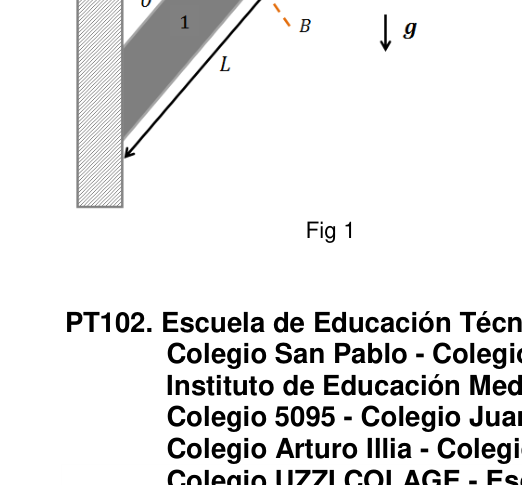
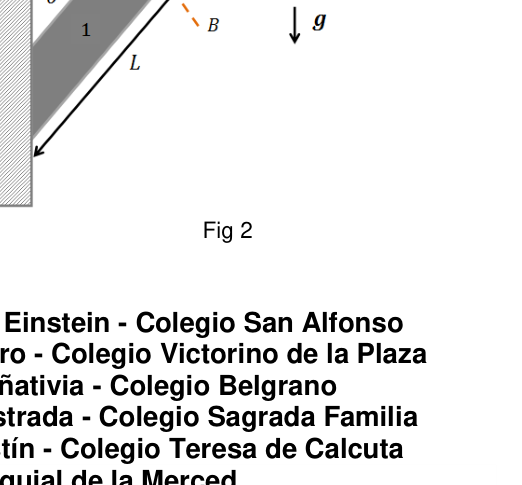
Topic: Fluid Mechanics Metodi: Hydrostatic Equilibrium, Free-Body Diagram Competenze: Physical Reasoning Objects: Sphere, String Fonte: Testo (PDF) — p.5
PT99. Gral High School of Commerce. José de San Martín
Monteros, Tucumán.
Si hanno due sfere di uguale volume (V = 50 cm3) unite da una corda sottile, di massa scarsa; si inseriscono in un recipiente con acqua. Una delle sfere è completamente immersa, poiché ha una massa quattro volte superiore. più grande di quella che galleggia sulla superficie, immersa a metà nell’acqua. Si chiede:
- Diagrama con tutte le forze che agiscono in ogni corpo.
- Calcolare la densità della sfera superiore.
- Calcolare la tensione della corda. Supponiamo che entrambe le sfere unite dalla corda, si inseriscano in un recipiente con olio di densità di 0,920 gr/cc, calcolare:
- Il volume immerso della sfera superiore.
- La tensione della corda.
Topic: Fluid Mechanics Metodi: Hydrostatic Equilibrium, Free-Body Diagram Competenze: Physical Reasoning Objects: Sphere, String Fonte: Testo (PDF) — p.5
PT99. Gral High School of Commerce. Joseph of San Martin
Monteros, Tucumán. What is it?
Two spheres of equal volume (V = 50 cm3) connected by a thin string, of a scanty mass; they are placed in a water container. One of the spheres is completely submerged, as it has a mass four times larger than that floating on the surface, half-submerged in water. It asks:
- It’s a diagram of all the forces acting on each body.
- Calculate the density of the upper sphere.
- Calculate the tension of the rope. Assuming that both spheres are connected by rope, they are inserted into a container with oil with a density of 0,920 g/cc, calculate:
- The submerged volume of the upper sphere.
- The tension of the rope.
Topic: Fluid Mechanics Metodi: Hydrostatic Equilibrium, Free-Body Diagram Competenze: Physical Reasoning Objects: Sphere, String Fonte: Testo (PDF) — p.5
PT100. Escuela de Educación Técnica Alberto Einstein - Colegio San Alfonso
Colegio San Pablo - Colegio  Del Milagro - Colegio Victorino de la Plaza

Instituto de Educación Media Arturo Oñativia - Colegio Belgrano

Colegio 5095 - Colegio Juan Manuel Estrada - Colegio Sagrada Familia

Colegio Arturo Illia - Colegio San Agustín - Colegio Teresa de Calcuta

Colegio UZZI COLAGE - Escuela Parroquial de la Merced

Colegio Del Huerto - EET Martin Miguel de Güemes

Colegio  11 de Setiembre - Colegio de Jesús - Colegio Secundario 5037

Colegio  CODESA - Colegio Padre Gabriel Tomassini

Colegio Divina Misericordia

Ciudad de Salta.
Sistema aparatoso solo válido para olimpíadas. Se dispone un dispositivo como el indicado por la figura 1, un tubo vertical liso abierto en ambos extremos (arriba y abajo) y con secciones diferentes, tanto arriba como abajo se
90 - OAF 2015 encuentran dos émbolos, unidos por un hilo imposible de deformarse .Entre ambos embolo se encuentra un mol de gas perfecto . El área de la parte superior es S1 y la de la inferior es S2 y como se observa en la figura es mayor que la inferior siendo la diferencia entre las superficies de 10 cm2. La masa total de los émbolos es m= 5 kg .La presión atmosférica es P0 = 1,0 Atm.
Figura 1
Actividades
a) Dibujar las fuerzas que actúan sobre el pistón superior y encontrar la expresión de
la fuerza que realiza el hilo (T) sobre el pistón superior
b) Repetir el inciso anterior para el embolo de la parte inferior
c) Calcular la presión p en el interior del recinto. Indique claramente la suposición que
realizó.
d) Cuanto valdrá la temperatura en Kelvin para calentar el gas
contenido entre ambos émbolos, para que estos se
desplacen solo 10 cm
Supongamos ahora que nuestro sistema aparatoso para
olimpíadas se hace más aparatoso todavía tal como lo muestra
la figura 2.
Se coloca un inyector de agua en la parte superior que arroja
agua con un caudal de 3cm3/minutos .
e) Encuentre una expresión de la fuerza neta que actúan
sobre el émbolo superior en función del tiempo.
f) Si suponemos que la variación de temperatura es de 2 K y
el sistema logra moverse con una velocidad de 1cm/ min .(
suponer situación estacionaria)¿Cuánto tiempo tarda en
recorrer 10 cm?.
Figura 2
Topic: Thermodynamics, Fluid Mechanics Metodi: Ideal Gas Law, Free-Body Diagram Competenze: Physical Reasoning Objects: Gas, Piston, Tube Fonte: Testo (PDF) — p.5
PT100. Scuola di istruzione tecnica Alberto Einstein - Colegio San Alfonso
Colegio San Pablo - Colegio Del Milagro - Colegio Victorino della Plaza
Istituto di media educazione Arturo Oñativia - Colegio Belgrano
Colegio 5095 - Colegio Juan Manuel Estrada - Colegio Sagrada Familia
Colegio Arturo Illia - Colegio San Agustin - Colegio Teresa di Calcutta
UZZI COLAGE - Scuola parrocchiale della Merced
Colegio Del Huerto - EET Martin Miguel de Güemes
Scuola 11 settembre - Scuola di Gesù - Scuola Secundaria 5037
Colegio CODESA - Colegio Padre Gabriel Tomassini
Divina Misericordia College
Città di Salta.
Sistema di apparecchiatura valido solo per le Olimpiadi. Dispone di un dispositivo come indicato in figura 1, un tubo verticale liscio aperto in Le parti di cui sopra sono diverse, con diverse sezioni, sia sopra che sotto.
90 - OAF 2015 Trovano due embolia, unite da un filo impossibile da deformare. l’ imbolio trova un mol di gas perfetto . L’area della parte superiore è S1 e quella della parte inferiore è S2 e come si vede nella figura è maggiore della superficie inferiore, essendo la differenza tra le superfici di 10 cm2. La massa totale La pressione atmosferica è P0 = 1,0 Atm.
Figura 1
Attività a) Disegnare le forze che agiscono sul pistone superiore e trovare l’espressione di la forza che il filo (T) esercita sul pistone superiore b) Ripetere il punto precedente per l’embolo della parte inferiore c) Calcolare la pressione p all’interno del recinto. Indicare chiaramente l’ipotesi che
- E’ stato fatto. d) Quanto vale la temperatura a Kelvin per riscaldare il gas contenuti tra i due embeli, in modo che questi si Svolano solo 10 cm. Supponiamo che il nostro sistema apparecchiato per Olimpiadi diventa ancora più apparente come lo mostra figura 2. Si colloca un iniezionatore di acqua sulla parte superiore che lancia acqua con un flusso di 3 cm3/minuto . e) Trova un’espressione della forza netta che agiscono sull’embolo superiore in funzione del tempo. f) Supponiamo che la variazione di temperatura sia di 2 K e Il sistema si muove a una velocità di 1cm/min.
- come si può fare per un’impresa di lavoro
- 10 cm di distanza? Figura 2
Topic: Thermodynamics, Fluid Mechanics Metodi: Ideal Gas Law, Free-Body Diagram Competenze: Physical Reasoning Objects: Gas, Piston, Tube Fonte: Testo (PDF) — p.5
PT100. Albert Einstein Technical Education School - College of San Alfonso
The school is located in the centre of the city.
Arturo Oñativia Institute of Middle Education - Belgrano College
School 5095 - Juan Manuel Estrada School - Sagrada Familia School
Arturo Illia College - St. Augustine College - Teresa College of Calcutta
UZZI COLAGE School - Parish School of Merced
The first is the “EET Martin Miguel de Güemes”.
September 11th School - Jesus College - High School 5037
The school is called the “Codeza” College.
Divine Mercy College
Salt City.
Apparatus system only valid for the Olympics. A device such as that shown in Figure 1 is provided, a smooth vertical tube open in both ends (up and down) and with different sections, both up and down are
The Commission shall adopt delegated acts in accordance with Article 21 of Regulation (EU) No 1303/2013. They find two embols, bound together by an impossible thread to deform. The bulb is a perfect mol of gas . The area of the top is S1 and the area of the bottom is S2 and as shown in Figure is greater than the lower one, the difference between the surfaces being 10 cm2. The total mass The atmospheric pressure is P0 = 1,0 Atm.
Figure 1
Activities (a) Draw the forces acting on the upper piston and find the expression of the force exerted by the wire (T) on the upper piston (b) Repeat the previous paragraph for the bottom embolus (c) Calculate the p-pressure inside the enclosure. Please state clearly the assumption that He did. d) How much will the Kelvin temperature be worth to heat the gas? contained between the two embols, so that these are They only move 10 cm. Now let’s say our apparatus system for The Olympics are getting more apparent even as it shows . the figure 2. A water injector is placed on top of the thrower . water with a flow rate of 3cm3/min. (e) Find an expression of the net force acting over the upper embolism depending on the time. (f) If we assume that the temperature variation is 2 K and The system can move at a speed of 1cm/min. (How long does it take to 10 cm. Figure 2
Topic: Thermodynamics, Fluid Mechanics Metodi: Ideal Gas Law, Free-Body Diagram Competenze: Physical Reasoning Objects: Gas, Piston, Tube Fonte: Testo (PDF) — p.5
PT101. Escuela de Educación Técnica Alberto Einstein - Colegio San Alfonso
Colegio San Pablo - Colegio  Del Milagro - Colegio Victorino de la Plaza

Instituto de Educación Media Arturo Oñativia - Colegio Belgrano

Colegio 5095 - Colegio Juan Manuel Estrada - Colegio Sagrada Familia

Colegio Arturo Illia - Colegio San Agustín - Colegio Teresa de Calcuta

Colegio UZZI COLAGE - Escuela Parroquial de la Merced

Colegio Del Huerto - EET Martin Miguel de Güemes

Colegio  11 de Setiembre - Colegio de Jesús - Colegio Secundario 5037

Colegio  CODESA - Colegio Padre Gabriel Tomassini

Colegio Divina Misericordia

Ciudad de Salta.
Supongamos que tenemos una barra con masa variable (2 en Fig. 1) siendo la relación funcional entre la masa y la posición x
OAF 2015 - 91 𝑚 𝑥 = 𝛿(𝑙2 −𝑥2)
dónde 𝑥 está medida desde el extremo izquierdo (punto A) de la barra 2, cuya longitud total es 𝑙, la cuál se encuentra apoyada horizontalmente sobre otra barra que está empotrada en una pared vertical (1 en Fig. 1), cuya masa es 𝑀, su longitud total 𝐿 y posee una inclinación 𝜃 con respecto a la pared.
a) Dibuje las fuerzas que actúan sobre cada cuerpo y la pared. b) Realice un diagrama de cuerpo libre para cada caso. c) Encuentre la fuerza de reacción de la pared. d) Encuentre la distancia mínima 𝑥𝑜 con respecto al punto A, en función de los parámetros del problema, para que el sistema se mantenga en equilibrio.
Supongamos ahora un cuerpo de masa 𝑚1 que se desplaza con velocidad constante 𝒗 con dirección 𝐴→𝐶 (3 en Fig. 2) sobre la Barra 2.
e) ¿Cuál debe ser la velocidad (deslizándose sin rozamiento) de la barra 2 con respecto a la barra 1 para que el sistema se mantenga en equilibrio? f) Ahora considere que hay rozamiento entre las barras 1 y 2, siendo el coeficiente de fricción igual a µ1. Encuentre el valor de la fuerza externa aplicada a la barra 1 necesaria para que el sistema se mantenga como en el punto anterior (equilibrio).
Ayuda: Considere que la barra 1 en muy fina y que las longitudes de los triángulos de sus extremos son despreciables respecto
Fig 1
Fig 2
Topic: Rigid Body Statics Metodi: Torque & Angular Momentum Analysis, Calculus-Integration Competenze: Physical Reasoning, Mathematical Modeling Objects: Rod, Beam Fonte: Testo (PDF) — p.5
PT101. Scuola di istruzione tecnica Alberto Einstein - Colegio San Alfonso
Colegio San Pablo - Colegio Del Milagro - Colegio Victorino della Plaza
Istituto di media educazione Arturo Oñativia - Colegio Belgrano
Colegio 5095 - Colegio Juan Manuel Estrada - Colegio Sagrada Familia
Colegio Arturo Illia - Colegio San Agustin - Colegio Teresa di Calcutta
UZZI COLAGE - Scuola parrocchiale della Merced
Colegio Del Huerto - EET Martin Miguel de Güemes
Scuola 11 settembre - Scuola di Gesù - Scuola Secundaria 5037
Colegio CODESA - Colegio Padre Gabriel Tomassini
Divina Misericordia College
Città di Salta.
Supponiamo che abbiamo una barra con massa variabile (2 in Figura 2. 1) essendo la relazione funzionale tra massa e posizione x
OAF 2015 - 91 𝑚 𝑥 = 𝛿(𝑙2 −𝑥2)
dove x è misurata dall’estremità sinistra (punto A) della barra 2, la cui lunghezza totale è l, che si trova appoggiato orizzontalmente su un’altra barra che è Incremento in un muro verticale (1 in Figura 1. 1), la cui massa è M, la sua lunghezza totale L e ha un’inclinazione θ rispetto al muro.
a) Disegna le forze che agiscono su ogni corpo e su ogni muro. b) Realizzare un diagramma di corpo libero per ogni caso. c) Indicare la forza di reazione del muro. d) Trova la distanza minima xo dal punto A, in base ai I parametri del problema, per mantenere il sistema in equilibrio.
Supponiamo ora un corpo di massa m1 che si muove a velocità costante v con indirizzo A→C (3 in Fig. 2) sulla barra 2.
e) Qual è la velocità (sliando senza scorrere) della barra 2 con rispetto alla barra 1 per mantenere il sistema in equilibrio? f) Ora, si consideri che ci sia un’arrestazione tra le barre 1 e 2, il coefficiente di la friczione è uguale a μ1. Trova il valore della forza esterna applicata alla barra 1 La situazione è stata determinata dal fatto che il sistema è stato mantenuto come al punto precedente (equilibrio).
Aiuto: Considera che la barra 1 è molto sottile e che le lunghezze dei suoi triangoli Gli estremi sono sconsiderati rispetto a
Fig. 1
Fig. 2
Topic: Rigid Body Statics Metodi: Torque & Angular Momentum Analysis, Calculus-Integration Competenze: Physical Reasoning, Mathematical Modeling Objects: Rod, Beam Fonte: Testo (PDF) — p.5
PT101. Albert Einstein Technical Education School - College of San Alfonso
The school is located in the centre of the city.
Arturo Oñativia Institute of Middle Education - Belgrano College
School 5095 - Juan Manuel Estrada School - Sagrada Familia School
Arturo Illia College - St. Augustine College - Teresa College of Calcutta
UZZI COLAGE School - Parish School of Merced
The first is the “EET Martin Miguel de Güemes”.
September 11th School - Jesus College - High School 5037
The school is called the “Codeza” College.
Divine Mercy College
Salt City.
Let’s say we have a bar with variable mass (2 in Fig. 1) being the relationship Functional between mass and position x
The Commission shall adopt delegated acts in accordance with Article 21 of the Financial Regulation. 𝑚 𝑥 = 𝛿(𝑙2 −𝑥2)
where x is measured from the left end (point A) of bar 2, whose length Total is l, which is supported horizontally over another bar that is embedded in a vertical wall (1 in Fig. 1), whose mass is M, its total length L and has a θ inclination with respect to the wall.
(a) Draw the forces acting on each body and wall. (b) Draw a free body diagram for each case. (c) Find the reaction force of the wall. (d) Find the minimum distance x from point A, based on the The problem parameters, so that the system is kept in balance.
Now let’s say a body of mass m1 is moving at constant velocity v. with address A→C (3 in Fig. 2) on Bar 2.
(e) What is the speed (sliding without rubbing) of bar 2 with about bar 1 so the system stays in balance? (f) Now consider that there is a friction between bars 1 and 2, being the coefficient of friction equal to μ1. Find the value of the external force applied to the bar 1 The system is not in equilibrium.
Help: Consider that the bar 1 is very thin and that the lengths of the triangles of your Extremes are despicable in this respect.
Figure 1
Figure 2
Topic: Rigid Body Statics Metodi: Torque & Angular Momentum Analysis, Calculus-Integration Competenze: Physical Reasoning, Mathematical Modeling Objects: Rod, Beam Fonte: Testo (PDF) — p.5
PT102. Escuela de Educación Técnica Alberto Einstein - Colegio San Alfonso
Colegio San Pablo - Colegio  Del Milagro - Colegio Victorino de la Plaza

Instituto de Educación Media Arturo Oñativia - Colegio Belgrano

Colegio 5095 - Colegio Juan Manuel Estrada - Colegio Sagrada Familia

Colegio Arturo Illia - Colegio San Agustín - Colegio Teresa de Calcuta

Colegio UZZI COLAGE - Escuela Parroquial de la Merced

Colegio Del Huerto - EET Martin Miguel de Güemes

Colegio  11 de Setiembre - Colegio de Jesús - Colegio Secundario 5037

Colegio  CODESA - Colegio Padre Gabriel Tomassini

Colegio Divina Misericordia

Ciudad de Salta.
Sábado a la mañana, otra vez en el taller. Un sábado soleado en la mañana, abrieron una vez más las puertas del taller de física dictado por un científico loco y apasionado, “Doc Brown”. Agustincito con tan solo 13
92 - OAF 2015 años se dio cuenta que caminando por la calle yendo al taller, notó un fenómeno de espejismo y emocionado fue corriendo a contárselo al Doc.
Para explicarle el fenómeno, le presenta la siguiente situación:
Está usted parado en un extremo de una pista larga en un aeropuerto. Un gradiente de
temperatura vertical en el aire da por resultado que el índice de refracción del aire sobre
la pista varíe con la altura y de acuerdo con n2 = n0
2 + n1
2(1 -e-a y), donde n0 es el índice
de refracción en la superficie de la pista, n0=1,00023, n1=0,4584 y a = 2.3 m-1. Tus ojos
están a una altura h = 1.5m sobre la pista.
a) Esboce un dibujo ilustrativo del fenómeno en cuestión y mencione el principio bajo
cuestión.
b) ¿Con que ángulo respecto a la vertical no podra ver el suelo?
c) ¿Más allá de que distancia horizontal d no puedes ver la pista?
Una vez resuelto, el pequeño Agustín le pregunta que sucedería si pondrían un espejo en
el suelo. Doc muy astuto se le ocurrió el siguiente problema:
Suponga ahora que el índice de refracción del aire no varié con la altura y que se
coloca un espejo a con una capa de un extraño material transparente que permite que la
luz pase de espesor e0=70mm en el suelo. Ud. ve a través del mismo un árbol de 2.50 m
de alto, pero alcanza solo a ver 2.47 m del árbol. Luego de un tiempo, se calienta el
material, variando su espesor.
a) Represente en un dibujo que sucede antes y después de calentarse el material.
b) ¿Podrá ver Ud. la copa del árbol?
c) ¿ En cuanto tiene que variar la temperatura para ver la copa del árbol?
Considerar los siguientes datos: n1=2.2 ;α=5 x 10⁻³ °C-1 ; ∆𝑇=50°C
Durante el curso, el Doc realiza el siguiente experimento con un laser:
Un haz de luz paralela que parte de un láser incide sobre una esfera sólida
transparente de índice de refracción n.
a) Represente en un dibujo la situación.
b) Demuestre que el haz no puede enfocarse en la parte de atrás de la esfera a no ser
que la anchura del haz sea pequeña en comparación con el radio de la esfera.
c) Si la condición en b) se satisface, ¿Cuál es el índice de refracción de la esfera?
Topic: Geometric Optics Metodi: Snell’s Law, Ray Tracing Competenze: Physical Reasoning Objects: Sphere, Mirror Fonte: Testo (PDF) — p.5
PT102. Scuola di istruzione tecnica Alberto Einstein - Colegio San Alfonso
Colegio San Pablo - Colegio Del Milagro - Colegio Victorino della Plaza
Istituto di media educazione Arturo Oñativia - Colegio Belgrano
Colegio 5095 - Colegio Juan Manuel Estrada - Colegio Sagrada Familia
Colegio Arturo Illia - Colegio San Agustin - Colegio Teresa di Calcutta
UZZI COLAGE - Scuola parrocchiale della Merced
Colegio Del Huerto - EET Martin Miguel de Güemes
Scuola 11 settembre - Scuola di Gesù - Scuola Secundaria 5037
Colegio CODESA - Colegio Padre Gabriel Tomassini
Divina Misericordia College
Città di Salta.
Sabato mattina, di nuovo in laboratorio. Un sabato solevo, la mattina, hanno aperto ancora una volta le porte del laboratorio di fisica. Dicto da un scienziato pazzo e appassionato, “Doc Brown”. Mi sento solo con 13
92 - OAF 2015 anni dopo si è accorto che camminando per la strada, andando al laboratorio, ha notato un fenomeno di Speglia e emozione, corse a dirlo al Doc.
Per spiegare il fenomeno, vi presenta la seguente situazione: • Sei fermo all’estremità di un lungo dirigione in un aeroporto. Un gradiente di La temperatura verticale nell’aria si traduce in un indice di refraczione dell’aria superiore a la pista varia con l’altezza e secondo n2 = n0 2 + n1 2(1 -e-a y), dove n0 è l’indice di rifrazione sulla superficie della pista, n0=1,00023, n1=0,4584 e a = 2,3 m-1. I tuoi occhi Sono a un’altezza di h = 1,5 metri sopra la pista. a) Descrivere un disegno illustrativo del fenomeno in questione e citare il principio seguente
- La questione. b) Con quale angolo rispetto alla verticale non potrà vedere il pavimento? c) Al di là di quale distanza orizzontale d non si può vedere la pista?
Una volta risolto, il piccolo Agostino gli chiede cosa succederebbe se mettessero uno specchio in esso. il pavimento. Doc molto astuto ha avuto il seguente problema: Supponiamo che l’indice di refraczione dell’aria non varia con l’altezza e che si mette uno specchio a con una stretta strata di materiale trasparente che permette di la luce passa di spessore e0=70mm sul suolo. Ud. - Si vede attraverso di esso un albero di 2,50 m E’ alto, ma si può vedere solo a 2,47 metri dall’albero. Dopo un po’, il caldo si riscalda. materiale, variando il suo spessore. a) Rappresenta in un disegno ciò che accade prima e dopo il riscaldamento del materiale. b) Potrai vedere. la coppa dell’albero? c) Quanto varia la temperatura per vedere la coppia dell’albero? Considerare i seguenti dati: n1=2.2 ;α=5 x 10⁻³ °C-1 ; ∆T=50°C
Durante il corso, il Doc fa il seguente esperimento con un laser: Un fascio di luce parallela che parte di un laser incide su una sfera solida trasparente di indice di rifrazione n. a) Disegna la situazione in un disegno. b) Dimostra che il fascio non può focalizzarsi sul retro della sfera se non è che la larghezza del fascio sia piccola rispetto al raggio della sfera. c) Se la condizione di b) è soddisfatta, qual è l’indice di refraczione della sfera?
Topic: Geometric Optics Metodi: Snell’s Law, Ray Tracing Competenze: Physical Reasoning Objects: Sphere, Mirror Fonte: Testo (PDF) — p.5
PT102. Albert Einstein Technical Education School - College of San Alfonso
The school is located in the centre of the city.
Arturo Oñativia Institute of Middle Education - Belgrano College
School 5095 - Juan Manuel Estrada School - Sagrada Familia School
Arturo Illia College - St. Augustine College - Teresa College of Calcutta
UZZI COLAGE School - Parish School of Merced
The first is the “EET Martin Miguel de Güemes”.
September 11th School - Jesus College - High School 5037
The school is called the “Codeza” College.
Divine Mercy College
Salt City.
Saturday morning, back in the workshop. On a sunny Saturday morning, they once again opened the doors of the physics workshop. dictated by a mad, passionate scientist, “Doc Brown”. I ‘m just about 13 .
The Commission shall adopt delegated acts in accordance with Article 92 of the Financial Regulation. years he realized that walking down the street going to the workshop, he noticed a phenomenon of He was mired and excited and ran to tell Doc.
To explain the phenomenon, he presents the following situation: • You are parked at the end of a long runway at an airport. A gradient of The vertical air temperature results in the refractive index of the air above The track varies with height and according to n2 = n0 2 + n1 2(1 -e-a y), where n0 is the index The following conditions shall apply: Your eyes . They’re at a height h=1.5m above the track. (a) Draw an illustrative drawing of the phenomenon in question and mention the principle below The question. (b) From which angle of view of the vertical can you not see the floor? (c) Beyond what horizontal distance d can you not see the track?
Once resolved, little Augustine asks him what would happen if they put a mirror in it. The floor. Very clever Doc came up with the following problem: Suppose now that the refractive index of the air did not vary with height and that it was It places a mirror on a layer of a foreign transparent material that allows the mirror to be light passes thickness e0=70mm on the ground. Ud. You see through it a tree of 2.50 m. It’s very tall, but you can only see 2.47 meters from the tree. After a while, it warms up. material, varying in thickness. (a) A drawing of the material before and after heating. (b) Will you be able to see it? The tree cup? (c) How much temperature does it take to see the top of the tree? Consider the following data: n1=2.2;α=5 x 10⁻³ °C-1; ∆T=50°C
During the course, the Doc performs the following experiment with a laser: A parallel beam of light that is part of a laser that hits a solid sphere transparent refractive index n. (a) Draw a picture of the situation. (b) Demonstrate that the beam cannot be focused on the back of the sphere unless the beam width is small compared to the radius of the sphere. (c) If the condition in (b) is satisfied, what is the refractive index of the sphere?
Topic: Geometric Optics Metodi: Snell’s Law, Ray Tracing Competenze: Physical Reasoning Objects: Sphere, Mirror Fonte: Testo (PDF) — p.5
PT103. Colegio San Ignacio
Río Cuarto, Córdoba.
Un automóvil se desplaza por una carretera horizontal en línea recta a velocidad constante.
OAF 2015 - 93
a) Explique por qué la turbulencia en la parte posterior del automóvil aumenta el
consumo de combustible.
b) El automóvil de superficie frontal A se mueve a través de aire en reposo de
densidad a una rapidez v. La fuerza de arrastre F que actúa sobre el auto está
dada por la expresión
𝐹= 1
2 𝐶𝐷𝐴𝑣2,
donde CD es una constante para el auto.
i. Muestra que la potencia requerida por el motor del auto para superar la fuerza de
arrastre está dada por:
P = kv3,
donde k es una constante.
ii. Un automóvil particular tiene un área A de 1.8 m2 y una constante CD de 0.34. La
potencia disponible para superar a la fuerza de arrastre del aire en reposo de
densidad 1.1 kg m-3 es de 84 kW.
Calcule la rapidez vMAX del automóvil.
iii. El automóvil del punto ii. ahora se desplaza contra una corriente de aire
que tiene una rapidez de 9.0 m s-1 relativa al suelo. La densidad del aire es
de 1.1 kg m-3.
Calcule
𝑃𝑜𝑡𝑒𝑛𝑐𝑖𝑎 𝑛𝑒𝑐𝑒𝑠𝑎𝑟𝑖𝑎 𝑝𝑎𝑟𝑎 𝑚𝑎𝑛𝑡𝑒𝑛𝑒𝑟 𝑢𝑛𝑎 𝑟𝑎𝑝𝑖𝑑𝑒𝑧 𝑣𝑀𝐴𝑋 𝑐𝑜𝑛𝑡𝑟𝑎 𝑢𝑛𝑎 𝑐𝑜𝑟𝑟𝑖𝑒𝑛𝑡𝑒 𝑑𝑒 𝑎𝑖𝑟𝑒 𝑑𝑒 𝑟𝑎𝑝𝑖𝑑𝑒𝑧 9.0 𝑚 𝑠−1 𝑃𝑜𝑡𝑒𝑛𝑐𝑖𝑎 𝑛𝑒𝑐𝑒𝑠𝑎𝑟𝑖𝑎 𝑝𝑎𝑟𝑎 𝑚𝑎𝑛𝑡𝑒𝑛𝑒𝑟 𝑢𝑛𝑎 𝑟𝑎𝑝𝑖𝑑𝑒𝑧 𝑣𝑀𝐴𝑋 𝑒𝑛 𝑎𝑖𝑟𝑒 𝑒𝑛 𝑟𝑒𝑝𝑜𝑠𝑜
iv. Averigüe e coeficiente de rozamiento dinámico entre el automóvil y la carretera cuando éste se desplaza contra una corriente de aire que tiene una rapidez de 9.0 m s-1 sabiendo que la masa del mismo es de 900 kg.
Topic: Fluid Mechanics, Newtonian Mechanics Metodi: Free-Body Diagram, Dimensional Analysis Competenze: Physical Reasoning Objects: Wheel Fonte: Testo (PDF) — p.5
PT103. Scuola San Ignacio
Rio Cuarto, Córdoba.
Una macchina si muove su una strada orizzontale in linea retta a velocità costante.
OAF 2015 - 93 a) Spiegare perché la turbolenza nella parte posteriore dell’auto aumenta il volume di consumo di carburante. b) La macchina a superficie frontale A si muove attraverso l’aria a riposo di densità a velocità v. La forza di trazione F che agisce sull’auto è data dall’espressione 𝐹= 1 2 CDAv2, dove il CD è una costante per la macchina. i. Mostra che la potenza richiesta dal motore della macchina per superare la forza di trascinare è dato da: P = kv3, dove k è una costante. ii. Una macchina privata ha un’area A di 1,8 m2 e un CD costante di 0,34. La Potenza disponibile per superare la forza di trazione dell’aria a riposo di la densità di 1,1 kg m-3 è di 84 kW. Calcola la velocità vMAX della macchina. iii. Il veicolo di cui al punto ii. Ora si muove contro un flusso d’aria. che ha una velocità di 9,0 m s-1 rispetto al suolo. La densità dell’aria è de 1.1 kg m-3. Calcola
Potenza necessaria per mantenere una velocità vMAX contro un flusso d’aria di velocità 9,0 m s−1 Potenza necessaria per mantenere una velocità vMAX in aria a riposo
iv. Scopri il coefficiente di rottura dinamica tra l’automobile e la strada quando si sposta contro un flusso d’aria che ha una velocità di 9.0 m s-1 sapendo che la massa di questo è di 900 kg.
Topic: Fluid Mechanics, Newtonian Mechanics Metodi: Free-Body Diagram, Dimensional Analysis Competenze: Physical Reasoning Objects: Wheel Fonte: Testo (PDF) — p.5
PT103. St. Ignatius College
The fourth river, Cordoba.
A car is moving along a horizontal road in a straight line at a speed It’s constant.
The Commission shall adopt delegated acts in accordance with Article 21 of the Financial Regulation. (a) Explain why turbulence at the rear of the car increases the fuel consumption. (b) Front surface car A moves through air at rest from density at a velocity v. The F-traction force acting on the car is given by the expression 𝐹= 1 The following table shows the results of the evaluation: where CD is a constant for the car. i. It shows that the power required by the car engine to overcome the force of drag is given by: P = kv3, where k is a constant. ii. A particular car has an area A of 1.8 m2 and a constant CD of 0.34. La Power available to overcome the drag force of air at rest The density of 1.1 kg m-3 is 84 kW. Calculate the vMAX speed of the car. (iii) the following: The vehicle referred to in point (ii). Now it ‘s moving against an air stream . which has a velocity of 9.0 m s-1 relative to the ground. The density of the air is de 1.1 kg m-3. Calculate
Power required to maintain vMAX speed against a 9.0 m s−1 airflow Power required to maintain vMAX speed in air at rest
iv. Find out the dynamic friction coefficient between the car and the road When it moves against an air current that has a speed of 9.0 m s-1 knowing that the mass of the same is 900 kg.
Topic: Fluid Mechanics, Newtonian Mechanics Metodi: Free-Body Diagram, Dimensional Analysis Competenze: Physical Reasoning Objects: Wheel Fonte: Testo (PDF) — p.5
PT104. Colegio San Ignacio
Río Cuarto, Córdoba.
Una bala de 32 g es disparada de un revolver. El gráfico muestra la variación de la fuerza F sobre la bala con el tiempo t cuando ésta viaja dentro del cañón del revólver. La bala es disparada en t = 0 y la longitud del cañón del revolver es 0.70 m. a) Decir y explicar por qué no es apropiado usar la ecuación
para calcular la aceleración de la bala. b) Use el gráfico para i. determinar la aceleración media durante los últimos 2.0 ms del gráfico. ii. mostrar que el cambio de la cantidad de movimiento del la bala, cuando esta viaja a lo largo de la longitud del cañón del revólver, es aproximadamente 9 N s. c) Use la respuesta b. ii. para calcular i. la rapidez de la bala cuando sale del cañón del revolver ii. la potencia media entregada a la bala.
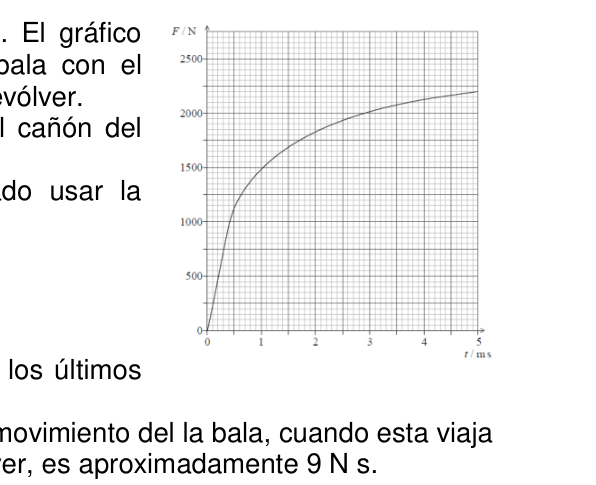
Topic: Newtonian Mechanics, Conservation of Momentum Metodi: Impulse-Momentum Theorem, Curve Fitting Competenze: Physical Reasoning, Experimental Data Analysis Objects: Projectile Fonte: Testo (PDF) — p.5
PT104. Scuola San Ignacio
Rio Cuarto, Córdoba.
Una pallottola da 32 g viene sparata da un revolver. Il grafico mostra la variazione della forza F sul proiettile con il Il tempo t quando questa viaggia dentro il cannone della pistola. La pallottola viene sparata a t = 0 e la lunghezza del cannone del Il revolver è di 0,70 m. a) Dicere e spiegare perché non è appropriato usare la Equatoria
per calcolare l’accelerazione della pallottola. b) Utilizzare il grafico per i. determinare l’accelerazione media durante gli ultimi anni 2.0 ms dal grafico. ii. mostrare che il cambiamento della quantità di movimento della pallottola, quando questo viaggia lungo la lunghezza del cannone della pistola, è di circa 9 N s. c) Usa la risposta b. ii. per calcolare i. La velocità della pallottola quando esce dal cannone del revolver ii. la potenza media consegnata al proiettile.
Topic: Newtonian Mechanics, Conservation of Momentum Metodi: Impulse-Momentum Theorem, Curve Fitting Competenze: Physical Reasoning, Experimental Data Analysis Objects: Projectile Fonte: Testo (PDF) — p.5
PT104. St. Ignatius College
The fourth river, Cordoba.
A 32g bullet is fired from a revolver. The chart . It shows the variation of the force F on the bullet with the Time t when this one travels inside the gun barrel. The bullet is fired at t = 0 and the length of the cannon of the The revolver is 0.70 m. (a) Tell and explain why it is not appropriate to use the Equation
to calculate the bullet’s acceleration. (b) Use the chart to i. Determine the average acceleration over the last few years 2.0ms from the graph. ii. Show that the change in the amount of movement of the bullet, when this travels along the gun’s barrel length, is approximately 9 N s. (c) Use the answer b. ii. to calculate i. The speed of the bullet when it comes out of the gun . ii. the mean power delivered to the bullet.
Topic: Newtonian Mechanics, Conservation of Momentum Metodi: Impulse-Momentum Theorem, Curve Fitting Competenze: Physical Reasoning, Experimental Data Analysis Objects: Projectile Fonte: Testo (PDF) — p.5
PT105. Colegio San Ignacio
Río Cuarto, Córdoba.
El diagrama muestra el depósito de un recipiente utilizado para guardar líquidos.
94 - OAF 2015
El recipiente es llenado desde arriba. La distancia entre la base del recipiente y el piso es h0. El recipiente, que inicialmente está vacío, es llenado con una tasa constante. La altura h de la superficie del líquido por sobre el nivel del suelo es medida como una función del tiempo t. Los resultados de las mediciones se muestran graficados abajo.
a) Dibujar, en el gráfico, la línea que mejor ajusta a los puntos.
b) Decir y explicar si h es directamente proporcional a t para los períodos de tiempo
i. t = 0 s a t = 120 s
ii. t 120 s
c) Usar los datos del gráfico para determinar el valor de h0.
d) El área de la base del recipiente es 1.8 m2. Deducir que el volumen de líquido
entrando en el depósito del recipiente es aproximadamente 0.02 m3 s-1.
e) El recipiente está completamente lleno después de 850 s. Calcular el volumen total
del depósito.
f) El recipiente vacío, ahora es llenado a la mitad de la tasa de d.. Usando los ejes,
esquematice gráfico que muestra la variación de h con t en el rango t = 0 s a
t = 900 s.
recipiente
altura de la
superficie
del líquido
por sobre el
nivel del
suelo h/m
tiempo t/s
OAF 2015 - 95
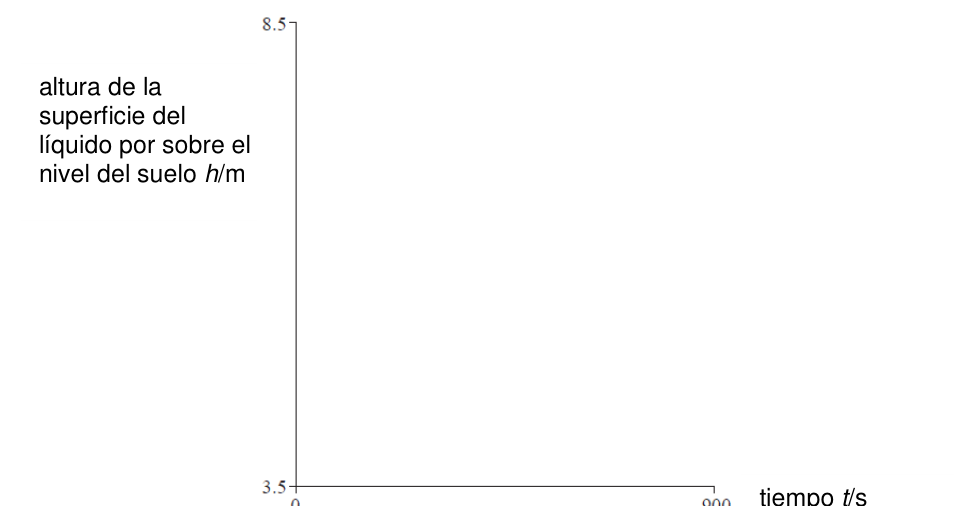
Topic: Fluid Mechanics Metodi: Continuity Equation, Graph Linearization Competenze: Physical Reasoning, Experimental Data Analysis Objects: Container Fonte: Testo (PDF) — p.5
PT105. Scuola San Ignacio
Rio Cuarto, Córdoba.
Il diagramma mostra il deposito di un recipiente utilizzato per conservare liquidi.
94 - OAF 2015
Il contenitore è pieno dall’alto. La distanza tra la base del recipiente e il pavimento è h0. Il contenitore, inizialmente vuoto, è riempito a un tasso costante. Alto h La superficie del liquido sopra il livello del suolo è misurata come funzione del tempo t. I risultati delle misure sono riportati in grafico seguente.
a) Disegnare, sul grafico, la linea che meglio si adatta ai punti. b) Dire e spiegare se h è direttamente proporzionale a t per i periodi di tempo i. t = 0 s a t = 120 s ii. t 120 s c) Usare i dati del grafico per determinare il valore di h0. d) L’area della base del recipiente è di 1,8 m2. Dotturare che il volume di liquido entrando nel deposito del recipiente è di circa 0,02 m3 s-1. e) Il contenitore è completamente pieno dopo 850 s. Calcolare il volume totale
- Il deposito. f) Il contenitore vuoto è ora riempito a metà del tasso di d.. Usando gli assi, schematica grafica che mostra la variazione di h con t nel range t = 0 s a t = 900 s. contenitore Alto della superficie del liquido
- Al di sopra di lui . livello di suolo h/m tempo t/s
OAF 2015 - 95
Topic: Fluid Mechanics Metodi: Continuity Equation, Graph Linearization Competenze: Physical Reasoning, Experimental Data Analysis Objects: Container Fonte: Testo (PDF) — p.5
PT105. St. Ignatius College
The fourth river, Cordoba.
The diagram shows the reservoir of a container used for storing liquids.
The Commission shall adopt delegated acts in accordance with Article 21 of Regulation (EU) No 1303/2013.
The container is filled from above. The distance between the bottom of the container and the floor is h0. The container, which is initially empty, is filled at a constant rate. Height h The surface area of the liquid above ground level is measured as a function of the time t. The results of the measurements are shown in the following graph.
(a) Draw the line on the graph that best fits the points. (b) Say and explain whether h is directly proportional to t for periods of time i. t = 0 s a t = 120 s ii. t 120 s (c) Use the graph data to determine the value of h0. (d) The area of the bottom of the container is 1.8 m2. To deduce that the volume of liquid entering the container tank is approximately 0.02 m3 s-1. (e) The container is fully filled after 850 s. Calculate the total volume from the storage tank. (f) The empty container is now filled at half the rate of d. Using the shafts, Graphic diagram showing the variation of h with t in the range t = 0 s to t = 900 s. container height of the surface area of the liquid Over the top The level of the Floor h/m time t/s
The following points shall be added:
Topic: Fluid Mechanics Metodi: Continuity Equation, Graph Linearization Competenze: Physical Reasoning, Experimental Data Analysis Objects: Container Fonte: Testo (PDF) — p.5
PT106. Colegio Nacional de Buenos Aires
Ciudad de Buenos Aires.
Dos partículas se mantienen inicialmente suspendidas verticalmente mediante cuerdas
de longitud L, inextensibles y de masa despreciable (ver figura 1a).
La partícula 1 se separa un ángulo θ1 respecto de la vertical (ver figura 1b) y se la suelta
desde el reposo, chocando luego de manera inelástica (pero no plástica) con la 2.
Después del choque la partícula 1 alcanza un ángulo máximo θ1’ respecto de la vertical
y, a su vez, la partícula 2 alcanza un ángulo máximo θ2’ también respecto de la vertical
(ver figura 1c). Determine:
a) La velocidad de la partícula 1 justo antes del choque en función de L y la
aceleración de la gravedad (g)
b) La velocidad de la partícula 2 justo después del choque en función de L y la
aceleración de la gravedad (g)
c) El coeficiente de restitución correspondiente a la colisión.
d) La tensión en la soga que sujeta a la partícula 1 cuando se ha apartado un ángulo
θ1’ respecto de la vertical.
Datos: θ1= 60º; θ1’ = 23º; θ2’= 20,15º; m1= 1kg
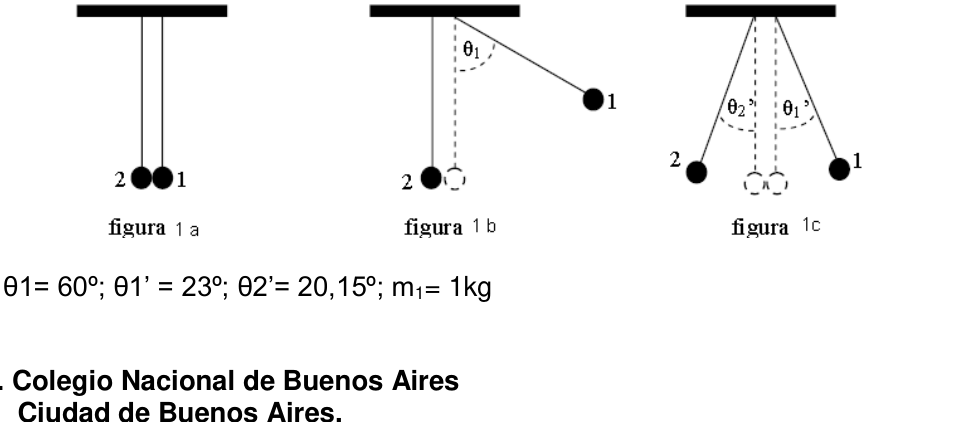
Topic: Conservation of Momentum, Conservation of Energy Metodi: Conservation of Momentum, Energy Conservation Method Competenze: Physical Reasoning Objects: Pendulum Fonte: Testo (PDF) — p.5
PT106. Collegio Nazionale di Buenos Aires
Città di Buenos Aires.
Due particelle vengono inizialmente tenute in sospensione verticale con le corde. di lunghezza L, inespandibili e di massa scarsa (vedere figura 1a). La particella 1 si separa da un angolo θ1 rispetto alla verticale (vedere figura 1b) e si lascia scaricare dopo il riposo, colpendo poi inelasticamente (ma non in plastica) con la 2. Dopo l’impatto la particella 1 raggiunge un angolo massimo θ1 rispetto alla verticale e, a sua volta, la particella 2 raggiunge un angolo massimo θ2 anche rispetto alla verticale (cfr. figura 1c). Determina: a) La velocità della particella 1 appena prima del colpo in funzione di L e di l’ accelerazione della gravità (g) b) La velocità della particella 2 subito dopo l’impatto in funzione di L e l’ accelerazione della gravità (g) c) Il coefficiente di restituzione corrispondente alla collisione. d) La tensione della corda che si adatta alla particella 1 quando un angolo è stato allontanato θ1 rispetto alla verticale.
Data: θ1= 60o; θ1= 23o; θ2= 20,15o; m1= 1kg
Topic: Conservation of Momentum, Conservation of Energy Metodi: Conservation of Momentum, Energy Conservation Method Competenze: Physical Reasoning Objects: Pendulum Fonte: Testo (PDF) — p.5
PT106. National College of Buenos Aires
City of Buenos Aires.
Two particles are initially held suspended vertically by ropes. of length L, not extensible and of negligible mass (see Figure 1a). Particle 1 is separated by an angle θ1 from the vertical (see Figure 1b) and released from rest, then colliding inelastically (but not plastically) with the 2. After the impact the particle 1 reaches a maximum angle θ1 with respect to the vertical and, in turn, particle 2 reaches a maximum angle θ2 also with respect to the vertical (see Figure 1c). Determine: (a) Particle 1 velocity just before impact as a function of L and the The acceleration of gravity (g) (b) Particle 2 velocity just after impact as a function of L and the The acceleration of gravity (g) (c) The rate of return corresponding to the collision. (d) The tension on the rope that is attached to particle 1 when an angle has been set. θ1 with respect to the vertical.
The data are: θ1=60o; θ1=23o; θ2=20.15o; m1=1kg
Topic: Conservation of Momentum, Conservation of Energy Metodi: Conservation of Momentum, Energy Conservation Method Competenze: Physical Reasoning Objects: Pendulum Fonte: Testo (PDF) — p.5
PT107. Colegio Nacional de Buenos Aires
Ciudad de Buenos Aires.
El amperímetro A de la figura indica el mismo valor cuando las llaves L1 y L2 del circuito están cerradas simultáneamente, o cuando las dos llaves L1 y L2 están abiertas simultáneamente.
a) Encuentre una expresión para la intensidad de tiempo t/s altura de la superficie del líquido por sobre el nivel del suelo h/m
96 - OAF 2015
corriente iA medida por el amperímetro cuando ambas llaves L1 y L2 están cerradas.
b) Encuentre una expresión para la intensidad de corriente iA medida por el
amperímetro cuando ambas llaves L1 y L2 están abiertas.
c) Halle el valor de la resistencia R.
d) Si ahora se utiliza la resistencia R como un calentador. ¿Cuánto tiempo se
necesitaría para elevar la temperatura de 100g de agua de 10°C a 30 °C?
Datos: R1=300; R2=100; R3=50;= 1,5 V; calor específico del agua=1cal/g°C
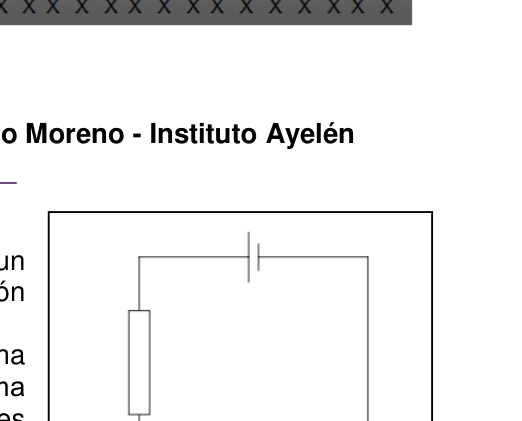
Topic: Circuits, Thermodynamics Metodi: Kirchhoff’s Laws, First Law of Thermodynamics Competenze: Physical Reasoning Objects: Resistor, Switch Fonte: Testo (PDF) — p.5
PT107. Collegio Nazionale di Buenos Aires
Città di Buenos Aires.
L’ampiezza A della figura indica lo stesso valore quando le chiavi L1 e L2 del circuito sono chiuse simultaneamente, o quando le due chiavi L1 e L2 sono aperte contemporaneamente.
a) Trova un’espressione per l’intensità di tempo t/s Alto della superficie del liquido sopra il livello del suolo h/m
96 - OAF 2015 corrente iA misurata dall’ampimetro quando entrambi i tasti L1 e L2 sono chiusi. b) Trova un’espressione per l’intensità di corrente iA misurata dal Amperimetro quando entrambe le chiavi L1 e L2 sono aperte. c) Trova il valore della resistenza R. d) Se si utilizza ora la resistenza R come riscaldatore. Quanto tempo ci sono? che avrebbe bisogno di elevare la temperatura di 100 g di acqua da 10°C a 30 °C? Dati: R1=300; R2=100; R3=50;= 1,5 V; calore specifico dell’acqua=1cal/g°C
Topic: Circuits, Thermodynamics Metodi: Kirchhoff’s Laws, First Law of Thermodynamics Competenze: Physical Reasoning Objects: Resistor, Switch Fonte: Testo (PDF) — p.5
PT107. National College of Buenos Aires
City of Buenos Aires.
The ampere A of the figure indicates the same value When the L1 and L2 circuitry keys are closed simultaneously, or when the two keys L1 and L2 They’re open at the same time.
(a) Find an expression for the intensity of time t/s height of the surface of the liquid above the the soil level h/m
96 - OAF 2015 current iA measured by the ampere when both L1 and L2 keys are closed. (b) Find an expression for the current intensity iA as measured by the Amp when both L1 and L2 keys are open. (c) Find the resistance value R. (d) If the resistance R is now used as a heater. How long have you been? would you need to raise the temperature of 100 g of water from 10°C to 30 °C? Data: R1=300; R2=100; R3=50;=1,5 V; specific heat of water=1cal/g°C
Topic: Circuits, Thermodynamics Metodi: Kirchhoff’s Laws, First Law of Thermodynamics Competenze: Physical Reasoning Objects: Resistor, Switch Fonte: Testo (PDF) — p.5
PT108. Colegio Nacional de Buenos Aires
Ciudad de Buenos Aires.
Un conductor suspendido por dos alambres flexibles, como el que se muestra en la figura, tiene una masa por unidad de longitud de 0,080 Kg/m. El mismo se encuentra en una zona donde existe un vector campo magnético constante B de 7,2 T hacia el interior de la página. El vector aceleración de gravedad g apunta en el sentido indicado en la figura y tiene un módulo de 9,8 m/s2 a) ¿Qué corriente debe existir en el conductor para que la tensión en los alambres que lo soportan sea cero? b) ¿Cuál debe ser el sentido de la corriente?
Topic: Magnetism Metodi: Lorentz Force Analysis, Free-Body Diagram Competenze: Physical Reasoning Objects: Wire Fonte: Testo (PDF) — p.5
PT108. Collegio Nazionale di Buenos Aires
Città di Buenos Aires.
Un conduttore sospeso da due fili flessibili, come quello mostrato in figura, ha una massa per unità di lunghezza di 0,080 Kg/m. E ’ situato in una zona. dove esiste un Vettore campo Magnetico costante B di 7,2 T verso l’interno della pagina. Il vettore di accelerazione di gravità g punta al senso indicato nella figura e ha un modulo di 9,8 m/s2 a) Che corrente deve esistere nel conducente per che la tensione nei fili che lo sopportano zero? b) Qual è il senso del corrente?
Topic: Magnetism Metodi: Lorentz Force Analysis, Free-Body Diagram Competenze: Physical Reasoning Objects: Wire Fonte: Testo (PDF) — p.5
PT108. National College of Buenos Aires
City of Buenos Aires.
A driver suspended by two flexible wires, such as the one shown in the Figure, has a mass per unit length of 0,080 Kg/m. It’s in a zone. Where There is . un vector field Magnetic B constant of 7.2 T towards the inside of the page. The gravitational acceleration vector g points to the The value of the value of the input is the sum of the values of the input values. 9,8 m/s2 (a) What current should be present in the driver So that the tension on the wires that you Can you stand it? (b) What should be the direction of the current?
Topic: Magnetism Metodi: Lorentz Force Analysis, Free-Body Diagram Competenze: Physical Reasoning Objects: Wire Fonte: Testo (PDF) — p.5
PT109. Colegio Santísima Trinidad - Colegio Mariano Moreno - Instituto Ayelén
Mar del Plata, Buenos Aires.
Fabricante de resistores. a) La magnitud de un campo eléctrico dentro de un conductor 55NC-1. Calcule la fuerza de un electrón libre dentro de un conductor. b) Un resistor hecho de un oxido de metal tiene una resistencia de 1,5Ω. El resistor tiene una forma cilíndrica de un largo 2,2x10⁻²m y el radio es 1,2x10⁻³m. Calcular la resistividad del óxido de metal. c) El manufacturador del resistor de (b) garantiza que su resistencia tiene un 10% de error, y que la potencia de disipación en el resistor no exceda 1,0 W. Calcular la máxima corriente en el resistor para que la potencia de disipación sea igual a 1,0W. d) Tres resistores como los de (c) están conectados como muestra la figura 1. La batería tiene una fem de 2,0V y una resistencia interna despreciable. e) Determine la máxima y la mínima potencia que puede disipar el circuito. Datos: carga del electrón=1,6x10⁻¹⁹C
Topic: Circuits Metodi: Equivalent Circuit Reduction, Kirchhoff’s Laws Competenze: Physical Reasoning Objects: Resistor, Battery Fonte: Testo (PDF) — p.5
PT109. Colegio Santísima Trinidad - Colegio Mariano Moreno - Istituto Ayelén
Mar del Plata, Buenos Aires.
- Fabricante di resistenti. a) La magnitudine di un campo elettrico all’interno di un il conducente 55NC-1. Calcola la forza di un elettrone libero all’interno di un conducente. b) Un resistore fatto di un ossido di metallo ha un resistenza di 1,5Ω. La resistenza ha una forma. cilindrica di 2,2x10⁻²m di lunghezza e il raggio è 1,2x10⁻³m. Calcolare la resistenza dell’ossido di metallo. c) Il fabbricante del resistore di (b) garantisce che la sua resistenza ha un errore del 10%, e che la potenza di dissipazione nel resistore non eccede 1,0 W. Calcolare la massima corrente nella resistenza per rendere la potenza di dissipazione è uguale a 1,0W. d) Tre resistori come quelli di (c) sono collegati come mostrato in figura 1. La La batteria ha un fem di 2,0 V e una resistenza interna disprezzabile. e) Determina la potenza massima e la potenza minima che il circuito può dissipare. Dati: carico dell’elettrone = 1,6x10⁻¹⁹C
Topic: Circuits Metodi: Equivalent Circuit Reduction, Kirchhoff’s Laws Competenze: Physical Reasoning Objects: Resistor, Battery Fonte: Testo (PDF) — p.5
PT109. Holy Trinity College - Mariano Moreno College - Institute of Ayelén
The city of Mar del Plata, Buenos Aires.
Manufacturer of resistors. (a) The magnitude of an electric field within a The following conditions shall apply: Calculate the force of an electron. Free inside a driver. (b) A resistor made of a metal oxide has a resistance of 1,5Ω. The resistor has a shape. A cylinder of 2.2 x 10⁻² m long and the radius is 1,2x10⁻³m. Calculate the resistance of the oxide of metal. (c) The manufacturer of the resistor of (b) shall ensure that Its resistance is 10% error, and that’s the The resistor dissipation power does not exceed 1,0 W. Calculate the maximum current in the resistor so that the dissipation power is equal to 1.0W. (d) Three resistors such as those in (c) are connected as shown in Figure 1. La The battery has a 2.0V fem and a despicable internal resistance. (e) Determine the maximum and minimum power that the circuit can dissipate. Data: charge of the electron = 1.6x10⁻¹⁹C
Topic: Circuits Metodi: Equivalent Circuit Reduction, Kirchhoff’s Laws Competenze: Physical Reasoning Objects: Resistor, Battery Fonte: Testo (PDF) — p.5
PT110. Colegio Santísima Trinidad - Colegio Mariano Moreno - Instituto Ayelén
Mar del Plata, Buenos Aires.
El submarino perfecto.
Para
tomarse
un
submarino
perfecto,
se
debe
calentar
250ml
de
leche
(densidad= 1.035 g/cm3, Ce=0,94 Kcal/kg°C). a 85° C. Luego introducción 50g de
chocolate(Ce=0,3 kcal/kg°C (solido), Ce=0,56 kcal/kg°C (liquido), L=10,52 kcal/kg,
Figura 1
OAF 2015 - 97 Tfusión=43°C), y 5ml de esencia de vainilla (densidad=1,1gr/cm3,Ce=5 Kcal/kg°C). Si la temperatura ambiente es de 20°C, y la taza adiabática calcular: a) Calcular la temperatura final del sistema. b) Calcular la cantidad de calor cedida por la leche al sistema. c) Si la leche se calienta en un microondas que tiene una potencia media de 890W, calcular el tiempo que se necesitó usar el microondas para armar el submarino. d) Si el precio del KWh es de $2,30.-, decir cuánta plata se gastó para armar el submarino. e) La taza es un cilindro de diámetro 14cm y altura 10 cm. Si se saca la parte de arriba, y se sabe que la perdida de calor es de 1,2cal/cm2.seg, decir i) cuanto tiempo tiene que estar la taza destapada para que el submarino baje 1°C su temperatura. ii) cuanto tiempo tiene que estar destapada para que el submarino quede en equilibrio térmico con el ambiente.}
Topic: Thermodynamics Metodi: First Law of Thermodynamics Competenze: Physical Reasoning Objects: Calorimeter Fonte: Testo (PDF) — p.5
PT110. Colegio Santísima Trinidad - Colegio Mariano Moreno - Istituto Ayelén
Mar del Plata, Buenos Aires.
Il sottomarino perfetto. Per
- Si prendono. un Submarino Perfetto, se
- Dovrebbe . riscaldare 250ml de latte (densità = 1,035 g/cm3, Ce=0,94 Kcal/kg°C). a 85° C. Poi introdurre 50g di La produzione di zucchero di zucchero di zucchero di zucchero di zucchero di zucchero di zucchero di zucchero di zucchero di zucchero di zucchero di zucchero di zucchero di zucchero di zucchero di zucchero di zucchero di zucchero di zucchero di zucchero di zucchero di zucchero di zucchero di zucchero di zucchero di zucchero di zucchero di zucchero di zucchero di zucchero di zucchero di zucchero di zucchero di zucchero di zucchero di zucchero di zucchero di zucchero di zucchero di zucchero di zucchero di zucchero di zucchero di zucchero di zucchero di zucchero di zucchero di zucchero di zucchero di zucchero di zucchero di zucchero di zucchero di zucchero di zucchero di zucchero di zucchero di zucchero di zucchero di zucchero di zucchero di zucchero di zucchero di zucchero di zucchero di zucchero di zucchero di zucchero di zucchero di zucchero di zucchero di zucchero di zucchero di zucchero di zucchero di zucchero di zucchero di zucchero di zucchero di zucchero di zucchero di zucchero di zucchero di zucchero di zucchero di zucchero di zucchero di zucchero di zucchero di zucchero di zucchero di zucchero di zucchero di zucchero di zucchero di zucchero di zucchero di zucchero di zucchero di zucchero di zucchero di zucchero di zucchero di zucchero di zucchero di zucchero di zucchero di zucchero di zucchero di zucchero di zucchero di zucchero di zucchero di zucchero di zucchero di zucchero di zucchero di zucchero di zucchero di zucchero di zucchero di zucchero di zucchero di zucchero di zucchero di zucchero di zucchero di zucchero di zucchero di zucchero di zucchero di zucchero di zucchero di zucchero di zucchero di zucchero di zucchero di zucchero di zucchero di zucchero di zucchero di zucchero di zucchero di zucchero di zucchero di zucchero di zucchero di zucchero di zucchero di zucchero di zucchero di zucchero di zucchero di zucchero di zucchero di zucchero di zucchero di zucchero di zucchero di zucchero di zucchero di zucchero di zucchero di zucchero di zucchero di zucchero di zucchero di zucchero di zucchero di zuc
Figura 1
OAF 2015 - 97 Fusione=43°C), e 5 ml di essenza di vaniglia (densità=1,1gr/cm3,Ce=5 Kcal/kg°C). Si la la temperatura ambiente è 20°C, e la tazza adiabita calcola: a) Calcolare la temperatura finale del sistema. b) Calcolare la quantità di calore che il latte dà al sistema. c) Se il latte viene riscaldato in un microonde con una potenza media di 890W, calcolare il tempo necessario per usare il microonde per armare il sottomarino. d) Se il prezzo del KWh è di $2.30.-, dire quanto denaro è stato speso per armarlo
- Sottocruci. e) La tazza è un cilindro di 14 cm di diametro e 10 cm di altezza. Se si toglie la parte di E’ noto che la perdita di calore è di 1,2 cal/cm2.seg, cioè i) quanto Il tempo deve essere scaricato per far scendere il sottomarino. temperatura. (ii) quanto tempo deve essere svolto per il sottomarino Rimane in equilibrio termico con l’ambiente.}
Topic: Thermodynamics Metodi: First Law of Thermodynamics Competenze: Physical Reasoning Objects: Calorimeter Fonte: Testo (PDF) — p.5
PT110. Holy Trinity College - Mariano Moreno College - Institute of Ayelén
The city of Mar del Plata, Buenos Aires.
The perfect submarine. For Take it . un Submarine Perfect, se You must Heating 250ml de Milk The following is the list of the products of the product concerned: a 85° C. Then 50g of The following table shows the results of the calculation of the weighted average weight of the product:
Figure 1
The Commission shall adopt delegated acts in accordance with Article 21 of this Regulation. The product is a mixture of the following: Si la The ambient temperature is 20°C, and the adiabatic cup is calculated: (a) Calculate the final temperature of the system. (b) Calculate the amount of heat delivered by milk to the system. (c) If the milk is heated in a microwave with an average power of 890W, calculate the time it took to use the microwave to arm the submarine. (d) If the price of KWh is $2.30.,- say how much silver was spent to assemble the The submarine. (e) The cup is a cylinder 14 cm in diameter and 10 cm in height. If you take the part of above, and the heat loss is known to be 1.2 cal/cm2.sec, so i) how much Time has to be unlocked for the submarine to descend. The temperature. (ii) how long it has to be uncovered for the submarine to be able to It is in thermal equilibrium with the environment.}
Topic: Thermodynamics Metodi: First Law of Thermodynamics Competenze: Physical Reasoning Objects: Calorimeter Fonte: Testo (PDF) — p.5
PT111. Colegio Santísima Trinidad - Colegio Mariano Moreno - Instituto Ayelén
Mar del Plata, Buenos Aires.
Salto Olimpiadas de invierno. Dentro de las disciplinas de ski, existe el salto en largo. Los competidores se dejan caer desde el extremo de la pista como muestra la figura.
Y gana aquel competidor que logre caer más lejos.
Se considera despreciable el rozamiento con el aire, y con la pista de nieve. Si un
esquiador de 70Kg se lanza, calcular:
a) La energía mecánica en A.
b) La velocidad alcanzada en el punto A de la pista.
c) Escribir las ecuaciones de movimiento para el esquiador a partir del punto A.
d) Escribir la ecuación de altura Yo en función del alcance.
e) Si la altura Yo, es de 30m, calcular el alcance máximo del esquiador.
f) Calcular la altura máxima a la que llega el esquiador una vez que abandona la
pista.
g) Que distancia máxima alcanzaría si el esquiador tuviera una masa de 50kg.
Topic: Conservation of Energy, Newtonian Mechanics Metodi: Energy Conservation Method, Kinematic Equations Competenze: Physical Reasoning Objects: Projectile Fonte: Testo (PDF) — p.5
PT111. Colegio Santísima Trinidad - Colegio Mariano Moreno - Istituto Ayelén
Mar del Plata, Buenos Aires.
Salto le Olimpiadi d’inverno. All’interno delle discipline di sci, esiste il salto a lungo. I concorrenti si lasciano cadere dall’estremità della pista come mostra la figura.
E vince il concorrente che riesce a cadere più lontano. È disprezzo il ruggimento con l’aria e con la pista di neve. Si un sciatore di 70Kg lancia, calcola: a) L’energia meccanica in A. b) La velocità raggiunta al punto A della pista. c) Scrivere le equazioni di movimento per lo sciatore a partire dal punto A. d) Scrivere l’equazione di altezza io in base alla portata. e) Se l’altezza Io è di 30 m, calcolare la portata massima dello sciatore. f) Calcolare l’altezza massima raggiunta dallo sciatore una volta che lascia la pista.
- C’è un indizio. g) Qual è la distanza massima raggiunta se lo sciatore avesse una massa di 50 kg.
Topic: Conservation of Energy, Newtonian Mechanics Metodi: Energy Conservation Method, Kinematic Equations Competenze: Physical Reasoning Objects: Projectile Fonte: Testo (PDF) — p.5
PT111. Holy Trinity College - Mariano Moreno College - Institute of Ayelén
The silver sea, Buenos Aires.
I’m skipping the winter Olympics. Within the skiing disciplines, there is the long jump. Competitors are dropped . from the end of the track as shown in the figure.
And wins that competitor who manages to fall further. It is considered contemptible to rub with the air, and with the snow track. Si un 70kg skier is thrown, calculate: (a) Mechanical energy in A. (b) The speed achieved at track point A. (c) Write the equations of motion for the skier from point A. d) Write the height equation I based on the range. (e) If the height I is 30 m, calculate the maximum range of the skier. (f) Calculate the maximum altitude reached by the skier once he leaves the ski area.
- The lead. (g) What maximum distance would the skier reach if the skier had a mass of 50 kg?
Topic: Conservation of Energy, Newtonian Mechanics Metodi: Energy Conservation Method, Kinematic Equations Competenze: Physical Reasoning Objects: Projectile Fonte: Testo (PDF) — p.5
PT112. Escuela Superior de Comercio Carlos Pellegrini
Ciudad de Buenos Aires.
El chico maravilla al rescate. El operativo de Batman para detener al Pingüino por sorpresa tuvo un desenlace preocupante: el héroe fue capturado en una emboscada y llevado a la guarida del malvado villano en lo más profundo del alcantarillado de Ciudad Gótica. Robin, que logró escapar, no se queda de brazos cruzados y emprende de inmediato su búsqueda. Como Robin no desea nadar por las sucias, y posiblemente envenenadas, aguas de las alcantarillas, decide construir una balsa apilando planchas rectangulares de madera que hay guardadas en la baticueva. Cada plancha es de 60 cm por 140 cm y tiene un espesor de 4 cm.
98 - OAF 2015 a) Cuando Robin deja flotar una plancha en su batipileta, observa que 12 mm de la misma quedan por encima de la superficie del agua. ¿Qué densidad tiene la madera? b) ¿Qué volumen total debería tener, como mínimo, una balsa que soporte a Robin? ¿Cuántas planchas debe utilizar para construirla?
Encima de su balsa, Robin alcanza remando una rapidez de 10 km/h. En un momento, divisa 2,5 metros más adelante y 2,5 metros a su derecha a uno de los esfeníscidos secuaces del Pingüino patrullando las turbias aguas, nadando paralelo a él a unos 6 km/h. La idea de Robin es atraparlo e intentar convencerlo de que lo lleve a su guarida para rescatar a Batman. Para ello, decide continuar remando en la dirección original hasta llegar a la misma altura, y luego cambiar su dirección de manera de interceptar al enemigo. La situación está esquematizada en la figura (a). c) ¿Qué distancia recorre Robin desde que divisa al pingüino hasta que cambia su dirección? d) ¿En qué dirección debería remar Robin para alcanzarlo? ¿Cuánto tiempo tarda en efectuar los dos desplazamientos? e) Uno puede sospechar que Robin tardaría menos tiempo en alcanzar al pingüino si cambiase su dirección inmediatamente después de verlo (figura (b)). Decida en qué dirección debería moverse en este caso, y verifique la sospecha anterior. (Ayuda: sen² β + cos² β = 1 para cualquier β).
Cuando se produce el choque entre la balsa y el pingüino, ambos cambian su velocidad. Tenga en cuenta que la cantidad de movimiento total de los cuerpos que intervienen es la misma antes y después de un choque, y que la cantidad de movimiento de un cuerpo se define como el vector 𝑝 = 𝑚𝑣 , siendo 𝑣 el vector velocidad. f) Suponiendo que ocurrió la situación del inciso d), calcule la cantidad de movimiento total inicial del sistema Robin-pingüino. g) Supongamos que después del choque Robin y el pingüino viajan juntos, con la misma velocidad. ¿Cuál?
Una vez que Robin llega a la guarida, encuentra una situación desesperante: su colega
Batman está colgado de una soga, completamente atado, encima de un caldero de
hirviente ácido letal. Robin no quiere cortar la soga directamente, porque su colega caería
hacia una muerte inevitable.
h) Su idea consiste en hacerlo oscilar (―hamacarlo‖) hasta que alcance una velocidad
tal que, si corta la soga cuando Batman pasa por el punto más bajo de su
oscilación, aterrice fuera del caldero. ¿Qué velocidad debería tener allí para que
ello ocurra?
i) Robin descubre que se había olvidado las batitijeras en la baticueva, y no tiene
forma de cortar la soga. El plan, ahora, es hamacar a Batman hasta que la tensión
de la soga en el punto más bajo incremente de tal forma que se
rompa y el Caballero de la Noche salga volando. ¿Qué velocidad
deberá tener esta vez para lograrlo?
Datos
- Masa de Robin: 60 kg
- Masa del pingüino: 40 kg
- D = L = 2,5 m
- g = 9,8 m/s²
- a = 7 m; b = 10 m; c = 6 m
- Masa de Batman: 100 kg
- Tensión máxima que puede soportar la soga: 1100 N
OAF 2015 - 99
Topic: Fluid Mechanics, Conservation of Momentum Metodi: Hydrostatic Equilibrium, Conservation of Momentum Competenze: Physical Reasoning Objects: Pendulum Fonte: Testo (PDF) — p.5
PT112. Scuola superiore di commercio Carlos Pellegrini
Città di Buenos Aires.
Il ragazzo è fantastico per il salvataggio. L’operazione di Batman per fermare il Pinguino per sorpresa ha avuto un risultato. preoccupante: il eroe fu catturato in un’imboscata e portato alla cova del Cattivo villan nel profondo del canalizzatore di Gothic City. Robin, che ha fatto. fuggire, non restare in braccio incrociato e intraprendere immediatamente la sua ricerca. Come Robin non vuole nuotare nelle acque sporche, e possibilmente avvelenate, delle Sotto le fogne decide di costruire una barca a vela mettendo in pietra tavole rettangolari di legno che ci sono guardate nella cassaforte. Ogni piastra è di 60 cm per 140 cm e ha un spessore de 4 cm.
98 - OAF 2015 a) Quando Robin lascia fluttuare una lavagna nella sua battipiletta, osserva che 12 mm di e che si trovano sopra la superficie dell’acqua. Che densità ha la
- Legno? b) Qual è il volume totale di una barca da bordo che supporti Robin? Quante tavole deve usare per costruirla?
Sull’alto della barca, Robin raggiunge una velocità di 10 km/h. In un momento, Divide 2,5 metri più avanti e 2,5 metri a destra uno degli sphinicci I seguaci del Pinguino pattugliano le acque turbolente, nuotando parallelo a lui a circa 6 km/h. L’idea di Robin è di prenderlo e cercare di convincerlo a portarlo al suo cimitero. per salvare Batman. Per questo, decide di continuare a rammare nella direzione originale fino a raggiungere la stessa altezza, e poi cambiare direzione in modo da intercettare il Il nemico. La situazione è illustrata in figura a. c) Quante distanze ha percorso Robin da quando ha diviso il Pinguino fino a quando non cambia indirizzo? d) In che direzione deve rammare Robin per
- Per raggiungerlo? Quanto tempo ci vuole per effettuare entrambi?
- spostamenti? e) Si può sospettare che Robin ci vorrà meno. tempo per raggiungere il pingüino se cambiasse il suo indirizzo immediatamente dopo averlo visto (Figura (b)). Decidi in che direzione dovresti andare in questo. caso, e verificare il sospetto precedente. (Aiuto: sen2 β + cos2 β = 1 per qualsiasi β).
Quando si verifica lo scontro tra la barca e il pinguino, entrambi cambiano velocità. Si noti che la quantità totale di movimento dei corpi che intervengono è la stessa prima e dopo un colpo, e che la quantità di movimento di un corpo è definito come il vettore p = mv , v è il vettore velocità. f) Supponendo che si sia verificata la situazione di cui al punto (d), calcolare la quantità di movimento Il totale iniziale del sistema Robin-Penguin. g) Supponiamo che dopo lo scontro Robin e il pinguino viaggiino insieme, con la la stessa velocità. - Che cosa?
Una volta che Robin arriva alla cova, trova una situazione disperata: il suo collega. Batman è appeso a una corda, completamente legato, sopra un calderone di acido fervente letale. Robin non vuole tagliare la corda direttamente, perché il suo collega sarebbe caduto. verso una morte inevitabile. h) L’idea è di farlo oscillare (―hamacarlo‖) fino a raggiungere una velocità Così, se taglia la corda quando Batman passa per il punto più basso del suo Oscillazione, atterraggio fuori dal calderone. Che velocità dovrebbe avere lì per farlo? che succede? i) Robin scopre che aveva dimenticato le cucche nella cucchiaiola, e non ha come tagliare la corda. Il piano, ora, è di ammazzare Batman fino a quando la tensione non si allontana. La linea di rilo al punto più basso aumenta in modo che si Se il Cavaliere della Notte si rompe, il Cavaliere della Notte si spalanca. Che velocità! Dovrebbe avere questa volta per farlo? Datos
- Massa di Robin: 60 kg
- Massa del pinguino: 40 kg
- D = L = 2,5 m
- g = 9,8 m/s²
- a = 7 m; b = 10 m; c = 6 m
- Massa di Batman: 100 kg
- Tensione massima che la corda può sopportare: 1100 N
OAF 2015 - 99
Topic: Fluid Mechanics, Conservation of Momentum Metodi: Hydrostatic Equilibrium, Conservation of Momentum Competenze: Physical Reasoning Objects: Pendulum Fonte: Testo (PDF) — p.5
PT112. The Carlos Pellegrini School of Commerce
City of Buenos Aires.
The kid’s a great guy at the rescue. Batman ‘s operation to surprise the Penguin had a result . Worrying: the hero was captured in an ambush and taken to the lair of the Evil villain deep in the sewer of Gotham City. Robin, who made it. escape, not stayed up and immediately began his search. As Robin does not wish to swim through the dirty, and possibly poisoned, waters of the world. Sewers, decides to build a raft by stacking rectangular wooden planks that There’s a lot of them in the bathtub. Each sheet is 60 cm by 140 cm and has a thickness de 4 cm.
The Commission shall adopt delegated acts in accordance with Article 21 of this Regulation. (a) When Robin lets a board float on his battipilot, he observes that 12 mm of the It’s just above the surface of the water. What density does the
- The wood? (b) What volume should a raft supporting Robin have at least? How many planks should you use to build it?
On top of his raft, Robin reaches a speed of 10 km/h. In a moment, Divide 2.5 meters further and 2.5 meters to your right to one of the sphinxes Penguin’s crew patrolling the murky waters, swimming parallel to it at about 6 km/h. Robin ‘s idea is to catch him and try to convince him to take him to his lair . to rescue Batman. For this, he decides to continue rowing in the original direction. until you reach the same height, and then change your direction so that you intercept the The enemy. The situation is outlined in Figure (a). (c) How far has Robin travelled since he divided the Penguin until he changes his address? (d) In which direction should Robin row for reaching him? How long does it take to make both The displacement? e) One can suspect that Robin would take less. Time to catch up with the penguin if he changes his mind. address immediately after seeing it (Figure (b)). Decide which direction you should move in this one. case, and check the previous suspicion. (Help: sen2 β + cos2 β = 1 for any β).
When the raft and the penguin collide, both change their speed. Note that the total amount of movement of the intervening bodies is The same before and after a crash, and that the amount of movement of a body. is defined as the vector p = mv , where v is the velocity vector. (f) Assuming that the situation in paragraph (d) has occurred, calculate the amount of movement The initial total of the Robin-Penguin system. g) Suppose after the collision Robin and the penguin travel together, with the Same speed. What’s the one?
Once Robin gets to the lair, he finds a desperate situation: his colleague. Batman is hanging from a rope, completely tied up, over a boiler. boiling lethal acid. Robin doesn’t want to cut the rope directly, because his colleague would fall. to an inevitable death. h) His idea is to make it oscillate (―hamacarlo‖) until it reaches a speed So, if you cut the rope when Batman goes through the bottom of his swing, land outside the boiler. What speed should I have there for that? is that happening? i) Robin finds out that she forgot her bathing suit in the sink, and she doesn’t have it. It’s a way to cut the rope. The plan, now, is to hammer Batman until the tension. The rope at the lowest point increases in such a way that it is breaks and the Knight of the Night comes out flying. What speed? You’ll have to do it this time? Data from the report
- Robin ‘s weight: 60 kg
- Penguin weight: 40 kg
- D = L = 2,5 m
- g = 9,8 m/s²
- a = 7 m; b = 10 m; c = 6 m
- Batman weight: 100 kg
- Maximum strain that the rope can withstand: 1100 N
The following is the list of the countries of the European Union:
Topic: Fluid Mechanics, Conservation of Momentum Metodi: Hydrostatic Equilibrium, Conservation of Momentum Competenze: Physical Reasoning Objects: Pendulum Fonte: Testo (PDF) — p.5
PT113. Escuela Superior de Comercio Carlos Pellegrini
Ciudad de Buenos Aires.
Hacia Cataratas del Paraíso. El señor Fredricksen está investigando cómo emprender un viaje por los cielos hacia Cataratas del Paraíso. La primera opción que considera es, por supuesto, usar globos. Enseguida se da cuenta de que usar globos inflados con aire común es inútil, porque se caen. a) Calcule la densidad del aire en CNPT. (Sugerencia: considere la masa de 1 l de aire). b) Un globo que pesa 2 g desinflado se puede inflar con 3 l de gas. ¿Cuál es el peso total del globo, si se lo infla con aire? ¿Qué empuje sentirá? ¿Y si el globo se infla con helio? c) Calcule cuántos globos de helio se necesitan para sacar a flote al señor Fredricksen. Luego, estime cuántos necesitaría para hacer volar toda su casa. d) Mientras el señor Fredricksen flota, un vecino malvado vierte nitrógeno líquido sobre los globos, enfriándolos hasta que su temperatura alcanza el punto de ebullición de aquél. ¿Qué ocurre con el sistema?
Como sabemos, la presión atmosférica disminuye con la altura. Si se desprecia el cambio en la temperatura, la ecuación barométrica afirma que 𝑝= 𝑝0𝑒− 𝑀𝑔 𝑅𝑇,
donde p es la presión atmosférica a una altura h sobre el nivel del mar, p0 es la presión atmosférica al nivel del mar y M es la masa molar del aire. Para saber a qué altura h la presión atmosférica vale p, se encuentra la solución de la ecuación anterior, que es: = 𝑅𝑇 𝑀𝑔ln 𝑝0 𝑝 .
Las anteriores ecuaciones son válidas para altitudes menores que 11000 m. e) Calcule el volumen de cada globo del señor Fredricksen cuando se encuentra volando a 1000 m de altura sobre el nivel del mar. ¿Cuánto vale ahora el empuje sobre cada globo? f) Cada globo debe llevar un volumen menor que 4 l de gas en su interior, o se reventará. ¿Qué altitudes son seguras para el vuelo del señor Fredricksen?
Una opción más realista consiste en usar un globo de aire caliente. Se calcula que la carga que debe llevar el globo, que incluye al señor Fredricksen, la tela del globo y el combustible (propano), es de unos 600 kg. El interior del globo alberga unos 2500 m³ de aire. Como antes, el aire del medio ambiente se halla en CNPT. g) ¿A qué temperatura es necesario calentar el aire en el interior para despegar? ¿Cuánto calor hay que entregarle en total? (Cuidado: no olvide considerar el peso del aire en el globo. Para calcular el calor, considere sólo la masa de gas que hay en el globo al final del proceso). h) Cuando el globo alcance cierta altura, la presión atmosférica disminuirá. Una vez que ello ocurra, para mantener el empuje ¿hay que calentar más o enfriar el aire del globo? Justifique su respuesta.
Datos
-
CNPT: 1 atm, 20°C. Composición de la atmósfera: aprox. 80% moléculas de N2, 20% moléculas de O2
100 - OAF 2015
-
Masas atómicas relativas: N: 14, O: 16, He: 4.
-
g = 9,8 m/s²
-
R = 0,08206 l.atm/(mol.K) = 8,314 J/(mol.K)
-
Masa del señor Fredricksen: 75 kg
-
Punto de ebullición del nitrógeno: 77 K
-
Capacidad calorífica del aire a presión constante: 7/2.nR (n: número de moles)
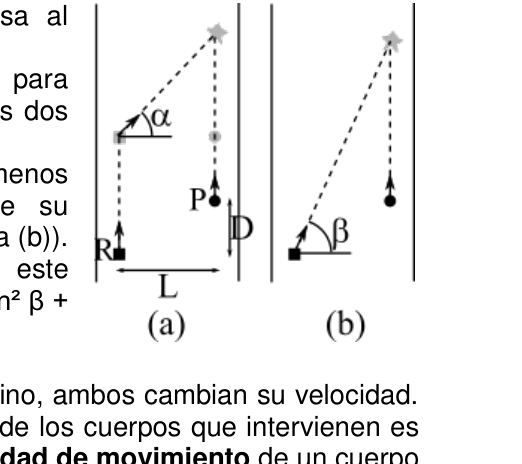
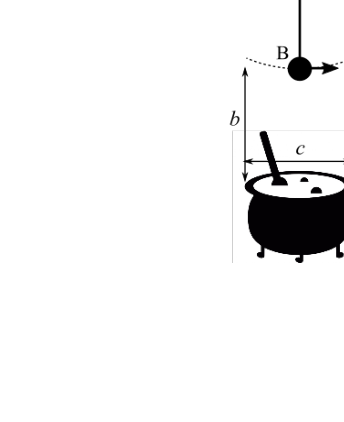
Topic: Fluid Mechanics, Thermodynamics Metodi: Hydrostatic Equilibrium, Ideal Gas Law Competenze: Physical Reasoning, Mathematical Modeling Objects: Bubble, Gas Fonte: Testo (PDF) — p.5
PT113. Scuola superiore di commercio Carlos Pellegrini
Città di Buenos Aires.
- verso le cascate del paradiso. Il signor Fredricksen sta studiando come intraprendere un viaggio nel cielo verso Cascate del Paradiso. La prima opzione che considera è, ovviamente, usare i palloni. Si accorge subito. che usare palloni gonfiati con aria comune è inutile, perché cadono. a) Calcolare la densità dell’aria in CNPT. (Suggerimento: considera la massa di 1 litro di aria). b) Un pallone che pesa 2 g di deflato può essere gonfiato con 3 li di gas. Qual è il peso?
- Il tutto del globo, se lo infla con l’aria? Che spinta sentirai? E se il globo si gonfiasse? con elio? Calcola quanti globuli di elio ci vogliono per far flotare il signore Fredricksen. Poi, calcoli quanti ne avresti bisogno per far esplodere tutta la tua casa. D) Mentre il signor Fredricksen galleggia, un malvagio vicino versare nitrogeno liquido su di lui. i globuli, raffreddandoli fino a quando la temperatura raggiunge il punto di ebollizione di
- Quello. Che succede al sistema?
Come sappiamo, la pressione atmosferica diminuisce con l’altezza. Se si disprezza il cambiamento La temperatura, l’equazione barometrica afferma che 𝑝= 𝑝0𝑒− 𝑀𝑔 𝑅𝑇,
dove p è la pressione atmosferica ad un’altezza h sul livello del mare, p0 è la pressione M è la massa mollare dell’aria. Per sapere a che altezza è la pressione atmosferica vale p, si trova la soluzione dell’equazione precedente, che è: = 𝑅𝑇 Mgln p0 𝑝 .
Le ecuazioni precedenti sono valide per altitudini inferiori a 11000 m. e) Calcola il volume di ogni pallone di Mr. Fredricksen quando si trova volando a 1000 metri di altezza. Quanto vale ora il push? su ogni pallone? (f) Ogni pallone deve contenere un volume di gas inferiore a 4 litri all’interno, o
- E’ il momento di scoppiare. Quali altitudini sono sicure per il volo di Mr. Fredricksen?
Un’opzione più realistica è quella di usare un pallone d’aria calda. Si calcola che la Il carico che deve portare il pallone, che include il signor Fredricksen, il tessuto del pallone e il Il combustibile (propano) è di circa 600 kg. L’interno del globo ospita circa 2500 m3 di aria. Come prima, l’aria ambientale è nel CNPT. g) A che temperatura è necessario riscaldare l’aria all’interno per decollare? Quanto calore deve essere consegnato in totale? (Cosservazione: non dimenticare di considerare il peso dell’aria in il globo. Per calcolare il calore, considerate solo la temperatura. massa di gas che c’è nel globo alla fine del processo). h) Quando il pallone raggiunge una certa altezza, la pressione l’atmosfera diminuirà. Una volta che ciò accade, Per mantenere la spinta, è necessario riscaldare di più o raffreddare l’aria del globo? giustifica la tua risposta.
Datos
- CNPT: 1 atm, 20° C. Compostazione dell’atmosfera:
- Approx. 80% molecole di N2, 20% molecole di O2
100 - OAF 2015
- Massa atomica relativa: N: 14, O: 16, He: 4.
- g = 9,8 m/s²
- R = 0,08206 l.atm/(mol.K) = 8,314 J/(mol.K)
- Massaggio del signor Fredricksen: 75 kg.
- Punto di ebollizione dell’azoto: 77 K
- Capacità calorifica dell’aria a pressione costante: 7/2.nR (n: numero di molli)
Topic: Fluid Mechanics, Thermodynamics Metodi: Hydrostatic Equilibrium, Ideal Gas Law Competenze: Physical Reasoning, Mathematical Modeling Objects: Bubble, Gas Fonte: Testo (PDF) — p.5
PT113. The Carlos Pellegrini School of Commerce
City of Buenos Aires.
Towards the waterfalls of paradise. Mr. Fredricksen is investigating how to embark on a journey through the skies to The waterfalls of paradise. The first option you consider is, of course, using balloons. You ‘ll see it soon . I’m not sure if I’m gonna be able to tell you that using inflated balloons with ordinary air is useless because they fall. (a) Calculate the air density in CNPT. (Suggest: consider the mass of 1 litre of air). (b) A balloon weighing 2 g deflated can be inflated with 3 litres of gas. What’s the weight? The whole globe, if you inflate it with air? What kind of thrust will you feel? What if the balloon swells? with helium? (c) Calculate how many helium balloons are needed to get the gentleman aboard . Fredricksen, what are you doing? Then estimate how many you’d need to blow up your entire house. d) While Mr. Fredricksen is floating, an evil neighbor pours liquid nitrogen over him. The balloons are then cooled until the temperature reaches the boiling point of That one. What about the system?
As we know, the atmospheric pressure decreases with height. If you despise change In temperature, the barometric equation states that 𝑝= 𝑝0𝑒− 𝑀𝑔 𝑅𝑇,
where p is the atmospheric pressure at a height h above sea level, p0 is the pressure atmospheric at sea level and M is the molar mass of the air. To know how high they ‘re at . The solution to the above equation is: = 𝑅𝑇 The following is the list of the countries of the European Union: 𝑝 .
The above equations are valid for altitudes below 11000 m. (e) Calculate the volume of each of Mr. Fredricksen ‘s balloons when he is in it . flying at 1000 m above sea level. How much is the push now? on each balloon? (f) Each balloon must carry a volume of gas less than 4 litres inside it, or It’s going to blow. What altitudes are safe for Mr. Fredricksen’s flight?
A more realistic option is to use a hot air balloon. It is estimated that The burden that must be carried by the balloon, which includes Mr Fredricksen, the balloon cloth and the fuel (propano), is about 600 kg. The interior of the globe contains about 2500 m3 of Air. As before, the environmental air is in CNPT. (g) What temperature is the indoor air to be heated to take off? How much heat do you have to deliver to it in total? (Caution: do not forget to consider the air weight in The balloon. To calculate the heat, consider only the mass of gas in the balloon at the end of the year. process). (h) When the balloon reaches a certain height, the pressure atmospheric pressure will decrease. Once that happens, To keep the thrust up, do you need to heat up more or cool the air from the balloon? Justify your answer.
Data from the report
- CNPT: 1 atm, 20° C. Composition of the atmosphere: I’m going to go. 80% N2 molecules, 20% of O2
The following points shall be added:
- Relative atomic masses: N: 14, O: 16, He: 4.
- g = 9,8 m/s²
- R = 0,08206 l.atm/(mol.K) = 8,314 J/(mol.K)
- Weight of Mr. Fredricksen: 75 kg
- Boiling point of nitrogen: 77 K
- Heat capacity of air under constant pressure: 7/2.nR (n: number of moles)
Topic: Fluid Mechanics, Thermodynamics Metodi: Hydrostatic Equilibrium, Ideal Gas Law Competenze: Physical Reasoning, Mathematical Modeling Objects: Bubble, Gas Fonte: Testo (PDF) — p.5
PT114. Escuela Superior de Comercio Carlos Pellegrini
Ciudad de Buenos Aires.
Galileo vs. Einstein. Para fines del siglo xix, el electromagnetismo llegó a ser considerada una teoría definitiva para la descripción de los fenómenos eléctricos y magnéticos, incluyendo la propagación de la luz. En ese momento, estaba bien establecido que la luz era una onda que se propagaba con velocidad c en un medio llamado éter que ocupaba todo el espacio, así como las ondas que se producen en un estanque cuando se cae una piedrita en él, requieren del agua para propagarse. Sin embargo, para comienzos del siglo xx, todos los intentos de determinar cómo se mueve la Tierra respecto del éter daban conclusiones aparentemente contradictorias. Una explicación que iba a cambiar por completo la física fue propuesta por Einstein en 1905: el éter no existe; la luz se puede propagar en el vacío y la velocidad de la luz… tiene el mismo valor para todos los observadores que estén en movimiento relativo uniforme. Consideremos las implicancias de esta propuesta, llamada segundo postulado de la relatividad especial. a) Consideremos un vagón de tren de 100 m de longitud que se mueve hacia la derecha a una velocidad 2.108 m/s respecto de las vías, y llamemos A y B a sus extremos izquierdo y derecho. Cuando A pasa por un semáforo, éste envía un rayo de luz en la dirección en la que se mueve el tren. Calcule el tiempo que tarda el rayo de luz en alcanzar el punto B del tren. b) Un físico experimental quiere medir la velocidad del rayo de luz respecto del tren, considerando el intervalo que transcurre entre que el rayo pasa por A y por B. Dividiendo distancia por tiempo, ¿cuál será su resultado? c) Según el segundo postulado de la relatividad especial, ¿cuál debería ser el resultado?
La forma de obtener el resultado en b) se llama la transfomación (de velocidades) de Galileo. Evidentemente, este resultado es incompatible con el postulado de Einstein. En efecto, la transformación de Galileo es correcta si el intervalo de tiempo medido en el sistema de referencia fijo a las vías es igual al medido sobre el tren y si la longitud del tren medida desde el sistema de referencia fijo a las vías es igual a la que se mide sobre el mismo tren. O sea: si las longitudes y los tiempos se pueden medir de manera absoluta para cualquier sistema de referencia. Por lo tanto, para que se cumpla el postulado de Einstein, debemos renunciar a la posibilidad de medir longitudes y tiempos de manera absoluta. Es de esperar que la forma en que se modifican las longitudes y los tiempos dependa de la velocidad relativa de los dos sistemas de referencia. A continuación intentaremos calcular dichas transformaciones a partir del postulado de Einstein únicamente. Para empezar, consideremos una bolita que se mueve con velocidad V constante a lo largo de una barra quieta de longitud L0.
OAF 2015 - 101 d) En el sistema de referencia S donde la barra está quieta, exprese algebraicamente el tiempo ∆t que tarda la bolita en recorrer la barra. e) Pasemos ahora a un sistema de referencia S’ que se mueve junto con la bolita. En este sistema, la longitud de la barra es L (que podría ser igual o distinta de L0, no lo sabemos). Exprese algebraicamente el tiempo ∆t0 que transcurre aquí entre que la bolita pasa por un extremo de la barra y otro. f) Un ejemplo: si ∆t/∆t0 = 2 y en S la barra mide 1,5 m, diga cuánto mide la barra en S’. g) Más en general: obtenga una expresión algebraica que relacione ∆t/∆t0 con L y L0.
La longitud L0 de un objeto en un sistema de referencia donde el mismo está quieto se
llama longitud propia. Por otra parte, el tiempo ∆t0 entre dos sucesos en un sistema
donde ocurren en la misma posición, se llama tiempo propio.
Ahora consideremos el siguiente experimento con el tren anterior. Dentro del tren, desde
el punto A se emite un rayo de luz hacia la derecha; en el punto B hay un espejo que
refleja el rayo de vuelta hacia A cuando llega hacia él. Los dos sucesos considerados
son: (1) el rayo es emitido desde A y (2) el rayo vuelve a pasar por A. Considere que la
longitud propia del tren es de 100 m.
h) En el sistema de referencia fijo al tren, exprese algebraicamente el tiempo que
transcurre entre esos sucesos. Haga lo mismo, en el sistema de referencia fijo a las
vías.
i) ¿En cuál de los dos sistemas la longitud del tren es la longitud propia? ¿Y en cuál, el
tiempo transcurrido entre los dos sucesos es el tiempo propio?
j) Usando la expresión hallada en g), encuentre la longitud del tren en cada sistema de
referencia. Verifique que la longitud del tren en uno de ellos es más corta que la
propia: este es el fenómeno de contracción de longitudes.
k) De forma parecida, en uno de los sistemas de referencia, el rayo de luz tarda más
en ir y volver que en el otro. Calcule cuánto. Este es el fenómeno de dilatación de
tiempos.
l) ¿Cómo puede ser que ocurran estas cosas y no nos hayamos dado cuenta en
nuestra experiencia cotidiana? Habrá notado que la velocidad del tren considerado
es absurdamente grande. En efecto, estos dos fenómenos sólo son notorios cuando
las velocidades involucradas son cercanas a la de la luz. Para las velocidades de
(muchas de) las cosas de nuestra vida diaria, la diferencia es indetectable.
Verifíquelo, repitiendo los cálculos anteriores si la velocidad del tren es de 1.106 m/s
(que es menor, pero sigue siendo una bestialidad).
Datos
- c = 3.108 m/s
Topic: Special Relativity Metodi: Lorentz Transformation, Approximation & Series Expansion Competenze: Physical Reasoning, Mathematical Modeling Objects: — Fonte: Testo (PDF) — p.5
PT114. Scuola superiore di commercio Carlos Pellegrini
Città di Buenos Aires.
Galileo contro il Einstein. Alla fine del XIX secolo, l’elettromagnetismo divenne considerato una teoria definitiva. per la descrizione dei fenomeni elettrici e magnetici, inclusa la diffusione della luce. A quel tempo, era ben noto che la luce era un’onda che si Si diffondeva a velocità c in un mezzo chiamato eter che occupava tutto lo spazio, così. Come le onde che si producono in un stagno quando un piccolo pietra cade in esso, richiedono acqua per diffondersi. Tuttavia, all’inizio del XX secolo, tutti gli sforzi per determinare come si Le sue osservazioni sulla Terra in relazione all’etere hanno portato a conclusioni apparentemente contraddittorie. Un’ spiegazione che avrebbe completamente cambiato la fisica fu proposta da Einstein nel 1905: l’etere non esiste; la luce può diffondersi nel vuoto e la velocità della luce… ha lo stesso valore per tutti gli osservatori che sono in movimento relativo uniforme. Considerate le implicazioni di questa proposta, detta seconda proposta della Commissione. Relatività speciale. a) Considerate un vagone di treno di 100 m. di lunghezza che si muove a destra a una velocità di 2.108 m/s rispetto alle le vie, e chiamiamo A e B alle loro estremità Sinistra e destra. Quando A passa per un semaforo, questo manda un raggio di luce sulla direzione in cui si muove il treno. Calcola il tempo che dura il raggio di luce Arrivare al punto B del treno. b) Un fisico esperimentare vuole misurare la velocità del raggio di luce rispetto al treno. considerando l’intervallo tra il passaggio del raggio da A a B. Dividendo la distanza per tempo, qual è il risultato? c) Secondo il secondo postulato della relatività speciale, quale dovrebbe essere il risultato?
Il modo di ottenere il risultato in b) è chiamato la trasformazione (di velocità) di Galileo. Ovviamente questo risultato è incompatibile con il postulato di Einstein. En Infatti, la trasformazione di Galileo è corretta se l’intervallo di tempo misurato nel Il sistema di riferimento fisso alle piste è uguale al livello del treno e se la lunghezza del treno è il treno misurato dal sistema di riferimento fisso alle piste è uguale a quello misurato su lo stesso treno. Cioè, se le lunghezze e i tempi possono essere misurati in modo La Commissione ha adottato una decisione che non è stata adottata. Per questo, per soddisfare il postulato da Einstein, dobbiamo rinunciare alla possibilità di misurare lunghezze e tempi.
- In modo assoluto. Si può sperare che il modo in cui le lunghezze e i tempi vengono modificati dipenda da la velocità relativa dei due sistemi di riferimento. Poi cercheremo. Calcolare queste trasformazioni solo dal postulato di Einstein. Per Per cominciare, consideriamo una palla che si muove a velocità V costante lungo una barra ferma di lunghezza L0.
OAF 2015 - 101 d) Nel sistema di riferimento S dove la barra è ferma, esprime algebricamente il tempo di tempo necessario per attraversare la barra. e) Passamo ora a un sistema di riferimento S che si muove insieme alla palla. En Questo sistema, la lunghezza della barra è L (che potrebbe essere uguale o differente da L0, non lo è lo sappiamo). Esprimete algebricamente il tempo ∆t0 che passa qui tra il La palla passa da un’altra estremità della barra e dall’altra. f) Un esempio: se ∆t/∆t0 = 2 e in S la barra è di 1,5 m, dite quanto è di S. g) Più in generale: ottenere un’espressione algebrica che relaziona ∆t/∆t0 con L e L0.
L’altezza L0 di un oggetto in un sistema di riferimento dove esso è fermo si chiama la propria lunghezza. Inoltre, il tempo ∆t0 tra due eventi in un sistema dove si verificano nello stesso posto, si chiama tempo proprio. Ora consideriamo il prossimo esperimento con il treno precedente. All’interno del treno, da Il punto A emette un raggio di luce verso destra; il punto B ha uno specchio che riflette il raggio di nuovo verso A quando arriva verso di lui. I due eventi considerati sono: (1) il raggio viene emesso da A e (2) il raggio torna a passare da A. Considerate che la la lunghezza del treno è di 100 m. h) Nel sistema di riferimento fisso al treno, esprime algebricamente il tempo che si svolge tra questi eventi. Fa’ lo stesso nel sistema di riferimento fisso alle
- Le vie. (i) In quale dei due sistemi la lunghezza del treno è la lunghezza propria? E in quale, il Il tempo trascorso tra i due eventi è il tempo proprio? j) Usando l’espressione trovata in g), trova la lunghezza del treno in ogni sistema di riferimento. Verifica che la lunghezza del treno su uno di questi sia più breve della lunghezza del treno. Questo è il fenomeno della contrazione delle lunghezze. k) Similmente, in uno dei sistemi di riferimento, il raggio di luce dura più in andare e tornare che in l’altro. Calcola quanto. Questo è il fenomeno di dilatazione di tempi. L) Come può essere che queste cose accadano e non ci siamo accorti di questo? la nostra esperienza quotidiana? Avrete notato che la velocità del treno considerata è assurdamente grande. Infatti, questi due fenomeni sono noti solo quando le velocità coinvolte sono vicine a quelle della luce. Per le velocità di (Molte) cose della nostra vita quotidiana, la differenza è indetettabile. Verifica, ripetendo i calcoli precedenti se la velocità del treno è di 1.106 m/s (che è minore, ma è ancora una bestialità).
Datos
- c = 3.108 m/s
Topic: Special Relativity Metodi: Lorentz Transformation, Approximation & Series Expansion Competenze: Physical Reasoning, Mathematical Modeling Objects: — Fonte: Testo (PDF) — p.5
PT114. The Carlos Pellegrini School of Commerce
City of Buenos Aires.
Galileo v. the French Einstein. What is it? By the end of the 19th century, electromagnetism had become a definitive theory. for the description of electric and magnetic phenomena, including propagation of light. At that time, it was well established that light was a wave that was It was spreading at speed c in a medium called ether that occupied all of space, like this. Like the waves in a pond when a rock falls on it. They require water to spread. However, by the early 20th century, all attempts to determine how The Earth’s motion relative to the ether gave seemingly contradictory conclusions. An explanation that was going to completely change physics was proposed by Einstein in 1905: the ether does not exist; light can be propagated in the void and The speed of light… has the same value for all observers in uniform relative movement. The second is that the Commission is not going to be able to make a decision on the The special relativity. (a) Consider a 100 m train wagon. of length moving to the right at a speed of 2,108 m/s with respect to the tracks, and let’s call A and B at their ends. Left and right. When A passes through a traffic light, this one sends a beam of light into the the direction of movement of the train. Calculate how long the lightning takes . I’m on my way to train B. (b) An experimental physicist wants to measure the speed of lightning with respect to the train. Considering the interval between the passing of the beam through A and through B. Dividing distance by time, what will be the result? (c) According to the second postulate of special relativity, what should be the What’s the result?
The way to get the result in b) is called the transformation (of velocities) of Galileo, you know. Obviously, this result is incompatible with Einstein’s postulate. En The Galileo transform is correct if the time interval measured in the The fixed track reference system is equal to the measurement on the train and if the length of the train is The train measured from the fixed track reference system is equal to that measured on The same train. That is, if the lengths and times can be measured in a way absolute for any reference system. Therefore, to fulfil the Einstein’s postulate, we must renounce the possibility of measuring lengths and times. I’m absolutely sure of it. It is to be expected that the way in which longitudes and times are modified depends on the relative speed of the two reference systems. Next we ‘ll try . calculate these transformations from Einstein’s postulate alone. For To begin with, let’s consider a ball that moves at a constant V velocity along the length of a still bar of length L0.
The following points shall be added: d) In the reference system S where the bar is still, express algebraically the time ∆t it takes the ball to travel the bar. (e) Now to a reference system S which moves along with the ball. En This system, the length of the bar is L (which could be equal to or different from L0, not We know). Express algebraically the time ∆t0 that passes between here and ball passes through one end of the bar and the other. (f) An example: if ∆t/∆t0 = 2 and in S the bar is 1.5 m, say how much the bar is in S. g) More generally: obtain an algebraic expression that relates ∆t/∆t0 to L and L0.
The length L0 of an object in a reference system where it is still is It’s called its own length. Moreover, the time ∆t0 between two events in a system where they occur in the same position, it’s called time proper. Now let’s consider the next experiment with the previous train. Inside the train, from Point A emits a ray of light to the right; point B has a mirror that It reflects the beam back towards A when it reaches it. The two events considered are: (1) the beam is emitted from A and (2) the beam is passed through A again. Consider that the The train’s own length is 100 m. (h) In the fixed reference system to the train, express algebraically the time that It’s between those events. Do the same in the fixed reference system to the The tracks. (i) In which of the two systems is the train length the own length? And in which, the Time between the two events is the proper time? (j) Using the expression in g), find the length of the train in each system of reference. Check that the train length on one of them is shorter than the train length. This is the phenomenon of length contraction. (k) Similarly, in one of the reference systems, the beam of light takes longer on going back and forth that on the other. Calculate how much. This is the dilation phenomenon of The times. (l) How can these things happen and we have not realized in our everyday experience? You ‘ve noticed that the train speed is considered . It’s absurdly big. In fact, these two phenomena are only noticeable when the speeds involved are close to that of light. For the speeds of (Many of) the things in our daily lives, the difference is undetectable. Check it, repeating the previous calculations if the train speed is 1.106 m/s (which is smaller, but still a beastly thing).
Data from the report
- c = 3.108 m/s
Topic: Special Relativity Metodi: Lorentz Transformation, Approximation & Series Expansion Competenze: Physical Reasoning, Mathematical Modeling Objects: — Fonte: Testo (PDF) — p.5
PT115. Instituto Primo Capraro
San Carlos de Bariloche, Río Negro.
Aprovechando la nevada. Aprovechando la buena temporada de nieve en el cerro Catedral, decidimos hacer nuestras primeras incursiones en el snowboard, y por ello nos dirigimos a la pista preparada especialmente para principiantes. Dicha pista consiste en un tramo AB con una pendiente de 260 m de largo y un desnivel de 45 m, que empalma suavemente con un tramo horizontal BC cuya longitud es de 40 m para luego enfrentar el ascenso de una pendiente CD que forma un ángulo de 37º con la horizontal y sube una altura de 25 m. Aquellos principiantes que se atrevan podrán realizar un salto desde D para caer en E sobre una superficie horizontal. (ver figura).
102 - OAF 2015
Como primera experiencia nos dejamos deslizar partiendo del reposo en A. Suponiendo que la fricción entre la tabla y la nieve es despreciable, al igual que el rozamiento con el aire, se pide: a) Determinar la velocidad con que recorre el tramo BC. b) Determinar la velocidad con que llega al punto D. c) Encontrar el tiempo de vuelo entre D y E, y la distancia horizontal entre D y E, (alcance). Debido a la traumática caída de la primera experiencia, decidimos asesorarnos para hacer friccionar la tabla con la nieve pero solamente en el tramo horizontal BC. Dado que el coeficiente de fricción en ese tramo BC es μ = 0,25 y además nuestra masa es de 78 kg mientras que la tabla es de 2 kg, se pide: d) Calcular el alcance. No conforme con la segunda traumática experiencia por el golpe (aunque de menor intensidad que en el primer caso) decidimos hacer friccionar la tabla contra la nieve en todo su recorrido, con el objetivo de detenernos en el punto D y evitar el salto DE que no dominamos correctamente . Para este caso se pide: e) Determinar el coeficiente de rozamiento mínimo que haría que se detenga en D, considerando que existe fricción en todo el trayecto. Feliz de haber logrado con éxito nuestro objetivo nos preguntamos: f) Suponiendo que todo el calor generado en la fricción se utilizara para calentar el hielo, ¿cuántos gramos de agua líquida se obtendrían, si la temperatura del hielo y del aire es de 0° C y el calor latente de fusión del hielo es de 80 cal / g. Datos: utilizar: g = 10 m / s2. 1 cal = 4,182 J
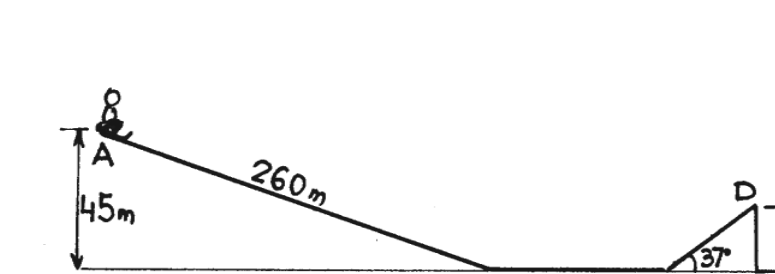
Topic: Conservation of Energy Metodi: Energy Conservation Method, Kinematic Equations Competenze: Physical Reasoning Objects: Block, Inclined Plane Fonte: Testo (PDF) — p.5
PT115. Istituto Primo Capraro
San Carlo di Bariloche, Rio Negro.
Sfruttando la neve. Approfittando della buona stagione di neve sulla collina della Cattedrale, abbiamo deciso di fare Le nostre prime incursioni in snowboard, e per questo ci dirigiamo alla pista. preparata specialmente per i principianti. Tale pista consiste in un tratto AB con una pendenza lunga 260 m e un’aria svantaggiata di 45 m, che si spalla con un tratto orizzontale BC la cui lunghezza è di 40 m per poi affrontare l’ascesa di una pendola CD che forma un angolo di 37° con l’orizzontale e sale ad una altezza di 25 m. I principianti che si osano potranno fare un salto da D a E. su una superficie orizzontale. (vedi figura).
102 - OAF 2015
Come prima esperienza ci lasciamo scivolare partendo dal riposo in A. Supponiamo che che la frizione tra la tavola e la neve è sconsiderata, come il rasare con il aria, si chiede: a) Determinare la velocità della trama BC. b) Determinare la velocità con cui arriva al punto D. c) Trovare il tempo di volo tra D e E e la distanza orizzontale tra D e E, (alquanta) A causa del traumatico cadere della prima esperienza, abbiamo deciso di consultarci per fare frottare la tavola con la neve ma solo nel tratto orizzontale BC. Dato che Il coefficiente di attrito in questo tratto BC è μ = 0,25 e la nostra massa è di 78 kg mentre la tabella è di 2 kg, si chiede: d) Calcolare la portata. Non mi rallegro della seconda traumatica esperienza per il colpo (anche se minore) In questo caso, abbiamo deciso di fare un’arrestazione della tavola contro la neve. Il nostro obiettivo è di fermarci al punto D e evitare il salto DE che non ci viene. Dominiamo bene . Per questo caso si chiede: (e) Determinare il coefficiente di rottura minimo che avrebbe portato ad un arresto a D, Considerando che c’è attrito in tutto il percorso. Felici di aver raggiunto con successo il nostro obiettivo, ci siamo chiesti: f) Supponendo che tutto il calore generato dalla frizione sia stato utilizzato per riscaldare il Il tempo di calore del ghiaccio, quanti grammi di acqua liquida si otterrebbero, se la temperatura del ghiaccio e L’acqua è di 0° C e il calore latente di fusione del ghiaccio è di 80 cal/g. Dati: utilizzare: g = 10 m/s2. 1 cal = 4.182 J
Topic: Conservation of Energy Metodi: Energy Conservation Method, Kinematic Equations Competenze: Physical Reasoning Objects: Block, Inclined Plane Fonte: Testo (PDF) — p.5
PT115. The first is the Capraro Institute.
St. Charles of Bariloche, Rio Negro.
Taking advantage of the snow. Taking advantage of the good snow season on Cathedral Hill, we decided to do Our first snowboarding rides, and so we headed to the track. It’s designed especially for beginners. This track consists of an AB section with a slope of 260 m long and a slope of 45 m, which splits smoothly with A horizontal stretch of BC whose length is 40 m to then face the ascent of a a CD slope forming a 37° angle with the horizontal and rising to a height of 25 m. Those beginners who dare can make a jump from D to fall into E. on a horizontal surface. (see figure).
The following points shall be added:
As a first experience we let ourselves slip away from rest on A. Assuming that That the friction between the board and the snow is despicable, as is the friction with the Air, it is asked: (a) Determine the speed at which the BC section travels. (b) Determine the speed at which it reaches point D. (c) Find the flight time between D and E and the horizontal distance between D and E, (Sighs) Because of the traumatic fall of the first experience, we decided to consult for The table is to be rubbed with snow but only on the horizontal stretch BC. Since The coefficient of friction in that stretch BC is μ = 0.25 and also our mass is 78 kg while the table is 2 kg, ask: (d) Calculate the scope. I do not agree with the second traumatic experience of the stroke (though minor) The first thing we decided to do was to rub the table against the snow. All along, with the aim of stopping at point D and avoiding the LE jump that didn’t We ‘re good at it . In this case, the following questions are asked: (e) Determine the minimum coefficient of friction that would cause it to stop at D, Considering there’s friction all the way through. Happy to have achieved our goal successfully we asked ourselves: (f) Assuming that all the heat generated by the friction was used to heat the ice, how many grams of liquid water would be obtained, if the temperature of the ice and The air content is 0° C and the latent heat of ice melting is 80 cal/ g. Data: use: g = 10 m/s2. 1 cal = 4,182 J
Topic: Conservation of Energy Metodi: Energy Conservation Method, Kinematic Equations Competenze: Physical Reasoning Objects: Block, Inclined Plane Fonte: Testo (PDF) — p.5
PT116. Instituto Primo Capraro
San Carlos de Bariloche, Río Negro.
Camino complicado. De regreso de las pistas de esquí un amplio sector de la ruta se encuentra con mucho hielo y por lo tanto con rozamiento despreciable entre el piso y los neumáticos. Al llegar al cruce, intentamos, pero el automóvil se desliza por el hielo con una velocidad de 18 km/h haciendo impacto en otro vehículo de igual masa que se encontraba detenido en el cruce. Como consecuencia del impacto, ambos automóviles permanecen unidos luego de la colisión. Determinar: a) La velocidad de ambos vehículos luego del choque. b) Si la masa del auto que se encuentra detenido es el doble de la de nuestro auto, ¿cuál sería la velocidad de ambos luego del choque si también permanecieran unidos?. Una de las formas de aumentar el rozamiento con el hielo, consiste en utilizar cadenas que rodean a las cubiertas del automóvil. Suponiendo que el auto que se encontraba detenido usara cadenas y para el caso calculado en el punto a) suponiendo que el coeficiente de rozamiento es de 0,0625 y la masa de cada auto es de 800 kg, se pide determinar: c) la distancia recorrida por el conjunto luego del choque, hasta detenerse. Por desgracia, después de chocar con el primer auto y permanecer unidos, una camioneta que viajaba por la calle transversal con una velocidad de 27 km/h impacta
OAF 2015 - 103 contra el conjunto. Sabiendo que la masa de la camioneta es el triple que la de uno de los autos y despreciando el rozamiento: d) calcular el módulo y la dirección de la velocidad de los tres vehículos luego de la segunda colisión, si permanecen unidos luego de la misma. e) ¿cuál debería ser la velocidad de la camioneta antes del choque para que luego de la colisión los tres vehículos se desplacen en una dirección que forma 45° con la que traían antes de chocar?
Topic: Conservation of Momentum Metodi: Conservation of Momentum, Vector Decomposition Competenze: Physical Reasoning Objects: Cart Fonte: Testo (PDF) — p.5
PT116. Istituto Primo Capraro
San Carlo di Bariloche, Rio Negro.
Cammino complicato. Di ritorno dalle piste di sci un ampio settore del percorso si trova con un sacco ghiaccio e quindi con scarsa rottura tra il pavimento e le gomme. Arrivati al Ci siamo provato, ma la macchina si scivola sul ghiaccio a 18 km/h. colpendo un altro veicolo di massa simile che era fermo al punto di passaggio. Come conseguenza dell’impatto, le due auto rimangono unite dopo la colpissione. Determinare: a) La velocità di entrambi i veicoli dopo l’impatto. b) Se il peso della macchina in sospensione è doppio di quello della nostra auto, Qual è la velocità di entrambi dopo l’incidente se anche loro restassero? Uniti? Uno dei modi per aumentare il ruggine con il ghiaccio è utilizzare catene. che circondano le coperture delle auto. Supponiamo che la macchina che si trovava Il detenuto deve usare catene e per il caso calcolato in (a) Il coefficiente di rottura è di 0,0625 e la massa di ogni auto è di 800 kg, si richiede determinare: c) la distanza percorsa dall’insieme dopo l’impatto fino all’arresto. Purtroppo, dopo aver colpito la prima macchina e rimanere uniti, una camionetta che viaggiava sulla strada trasversale con una velocità di 27 km/h impatto
OAF 2015 - 103 contro l’insieme. Sapendo che il camion è triplo di più di uno dei due. Auto e disprezzo il rasare: (d) calcolare il modulo e la direzione della velocità dei tre veicoli dopo il Se dopo la seconda collisione restano uniti. e) quale dovrebbe essere la velocità del furgone prima dell’impatto in modo che dopo la collisione i tre veicoli si spostano in una direzione che forma 45° con la che portavano prima del colpo?
Topic: Conservation of Momentum Metodi: Conservation of Momentum, Vector Decomposition Competenze: Physical Reasoning Objects: Cart Fonte: Testo (PDF) — p.5
PT116. The first is the Capraro Institute.
St. Charles of Bariloche, Rio Negro.
It’s a complicated road. Back from the ski slopes a wide section of the route is full of ice and therefore with despicable friction between the floor and the tires. When I get to the We’re trying to cross, but the car slides through the ice at a speed of 18 km/h. impacting another vehicle of equal mass that was stopped at the crossing. As a result of the impact, the two cars remain united after the The collision. Determine: (a) The speed of both vehicles after the collision. (b) If the mass of the car that is stopped is twice that of our car, What would be the speed of both of them after the crash if they also stayed? United? One way to increase ice rubbing is to use chains. They’re all around the car decks. Assuming the car was found The arrested person shall use chains and for the case calculated in point (a) assuming that the The friction coefficient is 0.0625 and the mass of each car is 800 kg, please determine: (c) the distance travelled by the assembly after the impact until it has stopped. Unfortunately, after hitting the first car and staying together, a A truck that was travelling on the cross street at a speed of 27 km/h impacts
The following points shall be added: against the whole. Knowing that the mass of the van is three times that of one of the Car and scorn the grating: (d) calculate the speed module and direction of the three vehicles after the Second collision, if they stay together after that. (e) what should be the speed of the van before the collision so that after the collision the collision the three vehicles are moving in a direction that forms 45° with the What were they bringing before the crash?
Topic: Conservation of Momentum Metodi: Conservation of Momentum, Vector Decomposition Competenze: Physical Reasoning Objects: Cart Fonte: Testo (PDF) — p.5
PT117. Instituto Primo Capraro
San Carlos de Bariloche, Río Negro.
Midiendo longitud de manera rebuscada. El ingeniero en materiales tuvo un día complicado y que mejor que un buen mate para renovar fuerzas y empezar de nuevo. Al regresar a su laboratorio se propone calentar agua, y como para colmo de males le cortaron el gas por falta de pago, decide hacerlo aprovechando un cable de un nuevo material que está investigando y que se compone de 40% de Níquel y 60% de Cobre. Dicho cable será usado como resistencia conectada a una batería de 12 V con que cuenta en el laboratorio. Sabiendo que la densidad del níquel es Ni = 8,9 g/cm3 y la del cobre es Cu = 8,96 g/cm3, y que la densidad del alambre cumple con la regla de la mezcla (proporcionalidad): a) Calcular la densidad del alambre. Para determinar el largo del cable, al no contar con la cinta métrica, que le robaron la noche anterior, y teniendo una balanza que permite medir un rango entre 200 g y 400 g, aprovecha sus conocimientos del principio de Arquímedes para determinar el largo del cable. Coloca un recipiente con agua sobre la balanza haciendo una lectura de 243,28 g. Luego enrolla el cable, le ata un hilo muy fino y sumerge totalmente el cable en el agua sin que toque el fondo del recipiente. En esta situación la balanza acusa 244,82 g. Ver figura:
Sabiendo que la densidad del agua es de 1 g/cm3, y que el diámetro del cable es de 1 mm: b) determinar el largo del cable. c) determinar la masa del cable. Este cable cumplirá la función de resistencia eléctrica en un calentador eléctrico conectado a la batería de 12 V. Una de las principales propiedades que tiene el material del cable es que su resistencia eléctrica permanece constante con la temperatura. Sabiendo que la resistencia de un alambre cumple la siguiente ecuación: A l R donde es la resistividad del material que equivale a m mm2 50 ,0 , l es el largo del cable y A el área de la sección transversal, calcular: d) la resistencia eléctrica del cable. e) La potencia eléctrica del calentador.
104 - OAF 2015 Si suponemos que todo el calor suministrado por el calentador se utiliza para calentar medio litro de agua y llevarla de una temperatura inicial de 16° C a 82° C (ideal para un buen mate) y que el calor específico del agua es de 1 cal / g °C: f) ¿cuánto tiempo le demandará al ingeniero calentar el agua para tomarse el primer matecito?. Si al ingeniero lo pasan a buscar para llevarlo a su casa 15 minutos después de haber colocado el agua a calentar ¿alcanzará a saborear el primer mate?. Recordar que 1 cal = 4,182 J.
Topic: Fluid Mechanics, Circuits Metodi: Hydrostatic Equilibrium, First Law of Thermodynamics Competenze: Physical Reasoning Objects: Wire, Resistor Fonte: Testo (PDF) — p.5
PT117. Istituto Primo Capraro
San Carlo di Bariloche, Rio Negro.
Misurando la lunghezza in modo incrociato. L’ingegnere di materiali ha avuto una giornata complicata e che meglio di un buon mate per rinnovare le forze e ricominciare da capo. Tornando al suo laboratorio si propone di riscaldare. E come per il male che ha fatto, gli hanno tagliato il gas per mancanza di pagamento, decide di farlo. Attraverso un cavo di un nuovo materiale che sta studiando e che è composto da 40% di nichel e 60% di rame. Tale cavo sarà utilizzato come resistenza collegata a una batteria da 12 V che ha in laboratorio. Sapendo che la densità del nichel è Ni = 8,9 g/cm3 e quella del rame è Cu = 8,96 g/cm3, e che la densità del filo soddisfi la regola della miscela (proporzionalità): a) Calcolare la densità del filo. Per determinare la lunghezza del cavo, non avendo la cinta metrica, gli sono state rubate la… la notte precedente, e con una bilancia che permette di misurare un intervallo tra 200 g e 400 g, La sua conoscenza del principio di Archimede per determinare il lungo periodo di Cable. Metti un contenitore con acqua sulla bilancia facendo una lettura di 243,28 g. Poi arrotola il cavo, lo lega con un filo molto sottile e lo immerge completamente nell’acqua. senza toccare il fondo del recipiente. In questa situazione la bilancia accusa 244,82 g. Vedi figura:
Sapendo che la densità dell’acqua è di 1 g/cm3, e che il diametro del cavo è di 1
mm:
b) determinare la lunghezza del cavo.
c) determinare la massa del cavo.
Questo cavo svolgerà la funzione di resistenza elettrica in un caldaio elettrico
collegato alla batteria da 12 V. Una delle proprietà principali del materiale
La resistenza elettrica del cavo è costante con la temperatura.
Sapendo che la resistenza di un filo soddisfa la seguente equazione:
A
l
R
dove
è la resistività del materiale che equivale a
m
mm2
50
,0
, l è la lunghezza del cavo e l’area
di sezione trasversale, calcolare:
d) resistenza elettrica del cavo.
e) Potenza elettrica del riscaldatore.
104 - OAF 2015 Se supponiamo che tutto il calore fornito dal riscaldatore sia usato per riscaldare mezzo litro di acqua e portarla da una temperatura iniziale di 16° C a 82° C (ideale per un il calore specifico dell’acqua è di 1 cal / g °C: f) Quanto tempo l’ingegnere deve impiegare per riscaldare l’acqua per prendere la prima volta Matto piccolo? Se l’ingegnere viene portato a casa sua in 15 minuti Dopo aver messo l’acqua a riscaldare, riuscirà a assaporare il primo?
- Matte? Ricordate che 1 cal è pari a 4.182 J.
Topic: Fluid Mechanics, Circuits Metodi: Hydrostatic Equilibrium, First Law of Thermodynamics Competenze: Physical Reasoning Objects: Wire, Resistor Fonte: Testo (PDF) — p.5
PT117. The first is the Capraro Institute.
St. Charles of Bariloche, Rio Negro.
Measuring length in a crawling manner. The materials engineer had a rough day and better than a good mate for it. renew your strength and start again. When he returns to his lab he proposes to heat up . Water, and as a matter of fact, he was cut off from gas for nonpayment, he decides to do it. Using a cable from a new material you’re researching and consisting of 40% nickel and 60% copper. Such cable shall be used as resistance connected to A 12V battery that you have in the lab. Knowing that the density of nickel is Ni = 8.9 g/cm3 and that of copper is Cu = 8.96 g/cm3, and that the density of the wire meets the mixture rule (proportion): (a) Calculate the density of the wire. To determine the length of the cable, not having the tape measure, they stole the cable. the previous night, and having a scale that allows measuring a range of 200 g to 400 g, The study of the longevity of the human body is based on the knowledge of the Archimedes principle. cable. Place a container of water on the scale by reading 243.28 g. Then he rolls the cable, ties it up with a very fine thread and plunges the cable completely into the water. without touching the bottom of the container. In this situation the balance accuses 244.82 g. See Figure:
Knowing that the density of the water is 1 g/cm3, and that the diameter of the cable is 1
mm:
(b) determine the length of the cable.
(c) determine the mass of the cable.
This cable will perform the function of electrical resistance in an electric heater
connected to the 12 V battery. One of the main properties of the material.
The power of the cable is that its electrical resistance remains constant with temperature.
Knowing that the resistance of a wire meets the following equation:
A
l
R
where
is the resistivity of the material that is equal to
m
mm2
50
,0
, l is the length of the cable and A is the area
of the cross section, calculate:
(d) the electrical resistance of the cable.
(e) The electrical power of the heater.
The following points shall be added: If we assume that all the heat supplied by the heater is used to heat half a liter of water and take it from an initial temperature of 16° C to 82° C (ideal for a good mate) and that the specific heat of the water is 1 cal / g °C: (f) how long will it take the engineer to heat the water to take the first time What’s that? If the engineer gets picked up to take him home in 15 minutes After you put the water to heat, will you be able to taste the first? I’m not going to kill you. Remember that 1 cal is 4,182 J.
Topic: Fluid Mechanics, Circuits Metodi: Hydrostatic Equilibrium, First Law of Thermodynamics Competenze: Physical Reasoning Objects: Wire, Resistor Fonte: Testo (PDF) — p.5
PT118. Colegio Pablo Apóstol1 - Colegio del Sol2
Yerba Buena1 - San Miguel2, Tucumán.
El Átomo Clásico y sus Problemas. En los albores de las investigaciones sobre el átomo, a principios del siglo XX, se pensaba que éste tenía una estructura similar a un sistema planetario con un núcleo en el centro, muy pesado y cargado positivamente, y los ligeros electrones girando a su alrededor, ligados por la atracción de Coulomb (Fig. 1 – Visión clásica del átomo de Hidrógeno, con un protón en el núcleo y un único electrón orbitando, ubicado a una distancia r ). Pronto se descubrió que las cosas no podían ser tan simples: las cargas eléctricas cuando se mueven con aceleración, como los electrones orbitando alrededor del núcleo (aceleración centrípeta), pierden energía en forma de radiación electromagnética, llamada Radiación de Larmor, por lo que los electrones atómicos precipitarían hacia el núcleo en trayectoria espiral en un tiempo muy breve (ver Fig. 2). Está claro que no sucede así, puesto que la materia normal es estable y todos estamos aquí. La idea de este problema es realizar una estimación clásica y no relativista del tiempo que tardaría en aniquilarse un átomo de hidrógeno según las teorías clásicas de la mecánica y el electromagnetismo, partiendo del hecho de que la energía de ionización (la energía necesaria para arrancar el electrón)de un átomo de hidrógeno en su estado fundamental es 13 eV .6 Ioniz E .
a) Suponiendo que la órbita del electrón es circular de radio r , obtenga las expresiones de la energía total del electrón E , de su velocidad v , de su aceleración a y de su período de rotación T , en función de la energía total 0 E del átomo de Hidrógeno en el estado fundamental, y del radio 0r de la órbita circular en dicho estado.
Ayuda: para resolver este inciso recomendamos primero escribir la energía mecánica total del electrón en una órbita de radio r , luego utilizar que la Fuerza de atracción Newtoniana es la Fuerza Centrípeta y así van llegar a una expresión para E. La energía 0 E es la que se obtiene particularizando 0 r r . Como la energía de ionización es la mínima energía que hay que entregarle al átomo para arrancarle el electrón, podemos escribir: 0 0 13.6e 0 V Ioniz Ioniz E E E E
Fig 2 – En el modelo atómico de Rutherford, los electrones deberían perder gradualmente energía y caer sobre el núcleo positivo
OAF 2015 - 105 b) Determinar y calcular 0r así como la velocidad, la aceleración y el período en esta órbita 0 0 0 , y v a T .
Cuando un electrón se mueve con aceleración a , la potencia radiante que emite viene dada por la Fórmula de Larmor: 2 2 3 2 3 ke c P a
en donde k es la constante de Coulomb, c es la velocidad de la luz y e es la carga del electrón.
c) Al perder energía, el electrón irá describiendo órbitas de radio cada vez menor. Encontrar la expresión de la potencia emitida P en función del radio r de la órbita circular del electrón, de 0r y de 0 E .
A partir de los resultados obtenidos en a) y c) es posible encontrar una expresión para el tiempo que le tomaría a un electrón ―caer‖ sobre el núcleo desde el estado fundamental de radio 0r : 3 2 0 2 0 1 16 e c m r E
d) ¿Cuál es el tiempo que le tomaría a un electrón ―caer‖ sobre el núcleo desde la órbita del estadio fundamental de radio 0r ?
Conclusión: si llegaste al final del problema, pudiste comprobar que la vida de un átomo según la teoría clásica es muy corta. El átomo clásico es un fracaso. La Teoría Cuántica es la que describe correctamente la estabilidad de la materia, prediciendo además las propiedades de los átomos.
Datos:
-
Correlación entre eV y J 19 eV 1,60x10 J 1
-
Masa del electrón 31 x10 k 1 g 9,1 e m
-
Constante de Coulomb 9 2 2 x10 Nm C 8,99 / k
-
Velocidad de la Luz 8 x10 3, / 00 m s c
-
Carga elemental del electrón 19 x10 1,60 C e
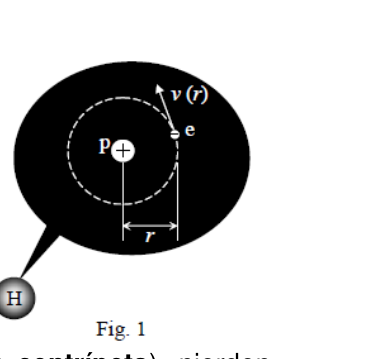
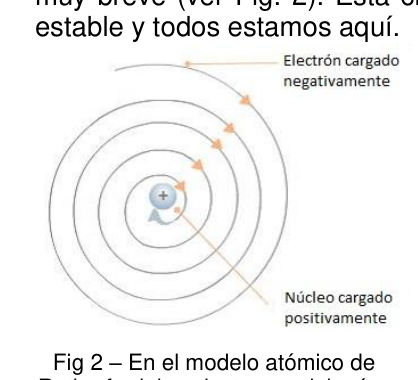
Topic: Modern-Quantum Physics, Electrostatics Metodi: Coulomb’s Law, Calculus-Integration Competenze: Physical Reasoning, Mathematical Modeling Objects: Electron, Nucleus Fonte: Testo (PDF) — p.5
PT118. Colegio Paolo Apóstol1 - Colegio del Sole2
Erba Buena1 - San Miguel2, Tucumán.
L’atomo classico e i suoi problemi. All’inizio delle ricerche sull’atomo, All’inizio del XX secolo, si pensava che questo avesse una struttura simile a un sistema planetario con un nucleo nel centro, molto pesante e carica positivamente, e le leggere elettroni che girano intorno a loro, legati dall’attrazione di Coulomb (Fig. 1 Visione classica dell’atomo di idrogeno, con un protone nel nucleo e un singolo elettrone orbitante, situato a una distanza r). Presto si scoprì che le cose non potevano essere così semplici: le cariche elettriche quando si muovono con accelerazione, Come gli elettroni che orbitano intorno al nucleo (accelerazione centripeta), perdono energia sotto forma di radiazioni elettromagnetiche, chiamata radiazioni di lacrime, Gli elettroni atomici precipiterebbero verso il nucleo in una traccia spirale in un certo tempo. molto breve (vedi Figura 1. 2). È chiaro che non succede così, poiché la materia normale è Stabile e siamo tutti qui. L’idea di questo problema è di fare una stima La classica e non relativista del tempo che ci vorrebbe in annientare un atomo di idrogeno secondo le teorie. classiche della meccanica e dell’elettromagnetismo, La Commissione ha adottato una decisione che prevede che l’energia di ionizzazione (la energia necessaria per far partire l’elettrone di un atomo de
- l’idrogeno en su stato fondamentale es 13 eV .6 Ionizzazione E .
a) Supponendo che l’orbita dell’elettrone sia circolare di radio r , ottieni le espressioni dell ’ energia totale del E , della sua velocità v , della sua accelerazione a e di il suo periodo di rotazione T , in funzione della potenza totale 0 E dell’atomo di idrogeno nello stato fondamentale, e del radio. 0r di orbita circolare in tale stato.
Aiuto: per risolvere questo inciso raccomandiamo di scrivere prima l’energia meccanica totale dell’elettrone in un’orbita radio r , quindi utilizzare la forza di attrazione Newton è la forza centripetata e così arrivano ad un’espressione per E. L’energia 0 E questo è quello che si ottiene particellarizzando. 0 r r . Poiché l’energia di ionizzazione è la minima energia che si deve consegnare all’atomo. Per far partire l’elettrone, possiamo scrivere: 0 0 13.6e 0 V Ionizzazione Ionizzazione E E E E
Fig 2 Nel modello atomico di Rutherford, gli elettroni dovrebbero…
- la perdita di energia gradualmente cadere sul nucleo positivo
OAF 2015 - 105 b) Determinare e calcolare 0r, nonché la velocità, l’accelerazione e il periodo in questa Orbita 0 0 0 , y v a T .
Quando un elettrone si muove ad accelerare a , la potenza radiante emessa viene data dalla Formula di Larmor: 2 2 3 2 3 ke c P a
dove k è la costante di Coulomb, c è la velocità della luce e e è la carica di l’elettrone.
c) Perdere energia, l’elettrone descriverà orbite radio sempre più ridotte. Trovare l’espressione della potenza emessa P in funzione del raggio r dell’orbita Circolare di elettrone, di 0r e di 0 E .
A partire dai risultati ottenuti in a) e c) è possibile trovare un’espressione per il tempo che ci vorrebbe un elettrone per cadere sul nucleo dallo stato fondamentale di radio 0r: 3 2 0 2 0 1 16 e c m r E
d) Qual è il tempo che ci vorrebbe per un elettrone di cadere sul nucleo dal Orbita dello stadio fondamentale di radio 0r ?
Conclusione: se siete arrivati alla fine del problema, potete provare che la vita di un atomo Secondo la teoria classica è molto breve. L’atomo classico è un fallimento. La teoria quantistica La struttura di una struttura di massa è quella che descrive correttamente la stabilità della materia, prevedendo inoltre le proprietà degli atomi.
Datati:
-
Correlazione tra eV e J 19 eV 1,60x10 J 1
-
Massa dell’elettrone 31 x10 k 1 g 9,1 e m
-
Costante di Coulomb 9 2 2 x10 Nm C 8,99 / k
-
Velocità della luce 8 x10 3, / 00 m s c
-
Carga elementare dell’elettrone 19 x10 1,60 C e
Topic: Modern-Quantum Physics, Electrostatics Metodi: Coulomb’s Law, Calculus-Integration Competenze: Physical Reasoning, Mathematical Modeling Objects: Electron, Nucleus Fonte: Testo (PDF) — p.5
PT118. The school of the apostle Paul1 - College of the sun2
We’re going to get a new one.
The Classic Atom and its Problems. In the early days of atomic research, In the early 20th century, it was thought that this one had a structure similar to a planetary system with a nucleus in the center, very heavy and positively charged, and the lighter ones electrons spinning around them, bound by the attraction of The Commission has not yet adopted a proposal for a regulation. 1 Classic view of the hydrogen atom, with A proton in the nucleus and a single electron orbiting, located at a distance r). It soon became clear that things couldn ‘t be as simple as this: electrical charges when moving at acceleration, As electrons orbiting around the nucleus (centipede acceleration), they lose. energy in the form of electromagnetic radiation, called laughter radiation, so atomic electrons would rush into the nucleus in a spiral path at a time. The following table shows the results of the study: 2). It’s obviously not like that, since normal matter is stable and we’re all here. The idea of this problem is to make an estimate. The classical and non-relativist of the time it would take in Theories are there to destroy a hydrogen atom. The classics of mechanics and electromagnetism, The first is that the energy from ionization (ionization) is not a energy needed to start the electron from an atom. de Hydrogen en su State of the Union The key es 13 eV .6 Other E .
(a) Assuming that the electron’s orbit is circular from Radio r , get the expressions of the total energy of the electron E , its velocity v , its acceleration a and of its rotation period T , depending on the total energy 0 And the hydrogen atom in the fundamental state, and the radio. 0r of orbit circulating in that state.
Help: to solve this incision we recommend first writing mechanical energy total electron in a radio orbit r , then use that gravitational force Newtonian is the centrifugal force and so they’re going to come up with an expression for E. The energy 0 And that ‘s what you get for particularizing . 0 r r . Because the ionization energy is the minimum energy that you have to deliver to the atom. To start the electron, we can write: 0 0 13.6e 0 V Other Other E E E E
Fig 2 In the atomic model of Rutherford, the electrons should be gradually lose energy and Falling on the positive core
The following points shall be added: (b) Determining and calculating 0r as well as the speed, acceleration and period in this orbit 0 0 0 , y v a T .
When an electron moves with acceleration to , the radiant power it emits comes . given by the Lacrimal formula: 2 2 3 2 3 ke c P a
where k is Coulomb’s constant, c is the speed of light and e is the charge of electron.
c) As the electron loses energy, it will describe ever smaller radio orbits. Find the expression of the emitted power P in terms of the radius r of the orbit The electron cycle, of 0r and of 0 E .
From the results obtained in (a) and (c) it is possible to find an expression for the time that would take an electron to fall over the nucleus from the fundamental state 0r radio: 3 2 0 2 0 1 16 e c m r E
d) What time would it take an electron to fall over the nucleus from the orbit of the fundamental radio 0r stage ?
Conclusion: if you got to the end of the problem, you could test that the life of an atom According to classical theory, it’s very short. The classic atom is a failure. The quantum theory . It is the one that correctly describes the stability of matter, and also predicts the properties of atoms.
The data:
-
Correlation between eV and J 19 eV 1,60x10 J 1
-
Mass of the electron 31 x10 k 1 g 9,1 e m
-
Coulomb constant . 9 2 2 x10 Nm C 8,99 / k
-
Speed of light . 8 x10 3, / 00 m s c
-
Elemental charge of the electron 19 x10 1,60 C e
Topic: Modern-Quantum Physics, Electrostatics Metodi: Coulomb’s Law, Calculus-Integration Competenze: Physical Reasoning, Mathematical Modeling Objects: Electron, Nucleus Fonte: Testo (PDF) — p.5
PT119. Colegio Pablo Apóstol
Yerba Buena, Tucumán.
Problemas Térmicos. Alejado de la sociedad, en el medio de una distante montaña vive un físico en su cabaña. Todos los días debe afrontar diferentes retos, que van desde lograr conseguir alimentos, hasta el hecho de hallar un modo de cocinarlos… Pero el más grande de todos sus dramas radica en mantener su hogar calentito. Suponga que las dimensiones de su cabaña son 5,00 m de alto, 8,00 m de ancho y 10,0 m de largo.
106 - OAF 2015 a) ¿Cuánta energía en forma de calor debe entregarse al aire dentro de la cabaña para elevar su temperatura de 0ºC a 25ºC?
b) Calcule el tiempo que demora en alcanzar dicha temperatura si utiliza una estufa cuya potencia efectiva es de 500W
Pasado el tiempo calculado anteriormente, el físico descubre que la temperatura en su casa todavía no es la deseada. Esto se debe a las pérdidas de energía por conducción térmica desde la cabaña hacia fuera a través de las ventanas. Sabiendo que la potencia de transferencia de energía por conducción entre dos ambientes a distintas temperaturas está dada por:
Siendo k una constante de conductividad térmica propia del materia, A el área de contacto entre los ambientes y L la longitud del aislante entre ambos.
c) Calcular la potencia de pérdida de energía térmica a través de una ventana cuadrada de vidrio de 1,00 cm de espesor y 0,50 m de lado de la cabaña cuando ésta se encuentra a 25ºC si en el exterior la temperatura es de 6ºC. Considere 0,80 º VIDRIO W k m C .
d) Calcule nuevamente el tiempo empleado en calentar la habitación si la potencia efectiva de la estufa se ve reducida por la potencia de pérdida de energía por conducción térmica.
Otro drama para el físico montañista es encontrar una forma de calentar el agua para tomar café por las mañanas. Aprovechando los intensos rayos de Sol por las mañanas, ideó un sistema de calentamiento basándose en la energía radiante de la luz solar. Dicho sistema consiste en una antena parabólica que permite concentrar los rayos solares en un punto determinado: Suponiendo que la intensidad de radiación solar que llega a la Tierra en la montaña es de 2 600W m , y el calentador tiene un diámetro de 0,600 m. Considerando que el 40% de toda la energía incidente es transferida al agua en la tasa:
e) ¿Cuánto demora en llevar al punto de ebullición (suponga 100ºC) 0,500 L de agua en la tasa, inicialmente a 15,0ºC? (despreciar la capacidad calórica de la taza)
Por último, si en la taza con agua a 100ºC se coloca un cubo de 50,0g de hielo inicialmente a -10,0ºC.
f) Calcule la temperatura final del sistema Datos útiles:
3 1,29 AIRE kg m
0,350 º AIRE cal ce g C
2 1 T T P kA L
OAF 2015 - 107
Topic: Thermodynamics Metodi: First Law of Thermodynamics Competenze: Physical Reasoning Objects: Gas Fonte: Testo (PDF) — p.5
PT119. Colegio Paolo l’apostolo
- Buona erba, Tucumán.
Problemi termici. Distanti dalla società, nel mezzo di una lontano montagna vive un fisico in suo Cotta. Ogni giorno deve affrontare Diversi sfide, che vanno dal raggiungimento
- per ottenere cibo, fino al fatto di trovare un modo per cucinarli… Ma il più Il più grande dei suoi drammatici è il mantenere la sua casa calda. Supponiamo che le dimensioni del suo Cotta sono 5,00 m di altezza, 8,00 m di largo e lungo 10 metri.
106 - OAF 2015 a) Quanta energia in forma di calore deve essere consegnata all’aria all’interno della cabina per aumentare la temperatura da 0 °C a 25 °C?
b) Calcolare il tempo necessario per raggiungere tale temperatura se si utilizza un stufa di potenza effettiva di 500W
Dopo il tempo calcolato in precedenza, il fisico scopre che la temperatura al suo La casa non è ancora la desiderata. Questo è dovuto ai perditi di energia da guida. la temperatura dalla cabina verso l’esterno attraverso le finestre. Sapendo che la potenza di trasferimento di energia da conduzione tra due ambienti a diverse temperature è dato da:
Essendo k una costante di conducibilità termica propria della materia, A l’area di L’isolazione è la durata di un’isolazione.
c) Calcolare la potenza di perdita di energia termica attraverso una finestra quadrato di vetro di 1,00 cm di spessore e 0,50 m sul lato della cabina quando La temperatura è di 25°C se la temperatura è di 6°C all’esterno. Considerate 0,80 º VISTO W k m C .
d) Calcolare di nuovo il tempo impiegato per riscaldare la stanza se la potenza L’effetto di caldaia è ridotto dal potere di perdita di energia di la conduzione termica.
Un altro dramma per il fisico alpinista è trovare un modo per riscaldare l’acqua per prendere un caffè al mattino. Attraversando i forti raggi del sole nelle mattine, ha ideato un sistema di riscaldamento basato sull’energia radiante della luce solare. - Si ’ , si ’ . Il sistema consiste in un’antenna parabola che consente di concentrare i raggi solari in un determinato punto: Supponendo che l’intensità della radiazione solare che raggiunge la Terra In montagna è di 2 600W m , e il riscaldatore ha un diametro di 0,600 m. Considerando che il 40% di tutta l’energia incidente è trasferito in acqua al tasso:
e) Quanto tempo ci vuole per arrivare al punto di ebollizione (supponi 100°C) 0,500 litri di acqua al tasso, inizialmente a 15,0°C? (disprezzo) la capacità calorico della tazza)
Infine, se si mette in un bicchiere di acqua a 100°C un cubo di 50,0 g di ghiaccio inizialmente a -10,0oC.
f) Calcolare la temperatura finale del sistema Informazioni utili:
3 1,29 AIRE kg m
0,350 º AIRE cal ce g C
2 1 T T P kA L
OAF 2015 - 107
Topic: Thermodynamics Metodi: First Law of Thermodynamics Competenze: Physical Reasoning Objects: Gas Fonte: Testo (PDF) — p.5
PT119. Paul the Apostle College
It’s good grass, Tucumán.
Heat problems. Away from society, in the middle of a Far away mountain lives a physicist in his. The cabin. Every day you must face The European Union has a number of challenges, ranging from achieving The Commission has already adopted a number of proposals for a new directive on the protection of workers’ rights. I’m going to find a way to cook them. Greatest of all his dramas lies in Keep your home warm. Suppose the dimensions of your The cabin is 5.00 m high, 8.00 m high. wide and 10.0 m long.
The Commission shall adopt delegated acts in accordance with Article 21 of this Regulation. (a) How much heat energy should be delivered to the air inside the cabin? to raise its temperature from 0 to 25 degrees Celsius?
(b) Calculate the time it takes to reach this temperature if you use a stove. whose actual power is 500W
After the time calculated above, the physicist discovers that the temperature in his The house is not yet the desired. This is due to the energy losses from driving . Thermal from the cabin out through the windows. Knowing that the power transfer power by conduction between two Different temperature environments are given by:
Since k is a constant of thermal conductivity proper to matter, A is the area of contact between the environments and L the length of the insulator between them.
(c) Calculate the loss of thermal energy through a window square glass of 1,00 cm thickness and 0,50 m on the side of the cabin when This is 25°C if the outside temperature is 6°C. Consider 0,80 º Glass W k m C .
(d) Calculate again the time spent heating the room if the power is The efficiency of the stove is reduced by the energy loss potential of the the thermal conductivity.
Another drama for the mountaineering physicist is finding a way to heat the water for coffee in the morning. Taking advantage of the intense sunlight in the mornings, He devised a heating system based on the radiant energy of sunlight. That said . The system consists of a parabolic antenna which allows the sun’s rays to be concentrated in the a certain point: Assuming the intensity of solar radiation reaching Earth In the mountains it is from 2 600W m , and the heater has a diameter of 0,600 m. Considering that 40% of all incident energy is transferred to water at the rate:
(e) How long does it take to reach the boiling point (assume 100°C) 0,500 litres of water at the rate, initially at 15.0°C? (disdainfully) the caloric capacity of the cup)
Finally, if a bucket of 50.0 g of ice is placed in a cup of water at 100 °C initially at −10.0oC.
(f) Calculate the final temperature of the system Useful data:
3 1,29 The following is the list of airlines: kg m
0,350 º The following is the list of airlines: Cal ce g C
2 1 T T P kA L
The following points shall be added:
Topic: Thermodynamics Metodi: First Law of Thermodynamics Competenze: Physical Reasoning Objects: Gas Fonte: Testo (PDF) — p.5
PT120. Colegio Pablo Apóstol
Yerba Buena, Tucumán.
¡Felíz Cumple Oersted! Hans Christian Ørsted nació en Rudkobing, Dinamarca un día 14 de agosto de 1777, y murió en Copenhague el 9 de marzo de 1851. Este físico y químico danés fue un gran estudioso del electromagnetismo y hoy festejamos su 232º cumpleaños. Su principal descubrimiento tuvo lugar en 1819, cuando junto con André-Marie Ampère descubrió la desviación de una aguja imantada al ser colocada en dirección perpendicular a un conductor eléctrico, por el que circula una corriente eléctrica. Este descubrimiento fue crucial en el desarrollo de la electricidad, ya que puso en evidencia la relación existente entre la electricidad y el magnetismo.
En su honor, vamos a hacerle un pequeño homenaje analizando el comportamiento de esta manifestación tan particular de la materia como lo es la carga eléctrica. Primero supongamos que dos esferas metálicas pequeñas, cada una de masa 0,2g , están suspendidas como péndulos por medio de hilos ligeros desde un punto común. Las esferas tienen la misma carga eléctrica, y se comprueba que las dos alcanzan el equilibrio cuando cada hilo forma un ángulo de 5,0º con respecto a la vertical. Si cada hilo tiene una longitud de 30,0cm :
a) ¿Cuál es la magnitud de la carga de cada esfera?
A continuación se colocan cargas positivas en los tres vértices de un rectángulo.
b) Encontrar el campo eléctrico en el cuarto vértice Para complicar un poco más las cosas, supongamos que tres cargas positivas q están en las esquinas de un triángulo equilátero de lado a . Consideremos el campo eléctrico generado por esta distribución de cargas.
108 - OAF 2015
c) Encontrar un punto (distinto del ) donde el campo eléctrico sea nulo. (Consejo: dibujar las líneas de campo correspondientes a cada carga). d) ¿Cuál es la magnitud y dirección del campo eléctrico en P debido a las cargas de la base del triángulo?
Dos esferas de 0,2g están suspendidas por cuerdas ligeras de 10,0cm de longitud. Se aplicó un campo eléctrico uniforme en la dirección x. Si las esferas tienen cargas de 8 6,0 10 x C y 8 6,0 10 x C :
e) Determine la intensidad del campo eléctrico que permite que las esferas estén en equilibrio a 10º .
Por último, se coloca una esfera de corcho cargada cuya masa es de 1,00g suspendida en una cuerda ligera en presencia de un campo eléctrico uniforme. Cuando el campo eléctrico tiene una componente x de 5 3,00 10 N x C y una componente y de 5 5,00 10 N x C , la esfera está en equilibrio en 37,0º .
f) Encontrar la carga sobre la esfera y la tensión en la cuerda.
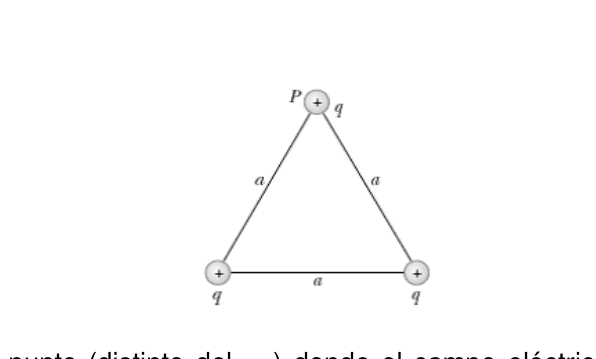
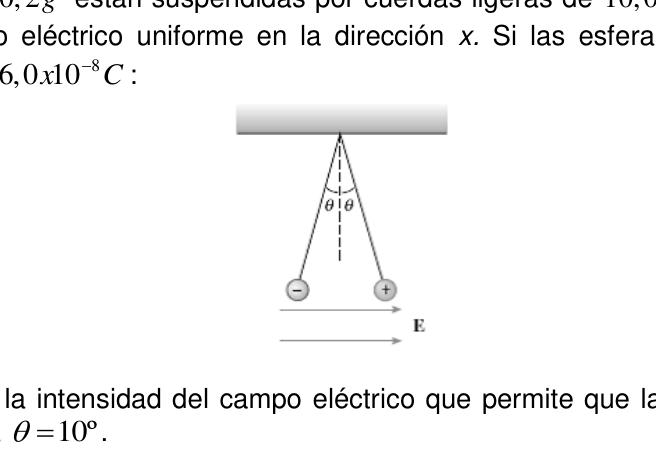
Topic: Electrostatics Metodi: Coulomb’s Law, Superposition Principle Competenze: Physical Reasoning Objects: Point Charge, Pendulum Fonte: Testo (PDF) — p.5
PT120. Colegio Paolo l’apostolo
- Buona erba, Tucumán.
Felice Cumple Oersted! Hans Christian Ørsted è nato a Rudkobing, Danimarca il 14 di agosto del 1777, e morì a Copenhagen il 9 marzo di 1851. Questo fisico e chimico danese fu un grande studioso del E oggi festeggiamo il suo 232° compleanno. Su La scoperta principale avvenne nel 1819, quando insieme con André-Marie Ampère ha scoperto la deviazione di un ago Magnetico quando posizionato in direzione perpendicolare a un un conduttore elettrico, attraverso il quale circola un corrente elettrica. Questo . La scoperta fu cruciale nello sviluppo dell’elettricità, poiché evidenziò la La relazione tra elettricità e magnetismo.
In suo onore, faremo un piccolo omaggio analizzando il comportamento di Questa manifestazione di materia è così particolare come la carica elettrica. Primo, supponiamo che due piccole sfere metalliche, ciascuna di massa 0,2 g, sono sospesi come pendoli con fili leggeri da un punto comune. Le Le sfere hanno la stessa carica elettrica, e si verifica che le due raggiungono il equilibrio quando ogni filo forma un angolo di 5,0° rispetto alla verticale. Se ogni il filo ha una lunghezza di 30,0 cm:
a) Qual è la grandezza del carico di ciascuna sfera?
Successivamente si collocano cariche positive sui tre vertici di un rettangolo.
b) Trovare il campo elettrico al quarto vertice Per complicare un po’ di più le cose, supponiamo che ci siano tre cariche positive q. nei angoli di un triangolo equilaterale a. Considerate il campo elettrico. generato da questa distribuzione di carichi.
108 - OAF 2015
c) Trovare un punto (diverso da ) in cui il campo elettrico è nullo. (Consego: il disegno delle linee di campo corrispondenti a ciascun carico). d) Qual è la magnitudine e la direzione del campo elettrico in P a causa delle cariche della base del triangolo?
Due sfere di 0,2 g sono sospese da corde leggere di 10,0 cm di lunghezza. Se applicato un campo elettrico uniforme nella direzione x. Se le sfere hanno cariche di 8 6,0 10 x C y 8 6,0 10 x C :
e) Determina l’intensità del campo elettrico che permette alle sfere di essere in equilibrio a 10º .
Infine, si inserisce una sfera di cork carica con una massa sospesa di 1,00 g in una corda leggera in presenza di un campo elettrico uniforme. Quando il campo elettrico ha un componente x di 5 3,00 10 N x C e un componente e di 5 5,00 10 N x C , la La sfera è in equilibrio a 37,0º .
f) Trovare la carica sulla sfera e la tensione nella corda.
Topic: Electrostatics Metodi: Coulomb’s Law, Superposition Principle Competenze: Physical Reasoning Objects: Point Charge, Pendulum Fonte: Testo (PDF) — p.5
PT120. Paul the Apostle College
It’s good grass, Tucumán.
Happy Cumple Oersted! Hans Christian Ørsted was born in Rudkobing, Denmark on 14th. He died in Copenhagen on 9 March 1777. 1851. This Danish physicist and chemist was a great scholar of the electromagnetism and today we celebrate his 232nd birthday. Su The main discovery took place in 1819, when together with André-Marie Ampère discovered the deviation of a needle. Magnetized when placed in a direction perpendicular to a an electrical conductor through which an electric current flows. This one . The discovery was crucial in the development of electricity, as it highlighted the The relationship between electricity and magnetism.
In his honor, let’s pay a small tribute by analyzing the behavior of This particular manifestation of matter is as particular as the electric charge. First let’s say that two small metal spheres, each 0.2g mass, They are suspended like pendants by means of light threads from a common point. The The spheres have the same electrical charge, and both are shown to reach the equilibrium when each strand forms an angle of 5.0° with respect to the vertical. If each The length of the thread is 30.0 cm:
(a) What is the magnitude of the load of each sphere?
Positive loads are then placed on the three vertices of a rectangle.
(b) Find the electric field at the fourth vertex. To complicate things a little bit more, let’s say there are three positive charges q. in the corners of an equilateral triangle on the side a . Consider the electric field. The result of this distribution of charges.
The Commission shall adopt delegated acts in accordance with Article 21 of Regulation (EU) No 1303/2013.
(c) Find a point (other than ) where the electric field is zero. (Thanks: draw the field lines for each load). (d) What is the magnitude and direction of the electric field in P due to the loads of the base of the triangle?
Two 0,2 g spheres are suspended by light strings of 10,0 cm in length. Se applied a uniform electric field in the direction x. If the spheres have loads of 8 6,0 10 x C y 8 6,0 10 x C :
(e) Determine the intensity of the electric field that allows the spheres to be in Balance to 10º .
Finally, a loaded cork sphere with a mass of 1,00 g suspended is placed in a light wire in the presence of a uniform electric field. When the field electrical has a component x of 5 3,00 10 N x C and a component and of 5 5,00 10 N x C , la The sphere is in equilibrium at 37,0º .
(f) Find the load on the sphere and the tension on the rope.
Topic: Electrostatics Metodi: Coulomb’s Law, Superposition Principle Competenze: Physical Reasoning Objects: Point Charge, Pendulum Fonte: Testo (PDF) — p.5
PT121. Colegio Del Sol
San Miguel, Tucumán.
Perdidos en la Montaña. Julio y José son dos amigos acampantes que se encuentran perdidos en la montaña, en pleno invierno y sin muchas provisiones restantes. Deciden no dejarse derrotar por las adversidades y comienzan a caminar por un sendero cuando, de repente, se dan cuenta que están parados en la cima de una colina cubierta de nieve. Para poder descender, construyen un trineo con unos troncos de madera:
OAF 2015 - 109
Si la masa total de los amigos y el trineo es 150 M kg
a) Determine la velocidad con la que llegan a la base de la colina si consideramos que ésta no ofrece resistencia por roce al trineo, su inclinación es de 30º y tiene una longitud 300 x m
b) Calcule la aceleración de descenso del trineo y demuestre que:
Al llegar a la base continúa deslizando sobre el suelo hasta que finalmente el roce con los detiene. Si el coeficiente de roce dinámico entre el trineo y el suelo rocoso es 0,50 : c) Calcule la distancia recorrida por el trineo con los campistas hasta detenerse por completo.
A continuación suponga que toda la energía disipada por el rozamiento es utilizada para fundir hielo a 0ºC . d) Obtenga la masa de hielo que se fundiría con dicha energía. Cuando están detenidos, los amigos continúan caminando sin perder la esperanza, hasta llegar a una zona despejada sin árboles. Para alegría de sus corazones, en ese preciso momento divisan a lo lejos un avión de rescate. Cuando el piloto los distingue en la nieve, deja caer un paquete con medicamentos y algo de provisiones, y luego cambia su rumbo para buscar a todo el equipo de rescate y llevar a los viajeros a casa.
Si el avión viaja a una altura de 500m y a una velocidad 150 x km v h . e) ¿A qué distancia x debe soltar la caja de provisiones para que ésta llegue a Julio y José?
Con los ánimos renovados al saber que el rescate está próximo, deciden descansar un poco y relajarse jugando con su trineo. Julio, cuya masa es de 60kg corre a una velocidad 6,00m v s y salta sobre el trineo de masa 30kg , inicialmente en reposo. Suponiendo que no existe movimiento relativo entre Julio y el trineo luego de que éste salta (no desliza sobre el trineo), y considerando despreciable el roce entre el trineo y el suelo: f) Determine el cambio del impulso lineal en el trineo, en el hombre y en el sistema trineo-hombre, y calcule la velocidad y energía cinética final del mismo.
trineo a gsen
110 - OAF 2015
Topic: Conservation of Energy, Conservation of Momentum Metodi: Energy Conservation Method, Conservation of Momentum Competenze: Physical Reasoning Objects: Block, Inclined Plane Fonte: Testo (PDF) — p.5
PT121. Colegio del Sol
San Miguel, Tucumán.
Perdi in montagna. Julio e Giuseppe sono due amici che camminano e si trovano persi in montagna, in… In pieno inverno e senza molte riserve rimanenti. Decidono di non lasciarsi sconfiggere dalle avversità e iniziano a camminare su un sentiero. Quando, all’improvviso, si rendono conto di essere in piedi sulla cima di una collina coperta di neve. Per poter scendere, costruiscono un bagliore con tronchi di legno:
OAF 2015 - 109
Se la massa totale degli amici e gli scivoli è 150 M kg
a) Determina la velocità con cui arrivano alla base della collina se consideriamo che La sua inclinazione è di 30º e ha una lunghezza 300 x m
b) Calcolare l’accelerazione di discesa del scheggiaio e dimostrare che:
Arrivata alla base continua a scivolare sul pavimento fino a quando non si sbatte con i
- Si ferma. Se il coefficiente di rottura dinamica tra gli scivoli e il suolo roccioso è 0,50 : (c) Calcolare la distanza percorsa dal bagliardo con i camper fino a fermarsi per Completamente.
Quindi supponi che tutta l’energia dissipata dal fratturazione sia usata per Fondersi ghiaccio a 0 ° C . d) Ottieni la massa di ghiaccio che si fonderebbe con tale energia. Quando sono arrestati, gli amici continuano. camminando senza perdere speranza, fino a raggiungere Una zona schietta senza alberi. Per la gioia dei suoi I cuori, proprio in quel momento, vedono il lontano un aereo di salvataggio. Quando il pilota le ha Si distingue nella neve, lascia cadere un pacchetto con farmaci e qualche provvista, e poi cambia.
- E’ il suo corso per cercare l’intero team di salvataggio. portare i viaggiatori a casa.
Se l’aereo viaggia ad un’altezza di 500 metri e a un’altezza di velocità 150 x km v h . e) A che distanza x deve essere rilasciata la cassa di Provviste per il suo arrivo a luglio e
- José?
Con il rinnovato spirito sapendo che il salvataggio è vicino, decidono di riposare un giorno. poco e rilassarsi giocando con il suo scivolo. Julio, il cui peso è di 60 kg corre a una velocità 6,00m v s e salta sul baglione di massa 30kg , Inizialmente en Riposo. Supponendo che non ci sia movimento relativo Tra Giulio e gli scivoli dopo che questo salta (non scivola sul baglietto), considerando sconsiderato il rottura tra gli scivoli e il suolo: f) Determina il cambiamento di impulso lineare in sciatto, in uomo e in sistema gli uomini e calcola la velocità e l’energia cinetica finale di questo.
trineo a Gsen
110 - OAF 2015
Topic: Conservation of Energy, Conservation of Momentum Metodi: Energy Conservation Method, Conservation of Momentum Competenze: Physical Reasoning Objects: Block, Inclined Plane Fonte: Testo (PDF) — p.5
PT121. College of the Sun
San Miguel, Tucumán.
Lost in the Mountain. Julio and Joseph are two camping friends who find themselves lost in the mountains, in Full winter and without much leftover supplies. They decide not to be defeated by adversity and begin to walk a path . When, suddenly, they realize they’re standing on top of a covered hill. Snow. To get down, they build a sled with wooden logs:
The following points shall be added:
If the total mass of the friends and the sled is 150 M kg
(a) Determine the speed at which they reach the base of the hill if we consider that This one does not offer friction resistance to sliding, its inclination is of 30º And he has a length 300 x m
(b) Calculate the downhill acceleration of the sled and demonstrate that:
When you reach the base, you keep sliding on the ground until you finally rub it with the ground. It stops. If the dynamic friction coefficient between the slide and the rocky ground is 0,50 : (c) Calculate the distance travelled by the skis with the campers until they stop by It’s complete.
It then assumes that all the energy dissipated by the grinding is used for melting ice at 0 ° C . (d) Obtain the mass of ice that would melt with that energy. When they’re arrested, friends keep going. Walking without losing hope, until we reach A clear area without trees. For the joy of theirs hearts, at that very moment they see what A rescue plane is far away. When the pilot gets them It distinguishes in the snow, dropping a package with Medication and some supplies, and then change. Your way to search for the entire rescue team and Take the travelers home.
If the plane travels at an altitude of 500m and a speed 150 x km v h . (e) How far away should x let the box of Provisions for the July and
- What?
With their spirits renewed, knowing that redemption is near, they decide to rest a day. Little and relax playing with his sled. July, whose weight is 60kg runs to one. speed 6,00m v s And jumps on the sleigh of Mass 30kg , Initially en I’m going to rest. Assuming there is no relative motion Between July and the sled after he jumps. (does not slide over the sleigh), and The friction between the sleigh and the ground is despicable: (f) Determine the change in linear momentum in sledding, in man and in the system and calculate the final speed and kinetic energy of the same.
Slinging a The Commission shall adopt implementing acts.
The following points shall be added:
Topic: Conservation of Energy, Conservation of Momentum Metodi: Energy Conservation Method, Conservation of Momentum Competenze: Physical Reasoning Objects: Block, Inclined Plane Fonte: Testo (PDF) — p.5
PT122. Colegio Del Sol
San Miguel, Tucumán.
El juego del Miedo. En una conocida película un criminal aterroriza a la gente sometiéndolas a pruebas extremas donde el fracaso conlleva a una agonizante y dolorosa muerte. Un valiente policía cayó víctima del criminal, quien lo capturó, lo secuestró y lo adormeció… Al despertar se encontró en una situación como esta:
Considere que usted es la única persona que puede ayudarlo, sabiendo que, de
sobrevivir, podría SIN DUDAS atrapar al asesino…
Para ello usted recibió como ayuda un diagrama como el de la figura con las siguientes
pistas del asesino, la mayoría en claves:
-
El circuito 1 compuesto por un arreglo de resistencias conocidas ( 15 1 R , 10 2 R , 5 3 R y 20 4 R ) está alimentado por una f.e.m. igual a la fuerza necesaria para que una masa de 2.0 kg acelere de 0 a 24 s m/ en 4 s, en volts.
-
El 85% de la potencia disipada por 4 R se utiliza para calentar un cable fino de: C g cal Ce º 125 .0
g cal L 130
C Tf º 200
C T º 25 0
y cuya masa en contacto es igual al número de segundos en que la luz recorre m x 9 10 5.4 , en gramos. 3) Cuando el cable se corta, una palanca grande pivotea respecto de un eje, cayendo como se ve en el diagrama. La palanca posee un momento de inercia 2 3 1 ML I . Siendo su masa kg m 0. 20 (suponga que el centro de masa se encuentra en el medio de la palanca) y m L 00 .1 . 4) Al rotar un 2 / choca elásticamente contra una masa igual a 25.0 kg. (Para este choque suponga toda la masa de la palanca concentrada en su extremo de impacto). 5) La masa desliza por una superficie sin roce de 10.0 m de longitud hasta encontrar en el extremo un borne con el cual, al hacer contacto, cierra un circuito como el
OAF 2015 - 111
circuito 2, compuesto por una fuente de 250 000 volts y la cabeza de nuestro héroe
cerrando y asegurando una dolorosa muerte.
Con estas pistas, se le pide contestar las siguientes preguntas antes de ayudar al pobre
policía. Recuerde: ¡¡¡cada segundo cuenta!!!
a) Calcular la
eq
R del circuito 1
b) Calcule la I del circuito 1
c) Calcular la Potencia disipada por
4
R
Calcular el tiempo necesario para fundir el cable que se encuentra a
C
T
º
25
0
.
Antes de que se corte el cable, calcular la tensión sobre el mismo para que la
palanca se encuentre en equilibrio rotacional.
Calcule la velocidad tanto angular como tangencial con que la palanca impacta a la
masa.
Calcular el tiempo entre que comienza a rotar e impacta
Calcule la velocidad con que sale despedida la masa y el tiempo en que llega al
otro extremo
Considere la
50
policia
R
y calcule la corriente por su cerebro al cerrar el circuito
en caso de no llegar a ser salvado.
Calcule el tiempo total que dispone para salvarlo desde que se cierra el circuito 1
Considere g = 10.0
2s
m
… Buena suerte
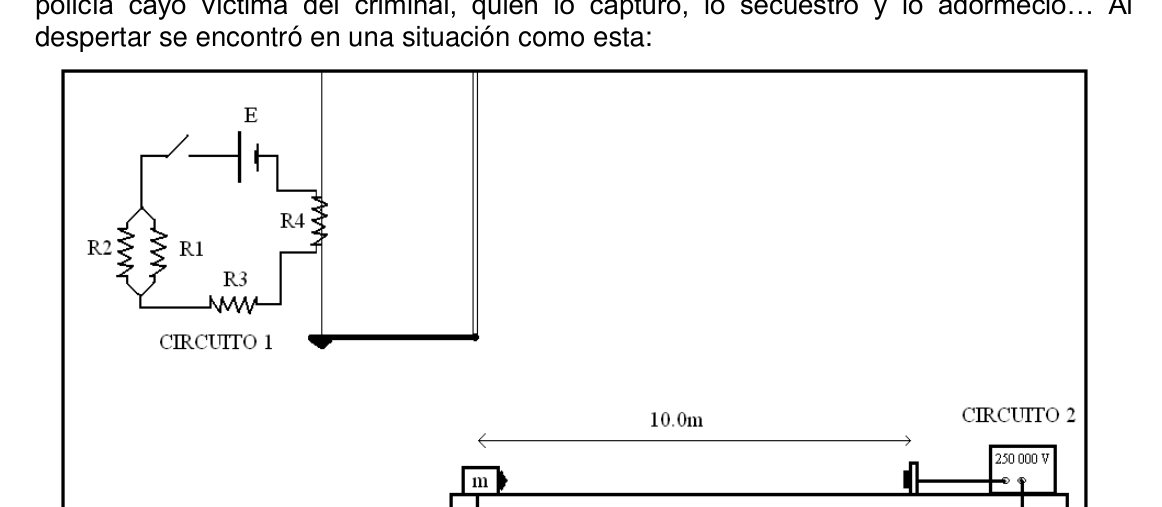
Topic: Rotational Dynamics, Circuits Metodi: Torque & Angular Momentum Analysis, Kirchhoff’s Laws Competenze: Physical Reasoning Objects: Lever, Resistor Fonte: Testo (PDF) — p.5
PT122. Colegio del Sol
San Miguel, Tucumán.
Il gioco della paura. In un film famoso un criminale terrorizza la gente sottoponendola a prove estremi dove il fallimento porta a una morte dolorosa e agonizzante. Un bravo . Un poliziotto è caduto vittima del criminale, che lo ha catturato, rapito e addormentato. svegliarsi si è trovato in una situazione come questa:
Considera che sei l’unica persona che può aiutarti, sapendo che, di Se sopravvivere, potrebbe sicuramente catturare l’assassino. Per questo motivo, è stato fornito un diagramma come quello riportato in figura seguente. Tracce dell’assassino, la maggior parte in chiavi:
-
Il circuito 1 composto da un sistema di resistenze conosciute ( 15 1 R , 10 2 R , 5 3 R y 20 4 R ) è alimentato da un f.e.m. - E ’ uguale alla forza . necessaria per accelerare una massa di 2,0 kg da 0 a 24 s m/ in 4 s, in volt.
-
L’85% della potenza dissipata da 4 R è usato per riscaldare un cavo fino di: C g cal Ce º 125 .0
g cal L 130
C Tf º 200
C T º 25 0
e la cui massa in contatto è uguale al numero di secondi in cui la luce attraversa m x 9 10 5.4
- In grammo.
- Quando il cavo viene tagliato, una grande leva piova rispetto ad un asse, cadendo. come si vede nel diagramma. La leva ha un momento di inerzia. 2 3 1 ML I . Essendo la sua massa kg m
20 (si supponga che il centro di massa si trovi nel (cfr. punto 1.6.1 del capitolo 1) m L 00 .1 . 4) Rotare un 2 / colpisce con elasticità una massa pari a 25,0 kg. (Per Questo colpo suppone l’intera massa della leva concentrata al suo estremità di
- l’impatto).
- La massa scivola su una superficie senza rottura di 10,0 m di lunghezza fino a trovare all’estremità un terminale con il quale, quando si fa contatto, chiude un circuito come il
OAF 2015 - 111
Circuito 2, composto da una fonte di 250.000 volt e la testa del nostro eroe.
chiudendo e assicurando una morte dolorosa.
Con questi indizi, si chiede di rispondere alle seguenti domande prima di aiutare il povero
Polizia. Ricordate: ogni secondo conta!!!
a) Calcolare la
eq
R del circuito 1
b) Calcolare l’I del circuito 1
(c) Calcolare la potenza dissipata da
4
R
Calcolare il tempo necessario per fondere il cavo che si trova a
C
T
º
25
0
.
Prima di tagliare il cavo, calcolare la tensione su di esso in modo che il
Le palanche sono in equilibrio rotazionale.
Calcolare la velocità angolare e tangenziale con cui la leva colpisce la
massa.
Calcolare il tempo che passa tra il momento in cui inizia a rotare e l’impatto
Calcolare la velocità con cui la massa viene rilasciata e il tempo di arrivo
Un altro estremo .
Considerare la
50
polizia
R
e calcola il corrente attraverso il tuo cervello quando chiudi il circuito
nel caso in cui non si riesca a salvare.
Calcolare il tempo totale di salvataggio dal momento in cui il circuito viene chiuso 1
Considera g = 10,0
2s
m
# Buon giorno
Topic: Rotational Dynamics, Circuits Metodi: Torque & Angular Momentum Analysis, Kirchhoff’s Laws Competenze: Physical Reasoning Objects: Lever, Resistor Fonte: Testo (PDF) — p.5
PT122. College of the Sun
San Miguel, Tucumán.
The game of Fear. In a famous movie, a criminal terrorizes people by putting them through tests. Extremes where failure leads to agonizing and painful death. A brave man . The police officer fell victim to the criminal, who captured him, kidnapped him and put him to sleep. awakening found himself in a situation like this:
Consider yourself the only person who can help you, knowing that, of If he survives, he could definitely catch the killer. For this purpose you have been given a diagram as an aid, such as the following figure. The killer’s clues, most of them in keys:
-
Circuit 1 composed of a known resistance arrangement ( 15 1 R , 10 2 R , 5 3 R y 20 4 R ) is fed by an f.e.m. equal to the force. necessary for acceleration of a mass of 2.0 kg from 0 to 24 s m/ In 4s, in volts.
-
85% of the power dissipated by 4 R is used to heat a fine wire of: C g Cal Ce º 125 .0
g Cal L 130
C Tf º 200
C T º 25 0
and whose contact mass is equal to the number of seconds light travels through. m x 9 10 5.4 , in grams. 3) When the cable is cut, a large lever pivots against an axis, falling. As you can see in the diagram. The lever has an inertia moment. 2 3 1 ML I . Being your mass . kg m 0. 20 (assume that the center of mass is at the middle of the lever) and m L 00 .1 . 4) By rotating a 2 / It collides elastically with a mass equal to 25.0 kg. (For This impact means that the entire mass of the lever is concentrated at its end of the The impact of the 5) The mass slides over a 10.0 m long unbroken surface until it finds At the end a terminal with which, when making contact, it closes a circuit such as the
The following points shall be added: Circuit 2, composed of a 250,000-volt source and the head of our hero. closing and ensuring a painful death. With these clues, you are asked to answer the following questions before helping the poor.
- The police. Remember, every second counts!
• a) Calculate the
eq
R of circuit 1
(b) Calculate the I of circuit 1
(c) Calculate the power dissipated by
4
R
Calculate the time it takes to melt the cable that is located at C T º 25 0 . Before cutting the cable, calculate the voltage on it so that the The lever is in rotational equilibrium. Calculate the angular and tangential velocity at which the lever impacts the Mass. Calculate the time between rotation and impact Calculate the speed at which the mass is discharged and the time it takes to reach the The other end . Consider the 50 Police R and calculate the current through your brain when you close the circuit In case you don’t get saved. Calculate the total time you have to save it since the circuit is closed 1 Consider g = 10.0 2s m Good luck with that.
Topic: Rotational Dynamics, Circuits Metodi: Torque & Angular Momentum Analysis, Kirchhoff’s Laws Competenze: Physical Reasoning Objects: Lever, Resistor Fonte: Testo (PDF) — p.5
PT123. Escuela Nacional Ernesto Sábato
Colegio Sagrada Familia - Colegio San Ignacio

Tandil, Buenos Aires.
Vuelos acrobáticos.
Durante los primeros años de la aviación, algunos pilotos usaban sus aviones para
entretener al público en exhibiciones aéreas. Las maniobras realizadas, escogidas por su
belleza o peligrosidad, no tenían mayor propósito que el de impresionar a los
espectadores. Hoy en día, la competición de acrobacias aéreas es considerada un
deporte extremo y se practica con aviones de un solo motor de pistón.
En un momento de la acrobacia, el piloto asciende hasta una altura de 2000 metros y
apaga su motor. Sabiendo que la masa del avión ronda en los 680 kg, ya que debe ser
ultraliviano.
a) ¿Qué velocidad alcanzará a los 100 m de altura respecto del piso si se deja caer
verticalmente hacia abajo? (Suponer que la fuerza de roce que actúa es constante
y tiene un valor de 170 N)
Las bombas de humo de color se utilizan para enmarcar las acrobacias del avión.
También se usan para indicar el principio o fin de una maniobra, o para escribir en el
cielo. Para obtener el humo de color se coloca una manguera (que une el recipiente con
liquido generador de humo al motor) que suele ser de polietileno de 1,6m de longitud y
1cm de radio a 20 °C. Si los gases expulsados en su interior alcanzan hasta una
temperatura de 56 °C, siendo el coeficiente de dilatación lineal del polietileno 120 x 10-6
1/°C.
b) Calcular en cuánto variará su volumen.
Accidentalmente la bomba de humo, cuya masa es de unos 20 Kg, se desprendió cuando el avión volaba horizontalmente a una altura de 1200 m y 260 Km/h. c) ¿En cuánto varió la velocidad del avión debido a la pérdida de masa? d) ¿Cuánto tiempo tardó en tocar suelo la bomba? e) ¿Con qué velocidad impactó la bomba en el suelo?
112 - OAF 2015
Topic: Newtonian Mechanics, Conservation of Momentum Metodi: Kinematic Equations, Conservation of Momentum Competenze: Physical Reasoning Objects: Projectile Fonte: Testo (PDF) — p.5
PT123. Scuola nazionale Ernesto sabato
Colegio Sagrada Familia - Colegio San Ignacio

Tandil, Buenos Aires.
Volanti acrobatici. Durante i primi anni dell’aviazione, alcuni piloti usavano i loro aerei per intrattenere il pubblico in mostre aeree. Le manovre realizzate, scelte da lei bellezza o pericolosità, non avevano altro scopo che quello di impressionare i cittadini. gli spettatori. Oggi, la competizione di aerei è considerata una competizione di aerei. sport estremo e si pratica con aerei a un solo motore a pistone. In un momento di acrobazia, il pilota sale ad un’altezza di 2000 metri e Spegni il motore. Sapendo che la massa dell’aereo si aggira a 680 kg, perché deve essere
- Ultravioletto. a) Che velocità raggiungerà a 100 m di altezza rispetto al pavimento se viene abbassato Verticalmente verso il basso? (Suppone che la forza di rottura che agisce sia costante e ha un valore di 170 N)
Le bombe di fumo colorate vengono utilizzate per inquadrare gli aerei. Sono anche usati per indicare l’inizio o la fine di una manovra, o per scrivere in
- Oh, mio Dio. Per ottenere il fumo colorato si inserisce un tubo (che unisce il recipiente con liquido generatore di fumo al motore) che è di solito di polietilene di 1,6 m di lunghezza e 1 cm di radio a 20 °C. Se i gas emessi all’interno raggiungono fino a un temperatura di 56 °C, il coefficiente di dilatazione lineare del polietilene 120 x 10-6 1/°C. b) Calcolare quanto varia il volume.
Accidentalmente la bomba di fumo, di circa 20 kg di massa, si è sganciata quando L’aereo volava orizzontalmente ad un’altitudine di 1200 m e 260 Km/h. c) In che misura la velocità dell’aeromobile è variata a causa della perdita di massa? d) Quanto tempo è voluto per far cadere la bomba? e) A che velocità la bomba ha colpito il pavimento?
112 - OAF 2015
Topic: Newtonian Mechanics, Conservation of Momentum Metodi: Kinematic Equations, Conservation of Momentum Competenze: Physical Reasoning Objects: Projectile Fonte: Testo (PDF) — p.5
PT123. Ernesto National School Saturday
The Holy Family College - St. Ignatius College
I’m going to Tandil, Buenos Aires.
Acrobatic flights. During the early years of aviation, some pilots used their planes for entertain the public in air shows. The manoeuvres carried out, chosen by his beauty or danger, they had no greater purpose than to impress the people. The audience. Today, the aerial stunt competition is considered a Extreme sports and is practiced with single-engine piston aircraft. At one point in the stunt, the pilot climbs to a height of 2,000 meters and Turn off the engine. Knowing that the mass of the plane is around 680 kg, as it must be The resulting light is a light ultraviolet. (a) What speed will it reach at 100 m above the floor if it is dropped? Vertically down? (Assuming the force of friction acting is constant and has a value of 170 N)
Color smoke bombs are used to frame the aircraft’s stunts. They are also used to indicate the beginning or end of a maneuver, or to write in the Oh, my God. To obtain coloured smoke a hose is placed (which joins the container with (i.e. the engine smoke generator liquid) which is usually 1.6m long polyethylene and 1 cm radius at 20 °C. If the gases emitted inside reach up to one temperature of 56 °C, the linear dilation coefficient of polyethylene being 120 x 10-6 1/°C. (b) Calculate how much the volume will vary.
Accidentally the smoke bomb, which weighs about 20 kg, detonated when The aircraft was flying horizontally at an altitude of 1200 m and 260 Km/h. (c) How much did the aircraft’s speed change due to mass loss? (d) How long did it take for the bomb to hit the ground? (e) How fast did the bomb hit the ground?
The following points shall be added:
Topic: Newtonian Mechanics, Conservation of Momentum Metodi: Kinematic Equations, Conservation of Momentum Competenze: Physical Reasoning Objects: Projectile Fonte: Testo (PDF) — p.5
PT124. Escuela Nacional Ernesto Sábato
Colegio Sagrada Familia - Colegio San Ignacio

Tandil, Buenos Aires.
Preparando Té Helado. Con el objetivo de preparar té helado para la noche se procede de la siguiente manera: Se coloca un litro de agua que se encontraba a temperatura ambiente (20 ºC) en una pava eléctrica cuya potencia máxima es de 2400 Watts. a) ¿Cuánto tiempo deberá estar encendida para que el agua alcance la temperatura de ebullición de 100 ºC?
Se prepara el té e inmediatamente se lo coloca en un termo de acero inoxidable (despreciar las pérdidas de energía en el traspaso). b) ¿En cuánto variará el volumen interno del termo teniendo en cuenta se encontraba a temperatura ambiente y despreciando su masa?
Luego, se deja reposar el tiempo suficiente como para que el té alcance la temperatura ambiente y se desea introducir cubitos de hielo para lograr té helado a 5ºC. Sabiendo que los cubitos de hielo se encuentran a -3ºC y tienen una masa de 10 gramos. c) ¿Cuántos cubitos serán necesarios mezclar al litro de té? (despreciar las pérdidas considerando al termo como un calorímetro ideal).
El termo posee una capacidad de 1200 cm3. d) ¿Hay suficiente espacio libre como para que se logren introducir todos los cubitos? ¿Cuánto espacio falta, o sobra?
Topic: Thermodynamics Metodi: First Law of Thermodynamics Competenze: Physical Reasoning Objects: Calorimeter Fonte: Testo (PDF) — p.5
PT124. Scuola nazionale Ernesto sabato
Colegio Sagrada Familia - Colegio San Ignacio
Tandil, Buenos Aires.
Preparando il tè gelato. Per preparare il tè gelato per la serata si procede come segue: Si mette un litro di acqua a temperatura ambiente (20 oC) in una una piattaforma elettrica di 2400 watt. a) Quanto tempo deve essere acceso per raggiungere la temperatura dell’acqua di scaldamento di 100 oC?
Il tè viene preparato e immediatamente messo in un termo in acciaio inossidabile (spregiare i perditi di energia nel trasferimento). b) Quanto varia il volume interno del termo, tenuto conto del luogo in cui si trovava? a temperatura ambiente e disprezzando la sua massa?
Poi si lascia riposare abbastanza a lungo da far raggiungere la temperatura del tè. La temperatura del tè è di 5 °C. Sapendo che I cubetti di ghiaccio si trovano a -3°C e hanno una massa di 10 grammi. c) Quanti cubetti saranno necessari per mescolare il litro di tè? (spregiare le perdite Considerando il termometro come calometro ideale).
Il termo ha una capacità di 1200 cm3. d) C’è abbastanza spazio libero per poter introdurre tutti i cubetti? Quanto spazio c’è, o c’è ancora?
Topic: Thermodynamics Metodi: First Law of Thermodynamics Competenze: Physical Reasoning Objects: Calorimeter Fonte: Testo (PDF) — p.5
PT124. Ernesto National School Saturday
The Holy Family College - St. Ignatius College
I’m going to Tandil, Buenos Aires.
Making iced tea. For the purpose of preparing iced tea for the evening, the following procedure is followed: One liter of water at room temperature (20°C) is placed in a Electrical power outlet with a maximum power of 2400 watts. (a) How long must it be on for water to reach the temperature of boiling at 100 oC?
The tea is prepared and immediately placed in a stainless steel thermos. (discounting energy losses in the transfer). (b) How much will the internal volume of the thermos vary given the location of the thermos? At room temperature and disregarding its mass?
Then, it is left to rest long enough for the tea to reach its temperature. The Commission has already decided to introduce a new methodology for the preparation of the green tea. Knowing that The ice cubes are at -3°C and have a mass of 10 grams. (c) How many cubes will it take to mix the litre of tea? (disregarding losses) The thermos is considered as an ideal calorimeter.
The thermos has a capacity of 1200 cm3. (d) Is there enough free space to fit all the cubes? How much space is left, or is there more?
Topic: Thermodynamics Metodi: First Law of Thermodynamics Competenze: Physical Reasoning Objects: Calorimeter Fonte: Testo (PDF) — p.5
PT125. Escuela Nacional Ernesto Sábato
Colegio Sagrada Familia - Colegio San Ignacio
Tandil, Buenos Aires.
Analizando un circuito combinado. Para el circuito de la figura responde:
Donde: R1 = R2 = 10 Ω R3 = R4 = 15 Ω R5 = 20 Ω
¿Qué corriente circula por el resistor R4?
a) ¿Cuál es la diferencia de potencial en el resistor R3? b) ¿Cuánta energía transforma el circuito si está funcionando 5 horas?
OAF 2015 - 113
Expresar en unidades convenientes para la compra de energía a una empresa
proveedora del servicio.
c) ¿Qué ocurre si se conectan los puntos A y B del circuito?
d) ¿Cómo conectaría el amperímetro para medir la corriente que circula en R4? ¿y un
voltímetro para medir el voltaje en R3?
Dibuja en el circuito la conexión realizada en cada caso.
Datos útiles:
g = 9,8 m/s2
1Cal = 4,2 Joule
Coeficiente de dilatación lineal del acero inoxidable: α = 1,73 . 10-5 1/ºC
Calor específico del agua: C = 1 Cal/g.ºC
Calor Latente de fusión: LF = 80 Cal/g
Calor específico del Hielo: C = 0,5 Cal/g.ºC
Densidad del Hielo: δ = 0,92 g/cm3
Topic: Circuits Metodi: Equivalent Circuit Reduction, Kirchhoff’s Laws Competenze: Physical Reasoning Objects: Resistor, Galvanometer Fonte: Testo (PDF) — p.5
PT125. Scuola nazionale Ernesto sabato
Colegio Sagrada Familia - Colegio San Ignacio
Tandil, Buenos Aires.
Analizzando un circuito combinato. Per il circuito della figura risponde:
Dove: R1 = R2 = 10 Ω R3 = R4 = 15 Ω R5 = 20 Ω
Che corrente circola attraverso il resistore R4? a) Qual è la differenza di potenziale nel resistore R3? b) Quanta energia trasforma il circuito se è in funzione per 5 ore?
OAF 2015 - 113 Esprimere in unità convenienti per l’acquisto di energia da un’impresa fornitore di servizi. c) Cosa succede se si collegano i punti A e B del circuito? d) Come collegare l’ampiecatore per misurare il corrente circolante in R4? ¿y un Voltímetro per misurare la tensione in R3? Disegna sul circuito la connessione fatta in ogni caso.
Informazioni utili:
g = 9,8 m/s2
1Cal = 4,2 Joule
Coefficiente di dilatazione lineare dell’ acciaio inossidabile: α = 1,73 . 10-5 1/ºC
Calore specifico dell’acqua: C = 1 Cal/g.oC
Calore latente di fusione: LF = 80 Cal/g
Calore specifico del ghiaccio: C = 0,5 Cal/g.oC
Densità del ghiaccio: δ = 0,92 g/cm3
Topic: Circuits Metodi: Equivalent Circuit Reduction, Kirchhoff’s Laws Competenze: Physical Reasoning Objects: Resistor, Galvanometer Fonte: Testo (PDF) — p.5
PT125. Ernesto National School Saturday
The Holy Family College - St. Ignatius College
I’m going to Tandil, Buenos Aires.
Analyzing a combined circuit. For the circuit of the figure it answers:
Where: R1 = R2 = 10 Ω R3 = R4 = 15 Ω R5 = 20 Ω
What current is flowing through the R4 resistor? (a) What is the potential difference in the R3 resistor? (b) How much energy does the circuit convert if it is running for 5 hours?
The following points shall be added: Express in units suitable for energy purchase to a company the service provider. (c) What happens if the circuit points A and B are connected? (d) How would you connect the ampmeter to measure the current circulating in R4? ¿y un Voltmeter to measure the voltage at R3? Draw on the circuit the connection made in each case.
Useful data:
g = 9,8 m/s2
1Cal = 4.2 Joule
Linear dilation coefficient of stainless steel: α = 1.73 . 10-5 1/ºC
Specific water heat: C = 1 Cal/g.oC
The heat of the melting point is: LF = 80 Cal/g
Specific heat of the ice: C = 0,5 Cal/g.oC
Density of the ice: δ = 0,92 g/cm3
Topic: Circuits Metodi: Equivalent Circuit Reduction, Kirchhoff’s Laws Competenze: Physical Reasoning Objects: Resistor, Galvanometer Fonte: Testo (PDF) — p.5
PT126. Instituto Eduardo L. Holmberg
Quilmes, Buenos Aires.
Es sabido que las órbitas de los planetas alrededor del Sol son elípticas pero para este problema podemos considerarlas que son circulares. Hacia fines del siglo XVI, los astrónomos de la época ya habían determinado con buena precisión el período de rotación del planeta Marte alrededor del Sol. En base a esos datos se pudo determinar que ese planeta se encuentra a 227,9 millones de kilómetros del Sol (la Tierra se encuentra a 1,496 1011 m del Sol). Imaginando que la vida en Marte es posible, tal vez debajo de una gigantesca cúpula que mantenga condiciones atmosféricas de presión y temperatura normales iguales a las terrestres, Jaime, un alumno de física que nació allí, decide hacer una serie de experimentos y comparar sus resultados con algún amigo terrícola.
La primera serie de experimentos que hace Jaime en Marte son de mecánica de sólidos. a) En el primer experimento, simplemente deja caer libremente un objeto desde 3 m de altura y determina que el tiempo de caída fue 1,27 s. Calcular la aceleración de la gravedad en Marte. b) Luego Jaime lanza una pelota con una velocidad inicial de 10 m/s con un ángulo de 37° sobre la horizontal. La altura del lanzamiento puede considerarse al nivel del suelo. Determinar: (i) el tiempo de vuelo de la pelota hasta regresar al suelo. (ii) la altura máxima alcanzada por la pelota. (iii) el alcance horizontal de la pelota al momento de tocar el suelo nuevamente. (iv) Comparar estos resultados (tiempo, altura y alcance) con los que se obtendrían en la Tierra para un lanzamiento con las mismas condiciones iniciales: todos son diferentes, pero ¿todos difieren en el mismo porcentaje? c) Luego Jaime decide comparar su edad con la de un amigo terrícola que casualmente nació en el mismo instante que él. Para eso debe realizar algunos cálculos previos. (i) Conociendo el radio de la órbita del planeta Marte y sabiendo que la masa del Sol es 1,989 1030 kg, determinar el período de rotación alrededor del Sol de Marte. (ii) Si Jaime nació en Marte hace 8 años (años marcianos), ¿qué edad tiene su amigo terrícola (medida en años terrestres)? (iii) Determinar la velocidad de ambos planetas en sus respectivos movimientos de traslación alrededor del Sol.
114 - OAF 2015
2.
La segunda serie de experimentos son de mecánica de fluidos y
termodinámica.
a) Luego Jaime decide construir un barómetro similar al diseñado por un
antiguo científico terrícola llamado Evangelista Torricelli. Es decir, un
tubo de vidrio con un extremo cerrado lleno de mercurio. Sin permitir
que entre aire, se invierte la boca del tubo y se la sumerge en una
cubeta con más mercurio, tal como se ve en el diagrama de al lado.
En el extremo superior del tubo hay vacío ya que no entró aire al
invertir el tubo.
(i) Determinar la altura h de la columna de mercurio para equilibrar la presión
atmosférica normal (PAN = 1,013 105 Pa; δHg = 13560 kg/m3).
(ii) Comparar el valor de h con el que se obtiene en la Tierra en igualdad de
condiciones atmosféricas.
b) Jaime encendió un calentador eléctrico de 150 w por 0,5 minutos y calentó un
recipiente que contenía un gas (que podemos considerar ideal). Como la tapa del
recipiente se podía mover sin fricción, la presión se mantuvo igual a la presión
atmosférica normal mientras se calentaba.
(i) ¿Cuánta energía térmica le entregó al gas?
(ii) Sabiendo que había 0,5 moles de gas a 20 °C, determinar la temperatura final
que alcanzó el gas.
Las capacidades caloríficas molares del gas valen CP = 30 J/mol.°C y CV = 20
J/mol.°C.
(iii) Determinar la variación de energía interna del gas.
(iv) Determinar el trabajo realizado por el gas durante su expansión.
(v) Habría alguna diferencia si este experimento se realizara en la Tierra.
Esta tercera serie de experimentos son de electricidad y magnetismo.
a) Un campo magnético, cuyas líneas de fuerza
son horizontales y se representaron con cruces
en el diagrama de al lado, sostiene una varilla
de 8 g de masa y 12 cm de longitud, que fue
adecuadamente conectada para transportar
una corriente de 4 A. La varilla se mantiene en
equilibrio sin estar apoyada o colgada, sin
caer.
Está
sostenida
por
la
interacción
magnética entre la corriente en la varilla y el
campo 𝐵 . Asumimos que los cables de
conexión de la varilla (no están dibujados) no afectan el experimento.
(i) ¿Cuánto pesa la varilla?
(ii) ¿Cuál es la densidad de flujo magnético adecuada para que la varilla quede en
equilibrio?
(iii) ¿En qué dirección circula la corriente en la varilla?
(iv) ¿Cuál debería ser la densidad de flujo magnético si se repitiera este
experimento en la Tierra?
b) La varilla está hecha de un material de origen marciano de resistividad = 1,2 10-
5 .m y tiene un diámetro de 0,8 mm.
(i) Determinar la resistencia de la varilla.
(ii) ¿Cuál es la diferencia de potencial a la que fue conectada la varilla para que la
corriente tuviera la intensidad indicada?
(iii) ¿Cuál es la densidad del material de la varilla?
¿Alguno de estos resultados cambiaría si se repitiera el experimento en la Tierra?
OAF 2015 - 115
Topic: Gravitation, Newtonian Mechanics Metodi: Kepler’s Laws, Kinematic Equations Competenze: Physical Reasoning Objects: Planet, Star Fonte: Testo (PDF) — p.5
PT126. Istituto Eduardo L. Holmberg
Quilmes, Buenos Aires.
È noto che le orbite dei pianeti intorno al Sole sono elliptiche, ma per questo Il problema è che possiamo considerare le forme circolari. Alla fine del XVI secolo, gli astronomi dell’epoca avevano già determinato con buona probabilità Precisione il periodo di rotazione del pianeta Marte attorno al Sole. Basandosi su questi dati hanno stabilito che questo pianeta si trova a 227,9 milioni di chilometri del Sole (la Terra si trova a 1.496 1011 m dal Sole). Immaginando che la vita su Marte sia possibile, forse sotto una gigantesca cupola che mantenere condizioni atmosferiche di pressione e temperatura normali uguali alle Terrestri, Jaime, un studente di fisica che è nato lì, decide di fare una serie di I risultati sono stati confrontati con un amico terrestre.
La prima serie di esperimenti che Jaime fa su Marte sono di meccanica di solidi. a) Nel primo esperimento, semplicemente lascia cadere un oggetto da 3 m. E determina che il tempo di caduta è stato di 1,27 secondi. Calcolare l’accelerazione di la gravità su Marte. b) Poi Jaime lancia una palla con una velocità iniziale di 10 m/s con un angolo di 37° sullo scarto. L’altezza del lancio può essere considerata come il livello di
- No, non è così. Determinare: (i) il tempo di volo della palla fino al ritorno al suolo. (ii) l’altezza massima raggiunta dalla palla. (iii) la portata orizzontale della palla al momento del nuovo tocco al suolo. (iv) confrontare questi risultati (tempo, altezza e portata) con quelli che sarebbero stati ottenuti sulla Terra per un lancio con le stesse condizioni iniziali: tutti sono diverse, ma sono tutte diverse nella stessa percentuale? (c) Poi Jaime decide di confrontare la sua età con quella di un amico terriero che E’ nato nel momento stesso di lui. Per questo dovrà fare alcuni calcoli precedenti. (i) Conoscendo il raggio di orbita del pianeta Marte e sapendo che la massa del Il sole è di 1.989 1030 kg, determinare il periodo di rotazione attorno al sole di Marte. (ii) Se Jaime è nato su Marte 8 anni fa (anni marziani), che età ha? amica terrestre (misurata in anni terrestri)? (iii) Determinare la velocità dei due pianeti nei loro rispettivi movimenti di trasformazione attorno al Sole.
114 - OAF 2015 2. La seconda serie di esperimenti è di meccanica dei fluidi e Termodinamica. a) Poi Jaime decide di costruire un barometro simile a quello progettato da un un antico scienziato terremoto chiamato Evangelista Torricelli. Cioè, un tubo di vetro con un’estremità chiusa piena di mercurio. Senza permetterlo che entra in aria, si inverte la bocca del tubo e si immerge in una un vaso con più mercurio, come si vede nel diagramma di fianco. All’estremità superiore del tubo c’è un vuoto perché non è entrato aria. Invertire il tubo. (i) Determinare l’altezza h della colonna di mercurio per bilanciare la pressione La temperatura di un’acqua di base di 100 °C è di circa 10 °C. (ii) Compare il valore di h con quello ottenuto sulla Terra in uguale di condizioni atmosferiche. b) Jaime ha acceso un riscaldatore elettrico di 150 w per 0,5 minuti e ha riscaldato un contenente un gas (che possiamo considerare ideale). Come la copertura del Il recipiente poteva muoversi senza attrito, la pressione era mantenuta uguale alla pressione normale atmosfera mentre si riscaldò. (i) Quanta energia termica ha fornito al gas? (ii) Sapendo che c’erano 0,5 molli di gas a 20 °C, determinare la temperatura finale che ha raggiunto il gas. Le capacità caloriche molari del gas sono CP = 30 J/mol.°C e CV = 20 J/mol.°C. (iii) Determinare la variazione dell’energia interna del gas. (iv) Determinare il lavoro svolto dal gas durante la sua espansione. (v) Ci sarebbe qualche differenza se questo esperimento fosse stato condotto sulla Terra.
Questa terza serie di esperimenti riguarda l’elettricità e il magnetismo. a) Un campo magnetico, le cui linee di forza Sono orizzontali e rappresentati con incroci. sul diagramma accanto, tiene un bastone di 8 g di massa e 12 cm di lunghezza, che è stato adeguatamente collegata per il trasporto un corrente di 4 A. La bacchetta si mantiene in equilibrio senza appoggiamento o appeso, senza
- cadere. È sostenuta Per la Interazione magnetico tra il corrente sul bastone e il campo B . Supponiamo che i cavi di La connessione della bacchetta (non sono disegnate) non influisce sull’esperimento. (i) Quanto pesa la canna? (ii) Qual è la densità di flusso magnetico adeguata per mantenere il bastone in equilibrio? (iii) In che direzione circola la corrente nel bastone? (iv) Qual è la densità di flusso magnetico se si ripete questo? un esperimento sulla Terra? b) La canna è fatta di un materiale di origine marziana di resistività = 1,2 10- 5 .m e ha un diametro di 0,8 mm. (i) Determinare la resistenza della canna. (ii) Qual è la differenza di potenziale alla quale è stata collegata la canna per consentire alla corrente ha l’intensità indicata? (iii) Qual è la densità del materiale del bastone?
Alcune di queste risposte cambierebbero se l’esperimento fosse ripetuto sulla Terra?
OAF 2015 - 115
Topic: Gravitation, Newtonian Mechanics Metodi: Kepler’s Laws, Kinematic Equations Competenze: Physical Reasoning Objects: Planet, Star Fonte: Testo (PDF) — p.5
PT126. The Institute Eduardo L. Holmberg
Quilmes, Buenos Aires is where I am.
It is known that the orbits of the planets around the Sun are elliptical but for this problem we can consider them to be circular. By the end of the 16th century, astronomers at the time had already determined with good reason. The period of rotation of the planet Mars around the Sun. Based on those . Data has determined that this planet is 227.9 million kilometers away. of the Sun (the Earth is 1,496 1011 m from the Sun). Imagine that life on Mars is possible, maybe under a giant dome that maintain normal atmospheric pressure and temperature conditions equal to those of Earthlings, Jaime, a physics student who was born there, decides to do a series of experiments and compare their results with some earthly friend.
The first set of experiments Jaime does on Mars are mechanical. solids. (a) In the first experiment, you just drop an object freely from 3 m. Height and determines the time of fall was 1.27 seconds. Calculate the acceleration of gravity on Mars. (b) Then Jaime throws a ball at an initial speed of 10 m/s at an angle of 37° on the horizontal. The height of the launch can be considered at the level of the I’m going to the ground. Determine: (i) the flight time of the ball until it returns to the ground. (ii) the maximum height reached by the ball. (iii) the horizontal range of the ball when it touches the ground again. (iv) Comparing these results (time, height and range) with what would be achieved on Earth for a launch with the same initial conditions: all They’re different, but do they all differ in the same percentage? (c) Then Jaime decides to compare his age to that of a friend from the land who He was born at the same moment as him. For that you must make some the previous calculations. (i) Knowing the radius of orbit of the planet Mars and knowing that the mass of the planet is Sun is 1,989 1030 kg, determining the period of rotation around the Sun from It’s Mars. (ii) If Jaime was born on Mars 8 years ago (Martian years), how old is his age? the land friend (measured in earth years)? (iii) Determine the speed of both planets in their respective motions of translation around the sun.
The following points shall be added: 2. The second series of experiments are fluid mechanics and The thermodynamic effect. (a) Then Jaime decides to build a barometer similar to the one designed by a An ancient earth scientist called Evangelista Torricelli. I mean, a glass tube with a closed end full of mercury. Without allowing It’s in the air, you turn the mouth of the tube and you dip it in a tube. bucket with more mercury, as shown in the diagram next to it. At the top end of the tube is a vacuum as no air entered the tube. Invert the tube. (i) Determine the height h of the mercury column to balance the pressure The following conditions are met: (ii) Comparing the value of h to that obtained on Earth at equal to atmospheric conditions. (b) Jaime turned on a 150W electric heater for 0.5 minutes and heated a container containing a gas (which we may consider ideal). Like the cover of the The container could move without friction, the pressure was kept equal to the pressure. normal atmosphere while it was warming up. (i) How much heat energy did you deliver to the gas? (ii) Knowing that there were 0,5 moles of gas at 20 °C, determine the final temperature It reached the gas. The molar heat capacities of the gas are CP = 30 J/mol.°C and CV = 20 The following table shows the results of the calculations: (iii) Determine the variation in the internal energy of the gas. (iv) Determine the work done by gas during its expansion. (v) There would be some difference if this experiment were done on Earth.
This third series of experiments is about electricity and magnetism. (a) A magnetic field, whose lines of force They are horizontal and represented by crosses In the diagram next to it, he holds a stick. 8 g of mass and 12 cm of length, which was properly connected for transport a current of 4 A. The rod is kept in balance without being supported or suspended, without I’m going to fall. It ‘s … sustained by la interaction magnetic between the current in the rod and the Field B . We assume that the cables of The connections of the rod (not drawn) do not affect the experiment. (i) How much does the rod weigh? (ii) What is the appropriate magnetic flux density for the rod to remain at What’s the balance? (iii) In which direction does the current circulate in the rod? (iv) What should be the magnetic flux density if this is repeated experiment on Earth? (b) The rod is made of a material of Martian origin with resistivity = 1,2 10- 5 .m and has a diameter of 0,8 mm. (i) Determine the strength of the rod. (ii) What is the potential difference to which the rod was connected so that the The current had the indicated intensity? (iii) What is the density of the material of the rod?
Would any of these results change if the experiment were repeated on Earth?
The following points shall be added:
Topic: Gravitation, Newtonian Mechanics Metodi: Kepler’s Laws, Kinematic Equations Competenze: Physical Reasoning Objects: Planet, Star Fonte: Testo (PDF) — p.5
PT127. Instituto de Enseñanza San Jorge - Colegio La Asunción
Escuela Normal Superior Gral. Manuel Belgrano

Colegio Hermano Hermas de Bruijn - Colegio San Francisco de Asís

Ciudad de Santiago del Estero.
Tres bloques están unidos como muestra la
figura 1. No hay rozamientos. Las masas de
los bloques son: m1= 10 kg , m2= 150 kg y
m3= 25 kg
a) Realiza el diagrama de cuerpo libre
para cada bloque.
b) Determina la aceleración del sistema.
c) Determina la tensión en la cuerda T1.
d) Determina la tensión en la cuerda T2.
Nota: Se desprecia el roce de las cuerdas en las poleas y el peso de de las mismas.
Considerar g = 10 m / s2
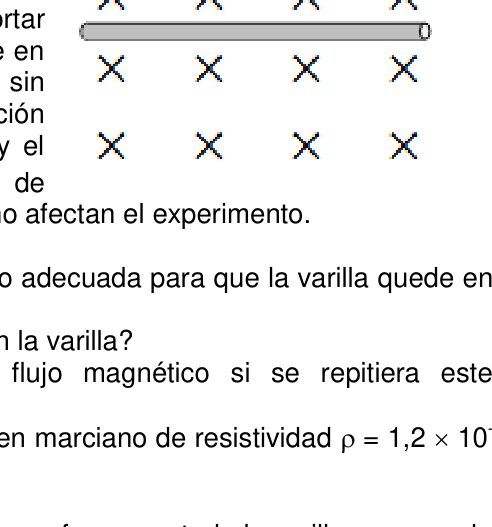
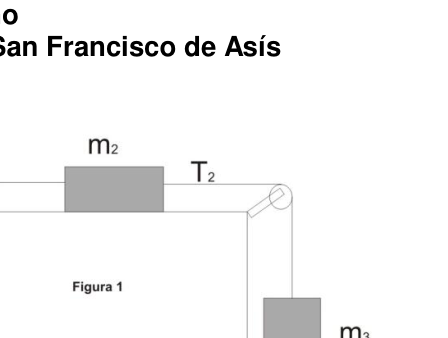
Topic: Newtonian Mechanics Metodi: Free-Body Diagram, Conservation Laws Competenze: Physical Reasoning Objects: Block, Pulley, String Fonte: Testo (PDF) — p.5
PT127. Istituto di istruzione San Jorge - Colegio La Asunción
Scuola Normale Superiore Gral. Manuel Belgrano
Collegio Fratello Hermas di Bruijn - Collegio San Francesco di Assisi
Città di Santiago del Estero.
Tre blocchi sono uniti come mostra la
Figura 1. Non ci sono rotture. Le masse di
i blocchi sono: m1= 10 kg , m2= 150 kg e
m3= 25 kg
a) Realizza il diagramma del corpo libero
per ogni blocco.
b) Determina l’accelerazione del sistema.
c) Determina la tensione nella corda T1.
d) Determina la tensione nella corda T2.
Nota: si disprezza il raggio delle corde nelle pollice e il peso delle stesse.
Considerare g = 10 m / s2
Topic: Newtonian Mechanics Metodi: Free-Body Diagram, Conservation Laws Competenze: Physical Reasoning Objects: Block, Pulley, String Fonte: Testo (PDF) — p.5
PT127. The school is located in the city of San Jorge.
Gral High School. Manuel Belgrano
Brother Brother School of Bruijn - College of St. Francis of Assisi
The city of Santiago del Estero.
Three blocks are joined together as shown in the diagram.
The following table shows the following: There are no bruises. The masses of
The blocks are: m1= 10 kg , m2= 150 kg and
m3= 25 kg
(a) Perform the free body diagram
for each block.
(b) Determine the system acceleration.
(c) Determine the tension on the T1 rope.
(d) Determine the tension on the T2 rope.
Note: The brushing of the strings on the pulleys and the weight of the pulleys are disregarded.
Consider g = 10 m/s2
Topic: Newtonian Mechanics Metodi: Free-Body Diagram, Conservation Laws Competenze: Physical Reasoning Objects: Block, Pulley, String Fonte: Testo (PDF) — p.5
PT128. Instituto de Enseñanza San Jorge - Colegio La Asunción
Escuela Normal Superior Gral. Manuel Belgrano

Colegio Hermano Hermas de Bruijn - Colegio San Francisco de Asís

Ciudad de Santiago del Estero.
En la figura se observa un bloque de 5 kg que pasa por el punto A con una rapidez de 15 m/s y se desliza sin rozamiento hasta el punto B, a partir del cual existe una superficie rugosa de 10 m de longitud que culmina en el punto C. El coeficiente de roce dinámico entre el bloque y la superficie es 0,4. El tramo CD carece de rozamiento y mide 8 m de longitud. El punto E está a 8 m de la base del muro. a) ¿Supera el bloque en su movimiento al punto C? De ser así, ¿Con qué rapidez lo hace? b) ¿Supera el bloque al punto D? Justifica. c) En caso de responder afirmativamente la pregunta anterior, ¿a qué distancia del punto E caerá el bloque? d) Grafica las fuerzas que actúan sobre el bloque en los tramos AB, BC, CD y a partir del punto D hasta su impacto contra el suelo. e) Calcula el trabajo del peso del bloque en cada etapa del movimiento. f) Si el punto E pudiera moverse libremente, ¿cuál debería ser su aceleración para alcanzar al bloque en el mismo instante en el que alcanza su punto de impacto contra el suelo? Nota: Considerar g = 10 m/s²
Topic: Conservation of Energy Metodi: Energy Conservation Method, Kinematic Equations Competenze: Physical Reasoning Objects: Block, Inclined Plane Fonte: Testo (PDF) — p.5
PT128. Istituto di istruzione San Jorge - Colegio La Asunción
Scuola Normale Superiore Gral. Manuel Belgrano
Collegio Fratello Hermas di Bruijn - Collegio San Francesco di Assisi
Città di Santiago del Estero.
La figura mostra un blocco di 5 kg che passa attraverso il punto A a velocità di 15 m/s e si scivola senza rottura fino al punto B, da cui è uscita una superficie rugosa di 10 m di lunghezza che si conclude al punto C. Il coefficiente di Rottura dinamica tra il blocco e la superficie è di 0,4. La parte CD non ha di rottura e misura 8 m di lunghezza. El Il punto E è a 8 metri dalla base del muro. a) Supera il blocco in movimento al punto C? Se è così, con cosa? velocezza lo fa? b) Sopra il blocco al punto D? - Giustifica. (c) Se la domanda precedente è risolta in modo affermativo, a che distanza da punto E il blocco cadrà? d) Grafica delle forze che agiscono sul blocco nei tratti AB, BC, CD e a partire da dal punto D fino all’impatto sul suolo. e) Calcola il lavoro del peso del blocco in ogni fase del movimento. f) Se il punto E potesse muoversi liberamente, quale dovrebbe essere la sua accelerazione per raggiungere il blocco nel momento in cui raggiunge il punto di impatto
- Contro il pavimento? Nota: Considerare g = 10 m/s2
Topic: Conservation of Energy Metodi: Energy Conservation Method, Kinematic Equations Competenze: Physical Reasoning Objects: Block, Inclined Plane Fonte: Testo (PDF) — p.5
PT128. The school is located in the city of San Jorge.
Gral High School. Manuel Belgrano
Brother Brother School of Bruijn - College of St. Francis of Assisi
The city of Santiago del Estero.
The figure shows a block of 5 kg passing through point A at a speed of 15 m/s and slides without rubbing until the point B, from which there is a rough surface of 10 m in length which It ends at point C. The coefficient of dynamic brushing between the block and the surface is 0.4. The CD section is missing It is 8 m long. El Point E is eight meters from the base of the wall. (a) Does it overcome the block in its movement to point C? If so, with what?
- Does speed do it? (b) Does the block overlap with point D? It justifies it. (c) If the answer to the above question is yes, how far from the Point E will the block fall? (d) Graphs the forces acting on the block in sections AB, BC, CD and onwards from D-point to impact. (e) Calculates the work of the block weight at each stage of movement. (f) If the point E could move freely, what should be its acceleration for reach the block as soon as it reaches its impact point On the ground? Note: Consider g = 10 m/s2
Topic: Conservation of Energy Metodi: Energy Conservation Method, Kinematic Equations Competenze: Physical Reasoning Objects: Block, Inclined Plane Fonte: Testo (PDF) — p.5
PT129. Instituto de Enseñanza San Jorge - Colegio La Asunción
Escuela Normal Superior Gral. Manuel Belgrano

Colegio Hermano Hermas de Bruijn - Colegio San Francisco de Asís

Ciudad de Santiago del Estero.
En un recipiente aislado idealmente se agregan 500 g de hielo a -10°C. Luego se calienta el hielo empleando un calentador eléctrico que se encuentra dentro del recipiente.
116 - OAF 2015 a) ¿Qué cantidad de calor tuvo que entregar el calentador para lograr llevar todo el hielo a 0ºC ? b) ¿Cuánto tiempo estuvo conectado el calentador para lograr esto, si su potencia es de 350W? c) ¿Cuál fue la intensidad de corriente que circuló por el calentador si se conectó a una fuente de 220V? d) ¿Cuál es el valor de la resistencia eléctrica del calentador?
Luego, en el mismo recipiente se agregan 800 g de agua a 50°C y se espera que la
mezcla alcance su temperatura de equilibrio.
e) Determina la temperatura de equilibrio de la mezcla.
f) Determina la masa final de agua en la mezcla.
Datos útiles:
Calor específico del agua: Ce H2O = 1 cal /g °C
Calor específico del hielo: Ce HIELO = 0.5 cal / g°C
Calor latente de fusión del hielo: Lf HIELO = 80 cal / g
Nota: Idealmente, ninguno de los elementos empleados intercambia calor con el medio que lo rodea. Se desprecia la masa del calentador eléctrico.
Topic: Thermodynamics, Circuits Metodi: First Law of Thermodynamics, Kirchhoff’s Laws Competenze: Physical Reasoning Objects: Calorimeter, Resistor Fonte: Testo (PDF) — p.5
PT129. Istituto di istruzione San Jorge - Colegio La Asunción
Scuola Normale Superiore Gral. Manuel Belgrano
Collegio Fratello Hermas di Bruijn - Collegio San Francesco di Assisi
Città di Santiago del Estero.
In un recipiente isolato si aggiungono idealmente 500 g di ghiaccio a -10°C. Poi si riscaldano. il ghiaccio utilizzando un riscaldatore elettrico all’interno del recipiente.
116 - OAF 2015 a) Quanta calore ha dovuto consegnare il riscaldatore per poter portare tutto il calore
- gelo a 0 ° C ? b) Quanto tempo è stato connesso il riscaldatore per ottenere questo, se la sua potenza è de 350W? c) Qual è stata l’intensità di corrente circolare attraverso il riscaldatore se si è collegato a una fonte di 220 V? d) Qual è il valore della resistenza elettrica del riscaldatore?
In questo stesso contenitore vengono poi aggiunti 800 g di acqua 50°C e si prevede che la il miscela raggiunge la sua temperatura di equilibrio. e) Determina la temperatura di equilibrio della miscela. f) Determina la massa finale di acqua nella miscela.
Informazioni utili: Calore specifico dell’acqua: Ce H2O = 1 cal /g °C Calore specifico della ghiaccio: Ce IELO = 0,5 cal / g°C Calore latente di fusione del ghiaccio: Lf Ghiaccio = 80 cal / g
Nota: Idealmente, nessuno degli elementi utilizzati scambierà calore con il mezzo che lo circonda. Si disprezza la massa del riscaldatore elettrico.
Topic: Thermodynamics, Circuits Metodi: First Law of Thermodynamics, Kirchhoff’s Laws Competenze: Physical Reasoning Objects: Calorimeter, Resistor Fonte: Testo (PDF) — p.5
PT129. The school is located in the city of San Jorge.
Gral High School. Manuel Belgrano
Brother Brother School of Bruijn - College of St. Francis of Assisi
The city of Santiago del Estero.
In an insulated container 500 g of ice to -10°C is ideally added. Then it warms up . ice using an electric heater located inside the container.
The Commission shall adopt delegated acts in accordance with Article 21 of this Regulation. (a) How much heat did the heater have to deliver to carry the whole heat? ice at 0 ° C ? (b) How long was the heater connected to achieve this, if its power is de 350W? (c) What was the current intensity that circulated through the heater if it was connected to A 220V power supply? (d) What is the value of the electrical resistance of the heater?
Then 800 g of water at 50°C is added to the same container and the The mixture reaches its equilibrium temperature. (e) Determine the equilibrium temperature of the mixture. (f) Determine the final mass of water in the mixture.
Useful data: The specific heat of the water: Ce H2O = 1 cal /g °C Specific heat of ice: Ce ICE = 0.5 cal/g°C Latent heat from ice melting: Lf ICE = 80 cal / g
Note: Ideally, none of the elements used exchanged heat with the medium It’s all around him. The mass of the electric heater is neglected.
Topic: Thermodynamics, Circuits Metodi: First Law of Thermodynamics, Kirchhoff’s Laws Competenze: Physical Reasoning Objects: Calorimeter, Resistor Fonte: Testo (PDF) — p.5
PT130. Escuela Philips
Ciudad de Buenos Aires.
Asteroide B 612. El principito (la obra más famosa de Antoine de Saint-Exupéry) narra la historia de un pequeño príncipe que vive en un asteroide llamado B 612. Aquí nos proponemos hacer un análisis de este asteroide, para el cual lo consideraremos perfectamente esférico y de densidad uniforme; mediante los dibujos originales del autor medimos en una escala arbitraria el diámetro del asteroide y la altura del principito. Sabiendo que la altura normal para un niño de su edad esta entre 1.40m y 1.55m: a) Determine el diámetro del asteroide, expréselo como: (valor mas representativo)±(intervalo de confianza)
De ahora en más trabaje exclusivamente con el valor más representativo del diámetro. En la novela nos dicen que al principito le gustaba ver atardeceres. cita:‖sobre tu pequeño planeta te bastaba arrastrar la silla algunos pasos para presenciar el crepúsculo cada vez que lo deseabas… —¡Un día vi ponerse el sol cuarenta y tres veces!‖ b) Estime la distancia angular que recorrió ese día asumiendo que se movió 1m entre cada atardecer y que se tuvo que mover 42 veces para ver 43 atardeceres. c) Determine la velocidad angular del asteroide. d) Determine la masa del asteroide suponiendo que su gravedad es igual en magnitud a la terrestre. e) Determine la densidad del asteroide.
Si no lo recuerda, la velocidad de escape es la rapidez mínima con la que un cuerpo debería ser lanzado desde la superficie de un planeta para que lograse llegar al infinito, es decir, lograse escapar a la influencia gravitatoria del planeta. En esta condición de rapidez de lanzamiento mínima, el cuerpo alcanzaría el infinito con rapidez instantánea nula.
OAF 2015 - 117 f) Determine la velocidad de escape del asteroide.
Un agujero negro de Schwarzschild es el que no rota ni tiene carga eléctrica, por lo tanto esta completamente definido solamente por su masa y su horizonte de sucesos es perfectamente esférico. g) Calcule cual debería ser el diámetro del asteroide para que con su masa forme un agujero negro de Schwarzschild.
Hint: según wikipedia.org ―Una órbita síncrona o sincrónica es una órbita en la que el periodo orbital del cuerpo orbitando (normalmente un satélite) es igual al periodo de rotación del cuerpo en el cual orbita (normalmente un planeta) y, además, orbita en el mismo sentido que este cuerpo.‖ h) Determine la distancia desde la superficie del asteroide al la que debe orbitar un objeto de manera que su orbita sea ecuatorial, circular y sincrónica. i) Averigüe a que velocidad debería correr el principito (m= 40kg) sobre el ecuador de manera de disminuir la velocidad angular del asteroide en un 1%.
Datos: Gravedad terrestre: 2 / 81 ,9 s m
Constante de gravitación universal
2
2
11
10
67
,6
kg
Nm
G
Volumen esfera:
3
3
4 R
V
Momento de inercia de una esfera maciza
CM
I
2
3
2 MR
Topic: Gravitation, Astrophysics Metodi: Newton’s Law of Gravitation, Order-of-Magnitude Estimation Competenze: Physical Reasoning, Mathematical Modeling Objects: Planet, Black Hole Fonte: Testo (PDF) — p.5
PT130. Philips School
Città di Buenos Aires.
Asteroide B 612. Il principino (l’opera più famosa di Antoine de Saint-Exupéry) racconta la storia di un piccolo principe che vive in un Asteroide chiamato B 612. Qui proponiamo di fare un’analisi di questo asteroide, per che consideriamo perfettamente sferica e densissima. Uniforme; con i disegni originali dell’autore misuriamo il Una scala arbitraria il diametro dell’asteroide e l’altezza del Principe. Sapendo che la altezza normale per un bambino è la sua età è compresa tra 1.40m e 1.55m: a) Determina il diametro dell’asteroide, espresso come: (valore più (MSK0/>(intervallo di fiducia)
Da ora in poi lavoreremo esclusivamente con il valore più rappresentativo del diametro. En la romanzo
- Non lo so. Dicono che che al Principe le Mi piaceva .
- Vediamo Il sole. “Sulla tua piccola pianeta, basta trascinare la sedia per vedere”. Il crepuscolo ogni volta che lo desideravi un giorno ho visto il sole tramontare 43
- A volte! b) Calcola la distanza angolare percorsa quel giorno, supponendo che si sia mossa 1m. Tra ogni tramonto e che ha dovuto muoversi 42 volte per vedere 43 Il sole. c) Determina la velocità angolare dell’asteroide. d) Determina la massa dell’asteroide supponendo che la sua gravità sia uguale a Magnitude a terra. e) Determina la densità dell’asteroide.
Se non si ricorda, la velocità di fuga è la velocità minima con cui un corpo Dovrebbe essere lanciato dalla superficie di un pianeta per raggiungere l’infinito. In altre parole, riuscire a sfuggire all’influenza gravitazionale del pianeta. In questa condizione di La velocità minima di lancio, il corpo raggiungerebbe l’infinito con velocità istantanea.
- Niente.
OAF 2015 - 117 f) Determina la velocità di fuga dell’asteroide.
Un buco nero di Schwarzschild è quello che non si rompe e non ha carica elettrica, quindi tanto quanto è completamente definito solo dalla sua massa e il suo orizzonte di eventi è perfettamente sferica. g) Calcola quale dovrebbe essere il diametro dell’asteroide per formare con la sua massa un buco nero di Schwarzschild.
Hint: secondo wikipedia.org ―Un’orbita sincrona o sincronica è un’orbita in cui Il periodo orbitale del corpo in orbita (normalmente un satellite) è uguale al periodo di La rotazione del corpo in cui orbita (normalmente un pianeta) e, inoltre, orbita in lo stesso senso che questo corpo. h) Determina la distanza dalla superficie dell’asteroide a cui deve orbitare un oggetto in modo che la sua orbita sia equatoria, circolare e sincronica. i) Scopri a che velocità dovrebbe correre il principito (m= 40 kg) sul L’equatore in modo da ridurre l’angolare velocità dell’asteroide dell’1%
Datati: Gravità terrestre: 2 / 81 ,9 s m
Costante di gravitazione universale 2 2 11 10 67 ,6 kg Nm G
Volume sfera: 3 3 4 R V
Moment di inerzia di una sfera massiccia CM I 2 3 2 MR
Topic: Gravitation, Astrophysics Metodi: Newton’s Law of Gravitation, Order-of-Magnitude Estimation Competenze: Physical Reasoning, Mathematical Modeling Objects: Planet, Black Hole Fonte: Testo (PDF) — p.5
PT130. Philips School
City of Buenos Aires.
Asteroid B 612. The little prince (the most famous work of Antoine de Saint-Exupéry) It tells the story of a little prince who lives in a asteroid named B 612. Here we propose to do an analysis of this asteroid, for which we will consider perfectly spherical and densely The original drawings of the author are used to measure the an arbitrary scale the diameter of the asteroid and the height of the Prince. Knowing that normal height for a child of his age is between 1.40m and 1.55m: (a) Determine the diameter of the asteroid, and express it as: (value plus The amount of the loan is calculated as follows:
From now on, I’ll work exclusively with the most representative value of the diameter. En la novel We ‘re not . They say That al Prince le I liked it . See
- I’m going to be there. “On your little planet, you just had to drag the chair a few steps to witness. The twilight every time you wanted it. One day I saw the sun set forty-three. Sometimes! (b) Estimate the angular distance travelled that day assuming that it moved 1m Between each sunset and the fact that he had to move 42 times to see 43
- I’m going to be there. (c) Determine the angular velocity of the asteroid. (d) Determine the mass of the asteroid assuming its gravity is equal to magnitude to the Earth. (e) Determine the density of the asteroid.
If you don’t remember, the escape velocity is the minimum velocity with which a body can escape. It should be launched from the surface of a planet to reach infinity. That is, to escape the gravitational influence of the planet. In this condition of With a minimum launch speed, the body would reach infinity with instantaneous speed.
- No, not at all.
The Commission shall adopt delegated acts in accordance with Article 21 of this Regulation. (f) Determine the asteroid’s escape velocity.
A Schwarzschild black hole is one that doesn’t break or have an electric charge, so… So it is completely defined only by its mass and its event horizon is perfectly spherical. (g) Calculate what the diameter of the asteroid should be so that with its mass it forms A black hole from Schwarzschild.
Hint: According to wikipedia.org ―A synchronous or synchronous orbit is an orbit in which The orbital period of the orbiting body (usually a satellite) is equal to the period of rotation of the body in which it orbits (usually a planet) and also orbits in the The same sense as this body. (h) Determine the distance from the surface of the asteroid to which it is to orbit an object so that its orbit is equatorial, circular and synchronous. (i) Find out what speed the little one should run (m= 40kg) over the Equator so as to decrease the angular velocity of the asteroid by 1%.
The data: Earth gravity: 2 / 81 ,9 s m
Universal gravity constant is 2 2 11 10 67 ,6 kg Nm G
The volume of the sphere: 3 3 4 R V
Moment of inertia of a massive sphere CM I 2 3 2 MR
Topic: Gravitation, Astrophysics Metodi: Newton’s Law of Gravitation, Order-of-Magnitude Estimation Competenze: Physical Reasoning, Mathematical Modeling Objects: Planet, Black Hole Fonte: Testo (PDF) — p.5
PT131. Escuela Philips
Ciudad de Buenos Aires.
Paseando en globo. Una tarde sin viento en la que la temperatura ambiente es de unos agradables C 25 , Gabriel y Florencia deciden alquilar un paseo en globo aerostático. Gabriel pesa kg 75 , Florencia kg 56 y el globo aerostático está formado por un habitáculo cuya masa es kg M H 200 , 6 bolsas de lastre de masa kg mL 50 y un conjunto globo (desinflado)- cuerdas de masa kg mC 150 . En todo momento considere 2 / 10 s m g y exprese los resultados en unidades del SI a) ¿Cuál es el peso G P del globo antes de que Gabriel y Florencia se suban para comenzar el paseo?
El globo se infla mediante un sistema térmico que fuerza helio caliente en su interior ( mol g M He / 4 ). A último momento deciden que los acompañe un guía de modo que el peso total del globo (aun sin inflar) con sus tres tripulantes será de N 8700 . Si el paseo comienza en una región a nivel del mar y el helio caliente inyectado se encuentra a una temperatura de C 250 y a una presión de atm 2
b) ¿Cuál debe ser el mínimo volumen mín G V al que se debe llevar el globo inflado (supuesto una esfera) para que pueda comenzar el ascenso?
Suponiendo que el material del globo presenta una emisividad
15
,0
y se mantiene en
todo momento en equilibrio térmico con el helio en su interior,
c) ¿Qué cantidad de energía neta por unidad de tiempo irradia el globo?
118 - OAF 2015 Suponiendo que, para las condiciones V p especificadas el globo se infla hasta un volumen 𝑉𝐺= 960𝑚3 d) ¿Con qué aceleración comienza el paseo?
Si la aceleración con la que despega el globo fuese constante durante el ascenso y de valor 2 / 25 ,0 s m a
e) ¿cuánto tiempo le tomaría al globo alcanzar una altura de m 1000 ?
La aceleración con la que asciende el globo no es constante ya que…,bueno, usted debería poder reconocer los motivos. Como sea, en algún momento el globo se detiene y ya no puede ascender a no ser que se suelte algo de lastre. La pregunta es, f) ¿a qué altura se debe soltar lastre por vez primera?
Suponga que se suelta un lastre en un instante en que el globo se encontraba pasando
por la posición
m
h
250
y ascendiendo con una rapidez de
s
m
v
/
8,0
. Si se desprecia
cualquier interacción del lastre con el aire,
g) ¿Cuánto tiempo tarda el lastre en llegar al suelo?
Suponga ahora que no hay vientos pero consideramos la viscosidad del aire de modo que ofrece una resistencia al avance. En su descenso, el lastre alcanzara una velocidad terminal como consecuencia de la fuerza viscosa o fuerza de arrastre ejercida por el aire. Si esta velocidad terminal es de s m/ 12 y el lastre la alcanza cuando se encuentra a una altura m h 100 sobre el suelo, h) ¿Qué cantidad de energía se disipa al aire en forma de calor como consecuencia de la viscosidad a lo largo de los últimos m 100 de caída del lastre?
Topic: Fluid Mechanics, Thermodynamics Metodi: Hydrostatic Equilibrium, Ideal Gas Law Competenze: Physical Reasoning Objects: Bubble, Gas Fonte: Testo (PDF) — p.5
PT131. Philips School
Città di Buenos Aires.
Passeggiando in ballo. Una serata senza vento in cui la temperatura ambiente è piacevole C 25 , Gabriel e Florence decidono di affittare un giro a ballo. Gabriel pesa kg 75 , Firenze kg 56 e il globo aereo è costituito da un piccolo spazio di massa kg M H 200 , 6 sacchetti di lastre di massa kg mL 50 e un insieme di globuli (desinflati)
- Cnordie di massa kg mC 150 . Considerate in ogni momento 2 / 10 s m g e esprime le parole. Risultati in unità SI a) Qual è il peso G P del globo prima che Gabriel e Florence si arrampicino per Iniziare il giro?
Il globo si gonfia mediante un sistema termico che forza l’elio caldo all’interno ( Mol g M He / 4 ). L’ultima volta che decidono di accompagnarli, un’autrice li accompagna in modo che il Il peso totale del pallone (anche non gonfiato) con i suoi tre membri di bordo sarà di N 8700 . Se il giro Si inizia a un livello del mare e l’elio caldo iniezionato si trova a un temperatura di C 250 e a una pressione di atm 2
b) Qual è il volume minimo Min G V A chi deve essere portato il pallone gonfiato (suppone una sfera) per poter iniziare l’ascensione?
Supponendo che il materiale del globo presenta un’emissività 15 ,0 e si mantiene in ogni momento in equilibrio termico con l’elio dentro di esso, c) Quanta energia netta per unità di tempo irradia il globo?
118 - OAF 2015 Supponendo che, per le condizioni V p Se si specificano le condizioni di inondazione del globo, si infla fino a un Volume VG= 960m3 D) Con quale accelerazione inizia il giro?
Se l’accelerazione con cui il pallone parte fosse costante durante l’ascesa e di Valore 2 / 25 ,0 s m a
e) quanto tempo ci vorrebbe per il globulo per raggiungere un’altezza di m 1000 ?
L’accelerazione con cui il globo sale non è costante poiché, beh, tu Dovrebbe essere in grado di riconoscere i motivi. Comunque, a un certo punto il globo si ferma e… Non può più salire se non si lascia scendere un po’ di lastre. La domanda è: f) a che altezza deve essere rilasciata la lastra per la prima volta?
Supponiamo che si sganci un lastro nel momento in cui il pallone passava. per la posizione m h 250 e salire con una velocità di s m v / 8,0 . Se si disprezza qualsiasi interazione della lastra con l’aria, g) Quanto tempo ci vuole per raggiungere il suolo?
Supponiamo ora che non ci siano venti ma consideriamo la viscosità dell’aria in modo che che offre una resistenza all’avanzamento. Scendiando, la lastra raggiungerà una velocità. la forza viscosa o la forza di trascinamento esercitata dall’aria. Se questa velocità terminale è di s m/ 12 e la lastra la raggiunge quando si trova a una altezza m h 100 sul pavimento, h) Quanta energia viene dissipata in aria sotto forma di calore come Le condizioni di conservazione sono state determinate. m 100 di caduta del
- La lastra?
Topic: Fluid Mechanics, Thermodynamics Metodi: Hydrostatic Equilibrium, Ideal Gas Law Competenze: Physical Reasoning Objects: Bubble, Gas Fonte: Testo (PDF) — p.5
PT131. Philips School
City of Buenos Aires.
Walking around in balloons. A windless afternoon in which the room temperature is pleasant C 25 , Gabriel and Florence decide to rent a balloon ride. Gabriel weighs kg 75 , Florence . kg 56 And the balloon is made up of a cabin whose mass is kg M H 200 , 6 bags of mass ballast kg mL 50 and a globular set (deinflated) Mass rope kg mC 150 . At all times consider 2 / 10 s m g And express them . results in SI units (a) What is the weight G P of the globe before Gabriel and Florence climb up to Start the walk?
The balloon is inflated by a heat system that forces hot helium inside ( Other g M He / 4 ). At the last minute they decide to be accompanied by a guide so that the The total weight of the balloon (not inflated) with its three crew shall be N 8700 . If the ride It starts at a sea level region and the hot helium injected is at a temperature of C 250 and at an atmospheric pressure 2
(b) What should be the minimum volume Min G V To which the balloon should be brought inflated (supposing a sphere) so I can start the ascent?
Assuming the balloon material has an emissivity 15 ,0 And it stays in Any time in thermal equilibrium with helium inside, (c) What amount of net energy per unit time radiates the balloon?
The Commission shall adopt delegated acts in accordance with Article 21 of this Regulation. Assuming that, for the conditions V p The balloon inflates to a The volume VG = 960m3 (d) What acceleration does the ride start with?
If the acceleration at which the balloon takes off was constant during the ascent and of Value 2 / 25 ,0 s m a
(e) how long would it take the balloon to reach a height of m 1000 ?
The acceleration with which the balloon rises is not constant since, well, you I should be able to recognize the motives. Anyway, at some point the balloon stops and You can’t climb up any more unless you release some ballast. The question is, (f) how high should the ballast be released for the first time?
Suppose a ballast is released at the moment the balloon was passing. by position m h 250 And rising with a speed of s m v / 8,0 . If you despise him any interaction of the ballast with air, (g) How long does it take for the ballast to reach the ground?
Now suppose there are no winds but we consider the viscosity of the air so It offers resistance to progress. On its descent, the ballast would reach a speed. terminal as a result of viscous force or drag force exerted by air. If this terminal velocity is of s m/ 12 And the ballast reaches her when she finds one Height m h 100 On the ground, (h) How much energy is dissipated into the air as heat as The result of viscosity over the last few years m 100 The fall of the
- What?
Topic: Fluid Mechanics, Thermodynamics Metodi: Hydrostatic Equilibrium, Ideal Gas Law Competenze: Physical Reasoning Objects: Bubble, Gas Fonte: Testo (PDF) — p.5
PT132. Escuela Philips
Ciudad de Buenos Aires.
Observando a lo lejos.
El intrépido capitán Jack Sparrow le ha robado el catalejo al capitán Barbosa y a bordo de
su gloriosa nave, el Perla Negra, desea utilizarlo para llegar a la isla que supuestamente
esconde un cofre repleto de monedas de oro.
El catalejo es de tipo telescópico y consiste en dos tramos cilíndricos. Cerrado tiene una
longitud de
cm
25
y cuando está extendido, una longitud máxima de
cm
40
.
En un extremo del catalejo se encuentra la lente objetivo y en el otro, la ocular. La
primera está fabricada con un vidrio de índice de refracción
42
,1
ob
n
mientras que la
OAF 2015 - 119
segunda, con un vidrio de índice
53
,1
oc
n
. Ambas lentes son del tipo positivas
(biconvexas) y sus radios de curvatura son de
cm
50
.
a) ¿Cuál es la distancia focal equivalente del catalejo como sistema óptico
cuando se encuentra completamente extendido?
b) ¿Cuál es el aumento del sistema?
Si el Perla Negra se encuentra a
m
500
de la costa de la isla,
c) ¿de qué tamaño se verá a través del catalejo una palmera que se encuentra en
la orilla y a nivel del mar, y que tiene una altura de m
6
?
El índice de refracción de un material
refringente como el vidrio no es único
sino que depende de la longitud de
onda de la luz. Así, se presenta el
fenómeno conocido como aberración
cromática.
Si las lentes del catalejo fuesen de un
vidrio cuyo
índice de refracción
variara de acuerdo a la figura,
d) ¿Cuál sería la longitud del
intervalo que contendría las
distancias focales de una de
las lentes?
120 - OAF 2015
OAF 2015 - 121
Instancias Locales Problemas Experimentales
122 - OAF 2015
OAF 2015 - 123
Topic: Geometric Optics Metodi: Thin Lens & Mirror Equation, Ray Tracing Competenze: Physical Reasoning Objects: Lens Fonte: Testo (PDF) — p.5
PT132. Philips School
Città di Buenos Aires.
Guardando lontano. L’ intrepidissimo Capitano Jack Sparrow ha rubato il catalogo al Capitano Barbosa e a bordo di La sua gloriosa nave, la Perla Nera, vuole usarla per raggiungere l’isola che presumibilmente nasconde una cassa piena di monete d’oro. Il catalogo è di tipo telescopico e consiste in due tratti cilindrici. Cerrado ha una . lunghezza di cm 25 e quando è estesa, una lunghezza massima di cm 40 . Da una parte del catalogo si trova la lente obiettivo e dall’altra l’oculare. La La prima è realizzata con un vetro a indice di rifrazione. 42 ,1 ob n mentre la
OAF 2015 - 119 Secondo, con un vetro di indice 53 ,1 oc n . Entrambe le lenti sono del tipo positivo. (biconvex) e i suoi radii di curvatura sono di cm 50 . a) Qual è la distanza focale equivalente del catalogo come sistema ottico quando è completamente esteso? b) Qual è l’aumento del sistema?
Se la Perla Nera si trova a m 500 dalla costa dell’isola, c) di che dimensione si vedrà attraverso il catalogo una palma che si trova in la riva e a livello del mare, e che ha un’altezza di m 6 ?
Indice di refraczione di un materiale Rafrozzante come il vetro non è unico. La durata di un’operazione è determinata dalla lunghezza di un’operazione. onda di luce. Così, si presenta il fenomeno noto come aberrazione
- E’ una cosa molto diversa. Se i lenti del catalogo fossero di un il cui vetro indice di refraczione varia in base alla figura, d) Qual è la lunghezza del intervallo che contengano le Distanze focali di una di
- Le lenti?
120 - OAF 2015
OAF 2015 - 121
I servizi locali Problemi sperimentali
122 - OAF 2015
OAF 2015 - 123
Topic: Geometric Optics Metodi: Thin Lens & Mirror Equation, Ray Tracing Competenze: Physical Reasoning Objects: Lens Fonte: Testo (PDF) — p.5
PT132. Philips School
City of Buenos Aires.
Watching from afar. The intrepid Captain Jack Sparrow has stolen the catalyst from Captain Barbosa and aboard the ship . His glorious ship, the Black Pearl, wishes to use it to reach the island that he supposedly He hides a safe full of gold coins. The catalyst is telescopic and consists of two cylindrical sections. Closed has a . length of cm 25 and when extended, a maximum length of cm 40 . At one end of the catalyst is the lens lens and at the other, the eyepiece. La Firstly, it is made with refractive index glass. 42 ,1 ob n While the
The Commission shall adopt delegated acts in accordance with Article 21 of this Regulation. Second, with index glass 53 ,1 oc n . Both lenses are positive . (biconvex) and its radii of curvature are of cm 50 . (a) What is the equivalent focal length of the catalyst as an optical system When it’s completely spread out? (b) What is the increase in the system?
If the Black Pearl is found at m 500 from the island’s coast, (c) What size will a palm tree in the range be seen through the catalogue? the shore and at sea level, and which has a height of m 6 ?
The refractive index of a material Refractory like glass is not unique . It depends on the length of the wave of light. So, the presentation is phenomenon known as aberration It’s a color scheme. If the catalyst lenses were from a glass whose refractive index will vary according to the figure, (d) What would be the length of the the interval that would contain the focal lengths of one of The glasses?
The Commission shall adopt delegated acts in accordance with Article 21 of Regulation (EU) No 1303/2013.
The Commission shall adopt delegated acts in accordance with Article 21 of Regulation (EU) No 1303/2013.
Local authorities Experimental problems
The Commission shall adopt delegated acts in accordance with Article 122 of the Financial Regulation.
The following points shall be added:
Topic: Geometric Optics Metodi: Thin Lens & Mirror Equation, Ray Tracing Competenze: Physical Reasoning Objects: Lens Fonte: Testo (PDF) — p.5
PE1. Instituto de Enseñanza Privada Yapeyú1
Escuela Técnica UOCRA Islas Malvinas1
Escuela Mariano Ferreyra Proyecto Especial BLA2 1Ciudad de Corrientes - 2Resistencia, Chaco.
Péndulo Simple. Determinación de la aceleración de la gravedad
Introducción: Se denomina péndulo simple o péndulo matemático a un punto material suspendido de un hilo inextensible y sin peso, que puede oscilar en torno a una posición de equilibrio. La distancia del punto pesado al punto de suspensión se denomina longitud del péndulo simple. Nótese que un péndulo simple no tiene existencia real, ya que los puntos materiales y los hilos sin masa son entes abstractos. En la práctica se considera un péndulo simple un cuerpo de reducidas dimensiones suspendido de un hilo inextensible y de masa despreciable comparada con la del cuerpo. El péndulo matemático describe un movimiento armónico simple en torno a su posición de equilibrio, y su periodo de oscilación alrededor de dicha posición está dado por la ecuación siguiente: 𝑇= 2𝜋 𝐿 𝑔
donde𝐿 representa la longitud medida desde el punto de suspensión hasta la masa puntual y 𝑔 es la aceleración de la gravedad en el lugar donde está instalado.
Objetivo: Determinar la aceleración de la gravedad a partir del periodo de un péndulo simple.
Materiales Péndulo simple. Cinta métrica o regla. Cronometro.
Procedimiento
- Separar el péndulo de la posición vertical un ángulo pequeño (menor de 10º) y dejarlo oscilar libremente, teniendo cuidado de verificar que la oscilación se produce en un plano vertical.
- Se pone en marcha el cronómetro y se cuentan 𝑁 oscilaciones completas a partir de la máxima separación del equilibrio (se aconseja tomar a partir de 𝑁= 20, bien entendido que una oscilación completa dura el tiempo de ida y vuelta hasta la posición donde se tomó el origen de tiempos). El periodo del péndulo es igual al tiempo medido dividido por N.
- Se repite la medida anterior con el mismo péndulo para distintos números de oscilaciones.
Consignas
- Mida la longitud del péndulo.
- Preparar una tabla de tres columnas, en donde se deben anotar el número de oscilaciones, el tiempo medido, el periodo del péndulo correspondiente a dicha medición.
- Calcula la aceleración gravedad para cada una de las mediciones a partir de la
formula
𝑔= 4𝜋2𝐿 𝑇2 - Determine el valor de 𝑔 con su correspondiente incertidumbre.
- Presentar todo lo pedido en los puntos anteriores de forma escrita.
124 - OAF 2015
Topic: Oscillations & Waves Metodi: Simple Harmonic Motion Analysis, Experimental Data Analysis Competenze: Physical Reasoning, Experimental Data Analysis Objects: Pendulum Fonte: Testo (PDF) — p.5
PE1. Istituto privato di istruzione Yapeyú1
UOCRA Isole Malvine
Scuola Mariano Ferreyra Progetto speciale BLA2 1Città di Corrientes - 2Resistenza, Chaco.
Pendolo semplice. Determinazione dell’accelerazione della gravità
Introduzione: Si chiama pendolo semplice o pendolo matematico a un punto materiale sospeso di un filo inestensibile e senza peso, che può oscillare attorno a una posizione di equilibrio. La La distanza dal punto pesante al punto di sospensione è denominata lunghezza del pendolo
- semplice. Si noti che un semplice pendolo non ha una reale esistenza, poiché i punti i materiali e i fili senza massa sono entità astratte. In pratica si considera un un pendolo semplice un corpo di dimensioni ridotte sospeso da un filo inestensibile e di massa scarsa rispetto a quella del corpo. Il pendolo matematico descrive un semplice movimento armonico intorno alla sua posizione. La posizione di equilibrio è di Equazione seguente: 𝑇= 2𝜋 𝐿 𝑔
dove L rappresenta la lunghezza misurata dal punto di sospensione alla massa e g è l’accelerazione della gravità nel luogo in cui è installato.
Obiettivo: Determinare l’accelerazione della gravità a partire dal periodo di un pendolo
- semplice.
Materiali • Pendale semplice. • Cintura metrica o regola.
- Cronometro.
Procedura
- Separare il pendolo dalla posizione verticale ad un angolo piccolo (meno di 10°) e lasciarlo oscillare liberamente, facendo attenzione a verificare che l’oscillazione si verifichi in un piano verticale.
- Si avvia il cronometro e si contano N oscillazioni complete a partire da di massima separazione dell’equilibrio (si consiglia di prendere da N= 20, o L’oscillazione completa dura il tempo di andata e ritorno fino alla La posizione in cui è stata presa l’origine dei tempi). Il periodo del pendolo è uguale a tempo misurato diviso per N.
- La misura precedente viene ripetuta con lo stesso pendolo per diversi numeri di oscillazioni.
Consigne
- Misura la lunghezza del pendolo.
- Preparare una tabella a tre colonne, in cui si deve annotare il numero di oscillazioni, tempo misurato, periodo del pendolo corrispondente a tale oscillazione misurazione.
- Calcola l’accelerazione gravità per ciascuna delle misure a partire da formula 𝑔= 4𝜋2𝐿 𝑇2
- Determina il valore di g con la relativa incertezza.
- Presentare tutto l’ordine in precedenza in forma scritta.
124 - OAF 2015
Topic: Oscillations & Waves Metodi: Simple Harmonic Motion Analysis, Experimental Data Analysis Competenze: Physical Reasoning, Experimental Data Analysis Objects: Pendulum Fonte: Testo (PDF) — p.5
PE1. Private teaching institute Yapeyú1
The UOCRA Technical School islands of the Falkland Islands1
School Mariano Ferreyra Special Project BLA2 1City of currents - 2Resistance, Chaco.
Simple pendulum. Determination of the acceleration of gravity
The Commission has also adopted a proposal for a directive on the protection of workers’ rights. It is called a simple pendulum or mathematical pendulum to a material suspended point of a weightless, elongated thread, which can swing around a position of balance. La The distance from the heavy point to the suspension point is called the length of the pendulum It’s simple. Note that a simple pendulum has no real existence, since the dots materials and massless threads are abstract entities. In practice it is considered a A simple pendulum a small body suspended from an unextended thread and of a despicable mass compared to that of the body. The mathematical pendulum describes a simple harmonic movement around its position. The position of the equation is given by the The following equation: 𝑇= 2𝜋 𝐿 𝑔
whereL represents the length measured from the point of suspension to the mass And g is the acceleration of gravity at the place where it’s installed.
Objective: Determine the acceleration of gravity from the period of a pendulum It’s simple.
Materials • Simple pendulum. • Metric tape or rule.
- The time.
The procedure
- Separate the pendulum from the vertical position at a small angle (less than 10°) and allow it to oscillate freely, carefully verifying that oscillation occurs on a vertical plane.
- The time-meter is set and N full oscillations are counted from The maximum separation of the balance (it is recommended to take from N= 20, or Understood that a complete oscillation lasts the round trip time until the position where the origin of time was taken). The period of the pendulum is equal to Measured time divided by N.
- The previous measure is repeated with the same pendulum for different numbers of The fluctuations.
Consigns
- Measure the length of the pendulum.
- Prepare a three-column table, where the number of The time measured, the period of pendulum corresponding to the pendulum measurement.
- Calculate the gravitational acceleration for each of the measurements from the formula 𝑔= 4𝜋2𝐿 𝑇2
- Determine the value of g with its corresponding uncertainty.
- Submit all the requested items in writing.
The following is the list of the countries of the European Union:
Topic: Oscillations & Waves Metodi: Simple Harmonic Motion Analysis, Experimental Data Analysis Competenze: Physical Reasoning, Experimental Data Analysis Objects: Pendulum Fonte: Testo (PDF) — p.5
PE2. Colegio Champagnat Ciudad de Buenos Aires.
Péndulo de Kater
Introducción Determinar la aceleración de la gravedad por medio del péndulo reversible de Kater.
Marco Teórico El péndulo de Kater es un tipo de péndulo compuesto que está constituido por una barra que lleva en sus extremos dos masas de distinto valor A y B y una abrazadera que permite la suspensión del péndulo a lo largo de la barra.
Si se hace oscilar la masa B en una posición tal que la distancia entre el centro de suspensión E1 y del centro de gravedad sea h1, siendo el periodo T1 y luego invirtiendo la barra, se coloca la abrazadera en una posición tal que la distancia entre el nuevo centro de suspensión E2 y el centro de gravedad, sea h2, y la masa A oscila con periodo T2 igual de T1. Las expresiones de estos periodos, del péndulo compuesto, son iguales. 𝑇1 = 2𝜋 𝑅𝐺 2 + 1 2 𝑔1
𝑇2 = 2𝜋 𝑅𝐺 2 + 2 2 𝑔2
De T1 = T2
h1 h2 = 𝑅𝐺 2
Y 𝑇= 2 𝜋 1 + 2 𝑔 = 2 𝜋 𝑙 𝑔 Donde RG es el radio de giro respecto al centro de gravedad y l = h1 + h2, la longitud del péndulo simple equivalente. De la ecuación anterior 𝑔= 4 𝜋2 𝑇2 𝑙 Para la aplicación de este ecuación los periodos T1 y T2 deben ser iguales o por lo menos que su diferencia sea muy pequeña
Materiales
- Varilla rígida
- Masas A y B
- Soportes Universales
- Nueces
- Cronómetro
Procedimiento 1- Colocar las masas en los extremos de la varilla 2- Identificar el centro de gravedad suspendiendo la varilla, en forma de balanza sobre cualquier objeto delgado
OAF 2015 - 125 3- Hacer oscilar la varilla lo mas cerca del extremo superior. Medir el tiempo t que tarda en realizar 10 oscilaciones. El periodo T1 = t/10. Anotar la distancia h1, del centro de suspensión al de gravedad. 4- Invertir la barra y buscar una posición tal que el periodo de oscilación T2, sea muy próximo al valor anterior T1. Determinar T2, a partir del tiempo empleado en 10 oscilaciones. Anotar la nueva distancia h2, del centro de suspensión al de gravedad. 5- Calcular g 6- Repetir la experiencia por lo menos 5 veces con distintas posiciones
h1 h2 l T1 T2 g 1
2
3
4
5
Valor de g =
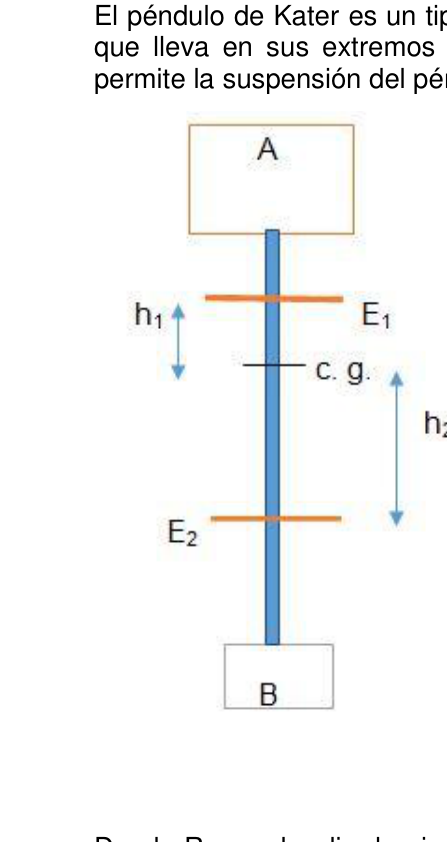
Topic: Oscillations & Waves, Rotational Dynamics Metodi: Simple Harmonic Motion Analysis, Experimental Data Analysis Competenze: Physical Reasoning, Experimental Data Analysis Objects: Pendulum, Rod Fonte: Testo (PDF) — p.5
PE2. La Champagnat College Città di Buenos Aires.
Pendolo di Kater
Introduzione Determinare l’accelerazione della gravità con il pendolo reversibile di Kater.
Marco Teorico Il pendolo di Kater è un tipo di pendolo composto che è costituito da una barra. che porta alle sue estremità due masse di valore diverso A e B e un abbraccio che consente di sospendere il pendolo lungo la barra.
Se si fa oscillare la massa B in una posizione tale che la Distanza tra il centro di sospensione E1 e il centro gravità è h1, il periodo T1 e poi Invertendo la barra, si mette l’abbraccio in una posizione tale che la distanza tra il nuovo centro di sospensione E2 e centro di gravità, sia h2, e massa A oscilla con periodo T2 pari a T1. Le espressioni di Questi periodi, del pendolo composto, sono uguali. 𝑇1 = 2𝜋 𝑅𝐺 2 + 1 2 𝑔1
𝑇2 = 2𝜋 𝑅𝐺 2 + 2 2 𝑔2
De T1 = T2
h1 h2 = 𝑅𝐺 2
Y 𝑇= 2 𝜋 1 + 2 𝑔 = 2 𝜋 𝑙 𝑔 Dove RG è il raggio di rotazione rispetto al centro di gravità e l = h1 + h2, la lunghezza di un semplice pendolo equivalente. Dall’equazione precedente 𝑔= 4 𝜋2 𝑇2 𝑙 Per applicare questa equazione i periodi T1 e T2 devono essere uguali o almeno che la differenza sia molto piccola.
Materiali
- La verga rigida .
- Masse A e B
- Supporti universali
- Nucchi .
- Cronometro .
Procedura 1- Metti le masse sulle estremità della canna 2- Identificare il centro di gravità appeso al bastone, in forma di bilanciatore su qualsiasi oggetto sottile
OAF 2015 - 125 3- Oscillare il bastone il più vicino possibile all’estremità superiore. Misurare il tempo t che Ci vuole 10 oscillazioni. Il periodo T1 = t/10. Nota la distanza h1, di centro di sospensione a centro di gravità. 4- Invertire la barra e cercare una posizione tale che il periodo di oscillazione T2 sia molto vicino al valore precedente T1. Determinare T2, a partire dal tempo impiegato in 10 oscillazioni. Notare la nuova distanza h2 dal centro di sospensione alla gravità. 5- Calcolare g 6- Ripetere l’esperienza almeno 5 volte con posizioni diverse
h1 h2 l T1 T2 g 1
2
3
4
5
Valore di g =
Topic: Oscillations & Waves, Rotational Dynamics Metodi: Simple Harmonic Motion Analysis, Experimental Data Analysis Competenze: Physical Reasoning, Experimental Data Analysis Objects: Pendulum, Rod Fonte: Testo (PDF) — p.5
PE2. Champagnat College City of Buenos Aires.
Kater ‘s pendulum .
The first is the introduction. Determine the acceleration of gravity by using the Kater reversible pendulum.
Theoretical Mark The Kater pendulum is a type of compound pendulum that is made up of a bar. It carries at its ends two masses of different values A and B and a clutch which allows the pendulum to be suspended along the bar.
If the mass B is oscillated in a position such that distance between the E1 suspension centre and the centre gravity is h1, the period being T1 and then Inverting the bar, you place the clutch in a position such that the distance between the new centre of E2 suspension and centre of gravity, be h2, and mass A oscillates with period T2 equal to T1. The expressions of These periods, of the compound pendulum, are the same. 𝑇1 = 2𝜋 𝑅𝐺 2 + 1 2 𝑔1
𝑇2 = 2𝜋 𝑅𝐺 2 + 2 2 𝑔2
De T1 = T2
h1 h2 = 𝑅𝐺 2
Y 𝑇= 2 𝜋 1 + 2 𝑔 = 2 𝜋 𝑙 𝑔 Where RG is the radius of rotation with respect to the centre of gravity and l = h1 + h2, the length of the The same as the simple pendulum. From the above equation 𝑔= 4 𝜋2 𝑇2 𝑙 For the application of this equation, periods T1 and T2 must be equal or at least Let the difference be very small.
Materials
- Hard rod .
- Masses A and B
- Universal supports
- Nuts .
- The chronometer .
The procedure 1- Place the masses at the ends of the rod 2- Identify the centre of gravity by suspending the rod, in the shape of a scale on any thin object
The Commission shall adopt delegated acts in accordance with Article 21 of this Regulation. 3- Make the rod swing as close to the upper end as possible. Measure the time t t t It takes 10 oscillations. The period T1 = t/10. Write down the distance h1, from The centre of suspension is the centre of gravity. 4- Invert the bar and look for a position such that the period of oscillation T2 is very close to the previous value T1. Determine T2, from the time spent in 10 The fluctuations. Write down the new distance h2 from the centre of suspension to the centre of gravity. 5- Calculate the 6- Repeat the experience at least 5 times with different positions
h1 h2 l T1 T2 g 1
2
3
4
5
The value of g =
Topic: Oscillations & Waves, Rotational Dynamics Metodi: Simple Harmonic Motion Analysis, Experimental Data Analysis Competenze: Physical Reasoning, Experimental Data Analysis Objects: Pendulum, Rod Fonte: Testo (PDF) — p.5
PE3. Escuela Provincial de Educación Técnica Nro. 16 Dos de Mayo, Misiones.
Los secretos de la flotación fueron descubiertos por Arquímedes, un sabio griego que
vivió hace más 2500 años. Se dice que fue tan grande su emoción al comprender por qué
los cuerpos flotan, que salió corriendo desnudo por las calles gritando ¡Eureka! (que
significa “lo encontré”, en griego).
Más allá de las anécdotas, Arquímedes se dio cuenta de que, al sumergir un cuerpo en
un líquido, aquél recibe del líquido una fuerza que lo empuja hacia arriba. A esa fuerza la
llamó, precisamente, empuje.
La densidad de un material se puede determinar mediante la siguiente expresión: 𝛿=
𝑚
𝑣
Donde 𝑚 es la masa y 𝑣 es el volumen.
El empuje es igual al peso del volumen de líquido desalojado
𝐸= 𝛿⋅𝑣⋅𝑔
126 - OAF 2015 El objetivo de la siguiente actividad será determinar la densidad de un líquido utilizado los materiales disponibles.
Materiales:
- Recipiente plástico trasparente con líquido desconocido
- Recipiente cilíndrico con graduación en milímetros
- Trozo rectangular de cartón
- Balanza digital
- Arena para utilizar como peso
- Regla graduada
-
Mide el radio del cilindro
-
Arma el siguiente dispositivo.
-
Registra el nivel que alcanza el líquido en el cilindro graduado
-
Agrega progresivamente masa sobre la plataforma de cartón y determina los volúmenes de líquido desalojado en cada caso.
-
Registra los datos en una tabla.
-
Elabora un gráfico que relacione la masa con el volumen de líquido desalojado.
-
Determina la densidad del líquido con su correspondiente error
Topic: Fluid Mechanics Metodi: Hydrostatic Equilibrium, Experimental Data Analysis Competenze: Physical Reasoning, Experimental Data Analysis Objects: Container Fonte: Testo (PDF) — p.5
PE3. Scuola Provinciale di Educazione Tecnica Nro. 16 Due maggio, missioni.
I segreti della flottazione furono scoperti da Archimede, un saggio greco che ha vissuto più di 2500 anni fa. Si dice che sia stato così emozionante capire perché I corpi galleggiano, che è uscito correndo nuda per le strade urlando Eureka! (che che significa “lo ho trovato”, in greco). Oltre alle anedotte, Archimede si rese conto che, immergendo un corpo in un liquido, il liquido riceve da esso una forza che lo spinge verso l’alto. A quel punto la forza ha chiamato, proprio, spinta. La densità di un materiale può essere determinata mediante la seguente espressione: δ= 𝑚 𝑣 Dove m è la massa e v è il volume. La spinta è pari al peso del volume di liquido sfrattato 𝐸= 𝛿⋅𝑣⋅𝑔
126 - OAF 2015 L’obiettivo della seguente attività sarà determinare la densità di un liquido utilizzato i materiali disponibili.
Materiali:
- recipiente di plastica trasparente con liquido sconosciuto
- recipiente cilindrico con graduazione in millimetri
- Un pezzo di cartone rettangolare
- Balance digitale
- Sand per il peso
- Regola graduata .
-
Misura il raggio del cilindro
-
Armati il prossimo dispositivo.
-
Registra il livello di liquido raggiunto nel cilindro graduato
-
Aggiunge progressivamente massa sulla piattaforma di cartone e determina i i volumi di liquido dislocato in ogni caso.
-
Registra i dati in una tabella.
-
Realizza un grafico che relaziona la massa con il volume di liquido dislocato.
-
Determina la densità del liquido con il suo errore corrispondente
Topic: Fluid Mechanics Metodi: Hydrostatic Equilibrium, Experimental Data Analysis Competenze: Physical Reasoning, Experimental Data Analysis Objects: Container Fonte: Testo (PDF) — p.5
PE3. Provincial school of technical education nro. 16 May 2nd, missions.
The secrets of the float were discovered by Archimedes, a Greek sage who He lived over 2,500 years ago. It is said that he was so excited to understand why The bodies float, he came running naked through the streets screaming Eureka! (which It means “I found it”, in Greek. Beyond the anecdotes, Archimedes realized that, by immersing a body in a liquid, that one receives from the liquid a force that pushes it upwards. That ‘s the strength . He called it, precisely, push. The density of a material can be determined by the following expression: δ= 𝑚 𝑣 Where m is mass and v is volume. The thrust is equal to the weight of the volume of displaced liquid. 𝐸= 𝛿⋅𝑣⋅𝑔
The Commission shall adopt delegated acts in accordance with Article 21 of Regulation (EU) No 1303/2013. The following activity will be aimed at determining the density of a liquid used the materials available.
Materials:
- Transparent plastic container with unknown liquid
- Cylindrical container with millimetre grading
- Rectangular piece of cardboard
- Digital balance sheet
- Sand to use as weight
- Gradual rule .
-
Measure the radius of the cylinder
-
Arm the next device.
-
It records the level of the liquid reaching the graduated cylinder.
-
It progressively adds mass to the cardboard platform and determines the volume of discharged liquid in each case.
-
Record the data in a table.
-
It draws up a graph that relates the mass to the volume of displaced liquid.
-
Determine the density of the liquid with its corresponding error
Topic: Fluid Mechanics Metodi: Hydrostatic Equilibrium, Experimental Data Analysis Competenze: Physical Reasoning, Experimental Data Analysis Objects: Container Fonte: Testo (PDF) — p.5
PE4. Escuela Técnica Nro. 27 Hipólito Yrigoyen Ciudad de Buenos Aires.
Determinación de la distancia focal de una lente divergente y su potencia (Método de la distancia objeto infinita)
Elementos utilizados: Lente divergente Linterna con colimador Pantalla Papel cuadriculado
Introducción: Según la marcha de rayos en lentes, todo rayo que incide paralelo al eje principal, se refracta pasando por el foco imagen f’. Si se ilumina la lente con una luz lejana o haciendo que los rayos incidan paralelos al eje principal, éstos se refractarán pasando por el foco imagen f’, logrando una imagen virtual. Colocando una pantalla a una distancia ―L‖ de la lente, se obtiene un círculo luminoso de diámetro ―D‖. La medida del diámetro ―D‖ dependerá de la ubicación ―L‖ de la pantalla
De la figura, por semejanza de triángulos se obtiene:
OAF 2015 - 127
𝐷 |𝑓|+|𝐿| = 𝑑 |𝑓| (siendo f < 0, lente divergente)
Siendo la potencia :Pot = 1/f (su unidad es la dioptría para f expresada en metros).
Desarrollo:
- Colocar el colimador delante de la lámpara para que ilumine la lente.
- Medir el diámetro ―d‖ de la lente. (Apreciación de la regla ± 1 mm)
- Ubicar la pantalla a 5 cm (aproximadamente) de la lente y medir ―L‖ y ―D‖
- Repetir para otras 4 posiciones de la pantalla
- Completar la siguiente tabla, calculando los errores en cada medición y dar el resultado final de f
Medición d L D |f|±Δf 1
2
3
4
5
Resultado final: |f|±Δf =
- Calcular la potencia de la lente con su error
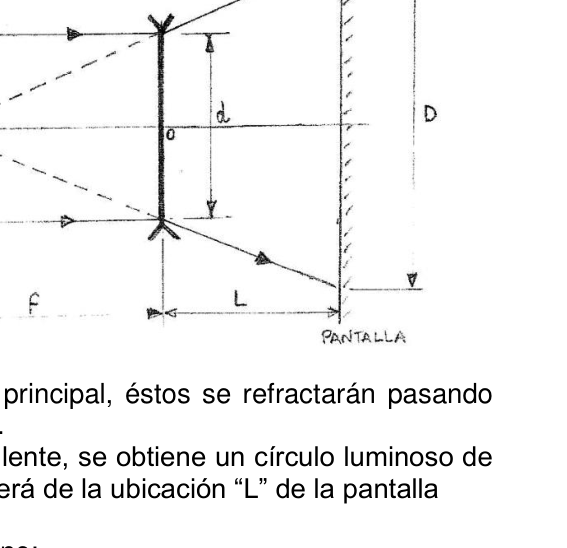
Topic: Geometric Optics Metodi: Thin Lens & Mirror Equation, Experimental Data Analysis Competenze: Physical Reasoning, Experimental Data Analysis Objects: Lens, Screen Fonte: Testo (PDF) — p.5
PE4. Scuola tecnica n.o. 27 Hippolytus Yrigoyen Città di Buenos Aires.
Determinazione della distanza focale di una lente divergente e della sua potenza (Metoda di distanza infinita dell’oggetto)
Elementi utilizzati: Lente divergente Lanterna con collimatore schermo Carta quadrata
Introduzione: Secondo il marcia dei raggi in Lenti, ogni fulmine che colpisce parallelo all’asse principale, si
- si rifracca passando attraverso il fuoco. immagine f. Se si illumina la L’ obiettivo è quello di ottenere una luce lontana o facendo incidere i raggi in parallelo all’asse principale, questi si refrattano passando per il focus immagine f, ottenendo un’immagine virtuale. Mettendo uno schermo a una distanza ―L‖ dalla lente, si ottiene un cerchio luminoso di diametro ―D‖. La misura del diametro ―D‖ dipenderà dalla posizione ―L‖ dello schermo
Dalla figura, per somiglianza di triangoli si ottiene:
OAF 2015 - 127
𝐷 |𝑓|+|𝐿| = 𝑑 |𝑓| (siendo f < 0, lente divergente)
Se la potenza: Pot = 1/f (la sua unità è la dioptria per f espressa in metri).
Sviluppo:
- Metti il collimatore davanti alla lampada per illuminare la lente.
- Misurare il diametro ―d‖ della lente. (Relazione ± 1 mm)
- posizionare lo schermo a 5 cm (circa) dalla lente e misurare ―L‖ e ―D‖
- Ripeti per altre 4 posizioni dello schermo
- Completare la tabella seguente, calcolando gli errori di ogni misurazione e dando il risultato finale di f
Misurazione d L D |f|±Δf 1
2
3
4
5
Risultato finale: ↓
- Calcolare la potenza della lente con il suo errore
Topic: Geometric Optics Metodi: Thin Lens & Mirror Equation, Experimental Data Analysis Competenze: Physical Reasoning, Experimental Data Analysis Objects: Lens, Screen Fonte: Testo (PDF) — p.5
PE4. Technical school No. 27 Hippolytus Yrigoyen City of Buenos Aires.
Determination of the focal length of a divergent lens and its power (Method of the (Infinite object distance)
Elements used: Divergent lens Lights with a collimator Screen Quadriculated paper
The Commission has also adopted a proposal for a directive on the protection of workers’ rights. According to the lightning march in lenses, any lightning that hits parallel to the main axis, it It refracts through the focus . The following is the image: If you light the light . Lenses with a distant light or By making the rays strike parallel to the main axis, they will refract by passing. by the image focus f, achieving a virtual image. By placing a screen at a distance ―L‖ from the lens, you get a bright circle of diameter of the vehicle. The measurement of the diameter ―D‖ will depend on the location ―L‖ of the screen
From the figure, by triangle resemblance, we get:
The Commission shall adopt delegated acts in accordance with Article 21 of this Regulation.
𝐷 |𝑓|+|𝐿| = 𝑑 If f is 0, divergent lens
If the power is:Pot = 1/f (its unit is the dioptry for f expressed in meters).
Development of the Community:
- Place the collimator in front of the lamp so that the lens lights up.
- Measure the diameter ―d‖ of the lens. (Rule value ± 1 mm)
- Place the screen 5 cm (approximately) from the lens and measure ―L‖ and ―D‖
- Repeat for 4 other screen positions
- Complete the following table, calculating the errors in each measurement and giving the Final result of f
Measurement d L D |f|±Δf 1
2
3
4
5
The final result: ↓
- Calculate the power of the lens with its error
Topic: Geometric Optics Metodi: Thin Lens & Mirror Equation, Experimental Data Analysis Competenze: Physical Reasoning, Experimental Data Analysis Objects: Lens, Screen Fonte: Testo (PDF) — p.5
PE5. Colegio Juan Humberto Morán Eduardo Castex, La Pampa.
Campo magnetico.
Objetivo: Construir un electroimán. Verificar si el comportamiento del módulo del campo
de inducción magnética producido por un dipolo magnético sobre el eje del mismo,
responde a una ley del tipo 1/x3. Breve descripción:
Un electroimán es un dispositivo mediante el cual se obtiene un campo de inducción
magnética B. Una configuración usual consiste en una barra de hierro (o algún otro
material ferromagnético) sobre el cual se ha bobinado algún número de vueltas de
alambre de cobre . Cuando la bobina se conecta a una fuente de tensión, la corriente
eléctrica que circula por ella produce un campo de inducción magnética. El campo B que
se consigue mediante un electroimán depende de la configuración geométrica utilizada;
en el caso del descripto arriba (barra y bobina) es similar al de un dipolo magnético. El
módulo del campo de inducción magnética, B, producido por un dipolo magnético de
módulo Pm a lo largo de la dirección de eje del dipolo y a una distancia x, está dado por:
B= (μo Pm / 2 𝜋). (1 / x3 )
La dirección del vector campo de inducción magnética en este caso es la del eje x.
Una brújula es un instrumento mediante el cual se puede determinar la dirección norte-
sur (N-S) sobre la superficie terrestre; en general, se puede usar para determinar la
dirección, en un punto determinado, de un campo de inducción magnética cualquiera.
Consigna 1
a) Realizar la construcción de un electroimán o también llamado solenoide, con una
bobina de al menos 30 vueltas de alambre.
b) Verificar su funcionamiento. Describir el procedimiento utilizado. Elementos que
pueden resultar de utilidad – Una varilla de hierro 15cm de largo. - Alambre fino de
cobre aislado (hilos de cables de electricidad, alambre esmaltado de bobinas, etc.),
aproximadamente 1m. - Cinta adhesiva de papel. - Cables conductores para
conexiones eléctricas. – Fuente con corriente continua de 1,5 V
128 - OAF 2015
Consigna 2
Verificar que el módulo del campo de inducción magnética B a lo largo del eje del
electroimán varía con la distancia como el de un dipolo magnético, esto es:
B α 1 / x3
Elementos que pueden resultar de utilidad
- Una brújula
- El electroimán construido.
- Hojas en blanco.
- Papel milimetrado.
- Regla.
- Lápiz.
Para realizar la verificación ubique el eje del electroimán perpendicular al campo magnético terrestre y sobre un plano paralelo a la superficie terrestre. De esta manera, la presencia del campo del electroimán sumado vectorialmente al terrestre producirá una desviación de la aguja respecto de la dirección norte-sur (N-S). La tangente trigonométrica del ángulo (α) entre la aguja y la dirección norte-sur es proporcional al campo de inducción magnética producido por el electroimán. Determine la tangente de α para diferentes distancias x entre el electroimán y la aguja de la brújula.
Procedimiento sugerido
a) Apoye la ―brújula‖ sobre un extremo de una hoja de papel de tal manera que el lado
corto quede alineado con la dirección N-S. Pegue, con cinta adhesiva, la hoja a la mesa y
marque sobre la hoja el contorno de la cubeta de la brújula. b) Marque una recta que
―contenga‖ a la aguja y una recta perpendicular que pase por el centro de la aguja y sea
paralela al lado largo de la hoja (dirección E-O). El punto de intersección es el origen del
sistema de coordenadas que se utilizará. c) Apoye el electroimán sobre la línea E-O, a
una distancia x del centro de la aguja y enciéndalo. Verifique que la aguja se reorienta y
marque la posición del electroimán. Trace una recta que ―contenga‖ a la aguja. Para
esto apoye la regla sobre la cubeta en la dirección de la aguja (no cometa errores de
paralaje), desconecte el electroimán, marque la recta sobre el papel. e) A partir de los
catetos (h y h*) del triangulo determinado por la recta 33 trazada en b) y por la trazada en
d) y un borde de la hoja, determine la tangente del ángulo entre la dirección de la aguja
en presencia del electroimán y la dirección N-S. Figura 4 f) Consigne en una tabla los
valores de tg α y de x .Determine los errores correspondientes.
Repita el procedimiento de c), d), e) y
f), para diferentes posiciones (x) del
electroimán. g) Haga un grafico (1/x3
vs
tg
α).
Verifique
si
el
comportamiento es lineal, en tal caso
ajuste una recta. Para determinar la
dirección de la aguja utilice la regla
como guía y trace la recta que
―contiene‖ a la aguja sobre el papel
base. - Mida las distancias desde la
cabeza de la barra y déjelas
asentadas en el papel base. - Utilice
cables de conexión al electroimán
suficientemente largos. - Desconecte la fuente luego de cada medición. - Trabaje sobre
una mesa que no tenga partes ferromagnéticas, o con el electroimán y la brújula
suficientemente alejados de dichas partes. Luego de cada medición verifique que la
aguja de la brújula esté ubicada en la posición original (con el centro en el origen de
coordenadas).
OAF 2015 - 129
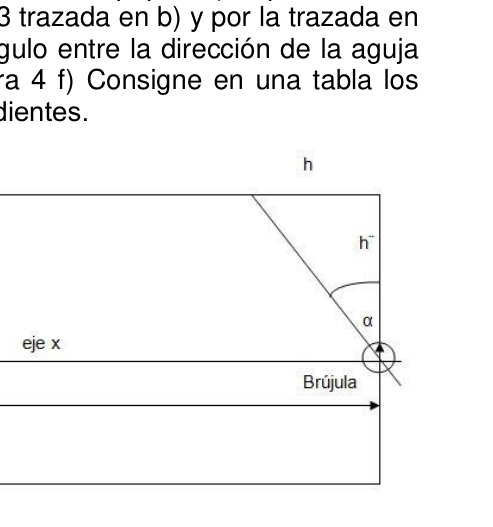
Topic: Magnetism Metodi: Experimental Data Analysis, Graph Linearization Competenze: Physical Reasoning, Experimental Data Analysis Objects: Solenoid, Magnetic Dipole Fonte: Testo (PDF) — p.5
PE5. Colegio Juan Humberto Morán Eduardo Castex, La Pampa.
Campo magnetico. Obiettivo: costruire un elettromagneto. Verificare se il comportamento del modulo di campo di induzione magnetica prodotta da un dipolo magnetico sull’asse del dipolo, risponde a una legge del tipo 1/x3. Breve descrizione: Un elettromagnetico è un dispositivo con il quale si ottiene un campo di induzione. Magnetico B. Una configurazione comune consiste in una barra di ferro (o qualche altro materiale ferromagneto) su cui è stato ripiegato un certo numero di giri di
- Cattedra di rame . Quando la bobina si collega a una fonte di tensione, il corrente L’energia elettrica che circola attraverso di essa produce un campo di induzione magnetica. Il campo B che si ottiene con un elettromagnetico dipende dalla configurazione geometrica utilizzata; nel caso del di sopra descritto (barra e bobina) è simile a quello di un dipolo magnetico. El modulo del campo di induzione magnetica, B, prodotto da un dipolo magneto di modulo Pm lungo la direzione dell’asse del dipolo e a una distanza x, è dato da: B= (μo Pm / 2 𝜋). (1 / x3 ) La direzione del vettore del campo di induzione magnetica in questo caso è quella dell’asse x. Una compassa è uno strumento per determinare la direzione nord- sud (N-S) sulla superficie terrestre; in generale, può essere usato per determinare la direzione, a un determinato punto, di un campo di induzione magnetica qualsiasi.
Consigna 1 a) Costruire un elettromane o solenoide, con una condraggino di almeno 30 giri di filo. b) Verificare il suo funzionamento. Descrivere la procedura utilizzata. Elementi che Potrebbe essere utile un bastone di ferro lungo 15 cm. - Fino a filo di Copro isolato (filamenti di cavi elettrici, filo smaltato di bobine, ecc.), circa 1 m. - Fascia adesiva di carta. - Cable di conduttore per collegamenti elettrici. Fonte a corrente continua di 1,5 V
128 - OAF 2015 Consigna 2 Verificare che il modulo del campo di induzione magnetica B lungo l’asse del L’elettromagnetismo varia a distanza come quello di un dipolo magnetico, cioè: B α 1 / x3
Elementi che possono risultare utili
- Una compassa .
- L’elettromagneto costruito.
- Foglie bianche.
- Papero millimetrico.
- Regola.
- Una penna. Per verificare , localizza l’ asce dell’ elettromagnetico perpendicolare al campo . Magnetico terrestre e su un piano parallelo alla superficie terrestre. In questo modo, la La presenza di un campo elettromagnetico di cui la presenza è di un campo elettromagnetico di cui la presenza è di un campo elettromagnetico di cui la presenza è di un campo elettromagnetico di cui la presenza è di un campo elettromagnetico di cui la presenza è di un campo elettromagnetico di cui la presenza è di un campo elettromagnetico di cui la presenza è di un campo elettromagnetico di cui la presenza è di un campo elettromagnetico di cui la presenza è di un campo elettromagnetico di cui la presenza è di un campo elettromagnetico di cui la presenza è di un campo elettromagnetico di cui la presenza è di un campo elettromagnetico di cui la presenza è di un campo elettromagnetico di cui la presenza è di un campo elettromagnetico di cui la presenza è di un campo elettromagnetico di cui la presenza è di un campo elettromagnetico di cui la presenza è di un campo elettromagnetico di cui la presenza è di un campo elettromagnetico di cui la presenza è di un campo di un campo di un campo elettromagnetico di cui il campo elettromagnetico di cui il campo è di un campo di un campo di cui il campo è di un campo di un campo elettromagnetico di cui il campo è un campo di un campo di un campo di cui il campo di un campo di un campo diametricolo di un’eletronica è un campo di un’eletronica. la deviazione dell’ago rispetto alla direzione nord-sud (N-S). La tangente la trigonometria dell’angolo (α) tra l’ago e la direzione nord-sud è proporzionale a campo di induzione magnetica prodotto dall’elettromagnetico. Determina la tangenza di α per diverse distanze x tra l’elettromagnetico e l’ago della compassa.
Procedura suggerita a) appoggiare la “brush” su un’estremità di una foglia di carta in modo che il lato corto, in linea con l’indirizzo N-S. Collegare, con nastri, la foglia al tavolo e Marcare sul foglio il contorno della cubica della compassa. b) Segna un tratto che “contiene” l’ago e una retta perpendicolare che attraversa il centro dell’ago e sia parallelo al lato lungo della foglia (indirizzo E-O). Il punto di intersezione è l’origine del sistema di coordinate da utilizzare. c) Sostene l’elettromagnetico sulla linea E-O, a una distanza x dal centro dell’ago e accenderlo. Verifica che la ago si sia riorientata e segna la posizione dell’elettromagnetico. Traccia una retta che “contiene” l’ago. Per Questo supporta la regola sul cubo nella direzione dell’ago (non commette errori di Parallaggio), spegni l’elettromagnetico, segna la retta sulla carta. e) A partire da cateti (h e h*) del triangolo determinato dalla linea 33 tracciata in b) e dalla linea d) e un bordo della foglia, determinare la tangenza dell’angolo tra la direzione dell’ago in presenza dell’elettromagnetico e dell’indirizzo N-S. Figura 4 (f) Contiene in una tabella i Determina gli errori corrispondenti. Ripetere la procedura di c), d), e) e f), per diverse posizioni (x) di
- Un elettromagnetico. g) Fare un grafico (1/x3 vs tg α). Controlla si el Il comportamento è lineare, in questo caso.
- Aggiusta un tratto. Per determinare la Direzione dell’ ago usa la regola come guida e traccia la retta via che “contene” l’ago sul cartaceo base. - Misura le distanze da
- La testa della barra e lasciala basate sullo scarto. - Utilizzare Cable di connessione all’elettromagnetico abbastanza lunghi. - Sconfiggere la fonte dopo ogni misurazione. - Sto lavorando su Un tavolo senza parti ferromagnetiche, o con l’elettromagnetico e la compassa. sufficientemente allontanati da tali parti. Dopo ogni misurazione verificare che la spilla della compassa è collocata nella posizione originale (con il centro all’origine di coordinate).
OAF 2015 - 129
Topic: Magnetism Metodi: Experimental Data Analysis, Graph Linearization Competenze: Physical Reasoning, Experimental Data Analysis Objects: Solenoid, Magnetic Dipole Fonte: Testo (PDF) — p.5
PE5. The school is called Juan Humberto Morán. Eduardo Castex, the Pampa.
Magnetic field. Goal: Build an electromagnet. Check whether the field module behaves magnetic induction produced by a magnetic dipole on its axis, It’s a 1/x3 law. Brief description: An electromagnet is a device by which an induction field is obtained. magnetic B. A common configuration consists of an iron bar (or some other Ferromagnetic material) on which a number of turns of copper wire . When the coil is connected to a voltage source, the current The electrical current that flows through it produces a magnetic induction field. Field B that is achieved by an electromagnet depending on the geometric configuration used; In the case of the above described (bar and coil) it is similar to that of a magnetic dipole. El magnetic induction field module, B, produced by a magnetic dipole of module Pm along the axis direction of the dipole and at a distance x, is given by: B= (μo Pm / 2 𝜋). (1 / x3 ) The direction of the magnetic induction field vector in this case is that of the x-axis. A compass is an instrument by which the northern direction can be determined. south (N-S) over the land surface; generally, it can be used to determine the direction, at a given point, of any magnetic induction field.
Consigna 1 (a) To construct an electromagnet or also called a solenoid, with a coil of at least 30 turns of wire. (b) Verify its operation. Describe the procedure used. Elements that A 15cm long iron rod can be useful. - Fine wire of Insulated copper (wire of electrical wires, coil enamelled wire, etc.), approximately 1 m. - It’s a paper tape. - Cable conductors for electrical connections. Continuous flow source of 1,5 V
The Commission shall adopt delegated acts in accordance with Article 21 of Regulation (EU) No 1303/2013. Consigna 2 Verify that the magnetic induction field module B along the axis of the The electromagnet varies with distance like that of a magnetic dipole, that is: B α 1 / x3
Elements that may be useful
- A compass .
- The built-in electromagnet.
- It’s blank.
- It’s a millimeter piece of paper.
- It’s a rule.
- A pencil. To verify the position of the electromagnet perpendicular to the field. The magnetic field is the magnetic field of the Earth and is on a plane parallel to the Earth’s surface. In this way, the The presence of the electromagnetic field vectorally added to the ground will produce a deviation of the needle from the north-south direction (N-S). The tangent The trigonometric angle (α) between the needle and the north-south direction is proportional to magnetic induction field produced by the electromagnet. Determine the tangent of α for different x distances between the electromagnet and the compass needle.
Suggested procedure (a) Hold the “brush” on one end of a sheet of paper in such a way that the side short be aligned with N-S address. Sticky, with tape, sheet to the table and mark the outline of the compass bucket on the sheet. (b) Mark a line that “contain” the needle and a perpendicular straight line passing through the centre of the needle and be parallel to the long side of the leaf (E-O direction). The intersection point is the origin of the the coordinate system to be used. (c) Supports the electromagnet over the E-O line, a x distance from the center of the needle and turn it on. Check that the needle is re-directed and mark the position of the electromagnet. Draw a straight line that “contains” the needle. For This supports the rule on the bucket in the direction of the needle (do not make mistakes of Parallax), disconnect the electromagnet, mark the straight on the paper. (e) From the Cathetes (h and h*) of the triangle determined by the straight 33 plotted in (b) and plotted in (d) and a leaf edge, determine the tangent of the angle between the direction of the needle in the presence of the electromagnet and the N-S address. Figure 4 (f) Contain in a table the values of tg α and x. Determine the corresponding errors. Repeat the procedure in (c), (d), (e) and ( (f) for different positions (x) of The electromagnetic field. (g) Draw a graph (1/x3 ) vs tg α). Check it out . si el The behavior is linear, in that case You just set a straight. To determine the Needle direction use the rule as a guide and trace the straight path that ―contains‖ the needle on the paper base. - Measure distances from the Head off the bar and let them go . settled on the base paper. - Use it . wires for connection to the electromagnet long enough. - Turn off the source after each measurement. - I ‘m working on A table that doesn’t have ferromagnetic parts, or with the electromagnet and compass. sufficiently distant from those parts. After each measurement check that the The needle of the compass is located in the original position (with the centre at the origin of coordinates).
The following is the list of the countries of the European Union:
Topic: Magnetism Metodi: Experimental Data Analysis, Graph Linearization Competenze: Physical Reasoning, Experimental Data Analysis Objects: Solenoid, Magnetic Dipole Fonte: Testo (PDF) — p.5
PE6. Colegio Nacional Dr. Arturo U. Illia
Colegio Albert Einstein Mar del Plata, Buenos Aires.
Objetivo: Caracterización de un movimiento a partir de mediciones Procedimiento: Se dispone de una varilla roscada con una serie de marcas que se coloca de forma rígida sobre un soporte, de forma que la varilla quede vertical. Se analizará el movimiento de una arandela que se dejará caer desde la parte superior por la varilla. El objetivo de la experiencia es encontrar el tipo de movimiento que describe el centro de masa de la arandela en su descenso, para esto deberá medir la separación entre las marcas de la verilla y el tiempo que tarda la arandela en bajar. Para esto le recomendamos tomar como inicio del movimiento la marca de la parte superior, (tiempo cero en el cronómetro) pero dejando caer la arandela desde el borde superior de la varilla para que se estabilice en la caída. a) Complete la siguiente tabla de datos
X Δx t Δt
b) A partir de los datos de la tabla realice un gráfico de posición en función del tiempo. c) Describa el tipo de movimiento que realiza el centro de masa de la arandela a partir del gráfico realizado. d) Si considera que el movimiento es a velocidad constante encuentre la velocidad del mismo con su error a partir del gráfico. e) Si considera que el movimiento no es constante, explique cómo haría para construir el gráfico de velocidad en función del tiempo y como podría medir la aceleración del problema si fuera constante. f) Explique claramente como consideró los errores en su experiencia.
Topic: Newtonian Mechanics Metodi: Kinematic Equations, Experimental Data Analysis Competenze: Physical Reasoning, Experimental Data Analysis Objects: Rod Fonte: Testo (PDF) — p.5
PE6. Il Dr. Arturo U. Illia
Albert Einstein College Mar del Plata, Buenos Aires.
Obiettivo: Caratterizzazione di un movimento a partire da misurazioni Procedura: Si dispone di una canna a riso con una serie di marchi che si colloca in forma rigido su un supporto, in modo che la canna sia verticale. Si analizzerà il movimento. di una scaglia che sarà abbattuta dall’alto dal bastone. L’obiettivo dell’esperienza è quello di trovare il tipo di movimento che descrive il centro di La massa della scatola in discesa, per questo dovrà misurare la separazione tra le le tracce della vernice e il tempo che la cravatta impiega per scendere. Per questo, consigliamo di prendere come inizio del movimento il marchio della parte. superiore, (zero tempo sul cronometro) ma lasciando cadere la catena dal bordo superiore del bastone per stabilizzarlo nel cadere. a) Completa la tabella di dati seguente
X Δx t Δt
b) Sulla base dei dati della tabella realizza un grafico di posizione in base al tempo. c) Descriva il tipo di movimento effettuato dal centro di massa della scatola a partire da di grafico realizzato. d) Se si ritiene che il movimento sia a velocità costante, si trova la velocità di lo stesso errore che ha fatto sul grafico. e) Se ritieni che il movimento non sia costante, spiega come farebbe per costruire il grafico di velocità in funzione del tempo e come potrebbe misurare l’accelerazione del problema se fosse costante. f) Spiega chiaramente come ha considerato gli errori nella sua esperienza.
Topic: Newtonian Mechanics Metodi: Kinematic Equations, Experimental Data Analysis Competenze: Physical Reasoning, Experimental Data Analysis Objects: Rod Fonte: Testo (PDF) — p.5
PE6. National College Dr. - Arthur U. Illia
Albert Einstein College . The city of Mar del Plata, Buenos Aires.
The objective: Characterization of a movement from measurements The procedure: A threaded rod with a series of marks is provided which is placed in the shape of a rigid on a support, so that the rod is vertical. The movement will be analysed. of a scythe that will be dropped from the top by the rod. The aim of the experiment is to find the type of movement that describes the center of the The mass of the screw as it descends, for this purpose it must measure the separation between the the beam marks and the time it takes the crankshaft to descend. For this we recommend that you start the movement by taking the mark of the part. higher, (zero time on the timekeeper) but dropping the scythe from the edge the top of the rod to stabilize in the fall. (a) Complete the following data table
X Δx t Δt
(b) Draw a position chart based on time from the data in the table. (c) Describe the type of movement the centre of mass of the screw makes from The graph is done. (d) If you consider that the motion is constant, find the velocity of the Even with his error from the graph. (e) If you consider the movement to be unstable, explain how you would build it. The speed graph is based on time and how you could measure the acceleration of the problem if it was constant. (f) Clearly explain how you considered the errors in your experience.
Topic: Newtonian Mechanics Metodi: Kinematic Equations, Experimental Data Analysis Competenze: Physical Reasoning, Experimental Data Analysis Objects: Rod Fonte: Testo (PDF) — p.5
PE7. Instituto Educativo Génesis Posadas, Misiones.
Objetivo: Comparar la presión atmosférica con la presión interior.
130 - OAF 2015 Breve descripción: Al encender una vela, en el interior de los vasos se va llenando de gases desprendidos en el proceso de combustión (CO2, vapor de agua, otros), y también se observa aire caliente. Al agotarse el oxígeno dentro del interior de los vasos la llama se apaga, por lo cuál disminuye la temperatura de los gases en el interior. De acuerdo con la ley de Gay- Lussac, a volumen constante la presión ejercida por una determinada masa de gas es directamente proporcional a la temperatura (P α T).
Elementos necesarios:
- Dos vasos de vidrios (del mismo tamaño y necesariamente que sean livianos).
- Una vela pequeña de té (las de base de aluminio)
- Una servilleta de papel (una hoja)
- Agua
- Fósforos. Seguridad: El experimento involucra combustible (cera) en combustión, ser cuidadoso. Usar fósforos preferentemente.
Procedimiento:
a) Se realiza un pequeño corte en el centro de la servilleta, y luego se lo humedece
con agua.
b) Se coloca la vela en el interior de uno de los vasos y se la enciende, tener cerca el
otro vaso y la servilleta humedecida.
c) Luego de unos 20 segundos, se cubre el vaso que contiene la vela empleando la
servilleta húmeda, procurando que no aparezcan arrugas en el borde del vaso.
Inmediatamente antes de que se apague la vela, se coloca el otro vaso encima de
la servilleta húmeda; cuidando que los perímetros de los vasos sean coincidentes y
que no exista ―espacio‖ por el cuál pueda ingresar aire al interior de los vasos.
d) Luego de que se apaga la vela, levantar cuidadosamente el vaso superior y
observar lo que ocurre.
Evaluar:
a) ¿Por qué los vasos se mantienen unidos luego de que la vela se apaga?
b) ¿Por qué cuesta separar a los vasos? Para separarlos, resulta más sencillo, ¿tirar
de ellos ó realizar un movimiento de giro?
¿Cuál es la función que ejerce el agua en la servilleta?
Topic: Thermodynamics, Fluid Mechanics Metodi: Ideal Gas Law, Experimental Data Analysis Competenze: Physical Reasoning, Experimental Data Analysis Objects: Container Fonte: Testo (PDF) — p.5
PE7. Istituto Educativo Genesi Posate, Missioni.
Obiettivo: Confrontare la pressione atmosferica con la pressione interna.
130 - OAF 2015 Breve descrizione: Accendendo una candela, l’interno dei vasi si riempie di gas sganciati. La combustione è un processo di combustione (CO2, vapore d’acqua, altri), e si osserva anche l’aria caldo. Quando l’ossigeno si esaurisce all’interno dei vasi, la fiamma si spegne, per cui diminuisce la temperatura dei gas all’interno. Secondo la legge di Gay- Lussac, a volume costante la pressione esercitata da una determinata massa di gas è direttamente proporzionale alla temperatura (P α T).
Elementi necessari:
- Due bicchieri di vetro (same dimensione e necessariamente leggeri).
- Una piccola vela di tè (le base di alluminio)
- Un foglio di carta.
- Acqua .
- Fosforo. Sicurezza: l’esperimento prevede combustibile (cerra) in combustione, essere attenti. Usare i fiammiferi preferibilmente.
Procedura: a) Si fa un piccolo taglio al centro della servetta, e poi si umide con l’acqua. b) Mettete la candela all’interno di uno dei vasi e accendetela, tenendo vicino il Un altro bicchiere e la tovaglia bagnata. c) Dopo circa 20 secondi, coprire il bicchiere contenente la vela utilizzando il Servetta umida, assicurando che non si trovino rughe sul bordo del bicchiere. Immediatamente prima di spegnere la candela, si pone l’altro vaso sopra la servetta umida; assicurando che i perimetri dei vasi siano corrispondenti e che non esiste spazio per l’aria che possa entrare all’interno dei vasi. d) Dopo aver spento la candela, sollevare con cura il vaso superiore e osservare cosa succede. Valutare: a) Perché i vasi restano uniti dopo che la candela si spende? b) Perché è difficile separare i vasi? Per separarli, è più semplice, tirare. di loro o di fare un giro? Qual è la funzione dell’acqua nel serbatoio?
Topic: Thermodynamics, Fluid Mechanics Metodi: Ideal Gas Law, Experimental Data Analysis Competenze: Physical Reasoning, Experimental Data Analysis Objects: Container Fonte: Testo (PDF) — p.5
PE7. The Genesis Education Institute The inn, the missions.
The objective: Comparing atmospheric pressure to the internal pressure.
The Commission shall adopt delegated acts in accordance with Article 21 of Regulation (EU) No 1305/2013. Brief description: When you light a candle, the inside of the glasses is filled with discharged gases. The resulting emissions from the combustion process (CO2, water vapour, others) and air are also observed. It’s hot. When the oxygen inside the vessels is exhausted, the flame is extinguished, which is why It decreases the temperature of the gases inside. According to Gay’s law… Lussac, at constant volume the pressure exerted by a given mass of gas is directly proportional to temperature (P α T).
The following items are required:
- Two glass glasses (of the same size and necessarily lightweight).
- A small tea candle (the aluminum-based ones)
- A paper napkin (a sheet)
- Water .
- It’s phosphorus. Safety: The experiment involves fuel (ceramics) in combustion, be careful. Use matches preferably.
The procedure: a) A small cut is made in the center of the napkin, and then it is moistened. with water. (b) Place the candle inside one of the cups and light it, keeping the candle close to the glass. Another glass and the wet napkin. (c) After about 20 seconds, cover the glass containing the candle using the wet napkin, making sure there are no wrinkles on the edge of the glass. Immediately before the candle is turned off, the other glass is placed above the candle. the wet napkin; making sure the perimeter of the cups are matched and There is no “space” through which air can enter the inside of the vessels. d) After the candle is turned off, carefully lift the top glass and Watch what happens. The evaluation of: (a) Why do the glasses stay together after the candle is turned off? (b) Why is it so difficult to separate the glasses? To separate them, it’s easier to pull. Or do you make a turn? What is the function of water in the napkin?
Topic: Thermodynamics, Fluid Mechanics Metodi: Ideal Gas Law, Experimental Data Analysis Competenze: Physical Reasoning, Experimental Data Analysis Objects: Container Fonte: Testo (PDF) — p.5
PE8. Escuelas Técnicas Raggio Ciudad de Buenos Aires.
Objetivo: Medir el Empuje que un líquido incógnita ejerce cobre un cuerpo metálico macizo, completamente sumergido. Medir la densidad de ese líquido.
Elementos:
- 1 vaso de precipitado de 250 ml aforado
- 1 vaso de precipitado de 100 ml aforado, con hilo pegado para poder colgarlo
- 1 soporte universal con una nuez con agarradera metálica
- 1 dinamómetro (0-2.5)N
- 500 ml líquido incógnita
- 1 taco de madera
- 1 cuerpo metálico macizo con un gancho
Requerimientos: Solo podrá utilizar los elementos provistos, papel, lapicera y calculadora no programable.
OAF 2015 - 131 Al finalizar el trabajo deberá presentar un informe que incluya los siguientes puntos:
- Esquema de los dispositivos experimentales utilizados
- Descripción y fundamentación del diseño utilizado
- Diagrama de cuerpo libre del cuerpo metálico macizo completamente sumergido en el líquido.
- Cuadro de valores de las mediciones realizadas
- Resultados obtenidos con sus correspondientes errores
- Respuesta justificada a la pregunta: ¿Es posible que el líquido incógnita sea agua?
- Tanto para la determinación el Empuje como la de la Densidad buscada: De todas las mediciones directas realizadas, ¿cuál es el factor que, de hacer esta experiencia nuevamente, ud. se preocuparía de medir con menor error la próxima vez? Justifique
Datos:
- La densidad del agua es (1,00 ± 0,03)g / cm3
- La aceleración de la gravedad es (9,80 ± 0,01) m / s2
Topic: Fluid Mechanics Metodi: Hydrostatic Equilibrium, Experimental Data Analysis Competenze: Physical Reasoning, Experimental Data Analysis Objects: Block Fonte: Testo (PDF) — p.5
PE8. Scuole tecniche Raggio Città di Buenos Aires.
Obiettivo: Misurare la spinta che un liquido incognito esercita copre un corpo metallico massiccio, completamente immerso. Misurare la densità di quel liquido.
Elementi:
- 1 bicchiere di precipitato di 250 ml risparmiato
- 1 bicchiere di precipitazione di 100 ml risparmiato, con filo attaccato per poterlo appendere
- 1 supporto universale con un’aria a legno con una colla metallica
- 1 dinamometro (0-2.5)
- 500 ml di liquido incognito
- 1 palo di legno
- 1 corpo metallico massiccio con un gancio
Requisiti: Può utilizzare solo gli elementi forniti, carta, lapislatura e calcolatore non programmabile.
OAF 2015 - 131 Al termine del lavoro, deve presentare un rapporto che include i seguenti punti:
- Schema dei dispositivi sperimentali utilizzati
- Descrizione e motivazione del design utilizzato
- Diagramma di corpo libero del corpo metallico massiccio completamente immerso in il liquido.
- Tabella dei valori delle misurazioni effettuate
- Risultati ottenuti con i propri errori
- Risposta giustificata alla domanda: è possibile che il liquido incognito sia acqua?
- Per determinare sia la spinta che la densità ricercata: Le misure dirette effettuate, qual è il fattore che, di fare questa esperienza Ancora una volta, Ud. Ti preoccuperai di misurare con meno errore la prossima volta? Giustifica
Datati:
- La densità dell’acqua è (1,00 ± 0,03) g/cm3
- L’accelerazione della gravità è (9,80 ± 0,01) m/s2
Topic: Fluid Mechanics Metodi: Hydrostatic Equilibrium, Experimental Data Analysis Competenze: Physical Reasoning, Experimental Data Analysis Objects: Block Fonte: Testo (PDF) — p.5
PE8. Raggio Technical Schools City of Buenos Aires.
The objective: Measure the thrust that an unknown liquid exert covers a solid metal body, completely submerged. Measure the density of that liquid.
The following elements:
- 1 glass of 250 ml of precipitated savings
- 1 glass of 100 ml of precipitated water saved, with thread attached so that it can be hung
- 1 universal support with a nut with a metal handle
- 1 dynamometer (0-2.5)
- 500 ml of unknown liquid
- One wooden stick .
- 1 solid metal body with a hook
Requirements: You may only use the items provided, paper, pencil and non-programmable calculator.
The Commission shall adopt delegated acts in accordance with Article 21 of this Regulation. At the end of the work, a report shall be submitted, including the following:
- Schedule of experimental devices used
- Description and justification of the design used
- Free-body diagram of the solid metal body completely submerged in the liquid.
- Table of values of measurements carried out
- Results obtained with their corresponding errors
- Justified answer to the question: Is it possible that the unknown liquid is water?
- For both the determination of the thrust and the density sought: The direct measurements made, what is the factor that, of making this experiment Again, you. Would you care to measure with less error next time? Justify it .
The data:
- The density of water is (1,00 ± 0.03) g/cm3
- The acceleration of gravity is (9,80 ± 0.01) m/s2
Topic: Fluid Mechanics Metodi: Hydrostatic Equilibrium, Experimental Data Analysis Competenze: Physical Reasoning, Experimental Data Analysis Objects: Block Fonte: Testo (PDF) — p.5
PE9. EPES Nro. 59 Prof. Pabla Idoyaga Ciudad de Formosa.
Objetivo:
- Estudiar la potencia calórica de una vela.
Breve descripción
Una vela es un cilindro de cera con un pabilo en
el eje para que pueda encenderse y como
resultado de la combustión de la cera irradiar luz
y calor.
La llama de la vela tiene diferentes temperaturas
(ver la figura) e irradia calor y luz en todas
direcciones. Sin embargo, por el mecanismo de
convección, el calor principalmente fluye en la
dirección vertical (hacia donde apunta la llama).
El flujo de calor que emite la vela en la dirección de su eje (vertical) se puede estudiar mediante el dispositivo que se esquematiza en la Figura 2. El mismo consiste de un cubito de hielo, apoyado sobre una chapa metálica fina, que está ligeramente inclinada. Por debajo de la chapa y en coincidencia con un eje que pasa por el centro del cubito se coloca la vela. La llama de esta última está a una distancia d de la chapa. En el extremo inferior de la chapa se ubica una jeringa graduada, sin émbolo y con el extremo fino (donde va la aguja) tapado (podría ser reemplazada por una probeta).
El agua producida por la fusión del hielo se recolecta en la jeringa y se determina suvolumen Va. Determinando Va en función del tiempo (t) y sabiendo el calor latente del hielo (80cal/g), se puede estimar la cantidad de energía por unidad de tiempo (potencia) que le ha llegado al hielo proveniente de la vela.
132 - OAF 2015
a) Enuncie algunas de las hipótesis que se han realizado en la descripción previa y
que no se han enunciado explícitamente. Algunas que involucran a la chapa y se
relacionan con sus dimensiones. Otras que se relacionan con la temperatura del
ambiente, del hielo, del agua.
b) Mida la temperatura ambiente.
c) Implemente el dispositivo propuesto.
d) Mida el aporte de calor proveniente del ambiente. Determine si es despreciable o
no.
e) Realice las mediciones de Va en función de t para, al menos, tres distancias chapa-
llama (d) diferentes. Cada conjunto debe estar compuesto por no menos de diez
pares (t, Va).
f) Haga un gráfico t vs masa de hielo fundido, correspondiente a cada distancia d.
Verifique si el comportamiento es aproximadamente lineal, en tal caso ajuste una
recta.
g) A partir de los gráficos anteriores estime la potencia (P) recibida por el cubito de
hielo en cada caso.
h) Presente estos resultados en un gráfico (d vs P). Extrapole estos resultados al valor
d=0 y determine un valor PM.
Elementos que pueden resultar de utilidad:
- Chapa metálica fina (espesor despreciable).
- Cubitos de hielo (al menos 3).
- Plastilina (para evitar que el hielo deslice como consecuencia de la pendiente con la que se ha puesto la chapa).
- Vela (marca Ranchera o de calidad equivalente).
- Regla, papel milimetrado o cuadriculado, lápiz.
- Jeringa graduada de 10ml o más.
- Cronómetro.
- Soportes, pinzas de madera (tipo broches de los de colgar la ropa).
- Recipientes para agua.
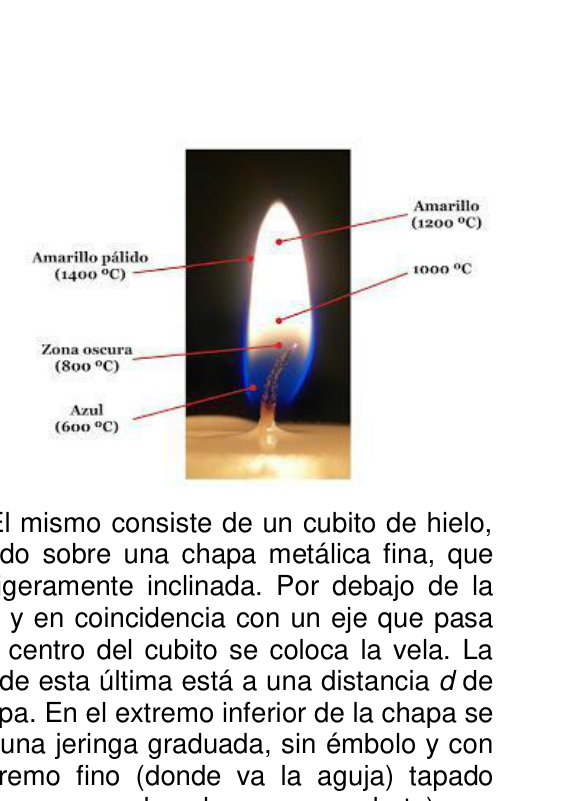
Topic: Thermodynamics Metodi: First Law of Thermodynamics, Experimental Data Analysis Competenze: Physical Reasoning, Experimental Data Analysis Objects: Calorimeter Fonte: Testo (PDF) — p.5
PE9. - Non lo so. 59 Prof. Pabla Idoyaga Città di Formosa.
Obiettivo:
- Studiare la potenza calorica di una candela.
Breve descrizione Una candela è un cilindro di cera con un pavilone in l’asse per potersi accendere e come Risultato della combustione della cera irradiare luce e caldo. La fiamma della candela ha temperature diverse (Vedere la figura) e irradia calore e luce in tutti. indirizzi. Tuttavia, il meccanismo di Convezione, il calore fluisce principalmente nella direzione verticale (a cui punta la fiamma).
Il flusso di calore che emette la candela in direzione La sua oscillazione verticale può essere studiata mediante dispositivo che è schematizzato in Figura 2. Esso consiste in un cubito di ghiaccio, appoggiato su una sottile lamiera metallica, che è leggermente inclinata. Sotto la La copertura è di un’asse che passa. nel centro del cubo si pone la candela. La La chiamata di quest’ultimo è a una distanza di d la piastra. Sulla parte inferiore della scheda si si trova una siringa graduata, senza embols e con l’estremità fine (dove va l’ago) tappolata (potrebbe essere sostituita da una prova).
L’acqua prodotta dalla fusione del ghiaccio è raccoglie nella siringa e si determina
- Va. - Va. Determinando Va in funzione Il tempo (t) e il calore latente del I livelli di calore di acqua di cui all’articolo 1 del regolamento (UE) n. di energia per unità di tempo (potenza) che è arrivato al ghiaccio proveniente dalla
- No, no, no, no, no, no, no, no, no, no, no, no, no, no, no, no, no, no, no, no, no, no, no, no, no, no, no, no, no, no, no, no, no, no, no, no, no, no, no, no, no, no, no, no, no, no, no, no, no, no, no, no, no, no, no, no, no, no, no, no, no, no, no, no, no, no, no, no, no, no, no, no, no, no, no, no, no, no, no, no, no, no, no, no, no, no, no, no, no, no, no, no, no, no, no, no, no, no, no, no, no, no, no, no, no, no, no, no, no, no, no, no, no, no, no, no, no, no, no, no, no, no, no, no, no, no, no, no, no, no, no, no, no, no, no, no, no, no, no, no, no, no, no, no, no, no, no, no, no, no, no, no, no, no, no, no, no, no, no, no, no, no, no, no, no, no, no, no, no, no, no, no, no, no, no, no, no, no, no, no, no, no, no, no, no, no, no, no, no, no, no, no, no, no, no, no, no, no, no, no, no, no, no, no, no, no, no, no, no, no, no, no, no, no, no, no, no, no, no, no, no, no, no, no, no, no, no, no, no, no, no, no, no, no, no, no, no, no, no, no, no, no, no, no, no, no, no, no, no, no, no, no, no, no, no,
132 - OAF 2015 (a) Indicare alcune delle ipotesi che sono state fatte nella descrizione precedente e che non sono state espresse esplicitamente. Alcuni che coinvolgono la lamiera e si Le dimensioni sono correlate. Altri che sono correlati alla temperatura del ambiente, ghiaccio, acqua. b) Misura la temperatura ambiente. c) Implementare il dispositivo proposto. d) Misura l’apporto di calore proveniente dall’ambiente. Determina se è dispregiato o no. (e) eseguire le misurazioni di Va in base a t per almeno tre distanze di (d) di nome diverso. Ogni gruppo deve essere composto da non meno di dieci persone. pari (t, Va). f) Fare un grafico t vs massa di ghiaccio fuso, corrispondente a ogni distanza d. Verificare se il comportamento è approssimativamente lineare, in tal caso regolare un
- Si’, e’ dritto. g) Sulla base dei grafici precedenti, stima la potenza (P) ricevuta dal cubito di ghiaccio in ogni caso. h) Presenta questi risultati in un grafico (d vs P). Supraporta questi risultati al valore d=0 e determinare un valore PM.
Elementi che possono risultare utili:
- Sciacche metalliche sottili (spessore spregevole).
- Coperte di ghiaccio (almeno 3).
- Plastici (per evitare che il ghiaccio scivoli a causa della pendenza con la che si è messo il tappo.
- Vela (marchio Ranchera o di qualità equivalente).
- Regola, carta millimetrica o quadrata, penna.
- Seringa graduata di 10ml o più.
- Un cronometro.
- supporti, pinze di legno (tipo di pinze per appendere i vestiti).
- Ricevitori per l’acqua.
Topic: Thermodynamics Metodi: First Law of Thermodynamics, Experimental Data Analysis Competenze: Physical Reasoning, Experimental Data Analysis Objects: Calorimeter Fonte: Testo (PDF) — p.5
PE9. The Commission shall adopt implementing acts in accordance with Article 21 of this Regulation. 59 Prof. Idoyaga is a young man . The city of Formosa.
The objective:
- Study the caloric power of a candle.
Brief description A candle is a wax cylinder with a pavilion in it. The shaft so that it can be turned on and like result of the combustion of the wax radiate light and heat. The flame of the candle has different temperatures. (See figure) and radiates heat and light in all of them. addresses. However, the mechanism of Convection, heat mainly flows in the vertical direction (to the point of the flame).
The heat flow that the candle emits in the direction The vertical axis of the system can be studied by The device is outlined in Figure 2. It consists of a cubit of ice, resting on a thin sheet of metal, which It’s slightly slanted. Under the plate and in conjunction with a passing axis. the candle is placed in the center of the cubit. La The last call is at a distance of d from the sheet. At the bottom end of the sheet is It places a graduated syringe, without a plunger and with The finer end (where the needle goes) is covered. (it could be replaced by a sample).
The water produced by the melting of the ice is It collects in the syringe and determines I’m going to go. Determining Go according to function The time of the time (t) and knowing the latent heat of the ice (80 cal/g), the amount can be estimated of energy per unit of time (power) It’s got ice coming from the sea.
- I’m not.
The Commission shall adopt delegated acts in accordance with Article 21 of this Regulation. (a) Give some of the assumptions made in the previous description and which have not been made clear. Some involving the plate and being They relate to their dimensions. Other temperature related to The environment, the ice, the water. (b) Measure the ambient temperature. (c) Implement the proposed device. (d) Measure the heat input from the environment. Determine whether it is despicable or not. no. (e) Make measurements of Va based on t for at least three plate distances. (d) different names. Each set shall be composed of not less than ten the values of the values of the values of the values of the values of the values of the values of the values of the values of the values of the values of the values of the values of the values of the values of the values of the values of the values of the values of the values of the values of the values of the values of the values of the values of the values of the values of the values of the values of the values of the values of the values of the values of the values of the values of the values of the values of the values of the values of the values of the values of the values of the values of the values of the values of the values of the values of the values of the values of the values of the values of the values of the values of the values of the values of the values of the values of the values of the values of the values of the values of the values of the values of the values of the values of the values of the values of the values of the values of the values of the values of the values of the values of the values of the values of the values of the values of the values of the values of the values of the values of the values of the values of the values of the values of the values of the values of the values of the values of the values of the values of the values of the values of the values of the values of the values of the values of the values of the values of the values of the values of the values of the values of the values of the values of the values of the values of the values of the values of the values of the values of the values of the values of the values of the values of the values of the values of the values of the values of the values of the values of the values of the values of the values of the values of the values of the values of the values of the values of the values of the values of the values of the values of the values of the values of the values of the values of the values of the values of the values of the values of the values of the values of the values of the values of the values of the values of the values of the values of the values of the values of the values of the values of the values of the values of the values of the values of the least least least least least least least least least least least least least least least least least least least least least least least least least least least least least least least least least least least least least least least (f) Draw a graph t vs melting ice mass, corresponding to each distance d. Check if the behavior is approximately linear, in which case adjust a It’s straight. (g) From the above graphs estimate the power (P) received by the cube of ice in each case. (h) Present these results in a graph (d vs P). Extrapolate these results to the value d=0 and determine a PM value.
Elements that may be useful:
- Fine sheet metal (despicable thickness).
- Ice cubes (at least 3).
- Plastiline (to prevent ice from slipping as a result of slope with the The plaque is on.
- Sail (Ranchera mark or equivalent quality).
- Rule, millimeter paper or square, pencil.
- Graduated syringe of 10ml or more.
- It’s a timekeeper.
- Wood pins, wood pins (such as those for hanging clothes).
- Water receivers.
Topic: Thermodynamics Metodi: First Law of Thermodynamics, Experimental Data Analysis Competenze: Physical Reasoning, Experimental Data Analysis Objects: Calorimeter Fonte: Testo (PDF) — p.5
PE10. Escuela Normal Superior Juan B. Alberdi San Miguel, Tucumán.
Comprobar el principio de conservación y efecto Joule (- QE = QR, I2r ) Materiales:
- 150 cm3 de H20
- Cronómetro
- Termómetro
- Fuente de Tensión
- Amperímetro
- Voltímetro
- Calorímetro
- Cables Experiencia: Coloque 150 cm3 de agua a temperatura ambiente en el calorímetro, proceda a registrar el valor de la temperatura inicial del agua, conecte el calorímetro a la fuente de alimentación durante 15 minutos, registre el valor de la temperatura final del agua. Determine la temperatura final del agua mediante cálculos y su cota de error. Compare el valor de la temperatura final obtenida de los cálculos con la registrada en el ensayo. Efectúe un análisis de los valores obtenidos indicando las posibles fuentes de error. De las características de los instrumentos utilizados y el error de apreciación de los mismos.
OAF 2015 - 133
Topic: Thermodynamics, Circuits Metodi: First Law of Thermodynamics, Experimental Data Analysis Competenze: Physical Reasoning, Experimental Data Analysis Objects: Calorimeter, Resistor Fonte: Testo (PDF) — p.5
PE10. Scuola Normale Superiore Juan B. Alberdi San Miguel, Tucumán.
Verificare il principio di conservazione e l’effetto Joule (- QE = QR, I2r) Materiali:
- 150 cm3 de H20
- Cronometro .
- Termodermico .
- Fonte di tensione
- Amperimetro
- Voltímetro .
- Calorimetro
- Cable . Esperienza: Mettere 150 cm3 di acqua a temperatura ambiente nel caloriometro, procedere a registrare il valore della temperatura iniziale dell’acqua, collegare il caloriometro alla fonte di 15 minuti di alimentazione, registra il valore della temperatura finale dell’acqua. Determina la temperatura finale dell’acqua mediante calcoli e il suo tasso di errore. Compare il valore della temperatura finale ottenuta dai calcoli con quello registrato nel
- Provo. Eseguire un’analisi dei valori ottenuti indicando le possibili fonti di errore. Le caratteristiche degli strumenti utilizzati e l’errore di valutazione dei
- E’ proprio loro.
OAF 2015 - 133
Topic: Thermodynamics, Circuits Metodi: First Law of Thermodynamics, Experimental Data Analysis Competenze: Physical Reasoning, Experimental Data Analysis Objects: Calorimeter, Resistor Fonte: Testo (PDF) — p.5
PE10. Secondary school Juan B. Alberdi . San Miguel, Tucumán.
Testing of the conservation principle and Joule effect (- QE = QR, I2r) Materials:
- 150 cm3 de H20
- The chronometer .
- Thermometer .
- The source of the tension .
- The perimeter .
- Voltmeter .
- Calorimeter .
- Cable . Experience: Place 150 cm3 of water at room temperature in the calorimeter, record it. the initial water temperature value, connect the calorimeter to the source of feed for 15 minutes, record the value of the final water temperature. Determine the final water temperature by calculation and error rate. Compare the value of the final temperature obtained from the calculations with the one recorded in the I’m going to rehearse. Perform an analysis of the values obtained indicating the possible sources of It’s a mistake. The characteristics of the instruments used and the error of assessment of the They’re themselves.
The following points shall be added:
Topic: Thermodynamics, Circuits Metodi: First Law of Thermodynamics, Experimental Data Analysis Competenze: Physical Reasoning, Experimental Data Analysis Objects: Calorimeter, Resistor Fonte: Testo (PDF) — p.5
PE11. Escuela de Agricultura General Alvear, Mendoza.
“el calor”.
Objetivos
- Construcción de un Calorímetro para determinar calor de fusión y calor específico.
Breve Descripción:
El calor es la energía que se transmite de un cuerpo a otro, en virtud únicamente de una
diferencia de temperatura entre ellos. El mismo se transmite de diferentes maneras ya
sea por conducción, convección y radiación.
Si un cuerpo recibe una cantidad de calor ΔQ y su temperatura varia Δt, la capacidad
térmica de este cuerpo está dada por
t
Q
C
Si dicho cuerpo tiene una masa m, y una capacidad térmica C, el calor especifico c del material, que constituye el mismo está dado por m C c
Relacionando las ecuaciones anteriores podemos obtener la cantidad de calor ΔQ absorbido o liberado por un cuerpo de masa m y calor especifico c, cuando su temperatura varía en Δt, de manera tal que t c m Q . .
Cuando entra en calor un sólido o liquido, la temperatura de la muestra no se eleva necesariamente, ya que puede cambiar de fase o estado absorbiendo calor sin modificar su temperatura. La cantidad de calor por unidad de masa que debe transferirse para producir un cambio de fase recibe el nombre de calor latente. m L Q .
Un calorímetro es un instrumento que se usa para medir el calor intercambiado entre dos cuerpos. Teniendo en cuenta que el calor total liberado por los cuerpos que se enfrían, es igual que el calor total absorbido por los cuerpos que aumentan de temperatura.
Materiales
- Envase de telgopor
- Algodón
- Envase de plástico/metálico
- Varilla maleable
- Termómetro
- Balanza
- hielo
- Aceite.
Consigna 1 a) Realice un montaje similar al de la figura. Para ello tome el recipiente de telgopor y en su interior coloque el envase. Llene con algodón el espacio entre ambos recipientes y realice dos orificios en la tapa del envase de telgopor. En uno de ellos introduzca una varilla con la punta encorvada (agitador) y en el otro un termómetro. b) Determinar la capacidad térmica del calorímetro. Para ello colocar una cantidad de agua (que ocupe aproximadamente la mitad del recipiente)
134 - OAF 2015 en el calorímetro y después de un determinado tiempo medir la temperatura. Luego agregar una cantidad de agua a 40°C y mezclar con el agitador. Después de unos minutos medir la temperatura de la mezcla y realizar los cálculos necesarios para poder determinar la capacidad térmica del recipiente.
Consigna 2 Utilizando el calorímetro construido, determinar el calor de fusión del hielo.
a) Mida cierta masa de agua tibia (45°C), cuyo volumen sea aproximadamente la
mitad del volumen del calorímetro.
b) Coloque esta agua en dicho calorímetro, y observando el termómetro, espere hasta
que se establezca el equilibrio térmico. Anote el valor de esta temperatura.
c) Introduzca hielo (0°C) en el calorímetro, determinando previamente la masa del
mismo (tener en cuenta que masa de hielo sea casi de 1/3 de la masa del agua) y
luego de unos minutos de realizar esto anotar la temperatura de equilibrio en el
interior del calorímetro.
d) Con los datos que obtenga calcule el calor de fusión. Realice la medición al menos
5 veces.
e) El valor obtenido ¿se aproxima razonablemente al valor establecido (80cal/g)? diga
si son o no indistinguibles. ( justifique)
Consigna 3
Determinar el calor específico del aceite.
a) Mida cierta masa de agua fría, cuyo volumen sea aproximadamente la mitad del
volumen del calorímetro. Coloque esta agua en dicho calorímetro, y observando el
termómetro, espere hasta que se establezca el equilibrio térmico. Anote el valor de
esta temperatura.
b) Mida cierta masa de aceite (50°C), cuyo volumen sea aproximadamente mismo del
volumen del agua. Coloque el aceite en dicho calorímetro, y observando el
termómetro, espere hasta que se establezca el equilibrio térmico. Anote el valor de
esta temperatura.
Con los datos que obtenga calcule el calor específico. Realice la medición al menos 5
veces.
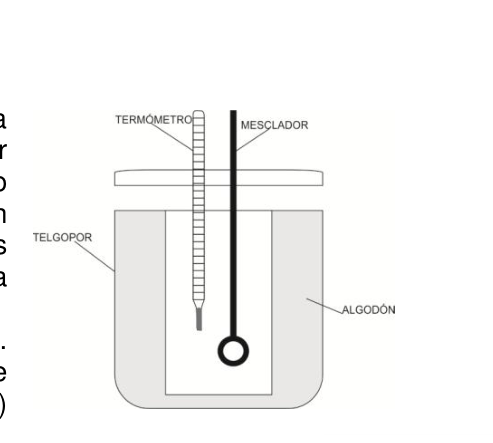
Topic: Thermodynamics Metodi: First Law of Thermodynamics, Experimental Data Analysis Competenze: Physical Reasoning, Experimental Data Analysis Objects: Calorimeter Fonte: Testo (PDF) — p.5
PE11. La scuola di agricoltura Generale Alvear, Mendoza.
Il caldo.
Obiettivi
- Costruzione di un calorimetro per determinare la temperatura di fusione e la temperatura specifica.
Breve descrizione: Il calore è l’energia che viene trasmessa da un corpo all’altro, solo per mezzo di un’unica energia. differenze di temperatura tra loro. Si trasmette in diversi modi già. sia per conduzione, convezione e radiazioni. Se un corpo riceve una quantità di calore ΔQ e la sua temperatura varia Δt, la capacità La temperatura di questo corpo è data da t Q C
Se tale corpo ha una massa m, e una capacità termico C, il calore specifico c del Il materiale che lo costituisce è dato da m C c
Relazionando le equazioni precedenti possiamo ottenere la quantità di calore ΔQ Assorbito o rilasciato da un corpo di massa m e calore specifico c, quando il suo la temperatura varia in Δt in modo tale che t c m Q . .
Quando un solido o un liquido si calda, la temperatura del campione non aumenta necessariamente, poiché può cambiare fase o stato assorbendo calore senza modificare la sua temperatura. La quantità di calore per unità di massa da trasferire per produrre un cambiamento di fase è chiamato calore latente. m L Q .
Un calometro è un strumento usato per misurare il calore scambiato tra due persone. corpi. Considerando che il calore totale rilasciato dai corpi che si raffreddano, è E’ il calore totale assorbito dai corpi che aumentano di temperatura.
Materiali
- Invasto di telgopor
- Cottone .
- imballaggio in plastica/metallo
- Una bacchetta malevole .
- Termodermico .
- Sbalzo .
- ghiaccio
- L’olio.
Consigna 1 a) Realizzare un montaggio simile a quello riportato nella figura. Per Prendi il recipiente di telgopor e dentro di esso. Metti la confezione. Riempire lo spazio di cotone tra i due recipienti e fa due buchi in il coperchio dell’imballaggio di telgopor. In uno di loro. inserisci un bastone con la punta incrociata (agitatore) e l’altro un termometro. b) Determinare la capacità termico del caloriometro. Per questo, si deve mettere una quantità di acqua (che occupi circa la metà del recipiente)
134 - OAF 2015 nel caloriometro e dopo un certo tempo misurare la temperatura. Poi aggiungere una quantità di acqua a 40°C e mescolare con l’agitatore. Dopo un po ’ minuti per misurare la temperatura della miscela e effettuare i calcoli necessari per essere in grado di determinare la capacità termico del recipiente.
Consigna 2 Usando il calometro costruito, determinare il calore di fusione del ghiaccio.
a) Misura una certa massa di acqua calda (45°C) il cui volume è di circa metà del volume del calometro. b) Mettiamo l’acqua in quel calometro e, osservando il termometro, aspettiamo che che si stabilisca l’equilibrio termico. Nota il valore di questa temperatura. c) Introduce ghiaccio (0°C) nel caloriometro, determinando in anticipo la massa del caloriometro. (considerare che la massa di ghiaccio è quasi 1/3 della massa dell’acqua) e Dopo qualche minuto di fare questo annotare la temperatura di equilibrio in all’interno del calometro. d) Calcolare il calore di fusione con i dati ottenuti. Fate almeno la misurazione Cinque volte. e) Il valore ottenuto si avvicina ragionevolmente al valore stabilito (80 cal/g)? - Di ’ che cosa ? se sono o meno indistingubili. (Giustifica)
Consegna 3 Determinare la temperatura specifica dell’olio. a) Misura una certa massa di acqua fredda, il cui volume è circa metà del volume di acqua. volume del calometro. Mettiamo l’acqua in quel calometro, e osservando il termometro, aspettate che si stabilisca l’equilibrio termico. Nota il valore di
- Questa temperatura. b) Misura una massa di olio (50°C) il cui volume è approssimativamente uguale a quello di volume dell’acqua. Metti l’olio in quel calometro, e osservando il termometro, aspettate che si stabilisca l’equilibrio termico. Nota il valore di
- Questa temperatura. Con i dati che ottiene calcola il calore specifico. Fare la misurazione almeno 5
- A volte.
Topic: Thermodynamics Metodi: First Law of Thermodynamics, Experimental Data Analysis Competenze: Physical Reasoning, Experimental Data Analysis Objects: Calorimeter Fonte: Testo (PDF) — p.5
PE11. School of Agriculture General Alvear, Mendoza, please.
The heat.
Objectives
- Construction of a calorimeter to determine fusion heat and specific heat.
Brief description: Heat is the energy that is transmitted from one body to another by virtue of only one. temperature difference between them. It ‘s already transmitted in different ways . whether by conduction, convection or radiation. If a body receives a quantity of heat ΔQ and its temperature varies Δt, the capacity The thermal of this body is given by t Q C
If the body has a mass m, and a thermal capacity C, the specific heat c of the The material, which constitutes the same is given by m C c
Relating the above equations we can get the amount of heat ΔQ absorbed or released by a body of m mass and specific heat c, when its temperature varies in Δt, such that t c m Q . .
When a solid or liquid is heated, the temperature of the sample does not rise It can change phase or state by absorbing heat without modification. your temperature. The amount of heat per unit mass to be transferred to producing a phase change is called latent heat. m L Q .
A calorimeter is an instrument used to measure the heat exchanged between two bodies. Considering that the total heat released by the bodies that are cooling, is Just like the total heat absorbed by increasing body temperatures.
Materials
- Package of telgopor
- Cotton .
- Plastic/metallic packaging
- Malleable rod .
- Thermometer .
- Weigh it .
- ice .
- Oil.
Consigna 1 (a) Make a similar assembly as shown in the figure. For This takes the telgopor container and inside it. Put the package in. Fill the space with cotton. between both containers and make two holes in the lid of the telgopor container. In one of them . Enter a rod with the tip bent. (swing) and the other one’s a thermometer. (b) Determine the thermal capacity of the calorimeter. To do this, place a quantity of water (which (Occupy about half of the container)
The Commission shall adopt delegated acts in accordance with Article 21 of this Regulation. The temperature is measured in the thermometer and after a certain time. Then . Add a quantity of water to 40°C and mix with the agitator. After a few minutes to measure the mixture temperature and to perform the necessary calculations for be able to determine the thermal capacity of the container.
Consigna 2 Using the built-in thermometer, determine the melting heat of the ice.
(a) Measure a certain mass of warm water (45°C) whose volume is approximately half the volume of the calorimeter. (b) Place this water in that thermometer, and look at the thermometer, wait until The thermal balance is to be established. Write down the value of this temperature. (c) Insert ice (0°C) into the calorimeter, determining the mass of the calorie before the calorie intake. (bearing in mind that ice mass is almost 1/3 of the water mass) and After a few minutes of doing this, write down the equilibrium temperature at the inside the thermometer. (d) Calculate the melting heat using the data obtained. Make the measurement at least Five times. (e) Does the value obtained reasonably approximate the established value (80 cal/g)? Say it . whether or not they are indistinguishable. (Justify)
Consigna 3 Determine the specific heat of the oil. (a) Measure a certain mass of cold water, the volume of which is approximately half of the volume of the water. the volume of the calorimeter. Put this water in that calorimeter, and observe the Thermometer, wait until the thermal balance is established. Write down the value of This temperature. (b) Measure a certain mass of oil (50°C) whose volume is approximately the same as that of volume of water. Place the oil in that calorimeter, and observe the Thermometer, wait until the thermal balance is established. Write down the value of This temperature. With the data you get, calculate the specific heat. Make the measurement at least 5 Sometimes.
Topic: Thermodynamics Metodi: First Law of Thermodynamics, Experimental Data Analysis Competenze: Physical Reasoning, Experimental Data Analysis Objects: Calorimeter Fonte: Testo (PDF) — p.5
PE12. Colegio Padre Ramón de la Quintana
ENET Nro. 1 Prof. Vicente Aguilera
Colegio Del Carmen y San José
Instituto Superior FASTA Catamarca
Escuela Secundaria Gustavo G. Levene
Escuela Pre-Universitaria Fray Mamerto Esquiú San Fernando del Valle, Catamarca.
Determinacion del peso específico de un cuerpo.
Objetivo: Determinar experimentalmente el peso específico de un cuerpo.
Breve introducción: El peso específico Pe de una sustancia se define como el cociente entre el peso del cuerpo macizo de dicha sustancia y su volumen, matemáticamente: 𝑃𝑒 = 𝑃 𝑉
donde:
P= peso del cuerpo, V=volumen del cuerpo.
Materiales:
- Cuerpo de forma regular.
OAF 2015 - 135
- Regla, calibre.
- Dinamómetro
Procedimiento: 1- Calcule el volumen del cuerpo geométrico. Las fórmula para el cálculo del volumen es: 2-
donde: r = radio - h = altura - π=3,14159
3- Mida el peso del cuerpo usando el dinamómetro.
4- Calcule su peso específico.
5- Realice varias mediciones.
6- Completar la siguiente tabla:
7-
Cuerpo
Peso (gf)
Volumen(cm3 )
Peso específico (gf/cm3 )
Cilindro
Requerimientos:
- Al finalizar la experiencia deberá entregar un informe escrito con letra clara, que conste de :
- Planteo del problema.
- Valores obtenidos en las mediciones, tablas, gráficos.
- Fuentes de error y análisis de como influyen en el resultado final.
- Resultado experimental de lo solicitado.
- Conclusiones.
- Comentarios que desee realizar referidos dificultades relacionadas a la realización de
la experiencia.
Topic: Fluid Mechanics Metodi: Hydrostatic Equilibrium, Experimental Data Analysis Competenze: Physical Reasoning, Experimental Data Analysis Objects: Cylinder Fonte: Testo (PDF) — p.5
PE12. Colegio Padre Ramón de la Quintana
- Il numero di rete. 1 Prof. Vicente Aguilera
Colegio del Carmen e San José
Istituto superiore FASTA Catamarca
Scuola secondaria Gustavo G. Prendila .
Preuniversità Fray Mamerto Esquiu San Fernando del Valle, Catamarca.
Determinazione del peso specifico di un corpo.
Obiettivo: Determinare sperimentalmente il peso specifico di un corpo.
Breve introduzione: Il peso specifico Pe di una sostanza è definito come il coefficiente tra il peso di una sostanza e il peso di una sostanza. corpo massiccio di tale sostanza e il suo volume, matematicamente: 𝑃𝑒 = 𝑃 𝑉
dove: P = peso corporeo, V = volume corporeo.
Materiali:
- Corpo di regola.
OAF 2015 - 135
- Regola, calibro.
- Dinamometro .
Procedura: 1- Calcolare il volume del corpo geometrico. Formula di calcolo del volume es: 2-
dove: r = radio - h = altezza - π=3,14159
3- Misurare il peso corporeo usando il dinamometro.
4- Calcola il peso specifico.
5- Eseguire varie misurazioni.
6- Completa la tabella seguente:
7-
Corpo .
Peso (gf)
Volume (cm3)
Peso specifico (gf/cm3)
Cillico
Requisiti:
- alla fine dell’esperienza deve presentare un rapporto scritto in chiaro, che Consiste di:
- La questione è stata sollevata.
- Valori ottenuti dalle misure, dalle tabelle, dai grafici.
- Fonti di errore e analisi di come influenzano il risultato finale.
- Risultato sperimentale della richiesta.
- Conclusioni.
- le osservazioni che desiderano fare riguardo alle difficoltà relative alla realizzazione di l’esperienza.
Topic: Fluid Mechanics Metodi: Hydrostatic Equilibrium, Experimental Data Analysis Competenze: Physical Reasoning, Experimental Data Analysis Objects: Cylinder Fonte: Testo (PDF) — p.5
PE12. Father Ramon de la Quintana College is located in the city of Quintana.
The Commission shall adopt delegated acts in accordance with Article 21 of this Regulation. 1 Prof. Vicente Aguilera is a great man .
College of Carmen and San José
The Spanish Ministry of Education
High school Gustavo G. Take it off .
Pre-university school Fray Mamerto Esquiú San Fernando del Valle, Catamarca. It was a great day.
Determination of the specific weight of a body.
Objective: To experimentally determine the specific weight of a body.
Short introduction: The specific weight Pe of a substance is defined as the ratio between the weight of the substance. mass of the substance and its volume, mathematically: 𝑃𝑒 = 𝑃 𝑉
where: P = body weight, V = body volume.
Materials:
- I’m regularly on the body.
The Commission shall adopt delegated acts in accordance with Article 21 of this Regulation.
- Rule, caliber.
- Dynamometer .
The procedure: 1- Calculate the volume of the geometric body. The formula for calculating the volume es: 2-
where: r = radius - h = height - π=3,14159
3- Measure body weight using the dynamometer.
4- Calculate your specific weight.
5- Take several measurements.
6- Complete the following table:
7-
Body .
Weight (gf)
The following table shows the results of the study:
Specific weight (gf/cm3)
Cylinder
Requirements:
- At the end of the training you must submit a written report in clear writing, which consists of:
- I’m just raising the issue.
- Values obtained in measurements, tables, graphs.
- Error sources and analysis of how they influence the final result.
- Experimental result of the requested.
- I’m going to draw conclusions.
- comments on the difficulties involved in the implementation of the The experience.
Topic: Fluid Mechanics Metodi: Hydrostatic Equilibrium, Experimental Data Analysis Competenze: Physical Reasoning, Experimental Data Analysis Objects: Cylinder Fonte: Testo (PDF) — p.5
PE13. Colegio Padre Ramón de la Quintana
ENET Nro. 1 Prof. Vicente Aguilera
Colegio Del Carmen y San José
Instituto Superior FASTA Catamarca
Escuela Secundaria Gustavo G. Levene
Escuela Pre-Universitaria Fray Mamerto Esquiú San Fernando del Valle, Catamarca.
Calibración de un resorte.
Objetivo: Calibrar un resorte por el método estático.
Elementos
-
Resorte
-
Porta pesas
-
Pesas
-
Soporte universal
-
Regla plástica calibrada en milímetros. Cuerpo Esquema Volumen Cilindro V = π r2 · h
136 - OAF 2015 Teoría En este trabajo de laboratorio se calibrará un aparato de medición: el resorte, elemento esencial de los dinamómetros .Como sistema de referencia se utilizarán objetos cuyas masas han sido cuidadosamente determinadas; el valor del peso de dichas masas de referencias se determinará utilizando la relación P = m g ( g es la aceleración de la gravedad).
Cuando un resorte es sometido a la acción de cargas crecientes, sufre deformaciones que, dentro del límite elástico del material, son proporcionales a las cargas aplicadas. Podemos expresar este comportamiento por la siguiente relación:
El cociente entre la carga aplicada (P) y el alargamiento producido (AL) se denomina constante elástica de resorte (K) y de acuerdo al sistema utilizado podrá ser expresada como la relación entre la unidad de fuerza y la de longitud. La representación gráfica corresponde a la recta de la ecuación P= K AL que pasa por el origen de coordenadas y cuya pendiente dependerá del valor de la constante k. La constante elástica del resorte depende de las características geométricas del resorte y del material del mismo.
Procedimiento 1- Suspenda el resorte como se muestra en la figura 1. Luego agregue sucesivamente masas (m) en el portapesas. 2- Anote el alargamiento AL del resorte respecto a su longitud original, a medida que se van agregando las masas (ni). Para realizar las mediciones de longitud se debe esperar a que el sistema masa-resorte se encuentre en situación de equilibrio. 3- Con los datos de los pesos y alargamientos, construya el gráfico de peso en función del alargamiento. Para ello complete la siguiente tabla: 4- Ajuste la gráfica obtenida (dibuje la recta que mejor represente todos los puntos). 5- Calcule la pendiente de la recta con su correspondiente incertidumbre o error. ¿Qué representa el valor obtenido?
Masa m
Fuerza P
Alargamiento
AL
Constante del resorte K
Requerimientos: Sólo podrá utilizar los útiles de escritura y calculadora no programalks además de los materiales de la prueba. Al finalizar la experiencia deberá entregar un informe escrito con letra clara, que conste de:
- Planteo del problema
- Valores obtenidos en las mediciones, tablas, gráficos.
- Fuentes de error
- Resultado experimental de lo solicitado,
- Conclusiones
- Comentarios que desee realizar referidos dificultades relacionadas a la realización de la experiencia.
OAF 2015 - 137
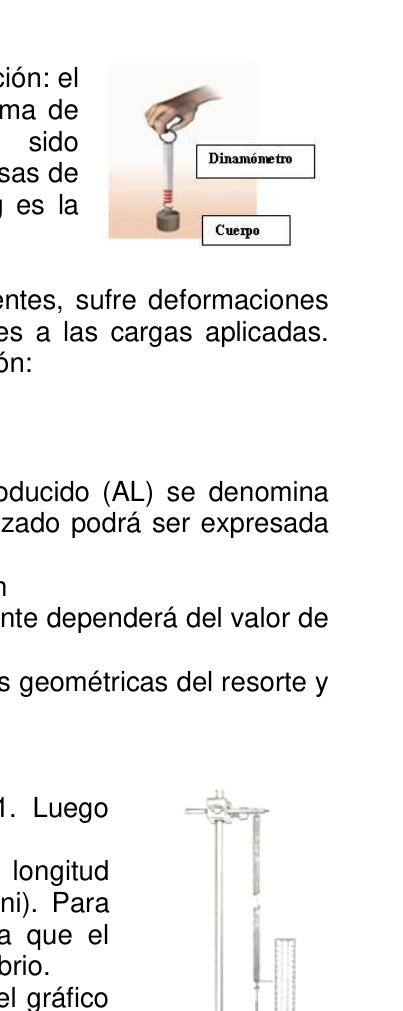
Topic: Elasticity & Materials Metodi: Hooke’s Law, Experimental Data Analysis Competenze: Physical Reasoning, Experimental Data Analysis Objects: Spring Fonte: Testo (PDF) — p.5
PE13. Colegio Padre Ramón de la Quintana
- Il numero di rete. 1 Prof. Vicente Aguilera
Colegio del Carmen e San José
Istituto superiore FASTA Catamarca
Scuola secondaria Gustavo G. Prendila .
Preuniversità Fray Mamerto Esquiu San Fernando del Valle, Catamarca.
Calibrazione di una stazione.
Obiettivo: Calibrare una sorgente con il metodo statico.
Elementi
- Resorte
- Porta i pesi .
- Pese .
- Supporto universale
- Regola di plastica calibrata in millimetri. Corpo . Schema Volume Cillico V = π r2 · h
136 - OAF 2015 Teoria In questo lavoro di laboratorio si calibrerà un dispositivo di misurazione: La stabilità è un elemento essenziale dei dinamometri. riferimento se Usano oggetti di cui Massa
- Sono stati
- Sono stato
- il valore del peso di tali masse di i riferimenti sono determinati utilizzando il rapporto P = m g (g è la l’accelerazione della gravità).
Quando una stazione di resorgenza è sottoposta a carichi crescenti, subisce deformazioni. che, entro il limite elastico del materiale, siano proporzionali ai carichi applicati. Possiamo esprimere questo comportamento con la seguente relazione:
Il coefficiente tra la carica applicata (P) e l’allungamento prodotto (AL) è denominato La variazione della velocità di un’operazione è determinata da un’espressione di un’espressione di un’espressione di un’espressione di un’operazione di un’operazione di un’operazione di un’operazione di un’espressione di un’operazione di un’operazione di un’operazione di un’operazione di un’operazione di un’operazione di un’operazione di un’operazione di un’operazione di un’operazione di un’operazione di un’operazione di un’operazione di un’operazione di un’operazione di un’operazione di un’operazione di un’operazione di un’operazione di un’operazione di un’operazione di un’operazione di un’altra. come il rapporto tra unità di forza e unità di lunghezza. La rappresentazione grafica corrisponde alla rettitudine dell’equazione P= K AL che passa per l’origine delle coordinate e la cui pendenza dipenderà dal valore di la costante k. La costante elastica della primavera dipende dalle caratteristiche geometriche della primavera e di materiale del materiale.
Procedura 1- Suspendere la primavera come mostrato in figura 1. Poi aggiungere successivamente masse (m) al portafoglio. 2- Notare l’allungamento AL della primavera rispetto alla sua lunghezza La maggior parte delle parti di questo gruppo sono di tipo di massa (ni). Per La misurazione della lunghezza deve essere effettuata fino a quando il Il sistema massa-risorsa è in equilibrio. 3- Con i dati dei pesi e delle allungamenti, costruire il grafico peso in funzione dell’allungamento. Per questo completare il tabella seguente: 4- Aggiusta il grafico ottenuto (digni il retto che meglio rappresenta tutti i punti). 5- Calcolare la pendenza della retta con la sua corrispondente incertezza o errore. Che cosa rappresenta il valore ottenuto?
Massa m
Forza P
L’allungamento AL
Costante di cui al primavera K
Requisiti: Potete utilizzare solo strumenti di scrittura e calcolatore non programmatici oltre ai materiali della prova. Al termine dell’esperienza, deve presentare un rapporto scritto in chiaro, che contiene: de:
- La questione è stata sollevata.
- Valori ottenuti dalle misure, dalle tabelle, dai grafici.
- Fonti di errore
- Risultato sperimentale della richiesta,
- Conclusioni
- le osservazioni che desiderano fare riguardo alle difficoltà relative alla realizzazione di l’esperienza.
OAF 2015 - 137
Topic: Elasticity & Materials Metodi: Hooke’s Law, Experimental Data Analysis Competenze: Physical Reasoning, Experimental Data Analysis Objects: Spring Fonte: Testo (PDF) — p.5
PE13. Father Ramon de la Quintana College is located in the city of Quintana.
The Commission shall adopt delegated acts in accordance with Article 21 of this Regulation. 1 Prof. Vicente Aguilera is a great man .
College of Carmen and San José
The Spanish Ministry of Education
High school Gustavo G. Take it off .
Pre-university school Fray Mamerto Esquiú San Fernando del Valle, Catamarca. It was a great day.
Calibration of a spring.
Objective: Calibrate a spring by the static method.
Elements
- Spring .
- He ‘s carrying weights .
- Weights .
- Universal support
- Plastic rule calibrated in millimeters. Body . Schedule The volume Cylinder V = π r2 · h
The Commission shall adopt delegated acts in accordance with Article 21 of Regulation (EU) No 1303/2013. The theory . In this laboratory work a measuring apparatus will be calibrated: The main feature of the dynamometer is the spring, which is an essential element of the dynamometer. reference se They will use Objects whose Mass They ‘ve been It was . carefully determined; the weight value of such masses of References shall be determined using the ratio P = m g (g is the The acceleration of gravity.
When a spring is subjected to the action of increasing loads, it suffers deformation which, within the elastic limit of the material, are proportional to the loads applied. We can express this behavior by the following relation:
The ratio of applied load (P) to the length of the output (AL) is called The resulting variable is the spring elastic constant (K) and according to the system used can be expressed as the ratio of the unit of force to the unit of length. The graph represents the line of the equation P= K AL passing through the origin of coordinates and whose slope will depend on the value of the constant k. The spring’s elastic constant depends on the geometric characteristics of the spring and the material of the same.
The procedure 1- Suspend the spring as shown in Figure 1. Then . add successive masses (m) to the baggage. 2- Note the AL length of the spring relative to its length The total mass (ni) of the sample is the original, as the masses are added. For The length measurements should be performed until the The mass-resort system is in equilibrium. 3- With the data of weights and elongations, build the graph weight by length. For this purpose, complete the the following table: 4- Adjust the graph obtained (draw the straight line that best represents all points). 5- Calculate the slope of the straight line with its corresponding slope uncertainty or error. What is the value obtained?
Mass m
Force P
Enlargement AL
Constantly of the spring K
Requirements: You can only use non-programalks writing and calculating tools other than the the test materials. At the end of the experience, you must submit a written report in clear writing, which shall read de:
- The problem is being raised .
- Values obtained in measurements, tables, graphs.
- Source of error
- Experimental result of the requested product,
- Conclusions
- comments on the difficulties involved in the implementation of the The experience.
The following points shall be added:
Topic: Elasticity & Materials Metodi: Hooke’s Law, Experimental Data Analysis Competenze: Physical Reasoning, Experimental Data Analysis Objects: Spring Fonte: Testo (PDF) — p.5
PE14. Colegio Padre Ramón de la Quintana
ENET Nro. 1 Prof. Vicente Aguilera
Colegio Del Carmen y San José
Instituto Superior FASTA Catamarca
Escuela Secundaria Gustavo G. Levene
Escuela Pre-Universitaria Fray Mamerto Esquiú San Fernando del Valle, Catamarca.
DETERMINACIÓN DE LA CONSTANTE DE PLANCK
OBJETIVO: Determinar experimentalmente el valor de la constante de Planck.
INTRODUCCIÓN
En Física existen constantes, denominadas constantes fundamentales, determinadas a lo
largo de la historia de la Ciencia. Entre las que podemos enumerar están la constante de
Gravitación Universal, propuesta por Newton y medida experimentalmente por
Cavendish, la masa y la carga de un electrón, la permeabilidad magnética y eléctrica del
vacío a partir de las cuales se escribe la velocidad de la luz y la constante de Planck,
entre otras.
El surgimiento de estas constantes ha significado un momento de quiebre en la historia
de la Ciencia. Su aparición y la determinación de su valor definitivamente marcaron un
cambio de paradigma; la Física, la Ciencia y el pensamiento humano cambiaron para no
volver a ser lo mismo.
Los valores de las distintas constantes físicas parecen estar finamente sintonizadas y
como resultado de esa sintonización surge el Universo visible. Existe lo que se denomina
el principio antrópico, es decir, la respuesta a la siguiente pregunta: ¿qué pasaría si los
valores de las constantes fundamentales cambiaran sólo un poco? Los panoramas son
diversos, pero la conclusión a la que llegan algunos científicos interesados en el tema es
que, variando ligeramente una o dos de estas constantes los eventos posibles son tales
que la existencia de la vida en un planeta como el nuestro sería imposible.
En particular, la constante de Planck da nacimiento a una nueva rama de la física: la
Física Cuántica. Esta especialidad estudia y analiza la estructura y movimiento del mundo
atómico y subatómico. En un intento por resolver las discrepancias entre la curva de
energía de un cuerpo negro radiante medida y la predicha teóricamente, el físico Max
Planck decide considerar la energía como una cantidad discreta y no continua como
suponía el modelo teórico en vigencia. Es así que sugiere que la energía es proporcional
a la frecuencia de las ondas estacionarias de la radiación, y la constante de
proporcionalidad es la constante de Planck,
𝐸≈ . 𝑓
donde E es la energía, f es la frecuencia y es la constante de Planck. Mediante un
trabajo numérico, él mismo determinó su valor (en el año 1900) de modo de establecer un
mejor ajuste entre su modelo teórico y las observaciones; el resultado obtenido fue
bastante cercano al valor vigente. El valor aceptado actualmente es:
h = 6,628 x 10-34 J. s
Marco teórico
Las ondas de radio, televisión, telefonía móvil, infrarroja, luz visible, ultravioleta, los rayos
X y los rayos Gamma pertenecen a distintos rangos de la radiación electromagnética. Las
ondas electromagnéticas abarcan un espectro extremadamente amplio de longitud de
onda y frecuencia. Pese a la enorme diferencia en cuanto a usos y medios de
generación, todas son ondas electromagnéticas que se propagan en el vacío con una
velocidad aproximada de c = 3x10⁸
𝑚
𝑠 . Por medio de nuestro sentido de la vista podemos
detectar sólo un pequeño segmento de ese espectro: llamamos a ese intervalo luz
visible. Las diferentes partes del espectro visible evocan en los seres humanos las
sensaciones de distintos colores.
En esta experiencia se montará un circuito eléctrico utilizando diodos LED de distintas
longitudes de onda y a partir de la relación entre el voltaje de umbral y la frecuencia de la
138 - OAF 2015 luz emitida por el diodo montado en el circuito (Figura 1.a.) se determinará de manera aproximada la constante de Planck.
Un LED (de su sigla en inglés : Light-Emitting Diode) es un dispositivo optoelectrónico que emite luz cuando circula por él una corriente eléctrica i, (Figura 1.b.). Para que circule esta corriente es necesario que la diferencia de potencial entre sus terminales, V, sea superior a un cierto valor umbral, V0. En esencia, un LED es un semiconductor en el que los electrones se encuentran en niveles de energía muy próximos que forman bandas. La de menor energía es la banda de valencia, que está normalmente llena de electrones. Existe otra banda, con energía superior y que contiene pocos electrones, llamada banda de conducción. Ambas bandas están separadas por una banda prohibida, de energía E (Figura 1.a.).
Para que un electrón pueda excitarse desde la banda de valencia hasta la de conducción
debe absorber, como mínimo, una energía igual a
𝐸= 𝑞. 𝑉0
donde 𝑞 es la carga elemental (valor absoluto de la carga del electrón, e= 1,6 x 10 -19 J).
Esta energía es aportada por la batería que alimenta el circuito con el LED. Cuando el
electrón se desexcita y regresa a la banda de valencia se emite un fotón de energía
𝐸= . 𝑓
donde h es la constante de Planck y f la frecuencia de la radiación emitida. Por tanto, con
este modelo simplificado, sería de esperar que se cumpliese la igualdad qV0 =h. f. En la
práctica, se encuentra esta relación lineal entre V0 y f, pero con un término independiente,
C, aproximadamente constante, que no puede justificarse con este modelo, es decir
V0 ≈ C + h (f/q)
El diodo debe conectarse en el sentido adecuado dentro de un circuito, de lo contrario el diodo no conduce corriente.
El circuito que se propone para la determinación de la constante de Planck, es ligeramente diferente al de la Figura 1.a., ya que la resistencia a utilizar es un potenciómetro. En la Figura 2.a. se presenta el esquema eléctrico del equipo experimental. Un potenciómetro es una resistencia a la que se le puede modificar su valor óhmico desde cero hasta un valor máximo. En la Figura 2.b. se muestra la apariencia física de un potenciómetro, presenta tres terminales denominadas como ―a‖, ―b‖ y ―c‖. El terminal central se conectará al diodo para suministrarle corriente.
OAF 2015 - 139 Desarrollo experimental Materiales para el montaje del circuito:
- LEDs de alta eficiencia de frecuencias diferentes (Infrarrojo, rojo, amarillo, azul, violeta)
- Pila de 9 V y su portapila.
- Un Potenciómetro.
- Dos multímetros.
- Pinzas cocodrilo, cables.
Instrucciones de montaje:
Teniendo en cuenta las características de los elementos explicados en el MARCO
TEÓRICO realice los pasos para el montaje del circuito de la Figura 2.a.
• Verifique que el potenciómetro esté en la posición de máxima resistencia. De esta
manera se anulará el paso de corriente hacia el diodo.
• Conecte el terminal ―a‖ del potenciómetro a uno de los bornes de la batería sin cerrar
el circuito.
• Conecte el terminal ―b‖ del potenciómetro a la pata positiva del diodo.
• Conecte una punta de prueba del amperímetro al extremo negativo del diodo, y la
otra al terminal ―c‖ del potenciómetro.
• Conecte el voltímetro al diodo.
• Cuando comience a medir, deberá conectar el borne libre de la batería al terminal ―c‖
del potenciómetro para cerrar el circuito.
• Atención: para evitar que se agote la pila, mantenga el circuito abierto cuando
no esté midiendo.
Instrucciones para la medición de la constante de Planck:
- Utilice en el circuito el LED infrarrojo. Conecte la pila y aumente la tensión de alimentación del LED, girando el tornillo del potenciómetro, hasta que circule una corriente de 0,010 mA (10 A). Supondremos que, en estas circunstancias, la tensión indicada por el voltímetro es aproximadamente la tensión umbral para este diodo, V0. Anote su valor.
- Restableciendo cada vez el potenciómetro a su posición inicial, repita la medida de V0 para los otros LEDs: rojo, amarillo, azul y violeta. El aspecto exterior de estos LEDs es similar, pero los distinguirá al hacer pasar corriente. No olvide desconectar el circuito cada vez que repita las mediciones y al finalizar esta serie de medidas.
- Traslade sus medidas a la Tabla N° 1, donde se indica la frecuencia de onda de emisión de cada LED.
Tabla N° 1: Registro del Potencial de umbral de cada diodo COLOR DEL DIODO FRECUENCIA (1014 Hz) V0 (V) Infrarrojo 3,20
Rojo 4,75
Amarillo 5,06
Azul 6,47
Violeta 7,41
- Represente gráficamente los valores de V0 (en ordenadas, eje vertical) frente a las frecuencias f (en abscisas, eje horizontal). Trace la mejor recta.
- Obtenga el valor de la pendiente de la recta.
- Realice una estimación de la incertidumbre del valor de h.
- Escriba correctamente el valor obtenido de la medición.
140 - OAF 2015 Requerimientos: Al finalizar la experiencia deberá entregar un informe escrito con letra clara, que conste de : Planteo del problema. Valores obtenidos en las mediciones, tablas, gráficos. Fuentes de error y análisis de como influyen en el resultado final. Resultado experimental de lo solicitado. Conclusiones. Comentarios que desee realizar referidos dificultades relacionadas a la realización de la experiencia.
Fig 3: Tester o multímetro:
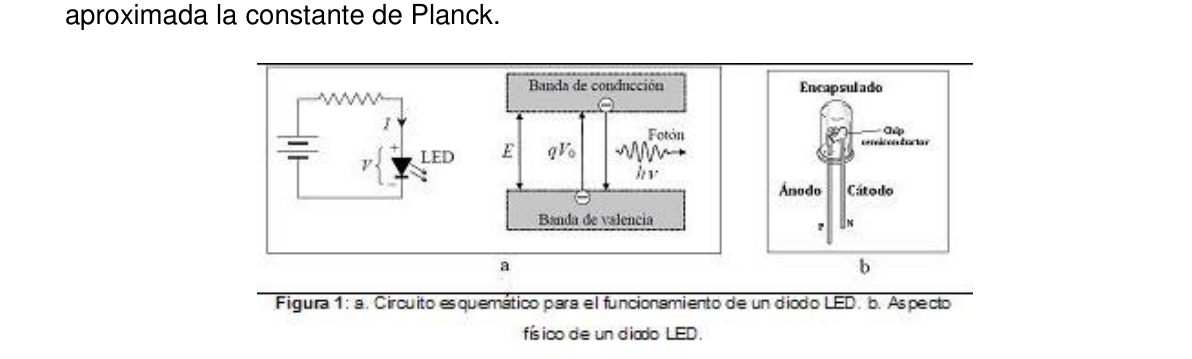
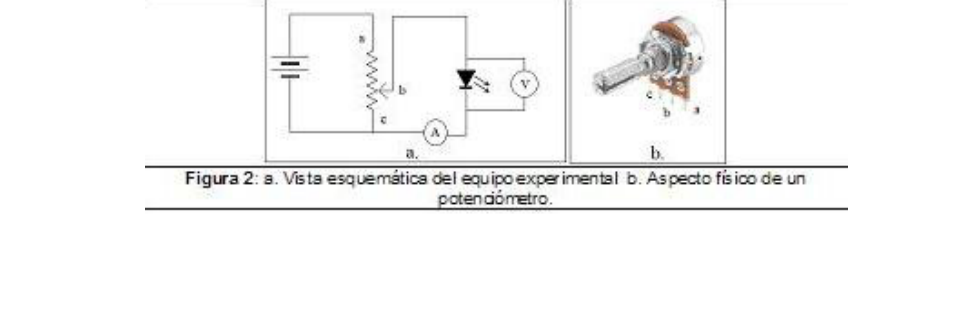
Topic: Modern-Quantum Physics, Circuits Metodi: Photon Energy Relation, Experimental Data Analysis Competenze: Physical Reasoning, Experimental Data Analysis Objects: Resistor Fonte: Testo (PDF) — p.5
PE14. Colegio Padre Ramón de la Quintana
- Il numero di rete. 1 Prof. Vicente Aguilera
Colegio del Carmen e San José
Istituto superiore FASTA Catamarca
Scuola secondaria Gustavo G. Prendila .
Preuniversità Fray Mamerto Esquiu San Fernando del Valle, Catamarca.
DETERMINATION DEL CONSTANT di PLOCK OGITIVO: Determinare sperimentalmente il valore della costante di Planck. INTRODUZIONE In fisica esistono costanti, chiamate costanti fondamentali, determinate al nel corso della storia della scienza. Tra le quali possiamo elencare la costante di Gravità universale, proposta da Newton e misurata sperimentalmente da Cavendish, massa e carico di un elettrone, permeabilità magnetica ed elettrica di vuoto da cui si scrivono la velocità della luce e la costante di Planck, tra le altre. L’insorgere di queste costanti ha significato un momento di rottura nella storia. della scienza. La sua comparsa e la determinazione del suo valore hanno definitivamente segnato un cambiamento di paradigma; la fisica, la scienza e il pensiero umano sono cambiati per non
- E’ tornato a essere lo stesso.
I valori delle diverse costanti fisiche sembrano essere finemente sintonizzati e
Come risultato di questa sintonia nasce l’universo visibile. C’è una cosa chiamata
Il principio antropico, cioè la risposta alla domanda:
I valori delle costanti fondamentali cambieranno solo un po’? I panorami sono:
La conclusione che alcuni scienziati interessati arrivano è:
che, variando leggermente una o due di queste costanti gli eventi possibili sono tali
che l’esistenza della vita su un pianeta come il nostro sarebbe impossibile.
In particolare, la costante di Planck dà vita a un nuovo ramo della fisica: la
Fisica Quantistica. Questa specialità studia e analizza la struttura e il movimento del mondo.
Atomica e subatomica. In un tentativo di risolvere le discrepanze tra la curva di
L’energia di un corpo nero radiante misurata e teoricamente predetta dal fisico Max
Planck decide di considerare l’energia come una quantità discreta e non continua come
Il modello teorico in vigore. Quindi suggerisce che l’energia è proporzionale.
la frequenza delle onde di radiazione stazionarie, e la costante di
La proporzionalità è la costante di Planck.
𝐸≈ . 𝑓
dove E è l’energia, f è la frequenza e è la costante di Planck. - Un’altra volta. La sua valutazione è stata effettuata nel 1900 e si è verificata che il valore di questa cifra è stato determinato da lui stesso. La sua teoria è più corretta rispetto alle osservazioni; abbastanza vicino al valore attuale. Il valore attualmente accettato è: h = 6,628 x 10-34 J. s
Marco teorico Le onde radio, la televisione, le telefonie cellulari, l’infrarosso, la luce visibile, l’ultravioletta, i raggi. I raggi X e i raggi gamma appartengono a diversi ranghi di radiazioni elettromagnetiche. Le Le onde elettromagnetiche coprono uno spettro estremamente largo di lunghezza di onde e frequenze. Nonostante la differenza enorme in termini di utilizzi e mezzi di La generazione, tutte onde elettromagnetiche che si diffondono nel vuoto con una velocità approssimativa di c = 3x10⁸ 𝑚 𝑠 . Con il nostro senso della vista possiamo rilevare solo un piccolo segmento di questo spettro: chiamiamo questo intervallo luce. visibile. Le diverse parti dello spettro visibile evocano in esseri umani le sensazioni di diversi colori. In questa esperienza si monterà un circuito elettrico utilizzando diodi LED di diverse tipologie. L’aumento della velocità di velocità di un’onda è stato determinato in base al rapporto tra la volta di soglia e la frequenza di
138 - OAF 2015 la luce emessa dal diodo montato sul circuito (Figura 1.a.) sarà determinata in modo che Approximato costante di Planck.
Un LED (in inglese: Light-Emitting Diode) è un dispositivo optoelettronica. che emette luce quando un corrente elettrica i (Figura 1.b.) circola attraverso di esso. Per far circolare Questo corrente deve essere tale che la differenza di potenziale tra i suoi terminali, V, sia superiore a un certo valore limite, V0. In sostanza, un LED è un semiconduttore in cui Gli elettroni si trovano in livelli di energia molto vicini che formano bande. La La banda di valenza è più bassa di energia, e normalmente è piena di elettroni. C’è un’altra banda, con energia superiore e contenente pochi elettroni, chiamata banda. di guida. Entrambe le bande sono separate da una banda proibita, di energia E (Figura 1.a.)
Per eccitare un elettrone dalla banda di valenza alla banda di conduzione. deve assorbire almeno un’energia pari a 𝐸= 𝑞. 𝑉0 dove q è la carica elementare (valore assoluto della carica dell’elettrone, e= 1,6 x 10 -19 J).
Questa energia viene fornita dalla batteria che alimenta il circuito con il LED. Quando il
L’elettrone si decessisce e torna nella banda di valenza, emette un fotone di energia.
𝐸= . 𝑓
dove h è la costante di Planck e f la frequenza della radiazione emessa. Pertanto, con
Questo modello semplificato, ci si aspetterebbe che si soddisfassero l’equazione qV0 = h. f. En la
In pratica, si trova questa relazione lineare tra V0 e f, ma con un termine indipendente,
C, approssimativamente costante, che non può essere giustificata con questo modello, cioè
V0 ≈ C + h (f/q)
Il diodo deve essere collegato nella giusta direzione all’interno di un circuito, altrimenti il Il diodo non conduce corrente.
Il circuito che si propone per la determinazione della costante di Planck, è La resistenza a usare è un’aumento di resistenza. Potenzimetro. In figura 2.a. viene presentato lo schema elettrico dell’ equipaggio
- Esperienziale. Un potenziometro è una resistenza al quale si può modificare il suo valore. Ohmico da zero al massimo. In Figura 2.b. si mostra l’aspetto fisica di un potenzimetro, presenta tre terminali denominati come ―a‖, ―b‖ e ―c‖. El il terminale centrale si connette al diodo per fornire corrente.
OAF 2015 - 139 Sviluppo sperimentale Materiali per l’assemblaggio del circuito:
- LED ad alta efficienza di diverse frequenze (infrarosso, rosso, giallo, blu, (violetta)
- La pila a 9 V e il suo portabello.
- Un Potenzometro.
- Due millimetri.
- Ghiacci di coccodrillo, cavi.
Instruzioni di montaggio: Tenendo conto delle caratteristiche degli elementi spiegati nel MARCO Teorico fa i passaggi per il montaggio del circuito di Figura 2.a. • Verificare che il potenziometro sia nella posizione di massima resistenza. Di questa . In questo modo, il passaggio di corrente verso il diodo sarà annullato. • Connettere il terminale ―a‖ del potenzimetro a uno dei bordi della batteria senza chiudere il circuito. • Connettere il terminale ―b‖ del potenziometro alla gamba positiva del diodo. • Connettere un punto di prova dell’ampiecatore all’estremità negativa del diodo, e Un altro al terminale “c” del potenzimetro. • Collegare il voltometro al diodo. • Quando si inizia a misurare, deve collegare il terminale libero della batteria al terminale ―c‖ Il potenzimetro per chiudere il circuito. • Attenzione: per evitare che la pila si esaurisca, mantenete il circuito aperto quando Non sta misurando.
Instruzioni per la misurazione della costante di Planck:
- Usa il LED infrarosso sul circuito. Collegare la pila e aumentare la tensione di alimentazione del LED, girando il potenziometro fino a che circola una corrente di 0,010 mA (10 A). Supponiamo che, in queste circostanze, la la tensione indicata dal voltimetro è approssimativamente la tensione soglia per questo diodo, V0. Scrivi il tuo valore.
- Ritornando ogni volta il potenziometro alla sua posizione iniziale, ripete la misurazione di V0 per gli altri LED: rosso, giallo, blu e viola. L’aspetto esterno di questi LED è simile, ma li distingue dal passaggio di corrente. Non dimenticare di disattivare il circuito ogni volta che si ripetono le misure e il concludere questa serie di misure.
- Trasferisci le tue misure nella Tabella N° 1, che indica la frequenza d’onda di l’emissione di ogni LED.
Tabella N° 1: Registrazione del potenziale di soglia di ogni diodo COLORE DEL Dio. Frequenza (1014 Hz) V0 (V) Infrarosso 3,20
Rossa 4,75
Giallo 5,06
Blu 6,47
Violeta 7,41
- Rappresenta graficamente i valori di V0 (ordinati, a livello verticale) rispetto ai frequenze f (in abscissi, a livello orizzontale). Traccia la linea migliore.
- Ottieni il valore dell’inclinazione della retta.
- Si fa una stima dell’incertezza del valore di h.
- Scrivi correttamente il valore ottenuto dalla misurazione.
140 - OAF 2015 Requisiti: Al termine dell’esperienza, deve presentare un rapporto scritto in chiaro, che contiene: de : • La presentazione del problema. Valori ottenuti in misurazioni, tabelle, grafici. Fonti di errore e analisi di come influenzano il risultato finale. • Risultato sperimentale della richiesta. • Conclusioni. Commenti che desiderino fare riguardo alle difficoltà di realizzazione di esperienza.
Fig 3: Tester o multimetro:
Topic: Modern-Quantum Physics, Circuits Metodi: Photon Energy Relation, Experimental Data Analysis Competenze: Physical Reasoning, Experimental Data Analysis Objects: Resistor Fonte: Testo (PDF) — p.5
PE14. Father Ramon de la Quintana College is located in the city of Quintana.
The Commission shall adopt delegated acts in accordance with Article 21 of this Regulation. 1 Prof. Vicente Aguilera is a great man .
College of Carmen and San José
The Spanish Ministry of Education
High school Gustavo G. Take it off .
Pre-university school Fray Mamerto Esquiú San Fernando del Valle, Catamarca. It was a great day.
The decision of the PLANCK CONSTANT
OBJECTIVE: To experimentally determine the value of the Planck constant.
The Commission will take the necessary steps to ensure that the Commission is able to take the necessary measures.
In physics, there are constants, called fundamental constants, determined by the
long in the history of science. Among the things we can list are the constant of
Universal gravity, proposed by Newton and measured experimentally by
Cavendish, the mass and charge of an electron, magnetic and electrical permeability of the electron
The vacuum from which the speed of light and the Planck constant are written,
among others.
The emergence of these constants has marked a turning point in history.
The science. Its appearance and determination of its value definitely marked a
paradigm shift; physics, science and human thought have changed to no.
It’s going to be the same again.
The values of the various physical constants seem to be finely tuned and
As a result of this tuning, the visible universe emerges. There is what is called
The anthropic principle, that is, the answer to the question: what would happen if the
The values of the fundamental constants will change only a little? The panorama is
The results of the study are not exhaustive.
that, varying slightly from one or two of these constants the possible events are such
that the existence of life on a planet like ours would be impossible.
In particular, the Planck constant gives birth to a new branch of physics: the
Quantum physics. This specialty studies and analyzes the structure and movement of the world.
atomic and subatomic. In an attempt to resolve the discrepancies between the curve of
The energy of a radiant black body measured and predicted theoretically by the physicist Max
Planck decides to consider energy as a discrete quantity and not continuous as
The Commission’s proposal for a directive on the protection of workers’ rights in the Community was adopted. So he suggests that the energy is proportional.
the frequency of the stationary radiation waves, and the constant of
Proportionality is Planck’s constant.
𝐸≈ . 𝑓
where E is the energy, f is the frequency and is the Planck constant. By means of a
In the course of his work, he himself determined its value (in 1900) so as to establish a
The results of the study were:
fairly close to the current value. The currently accepted value is:
h = 6,628 x 10-34 J. s
Theoretical framework Radio, television, mobile phones, infrared, visible light, ultraviolet, lighting. X-rays and gamma rays belong to different ranges of electromagnetic radiation. The Electromagnetic waves cover an extremely wide spectrum of length wave and frequency. Despite the huge difference in the uses and means of generation, all of them are electromagnetic waves that propagate in the vacuum with a The approximate speed of c = 3x10⁸ 𝑚 𝑠 . Through our sense of sight we can We can detect only a small segment of that spectrum: we call that light interval. visible. The different parts of the visible spectrum evoke in humans the sensations of different colors. In this experiment an electrical circuit will be installed using different LED diodes. The frequency of the threshold voltage is the frequency of the
The Commission shall adopt delegated acts in accordance with Article 21 of this Regulation. The light emitted by the diode mounted on the circuit (Figure 1.a.) shall be determined as approximate to the Planck constant.
A LED (Light-Emitting Diode) is an optoelectronic device. a light emitting power source that emits light when an electric current i is flowing through it (Figure 1.b.). To circulate . This current needs to be the potential difference between its terminals, V, to be above a certain threshold value, V0. Essentially, an LED is a semiconductor in which electrons are in very close energy levels that form bands. La The lowest energy is the valence band, which is normally full of electrons. There’s another band, with higher energy and containing few electrons, called the band. The driver. Both bands are separated by a forbidden band, energy E The Commission has also adopted a proposal for a new directive on the protection of the environment.
So that an electron can be excited from the valence band to the conduction band. It must absorb at least one energy equal to 𝐸= 𝑞. 𝑉0 where q is the elementary charge (absolute electron charge value, e= 1,6 x 10 -19 J).
This energy is supplied by the battery that powers the circuit with the LED. When the
The electron is defected and returns to the valence band and a photon of energy is emitted.
𝐸= . 𝑓
where h is Planck’s constant and f is the frequency of the radiation emitted. Therefore, with
This simplified model, we would expect to meet the equation qV0 =h. f. En la
In practice, we find this linear relationship between V0 and f, but with an independent term,
C, approximately constant, which cannot be justified with this model, i.e.
V0 ≈ C + h (f/q)
The diode must be connected in the correct direction within a circuit, otherwise the The diode does not conduct current.
The proposed circuit for determining the Planck constant is The resistance to use is a I’m not going to say. In Figure 2a. The electrical scheme of the equipment is presented It’s experimental. A potentiometer is a resistor to which its value can be modified. Ohmic from zero to maximum value. In Figure 2.b. The appearance is shown physics of a potentiometer, it has three terminals named as ―a‖, ―b‖ and ―c‖. El The central terminal shall be connected to the diode to supply power.
The Commission shall adopt delegated acts in accordance with Article 21 of Regulation (EU) No 1303/2013. Experimental development Circuit assembly materials:
- high-efficiency LEDs of different frequencies (infrared, red, yellow, blue, (purple)
- Nine-volt battery and his portable.
- A power meter.
- Two millimeters.
- Crocodile clamps, wires.
Installation instructions: Taking into account the characteristics of the elements explained in the MARCO Theoretical steps for the assembly of the circuit in Figure 2.a. • Check that the potentiometer is in the maximum resistance position. Of this one . This will cancel the current flow to the diode. • Connect the power meter terminal ―a‖ to one of the battery terminals without closing the circuit. • Connect the “b” terminal of the potentiometer to the positive diode leg. • Connect a test tip of the ampere to the negative end of the diode, and the Another to the “c” terminal of the potentiometer. • Connect the voltmeter to the diode. • When starting to measure, the battery free-range must be connected to the terminal ―c‖ The power meter to close the circuit. • Attention: to prevent battery depletion, keep the circuit open when I’m not measuring.
Instructions for measuring the Planck constant:
- Use the infrared LED on the circuit. Connect the battery and increase the voltage of Powering the LED, turning the screw of the potentiometer, until a The following is the list of the following: We shall assume that, under these circumstances, the The voltage indicated by the voltmeter is approximately the threshold voltage for this The diode, V0. Write down your courage.
- Repeating the potentiometer at its initial position each time. V0 measurement for the other LEDs: red, yellow, blue and purple. The exterior . of these LEDs is similar, but it will distinguish them by passing current. Don ‘t forget to disconnect the circuit every time you repeat the measurements and the The Commission will take the necessary measures to complete this series of measures.
- Transfer your measurements to Table N° 1, where the wave frequency of is indicated. the emission of each LED.
Table N° 1: Record of threshold potential of each diode The colour From God . Frequency (1014 Hz) V0 (V) Infrared . 3,20
Red . 4,75
Yellow . 5,06
Blue . 6,47
Violet . 7,41
- Graphically represent the values of V0 (in ordered, vertical axis) versus The frequency of the test shall be: He’s mapping the best straight.
- Get the value of the slope of the straight.
- Estimate the uncertainty of the value of h.
- Write the value obtained from the measurement correctly.
The Commission shall adopt delegated acts in accordance with Article 21 of Regulation (EU) No 1303/2013. Requirements: At the end of the experience, you must submit a written report in clear writing, which shall read de : • The problem is raised. • Value obtained from measurements, tables, charts. Source of error and analysis of how they influence the final result. • Experimental result of the requested product. • Conclusions comments you wish to make on these difficulties related to the implementation I’m not sure.
Figure 3: Tester or multimeter:
Topic: Modern-Quantum Physics, Circuits Metodi: Photon Energy Relation, Experimental Data Analysis Competenze: Physical Reasoning, Experimental Data Analysis Objects: Resistor Fonte: Testo (PDF) — p.5
PE15. Instituto Jesús María
Escuela Nueva Juan Mantovani
Ciudad de Córdoba.
Objetivo:
Determinar indirectamente la aceleración gravitatoria ―g‖ de la ciudad de Córdoba.
Materiales:
- Plano inclinado de madera con barreras en sus extremos
- Taco de madera
- Cilindro de sección circular de madera
- Cinta métrica o regla
- Cronómetro digital o de teléfono celular
- Lápiz
Introducción y justificación teórica: Examinaremos el movimiento de caída de un cilindro macizo que rueda sin deslizar a lo largo de un plano inclinado, con el fin de calcular la aceleración gravitatoria ―g‖ de la ciudad de Córdoba. Las fuerzas que actúan sobre el centro de masa (c.m.) del cilindro son su peso, la reacción del plano inclinado y la fuerza de rozamiento en el punto de contacto entre el cilindro y el plano, las cuales producen una aceleración del c.m. que llamaremos acm.
Descomponemos el peso en direcciones paralela y perpendicular al plano inclinado a fin de obtener las ecuaciones del movimiento siguientes:
- Movimiento de traslación del c.m: mg senθ−F r= macm
(1)
OAF 2015 - 141
- Movimiento de rotación alrededor de un eje que pasa por el c.m.: F r R= I c α (2) donde Ic es el momento de Inercia del cilindro, I c= 1 2 mR 2 y α es la aceleración angular.
- Condición de rodadura (relación entre el movimiento de traslación y rotación sin deslizar): acm= α R
(3) Combinando las ecuaciones anteriores tenemos acm= 2 3 g senθ
(4)
expresión que nos indica que la aceleración es independiente de la masa (recordar a
Galileo!)
Por otro lado, para evitar medir ángulos, tenemos
senθ= h
L (5) y X cm= L−d (6) es la
distancia que recorre el c.m. del cilindro en el plano inclinado.
Usando las ecuaciones del movimiento rectilíneo uniformemente acelerado, tenemos que
la distancia Xcm que se desplaza el c.m. del cilindro en un tiempo ―t‖ es:
X cm= 1
2 acmt
2= ⅓g senθ t
2
combinando las ecuaciones anteriores, finalmente tenemos: (L−d)= 1 3 g( h L)t 2
(7) Expresión relaciona el desplazamiento L-d y los tiempos de rodamiento t.
Procedimiento y Actividades: a) Hallar una expresión para calcular ―g‖ a partir de la ecuación (7). b) Usando la ecuación hallada en a) y sus conocimientos en propagación de errores, encontrar la expresión del error relativo Δg g en función de los errores relativos Δd d , ΔL L , Δh h y Δt t , a fin de usar Δg como el error de ―g‖. Analizando los errores relativos, ¿qué magnitud debe medirse con mayor precisión? c) Colocar el equipo como muestra la figura 2 y medir la longitud L del plano, la altura h del plano, el diámetro d del cilindro y consignarlos en la tabla adjunta.
Dejar caer al menos 20 veces el cilindro por el plano inclinado, desde el tope superior hasta el tope inferior, midiendo el tiempo ―t‖ que invierte en recorrer esta longitud y consignarlos en la tabla adjunta.
Determine el valor de ―g‖ con su incerteza correspondiente.
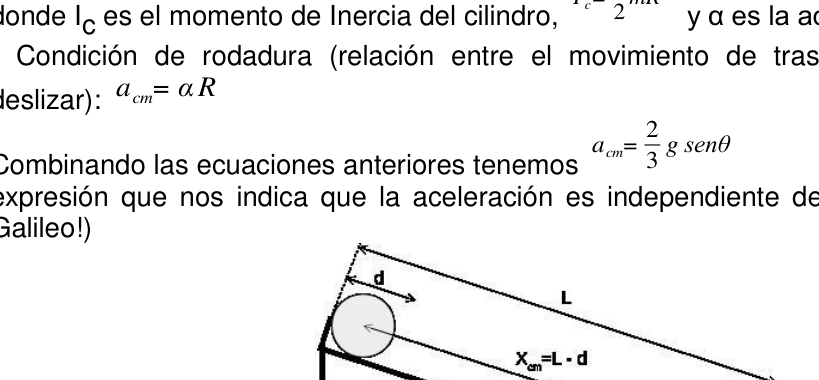
Topic: Rotational Dynamics, Newtonian Mechanics Metodi: Torque & Angular Momentum Analysis, Experimental Data Analysis Competenze: Physical Reasoning, Experimental Data Analysis Objects: Cylinder, Inclined Plane Fonte: Testo (PDF) — p.5
PE15. Istituto Gesù Maria
Scuola Nuova Juan Mantovani
Città di Córdoba.
Obiettivo: Determinare indirettamente l’accelerazione gravitazionale ―g‖ della città di Córdoba.
Materiali:
- Piano inclinato di legno con barriere alle estremità
- Taco di legno .
- cilindro di sezione circolare di legno
- Cintura metrica o regola
- Cronometro digitale o cellulare
- Un penna .
Introduzione e giustificazione teorica: Esaminiamo il movimento di caduta di un cilindro Massiccio che ruota senza scivolare lungo un piano inclinato, per calcolare l’accelerazione gravitatoria ―g‖ della città di Córdoba. Le forze che agiscono sul centro di massa (c.m.) del cilindro sono il suo peso, la reazione del piano inclinato e la forza di rottura. il punto di contatto tra il cilindro e il piano, che producono un’accelerazione di c.m. che chiameremo ACM.
Scompondiamo il peso in direzioni parallele e perpendicolari al piano inclinato verso il termine. di ottenere le seguenti equazioni di movimento:
- Movimento di traslazione del c.m.: mg senθ−F r= macm
(1)
OAF 2015 - 141
- Movimento di rotazione attorno ad un asse che passa attraverso il c.m.: F r R= I c α (2) dove Ic è il momento di inerzia del cilindro, I c= 1 2 mR 2 e α è l’accelerazione angolare.
- Condizione di rotazione (relazione tra movimento di trasformazione e rotazione senza scivolare): acm= α R
(3) Combinando le equazioni precedenti abbiamo acm = 2 3 g senθ
(4)
espressione che ci indica che l’accelerazione è indipendente dalla massa (ricordate
Galileo!)
D’altra parte, per evitare di misurare angoli, abbiamo senθ= h L (5) y X cm= L−d (6) es la Distanza che percorre il c.m. del cilindro in piano inclinato. Usando le equazioni del movimento rettile uniformemente accelerato, abbiamo la distanza Xcm che si spostano per cm. del cilindro in un tempo — t — è: X cm= 1 2 acmt 2= 1⁄3g senθ t 2
Combinando le equazioni precedenti, abbiamo finalmente: (L−d)= 1 3 g( h L)t 2
(7) Espressione che relaziona il spostamento L-d e i tempi di rotazione t.
Procedura e attività: a) Trovare un’espressione per calcolare ―g‖ dall’equazione (7). b) utilizzando l’equazione di a) e le sue conoscenze in materia di diffusione degli errori, trovare l’espressione dell’errore relativo Δg g in base agli errori relativi Δd d , ΔL L , Δh h y Δt t, per usare Δg come errore di ―g‖. Analizzando gli errori relativi, quale magnitudo deve essere misurata con maggiore precisione? c) Mettete l’apparecchio come mostrato in figura 2 e misurate la lunghezza L del piano, l’altezza h del piano, il diametro d del cilindro e riportarli nella tabella allegata.
Abbassare almeno 20 volte il cilindro per il piano inclinato, dal sommo superiore fino al picco inferiore, misurando il tempo — t — che si investe nel percorso di questa lunghezza e le iscrivere nella tabella allegata.
Determina il valore di “g” con la sua corrispondente incertezza.
Topic: Rotational Dynamics, Newtonian Mechanics Metodi: Torque & Angular Momentum Analysis, Experimental Data Analysis Competenze: Physical Reasoning, Experimental Data Analysis Objects: Cylinder, Inclined Plane Fonte: Testo (PDF) — p.5
PE15. Jesus Mary Institute
The New Juan Mantovani School
The city of Cordoba.
The objective: Indirectly determine the gravitational acceleration ―g‖ of the city of Córdoba.
Materials:
- Wood sloping plan with barriers at its ends
- Wood stick .
- Circular section cylinder of wood
- Metric tape or rule
- Digital or cell phone chronometer
- A pencil .
Introduction and theoretical justification: We ‘ll examine the falling motion of a cylinder . A solid that rolls without slipping along a plane inclined, in order to calculate the acceleration gravitational “g” of the city of Cordoba. The forces acting on the center of mass (c.m.) of the cylinder are its weight, the reaction of the tilted plane and the force of friction. the point of contact between the cylinder and the plane, which produce an acceleration of c.m. We’ll call it acm.
We break down the weight in parallel and perpendicular directions to the slope of the plane at the end. of obtaining the following equations of motion:
- Movement of the c.m. translation: mg senθ−F r= macm
(1)
The Commission shall adopt delegated acts in accordance with Article 21 of this Regulation.
- Rotation movement around an axis passing through the cm: F r R= I c α (2) where Ic is the moment of inertia of the cylinder, I c= 1 2 mR 2 And α is the angular acceleration.
- Rolling condition (relation between the translation and rotation motion without Slide: acm= α R
(3) Combining the above equations we have Acm = 2 3 g senθ
(4)
The expression indicating that the acceleration is independent of mass (remember
Galileo!)
On the other hand, to avoid measuring angles, we have Senθ=h L (5) y X cm= L−d (6) es la distance travelled in c.m. The cylinder on the slope. Using the equations of uniformly accelerated right-hand motion, we have to the distance Xcm travelling the c.m. of the cylinder at a time—t— is: X cm= 1 2 acm 2= 1⁄3g senθ t 2
Combining the above equations, we finally have: (L−d)= 1 3 g( h L)t 2
(7) Expression relates the L-d shift to the rolling times t.
Procedures and Activities: (a) Find an expression to calculate ―g‖ from equation (7). (b) Using the equation in (a) and their knowledge in spreading errors, Find the expression of the relative error Δg g depending on the relative errors Δd d , ΔL L , Δh h y Δt t, in order to use Δg as the error of ―g‖. Analyzing the relative errors, What magnitude should be measured more accurately? (c) Place the equipment as shown in Figure 2 and measure the plane length L, height h of the plane, the diameter of the cylinder d and record them in the table attached.
Drop the cylinder at least 20 times from the upper top by the inclined plane. to the bottom, measuring the time t spends traveling this length and record them in the table attached.
Determine the value of ―g‖ with its corresponding uncertainty.
Topic: Rotational Dynamics, Newtonian Mechanics Metodi: Torque & Angular Momentum Analysis, Experimental Data Analysis Competenze: Physical Reasoning, Experimental Data Analysis Objects: Cylinder, Inclined Plane Fonte: Testo (PDF) — p.5
PE16. Escuela Técnica ORT Nro. 2
Ciudad de Buenos Aires.
El péndulo simple y la gravedad.
Objetivo: Al soltar un objeto sujetado a un hilo con el otro extremo fijo en un punto de suspensión, vemos que este comienza a oscilar debido al peso del objeto. El objetivo
142 - OAF 2015 en este experimento es determinar de que factores depende el período de oscilación T del péndulo simple, es decir el tiempo que tarda en completar una oscilación, y la obtención experimental del valor de la aceleración gravitatoria.
Lista de materiales:
- Dos pesitas de diferente masa
- Hilo
- Hojas de papel milimetrado
- Regla milimetrada
- Cinta métrica
- Transportador
- Cronómetro
Comentarios generales:
- Antes de comenzar lea todas las instrucciones
- Agregue en el informe los comentarios que aclaren el procedimiento exacto que utilizó en cada paso. En lo posible incluya también un dibujo aclaratorio.
- Escriba en tablas los datos obtenidos en las mediciones
- Aclare cualquier cambio o desvío respecto de las instrucciones, junto con una breve explicación de su motivo.
- Trate de ser prolijo.
Parte 1: Armado del péndulo Sujete un extremo del hilo a la pesita. Busque un soporte para el otro extremo del hilo. Idee una manera de poder manipular los elementos del péndulo fácilmente obteniendo el menor error posible. Explique el método.
Parte 2: Los elementos del péndulo
- En un mismo péndulo varíe la amplitud: el ángulo que forma el hilo con la vertical cuando el péndulo está en una de sus posiciones extremas. Utilizar ángulos entre 0º y 20º
- Haga lo mismo, pero ahora con la longitud: el largo del hilo desde el punto de suspensión hasta el centro de gravedad del objeto que oscila.
- Ahora le toca el turno de variar a la masa: la masa del objeto suspendido.
- Realice entre 5 y 10 mediciones diferentes del período T del péndulo en cada uno de los 3 casos anteriores y coloque los resultados en una tabla indicando las unidades y el error de medición.
- Grafique los resultados del punto anterior y decida de que elementos depende el período del péndulo.
Ayudita: Para eliminar lo más posible el error en la medición de T, déjelo oscilar más de una vez y luego divida el tiempo obtenido por el número de oscilaciones
Nota: Al variar uno de los elementos, todos los demás deben permanecer constantes.
Parte 3: Cálculo de la aceleración de la gravedad Otro elemento que afecta al período del péndulo es la gravedad, pues esta determina el peso del objeto suspendido, el cual es la causa de movimiento del mismo (recuerden que la gravedad es más intensa en los polos que en el Ecuador) La relación obtenida experimentalmente es la siguiente: |g| = 4π 2 L donde L es la longitud T 2 A partir de los datos obtenidos en el punto 2 de la Parte 2 calcule el valor de la gravedad en Buenos Aires y compárela con el valor standard de 9,82m/s 2 . Grafique los resultados.
Parte 4: Confección de un informe Escriba un informe de la experiencia realizada que posea la siguiente información:
OAF 2015 - 143
- Título
- Introducción (breve)
- Hipótesis
- Descripción del dispositivo experimental (texto y dibujo)
- Detalles acerca de cómo se realizaron las mediciones (texto y dibujo)
- Mediciones / Tablas
- Gráficos (en hoja milimetrada)
- Cálculos
- Cálculos de errores
- Resultados obtenidos
- Comentarios finales
- Conclusiones Y cualquier información que considere relevante
Topic: Oscillations & Waves Metodi: Simple Harmonic Motion Analysis, Experimental Data Analysis Competenze: Physical Reasoning, Experimental Data Analysis Objects: Pendulum Fonte: Testo (PDF) — p.5
PE16. Scuola tecnica ORT Nro. 2
Città di Buenos Aires.
Il semplice pendolo e la gravità.
Obiettivo: Quando si rilascia un oggetto attaccato a un filo con l’altra estremità fissa in un punto di la sospensione, vediamo che questo inizia ad oscillare a causa del peso dell’oggetto. L’obiettivo
142 - OAF 2015 In questo esperimento si determina su quali fattori dipende il periodo di oscillazione T del semplice pendolo, cioè il tempo necessario per completare un oscillazione, e la l’accelerazione gravitazionale.
Lista dei materiali:
- Due pesci di massa diversa.
- Il filo .
- Foli di carta millimetrica
- Regola di millimetro .
- Cintura metrica .
- Trasportatore .
- Cronometro .
Commenti generali:
- Prima di iniziare, leggi tutte le istruzioni
- Aggiungere alla relazione le osservazioni che chiariscono l’esatta procedura che ha usato ogni passo. Se possibile, includere anche un disegno chiaritorio.
- Scrivi in tabella i dati ottenuti dalle misurazioni
- Acclarare qualsiasi modifica o deviazione rispetto alle istruzioni, con una breve nota spiegazione del suo motivo.
- Cerca di essere prolico.
Parte 1: Armato con il pendolo Sosteni un’estremità del filo al pesce. Cerca un supporto per l’altra parte del filo. Ho pensato a un modo per poter manipolare gli elementi del pendolo facilmente ottenendo il il minor errore possibile. Spiegate il metodo.
Parte 2: Gli elementi del pendolo
- In un medesimo pendolo varia l’ampiezza: l’angolo che forma il filo con la verticale quando il pendolo è in una delle sue posizioni estreme. Utilizzare angoli tra 0º y 20º
- Fa’ lo stesso, ma ora con la lunghezza: la lunghezza del filo dal punto di sospensione fino al centro di gravità dell’oggetto oscillante.
- Ora è il turno di variare la massa: la massa dell’oggetto sospeso.
- Fare 5 - 10 diverse misurazioni del periodo T del pendolo su ciascuno di essi di tutti i 3 casi precedenti e inserire i risultati in una tabella indicando i unità e errore di misura.
- Graficare i risultati del punto precedente e decidere quali elementi dipendono dal punto di vista periodo del pendolo.
Aiuto: Per eliminare il più possibile l’errore di misurazione di T, lascialo oscillare oltre una volta e poi dividere il tempo ottenuto per il numero di oscillazioni
Nota: Se uno degli elementi varia, tutti gli altri devono rimanere costanti.
Parte 3: Calcolo dell’accelerazione della gravità Un altro elemento che influisce sul periodo del pendolo è la gravità, che determina il periodo di pendolo. peso dell’oggetto sospeso, che è la causa del suo movimento (ricordate che La gravità è più intensa nei poli dell’Ecuador) experimentalmente es la siguiente: |g| = 4π 2 L donde L es la longitud T 2 Sulla base dei dati ottenuti al punto 2 della parte 2 calcoli il valore di gravità a Buenos Aires e confrontale con il valore standard di 9,82m/s 2 . Grafica i risultati.
Parte 4: Confezione di un rapporto Scrivi un rapporto sull’esperienza svolta che contiene le seguenti informazioni:
OAF 2015 - 143
- Titolo .
- Introduzione (breve)
- Ipotesi
- Descrizione del dispositivo sperimentale (testo e disegno)
- Dettagli su come sono state effettuate le misure (testo e disegno)
- Misure / tabelle
- Grafica (in foglio in millimetri)
- Calcoli
- Calcoli errori
- Risultati ottenuti
- Commenti conclusivi
- Conclusioni E qualsiasi informazione che ritenga rilevante
Topic: Oscillations & Waves Metodi: Simple Harmonic Motion Analysis, Experimental Data Analysis Competenze: Physical Reasoning, Experimental Data Analysis Objects: Pendulum Fonte: Testo (PDF) — p.5
PE16. The technical school ORT Nro. 2
City of Buenos Aires.
The simple pendulum and gravity.
The objective: When releasing an object attached to a thread with the other end fixed at a point of We see that this one starts to oscillate because of the weight of the object. The target
The Commission shall adopt delegated acts in accordance with Article 14 of this Regulation. In this experiment , it is determined on what factors the period of oscillation depends . T of the simple pendulum, that is, the time it takes to complete a swing, and the The test results are based on the results of the experimental calculation of the gravitational acceleration value.
List of materials:
- Two weights of different mass .
- I ‘m not .
- Sheets of millimeter paper
- Millimeter rule .
- Metric tape .
- The transporter .
- The chronometer .
General comments:
- Before you start read all the instructions
- Add to the report the comments clarifying the exact procedure that He used it every step of the way. If possible, include a clarifying drawing.
- Write down the data obtained from the measurements in tables
- Please explain any changes or deviations from the instructions, together with a brief explanation of his motive.
- Try to be prolific.
Part 1: Armed with pendulum Hold one end of the thread to the weighing. Find a support for the other end of the thread. I’ve come up with a way to manipulate the elements of the pendulum easily by getting the The least possible error. Explain the method.
Part 2: The elements of the pendulum
- In the same pendulum, the width varies: the angle formed by the thread with the vertical when the pendulum is in one of its extreme positions. Use angles between 0º y 20º
- Do the same, but now with the length: the length of the thread from the point of Suspension to the centre of gravity of the oscillating object.
- Now it’s time to vary the mass: the mass of the suspended object.
- Make between 5 and 10 different measurements of the pendulum ‘s T period on each one The results of the three previous cases and put them in a table indicating the results. units and measurement error.
- Draw the results of the previous point and decide on which elements the period of the pendulum.
Help: To eliminate the T measurement error as much as possible, let it oscillate more than Once and then divide the time obtained by the number of oscillations.
Note: When one of the elements changes, all the others must remain constant.
Part 3: Calculation of the acceleration of gravity Another factor affecting the period of the pendulum is gravity, which determines the period of the pendulum. The weight of the suspended object, which is the cause of its movement (remember that The gravity is more intense at the poles than at the equator. experimentalmente es la siguiente: |g| = 4π 2 L donde L es la longitud T 2 Based on the data obtained in point 2 of Part 2 calculate the gravity value in Buenos Aires and compare it to the standard value of 9.82m/s 2 . Graph the results.
Part 4: Preparation of a report Write a report of the experience that contains the following information:
The Commission shall adopt delegated acts in accordance with Article 21 of this Regulation.
- Title
- Introduction (short)
- Hypothesis
- Description of the experimental device (text and drawing)
- Details of how the measurements were made (text and drawing)
- Measurements / Tables
- Graphics (in millimetres)
- Calculations .
- Error calculations
- Results obtained
- Final comments
- Conclusions And any information you deem relevant
Topic: Oscillations & Waves Metodi: Simple Harmonic Motion Analysis, Experimental Data Analysis Competenze: Physical Reasoning, Experimental Data Analysis Objects: Pendulum Fonte: Testo (PDF) — p.5
PE17. EPES Nro. 54 Gobernador Juan José Silva
Ciudad de Formosa.
Introducción:
Consideremos el péndulo que se muestra en la Fig.
1, formado por un aro de masa M, diámetro interior
D y espesor e, y un fiel de alambre de masa m y
longitud LF. El péndulo se encuentra suspendido de
una cuchilla (C) como se muestra en la Figura.
Esquema del péndulo a utilizar para medir la aceleración de la gravedad local. Las cantidades están definidas en el texto. En el límite de pequeñas amplitudes de oscilación ( θ0< 5º) el período T de oscilación de un péndulo físico se puede aproximar de la siguiente manera:
En donde hemos llamado IT al momento de inercia del péndulo (aro + fiel) con respecto a su eje de rotación, d a la distancia entre el punto de suspensión y el centro de masa del péndulo, MT a la masa total del péndulo y g a la aceleración de la gravedad local. Para el péndulo de la Fig. 1, escribiendo adecuadamente IT, MT y d en términos de las cantidades a medir directamente (masas y distancias), se llega a la siguiente expresión:
Objetivo:
Determinar experimentalmente la aceleración de la gravedad local y el espesor
promedio de los aros.
Elementos disponibles
-
Pie con espejo graduado y cuchilla
144 - OAF 2015
-
10 aros de madera de distinto diámetro y aproximadamente el mismo espesor
-
Cronómetro
-
Papel milimetrado
-
Regla
Procedimiento
a) Mida el diámetro D de cada aro.
b) Mida el espesor e de cada aro. Asiente cada aro suavemente sobre la cuchilla (no lo
clave). Recuerde que la oscilación se debe producir sobre el plano que contiene al
aro. (Ver Figura)
c) Haga oscilar de manera adecuada cada aro y mida el período T de oscilación.
Informe en cada caso la amplitud máxima de oscilación (A).
d) Construya un tabla que contenga e, A, D, T y T2.
e) Grafique los datos experimentales de tal manera de obtener una relación lineal.
f) A partir del gráfico determine el valor de g con su correspondiente incertidumbre.
g) A partir del gráfico determine el valor de e con su correspondiente incertidumbre.
h) A partir de los espesores medidos en el punto b, determine el espesor promedio y
compárelo con el obtenido a partir de la gráfica indicando si estos valores son
indistinguibles.
i) Concluya cual de los dos métodos utilizados es mejor para determinar e. Justifique.
Datos útiles
- El error asociado a
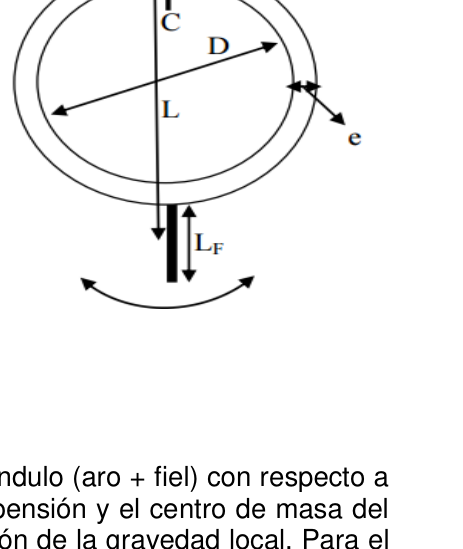
Topic: Oscillations & Waves, Rotational Dynamics Metodi: Simple Harmonic Motion Analysis, Experimental Data Analysis Competenze: Physical Reasoning, Experimental Data Analysis Objects: Pendulum Fonte: Testo (PDF) — p.5
PE17. - Non lo so. 54 Governatore Juan José Silva
Città di Formosa.
Introduzione: Considerate il pendolo che viene mostrato nella Figura. 1, costituito da un anello di massa M, diametro interno D e spessore e, e un fiore di massa m e lunghezza LF. Il pendolo è sospeso da una cucchiaio (C) come mostrato nella Figura.
Schema del pendolo da utilizzare per misurare la l’accelerazione della gravità locale. Quanti sono definite nel testo. Al limite di piccole amplitudini di oscillazione ( θ0< 5o) il periodo T di Oscillazione di un pendolo fisico si può avvicinare in questo modo:
Dove abbiamo chiamato IT il momento di inerzia del pendolo (aro + fiel) rispetto a il suo asse di rotazione, d alla distanza tra il punto di sospensione e il centro di massa del pendolo, MT alla massa totale del pendolo e g all’accelerazione della gravità locale. Per il pendolo della Fig. 1, scrivendo correttamente IT, MT e d in termini di quantità se si misura direttamente (masse e distanze), si ottiene la seguente espressione:
Obiettivo: Determinare sperimentalmente l’accelerazione della gravità locale e dello spessore media degli anelli.
Elementi disponibili
- Piede con specchio graduato e coltello .
144 - OAF 2015
- 10 anelli di legno di diametro diverso e di spessore approssimativo
- Cronometro .
- Papero millimetrico .
- Regola .
Procedura a) Misura il diametro D di ogni anello. b) Misura lo spessore e ogni anello. Siate delicati con ogni anello sul coltello (non chiave). Ricorda che l’oscillazione deve avvenire sul piano che contiene il
- Il mio gruppo. (Vedere Figura) c) Oscillare adeguatamente ogni anello e misurare il periodo T di oscillazione. In ogni caso, segnalare l’ampiezza massima di oscillazione (A). d) Costruire una tabella contenente e, A, D, T e T2. e) Graficare i dati sperimentali in modo da ottenere una relazione lineare. f) Sulla base del grafico, determina il valore di g con la relativa incertezza. g) Sulla base del grafico si determina il valore di e con la relativa incertezza. h) Sulla base degli spessori misurati al punto b, determinare il spessore medio e Confrontare con quello ottenuto dal grafico indicando se questi valori sono indistinguibilmente. (i) Conclude quale dei due metodi utilizzati sia meglio indicato per determinare e. giustifica.
Dati utili
- L’errore associato a
Topic: Oscillations & Waves, Rotational Dynamics Metodi: Simple Harmonic Motion Analysis, Experimental Data Analysis Competenze: Physical Reasoning, Experimental Data Analysis Objects: Pendulum Fonte: Testo (PDF) — p.5
PE17. The Commission shall adopt implementing acts in accordance with Article 21 of this Regulation. 54 Governor Juan José Silva
The city of Formosa.
The Commission has also adopted a proposal for a directive on the protection of workers’ rights. Consider the pendulum shown in Fig. 1, formed by a mass ring M, inner diameter D and thickness e, and a wire mesh of m and length LF. The pendulum is suspended from a blade (C) as shown in Figure 1.
Scheme of pendulum to be used to measure the The acceleration of local gravity. The quantities are defined in the text. At the limit of small The frequency of the oscillation ( θ0< 5o) period T of The oscillation of a physical pendulum can be approximated. as follows:
Where we called it the moment of inertia of the pendulum (aro + fidelity) with respect to its axis of rotation, d at the distance between the point of suspension and the centre of mass of the pendulum, MT to the total pendulum mass and g to the local gravity acceleration. For the The Fig pendulum. 1, by correctly typing IT, MT and d in terms of quantities to directly measure (masses and distances), the following expression is given:
The objective: Experimentally determine the acceleration of local gravity and thickness The average of the rings.
Available items
- Foot with graduated mirror and knife
The following points shall be added:
- 10 wooden rings of different diameter and about the same thickness
- The chronometer .
- Millimeter paper .
- Rule .
The procedure (a) Measure the diameter D of each ring. (b) Measure the thickness and of each ring. Place each ring gently on the blade (not (key) Remember that the oscillation must occur on the plane containing the The Commission has not yet adopted a decision. (See Figure) (c) Have each ring swing properly and measure the T swing period. In each case, report the maximum oscillation width (A). d) Build a table containing e, A, D, T and T2. (e) Graph the experimental data in such a way as to obtain a linear relationship. (f) From the graph, determine the value of g with its corresponding uncertainty. (g) From the graph, determine the value of e with its corresponding uncertainty. (h) From the thicknesses measured in point (b), determine the average thickness and compare it with the result from the graph indicating whether these values are They are indistinguishable. (i) Find out which of the two methods used is best for determining e. You justify it.
Useful data
- The error associated with
Topic: Oscillations & Waves, Rotational Dynamics Metodi: Simple Harmonic Motion Analysis, Experimental Data Analysis Competenze: Physical Reasoning, Experimental Data Analysis Objects: Pendulum Fonte: Testo (PDF) — p.5
PE18. Colegio San Jorge
Quilmes, Buenos Aires.
En este experimento se estudiará la relación entre la presión y el volumen de un gas a presión constante.
Materiales
- Jeringa
- Pesas (25g)
- Manómetro de rama abierta
Procedimiento
Armar el equipo conectando la salida de la jeringa al manómetro de rama abierta (lleno
en sus dos quintas partes por agua) utilizando una manguera. Se debe sostener en forma
vertical a la jeringa por medio de una agarradera sujeta a un pié universal, de modo que
se puedan colocar las pesas sobre el émbolo.
Se coloca una cantidad determinada de gas (aire) en el cilindro. Determinada dicha
cantidad, se conecta el manómetro de modo que las dos ramas, inicialmente, estén a la
misma altura.
Una vez finalizada la preparación del equipo, se comienza a colocar pesas sobre el
émbolo, registrando el aumento en la columna de agua en la rama abierta del
manómetro.
a) Armar una tabla con los datos recolectados, incluyendo los errores.
b) Repetir el procedimiento con dos cantidades iniciales distintas de gas.
c) Graficar Presión vs. Volumen (Para la primera experiencia)
La Ley General de los Gases Ideales estipula la siguiente relación: P.V = n.R.T Donde P es la presión, V el volumen, n el número de moles, R la constante de los gases y T la temperatura absoluta.
OAF 2015 - 145
d) Graficar ln P vs ln V para las tres experiencias.
e) Encontrar a partir del gráfico, el valor de n.R y compararlo en cada caso con el
volumen inicial del experimento.
Datos: densidad del agua = 1000 kg.m-3. Se debe registrar la temperatura ambiente.
Topic: Thermodynamics, Kinetic Theory Metodi: Ideal Gas Law, Experimental Data Analysis Competenze: Physical Reasoning, Experimental Data Analysis Objects: Gas, Manometer, Piston Fonte: Testo (PDF) — p.5
PE18. - Scuola San Giorgio.
Quilmes, Buenos Aires.
Questo esperimento si riferisce al rapporto tra pressione e volume di un gas a
- Presione costante.
Materiali
- Seringa .
- Peso (25 g)
- Manometro a rampa aperta
Procedura Armarsi l’apparecchio collegando l’uscita della siringa al manometro a ramma aperta (pieno (Il tubo di acqua) Deve essere mantenuto in forma. Verticale alla siringa mediante un aggancio che si attacca a un piede universale, in modo che si possono mettere i pesi sul pallone. Si inserisce una determinata quantità di gas (aria) nel cilindro. Determinato tale La quantità, si collega il manometro in modo che i due rami, inizialmente, siano a
- La stessa altezza. Una volta completata la preparazione dell’equipaggio, si inizia a posizionare pesanti sul Embolo, registrando l’aumento nella colonna d’acqua nel ramo aperto del Manometro. a) Arrangere una tabella con i dati raccolti, compresi gli errori. b) Ripetere la procedura con due quantità iniziali di gas diverse. c) Grafica Pressione vs. Volume (Per la prima esperienza)
La legge generale sui gas ideali stabilisce il seguente rapporto: P.V = n.R.T Dove P è la pressione, V il volume, n il numero di molli, R la costante dei gas e T la temperatura assoluta.
OAF 2015 - 145 d) Grafica ln P vs ln V per le tre sperimentazioni. e) Trovare dal grafico il valore di n.R. e confrontarlo in ogni caso con il volume iniziale dell’esperimento.
Dati: densità dell’acqua = 1000 kg.m-3. Si deve registrare la temperatura ambiente.
Topic: Thermodynamics, Kinetic Theory Metodi: Ideal Gas Law, Experimental Data Analysis Competenze: Physical Reasoning, Experimental Data Analysis Objects: Gas, Manometer, Piston Fonte: Testo (PDF) — p.5
PE18. St. George’s School
Quilmes, Buenos Aires is where I am.
This experiment will examine the relationship between the pressure and volume of a gas at constant pressure.
Materials
- The syringe .
- Weights (25 g)
- Open branch gauge
The procedure Arming the equipment by connecting the syringe output to the open-branch manometer (full The Commission has already decided to use the measures set out in the Annex to this Regulation. It must be held in shape vertical to the syringe by means of a universal foot-tight grip, so that the weights can be placed on the embolus. A certain amount of gas (air) is placed in the cylinder. Determined such The manometer is connected so that the two branches are initially at the Same height. Once the equipment is ready, weights are placed on the equipment. The water column on the open branch of the
- What? (a) Arranging a table with the data collected, including errors. (b) Repeat the procedure with two different initial gas quantities. (c) Graphing Pressure vs. Volume (for the first experience)
The General Law of Ideal Gases stipulates the following relationship: P.V = n.R.T Where P is the pressure, V the volume, n the number of moles, R the gas constant and T the absolute temperature.
The following points shall be added: (d) Graph ln P vs ln V for the three experiments. (e) Find from the graph the value of n.R. and compare it in each case with the The initial volume of the experiment.
Data: water density = 1000 kg.m-3. The ambient temperature must be recorded.
Topic: Thermodynamics, Kinetic Theory Metodi: Ideal Gas Law, Experimental Data Analysis Competenze: Physical Reasoning, Experimental Data Analysis Objects: Gas, Manometer, Piston Fonte: Testo (PDF) — p.5
PE19. Instituto Politécnico Superior General San Martín
Rosario, Santa Fe.
A jugar con bombuchas.
Desde chicos nos dedicamos a pasar parte del verano a jugar con ―bombuchas‖. Estos
pequeños globos muchas veces los hemos llenado de agua pero, algunas otras, los
inflamos soplando. Es, desde aquellos años, que empezamos a experimentar que el aire
es un gas que se puede comprimir.
Nuestro objetivo, en este encuentro, será estudiar el comportamiento del aire
bajo compresión a partir del montaje experimental que se encuentra en la
figura. El dispositivo consiste en un tubo en ―U‖ con dos extremos abiertos.
Una vez colocada una cierta cantidad de agua inicial al tubo, si a uno de los
extremos lo cerramos con una bombucha, y a la columna abierta a la atmósfera
le agregamos agua, se observa una diferencia de altura entre las columnas de
agua.
Como el proceso se hace a temperatura ambiente, entonces la expresión que
rige al sistema de aire de la columna cerrada es:
donde , la presión inicial, será la presión atmosférica. El volumen inicial de aire está compuesto por el que se encuentra contenido en el globo desinflado y el aire contenido en la columna. Si la columna de aire es lo suficientemente grande, se puede despreciar el aire contenido en el globo desinflado, quedando entonces:
donde A representa el área transversal del tubo y
representan la altura de la
columna de aire inicial y final respectivamente.
Por otro lado es posible conocer la presión a la cual se encuentra sometido el aire que se
ha comprimido, a través de la diferencia de altura entre las columnas de agua
aplicando el Teorema Fundamental de la Hidrostática:
Reuniendo las expresiones anteriores:
Aprovechando la relación
146 - OAF 2015 Llegando a la expresión final
Procedimiento
a) Coloque agua en el tubo en U hasta tener dos columnas de agua. Deberá ser
criterioso para adoptar el nivel de agua deseado.
b) Coloque la bombucha en uno de los extremos del tubo.
c) Agregue agua en el extremo abierto en etapas. En cada etapa mida la diferencia de
altura del nivel de agua entre las columnas y la altura de la columna de aire del
extremo cerrado. Deberá contar con, al menos, 6 mediciones.
d) Realice una tabla con los resultados.
e) Mientras agrega el agua, observe el comportamiento del globo.
f) Realice una gráfica de
vs
.
g) A partir de la gráfica realizada, calcular la presión atmosférica.
h) Compara tu resultado de la presión obtenida con el valor estándar de presión
atmosférica.
i) Si valor medido experimentalmente difiere del esperado, analice las posibles causas
que pueden interferir tanto en lo experimental como en el modelo propuesto.
j) De ser posible estime, cuanto afecta al valor obtenido, cada ―fuente de error‖.
Datos
Topic: Thermodynamics, Fluid Mechanics Metodi: Ideal Gas Law, Experimental Data Analysis Competenze: Physical Reasoning, Experimental Data Analysis Objects: Gas, Manometer Fonte: Testo (PDF) — p.5
PE19. Istituto Politetnico Superiore Generale San Martín
Rosario, Santa Fe.
Giochi con le bombone. Da bambini abbiamo dedicato parte dell’estate a giocare con le “bombole”. Questi . I piccoli globuli spesso sono riempiti di acqua, ma alcuni altri, si gonfia a suonare. È da quegli anni che abbiamo iniziato a sperimentare che l’aria è un gas compressibile. L’obiettivo di questo incontro sarà quello di studiare il comportamento dell’aria. sotto compressione dal montaggio sperimentale che si trova nella
- Figura. Il dispositivo consiste in un tubo in U con due estremità aperte. Una volta che una certa quantità di acqua iniziale viene inserita nel tubo, se uno di questi L’estremo lo chiudiamo con una bombella, e la colonna aperta all’atmosfera. aggiungiamo acqua, si osserva una differenza di altezza tra le colonne di acqua. Come il processo viene fatto a temperatura ambiente, allora l’espressione che controlla il sistema di aria della colonna chiusa:
dove , la pressione iniziale, sarà la pressione atmosferica. L’ aria iniziale è di composto da contenuto nel globo deflato e contenuto aria nella colonna vertebrale. Se la colonna d’aria è abbastanza grande, si può disprezzare il aria contenuta nel globo deflato, rimanendo quindi:
dove A rappresenta l’area trasversale del tubo e rappresentano l’altezza della colonna d’aria iniziale e finale rispettivamente. In altre parole, è possibile conoscere la pressione all’aria che si trova sottoposta. ha compresso, attraverso la differenza di altezza tra le colonne d’acqua applicando il Teorema fondamentale dell’idrostatica:
Riunendo le espressioni precedenti:
Sfruttando la relazione
146 - OAF 2015 Arrivo all’espressione finale
Procedura a) Metti l’acqua nel tubo in U fino a che non si formino due colonne d’acqua. Dovrebbe essere criteri per adottare il livello d’acqua desiderato. b) Metti la bombola su una delle estremità del tubo. c) Aggiungere acqua all’estremità aperta in fasi. In ogni fase misura la differenza di Altezza del livello dell’acqua tra le colonne e altezza della colonna d’aria del estremità chiusa. Dovrà contare su almeno 6 misure. d) Fare un tabella dei risultati. e) Mentre aggiungi l’acqua, osserva il comportamento del pallone. f) Rendi un grafico di vs . g) Calcolare la pressione atmosferica a partire dal grafico. h) Confronta il risultato della pressione ottenuta con il valore standard di pressione
- Atmosferica. i) Se il valore misurato sperimentalmente differisce da quello previsto, analizzare le possibili cause che possono interferire sia con lo sperimentale che con il modello proposto. j) Se possibile, stima, quanto riguarda il valore ottenuto, ogni “fonte di errore”.
Datossegna
Topic: Thermodynamics, Fluid Mechanics Metodi: Ideal Gas Law, Experimental Data Analysis Competenze: Physical Reasoning, Experimental Data Analysis Objects: Gas, Manometer Fonte: Testo (PDF) — p.5
PE19. The French authorities have already confirmed that the Commission is not interested in the use of the information provided by the Commission.
Rosario, Santa Fe.
Playing with the bubbles. Since we were kids, we spent part of the summer playing with “bombas”. These . We’ve filled them with water many times, but some other balloons, they’re just like water. We blow it up. It’s, since those years, that we’ve started to experience that air. It’s a gas that can be compressed. Our aim at this meeting will be to study air behaviour. under compression from the experimental assembly found in the It’s a figure. The device consists of a tube in ―U‖ with two ends open. Once a certain amount of water is placed in the initial tube, if one of the Extremes we close with a bomb, and the column open to the atmosphere. We add water to it, you see a difference in height between the columns of
- What? As the process is done at room temperature, then the expression that The control of the closed column air system is:
Where , the initial pressure, will be the atmospheric pressure. The initial air volume is composed of the contents of the deflated balloon and the air contents in the spine. If the air column is large enough, you can disregard the Air content in the deflated balloon, then remaining:
where A represents the transverse area of the tube and They represent the height of the the initial and final air column respectively. On the other hand, it is possible to know the pressure to which the air is subjected. has compressed, through the height difference between the water columns applying the Fundamental Theorem of Hydrostatics:
Gathering the above expressions:
Taking advantage of the relationship
The Commission shall adopt delegated acts in accordance with Article 146. Coming to the final expression
The procedure (a) Place water in the tube at U until there are two water columns. It must be. The water level is determined by the criteria for the desired water level. (b) Place the bulb on one end of the tube. (c) Add water to the open end in stages. At each stage measure the difference of the height of the water level between the columns and the height of the air column of the The end is closed. You must have at least six measurements. (d) Draw up a table with the results. e) As you add water, observe the behavior of the balloon. (f) Draw a graph of vs . (g) Calculate the atmospheric pressure from the graph. (h) Compare your result of the pressure obtained to the standard pressure value atmospheric. (i) If the experimentally measured value differs from expected, analyse the possible causes The Commission has already adopted a number of proposals for the new directive. (j) If possible, estimate, as far as it affects the value obtained, each “source of error”.
The data
Topic: Thermodynamics, Fluid Mechanics Metodi: Ideal Gas Law, Experimental Data Analysis Competenze: Physical Reasoning, Experimental Data Analysis Objects: Gas, Manometer Fonte: Testo (PDF) — p.5
PE20. Colegio Universitario Central Gral. José de San Martín
Ciudad de Mendoza.
Péndulo Real.
Objetivo: Determinar el momento de inercia de una varilla delgada
Breve Descripción
El momento de inercia representado, comúnmente por la letra ―I‖, es una medida de la
inercia rotacional de un cuerpo. Cuando un cuerpo gira en torno a uno de los ejes
principales de inercia, la inercia rotacional puede ser representada como una magnitud
escalar llamada momento de inercia. Refleja la distribución de masa de un cuerpo o de
un sistema de partículas en rotación, respecto a un eje de giro, sólo depende de la
geometría del cuerpo y de la posición del eje de giro; pero no de las fuerzas que
intervienen en el movimiento.
Dado un sistema de partículas y un eje arbitrario, el momento de inercia del mismo se
define como la suma de los productos de las masas de las partículas por el cuadrado de
la distancia r de cada partícula a dicho eje. Matemáticamente se expresa como
𝐼= 𝑚𝑖𝑟𝑖 2
Este concepto desempeña en el movimiento de rotación un papel análogo al de masa
inercial en el caso del movimiento rectilíneo y uniforme.
Para nuestra práctica nos valdremos de un método que se basa en la idea del péndulo
físico. Por ello recordemos que se trata de un cuerpo rígido que gira libremente en torno a
un eje fijo de rotación. Si las oscilaciones son pequeñas, el análisis de un péndulo real es
OAF 2015 - 147 tan sencillo como el de uno simple. La figura 1 muestra un cuerpo irregular que puede girar sin fricción alrededor de un eje que pasa por el punto O. En la posición de equilibrio, el centro de gravedad está directamente abajo del pivote; en la posición mostrada en la figura 1, el cuerpo esta desplazado de la posición de equilibrio un ángulo θ. La distancia de O al centro de gravedad es d. Cuando el cuerpo se desplaza como se muestra el peso causa una torca de restitución.
Realizando el análisis teórico correspondiente podemos determinar una ecuación que
resulta sumamente útil para la determinación experimental del momento de inercia de un
cuerpo.
𝑇= 2𝜋
𝐼
𝑚𝑔𝑑
Donde T es el periodo del péndulo, I el momento de inercia, m la masa total del cuerpo y g la aceleración de la gravedad.
Consigna 1 a) Determine el momento de inercia de la varilla entregada, basándose en el método del péndulo físico. Considere que la varilla es perfectamente homogénea por lo que su centro de masa coincide con su centro geométrico. b) Describa el procedimiento utilizado para determinar dicho valor, y las consideraciones que tuvo para que la practica resulte exitosa.
Consigna 2 a) Determine el error correspondiente al momento de inercia calculado en el punto anterior b) Analíticamente el momento de inercia de una varilla delgada que gira en torno a un eje que pasa por uno de sus extremos es:
𝐼= 1 3 𝑀𝐿2
Compare este valor con el obtenido experimentalmente en la consigna 1 a)
Consigna 3 Utilizando las varillas perforadas en diferentes puntos realice un gráfico que muestre la variación del período en función de la distancia del eje de giro al centro de masa.
Topic: Rotational Dynamics, Oscillations & Waves Metodi: Simple Harmonic Motion Analysis, Experimental Data Analysis Competenze: Physical Reasoning, Experimental Data Analysis Objects: Pendulum, Rod Fonte: Testo (PDF) — p.5
PE20. Gral Central University. José de San Martín
Città di Mendoza.
Pendolo reale.
Obiettivo: Determinare il momento di inerzia di un bastone sottile
Breve descrizione Il momento di inerzia rappresentato, comunemente dalla lettera ―I‖, è una misura della inerzia rotazionale di un corpo. Quando un corpo gira attorno a uno degli assi In questo modo, la inerzia rotazionale può essere rappresentata come una magnitudine. scalare chiamato momento di inerzia. Riflette la distribuzione di massa di un corpo o di Un sistema di particelle in rotazione, rispetto ad un’asse di rotazione, dipende solo dalla geometria del corpo e della posizione dell’asse di rotazione; ma non delle forze che interviene nel movimento. Dato un sistema di particelle e un asse arbitrario, il momento di inerzia di esso si definisce la somma dei prodotti delle masse delle particelle per il quadrato di la distanza r di ogni particella a tale asse. Matematicamente si esprime come
I = miri 2
Questo concetto svolge un ruolo analogo al movimento di massa in rotazione inerziale nel caso del movimento rettilineo e uniforme. Per la nostra pratica si userà un metodo basato sull’idea del pendolo.
- Fisica. Ricordiamoci che si tratta di un corpo rigido che gira liberamente intorno a un asse fisso di rotazione. Se le oscillazioni sono piccole, l’analisi di un pendolo reale è
OAF 2015 - 147 semplice come quello di una semplice. La figura 1 mostra un corpo irregolare che può girare senza attrito attorno ad un asse che passa attraverso il punto O. Nella posizione di equilibrio, Il centro di gravità è direttamente sotto il pivote; nella posizione mostrata nella Fig. 1, il corpo è spostato dalla posizione di equilibrio un angolo θ. La distanza di O al centro di gravità è d. Quando il corpo si muove come mostra il peso causa un’impossibilità di restituzione.
Con l’analisi teorica corrispondente possiamo determinare un’equazione che La velocità di inerzia di un sistema di velocità di inerzia è molto utile per la determinazione sperimentale del momento di inerzia di un sistema di velocità di inerzia. corpo. 𝑇= 2𝜋 𝐼 mgd
Dove T è il periodo del pendolo, I il momento di inerzia, m la massa totale del corpo e g l’accelerazione della gravità.
Consigna 1 a) Determina il momento di inerzia della canna consegnata, basandosi sul metodo del pendolo fisico. Considerate che il bastone è perfettamente omogeneo, quindi… il suo centro di massa corrisponde al suo centro geometrico. b) Descrive la procedura utilizzata per determinare tale valore e le condizioni di utilizzo. Le sue considerazioni hanno contribuito a farla avere successo.
Consigna 2 a) Determina l’errore corrispondente al momento di inerzia calcolato al punto precedente b) Analiticamente il momento di inerzia di un sottile bastone che ruota intorno a un L’asse che passa attraverso una delle sue estremità è:
𝐼= 1 3 𝑀𝐿2
Compare questo valore con quello ottenuto sperimentalmente nella voce 1 (a)
Consegna 3 Utilizzando le bacche perforate in diversi punti realizza un grafico che mostra la variazione del periodo in funzione della distanza dell’asse di rotazione dal centro di massa.
Topic: Rotational Dynamics, Oscillations & Waves Metodi: Simple Harmonic Motion Analysis, Experimental Data Analysis Competenze: Physical Reasoning, Experimental Data Analysis Objects: Pendulum, Rod Fonte: Testo (PDF) — p.5
PE20. Gral Central High School. Joseph of San Martin
The city of Mendoza.
The Royal Pendulum.
Objective: Determine the moment of inertia of a thin rod
Brief description The moment of inertia, commonly represented by the letter ―I‖, is a measure of the rotational inertia of a body. When a body rotates around one of the axes In the case of a rotational inertia, the main inertia can be represented as a magnitude. Scale is called moment of inertia. It reflects the mass distribution of a body or body. A system of rotating particles, with respect to a rotating axis, depends only on the body geometry and the position of the axis of rotation; but not the forces that They’re involved in the movement. Given a system of particles and an arbitrary axis, the moment of inertia of the same is It is defined as the sum of the products of the masses of the particles by the square of the distance r of each particle to that axis. Mathematically it is expressed as
I = miri 2
This concept plays a role in rotational motion analogous to that of mass. Inertial in the case of straight and uniform movement. For our practice we will use a method based on the idea of the pendulum. I’m a physicist. So let us remember that it is a rigid body that rotates freely around the a fixed axis of rotation. If the oscillations are small, the analysis of a real pendulum is
The following points shall be added: It’s as simple as a simple one. Figure 1 shows an irregular body that can rotate without friction around an axis passing through the O point. In the equilibrium position, The centre of gravity is directly below the pivot; at the position shown in the Figure 1, the body is displaced from the equilibrium position at an angle θ. The distance of O to the center of gravity is d. When the body moves as the weight is shown causes a return blunder.
By performing the corresponding theoretical analysis we can determine an equation which It is extremely useful for experimental determination of the moment of inertia of a body. 𝑇= 2𝜋 𝐼 mgd
Where T is the period of the pendulum, I is the moment of inertia, m is the total mass of the body and g the acceleration of gravity.
Consigna 1 (a) Determine the moment of inertia of the delivered rod, based on the method The physical pendulum. Consider that the rod is perfectly homogeneous so Its center of mass matches its geometric center. (b) Describe the procedure used to determine this value, and The Commission has already taken into account the various considerations it took to make the practice successful.
Consigna 2 (a) Determine the error corresponding to the moment of inertia calculated at the point Previously on (b) Analytically the moment of inertia of a thin rod rotating around a The axis passing through one of its ends is:
𝐼= 1 3 𝑀𝐿2
Compare this value with the experimental value in heading 1 (a)
Consigna 3 Using the rods drilled at different points make a graph showing the period variation in relation to the distance of the axis of rotation to the centre of mass.
Topic: Rotational Dynamics, Oscillations & Waves Metodi: Simple Harmonic Motion Analysis, Experimental Data Analysis Competenze: Physical Reasoning, Experimental Data Analysis Objects: Pendulum, Rod Fonte: Testo (PDF) — p.5
PE21. Instituto Nuestra Señora de Lourdes
Porteña, Córdoba.
Objetivo: Determinar si la masa y la longitud dependen en el período de un péndulo.
148 - OAF 2015 Materiales:
- 1 armazón con dos péndulos de igual longitud pero de distinta masa.
- 1 armazón con dos péndulos con igual masa y distintas longitudes.
- Regla
- Cronómetro
- Calculadora
Procedimiento:
- Se busca un armazón con diferentes masas. Se aleja una misma amplitud los dos péndulos y se cronometro los tiempos a intervalos diferentes y se cuentan las oscilaciones dobles.
- Se construye una tabla con los valores y se determinan los períodos.
- Completar la tabla
tiempo Oscilación (1) Oscilación (2) Período (1) Período (2)
- Observar las dos últimas columnas y extraer conclusiones.
- Enumerar los errores que se pudieron cometer
- Enunciar la conclusión.
- Utilizar el otro armazón y medir las longitudes, y a diferentes tiempos contar las oscilaciones dobles de los péndulos y completar el cuadro:
Tiempo Oscil.(1) Oscil.(2) Período1 Período2 T1 / T2 √L1/√L 2
- Observar las dos últimas columnas y extraer conclusiones.
- Enumerar los errores que se pudieron cometer
- Enunciar la conclusión.
- Generalizar las dos leyes.
Topic: Oscillations & Waves Metodi: Simple Harmonic Motion Analysis, Experimental Data Analysis Competenze: Physical Reasoning, Experimental Data Analysis Objects: Pendulum Fonte: Testo (PDF) — p.5
PE21. Istituto Nostra Signora di Lourdes
Porteña, Cordoba.
Obiettivo: Determinare se la massa e la lunghezza dipendono dal periodo di un pendolo.
148 - OAF 2015 Materiali:
- 1 telaio con due pendoli di uguale lunghezza ma di massa diversa.
- 1 telaio con due pendoli di massa uguale e lunghezza diversa.
- Regola .
- Cronometro .
- Calcolatore .
Procedura:
- Si cerca un telaio con diverse masse. Si allontana la stessa larghezza. Le pendole e i tempi sono cronometrati a diversi intervalli e le calcoli sono calcolate. oscillazioni doppie.
- Si costruisce una tabella con i valori e si determinano i periodi.
- Completare la tabella
Tempo Oscillazione (1) Oscillazione (2) Periodo (1) Periodo (2)
- Osservare le ultime due colonne e trarre conclusioni.
- L’elenco degli errori che si possono commettere
-
- Esprimere la conclusione.
- Usare l’altro telaio e misurare le lunghezze, e a tempi diversi contare le lunghezze. oscillazioni doppie dei pendoli e completare il quadro:
Tempo Oscillo. Oscillazione. Periodo1 Periodo2 T1 / T2 √L1/√L 2
- Osservare le ultime due colonne e trarre conclusioni.
- L’elenco degli errori che si possono commettere
-
- Esprimere la conclusione.
- Generalizzare le due leggi.
Topic: Oscillations & Waves Metodi: Simple Harmonic Motion Analysis, Experimental Data Analysis Competenze: Physical Reasoning, Experimental Data Analysis Objects: Pendulum Fonte: Testo (PDF) — p.5
PE21. Our Lady of Lourdes Institute
The gate, Cordoba.
The objective: Determine whether the mass and length depend on the period of a pendulum.
The Commission shall adopt delegated acts in accordance with Article 148. Materials:
- 1 frame with two pendulums of equal length but of different mass.
- 1 frame with two pendulums of equal mass and different lengths.
- Rule .
- The chronometer .
- Calculator .
The procedure:
- We’re looking for a frame with different masses. It’s the same width apart. The time intervals are timed at different intervals and the time intervals are counted. The two-dimensional oscillations.
- A table is constructed with the values and the periods are determined.
- Complete the table
Time . The number of rows of rows The following is the list of the following: Period (1) Period (2)
- Look at the last two columns and draw conclusions.
- List the mistakes that could have been made
- To state the conclusion.
- Use the other frame and measure the lengths, and at different times count the lengths. Double oscillations of the pendulums and complete the table:
Time is running out . It’s not going to be easy. It’s not going to be easy. Period1 Period2 T1 / T2 √L1/√L 2
- Look at the last two columns and draw conclusions.
- List the mistakes that could have been made
- To state the conclusion.
- Generalize the two laws.
Topic: Oscillations & Waves Metodi: Simple Harmonic Motion Analysis, Experimental Data Analysis Competenze: Physical Reasoning, Experimental Data Analysis Objects: Pendulum Fonte: Testo (PDF) — p.5
PE22. EPET Nro. 4 Juan Agustín Larrus
Colegio Secundario Valle Argentino
General Acha, La Pampa.
Auto Desafío Eco.
Experiencia 1 Determinar la densidad y el peso específico de los materiales permitido para el uso en la construcción del auto y que materiales son según la tabla1
Materiales necesarios
- 5 probetas geométricamente cortadas pintadas
- 1 pie milimetrado
- 1 dinamómetro
OAF 2015 - 149
- Hojas milimetradas
Tener en cuenta los errores. Graficar
Tabla 1
Experiencia 2 Determinar corriente y tensión de 1 autito armado con el juego lego
Materiales necesarios
- Juego lego
- 1 multímetro
- 2 trasmisiones distintas
- Hojas milimetradas
- 1 balanza
Consigna
Armar el autito con una trasmisión sacar valores de corriente y tensión del motor
Y hacer lo mismo con la otra. Realizarlo sin apoyarlo en el piso
Luego hacer lo mismo apoyado en el piso.
¿A que se debe el cambio de valores?
Cambiar el peso y hacer la misma experiencia
Con todo estos valores sacado que podemos decir del auto de Desafío eco que se debe
tener en cuenta para mayor rendimiento
Tener en cuenta los errores. Graficar
Topic: Fluid Mechanics, Circuits Metodi: Hydrostatic Equilibrium, Experimental Data Analysis Competenze: Physical Reasoning, Experimental Data Analysis Objects: Battery Fonte: Testo (PDF) — p.5
PE22. Il numero di EPET. 4 Juan Agustín Larrus
Scuola Secundaria Valle Argentino
Generale Acha, La Pampa.
Auto-sfida Eco.
Esperienza 1 Determinare la densità e il peso specifico dei materiali consentiti per l’uso in La costruzione dell’auto e quali materiali sono secondo il tabella1
Materiali necessari
- 5 proiettili geometricamente tagliati, dipinti.
- 1 piede millimetro
- Un dinamometro .
OAF 2015 - 149
- Foli millimetrici
Tenere conto degli errori. Grafica
Tabella 1
Esperienza 2 Determinare corrente e tensione di un autito armato con il gioco lego
Materiali necessari
- Gioco leggero.
- 1 multimetro
- Due trasmissioni diverse
- Foli millimetrici
- 1 bilancia .
Consigna Armarla con una trasmissione, ottenere valori di corrente e tensione del motore. E fare lo stesso con l’altra. Fate questo senza appoggiarlo al pavimento Poi fare lo stesso appoggiato al pavimento. A cosa si deve il cambio di valori? Cambiare di peso e fare la stessa esperienza. Con tutti questi valori che si possono dire di auto sfida eco che è dovuto
- per un’ottima performance
Tenere conto degli errori. Grafica
Topic: Fluid Mechanics, Circuits Metodi: Hydrostatic Equilibrium, Experimental Data Analysis Competenze: Physical Reasoning, Experimental Data Analysis Objects: Battery Fonte: Testo (PDF) — p.5
PE22. The following information shall be provided: 4 John Agustin Larrus
High School Valle Argentino
General Acha, the Pampa.
Self-Defy Eco.
Experience 1 Determine the specific density and weight of materials permitted for use in the The following are the main features of the vehicle:
Materials needed
- 5 geometrically cut samples painted
- 1 foot in millimetres
- One dynamometer .
The Commission shall adopt delegated acts in accordance with Article 21 of the Financial Regulation.
- Millimeter sheets .
Take into account mistakes. Graphically
Table 1
Experience 2 Determine current and voltage of 1 AUT with the Lego game
Materials needed
- A game of lego .
- 1 multi-meter .
- Two different transmissions
- Millimeter sheets .
- One swing .
I ‘m giving it away . Arming the car with a transmission to extract current and voltage values from the engine And do the same with the other one. Do it without leaning it on the floor. Then do the same thing leaning on the floor. What is the reason for the change in values? Change the weight and do the same experience With all these values drawn we can say of the car’s eco challenge that it’s due Consider for higher performance
Take into account mistakes. Graphing
Topic: Fluid Mechanics, Circuits Metodi: Hydrostatic Equilibrium, Experimental Data Analysis Competenze: Physical Reasoning, Experimental Data Analysis Objects: Battery Fonte: Testo (PDF) — p.5
PE23. Colegio Nicolás Avellaneda
Aguilares, Tucumán.
Las pelotas “saltarinas”.
Dos niños juegan con pelotitas de goma, de diferente masa, que están colgadas de
sendos hilos delgados de tal modo que están a la misma altura y están en contacto.
Las longitudes de los hilos no son las mismas. Las masas de las pelotitas son:
150 - OAF 2015 𝑚1 = (8,0 ± 0,2) 𝑔 y 𝑚1 = (20 ± 0,2) 𝑔. La pelotita de masa 𝑚1 es desviada en un ángulo de 60° y luego se suelta.. a) Determina el ángulo máximo de las bolitas después de la colisión. Suponga que el choque es perfectamente elástico. b) Redacte un informe del trabajo realizado, donde debes explicar que objetivo tiene la experiencia y un planteo analítico. c) Método experimental utilizado para lograr el objetivo d) Realiza tabla de valores y graficas obtenidas e) También deje asentado consideraciones y supuestos que considere importante mencionar
Material: a) Regla milimetrada b) Metro c) Papel milimetrado d) Cronometro e) Bolitas de goma de diferente masa
Topic: Conservation of Momentum Metodi: Conservation of Momentum, Experimental Data Analysis Competenze: Physical Reasoning, Experimental Data Analysis Objects: Pendulum, Ball Fonte: Testo (PDF) — p.5
PE23. Scuola Nicolás Avellaneda
Aguilar, Tucuman.
Le palle salterine. Due bambini giocano con palline di gomma, di massa diversa, che sono appese a tracciano fili sottili in modo che siano a pari altezza e siano in contatto. Le lunghezze dei fili non sono le stesse. Le masse delle palline sono:
150 - OAF 2015 𝑚1 = (8,0 ± 0,2) 𝑔 y 𝑚1 = (20 ± 0,2) 𝑔. La palla di massa m1 è deviata ad un angolo di 60° e poi si rilascia.. a) Determina l’angolo massimo delle palline dopo l’impatto. Supponiamo che il lo shock è perfettamente elastico. b) Scrivi un rapporto sul lavoro svolto, in cui spieghi quale sia l’obiettivo della l’esperienza e un approccio analitico. c) Metodo sperimentale utilizzato per raggiungere l’obiettivo d) Realizza un tabella dei valori e dei grafici ottenuti e) Lascia anche in atto considerazioni e presupposti che ritiene importanti menzionare
Materiale: a) Regola di millimetro b) Metro c) Carta millimetrica d) Cronometro e) Bocce di gomma di massa diversa
Topic: Conservation of Momentum Metodi: Conservation of Momentum, Experimental Data Analysis Competenze: Physical Reasoning, Experimental Data Analysis Objects: Pendulum, Ball Fonte: Testo (PDF) — p.5
PE23. Nicholas Avellaneda College
The Eagles, Tucumán.
The saltarine balls. Two kids playing with rubber balls, of different mass, that are hung from The two sides of the line are made of thin threads so that they are at the same height and are in contact. The lengths of the threads are not the same. The masses of the balls are:
The Commission shall adopt delegated acts in accordance with Article 21 of this Regulation. 𝑚1 = (8,0 ± 0,2) 𝑔 y 𝑚1 = (20 ± 0,2) 𝑔. The m1 mass ball is deflected at an angle of 60° and then it’s released.. (a) Determine the maximum angle of the balls after the collision. Suppose the The shock is perfectly elastic. (b) Write a report on the work done, explaining the purpose of the work. The Commission has already adopted a number of proposals. (c) Experimental method used to achieve the objective (d) Perform a table of values and graphs obtained (e) Also leave behind considerations and assumptions which it considers important to mention
Material: (a) The millimetre rule (b) Metro (c) Millimeter paper (d) Timetable (e) Rubber balls of different mass
Topic: Conservation of Momentum Metodi: Conservation of Momentum, Experimental Data Analysis Competenze: Physical Reasoning, Experimental Data Analysis Objects: Pendulum, Ball Fonte: Testo (PDF) — p.5
PE24. Escuela Técnica ORT - Sede Almagro
Ciudad de Buenos Aires.
El oscilador armónico es el tipo de movimiento más estudiado en toda la física, el mismo está presente desde las interacciones moleculares y los circuitos eléctricos hasta los fenómenos cuánticos de la luz. En este experimento intentaremos comprender este sistema en una de sus maneras más fáciles: un resorte. Un resorte está caracterizado por su dureza que se suele llamar k y la fuerza que ejerce el mismo sobre un cuerpo viene dada por:
En conjunto con la gravedad podemos obtener la posición de equilibrio para el sistema resorte-masa estático:
Al poner en movimiento el sistema aparece una fuerza viscosa debido a la presencia del aire:
Donde v es la velocidad de la masa y b es el coeficiente de viscosidad cinemática del aire. Esta fuerza aumenta conla velocidad y es la que genera la existencia de una velocidad límite en los casos de caída libre. Para poder resolver este sistema es necesario ubicar el origen de coordenadas del sistema en la posición de equilibrio del sistema (como se puede ver en la figura 1). El balance de fuerzas en esta situación dinámica queda:
Una vez hecho esto podemos resolver la ecuación correspondiente y obtener la posición de la masa en función del tiempo.
En donde xi es la posición inicial de la masa. Esta ecuación nos da una oscilación armónica amortiguada como se puede ver en la figura 2. En un sistema oscilante tambien se puede definir un factor de calidad adimensional o factor Q que dice que tan amortiguado está el sistema y el ancho de las resonancias del mismo. Dicho parámetro viene dado por:
OAF 2015 - 151
En este experimento contarán con:
- Resorte.
- Masas.
- Balanza.
- Regla.
- Sensor de movimiento.
Se pide:
- Medir la posición de equilibrio del resorte para distintas masas, ¿cuál es la constante elástica del resorte?
- Realizar una medición dinámica para el resorte utilizando el sensor de movimiento. Escribir en una tabla los valores de amplitud máxima de la oscilación y el tiempo correspondiente.
- Realizar un gráfico en hoja milimetrada de amplitud en función del tiempo. Linealizarlo y obtener el valor de la viscosidad dinámica.
- Calcular el factor de calidad Q.
Topic: Oscillations & Waves, Elasticity & Materials Metodi: Simple Harmonic Motion Analysis, Experimental Data Analysis Competenze: Physical Reasoning, Experimental Data Analysis Objects: Spring Fonte: Testo (PDF) — p.5
PE24. Scuola tecnica ORT - Sede Almagro
Città di Buenos Aires.
L’oscillare armonico è il tipo di movimento più studiato in tutta la fisica, lo stesso. La presenza di un’energia di tipo di “tempo” è presente da interazioni molecolari e circuiti elettrici a fenomeni quantistici della luce. In questo esperimento cercheremo di capire questo. sistema in uno dei suoi modi più facili: una primavera. Un resorte è caratterizzato dalla sua durezza che viene comunemente chiamata k e dalla forza che esercita. lo stesso su un corpo viene dato da:
In combinazione con la gravità possiamo ottenere la posizione di equilibrio per il sistema di massa-sorgente statica:
Quando si mette in movimento il sistema si manifesta una forza viscosa a causa della presenza di aria:
Dove v è la velocità della massa e b è il coefficiente di viscosità cinematica di aria. Questa forza aumenta con la velocità e genera l’esistenza di una velocità limite in caso di caduta libera. Per risolvere questo sistema è È necessario individuare l’origine delle coordinate del sistema nella posizione di equilibrio del sistema (come si può vedere nella figura 1). Il bilancio delle forze in questa situazione dinamica è:
Una volta fatto questo possiamo risolvere l’equazione corrispondente e ottenere la posizione di massa in funzione del tempo.
Dove xi è la posizione iniziale della massa. Questa equazione ci dà un’oscillazione. l’armonia ammortizzata come si può vedere nella figura 2. In un sistema oscilante si può definire anche un fattore di qualità dimensionale o Q fattore che dice che così amortizzato è il sistema e la larghezza delle risonanze di
- Proprio così. Tale parametro è dato da:
OAF 2015 - 151
In questo esperimento conteranno:
- Resorte.
- Massaggi.
- Sbalza.
- Regola.
- Sensore di movimento.
Si chiede:
- Misurare la posizione di equilibrio della sorgente per le diverse masse, qual è la costante elastica della primavera?
- Per effettuare una misurazione dinamica per la primavera utilizzando il sensore di movimento. Scrivere su una tabella i valori di amplitudine massima dell’oscillazione e del tempo corrispondente.
- Realizzare un grafico in foglio di larghezza millimetrica in base al tempo. Linealizzare e ottenere il valore della viscosità dinamica.
- Calcolare il fattore qualità Q.
Topic: Oscillations & Waves, Elasticity & Materials Metodi: Simple Harmonic Motion Analysis, Experimental Data Analysis Competenze: Physical Reasoning, Experimental Data Analysis Objects: Spring Fonte: Testo (PDF) — p.5
PE24. The technical school ORT - Headquarters Almagro
City of Buenos Aires.
The harmonic oscillator is the most studied type of motion in all of physics, the same. It is present in all molecular interactions and electrical circuits. quantum phenomena of light. In this experiment we will try to understand this. system in one of its easiest ways: a spring. A spring is characterized by its hardness, usually called k, and the force it exerts. The same over a body is given by:
Together with gravity we can get the equilibrium position for the system. Static spring-mass:
When the system is set in motion, a viscous force appears due to the presence of the Air:
Where v is the mass velocity and b is the kinematic viscosity coefficient of the Air. This force increases with speed and is what generates the existence of a speed limit in cases of free fall. To solve this system is The system coordinates must be located at the equilibrium position of the system (as can be seen in Figure 1). The balance of power in this dynamic situation is:
Once we do this we can solve the corresponding equation and get the position The mass of the planet is time-dependent.
Where xi is the initial position of the mass. This equation gives us a swing. The amount of the energy used is the sum of the energy used. In an oscillating system a dimensionless quality factor can also be defined or Q factor that says how cushioned is the system and the width of the resonance of the I’m not. This parameter is given by:
The following points shall be added:
In this experiment, they will have:
- Spring. - What is it?
- It’s a lot.
- Weigh it.
- It’s a rule.
- It’s a motion sensor.
It asks:
- Measuring the balance position of the spring for different masses, what is the the spring elastic constant?
- Perform a dynamic measurement for the spring using the motion sensor. Write on a table the maximum amplitude values of the oscillation and time the corresponding.
- Make a sheet graph in millimetres of width based on time. Linearise it and get the value of the dynamic viscosity.
- Calculate the quality factor Q.
Topic: Oscillations & Waves, Elasticity & Materials Metodi: Simple Harmonic Motion Analysis, Experimental Data Analysis Competenze: Physical Reasoning, Experimental Data Analysis Objects: Spring Fonte: Testo (PDF) — p.5
PE25. Escuela Escocesa San Andrés
Olivos, Buenos Aires.
Usted va a encontrar la masa desconocida, H, de una carga fija mediante el equilibrio contra una gama de masas conocido en una regla de metro.
La carga fija de masa M se ha fijado a la regla de metro. Su posición se fija con su centro sobre la marca de 5,0 cm. No intente mover esta masa durante el experimento. a) i) tomar una masa m de 60 g y colocarlo en la regla. Ajuste su posición hasta que la regla es justo equilibrio con el pivote directamente debajo de la marca de 50,0 cm, como se muestra en el diagrama anterior.
152 - OAF 2015 Medir, a 0,1 cm, la distancia x desde el centro de la masa conocida de la marca de 50,0 cm en la regla. Registre esta distancia en la Tabla 2.1.
ii) Describa cómo se encuentra la posición del centro de la 60 g de masa antes de mide la distancia a la marca de 50,0 cm en la regla. iii) Repetir el procedimiento descrito en (i), reemplazando el 60 g de masa m con una nueva masa de 70 g. Mida y registre la nueva distancia x en la Tabla 2.1. Repetir el procedimiento tres veces más, usando masas m de 80 g, 90 g y 100 g, la grabación de la distancia x en la Tabla 2.1 cada vez. [2] v) Para cada valor de x en la tabla, calcular el valor de 1 / x y registrar estos valores de la Tabla 2.1 a 3 cifras decimales. b) i) En la cuadrícula proporcionada, trazar un gráfico de m / g (eje vertical) frente a 1 / x (eje horizontal). Inicie el eje vertical a 60 g. El eje horizontal no tiene que empezar desde cero. Dibuje la mejor línea recta en forma. ii) Calcular la pendiente de la línea. Mostrar todos de trabajo e indicar en el gráfico los valores que usted eligió para que el gradiente de calcularse. c) El gradiente de la línea está relacionada con la masa M de la carga fija, por la ecuación M = 45,0 / gradiente Determinar la masa M de la carga fija de 2 cifras significativas. h) i) Describa dos fuentes de incertidumbre o limitaciones del procedimiento de este experimento. (ii) Describa dos mejoras que podrían introducirse en este experimento. Debes sugerir el uso de otros aparatos o procedimientos diferentes.
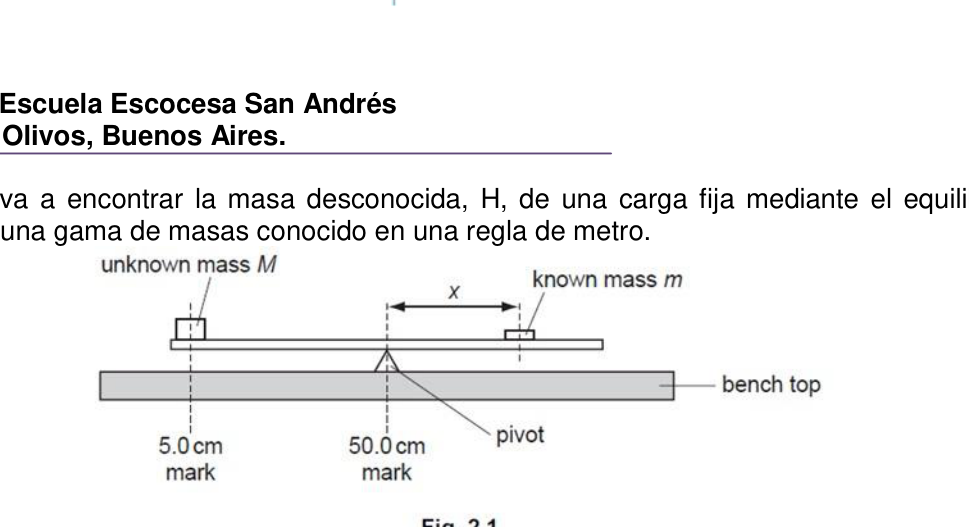
Topic: Rigid Body Statics Metodi: Torque & Angular Momentum Analysis, Experimental Data Analysis Competenze: Physical Reasoning, Experimental Data Analysis Objects: Lever, Rod Fonte: Testo (PDF) — p.5
PE25. Scuola scozzese San Andrés
Olivos, Buenos Aires.
Troverete la massa sconosciuta, H, di una carica fissa attraverso l’equilibrio. contro una gamma di massa nota in una regola di metro.
Il carico fisso di massa M è stato fissato alla regola del metro. La sua posizione si fissa con la sua centro sul marchio di 5,0 cm. Non provate a spostare questa massa durante l’esperimento. a) i) prendere una massa m di 60 g e metterla nella gomma. Aggiusta la posizione fino a quando non la regola è giusto equilibrio con il pivote direttamente sotto il marchio di 50,0 cm, come mostrato nel diagramma precedente.
152 - OAF 2015 Misurare, a 0,1 cm, la distanza x dal centro della massa nota del marchio 50,0
- Centimetri nella regola. Registra questa distanza nella Tabella 2.1.
(ii) Descriva come si trova la posizione del centro della massa di 60 g prima di misura la distanza al marchio di 50,0 cm nella regola. (iii) Ripetere la procedura descritta in (i) sostituendo il 60 g di massa m con una nuova massa di 70 g. Misura e registra la nuova distanza x in Tabella 2.1. Ripetere la procedura tre più volte, usando masse m di 80 g, 90 g e 100 g, la registrazione della distanza x nella tabella 2.1 ogni volta. [2] v) Per ogni valore di x nella tabella, calcolare il valore di 1 / x e registrare questi valori La tabella 2.1 è di 3 cifre decimali. b) i) Nella rete proporzionata, tracciare un grafico di m / g (asse verticale) rispetto a 1 / x (asse orizzontale). Inizia l’asse verticale a 60 g. L’asse orizzontale non deve partire da zero. Disegna la linea retta migliore in forma. (ii) Calcolare la pendenza della linea. Mostra tutti i lavori e indicare sul grafico i valori che hai scelto per il gradiente di calcolo. c) Il gradiente della linea è correlato alla massa M della carica fissa, per la Equità M = 45,0 / gradiente Determinare la massa M della carica fissa di 2 cifre significative. h) i) Descrive due fonti di incertezza o di limitazioni del procedimento di questo tipo. l’esperimento. (ii) Descrivi due miglioramenti che potrebbero essere introdotti in questo esperimento. Dovresti suggerire l’uso di altri dispositivi o procedure diversi.
Topic: Rigid Body Statics Metodi: Torque & Angular Momentum Analysis, Experimental Data Analysis Competenze: Physical Reasoning, Experimental Data Analysis Objects: Lever, Rod Fonte: Testo (PDF) — p.5
PE25. St. Andrew’s Scottish School
Olive trees, from Buenos Aires.
You’re going to find the unknown mass, H, of a fixed charge by balancing it. against a known mass range in a meter rule.
The fixed mass load M has been fixed to the meter rule. Your position is fixed with your centre over the 5.0 cm mark. Don’t try to move this mass during the experiment. a) (i) take a mass of 60 g and place it on the rubber. Adjust your position until the Rule is just balance with the pivot directly below the 50.0 mark. cm, as shown in the diagram above.
The Commission shall adopt delegated acts in accordance with Article 21 of this Regulation. Measure, at 0,1 cm, the distance x from the centre of the known mass of the mark of 50,0 cm in the rule. Record this distance in Table 2.1.
(ii) Describe the position of the centre of the 60 g mass before Measures the distance to the 50.0 cm mark in the rule. (iii) Repeat the procedure described in (i) by replacing the 60 g of m mass with a new mass of 70 g. Measure and record the new distance x in Table 2.1. Repeat the procedure three times more, using m masses of 80 g, 90 g and 100 g, recording the distance x in Table 2.1 every time. [2] v) For each value of x in the table, calculate the value of 1 / x and record these values The following table shows the number of digits in the table: b) (i) In the grid provided, draw a graph of m / g (vertical axis) versus 1/ x (horizontal axis). Start the vertical axis at 60 g. The horizontal axis doesn’t have to start from scratch. Draw the best straight line in shape. (ii) Calculate the slope of the line. Show all work and indicate on the chart the values you chose for the The calculation gradient is the (c) The gradient of the line is related to the mass M of the fixed load, by the Equation M = 45,0 / gradient Determine the mass M of the fixed load of 2 significant digits. h) (i) Describe two sources of uncertainty or limitations in the procedure for this purpose I’m going to try it. (ii) Describe two improvements that could be introduced in this experiment. You must . suggesting the use of different devices or procedures.
Topic: Rigid Body Statics Metodi: Torque & Angular Momentum Analysis, Experimental Data Analysis Competenze: Physical Reasoning, Experimental Data Analysis Objects: Lever, Rod Fonte: Testo (PDF) — p.5
PE26. Escuela Escocesa San Andrés
Olivos, Buenos Aires.
Un anillo de aluminio se coloca sobre una bobina con la varilla de un soporte vertical de metal pasa a través de sus centros, como se muestra en la Fig. 1.1.
Cuando se aplica una corriente alterna de la frecuencia f a la bobina, el anillo se eleva hasta que está en equilibrio a una altura h por encima de la bobina. Se sugiere que la relación entre h y f es
OAF 2015 - 153 h = kf n donde k y n son constantes. Diseñar un experimento de laboratorio para poner a prueba la relación entre H y F y determinar valores de k y n. Usted debe dibujar un diagrama, que muestra la disposición de su equipo. En su cuenta se debe prestar especial atención a a) el procedimiento que ha de seguirse, b) las medidas que deben adoptarse, c) el control de variables, d) el análisis de los datos, e) las precauciones de seguridad que deban tomarse.
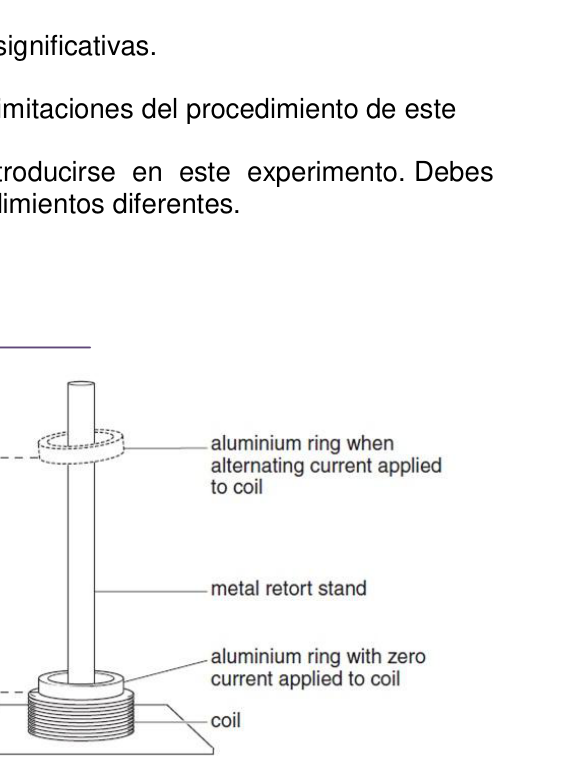
Topic: Electromagnetic Induction Metodi: Faraday’s Law of Induction, Experimental Data Analysis Competenze: Physical Reasoning, Experimental Data Analysis Objects: Coil Fonte: Testo (PDF) — p.5
PE26. Scuola scozzese San Andrés
Olivos, Buenos Aires.
Un anello di alluminio viene messo su una bobina con la verga di un supporto verticale di metallo passa attraverso i loro centri, come si mostra in Figura 1. 1.1.
Quando si applica un corrente alterna della frequenza f alla bobina, l’anello si alza fino che è in equilibrio ad un’altezza. h sopra la bobina. Se suggerisce che la relazione tra h e f es
OAF 2015 - 153 h = kf n dove k e n sono costanti. Progettare un esperimento di laboratorio per testare il rapporto tra H e F e determinare valori di k e n. Dovete disegnare un diagramma, che mostra la disposizione della sua squadra. In tale caso, si deve prestare particolare attenzione a a) la procedura da seguire, b) le misure da adottare; c) il controllo delle variabili, (d) l’analisi dei dati; (e) le precauzioni di sicurezza da prendere.
Topic: Electromagnetic Induction Metodi: Faraday’s Law of Induction, Experimental Data Analysis Competenze: Physical Reasoning, Experimental Data Analysis Objects: Coil Fonte: Testo (PDF) — p.5
PE26. St. Andrew’s Scottish School
Olive trees, from Buenos Aires.
An aluminum ring is placed on a coil with a rod of A vertical metal support passes through . through their centres, as they are The following table shows the figures in Fig. 1.1.
When a current is applied Alternating frequency f to the Coil, ring rises up It ‘s in balance at a height . h above the coil. Se suggests that the relationship between h and f es
The following points shall be added: h = kf n where k and n are constants. Design a laboratory experiment to test the relationship between H and F and determine values of k and n. You should draw a diagram, showing the layout. of his team. Special attention should be paid to (a) the procedure to be followed, (b) the measures to be taken; (c) the control of variables, (d) data analysis, (e) the safety precautions to be taken.
Topic: Electromagnetic Induction Metodi: Faraday’s Law of Induction, Experimental Data Analysis Competenze: Physical Reasoning, Experimental Data Analysis Objects: Coil Fonte: Testo (PDF) — p.5
PE27. Instituto Tecnológico del Comahue
Escuela Provincial de Educación Técnica Nro. 14
Ciudad de Neuquén.
¿Cómo podemos medir la aceleración de la gravedad? Utilizando un péndulo físico se puede medir la gravedad en un determinado sitio sin tener muchos equipos y aparatos sofisticados. Su teoría se basa en lo siguiente (resumidamente):
Comparando este sistema con el de un resorte con una masa, en el cual:
= 𝑘/𝑚
Y realizando algunas aproximaciones matemáticas llegamos a:
𝑇= 2𝜋 𝐿
𝑔
Contando con los siguientes elementos: hilos de diferente largo, pesas, cinta métrica,
cinta de papel y cronómetro debes medir la aceleración de la gravedad.
a. ¿El método tiene hipótesis simplificativas? SI – No- Justificar
b. Determinar la aceleración de la gravedad para cada largo de hilo realizando al
menos cinco mediciones para cada hilo.
Largo Hilo =
Largo Hilo =
Largo Hilo =
Grav:
Grav:
Grav:
Grav:
Grav:
Grav:
Grav:
Grav:
Grav:
Grav:
Grav:
Grav:
Grav:
Grav:
Grav:
Grav:
Grav:
Grav:
Grav:
Grav:
Grav:
154 - OAF 2015
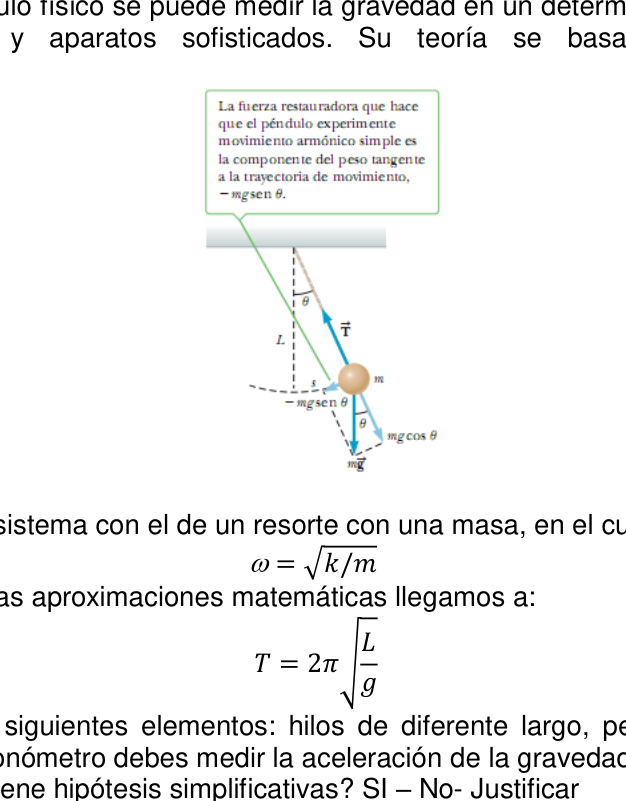
Topic: Oscillations & Waves Metodi: Simple Harmonic Motion Analysis, Experimental Data Analysis Competenze: Physical Reasoning, Experimental Data Analysis Objects: Pendulum Fonte: Testo (PDF) — p.5
PE27. L’Istituto Tecnologico del Comahue
Scuola Provinciale di Educazione Tecnica Nro. 14
Città di Neuquén.
Come possiamo misurare l’accelerazione della gravità? Usando un pendolo fisico si può misurare la gravità in un determinato luogo senza avere molti attrezzi e dispositivi sofisticati. La sua teoria si basa su quanto segue (riassumendo):
Confrontando questo sistema con quello di una massa di un’esclusione, in cui:
= 𝑘/𝑚
E facendo qualche approssimazione matematica arriviamo a:
𝑇= 2𝜋 𝐿
𝑔
Con i seguenti elementi: fili di lunghezza diversa, pesi, nastro metrico,
Una cinta di carta e un cronometro, devi misurare l’accelerazione della gravità.
a. Il metodo ha ipotesi semplificative? Si No- giustificare
b. Determinare l’accelerazione della gravità per ogni lunghezza del filo effettuando il
meno cinque misure per ogni filo.
Largo Hilo =
Largo Hilo =
Largo Hilo =
Grav:
Grav:
Grav:
Grav:
Grav:
Grav:
Grav:
Grav:
Grav:
Grav:
Grav:
Grav:
Grav:
Grav:
Grav:
Grav:
Grav:
Grav:
Grav:
Grav:
Grav:
154 - OAF 2015
Topic: Oscillations & Waves Metodi: Simple Harmonic Motion Analysis, Experimental Data Analysis Competenze: Physical Reasoning, Experimental Data Analysis Objects: Pendulum Fonte: Testo (PDF) — p.5
PE27. The Comahue Institute of Technology
Provincial school of technical education nro. 14
The city of Neuquén.
How can we measure the acceleration of gravity? Using a physical pendulum you can measure gravity in a particular place without having to A lot of sophisticated equipment and devices. His theory is based on the following. (summary):
Comparing this system to that of a spring with a mass, in which:
= 𝑘/𝑚
And by doing some mathematical approximations we get to:
𝑇= 2𝜋 𝐿
𝑔
Containing the following elements: threads of different lengths, weights, metric tape,
You need to measure the acceleration of gravity.
a. Does the method have simplifying hypotheses? Yes No- Justify
b. Determine the acceleration of gravity for each length of thread by performing the
minus five measurements for each thread.
Long hair =
Long hair =
Long hair =
- What ?
- What ?
- What ?
- What ?
- What ?
- What ?
- What ?
- What ?
- What ?
- What ?
- What ?
- What ?
- What ?
- What ?
- What ?
- What ?
- What ?
- What ?
- What ?
- What ?
- What ?
The following is the list of the countries of origin of the products:
Topic: Oscillations & Waves Metodi: Simple Harmonic Motion Analysis, Experimental Data Analysis Competenze: Physical Reasoning, Experimental Data Analysis Objects: Pendulum Fonte: Testo (PDF) — p.5
PE28. Instituto María Auxiliadora
Comodoro Rivadavia, Chubut.
Objetivo: determinar el coeficiente de rozamiento dinámico entre dos placas de melanina.
Elementos:
- Una placa de melanina de 25cm de ancho y 1,15m de lardo.
- Una placa de melanina de la misma calidad de la anterior de 25cm por 15cm.
- Un apoyo vertical de 31 cm de altura.
- Tiza blanca.
- Una regla de al menos 15cm de longitud.
- Una franela limpia.
- Cronómetro.
- Hojas de papel, lapicera, calculadora.
Teoría:
Por la segunda Ley de Newton cuando sobre un cuerpo actúa una fuerza o un sistema de
fuerzas cuya resultante no es nula, este cuerpo adquiere una aceleración. En particular,
cuando un cuerpo se apoya sobre un plano inclinado,
el peso se descompone en dos direcciones. La
componente perpendicular al plano, Py, se equilibra
con la fuerza que el plano ejerce sobre el cuerpo,
llamada Normal (N). La componente paralela al plano
Px es la que provoca que el cuerpo se deslice sobre el
plano. Pero esta no es la única fuerza que actúa sobre
el cuerpo en esa dirección, ya que al existir dos superficies en contacto en el momento
del desplazamiento actúa una fuerza de rozamiento Fr que depende de la Normal de un
coeficiente d, llamado coeficiente de rozamiento dinámico, depende de cuales sean las
superficies en contacto.
Esto implica que la sumatoria de fuerzas en la dirección del plano inclinado es igual al
producto de la masa M por la aceleración a, y que, como todas las fuerzas que
intervienen en esta ecuación tienen como uno de sus factores a la masa del cuerpo, la
aceleración no dependerá de la cantidad de materia del cuerpo que se desliza.
El movimiento del cuerpo sobre el plano es M.R.U.A. lo que establece una relación
entre el espacio recorrido y tiempo empleado en recorrerlo que permite calcular la
aceleración a.
Luego de conocer el valor de la aceleración, utilizando la ecuación Px–Fr=M.a se podrá
hallar el valor del coeficiente de rozamiento dinámico entre las superficies en contacto,
Procedimiento:
- Marque en la placa de 1,15 de largo, una línea paralela al lado menor que esté a 1m del lado opuesto.
- Forme la rampa como se muestra en la figura. Esta constituirá el plano inclinado.
- Coloque la placa de menor tamaño sobre la placa mayor, de forma tal que coincidan los bordes y que el lado que está en la posición inferior esté sobre la línea que indica 1m.
- Sostener con la regla en esta posición.
- Sacar la regla para que la placa menor deslice sobre la grande y medir el tiempo que tarda en llegar al suelo, usando el cronómetro.
- Repetir la experiencia al menos 10 diez veces, limpiando con la franela ambas superficies luego realizar cada una de ellas.
OAF 2015 - 155 a) Complete el cuadro de la hoja de respuestas con los valores de los registrados. b) Determine un valor de 𝒕 , (el promedio a partir de los registrados), el desvío standart de la muestra s y establecer un intervalo de confianza para el valor del tiempo. c) Escribir la ecuación que relaciona espacio, aceleración y tiempo. Expresando la aceleración en función de las demás. d) Calcule la aceleración usando el valor de t determinado. e) Utilizando la relación entre la sumatoria de fuerzas y la aceleración, halle la expresión que permite determinar el coeficiente de rozamiento en función de la aceleración. f) Halle el valor numérico del coeficiente de rozamiento dinámico entre las placas de melanina.
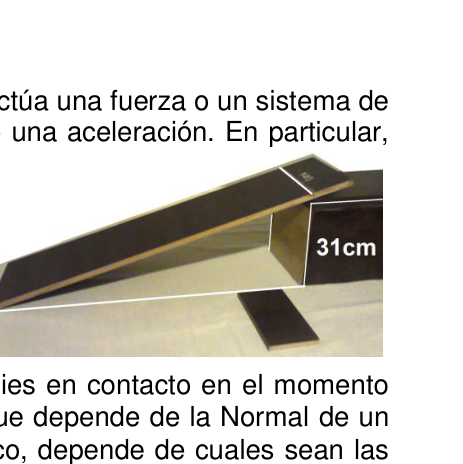
Topic: Newtonian Mechanics Metodi: Free-Body Diagram, Experimental Data Analysis Competenze: Physical Reasoning, Experimental Data Analysis Objects: Block, Inclined Plane Fonte: Testo (PDF) — p.5
PE28. Istituto Maria Assilliadora
Comodoro Rivadavia, Chubut.
Obiettivo: determinare il coefficiente di rottura dinamica tra due schede di calcolo di calcolo di calcolo di calcolo di calcolo di calcolo di calcolo di calcolo di calcolo di calcolo di calcolo di calcolo di calcolo di calcolo di calcolo di calcolo di calcolo di calcolo di calcolo di calcolo di calcolo di calcolo di calcolo di calcolo di calcolo di calcolo di calcolo di calcolo di calcolo di calcolo di calcolo di calcolo di calcolo di calcolo di calcolo di calcolo di calcolo di calcolo di calcolo di calcolo di calcolo di calcolo di calcolo di calcolo di calcolo di calcolo di calcolo di calcolo di calcolo di calcolo di calcolo di calcolo di calcolo di calcolo di calcolo di calcolo di calcolo di calcolo di calcolo di calcolo di calcolo di calcolo di calcolo di calcolo di calcolo di calcolo di calcolo di calcolo di calcolo di calcolo di calcolo di calcolo di calcolo di calcolo di calcolo di calcolo di calcolo di calcolo di calcolo di calcolo di calore di calore di calore di calore di calore di calore di calore di calore di calore di calore di calore di calore di calore di calore di calore di calore di calore di calore di calore di calore di calore di calore di calore di calore di calore di calore di calore di calore di calore di calore di calore di calore di calore di calore di calore di calore di calore di calore di calore di calore di calore di calore di calore di calore di calore di calore di calore di calore di calore di calore di calore di calore di calore di calore di calore di calore di calore di calore di calore di calore di calore di calore di calore di calore di calore di calore di calore di calore di calore di calore di calore di calore di calore di calore di calore di calore di calore di calore di calore di calore di calore di calore di calore di calore
- Melanina.
Elementi:
- Una piastra di melanina larga 25 cm e 1,15 m di lardo.
- Una placca di melanina di qualità uguale a quella precedente di 25 cm per 15 cm.
- Un supporto verticale alto 31 cm.
- Capi bianca.
- Una regola di almeno 15 centimetri di lunghezza.
- Una franela pulita.
- Un cronometro.
- Carta, penna, calcolatrice.
Teoria: La seconda legge di Newton, quando un corpo è sottoposto a un’azione di una forza o di un sistema di Le forze che ne derivano non sono nulli, questo corpo acquista un’accelerazione. In particolare, quando un corpo si appoggia su un piano inclinato, il peso si decompone in due direzioni. La La componente perpendicolare al piano, Py, si bilancia con la forza che il piano esercita sul corpo, chiamata Normal (N). Il componente parallelo al piano Px è quello che fa scivolare il corpo piano. Ma questa non è l’unica forza che agisce su di noi. Il corpo in quella direzione, poiché esistono due superfici in contatto al momento La forza di rottura di un movimento è determinata dalla norma di un Il coefficiente d, chiamato coefficiente di rasatura dinamico, dipende da quali siano le superfici in contatto. Ciò implica che la somma delle forze nella direzione del piano inclinato è pari a prodotto della massa M per l’accelerazione a, e che, come tutte le forze che Le parti di massa corporea sono una delle loro fattori, la massa corporea. l’accelerazione non dipenderà dalla quantità di materia del corpo che si scivola. Il movimento del corpo sul piano è M.R.U.A. che stabilisce un rapporto La differenza tra lo spazio percorso e il tempo impiegato per il percorso permette di calcolare la Accelerazione a. Dopo aver conosciuto il valore dell’accelerazione, utilizzando l’equazione PxFr=M.a si può determinare il valore del coefficiente di rottura dinamica tra le superfici in contatto,
Procedura:
- Segna sulla targa di 1,15 di lunghezza, una linea Parallelato al lato minore che è 1m dal lato Opposto.
- Forma la rampa come mostrato nella figura. Questo costituirà il piano inclinato.
- Metti la scheda più piccola sulla La placca maggiore, in modo tale che coincidano le bordi e che il lato che è in posizione il basso è sopra la linea che indica 1m.
- Sostenersi con la regola in questa posizione.
- Togliere la regola per far scivolare la scheda minore sulla grandezza e misurare il tempo che ci vuole in Arrivare al suolo, usando il cronometro.
- Ripetere l’esperienza almeno 10 volte, pulirla con la franela entrambe le volte superfici e poi realizzare ognuna di esse.
OAF 2015 - 155 a) Completa il quadro della scheda delle risposte con i valori dei registrati. b) Determina un valore di t , (la media a partire da quelli registrati), il deviamento standard del campione e stabilire un intervallo di fiducia per il valore del tempo. c) Scrivere l’equazione che relaziona spazio, accelerazione e tempo. Esprimendo la Accelerazione a seconda delle altre. d) Calcolare l’accelerazione utilizzando il valore di t determinato. e) Sfruttando il rapporto tra la somma delle forze e l’accelerazione, si trova la espressione che permette di determinare il coefficiente di rottura in funzione della Accelerazione. f) Trova il valore numerica del coefficiente di rottura dinamica tra le schede di
- Melanina.
Topic: Newtonian Mechanics Metodi: Free-Body Diagram, Experimental Data Analysis Competenze: Physical Reasoning, Experimental Data Analysis Objects: Block, Inclined Plane Fonte: Testo (PDF) — p.5
PE28. The Institute of Maria Auxiliadora
Commodore Rivadavia, Chubut.
Objective: to determine the dynamic friction coefficient between two plates of I’m not going to lie.
The following elements:
- A sheet of melanin 25cm wide and 1.15m thick.
- A melanin plate of the same quality as the one before 25cm by 15cm.
- A vertical support of 31 cm high.
- It’s white.
- A rule of at least 15 centimeters long.
- A clean frill.
- It’s a timekeeper.
- Sheets of paper, pencil, calculator.
Theory: By Newton ‘s second law when a force or system acts on a body . forces whose result is not zero, this body acquires acceleration. In particular, When a body rests on a flat slope, The weight decomposes in two directions. La The plane perpendicular component, Py, is balanced the force the plane exerts on the body, called Normal (N). The component parallel to the plane Px is what causes the body to slide over the It’s flat. But this is not the only force acting on it. The body is in that direction, since there are two surfaces in contact at the moment. The displacement is a friction force Fr that depends on the normal of a The coefficient d, called the dynamic friction coefficient, depends on which of the contact surfaces. This implies that the sum of forces in the direction of the inclined plane is equal to product of mass M by the acceleration to, and that, like all forces that They have as one of their factors the mass of the body, the acceleration will not depend on the amount of material in the body that is sliding. The movement of the body over the plane is M.R.U.A. What sets up a relationship between the space travelled and the time spent travelling which allows the calculation of the acceleration to a. After knowing the acceleration value, using the equation PxFr=M.a, it can be Find the value of the dynamic friction coefficient between the contact surfaces
The procedure:
- Mark on the 1.15-inch plate, one line parallel to the smaller side that is 1m from the side The opposite.
- Form the ramp as shown in the figure. This will be the slope.
- Place the smaller plate over the The main plate, so that the edges and that side that is in position The lower part is above the line indicating 1m.
- Hold the rule in this position.
- Remove the rule so the minor plate slides on the big and measuring the time it takes in Get to the ground, using the chronometer.
- Repeat the experiment at least 10 to 10 times, cleaning with both flannel Surfaces then make each of them.
The Commission shall adopt delegated acts in accordance with Article 21 of the Financial Regulation. (a) Complete the table on the reply sheet with the values of the registrants. (b) Determine a value of t , (the average from the recorded), the deviation standard of the sample s and establish a confidence interval for the value of the time. (c) Write the equation relating space, acceleration and time. Expressing the acceleration in relation to the others. (d) Calculate the acceleration using the given value of t. (e) Using the ratio between the sum of forces and acceleration, find the expression that allows the coefficient of friction to be determined by the The acceleration. (f) Find the numerical value of the dynamic friction coefficient between the plates of I’m not going to lie.
Topic: Newtonian Mechanics Metodi: Free-Body Diagram, Experimental Data Analysis Competenze: Physical Reasoning, Experimental Data Analysis Objects: Block, Inclined Plane Fonte: Testo (PDF) — p.5
PE29. Escuela Técnica Nro. 9 Ing. Luis A. Huergo
Ciudad de Buenos Aires.
Medición de la velocidad de propagación de una onda.
- Propuesta de la experiencia. Hablando en términos generales, el movimiento ondulatorio implica la propagación de un estado. Si colocamos de pie fichas de dominó alineadas y tumbamos la primera, se inicia un tren de sucesos que acaba con todas las fichas tumbadas. La velocidad con que se movido el estado de caída se denomina velocidad de propagación. En este problema experimental, se propone generar una onda transversal en un resorte (fig1) y medir su velocidad de propagación. La medición se hará de dos maneras distintas:
- midiendo la distancia recorrida por el pulso y el tiempo empleado y haciendo
[1] V[1] = d / t y
- mediante la ecuación [2] V[2] = T / μ
Donde T es la tensión que estira el resorte a través del cual se propaga el pulso y μ es la densidad lineal de masa o masa por unidad de longitud, calculable por:
[3] μ = m / L (m = masa de la cuerda, L = longitud)
De la simple inspección de la fórmula [3] se deduce que, cuanto T sea pequeña y μ, grande, ( es decir, cuanto menos se tense el resorte y más masivo por unidad de longitud sea) más lentamente se propagará el pulso y será por lo tanto más fácilmente medible y con menos error. También será importante permitir que el pulso viaje una larga distancia d (dentro de lo que permita nuestro lugar de trabajo) porque así, para una velocidad dada, el tiempo t de tránsito será mayor y el de nuestra reacción al pulsar el cronómetro, introducirá menos incerteza en la medida. La mejor combinación que conseguimos en el laboratorio de nuestra escuela, fue producir el pulso viajero dando un golpe seco, no muy fuerte, con un vástago de acero ( un ―ϕ10 corto‖ ). Éste último mide unos 15cm de largo y 1cm de diámetro y se golpea una cadena de acero cerca del extremo. Los eslabones de aquélla son algo más pequeños que los de las que se usan para amarrar bicicletas. Se la tendió horizontalmente, como una cuerda para secar ropa. La magnitud a variar en la experiencia es la tensión de la cadena. Eso se hace mediante una polea y pesas, como se muestra en la fig2. 2. Ejecución de la experiencia. Antes de armar el equipo, se deben medir la longitud y la masa de la cadena, como indican 2.1) y 2.2)
156 - OAF 2015
2.1. Medida de la longitud (l) de la cadena.
Con la cinta métrica. Se anota en la planilla de ―valores medidos y calculados‖
2.2. Medida de la masa (m) de la cadena.
Usando la báscula de platillos de almacén (reliquia) del laboratorio de física. Pesada de
Gauss: se pone primero el cuerpo en el platillo izquierdo y las pesa en el derecho y luego
se pasa el cuerpo al platillo derecho y se vuelve a pesar. Si P y P’ son los valores de la 1ª
y la 2ª pesadas, se calcula
Pprom = P.P’
Con Pprom se calcula la masa m de la cadena. Se anota m en la planilla de ―valores
medidos y calculados‖.
2.3. Cálculo de la masa por unidad de longitud (µ) de la cadena.
Se hace µ = (m / L) Se anota
2.4. Armado del equipo.
(Luego de armar el equipo, el alumno llamará al Comité de Problemas, que evaluará “in
situ” este ítem antes de comenzar las mediciones)
Observá atentamente la fig 2.
i.Colocá un banco (detalle 1) y sobre él, el portapesas con pesas (detalle 2), para un
total de 2 kgf
ii.Insertá un extremo de la cadena en el manguito que está sujeto a un barrote de la
ventana. Lo indica el detalle 3. Ése será el extremo fijo de la cadena
iii.Enganchá el extremo de la tanza que unirá portapesas y cadena como muestra el
detalle 4
iv.Verificá que la tanza pasa correctamente por la polea de menor radio y que ésta
puede girar libremente.
v.Retirá con cuidado el banco que sostenía al portapesas, para que la cadena se
tensione.
vi.El equipo está armado. Llamá al profesor para que evalúe cómo lo hiciste.
2.5. Antes de comenzar a medir.
i.Practicá un par de veces dónde y cómo golpear la cadena (detalle 5 de fig2). Usá el
vástago ϕ10 corto que está en la caja del equipo. Si golpeás adecuadamente, a
unos 10cm del extremo de la cadena, vas a lograr que el pulso haga los 5 (cinco)
idas y vueltas que se proponen sin que se extinga la onda.
ii.Para frenar el pulso una vez tomado el tiempo podés probar de apretar la cadena
con la mano. Ensayá esto también, para trabajar más rápido.
iii.Por último probá generar el pulso como en i), midiendo a la vez el tiempo para 5
(cinco) idas y vueltas (al aumentar la distancia y por lo tanto ,el tiempo, el error será
menor)
Objetivo: cuando empieces a medir y anotar, por más apuro que tengas, no olvides
qué estás haciendo. Estarás produciendo una onda mecánica con diferentes
tensiones y mediendo su velocidad de dos maneras distintas. Una, como cociente
v[1] = d / t y la otra, como v[2] = T / µ . Querremos ver si v[1] = v[2] .
Así no olvidarás nada.
2.6. Mediciones.
Los siguientes pasos se repiten exactamente igual, pero variando la tensión de la cadena
con los siguientes valores de T (en kgf ): 2; 2,5; 3; 3,5 y 4. Por eso las instrucciones, las
tablas para que anotes los valores medidos y los cálculos a realizar son similares.
2.6.1. Tensión de la cadena: T = 2kgf
a) ajustar la tensión de la cadena a 2kgf mediante las pesas que muestra el detalle 2
de la fig2.
b) producir el pulso y medir el tiempo de tránsito para 5 (cinco) idas y vueltas del
mismo. Anotar el tiempo en la ―Planilla de Valores Medidos y Calculados (PVMC)‖
c) repetir el paso b) anterior otras 4 veces
d) calcular el tiempo promedio que pide la PVMC y anotarlo
OAF 2015 - 157 e) calcular la velocidad
V[1]
d / t
=
10
L
/
tprom
donde d = 10 L [¿por qué?] (L = largo de la cadena). Anotar el valor de V[1] en la
PVMC
f) calcular la V[2] = T / µ ( ¡Elegí adecuadamente las unidades! ). Anotar en la
PVMC
g) compará V[1] y V[2]
2.6.2. Tensión de la cadena: T = 2,5 kgf
a) ajustar la tensión de la cadena a 2,5 kgf mediante las pesas que muestra el detalle
2 de la fig2.
b), c), d), e), f) y g) similares a 2.6.1)
2.6.3. Tensión de la cadena: T = 3 kgf
a) ajustar la tensión de la cadena a 3 kgf mediante las pesas que muestra el detalle 2
de la fig2.
b), c), d), e), f) y g) similares a 2.6.1)
2.6.4. Tensión de la cadena: T = 3,5 kgf
a) ajustar la tensión de la cadena a 3,5 kgf mediante las pesas que muestra el detalle
2 de la fig2.
b), c), d), e), f) y g) similares a 2.6.1)
2.6.5. Tensión de la cadena: T = 4 kgf
a) ajustar la tensión de la cadena a 4 kgf mediante las pesas que muestra el detalle 2
de la fig2.
b), c), d), e), f) y g) similares a 2.6.1)
2.7. Gráfico.
Usando la hoja de papel milimetrado, representar Velocidad del pulso en función de la
Tensión de la cadena. En un solo gráfico conjunto, marcar los puntos de V[1] = f (T) y
V[2] = f (T) con los valores de la PVMC
Topic: Oscillations & Waves Metodi: Wave Equation, Experimental Data Analysis Competenze: Physical Reasoning, Experimental Data Analysis Objects: String Fonte: Testo (PDF) — p.5
PE29. Scuola tecnica n.o. 9 Ing. Luis A. - Hoorgo
Città di Buenos Aires.
Misura della velocità di diffusione di un’onda.
- Proposta di esperienza. In termini generali, il movimento ondulatorio implica la diffusione di un stato. Se mettiamo in piedi i biglietti di domino allineati e mettiamo la prima, inizia. Un treno di eventi che elimina tutti i biglietti. La velocità con cui si quando si muove lo stato di caduta è chiamato velocità di diffusione. In questo problema sperimentale, si propone di generare un’onda trasversale in una sorgente (fig1) e misurare la sua velocità di diffusione. La misurazione si fa in due modi. diversi:
- misurando la distanza percorsa dal pulso e il tempo impiegato e facendo
[1] V[1] = d / t y
- mediante l’equazione [2] V[2] = T / μ
Dove T è la tensione che allunga la molla attraverso la quale si diffonde il pulso e μ è la densità lineare di massa o massa per unità di lunghezza, calcolabile da:
[3] μ = m / L (m = massa della corda, L = lunghezza)
La semplice ispezione della formula [3] consente di dedurre che, se T è piccola e μ, grande, (cioè, meno si ha la primavera e più massiccia per unità di lunghezza (e) più lentamente si diffonde il polso e sarà quindi più facilmente misurabile e con meno errori. Sarà anche importante permettere al pulso di viaggiare una lunga distanza. d (entro ciò che il nostro posto di lavoro consente) perché così, per una velocità dato che il tempo di transito t sarà maggiore e quello della nostra reazione quando pulsate il cronometro, La misura introdurrà meno incertezza. La migliore combinazione che abbiamo ottenuto nel laboratorio della nostra scuola è stata produrre Il polso viaggiatore dando un colpo secco, non molto forte, con un tronco di acciaio (un ―φ10 breve (). L’ultimo è lungo circa 15 cm e di diametro 1 cm e si colpisce una catena. di acciaio vicino all’estremità. I suoi legami sono un po ’ più piccoli di quelli di quella . di cui si usano per attaccare biciclette. L’ha allungata orizzontalmente, come una
- C’è una corda per asciugare i vestiti. La portata variabile dell’esperienza è la tensione della
- La catena. Questo è fatto con un pollice e pesanti, come mostrato in Figura 2.
- Esercizio dell’esperienza. Prima di mettere insieme l’apparecchio, si devono misurare la lunghezza e la massa della catena, come indicare 2.1) e 2.2)
156 - OAF 2015 2.1. Misura della lunghezza (l) della catena. Con la cinta metrica. È annotato nella scheda dei “valori misurati e calcolati” 2.2. Misura della massa (m) della catena. Usando la scala di piatti di stoccaggio (relicja) del laboratorio di fisica. Pesante di Gauss: si mette il corpo prima sul piatto sinistro e si pesa sul piatto destro e poi si passa il corpo al piatto destro e diventa pesante. Se P e P sono i valori di 1a e la seconda pesante, si calcola Pprom = P.P
Con Pprom si calcola la massa m della catena. È riportato su “valori” misurati e calcolati”. 2.3. Calcolo della massa per unità di lunghezza (μ) della catena. Si fa μ = (m / L) Si annota 2.4. Armato dalla squadra. (Dopo aver messo insieme il team, lo studente chiama il Comitato dei problemi, che valuta il situare questo oggetto prima di iniziare le misurazioni) Guardate attentamente la figura 2. I.Posizionare un banco (detto 1) e sopra di esso, la portafogli con pesanti (detto 2), per un 2 kgf in totale ii.Inserire un’estremità della catena nel manubrio che è soggetta a un’impalcatura di
- La finestra. Lo indica il dettaglio 3. Questo sarà l’estremità fissa della catena. iii.Confonde l’estremità della vasca che unisce le portafogli e la catena come mostra il Dettaglio 4 iv. Verifica che la polla passa correttamente attraverso la polea di radio minore e che questa può girare liberamente. V.Retenerà con cura la banca che sosteneva il portafoglio, affinché la catena si
- Tensione. V. La squadra è armata. Chiama il professore per valutare come l’hai fatto. 2.5. Prima di iniziare a misurare. I. Praticare un paio di volte dove e come colpire la catena (detto 5 di figura2). Usa il la stamella φ10 corta che è nella scatola dell’apparecchio. Se fai il giusto, a Circa 10 centimetri dall’estremità della catena, si farà il polso a 5 (cinque) Vai e vai che si propongono senza spegnere l’onda. ii.Per frenare il polso una volta preso il tempo si può provare a stringere la catena con la mano. Prova anche questo, per lavorare più velocemente. iii.Infine, prova a generare il polso come in i), misurando contemporaneamente il tempo per 5 (cinque) giri e ritorni (aumentando la distanza e quindi il tempo, l’errore sarà minore) Obiettivo: quando inizi a misurare e a scrivere, per quanto più ti spenga, non dimenticare.
- Cosa stai facendo? Sarei produrre un’onda meccanica con diversi tipi di La velocità è misurata in due modi diversi. Uno, come coefficiente v[1] = d / t e l’altra, come v[2] = T / μ . Vogliamo vedere se v[1] = v[2] . Così non dimenticherete nulla. 2.6. Misure. I passi successivi si ripetono esattamente la stessa, ma variando la tensione della catena con i seguenti valori di T (in kgf ): 2; 2,5; 3; 3,5 e 4. Per questo le istruzioni, le tabelle per annotare i valori misurati e i calcoli da effettuare sono simili. 2.6.1. T = 2kgf a) regolare la tensione della catena a 2 kgf con i pesi indicati nel dettaglio 2 della figura 2. b) produrre il pulso e misurare il tempo di transito per 5 (cinque) giri e giri del
- Proprio così. Notare il tempo nella tabella dei valori misurati e calcolati (PVMC) (c) ripetere il passaggio precedente (b) altre 4 volte d) calcolare il tempo medio richiesto dalla PVMC e annotarlo
OAF 2015 - 157 e) calcolare la velocità
V[1]
d / t
= 10 L / Tprom dove d = 10 L [perché?] (L = lunghezza della catena). Annotare il valore di V[1] in PVMC f) calcolare V[2] = T / μ (Ho scelto correttamente le unità! ). Nota in PVMC g) confronta V[1] e V[2] 2.6.2. T = 2,5 kgf a) regolare la tensione della catena a 2,5 kgf con i pesi che mostrano il dettaglio 2 della figura 2. b), c), d), e), f) e g) simili a 2.6.1) 2.6.3. T = 3 kgf a) regolare la tensione della catena a 3 kgf con i pesi indicati nel dettaglio 2 della figura 2. b), c), d), e), f) e g) simili a 2.6.1) 2.6.4. T = 3,5 kgf a) regolare la tensione della catena a 3,5 kgf utilizzando i pesi che mostrano il dettaglio 2 della figura 2. b), c), d), e), f) e g) simili a 2.6.1) 2.6.5. T = 4 kgf a) regolare la tensione della catena a 4 kgf con i pesi indicati nel dettaglio 2 della figura 2. b), c), d), e), f) e g) simili a 2.6.1) 2.7. Grafico. Usando la foglia di carta millimetrica, rappresentare la velocità del polso in funzione della Tensione della catena. In un singolo grafico insieme, segna i punti di V[1] = f (T) e V[2] = f (T) con i valori del PVMC
Topic: Oscillations & Waves Metodi: Wave Equation, Experimental Data Analysis Competenze: Physical Reasoning, Experimental Data Analysis Objects: String Fonte: Testo (PDF) — p.5
PE29. Technical school No. 9 Ing. Louis A. I ‘m not .
City of Buenos Aires.
Measurement of the speed of propagation of a wave.
- Proposal for the experiment. Generally speaking, ripple motion involves the propagation of a wave. I’ve been here. If we put dominoes in a row and we put the first one down, it starts. A train of events that takes out all the chips lying around. The speed at which it is Moving the falling state is called propagation speed. In this experimental problem, it is proposed to generate a transverse wave in a spring. (fig1) and measure its spread rate. The measurement will be done in two ways Other:
- measuring the distance travelled by the pulse and the time spent and making
[1] V[1] = d / t y
- by the equation [2] V[2] = T / μ
Where T is the voltage that stretches the spring through which the pulse propagates and μ is the Linear density of mass or mass per unit length, calculated by:
The following is the list of the types of rope (s) used:
From the simple inspection of the formula [3] it is inferred that, for T small and μ, The larger (i.e. the less spring and the more massive per unit length) (e) the pulse will spread more slowly and will therefore be more easily measurable and with less error. It will also be important to allow the pulse to travel a long distance. d (within what our workplace allows) because so, for a speed given, the transit time t will be greater than that of our reaction to pressing the timer, It will introduce less uncertainty in the measure. The best combination we got in our school lab, was to produce The traveling pulse giving a dry, not very strong blow, with a steel stem (a ―φ10 short ‖). The latter is about 15 cm long and 1 cm in diameter and is hit by a chain. of steel near the end. The links on that one are a little smaller than the ones on the other. of which are used to tie bicycles. He stretched it horizontally, like a I’m using a rope to dry clothes. The magnitude to be varied in the experience is the voltage of the chain. This is done by pulley and weights, as shown in Figure 2. 2. The execution of the experience. Before assembling the equipment, the length and mass of the chain should be measured, as indicate 2.1) and 2.2)
The Commission shall adopt delegated acts in accordance with Article 21 of Regulation (EU) No 182/2011.’ 2.1. Measurement of the length (l) of the chain. With the tape measure. It is noted in the table of “measured and calculated values” 2.2. Measurement of mass (m) of the chain. Using the storage plate scale (relic) of the physics lab. Weight of Gauss: first you put the body on the left plate and weigh them on the right and then You move the body to the right plate and it becomes a weight. If P and P are the values of 1a and the second heavy, it is calculated The following points shall be added:
Pprom is used to calculate the mass m of the chain. It is noted in the ‘values’ table measured and calculated. 2.3. Calculation of mass per unit length (μ) of the chain. It is made μ = (m / L) It is noted 2.4. Armed with the team. (After assembling the team, the student will call the Problems Committee, which will evaluate in place this item before measurements start) Look closely at Figure 2. i.Place a bench (detail 1) and on top of it, the carry-on bag with weights (detail 2), for a Total of 2 kgf ii.Insert one end of the chain into the cuff which is subject to a The window. It’s shown in detail 3. That ‘s the fixed end of the chain . iii.Turn the end of the tray together with the chain as shown in the Detail 4 iv.Check that the tank passes correctly through the minor-radius pole and that this one It can spin freely. v.He will carefully hold the bank that held the wallet, so that the chain is It’s a little tense. I see. The team is armed. Call the professor to evaluate how you did it. 2.5. Before we start measuring. i.Practice a couple of times where and how to hit the string (detail 5 of Fig2). Use the Short φ10 stem that’s in the gearbox. If you hit it right, a about 10cm off the end of the chain, you’re gonna get the pulse to do the five. Goes and turns that are proposed without the wave going out. ii.To slow down the pulse once you take the time you can try to tighten the chain. with your hand. Try this too, to work faster. iii.Finally try to generate the pulse as in i), while measuring the time for 5 (five) go-arounds (as the distance increases and therefore the time, the error will be (less) Objective: When you start measuring and scoring, no matter how fast you rush, don’t forget. What are you doing? You ‘ll be producing a mechanical wave with different The two methods of measuring the speed of the voltage are two different ways. One, as a coefficient v[1] = d / t and the other, as v[2] = T / μ. We want to see if v[1] = v[2] . That way you won’t forget anything. 2.6. Measurements. The following steps are repeated exactly the same, but varying the voltage of the chain with the following values of T (in kgf ): 2; 2,5; 3; 3,5 and 4. That is why the instructions, the tables for you to write down the measured values and the calculations to be made are similar. 2.6.1. The value of the value of the underlying assets shall be the sum of the values of the underlying assets. (a) adjust the chain voltage to 2kgf using the weights shown in detail 2 of Fig. 2. (b) produce the pulse and measure the transit time for 5 (five) laps of the vehicle. I’m not. Write down the time in the “PVMC” (c) repeat the previous step (b) 4 more times (d) calculate the average time requested by the PVMC and write it down
The Commission shall adopt delegated acts in accordance with Article 21 of this Regulation. (e) calculate la speed
V[1]
d / t
= 10 L / tprom where d = 10 L [why?] (L = length of the chain). Write down the value of V[1] in the The PVMC f) calculate V[2] = T/μ (I selected the units correctly! ). Write down the The PVMC g) compares V[1] and V[2] 2.6.2. The value of the value of the underlying assets shall be the sum of the underlying assets. (a) adjust the chain voltage to 2,5 kgf using the weights shown in detail 2 of Fig. 2. b), c), d), e), f) and g) similar to 2.6.1. 2.6.3. The value of the value of the underlying assets shall be the sum of the values of the underlying assets. (a) adjust the chain voltage to 3 kgf using the weights shown in detail 2 of Fig. 2. b), c), d), e), f) and g) similar to 2.6.1. 2.6.4. The value of the value of the underlying assets shall be the sum of the underlying assets. (a) adjust the chain voltage to 3,5 kgf using the weights shown in detail 2 of Fig. 2. b), c), d), e), f) and g) similar to 2.6.1. 2.6.5. The value of the input voltage shall be the value of the input voltage. (a) adjust the chain voltage to 4 kgf using the weights shown in detail 2 of Fig. 2. b), c), d), e), f) and g) similar to 2.6.1. 2.7. It’s graphic. Using the millimeter sheet of paper, represent Pulse velocity as a function of the The chain tension. In a single set graph, mark the points of V[1] = f (T) and V[2] = f (T) with PVMC values
Topic: Oscillations & Waves Metodi: Wave Equation, Experimental Data Analysis Competenze: Physical Reasoning, Experimental Data Analysis Objects: String Fonte: Testo (PDF) — p.5
PE30. Escuela de Biología Marina y Laboratorista Nro. 1 Atlántico Sur
Caleta Olivia, Santa Cruz.
Objetivo: Determinar el diámetro de una bolita de telgopor.
Elementos:
- Calibre
- Bolita de telgopor.
Determinar el diámetro de la bolita de telgopor indicando el valor de incerteza. Realizar como mínimo diez mediciones.
158 - OAF 2015
Topic: Order-of-Magnitude Estimation Metodi: Error Propagation, Experimental Data Analysis Competenze: Physical Reasoning, Experimental Data Analysis Objects: Sphere Fonte: Testo (PDF) — p.5
PE30. Scuola di Biologia Marina e Laboratoriista Nro. 1 Atlantico Sud
- Calma Olivia, Santa Cruz.
Obiettivo: Determinare il diametro di una palla di telgopor.
Elementi:
- Calibro .
- Un biglietto di telgopor.
Determinare il diametro della palla di telgopor indicando il valore di incertezza. Realizzare almeno dieci misure.
158 - OAF 2015
Topic: Order-of-Magnitude Estimation Metodi: Error Propagation, Experimental Data Analysis Competenze: Physical Reasoning, Experimental Data Analysis Objects: Sphere Fonte: Testo (PDF) — p.5
PE30. School of Marine and Laboratory Biology Nro. 1 South Atlantic
Put Olivia down, Santa Cruz.
Objective: Determine the diameter of a telgopor ball.
The following elements:
- Caliber .
- It’s a little telgopor.
Determine the diameter of the telgopor ball indicating the uncertainty value. To perform at least 10 measurements.
The following points shall be added:
Topic: Order-of-Magnitude Estimation Metodi: Error Propagation, Experimental Data Analysis Competenze: Physical Reasoning, Experimental Data Analysis Objects: Sphere Fonte: Testo (PDF) — p.5
PE31. Escuela de Biología Marina y Laboratorista Nro. 1 Atlántico Sur
Caleta Olivia, Santa Cruz.
Objetivo: Determinar la densidad de los perdigones de plomo contenidos en un paquete encontrado en el laboratorio.
Elementos:
- Balanza
- Probeta
- Bolsa conteniendo perdigones de plomo.
Determinar la densidad de los perdigones de plomo de la muestra entregada valiéndose de los elementos disponibles. Indicar también el valor de incerteza.
Topic: Fluid Mechanics Metodi: Experimental Data Analysis, Error Propagation Competenze: Physical Reasoning, Experimental Data Analysis Objects: Block Fonte: Testo (PDF) — p.5
PE31. Scuola di Biologia Marina e Laboratoriista Nro. 1 Atlantico Sud
- Calma Olivia, Santa Cruz.
Obiettivo: Determinare la densità dei perditori di piombo contenuti in un pacchetto
- E’ stato trovato in laboratorio.
Elementi:
- Sbalzo .
- Prova .
- Borsa contenente perdigoni di piombo.
Determinare la densità dei perditori di piombo del campione consegnato, utilizzando di elementi disponibili. Indicare anche il valore dell’incertezza.
Topic: Fluid Mechanics Metodi: Experimental Data Analysis, Error Propagation Competenze: Physical Reasoning, Experimental Data Analysis Objects: Block Fonte: Testo (PDF) — p.5
PE31. School of Marine and Laboratory Biology Nro. 1 South Atlantic
Put Olivia down, Santa Cruz.
Objective: Determine the density of lead perdigons contained in a package Found in the lab.
The following elements:
- Weigh it .
- Try it .
- A bag containing lead pellets.
Determine the density of lead perdigons in the delivered sample by applying of the available elements. Indicate also the value of uncertainty.
Topic: Fluid Mechanics Metodi: Experimental Data Analysis, Error Propagation Competenze: Physical Reasoning, Experimental Data Analysis Objects: Block Fonte: Testo (PDF) — p.5
PE32. Instituto Industrial Luis A. Huergo
Ciudad de Buenos Aires.
Objetivo: Determinar la constante elástica de un resorte ( K ).
Elementos:
- Resorte con su soporte
- Juego de pesas
- Regla
- Cronómetro
Procedimiento:
- Método estático: Colgamos el resorte del soporte y medimos su longitud en reposo. Registramos el valor de la masa M y la longitud que tiene el resorte. Cambiamos la masa M varias veces y vamos anotando las masas y las longitudes. Determine el valor de K mediante el ajuste de una recta con al menos cinco puntos.
- Método dinámico: Registramos el valor de la masa M. Tensamos ligeramente el
sistema elástico, luego lo soltamos y conseguimos de este modo un movimiento
armónico simple. Medimos el tiempo que tarda el sistema en realizar 10
oscilaciones. Cambiamos la masa M varias veces y se repite el proceso. La
expresión que relaciona el período de las oscilaciones con la constante elástica del
resorte es:
T2 = 4π2 · M / K - Si tenemos en cuenta la masa del resorte (m), el tiempo de oscilación responde a la siguiente expresión: T2 = 4π2 · (M + fm) / K donde f es una cierta fracción. Determine el valor de K y el valor de f mediante el ajuste de una recta, utilizando al menos cinco masas diferentes.
- Para una masa que considere adecuada, determine el cambio de la amplitud de oscilación en función del tiempo. Muestre su comportamiento gráficamente y proponga una fórmula analítica de ajuste. Encuentre para algunas de las diferentes amplitudes medidas el valor de K y compárelos con los que encontró en el punto anterior.
Topic: Oscillations & Waves, Elasticity & Materials Metodi: Simple Harmonic Motion Analysis, Experimental Data Analysis Competenze: Physical Reasoning, Experimental Data Analysis Objects: Spring Fonte: Testo (PDF) — p.5
PE32. Istituto industriale Luis A. - Hoorgo
Città di Buenos Aires.
Obiettivo: Determinare la costante elastica di una sorgente (K).
Elementi:
- Resorte con il suo supporto
- Gioco di pesi
- Regola .
- Cronometro .
Procedura:
- Metodo statico: appendere la resorte del supporto e misurare la sua lunghezza in Riposo. Registriamo il valore della massa M e la lunghezza della primavera. Cambiamo la massa M più volte e annotamo le masse e le lunghezze. Determina il valore di K regolare una retta con almeno cinque punti.
- Metoda dinamica: Registra il valore della massa M. - Si , si . - Si . sistema elastico, poi lo rilasciamo e otteniamo così un movimento.
- Un’armonia semplice. Misurando il tempo che il sistema impiega per realizzare 10 oscillazioni. Cambiamo la massa M più volte e ripetiamo il processo. La espressione che relaziona il periodo di oscillazioni con la costante elastica del La primavera è: T2 = 4π2 · M / K
- Se si tiene conto della massa della primavera (m), il tempo di oscillazione risponde alla seguente espressione: T2 = 4π2 · (M + fm) / K dove f è una certa frazione. Determina il valore di K e il valore di f regolare una retta, utilizzando il meno cinque masse diverse.
- Per una massa che ritieni adeguata, determina il cambiamento di larghezza di oscillazione a seconda del tempo. Mostra il tuo comportamento graficamente e Propone una formula analitica di regolazione. Trova per alcune delle diverse Le amplitudini misurano il valore di K e li confrontano con quelli che ha trovato al punto precedente.
Topic: Oscillations & Waves, Elasticity & Materials Metodi: Simple Harmonic Motion Analysis, Experimental Data Analysis Competenze: Physical Reasoning, Experimental Data Analysis Objects: Spring Fonte: Testo (PDF) — p.5
PE32. The Spanish Ministry of Foreign Affairs I ‘m not .
City of Buenos Aires.
Objective: Determine the elastic constant of a spring (K).
The following elements:
- Spring with your support
- Weight play .
- Rule .
- The chronometer .
The procedure:
- Static method: We hang the spring of the support and measure its length in I’m going to rest. We record the value of mass M and the length of the spring. We change the mass M several times and we’re going to write down the masses and the lengths. Determine the value of K by adjusting a straight line with at least five points.
- Dynamic method: We record the value of mass M. We ‘re slightly tightening the . So we’re going to have to get a little bit of a movement. It’s a simple harmonica. We measure the time it takes the system to perform 10 The fluctuations. We change the M mass several times and repeat the process. La The term ‘s duration ’ is the period of the oscillations with the elastic constant of the spring is: T2 = 4π2 · M / K
- If we take into account the mass of the spring (m), the oscillation time corresponds to the following expression: T2 = 4π2 · (M + fm) / K where f is a certain fraction. Determine the value of K and the value of f by adjusting a straight line using the minus five different masses.
- For a mass that you consider appropriate, determine the change in width of oscillation with time. Show your behavior graphically and The Commission will take the necessary measures to ensure that the Commission is able to take all necessary measures to ensure that the measures are implemented in a timely manner. Find out for some of the different ones amplitudes measure the value of K and compare them to those you found at the point previously.
Topic: Oscillations & Waves, Elasticity & Materials Metodi: Simple Harmonic Motion Analysis, Experimental Data Analysis Competenze: Physical Reasoning, Experimental Data Analysis Objects: Spring Fonte: Testo (PDF) — p.5
PE33. Colegio Nacional de Monserrat
Ciudad de Córdoba.
Ascenso capilar. Objetivo: Determinar la relación entre el radio de un capilar y la altura del agua en el mismo
OAF 2015 - 159 Materiales: tubos capilares de vidrio transparentes de distinto radio un recipiente para el agua o una superficie de vidrio lisa. Procedimiento:
- Prepara un recipiente con agua destilada o vierte cierta cantidad de agua sobre una superficie de vidrio horizontal (sin que se derrame al piso).
- Ordena los tubos capilares según su radio.
- Toma los tubos y apóyalos sobre la superficie del agua como se indica en la figura Observa el nivel de agua dentro de los tubos y compara con el nivel de agua del recipiente. Registra los resultados.
Topic: Fluid Mechanics Metodi: Experimental Data Analysis, Graph Linearization Competenze: Physical Reasoning, Experimental Data Analysis Objects: Tube Fonte: Testo (PDF) — p.5
PE33. Il collegio nazionale di Monserrat
Città di Córdoba.
Ascensione capillare. Obiettivo: Determinare il rapporto tra il raggio di un capillario e l’altezza dell’acqua nel
- Io stesso .
OAF 2015 - 159 Materiali: tubi capillari di vetro trasparenti de diverso radio un contenitore per l’acqua o superficie di
- Il vetro è liscio. Procedura:
- Preparare un recipiente con acqua distillato o versato una certa quantità di acqua su una superficie di vetro L’ acqua di cui si tratta è stata riempita di acqua di cui si trattava.
- Piano).
- Ordina i tubi capillari secondo il loro tipo di radio.
- Prendi i tubi e appoggili sulla superficie dell’acqua come indicato in La figura Guarda il livello dell’acqua all’interno dei I tubi e il livello di acqua del contenitore. Registra i risultati.
Topic: Fluid Mechanics Metodi: Experimental Data Analysis, Graph Linearization Competenze: Physical Reasoning, Experimental Data Analysis Objects: Tube Fonte: Testo (PDF) — p.5
PE33. National College of Monserrat
The city of Cordoba.
Hair growth. Objective: Determine the relationship between the radius of a capillary and the height of water in the
- I ‘m not .
The following is the list of the countries of the European Union: Materials: glass capillary tubes transparent de different Radio un water tank or surface of It’s a smooth glass. The procedure:
- Prepare a container of water . distilled or poured a certain amount of Water on a glass surface horizontal (without spilling into the floor).
- It ‘s sorting the capillaries according to their size . The radio.
- Take the tubes and hold them over the surface of water as indicated in the figure Look at the water level inside the water . The water level of the water is container. Record the results.
Topic: Fluid Mechanics Metodi: Experimental Data Analysis, Graph Linearization Competenze: Physical Reasoning, Experimental Data Analysis Objects: Tube Fonte: Testo (PDF) — p.5
PE34. Escuela Técnica Alfredo Passera
Mocoretá, Corrientes.
Polea fija. Objetivo: Determinar si este tipo de polea permite ahorrar fuerza y determinar la tensión de la cuerda en cada caso. En los terrenos de obras podemos observar cómo una carga es tirada sobre una polea montada firmemente. ¿Es posible de esta manera ahorrar fuerza, es decir, tirar con una fuerza menor a la fuerza del peso de la carga?
Material:
- 1 Riel de soporte
- 1 Nuez
- 1 Bulón con cojinetes
- 1 Polea
- 1 Dinamómetro 2 N
- 1 Platillo para pesos de ranura
- 3 Pesas de ranura 50 g
- 2 Pesas de ranura 10 g
-1 Cordón - 1 Tijeras
Introducción:
Por definición, cuando una fuerza actúa sobre un cuerpo (F) y lo desplaza una cierta
distancia (r) se dice que se realiza un trabajo mecánico.
L=Fr
Para tirar un material, rescatar una persona herida o un compañero que ha caído en una
grieta se ejerce un trabajo mecánico, ya que desplazamos un peso (peso como una masa
bajo la influencia de la gravedad, P=mg) una cierta distancia. Las poleas fijas se utilizan
para modificar la dirección del movimiento y reducir el rozamiento de la cuerda en los
cambios de sentido. Con este tipo de poleas no se disminuye la fuerza, sólo se desvía.
En este caso la distancia que recorre el peso es el mismo que la distancia de tiro.
F=P
La ventaja de utilizar poleas fija viene del hecho que podemos ayudarnos de nuestro
propio peso corporal para ejercer la fuerza de tiro.
160 - OAF 2015
Desarrollo experimental:
Preparación: ilustración.
-
Insertamos una varilla de soporte 25 cm. a través de la perforación transversal del riel de soporte.
-
Ajustamos la varilla de soporte con ayuda del tornillo.
-
Colocamos los capuchones de plástico a ambos extremos de la varilla de soporte.
-
Fijamos la varilla de soporte 50 cm. normal al riel de soporte y sobre el mismo. Fijamos la nuez a la varilla de soporte normal.
-
Aseguramos la polea en la nuez con ayuda del bulón de cojinetes.
-
Atamos gazas a ambos extremos de un cordón de aprox. 30 cm. Llevamos el cordón sobre la polea fija. Sostenemos verticalmente un dinamómetro (la parte movible hacia arriba) y ajustamos el punto cero en esta posición.
Experimento -
Preparamos sucesivamente las cargas.
-
Suspendemos cada carga del extremo del cordón y la sostenemos con ayuda del dinamómetro, el cual lo suspendemos de la gaza del otro extremo del cordón.
-
Trasladamos a la tabla la fuerza detracción indicada por el dinamómetro.
Tenemos que sostener el dinamómetro inclinado. Así no es posible que se den errores, ya que no hemos ajustado el punto cero para esta posición. -
¿Cuál es la fuerza de tracción?
-
A modo de conclusión que nos puedes relatar sobre la misma.
-
Determine la tensión de la cuerda en cada acaso. Segunda ley de Newton F=m.a Sobre el peso actúan la fuerza de 10N que se aplica y el peso de 5N pero con sentido contrario a la fuerza: F - P= m . a Donde m=p/g Hacia arriba:
-
a>0 –>T-P=m·a. Por lo tanto T=m(g+a)
-
a=0 –> T-P=0. Por lo tanto T=P.
-
a<0 —> T-P=m·(-a). Por lo tanto T=m(g-a). Hacia abajo:
-
a>0 –> P-T=m·a. Por lo tanto T=m.(g-a)
-
a<0 —> P-T=m·(-a). Por lo tanto T=m.(g+a) Se rompe el cable: a=g –> P-T=m.g Por lo tanto T=m. (g-g)=0.
TENSION 1
TENSION 2
TENSION 3
OAF 2015 - 161
Topic: Newtonian Mechanics Metodi: Free-Body Diagram, Experimental Data Analysis Competenze: Physical Reasoning, Experimental Data Analysis Objects: Pulley, String Fonte: Testo (PDF) — p.5
PE34. Scuola tecnica Alfredo Passera
Mocoretá, Corrientes.
- Polea fissa. Obiettivo: determinare se questo tipo di pullea consente di risparmiare forza e determinare la tensione di ogni caso. Nei cantieri si può osservare come un carico viene gettato su un polea. montata saldamente. È possibile risparmiare forza in questo modo, cioè tirare con una forza minore della forza del peso della carica?
Materiale:
- 1 riel di supporto
- 1 Nove .
- 1 bullo con cuscini
- 1 polacca .
- 1 dinamometro 2 N
- 1 piatto per pesci di slot
- 3 pesci di rottura 50 g
- 2 pesi di rottura 10 g -1 Cordo
- 1 scorta .
Introduzione: Per definizione, quando una forza agisce su un corpo (F) e lo sposta una certa forza. Distanza (r) si dice che si svolge un lavoro meccanico. L=Fr Per gettare un materiale, per salvare una persona ferita o un compagno che è caduto in una La crepa è un lavoro meccanico, poiché spostare un peso (peso come una massa sotto l’influenza della gravità, P=mg) una certa distanza. Le polea fissa sono utilizzate. per modificare la direzione del movimento e ridurre il rottura della corda nei cambiamenti di senso. Con questo tipo di pole non si riduce la forza, si deviano solo. In questo caso la distanza percorsa dal peso è la stessa della distanza di tiro. F=P Il vantaggio di usare polemiche fisse viene dal fatto che possiamo aiutare il nostro peso corporeo per esercitare la forza di tiro.
160 - OAF 2015 Sviluppo sperimentale: Preparazione: illustrazione.
-
Inserire una bacchetta di supporto da 25 cm. attraverso la perforazione trasversale del il riello di supporto.
-
Regolare la canna di supporto con lo schermo.
-
Mettiamo le cappucce di plastica alle due estremità del bastone di supporto.
-
Fissate il bastone di supporto 50 cm. normale sul binario di supporto e sullo stesso. Abbiamo fissato l’oro al normale bastone di supporto.
-
Assicurare la pollea nell’oro con il bullo di cuscinetti.
-
Leghiamo i gas alle due estremità di un cordone di approx. 30 cm. - Prendiamo il cordone sulla polla fissa. Sosteniamo verticalmente un dinamometro (la parte e aggiustare il punto zero in questa posizione. Esperimento
-
Preparare successivamente i carichi.
-
Sospendere ogni carico dall’estremità del cordone e sostenerlo con l’aiuto del Il dinamometro, che lo sospendiamo dal gas dall’altra parte del cordone.
-
Trasportiamo alla tabella la forza di detraczione indicata dal dinamometro. Dobbiamo tenere il dinamometro inclinato. Non è possibile che si commetta errori. Non abbiamo ancora aggiustato il punto zero per questa posizione.
-
Qual è la forza di trazione?
-
In conclusione, puoi raccontarci di essa.
-
Determina la tensione della corda in ogni caso. La seconda legge di Newton F=m.a Su questo peso agiscono la forza di 10N applicata e il peso di 5N ma con senso contrario alla forza: F - P= m . a Dove m=p/g Avanti:
-
a>0 –>T-P=m·a. Quindi T=m(g+a)
-
a=0 –> T-P=0. Quindi T = P.
-
a<0 —> T-P=m·(-a). Quindi T=m(g-a).
- A terra:
- a>0 –> P-T=m·a. Quindi T=m.(g-a)
- a<0 —> P-T=m·(-a). Quindi T=m.(g+a) Il cavo si rompe: a=g > P-T=m.g Quindi T=m. (g-g)=0.
TENSIONE 1 TENSIONE 2 TENSIONE 3
OAF 2015 - 161
Topic: Newtonian Mechanics Metodi: Free-Body Diagram, Experimental Data Analysis Competenze: Physical Reasoning, Experimental Data Analysis Objects: Pulley, String Fonte: Testo (PDF) — p.5
PE34. Alfredo Passera Technical School
It’s a mockery, currents.
- Keep your head down. Objective: Determine whether this type of pulley saves strength and determines voltage of the rope in each case. On the construction grounds we can observe how a load is thrown over a pulley. It’s mounted firmly. Is it possible to save strength in this way, that is, to shoot with a force less than the weight of the load?
Material:
- 1 support rail
- One nine .
- 1 bullion with cushions
- One Polea .
- 1 Dynamometer 2 N
- 1 slot plate for weights
- 3 weights of groove 50 g
- 2 weights of groove 10 g
- 1 cord
- 1 scissors .
The Commission has also adopted a proposal for a directive on the protection of workers’ rights. By definition, when a force acts on a body (F) and displaces it a certain distance (r) is said to be a mechanical work. L=Fr To throw a material, rescue an injured person or a partner who has fallen into a The cracking is a mechanical job, as we move a weight (weight as a mass under the influence of gravity, P=mg) a certain distance. Fixed pulleys are used to modify the direction of movement and reduce the rope friction in the changes in meaning. With this kind of pulley, the force doesn’t diminish, it just diverts. In this case the distance travelled by the weight is the same as the distance of the shot. F=P The advantage of using fixed pulleys comes from the fact that we can help ourselves with our own. Your own body weight to exercise your shooting force.
The Commission shall adopt delegated acts in accordance with Article 21 of Regulation (EU) No 1303/2013. Experimental development: Preparation: illustration of the work.
-
We insert a 25 cm support rod. through the transverse drilling of the the support rail.
-
Adjust the support rod with the help of the screw.
-
We place the plastic caps at both ends of the support rod.
-
Fix the support rod 50 cm. normal to the support rail and over it. We fixed the nut to the normal support rod.
-
We secure the pollen in the nut with the help of the cushion bulb.
-
We tie gas to both ends of a cordon of approx. 30 cm. We ‘re taking the . cord over the fixed pole. We hold a dynamometer vertically (the part And we adjust the zero point at this position. Experiment .
-
We prepare the loads in succession.
-
We suspend each load from the end of the rope and hold it with the help of the rope. Dynamometer, which we suspend from the gas at the other end of the cord.
-
We transfer the force of detraction indicated by the dynamometer to the table. We have to hold the dynamometer tilted. There is no way that they can make mistakes. Since we haven’t adjusted the zero point for this position.
-
What is the traction force?
-
As a conclusion you can tell us about it.
-
Determine the tension of the rope in each case. Newton’s second law F = m.a The force of 10N applied and the weight of 5N but with The opposite of force: F - P= m . a Where m = p/g Upwards:
-
a>0 –>T-P=m·a. Therefore T=m(g+a)
-
a=0 –> T-P=0. Therefore T is P.
-
a<0 —> T-P=m·(-a). Therefore T = m g-a). Down:
-
a>0 –> P-T=m·a. Therefore T=m.(g-a)
-
a<0 —> P-T=m·(-a). Therefore T=m.(g+a) The cable breaks: a=g > P-T=m.g Therefore T=m. (g-g)=0.
TENSION 1 The Commission has not yet adopted a proposal for a directive. TENSION 2 TENSION 3 The Commission has not yet adopted a proposal for a directive.
The following is the list of the countries of the European Union:
Topic: Newtonian Mechanics Metodi: Free-Body Diagram, Experimental Data Analysis Competenze: Physical Reasoning, Experimental Data Analysis Objects: Pulley, String Fonte: Testo (PDF) — p.5
PE35. Escuela Industrial Superior
Ciudad de Santa Fe.
Objetivos: Determinar la densidad relativa de un fluido, e indirectamente su densidad absoluta.
Elementos: Soporte metálico, fluido de comparación: Agua, Fluido a medir: Alcohol etílico, elemento de lectura, Resorte y objeto a sumergir (esfera plástica).
La balanza de Jolly, es un dispositivo de diseño sencillo que consta de una varilla metálica sobre la cual corre un tornillo sin fin. Sobre dicho soporte se cuelga un resorte, y sobre el mismo, mediante un elemento que facilite el proceso de toma de medición, se coloca enganchado un objeto de tamaño determinado a sumergir. Todo el sistema se enfrenta con una regla graduada que permite medir la elongación del resorte en cuestión.
Consigna 1: Es conocido que para trabajar con un resorte, es necesario siempre conocer su constante de elasticidad. Partiendo de que la densidad relativa se calcula de la siguiente manera, plantee el diagrama de cuerpo libre para el caso en que el objeto se encuentre sumergido, y luego, empleando las ecuaciones que considere necesarias, demuestre por qué no es necesario conocer la constante de elasticidad, ni el volumen del cuerpo a emplear.
Respetar las variables asignadas para el gráfico de la página anterior:
L0 = Elongación natural del resorte.
L1 = Elongación con el cuerpo suspendido en el aire.
L1’ = Elongación con el cuerpo suspendido en Líquido 1.
L2’ = Elongación con el cuerpo suspendido en Líquido 2.
Consigna 2: Mediante la expresión obtenida en la Consiga 1, evalúe sumergiendo el cuerpo en las soluciones otorgadas, la elongación del resorte en la balanza de Jolly, registrando las medidas en una tabla de valores que contenga por lo menos diez mediciones.
Consigna 3: Calcule, realizando un tratamiento de datos adecuado, el cálculo de la densidad relativa de la sustancia incógnita, acompañando dicho resultado con su respectivo error.
Consigna 4: Conociendo la densidad relativa de la solución incógnita, e indirectamente su densidad absoluta, diseñe una manera de evaluar el empuje que ofrece el líquido al objeto sumergido en las condiciones del experimento.
162 - OAF 2015
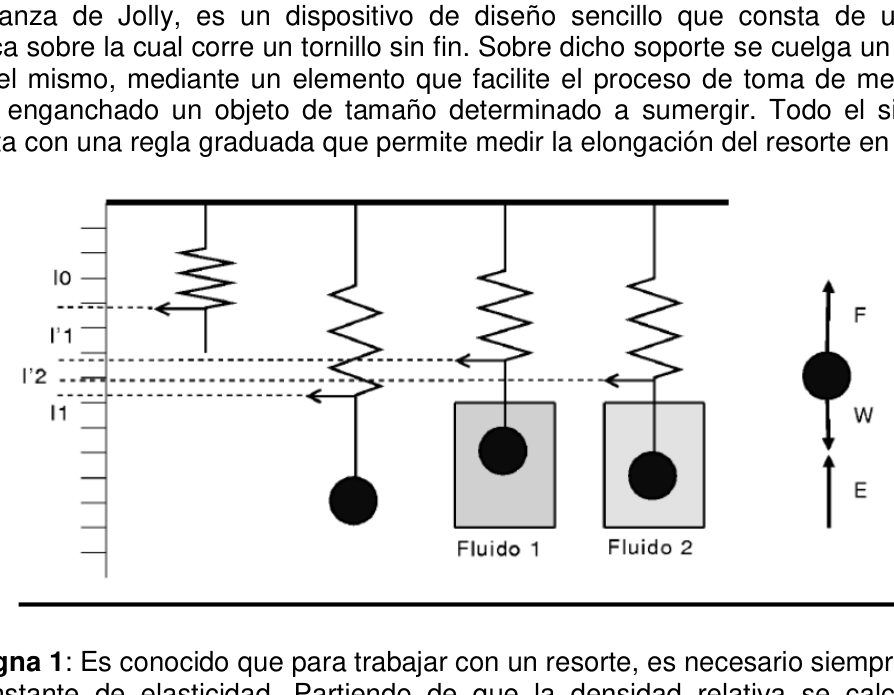
Topic: Fluid Mechanics Metodi: Hydrostatic Equilibrium, Experimental Data Analysis Competenze: Physical Reasoning, Experimental Data Analysis Objects: Spring, Sphere Fonte: Testo (PDF) — p.5
PE35. Scuola superiore industriale
Città di Santa Fe.
Obiettivi: determinare la densità relativa di un fluido e indirettamente la densità di un fluido
- Assolutamente.
Elementi: supporto metallico, fluido di confronto: acqua, fluido da misurare: alcol Etillo, elemento di lettura, Resorte e oggetto da immergere (sfera plastica).
La bilancia di Jolly è un semplice dispositivo di design che consiste in un bastone. metallo su cui corre un tornello senza fine. Su tale supporto si appende una stagnola, e La misurazione è effettuata con un elemento che facilita il processo di misurazione. mette attaccato un oggetto di determinata dimensione da immergere. L’intero sistema si è La misurazione del lunghezza della primavera in questione è effettuata con una regola graduata.
Consigna 1: È noto che per lavorare con una primavera, è sempre necessario conoscere la sua costante elasticità. La densità relativa viene calcolata da Come segue, presentate il diagramma di corpo libero per il caso in cui l’oggetto si trova immerso, e poi, utilizzando le equazioni che ritiene necessarie, dimostrare perché non è necessario conoscere la costante di elasticità, né il volume del corpo da utilizzare.
Rispettare le variabili assegnate al grafico della pagina precedente: L0 = allungamento naturale della primavera. L1 = allungamento con il corpo sospeso in aria. L1 = Elungamento con il corpo sospeso in liquido 1. L2 = Elungamento con il corpo sospeso in liquido 2.
Consegna 2: Con l’espressione ottenuta in Consegna 1, valuta immergendo il corpo nelle soluzioni concesse, allungamento della primavera sulla bilancia di Jolly, registrando le misure in una tabella di valori contenente almeno dieci misurazioni.
Consegno 3: Calcolare, effettuando un adeguato trattamento dei dati, il calcolo della La densità relativa della sostanza incognita, accompagnando tale risultato con il suo
- l’errore rispettivo.
Consigna 4: Conoscendo la densità relativa della soluzione incognita, e indirettamente la densità assoluta, progettando un modo per valutare la spinta che il liquido offre al oggetto immerso nelle condizioni dell’esperimento.
162 - OAF 2015
Topic: Fluid Mechanics Metodi: Hydrostatic Equilibrium, Experimental Data Analysis Competenze: Physical Reasoning, Experimental Data Analysis Objects: Spring, Sphere Fonte: Testo (PDF) — p.5
PE35. Higher Industrial School
City of Santa Fe.
Objectives: Determine the relative density of a fluid, and indirectly its density I’m sure you’re right.
Elements: Metal support, comparison fluid: Water, fluid to be measured: Alcohol The following elements are used:
Jolly’s scale is a simple design device consisting of a rod. metallic on which a screw runs endlessly. A spring is hung over the support, and The Commission has already adopted a proposal for a regulation on the It is a device that is attached to an object of a given size to be submerged. The whole system is The length of the spring in question is measured by a graduated rule.
Consigna 1: It is known that to work with a spring, you must always know Its elasticity is constant. The relative density is calculated from the Next, you put the free-body diagram for the case where the object is find submerged, and then, using the equations you deem necessary, The first is the fact that the current elasticity of the material is not known. body volume to be used.
Respect the variables assigned to the chart on the previous page: L0 = Natural elongation of the spring. L1 = Elongation with the body suspended in the air. L1 = Elongation with body suspended in liquid 1. L2 = Elongation with body suspended in liquid 2.
Consigna 2: Using the expression obtained in Consigna 1, assess by immersing the body in the solutions given, the elongation of the spring in the Jolly scale, recording the measures in a table of values containing at least ten measurements.
Consignment 3: Calculate, by performing appropriate data processing, the calculation of the relative density of the unknown substance, accompanying this result with its The Commission’s proposal for a regulation on the
Consigna 4: Knowing the relative density of the unknown solution, and indirectly its absolute density, design a way to evaluate the thrust the liquid provides to the The object is immersed in the experimental conditions.
The following points shall be added:
Topic: Fluid Mechanics Metodi: Hydrostatic Equilibrium, Experimental Data Analysis Competenze: Physical Reasoning, Experimental Data Analysis Objects: Spring, Sphere Fonte: Testo (PDF) — p.5
PE36. Escuela Superior de Comercio Gral. José de San Martín
Monteros, Tucumán.
Se pide determinar el índice de refracción del material de un prisma recto utilizando sólo los elementos provistos.
Elementos provistos:
- Un prisma recto de sección rectangular, de material transparente y con dos caras paralelas pulidas. Sus dimensiones aproximadas: 20mm x 30mm x 40mm
- Alfileres
- Una regla milimetrada
- Un transportador
- Una plancha de telgopor
Sugerencias:
a) Enuncie o indique las leyes de la óptica que considere aplicables al problema.
b) Si puede proponer más de un método para medir el índice, descríbalos a todos.
Use uno por lo menos para realizar la medición, y si tiene tiempo, más de uno.
c) Mencione posibles causas de errores experimentales
d) Dé una estimación del error experimental de la medición realizada.
e) Anote todas las observaciones mientras trabaja y redacte prolijamente un breve
informe aunque no llegue a concretar una medición del índice.
El informe del trabajo realizado, debe consignar: I. Objetivos - Planteo analítico II. Experiencia realizada - Método experimental utilizado III. Valores, tablas y/o gráficas obtenidas. IV. Fuentes de errores y análisis de cómo influyen en los resultados finales acotados. V. Consideraciones y supuestos que considere relevantes para el informe. Todo aquello que considere relevante para su informe.
Topic: Geometric Optics Metodi: Snell’s Law, Experimental Data Analysis Competenze: Physical Reasoning, Experimental Data Analysis Objects: Prism Fonte: Testo (PDF) — p.5
PE36. Gral High School of Commerce. José de San Martín
Monteros, Tucumán.
Si chiede di determinare l’indice di refraczione del materiale di un prisma retto utilizzando solo gli elementi forniti.
Elementi forniti:
- Un prisma retto di sezione rettangolare, di materiale trasparente e con due facce paralleli puliti. Le sue dimensioni approssimative: 20 mm x 30 mm x 40 mm
- Alfilatori
- Una regola di millimetro.
- Un trasportatore
- Una lavagna di telgopor
Suggerimenti: a) Esprimere o indicare le leggi dell’ottica che ritiene applicabili al problema. b) Se si può proporre più di un metodo per misurare l’indice, descriverli a tutti. Usa almeno uno per effettuare la misurazione, e se hai tempo, più di uno. c) Indicare le possibili cause di errori sperimentali d) Indicare l’errore sperimentale della misurazione effettuata. e) Prendere note di tutte le osservazioni mentre lavora e redigere con facilità un breve Il rapporto non è stato effettuato se non si è riuscito a valutare l’indice.
Il rapporto del lavoro svolto deve contenere: I. Obiettivi - Sviluppo analitico II. Esperienza realizzata - Metodo sperimentale utilizzato III. Valori, tabelle e/o grafici ottenuti. IV. Fonti di errori e analisi di come influenzano i risultati finali accorti. V. Considerazioni e ipotesi che ritiene rilevanti per il rapporto. Tutto ciò che ritiene rilevante per il suo rapporto.
Topic: Geometric Optics Metodi: Snell’s Law, Experimental Data Analysis Competenze: Physical Reasoning, Experimental Data Analysis Objects: Prism Fonte: Testo (PDF) — p.5
PE36. Gral High School of Commerce. Joseph of San Martin
Monteros, Tucumán. What is it?
The refractive index of a rectangular prism material is to be determined using only the elements provided.
Elements provided:
- A rectangular-section prism, of transparent material and with two faces polished parallels. Its approximate dimensions: 20mm x 30mm x 40mm
-
- The sharps .
- A millimeter rule .
- A transporter .
- A telgopor board
Suggestions: (a) State or indicate the laws of optics which you consider applicable to the problem. (b) If you can propose more than one method for measuring the index, describe them to all. Use at least one to make the measurement, and if you have time, more than one. (c) State possible causes of experimental errors (d) Give an estimate of the experimental error of the measurement performed. (e) Write down all the observations as you work and write a brief brief. The Commission will also be able to provide a report on the situation in the Community.
The report of the work carried out shall contain: I. Objectives - Analytical planning II. Experience gained - Experimental method used The Commission shall adopt the following: Value, tables and/or graphs obtained. IV. Sources of errors and analysis of how they influence the final results of the summary. V. Considerations and assumptions that you consider relevant to the report. Anything you consider relevant to your report.
Topic: Geometric Optics Metodi: Snell’s Law, Experimental Data Analysis Competenze: Physical Reasoning, Experimental Data Analysis Objects: Prism Fonte: Testo (PDF) — p.5
PE37. Escuela de Educación Técnica Alberto Einstein - Colegio San Alfonso
Colegio San Pablo - Colegio Del Milagro - Colegio Victorino de la Plaza
Instituto de Educación Media Arturo Oñativia - Colegio Belgrano
Colegio 5095 - Colegio Juan Manuel Estrada - Colegio Sagrada Familia
Colegio Arturo Illia - Colegio San Agustín - Colegio Teresa de Calcuta
Colegio UZZI COLAGE - Escuela Parroquial de la Merced
Colegio Del Huerto - EET Martin Miguel de Güemes
Colegio 11 de Setiembre - Colegio de Jesús - Colegio Secundario 5037
Colegio CODESA - Colegio Padre Gabriel Tomassini
Colegio Divina Misericordia
Ciudad de Salta.
Determinación del Índice de Refracción.
El índice de refracción de un material transparente es uno de sus parámetros físicos más
Importantes.
Existen varios métodos para determinarlo, un grupo de investigadores de la Universidad
de la Conchinchina públicos en el Journal Optical Society of America en 1939 una
relación funcional que indagaba la dependencia entre la altura H del material
transparente y el diámetro D de un circulo que se observa cuando se hace incidir en él
un haz perpendicular de luz actuando un papel en la base del material transparente como
difusor de luz ( fig. 1 y 2) .
Lo que los investigadores propusieron que la dependencia funcional era de la forma:
𝐻= 𝛼. 𝐷𝜆 (1)
Donde α y λ son dos contantes a determinar.
OAF 2015 - 163 Tres años después en la misma revista aparece el método de Pfund que permite la medición del índice de refracción. Hoy en muchos laboratorios podemos medir el índice de refracción de un material transparente usando un haz de luz láser . Básicamente este método consiste en hacer incidir un haz de luz láser de manera perpendicular a la superficie de la placa transparente, que reposa sobre una superficie difusora. La luz se difunde en todas direcciones desde el punto de incidencia del haz en esta superficie, y llega a la superficie superior de la placa transparente bajo todos los ángulos, desde 0 hasta 90°. Como sabemos un fenómeno importante en la propagación de la luz entre dos medios es la reflexión interna total, caracterizada por un ángulo límite (o crítico). Si la radiación difundida en el fondo alcanza la superficie superior de la placa, con ángulos de incidencia menores que el ángulo límite, una parte se transmitirá al aire y otra parte será reflejada. Pero si la radiación difundida desde el fondo incide en la superficie superior de la placa con un ángulo mayor que el ángulo límite, no existirá luz transmitida. Como consecuencia, desde la parte superior de la placa se observa un punto luminoso originado por la incidencia directa del haz, rodeado de un círculo de intensidad mucho menor (Figura 1). El diámetro de este círculo está relacionado con el índice de refracción de la placa.
Figura 1
Para la determinación del índice de refracción de la placa se utiliza la ley de Snell:
𝑛1 sin𝜃1 −𝑛2 sin 𝜃2, (2)
Si D es el diámetro del círculo (Figura 1) que se forma sobre la superficie difusora (papel), y H es el espesor de la placa (Figura 2), a partir de la ley de Snell y de la condición de reflexión total, es posible obtener la dependencia de α de la ecuación 1 con n 𝛼= 𝑛2 −1 1/2 8
De la ecuación 1 con este valor de α y conociendo λ, midiendo D para varios valores de H, es posible calcular el índice de refracción de la placa.
Figura 2
164 - OAF 2015 Los materiales de los cuales se dispone para este experimento son:
- Cuatro placas de vidrio de espesores: 3,0; 4,0;5,0 y 6,0 mm
- Láser rojo
- Papel milimetrado (superficie difusora) y papel log –log
Actividades 0. Encuentre el valor de α y λ realizando las medidas que usted considere necesarias.
- Determine el índice de refracción del vidrio y estime su incertidumbre, a partir de las medidas obtenidas para las cuatro placas individuales.
- Mida los diámetros (D) al combinar las placas, en ese orden y en el orden inverso, sin humedecer la superficie de contacto. Explique sus resultados.
- Mida los diámetros (D) al combinar las placas, en ese orden y en el orden inverso, humedeciendo la superficie de contacto. Explique sus resultados.
- Compare los diámetros (D) obtenidos para valores iguales de H, y la combinación de placas unidas humedeciendo la superficie de contacto. Explique sus resultados.
- Determine el índice de refracción del vidrio y estime su incertidumbre a partir de las medidas obtenidas con las placas y con combinaciones de ellas, humedeciendo las superficies de contacto.
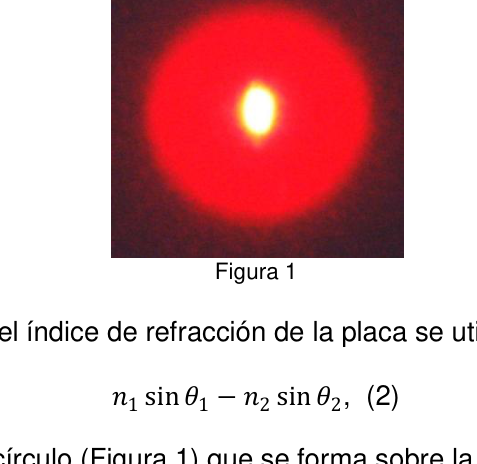
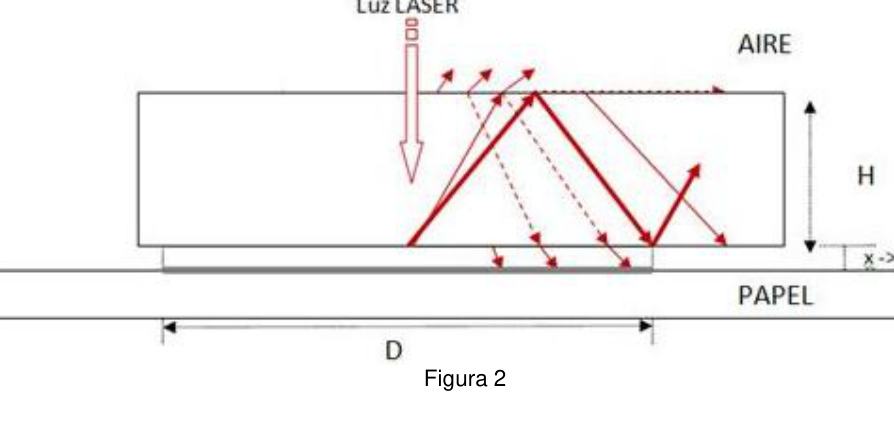
Topic: Geometric Optics Metodi: Snell’s Law, Experimental Data Analysis Competenze: Physical Reasoning, Experimental Data Analysis Objects: Screen Fonte: Testo (PDF) — p.5
PE37. Scuola di istruzione tecnica Alberto Einstein - Colegio San Alfonso
Colegio San Pablo - Colegio Del Milagro - Colegio Victorino della Plaza
Istituto di media educazione Arturo Oñativia - Colegio Belgrano
Colegio 5095 - Colegio Juan Manuel Estrada - Colegio Sagrada Familia
Colegio Arturo Illia - Colegio San Agustin - Colegio Teresa di Calcutta
UZZI COLAGE - Scuola parrocchiale della Merced
Colegio Del Huerto - EET Martin Miguel de Güemes
Scuola 11 settembre - Scuola di Gesù - Scuola Secundaria 5037
Colegio CODESA - Colegio Padre Gabriel Tomassini
Divina Misericordia College
Città di Salta.
Determinazione dell’indice di refraczione. L’indice di refraczione di un materiale trasparente è uno dei suoi parametri fisici più elevati.
- Sono importanti. Esistono diversi metodi per determinarlo, un gruppo di ricercatori dell’Università La Conchinchina pubblica nel Journal Optical Society of America nel 1939 un Relazione funzionale che ha indagato la dipendenza tra l’altezza H del materiale trasparente e il diametro D di un cerchio che si osserva quando si incide su di esso un fascio di luce perpendicolare che agisce come un ruolo nella base del materiale trasparente come diffusore di luce (fig. 1 y 2) . Ciò che i ricercatori hanno proposto come dipendenza funzionale era la seguente: 𝐻= 𝛼. 𝐷𝜆 (1) Dove α e λ sono due contanti da determinare.
OAF 2015 - 163 Tre anni dopo la stessa rivista riporta il metodo di Pfund che permette di misurazione dell’indice di refraczione. Oggi in molti laboratori possiamo misurare l’indice di refraczione di un materiale. trasparente usando un raggio di luce laser . Fondamentalmente questo metodo consiste nel far incidere un raggio di luce laser in modo perpendicolare alla superficie della scheda trasparente, che si fonda su una superficie diffusore. La luce si diffonde in tutte le direzioni dal punto di incidenza del raggio in Questa superficie, e arriva alla superficie superiore della scheda trasparente sotto tutti i angoli da 0 a 90°. Come sappiamo un fenomeno importante nella diffusione della luce tra due mezzi è la riflessione interna totale, caratterizzata da un angolo limite (o critico). Se la radiazione diffusa in fondo raggiunge la superficie superiore della piastra, con angoli di incidenza Se la parte inferiore all’angolo limite è trasmessa all’aria, la parte inferiore è riflessa. Ma se la radiazione diffusa dal fondo incide sulla superficie superiore della placca se l’angolo è superiore all’angolo limite, non vi sarà luce trasmessa. Di conseguenza, da sopra la targa si osserva un punto luminoso. L’incidenza diretta del raggio, circondata da un cerchio di grande intensità
- il numero di persone che hanno un’attività di lavoro inferiore (Figura 1). Il diametro di questo cerchio è correlato all’indice di rifrazione. della targa.
Figura 1
Per determinare l’indice di refraczione della placca si usa la legge di Snell:
n1 senzaθ1 −n2 senza θ2, (2)
Se D è il diametro del cerchio (Figura 1) che si forma sulla superficie diffusore (papero), e H è lo spessore della placca (Figura 2), a partire dalla legge di Snell e dalla condizione di riflessione totale, è possibile ottenere la dipendenza di α dall’equazione 1 con n 𝛼= 𝑛2 −1 1/2 8
D’equazione 1 con questo valore di α e conoscendo λ, misurando D per vari valori di H, è possibile calcolare l’indice di refraczione della placca.
Figura 2
164 - OAF 2015 I materiali disponibili per questo esperimento sono:
- Quattro lastre di vetro di spessore: 3,0; 4,0; 5,0 e 6,0 mm
- Laser rosso .
- Carta millimetrica (superficie diffusore) e carta log log
Attività 0. Trova il valore di α e λ facendo le misure che ritieni necessarie.
- Determina l’indice di refraczione del vetro e stima la sua incertezza, a partire da misure ottenute per le quattro singole targhe.
- Misurare i diametri (D) combinando le schede, in questo ordine e in ordine inverso, senza umidire la superficie di contatto. Spiegate i risultati.
- Misurare i diametri (D) combinando le schede, in questo ordine e in ordine inverso, Ummidando la superficie del contatto. Spiegate i risultati.
- Compare i diametri (D) ottenuti per valori uguali di H, e la combinazione di lastre unite, che umidiscono la superficie di contatto. Spiegate i risultati.
- Determina l’indice di refraczione del vetro e stima l’incertezza a partire da misurazione ottenuta con le lastre e con le loro combinazioni, superfici di contatto.
Topic: Geometric Optics Metodi: Snell’s Law, Experimental Data Analysis Competenze: Physical Reasoning, Experimental Data Analysis Objects: Screen Fonte: Testo (PDF) — p.5
PE37. Albert Einstein Technical Education School - College of San Alfonso
The school is located in the centre of the city.
Arturo Oñativia Institute of Middle Education - Belgrano College
School 5095 - Juan Manuel Estrada School - Sagrada Familia School
Arturo Illia College - St. Augustine College - Teresa College of Calcutta
UZZI COLAGE School - Parish School of Merced
The first is the “EET Martin Miguel de Güemes”.
September 11th School - Jesus College - High School 5037
The school is called the “Codeza” College.
Divine Mercy College
Salt City.
Determination of the refractive index. The refractive index of a transparent material is one of its most important physical parameters. It’s important. There are several methods to determine this, a group of researchers at the University of The Conchinchina publications in the Journal of the Optical Society of America in 1939 a functional relationship that investigated the dependence between the height H of the material The diameter of a circle is transparent and the diameter of a circle is visible when it is inserted into it. a perpendicular beam of light acting as a role in the base of the transparent material as The light diffuser (fig. 1 y 2) . What the researchers proposed as functional dependence was as follows: 𝐻= 𝛼. 𝐷𝜆 (1) Where α and λ are two counts to be determined.
The following points shall be added: Three years later the same journal published the Pfund method which allows the measurement of the refractive index. Today in many laboratories we can measure the refractive index of a material. transparent using a laser beam of light . Basically this method consists of making a laser beam incline in a way that perpendicular to the surface of the transparent plate, resting on a surface It’s a broadcaster. Light is diffused in all directions from the beam’s point of impact in This surface, and it reaches the top surface of the transparent plate under all the The value of the underlying assets shall be reported in the following column: As we know an important phenomenon in the propagation of light between two media is the total internal reflection, characterised by a limit (or critical) angle. If the radiation diffused at the bottom reaches the upper surface of the plate, with angle of incidence less than the limit angle, one part shall be transmitted to the air and another part shall be reflected. But if the radiation diffused from the bottom hits the top surface of the plate with an angle greater than the limit angle, there shall be no transmitted light. As a result, a bright spot is visible from the top of the plate. The radiation is caused by the direct impact of the beam, surrounded by a circle of very high intensity. The following is a list of the main types of The diameter of this circle is related to the refractive index. The plate.
Figure 1
For the determination of the refractive index of the plate, Snell’s law is used:
N1 withoutθ1 −n2 without θ2, (2)
If D is the diameter of the circle (Figure 1) that forms on the diffusor surface (paper), and H is the thickness of the plate (Figure 2), from Snell’s law and the condition of In the case of the total reflection, it is possible to obtain the dependence of α from equation 1 with n 𝛼= 𝑛2 −1 1/2 8
From equation 1 with this value of α and knowing λ, measuring D for several values of H, it is possible to calculate the plate’s refractive index.
Figure 2
The Commission shall adopt delegated acts in accordance with Article 21 of this Regulation. The materials available for this experiment are:
- Four glass plates of 3,0; 4,0; 5,0 and 6,0 mm thickness
- Red laser .
- Millimeter paper (diffusing surface) and log paper log
Activities 0. Find the value of α and λ by taking the measures you deem necessary.
- Determine the refractive index of the glass and estimate its uncertainty, starting from the measurements obtained for the four individual plates.
- Measure the diameters (D) by combining the plates, in that order and in reverse order, without moisturising the contact surface. Explain your results.
- Measure the diameters (D) by combining the plates, in that order and in reverse order, moistening the contact surface. Explain your results.
- Compare the diameters (D) obtained for equal values of H, and the combination of adhesive plates moistening the contact surface. Explain your results.
- Determine the refractive index of the glass and estimate its uncertainty from the The measures obtained with the plates and combinations thereof, by moisturizing the plates. contact surfaces.
Topic: Geometric Optics Metodi: Snell’s Law, Experimental Data Analysis Competenze: Physical Reasoning, Experimental Data Analysis Objects: Screen Fonte: Testo (PDF) — p.5
PE38. Colegio San Ignacio
Río Cuarto, Córdoba.
Este experimento consiste en estudiar las oscilaciones de una cadena de clips.
a.
i. Coloque firmemente un gancho, con la ayuda de una abrazadera, entre dos pedazos
de madera en un pie universal como se indica en la Figura 1.
ii. Cuelgue del gancho una cadena de n clips (ver Figura 1). El valor inicial de n debe
ser igual a 25 (n = 25).
Figura 1: Esquema de la disposición experimental
iii. Desplace la cadena de su posición de equilibrio moviendo la misma hacia a un
costado usando para ello el clip que está más abajo.
Cuando la cadena se está moviendo suavemente, mida el valor del tiempo t para veinte
oscilaciones.
iv. Estime la incerteza en la medición del valor de t y sugiera una manera para reducir
la misma.
b. Cambie el valor de n y repita a. iii. hasta que tenga un número adecuado de mediciones de t y n. Incluya los valores del período T y n para cada valor de n en su tabla de resultados.
OAF 2015 - 165 c. Para este oscilador se sugiere que las cantidades T y n están relacionadas por la expresión: c n k T , en donde k y c son constantes. i. Grafique T vs. n . ii. Determine los valores de k y c. iii. Explique el sentido físico de las constantes k y c.
d. Una grúa que se usa para levantar pesos hasta la parte superior de un edificio tiene una cadena de 700 eslabones como se ilustra en la Figura 2.
Figura 2: Ejemplificación del modelo de grúa.
i. Use el modelo matemático propuesto y los valores obtenidos en c. iii. para calcular el período de oscilación para esta cadena. ii. Sugiera dos razones por las cuales la respuesta i. puede no ser válida.
Topic: Oscillations & Waves Metodi: Simple Harmonic Motion Analysis, Experimental Data Analysis Competenze: Physical Reasoning, Experimental Data Analysis Objects: Pendulum Fonte: Testo (PDF) — p.5
PE38. Scuola San Ignacio
Rio Cuarto, Córdoba.
Questo esperimento consiste nello studio delle oscillazioni di una catena di clip.
a. i. Metti saldamente un gancio, con l’aiuto di una abbraccia, tra due pezzi. di legno su un piede universale come indicato in Figura 1. ii. Colpisce dal gancio una catena di n clip (vedere Figura 1). Il valore iniziale di n deve essere pari a 25 (n = 25).
Figura 1: schema della disposizione sperimentale
iii. Spostare la catena della sua posizione di equilibrio spostandola verso un per questo, utilizzando il clip qui sotto. Quando la catena si sta muovendo lentamente, misurare il valore del tempo t per venti oscillazioni. iv. Estima l’incertezza nel misurare il valore di t e suggerisci un modo per ridurre
- La stessa.
b. Cambiare il valore di n e ripetere a. iii. fino a quando non ha un numero adeguato di misurazioni di t e n. Include i valori del periodo T e n per ogni valore di n nella sua tabella di risultati.
OAF 2015 - 165 c. Per questo oscillatore si suggerisce che le quantità T e n siano correlate per la espressione: c n k T , dove k e c sono costanti. i. Grafico T vs. n . ii. Determina i valori di k e c. iii. Spiega il senso fisico delle costanti k e c.
d. Un grilletto che viene usato per sollevare pesanti fino alla cima di un edificio ha una catena di 700 collegamenti come illustrato in Figura 2.
Figura 2: Esempio del modello di gru.
i. Utilizzare il modello matematico proposto e i valori ottenuti in c. iii. per calcolare il periodo di oscillazione per questa catena. ii. Suggerisco due ragioni per cui la risposta i. - Potrebbe non essere valido.
Topic: Oscillations & Waves Metodi: Simple Harmonic Motion Analysis, Experimental Data Analysis Competenze: Physical Reasoning, Experimental Data Analysis Objects: Pendulum Fonte: Testo (PDF) — p.5
PE38. St. Ignatius College
The fourth river, Cordoba.
This experiment involves studying the oscillations of a string of clips.
a. i. Place a hook firmly, with the help of a clutch, between two pieces. wood on a universal foot as shown in Figure 1. ii. Hang a string of n clips from the hook (see Figure 1). The initial value of n must be equal to 25 (n = 25).
Figure 1: Scheme of the experimental arrangement
(iii) the following: Move the chain from its equilibrium position by moving it towards a side by side using the clip below. When the chain is moving smoothly, measure the time value t to twenty The fluctuations. iv. Estimate the uncertainty in measuring t and suggest a way to reduce The same.
b. Change the value of n and repeat to a. (iii) the following: Until you have an appropriate number of measurements of t and n. Include the values for period T and n for each value of n in your result table.
The Commission shall adopt delegated acts in accordance with Article 21 of Regulation (EU) No 1303/2013. c. For this oscillator it is suggested that the quantities T and n are related by the The expression: c n k T , where k and c are constants. i. Graph T vs. n . ii. Determine the values of k and c. (iii) the following: Explain the physical meaning of the constants k and c.
d. A crane used to lift weights to the top of a building has a 700-link chain as shown in Figure 2.
Figure 2: Example of the crane model.
i. Use the proposed mathematical model and the values obtained in c. (iii) the following: to calculate the oscillation period for this chain. ii. I suggest two reasons why the answer i. It may not be valid.
Topic: Oscillations & Waves Metodi: Simple Harmonic Motion Analysis, Experimental Data Analysis Competenze: Physical Reasoning, Experimental Data Analysis Objects: Pendulum Fonte: Testo (PDF) — p.5
PE39. Colegio Nacional de Buenos Aires
Ciudad de Buenos Aires.
Objetivo: Determinar el índice de refracción del agua.
Elementos:
- Frasco o vaso cilíndrico de vidrio delgado transparente
- Agua a temperatura ambiente
- Calibre y/o regla
- Lápiz o palito de madera
Teoría
Cuando sumergimos un lápiz en posición
vertical en un vaso que contiene agua, la
posición del lápiz bajo el agua se ve desplazada
con relación a la posición del lápiz por encima
del agua y en consecuencia parece que el lápiz
estuviese roto.
La deformación aparente es producida por la
refracción de la luz proveniente del lápiz al pasar
de un medio (agua) a otro con distinto índice de
refracción (aire).
Asimismo, existe una posición (x) del lápiz para
la cual su imagen bajo el agua se observa justo
a continuación de la porción de lápiz por encima
del agua (Figura 1)
Si se observa el vaso desde arriba (Figura 2) y
se analiza la posición aparente del punto A del
166 - OAF 2015 lápiz, es decir , A’ , es posible deducir mediante la Ley de Snell una relación entre el diámetro del vaso (D), el diámetro del lápiz (d) y el índice de refracción del agua (na).
Con los elementos solicitados, se pretende determinar el coeficiente de refracción del
agua (na). Para ello:
a) Escriba una expresión para las tangentes de los ángulos i y t en función de D, x d y
H
b) Usando la aproximación de pequeños ángulos (sen i~ tg i y sen t~ tgt), escriba la ley
de Snell correspondiente a la situación descripta en la Figura 2
c) A partir de b), deduzca una expresión del índice de refracción del agua (na) en
función de x, d y D
d) Mida d y D y exprese correctamente los resultados.
e) Mida x al menos 10 veces.
f) A partir del análisis teórico realizado y de las mediciones, determine el valor de na
con su incerteza.
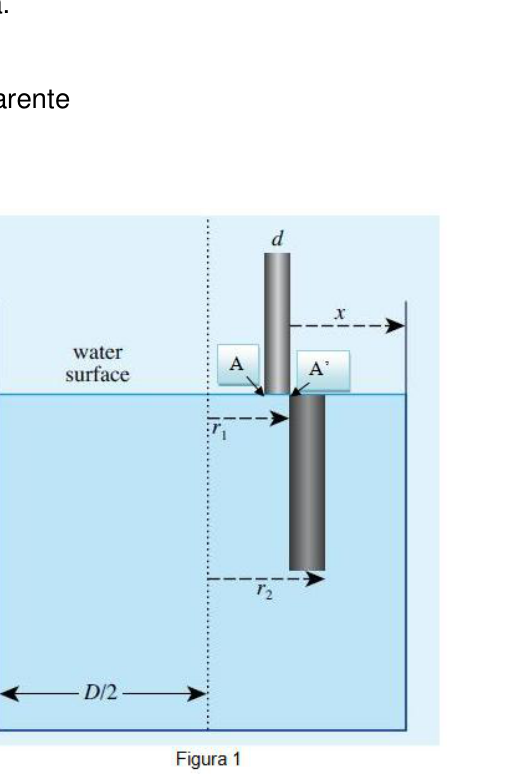
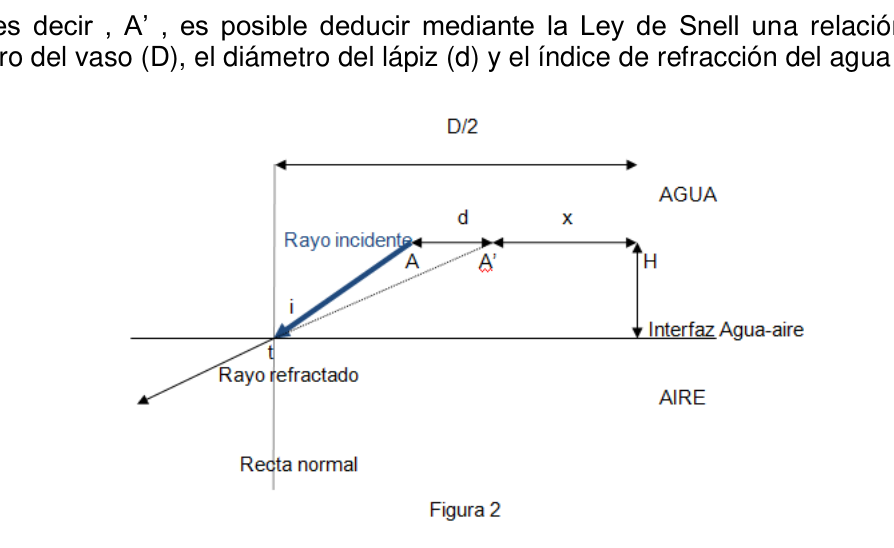
Topic: Geometric Optics Metodi: Snell’s Law, Experimental Data Analysis Competenze: Physical Reasoning, Experimental Data Analysis Objects: Container Fonte: Testo (PDF) — p.5
PE39. Collegio Nazionale di Buenos Aires
Città di Buenos Aires.
Obiettivo: Determinare l’indice di refraczione dell’acqua.
Elementi:
- Vaso o vasso di vetro trasparente
- Agua a temperatura ambiente
- Calibro e/o regola
- Pennale o bastone di legno
Teoria Quando immergiamo un crayon in posizione Verticale in un bicchiere contenente acqua, la La posizione della penna sotto l’acqua si sposta. rispetto alla posizione della matita sopra di voi l’acqua e di conseguenza sembra che il matita
- Se fosse rotto. La deformazione apparente è prodotta dalla refraczione della luce proveniente dalla matita al passaggio di un mezzo (acqua) a un altro con un diverso indice di refraczione (aria). Inoltre, esiste una posizione (x) della penna per che la sua immagine sotto l’acqua si osserva proprio dopo la porzione di penna sopra La produzione di acqua (Figura 1) Se si osserva il bicchiere dall’alto (Figura 2) e si analizza la posizione apparente del punto A del
166 - OAF 2015 La legge di Snell è che si può dedurre una relazione tra il diametro del vaso (D), diametro della matita (d) e indice di refraczione dell’acqua (na).
La ricerca di un’elettricità di rifrazione di un’unità di rifrazione di un’unità di rifrazione di un’unità di rifrazione di un’unità di rifrazione di un’unità di rifrazione di un’unità di rifrazione di una unità di rifrazione di una unità di rifrazione di una unità di rifrazione di una unità di rifrazione di una unità di rifrazione di una unità di rifrazione di una unità di rifrazione di una unità di rifrazione di una unità di rifrazione di una unità di rifrazione di una unità di rifrazione di una unità di rifrazione di una unità di rifrazione di una unità di rifrazione di una unità di un’unità di rifrazione di una unità di un’unità di un’unità di rifrazione di una unità di un’unità di unità di unità di unità di unità di unità di unità di unità di unità di unità di unità di unità di unità di unità di unità di unità di unità di unità di unità di unità di unità di unità di unità di unità di unità di unità di unità di unità di unità di unità di unità di unità di unità di unità di unità di unità di unità di unità di unità di unità di unità di unità di unità di unità di unità di unità di unità di unità di unità di unità di unità di unità di unità di unità di unità di unità di unità di unità di unità di unità di unità di unità di unità di unità di unità di unità di unità di unità di unità di unità di unità di unità di unità di unità di unità di unità di di unità di unità di unità di di di unità di di di di di di unità di unità di di di di unità di unità di di di di di unità di unità di di di di unità di di di unità di unità di di di di di di di di di di di di di di di di di di di di unità di di unità di di di di di di di di di di di di di di di di di di di di unità di di di di di unità di di di di di di di di di di di di di di di di di di di di di di di di di di di di di di di di di di di di di di di di di di di di di di di di di di di di di di di di di di di di di di di di di di di di di di di di acqua (na). Per questo: a) Scrivi un’espressione per le tangenti degli angoli i e t in funzione di D, x d e H b) Usando l’approssimazione di angoli piccoli (sen i~ tg i e sen t~ tgt), scrivete la legge La situazione di Snell è descritta in Figura 2. c) A partire da b) dedurre un’espressione dell’indice di refraczione dell’acqua (na) in funzione di x, d e D d) Misura d e D e esprimi correttamente i risultati. e) Misura x almeno 10 volte. f) Sulla base dell’analisi teorica effettuata e delle misurazioni, determinare il valore di con la sua incertezza.
Topic: Geometric Optics Metodi: Snell’s Law, Experimental Data Analysis Competenze: Physical Reasoning, Experimental Data Analysis Objects: Container Fonte: Testo (PDF) — p.5
PE39. National College of Buenos Aires
City of Buenos Aires.
Objective: Determine the refractive index of water.
The following elements:
- A cylindrical glass jar or glass of clear thin glass
- Water at room temperature
- Caliber and/or rule
- Pencil or wooden stick
The theory . When we dip a pencil into position vertical in a glass containing water, the The position of the pencil underwater is displaced. relative to the position of the pencil above The water and consequently the pencil appear to be I’d have broken it. The apparent deformation is produced by the refraction of light from the pencil as it passes from one medium (water) to another with a different index of the refraction (air). There is also a pencil position (x) for Which his image underwater is observed just right Next to the pencil overhead The Commission has already adopted a proposal for a regulation on the use of the If you look at the glass from above (Figure 2) and The apparent position of point A of the
The Commission shall adopt delegated acts in accordance with Article 166 of the Financial Regulation. The pencil, that is, A, is possible to deduce by Snell’s Law a relation between the and the the diameter of the glass (D), the diameter of the pencil (d) and the refractive index of the water (na).
The purpose of the calculation of the refractive index of the water (na). For this purpose: (a) Write an expression for the tangents of the angles i and t as a function of D, x d and H b) Using the approximation of small angles (without i~ tg i and without t~ tgt), write the law The Snell situation as described in Figure 2 (c) From (b) deduce an expression of the water refractive index (na) in function of x, d and D (d) Measure d and D and correctly express the results. (e) Measure x at least 10 times. (f) On the basis of the theoretical analysis and measurements, determine the value of the with their uncertainty.
Topic: Geometric Optics Metodi: Snell’s Law, Experimental Data Analysis Competenze: Physical Reasoning, Experimental Data Analysis Objects: Container Fonte: Testo (PDF) — p.5
PE40. Colegio Santísima Trinidad - Colegio Mariano Moreno - Instituto Ayelén
Mar del Plata, Buenos Aires.
Objetivo: Crear un medidor temporal con una columna de agua. Hallar la relación entre la altura de la columna de agua y el tiempo de vaciado. Hallar la relación entre sección transversal del recipiente y el tiempo de vaciado.
Introducción: La medición del tiempo ha sido una inquietud de la humanidad desde la antigüedad. Es por eso que podemos hallar relojes de arena, relojes de Sol, etc. Como cualquier medidor, lo importante es hallar una relación entre la cantidad que se quiere medir (en este caso tiempo) y una cantidad propia de nuestro sistema experimental (altura del orifico). Una vez determinada la relación entre estas dos cantidades, ya se tiene calibrado nuestro instrumento. En este caso, construiremos un medidor de tiempo utilizando una columna de agua. Se define como tiempo de vaciado al tiempo que le toma a la columna de agua descender hasta el nivel del orificio. Una vez alcanzado este nivel el agua dejara de salir. Durante el tiempo de desagote el agua sale debido a que la presión en la columna de agua es mayor que en el exterior. Se establece que a la altura del orificio la cara interna de la botella experimenta una presión igual a = 𝑃𝑎𝑡𝑚+ 𝛿. 𝑔. . En donde: 𝛿= 𝑑𝑒𝑛𝑠𝑖𝑑𝑎𝑑 𝑑𝑒𝑙 𝑙𝑖𝑞𝑢𝑖𝑑𝑜; 𝑔= 𝑔𝑟𝑎𝑣𝑒𝑑𝑎𝑑; = 𝑎𝑙𝑡𝑢𝑟𝑎 𝑑𝑒 𝑙𝑎 𝑐𝑜𝑙𝑢𝑚𝑛𝑎 𝑑𝑒 𝑙𝑖𝑞𝑢𝑖𝑑𝑜. En la parte exterior, la presión será igual a 𝑃𝑎𝑡𝑚. Cuando ambas presiones se equiparen el líquido dejara de fluir hacia el exterior.
OAF 2015 - 167 Materiales:
- Una botella
- Regla
- Papel milimetrado/ Hoja cuadridulada
- Agua -Clavo -Cronometro
Procedimiento
- Realizar un orificio a una determinada altura por encima de la base de la botella. Taparlo con una cinta. Llenar la botella hasta un nivel superior al del orificio realizado.
- Destapar el orificio y medir con el cronometro el tiempo que tarda la botella para desagotarse.
- Repetir este procedimiento 5 veces para este orificio.
- Repetir los puntos del 1-3 para 5 orificios distintos ubicados a distintas alturas.
- Volcar los datos en una tabla.
- Escribir todos los datos de las variables que permanecen fijas durante el experimento.
- Sacar los valores promedios de tiempo para cada orificio.
- Realizar un gráfico de tiempo vs. Altura de la columna.
- Establecer la relación que se encuentra a partir del grafico anterior, junto con su incerteza.
- Repetir las medidas anteriores en una botella con distinta sección transversal. (realizar una sola medición por altura)
- Graficar los datos obtenidos en el grafico del punto 7.
- Establecer como es la dependencia del tiempo de llenado con la sección transversal de la botella, junto con su incerteza. Justificar
- Establecer los alcances y las limitaciones del experimento. Se puede extrapolar los datos obtenidos? Que se asumió al realizar las mediciones?
Recuerde tomar las incertezas de cada medición y representarlas en el grafico mediante barras de error.
Topic: Fluid Mechanics Metodi: Bernoulli’s Equation, Experimental Data Analysis Competenze: Physical Reasoning, Experimental Data Analysis Objects: Container Fonte: Testo (PDF) — p.5
PE40. Colegio Santísima Trinidad - Colegio Mariano Moreno - Istituto Ayelén
Mar del Plata, Buenos Aires.
Obiettivo: creare un misuratore temporale con una colonna d’acqua. Trovare la relazione tra l’altezza della colonna d’acqua e il tempo di svuotamento. Trovare il rapporto tra sezioni trasversale del contenitore e il tempo di svuotamento.
Introduzione: La misurazione del tempo è stata una preoccupazione dell’umanità fin dal Antica. Ecco perché possiamo trovare orologi di sabbia, orologi di sole, ecc. Come Qualsiasi misurazione, l’importante è trovare una relazione tra la quantità che si vuole. La misurazione (in questo caso il tempo) e una quantità propria del nostro sistema sperimentale (altezza dell’orico). Una volta determinato il rapporto tra queste due quantità, si è già ha calibrato il nostro strumento. In questo caso, costruiremo un tempo-meter. usando una colonna d’acqua. Si definisce tempo di svuotamento del tempo che si fa scendere la colonna d’acqua fino al livello del buco. Una volta raggiunto questo livello l’acqua smette di uscire. Durante il tempo di esaurimento l’acqua viene fuori dal momento che la la pressione nella colonna d’acqua è maggiore rispetto all’esterno. Si stabilisce che all’ altitudine del foro la faccia interna della bottiglia prova un pressione pari a = Patm+ δ. 𝑔. . Dove: δ= densità del liquido; g= gravità; = altezza della colonna di liquido. All’esterno, la pressione sarà uguale a Patm. Quando le due pressioni si eguagliano il liquido smetterà di fluire verso l’esterno.
OAF 2015 - 167 Materiali:
- Una bottiglia .
- Regola .
- Carta millimetrica/ foglio quadriformato
- Acqua . -Clavolo. -Cronometro.
Procedura
- Fare un foro a una determinata altezza sopra la base della bottiglia.
- Lo copro con una cinta. Riempire la bottiglia fino a un livello superiore al buco
- il progetto di bilancio.
- Scavare il buco e misurare con il cronometro il tempo che dura per il bottiglio
- Svanire.
- Ripetere questa procedura 5 volte per questo foro.
- Ripettere i punti 1-3 per 5 orizzonti diversi posizionati a altezza diversa.
- Rimbollire i dati in una tabella.
- Scrivere tutti i dati delle variabili che rimangono fisse durante il l’esperimento.
- Prendere i valori medi di tempo per ogni foro.
- Realizzare un grafico di tempo vs. Altezza della colonna vertebrale.
- Establish the relationship that is from the previous graph, together with your
- l’incertitudine.
- Ripetere le misure precedenti in una bottiglia con sezione trasversale diversa. (realizzare una sola misura per altezza)
- Grafica dei dati ottenuti nel grafico di punto 7.
- Establishing how is the filling time dependency with the section transversale della bottiglia, insieme alla sua incertezza. Giustificare
- stabilire le portate e i limiti dell’esperimento. Si può estrapolare. i dati ottenuti? Che cosa ha preso in considerazione nel fare le misure?
Ricordate di prendere le incertezze di ogni misurazione e di rappresentarle sul grafico usando barrette di errore.
Topic: Fluid Mechanics Metodi: Bernoulli’s Equation, Experimental Data Analysis Competenze: Physical Reasoning, Experimental Data Analysis Objects: Container Fonte: Testo (PDF) — p.5
PE40. Holy Trinity College - Mariano Moreno College - Institute of Ayelén
The city of Mar del Plata, Buenos Aires.
Objective: Create a temporary meter with a water column. Find the relationship between the height of the water column and the time of emptying. Find the relationship between sections the transverse of the container and the time of emptying.
Introduction: Measuring time has been a concern of mankind since the dawn of time. Ancient times. That’s why we can find sand clocks, sun clocks, etc. Like Any measurement, the important thing is to find a relationship between the amount you want. measuring (in this case time) and a quantity proper to our experimental system (hole height). Once the relationship between these two quantities is determined, the He’s calibrated our instrument. In this case, we’ll build a time meter. using a water column. It is defined as time of emptying at the time that it is It takes the water column to descend to the hole level. Once you hit this one level the water would stop coming out. During the drainage period the water comes out because the The pressure in the water column is higher than outside. It is established that at the hole height the inner side of the bottle experiences a pressure equal to a = Patm+ δ. 𝑔. . Where δ = density of liquid; g = gravity; = height of the liquid column. On the outside, the pressure will be the same as Patm. When both pressures are equal the liquid will stop flowing outward.
The following information shall be provided: Materials:
- A bottle .
- Rule .
- Millimeter paper/ Quadrilateral sheet
- Water .
- I’m going to go.
- The chronometer.
The procedure
- Make a hole at a certain height above the bottle base. Cover it with a tape. Fill the bottle to a level higher than the hole The Commission has already taken a decision.
- Unlock the hole and measure the time it takes the bottle to to wear out.
- Repeat this procedure 5 times for this hole.
- Repeat the points from 1-3 for 5 different holes located at different heights.
- Turn the data into a table.
- Write all data of the variables that remain fixed during the I’m going to try it.
- Get the mean time values for each hole.
- Make a time chart vs. Height of the spine.
- Establish the relationship that is found from the above chart, together with your Uncertainty.
- Repeat the above steps in a bottle with a different cross section. (to perform only one measurement per height)
- Graph the data obtained in the graph in point 7.
- Establish how the filling time depends on the section cross-bottle, along with its uncertainty. Justify it .
- Establish the scope and limitations of the experiment. It can be extrapolated. the data obtained? What did you assume when you made the measurements?
Remember to take the uncertainties of each measurement and represent them in the graph by the error bars.
Topic: Fluid Mechanics Metodi: Bernoulli’s Equation, Experimental Data Analysis Competenze: Physical Reasoning, Experimental Data Analysis Objects: Container Fonte: Testo (PDF) — p.5
PE41. Escuela Superior de Comercio Carlos Pellegrini
Ciudad de Buenos Aires.
Ley de Torricelli.
Objetivo
En mecánica de fluidos, la ley de Torricelli describe la
velocidad a la que sale un líquido por un orificio practicado en
un recipiente muy ancho. Su expresión analítica es:
v ² = 2gh
(ecuación 1) donde v es la velocidad a la que sale el chorrito
de líquido por el orificio, g es la aceleración de la gravedad y
h es la altura de la superficie libre del líquido medida desde el
orificio.
En este trabajo queremos aplicar la ley de Torricelli para hallar g, y para ello se propone
medir indirectamente la velocidad v con la que salen chorritos de líquido por un orificio en
un recipiente con agua, y relacionarla con la altura h.
Materiales
-
Botella plástica de capacidad ≥ 2 l
-
Bandeja metálica
-
Juego de alfileres
168 - OAF 2015
-
Cinta adhesiva plástica
-
Probeta graduada
-
Cinta métrica o regla milimetrada
-
Cronómetro manual
-
Tornillo micrométrico o calibre
Comentarios generales
- Antes de comenzar, lea todas las instrucciones.
- Agregue en el informe comentarios que aclaren el procedimiento exacto que utilizó en cada paso. En lo posible incluya también un dibujo aclaratorio.
- Escriba en tablas los datos obtenidos en las mediciones junto con sus errores.
- Aclare cualquier cambio o desvío respecto de las instrucciones, junto con una breve explicación de su motivo.
- Trate de ser prolijo.
Introducción teórica
La ley de Torricelli es una consecuencia de la ley de Bernoulli, que expresa la
conservación de la energía mecánica en un fluido ideal (sin fricción viscosa),
incompresible y estacionario (cuya velocidad en cada punto del espacio no cambia en
con el tiempo), sujeto a la acción de la gravedad. La fórmula dada anteriormente
(ecuación 1) vale cuando la presión de la superficie libre del líquido es igual a la del
entorno hacia el cual sale el chorrito.
En mecánica de fluidos, se define el caudal Q de un flujo
estacionario a través de una superficie como el volumen V de
fluido que atraviesa esa superficie por unidad de tiempo: Q =
V/t. Si A es el área de la superficie y v es la velocidad con la
que el flujo la atraviesa, el caudal se puede calcular
equivalentemente según Q = A.v.
Por lo tanto, si A es el área de la sección transversal del chorro que sale por el orificio, al
aplicar la ley de Torricelli se obtiene que Q 2 = 2gA2.h (ecuación 2).
Experimento Parte 1: mediciones
- Llene lo más posible la botella con agua.
- Cerca de la base de la botella, en un punto donde la pared de la botella sea vertical, practique un orificio con un alfiler. Mientras no esté midiendo, cúbralo con cinta adhesiva para evitar perder agua.
- Para medir el caudal, mida con el cronómetro cuánto tiempo tarda el chorrito en llenar la probeta con un cierto volumen de agua.
- Mida la altura del nivel del agua en la botella respecto del orificio, para el caudal que acaba de medir. Trate de que el nivel no haya cambiado significativamente mientras midió el caudal.
- Repita los pasos 3 y 4 para distintos niveles de agua en la botella. No se conforme con menos de 10 mediciones. Tenga en cuenta que puede poner más agua en la botella si es necesario.
- Mida el diámetro del alfiler con el tornillo micrométrico o el calibre.
Parte 2: análisis
- Para cada altura para la que midió, calcule el caudal Q, y Q2, con sus incertezas.
- Estime el área transversal del chorrito con su incerteza.
- ¿Cómo calcularía la velocidad con la que sale el agua por el orificio, en base a sus datos?
- Grafique Q2 en función de h. Si la ley de Torricelli es correcta, y por lo tanto la ecuación 2, ¿qué características espera que tenga el gráfico?
- A partir del análisis del gráfico, obtenga la aceleración de la gravedad g con su incerteza.
OAF 2015 - 169 Parte 3: confección de un informe Escriba un informe de la experiencia realizada que posea la siguiente información: a) Título b) Introducción (breve) c) Descripción del dispositivo experimental (texto y dibujo) d) Detalles acerca de cómo se realizaron las mediciones (texto y dibujo) e) Mediciones / Tablas con errores f) Justificación de los errores presentados g) Gráficos (en hoja milimetrada) h) Cálculos i) Resultados obtenidos j) Comentarios finales k) Conclusiones Y cualquier información que considere relevante
Topic: Fluid Mechanics Metodi: Bernoulli’s Equation, Experimental Data Analysis Competenze: Physical Reasoning, Experimental Data Analysis Objects: Container Fonte: Testo (PDF) — p.5
PE41. Scuola superiore di commercio Carlos Pellegrini
Città di Buenos Aires.
Legge di Torricelli. Obiettivo In meccanica dei fluidi, la legge di Torricelli descrive la velocità con cui un liquido esce da un foro praticato in un vasto contenitore. La sua espressione analitica è: v ² = 2gh (Equatoria 1) dove v è la velocità con cui il corridoio esce. di liquido attraverso il foro, g è l’accelerazione della gravità e h è l’altezza della superficie libera del liquido misurata dal
- Un buco. In questo lavoro vogliamo applicare la legge di Torricelli per trovare g, e per questo si propone misurare indirettamente la velocità v con cui i gorgelli di liquido usciranno da un foro in un recipiente con acqua, e collegarla all’altezza h.
Materiali
- Bottiglia di plastica di > 2 l
- Una banda metallica .
- Gioco di spine
168 - OAF 2015
- Fascia adesiva di plastica
- Provetta graduata.
- Cintura metrica o regola millimetrica
- Cronometro manuale .
- Torno micrometrico o calibro
Commenti generali
- Prima di iniziare, leggi tutte le istruzioni.
- Aggiungi nel rapporto commenti che chiariscano l’esatta procedura che ha usato a ogni passo. Se possibile, includere anche un disegno chiaritorio.
- Scrivi in tavola i dati ottenuti dalle misurazioni insieme ai tuoi errori.
- Accertare qualsiasi modifica o deviazione rispetto alle istruzioni, con una breve spiegazione del suo motivo.
- Cerca di essere prolico.
Introduzione teorica La legge di Torricelli è una conseguenza della legge di Bernoulli, che esprime la conservazione dell’energia meccanica in un fluido ideale (senza frizione viscosa), Incompressibile e stazionario (la cui velocità in ogni punto dello spazio non cambia in con il tempo), soggetta all’azione della gravità. La formula data sopra (Equatoria 1) vale quando la pressione della superficie libera del liquido è pari a quella del l’ambiente verso cui sale il boccone. In fluidi meccanici, definisce il flusso Q di un flusso di un volume V di fluido che attraversa quella superficie per unità di tempo: Q = V/t. Se A è l’area della superficie e v è la velocità con la Se il flusso attraversa la corrente, la corrente può essere calcolata. equivalentemente secondo Q = A.v. Quindi, se A è l’area della sezione trasversale del jet che esce dal foro, al Applicando la legge di Torricelli si ottiene che Q 2 = 2gA2.h (equazione 2).
Esperimento Parte 1: misurazioni
- Riempi il più possibile la bottiglia di acqua.
- Vicino alla base della bottiglia, in un punto dove il muro della bottiglia è verticale, Pratica un foro con un pincello. Finché non sta misurando, coprilo con una cinta. adesivo per evitare di perdere acqua.
- Per misurare il flusso, misurare con il cronometro quanto tempo dura il rottura in riempire il campione con un certo volume di acqua.
- Misura l’altezza del livello dell’acqua in bottiglia rispetto al foro, per il flusso che ha appena misurato. Cerca di non cambiare significativamente il livello. mentre misurava il flusso.
- Ripeti i passi 3 e 4 per diversi livelli di acqua in bottiglia. Non mi acconsento. con meno di 10 misure. Si noti che può mettere più acqua in bottiglia se necessario.
- Misura il diametro del bastone con lo scheggio micrometrico o il calibro.
Parte 2: analisi
- Per ogni altezza per cui ha misurato, calcola il flusso Q, e Q2, con le loro incertezze.
- Valutare l’area trasversale del corretto con la sua incertezza.
- Come calcolare la velocità con cui l’acqua esce dal buco, in base alle sue
- dati?
- Grafica Q2 in funzione di h. Se la legge di Torricelli è corretta, e quindi la Equazione 2, quali caratteristiche si aspetta che il grafico abbia?
- Sulla base dell’analisi del grafico, ottieni l’accelerazione della gravità g con il suo
- l’incertitudine.
OAF 2015 - 169 Parte 3: elaborazione di un rapporto Scrivi un rapporto sull’esperienza svolta che contiene le seguenti informazioni: a) Titolo b) Introduzione (breve) c) Descrizione del dispositivo sperimentale (testo e disegno) d) Dettagli su come le misure sono state effettuate (testo e disegno) e) Misure / tabelle con errori f) giustificazione degli errori presentati g) Grafiche (in fogli di millimetro) h) Calcoli i) Risultati ottenuti j) Commenti conclusivi k) Conclusioni E qualsiasi informazione che ritenga rilevante
Topic: Fluid Mechanics Metodi: Bernoulli’s Equation, Experimental Data Analysis Competenze: Physical Reasoning, Experimental Data Analysis Objects: Container Fonte: Testo (PDF) — p.5
PE41. The Carlos Pellegrini School of Commerce
City of Buenos Aires.
Torricelli’s law. The objective In fluid mechanics, Torricelli’s law describes the The speed at which a liquid is released through a hole in the A very wide container. His analytical expression is: v ² = 2gh (Equation 1) where v is the velocity at which the outlet is going out of liquid through the hole, g is the acceleration of gravity and h is the height of the free surface of the liquid measured from The hole. In this paper we want to apply Torricelli’s law to find g, and for that we propose indirectly measure the velocity v at which liquid jets come out through a hole in a container of water, and relate it to height h.
Materials
- Plastic bottle with capacity ≥ 2 l
- Metallic bandage .
- A game of pincers .
The Commission shall adopt delegated acts in accordance with Article 168 of the Financial Regulation.
- Plastic adhesive tape
- Graduated test.
- Metric tape or millimeter rule
- The time-lapse .
- Micrometric or caliber torch
General comments
- Before you start, read all the instructions.
- Add comments to the report that clarify the exact procedure you used every step of the way. If possible, include a clarifying drawing.
- Write down the data obtained in the measurements along with their errors in tables.
- Please explain any changes or deviations from the instructions together with a brief explanation of his motive.
- Try to be prolific.
Theoretical introduction Torricelli’s law is a consequence of Bernoulli’s law, which expresses the conservation of mechanical energy in an ideal fluid (without viscous friction), The speed of the current is constant at each point in space. The time of the earth’s magnetic field is the time of the earth’s magnetic field. The formula given above (Equation 1) is when the pressure on the free surface of the liquid is equal to that of the liquid. The environment the rattlesnake goes into. In fluid mechanics, the flow Q of a flow is defined. The surface of the vehicle is the same as the surface of the vehicle. fluid flowing through that surface per unit of time: Q = V/t. If A is the area of the surface and v is the velocity with the If the flow is through it, the flow can be calculated. Equivalently according to Q = A.v. Therefore, if A is the area of the cross section of the jet coming out of the hole, then apply Torricelli’s law, we get that Q 2 = 2gA2.h (equation 2).
Experiment . Part 1: measurements
- Fill the bottle with water as much as possible.
- Near the bottom of the bottle, at a point where the wall of the bottle is vertical, practice a hole with a pin. While I’m not measuring, cover it with tape. adhesive to avoid water loss.
- To measure flow rate, measure with the chronometer how long the flow takes in fill the sample with a certain volume of water.
- Measure the height of the water level in the bottle relative to the hole, for flow I just measured it. Try to make sure the level hasn ‘t changed significantly . while measuring the flow.
- Repeat steps 3 and 4 for different levels of water in the bottle. I ‘m not complying . with less than 10 measurements. Please note that you can put more water into the bottle if necessary.
- Measure the diameter of the pin with the micrometer screw or caliber.
Part 2: analysis
- For each height you measured, calculate the flow rate Q, and Q2, with their uncertainties.
- Estimate the cross-sectional area of the shrimp with its uncertainty.
- How would you calculate the speed at which water is coming out of the hole, based on their What data?
- Graph Q2 as a function of h. If Torricelli’s law is correct, and therefore the Equation 2, what characteristics do you expect the graph to have?
- From the analysis of the graph, obtain the acceleration of gravity g with its Uncertainty.
The Commission shall adopt delegated acts in accordance with Article 21 of this Regulation. Part 3: preparation of a report Write a report of the experience that contains the following information: (a) Title (b) Introduction (short) (c) Description of the experimental device (text and drawing) (d) Details of how the measurements were made (text and drawing) (e) Measurements / tables with errors (f) Justification of the errors presented (g) Graphics (in millimetre sheet) (h) Calculations (i) Results obtained (j) Final comments (k) Conclusions And any information you deem relevant
Topic: Fluid Mechanics Metodi: Bernoulli’s Equation, Experimental Data Analysis Competenze: Physical Reasoning, Experimental Data Analysis Objects: Container Fonte: Testo (PDF) — p.5
PE42. Instituto Primo Capraro
San Carlos de Bariloche, Río Negro.
Objetivo:
- Determinar el módulo de Young, E, de una regla de plástico.
Breve descripción
Una viga empotrada por uno sus extremos y en voladizo, experimenta esfuerzos que
producen su flexión; esto es, la viga se arquea, se deforma. Si la viga soporta, además de
su propio peso, una carga extra, la flexión que experimenta se incrementa. Los esfuerzos
aplicados deforman la viga, según sea su geometría y el material que la compone, pero si
son tales que las deformaciones son elásticas (limite elástico), entonces cuando cesan la
viga retoma su forma original.
Supongamos una viga ―sin peso‖ de sección rectangular y longitud L, empotrada, a la que
se le aplica en el extremo libre una fuerza F (ver figura). La viga se deforma, perdiendo su
horizontalidad, y su extremo libre desciende una cantidad z (flecha). Se puede demostrar
que:
𝑧= 𝐹𝐿3 3𝐸𝐼
Con 𝐼= 𝑎𝑏3 12 : donde a y b son las dimensiones de la sección de la viga, E es el módulo de Young correspondiente al material del cual está compuesta la viga.
Consigna
- Implementar un dispositivo similar al de la Figura utilizando como viga una regla plástica de al menos 30 cm de longitud.
- Utilizando diferentes masas conocidas, determinar la ―flecha‖ z correspondiente a diferentes longitudes de ―vuelo‖ (L). Determinar el coeficiente de elasticidad correspondiente al plástico con el que está construida la viga.
Elementos provistos para la experiencia:
-
Dos reglas plásticas.
-
Hilos finos y resistentes o tanza de pesca (mojarritas) aproximadamente 0,5 m.
-
Cinta adhesiva de papel.
170 - OAF 2015
-
Prensa tipo nuez o un sistema de reemplazo que puede ser un contrapeso formado por libros o ladrillos, etc.
-
Recipiente plástico que actuará como contenedor de agua para ejercer la carga en la viga y jeringa graduada para conocer el valor de la carga.
Nota: Es importante garantizar que las reglas (la utilizada como viga y la de referencia) estén siempre al mismo nivel en ausencia de carga.
Sugerencias
a) Realice mediciones de la flecha cuando somete a una viga al efecto de diferentes
fuerzas; utilice 5 fuerzas distintas. Construya una tabla con los resultados.
b) Confeccione un gráfico fuerza vs flecha y determine el valor del modulo de Young
del plástico (nómbrelo E1).
c) Con cada uno de las fuerzas que utilizó, realice mediciones de la flecha para ―vigas‖
de diferentes longitudes; utilice 5 longitudes. Construya una tabla con los
resultados.
d) Confeccione gráficos (cuantos sean necesarios) de longitud a la tercera potencia vs
flecha y determine el valor del modulo de Young del plástico (nómbrelo E2).
e) Construya una tabla con los productos F L3 y confeccione un grafico F L3 vs flecha.
Determine el valor del módulo de Young del plástico (nómbrelo E3).
f) Compare los valores del módulo de Young que encontró con sus correspondientes
incertezas y diga si son o no indistinguibles y por qué.
Topic: Elasticity & Materials Metodi: Stress-Strain Analysis, Experimental Data Analysis Competenze: Physical Reasoning, Experimental Data Analysis Objects: Beam Fonte: Testo (PDF) — p.5
PE42. Istituto Primo Capraro
San Carlo di Bariloche, Rio Negro.
Obiettivo:
- Determinare il modulo di Young, E, di una regola di plastica.
Breve descrizione Un viglio inserito da uno i suoi estremi e in volante, sperimenta sforzi che producono la loro flessione, cioè il tracciato si arca, si deforma. Se il vigno sopporta, oltre il suo peso, un carico extra, la flessione che prova aumenta. Gli sforzi Applicate distortano il vigno, a seconda della geometria e del materiale che lo compone, ma se Le distorsioni sono tali che sono elastiche (limite elastica), quindi quando si cessano la Il filo riprende la sua forma originale. Supponiamo che un vigno — senza peso — di sezione rettangolare e lunghezza L, inserito, al quale se alla punta libera viene applicata una forza F (vedi figura). Il vigno si distorsi, perdendo il suo L’orizzontalità, e la sua estremità libera scende una quantità z (arcia). Si può dimostrare che:
𝑧= 𝐹𝐿3 3𝐸𝐼
Con I= 𝑎𝑏3 12: dove a e b sono le dimensioni della sezione di Il viglio, E è il modulo di Young relativa al materiale del che compone il vigno.
Consigna
- Implementare un dispositivo simile a quello di Figura utilizzando come vigia una regola di plastica di almeno 30 cm di lunghezza.
- utilizzando diverse masse conosciute, determinare la “arcia” z corrispondente a Le lunghezze di volo (L) sono diverse. Determinare il coefficiente di elasticità corrispondente alla plastica con cui è costruita la vigna.
Gli elementi forniti per l’esperienza:
- Due regole di plastica.
- Fiocchi finti e resistenti o di pesca (caccia) di circa 0,5 m.
- Fascia adesiva di carta.
170 - OAF 2015
- Una stampa di tipo noci o un sistema di sostituzione che può essere un contrappeso formato per libri o mattoni, ecc.
- contenitore di plastica che funge da contenitore di acqua per esercitare il carico in la prova e la seringa graduata per determinare il valore del carico. Nota: è importante garantire che le regole (la vigia e la vigia di riferimento) sono sempre allo stesso livello in assenza di carico.
Suggerimenti a) Misura l’arcia quando si sommette a un viggio a diversi effetti.
- Forze: usi 5 forze diverse. Costruisci una tabella con i risultati. b) Configgere un grafico forza vs freccia e determinare il valore del modulo di Young di plastica (numero E1). c) Con ciascuna delle forze usate, esegue misure dell’arcia per “vigas” di lunghezze diverse; utilizzare 5 lunghezze. Costruisci una tavola con i risultati. d) Confezionare grafici (quanti sono necessari) di lunghezza alla terza potenza vs. Arrow e determina il valore del modulo Young della plastica (numero E2). e) Costruire una tabella con i prodotti F L3 e creare un grafico F L3 vs. freccia. Determina il valore del modulo Young della plastica (numero E3). f) Compare i valori del modulo di Young che ha trovato con i suoi corrispondenti le incertezze e dire se sono indistingubili o no e perché.
Topic: Elasticity & Materials Metodi: Stress-Strain Analysis, Experimental Data Analysis Competenze: Physical Reasoning, Experimental Data Analysis Objects: Beam Fonte: Testo (PDF) — p.5
PE42. The first is the Capraro Institute.
St. Charles of Bariloche, Rio Negro.
The objective:
- Determine Young’s module, E, from a plastic rule.
Brief description A beam embedded by one’s ends and in flight, experiences efforts that They make their bending; that is, the beam is arched, it is deformed. If the beam holds, besides Your own weight, extra weight, the bending you experience increases. The efforts The beam is deformed according to its geometry and the material from which it is made, but if The deformation is elastic (elastic limit), so when the deformation ceases The beam is returning to its original shape. Let’s say a beam — weightless — of rectangular section and L length, embedded, to which a force F is applied to the free end (see figure). The beam is warped, losing its The horizontal, and its free end descends a quantity z (arrow). It can be proven which:
𝑧= 𝐹𝐿3 3𝐸𝐼
With I= 𝑎𝑏3 12 where a and b are the dimensions of the section The beam, E is Young’s module. The following information is provided by the European Commission: which is the beam composed.
I ‘m giving it away .
- Implement a device similar to that shown in Figure using as a beam a rule plastic of a length of at least 30 cm.
- Using different known masses, determine the “arrow” z corresponding to The following is the list of the different lengths of flight (L). Determine the elasticity coefficient corresponding to the plastic from which the beam is constructed.
Elements provided for the experience:
- Two plastic rules.
- Fine and durable yarn or fishing linen (moll) of approximately 0.5 m.
- It’s a paper tape.
The Commission shall adopt delegated acts in accordance with Article 21 of Regulation (EU) No 1303/2013.
- A nut type press or a replacement system that can be a formed counterweight by books or bricks, etc.
- Plastic container that will act as a water container to carry the load in the beam and graduated syringe to determine the value of the load. Note: It is important to ensure that the rules (the one used as beam and the reference) They are always at the same level in the absence of load.
Suggestions (a) Measurements of the arrow when subjecting a beam to different effects. Use five different forces. Build a table with the results. (b) Construct a force vs arrow graph and determine the value of Young’s module of plastic (number E1). (c) With each of the forces he used, make measurements of the arrow for “vigas” of different lengths; use 5 lengths. Build a table with the The results. (d) Construct charts (as many as are needed) of length to third power vs. arrow and determine the value of the plastic Young module (number E2). e) Build a table with the products F L3 and make a chart F L3 vs arrow. Determine the value of the Young module of the plastic (number E3). f) Compare the values of Young’s module that he found with his corresponding ones Uncertainties and tell me whether or not they are indistinguishable and why.
Topic: Elasticity & Materials Metodi: Stress-Strain Analysis, Experimental Data Analysis Competenze: Physical Reasoning, Experimental Data Analysis Objects: Beam Fonte: Testo (PDF) — p.5
PE43. Colegio Pablo Apóstol1 - Colegio Del Sol2
Yerba Buena1 - San Miguel2, Tucumán.
Difracción por una rendija. La difracción es un fenómeno característico de las ondas, que es observable cuando una onda pasa a través de un obstáculo cuyas dimensiones son similares a la longitud de la onda. La onda, al atravesar la ranura, se abre y en lugar de seguir la dirección del rayo incidente, se forman gran número de rayos abriéndose en abanico. La difracción ocurre en todo tipo de ondas, desde ondas sonoras, ondas en la superficie de un fluido y ondas electromagnéticas como la luz visible y las ondas de radio. El caso más sencillo corresponde a la llamada Difracción de Fraunhofer, en la que el obstáculo es una rendija estrecha y larga de modo que podemos ignorar los efectos de los extremos. Suponemos que las ondas incidentes son normales al plano de la rendija, y que el observador se encuentra a una distancia grande en comparación con la anchura de la misma. Cuando la luz láser atraviesa la rendija estrecha, y la imagen se recoge en una pantalla, aparece una figura de difracción (llamado patrón de difracción) formada por una zona central fuertemente iluminada llamada máximo central. Este patrón es altamente simétrico a izquierda y derecha del máximo central. Las zonas luminosas constituyen máximos secundarios que están separados entre sí por zonas oscuras o de mínimos nulos. La intensidad de los máximos secundarios disminuye a medida que nos alejamos del centro del máximo principal y terminan por perder tanta intensidad que no pueden distinguirse más. Pude probarse que la condición de intensidad cero para la difracción de luz monocromática por una rendija de ancho a es: min
1, 2, 3,… sin m m a
Siendo m el ―orden‖ de mínimo nulo a considerar.
En la mayoría de los casos, cuando se estudia la Difracción de Fraunhofer, observamos
el patrón de interferencia sobre una pantalla a una distancia D muy alejada de la rendija.
El ángulo en el que llegan los rayos que van a interferir en un punto a una distancia y
del máximo central, es lo suficientemente pequeño para poder aproximar su seno por su
tangente, con lo que las posiciones
min
y
sobre la pantalla para intensidad nula son:
OAF 2015 - 171 min min min sin
y y m D m a a m D a
Objetivo: Determinar el ancho de la rendija a partir de un experimento de difracción de fraunhofer por rendija única
Instrumentos Disponibles:
-
Láser rojo de longitud de onda (630 1)nm
-
Rendija vertical de ancho a desconocido
-
Pantalla
-
Ruletas para medir distancias
Procedimiento Experimental:
-
Armar un dispositivo experimental como el de la figura:
-
Medir las posiciones de los mínimos de intensidad min y para una distancia D
conocida. -
Graficar la relación min(m) y y determinar, a partir de su pendiente, el valor del ancho a con su respectiva incerteza.
-
Repetir para otras 2 distancias D .
-
Discutir resultados
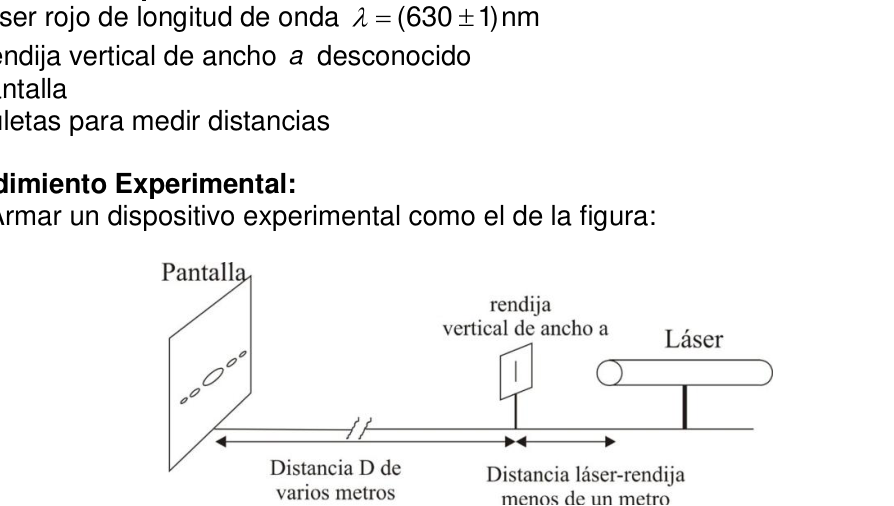
Topic: Wave Optics Metodi: Interference & Diffraction Analysis, Experimental Data Analysis Competenze: Physical Reasoning, Experimental Data Analysis Objects: Slit, Screen Fonte: Testo (PDF) — p.5
PE43. Colegio Paolo Apóstol1 - Colegio del Sol2
Erba Buena1 - San Miguel2, Tucumán.
Difrazione per una spaccatura. La diffrazione è un fenomeno caratteristico delle onde, che è osservabile quando una L’onda passa attraverso un ostacolo le cui dimensioni sono simili alla lunghezza della
- Non è così. L’onda, attraversando la ranura, si apre e invece di seguire la direzione del raggio In questo caso, si formano un gran numero di raggi che si aprono in un fan. La diffrazione avviene. in ogni tipo di ondata, da onde sonore, onde sulla superficie di un fluido e onde elettromagnetici come la luce visibile e le onde radio. Il caso più semplice è quello della “difrazione di Fraunhofer”, in cui il L’ostacolo è una rancella lunga e stretta, in modo da poter ignorare gli effetti di Le estremità. Supponiamo che le onde incidenti siano normali sul piano della fessura, e che l’osservatore si trova a una grande distanza rispetto alla larghezza di quella stessa. Quando la luce laser attraversa la fessura stretta, e l’immagine viene raccolta su uno schermo, si presenta una figura di diffrazione (chiamata pattern di diffrazione) formata da una zona centrale fortemente illuminata chiamata massima centrale. Questo modello è altamente simmetrico a sinistra e a destra della massima centrale. Le aree luminose costituiscono massimi secondari separati tra loro da zone scure o da minimi
- Non sono nulla. L’intensità dei massimi secondari diminuisce con l’allontanamento. finiscono per perdere tanta intensità che non possono.
- Differentiamoci. Si è dimostrato che la condizione di intensità zero per la diffrazione della luce monocromatica per una spazia di larghezza a è: Min
1, 2, 3,… senza m m a
Essendo il “ordine” di minimo nulla da considerare. Nella maggior parte dei casi, quando si studia la Difrazione di Fraunhofer, si osserva il modello di interferenza su uno schermo a una distanza D molto lontana dalla spazia. L’angolo in cui arrivano i raggi che interferiscono con un punto a una distanza e La sua parte più alta, la più alta, è abbastanza piccola da poter avvicinare il seno per il suo tangente, con cui le posizioni Min y sullo schermo per intensità zero sono:
OAF 2015 - 171 Min Min Min senza
y y m D m a a m D a
Obiettivo: Determinare la larghezza della spaccatura da un esperimento di diffrazione fraunhofer per singolo spazzola
I mezzi disponibili:
-
Laser rosso a lunghezza d’onda (630 1)nm
-
Corrispondenza verticale da latitudine a latitudine sconosciuta
-
Scatto .
-
Roulette per misurare le distanze
Procedura sperimentale:
-
Armarsi un dispositivo sperimentale come quello riportato in figura:
-
Misurare le posizioni dei minimi di intensità Min y per una distanza D Conosciuto.
-
Grafica della relazione min(m) y e determinare, a partire dalla sua pendenza, il valore del La nostra politica è molto più ampia.
-
Ripeti per altre due distanze D.
-
Discutere dei risultati
Topic: Wave Optics Metodi: Interference & Diffraction Analysis, Experimental Data Analysis Competenze: Physical Reasoning, Experimental Data Analysis Objects: Slit, Screen Fonte: Testo (PDF) — p.5
PE43. The school of the Apostle Paul1 - The School of the Sun2
We’re going to get a new one.
Difference by a crack. Diffraction is a characteristic phenomenon of waves, which is observable when a wave is The wave passes through an obstacle whose dimensions are similar to the length of the wave. I’m going to go. The wave, as it crosses the slot, opens up and instead of following the direction of the beam incident, a large number of rays form opening in the fan. Diffraction occurs. In all kinds of waves, from sound waves, waves on the surface of a fluid and waves electromagnetic fields such as visible light and radio waves. The simplest case is the so-called Fraunhofer’s Diffraction, in which the The obstacle is a narrow, long gap so we can ignore the effects of the extremes. Suppose the incident waves are normal to the plane of the cleft, and The observer is at a great distance from the width. of the same. When the laser light goes through the narrow gap, and the image is picked up on a screen, A diffraction figure (called a diffraction pattern) is shown, formed by a zone. Highly illuminated central called the central maximum. This pattern is highly symmetrical to the left and right of the central maximum. The light areas constitute secondary maximum which are separated from each other by dark or minimum zones the value of the goods. The intensity of secondary maxima decreases as we move away. They’re going to lose so much intensity they can’t. to be more distinguished. It was proved that the zero intensity condition for light diffraction monochromatic by a cleft of width a is: Min
1, 2, 3,… without m m a
Being the “order” of minimum zero to consider. In most cases, when we study Fraunhofer’s Diffraction, we observe The interference pattern on a screen at a distance D very far from the cleft. The angle at which the rays that are going to interfere with a point at a distance reach and From the central maximum, it’s small enough to be able to approach its breast by its tangent, with which positions Min y on the screen for zero intensity are:
The Commission shall adopt delegated acts in accordance with Article 21 of this Regulation. Min Min Min without
y y m D m a a m D a
The objective: Determine the width of the crack from a fraunhofer diffraction experiment by single slot
The following instruments are available:
-
Red laser of wavelength (630 1)nm
-
Vertical curve from width to unknown
-
Screen .
-
Roulette to measure distances
The experimental procedure:
-
Arming an experimental device like the one in the figure:
-
Measuring positions of the minimum intensity Min y for a distance D I know you.
-
Chart the relationship Minus y and determine, from its slope, the value of the I am not sure what the Commission is thinking.
-
Repeat for another 2 D distances .
-
Discuss results
Topic: Wave Optics Metodi: Interference & Diffraction Analysis, Experimental Data Analysis Competenze: Physical Reasoning, Experimental Data Analysis Objects: Slit, Screen Fonte: Testo (PDF) — p.5
PE44. Escuela Nacional Ernesto Sábato
Colegio Sagrada Familia - Colegio San Ignacio
Tandil, Buenos Aires.
Objetivo: Estimar la magnitud de las fuerzas producidas por el impacto de cuerpos en movimiento.
172 - OAF 2015 Breve descripción Es sabido que muchos cuerpos caen al suelo desde una determinada altura se deforman y, con frecuencia se rompen, porque en el choque se llegan a producir fuerzas muy grandes. La magnitud de este tipo de fuerzas se puede estimar. Será necesario contar con una bola de plastilina de aproximadamente 1 cm de radio. Se deberá ubicar a una altura h cercana al techo y luego soltarla. La bolita cae, toca el suelo con una velocidad v0 y, transcurrido un tiempo muy corto, acaba por detenerse un poco aplastada. Midiendo los diámetros de la bolita antes y después del choque es posible conocer el valor d de deformación de la misma.
Elementos que pueden resultar de utilidad:
- Bolas de plastilina.
- Regla para medir el diámetro de las bolas. (si se dispone de un calibre, mejor)
- Cinta métrica para medir la altura de la cual se deja caer la bola.
Consigna
a) Dejar caer la bola de plastilina desde una altura h previamente especificada varias
veces midiendo el diámetro de la bola deformada para cada una.
b) Calcular el valor promedio del diámetro de la bola deformada y luego hallar la el
parámetro d.
c) Calcular la velocidad de la bola antes de tocar el piso.
d) Aproximar la aceleración de la bola en el proceso de deformación como constante y
calcularlo.
e) Hallar el tiempo que emplea la bola en recorrer la distancia d.
f) Calcular el módulo de la fuerza que deforma la bola y expresarla respecto del peso
de la misma.
Topic: Newtonian Mechanics, Conservation of Energy Metodi: Kinematic Equations, Experimental Data Analysis Competenze: Physical Reasoning, Experimental Data Analysis Objects: Ball Fonte: Testo (PDF) — p.5
PE44. Scuola nazionale Ernesto sabato
Colegio Sagrada Familia - Colegio San Ignacio
Tandil, Buenos Aires.
Obiettivo: Estimare l’entità delle forze prodotte dall’impatto di corpi in movimento.
172 - OAF 2015 Breve descrizione È noto che molti corpi cadono a terra da … a una certa altezza si deformano e, con Si rompono spesso, perché nel colpo si che producono forze molto grandi. La grandezza di questo tipo di forze si possono stimare. Sarà necessario disporre di una palla di plastilina di circa 1 cm di raggio. Dovrebbe essere localizzato. a un’altezza h vicino al tetto e poi lasciarla andare. La La pallina cade, tocca il terreno a velocità v0 e, Dopo un breve periodo di tempo, finisce per
- Fermarsi. un
- Pochi . schiacciato. Misurando Le diametri della pallina prima e dopo l’impatto È possibile conoscere il valore d di deformazione della
- Sì, è lei stessa.
Elementi che possono risultare utili:
- Bocce di plastilina.
- Regola per misurare il diametro delle palle. (se si dispone di un calibro, meglio)
- Cantezza metrica per misurare l’altezza da cui si lascia cadere la palla.
Consigna a) Lasciare cadere la palla di plastilina da una altezza h pre-specificata diverse volte misurando il diametro della palla distorta per ciascuna. b) Calcolare il valore medio del diametro della sfera distorta e poi trovare il parametro d. c) Calcolare la velocità della palla prima di toccare il pavimento. d) Approcciare l’accelerazione della palla nel processo di deformazione come costante e Calcolare. e) Indicare il tempo impiegato dalla palla per percorrere la distanza d. f) Calcolare il modulo della forza che deforma la palla e esprimerla rispetto al peso di quella stessa.
Topic: Newtonian Mechanics, Conservation of Energy Metodi: Kinematic Equations, Experimental Data Analysis Competenze: Physical Reasoning, Experimental Data Analysis Objects: Ball Fonte: Testo (PDF) — p.5
PE44. Ernesto National School Saturday
The Holy Family College - St. Ignatius College
I’m going to Tandil, Buenos Aires.
The objective: Estimate the magnitude of the forces produced by the impact of moving bodies.
The Commission shall adopt delegated acts in accordance with Article 21 of Regulation (EU) No 182/2011 and with Article 21 of Regulation (EU) No 182/2011 of the European Parliament and of the Council. Brief description It is known that many bodies fall to the ground since a certain height they deform and, with They often break up because in the crash they are They come to produce very large forces. The magnitude of this kind of force can be estimated. You will need a plastic ball of approximately 1 cm in radius. It must be located to a height h near the ceiling and then release it. La ball falls, hits the ground at a speed of v0 and, After a very short time, it ends up being Stop it . un Very little . It’s crushed. Measuring The Ball diameters before and after impact It is possible to know the deformation value of the I’m not.
Elements that may be useful:
- Balls of plastic.
- A rule for measuring the diameter of the balls. (If a caliber is available, better)
- Metric tape to measure the height from which the ball is dropped.
I ‘m giving it away . (a) Drop the plasticine ball from a previously specified height h several times by measuring the diameter of the warped ball for each. (b) Calculate the average value of the diameter of the deformed ball and then find the the parameters d. (c) Calculate the speed of the ball before touching the floor. (d) Approximate the acceleration of the ball in the deformation process as constant and Calculate it. (e) Find the time the ball takes to travel distance d. (f) Calculate the force modulus of the deforming ball and express it with respect to weight of the same.
Topic: Newtonian Mechanics, Conservation of Energy Metodi: Kinematic Equations, Experimental Data Analysis Competenze: Physical Reasoning, Experimental Data Analysis Objects: Ball Fonte: Testo (PDF) — p.5
PE45. Instituto Eduardo L. Holmberg
Quilmes, Buenos Aires.
Distancia focal en lentes convergentes. Introducción. Una lente es un objeto transparente que altera la forma de un frente de ondas que pasa a través de él. Las lentes generalmente se construyen de vidrio y se les da forma de modo que la luz refractada forme imágenes de diferentes características. Una lente convergente es la que refracta y hace converger la luz paralela en un punto focal situado más allá de la propia lente.
Una lente se considera ―delgada‖ si su espesor es pequeño comparado con sus otras dimensiones. La formación de imágenes por lentes delgadas es una función de la longitud focal f.
OAF 2015 - 173 Puesto que los rayos de luz son reversibles, una fuente de luz que se coloque en cualquier foco de la lente convergente resulta en un haz de luz paralelo. La longitud focal de una lente depende del índice de refracción n del material con el que este fabricada. También está determinado por los radios de curvatura R1 y R2 de sus superficies. 1 𝑓= 𝑛−1 1 𝑅1
- 1 𝑅2
La ecuación anterior es conocida como la ecuación del fabricante de lentes. Para entender cómo se forman las imágenes por medio de lentes hay que presentar ahora métodos de trazado de rayos.
Rayo 1: Es un rayo paralelo al eje que se refracta pasando por el segundo punto focal F2 de una lente convergente. Rayo 2: Un rayo que pasa por el primer punto focal F1 de una lente convergente se refracta paralelamente al eje. Rayo 3: Un rayo que pasa por el centro geométrico de una lente no se desvía. La intersección de cualquiera de estos rayos (o sus extensiones) que provienen de un objeto puntual representa la imagen de ese punto. Las características, el tamaño y la ubicación de las imágenes pueden también determinarse analíticamente a partir de la ecuación de las lentes. Esta importante relación se puede deducir aplicando la geometría plana. La ecuación de las lentes puede escribirse: 1 𝑓= 1 𝑝+ 1 𝑞 Donde p = distancia al objeto
q = distancia a la imagen
f = distancia focal de la lente
Objetivo El objetivo de esta investigación es determinar la distancia focal de una lente convergente, con la que se formarán imágenes de un objeto luminoso.
Elementos disponibles
-
Pié universal.
-
Grapa con nuez.
-
Lente convergente.
-
Regla.
-
Vela.
-
Pantalla.
174 - OAF 2015 Procedimiento
- Disponer la vela y la pantalla a ambos lados de la lente.
- Regular las distancias tanto del objeto (p) como de la pantalla donde se formará la imagen (q) hasta que la imagen se vea nítida.
- Registrar los valores de p y de q en una tabla incluyendo las incertidumbres de cada medida.
- Cambiar la posición del objeto y enfocar la nueva imagen. Registrar los nuevos valores de p y q.
- Repetir este procedimiento hasta obtener diez mediciones.
- Obtener en cada caso el valor de la distancia focal y calcular un promedio. El resultado final deberá expresarse con su correspondiente incertidumbre.
Se prefiere que la determinación de la distancia focal f sea a través de un gráfico, donde se representan adecuadamente las variables y el valor de f surge de la pendiente de la recta hallada.
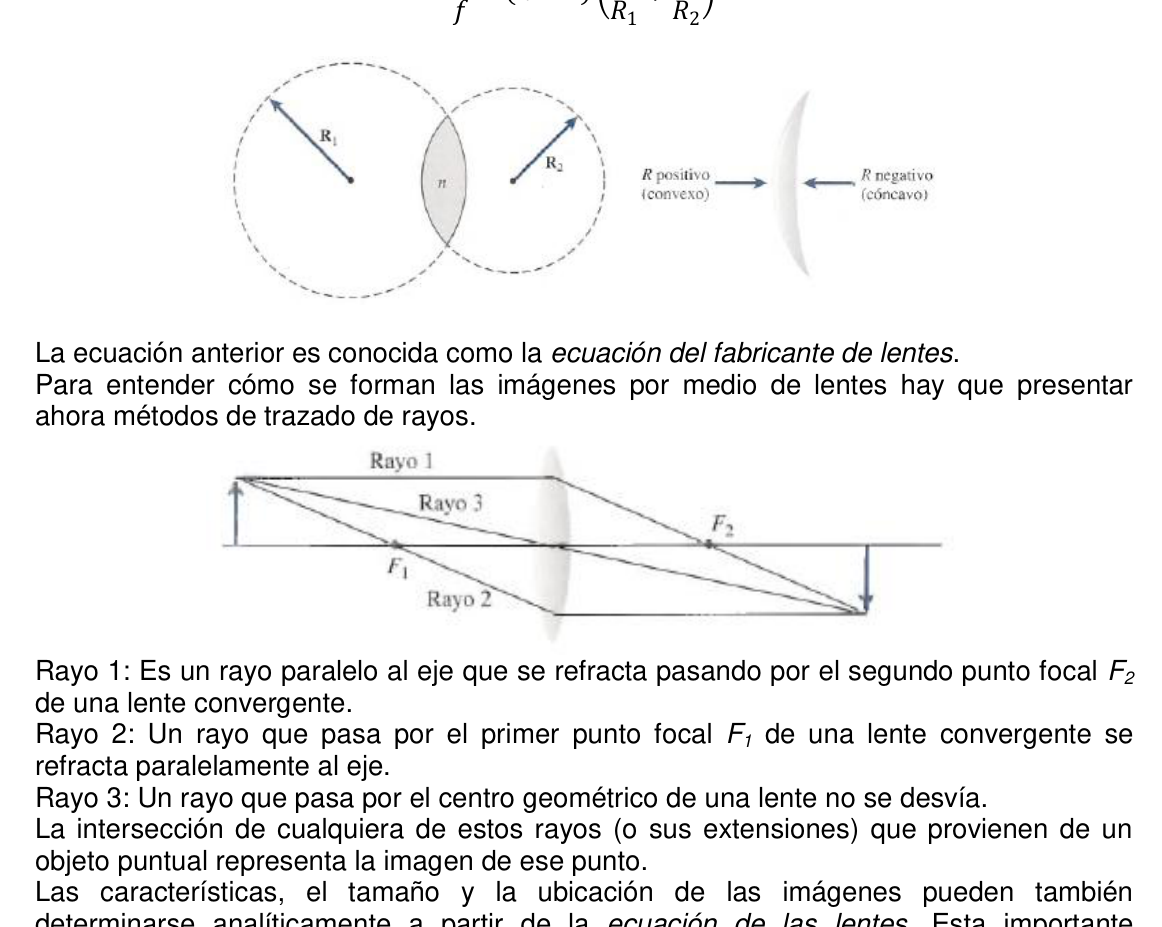
Topic: Geometric Optics Metodi: Thin Lens & Mirror Equation, Experimental Data Analysis Competenze: Physical Reasoning, Experimental Data Analysis Objects: Lens, Screen Fonte: Testo (PDF) — p.5
PE45. Istituto Eduardo L. Holmberg
Quilmes, Buenos Aires.
Distanza focale in lenti convergenti. Introduzione. Un lente è un oggetto trasparente che altera la forma di un fronte d’onda che passa a attraverso di lui. I lenti sono generalmente costruiti in vetro e si formano in modo che che la luce refratta forma immagini di diverse caratteristiche. Una lente convergente è quella che si refracta e converge la luce parallela in un punto. focale situato oltre la lente stessa.
Una lente è considerata “sottile” se il suo spessore è piccolo rispetto alle altre. dimensioni. La formazione di immagini da lenti sottili è una funzione della lunghezza focale f.
OAF 2015 - 173 Poiché i raggi di luce sono reversibili, una fonte di luce che viene posta in Qualsiasi focolamento della lente convergente produce un fascio di luce parallelo. La lunghezza focale di un obiettivo dipende dall’indice di refraczione n del materiale con cui si Questa è fatta. È determinato anche dai radii di curvatura R1 e R2 dei suoi superfici. 1 𝑓= 𝑛−1 1 𝑅1
- 1 𝑅2
L’equazione precedente è conosciuta come l’equazione del produttore di occhiali. Per capire come si formano le immagini attraverso lenti, bisogna presentare. ora metodi di tracciamento dei raggi.
Il raggio 1: è un raggio parallelo all’asse che si refracta passando per il secondo punto focale F2. di una lente convergente. Il raggio 2: un raggio che passa attraverso il primo punto focale F1 di un obiettivo convergente si si rifracca parallelo all’asse. Raggio 3: Un raggio che passa attraverso il centro geometrico di una lente non si allontana. L’intersezione di uno di questi raggi (o di loro estensioni) provenienti da un l’oggetto punteggiato rappresenta l’immagine di quel punto. Le caratteristiche, la dimensione e la posizione delle immagini possono anche La misurazione è determinata analiticamente dall’equazione dei lenti. È importante. La relazione può essere dedotta applicando la geometria piatta. L’equazione dei lenti può scrivere: 1 𝑓= 1 𝑝+ 1 𝑞 Dove p = distanza dall’oggetto
q = distanza dall’immagine
f = distanza focale della lente
Obiettivo L’obiettivo di questa ricerca è quello di determinare la distanza focale di un lente convergente, con la quale si formano immagini di un oggetto luminoso.
Elementi disponibili
- Piede universale.
- Aggancio con le noci.
- Lenti convergenti.
- Regola.
- Vella.
- Lo schermo.
174 - OAF 2015 Procedura
- Disporre la candela e lo schermo su entrambi i lati della lente.
- Regola le distanze sia dall’oggetto (p) che dallo schermo dove si formerà la immagine (q) fino a quando l’immagine non è chiarissima.
- Registrare i valori di p e di q in una tabella inclusi gli incertezze di ogni misura.
- Cambiare la posizione dell’oggetto e focalizzare la nuova immagine. Registrare i nuovi Valori di p e q.
- Ripetere questa procedura fino a ottenere dieci misure.
- Ottenere in ogni caso il valore della distanza focale e calcolare una media. El Il risultato finale deve essere espresso con la relativa incertezza.
È preferibile che la determinazione della distanza focale f sia attraverso un grafico, dove Le variabili e il valore di f sorgono da un’inclinazione di
- Un’altra strada.
Topic: Geometric Optics Metodi: Thin Lens & Mirror Equation, Experimental Data Analysis Competenze: Physical Reasoning, Experimental Data Analysis Objects: Lens, Screen Fonte: Testo (PDF) — p.5
PE45. The Institute Eduardo L. Holmberg
Quilmes, Buenos Aires is where I am.
Focal distance in convergent lenses. I’ll give you an introduction. A lens is a transparent object that alters the shape of a wave front passing through the lens. through him. Lenses are usually made of glass and shaped in such a way that they are The refracted light forms images of different characteristics. A convergent lens is one that refracts and converges parallel light at a point. focal length beyond the lens itself.
A lens is considered thin if its thickness is small compared to its other lenses. dimensions. The formation of images by thin lenses is a function of the focal length f.
The following points shall be added: Since light rays are reversible, a light source that is placed in Any focusing of the converging lens results in a parallel beam of light. The focal length of a lens depends on the refractive index n of the material with which it is This is manufactured. It is also determined by the radii of curvature R1 and R2 of its the surface. 1 𝑓= 𝑛−1 1 𝑅1
- 1 𝑅2
The above equation is known as the lens manufacturer’s equation. To understand how images are formed by means of lenses, you have to present them. Now, lightning tracing methods.
Ray 1: It is a beam parallel to the axis that is refracted passing through the second focal point F2. of a convergent lens. Ray 2: A ray passing through the first F1 focal point of a convergent lens is The vehicle is designed to be capable of operating at a speed of less than 10 km/h. Ray 3: A ray passing through the geometric center of a lens does not deviate. The intersection of any of these rays (or their extensions) coming from a The point object represents the image of that point. The characteristics, size and location of the images can also be The results of the analysis are based on the lens equation. This is important . The relationship can be deduced by applying flat geometry. The lens equation can Write: 1 𝑓= 1 𝑝+ 1 𝑞 Where p = distance to the object
q = distance to the image
f = focal length of the lens
The objective The purpose of this research is to determine the focal length of a lens convergent, with which images of a luminous object will be formed.
Available items
- Universal foot.
- It’s cluttered with nuts.
- Converging lens.
- It’s a rule.
- The sail.
- The screen.
The Commission shall adopt delegated acts in accordance with Article 21 of Regulation (EU) No 182/2011.’ The procedure
- Place the candle and the screen on both sides of the lens.
- Adjust the distances from both the object (p) and the screen where the image (q) until the image is clear.
- Record the values of p and q in a table including the uncertainties of every measure.
- Change the position of the object and focus the new image. Register the new ones values of p and q.
- Repeat this procedure until you get ten measurements.
- Get the focal length value in each case and calculate an average. El The final result must be expressed with its corresponding uncertainty.
It is preferable that the determination of the focal length f is through a graph, where The variables and the value of f arises from the slope of the straight found.
Topic: Geometric Optics Metodi: Thin Lens & Mirror Equation, Experimental Data Analysis Competenze: Physical Reasoning, Experimental Data Analysis Objects: Lens, Screen Fonte: Testo (PDF) — p.5
PE46. Instituto de Enseñanza San Jorge - Colegio La Asunción
Escuela Normal Superior Gral. Manuel Belgrano
Colegio Hermano Hermas de Bruijn - Colegio San Francisco de Asís
Ciudad de Santiago del Estero.
Objetivo:
Determinar el coeficiente de rozamiento estático entre dos superficies.
Lista de Materiales:
- Regla
- monedas.
- Fichas de plástico.
- Bandas elásticas.
- Sorbete
Descripción:
―La fuerza de rozamiento no es más que la componente tangencial de la fuerza de
contacto entre dos superficies. Su origen es electromagnético. En efecto, podemos
pensar que los átomos superficiales de ambos lados tienen electrones que se encuentran
anclados a los átomos y que se repelen entre sí, prácticamente de forma electrostática‖2.
La fuerza de rozamiento o fricción entre dos cuerpos aparece aún sin que exista
movimiento relativo entre ellos. Cuando así sucede actúa la fuerza de rozamiento estático
cuyo valor máximo depende de la fuerza Normal y de una constante relacionada con las
superficies.
𝑓𝑟= 𝜇𝑁 (1)
Dado que el objeto esta en reposo, a partir del diagrama de fuerzas y utilizando las leyes de Newton se encuentran las siguientes ecuaciones: 𝐹𝑦= 0 , 𝑁−𝑚𝑔cos𝜃= 0 , 𝑁= 𝑚𝑔cos 𝜃 (2) 𝐹𝑥= 0 , 𝑚𝑔sin𝜃− 𝑓𝑠= 0 , 𝑚𝑔sin𝜃= 𝑓𝑠 (3)
Sustituyendo la ecuación (1) en la ecuación (3) se obtiene:
𝑚𝑔sin𝜃= 𝜇𝑠𝑁 (4)
Sustituyendo la ecuación (2) en la ecuación (4) se obtiene:
2 Predicción, Experimentación y Simulación en la Enseñanza de la Fuerza de Rozamiento, Herson Obdulio Hincapié Martinez, Universidad Nacional de Colombia Facultad de Ciencias Bogotá, Colombia 2011.
OAF 2015 - 175 𝑚𝑔sin 𝜃= 𝜇𝑠𝑚𝑔 cos 𝜃
sin𝜃= 𝜇𝑠cos𝜃
sin 𝜃 cos 𝜃= 𝜇𝑠
tan 𝜃= 𝜇𝑠 (5)
Por lo tanto, el coeficiente de rozamiento estático es igual a la tangente del ángulo del plano inclinado, en el que el cuerpo se mantiene en equilibrio sin deslizar; ello permite calcular el coeficiente de rozamiento estático, simplemente colocando un cuerpo sobre un plano inclinado y aumentando el ángulo de inclinación progresivamente hasta observar el momento en el que el cuerpo comienza a deslizarse, la tangente de este ángulo es el coeficiente de rozamiento.
Figura 1. Plano inclinado para calcular el coeficiente de rozamiento estático3.
De la figura 1, se puede se puede expresar que: tan 𝜃= 𝑦 𝑥 y como tan 𝜃= 𝜇𝑠 , entonces 𝜇𝑠= 𝑦 𝑥
Es decir que el coeficiente de rozamiento estático (𝜇𝑠) es igual al cociente entre la altura (y) y la distancia horizontal (x) del cuerpo en el momento en que este empieza a deslizarse.
Procedimiento:
- Realiza el montaje de la experiencia empleando la regla como rampa.
- Coloca una moneda sobre la rampa y elévala suavemente, mide la altura y la distancia horizontal con la cual el bloque empieza a deslizarse. Vuelca los datos en una tabla.
- Repite el paso 2) al menos 10 veces, modificando la posición inicial de la moneda sobre la regla.
- Calcula el coeficiente de rozamiento estático entre la regla plástica y la moneda a partir de los datos de la tabla.
- Realiza otras
Requerimientos: a) Realiza el montaje de la experiencia en forma correcta, prolija y ordenada minimizando las posibles causas de errores. b) Efectúa una tabla de mediciones incluyendo: Altura (y), distancia horizontal (x), cociente Y/X y coeficiente de rozamiento estático. c) Determina el coeficiente de rozamiento estático entre la regla y la moneda con su correspondiente incerteza.
3 Fuente: LEYES DE NEWTON, CÁLCULO DEL COEFICIENTE DE ROZAMIENTO ESTÁTICO Y DINÁMICO. Víctor Agrono, Diego Alegría, Christian Marín y Carlos Paramo. Maestría en Enseñanza de las Ciencias Naturales y Exactas. Universidad Nacional de Colombia. Palmira. Colombia
176 - OAF 2015 d) Analiza y detalla las fuentes de error que tienen mayor incidencia en el resultado obtenido.
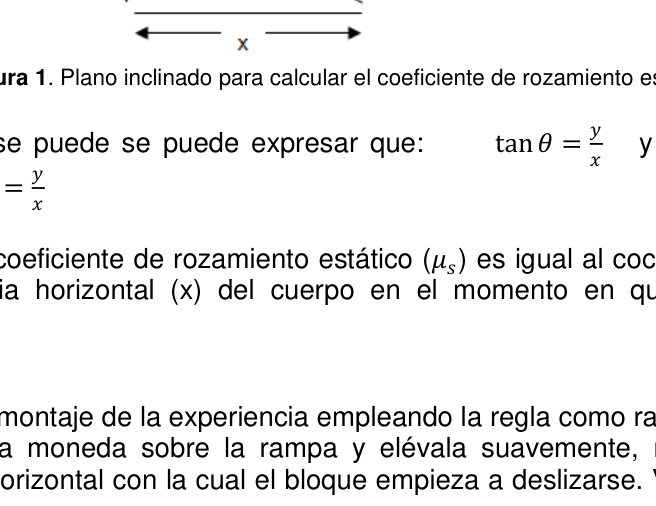
Topic: Newtonian Mechanics Metodi: Free-Body Diagram, Experimental Data Analysis Competenze: Physical Reasoning, Experimental Data Analysis Objects: Block, Inclined Plane Fonte: Testo (PDF) — p.5
PE46. Istituto di istruzione San Jorge - Colegio La Asunción
Scuola Normale Superiore Gral. Manuel Belgrano
Collegio Fratello Hermas di Bruijn - Collegio San Francesco di Assisi
Città di Santiago del Estero.
Obiettivo: Determinare il coefficiente di ruggine statico tra due superfici.
Lista dei materiali:
- Regola .
- le monete.
- Fichette di plastica.
- Cinture elastiche.
- Sorba .
Descrizione:
- La forza di rottura è solo la componente tangenziale della forza di contatto tra due superfici. La sua origine è elettromagnetica. In effetti, possiamo pensare che gli atomi superficiali su entrambi i lati abbiano elettroni che si trovano che si rivolgono tra loro, praticamente in modo elettrostatico”. La forza di rottura o di attrito tra due corpi appare anche senza esistere . il movimento relativo tra loro. Quando questo accade, agisce la forza di ruggine statica. il cui valore massimo dipende dalla forza normale e da una costante correlata alle superfici. 𝑓𝑟= 𝜇𝑁 (1)
Dato che l’oggetto è a riposo, a partire dal diagramma delle forze e utilizzando le leggi di Newton si trovano le seguenti equazioni: N−mgcosθ= 0 , N= mgcos θ (2) Fx=0 , mgsinθ− fs=0 , mgsinθ= fs (3)
Rimpiazzando l’equazione (1) nell’equazione (3) si ottiene:
Maggiore di calcolo
Substituendo l’equazione (2) nell’equazione (4) si ottiene:
2 Prediczione, sperimentazione e simulazione nell’insegnamento della forza di rottura, Herson Obdulio Hincapié Martinez, Università Nazionale della Colombia Facoltà di Scienze Bogotá, Colombia 2011.
OAF 2015 - 175 mgsin θ= μsmg cos θ
non è più di 1
senza θ cos θ= μs
di θ= μs (5)
Quindi il coefficiente di rottura statica è uguale alla tangenza dell’angolo di piano inclinato, in cui il corpo si mantiene in equilibrio senza scivolare; questo permette Calcolare il coefficiente di rottura statica semplicemente posizionando un corpo su un Il piano inclinato e aumentando l’angolo di inclinazione progressivamente fino a osservare il Il momento in cui il corpo inizia a scivolare, la tangenza di questo angolo è il coefficiente di rottura.
Figura 1. Piano inclinato per calcolare il coefficiente di rotturazione statica3.
Dalla figura 1, si può esprimere che: 𝑦 x e come θ= μs , Quindi μs= 𝑦 𝑥
Il coefficiente di rottura statica (μs) è uguale al coefficiente tra l’altezza (y) e la distanza orizzontale (x) del corpo al momento in cui esso inizia a scivolare.
Procedura:
- Realizza l’assemblaggio dell’esperienza utilizzando la regola come rampa.
- Metti una moneta sul rampo e levalo con delicatezza, misura l’altezza e la Distanza orizzontale con cui il blocco inizia a scivolare. Rimuovi i dati in una tavola.
- Ripetere il passaggio 2) almeno 10 volte, modificando la posizione iniziale della moneta sulla regola.
- Calcola il coefficiente di rottura statica tra la rubrica di plastica e la moneta a basandosi sui dati della tabella.
- Realizza altre
Requisiti: a) realizza l’assemblaggio dell’esperienza in modo corretto, prolifico e ordinato minimizzando le possibili cause di errori. b) Esegue una tabella di misurazioni che include: Altura (y), distanza orizzontale (x), il coefficiente Y/X e il coefficiente di rottura statica. (c) Determina il coefficiente di rottura statica tra la regola e la moneta con il suo La Commissione ha adottato una decisione che non è stata adottata.
3 Fonte: Leggi di Newton, Calcolo del Coefficiente di Rosiamento Statico e DINAMICO. Victor Agrono, Diego Alegría, Christian Marín e Carlos Paramo. Master in Educazione delle Scienze naturali e esatte. Università Nazionale della Colombia. Palmira. Colombia
176 - OAF 2015 d) analizza e descrive le fonti di errore che hanno maggiore incidenza sul risultato ottenuto.
Topic: Newtonian Mechanics Metodi: Free-Body Diagram, Experimental Data Analysis Competenze: Physical Reasoning, Experimental Data Analysis Objects: Block, Inclined Plane Fonte: Testo (PDF) — p.5
PE46. The school is located in the city of San Jorge.
Gral High School. Manuel Belgrano
Brother Brother School of Bruijn - College of St. Francis of Assisi
The city of Santiago del Estero.
The objective: Determine the static friction coefficient between two surfaces.
List of Materials:
- Rule .
- coins.
- Plastic sheets.
- Elastic bands.
- You can drink .
The following is the list of the categories of products:
- The friction force is only the tangential component of the force of the contact between two surfaces. Its origin is electromagnetic. In fact, we can. Think that the surface atoms on both sides have electrons that are located. Anchored to atoms and repelled to each other, practically electrostatically. The force of friction between two bodies appears even if it doesn ‘t exist . relative movement between them. When this happens , the force of static friction acts . The maximum value of the two is the normal force and the constant related to the the surface. 𝑓𝑟= 𝜇𝑁 (1)
Since the object is at rest, from the force diagram and using the laws Newton’s equations are as follows: The following is the list of the following: Fx = 0 , mgsinθ− fs = 0 , mgsinθ= fs (3)
Substituting equation (1) in equation (3) results in:
The following is the list of the following:
Substituting equation (2) in equation (4) results in:
2 Prediction, experimentation and simulation in the teaching of the force of friction, Herson Obdulio Hincapié Martinez, National University of Colombia Faculty of Sciences Bogotá, Colombia 2011.
The Commission shall adopt delegated acts in accordance with Article 21 of this Regulation. The following is the list of the types of products:
The following is the list of the following:
without θ Cos θ= μs
as θ= μs (5)
Therefore, the static friction coefficient is equal to the tangent of the angle of the The body is in a steady, unshifted balance, allowing for a steady, steady, steady, steady, steady, steady, steady, steady, steady, steady, steady, steady, steady, steady, steady, steady, steady, steady, steady, steady, steady, steady, steady, steady, steady, steady, steady, steady, steady, steady, steady, steady, steady, steady, steady, steady, steady, steady, steady, steady, steady, steady, steady, steady, steady, steady, steady, steady, steady, steady, steady, steady, steady, steady, steady, steady, steady, steady, steady, steady, steady, steady, steady, steady, steady, steady, steady, steady, steady, and steady, steady, steady, steady, steady, steady, steady, steady, steady, steady, steady, steady, steady, steady, steady, steady, and steady, steady, steady, steady, steady, steady, steady, steady, steady, steady, steady, and steady, steady, steady, steady, steady, steady, steady, steady, steady, steady, steady, and steady, steady, steady, steady, and steady, steady, steady, steady, and steady, steady, and steady, and steady, and steady, and steady, and steady, and steady, and steady, and steady, and steady, and steady, and steady, and steady, to the. Calculate the static friction coefficient by simply placing a body on a slope and increasing the angle of inclination gradually until the observed The moment the body starts to slide, the tangent of this angle is the the coefficient of friction.
Figure 1 is shown. The slope plane for calculating the static friction coefficient3.
From figure 1, it can be expressed as: 𝑦 x and as θ= μs , Then μs is equal to 𝑦 𝑥
That is, the static friction coefficient (μs) is equal to the ratio between heights. (y) and the horizontal distance (x) of the body at the time it starts to I’m going to slip.
The procedure:
- Install the experience using the rule as a ramp.
- Place a coin on the ramp and lift it gently, measure the height and the the horizontal distance at which the block begins to slide. Turn the data in a board.
- Repeat step 2) at least 10 times, changing the initial position of the currency about the rule.
- Calculate the static friction coefficient between the plastic rule and the coin from the data in the table.
- Do other things
Requirements: (a) It assumes the experience in a correct, prolific and orderly manner. The Commission shall adopt implementing acts in accordance with Article 21 of the Treaty on the Functioning of the European Union. (b) Use a measurement table including: Height (y), horizontal distance (x), the Y/X coefficient and the static friction coefficient. (c) Determines the static friction coefficient between the rule and the currency with its The Commission has not yet adopted a proposal.
3 Source: Newton’s laws, calculation of the coefficient of static flow and It’s very dynamic. Victor Agrono, Diego Alegría, Christian Marín and Carlos Paramo are also on the list. Master’s degree in Teaching from the Natural and exact sciences. National University of Colombia. Palm trees. Colombia
The Commission shall adopt delegated acts in accordance with Article 21 of this Regulation. (d) Analyze and detail the sources of error which have the greatest impact on the result obtained.
Topic: Newtonian Mechanics Metodi: Free-Body Diagram, Experimental Data Analysis Competenze: Physical Reasoning, Experimental Data Analysis Objects: Block, Inclined Plane Fonte: Testo (PDF) — p.5
PE47. Instituto de Enseñanza San Jorge - Colegio La Asunción
Escuela Normal Superior Gral. Manuel Belgrano
Colegio Hermano Hermas de Bruijn - Colegio San Francisco de Asís
Ciudad de Santiago del Estero.
Objetivo:
Medir el diámetro de un cabello humano con una regla.
Lista de Materiales:
- 1 cabello humano
- 1 Regla
Descripción:
Cada cabello de la cabeza o cuerpo tiene una raíz en forma de bulbo bajo la piel y el tallo
que es la parte que sale de la piel. Si cortamos un cabello cerca de la raíz y lo vemos al
microscopio, se puede identificar una forma específica, o redonda o plana. Si la forma es
redonda, significa que el cabello es liso; si es plano, significa que el cabello crece en
diferentes proporciones en cada parte, haciéndolo ondulado o rizado.
Para realizar esta experiencia, deberemos utilizar preferentemente
cabello liso, pues su forma aproximada es cilíndrica de diámetro d. Al
rodar sobre una superficie N vueltas, el cabello recorre una distancia
d
N
D
.
.
. Entonces, sabiendo el número de vueltas realizadas y su
recorrido en la superficie, se puede calcular su diámetro empleando la
expresión:
.
N
D
d
Datos curiosos:
- Una persona tiene de 120.000 a 150.000 cabellos en toda la cabeza, es decir, 250 cabellos en promedio por cm². Se pierden de 50 a 100 cabellos promedio cada día.
- Un cabello resiste 100 g, una cuerda hecha de 100 cabellos puede resistir un peso de 10 kg, si el cuero cabelludo fuera lo suficientemente fuerte una cabeza humana podría resistir 12 toneladas.
Procedimiento sugerido:
- Coloca un cabello entre sus dedos y gírelo, desplazando un dedo con respecto al otro. Si lo hiciste bien notarás que una de las puntas libres del cabello rota como las aspas de un ventilador. Este movimiento perceptible a la vista te permitirá contar el número de vueltas que rueda sobre tus dedos.
- Dibuja en tu dedo con un marcador marcas para el punto de inicio y fin de giro del cabello. Mide esa distancia y a partir de esta y el número de giros calcula el diámetro d.
- Repite el paso anterior 10 veces como mínimo y organiza los datos en una tabla.
- Determina el diámetro del cabello con su correspondiente incerteza.
Requerimientos: a) Efectúa una tabla de mediciones incluyendo: Número de vueltas, distancia recorrida y diámetro en forma clara. b) Determina el diámetro del cabello con su correspondiente incerteza. c) Analiza y detalla las fuentes de error que tienen mayor incidencia en el resultado obtenido.
OAF 2015 - 177
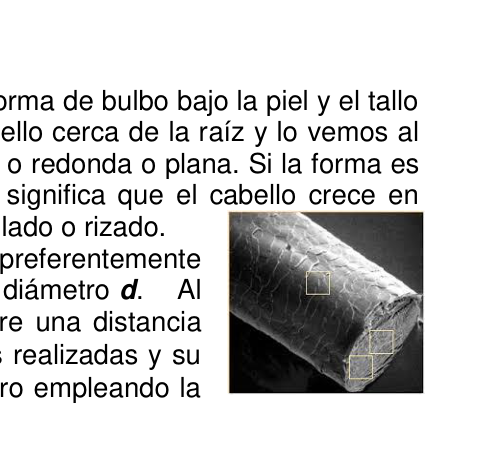
Topic: Order-of-Magnitude Estimation Metodi: Error Propagation, Experimental Data Analysis Competenze: Physical Reasoning, Experimental Data Analysis Objects: — Fonte: Testo (PDF) — p.5
PE47. Istituto di istruzione San Jorge - Colegio La Asunción
Scuola Normale Superiore Gral. Manuel Belgrano
Collegio Fratello Hermas di Bruijn - Collegio San Francesco di Assisi
Città di Santiago del Estero.
Obiettivo: Misurare il diametro di un capello umano con una regola.
Lista dei materiali:
- 1 capello umano .
- 1 regola
Descrizione: Ogni capello della testa o del corpo ha una radice a forma di bulbo sotto la pelle e il tallone che è la parte che esce dalla pelle. Se tagliamo un capello vicino alla radice e lo vediamo al Il microscopio può identificare una forma specifica, o rotonda o piatta. Se la forma è rotondo, significa che i capelli sono lisci; se sono piatti, significa che i capelli crescono in Le dimensioni sono diverse in ogni parte, rendendola ondulata o curva. Per fare questa esperienza, dovremmo preferibilmente utilizzare capelli lisci, poiché la sua forma approssimativa è cilindrica di diametro d. Al Rotare su una superficie N giri, il capello percorre una distanza d N D . . . Quindi, sapendo il numero di giri effettuati e il suo La superficie del terreno è diametralmente distante, il diametro può essere calcolato utilizzando espressione: . N D d
- Curiosi dati:
- Una persona ha tra 120.000 e 150.000 capelli su tutta la testa, cioè 250 capelli in media per cm2. Si perdono, in media, da 50 a 100 capelli al giorno.
- Un capello resiste 100 g, una corda fatta di 100 capelli può resistere a un peso di 10 kg, se il cuoio capelluto fosse abbastanza forte una testa umana potrebbe. resistere a 12 tonnellate.
Procedura suggerita:
- Mettere un capello tra le dita e girarlo, spostando un dito rispetto alla Un altro. Se l’hai fatto bene noterai che una delle puntate libere dei capelli è rotta come le le asciugamani di un ventilatore. Questo movimento visibile ti permetterà di contare il numero di giri che ruotano sulle dita.
- Disegna sul tuo dito un marcatore di marcature per il punto di inizio e fine del giro del
- I capelli. Misura quella distanza e da questa e il numero di giri calcola il diametro d.
- Ripetere il passaggio precedente almeno 10 volte e organizzare i dati in una tabella.
- Determina il diametro dei capelli con la relativa incertezza.
Requisiti: a) Eseguire una tabella di misurazioni che include: numero di giri, distanza Il percorso e il diametro in modo chiaro. b) Determina il diametro dei capelli con la relativa incertezza. c) analizza e descrive le fonti di errore che hanno maggiore incidenza sul risultato ottenuto.
OAF 2015 - 177
Topic: Order-of-Magnitude Estimation Metodi: Error Propagation, Experimental Data Analysis Competenze: Physical Reasoning, Experimental Data Analysis Objects: — Fonte: Testo (PDF) — p.5
PE47. The school is located in the city of San Jorge.
Gral High School. Manuel Belgrano
Brother Brother School of Bruijn - College of St. Francis of Assisi
The city of Santiago del Estero.
The objective: Measure the diameter of a human hair with a rule.
List of Materials:
- One human hair .
- 1 rule
The following is the list of the categories of products: Every hair on the head or body has a bulb-shaped root under the skin and stem. It’s the part that comes out of the skin. If we cut a hair close to the root and see it at the microscope, you can identify a specific shape, either round or flat. If the form is round, means the hair is smooth; if flat, means the hair grows in different proportions on each part, making it wavy or curly. To make this experience, we should preferably use smooth hair, as its approximate shape is cylindrical with a diameter of d. Al rolling over a surface N rounds, the hair travels a distance d N D . . . So, knowing the number of laps you’ve made and your The surface area can be calculated using the The expression: . N D d
Interesting facts:
- A person has 120,000 to 150,000 hairs all over his head, that’s 250 hair on average per cm2. You lose an average of 50 to 100 hairs every day.
- One hair can hold 100 g, a rope made of 100 hairs can hold a weight of 10 kg, if the scalp was strong enough a human head could. It can withstand 12 tons.
Suggested procedure:
- Place a hair between your fingers and twist it, moving one finger relative to the other. Another one. If you did it right you ‘ll notice that one of the free ends of your hair is broken like the other . the stings from a fan. This movement is noticeable by the eyes . number of turns that roll over your fingers.
- Draw on your finger with a marker marks the starting and ending of the turn.
- The hair. Measure that distance and from this and the number of turns calculates the diameter of d.
- Repeat the previous step at least 10 times and organize the data in a table.
- Determine the diameter of the hair with its corresponding uncertainty.
Requirements: (a) Perform a measurement table including: number of laps, distance The length and diameter of the vehicle are clearly defined. (b) Determine the diameter of the hair with its corresponding uncertainty. (c) Analyze and detail the sources of error that have the greatest impact on the result obtained.
The following points shall be added:
Topic: Order-of-Magnitude Estimation Metodi: Error Propagation, Experimental Data Analysis Competenze: Physical Reasoning, Experimental Data Analysis Objects: — Fonte: Testo (PDF) — p.5
PE48. Escuela Philips
Ciudad de Buenos Aires.
Objetivo: determinar la constante de amortiguación de un sistema oscilante
Introducción Bajo determinadas condiciones de oscilación, un péndulo presenta un movimiento oscilatorio amortiguado cuyas amplitudes instantáneas responden a la siguiente ley física t e A t A 0
Donde
0 A es la amplitud máxima
- es la constante de amortiguación
Materiales
- Soporte universal
- Péndulo
- Cronómetro
Procedimiento
- Describa un método para determinar la constante de amortiguación del sistema
- Realice un esquema del dispositivo asociado al método diseñado
- Determine las magnitudes que se necesitan medir y obtenga los valores correspondientes
- Confeccione un gráfico apropiado que le permita obtener el valor de
Topic: Oscillations & Waves Metodi: Simple Harmonic Motion Analysis, Experimental Data Analysis Competenze: Physical Reasoning, Experimental Data Analysis Objects: Pendulum Fonte: Testo (PDF) — p.5
PE48. Philips School
Città di Buenos Aires.
Obiettivo: determinare la costante di ammortizzazione di un sistema oscilante
Introduzione Sotto determinate condizioni di oscillazione, un pendolo presenta un movimento oscillatore amortizzato le cui ampiezze istantanee rispondono alla seguente legge fisica t e A t A 0
Dove?
0 A è l’ampiezza massima
- è la costante di ammortizzazione
Materiali
- Supporto universale
- Pendolo
- Cronometro .
Procedura
- Descrivi un metodo per determinare la costante di ammortizzazione del sistema
- Sviluppa un diagramma del dispositivo associato al metodo progettato
- Determina le dimensioni da misurare e ottieni i valori corrispondenti
- Configgere un grafico appropriato per ottenere il valore di
Topic: Oscillations & Waves Metodi: Simple Harmonic Motion Analysis, Experimental Data Analysis Competenze: Physical Reasoning, Experimental Data Analysis Objects: Pendulum Fonte: Testo (PDF) — p.5
PE48. Philips School
City of Buenos Aires.
Objective: to determine the buffer constant of an oscillating system
The first is the introduction. Under certain oscillation conditions, a pendulum exhibits a movement. Amortized oscillator whose instantaneous amplitudes correspond to the following physical law t e A t A 0
Where ?
0 A is the maximum width
- is the buffer constant
Materials
- Universal support
- The pendulum .
- The chronometer .
The procedure
- Describe a method for determining the system buffer constant
- Make a diagram of the device associated with the method designed
- Determine the magnitude to be measured and obtain the values the corresponding
- Make an appropriate chart to obtain the value of
Topic: Oscillations & Waves Metodi: Simple Harmonic Motion Analysis, Experimental Data Analysis Competenze: Physical Reasoning, Experimental Data Analysis Objects: Pendulum Fonte: Testo (PDF) — p.5