Quesito 1. Quale delle seguenti grandezze è uno scalare?
- A. Accelerazione
- B. Spostamento
- C. Forza
- D. Lavoro
Topic: Newtonian Mechanics, Thermodynamics, Oscillations & Waves Metodi: Kinematic Equations, Free-Body Diagram, Torque & Angular Momentum Analysis, Simple Harmonic Motion Analysis Competenze: Graph Linearization, Physical Reasoning, Error Propagation Objects: — Fonte: Testo (PDF) — p.2
Question 1.Which of the following is a scalar?
- A. Acceleration
- B. Moving
- C. Force
- **D ** Work
Topic: Newtonian Mechanics, Thermodynamics, Oscillations & Waves Metodi: Kinematic Equations, Free-Body Diagram, Torque & Angular Momentum Analysis, Simple Harmonic Motion Analysis Competenze: Graph Linearization, Physical Reasoning, Error Propagation Objects: — Fonte: Testo (PDF) — p.2
Quesito 2. Un termometro viene immerso in un contenitore contenente un liquido. Ogni mezzo minuto ne viene registrata la temperatura (tabella: a min , poi in a passi di min). Qual è la temperatura di fusione della sostanza?
- A.
- B.
- C.
- D.
Topic: Newtonian Mechanics, Thermodynamics, Oscillations & Waves Metodi: Kinematic Equations, Free-Body Diagram, Torque & Angular Momentum Analysis, Simple Harmonic Motion Analysis Competenze: Graph Linearization, Physical Reasoning, Error Propagation Objects: Container Fonte: Testo (PDF) — p.2
Question 2. A thermometer is immersed in a container containing a liquid. The temperature is recorded every half minute (table: at min , then in at steps of min). What is the melting temperature of the substance?
- A.
- B.
- C.
- D.
Topic: Newtonian Mechanics, Thermodynamics, Oscillations & Waves Metodi: Kinematic Equations, Free-Body Diagram, Torque & Angular Momentum Analysis, Simple Harmonic Motion Analysis Competenze: Graph Linearization, Physical Reasoning, Error Propagation Objects: Container Fonte: Testo (PDF) — p.2
Quesito 3. Componenti fondamentali degli atomi sono protoni, elettroni e neutroni. Quale affermazione è vera?
- A. protoni e neutroni hanno circa la stessa massa, gli elettroni sono circa 2000 volte più leggeri
- B. protoni ed elettroni hanno circa la stessa massa, i neutroni circa 2000 volte più leggeri
- C. protoni e neutroni hanno circa la stessa massa, gli elettroni circa 2000 volte più pesanti
- D. protoni ed elettroni hanno circa la stessa massa, i neutroni circa 2000 volte più pesanti
Topic: Newtonian Mechanics, Thermodynamics, Oscillations & Waves Metodi: Kinematic Equations, Free-Body Diagram, Torque & Angular Momentum Analysis, Simple Harmonic Motion Analysis Competenze: Graph Linearization, Physical Reasoning, Error Propagation Objects: Atom, Nucleus, Electron Fonte: Testo (PDF) — p.2
Question 3. The basic components of atoms are protons, electrons and neutrons. What statement is true?
- A. Protons and neutrons have about the same mass, electrons are about 2000 times lighter
- B. Protons and electrons have about the same mass, neutrons about 2000 times lighter
- C. Protons and neutrons have about the same mass, electrons about 2000 times heavier
- D. Protons and electrons have about the same mass, neutrons about 2000 times heavier
Topic: Newtonian Mechanics, Thermodynamics, Oscillations & Waves Metodi: Kinematic Equations, Free-Body Diagram, Torque & Angular Momentum Analysis, Simple Harmonic Motion Analysis Competenze: Graph Linearization, Physical Reasoning, Error Propagation Objects: Atom, Nucleus, Electron Fonte: Testo (PDF) — p.2
Quesito 4. Quale dei seguenti diagrammi rappresenta correttamente i due vettori e e il loro risultante ?
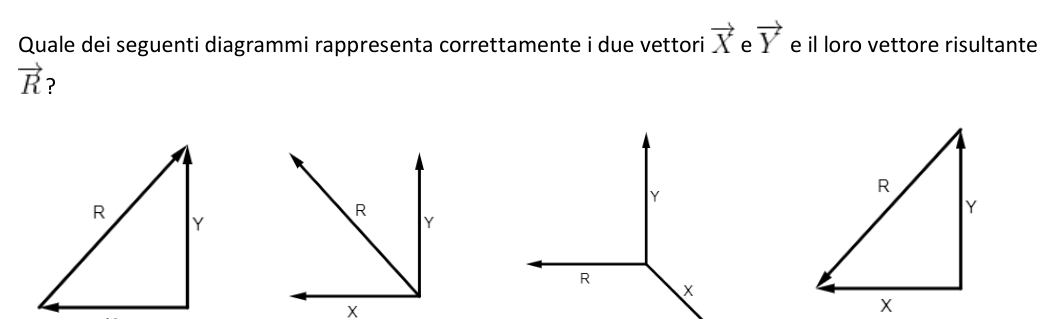 quattro diagrammi vettori A B C D
A · B · C · D
Topic: Newtonian Mechanics, Thermodynamics, Oscillations & Waves Metodi: Kinematic Equations, Free-Body Diagram, Torque & Angular Momentum Analysis, Simple Harmonic Motion Analysis Competenze: Graph Linearization, Physical Reasoning, Error Propagation Objects: — Fonte: Testo (PDF) — p.2
Question 4. Which of the following diagrams correctly represents the two vectors and and their resulting ? I’m going to start with this.
*four vector diagrams A B C D *
A · B · C · D
Topic: Newtonian Mechanics, Thermodynamics, Oscillations & Waves Metodi: Kinematic Equations, Free-Body Diagram, Torque & Angular Momentum Analysis, Simple Harmonic Motion Analysis Competenze: Graph Linearization, Physical Reasoning, Error Propagation Objects: — Fonte: Testo (PDF) — p.2
Quesito 5. L’oblò di un sommergibile ha diametro m. È omologato per sopportare una pressione esterna massima di kPa. Qual è la minima forza esterna che può provocare la rottura dell’oblò?
- A. 47000 N
- B. 190000 N
- C. 9300 N
- D. 220000 N
Topic: Newtonian Mechanics, Thermodynamics, Oscillations & Waves Metodi: Kinematic Equations, Free-Body Diagram, Torque & Angular Momentum Analysis, Simple Harmonic Motion Analysis Competenze: Graph Linearization, Physical Reasoning, Error Propagation Objects: — Fonte: Testo (PDF) — p.2
Question 5.The hull of a submarine has a diameter of m. It is approved to withstand a maximum external pressure of kPa. What is the least external force that can cause the oblobo to break?
- A. 47000 N
- B. 190000 N
- C. 9300 N
- D. 220000 N
Topic: Newtonian Mechanics, Thermodynamics, Oscillations & Waves Metodi: Kinematic Equations, Free-Body Diagram, Torque & Angular Momentum Analysis, Simple Harmonic Motion Analysis Competenze: Graph Linearization, Physical Reasoning, Error Propagation Objects: — Fonte: Testo (PDF) — p.2
Quesito 6. Il grafico mostra come varia la lunghezza di una molla con il carico applicato (retta da lunghezza a riposo cm). Alla molla è applicato un carico che la fa estendere di cm. Qual è il peso applicato?
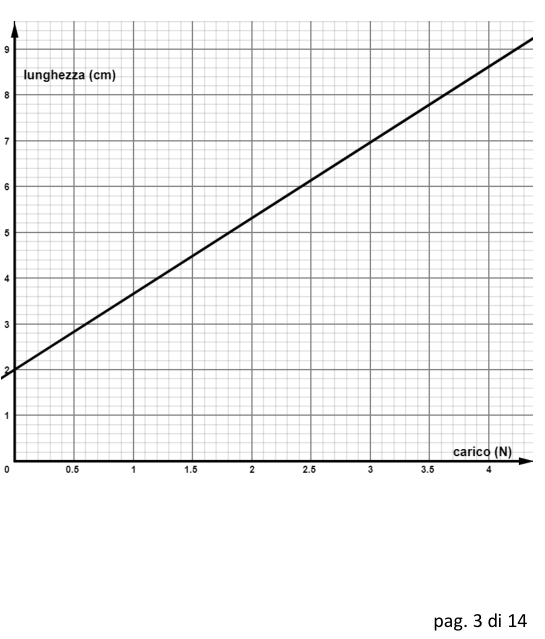 grafico lunghezza molla vs forza
- A. 8.6 N
- B. 1.2 N
- C. 2.4 N
- D. Non è possibile determinarlo senza conoscere la lunghezza a riposo
Topic: Newtonian Mechanics, Thermodynamics, Oscillations & Waves Metodi: Kinematic Equations, Free-Body Diagram, Torque & Angular Momentum Analysis, Simple Harmonic Motion Analysis Competenze: Graph Linearization, Physical Reasoning, Error Propagation Objects: Spring Fonte: Testo (PDF) — p.2
Question 6. The graph shows how the length of a spring varies with the load applied (direct from rest length cm). The spring shall be loaded with a load extending it by cm. What’s the applied weight? I’m going to start with this.
graph length spring vs force
- A. 8.6 N
- B. 1.2 N
- C. 2.4 N
- D. It is not possible to determine this without knowing the resting length
Topic: Newtonian Mechanics, Thermodynamics, Oscillations & Waves Metodi: Kinematic Equations, Free-Body Diagram, Torque & Angular Momentum Analysis, Simple Harmonic Motion Analysis Competenze: Graph Linearization, Physical Reasoning, Error Propagation Objects: Spring Fonte: Testo (PDF) — p.2
Quesito 7. Un ciclista pedala su una piattaforma rialzata orizzontale in linea retta. Raggiunto il bordo prosegue e atterra m più in basso e m più avanti. Trascurando l’attrito con l’aria, quanto vale la componente orizzontale della velocità al momento dell’atterraggio?
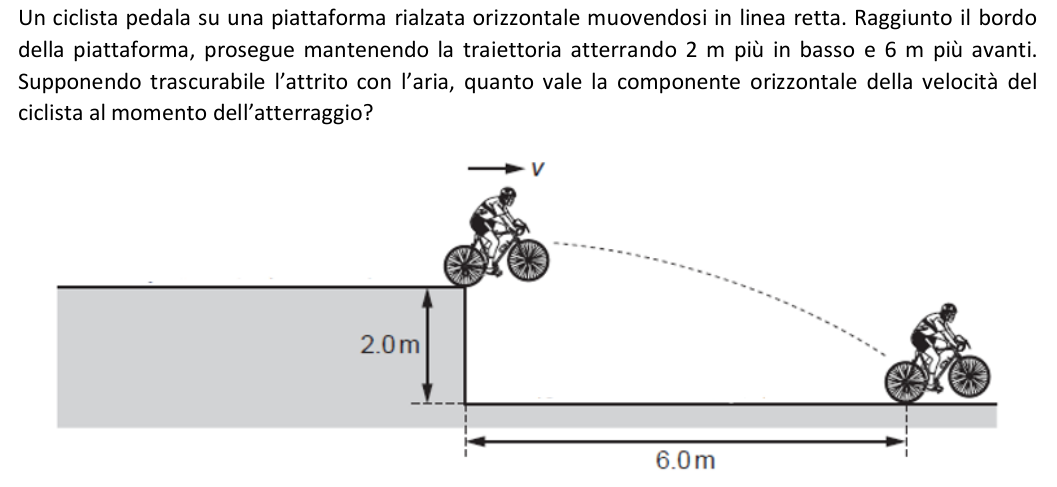 ciclista che salta da piattaforma rialzata
- A. 6.3 m/s
- B. 9.9 m/s
- C. 9.4 m/s
- D. 15 m/s
Topic: Newtonian Mechanics, Thermodynamics, Oscillations & Waves Metodi: Kinematic Equations, Free-Body Diagram, Torque & Angular Momentum Analysis, Simple Harmonic Motion Analysis Competenze: Graph Linearization, Physical Reasoning, Error Propagation Objects: Projectile Fonte: Testo (PDF) — p.2
Question 7.A cyclist pedals on a horizontal upright platform in a straight line. At the edge, continue and land m further down and m further forward. If we ignore the friction with the air, what is the horizontal component of the velocity at the time of landing? I’m going to start with this.
cyclist jumping from a raised platform
- A. 6.3 m/s
- B. 9.9 m/s
- C. 9.4 m/s
- D. 15 m/s
Topic: Newtonian Mechanics, Thermodynamics, Oscillations & Waves Metodi: Kinematic Equations, Free-Body Diagram, Torque & Angular Momentum Analysis, Simple Harmonic Motion Analysis Competenze: Graph Linearization, Physical Reasoning, Error Propagation Objects: Projectile Fonte: Testo (PDF) — p.2
Quesito 8. Una biglia appesa a una molla compie oscillazioni armoniche. Il grafico mostra la posizione rispetto al pavimento in funzione del tempo. Qual è il periodo di oscillazione (in secondi)?
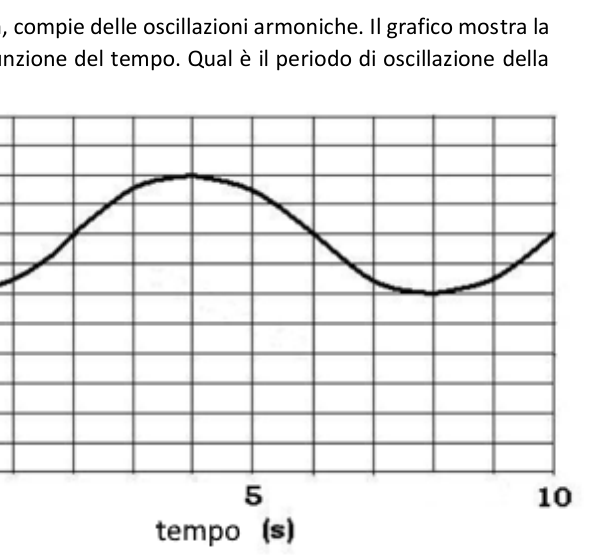 grafico posizione vs tempo biglie su molla
- A. 2.0
- B. 4.0
- C. 5.0
- D. 8.0
Topic: Newtonian Mechanics, Thermodynamics, Oscillations & Waves Metodi: Kinematic Equations, Free-Body Diagram, Torque & Angular Momentum Analysis, Simple Harmonic Motion Analysis Competenze: Graph Linearization, Physical Reasoning, Error Propagation Objects: Ball, Spring Fonte: Testo (PDF) — p.2
Question 8. A sheet suspended from a spring performs harmonic oscillations. The graph shows the position relative to the floor depending on the time. What is the oscillation time (in seconds)? I’m going to start with this.
graph position vs time of the spring balls
- A. 2.0
- B. 4.0
- C. 5.0
- D. 8.0
Topic: Newtonian Mechanics, Thermodynamics, Oscillations & Waves Metodi: Kinematic Equations, Free-Body Diagram, Torque & Angular Momentum Analysis, Simple Harmonic Motion Analysis Competenze: Graph Linearization, Physical Reasoning, Error Propagation Objects: Ball, Spring Fonte: Testo (PDF) — p.2
Quesito 9. Un’asta rigida è libera di ruotare nel piano verticale attorno a un fulcro a un’estremità. Una forza di N applicata a cm dal fulcro la tiene in equilibrio; il baricentro è a cm dal fulcro. Qual è il peso dell’asta?
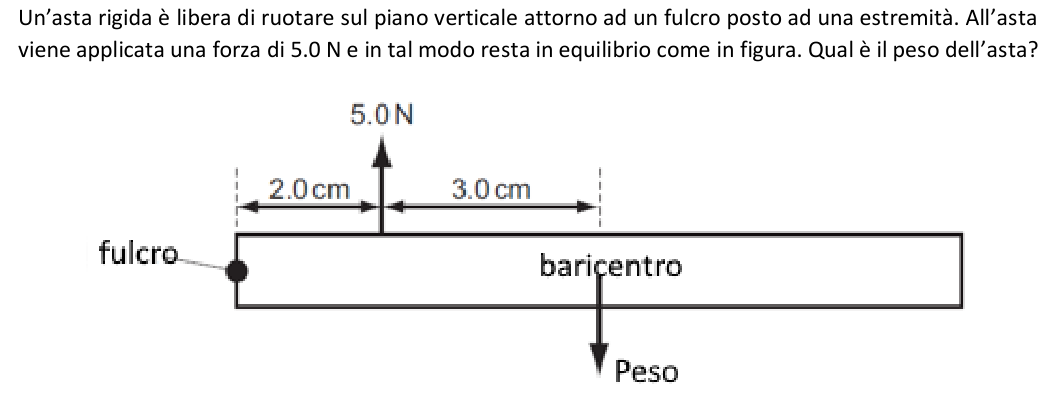 asta rigida con fulcro baricentro e peso
- A. 2.0 N
- B. 3.0 N
- C. 3.3 N
- D. 5.0 N
Topic: Newtonian Mechanics, Thermodynamics, Oscillations & Waves Metodi: Kinematic Equations, Free-Body Diagram, Torque & Angular Momentum Analysis, Simple Harmonic Motion Analysis Competenze: Graph Linearization, Physical Reasoning, Error Propagation Objects: Rod, Lever Fonte: Testo (PDF) — p.2
Question 9.A rigid axle is free to rotate vertically around a hub at one end. A force of N applied to cm from the core holds it in balance; the barrier centre is at cm from the core. What’s the weight of the auction? I’m going to start with this.
rigid axle with centre of focus and weight
- A. 2.0 N
- B. 3.0 N
- C. 3.3 N
- D. 5.0 N
Topic: Newtonian Mechanics, Thermodynamics, Oscillations & Waves Metodi: Kinematic Equations, Free-Body Diagram, Torque & Angular Momentum Analysis, Simple Harmonic Motion Analysis Competenze: Graph Linearization, Physical Reasoning, Error Propagation Objects: Rod, Lever Fonte: Testo (PDF) — p.2
Quesito 10. Un contenitore è pieno d’acqua a temperatura ambiente. Come è possibile attivare moti convettivi nel liquido?
- A. Scaldando la superficie
- B. Raffreddando la superficie
- C. Scaldando oppure raffreddando la superficie
- D. Nessuno dei metodi proposti
Topic: Newtonian Mechanics, Thermodynamics, Oscillations & Waves Metodi: Kinematic Equations, Free-Body Diagram, Torque & Angular Momentum Analysis, Simple Harmonic Motion Analysis Competenze: Graph Linearization, Physical Reasoning, Error Propagation Objects: Container Fonte: Testo (PDF) — p.2
Question 10. A container is filled with water at room temperature. How can you activate convective motions in the fluid?
- A. Heating the surface
- B. Cooling the surface
- C. Heating or cooling of the surface
- D. None of the proposed methods
Topic: Newtonian Mechanics, Thermodynamics, Oscillations & Waves Metodi: Kinematic Equations, Free-Body Diagram, Torque & Angular Momentum Analysis, Simple Harmonic Motion Analysis Competenze: Graph Linearization, Physical Reasoning, Error Propagation Objects: Container Fonte: Testo (PDF) — p.2
Quesito 11. Un’automobile traina un carrello che pesa N con una forza di N per km su strada diritta e orizzontale. Qual è il lavoro eseguito dall’auto?
- A. 160 J
- B. 20000 J
- C. 160000 J
- D. 20000000 J
Topic: Newtonian Mechanics, Thermodynamics, Oscillations & Waves Metodi: Kinematic Equations, Free-Body Diagram, Torque & Angular Momentum Analysis, Simple Harmonic Motion Analysis Competenze: Graph Linearization, Physical Reasoning, Error Propagation Objects: Cart Fonte: Testo (PDF) — p.2
Question 11.A car pulls a cart weighing N with a force of N per km on a straight and horizontal road. What’s the work done by the car?
- A. 160 J
- B. 20000 J
- C. 160000 J
- D. 20000000 J
Topic: Newtonian Mechanics, Thermodynamics, Oscillations & Waves Metodi: Kinematic Equations, Free-Body Diagram, Torque & Angular Momentum Analysis, Simple Harmonic Motion Analysis Competenze: Graph Linearization, Physical Reasoning, Error Propagation Objects: Cart Fonte: Testo (PDF) — p.2
Quesito 12. Due automobiline A e B, muovendosi di moto rettilineo uniforme su una strada orizzontale, percorrono la stessa distanza prima di fermarsi (stessa forza frenante, B con velocità doppia di A). [v. figura nel PDF] Qual è il rapporto tra le decelerazioni / quale frena prima? A · B · C · D
Topic: Newtonian Mechanics, Thermodynamics, Oscillations & Waves Metodi: Kinematic Equations, Free-Body Diagram, Torque & Angular Momentum Analysis, Simple Harmonic Motion Analysis Competenze: Graph Linearization, Physical Reasoning, Error Propagation Objects: — Fonte: Testo (PDF) — p.2
Question 12. Two cars A and B, moving in a straight line motion on a horizontal road, travel the same distance before stopping (the same braking force, B at twice the speed of A). *[v. What is the relationship between the decelerations / which brake first? A · B · C · D
Topic: Newtonian Mechanics, Thermodynamics, Oscillations & Waves Metodi: Kinematic Equations, Free-Body Diagram, Torque & Angular Momentum Analysis, Simple Harmonic Motion Analysis Competenze: Graph Linearization, Physical Reasoning, Error Propagation Objects: — Fonte: Testo (PDF) — p.2
Quesito 13. Telescopio di Newton: dove va posto lo specchio piano secondario?
- A. Oltre il fuoco
- B. Tra lo specchio primario e il fuoco
- C. Sul fuoco
- D. (altra opzione)
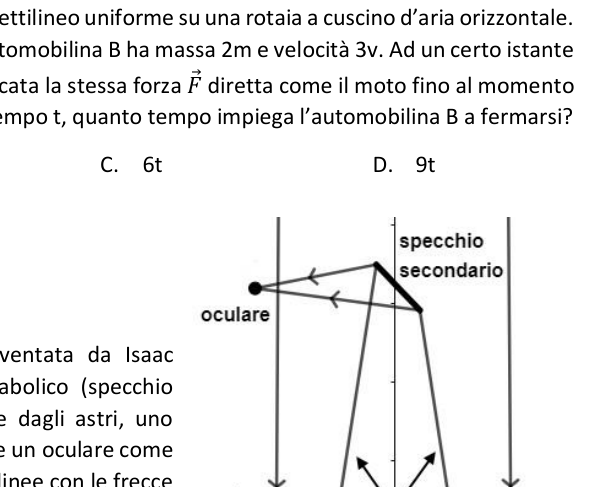 schema telescopio a specchi primario secondario
Topic: Newtonian Mechanics, Thermodynamics, Oscillations & Waves Metodi: Kinematic Equations, Free-Body Diagram, Torque & Angular Momentum Analysis, Simple Harmonic Motion Analysis Competenze: Graph Linearization, Physical Reasoning, Error Propagation Objects: Mirror Fonte: Testo (PDF) — p.2
Question 13. Newton’s telescope: where should the secondary mirror be placed?
- A. Beyond the fire
- B. Between the primary mirror and fire
- On the fire
- **D ** (other option)
square primary secondary mirror telescope
Topic: Newtonian Mechanics, Thermodynamics, Oscillations & Waves Metodi: Kinematic Equations, Free-Body Diagram, Torque & Angular Momentum Analysis, Simple Harmonic Motion Analysis Competenze: Graph Linearization, Physical Reasoning, Error Propagation Objects: Mirror Fonte: Testo (PDF) — p.2
Quesito 14. Una chioma di volume e massa kg (cfr. testo). Quale forza di Archimede (spinta) agisce sulla chioma immersa in ? [domanda sulla spinta di Archimede]
- A. N
- B. N
- C. N
- D. N
Topic: Newtonian Mechanics, Thermodynamics, Oscillations & Waves Metodi: Kinematic Equations, Free-Body Diagram, Torque & Angular Momentum Analysis, Simple Harmonic Motion Analysis Competenze: Graph Linearization, Physical Reasoning, Error Propagation Objects: — Fonte: Testo (PDF) — p.2
Question 14.A cucumber of volume and mass kg (see. The Commission has not yet adopted a proposal. What force of Archimedes (push) acts on the hook immersed in ? The first is the “Message of the Archimedes”
- A. N
- B. N
- C. N
- D. N
Topic: Newtonian Mechanics, Thermodynamics, Oscillations & Waves Metodi: Kinematic Equations, Free-Body Diagram, Torque & Angular Momentum Analysis, Simple Harmonic Motion Analysis Competenze: Graph Linearization, Physical Reasoning, Error Propagation Objects: — Fonte: Testo (PDF) — p.2
Quesito 15. Una bacchetta di plastica strofinata con un indumento si carica negativamente. Cosa si può dire dell’indumento?
- A. positivo, alcuni elettroni trasferiti alla bacchetta
- B. positivo, alcuni protoni trasferiti dalla bacchetta
- C. positivo, alcuni protoni trasferiti alla bacchetta
- D. positivo, alcuni elettroni trasferiti dalla bacchetta
Topic: Newtonian Mechanics, Thermodynamics, Oscillations & Waves Metodi: Kinematic Equations, Free-Body Diagram, Torque & Angular Momentum Analysis, Simple Harmonic Motion Analysis Competenze: Graph Linearization, Physical Reasoning, Error Propagation Objects: Rod Fonte: Testo (PDF) — p.2
Question 15.A plastic bag rubbed with clothing will charge negatively. What about the garment?
- A. positive, some electrons transferred to the rod
- B. positive, some protons transferred from the rod
- C. positive, some protons transferred to the rod
- D. positive, some electrons transferred from the rod
Topic: Newtonian Mechanics, Thermodynamics, Oscillations & Waves Metodi: Kinematic Equations, Free-Body Diagram, Torque & Angular Momentum Analysis, Simple Harmonic Motion Analysis Competenze: Graph Linearization, Physical Reasoning, Error Propagation Objects: Rod Fonte: Testo (PDF) — p.2
Quesito 16. Circuito con tre lampade e tre interruttori . La lampada 1 e la 3 sono accese, la 2 è spenta. Quali interruttori sono chiusi?
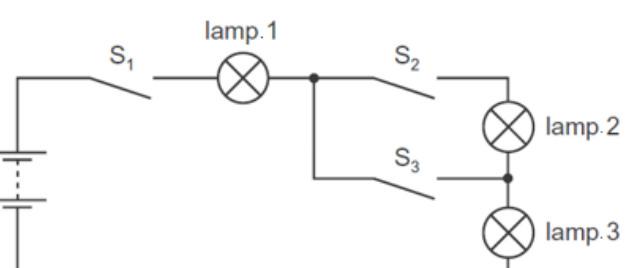 circuito con tre lampade e interruttori
- A. Solo
- B. e
- C. e
- D. e
Topic: Newtonian Mechanics, Thermodynamics, Oscillations & Waves Metodi: Kinematic Equations, Free-Body Diagram, Torque & Angular Momentum Analysis, Simple Harmonic Motion Analysis Competenze: Graph Linearization, Physical Reasoning, Error Propagation Objects: Switch, Wire Fonte: Testo (PDF) — p.2
Quesito 16. Circuito con tre lampade e tre interruttori . Lamps 1 and 3 are on, lamp 2 is off. What switches are closed? I’m going to start with this.
circuit with three lamps and switches
- A. Only
- B. e
- C. e
- D. e
Topic: Newtonian Mechanics, Thermodynamics, Oscillations & Waves Metodi: Kinematic Equations, Free-Body Diagram, Torque & Angular Momentum Analysis, Simple Harmonic Motion Analysis Competenze: Graph Linearization, Physical Reasoning, Error Propagation Objects: Switch, Wire Fonte: Testo (PDF) — p.2
Quesito 17. Il motorino di un giocattolo funziona con d.d.p. V e corrente A. L’energia consumata in s è:
- A. 2.40 J
- B. 60.0 J
- C. 144 J
- D. 3600 J
Topic: Newtonian Mechanics, Thermodynamics, Oscillations & Waves Metodi: Kinematic Equations, Free-Body Diagram, Torque & Angular Momentum Analysis, Simple Harmonic Motion Analysis Competenze: Graph Linearization, Physical Reasoning, Error Propagation Objects: — Fonte: Testo (PDF) — p.2
Quesito 17. Il motorino di un giocattolo funziona con d.d.p. V e corrente A. The energy consumption in s is:
- A. 2.40 J
- B. 60.0 J
- C. 144 J
- D. 3600 J
Topic: Newtonian Mechanics, Thermodynamics, Oscillations & Waves Metodi: Kinematic Equations, Free-Body Diagram, Torque & Angular Momentum Analysis, Simple Harmonic Motion Analysis Competenze: Graph Linearization, Physical Reasoning, Error Propagation Objects: — Fonte: Testo (PDF) — p.2
Quesito 18. Il grafico mostra la velocità di un’auto. Quale calcolo fornisce la distanza percorsa in s?
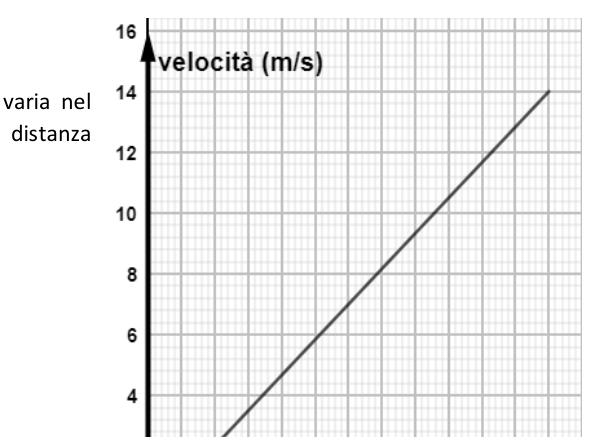 grafico velocità vs tempo auto accelerazione costante
- A.
- B.
- C.
- D.
Topic: Newtonian Mechanics, Thermodynamics, Oscillations & Waves Metodi: Kinematic Equations, Free-Body Diagram, Torque & Angular Momentum Analysis, Simple Harmonic Motion Analysis Competenze: Graph Linearization, Physical Reasoning, Error Propagation Objects: — Fonte: Testo (PDF) — p.2
Question 18. The graph shows the speed of a car. What calculation provides the distance travelled in s?
The speed of the vehicle is measured in the following way:
- A.
- B.
- C.
- D.
Topic: Newtonian Mechanics, Thermodynamics, Oscillations & Waves Metodi: Kinematic Equations, Free-Body Diagram, Torque & Angular Momentum Analysis, Simple Harmonic Motion Analysis Competenze: Graph Linearization, Physical Reasoning, Error Propagation Objects: — Fonte: Testo (PDF) — p.2
Quesito 19. Uno spettacolo circense: un clown è lanciato. Qual è l’accelerazione del clown a s?
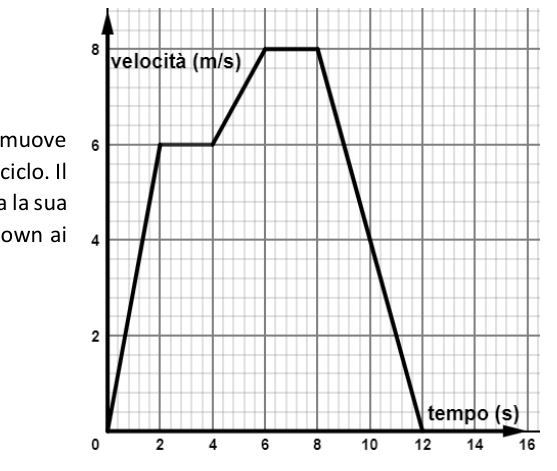 grafico velocità vs tempo clown su monociclo
- A.
- B.
- C.
- D.
Topic: Newtonian Mechanics, Thermodynamics, Oscillations & Waves Metodi: Kinematic Equations, Free-Body Diagram, Torque & Angular Momentum Analysis, Simple Harmonic Motion Analysis Competenze: Graph Linearization, Physical Reasoning, Error Propagation Objects: — Fonte: Testo (PDF) — p.2
Question 19. A circus show: a clown is launched. What is the clown’s acceleration at s?
graph speed vs clown time on single wheel
- A.
- B.
- C.
- D.
Topic: Newtonian Mechanics, Thermodynamics, Oscillations & Waves Metodi: Kinematic Equations, Free-Body Diagram, Torque & Angular Momentum Analysis, Simple Harmonic Motion Analysis Competenze: Graph Linearization, Physical Reasoning, Error Propagation Objects: — Fonte: Testo (PDF) — p.2
Quesito 20. Un ragazzo soffia in un fischietto con frequenza Hz. L’amico, pur con udito normale, non riesce a sentire il suono. Perché?
- A. ampiezza troppo grande
- B. ampiezza troppo piccola
- C. frequenza troppo alta
- D. frequenza troppo bassa
Topic: Newtonian Mechanics, Thermodynamics, Oscillations & Waves Metodi: Kinematic Equations, Free-Body Diagram, Torque & Angular Momentum Analysis, Simple Harmonic Motion Analysis Competenze: Graph Linearization, Physical Reasoning, Error Propagation Objects: — Fonte: Testo (PDF) — p.2
Question 20. A boy is blowing a whistle at a frequency of Hz. The friend, although with normal hearing, cannot hear the sound. Why? Why?
- **A ** width too large
- B. width too small
- C. frequency too high
- D. frequency too low
Topic: Newtonian Mechanics, Thermodynamics, Oscillations & Waves Metodi: Kinematic Equations, Free-Body Diagram, Torque & Angular Momentum Analysis, Simple Harmonic Motion Analysis Competenze: Graph Linearization, Physical Reasoning, Error Propagation Objects: — Fonte: Testo (PDF) — p.2
Quesito 21. Un sommergibile fermo emette due impulsi sonori e riceve l’eco da un oggetto che si muove lungo la stessa direzione. I due impulsi sono emessi a intervallo di s; gli echi tornano dopo s e s. Velocità media con cui l’oggetto si allontana? (velocità del suono in acqua m/s)
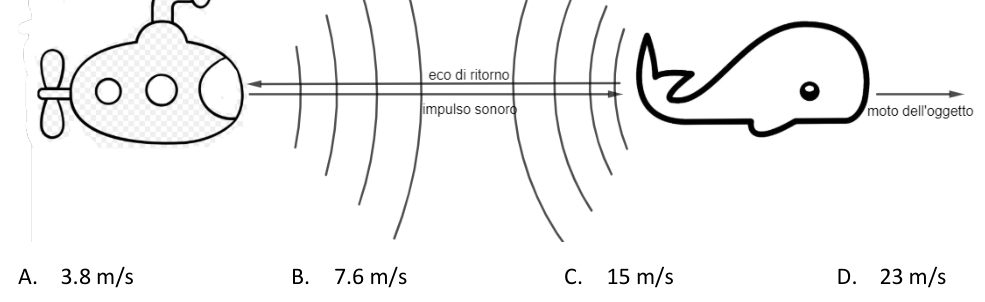 sommergibile e balena con onde sonore
- A. 3.8 m/s
- B. 7.6 m/s
- C. 15 m/s
- D. 23 m/s
Topic: Newtonian Mechanics, Thermodynamics, Oscillations & Waves Metodi: Kinematic Equations, Free-Body Diagram, Torque & Angular Momentum Analysis, Simple Harmonic Motion Analysis Competenze: Graph Linearization, Physical Reasoning, Error Propagation Objects: — Fonte: Testo (PDF) — p.2
Question 21. A stationary submarine emits two sound pulses and receives echoes from an object moving in the same direction. The two pulses are emitted at intervals of s; the echoes return after s and s. The average velocity at which the object moves away? (water sound speed m/s)
submersible and sound wave whale
- A. 3.8 m/s
- B. 7.6 m/s
- C. 15 m/s
- D. 23 m/s
Topic: Newtonian Mechanics, Thermodynamics, Oscillations & Waves Metodi: Kinematic Equations, Free-Body Diagram, Torque & Angular Momentum Analysis, Simple Harmonic Motion Analysis Competenze: Graph Linearization, Physical Reasoning, Error Propagation Objects: — Fonte: Testo (PDF) — p.2
Quesito 22. Confronto tra masse di fogli formato A0/A4 con relative incertezze (quesito sulla propagazione delle incertezze nelle misure). Quale modalità di scrittura del risultato è corretta? A · B · C · D
Topic: Newtonian Mechanics, Thermodynamics, Oscillations & Waves Metodi: Kinematic Equations, Free-Body Diagram, Torque & Angular Momentum Analysis, Simple Harmonic Motion Analysis Competenze: Graph Linearization, Physical Reasoning, Error Propagation Objects: — Fonte: Testo (PDF) — p.2
Question 22.Comparison of A0/A4 sheets with relative uncertainties (question on the spread of uncertainties in measurements). What is the correct way of writing the result? A · B · C · D
Topic: Newtonian Mechanics, Thermodynamics, Oscillations & Waves Metodi: Kinematic Equations, Free-Body Diagram, Torque & Angular Momentum Analysis, Simple Harmonic Motion Analysis Competenze: Graph Linearization, Physical Reasoning, Error Propagation Objects: — Fonte: Testo (PDF) — p.2
Quesito 23. Il simbolo riprodotto (messa a terra) cosa significa?
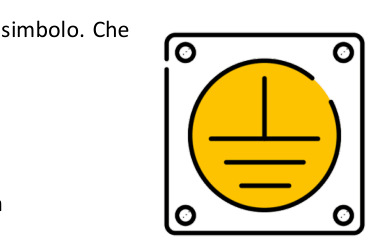 simbolo messa a terra su cartello elettrico
- A. Pericolo alta tensione
- B. Messa a terra
- C. Passo pericoloso di caduta
- D. Freccia che indica la posizione della centralina elettrica
Topic: Newtonian Mechanics, Thermodynamics, Oscillations & Waves Metodi: Kinematic Equations, Free-Body Diagram, Torque & Angular Momentum Analysis, Simple Harmonic Motion Analysis Competenze: Graph Linearization, Physical Reasoning, Error Propagation Objects: — Fonte: Testo (PDF) — p.2
Question 23. What does the symbol reproduced (set down) mean?
*sign on the electric billboard *
- A. High voltage hazard
- B. Grounded
- C. Dangerous step of fall
- D. Arrow indicating the position of the power station
Topic: Newtonian Mechanics, Thermodynamics, Oscillations & Waves Metodi: Kinematic Equations, Free-Body Diagram, Torque & Angular Momentum Analysis, Simple Harmonic Motion Analysis Competenze: Graph Linearization, Physical Reasoning, Error Propagation Objects: — Fonte: Testo (PDF) — p.2
Quesito 24. Una cassa di massa e velocità note su pavimento tramite una corda inclinata di ; lavoro di una forza in gioco (coefficiente d’attrito dato). Quale valore?
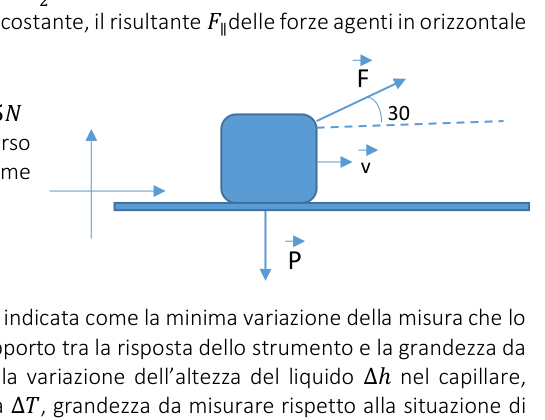 diagramma forze cassa su piano inclinato 30 gradi
- A. -0.25
- B. 0.44
- C. 0.51
- D. 0.59
Topic: Newtonian Mechanics, Thermodynamics, Oscillations & Waves Metodi: Kinematic Equations, Free-Body Diagram, Torque & Angular Momentum Analysis, Simple Harmonic Motion Analysis Competenze: Graph Linearization, Physical Reasoning, Error Propagation Objects: Block, String Fonte: Testo (PDF) — p.2
Question 24.A box of known mass and speed on the floor by means of a slanted rope of ; work of a force in play (ratio of friction given). What value?
chassis force diagram on a plane tilted by 30 degrees
- A. -0.25
- B. 0.44
- C. 0.51
- D. 0.59
Topic: Newtonian Mechanics, Thermodynamics, Oscillations & Waves Metodi: Kinematic Equations, Free-Body Diagram, Torque & Angular Momentum Analysis, Simple Harmonic Motion Analysis Competenze: Graph Linearization, Physical Reasoning, Error Propagation Objects: Block, String Fonte: Testo (PDF) — p.2
Quesito 25. Tra le grandezze proposte, quale incide sulla sensibilità del termometro a liquido mostrato in figura?
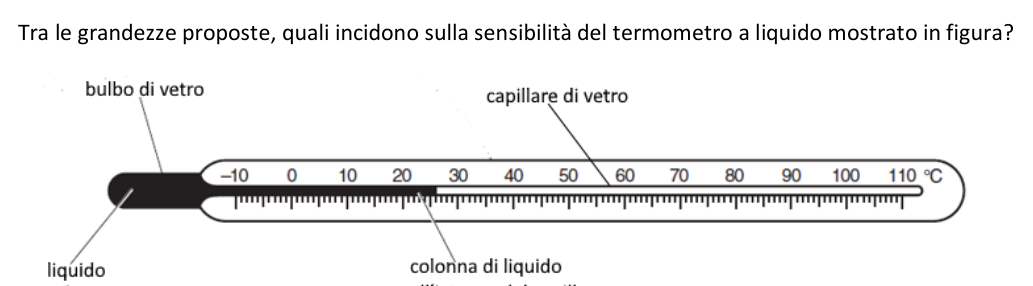 termometro a liquido bulbo e capillare
- A. spessore del bulbo e lunghezza del capillare
- B. diametro del capillare
- C. spessore del capillare
- D. spessore del bulbo e diametro del capillare
Topic: Newtonian Mechanics, Thermodynamics, Oscillations & Waves Metodi: Kinematic Equations, Free-Body Diagram, Torque & Angular Momentum Analysis, Simple Harmonic Motion Analysis Competenze: Graph Linearization, Physical Reasoning, Error Propagation Objects: — Fonte: Testo (PDF) — p.2
Question 25.Which of the proposed sizes affects the sensitivity of the liquid thermometer shown in the figure? I’m going to start with this.
bulb and capillary liquid thermometer
- A. bulb thickness and capillary length
- B. diameter of the capillary
- C. thickness of the capillary
- D. bulb thickness and capillary diameter
Topic: Newtonian Mechanics, Thermodynamics, Oscillations & Waves Metodi: Kinematic Equations, Free-Body Diagram, Torque & Angular Momentum Analysis, Simple Harmonic Motion Analysis Competenze: Graph Linearization, Physical Reasoning, Error Propagation Objects: — Fonte: Testo (PDF) — p.2
Quesito 26. È vero che gli astronauti sulla Stazione Spaziale fluttuano liberamente perché lì manca la gravità?
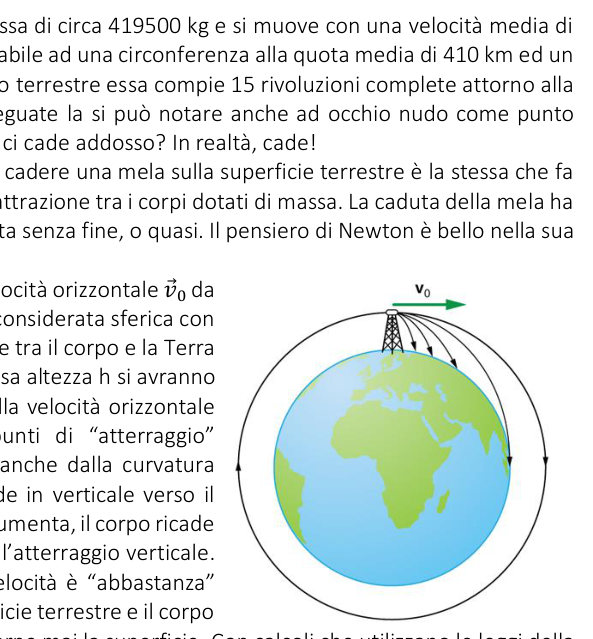 Terra con traiettorie ellisse parabola iperbole
- A. Solo la prima
- B. Solo la seconda
- C. Nessuna delle due
- D. Entrambe
Topic: Newtonian Mechanics, Thermodynamics, Oscillations & Waves Metodi: Kinematic Equations, Free-Body Diagram, Torque & Angular Momentum Analysis, Simple Harmonic Motion Analysis Competenze: Graph Linearization, Physical Reasoning, Error Propagation Objects: Satellite, Planet Fonte: Testo (PDF) — p.2
Question 26. Is it true that astronauts on the space station float freely because gravity is missing?
The following table shows the following information:
- **A ** Only the first
- B. Only the second
- C. Neither of the two
- D. Both
Topic: Newtonian Mechanics, Thermodynamics, Oscillations & Waves Metodi: Kinematic Equations, Free-Body Diagram, Torque & Angular Momentum Analysis, Simple Harmonic Motion Analysis Competenze: Graph Linearization, Physical Reasoning, Error Propagation Objects: Satellite, Planet Fonte: Testo (PDF) — p.2
Quesito 27. Un’intervista (Very Large Telescope) su un pianeta scoperto orbitante attorno a una stella massiccia di un sistema binario. Quale delle affermazioni NON si può ricavare dal testo? A · B · C · D
Topic: Newtonian Mechanics, Thermodynamics, Oscillations & Waves Metodi: Kinematic Equations, Free-Body Diagram, Torque & Angular Momentum Analysis, Simple Harmonic Motion Analysis Competenze: Graph Linearization, Physical Reasoning, Error Propagation Objects: Planet, Star Fonte: Testo (PDF) — p.2
Question 27. A very large telescope interview on an uncovered planet orbiting a massive star in a binary system. Which of the following statements cannot be drawn from the text? A · B · C · D
Topic: Newtonian Mechanics, Thermodynamics, Oscillations & Waves Metodi: Kinematic Equations, Free-Body Diagram, Torque & Angular Momentum Analysis, Simple Harmonic Motion Analysis Competenze: Graph Linearization, Physical Reasoning, Error Propagation Objects: Planet, Star Fonte: Testo (PDF) — p.2
Deformazione di una molla (quesiti 28-30)
Quesito a risposta aperta (vale come tre quesiti, punti totali).
Una molla ha un estremo fissato a un muro e all’altro libero. Al capo libero vengono applicate forze di diversa intensità nella direzione dell’asse, che ne deformano la molla. La relazione tra la lunghezza della molla e la forza applicata è descritta dal grafico.
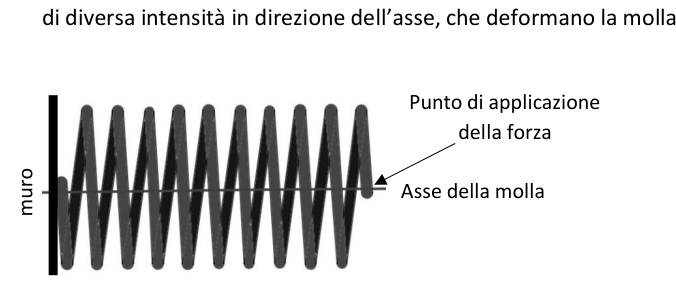 schema molla con asse e punto applicazione
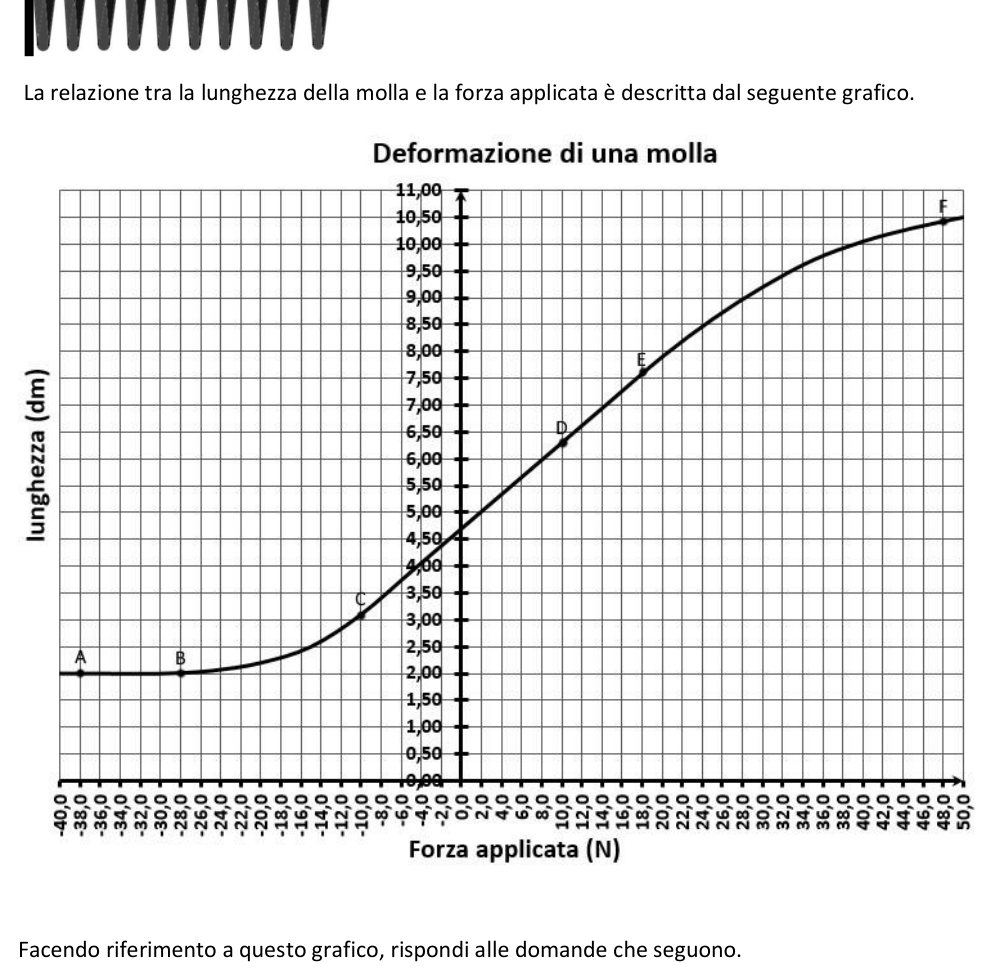 grafico deformazione molla lunghezza vs forza
 due molle identiche in serie Molla1 Molla2
Facendo riferimento al grafico, rispondi alle domande.
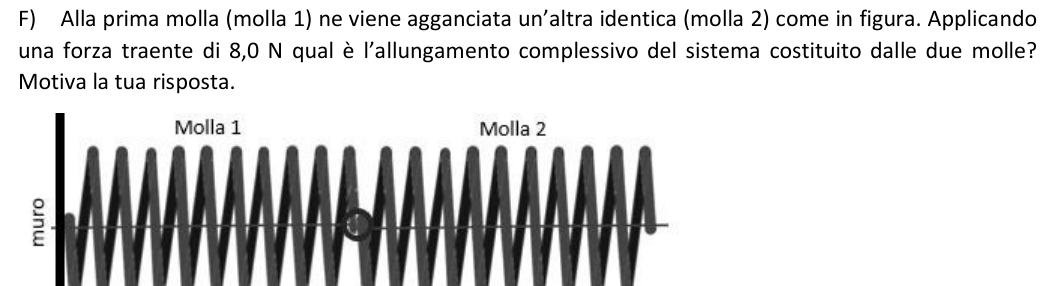
A) Qual è la lunghezza a riposo della molla? B) La molla segue la legge di Hooke? C) Calcola il valore della costante elastica. D) È maggiore la forza esercitata sulla molla nelle condizioni descritte al punto C o al punto D del grafico? Spiega. E) Nel tratto tra A e B la lunghezza rimane costante. Che cosa succede alla molla? F) Alla prima molla (molla 1) ne viene agganciata un’altra identica (molla 2) in serie. Applicando una forza di N, qual è l’allungamento complessivo del sistema delle due molle?G) Alle due molle identiche collegate in serie viene applicata una forza tale per cui la lunghezza totale del sistema è dm. Qual è l’intensità della forza applicata?
Topic: Elasticity & Materials, Newtonian Mechanics Metodi: Hooke’s Law, Graph Linearization, Free-Body Diagram Competenze: Graph Linearization, Mathematical Modeling, Significant Figures Objects: Spring Fonte: Testo (PDF) — p.13
**Deformation of a spring (questions 28-30) **
Open-ended question (equals three questions, total points).
A spring has one end attached to a wall and the other free. The free head is subjected to forces of varying intensity in the direction of the axis, which deform the spring. The relationship between the length of the spring and the force applied is described in the graph. I’m going to start with this.
spring scheme with axis and point of application
graph of deformation spring length vs force
two identical springs in the Molla1 Molla2 series
By referring to the chart, answer the questions.
**A) ** What is the resting length of the spring? Does the spring follow Hooke’s law? **C) ** Calculate the value of the elastic constant. **D) ** Is the force exerted on the spring greater under the conditions described in point C or point D of the chart? - Explain that. **E) ** In the stretch between A and B the length remains constant. What’s wrong with the spring? **F) ** An identical second (mole 2) is attached to the first spring (mole 1) in series. Applying a force of N, what is the total length of the two-spring system?G) The two identical springs connected in series shall be applied such a force that the total length of the system is dm. What is the intensity of the force applied?
Topic: Elasticity & Materials, Newtonian Mechanics Metodi: Hooke’s Law, Graph Linearization, Free-Body Diagram Competenze: Graph Linearization, Mathematical Modeling, Significant Figures Objects: Spring Fonte: Testo (PDF) — p.13