Quesito 1. Misurando la profondità di un pozzo un geologo ottiene m e ripetendo quattro volte ottiene sempre lo stesso valore. Può concludere che: A. il pozzo è profondo esattamente m · B. lo strumento non è abbastanza sensibile per rilevare differenze · C. non si sono verificati errori casuali · D. la misura non presenta incertezza
Topic: Newtonian Mechanics, Thermodynamics, Electrostatics Metodi: Vector Decomposition, Free-Body Diagram, Order-of-Magnitude Estimation, Energy Conservation Method, Torque & Angular Momentum Analysis Competenze: Physical Reasoning, Estimation & Approximation, Unit Conversion Objects: — Fonte: Testo (PDF) — p.2
Question 1. Measuring the depth of a well a geologist gets m and repeating four times always gets the same value. It may be concluded that: The well is exactly m · B. The instrument is not sensitive enough to detect differences. No accidental errors occurred · D. the measure is not uncertain
Topic: Newtonian Mechanics, Thermodynamics, Electrostatics Metodi: Vector Decomposition, Free-Body Diagram, Order-of-Magnitude Estimation, Energy Conservation Method, Torque & Angular Momentum Analysis Competenze: Physical Reasoning, Estimation & Approximation, Unit Conversion Objects: — Fonte: Testo (PDF) — p.2
Quesito 2. Per raggiungere una località a Est (direzione ) un aereo viaggia a km/h; un vento di traverso da nord a sud (direzione ) a km/h. Quale rotta deve impostare il pilota? A. · B. · C. · D.
Topic: Newtonian Mechanics, Thermodynamics, Electrostatics Metodi: Vector Decomposition, Free-Body Diagram, Order-of-Magnitude Estimation, Energy Conservation Method, Torque & Angular Momentum Analysis Competenze: Physical Reasoning, Estimation & Approximation, Unit Conversion Objects: — Fonte: Testo (PDF) — p.2
Question 2.To reach an eastern location (direction ) an aircraft travels at km/h; a north-south crosswind (direction ) travels at km/h. Which route should the pilot set? A. · B. · C. · D.
Topic: Newtonian Mechanics, Thermodynamics, Electrostatics Metodi: Vector Decomposition, Free-Body Diagram, Order-of-Magnitude Estimation, Energy Conservation Method, Torque & Angular Momentum Analysis Competenze: Physical Reasoning, Estimation & Approximation, Unit Conversion Objects: — Fonte: Testo (PDF) — p.2
Quesito 3. Due atomi si dicono isotopi se: A. stesso numero di protoni e neutroni · B. stesso numero di neutroni ma non di protoni · C. stesso numero di protoni ma non di neutroni · D. stesso numero di elettroni ma non di protoni
Topic: Newtonian Mechanics, Thermodynamics, Electrostatics Metodi: Vector Decomposition, Free-Body Diagram, Order-of-Magnitude Estimation, Energy Conservation Method, Torque & Angular Momentum Analysis Competenze: Physical Reasoning, Estimation & Approximation, Unit Conversion Objects: Atom Fonte: Testo (PDF) — p.2
Question 3. Two atoms are called isotopes if: A. equal number of protons and neutrons · B. the same number of neutrons but not protons · C. the same number of protons but not neutrons · D. the same number of electrons but not protons
Topic: Newtonian Mechanics, Thermodynamics, Electrostatics Metodi: Vector Decomposition, Free-Body Diagram, Order-of-Magnitude Estimation, Energy Conservation Method, Torque & Angular Momentum Analysis Competenze: Physical Reasoning, Estimation & Approximation, Unit Conversion Objects: Atom Fonte: Testo (PDF) — p.2
Quesito 4. Quante volte si può piegare un foglio mm di spessore mm (piegabile se il rapporto larghezza/spessore non è inferiore a una certa soglia; a ogni piega la larghezza si dimezza e lo spessore raddoppia)? A. 3 · B. 5 · C. 7 · D. 12
Topic: Newtonian Mechanics, Thermodynamics, Electrostatics Metodi: Vector Decomposition, Free-Body Diagram, Order-of-Magnitude Estimation, Energy Conservation Method, Torque & Angular Momentum Analysis Competenze: Physical Reasoning, Estimation & Approximation, Unit Conversion Objects: — Fonte: Testo (PDF) — p.2
Question 4.** How many times can a sheet mm thick mm be folded (folded if the width/thickness ratio is not less than a certain threshold; at each fold the width is halved and the thickness doubled)? A. 3 · B. 5 · C. 7 · D. 12
Topic: Newtonian Mechanics, Thermodynamics, Electrostatics Metodi: Vector Decomposition, Free-Body Diagram, Order-of-Magnitude Estimation, Energy Conservation Method, Torque & Angular Momentum Analysis Competenze: Physical Reasoning, Estimation & Approximation, Unit Conversion Objects: — Fonte: Testo (PDF) — p.2
Quesito 5. Grafico velocità-tempo di due corridori. All’istante cosa si deduce? A. stessa velocità · B. corridore 1 non accelera · C. corridore 1 sta sorpassando il 2 · D. corridore 2 sta rallentando
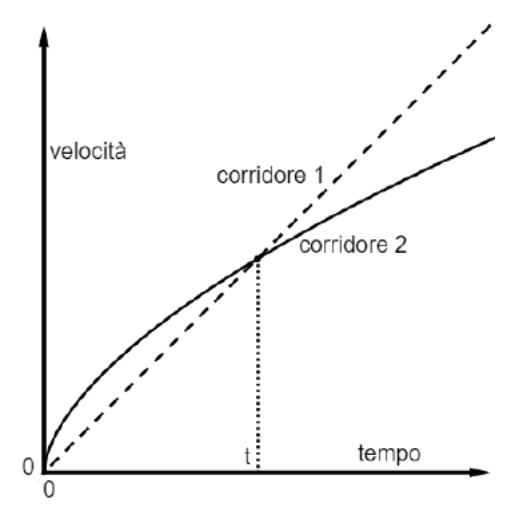 Grafico velocità-tempo: corridore 1 (retta tratteggiata) e corridore 2 (curva), che si incrociano all’istante .
Topic: Newtonian Mechanics, Thermodynamics, Electrostatics Metodi: Vector Decomposition, Free-Body Diagram, Order-of-Magnitude Estimation, Energy Conservation Method, Torque & Angular Momentum Analysis Competenze: Physical Reasoning, Estimation & Approximation, Unit Conversion Objects: — Fonte: Testo (PDF) — p.2
Question 5. The speed-time chart of two runners. What is the instantaneous ? A. the same speed · B. Runner 1 does not accelerate · C. Runner 1 is overtaking 2 · D. Runner 2 is slowing down.
Time-speed chart: runner 1 (trajectory straight) and runner 2 (curve), which intersect instantly .
Topic: Newtonian Mechanics, Thermodynamics, Electrostatics Metodi: Vector Decomposition, Free-Body Diagram, Order-of-Magnitude Estimation, Energy Conservation Method, Torque & Angular Momentum Analysis Competenze: Physical Reasoning, Estimation & Approximation, Unit Conversion Objects: — Fonte: Testo (PDF) — p.2
Quesito 6. Esperimento di caduta da una torre per provare la rotazione terrestre (Terra vista dal polo, rotazione antioraria). Dove tocca terra l’oggetto?
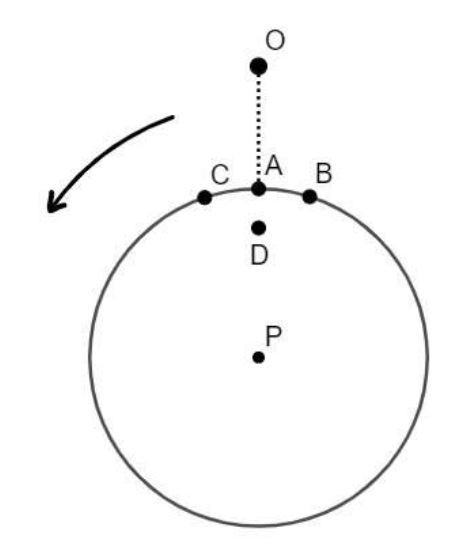 Terra vista dal polo P (rotazione antioraria); oggetto in O sopra la verticale tratteggiata; possibili punti d’impatto A, B, C, D.
Topic: Newtonian Mechanics, Thermodynamics, Electrostatics Metodi: Vector Decomposition, Free-Body Diagram, Order-of-Magnitude Estimation, Energy Conservation Method, Torque & Angular Momentum Analysis Competenze: Physical Reasoning, Estimation & Approximation, Unit Conversion Objects: Planet Fonte: Testo (PDF) — p.2
Question 6. (MSK1) Falling from a tower to test the Earth’s rotation (Earth as seen from the pole, anti-clockwise rotation). Where does the object touch the ground?
Earth as seen from pole P (anti-clock rotation); object in O above the drawn vertical; possible points of impact A, B, C, D.
Topic: Newtonian Mechanics, Thermodynamics, Electrostatics Metodi: Vector Decomposition, Free-Body Diagram, Order-of-Magnitude Estimation, Energy Conservation Method, Torque & Angular Momentum Analysis Competenze: Physical Reasoning, Estimation & Approximation, Unit Conversion Objects: Planet Fonte: Testo (PDF) — p.2
Quesito 7. Impulso laser Terra-Luna riflesso da uno specchietto, ricevuto dopo s. Distanza Terra-Luna? (raggio Terra km, raggio Luna km, km/s) A. 384400 km · B. 374800 km · C. 749500 km · D. 382900 km
Topic: Newtonian Mechanics, Thermodynamics, Electrostatics Metodi: Vector Decomposition, Free-Body Diagram, Order-of-Magnitude Estimation, Energy Conservation Method, Torque & Angular Momentum Analysis Competenze: Physical Reasoning, Estimation & Approximation, Unit Conversion Objects: Planet, Mirror Fonte: Testo (PDF) — p.2
Question 7. ** Earth-Moon laser pulse reflected from a mirror, received after s. Earth-Moon distance? (Earth radius km, Moon radius km, km/s) A. 384400 km · B. 374800 km · C. 749500 km · D. 382900 km
Topic: Newtonian Mechanics, Thermodynamics, Electrostatics Metodi: Vector Decomposition, Free-Body Diagram, Order-of-Magnitude Estimation, Energy Conservation Method, Torque & Angular Momentum Analysis Competenze: Physical Reasoning, Estimation & Approximation, Unit Conversion Objects: Planet, Mirror Fonte: Testo (PDF) — p.2
Quesito 8. Diagrammi del moto di due corpi 1 e 2. Quale affermazione è corretta? A. stessa velocità · B. stessa distanza percorsa · C. stessa posizione finale · D. tutte false
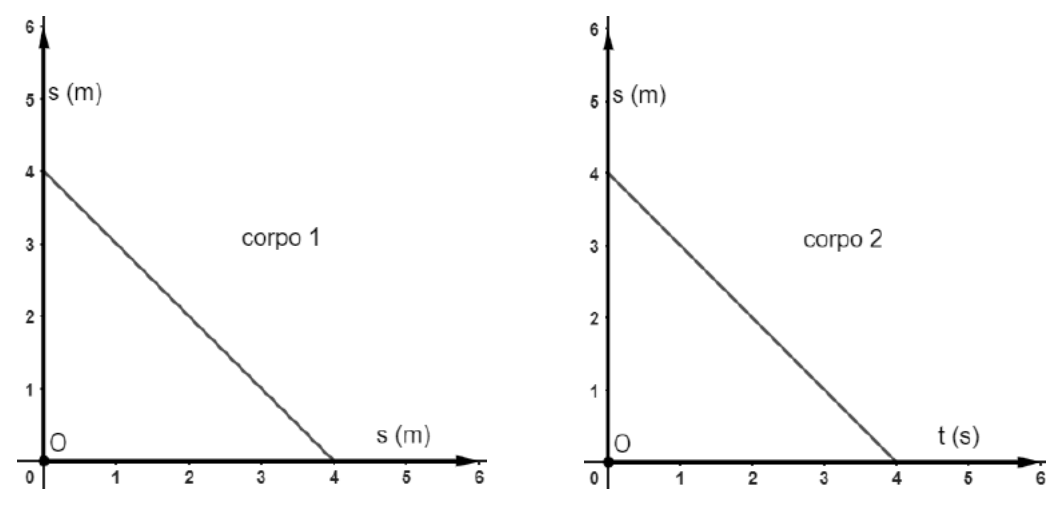 Diagrammi del moto: corpo 1 (grafico vs ) e corpo 2 (grafico vs ), entrambi rette decrescenti da a .
Topic: Newtonian Mechanics, Thermodynamics, Electrostatics Metodi: Vector Decomposition, Free-Body Diagram, Order-of-Magnitude Estimation, Energy Conservation Method, Torque & Angular Momentum Analysis Competenze: Physical Reasoning, Estimation & Approximation, Unit Conversion Objects: — Fonte: Testo (PDF) — p.2
Question 8.Motor diagrams of two bodies 1 and 2. What statement is correct? A. the same speed · B. same distance travelled · C. same final position · D. All of them are fake.
Motor diagrams: body 1 (graph vs ) and body 2 (graph vs ), both of which are straight decreasing from to .
Topic: Newtonian Mechanics, Thermodynamics, Electrostatics Metodi: Vector Decomposition, Free-Body Diagram, Order-of-Magnitude Estimation, Energy Conservation Method, Torque & Angular Momentum Analysis Competenze: Physical Reasoning, Estimation & Approximation, Unit Conversion Objects: — Fonte: Testo (PDF) — p.2
Quesito 9. Pendolo semplice (massa , filo di lunghezza , piccole oscillazioni). Da cosa dipende il periodo? A. solo massa e lunghezza · B. solo massa e · C. solo e lunghezza · D. massa, e lunghezza
Topic: Newtonian Mechanics, Thermodynamics, Electrostatics Metodi: Vector Decomposition, Free-Body Diagram, Order-of-Magnitude Estimation, Energy Conservation Method, Torque & Angular Momentum Analysis Competenze: Physical Reasoning, Estimation & Approximation, Unit Conversion Objects: Pendulum Fonte: Testo (PDF) — p.2
Quesito 9. Pendolo semplice (massa , filo di lunghezza , piccole oscillazioni). What does the period depend on? A. only mass and length · B. only mass and · C. only and length · D. Mass, and length
Topic: Newtonian Mechanics, Thermodynamics, Electrostatics Metodi: Vector Decomposition, Free-Body Diagram, Order-of-Magnitude Estimation, Energy Conservation Method, Torque & Angular Momentum Analysis Competenze: Physical Reasoning, Estimation & Approximation, Unit Conversion Objects: Pendulum Fonte: Testo (PDF) — p.2
Quesito 10. Una scatola su piano orizzontale (forza normale ) non si muove sotto una forza orizzontale; raddoppiando la forza resta ferma. Quale relazione per l’attrito con la forza iniziale (coefficiente )? A. · B. · C. · D.
Topic: Newtonian Mechanics, Thermodynamics, Electrostatics Metodi: Vector Decomposition, Free-Body Diagram, Order-of-Magnitude Estimation, Energy Conservation Method, Torque & Angular Momentum Analysis Competenze: Physical Reasoning, Estimation & Approximation, Unit Conversion Objects: Block Fonte: Testo (PDF) — p.2
Question 10.A horizontal box (normal force ) does not move under a horizontal force; doubling the force remains stationary. What is the ratio of the friction to the initial force (coefficient )? A. · B. · C. · D.
Topic: Newtonian Mechanics, Thermodynamics, Electrostatics Metodi: Vector Decomposition, Free-Body Diagram, Order-of-Magnitude Estimation, Energy Conservation Method, Torque & Angular Momentum Analysis Competenze: Physical Reasoning, Estimation & Approximation, Unit Conversion Objects: Block Fonte: Testo (PDF) — p.2
Quesito 11. Uno studente spinge col pollice una puntina su una lavagna; entra nella lavagna ma non nel pollice. Come si spiega? A. forza solo sulla lavagna · B. forza minore sul pollice · C. pressione del pollice… · D. la pressione della puntina sul pollice è minore di quella sulla lavagna
Topic: Newtonian Mechanics, Thermodynamics, Electrostatics Metodi: Vector Decomposition, Free-Body Diagram, Order-of-Magnitude Estimation, Energy Conservation Method, Torque & Angular Momentum Analysis Competenze: Physical Reasoning, Estimation & Approximation, Unit Conversion Objects: — Fonte: Testo (PDF) — p.2
Question 11. A student pushes a dot on a board with his thumb; he enters the board but not the thumb. How do you explain that? A. Force only on the board · B. Less force on the thumb · C. The pressure of the thumb… · D. The pressure of the thumb dot is less than that on the board.
Topic: Newtonian Mechanics, Thermodynamics, Electrostatics Metodi: Vector Decomposition, Free-Body Diagram, Order-of-Magnitude Estimation, Energy Conservation Method, Torque & Angular Momentum Analysis Competenze: Physical Reasoning, Estimation & Approximation, Unit Conversion Objects: — Fonte: Testo (PDF) — p.2
Quesito 12. Un pallone A (elio, forza verso l’alto) e una massa M su una sbarra incernierata in P. Quale spostamento provoca una rotazione oraria? A. pallone a 40 cm, massa a 30 cm · B. pallone a 20, massa a 10 · C. pallone a 25, massa a 25 · D. pallone a 20, massa a 30
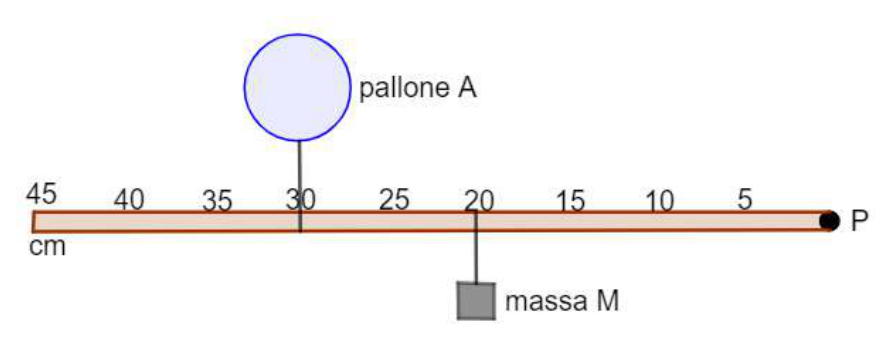 Sbarra graduata (cm) incernierata in P; pallone A (elio) a cm e massa M a cm.
Topic: Newtonian Mechanics, Thermodynamics, Electrostatics Metodi: Vector Decomposition, Free-Body Diagram, Order-of-Magnitude Estimation, Energy Conservation Method, Torque & Angular Momentum Analysis Competenze: Physical Reasoning, Estimation & Approximation, Unit Conversion Objects: Lever Fonte: Testo (PDF) — p.2
Question 12. A ball A (helium, upward force) and a mass M on a bar in P. What shift causes a time rotation? A. Ball 40 cm, mass 30 cm · B. Ball at 20, mass at 10 · C. Ball at 25, mass at 25 · D. Ball at 20, mass at 30
- Gradeed bar (cm) in P; ball A (helium) at cm and mass M at cm.*
Topic: Newtonian Mechanics, Thermodynamics, Electrostatics Metodi: Vector Decomposition, Free-Body Diagram, Order-of-Magnitude Estimation, Energy Conservation Method, Torque & Angular Momentum Analysis Competenze: Physical Reasoning, Estimation & Approximation, Unit Conversion Objects: Lever Fonte: Testo (PDF) — p.2
Quesito 13. Calvino (Cosmicomiche): un tempo la Luna era più vicina alla Terra. Perché? A. l’attrito delle maree dissipa energia e allontana il sistema per conservare il momento angolare · B. impatto con meteorite · C. fantasia letteraria · D. la Luna si sta in realtà avvicinando
Topic: Newtonian Mechanics, Thermodynamics, Electrostatics Metodi: Vector Decomposition, Free-Body Diagram, Order-of-Magnitude Estimation, Energy Conservation Method, Torque & Angular Momentum Analysis Competenze: Physical Reasoning, Estimation & Approximation, Unit Conversion Objects: Planet Fonte: Testo (PDF) — p.2
Question 13. Calvin (Cosmic Comics): Once the Moon was closer to the Earth. Why? Why? A. The friction of the tides dissipates energy and pushes the system away to preserve angular momentum. The impact with meteorite · C. The following is a list of the main subjects covered by this section: The moon is actually getting closer.
Topic: Newtonian Mechanics, Thermodynamics, Electrostatics Metodi: Vector Decomposition, Free-Body Diagram, Order-of-Magnitude Estimation, Energy Conservation Method, Torque & Angular Momentum Analysis Competenze: Physical Reasoning, Estimation & Approximation, Unit Conversion Objects: Planet Fonte: Testo (PDF) — p.2
Quesito 14. Un furgone pesa N e si muove a km/h. Ordine di grandezza dell’energia cinetica? A. J · B. J · C. J · D. Altro
Topic: Newtonian Mechanics, Thermodynamics, Electrostatics Metodi: Vector Decomposition, Free-Body Diagram, Order-of-Magnitude Estimation, Energy Conservation Method, Torque & Angular Momentum Analysis Competenze: Physical Reasoning, Estimation & Approximation, Unit Conversion Objects: — Fonte: Testo (PDF) — p.2
Question 14. A truck weighs N and moves at km/h. Orders of magnitude of kinetic energy? A. J · B. J · C. J · D. Other
Topic: Newtonian Mechanics, Thermodynamics, Electrostatics Metodi: Vector Decomposition, Free-Body Diagram, Order-of-Magnitude Estimation, Energy Conservation Method, Torque & Angular Momentum Analysis Competenze: Physical Reasoning, Estimation & Approximation, Unit Conversion Objects: — Fonte: Testo (PDF) — p.2
Quesito 15. Tre palle identiche lanciate dalla cima di una scogliera con velocità iniziale : A verso l’alto, B verso il basso, C orizzontalmente. Relazione tra le velocità d’impatto ? (attrito trascurabile) A. · B. · C. · D.
Topic: Newtonian Mechanics, Thermodynamics, Electrostatics Metodi: Vector Decomposition, Free-Body Diagram, Order-of-Magnitude Estimation, Energy Conservation Method, Torque & Angular Momentum Analysis Competenze: Physical Reasoning, Estimation & Approximation, Unit Conversion Objects: Ball, Projectile Fonte: Testo (PDF) — p.2
Question 15. Three identical balls thrown from the top of a cliff with initial speed : A up, B down, C horizontally. The impact velocity ratio ? (negligible friction) A. · B. · C. · D.
Topic: Newtonian Mechanics, Thermodynamics, Electrostatics Metodi: Vector Decomposition, Free-Body Diagram, Order-of-Magnitude Estimation, Energy Conservation Method, Torque & Angular Momentum Analysis Competenze: Physical Reasoning, Estimation & Approximation, Unit Conversion Objects: Ball, Projectile Fonte: Testo (PDF) — p.2
Quesito 16. Due masse con stessa energia cinetica. Quantità di moto ? A. · B. · C. · D. non determinabile
Topic: Newtonian Mechanics, Thermodynamics, Electrostatics Metodi: Vector Decomposition, Free-Body Diagram, Order-of-Magnitude Estimation, Energy Conservation Method, Torque & Angular Momentum Analysis Competenze: Physical Reasoning, Estimation & Approximation, Unit Conversion Objects: — Fonte: Testo (PDF) — p.2
Quesito 16. Due masse con stessa energia cinetica. Motorcycle quantity ? A. · B. · C. · D. Not determinable
Topic: Newtonian Mechanics, Thermodynamics, Electrostatics Metodi: Vector Decomposition, Free-Body Diagram, Order-of-Magnitude Estimation, Energy Conservation Method, Torque & Angular Momentum Analysis Competenze: Physical Reasoning, Estimation & Approximation, Unit Conversion Objects: — Fonte: Testo (PDF) — p.2
Quesito 17. Un Boeing 737 atterra a km/h ( m/s), massa t, e percorre m prima di fermarsi. Intensità della forza (costante)? A. N · B. N · C. N · D. N
Topic: Newtonian Mechanics, Thermodynamics, Electrostatics Metodi: Vector Decomposition, Free-Body Diagram, Order-of-Magnitude Estimation, Energy Conservation Method, Torque & Angular Momentum Analysis Competenze: Physical Reasoning, Estimation & Approximation, Unit Conversion Objects: — Fonte: Testo (PDF) — p.2
A Boeing 737 lands at km/h ( m/s), mass t, and travels m before stopping. Intensity of force (constant)? A. N · B. N · C. N · D. N
Topic: Newtonian Mechanics, Thermodynamics, Electrostatics Metodi: Vector Decomposition, Free-Body Diagram, Order-of-Magnitude Estimation, Energy Conservation Method, Torque & Angular Momentum Analysis Competenze: Physical Reasoning, Estimation & Approximation, Unit Conversion Objects: — Fonte: Testo (PDF) — p.2
Quesito 18. Due oggetti P e Q in un vaso con liquido: P galleggia, Q affonda. Quale combinazione di densità (P, Q, liquido) è compatibile? [tabella con 4 righe A-D di valori in ]
Topic: Newtonian Mechanics, Thermodynamics, Electrostatics Metodi: Vector Decomposition, Free-Body Diagram, Order-of-Magnitude Estimation, Energy Conservation Method, Torque & Angular Momentum Analysis Competenze: Physical Reasoning, Estimation & Approximation, Unit Conversion Objects: Container Fonte: Testo (PDF) — p.2
Question 18. Two P and Q objects in a vessel with liquid: P floats, Q sinks. What density combination (P, Q, liquid) is compatible? [table with 4 A-D rows of values in ]
Topic: Newtonian Mechanics, Thermodynamics, Electrostatics Metodi: Vector Decomposition, Free-Body Diagram, Order-of-Magnitude Estimation, Energy Conservation Method, Torque & Angular Momentum Analysis Competenze: Physical Reasoning, Estimation & Approximation, Unit Conversion Objects: Container Fonte: Testo (PDF) — p.2
Quesito 19. Dilatazione lineare di tre sbarre I, II, III (). Quale relazione tra i coefficienti ? A. · B. · C. · D.
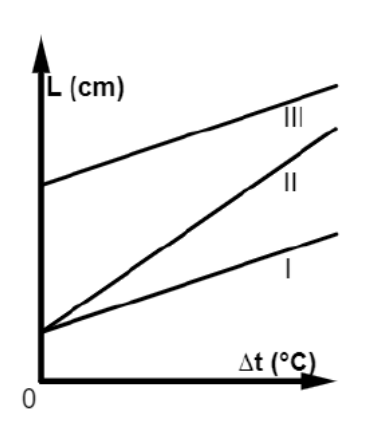 Grafico (cm) vs (°C) per le tre sbarre I, II, III (rette di pendenza diversa).
Topic: Newtonian Mechanics, Thermodynamics, Electrostatics Metodi: Vector Decomposition, Free-Body Diagram, Order-of-Magnitude Estimation, Energy Conservation Method, Torque & Angular Momentum Analysis Competenze: Physical Reasoning, Estimation & Approximation, Unit Conversion Objects: Rod Fonte: Testo (PDF) — p.2
Quesito 19. Dilatazione lineare di tre sbarre I, II, III (). What is the relationship between the coefficients? A. · B. · C. · D.
Grafico (cm) vs (°C) per le tre sbarre I, II, III (rette di pendenza diversa).
Topic: Newtonian Mechanics, Thermodynamics, Electrostatics Metodi: Vector Decomposition, Free-Body Diagram, Order-of-Magnitude Estimation, Energy Conservation Method, Torque & Angular Momentum Analysis Competenze: Physical Reasoning, Estimation & Approximation, Unit Conversion Objects: Rod Fonte: Testo (PDF) — p.2
Quesito 20. Due cambiamenti di stato descritti: (1) le particelle non vibrano più attorno a posizioni fisse e occupano tutto lo spazio; (2) le particelle si avvicinano ma continuano a muoversi in tutta la sostanza. Quali passaggi di stato? A. sublimazione/condensazione · B. fusione/vaporizzazione · C. fusione/solidificazione · D. condensazione/vaporizzazione
Topic: Newtonian Mechanics, Thermodynamics, Electrostatics Metodi: Vector Decomposition, Free-Body Diagram, Order-of-Magnitude Estimation, Energy Conservation Method, Torque & Angular Momentum Analysis Competenze: Physical Reasoning, Estimation & Approximation, Unit Conversion Objects: — Fonte: Testo (PDF) — p.2
Question 20. Two state changes described: (1) particles no longer vibrate around fixed positions and occupy all space; (2) particles approach but continue to move throughout the substance. What steps? A. Sublimation/condensation · B. The following conditions shall apply: The following conditions shall apply: Condensation/vaporization
Topic: Newtonian Mechanics, Thermodynamics, Electrostatics Metodi: Vector Decomposition, Free-Body Diagram, Order-of-Magnitude Estimation, Energy Conservation Method, Torque & Angular Momentum Analysis Competenze: Physical Reasoning, Estimation & Approximation, Unit Conversion Objects: — Fonte: Testo (PDF) — p.2
Quesito 21. Spazio tra due superfici (sopra fredda , sotto calda ) riempito con aria, ferro, acqua o vuoto. In quale caso il trasferimento di energia termica è più veloce? A. aria · B. acqua · C. ferro · D. vuoto
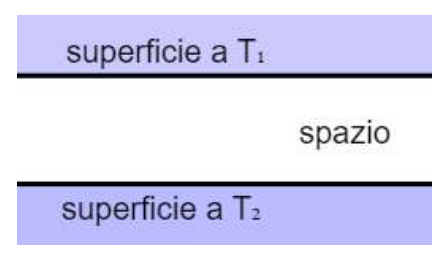 Due superfici parallele (sopra a , sotto a ) separate da uno spazio.
Topic: Newtonian Mechanics, Thermodynamics, Electrostatics Metodi: Vector Decomposition, Free-Body Diagram, Order-of-Magnitude Estimation, Energy Conservation Method, Torque & Angular Momentum Analysis Competenze: Physical Reasoning, Estimation & Approximation, Unit Conversion Objects: — Fonte: Testo (PDF) — p.2
Question 21.** Space between two surfaces (cold above , hot below ) filled with air, iron, water or vacuum. In which case is the transfer of heat energy faster? A. Air · B. water · C. Iron · D. empty
Two parallel surfaces (above , below ) separated by a space.
Topic: Newtonian Mechanics, Thermodynamics, Electrostatics Metodi: Vector Decomposition, Free-Body Diagram, Order-of-Magnitude Estimation, Energy Conservation Method, Torque & Angular Momentum Analysis Competenze: Physical Reasoning, Estimation & Approximation, Unit Conversion Objects: — Fonte: Testo (PDF) — p.2
Quesito 22. Molecole di un gas in un contenitore sigillato a volume costante, scaldato: (I) le molecole si allontanano; (II) si muovono più velocemente. Quali vere? A. solo I · B. solo II · C. entrambe · D. nessuna
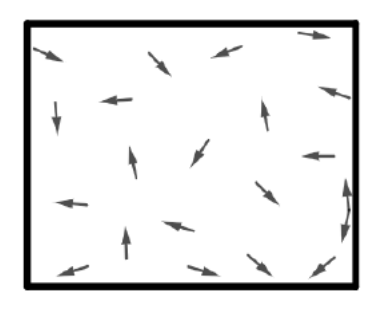 Molecole di gas (frecce di velocità) in un contenitore sigillato a volume costante.
Topic: Newtonian Mechanics, Thermodynamics, Electrostatics Metodi: Vector Decomposition, Free-Body Diagram, Order-of-Magnitude Estimation, Energy Conservation Method, Torque & Angular Momentum Analysis Competenze: Physical Reasoning, Estimation & Approximation, Unit Conversion Objects: Gas, Container Fonte: Testo (PDF) — p.2
Question 22. Moles of a gas in a sealed container at constant volume, heated: (I) the molecules move away; (II) they move faster. What truths? A. only I · B. only II · C. both · D. No one
Gas molecules (speed arrows) in a sealed container at constant volume.
Topic: Newtonian Mechanics, Thermodynamics, Electrostatics Metodi: Vector Decomposition, Free-Body Diagram, Order-of-Magnitude Estimation, Energy Conservation Method, Torque & Angular Momentum Analysis Competenze: Physical Reasoning, Estimation & Approximation, Unit Conversion Objects: Gas, Container Fonte: Testo (PDF) — p.2
Quesito 23. Un raggio di luce verso uno specchio angolare; il raggio incidente forma con uno specchio. Angolo da cui emerge? A. · B. · C. · D. nessuno dei precedenti
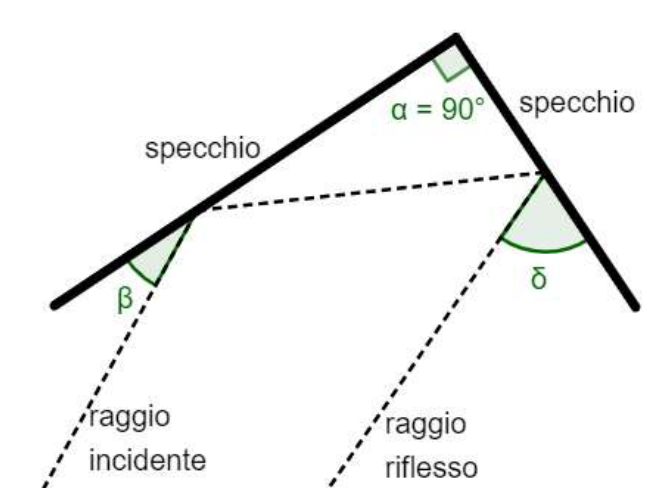 Specchio angolare (): raggio incidente con angolo ed emergente con angolo .
Topic: Newtonian Mechanics, Thermodynamics, Electrostatics Metodi: Vector Decomposition, Free-Body Diagram, Order-of-Magnitude Estimation, Energy Conservation Method, Torque & Angular Momentum Analysis Competenze: Physical Reasoning, Estimation & Approximation, Unit Conversion Objects: Mirror Fonte: Testo (PDF) — p.2
Question 23. A beam of light towards an angular mirror; the incident beam forms with a mirror. angle from which it emerges? A. · B. · C. · D. None of the above
Angular mirror (): incident beam with angle and emerging beam with angle .
Topic: Newtonian Mechanics, Thermodynamics, Electrostatics Metodi: Vector Decomposition, Free-Body Diagram, Order-of-Magnitude Estimation, Energy Conservation Method, Torque & Angular Momentum Analysis Competenze: Physical Reasoning, Estimation & Approximation, Unit Conversion Objects: Mirror Fonte: Testo (PDF) — p.2
Quesito 24. Affermazione corretta sulla radiazione elettromagnetica: A. infrarosso per analizzare le ossa · B. microonde nelle telecomunicazioni · C. visione notturna con ultravioletto · D. immagini termiche con raggi X
Topic: Newtonian Mechanics, Thermodynamics, Electrostatics Metodi: Vector Decomposition, Free-Body Diagram, Order-of-Magnitude Estimation, Energy Conservation Method, Torque & Angular Momentum Analysis Competenze: Physical Reasoning, Estimation & Approximation, Unit Conversion Objects: — Fonte: Testo (PDF) — p.2
Question 24. Correct statement on electromagnetic radiation: A. Infrared to analyse bones · B. Microwave in telecommunications · C. night vision with ultraviolet · D. Thermal imaging with X-rays
Topic: Newtonian Mechanics, Thermodynamics, Electrostatics Metodi: Vector Decomposition, Free-Body Diagram, Order-of-Magnitude Estimation, Energy Conservation Method, Torque & Angular Momentum Analysis Competenze: Physical Reasoning, Estimation & Approximation, Unit Conversion Objects: — Fonte: Testo (PDF) — p.2
Quesito 25. Diagramma di un’onda sonora nel tempo. Affermazione corretta sulla percezione? A. sempre più grave · B. sempre più acuto · C. sempre più debole · D. nessuna differenza
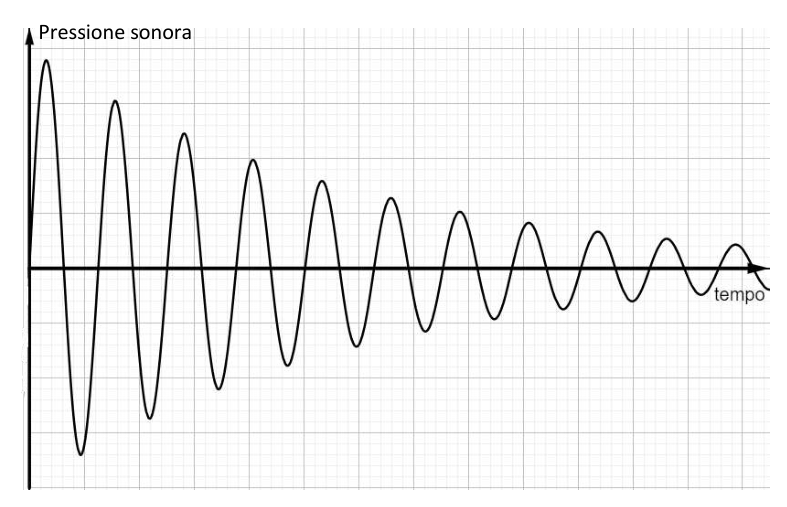 Pressione sonora vs tempo: oscillazione con ampiezza decrescente e periodo costante.
Topic: Newtonian Mechanics, Thermodynamics, Electrostatics Metodi: Vector Decomposition, Free-Body Diagram, Order-of-Magnitude Estimation, Energy Conservation Method, Torque & Angular Momentum Analysis Competenze: Physical Reasoning, Estimation & Approximation, Unit Conversion Objects: — Fonte: Testo (PDF) — p.2
Question 25. A diagram of a sound wave in time. Correct statement about the perception? A. The situation is becoming more serious. increasingly acute · C. increasingly weak · D. No difference
Sound pressure vs. time: oscillation with decreasing amplitude and constant period.
Topic: Newtonian Mechanics, Thermodynamics, Electrostatics Metodi: Vector Decomposition, Free-Body Diagram, Order-of-Magnitude Estimation, Energy Conservation Method, Torque & Angular Momentum Analysis Competenze: Physical Reasoning, Estimation & Approximation, Unit Conversion Objects: — Fonte: Testo (PDF) — p.2
Quesito 26. Tre palline cariche ai vertici di un triangolo equilatero. Direzione della forza sulla pallina C? A. nulla · B. verso l’alto · C. verso il basso · D. non determinabile
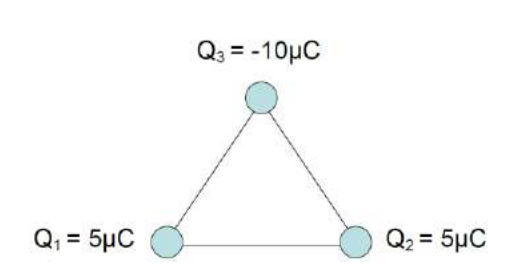 Triangolo equilatero con C e C alla base e C al vertice.
Topic: Newtonian Mechanics, Thermodynamics, Electrostatics Metodi: Vector Decomposition, Free-Body Diagram, Order-of-Magnitude Estimation, Energy Conservation Method, Torque & Angular Momentum Analysis Competenze: Physical Reasoning, Estimation & Approximation, Unit Conversion Objects: Point Charge Fonte: Testo (PDF) — p.2
Question 26. Three balls loaded at the vertices of an equilateral triangle. Direction of force on the ball C? A. Nothing · B. Upwards · C. Downward · D. Not determinable
Equivalent triangle with C and C at the base and C at the top.
Topic: Newtonian Mechanics, Thermodynamics, Electrostatics Metodi: Vector Decomposition, Free-Body Diagram, Order-of-Magnitude Estimation, Energy Conservation Method, Torque & Angular Momentum Analysis Competenze: Physical Reasoning, Estimation & Approximation, Unit Conversion Objects: Point Charge Fonte: Testo (PDF) — p.2
Quesito 27. (Comprensione testo) Missione Hera (ESA, flyby di Marte, difesa planetaria, Didymos/Dimorphos). Qual è il principale scopo? A. proteggere la Terra dagli impatti asteroidali · B. studiare Deimos per missioni umane · C. accorciare i viaggi e risparmiare carburante · D. capire come si formano le lune
Topic: Newtonian Mechanics, Thermodynamics, Electrostatics Metodi: Vector Decomposition, Free-Body Diagram, Order-of-Magnitude Estimation, Energy Conservation Method, Torque & Angular Momentum Analysis Competenze: Physical Reasoning, Estimation & Approximation, Unit Conversion Objects: Planet, Satellite Fonte: Testo (PDF) — p.2
Question 27. (Text understanding) Mission Hera (ESA, flyby of Mars, planetary defence, Didymos/Dimorphos). What is the main purpose? A. Protect the Earth from asteroid impacts · B. studying Deimos for human missions · C. shorten travel and save fuel · D. How the moons form
Topic: Newtonian Mechanics, Thermodynamics, Electrostatics Metodi: Vector Decomposition, Free-Body Diagram, Order-of-Magnitude Estimation, Energy Conservation Method, Torque & Angular Momentum Analysis Competenze: Physical Reasoning, Estimation & Approximation, Unit Conversion Objects: Planet, Satellite Fonte: Testo (PDF) — p.2
Il proiettore per diapositive — costruzione ottica (problema 1x3)
Quesito a risposta aperta (Quesito uno X tre, punti).
Il proiettore per diapositive proietta immagini su uno schermo. La diapositiva (“oggetto”) è illuminata da dietro; la luce attraversa una lente convergente e raggiunge lo schermo. L’immagine è reale e capovolta. Lo schema ottico (unità arbitrarie) mostra l’oggetto (con base sull’asse ottico), la lente convergente con centro O, l’asse ottico, e i due fuochi (lato oggetto) ed (lato immagine).
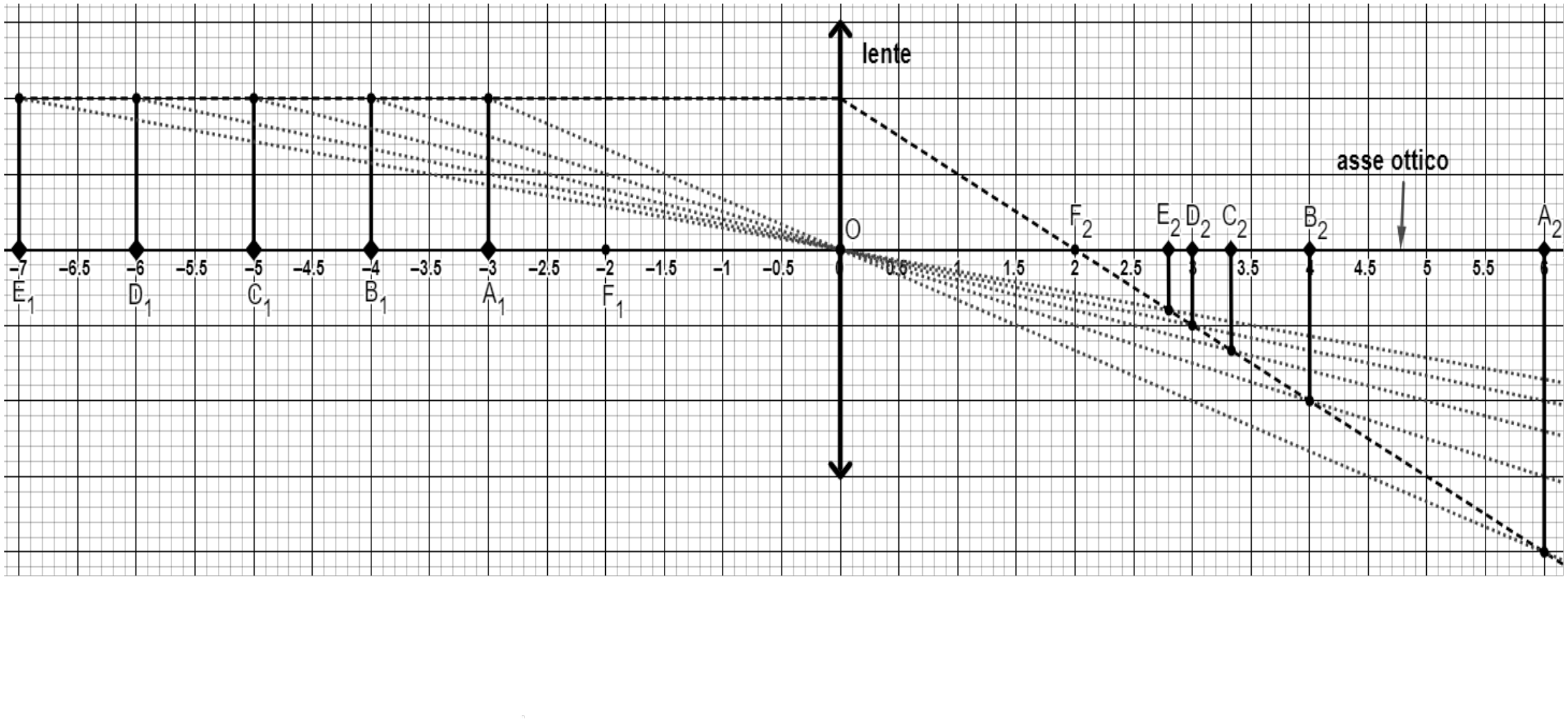 Schema ottico (unità arbitrarie): asse ottico orizzontale, lente in O, fuochi a e a ; oggetti sul lato negativo con i raggi tracciati e le immagini dal lato opposto.
Promemoria: i raggi da uno stesso punto convergono in un punto dopo la lente; il raggio per il centro O non viene deviato; i raggi paralleli all’asse passano per il fuoco; distanza focale .
a) A quale distanza da O deve porsi l’oggetto perché l’immagine si formi in una certa posizione (leggere dal grafico)? b), c) Analoghe, per altre posizioni dell’immagine. d) Disegna l’immagine se l’oggetto è in posizione unità. e) Se lo schermo è a unità dalla lente, dove va posto l’oggetto? f) Spiega perché, se l’oggetto è posto sul fuoco , non si forma immagine nitida per nessuna posizione dello schermo. g) Compila la tabella con (oggetto-lente), (immagine-lente) e il rapporto . A cosa corrispondono questi rapporti? h) Compila la tabella con (oggetto-fuoco) e (immagine-fuoco). Quale relazione tra le due distanze? i) Se l’oggetto è a unità dalla lente, dove va posto lo schermo e quanto è grande l’immagine?
Topic: Geometric Optics Metodi: Ray Tracing, Thin Lens & Mirror Equation, Graph Linearization Competenze: Graph Linearization, Diagrammatic Reasoning, Mathematical Modeling Objects: Lens, Screen Fonte: Testo (PDF) — p.10
Il proiettore per diapositive — costruzione ottica (problema 1x3)
Question with open answer (Question one X three, points).
The slide projector projects images onto a screen. The slide (“object”) is illuminated from behind; the light passes through a converging lens and reaches the screen. The image is real and upside down. The optical scheme (arbitrary unit) shows the object (based on the optical axis), the converging lens with center O, the optical axis, and the two fires (the object side) and (the image side).
Optical scheme (arbitrary units): horizontal optical axis, lens in O, fires at and at ; objects on the negative side with traced beams and images on the opposite side.
Reminder: rays from the same point converge to a point after the lens; the radius for the centre O is not deflected; rays parallel to the axis pass through the fire; focal length .
**a) ** How far from O must the object be placed for the image to form in a certain position (read from the graph)? **b) **, **c) ** Analogs, for other positions of the image. **d) ** Draw the image if the object is in the position unit. e) Se lo schermo è a unità dalla lente, dove va posto l’oggetto? **f) ** Explains why, if the object is placed on fire , no clear image is formed for any position on the screen. g) Compila la tabella con (oggetto-lente), (immagine-lente) e il rapporto . What do these reports correspond to? **h) ** Complete the table with (object-fire) and (image-fire). What relationship between the two distances? i) Se l’oggetto è a unità dalla lente, dove va posto lo schermo e quanto è grande l’immagine?
Topic: Geometric Optics Metodi: Ray Tracing, Thin Lens & Mirror Equation, Graph Linearization Competenze: Graph Linearization, Diagrammatic Reasoning, Mathematical Modeling Objects: Lens, Screen Fonte: Testo (PDF) — p.10