Una certa situazione fisica è descritta dalla relazione , dove , e sono variabili e è una costante. In seguito a un processo fisico in cui raddoppia e anche raddoppia, cosa accade alla variabile ?
- A. deve raddoppiare
- B. deve aumentare di 4 volte
- C. deve aumentare di 8 volte
- D. deve dimezzarsi
Risposta: C
Soluzione:
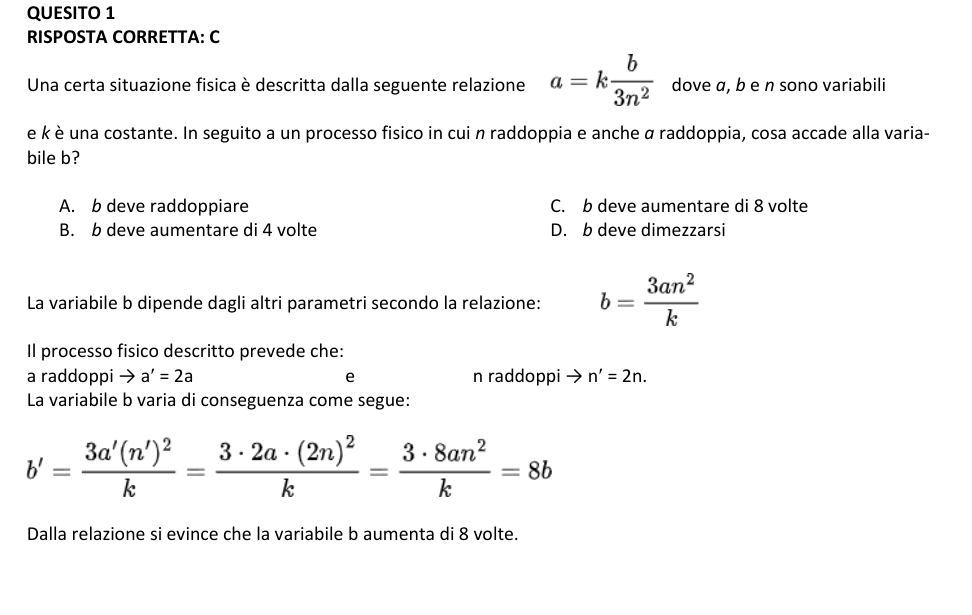
Soluzione ufficiale (Gruppo «Giochi di Anacleto», AIF), dal PDF ufficiale — p. 20.
Topic: Mathematics Metodi: Dimensional Analysis Competenze: Mathematical Modeling Objects: — Fonte: Testo (PDF) — p.2 · Soluzione ufficiale (PDF) — p.20
A certain physical situation is described by the relation , where , and are variables and is a constant. After a physical process in which doubles and also doubles, what happens to the variable ?
- A. must double
- B. must increase 4 times
- C. must increase 8 times
- D. must halve
Risposta: C
Soluzione: The full official solution (in Italian) is in the original-language version of this problem and in the official PDF.
Topic: Mathematics Metodi: Dimensional Analysis Competenze: Mathematical Modeling Objects: — Fonte: Testo (PDF) — p.2 · Soluzione ufficiale (PDF) — p.20
Un gas è contenuto in un cilindro il cui coperchio è sottoposto a una pressione costante, ma regolabile a piacere. Il grafico in figura rappresenta le coppie di valori volume-pressione misurati sperimentalmente in nove diverse regolazioni della pressione. Quale tra le quattro linee di tendenza (A, B, C, D in figura) rappresenta in modo più accurato la relazione esistente tra le due grandezze considerate?
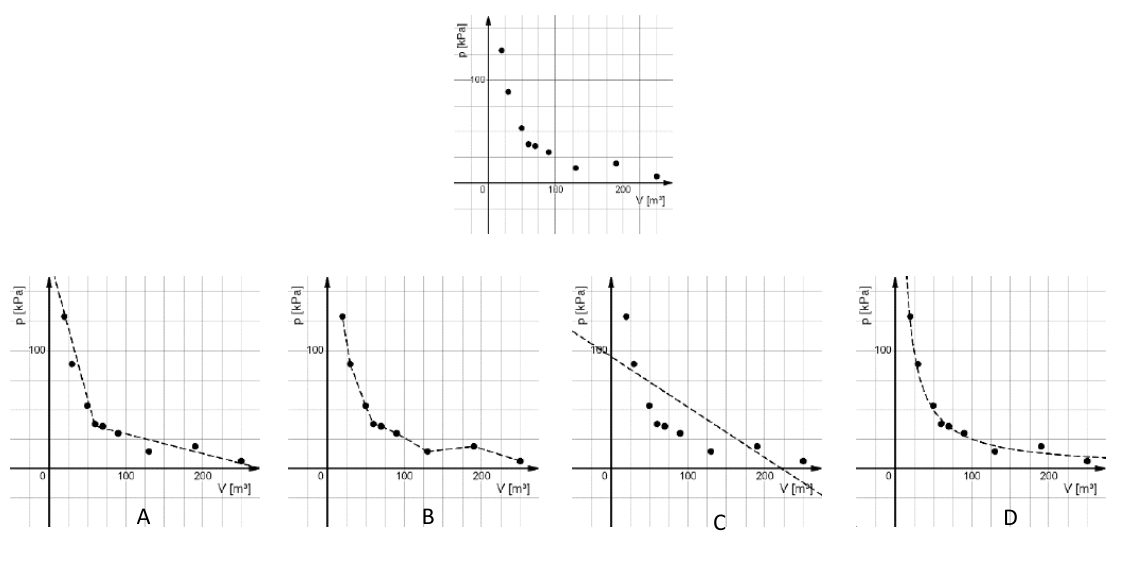
Risposta: D
Soluzione:
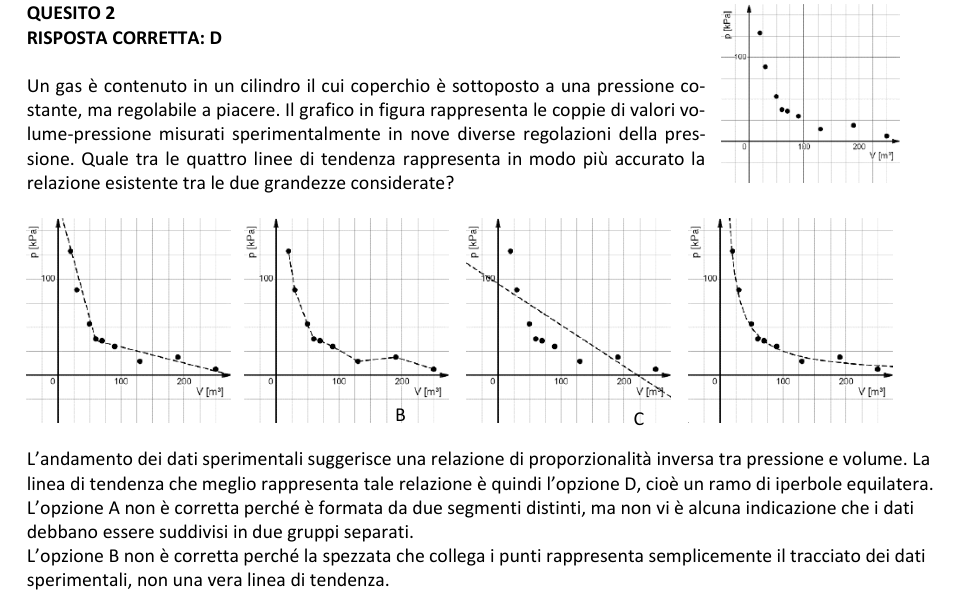

Soluzione ufficiale (Gruppo «Giochi di Anacleto», AIF), dal PDF ufficiale — p. 20, 21.
Topic: Thermodynamics Metodi: Ideal Gas Law, Curve Fitting Competenze: Experimental Data Analysis, Curve Fitting Objects: Gas, Piston Fonte: Testo (PDF) — p.2 · Soluzione ufficiale (PDF) — p.20
A gas is contained in a cylinder whose lid is subjected to a constant but freely adjustable pressure. The graph in the figure shows the volume–pressure pairs measured experimentally for nine different pressure settings. Which of the four trend lines (A, B, C, D in the figure) most accurately represents the relationship between the two quantities?
Risposta: D
Soluzione: The full official solution (in Italian) is in the original-language version of this problem and in the official PDF.
Topic: Thermodynamics Metodi: Ideal Gas Law, Curve Fitting Competenze: Experimental Data Analysis, Curve Fitting Objects: Gas, Piston Fonte: Testo (PDF) — p.2 · Soluzione ufficiale (PDF) — p.20
Una sbarra uniforme viene tagliata in tre pezzi di dimensioni diverse, tali che la somma delle lunghezze dei due pezzi più corti sia uguale alla lunghezza del pezzo più lungo. Ogni pezzo ha la stessa larghezza e lo stesso spessore. Dette , e le densità dei tre pezzi, quale delle seguenti affermazioni è corretta?
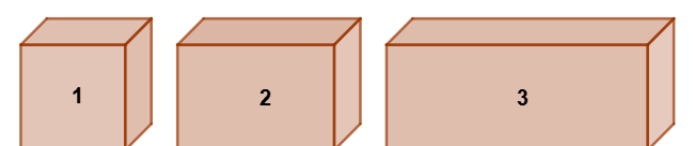
- A.
- B.
- C.
- D.
Risposta: D
Soluzione:
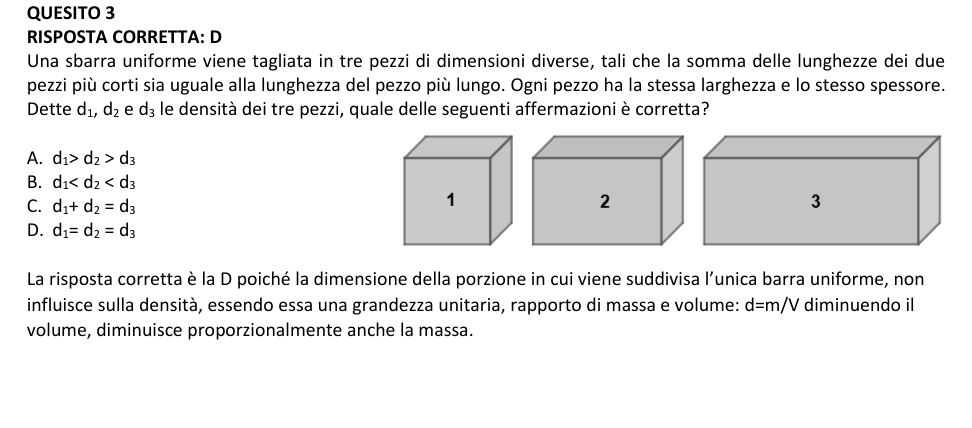
Soluzione ufficiale (Gruppo «Giochi di Anacleto», AIF), dal PDF ufficiale — p. 21.
Topic: Elasticity & Materials Metodi: Physical Modeling Competenze: Physical Reasoning Objects: Beam Fonte: Testo (PDF) — p.2 · Soluzione ufficiale (PDF) — p.21
A uniform bar is cut into three pieces of different sizes, such that the sum of the lengths of the two shorter pieces equals the length of the longest piece. Each piece has the same width and the same thickness. Calling , and the densities of the three pieces, which of the following statements is correct?
- A.
- B.
- C.
- D.
Risposta: D
Soluzione: The full official solution (in Italian) is in the original-language version of this problem and in the official PDF.
Topic: Elasticity & Materials Metodi: Physical Modeling Competenze: Physical Reasoning Objects: Beam Fonte: Testo (PDF) — p.2 · Soluzione ufficiale (PDF) — p.21
La forza normale è un vettore che ha
- A. sempre direzione uguale a quella dell’accelerazione di gravità, ma verso opposto
- B. sempre direzione e verso uguali a quelli dell’accelerazione di gravità
- C. direzione perpendicolare alla superficie, verso entrante
- D. direzione perpendicolare alla superficie, verso uscente
Risposta: D
Soluzione:
Soluzione ufficiale (Gruppo «Giochi di Anacleto», AIF), dal PDF ufficiale — p. 21.
Topic: Newtonian Mechanics Metodi: Free-Body Diagram Competenze: Physical Reasoning Objects: — Fonte: Testo (PDF) — p.3 · Soluzione ufficiale (PDF) — p.21
The normal force is a vector that has
- A. always the same direction as the gravitational acceleration, but opposite sense
- B. always the same direction and sense as the gravitational acceleration
- C. direction perpendicular to the surface, pointing into it
- D. direction perpendicular to the surface, pointing out of it
Risposta: D
Soluzione: The full official solution (in Italian) is in the original-language version of this problem and in the official PDF.
Topic: Newtonian Mechanics Metodi: Free-Body Diagram Competenze: Physical Reasoning Objects: — Fonte: Testo (PDF) — p.3 · Soluzione ufficiale (PDF) — p.21
Esattamente alle 4:00 del pomeriggio di ieri un’automobile si trovava su una strada di collina. L’accelerazione dell’automobile era nel verso della salita. Quale o quali affermazioni descrivono correttamente lo stato di moto dell’auto?
(I) Si muoveva in salita · (II) Si muoveva in discesa · (III) Era ferma
- A. È possibile solo l’affermazione (I)
- B. Sono possibili tutte e tre le affermazioni
- C. Sono possibili sia l’affermazione (I) che la (II), non la (III)
- D. Sono possibili sia l’affermazione (I) che la (III), non la (II)
Risposta: B
Soluzione:
Soluzione ufficiale (Gruppo «Giochi di Anacleto», AIF), dal PDF ufficiale — p. 21, 22.
Topic: Newtonian Mechanics Metodi: Kinematic Equations Competenze: Physical Reasoning Objects: Cart, Inclined Plane Fonte: Testo (PDF) — p.3 · Soluzione ufficiale (PDF) — p.21
At exactly 4:00 pm yesterday a car was on a hill road. The car’s acceleration pointed up the slope. Which statement(s) correctly describe the car’s state of motion?
(I) It was moving uphill · (II) It was moving downhill · (III) It was at rest
- A. Only statement (I) is possible
- B. All three statements are possible
- C. Statements (I) and (II) are possible, not (III)
- D. Statements (I) and (III) are possible, not (II)
Risposta: B
Soluzione: The full official solution (in Italian) is in the original-language version of this problem and in the official PDF.
Topic: Newtonian Mechanics Metodi: Kinematic Equations Competenze: Physical Reasoning Objects: Cart, Inclined Plane Fonte: Testo (PDF) — p.3 · Soluzione ufficiale (PDF) — p.21
Due scatole vengono lanciate verso l’alto lungo una rampa senza attrito con velocità iniziali diverse, e quindi lasciate muoversi liberamente. Qual è il grafico (A, B, C, D in figura) che rappresenta il loro moto?
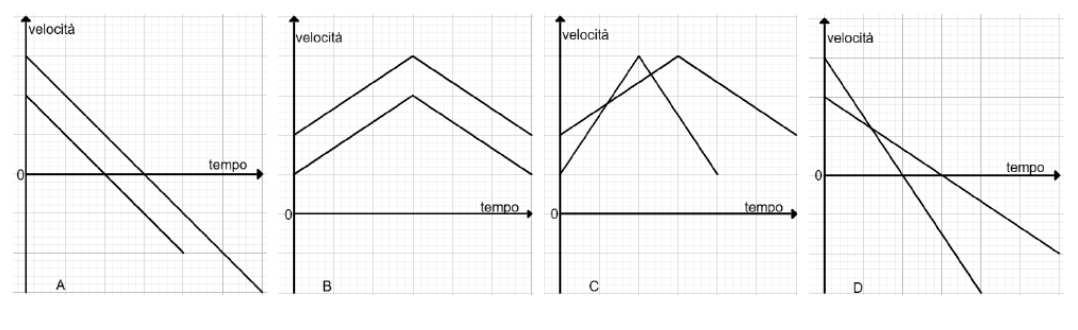
Risposta: A
Soluzione:
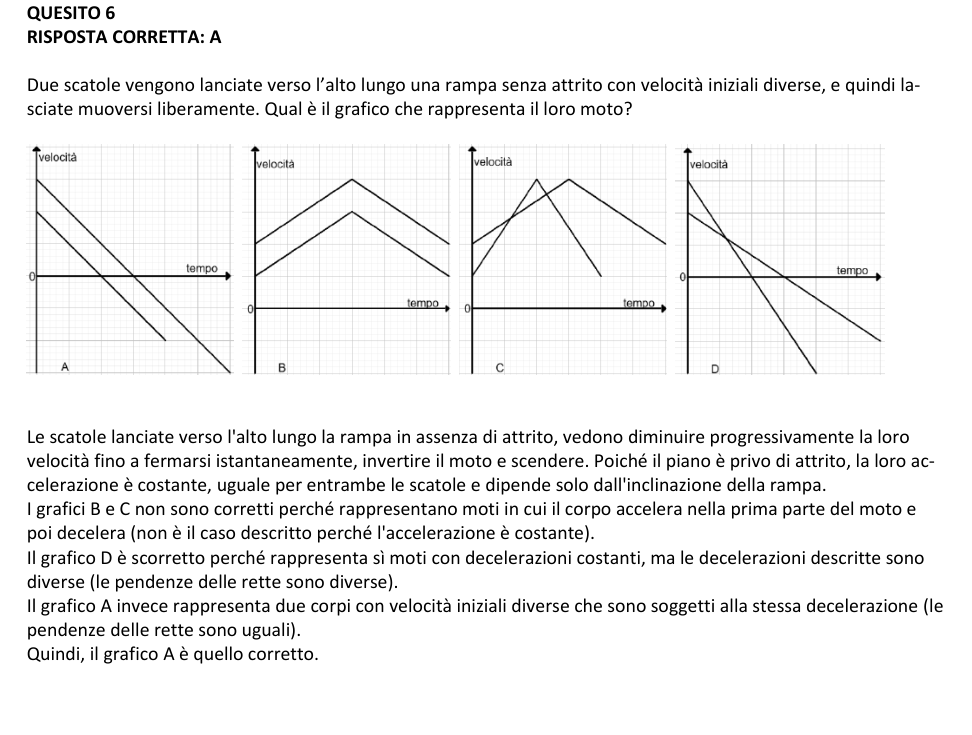
Soluzione ufficiale (Gruppo «Giochi di Anacleto», AIF), dal PDF ufficiale — p. 22.
Topic: Newtonian Mechanics Metodi: Kinematic Equations Competenze: Diagrammatic Reasoning Objects: Block, Inclined Plane Fonte: Testo (PDF) — p.3 · Soluzione ufficiale (PDF) — p.22
Two boxes are launched up a frictionless ramp with different initial speeds and then left to move freely. Which graph (A, B, C, D in the figure) represents their motion?
Risposta: A
Soluzione: The full official solution (in Italian) is in the original-language version of this problem and in the official PDF.
Topic: Newtonian Mechanics Metodi: Kinematic Equations Competenze: Diagrammatic Reasoning Objects: Block, Inclined Plane Fonte: Testo (PDF) — p.3 · Soluzione ufficiale (PDF) — p.22
L’auto A e l’auto B viaggiano entrambe lungo un tratto di strada rettilinea a 90 km/h e nella stessa direzione (verso). L’auto A si mantiene costantemente 6.0 metri dietro l’auto B. Improvvisamente il conducente dell’auto B frena, rallentando con una decelerazione costante di 2.0 m/s². Dopo 1.2 secondi, anche il conducente della vettura A inizia a frenare, sempre a 2.0 m/s², ma questo non è sufficiente e alla fine la vettura A tampona la vettura B, entrambe ancora in movimento. Qual è la velocità relativa delle due auto al momento della collisione?
- A. 2.4 m/s
- B. 5.0 m/s
- C. 23.8 m/s
- D. nessuna delle precedenti opzioni
Risposta: A
Soluzione:
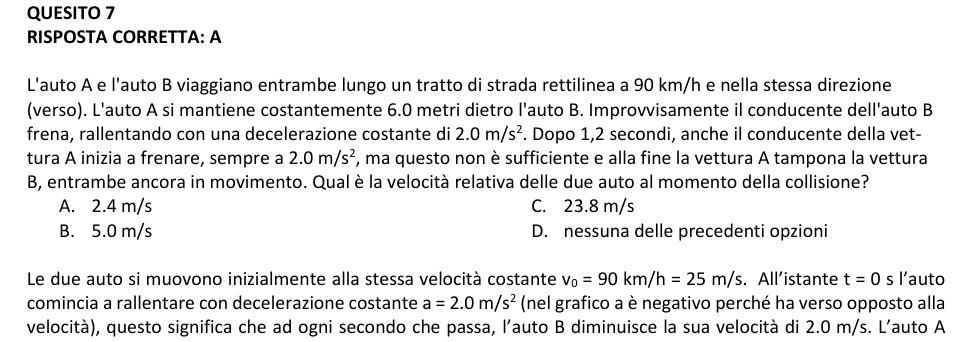
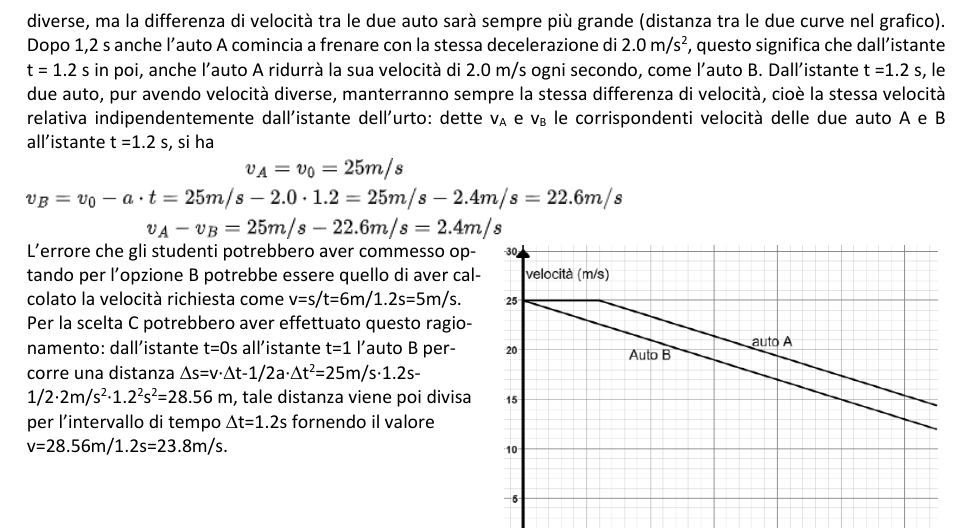
Soluzione ufficiale (Gruppo «Giochi di Anacleto», AIF), dal PDF ufficiale — p. 22, 23.
Topic: Newtonian Mechanics Metodi: Kinematic Equations Competenze: Mathematical Modeling Objects: Cart Fonte: Testo (PDF) — p.4 · Soluzione ufficiale (PDF) — p.22
Car A and car B both travel along a straight stretch of road at 90 km/h in the same direction. Car A constantly stays 6.0 metres behind car B. Suddenly the driver of car B brakes, slowing down with a constant deceleration of 2.0 m/s². After 1.2 seconds the driver of car A also starts braking, again at 2.0 m/s², but this is not enough and car A eventually rear-ends car B, both still moving. What is the relative speed of the two cars at the moment of the collision?
- A. 2.4 m/s
- B. 5.0 m/s
- C. 23.8 m/s
- D. none of the previous options
Risposta: A
Soluzione: The full official solution (in Italian) is in the original-language version of this problem and in the official PDF.
Topic: Newtonian Mechanics Metodi: Kinematic Equations Competenze: Mathematical Modeling Objects: Cart Fonte: Testo (PDF) — p.4 · Soluzione ufficiale (PDF) — p.22
Qui di seguito sono riportati i grafici dell’accelerazione in funzione del tempo per quattro oggetti (A, B, C, D). Tutti gli assi hanno la stessa scala. Quale oggetto ha subito la maggiore variazione di velocità durante l’intervallo di tempo considerato?
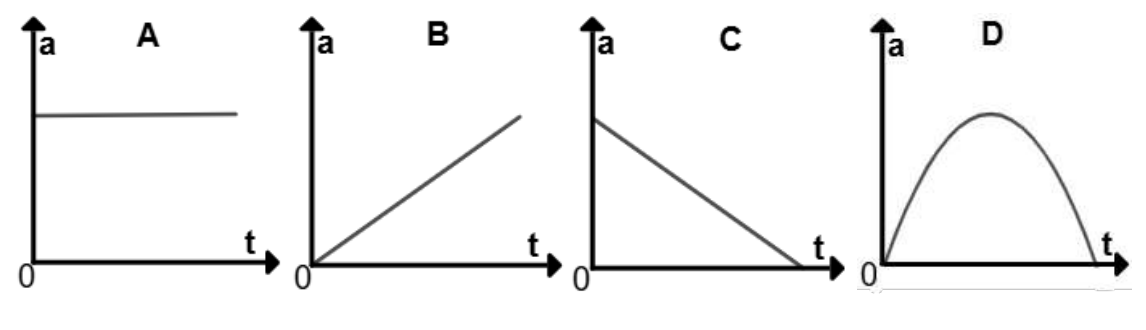
Risposta: A
Soluzione:
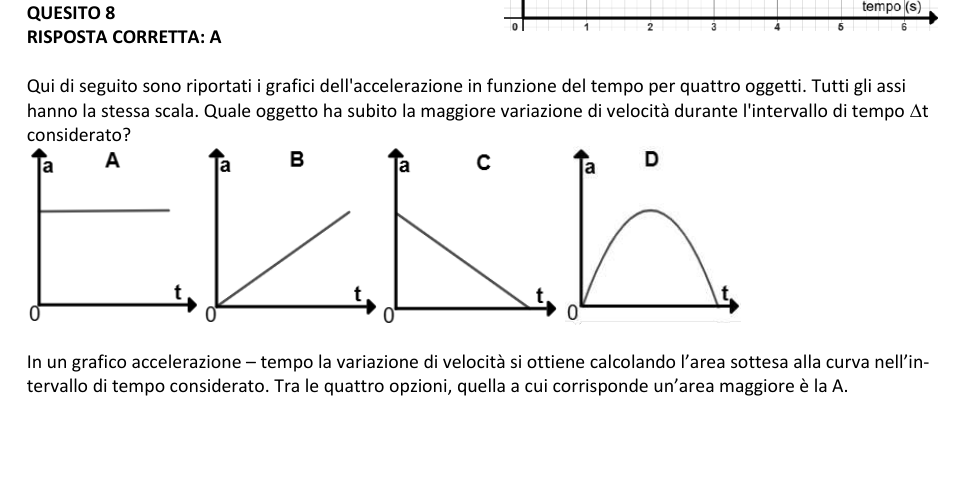
Soluzione ufficiale (Gruppo «Giochi di Anacleto», AIF), dal PDF ufficiale — p. 23.
Topic: Newtonian Mechanics Metodi: Kinematic Equations, Calculus-Integration Competenze: Diagrammatic Reasoning Objects: — Fonte: Testo (PDF) — p.4 · Soluzione ufficiale (PDF) — p.23
Below are the acceleration–time graphs of four objects (A, B, C, D). All axes have the same scale. Which object underwent the largest change in velocity during the time interval considered?
Risposta: A
Soluzione: The full official solution (in Italian) is in the original-language version of this problem and in the official PDF.
Topic: Newtonian Mechanics Metodi: Kinematic Equations, Calculus-Integration Competenze: Diagrammatic Reasoning Objects: — Fonte: Testo (PDF) — p.4 · Soluzione ufficiale (PDF) — p.23
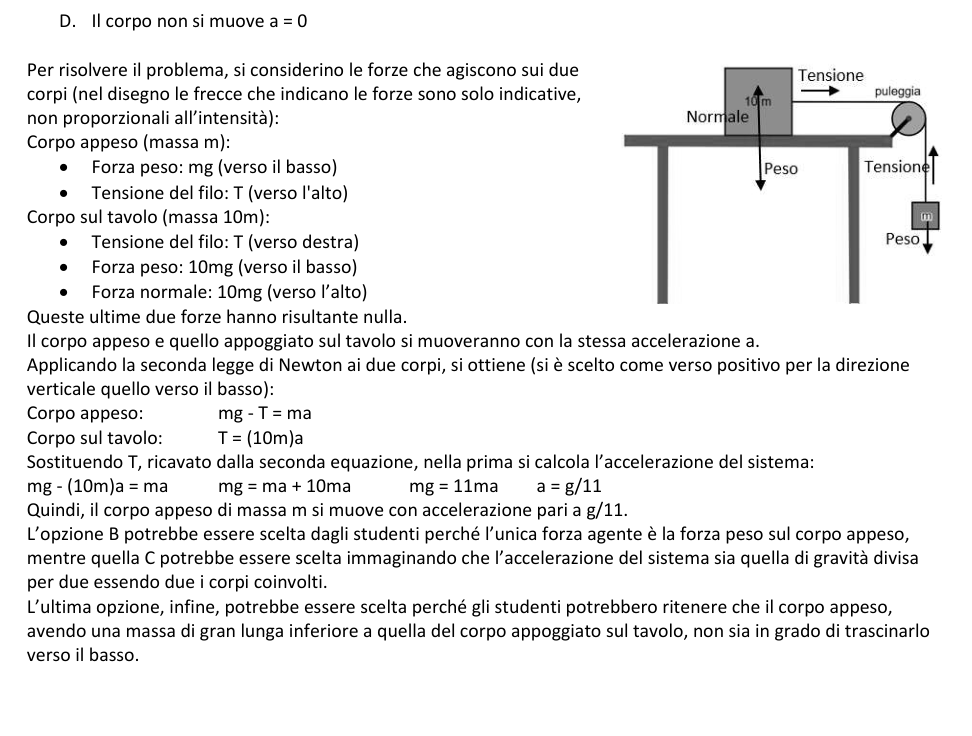
Un corpo appoggiato ad un tavolo privo di attrito è collegato ad un altro tramite un filo inestensibile e di massa trascurabile come in figura. Il corpo appoggiato al tavolo ha una massa 10 volte superiore a quella del corpo appeso, che ha massa . Anche la puleggia è priva di attrito. Con quale accelerazione si muoverà il corpo appeso di massa ?
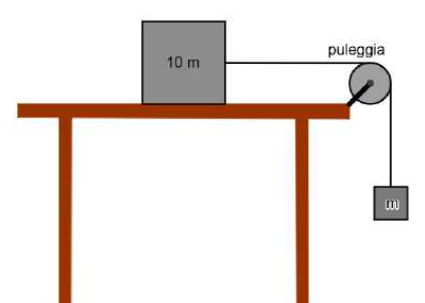
- A. Si muove con accelerazione pari a
- B. Si muove con accelerazione pari a
- C. Si muove con accelerazione pari a
- D. Il corpo non si muove,
Risposta: C
Soluzione:
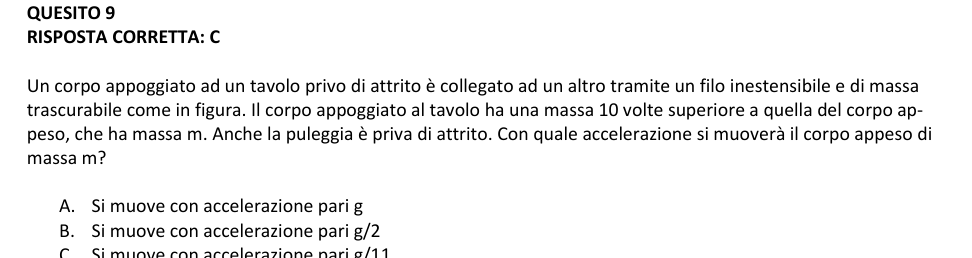
Soluzione ufficiale (Gruppo «Giochi di Anacleto», AIF), dal PDF ufficiale — p. 23, 24.
N.d.R.: nel commento ufficiale sui distrattori le lettere sono scambiate. Chi considera solo la forza peso sul corpo appeso sceglie l’opzione A (, non B); chi divide l’accelerazione di gravità per i due corpi sceglie l’opzione B (, non C). La risposta corretta resta C.
Topic: Newtonian Mechanics Metodi: Free-Body Diagram Competenze: Mathematical Modeling Objects: Block, Pulley, String Fonte: Testo (PDF) — p.4 · Soluzione ufficiale (PDF) — p.23
A body resting on a frictionless table is connected to another one by an inextensible, massless string as shown in the figure. The body on the table has a mass 10 times that of the hanging body, whose mass is . The pulley is also frictionless. With what acceleration will the hanging body of mass move?
- A. It moves with acceleration
- B. It moves with acceleration
- C. It moves with acceleration
- D. The body does not move,
Risposta: C
Soluzione: The full official solution (in Italian) is in the original-language version of this problem and in the official PDF.
Topic: Newtonian Mechanics Metodi: Free-Body Diagram Competenze: Mathematical Modeling Objects: Block, Pulley, String Fonte: Testo (PDF) — p.4 · Soluzione ufficiale (PDF) — p.23
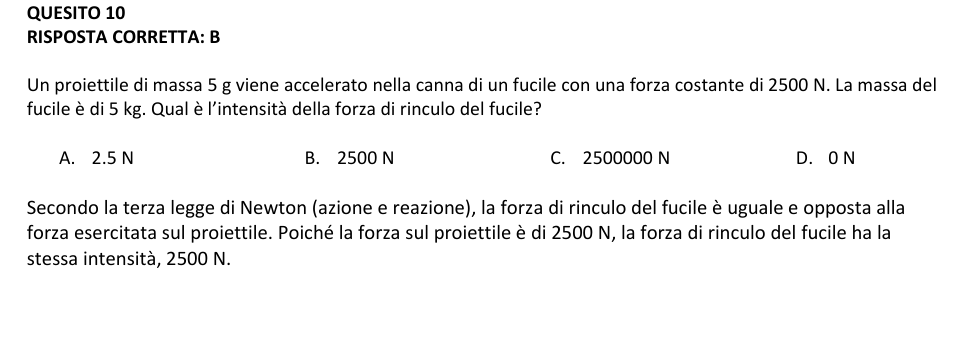
Un proiettile di massa 5 g viene accelerato nella canna di un fucile con una forza costante di 2500 N. La massa del fucile è di 5 kg. Qual è l’intensità della forza di rinculo del fucile?
- A. 2.5 N
- B. 2500 N
- C. 2500000 N
- D. 0 N
Risposta: B
Soluzione:
Soluzione ufficiale (Gruppo «Giochi di Anacleto», AIF), dal PDF ufficiale — p. 24.
Topic: Newtonian Mechanics Metodi: Free-Body Diagram Competenze: Physical Reasoning Objects: Projectile Fonte: Testo (PDF) — p.5 · Soluzione ufficiale (PDF) — p.24
A bullet of mass 5 g is accelerated in the barrel of a rifle by a constant force of 2500 N. The mass of the rifle is 5 kg. What is the magnitude of the recoil force on the rifle?
- A. 2.5 N
- B. 2500 N
- C. 2500000 N
- D. 0 N
Risposta: B
Soluzione: The full official solution (in Italian) is in the original-language version of this problem and in the official PDF.
Topic: Newtonian Mechanics Metodi: Free-Body Diagram Competenze: Physical Reasoning Objects: Projectile Fonte: Testo (PDF) — p.5 · Soluzione ufficiale (PDF) — p.24
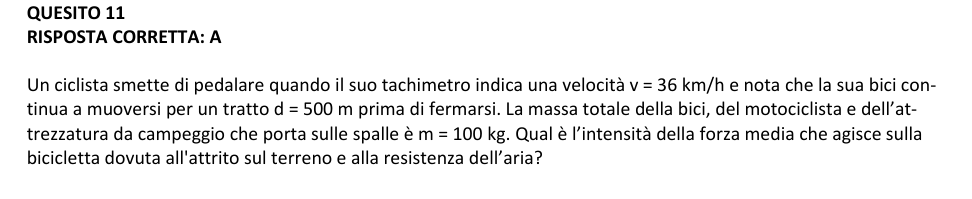
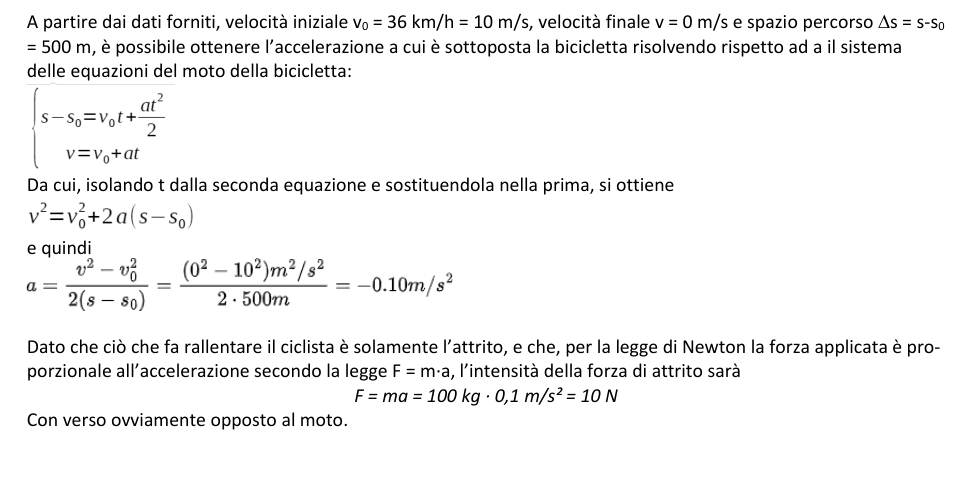
Un ciclista smette di pedalare quando il suo tachimetro indica una velocità km/h e nota che la sua bici continua a muoversi per un tratto m prima di fermarsi. La massa totale della bici, del ciclista e dell’attrezzatura da campeggio che porta sulle spalle è kg. Qual è l’intensità della forza media che agisce sulla bicicletta dovuta all’attrito sul terreno e alla resistenza dell’aria?
- A. 10 N
- B. 20 N
- C. 130 N
- D. 260 N
N.d.R.: il testo ufficiale scrive «La massa totale della bici, del motociclista e…»; qui è corretto in «del ciclista», coerente con il resto del quesito.
Risposta: A
Soluzione:
Soluzione ufficiale (Gruppo «Giochi di Anacleto», AIF), dal PDF ufficiale — p. 24, 25.
Topic: Newtonian Mechanics Metodi: Kinematic Equations Competenze: Mathematical Modeling, Unit Conversion Objects: — Fonte: Testo (PDF) — p.5 · Soluzione ufficiale (PDF) — p.24
A cyclist stops pedalling when his speedometer reads km/h and notices that the bike keeps moving for a distance m before stopping. The total mass of the bike, the cyclist and the camping gear he carries on his back is kg. What is the magnitude of the average force acting on the bicycle due to friction with the ground and air resistance?
- A. 10 N
- B. 20 N
- C. 130 N
- D. 260 N
Risposta: A
Soluzione: The full official solution (in Italian) is in the original-language version of this problem and in the official PDF.
Topic: Newtonian Mechanics Metodi: Kinematic Equations Competenze: Mathematical Modeling, Unit Conversion Objects: — Fonte: Testo (PDF) — p.5 · Soluzione ufficiale (PDF) — p.24
Una sbarra è libera di ruotare attorno al suo centro C. Vengono applicate delle forze in alcuni punti della sbarra secondo gli schemi presentati nelle figure (I), (II) e (III). In quale o quali dei casi presentati si verifica una rotazione della sbarra attorno al suo centro?
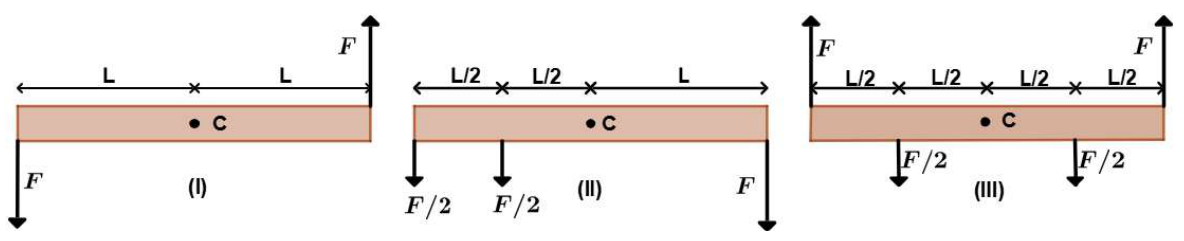
- A. Solo nel caso (I)
- B. Solo nel caso (II)
- C. Solo nel caso (III)
- D. Solo nei casi (I) e (II)
Risposta: D
Soluzione:
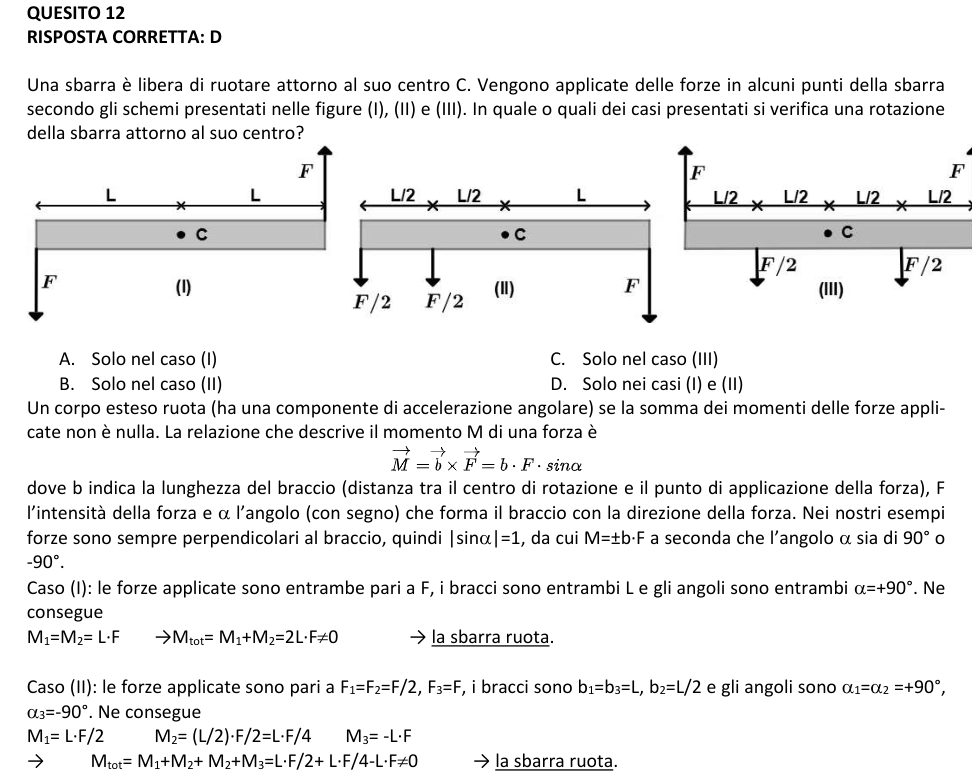

Soluzione ufficiale (Gruppo «Giochi di Anacleto», AIF), dal PDF ufficiale — p. 25, 26.
Topic: Rigid Body Statics Metodi: Torque & Angular Momentum Analysis Competenze: Diagrammatic Reasoning Objects: Rod Fonte: Testo (PDF) — p.5 · Soluzione ufficiale (PDF) — p.25
A bar is free to rotate about its centre C. Forces are applied at some points of the bar according to the schemes shown in figures (I), (II) and (III). In which of the cases does the bar rotate about its centre?
- A. Only in case (I)
- B. Only in case (II)
- C. Only in case (III)
- D. Only in cases (I) and (II)
Risposta: D
Soluzione: The full official solution (in Italian) is in the original-language version of this problem and in the official PDF.
Topic: Rigid Body Statics Metodi: Torque & Angular Momentum Analysis Competenze: Diagrammatic Reasoning Objects: Rod Fonte: Testo (PDF) — p.5 · Soluzione ufficiale (PDF) — p.25
Il corridore A corre verso est e il corridore B corre verso ovest. Hanno la stessa massa e la stessa velocità . Considera i due corridori come un sistema; qual è l’energia cinetica del sistema?
- A. 0
- B.
- C.
- D.
Risposta: C
Soluzione:
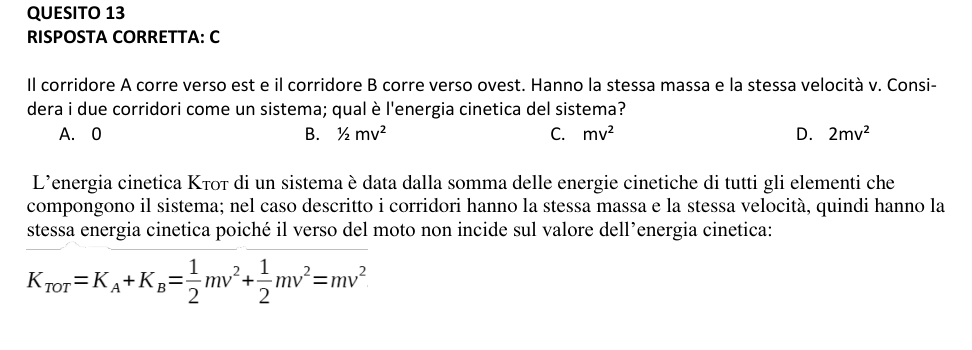
Soluzione ufficiale (Gruppo «Giochi di Anacleto», AIF), dal PDF ufficiale — p. 26.
Topic: Conservation of Energy Metodi: Energy Conservation Method Competenze: Physical Reasoning Objects: — Fonte: Testo (PDF) — p.6 · Soluzione ufficiale (PDF) — p.26
Runner A runs east and runner B runs west. They have the same mass and the same speed . Consider the two runners as one system; what is the kinetic energy of the system?
- A. 0
- B.
- C.
- D.
Risposta: C
Soluzione: The full official solution (in Italian) is in the original-language version of this problem and in the official PDF.
Topic: Conservation of Energy Metodi: Energy Conservation Method Competenze: Physical Reasoning Objects: — Fonte: Testo (PDF) — p.6 · Soluzione ufficiale (PDF) — p.26
Due palline di plastilina di massa g e due biglie di acciaio di massa 50 g ciascuna sono appese tramite fili inestensibili e di massa trascurabile, come in figura. Rilasciate contemporaneamente, le due coppie collidono:
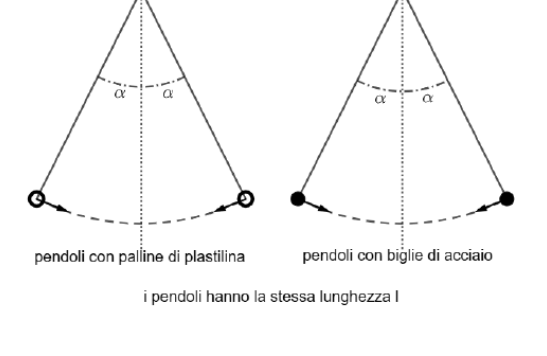
- le palline di plastilina restano attaccate e ferme dopo l’urto;
- le biglie di acciaio si separano e ritornano alle posizioni iniziali.
(Si trascurino gli attriti.) Cosa si può dire delle velocità delle due coppie immediatamente prima della collisione?
- A. Le velocità delle palline di plastilina sono una opposta all’altra, mentre quelle delle biglie di acciaio no
- B. Le velocità delle palline di plastilina sono in modulo minori di quelle delle biglie di acciaio
- C. Le velocità delle palline di plastilina e delle biglie di acciaio sono in modulo tutte uguali, ma, visto il materiale plastico, l’urto delle palline di plastilina è anelastico, mentre quello delle palline di acciaio è elastico
- D. Le velocità delle palline di plastilina e delle biglie di acciaio sono in modulo tutte uguali, ma, visto il materiale plastico, l’urto delle palline di plastilina è elastico, mentre quello delle palline di acciaio è anelastico
Risposta: C
Soluzione:
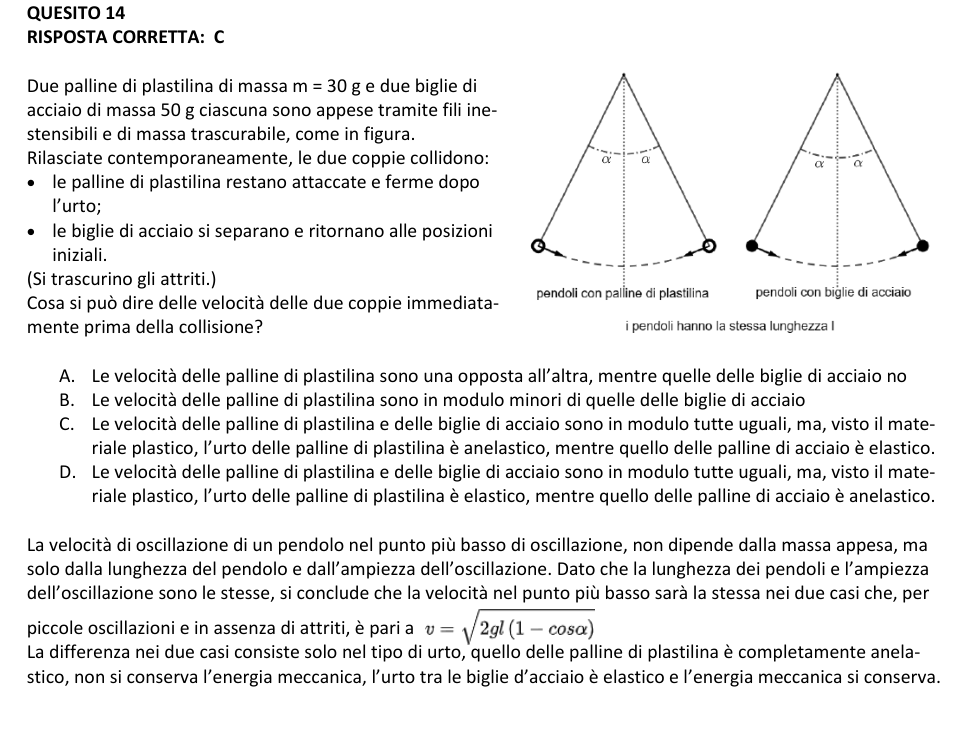
Soluzione ufficiale (Gruppo «Giochi di Anacleto», AIF), dal PDF ufficiale — p. 26.
Topic: Conservation of Momentum, Conservation of Energy Metodi: Conservation of Momentum, Energy Conservation Method Competenze: Physical Reasoning Objects: Pendulum, Ball Fonte: Testo (PDF) — p.6 · Soluzione ufficiale (PDF) — p.26
Two plasticine balls of mass g and two steel marbles of mass 50 g each hang from inextensible, massless strings, as shown in the figure. Released at the same time, the two pairs collide:
- the plasticine balls stick together and are at rest after the collision;
- the steel marbles separate and return to their initial positions.
(Neglect friction.) What can be said about the velocities of the two pairs immediately before the collision?
- A. The velocities of the plasticine balls are opposite to each other, while those of the steel marbles are not
- B. The plasticine balls’ speeds are smaller than the steel marbles’ speeds
- C. The speeds of the plasticine balls and of the steel marbles are all equal, but, given the plastic material, the collision of the plasticine balls is inelastic, while that of the steel marbles is elastic
- D. The speeds of the plasticine balls and of the steel marbles are all equal, but, given the plastic material, the collision of the plasticine balls is elastic, while that of the steel marbles is inelastic
Risposta: C
Soluzione: The full official solution (in Italian) is in the original-language version of this problem and in the official PDF.
Topic: Conservation of Momentum, Conservation of Energy Metodi: Conservation of Momentum, Energy Conservation Method Competenze: Physical Reasoning Objects: Pendulum, Ball Fonte: Testo (PDF) — p.6 · Soluzione ufficiale (PDF) — p.26
Un oggetto di massa kg scivola lungo una rampa lunga 3.60 m inclinata di 30.0° rispetto all’orizzontale. La sua velocità iniziale è 2.00 m/s e quella finale 1.06 m/s. A quanto ammonta il lavoro fatto dalla forza d’attrito dinamico quando l’oggetto giunge alla fine della rampa?
- A. J
- B. J
- C. J
- D. J
Risposta: C
Soluzione:
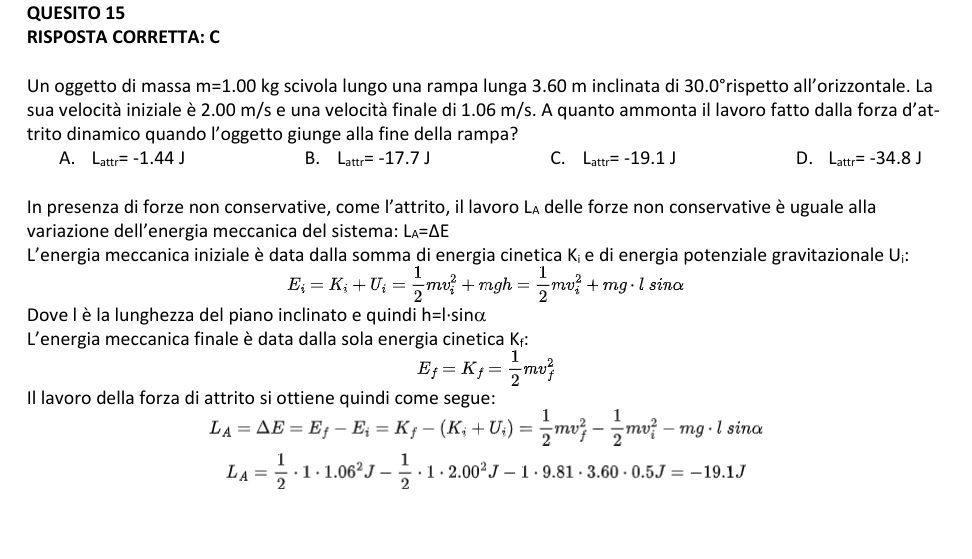
Soluzione ufficiale (Gruppo «Giochi di Anacleto», AIF), dal PDF ufficiale — p. 27.
Topic: Conservation of Energy Metodi: Energy Conservation Method Competenze: Mathematical Modeling Objects: Block, Inclined Plane Fonte: Testo (PDF) — p.6 · Soluzione ufficiale (PDF) — p.27
An object of mass kg slides down a 3.60 m long ramp inclined at 30.0° to the horizontal. Its initial speed is 2.00 m/s and its final speed 1.06 m/s. How much work is done by the kinetic friction force by the time the object reaches the end of the ramp?
- A. J
- B. J
- C. J
- D. J
Risposta: C
Soluzione: The full official solution (in Italian) is in the original-language version of this problem and in the official PDF.
Topic: Conservation of Energy Metodi: Energy Conservation Method Competenze: Mathematical Modeling Objects: Block, Inclined Plane Fonte: Testo (PDF) — p.6 · Soluzione ufficiale (PDF) — p.27
Durante un viaggio spaziale con i genitori, un piccolo alieno ha dimenticato una palla (dischetto nero) sulla superficie di un asteroide (figura irregolare in grigio). L’asteroide non ruota attorno ad alcun asse. Nel disegno è indicato con X il centro di massa dell’asteroide e con Y il suo centro geometrico. Quale freccia rappresenta meglio la direzione della forza di gravità a cui è soggetta la palla?
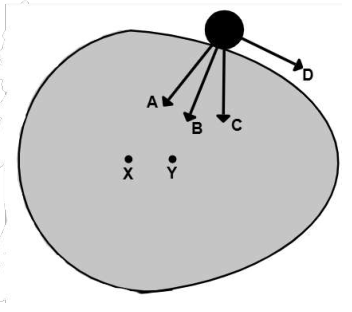
- A. A, perché punta verso il centro di massa
- B. B, perché punta verso il centro geometrico
- C. C, perché punta verso il basso
- D. D, perché segue la pendenza della superficie
Risposta: A
Soluzione:
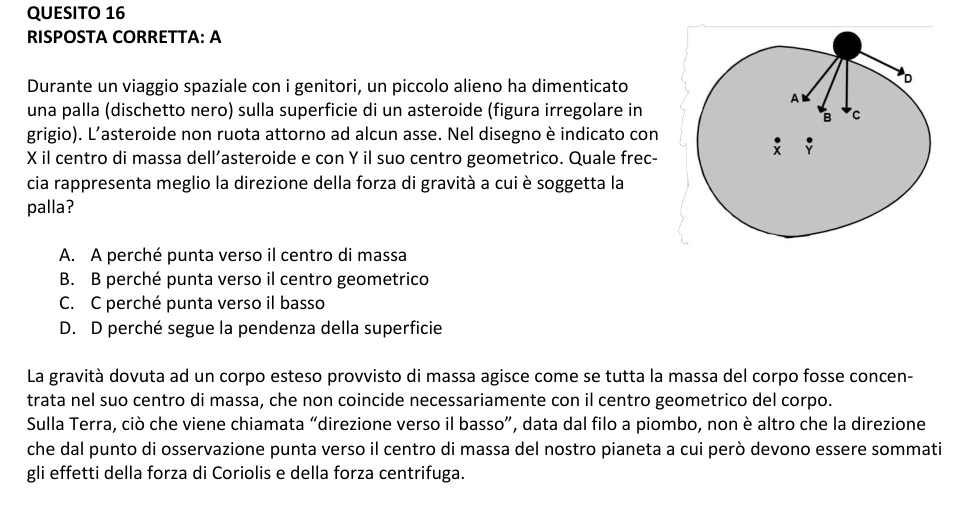
Soluzione ufficiale (Gruppo «Giochi di Anacleto», AIF), dal PDF ufficiale — p. 27.
Topic: Gravitation Metodi: Newton’s Law of Gravitation Competenze: Physical Reasoning Objects: Ball, Planet Fonte: Testo (PDF) — p.7 · Soluzione ufficiale (PDF) — p.27
During a space trip with his parents, a little alien forgot a ball (black dot) on the surface of an asteroid (irregular grey shape). The asteroid does not rotate about any axis. In the drawing, X marks the asteroid’s centre of mass and Y its geometric centre. Which arrow best represents the direction of the gravitational force acting on the ball?
- A. A, because it points towards the centre of mass
- B. B, because it points towards the geometric centre
- C. C, because it points downwards
- D. D, because it follows the slope of the surface
Risposta: A
Soluzione: The full official solution (in Italian) is in the original-language version of this problem and in the official PDF.
Topic: Gravitation Metodi: Newton’s Law of Gravitation Competenze: Physical Reasoning Objects: Ball, Planet Fonte: Testo (PDF) — p.7 · Soluzione ufficiale (PDF) — p.27
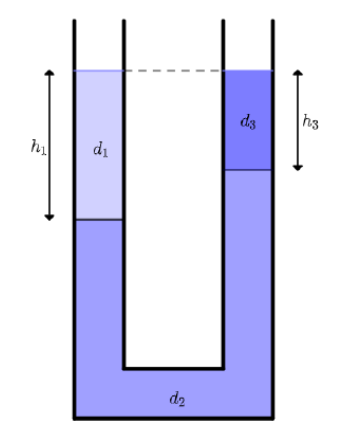
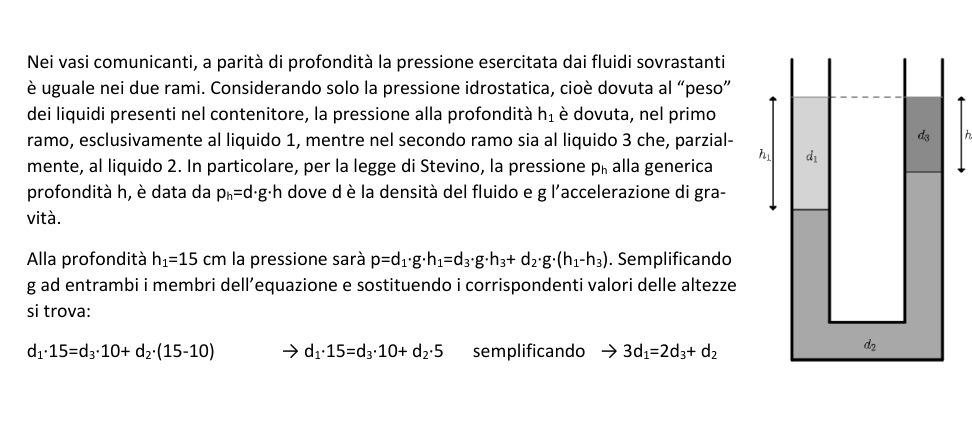
In un contenitore a forma di U sono presenti tre diversi liquidi le cui densità sono , e . L’altezza dei tre liquidi è diversa, in particolare l’altezza della colonna di liquido 1 è cm e quella del liquido 3 è cm; le superfici libere dei liquidi 1 e 3 sono allo stesso livello come mostrato in figura. Quale delle seguenti equazioni esprime la corretta relazione tra le densità dei fluidi nel contenitore?
- A.
- B.
- C.
- D.
N.d.R.: nel testo ufficiale l’opzione D è stampata come «3d₂ = d₁ + 2d»; qui è riportata come , come nella ristampa del quesito nel fascicolo delle soluzioni (PDF, p. 27).
Risposta: B
Soluzione:

Soluzione ufficiale (Gruppo «Giochi di Anacleto», AIF), dal PDF ufficiale — p. 27, 28.
Topic: Fluid Mechanics Metodi: Hydrostatic Equilibrium Competenze: Mathematical Modeling Objects: Manometer, Container Fonte: Testo (PDF) — p.7 · Soluzione ufficiale (PDF) — p.27
A U-shaped container holds three different liquids with densities , and . The heights of the three liquids differ: the column of liquid 1 is cm high and that of liquid 3 is cm; the free surfaces of liquids 1 and 3 are at the same level, as shown in the figure. Which of the following equations expresses the correct relation between the densities of the fluids?
- A.
- B.
- C.
- D.
Risposta: B
Soluzione: The full official solution (in Italian) is in the original-language version of this problem and in the official PDF.
Topic: Fluid Mechanics Metodi: Hydrostatic Equilibrium Competenze: Mathematical Modeling Objects: Manometer, Container Fonte: Testo (PDF) — p.7 · Soluzione ufficiale (PDF) — p.27
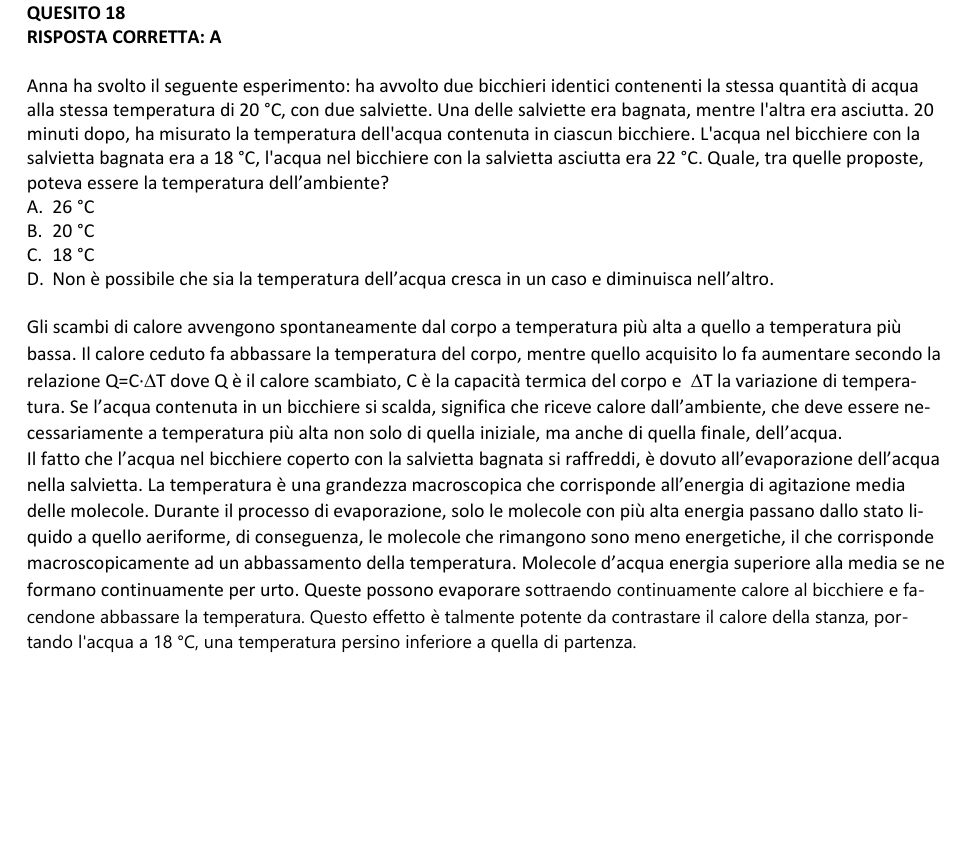
Anna ha svolto il seguente esperimento: ha avvolto due bicchieri identici contenenti la stessa quantità di acqua alla stessa temperatura di 20 °C, con due salviette. Una delle salviette era bagnata, mentre l’altra era asciutta. 20 minuti dopo, ha misurato la temperatura dell’acqua contenuta in ciascun bicchiere. L’acqua nel bicchiere con la salvietta bagnata era a 18 °C, l’acqua nel bicchiere con la salvietta asciutta era a 22 °C. Quale, tra quelle proposte, poteva essere la temperatura dell’ambiente?
- A. 26 °C
- B. 20 °C
- C. 18 °C
- D. Non è possibile che la temperatura dell’acqua cresca in un caso e diminuisca nell’altro
N.d.R.: nel testo ufficiale l’opzione D è «Non è possibile che sia la temperatura dell’acqua cresca in un caso e diminuisca nell’altro»; qui è stato tolto il «sia» superfluo.
Risposta: A
Soluzione:
Soluzione ufficiale (Gruppo «Giochi di Anacleto», AIF), dal PDF ufficiale — p. 28.
Topic: Thermodynamics Metodi: First Law of Thermodynamics Competenze: Physical Reasoning Objects: Container Fonte: Testo (PDF) — p.7 · Soluzione ufficiale (PDF) — p.28
Anna did the following experiment: she wrapped two identical glasses, containing the same amount of water at the same temperature of 20 °C, in two towels. One towel was wet, the other dry. 20 minutes later she measured the temperature of the water in each glass. The water in the glass with the wet towel was at 18 °C, the water in the glass with the dry towel at 22 °C. Which of the following could have been the room temperature?
- A. 26 °C
- B. 20 °C
- C. 18 °C
- D. It is impossible for the water temperature to rise in one case and fall in the other
Risposta: A
Soluzione: The full official solution (in Italian) is in the original-language version of this problem and in the official PDF.
Topic: Thermodynamics Metodi: First Law of Thermodynamics Competenze: Physical Reasoning Objects: Container Fonte: Testo (PDF) — p.7 · Soluzione ufficiale (PDF) — p.28
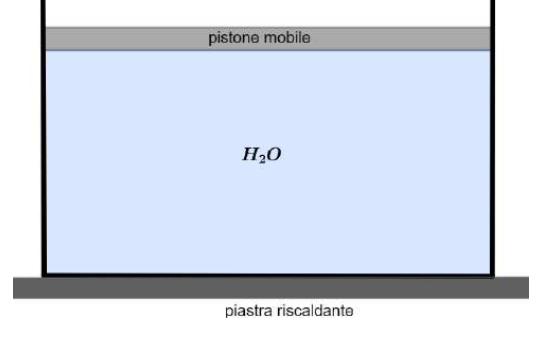
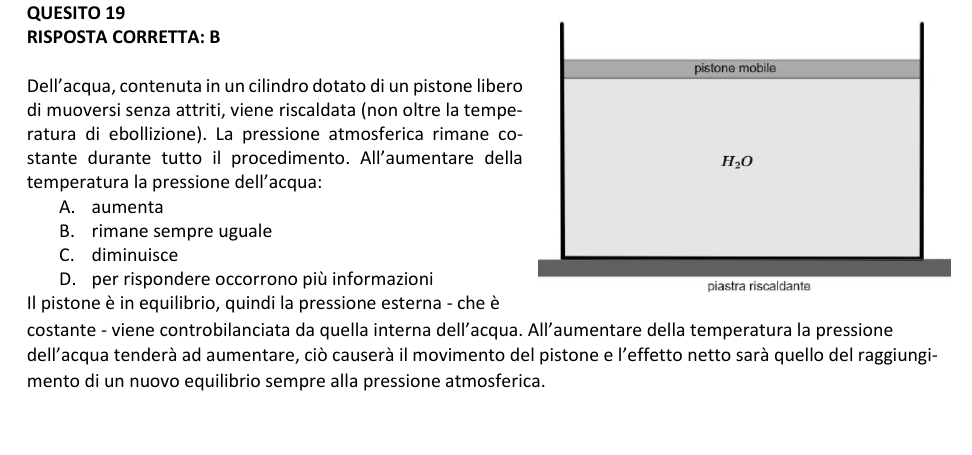
Dell’acqua, contenuta in un cilindro dotato di un pistone libero di muoversi senza attriti, viene riscaldata (non oltre la temperatura di ebollizione). La pressione atmosferica rimane costante durante tutto il procedimento. All’aumentare della temperatura la pressione dell’acqua:
- A. aumenta
- B. rimane sempre uguale
- C. diminuisce
- D. per rispondere occorrono più informazioni
Risposta: B
Soluzione:
Soluzione ufficiale (Gruppo «Giochi di Anacleto», AIF), dal PDF ufficiale — p. 29.
Topic: Thermodynamics, Fluid Mechanics Metodi: Hydrostatic Equilibrium, Free-Body Diagram Competenze: Physical Reasoning Objects: Piston Fonte: Testo (PDF) — p.8 · Soluzione ufficiale (PDF) — p.29
Water contained in a cylinder fitted with a piston that moves without friction is heated (not beyond the boiling point). The atmospheric pressure stays constant throughout. As the temperature increases, the pressure of the water:
- A. increases
- B. stays the same
- C. decreases
- D. more information is needed to answer
Risposta: B
Soluzione: The full official solution (in Italian) is in the original-language version of this problem and in the official PDF.
Topic: Thermodynamics, Fluid Mechanics Metodi: Hydrostatic Equilibrium, Free-Body Diagram Competenze: Physical Reasoning Objects: Piston Fonte: Testo (PDF) — p.8 · Soluzione ufficiale (PDF) — p.29
Si parla spesso di movimento dei ghiacciai: questo succede perché, tra le altre cose, alla base della coltre di ghiaccio è presente un sottile strato di acqua che facilita lo scorrimento del ghiaccio sovrastante sul terreno. Perché è presente lo strato d’acqua?
- A. Perché la pressione esercitata dal ghiaccio sovrastante fa abbassare la temperatura di fusione (o di solidificazione, che coincidono)
- B. Perché il terreno è sempre a una temperatura maggiore di 0 °C
- C. Perché l’acqua non si ghiaccia mai del tutto e la sua densità è maggiore di quella del ghiaccio
- D. Perché il ghiaccio comincia a formarsi a partire dall’alto e ci vogliono tempi più lunghi delle ere geologiche prima che possa ghiacciarsi completamente
Risposta: A
Soluzione:
Soluzione ufficiale (Gruppo «Giochi di Anacleto», AIF), dal PDF ufficiale — p. 29.
Topic: Thermodynamics, Earth & Environmental Science Metodi: Physical Modeling Competenze: Physical Reasoning Objects: — Fonte: Testo (PDF) — p.8 · Soluzione ufficiale (PDF) — p.29
People often talk about glaciers moving: among other things, this happens because at the base of the ice sheet there is a thin layer of water that helps the overlying ice slide over the ground. Why is the water layer there?
- A. Because the pressure exerted by the overlying ice lowers the melting (or freezing, which is the same) temperature
- B. Because the ground is always at a temperature above 0 °C
- C. Because water never freezes completely and its density is greater than that of ice
- D. Because ice starts forming from the top and it takes longer than geological eras for it to freeze completely
Risposta: A
Soluzione: The full official solution (in Italian) is in the original-language version of this problem and in the official PDF.
Topic: Thermodynamics, Earth & Environmental Science Metodi: Physical Modeling Competenze: Physical Reasoning Objects: — Fonte: Testo (PDF) — p.8 · Soluzione ufficiale (PDF) — p.29
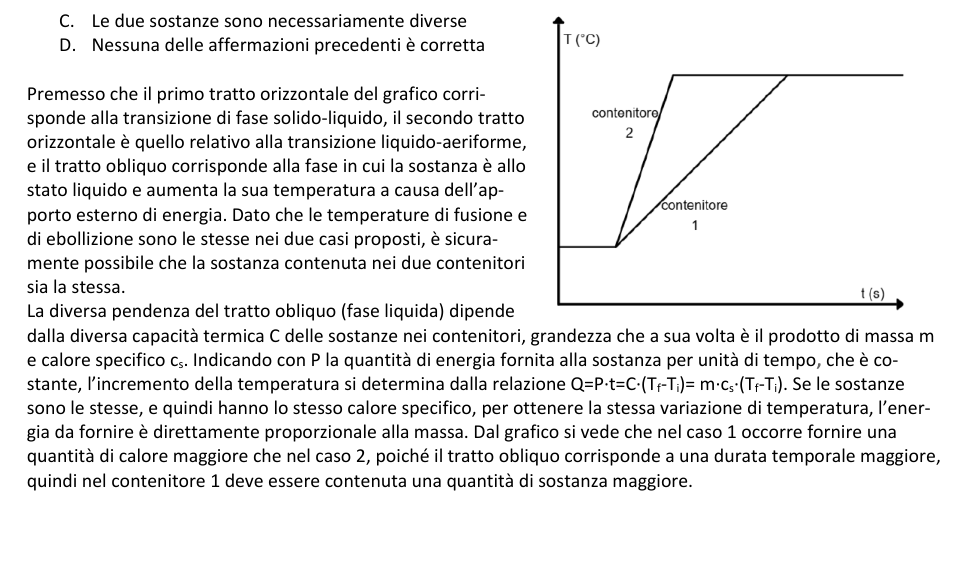
Due contenitori uguali, indicati con 1 e 2, contengono una qualche sostanza non nota, parzialmente allo stato solido e alla stessa temperatura. I due contenitori vengono scaldati fornendo loro la stessa quantità di energia per unità di tempo. Il grafico in figura descrive la temperatura della sostanza all’interno del contenitore mano a mano che viene fornito il calore. Dal grafico si può concludere che:
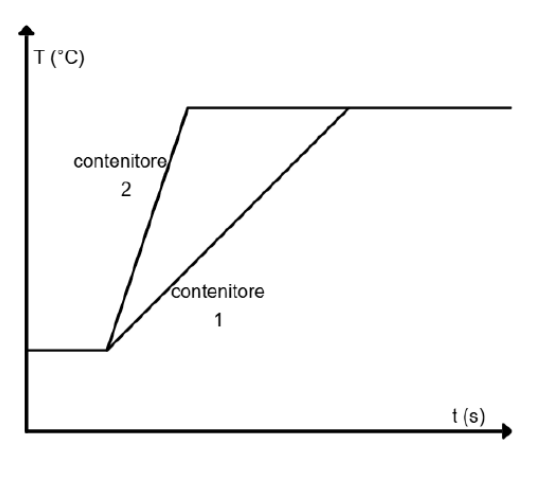
- A. le due sostanze possono essere identiche, ma il contenitore 1 contiene una quantità maggiore della sostanza rispetto al contenitore 2
- B. le due sostanze possono essere identiche, ma il contenitore 2 contiene una quantità maggiore della sostanza rispetto al contenitore 1
- C. le due sostanze sono necessariamente diverse
- D. nessuna delle affermazioni precedenti è corretta
Risposta: A
Soluzione:
Soluzione ufficiale (Gruppo «Giochi di Anacleto», AIF), dal PDF ufficiale — p. 29, 30.
Topic: Thermodynamics Metodi: First Law of Thermodynamics Competenze: Diagrammatic Reasoning, Experimental Data Analysis Objects: Calorimeter Fonte: Testo (PDF) — p.8 · Soluzione ufficiale (PDF) — p.29
Two identical containers, labelled 1 and 2, contain some unknown substance, partly in the solid state and at the same temperature. The two containers are heated, supplying the same amount of energy per unit time. The graph in the figure shows the temperature of the substance in each container as heat is supplied. From the graph one can conclude that:
- A. the two substances may be identical, but container 1 holds a larger amount of substance than container 2
- B. the two substances may be identical, but container 2 holds a larger amount of substance than container 1
- C. the two substances are necessarily different
- D. none of the previous statements is correct
Risposta: A
Soluzione: The full official solution (in Italian) is in the original-language version of this problem and in the official PDF.
Topic: Thermodynamics Metodi: First Law of Thermodynamics Competenze: Diagrammatic Reasoning, Experimental Data Analysis Objects: Calorimeter Fonte: Testo (PDF) — p.8 · Soluzione ufficiale (PDF) — p.29
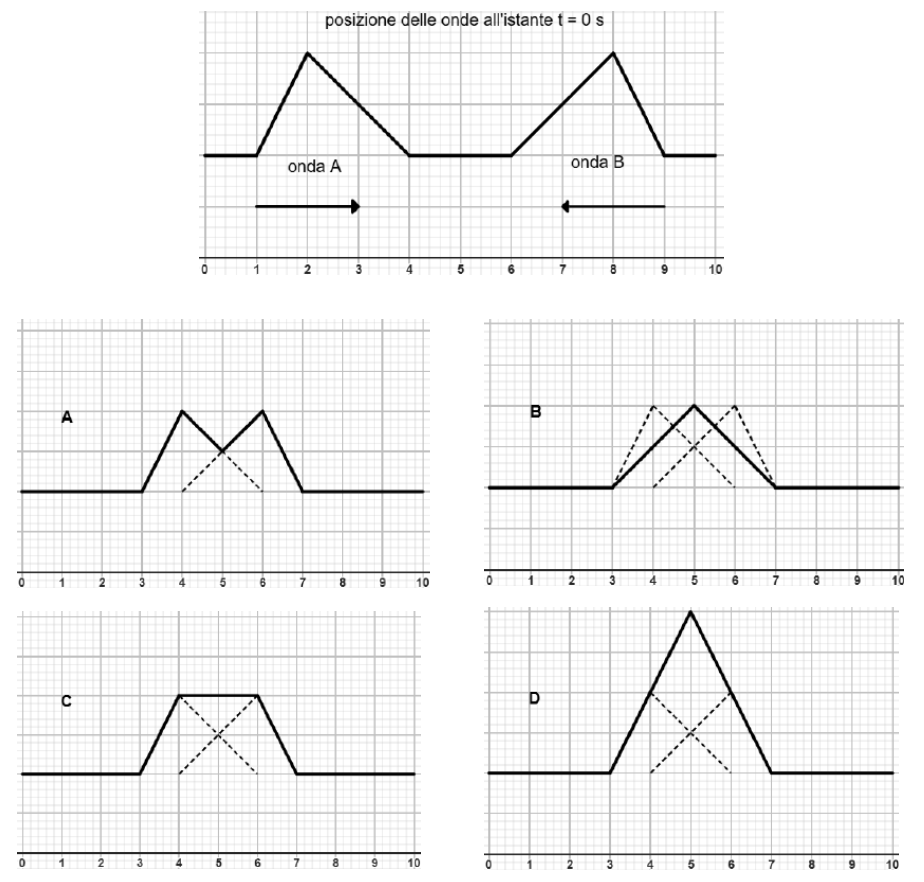
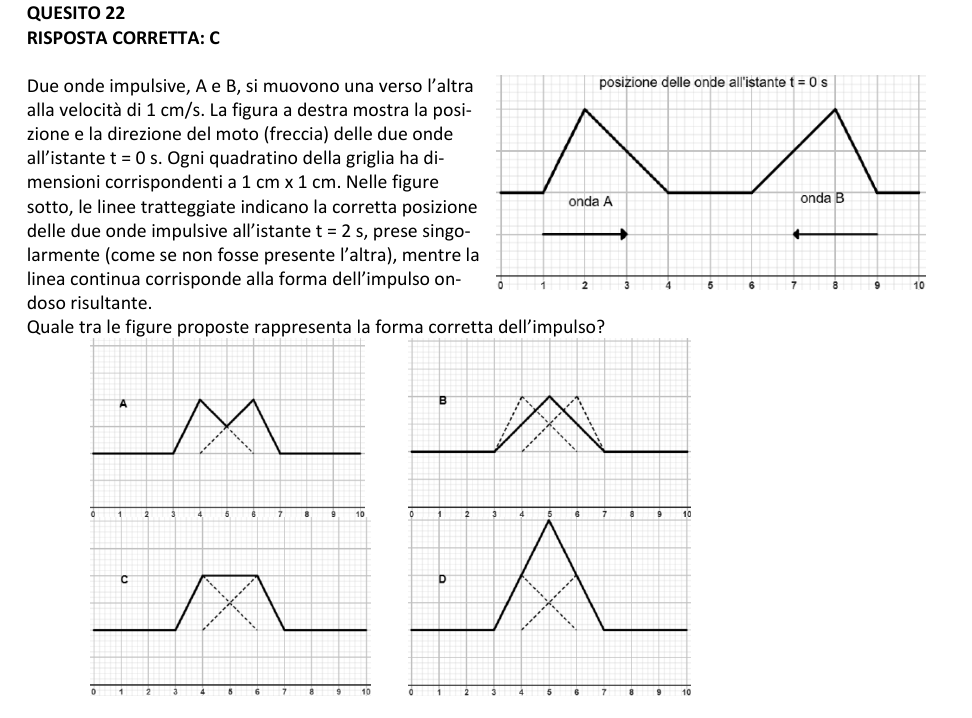
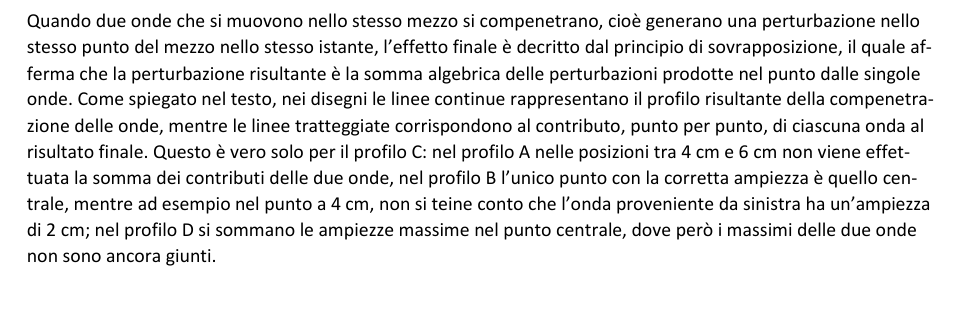
Due onde impulsive, A e B, si muovono una verso l’altra alla velocità di 1 cm/s. La figura mostra la posizione e la direzione del moto (freccia) delle due onde all’istante s. Ogni quadratino della griglia ha dimensioni corrispondenti a 1 cm × 1 cm. Nelle figure proposte, le linee tratteggiate indicano la corretta posizione delle due onde impulsive all’istante s, prese singolarmente (come se non fosse presente l’altra), mentre la linea continua corrisponde alla forma dell’impulso ondoso risultante. Quale tra le figure proposte rappresenta la forma corretta dell’impulso?
Risposta: C
Soluzione:
Soluzione ufficiale (Gruppo «Giochi di Anacleto», AIF), dal PDF ufficiale — p. 30, 31.
Topic: Oscillations & Waves Metodi: Superposition Principle Competenze: Diagrammatic Reasoning Objects: — Fonte: Testo (PDF) — p.9 · Soluzione ufficiale (PDF) — p.30
Two wave pulses, A and B, move towards each other at a speed of 1 cm/s. The figure shows the position and direction of motion (arrow) of the two pulses at time s. Each grid square corresponds to 1 cm × 1 cm. In the proposed figures, the dashed lines show the correct position of the two pulses at s, each taken on its own (as if the other were absent), while the solid line is the shape of the resulting pulse. Which of the proposed figures shows the correct shape of the pulse?
Risposta: C
Soluzione: The full official solution (in Italian) is in the original-language version of this problem and in the official PDF.
Topic: Oscillations & Waves Metodi: Superposition Principle Competenze: Diagrammatic Reasoning Objects: — Fonte: Testo (PDF) — p.9 · Soluzione ufficiale (PDF) — p.30
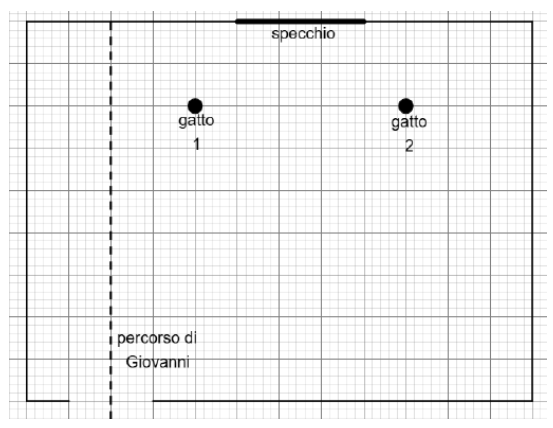
La figura rappresenta una stanza illuminata in modo omogeneo vista dall’alto. Giovanni entra nella stanza dalla porta e, mentre cammina dritto in avanti (linea tratteggiata), cerca di osservare riflesse nello specchio piano appeso alla parete di fronte a lui le immagini di due gatti, indicati con 1 e 2, presenti nella stanza nelle posizioni indicate. In quale ordine Giovanni vede le immagini dei gatti nello specchio mentre cammina lungo il percorso indicato?
- A. Giovanni vede riflesso prima il gatto 1 e poi il gatto 2
- B. Giovanni può vedere riflesso solo il gatto 2
- C. Giovanni vede i due gatti riflessi contemporaneamente
- D. Per la loro posizione i due gatti non possono essere visti sullo specchio
Risposta: B
Soluzione:
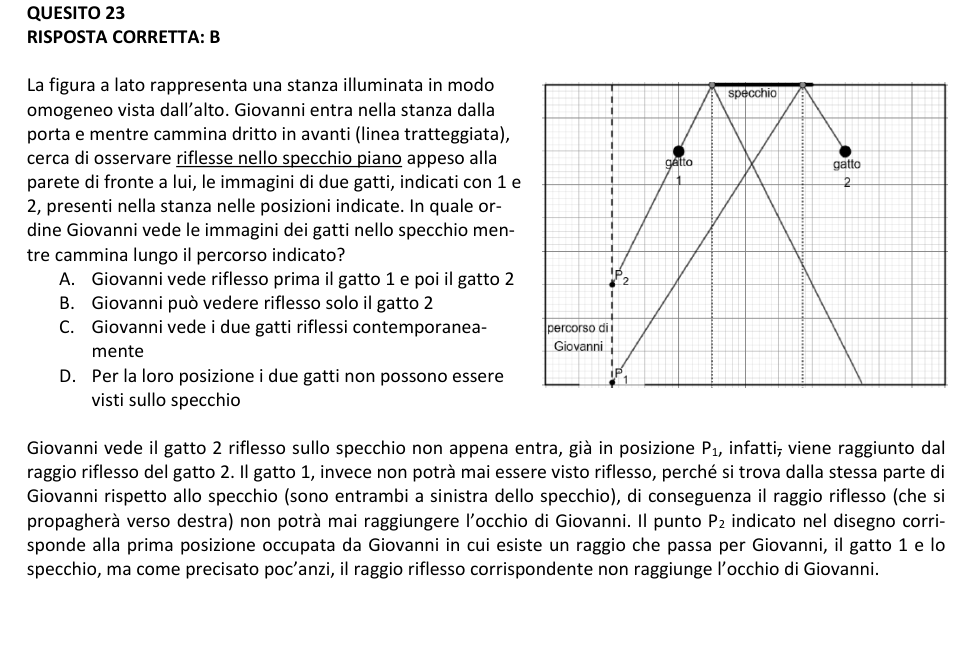
Soluzione ufficiale (Gruppo «Giochi di Anacleto», AIF), dal PDF ufficiale — p. 31.
Topic: Geometric Optics Metodi: Ray Tracing Competenze: Diagrammatic Reasoning Objects: Mirror Fonte: Testo (PDF) — p.9 · Soluzione ufficiale (PDF) — p.31
The figure shows a uniformly lit room seen from above. Giovanni enters the room through the door and, while walking straight ahead (dashed line), tries to see in the plane mirror hanging on the wall in front of him the images of two cats, labelled 1 and 2, located in the room as shown. In what order does Giovanni see the cats’ images in the mirror as he walks along the path shown?
- A. Giovanni first sees cat 1 reflected and then cat 2
- B. Giovanni can see only cat 2 reflected
- C. Giovanni sees both cats reflected at the same time
- D. Because of their positions, neither cat can be seen in the mirror
Risposta: B
Soluzione: The full official solution (in Italian) is in the original-language version of this problem and in the official PDF.
Topic: Geometric Optics Metodi: Ray Tracing Competenze: Diagrammatic Reasoning Objects: Mirror Fonte: Testo (PDF) — p.9 · Soluzione ufficiale (PDF) — p.31
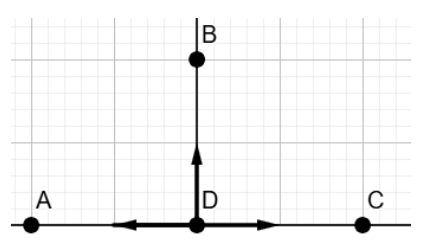
Tre cariche negative uguali sono poste ai vertici A, B, C di un triangolo come in figura. Le cariche A, B e C non possono muoversi. Nella posizione D è posta una carica positiva inizialmente ferma. Se lasciata libera di muoversi, in quale direzione si sposterà la carica D?
- A. Verso la carica A
- B. Verso la carica B
- C. Verso la carica C
- D. Rimane ferma in D
Risposta: B
Soluzione:
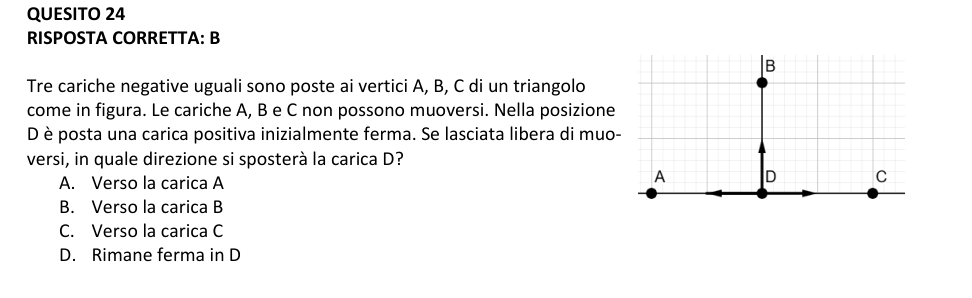
Soluzione ufficiale (Gruppo «Giochi di Anacleto», AIF), dal PDF ufficiale — p. 31, 32.
Topic: Electrostatics Metodi: Coulomb’s Law, Superposition Principle Competenze: Diagrammatic Reasoning Objects: Point Charge Fonte: Testo (PDF) — p.10 · Soluzione ufficiale (PDF) — p.31
Three equal negative charges are placed at the vertices A, B, C of a triangle as shown in the figure. Charges A, B and C cannot move. A positive charge, initially at rest, is placed at position D. If it is left free to move, in which direction will charge D move?
- A. Towards charge A
- B. Towards charge B
- C. Towards charge C
- D. It stays at rest at D
Risposta: B
Soluzione: The full official solution (in Italian) is in the original-language version of this problem and in the official PDF.
Topic: Electrostatics Metodi: Coulomb’s Law, Superposition Principle Competenze: Diagrammatic Reasoning Objects: Point Charge Fonte: Testo (PDF) — p.10 · Soluzione ufficiale (PDF) — p.31
Al momento della loro formazione qual è l’elemento più abbondante nelle atmosfere stellari?
- A. Azoto
- B. Ossigeno
- C. Elio
- D. Idrogeno
Risposta: D
Soluzione:
Soluzione ufficiale (Gruppo «Giochi di Anacleto», AIF), dal PDF ufficiale — p. 32.
Topic: Astrophysics Metodi: Physical Modeling Competenze: Physical Reasoning Objects: Star Fonte: Testo (PDF) — p.10 · Soluzione ufficiale (PDF) — p.32
At the time of their formation, which is the most abundant element in stellar atmospheres?
- A. Nitrogen
- B. Oxygen
- C. Helium
- D. Hydrogen
Risposta: D
Soluzione: The full official solution (in Italian) is in the original-language version of this problem and in the official PDF.
Topic: Astrophysics Metodi: Physical Modeling Competenze: Physical Reasoning Objects: Star Fonte: Testo (PDF) — p.10 · Soluzione ufficiale (PDF) — p.32
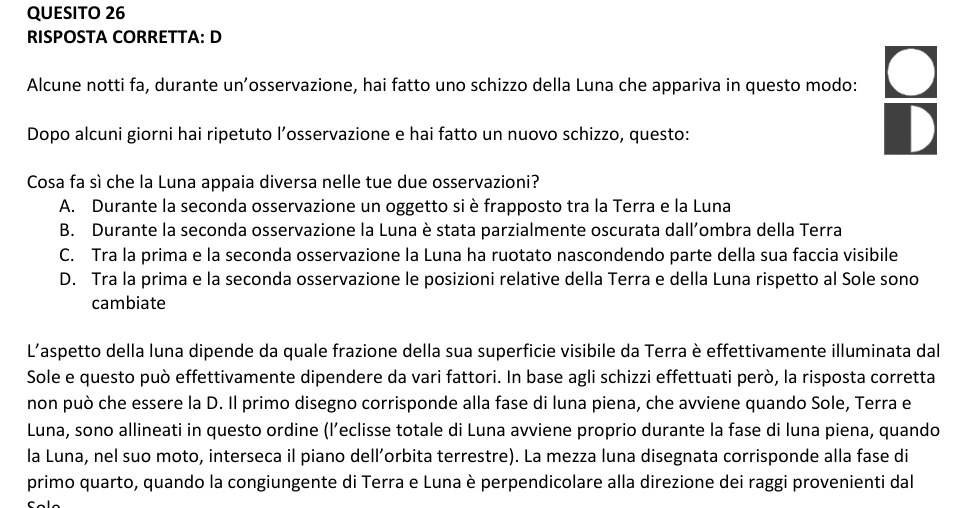
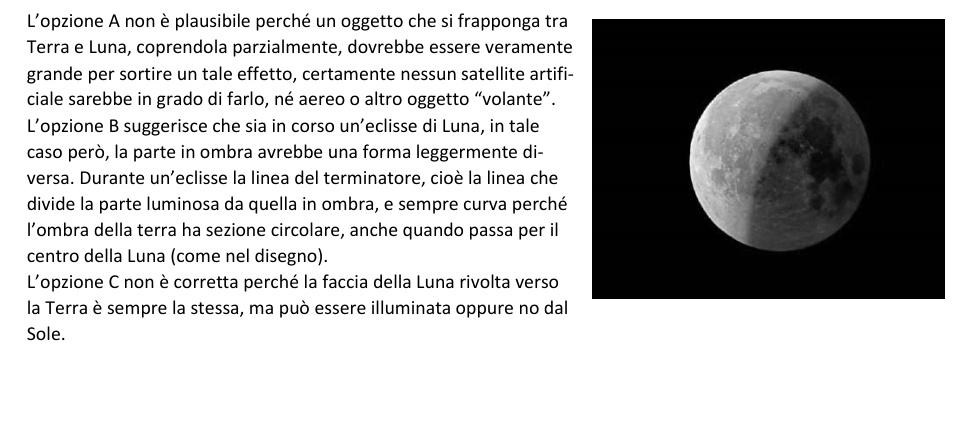
Alcune notti fa, durante un’osservazione, hai fatto uno schizzo della Luna (primo disegno in figura). Dopo alcuni giorni hai ripetuto l’osservazione e hai fatto un nuovo schizzo (secondo disegno). Cosa fa sì che la Luna appaia diversa nelle tue due osservazioni?

- A. Durante la seconda osservazione un oggetto si è frapposto tra la Terra e la Luna
- B. Durante la seconda osservazione la Luna è stata parzialmente oscurata dall’ombra della Terra
- C. Tra la prima e la seconda osservazione la Luna ha ruotato nascondendo parte della sua faccia visibile
- D. Tra la prima e la seconda osservazione le posizioni relative della Terra e della Luna rispetto al Sole sono cambiate
Risposta: D
Soluzione:
Soluzione ufficiale (Gruppo «Giochi di Anacleto», AIF), dal PDF ufficiale — p. 32, 33.
Topic: Astrophysics, Geometric Optics Metodi: Physical Modeling Competenze: Physical Reasoning, Diagrammatic Reasoning Objects: Satellite, Planet Fonte: Testo (PDF) — p.10 · Soluzione ufficiale (PDF) — p.32
A few nights ago, during an observation, you sketched the Moon (first drawing in the figure). A few days later you repeated the observation and made a new sketch (second drawing). What makes the Moon look different in your two observations?
- A. During the second observation an object came between the Earth and the Moon
- B. During the second observation the Moon was partly darkened by the Earth’s shadow
- C. Between the first and second observation the Moon rotated, hiding part of its visible face
- D. Between the first and second observation the relative positions of the Earth and the Moon with respect to the Sun changed
Risposta: D
Soluzione: The full official solution (in Italian) is in the original-language version of this problem and in the official PDF.
Topic: Astrophysics, Geometric Optics Metodi: Physical Modeling Competenze: Physical Reasoning, Diagrammatic Reasoning Objects: Satellite, Planet Fonte: Testo (PDF) — p.10 · Soluzione ufficiale (PDF) — p.32
Dell’acqua viene versata con flusso costante all’interno di un vaso di forma sferica, come quello in figura. Quale dei grafici proposti (A, B, C, D) rappresenta meglio l’altezza dell’acqua nel vaso in funzione del tempo trascorso?
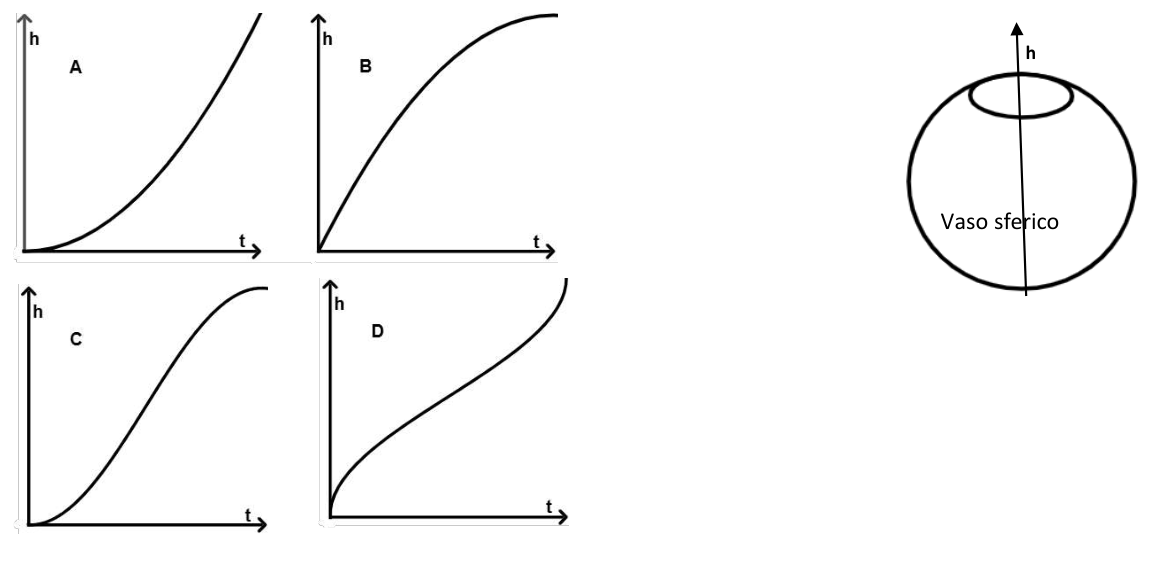
Risposta: D
Soluzione:
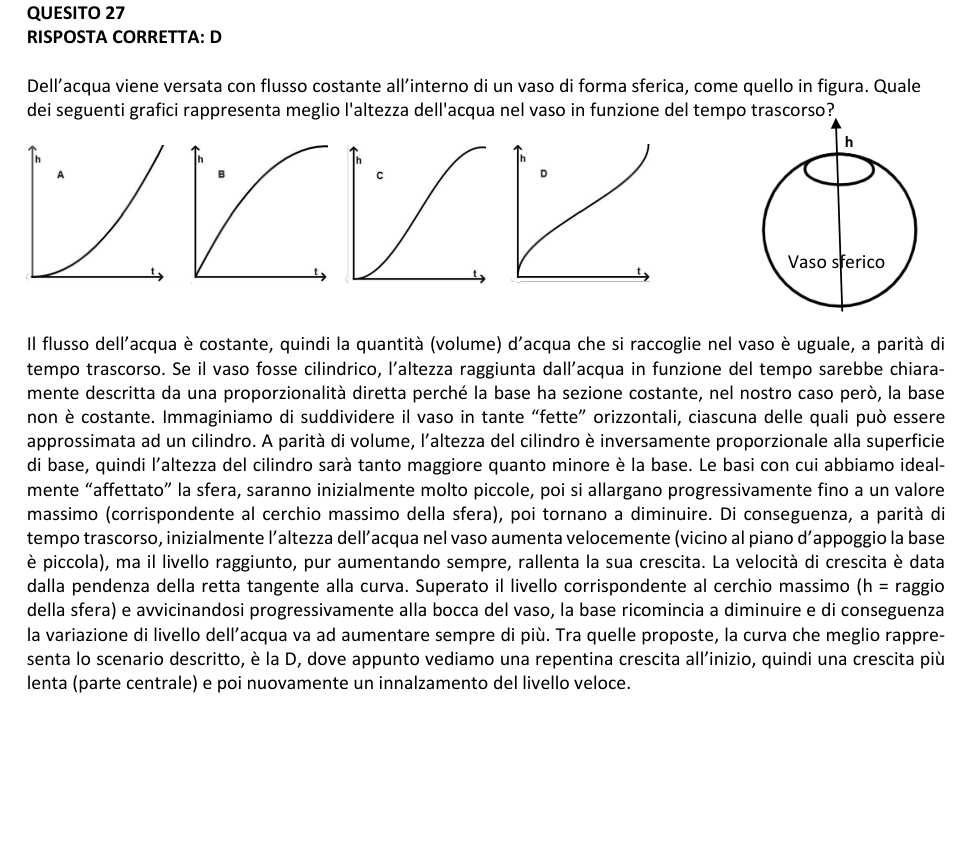
Soluzione ufficiale (Gruppo «Giochi di Anacleto», AIF), dal PDF ufficiale — p. 33.
Topic: Fluid Mechanics, Mathematics Metodi: Continuity Equation Competenze: Diagrammatic Reasoning Objects: Container Fonte: Testo (PDF) — p.11 · Soluzione ufficiale (PDF) — p.33
Water is poured at a constant flow rate into a spherical vase like the one in the figure. Which of the proposed graphs (A, B, C, D) best represents the height of the water in the vase as a function of time?
Risposta: D
Soluzione: The full official solution (in Italian) is in the original-language version of this problem and in the official PDF.
Topic: Fluid Mechanics, Mathematics Metodi: Continuity Equation Competenze: Diagrammatic Reasoning Objects: Container Fonte: Testo (PDF) — p.11 · Soluzione ufficiale (PDF) — p.33
Quesito aperto 28–30
Tracce nella camera a nebbia — Un detective della fisica delle particelle (quesito a risposta aperta, vale come tre quesiti: 28–30)
Una camera a nebbia è uno strumento che rende visibili le particelle subatomiche — quelle stesse particelle che attraversano il tuo corpo in questo momento senza che tu te ne accorga. Fu inventata da Charles Wilson nel 1911, e per decenni fu lo strumento principale con cui i fisici scoprirono nuove particelle: il positrone (1932), il muone (1936), e molte altre.
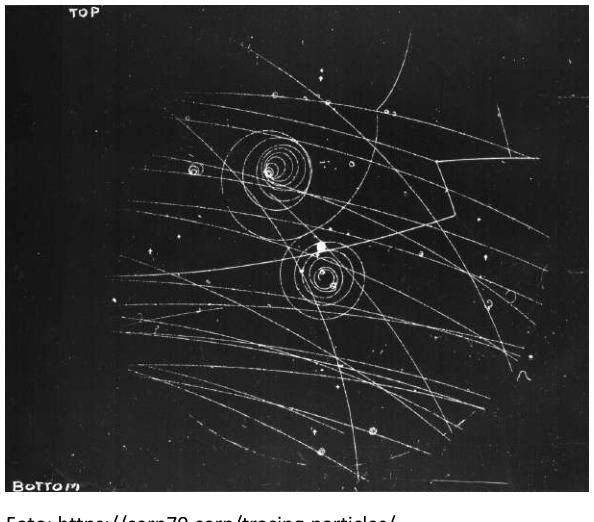
Foto: https://cern70.cern/tracing-particles/
Il principio di funzionamento è semplice ma ingegnoso. All’interno della camera si trova un vapore di alcool in uno stato instabile, detto soprasaturo: il vapore vorrebbe condensarsi in goccioline, ma non riesce perché manca un punto di condensazione. Quando una particella carica attraversa la camera, ionizza le molecole di alcool lungo il suo percorso. Queste molecole ionizzate diventano i punti di appoggio cercati: attorno a ciascuna si forma una piccola gocciolina, e l’insieme di queste goccioline disegna una scia di condensazione visibile, simile alla scia di vapore di un aereo nel cielo.
Come si vede dalla foto, le tracce si presentano con forme diverse, questo perché l’aspetto dipende da vari parametri, come la massa della particella che le genera, la sua carica elettrica e la sua velocità. Se la camera è immersa in un campo magnetico, le particelle cariche curvano, generando una traiettoria che è approssimativamente circolare e il cui raggio e verso di curvatura dipendono proprio dalla massa, carica e velocità delle particelle.
Nei nostri esempi considereremo sempre il campo magnetico diretto in modo perpendicolare al foglio e con verso uscente da esso. In tale caso una particella negativa che provenga da sinistra ruoterà in senso antiorario, mentre ruoterà in senso orario se la sua carica è positiva.
Il raggio di curvatura (raggio della traiettoria) è descritto dalla relazione , dove indica la lunghezza del raggio della traiettoria della particella, la sua massa, la sua velocità, la sua carica e l’intensità del campo magnetico esterno applicato. La carica è indicata con il valore assoluto, perché la dimensione del raggio non dipende dal segno: a parità di carica, non ha importanza se è positiva o negativa. L’effetto del segno è solo sul verso di rotazione.
Guardando le tracce lasciate dalle particelle che attraversano o talvolta si formano all’interno della camera a nebbia, un fisico può ricavare informazioni preziose, in particolare può distinguere quali particelle le hanno generate. Le proprietà principali da osservare sono le seguenti:
- Spessore della traccia — dipende da quante ionizzazioni la particella produce per centimetro. Una particella pesante e doppiamente carica (come la particella α – nucleo di elio) ionizza moltissimo → traccia corta e spessa. Un elettrone, carica singola e massa molto piccola, ionizza poco → traccia lunga e sottile.
- Verso della curvatura — se la camera è immersa in un campo magnetico , le particelle cariche sono deflesse dalla forza magnetica. Il verso della curvatura rivela il segno della carica. Con diretto verso l’osservatore, come nel nostro caso, una carica positiva proveniente da sinistra curva in verso orario e una negativa nell’altro verso.
- Raggio di curvatura — è proporzionale al prodotto della massa e della velocità: . Se si osserva una curva stretta → particella lenta o leggera. Se si osserva una curva molto ampia → particella veloce o pesante.
- Quando si produce una coppia di particelle, la carica totale si conserva, cioè la somma delle cariche delle particelle prodotte deve essere uguale a quella della particella che le produce.
- Le particelle prive di carica — come il fotone γ — non ionizzano direttamente e non lasciano traccia. La loro presenza si rivela indirettamente: un fotone ad alta energia può trasformarsi in un elettrone e un positrone (produzione di coppia), che lasciano due tracce che partono dallo stesso punto, apparentemente dal nulla.
Nella tabella che segue sono riportate le proprietà di alcune particelle che spesso lasciano tracce nella camera a nebbia (unità di massa: massa dell’elettrone; unità di velocità: ; unità di carica: carica del protone, +1; le velocità sono a titolo di esempio).
| Particella | Massa | Carica | Velocità | Aspetto della traccia |
|---|---|---|---|---|
| Elettrone − | 1 | −1 | 0.90 | Tracce in genere abbastanza lunghe e sottili che spesso si avvolgono a spirale |
| Positrone + | 1 | +1 | 0.90 | Tracce lunghe e sottili che si avvolgono a spirale, spesso un po’ più brevi di quelle degli elettroni |
| Particella alfa | 8000 | +2 | 0.10 | Tracce molto brevi e spesse |
| Muone − | 210 | −1 | 0.99 | Tracce praticamente rettilinee che attraversano tutto il campo della camera a nebbia |
| Antimuone + | 210 | +1 | 0.99 | Tracce praticamente rettilinee che attraversano tutto il campo della camera a nebbia |
| Fotone | 0 | 0 | 1 | Non genera tracce |
Domande (nelle risposte fai riferimento a questi valori):
a) Facendo riferimento alla tabella, ordina le particelle in base alla dimensione decrescente del raggio di curvatura (a parità di campo magnetico applicato).
b) Supponi di avere due tracce di un elettrone provenienti da due diverse camere a nebbia. Le due tracce hanno raggio di curvatura diverso: il primo raggio risulta di 3 cm, il secondo di 1 cm. Da cosa pensi sia determinata la differenza?
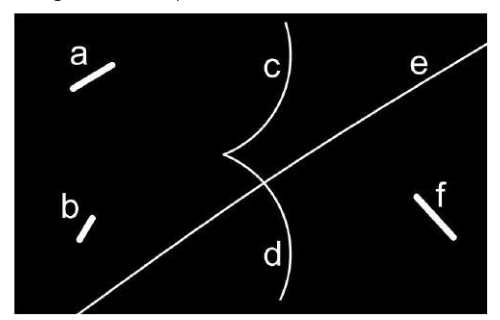
c) Quello presentato sotto è un diagramma schematico di possibili tracce generate da alcune particelle. In base alla tabella classifica le tracce (le particelle si muovono da sinistra verso destra, il campo magnetico è perpendicolare al foglio e uscente).
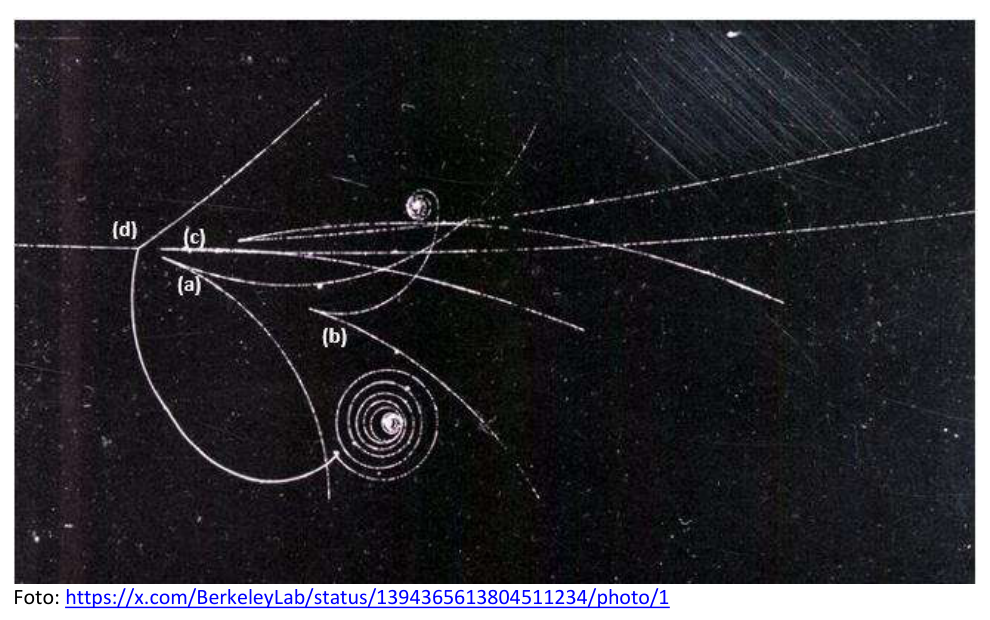
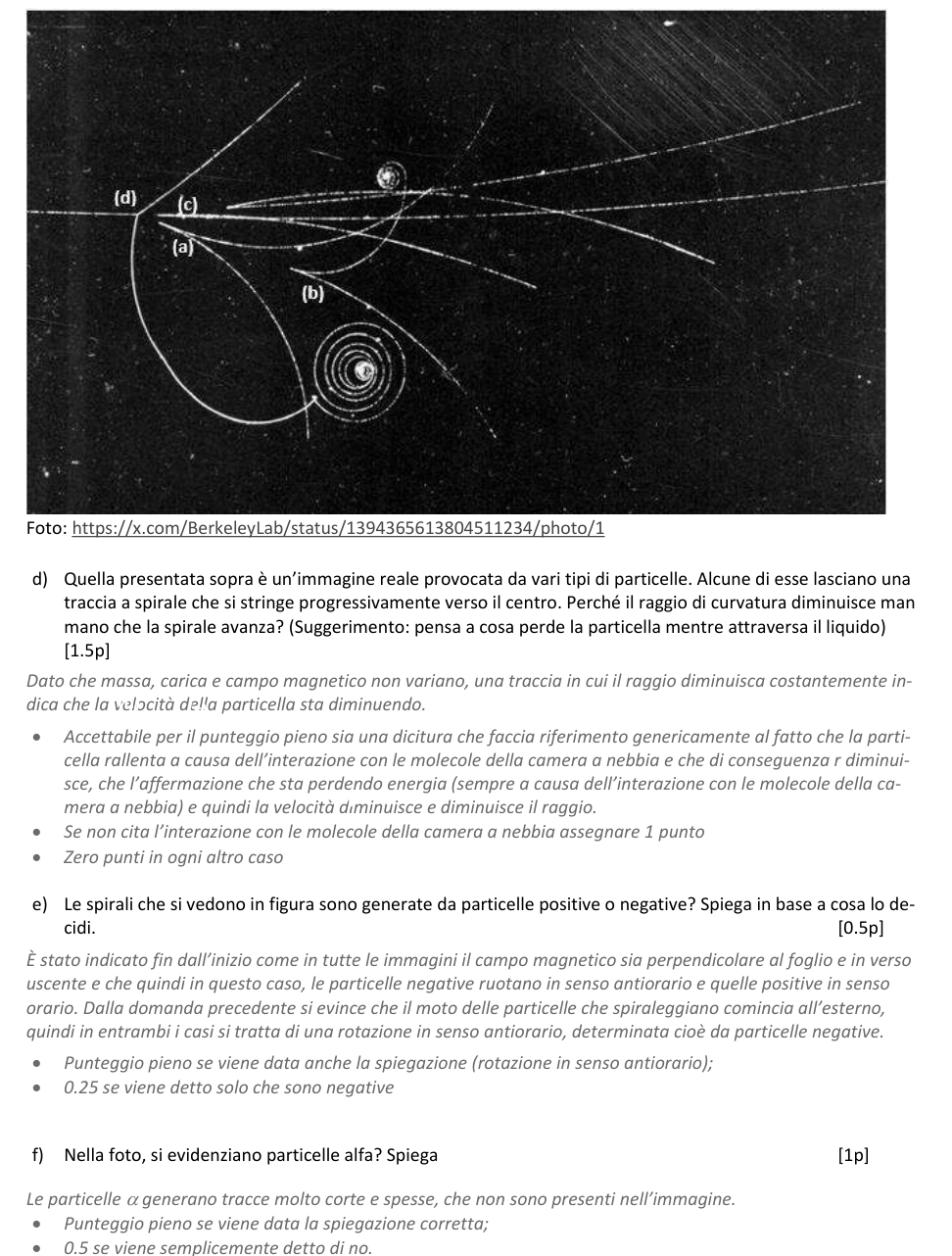
d) Quella presentata sopra è un’immagine reale provocata da vari tipi di particelle. Alcune di esse lasciano una traccia a spirale che si stringe progressivamente verso il centro. Perché il raggio di curvatura diminuisce man mano che la spirale avanza? (Suggerimento: pensa a cosa perde la particella mentre attraversa il liquido.)
e) Le spirali che si vedono in figura sono generate da particelle positive o negative? Spiega in base a cosa lo decidi.
f) Nella foto si evidenziano particelle alfa? Spiega.
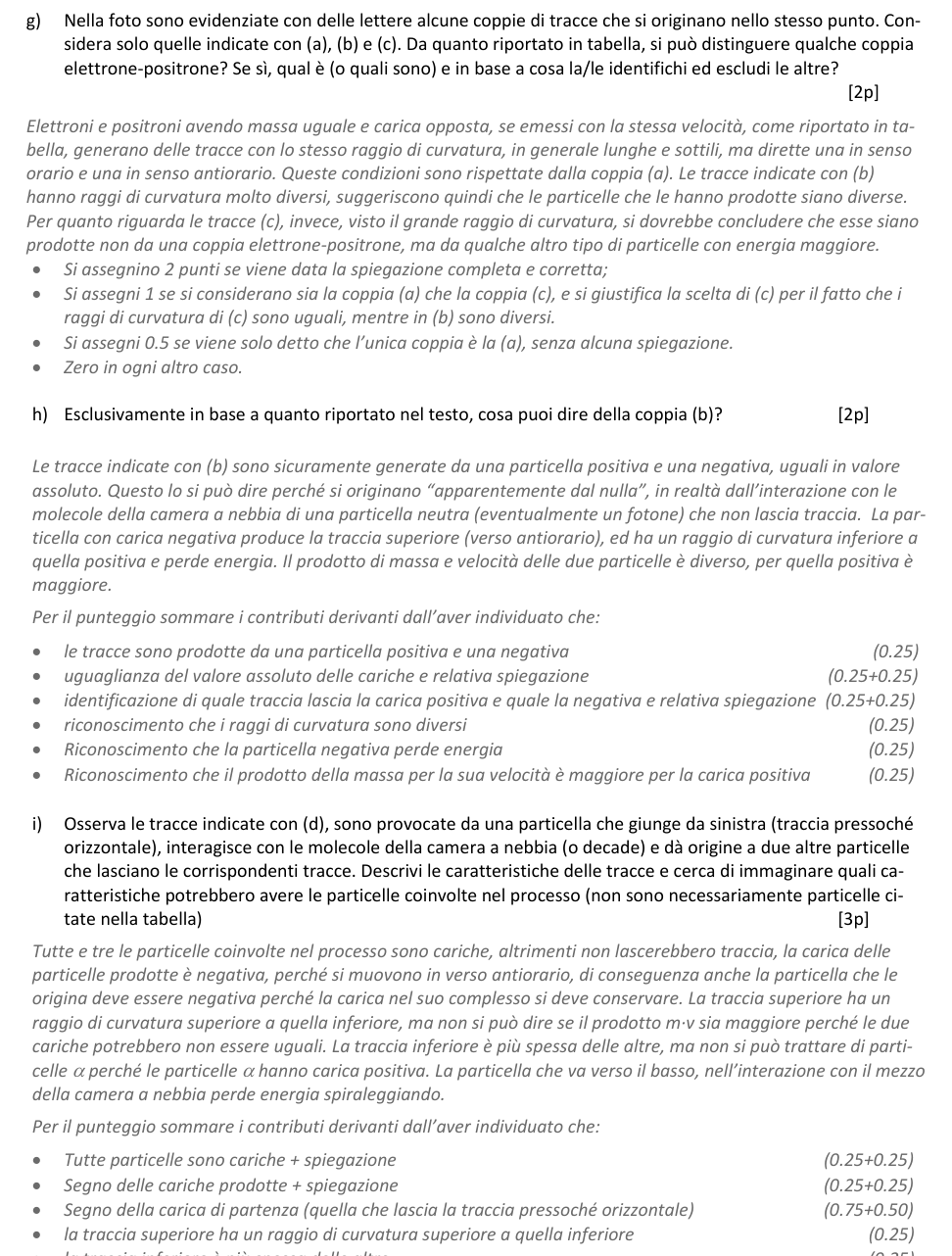
g) Nella foto sono evidenziate con delle lettere alcune coppie di tracce che si originano nello stesso punto. Considera solo quelle indicate con (a), (b) e (c). Da quanto riportato in tabella, si può distinguere qualche coppia elettrone-positrone? Se sì, qual è (o quali sono) e in base a cosa la/le identifichi ed escludi le altre?
h) Esclusivamente in base a quanto riportato nel testo, cosa puoi dire della coppia (b)?
i) Osserva le tracce indicate con (d): sono provocate da una particella che giunge da sinistra (traccia pressoché orizzontale), interagisce con le molecole della camera a nebbia (o decade) e dà origine a due altre particelle che lasciano le corrispondenti tracce. Descrivi le caratteristiche delle tracce e cerca di immaginare quali caratteristiche potrebbero avere le particelle coinvolte nel processo (non sono necessariamente particelle citate nella tabella).
Risposta: risposta aperta — vedi la soluzione ufficiale con i criteri di valutazione
Soluzione:
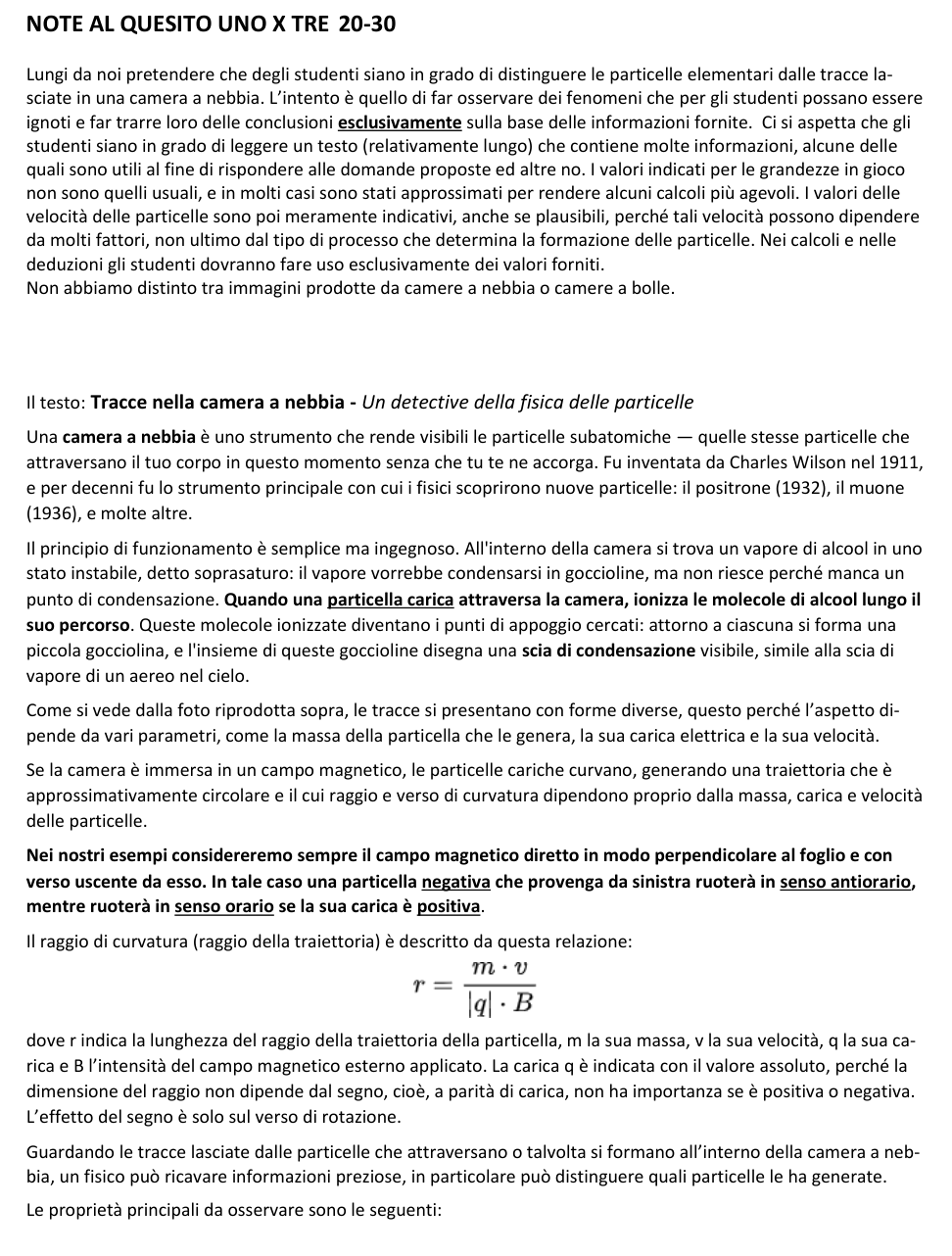
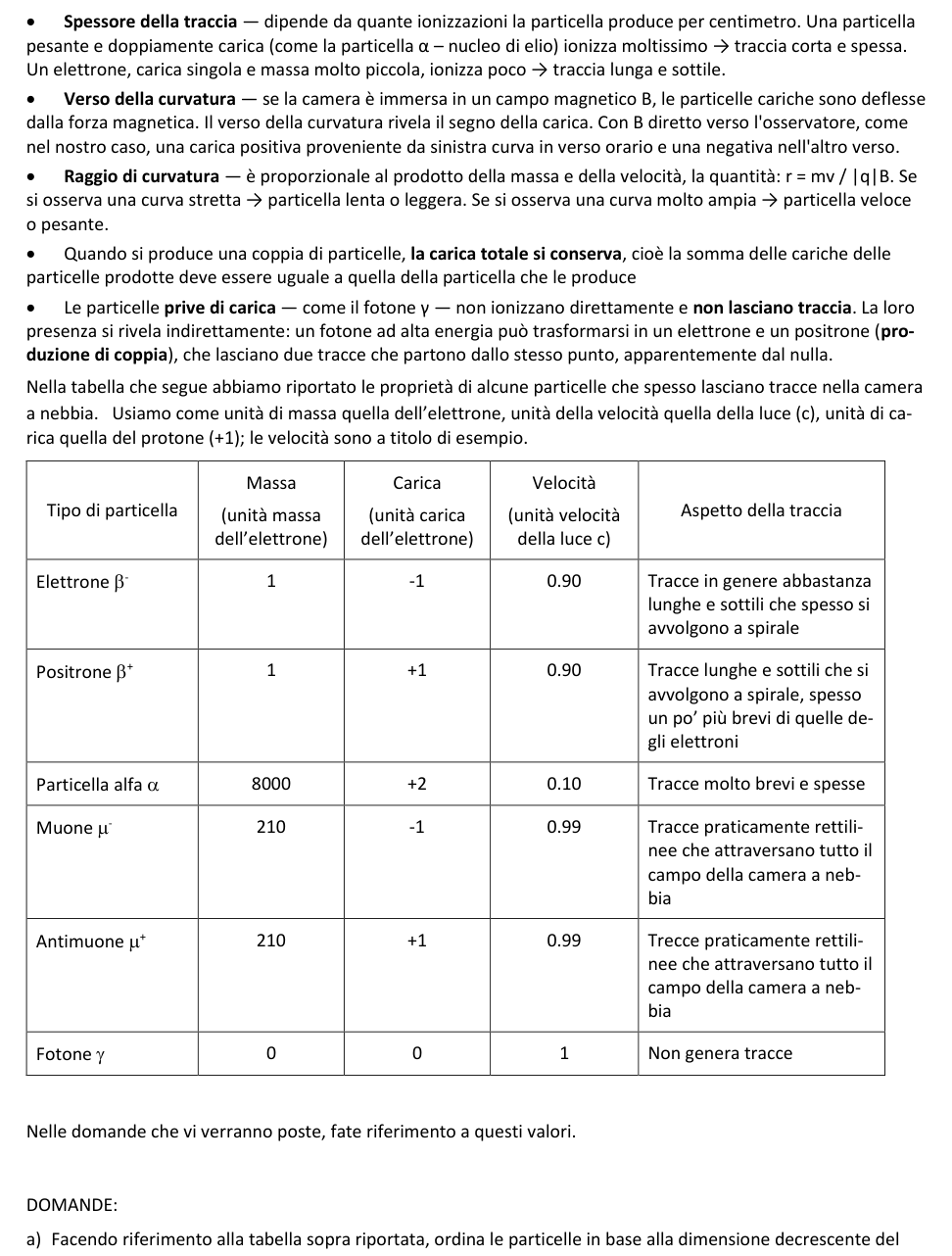
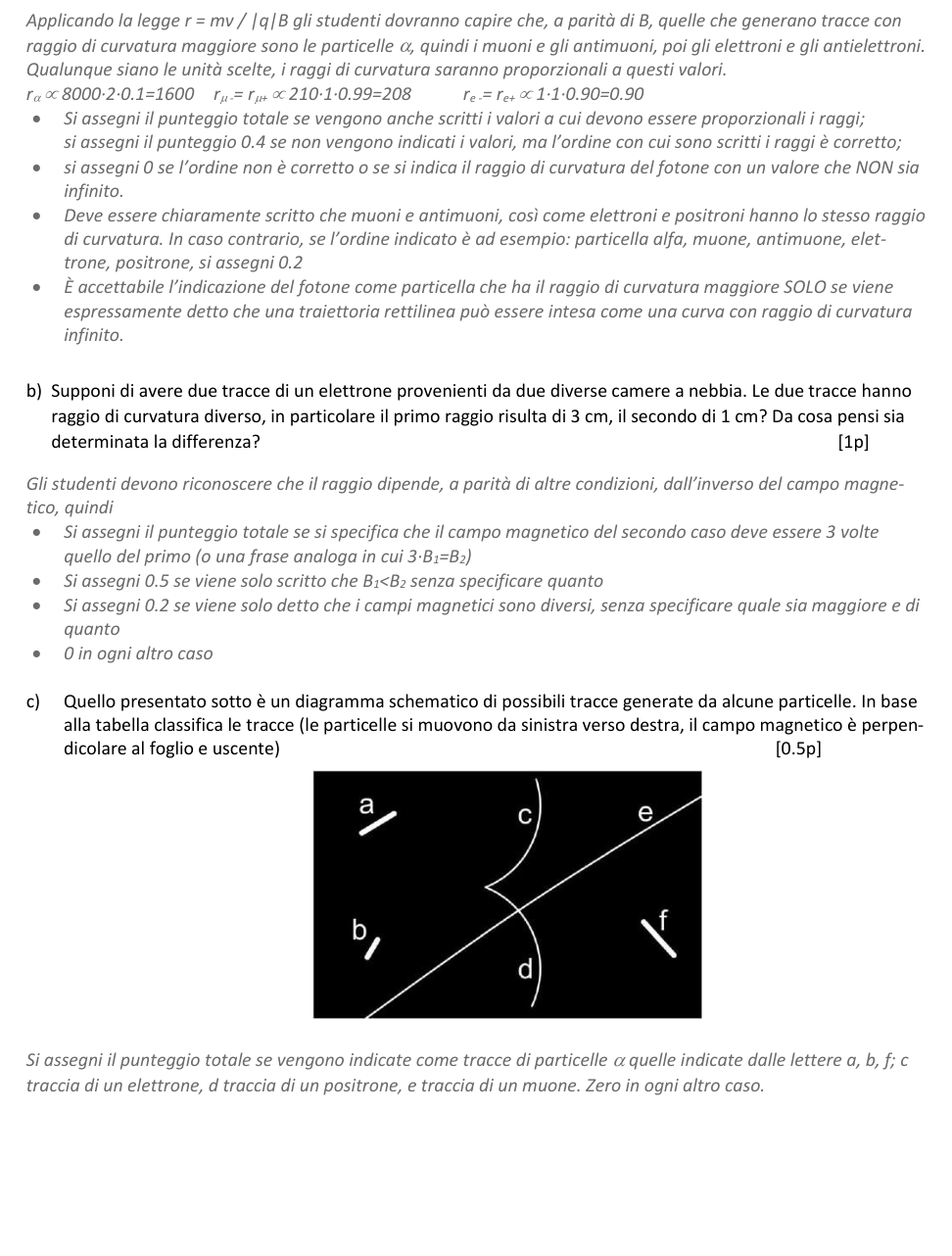

Soluzione ufficiale (Gruppo «Giochi di Anacleto», AIF), dal PDF ufficiale — p. 34, 35, 36, 37, 38, 39.
N.d.R.: (1) L’intestazione ufficiale delle note riporta «QUESITO UNO X TRE 20-30»: si tratta del quesito 28–30. (2) Nella soluzione della domanda a) la fonte scrive . Poiché , la carica va al denominatore: il valore corretto è . L’ordinamento finale (particelle α, poi muoni e antimuoni con , poi elettroni e positroni con ) non cambia.
Topic: Nuclear & Particle Physics, Magnetism Metodi: Lorentz Force Analysis, Conservation Laws Competenze: Physical Reasoning, Diagrammatic Reasoning Objects: Particle Beam, Electron Fonte: Testo (PDF) — p.12 · Soluzione ufficiale (PDF) — p.34
Open problem 28–30
Tracks in the cloud chamber — A particle-physics detective (open-answer problem, worth three questions: 28–30)
A cloud chamber is an instrument that makes subatomic particles visible — the very particles that are passing through your body right now without you noticing. It was invented by Charles Wilson in 1911, and for decades it was the main instrument with which physicists discovered new particles: the positron (1932), the muon (1936), and many others.
Photo: https://cern70.cern/tracing-particles/
The working principle is simple but ingenious. Inside the chamber there is alcohol vapour in an unstable state, called supersaturated: the vapour would like to condense into droplets but cannot, because a condensation point is missing. When a charged particle crosses the chamber, it ionises the alcohol molecules along its path. These ionised molecules become the missing anchor points: a small droplet forms around each of them, and together the droplets draw a visible condensation trail, similar to the vapour trail of a plane in the sky.
As the photo shows, the tracks have different shapes, because their appearance depends on several parameters, such as the mass of the particle producing them, its electric charge and its speed. If the chamber is placed in a magnetic field, charged particles curve, producing an approximately circular trajectory whose radius and sense of curvature depend precisely on the mass, charge and speed of the particles.
In our examples the magnetic field will always be perpendicular to the page and pointing out of it. In that case a negative particle coming from the left turns anticlockwise, while it turns clockwise if its charge is positive.
The radius of curvature (radius of the trajectory) is given by , where is the radius of the particle’s trajectory, its mass, its speed, its charge and the magnitude of the applied external magnetic field. The charge appears in absolute value because the size of the radius does not depend on the sign: for the same charge, it does not matter whether it is positive or negative. The sign only affects the sense of rotation.
By looking at the tracks left by particles that cross, or sometimes are created inside, the cloud chamber, a physicist can obtain valuable information; in particular, he or she can tell which particles produced them. The main properties to observe are:
- Track thickness — depends on how many ionisations the particle produces per centimetre. A heavy, doubly charged particle (such as the α particle – a helium nucleus) ionises a lot → short, thick track. An electron, with single charge and very small mass, ionises little → long, thin track.
- Sense of curvature — if the chamber is in a magnetic field , charged particles are deflected by the magnetic force. The sense of curvature reveals the sign of the charge. With pointing towards the observer, as in our case, a positive charge coming from the left curves clockwise and a negative one the other way.
- Radius of curvature — proportional to the product of mass and speed: . A tight curve → slow or light particle. A very wide curve → fast or heavy particle.
- When a pair of particles is produced, total charge is conserved: the sum of the charges of the produced particles must equal that of the particle producing them.
- Neutral particles — like the photon γ — do not ionise directly and leave no track. Their presence is revealed indirectly: a high-energy photon can turn into an electron and a positron (pair production), which leave two tracks starting from the same point, apparently out of nowhere.
The table below lists the properties of some particles that often leave tracks in the cloud chamber (mass unit: electron mass; speed unit: ; charge unit: proton charge, +1; speeds are examples).
| Particle | Mass | Charge | Speed | Track appearance |
|---|---|---|---|---|
| Electron − | 1 | −1 | 0.90 | Usually fairly long, thin tracks that often curl into spirals |
| Positron + | 1 | +1 | 0.90 | Long, thin tracks that curl into spirals, often a bit shorter than electron tracks |
| Alpha particle | 8000 | +2 | 0.10 | Very short, thick tracks |
| Muon − | 210 | −1 | 0.99 | Practically straight tracks crossing the whole field of the chamber |
| Antimuon + | 210 | +1 | 0.99 | Practically straight tracks crossing the whole field of the chamber |
| Photon | 0 | 0 | 1 | Leaves no track |
Questions (refer to these values in your answers):
a) Using the table, order the particles by decreasing radius of curvature (for the same applied magnetic field).
b) Suppose you have two electron tracks from two different cloud chambers. The two tracks have different radii of curvature: the first is 3 cm, the second 1 cm. What do you think causes the difference?
c) The diagram below is a schematic of possible tracks produced by some particles. Using the table, classify the tracks (the particles move from left to right; the magnetic field is perpendicular to the page and pointing out of it).
d) The image above is a real picture produced by various kinds of particles. Some of them leave a spiral track that gradually tightens towards the centre. Why does the radius of curvature decrease as the spiral proceeds? (Hint: think about what the particle loses as it crosses the liquid.)
e) Are the spirals in the figure produced by positive or negative particles? Explain how you decide.
f) Does the photo show alpha particles? Explain.
g) In the photo some pairs of tracks starting from the same point are marked with letters. Consider only those marked (a), (b) and (c). Based on the table, can any electron–positron pair be identified? If so, which one(s), and on what basis do you identify it/them and exclude the others?
h) Based only on the text, what can you say about pair (b)?
i) Look at the tracks marked (d): they are produced by a particle arriving from the left (almost horizontal track) which interacts with the molecules of the cloud chamber (or decays) and gives rise to two other particles that leave the corresponding tracks. Describe the features of the tracks and try to imagine what features the particles involved in the process might have (they are not necessarily particles listed in the table).
Risposta: open answer — see the official solution and marking scheme
Soluzione: The full official solution (in Italian) is in the original-language version of this problem and in the official PDF.
Topic: Nuclear & Particle Physics, Magnetism Metodi: Lorentz Force Analysis, Conservation Laws Competenze: Physical Reasoning, Diagrammatic Reasoning Objects: Particle Beam, Electron Fonte: Testo (PDF) — p.12 · Soluzione ufficiale (PDF) — p.34
Risposte corrette ufficiali (soluzioni AIF, Giochi di Anacleto 2026).
| Problema | Titolo | Risposta |
|---|---|---|
| 1 | C | |
| 2 | D | |
| 3 | D | |
| 4 | D | |
| 5 | B | |
| 6 | A | |
| 7 | A | |
| 8 | A | |
| 9 | C | |
| 10 | B | |
| 11 | A | |
| 12 | D | |
| 13 | C | |
| 14 | C | |
| 15 | C | |
| 16 | A | |
| 17 | B | |
| 18 | A | |
| 19 | B | |
| 20 | A | |
| 21 | A | |
| 22 | C | |
| 23 | B | |
| 24 | B | |
| 25 | D | |
| 26 | D | |
| 27 | D | |
| 28 | Quesito aperto 28–30 | risposta aperta — vedi la soluzione ufficiale con i criteri di valutazione |
Fonte: Testo e soluzioni (PDF)
Official correct answers (AIF solutions, Giochi di Anacleto 2026).
| Problem | Title | Risposta |
|---|---|---|
| 1 | C | |
| 2 | D | |
| 3 | D | |
| 4 | D | |
| 5 | B | |
| 6 | A | |
| 7 | A | |
| 8 | A | |
| 9 | C | |
| 10 | B | |
| 11 | A | |
| 12 | D | |
| 13 | C | |
| 14 | C | |
| 15 | C | |
| 16 | A | |
| 17 | B | |
| 18 | A | |
| 19 | B | |
| 20 | A | |
| 21 | A | |
| 22 | C | |
| 23 | B | |
| 24 | B | |
| 25 | D | |
| 26 | D | |
| 27 | D | |
| 28 | Open problem 28–30 | open answer — see the official solution and marking scheme |
Fonte: Testo e soluzioni (PDF)