Rubber fiber (12 pts)
Fibers made of elastic rubber can be stretched to lengths , much longer than the length in undeformed state . For such rubbers, the net volume of the fiber remains constant.
-
Express the cross-sectional area of such a fiber in a deformed state via its length and initial dimensions , (1 pt).
-
For small deformations of an elastic material, the stretching force and deformation are related to each other by the Hooke’s law , where the stiffness and is the Young’s modulus of the rubber. For non-small (possibly large, ) deformations of elastic rubber, however, the Hooke’s law is substituted by a non-linear law, (breaking of this law at very large values of will not be studied here). Express the constants and in terms of , , and (2 pt).
-
Suppose such a fiber is stretched by some force up to the length . A small change of the stretching force results in a small change in the length . Express in terms of , , , , and (1 pt).
-
Suppose a small body is fixed to one end of the fiber and the system is put into rotation around the other end of the fiber. In the case of a circular motion of the body, express the length of the fiber via , , , and the kinetic energy of the body (the kinetic energy of the fiber and gravity can be neglected). (1.5 pts)
-
Let us analyse a slightly non-circular motion of the body. Let us describe the motion of the system by the length change of the fiber , the radial and tangential velocities of the body (the components respectively parallel and perpendicular to the fiber). The initial values of these quantities are designated as , , and . The values and are chosen so that if the initial radial velocity were zero, the motion would be circular. Write down two independent equations relating , , and to each other (using also the mass of the body , together with the parameters , , , , , ). (3.5 pts)
-
Find the relationship between and (containing also the parameters , , , , , , ) assuming that , and find the period of small oscillations of . Simplify the expression of for (3 pts).
Topic: Elasticity & Materials, Oscillations & Waves, Newtonian Mechanics Metodi: Hooke’s Law, Simple Harmonic Motion Analysis Competenze: Mathematical Modeling, Physical Reasoning Objects: String, Block Fonte: Testo (PDF) — p.1
**Fibra di gomma (12 pts) **
Le fibre in gomma elastica possono essere estese fino a lunghezze , molto più lunghe della lunghezza in stato non deformato . Per tali gommi, il volume netto della fibra rimane costante.
-
Esprimere l’area trasversale di una tale fibra in stato deformato attraverso la sua lunghezza e le sue dimensioni iniziali , (1 pt).
-
Per piccole deformazioni di un materiale elastico, la forza di estensione e la deformazione sono correlate tra loro con la legge di Hooke , dove la rigidità e è il modulo di Young della gomma. Per le deformazioni non piccole (possibilmente grandi, ) della gomma elastica, tuttavia, la legge di Hooke viene sostituita da una legge non lineare, (la violazione di questa legge a valori molto grandi di non verrà esaminata qui). Esprimere le costanti e in termini di , e (2 pt).
-
Supponiamo che una fibra sia estesa da una forza fino alla lunghezza . Un piccolo cambiamento della forza di estensione comporta un piccolo cambiamento della lunghezza . Esprimere in termini di , , , e (1 pt).
-
Supponiamo che un piccolo corpo sia fissato ad una estremità della fibra e il sistema sia messo in rotazione attorno all’altra estremità della fibra. In caso di movimento circolare del corpo, esprimere la lunghezza della fibra tramite , , e l’energia cinetica del corpo (la energia cinetica della fibra e della gravità possono essere trascurate). 1, 5 punti)
-
Analizziamo un movimento leggermente non circolare del corpo. Descriviamo il movimento del sistema con il cambiamento di lunghezza della fibra , la velocità radial e tangenziale del corpo (le componenti rispettivamente parallele e perpendicolari alla fibra). I valori iniziali di tali quantità sono designati come , e . I valori e sono scelti in modo che se la velocità radial iniziale fosse zero, il movimento sia circolare. Write down two independent equations relating , , and to each other (using also the mass of the body , together with the parameters , , , , , ). 3,5 punti)
-
Trovare la relazione tra e (contiene anche i parametri , , , , , , ) supponendo che , e trovare il periodo di piccole oscillazioni di . Semplificare l’espressione di per (3 punti).
Topic: Elasticity & Materials, Oscillations & Waves, Newtonian Mechanics Metodi: Hooke’s Law, Simple Harmonic Motion Analysis Competenze: Mathematical Modeling, Physical Reasoning Objects: String, Block Fonte: Testo (PDF) — p.1
Planets (6 pts)
Two planets move along circular orbits around a star of mass kg; gravitational constant m/(kgs). The dependence of the angular distance between a planet and the star on time, as seen from the other planet, is depicted in the figure.
-
What is the ratio of the radii of the planets (2 pts)?
-
Determine the value of the unit on the vertical axis (or express it in terms of , if you were unable to find it) (2 pts).
-
What are the orbital radii of the planets, if the unit on the horizontal axis equals to one year (2 pts)?
 Angular distance vs time graph for two planets
Topic: Gravitation, Astrophysics, Newtonian Mechanics Metodi: Kepler’s Laws, Newton’s Law of Gravitation, Experimental Data Analysis Competenze: Graph Linearization, Physical Reasoning Objects: Planet, Star Fonte: Testo (PDF) — p.1
**Planeti (6 pts) **
Due pianeti si muovono in orbite circolari intorno a una stella di massa kg; costante gravitazionale m/(kgs). La dipendenza della distanza angolare tra un pianeta e la stella dal tempo, vista dall’altro pianeta, è raffigurata nella figura.
-
Qual è il rapporto tra i raggi dei pianeti (2 punti)?
-
Determina il valore dell’unità sull’asse verticale (o esprima in termini di , se non è stato possibile trovarla) (2 punti).
-
Quali sono i raggi orbitali dei pianeti, se l’unità sull’asse orizzontale è uguale a un anno (2 punti)?
Distanza angolare vs grafico temporale per due pianeti
Topic: Gravitation, Astrophysics, Newtonian Mechanics Metodi: Kepler’s Laws, Newton’s Law of Gravitation, Experimental Data Analysis Competenze: Graph Linearization, Physical Reasoning Objects: Planet, Star Fonte: Testo (PDF) — p.1
Tilt-shift lens (6 pts)
-
Show that an image of a straight line created by a thin lens is also a straight line. Consider two-dimensional geometry only, i.e. assume that the main optical axis and the straight line lay in the same surface. Hint: use the coordinate system, where the origin coincides with the center of the lens and represent lines algebraically, e.g. . Make use of the formula of thin lens ( and are the -coordinates of a point and its image, respectively) (2 pts).
-
In the figure (a), draw the image of the given line and indicate which parts of the image are virtual, and which are real (2 pts).
-
A photographer wants to take a photo of a field of flowers. In order to get an image where all the flowers (both the close and far ones) are sharp, he has to use a lens with tilt-shift (TS) capabilities. The field of flowers (which extends effectively to infinity) and the image of its distant edge, together with the image plane are depicted in figure (b). Reconstruct the position of the lens, the focal length of which is provided as a scale (2 pts).
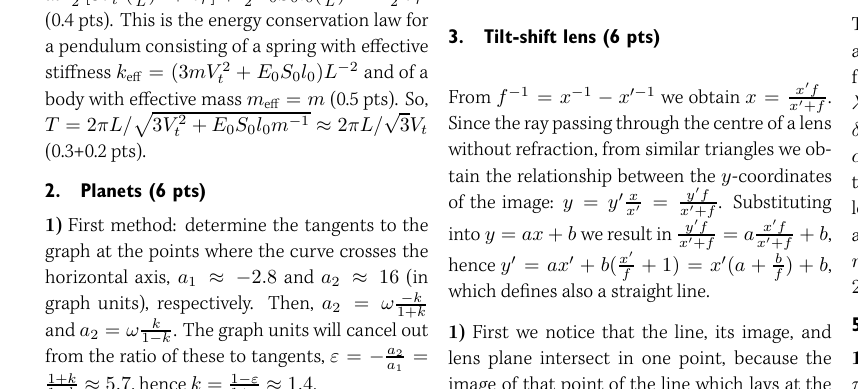 Tilt-shift lens geometry diagrams (a) and (b)
Topic: Geometric Optics, Wave Optics Metodi: Thin Lens & Mirror Equation, Ray Tracing Competenze: Mathematical Modeling, Diagrammatic Reasoning Objects: Lens Fonte: Testo (PDF) — p.1
**Lenza a spostamento di inclinazione (6 punti) **
-
Mostra che un’immagine di una linea retta creata da una lente sottile è anche una linea retta. Considera solo la geometria bidimensionale, cioè presumere che l’asse ottico principale e la linea retta si trovino nella stessa superficie . Suggerimento: utilizzare il sistema di coordinate, dove l’origine coincide con il centro della lente e rappresentare linee in modo algebrico, ad esempio. . Utilizzare la formula di lente sottile ( e sono rispettivamente le coordinate di un punto e della sua immagine) (2 pts).
-
Nella figura a), disegnare l’immagine della linea data e indicare quali parti dell’immagine sono virtuali e quali reali (2 punti).
-
Un fotografo vuole scattare una foto di un campo di fiori. Per ottenere un’immagine in cui tutti i fiori (sia quelli vicini che quelli lontani) sono taglienti, deve usare un obiettivo con capacità di spostamento di tilt (TS). Il campo dei fiori (che si estende efficacemente all’infinito) e l’immagine del suo bordo lontano, insieme al piano dell’immagine sono raffigurati nella figura (b). Ricostruire la posizione della lente, la cui lunghezza focale è fornita in forma di scala (2 punti).
*Diagrammi di geometria delle lente a spostamento di inclinazione (a) e (b) *
Topic: Geometric Optics, Wave Optics Metodi: Thin Lens & Mirror Equation, Ray Tracing Competenze: Mathematical Modeling, Diagrammatic Reasoning Objects: Lens Fonte: Testo (PDF) — p.1
Transparent film (6 pts)
A thick glass plate is coated by a thin transparent film. The transmission spectrum of the system is depicted in the graph (light falls normal to the plate). The refractive index of the film . What is the thickness of the film ?
 Transmission spectrum of film-coated glass
Topic: Wave Optics, Geometric Optics Metodi: Interference & Diffraction Analysis, Experimental Data Analysis Competenze: Experimental Data Analysis, Graph Linearization Objects: — Fonte: Testo (PDF) — p.1
**Filma trasparente (6 pts) **
Una piastra di vetro spessa è rivestita da un sottile film trasparente. Lo spettro di trasmissione del sistema è raffigurato nel grafico (la luce cade normalmente sulla targa). L’indice di rifrazione del film . Qual è lo spessore del film ?
Spetto di trasmissione di vetro rivestito di pellicola
Topic: Wave Optics, Geometric Optics Metodi: Interference & Diffraction Analysis, Experimental Data Analysis Competenze: Experimental Data Analysis, Graph Linearization Objects: — Fonte: Testo (PDF) — p.1
4th order ellipse (6 pts)
A 4th order ellipse is defined by equation , where and are the lengths of the half-axes. Consider a homogeneous cylinder, the cross-section of which is a 4th order ellipse. The position of the cylinder is measured by the angle between the vertical direction and the longer half-axis, see figure.
-
What are the equilibrium positions of the cylinder laying on a horizontal surface (3.5 pts)?
-
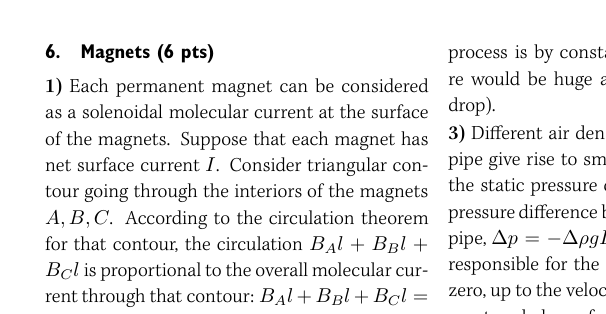
Sketch on a graph the net torque of gravity and surface reaction forces with respect to the contact point of the cylinder and surface as a function of (). For the axis of torque, you do not need to indicate any quantitative scale (1.3 pts).
-
Which equilibrium positions are stable and which are not? Motivate your answer (1.2 pts).
 4th order ellipse cylinder on surface
Topic: Rigid Body Statics, Newtonian Mechanics Metodi: Torque & Angular Momentum Analysis, Symmetry Argument Competenze: Mathematical Modeling, Diagrammatic Reasoning Objects: Cylinder Fonte: Testo (PDF) — p.2
**Elisse di quarto ordine (6 punti) **
Un’ellisse di quarto ordine è definita con l’equazione , dove e sono le lunghezze degli asse a metà. Considera un cilindro omogeneo, la cui sezione trasversale è un’ellisse di quarto ordine. La posizione del cilindro è misurata dall’angolo tra la direzione verticale e la semia-asse più lunga, vedi figura.
-
Quali sono le posizioni di equilibrio del cilindro che si trova su una superficie orizzontale (3,5 punti)?
-
Segnare su un grafico la coppia netta della forza di reazione gravitazionale e della superficie rispetto al punto di contatto del cilindro e della superficie in funzione di (). Per l’asse della coppia non è necessario indicare alcuna scala quantitativa (1,3 pts).
-
Quali posizioni di equilibrio sono stabili e quali no? Motiva la tua risposta (1.2 pag.
- cilindro di elipsina di quarto ordine sulla superficie*
Topic: Rigid Body Statics, Newtonian Mechanics Metodi: Torque & Angular Momentum Analysis, Symmetry Argument Competenze: Mathematical Modeling, Diagrammatic Reasoning Objects: Cylinder Fonte: Testo (PDF) — p.2
Magnets (6 pts)
Certain type of magnetic toys are made up of ferromagnetic spheres and permanent magnets of cylindrical shape. These building blocks can be used to build, for instance, a tetrahedron (letter “N” marks the northern end of a magnet). Assume that all these permanent magnets are identical and each of them alone can create a magnetic flux (assuming both ends of the magnet are in contact with a U-shaped large piece of ferromagnetic material, so that a closed ferromagnetic contour is formed). Assume also that due to high magnetic permeability of the material of the building blocks, all the magnetic field lines are constrained inside of them (i.e. in the surrounding medium, the magnetic inductance ).
-
Let us designate the fluxes in each permanent magnet (magnets A–F in figure) by –. Write down an equation relating , , and to each other (and possibly to ) (1 pt).
-
Write down an equation relating , , and to each other (and possibly to ) (1 pt).
-
Find the ratio (1 pt).
-
Find the magnetic fluxes in each permanent magnet (2 pts).
-
Which of the magnets is the most difficult one to remove? Motivate your answer (1 pt).
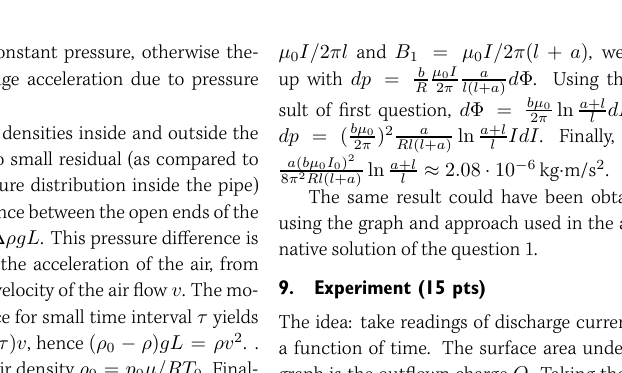 Tetrahedron of magnets A–F
Topic: Magnetism, Electromagnetism Metodi: Ampère’s Law, Symmetry Argument Competenze: Physical Reasoning, Diagrammatic Reasoning Objects: Magnet, Sphere Fonte: Testo (PDF) — p.2
Magnets (6 pts)
Alcuni tipi di giocattoli magnetici sono costituiti da sfere ferromagnetiche e magneti permanenti di forma cilindrica. Questi blocchi possono essere utilizzati per costruire, ad esempio, un tetraedro (la lettera “N” segna l’estremità settentrionale di un magnete). Supponiamo che tutti questi magneti permanenti siano identici e ognuno di essi da solo possa creare un flusso magnetico (supponendo che entrambe le estremità del magnete siano in contatto con un grande pezzo di materiale ferromagnetico a forma di U, in modo da formare un contorno ferromagnetico chiuso). Supponiamo inoltre che, a causa dell’elevata permeabilità magnetica del materiale dei blocchi di costruzione, tutte le linee di campo magnetico siano limitate all’interno di essi (cioè nel mezzo circostante, l’inductanza magnetica ).
-
Indichiamo i flussi di ogni magnete permanente (magnete AF nella figura) con \Phi_A$$\Phi_F. Scrivere un’equazione relativa a , e (e possibilmente a ) (1 pt).
-
Write down an equation relating , , and to each other (and possibly to ) (1 pt).
-
Trovare il rapporto (1 pt).
-
Trova i flussi magnetici di ogni magnete permanente (2 punti).
-
Quale dei magneti è il più difficile da togliere? Motiva la tua risposta (1 Pt).
Tetraedro di magneti AF
Topic: Magnetism, Electromagnetism Metodi: Ampère’s Law, Symmetry Argument Competenze: Physical Reasoning, Diagrammatic Reasoning Objects: Magnet, Sphere Fonte: Testo (PDF) — p.2
Passive air-cooling (9 pts)
Consider a passive cooling system. Cold air (at normal conditions: Pa, K) flows over the heat sink of a chip of power dissipation W, into a vertical pipe of length m and cross-sectional area cm. After passing the pipe, air enters the ambient room. Assume that the air inside the pipe becomes well mixed; neglect the viscous and turbulent friction of air inside the pipe and heat sink. Air can be considered as an ideal gas with adiabatic exponent and molar mass g/mol.
-
Express the heat capacitance at constant pressure via quantities and (1 pt).
-
Find a relationship between the outflowing air density and temperature (the relationship may contain also the parameters defined above) (2 pts).
-
Find a relationship between the air flow velocity in the pipe and outflowing air density (the relationship may contain also the parameters defined above) (2 pts).
-
Express the power dissipation in terms of the air flow velocity , the outflowing air temperature , and density (the relationship may contain also the parameters defined above) (2 pts).
-
What is the temperature of the outflowing air? In your calculations, you may use the approximation (2 pts).
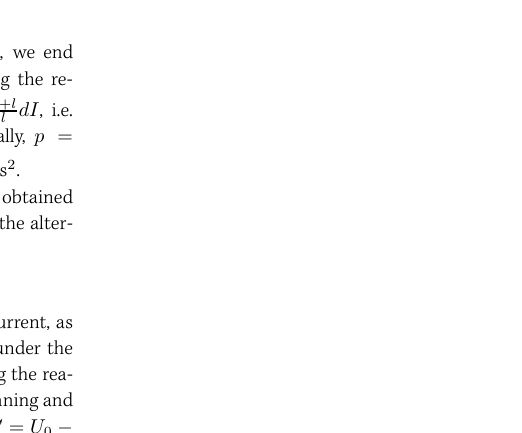 Passive air-cooling pipe diagram
Topic: Thermodynamics, Fluid Mechanics Metodi: Ideal Gas Law, First Law of Thermodynamics, Bernoulli’s Equation Competenze: Mathematical Modeling, Physical Reasoning Objects: Tube, Gas Fonte: Testo (PDF) — p.2
**Rifrigio passivo (9 pts) **
Considerate un sistema di raffreddamento passivo. L’aria fredda (a condizioni normali: Pa, K) scorre attraverso il disipadore termico di un chip di dissipazione di potenza W, in un tubo verticale di lunghezza m e superficie trasversale cm. Dopo aver attraversato il tubo, l’aria entra nella stanza ambientale. Supponiamo che l’aria all’interno del tubo si mescolhi bene; trascurate l’attrito viscoso e turbolento dell’aria all’interno del tubo e del termostato. L’aria può essere considerata un gas ideale con esponente adiabatico e massa molare g/mol.
-
Esprimere la capacità termico a pressione costante attraverso quantità e (1 pt).
-
Trovare una relazione tra la densità di aria uscita e la temperatura (la relazione può contenere anche i parametri definiti sopra) (2 punti).
-
Trovare una relazione tra la velocità di flusso d’aria nel tubo e la densità di uscita d’aria (la relazione può contenere anche i parametri definiti sopra) (2 punti).
-
Esprimere la dissipazione di potenza in termini di velocità di flusso d’aria , temperatura di uscita dell’aria e densità (la relazione può contenere anche i parametri definiti sopra) (2 punti).
-
Qual è la temperatura dell’aria uscita? Per i calcoli, è possibile utilizzare l’approssimazione (2 punti).
Diagramma di tubi di raffreddamento aereo passivo
Topic: Thermodynamics, Fluid Mechanics Metodi: Ideal Gas Law, First Law of Thermodynamics, Bernoulli’s Equation Competenze: Mathematical Modeling, Physical Reasoning Objects: Tube, Gas Fonte: Testo (PDF) — p.2
Loop of wire (7 pts)
Consider a rectangular loop of wire with dimensions m and m, one side of which is parallel to another long straight wire carrying current A, at distance m (see figure). The magnetic inductance of such current is plotted as a function of the distance from the wire in the attached graph.
- Find the magnetic flux through the loop (the relevant formula for the magnetic field of a long wire is provided in the graph).
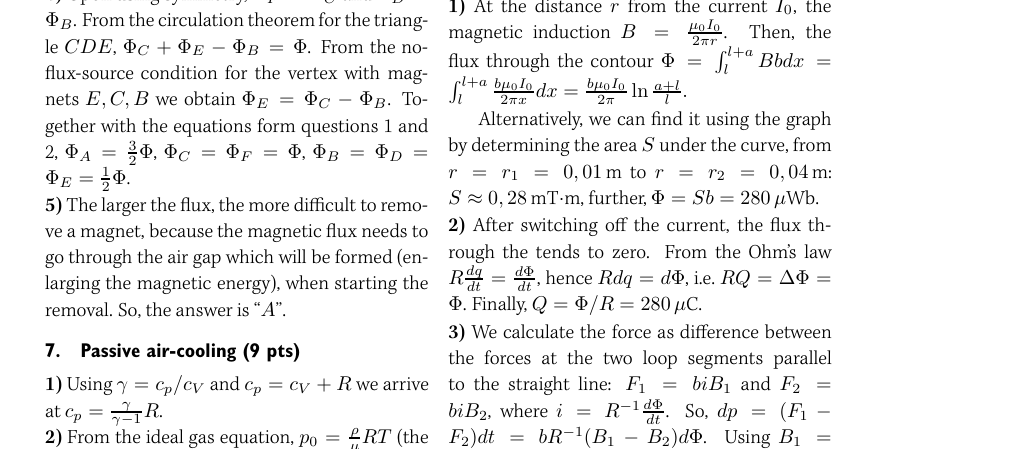 Rectangular loop near straight current wire
Topic: Magnetism, Electromagnetic Induction Metodi: Biot-Savart Law, Calculus-Integration Competenze: Mathematical Modeling, Physical Reasoning Objects: Wire Fonte: Testo (PDF) — p.2
**Luppo di filo (7 pts) **
Si consideri un ciclo rettangolare di filo con dimensioni m e m, il cui lato è parallelo ad un altro lungo filo retto con corrente A, a distanza m (vedi figura). L’induttanza magnetica di tale corrente è tracciata come funzione della distanza dal filo nel grafico allegato.
- Trova il flusso magnetico attraverso il ciclo (la formula pertinente per il campo magnetico di un filo lungo è fornita nel grafico).
Luglio rettangolare vicino al filo di corrente retta
Topic: Magnetism, Electromagnetic Induction Metodi: Biot-Savart Law, Calculus-Integration Competenze: Mathematical Modeling, Physical Reasoning Objects: Wire Fonte: Testo (PDF) — p.2