Problem 1 (10 points) This problem consists of three independent parts.
Problem 1A (3.0 points) Steam engine consists of a vertical cylindrical vessel, in which a piston can move without friction. There is some water in the vessel with an electrical heater located inside. Steam engine cycle consists of four stages, as shown in the figure on the right:
- A load is placed on the piston, the heater is switched on making the water boiling and the vapor lifts up the piston with the load.
- Once the piston has risen to some height, the load is quickly removed and the heater is immediately switched off.
- The vapor under the piston cools down and condenses, the piston moves down slowly .
- Once the piston has come down to some other height, the load is again put on the piston. Draw a ( ) V P, diagram schematically showing the cycle of the steam engine and find its efficiency. The atmospheric pressure is 5 0 1.0 10 P Pa = , the piston mass is 2.0 M kg = , the piston area is 2 10см S = , the load mass is 1.0 m kg = , and the free fall acceleration is 2 9.8 / g m s = . Assume that there is nothing under the piston except for the water vapor, and the dependence of the pressure of the saturated water vapor in the temperature range under consideration is approximated by the formula b at P = , where 4,85 / a kPa K = , 384 b kPa = , t is the temperature in degrees Celsius. Problem 1B (5.0 points) In the circuit shown in the figure on the right, all the electrical components are ideal and their parameters are assumed to be given. Before switching on the key, the capacitor has been discharged. Find an amount of heat releasing in the resistor R after the key has been switched on.
Problem 1C (2.0 points) Thin lens gives an image of the object, located perpendicular to its optical axis. The image size is 1 cm. If the distance from the object to the lens is increased by 5 cm, the image size remains 1 cm. Find the image size if the distance from the object to the lens is increased by another 5 cm.
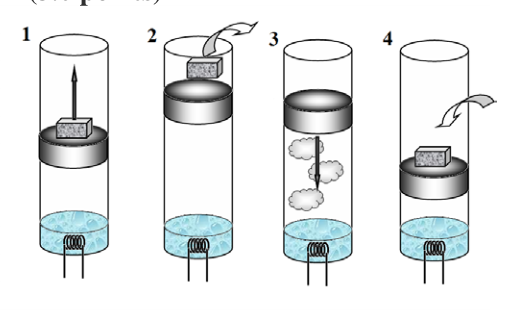 motore a vapore: 4 fasi del ciclo
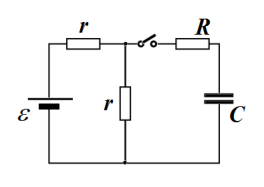 circuito con batteria, resistori e condensatore
Topic: Thermodynamics, Circuits, Geometric Optics Metodi: Thermodynamic Cycle Analysis, First Law of Thermodynamics, Kirchhoff’s Laws, Thin Lens & Mirror Equation Competenze: Diagrammatic Reasoning, Mathematical Modeling, Physical Reasoning Objects: Piston, Gas, Capacitor, Resistor, Lens Fonte: Testo (PDF) — p.2
Problema 1 (10 punti) Questo problema è costituito da tre parti indipendenti.
Problema 1A (3,0 punti) Motore a vapore costituito da un cilindro verticale contenitore in cui un pistone può muoversi senza
- Friccio. C’ è dell’ acqua nella nave . con un riscaldatore elettrico all’interno. Fumo ciclo del motore è composto da quattro fasi, come mostrato nella figura a destra:
- Un carico viene posto sul pistone, il riscaldatore è accesa, facendo bollire l’acqua e il vapore solleva il pistone con il carico.
- Una volta che il pistone è salito ad un’altezza, il carico viene rapidamente rimosso e il riscaldatore è immediatamente spento.
- Il vapore sotto il pistone si raffredda e si condensa, il pistone si muove lentamente.
- Una volta che il pistone è scesa ad un’altra altezza, il carico viene di nuovo messo sul pistone. Disegnare un ( ) V P, diagramma che mostra schematicamente il ciclo del motore a vapore e trova il suo
- l’efficienza. La pressione atmosferica è 5 0 1.0 10 P Pa = , la massa del pistone è 2.0 M kg = , la zona del pistone è 2 10см S = , la massa del carico è 1.0 m kg = , e l’ accelerata caduta libera è 2 9.8 / g m s = . Supponiamo che non c’è nulla sotto il pistone, tranne il vapore d’acqua, e la dipendenza del la pressione del vapore idrico saturo nella fascia di temperatura in esame è approssimati con la formula b at P = , dove 4,85 / a KPa K = , 384 b KPa = , t è il temperatura in gradi Celsius. Problema 1B (5,0 punti) Nel circuito illustrato nella figura a destra, tutte le i componenti sono ideali e si presuppone che siano dati i loro parametri. Prima di accendere la chiave, il condensatore è stato scaricato. Trova un quantità di calore rilasciato nella resistenza R dopo aver commesso il cambio della chiave on.
Problema 1C (2,0 punti) L’obiettivo sottile dà un’immagine dell’oggetto, posizionato perpendicolare al suo asse ottico. La dimensione dell’immagine è 1 cm. Se la distanza dall’oggetto alla lente è aumentata di 5 cm, la dimensione dell’immagine rimane 1 cm. Trova la dimensione dell’immagine se la distanza dall’oggetto alla lente è aumentata di altri 5 cm.
- motore a vapore: 4 fasi del ciclo *
Circuito con batterie, resistori e condensatore
Topic: Thermodynamics, Circuits, Geometric Optics Metodi: Thermodynamic Cycle Analysis, First Law of Thermodynamics, Kirchhoff’s Laws, Thin Lens & Mirror Equation Competenze: Diagrammatic Reasoning, Mathematical Modeling, Physical Reasoning Objects: Piston, Gas, Capacitor, Resistor, Lens Fonte: Testo (PDF) — p.2
Problem 2 Jet propulsion (10 points) In a rocket engine thrust is created by the release of products of fuel combustion in the direction opposite to its motion. It is, of course, natural that the mass of the rocket decreases in the acceleration process. This idea was first proposed by the great Russian scientist K. Tsiolkovsky to implement the motion of objects in a vacuum, for example, in outer space. Nowadays space flights have become habitual. It is widely known that the space launching site, Baikonur, is situated on the territory of Kazakhstan. The first satellite and the first cosmonaut, Yu. Gagarin, were sent into space from Baikonur which is now a X International Zhautykov Olympiad/Theoretical Competition Page 3/5 complex of high-tech facilities intended to launch manned spacecraft into space, in particular, to the International Space Station. Classical rocket Let a rocket have an initial mass 0 m and let a fuel velocity relative to the rocket be constant and equal u . Assume that at the initial time moment the rocket is at rest in the laboratory frame of reference and no external force is present.
- [0.5 points] Find the rocket velocity v as a function of its mass m . This formula is called after K. Tsiolkovsky. Express your answer in terms of 0 , , m m u .
- [0.5 points] An object of mass 1000 m = kg is required to be accelerated to the orbital velocity. Evaluate the initial rocket mass 0 m , if the free fall acceleration is 9.80 g = m/c2 and the radius of the Earth is 6400 R = km and 5,00 u = km/s. Let a rocket move in the gravitational field of the Earth. The free fall acceleration g is assumed to be constant, whereas the fuel consumption ( ) ( ) / t dm t dt = may depend on time.
- [0.75 points] Write down the equation of motion of a rocket in Earth’s gravitational field. This equation is called after I. Meshcherskij. Express your answer in terms of ,v, , , m u g . Assume in the following that the fuel exhaust velocity u is directed parallel to the free fall acceleration g , and the initial velocity of the rocket is zero.
- [0.75 points] Find how the fuel consumption ( ) st t should depend on time t in order for the rocket to hung motionless at some height. Express your answer in terms of 0, , , m u g t . Assume now that the fuel consumption is also constant over time such that ( ). st t
- [2.0 points] In this case the rocket velocity dependence on time t can be represented as 1 2 3 v( ) ln(1 ) t At A A t =
, where 1 2 3 , , A A A are some constants. Find 1 2 3 , , A A A and express them in terms of 0, , , m u g . 6. [1.0 points] Suppose that the initial mass of the rocket is equal 0 m , and the final mass is to be m . Find the maximum height max H that the rocket can reach and determine the corresponding optimum fuel consumption opt . Express your answer in terms of 0, , , m m u g . Relativistic rocket In the previous part of the problem it has been assumed that the rocket moves with a nonrelativistic velocity. To implement interstellar travels it is necessary to accelerate the rocket to the speed close to that of light and, then, relativity effects cannot be ignored at the calculations. To establish the characteristic features of the rocket motion in a relativistic case, we introduce the concept of the proper frame of reference. The proper frame of reference is an inertial frame of reference which moves with the speed of the rocket itself relative to the laboratory reference frame, i.e. it is the reference frame in which the rocket is at rest at any given time. 7. [2.5 points] Find the relation between the rocket acceleration in the proper reference frame p a and its acceleration in the laboratory frame of reference ra when the velocity of the rocket is v , and c stands for the speed of light. Express your answer in terms of , ,v, p r a a c . 8. [1.5 points] Let the rocket be at rest at the initial time moment. Then, using the results of the previous question it can be shown that at any time moment the rocket mass in the proper reference frame is related to its speed in the laboratory reference frame as 0 1 v / 1 v / c m m c
=
. Find and express it in terms of ,u c . X International Zhautykov Olympiad/Theoretical Competition Page 4/5 9. [0.25 points] An object of mass 1000 m = kg is required to be accelerated to half the speed of light v 0.5c
where the speed of light is 8 3.00 10 c = m/s. Evaluate the initial rocket mass together with the fuel 0 m and write it down as a power of 10, if the fuel exhaust velocity is 5,00 u = km/s. 10. [0.25 points] It can be shown that from the practical point of view the best rocket is the one that exploits photons rather than hot gases produced at the fuel combustion. An object of mass 1000 m = kg is required to be accelerated to half the speed of light v 0.5c
. Evaluate the initial rocket mass together with the fuel 0 m .
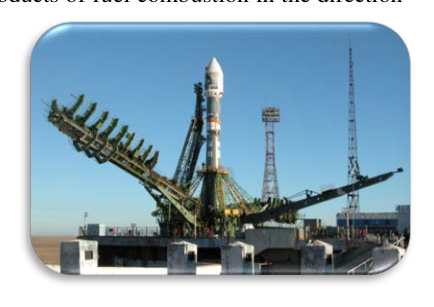 razzo Sojuz al cosmodromo Baikonur
Topic: Newtonian Mechanics, Special Relativity, Gravitation Metodi: Conservation of Momentum, Differential Equations, Lorentz Transformation, Relativistic Energy-Momentum, Calculus-Integration, Approximation & Series Expansion Competenze: Mathematical Modeling, Physical Reasoning, Estimation & Approximation Objects: Satellite, Photon, Planet Fonte: Testo (PDF) — p.2
Problema 2 Propulsione a getto (10 punti) In un motore di razzo la spinta è creata dal rilascio di prodotti di combustione del combustibile nella direzione
- Opposto al suo movimento. È naturale che la Commissione si impegni a la massa del razzo diminuisce nell’accelerazione processo. Questa idea fu proposta per la prima volta dal grande Lo scienziato russo K. Tsiolkovsky per attuare il movimento di oggetti in vuoto, ad esempio, in aria esterna lo spazio. Oggi i voli spaziali sono diventati un’abitudine. È noto che il sito di lancio spaziale, Baikonur, è situato sul territorio del Kazakistan. Il primo satellite e il primo cosmonauta, Yu. Gagarin, Sono stati inviati nello spazio da Baikonur che è ora un X Olimpiada internazionale di Zhautykov/concorso teorico Pagina 3/5 complesso di strutture ad alta tecnologia destinate al lancio nello spazio di navi spaziali dotate di equipaggiamento umano, in particolare per La Stazione Spaziale Internazionale.
- Il razzo classico Lascia che un razzo abbia una massa iniziale 0 m e lasciare che la velocità del combustibile rispetto al razzo sia costante e uguale a U . Supponiamo che nel momento iniziale il razzo sia a riposo nel il quadro di riferimento del laboratorio e non vi è alcuna forza esterna.
- Trova la velocità del razzo v come funzione della sua massa m . Questa formula si chiama dopo K. Tsiolkovsky. Esprimi la tua risposta in termini di 0 , , m m u .
- [0,5 punti] Un oggetto di massa 1000 m = è necessario accelerare il kg alla velocità orbitale. Valutare la massa iniziale del razzo 0 m , se l’ acceleramento della caduta libera è 9.80 g = m/c2 e il raggio di La Terra è 6400 R = km e 5,00 u = km/s. Lascia che un razzo si muova nel campo gravitazionale della Terra. L’accelerazione di caduta libera g è il consumo di combustibile è stato considerato costante, mentre il consumo di combustibile è stato considerato ( ) ( ) / t dm t dt =
- può dipendere dal tempo.
- Scrivi l’equazione del movimento di un razzo nel campo gravitazionale terrestre. Questo L’equazione viene chiamata dopo I. - Meshcherskij. Esprimi la tua risposta in termini di ,v, , , m u g . Supponiamo che la velocità di scarico del combustibile u sia diretta parallela alla velocità di scarico del combustibile Accelerazione di caduta g , e la velocità iniziale del razzo è zero.
- [0,75 punti] Trova come il consumo di carburante ( ) st t La durata di un’operazione deve essere un razzo per appendere immobile ad una certa altezza. Esprimi la tua risposta in termini di 0, , , m u g t . Supponiamo che il consumo di carburante sia costante nel tempo in modo tale che ( ). st t
- [2,0 punti] In questo caso la dipendenza della velocità del razzo dal tempo t può essere rappresentata come 1 2 3 v( ) ln(1 ) t At A A t =
, dove 1 2 3 , , Un A A sono alcune costanti. Trova 1 2 3 , , A A A e esprimere le loro 0, , , m u g . 6. Supponiamo che la massa iniziale del razzo sia uguale 0 m , e la massa finale è m . Trova l’altezza massima Max H che il razzo possa raggiungere e determinare il corrispondente consumo di carburante ottimale opt . Esprimi la tua risposta in termini di 0, , , m m u g . Raquete relativistiche Nella parte precedente del problema si è ipotizzato che il razzo si muova con un velocità non relativistica. Per realizzare viaggi interstellari è necessario accelerare il razzo La velocità della luce è molto più elevata rispetto alla velocità della luce e quindi gli effetti della relatività non possono essere ignorati al Calcoli. Per stabilire le caratteristiche del movimento del razzo in un caso relativistico, introdurre il concetto di corretto quadro di riferimento. Il corretto quadro di riferimento è un Inerzia di riferimento che si muove con la velocità del razzo stesso rispetto alla velocità del veicolo quadro di riferimento di laboratorio, ovvero è il quadro di riferimento in cui il razzo è a riposo in una data
- Il tempo.
- [2,5 punti] Trova la relazione tra l’accelerazione del razzo nel corretto quadro di riferimento p a e la sua accelerazione nel quadro di riferimento di laboratorio Ra quando la velocità del razzo è v , e c è la velocità della luce. Esprimi la tua risposta in termini di , ,v, p r a a c .
- Lascia che il razzo sia in riposo al momento iniziale. In seguito, utilizzando i risultati della La massa del razzo nel corretto il quadro di riferimento è correlato alla sua velocità nel quadro di riferimento di laboratorio come 0 1 v / 1 v / c m m c
=
. Trova e esprima in termini di ,u c . X Olimpiada internazionale di Zhautykov/concorso teorico Pagina 4/5 9. [0,25 punti] Un oggetto di massa 1000 m = il kg deve essere accelerato fino alla metà della velocità di luce v 0.5c
dove la velocità della luce è 8 3.00 10 c = m/s. Valutare la massa iniziale del razzo insieme al combustibile 0 m e scriverlo come potenza di 10, se la velocità di scarico del combustibile è 5,00 u = km/s. 10. [0,25 punti] Si può dimostrare che dal punto di vista pratico il miglior razzo è quello che che sfrutta i fotoni piuttosto che i gas caldi prodotti alla combustione del combustibile. Un oggetto di massa 1000 m = è necessario accelerare il kg fino alla metà della velocità della luce v 0.5c
. Valutare l’inizio massa del razzo insieme al combustibile 0 m .
razzo Sojuz al cosmodromo Baikonur
Topic: Newtonian Mechanics, Special Relativity, Gravitation Metodi: Conservation of Momentum, Differential Equations, Lorentz Transformation, Relativistic Energy-Momentum, Calculus-Integration, Approximation & Series Expansion Competenze: Mathematical Modeling, Physical Reasoning, Estimation & Approximation Objects: Satellite, Photon, Planet Fonte: Testo (PDF) — p.2
Problem 3 Metamaterials (10 points) Metamaterials are composite materials whose properties are due not so much to the properties of its constituent elements but due to artificially tailored periodic structures. Metamaterials are synthesized in modern nanolaboratories by implantation different periodic structures with a variety of geometric shapes into the original natural material, which substantially modifies its physical properties. In a very rough approximation, those implants can be treated as artificially made atoms of extremely large size immersed into the original material. While synthesizing the metamaterial Ddveloper has the opportunity of varying various free parameters (structure sizes and constant or varying period between them, etc.). In one nanolaboratory the metamaterial has been manufactured in the form of a wire of the length 5.00 L cm
and radius 1.00 R mm
, whose conductivity depends on the distance from its axis according to the law 0 r
. Physical properties of the wire have been experimentally measured and are presented in the following table:
- [1.0 points] Find an analytic formula for the total resistance 0 R of the wire, and calculate its numerical value. An electric current 1 I А = is made to pass through the wire. It is known that the heat exchange with the environment obeys the Newton-Richman law, 0 ( ) ext s P T T = , where ext P stands for the power loss per unit surface of the wire with the surface temperature sT , 0 293 T К = denotes the ambient temperature and is a constant, called the heat transfer coefficient.
- [1.0 points] Find an analytic formula for the surface temperature sT of the wire and calculate its numerical value. The wire temperature varies with the depth due to the phenomenon known as thermal conductivity, which is described by the Fourier law PHYSICAL PROPERTY NUMERICAL VALUE Conductivity 0 r =
9 2 1.00 1 / 0 S m =
Heat transfer coefficient 2 20 / ( ) W m K =
Thermal conductivity coefficient 0,01 / ( ) W m K =
Young’s modulus 7 1.00 10 E Pa
Linear expansion coefficient 6 1 1.00 10 K
X International Zhautykov Olympiad/Theoretical Competition Page 5/5 T P S x = , where P designates the power of the heat flow between the opposite faces of the parallelepiped with the square S , T is the temperature difference between the faces of the parallelepiped situated at a distance x from each other, and is called the heat transfer coefficient. 3. [2.5 points] Find an analytic formula for the temperature max T in the center of the wire, and calculate its numerical value. 4. [0.5 points] Find an analytic formula for the change T R of the wire radius due to its thermal expansion and calculate its numerical value. Attention! In all further calculations assume that the wire is infinitely long. 5. [0.5 points] Find an analytic formula for the magnetic induction inside the wire as a function of the distance r from its axis. 6. [1.0 points] Find an analytic formula for the energy of the magnetic field inside the wire, and calculate its numerical value. 7. [1.0 points] The electric current causes an appearance of mechanical stress in the wire. Find an analytic formula for the pressure ( ) p r inside the wire as a function of the distance r from its axis. 8. [1.0 points] Find an analytic formula for the mechanical stress energy of the wire, and calculate its numerical value. 9. [1.0 points] Find an analytic formula for the change of the wire radius due to its mechanical stress, and calculate its numerical value. 10. [0.5 points] Find the value of the thermal expansion coefficient such that the total change of the wire radius would be zero when an electric current was passing through it. Help! The value of the magnetic constant is 7 0 4 10 / Гн м
.
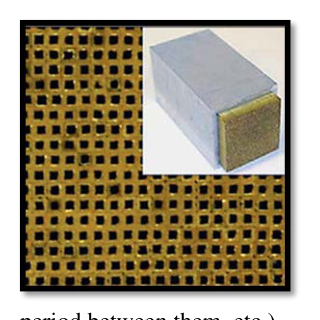 metamateriale: reticolo metallico e blocco
Topic: Electromagnetism, Thermodynamics, Elasticity & Materials Metodi: Ampère’s Law, Calculus-Integration, Differential Equations, Stress-Strain Analysis Competenze: Mathematical Modeling, Physical Reasoning, Experimental Data Analysis Objects: Wire Fonte: Testo (PDF) — p.4
Problema 3 Metamateriali (10 punti) Metamateriali sono materiali composti le cui proprietà sono dovute non tanto per le proprietà dei suoi elementi costituenti, ma dovute a strutture periodiche su misura artificiale. I metamateriali sono La produzione di prodotti di base di base di base di base di base di base di base di base di base di base di base di base di base di base di base di base di base di base di base di base di base di base di base di base di base di base di base di base di base di base di base di base di base di base di base di base di base di base di base di base di base di base di base di base di base di base di base di base di base di base di base di base di base di base di base di base di base di base di base di base di base di base di base di base di base di base di base di base di base di base di base di base di base di base di base di base di base di base di base di base di base di base di base di base di base di base di base di base di base di base di base di base di base di base di base di base di base di base di base di base di base di base di base di base di base di base di base di base di base di base di base di base di base di base di base di base di base di base di base di base di base di base di base di base di base di base di base di base di base di base di base di base di base di base di base di base di base di base di base di base di base di base di base di base di base di base di base di base di base di base di base di base di base di base di base di base di base di base di base di base di base di base di base di base di base di base di base di base di base di base di base di base di base di base di base di base di base di base di base di base di base di base di base di base di base di base di base di base di base di base di base di base di base di base di base di base di base di base di base di base di base di base di base di base di base di base di base di base di base di base di base di base di base di base di base di base di base di base di base di base di base di base di base di base di base di base di base di base di base di base di base di base di base di base di base di base di base di base di base di base di base di base di base di base di base di base di base di base di base di base di base di base di base di La struttura di un’area di La produzione di materiali naturali originali, che modificano sostanzialmente la loro proprietà fisiche. In una approssimazione molto approssimativa, Gli impianti possono essere trattati come atomi artificiali di grandezza immersa nel materiale originale. Mentre sintetizziamo il metamateriale Dd sviluppatore ha la possibilità di variare vari parametri liberi (dimensioni di struttura e costanti o variabili) periodo tra di loro, ecc.). In un laboratorio nano il metamateriale è stato prodotto sotto forma di filo di la lunghezza 5.00 L cm
e raggio 1.00 R mm
, la cui conducibilità dipende dalla distanza dal suo asse secondo la legge 0 r
. Le proprietà fisiche del filo sono state sono state misurate sperimentalmente e sono presentate nella tabella seguente:
- [1,0 punti] Trova una formula analitica per la resistenza totale 0 R del filo, e calcolare il suo valore numerico. Un corrente elettrica 1 I А = è fatto passare attraverso il filo. È noto che il calore il commercio con l’ambiente obbedisce alla legge di Newton-Richman, 0 ( ) Ext s P T T = , dove Ext P è la perdita di potenza per unità di superficie del filo con la temperatura superficiale sT , 0 293 T К = indica la temperatura ambiente e è una costante, chiamata trasferimento di calore il coefficiente.
- [1,0 punti] Trovare una formula analitica per la temperatura superficiale ST del filo e calcolo il suo valore numerico. La temperatura del filo varia con la profondità a causa del fenomeno noto come termico la conducibilità, che è descritta dalla legge di Fourier PREPARITA’ FISIICA VALORE NUMERICO Conduttività 0 r =
9 2 1.00 1 / 0 S m =
Coefficiente di trasferimento di calore 2 20 / ( ) W m K =
Coefficiente di conduttività termica 0,01 / ( ) W m K =
Modulo di Young 7 1.00 10 E Pa
Coefficiente di espansione lineare 6 1 1.00 10 K
X Olimpiada internazionale di Zhautykov/concorso teorico Pagina 5/5 T P S x = , dove P indica la potenza del flusso di calore tra le facce opposte del parallelepiped con il quadrato S , T è la differenza di temperatura tra le facce del parallelepiped situato a una distanza x tra loro e è chiamato coefficiente di trasferimento di calore. 3. [2,5 punti] Trova una formula analitica per la temperatura Max T al centro del filo, e calcolare il suo valore numerico. 4. [0,5 punti] Trova una formula analitica per il cambiamento T R di radius del filo a causa della sua temperatura l’espansione e calcolare il suo valore numerico. Attenzione! In tutti i calcoli successivi si assume che il filo sia infinitamente lungo. 5. [0,5 punti] Trovare una formula analitica per l’induzione magnetica all’interno del filo come funzione della distanza r dal suo asse. 6. [1,0 punti] Trovare una formula analitica per l’energia del campo magnetico all’interno del filo, e calcolare il suo valore numerico. 7. La corrente elettrica provoca l’apparenza di tensioni meccaniche nel filo. Trova formula analitica per la pressione ( ) p r all’interno del filo in funzione della distanza r da esso
- L’asse.
- [1,0 punti] Trovare una formula analitica per l’energia di tensione meccanica del filo, e calcolare il suo valore numerico.
- [1,0 punti] Trova una formula analitica per il cambiamento di radius del filo a causa della sua la tensione meccanica e calcolare il suo valore numerico.
- [0,5 punti] Trova il valore del coefficiente di espansione termica in modo tale che la variazione totale di radio del filo sarebbe zero quando una corrente elettrica passava attraverso di esso.
- Aiutami! Il valore della costante magnetica è 7 0 4 10 / Гн м = .
metamateriale: reticolo metallico e blocco
Topic: Electromagnetism, Thermodynamics, Elasticity & Materials Metodi: Ampère’s Law, Calculus-Integration, Differential Equations, Stress-Strain Analysis Competenze: Mathematical Modeling, Physical Reasoning, Experimental Data Analysis Objects: Wire Fonte: Testo (PDF) — p.4