- There exists an air bubble with a volume at normal pressure in a closed, long, cylindrical container filled with water at room temperature. The container is rotated slowly about its central axis of symmetry at a steady state, carefully accelerating it in a state of weightlessness until it reaches an angular velocity of where it is kept rotating at the same constant speed. What shape does the air bubble now take? Give the typical dimensions of the bubble. The surface tension of water is .
Topic: Fluid Mechanics, Rotational Dynamics Metodi: Hydrostatic Equilibrium, Free-Body Diagram, Physical Modeling Competenze: Diagrammatic Reasoning, Mathematical Modeling, Physical Reasoning Objects: Bubble, Container Fonte: Testo (PDF) — p.1
- Esiste una bolla d’aria con un volume a pressione normale in un contenitore chiuso, lungo e cilindrico riempito con acqua a temperatura ambiente. Il contenitore si ruota lentamente intorno al suo asse centrale di simmetria a un stato, accelerandolo con attenzione in uno stato di assenza di peso fino a raggiungere una velocità angolare di , dove si mantiene a rotazione alla stessa velocità costante. Che forma assume ora la bolla d’aria? Indicare le dimensioni tipiche della bolla. La tensione superficiale dell’acqua è .
Topic: Fluid Mechanics, Rotational Dynamics Metodi: Hydrostatic Equilibrium, Free-Body Diagram, Physical Modeling Competenze: Diagrammatic Reasoning, Mathematical Modeling, Physical Reasoning Objects: Bubble, Container Fonte: Testo (PDF) — p.1
- A tank contains a mixture of 1 mole of monoatomic gas and 2 moles of diatomic gas. The wall of the tank allows monoatomic gas particles to enter, but not diatomic gas particles. Initially, the tank is in equilibrium with the environment. The gas mixture in the tank is slowly heated by a radiator to .
- A. What is the change in internal energy of the gas in the tank?
- B. How much heat does the radiator give to the gas? (Neglect the heat required to heat the tank and the heat conduction of the tank!)
Topic: Thermodynamics, Kinetic Theory Metodi: First Law of Thermodynamics, Ideal Gas Law, Kinetic Theory of Gases Competenze: Physical Reasoning, Mathematical Modeling Objects: Container, Gas Fonte: Testo (PDF) — p.1
- Un serbatoio contiene una miscela di 1 mol di gas monoatomo e 2 mol di gas diatomo. Il muro del serbatoio permette particelle di gas monoatomiche da introdurre, ma non particelle di gas diatomiche. Inizialmente, il serbatoio è in equilibrio con il ambiente. La miscela di gas nel serbatoio viene lentamente riscaldata da un radiatore fino a .
- A. Qual è la variazione dell’energia interna del gas nel serbatoio?
- B. Quanto calore dà il radiatore al gas? (Non si deve considerare il calore necessario per riscaldare il serbatoio e il calore la conduzione del serbatoio!)
Topic: Thermodynamics, Kinetic Theory Metodi: First Law of Thermodynamics, Ideal Gas Law, Kinetic Theory of Gases Competenze: Physical Reasoning, Mathematical Modeling Objects: Container, Gas Fonte: Testo (PDF) — p.1
- A long solenoid with a fixed, horizontal axis, has a cross-section of a circle with radius . Inside the coil there is a solid cylinder of radius made of (non-magnetic) insulating material. The insulating cylinder is positively charged in an even volume distribution. A steady, rapidly increasing current is applied to the solenoid over time according to the circumference shown in the figure. In what direction does the cylinder start? How does its response depend on the ratio? At what ratio is the cylinder at rest? The adhesive friction is large enough to prevent the cylinder from slipping. Disregard the resistance due to rolling!
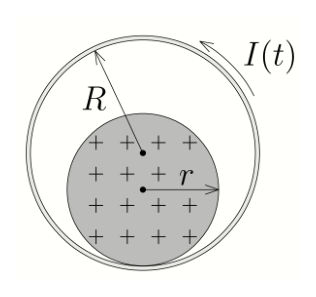 Sezione solenoide con cilindro carico
Topic: Electromagnetic Induction, Rotational Dynamics, Electromagnetism Metodi: Faraday’s Law of Induction, Torque & Angular Momentum Analysis, Lorentz Force Analysis Competenze: Diagrammatic Reasoning, Mathematical Modeling, Physical Reasoning Objects: Solenoid, Cylinder Fonte: Testo (PDF) — p.1
- Un solenoide lungo con un asse fisso e orizzontale ha una sezione trasversale di un cerchio con raggio . All’interno della bobina c’è un cilindro solido di raggio in materiale isolante (non magnetico). Il cilindro isolante è carico positivo in una distribuzione di volume uniforme. Un’attuale corrente costante e in rapida crescita viene applicata al solenoide nel tempo secondo per la circonferenza mostrata nella figura. In che direzione inizia il cilindro? Come dipende la sua risposta dal rapporto ? Al quale rapporto Il cilindro è a riposo? La friczione dell’adesivo è sufficientemente grande da impedire che il cilindro scivoli. Non si deve considerare resistenza a causa del rotolamento!
Sezione solenoide con cilindro carico
Topic: Electromagnetic Induction, Rotational Dynamics, Electromagnetism Metodi: Faraday’s Law of Induction, Torque & Angular Momentum Analysis, Lorentz Force Analysis Competenze: Diagrammatic Reasoning, Mathematical Modeling, Physical Reasoning Objects: Solenoid, Cylinder Fonte: Testo (PDF) — p.1