Domanda 1
Il nostro universo attualmente è
- A. in un’espansione accelerata.
- B. in un’espansione a velocità costante.
- C. statico.
- D. in una contrazione a velocità costante.
- E. in una contrazione accelerata.
Topic: Astrophysics Metodi: Physical Modeling Competenze: Physical Reasoning Objects: — Fonte: Testo (PDF) — p.4
Question 1
Our current universe is
- A. undergoing accelerated expansion.
- B. undergoing expansion at constant speed.
- C. static.
- D. undergoing contraction at constant speed.
- E. undergoing accelerated contraction.
Domanda 2
Un uccello è posato su una barca su un lago. Ad un certo istante l’uccello prende il volo. Il livello del lago:
- A. si alza.
- B. resta costante.
- C. si abbassa.
- D. Non abbiamo abbastanza informazioni per rispondere.
Topic: Fluid Mechanics Metodi: Hydrostatic Equilibrium, Physical Modeling Competenze: Physical Reasoning Objects: — Fonte: Testo (PDF) — p.4
Question 2
A bird is sitting on a boat on a lake. At a certain instant, the bird takes flight. The water level of the lake:
- A. rises.
- B. remains constant.
- C. falls.
- D. We do not have enough information to answer.
Domanda 3
Supponendo che si possa piegare un foglio di carta per più di 7 o 8 volte. Quante volte bisognerà piegare questo foglio affinché lo spessore sia uguale alla distanza tra la terra e la luna (384 400 km)?
- A. 42
- B. 168
- C. 253
- D. 283
Topic: Order-of-Magnitude Estimation Metodi: Order-of-Magnitude Estimation, Dimensional Analysis Competenze: Estimation & Approximation Objects: — Fonte: Testo (PDF) — p.4
Question 3
Assuming that a sheet of paper could be folded more than 7 or 8 times, how many times would you need to fold this sheet so that its thickness equals the distance between Earth and the Moon (384,400 km)?
- A. 42
- B. 168
- C. 253
- D. 283
Domanda 4
Un piccolo villaggio situato dietro una collina desidera ascoltare la radio. Nella regione c’è una radio AM che trasmette a 980 kHz e una radio FM che trasmette a 89 MHz. Tuttavia, le due emittenti sono nascoste dalla collina. È possibile ascoltare:
- A. la radio AM.
- B. la radio FM.
- C. tutte e due.
- D. nessuna.
Topic: Oscillations & Waves Metodi: Wave Equation, Physical Modeling Competenze: Physical Reasoning Objects: — Fonte: Testo (PDF) — p.4
Question 4
A small village located behind a hill wants to listen to the radio. In the region, there is an AM radio station transmitting at 980 kHz and an FM radio station transmitting at 89 MHz. However, the two transmitters are hidden by the hill. Is it possible to receive:
- A. the AM radio.
- B. the FM radio.
- C. both.
- D. neither.
Domanda 5
Un casco di banane di massa è appeso a 20 m da una carrucola (vedi figura sottostante). Dall’altro lato una scimmia di massa è appesa a 25 m dalla carrucola. Sapendo che la scimmia ha abbastanza energia per sollevare il suo peso per 20 m lungo la propria corda, riuscirà a raggiungere le banane per mangiarle? (trascurate la massa della carrucola e il suo attrito)
- A. No, non appena la scimmia prova a tirarsi su, le banane salgono fino alla carrucola, ma la scimmia rimane ferma sul posto.
- B. Sì, la scimmia riesce a tirarsi su e le banane restano ferme sul posto.
- C. No, la scimmia riesce a tirarsi su, ma anche le banane salgono, senza che la scimmia le possa acchiappare.
- D. Sì, nonostante le banane salgano quando la scimmia si tira su, la scimmia riesce ad acchiappare le banane.
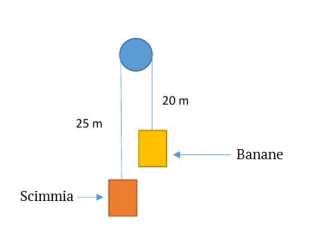 Scimmia e banane appese a carrucola
Topic: Newtonian Mechanics Metodi: Free-Body Diagram, Conservation of Energy Competenze: Physical Reasoning, Diagrammatic Reasoning Objects: Pulley, String Fonte: Testo (PDF) — p.5
Question 5
A bunch of bananas of mass is hung 20 m from a pulley (see figure below). On the other side, a monkey of mass is hanging 25 m from the pulley. Knowing that the monkey has enough energy to lift its own weight by 20 m along its rope, will it be able to reach the bananas and eat them? (Neglect the mass of the pulley and its friction)
- A. No, as soon as the monkey tries to pull itself up, the bananas rise all the way to the pulley, but the monkey remains stationary.
- B. Yes, the monkey manages to pull itself up and the bananas remain fixed in place.
- C. No, the monkey manages to pull itself up, but the bananas also rise, so the monkey cannot catch them.
- D. Yes, even though the bananas rise when the monkey pulls itself up, the monkey still manages to catch them.
Monkey and bananas hanging from a pulley
Domanda 6
Quali assi di rotazione del parallelepipedo rappresentato nella figura sottostante sono stabili?
- A. nessuno
- B. gli assi Y e Z
- C. gli assi X, Y, Z
- D. gli assi X e Z
- E. gli assi X e Y
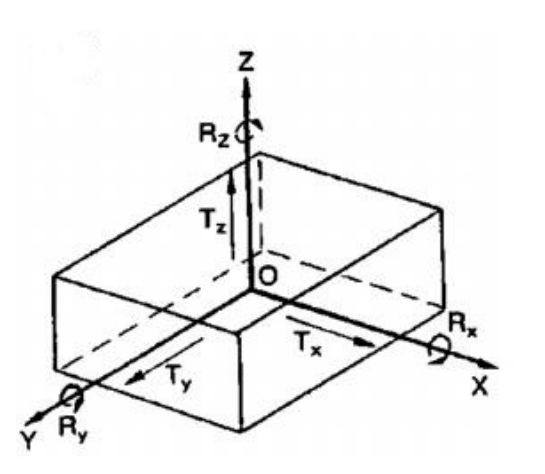 Parallelepipedo con assi X, Y, Z
Topic: Rotational Dynamics, Rigid Body Statics Metodi: Torque & Angular Momentum Analysis, Physical Modeling Competenze: Physical Reasoning, Diagrammatic Reasoning Objects: — Fonte: Testo (PDF) — p.5
Question 6
Which rotation axes of the rectangular prism shown in the figure below are stable?
- A. none
- B. axes Y and Z
- C. axes X, Y, and Z
- D. axes X and Z
- E. axes X and Y
Rectangular prism with axes X, Y, Z
Domanda 7
Una persona si guarda allo specchio. Osserva che la sommità della sua testa coincide esattamente con quella dello specchio. Allo stesso modo, i suoi piedi coincidono esattamente con il fondo dello specchio. Se questa persona si avvicina per guardarsi meglio, cosa succede?
- A. Coprirà lo specchio intero, con la testa e i piedi alle estremità.
- B. Coprirà lo specchio intero ma non vedrà più né la testa né i piedi.
- C. Non coprirà tutto lo specchio, potrà vedere il cielo sopra la sua testa, e il pavimento sotto i suoi piedi.
- D. Vedrà i piedi in fondo allo specchio, ma non tutta la testa.
Topic: Geometric Optics Metodi: Ray Tracing, Physical Modeling Competenze: Physical Reasoning, Diagrammatic Reasoning Objects: Mirror Fonte: Testo (PDF) — p.6
Question 7
A person looks into a mirror and observes that the top of their head exactly coincides with the top edge of the mirror, while their feet exactly coincide with the bottom edge of the mirror. If this person moves closer to see themselves better, what happens?
- A. They will cover the entire mirror, with their head and feet at the extremes.
- B. They will cover the entire mirror but no longer see either their head or their feet.
- C. They will not cover the entire mirror; they will be able to see the sky above their head and the floor below their feet.
- D. They will see their feet at the bottom of the mirror, but not their entire head.
Domanda 8
Sei in giro in auto per una corsa. Vuoi fare due giri del percorso. Il primo giro lo percorri con una velocità media di . Quanto devi andare veloce nel secondo giro per avere una velocità media totale di ?
- A.
- B.
- C.
- D.
- E.
Topic: Newtonian Mechanics Metodi: Kinematic Equations Competenze: Mathematical Modeling, Physical Reasoning Objects: — Fonte: Testo (PDF) — p.6
Question 8
You are driving around for a race. You want to complete two laps of the track. You drive the first lap with an average speed of . How fast must you go in the second lap to achieve a total average speed of ?
- A.
- B.
- C.
- D.
- E.
Domanda 9
Aiuti tua mamma a sgomberare il solaio. Ti dà il compito di arrotolare un tappeto attorno ad un tubo cilindrico. Sono dati il raggio del tubo e la sua lunghezza . Il tuo tappeto ha uno spessore di , è lungo e largo . Che diametro approssimativo avrà il tubo una volta che tutto il tappeto sarà stato arrotolato?
- A. 12.4 cm
- B. 18.6 cm
- C. 24.8 cm
- D. 37.2 cm
Topic: Order-of-Magnitude Estimation Metodi: Approximation & Series Expansion, Dimensional Analysis Competenze: Estimation & Approximation, Mathematical Modeling Objects: Cylinder Fonte: Testo (PDF) — p.6
Question 9
You help your mother clear the attic. You are tasked with rolling a carpet around a cylindrical tube. The radius of the tube is given as and its length as . Your carpet has a thickness of , is long and wide . What approximate diameter will the tube have once the entire carpet has been rolled around it?
- A. 12.4 cm
- B. 18.6 cm
- C. 24.8 cm
- D. 37.2 cm
Domanda 10
Una ditta ti chiede di valutare il numero massimo di persone che possono stare nel suo ascensore. Sai che la fune dell’ascensore può reggere una forza massima di prima di rompersi. Inoltre, l’ascensore deve raggiungere la sua velocità finale di ascesa in 3 s. Supponendo che la massa media di una persona sia , quante persone può ospitare l’ascensore?
- A. 17
- B. 18
- C. 19
- D. 20
- E. 24
Topic: Newtonian Mechanics Metodi: Free-Body Diagram, Kinematic Equations Competenze: Physical Reasoning, Estimation & Approximation Objects: String Fonte: Testo (PDF) — p.6
Question 10
A company asks you to evaluate the maximum number of people who can fit in its elevator. You know that the elevator cable can withstand a maximum force of before breaking. Moreover, the elevator must reach its final ascent speed of in 3 s. Assuming the average mass of a person is , how many people can the elevator accommodate?
- A. 17
- B. 18
- C. 19
- D. 20
- E. 24
Domanda 11
Il 21 marzo ci troviamo all’equatore. In questo giorno di equinozio il sole sorge alle 6 h, è allo zenit alle 12 h e tramonta alle 18 h. Piantiamo un bastone verticale. Alle 14 h osserviamo che l’ombra del bastone misura . Quanto sarà lunga l’ombra alle 16 h?
- A.
- B.
- C.
- D.
Topic: Geometric Optics, Astrophysics Metodi: Kinematic Equations, Physical Modeling Competenze: Mathematical Modeling, Physical Reasoning Objects: Rod, Star Fonte: Testo (PDF) — p.6
Question 11
On March 21st we are at the equator. On this equinox day, the Sun rises at 6 a.m., is at zenith at noon, and sets at 6 p.m. We plant a vertical stick. At 2 p.m., we observe that the shadow of the stick measures . What will be the length of the shadow at 4 p.m.?
- A.
- B.
- C.
- D.
Domanda 12
Due lampadine da 75 W (a 220 V) sono connesse in serie. Il tutto è connesso ad un’alimentazione a 220 V. Quanta potenza è dissipata da ogni lampadina?
- A. 75 W
- B. 60.125 W
- C. 18.75 W
- D. 37.5 W
- E. dipende dalla loro resistenza
Topic: Circuits Metodi: Kirchhoff’s Laws, Equivalent Circuit Reduction Competenze: Physical Reasoning, Mathematical Modeling Objects: — Fonte: Testo (PDF) — p.7
Question 12
Two lamps rated at 75 W (at 220 V) are connected in series. The entire circuit is connected to a power supply of 220 V. How much power is dissipated by each lamp?
- A. 75 W
- B. 60.125 W
- C. 18.75 W
- D. 37.5 W
- E. depends on their resistance
Domanda 13
Sei a e ascolti un suono generato con frequenza . Il grafico sottostante mostra la frequenza che ascolti in funzione del tempo per un intervallo di 4 s. Quale delle seguenti situazioni descrive la sorgente?
- A. La sorgente si muove da destra a sinistra e a s si trova il più vicino a te.
- B. La sorgente si muove da sinistra a destra e a s si trova il più vicino a te.
- C. La sorgente si muove verso di te senza raggiungerti; a partire da s si allontana lungo la stessa direzione.
- D. La sorgente si allontana da te; a partire da s si avvicina lungo la stessa direzione.
Frequenza percepita vs tempo (effetto Doppler)
Topic: Oscillations & Waves Metodi: Wave Equation, Physical Modeling Competenze: Physical Reasoning, Diagrammatic Reasoning Objects: — Fonte: Testo (PDF) — p.7
Question 13
You are at and hear a sound generated with frequency . The graph below shows the frequency you perceive as a function of time over a 4-second interval. Which of the following situations describes the source?
- A. The source is moving from right to left and at s it is closest to you.
- B. The source is moving from left to right and at s it is closest to you.
- C. The source is moving toward you without reaching you; starting from s it moves away along the same direction.
- D. The source is moving away from you; starting from s it moves toward you along the same direction.
Perceived frequency vs time (Doppler effect)
Domanda 14
Stimando la superficie delle vostre spalle a , quanti kg di aria trasportate su di voi ogni giorno?
- A. 10
- B. 50
- C. 100
- D. 500
Topic: Fluid Mechanics, Order-of-Magnitude Estimation Metodi: Order-of-Magnitude Estimation, Hydrostatic Equilibrium Competenze: Estimation & Approximation, Physical Reasoning Objects: Gas Fonte: Testo (PDF) — p.7
Question 14
Estimating the surface area of your shoulders to be , how many kilograms of air do you carry around on yourself each day?
- A. 10
- B. 50
- C. 100
- D. 500
Domanda 15
Abbiamo un bicchiere d’acqua di 3 dl a che desideriamo raffreddare. Aggiungiamo di ghiaccio a . Cosa otteniamo dopo un po’ di tempo? Supponi che il sistema composto da ghiaccio e acqua non scambi né calore né energia con il bicchiere e l’ambiente circostante.
Costanti:
-
Densità del ghiaccio:
-
Densità dell’acqua:
-
Calore specifico dell’acqua:
-
Calore specifico del ghiaccio:
-
Calore latente di fusione del ghiaccio:
-
A. 230 g d’acqua / 111 g di ghiaccio / entrambi a
-
B. 337 g d’acqua / 5 g di ghiaccio / entrambi a
-
C. 341 g d’acqua / 0 g di ghiaccio /
-
D. 322 g d’acqua / 19 g di ghiaccio / entrambi a
Topic: Thermodynamics Metodi: First Law of Thermodynamics, Conservation of Energy Competenze: Mathematical Modeling, Physical Reasoning Objects: — Fonte: Testo (PDF) — p.8
Question 15
We have a glass of water with volume 3 dl at , which we wish to cool down. We add of ice at . What do we obtain after some time? Assume that the system composed of ice and water does not exchange heat or energy with the glass or surrounding environment.
Constants:
-
Density of ice:
-
Density of water:
-
Specific heat capacity of water:
-
Specific heat capacity of ice:
-
Latent heat of fusion of ice:
-
A. 230 g of water / 111 g of ice / both at
-
B. 337 g of water / 5 g of ice / both at
-
C. 341 g of water / 0 g of ice / at
-
D. 322 g of water / 19 g of ice / both at
Domanda 16
L’aereo Solar Impulse SI2 è un veicolo elettrico dotato di 17 248 celle fotovoltaiche. Le sue batterie, aventi una densità energetica di , rappresentano il 28% della massa totale dell’aereo che è 2300 kg. L’aereo vola ad una velocità di e altitudine 8500 m al di sopra del livello del mare al tramonto. Approssimativamente di quanta energia dispone l’aereo per potersi mantenere in aria fino al sorgere del sole?
- A.
- B.
- C.
- D.
Topic: Order-of-Magnitude Estimation Metodi: Dimensional Analysis, Order-of-Magnitude Estimation Competenze: Estimation & Approximation, Unit Conversion Objects: — Fonte: Testo (PDF) — p.8
Question 16
The Solar Impulse SI2 aircraft is an electric vehicle equipped with 17,248 photovoltaic cells. Its batteries have an energy density of and account for 28% of the aircraft’s total mass, which is 2300 kg. The aircraft flies at a speed of and an altitude of 8500 m above sea level at sunset. Approximately how much energy does the aircraft have available to remain airborne until sunrise?
- A.
- B.
- C.
- D.
Domanda 17
Quale di queste dimensioni fisiche non corrisponde ad un’unità di energia?
- A.
- B.
- C.
- D.
- E. Nessuna delle risposte.
Topic: Order-of-Magnitude Estimation Metodi: Dimensional Analysis Competenze: Unit Conversion, Physical Reasoning Objects: — Fonte: Testo (PDF) — p.8
Question 17
Which of these physical dimensions does not correspond to a unit of energy?
- A.
- B.
- C.
- D.
- E. None of the answers.
Domanda 18
Un satellite geostazionario ha:
- A. un’orbita ellittica.
- B. un periodo di rivoluzione siderale di esattamente 24 h.
- C. una velocità nulla.
- D. un’accelerazione nulla.
- E. Nessuna delle risposte.
Topic: Gravitation, Astrophysics Metodi: Kepler’s Laws, Newton’s Law of Gravitation Competenze: Physical Reasoning Objects: Satellite Fonte: Testo (PDF) — p.8
Question 18
A geostationary satellite has:
- A. an elliptical orbit.
- B. a sidereal revolution period of exactly 24 h.
- C. zero velocity.
- D. zero acceleration.
- E. None of the answers.
Domanda 19
Il circuito seguente è connesso da diverso tempo. Qual è la tensione della resistenza incorniciata di rosso?
- A. 2.5 V
- B. 5 V
- C. 7.5 V
- D. 10 V
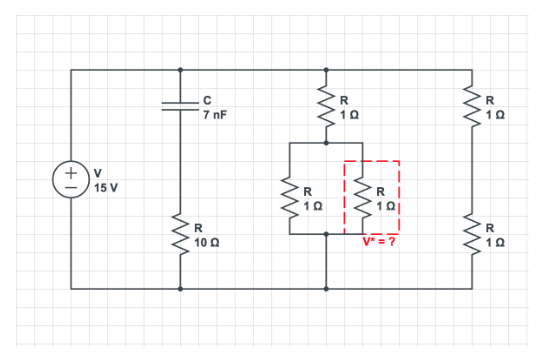 Circuito con resistenze e condensatore
Topic: Circuits Metodi: Kirchhoff’s Laws, Equivalent Circuit Reduction Competenze: Diagrammatic Reasoning, Physical Reasoning Objects: Resistor, Capacitor Fonte: Testo (PDF) — p.9
Question 19
The following circuit has been connected for a long time. What is the voltage across the red-framed resistor?
- A. 2.5 V
- B. 5 V
- C. 7.5 V
- D. 10 V
Circuit with resistors and capacitor
Domanda 20
Quale delle seguenti affermazioni è corretta?
- A. Il campo elettrico è un campo scalare.
- B. La quantità di moto di un elettrone sottoposto ad un campo magnetico uniforme viene alterata dalla forza di Lorentz.
- C. In presenza di un campo magnetico e in assenza di uno elettrico, la traiettoria di un elettrone in movimento sarà sempre un cerchio o una spirale.
- D. La forza di Lorentz è sempre conservativa.
- E. Nessuna delle risposte.
Topic: Electromagnetism, Magnetism Metodi: Lorentz Force Analysis Competenze: Physical Reasoning Objects: Electron Fonte: Testo (PDF) — p.9
Question 20
Which of the following statements is correct?
- A. The electric field is a scalar field.
- B. The momentum of an electron subjected to a uniform magnetic field is altered by the Lorentz force.
- C. In the presence of a magnetic field and in the absence of an electric field, the trajectory of a moving electron will always be a circle or a spiral.
- D. The Lorentz force is always conservative.
- E. None of the answers.
Domanda 21
Per Natale hai ricevuto un numero infinito di ceppi di legno a sezione rettangolare con lunghezza , larghezza e altezza . Vorresti costruire un ponte su un lago mettendo questi ceppi uno sopra l’altro. Non hai a disposizione altri componenti, e disponi i ceppi uno sopra l’altro in modo che il momento angolare risultante è nullo. A che distanza dalla sponda puoi arrivare? (vedi anche la figura sottostante)
- A.
- B.
- C.
- D.
Ceppi impilati a sbalzo verso il lago
Topic: Rigid Body Statics, Newtonian Mechanics Metodi: Torque & Angular Momentum Analysis, Superposition Principle Competenze: Physical Reasoning, Mathematical Modeling Objects: Block Fonte: Testo (PDF) — p.10
Question 21
For Christmas, you received an infinite number of wooden logs with rectangular cross-section, length , width , and height . You want to build a bridge across a lake by stacking these logs one on top of another. You have no other components available, and you arrange the logs stacked vertically so that the resultant angular momentum is zero. How far from the shore can you reach? (See also the figure below.)
- A.
- B.
- C.
- D.
Logs stacked overhanging toward the lake
Domanda 22
Qual è la distanza media tra due molecole di un gas a temperatura e pressione ?
- A.
- B.
- C.
- D.
- E.
Topic: Kinetic Theory, Thermodynamics Metodi: Ideal Gas Law, Order-of-Magnitude Estimation Competenze: Estimation & Approximation, Mathematical Modeling Objects: Gas Fonte: Testo (PDF) — p.10
Question 22
What is the average distance between two molecules of a gas at temperature and pressure ?
- A.
- B.
- C.
- D.
- E.
Esercizio 1: Viaggio al centro della Terra (16 punti)
Per il viaggio al centro della Terra viene scavato un tunnel, che dalla superficie scorre attraverso il centro e quindi prosegue verso la superficie dal lato opposto del pianeta. La Terra sia considerata come una sfera perfetta con raggio e una densità omogenea. Effetti come attrito, forza di Corioli o forza centrifuga possono venire trascurati.
Costanti:
Parte A. Potenziale gravitazionale all’interno della Terra (8 punti)
i. (2 pt) Esprimi la massa di una sfera di dimensioni inferiori e della stessa composizione terrestre con raggio tramite il raggio della Terra , la massa della Terra e .
ii. (2 pt) Calcola la forza gravitazionale che verrebbe esercitata su un oggetto che si trovi a distanza . Esprimi tramite , , la massa dell’oggetto e .
Suggerimento: usa la Legge di Gravità di Newton:
iii. (1 pt) Calcola, partendo dalla forza di gravità all’interno della Terra, il potenziale gravitazionale sempre all’interno della sfera terrestre.
Suggerimento: Per il potenziale della forza di gravità all’interno della Terra vale:
iv. (3 pt) Calcola la velocità al centro della Terra (sia in formula che in numeri), nel caso in cui un uomo dovesse cadere nel tunnel con velocità iniziale nulla.
Parte B. Traiettoria della caduta (8 punti)
i. (2 pt) Esponi l’equazione differenziale per la traiettoria .
ii. (3 pt) Risolvi l’equazione differenziale per considerando la condizione iniziale in cui l’oggetto all’inizio si trova all’estremità del tunnel, sulla superficie terrestre, e inizia la caduta con velocità iniziale nulla.
Suggerimento: la soluzione generale per l’equazione differenziale con è:
iii. (3 pt) Calcola nuovamente la velocità al centro della Terra. Sfrutta questa volta la tua soluzione della traiettoria . Compara questo risultato con il corrispondente della domanda precedente.
Topic: Gravitation, Newtonian Mechanics, Oscillations & Waves Metodi: Newton’s Law of Gravitation, Differential Equations, Conservation of Energy Competenze: Mathematical Modeling, Physical Reasoning Objects: Planet Fonte: Testo (PDF) — p.11
Problem 1: Journey to the Center of the Earth (16 points)
A tunnel is drilled through the Earth, starting from the surface, passing through the center, and continuing to the opposite side of the planet. The Earth is considered a perfect sphere with radius and uniform density. Effects such as friction, Coriolis force, or centrifugal force may be neglected.
Constants:
Part A. Gravitational Potential Inside the Earth (8 points)
i. (2 pt) Express the mass of a smaller sphere, made of the same material as Earth and with radius , in terms of the Earth’s radius , Earth’s mass , and .
ii. (2 pt) Calculate the gravitational force acting on an object located at a distance from the center. Express in terms of , , the mass of the object, and .
Hint: Use Newton’s Law of Gravitation:
iii. (1 pt) Starting from the gravitational force inside the Earth, calculate the gravitational potential at any point within the Earth’s sphere.
Hint: The gravitational potential inside the Earth satisfies:
iv. (3 pt) Calculate the velocity at the center of the Earth (both in symbolic form and numerically), assuming a person falls into the tunnel from rest.
Part B. Trajectory of the Fall (8 points)
i. (2 pt) Write down the differential equation for the trajectory .
ii. (3 pt) Solve the differential equation for , considering the initial condition in which the object initially is at the end of the tunnel, on Earth’s surface, and begins falling with zero initial velocity.
Hint: The general solution for the differential equation with is:
iii. (3 pt) Recalculate the velocity at Earth’s center. This time, use your solution for the trajectory . Compare this result with that of the previous question.
Esercizio 2: Volo verso le stelle (16 punti)
Effetti relativistici possono essere ignorati in tutto l’esercizio.
Parte A. Pressione di radiazione (6 punti)
Le onde elettromagnetiche possono esercitare una forza su un corpo quando vengono assorbite o riflesse da quest’ultimo. Supponi che la forza di un raggio laser su un corpo nero sia nella direzione di propagazione e la radiazione del laser venga completamente assorbita (vedi Figura 2a).
i. (2 pt) C’è una forza che il raggio esercita anche sul laser stesso? Se sì, qual è la sua direzione ed il suo valore?
ii. (2 pt) Qual è la forza che agisce su uno specchio che riflette completamente il raggio con un angolo di incidenza (Figura 2b)?
Suggerimento: Cosa succede se un corpo nero assorbe il raggio dopo lo specchio?
iii. (2 pt) Il valore di dipende dalla potenza del laser e dalla velocità della luce . Quale equazione potrebbe legare le tre grandezze? Tieni conto delle unità e scrivi l’espressione più semplice possibile. Supponendo che quest’espressione sia corretta, qual è il valore di per un puntatore laser con una potenza di 1 mW?
Parte B. Proxima Centauri (10 punti)
Proxima Centauri, con una distanza di 4.2 anni-luce, è la stella più vicina al sole. Per cercare vita extraterrestre su un pianeta orbitante attorno ad essa, si vuole inviare una sonda spaziale alimentata attraverso un laser posizionato sulla terra che emette radiazione in direzione della stella. La sonda è equipaggiata con una grande vela solare che permette di catturare la luce del laser. Inoltre la sonda è composta da materiali molto leggeri, così che la sua massa è solo .
i. (2 pt) La propulsione è più efficiente se la vela solare riflette o assorbe completamente la luce del laser? Motiva la tua risposta.
ii. (3 pt) Il laser non produce una luce perfettamente collimata. Di conseguenza la propulsione è efficiente solo quando la distanza tra la sonda e il laser è minore di . Supponi che per il laser eserciti una forza costante sulla sonda, mentre per la forza sia nulla. Quanto grande deve essere la forza iniziale per permettere alla sonda di raggiungere Proxima Centauri in 50 anni? Considera le seguenti semplificazioni: inizialmente la sonda si trova immobile direttamente davanti al laser e l’influsso della gravità può essere ignorato.
iii. (3 pt) Disegna un grafico per ognuna delle seguenti quantità:
- in funzione del tempo,
- la velocità della sonda in funzione del tempo,
- l’accelerazione della sonda in funzione del tempo.
iv. (2 pt) Utilizza le tue risposte alle domande A.iii e B.ii per calcolare la potenza del laser necessaria.
 Laser e corpo nero assorbitore (Fig. 2a)
 Raggio laser riflesso da specchio con angolo theta (Fig. 2b)
Topic: Electromagnetism, Newtonian Mechanics Metodi: Conservation of Momentum, Kinematic Equations, Dimensional Analysis Competenze: Physical Reasoning, Mathematical Modeling Objects: Mirror, Satellite, Star Fonte: Testo (PDF) — p.13
Problem 2: Flight toward the stars (16 points)
Relativistic effects may be ignored throughout this problem.
Part A. Radiation pressure (6 points)
Electromagnetic waves can exert a force on an object when they are absorbed or reflected by it. Suppose the force of a laser beam on a black body is in the direction of propagation, and the laser radiation is completely absorbed (see Figure 2a).
i. (2 pts) Is there a force that the beam exerts on the laser itself? If yes, what is its direction and magnitude?
ii. (2 pts) What is the force acting on a mirror that completely reflects the beam at an angle of incidence (Figure 2b)?
Hint: What happens if a black body absorbs the beam after the mirror?
iii. (2 pts) The value of depends on the laser power and the speed of light . What equation might relate these three quantities? Consider units and write the simplest possible expression. Assuming this expression is correct, what is the value of for a laser pointer with a power of 1 mW?
Part B. Proxima Centauri (10 points)
Proxima Centauri, at a distance of 4.2 light-years, is the closest star to the Sun. To search for extraterrestrial life on a planet orbiting it, a spacecraft is to be sent using propulsion provided by a laser located on Earth that emits radiation toward the star. The spacecraft is equipped with a large solar sail capable of capturing the laser light. Additionally, the spacecraft is made of extremely lightweight materials so that its mass is only .
i. (2 pt) Is propulsion more efficient if the solar sail reflects or completely absorbs the laser light? Justify your answer.
ii. (3 pt) The laser does not produce perfectly collimated light. Therefore, propulsion is effective only when the distance between the spacecraft and the laser is less than . Assume that for , the laser exerts a constant force on the spacecraft, while for , the force is zero. What must be the initial force magnitude to allow the spacecraft to reach Proxima Centauri in 50 years? Use the following simplifications: initially, the spacecraft is at rest directly in front of the laser, and gravitational effects may be neglected.
iii. (3 pt) Draw a graph for each of the following quantities:
- as a function of time,
- spacecraft velocity as a function of time,
- spacecraft acceleration as a function of time.
iv. (2 pt) Use your answers to parts A.iii and B.ii to calculate the required laser power.
Laser and black body absorber (Fig. 2a)
Reflected laser beam from mirror at angle theta (Fig. 2b)
Esercizio 3: Sotto pressione (16 punti)
Parte A. Determinazione della massa (5 punti)
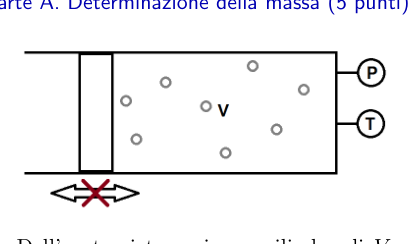
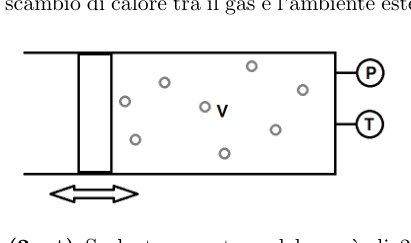
Dell’azoto si trova in un cilindro di munito di un pistone che funge da tappo. In questa prima parte blocchiamo il pistone, riscaldiamo il gas a differenti temperature e misuriamo la pressione. I risultati sono indicati nella tabella:
| # | (°C) | (Pa) |
|---|---|---|
| 1 | 10 | 168 100 |
| 2 | 20 | 174 000 |
| 3 | 50 | 191 800 |
| 4 | 100 | 221 500 |
| 5 | 150 | 251 200 |
| 6 | 250 | 310 600 |
i. (2 pt) Schizzate un grafico della temperatura del gas in funzione della pressione nel cilindro.
ii. (3 pt) Qual’è la massa dell’azoto all’interno del cilindro?
Parte B. Equilibrio (2 punti)
Lasciamo ora il pistone libero di muoversi lungo l’asse del cilindro. Salvo dove menzionate esplicitamente, ignoriamo lo scambio di calore tra il gas e l’ambiente esterno.
i. (2 pt) Se la temperatura del gas è di , qual’è il volume assunto dal gas all’interno del cilindro?
Parte C. Immersione (9 punti)
Il cilindro viene immerso sott’acqua, a 7 m al di sotto della superficie. La temperatura del gas nel cilindro è di . Il pistone è sempre libero di muoversi lungo l’asse del cilindro.
Costanti:
- Densità dell’acqua:
- Calore specifico dell’azoto:
i. (2 pt) Che volume assume il gas, supponendo che la temperatura non cambi?
ii. (3 pt) Lasciando il cilindro sott’acqua, che quantità di calore è necessario fornire perché il suo volume divenga di 2 L?
iii. (4 pt) Quale dev’essere la massa del cilindro in funzione della temperatura del gas per far sì che quest’ultimo si trovi in equilibrio a questa profondità? Per equilibrio si intende che non risale in superficie né sprofonda verso il basso. Il materiale del cilindro occupa un volume trascurabile e il pistone ha una massa trascurabile.
Topic: Thermodynamics, Fluid Mechanics Metodi: Ideal Gas Law, Hydrostatic Equilibrium, First Law of Thermodynamics Competenze: Mathematical Modeling, Graph Linearization Objects: Gas, Cylinder, Piston Fonte: Testo (PDF) — p.14
Problem 3: Under Pressure (16 points)
Part A. Determination of Mass (5 points)
Nitrogen gas is contained in a cylinder of equipped with a piston acting as a stopper. In this first part, we fix the piston in place, heat the gas to different temperatures, and measure the pressure. The results are shown in the table:
| # | (°C) | (Pa) |
|---|---|---|
| 1 | 10 | 168 100 |
| 2 | 20 | 174 000 |
| 3 | 50 | 191 800 |
| 4 | 100 | 221 500 |
| 5 | 150 | 251 200 |
| 6 | 250 | 310 600 |
i. (2 pt) Sketch a graph of the gas temperature as a function of pressure in the cylinder.
ii. (3 pt) What is the mass of nitrogen inside the cylinder?
Part B. Equilibrium (2 points)
Now we allow the piston to move freely along the cylinder axis. Unless explicitly stated otherwise, ignore heat exchange between the gas and the external environment.
i. (2 pt) If the temperature of the gas is , what volume does the gas occupy inside the cylinder?
Part C. Immersion (9 points)
The cylinder is submerged underwater, 7 m below the surface. The temperature of the gas inside the cylinder is . The piston remains free to move along the cylinder axis.
Constants:
- Water density:
- Specific heat of nitrogen:
i. (2 pt) What volume does the gas occupy, assuming that the temperature remains unchanged?
ii. (3 points) Leaving the cylinder underwater, how much heat must be supplied so that its volume becomes 2 L?
iii. (4 points) What must be the mass of the cylinder as a function of the gas temperature in order for the gas to be in equilibrium at this depth? By equilibrium, it is meant that the cylinder neither rises toward the surface nor sinks downward. The material of the cylinder occupies a negligible volume, and the piston has negligible mass.