Lanciamo una palla verticalmente verso l’alto. Quale grafico rappresenta meglio l’evoluzione dell’energia cinetica della palla nel corso del tempo?
- A. grafico a forma di V (energia cinetica diminuisce linearmente a zero poi risale linearmente)
- B. grafico con curva che tocca zero poi risale (forma parabolica)
- C. grafico costante
- D. grafico decrescente che rimane a zero
 Quattro grafici E vs t per palla lanciata
Topic: Newtonian Mechanics, Conservation of Energy Metodi: Kinematic Equations, Energy Conservation Method Competenze: Physical Reasoning, Diagrammatic Reasoning Objects: Ball Fonte: Testo (PDF) — p.4
We throw a ball vertically upward. Which graph best represents the evolution of the ball’s kinetic energy over time?
- A. V-shaped graph (kinetic energy decreases linearly to zero, then increases linearly)
- B. Graph with a curve that reaches zero and then rises (parabolic shape)
- C. Constant graph
- D. Decreasing graph that remains at zero
Four E vs t graphs for a ball thrown upward
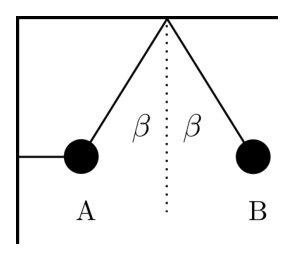
Una palla è tenuta a riposo nella posizione A da due corde che sono molto leggere. Tagliamo la corda orizzontale, in modo che la palla oscilla come un pendolo. La posizione B rappresenta la distanza massima raggiunta da questa palla, opposta al punto A.
Qual’è la relazione tra la forza di tensione nella corda del pendolo nella posizione A, prima di tagliare la corda orizzontale, e quella nella posizione B?
- A. 1
- B.
- C. 2
- D.
- E.
Topic: Newtonian Mechanics, Oscillations & Waves Metodi: Free-Body Diagram, Conservation of Energy Competenze: Physical Reasoning, Mathematical Modeling Objects: Pendulum, String, Ball Fonte: Testo (PDF) — p.4
A ball is held at rest in position A by two very light strings. We cut the horizontal string, so that the ball swings like a pendulum. Position B represents the maximum distance reached by this ball, opposite to point A.
What is the relationship between the tension force in the pendulum string at position A, before cutting the horizontal string, and that at position B?
- A. 1
- B.
- C. 2
- D.
- E.
Un blocco di massa è posto su un piano inclinato con un angolo di rispetto all’orizzontale. Questo blocco viene lanciato verso la cima del piano con una velocità iniziale . La forza di attrito risultante è di . Dopo quanto tempo il blocco tornerà alla sua posizione iniziale?
- A. 2 s
- B. 3 s
- C. 5 s
- D. 8 s
- E. 13 s (F) 21 s
Topic: Newtonian Mechanics Metodi: Kinematic Equations, Free-Body Diagram Competenze: Physical Reasoning, Mathematical Modeling Objects: Block, Inclined Plane Fonte: Testo (PDF) — p.5
A block of mass is placed on an inclined plane at an angle of with respect to the horizontal. This block is launched up the plane with an initial velocity . The resultant frictional force is . After how much time will the block return to its initial position?
- A. 2 s
- B. 3 s
- C. 5 s
- D. 8 s
- E. 13 s
- F. 21 s
Consideriamo una velocità , una massa e una lunghezza . Le unità sono quelle di una pressione per che valori degli esponenti?
- A.
- B.
- C.
- D.
- E. (F)
Topic: Newtonian Mechanics Metodi: Dimensional Analysis Competenze: Mathematical Modeling, Unit Conversion Objects: — Fonte: Testo (PDF) — p.5
Consider a velocity , a mass , and a length . The units are those of pressure; for what values of the exponents?
- A.
- B.
- C.
- D.
- E. (F)
Due biglie di massa e subiscono una collisione elastica. Prima della collisione, la biglia di massa è a riposo, mentre la biglia di massa si sposta verso destra con una velocità . Quali sono le velocità dopo la collisione?
- A.
- B.
- C.
- D.
- E.
Topic: Newtonian Mechanics, Conservation of Momentum Metodi: Conservation of Momentum, Conservation of Energy Competenze: Mathematical Modeling, Physical Reasoning Objects: Ball Fonte: Testo (PDF) — p.5
Two marbles of masses and undergo an elastic collision. Before the collision, the marble of mass is at rest, while the marble of mass moves to the right with velocity . What are the velocities after the collision?
- A.
- B.
- C.
- D.
- E.
Ogni primo mercoledì di febbraio in Svizzera viene effettuato un test di allarme in tutto il paese. L’allarme dell’acqua consiste per esempio da una successione di 12 suoni da 20 secondi, emessi ad una frequenza di 200 Hz. Un automobilista alla guida sente questo allarme, ma a una frequenza di 215 Hz. A quale velocità si muove l’automobilista? Consideriamo la velocità del suono .
- A.
- B.
- C.
- D.
- E. (F)
Topic: Oscillations & Waves Metodi: Wave Equation Competenze: Mathematical Modeling, Physical Reasoning Objects: — Fonte: Testo (PDF) — p.5
Every first Wednesday of February in Switzerland, a nationwide emergency test is conducted. The water alarm consists, for example, of a sequence of 12 sounds lasting 20 seconds each, emitted at a frequency of 200 Hz. A driver hears this alarm at a frequency of 215 Hz. At what speed is the driver moving? Consider the speed of sound .
- A.
- B.
- C.
- D.
- E. (F)
Possediamo tre blocchi aventi ciascuno una massa di 100 g: un blocco di ferro (calore specifico ), un blocco di alluminio (calore specifico ) e un blocco in cartone (calore specifico ). Questi tre blocchi hanno una temperatura iniziale di . Ora li mettiamo in un frigorifero avente una temperatura di per 12 h. Cosa possiamo dire sulla relazione tra la temperatura dei blocchi?
- A.
- B.
- C.
- D.
- E. (F) Nessuna delle risposte precedenti.
Topic: Thermodynamics Metodi: First Law of Thermodynamics Competenze: Physical Reasoning, Mathematical Modeling Objects: Block Fonte: Testo (PDF) — p.6
We have three blocks, each with a mass of 100 g: one block of iron (specific heat ), one block of aluminum (specific heat ), and one block made of cardboard (specific heat ). These three blocks initially have a temperature of . Now we place them in a refrigerator maintained at a temperature of for 12 hours. What can we say about the relationship between the temperatures of the blocks?
- A.
- B.
- C.
- D.
- E. (F) None of the above.
Due macchine termiche A e B hanno dei cicli - come indicato negli schemi sottostanti. Entrambe le macchine lavorano con l’azoto come gas (che è considerato un gas perfetto). Quale affermazione è falsa?
- A. Il rendimento della macchina A è inferiore al rendimento della macchina B.
- B. Le due macchine lavorano la stessa quantità (mole) di azoto.
- C. è inferiore a .
- D. Durante le trasformazioni isotermiche, del calore viene scambiato con l’esterno.
- E. Durante le trasformazioni isocore, non viene eseguito alcun lavoro.
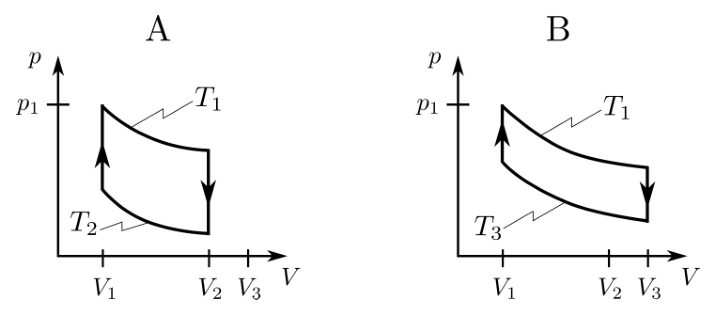 Cicli p-V delle macchine termiche A e B
Topic: Thermodynamics Metodi: Thermodynamic Cycle Analysis, Ideal Gas Law Competenze: Diagrammatic Reasoning, Physical Reasoning Objects: Heat Engine, Gas Fonte: Testo (PDF) — p.6
Two heat engines, A and B, have cycles - as shown in the diagrams below. Both engines operate using nitrogen gas (assumed to be an ideal gas). Which statement is false?
- A. The efficiency of engine A is lower than the efficiency of engine B.
- B. Both engines operate with the same amount (number of moles) of nitrogen.
- C. is less than .
- D. During the isothermal processes, heat is exchanged with the surroundings.
- E. During the isochoric processes, no work is performed.
Pressure-volume cycles of heat engines A and B
Per un gas perfetto, quale espressione vale
- A. 2
- B. 0
- C.
- D.
- E. (F)
Topic: Thermodynamics Metodi: Ideal Gas Law Competenze: Mathematical Modeling, Physical Reasoning Objects: Gas Fonte: Testo (PDF) — p.6
For an ideal gas, which expression holds true?
- A. 2
- B. 0
- C.
- D.
- E. (F)
Considera due stelle A e B. Il raggio della stella A è il doppio di quello della stella B. Inoltre, la temperatura sulla superficie della stella A è anche il doppio della temperatura sulla superficie della stella B. Qual è il rapporto tra le potenze totali della radiazione di A e B?
- A. 4
- B. 8
- C. 16
- D. 32
- E. 64
Topic: Astrophysics, Thermodynamics Metodi: Physical Modeling Competenze: Mathematical Modeling, Physical Reasoning Objects: Star Fonte: Testo (PDF) — p.7
Consider two stars, A and B. The radius of star A is twice that of star B. Moreover, the surface temperature of star A is also twice that of star B. What is the ratio between the total radiation powers of A and B?
- A. 4
- B. 8
- C. 16
- D. 32
- E. 64
Nel 1883 l’esplosione del vulcano Krakatoa (Indonesia) fu così grande che fu possibile rilevare l’onda d’urto in tutto il pianeta! Dopo quanti secondi un abitante di Bogotà, agli antipodi dell’Indonesia, ha “sentito” l’eruzione?
- A. 6 s
- B. 60 s
- C. s
- D. s
- E. s (F) s
Topic: Oscillations & Waves, Order-of-Magnitude Estimation Metodi: Order-of-Magnitude Estimation Competenze: Estimation & Approximation, Physical Reasoning Objects: — Fonte: Testo (PDF) — p.7
In 1883 the eruption of the Krakatoa volcano (Indonesia) was so powerful that its shock wave could be detected all around the planet! After how many seconds did a resident of Bogotá, located at the antipodes of Indonesia, “hear” the eruption?
- A. 6 s
- B. 60 s
- C. s
- D. s
- E. s (F) s
Due corde di pianoforte identiche, di lunghezza , sono accordate a 440 Hz. Riduciamo leggermente la lunghezza di una corda, del 0.5%, ma manteniamo la sua tensione iniziale. Eccitiamo le due corde alla loro frequenza fondamentale. Qual’è la frequenza di battimento?
- A. 5.9 Hz
- B. 2.2 Hz
- C. 1.0 Hz
- D. 441 Hz
- E. 220.5 Hz (F) Il n’y a pas de battements.
Topic: Oscillations & Waves Metodi: Wave Equation, Superposition Principle Competenze: Mathematical Modeling, Physical Reasoning Objects: String Fonte: Testo (PDF) — p.7
Two identical piano strings, each of length , are tuned to 440 Hz. We slightly reduce the length of one string by 0.5%, while keeping its initial tension unchanged. We excite both strings at their fundamental frequency. What is the beat frequency?
- A. 5.9 Hz
- B. 2.2 Hz
- C. 1.0 Hz
- D. 441 Hz
- E. 220.5 Hz
- F. There are no beats.
L’indice di rifrazione del mezzo 1 è . Qual’è l’indice di rifrazione del mezzo 3?
- A.
- B.
- C.
- D.
- E.
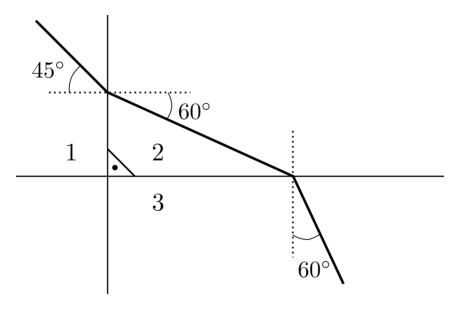 Raggi rifratti tra tre mezzi stratificati
Topic: Geometric Optics Metodi: Snell’s Law, Ray Tracing Competenze: Diagrammatic Reasoning, Mathematical Modeling Objects: — Fonte: Testo (PDF) — p.7
The refractive index of medium 1 is . What is the refractive index of medium 3?
- A.
- B.
- C.
- D.
- E.
Reflected rays in three stratified media
Un fascio parallelo raggiunge una lente convessa avente una distanza focale di 15 cm. A quale distanza da questa prima lente bisogna posizionare una seconda lente con distanza focale 5 cm affinché i raggi risultanti siano di nuovo paralleli?
- A. 3.75 cm
- B. 10 cm
- C. 15 cm
- D. 20 cm
- E. Non esiste nessuna distanza del genere.
Topic: Geometric Optics Metodi: Thin Lens & Mirror Equation, Ray Tracing Competenze: Physical Reasoning, Mathematical Modeling Objects: Lens Fonte: Testo (PDF) — p.8
A parallel beam of light reaches a convex lens with a focal length of 15 cm. At what distance from this first lens must a second lens with a focal length of 5 cm be placed so that the resulting rays are parallel again?
- A. 3.75 cm
- B. 10 cm
- C. 15 cm
- D. 20 cm
- E. No such distance exists.
Dopo 168 s l’attività di un elemento radioattivo è solo del suo valore iniziale. Qual’è il tempo di dimezzamento di questo elemento?
- A. 10.5 s
- B. 28 s
- C. 42 s
- D. 56 s
- E. 80.79 s (F) 84 s
Topic: Nuclear & Particle Physics Metodi: Radioactive Decay Law Competenze: Mathematical Modeling, Physical Reasoning Objects: Nucleus Fonte: Testo (PDF) — p.8
After 168 s, the activity of a radioactive element is only of its initial value. What is the half-life of this element?
- A. 10.5 s
- B. 28 s
- C. 42 s
- D. 56 s
- E. 80.79 s
- F. 84 s
Si consideri il circuito seguente. La corrente totale nel circuito è di 3 A. La resistenza interna della sorgente di tensione è considerata trascurabile. La resistenza è:
- A.
- B.
- C.
- D.
- E.
Schema circuito con resistenze e sorgente
Topic: Circuits Metodi: Kirchhoff’s Laws, Equivalent Circuit Reduction Competenze: Diagrammatic Reasoning, Mathematical Modeling Objects: Resistor, Battery Fonte: Testo (PDF) — p.8
Consider the following circuit. The total current in the circuit is 3 A. The internal resistance of the voltage source is considered negligible. The resistance is:
- A.
- B.
- C.
- D.
- E.
Circuit diagram with resistors and voltage source
Su due lampadine A e B si trovano le indicazioni 6 V/0.3 A, rispettivamente 60 W/230 V. Le connettiamo in serie a una sorgente di tensione 230 V. Che cosa succede?
- A. Le due lampadine si illuminano.
- B. Solo la lampadina A si illumina.
- C. Solo la lampadina B si illumina.
- D. A si illumina per un piccolo istante, poi le due lampadine si spengono.
Topic: Circuits Metodi: Kirchhoff’s Laws Competenze: Physical Reasoning, Mathematical Modeling Objects: Resistor, Battery Fonte: Testo (PDF) — p.8
On two lamps A and B are indicated 6 V/0.3 A, respectively 60 W/230 V. We connect them in series to a voltage source of 230 V. What happens?
- A. Both lamps light up.
- B. Only lamp A lights up.
- C. Only lamp B lights up.
- D. Lamp A lights up for a brief instant, then both lamps go out.
Un condensatore da è collegato in serie con uno da . Se si applica una differenza di potenziale di 300 V al blocco formato dai due condensatori, qual è l’energia totale immagazzinata?
- A. 0.09 J
- B. 0.18 J
- C. 0.27 J
- D. 0.41 J
- E. 0.81 J
Topic: Electrostatics, Circuits Metodi: Equivalent Circuit Reduction, Electric Potential Method Competenze: Mathematical Modeling, Physical Reasoning Objects: Capacitor Fonte: Testo (PDF) — p.9
A capacitor of is connected in series with another of . If a potential difference of 300 V is applied across the combination of the two capacitors, what is the total energy stored?
- A. 0.09 J
- B. 0.18 J
- C. 0.27 J
- D. 0.41 J
- E. 0.81 J
Un elettrone inizialmente a riposo viene accelerato ad una distanza da una tensione elettrica di . La sua velocità finale è . Ripetiamo l’esperimento, ma questa volta con una tensione di . Qual’è la nuova velocità finale dell’elettrone?
- A.
- B.
- C.
- D.
- E. (F)
Topic: Electrostatics Metodi: Energy Conservation Method, Electric Potential Method Competenze: Mathematical Modeling, Physical Reasoning Objects: Electron Fonte: Testo (PDF) — p.9
An electron initially at rest is accelerated over a distance by an electric potential difference of . Its final velocity is . We repeat the experiment, but this time with a potential difference of . What is the electron’s new final velocity?
- A.
- B.
- C.
- D.
- E. (F)
Una massa puntiforme di carica si muove in un campo magnetico , con una quantità di moto perpendicolare al campo magnetico. Descrive quindi un cerchio di raggio . Una seconda massa puntiforme della stessa carica si posiziona dentro un altro campo magnetico , ma questa volta con una quantità di moto (e quindi abbiamo ). Quale dovrebbe essere la norma del campo magnetico in modo tale che il raggio della traiettoria sia di nuovo ?
- A.
- B.
- C.
- D.
- E. (F)
Topic: Magnetism Metodi: Lorentz Force Analysis Competenze: Mathematical Modeling, Physical Reasoning Objects: Point Charge Fonte: Testo (PDF) — p.9
A point mass with charge moves in a magnetic field , having momentum perpendicular to the magnetic field. It therefore describes a circular trajectory of radius . A second point mass with the same charge is placed in another magnetic field , but this time with momentum (and thus we have ). What should be the magnitude of the magnetic field so that the radius of the trajectory is again ?
- A.
- B.
- C.
- D.
- E. (F)
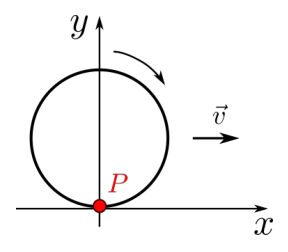
Si consideri un punto P situato al bordo di una strada. All’istante il punto P si trova all’origine del sistema di riferimento. La strada si sposta verso destra con una velocità costante verso destra e parallela all’asse (vedi schema). Qual’è la traiettoria del punto P?
- A. cicloide
- B. parabola
- C. cerchio
- D. retta
 Quattro possibili traiettorie nel piano xy
Topic: Newtonian Mechanics Metodi: Kinematic Equations, Vector Decomposition Competenze: Diagrammatic Reasoning, Physical Reasoning Objects: — Fonte: Testo (PDF) — p.10
Consider a point P located at the edge of a road. At time , point P is at the origin of the reference frame. The road moves to the right with a constant velocity parallel to the axis (see diagram). What is the trajectory of point P?
- A. cycloid
- B. parabola
- C. circle
- D. straight line
Four possible trajectories in the xy plane
Si considerino due vettori e si definisca . Tra le cinque affermazioni seguenti:
quali sono sempre corrette?
- A. 1, 2, 3, 4
- B. 2, 3, 4
- C. 2, 3, 5
- D. 1, 2, 5
- E. 1, 2, 4 (F) Non ci sono abbastanza informazioni.
Topic: Newtonian Mechanics Metodi: Vector Decomposition Competenze: Mathematical Modeling, Physical Reasoning Objects: — Fonte: Testo (PDF) — p.10
Consider two vectors and define . Among the following five statements:
which are always correct?
- A. 1, 2, 3, 4
- B. 2, 3, 4
- C. 2, 3, 5
- D. 1, 2, 5
- E. 1, 2, 4
- F. There is not enough information.
Esercizio 1: Che pressione! (16 punti)
Parte A. Tubo aperto (4 punti)
Consideriamo il sistema nella figura Fig. 1: un tubo in vetro è riempito di mercurio e immerso in un recipiente contenente anch’esso mercurio. In seguito si apre la parte inferiore del tubo. Si osserva quindi che il livello del mercurio si abbassa di un’altezza .
i. (1 pt) Cosa contiene la parte superiore del tubo, di altezza ?
ii. (1 pt) Cosa si può misurare con questo dispositivo? Spiega brevemente il suo funzionamento.
Immaginiamo di essere su una spiaggia, a bordo del mare, con un bicchiere d’acqua e una cannuccia. Se aspirate con la cannuccia, l’acqua del bicchiere sale.
iii. (1.5 pt) Determinate la lunghezza teorica massima di una cannuccia per bere dal vostro bicchiere d’acqua, poi calcolatene il valore numerico.
iv. (0.5 pt) In pratica la lunghezza sarà più corta di quella calcolata. Proponi una spiegazione possibile.
Parte B. Tubo chiuso (12 punti)
Un tubo di vetro, a forma di U e di sezione uniforme, contiene del mercurio (densità ). Le due estremità del tubo sono sigillate e un ramo del tubo contiene un gas A, mentre l’altro ramo contiene un gas B, entrambi considerati come gas perfetti.
Quando il tubo viene mantenuto verticale con le estremità rivolte verso l’alto (parte sinistra della figura Fig. 2), le parti del tubo occupate dai gas A e B hanno una lunghezza rispettivamente e .
Quando invece il tubo viene capovolto (parte destra della figura Fig. 2), la lunghezza della parte del tubo occupata dal gas A è .
In questo problema supponiamo sempre di conoscere , e . Se sono richieste delle applicazioni numeriche, si assuma che , e . La temperatura ambiente è .
i. (1 pt) Determinare la lunghezza occupata dal gas B quando il tubo è girato. Calcolare in seguito il suo valore numerico.
ii. (3.5 pt) Determinare le pressioni , , e del gas per il tubo in verticale e girato, poi calcolarne i valori numerici.
Si dispone ora il tubo in orizzontale, vale a dire che il piano su cui è sdraiato il tubo è parallelo al suolo.
iii. (1.5 pt) Determinare e calcolare le lunghezze , e le pressioni e corrispondenti.
Si consideri di nuovo la situazione del tubo verticale (parte sinistra della figura Fig. 2), ma questa volta si aumenta la temperatura ambiente di , che provocherà un cambiamento di lunghezza e pressione , .
iv. (6 pt) Determinare algebricamente le variazioni e in funzione delle grandezze conosciute, poi calcolarne il valore. Indicare esplicitamente le ipotesi di calcolo di cui avete avuto bisogno.
Fig. 1 tubo barometro verticale aperto e chiuso
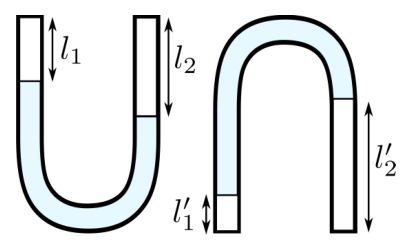 Fig. 2 tubo U verticale e capovolto con gas
Topic: Fluid Mechanics, Thermodynamics Metodi: Hydrostatic Equilibrium, Ideal Gas Law, First Law of Thermodynamics Competenze: Physical Reasoning, Mathematical Modeling Objects: Tube, Container, Gas, Manometer Fonte: Testo (PDF) — p.12
Problem 1: What Pressure! (16 points)
Part A. Open Tube (4 points)
Consider the system shown in Figure 1: a glass tube is filled with mercury and immersed in a container also containing mercury. Then, the lower end of the tube is opened. It is observed that the mercury level inside the tube drops by a height .
i. (1 pt) What is contained in the upper part of the tube, of height ?
ii. (1 pt) What can be measured with this device? Briefly explain how it works.
Imagine you are on a beach by the sea, holding a glass of water and a straw. When you suck through the straw, the water from the glass rises.
iii. (1.5 pt) Determine the theoretical maximum length of a straw for drinking from your glass of water, then compute its numerical value.
iv. (0.5 pt) In practice, the length will be shorter than the calculated value. Propose a possible explanation.
Part B. Closed Tube (12 points)
A glass U-shaped tube with uniform cross-section contains mercury (density ). Both ends of the tube are sealed, and one arm contains gas A while the other contains gas B; both gases are considered ideal.
When the tube is kept vertical with its ends pointing upward (left side of Figure 2), the portions of the tube occupied by gases A and B have lengths respectively and .
When instead the tube is inverted (right side of Figure Fig. 2), the length of the portion of the tube occupied by gas A is .
In this problem we always assume that , and are known. If numerical applications are required, assume that , and . The ambient temperature is .
i. (1 pt) Determine the length occupied by gas B when the tube is rotated. Then compute its numerical value.
ii. (3.5 pt) Determine the pressures , , and of the gas for the tube in vertical position and when inverted, then compute their numerical values.
The tube is now placed horizontally, i.e., the plane on which the tube lies is parallel to the ground.
iii. (1.5 pt) Determine and compute the lengths , and the corresponding pressures and .
Consider again the vertical tube situation (left side of Figure Fig. 2), but this time increase the ambient temperature by , which will cause a change in length and pressure , .
iv. (6 pt) Algebraically determine the variations and as functions of the known quantities, then compute their values. Explicitly indicate the assumptions made in the calculation.
Fig. 1 vertical open and closed manometer tube
Fig. 2 vertical U-shaped and inverted tube with gas
Esercizio 2: Sistema trasportatore a rulli (16 punti)
Un sistema trasportatore a rulli è realizzato da tanti rulli omogenei posti su un piano inclinato di un angolo , come mostrato in figura Fig. 3. Gli assi dei rulli sono perpendicolari al foglio e ognuno di essi può ruotare indipendentemente dagli altri (si ipotizzi, cioè, che i rulli non siano direttamente a contatto, ma siano separati da una distanza trascurabile). Ogni rullo ha massa e raggio .
Una lastra omogenea di massa si sposta sopra i rulli. La lunghezza della lastra è . Si ipotizzi inoltre che in ogni istante la lastra sia a contatto con esattamente rulli, anche nel momento in cui il retro della lastra si stacca da un rullo e il fronte si appoggia sul successivo che è fermo. Quando ciò accade la lastra rallenta e il rullo inizia a ruotare fino a quando le loro velocità soddisfano la condizione di non slittamento; per tutto questo tempo i rulli che si muovevano già con la lastra ruoteranno in modo da non farla slittare. L’effetto finale sarà dunque di rallentare la lastra e i rulli che si muovevano con essa e di accelerare il rullo inizialmente fermo. Nel nostro caso si faccia l’ipotesi che tutto questo avvenga in un tempo trascurabile cosicché le forze di interazione si possano trattare come impulsive: si tratta quindi di un “urto”.
Inizialmente tutti i rulli sono fermi e la lastra viene appoggiata su di essi e poi lasciata scorrere. Sia il modulo dell’accelerazione di gravità e si indichi con il modulo della velocità del centro di massa della lastra e con il modulo della velocità angolare dei rulli. Si ipotizzi che l’attrito statico tra un rullo e la lastra sia sufficiente a non far slittare la lastra.
i. (1 pt) Trovare una relazione tra e , che valga nel lasso di tempo che intercorre tra un urto ed il successivo, e dire se le velocità angolari dei rulli a contatto con la lastra sono tutte uguali.
Si indichino con e i moduli delle velocità subito prima e subito dopo un urto tra la lastra e il rullo -esimo.
ii. (3.5 pt) Si consideri il moto della lastra tra un urto e l’altro. Calcolare di quanto aumenta tra due urti, cioè trovare .
iii. (4 pt) Si consideri ora il processo di urto della lastra con un rullo. Trovare una relazione che lega e .
Nell’ipotesi che la distanza percorsa dalla lastra sia sufficientemente lunga, la lastra raggiungerà una condizione di regime.
iv. (4 pt) Nel caso particolare , calcolare i moduli e delle velocità limite raggiunte dalla lastra subito prima e subito dopo ciascun urto.
v. (1.5 pt) Nella condizione di regime, di quanto varia la velocità della lastra tra due urti consecutivi?
vi. (2 pt) Tracciare un grafico che esprima l’andamento temporale della velocità della lastra in condizione di regime.
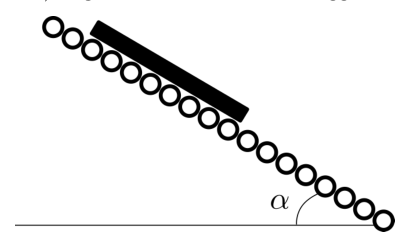 Fig. 3 sistema trasportatore a rulli su piano inclinato
Topic: Newtonian Mechanics, Rotational Dynamics Metodi: Conservation of Momentum, Torque & Angular Momentum Analysis, Conservation of Energy Competenze: Physical Reasoning, Mathematical Modeling Objects: Cylinder, Block, Inclined Plane Fonte: Testo (PDF) — p.13
Problem 2: Roller Conveyor System (16 points)
A roller conveyor system is constructed from many homogeneous rollers placed on an inclined plane at angle , as shown in Figure 3. The axes of the rollers are perpendicular to the plane of the paper, and each roller can rotate independently from the others (it is assumed that the rollers are not directly in contact, but separated by a negligible distance). Each roller has mass and radius .
A homogeneous plate of mass moves over the rollers. The length of the plate is . It is also assumed that, at every instant, the plate is in contact with exactly rollers—even at the moment when the rear end of the plate detaches from one roller and the front end contacts the next roller, which is initially at rest. At this moment, the plate slows down and the previously stationary roller begins to rotate until their velocities satisfy the non-slip condition; during this entire time, the rollers already rotating with the plate will adjust their rotation so as to prevent slipping of the plate. The net effect is therefore a reduction in speed of the plate and those rollers already rotating with it, along with an acceleration of the roller initially at rest. In our case, assume that all these processes occur in a negligible time interval so that the interaction forces may be treated as impulsive: this constitutes an “impact.”
Initially all rollers are at rest and the slab is placed on them and then released to slide. Let denote the magnitude of gravitational acceleration, let denote the magnitude of the velocity of the center of mass of the slab, and let denote the magnitude of the angular velocity of the rollers. It is assumed that the static friction between a roller and the slab is sufficient to prevent slipping of the slab.
i. (1 pt) Find a relation between and that holds during the time interval between one impact and the next, and state whether the angular velocities of the rollers in contact with the slab are all equal.
Let and denote the magnitudes of the velocity of the slab just before and just after an impact with the -th roller.
ii. (3.5 pt) Consider the motion of the slab between two consecutive impacts. Calculate by how much increases between two impacts, i.e., find .
iii. (4 pt) Now consider the impact process between the slab and a roller. Find a relation connecting and .
Assuming the distance traveled by the slab is sufficiently long, the slab will reach a steady-state regime.
iv. (4 pt) In the special case , calculate the magnitudes and of the limiting velocities reached by the slab just before and just after each impact.
v. (1.5 pt) Under steady-state conditions, by how much does the velocity of the slab change between two consecutive impacts?
vi. (2 points) Draw a graph showing the time evolution of the plate’s velocity under steady-state conditions.
Fig. 3 roller conveyor system on inclined plane
Esercizio 3: Pendolo Elettrico (16 punti)
Consideriamo un condensatore piatto composto da due placche parallele e verticali che non si possono muovere. Queste placche sono separate da una distanza , hanno un’altezza e un’area . In questo problema, si considera l’ipotesi per cui la resistenza dell’aria può venire trascurata.
Parte A. Riscaldamento (1.5 punti)
Concentriamoci prima di tutto sul condensatore.
i. (0.5 pt) Come varia la capacità del condensatore se si raddoppia la distanza tra le placche?
ii. (0.5 pt) Se l’aria tra le placche possiede una resistività elettrica uniforme , quale sarà la resistenza tra le placche?
iii. (0.5 pt) Se le placche sono inizialmente caricate da una sorgente con tensione costante , quale sarà l’energia immagazzinata nel condensatore?
Parte B. Tensione costante (7.5 punti)
Una sfera metallica di massa e di carica è appesa ad un cavo fissato ad un supporto rigido. Quando il condensatore non è carico, la sfera si trova al centro del condensatore (a una distanza da ciascuna placca, e a un’altezza al di sopra del fondo delle placche). Per contro, applicando una tensione tra le placche, il cavo farà un angolo con la verticale, nel momento in cui la sfera si troverà in equilibrio.
i. (2 pt) Determinate l’angolo in funzione delle misure date e delle costanti fondamentali.
Si sollevi leggermente la sfera metallica, in modo che faccia un angolo con la verticale, ma con appena più grande di . Si rilascia allora la sfera.
ii. (3.5 pt) Determinate il periodo d’oscillazione in funzione dei valori conosciuti e delle costanti fondamentali. Qual’è il rapporto tra questo periodo e il periodo che avrebbe il pendolo se non ci fosse tensione tra le due placche?
Quando la sfera è in equilibrio, tagliamo il cavo.
iii. (2 pt) Qual’è il valore massimo di per far sì che la sfera non tocchi nessuna piastra durante la sua caduta fino a che non esce dal basso del condensatore? Esprimete la risposta in funzione delle misure date e delle costanti fondamentali.
Parte C. Tensione variabile (7 punti)
Consideriamo nuovamente la nostra sfera di massa e di carica , inizialmente situata esattamente alla stessa distanza dalle due placche, a un’altezza di dal fondo delle placche. Al tempo , tagliamo nuovamente il cavo.
i. (1 pt) Quanto tempo servirebbe alla sfera per uscire dal fondo del condensatore se non ci fosse tensione tra le placche?
Questa volta, applichiamo una differenza di potenziale tra le placche.
ii. (6 pt) Per quale frequenza angolare la sfera riesce a fuoriuscire dal fondo del condensatore, ma senza toccare le placche? Per fare questo, studiate i due casi e . Esprimete i vostri risultati in funzione delle grandezze conosciute e delle costanti fondamentali.
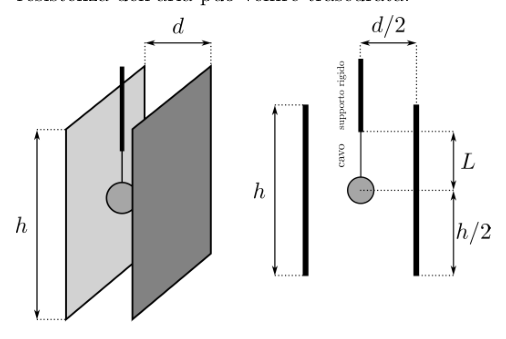 Fig. 4 condensatore piatto con sfera metallica appesa
Topic: Electrostatics, Oscillations & Waves, Newtonian Mechanics Metodi: Electric Potential Method, Simple Harmonic Motion Analysis, Free-Body Diagram Competenze: Mathematical Modeling, Physical Reasoning Objects: Capacitor, Conducting Sphere, Pendulum, String Fonte: Testo (PDF) — p.14
Problem 3: Electric Pendulum (16 points)
Consider a parallel-plate capacitor consisting of two fixed, vertical, non-movable plates. These plates are separated by a distance , have a height and an area . In this problem, we assume that air resistance can be neglected.
Part A. Heating (1.5 points)
Let us first focus on the capacitor.
i. (0.5 pt) How does the capacitance of the capacitor change if the distance between the plates is doubled?
ii. (0.5 pt) If the air between the plates has a uniform electrical resistivity , what will be the resistance between the plates?
iii. (0.5 pt) If the plates are initially charged by a source with constant voltage , what will be the energy stored in the capacitor?
Part B. Constant Voltage (7.5 points)
A metallic sphere of mass and charge is suspended by a cable attached to a rigid support. When the capacitor is uncharged, the sphere hangs at the center of the capacitor (at a distance from each plate, and at a height above the bottom of the plates). Conversely, when a voltage is applied across the plates, the cable makes an angle with the vertical at equilibrium.
i. (2 pt) Determine the angle as a function of the given measurements and fundamental constants.
The metal sphere is slightly lifted so that it makes an angle with the vertical, but with just larger than . The sphere is then released.
ii. (3.5 points) Determine the oscillation period as a function of known values and fundamental constants. What is the ratio between this period and the period the pendulum would have if there were no tension between the two plates?
When the sphere is in equilibrium, cut the cable.
iii. (2 points) What is the maximum value of such that the sphere does not touch either plate during its fall until it exits from below the capacitor? Express your answer in terms of the given measurements and fundamental constants.
Part C. Time-varying voltage (7 points)
We again consider our sphere of mass and charge , initially located exactly equidistant from the two plates, at a height above the bottom of the plates. At time , cut the cable again.
i. (1 point) How much time would it take for the sphere to exit from below the capacitor if there were no voltage between the plates?
This time, apply a potential difference between the plates.
ii. (6 points) For what angular frequency does the sphere manage to exit from below the capacitor without touching either plate? To solve this, examine the two cases and . Express your results in terms of the known quantities and fundamental constants.
Fig. 4 parallel-plate capacitor with a suspended metallic sphere