Membrana porosa
Note generali. Fornisci schizzi dettagliati di tutti i montaggi che usi. Stimare gli errori solo nella parte A. A seconda del meto do che avrai usato, potresti essere in grado di completare le attivi tà richieste senza utilizzare tutta l’attrezzatura fornita. Membrana porosa Studierai una membrana di ossido di alluminio anodico. La mem brana è trasparente; ha spessore h e canali cilindrici di diametro d come mostrato in figura. Il tuo obiettivo è determinare i parametri h, d e la porosità p (la frazione di volume dei canali nella mem brana). Assumi che la membrana sia otticamente omogenea e si prega di non toccare la superficie della membrana! A Diffusione, 5 punti Strumentazione. Recipiente a tenuta stagna con una finestra realizzata con la membrana e 2 tubi di collegamento con morsetti (il diametro della finestra è dw= 13 mm), dotato di sensore di concentrazione di anidride carbonica (CO2, massa molare 44 g/mol) con limite di lavoro superiore dello 0,5%; accumulatore di energia; 2 ventole con blocco batteria (inserire l’ultima batteria per farle funzionare); plastilina. Non smontare i collegamenti elettrici della configurazione Se c rappresenta la concentrazione (numero di molecole per unità di volume) di CO2 a un’estremità di un canale della membrana e c0 all’altra estremità, la densità del flusso di CO2 nel canale è data da j = D (c – c0 ) / h; dove D è il coefficiente di diffusione. Poiché i canali sono più stretti della lunghezza del cammino libero me dio, la velocità di diffusione è determinata dal diametro dei cana li: D v d / 3; dove v è la velocità quadratica media delle moleco le di CO2. La temperatura della stanza è T = (295 5) K. Compito. Individua una dipendenza funzionale di come c - c0 cambia nel tempo, studia sperimentalmente questo modello, de termina i suoi parametri e stima gli errori. Istruzioni per il sensore di CO2. Il sensore misura effica cemente il rapporto tra il numero di molecole di CO2 e il numero totale di molecole d’aria. Accendi il sensore collegandolo all’ac cumulatore di energia attraverso una porta USB. L’avvio richiede alcuni minuti. Se spegni il sensore, tutti i dati andranno persi. Premendo il pulsante SELECT per un secondo, si commuta il sensore tra la modalità di registrazione (R) e quella di navigazio ne tra i dati registrati (D). In modalità di registrazione, viene ag giunto un record ogni 20 s. La memoria contiene solo gli ultimi 200 record. Passando alla modalità di navigazione tra i dati regi strati si interrompe l’aggiunta di nuovi record ma il timer continua a funzionare. In questa modalità, con i pulsanti UP e DOWN si naviga tra i record. Al ritorno alla modalità di registrazione si ri prende la registrazione di nuovi dati. Il pulsante di ripristino RST cancella tutti i record e ripristina il timer. I pulsanti LEFT e RIGHT non vengono utilizzati. B Interferenza, 6 punti Strumentazione. Banco ottico; membrana (identica a quella della parte A) su un supporto; laser, = 660 nm; 2 polarizzatori (l’asse del polarizzatore è contrassegnato da una linea e forma un angolo di con il bordo della cornice); fotodiodo (la cor rente di cortocircuito è proporzionale all’intensità della luce); multimetro; fili; mollette; 2 righelli; plastilina; carta bianca. L’intensità della luce riflessa dipende dall’angolo di incidenza a causa dell’interferenza dei raggi riflessi dalle superfici superiore e inferiore della membrana. Compito. Determina lo spessore h della membrana. Assumi che l’indice di rifrazione della membrana sia n0 = 1.50. Per evitare la birifrangenza descritta nella parte C, la luce incidente deve avere polarizzazione perpendicolare al piano di incidenza (piano della figura). Se il contrasto delle interferenze è troppo debole, prova l’altra superficie della membrana. C Birifrangenza, 7 punti Strumentazione. La stessa della parte B. L’indice di rifrazione della membrana dipende dalla polarizzazio ne e dalla direzione di propagazione della luce. La membrana può essere descritta con due indici di rifrazione: no e ne; | ne – no | << no. Quando il raggio laser entra nella membrana, si divide in due fasci con diverse polarizzazioni e velocità. Il raggio 1 è polariz zato in direzione normale al piano di incidenza; il suo indice di rifrazione è n1 = no e non dipende da . Il raggio 2 è polarizzato parallelamente al piano di incidenza; il suo indice di rifrazione n2 dipende da : Si può dimostrare che la differenza del cammino ottico tra i raggi vale = h (n1 cos – n2 cos ). Compito. Determina la differenza = | ne – no | della membrana. Trova la porosità p usando il grafico fornito di ). C Conclusioni, 2 punti Compito. Usando i risultati delle parti precedenti e, se necessa rio, facendo misure addizionali, stima il diametro d. 1 n2 2=cos 2 no 2
- sin ne 2
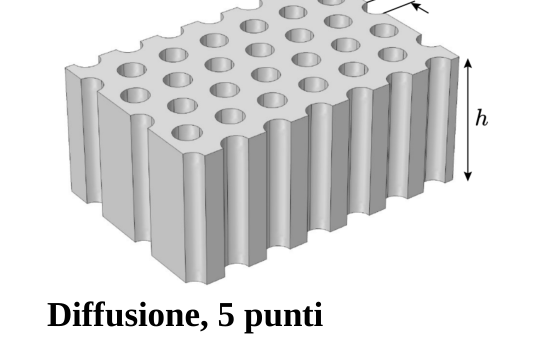
p.1 — Membrana porosa con canali cilindrici, spessore h e diametro d
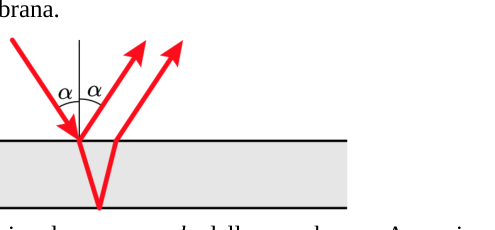
p.1 — Riflessione del raggio sulla membrana, angoli alpha
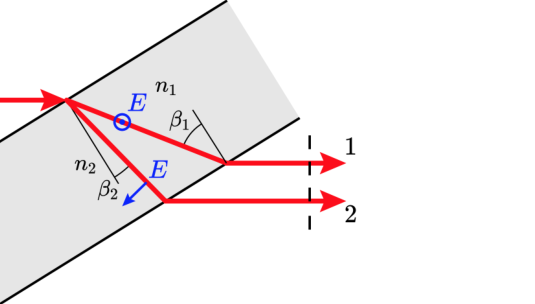
p.1 — Birifrangenza: raggi 1 e 2, indici n1 n2, angoli beta
Topic: Wave Optics, Kinetic Theory, Fluid Mechanics Metodi: Interference & Diffraction Analysis, Kinetic Theory of Gases, Experimental Data Analysis, Error Propagation Competenze: Experimental Data Analysis, Error Propagation, Graph Linearization Objects: Membrane, Container Fonte: Testo (PDF) — p.1 Soluzione: Soluzioni (PDF)
Membrana porosa
General notes. Provide detailed sketches of all assemblies I’m using it. Estimate errors only in Part A. Depending on the method The amount of the assets you have used may be able to complete the The Commission has not yet taken any further steps to ensure that the Commission is able to take all necessary measures to ensure that the Commission is able to take all necessary measures to ensure that the Commission is able to take all necessary measures to ensure that the necessary information is available. Other, of a kind used for the manufacture of goods of heading 8102 You’ll study an anodized aluminum oxide membrane. The Member States The brane is transparent; it has a thickness of h and cylindrical channels of diameter d As shown in the figure. Your goal is to determine the parameters h, d and porosity p (the fraction of the volume of the channels in the The Commission shall adopt implementing acts in accordance with Article 21 of this Regulation. Assume that the membrane is optically homogeneous and you Please don’t touch the surface of the membrane! A Diffusion, five points The instrumentation. Watertight container with a window Manufacture from materials of any heading, except those of heading 8706, of a kind used for the manufacture of goods of heading 8706, of which: (window diameter is dw= 13 mm), equipped with a sensor of The following table shows the concentration of carbon dioxide (CO2, molar mass 44): (g/mol) with a working limit of more than 0,5%; power; 2 fans with battery block (insert the last battery) I’m not sure what I’m doing. Do not dismantle the links electrical configuration If c is the concentration (number of molecules per unit) volume) of CO2 at one end of a membrane channel; and The density of the CO2 flow in the channel is given by the where j = D (c c0 ) / h; where D is the diffusion coefficient. Because The channels are narrower than the length of the freeway. The speed of diffusion is determined by the diameter of the canals. L: D v d / 3; where v is the mean square velocity of the molecules le di CO2. The room temperature is T = (295 5) K. I got a job. Indicates a functional dependence on how c - c0 The study of this model is experimental, and the results of the study are Finish your parameters and estimate the errors. Instructions for the CO2 sensor The sensor measures the effectiveness of the The ratio of the number of CO2 molecules to the number of Total of air molecules. Turn on the sensor by connecting it to the power accumulator through a USB port. The start-up requires A few minutes. If you turn off the sensor, all the data will be lost. Press the SELECT button for a second, and you switch the The sensor between the recording mode (R) and the navigation mode (R) the data recorded (D). In the mode of registration, the following information is provided: It ‘s a record every 20 seconds . Memory contains only the last ones 200 records. The Commission has decided to extend the scope of the Layers stop adding new records but the timer continues It’s not working. In this mode, with the up and down buttons you It’s a record. The Commission has decided to extend the period of validity of the It takes the recording of new data. The RST restore button erases all records and restores the The timer. The LEFT and RIGHT buttons are not used. B Interference, six points The instrumentation. Optical bench; membrane (identical to that of the optical bench) of Part A) on a support; laser, = 660 nm; 2 polarizers (the axis of the polarizer is marked by a line and shape) The angle of to the edge of the frame; photodiode (the frame) short-circuit rents shall be proportional to the light intensity); The following elements are added: The intensity of the reflected light depends on the angle of incidence a cause of interference of rays reflected from the upper surfaces; and The lower part of the membrane. I got a job. Determine the thickness of the membrane h. Take it the refractive index of the membrane is n0 = 1.50. To avoid the bifrangence described in Part C, the incident light shall have polarity perpendicular to the incidence plane (plane) The Commission has not yet adopted a proposal for a regulation. If the interference contrast is too weak, Test the other surface of the membrane. C The Commission has already adopted a proposal for a regulation on the The instrumentation. The same as in Part B. The refractive index of the membrane depends on the polarization of the The light is transmitted in the direction of the light. The membrane can I’m not going to be able to describe myself with two refractive indices: no and no; no, no. no. When the laser beam enters the membrane, it splits into two bands with different polarizations and speeds. The radius 1 is polarity. The average rate of the incidence of the disease is the average rate of the incidence of the disease. refraction is n1 = no and does not depend on . Ray 2 is polarized. parallel to the incidence plane; its refractive index n2 depends on : It can be shown that the difference in the optical path between the rays vale = h (n1 cos – n2 cos ). I got a job. Determina la differenza = | ne – no | della The membrane. Find the porosity p using the graph provided by ). C Conclusions, two points I got a job. Using the results of the previous parts and, if necessary, the The diameter of the d-shaped plane is calculated by taking additional measurements. 1 n2 2 = cos 2 no 2
- sin ne 2
**p.1 ** Porous membrane with cylindrical channels, thickness h and diameter d
**p.1 ** Radius reflection on the membrane, alpha angles
p.1 — Birifrangenza: raggi 1 e 2, indici n1 n2, angoli beta
Topic: Wave Optics, Kinetic Theory, Fluid Mechanics Metodi: Interference & Diffraction Analysis, Kinetic Theory of Gases, Experimental Data Analysis, Error Propagation Competenze: Experimental Data Analysis, Error Propagation, Graph Linearization Objects: Membrane, Container Fonte: Testo (PDF) — p.1 Soluzione: Soluzioni (PDF)