1 Tre palle Tre piccole palle identiche (indicate con A, B e C), ciascuna di , sono collegate tra loro con due aste di massa trascurabile e lunghezza in modo tale che la prima collega le palle A e B, e l’altra le palle B e C. La connessione alla sfera B è incernierata e l’angolo tra le aste può cambiare senza sforzo. Il sistema è fermo in assenza di gravità in modo che tutte le sfere si trovino su una linea. Alla palla A viene data istantaneamente una velocità perpendicolare alle aste. Trova la distanza minima tra le palle A e C durante il successivo movimento del sistema. Tutti gli attriti possono essere trascurati.
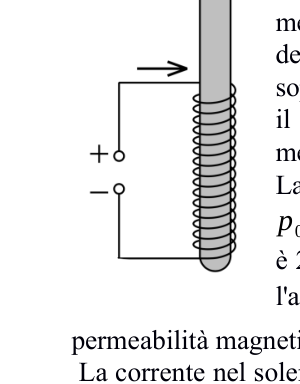
2 Un solenoide Un solenoide di lunghezza è avvolto intorno ad una provetta verticale cilindrica fatta di vetro e riempita con acqua. Il solenoide è isolato termicamente dall’acqua. L’altezza del livello dell’acqua è approssimativamente sopra l’estremo superiore del solenoide, il diametro della provetta è , il numero di spire della bobina è . La pressione atmosferica è , la temperatura dell’acqua è . La suscettibilità magnetica dell’acqua è . La permeabilità magnetica del vuoto è . La corrente nel solenoide viene aumentata lentamente fino a quando l’acqua inizia a bollire all’interno della bobina. Per quale intensità di corrente succederà ciò? Fai delle approssimazioni ragionevoli quando necessario. Si noti che l’intensità della corrente richiesta potrebbe essere leggermente troppo grande per la tecnologia attuale.
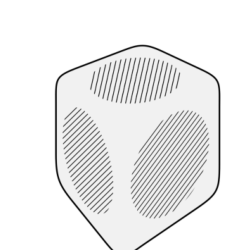
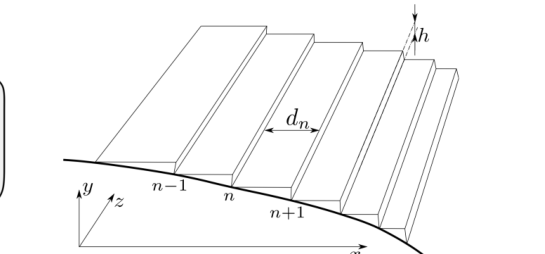
3 Una scala La configurazione di equilibrio dei corpi in assenza di gravità è determinata dal minimo della loro energia di superficie. Così, ad esempio, la configurazione di equilibrio di una goccia d’acqua risulta sferica: la sfera ha l’area superficiale più piccola tra i corpi dello stesso volume. A bassa temperatura, la configurazione di equilibrio dei cristalli può avere sfaccettature piatte. Le parti della superficie di cristallo che formano un piccolo angolo con la sfaccettatura sono in realtà scale formate da rari gradini su questa sfaccettatura. L’altezza di tali gradini è uguale al periodo del reticolo cristallino. Il profilo della superficie di equilibrio di un certo cristallo e la corrispondente scala microscopica sono mostrati schematicamente nella figura, dove denota il numero del gradino, a partire da . Per la forma del profilo può essere approssimata come , dove e . A. Esprimi la distanza tra due gradini adiacenti in funzione di per . B. L’energia di interazione di due gradini dipende dalla distanza tra loro dove è una costante. Assumi che l’interazione avvenga soltanto tra gradini adiacenti. Trova il valore numerico dell’esponente .
p.1 — Provetta con solenoide e batteria
p.1 — Cristallo cubico con sfaccettature piatte
p.1 — Scala microscopica di gradini sulla superficie
Topic: Newtonian Mechanics, Magnetism, Thermodynamics Metodi: Conservation of Energy, Conservation of Momentum, Approximation & Series Expansion, Physical Modeling Competenze: Mathematical Modeling, Physical Reasoning, Estimation & Approximation Objects: Ball, Rod, Solenoid, Tube Fonte: Testo (PDF) — p.1 Soluzione: Soluzioni (PDF)
1 Three balls
Three small identical balls (denoted as A, B, and C) of mass each are connected with two massless rods of length so that one of the rods connects the balls A and B, and the other rod connects the balls B and C. The connection at the ball B is hinged, and the angle between the rods can change effortlessly. The system rests in weightlessness so that all the balls lie on one line. The ball A is given instantaneously a velocity perpendicular to the rods.
Find the minimal distance between the balls A and C during the subsequent motion of the system. Any friction is to be neglected.
2 Solenoid
A solenoid of length is wound around a vertical, cylindrical test tube made of glass, filled with water. The solenoid is thermally insulated from the water. The height of the water level is approximately above the upper end of the solenoid, the diameter of the test tube is , the number of turns of the coil is . The atmospheric pressure is , the temperature of water is . Magnetic susceptibility of water is . Vacuum permeability .
The current in the solenoid is slowly increased until the water starts boiling inside the coil. At which current strength would this happen? Make reasonable approximations when needed. Note that the required current strength might be slightly too large for the present technology.
Test tube with solenoid and battery
3 Staircase
The equilibrium shape of bodies in zero-gravity is determined by the minimum of their surface energy. Thus, for example, the equilibrium shape of a water droplet turns out to be spherical: the sphere has the smallest surface area among bodies of the same volume.
At low temperature, the equilibrium shape of crystals may have flat facets. The parts of the crystal surface that have a small angle with the facet are in fact staircases of rare steps on this facet. The height of such steps is equal to the period of the crystal lattice .
Equilibrium surface profile of a certain crystal and the corresponding microscopic staircase are shown schematically in the figure, where denotes the step number, counting from . The profile shape at can be approximated as , where and .
Crystal with flat facets
Microscopic staircase of steps on the surface
A. Express the distance between two adjacent steps as a function of for .
B. The interaction energy of two steps depends on the distance between them as
where is a constant. Assume that only adjacent steps interact. Find the numerical value for the exponent .
Topic: Newtonian Mechanics, Magnetism, Thermodynamics Metodi: Conservation of Energy, Conservation of Momentum, Approximation & Series Expansion, Physical Modeling Competenze: Mathematical Modeling, Physical Reasoning, Estimation & Approximation Objects: Ball, Rod, Solenoid, Tube Fonte: Testo (PDF) — p.1 Soluzione: Soluzioni (PDF)