Problema Sperimentale — EuPhO 2019 — Propagazione di onde radio
Le onde elettromagnetiche svolgono un ruolo importante nelle nostre vite. Molte innovazioni tecnologiche si basano sulle proprietà di propagazione di queste onde. In questo esperimento dovrai studiare la propagazione delle onde radio nell’acqua, nell’aria e nelle guide d’onda.
Strumenti
- Una sorgente di onde radio monocromatiche in un alloggiamento stagno contrassegnato con “A” nella Figura 1 (la frequenza varia nell’intervallo da 200 MHz a 5 GHz); la posizione della sorgente nel recipiente è mostrata con una linea tratteggiata. Essa è abbinata ad un ricevitore “B” che misura la potenza dell’onda elettromagnetica ricevuta e mostra il risultato in decibel: . Il ricevitore fa una lettura ogni 15 secondi. La posizione del sensore è contrassegnata sul dispositivo da un triangolo rosso. NB! Il ricevitore non è impermeabile! L’alloggiamento dell’emettitore è impermeabile e sigillato e non devi aprirlo!
- Una serie di tubi metallici “C” di vari diametri (diametri interni , , , ).
- Un tubo di plastica “D” che ha un’estremità sigillata con un tappo.
- Una scatola di plastica “E” con fondo piatto. Lo sfasamento di onde radio che passano attraverso le pareti della scatola è sufficientemente piccolo da poter essere trascurato.
- Un rotolo di alluminio “F”.
- Quattro pezzi di polistirolo “G” con cui è possibile costruire un supporto schermato (screening holder) per l’emettitore seguendo quanto suggerito in Figura 2.
- Un righello “H”.
- Un secchio di plastica con acqua “I”, una brocca “J”, un bicchiere di plastica “K” e tessuti “L”.
- Una corda sottile “M”, una clip “N”, un rotolo di nastro “O”, elastici “P” e un’asta di legno “Q”.
Il tuo emettitore è associato al tuo ricevitore e il ricevitore elimina il segnale di tutti gli altri emettitori. Però, ricorda che le onde radio sono riflesse da tutti gli oggetti nella stanza, compreso il corpo umano, dando luogo a interferenza di onde. Per esempio avvicinando la mano al ricevitore o spostandoti puoi influenzare la lettura del ricevitore. La potenza ricevuta dipende anche dall’orientamento del ricevitore e dell’emettitore. Fa’ attenzione alla schermatura fatta con il foglio di alluminio: anche piccoli fori o fessure (ad esempio tra il foglio e la scatola nella Figura 2) potrebbero causare perdite di segnale.
I compiti dall’1 al 4 sono indipendenti e possono essere eseguiti in ordine arbitrario. Disegna tutti i montaggi dell’apparecchiatura usata, metti in evidenza eventuali dettagli importanti del montaggio, annota tutte le formule usate, annotando in tabelle tutti i dati misurati, e disegnando dei grafici laddove appropriato. Non c’è bisogno di stimare le incertezze di misura, ma cerca di eseguire le misurazioni nella maniera più precisa possibile.
Attività 1. Sensibilità del ricevitore (1 p)
Qual è la più bassa potenza ricevuta misurabile (in mW)?
 Emettitore A e ricevitore B, montaggio sperimentale
 Supporto schermato con polistirolo Fig. 2
Topic: Oscillations & Waves, Electromagnetism Metodi: Experimental Data Analysis, Physical Modeling Competenze: Measurement & Instrumentation, Physical Reasoning Objects: Tube, Container Fonte: Testo (PDF) — p.1 Soluzione: Soluzioni (PDF)
The following is the list of the most commonly used methods of measuring the amount of radio waves in the atmosphere:
Electromagnetic waves play an important role in our lives. Many technological innovations are based on the propagation properties of these waves. In this experiment, you’ll have to study the propagation of radio waves in water, air, and wave guides.
The following table shows the results of the calculations:
- A monochrome radio wave source in a tank housing marked “A” in Figure 1 (frequency varies from 200 MHz to 5 GHz); the location of the source in the container is shown with a drawn line. It is paired with a receiver ‘B’ which measures the power of the electromagnetic wave received and displays the result in decibels: . The receiver reads it every 15 seconds. The position of the sensor is marked on the device by a red triangle. NB! The receiver is not waterproof! The emitter housing is waterproof and sealed and you don’t have to open it!
- A series of “C” metal tubes of various diameters (internal diameters , , , ).
- A D-plastic tube with a sealed end with a lid.
- A plastic box with an E-box. The radio wave deflection that passes through the walls of the box is small enough to be neglected.
- It’s an aluminum roll with an “F”.
- Four pieces of G-polystyrene with which a screening holder can be constructed for the emitter following the suggestion in Figure 2.
- A “H” reel.
- A plastic bucket with “I” water, a “J” jar, a “K” plastic glass and “L” fabrics.
- A thin M-string, an N-clipping, an O-tape roll, P-pins and a Q-wood arrow.
Your emitter is associated with your receiver and the receiver eliminates the signal from all other emitters. However, remember that radio waves are reflected by all objects in the room, including the human body, resulting in wave interference. For example, by moving your hand closer to the receiver or moving your hand, you can influence the receiver’s reading. The power received also depends on the orientation of the receiver and the emitter. Be careful of the aluminium foil shielding: even small holes or cracks (e.g. between the foil and the box in Figure 2) may cause signal leakage.
The tasks 1 to 4 are independent and can be performed in an arbitrary manner. Draw all assemblies of the equipment used, highlight any important details of the assembly, note all the formulas used, annotate all measured data in tables, and draw charts where appropriate. You don’t have to estimate measurement uncertainties, but try to make measurements as accurate as possible.
The following is the list of the activities: The following information is provided for in the Annex to Implementing Regulation (EU) No 1303/2013.
What is the lowest measurable receiver power (mW)?
Emitter A and receiver B, experimental assembly
The manufacturer shall provide the manufacturer with the following information: 2*
Topic: Oscillations & Waves, Electromagnetism Metodi: Experimental Data Analysis, Physical Modeling Competenze: Measurement & Instrumentation, Physical Reasoning Objects: Tube, Container Fonte: Testo (PDF) — p.1 Soluzione: Soluzioni (PDF)
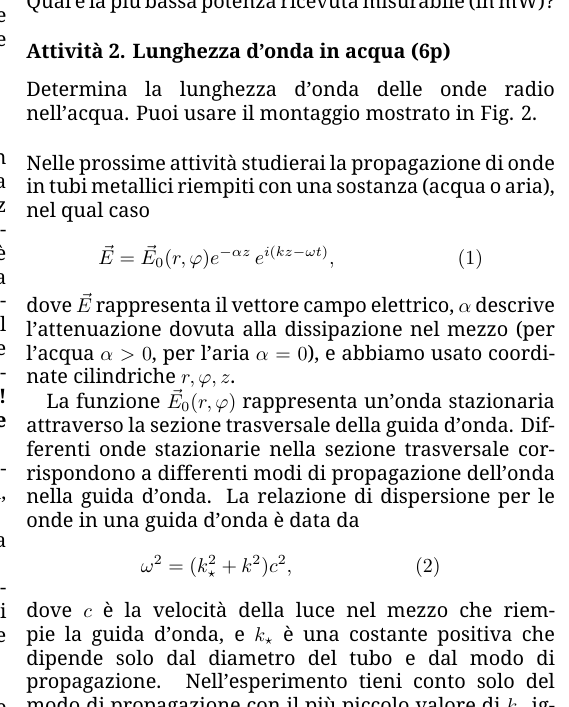
Attività 2. Lunghezza d’onda in acqua (6 p)
Determina la lunghezza d’onda delle onde radio nell’acqua. Puoi usare il montaggio mostrato in Fig. 2.
Topic: Oscillations & Waves, Wave Optics Metodi: Interference & Diffraction Analysis, Experimental Data Analysis, Graph Linearization Competenze: Experimental Data Analysis, Graph Linearization Objects: — Fonte: Testo (PDF) — p.1 Soluzione: Soluzioni (PDF)
The following information is provided by the Commission: Wavelength in water (6 p) **
Determine the wavelength of radio waves in water. You can use the assembly shown in Fig. 2.
Topic: Oscillations & Waves, Wave Optics Metodi: Interference & Diffraction Analysis, Experimental Data Analysis, Graph Linearization Competenze: Experimental Data Analysis, Graph Linearization Objects: — Fonte: Testo (PDF) — p.1 Soluzione: Soluzioni (PDF)
Attività 3. Attenuazione in acqua (3 p)
Nelle prossime attività studierai la propagazione di onde in tubi metallici riempiti con una sostanza (acqua o aria), nel qual caso
dove rappresenta il vettore campo elettrico, descrive l’attenuazione dovuta alla dissipazione nel mezzo (per l’acqua , per l’aria ), e abbiamo usato coordinate cilindriche .
La funzione rappresenta un’onda stazionaria attraverso la sezione trasversale della guida d’onda. Differenti onde stazionarie nella sezione trasversale corrispondono a differenti modi di propagazione dell’onda nella guida d’onda. La relazione di dispersione per le onde in una guida d’onda è data da
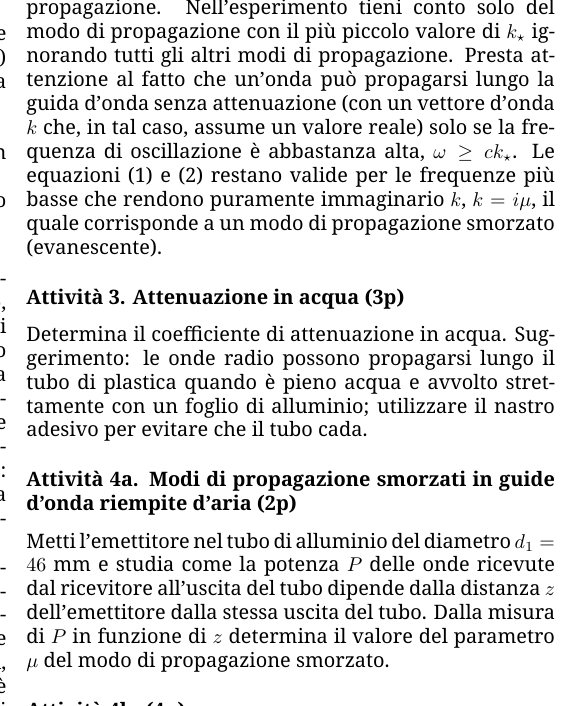
dove è la velocità della luce nel mezzo che riempie la guida d’onda, e è una costante positiva che dipende solo dal diametro del tubo e dal modo di propagazione. Nell’esperimento tieni conto solo del modo di propagazione con il più piccolo valore di , ignorando tutti gli altri modi di propagazione. Presta attenzione al fatto che un’onda può propagarsi lungo la guida d’onda senza attenuazione (con un vettore d’onda che, in tal caso, assume un valore reale) solo se la frequenza di oscillazione è abbastanza alta, . Le equazioni (1) e (2) restano valide per le frequenze più basse che rendono puramente immaginario , , il quale corrisponde a un modo di propagazione smorzato (evanescente).
Determina il coefficiente di attenuazione in acqua. Suggerimento: le onde radio possono propagarsi lungo il tubo di plastica quando è pieno d’acqua e avvolto strettamente con un foglio di alluminio; utilizzare il nastro adesivo per evitare che il tubo cada.
Topic: Oscillations & Waves, Electromagnetism Metodi: Wave Equation, Experimental Data Analysis, Graph Linearization Competenze: Experimental Data Analysis, Mathematical Modeling Objects: Tube Fonte: Testo (PDF) — p.1 Soluzione: Soluzioni (PDF)
The following is the list of the activities: Water attenuation (3 p)**
In the next activities you will study the propagation of waves in metal tubes filled with a substance (water or air), in which case
where represents the electric field vector, describes the attenuation due to dissipation in the medium (for water , for air ), and we used cylindrical coordinates .
The function represents a stationary wave through the cross section of the wave guide. Different stationary waves in the cross section correspond to different ways of wave propagation in the wave direction. The wave dispersion ratio in a wave guide is given by
where is the speed of light in the medium filling the wave guide, and is a positive constant that depends only on the diameter of the tube and the mode of propagation. In the experiment, only consider the mode of propagation with the smallest value of , ignoring all other modes of propagation. Pay attention to the fact that a wave can propagate along the wave direction without attenuation (with a wave vector which, in this case, takes a real value) only if the oscillation frequency is sufficiently high, . Equations (1) and (2) remain valid for the lower frequencies which make purely imaginary, , which corresponds to a damped (evanishing) mode of propagation.
Determine the water attenuation coefficient. Suggest: radio waves can propagate along the plastic tube when it is full of water and wrapped tightly with an aluminium foil; use the adhesive tape to prevent the tube from falling.
Topic: Oscillations & Waves, Electromagnetism Metodi: Wave Equation, Experimental Data Analysis, Graph Linearization Competenze: Experimental Data Analysis, Mathematical Modeling Objects: Tube Fonte: Testo (PDF) — p.1 Soluzione: Soluzioni (PDF)
Attività 4a. Modi di propagazione smorzati in guide d’onda riempite d’aria (2 p)
Metti l’emettitore nel tubo di alluminio del diametro e studia come la potenza delle onde ricevute dal ricevitore all’uscita del tubo dipende dalla distanza dell’emettitore dalla stessa uscita del tubo. Dalla misura di in funzione di determina il valore del parametro del modo di propagazione smorzato.
Topic: Oscillations & Waves, Electromagnetism Metodi: Wave Equation, Experimental Data Analysis, Graph Linearization Competenze: Experimental Data Analysis, Graph Linearization Objects: Tube Fonte: Testo (PDF) — p.1 Soluzione: Soluzioni (PDF)
The Commission shall adopt delegated acts in accordance with Article 21 of Regulation (EC) No 1224/2009. Moisture-sensitive propagation methods in air-filled wave guides (2 p)**
Place the emitter in the diameter aluminium tube and study how the power of the waves received from the receiver at the tube exit depends on the distance of the emitter from the tube exit itself. From the measurement of in relation to , the value of the parameter of the damped propagation mode is determined.
Topic: Oscillations & Waves, Electromagnetism Metodi: Wave Equation, Experimental Data Analysis, Graph Linearization Competenze: Experimental Data Analysis, Graph Linearization Objects: Tube Fonte: Testo (PDF) — p.1 Soluzione: Soluzioni (PDF)
Attività 4b. (4 p)
Esegui una serie di misurazioni per determinare in che modo il parametro dipende dal diametro del tubo. Ipotizza una dipendenza funzionale tra questi parametri e verificala sperimentalmente.
Topic: Oscillations & Waves, Electromagnetism Metodi: Wave Equation, Experimental Data Analysis, Graph Linearization Competenze: Experimental Data Analysis, Graph Linearization Objects: Tube Fonte: Testo (PDF) — p.2 Soluzione: Soluzioni (PDF)
The following is the list of the activities: (4 p)**
Perform a series of measurements to determine how the parameter depends on the diameter of the pipe. It assumes a functional dependence between these parameters and tests it experimentally.
Topic: Oscillations & Waves, Electromagnetism Metodi: Wave Equation, Experimental Data Analysis, Graph Linearization Competenze: Experimental Data Analysis, Graph Linearization Objects: Tube Fonte: Testo (PDF) — p.2 Soluzione: Soluzioni (PDF)
Attività 5. Lunghezza d’onda in aria e indice di rifrazione dell’acqua (3 p)
Determina la lunghezza d’onda di queste onde radio in aria e calcola l’indice di rifrazione dell’acqua per le onde radio.
Topic: Oscillations & Waves, Wave Optics Metodi: Interference & Diffraction Analysis, Experimental Data Analysis, Superposition Principle Competenze: Experimental Data Analysis, Mathematical Modeling Objects: — Fonte: Testo (PDF) — p.2 Soluzione: Soluzioni (PDF)
The following is the list of activities: Wavelength in air and water refractive index (3 p) **
Determine the wavelength of these radio waves in the air and calculate the refractive index of water for radio waves.
Topic: Oscillations & Waves, Wave Optics Metodi: Interference & Diffraction Analysis, Experimental Data Analysis, Superposition Principle Competenze: Experimental Data Analysis, Mathematical Modeling Objects: — Fonte: Testo (PDF) — p.2 Soluzione: Soluzioni (PDF)