Problemi teorici. Lingua: Italiano
T1: Lenti termiche (10 punti)
Quando un raggio laser intenso cade su una lastra semitrasparente, la luce trasmessa può focalizzarsi automaticamente (da sola) in un punto dietro la lastra a causa del riscaldamento disomogeneo del materiale. Questo effetto, noto come ”thermal lensing”, si osserva nei materiali il cui indice di rifrazione aumenta con la temperatura e che sono caratterizzati da un coefficiente termo-ottico positivo .
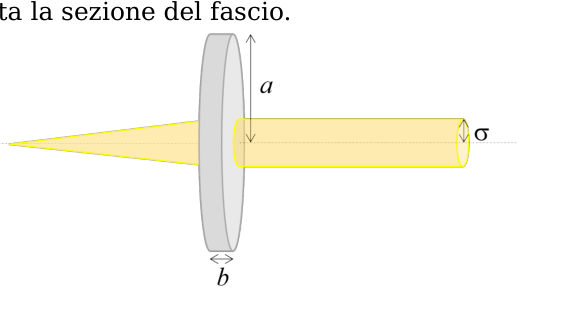
Un disco semitrasparente di raggio , spessore e coefficiente di assorbimento ottico è fatto con un materiale che ha conduttività termica e coefficiente termoottico .
Il bordo esterno del disco è collegato termicamente a un supporto metallico circolare (non mostrato nella figura) mantenuto a temperatura costante . Un fascio laser parallelo di raggio e potenza incide normalmente sul centro del disco. La distribuzione di intensità è omogenea su tutta la sezione del fascio.
a) (2 punti) Disegnare un grafico qualitativo del profilo di temperatura , dove indica la distanza dall’asse del fascio. Riportare chiaramente sul grafico la regione illuminata e la regione esterna .
b) (4 punti) Nei punti prossimi al centro del disco, il profilo di temperatura può essere rappresentato da una funzione quadratica . Calcolare i parametri ed .
c) (4 punti) Mostrare che il fascio è focalizzato in un punto e trovare la distanza di questo punto dal disco. Se non riesci a trovare ed in b) puoi lasciali indicati come parametri nella risposta finale.
Non considerare la dilatazione termica del disco. Trascura la radiazione termica e lo scambio di calore tra il disco e l’aria circostante. Supponi che l’indice di rifrazione dell’aria sia .
T2: Mattone tra due piani (10 punti)
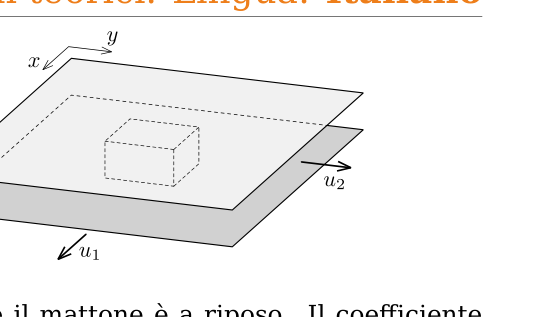
Un piccolo mattone viene schiacciato tra due piani paralleli in assenza di forza peso. I piani sono perpendicolari all’asse . Il piano inferiore si muove con velocità costante lungo l’asse , mentre quello superiore si muove con velocità costante lungo l’asse .
Inizialmente il mattone è a riposo. Il coefficiente di attrito dinamico tra il mattone e ciascun piano è identico.
a) (4 punti) Trovare la velocità del mattone nella condizione dopo un lungo periodo di tempo.
b) (6 punti) Trovare la velocità del mattone dopo un lungo periodo di tempo per .
T3: Piastra tra i magneti (10 punti)
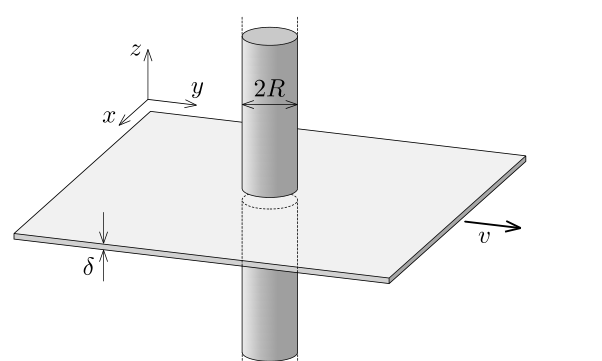
Due magneti identici, lunghi e cilindrici, di raggio , sono vicini tra loro e condividono lo stesso asse di simmetria verticale. La polarità dei due magneti è la stessa. Di conseguenza, il campo magnetico nell’intercapedine tra i magneti è diretto verso la direzione (vedi figura) e uniforme con densità di flusso . Il campo magnetico all’esterno della fessura è nullo. Una piastra metallica non magnetica di grandi dimensioni viene collocata nel traferro e spostata con velocità orizzontale costante in direzione . Lo spessore della lastra è , la resistività del metallo è .
a) (3 punti) Disegnare la forma delle linee di corrente nella piastra metallica in un dato istante. Indicare gli assi sul vostro schizzo.
b) (5 punti) Trovare e tracciare la densità di corrente all’interno della piastra lungo una linea parallela all’asse che interseca l’asse di simmetria dei magneti.
c) (2 punti) Trovare la forza orizzontale necessaria per spostare la piastra.
p.1 — Fascio laser attraverso disco semitrasparente
p.1 — Mattone tra due piani in moto
p.1 — Magneti cilindrici con piastra metallica
Topic: Thermodynamics, Geometric Optics, Newtonian Mechanics, Electromagnetic Induction Metodi: Differential Equations, Snell’s Law, Thin Lens & Mirror Equation, Free-Body Diagram, Vector Decomposition, Faraday’s Law of Induction, Lorentz Force Analysis Competenze: Mathematical Modeling, Diagrammatic Reasoning, Physical Reasoning Objects: Disk, Lens, Block, Magnet Fonte: Testo (PDF) — p.1 Soluzione: Soluzioni (PDF)
Theoretical problems. Language: Italian
T1: Thermal lenses (10 points)
When an intense laser beam falls on a semitrasparent sheet, the transmitted light can focus automatically (on its own) at a point behind the sheet due to the material’s heterogeneous heating. This effect, known as thermal lensing, is observed in materials whose refractive index increases with temperature and which are characterized by a positive thermo-optical coefficient .
A semitrasparent disc of radius, thickness and optical absorption coefficient is made of a material having a thermal conductivity and a thermooptic coefficient .
The outer edge of the disc is thermal connected to a circular metal support (not shown in the figure) maintained at a constant temperature . A parallel laser beam of radius and power normally affects the center of the disc. The intensity distribution is uniform across the entire beam section.
(a) (2 points) Draw a qualitative chart of the temperature profile , where indicates the distance from the axis of the beam. Clearly report the illuminated region and the outer region on the chart.
(b) (4 points) At points near the centre of the disc, the temperature profile may be represented by a quadratic function . Calculate the parameters and .
(c) (4 points) Show that the beam is focused at a point and find the distance of this point from the disk. If you can’t find and in b) you can leave them as parameters in the final answer.
Do not consider the thermal dilation of the disc. It tracks the thermal radiation and heat exchange between the disk and the surrounding air. Assume that the air refractive index is .
T2: Brick between two floors (10 points)
A small brick is crushed between two parallel planes in the absence of weight. The planes are perpendicular to the axis. The lower plane moves at constant speed along the axis, while the upper plane moves at constant speed along the axis.
Initially, the brick is at rest. The dynamic friction coefficient between the brick and each plane is the same.
(a) (4 points) Find the speed of the brick in the condition after a long period of time.
(b) (6 points) Find the speed of the brick after a long period of time for .
T3: Plate between magnets (10 points)
Two identical magnets, long and cylindrical, of radius , are close together and share the same axis of vertical symmetry. The polarity of the two magnets is the same. As a result, the magnetic field in the intercapedine between magnets is directed towards (see figure) and uniform with a flow density . The magnetic field outside the crack is zero. A large non-magnetic metal plate is placed in the gearbox and moved at a constant horizontal speed in the direction . The thickness of the sheet is , the resistivity of the metal is .
(a) (3 points) Draw the shape of the current lines in the metal plate at a given moment. Point the axes on your sketch.
(b) (5 points) Find and trace the current density within the plate along a parallel line to the axis that intersects the magnetic symmetry axis.
(c) (2 points) Find the horizontal force needed to move the plate.
The following information is provided for in the Annex to this Regulation:
**p.1 ** Brick between two floors in motion
Other, of a kind used for the manufacture of goods of heading 8406
Topic: Thermodynamics, Geometric Optics, Newtonian Mechanics, Electromagnetic Induction Metodi: Differential Equations, Snell’s Law, Thin Lens & Mirror Equation, Free-Body Diagram, Vector Decomposition, Faraday’s Law of Induction, Lorentz Force Analysis Competenze: Mathematical Modeling, Diagrammatic Reasoning, Physical Reasoning Objects: Disk, Lens, Block, Magnet Fonte: Testo (PDF) — p.1 Soluzione: Soluzioni (PDF)