T1: Solenoide e anello
Un anello circolare chiuso di raggio è formato da una batteria ideale di forza elettromotrice e da un filo di resistenza . Un solenoide a nucleo d’aria, lungo e sottile, è allineato con l’asse dell’anello (asse ). La sua lunghezza è , l’area della sezione trasversale è () e il numero di spire è . Nel solenoide circola una corrente costante fornita da un generatore ideale di corrente. Le direzioni delle correnti nel solenoide e nell’anello sono le stesse (in senso orario nella figura).
a. Trovare la forza che agisce sul solenoide quando la sua testa è posizionata nel centro dell’anello. Qual è la forza che agisce sul solenoide quando la sua estremità inferiore si trova al centro dell’anello?
b. Si supponga ora che il solenoide si muova lentamente con una velocità costante lungo l’asse partendo da una posizione molto distante dall’anello, oltrepassando il suo centro e procedendo ulteriormente a destra in direzione positiva . Tracciare un grafico della corrente che scorre nell’anello in funzione del tempo. Evidenziare nel grafico caratteristiche e valori importanti. La velocità è così piccola che è possibile trascurare l’autoinduzione dell’anello.
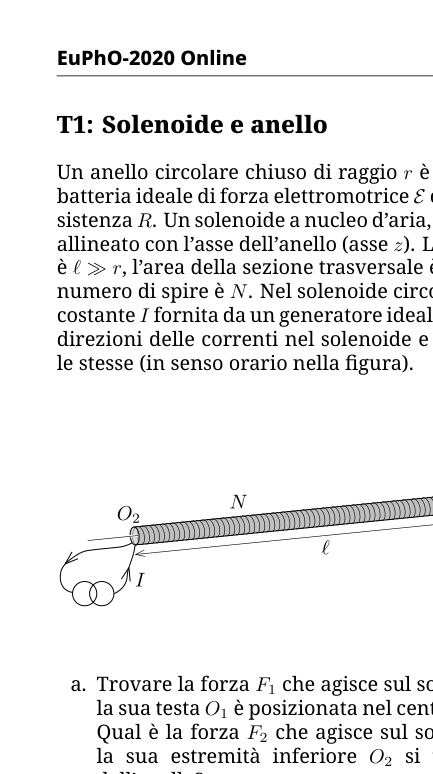 Solenoide allineato con asse anello
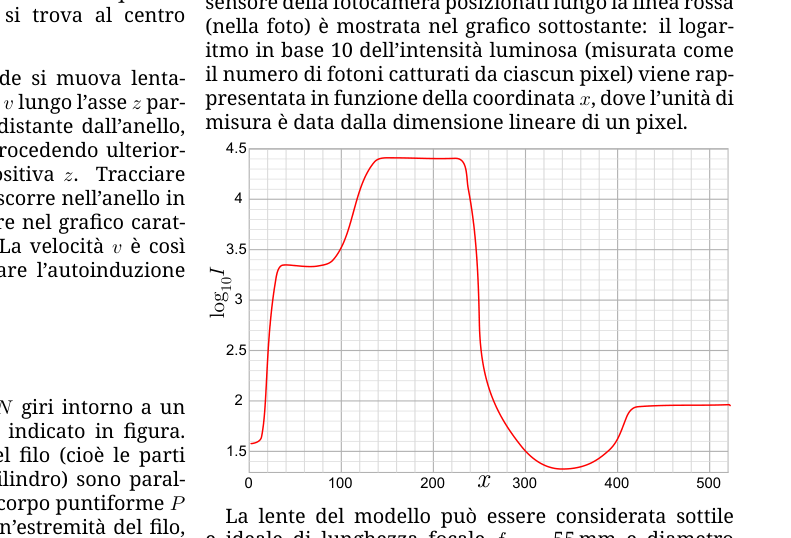 Schema ottico lampada lente fotocamera foglio
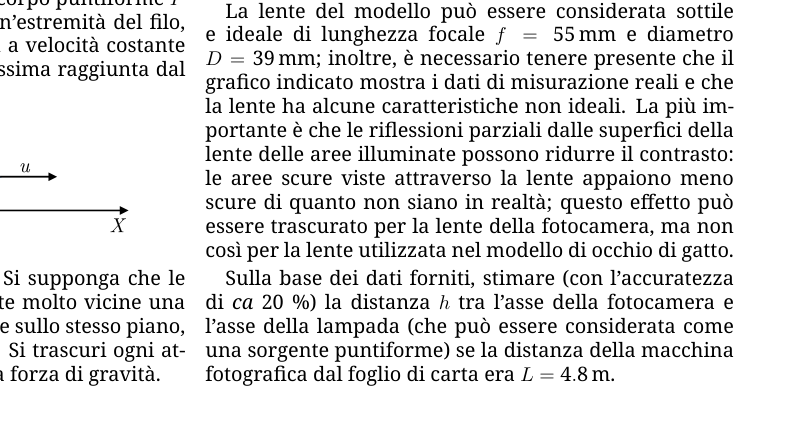 Grafico log10 intensità vs coordinata pixel
Topic: Electromagnetic Induction, Electromagnetism Metodi: Faraday’s Law of Induction, Ampère’s Law, Conservation Laws Competenze: Mathematical Modeling, Diagrammatic Reasoning Objects: Solenoid, Wire, Battery Fonte: Testo (PDF) — p.1 Soluzione: Soluzioni (PDF)
T1: Solenoid and ring
A closed circular beam ring is formed by an ideal electromotive force battery and a resistance wire . A long, thin air core solenoid is aligned with the axis of the ring (axis ). Its length is , cross section area is () and the number of spires is . The solenoid has a constant current provided by an ideal current generator. The direction of the currents in the solenoid and ring are the same (in the time-scale in the figure).
a. Find the force acting on the solenoid when its head is placed in the centre of the ring. What is the force acting on the solenoid when its lower end is at the centre of the ring?
b. Assume now that the solenoid moves slowly at a constant speed along the axis starting from a position very far from the ring, passing its centre and proceeding further to the right in a positive direction . Draw a graph of the current flowing through the ring as a function of time. Highlight important characteristics and values in the graph. The speed is so small that the self-induction of the ring can be overlooked.
Aligned solenoid with ring axis
Lens lamp optical scheme foil camera
The following table shows the number of pixels in the log10 intensity vs pixel coordinate chart:
Topic: Electromagnetic Induction, Electromagnetism Metodi: Faraday’s Law of Induction, Ampère’s Law, Conservation Laws Competenze: Mathematical Modeling, Diagrammatic Reasoning Objects: Solenoid, Wire, Battery Fonte: Testo (PDF) — p.1 Soluzione: Soluzioni (PDF)
T2: Acceleratore meccanico
Un filo senza massa è avvolto per giri intorno a un cilindro fissato staticamente, come indicato in figura. Inizialmente, le estremità libere del filo (cioè le parti del filo non arrotolate intorno al cilindro) sono parallele all’asse . Successivamente un corpo puntiforme dotato di massa viene attaccato a un’estremità del filo, mentre l’altra estremità viene tirata a velocità costante lungo . Calcolare la velocità massima raggiunta dal punto materiale pesante.
Il filo è inestensibile e flessibile. Si supponga che le spire dell’avvolgimento siano avvolte molto vicine una all’altra e siano in pratica posizionate sullo stesso piano, perpendicolare all’asse del cilindro. Si trascuri ogni attrito nel sistema e non si consideri la forza di gravità.
 Filo avvolto intorno al cilindro
Topic: Newtonian Mechanics, Rotational Dynamics Metodi: Conservation of Energy, Kinematic Equations, Physical Modeling Competenze: Mathematical Modeling, Physical Reasoning Objects: String, Cylinder Fonte: Testo (PDF) — p.1 Soluzione: Soluzioni (PDF)
The following shall be added to the list of the following:
A massless wire is wrapped for turns around a statically fixed cylinder, as shown in Figure 1. Initially, the free ends of the wire (i.e. the parts of the wire not rolled around the cylinder) are parallel to the axis. Subsequently a pointed body with mass is attached to one end of the wire, while the other end is pulled at a constant speed along . Calculate the maximum speed reached by the heavy material point.
The wire is extensible and flexible. Suppose the spires of the winding are wrapped very close together and are in practice placed on the same plane perpendicular to the cylinder’s axis. Every friction in the system is neglected and gravity is not taken into account.
Wire wrapped around the cylinder
Topic: Newtonian Mechanics, Rotational Dynamics Metodi: Conservation of Energy, Kinematic Equations, Physical Modeling Competenze: Mathematical Modeling, Physical Reasoning Objects: String, Cylinder Fonte: Testo (PDF) — p.1 Soluzione: Soluzioni (PDF)
T3: Occhi di gatto
Si sarà notato che nell’oscurità, quando un gatto si trova nel raggio di luce di un proiettore, i suoi occhi appaiono molto luminosi. Questo fenomeno può essere modellizzato con un sistema ottico.
La lente del modello può essere considerata sottile e ideale di lunghezza focale e diametro . Il grafico mostra il logaritmo in base 10 dell’intensità luminosa (misurata come il numero di fotoni catturati da ciascun pixel) in funzione della coordinata , dove l’unità di misura è data dalla dimensione lineare di un pixel. La lente ha alcune caratteristiche non ideali: le riflessioni parziali dalle superfici della lente delle aree illuminate possono ridurre il contrasto (le aree scure viste attraverso la lente appaiono meno scure di quanto non siano in realtà); questo effetto può essere trascurato per la lente della fotocamera, ma non così per la lente utilizzata nel modello di occhio di gatto.
Sulla base dei dati forniti, stimare (con l’accuratezza di ca 20%) la distanza tra l’asse della fotocamera e l’asse della lampada (che può essere considerata come una sorgente puntiforme) se la distanza della macchina fotografica dal foglio di carta era .
Topic: Geometric Optics, Wave Optics Metodi: Thin Lens & Mirror Equation, Experimental Data Analysis, Ray Tracing Competenze: Experimental Data Analysis, Estimation & Approximation Objects: Lens Fonte: Testo (PDF) — p.1 Soluzione: Soluzioni (PDF)
T3: Cat’s eyes
You’ve noticed that in the dark, when a cat is in the light ray of a projector, its eyes appear very bright. This phenomenon can be modeled using an optical system.
The lens of the model can be considered thin and ideal with a focal length and a diameter . The graph shows the logarithm in base 10 of the light intensity (measured as the number of photons captured by each pixel) as a function of the coordinate, where the unit of measurement is given by the linear size of a pixel. The lens has some non-ideal characteristics: partial reflections from the lens surfaces of the illuminated areas can reduce contrast (the dark areas seen through the lens appear less dark than they actually are); this effect can be overlooked for the camera lens, but not so for the lens used in the cat’s eye model.
Based on the data provided, estimate (with an accuracy of approximately 20%) the distance between the camera axis and the lamp axis (which can be considered as a point source) if the distance of the camera from the paper was .
Topic: Geometric Optics, Wave Optics Metodi: Thin Lens & Mirror Equation, Experimental Data Analysis, Ray Tracing Competenze: Experimental Data Analysis, Estimation & Approximation Objects: Lens Fonte: Testo (PDF) — p.1 Soluzione: Soluzioni (PDF)