T1: Una perdita
Un cilindro cavo isolato di altezza e volume è chiuso dal basso da un pistone isolante. Il cilindro è diviso in due camere, inizialmente identiche, da un diaframma isolante di massa . Il diaframma poggia su una sporgenza circolare munita di una guarnizione che rende stretto il loro contatto. Entrambe le camere sono riempite con elio gassoso alla pressione e alla temperatura . Viene applicata una forza al pistone, in modo che si muova lentamente verso l’alto.
a. Trova il volume della camera inferiore quando il gas inizia a fluire tra le camere.
b. Trova la temperatura nella camera superiore quando il pistone tocca il diaframma.
c. Trova la temperatura nella camera inferiore immediatamente prima che il pistone tocchi il diaframma.
Topic: Thermodynamics, Newtonian Mechanics Metodi: Ideal Gas Law, First Law of Thermodynamics, Free-Body Diagram Competenze: Physical Reasoning, Mathematical Modeling Objects: Cylinder, Piston, Gas Fonte: Testo (PDF) — p.1 Soluzione: Soluzioni (PDF)
The following table shows the total amount of the loss:
A cylinder cable insulated with a height and volume is closed from the bottom by an insulating piston. The cylinder is divided into two chambers, initially identical, by an insulating diaphragm of mass. The diaphragm rests on a circular protrusion with a seal that makes them close together. Both chambers are filled with gaseous helium at pressure and temperature. A force is applied to the piston, so that it moves slowly upwards.
a. Find the volume of the lower chamber when the gas starts to flow between the chambers.
b. Find the temperature in the upper chamber when the piston touches the diaphragm.
c. Find the temperature in the lower chamber immediately before the piston touches the diaphragm.
Topic: Thermodynamics, Newtonian Mechanics Metodi: Ideal Gas Law, First Law of Thermodynamics, Free-Body Diagram Competenze: Physical Reasoning, Mathematical Modeling Objects: Cylinder, Piston, Gas Fonte: Testo (PDF) — p.1 Soluzione: Soluzioni (PDF)
T2: Un filo intorno ad un cilindro
Un’estremità di un filo è piegata a formare un anello di lunghezza , e un cilindro di raggio viene inserito nell’anello. Il coefficiente di attrito tra il filo e il cilindro è . L’estremità libera del filo viene tirata parallelamente all’asse del cilindro (come mostrato dalla freccia nella foto) mantenendo fermo il cilindro.
Se la lunghezza dell’anello è maggiore di un valore critico, , l’anello può scorrere lungo il cilindro senza modificare la sua forma, altrimenti l’attrito lo “blocca” in un posizione e aumentando la forza di trazione si finirebbe per rompere il filo. Trova questo valore critico . Il peso del filo è da trascurare; il filo non si attorciglia quando viene tirato.
Potrebbe essere utile sapere che
dove .
Topic: Newtonian Mechanics Metodi: Free-Body Diagram, Calculus-Integration, Differential Equations Competenze: Mathematical Modeling, Physical Reasoning Objects: String, Cylinder Fonte: Testo (PDF) — p.1 Soluzione: Soluzioni (PDF)
T2: A wire around a cylinder
One end of a wire is bent to form a length ring, and a cylinder of radius is inserted into the ring. The coefficient of friction between the wire and the cylinder is . The free end of the wire is pulled parallel to the cylinder axis (as shown by the arrow in the photo) keeping the cylinder still.
If the length of the ring is greater than a critical value, , the ring can run along the cylinder without changing its shape, otherwise friction would ‘lock’ it in one position and increasing the tensile strength would end up breaking the wire. Find this critical value . The weight of the wire is negligible; the wire does not twist when pulled.
It may be helpful to know that
where .
Topic: Newtonian Mechanics Metodi: Free-Body Diagram, Calculus-Integration, Differential Equations Competenze: Mathematical Modeling, Physical Reasoning Objects: String, Cylinder Fonte: Testo (PDF) — p.1 Soluzione: Soluzioni (PDF)
T3: Una sfera di vetro
La prima foto qui accanto è scattata con una fotocamera digitale e mostra una sfera di vetro, retroilluminata con luce bicromatica diffusa che ha solo due strette righe spettrali (rosso 630 nm e viola 400 nm). La luce diffusa proviene dal pavimento bianco (contrassegnato con “1” nella figura) e dalle pareti bianche (contrassegnate con “2”), entrambe illuminate con lampade a LED viola e rosse. Il sensore della fotocamera ha solo sensori sensibili al rosso, al blu e al verde, di conseguenza la luce viola appare nella foto come blu. La foto è scattata da una distanza molto maggiore del raggio della sfera.
Sul retro della sfera, un filo opaco molto sottile è incollato alla superficie di vetro, formando, sulla sfera, un arco di cerchio massimo. Nella foto il filo è coperto dalla sfera e non può essere osservato direttamente. Tuttavia, immagini estremamente deformate di un segmento molto corto del filo sono viste come ellissi blu (contrassegnate con “b”) e rosse (“r”). La lettera “p” indica le aree di colore porpora nella foto.
Nella prima foto, il centro della sfera è segnato con una croce, e il perimetro della sfera è tracciato con una linea tratteggiata. Puoi trovare una versione più grande della prima foto su un foglio a parte. Puoi effettuare le misurazioni delle lunghezze su questa immagine. Nella foto più grande è indicato, con una linea tratteggiata, anche il confine tra le regioni rossa e porpora.
La seconda foto è stata scattata mentre si illumina la scena con un LED bianco, con la sfera girata in modo che il filo possa essere visto direttamente.
a. Spiega qualitativamente, usando un diagramma dei raggi luminosi, perché un segmento del filo è visto come un anello chiuso nella prima foto.
b. Determina il coefficiente di rifrazione per la luce rossa.
c. Determina la differenza dei coefficienti di rifrazione per la luce viola e rossa (dove indica il coefficiente di rifrazione per la luce viola).
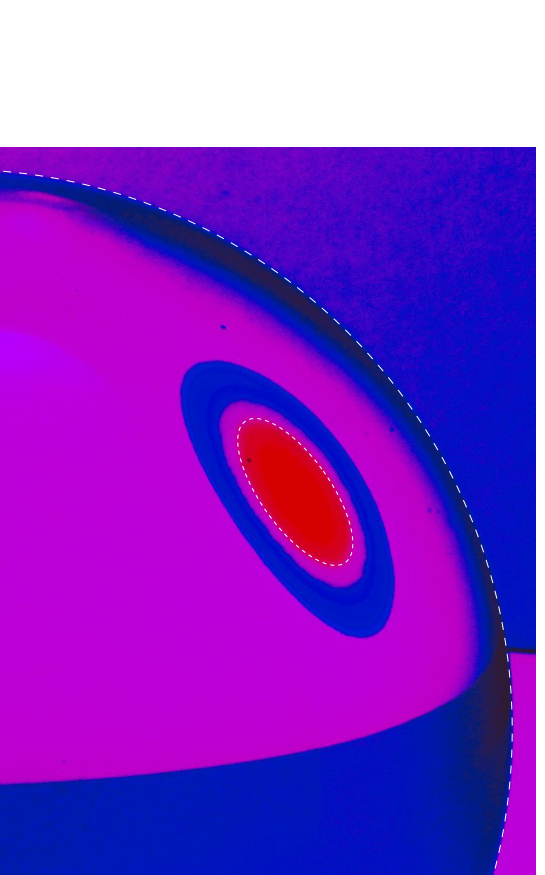 Glass sphere with bichromatic backlight, wire images
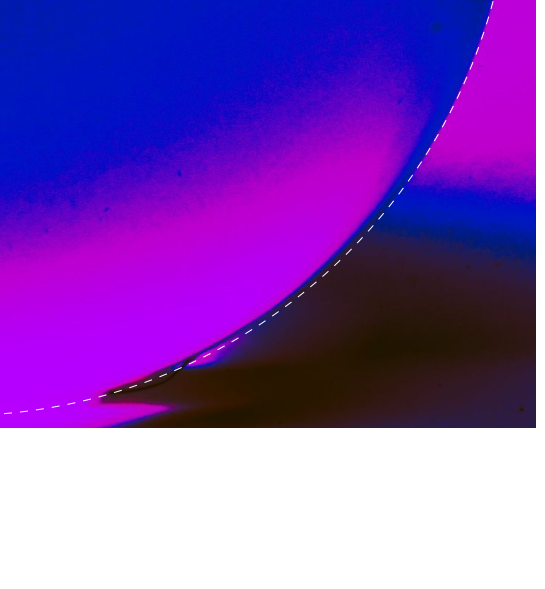 Sphere with wire visible under white LED
Topic: Geometric Optics, Wave Optics Metodi: Ray Tracing, Snell’s Law, Superposition Principle Competenze: Diagrammatic Reasoning, Mathematical Modeling Objects: Sphere, Wire Fonte: Testo (PDF) — p.2 Soluzione: Soluzioni (PDF)
The following table shows the results of the calculation of the total weight of the product:
The first photo here next door was taken with a digital camera and shows a glass sphere, backlit with diffuse bichromatic light that has only two narrow spectral lines (red 630 nm and purple 400 nm). The diffuse light comes from the white floor (marked with “1” in the figure) and the white walls (marked with “2”), both illuminated with purple and red LED lamps. The camera’s sensor only has sensors sensitive to red, blue and green, so purple light appears in the photo as blue. The photo was taken from a distance far beyond the radius of the sphere.
On the back of the sphere, a very thin opaque thread is glued to the glass surface, forming a maximum circle arc on the sphere. In the photo, the wire is covered by the sphere and cannot be directly observed. However, extremely distorted images of a very short segment of the wire are seen as blue (marked with “b”) and red (“r”) ellipses. The letter “p” indicates the purple areas in the photo.
In the first photo, the center of the sphere is marked with a cross, and the perimeter of the sphere is drawn with a line drawn. You can find a larger version of the first photo on a separate sheet. You can measure the lengths on this image. The larger picture shows, with a drawn line, the border between the red and purple regions.
The second photo was taken while illuminating the scene with a white LED, with the sphere rotated so that the wire can be seen directly.
a. Explain qualitatively, using a light-ray diagram, why a segment of the wire is seen as a closed ring in the first photo.
b. Determine the refractive index for red light.
c. Determine the difference of refractive coefficients for purple and red light (where indicates the refractive coefficient for purple light).
The following table shows the results of the tests:
Sphere with wire visible under white LED
Topic: Geometric Optics, Wave Optics Metodi: Ray Tracing, Snell’s Law, Superposition Principle Competenze: Diagrammatic Reasoning, Mathematical Modeling Objects: Sphere, Wire Fonte: Testo (PDF) — p.2 Soluzione: Soluzioni (PDF)