EuPhO-2022 Problemi teorici. Lingua: Italiano
T1: Cilindro galleggiante (10 pts)
Un cilindro solido e uniforme di altezza e area di base galleggia in un bicchiere cilindrico di altezza e area interna riempito con un liquido. Il rapporto tra la densità del cilindro e quella del liquido è . Il fondo del cilindro si trova alcuni centimetri sopra il fondo del bicchiere. Il cilindro viene fatto oscillare verticalmente, in modo che il suo asse coincida sempre con quello del bicchiere.
L’ampiezza delle oscillazioni del livello del liquido è .
Trova il periodo delle oscillazioni . Trascura la viscosità del liquido.
T2: Oscillazioni termiche (10 pts)
Un resistore è costituito da un materiale che subisce una transizione di fase in modo tale che la sua resistenza assuma uno dei due valori seguenti, se la sua temperatura è inferiore a , e se la temperatura è maggiore di .
Il resistore viene collegato a una sorgente di tensione attraverso un induttore di induttanza . Se la tensione applicata è compresa tra due valori critici, , la temperatura della resistenza inizia a oscillare. Si supponga che (i) il flusso di calore dal resistore al mezzo ambiente sia dato da , dove è una costante, indica la temperatura del resistore, e è la temperatura ambiente; (ii) la dimensione geometrica del resistore sia così piccola che esso raggiunge l’equilibrio termico molto più velocemente del tempo caratteristico .
(a) (2 punti) Esprimi e in funzione dei parametri definiti sopra.
(b) (6 punti) Supponendo che , rappresenta qualitativamente l’andamento della temperatura della resistenza in funzione del tempo , e trova il rapporto , dove e sono, rispettivamente, il massimo e il minimo valore di .
(c) (2 punti) Nel caso in cui e , trova il periodo delle oscillazioni.
T3: Dipolo in a campo magnetico (10 pts)
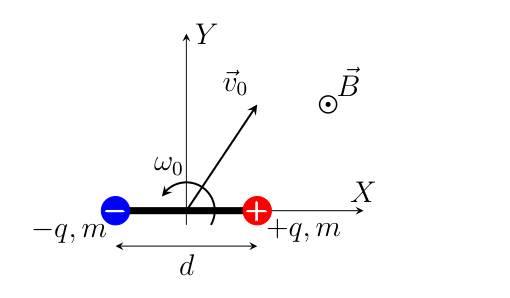
Due palline ciascuna di massa e con carica rispettivamente e , collegate da un’asta rigida priva di massa di lunghezza , formano un dipolo. Il dipolo è parallelo al piano ed è posto in un campo magnetico uniforme perpendicolare a .
Inizialmente il dipolo è allineato con la direzione e ruota nel piano con velocità angolare iniziale , come mostrato. Il suo centro di massa è inizialmente situato nell’origine del sistema di riferimento e la velocità iniziale è parallela a .
Considera tre situazioni distinte (a, b, c-d):
(a) (2 punti) Determina e la direzione e verso di , in modo che il centro di massa si muova con velocità costante .
(b) (3 punti) Data , trova (direzione, verso e intensità), in modo che il centro di massa descriva una traiettoria circolare. Trova il raggio della circonferenza e le coordinate del suo centro. Non è necessario dimostrare l’unicità della soluzione.
(c) (4 punti) Data , trova il valore minimo necessario affinché il dipolo inverta il verso durante il movimento.
(d) (1 punto) Se il dipolo inizia il movimento con e trovato nella parte (c), la traiettoria del suo centro di massa ha un asintoto. Trova la distanza dall’origine all’asintoto.
Identità vettoriale utile:
dove "" e "" rappresentano rispettivamente il prodotto vettoriale e il prodotto scalare.
p.1 — Dipolo con assi XY, velocita e campo B
Topic: Oscillations & Waves, Fluid Mechanics, Magnetism Metodi: Simple Harmonic Motion Analysis, Hydrostatic Equilibrium, Lorentz Force Analysis, Torque & Angular Momentum Analysis Competenze: Mathematical Modeling, Physical Reasoning, Diagrammatic Reasoning Objects: Cylinder, Container, Resistor, Inductor, Magnetic Dipole Fonte: Testo (PDF) — p.1 Soluzione: Soluzioni (PDF)
The Commission shall adopt implementing acts in accordance with Article 21 of this Regulation. Theoretical problems. Language: Italian
T1: Floating cylinder (10 pts)
A solid, uniform cylinder of height and base area floats in a cylindrical glass of height and internal area filled with a liquid. The ratio of the density of the cylinder to that of the liquid is . The bottom of the cylinder is a few centimeters above the bottom of the glass. The cylinder is made to swing vertically, so that its axis always coincides with that of the glass.
The fluid level oscillation amplitude is .
Find the oscillation period . It’s a trace of the viscosity of the liquid.
T2: Thermal oscillations (10 pts)
A resistor consists of a material undergoing a phase transition such that its resistance assumes one of the following two values, if its temperature is less than , and if the temperature is greater than .
The resistor is connected to a voltage source via an inductance inductor . If the applied voltage is between two critical values, , the resistance temperature begins to oscillate. Assume that (i) the heat flow from the resistor to the ambient medium is given by , where is a constant, indicates the resistor temperature, and is the ambient temperature; (ii) the geometrical size of the resistor is so small that it reaches the thermal equilibrium much faster than the characteristic time .
(a) (2 points) Expressions and according to the parameters defined above.
(b) (6 points) Assuming , it qualitatively represents the temperature trend of the resistance in terms of time , and finds the ratio , where and are the maximum and minimum values of , respectively.
(c) (2 points) In the case of and , find the period of oscillations.
T3: Dipolo in magnetic field (10 pts)
Two balls of mass and and load, connected by a rigid axle without a length mass, form a dipole. The dipole is parallel to the plane and is placed in a uniform magnetic field perpendicular to .
Initially the dipole is aligned with the direction and rotates in the plane with initial angular velocity , as shown. Its centre of mass is initially located at the origin of the reference system and the initial speed is parallel to .
Consider three distinct situations (a, b, c-d):
(a) (2 points) Determine and the direction and direction of so that the centre of mass moves at a constant speed .
(b) (3 points) The data , finds (direction, direction and intensity), so that the centre of mass describes a circular trajectory. Find the radius of circumference and the coordinates of its center. It is not necessary to demonstrate the uniqueness of the solution.
(c) (4 points) The data finds the minimum value required for the dipole to turn inwards during movement.
(d) (1 point) If the dipole starts its motion with and found in part (c), the trajectory of its center of mass has an asymptote. Find the distance from the source to the asynchronous.
Useful vector identity:
where '' and '' represent the vector product and the scalar product respectively.
p.1 XY axis dipole, speed and field B
Topic: Oscillations & Waves, Fluid Mechanics, Magnetism Metodi: Simple Harmonic Motion Analysis, Hydrostatic Equilibrium, Lorentz Force Analysis, Torque & Angular Momentum Analysis Competenze: Mathematical Modeling, Physical Reasoning, Diagrammatic Reasoning Objects: Cylinder, Container, Resistor, Inductor, Magnetic Dipole Fonte: Testo (PDF) — p.1 Soluzione: Soluzioni (PDF)