T1: Un disco che scorre (10 punti)
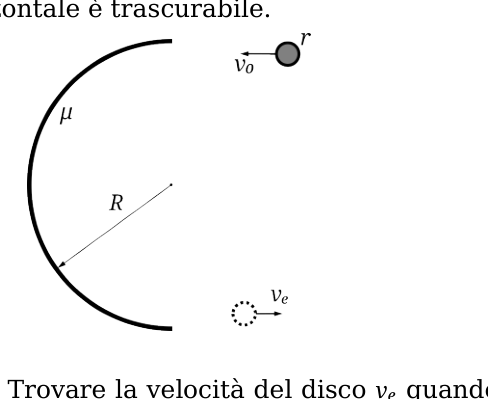
Un disco di raggio e densità uniforme si muove su un piano orizzontale con velocità senza ruotare. Il disco incontra una parete semicircolare fissa con raggio e inizia a muoversi lungo la parete. Il coefficiente di attrito con la parete è , e l’attrito con il piano orizzontale è trascurabile.
a) (8 punti) Trovare la velocità del disco quando lascia il muro.
b) (2 punti) Disegnare il grafico . Indicare le caratteristiche importanti del grafico. Siete invitati a disegnare il grafico anche se non avete trovato la formula esatta per .
p.1 — Disco con velocita iniziale contro parete semicircolare
Topic: Rotational Dynamics, Newtonian Mechanics Metodi: Free-Body Diagram, Conservation of Energy, Torque & Angular Momentum Analysis Competenze: Mathematical Modeling, Physical Reasoning Objects: Disk Fonte: Testo (PDF) — p.1 Soluzione: Soluzioni (PDF)
T1: Sliding puck (10 pts)
A puck (a small disc) with radius and uniform density is moving on a horizontal plane with the velocity without rotation. The puck meets a fixed half-circular wall with a radius and starts to move along the wall. The coefficient of friction with the wall is , and friction with the horizontal plane is negligible.
a) (8 pts) Find the velocity of the puck when it leaves the wall.
b) (2 pts) Sketch the graph . Indicate important features of the graph. You are encouraged to sketch the graph even if you haven’t found the exact formula for .
p.1 Disk with initial speed against a semicircular wall
Topic: Rotational Dynamics, Newtonian Mechanics Metodi: Free-Body Diagram, Conservation of Energy, Torque & Angular Momentum Analysis Competenze: Mathematical Modeling, Physical Reasoning Objects: Disk Fonte: Testo (PDF) — p.1 Soluzione: Soluzioni (PDF)
T2: Astronavi (10 punti)
Alice e Bob sono gemelli e lavorano come due astronauti in una lunga missione spaziale. Dopo molti anni, si stanno finalmente avvicinando per ricongiungersi. L’astronave di Alice si muove verso l’astronave di Bob a una velocità di , dove è la velocità della luce nel vuoto.
Durante il loro avvicinamento, Alice e Bob si inviano reciprocamente dei regali. Alice invia doni a Bob a intervalli regolari di tempo nel proprio sistema di riferimento, con ogni dono che viaggia a una velocità (sempre nel suo sistema di riferimento). Allo stesso modo, Bob invia regali ad Alice agli stessi intervalli di tempo regolari nel proprio sistema di riferimento, con ogni regalo che viaggia anch’esso a una velocità nel suo sistema di riferimento. Supponiamo che la distanza tra Alice e Bob sia abbastanza grande da avere molti regali in transito in ogni momento.
a) (5 punti) Nel sistema di riferimento di Bob, si calcoli:
(i) la distanza fra due regali consecutivi inviati da Alice e
(ii) la distanza temporale alla quale questi regali di Alice arrivano all’astronave di Bob.
b) (5 punti) In ogni momento, Alice può vedere un numero di regali che si allontanano da lei e un numero di regali che si muovono verso di lei. Qual è il rapporto tra questi due numeri?
Topic: Special Relativity Metodi: Lorentz Transformation, Relativistic Energy-Momentum Competenze: Mathematical Modeling, Physical Reasoning Objects: — Fonte: Testo (PDF) — p.1 Soluzione: Soluzioni (PDF)
T2: Spaceships (10 pts)
Alice and Bob are twin astronauts on a long space mission. After many years, they are finally approaching each other to reunite. Alice’s spaceship is moving towards Bob’s spaceship at a speed of , where is the speed of light.
During their approach, both Alice and Bob send gifts to each other. Alice sends gifts to Bob at regular time intervals in her own frame of reference, with each gift travelling at a velocity (again, in her frame of reference). Similarly, Bob sends gifts to Alice at the same regular time intervals in his own frame of reference, with each gift also travelling at a velocity in his frame of reference. Assume that the distance between Alice and Bob is so large that there are many gifts in transit at any given moment.
a) (5 pts) In Bob’s reference frame, find
(i) the distance between two successive gifts sent by Alice, and
(ii) the time interval at which these gifts from Alice arrive at Bob’s spaceship.
b) (5 pts) At a given instant, Alice can see a number of gifts moving away from her and a number of gifts moving towards her. What is the ratio between these two numbers?
Topic: Special Relativity Metodi: Lorentz Transformation, Relativistic Energy-Momentum Competenze: Mathematical Modeling, Physical Reasoning Objects: — Fonte: Testo (PDF) — p.1 Soluzione: Soluzioni (PDF)
T3: Interferometro di Fabry–Pérot (10 punti)
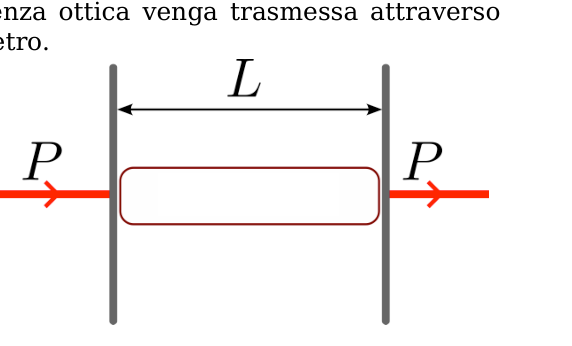
Un interferometro di Fabry-Pérot è costituito da due specchi piani paralleli identici separati da una distanza . Lo spazio tra gli specchi e all’esterno degli specchi è riempito d’aria. Gli specchi sono parzialmente riflettenti; quando la luce è diretta verso uno di questi specchi lungo la direzione normale, il fascio riflesso ha un’intensità volte l’intensità del fascio incidente.
Si supponga che gli specchi siano simmetrici, cioè ciascuno dei due interagisce da entrambi i lati allo stesso modo con la luce incidente, e che siano privi di perdite. Si supponga inoltre che siano altamente riflettenti, ossia che . Un raggio laser monocromatico di potenza viene diretto verso l’interferometro perpendicolarmente agli specchi. La distanza è scelta in modo che il fascio riflesso all’indietro svanisca, cioè che tutta la potenza ottica venga trasmessa attraverso l’interferometro.
a) (3 punti) Si dimostri che il fascio laser deve acquisire una differenza di fase non nulla quando passa attraverso uno degli specchi.
b) (2 punti) Si trovi il valore di .
c) (4 punti) A un certo punto, il raggio laser incidente viene spento rapidamente. Si trovi l’energia totale della luce che, dopo lo spegnimento del laser, torna dall’interferometro verso il laser stesso.
d) (1 punto) Si stimi la durata temporale dell’impulso di luce che ritorna verso il laser.
p.1 — Interferometro Fabry-Perot con due specchi
Topic: Wave Optics Metodi: Interference & Diffraction Analysis, Superposition Principle Competenze: Mathematical Modeling, Physical Reasoning Objects: Mirror Fonte: Testo (PDF) — p.1 Soluzione: Soluzioni (PDF)
T3: Fabry–Pérot interferometer (10 pts)
A Fabry–Pérot interferometer consists of two identical parallel planar mirrors separated by a distance . The space between and outside the mirrors is filled with air. The mirrors are partially reflective; when light is aimed towards one of these mirrors along the normal direction, the reflected beam has intensity times the intensity of the incident beam. Assume that the mirrors are symmetric, meaning they interact the same way with light incident from either side, and lossless. Assume also that they are highly reflective, meaning . A monochromatic laser beam of power is aimed towards the interferometer perpendicular to the mirrors. The distance is chosen so that the back-reflected beam vanishes, i.e. all the optical power is transmitted through the interferometer.
a) (3 pts) Show that the laser beam must acquire a nonzero phase shift when it passes through either of the mirrors.
b) (2 pts) Find the magnitude of .
c) (4 pts) At a certain moment, the incident laser beam is switched off rapidly. Find the total energy of the light that travels back from the interferometer towards the laser after the laser is switched off.
d) (1 pt) Estimate the duration of the light pulse that travels back towards the laser.
Fabry-Perot interferometer with two mirrors
Topic: Wave Optics Metodi: Interference & Diffraction Analysis, Superposition Principle Competenze: Mathematical Modeling, Physical Reasoning Objects: Mirror Fonte: Testo (PDF) — p.1 Soluzione: Soluzioni (PDF)