T1: Sunny (10 pts)
You are asked to study the features of the brightly lit circle and dark rings in the figures below. Make your calculations for an idealized situation: the chair leg is strictly cylindrical of radius , strictly vertical, with a perfectly smooth, cylindrical, and perfectly reflecting surface. You may make any additional model assumptions and approximations you deem reasonable that will simplify your calculations.
a) (5 pts) Determine how the illuminance surplus inside the brightly lit circle on the floor depends on the polar coordinates and . The illuminance quantifies the amount of incoming light per area. By “surplus” we mean the additional illuminance introduced due to the presence of the cylinder. Express the answer in terms of defined as the illuminance difference between points A and B in the figure.
b) (5 pts) In the following figure some fingers are blocking some of the light from reaching the chair leg. Let denote the radial distance of the middle dark ring as a function of the angle and let be the minimal value of . Determine .
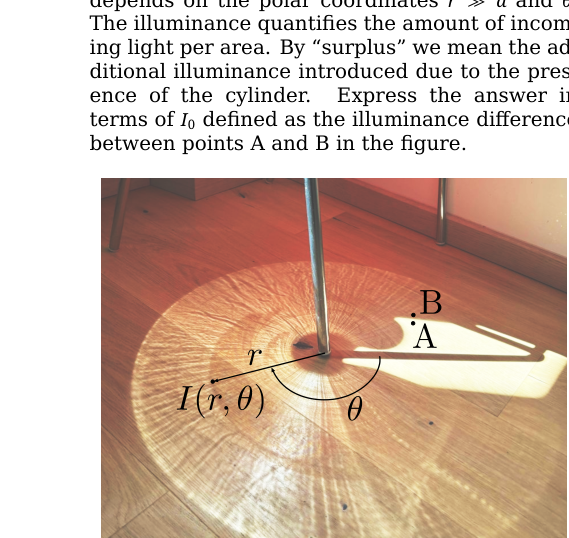 Brightly lit circle and dark rings around chair leg
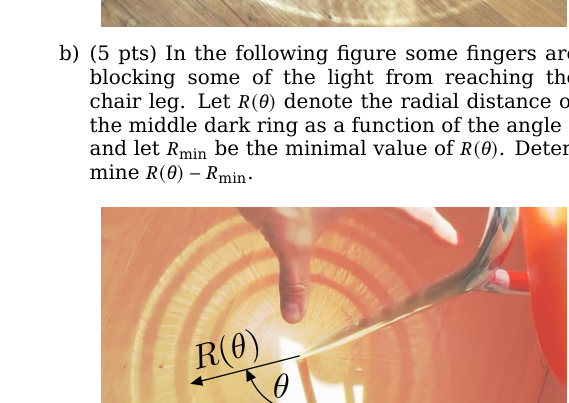 Fingers blocking light, dark ring R(θ)
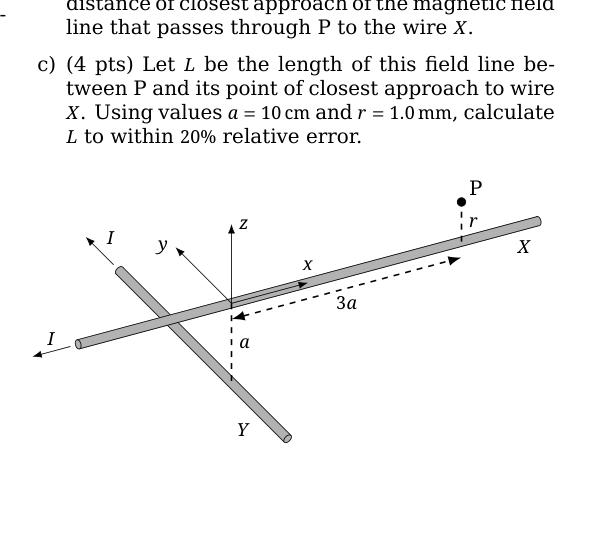 Two crossed current-carrying wires X and Y with point P
Topic: Geometric Optics, Wave Optics Metodi: Ray Tracing, Superposition Principle, Small-Angle Approximation Competenze: Physical Reasoning, Mathematical Modeling Objects: Cylinder Fonte: Testo (PDF) — p.1 Soluzione: Soluzioni (PDF)
T1: Sunny (10 pts)
You are asked to study the features of the brightly lit circle and dark rings in the figures below. Make your calculations for an idealized situation: the chair leg is strictly cylindrical of radius , strictly vertical, with a perfectly smooth, cylindrical, and perfectly reflecting surface. You may make any additional model assumptions and approximations you deem reasonable that will simplify your calculations.
a) (5 pts) Determine how the illuminance surplus inside the brightly lit circle on the floor depends on the polar coordinates and . The illuminance quantifies the amount of incoming light per area. By “surplus” we mean the additional illuminance introduced due to the presence of the cylinder. Express the answer in terms of defined as the illuminance difference between points A and B in the figure.
(b) (5 pts) In the following figures some fingers are blocking some of the light from reaching the chair leg. Let denote the radial distance of the middle dark ring as a function of the angle and let be the minimal value of . Determine .
*Brightly lit circle and dark rings around chair leg *
Fingers blocking light, dark ring R(θ)
Two crossed current-carrying wires X and Y with point P
Topic: Geometric Optics, Wave Optics Metodi: Ray Tracing, Superposition Principle, Small-Angle Approximation Competenze: Physical Reasoning, Mathematical Modeling Objects: Cylinder Fonte: Testo (PDF) — p.1 Soluzione: Soluzioni (PDF)
T2: Floating table (10 pts)
A table is made by fastening a metal frame to a massive uniform plate (so they form a rigid body) and attaching it with chains to another frame that is fixed on the horizontal ground. The motion of the table is limited to the plane of the side view (right picture).
a) (4 pts) Show that in the configuration on the side view, the table is in a stable equilibrium.
b) (6 pts) Find the period of the small oscillations.
The masses of the chains and the frame can be neglected. The chains are frictionless, inextensible, and remain tensioned in oscillations. The grid step is m, the acceleration of gravity m/s.
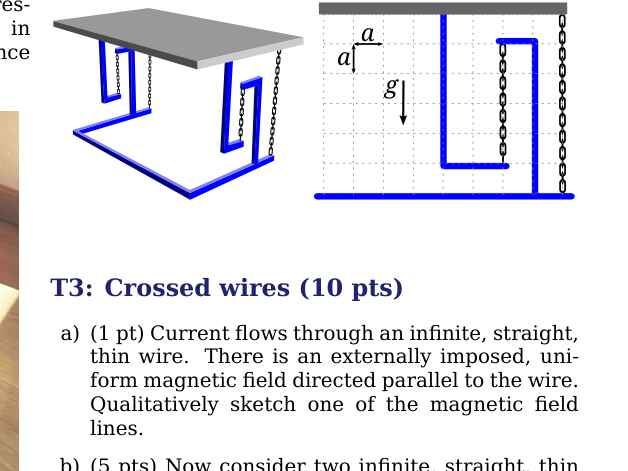 Floating table with chains, side view diagram
Topic: Newtonian Mechanics, Oscillations & Waves Metodi: Free-Body Diagram, Simple Harmonic Motion Analysis, Torque & Angular Momentum Analysis Competenze: Physical Reasoning, Mathematical Modeling Objects: — Fonte: Testo (PDF) — p.1 Soluzione: Soluzioni (PDF)
The following table shows the number of units of the vehicle:
A table is made by fastening a metal frame to a massive uniform plate (so they form a rigid body) and attaching it with chains to another frame that is fixed on the horizontal ground. The motion of the table is limited to the plane of the side view (right picture).
(a) (4 pts) Show that in the configuration on the side view, the table is in stable equilibrium.
(b) (6 pts) Find the period of the small oscillations.
The masses of the chains and the frame can be neglected. The chains are frictionless, inextensible, and remain tense in oscillations. The grid step is m, the acceleration of gravity m/s.
The following table shows the number of units in the unit:
Topic: Newtonian Mechanics, Oscillations & Waves Metodi: Free-Body Diagram, Simple Harmonic Motion Analysis, Torque & Angular Momentum Analysis Competenze: Physical Reasoning, Mathematical Modeling Objects: — Fonte: Testo (PDF) — p.1 Soluzione: Soluzioni (PDF)
T3: Crossed wires (10 pts)
a) (1 pt) Current flows through an infinite, straight, thin wire. There is an externally imposed, uniform magnetic field directed parallel to the wire. Qualitatively sketch one of the magnetic field lines.
b) (5 pts) Now consider two infinite, straight, thin wires (wires and ), each carrying a current as shown in the figure. The -axis coincides with wire , while wire is parallel to the -axis and passes through the point . Let P be the point . Assuming , calculate , the distance of closest approach of the magnetic field line that passes through P to the wire .
c) (4 pts) Let be the length of this field line between P and its point of closest approach to wire . Using values cm and mm, calculate to within 20% relative error.
Topic: Magnetism, Electromagnetism Metodi: Biot-Savart Law, Superposition Principle, Differential Equations Competenze: Mathematical Modeling, Physical Reasoning Objects: Wire Fonte: Testo (PDF) — p.1 Soluzione: Soluzioni (PDF)
T3: Crossed wires (10 pts)
(a) (1 pt) Current flows through an infinite, straight, thin wire. There is an externally imposed, uniform magnetic field directed parallel to the wire. Qualitatively sketch one of the magnetic field lines.
b) (5 pts) Now consider two infinite, straight, thin wires (wires and ), each carrying a current as shown in the figure. The -axis coincides with wire , while wire is parallel to the -axis and passes through the point . Let P be the point . Assuming , calculating , the distance of closest approach of the magnetic field line that passes through P to the wire .
(c) (4 pts) Let be the length of this field line between P and its point of closest approach to wire . Using values cm and mm, calculated to within 20% relative error.
Topic: Magnetism, Electromagnetism Metodi: Biot-Savart Law, Superposition Principle, Differential Equations Competenze: Mathematical Modeling, Physical Reasoning Objects: Wire Fonte: Testo (PDF) — p.1 Soluzione: Soluzioni (PDF)