James Webb Space Telescope (12 punti)
Questo è un problema sulla fisica del James Webb Space Telescope. La luce proveniente da una stella colpisce lo specchio primario, che ha un’area di , e la riflette sullo specchio secondario. La lunghezza focale del sistema è . La luce viene focalizzata nell’ISIM (Integrated Science Instrument Module), che contiene il sensore CCD (Charge-Coupled Device).
Parte A — Visualizzare una stella (1.8 punti)
La stella gigante rossa più vicina si trova a una distanza di 89 anni-luce, ha una temperatura di , e un diametro .
A.1 (0.4 pt) Calcola il diametro dell’immagine della stella focalizzata sulla superficie sensibile del sensore CCD.
A.2 (0.4 pt) Stima il diametro del massimo centrale di diffrazione sulla superficie sensibile del sensore CCD. Assumi una lunghezza d’onda , che è la lunghezza d’onda del massimo di intensità della stella gigante rossa.
A.3 (1.0 pt) Se il sensore del CCD non viene raffreddato e può perdere calore solo irradiandolo dalla parte superiore della superficie sensibile, quale sarebbe la temperatura di equilibrio del CCD nell’area ove si forma l’immagine della gigante rossa? Si assuma che la superficie del CCD sia quella di un corpo nero. Si fornisca una formula e una stima numerica.
Parte B — Contare i fotoni (1.8 punti)
L’assorbimento di un fotone dal sensore del CCD provoca l’emissione di un elettrone nell’apparato. Questo avviene solo se il fotone ha energia sufficiente per eccitare un elettrone a superare il gap di energia . Si assuma che ogni fotone che ha energia sufficiente ecciti un elettrone. Esiste anche una fuoriuscita di elettroni attraverso il gap dovuta alla temperatura del sensore CCD; questa è la corrente di buio e viene misurata in numero di elettroni al secondo. È una funzione della temperatura secondo la relazione
dove è una costante.
Il grafico mostra come varia la corrente di buio con la temperatura. Le unità per la corrente di buio, , devono essere interpretate come espressione del conteggio del numero di elettroni per secondo.
B.1 (0.4 pt) Dal grafico della corrente di buio, fornisci una stima dell’ordine di grandezza della temperatura di una sorgente lontana di fotoni termici di soglia che sarebbero in grado di eccitare appena un elettrone in quel pixel.
Gli elettroni sono raccolti in un condensatore, e dopo un tempo di esposizione , vengono contati. Ci sono tre sorgenti principali di errori nel processo: una incertezza fissa nel processo di conteggio chiamata errore di lettura; un errore distribuito secondo la distribuzione di Poisson associato con la corrente di buio; un errore distribuito secondo la distribuzione di Poisson associato con la rivelazione del fotone incidente. Gli errori distribuiti secondo la distribuzione di Poisson sono uguali alla radice quadrata del numero di conteggi associati con quel processo.
Il numero di fotoni misurato è uguale al numero di elettroni nel condensatore meno il numero di elettroni associati con la corrente di buio.
B.2 (0.4 pt) Scrivi un’espressione per l’incertezza totale del conteggio , in presenza di un errore di lettura , una corrente di buio , un numero di fotoni incidenti per secondo , e un tempo di esposizione .
Per le rimanenti domande di questa parte si assuma per il tempo di esposizione e l’errore di lettura è fissato al valore .
B.3 (0.5 pt) Si assuma una temperatura di esercizio pari a . Si calcoli il numero minimo di fotoni incidenti al secondo affinché il conteggio dei fotoni sia dieci volte l’incertezza del conteggio.
B.4 (0.5 pt) Assumendo che tutti i fotoni siano appena in grado di eccitare un elettrone attraverso il gap di energia, qual è l’intensità della sorgente di fotoni trovata in B.3 sullo specchio primario? Si esprima il risultato in .
Parte C — Raffreddamento passivo (4.4 punti)
Un sensore CCD deve essere mantenuto a bassa temperatura. La prima accortezza è mettere uno schermo per proteggerlo dalla radiazione del sole.
Lo schermo solare consiste di cinque strati separati riflettenti in fogli sottili; l’energia radiante del sole incide sul primo foglio a sinistra e una certa quantità di energia sfugge tra ogni coppia di fogli.
Si considerino due fogli adiacenti, 1 e 2, separati da una distanza . I fogli non si toccano e il perimetro comunica con lo spazio. Per semplicità si assuma che i fogli siano paralleli. La radiazione termica può essere scambiata tra i fogli e la radiazione termica può sfuggire attraverso lo spazio aperto nel perimetro.
Si assumano le seguenti approssimazioni:
- I fogli sono quadrati ciascuno con un’area pari a .
- I fogli sono paralleli e separati di lungo il perimetro.
- I fogli hanno un coefficiente di emissività . Si assuma che tutte le riflessioni al di fuori delle superfici del foglio siano diffuse.
- I fogli sono sottili e la temperatura sulle facce anteriori e posteriori sono uguali e uniformi.
- La frazione di flusso radiante emessa da un foglio e assorbita dal foglio adiacente è . Ciò significa che se la superficie 1 emette una quantità di calore verso la superficie 2 allora la superficie 2 assorbirà una quantità di calore dalla superficie 1.
- La quantità di flusso radiante espulsa dallo spazio lungo il perimetro tra i due fogli viene approssimata come mentre è il flusso netto tra i due fogli. Si assuma . Questo equivale a dire che il calore perso nello spazio tra i due fogli è proporzionale al calore netto scambiato tra i due fogli. Questa è una approssimazione brutale nel problema.
- La temperatura di fondo dello spazio è trascurabile.
C.1 (2.4 pt) Si ricavi l’espressione per le temperature di equilibrio del primo foglio e del quinto foglio in termini dell’intensità della radiazione solare incidente , le costanti e , e le necessarie costanti fisiche. Per semplificare l’espressione è possibile definire ulteriori costanti espresse in funzione di e , ecc.
C.2 (1.6 pt) Si ricavino stime numeriche per e dalle informazioni sulla geometria dei fogli assumendo un coefficiente di emissività . Si raccomanda di considerare il modello a scatola rettangolare dei fogli presentato sopra, dove la superficie laterale agisce effettivamente come un assorbitore ideale di energia radiante.
C.3 (0.4 pt) Determina numericamente le temperature dei fogli 1 e 5. L’intensità solare è .
Parte D — Refrigeratore criogenico (4 punti)
L’ultimo stadio del sistema di raffreddamento raffredda direttamente il CCD. Un sistema di raffreddamento a ciclo chiuso ha un tubo di ingresso che immette elio gassoso a pressione costante . L’elio fluisce attraverso un’intercapedine porosa spugnosa (porous plug) in un tubo a pressione costante . Il tubo trasporta il gas che raffredda il CCD. L’elio gassoso passa quindi attraverso una pompa prima di ritornare alla linea di ingresso.
Elio gassoso, fornito a sinistra a una pressione ben definita e temperatura , viene forzato attraverso un’intercapedine a una pressione e temperatura , ben definite, e viene rimosso da destra.
Quando il gas attraversa l’interfaccia porosa, l’attrito viscoso con le pareti sottili dei canali nella parte spugnosa ha un effetto rilevante; invece, non vi è scambio di calore dal gas durante questo processo. La velocità della massa di gas nella regione 2 è solo marginalmente maggiore della velocità della massa di gas nella regione 1.
L’elio non è un gas perfetto, ma rimane allo stato gassoso durante tutto il processo.
D.1 (1.0 pt) Si consideri una mole di gas che attraversa da sinistra a destra l’interfaccia. Si completi la tabella scrivendo ”>” o ”<” per identificare la quantità che deve essere maggiore, ”=” per identificare le quantità che devono essere uguali, o ”?” se non è possibile sapere quale è maggiore o uguale senza ulteriori informazioni.
| Nome della grandezza fisica | Stato 1 | Confronto | Stato 2 |
|---|---|---|---|
| Energia Interna | |||
| Temperatura | |||
| Entropia | |||
| Pressione | |||
| Volume |
D.2 (0.6 pt) Si identifichi una grandezza fisica conservata costruita a partire da (energia interna), (pressione), e (volume) quando una mole di gas attraversa l’interfaccia; si mostrino i passaggi esplicativi di come viene derivata la grandezza fisica conservata.
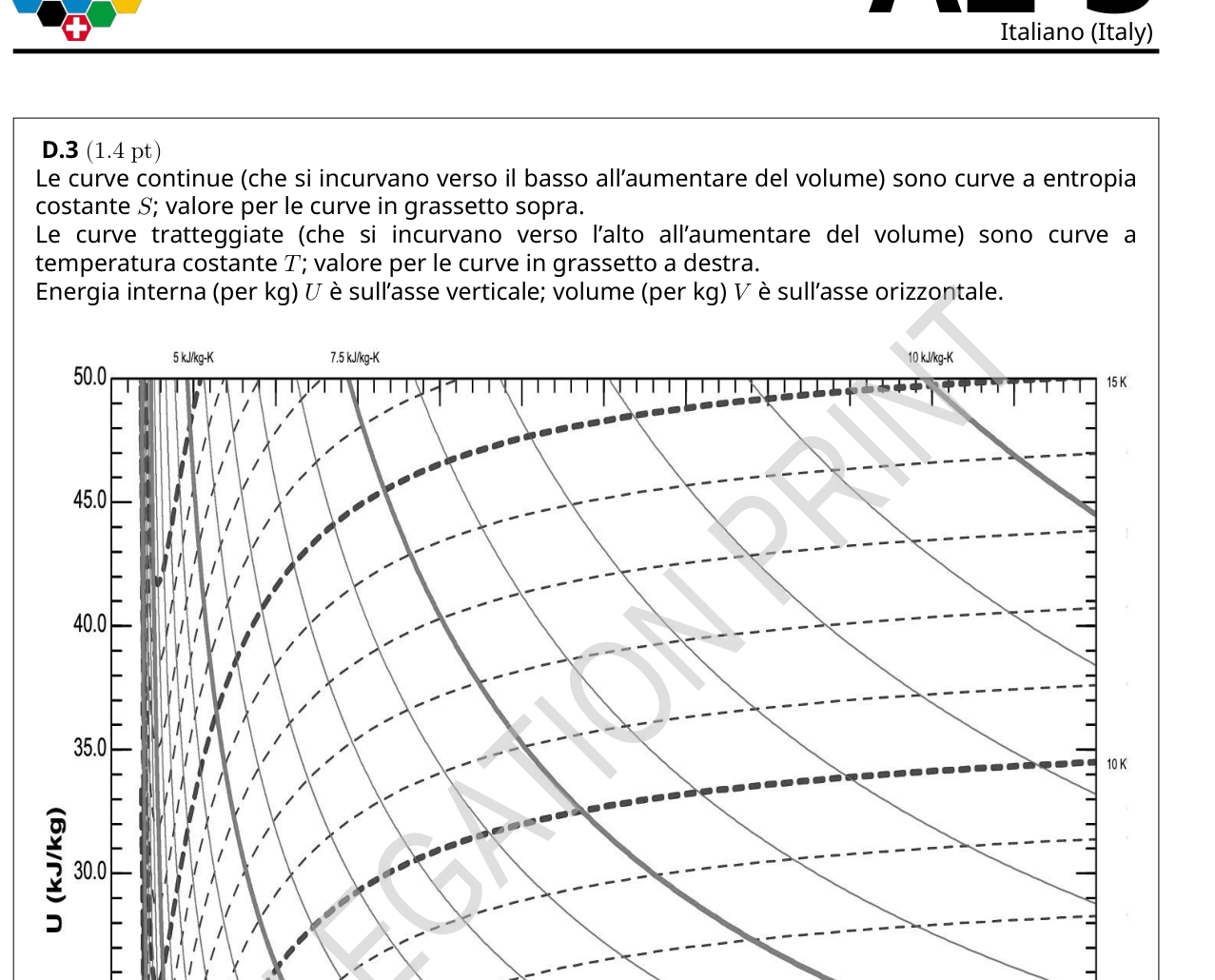
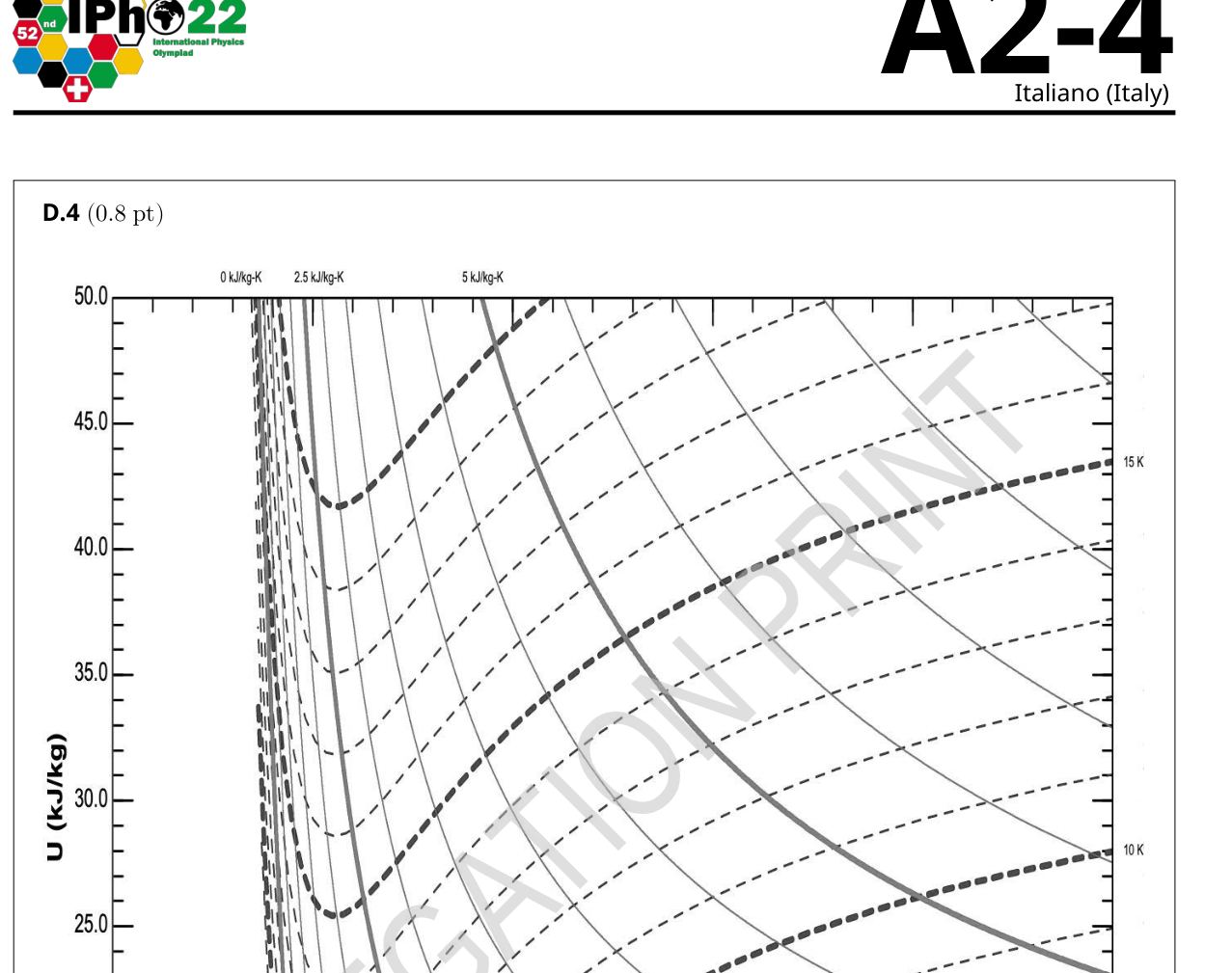
Il foglio risposta contiene grafici di energia interna per unità di massa in funzione del volume per unità di massa per l’elio insieme con le isoterme e le linee ad entropia costante.
D.3 (1.4 pt) Assumendo e , si utilizzi il grafico per trovare un valore numerico per la grandezza fisica conservata trovata nella domanda D.2. Si mostri la costruzione sul grafico.
D.4 (0.8 pt) Si trovi la temperatura massima possibile per . Si mostri la costruzione sul grafico.
D.5 (0.2 pt) Si assuma per il massimo il valore trovato in D.4, si trovi il valore numerico per .
p.3 — Diagramma U-V con isoterme e curve di entropia
p.4 — Diagramma U-V con curve termodinamiche
Topic: Thermodynamics, Astrophysics, Modern-Quantum Physics Metodi: First Law of Thermodynamics, Thermodynamic Cycle Analysis, Photon Energy Relation, Physical Modeling Competenze: Physical Reasoning, Mathematical Modeling, Estimation & Approximation Objects: Mirror, Star, Photon, Gas Fonte: Testo (PDF) — p.1 Soluzione: Soluzioni (PDF)
James Webb Space Telescope (12 punti)
This is a problem with the physics of the James Webb Space Telescope. Light from a star hits the primary mirror, which has an area of , and reflects it onto the secondary mirror. The focal length of the system is . The light is focused in the Integrated Science Instrument Module (ISIM), which contains the CCD (Charge-Coupled Device) sensor.
Part A. View a star (1.8 points)
The nearest red giant star is 89 light-years away, has a temperature of , and a diameter of .
A.1 (0.4 pt) Calculates the image diameter of the star focused on the sensitive surface of the CCD sensor.
A.2 (0.4 pt) Estimate the diameter of the maximum centre of diffraction on the sensitive surface of the CCD sensor. Assume a wavelength , which is the wavelength of the maximum intensity of the red giant star.
A.3 (1.0 pt) Se il sensore del CCD non viene raffreddato e può perdere calore solo irradiandolo dalla parte superiore della superficie sensibile, quale sarebbe la temperatura di equilibrio del CCD nell’area ove si forma l’immagine della gigante rossa? It is assumed that the surface of the CCD is that of a black body. A formula and a numerical estimate are provided.
Part B. Counting photons (1.8 points)
The absorption of a photon by the CCD sensor causes an electron to be emitted into the apparatus. This only happens if the photon has enough energy to excite an electron to overcome the energy gap . It’s assumed that every photon with enough energy excites an electron. There is also an electron leak through the gap due to the temperature of the CCD sensor; this is the dark current and is measured in number of electrons per second. It’s a function of temperature according to the ratio.
where is a constant.
The graph shows how the dark current varies with temperature. The units for the dark current, , shall be interpreted as an expression of the number of electrons per second count.
B.1 (0.4 pt) Dal grafico della corrente di buio, fornisci una stima dell’ordine di grandezza della temperatura di una sorgente lontana di fotoni termici di soglia che sarebbero in grado di eccitare appena un elettrone in quel pixel.
The electrons are collected in a capacitor, and after a exposure time , they are counted. There are three main sources of errors in the process: a fixed uncertainty in the counting process called a reading error; a distribution error according to the Poisson distribution associated with the dark current; a distribution error according to the Poisson distribution associated with the disclosure of the incident photon. The errors distributed according to Poisson’s distribution are equal to the square root of the number of counts associated with that process.
The number of photons measured is equal to the number of electrons in the capacitor minus the number of electrons associated with the dark current.
B.2 (0.4 pt) Write an expression for the total uncertainty of the count, in the event of a reading error , a current of darkness , a number of incident photons per second , and an exposure time .
For the remaining questions in this Part, the exposure time is assumed and the reading error is set to .
**B.3 ** (0.5 pts) An operating temperature of is assumed. The minimum number of incident photons per second shall be calculated so that the number of photons is ten times the uncertainty of the count.
B.4 (0.5 pt) Assumendo che tutti i fotoni siano appena in grado di eccitare un elettrone attraverso il gap di energia, qual è l’intensità della sorgente di fotoni trovata in B.3 sullo specchio primario? The result is expressed in .
Part C Passive cooling (4.4 points)
A CCD sensor shall be kept at a low temperature. The first thing to do is put a screen on to protect it from the sun’s rays.
The solar panel consists of five separate layers reflecting off thin sheets; the radiant energy of the sun hits the first leaf on the left and a certain amount of energy escapes between each pair of leaves.
Two adjacent sheets, 1 and 2, separated by a distance shall be considered. The leaves don’t touch each other and the perimeter communicates with space. For simplicity’s sake, it’s assumed that the sheets are parallel. The heat radiation can be exchanged between the sheets and the heat radiation can escape through the open space in the perimeter.
The following approximations shall be taken:
- The sheets are square, each with an area of .
- The leaves are parallel and separated by along the perimeter.
- The sheets have an emission coefficient . It is assumed that all reflections outside the surface of the sheet are diffuse. The leaves are thin and the temperature on the front and back faces are the same and uniform.
- The radiant flow fraction emitted by a sheet and absorbed by the adjacent sheet is . This means that if surface 1 emits a quantity of heat towards surface 2 then surface 2 will absorb a quantity of heat from surface 1.
- The amount of radiant flow expelled from the space along the perimeter between the two sheets is approximated as while is the net flow between the two sheets. Si assuma . This means that the heat lost in the space between the two sheets is proportional to the net heat exchanged between the two sheets. This is a brutal approximation of the problem. The bottom temperature of space is negligible.
C.1 (2.4 pt) The equilibrium temperatures of the first sheet and the fifth sheet are expressed in terms of the intensity of incident solar radiation , the constants and , and the necessary physical constants. To simplify the expression, it is possible to define additional constants expressed as a function of and , etc.
C.2 (1.6 pt) Numerical estimates for and are obtained from information on the geometry of the sheets by assuming an emission coefficient of . It is recommended to consider the rectangular box model of the sheets presented above, where the side surface actually acts as an ideal absorber of radiant energy.
C.3 (0.4 pt) Determine the temperatures of sheets 1 and 5 numerically. The solar intensity is .
Part D Cryogenic refrigerator (4 points)
The final stage of the cooling system directly cools the CCD. A closed-loop cooling system has an input tube that enters gaseous helium at constant pressure . The helium flows through a spongy porous intercahedron (porous plug) into a continuous pressure tube . The tube carries the gas that cools the CCD. The gas helium then passes through a pump before returning to the input line.
Gas helium, supplied on the left at a well-defined pressure and temperature , is forced through an intercavator to a well-defined pressure and temperature and is removed on the right.
When the gas passes through the porous interface, the viscous friction with the thin walls of the channels in the spongy part has a significant effect; instead, there is no heat exchange from the gas during this process. The gas mass velocity in region 2 is only marginally higher than the gas mass velocity in region 1.
The helium is not a perfect gas, but it remains in the gas state throughout the process.
D.1 (1.0 pt) Consider a mole of gas running from left to right across the interface. Complete the table by writing ”>” or ”<” to identify the quantity that must be greater, ”=” to identify the quantities that must be equal, or ”?” if it is not possible to know which is greater or equal without further information.
What is the name of the physical size? |---|---|---|---| | Energia Interna | | | | | Temperatura | | | | | Entropia | | | | | Pressione | | | | | Volume | | | |
D.2 (0.6 pt) A conserved physical quantity is identified as being constructed from (internal energy), (pressure), and (volume) when a mole of gas passes through the interface; the explanatory steps for how the conserved physical quantity is derived are shown.
The response sheet contains internal energy charts per unit mass in relation to volume per unit mass for helium together with isotherms and constant entropy lines.
D.3 (1.4 pt) Assuming and , the graph is used to find a numerical value for the conserved physical size found in question D.2. You can see the construction on the chart.
**D.4 ** (0.8 pt) The maximum possible temperature is for . You can see the construction on the chart.
D.5 (0.2 pt) Assume for the maximum the value found in D.4, the numerical value for is found.
p.3 U-V diagram with isotherms and entropy curves
p.4 — Diagramma U-V con curve termodinamiche
Topic: Thermodynamics, Astrophysics, Modern-Quantum Physics Metodi: First Law of Thermodynamics, Thermodynamic Cycle Analysis, Photon Energy Relation, Physical Modeling Competenze: Physical Reasoning, Mathematical Modeling, Estimation & Approximation Objects: Mirror, Star, Photon, Gas Fonte: Testo (PDF) — p.1 Soluzione: Soluzioni (PDF)