Theory Q1-1 English (Official) Hydrogen and galaxies (10 points) This problem aims to study the peculiar physics of galaxies, such as their dynamics and structure. In particular, we explain how to measure the mass distribution of our galaxy from the inside. For this we will focus on hydrogen, its main constituent. Throughout this problem we will only use , defined as . Part A - Introduction Bohr model We assume that the hydrogen atom consists of a non-relativistic electron, with mass , orbiting a fixed proton. Throughout this part, we assume its motion is on a circular orbit. A.1 Determine the electron’s velocity in a circular orbit of radius . 0.2pt In the Bohr model, we assume the magnitude of the electron’s angular momentum is quantized, where is an integer. We define . A.2 Show that the radius of each orbit is given by , where is called the Bohr radius. Express in terms of , , and and calculate its numerical value with 3 digits. Express , the velocity on the orbit of radius , in terms of and . 0.5pt A.3 Determine the electron’s mechanical energy on an orbit of radius in terms of , , and . Determine in the ground state in terms of , and . Compute its numerical value in eV. 0.5pt Hydrogen fine and hyperfine structures The rare spontaneous inversion of the electron’s spin causes a photon to be emitted on average once per 10 million years per hydrogen atom. This emission serves as a hydrogen tracer in the universe and is thus fundamental in astrophysics. We will study the transition responsible for this emission in two steps. First, consider the interaction between the electron spin and the relative motion of the electron and the proton. Working in the electron’s frame of reference, the proton orbits the electron at a distance . This produces a magnetic field . A.4 Determine the magnitude of at the position of the electron in terms of , , , and . 0.5pt Second, the electron spin creates a magnetic moment . Its magnitude is roughly . The fine (F) structure is related to the energy difference between an electron with a magnetic moment parallel to and that of an electron with anti-parallel to . Similarly, the hyperfine (HF) structure is related to the energy difference , due to the interaction between parallel and anti-parallel magnetic moments of the electron and the proton. It is known to be approximately where is the proton mass.
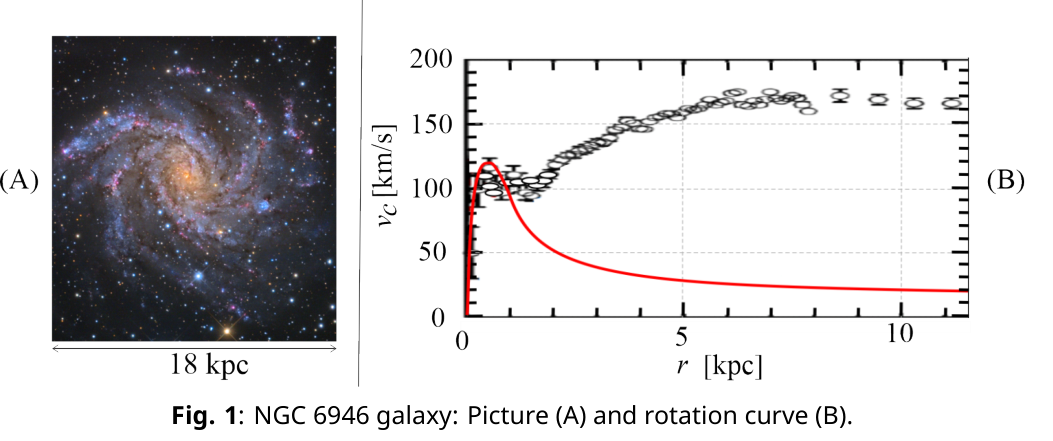
Theory Q1-2 English (Official) A.5 Express as a function of and . Express the wavelength of a photon emitted during a transition between the two states of the hyperfine structure and give its numerical value with two digits. 0.5pt Part B - Rotation curves of galaxies Data • Kiloparsec: m • Solar mass : kg We consider a spherical galaxy centered around a fixed point . At any point , let be the volumetric mass density and the associated gravitational potential (i.e. potential energy per unit mass). Both and depend only on . The motion of a mass located at , due to the field , is restricted to a plane containing . B.1 In the case of a circular orbit, determine the velocity of an object on a circular orbit passing through in terms of and . 0.2pt Fig. 1(A) is a picture of the spiral galaxy NGC 6946 in the visible band (from the 0.8m Schulman Telescope at the Mount Lemmon Sky Center in Arizona). The little ellipses in Fig. 1(B) show experimental measurements of for this galaxy. The central region () is named the bulge. In this region, the mass distribution is roughly homogeneous. The red curve is a prediction for if the system were homogeneous in the bulge and keplerian ( with ) outside it, i.e. considering that the total mass of the galaxy is concentrated in the bulge. Fig. 1: NGC 6946 galaxy: Picture (A) and rotation curve (B). B.2 Deduce the mass of the bulge of NGC 6946 from the red rotation curve in Fig. 1(B), in solar mass units. 0.5pt Comparing the keplerian model and the experimental data makes astronomers confident that part of the mass is invisible in the picture. They thus suppose that the galaxy’s actual mass density is given by
Theory Q1-3 English (Official) where and are constants. B.3 Show that the velocity profile , corresponding to the mass density in Eq. 1, can be written . Express and in terms of , and . ( Hints: , and: for . )
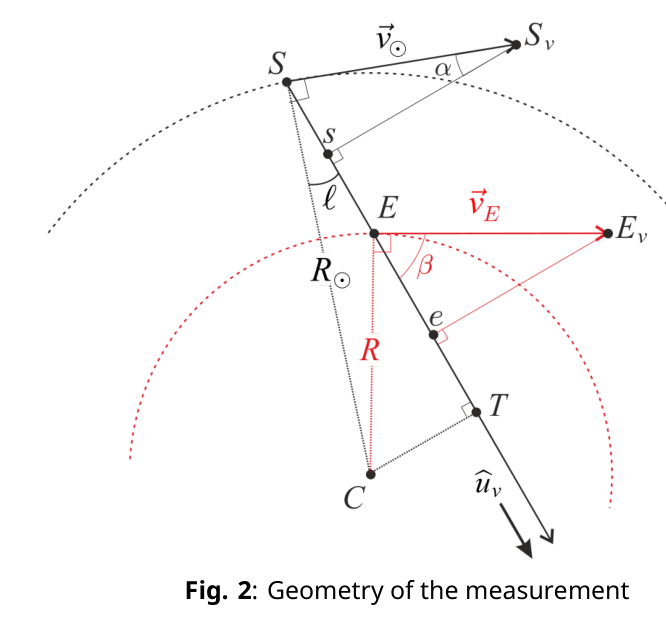
Simplify when and when . Show that if , the mass embedded in a sphere of radius with the mass density given by Eq. 1 simplifies and depends only on and . Estimate the mass of the galaxy NGC 6946 actually present in the picture in Fig. 1(A). 1.8pt Part C - Mass distribution in our galaxy For a spiral galaxy, the model for Eq. 1 is modified and one usually considers the gravitational potential is given by , where is the distance to the galactic plane (defined by ), and is now the axial radius and a constant to be determined. and are constant values. C.1 Find the equation of motion on for the vertical motion of a point mass in such a potential, assuming is constant. Show that, if , the galactic plane is a stable equilibrium state by giving the angular frequency of small oscillations around it. 0.5pt From here on, we set . C.2 Identify the regime, either or , in which the model of Eq. 1 recovers a potential of the form with a suitable definition of . Under this condition no longer depends on . Express it in terms of . 0.6pt Therefore, outside the bulge the velocity modulus does not depend on the distance to the galactic center. We will use this fact, as astronomers do, to measure the galaxy’s mass distribution from the inside. All galactic objects considered here for astronomical observations, such as stars or nebulae, are primarily composed of hydrogen. Outside the bulge, we assume that they rotate on circular orbits around the galactic center . is the sun’s position and that of a given galactic object emitting in the hydrogen spectrum. In the galactic plane, we consider a line of sight corresponding to the orientation of an observation, on the unit vector (see Fig. 2).
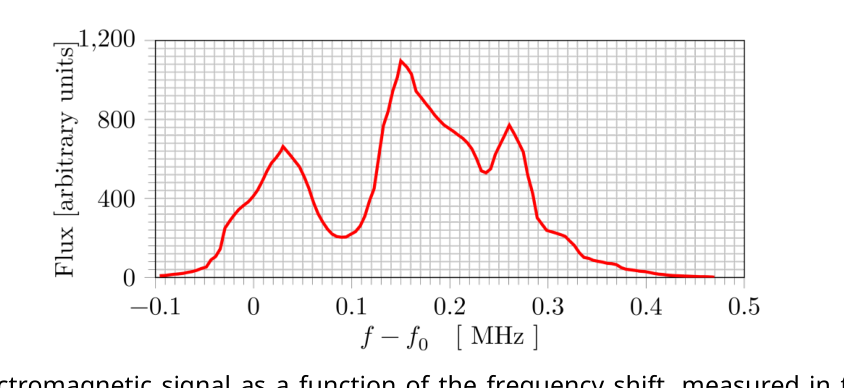
Theory Q1-4 English (Official) Fig. 2: Geometry of the measurement Let be the galactic longitude, measuring the angle between and the . The sun’s velocity on its circular orbit of radius is denoted . A galactic object in orbits on another circle of radius at velocity . Using a Doppler effect on the previously studied 21cm line, one can obtain the relative radial velocity of the emitter with respect to the sun : it is the projection of on the line of sight. C.3 Determine in terms of , , and . Then, express in terms of , , and . 0.7pt Using a radio telescope, we make observations in the plane of our galaxy toward a longitude . The frequency band used contains the 21cm line, whose frequency is . The results are reported in Fig. 3. Fig. 3: Electromagnetic signal as a function of the frequency shift, measured in the radio frequency band at using EU-HOU RadioAstronomy
Theory Q1-5 English (Official) C.4 In our galaxy, . Determine the values of the relative radial velocity (with 3 significant digits) and the distance from the galactic center (with 2 significant digits) of the 3 sources observed in Fig. 3. Distances should be expressed as multiples of . 0.6pt C.5 On the top view of our galaxy (in the answer box), indicate the positions of the sources observed in Fig. 3. What could be deduced from repeated measurements changing ? 0.6pt Part D
p.2 — NGC 6946: immagine e curva di rotazione
p.4 — Geometria della misura
p.4 — Spettro del flusso contro spostamento in frequenza
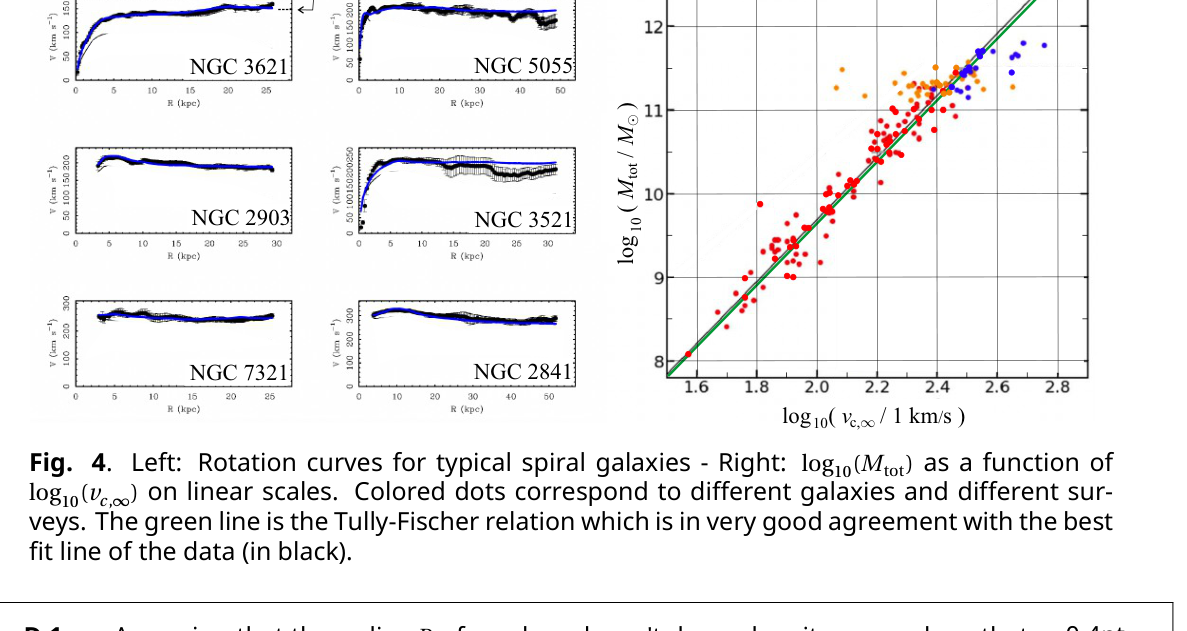
p.5 — Curve di rotazione e relazione di Tully-Fisher
Topic: Modern-Quantum Physics, Gravitation, Astrophysics Metodi: Bohr Model & Quantization, Newton’s Law of Gravitation, Calculus-Integration, Approximation & Series Expansion, Simple Harmonic Motion Analysis Competenze: Mathematical Modeling, Physical Reasoning, Estimation & Approximation Objects: Atom, Electron, Star Fonte: Testo (PDF) — p.1 Soluzione: Soluzioni (PDF)
Theory Q1-1 English (Official) Hydrogen and galaxies (10 points) This problem aims to study the peculiar physics of galaxies, such as their dynamics and structure. In In particular, we explain how to measure the mass distribution of our galaxy from the inside. For this we will focus on hydrogen, its main constituent. Throughout this problem we will only use , defined as . Part A - Introduction to the text The Bohr model We assume that the hydrogen atom consists of a non-relativistic electron, with mass , orbiting a fixed The proton. Throughout this part, we assume its motion is on a circular orbit. A.1 Determine the electron’s velocity in a circular orbit of radius . 0.2pt In the Bohr model, we assume the magnitude of the electron’s angular momentum is quantized, where is an integer. We define . A.2 Show that the radius of each orbit is given by , where is called the The radius of Bohr. Express in terms of , , and and calculate its numerical value with 3 digits. Express , the velocity on the orbit of radius , in terms of and . 0.5pt A.3 Determine the electron’s mechanical energy on an orbit of radius in terms of of , , and . Determine in the ground state in terms of , and . Calculates its numerical value in eV. 0.5pt Hydrogen fine and hyperfine structures The rare spontaneous inversion of the electron’s spin causes a photon to be emitted on average once 10 million years for a hydrogen atom. This emission serves as a hydrogen tracer in the universe and is So it’s fundamental to astrophysics. We will study the transition responsible for this emission in two steps. First, consider the interaction between the electron spin and the relative motion of the electron and the The proton. Working in the electron’s frame of reference, the proton orbits the electron at a distance . This The magnetic field output is . A.4 Determine the magnitude of at the position of the electron in terms of , , , and . 0.5pt Second, the electron spin creates a magnetic moment . Its magnitude is roughly . The end (F) structure is related to the energy difference between an electron with a magnetic moment parallel to and that of an electron with anti-parallel to . Similarly, the hyperfine (HF) structure is related to the energy difference , due to the interaction between parallel and anti-parallel magnetic moments of the electron and the proton. It is known to be approximately where is The proton mass.
Theory Q1-2 English (Official) A.5 Express as a function of and . Express the wavelength of a photon emitted during a transition between The two states of the hyperfine structure and give its numerical value with two The digits. 0.5pt Part B - Rotation curves of galaxies Date of the date • Kiloparsec: m • Solar mass: kg We consider a spherical galaxy centered around a fixed point . At any point , let be the volumetric mass density and the associated gravitational potential (i.e. potential energy for unit of mass). Both and depend only on . The motion of a mass located at , due to the field , is restricted to a plane containing . B.1 In the case of a circular orbit, determine the velocity of an object on a circular Orbits passing through in terms of and . 0.2pt
- What? 1(A) is a picture of the spiral galaxy NGC 6946 in the visible band (from the 0.8m Schulman Telescope) It’s the Mount Lemmon Sky Center in Arizona. The little ellipses in Fig. 1(B) show experimental measurements of for this galaxy. The central region () is named the bulge. In this region, the mass The distribution is roughly homogeneous. The red curve is a prediction for if the system were homogeneous in the bulge and keplerian ( with ) outside it, i.e. Considering that the total mass of the galaxy is concentrated in the bulge.
- What? 1: NGC 6946 galaxy: Picture (A) and rotation curve (B). B.2 Deduces the mass of the bulge of NGC 6946 from the red rotation curve in
- What? 1(B), in solar mass units. 0.5pt Comparing the Keplerian model and the experimental data makes astronomers confident that part of the The mass is invisible in the picture. They thus assume that the galaxy’s actual mass density is given by
Theory Q1-3 English (Official) where and are constants. B.3 Show that the velocity profile , corresponding to the mass density in Eq. 1, can be written . Express and in terms of , and . (Hints: , and: for . )
Simplify when and when . Show that if , the mass embedded in a sphere of radius with the mass density given by Eq. 1 simplifies and depends only on and . Estimate the mass of the galaxy NGC 6946 actually present in the picture in Fig. 1(A). 1.8pt Part C - Mass distribution in our galaxy For a spiral galaxy, the model for Eq. 1 is modified and one usually considers the gravitational potential is given by , where is the distance to the galactic plane (defined by ), and is now the axial radius and a constant to be determined. and are constant values. C.1 Find the equation of motion on for the vertical motion of a point mass In such a potential, assuming is constant. Show that, if , the galactic plane is a stable equilibrium state by giving the angular frequency of small oscillations around it. 0.5pt From here on, we set . C.2 Identify the regime, either or , in which the model of Eq. 1 recovered a potential of the form with a suitable definition of . Under this condition no longer depends on . Express it in terms of . 0.6pt Therefore, outside the bulge the velocity modulus does not depend on the distance to the galactic The centre. We will use this fact, as astronomers do, to measure the galaxy’s mass distribution from the inside. All galactic objects considered here for astronomical observations, such as stars or nebulae, are primarily composed of hydrogen. Outside the bulge, we assume that they rotate on circular orbits around the galactic center . is the sun’s position and that of a given galactic object emitting in the hydrogen Spectrum. In the galactic plane, we consider a line of sight corresponding to the orientation of an observation, on the unit vector (see Fig. 2).
Theory Q1-4 English (Official)
- What? 2: Geometry of the measurement Let be the galactic longitude, measuring the angle between and the . The sun’s speed on its circular orbit of radius is denoted . A galactic object in orbits on another circle of radius at velocity . Using a Doppler effect on the previously studied 21cm line, one can obtain the relative radial velocity of the emitter with respect to the sun : it is the projection of on the line of I’m going to see. C.3 Determine in terms of , , and . Then, express in terms of , , and . 0.7pt Using a radio telescope, we make observations in the plane of our galaxy toward a longitude . The The frequency band used contains the 21cm line, whose frequency is . The results are reported in Fig. 3.
- What? 3: Electromagnetic signal as a function of frequency shift, measured in radio The frequency band at using EU-HOU RadioAstronomy
Theory Q1-5 English (Official) C.4 In our galaxy, . Determine the values of the relative radial velocity (with 3 significant digits) and the distance from the galactic center (with The results of the study are presented in Fig. 2. 3. Distances should be expressed as multiples of . 0.6pt C.5 On the top view of our galaxy (in the answer box), indicate the positions of the The results of the study were published in Fig. 3. What could be deduced from repeated measurements changing ? 0.6pt The Commission shall adopt implementing acts.
p.2 — NGC 6946: immagine e curva di rotazione
p.4 — Geometria della misura
p.4 — Spettro del flusso contro spostamento in frequenza
p.5 — Curve di rotazione e relazione di Tully-Fisher
Topic: Modern-Quantum Physics, Gravitation, Astrophysics Metodi: Bohr Model & Quantization, Newton’s Law of Gravitation, Calculus-Integration, Approximation & Series Expansion, Simple Harmonic Motion Analysis Competenze: Mathematical Modeling, Physical Reasoning, Estimation & Approximation Objects: Atom, Electron, Star Fonte: Testo (PDF) — p.1 Soluzione: Soluzioni (PDF)