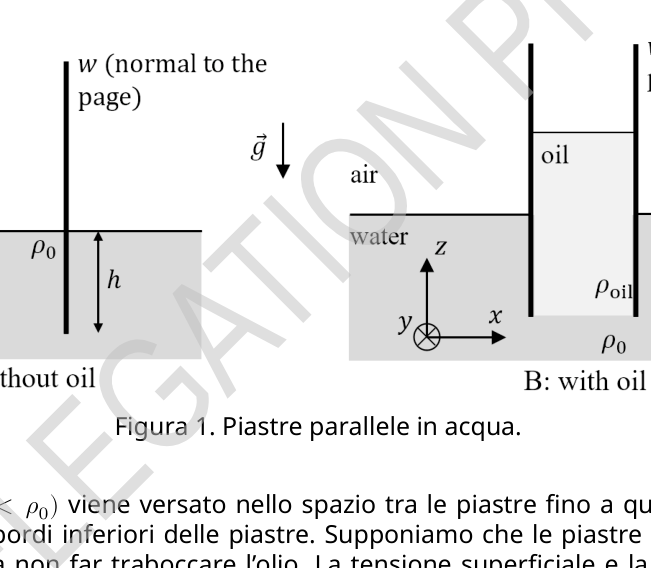
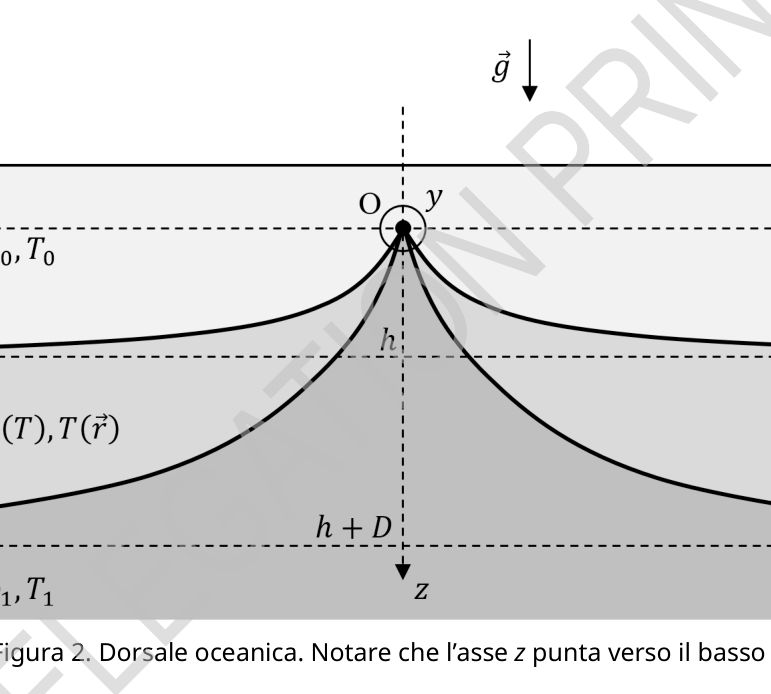
Theory Q1-1 Italiano (Italy) Fisica planetaria (10 punti) Questo problema consiste di due problemi indipendenti relativi all’interno dei pianeti. Gli effetti della curvatura della superficie dei pianeti può essere trascurata. Potrebbe essere utile usare la formula (1 + + εx, quando |x| . (1) Parte A. Dorsale oceanica (5.0 punti) Consideriamo un grande recipiente d’acqua situato in un campo gravitazionale uniforme con accelerazione di caduta libera g. Due piastre rettangolari verticali parallele l’una all’altra sono montate nel recipiente in modo che i bordi verticali delle piastre siano a stretto contatto senza spazi con le pareti verticali del recipiente. Un tratto di lunghezza hdi ogni piastra è immerso in acqua (Fig. 1). La larghezza delle piastre lungo l’asse y è w, la densità dell’acqua è ρ0. Figura 1. Piastre parallele in acqua. Olio di densità ρoil (ρoil < ρ0) viene versato nello spazio tra le piastre fino a quando il livello inferiore dell’olio ha raggiunto i bordi inferiori delle piastre. Supponiamo che le piastre e i bordi del recipiente siano abbastanza alti da non far traboccare l’olio. La tensione superficiale e la miscelazione dei fluidi possono essere trascurate. A.1 Qual è la componente xdella forza totale Fxche agisce sulla piastra destra (intensità e direzione)? 0.8pt La Fig. 2 mostra una sezione trasversale di una dorsale oceanica. Consiste di strati sovrapposti di mantello, crosta e acqua oceanica. Il mantello è composto da rocce che supponiamo possano scorrere in tempi geologici. Perciò in questo problema sarà trattato come un fluido. Lo spessore della crosta è molto più piccolo della lunghezza caratteristica nella direzione x, quindi la crosta si comporta come una piastra liberamente pieghevole. Una tale dorsale può essere modellata con alta precisione come un sistema bidimensionale, senza alcuna variazione delle quantità lungo l’asse y, che è perpendicolare al piano di Fig. 2. Assumiamo che la lunghezza Ldella dorsale lungo l’asse ysia molto più grande di qualsiasi altra lunghezza introdotta in questo problema. Al centro della dorsale si assume che lo spessore della crosta sia nullo. La crosta si fa più spessa al crescere della distanza orizzontale xdal centro e si avvicina ad uno spessore costante Dquando . Di conseguenza, il fondale oceanico si abbassa di un’altezza verticale hsotto la sommità della dorsale O, che definiamo come l’origine del nostro sistema di coordinate (vedi Fig. 2). La densità dell’acqua ρ0
Theory Q1-2 Italiano (Italy) e la sua temperatura T0 possono essere assunte uniformi nello spazio e costanti nel tempo. La stessa assunzione può essere fatta per la densità del mantello ρ1 e la sua temperatura T1. Anche la temperatura della crosta Tè costante nel tempo ma può dipendere dalla posizione. E’ noto che, con elevata precisione, il materiale crostale si espande linearmente con la temperatura T. Poiché si presume che le temperature dell’acqua e del mantello siano costanti, è conveniente utilizzare un’espressione adimensionale del coefficiente di espansione termica. Pertanto l(T) = l1 [1 ) /(T1 , dove lè la lunghezza di un tratto del materiale della crosta, l1 è la sua lunghezza alla temperatura T1, e klè il coefficiente di espansione termico adimensionale, che può essere assunto come costante. Figura 2. Dorsale oceanica. Notare che l’asse z punta verso il basso A.2 Assumendo che la crosta sia isotropica, trovare come la sua densità ρdipende dalla sua temperatura T. Assumendo che |kl| , scrivere la risposta nella forma appropriata ρ(T) [1 + kT1 T1 ] , (2) dove i termini dell’ordine k2 le superiori sono trascurati. Successivamente, identificare la costante k. 0.6pt E’ noto che k> 0. Inoltre, la conducibilità termica κdella crosta può essere assunta come costante. Di conseguenza, molto lontano dall’asse della dorsale la temperatura della crosta dipende linearmente con la profondità. A.3 Assumendo che il mantello e l’acqua si comportino come un fluido incomprimibile in equilibrio idrostatico, esprimere lo spessore della crosta a grande distanza Din funzione di h, ρ0, ρ1e k. Qualsiasi movimento del materiale può essere trascurato. 1.1pt
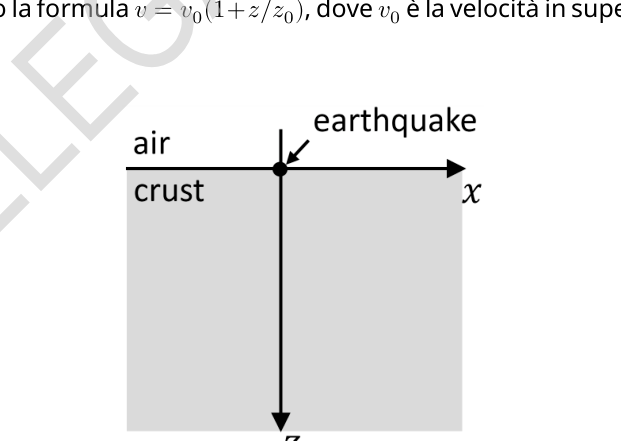
Theory Q1-3 Italiano (Italy) A.4 Trova, al prim’ordine in k, la forza orizzontale totale Fche agisce sulla metà destra (x> 0) della crosta in funzione di ρ0, ρ1, h, L, ke g. 1.6pt Supponiamo che la crosta sia isolata termicamente dal resto della Terra. Come risultato della conduzione del calore, le temperature delle superfici superiore e inferiore della crosta si avvicineranno l’una all’altra fino a quando la crosta raggiungerà l’equilibrio termico. Il calore specifico della crosta è ce si può ritenere costante. A.5 Utilizzando l’analisi dimensionale o l’ordine di grandezza, stimare il tempo caratteristico τin cui la differenza tra la temperatura superficiale superiore e quella inferiore della crosta lontana dall’asse della dorsale diminuirà approssimativamente a zero. Puoi presumere che τnon dipende dalle due temperature superficiali iniziali della crosta. 0.9pt Parte B. Onde sismiche in un mezzo stratificato (5.0 punti) Supponiamo che si verifichi un breve terremoto sulla superficie di un pianeta. Si può ipotizzare che le onde sismiche provengano da una sorgente lineare situata a z= x= 0, dove xè la coordinata orizzontale e zè la profondità sotto la superficie (Fig. 3). Si può presumere che la sorgente dell’onda sismica sia molto più lunga di qualsiasi altra lunghezza considerata in questa domanda. A seguito del terremoto, viene emesso un flusso uniforme delle cosiddette onde longitudinali P lungo tutte le direzioni nel piano x-zche ha componente positiva lungo l’asse z. Poiché la teoria delle onde in un solido è generalmente complicata, in questo problema trascuriamo tutte le altre onde emesse dal terremoto. La crosta del pianeta è stratificata in modo che il modulo della velocità vdell’onda P dipende dalla profondità zsecondo la formula v= v0(1+z/z0), dove v0 è la velocità in superficie e z0 è una costante positiva nota. Figura 3. Sistema di coordinate utilizzato nella parte B. B.1 Consideriamo un singolo raggio emesso dal terremoto che forma un angolo iniziale 0 < θ0 < π/2 con l’asse ze si muove nel piano x-z. Qual è la coordinata orizzontale x1(θ0) alla quale questo raggio può essere individuato sulla superficie del pianeta? E’ noto che il percorso del raggio è un arco di circonferenza. Scrivere la risposta nella forma x1(θ0) = Acot(bθ0), dove Ae bsono costanti che devono essere determinate. 1.5pt
Theory Q1-4 Italiano (Italy) Se non sei riuscito a trovare Ae b, nelle domande successive puoi usare il risultato x1(θ0) = Acot(bθ0) come fornito. Supponiamo che l’energia totale, per unità di lunghezza della sorgente, rilasciata come onde P nella crosta durante il terremoto sia E. Supponiamo che le onde siano completamente assorbite quando raggiungono la superficie del pianeta proveniendo dal basso. B.2 Trova come la densità di energia per unità di area ε(x) assorbita dalla superficie dipende dalla distanza lungo la superficie x. Disegna l’andamento di ε(x). 1.5pt D’ora in poi, supponiamo che le onde siano invece completamente riflesse quando raggiungono la superficie. Immagina un dispositivo posizionato a z= x= 0 che ha la stessa geometria della sorgente sismica considerata in precedenza. Il dispositivo è in grado di emettere onde P in una distribuzione angolare liberamente scelta. Facciamo in modo che il dispositivo emetta un segnale con una gamma ristretta di angoli di emissione. In particolare, l’angolo iniziale che il segnale forma con la verticale appartiene all’intervallo [θ0 2δθ0, θ0 + 1 2δθ0], dove 0 < θ0 < π/2, δθ0 e δθ0 . B.3 A quale distanza xmax lungo la superficie dalla sorgente si trova il punto più lontano che non viene raggiunto dal segnale? Scrivere la risposta in funzione di θ0, δθ0 e delle altri costanti fornite sopra. 2.0pt
p.1 — Colonne A e B, dorsale oceanica
p.2 — Sezione interno pianeta, profilo densita
p.3 — Sistema coordinate onde sismiche P
Topic: Fluid Mechanics, Oscillations & Waves, Thermodynamics Metodi: Hydrostatic Equilibrium, Free-Body Diagram, Approximation & Series Expansion, Dimensional Analysis, Ray Tracing Competenze: Mathematical Modeling, Physical Reasoning, Estimation & Approximation Objects: Planet Fonte: Testo (PDF) — p.1 Soluzione: Soluzioni (PDF)
Theory Q1-1 Italian (Italy) The following is the list of the countries of the European Union: This problem consists of two independent problems relating to the interior of the planets. The effects of the The curvature of the surface of the planets can be neglected. It might be useful to use the formula (1 + + εx, quando |x| . (1) Part A. The following is the list of the countries of the European Union: Consider a large water container located in a uniform gravitational field with free-fall acceleration g. Two vertical rectangular plates parallel to each other are mounted in the container so that the vertical edges of the plates are in close contact with the vertical walls of the container. A stretch of length hdi each plate is immersed in water (Fig. 1). The width of the plates along the y-axis is w, the density of the water is ρ0. Figure 1 is shown. Parallel plates in the water. Oil of ρoil density (ρoil < ρ0) is poured into the space between the plates until the lower level The oil has reached the lower edges of the plates. Suppose the plates and edges of the container They’re high enough not to overload the oil. Surface tension and fluid mixing They can be overlooked. A.1 What is the component xd of the total force Fx that acts on the right plate (intensity and direction)? 0.8pt The Fig. 2 shows a cross section of an ocean backbone. It consists of overlapping layers of mantle, crust and ocean water. The mantle is made up of rocks that we assume can flow through time. The geological ones. So in this problem it will be treated like a fluid. The thickness of the crust is much more So the crust behaves like a plate. freely folded. Such a backbone can be modeled with high precision as a system Two-dimensional, with no change in quantities along the y-axis, perpendicular to the plane of
- What? 2. Let’s assume that the length of the spine along the yasse is much larger than any other The length introduced into this problem. At the center of the spine, the crust is assumed to be zero in thickness. The crust thickens as it grows from the horizontal distance x from the centre and approaches a constant thickness D When . As a result, the ocean floor drops to a vertical height below the summit of the backbone. Or, which we define as the origin of our coordinate system (see Fig. 2). The density of water ρ0
Theory Q1-2 Italian (Italy) and its temperature T0 can be assumed uniformly in space and constantly in time. The same The measurement shall be made for the coat density ρ1 and its temperature T1. The temperature too The time of the tea crust is constant, but it can depend on the location. It is known that, with high precision, the crustal material expands linearly with temperature T. Since the water and mantle temperatures are assumed to be constant, it is appropriate to use an additional termic expansion coefficient. Therefore, L (T) = l1 [1 ) /(T1 , where the length of a stretch of crust material is l1, The temperature of the test chemical is T1 and the coefficient of thermal expansion of the test chemical is T1 and the coefficient of thermal expansion of the test chemical is T1 and T2 be assumed as a constant. Figure two. Ocean backbone. Note that the z axis points downwards A.2 Assuming the crust is isotropic, find how its density ρdepends from its temperature T. Assuming that kL , write the answer in appropriate form ρ(T) [1 + kT1 T1 ] , (2) where the terms of the order k2 The high schools are being neglected. Afterwards, Identify the constant k. 0.6pt It’s known that k> 0. In addition, the thermal conductivity of the crust can be assumed to be constant. Di As a result, far from the dorsal axis, the temperature of the crust depends linearly on the The depth. A.3 Assuming that the mantle and water behave as an incompressible fluid in hydrostatic equilibrium, express the thickness of the crust at a great distance Din function of h, ρ0, ρ1e k. Any movement of the material can be I’m not doing it. 1.1pt
Theory Q1-3 Italian (Italy) A.4 Find, in the first order in k, the total horizontal force Fche acting on the half the right (x> 0) of the crust in the function ρ0, ρ1, h, L, ke g. 1.6pt Suppose the crust is heat-insulated from the rest of the Earth. As a result of driving The temperature of the upper and lower surfaces of the crust will approach each other Until the crust reaches thermal equilibrium. The specific heat of the crust is there you can think of The time is constant. A.5 Using dimensional analysis or order of magnitude, estimate the characteristic time τ in which the difference between the upper and lower surface temperature of the crust away from the dorsal axis will decrease to approximately zero. You can assume that τ does not depend on the two temperatures the initial surface of the crust. 0.9pt Part B. Seismic waves in a layered medium (5.0 points) Suppose there is a brief earthquake on the surface of a planet. It can be assumed that the Seismic waves come from a linear source located at z=x=0, where the horizontal coordinate is and z is the depth below the surface (Fig. 3). The source of the seismic wave can be assumed to be very The length of the test is more than any other length considered in this question. Following the earthquake, a uniform flow of the so-called longitudinal P waves is emitted All the directions in the x-z plane have a positive component along the z axis. Because the wave theory in So, a solid is usually complicated, so we ignore all the other waves emitted by the It’s an earthquake. The planet’s crust is layered so that the wave velocity modulo V of P depends on the from the depth z according to the formula v=v0(1+z/z0), where v0 is the surface velocity and z0 is a constant The Commission has not yet taken a decision. Figure 3 is shown. Coordinate system used in Part B. B.1 Consider a single beam emitted by an earthquake that forms an angle The initial 0 < θ0 < π/2 with the x axis moves in the x-z plane. What is the coordinate? horizontal x1(θ0) at which radius can be detected on the planet’s surface? It is known that the path of the beam is an arc of circumference. Write the answer in the form x1(θ0) = Acot(bθ0), where Ae are constants that They must be determined. 1.5pt
Theory Q1-4 Italian (Italy) If you can’t find Ae b, in the next questions you can use the result x1(θ0) = Acot(bθ0) as provided. Suppose that the total energy, per unit of length of the source, released as P waves in the crust during the earthquake are E. Suppose the waves are completely absorbed. When they reach the surface of the planet from below. B.2 Find how the energy density per unit area ε(x) absorbed by the surface depends on the distance along the surface x. Draw the sequence of ε(x). 1.5pt From now on, let’s assume that the waves are completely reflected when they reach the surface. Imagine a device positioned at z=x=0 that has the same geometry as the seismic source. The Commission has already taken the necessary steps to ensure that the Commission is able to take the necessary measures. The device is capable of emitting P waves in a freely chosen angular distribution. Let’s make the device emit a signal with a narrow range of angles. The Commission shall adopt implementing acts in accordance with Article 21 of this Regulation. In particular, the initial angle formed by the signal with the vertical is the interval [θ0 2δθ0, θ0 + 1 2δθ0], where 0 < θ0 < π/2, δθ0 and δθ0 . B.3 At what distance xmax along the surface from the source is the point most Far away from being reached by the Signal? Write the answer according to θ0, δθ0 and the other constants given above. 2.0pt
p.1 — Colonne A e B, dorsale oceanica
p.2 — Sezione interno pianeta, profilo densita
p.3 — Sistema coordinate onde sismiche P
Topic: Fluid Mechanics, Oscillations & Waves, Thermodynamics Metodi: Hydrostatic Equilibrium, Free-Body Diagram, Approximation & Series Expansion, Dimensional Analysis, Ray Tracing Competenze: Mathematical Modeling, Physical Reasoning, Estimation & Approximation Objects: Planet Fonte: Testo (PDF) — p.1 Soluzione: Soluzioni (PDF)