- al tempo la velocità dell’elettrone è ,
Topic: Electromagnetism, Magnetism Metodi: Lorentz Force Analysis, Kinematic Equations, Vector Decomposition Competenze: Physical Reasoning, Mathematical Modeling Objects: Electron Fonte: Testo (PDF) — p.2 Soluzione: Soluzioni (PDF)
- at the electron speed is ,
Topic: Electromagnetism, Magnetism Metodi: Lorentz Force Analysis, Kinematic Equations, Vector Decomposition Competenze: Physical Reasoning, Mathematical Modeling Objects: Electron Fonte: Testo (PDF) — p.2 Soluzione: Soluzioni (PDF)
- al tempo la velocità dell’elettrone è .
1.5pt
Riprendiamo ora l’analisi del magnetron. La distanza tra catodo e anodo è di . Si assuma che, a causa della perdita di energia verso il campo variabile periodicamente, la massima energia cinetica degli elettroni non superi il valore . L’intensità del campo magnetico statico è . La massa e la carica dell’elettrone sono rispettivamente e .
A.3 Si stimi numericamente il massimo raggio della traiettoria dell’elettrone nel sistema di riferimento in cui essa è approssimativamente circolare, assumendo che tale sistema di riferimento sia approssimativamente inerziale. 0.4pt
Theory Q2-3 Italiano (Italy)
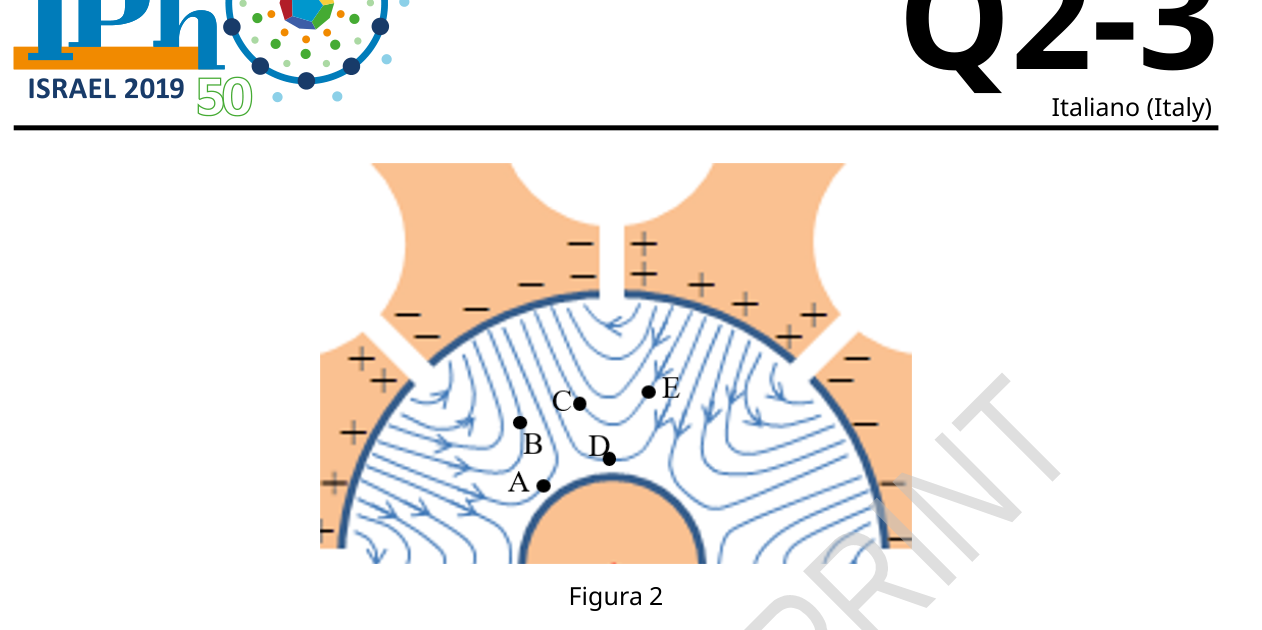
Figura 2
A.4 La Figura 2 rappresenta le linee del campo elettrico variabile nella regione tra catodo e anodo ad un certo istante (il campo elettrico statico non è rappresentato). Nel Foglio Risposte, per gli elettroni posti nei punti A, B, C, D e E nell’istante rappresentato si indichi se la velocità di deriva è diretta verso il catodo, verso l’anodo o perpendicolarmente al raggio. 1.2pt
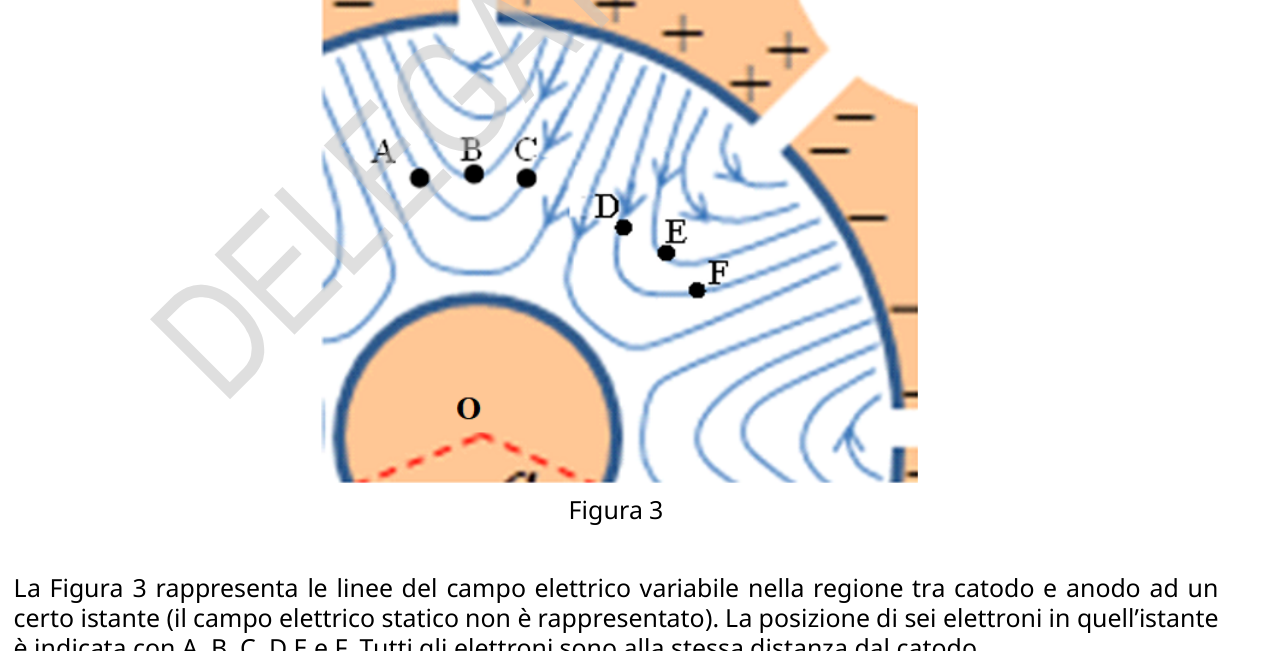
Figura 3
La Figura 3 rappresenta le linee del campo elettrico variabile nella regione tra catodo e anodo ad un certo istante (il campo elettrico statico non è rappresentato). La posizione di sei elettroni in quell’istante è indicata con A, B, C, D E e F. Tutti gli elettroni sono alla stessa distanza dal catodo.
Theory Q2-4 Italiano (Italy)
A.5 Si consideri la situazione mostrata in Figura 3. Per ciascuna delle sei coppie di elettroni AB, AC, BC, DE, DF, EF, si indichi sul foglio risposte se, nell’istante rappresentato, la velocità di deriva provoca una diminuzione o un aumento dell’angolo tra i loro vettori posizione (misurati a partire dal centro del catodo O). 1.2pt
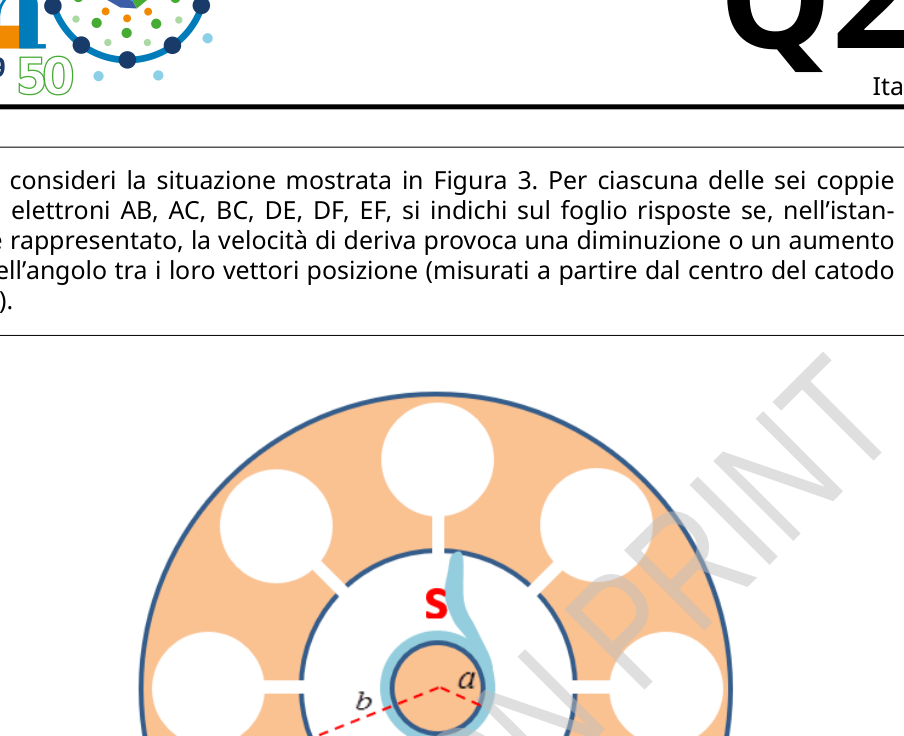
Figura 4
L’andamento evidenziato nella Domanda A.5 funziona come un meccanismo di messa a fuoco, concentrando in alcune lingue rotanti gli elettroni della regione interna dal magnetron. La Figura 4 rappresenta una di queste lingue, indicata con S.
A.6 Nel Foglio Risposte, si rappresentino le altre lingue rotanti allo stesso istante. Si indichi con delle frecce la loro direzione di rotazione, e si calcoli la loro velocità angolare media . 0.8pt
Si consideri l’approssimazione in cui il campo elettrico totale nei punti a metà distanza tra catodo e anodo è pari al valore medio del campo elettrico statico tra catodo e anodo lungo una direzione radiale. Si consideri inoltre che le lingue rotanti in cui sono concentrati gli elettroni siano approssimativamente radiali in tali punti. In Figura 4 sono rappresentati anche il raggio del catodo e il raggio interno dell’anodo (rispettivamente e ).
A.7 Si trovi un’espressione approssimata per la tensione statica necessaria a far funzionare il magnetron nella maniera descritta (l’espressione ottenuta fornirà un’approssimazione del valore minimo necessario per il funzionamento del magnetron; la tensione ottimale è leggermente superiore). 1.1pt
Theory Q2-5 Italiano (Italy)
Parte B: L’interazione della radiazione a microonde con le molecole d’acqua (3.4 punti)
Questa parte riguarda l’uso della radiazione a microonde (irradiata dall’antenna del magnetron nel forno) per riscaldare un materiale dielettrico dispersivo come l’acqua, pura o salata (che è un nostro modello per una zuppa).
Un dipolo elettrico è una configurazione di due cariche elettriche uguali e opposte e situate a una piccola distanza l’una dall’altra. Il vettore di dipolo elettrico va dalla carica negativa a quella positiva e la sua ampiezza è .
Un campo elettrico dipendente dal tempo, , viene applicato a un dipolo singolo avente momento e intensità costante . L’angolo tra il dipolo e il campo elettrico è .
B.1 Scrivere le espressioni dell’intensità della coppia applicata dal campo elettrico al dipolo e della potenza trasmessa dal campo al dipolo, in funzione di , , e delle loro derivate. 0.5pt
Le molecole d’acqua sono polari, e possono essere trattate come dipoli elettrici. A causa dei forti legami a idrogeno fra le molecole d’acqua, allo stato liquido, non è possibile trattarle come dipoli indipendenti. Piuttosto, si dovrebbe fare riferimento al vettore di polarizzazione , che è la densità del momento di dipolo (cioè il momento di dipolo medio per unità di volume di un insieme di molecole d’acqua). La polarizzazione è un vettore parallelo al campo elettrico locale variabile della radiazione a microonde, , e oscilla nel tempo con un’ampiezza che è proporzionale all’ampiezza del campo elettrico locale, ma con un ritardo di fase .
Il campo elettrico variabile locale in una determinata posizione all’interno dell’acqua è , dove , dando origine alla polarizzazione . La costante adimensionale è una proprietà dell’acqua.
B.2 Trovare un’espressione per la potenza media per unità di volume che è stata assorbita dall’acqua. La media temporale per una variabile periodica che dipende dal tempo in un periodo viene definita da 0.5pt
Si consideri la propagazione della radiazione in acqua. La costante dielettrica relativa dell’acqua (ad una determinata frequenza della radiazione elettromagnetica) è e il corrispondente indice di rifrazione dell’acqua è . La densità di energia istantanea del campo elettrico è data da . In un periodo, la densità di energia media del campo elettrico e del campo magnetico sono uguali.
B.3 Si indichi con l’irradiamento (potenza media trasferita dalla radiazione elettromagnetica per unità di area). Qui è la profondità di penetrazione in acqua quando la radiazione si propaga nella direzione . Trovare un’espressione per in funzione di . Tale espressione può contenere l’irradiamento sulla superficie dell’acqua . 1.1pt
La differenza di fase è il risultato dell’interazione tra le molecole d’acqua. Essa dipende dal coefficiente adimensionale di dispersione dielettrica e dalla costante dielettrica relativa tramite la relazione
Theory Q2-6 Italiano (Italy)
. Entrambe le grandezze e dipendono dalla pulsazione e dalla temperatura. Quando è sufficientemente piccolo, la profondità di penetrazione in acqua del campo elettrico è data da: dove e è la velocità della luce nel vuoto.
B.4 Si consideri l’approssimazione in cui e si trovi un’espressione per il coefficiente , definito nella Domanda B.2, in termini degli altri parametri. 0.6pt
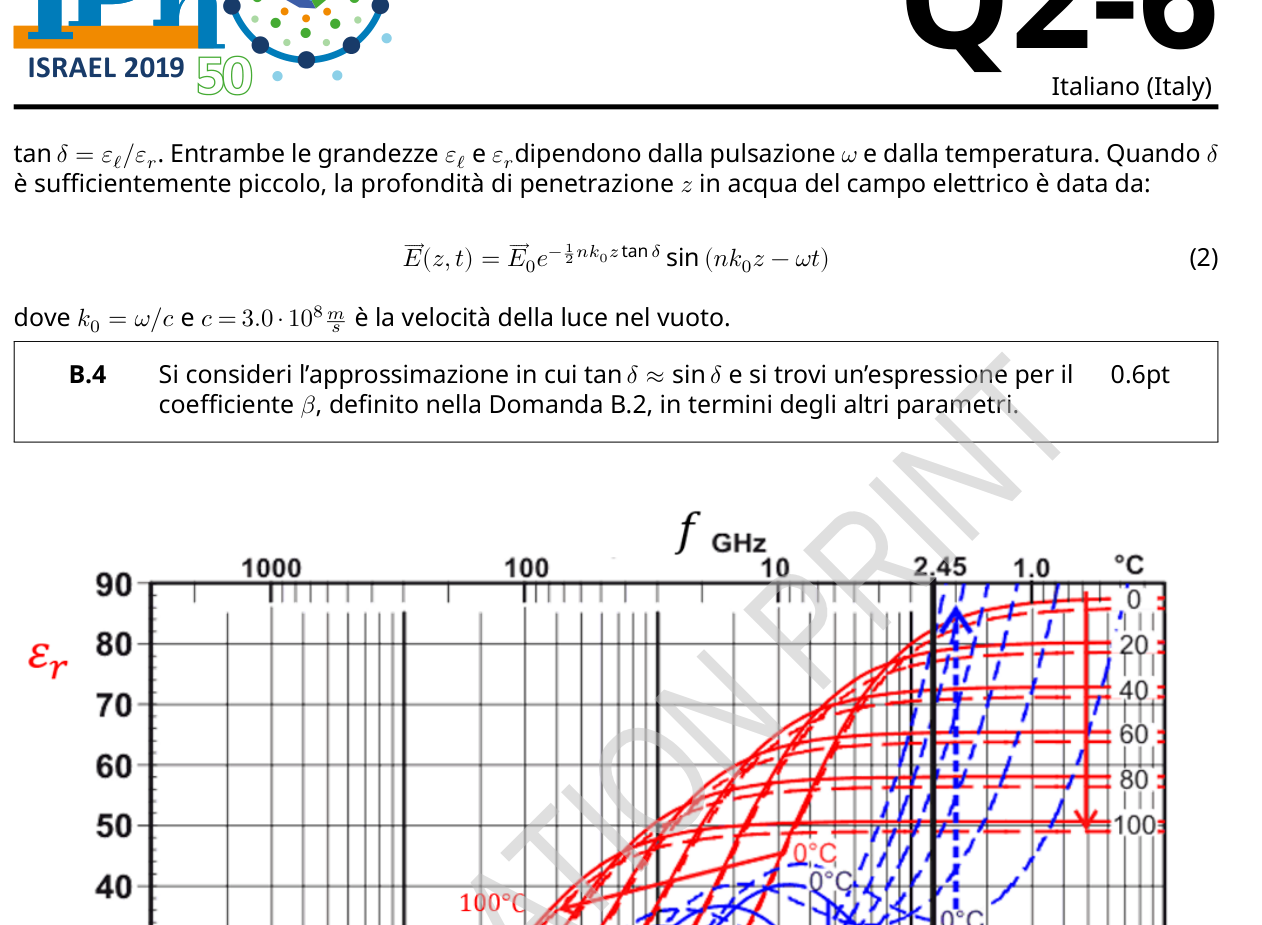
Figura 5. Le frecce rappresentano la variazione della temperatura nelle varie curve da a .
La Figura 5 rappresenta (in blu) e (in rosso) per l’acqua distillata (linee continue) e una soluzione di acqua e sale (linee tratteggiate) in funzione della lunghezza d’onda o della frequenza del campo elettrico per diverse temperature. La radiazione che corrisponde alla pulsazione è indicata da una linea verticale più spessa. Nel seguito si considerino solo microonde di tale frequenza.
Theory Q2-7 Italiano (Italy)
B.5 Si usi la Figura 5 per rispondere alle seguenti domande:
- Per l’acqua distillata a , si trovi la profondità di penetrazione alla quale la potenza trasmessa per unità di volume è ridotta alla metà del suo valore a .
- Si indichi sul Foglio Risposte se la profondità di penetrazione della radiazione a microonde in acqua distillata aumenta, diminuisce o resta invariata al variare della temperatura.
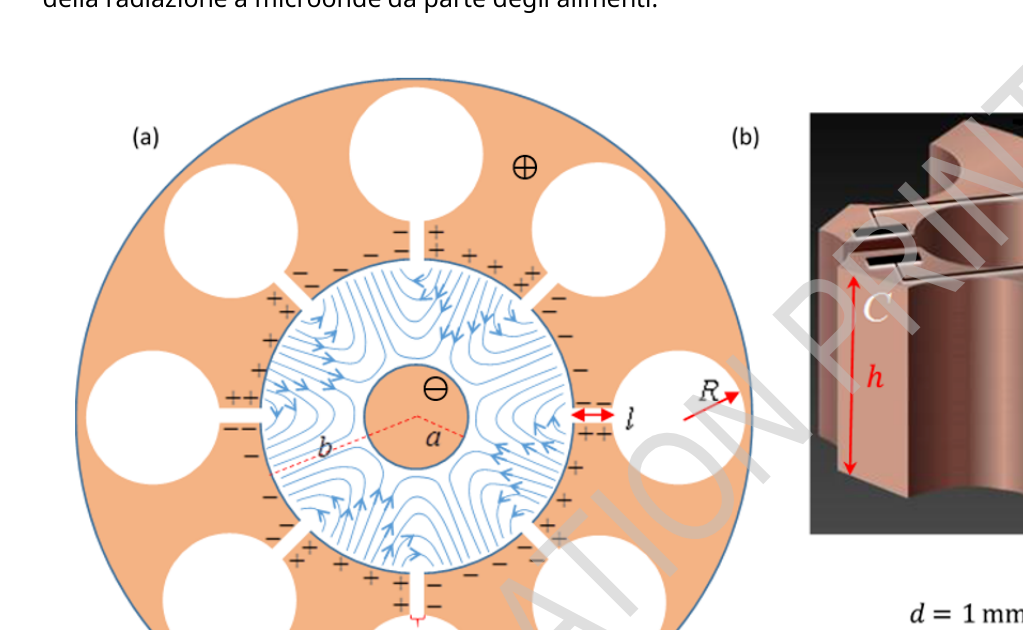
p.1 — Sezione del magnetron, viste (a) e (b)
p.3 — Linee di campo elettrico variabile catodo-anodo
p.3 — Linee di campo elettrico tra catodo e anodo
p.4 — Magnetron con punto di sella S
Topic: Electromagnetism, Oscillations & Waves, Electrostatics Metodi: Lorentz Force Analysis, Energy Conservation Method, Calculus-Integration, Wave Equation, Superposition Principle Competenze: Physical Reasoning, Mathematical Modeling, Diagrammatic Reasoning Objects: Electron Fonte: Testo (PDF) — p.2 Soluzione: Soluzioni (PDF)
- at the electron speed is .
1.5pt
Now let’s resume the magnetron analysis. The distance between the cathode and the anode is . It is assumed that, The maximum kinetic energy of the electrons not more than . The intensity of the static magnetic field is . La The mass and charge of the electron are and respectively.
A.3 The maximum radius of the trajectory of the electron in the The reference system in which it is approximately circular, assuming that the reference system is approximately inertial. 0.4pt
Theory Q2-3 Italian (Italy)
Figure 2
A.4 Figure 2 shows the lines of the variable electric field in the region between The electric field is not represented. In the Answer Sheet, for electrons placed in points A, B, C, D and E in the instant The represented indicates whether the drift speed is directed towards the cathode, towards the anode or perpendicular to the radius. 1.2pt
Figure 3
Figure 3 shows the lines of the electric field variable in the region between the cathode and anode at a The static electric field is not represented. The position of six electrons at that instant is indicated by A, B, C, D E and F. All the electrons are at the same distance from the cathode.
Theory Q2-4 Italian (Italy)
A.5 Consider the situation shown in Figure 3. For each of the six couples The resulting electron speed shall be expressed in terms of the number of electrons AB, AC, BC, DE, DF, EF, and shall be indicated on the response sheet if, at the moment represented, the drift speed causes a decrease or increase. angle between their vectors (measured from the centre of the cathode) O). 1.2pt
Figure 4
The trend highlighted in Question A.5 works as a focusing mechanism, concentrating in some rotating languages the electrons of the inner region of the magnetron. Figure 4 shows that one of these languages, marked with an S.
A.6 In the Answer Sheet, the other languages rotating at the same time are represented. Si You can point them in the direction of rotation with arrows and calculate their speed. The mean angular . 0.8pt
Consider the approximation in which the total electric field at half-distance points between the cathode and anode is is equal to the mean value of the static electric field between the cathode and anode along a radial direction. Si Consider also that the rotating languages in which the electrons are concentrated are approximately radials at these points. Figure 4 also shows the radius of the cathode and the internal radius of the anode. (rispettivamente e ).
A.7 An approximate expression is given for the static voltage required to make The magnetron shall operate as described (the resulting expression will provide an approximation of the minimum value necessary for the operation of the magnetron). The maximum voltage is slightly higher). 1.1pt
Theory Q2-5 Italian (Italy)
Part B: Interaction of microwave radiation with water molecules (3.4 points)
This part concerns the use of microwave radiation (irradiated by the magnetron antenna in the oven) To heat a dispersible dielectric material such as water, pure or salted (which is a model of ours) for a soup).
An electric dipole is a configuration of two equal and opposite electric charges and located at one small distance from each other. The electric dipole vector goes from negative to positive charge and its width is .
A time-dependent electric field, , is applied to a single dipole having momento e intensità costante . The angle between the dipole and the electric field is .
B.1 Write the expressions of the torque applied by the electric field to the dipole and the power transmitted by the field to the dipole, as of , , and their derivatives. 0.5pt
Water molecules are polar, and they can be treated like electric dipoles. Because of the strong ties Hydrogen between water molecules, in liquid state, cannot be treated as independent dipoles. Instead, we should refer to the polarization vector , which is the moment density of dipol (i.e. the mean dipol moment per unit volume of a set of water molecules). La Polarization is a vector parallel to the local variable electric field of microwave radiation, , and oscillates over time at an amplitude that is proportional to the amplitude of the local electric field, but with a phase delay .
The local variable electric field at a given position within the water is , where , giving rise to the polarization . The dimensionless constant It’s a property of water.
B.2 Find an expression for the mean power per unit volume which is It was absorbed by the water. The mean time for a periodic variable that depends on the time in a period is defined by 0.5pt
Consider the propagation of radiation in water. The relative dielectric constant of water (to a The frequency of the electromagnetic radiation (EMR) is and the corresponding refractive index The water content is . The instantaneous energy density of the electric field is given by . In a period of time, The energy density of the electric field and the magnetic field are equal.
B.3 Radiation (average power transferred from electromagnetic radiation per unit area) is indicated by . Here is the depth of penetration into water when radiation is propagated in the direction . Finding an Expression for in the function of . This expression may include irradiation on the surface of water . 1.1pt
The phase difference is the result of the interaction between water molecules. It depends on the dimensionless dielectric dispersion coefficient and the relative dielectric constant by the ratio
Theory Q2-6 Italian (Italy)
. Both and are dependent on the pulse and the temperature. When is sufficiently small, the depth of penetration in water of the electric field is given by: where and is the speed of light in vacuum.
B.4 Consider the approximation in which is found and an expression for the The coefficient , as defined in Question B.2, in terms of other parameters. 0.6pt
Figure 5 is shown. The arrows represent the temperature change in the various curves from to .
Figure 5 shows (in blue) and (in red) for distilled water (continuous lines) and a solution of Water and salt (drawn lines) according to the wavelength or frequency of the electric field It’s a different temperature. Radiation corresponding to the pulse is indicated from a thicker vertical line. In the following, only microwaves of this frequency are considered.
Theory Q2-7 Italian (Italy)
B.5 Figure 5 is used to answer the following questions:
- For distilled water at , the penetration depth at where the power transmitted per unit volume is reduced to half its valore a .
- Indicate on the Answer Sheet whether the depth of penetration of microwave radiation in distilled water increases, decreases or remains unchanged The temperature changes.
p.1 Section of the magnetron, as seen in (a) and (b)
p.3 Line of electric field variable cathode-anode
p.3 Electric field lines between cathode and anode
p.4 — Magnetron con punto di sella S
Topic: Electromagnetism, Oscillations & Waves, Electrostatics Metodi: Lorentz Force Analysis, Energy Conservation Method, Calculus-Integration, Wave Equation, Superposition Principle Competenze: Physical Reasoning, Mathematical Modeling, Diagrammatic Reasoning Objects: Electron Fonte: Testo (PDF) — p.2 Soluzione: Soluzioni (PDF)
- Si indichi sul Foglio Risposte se la profondità di penetrazione delle microonde nella zuppa (soluzione di acqua e sale) aumenta, diminuisce o rimane invariata al variare della temperatura. 0.7pt
p.6 — Permittivita acqua vs lunghezza d’onda e temperatura
Topic: Oscillations & Waves, Electromagnetism Metodi: Experimental Data Analysis, Approximation & Series Expansion, Physical Modeling Competenze: Physical Reasoning, Experimental Data Analysis, Graph Linearization Objects: — Fonte: Testo (PDF) — p.7 Soluzione: Soluzioni (PDF)
- The answer sheet shall indicate whether the depth of penetration of the microwaves in the soup (water and salt solution) increases, decreases or The temperature varies and the temperature remains unchanged. 0.7pt
Permitted water vs. wavelength and temperature
Topic: Oscillations & Waves, Electromagnetism Metodi: Experimental Data Analysis, Approximation & Series Expansion, Physical Modeling Competenze: Physical Reasoning, Experimental Data Analysis, Graph Linearization Objects: — Fonte: Testo (PDF) — p.7 Soluzione: Soluzioni (PDF)