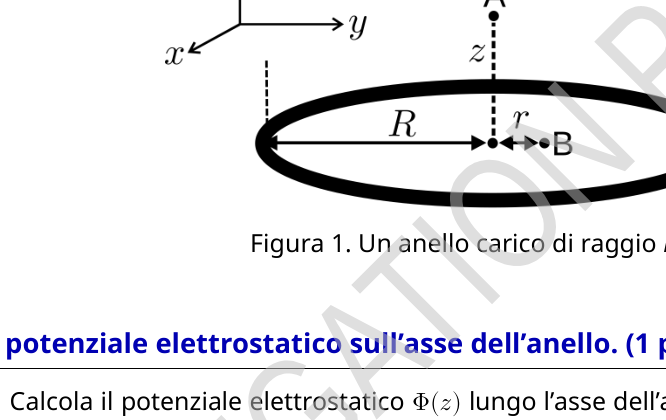
Theory Q2-1 Italiano (Italy) Lenti elettrostatiche (10 punti) Considera un anello metallico di raggio R, uniformemente carico con carica totale q. L’anello è un toroide cavo di spessore . Questo spessore può essere trascurato nelle parti A, B, C, ed E. Il piano xy coincide con il piano dell’anello, mentre l’asse zè ad esso perpendicolare , come mostrato nella Figura 1. Nelle parti A e B può essere necessario utilizzare la formula (sviluppo in serie di Taylor) (1 + + εx+ 1 , quando . Figura 1. Un anello carico di raggio R. Parte A. Il potenziale elettrostatico sull’asse dell’anello. (1 punto) A.1 Calcola il potenziale elettrostatico ) lungo l’asse dell’anello ad una distanza zdal suo centro (punto A in Figura 1). 0.3pt A.2 Calcola il potenziale elettrostatico ) al primo ordine non costante in z, assumendo . 0.4pt A.3 Un elettrone (massa me carica ) è posto nel punto A (Figura 1, ). Qual è l’espressione della forza che agisce sull’elettrone? Dall’espressione della forza determina il segno di qin modo che il moto risultante corrisponda ad un moto oscillatorio. L’elettrone in movimento non influenza la distribuzione di carica sull’anello. 0.2pt A.4 Qual è la frequenza angolare ωdi queste oscillazioni armoniche? 0.1pt Parte B. Potenziale elettrostatico nel piano dell’anello (1.7 punti) In questa parte del problema dovrai analizzare il potenziale ) nel piano dell’anello (z= 0) per (punto B in Figura 1). Al primo ordine non costante in ril potenziale elettrostatico è dato da ) q(α+ βr2).
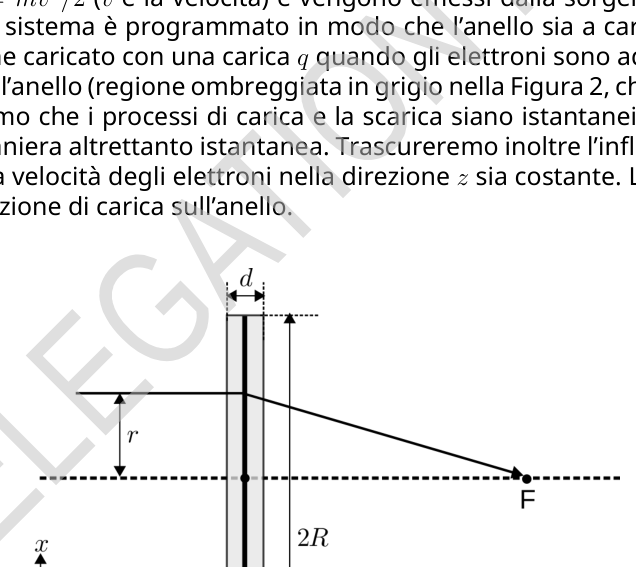
Theory Q2-2 Italiano (Italy) B.1 Determina l’espressione per β. Potresti aver bisogno dello sviluppo in serie di Taylor fornito precedentemente. 1.5pt B.2 Un elettrone è posto nel punto B (Figura 1, ). Qual è l’espressione della forza che agisce sull’elettrone? Dall’espressione della forza determina il segno di qin modo che il moto risultante corrisponda ad un moto oscillatorio. L’elettrone in movimento non influenza la distribuzione di carica sull’anello. 0.2pt Parte C. La lunghezza focale della lente elettrostatica idealizzata: processo di carica istantanea (2.3 punti) Si vuole costruire un dispositivo per focalizzare gli elettroni — una lente elettrostatica. Si consideri il seguente schema. L’anello è posizionato perpendicolarmente all’asse zcome mostrato in Figura 2. Abbiamo una sorgente che ammette a richiesta pacchetti di elettroni non relativistici. L’energia cinetica di questi elettroni è E= mv2/2 (vè la velocità) e vengono emessi dalla sorgente ad un istante perfettamente determinato. Il sistema è programmato in modo che l’anello sia a carica nulla per la maggior parte del tempo ma viene caricato con una carica qquando gli elettroni sono ad una distanza minore di ) dal piano dell’anello (regione ombreggiata in grigio nella Figura 2, chiamata “regione attiva”). Nella parte C assumeremo che i processi di carica e la scarica siano istantanei e che il campo elettrico ”riempia lo spazio” in maniera altrettanto istantanea. Trascureremo inoltre l’influenza dei campi magnetici e assumeremo che la velocità degli elettroni nella direzione zsia costante. L’elettrone in movimento non influenza la distribuzione di carica sull’anello. Figura 2. Un modello di lente elettrostatica. C.1 Determina la lunghezza focale fdi questa lente. Assumi che . Esprimi il tuo risultato in termini della costante βdella domanda B.1 e di altre quantità note. Assumi che prima di raggiungere la ”regione attiva” il moto del pacchetto di elettroni sia parallelo all’asse ze che . Il segno di qdovrebbe essere scelto in modo che la lente sia convergente. 1.3pt In realtà la sorgente di elettroni è posizionata sull’asse zad una distanza b> fdal centro dell’anello. Tieni conto del fatto che gli elettroni non si muovono più parallelamente all’asse zprima di raggiungere
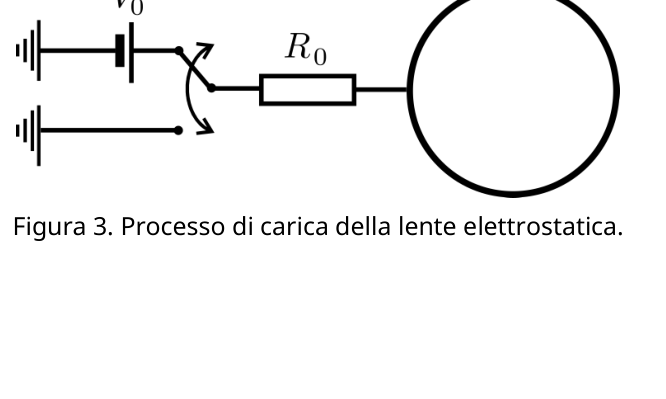
Theory Q2-3 Italiano (Italy) la ”regione attiva”, ma sono emessi da una sorgente puntiforme con un angolo rad rispetto all’asse z. Gli elettroni sono focalizzati in un punto posto a distanza cdal centro dell’anello. C.2 Trova c. Esprimi la tua risposta in termini della costante βdella domanda B.1 e di altre quantità note. 0.8pt C.3 L’equazione dei punti coniugati 1 b+ 1 c= 1 f è soddisfatta dalle lenti elettrostatiche? Rispondi calcolando esplicitamente 1/b+ 1/c. 0.2pt Parte D. L’anello come condensatore (3 punti) Il modello considerato precedentemente era idealizzato e abbiamo assunto che l’anello venga caricato istantaneamente. Nella realtà il processo di carica non è istantaneo poiché l’anello è un condensatore con una capacità finita C. In questa parte studieremo le proprietà di questo condensatore. Potrebbero servirti i seguenti integrali: sin x= ∣cos x+ 1 sin x ∣+ const e dx 1 + x2 = ln ∣x+ + x2∣+ const. D.1 Calcola la capacità Cdell’anello. Considera che l’anello ha una larghezza finita 2ama ricorda che . 2.0pt Quando gli elettroni raggiungono la “regione attiva” l’anello è collegato ad un generatore di differenza di potenziale V0 (Figura 3). Quando gli elettroni oltrepassano la “regione attiva” l’anello viene messo a terra. La resistenza del contatto è R0 e la resistenza dell’anello stesso può essere trascurata. Figura 3. Processo di carica della lente elettrostatica.
Theory Q2-4 Italiano (Italy) D.2 Determina la dipendenza dal tempo della carica sull’anello, q(t), e disegna un grafico schematico di questa dipendenza. L’istante t= 0 corrisponde all’istante in cui gli elettroni attraversano il piano dell’anello. Qual è la carica sull’anello q0 quando il valore assoluto q(t) è massimo? La capacità dell’anello è C(cioè non devi usare la vera espressione trovata in D.1). Nota: la polarità indicata nella Figura 3 è riportata solo a scopo illustrativo. Il segno dovrebbe essere scelto in modo che la lente sia convergente. 1.0pt Parte E. Lunghezza focale di una lente più realistica: processo di carica non istantanea (2 punti) In questa parte del problema, considereremo il comportamento di una lente pù realistica. Qui trascureremo di nuovo lo spessore dell’anello 2ae assumeremo che gli elettroni viaggiano parallelamente all’asse zprima di raggiungere la ”regione attiva”. Invece il processo di carica dell’anello non è più istantaneo. E.1 Trova la lunghezza focale fdella lente. Assumi che , ma d/ve R0C siano dello stesso ordine di grandezza. Esprimi la tua risposta in termini della costante βdella parte B e altre quantità note. 1.7pt E.2 Vedrai che il risultato per fè simile a quello ottenuto nella parte C, mentre la quantità qè sostituita da qeff. Trova l’espressione di qeff in funzione delle quantità date nella formulazione del problema. 0.3pt
p.1 — Anello carico di raggio R con assi
p.2 — Modello di lente elettrostatica con raggi
p.3 — Processo di carica della lente
Topic: Electrostatics, Oscillations & Waves, Circuits Metodi: Electric Potential Method, Approximation & Series Expansion, Simple Harmonic Motion Analysis, Differential Equations, Equivalent Circuit Reduction Competenze: Mathematical Modeling, Physical Reasoning, Diagrammatic Reasoning Objects: Electron, Capacitor Fonte: Testo (PDF) — p.1 Soluzione: Soluzioni (PDF)
Theory Q2-1 Italian (Italy) The following table shows the results of the calculations: Consider an R-ray metal ring, uniformly loaded with total q load. The ring is a toroid. a width of . This thickness can be overlooked in parts A, B, C, and E. The xy plan coincides with the plane of the ring, while the z axis is perpendicular to it, as shown in Figure 1. In Parts A and B it may be necessary to use the formula (Taylor series development) (1 + + εx+ 1 , when . Figure 1 is shown. A ring loaded with R-rays. Part A. The electrostatic potential on the ring axis. (a) the number of days A.1 Calculate the electrostatic potential ) along the axis of the ring at a distance The data set is the same as the data set. 0.3pt A.2 Calculate the electrostatic potential ) at the first non-constant order in z, assumendo . 0.4pt A.3 An electron (charging mass me ) is placed in point A (Figure 1, ). What Is it the expression of the force acting on the electron? From the expression of force determines the qin sign so that the resulting motor corresponds to a motor The oscillating force. The electron in motion does not affect the charge distribution On the ring. 0.2pt A.4 What is the angular frequency of these harmonic oscillations? 0.1pt Part B. Electrostatic potential in the plane of the ring (1.7 points) In this part of the problem you’ll have to analyze the potential in the ring plane (z=0) for (point B in Figure 1). The first non-constant order in electrostatic potential is given by ) q(α+ βr2).
Theory Q2-2 Italian (Italy) B.1 Determine the expression for β. You may need the series development of Taylor provided earlier. 1.5pt B.2 An electron is placed in point B (Figure 1, ). What is the expression of the The force acting on the electron? The force is expressed by the sign of The resulting motion is a oscillating motion. The electron The movement does not affect the distribution of the load on the ring. 0.2pt Part C. The focal length of the idealized electrostatic lens: instantaneous charging process (2.3 points) You want to build a device to focus electrons an electrostatic lens. Consider the The following diagram. The ring is positioned perpendicular to the z axis as shown in Figure 2. We have a source that allows for non-relativistic electron packs on demand. Kinetic energy of these electrons is E=mv2/2 (see velocity) and they are emitted from the source at a perfectly determined instant. The system is programmed so that the ring is charged at zero for most The electrons are at a distance of less than ) from the plane of the ring (grey shaded region in Figure 2, called active region). In Part C we will assume that the charging and discharging processes are instantaneous and that the electric field is fill the space just as instantly. We will also ignore the influence of magnetic fields and assume that the velocity of the electrons in the direction is constant. The electron in motion does not affect the distribution of load on the ring. Figure two. It’s a model of an electrostatic lens. C.1 Determine the focal length of this lens. Assume that . Express the your result in terms of the constant β of application B.1 and other quantities Notes. Assume that before reaching the active region the package motion The electron is parallel to the axis z and . The sign of q should be selected so that the lens converges. 1.3pt In reality the source of electrons is located on the zad axis a distance b> f from the center of the ring. Note that electrons no longer move parallel to the axis before reaching the
Theory Q2-3 Italian (Italy) the active region, but are emitted from a point source at an angle rad relative to the axis z. The electrons are focused at a point far from the centre of the ring. C.2 Find the c. Express your answer in terms of the constant β of question B.1 and of other known quantities. 0.8pt C.3 Equation of the conjugate points 1 b+ 1 c= 1 f Are you satisfied with the electrostatic lenses? Answer by explicitly calculating 1/b+ 1/c. 0.2pt The following is the list of the following: The ring as a condenser (3 points) The model we considered was idealized and we assumed that the ring would be loaded I’m going to get it right away. In reality the charging process is not instantaneous because the ring is a condenser with a finite capacity C. In this part, we’re going to study the properties of this capacitor. They could You need the following integers: sin x= ∣cos x+ 1 without x
- const e dx 1 + x2 = ln ∣x+ + x2∣+ const. D.1 Calculate the capacity of the ring. Consider the ring to be finite in width. 2ama recalls that . 2.0pt When the electrons reach the active region the ring is connected to a difference generator of The potential for V0 (Figure 3). When the electrons pass the active region the ring is put to the ground. The resistance of the contact is R0 and the resistance of the ring itself can be neglected. Figure 3 is shown. The process of charging the electrostatic lens.
Theory Q2-4 Italian (Italy) D.2 Determine the dependence on the time of charge on the ring, q(t), and draw a This is a diagram of this addiction. The distance t=0 is the distance where electrons pass through the plane of the ring. What is the charge on the q0 ring? When the absolute value q(t) is maximum? The capacity of the ring is C You must use the true expression found in D.1). Note: The polarity shown in Figure 3 is for illustrative purposes only. Il The sign should be chosen so that the lens converges. 1.0pt Part E. The focal length of a more realistic lens: non-instant loading process (2 (point) In this part of the problem, we will consider the behaviour of a more realistic lens. Here we’ll overlook the thickness of ring 2 again and assume that the electrons travel parallel to the axis. before reaching the active region. The process of loading the ring is no longer instantaneous. E.1 Find the focal length of the lens. Assume that , but d/ve R0C They’re the same order of magnitude. Please state your answer in terms of the β constant of part B and other known quantities. 1.7pt E.2 You will see that the result for each factor is similar to that obtained in Part C, while the Quantity is replaced by qef. Find the expression of qef in terms of quantities The problem is not solved. 0.3pt
**p.1 ** R-beam ring with axles
p.2 — Modello di lente elettrostatica con raggi
p.3 — Processo di carica della lente
Topic: Electrostatics, Oscillations & Waves, Circuits Metodi: Electric Potential Method, Approximation & Series Expansion, Simple Harmonic Motion Analysis, Differential Equations, Equivalent Circuit Reduction Competenze: Mathematical Modeling, Physical Reasoning, Diagrammatic Reasoning Objects: Electron, Capacitor Fonte: Testo (PDF) — p.1 Soluzione: Soluzioni (PDF)