Theory Q2-1 Italiano (Italy) Stelle di neutroni (10 punti) In questo problema discutiamo la stabilità dei nuclei di grandi dimensioni e stimiamo teoricamente e sperimentalmente la massa delle stelle di neutroni. Parte A. Massa e stabilità dei nuclei (2.5 punti) L’ energia a riposo di un nucleo m(Z, N)c2 costituito da Zprotoni e Nneutroni è minore della somma delle energie a riposo dei protoni e dei neutroni, di seguito chiamati nucleoni, per l’energia di legame B(Z, N), dove cè la velocità della luce nel vuoto. Ignorando correzioni minori, possiamo esprimere l’energia di legame in termini dei coefficienti di volume aV, di superficie aS, di energia di Coulomb aCe di energia di simmetria asym, nel modo seguente: m(Z, N)c2 = AmNc2 , N), B(Z, N) = Z2 A1/3 A , (1) dove A= Z+Nè il numero di massa e mNè la massa di un nucleone. Nei calcoli, utilizzare MeV, MeV, MeV, e asym MeV (MeV = 106 elettronvolt). A.1 Considerata la condizione Z= N, determinare Aper massimizzare l’energia di legame per nucleone, B/A. 0.9pt A.2 Per un determinato valore di A, il numero atomico Z∗del nucleo più stabile è determinato massimizzando B(Z, ). Per A= 197, calcolare Z∗utilizzando l’equazione (1). 0.9pt A.3 Un nucleo con Agrande si divide in nuclei più leggeri attraverso la fissione, al fine di minimizzare l’energia totale a riposo. Per semplicità, consideriamo uno dei molteplici modi per dividere un nucleo (Z, N) in due nuclei uguali, che si può verificare quando vale la seguente relazione energetica: m(Z, N)c2 > 2m(Z/2, N/2)c2. Quando questa relazione viene scritta come Z2/A> Cfission aS aC , determinare Cfission con due cifre significative. 0.7pt Parte B. Stella di neutroni come nucleo gigante (1.5 punti) Nel caso di nuclei di grandi dimensioni con un numero di massa sufficientemente grande A> Acdove Ac è un valore di soglia, questi nuclei rimangono stabili rispetto alla fissione nucleare a causa dell’energia di legame sufficientemente grande dovuta alla gravità.
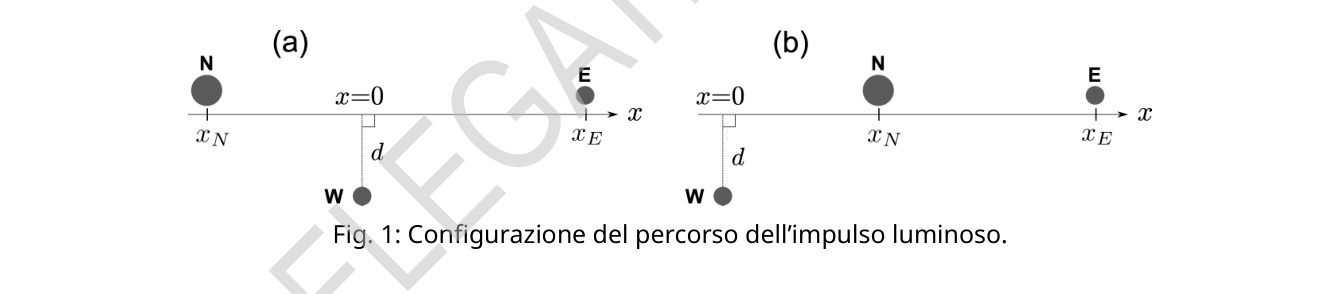
Theory Q2-2 Italiano (Italy) B.1 Assumiamo che N= Ae Z= 0 si realizzino nel caso di Asufficientemente grande e assumiamo che l’Eq. (1) continui a valere con l’aggiunta dell’energia di legame gravitazionale. L’energia di legame gravitazionale è Bgrav = 3 5 GM2 R , dove M= mNAe R= R0A1/3 con R0 m = 1.1 fm sono rispettivamente la massa e il raggio del nucleo. Per Bgrav = agravA5/3, determinare agrav nell’unità MeV con una cifra significativa. Dopo, ignorando il termine di superficie, stimare Accon una cifra significativa. Nei calcoli, utilizzare mNc2 MeV e G= ħc/M2 Pcome MPc2 1.22 1022 MeV e MeV . 1.5pt Parte C. Stella di neutroni in un sistema binario (6.0 punti) Alcune stelle di neutroni sono pulsar che emettono regolarmente onde elettromagnetiche di periodo costante, che qui chiamiamo ”luce” per semplicità. Le stelle di neutroni formano spesso sistemi binari con una Nana Bianca. Consideriamo la configurazione stellare mostrata nella Fig. 1, dove un impulso di luce da una stella di neutroni N alla Terra E passa vicino alla Nana Bianca W del sistema binario. La misurazione di questi impulsi, influenzati dalla gravità della stella, porta a una stima accurata della massa di W, come spiegato di seguito, e quindi alla stima della massa di N. Fig. 1: Configurazione del percorso dell’impulso luminoso.
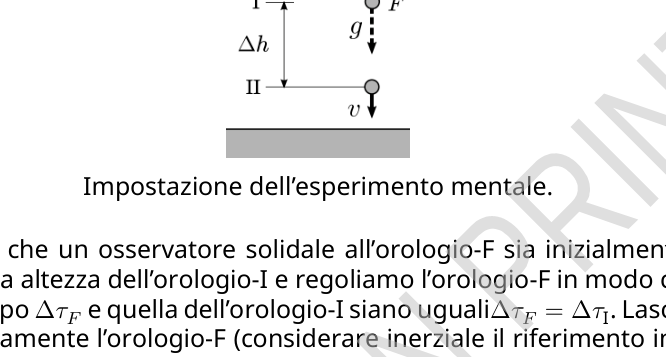
Theory Q2-3 Italiano (Italy) C.1 Come mostrato nella figura seguente, sotto l’accelerazione gravitazionale costante gfissiamo i due livelli I e II con differenza di altezza 0). Orologi identici sono posti in I, in II e in F(sistema in caduta libera) e indicati rispettivamente con orologio-I, orologio-II e orologio-F. Impostazione dell’esperimento mentale. Assumiamo che un osservatore solidale all’orologio-F sia inizialmente a riposo alla stessa altezza dell’orologio-I e regoliamo l’orologio-F in modo che la sua unità di tempo quella dell’orologio-I siano . Lasciamo ora cadere liberamente l’orologio-F (considerare inerziale il riferimento in cui esso è a riposo) che passa nei pressi dell’orologio-II con una velocità v. L’unità di tempo dell’orologio-F rimane . In questo istante, l’orologio-II si muove rispetto all’orologio-F verso l’alto con velocità v, cosi ché la dilatazione temporale può essere determinata usando le trasformazioni di Lorentz. l’unità di tempo dell’orologio-II misurata dal riferimento di F. Determinare in termini di al primo ordine in funzione di , dove la differenza di potenziale gravitazionale, cioè la differenza di energia potenziale gravitazionale per unità di massa. 1.0pt C.2 Per effetto del potenziale gravitazionale φ, i ritardi temporali modificano la velocità effettiva della luce, ceff, osservata all’infinito anche se la velocità della luce locale è c. Se φ(r= ) = 0, ceff può essere data al primo ordine in funzione di φ/c2 come ceff + 2φ c2 ) c che comprende l’effetto della distorsione spaziale che non era presente in C.1. Si tenga presente che il percorso della luce può essere approssimato a una linea retta. Come mostrato in Fig. 1, prendiamo l’asse xlungo il percorso della luce dalla stella di neutroni N alla Terra E e poniamo x= 0 nel punto in cui la Nana Bianca W è alla minima distanza dal percorso della luce. Sia xN(< 0) la coordinata xdi N, xE(> 0) quella di E e dla distanza tra W e il percorso luminoso. Stimare la variazione del tempo di arrivo un impulso luminoso da N a E causata dalla presenza della Nana Bianca di massa MWD ed esprimere la risposta in forma semplificata, cioè trascurando termini di ordine superiore nelle seguenti piccole quantità: d/|xN| , , e GMWD/(c2d) . Se necessario utilizzare la seguente formula. dx x2 + d2 = 1 2 log( x2 + d2 + x x2 + d2 ) + C. ( log è il logaritmo naturale) 1.8pt
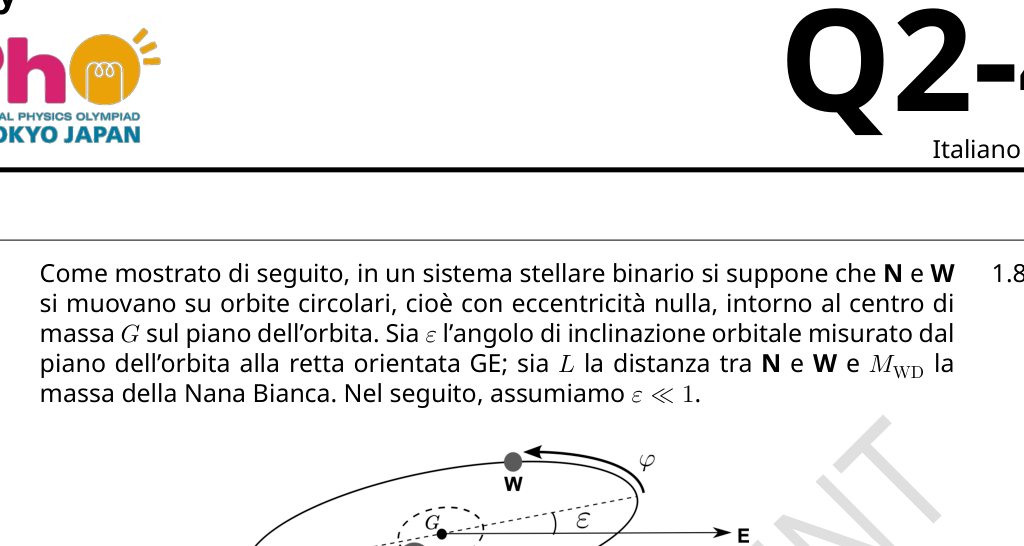
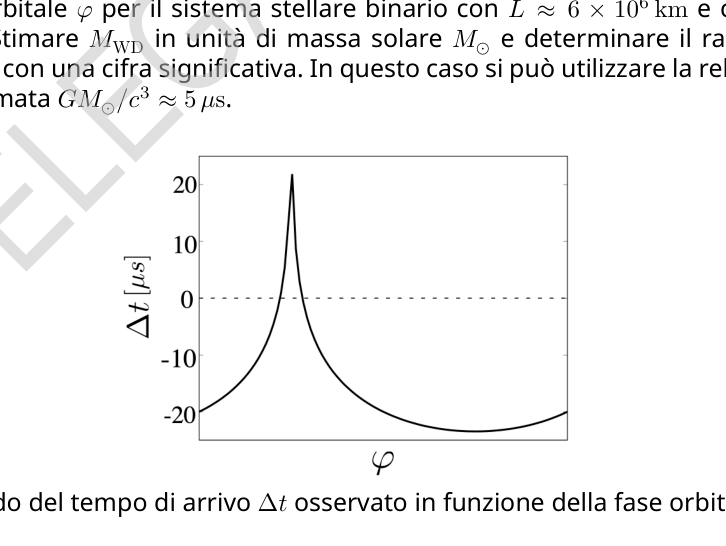
Theory Q2-4 Italiano (Italy) C.3 Come mostrato di seguito, in un sistema stellare binario si suppone che N e W si muovano su orbite circolari, cioè con eccentricità nulla, intorno al centro di massa Gsul piano dell’orbita. Sia εl’angolo di inclinazione orbitale misurato dal piano dell’orbita alla retta orientata GE; sia Lla distanza tra N e W e MWD la massa della Nana Bianca. Nel seguito, assumiamo . Sistema stellare binario. Da un punto di osservazione lontano da N, si osservino gli impulsi luminosi che da N raggiungono E. Il percorso della luce verso E varia nel tempo a seconda della posizione reciproca di N e W. Il ritardo del tempo impiegato da ogni impulso per arrivare in E assume il valore massimo per il valore minimo per . Calcolare in forma semplificata, cioè trascurando termini di ordine superiore nelle seguenti piccole quantità, come fatto in C.2. Si assuma che gli effetti dovuti alla gravità di oggetti stellari diversi da W si compensino in . 1.8pt C.4 La figura seguente mostra i ritardi dei tempi di arrivo osservati in funzione della fase orbitale φper il sistema stellare binario con 106 km e cos 0.99989. Stimare MWD in unità di massa solare M⊙e determinare il rapporto MWD/M⊙con una cifra significativa. In questo caso si può utilizzare la relazione approssimata GM⊙/c3 μs. Ritardo del tempo di arrivo in funzione della fase orbitale φ (vedi figura in C.3) per localizzare N e W sulle orbite. 0.8pt
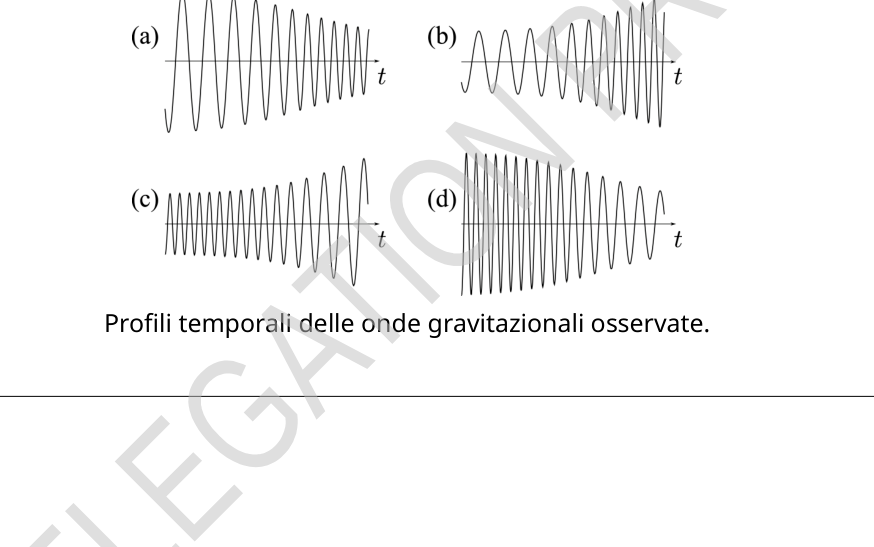
Theory Q2-5 Italiano (Italy) C.5 In un sistema binario di stelle di neutroni, le due stelle cedono energia e momento angolare attraverso l’emissione di onde gravitazionali e infine collidono fino a fondersi. Per semplicità, consideriamo un moto circolare con raggio Re velocità angolare ω, per cui trascurando gli effetti relativistici si ha ω= χRpcon la costante χche non dipende né da ωné da R. Determinare il valore di p. 0.4pt C.6 L’ampiezza dell’onda gravitazionale emessa dal sistema binario in C.5 è proporzionale a R2ω2. La figura seguente mostra qualitativamente quattro diversi profili temporal
p.2 — Configurazione del percorso dell’impulso luminoso
p.3 — Impostazione dell’esperimento mentale con tre orologi
p.4 — Sistema stellare binario, orbita ellittica
p.4 — Ritardo del tempo di arrivo in funzione della fase orbitale
p.5 — Profili temporali delle onde gravitazionali osservate
Topic: Nuclear & Particle Physics, Gravitation, Special Relativity Metodi: Mass-Energy Equivalence, Newton’s Law of Gravitation, Lorentz Transformation, Approximation & Series Expansion, Calculus-Integration Competenze: Mathematical Modeling, Physical Reasoning, Estimation & Approximation Objects: Nucleus, Star Fonte: Testo (PDF) — p.1 Soluzione: Soluzioni (PDF)
Theory Q2-1 Italian (Italy) Neutron stars (10 points) In this problem we discuss the stability of large nuclei and we estimate theoretically and We’re experimenting with the mass of neutron stars. Part A. Mass and stability of the cores (2.5 points) The energy at rest of a nucleus m ((Z, N) c2 consisting of Zprotons and Neutrons is less than the sum of the The resting energy of protons and neutrons, hereinafter referred to as nucleons, for the bond energy B(Z, N), where there is the speed of light in the vacuum. The energy of the energy of the energy of the energy of the energy of the energy of the energy of the energy of the energy of the energy of the energy of the energy of the energy of the energy of the energy of the energy of the energy of the energy of the energy of the energy of the energy of the energy of the energy of the energy of the energy of the energy of the energy of the energy of the energy of the energy of the energy of the energy of the energy of the energy of the energy of the energy of the energy of the energy of the energy of the energy of the energy of the energy of the energy of the energy of the energy of the energy of the energy. The following is the list of the coefficients of the coulomb energy of the coulomb energy of the coulomb energy of the coulomb energy of the coulomb energy of the coulomb energy of the coulomb energy of the coulomb energy of the coulomb energy of the coulomb energy of the coulomb energy of the coulomb energy of the coulomb energy of the coulomb energy of the coulomb energy of the coulomb energy of the coulomb energy of the coulomb energy of the coulomb energy of the coulomb energy of the coulomb energy of the coulomb energy of the coulomb energy of the coulomb energy of the coulomb energy of the coulomb energy of the coulomb energy of the coulomb energy of the coulomb energy of the coulomb asymmetry as follows: m(Z, N)c2 = AmNc2 , N), B(Z, N) = Z2 A1/3 A , (1) where A=Z+N is the mass number and mN is the mass of a nucleon. In the calculations, use MeV, MeV, MeV, e asym MeV (MeV = 106 elettronvolt). A.1 Given the condition Z=N, determine Aper to maximize the energy of The following is the list of the chemical substances used in the preparation of the product: 0.9pt A.2 For a given value of A, the atomic number Z of the most stable nucleus is determined by maximizing B(Z, ). For A=197, calculate using Z The following equation is used: 0.9pt A.3 A nucleus with Agrande divides into lighter nuclei through fission, at the The aim is to minimize total energy at rest. For simplicity’s sake, let’s consider one of the The number of ways of dividing a nucleus (Z, N) into two equal nuclei, which are may verify when the following energy report is valid: m(Z, N)c2 > 2m(Z/2, N/2)c2. When this report is written as Z2/A> Cfission aS aC , determine Cfission with two significant digits. 0.7pt Part B. Neutron star as a giant nucleus (1.5 points) In the case of large cores with a sufficiently large mass number A> Acdove Ac The energy of the nuclear fission is the energy of the nuclear fission. The weight of the material is not less than the weight of the material.
Theory Q2-2 Italian (Italy) B.1 Suppose that N=Ea Z=0 is realized in the case of Sufficiently So we’re going to have to do this. (1) continues to be valid with the addition of energy from gravitational bonding. The gravitational bond energy is Bgrav = 3 5 GM2 R , where M=mNAe R=R0A1/3 with R0 m = 1.1 fm are the mass and radius of the nucleus respectively. For Bgrav = agravA5/3, determine agrav in the MeV unit with a significant figure. Then, ignoring the surface term, estimate Accon a significant figure. In the calculations, use mNc2 MeV and G= ħc/M2 Pcome MPc2 1.22 1022 MeV e MeV . 1.5pt Part C. Neutron star in a binary system (6.0 points) Some neutron stars are pulsars that regularly emit periodic electromagnetic waves And this is the constant, which we call light here for simplicity. Neutron stars often form binary systems with a white Nana. Consider the star configuration shown in Fig. 1, where a pulse Light from a neutron star N to Earth E passes near the White Nana W of the binary system. La Measurement of these pulses, influenced by the star’s gravity, leads to an accurate estimate of the mass of W, as explained below, and therefore to the estimate of the mass of N.
- What? 1: Configuration of the path of the light pulse.
Theory Q2-3 Italian (Italy) C.1 As shown in the following figure, under constant gravitational acceleration we are going to find the two levels I and II with a difference in height 0. Identical clocks are placed in I, II and F (free fall system) and shown respectively with clock-I, clock-II and clock-F. The setting of the mental experiment. Assume that an observer in solidarity with the F-watch is initially resting at the same height as the I-watch and adjust the F-watch so that its The time units of the clock-I are . Let’s leave now The reference time in which the clock is placed is considered to be inertial. It is at rest) passing near the clock-II at a speed of v. The time unit of the F-clock remains . At this moment, the clock-II moves respectfully The time-flow is upwards at v speed, so that the time dilation can be It’s not going to be determined using Lorentz transformations. the unit of time of the clock-II measured from the reference F. Determine in terms of in the first order function of , where is the difference in gravitational potential, i.e. the difference in gravitational potential energy per unit of mass. 1.0pt C.2 Due to the gravitational potential φ, time delays change the actual speed of light, ceff, observed infinitely even if the speed of light is Local is c. If φ(r= ) = 0, ceff can be given to the first order according to φ/c2 as ceff + 2φ c2 ) c which includes the effect of spatial distortion not present in C.1. Please note that the path of light can be approximated to a line I’m going to tell you. As shown in Fig. 1, we take the axis along the path of light from And we put x is equal to 0 at the point where the White dwarf W is the minimum distance from the path of the light. Whether xN(< 0) the xdi coordinate N, xE(> 0) that of E and the distance between W and the light path. Estimate the change in arrival time of a light pulse from N to E causata dalla presenza della Nana Bianca di massa MWD ed esprimere la risposta in forma semplificata, cioè trascurando termini di ordine superiore nelle seguenti piccole quantità: d/|xN| , , e GMWD/(c2d) . If necessary use the following formula. dx x2 + d2 = 1 2 logs x2 + d2 + x x2 + d2 ) + C. (log is the natural logarithm) 1.8pt
Theory Q2-4 Italian (Italy) C.3 As shown below, in a binary star system, N and W are assumed to be They move in circular orbits, that is, with eccentricity of nothing, around the center of the Earth. mass G on the plane of orbit. Either the angle of orbital inclination measured by the The plane of the orbit in the direction of the direction of the Earth’s orbit; both the distance between N and W and MWD The white dwarf mass. In the following, we assume . The binary star system. From a distance of N, the light pulses are observed. From N to E. The path of light to E varies over time depending on the of the reciprocal position of N and W. The delay of time taken by each pulse to reach E assumes the maximum value for the value The minimum for . Calculate in simplified form, i.e. By disregarding higher order terms in the following small quantities, as made in C.2. It is assumed that the effects due to the gravity of different stellar objects from W to . 1.8pt C.4 The following figure shows the arrival time delays observed in relation to the orbital phase φ for the binary star system with 106 km and cos 0.99989. Estimate MWD in solar mass units M and determine the ratio MWD/M with a significant figure. In this case, the report may be used approssimata GM⊙/c3 μs. Arrival time delay depending on the orbital phase φ (see figure C.3) to locate N and W in orbits. 0.8pt
Theory Q2-5 Italian (Italy) C.5 In a binary neutron star system, the two stars yield energy and angular momentum through the emission of gravitational waves and finally collide until it melts. For simplicity, let’s consider a circular motorcycle with a King beam angle velocity ω, so that by ignoring the relativistic effects we have ω= χRpcon The constant χche does not depend on either ωne or R. Determine the value of p. 0.4pt C.6 The amplitude of the gravitational wave emitted by the binary system in C.5 is proportional to R2ω2. The following figure qualitatively shows four different temporal profiles
p.2 — Configurazione del percorso dell’impulso luminoso
**p.3 ** Set the mind experiment with three watches
p.4 — Sistema stellare binario, orbita ellittica
**p.4 ** Arrival time delay depending on the orbital phase
p.5 — Profili temporali delle onde gravitazionali osservate
Topic: Nuclear & Particle Physics, Gravitation, Special Relativity Metodi: Mass-Energy Equivalence, Newton’s Law of Gravitation, Lorentz Transformation, Approximation & Series Expansion, Calculus-Integration Competenze: Mathematical Modeling, Physical Reasoning, Estimation & Approximation Objects: Nucleus, Star Fonte: Testo (PDF) — p.1 Soluzione: Soluzioni (PDF)