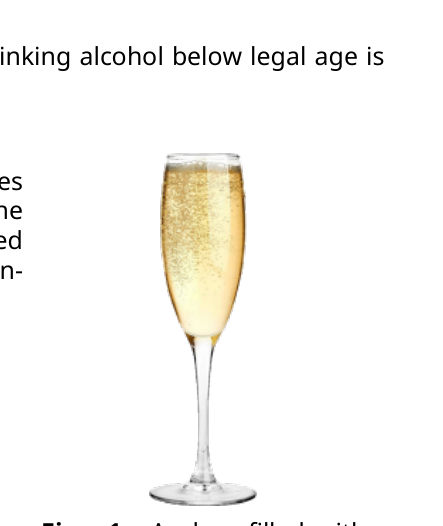
- A glass filled with champagne.
Part A. Nucleation, growth and rise of bubbles
Immediately after opening a bottle of champagne at temperature , we fill a glass. The pressure in the liquid is and its temperature stays constant at . The concentration of dissolved CO2 exceeds the equilibrium concentration and we study the nucleation of a CO2 bubble. We note its radius and its inner pressure.
A.1 Express the pressure in terms of , and . 0.2pt
In the liquid, the concentration of dissolved CO2 depends on the distance to the bubble. At long distance we recover the value and we note the concentration close to the bubble surface. According to Henry’s law, . We furthermore assume in all the problem that bubbles contain only CO2. Since , CO2 molecules diffuse from areas of high to low concentration. We assume also that any molecule from the liquid phase reaching the bubble surface is transferred to the vapour.
A.2 Express the critical radius above which a bubble is expected to grow in terms of , , and where . Calculate numerically for . 0.5pt
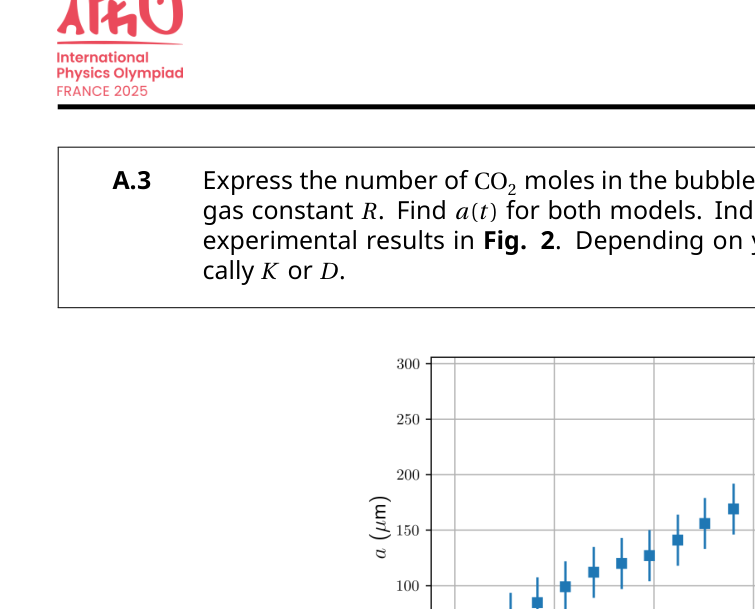
In practice, bubbles mainly grow from pre-existing gas cavities. Consider then a bubble with initial radius . The number of moles of CO2 transferred at the bubble’s surface per unit area and time is noted . Two models are possible for . • model (1) where is the diffusion coefficient of CO2 in the liquid. • model (2) where is a constant here. Experimentally, the bubble radius is found to depend on time as shown in Fig. 2. Here , and since bubbles are large enough to be visible, the excess pressure due to surface tension can be neglected and .
A.3 Express the number of CO2 moles in the bubble in terms of , , and ideal gas constant . Find for both models. Indicate which model explains the experimental results in Fig. 2. Depending on your answer, calculate numerically or . 1.2pt
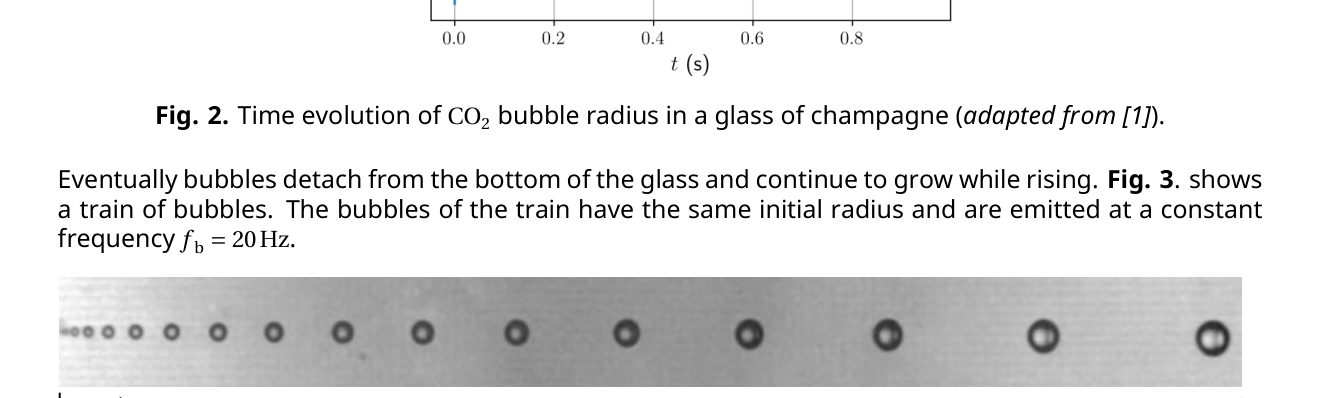
Fig. 2. Time evolution of CO2 bubble radius in a glass of champagne (adapted from [1]). Eventually bubbles detach from the bottom of the glass and continue to grow while rising. Fig. 3. shows a train of bubbles. The bubbles of the train have the same initial radius and are emitted at a constant frequency . , , , 1 mm Fig. 3. A train of bubbles. The photo is rotated horizontally for the page layout (adapted from [1]). For the range of velocities studied here, the drag force on a bubble of radius moving at velocity in a liquid of dynamic viscosity is given by Stokes’ law . Measurements show that at any moment in time, the bubble can be assumed to be travelling at its terminal velocity.
A.4 Give the expression of the main forces exerted on a vertically rising bubble. Obtain the expression of . Give a numerical estimate of using , and quantities measured on Fig. 3. 0.8pt
The quasi-stationary growth of bubbles with rate still applies during bubble rise.
A.5 Express the radius of a bubble reaching the free surface in terms of height travelled , growth rate , and any constants you may need. Assume and constant, and give the numerical value of with and corresponding to Fig. 2. 0.5pt
There are nucleation sites of bubbles. Assume that the bubbles are nucleated at a constant frequency at the bottom of a glass of champagne (height for a volume ), with still negligible. Neglect diffusion of CO2 at the free surface.
A.6 Write the differential equation for . Obtain from this equation the characteristic time for the decay of the concentration of dissolved CO2 in the liquid. 1.1pt
Part B. Acoustic emission of a bursting bubble
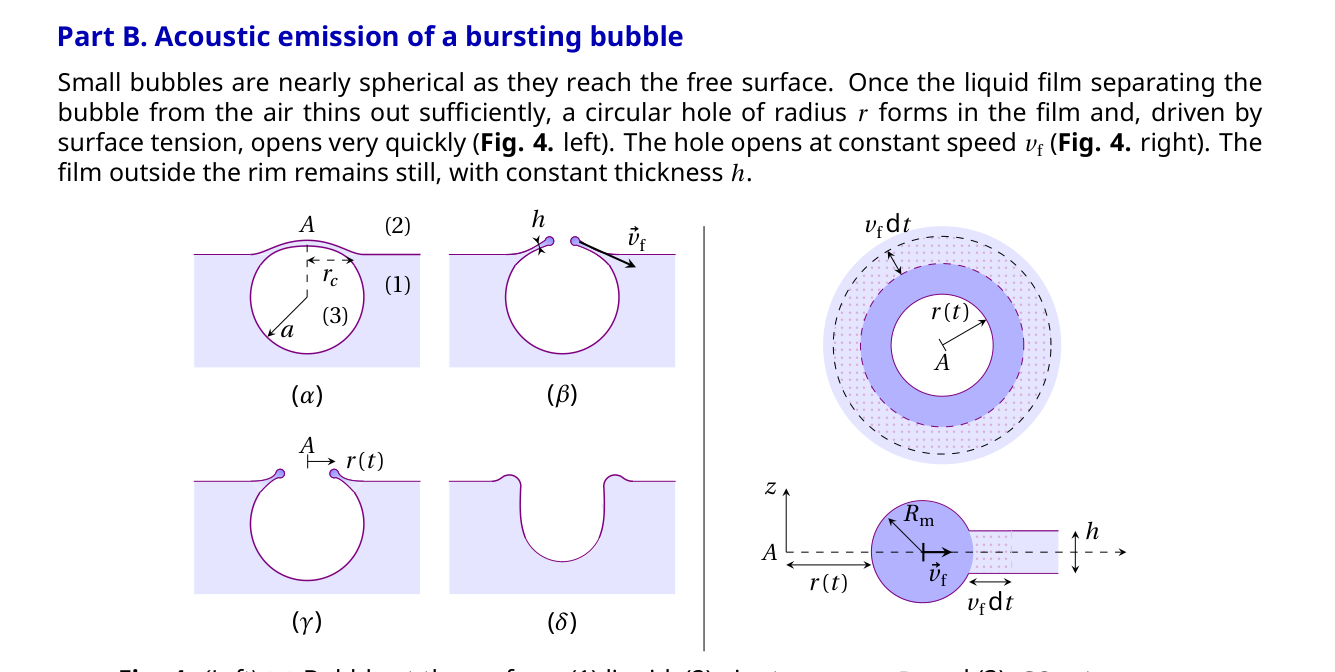
Small bubbles are nearly spherical as they reach the free surface. Once the liquid film separating the bubble from the air thins out sufficiently, a circular hole of radius forms in the film and, driven by surface tension, opens very quickly (Fig. 4. left). The hole opens at constant speed (Fig. 4. right). The film outside the rim remains still, with constant thickness .
Fig. 4. (Left) () Bubble at the surface: (1) liquid, (2) air at pressure and (3), CO2 at pressure , () and () retraction of the liquid film, where the rim is in dark blue, () bubble collapse. (Right) Retraction of the liquid film at time . Top: sketch of the pierced film seen from above. Bottom: cross-section of the rim and the retracting film. During the rim accumulates nearby liquid (dotted). Due to dissipative processes, only half of the difference of the surface energy between and of the rim and the accumulated liquid is transformed into kinetic energy. We further assume that the variation of the surface of the rim is negligible compared to that of the film.
B.1 Express in terms of , and . 1.1pt
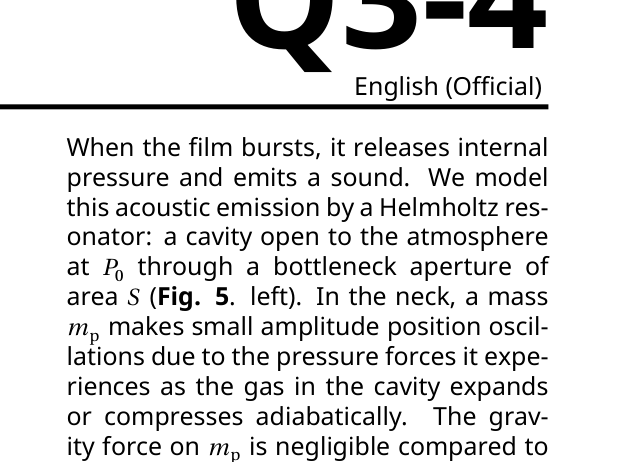
Fig. 5. (Left) a Helmholtz resonator. (Right) a bubble as an oscillator. When the film bursts, it releases internal pressure and emits a sound. We model this acoustic emission by a Helmholtz resonator: a cavity open to the atmosphere at through a bottleneck aperture of area (Fig. 5. left). In the neck, a mass makes small amplitude position oscillations due to the pressure forces it experiences as the gas in the cavity expands or compresses adiabatically. The gravity force on is negligible compared to pressure forces. Let be the volume of gas under the mass for as .
B.2 Express the frequency of oscillation of . Hint: for , . 1.1pt
The Helmholtz model may be used for a bubble of radius . is the volume of the closed bubble. From litterature, the mass of the equivalent of the piston is where is the radius of the circular aperture and is the density of the gas (Fig. 5. right). During the bursting process, goes from 0 to , given by . At the same time, the frequency of emitted sound increases until a maximum value of and the bursting time is ms.
B.3 Find the radius and the thickness of the champagne film separating the bubble from the atmosphere. 1.1pt
Part C. Popping champagne
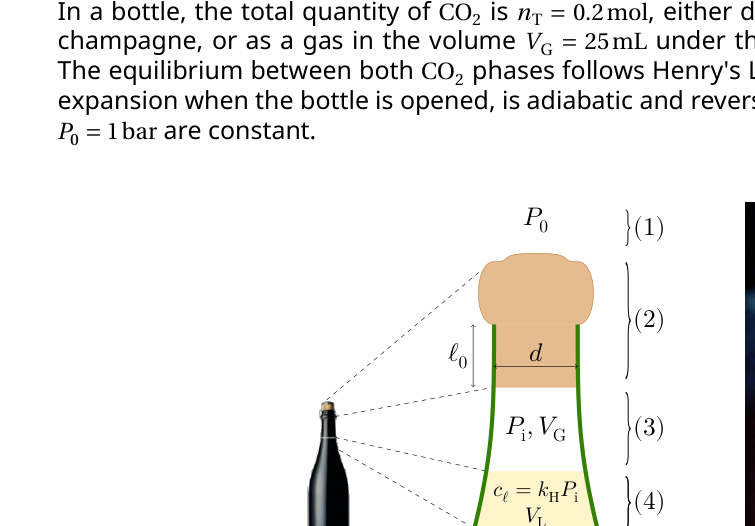
In a bottle, the total quantity of CO2 is , either dissolved in the volume of liquid champagne, or as a gas in the volume under the cork (Fig. 6. left). contains only CO2. The equilibrium between both CO2 phases follows Henry’s Law. We suppose that the fast gaseous CO2 expansion when the bottle is opened, is adiabatic and reversible. Ambient temperature and pressure are constant.
Fig. 6. Left: traditional bottleneck: (1) surrounding air, (2) cork stopper, (3) headspace, (4) liquid champagne. Right: Two phenomena observed while opening the bottle at two different temperatures (adapted from [2]).
C.1 Give the numerical value of the pressure of gaseous CO2 in the bottle for and . 0.4pt
Another step of champagne production (not described here) leads to the following values of that we will use for the next questions: at and at . During bottle opening, two different phenomena can be observed, depending on (Fig. 6. right). • either a blue fog appears, due to the formation of solid CO2 crystals (but water condensation is inhibited); • or a grey-white fog appears, due to water vapor condensation in the air surrounding the bottleneck. In this latter case, there is no formation of CO2 solid crystals. The saturated vapor pressure for the CO2 solid/gas transition follows : with in K, , K and K.
C.2 Give the numerical value of the CO2 gas at the end of the expansion, af
p.1 — Bicchiere riempito di champagne
p.2 — Raggio della bolla di CO2 nel tempo
p.2 — Treno di bolle in salita
p.3 — Bolla che scoppia in superficie, calotta sferica
p.4 — Risonatore di Helmholtz
Topic: Fluid Mechanics, Thermodynamics, Oscillations & Waves Metodi: Ideal Gas Law, Differential Equations, Hydrostatic Equilibrium, Simple Harmonic Motion Analysis, Conservation of Energy, Continuity Equation Competenze: Mathematical Modeling, Physical Reasoning, Experimental Data Analysis Objects: Bubble, Container Fonte: Testo (PDF) — p.1 Soluzione: Soluzioni (PDF)
- A glass filled with champagne.
Part A. Nucleation, growth and rise of bubbles
Immediately after opening a bottle of champagne at temperature , we fill a glass. The pressure in the liquid is and its temperature stays constant at . The concentration of dissolved CO2 exceeds the equilibrium concentration and we study the nucleation of a CO2 bubble. We note its radius and its inner pressure.
A.1 Express the pressure in terms of , and . 0.2pt
In the liquid, the concentration of dissolved CO2 depends on the distance to the bubble. At long distance we recover the value and we note the concentration close to the bubble surface. According to Henry’s law, . We further assume in all the problem that bubbles contain only CO2. Since , CO2 molecules diffuse from areas of high to low concentration. We also assume that any molecule from the liquid phase reaching the bubble surface is transferred to the vapor.
A.2 Express the critical radius above which a bubble is expected to grow in terms of , , and where . Calculated numerically for . 0.5pt
In practice, bubbles mainly grow from pre-existing gas cavities. Consider then a bubble with initial radius . The number of moles of CO2 transferred at the bubble’s surface per unit area and time is noted . Two models are possible for . • model (1) where is the diffusion coefficient of CO2 in the liquid. • model (2) where is a constant here. Experimentally, the bubble radius is found to depend on time as shown in Fig. 2. Here , and since bubbles are large enough to be visible, the excess pressure due to surface tension can be neglected and .
A.3 Express the number of CO2 moles in the bubble in terms of , , and ideal gas constant . Find for both models. Indicate which model explains the The results of the experiment are shown in Fig. 2. Depending on your answer, calculate numerically or . 1.2pt
- What? 2. Time evolution of CO2 bubble radius in a glass of champagne (adapted from [1]). Eventually bubbles detach from the bottom of the glass and continue to grow while rising. - What? 3. shows A train of bubbles. The bubbles of the train have the same initial radius and are emitted at a constant The frequency . , , , 1 mm
- What? 3. A train of bubbles. The photo is rotated horizontally for the page layout (adapted from [1]). For the range of velocities studied here, the drag force on a bubble of radius moving at velocity in a liquid of dynamic viscosity is given by Stokes’ law . Measurements show that at any time In time, the bubble can be assumed to be traveling at its terminal velocity.
A.4 Give the expression of the main forces exerted on a vertically rising bubble. Obtain the expression of . Give a numerical estimate of using , and quantities measured on Fig. 3. 0.8pt
The quasi-stationary growth of bubbles with rate still applies during bubble rise.
A.5 Express the radius of a bubble reaching the free surface in terms of height travelled , growth rate , and any constants you may need. He assumes and constant, and give the numerical value of with and corresponding to Fig. 2. 0.5pt
There are nucleation sites of bubbles. Assumes that the bubbles are nucleated at a constant frequency at the bottom of a glass of champagne (height for a volume ), with still negligible. Neglect The Commission has already adopted a proposal for a directive on the protection of the environment.
A.6 Write the differential equation for . Obtain from this equation the characteristic time for the decay of the concentration of dissolved CO2 in the liquid. 1.1pt
Part B. Acoustic emissions of a bursting bubble
Small bubbles are almost spherical as they reach the free surface. Once the liquid film separating the bubble from the air thins out sufficiently, a circular hole of radius forms in the film and, driven by surface tension, opens very quickly (Fig. 4. left). The hole opens at constant speed (Fig. 4. Right). The film outside the rim remains still, with constant thickness .
- What? 4. (Left) () Bubble at the surface: (1) liquid, (2) air at pressure and (3), CO2 at pressure , () and () retraction of the liquid film, where the rim is in dark blue, () bubble collapse. (Right) Retraction of the liquid film at time . Top: sketch of the pierced film seen from above. Bottom: cross-section of the rim and the retracting film. During the rim accumulates nearby liquid (dotted). Due to dissipative processes, only half of the difference of the surface energy between and of the rim and the accumulated liquid is transformed into kinetic energy. We further assume that the variation of the surface of the rim is negligible compared to that of the film.
B.1 Express in terms of , and . 1.1pt
- What? 5. (Left) to Helmholtz resonator. (Right) a bubble as The oscillator. When the film bursts, it releases internal pressure and emits sound. We model This acoustic emission by a Helmholtz resonator: a cavity open to the atmosphere at through a bottleneck aperture of area (Fig. 5. left). In the neck, at mass makes small amplitude position oscillations due to the pressure forces it experiences as the gas in the cavity expands or compressed adiabatically. The gravity force on is negligible compared to pressure forces. Let be the volume of gas under the mass for as .
B.2 Express the frequency of oscillation of . Hint: for , . 1.1pt
The Helmholtz model may be used for a bubble of radius . is the volume of the closed bubble. From The mass of the equivalent of the piston is where is the radius of the circular aperture and is the density of the gas (Fig. 5. Right). During the bursting process, goes from 0 to , given by . At the same time, the frequency of sound emitted increases until a maximum value of and the bursting time is ms.
B.3 Find the radius and the thickness of the champagne film separating the bubble from the atmosphere. 1.1pt
Part C. Popping champagne
In a bottle, the total quantity of CO2 is , either dissolved in the volume of liquid champagne, or as a gas in the volume under the cork (Fig. 6. left). contains only CO2. The equilibrium between both CO2 phases follows Henry’s Law. We assume that the fast gaseous CO2 Expansion when the bottle is opened, is adiabatic and reversible. Ambient temperature and pressure are constant.
- What? 6. Left: traditional bottleneck: (1) surrounding air, (2) cork stopper, (3) headspace, (4) It’s a liquid champagne. Right: Two phenomena observed while opening the bottle at two different temperatures (adapted from [2]).
C.1 Give the numerical value of the pressure of gaseous CO2 in the bottle for and . 0.4pt
Another step of champagne production (not described here) leads to the following values of that we will use for the next questions: at and at . During bottle opening, two different phenomena can be observed, depending on (Fig. 6. Right). • either a blue fog appears, due to the formation of solid CO2 crystals (but water condensation is inhibited; • or a grey-white fog appears, due to water vapor condensation in the air surrounding the bottleneck. In this latter case, there is no formation of CO2 solid crystals. The saturated vapor pressure for the CO2 solid/gas transition follows: with in K, , K and K.
C.2 Give the numerical value of the CO2 gas at the end of the expansion,
p.1 — Bicchiere riempito di champagne
p.2 — Raggio della bolla di CO2 nel tempo
p.2 — Treno di bolle in salita
p.3 — Bolla che scoppia in superficie, calotta sferica
p.4 — Risonatore di Helmholtz
Topic: Fluid Mechanics, Thermodynamics, Oscillations & Waves Metodi: Ideal Gas Law, Differential Equations, Hydrostatic Equilibrium, Simple Harmonic Motion Analysis, Conservation of Energy, Continuity Equation Competenze: Mathematical Modeling, Physical Reasoning, Experimental Data Analysis Objects: Bubble, Container Fonte: Testo (PDF) — p.1 Soluzione: Soluzioni (PDF)
- At a blue fog appears while opening the bottle.
Topic: Thermodynamics Metodi: First Law of Thermodynamics, Thermodynamic Cycle Analysis, Approximation & Series Expansion Competenze: Physical Reasoning, Mathematical Modeling Objects: — Fonte: Testo (PDF) — p.5 Soluzione: Soluzioni (PDF)
- At a blue fog appears while opening the bottle.
Topic: Thermodynamics Metodi: First Law of Thermodynamics, Thermodynamic Cycle Analysis, Approximation & Series Expansion Competenze: Physical Reasoning, Mathematical Modeling Objects: — Fonte: Testo (PDF) — p.5 Soluzione: Soluzioni (PDF)
- At a grey-white fog appears while opening the bottle.
Topic: Thermodynamics Metodi: First Law of Thermodynamics, Physical Modeling Competenze: Physical Reasoning Objects: — Fonte: Testo (PDF) — p.5 Soluzione: Soluzioni (PDF)
- At a grey-white fog appears while opening the bottle.
Topic: Thermodynamics Metodi: First Law of Thermodynamics, Physical Modeling Competenze: Physical Reasoning Objects: — Fonte: Testo (PDF) — p.5 Soluzione: Soluzioni (PDF)
- At a blue fog appears while opening the bottle. 0.7pt
During bottle opening, the cork stopper pops out. We now determine the maximum height it reaches. Assume that the friction force due to the bottleneck on the cork stopper is where is the area of contact and is a constant to determine. Initially, the pressure force slightly overcomes the friction force. The cork’s mass is , its diameter and the length of the cylindrical part initially stuck in the bottleneck is . Once the cork has left the bottleneck, you can neglect the net pressure force.
C.3 Give the numerical value of if the external temperature is . 1.3pt
[1] Liger-Belair et al, Am. J. Enol. Vitic., Vol. 50, No. 3 (1999). [2] Liger-Belair et al., Sc. Reports 7, 10938 (2017).
p.4 — Apertura della bottiglia, tappo che salta
Topic: Newtonian Mechanics, Thermodynamics Metodi: Free-Body Diagram, Kinematic Equations, Energy Conservation Method Competenze: Mathematical Modeling, Physical Reasoning, Diagrammatic Reasoning Objects: Container, Projectile Fonte: Testo (PDF) — p.5 Soluzione: Soluzioni (PDF)
- At a blue fog appears while opening the bottle. 0.7pt
During bottle opening, the cork stopper pops out. We now determine the maximum height it reaches. Assume that the friction force due to the bottleneck on the cork stopper is where is the area of contact and is a constant to determine. Initially, the pressure force slightly overcomes the friction I’m not going to force it. The cork’s mass is , its diameter and the length of the cylindrical part initially stuck in the bottleneck is . Once the cork has left the bottleneck, you can neglect the net pressure force.
C.3 Give the numerical value of if the external temperature is . 1.3pt
The following is a list of the most common types of cancer: J. - What? The Commission has not yet adopted a proposal. 50, No. 3 (1999). The following table shows the results of the analysis: The Commission shall adopt delegated acts in accordance with Article 21 of this Regulation.
**p.4 ** Bottle opening, leaping cap
Topic: Newtonian Mechanics, Thermodynamics Metodi: Free-Body Diagram, Kinematic Equations, Energy Conservation Method Competenze: Mathematical Modeling, Physical Reasoning, Diagrammatic Reasoning Objects: Container, Projectile Fonte: Testo (PDF) — p.5 Soluzione: Soluzioni (PDF)