Leggi di scala (8 punti)
Le leggi di scala descrivono la relazione funzionale tra due grandezze fisiche che sono collegate tra loro in un intervallo di variabilità molto ampio. Questa relazione funzionale in genere è una legge di potenza, ma esistono anche altre possibilità. Spesso è assai difficile scrivere l’espressione esatta della relazione, tuttavia si riescono comunque a ricavare le leggi di scala.
Parte A. Uno ’Spaghetto’ (2,0 punti)
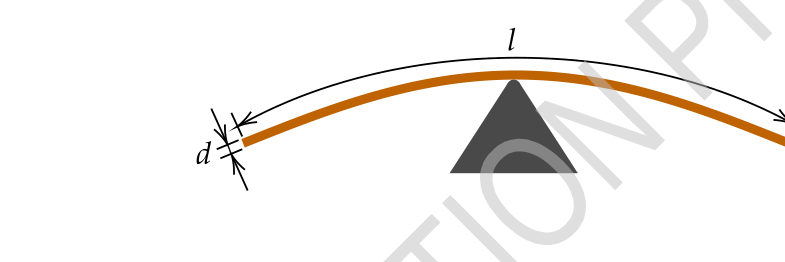
A.1 Uno spaghetto di diametro viene bilanciato orizzontalmente nel suo centro come in figura. Se , lo spaghetto si rompe sotto il suo stesso peso quando la sua lunghezza raggiunge . Qual è la lunghezza massima di uno spaghetto di diametro prima che si rompa sotto il suo stesso peso? 2.0pt
Parte B. Castello di sabbia (2,0 punti)
B.1 Il volume medio dei grani della sabbia a grana grossa è 10 volte superiore a quello della sabbia a grana fine. La sabbia a grana fine bagnata e la sabbia a grana grossa bagnata hanno entrambe un contenuto ottimale di acqua (da cui si assuma che si abbia la massima forza di resistenza) e vengono utilizzate per costruire due cilindri esattamente della stessa forma e dimensione. La resistenza di ciascun cilindro viene testata premendolo tra due piastre parallele. Il cilindro fatto di sabbia a grana grossa si distrugge quando la forza applicata per premere le piastre raggiunge . Quanto è grande la forza necessaria per distruggere il cilindro di sabbia a grana fine? Potete ignorare gli effetti della gravità. 2.0pt
Parte C. Viaggi interstellari (2,0 punti)
C.1 L’astronave di una spedizione interstellare viaggia ad una accelerazione costante , cioè questa è l’accelerazione dell’astronave nel sistema di riferimento inerziale dove è istantaneamente ferma. I passeggeri devono essere in grado di tornare sulla Terra entro la loro vita residua prevista di 50 anni. La distanza massima dalla Terra raggiunta dall’astronave è . Se l’accelerazione viene aumentata a , l’astronave può raggiungere una distanza maggiore . Qual è il rapporto ? Suggerimento 1. Potresti voler usare la formula di addizione relativistica della velocità, tuttavia, ci sono anche altri approcci. Suggerimento 2. Potrebbe essere necessario gestire le funzioni iperboliche definite come segue: , , . Suggerimento 3. A seconda del tuo approccio, potresti aver bisogno di uno o più di questi integrali: , , , dove e sono le funzioni inverse delle rispettive funzioni iperboliche. 2.0pt
Parte D. La sensazione di affondamento (2,0 punti)
D.1 Una palla di legno solida di raggio galleggia nell’acqua. Ignorando gli effetti dell’attrito, la frequenza delle piccole oscillazioni sarebbe , ma a causa dell’attrito viscoso, dopo essere stata spostata verticalmente, la frequenza delle oscillazioni decrescenti è in realtà . Qual è il raggio minimo di una sfera di legno che galleggia in acqua e che subisce piccole oscillazioni quando viene spostata? Suggerimento: la forza di resistenza viscosa che agisce su un dato corpo è proporzionale alla sua velocità rispetto al fluido e alla viscosità del fluido stesso in cui si sta muovendo. L’unità della viscosità è . 2.0pt
p.1 — Spaghetto bilanciato sul fulcro, lunghezza l e diametro d
Topic: Elasticity & Materials, Special Relativity, Oscillations & Waves Metodi: Dimensional Analysis, Stress-Strain Analysis, Lorentz Transformation, Simple Harmonic Motion Analysis Competenze: Mathematical Modeling, Estimation & Approximation, Physical Reasoning Objects: Rod, Cylinder, Sphere Fonte: Testo (PDF) — p.1 Soluzione: Soluzioni (PDF)
Scaling Laws (8 points)
Scaling laws describe the functional relationship between two physical quantities that are connected over a very wide range of variability. This functional relationship is usually a power law, although other possibilities exist. Often it is very difficult to write down the exact expression for the relationship; however, scaling laws can still be derived.
Part A. One ‘Spaghetti’ (2.0 points)
A.1 A spaghetti of diameter is balanced horizontally at its center, as shown in the figure. If a spaghetti of length breaks under its own weight when its length reaches , what is the maximum length of a spaghetti of diameter before it breaks under its own weight? 2.0 pt
Part B. Sandcastle (2.0 points)
B.1 The average volume of the grains of coarse sand is 10 times greater than that of fine sand. Both wet coarse sand and wet fine sand have an optimal water content (assumed to yield maximum resistance force) and are used to build two cylinders of exactly the same shape and dimensions. The resistance of each cylinder is tested by pressing it between two parallel plates. The cylinder made of coarse sand breaks when the applied force to press the plates reaches . What is the magnitude of the force required to break the cylinder made of fine sand? You may ignore gravitational effects. 2.0 pt
Part C. Interstellar travel (2.0 points)
C.1 The spaceship of an interstellar expedition travels with a constant acceleration , meaning this is the spaceship’s acceleration in the inertial reference frame where it is instantaneously at rest. The passengers must be able to return to Earth within their remaining expected lifetime of 50 years. The maximum distance from Earth reached by the spaceship is . If the acceleration is increased to , the spaceship can reach a greater distance . What is the ratio ? Hint 1. You might want to use the relativistic velocity addition formula, although there are other approaches as well. Hint 2. It may be necessary to handle hyperbolic functions defined as follows: , , . Hint 3. Depending on your approach, you might need one or more of these integrals: , , , where and are the inverse functions of the respective hyperbolic functions. 2.0pt
Part D. The sensation of sinking (2.0 points)
D.1 A solid wooden ball of radius floats in water. Ignoring the effects of friction, the frequency of small oscillations would be , but due to viscous friction, after being displaced vertically, the frequency of the damped oscillations is actually . What is the minimum radius of a wooden sphere that floats in water and undergoes small oscillations when displaced? Hint: The viscous resistance force acting on a given body is proportional to its velocity relative to the fluid and to the fluid’s viscosity . The unit of viscosity is .
2.0pt
p.1 — Spaghetti balanced on the fulcrum, length l and diameter d
Solution: Soluzioni (PDF)