Acqua e oggetti (10 pt)
In questo problema consideriamo i fenomeni causati dall’interazione tra acqua e oggetti collegati alla tensione superficiale. La parte A tratta situazioni di moto, mentre le parti B e C riguardano situazioni statiche.
Se necessario, si può usare il fatto che se la funzione soddisfa l’equazione differenziale ( è una costante positiva), allora la sua soluzione generale è , dove e sono costanti arbitrarie.
Parte A. Fusione di gocce d’acqua (2.0 punti)
Come mostrato in Fig. 1, consideriamo due gocce d’acqua sferiche stazionarie sulla superficie di un materiale super-idrofobo, cioè per il quale esistono intense forze repulsive tra il materiale e l’acqua.
Sulla superficie sono posizionate due gocce d’acqua sferiche identiche inizialmente vicine tra loro; successivamente queste due gocce si fondono dopo essersi toccate e formano una goccia d’acqua sferica più grande, che improvvisamente salta verso l’alto.
A.1 Il raggio di entrambe le gocce d’acqua prima della fusione è . La densità dell’acqua è . La tensione superficiale è . Una frazione della differenza di energia di superficie tra prima e dopo la fusione è trasformata in energia cinetica della sfera che salta verso l’alto. Determinare quindi la velocità iniziale di salto, , della goccia d’acqua fusa con due cifre significative in base alle seguenti ipotesi:
- Prima e dopo la fusione, il volume totale di acqua viene conservato.
2.0pt
Fig. 1: Fusione di due gocce d’acqua e salto della goccia d’acqua fusa.
Parte B. Una tavola posizionata verticalmente (4.5 punti)
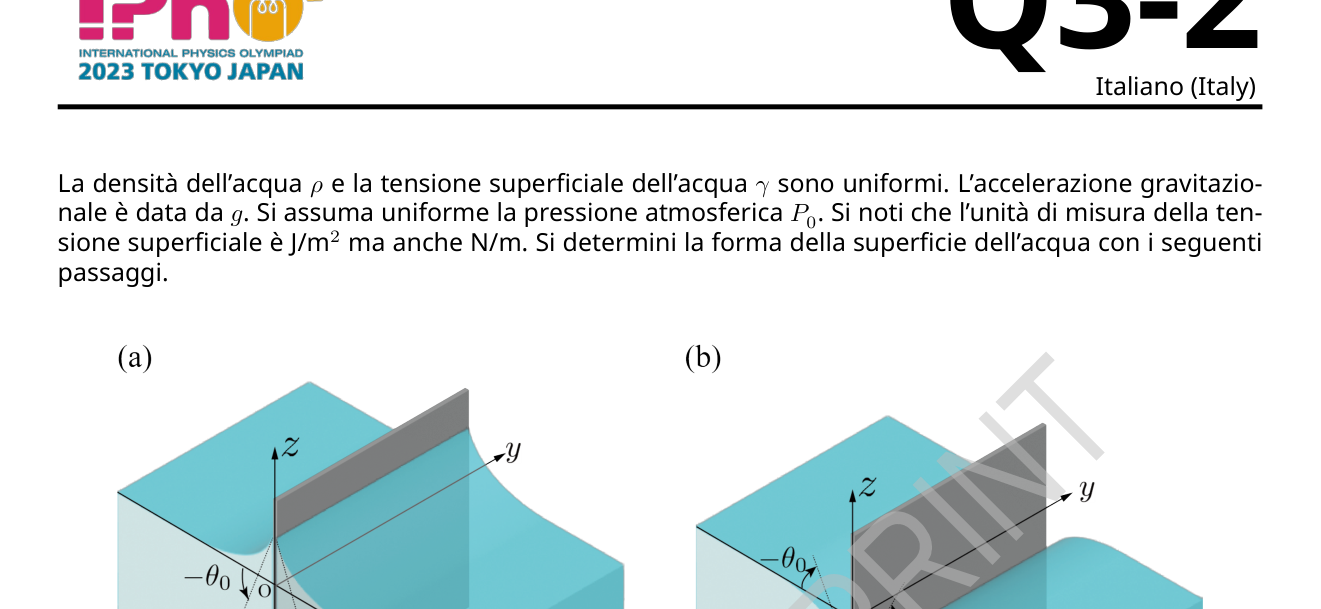
Una tavola piatta viene immersa verticalmente in acqua. Le figure 2(a) e 2(b) mostrano rispettivamente le forme della superficie dell’acqua per materiali idrofili (attrattivi) e idrofobi. Si trascuri lo spessore della tavola.
La superficie della tavola si trova sul piano e la superficie orizzontale dell’acqua lontana dalla tavola si trova sul piano con . La forma della superficie non dipende dalla coordinata . Sia l’angolo tra la superficie dell’acqua e il piano orizzontale in un punto della superficie dell’acqua nel piano . Qui è misurato rispetto all’asse positivo e la rotazione antioraria è considerata positiva. Sia pari a nel punto di contatto tra la tavola e la superficie dell’acqua (). Nel seguito, è fissato dalle proprietà del materiale della tavola.
La densità dell’acqua e la tensione superficiale dell’acqua sono uniformi. L’accelerazione gravitazionale è data da . Si assuma uniforme la pressione atmosferica . Si noti che l’unità di misura della tensione superficiale è ma anche N/m. Si determini la forma della superficie dell’acqua con i seguenti passaggi.
Fig. 2: Tavole immerse verticalmente nell’acqua. (a) Nel caso di tavola idrofila; (b) nel caso di tavola idrofoba.
B.1 Si consideri il caso di una tavola idrofila, come mostrato nella Fig. 2(a). Si noti che la pressione dell’acqua, , soddisfa le condizioni per e per . Si determini alla quota in funzione di , , , e .
0.6pt
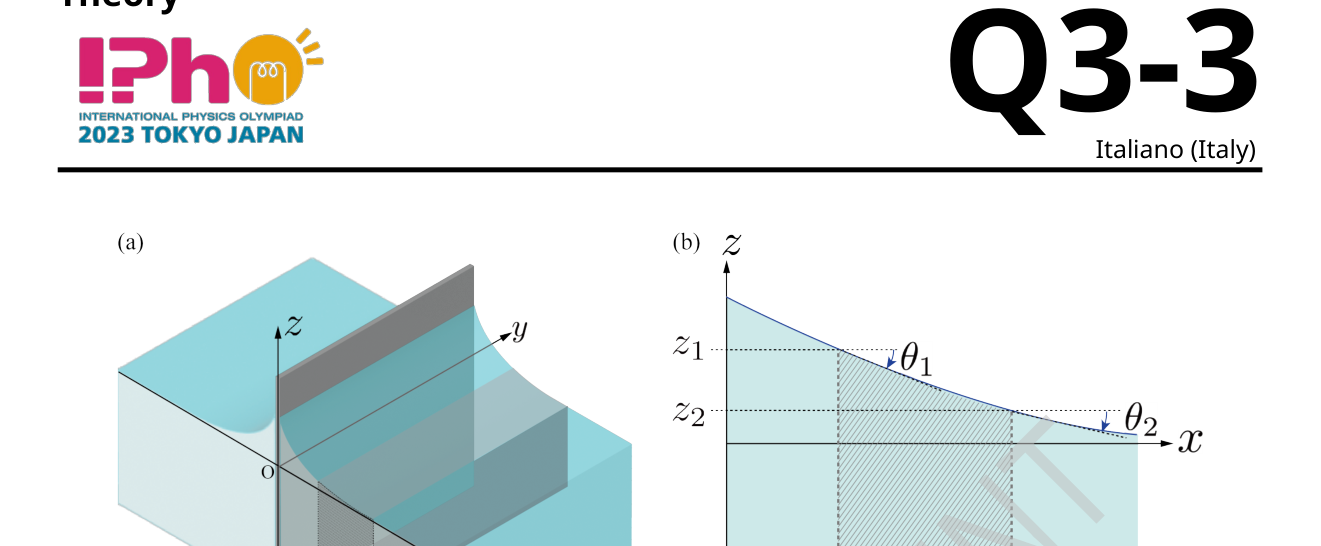
B.2 Si consideri un blocco d’acqua la cui forma è mostrata ombreggiata in Fig.3(a). La sua sezione trasversale nel piano è mostrata dall’area tratteggiata in Fig.3(b). Siano e rispettivamente le coordinate del bordo sinistro e destro del confine (superficie dell’acqua) tra il blocco d’acqua e l’aria. Ricavare la componente orizzontale (componente ) della forza risultante per unità di lunghezza lungo l’asse , esercitata sul blocco d’acqua a causa della pressione, in funzione di , , e . Si noti che la presenza della pressione atmosferica non determina una forza orizzontale netta sul blocco d’acqua.
0.8pt
Fig. 3: Forma del blocco d’acqua. (a) Vista a volo d’uccello e (b) vista in sezione.
B.3 La tensione superficiale che agisce sul blocco d’acqua è bilanciata dalla forza discussa in B.2. Si definiscano rispettivamente e gli angoli tra la superficie dell’acqua e il piano orizzontale ai bordi sinistro e destro. Ricavare in funzione di , e .
0.8pt
B.4 La seguente equazione vale in un punto arbitrario sulla superficie dell’acqua,
Determinare l’esponente ed esprimere la costante in funzione di e . Si noti che questa equazione è valida per materiali della tavola sia idrofili sia idrofobi.
0.8pt
B.5 Nell’equazione (1) in B.4, si assuma che la variazione della superficie dell’acqua sia lieve, cioè , in modo da poter sviluppare in serie di fino al secondo ordine. Successivamente, differenziando l’equazione risultante rispetto a , si ottiene l’equazione differenziale soddisfatta da . Risolvere questa equazione differenziale e determinare per in funzione di e . Si noti che le dimensioni verticali nelle Fig. 2 e 3 sono esagerate per ragioni grafiche e non soddisfano la condizione .
1.5pt
Parte C. Interazione tra due aste (3.5 punti)
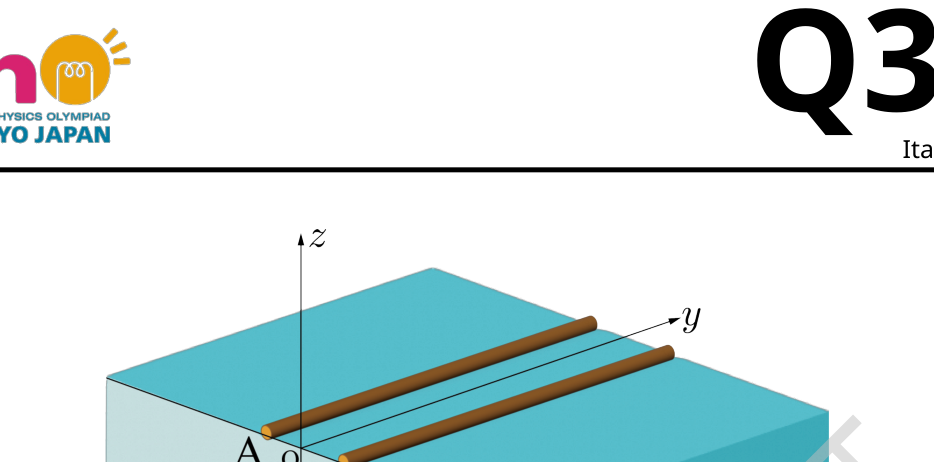
Le aste identiche A e B, di uno stesso materiale, galleggiano parallelamente tra loro sulla superficie dell’acqua e sono poste simmetricamente alla stessa distanza dall’asse (Fig. 4).
Fig. 4: Due aste A e B che galleggiano sulla superficie dell’acqua.
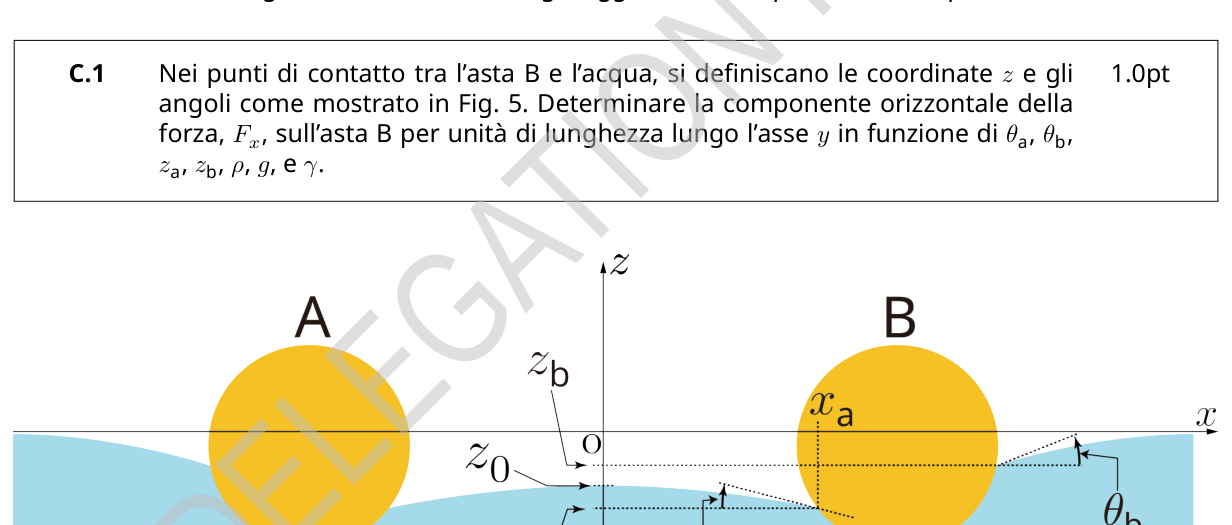
C.1 Nei punti di contatto tra l’asta B e l’acqua, si definiscano le coordinate e gli angoli come mostrato in Fig. 5. Determinare la componente orizzontale della forza, , sull’asta B per unità di lunghezza lungo l’asse in funzione di , , , , , , e .
1.0pt
Fig. 5: Vista in sezione verticale di due aste che galleggiano sulla superficie dell’acqua.
C.2 Si definisca la coordinata della superficie dell’acqua nel punto medio tra le due aste nel piano . Esprimere la forza ottenuta in C.1 senza utilizzare , , e .
1.5pt
C.3 Sia la coordinata del punto di contatto tra la superficie dell’acqua e la parte sinistra dell’asta B. Utilizzando l’equazione differenziale ottenuta in B.4, esprimere la coordinata del livello dell’acqua del punto medio di queste due aste A e B in funzione di e . Si può utilizzare la costante introdotta in B.4.
1.0pt
p.1 — Fusione di due gocce d’acqua
p.2 — Tavola immersa verticalmente nell’acqua
p.3 — Forma del blocco d’acqua e sezione
p.4 — Due aste A e B galleggianti
p.4 — Sezione verticale aste A e B
Topic: Fluid Mechanics, Conservation of Energy, Oscillations & Waves Metodi: Energy Conservation Method, Hydrostatic Equilibrium, Differential Equations, Free-Body Diagram, Small-Angle Approximation Competenze: Mathematical Modeling, Physical Reasoning, Diagrammatic Reasoning Objects: Droplet, Rod Fonte: Testo (PDF) — p.1 Soluzione: Soluzioni (PDF)
**Water and articles (10 pts) **
In this problem we consider the phenomena caused by the interaction between water and surface tension-related objects. Part A deals with motor situations, while Parts B and C deal with static situations.
If necessary, the fact that if the function satisfies the differential equation ( is a positive constant) can be used, then its general solution is , where and are arbitrary constants.
Part A. Fusion of water drops (2.0 points)
As shown in Fig. 1, consider two spherical water droplets stationary on the surface of a superhydrophobic material, i.e. for which there are intense repulsive forces between the material and the water.
On the surface are two identical spherical water droplets, initially close together; later these two droplets merge after touching each other and form a larger spherical water drop, which suddenly leaps upwards.
A.1 The radius of both drops of water before melting is . The density of the water is . The surface tension is . A fraction of the surface energy difference between before and after fusion is converted into kinetic energy of the upward-jumping sphere. Determine the initial jump speed, , of the melt water drop with two significant figures based on the following assumptions:
- Before and after fusion, the total volume of water is retained.
2.0pt
- What? 1: Fusion of two drops of water and leap of the melted water drop.
Part B. A table positioned vertically (4.5 points)
A flat table is immersed vertically in water. Figures 2 (a) and 2 (b) show the surface shapes of water for hydrophilic (attractive) and hydrophobic materials respectively. You’re neglecting the thickness of the table.
The surface of the table is on the plane and the horizontal surface of the water away from the table is on the plane with . The shape of the surface does not depend on the coordinate. Whether the angle between the surface of the water and the horizontal plane at a point of the surface of the water in the plane . Here is measured against the positive axis and the anti-clock rotation is considered positive. Either equal to at the point of contact between the table and the surface of the water (). The following is determined by the properties of the material on the board.
The water density and the water surface tension are uniform. The gravitational acceleration is given by . The atmospheric pressure is assumed to be uniform. Note that the surface tension measurement unit is but also N/m. The shape of the water surface is determined by the following steps.
- What? 2: Tables vertically submerged in water. (a) in the case of a hydrophilic table; (b) in the case of a hydrophobic table.
B.1 Consider the case of a hydrophilic table, as shown in Figure 1. 2(a). Note that the water pressure, , meets the conditions for and for . The is determined at the ratio according to , , , and .
0.6pt
B.2 Consider a block of water whose shape is shown in Figure 3. Its cross-section in the plane is shown by the area drawn in Fig.3 ((b). The coordinates of the left and right edge of the boundary (water surface) between the water and air blocks are and respectively. Find the horizontal component (component ) of the resulting force per unit length along the axis, applied to the water block due to pressure, as a function of , , and . Note that the presence of atmospheric pressure does not cause a net horizontal force on the water block.
0.8pt
- What? 3: The shape of the water block. (a) bird’s eye view and (b) section view.
B.3 The surface tension acting on the water block is balanced by the force discussed in B.2. The angles between the water surface and the horizontal plane at the left and right edges shall be and respectively. Ricavare in funzione di , e .
0.8pt
B.4 The following equation applies at an arbitrary point on the surface of the water,
Determine the exponent and express the constant as a function of and . Note that this equation is valid for both hydrophilic and hydrophobic table materials.
0.8pt
B.5 In equation (1) in B.4, the change in the water surface is assumed to be slight, i.e. , so that can be developed in series of up to the second order. Subsequently, by differentiating the resulting equation from , the differential equation satisfied by is obtained. Solve this differential equation and determine for as a function of and . Note that the vertical dimensions in Fig. 2 and 3 are exaggerated for graphic reasons and do not meet the condition .
1.5pt
Part C. Interaction between two auctions (3.5 points)
The same axes A and B, of the same material, float parallel to each other on the surface of the water and are placed symmetrically at the same distance from the axis (Fig. 4).
- What? 4: Two A and B axes floating on the surface of the water.
C.1 In the contact points between the B-beam and the water, the coordinates and angles are defined as shown in Figure 1. 5. Determine the horizontal component of the force, , on the B-axis per unit length along the axis as a function of , , , , , , and .
1.0pt
- What? 5: View in vertical section of two axes floating on the surface of the water.
C.2 is the coordinate of the water surface at the midpoint between the two axes in the plane . Express the force obtained in C.1 without using , , and .
1.5pt
C.3 The coordinate of the contact point between the surface of the water and the left side of the B axis. Using the differential equation obtained in B.4, express the coordinate of the water level of the mean point of these two axes A and B as a function of and . The constant introduced in B.4 may be used.
1.0pt
**p.1 ** Fusion of two drops of water
p.2 Vertically submerged table in water
p.3 Form of water block and section
p.4 — Due aste A e B galleggianti
p.4 — Sezione verticale aste A e B
Topic: Fluid Mechanics, Conservation of Energy, Oscillations & Waves Metodi: Energy Conservation Method, Hydrostatic Equilibrium, Differential Equations, Free-Body Diagram, Small-Angle Approximation Competenze: Mathematical Modeling, Physical Reasoning, Diagrammatic Reasoning Objects: Droplet, Rod Fonte: Testo (PDF) — p.1 Soluzione: Soluzioni (PDF)