Bicchiere d’acqua nell’oceano
Martin il pescatore si sporge dalla sua barca, riempie un bicchiere con di acqua di mare (di massa molecolare pari a ) e lo svuota nuovamente in mare subito dopo. Moltissimi anni dopo, quando l’acqua presa nel bicchiere si è ormai rimescolata completamente in tutti i mari del pianeta (che ricoprono circa il della superficie terrestre e sono profondi in media ), Martin si trova nuovamente sulla sua barca. Egli riempie una seconda volta il bicchiere con la stessa quantità d’acqua e si chiede quale sia il numero di molecole che sono state pescate entrambe le volte nel bicchiere. Quanto vale ?
Unità di misura: adimensionale. Precisione richiesta: .
Topic: Order-of-Magnitude Estimation, Kinetic Theory Metodi: Order-of-Magnitude Estimation, Statistical Averaging Competenze: Estimation & Approximation, Mathematical Modeling Objects: — Fonte: Testo (PDF) — p.3 Soluzione: Soluzioni (PDF)
Water bottles in the ocean
Martin the fisherman emerges from his boat, fills a glass with of seawater (with a molecular mass equal to ) and empties it back into the sea immediately afterwards. Many years later, when the water taken from the glass has now completely re-mixed into all the world’s seas (which cover about of the earth’s surface and are deep on average ), Martin is back on his boat. Egli riempie una seconda volta il bicchiere con la stessa quantità d’acqua e si chiede quale sia il numero di molecole che sono state pescate entrambe le volte nel bicchiere. Quanto vale ?
Unità di misura: adimensionale. Precisione richiesta: .
Topic: Order-of-Magnitude Estimation, Kinetic Theory Metodi: Order-of-Magnitude Estimation, Statistical Averaging Competenze: Estimation & Approximation, Mathematical Modeling Objects: — Fonte: Testo (PDF) — p.3 Soluzione: Soluzioni (PDF)
Molla oscillante
Simona si trova su un pianeta sconosciuto e vuole misurarne l’accelerazione di gravità in superficie. Ella ha a disposizione un set di masse note ed una molla ideale di costante elastica e lunghezza a riposo ignote (massa trascurabile). Simona appende ogni massa di prova alla molla ed esegue due misure: la lunghezza totale della molla e il periodo delle oscillazioni verticali intorno alla posizione di equilibrio. I risultati sono in tabella. Quanto vale l’accelerazione di gravità sulla superficie del pianeta?
| [kg] | [s] | [cm] |
|---|---|---|
| 0.100 | 0.582 | 14.7 |
| 0.200 | 0.819 | 17.5 |
| 0.300 | 1.02 | 20.0 |
| 0.400 | 1.15 | 22.3 |
| 0.500 | 1.31 | 25.3 |
| 0.600 | 1.43 | 27.9 |
| 0.700 | 1.53 | 30.3 |
| 0.800 | 1.66 | 33.1 |
| 0.900 | 1.73 | 35.8 |
Unità di misura: . Precisione richiesta: .
Topic: Oscillations & Waves, Newtonian Mechanics Metodi: Simple Harmonic Motion Analysis, Graph Linearization, Hooke’s Law Competenze: Experimental Data Analysis, Graph Linearization, Curve Fitting Objects: Spring, Block Fonte: Testo (PDF) — p.3 Soluzione: Soluzioni (PDF)
Molla oscillante
Simona is on an unknown planet and wants to measure its acceleration by gravity on the surface. She has a set of known masses and an ideal spring of constant elasticity and unknown rest length (negligible mass). Simona applies each test mass to the spring and performs two measurements: the total length of the spring and the period of vertical oscillations around the equilibrium position. The results are in the table. How much is the acceleration of gravity on the planet’s surface worth?
| [kg] | [s] | [cm] |
|---|---|---|
| 0.100 | 0.582 | 14.7 |
| 0.200 | 0.819 | 17.5 |
| 0.300 | 1.02 | 20.0 |
| 0.400 | 1.15 | 22.3 |
| 0.500 | 1.31 | 25.3 |
| 0.600 | 1.43 | 27.9 |
| 0.700 | 1.53 | 30.3 |
| 0.800 | 1.66 | 33.1 |
| 0.900 | 1.73 | 35.8 |
Unità di misura: . Precisione richiesta: .
Topic: Oscillations & Waves, Newtonian Mechanics Metodi: Simple Harmonic Motion Analysis, Graph Linearization, Hooke’s Law Competenze: Experimental Data Analysis, Graph Linearization, Curve Fitting Objects: Spring, Block Fonte: Testo (PDF) — p.3 Soluzione: Soluzioni (PDF)
Tetraedro e campo magnetico
Sei fili di rame identici, di resistività , lunghezza e sezione , sono disposti a formare gli spigoli di un tetraedro regolare, poggiato con una faccia su una superficie piana. Un campo magnetico ortogonale alla superficie cresce linearmente in modulo, ad un tasso di . Quanto vale il massimo modulo della corrente che scorre in uno dei lati del tetraedro?
Unità di misura: mA. Precisione richiesta: .
Topic: Electromagnetic Induction, Circuits Metodi: Faraday’s Law of Induction, Kirchhoff’s Laws, Symmetry Argument Competenze: Diagrammatic Reasoning, Mathematical Modeling Objects: Wire Fonte: Testo (PDF) — p.3 Soluzione: Soluzioni (PDF)
Tetrahedron and magnetic field
Six identical copper wires, resistivity , length and section , are arranged to form the tips of a regular tetrahedron, resting with a face on a flat surface. A magnetic field orthogonal to the surface grows linearly in shape, at a rate of . What is the maximum current flow rate on either side of the tetrahedron?
Unità di misura: mA. Precisione richiesta: .
Topic: Electromagnetic Induction, Circuits Metodi: Faraday’s Law of Induction, Kirchhoff’s Laws, Symmetry Argument Competenze: Diagrammatic Reasoning, Mathematical Modeling Objects: Wire Fonte: Testo (PDF) — p.3 Soluzione: Soluzioni (PDF)
Bombola particolare
Una particolare bombola è costituita di una gomma speciale, progettata per espandersi in modo esattamente lineare con la temperatura, con coefficiente di dilatazione termica lineare indipendente dalla temperatura e pari a . È noto che in condizioni standard (pressione esterna e temperatura ) essa può sostenere una pressione interna massima di . Quando le condizioni variano, il massimo della differenza tra pressione interna ed esterna sostenibile è proporzionale allo spessore delle pareti. In condizioni standard la bombola ha volume e viene riempita di anidride carbonica fino a una pressione di . La bombola viene poi riscaldata. Qual è la minima variazione di temperatura necessaria per farla scoppiare?
Unità di misura: K. Precisione richiesta: .
Topic: Thermodynamics, Elasticity & Materials Metodi: Ideal Gas Law, Differential Equations, Physical Modeling Competenze: Mathematical Modeling, Physical Reasoning Objects: Gas, Container Fonte: Testo (PDF) — p.3 Soluzione: Soluzioni (PDF)
Bombola particolare
A particular pump consists of a special rubber, designed to expand exactly linearly with temperature, with a temperature-independent linear thermal expansion coefficient of . It is known that under standard conditions (external pressure and temperature ) it can support a maximum internal pressure of . When conditions vary, the maximum difference between the internal and external pressure that is sustainable shall be proportional to the thickness of the walls. Under standard conditions the pump has a volume and is filled with carbon dioxide to a pressure of . The pump is then heated. What’s the minimum temperature change needed to make it explode?
Unità di misura: K. Precisione richiesta: .
Topic: Thermodynamics, Elasticity & Materials Metodi: Ideal Gas Law, Differential Equations, Physical Modeling Competenze: Mathematical Modeling, Physical Reasoning Objects: Gas, Container Fonte: Testo (PDF) — p.3 Soluzione: Soluzioni (PDF)
Strano pianeta
Un pianeta di raggio ruota con velocità angolare attorno al proprio asse. Esso possiede simmetria sferica, perciò la densità in qualsiasi punto dipende solo dalla distanza tra e il centro. Inoltre, un osservatore che si trovi sul piano dell’equatore, all’interno del pianeta, e ruoti con esso, percepisce una accelerazione di , indipendentemente dalla distanza dal centro. Immediatamente al di sotto della superficie, quanto vale la densità del pianeta?
Unità di misura: . Precisione richiesta: .
Topic: Gravitation, Newtonian Mechanics Metodi: Gauss’s Law, Calculus-Integration, Free-Body Diagram Competenze: Mathematical Modeling, Physical Reasoning Objects: Planet Fonte: Testo (PDF) — p.4 Soluzione: Soluzioni (PDF)
Strano pianeta
A planet with a radius rotates at angular velocity around its axis. It has spherical symmetry, so the density at any point depends only on the distance between and the center. In addition, an observer who is on the plane of the equator, inside the planet, and wheels with it, perceives an acceleration of , regardless of the distance from the center. Right below the surface, what is the density of the planet?
Unità di misura: . Precisione richiesta: .
Topic: Gravitation, Newtonian Mechanics Metodi: Gauss’s Law, Calculus-Integration, Free-Body Diagram Competenze: Mathematical Modeling, Physical Reasoning Objects: Planet Fonte: Testo (PDF) — p.4 Soluzione: Soluzioni (PDF)
Buco sulla ISS
A causa del rischio di collisione con alcuni detriti spaziali, la Stazione Spaziale Internazionale viene fatta evacuare. L’elettronica e tutte le fonti di energia vengono scollegate. Un detrito colpisce la stazione, provocando un piccolo foro circolare in una parete. Dopo un giorno dalla collisione, la pressione dell’aria all’interno della stazione è la metà di quella iniziale. Se, invece, il buco avesse avuto diametro doppio, quale frazione della pressione iniziale si sarebbe misurata dopo un giorno?
Unità di misura: adimensionale. Precisione richiesta: .
Topic: Fluid Mechanics, Kinetic Theory Metodi: Differential Equations, Kinetic Theory of Gases, Dimensional Analysis Competenze: Mathematical Modeling, Physical Reasoning Objects: Container, Gas Fonte: Testo (PDF) — p.4 Soluzione: Soluzioni (PDF)
Buco sulla ISS
Because of the risk of collision with some space debris, the International Space Station is evacuated. The electronics and all power sources are disconnected. A debris hits the station, causing a small circular hole in a wall. One day after the collision, the air pressure inside the station is half that of the initial one. If the hole was twice the diameter, what fraction of the initial pressure would be measured after a day?
Unità di misura: adimensionale. Precisione richiesta: .
Topic: Fluid Mechanics, Kinetic Theory Metodi: Differential Equations, Kinetic Theory of Gases, Dimensional Analysis Competenze: Mathematical Modeling, Physical Reasoning Objects: Container, Gas Fonte: Testo (PDF) — p.4 Soluzione: Soluzioni (PDF)
Pendolo rotante
Un oggetto puntiforme di massa è appeso ad un filo inestensibile di massa trascurabile e lunghezza . Il sistema è immerso nel campo gravitazionale terrestre. L’oggetto si muove di moto circolare uniforme con periodo e l’angolo che il filo forma con la verticale, come in figura, è . Se l’oggetto venisse messo in moto circolare uniforme con periodo , quanto varrebbe il nuovo valore di ?
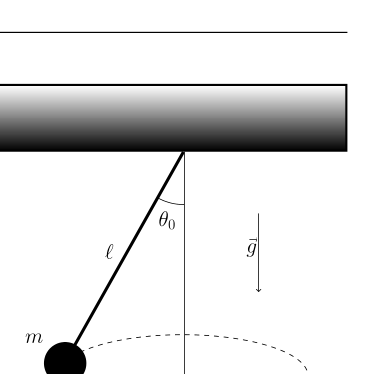 Pendolo conico: massa appesa a un filo di lunghezza che forma un angolo con la verticale, descrivendo una circonferenza orizzontale; gravità .
Unità di misura: . Precisione richiesta: .
Topic: Newtonian Mechanics Metodi: Free-Body Diagram, Vector Decomposition, Kinematic Equations Competenze: Diagrammatic Reasoning, Mathematical Modeling Objects: Pendulum Fonte: Testo (PDF) — p.4 Soluzione: Soluzioni (PDF)
Pendolo rotante
A pointed object of mass is suspended from an unextended wire of negligible mass and length . The system is immersed in the Earth’s gravitational field. The object moves in uniform circular motion with period and the angle formed by the wire with the vertical, as shown in the figure, is . If the object were to be put into uniform circular motion with a period , what would the new value of be worth?
Cone pendulum: mass suspended from a length of wire forming an angle with the vertical, describing a horizontal circumference; gravity .
Unità di misura: . Precisione richiesta: .
Topic: Newtonian Mechanics Metodi: Free-Body Diagram, Vector Decomposition, Kinematic Equations Competenze: Diagrammatic Reasoning, Mathematical Modeling Objects: Pendulum Fonte: Testo (PDF) — p.4 Soluzione: Soluzioni (PDF)
Resistenza che si scalda
Francesco vuole misurare la resistenza elettrica che un certo resistore ha a temperatura ambiente. Per far ciò, fa scorrere attraverso il resistore una corrente di , per un tempo molto lungo. Tuttavia, tale corrente è abbastanza elevata da scaldare significativamente il resistore, modificandone la resistenza e influenzando la misura. Sapendo che:
- la resistenza a temperatura ambiente vale ;
- la resistenza aumenta con la temperatura, con coefficiente termico ;
- la resistenza termica tra resistore e ambiente vale ;
quanto vale l’errore relativo percentuale della misura ottenuta da Francesco, rispetto al valore corretto?
Unità di misura: adimensionale. Precisione richiesta: .
Topic: Circuits, Thermodynamics Metodi: Energy Conservation Method, Kirchhoff’s Laws Competenze: Error Propagation, Mathematical Modeling Objects: Resistor Fonte: Testo (PDF) — p.4 Soluzione: Soluzioni (PDF)
**Heat resistance **
Francesco wants to measure the electrical resistance a certain resistor has at room temperature. To do this, it causes a current of to flow through the resistor for a very long time. However, such a current is high enough to significantly heat the resistor, changing its resistance and affecting the measurement. Knowing that:
- the ambient temperature resistance is ;
- the resistance increases with temperature, with a heat coefficient ;
- the thermal resistance between resistor and environment is ;
What is the relative error percentage of the measure obtained by Francis, compared with the correct value?
Unità di misura: adimensionale. Precisione richiesta: .
Topic: Circuits, Thermodynamics Metodi: Energy Conservation Method, Kirchhoff’s Laws Competenze: Error Propagation, Mathematical Modeling Objects: Resistor Fonte: Testo (PDF) — p.4 Soluzione: Soluzioni (PDF)
Volo al polo nord
Da un punto sull’equatore terrestre viene lanciato un razzo che, dopo essersi mosso su una traiettoria balistica, impatta la superficie al polo nord. Il razzo viene lanciato con una velocità iniziale pari a quella che avrebbe un corpo in orbita circolare di raggio pari a quello della Terra. Quanto vale il tempo di volo del razzo?
Hint: l’area di una ellisse di semiassi e vale .
Unità di misura: ore. Precisione richiesta: .
Topic: Gravitation Metodi: Conservation of Energy, Kepler’s Laws, Symmetry Argument Competenze: Mathematical Modeling, Physical Reasoning Objects: Projectile, Planet Fonte: Testo (PDF) — p.5 Soluzione: Soluzioni (PDF)
Flight to the North Pole
From a point on the Earth’s equator, a rocket is launched that, after moving along a ballistic trajectory, impacts the surface at the North Pole. The rocket is launched at an initial speed equal to that of a body in a circular orbit with a radius equal to that of the Earth. How much is the rocket’s flight time worth?
Hint: the area of a semi-axis ellipse and is .
Unità di misura: ore. Precisione richiesta: .
Topic: Gravitation Metodi: Conservation of Energy, Kepler’s Laws, Symmetry Argument Competenze: Mathematical Modeling, Physical Reasoning Objects: Projectile, Planet Fonte: Testo (PDF) — p.5 Soluzione: Soluzioni (PDF)
Corda su una sfera
Una corda chiusa ad anello ha massa , circonferenza ed è poggiata, ferma, su una sfera di raggio . Lo spessore della corda è trascurabile rispetto al raggio della sfera; inoltre, tra corda e sfera non è presente attrito. Quanto vale la tensione interna della corda in questa posizione?
Unità di misura: N. Precisione richiesta: .
Topic: Newtonian Mechanics, Rigid Body Statics Metodi: Free-Body Diagram, Calculus-Integration, Symmetry Argument Competenze: Diagrammatic Reasoning, Mathematical Modeling Objects: String, Sphere Fonte: Testo (PDF) — p.5 Soluzione: Soluzioni (PDF)
Cord on a sphere
A ring-locked rope has a mass , a circumference and is fixed, resting on a sphere of radius . The thickness of the rope is negligible relative to the radius of the sphere; furthermore, there is no friction between the rope and the sphere. What’s the internal tension of the rope in this position?
Unità di misura: N. Precisione richiesta: .
Topic: Newtonian Mechanics, Rigid Body Statics Metodi: Free-Body Diagram, Calculus-Integration, Symmetry Argument Competenze: Diagrammatic Reasoning, Mathematical Modeling Objects: String, Sphere Fonte: Testo (PDF) — p.5 Soluzione: Soluzioni (PDF)
Esagono di resistenze
Sapendo che tutte le resistenze del circuito in figura sono uguali e pari a , quanto vale la resistenza equivalente tra i punti e ?
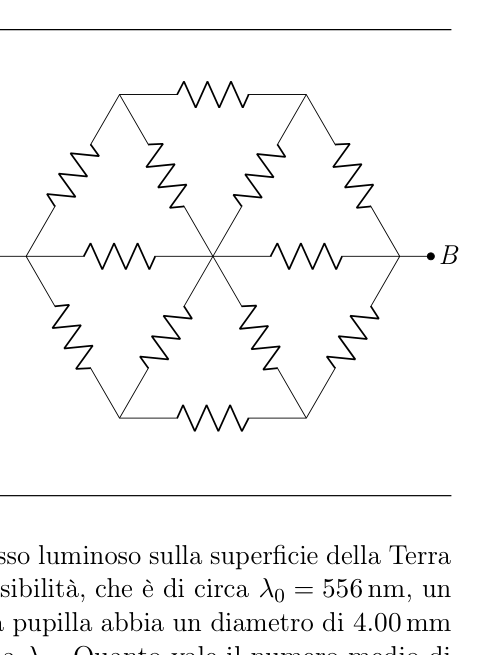 Rete esagonale di resistenze identiche con i terminali (sinistra) e (destra); le sei resistenze sul perimetro e i raggi interni collegano i vertici al centro.
Unità di misura: . Precisione richiesta: .
Topic: Circuits Metodi: Symmetry Argument, Kirchhoff’s Laws, Equivalent Circuit Reduction Competenze: Diagrammatic Reasoning, Mathematical Modeling Objects: Resistor Fonte: Testo (PDF) — p.5 Soluzione: Soluzioni (PDF)
**Excess resistance **
Knowing that all the resistors of the circuit in the figure are equal to , what is the equivalent resistance between the points and ?
Hexagonal network of resistors identical to the terminals (left) and (right); the six perimeter resistors and the inner beams connect the vertices to the center.
Unità di misura: . Precisione richiesta: .
Topic: Circuits Metodi: Symmetry Argument, Kirchhoff’s Laws, Equivalent Circuit Reduction Competenze: Diagrammatic Reasoning, Mathematical Modeling Objects: Resistor Fonte: Testo (PDF) — p.5 Soluzione: Soluzioni (PDF)
Fotoni da una stella
Una certa stella, facilmente visibile a occhio nudo, produce un flusso luminoso sulla superficie della Terra pari a . Alla lunghezza d’onda di massima visibilità, , un lumen corrisponde ad una potenza di . Si assuma che la pupilla abbia un diametro di e che tutta la luce dalla stella abbia lunghezza d’onda . Quanto vale il numero medio di fotoni al secondo che entrano nell’occhio di un osservatore che guarda tale stella?
Unità di misura: s. Precisione richiesta: .
Topic: Modern-Quantum Physics, Wave Optics Metodi: Photon Energy Relation, Order-of-Magnitude Estimation Competenze: Unit Conversion, Physical Reasoning Objects: Photon, Star Fonte: Testo (PDF) — p.5 Soluzione: Soluzioni (PDF)
Fotoni da una stella
A certain star, easily visible to the naked eye, produces a luminous flux on the Earth’s surface equal to . At the maximum visibility wavelength, , a lumen corresponds to a power of . Assume that the pupil has a diameter of and that all light from the star has a wavelength of . What is the average number of photons per second that enter the eye of an observer looking at that star?
Unità di misura: s. Precisione richiesta: .
Topic: Modern-Quantum Physics, Wave Optics Metodi: Photon Energy Relation, Order-of-Magnitude Estimation Competenze: Unit Conversion, Physical Reasoning Objects: Photon, Star Fonte: Testo (PDF) — p.5 Soluzione: Soluzioni (PDF)
Urto relativistico
Una particella di massa si muove di moto rettilineo uniforme a velocità . Essa urta una seconda particella, ferma, di massa . L’urto è completamente anelastico: le due particelle si “fondono” in un’unica particella. Quanto vale la massa di quest’ultima?
Unità di misura: . Precisione richiesta: .
Topic: Special Relativity, Conservation of Momentum Metodi: Relativistic Energy-Momentum, Conservation Laws, Mass-Energy Equivalence Competenze: Mathematical Modeling, Physical Reasoning Objects: — Fonte: Testo (PDF) — p.5 Soluzione: Soluzioni (PDF)
Urto relativistico
A particle of mass moves in a uniform straight motion at a speed . It hits a second, stationary particle of mass . The impact is completely anelastic: the two particles “melt” into a single particle. How much is the mass of the latter?
Unità di misura: . Precisione richiesta: .
Topic: Special Relativity, Conservation of Momentum Metodi: Relativistic Energy-Momentum, Conservation Laws, Mass-Energy Equivalence Competenze: Mathematical Modeling, Physical Reasoning Objects: — Fonte: Testo (PDF) — p.5 Soluzione: Soluzioni (PDF)
Nel sistema CGS, la carica elettrica si misura in StatCoulomb (StatC), la lunghezza in centimetri (cm) e la forza in dyne (dyn), dove . Sapendo che, in questo sistema, il modulo della forza elettrostatica tra due cariche a distanza vale quanto vale uno StatCoulomb?
Unità di misura: . Precisione richiesta: .
Topic: Electrostatics Metodi: Dimensional Analysis, Coulomb’s Law Competenze: Unit Conversion, Mathematical Modeling Objects: Point Charge Fonte: Testo (PDF) — p.6 Soluzione: Soluzioni (PDF)
In the CGS system, the electrical charge is measured in StatCoulomb (StatC), the length in centimetres (cm) and the force in dyne (dyn), where . Knowing that in this system, the modulus of electrostatic force between two charges at a distance is How much is a StatCoulomb worth?
Unità di misura: . Precisione richiesta: .
Topic: Electrostatics Metodi: Dimensional Analysis, Coulomb’s Law Competenze: Unit Conversion, Mathematical Modeling Objects: Point Charge Fonte: Testo (PDF) — p.6 Soluzione: Soluzioni (PDF)
Miraggi ed iceberg
Antonio si trova su una barca, ad altezza sul livello del mare, in una zona molto fredda. A causa della diminuzione della temperatura dell’aria all’aumentare dell’altezza , l’indice di rifrazione dell’aria varia linearmente con secondo la legge , dove . A causa di ciò, i raggi di luce vengono deviati, causando fenomeni quali i miraggi. Trascurando la curvatura terrestre, qual è la massima distanza alla quale si può trovare un iceberg, di altezza , affinché Antonio sia in grado di vederlo?
Potrebbe essere utile l’integrale:
Unità di misura: m. Precisione richiesta: .
Topic: Geometric Optics Metodi: Differential Equations, Calculus-Integration, Snell’s Law Competenze: Diagrammatic Reasoning, Mathematical Modeling Objects: — Fonte: Testo (PDF) — p.6 Soluzione: Soluzioni (PDF)
Mirages and icebergs
Antonio is on a boat, at an altitude of above sea level, in a very cold area. Due to the decrease in air temperature as the height increases, the air refractive index varies linearly with according to the law , where . Because of this, the light rays are deflected, causing phenomena such as mirages. If we ignore the curvature of the earth, what is the maximum distance from which an iceberg, of height, can be found for Antonio to be able to see it?
The whole thing might be useful:
Unità di misura: m. Precisione richiesta: .
Topic: Geometric Optics Metodi: Differential Equations, Calculus-Integration, Snell’s Law Competenze: Diagrammatic Reasoning, Mathematical Modeling Objects: — Fonte: Testo (PDF) — p.6 Soluzione: Soluzioni (PDF)
Giro della morte di un corpo rigido
Un oggetto sferico effettua un giro della morte su un supporto circolare di raggio , come in figura. Il supporto è fissato al terreno. L’oggetto viene lanciato alla base della circonferenza con una velocità iniziale di (tangenziale, dunque orizzontale) e rotola senza strisciare sin dall’istante iniziale. L’oggetto ha simmetria sferica, massa e raggio , ma densità non uniforme: il suo momento di inerzia vale , dove è un numero reale. Qual è il minimo valore di che permette alla sfera di effettuare un giro della morte completo senza staccarsi dalla guida?
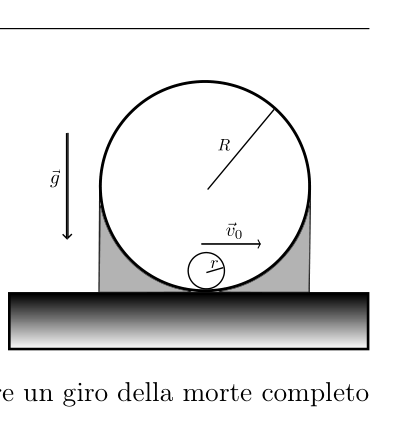 Sfera di raggio che rotola all’interno di una guida circolare di raggio fissata al terreno, lanciata orizzontalmente con alla base; gravità .
Unità di misura: adimensionale. Precisione richiesta: .
Topic: Rotational Dynamics, Conservation of Energy Metodi: Energy Conservation Method, Free-Body Diagram, Torque & Angular Momentum Analysis Competenze: Diagrammatic Reasoning, Mathematical Modeling, Physical Reasoning Objects: Sphere Fonte: Testo (PDF) — p.6 Soluzione: Soluzioni (PDF)
Turn of death of a rigid body
A spherical object makes a death spin on a circular radius support, as shown in Figure 1. The support is fixed to the ground. The object is launched at the base of the circumference with an initial velocity of (tangential, hence horizontal) and rolls without cracking from the initial moment. The object has spherical symmetry, mass and radius , but non-uniform density: its moment of inertia is , where is a real number. What is the minimum value of that allows the sphere to complete a complete death spin without detachment from the wheel?
Sphere of radius rolling within a circular guide of radius fixed to the ground, launched horizontally with at the base; gravity .
Unità di misura: adimensionale. Precisione richiesta: .
Topic: Rotational Dynamics, Conservation of Energy Metodi: Energy Conservation Method, Free-Body Diagram, Torque & Angular Momentum Analysis Competenze: Diagrammatic Reasoning, Mathematical Modeling, Physical Reasoning Objects: Sphere Fonte: Testo (PDF) — p.6 Soluzione: Soluzioni (PDF)