AA — Summer drink
Consider a cylindrical glass with an internal radius of and an ice cube with a side length of floating on the surface. The height of the liquid level, including the floating ice, is . By how many centimeters will the level change once the ice cube has completely melted? Provide a positive value if the level increases and a negative value if it decreases.
Risposta: (the level does not change)
Soluzione:
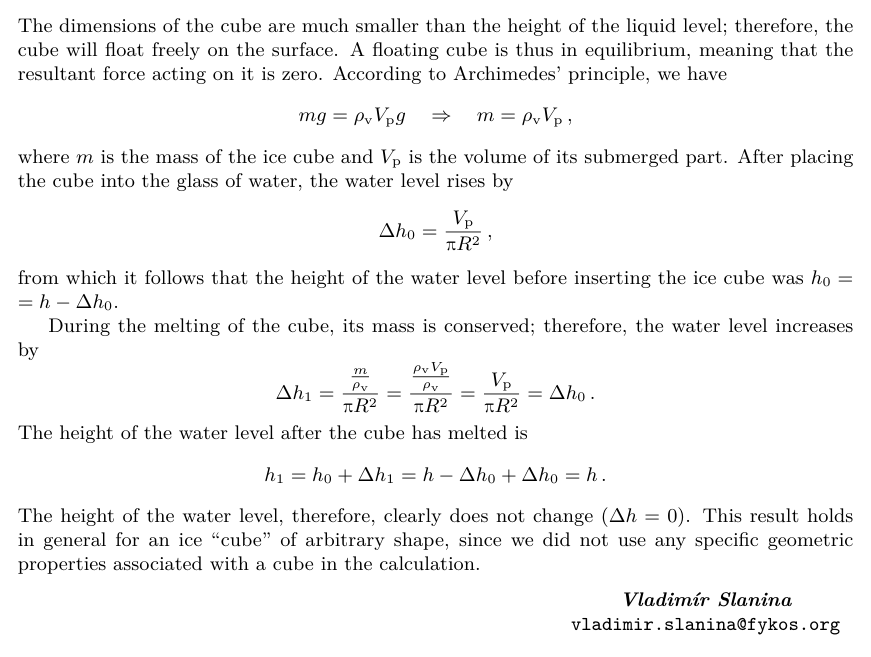
Official solution by FYKOS (Fyziklani 2026), reproduced from the official PDF — p. 3 — under CC BY-SA 3.0.
Topic: Fluid Mechanics Metodi: Hydrostatic Equilibrium Competenze: Physical Reasoning Objects: Cylinder, Block Fonte: Testo (PDF) — p.3 · Soluzione ufficiale (PDF) — p.3
AA — Bevanda estiva
Considera un bicchiere cilindrico di raggio interno e un cubetto di ghiaccio di lato che galleggia in superficie. L’altezza del livello del liquido, compreso il ghiaccio galleggiante, è . Di quanti centimetri cambierà il livello quando il cubetto si sarà completamente sciolto? Dai un valore positivo se il livello sale e negativo se scende.
Risposta: (il livello non cambia)
Soluzione: La soluzione ufficiale completa (in inglese) è nella versione originale di questo quesito e nel PDF ufficiale.
Topic: Fluid Mechanics Metodi: Hydrostatic Equilibrium Competenze: Physical Reasoning Objects: Cylinder, Block Fonte: Testo (PDF) — p.3 · Soluzione ufficiale (PDF) — p.3
AB — Marek’s ride
A sightseeing tram T3 Coupé equipped with turbo engines is racing through the streets at breakneck speed. Behind the controls sits nobody other than he. The man. The myth. The legend. Marek Milička. With every passing second, he approaches a collapsed bridge over the Vltava river, which has a width of . The remains of the bridge consist of ramps on both banks, which form an angle of with the ground. Marek accelerates and… he jumps over the river with the tram, landing successfully on the ramp on the opposite bank. At what speed was Marek’s tram moving immediately before the jump?
Risposta:
Soluzione:
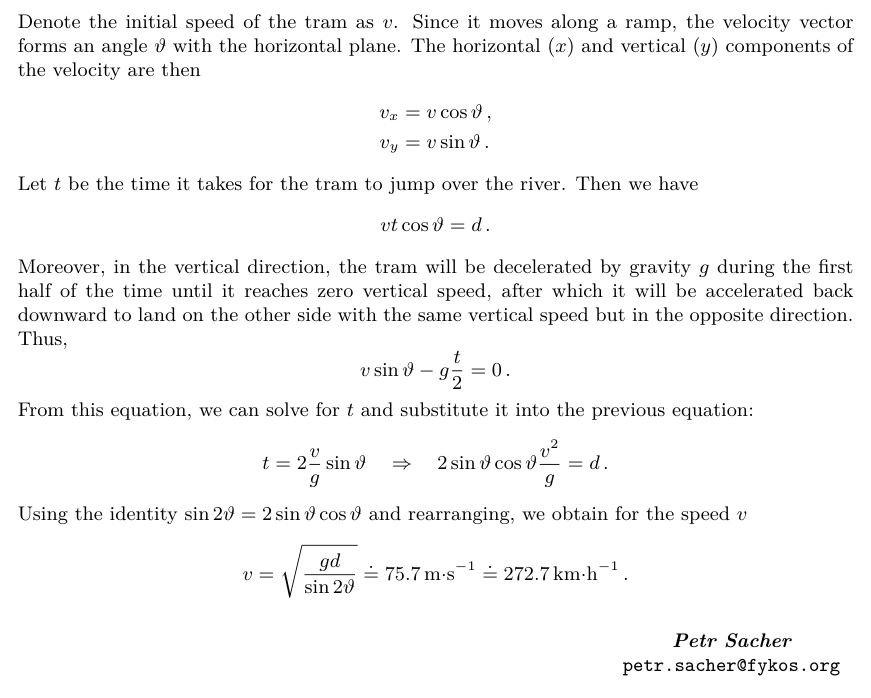
Official solution by FYKOS (Fyziklani 2026), reproduced from the official PDF — p. 4 — under CC BY-SA 3.0.
Topic: Newtonian Mechanics Metodi: Kinematic Equations Competenze: Mathematical Modeling Objects: Projectile, Inclined Plane Fonte: Testo (PDF) — p.3 · Soluzione ufficiale (PDF) — p.4
AB — La corsa di Marek
Un tram turistico T3 Coupé dotato di motori turbo sfreccia per le strade a velocità folle. Ai comandi siede nientemeno che lui. L’uomo. Il mito. La leggenda. Marek Milička. A ogni secondo si avvicina a un ponte crollato sulla Moldava, larga . I resti del ponte sono due rampe sulle due rive, inclinate di rispetto al suolo. Marek accelera e… salta il fiume con il tram, atterrando sano e salvo sulla rampa della riva opposta. A che velocità si muoveva il tram di Marek subito prima del salto?
Risposta:
Soluzione: La soluzione ufficiale completa (in inglese) è nella versione originale di questo quesito e nel PDF ufficiale.
Topic: Newtonian Mechanics Metodi: Kinematic Equations Competenze: Mathematical Modeling Objects: Projectile, Inclined Plane Fonte: Testo (PDF) — p.3 · Soluzione ufficiale (PDF) — p.4
AC — Don’t judge a fish by its ability to run
A rabbit and a fish compete in a race in which the rabbit runs and the fish swims. They start at the same time and travel a distance of downstream. Then they turn around and return to the starting point. The river has a current speed of . The rabbit runs at the same speed as the fish swims, which is . What is the difference in their finishing times? Provide a positive value if the rabbit finishes first, and a negative value if the fish finishes first.
Risposta: (the rabbit finishes first)
Soluzione:
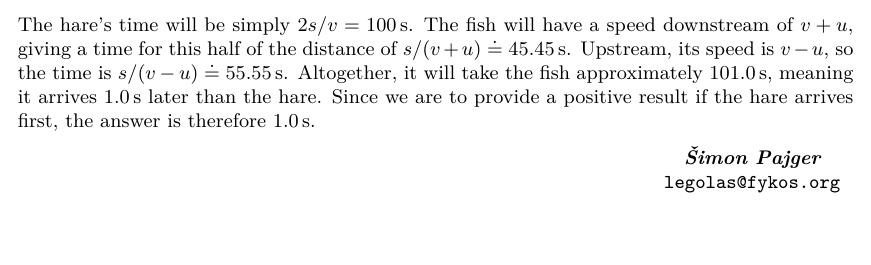
Official solution by FYKOS (Fyziklani 2026), reproduced from the official PDF — p. 4 — under CC BY-SA 3.0.
Topic: Newtonian Mechanics Metodi: Kinematic Equations Competenze: Physical Reasoning Objects: — Fonte: Testo (PDF) — p.4 · Soluzione ufficiale (PDF) — p.4
AC — Non giudicare un pesce dalla sua capacità di correre
Un coniglio e un pesce gareggiano: il coniglio corre e il pesce nuota. Partono nello stesso istante e percorrono una distanza a valle (seguendo la corrente). Poi tornano indietro fino al punto di partenza. La corrente del fiume ha velocità . Il coniglio corre alla stessa velocità con cui nuota il pesce, . Qual è la differenza tra i loro tempi di arrivo? Dai un valore positivo se arriva prima il coniglio e negativo se arriva prima il pesce.
Risposta: (arriva prima il coniglio)
Soluzione: La soluzione ufficiale completa (in inglese) è nella versione originale di questo quesito e nel PDF ufficiale.
Topic: Newtonian Mechanics Metodi: Kinematic Equations Competenze: Physical Reasoning Objects: — Fonte: Testo (PDF) — p.4 · Soluzione ufficiale (PDF) — p.4
AD — Angle averaging
Lego had an unpleasant dream: he found himself in the middle of a herd of running horses. He reasoned that the risk of injury would be minimal if he ran approximately in the same direction as they did. He therefore wanted to determine their average direction. Using a reference vector, he measured the directions of several nearby horses relative to it, obtaining the angles , , , , . At what angle with respect to this vector should Lego run so that it is the average direction of the horses in his vicinity?
Risposta:
Soluzione:
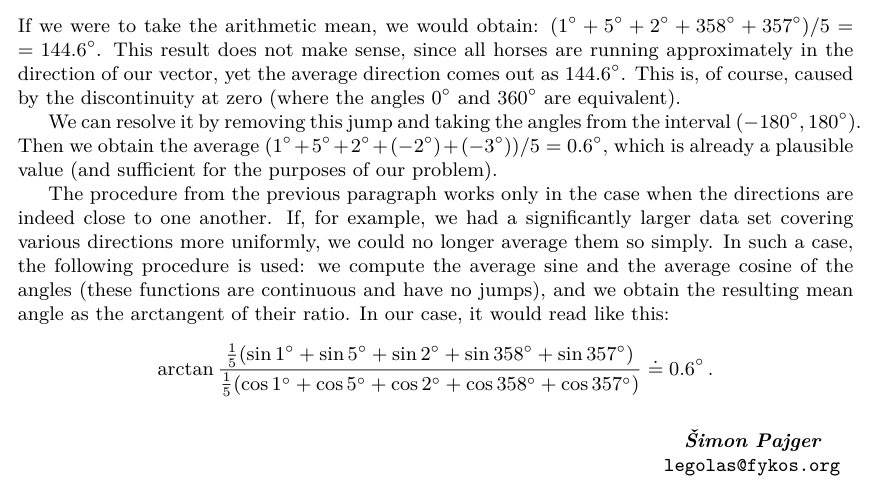
Official solution by FYKOS (Fyziklani 2026), reproduced from the official PDF — p. 5 — under CC BY-SA 3.0.
Topic: Mathematics Metodi: Statistical Averaging Competenze: Physical Reasoning Objects: — Fonte: Testo (PDF) — p.5 · Soluzione ufficiale (PDF) — p.5
AD — Media di angoli
Lego ha fatto un brutto sogno: si trovava in mezzo a una mandria di cavalli in corsa. Ha ragionato che il rischio di farsi male sarebbe stato minimo correndo all’incirca nella loro stessa direzione, e voleva quindi determinarne la direzione media. Rispetto a un vettore di riferimento ha misurato le direzioni di alcuni cavalli vicini, ottenendo gli angoli , , , , . A quale angolo rispetto a questo vettore deve correre Lego perché sia la direzione media dei cavalli intorno a lui?
Risposta:
Soluzione: La soluzione ufficiale completa (in inglese) è nella versione originale di questo quesito e nel PDF ufficiale.
Topic: Mathematics Metodi: Statistical Averaging Competenze: Physical Reasoning Objects: — Fonte: Testo (PDF) — p.5 · Soluzione ufficiale (PDF) — p.5
AE — Vive la révolution
The guillotine has a blade of mass that slides along the grooves of two vertical, opposing beams as it falls. The coefficient of friction between the blade and the beams is , and the force between each beam and the blade is . An energy is required to sever the head. Determine the minimum height of the guillotine when accounted for energy lost due to friction.
Risposta:
Soluzione:
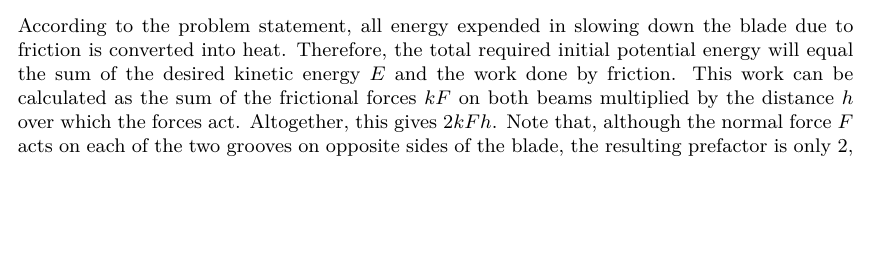
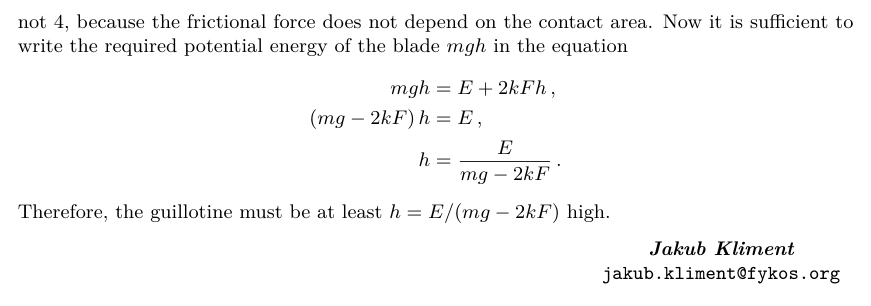
Official solution by FYKOS (Fyziklani 2026), reproduced from the official PDF — p. 5, 6 — under CC BY-SA 3.0.
Topic: Conservation of Energy Metodi: Energy Conservation Method Competenze: Mathematical Modeling Objects: Block Fonte: Testo (PDF) — p.5 · Soluzione ufficiale (PDF) — p.5
AE — Vive la révolution
La ghigliottina ha una lama di massa che, cadendo, scorre nelle scanalature di due montanti verticali affacciati. Il coefficiente di attrito tra lama e montanti è e la forza tra ciascun montante e la lama è . Per tagliare la testa serve un’energia . Determina l’altezza minima della ghigliottina tenendo conto dell’energia dissipata per attrito.
Risposta:
Soluzione: La soluzione ufficiale completa (in inglese) è nella versione originale di questo quesito e nel PDF ufficiale.
Topic: Conservation of Energy Metodi: Energy Conservation Method Competenze: Mathematical Modeling Objects: Block Fonte: Testo (PDF) — p.5 · Soluzione ufficiale (PDF) — p.5
AF — Nacho dip
We have a pile of nachos and a big bowl of dip. The nachos have the shape of an equilateral triangle with side length . By what percentage will we consume more dip if we dip the nachos while holding them by a vertex compared to holding them by the midpoint of a side? In both cases, we hold the nachos so that our fingers remain clean, leaving a length undipped. Assume that a constant thickness of dip is collected. Neglect the thickness of the nachos.
Risposta: more
Soluzione:
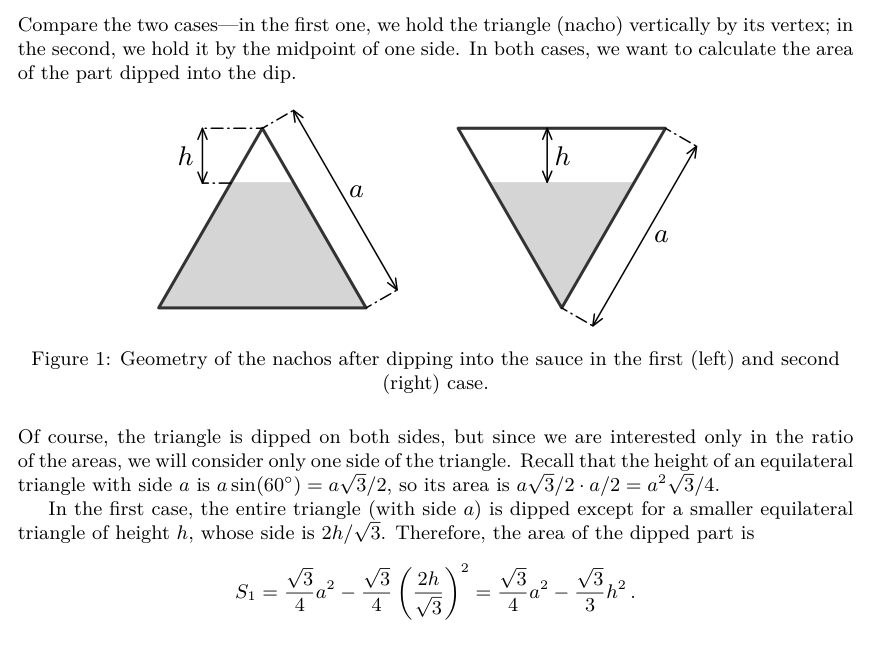
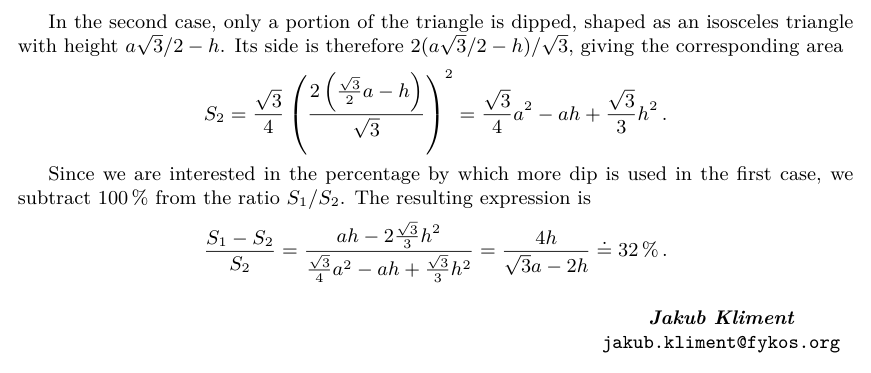
Official solution by FYKOS (Fyziklani 2026), reproduced from the official PDF — p. 6, 7 — under CC BY-SA 3.0.
Topic: Mathematics Metodi: Physical Modeling Competenze: Mathematical Modeling Objects: — Fonte: Testo (PDF) — p.6 · Soluzione ufficiale (PDF) — p.6
AF — Salsa per nachos
Abbiamo un mucchio di nachos e una grande ciotola di salsa. I nachos hanno la forma di un triangolo equilatero di lato . Di quale percentuale consumeremo più salsa intingendo i nachos tenendoli per un vertice anziché per il punto medio di un lato? In entrambi i casi teniamo i nachos in modo che le dita restino pulite, lasciando non intinta una lunghezza . Supponi che si raccolga uno strato di salsa di spessore costante. Trascura lo spessore dei nachos.
Risposta: in più
Soluzione: La soluzione ufficiale completa (in inglese) è nella versione originale di questo quesito e nel PDF ufficiale.
Topic: Mathematics Metodi: Physical Modeling Competenze: Mathematical Modeling Objects: — Fonte: Testo (PDF) — p.6 · Soluzione ufficiale (PDF) — p.6
AG — Active power plant
The Temelín nuclear power plant has a thermal power output of . Assume that the average usable energy released in the decay of one nucleus of uranium is , and that the entire power output comes from this decay. The molar mass of the isotope is , and its half-life is years. The activity of one banana is . How many times greater is the activity of the consumed in at the Temelín nuclear power plant compared to a banana?
Risposta:
Soluzione:
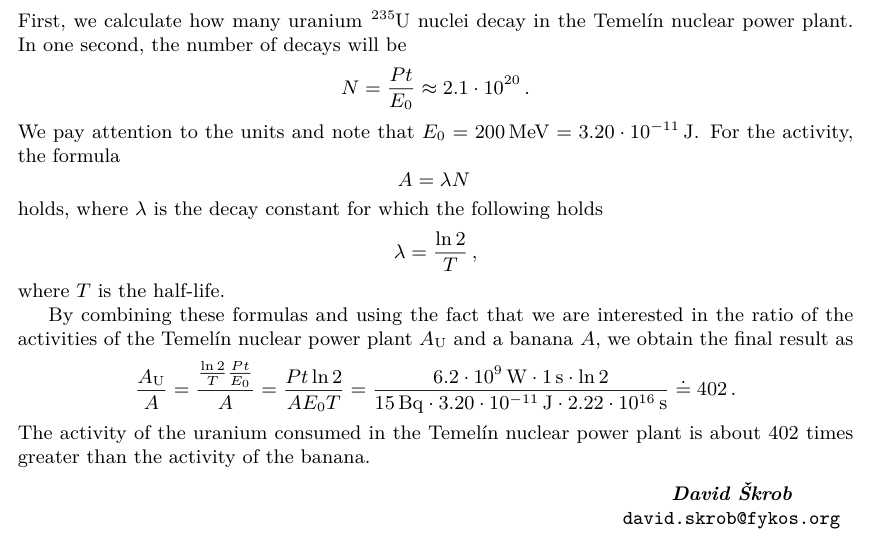
Official solution by FYKOS (Fyziklani 2026), reproduced from the official PDF — p. 7 — under CC BY-SA 3.0.
Topic: Nuclear & Particle Physics Metodi: Radioactive Decay Law Competenze: Mathematical Modeling, Unit Conversion Objects: Nucleus Fonte: Testo (PDF) — p.7 · Soluzione ufficiale (PDF) — p.7
AG — Centrale attiva
La centrale nucleare di Temelín ha una potenza termica . Supponi che l’energia utile media liberata nel decadimento di un nucleo di uranio sia e che tutta la potenza provenga da questo processo. La massa molare dell’isotopo è e il suo tempo di dimezzamento è anni. L’attività di una banana è . Quante volte è maggiore l’attività dell’ consumato in nella centrale di Temelín rispetto a quella di una banana?
Risposta:
Soluzione: La soluzione ufficiale completa (in inglese) è nella versione originale di questo quesito e nel PDF ufficiale.
Topic: Nuclear & Particle Physics Metodi: Radioactive Decay Law Competenze: Mathematical Modeling, Unit Conversion Objects: Nucleus Fonte: Testo (PDF) — p.7 · Soluzione ufficiale (PDF) — p.7
AH — Water in the air
A firefighter is extinguishing a fire by continuously spraying the surroundings with a steady stream of water from a hose from an elevated position. The hose is held so that the nozzle is at a height above the ground, onto which the water subsequently falls. Water flows out of the hose of diameter with speed at an initial angle upward relative to the horizontal plane. What is the mass of water that is present in the air at any given moment?
Risposta:
Soluzione:
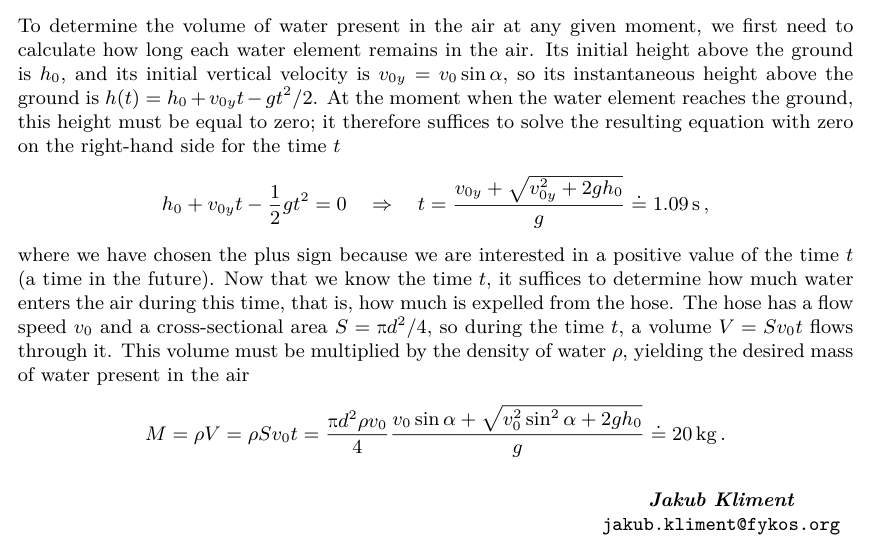
Official solution by FYKOS (Fyziklani 2026), reproduced from the official PDF — p. 8 — under CC BY-SA 3.0.
Topic: Newtonian Mechanics, Fluid Mechanics Metodi: Kinematic Equations, Continuity Equation Competenze: Mathematical Modeling Objects: Projectile, Tube Fonte: Testo (PDF) — p.8 · Soluzione ufficiale (PDF) — p.8
AH — Acqua nell’aria
Un vigile del fuoco spegne un incendio spruzzando con continuità un getto d’acqua stazionario da una manichetta, da una posizione elevata. La manichetta è tenuta con l’ugello a un’altezza sopra il suolo, sul quale l’acqua poi ricade. L’acqua esce dalla manichetta di diametro con velocità e angolo iniziale verso l’alto rispetto all’orizzontale. Qual è la massa d’acqua presente in aria in ogni istante?
Risposta:
Soluzione: La soluzione ufficiale completa (in inglese) è nella versione originale di questo quesito e nel PDF ufficiale.
Topic: Newtonian Mechanics, Fluid Mechanics Metodi: Kinematic Equations, Continuity Equation Competenze: Mathematical Modeling Objects: Projectile, Tube Fonte: Testo (PDF) — p.8 · Soluzione ufficiale (PDF) — p.8
BA — Valentine’s fluorite
As Vlado searched for a romantic gift for his girlfriend Julka before Valentine’s Day, he visited a store with various decorative minerals. He was attracted to fluorite products and thus began to ponder their mystical properties. Calculate the density of a fluorite single crystal and express the result to four significant figures. One unit cell of fluorite has a dimension . Its crystal lattice is shown in the attached figure. The molar mass of calcium and fluorine is and , respectively.
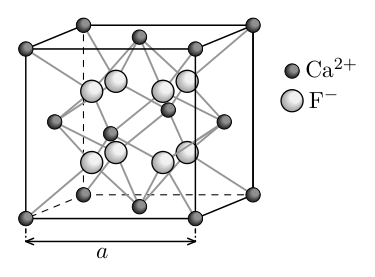
Risposta:
Soluzione:

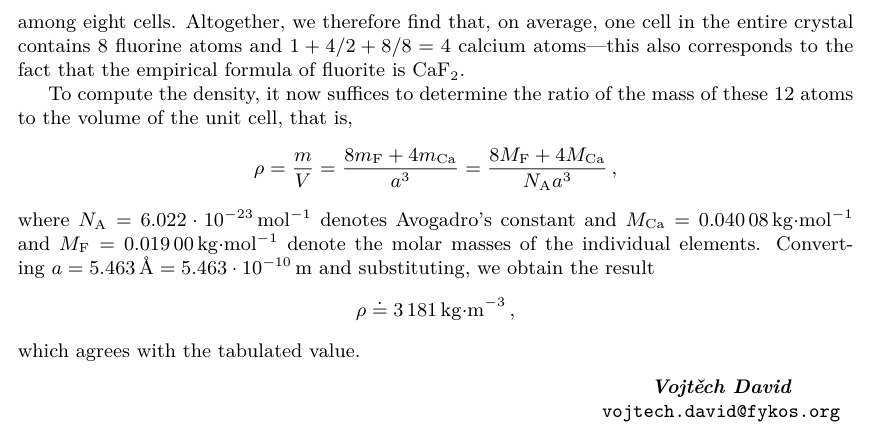
Official solution by FYKOS (Fyziklani 2026), reproduced from the official PDF — p. 8, 9 — under CC BY-SA 3.0.
Topic: Chemistry Metodi: Physical Modeling Competenze: Significant Figures, Unit Conversion Objects: Atom Fonte: Testo (PDF) — p.8 · Soluzione ufficiale (PDF) — p.8
BA — La fluorite di San Valentino
Cercando un regalo romantico per la sua ragazza Julka prima di San Valentino, Vlado è entrato in un negozio di minerali decorativi. È stato attratto dagli oggetti di fluorite e ha cominciato a riflettere sulle loro proprietà mistiche. Calcola la densità di un monocristallo di fluorite ed esprimi il risultato con quattro cifre significative. Una cella elementare di fluorite ha lato . Il suo reticolo cristallino è mostrato in figura. Le masse molari di calcio e fluoro sono rispettivamente e .
Risposta:
Soluzione: La soluzione ufficiale completa (in inglese) è nella versione originale di questo quesito e nel PDF ufficiale.
Topic: Chemistry Metodi: Physical Modeling Competenze: Significant Figures, Unit Conversion Objects: Atom Fonte: Testo (PDF) — p.8 · Soluzione ufficiale (PDF) — p.8
BB — Overturned glass
Imagine a cylindrical glass of height and base diameter . Suppose that its center of mass is at the center of its axis. What is the minimum coefficient of static friction with the surface required to make it possible to tip the glass over solely by pushing from the side? The push may be applied at any point, but only horizontally.
Risposta:
Soluzione:
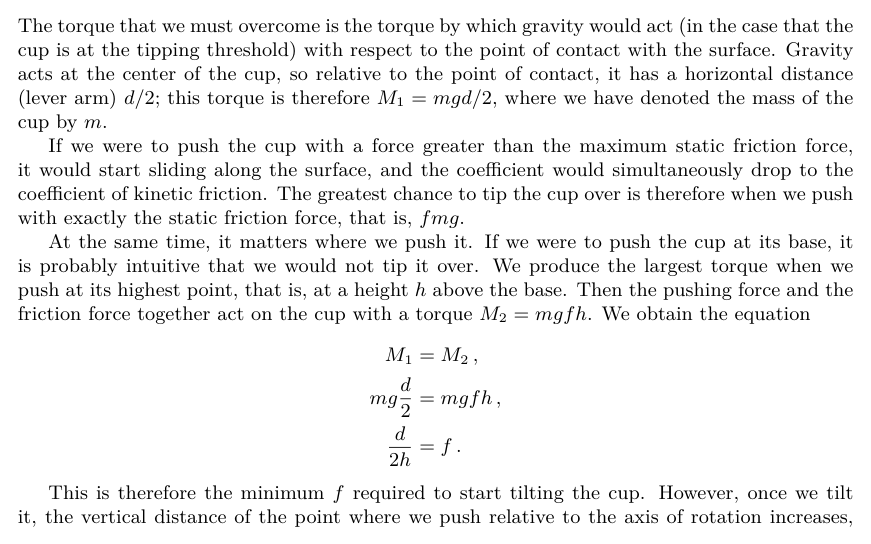

Official solution by FYKOS (Fyziklani 2026), reproduced from the official PDF — p. 9, 10 — under CC BY-SA 3.0.
Topic: Rigid Body Statics Metodi: Torque & Angular Momentum Analysis, Free-Body Diagram Competenze: Physical Reasoning Objects: Cylinder Fonte: Testo (PDF) — p.9 · Soluzione ufficiale (PDF) — p.9
BB — Bicchiere rovesciato
Immagina un bicchiere cilindrico di altezza e diametro di base . Supponi che il suo centro di massa si trovi a metà dell’asse. Qual è il coefficiente minimo di attrito statico con il piano d’appoggio necessario perché sia possibile ribaltare il bicchiere spingendolo solo lateralmente? La spinta può essere applicata in qualsiasi punto, ma solo orizzontalmente.
Risposta:
Soluzione: La soluzione ufficiale completa (in inglese) è nella versione originale di questo quesito e nel PDF ufficiale.
Topic: Rigid Body Statics Metodi: Torque & Angular Momentum Analysis, Free-Body Diagram Competenze: Physical Reasoning Objects: Cylinder Fonte: Testo (PDF) — p.9 · Soluzione ufficiale (PDF) — p.9
BC — Coin on water
A metal coin with density , a radius and a height is lying on water. Due to surface tension, the coin remains afloat. To what minimum temperature must the water be heated for the coin to sink? The surface tension of water at a temperature of is and at a temperature of it is . Assume that the dependence of surface tension on temperature is linear.
Risposta:
Soluzione:
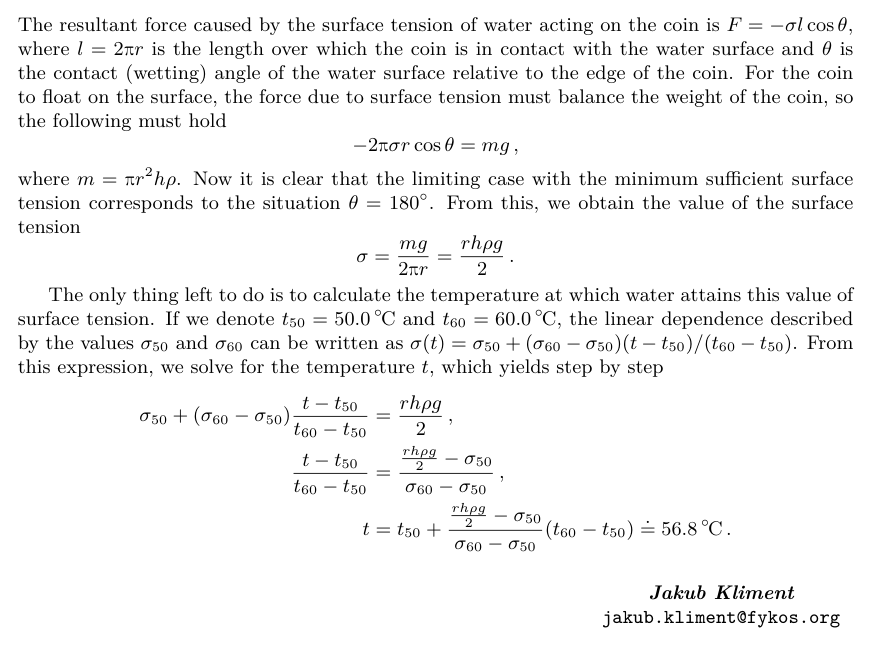
Official solution by FYKOS (Fyziklani 2026), reproduced from the official PDF — p. 10 — under CC BY-SA 3.0.
Topic: Fluid Mechanics, Thermodynamics Metodi: Free-Body Diagram, Physical Modeling Competenze: Mathematical Modeling Objects: Disk Fonte: Testo (PDF) — p.10 · Soluzione ufficiale (PDF) — p.10
BC — Moneta sull’acqua
Una moneta metallica di densità , raggio e spessore è appoggiata sull’acqua e resta a galla grazie alla tensione superficiale. A quale temperatura minima occorre scaldare l’acqua perché la moneta affondi? La tensione superficiale dell’acqua a è e a è . Supponi che la tensione superficiale dipenda linearmente dalla temperatura.
Risposta:
Soluzione: La soluzione ufficiale completa (in inglese) è nella versione originale di questo quesito e nel PDF ufficiale.
Topic: Fluid Mechanics, Thermodynamics Metodi: Free-Body Diagram, Physical Modeling Competenze: Mathematical Modeling Objects: Disk Fonte: Testo (PDF) — p.10 · Soluzione ufficiale (PDF) — p.10
BD — Prone to procrastination
Duty calls, so Marek grabs it, ties it to a rope of length , spins it so that the rope makes an angle with the horizontal plane, and releases it from the rope. However, since duty is persistent, it starts accelerating from rest toward Marek at the moment it lands, while Marek has been running away from the impact point with a speed of ever since he released the rope. If Marek is tall and holds the rope at this height, how long after landing will duty catch up with him?
Risposta:
Soluzione:
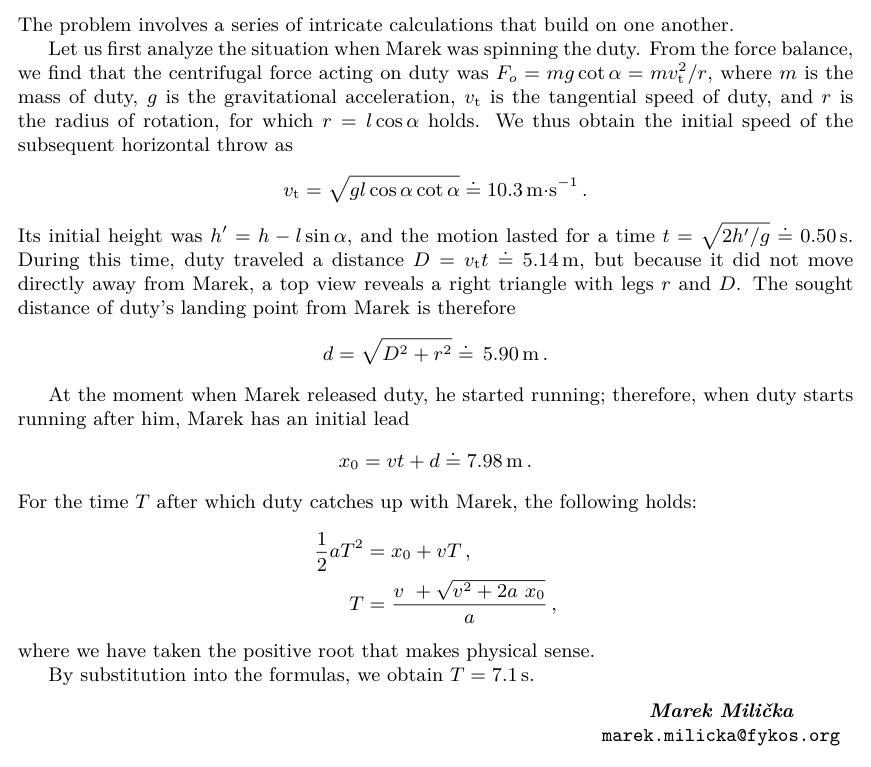
Official solution by FYKOS (Fyziklani 2026), reproduced from the official PDF — p. 11 — under CC BY-SA 3.0.
Topic: Newtonian Mechanics Metodi: Kinematic Equations, Free-Body Diagram Competenze: Mathematical Modeling Objects: Projectile, String Fonte: Testo (PDF) — p.10 · Soluzione ufficiale (PDF) — p.11
BD — Incline alla procrastinazione
Il dovere chiama, così Marek lo afferra, lo lega a una corda di lunghezza , lo fa ruotare in modo che la corda formi un angolo con il piano orizzontale e lo lascia andare. Ma il dovere è insistente: nell’istante in cui tocca terra parte da fermo e accelera verso Marek con , mentre Marek, da quando ha lasciato la corda, sta scappando dal punto d’impatto con velocità . Se Marek è alto e tiene la corda a quest’altezza, dopo quanto tempo dall’atterraggio il dovere lo raggiungerà?
Risposta:
Soluzione: La soluzione ufficiale completa (in inglese) è nella versione originale di questo quesito e nel PDF ufficiale.
Topic: Newtonian Mechanics Metodi: Kinematic Equations, Free-Body Diagram Competenze: Mathematical Modeling Objects: Projectile, String Fonte: Testo (PDF) — p.10 · Soluzione ufficiale (PDF) — p.11
BE — Schrödinger’s cat rescue mission
Anička keeps Schrödinger’s cat in a closed box and initially assigns a probability that the cat is alive. She worries about the cat, so she makes a deal with a fairy; the fairy casts a resurrection spell three times vertically downward into the box. Each spell hits the box at a uniformly random position, independently of the others. The box is rectangular with side lengths and . In top view, the cat can be modeled as a circle of radius , placed at a uniformly random position within the box, that remains stationary during the casting. If any cast spell hits the cat, it is considered saved. What is the probability of the cat being alive after the three shots?
Risposta:
Soluzione:
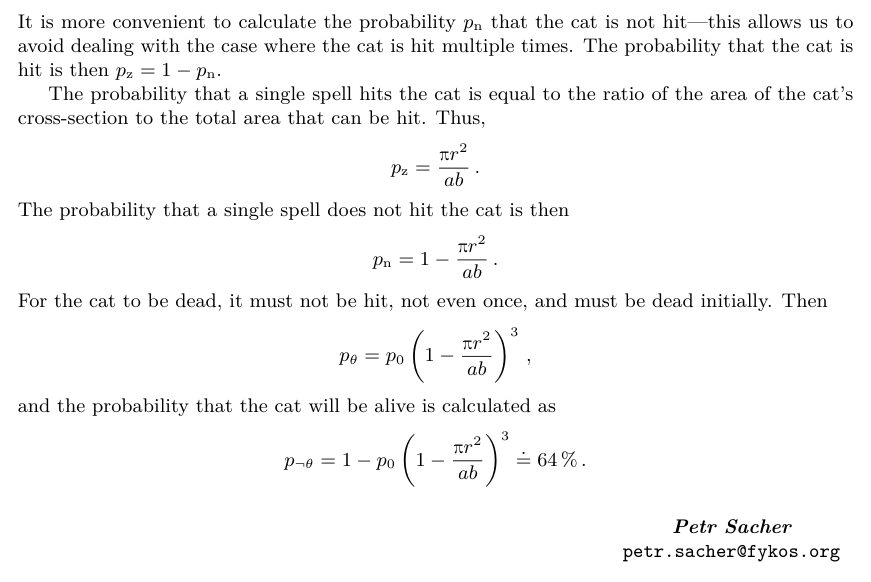
Official solution by FYKOS (Fyziklani 2026), reproduced from the official PDF — p. 12 — under CC BY-SA 3.0.
Topic: Mathematics Metodi: Statistical Averaging Competenze: Mathematical Modeling Objects: — Fonte: Testo (PDF) — p.11 · Soluzione ufficiale (PDF) — p.12
BE — Missione di salvataggio del gatto di Schrödinger
Anička tiene il gatto di Schrödinger in una scatola chiusa e inizialmente assegna probabilità che il gatto sia vivo. Preoccupata, stringe un patto con una fata: la fata lancia tre volte un incantesimo di resurrezione verticalmente verso il basso nella scatola. Ogni incantesimo colpisce la scatola in una posizione casuale uniforme, indipendentemente dagli altri. La scatola è rettangolare, con lati e . Vista dall’alto, il gatto si può modellare come un cerchio di raggio , in posizione casuale uniforme nella scatola, che resta fermo durante gli incantesimi. Se un incantesimo colpisce il gatto, questo è salvo. Qual è la probabilità che il gatto sia vivo dopo i tre lanci?
Risposta:
Soluzione: La soluzione ufficiale completa (in inglese) è nella versione originale di questo quesito e nel PDF ufficiale.
Topic: Mathematics Metodi: Statistical Averaging Competenze: Mathematical Modeling Objects: — Fonte: Testo (PDF) — p.11 · Soluzione ufficiale (PDF) — p.12
BF — Sphere in a cylinder
Consider a solid homogeneous sphere of radius and mass rolling inside a cylindrical cavity of inner radius . The cavity is oriented so that its main axis is parallel to the horizontal plane, and the gravitational acceleration acts vertically. Energy losses can be neglected for a few rotations, and the sphere rolls without slipping. The ratio of the sphere’s speeds at the lowest point of the motion to the highest point is . What is the maximum speed reached by the sphere during its motion? Provide the result as a formula expressed only in terms of the parameters , , and .
Risposta: (independent of )
Soluzione:
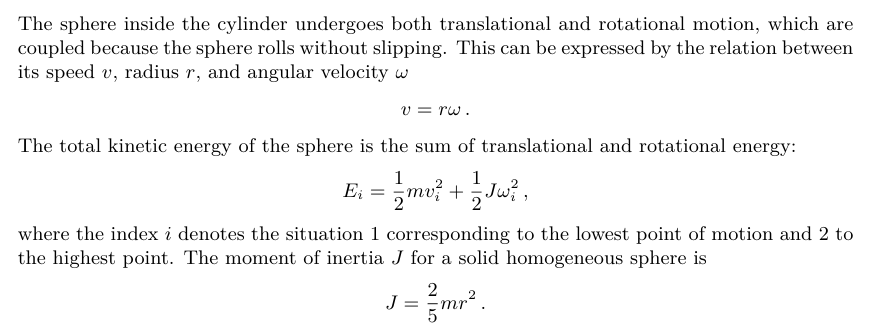
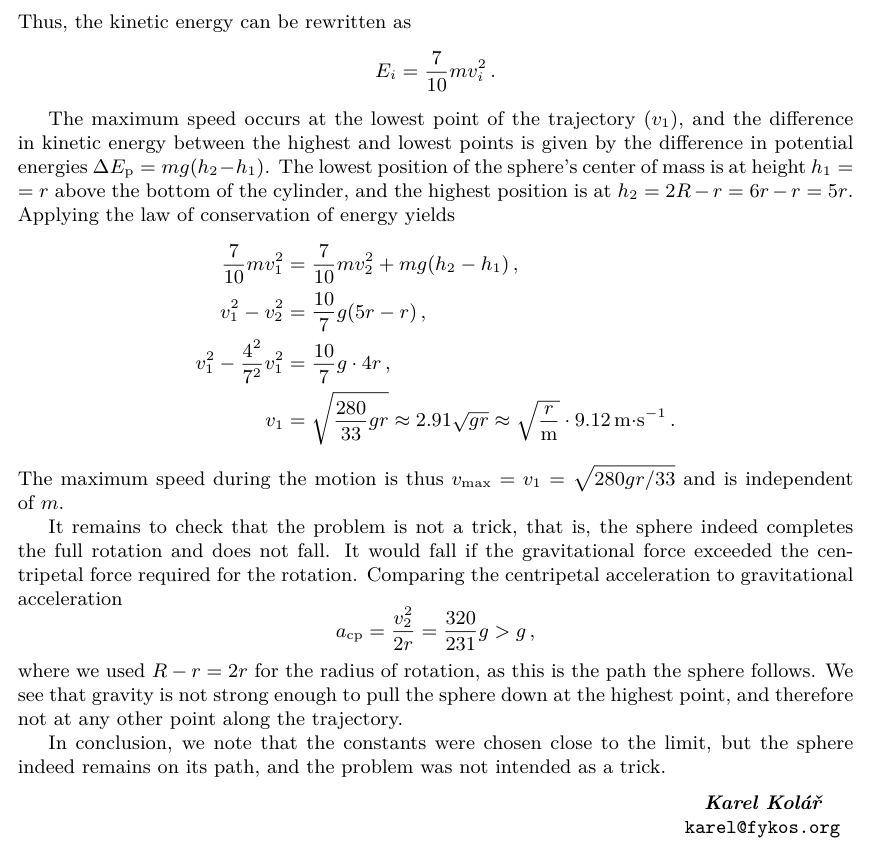
Official solution by FYKOS (Fyziklani 2026), reproduced from the official PDF — p. 12, 13 — under CC BY-SA 3.0.
Topic: Rotational Dynamics, Conservation of Energy Metodi: Energy Conservation Method Competenze: Mathematical Modeling Objects: Sphere, Cylinder Fonte: Testo (PDF) — p.12 · Soluzione ufficiale (PDF) — p.12
BF — Sfera in un cilindro
Considera una sfera piena omogenea di raggio e massa che rotola all’interno di una cavità cilindrica di raggio interno . La cavità ha l’asse parallelo al piano orizzontale e l’accelerazione di gravità è verticale. Per qualche giro le perdite di energia sono trascurabili e la sfera rotola senza strisciare. Il rapporto tra la velocità della sfera nel punto più basso del moto, , e quella nel punto più alto, , è . Qual è la velocità massima raggiunta dalla sfera? Esprimi il risultato con una formula che contenga solo i parametri , e .
Risposta: (indipendente da )
Soluzione: La soluzione ufficiale completa (in inglese) è nella versione originale di questo quesito e nel PDF ufficiale.
Topic: Rotational Dynamics, Conservation of Energy Metodi: Energy Conservation Method Competenze: Mathematical Modeling Objects: Sphere, Cylinder Fonte: Testo (PDF) — p.12 · Soluzione ufficiale (PDF) — p.12
BG — A ball in hand
We would like to grab a large ball with one hand and hold it underneath. Let us model the situation as follows. We have fingers, so we can act at points. The friction between a finger and the ball is . The fingers are arranged symmetrically around the pole of the ball, which points upward in our gravitational field. What is the smallest zenith angle we must choose (that is, how close to the pole) so that we can still hold the ball? The mass of the ball is , and the normal force that one finger can exert on the ball is .
Risposta:
Soluzione:

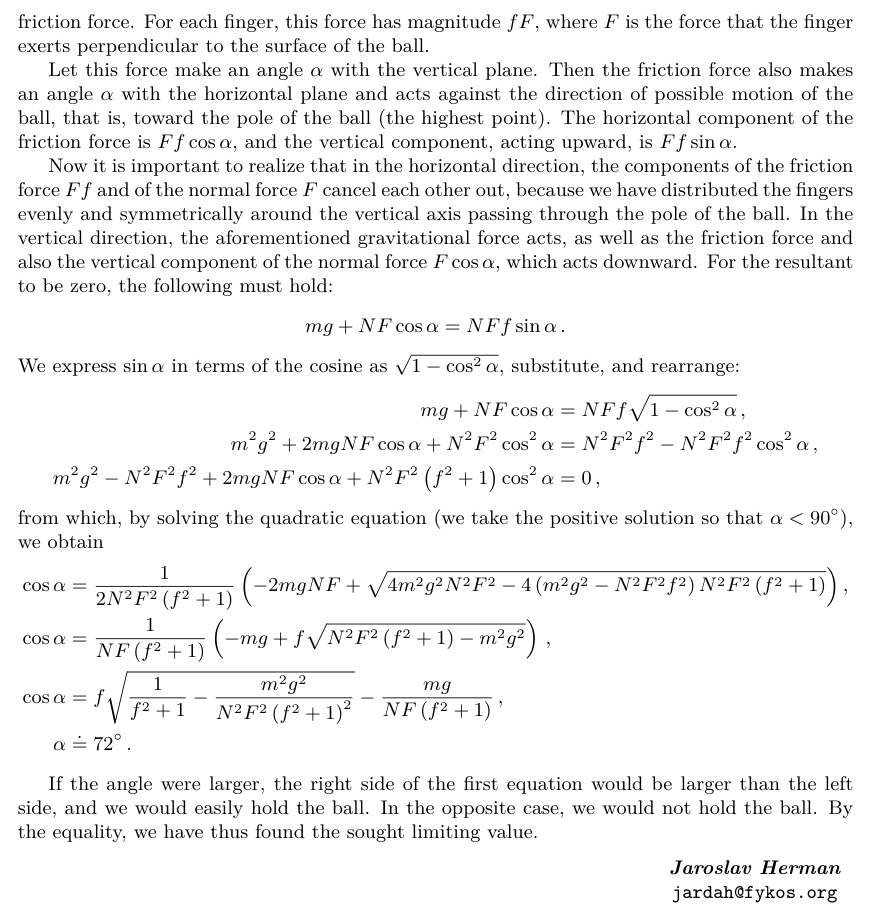
Official solution by FYKOS (Fyziklani 2026), reproduced from the official PDF — p. 13, 14 — under CC BY-SA 3.0.
Topic: Rigid Body Statics Metodi: Free-Body Diagram, Vector Decomposition Competenze: Mathematical Modeling Objects: Ball, Sphere Fonte: Testo (PDF) — p.13 · Soluzione ufficiale (PDF) — p.13
BG — Un pallone in mano
Vogliamo afferrare un pallone grande con una mano e tenerlo da sotto. Modelliamo la situazione così: abbiamo dita, quindi possiamo agire in punti. Il coefficiente di attrito tra un dito e il pallone è . Le dita sono disposte simmetricamente attorno al polo del pallone, che nel campo gravitazionale punta verso l’alto. Qual è il minimo angolo zenitale (cioè quanto vicino al polo) che dobbiamo scegliere per riuscire ancora a tenere il pallone? La massa del pallone è e la forza normale che un dito può esercitare sul pallone è .
Risposta:
Soluzione: La soluzione ufficiale completa (in inglese) è nella versione originale di questo quesito e nel PDF ufficiale.
Topic: Rigid Body Statics Metodi: Free-Body Diagram, Vector Decomposition Competenze: Mathematical Modeling Objects: Ball, Sphere Fonte: Testo (PDF) — p.13 · Soluzione ufficiale (PDF) — p.13
BH — Nuts and bolts
David once woke up with a strange dream: he wanted to fit a bolt with outer diameter into a nut with inner diameter , both measured at room temperature . To achieve this, he bought a carafe of liquid nitrogen at a temperature of and placed the bolt inside. To what thermodynamic temperature must he heat the nut so that they can be screwed together? Neglect any expansion or contraction of the threads. The thermal expansion coefficient of both objects is , and we assume it is independent of temperature.
Risposta:
Soluzione:
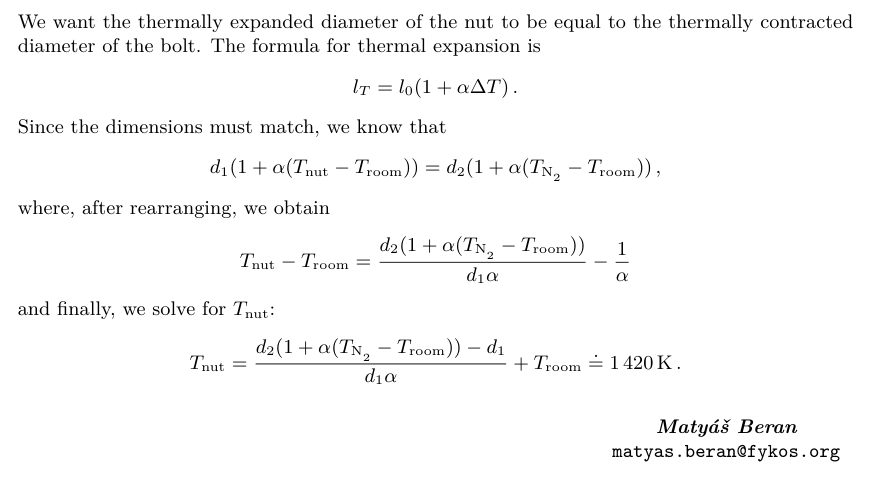
Official solution by FYKOS (Fyziklani 2026), reproduced from the official PDF — p. 15 — under CC BY-SA 3.0.
Topic: Thermodynamics, Elasticity & Materials Metodi: Physical Modeling Competenze: Mathematical Modeling, Unit Conversion Objects: Cylinder Fonte: Testo (PDF) — p.14 · Soluzione ufficiale (PDF) — p.15
BH — Dadi e bulloni
Una volta David si è svegliato da uno strano sogno: voleva infilare un bullone di diametro esterno in un dado di diametro interno , entrambi misurati a temperatura ambiente . Per riuscirci ha comprato una caraffa di azoto liquido a temperatura e vi ha immerso il bullone. A quale temperatura termodinamica deve scaldare il dado perché si possano avvitare? Trascura dilatazione e contrazione delle filettature. Il coefficiente di dilatazione termica di entrambi gli oggetti è e lo supponiamo indipendente dalla temperatura.
Risposta:
Soluzione: La soluzione ufficiale completa (in inglese) è nella versione originale di questo quesito e nel PDF ufficiale.
Topic: Thermodynamics, Elasticity & Materials Metodi: Physical Modeling Competenze: Mathematical Modeling, Unit Conversion Objects: Cylinder Fonte: Testo (PDF) — p.14 · Soluzione ufficiale (PDF) — p.15
CA — As quick as snapping your fingers
In the film Avengers: Infinity War, the villain Thanos turns half of the living beings in the universe into dust with a snap of his fingers. Suppose he achieves this by making all atoms in the bodies of these organisms unstable with a very short half-life. Within after the snap, the affected beings decay by . What was their half-life?
Risposta:
Soluzione:
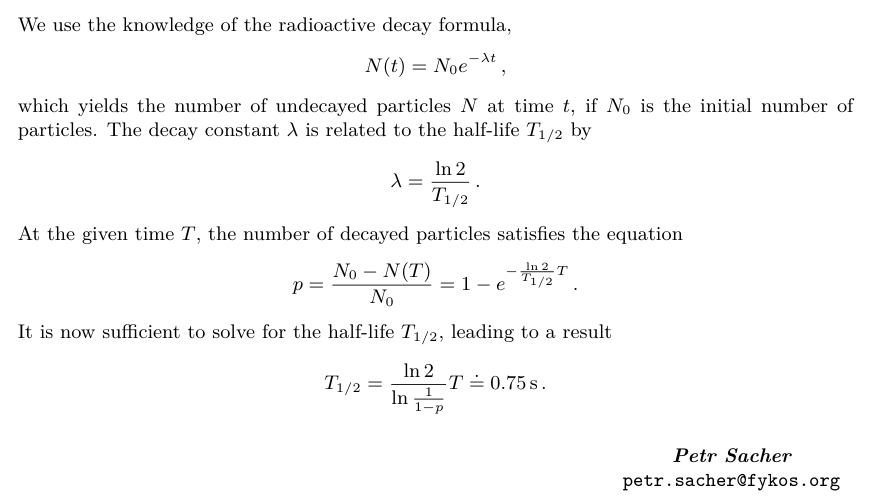
Official solution by FYKOS (Fyziklani 2026), reproduced from the official PDF — p. 15 — under CC BY-SA 3.0.
Topic: Nuclear & Particle Physics Metodi: Radioactive Decay Law Competenze: Mathematical Modeling Objects: Atom Fonte: Testo (PDF) — p.15 · Soluzione ufficiale (PDF) — p.15
CA — In uno schiocco di dita
Nel film Avengers: Infinity War il cattivo Thanos riduce in polvere metà degli esseri viventi dell’universo con uno schiocco di dita. Supponi che ci riesca rendendo instabili, con un tempo di dimezzamento brevissimo, tutti gli atomi dei corpi di questi organismi. Entro dallo schiocco, gli esseri colpiti decadono per il . Qual era il loro tempo di dimezzamento?
Risposta:
Soluzione: La soluzione ufficiale completa (in inglese) è nella versione originale di questo quesito e nel PDF ufficiale.
Topic: Nuclear & Particle Physics Metodi: Radioactive Decay Law Competenze: Mathematical Modeling Objects: Atom Fonte: Testo (PDF) — p.15 · Soluzione ufficiale (PDF) — p.15
CB — How a wheel went wandering
Paťo was driving a car uphill along a long, straight, empty road with a constant inclination angle of . Suddenly, he heard a strange sound, looked into the rearview mirror, and his heart sank: the rear wheel of his car was rolling behind the vehicle. The car, however, continued on as if nothing had happened, so he started thinking about what to do with the wheel. Trying to stop it manually would be dangerous, so he decided to wait for it at the place where it would come to rest. At what distance from the point of detachment does the wheel stop? Consider the wheel to be a rigid homogeneous cylinder of mass and radius . Immediately after detachment, the wheel had a tangential speed and rolled without slipping along the car’s straight path until it came to rest. At the same time, the wheel is decelerated opposite to the direction of motion by a resistive force of magnitude acting at the center of mass, where is a proportionality coefficient and is the normal force exerted by the road on the wheel. Neglect any deformation of the wheel.
Risposta:
Soluzione:
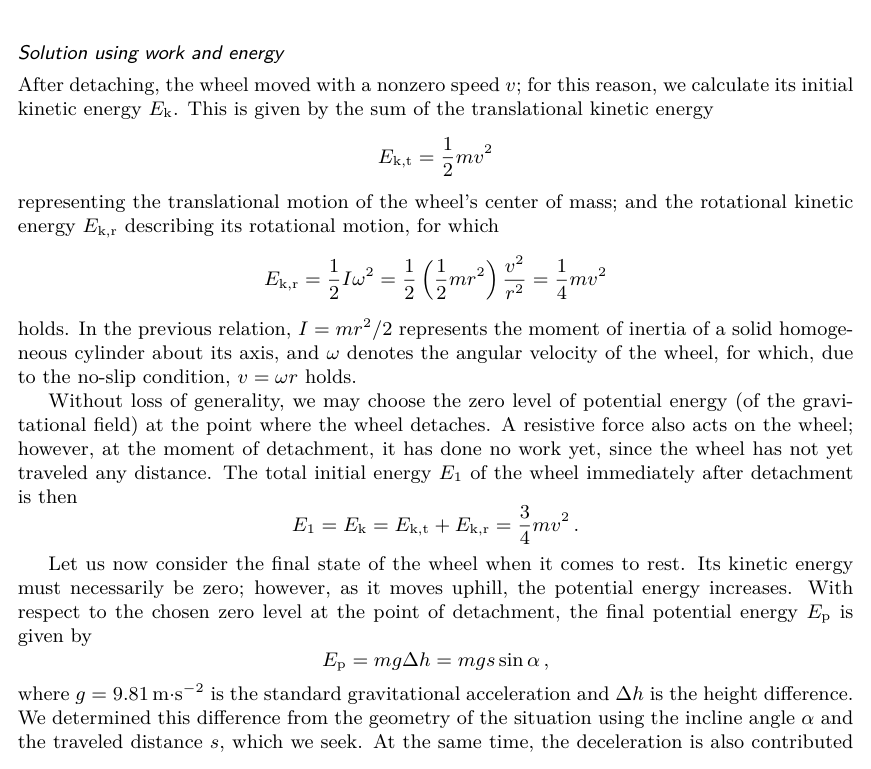
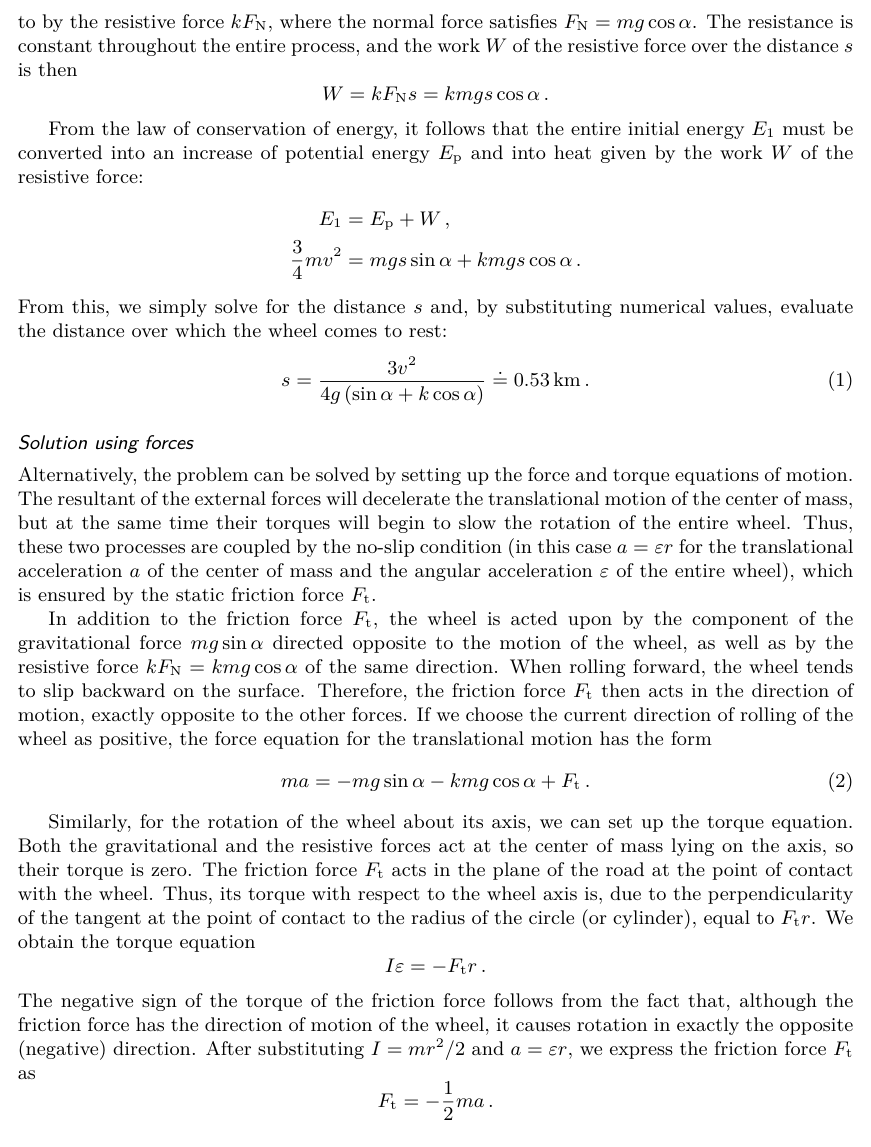
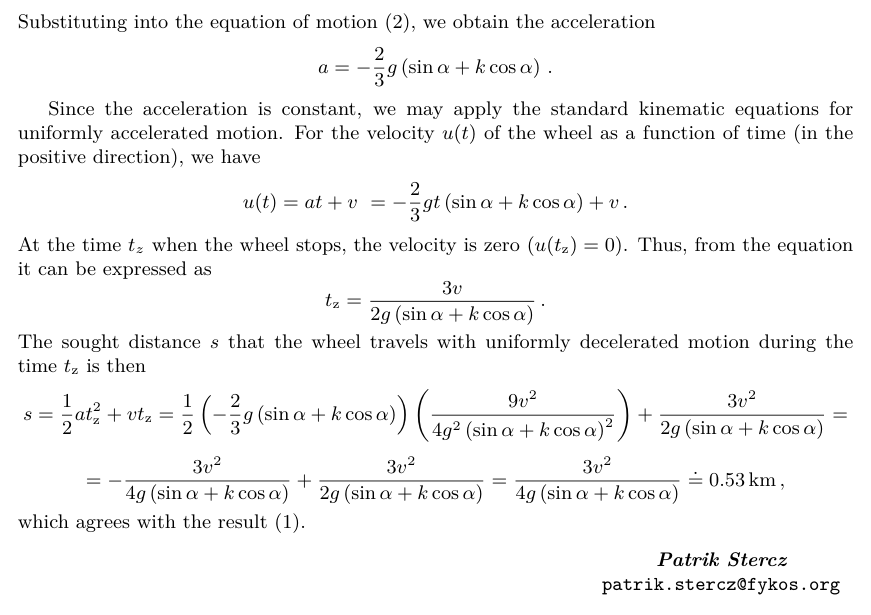
Official solution by FYKOS (Fyziklani 2026), reproduced from the official PDF — p. 16, 17, 18 — under CC BY-SA 3.0.
Topic: Rotational Dynamics Metodi: Torque & Angular Momentum Analysis, Kinematic Equations Competenze: Mathematical Modeling Objects: Wheel, Inclined Plane Fonte: Testo (PDF) — p.16 · Soluzione ufficiale (PDF) — p.16
CB — Come una ruota se ne andò a spasso
Paťo guidava in salita lungo una strada lunga, rettilinea e deserta, con inclinazione costante . All’improvviso ha sentito uno strano rumore, ha guardato nello specchietto e gli si è gelato il sangue: la ruota posteriore della sua auto rotolava dietro il veicolo. L’auto però ha proseguito come se nulla fosse, così ha cominciato a pensare a cosa fare con la ruota. Fermarla a mano sarebbe pericoloso, quindi ha deciso di aspettarla nel punto in cui si sarebbe fermata. A che distanza dal punto di distacco si ferma la ruota? Considera la ruota un cilindro rigido omogeneo di massa e raggio . Subito dopo il distacco la ruota aveva velocità tangenziale e ha rotolato senza strisciare lungo il percorso rettilineo dell’auto fino a fermarsi. La ruota è inoltre frenata, in verso opposto al moto, da una forza resistente di modulo applicata nel centro di massa, dove è un coefficiente di proporzionalità e è la forza normale esercitata dalla strada sulla ruota. Trascura ogni deformazione della ruota.
Risposta:
Soluzione: La soluzione ufficiale completa (in inglese) è nella versione originale di questo quesito e nel PDF ufficiale.
Topic: Rotational Dynamics Metodi: Torque & Angular Momentum Analysis, Kinematic Equations Competenze: Mathematical Modeling Objects: Wheel, Inclined Plane Fonte: Testo (PDF) — p.16 · Soluzione ufficiale (PDF) — p.16
CC — Wien filter
The Wien filter is a device used to select from a beam of charged particles only those with a specific velocity. It consists of two parallel plates between which a uniform electric field of magnitude is established, together with a uniform magnetic field of magnitude that is oriented perpendicular to the electric field. The particle beam enters the region between the plates with its velocity perpendicular to both fields. For given values of and , at what velocity will the particles pass through the filter without any change in the direction of their motion?
Risposta:
Soluzione:
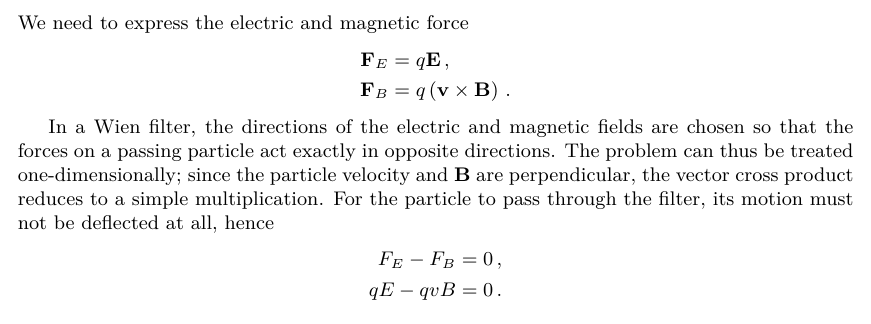
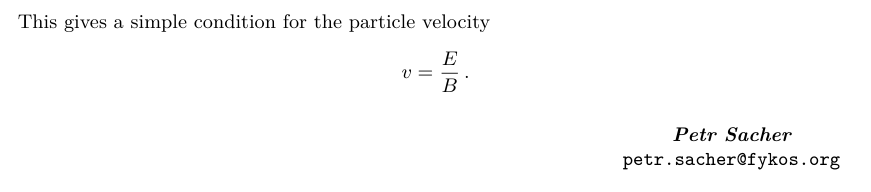
Official solution by FYKOS (Fyziklani 2026), reproduced from the official PDF — p. 18, 19 — under CC BY-SA 3.0.
Topic: Electromagnetism Metodi: Lorentz Force Analysis Competenze: Physical Reasoning Objects: Particle Beam Fonte: Testo (PDF) — p.18 · Soluzione ufficiale (PDF) — p.18
CC — Filtro di Wien
Il filtro di Wien è un dispositivo che seleziona, da un fascio di particelle cariche, solo quelle con una determinata velocità. È formato da due piastre parallele tra le quali c’è un campo elettrico uniforme di modulo , insieme a un campo magnetico uniforme di modulo perpendicolare al campo elettrico. Il fascio entra nella regione tra le piastre con velocità perpendicolare a entrambi i campi. Per dati valori di e , con quale velocità le particelle attraversano il filtro senza alcuna variazione della direzione del moto?
Risposta:
Soluzione: La soluzione ufficiale completa (in inglese) è nella versione originale di questo quesito e nel PDF ufficiale.
Topic: Electromagnetism Metodi: Lorentz Force Analysis Competenze: Physical Reasoning Objects: Particle Beam Fonte: Testo (PDF) — p.18 · Soluzione ufficiale (PDF) — p.18
CD — Spinning sink
Imagine a sink in the shape of a hollow cylinder with a radius . At one point along the bottom edge, water jets out and lands directly at the center of the sink’s bottom. The water reaches a maximum height above the surface. What is the maximum angular velocity at which we can spin the sink together with the nozzle about the cylinder axis so that the water does not hit the cylinder wall?
Risposta:
Soluzione:
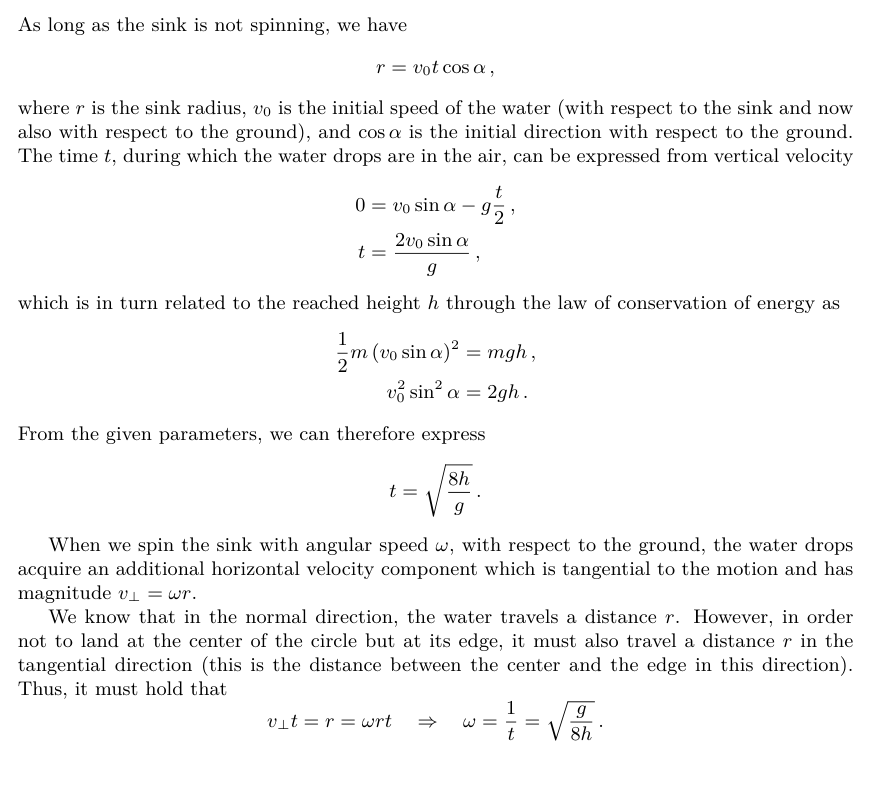
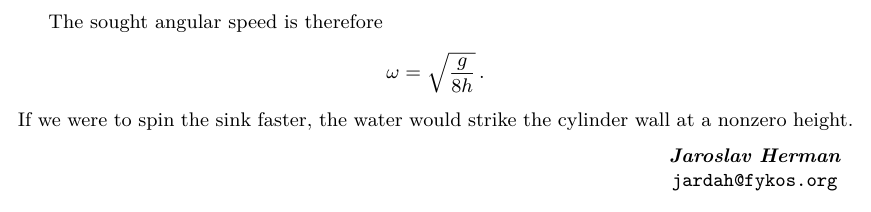
Official solution by FYKOS (Fyziklani 2026), reproduced from the official PDF — p. 19, 20 — under CC BY-SA 3.0.
Topic: Newtonian Mechanics Metodi: Kinematic Equations, Vector Decomposition Competenze: Physical Reasoning Objects: Projectile, Cylinder Fonte: Testo (PDF) — p.19 · Soluzione ufficiale (PDF) — p.19
CD — Lavandino rotante
Immagina un lavandino a forma di cilindro cavo di raggio . In un punto del bordo inferiore esce un getto d’acqua che ricade esattamente al centro del fondo del lavandino. L’acqua raggiunge un’altezza massima sopra il fondo. Qual è la velocità angolare massima con cui possiamo far ruotare il lavandino, insieme all’ugello, attorno all’asse del cilindro senza che l’acqua colpisca la parete del cilindro?
Risposta:
Soluzione: La soluzione ufficiale completa (in inglese) è nella versione originale di questo quesito e nel PDF ufficiale.
Topic: Newtonian Mechanics Metodi: Kinematic Equations, Vector Decomposition Competenze: Physical Reasoning Objects: Projectile, Cylinder Fonte: Testo (PDF) — p.19 · Soluzione ufficiale (PDF) — p.19
CE — Titanic
The Titanic is sailing at a speed toward an iceberg when the ship’s captain sounds the horn, which emits a sound with frequency . After the horn falls silent, the sound reflects off the iceberg back toward the ship. What frequency does the captain hear?
Risposta:
Soluzione:
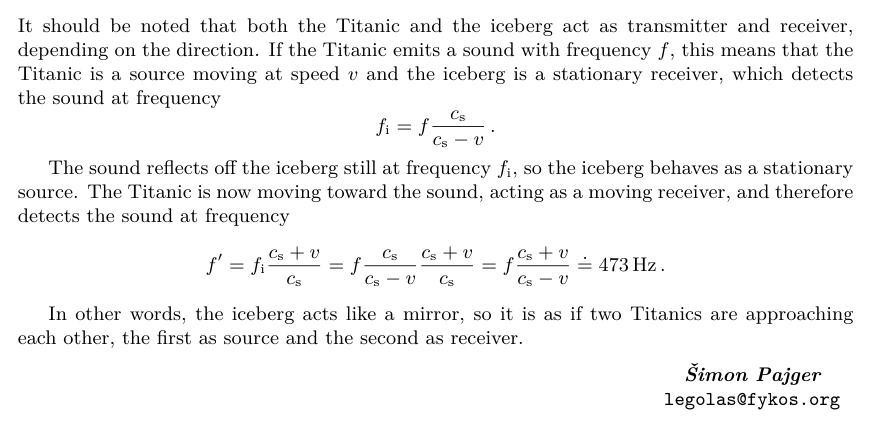
Official solution by FYKOS (Fyziklani 2026), reproduced from the official PDF — p. 20 — under CC BY-SA 3.0.
Topic: Oscillations & Waves Metodi: Physical Modeling Competenze: Mathematical Modeling Objects: — Fonte: Testo (PDF) — p.20 · Soluzione ufficiale (PDF) — p.20
CE — Titanic
Il Titanic naviga a velocità verso un iceberg quando il capitano suona la sirena, che emette un suono di frequenza . Dopo che la sirena tace, il suono si riflette sull’iceberg e torna verso la nave. Quale frequenza sente il capitano?
Risposta:
Soluzione: La soluzione ufficiale completa (in inglese) è nella versione originale di questo quesito e nel PDF ufficiale.
Topic: Oscillations & Waves Metodi: Physical Modeling Competenze: Mathematical Modeling Objects: — Fonte: Testo (PDF) — p.20 · Soluzione ufficiale (PDF) — p.20
CF — Christmas tree
Martin wanted to get rid of the needles from a Christmas tree by spinning it about its axis of symmetry with an angular speed . Let us approximate the Christmas tree as a rod of height and radius , and five disks with radii , , , , , where , with thickness . The central rod passes through the disks (meaning that they have holes in the center) and has density . The disks have half this density. Martin is interested in how much energy is required to achieve angular speed .
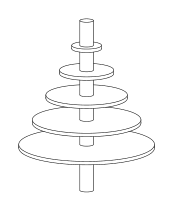
Risposta:
Soluzione:

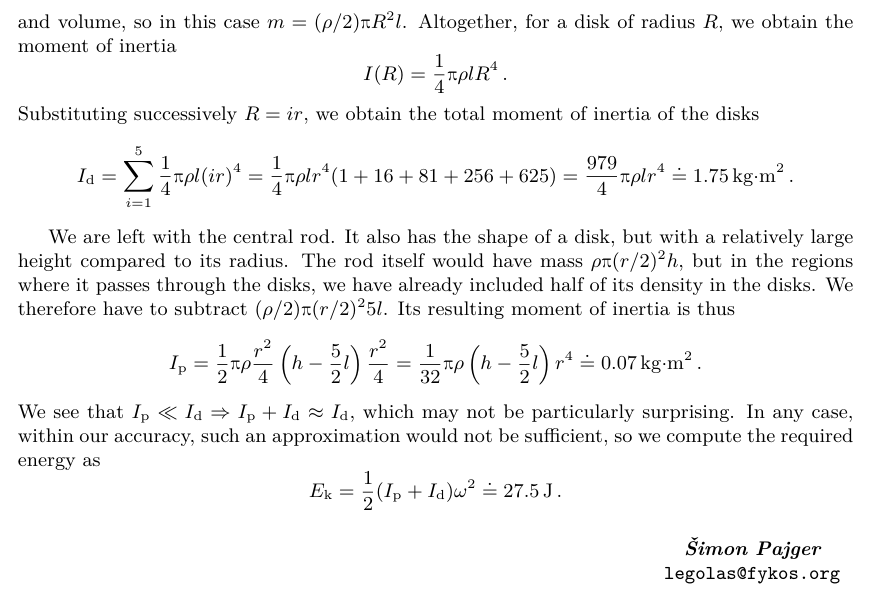
Official solution by FYKOS (Fyziklani 2026), reproduced from the official PDF — p. 20, 21 — under CC BY-SA 3.0.
Topic: Rotational Dynamics Metodi: Calculus-Integration Competenze: Mathematical Modeling Objects: Disk, Rod Fonte: Testo (PDF) — p.20 · Soluzione ufficiale (PDF) — p.20
CF — Albero di Natale
Martin voleva liberarsi degli aghi di un albero di Natale facendolo ruotare attorno al suo asse di simmetria con velocità angolare . Approssimiamo l’albero come un’asta di altezza e raggio più cinque dischi di raggi , , , , , con , di spessore . L’asta centrale attraversa i dischi (che quindi hanno un foro al centro) e ha densità ; i dischi hanno densità pari alla metà. Martin vuole sapere quanta energia serve per raggiungere la velocità angolare .
Risposta:
Soluzione: La soluzione ufficiale completa (in inglese) è nella versione originale di questo quesito e nel PDF ufficiale.
Topic: Rotational Dynamics Metodi: Calculus-Integration Competenze: Mathematical Modeling Objects: Disk, Rod Fonte: Testo (PDF) — p.20 · Soluzione ufficiale (PDF) — p.20
CG — Table oscillation
A body of mass is placed on a plate that undergoes harmonic oscillations in its plane with angular frequency and amplitude . What is the limiting value of such that the plate begins to slip under the body? The coefficient of friction between the body and the plate is .
Risposta:
Soluzione:
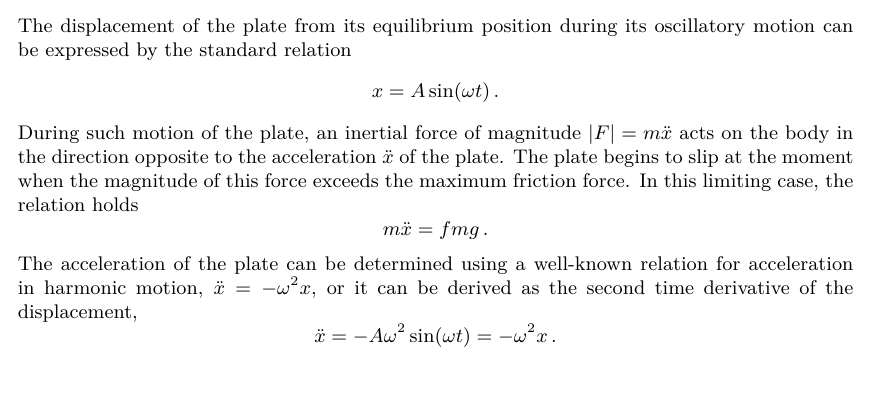
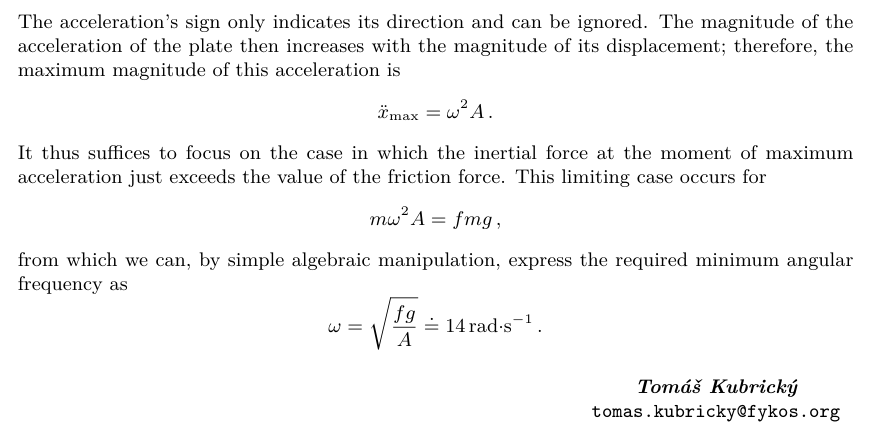
Official solution by FYKOS (Fyziklani 2026), reproduced from the official PDF — p. 21, 22 — under CC BY-SA 3.0.
Topic: Oscillations & Waves, Newtonian Mechanics Metodi: Simple Harmonic Motion Analysis, Free-Body Diagram Competenze: Physical Reasoning Objects: Block Fonte: Testo (PDF) — p.21 · Soluzione ufficiale (PDF) — p.21
CG — Oscillazione del tavolo
Un corpo di massa è appoggiato su un piano che compie oscillazioni armoniche nel proprio piano con pulsazione e ampiezza . Qual è il valore limite di oltre il quale il piano comincia a scivolare sotto il corpo? Il coefficiente di attrito tra corpo e piano è .
Risposta:
Soluzione: La soluzione ufficiale completa (in inglese) è nella versione originale di questo quesito e nel PDF ufficiale.
Topic: Oscillations & Waves, Newtonian Mechanics Metodi: Simple Harmonic Motion Analysis, Free-Body Diagram Competenze: Physical Reasoning Objects: Block Fonte: Testo (PDF) — p.21 · Soluzione ufficiale (PDF) — p.21
CH — Plato’s current
What is the electric flux through one face of a regular icosahedron (twenty-sided polyhedron) with charge of magnitude located in its center?
Risposta:
Soluzione:
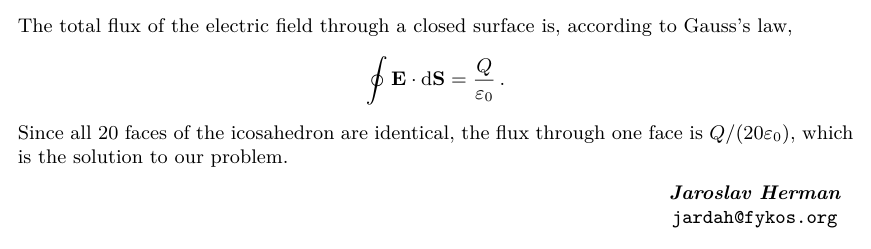
Official solution by FYKOS (Fyziklani 2026), reproduced from the official PDF — p. 22 — under CC BY-SA 3.0.
Topic: Electrostatics Metodi: Gauss’s Law, Symmetry Argument Competenze: Physical Reasoning Objects: Point Charge Fonte: Testo (PDF) — p.22 · Soluzione ufficiale (PDF) — p.22
CH — La corrente di Platone
Qual è il flusso del campo elettrico attraverso una faccia di un icosaedro regolare (poliedro a venti facce) al cui centro si trova una carica di modulo ?
Risposta:
Soluzione: La soluzione ufficiale completa (in inglese) è nella versione originale di questo quesito e nel PDF ufficiale.
Topic: Electrostatics Metodi: Gauss’s Law, Symmetry Argument Competenze: Physical Reasoning Objects: Point Charge Fonte: Testo (PDF) — p.22 · Soluzione ufficiale (PDF) — p.22
DA — Warming rezistor
Consider a voltage source and a resistor whose resistance varies with temperature according to , where is the resistance at room temperature, is the temperature coefficient of resistance, and is the difference between the resistor’s temperature and room temperature. Assume that the resistor’s temperature is higher than the surroundings by , where is the power dissipated in the resistor and . What is the steady-state current?
Risposta:
Soluzione:

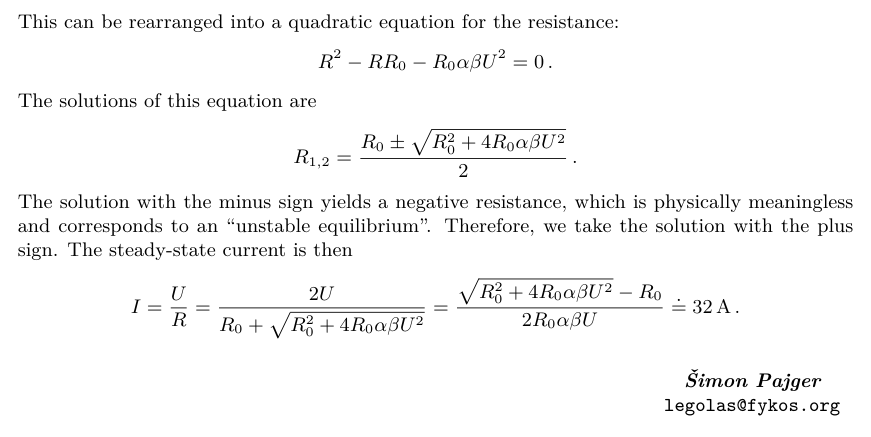
Official solution by FYKOS (Fyziklani 2026), reproduced from the official PDF — p. 22, 23 — under CC BY-SA 3.0.
Topic: Circuits, Thermodynamics Metodi: Physical Modeling Competenze: Mathematical Modeling Objects: Resistor Fonte: Testo (PDF) — p.22 · Soluzione ufficiale (PDF) — p.22
DA — Resistore che si scalda
Considera un generatore di tensione e un resistore la cui resistenza varia con la temperatura secondo , dove è la resistenza a temperatura ambiente, è il coefficiente termico della resistenza e è la differenza tra la temperatura del resistore e quella ambiente. Supponi che il resistore sia più caldo dell’ambiente di , dove è la potenza dissipata nel resistore e . Qual è la corrente a regime?
Risposta:
Soluzione: La soluzione ufficiale completa (in inglese) è nella versione originale di questo quesito e nel PDF ufficiale.
Topic: Circuits, Thermodynamics Metodi: Physical Modeling Competenze: Mathematical Modeling Objects: Resistor Fonte: Testo (PDF) — p.22 · Soluzione ufficiale (PDF) — p.22
DB — Triple collision
Two identical smooth spheres with radii lie at rest on a horizontal table with their centers separated by a distance . A third identical sphere approaches from a distance with velocity along the perpendicular bisector of the segment connecting their centers. All collisions are instantaneous and perfectly elastic. What will be the velocity of the incoming sphere after the collisions? Submit a positive result if it moves in its original direction, and a negative one if it moves in the opposite direction.
Risposta:
Soluzione:
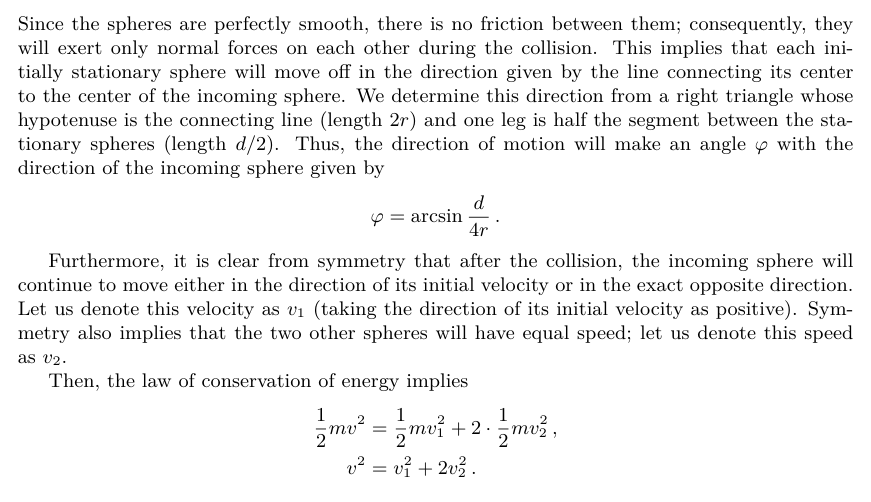
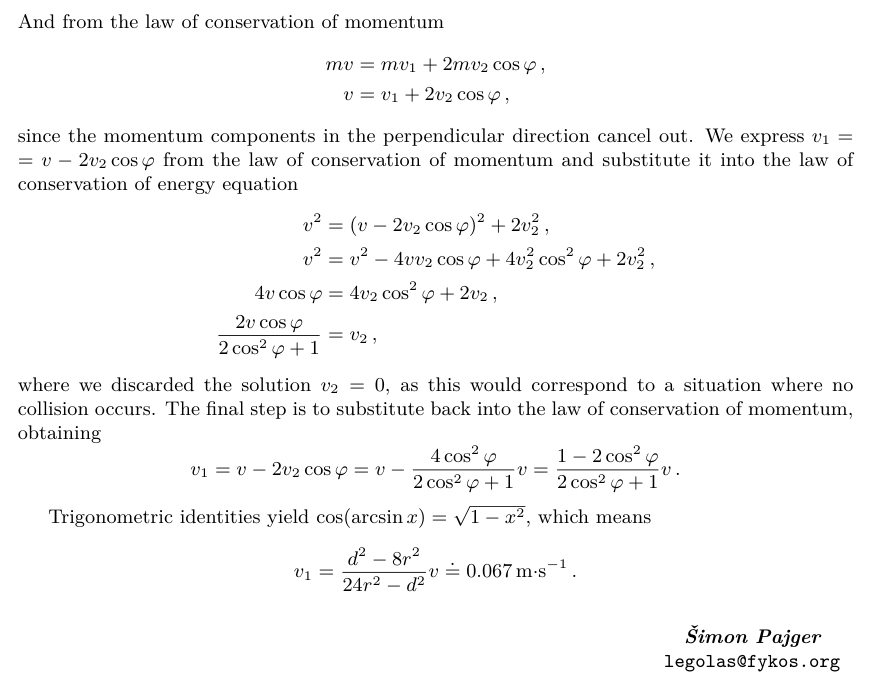
Official solution by FYKOS (Fyziklani 2026), reproduced from the official PDF — p. 23, 24 — under CC BY-SA 3.0.
Topic: Conservation of Momentum, Conservation of Energy Metodi: Conservation of Momentum, Energy Conservation Method Competenze: Mathematical Modeling Objects: Sphere Fonte: Testo (PDF) — p.23 · Soluzione ufficiale (PDF) — p.23
DB — Urto triplo
Due sfere lisce identiche di raggio sono ferme su un tavolo orizzontale, con i centri a distanza . Una terza sfera identica arriva da lontano con velocità lungo l’asse del segmento che congiunge i loro centri. Tutti gli urti sono istantanei e perfettamente elastici. Quale sarà la velocità della sfera incidente dopo gli urti? Dai un risultato positivo se prosegue nel verso originale e negativo se torna indietro.
Risposta:
Soluzione: La soluzione ufficiale completa (in inglese) è nella versione originale di questo quesito e nel PDF ufficiale.
Topic: Conservation of Momentum, Conservation of Energy Metodi: Conservation of Momentum, Energy Conservation Method Competenze: Mathematical Modeling Objects: Sphere Fonte: Testo (PDF) — p.23 · Soluzione ufficiale (PDF) — p.23
DC — Watt’s magnetic governor
Consider a classic Watt governor consisting of a vertical axis to which two massless arms of length are freely attached at a single common joint. Small spherical weights of mass are attached to the ends of the arms. When the axis starts spinning, the arms begin to rise due to the centrifugal force. In our situation, the weights are additionally charged with identical charges , and the entire system is placed in a homogeneous magnetic field of hypothetical magnitude oriented along the axis. At what minimum angular speed can the arms open to an angle of ?
Risposta:
Soluzione:
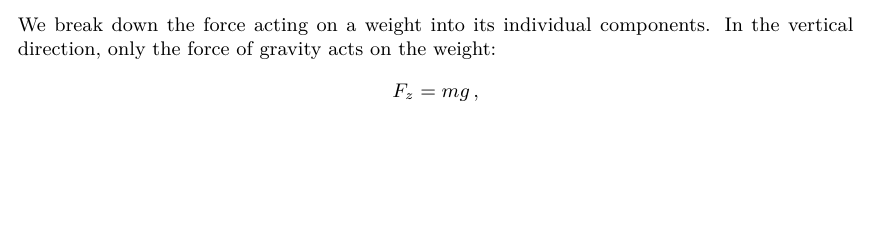
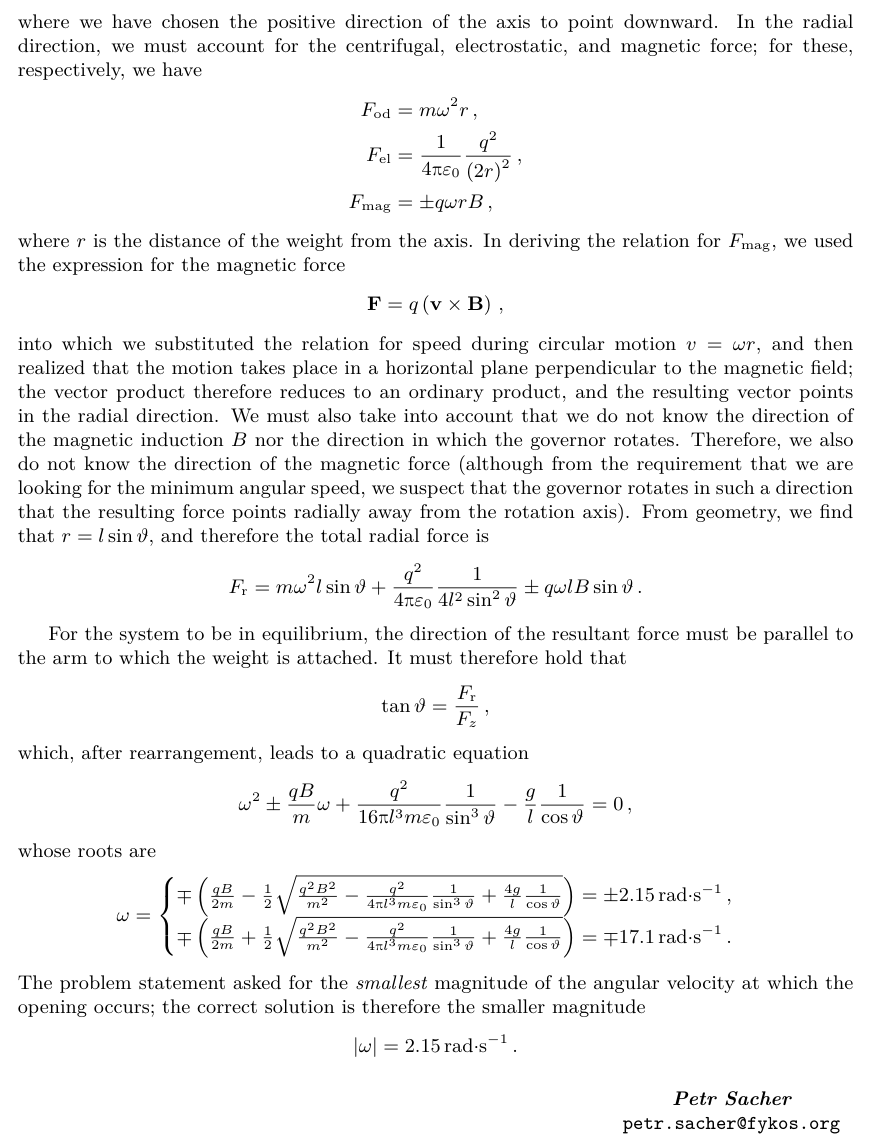
Official solution by FYKOS (Fyziklani 2026), reproduced from the official PDF — p. 24, 25 — under CC BY-SA 3.0.
Topic: Electromagnetism, Rotational Dynamics Metodi: Lorentz Force Analysis, Coulomb’s Law, Free-Body Diagram Competenze: Mathematical Modeling Objects: Point Charge, Rod Fonte: Testo (PDF) — p.24 · Soluzione ufficiale (PDF) — p.24
DC — Il regolatore magnetico di Watt
Considera un classico regolatore di Watt: un asse verticale al quale sono incernierati liberamente, in un unico snodo comune, due bracci di massa trascurabile lunghi . Alle estremità dei bracci sono fissati piccoli pesi sferici di massa . Quando l’asse comincia a ruotare, i bracci si sollevano per effetto della forza centrifuga. Nel nostro caso i pesi hanno inoltre cariche identiche e tutto il sistema è immerso in un campo magnetico uniforme di modulo ipotetico diretto lungo l’asse. Con quale velocità angolare minima i bracci possono aprirsi fino a un angolo ?
Risposta:
Soluzione: La soluzione ufficiale completa (in inglese) è nella versione originale di questo quesito e nel PDF ufficiale.
Topic: Electromagnetism, Rotational Dynamics Metodi: Lorentz Force Analysis, Coulomb’s Law, Free-Body Diagram Competenze: Mathematical Modeling Objects: Point Charge, Rod Fonte: Testo (PDF) — p.24 · Soluzione ufficiale (PDF) — p.24
DD — Overturned train
Grandmother learned about the Coriolis force, and while traveling by train from Prague exactly due south, she panicked, thinking that the train cars must not travel too fast so that they would not tip over. The train car has a rectangular cross section of width and height , with its center of mass located at the center of the cross section. Prague lies at approximately north latitude. At what minimum speed would the car have to travel? An estimate is sufficient; relativistic effects can be neglected. Give the result to two significant figures.
Hint: In a reference frame rotating with angular velocity , the Coriolis force acting on a body of mass moving with velocity is given by .
Risposta:
Soluzione:
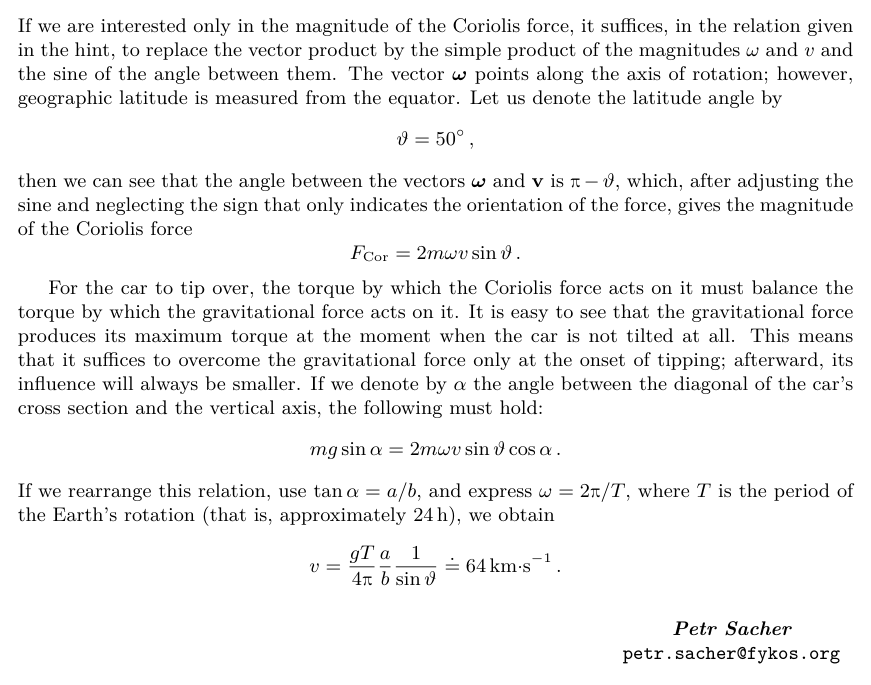
Official solution by FYKOS (Fyziklani 2026), reproduced from the official PDF — p. 26 — under CC BY-SA 3.0.
Topic: Newtonian Mechanics, Rigid Body Statics Metodi: Torque & Angular Momentum Analysis, Order-of-Magnitude Estimation Competenze: Estimation & Approximation Objects: Block Fonte: Testo (PDF) — p.26 · Soluzione ufficiale (PDF) — p.26
DD — Treno ribaltato
La nonna ha sentito parlare della forza di Coriolis e, viaggiando in treno da Praga esattamente verso sud, si è fatta prendere dal panico, convinta che le carrozze non debbano andare troppo veloci per non ribaltarsi. La carrozza ha sezione trasversale rettangolare di larghezza e altezza , con il centro di massa al centro della sezione. Praga si trova a circa di latitudine nord. A quale velocità minima dovrebbe viaggiare la carrozza? Basta una stima; gli effetti relativistici si possono trascurare. Dai il risultato con due cifre significative.
Suggerimento: in un sistema di riferimento che ruota con velocità angolare , la forza di Coriolis su un corpo di massa che si muove con velocità è .
Risposta:
Soluzione: La soluzione ufficiale completa (in inglese) è nella versione originale di questo quesito e nel PDF ufficiale.
Topic: Newtonian Mechanics, Rigid Body Statics Metodi: Torque & Angular Momentum Analysis, Order-of-Magnitude Estimation Competenze: Estimation & Approximation Objects: Block Fonte: Testo (PDF) — p.26 · Soluzione ufficiale (PDF) — p.26
DE — Where to with it?
Jan Neruda is fed up with his old straw mattress. Instead of gradually scattering it from his trouser legs during walks, he decides to bundle the mattress into a small ball of mass and launch it into the Vltava River using a homemade catapult from his house at Konviktská Street No. 30. The river is at a distance , and the middle of the trajectory is obstructed by houses of height , which he must shoot over. The final step is to choose a sufficiently stiff spring for the catapult to power the launch. What is the minimum spring constant required if the catapult allows a maximum extension of ? The catapult can be fired at any angle.
Risposta:
Soluzione:
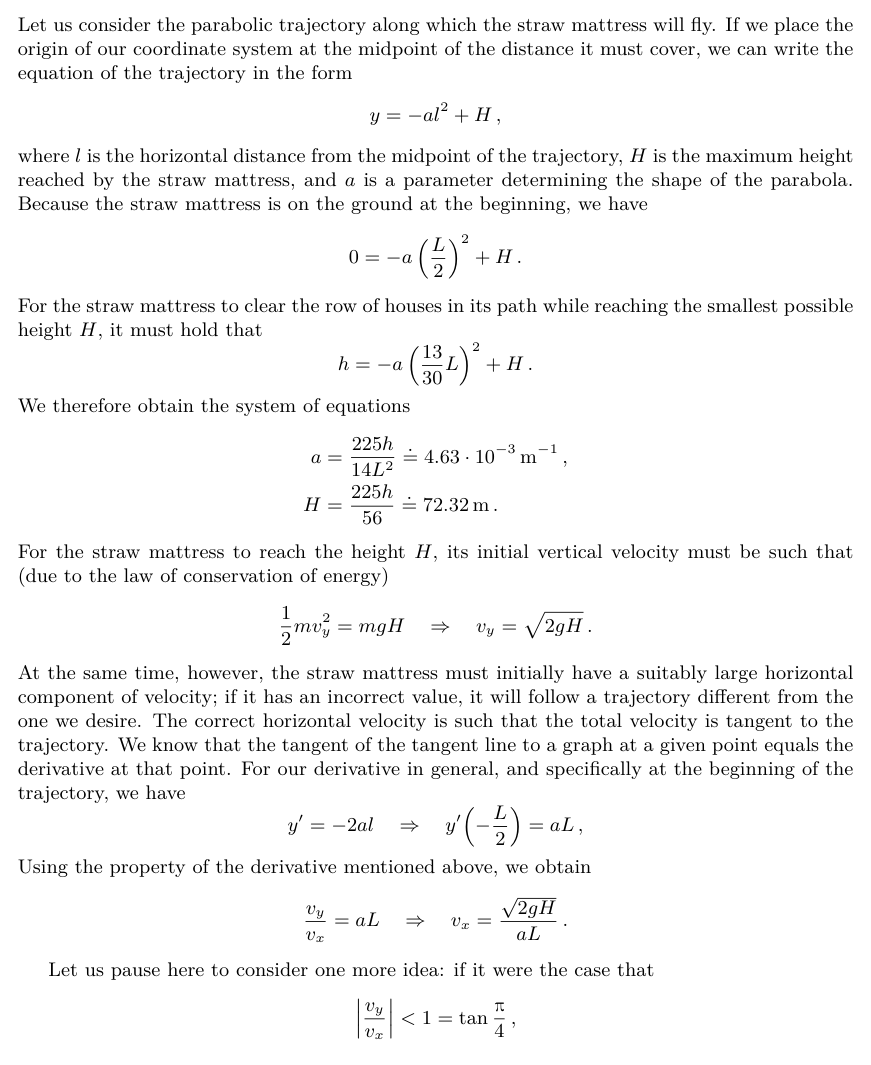
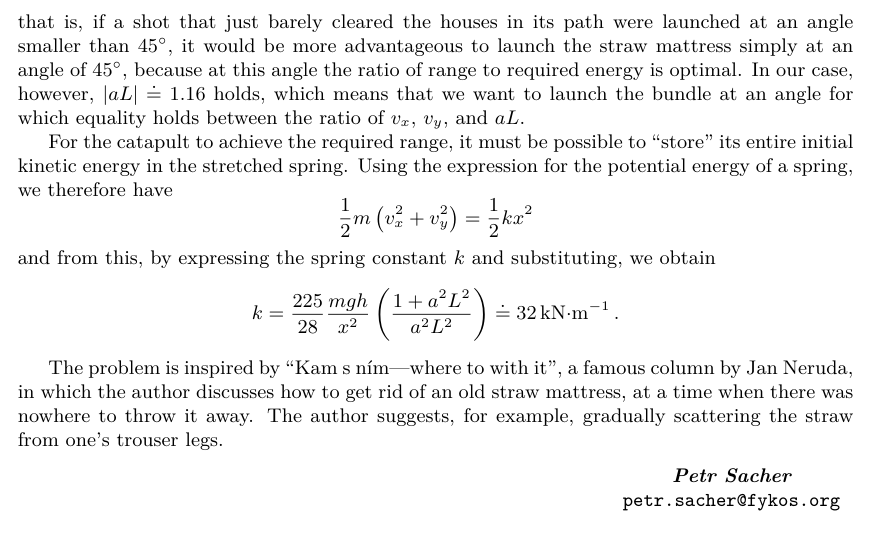
Official solution by FYKOS (Fyziklani 2026), reproduced from the official PDF — p. 27, 28 — under CC BY-SA 3.0.
Topic: Newtonian Mechanics, Conservation of Energy Metodi: Kinematic Equations, Hooke’s Law Competenze: Mathematical Modeling Objects: Projectile, Spring Fonte: Testo (PDF) — p.26 · Soluzione ufficiale (PDF) — p.27
DE — Dove metterlo?
Jan Neruda ne ha abbastanza del suo vecchio pagliericcio. Invece di disperderlo a poco a poco dalle gambe dei pantaloni durante le passeggiate, decide di appallottolarlo in una piccola palla di massa e di lanciarla nella Moldava con una catapulta fatta in casa, dalla sua abitazione in via Konviktská n. 30. Il fiume si trova a distanza e i centrali della traiettoria sono ostruiti da case alte , che deve scavalcare. Resta da scegliere una molla abbastanza rigida per la catapulta. Qual è la costante elastica minima necessaria se la catapulta consente un allungamento massimo ? La catapulta può sparare con qualsiasi angolo.
Risposta:
Soluzione: La soluzione ufficiale completa (in inglese) è nella versione originale di questo quesito e nel PDF ufficiale.
Topic: Newtonian Mechanics, Conservation of Energy Metodi: Kinematic Equations, Hooke’s Law Competenze: Mathematical Modeling Objects: Projectile, Spring Fonte: Testo (PDF) — p.26 · Soluzione ufficiale (PDF) — p.27
DF — Hellish
In the deepest abyss of Hell, in the very ninth circle, Lucifer himself with three faces is embedded in the middle of a frozen surface, holding a traitor in each mouth. Around him, a pentagram is drawn on the ice, consisting of a circle of radius in which a regular five-pointed star is inscribed. A charge is located at three of the star’s vertices, and a charge of the same sign is located at three of the star’s intersections. What must be the ratio so that the electric field at the center of the pentagram, where Lucifer is located, is zero?
Risposta:
Soluzione:
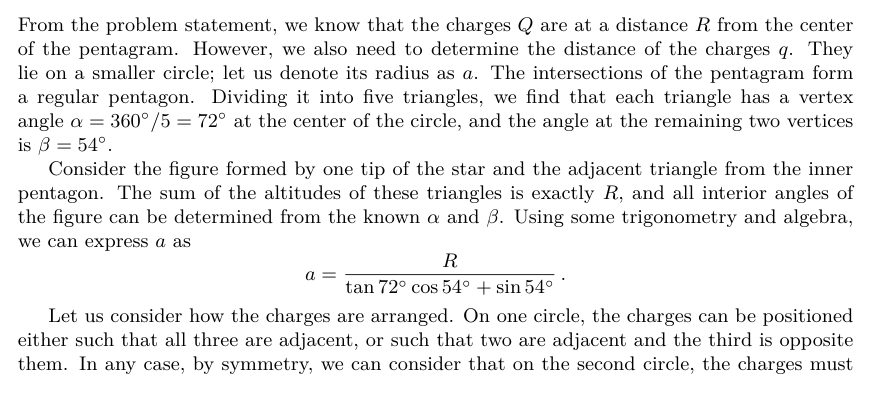
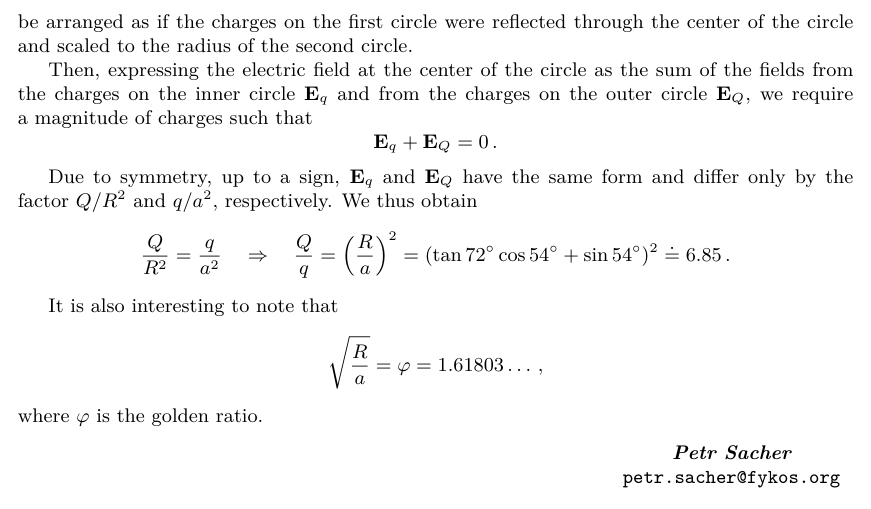
Official solution by FYKOS (Fyziklani 2026), reproduced from the official PDF — p. 28, 29 — under CC BY-SA 3.0.
Topic: Electrostatics Metodi: Coulomb’s Law, Superposition Principle, Symmetry Argument Competenze: Mathematical Modeling Objects: Point Charge Fonte: Testo (PDF) — p.28 · Soluzione ufficiale (PDF) — p.28
DF — Infernale
Nell’abisso più profondo dell’Inferno, proprio nel nono cerchio, Lucifero con le sue tre facce è conficcato al centro di una distesa ghiacciata e tiene un traditore in ciascuna bocca. Attorno a lui, sul ghiaccio, è tracciato un pentacolo: una circonferenza di raggio in cui è inscritta una stella regolare a cinque punte. In tre dei vertici della stella si trova una carica e in tre delle intersezioni della stella una carica dello stesso segno. Quanto deve valere il rapporto perché il campo elettrico al centro del pentacolo, dove si trova Lucifero, sia nullo?
Risposta:
Soluzione: La soluzione ufficiale completa (in inglese) è nella versione originale di questo quesito e nel PDF ufficiale.
Topic: Electrostatics Metodi: Coulomb’s Law, Superposition Principle, Symmetry Argument Competenze: Mathematical Modeling Objects: Point Charge Fonte: Testo (PDF) — p.28 · Soluzione ufficiale (PDF) — p.28
DG — Bead on parabole
Consider a bead of mass sliding freely on a wire in the shape of a parabolic curve in a uniform gravitational field. The wire is rotated about the axis (“the -axis”), which is parallel to . What must be the angular velocity so that the bead does not slide along the parabola regardless of its position?
Risposta:
Soluzione:
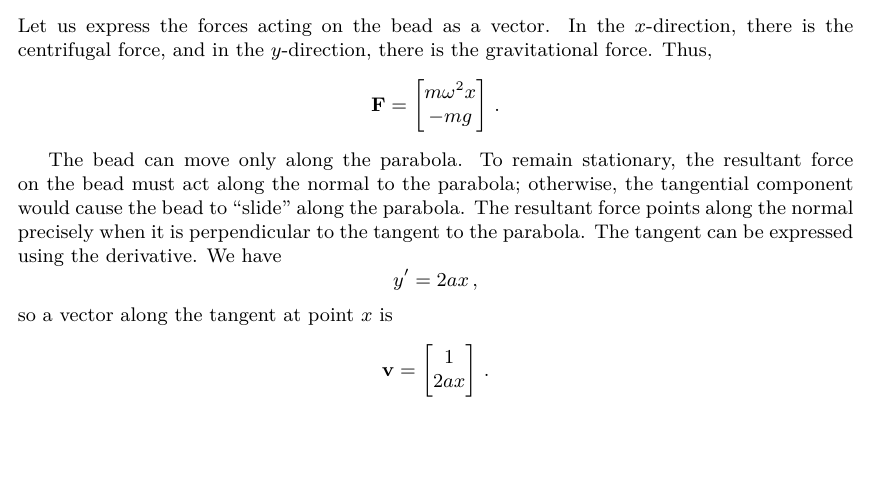
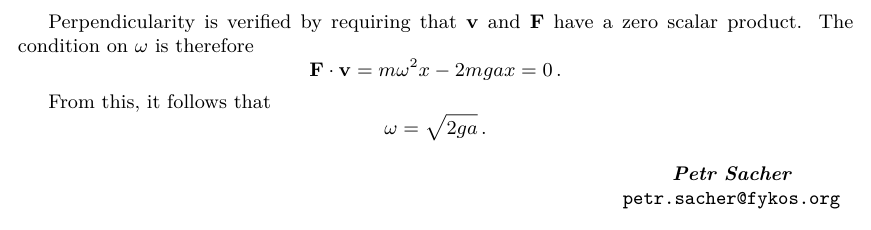
Official solution by FYKOS (Fyziklani 2026), reproduced from the official PDF — p. 29, 30 — under CC BY-SA 3.0.
Topic: Newtonian Mechanics Metodi: Free-Body Diagram, Vector Decomposition Competenze: Mathematical Modeling Objects: — Fonte: Testo (PDF) — p.29 · Soluzione ufficiale (PDF) — p.29
DG — Perlina sulla parabola
Considera una perlina di massa che scorre liberamente su un filo a forma di parabola in un campo gravitazionale uniforme. Il filo ruota attorno al proprio asse (“l’asse ”), parallelo a . Quale deve essere la velocità angolare perché la perlina non scivoli lungo la parabola, qualunque sia la sua posizione?
Risposta:
Soluzione: La soluzione ufficiale completa (in inglese) è nella versione originale di questo quesito e nel PDF ufficiale.
Topic: Newtonian Mechanics Metodi: Free-Body Diagram, Vector Decomposition Competenze: Mathematical Modeling Objects: — Fonte: Testo (PDF) — p.29 · Soluzione ufficiale (PDF) — p.29
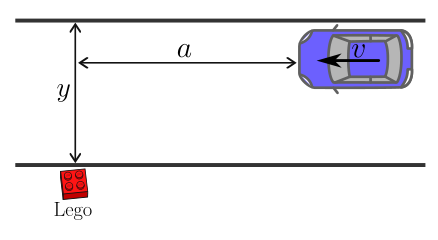
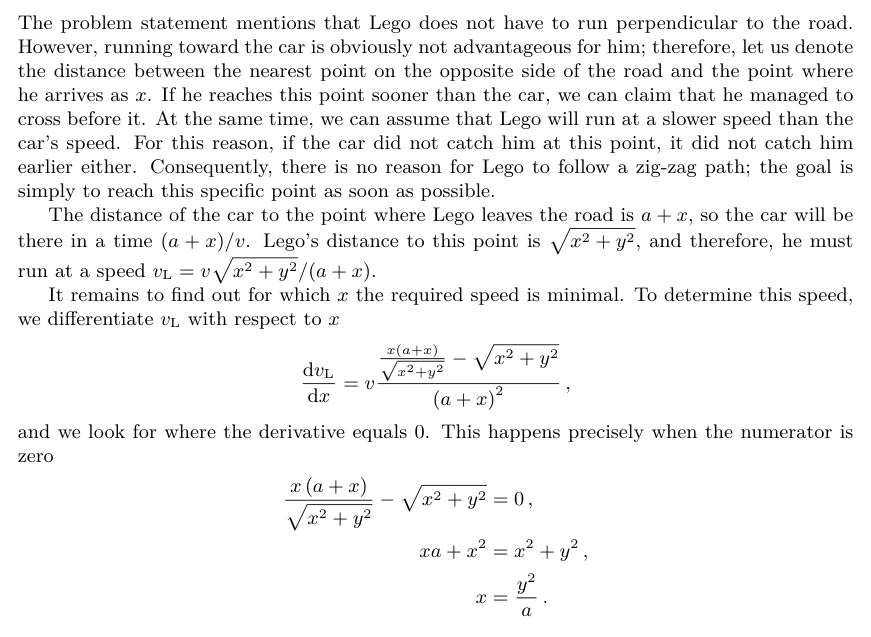
DH — Crossing the road in front of a car
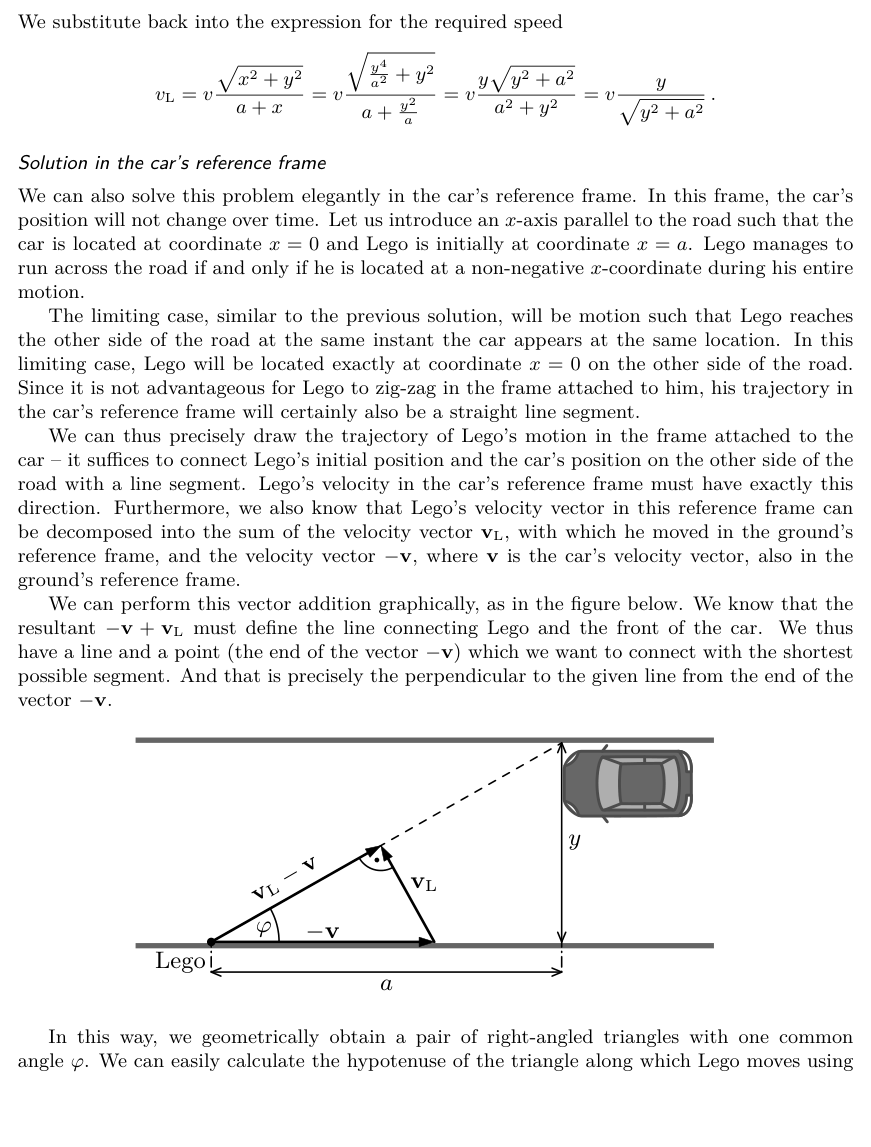
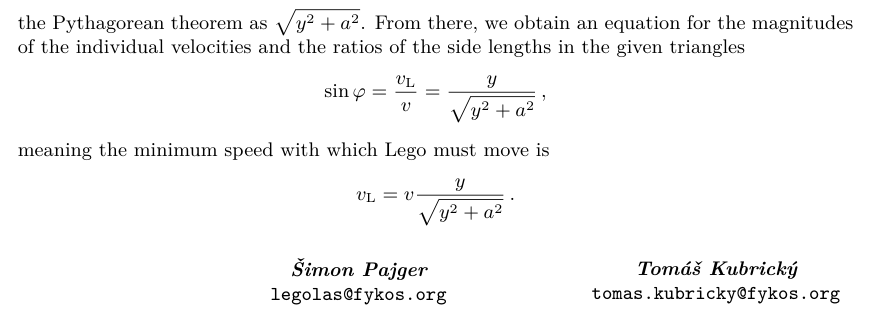
Lego sometimes cuts it a bit too close when running across the road, so he decided that this time he would rather calculate everything in advance, in case the car is driven by Radek, who does not slow down for pedestrians. The situation is shown in the figure. What is the minimum speed at which Lego must run to cross in front of the car? Lego does not necessarily have to run perpendicular to the road. Express the result in terms of , , .
Risposta:
Soluzione:
Official solution by FYKOS (Fyziklani 2026), reproduced from the official PDF — p. 30, 31, 32 — under CC BY-SA 3.0.
Topic: Newtonian Mechanics Metodi: Vector Decomposition, Kinematic Equations Competenze: Diagrammatic Reasoning Objects: — Fonte: Testo (PDF) — p.30 · Soluzione ufficiale (PDF) — p.30
DH — Attraversare la strada davanti a un’auto
Quando attraversa la strada di corsa, Lego a volte se la cava per un soffio; stavolta ha deciso di calcolare tutto in anticipo, nel caso in cui alla guida dell’auto ci sia Radek, che non rallenta per i pedoni. La situazione è mostrata in figura. Qual è la velocità minima con cui Lego deve correre per attraversare davanti all’auto? Lego non deve necessariamente correre perpendicolarmente alla strada. Esprimi il risultato in funzione di , , .
Risposta:
Soluzione: La soluzione ufficiale completa (in inglese) è nella versione originale di questo quesito e nel PDF ufficiale.
Topic: Newtonian Mechanics Metodi: Vector Decomposition, Kinematic Equations Competenze: Diagrammatic Reasoning Objects: — Fonte: Testo (PDF) — p.30 · Soluzione ufficiale (PDF) — p.30
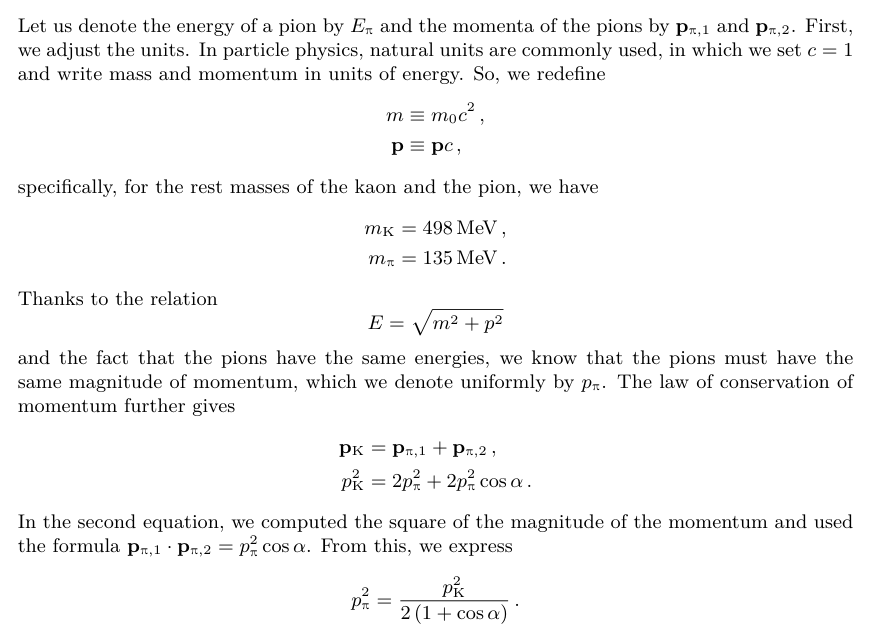
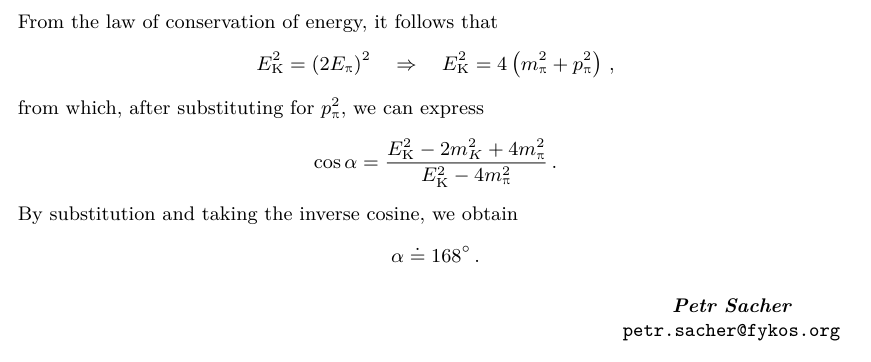
EA — Kaon decay
A kaon particle with total energy decays into two identical pions with the same energy. What will be the angle between the directions in which the pions fly apart? The rest mass of the kaon is and the rest mass of the pion is .
Hint: You certainly know the famous relation . This can also be rewritten in the form , where is the rest mass. Make use of this.
Risposta: ,
Soluzione:
Official solution by FYKOS (Fyziklani 2026), reproduced from the official PDF — p. 32, 33 — under CC BY-SA 3.0.
Topic: Special Relativity, Nuclear & Particle Physics Metodi: Relativistic Energy-Momentum, Conservation of Momentum Competenze: Mathematical Modeling Objects: — Fonte: Testo (PDF) — p.32 · Soluzione ufficiale (PDF) — p.32
EA — Decadimento del kaone
Un kaone con energia totale decade in due pioni identici con la stessa energia. Quale sarà l’angolo tra le direzioni in cui si allontanano i pioni? La massa a riposo del kaone è e quella del pione è .
Suggerimento: conosci certamente la celebre relazione . Si può anche scrivere nella forma , dove è la massa a riposo. Sfruttala.
Risposta: ,
Soluzione: La soluzione ufficiale completa (in inglese) è nella versione originale di questo quesito e nel PDF ufficiale.
Topic: Special Relativity, Nuclear & Particle Physics Metodi: Relativistic Energy-Momentum, Conservation of Momentum Competenze: Mathematical Modeling Objects: — Fonte: Testo (PDF) — p.32 · Soluzione ufficiale (PDF) — p.32
EB — Three spheres
Consider three steel spheres, each with a mass of , attached to massless strings of length . The other ends of the strings are connected at a single point. Each sphere carries a charge of . When the entire system is suspended from the point where the strings are joined, what is the area of the horizontal triangle formed by the spheres? Feel free to solve the problem approximately or numerically.
Risposta:
Soluzione:
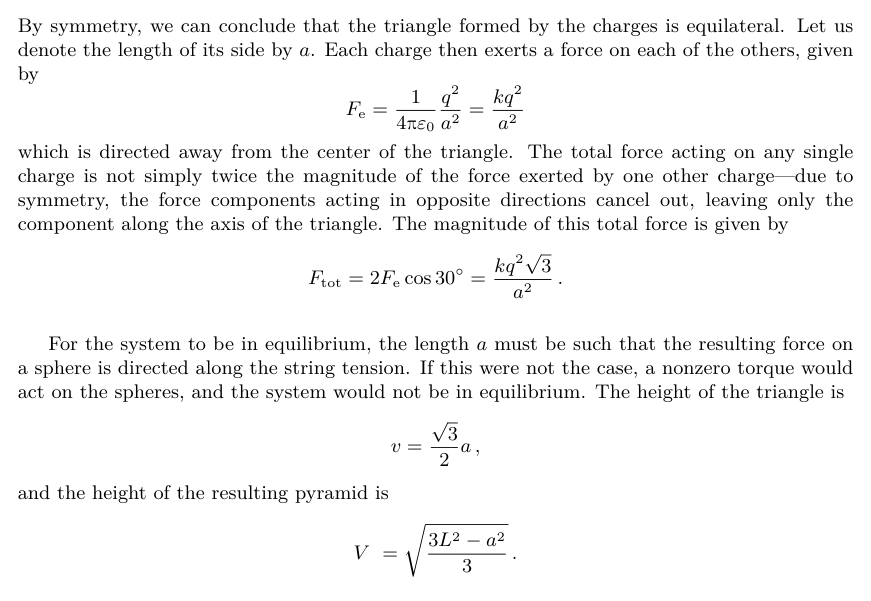
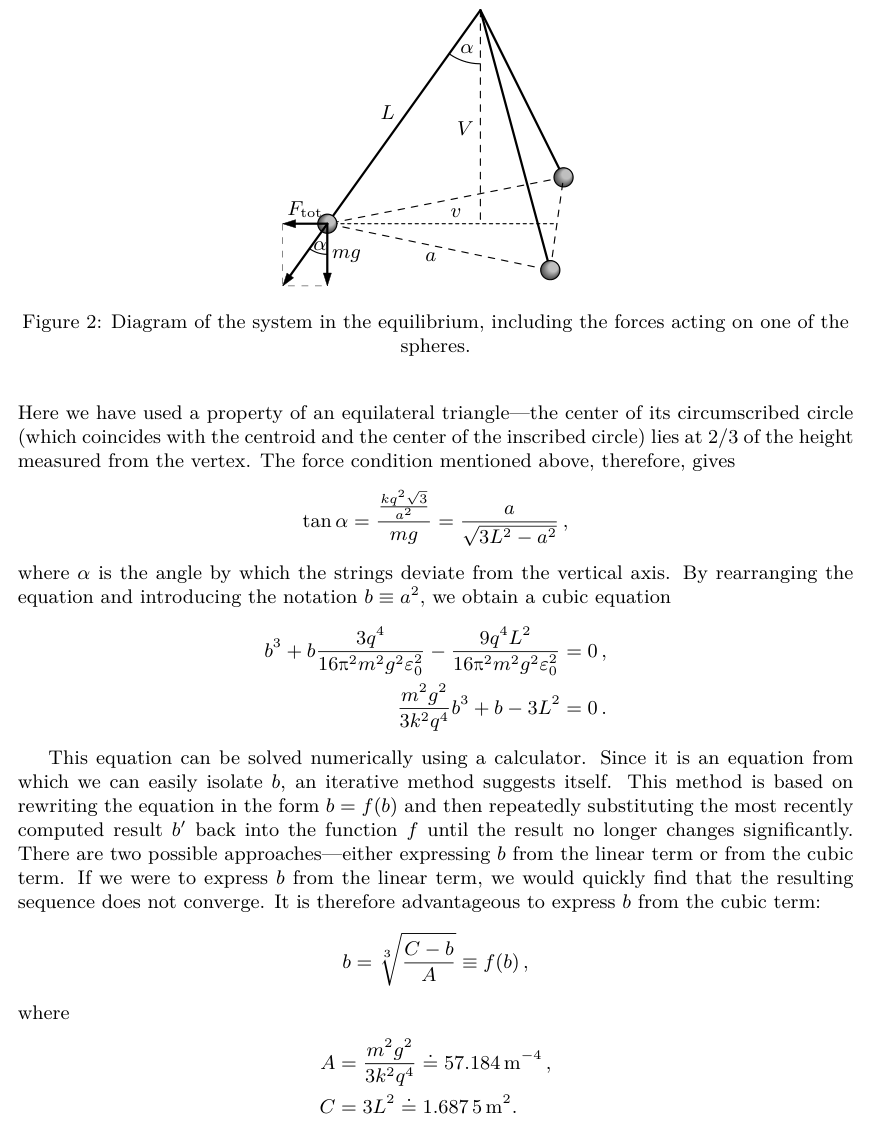
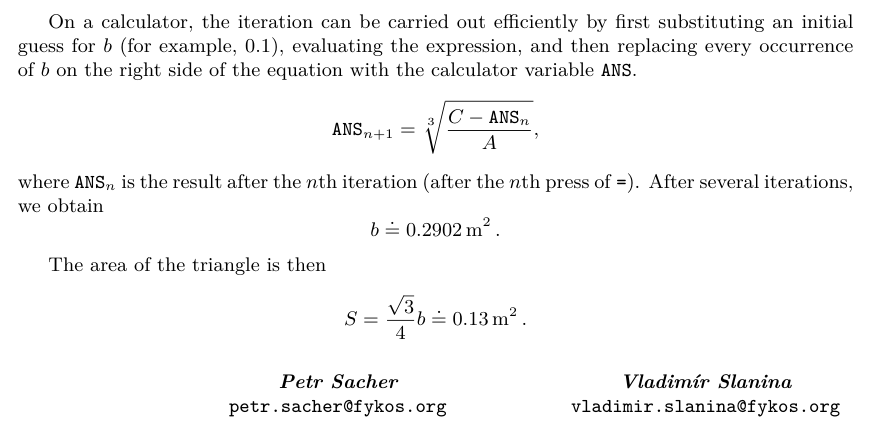
Official solution by FYKOS (Fyziklani 2026), reproduced from the official PDF — p. 33, 34, 35 — under CC BY-SA 3.0.
Topic: Electrostatics, Rigid Body Statics Metodi: Coulomb’s Law, Free-Body Diagram Competenze: Mathematical Modeling, Estimation & Approximation Objects: Sphere, String, Point Charge Fonte: Testo (PDF) — p.33 · Soluzione ufficiale (PDF) — p.33
EB — Tre sfere
Considera tre sfere d’acciaio, ciascuna di massa , appese a fili di massa trascurabile lunghi . Gli altri estremi dei fili sono legati in un unico punto. Ogni sfera ha carica . Quando tutto il sistema è appeso al punto in cui sono uniti i fili, qual è l’area del triangolo orizzontale formato dalle sfere? Puoi risolvere il problema in modo approssimato o numerico.
Risposta:
Soluzione: La soluzione ufficiale completa (in inglese) è nella versione originale di questo quesito e nel PDF ufficiale.
Topic: Electrostatics, Rigid Body Statics Metodi: Coulomb’s Law, Free-Body Diagram Competenze: Mathematical Modeling, Estimation & Approximation Objects: Sphere, String, Point Charge Fonte: Testo (PDF) — p.33 · Soluzione ufficiale (PDF) — p.33
EC — The shrunken Moon
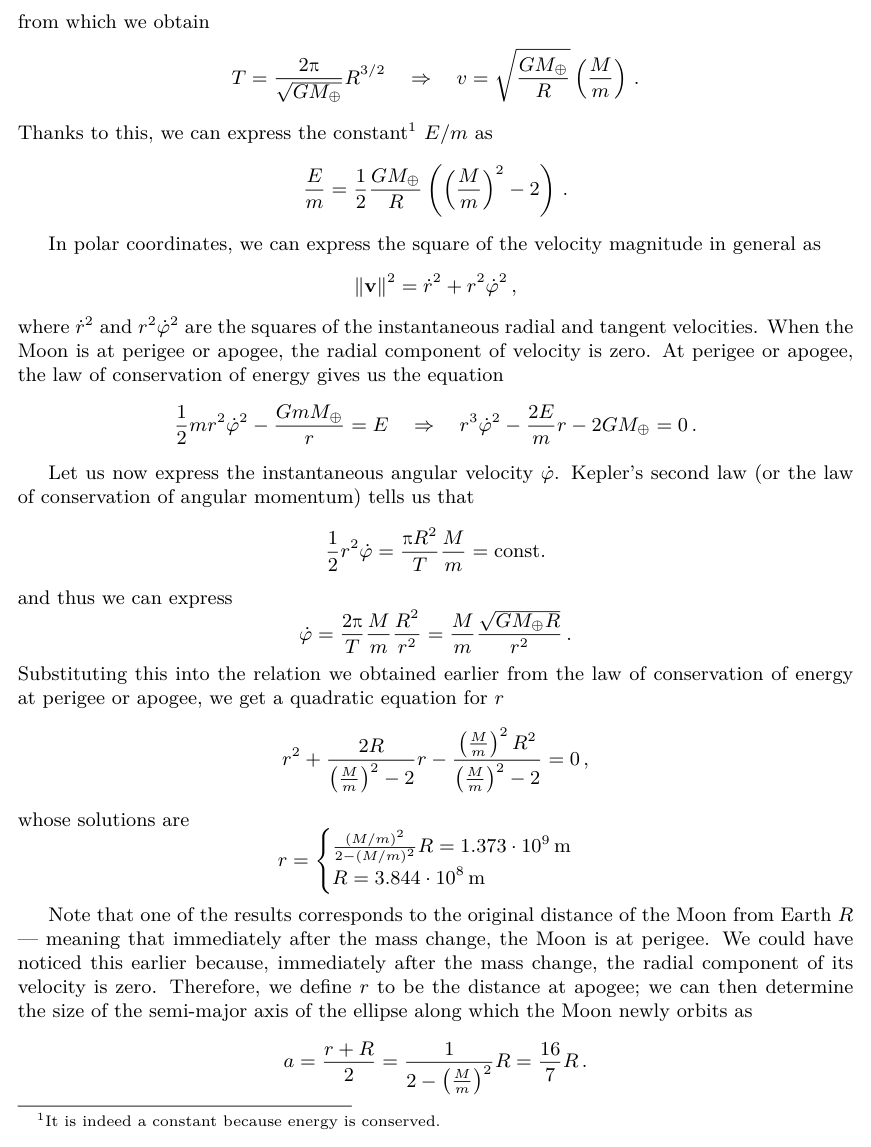
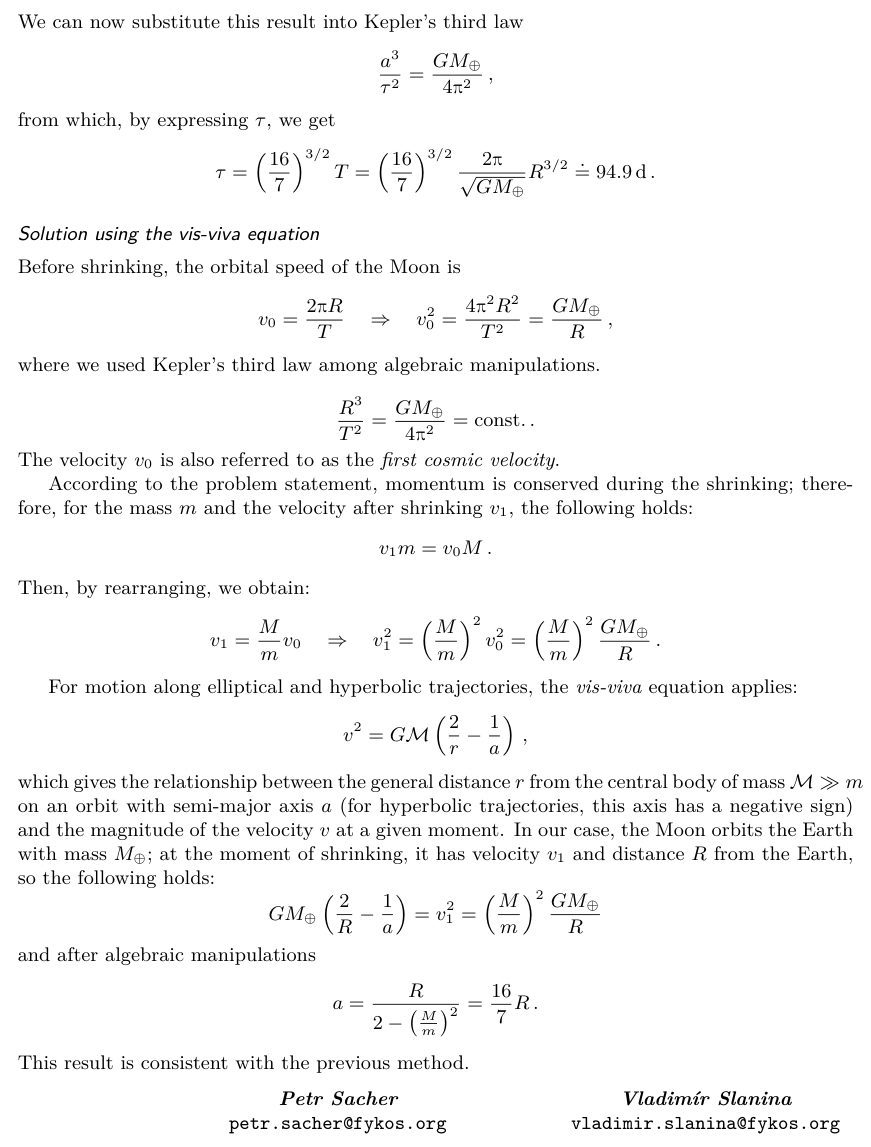
In the movie Despicable Me, the main character Gru shrinks the Moon and steals it. Imagine if instead of stealing it, Gru would have merely instantly shrunk the Moon such that the ratio of its new mass to its original mass was , while preserving the direction and magnitude of its total momentum and letting it continue orbiting the Earth. What would its new orbital period be? Assume that the Moon orbits the Earth along a circular trajectory with a radius and that the mass of the Moon is significantly smaller than the mass of the Earth.
Risposta: ,
Soluzione:
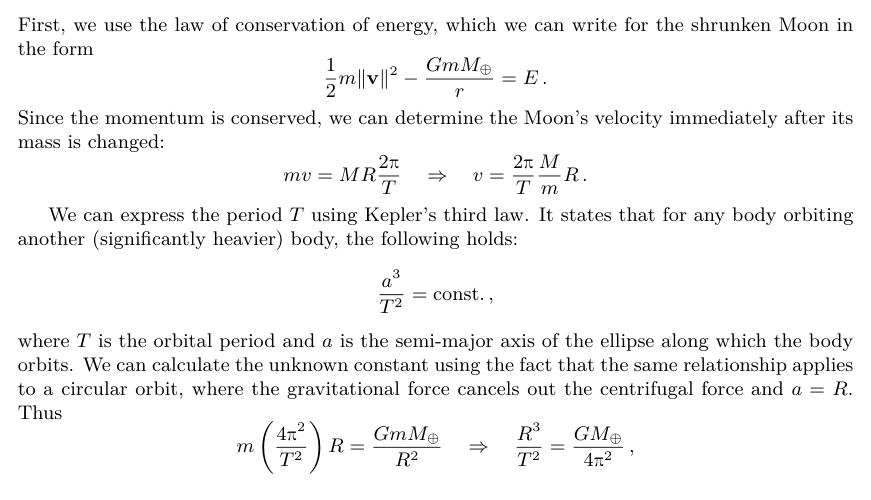
Official solution by FYKOS (Fyziklani 2026), reproduced from the official PDF — p. 35, 36, 37 — under CC BY-SA 3.0.
Topic: Gravitation Metodi: Kepler’s Laws, Conservation of Momentum Competenze: Mathematical Modeling Objects: Planet, Satellite Fonte: Testo (PDF) — p.35 · Soluzione ufficiale (PDF) — p.35
EC — La Luna rimpicciolita
Nel film Cattivissimo me il protagonista Gru rimpicciolisce la Luna e la ruba. Immagina che, invece di rubarla, Gru l’abbia soltanto rimpicciolita istantaneamente in modo che il rapporto tra la nuova massa e quella originale sia , conservando direzione e modulo della sua quantità di moto totale e lasciandola in orbita attorno alla Terra. Quale sarebbe il suo nuovo periodo orbitale ? Supponi che la Luna orbiti attorno alla Terra su una traiettoria circolare di raggio e che la massa della Luna sia molto minore di quella della Terra.
Risposta: , giorni
Soluzione: La soluzione ufficiale completa (in inglese) è nella versione originale di questo quesito e nel PDF ufficiale.
Topic: Gravitation Metodi: Kepler’s Laws, Conservation of Momentum Competenze: Mathematical Modeling Objects: Planet, Satellite Fonte: Testo (PDF) — p.35 · Soluzione ufficiale (PDF) — p.35
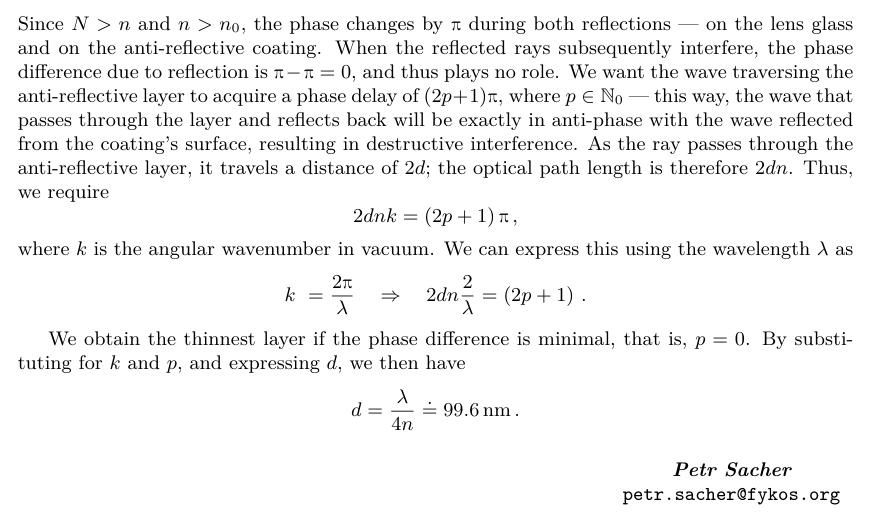
ED — Anti-reflective coating
To prevent light from reflecting off glasses (which, for example, looks bad in photographs), we can apply an anti-reflective coating. Suppose we wish to apply an anti-reflective coating made of a material with a refractive index onto glasses with a refractive index . What is the minimum thickness of the layer required so that no light is reflected at normal incidence, considering only a single reflection? Assume a standard wavelength of .
Risposta:
Soluzione:
Official solution by FYKOS (Fyziklani 2026), reproduced from the official PDF — p. 38 — under CC BY-SA 3.0.
Topic: Wave Optics Metodi: Interference & Diffraction Analysis Competenze: Physical Reasoning Objects: Lens Fonte: Testo (PDF) — p.38 · Soluzione ufficiale (PDF) — p.38
ED — Rivestimento antiriflesso
Per evitare che la luce si rifletta sugli occhiali (cosa che, per esempio, sta male in fotografia), si può applicare un rivestimento antiriflesso. Supponi di voler applicare un rivestimento antiriflesso di un materiale con indice di rifrazione su lenti con indice di rifrazione . Qual è lo spessore minimo dello strato perché a incidenza normale non venga riflessa luce, considerando una sola riflessione? Assumi una lunghezza d’onda standard .
Risposta:
Soluzione: La soluzione ufficiale completa (in inglese) è nella versione originale di questo quesito e nel PDF ufficiale.
Topic: Wave Optics Metodi: Interference & Diffraction Analysis Competenze: Physical Reasoning Objects: Lens Fonte: Testo (PDF) — p.38 · Soluzione ufficiale (PDF) — p.38
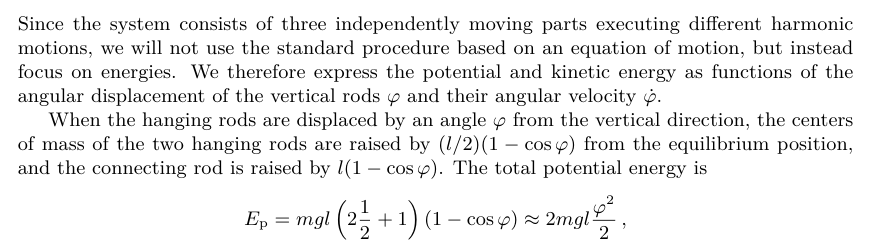
EE — Physical pendulums with stiff coupling
Consider two rods of length , each suspended by one of its ends and able to rotate freely about the suspension point. These suspension points are at the same height, their mutual distance is equal to , and the free ends of the rods are connected by another rod also of length . All three rods have mass . What is the period of small oscillations if we set the system into motion in the plane in which the rods lie? The system is located in a gravitational field with acceleration .
Risposta:
Soluzione:
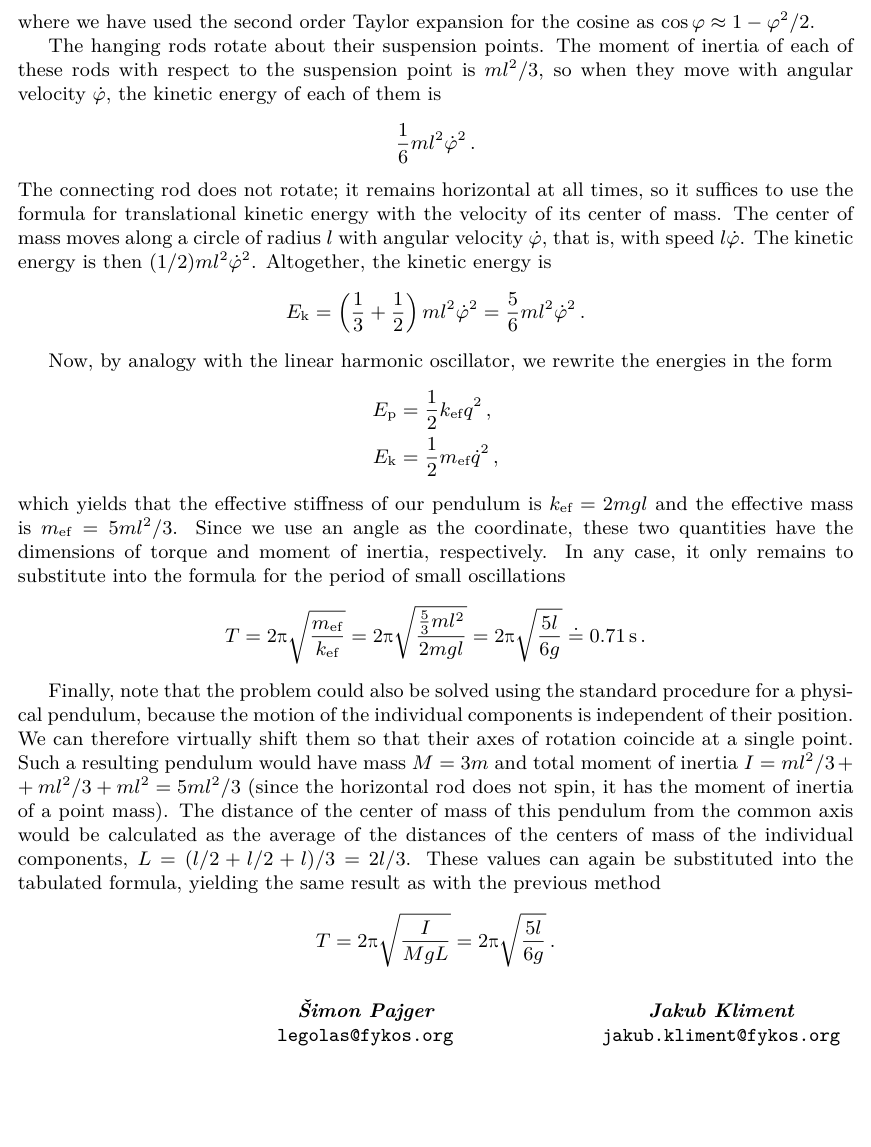
Official solution by FYKOS (Fyziklani 2026), reproduced from the official PDF — p. 38, 39 — under CC BY-SA 3.0.
Topic: Oscillations & Waves, Rotational Dynamics Metodi: Simple Harmonic Motion Analysis, Small-Angle Approximation Competenze: Mathematical Modeling Objects: Rod, Pendulum Fonte: Testo (PDF) — p.38 · Soluzione ufficiale (PDF) — p.38
EE — Pendoli fisici con accoppiamento rigido
Considera due aste di lunghezza , ciascuna sospesa per un estremo e libera di ruotare attorno al punto di sospensione. I punti di sospensione sono alla stessa altezza, a distanza l’uno dall’altro, e gli estremi liberi delle aste sono collegati da una terza asta, anch’essa lunga . Tutte e tre le aste hanno massa . Qual è il periodo delle piccole oscillazioni se mettiamo in moto il sistema nel piano in cui giacciono le aste? Il sistema si trova in un campo gravitazionale di accelerazione .
Risposta:
Soluzione: La soluzione ufficiale completa (in inglese) è nella versione originale di questo quesito e nel PDF ufficiale.
Topic: Oscillations & Waves, Rotational Dynamics Metodi: Simple Harmonic Motion Analysis, Small-Angle Approximation Competenze: Mathematical Modeling Objects: Rod, Pendulum Fonte: Testo (PDF) — p.38 · Soluzione ufficiale (PDF) — p.38
EF — Inside of a glowing sphere
Imagine you are inside a hollow sphere with a radius equal to the Sun’s radius , positioned at a distance from its center. The walls of the sphere have the surface temperature of the Sun . Your body can be approximated as a sphere with a cross-sectional area and a mass , and assume that you absorb of the incident radiation. Assume that each surface element of the sphere emits radiation isotropically. Determine the magnitude and direction of the force exerted on you by the radiation pressure emitted by the walls of the sphere.
Risposta: (analogous to Gauss’s law)
Soluzione:
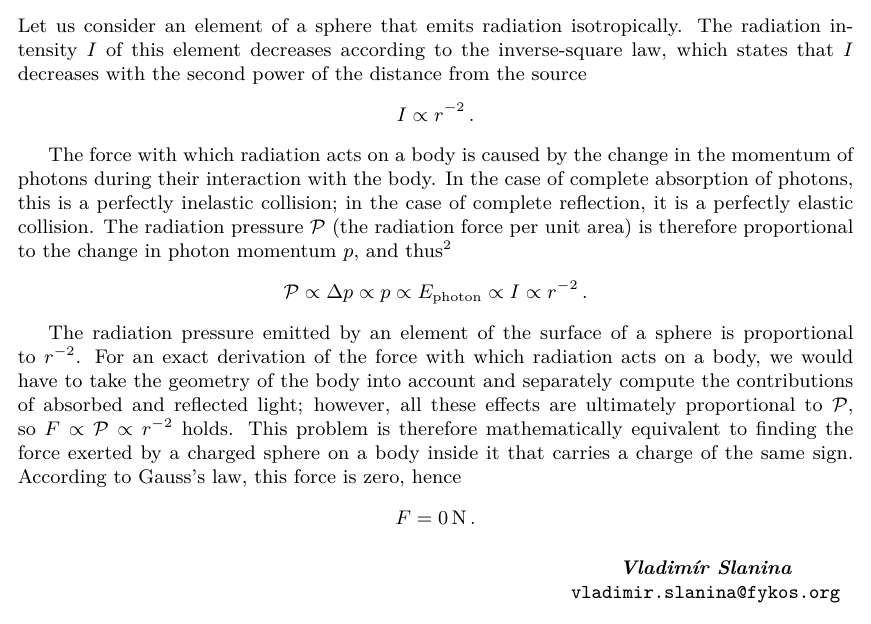
Official solution by FYKOS (Fyziklani 2026), reproduced from the official PDF — p. 40 — under CC BY-SA 3.0.
Topic: Astrophysics, Modern-Quantum Physics Metodi: Gauss’s Law, Symmetry Argument Competenze: Physical Reasoning Objects: Sphere, Photon Fonte: Testo (PDF) — p.40 · Soluzione ufficiale (PDF) — p.40
EF — Dentro una sfera incandescente
Immagina di trovarti dentro una sfera cava di raggio pari al raggio del Sole , a distanza dal suo centro. Le pareti della sfera hanno la temperatura superficiale del Sole, . Il tuo corpo si può approssimare come una sfera di sezione e massa ; supponi di assorbire il della radiazione incidente. Supponi che ogni elemento di superficie della sfera emetta radiazione in modo isotropo. Determina modulo e direzione della forza esercitata su di te dalla pressione di radiazione emessa dalle pareti della sfera.
Risposta: (analogia con il teorema di Gauss)
Soluzione: La soluzione ufficiale completa (in inglese) è nella versione originale di questo quesito e nel PDF ufficiale.
Topic: Astrophysics, Modern-Quantum Physics Metodi: Gauss’s Law, Symmetry Argument Competenze: Physical Reasoning Objects: Sphere, Photon Fonte: Testo (PDF) — p.40 · Soluzione ufficiale (PDF) — p.40
EG — Got to be the best pirate I have ever seen
Jack Sparrow is sailing into a harbor with velocity on a leaking boat. Water is flowing into the boat at a constant rate , the boat’s total volume is , and its mass including the pirate is . Jack is currently counteracting the intake using a bucket, but to preserve his pirate aura, he intends to stop at a certain moment and let the boat drift to the pier, where it will sink. At what distance from the pier should he stop using the bucket? Neglect resistive forces.
Risposta:
Soluzione:

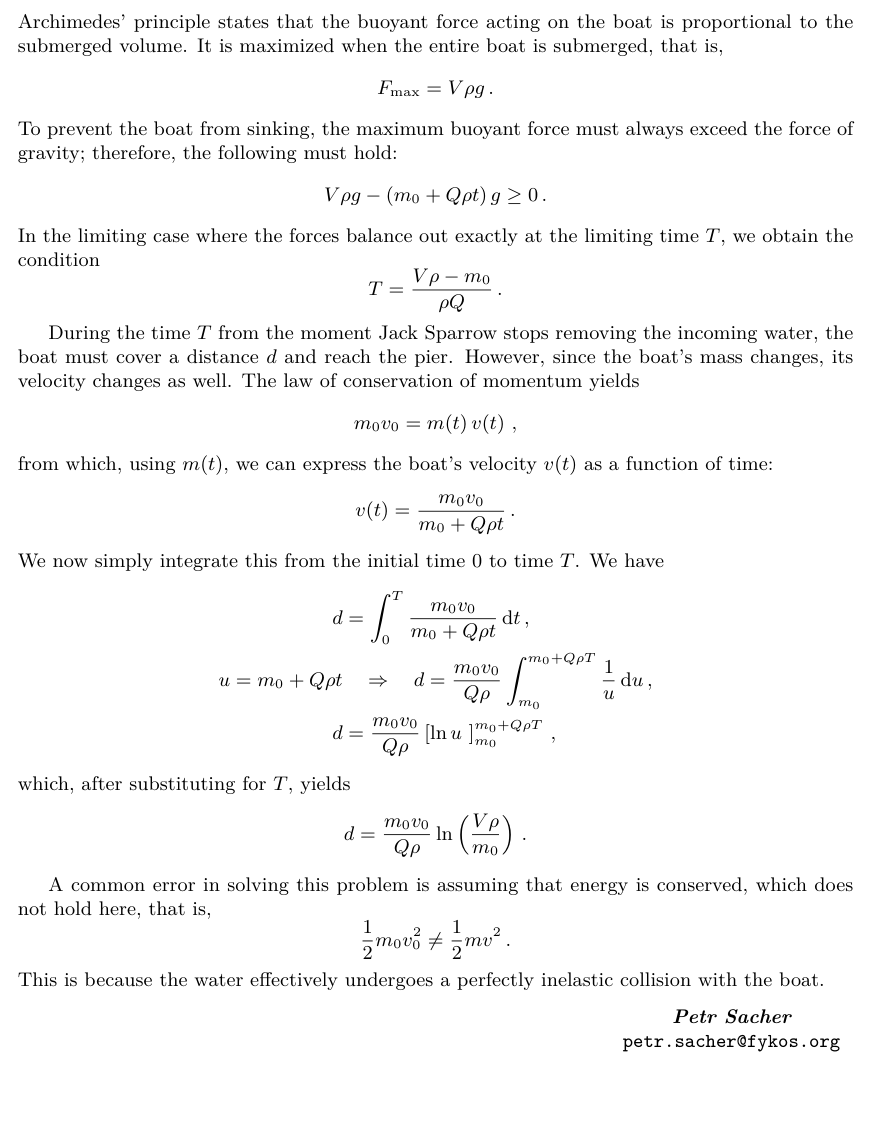
Official solution by FYKOS (Fyziklani 2026), reproduced from the official PDF — p. 40, 41 — under CC BY-SA 3.0.
Topic: Conservation of Momentum, Fluid Mechanics Metodi: Conservation of Momentum, Calculus-Integration Competenze: Mathematical Modeling Objects: — Fonte: Testo (PDF) — p.40 · Soluzione ufficiale (PDF) — p.40
EG — Dev’essere il miglior pirata che abbia mai visto
Jack Sparrow entra in porto con velocità su una barca che fa acqua. L’acqua entra nella barca con portata costante ; il volume totale della barca è e la sua massa, pirata compreso, è . Per ora Jack contrasta l’infiltrazione con un secchio, ma per salvare la sua aura da pirata intende smettere a un certo momento e lasciare che la barca arrivi per inerzia al molo, dove affonderà. A che distanza dal molo deve smettere di usare il secchio? Trascura le forze resistenti.
Risposta:
Soluzione: La soluzione ufficiale completa (in inglese) è nella versione originale di questo quesito e nel PDF ufficiale.
Topic: Conservation of Momentum, Fluid Mechanics Metodi: Conservation of Momentum, Calculus-Integration Competenze: Mathematical Modeling Objects: — Fonte: Testo (PDF) — p.40 · Soluzione ufficiale (PDF) — p.40
EH — Grilled Roman, Sicilian-style
Archimedes is said to have constructed a machine made of polished copper mirrors to defend Syracuse, intended to ignite enemy ships. Imagine such a machine, suppose it consists of a copper plate bent into a parabolic shape given by the equation , where is a parameter. We can tune the value of the parameter , and thus the focusing of the “mirror”, by turning a hand crank. The rotation of the crank is linearly related to the parameter by , where is the rotation of the crank in radians and . The ship must be targeted, i.e., placed at the focus of the parabola. The ship approaches us with uniform linear motion at a speed of , and at time , it is targeted at a distance of . At what speed must we turn the crank at time , so that the ship remains targeted?
Risposta:
Soluzione:
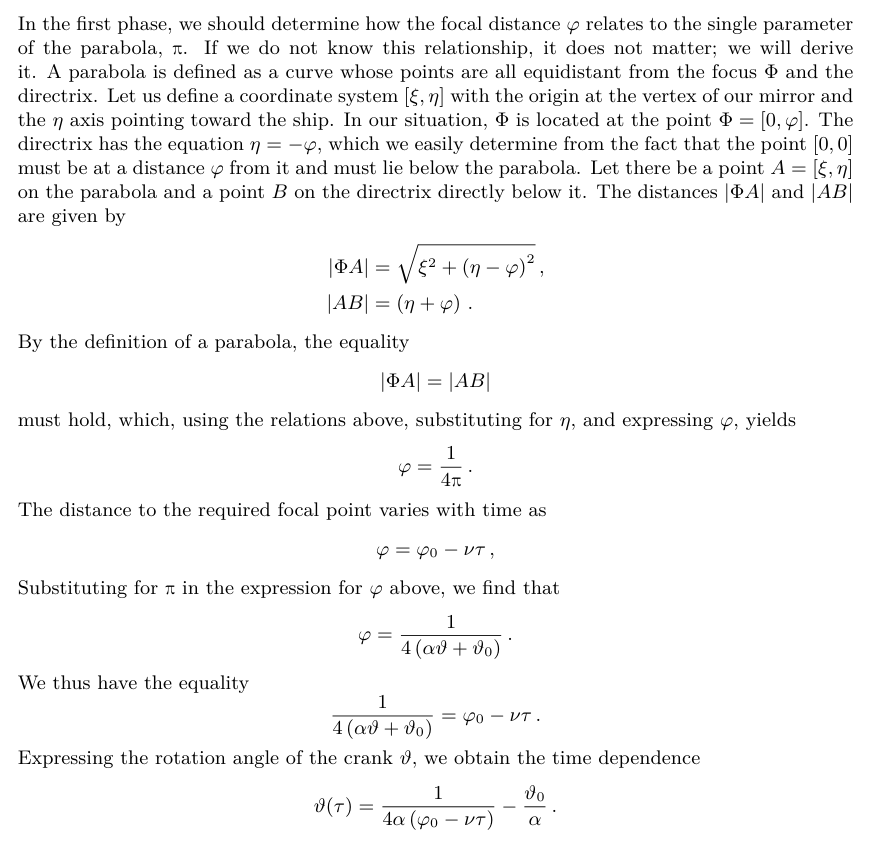
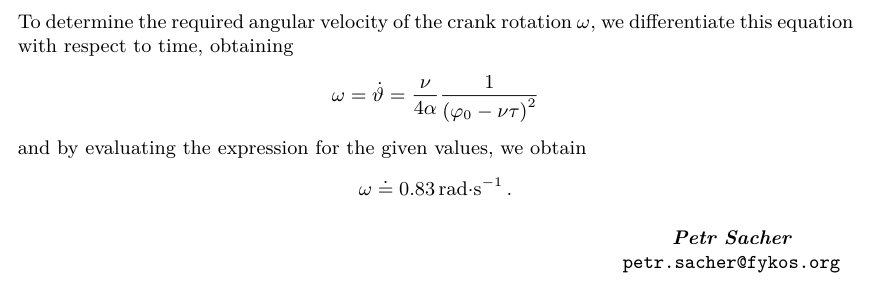
Official solution by FYKOS (Fyziklani 2026), reproduced from the official PDF — p. 42, 43 — under CC BY-SA 3.0.
Topic: Geometric Optics Metodi: Ray Tracing, Kinematic Equations Competenze: Mathematical Modeling Objects: Mirror Fonte: Testo (PDF) — p.42 · Soluzione ufficiale (PDF) — p.42
EH — Romano alla griglia, alla siciliana
Si racconta che Archimede abbia costruito, per difendere Siracusa, una macchina di specchi di rame lucidato destinata a incendiare le navi nemiche. Immagina una macchina del genere, formata da una lastra di rame piegata a forma di parabola di equazione , dove è un parametro. Possiamo regolare il valore del parametro , e quindi la focalizzazione dello “specchio”, girando una manovella. La rotazione della manovella è legata linearmente al parametro da , dove è la rotazione della manovella in radianti e . La nave deve essere tenuta sotto mira, cioè nel fuoco della parabola. La nave si avvicina di moto rettilineo uniforme con velocità e all’istante è sotto mira alla distanza . Con quale velocità angolare dobbiamo girare la manovella all’istante perché la nave resti sotto mira?
Risposta:
Soluzione: La soluzione ufficiale completa (in inglese) è nella versione originale di questo quesito e nel PDF ufficiale.
Topic: Geometric Optics Metodi: Ray Tracing, Kinematic Equations Competenze: Mathematical Modeling Objects: Mirror Fonte: Testo (PDF) — p.42 · Soluzione ufficiale (PDF) — p.42
FA — Starcraper
Marek wants to build a skyscraper at the latitude that reaches the stars. How tall should it be to slow down the Earth’s rotation by ? Consider the Earth to be a homogeneous sphere of mass , which remains unchanged by this construction, since Marek extracts the mass from a white hole. Assume that the mass of the building is initially at rest, and it is precisely its rotation that slows down the Earth. Further assume that the skyscraper is sufficiently thin, homogeneous, and has mass .
Risposta:
Soluzione:
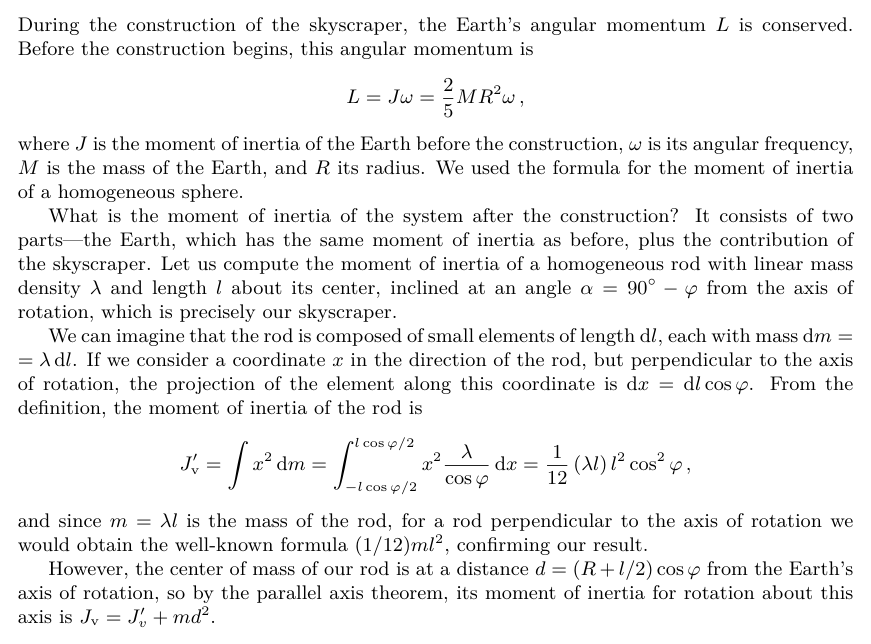
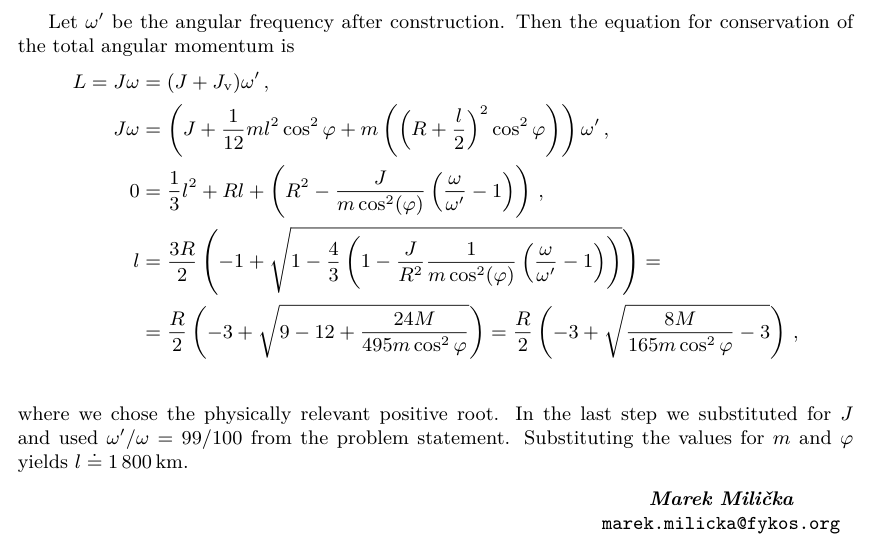
Official solution by FYKOS (Fyziklani 2026), reproduced from the official PDF — p. 43, 44 — under CC BY-SA 3.0.
Topic: Rotational Dynamics Metodi: Torque & Angular Momentum Analysis Competenze: Mathematical Modeling Objects: Planet, Rod Fonte: Testo (PDF) — p.43 · Soluzione ufficiale (PDF) — p.43
FA — Grattastelle
Marek vuole costruire alla latitudine un grattacielo che arrivi alle stelle. Quanto dovrebbe essere alto per rallentare la rotazione terrestre dell’? Considera la Terra una sfera omogenea di massa , che la costruzione non modifica, perché Marek prende la massa da un buco bianco. Supponi che la massa dell’edificio sia inizialmente ferma e che sia proprio la sua messa in rotazione a rallentare la Terra. Supponi inoltre che il grattacielo sia sufficientemente sottile, omogeneo e di massa .
Risposta:
Soluzione: La soluzione ufficiale completa (in inglese) è nella versione originale di questo quesito e nel PDF ufficiale.
Topic: Rotational Dynamics Metodi: Torque & Angular Momentum Analysis Competenze: Mathematical Modeling Objects: Planet, Rod Fonte: Testo (PDF) — p.43 · Soluzione ufficiale (PDF) — p.43
FB — Oscillating massive pulley
Consider a homogeneous pulley of mass in the shape of a disk with radius . We suspend this pulley from the ceiling such that on one side, the rope is attached to the ceiling directly, and on the other side, it is attached via a spring of stiffness . We pull the pulley slightly downwards from its equilibrium position. What is the period of small oscillations? Assume that the pulley does not slip on the rope.
Risposta:
Soluzione:
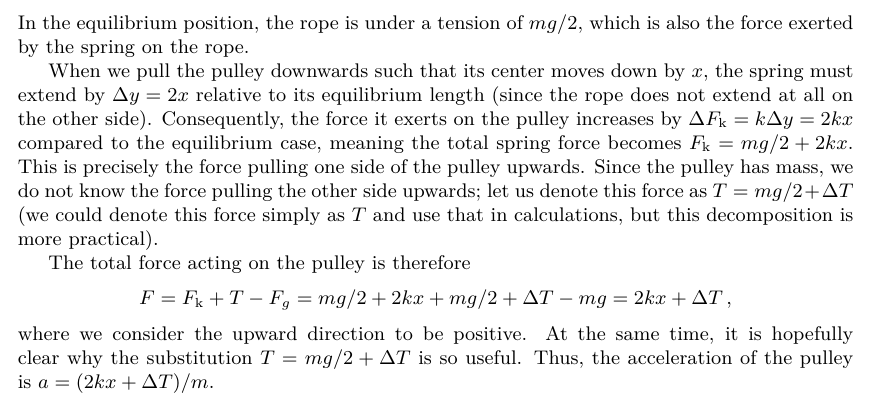
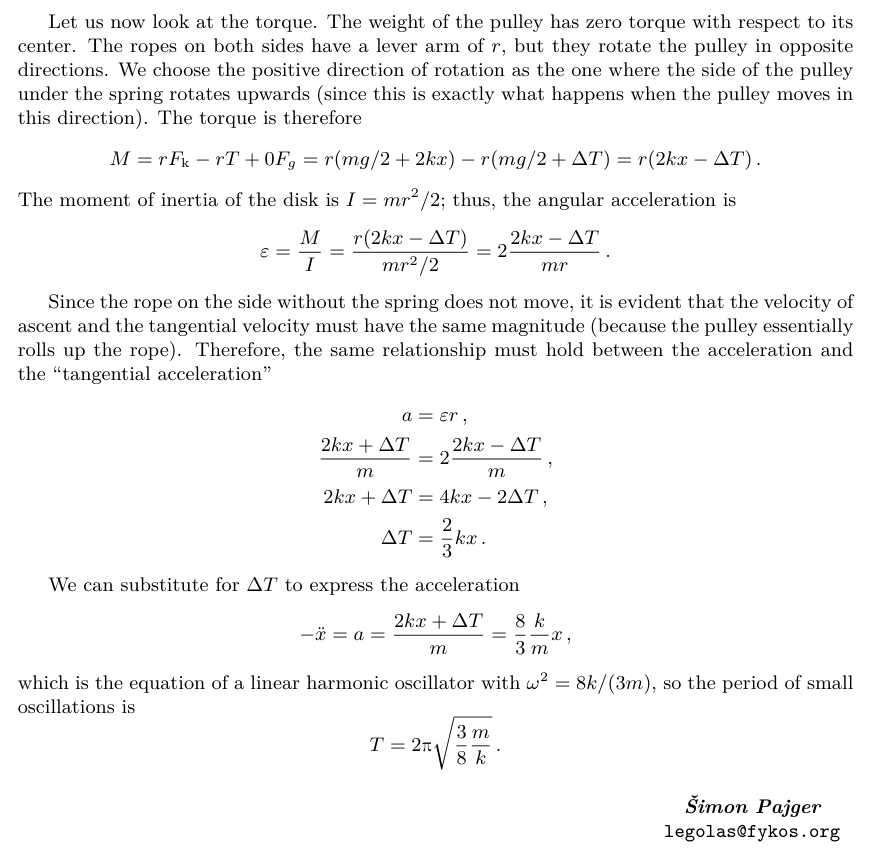
Official solution by FYKOS (Fyziklani 2026), reproduced from the official PDF — p. 44, 45 — under CC BY-SA 3.0.
Topic: Oscillations & Waves, Rotational Dynamics Metodi: Simple Harmonic Motion Analysis, Free-Body Diagram Competenze: Mathematical Modeling Objects: Pulley, Spring, String Fonte: Testo (PDF) — p.44 · Soluzione ufficiale (PDF) — p.44
FB — Carrucola massiccia oscillante
Considera una carrucola omogenea di massa a forma di disco di raggio . La appendiamo al soffitto in modo che da un lato la fune sia fissata direttamente al soffitto e dall’altro tramite una molla di costante elastica . Tiriamo la carrucola leggermente verso il basso rispetto alla posizione di equilibrio. Qual è il periodo delle piccole oscillazioni? Supponi che la carrucola non slitti sulla fune.
Risposta:
Soluzione: La soluzione ufficiale completa (in inglese) è nella versione originale di questo quesito e nel PDF ufficiale.
Topic: Oscillations & Waves, Rotational Dynamics Metodi: Simple Harmonic Motion Analysis, Free-Body Diagram Competenze: Mathematical Modeling Objects: Pulley, Spring, String Fonte: Testo (PDF) — p.44 · Soluzione ufficiale (PDF) — p.44
FC — Motocross derby
Three motorcyclists Pepa, Vojta, and Marek, along with their motorcycles, are positioned at the vertices of an equilateral triangle with side length . At time , they all simultaneously begin to pursue one another with speed , with Pepa chasing Vojta, Vojta chasing Marek, and Marek chasing Pepa. However, they do not want to collide at full speed; thus, the closer they get to each other, the more they slow down. Therefore, their speed is directly proportional to their mutual distance . How long does it take for the distance between Vojta and Marek to decrease to (assuming )?
Risposta:
Soluzione:

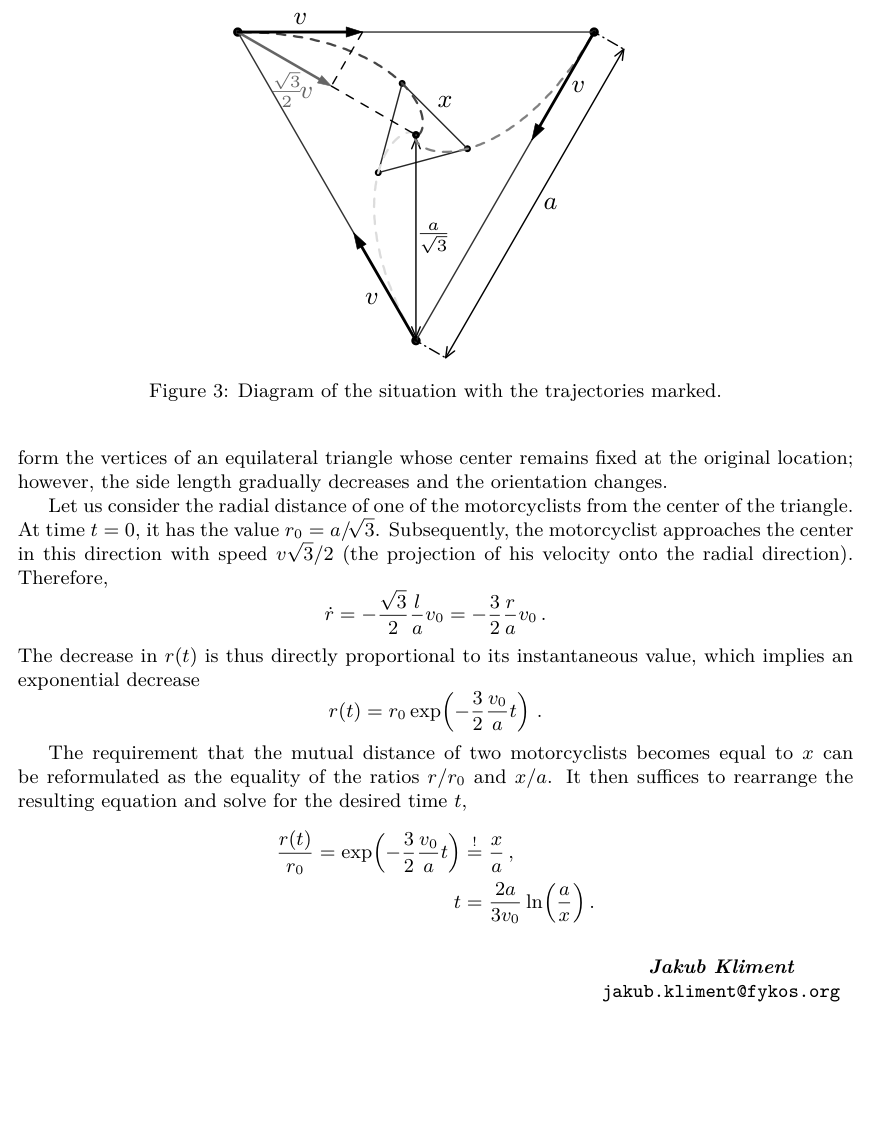
Official solution by FYKOS (Fyziklani 2026), reproduced from the official PDF — p. 45, 46 — under CC BY-SA 3.0.
Topic: Newtonian Mechanics Metodi: Differential Equations, Symmetry Argument Competenze: Mathematical Modeling Objects: — Fonte: Testo (PDF) — p.45 · Soluzione ufficiale (PDF) — p.45
FC — Derby di motocross
Tre motociclisti, Pepa, Vojta e Marek, con le loro moto, si trovano ai vertici di un triangolo equilatero di lato . All’istante cominciano contemporaneamente a inseguirsi con velocità : Pepa insegue Vojta, Vojta insegue Marek e Marek insegue Pepa. Non vogliono però scontrarsi a tutta velocità, quindi più si avvicinano più rallentano: la loro velocità è direttamente proporzionale alla distanza reciproca, . Quanto tempo occorre perché la distanza tra Vojta e Marek si riduca a (con )?
Risposta:
Soluzione: La soluzione ufficiale completa (in inglese) è nella versione originale di questo quesito e nel PDF ufficiale.
Topic: Newtonian Mechanics Metodi: Differential Equations, Symmetry Argument Competenze: Mathematical Modeling Objects: — Fonte: Testo (PDF) — p.45 · Soluzione ufficiale (PDF) — p.45
FD — Conical cup
Let us consider a cup in the shape of a hollow cone without a base, of height , whose opening angle is . We fill the cup with a liquid of density all the way up to the rim. Because such a cup would stand poorly with its apex down, we quickly turn it upside down and place it on a table so that not a single drop of liquid spills out. What buoyant force acts on the cup? The liquid at the apex inside the cone is at atmospheric pressure.
Risposta:
Soluzione:
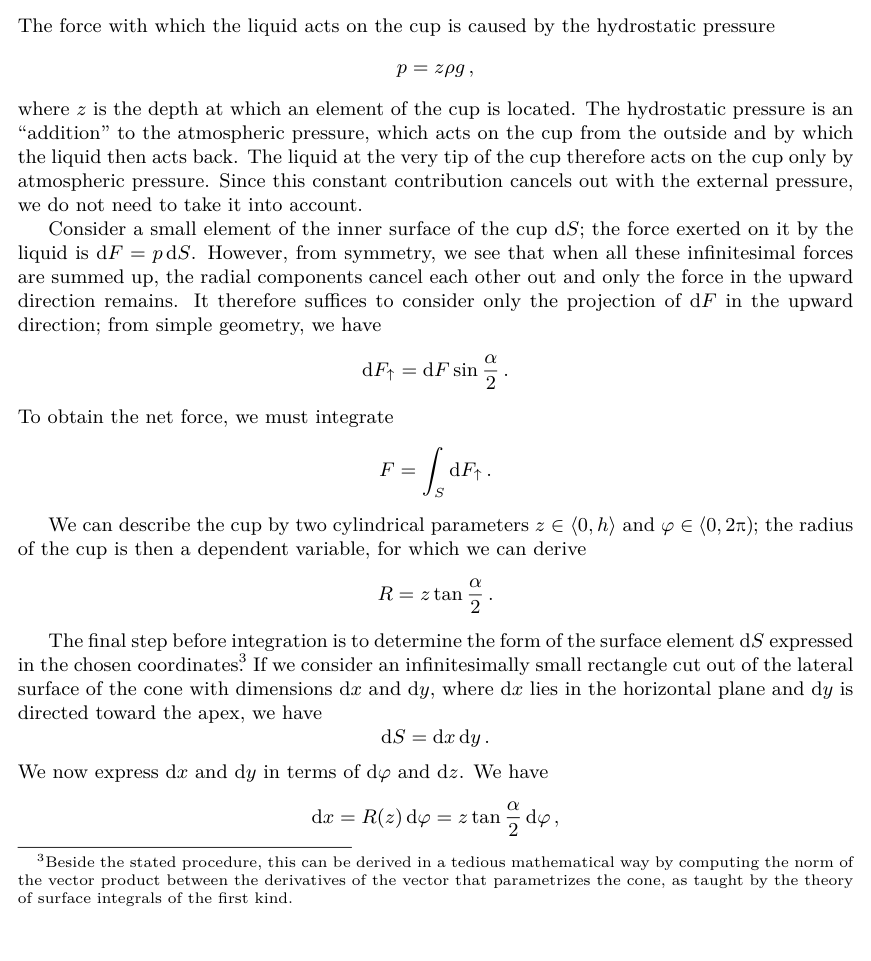
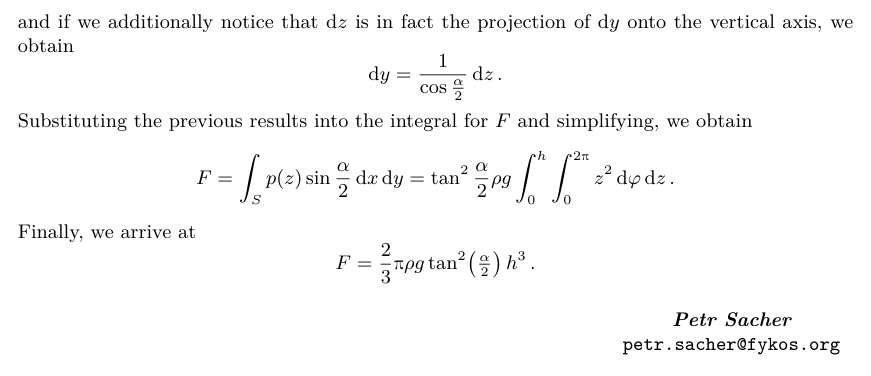
Official solution by FYKOS (Fyziklani 2026), reproduced from the official PDF — p. 47, 48 — under CC BY-SA 3.0.
Topic: Fluid Mechanics Metodi: Hydrostatic Equilibrium, Calculus-Integration Competenze: Mathematical Modeling Objects: Container Fonte: Testo (PDF) — p.47 · Soluzione ufficiale (PDF) — p.47
FD — Bicchiere conico
Considera un bicchiere a forma di cono cavo senza base, di altezza e angolo di apertura . Lo riempiamo fino all’orlo con un liquido di densità . Poiché un bicchiere così starebbe in piedi male con il vertice in basso, lo capovolgiamo rapidamente e lo appoggiamo sul tavolo senza versare nemmeno una goccia. Quale forza di spinta (verso l’alto) agisce sul bicchiere? Il liquido al vertice, dentro il cono, è a pressione atmosferica.
Risposta:
Soluzione: La soluzione ufficiale completa (in inglese) è nella versione originale di questo quesito e nel PDF ufficiale.
Topic: Fluid Mechanics Metodi: Hydrostatic Equilibrium, Calculus-Integration Competenze: Mathematical Modeling Objects: Container Fonte: Testo (PDF) — p.47 · Soluzione ufficiale (PDF) — p.47
FE — Fast-spinning kettle
Marek has a thin thermally insulating spherical shell of radius and mass filled with water. He spins up the sphere while keeping the water inside at rest. The sphere begins to slow down due to interaction with the water, and after a long time, Marek finds that the temperature inside the sphere has risen by . To what angular velocity did he spin up the sphere? Assume that the water has a constant density and specific heat capacity . Due to friction, which also heats the water, angular momentum is not conserved.
Risposta:
Soluzione:
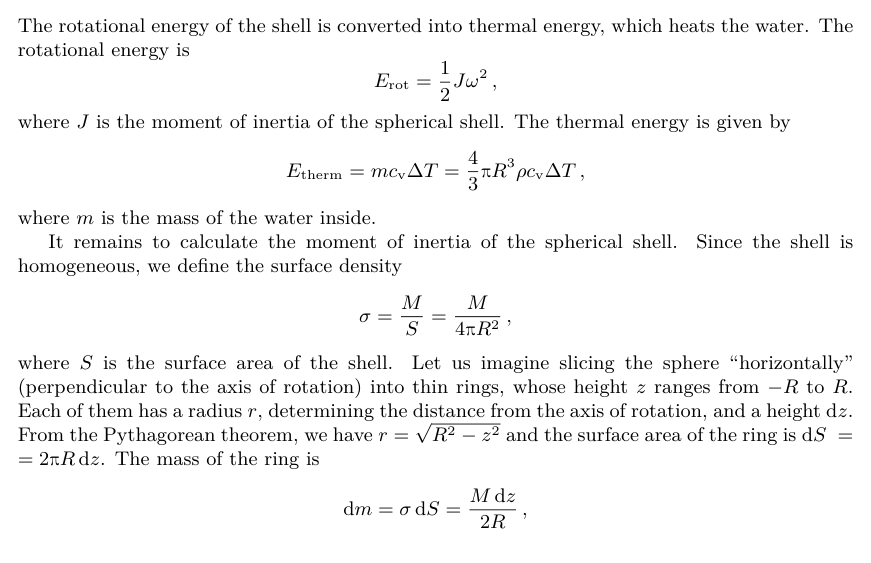
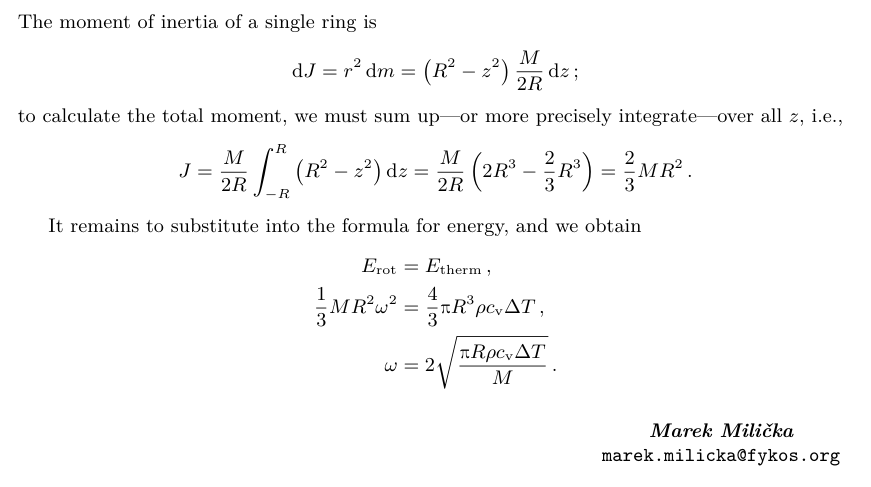
Official solution by FYKOS (Fyziklani 2026), reproduced from the official PDF — p. 48, 49 — under CC BY-SA 3.0.
Topic: Rotational Dynamics, Thermodynamics Metodi: Energy Conservation Method, Calculus-Integration Competenze: Mathematical Modeling Objects: Sphere Fonte: Testo (PDF) — p.48 · Soluzione ufficiale (PDF) — p.48
FE — Bollitore che gira veloce
Marek ha un sottile guscio sferico termicamente isolante, di raggio e massa , pieno d’acqua. Mette in rotazione la sfera mantenendo ferma l’acqua al suo interno. La sfera comincia a rallentare per l’interazione con l’acqua e, dopo molto tempo, Marek trova che la temperatura all’interno è aumentata di . A quale velocità angolare aveva portato la sfera? Supponi che l’acqua abbia densità costante e calore specifico . A causa dell’attrito, che riscalda anche l’acqua, il momento angolare non si conserva.
Risposta:
Soluzione: La soluzione ufficiale completa (in inglese) è nella versione originale di questo quesito e nel PDF ufficiale.
Topic: Rotational Dynamics, Thermodynamics Metodi: Energy Conservation Method, Calculus-Integration Competenze: Mathematical Modeling Objects: Sphere Fonte: Testo (PDF) — p.48 · Soluzione ufficiale (PDF) — p.48
FF — Definitional
Consider a homogeneous rod standing vertically upward on the Earth’s surface. What must be the length of this rod so that its center of gravity, i.e., the point where the gravitational force effectively acts, is at a distance of from its center of mass?
Hint: You may find it useful that for small the approximation holds.
Risposta:
Soluzione:
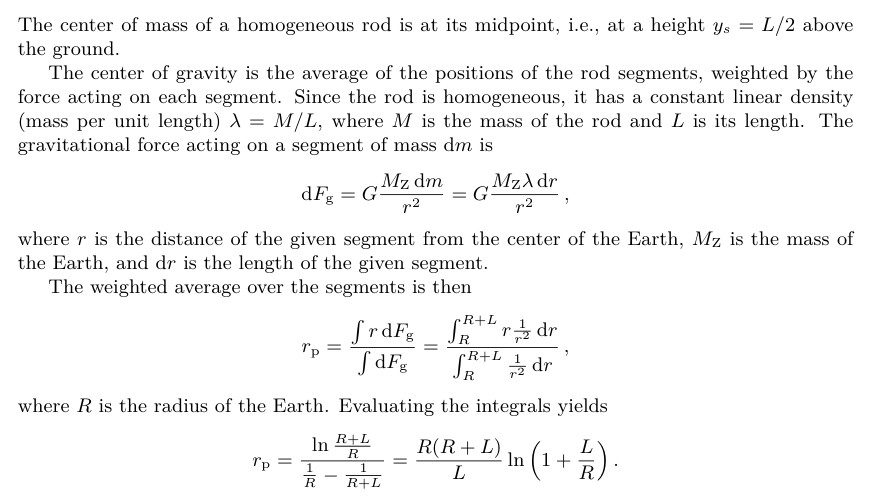
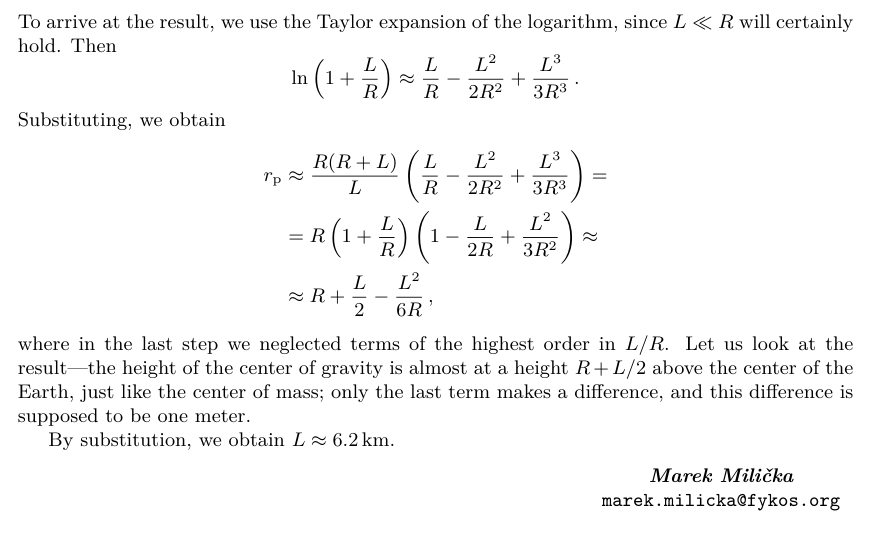
Official solution by FYKOS (Fyziklani 2026), reproduced from the official PDF — p. 49, 50 — under CC BY-SA 3.0.
Topic: Gravitation Metodi: Newton’s Law of Gravitation, Approximation & Series Expansion Competenze: Mathematical Modeling, Estimation & Approximation Objects: Rod, Planet Fonte: Testo (PDF) — p.49 · Soluzione ufficiale (PDF) — p.49
FF — Per definizione
Considera un’asta omogenea posta verticalmente sulla superficie terrestre. Quanto deve essere lunga perché il suo baricentro gravitazionale, cioè il punto in cui agisce effettivamente la forza di gravità, disti dal suo centro di massa?
Suggerimento: può esserti utile l’approssimazione , valida per piccolo.
Risposta:
Soluzione: La soluzione ufficiale completa (in inglese) è nella versione originale di questo quesito e nel PDF ufficiale.
Topic: Gravitation Metodi: Newton’s Law of Gravitation, Approximation & Series Expansion Competenze: Mathematical Modeling, Estimation & Approximation Objects: Rod, Planet Fonte: Testo (PDF) — p.49 · Soluzione ufficiale (PDF) — p.49
FG — A new lamp
Vlado bought a new lamp, but as is often the case these days, new devices come only with a cable and no adapter. Vlado has a adapter available, but the nominal voltage of the new lamp is . He therefore decides to connect it to this adapter through a potentiometer, which he connects as a voltage divider. Assume that the lamp has power input . Vlado cares about the planet and thus wants the efficiency of the entire system to be at least . Calculate the total resistance of the potentiometer at which the maximum current flows through the circuit.
Risposta:
Soluzione:
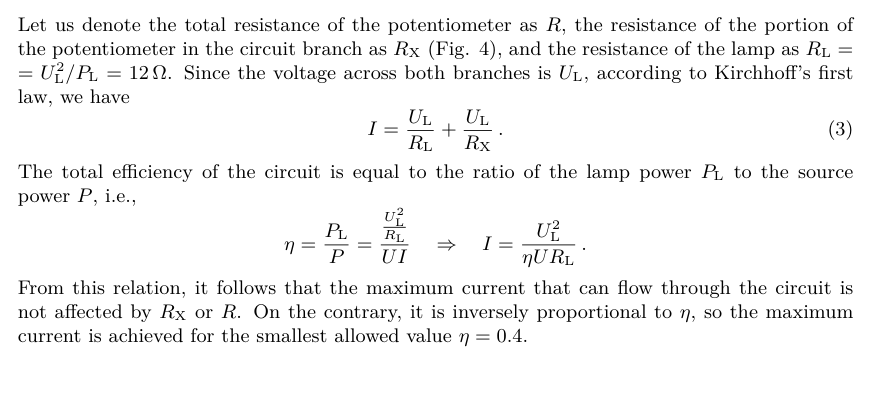
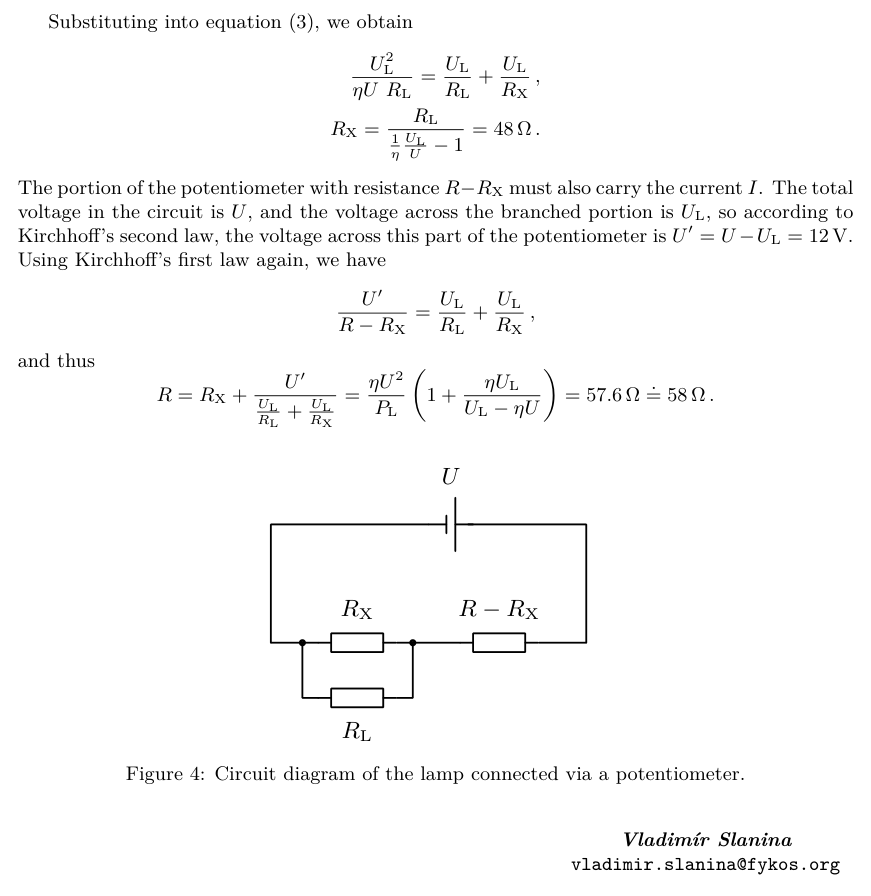
Official solution by FYKOS (Fyziklani 2026), reproduced from the official PDF — p. 50, 51 — under CC BY-SA 3.0.
Topic: Circuits Metodi: Kirchhoff’s Laws, Equivalent Circuit Reduction Competenze: Mathematical Modeling Objects: Resistor Fonte: Testo (PDF) — p.50 · Soluzione ufficiale (PDF) — p.50
FG — Una lampada nuova
Vlado ha comprato una lampada nuova ma, come spesso accade oggi, i nuovi apparecchi hanno solo il cavo e nessun alimentatore. Vlado ha a disposizione un alimentatore da , ma la tensione nominale della lampada è . Decide quindi di collegarla all’alimentatore tramite un potenziometro montato come partitore di tensione. Supponi che la lampada assorba una potenza . Vlado tiene al pianeta e vuole che il rendimento dell’intero sistema sia almeno . Calcola la resistenza totale del potenziometro per cui nel circuito scorre la corrente massima.
Risposta:
Soluzione: La soluzione ufficiale completa (in inglese) è nella versione originale di questo quesito e nel PDF ufficiale.
Topic: Circuits Metodi: Kirchhoff’s Laws, Equivalent Circuit Reduction Competenze: Mathematical Modeling Objects: Resistor Fonte: Testo (PDF) — p.50 · Soluzione ufficiale (PDF) — p.50
FH — Ice bubble
David was looking perpendicularly at a soap bubble (for simplicity, assume it is made only of water), which appeared green to him due to interference, with a wavelength of . However, since it was really cold outside, the bubble began to freeze. With what wavelength will David see the frozen bubble? Assume that the inner diameter of the bubble remains constant at , and that David observes only the first order of interference. The refractive index of ice is .
Risposta:
Soluzione:
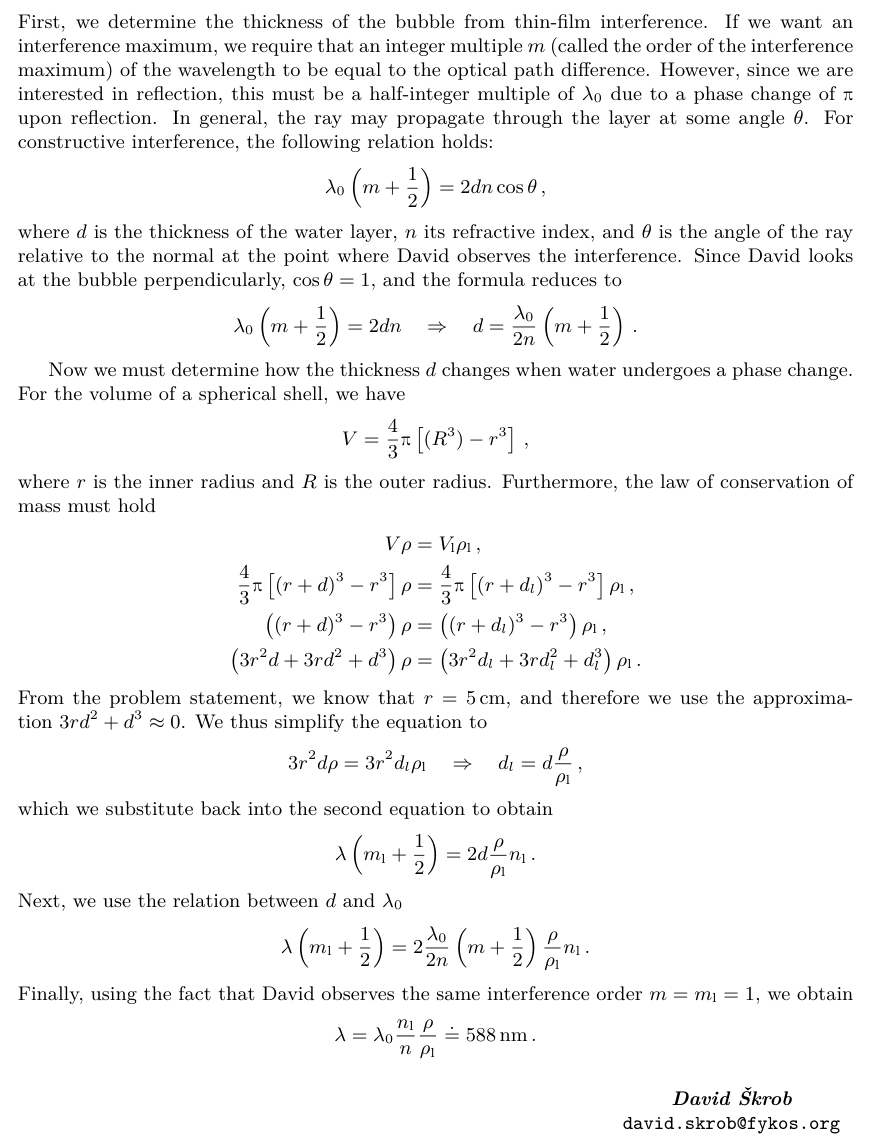
Official solution by FYKOS (Fyziklani 2026), reproduced from the official PDF — p. 52 — under CC BY-SA 3.0.
Topic: Wave Optics Metodi: Interference & Diffraction Analysis Competenze: Mathematical Modeling Objects: Bubble, Membrane Fonte: Testo (PDF) — p.51 · Soluzione ufficiale (PDF) — p.52
FH — Bolla di ghiaccio
David guardava perpendicolarmente una bolla di sapone (per semplicità supponi che sia fatta solo d’acqua), che per interferenza gli appariva verde, con lunghezza d’onda . Ma fuori faceva davvero freddo e la bolla ha cominciato a congelare. Con quale lunghezza d’onda David vedrà la bolla congelata? Supponi che il diametro interno della bolla resti costante, , e che David osservi solo il primo ordine di interferenza. L’indice di rifrazione del ghiaccio è .
Risposta:
Soluzione: La soluzione ufficiale completa (in inglese) è nella versione originale di questo quesito e nel PDF ufficiale.
Topic: Wave Optics Metodi: Interference & Diffraction Analysis Competenze: Mathematical Modeling Objects: Bubble, Membrane Fonte: Testo (PDF) — p.51 · Soluzione ufficiale (PDF) — p.52
GA — Antigravitational
Marek has two cones of height and opening angle glued together at their bases. He places them horizontally midway between two long rods that enclose an angle and lie in a plane inclined at an angle . Both rods have the same inclination with respect to the horizontal plane. Marek watches in surprise as the points of contact between the cones and the rods move upward. What is the smallest possible value of the angle ?
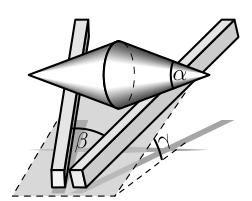
Risposta:
Soluzione:
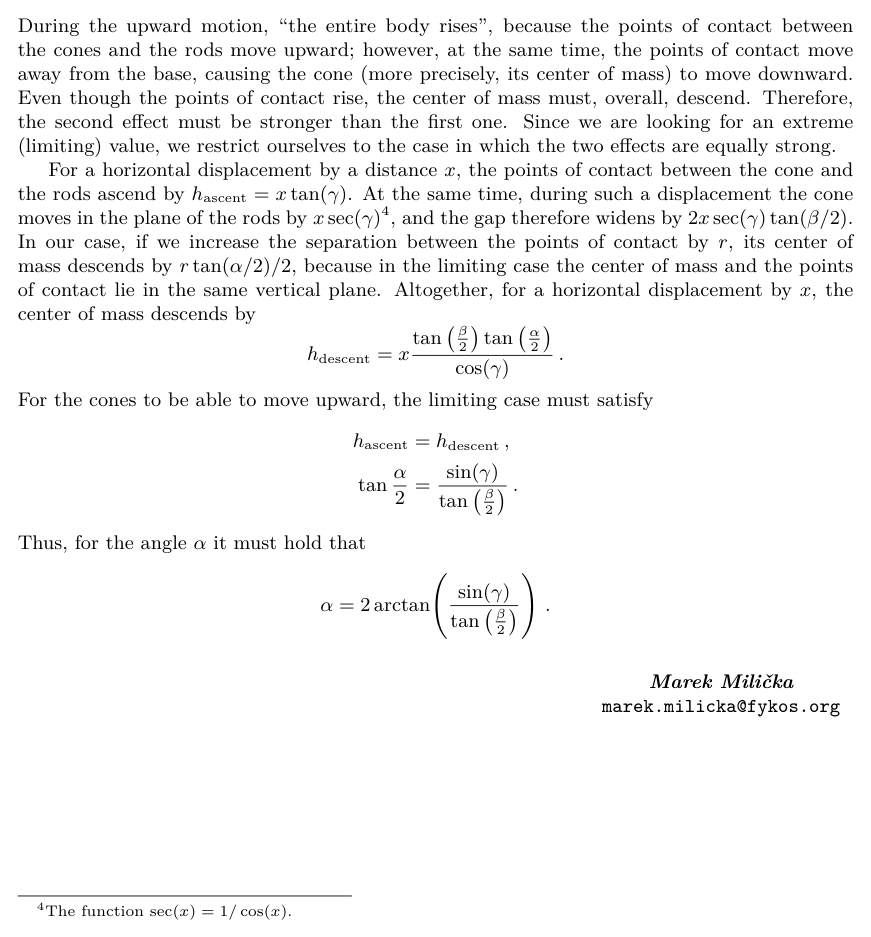
Official solution by FYKOS (Fyziklani 2026), reproduced from the official PDF — p. 53 — under CC BY-SA 3.0.
Topic: Rigid Body Statics, Conservation of Energy Metodi: Physical Modeling, Vector Decomposition Competenze: Physical Reasoning, Diagrammatic Reasoning Objects: Rod Fonte: Testo (PDF) — p.53 · Soluzione ufficiale (PDF) — p.53
GA — Antigravitazionale
Marek ha due coni di altezza e angolo di apertura incollati per le basi. Li appoggia orizzontalmente a metà tra due lunghe aste che formano un angolo e giacciono in un piano inclinato di un angolo . Le due aste hanno la stessa inclinazione rispetto al piano orizzontale. Marek osserva sorpreso che i punti di contatto tra i coni e le aste salgono verso l’alto. Qual è il minimo valore possibile dell’angolo ?
Risposta:
Soluzione: La soluzione ufficiale completa (in inglese) è nella versione originale di questo quesito e nel PDF ufficiale.
Topic: Rigid Body Statics, Conservation of Energy Metodi: Physical Modeling, Vector Decomposition Competenze: Physical Reasoning, Diagrammatic Reasoning Objects: Rod Fonte: Testo (PDF) — p.53 · Soluzione ufficiale (PDF) — p.53
GB — Opaque glass
Let us consider a piece of glass of thickness , which contains a dark dye that absorbs a portion of the transmitted light. Suppose that the absorption coefficient depends linearly on the dye concentration in the glass as , where is the concentration. If the glass, due to a manufacturing defect, has the standard concentration of dye at the surface, but then the concentration increases linearly by , where is the depth measured from the surface, by what factor is the transmitted light reduced?
Risposta: (relative to a defect-free plate)
Soluzione:
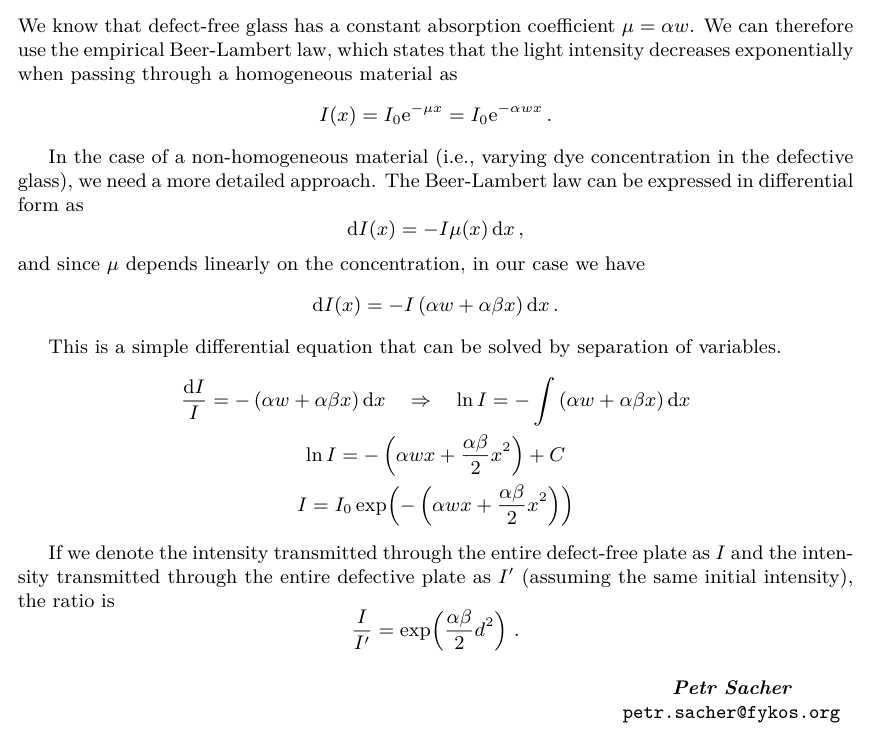
Official solution by FYKOS (Fyziklani 2026), reproduced from the official PDF — p. 54 — under CC BY-SA 3.0.
Topic: Geometric Optics Metodi: Differential Equations, Calculus-Integration Competenze: Mathematical Modeling Objects: — Fonte: Testo (PDF) — p.54 · Soluzione ufficiale (PDF) — p.54
GB — Vetro opaco
Considera una lastra di vetro di spessore contenente un colorante scuro che assorbe parte della luce trasmessa. Supponi che il coefficiente di assorbimento dipenda linearmente dalla concentrazione del colorante nel vetro, , dove è la concentrazione. Se il vetro, per un difetto di fabbricazione, ha la concentrazione standard di colorante in superficie, ma poi la concentrazione aumenta linearmente di , dove è la profondità misurata dalla superficie, di quale fattore si riduce la luce trasmessa?
Risposta: (rispetto a una lastra senza difetto)
Soluzione: La soluzione ufficiale completa (in inglese) è nella versione originale di questo quesito e nel PDF ufficiale.
Topic: Geometric Optics Metodi: Differential Equations, Calculus-Integration Competenze: Mathematical Modeling Objects: — Fonte: Testo (PDF) — p.54 · Soluzione ufficiale (PDF) — p.54
GC — Then measure it
Pepa has always wanted to live as a 2D being on a disk. After a lot of time and effort, he has finally achieved it. To celebrate his success, he has decided to measure the radius of the disk on which he is living using a 2D aluminum ruler lying in the same plane as the disk. However, Pepa has a nefarious friend Vojta who is envious of his success and therefore placed his world on a stove in such a way that the temperature of the disk decreases exponentially with distance from the center according to the formula , from in the center to at the edge of the disk, where denotes the room temperature. How much shorter (in percent) will the radius measured from Pepa’s point of view be compared to the true radius of the disk measured by Vojta? Assume that Vojta has a perfectly rigid ruler, Pepa’s ruler has a constant coefficient of thermal expansion and correctly measures distance at the room temperature .
Risposta:
Soluzione:
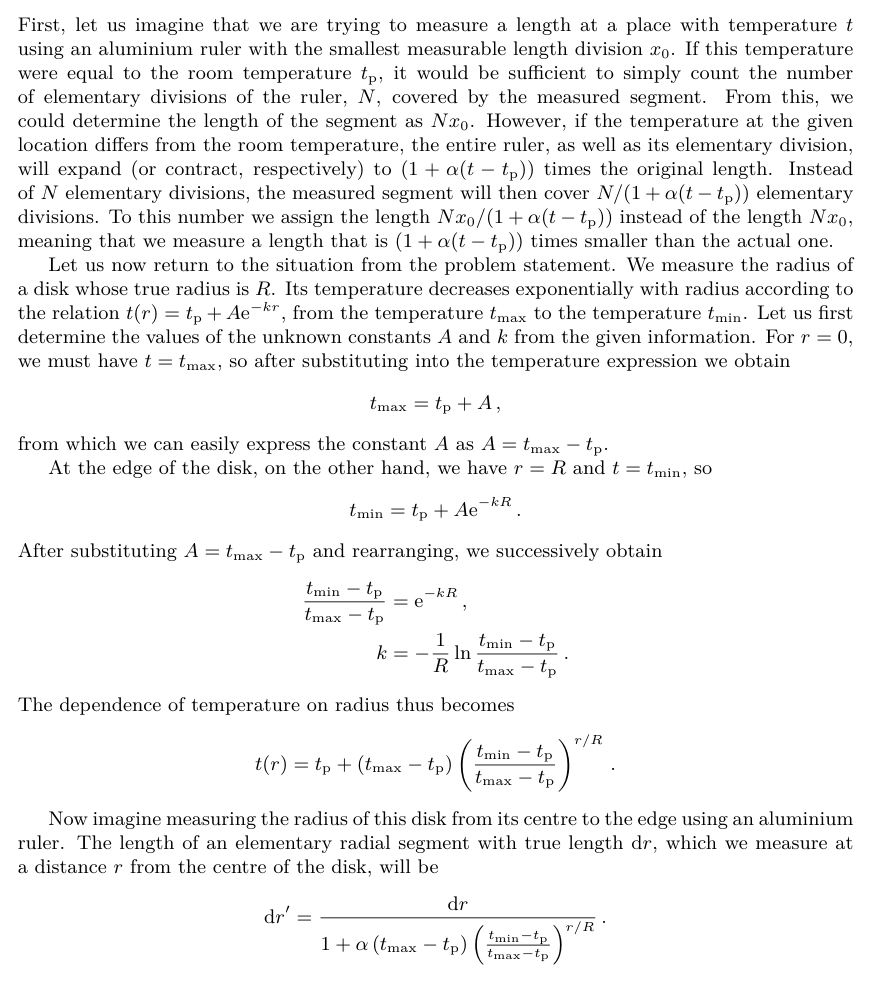
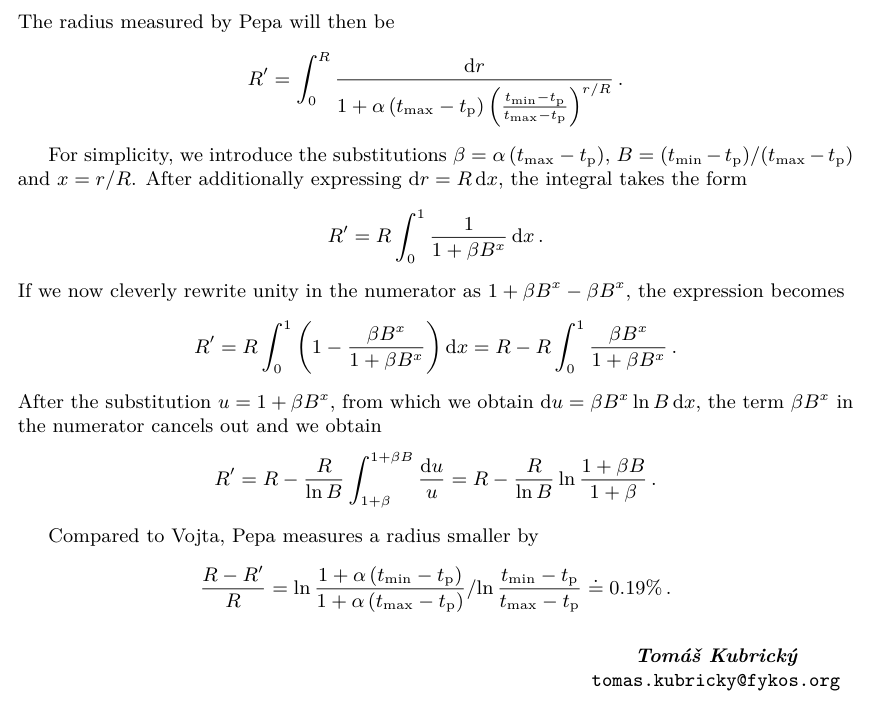
Official solution by FYKOS (Fyziklani 2026), reproduced from the official PDF — p. 55, 56 — under CC BY-SA 3.0.
Topic: Thermodynamics, Elasticity & Materials Metodi: Calculus-Integration Competenze: Mathematical Modeling Objects: Disk Fonte: Testo (PDF) — p.54 · Soluzione ufficiale (PDF) — p.55
GC — E poi misuralo
Pepa ha sempre desiderato vivere come un essere bidimensionale su un disco. Dopo molto tempo e fatica ci è finalmente riuscito. Per festeggiare decide di misurare il raggio del disco su cui vive con un righello bidimensionale di alluminio che giace nello stesso piano del disco. Pepa però ha un amico malvagio, Vojta, invidioso del suo successo, che ha messo il suo mondo su un fornello in modo che la temperatura del disco diminuisca esponenzialmente con la distanza dal centro secondo , da al centro a al bordo del disco, dove è la temperatura ambiente. Di quanto (in percentuale) il raggio misurato da Pepa sarà più corto del raggio vero del disco misurato da Vojta? Supponi che il righello di Vojta sia perfettamente rigido, mentre quello di Pepa ha coefficiente di dilatazione termica costante e misura correttamente alla temperatura ambiente .
Risposta:
Soluzione: La soluzione ufficiale completa (in inglese) è nella versione originale di questo quesito e nel PDF ufficiale.
Topic: Thermodynamics, Elasticity & Materials Metodi: Calculus-Integration Competenze: Mathematical Modeling Objects: Disk Fonte: Testo (PDF) — p.54 · Soluzione ufficiale (PDF) — p.55
GD — Overturning a rectangular cuboid
Consider a hollow rectangular cuboid with a base of side lengths and and height . The walls of the cuboid have negligible mass, but its entire volume is filled with water and a spherical buoy of radius made of a material with density . The buoy is attached to the center of the cuboid base by a massless and volumeless string of length . What work is needed to tip the cuboid over the edge ? Assume that the tipping is performed very slowly.
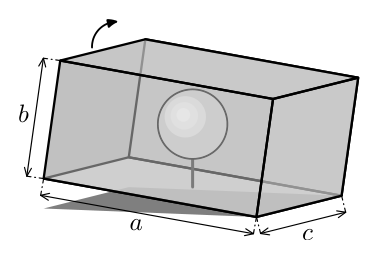
Risposta: (limiting angle )
Soluzione:

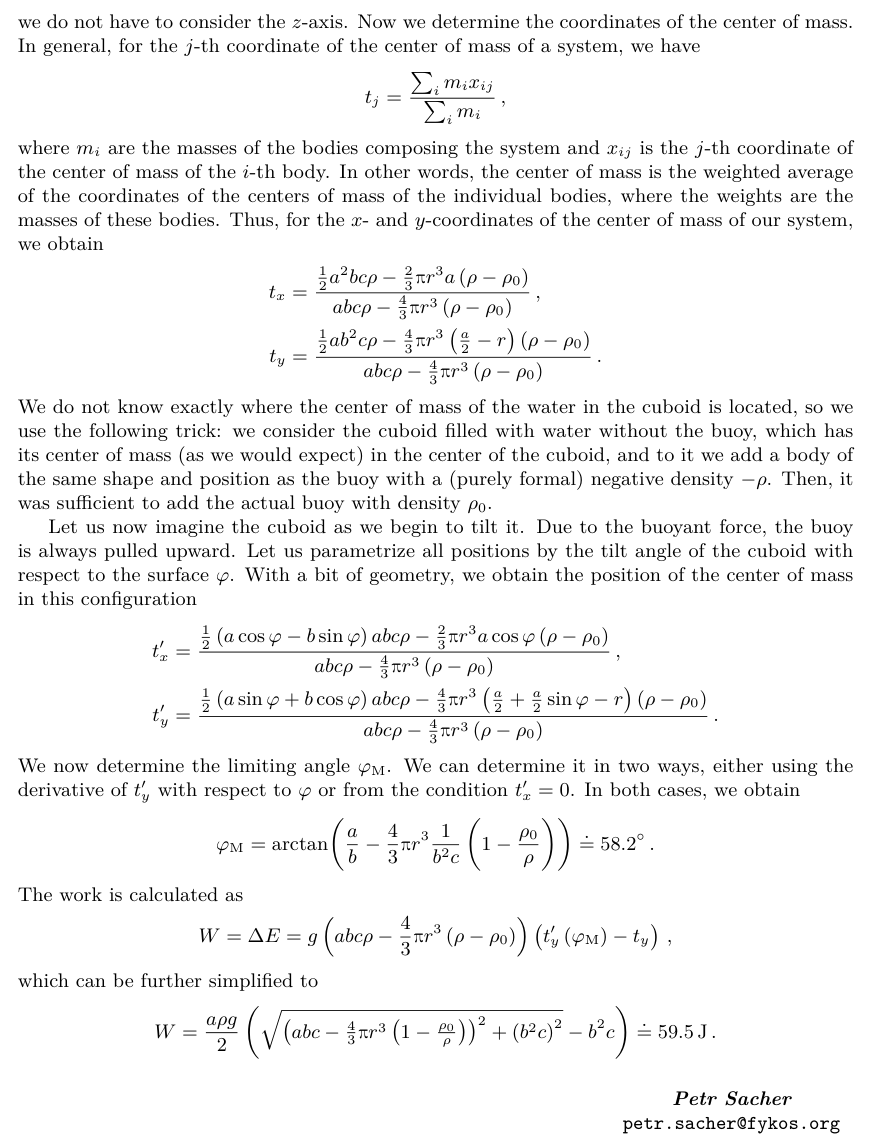
Official solution by FYKOS (Fyziklani 2026), reproduced from the official PDF — p. 56, 57 — under CC BY-SA 3.0.
Topic: Rigid Body Statics, Fluid Mechanics Metodi: Energy Conservation Method, Physical Modeling Competenze: Mathematical Modeling Objects: Container, Sphere, String Fonte: Testo (PDF) — p.56 · Soluzione ufficiale (PDF) — p.56
GD — Ribaltare un parallelepipedo
Considera un parallelepipedo rettangolo cavo con base di lati e e altezza . Le pareti hanno massa trascurabile, ma tutto il volume è riempito d’acqua e contiene una boa sferica di raggio , fatta di un materiale di densità . La boa è legata al centro della base del parallelepipedo con un filo di massa e volume trascurabili, di lunghezza . Quale lavoro occorre per ribaltare il parallelepipedo attorno allo spigolo ? Supponi che il ribaltamento avvenga molto lentamente.
Risposta: (angolo limite )
Soluzione: La soluzione ufficiale completa (in inglese) è nella versione originale di questo quesito e nel PDF ufficiale.
Topic: Rigid Body Statics, Fluid Mechanics Metodi: Energy Conservation Method, Physical Modeling Competenze: Mathematical Modeling Objects: Container, Sphere, String Fonte: Testo (PDF) — p.56 · Soluzione ufficiale (PDF) — p.56
GE — Networking
Consider a so-called multimode optical fiber in which an LED serves as the light source from which information propagates. The diode is located at the center of a tube with diameter and refractive index , and it emits light isotropically (equally in all directions). For simplicity, assume that the tube is surrounded by air and that the entire optical link has a length of . Calculate the mean value of the arrival times of light rays that were emitted at the same instant at the end of the cable. Consider only those light rays that reach the destination.
Risposta:
Soluzione:
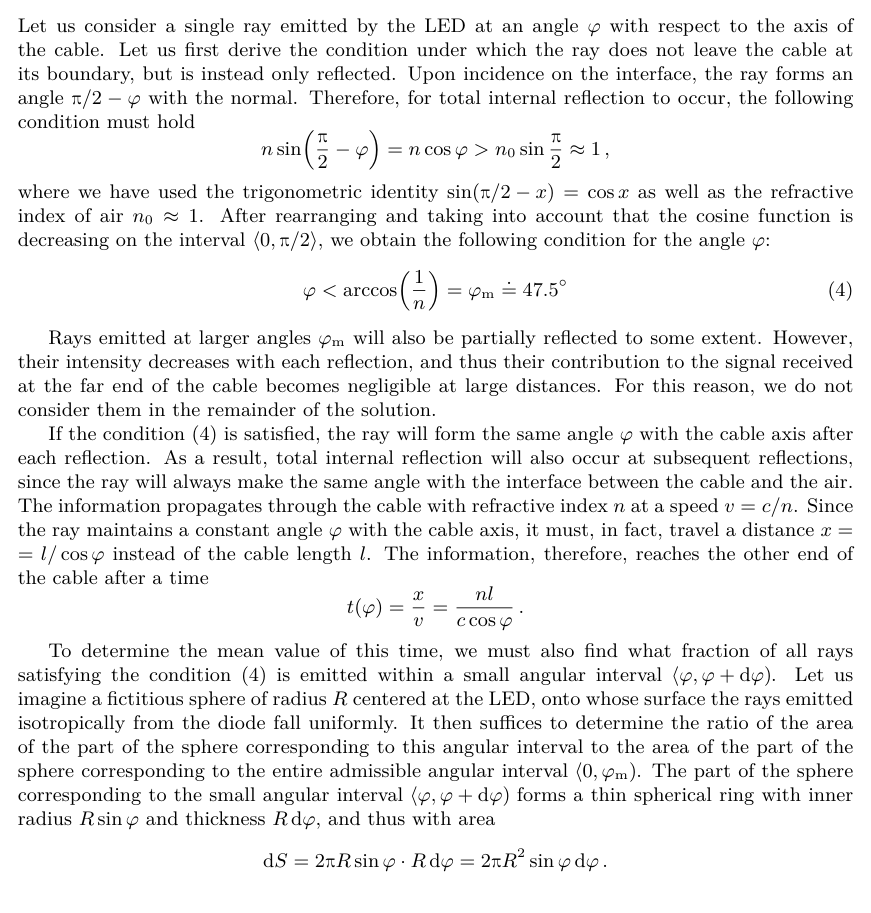
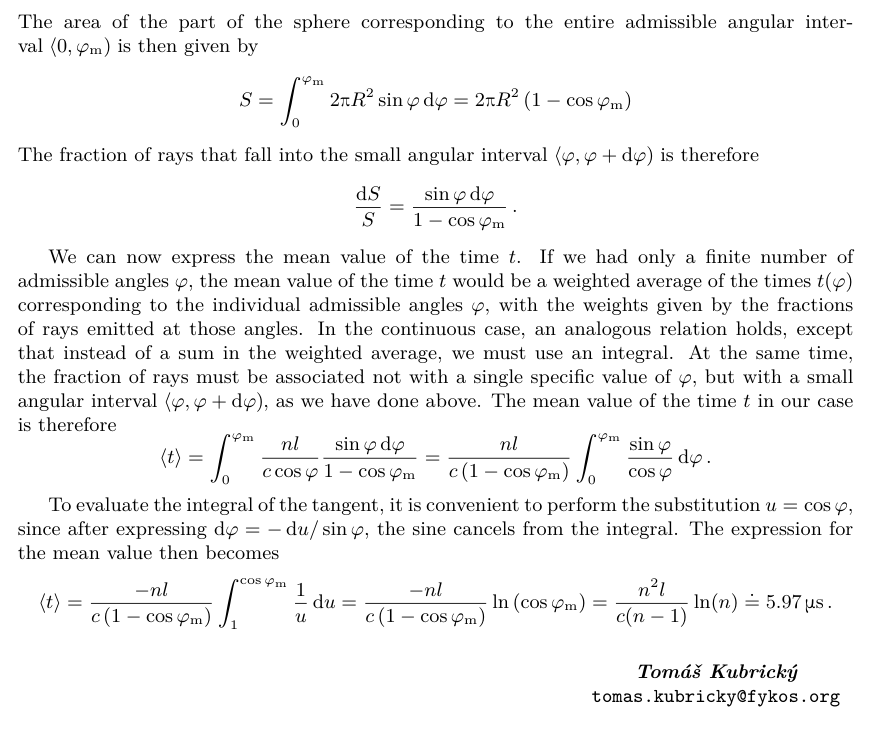
Official solution by FYKOS (Fyziklani 2026), reproduced from the official PDF — p. 58, 59 — under CC BY-SA 3.0.
Topic: Geometric Optics Metodi: Snell’s Law, Statistical Averaging, Calculus-Integration Competenze: Mathematical Modeling Objects: Tube, Photon Fonte: Testo (PDF) — p.58 · Soluzione ufficiale (PDF) — p.58
GE — Networking
Considera una cosiddetta fibra ottica multimodale in cui la sorgente di luce che trasporta l’informazione è un LED. Il diodo si trova al centro di un tubo di diametro e indice di rifrazione ed emette luce in modo isotropo (ugualmente in tutte le direzioni). Per semplicità supponi che il tubo sia circondato da aria e che l’intero collegamento ottico sia lungo . Calcola il valore medio dei tempi di arrivo, all’estremità del cavo, dei raggi di luce emessi nello stesso istante. Considera solo i raggi che arrivano a destinazione.
Risposta:
Soluzione: La soluzione ufficiale completa (in inglese) è nella versione originale di questo quesito e nel PDF ufficiale.
Topic: Geometric Optics Metodi: Snell’s Law, Statistical Averaging, Calculus-Integration Competenze: Mathematical Modeling Objects: Tube, Photon Fonte: Testo (PDF) — p.58 · Soluzione ufficiale (PDF) — p.58
GF — Indistinguishable gases
There is a mixture of two gases in a vacuum chamber at low pressure – nitrogen and carbon monoxide, with a portion of them being ionized. We can identify the gases in a mass spectrometer by the ratio of their charge to mass. However, the relative molecular mass of both gases is very similar, approximately , and our spectrometer does not have sufficient resolution to distinguish them. Some particles are ionized twice, which manifests as a signal at the position . The ratio of the cross section of double ionization to the cross section of single ionization is for CO, and for . The ratio of the cross section of the first ionization of to the first ionization of CO is then . We would like to determine the concentrations of both gases from the intensity of the detected signal at the given positions. The signal is measured as the amplified current of ions that strike the detector. We detected at the position with molecular mass 28, and at the position 14. Determine the ratio of the concentrations of carbon monoxide to nitrogen. Do not consider their mutual interactions.
Risposta:
Soluzione:
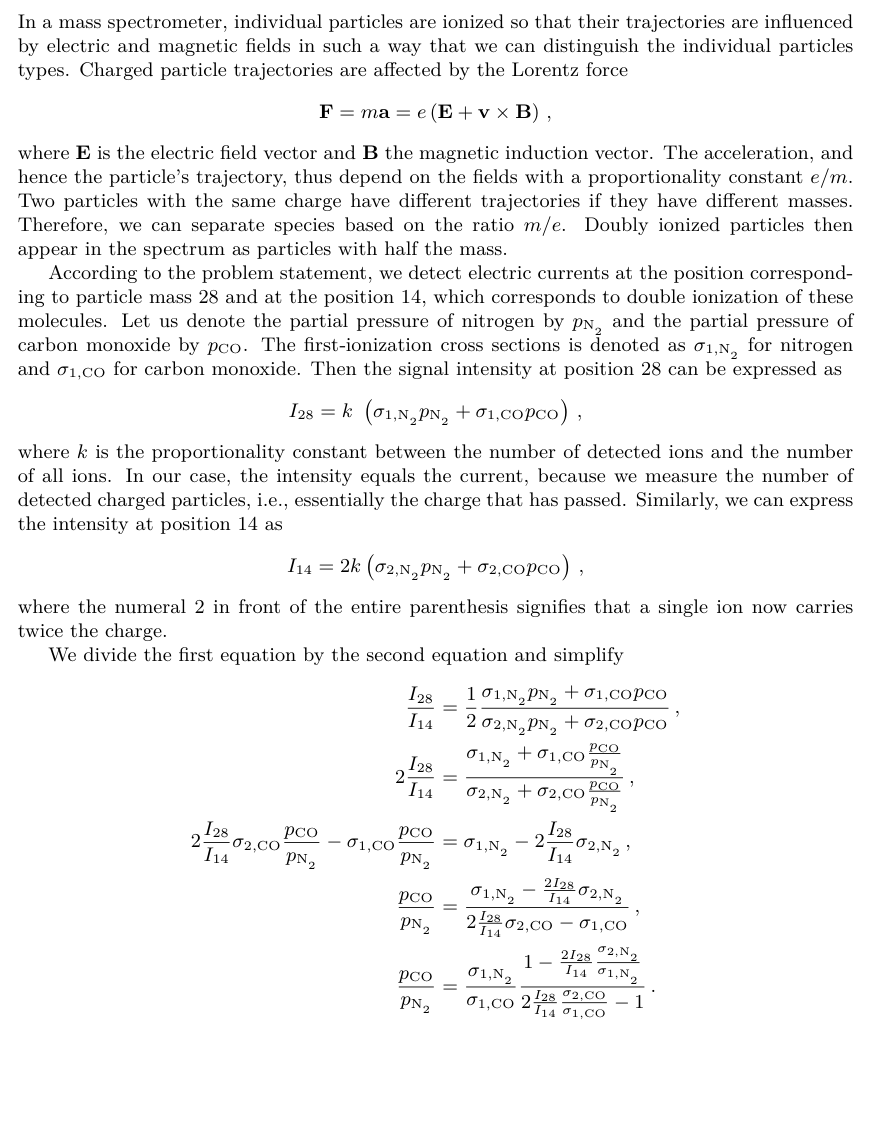
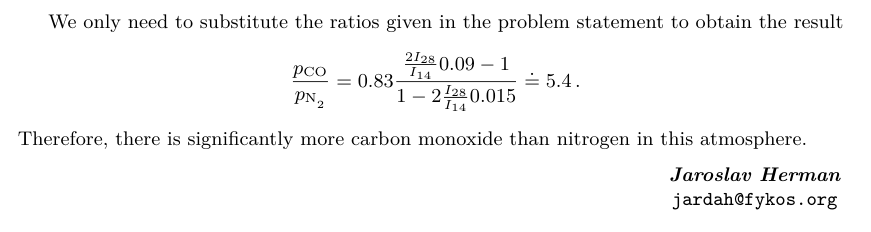
Official solution by FYKOS (Fyziklani 2026), reproduced from the official PDF — p. 60, 61 — under CC BY-SA 3.0.
Topic: Electromagnetism, Chemistry Metodi: Physical Modeling Competenze: Mathematical Modeling, Measurement & Instrumentation Objects: Gas, Particle Beam Fonte: Testo (PDF) — p.59 · Soluzione ufficiale (PDF) — p.60
GF — Gas indistinguibili
In una camera a vuoto, a bassa pressione, c’è una miscela di due gas, azoto e monossido di carbonio, in parte ionizzati. In uno spettrometro di massa i gas si identificano dal rapporto carica/massa. La massa molecolare relativa dei due gas è però molto simile, circa , e il nostro spettrometro non ha risoluzione sufficiente per distinguerli. Alcune particelle sono ionizzate due volte, e questo dà un segnale nella posizione . Il rapporto tra la sezione d’urto di doppia ionizzazione e quella di ionizzazione singola è per il CO e per l’. Il rapporto tra la sezione d’urto di prima ionizzazione dell’ e quella del CO è . Vogliamo ricavare le concentrazioni dei due gas dall’intensità del segnale rivelato nelle due posizioni. Il segnale si misura come corrente amplificata degli ioni che colpiscono il rivelatore. Abbiamo rivelato nella posizione di massa molecolare 28 e nella posizione 14. Determina il rapporto tra le concentrazioni di monossido di carbonio e di azoto. Non considerare le loro interazioni reciproche.
Risposta:
Soluzione: La soluzione ufficiale completa (in inglese) è nella versione originale di questo quesito e nel PDF ufficiale.
Topic: Electromagnetism, Chemistry Metodi: Physical Modeling Competenze: Mathematical Modeling, Measurement & Instrumentation Objects: Gas, Particle Beam Fonte: Testo (PDF) — p.59 · Soluzione ufficiale (PDF) — p.60
GG — Repulsive light
You have surely experienced walking out of a dimly lit building and suddenly being blinded by the Sun. Calculate the force exerted by the Sun on the Earth due to its radiation. Assume that the Earth’s surface is entirely composed of water, which means that a fraction of of all incident radiation is perfectly reflected from the surface, while the rest of it is absorbed.
Risposta: (independent of the albedo)
Soluzione:
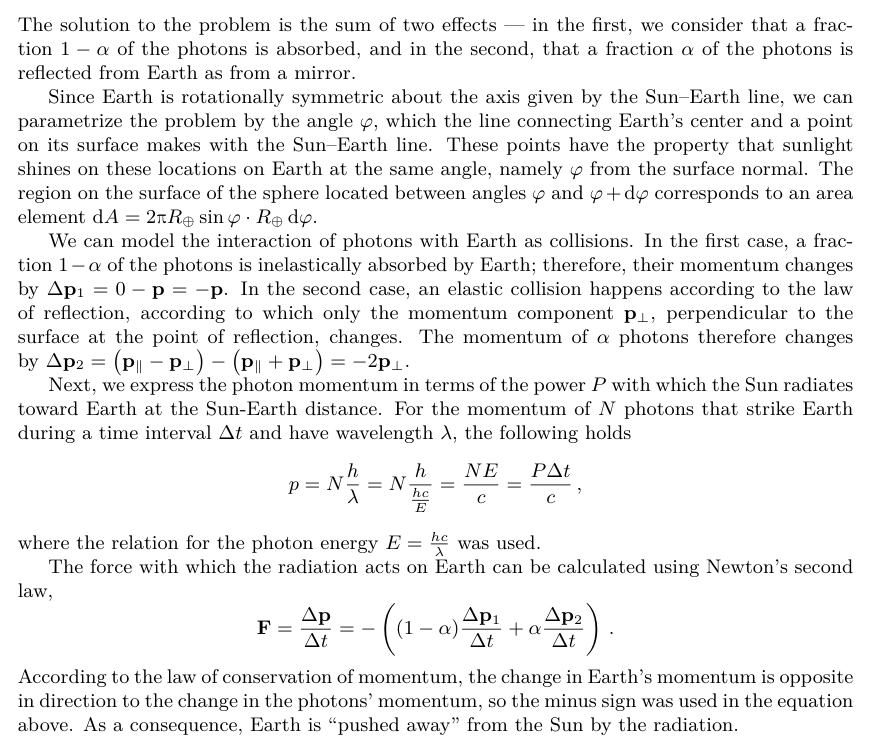
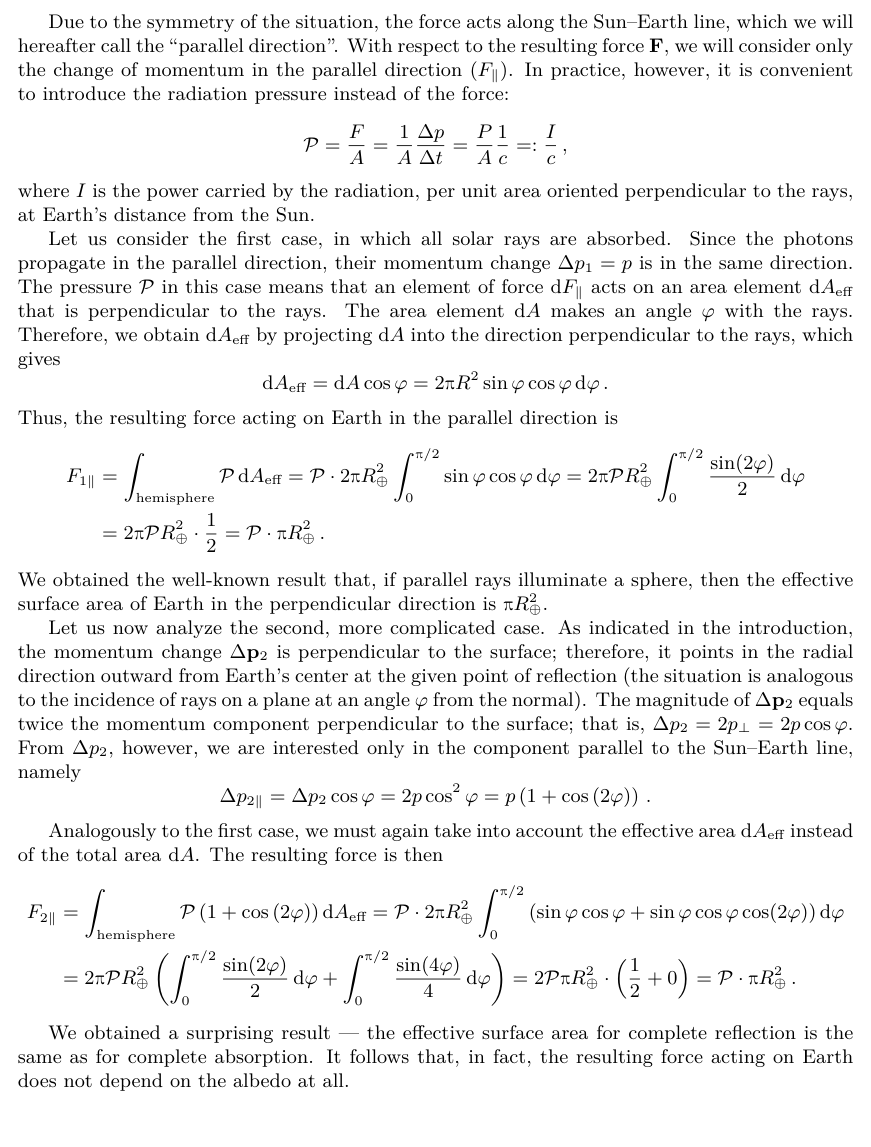
Official solution by FYKOS (Fyziklani 2026), reproduced from the official PDF — p. 61, 62, 63 — under CC BY-SA 3.0.
Topic: Astrophysics, Modern-Quantum Physics Metodi: Photon Energy Relation, Physical Modeling Competenze: Mathematical Modeling Objects: Planet, Star, Photon Fonte: Testo (PDF) — p.61 · Soluzione ufficiale (PDF) — p.61
GG — Luce repulsiva
Ti sarà certamente capitato di uscire da un edificio poco illuminato e di essere improvvisamente abbagliato dal Sole. Calcola la forza esercitata dal Sole sulla Terra a causa della sua radiazione. Supponi che la superficie terrestre sia interamente coperta d’acqua, per cui una frazione di tutta la radiazione incidente viene riflessa perfettamente dalla superficie, mentre il resto viene assorbito.
Risposta: (indipendente dall’albedo)
Soluzione: La soluzione ufficiale completa (in inglese) è nella versione originale di questo quesito e nel PDF ufficiale.
Topic: Astrophysics, Modern-Quantum Physics Metodi: Photon Energy Relation, Physical Modeling Competenze: Mathematical Modeling Objects: Planet, Star, Photon Fonte: Testo (PDF) — p.61 · Soluzione ufficiale (PDF) — p.61
GH — Charged ring
Kubo tried to create a trap for charged particles. For this purpose, he took a thin, uniformly electrically charged ring with radius and linear charge density . He then placed a charged particle with specific charge at its center. In the direction perpendicular to the plane of the ring, this was unfortunately only an unstable equilibrium position, so he slightly displaced the particle from the center only within the ring’s plane. Determine the period of the particle’s initial motion around the center of the ring.
Risposta:
Soluzione:
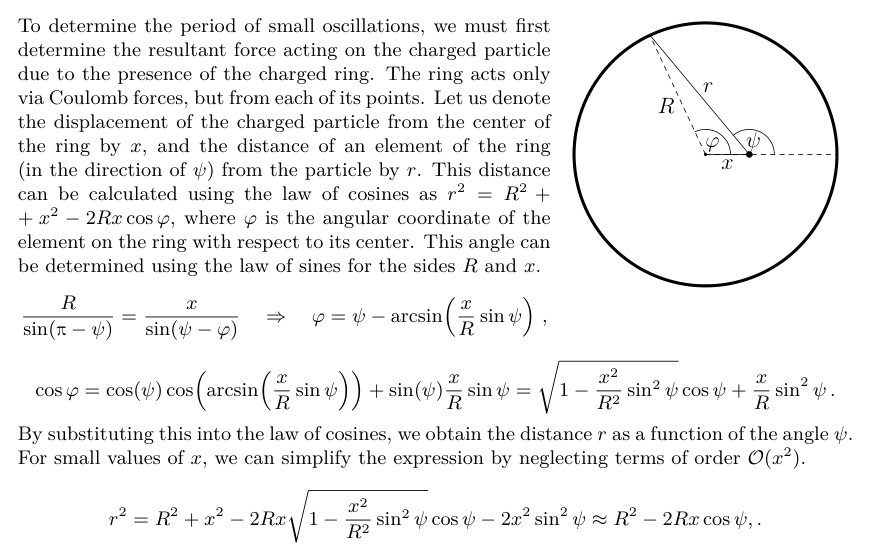
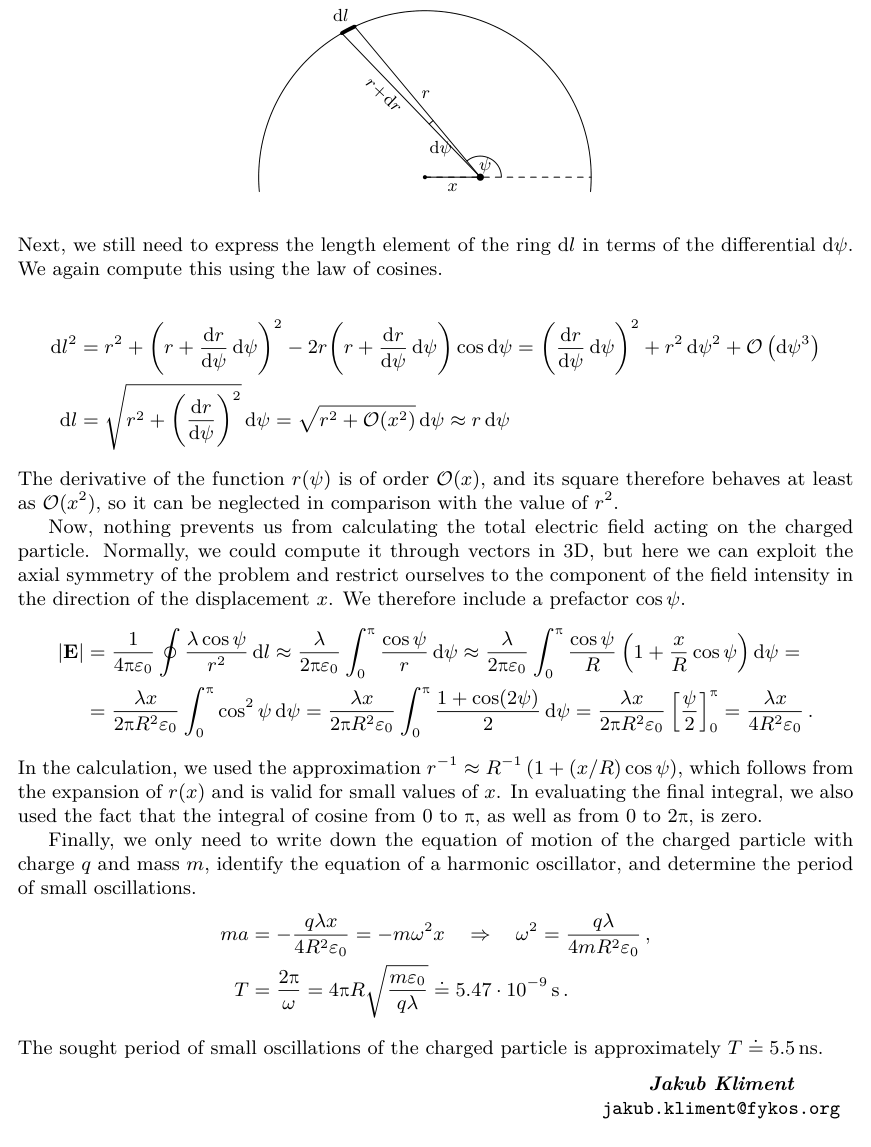
Official solution by FYKOS (Fyziklani 2026), reproduced from the official PDF — p. 63, 64 — under CC BY-SA 3.0.
Topic: Electrostatics, Oscillations & Waves Metodi: Superposition Principle, Approximation & Series Expansion, Simple Harmonic Motion Analysis Competenze: Mathematical Modeling Objects: Point Charge Fonte: Testo (PDF) — p.63 · Soluzione ufficiale (PDF) — p.63
GH — Anello carico
Kubo ha provato a costruire una trappola per particelle cariche. Ha preso un anello sottile, carico uniformemente, di raggio e densità lineare di carica , e ha posto al suo centro una particella carica con carica specifica . Nella direzione perpendicolare al piano dell’anello questa era purtroppo solo una posizione di equilibrio instabile, quindi ha spostato leggermente la particella dal centro solo nel piano dell’anello. Determina il periodo del moto iniziale della particella attorno al centro dell’anello.
Risposta:
Soluzione: La soluzione ufficiale completa (in inglese) è nella versione originale di questo quesito e nel PDF ufficiale.
Topic: Electrostatics, Oscillations & Waves Metodi: Superposition Principle, Approximation & Series Expansion, Simple Harmonic Motion Analysis Competenze: Mathematical Modeling Objects: Point Charge Fonte: Testo (PDF) — p.63 · Soluzione ufficiale (PDF) — p.63
HA — Friction on an inclined plane
We have a point mass on an inclined plane with a variable slope in a homogeneous gravitational field. The angle between the plane and the horizontal plane is slowly increased to a value , at which the point mass begins to move. Subsequently, the angle is continuously decreasing with an angular velocity in such a way that the axis of rotation of the plane passes through the point mass. What distance along the inclined plane does the point mass travel between its two stationary positions? The coefficient of static friction is and the coefficient of dynamic friction is .
Risposta:
Soluzione:
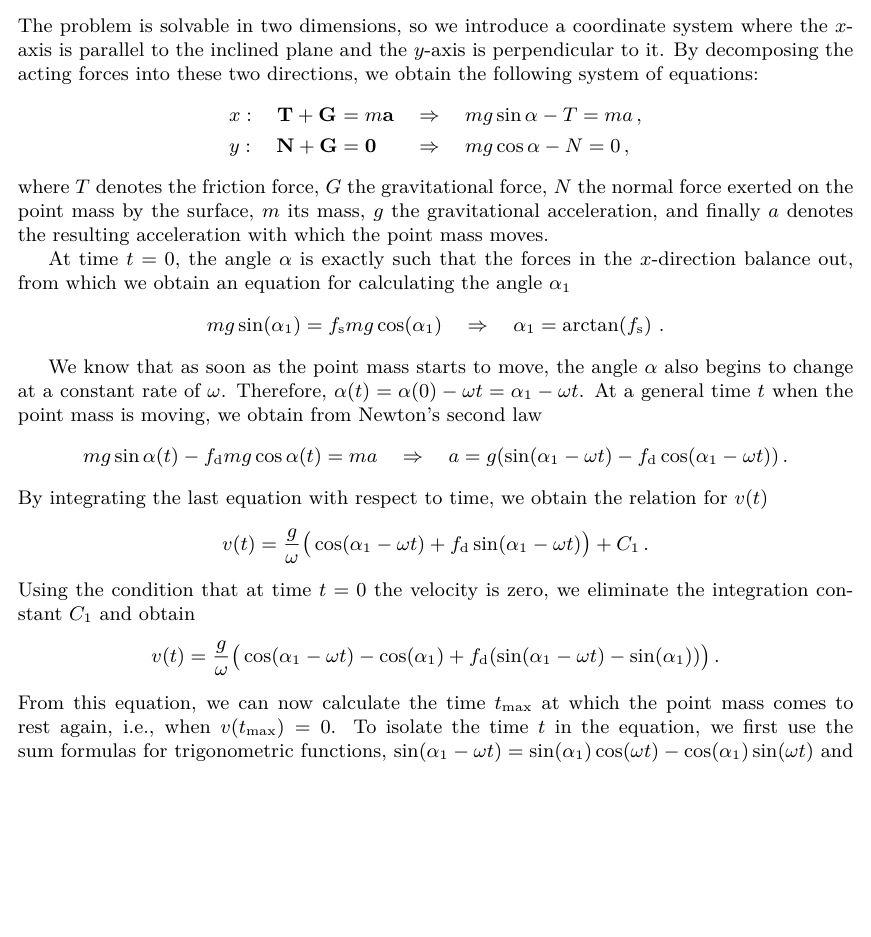
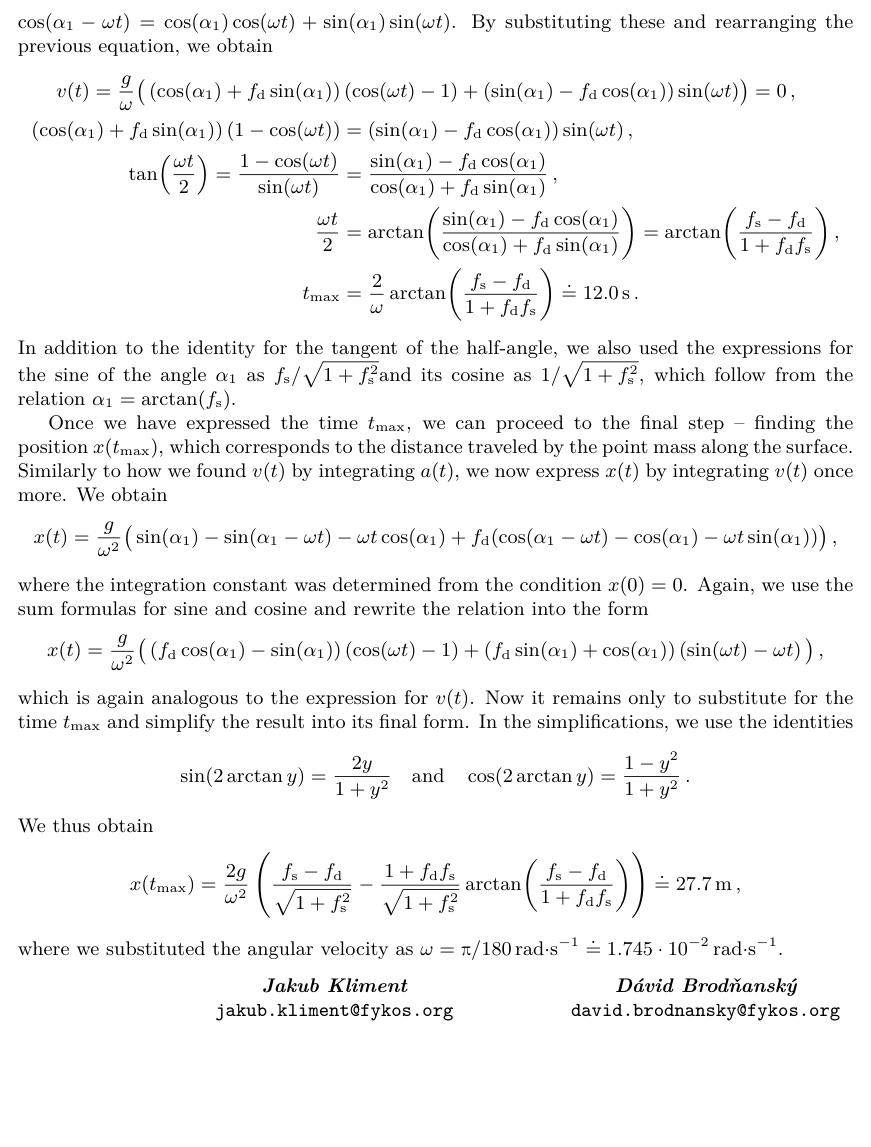
Official solution by FYKOS (Fyziklani 2026), reproduced from the official PDF — p. 65, 66 — under CC BY-SA 3.0.
Topic: Newtonian Mechanics Metodi: Differential Equations, Free-Body Diagram Competenze: Mathematical Modeling Objects: Inclined Plane Fonte: Testo (PDF) — p.65 · Soluzione ufficiale (PDF) — p.65
HA — Attrito su un piano inclinato
Abbiamo un punto materiale su un piano inclinato a pendenza variabile, in un campo gravitazionale uniforme. L’angolo tra il piano e l’orizzontale viene aumentato lentamente fino al valore , in corrispondenza del quale il punto materiale comincia a muoversi. In seguito l’angolo diminuisce con continuità con velocità angolare , in modo che l’asse di rotazione del piano passi per il punto materiale. Quale distanza lungo il piano inclinato percorre il punto materiale tra le sue due posizioni di quiete? Il coefficiente di attrito statico è e quello di attrito dinamico è .
Risposta:
Soluzione: La soluzione ufficiale completa (in inglese) è nella versione originale di questo quesito e nel PDF ufficiale.
Topic: Newtonian Mechanics Metodi: Differential Equations, Free-Body Diagram Competenze: Mathematical Modeling Objects: Inclined Plane Fonte: Testo (PDF) — p.65 · Soluzione ufficiale (PDF) — p.65
HB — Dramatic amplification
We place a conducting, uncharged sphere of radius into a homogeneous electric field with intensity . Determine the maximum magnitude of the electric field in the region.
Risposta: (at the surface, independent of )
Soluzione:
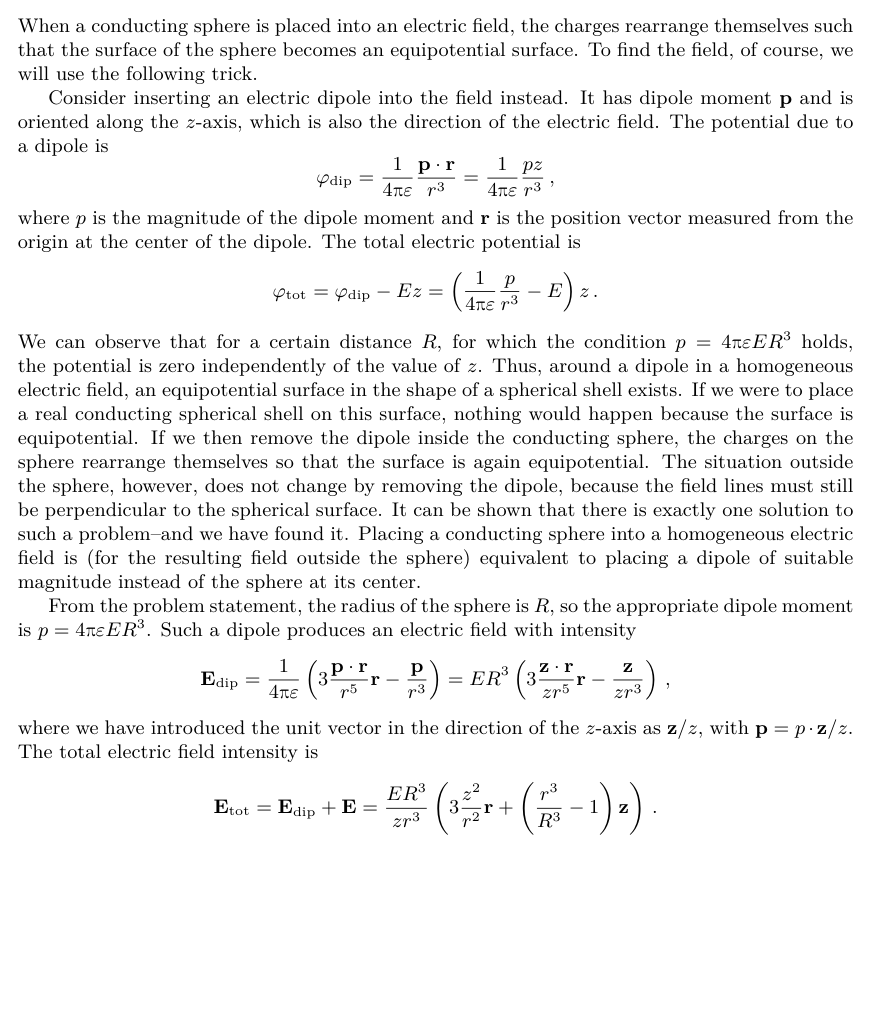
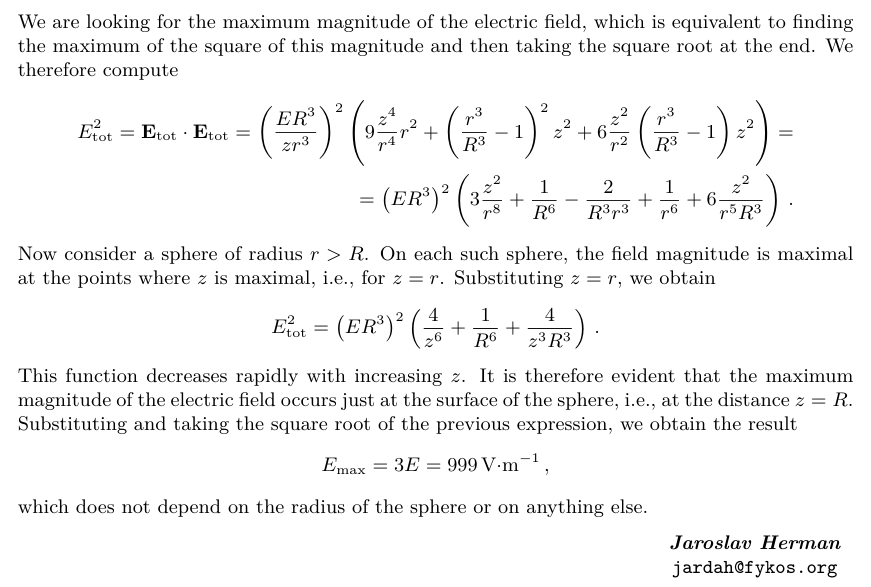
Official solution by FYKOS (Fyziklani 2026), reproduced from the official PDF — p. 67, 68 — under CC BY-SA 3.0.
Topic: Electrostatics Metodi: Electric Potential Method, Superposition Principle Competenze: Mathematical Modeling Objects: Conducting Sphere Fonte: Testo (PDF) — p.67 · Soluzione ufficiale (PDF) — p.67
HB — Amplificazione drammatica
Poniamo una sfera conduttrice scarica di raggio in un campo elettrico uniforme di intensità . Determina il modulo massimo del campo elettrico nella regione.
Risposta: (sulla superficie, indipendente da )
Soluzione: La soluzione ufficiale completa (in inglese) è nella versione originale di questo quesito e nel PDF ufficiale.
Topic: Electrostatics Metodi: Electric Potential Method, Superposition Principle Competenze: Mathematical Modeling Objects: Conducting Sphere Fonte: Testo (PDF) — p.67 · Soluzione ufficiale (PDF) — p.67
Answers taken from the official FYKOS solutions (Fyziklani 2026).
| Problem | Title | Risposta |
|---|---|---|
| 1 | AA — Summer drink | (the level does not change) |
| 2 | AB — Marek’s ride | |
| 3 | AC — Don’t judge a fish by its ability to run | (the rabbit finishes first) |
| 4 | AD — Angle averaging | |
| 5 | AE — Vive la révolution | |
| 6 | AF — Nacho dip | more |
| 7 | AG — Active power plant | |
| 8 | AH — Water in the air | |
| 9 | BA — Valentine’s fluorite | |
| 10 | BB — Overturned glass | |
| 11 | BC — Coin on water | |
| 12 | BD — Prone to procrastination | |
| 13 | BE — Schrödinger’s cat rescue mission | |
| 14 | BF — Sphere in a cylinder | (independent of ) |
| 15 | BG — A ball in hand | |
| 16 | BH — Nuts and bolts | |
| 17 | CA — As quick as snapping your fingers | |
| 18 | CB — How a wheel went wandering | |
| 19 | CC — Wien filter | |
| 20 | CD — Spinning sink | |
| 21 | CE — Titanic | |
| 22 | CF — Christmas tree | |
| 23 | CG — Table oscillation | |
| 24 | CH — Plato’s current | |
| 25 | DA — Warming rezistor | |
| 26 | DB — Triple collision | |
| 27 | DC — Watt’s magnetic governor | |
| 28 | DD — Overturned train | |
| 29 | DE — Where to with it? | |
| 30 | DF — Hellish | |
| 31 | DG — Bead on parabole | |
| 32 | DH — Crossing the road in front of a car | |
| 33 | EA — Kaon decay | , |
| 34 | EB — Three spheres | |
| 35 | EC — The shrunken Moon | , |
| 36 | ED — Anti-reflective coating | |
| 37 | EE — Physical pendulums with stiff coupling | |
| 38 | EF — Inside of a glowing sphere | (analogous to Gauss’s law) |
| 39 | EG — Got to be the best pirate I have ever seen | |
| 40 | EH — Grilled Roman, Sicilian-style | |
| 41 | FA — Starcraper | |
| 42 | FB — Oscillating massive pulley | |
| 43 | FC — Motocross derby | |
| 44 | FD — Conical cup | |
| 45 | FE — Fast-spinning kettle | |
| 46 | FF — Definitional | |
| 47 | FG — A new lamp | |
| 48 | FH — Ice bubble | |
| 49 | GA — Antigravitational | |
| 50 | GB — Opaque glass | (relative to a defect-free plate) |
| 51 | GC — Then measure it | |
| 52 | GD — Overturning a rectangular cuboid | (limiting angle ) |
| 53 | GE — Networking | |
| 54 | GF — Indistinguishable gases | |
| 55 | GG — Repulsive light | (independent of the albedo) |
| 56 | GH — Charged ring | |
| 57 | HA — Friction on an inclined plane | |
| 58 | HB — Dramatic amplification | (at the surface, independent of ) |
Fonte: Testo e soluzioni (PDF)
Risposte ricavate dalle soluzioni ufficiali FYKOS (Fyziklani 2026).
| Problema | Titolo | Risposta |
|---|---|---|
| 1 | AA — Bevanda estiva | (il livello non cambia) |
| 2 | AB — La corsa di Marek | |
| 3 | AC — Non giudicare un pesce dalla sua capacità di correre | (arriva prima il coniglio) |
| 4 | AD — Media di angoli | |
| 5 | AE — Vive la révolution | |
| 6 | AF — Salsa per nachos | in più |
| 7 | AG — Centrale attiva | |
| 8 | AH — Acqua nell’aria | |
| 9 | BA — La fluorite di San Valentino | |
| 10 | BB — Bicchiere rovesciato | |
| 11 | BC — Moneta sull’acqua | |
| 12 | BD — Incline alla procrastinazione | |
| 13 | BE — Missione di salvataggio del gatto di Schrödinger | |
| 14 | BF — Sfera in un cilindro | (indipendente da ) |
| 15 | BG — Un pallone in mano | |
| 16 | BH — Dadi e bulloni | |
| 17 | CA — In uno schiocco di dita | |
| 18 | CB — Come una ruota se ne andò a spasso | |
| 19 | CC — Filtro di Wien | |
| 20 | CD — Lavandino rotante | |
| 21 | CE — Titanic | |
| 22 | CF — Albero di Natale | |
| 23 | CG — Oscillazione del tavolo | |
| 24 | CH — La corrente di Platone | |
| 25 | DA — Resistore che si scalda | |
| 26 | DB — Urto triplo | |
| 27 | DC — Il regolatore magnetico di Watt | |
| 28 | DD — Treno ribaltato | |
| 29 | DE — Dove metterlo? | |
| 30 | DF — Infernale | |
| 31 | DG — Perlina sulla parabola | |
| 32 | DH — Attraversare la strada davanti a un’auto | |
| 33 | EA — Decadimento del kaone | , |
| 34 | EB — Tre sfere | |
| 35 | EC — La Luna rimpicciolita | , giorni |
| 36 | ED — Rivestimento antiriflesso | |
| 37 | EE — Pendoli fisici con accoppiamento rigido | |
| 38 | EF — Dentro una sfera incandescente | (analogia con il teorema di Gauss) |
| 39 | EG — Dev’essere il miglior pirata che abbia mai visto | |
| 40 | EH — Romano alla griglia, alla siciliana | |
| 41 | FA — Grattastelle | |
| 42 | FB — Carrucola massiccia oscillante | |
| 43 | FC — Derby di motocross | |
| 44 | FD — Bicchiere conico | |
| 45 | FE — Bollitore che gira veloce | |
| 46 | FF — Per definizione | |
| 47 | FG — Una lampada nuova | |
| 48 | FH — Bolla di ghiaccio | |
| 49 | GA — Antigravitazionale | |
| 50 | GB — Vetro opaco | (rispetto a una lastra senza difetto) |
| 51 | GC — E poi misuralo | |
| 52 | GD — Ribaltare un parallelepipedo | (angolo limite ) |
| 53 | GE — Networking | |
| 54 | GF — Gas indistinguibili | |
| 55 | GG — Luce repulsiva | (indipendente dall’albedo) |
| 56 | GH — Anello carico | |
| 57 | HA — Attrito su un piano inclinato | |
| 58 | HB — Amplificazione drammatica | (sulla superficie, indipendente da ) |
Fonte: Testo e soluzioni (PDF)