Main sequence stars (11 points)
In all your subsequent calculations you may use the following physical constants and their numerical values.
- Stefan-Boltzmann constant (Note that gives the black body thermal radiation power per unit area at temperature .)
- Boltzmann constant .
- The rest mass of a proton .
- Rest energy of a proton , where .
- Rest energy of a helium nucleus .
- Rest energy of an electron and positron .
- Speed of light .
- Universal gas constant .
- Avogadro’s number .
Part A. Lifetime of Sun (3 points)
For this Part, the following values can be also used.
- The mass of Sun .
- The radius of Sun .
- Surface temperature of Sun .
i. (0.7 pts) The Sun emits thermal radiation as a perfectly black body. Determine the total radiation power of the Sun (in watts).
ii. (0.5 pts) The Sun maintains its temperature owing to the fusion reaction, the net effect of which can be written as , where denotes a proton, — a helium nucleus, — a positron, and — an electron neutrino of negligible rest energy. Show that the energy released by such a fusion of four protons is .
iii. (0.5 pts) Antimatter cannot co-exist with matter: upon meeting, a positron and an electron disappear by producing two photons. How much energy per each fusion of four protons into a helium nucleus must leave Sun (carried away by photons and neutrinos) in order to keep it at a thermal equilibrium?
iv. (1.3 pts) Assuming that only the central part of the Sun (the Sun’s nucleus) which makes of the total mass of the Sun is hot enough for fusion reaction to take place, and neglecting the energy carried away by neutrinos, estimate the total lifetime of the Sun. Note that there is no convection in the central parts of the Sun, and therefore the particles inside the Sun’s nucleus remain trapped therein. Based on your result, comment on the current age of Sun, .
Part B. Mass-luminosity relationship of stars (4.5 points)
Inside the nuclei of the so-called main sequence stars (such as our Sun), the fusion reaction takes place in a stable regime: if fluctuations were to increase the reaction rate slightly, the increased thermal output would lead to an increase of the pressure inside the core; this would lead to a thermal expansion of the fusion plasma, and as a result, to a decrease of the reaction rate. The reaction rate grows very rapidly with the temperature; this means that even if the reaction rates in different stars of different masses may differ considerably, the interior temperatures remain fairly similar. So, we may assume that the interior temperature is independent of the stellar mass and equal to this approximation holds particularly well for stars larger than Sun.
In order to make our next calculations mathematically easier, we make the following additional approximations.
(a) The mass of the stellar core is and its radius is , where is the total mass of the star and — the radius of the star.
(b) The mass density , pressure , and temperature inside the stellar core can be approximately taken to be constant throughout its volume.
(c) For tasks i–iv, we assume also that all the mass of the outer layers of the star is concentrated into a very narrow spherical layer of radius around the core, see figure. In reality, this is certainly not true — the layer is not narrow. However, this approximation will have only a minor effect on our final expression for the pressure (in task iv).
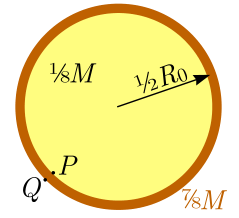
i. (0.4 pts) Express the free fall acceleration immediately above the narrow spherical layer (point in figure) in terms of and .
ii. (0.4 pts) Express the free fall acceleration immediately beneath the narrow spherical layer (point in figure).
iii. (0.4 pts) Express the gravity force acting on a small piece of the narrow spherical layer in terms of its surface area , and .
iv. (0.4 pts) Express the pressure in terms of the radius and mass of the star; (we overestimate it only by a factor which is less than two).
v. (1 pt) Derive another expression for the pressure , this time in terms of , , and the core temperature . Assume that the nucleus of a star consists of a fully ionised hydrogen, i.e. there are free protons and free electrons, both of which can be described as an ideal gas.
vi. (1.5 pts) Based on your previous results, express the radius of a star in terms of its mass and temperature .
vii. (1.5 pts) The radiative power of a star is limited by at which rate the produced heat can travel through the outer layers of the star and reach the surface. The heat conductivity is defined as the proportionality coefficient between the heat flux density (i.e. heat flowing per unit area and per unit time) and temperature gradient: , where is the distance from the centre of the star. For a plasma, the heat conductivity is inversely proportional to its density, . Assume simplifyingly that is constant throughout the bulk of a star, up to the near-surface regions where where the temperature , and is equal to . Show that the total radiative power of a star is proportional to , and find the exponent .
Part C. Proton-proton fusion chain (3.5 points)
We say that a constant is fundamental if it cannot be expressed in terms of other fundamental constants; for instance, the Stefan-Boltzmann constant can be expressed in terms of , speed of light , and Planck’s constant . However, majority of the fundamental constants are created artificially by physicists due to a non-fundamental way of choosing the units. For instance, SI system of units needs electrostatic constant , but for Gauss system of units, charge units are such that . So, majority of the “fundamental” constants are not really that fundamental, and depend on our (essentially arbitrary) choice of units. However, there are also dimensionless combinations of physical constants, which can be considered as the parameters of our Universe with a slightly different value (we shall not consider here the parameters of the Standard Model: the way in which matter and fields evolve).
i. (1.5 pts) Find a dimensionless combination and calculate its value using the following subset of fundamental constants (it may happen that only few constants will enter the expression for ):
- ,
- ,
- ,
- ,
- ,
- ,
- .
Note that any power of is also dimensionless; you are asked to find the simplest combination of constants which yields . Hint: before applying dimensional analysis, all units need to be expressed using the base units (m, s, A, K, kg, mol).
ii. (1 pt) The first and limiting step in the fusion of four protons into a helium atom inside a star of sub-solar mass is the fusion of two protons, This process is obstructed, however, by a coulomb repulsion of two protons. You may assume that until the distance between the centres of two protons remains larger than the proton radius , there is only a Coulomb force; at distances smaller than , an attractive strong force steps into play and dominates over the Coulomb force. Estimate the temperature required for the fusion of two protons if there were no quantum-mechanical effects. Compare this result with the value of .
iii. (1 pt) What enables the fusion of stellar hydrogen is the quantum-mechanical tunnel effect. With this task, you’ll learn that the fusion reaction rate depends on the dimensionless parameter , thus we can say that the parameter defines the production rate of heavier nuclei in our Universe. (It appears that in a slightly different Universe with a slightly different value of , no carbon nuclei necessary for the existence of life would have been produced1.)
It appears that a particle can tunnel through an energy barrier (a region in space where the potential energy is larger than the total energy ) with probability where the integral is to be taken over the range at which . Express the tunnelling probability for the proton-proton fusion for head-on collision of two centre-moving protons of speed in terms of , and . You may assume that the proton “dives into the tunnel” , and make use of the equality .
Fonte: Testo (PDF) — p.1
Topic: Astrophysics, Nuclear & Particle Physics Metodi: Hydrostatic Equilibrium, Mass-Energy Equivalence, Ideal Gas Law, Dimensional Analysis Competenze: Mathematical Modeling, Estimation & Approximation, Physical Reasoning Objects: Star, Nucleus, Electron
**Main sequence stars (11 points) **
In tutti i successivi calcoli, potete utilizzare le seguenti costanti fisiche e i loro valori numerici.
- Stefan-Boltzmann costante (nota che dà la potenza di radiazione termica del corpo nero per unità di area a temperatura .)
- Boltzmann constant .
- The rest mass of a proton .
- Rest energy of a proton , where .
- Rest energy of a helium nucleus .
- Rest energy of an electron and positron .
- velocità di luce .
- Costante universale del gas .
- Avogadro’s number .
Parte A. La durata del sole (3 punti)
Per questa parte, si possono utilizzare anche i seguenti valori.
- The mass of Sun .
- The radius of Sun .
- temperatura di superficie del sole .
i. (0.7 pts) The Sun emits thermal radiation as a perfectly black body. Determina la potenza radiativa totale del sole (in watt).
**ii. (0.5 pts) ** Il Sole mantiene la sua temperatura a causa della reazione di fusione, il netto effetto del quale può essere scritto come , dove denota un protone, un nucleo di elio, un positron, e un neutrone di elettrone di energia di riposo negligible. Mostra che l’energia rilasciata da una fusione di quattro protoni è .
iii. (0.5 pts) Antimatter cannot co-exist with matter: upon meeting, a positron and an electron disappear by producing two photons. Quanto energia per ogni fusione di quattro protoni in un nucleo di elio deve lasciare il Sole (portato via da fotoni e neutrini) per mantenerlo in equilibrio termico?
**iv. (1.3 pts) ** Supponendo che solo la parte centrale del Sole (nucleo del Sole) che fa della massa totale del Sole sia abbastanza calda per che si verifichi la reazione di fusione, e trascurando l’energia trasportata dai neutrini, stimare la vita totale del Sole. Si noti che non c’è convezione nelle parti centrali del Sole, e quindi le particelle all’interno del nucleo del Sole rimangono intrappolate in essa. Based on your result, comment on the current age of Sun, .
Parte B. Relazione di massa luminosità delle stelle (4.5 punti)
All’interno dei nuclei delle cosiddette stelle di sequenza principale (come il nostro Sole), la reazione di fusione avviene in un regime stabile: se le fluttuazioni aumentassero leggermente il tasso di reazione, l’aumento della produzione termica porterebbe ad un aumento della pressione all’interno del nucleo; questo porterebbe ad un’espansione termica del plasma di fusione, e di conseguenza, a una diminuzione del tasso di reazione. Il tasso di reazione aumenta molto rapidamente con la temperatura; questo significa che anche se i tassi di reazione in diverse stelle di masse diverse possono differire considerevolmente, le temperature interne rimangono abbastanza simili. Quindi, possiamo supporre che la temperatura interiore sia indipendente dalla massa stellare ed è uguale a Questo approccio vale particolarmente bene per le stelle più grandi del Sole.
Per rendere i nostri calcoli più semplici matematicamente, facciamo le seguenti approssimazioni aggiuntive.
(a) La massa del nucleo stellare è e il suo raggio è , dove è la massa totale della stella e il raggio della stella.
(b) La densità di massa , la pressione e la temperatura all’interno del nucleo stellare ** possono essere approssimativamente prese per essere costanti attraverso il suo volume**.
(c) Per i task iiv, supponiamo anche che tutta la massa dei strati esterni della stella sia concentrata in un strato sferico molto stretto di raggio intorno al nucleo, vedi figura. In realtà, questo non è certo vero. Tuttavia, questo approximation avrà solo un effetto minore sulla nostra espressione finale per la pressione (in task iv).
**i. (0,4 pts) ** Esprimere l’accelerazione di caduta libera immediatamente sopra il strato sferico stretto (point in figura) in termini di e .
**ii. (0.4 pts) ** Express the free fall acceleration immediately below the narrow spherical layer (point in figure).
**iii. (0.4 pts) ** Esprimere la forza di gravità che agisce su un piccolo pezzo del strato sferico stretto in termini di superficie , e .
**iv. (0.4 pts) ** Esprimere la pressione in termini del raggio e della massa della stella; (offermentiamo solo da un fattore che è inferiore a due).
**v. (1 pt) ** Derivare un’altra espressione per la pressione , questa volta in termini di , , e la temperatura core . Supponiamo che il nucleo di una stella sia costituito da un idrogeno completamente ionizzato, cioè there are free protons and free electrons, both of which can be described as an ideal gas.
**vi. (1.5 pts) ** Basato sui risultati precedenti, esprimere il raggio di una stella in termini di massa e temperatura .
vii. (1.5 pts) The radiative power of a star is limited by at which rate the produced heat can travel through the outer layers of the star and reach the surface. La conductività è definita come il coefficiente di proporzionalità tra la densità del flusso di calore (cioè: heat flowing per unit area and per unit time) and temperature gradient: , where is the distance from the centre of the star. Per un plasma, la conductività del calore è inversamente proporzionale alla densità, . Supponi semplicemente che sia costante nel gran numero di stelle, fino alle regioni vicino alla superficie dove e la temperatura è uguale a . Show that the total radiative power of a star is proportional to , and find the exponent .
Parte C. Catenia di fusione protone-protone (3,5 punti)
Diciamo che una costante è fondamentale se non può essere espressa in termini di altre costanti fondamentali; per esempio, la costante di Stefan-Boltzmann può essere espressa in termini di , velocità di luce , e costante di Planck . Tuttavia, la maggior parte delle costanti fondamentali sono create artificialmente dai fisici a causa di un modo non fondamentale di scegliere le unità. Per esempio, SI sistema di unità ha bisogno di costante elettrostatico , ma per Gauss sistema di unità, unità di carica sono tali che . Quindi, la maggior parte delle costanti “fundamentali” non sono davvero così fondamentali, e dipendono dalla nostra scelta (essenzalmente arbitraria) di unità. Tuttavia, ci sono anche combinazioni dimensionless di costanti fisiche, che possono essere considerati come i parametri del nostro universo con un valore leggermente diverso (non consideriamo qui i parametri del modello standard: il modo in cui materia e campi evolvono).
**i. (1.5 pts) ** Trova una combinazione dimensionless e calcola il suo valore utilizzando il seguente sottoinsieme di costanti fondamentali (potrebbe accadere che solo poche costanti entrino nell’espressione per ):
- ,
- ,
- ,
- ,
- ,
- ,
- .
Nota che qualsiasi potenza di è anche dimensionless; ti viene chiesto di trovare la più semplice combinazione di costanti che produce . Tip: prima di applicare analisi dimensionale, tutte le unità devono essere espresse utilizzando le unità base (m, s, A, K, kg, mol).
ii. (1 pt) The first and limiting step in the fusion of four protons into a helium atom inside a star of sub-solar mass is the fusion of two protons, Questo processo è ostacolato, tuttavia, da una repulsione di coulomb di due protoni. You may assume that until the distance between the centres of two protons remains larger than the proton radius , there is only a Coulomb force; at distances smaller than , an attractive strong force steps into play and dominates over the Coulomb force. Estimate the temperature required for the fusion of two protons if there were no quantum-mechanical effects. Compare this result with the value of .
iii. (1 pt) What enables the fusion of stellar hydrogen is the quantum-mechanical tunnel effect. With this task, you’ll learn that the fusion reaction rate depends on the dimensionless parameter , thus we can say that the parameter defines the production rate of heavier nuclei in our Universe. (Sembra che in un universo leggermente diverso con un valore leggermente diverso di , non sarebbero stati prodotti nuclei di carbonio necessari all’esistenza della vita1.)
Sembra che una particella possa tunnelare attraverso una barriera energetica (una regione nello spazio dove la potenziale energia è maggiore del totale energia ) con probabilità dove l’integrale deve essere preso sopra la gamma a cui . Esprimere la probabilità di tunnelamento per la fusione protone-protone per collisione testa-sopra di due protoni in movimento a centro di velocità in termini di , e . You may assume that the proton “dives into the tunnel” , and make use of the equality .
Fonte: Testo (PDF) — p.1
Topic: Astrophysics, Nuclear & Particle Physics Metodi: Hydrostatic Equilibrium, Mass-Energy Equivalence, Ideal Gas Law, Dimensional Analysis Competenze: Mathematical Modeling, Estimation & Approximation, Physical Reasoning Objects: Star, Nucleus, Electron
Main sequence stars (11 points)
In all your subsequent calculations you may use the following physical constants and their numerical values.
- Stefan-Boltzmann constant (note that gives the black body thermal radiation power per unit area at temperature .)
- Boltzmann constant is .
- The rest mass of a proton .
- Rest energy of a proton , where .
- Rest energy of a helium nucleus .
- Rest energy of an electron and positron .
- Speed of light .
- Universal gas constant
- Avogadro’s number .
Part A. Lifetime of Sun (3 points)
For this part, the following values can also be used.
- The mass of Sun .
- The radius of Sun .
- Surface temperature of the Sun .
i. (0.7 pts) The Sun emits thermal radiation as a perfectly black body. Determine the total radiation power of the Sun (in watts).
**ii. (0.5 pts) ** The Sun maintains its temperature owing to the fusion reaction, the net effect of which can be written as , where denotes a proton, a helium nucleus, a positron, and an electron neutrino of negligible rest energy. Show that the energy released by such a fusion of four protons is .
iii. (0.5 pts) Antimatter cannot co-exist with matter: upon meeting, a positron and an electron disappear by producing two photons. How much energy per each fusion of four protons into a helium nucleus must leave the Sun (carried away by photons and neutrinos) in order to keep it at a thermal equilibrium?
iv. (1.3 pts) Assuming that only the central part of the Sun (the Sun’s nucleus) which makes of the total mass of the Sun is hot enough for fusion reaction to take place, and neglecting the energy carried away by neutrinos, estimate the total lifetime of the Sun. Note that there is no convection in the central parts of the Sun, and therefore the particles inside the Sun’s nucleus remain trapped there. Based on your result, comment on the current age of Sun, .
Part B. The mass-luminosity relationship of stars (4.5 points)
Inside the nuclei of the so-called main sequence stars (such as our Sun), the fusion reaction takes place in a stable regime: if fluctuations were to increase the reaction rate slightly, the increased thermal output would lead to an increase in the pressure inside the core; this would lead to a thermal expansion of the fusion plasma, and as a result, to a decrease in the reaction rate. The reaction rate grows very rapidly with temperature; this means that even if the reaction rates in different stars of different masses may differ considerably, the interior temperatures remain fairly similar. So, we can assume that the interior temperature is independent of the stellar mass and equal to This approximation holds particularly well for stars larger than the Sun.
In order to make our next calculations mathematically easier, we make the following additional approximations.
(a) The mass of the stellar core is and its radius is , where is the total mass of the star and the radius of the star.
(b) The mass density , pressure , and temperature inside the stellar core ** can be approximately taken to be constant throughout its volume**.
(c) For tasks iiv, we also assume that all the mass of the outer layers of the star is concentrated into a very narrow spherical layer of radius around the core, see figure. In reality, this is certainly not true the layer is not narrow. However, this approximation will have only a minor effect on our final expression for the pressure (in task iv).
i. (0.4 pts) Express the free fall acceleration immediately above the narrow spherical layer (point in figure) in terms of and .
**ii. (0.4 pts) ** Express the free fall acceleration immediately below the narrow spherical layer (point in figure).
**iii. (0.4 pts) ** Express the gravity force acting on a small piece of the narrow spherical layer in terms of its surface area , and .
**iv. (0.4 pts) ** Express the pressure in terms of the radius and mass of the star; (we overestimate it only by a factor which is less than two).
**v. (1 pt) ** Derive another expression for the pressure , this time in terms of , , and the core temperature . Assume that the nucleus of a star consists of a fully ionised hydrogen, i.e. there are free protons and free electrons, both of which can be described as an ideal gas.
**vi. (1.5 pts) ** Based on your previous results, express the radius of a star in terms of its mass and temperature .
vii. (1.5 pts) The radiative power of a star is limited by at which rate the produced heat can travel through the outer layers of the star and reach the surface. The heat conductivity is defined as the proportionality coefficient between the heat flux density (i.e. heat flowing per unit area and per unit time) and temperature gradient: , where is the distance from the centre of the star. For a plasma, the heat conductivity is inversely proportional to its density, . Assume simplifyingly that is constant throughout the bulk of a star, up to the near-surface regions where where the temperature , and is equal to . Show that the total radiative power of a star is proportional to , and find the exponent .
Part C. The total value of the assets of the Union industry is EUR 725 million.
We say that a constant is fundamental if it cannot be expressed in terms of other fundamental constants; for example, the Stefan-Boltzmann constant can be expressed in terms of , speed of light , and Planck’s constant . However, most of the fundamental constants are created artificially by physicists due to a non-fundamental way of choosing the units. For example, SI system of units needs electrostatic constant , but for Gauss system of units, charge units are such that . So, most of the “fundamental” constants aren’t really that fundamental, and depend on our (essentially arbitrary) choice of units. However, there are also dimensionless combinations of physical constants, which can be considered as the parameters of our universe with a slightly different value (we will not consider here the parameters of the Standard Model: the way in which matter and fields evolve).
i. (1.5 pts) Find a dimensionless combination and calculate its value using the following subset of fundamental constants (it may happen that only few constants will enter the expression for ):
- ,
- ,
- ,
- ,
- ,
- ,
- .
Note that any power of is also dimensionless; you are asked to find the simplest combination of constants which yields . Hint: before applying dimensional analysis, all units need to be expressed using the base units (m, s, A, K, kg, mol).
ii. (1 pt) The first and limiting step in the fusion of four protons into a helium atom inside a star of sub-solar mass is the fusion of two protons, This process is obstructed, however, by a coulomb repulsion of two protons. You may assume that until the distance between the centres of two protons remains larger than the proton radius , there is only a Coulomb force; at distances smaller than , an attractive strong force steps into play and dominates over the Coulomb force. Estimate the temperature required for the fusion of two protons if there were no quantum-mechanical effects. Compare this result with the value of .
iii. (1 pt) What enables the fusion of stellar hydrogen is the quantum-mechanical tunnel effect. With this task, you’ll learn that the fusion reaction rate depends on the dimensionless parameter , thus we can say that the parameter defines the production rate of heavier nuclei in our Universe. (It appears that in a slightly different universe with a slightly different value of , no carbon nuclei necessary for the existence of life would have been produced1.)
It appears that a particle can tunnel through an energy barrier (a region in space where the potential energy is greater than the total energy ) with probability where the integral is to be taken over the range at which . Express the tunnelling probability for the proton-proton fusion for head-on collision of two centre-moving protons of speed in terms of , and . You may assume that the proton “dives into the tunnel” , and make use of the equality .
Fonte: Testo (PDF) — p.1
Topic: Astrophysics, Nuclear & Particle Physics Metodi: Hydrostatic Equilibrium, Mass-Energy Equivalence, Ideal Gas Law, Dimensional Analysis Competenze: Mathematical Modeling, Estimation & Approximation, Physical Reasoning Objects: Star, Nucleus, Electron
Water tube (8 points)
Consider a tube which is obtained when two metallic cylinders are welded together as shown in the figure. Upper cylinder has internal cross-sectional area , and the lower one — . Two pistons are connected with a narrow (rigid but light) steel bar of length ; the distance from the lower piston to the welding area is . The space between the pistons is filled with water of density and temperature . The mass of each of the pistons (neglect the mass of the rod connecting them) free fall acceleration and the atmospheric pressure . The tube stands vertically on a solid horizontal surface; the pistons can move freely up and down, friction force can be neglected. The distance between the bottom of the lower piston and the horizontal surface is more than .
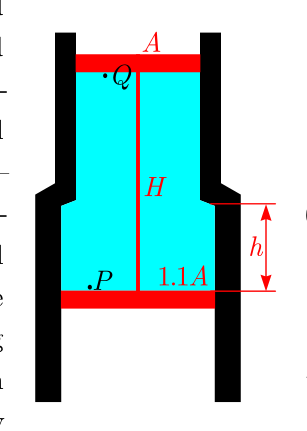
i. (0.5 pts) Let denote the pressure at a point at the bottom of the water column, and — at a point at the bottom. Find .
ii. (1.5 pts) Consider the two pistons, steel bar, and water column as a single compound body. Make a sketch and mark on it all the forces acting on this compound body by arrows (denote them by letters — , , etc.). Determine the values of all these forces.
iii. (1.2 pts) Determine the values of and .
iv. (0.8 pts) Determine the tension force in the steel bar.
v. (1 pt) Now, the whole system is slowly raised to a height (this is the distance between the horizontal surface and the bottom edge of the tube), and released. The system falls due to gravity, hits the surface (assume the impact to be plastic, i.e. the kinetic energy of the metallic tube is converted into heat), remains standing vertically on the horizontal surface for a brief period of time , and jumps up into air. Why does it jump? Provide a qualitative explanation.
vi. (3 pts) Find the duration during which the tube remains standing on the surface (after falling and before jumping).
Fonte: Testo (PDF) — p.1
Topic: Fluid Mechanics, Newtonian Mechanics Metodi: Hydrostatic Equilibrium, Free-Body Diagram, Impulse-Momentum Theorem, Conservation of Energy Competenze: Physical Reasoning, Diagrammatic Reasoning, Mathematical Modeling Objects: Tube, Piston, Cylinder, Rod
**Tubetta d’acqua (8 punti) **
Considerate un tubo che viene ottenuto quando due cilindri metallici sono saldati insieme come mostrato nella figura. Il cilindro superiore ha area interna di sezione trasversale , e il cilindro inferiore . Due pistoni sono collegati con una stretta (rigida ma leggera) barra di acciaio di lunghezza ; la distanza dal pistone inferiore all’area di saldatura è . Lo spazio tra i pistoni è pieno di acqua di densità e temperatura . La massa di ciascun pistone (neglizione della massa della canna che li collega) l’accelerazione di caduta libera e la pressione atmosferica . Il tubo sta verticalmente su una superficie solida orizzontale; i pistoni possono muoversi liberamente su e giù, la forza di attrito può essere trascurata. La distanza tra il fondo del pistone inferiore e la superficie orizzontale è più di .
**i. (0.5 pts) ** Let denota la pressione a un punto at the bottom of the water column, and at a point at the bottom. Trova .
ii. (1.5 pts) Consider the two pistons, steel bar, and water column as a single compound body. Make a sketch and mark on it all the forces acting on this compound body by arrows (denotare le forze con le lettere , , ecc.). Determina i valori di tutte queste forze.
iii. (1.2 pts) Determine the values of and .
iv. (0.8 pts) Determine the tension force in the steel bar.
v. (1 pt) Now, the whole system is slowly raised to a height (this is the distance between the horizontal surface and the bottom edge of the tube), and released. Il sistema cade a causa della gravità, colpisce la superficie (assume l’impatto di essere plastica, cioè the kinetic energy of the metallic tube is converted into heat), remains standing vertically on the horizontal surface for a brief period of time , and jumps up into air. Perché salta? Fornire una spiegazione qualitativa.
**vi. (3 pts) ** Find the duration during which the tube remains standing on the surface (after falling and before jumping).
Fonte: Testo (PDF) — p.1
Topic: Fluid Mechanics, Newtonian Mechanics Metodi: Hydrostatic Equilibrium, Free-Body Diagram, Impulse-Momentum Theorem, Conservation of Energy Competenze: Physical Reasoning, Diagrammatic Reasoning, Mathematical Modeling Objects: Tube, Piston, Cylinder, Rod
Water tube (8 points)
Consider a tube which is obtained when two metallic cylinders are welded together as shown in the figure. The upper cylinder has internal cross-sectional area , and the lower one . Two pistons are connected with a narrow (rigid but light) steel bar of length ; the distance from the lower piston to the welding area is . The space between the pistons is filled with water of density and temperature . The mass of each of the pistons (neglect the mass of the rod connecting them) free fall acceleration and the atmospheric pressure . The tube stands vertically on a solid horizontal surface; the pistons can move freely up and down, friction force can be neglected. The distance between the bottom of the lower piston and the horizontal surface is more than .
**i. (0.5 pts) ** Let denote the pressure at a point at the bottom of the water column, and at a point at the bottom. Find the .
ii. (1.5 pts) Consider the two pistons, steel bar, and water column as a single compound body. Make a sketch and mark on it all the forces acting on this compound body by arrows (denote them by letters , , etc.). Determine the values of all these forces.
iii. (1.2 pts) Determine the values of and .
iv. (0.8 pts) Determine the tension force in the steel bar.
v. (1 pt) Now, the whole system is slowly raised to a height (this is the distance between the horizontal surface and the bottom edge of the tube), and released. The system falls due to gravity, hits the surface (assume the impact to be plastic, i.e. the kinetic energy of the metallic tube is converted into heat), remains standing vertically on the horizontal surface for a brief period of time , and jumps up into air. Why does it jump? Provide a qualitative explanation.
**vi. (3 pts) ** Find the duration during which the tube remains standing on the surface (after falling and before jumping).
Fonte: Testo (PDF) — p.1
Topic: Fluid Mechanics, Newtonian Mechanics Metodi: Hydrostatic Equilibrium, Free-Body Diagram, Impulse-Momentum Theorem, Conservation of Energy Competenze: Physical Reasoning, Diagrammatic Reasoning, Mathematical Modeling Objects: Tube, Piston, Cylinder, Rod
Accelerating shock wave (11 points)
In interstellar space, shock waves can accelerate charged particles to very high energies. We shall use an idealized model of a shock wave, and assume that it is a potential barrier of a constant height which moves with a constant velocity along the -axis:
In the frame where the shock wave is at rest, the energy of an electron is conserved. This means that as long as the kinetic energy of an electron of mass and charge moving towards the shock wave is insufficient (, where denotes the speed with which the electron is approaching the shock wave), it is reflected back from the shock wave in the same way as an elastic ball bounces from a rigid wall. In what follows, unless otherwise mentioned, we assume that the electron is bounced elastically by the shock wave. You can always use the parameters , , , , and to express your answers. Unless otherwise specified, the velocity of the electron is assumed to be non-relativistic.
i. (1 pt) Let the initial speed of the electron be , with . Determine the velocity (i.e. the components , , ) of the electron after being hit by the shock wave.
ii. (1 pt) Now, there is also an homogeneous magnetic field of induction , parallel to the -axis. At the beginning, electron rests at the origin, and at is hit by the shock wave. Sketch qualitatively the trajectory drawn by the electron; cover the time period from until at least .
iii. (0.5 pts) Find the curvature radius of the electron’s trajectory immediately after its first collision with the shock wave.
iv. (1 pt) The electron undergoes soon, at , a second impact; write down an equation for determining . Use numerical calculation to obtain an expression for .
v. (0.5 pts) Determine the average -directional velocity of the electron (averaged over the time interval between two subsequent collisions of the electron with the shock wave).
vi. (1.5 pts) As time goes on, the electron undergoes many collisions with the shock wave. Show that during its motion, , where is a constant; express in terms of , and .
vii. (1 pt) From now on, let us consider the limit . Determine the average -directional acceleration of the electron (express it in terms of , and or constant introduced by task vi).
viii. (1 pt) It appears that at the limit , the time interval between subsequent collisions becomes shorter and shorter, hence we can assume that . This means that during a time interval between two subsequent collisions the velocity vector of the electron will change only by a very small angle and hence, its acceleration vector can be assumed to be constant.
Let us use now the shock wave’s frame of reference, and consider the electron’s phase diagram, i.e. a diagram which describes the state of the electron as a point in the plane, where the vertical axis corresponds to the -component of the momentum, and denotes the distance from the shock wave. Depict qualitatively the electron’s phase trajectory, i.e. the curve drawn in phase diagram during one period (between two subsequent collisions of the electron with the shock wave). Grades for this task are based purely on the shape of the curve.
ix. (1.5 pts) As time goes on, the width and height of the phase trajectory will change; however, it appears that the surface area of the region surrounded by the phase trajectory (referred to as the adiabatic invariant) will remain constant with a very good precision. For an initially resting electron, the adiabatic invariant appears to be approximately equal to . Determine the total kinetic energy of the electron when it falls behind the shock wave; express it in terms of , , and , which is defined as ; assume that .
x. (2 pts) This final task is independent from the previous tasks. Consider the propagation of a shock wave as described before, but under the absence of a magnetic field. A relativistic electron moves parallel to the front (in the laboratory frame; the perpendicular component of its velocity is strictly zero). Assuming that and (with denoting the speed of light), what should be the relativistic energy of the electron so that it could fall behind the shock wave? You can use any reasonable approximations.
Fonte: Testo (PDF) — p.1
Topic: Electromagnetism, Special Relativity Metodi: Lorentz Force Analysis, Conservation of Energy, Relativistic Energy-Momentum, Differential Equations Competenze: Physical Reasoning, Mathematical Modeling, Diagrammatic Reasoning Objects: Electron
**Accelerazione shock wave (11 punti) **
nello spazio interstellare, le onde d’urto possono accelerare le particelle cariche a energie molto elevate. Utilizziamo un modello idealizzato di una onda d’urto, e supponiamo che sia una barriera potenziale di altezza costante che si muove con una velocità costante lungo l’asse :
Nel quadro in cui l’onda di shock è a riposo, l’energia di un elettrone è conservata. Ciò significa che finché l’energia cinetica di un elettrone di massa e carica che si muove verso l’onda di shock è insufficiente (, dove denota la velocità con cui l’elettrone si avvicina all’onda di shock), è riflessa indietro dalla onda di shock ** nello stesso modo in cui una palla elastica rimbalza da un muro rigido. In ciò che segue, a meno che non sia diversamente menzionato, supponiamo che l’elettrone sia rimbalzato elasticamente dall’onda di shock.** Si possono sempre usare i parametri , , , , e per esprimere le vostre risposte. Salvo indicazione contraria, la velocità dell’elettrone è presunta non relativistica.
**i. (1 pt) ** Lascia che la velocità iniziale dell’elettrone sia , con . Determine la velocità (cioè i componenti , , ) dell’elettrone dopo essere stato colpito dalla onda di shock.
ii. (1 pt) Now, there is also an homogeneous magnetic field of induction , parallel to the -axis. At the beginning, electron rests at the origin, and at is hit by the shock wave. Sketch qualitativamente la trajectory drawn by the electron; cover the time period from until at least .
**iii. (0.5 pts) ** Trova il raggio di curvatura della traiettoria dell’elettrone immediatamente dopo la sua prima collisione con l’onda di shock.
**iv. (1 pt) ** L’elettrone subisce presto, a , a second impact; write down an equation for determining . Usare calcolo numerico per ottenere un’espressione per .
v. (0.5 pts) Determine the average -directional velocity of the electron (averaged over the time interval between two subsequent collisions of the electron with the shock wave).
vi. (1.5 pts) As time goes on, the electron undergoes many collisions with the shock wave. Show that during its motion, , where is a constant; express in terms of , and .
**vii. (1 pt) ** Da ora in poi, consideriamo il limite . Determina l’accelerazione direzionale media dell’elettrone (esprimere in termini di , e o costante introdotto da task vi).
**viii. (1 pt) ** Sembra che al limite , l’intervallo di tempo tra collisioni successive diventa più breve e più breve, quindi possiamo supporre che . Ciò significa che durante un intervallo di tempo tra due collisioni successive il vettore di velocità dell’elettrone cambierà solo da un angolo molto piccolo e quindi, il suo vettore di accelerazione può essere assunto come costante.
Let us use now the shock wave’s frame of reference, and consider the electron’s phase diagram, i.e. un diagramma che descrive lo stato dell’elettrone come un punto nel piano , dove l’asse verticale corrisponde al componente del momento, e denota la distanza dalla onda di shock. Depict qualitatively the electron’s phase trajectory, i.e. la curva tracciata in phase diagram during one period (entre due successive collisioni dell’elettrone con l’onda di shock). I gradi per questo compito sono basati puramente sulla forma della curva.
**ix. (1.5 pts) ** Con il tempo, la larghezza e l’altezza della traiettoria di fase cambieranno; tuttavia, sembra che l’area di superficie della regione circondata dalla traiettoria di fase (referita come l’invariante adiabatico >) rimarrà costante con una buona precisione. Per un elettrone inizialmente restante, l’invariante adiabatico sembra essere approximately equal a . Determine l’energia cinetica totale dell’elettrone quando cade dietro l’onda di shock; esprime in termini di , , e , che è definito come ; assume che .
**x. (2 pts) ** This final task is independent from the previous tasks. Consider the propagation of a shock wave as described before, but under the absence of a magnetic field. Un elettrone relativistico si muove parallelo al fronte (nel laboratorio; la componente perpendicolare della sua velocità è strettamente zero). Supponendo che e (con denotando la velocità della luce), cosa dovrebbe essere l’energia relativistica dell’elettrone in modo che possa cadere dietro l’onda di shock? Puoi usare qualsiasi approssimazione ragionevole.
Fonte: Testo (PDF) — p.1
Topic: Electromagnetism, Special Relativity Metodi: Lorentz Force Analysis, Conservation of Energy, Relativistic Energy-Momentum, Differential Equations Competenze: Physical Reasoning, Mathematical Modeling, Diagrammatic Reasoning Objects: Electron
Accelerating shock wave (11 points)
In interstellar space, shock waves can accelerate charged particles to very high energies. We shall use an idealized model of a shock wave, and assume that it is a potential barrier of a constant height which moves with a constant velocity along the axis:
In the frame where the shock wave is at rest, the energy of an electron is conserved. This means that as long as the kinetic energy of an electron of mass and charge moving towards the shock wave is insufficient (, where denotes the speed with which the electron is approaching the shock wave), it is reflected back from the shock wave ** in the same way as an elastic ball bounces from a rigid wall. In what follows, unless otherwise stated, we assume that the electron is bounced elastically by the shock wave.** You can always use the parameters , , , , and to express your answers. Unless otherwise specified, the velocity of the electron is assumed to be non-relativistic.
i. (1 pt) Let the initial speed of the electron be , with . Determine the velocity (i.e. the components , , ) of the electron after being hit by the shock wave.
ii. (1 pt) Now, there is also an homogeneous magnetic field of induction , parallel to the -axis. At the beginning, electron rests at the origin, and at is hit by the shock wave. Sketch qualitatively the trajectory drawn by the electron; cover the time period from until at least .
iii. (0.5 pts) Find the curvature radius of the electron’s trajectory immediately after its first collision with the shock wave.
iv. (1 pt) The electron undergoes soon, at , a second impact; write down an equation for determining . Use numerical calculation to obtain an expression for .
v. (0.5 pts) Determine the average -directional velocity of the electron (averaged over the time interval between two subsequent collisions of the electron with the shock wave).
vi. (1.5 pts) As time goes on, the electron undergoes many collisions with the shock wave. Show that during its motion, , where is a constant; express in terms of , and .
vii. (1 pt) From now on, let us consider the limit . Determine the average directional acceleration of the electron (express it in terms of , and or constant introduced by task vi).
viii. (1 pt) It appears that at the limit , the time interval between subsequent collisions becomes shorter and shorter, hence we can assume that . This means that during a time interval between two subsequent collisions the velocity vector of the electron will change only by a very small angle and hence, its acceleration vector can be assumed to be constant.
Let us use now the shock wave’s frame of reference, and consider the electron’s phase diagram, i.e. a diagram which describes the state of the electron as a point in the plane, where the vertical axis corresponds to the component of the momentum, and denotes the distance from the shock wave. Depict qualitatively the electron’s phase trajectory, i.e. the curve drawn in phase diagram during one period (between two subsequent collisions of the electron with the shock wave). Grades for this task are based purely on the shape of the curve.
ix. (1.5 pts) As time goes on, the width and height of the phase trajectory will change; however, it appears that the surface area of the region surrounded by the phase trajectory (referred to as the adiabatic invariant) will remain constant with a very good precision. For an initially resting electron, the adiabatic invariant appears to be approximately equal to . Determine the total kinetic energy of the electron when it falls behind the shock wave; express it in terms of , , and , which is defined as ; assume that .
x. (2 pts) This final task is independent from the previous tasks. Consider the propagation of a shock wave as described before, but under the absence of a magnetic field. A relativistic electron moves parallel to the front (in the laboratory frame; the perpendicular component of its velocity is strictly zero). Assuming that and (with denoting the speed of light), what should be the relativistic energy of the electron so that it could fall behind the shock wave? You can use any reasonable approximations.
Fonte: Testo (PDF) — p.1
Topic: Electromagnetism, Special Relativity Metodi: Lorentz Force Analysis, Conservation of Energy, Relativistic Energy-Momentum, Differential Equations Competenze: Physical Reasoning, Mathematical Modeling, Diagrammatic Reasoning Objects: Electron
Electric guitar (20 points)
In this experiment we measure different physical properties of steel guitar string material. The properties of steel vary a lot depending on the exact alloy composition and treatment. This guitar string is made of specific tempered high carbon steel (sometimes called “music wire”) to get the high tensile strength required.
First we measure electrical resistivity and Young’s modulus of the string material. Then we use those properties to measure the coefficient of thermal expansion of the steel. As we can see from our measurements, the temperature can crudely affect the tune of musical instruments.
Equipment
Stand (including a guitar string, piezoelectric contact microphone and an amplifier), DC supply, test leads (in total of different kinds), two multimeters, a set of resistors (values the values are not exact), measuring tape.
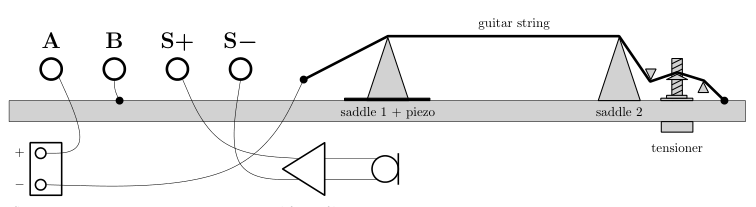
The stand has a guitar string tensioned over two main supports (“saddles” in guitar terminology) followed by a simple tensioner for further stretching the string. The amount of tensioning can be deduced from the number of turns of the tensioning screw. The fiddle adds a piezo to a piezoelectric contact microphone for transforming the mechanical vibrations into an electrical signal, which is then amplified and filtered (to remove some noise) and output between S+ and S−. The contacts A and B allow you to pass a controllable electric current through the string, if connected either directly or through a resistance resistor. One end of the string is in electrical contact with stand body (and contact B), other end is connected to . You are allowed to connect the test leads directly to stand body or string.
The smaller multimeter can be used to measure the frequency of the string oscillations from the S+ and S−. While doing so, ensure that the USB power supply is connected: pluck the string strongly enough to hear the actual sound, and start the measurement again, restart the program if it gives the wrong answer. Note that even though the string oscillates immediately after plucking the string, the multimeter may show the frequency of higher harmonics). Keep in mind that the final reading may be inexact, again, because the oscillations amplitude becomes too small for the multimeter to register them. Try several times to exclude any false readings. Correct reading should be between and . The measurement is easiest for range, so you might want to first tension the string, measure and work down in tension from there.
WARNINGS
- Do not tension the string so strongly that its fundamental frequency is over , otherwise you can damage the string (and ruin your measurements)!
- Use the input of the multimeter when measuring currents that are larger than .
Constants
- The pitch of the thread of the tensioning screw is (the string tensioner will rise by when the knob is turned by ). Assume the string has a circular cross section.
- When heated, the relative change of the resistivity of the string is .
- The linear density of the string at room temperature is .
You may assume that all the constants given in this section are exact.
Accuracies
The accuracy of the measuring tape is . The internal resistance of the multimeters in the DC voltmeter mode is for AX-100 and for AX-MS811. The accuracy (maximum allowed error) of a digital multimeter is usually given in the form "" meaning a percent of the reading plus units of the final digit. The values relevant for this experiment are as follows.
| Range | Accuracy of AX-100 |
|---|---|
| DC | |
| DC | |
| Range | Accuracy of AX-MS811 |
|---|---|
| DC voltage | |
| Resistance | |
| Frequency |
Tasks
Part A. String dimensions (2 points) Measure the length of the part of the string that is under tension. Estimate its uncertainty. You can assume that in the least tensioned position, the string is unbent over tensioner and that the string supports are small enough so that you can ignore the error from their curvature.
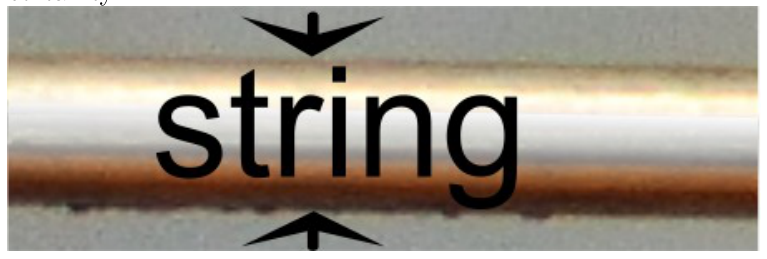
Here is a photo of the string, magnified . From the photo, measure the diameter of the string. Estimate its uncertainty.
Part B. Resistivity (3 points) The electric resistance between the ends of a cylindrical piece of material is characterized by its resistivity , where is its resistance, its cross section area and its length.
Measure as exactly as possible the resistivity of the string at room temperature. Estimate the uncertainty. Draw the circuit diagram used, indicating the exact placement of all the used leads, which multimeter(s) you used and what were their settings.
Part C. String oscillations (3 points) A string on a guitar is characterized by its fundamental frequency — the lowest frequency of oscillation. Measure and plot how the fundamental frequency of the string depends on its length .
To find the length you may use the following approximation:
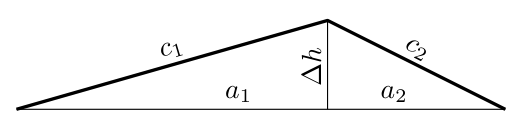
where the lengths are defined in the figure.
Part D. Young’s modulus of the string (4.5 points) The elasticity of a cylindrical piece of material can be characterized by its Young’s modulus , where is the applied tension (or compression) force, is its cross section area, is the original (unstretched) length and is the final (stretched) strength. It is known that waves travel along the string with speed , where is the tension force and is the linear density (mass per unit length) of the string. (Note that string oscillations are standing waves.)
Using the results of the previous task, plot an appropriate graph for finding the Young’s modulus of the string. Find it and estimate the uncertainty.
Part E. Heated string (3 points) You can heat the string by passing some electric current through it (by connecting A and B either directly or through a resistor). At some fixed length, measure how the fundamental frequency depends on temperature . Hint: Temperature can be determined by measuring the resistance of the string and using ; for room temperature use .
Part F. Thermal expansion of the string (4.5 points) When heated, the length (and similarly the width) of a piece of material follows the formula , where the constant is called the coefficient of linear heat expansion, is the original length, the final length and the final temperature. Note that if stretching is also involved, then this formula describes only the unstretched length!
Plot the results of the previous task in appropriate axes for finding the coefficient of linear heat expansion for the guitar string. Find it and estimate the uncertainty.
Fonte: Testo (PDF) — p.1
Topic: Elasticity & Materials, Oscillations & Waves Metodi: Experimental Data Analysis, Stress-Strain Analysis, Graph Linearization, Wave Equation Competenze: Experimental Data Analysis, Measurement & Instrumentation, Error Propagation, Graph Linearization Objects: String, Resistor
**Electric guitar (20 punti) **
In questo esperimento misuriamo diverse proprietà fisiche del materiale di stringhe della chitarra d’acciaio. Le proprietà dell’acciaio variano molto a seconda dell’esatta composizione e del trattamento dell’alloio. This guitar string is made of specific tempered high carbon steel (sometimes called “music wire”) to get the high tensile strength required.
Prima misuriamo la resistività elettrica e il modulo di Young del materiale della corda. Quindi usiamo quelle proprietà per misurare il coefficiente di espansione termica dell’acciaio. Come possiamo vedere dalle nostre misurazioni, la temperatura può influenzare crudamente il tono degli strumenti musicali.
# # Equipaggiamento
Stand (incluso una stringetta di chitarra, un microfono a contatto piezoelettrico e un amplificatore), DC supply, test leads (in total of different kinds), two multimeters, a set of resistors (values the values are not exact), measuring tape.
The Stand has a guitar string tensioned over two main supports (“saddles” in guitar terminology) followed by a simple tensioner for further stretching the string. La quantità di tensione può essere dedotta dal numero di giri della vite di tensione. Il fiddle aggiunge un piezo a un microfono piezoelettrico per trasformare le vibrazioni meccaniche in un segnale elettrico, che viene quindi amplificato e filtrato (to remove some noise) and output between S+ and S−. I contatti A e B permettono di passare una corrente elettrica controllabile attraverso la stringa, se collegata direttamente o attraverso una resistenza. Un’altra estremità della stringa è in contatto elettrico con il corpo di stand (and contact B), un’altra è collegata a . You are allowed to connect the test leads directly to stand body or string.
Il più piccolo multimetro può essere utilizzato per misurare la frequenza delle oscillazioni delle stringhe da S+ e S−. Mentre lo fate, assicuratevi che la alimentazione USB sia connessa: pulcate la corda abbastanza forte da sentire il suono effettivo, e ricominciate la misurazione, riavviate il programma se dà la risposta sbagliata. Nota che anche se la corda oscilla immediatamente dopo aver preso la corda, il multimetro può mostrare la frequenza di armonici superiori). Ricorda che la lettura finale può essere inesatta, perché l’ampiezza delle oscillazioni diventa troppo piccola per il multimetro per registrarle. Prova più volte a escludere qualsiasi lettura falsa. Corretta lettura deve essere tra e . The measurement is easiest for range, quindi potresti voler prima tensione la corda, misura e lavorare giù in tensione da lì.
# AVVERTORI
- Non tensione la corda così fortemente che la sua frequenza fondamentale sia sopra , altrimenti puoi danneggiare la corda (e rovinare le tue misurazioni)!
- Utilizzare l’input del multimetro quando si misurano correnti che sono più grandi di .
Constants
- Il pitch del filo della vite di tensione è (il string tensioner aumenterà di quando il pulsante è girato di ). Supponiamo che la corda abbia una sezione incrociata circolare.
- Quando riscaldato, il relativo cambiamento della resistività della corda è .
- La densità lineare della corda a temperatura ambiente è .
Si può supporre che tutte le costanti indicate in questa sezione sono esatte.
Accuratezza
L’accuratezza del nastro di misurazione è . La resistenza interna dei multimetri in modalità voltmeter DC è per AX-100 e per AX-MS811. L’accuratezza (massimo permesso di errore) di un multimetro digitale è solitamente data nella forma "" che significa un percentuale della lettura più unità della cifra finale. I valori rilevanti per questo esperimento sono i seguenti.
♬ Range accurate di AX-100 ♬ | --- | --- | | DC | | | DC | | | | | | | | | | | | | | | | |
♬ Range Accuracy di AX-MS811 ♬ | --- | --- | | DC voltage | | | Resistance | | | Frequency | |
Tasche
**Part A. Dimensioni della corda (2 punti) ** Measure the length of the part of the string that is under tension. Estimate la sua incertezza. Si può supporre che nella posizione meno tensa, la corda sia non piegata su più tensa e che i supporti della corda siano abbastanza piccoli da poter ignorare l’errore della loro curvatura.
Here is a photo of the string, magnified . From the photo, measure the diameter of the string. Estimate la sua incertezza.
**Parte B. Resistività (3 punti) ** La resistenza elettrica tra le estremità di un pezzo di materiale cilindrico è caratterizzata dalla sua resistenza , dove è la sua resistenza, la sua area di sezione e la sua lunghezza.
Measure as exactly as possible the resistivity of the string at room temperature. Estimate l’incertezza. Disegnare il diagramma di circuito utilizzato, indicando l’esatto posizionamento di tutti i lead utilizzati, quali multimetri hai utilizzato e quali erano le loro impostazioni.
** Parte C. String oscillations (3 points) ** Una stringa su una chitarra è caratterizzata dalla sua frequenza fondamentale la frequenza di oscillazione più bassa. Measure and plot how the fundamental frequency of the string depends on its length .
Per trovare la lunghezza è possibile utilizzare la seguente approssimazione:
dove le lunghezze sono definite nella figura.
**Parte D. Young’s modulus of the string (4.5 points) ** L’elasticità di un pezzo di materiale cilindrico può essere caratterizzata dal suo modulus Young’s , dove is the applied tension (o compressione) force, is its cross section area, is the original (unstretched) length and is the final (stretched) strength. È noto che le onde viaggiano lungo la stringa con velocità , dove è la forza di tensione e è la densità lineare (massa per unità di lunghezza) della stringa. (Nota che le oscillazioni delle stringhe sono onde in piedi.)
Usando i risultati del precedente compito, tracciare un grafico appropriato per trovare il modulo di Young della stringa. Trova e stima l’incertezza.
Parte E. Heated string (3 points) Si può riscaldare la corda passando qualche corrente elettrica attraverso di essa (connetto A e B direttamente o attraverso una resistore). A qualche lunghezza fissa, misura come la frequenza fondamentale dipende dalla temperatura . Hint: Temperature can be determined by measuring the resistance of the string and using ; for room temperature use .
Parte F. Thermal expansion of the string (4.5 points) When heated, the length (and similarly the width) of a piece of material follows the formula , where the constant is called the coefficient of linear heat expansion, is the original length, the final length and the final temperature. Si noti che se anche lo stretching è coinvolto, allora questa formula descrive solo la lunghezza non stretched!
Plot the results of the previous task in appropriate axes for finding the coefficient of linear heat expansion for the guitar string. Trova e stima l’incertezza.
Fonte: Testo (PDF) — p.1
Topic: Elasticity & Materials, Oscillations & Waves Metodi: Experimental Data Analysis, Stress-Strain Analysis, Graph Linearization, Wave Equation Competenze: Experimental Data Analysis, Measurement & Instrumentation, Error Propagation, Graph Linearization Objects: String, Resistor
Electric guitar (20 points)
In this experiment we measure different physical properties of steel guitar string material. The properties of steel vary greatly depending on the exact composition and treatment of the alloy. This guitar string is made of specific tempered high carbon steel (sometimes called “music wire”) to get the high tensile strength required.
First we measure electrical resistivity and Young’s modulus of the string material. Then we use those properties to measure the coefficient of thermal expansion of the steel. As we can see from our measurements, the temperature can roughly affect the tune of musical instruments.
Equipment
Stand (including a guitar string, piezoelectric contact microphone and an amplifier), DC supply, test leads (in total of different types), two multimeters, a set of resistors (values the values are not exact), measuring tape.
The stand has a guitar string tensioned over two main supports (“saddles” in guitar terminology) followed by a simple tensioner for further stretching the string. The amount of tensioning can be deduced from the number of turns of the tensioning screw. The fiddle adds a piezo to a piezoelectric contact microphone for transforming the mechanical vibrations into an electrical signal, which is then amplified and filtered (to remove some noise) and output between S+ and S−. The contacts A and B allow you to pass a controllable electric current through the string, if connected either directly or through a resistance resistor. One end of the string is in electrical contact with stand body (and contact B), other end is connected to . You are allowed to connect the test leads directly to stand body or string.
The smaller multimeter can be used to measure the frequency of the string oscillations from the S+ and S−. While doing so, make sure that the USB power supply is connected: pluck the string strongly enough to hear the actual sound, and start the measurement again, restart the program if it gives the wrong answer. Note that even though the string oscillates immediately after plucking the string, the multimeter may show the frequency of higher harmonics). Keep in mind that the final reading may be inaccurate, again, because the oscillations amplitude becomes too small for the multimeter to record them. Try several times to exclude any false readings. Correct reading should be between and . The measurement is easiest for range, so you might want to first tension the string, measure and work down in tension from there.
Warnings
- Do not tension the string so strongly that its fundamental frequency is over , otherwise you can damage the string (and ruin your measurements)!
- Use the input of the multimeter when measuring currents that are larger than .
♪ Constants ♪
- The pitch of the thread of the tensioning screw is (the string tensioner will rise by when the knob is turned by ). Assume the string has a circular cross section.
- When heated, the relative change of the resistivity of the string is .
- The linear density of the string at room temperature is .
You can assume that all the constants given in this section are exact.
Accuracies
The accuracy of the measuring tape is . The internal resistance of the multimeters in the DC voltmeter mode is for AX-100 and for AX-MS811. The accuracy (maximum allowed error) of a digital multimeter is usually given in the form "" meaning a percentage of the reading plus units of the final digit. The values relevant for this experiment are as follows.
♪ Range accuracy of AX-100 ♪ | --- | --- | | DC | | | DC | | | | | | | | | | | | | | | | |
♪ Range accuracy of AX-MS811 ♪ | --- | --- | | DC voltage | | | Resistance | | | Frequency | |
Tasks
**Part A. String dimensions (2 points) ** Measure the length of the part of the string that is under tension. Estimate its uncertainty. You can assume that in the least tense position, the string is unbent over tense and that the string supports are small enough so that you can ignore the error from their curvature.
Here is a photo of the string, magnified . From the photo, measure the diameter of the string. Estimate its uncertainty.
**Part B. Resistivity (3 points) ** The electrical resistance between the ends of a cylindrical piece of material is characterized by its resistivity , where is its resistance, its cross section area and its length.
Measure as exactly as possible the resistivity of the string at room temperature. Estimate the uncertainty. Draw the circuit diagram used, indicating the exact placement of all the used leads, which multimeter (s) you used and what were their settings.
**Part C. String oscillations (3 points) ** A string on a guitar is characterized by its fundamental frequency the lowest frequency of oscillation. Measure and plot how the fundamental frequency of the string depends on its length .
To find the length you may use the following approximation:
where the lengths are defined in the figure.
**Part D. Young’s modulus of the string (4.5 points) ** The elasticity of a cylindrical piece of material can be characterized by its Young’s modulus , where is the applied tension (or compression) force, is its cross section area, is the original (unstretched) length and is the final (stretched) strength. It is known that waves travel along the string with speed , where is the tension force and is the linear density (mass per unit length) of the string. (Note that string oscillations are standing waves.)
Using the results of the previous task, plot an appropriate graph for finding the Young’s modulus of the string. Find it and estimate the uncertainty.
Part E. Heated string (3 points) You can heat the string by passing some electric current through it (by connecting A and B either directly or through a resistor). At some fixed length, measure how the fundamental frequency depends on temperature . Hint: Temperature can be determined by measuring the resistance of the string and using ; for room temperature use .
**Part F. Thermal expansion of the string (4.5 points) ** When heated, the length (and similarly the width) of a piece of material follows the formula , where the constant is called the coefficient of linear heat expansion, is the original length, the final length and the final temperature. Note that if stretching is also involved, then this formula describes only the unstretched length!
Plot the results of the previous task in appropriate axes for finding the coefficient of linear heat expansion for the guitar string. Find it and estimate the uncertainty.
Fonte: Testo (PDF) — p.1
Topic: Elasticity & Materials, Oscillations & Waves Metodi: Experimental Data Analysis, Stress-Strain Analysis, Graph Linearization, Wave Equation Competenze: Experimental Data Analysis, Measurement & Instrumentation, Error Propagation, Graph Linearization Objects: String, Resistor