Problem T1. Dark matter (10 points)
One of the main unsolved problems in modern physics is concerning dark matter. It’s a hypothetical form of matter which gets its name from its peculiar property not to interact with electromagnetic fields (i.e. light), making it very difficult to detect. It’s thought to account for around of matter in the universe, including most of the mass in galaxies.
The existence of dark matter is motivated by various astrophysical observations which cannot be explained unless there’s more matter that cannot be seen. The primary candidate for dark matter is a new elementary particle that’s yet to be discovered. Experiments to directly detect and study dark matter particles are ongoing but have yet to succeed.
This task focuses on one indirect observation of dark matter and tests its agreement with a potential model for dark matter.
Part A. Rotation curves (5.5 points)
For this part, you may use the following physical constants and their numerical values:
Gravitational constant .
.
Duration of one year is days.
Rotation curves are a commonly used method to deduce the matter densities of galaxies. A rotation curve shows the orbital speeds of stars in a particular galaxy as a function of the radial distance from the galaxy’s centre. The following figure shows the simplified rotation curve of the Milky Way. We approximate it into two regions A and B, one with a linearly increasing profile from to for , and the other with a constant velocity profile for .
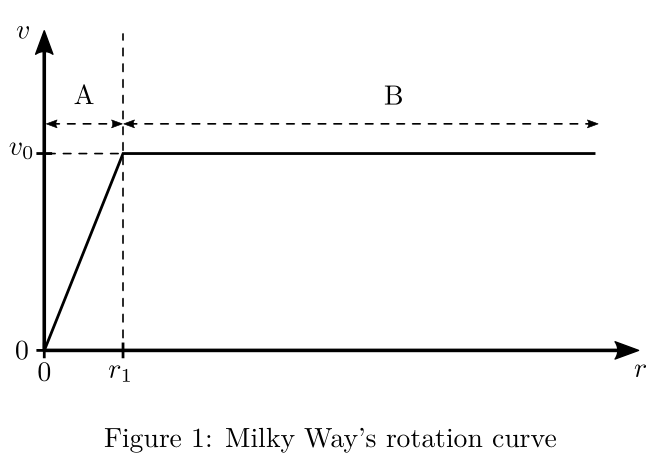
Figure 1: Milky Way’s rotation curve
1. (1 pt) How far is the Sun from the centre of the galaxy if its orbital period is ?
2. (1 pt) Consider a test particle of negligible mass in a circular orbit of radius around a point mass . Find the orbital speed of the test particle.
3. (1.5 pts) Consider a cloud of gas of uniform density and radius . Express the orbital speed of the aforementioned test particle for both when and in terms of , , and the physical constants. Also find an expression for the potential energy per unit mass in the cloud.
4. (1.5 pts) We now focus on the Milky Way galaxy. Deduce the matter density as a function of in both of the regions A and B shown on figure 1. You may assume spherical symmetry.
5. (0.5 pts) In the neighbourhood of the Sun, stars are typically separated by a distance of from each other. Estimate the density of visible mass (in the form of stars) in the solar neighbourhood. Compare this with the results from part 4. and comment on potential discrepancies. Take the mass of a typical star to be .
Part B. Self-interacting dark matter (4.5 points)
Self-interacting dark matter, or SIDM for short, is one of the many proposed classes of dark matter particles. Like most DM models, it interacts weakly with ordinary matter via gravity. Its main characteristic is that the particles interact strongly with each-other, leading to energy and momentum exchange between dark matter particles. Specifically, the interactions happen with a rate large enough that the dark matter in a galaxy thermalizes and assumes a uniform temperature . We additionally consider the dark matter gas to be sparse enough (i.e. classical) so that Boltzmann statistics can be used for describing how the particle densities and velocities are distributed.
1. (1.5 pts) According to Boltzmann statistics, the density of dark matter is proportional to
where is the potential energy per unit mass at the respective position in space and is the mass of a dark matter particle. Assuming that most of matter in the Milky Way is made up of dark matter, which region(s) can agree with the implications of the SIDM model?
2. (1 pt) Find the thermal speed of the dark matter particles in the aforementioned region(s) that agree with the SIDM model.
3. (1 pt) One of the key assumption for the isothermal model to work is that the dark matter particles undergo enough collisions to thermalize, i.e. the mean free path length of dark matter particles is significantly smaller than the characteristic size of the Milky Way. Based on this, give an estimate for the lower bound of the ratio of the self-interaction cross section to the mass of a dark matter particle.
4. (1 pt) Another of our assumptions has been that the SIDM gas is classical in nature, i.e. the density of the gas is well below the limit where quantum effects become evident. This condition can generally be written as
where is the number density of dark matter, the Boltzmann constant, and the reduced Planck’s constant. Based on this, give a lower bound for the mass of a dark matter particle for the classical considerations to apply in the Milky Way.
Fonte: Testo (PDF) — p.1
Topic: Astrophysics, Gravitation Metodi: Newton’s Law of Gravitation, Gauss’s Law, Kinetic Theory of Gases, Order-of-Magnitude Estimation Competenze: Mathematical Modeling, Estimation & Approximation, Physical Reasoning Objects: Star, Gas
Problem T1. Dark matter (10 points)
Uno dei principali problemi irrisolti nella fisica moderna riguarda la materia oscura. È una forma ipotetica di materia che prende il nome dalla sua peculiare proprietà di non interagire con campi elettromagnetici (cioè la luce), rendendola molto difficile da rilevare. It’s thought to account for around of matter in the universe, including most of the mass in galaxies.
L’esistenza della materia oscura è motivata da varie osservazioni astrofisiche che non possono essere spiegate a meno che non ci sia più materia che non può essere vista. Il candidato primario per la materia oscura è una nuova particella elementare che non è ancora stata scoperta. Esperienti per rilevare e studiare direttamente particelle di materia oscura sono in corso ma non hanno ancora successo.
Questo compito si concentra su una osservazione indiretta della materia oscura e testano la sua concordanza con un modello potenziale per la materia oscura.
Part A. Rotation curves (5.5 points)
Per questa parte, puoi usare le seguenti costanti fisiche e i loro valori numerici:
Costante gravitazionale .
.
Duration of one year is days.
Le curve di rotazione sono un metodo comunemente usato per dedurre le densità di materia delle galassie. Una curva di rotazione mostra le velocità orbitali di stelle in una particolare galassia in funzione della distanza radiale dal centro della galassia. La figura seguente mostra la curva di rotazione semplificata della Via Lattea. Approximate it into two regions A and B, one with a linearly increasing profile from to for , and the other with a constant velocity profile for .
Figure 1: Milky Way’s rotation curve
1. (1 pt) How far is the Sun from the centre of the galaxy if its orbital period is ?
2. (1 pt) Consider a test particle of negligible mass in a circular orbit of radius around a point mass . Trova la velocità orbitale della particella di prova.
3. (1.5 pts) Consider a cloud of gas of uniform density and radius . Esprimere la velocità orbitale della particella di prova di cui sopra per entrambi quando e in termini di , , e le costanti fisiche. Quindi troverete un’espressione per l’energia potenziale per unità di massa nel cloud.
4. (1.5 pts) We now focus on the Milky Way galaxy. Deduci la densità della materia come funzione di in entrambi i settori A e B mostrati in figura 1. Potete assumere la simmetria sferica.
**5. (0.5 pts) ** Nel quartiere del Sole, le stelle sono tipicamente separate da una distanza di l’una dall’altra. Estimare la densità di massa visibile (in forma di stelle) nel quartiere solare. Compare questo con i risultati della parte 4. e commentare le potenziali discrepanze. Take the mass of a typical star to be .
Parte B. Self-interacting dark matter (4.5 points)
La materia oscura che interagisce con se stessa, o SIDM per breve, è una delle molte classi proposte di particelle di materia oscura. Come molti modelli DM, interagisce debilmente con la materia ordinaria attraverso la gravità. La sua caratteristica principale è che le particelle interagiscono fortemente tra loro, portando a scambi di energia e impulso tra particelle di materia oscura. Specifically, the interactions happen with a rate large enough that the dark matter in a galaxy thermalizes and assumes a uniform temperature . Consideramo inoltre che il gas di materia oscura sia abbastanza scarse (cioè La statistica di Boltzmann può essere utilizzata per descrivere come le densità e le velocità delle particelle sono distribuite.
1. (1.5 pts) According to Boltzmann statistics, the density of dark matter is proportional to
dove è la potenza energetica per unità di massa alla rispettiva posizione nello spazio e è la massa di una particella di materia oscura. Supponendo che la maggior parte della materia della Via Lattea sia composta da materia oscura, quale regione può concordare con le implicazioni del modello SIDM?
2. (1 pt) Trova la velocità termica delle particelle di materia oscura nella regione di cui sopra che concordano con il modello SIDM.
**3. (1 pt) ** Una delle principali ipotesi per il modello isotermale da usare è che le particelle di materia oscura subiscono abbastanza collisioni da termizzare, cioè La lunghezza media del percorso libero delle particelle di materia oscura è significativamente inferiore alla dimensione caratteristica della Via Lattea. Basandosi su questo, date una stima del limite inferiore del rapporto tra la sezione di interazione di una particella di materia oscura e la massa.
**4. (1 pt) ** Un’altra delle nostre ipotesi è stata che il gas SIDM è classico in natura, cioè La densità del gas è ben al di sotto del limite dove gli effetti quantistici diventano evidenti. This condition can generally be written as
dove è la densità di numero di materia oscura, la costante di Boltzmann, e la costante di Planck ridotta. Based on this, give a lower bound for the mass of a dark matter particle for the classical considerations to apply in the Milky Way.
Fonte: Testo (PDF) — p.1
Topic: Astrophysics, Gravitation Metodi: Newton’s Law of Gravitation, Gauss’s Law, Kinetic Theory of Gases, Order-of-Magnitude Estimation Competenze: Mathematical Modeling, Estimation & Approximation, Physical Reasoning Objects: Star, Gas
Problem T1. Dark matter (10 points)
One of the main unsolved problems in modern physics is concerning dark matter. It’s a hypothetical form of matter which gets its name from its peculiar property not to interact with electromagnetic fields (i.e. light), making it very difficult to detect. It’s thought to account for around of matter in the universe, including most of the mass in galaxies.
The existence of dark matter is motivated by various astrophysical observations which cannot be explained unless there is more matter that cannot be seen. The primary candidate for dark matter is a new elementary particle that has yet to be discovered. Experiments to directly detect and study dark matter particles are ongoing but have yet to succeed.
This task focuses on one indirect observation of dark matter and tests its agreement with a potential model for dark matter.
Part A. Rotation curves (5.5 points)
For this part, you may use the following physical constants and their numerical values:
Gravitational constant
.
Duration of one year is days.
Rotation curves are a commonly used method to deduce the matter densities of galaxies. A rotation curve shows the orbital speeds of stars in a particular galaxy as a function of the radial distance from the galaxy’s center. The following figure shows the simplified rotation curve of the Milky Way. We approximate it into two regions A and B, one with a linearly increasing profile from to for , and the other with a constant velocity profile for .
Figure 1: Milky Way’s rotation curve
1. (1 pt) How far is the Sun from the centre of the galaxy if its orbital period is ?
2. (1 pt) Consider a test particle of negligible mass in a circular orbit of radius around a point mass . Find the orbital speed of the test particle.
3. (1.5 pts) Consider a cloud of gas of uniform density and radius . Express the orbital speed of the above-mentioned test particle for both when and in terms of , , and the physical constants. So find an expression for the potential energy per unit mass in the cloud.
4. (1.5 pts) We now focus on the Milky Way galaxy. Deduce the matter density as a function of in both of the regions A and B shown on figure 1. You may assume spherical symmetry.
**5. (0.5 pts) ** In the neighborhood of the Sun, stars are typically separated by a distance of from each other. Estimate the density of visible mass (in the form of stars) in the solar neighbourhood. Compare this with the results from part 4. and comment on potential discrepancies. Take the mass of a typical star to be .
Part B. Self-interacting dark matter (4.5 points)
Self-interacting dark matter, or SIDM for short, is one of the many proposed classes of dark matter particles. Like most DM models, it interacts weakly with ordinary matter via gravity. Its main characteristic is that the particles interact strongly with each other, leading to energy and momentum exchange between dark matter particles. Specifically, the interactions happen with a rate large enough that the dark matter in a galaxy thermalizes and assumes a uniform temperature . We additionally consider the dark matter gas to be sparse enough (i.e. The first is the classical (or classical) so that Boltzmann statistics can be used to describe how the particle densities and velocities are distributed.
1. (1.5 pts) According to Boltzmann statistics, the density of dark matter is proportional to
where is the potential energy per unit mass at the respective position in space and is the mass of a dark matter particle. Assuming that most of the matter in the Milky Way is made up of dark matter, which region (s) can agree with the implications of the SIDM model?
2. (1 pt) Find the thermal speed of the dark matter particles in the aforementioned region(s) that agree with the SIDM model.
3. (1 pt) One of the key assumption for the isothermal model to work is that the dark matter particles undergo enough collisions to thermalize, i.e. The mean free path length of dark matter particles is significantly smaller than the characteristic size of the Milky Way. Based on this, give an estimate for the lower bound of the ratio of the self-interaction cross section to the mass of a dark matter particle.
4. (1 pt) Another of our assumptions has been that the SIDM gas is classical in nature, i.e. The density of the gas is well below the limit where quantum effects become evident. This condition can generally be written as
where is the number density of dark matter, the Boltzmann constant, and the reduced Planck’s constant. Based on this, give a lower bound for the mass of a dark matter particle for the classical considerations to apply in the Milky Way.
Fonte: Testo (PDF) — p.1
Topic: Astrophysics, Gravitation Metodi: Newton’s Law of Gravitation, Gauss’s Law, Kinetic Theory of Gases, Order-of-Magnitude Estimation Competenze: Mathematical Modeling, Estimation & Approximation, Physical Reasoning Objects: Star, Gas
Problem T2. Global warming (10 points)
The average temperature of planet Earth () is the result of a combination of two factors: (a) Earth’s surface absorbs a fraction of the incident solar radiation; (b) The surface of the Earth radiates according to Stefan-Boltzmann’s law: the power radiated per unit area equals to , where , and denotes the surface temperature in Kelvin, and — the emissivity, the ratio of the energy radiated from a material’s surface to that radiated from an ideal black body. Due to the second law of thermodynamics, the emission factor must be equal to the absorption coefficient , but only if the radiation and absorption occur at the same wavelengths. The heat radiation from the Sun is mostly in the optical range for which the atmosphere is fully transparent (the above value corresponds to the optical wavelengths). The Earth emits predominantly infrared radiation, and in this wavelength range the Earth’s surface (mostly water) has an average emissivity . At the same time, the Earth’s heat balance is affected by greenhouse gases, which partially reflect Earth’s heat radiation back to Earth, and thus reducing the emissivity to a new effective value .
Below, you can use the following data: The emissivity of the Sun is ; Distance between the Sun and Earth ; Radius of the Sun ; the surface temperature of the Sun ; Average surface temperature of Earth ; zero degrees celsius in Kelvin is ; Earth’s radius ; total energy produced by mankind in one year: (assume that this energy ends up mostly being dissipated as heat into the environment).
1. (2 pts) What is the ratio of the total power consumed by mankind to the total solar radiation power absorbed by the Earth? A year has days.
2. (1 pt) How large of a surface area on the Earth needs to be covered by solar panels to supply enough electrical energy to the humankind assuming a solar panel efficiency of ? Compare this with the surface area of the Empty Quarter desert of about .
3. (2 pts) What is the average effective emissivity of the Earth’s surface at the wavelengths corresponding to the heat radiation of the Earth?
4. (2 pts) By how many degrees would the average temperature of the Earth’s surface decrease if, at some point of time, humanity stopped producing any energy, and assuming that the value of would remain unchanged?
5. (1.5 pts) The average surface temperature of the Earth has increased by over the last 50 years and this is mainly explained by the increase in greenhouse gas concentrations in Earth’s atmosphere. In a simplified manner, this effect can be modelled as the greenhouse gases absorbing a fraction of the heat radiation emitted by Earth and then radiating the absorbed energy thermally so half of the radiated energy goes towards the surface of the Earth, and the other half goes into space. By how much has the factor changed over the last 50 years?
6. (1.5 pts) Solar radiation is the main driving force of the atmospheric motion; on a global scale, the atmospheric circulation can be seen as a heat engine. To explain this, consider the so-called Hadley circulation: the Sun heats the ground, which in turn warms the air; the warm air initially travels along the ground, from the middle latitudes towards the equator, and at a certain point, when it has warmed up sufficiently, rises adiabatically and cools down. In the high atmospheric layers, at an altitude of , the cooler air travels back to the middle latitudes and slowly radiates heat into space. During its travel, air becomes cooler and the density increasingly higher, until at a certain point, it becomes so dense that it descends down back to the ground level. After that, the process starts repeating. Based on the model of ideal heat engine and the data provided and calculated above, estimate an upper limit for the total power of producing the wind energy on Earth, assuming that the temperature in the atmosphere drops by about one degree celsius per every 100 meters increase in the altitude. How many times does it differ from the total energy produced by humanity?
Fonte: Testo (PDF) — p.1
Topic: Thermodynamics, Earth & Environmental Science Metodi: Thermodynamic Cycle Analysis, First Law of Thermodynamics, Order-of-Magnitude Estimation, Physical Modeling Competenze: Estimation & Approximation, Mathematical Modeling, Physical Reasoning Objects: Planet, Star, Heat Engine
Problem T2. Global warming (10 points)
La temperatura media del pianeta Terra () è il risultato di una combinazione di due fattori: (a) la superficie terrestre assorbe una frazione della radiazione solare incidente; (b) la superficie terrestre irradia secondo la legge di Stefan-Boltzmann: la potenza irradiata per unità di area equivale a , dove e denota la temperatura della superficie in Kelvin, e l’emissività, il rapporto dell’energia irradiata dalla superficie di un materiale a quella irradiata da un corpo nero ideale. A causa della seconda legge della termodinamica, il fattore di emissione deve essere pari al coefficiente di assorbimento , ma solo se la radiazione e l’assorbimento si verificano alle stesse lunghezze d’onda. La radiazione di calore del Sole è principalmente nell’intervallo ottico per il quale l’atmosfera è completamente trasparente (il valore sopra corrisponde alle lunghezze d’onda ottica). La Terra emette prevalentemente radiazioni infrarosse, e in questa gamma di lunghezza d’onda la superficie terrestre (principalmente acqua) ha una emissività media . At the same time, the Earth’s heat balance is affected by greenhouse gases, which partially reflect Earth’s heat radiation back to Earth, and thus reducing the emissivity to a new effective value .
Qui di seguito, puoi usare i seguenti dati: L’emissività del Sole è ; Distanza tra il Sole e la Terra ; Radius del Sole ; la temperatura superficiale del Sole ; Average surface temperature of Earth ; zero gradi Celsius in Kelvin è ; Radius della Terra ; Total energy produced by mankind in one year: (assumere che questa energia finisce per essere dissipatata principalmente come calore nell’ambiente).
1. (2 pts) What is the ratio of the total power consumed by mankind to the total solar radiation power absorbed by the Earth? Un anno ha giorni.
2. (1 pt) How large of a surface area on the Earth needs to be covered by solar panels to supply enough electrical energy to the humankind assuming a solar panel efficiency of ? Compare questo con l’area di superficie del deserto Empty Quarter di circa .
**3. (2 pts) ** Qual è la media efficace di emissività della superficie terrestre alle lunghezze d’onda corrispondenti alla radiazione di calore della Terra?
**4. (2 pts) ** Da quanti gradi diminuirebbe la temperatura media della superficie terrestre se, a un certo punto di tempo, l’umanità cessasse di produrre energia, e supponendo che il valore di rimarrà invariato?
5. (1.5 pts) The average surface temperature of the Earth has increased by over the last 50 years and this is mainly explained by the increase in greenhouse gas concentrations in Earth’s atmosphere. In a simplified manner, this effect can be modelled as the greenhouse gases absorbing a fraction of the heat radiation emitted by Earth and then radiating the absorbed energy thermally so half of the radiated energy goes towards the surface of the Earth, and the other half goes into space. Per quanto è cambiato il fattore negli ultimi 50 anni?
6. (1.5 pts) Solar radiation is the main driving force of the atmospheric motion; on a global scale, the atmospheric circulation can be seen as a heat engine. Per spiegare questo, considerate la cosiddetta circolazione di Hadley: il sole riscalda il terreno, che a sua volta riscalda l’aria; l’aria calda inizia viaggiando lungo il terreno, dalle latitudini medie verso l’equatore, e ad un certo punto, quando si è riscaldato sufficientemente, sale adiabaticamente e si raffreddano. Nei livelli atmosferici più alti, ad altitudine di , l’aria più fresca si reca alle latitudini medie e irradia lentamente il calore nello spazio. Durante il suo viaggio, l’aria diventa più fresca e la densità sempre più alta, fino a un certo punto, diventa così densa che scende indietro al livello del suolo. Dopo di che, il processo inizia a ripetersi. Basandosi sul modello di motore di calore ideale e sui dati forniti e calcolati sopra, stimare un limite superiore per la potenza totale di produrre l’energia eolica sulla Terra, supponendo che la temperatura nell’atmosfera scenda di circa un grado Celsius per ogni 100 metri di aumento nell’altitudine. Quante volte è diverso dall’energia totale prodotta dall’umanità?
Fonte: Testo (PDF) — p.1
Topic: Thermodynamics, Earth & Environmental Science Metodi: Thermodynamic Cycle Analysis, First Law of Thermodynamics, Order-of-Magnitude Estimation, Physical Modeling Competenze: Estimation & Approximation, Mathematical Modeling, Physical Reasoning Objects: Planet, Star, Heat Engine
Problem T2. Global warming (10 points)
The average temperature of planet Earth () is the result of a combination of two factors: (a) Earth’s surface absorbs a fraction of the incident solar radiation; (b) The surface of the Earth radiates according to Stefan-Boltzmann’s law: the power radiated per unit area equals to , where , and denotes the surface temperature in Kelvin, and the emissivity, the ratio of the energy radiated from a material’s surface to that radiated from an ideal black body. Due to the second law of thermodynamics, the emission factor must be equal to the absorption coefficient , but only if the radiation and absorption occur at the same wavelengths. The heat radiation from the Sun is mostly in the optical range for which the atmosphere is fully transparent (the above value corresponds to the optical wavelengths). The Earth emits predominantly infrared radiation, and in this wavelength range the Earth’s surface (mostly water) has an average emissivity . At the same time, the Earth’s heat balance is affected by greenhouse gases, which partially reflect Earth’s heat radiation back to Earth, and thus reducing the emissivity to a new effective value .
Below, you can use the following data: The emissivity of the Sun is ; Distance between the Sun and Earth ; Radius of the Sun ; the surface temperature of the Sun ; Average surface temperature of Earth ; zero degrees Celsius in Kelvin is ; Earth’s radius ; total energy produced by mankind in one year: (assume that this energy ends up mostly being dissipated as heat into the environment).
1. (2 pts) What is the ratio of the total power consumed by mankind to the total solar radiation power absorbed by the Earth? A year has days.
2. (1 pt) How large of a surface area on the Earth needs to be covered by solar panels to supply enough electrical energy to the humankind assuming a solar panel efficiency of ? Compare this with the surface area of the Empty Quarter desert of about .
3. (2 pts) What is the average effective emissivity of the Earth’s surface at the wavelengths corresponding to the heat radiation of the Earth?
4. (2 pts) By how many degrees would the average temperature of the Earth’s surface decrease if, at some point of time, humanity stopped producing any energy, and assuming that the value of would remain unchanged?
5. (1.5 pts) The average surface temperature of the Earth has increased by over the last 50 years and this is mainly explained by the increase in greenhouse gas concentrations in Earth’s atmosphere. In a simplified manner, this effect can be modelled as the greenhouse gases absorbing a fraction of the heat radiation emitted by Earth and then radiating the absorbed energy thermally so half of the radiated energy goes towards the surface of the Earth, and the other half goes into space. By how much has the factor changed over the last 50 years?
6. (1.5 pts) Solar radiation is the main driving force of the atmospheric motion; on a global scale, the atmospheric circulation can be seen as a heat engine. To explain this, consider the so-called Hadley circulation: the sun heats the ground, which in turn warms the air; the warm air initially travels along the ground, from the middle latitudes towards the equator, and at a certain point, when it has warmed up sufficiently, rises adiabatically and cools down. In the high atmospheric layers, at an altitude of , the cooler air travels back to the middle latitudes and slowly radiates heat into space. During its travel, air becomes cooler and the density increasingly higher, until at a certain point, it becomes so dense that it descends back down to ground level. After that, the process starts repeating. Based on the model of ideal heat engine and the data provided and calculated above, estimate an upper limit for the total power of producing the wind energy on Earth, assuming that the temperature in the atmosphere drops by about one degree Celsius per every 100 meters increase in altitude. How many times does it differ from the total energy produced by humanity?
Fonte: Testo (PDF) — p.1
Topic: Thermodynamics, Earth & Environmental Science Metodi: Thermodynamic Cycle Analysis, First Law of Thermodynamics, Order-of-Magnitude Estimation, Physical Modeling Competenze: Estimation & Approximation, Mathematical Modeling, Physical Reasoning Objects: Planet, Star, Heat Engine
Problem T3. Physics of sports (10 points)
Part A. Hammer throw (4 points)
A hammer is an iron ball of mass density and , fixed to steel wire with a grip on the other end. The length of the steel wire (grip included) is ; the mass and air drag of the wire and the grip can be neglected. During the flight, a drag force acts on the hammer, where is the speed of the hammer with respect to the air, — the cross-sectional area of the iron ball, and — the density of air. Free fall acceleration is .
An athlete throws a hammer to a distance of . Assume that (a) the launching velocity of the hammer forms an angle of with respect to the horizon; (b) immediately before the hammer is released, the hammer moves along a circle of radius , where denotes the length of the arms; (c) the height of the hammer above the ground immediately before it is released can be neglected (i.e. taken to be equal to zero).
1. (0.5 pts) What is the speed of the hammer just before being released if we neglect the effect of air drag on the hammer?
2. (1 pt) What is the force with which the athlete pulls from the grip at the final stage of his throw?
3. (0.5 pts) From this part onwards, we consider the effects of air drag. Find the air drag acting on the hammer at the beginning of its flight.
4. (1 pt) Estimate as precisely as you can by how much is the final speed of the hammer (just before hitting the ground) smaller than its initial speed.
5. (1 pt) Estimate as precisely as you can by how much would the distance of the throw be longer if there were no air drag.
Part B. Discus throw (1 points)
Usually tailwind helps in sports, but not in discus throw. Explain qualitatively, why headwind can increase the distance reached in discus throw. Use a force diagram to show which forces are acting on a discus during its flight and in which way they are influenced by headwind.
Part C. Pole vault (5 points)
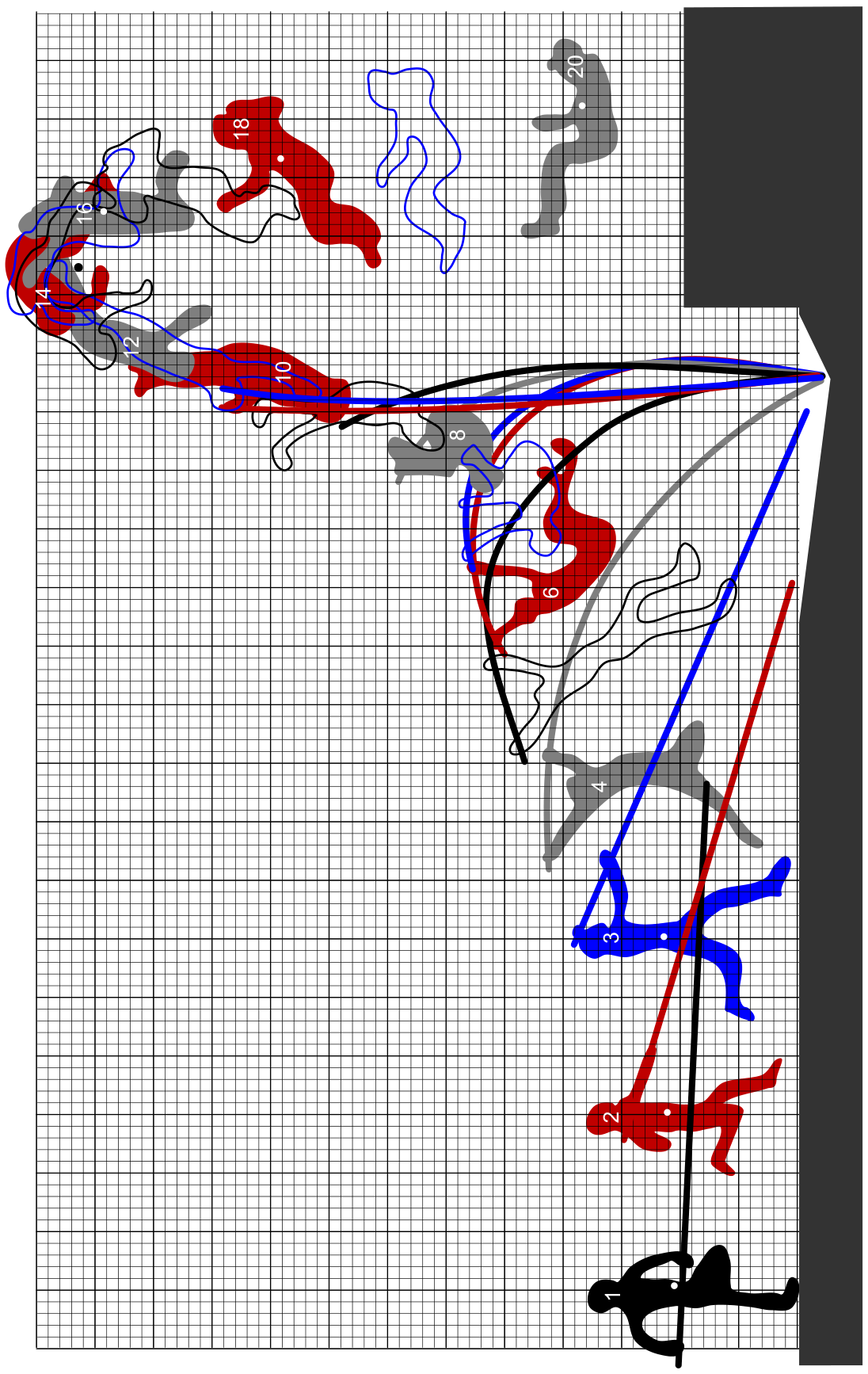
The figure shows an athlete (Armand Duplantis) setting the new world record of in pole vault. The figure is to scale and the inter-line distance of the grid is . What you can see is an overlay of a series of 20 snapshots, the time interval between two subsequent snapshots is not known. For positions 1, 2, 3, 16, 18, and 20, the white dots show the position of the centre of mass of the athlete. The black dot shows the location of the bar. To avoid clutter, some position numbers are not shown.
1. (0.5 pts) For which position is the elastic energy of the pole the largest?
2. (2 pts) Determine the value of the time interval by taking appropriate readings from the figure. Free fall acceleration is .
Remark: if you are unable to do it, in what follows you may use a very approximate value of .
3. (0.5 pts) Find the speed of the athlete at the position No 2.
4. (1 pt) During the jump, from the position No 3 to 12, the athlete performs a certain amount of mechanical work with his muscles. Find this work if the mass of the athlete is . You may neglect the mass of the pole.
5. (1 pt) What was the maximum height of the centre of mass of the man during the jump? Give the height with respect to the ground (corresponding to the lower boundary of the grid).
Fonte: Testo (PDF) — p.1
Topic: Newtonian Mechanics, Conservation of Energy Metodi: Kinematic Equations, Free-Body Diagram, Energy Conservation Method, Vector Decomposition Competenze: Physical Reasoning, Mathematical Modeling, Diagrammatic Reasoning, Estimation & Approximation Objects: Ball, String, Rod
Problem T3. Physics of sports (10 points)
Part A. Hammer throw (4 points)
Un martello è un iron ball of mass density and , fixed to steel wire with a grip on the other end. La lunghezza del filo di acciaio (grip included) è ; la massa e l’aria di drag del filo e la presa possono essere trascurate. Durante il volo, una forza di drag agisce sul martello, dove è la velocità del martello rispetto all’aria, l’area cross-sectional della palla di ferro, e la densità di aria. L’accelerazione di cascata libera è .
Un atleta lancia un martello a una distanza di . Supponiamo che (a) la velocità di lancio del martello forma un angolo di rispetto all’orizzonte; (b) immediatamente prima che il martello sia rilasciato, il martello si muove lungo un cerchio di raggio , dove denota la lunghezza delle braccia; (c) l’altezza del martello sopra il terreno immediatamente prima che sia rilasciato può essere trascurata (cioè, (Taced to be equal to zero).
1. (0.5 pts) What is the speed of the hammer just before being released if we neglect the effect of air drag on the hammer?
**2. (1 pt) ** What is the force with which the athlete pulls from the grip at the final stage of his throw?
3. (0.5 pts) From this part onwards, we consider the effects of air drag. Find the air drag acting on the hammer at the beginning of its flight.
4. (1 pt) Estimate as precisely as you can by how much is the final speed of the hammer (just before hitting the ground) smaller than its initial speed.
5. (1 pt) Estimate as precisely as you can by how much would the distance of the throw be longer if there were no air drag.
Parte B. Discus throw (1 points)
Di solito il tailwind aiuta nello sport, ma non nel discus throw. Spiegare qualitativamente perché il vento contro può aumentare la distanza raggiunta in discus throw. Usare un diagramma di forza per mostrare quali forze sono agendo su un disco durante il suo volo e in che modo sono influenzate da vento contrario.
** Parte C. Pole vault (5 points)**
The figure shows an athlete (Armand Duplantis) setting the new world record of in pole vault. La cifra è a scala e la distanza interlineare della griglia è . What you can see is an overlay of a series of 20 snapshots, the time interval between two subsequent snapshots is not known. Per le posizioni 1, 2, 3, 16, 18 e 20, i punti bianchi mostrano la posizione del centro di massa dell’atleta. Il punto nero mostra la posizione del bar. Per evitare il clutter, alcuni numeri di posizione non sono mostrati.
1. (0.5 pts) For which position is the elastic energy of the pole the largest?
2. (2 pts) Determine il valore del intervallo di tempo by taking appropriate readings from the figure. L’accelerazione di cascata libera è .
Ricerca: se non sei in grado di farlo, in what follows puoi usare un valore molto approssimativo di .
3. (0.5 pts) Find the speed of the athlete at the position No 2.
4. (1 pt) During the jump, from the position No 3 to 12, the athlete performs a certain amount of mechanical work with his muscles. Find this work if the mass of the athlete is . Potresti trascurare la massa del polo.
5. (1 pt) What was the maximum height of the centre of mass of the man during the jump? Date l’altezza rispetto al terreno (corrispondente al limite inferiore della griglia).
Fonte: Testo (PDF) — p.1
Topic: Newtonian Mechanics, Conservation of Energy Metodi: Kinematic Equations, Free-Body Diagram, Energy Conservation Method, Vector Decomposition Competenze: Physical Reasoning, Mathematical Modeling, Diagrammatic Reasoning, Estimation & Approximation Objects: Ball, String, Rod
Problem T3. Physics of sports (10 points)
Part A. Hammer throw (4 points)
A hammer is an iron ball of mass density and , fixed to steel wire with a grip on the other end. The length of the steel wire (grip included) is ; the mass and air drag of the wire and the grip can be neglected. During the flight, a drag force acts on the hammer, where is the speed of the hammer with respect to the air, the cross-sectional area of the iron ball, and the density of air. Free fall acceleration is .
An athlete throws a hammer to a distance of . Assume that (a) the launching velocity of the hammer forms an angle of with respect to the horizon; (b) immediately before the hammer is released, the hammer moves along a circle of radius , where denotes the length of the arms; (c) the height of the hammer above the ground immediately before it is released can be neglected (i.e. taken to be equal to zero).
1. (0.5 pts) What is the speed of the hammer just before being released if we neglect the effect of air drag on the hammer?
2. (1 pt) What is the force with which the athlete pulls from the grip at the final stage of his throw?
**3. (0.5 pts) ** From this part onwards, we consider the effects of air drag. Find the air drag acting on the hammer at the beginning of its flight.
4. (1 pt) Estimate as precisely as you can by how much is the final speed of the hammer (just before hitting the ground) smaller than its initial speed.
5. (1 pt) Estimate as precisely as you can by how much would the distance of the throw be longer if there were no air drag.
Part B. Discus throw (1 points)
Usually tailwind helps in sports, but not in discus throw. Explain qualitatively why headwind can increase the distance reached in discus throw. Use a force diagram to show which forces are acting on a discus during its flight and in what way they are influenced by headwind.
Part C. Pole vault (5 points)
The figure shows an athlete (Armand Duplantis) setting the new world record of in pole vault. The figure is to scale and the inter-line distance of the grid is . What you can see is an overlay of a series of 20 snapshots, the time interval between two subsequent snapshots is not known. For positions 1, 2, 3, 16, 18, and 20, the white dots show the position of the centre of mass of the athlete. The black dot shows the location of the bar. To avoid clutter, some position numbers are not shown.
1. (0.5 pts) For which position is the elastic energy of the pole the largest?
2. (2 pts) Determine the value of the time interval by taking appropriate readings from the figure. Free fall acceleration is .
Remark: if you are unable to do it, in what follows you may use a very approximate value of .
3. (0.5 pts) Find the speed of the athlete at the position No 2.
4. (1 pt) During the jump, from the position No 3 to 12, the athlete performs a certain amount of mechanical work with his muscles. Find this work if the mass of the athlete is . You may neglect the mass of the pole.
5. (1 pt) What was the maximum height of the centre of mass of the man during the jump? Give the height with respect to the ground (corresponding to the lower boundary of the grid).
Fonte: Testo (PDF) — p.1
Topic: Newtonian Mechanics, Conservation of Energy Metodi: Kinematic Equations, Free-Body Diagram, Energy Conservation Method, Vector Decomposition Competenze: Physical Reasoning, Mathematical Modeling, Diagrammatic Reasoning, Estimation & Approximation Objects: Ball, String, Rod
Problem E1. Cylinder in cylinder (20 points)
(Experimental Competition — Dammam, Saudi Arabia, March 15th 2022. The examination lasts for 5 hours; one problem worth in total 20 points.)
The aim of this experiment is to measure various characteristics of the provided transparent cylinder with a permanent magnet inside it.
Equipment
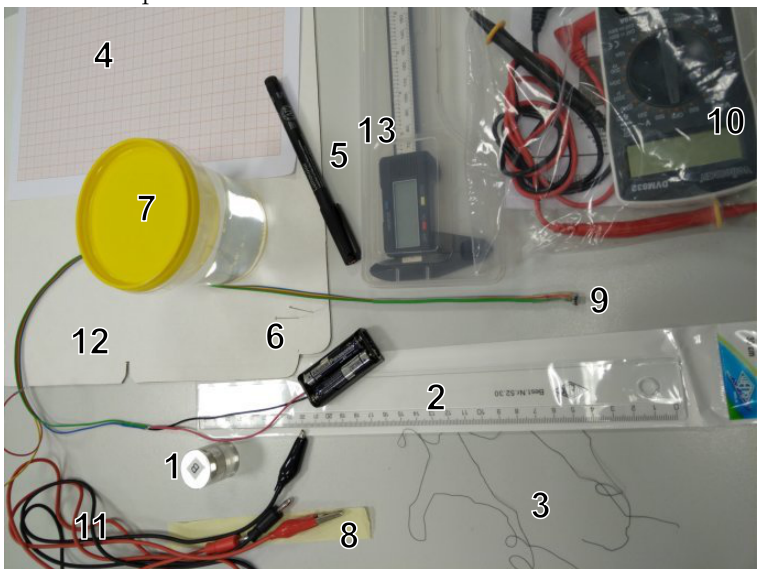
The following equipment is listed in the figure beneath:
- a transparent cylinder with a cylindrical permanent magnet inside and with foil caps covering its top and bottom;
- a ruler;
- a rubber thread;
- graph papers;
- a permanent marker;
- safety pins;
- a cup with water;
- a tape, for fixing a rubber thread to the cylinder;
- a resistive magnetic field sensor connected to batteries in a battery holder;
- a multimeter with wires;
- two wires with banana/crocodile connectors;
- a piece of cardboard, for fixing the safety pins vertically;
- a caliper.
WARNINGS:
- Avoid short-circuiting the battery leads — the battery will overheat and become unusable!
- Power off the multimeter when not in use, in order to conserve the batteries.
- Do not peel off the foil caps of the transparent cylinder, even if only partially — if you do, your score will be reduced!
- Do not move the magnetic sensor too close to the permanent magnet! If you do, the offset voltage of the sensor may change ( is defined in the problem text.)
- Pay attention to the fact that your tables have iron bars beneath. In order to avoid ferromagnetic interference, keep your cylinder and sensor in the middle of the table when doing magnetic measurements.
Tasks
For all the tasks below, keep in mind that parts of the points are given for the precision of your answer, so design and execute your experiments accordingly. Among other things, this might mean doing additional measurements to improve uncertainty estimates (when the task asks for this).
Always draw a sketch showing your measurement setup with clear indications of the positions of all those measurement tools which you are using for the given task. Describe clearly all steps in your solution, a significant amount of points will be given for the adequate procedure, based on your sketches and descriptions. In all cases, write down all the direct measurements results, the formulas used, and the calculations.
Part A. Geometrical characteristics (5 points)
1. (2 pts) Find the total volume of the cylinder and estimate the uncertainty of the result.
2. (1 pt) Find the height of the permanent magnet inside the cylinder and estimate the uncertainty of the result.
3. (2 pts) Design such a method for determining the diameter of the permanent magnet for which knowing the value of the refraction coefficient of the cylinder is not required. Determine the diameter of the magnet and estimate the uncertainty of the result.
Part B. Mechanical characteristics (3 points)
1. (2 pts) Determine the average density of the cylinder (glass with magnet) knowing that the density of water is .
2. (0.5 pts) Determine the total mass of the cylinder.
3. (0.5 pts) Determine the average density of the glass knowing that the density of the magnet is .
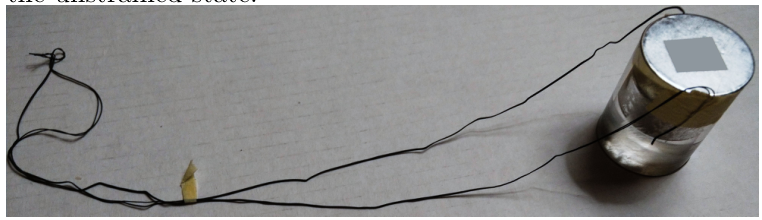
Hint: use the rubber threads as a dynamometer. Join two rubber threads together (to make them stiffer), and, using pieces of tape, attach the ends of the threads to both ends of the cylinder. Also attach a tiny piece of tape to the threads, serving as a marker for taking thread length measurements; the whole setup is shown in the figure below. The tension force in the threads given to you is proportional to the quantity
where denotes the length of the thread, and its length in the unstrained state.
Part C. Optical properties (5 points)
1. (2.5 pts) Notice that the transparent part of the cylinder is actually made of two different materials: the coefficient of refraction of the central part is slightly different from the coefficient of refraction of the outer part of the cylinder (the central part has the same diameter as the permanent magnet). Design a method for determining the coefficient of refraction and estimate the uncertainty of the result.
Hint: Measure the apparent diameter of the magnet and relate it to the refractive index using Snell’s law.
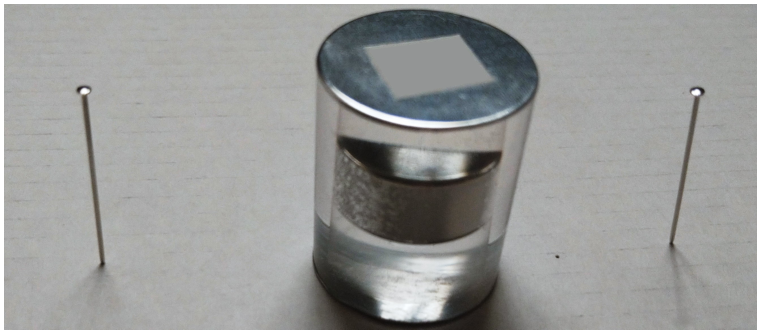
2. (1.5 pts) In order to determine the coefficient of refraction , you are asked to use the cylinder as a thick lens, and create with it an image of a safety pin, and to use the parallax method for determining the position of the pin’s image. To that end, complete the following steps, the end result of which is shown below. Fix two safety pins vertically into the provided piece of cardboard, such that the distance between the pins is bigger than the diameter of the cylinder. Place the cylinder vertically between the two pins such that the distances from both of the pins to the cylinder are strictly equal and such that the pins and the axis of the cylinder lie on the same line . Look at the cylinder from the side of one of the pins, along the line — so that the pin closer to you (let us call this pin “the pin A”) will overlap the image of the other pin — the pin B, as seen through the cylinder. Now, move your head (eye) rightwards; if the pin A moves rightwards from the image of the pin B, it means that it is farther away from you than the image of the pin B. You need to achieve the situation where pin A and the image of pin B coincide: in that case, their relative position will not change when you move your eye leftwards or rightwards from the initial position. You will need to pull the pins out and move them farther away from each other, or move them closer as needed, while maintaining an equal distance between the pins and the cylinder, and repeat it until the desired result has been achieved. Measure the distance between the two pins on the cardboard once pin A and the image of pin B coincide and estimate the uncertainty of the result.
3. (1 pt) Determine the coefficient of refraction of the cylinder.
Hint: you may use the formula
where denotes the diameter of the cylinder.
Part D. Magnetic properties (7 points)
1. (0.5 pts) Connect the banana ends of the two wires to the COM port and to the VmA-port of the multimeter. Switch on the multimeter in 20 volt (DC) range, and touch the two metallic leads of the battery holder (which are next to the points were the red and black wires come out from the holder) with the crocodile ends of the wires. Record the voltage on the output leads of the battery holder. If the voltage is below , you may ask for replacement batteries.
For all your magnetic field measurements, keep in mind that if the battery voltage were to be exactly , each millivolt in the reading would correspond to microteslas of the magnetic field strength. However, the reading in millivolts is proportional to both the magnetic field and to the battery voltage. So, to calculate the magnetic field strengths, you will be needing this battery voltage value.
Connect the crocodiles to the yellow and red wires of the magnetic sensor. Keep in mind that the sensor may have a non-zero offset: even if there is no magnetic field, the multimeter reading might be non-zero. You should also keep in mind that there is always the magnetic field of Earth.
2. (1 pt) Let the -axis be horizontal and parallel to the shorter edge of your desk. From this part onwards, we measure only the -component of the magnetic fields. It is convenient to fix the magnetic sensor to the plastic box of the caliper with pieces of tape as shown in the figure below: with such a setup the orientation of the sensor can be easily kept unchanged. The arrow in the figure shows the direction of the measured magnetic field component.
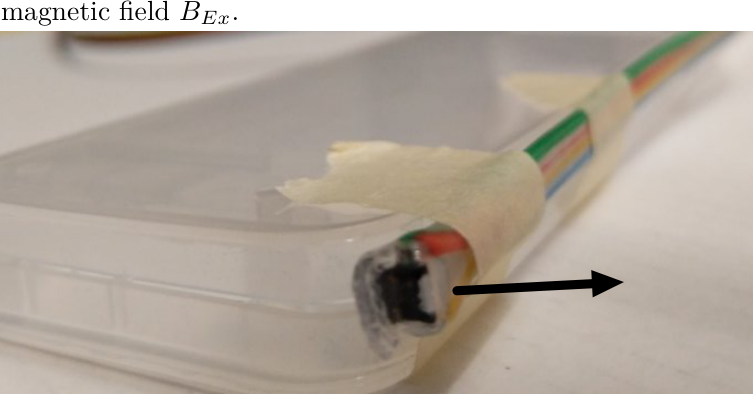
Switch on the multimeter in 200 millivolt (DC) range, put the sensor on the table far away from the magnet so that it will measure the -component of the magnetic field, take the reading of the multimeter , and write it down. Turn the sensor by degrees (so that it will again measure the -component of the magnetic field, but in the opposite direction), and take the new reading . Based on these two readings, determine the offset voltage , and the horizontal component of the Earth’s magnetic field .
3. (2.5 pts) Measure and tabulate the -component of the magnetic field of the permanent magnet for a series of points at different distances from the centre of the magnet, on the symmetry axis of the magnet (the -axis). You are expected to take readings for the full usable range of the distances. Avoid distances by which the voltage reading exceeds . Do not forget to report the direct measurement results (the voltages), and when calculating the magnetic field values, to subtract the offset voltage (you need to compensate both for the -component of the Earth’s magnetic field, and for the non-zero offset voltage ).
4. (2.5 pts) If the distance from the magnet is big enough, its strength is given by the formula
where denotes the magnetic dipole moment of the magnet and is the vacuum permeability. Find a way to plot the measurement data from the previous task so that the data points following this formula would lay in a straight line. Show for which values of , the formula holds within the measurement uncertainties. Use your graph to determine the dipole moment of the magnet.
5. (0.5 pts) Find the magnetization of the permanent magnet (defined as the volume density of the magnetic dipole moment).
Fonte: Testo (PDF) — p.1
Topic: Magnetism, Geometric Optics Metodi: Experimental Data Analysis, Snell’s Law, Graph Linearization, Thin Lens & Mirror Equation Competenze: Experimental Data Analysis, Measurement & Instrumentation, Error Propagation, Graph Linearization Objects: Cylinder, Magnet, Lens, Battery, Wire
**Problem E1. Caccia in cilindro (20 punti) **
(Experimental Competition — Dammam, Saudi Arabia, March 15th 2022. The examination lasts for 5 hours; one problem worth in total 20 points.)
L’obiettivo di questo esperimento è di misurare varie caratteristiche del cilindro trasparente fornito con un magnete permanente all’interno.
Equipment
Le seguenti apparecchiature sono elencate nella figura seguente:
- un cilindro trasparente con un magnetico permanente cilindrico all’interno e con cappucci di foil che coprono il suo top e il suo bottom;
- a ruotare;
- a filo di gomma;
- carta grafica;
- a marcatore permanente;
- i safety pins;
- un calice con acqua;
- un nastro per fissare un filo di gomma al cilindro;
- un sensore di campo magnetico resistivo collegato a batterie in un batterioio;
- un multimetro con fili;
- due fili con connettori banana/crocodile;
- un pezzo di cartone, per fissare verticalmente i pin di sicurezza;
-
- Un calibro.
**ALTERNAMENTI: **
- Evita di short-circuiting le batterie che si superiscelano e diventano inutilizzabili!
- Spegni il multimetro quando non in uso, per conservare le batterie.
- Non svelare i cappelli di carta del cilindro trasparente, anche se solo parzialmente
- Non spostare il sensore magnetico troppo vicino al magnete permanente! Se lo fai, il voltage offset del sensore può cambiare ( è definito nel testo del problema.)
- Attenzione al fatto che i tuoi tavoli hanno barre di ferro sotto. Per evitare interferenze ferromagnetiche, mantenere il cilindro e il sensore nel mezzo del tavolo quando si effettuano misure magnetiche.
Tasks
Per tutti i compiti qui sotto, ricordate che parti dei punti sono dati per la precisione della vostra risposta, quindi progettate ed eseguite i vostri esperimenti di conseguenza. Tra le altre cose, questo potrebbe significare fare ulteriori misurazioni per migliorare le stime di incertezza (quando il compito chiede questo).
Sempre disegnare uno schizzo che mostra la tua configurazione di misurazione con chiare indicazioni delle posizioni di tutti quei strumenti di misurazione che stai usando per il dato compito. Descrivi chiaramente tutti i passaggi della soluzione, verrà dato un numero significativo di punti per la procedura adeguata, basato sui tuoi schizzi e descrizioni. In tutti i casi, scrivete tutti i risultati delle misurazioni dirette, le formule utilizzate e i calcoli.
Part A. Geometrical characteristics (5 points)
**1. (2 pts) ** Find the total volume of the cylinder and estimate the uncertainty of the result.
**2. (1 pt) ** Find the height of the permanent magnet inside the cylinder and estimate the uncertainty of the result.
3. (2 pts) Design such a method for determining the diameter of the permanent magnet for which knowing the value of the refraction coefficient of the cylinder is not required. Determina il diametro del magnete e stima l’incertezza del risultato.
Parte B. Mechanical characteristics (3 points)
**1. (2 pts) ** Determina la densità media del cilindro (glass with magnet) sapendo che la densità di acqua è .
2. (0.5 pts) Determine the total mass of the cylinder.
3. (0.5 pts) Determine the average density of the glass knowing that the density of the magnet is .
*indizio: * use the rubber threads as a dynamometer. Unire due fili di gomma insieme (per renderli più rigidi), e, usando pezzi di nastro, attaccare le estremità dei fili a entrambi i lati del cilindro. Quindi, attaccare un piccolo pezzo di nastro ai fili, servendo come un marcatore per le misurazioni di lunghezza dei fili; l’intero setup è mostrato nella figura qui sotto. La forza di tensione nei fili dati a voi è proporzionale alla quantità
dove denota la lunghezza del filo, e la sua lunghezza nello stato non stretta.
** Parte C. Optical properties (5 points)**
**1. (2.5 pts) ** Nota che la parte trasparente del cilindro è effettivamente fatta di due materiali diversi: il coefficiente di refrazione della parte centrale è leggermente diverso dal coefficiente di refrazione della parte esterna del cilindro (la parte centrale ha lo stesso diametro del magnete permanente). Design a method for determining the coefficient of refraction and estimate the uncertainty of the result.
Tip: Misurare il diametro apparente del magnete e riferirlo all’indice refraettivo usando la legge di Snell.
2. (1.5 pts) In order to determine the coefficient of refraction , you are asked to use the cylinder as a thick lens, and create with it an image of a safety pin, and to use the parallax method for determining the position of the pin’s image. Per questo, completate i seguenti passi, il risultato finale di cui è mostrato qui sotto. Fissa due pinetti di sicurezza verticalmente nel pezzo di cartone fornito, in modo che la distanza tra i pinetti sia maggiore del diametro del cilindro. Place the cylinder vertically between the two pins such that the distances from both of the pins to the cylinder are strictly equal and such that the pins and the axis of the cylinder lie on the same line . Guardate il cilindro dal lato di uno dei pin, lungo la linea in modo che il pin più vicino a voi (chiamiamo questo pin “il pin A”) sovrappone l’immagine dell’altro pin il pin B, visto attraverso il cilindro. Ora, spostate la testa verso destra; se il pin A si muove verso destra dall’immagine del pin B, significa che è più lontano da voi dell’immagine del pin B. Devi ottenere la situazione in cui pin A e l’immagine di pin B coincidono: in quel caso, la loro posizione relativa non cambierà quando muovi l’occhio verso sinistra o verso destra dalla posizione iniziale. Dovrai tirare fuori i bastoni e spostarli più lontano l’uno dall’altro, o spostarli più vicino come necessario, mantenendo una distanza uguale tra i bastoni e il cilindro, e ripeterlo fino a quando il risultato desiderato non sarà stato raggiunto. Misurare la distanza tra i due pin sulla cartolina una volta che pin A e l’immagine di pin B coincidono e stimare l’incertezza del risultato.
**3. (1 pt) ** Determine il coefficiente di refrazione del cilindro.
Tint: you may use the formula
dove indica il diametro del cilindro.
Parte D. Magnetic properties (7 points)
**1. (0.5 pts) ** Connect the banana ends of the two wires to the COM port and to the VmA port of the multimeter. Spinta il multimetro in 20 volt (DC) range, e tocca i due condotti metallici del portabatteria (che sono vicino ai punti dove i fili rossi e neri uscivano dal portabatteria) con i capelli crocodilici dei fili. Record the voltage on the output leads of the battery holder. Se la voltage è inferiore a , potete chiedere batterie di sostituzione.
Per tutte le misurazioni del campo magnetico, ricordate che se la batteria fosse esattamente , ogni milivolt nella lettura corrisponderebbe a microteslas della forza del campo magnetico. Tuttavia, la lettura in millivolti è proporzionale sia al campo magnetico che alla tensione della batteria. Quindi, per calcolare le forze del campo magnetico, avrai bisogno di questo valore di tensione della batteria.
Connettere i coccodrilli ai fili gialli e rossi del sensore magnetico. Tenete presente che il sensore potrebbe avere un offset non zero: anche se non c’è campo magnetico, la lettura multimetro potrebbe essere non zero. Dovreste anche tenere a mente che c’è sempre il campo magnetico della Terra.
**2. (1 pt) ** Lascia che l’asse sia orizzontale e parallela al corto bordo della tua scrivania. Da questa parte in poi, misuriamo solo il componente dei campi magnetici. È conveniente fissare il sensore magnetico alla scatola di plastica del caliper con pezzi di nastro come mostrato nella figura seguente: con una configurazione simile l’orientamento del sensore può essere facilmente mantenuto invariato. L’arrow nella figura mostra la direzione del componente del campo magnetico misurato.
Switch on the multimeter in 200 millivolt (DC) range, put the sensor on the table far away from the magnet so that it will measure the -component of the magnetic field, take the reading of the multimeter , and write it down. Gira il sensore a gradi (per cui misura di nuovo il componente del campo magnetico, ma nella direzione opposta), e prendi la nuova lettura . Basandosi su queste due letture, determinare l’offset voltage , e la componente orizzontale del campo magnetico terrestre .
**3. (2.5 pts) ** Misurare e tabulare il componente del campo magnetico del magnete permanente per una serie di punti a diverse distanze dal centro del magnete, sull’asse di simmetria del magnete (l’asse ). Si prevede che si prendano le letture per il pieno raggio utilizzabile delle distanze. Evita le distanze in cui la lettura di voltage supera . Non dimenticate di riportare i risultati di misurazione diretta (le tensioni) e di sottraire la tensione di offset (bisogna compensare sia per il componente del campo magnetico terrestre, sia per il non zero voltage di offset ).
**4. (2.5 pts) ** Se la distanza dal magnete è sufficiente, la sua forza è data dalla formula
dove denota il momento di dipolo magnetico del magnete e è la permeabilità al vuoto. Trovare un modo per tracciare i dati di misurazione dal precedente compito in modo che i dati punti che seguono questa formula si trovino in una linea retta. Show for which values of , the formula holds within the measurement uncertainties. Usate il grafico per determinare il momento di dipole del magnete.
**5. (0.5 pts) ** Find the magnetization of the permanent magnet (defined as the volume density of the magnetic dipole moment).
Fonte: Testo (PDF) — p.1
Topic: Magnetism, Geometric Optics Metodi: Experimental Data Analysis, Snell’s Law, Graph Linearization, Thin Lens & Mirror Equation Competenze: Experimental Data Analysis, Measurement & Instrumentation, Error Propagation, Graph Linearization Objects: Cylinder, Magnet, Lens, Battery, Wire
Problem E1. Cylinder in cylinder (20 points)
(Experimental Competition — Dammam, Saudi Arabia, March 15th 2022. The examination lasts for 5 hours; one problem worth in total 20 points.)
The aim of this experiment is to measure various characteristics of the provided transparent cylinder with a permanent magnet inside it.
Equipment
The following equipment is listed in the figure below:
- a transparent cylinder with a cylindrical permanent magnet inside and with foil caps covering its top and bottom;
- a. Rulers;
- a rubber thread;
- Graph papers;
- a permanent marker;
- safety pins;
- a cup with water;
- a tape, for fixing a rubber thread to the cylinder;
- a resistive magnetic field sensor connected to batteries in a battery holder;
- a multimeter with wires;
- two wires with banana/crocodile connectors;
- a piece of cardboard, for fixing the safety pins vertically;
- A caliper.
WARNINGS:
- Avoid short-circuiting the battery leads the battery will overheat and become unusable!
- Power off the multimeter when not in use, to conserve the batteries.
- Do not peel off the foil caps of the transparent cylinder, even if only partially if you do, your score will be reduced!
- Don’t move the magnetic sensor too close to the permanent magnet! If you do, the offset voltage of the sensor may change ( is defined in the problem text.)
- Pay attention to the fact that your tables have iron bars underneath. To avoid ferromagnetic interference, keep your cylinder and sensor in the middle of the table when doing magnetic measurements.
Tasks
For all the tasks below, keep in mind that parts of the points are given for the precision of your answer, so design and execute your experiments accordingly. Among other things, this might mean doing additional measurements to improve uncertainty estimates (when the task asks for this).
Always draw a sketch showing your measurement setup with clear indications of the positions of all those measurement tools that you are using for the given task. Describe clearly all steps in your solution, a significant amount of points will be given for the adequate procedure, based on your sketches and descriptions. In all cases, write down all the direct measurement results, the formulas used, and the calculations.
Part A. Geometrical characteristics (5 points)
1. (2 pts) Find the total volume of the cylinder and estimate the uncertainty of the result.
2. (1 pt) Find the height of the permanent magnet inside the cylinder and estimate the uncertainty of the result.
3. (2 pts) Design such a method for determining the diameter of the permanent magnet for which knowing the value of the refraction coefficient of the cylinder is not required. Determine the diameter of the magnet and estimate the uncertainty of the result.
Part B. Mechanical characteristics (3 points)
**1. (2 pts) ** Determine the average density of the cylinder (glass with magnet) knowing that the density of water is .
2. (0.5 pts) Determine the total mass of the cylinder.
3. (0.5 pts) Determine the average density of the glass knowing that the density of the magnet is .
*Hint: * use the rubber threads as a dynamometer. Join two rubber threads together (to make them stiffer), and, using pieces of tape, attach the ends of the threads to both ends of the cylinder. So attach a tiny piece of tape to the threads, serving as a marker for taking thread length measurements; the whole setup is shown in the figure below. The tension force in the threads given to you is proportional to the quantity
where denotes the length of the thread, and its length in the unstrained state.
Part C. Optical properties (5 points)
**1. (2.5 pts) ** Note that the transparent part of the cylinder is actually made of two different materials: the coefficient of refraction of the central part is slightly different from the coefficient of refraction of the outer part of the cylinder (the central part has the same diameter as the permanent magnet). Design a method for determining the coefficient of refraction and estimate the uncertainty of the result.
*Hint: * Measure the apparent diameter of the magnet and relate it to the refractive index using Snell’s law.
**2. (1.5 pts) ** In order to determine the coefficient of refraction , you are asked to use the cylinder as a thick lens, and create with it an image of a safety pin, and to use the parallax method for determining the position of the pin’s image. To that end, complete the following steps, the end result of which is shown below. Fix two safety pins vertically into the provided piece of cardboard, such that the distance between the pins is greater than the diameter of the cylinder. Place the cylinder vertically between the two pins such that the distances from both of the pins to the cylinder are strictly equal and such that the pins and the axis of the cylinder lie on the same line . Look at the cylinder from the side of one of the pins, along the line — so that the pin closer to you (let us call this pin “the pin A”) will overlap the image of the other pin — the pin B, as seen through the cylinder. Now, move your head (eye) to the right; if pin A moves to the right from the pin B image, it means that it is further away from you than the pin B image. You need to achieve the situation where pin A and the image of pin B coincide: in that case, their relative position will not change when you move your eye left or right from the initial position. You’ll need to pull the pins out and move them further away from each other, or move them closer as needed, while maintaining an equal distance between the pins and the cylinder, and repeat it until the desired result has been achieved. Measure the distance between the two pins on the cardboard once pin A and the image of pin B coincide and estimate the uncertainty of the result.
3. (1 pt) Determine the coefficient of refraction of the cylinder.
Hint: you may use the formula
where denotes the diameter of the cylinder.
Part D. Magnetic properties (7 points)
**1. (0.5 pts) ** Connect the banana ends of the two wires to the COM port and to the VmA port of the multimeter. Switch on the multimeter in 20 volt (DC) range, and touch the two metallic leads of the battery holder (which are next to the points where the red and black wires come out from the holder) with the crocodile ends of the wires. Record the voltage on the output leads of the battery holder. If the voltage is below , you may ask for replacement batteries.
For all your magnetic field measurements, keep in mind that if the battery voltage were to be exactly , each millivolt in the reading would correspond to microteslas of the magnetic field strength. However, the reading in millivolts is proportional to both the magnetic field and to the battery voltage. So, to calculate the magnetic field strengths, you’ll be needing this battery voltage value.
Connect the crocodiles to the yellow and red wires of the magnetic sensor. Keep in mind that the sensor may have a non-zero offset: even if there is no magnetic field, the multimeter reading might be non-zero. You should also keep in mind that there is always the magnetic field of Earth.
2. (1 pt) Let the -axis be horizontal and parallel to the shorter edge of your desk. From this part onwards, we measure only the component of the magnetic fields. It is convenient to fix the magnetic sensor to the plastic box of the caliper with pieces of tape as shown in the figure below: with such a setup the orientation of the sensor can be easily kept unchanged. The arrow in the figure shows the direction of the measured magnetic field component.
Switch on the multimeter in 200 millivolt (DC) range, put the sensor on the table far away from the magnet so that it will measure the component of the magnetic field, take the reading of the multimeter , and write it down. Turn the sensor by degrees (so that it will again measure the component of the magnetic field, but in the opposite direction), and take the new reading . Based on these two readings, determine the offset voltage , and the horizontal component of the Earth’s magnetic field .
**3. (2.5 pts) ** Measure and tabulate the component of the magnetic field of the permanent magnet for a series of points at different distances from the centre of the magnet, on the symmetry axis of the magnet (the axis). You are expected to take readings for the full usable range of the distances. Avoid distances by which the voltage reading exceeds . Do not forget to report the direct measurement results (the voltages), and when calculating the magnetic field values, to subtract the offset voltage (you need to compensate both for the component of the Earth’s magnetic field, and for the non-zero offset voltage ).
4. (2.5 pts) If the distance from the magnet is big enough, its strength is given by the formula
where denotes the magnetic dipole moment of the magnet and is the vacuum permeability. Find a way to plot the measurement data from the previous task so that the data points following this formula would lay in a straight line. Show for which values of , the formula holds within the measurement uncertainties. Use your graph to determine the dipole moment of the magnet.
5. (0.5 pts) Find the magnetization of the permanent magnet (defined as the volume density of the magnetic dipole moment).
Fonte: Testo (PDF) — p.1
Topic: Magnetism, Geometric Optics Metodi: Experimental Data Analysis, Snell’s Law, Graph Linearization, Thin Lens & Mirror Equation Competenze: Experimental Data Analysis, Measurement & Instrumentation, Error Propagation, Graph Linearization Objects: Cylinder, Magnet, Lens, Battery, Wire