Spaceship-A moves at velocity km/s relative to a fixed coordinate system. Spaceship-B moves at km/s as seen by Spaceship-A. Find the velocity of Spaceship-B in the fixed coordinate system in the unit of km/s.
- (a)
- (b)
- (c)
- (d)
- (e)
Fonte: Testo (PDF) — p.4
Topic: Newtonian Mechanics Metodi: Vector Decomposition Competenze: Physical Reasoning Objects: —
La nave spaziale-A si muove a velocità km/s rispetto a un sistema di coordinate fisso. La nave spaziale B si muove a km/s come osservato dalla nave spaziale A. Trova la velocità della nave spaziale B nel sistema di coordinate fisse nell’unità di km/s.
- (a)
- (b)
- (c)
- (d)
- (e)
Fonte: Testo (PDF) — p.4
Topic: Newtonian Mechanics Metodi: Vector Decomposition Competenze: Physical Reasoning Objects: —
A light glass tube with a sealed lower end and cross section area contains a column of mercury of mass . Between the mercury and the lower end is some trapped gas. The glass tube is sliding down a slope with an inclining angle . The dynamic friction coefficient between the tube and the slope is . Find the pressure of the trapped gas in terms of the standard atmosphere pressure .
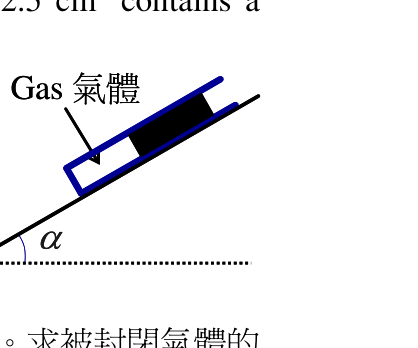 The sealed glass tube containing the mercury column (black) on top of the trapped gas, sliding down a slope of inclination .
- (a)
- (b)
- (c)
- (d)
- (e)
Fonte: Testo (PDF) — p.4
Topic: Newtonian Mechanics Metodi: Free-Body Diagram, Vector Decomposition Competenze: Physical Reasoning Objects: Tube, Gas, Inclined Plane
Un tubo di vetro leggero con un’estensione inferiore sigillata e una superficie trasversale contiene una colonna di mercurio di massa . Tra il mercurio e la parte inferiore c’è un gas intrappolato. Il tubo di vetro scorre verso il basso con un angolo di inclinazione . Il coefficiente di attrito dinamico tra il tubo e la pendenza è . Indicare la pressione del gas intrappolato in termini di pressione atmosferica standard .
Il tubo di vetro sigillato contenente la colonna di mercurio (nera) sopra il gas intrappolato, scorrendo verso il basso di una pendizione .
- (a)
- (b)
- (c)
- (d)
- (e)
Fonte: Testo (PDF) — p.4
Topic: Newtonian Mechanics Metodi: Free-Body Diagram, Vector Decomposition Competenze: Physical Reasoning Objects: Tube, Gas, Inclined Plane
Saturn revolves around the sun at 29.5 years per revolution. Find the distance between Saturn and Sun in terms of astronomical unit (A. U.).
- (a)
- (b)
- (c)
- (d)
- (e)
Fonte: Testo (PDF) — p.4
Topic: Gravitation Metodi: Kepler’s Laws Competenze: Physical Reasoning Objects: Planet, Star
Saturno ruota intorno al Sole a 29,5 anni per rivoluzione. Trova la distanza tra Saturno e Sole in termini di unità astronomiche (A. U.).
- (a)
- (b)
- (c)
- (d)
- (e)
Fonte: Testo (PDF) — p.4
Topic: Gravitation Metodi: Kepler’s Laws Competenze: Physical Reasoning Objects: Planet, Star
The pixel size of a digital camera is . The focal length of the lens is . The image plate from the lens is . Find the minimum size of an object the camera can resolve.
- (a)
- (b)
- (c)
- (d)
- (e)
Fonte: Testo (PDF) — p.4
Topic: Geometric Optics Metodi: Thin Lens & Mirror Equation Competenze: Physical Reasoning Objects: Lens
La dimensione dei pixel di una fotocamera digitale è . La distanza focale della lente è . La targa di immagine della lente è . Trova la dimensione minima di un oggetto che la fotocamera può risolvere.
- (a)
- (b)
- (c)
- (d)
- (e)
Fonte: Testo (PDF) — p.4
Topic: Geometric Optics Metodi: Thin Lens & Mirror Equation Competenze: Physical Reasoning Objects: Lens
Following MC4, if the diameter of the camera lens is doubled, what will be the increase of light intensity on the image plate?
- (a) 4 times
- (b) 2 times
- (c) 1.5 times
- (d) times
- (e) times
Fonte: Testo (PDF) — p.5
Topic: Geometric Optics Metodi: Physical Modeling Competenze: Physical Reasoning Objects: Lens
Dopo MC4, se il diametro della lente della fotocamera è raddoppiato, quale sarà l’aumento dell’intensità luminosa sulla targa di immagine?
- **(a) ** 4 volte
- **(b) ** 2 volte
- **(c) ** 1,5 volte
- **(d) ** volte
- **(e) ** volte
Fonte: Testo (PDF) — p.5
Topic: Geometric Optics Metodi: Physical Modeling Competenze: Physical Reasoning Objects: Lens
A uniform chain of mass and length is originally placed mid-way on the top of a fixed smooth double-sided wedge (Figure-A). The length of each side of the wedge is . It is then given a slight push. Find the kinetic energy of the chain when the whole chain has just slid to the left side of the wedge (Figure-B).
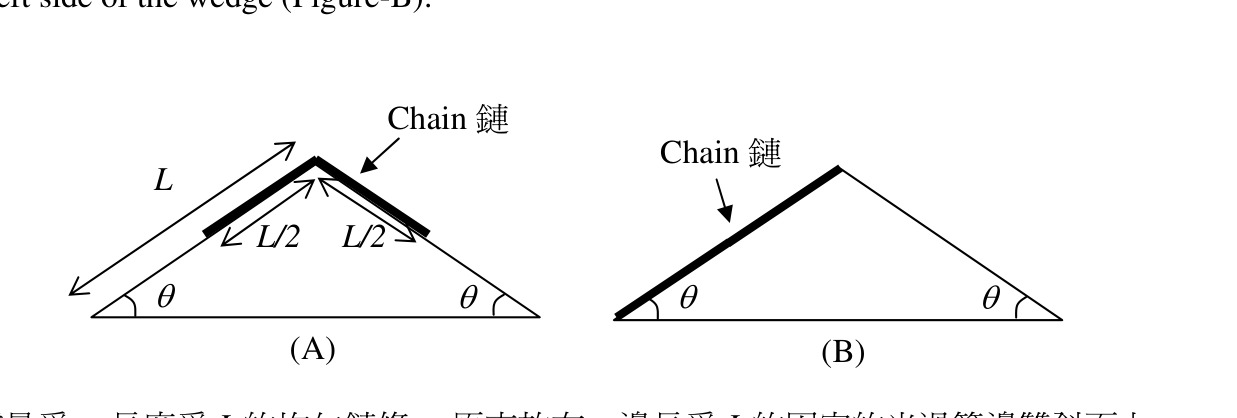 The uniform chain of length on the symmetric wedge of base angle : (A) initial position, mid-way over the apex with on each smooth incline; (B) after sliding entirely onto the left incline.
- (a)
- (b)
- (c)
- (d)
- (e)
Fonte: Testo (PDF) — p.5
Topic: Conservation of Energy Metodi: Energy Conservation Method, Calculus-Integration Competenze: Physical Reasoning Objects: Wedge, String
Una catena uniforme di massa e lunghezza è originariamente collocata a metà strada sulla parte superiore di una cucina a doppia parte liscia fissa (Figura-A). La lunghezza di ciascun lato della ciglia è . Si dà poi una leggera spinta. Trova l’energia cinetica della catena quando l’intera catena è appena scivolata verso il lato sinistro della cuvia (Figura-B).
La catena uniforme di lunghezza sulla cuccia simmetrica dell’angolo di base : (A) posizione iniziale, a metà strada sopra l’apice con su ogni inclinazione liscia; (B) dopo essere scivolato interamente verso la inclinazione sinistra.
- (a)
- (b)
- (c)
- (d)
- (e)
Fonte: Testo (PDF) — p.5
Topic: Conservation of Energy Metodi: Energy Conservation Method, Calculus-Integration Competenze: Physical Reasoning Objects: Wedge, String
A uniform “L”-shaped rigid body of mass , where and is a right angle, is hinged to a smooth joint at Point of the body and can swing freely in a vertical plane. Initially, the body is released from rest with horizontal. Find the maximum kinetic energy of the body.
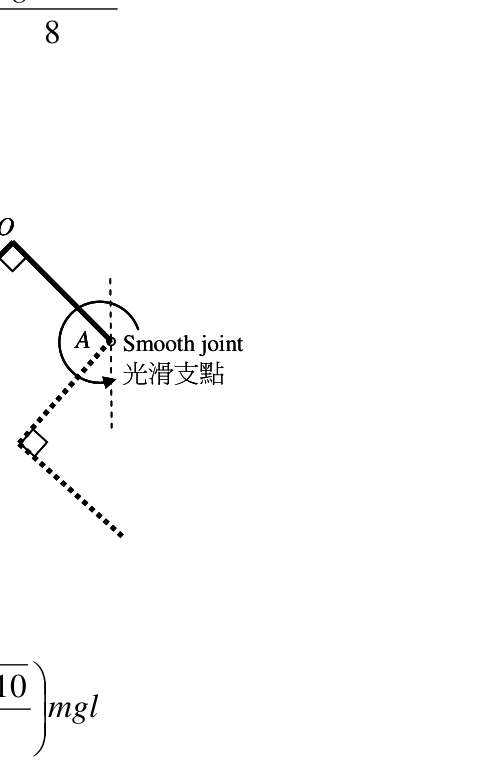 The “L”-shaped rigid body with and the right angle at , hinged at the smooth joint and free to swing in a vertical plane.
- (a)
- (b)
- (c)
- (d)
- (e)
Fonte: Testo (PDF) — p.5
Topic: Rotational Dynamics Metodi: Torque & Angular Momentum Analysis, Energy Conservation Method Competenze: Physical Reasoning Objects: Rod
Un corpo rigido uniforme “L” di massa , dove e sono angolati a destra, è inclinato su un’articolazione liscia al punto del corpo e può oscillare liberamente in piano verticale. Inizialmente, il corpo viene rilasciato dal riposo con orizzontale. Trova la massima energia cinetica del corpo.
Il corpo rigido a forma di “L” con e l’angolo retto a , inclinato alla giunta liscia e libero di oscillare in piano verticale.
- (a)
- (b)
- (c)
- (d)
- (e)
Fonte: Testo (PDF) — p.5
Topic: Rotational Dynamics Metodi: Torque & Angular Momentum Analysis, Energy Conservation Method Competenze: Physical Reasoning Objects: Rod
A capacitor charged to and a capacitor charged to are connected to each other, with the positive plate connected to the negative plate, and the negative plate to the positive plate. What is the final charge on the capacitor?
- (a)
- (b)
- (c)
- (d)
- (e)
Fonte: Testo (PDF) — p.6
Topic: Circuits Metodi: Conservation Laws Competenze: Physical Reasoning Objects: Capacitor
Un condensatore carico a e un condensatore carico a sono collegati tra loro, con la piastra positiva collegata alla piastra negativa e la piastra negativa alla piastra positiva. Qual è la carica finale del condensatore ?
- (a)
- (b)
- (c)
- (d)
- (e)
Fonte: Testo (PDF) — p.6
Topic: Circuits Metodi: Conservation Laws Competenze: Physical Reasoning Objects: Capacitor
A particle of mass and carrying charge is launched with initial speed and at an angle of relative to the horizontal direction. When it reaches the maximum height it enters a region of uniform magnetic field. In the region it moves at constant velocity in the horizontal direction. Determine the direction and strength of the magnetic field.
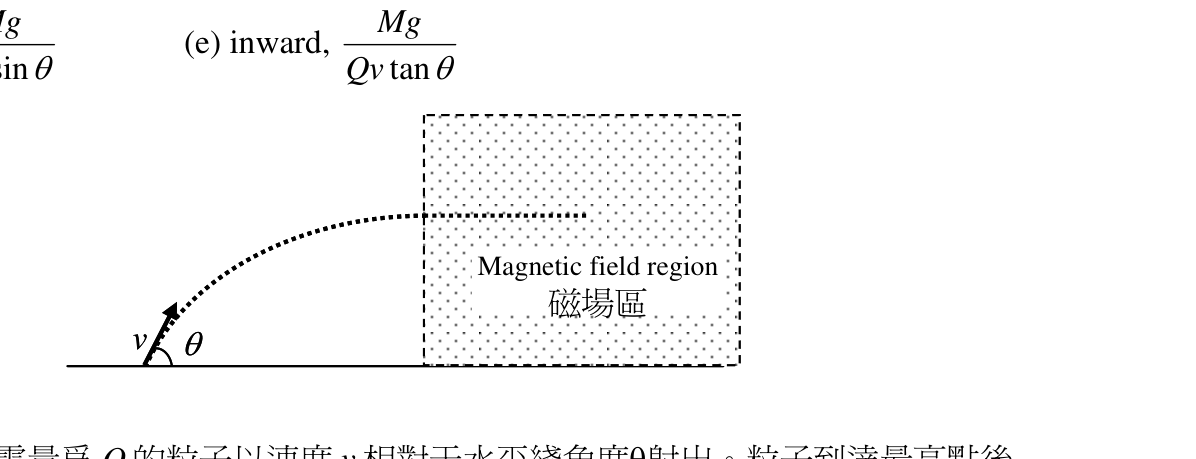 The charged particle is launched with speed at angle to the horizontal; at the top of its trajectory it enters the uniform magnetic field region.
- (a) outward,
- (b) inward,
- (c) outward,
- (d) inward,
- (e) inward,
Fonte: Testo (PDF) — p.6
Topic: Magnetism Metodi: Lorentz Force Analysis, Free-Body Diagram Competenze: Physical Reasoning Objects: Point Charge
Una particella di massa e carica di carico viene lanciata con velocità iniziale e ad un angolo di rispetto alla direzione orizzontale. Quando raggiunge l’altezza massima entra in una regione di campo magnetico uniforme. Nella regione si muove a velocità costante nella direzione orizzontale. Determinare la direzione e la forza del campo magnetico.
La particella carica viene lanciata con velocità all’angolo verso l’orizzontale; in cima alla sua traiettoria entra nella regione di campo magnetico uniforme.
- **(a) ** verso l’esterno,
- **(b) ** verso l’interno,
- **(c) ** verso l’esterno,
- **(d) ** verso l’interno,
- **(e) ** verso l’interno,
Fonte: Testo (PDF) — p.6
Topic: Magnetism Metodi: Lorentz Force Analysis, Free-Body Diagram Competenze: Physical Reasoning Objects: Point Charge
As shown, one end of a light thread is fixed on the ceiling and the other end tied to a small sphere. The angle between the thread and the vertical direction is . When and is a small angle, the sphere is in simple harmonic motion like a pendulum with period . When or (), the sphere is in a uniform circular motion in a horizontal plane with period or , respectively. Then the correct relation is ________.
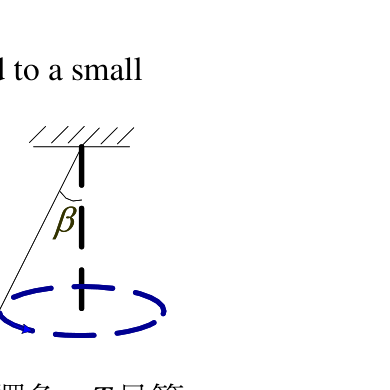 A small sphere on a light thread fixed to the ceiling; the thread makes angle with the vertical as the sphere moves in a horizontal circle.
- (a)
- (b)
- (c)
- (d)
- (e)
Fonte: Testo (PDF) — p.6
Topic: Oscillations & Waves Metodi: Simple Harmonic Motion Analysis, Free-Body Diagram Competenze: Physical Reasoning Objects: Pendulum, Ball, String
Come illustrato, una estremità di un filo leggero è fissata al soffitto e l’altra è legata a una piccola sfera. L’angolo tra il filo e la direzione verticale è . Quando e sono angoli piccoli, la sfera è in semplice movimento armonico come un pendolo con periodo . Quando o (), la sfera è in un movimento circolare uniforme in un piano orizzontale con periodo o , rispettivamente. Allora la corretta relazione è ________.
Una piccola sfera su un filo leggero fissato al soffitto; il filo fa un angolo con la verticale mentre la sfera si muove in un cerchio orizzontale.
- (a)
- (b)
- (c)
- (d)
- (e)
Fonte: Testo (PDF) — p.6
Topic: Oscillations & Waves Metodi: Simple Harmonic Motion Analysis, Free-Body Diagram Competenze: Physical Reasoning Objects: Pendulum, Ball, String
A cone of height with a mass attached is floating upside down in water, as shown. The water reaches when in equilibrium. Ignore friction. Find the vibration frequency after the cone is slightly pushed downwards.
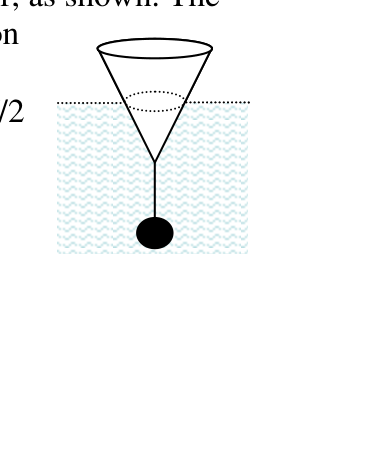 The inverted cone of height floats apex-down with a mass attached below it; in equilibrium the waterline reaches .
- (a)
- (b)
- (c)
- (d)
- (e)
Fonte: Testo (PDF) — p.7
Topic: Fluid Mechanics, Oscillations & Waves Metodi: Hydrostatic Equilibrium, Simple Harmonic Motion Analysis Competenze: Physical Reasoning Objects: —
Un cono di altezza con una massa attaccata galleggia in acqua a testa in giù, come mostrato. L’acqua raggiunge quando è in equilibrio. Ignora gli attriti. Trova la frequenza di vibrazione dopo che il cono è leggermente spinto verso il basso.
Il cono invertito di altezza galleggia verso l’alto con una massa fissata al di sotto; in equilibrio la linea d’acqua raggiunge .
- (a)
- (b)
- (c)
- (d)
- (e)
Fonte: Testo (PDF) — p.7
Topic: Fluid Mechanics, Oscillations & Waves Metodi: Hydrostatic Equilibrium, Simple Harmonic Motion Analysis Competenze: Physical Reasoning Objects: —
In the circuit, when the voltage between and is 20 V, the voltage between and is 10 V. When the voltage between and is 20 V, what is the voltage between and ?
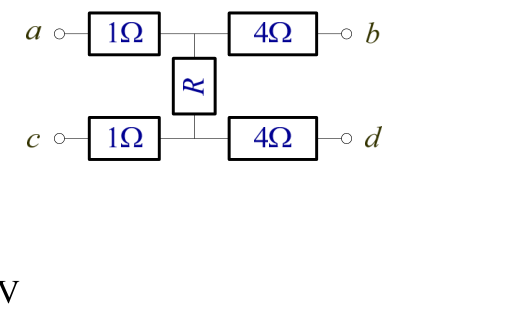 Bridge-type network: top branch – is then ; bottom branch – is then ; resistor bridges the two midpoints.
- (a)
- (b)
- (c)
- (d)
- (e)
Fonte: Testo (PDF) — p.7
Topic: Circuits Metodi: Kirchhoff’s Laws, Equivalent Circuit Reduction Competenze: Physical Reasoning Objects: Resistor
Nel circuito, quando la tensione tra e è di 20 V, la tensione tra e è di 10 V. Quando la tensione tra e è di 20 V, quale è la tensione tra e ?
Rete di tipo ponte: il ramo superiore a$$b è e poi ; il ramo inferiore c$$d è e poi ; la resistenza collega i due punti di mezzo.
- (a)
- (b)
- (c)
- (d)
- (e)
Fonte: Testo (PDF) — p.7
Topic: Circuits Metodi: Kirchhoff’s Laws, Equivalent Circuit Reduction Competenze: Physical Reasoning Objects: Resistor
In the circuit, the electric current through the battery is _____ Ampere(s).
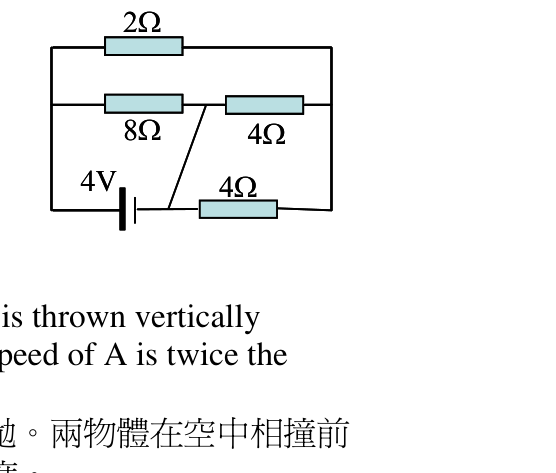 Network driven by a 4 V battery containing resistors of , , and arranged as shown.
- (a)
- (b)
- (c)
- (d)
- (e)
Fonte: Testo (PDF) — p.7
Topic: Circuits Metodi: Equivalent Circuit Reduction, Kirchhoff’s Laws Competenze: Physical Reasoning Objects: Battery, Resistor
Nel circuito, la corrente elettrica attraverso la batteria è di _____ Ampere (s).
Rete alimentata da una batteria da 4 V contenente resistori di , , e disposti come indicato.
- (a)
- (b)
- (c)
- (d)
- (e)
Fonte: Testo (PDF) — p.7
Topic: Circuits Metodi: Equivalent Circuit Reduction, Kirchhoff’s Laws Competenze: Physical Reasoning Objects: Battery, Resistor
Object-A is dropped from a height . At the same instant object-B is thrown vertically upward from the ground. Right before they collide in mid-air, the speed of A is twice the speed of B. Determine the height where the collision occurs.
- (a)
- (b)
- (c)
- (d)
- (e)
Fonte: Testo (PDF) — p.7
Topic: Newtonian Mechanics Metodi: Kinematic Equations Competenze: Physical Reasoning Objects: —
L’oggetto A viene abbassato da un’altezza . Allo stesso istante l’oggetto B viene gettato verticalmente in su dalla terra. Proprio prima che si schiantino in aria, la velocità di A è doppia della velocità di B. Determinare l’altezza in cui si verifica la collisione.
- (a)
- (b)
- (c)
- (d)
- (e)
Fonte: Testo (PDF) — p.7
Topic: Newtonian Mechanics Metodi: Kinematic Equations Competenze: Physical Reasoning Objects: —
An object of mass is placed on a horizontal floor. The static friction coefficient between the object and the floor is . Find the minimum force that can move the object.
- (a)
- (b)
- (c)
- (d)
- (e)
Fonte: Testo (PDF) — p.7
Topic: Newtonian Mechanics Metodi: Free-Body Diagram, Vector Decomposition Competenze: Physical Reasoning Objects: Block
Un oggetto di massa è posizionato su un pavimento orizzontale. Il coefficiente di attrito statico tra l’oggetto e il pavimento è . Trova la forza minima che può muovere l’oggetto.
- (a)
- (b)
- (c)
- (d)
- (e)
Fonte: Testo (PDF) — p.7
Topic: Newtonian Mechanics Metodi: Free-Body Diagram, Vector Decomposition Competenze: Physical Reasoning Objects: Block
In the circuit , , , and are four light bulbs. and are labeled “220V, 25W”. and are labeled “220V, 60W”. When voltage is applied, the sequence of the brightness of the four bulbs is, from the brightest to the dimmest, ________.
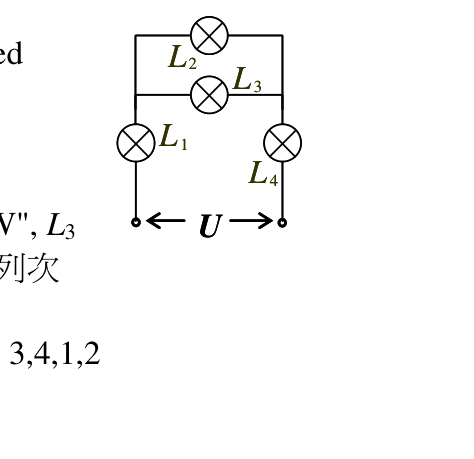 Network of four bulbs , , , connected across the supply as shown.
- (a)
- (b)
- (c)
- (d)
- (e)
Fonte: Testo (PDF) — p.8
Topic: Circuits Metodi: Equivalent Circuit Reduction, Kirchhoff’s Laws Competenze: Physical Reasoning Objects: Resistor
Nel circuito , , e sono quattro lampadine. e sono etichettati “220V, 25W”. e sono etichettati “220V, 60W”. Quando viene applicata la tensione , la sequenza di luminosità delle quattro lampadine è, dal più luminoso al più sottile, ________.
Rete di quattro lampadine , , , collegate attraverso la fornitura come mostrato.
- (a)
- (b)
- (c)
- (d)
- (e)
Fonte: Testo (PDF) — p.8
Topic: Circuits Metodi: Equivalent Circuit Reduction, Kirchhoff’s Laws Competenze: Physical Reasoning Objects: Resistor
A charged object is launched inside a time varying electric field. Its motion is recorded by a video camera on a video tape. When it is at a certain moment , its position vector , velocity , and acceleration are measured. A student watches the video at a later time but mistakenly plays the tape in the reverse direction. What are the position, velocity, and acceleration of the object at moment observed by the student?
- (a)
- (b)
- (c)
- (d)
- (e)
Fonte: Testo (PDF) — p.8
Topic: Newtonian Mechanics Metodi: Symmetry Argument Competenze: Physical Reasoning Objects: Point Charge
Un oggetto carico viene lanciato all’interno di un campo elettrico variabile nel tempo. Il suo movimento viene registrato da una videocamera su un nastro video. Quando è a un certo momento , si misurano il suo vettore di posizione , la velocità e l’accelerazione . Uno studente guarda il video in un secondo momento ma lo riproduce erroneamente in direzione inversa. Qual è la posizione, velocità e accelerazione dell’oggetto al momento osservato dallo studente?
- (a)
- (b)
- (c)
- (d)
- (e)
Fonte: Testo (PDF) — p.8
Topic: Newtonian Mechanics Metodi: Symmetry Argument Competenze: Physical Reasoning Objects: Point Charge
An object of mass is attached to a spring. The restoring force of the spring is , where is the displacement. The oscillation period now depends on the oscillation amplitude. Suppose the object is initially at rest. If the initial displacement is then its period is . If the initial displacement is , find the period. (Hint: use dimension analysis.)
- (a)
- (b)
- (c)
- (d)
- (e)
Fonte: Testo (PDF) — p.8
Topic: Oscillations & Waves Metodi: Dimensional Analysis Competenze: Physical Reasoning Objects: Spring
Un oggetto di massa è attaccato a una molla. La forza di ripristino della molla è , dove è il spostamento. Il periodo di oscillazione dipende ora dall’ampiezza di oscillazione. Supponiamo che l’oggetto sia inizialmente a riposo. Se il spostamento iniziale è , il suo periodo è . Se il spostamento iniziale è , trovare il periodo. (Suggestone: analisi di dimensioni utilizzate).
- (a)
- (b)
- (c)
- (d)
- (e)
Fonte: Testo (PDF) — p.8
Topic: Oscillations & Waves Metodi: Dimensional Analysis Competenze: Physical Reasoning Objects: Spring
A small air bubble is inside a drop of water residing in a space station on an orbit around Earth. The direction to Earth is downwards and the space station is moving to the left relative to Earth, as shown. The air bubble will __________ relative to the water drop.
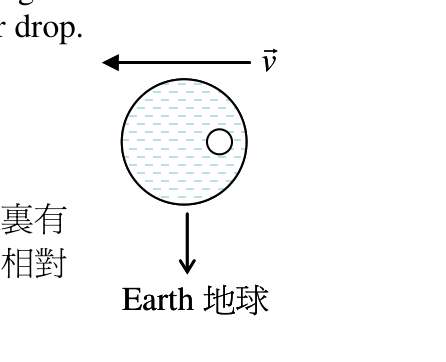 A water drop containing a small air bubble inside a space station moving with velocity to the left; the Earth direction is downward.
- (a) move to the left
- (b) move to the right
- (c) move up
- (d) move down
- (e) not move
Fonte: Testo (PDF) — p.8
Topic: Fluid Mechanics Metodi: Physical Modeling Competenze: Physical Reasoning Objects: Bubble, Droplet
Una piccola bolla d’aria è all’interno di una goccia d’acqua che risiede in una stazione spaziale in orbita attorno alla Terra. La direzione verso la Terra è verso il basso e la stazione spaziale si sta muovendo a sinistra rispetto alla Terra, come mostrato. La bolla d’aria __________ rispetto alla goccia d’acqua.
Una goccia d’acqua contenente una piccola bolla d’aria all’interno di una stazione spaziale che si muove a sinistra con velocità ; la direzione terrestre è verso il basso.
- **(a) ** spostarsi a sinistra
- **(b) ** spostarsi a destra
- **(c) ** salire
- **(d) ** scendere
- **(e) ** non si muove
Fonte: Testo (PDF) — p.8
Topic: Fluid Mechanics Metodi: Physical Modeling Competenze: Physical Reasoning Objects: Bubble, Droplet
A satellite of mass is at a distance from a star of mass . The speed of the satellite is . Suppose the law of universal gravity is instead of , find the speed of the satellite when it is at a distance from the star.
- (a)
- (b)
- (c)
- (d)
- (e)
Fonte: Testo (PDF) — p.9
Topic: Gravitation Metodi: Energy Conservation Method, Calculus-Integration Competenze: Physical Reasoning Objects: Satellite, Star
Un satellite di massa è a distanza da una stella di massa . La velocità del satellite è . Supponiamo che la legge della gravità universale sia invece di , trovi la velocità del satellite quando è a una distanza dalla stella.
- (a)
- (b)
- (c)
- (d)
- (e)
Fonte: Testo (PDF) — p.9
Topic: Gravitation Metodi: Energy Conservation Method, Calculus-Integration Competenze: Physical Reasoning Objects: Satellite, Star
(8 points) Consider the figure of an infinite ladder of resistors as shown in the figure. Calculate the equivalent resistance between point and point .
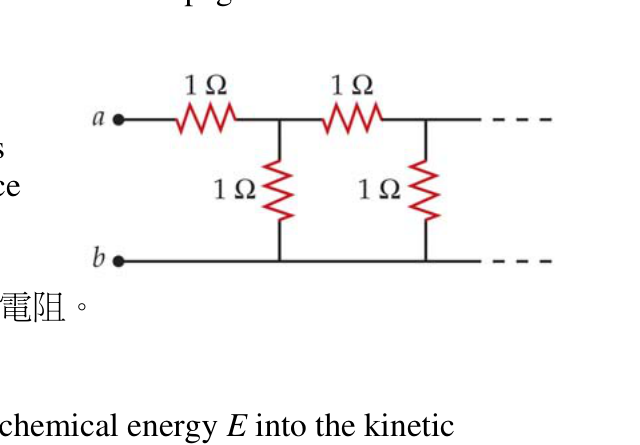 An infinite ladder network: each horizontal series element is and each shunt (vertical) element is , repeating indefinitely to the right from terminals (top) and (bottom).
Fonte: Testo (PDF) — p.10
Topic: Circuits Metodi: Equivalent Circuit Reduction, Symmetry Argument Competenze: Mathematical Modeling Objects: Resistor, Wire
**(8 punti) ** Considerate la figura di una scala infinita di resistori come mostrato nella figura. Calcolare la resistenza equivalente tra il punto e il punto .
Rete di scala infinita: ogni elemento della serie orizzontale è e ogni elemento di shunt (verticale) è , ripetendosi indefinitamente a destra dai terminali (alto) e (infine).
Fonte: Testo (PDF) — p.10
Topic: Circuits Metodi: Equivalent Circuit Reduction, Symmetry Argument Competenze: Mathematical Modeling Objects: Resistor, Wire
(12 points) A firework exploded into fragments and converted chemical energy into the kinetic energies of the fragments. The masses of the fragments are , . The spinning motions of the fragments are ignored.
(a) Consider the 2nd to the Nth fragments as a whole system, find the velocity of the center-of-mass of the system in terms of the fragment masses and the velocity of the 1st fragment . (4 points)
(b) Let the velocities of the 2nd to the Nth fragments relative to the center-of-mass of the system be , . Find their total kinetic energy in terms of their masses, , and , . (4 points)
(c) Find the maximum kinetic energy the 1st fragment can have in terms of and the masses of the fragments. (4 points)
Fonte: Testo (PDF) — p.10
Topic: Conservation of Momentum, Conservation of Energy Metodi: Conservation of Momentum, Energy Conservation Method Competenze: Mathematical Modeling Objects: Projectile
**(12 punti) ** Un fuochi d’artificio esplose in frammenti e convertì l’energia chimica in energie cinetiche dei frammenti. Le masse dei frammenti sono , . I movimenti di rotazione dei frammenti vengono ignorati.
(a) Considerare i 2° ai frammenti Nth come un intero sistema, trovare la velocità del centro di massa del sistema in termini di massa dei frammenti e la velocità del primo frammento . (4 punti)
b) Le velocità dei frammenti 2° a Nth rispetto al centro di massa del sistema siano , . Trova la loro energia cinetica totale in termini di massa, , e , . (4 punti)
c) Trova l’energia cinetica massima che il primo frammento può avere in termini di e di massa dei frammenti. (4 punti)
Fonte: Testo (PDF) — p.10
Topic: Conservation of Momentum, Conservation of Energy Metodi: Conservation of Momentum, Energy Conservation Method Competenze: Mathematical Modeling Objects: Projectile
(15 points) Two vertical pistons of total mass and different diameters are connected by a rigid light rod of length . Trapped in between is mol of ideal gas. The area of the upper piston is and that of the lower piston is . The air pressure outside is . The wall of the cylinder is smooth. The gas constant is .
(a) Find the distance between the bottom of the large cylinder and the lower piston when the system is in equilibrium.
(b) Find the vibration frequency of the pistons near the equilibrium position.
(Hint: for , , where can be a fraction number or an integer.)
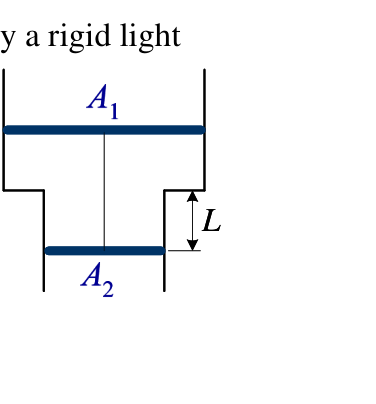 The stepped vertical cylinder with an upper piston of area and a lower piston of area joined by a rigid light rod, gas trapped between them; marks the relevant distance.
Fonte: Testo (PDF) — p.10
Topic: Thermodynamics, Oscillations & Waves Metodi: Ideal Gas Law, Simple Harmonic Motion Analysis, Approximation & Series Expansion Competenze: Physical Reasoning Objects: Piston, Rod, Gas, Cylinder
**(15 punti) ** Due pistoni verticali di massa totale e di diametri diversi sono collegati da una barra rigida di luce di lunghezza . Tracciato tra di essi è mol di gas ideale. L’area del pistone superiore è e quella del pistone inferiore è . La pressione dell’aria esterna è . La parete del cilindro è liscia. La costante del gas è .
(a) Indicare la distanza tra il fondo del cilindro grande e il pistone inferiore quando il sistema è in equilibrio.
b) Trova la frequenza di vibrazione dei pistoni vicino alla posizione di equilibrio.
(Signore: per , , dove può essere un numero di frazione o un numero intero.)
Il cilindro verticale a gradini con un pistone superiore di superficie e un pistone inferiore di superficie unito da una barra leggera rigida, tra cui il gas è intrappolato; segna la distanza pertinente.
Fonte: Testo (PDF) — p.10
Topic: Thermodynamics, Oscillations & Waves Metodi: Ideal Gas Law, Simple Harmonic Motion Analysis, Approximation & Series Expansion Competenze: Physical Reasoning Objects: Piston, Rod, Gas, Cylinder
(15 points)
(a) Use suitable parameters on Page-3, calculate the mass of Earth. (3 points)
(b) Geostationary satellites seem stationary in the sky all the time. One such satellite is right above Singapore on the Equator. Find the orbit radius of the satellite. (5 points)
(c) Hong Kong is N in latitude. To maintain a geostationary satellite of mass right above Hong Kong, the orbit of the satellite is no longer around the Earth center and a constant force from the small rocket engines on the satellite must be provided. Find the height of the satellite when the force is minimum. (For , , , the function
is minimum when
) (7 points)
Fonte: Testo (PDF) — p.11
Topic: Gravitation Metodi: Newton’s Law of Gravitation, Kepler’s Laws Competenze: Mathematical Modeling Objects: Satellite, Planet
**(15 punti) **
(a) Utilizzare i parametri appropriati sulla pagina 3, calcolare la massa della Terra. (3 punti)
b) I satelliti geostazionari sembrano sempre fermi nel cielo. Uno di questi satelliti è proprio sopra Singapore sull’equatore. Trova il raggio orbitale del satellite. (5 punti)
c) Hong Kong è N in latitudine. Per mantenere un satellite geostazionario di massa proprio sopra Hong Kong, l’orbita del satellite non è più attorno al centro della Terra e deve essere fornita una forza costante dei piccoli motori di razzo sul satellite. Trova l’altezza del satellite quando la forza è minima. (Per , , , la funzione
è minimo quando
) (7 punti)
Fonte: Testo (PDF) — p.11
Topic: Gravitation Metodi: Newton’s Law of Gravitation, Kepler’s Laws Competenze: Mathematical Modeling Objects: Satellite, Planet
(10 points) According to quantum mechanics, a particle of momentum can be regarded as a plane matter wave with wavelength , where is the Planck Constant. As shown in the figure, is a flat square of side length at an inclined angle to the horizontal plane. A neutron beam of initial kinetic energy is divided into two beams at point-. One beam moves along the path and the other beam along the path . When the two beams meet at point-D they interfere. The mass of a neutron is . How many times can one get maximum neutron number readings at point-D when changes from to ?
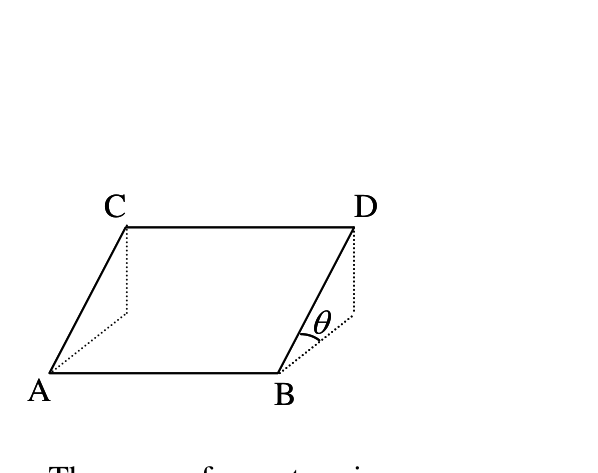 The flat square of side inclined at angle to the horizontal; the neutron beam splits at , travels along and , and recombines at .
Fonte: Testo (PDF) — p.11
Topic: Modern-Quantum Physics, Wave Optics Metodi: de Broglie Relation, Interference & Diffraction Analysis Competenze: Physical Reasoning Objects: Particle Beam
Secondo la meccanica quantistica, una particella di impulso può essere considerata un’onda di materia piana con lunghezza d’onda , dove è la costante di Planck. Come mostrato nella figura, è un quadrato piatto di lunghezza laterale in un angolo inclinato verso il piano orizzontale. Un fascio di neutroni di energia cinetica iniziale è diviso in due fasci al punto-. Un fascio si muove lungo il percorso e l’altro il percorso . Quando i due raggi si incontrano al punto D interferiscono. La massa di un neutrone è . Quante volte si possono ottenere le letture massime del numero di neutroni al punto-D quando passa da a ?
Il quadrato piatto del lato inclinato all’angolo verso l’orizzontale; il fascio di neutroni si sparticola a , si sposta lungo e e si ricombina a .
Fonte: Testo (PDF) — p.11
Topic: Modern-Quantum Physics, Wave Optics Metodi: de Broglie Relation, Interference & Diffraction Analysis Competenze: Physical Reasoning Objects: Particle Beam