An opened parachute of mass is coming straight down from the sky. Attached to the parachute is the upper end of a light spring scale, while a block of mass is attached to its lower end of the scale. The scale reading is . The air resistance at the moment is approximately ________.
- (A) 55 N
- (B) 66 N
- (C) 77 N
- (D) 88 N
- (E) 99 N
Fonte: Testo (PDF) — p.4 Topic: Newtonian Mechanics Metodi: Free-Body Diagram, Kinematic Equations Competenze: Physical Reasoning Objects: Spring, Block
Un paracadute aperto di massa sta scendendo direttamente dal cielo. Al paracadute è attaccato l’estremità superiore di una scala di molla leggera, mentre al suo estremo inferiore della scala è attaccato un blocco di massa . La lettura della scala è . La resistenza dell’aria al momento è di circa ________.
- (A) 55 N
- (B) 66 N
- (C) 77 N
- (D) 88 N
- (E) 99 N
Fonte: Testo (PDF) — p.4 Topic: Newtonian Mechanics Metodi: Free-Body Diagram, Kinematic Equations Competenze: Physical Reasoning Objects: Spring, Block
The wind speed is . Estimate the force of the wind on an adult human being standing facing the wind. Choose the answer below that is closest to your result.
- (A) 2 m/s
- (B) 4630 N
- (C) 1.9 N
- (D) 39 N
- (E) 463 N
Fonte: Testo (PDF) — p.4 Topic: Order-of-Magnitude Estimation ; Fluid Mechanics Metodi: Order-of-Magnitude Estimation, Physical Modeling Competenze: Estimation & Approximation Objects: —
La velocità del vento è . Calcola la forza del vento su un essere umano adulto che sta di fronte al vento. Scegli la risposta che ti avvicina al risultato.
- (A) 2 m/s
- (B) 4630 N
- (C) 1.9 N
- (D) 39 N
- (E) 463 N
Fonte: Testo (PDF) — p.4 Topic: Order-of-Magnitude Estimation ; Fluid Mechanics Metodi: Order-of-Magnitude Estimation, Physical Modeling Competenze: Estimation & Approximation Objects: —
The first extra-solar system discovered in 1995 consists of a solar type star and a planet with mass similar to Jupiter in the solar system. The period of the circular orbit of the planet is days. Find the distance between the star and its planet (in terms of astronomical unit (A. U.)). The mass of the star is times that of the Sun.
- (A) 0.2
- (B) 9.5
- (C) 0.05
- (D) 15
- (E) 3.0
Fonte: Testo (PDF) — p.4 Topic: Gravitation ; Astrophysics Metodi: Kepler’s Laws, Newton’s Law of Gravitation Competenze: Physical Reasoning Objects: Star, Planet
Il primo sistema extra-solare scoperto nel 1995 è costituito da una stella di tipo solare e da un pianeta con una massa simile a quella di Giove nel sistema solare. Il periodo dell’orbita circolare del pianeta è giorni. Trova la distanza tra la stella e il suo pianeta (in termini di unità astronomica ** (A. U.)**). La massa della stella è volte quella del Sole.
- (A) 0.2
- (B) 9.5
- (C) 0.05
- (D) 15
- (E) 3.0
Fonte: Testo (PDF) — p.4 Topic: Gravitation ; Astrophysics Metodi: Kepler’s Laws, Newton’s Law of Gravitation Competenze: Physical Reasoning Objects: Star, Planet
Following MC3, find the orbital speed of the star around the center of mass of the star-planet system.
- (A) 2 m/s
- (B) 84 m/s
- (C) 62 m/s
- (D) 126 m/s
- (E) 312 m/s
Fonte: Testo (PDF) — p.4 Topic: Gravitation ; Astrophysics Metodi: Newton’s Law of Gravitation, Conservation of Momentum Competenze: Physical Reasoning Objects: Star, Planet
Seguendo MC3, trovi la velocità orbitale della stella intorno al centro di massa del sistema stellare-planetario.
- (A) 2 m/s
- (B) 84 m/s
- (C) 62 m/s
- (D) 126 m/s
- (E) 312 m/s
Fonte: Testo (PDF) — p.4 Topic: Gravitation ; Astrophysics Metodi: Newton’s Law of Gravitation, Conservation of Momentum Competenze: Physical Reasoning Objects: Star, Planet
A small wooden sphere of density is attached to the end of a string of length in water. The other end of the string is attached to the bottom, forming a reverse pendulum. Ignore water friction. Find the period of the pendulum.
- (A) 4 s
- (B) 2 s
- (C) 5 s
- (D) 1 s
- (E) 8 s
Fonte: Testo (PDF) — p.4 Topic: Oscillations & Waves ; Fluid Mechanics Metodi: Simple Harmonic Motion Analysis, Hydrostatic Equilibrium Competenze: Physical Reasoning Objects: Sphere, String, Pendulum
Una piccola sfera di legno di densità è attaccata alla fine di una catena di lunghezza in acqua. L’altra estremità della corda è attaccata al fondo, formando un pendolo inverso. Ignora l’attrito dell’acqua. Trova il periodo del pendolo.
- (A) 4 s
- (B) 2 s
- (C) 5 s
- (D) 1 s
- (E) 8 s
Fonte: Testo (PDF) — p.4 Topic: Oscillations & Waves ; Fluid Mechanics Metodi: Simple Harmonic Motion Analysis, Hydrostatic Equilibrium Competenze: Physical Reasoning Objects: Sphere, String, Pendulum
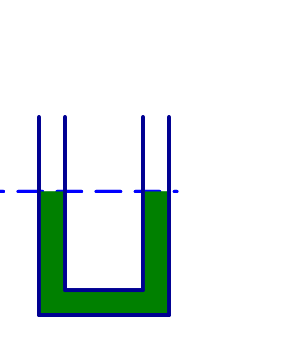
A U-tube of small and uniform cross section contains water of total length . The height difference between the water columns on the left and on the right is when the valve K is closed. The valve is suddenly open, and water is flowing from left to right. Ignore friction. Find the speed of water when the heights of the left and the right water columns are the same.
Figure
- (A)
- (B)
- (C)
- (D)
- (E)
Fonte: Testo (PDF) — p.4 Topic: Fluid Mechanics ; Conservation of Energy Metodi: Energy Conservation Method, Bernoulli’s Equation Competenze: Physical Reasoning Objects: Tube
Un tubo U di sezione trasversale piccola e uniforme contiene acqua di lunghezza totale . La differenza di altezza tra le colonne d’acqua a sinistra e a destra è quando la valvola K è chiusa. La valvola si apre improvvisamente e l’acqua scorre da sinistra a destra. Ignora gli attriti. Trova la velocità dell’acqua quando le altezze delle colonne d’acqua a sinistra e a destra sono le stesse.
Figura
- (A)
- (B)
- (C)
- (D)
- (E)
Fonte: Testo (PDF) — p.4 Topic: Fluid Mechanics ; Conservation of Energy Metodi: Energy Conservation Method, Bernoulli’s Equation Competenze: Physical Reasoning Objects: Tube
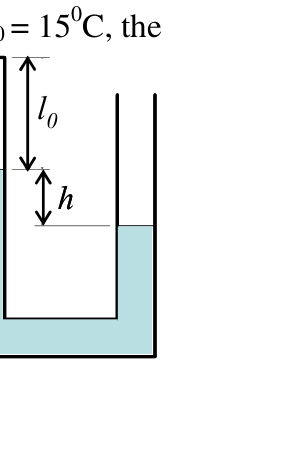
As shown, the left end of an upright U-shaped glass tube of uniform cross section is sealed and the right end is open. In the atmospheric pressure of and at , the length of the gas column sealed by the mercury is and the height difference between the left and the right mercury surfaces is . When the temperature is raised to , the length of the gas column becomes . Find .
Figure
- (A)
- (B)
- (C)
- (D)
- (E)
Fonte: Testo (PDF) — p.4 Topic: Thermodynamics Metodi: Ideal Gas Law, Hydrostatic Equilibrium Competenze: Physical Reasoning Objects: Tube, Gas
Come illustrato, l’estremità sinistra di un tubo di vetro in forma di U verticale di sezione incrociata uniforme è sigillata e l’estremità destra è aperta. Nella pressione atmosferica di e a , la lunghezza della colonna di gas sigillata dal mercurio è e la differenza di altezza tra le superfici di mercurio sinistra e destra è . Quando la temperatura è elevata a , la lunghezza della colonna di gas diventa . Trova .
Figura
- (A)
- (B)
- (C)
- (D)
- (E)
Fonte: Testo (PDF) — p.4 Topic: Thermodynamics Metodi: Ideal Gas Law, Hydrostatic Equilibrium Competenze: Physical Reasoning Objects: Tube, Gas
Following MC7, keep the temperature at , fill in mercury in the amount of length from the open end such that the gas column length returns to . Find .
- (A) 11.25 cm
- (B) 13.25 cm
- (C) 14.35 cm
- (D) 8.25 cm
- (E) 7.25 cm
Fonte: Testo (PDF) — p.5 Topic: Thermodynamics Metodi: Ideal Gas Law, Hydrostatic Equilibrium Competenze: Physical Reasoning Objects: Tube, Gas
Dopo MC7, mantenere la temperatura a , riempire il mercurio nella quantità di lunghezza dall’estremità aperta in modo che la lunghezza della colonna di gas ritorni a . Trova .
- (A) 11.25 cm
- (B) 13.25 cm
- (C) 14.35 cm
- (D) 8.25 cm
- (E) 7.25 cm
Fonte: Testo (PDF) — p.5 Topic: Thermodynamics Metodi: Ideal Gas Law, Hydrostatic Equilibrium Competenze: Physical Reasoning Objects: Tube, Gas
As shown, two parallel plate capacitors are placed horizontally and connected to a battery . After charging the capacitors, the switch is open. A charged particle is placed in the left capacitor and is at rest. If one reduces the distance between the plates of the right capacitor, the particle will then ________.
- (A) move horizontally
- (B) move upwards
- (C) move downwards
- (D) remain at rest
- (E) move counterclockwise
Fonte: Testo (PDF) — p.5 Topic: Electrostatics ; Circuits Metodi: Electric Potential Method, Physical Modeling Competenze: Physical Reasoning Objects: Capacitor, Battery, Switch, Point Charge
Come illustrato, due condensatori di piastre parallele sono posizionati orizzontalmente e collegati a una batteria . Dopo aver caricato i condensatori, il interruttore è aperto. Una particella carica viene collocata nel condensatore sinistro e rimane a riposo. Se si riduce la distanza tra le piastre del condensatore giusto, la particella ________.
- **(A) ** si muove orizzontalmente
- **(B) ** si muove verso l’alto
- **(C) ** spostarsi verso il basso
- **(D) ** restano in riposo
- **(E) ** muoversi in senso contrario all’orologio
Fonte: Testo (PDF) — p.5 Topic: Electrostatics ; Circuits Metodi: Electric Potential Method, Physical Modeling Competenze: Physical Reasoning Objects: Capacitor, Battery, Switch, Point Charge
A capacitor charged to and a capacitor charged to are connected to each other, with the positive plate to the positive plate, and the negative plate to the negative plate. What is the final charge on the capacitor?
- (A) 50 mC
- (B) 200 mC
- (C) 40 mC
- (D) 60 mC
- (E) 0 mC
Fonte: Testo (PDF) — p.5 Topic: Circuits ; Electrostatics Metodi: Conservation Laws, Equivalent Circuit Reduction Competenze: Physical Reasoning Objects: Capacitor
Un condensatore carico a e un condensatore carico a sono collegati tra loro, con la piastra positiva alla piastra positiva e la piastra negativa alla piastra negativa. Qual è la carica finale del condensatore ?
- (A) 50 mC
- (B) 200 mC
- (C) 40 mC
- (D) 60 mC
- (E) 0 mC
Fonte: Testo (PDF) — p.5 Topic: Circuits ; Electrostatics Metodi: Conservation Laws, Equivalent Circuit Reduction Competenze: Physical Reasoning Objects: Capacitor
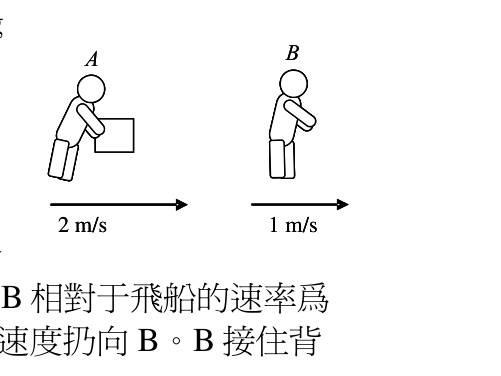
Two astronauts, and , both with mass of , are moving along a straight line in the same direction in a “weightless” spaceship. Relative to the spaceship the speed of is and that of is . is carrying a bag of mass with him. To avoid collision with , throws the bag with a speed relative to the spaceship towards and catches it. Find the minimum value of .
Figure
- (A) 7.8 m/s
- (B) 26.0 m/s
- (C) 14.0 m/s
- (D) 9.2 m/s
- (E) 0
Fonte: Testo (PDF) — p.5 Topic: Conservation of Momentum Metodi: Conservation of Momentum, Physical Modeling Competenze: Physical Reasoning Objects: —
Due astronauti, e , entrambi con massa di , si muovono lungo una linea retta nella stessa direzione in una nave spaziale “senza peso”. Relativamente alla nave spaziale la velocità di è e quella di è . porta con sé un sacchetto di massa . Per evitare collisioni con , lancia il sacchetto con una velocità rispetto alla nave spaziale verso e lo cattura. Trova il valore minimo di .
Figura
- (A) 7.8 m/s
- (B) 26.0 m/s
- (C) 14.0 m/s
- (D) 9.2 m/s
- (E) 0
Fonte: Testo (PDF) — p.5 Topic: Conservation of Momentum Metodi: Conservation of Momentum, Physical Modeling Competenze: Physical Reasoning Objects: —
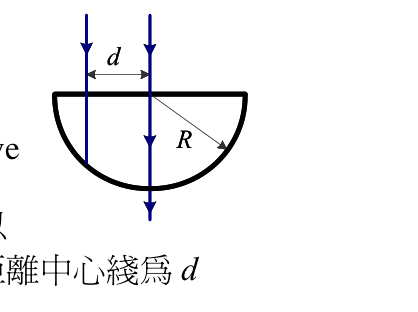
As shown, a narrow beam of light is incident onto a semi-circular glass cylinder of radius . Light can exit the cylinder when the beam is at the center. When the beam is moved parallel to a distance from the central line, no light can exit the beam from the lower surface. Find the refractive index of the glass.
Figure
- (A)
- (B)
- (C)
- (D)
- (E)
Fonte: Testo (PDF) — p.5 Topic: Geometric Optics Metodi: Snell’s Law, Ray Tracing Competenze: Diagrammatic Reasoning Objects: Cylinder
Come illustrato, un raggio di luce stretta incide su un cilindro di vetro semicircolare di raggio . La luce può uscire dal cilindro quando il fascio è al centro. Quando il fascio è spostato parallelo a una distanza dalla linea centrale, nessuna luce può uscire dal fascio dalla superficie inferiore. Trova l’indice di rifrazione del vetro.
Figura
- (A)
- (B)
- (C)
- (D)
- (E)
Fonte: Testo (PDF) — p.5 Topic: Geometric Optics Metodi: Snell’s Law, Ray Tracing Competenze: Diagrammatic Reasoning Objects: Cylinder
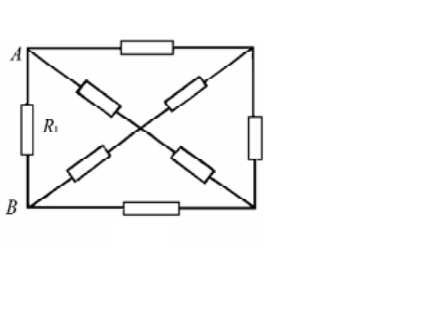
As shown, the circuit is made of 8 different resistors. It is found that when , the resistance between A and B is . Now replace by a resistor, while the resistance between A and B remains. What is the resistance between A and B?
Figure
- (A) 5
- (B) 3
- (C) 6
- (D) 2.4
- (E) 1.5
Fonte: Testo (PDF) — p.5 Topic: Circuits Metodi: Equivalent Circuit Reduction, Kirchhoff’s Laws Competenze: Physical Reasoning Objects: Resistor, Wire
Come mostrato, il circuito è costituito da 8 resistori diversi. Si è scoperto che quando , la resistenza tra A e B è . Ora sostituire con una resistenza , mentre la resistenza tra A e B rimane. Qual è la resistenza tra A e B?
Figura
- (A) 5
- (B) 3
- (C) 6
- (D) 2.4
- (E) 1.5
Fonte: Testo (PDF) — p.5 Topic: Circuits Metodi: Equivalent Circuit Reduction, Kirchhoff’s Laws Competenze: Physical Reasoning Objects: Resistor, Wire
To reach the fire at the height of 30 meters, what should be the initial speed of water jet on the ground?
- (A) 30 m/s
- (B) 12 m/s
- (C) 300 m/s
- (D) 5 m/s
- (E) 24 m/s
Fonte: Testo (PDF) — p.6 Topic: Newtonian Mechanics Metodi: Kinematic Equations, Energy Conservation Method Competenze: Physical Reasoning Objects: —
Per raggiungere il fuoco ad un’altezza di 30 metri, quale dovrebbe essere la velocità iniziale di un getto d’acqua a terra?
- (A) 30 m/s
- (B) 12 m/s
- (C) 300 m/s
- (D) 5 m/s
- (E) 24 m/s
Fonte: Testo (PDF) — p.6 Topic: Newtonian Mechanics Metodi: Kinematic Equations, Energy Conservation Method Competenze: Physical Reasoning Objects: —
Following MC14, the area of the cross session of the water hose is . What is the recoil force?
- (A) 588 N
- (B) 60 N
- (C) 705 N
- (D) 24 N
- (E) 5 N
Fonte: Testo (PDF) — p.6 Topic: Fluid Mechanics ; Conservation of Momentum Metodi: Impulse-Momentum Theorem, Continuity Equation Competenze: Physical Reasoning Objects: —
Dopo MC14, l’area della sessione incrociata del tubo d’acqua è . Qual è la forza di retrocesso?
- (A) 588 N
- (B) 60 N
- (C) 705 N
- (D) 24 N
- (E) 5 N
Fonte: Testo (PDF) — p.6 Topic: Fluid Mechanics ; Conservation of Momentum Metodi: Impulse-Momentum Theorem, Continuity Equation Competenze: Physical Reasoning Objects: —
Three point charges, each with charge , are placed on the apexes of an equilateral triangle of length . The potential energy of the system is then , where is ________.
- (A) 2
- (B) 3
- (C) 6
- (D) 1
- (E) 12
Fonte: Testo (PDF) — p.6 Topic: Electrostatics Metodi: Electric Potential Method, Superposition Principle Competenze: Physical Reasoning Objects: Point Charge
Tre cariche a punti, ciascuna con carica , sono posizionate sugli apici di un triangolo equilaterale di lunghezza . L’energia potenziale del sistema è quindi , dove è ________.
- (A) 2
- (B) 3
- (C) 6
- (D) 1
- (E) 12
Fonte: Testo (PDF) — p.6 Topic: Electrostatics Metodi: Electric Potential Method, Superposition Principle Competenze: Physical Reasoning Objects: Point Charge
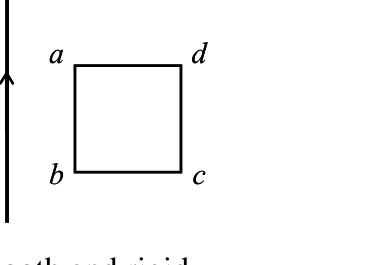
As shown, the electric current in a straight wire is increasing with time. The direction of the electric current in the square wire loop is ________.
Figure
- (A)
- (B)
- (C)
- (D)
- (E)
Fonte: Testo (PDF) — p.6 Topic: Electromagnetic Induction Metodi: Lenz’s Law, Faraday’s Law of Induction Competenze: Diagrammatic Reasoning Objects: Wire, Coil
Come mostrato, la corrente elettrica in un filo retto aumenta con il tempo. La direzione della corrente elettrica nel circuito di filo quadrato è ________.
Figura
- (A)
- (B)
- (C)
- (D)
- (E)
Fonte: Testo (PDF) — p.6 Topic: Electromagnetic Induction Metodi: Lenz’s Law, Faraday’s Law of Induction Competenze: Diagrammatic Reasoning Objects: Wire, Coil
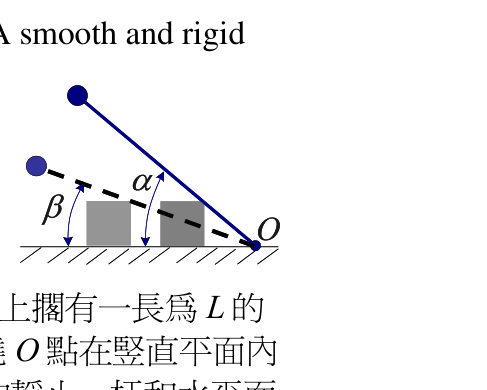
A cubic block of mass and side length is placed on a smooth floor. A smooth and rigid rod of length and with negligible mass is leaning against the block. A sphere of mass is attached to the upper end of the rod. The lower end of the rod is fixed at point-, but the rod can rotate freely around the point within the vertical plane. Initially the angle between the rod and the floor is while the system is at rest. After releasing, find the speed of the block when the angle between the rod and the floor is .
Figure
- (A)
- (B)
- (C)
- (D)
- (E)
Fonte: Testo (PDF) — p.6 Topic: Conservation of Energy ; Newtonian Mechanics Metodi: Energy Conservation Method, Vector Decomposition Competenze: Physical Reasoning Objects: Block, Rod, Sphere
Un blocco cubo di massa e lunghezza laterale è posizionato su un pavimento liscio. Una barra liscia e rigida di lunghezza e di massa trascurabile si appoggia al blocco. Una sfera di massa è attaccata all’estremità superiore della canna. L’estremità inferiore della canna è fissata al punto-, ma la canna può ruotare liberamente intorno al punto all’interno del piano verticale. Inizialmente l’angolo tra la canna e il pavimento è mentre il sistema è a riposo. Dopo la liberazione, si deve trovare la velocità del blocco quando l’angolo tra la canna e il pavimento è .
Figura
- (A)
- (B)
- (C)
- (D)
- (E)
Fonte: Testo (PDF) — p.6 Topic: Conservation of Energy ; Newtonian Mechanics Metodi: Energy Conservation Method, Vector Decomposition Competenze: Physical Reasoning Objects: Block, Rod, Sphere
In a traffic accident, a taxi runs into a bus initially at rest. The two vehicles are locked together after impact and slide for a distance of . It is known that the frictional force between the locked vehicles and the ground is . Find the speed of the taxi just before impact. Mass of the taxi . Mass of the bus .
- (A) 21.1 km/h
- (B) 46.2 km/h
- (C) 69.5 km/h
- (D) 93 km/h
- (E) 0
Fonte: Testo (PDF) — p.7 Topic: Conservation of Momentum ; Conservation of Energy Metodi: Conservation of Momentum, Energy Conservation Method Competenze: Physical Reasoning Objects: —
In un incidente stradale, un taxi sbatte contro un autobus inizialmente a riposo. I due veicoli sono bloccati dopo l’impatto e scivolano per una distanza di . È noto che la forza di attrito tra i veicoli bloccati e il terreno è . Trova la velocità del taxi poco prima dell’impatto. Massa del taxi . Massa dell’autobus .
- (A) 21.1 km/h
- (B) 46.2 km/h
- (C) 69.5 km/h
- (D) 93 km/h
- (E) 0
Fonte: Testo (PDF) — p.7 Topic: Conservation of Momentum ; Conservation of Energy Metodi: Conservation of Momentum, Energy Conservation Method Competenze: Physical Reasoning Objects: —
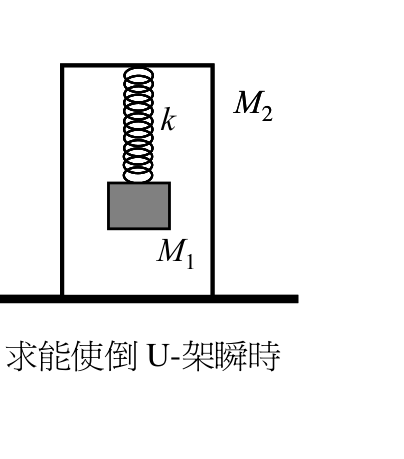
A block of mass is hanged by a light spring of force constant to the top bar of a reverse U-frame of mass on the floor. The block is pushed down from its equilibrium position by a distance and then released. Find the minimum value of such that the reverse U-frame will leave the floor momentarily.
Figure
- (A)
- (B)
- (C)
- (D)
- (E)
Fonte: Testo (PDF) — p.7 Topic: Oscillations & Waves ; Newtonian Mechanics Metodi: Simple Harmonic Motion Analysis, Hooke’s Law, Free-Body Diagram Competenze: Physical Reasoning Objects: Block, Spring
Un blocco di massa è appeso con una sorgente leggera di forza costante alla barra superiore di un telaio U inverso di massa sul pavimento. Il blocco viene spinto verso il basso dalla sua posizione di equilibrio per una distanza e quindi rilasciato. Trova il valore minimo di in modo tale che il telaio U inverso lasci il pavimento per un momento.
Figura
- (A)
- (B)
- (C)
- (D)
- (E)
Fonte: Testo (PDF) — p.7 Topic: Oscillations & Waves ; Newtonian Mechanics Metodi: Simple Harmonic Motion Analysis, Hooke’s Law, Free-Body Diagram Competenze: Physical Reasoning Objects: Block, Spring
Open Problems
Total 5 problems. The Open Problem(s) with the ”*” sign may require information on page-3.
(15 points)
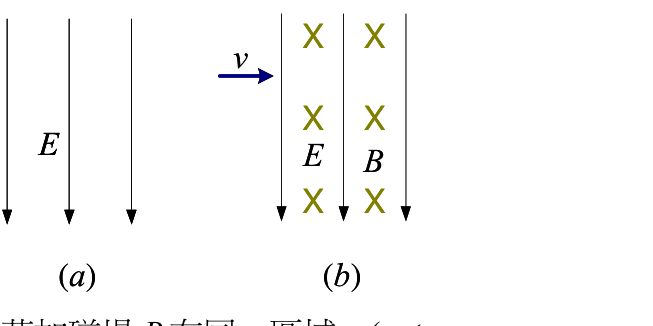
As shown in Fig. (a), a charged particle enters a region of uniform electric field with initial horizontal velocity . When it exits the region, its speed is . In the second case, the same particle with the same initial velocity enters the region where a magnetic field () is added perpendicularly to the original electric field , as shown in Fig. (b). When it exits the region, its speed is . Compare with , which one is larger? Give brief explanation in no more than 5 lines.
Figure
Fonte: Testo (PDF) — p.9 Topic: Electromagnetism ; Conservation of Energy Metodi: Lorentz Force Analysis, Energy Conservation Method Competenze: Physical Reasoning Objects: Point Charge
Problemi aperti
5 problemi complessivi. Il problema aperto con il segno ”*” può richiedere informazioni sulla pagina 3.
**(15 punti) **
Come mostrato nella figura. a) una particella carica entra in una regione di campo elettrico uniforme con velocità orizzontale iniziale . Quando esce dalla regione, la sua velocità è . Nel secondo caso, la stessa particella con la stessa velocità iniziale entra nella regione in cui un campo magnetico () viene aggiunto perpendicolare al campo elettrico originale , come mostrato nella figura. (b). Quando esce dalla regione, la sua velocità è . Confronta con , quale è più grande? In breve spiegazione non più di 5 righe.
Figura
Fonte: Testo (PDF) — p.9 Topic: Electromagnetism ; Conservation of Energy Metodi: Lorentz Force Analysis, Energy Conservation Method Competenze: Physical Reasoning Objects: Point Charge
(15 points)
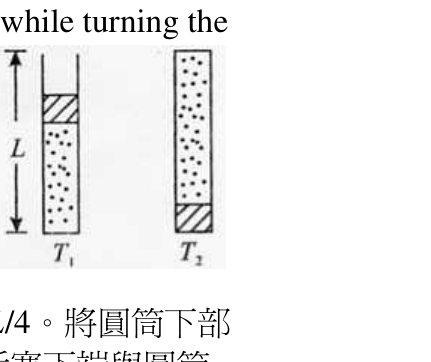
Air is filled in a vertical cylinder of length . The lower end of the cylinder is sealed and the upper end is open. The air pressure outside is . A piston, which can move freely up and down the cylinder without gas leakage, is placed from the open end and sits down on the gas column. At equilibrium the length from the upper end of the cylinder to the outer surface of the piston is . The temperature of the air inside is kept at in the process. Now, lower the temperature of the air inside to , and keep the temperature constant while turning the cylinder upside down. At equilibrium the outer surface of the piston is right at the open end edge of the cylinder. Find the thickness and the mass density of the piston.
Figure
Fonte: Testo (PDF) — p.9 Topic: Thermodynamics Metodi: Ideal Gas Law, Hydrostatic Equilibrium Competenze: Physical Reasoning Objects: Gas, Cylinder, Piston
**(15 punti) **
L’aria viene riempita in un cilindro verticale di lunghezza . L’estremità inferiore del cilindro è sigillata e l’estremità superiore è aperta. La pressione dell’aria esterna è . Un pistone, che può muoversi liberamente su e giù dal cilindro senza perdita di gas, viene posizionato dall’estremità aperta e si si siede sulla colonna di gas. In equilibrio la lunghezza dalla parte superiore del cilindro alla superficie esterna del pistone è . La temperatura dell’aria all’interno è mantenuta a durante il processo. Ora, abbassate la temperatura dell’aria all’interno a e mantenete la temperatura costante mentre girate il cilindro a testa in giù. Al punto di equilibrio la superficie esterna del pistone è proprio al bordo di punta aperta del cilindro. Trova lo spessore e la densità di massa del pistone.
Figura
Fonte: Testo (PDF) — p.9 Topic: Thermodynamics Metodi: Ideal Gas Law, Hydrostatic Equilibrium Competenze: Physical Reasoning Objects: Gas, Cylinder, Piston
(15 points)
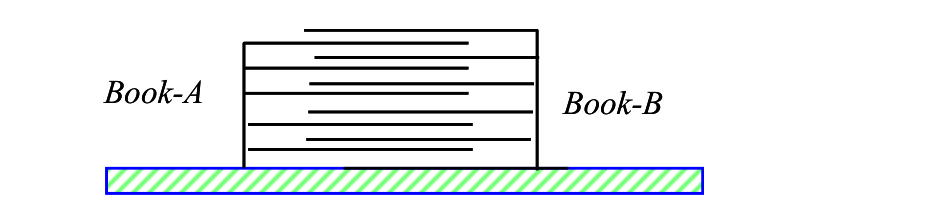
As shown in the figure, the pages of two identical books and are overlapping on one another. The mass of each book is and the number of pages of each book is . The friction coefficient between the pages is . Book- is fixed on the table. A horizontal force is applied to book-. Determine the minimum value of to pull book- out.
Figure
Fonte: Testo (PDF) — p.9 Topic: Newtonian Mechanics ; Rigid Body Statics Metodi: Free-Body Diagram, Conservation Laws Competenze: Physical Reasoning Objects: Block
**(15 punti) **
Come mostrato nella figura, le pagine di due libri identici e si sovrappongono. La massa di ogni libro è e il numero di pagine di ogni libro è . Il coefficiente di attrito tra le pagine è . Il libro- è fissato sul tavolo. Si applica una forza orizzontale al libro-. Determinare il valore minimo di per estrarre il libro-.
Figura
Fonte: Testo (PDF) — p.9 Topic: Newtonian Mechanics ; Rigid Body Statics Metodi: Free-Body Diagram, Conservation Laws Competenze: Physical Reasoning Objects: Block
(15 points)
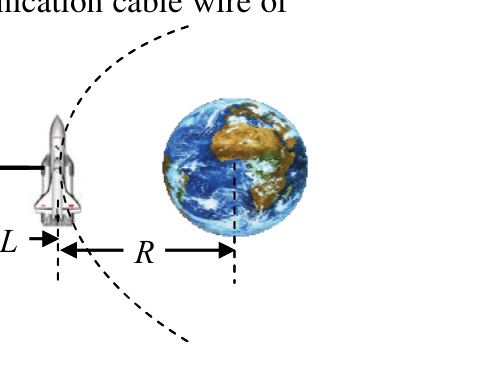
As shown in the figure, an astronaut of total mass was doing a spacewalk when his jetpack failed. His only connection to the spaceship was the communication cable wire of length . Assume the radius of the orbit is the Earth’s radius. Also assume that the astronaut and the spaceship underwent circular motion with the common angular velocity of and remained on a straight line projecting from the Earth’s center. The mass of the spaceship is much larger than that of the astronaut. Find the tension in the cable.
[Hint: For , .]
Figure
Fonte: Testo (PDF) — p.10 Topic: Gravitation ; Newtonian Mechanics Metodi: Newton’s Law of Gravitation, Approximation & Series Expansion Competenze: Physical Reasoning Objects: String, Satellite, Planet
**(15 punti) **
Come mostrato nella figura, un astronauta di massa totale stava facendo una passeggiata spaziale quando il suo jetpack ha fallito. La sua unica connessione con la nave spaziale era il cavo di comunicazione di lunghezza . Supponiamo che il raggio di orbita sia quello della Terra. Supponiamo anche che l’astronauta e la nave spaziale abbiano subito un movimento circolare con la velocità angolare comune di e siano rimasti su una linea retta proiettata dal centro della Terra. La massa della nave spaziale è molto più grande di quella dell’astronauta. Trova la tensione nel cavo.
[Signore: per , .]
Figura
Fonte: Testo (PDF) — p.10 Topic: Gravitation ; Newtonian Mechanics Metodi: Newton’s Law of Gravitation, Approximation & Series Expansion Competenze: Physical Reasoning Objects: String, Satellite, Planet
(10 points)
A photon of angular frequency carries energy and momentum , where is the Planck Constant, and is the speed of light in vacuum. When a photon meets an atom, it may be absorbed by the atom. The probability for an atom to absorb a photon depends on the photon frequency in the rest frame of the atom , namely , where , , and are constants. Shortly after absorbing the photon, the atom re-emits a photon of the same frequency in an arbitrary direction. Within a very short time the atom absorbs many photons from a laser beam in one direction and re-emits photons in all directions. Therefore, on average over time, the atom experiences a force which can slow down its speed. This is the principle of cooling atoms with laser.
- (a) An atom is moving in the positive direction with speed (), and a photon with frequency is moving in the negative direction. What is the frequency of the photon in the rest frame of the atom? (2 points)
- (b) Suppose the atom is moving in the positive direction with velocity , and two identical laser beams shine along the positive direction and the negative direction, respectively. There are photons from each beam colliding with the atom per unit time. Find the expression for the average force acting on the atom. If the expression contains , you should replace it with the answer in (a). (6 points)
- (c) For small , we have , the force in (b) can then be expressed as . Find the expression for . (2 points)
(Hint: For small , .)
Fonte: Testo (PDF) — p.10 Topic: Modern-Quantum Physics ; Special Relativity Metodi: Photon Energy Relation, Lorentz Transformation, Approximation & Series Expansion Competenze: Mathematical Modeling Objects: Photon, Atom
**(10 punti) **
Un fotone di frequenza angolare porta energia e impulso , dove è la costante di Planck e è la velocità della luce nel vuoto. Quando un fotone incontra un atomo, può essere assorbito dall’atomo. La probabilità che un atomo assorba un fotone dipende dalla frequenza fotonica ** nel quadro di riposo ** dell’atomo , vale a dire , dove , e sono costanti. Poco dopo aver assorbito il fotone, l’atomo emette di nuovo un fotone della stessa frequenza in una direzione arbitraria. In un breve periodo l’atomo assorbe molti fotoni da un raggio laser in una direzione e emette di nuovo fotoni in tutte le direzioni. Pertanto, in media nel tempo, l’atomo sperimenta una forza che può rallentare la sua velocità. Questo è il principio del raffreddamento degli atomi con il laser.
- **(a) ** Un atomo si muove nella direzione positiva con velocità (), e un fotone con frequenza si muove nella direzione negativa . Qual è la frequenza del fotone nel quadro di riposo dell’atomo? (2 punti)
- **(b) ** Supponiamo che l’atomo si muova nella direzione positiva con velocità , e due fasci laser identici brillano lungo la direzione positiva e la direzione negativa , rispettivamente. Ci sono fotoni da ogni fascio che collidono con l’atomo per unità di tempo. Trova l’espressione per la forza media che agisce sull’atomo. Se l’espressione contiene , è necessario sostituirla con la risposta di cui alla lettera a). (6 punti)
- **(c) ** Per , abbiamo , la forza in (b) può quindi essere espressa come . Trova l’espressione per . (2 punti)
(Signore: per i piccoli , .)
Fonte: Testo (PDF) — p.10 Topic: Modern-Quantum Physics ; Special Relativity Metodi: Photon Energy Relation, Lorentz Transformation, Approximation & Series Expansion Competenze: Mathematical Modeling Objects: Photon, Atom