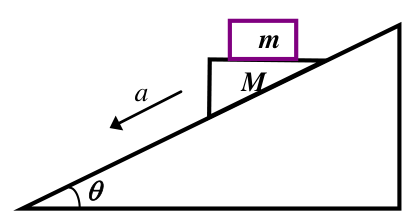
As shown in the figure, a wedge of mass is placed on a smooth inclined ramp that makes an angle to the horizontal. An object of mass rests on top of the wedge. The system is sliding down the ramp at acceleration . Determine the apparent weight of the object as it slides down. Note that there is friction between the object and the wedge so that the object remains relatively at rest on the wedge.
- (a)
- (b)
- (c)
- (d)
- (e)
Fonte: Testo (PDF) — p.4 Topic: Newtonian Mechanics Metodi: Free-Body Diagram, Vector Decomposition Competenze: Physical Reasoning Objects: Wedge, Inclined Plane, Block
Come mostrato nella figura, un’ancella di massa è posizionata su una rampa a inclinamento liscio che fa un angolo verso l’orizzontale. Un oggetto di massa si trova sulla parte superiore della cucina. Il sistema scende per la rampa ad accelerare . Determina il peso apparente dell’oggetto mentre scende. Si noti che c’è attrito tra l’oggetto e la ciglia in modo che l’oggetto rimanga relativamente a riposo sulla ciglia.
- (a)
- (b)
- (c)
- (d)
- (e)
Fonte: Testo (PDF) — p.4 Topic: Newtonian Mechanics Metodi: Free-Body Diagram, Vector Decomposition Competenze: Physical Reasoning Objects: Wedge, Inclined Plane, Block
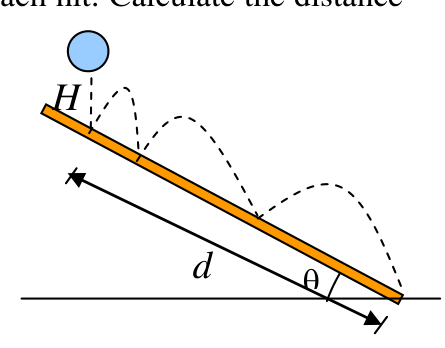
A ball is released vertically from a height above an inclined plane and makes several bounces. The angle of the inclined plane is . Assume the ball bounces elastically in each hit. Calculate the distance from the first hit to the fourth hit on the inclined plane.
- (a)
- (b)
- (c)
- (d)
- (e)
Fonte: Testo (PDF) — p.4 Topic: Newtonian Mechanics Metodi: Kinematic Equations, Vector Decomposition Competenze: Physical Reasoning Objects: Ball, Inclined Plane
Una palla viene rilasciata verticalmente da un’altezza sopra un piano inclinato e fa diversi salti. L’angolo del piano inclinato è . Supponiamo che la palla rimbalzi elasticamente in ogni colpo. Calcola la distanza dal primo colpo al quarto colpo sul piano inclinato.
- (a)
- (b)
- (c)
- (d)
- (e)
Fonte: Testo (PDF) — p.4 Topic: Newtonian Mechanics Metodi: Kinematic Equations, Vector Decomposition Competenze: Physical Reasoning Objects: Ball, Inclined Plane
The first two extra-solar planets were discovered in 1992 to be revolving around a pulsar of solar mass. The period of the circular orbit of one of the two planets is days. Ignore the gravitational interaction between the planets. Find the distance between the pulsar and the planet in terms of astronomical units (AU).
- (a)
- (b)
- (c)
- (d)
- (e)
Fonte: Testo (PDF) — p.4 Topic: Gravitation Metodi: Kepler’s Laws, Newton’s Law of Gravitation Competenze: Physical Reasoning Objects: Star, Planet
The first two extra-solar planets were discovered in 1992 to be revolving around a pulsar of solar mass. Il periodo di orbita circolare di uno dei due pianeti è giorni. Ignorate l’interazione gravitazionale tra i pianeti. Trova la distanza tra il pulsare e il pianeta in termini di unità astronomiche (AU).
- (a)
- (b)
- (c)
- (d)
- (e)
Fonte: Testo (PDF) — p.4 Topic: Gravitation Metodi: Kepler’s Laws, Newton’s Law of Gravitation Competenze: Physical Reasoning Objects: Star, Planet
A ball hits a horizontal plane in a direction making an angle with the horizontal, where . The coefficient of friction between the ball and the plane surface is . If of the kinetic energy of the ball remains after the impact, then the ball bounces off the plane in a direction making an angle with the horizontal. Find .
- (a)
- (b)
- (c)
- (d)
- (e)
Fonte: Testo (PDF) — p.4 Topic: Conservation of Momentum Metodi: Impulse-Momentum Theorem, Vector Decomposition Competenze: Physical Reasoning Objects: Ball
Una palla colpisce un piano orizzontale in una direzione che fa un angolo con l’orizzontale, dove . Il coefficiente di attrito tra la palla e la superficie del piano è . Se dell’energia cinetica della palla rimane dopo l’impatto, la palla rimbalza dal piano in una direzione che fa un angolo con l’orizzontale. Trova .
- (a)
- (b)
- (c)
- (d)
- (e)
Fonte: Testo (PDF) — p.4 Topic: Conservation of Momentum Metodi: Impulse-Momentum Theorem, Vector Decomposition Competenze: Physical Reasoning Objects: Ball
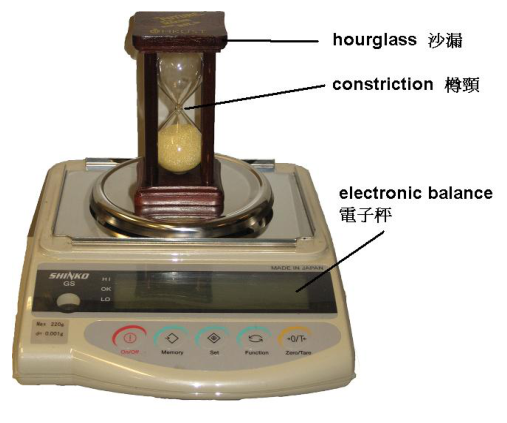
As shown in the figure, an hourglass is put on an electronic balance. At time , a clot at the constriction prevents the sand from passing through. At time , the clot clears and the sand begins to drip down from the upper part to the lower part at a constant rate, until all sand is collected in the lower part after one hour. Assuming that the sand powder is extremely fine, how does the force acting on the electronic balance depend on the dripping process?
- (a) The force increases to a higher value during the dripping process and then returns to the equilibrium value after the process.
- (b) The force decreases to a lower value during the dripping process and then returns to the equilibrium value after the process.
- (c) The force increases momentarily at the beginning and restores to the equilibrium value, and remains the same thereafter.
- (d) The force increases momentarily at the beginning and restores to the equilibrium value, and decreases momentarily at the end of the dripping process, and remains at the equilibrium value thereafter.
- (e) The force decreases momentarily at the beginning and restores to the equilibrium value, and increases momentarily at the end of the dripping process, and remains at the equilibrium value thereafter.
Fonte: Testo (PDF) — p.5 Topic: Newtonian Mechanics Metodi: Impulse-Momentum Theorem, Physical Modeling Competenze: Physical Reasoning Objects: —
Come si vede nella figura, un orologio di sabbia viene messo su un bilanciatore elettronico. Al tempo , un coagulo alla constrizione impedisce la passaggio della sabbia. Nel tempo , il coagulo si spalanca e la sabbia inizia a gocciolare dalla parte superiore alla parte inferiore a un ritmo costante, fino a quando dopo un’ora non viene raccolta tutta la sabbia nella parte inferiore. Supponendo che la polvere di sabbia sia estremamente fine, come la forza che agisce sull’equilibrio elettronico dipende dal processo di gocciolare?
- **(a) ** La forza aumenta a un valore superiore durante il processo di gocciolare e poi ritorna al valore di equilibrio dopo il processo.
- **(b) ** La forza diminuisce a un valore inferiore durante il processo di gocciolare e poi ritorna al valore di equilibrio dopo il processo.
- **(c) ** La forza aumenta momentaneamente all’inizio e riprende il valore di equilibrio, e rimane la stessa dopo.
- **(d) ** La forza aumenta momentaneamente all’inizio e riprende il valore di equilibrio, diminuisce momentaneamente alla fine del processo di gocciolare, e rimane al valore di equilibrio successivamente.
- **(e) ** La forza diminuisce momentaneamente all’inizio e riprende il valore di equilibrio, e aumenta momentaneamente alla fine del processo di gocciolare, e rimane al valore di equilibrio successivamente.
Fonte: Testo (PDF) — p.5 Topic: Newtonian Mechanics Metodi: Impulse-Momentum Theorem, Physical Modeling Competenze: Physical Reasoning Objects: —
A piece of ice with an embedded stone floats on the surface of water in a glass. After the ice has melted, the stone sinks to the bottom of the glass. Compared with the initial water level, what is the change of the water level in the glass, first during the period the ice is melting, and second after the stone sinks to the bottom?
- (a) Remains the same then rises.
- (b) Remains the same then falls.
- (c) Remains the same all the way.
- (d) Rises then falls.
- (e) Falls then rises.
Fonte: Testo (PDF) — p.5 Topic: Fluid Mechanics Metodi: Hydrostatic Equilibrium, Physical Modeling Competenze: Physical Reasoning Objects: —
Un pezzo di ghiaccio con una pietra incastrata galleggia sulla superficie dell’acqua in un bicchiere. Dopo che il ghiaccio si è sciolto, la pietra si scende al fondo del vetro. Rispetto al livello iniziale dell’acqua, quale è il cambiamento del livello dell’acqua nel vetro, prima durante il periodo in cui il ghiaccio si scioglie, e secondo dopo che la pietra si affonda al fondo?
- **(a) ** Rimane lo stesso e poi sale.
- **(b) ** Rimane uguale e poi cade.
- **(c) ** Rimane lo stesso per tutto il tempo.
- ** (d) ** Si alza e poi si fa cadere.
- **(e) ** Le cascate poi si alzano.
Fonte: Testo (PDF) — p.5 Topic: Fluid Mechanics Metodi: Hydrostatic Equilibrium, Physical Modeling Competenze: Physical Reasoning Objects: —
A student observed the presence of strong winds generated by moving trains in the tunnels of the subway. She suggested that wind turbines could be installed in the tunnels to generate electricity. Which of the following statement(s) is(are) correct?
I. The electricity generated by the turbines can be supplied to the air conditioners of the underground train stations, thereby saving energy.
II. The electricity generated by the turbines can be supplied to the electric motors of the underground trains, thereby saving energy.
III. The air resistance experienced by the trains will not be affected.
- (a) All are not true
- (b) Only I is true
- (c) Only II is true
- (d) Only III is true
- (e) All are true
Fonte: Testo (PDF) — p.6 Topic: Conservation of Energy Metodi: Conservation Laws, Physical Modeling Competenze: Physical Reasoning Objects: —
Uno studente ha osservato la presenza di forti venti generati da treni in movimento nei tunnel della metropolitana. Ha suggerito che le turbine eoliche potevano essere installate nei tunnel per generare elettricità. Quali delle seguenti affermazioni sono corrette?
I. L’elettricità generata dalle turbine può essere fornita ai condizionatori delle stazioni ferroviarie sotterranee, risparmiando così energia.
II. L’elettricità generata dalle turbine può essere fornita ai motori elettrici dei treni sotterranei, risparmiando così energia.
III. Il La resistenza all’aria dei treni non sarà influenzata.
- **(a) ** Non tutti sono veri
- **(b) ** Solo I è vero
- **(c) ** Solo II è vero
- **(d) ** Solo III è vero
- **(e) ** Tutti sono veri
Fonte: Testo (PDF) — p.6 Topic: Conservation of Energy Metodi: Conservation Laws, Physical Modeling Competenze: Physical Reasoning Objects: —
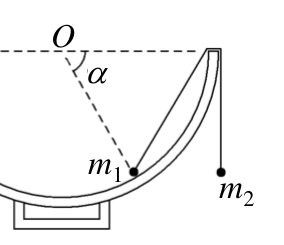
As shown in the figure, a hemispherical bowl is placed horizontally on a table. Point is the center of the hemisphere. The edge and the surface of the bowl are smooth. A particle of mass is placed in the bowl and is tied to a string with negligible mass. The other end of the string is tied to another particle of mass hanging outside the bowl. When the system is in equilibrium, the line joining the particle and point makes an angle with the horizontal. Find the ratio .
- (a)
- (b)
- (c)
- (d)
- (e)
Fonte: Testo (PDF) — p.6 Topic: Rigid Body Statics Metodi: Free-Body Diagram, Vector Decomposition Competenze: Physical Reasoning Objects: String
Come mostra la figura, una ciotola emisfera è posizionata orizzontalmente su un tavolo. Il punto è il centro dell’emisfero. Il bordo e la superficie della ciotola sono lisci. Una particella di massa viene inserita nella ciotola e legata a una corda di massa trascurabile. L’altra estremità della corda è legata ad un’altra particella di massa appesa fuori dalla ciotola. Quando il sistema è in equilibrio, la linea che unisce la particella e il punto fa un angolo con l’orizzontale. Trova il rapporto .
- (a)
- (b)
- (c)
- (d)
- (e)
Fonte: Testo (PDF) — p.6 Topic: Rigid Body Statics Metodi: Free-Body Diagram, Vector Decomposition Competenze: Physical Reasoning Objects: String
A non-viscous liquid of density , as shown in the figure, fills a “V”-shaped tube with , and being the area of cross section and arm lengths respectively. If the liquid is slightly depressed in one of the arms, find the oscillation frequency of the liquid column.
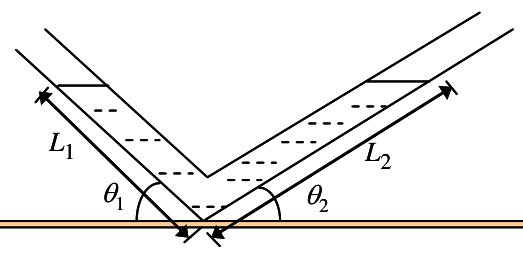
- (a)
- (b)
- (c)
- (d)
- (e)
Fonte: Testo (PDF) — p.6 Topic: Oscillations & Waves ; Fluid Mechanics Metodi: Simple Harmonic Motion Analysis, Hydrostatic Equilibrium Competenze: Physical Reasoning Objects: Tube
Un liquido non viscoso di densità , come mostrato nella figura, riempie un tubo a forma di “V” con , e , che sono rispettivamente l’area delle lunghezze del treno e del braccio. Se il liquido è leggermente compresso in uno dei bracci, trovare la frequenza di oscillazione della colonna liquida.
- (a)
- (b)
- (c)
- (d)
- (e)
Fonte: Testo (PDF) — p.6 Topic: Oscillations & Waves ; Fluid Mechanics Metodi: Simple Harmonic Motion Analysis, Hydrostatic Equilibrium Competenze: Physical Reasoning Objects: Tube
The kinetic energy of a particle in a simple harmonic motion is , its potential energy is , where is the coordinate for the position of the particle and is its speed. Find the frequency of the motion.
- (a)
- (b)
- (c)
- (d)
- (e)
Fonte: Testo (PDF) — p.7 Topic: Oscillations & Waves Metodi: Simple Harmonic Motion Analysis, Energy Conservation Method Competenze: Physical Reasoning Objects: —
L’energia cinetica di una particella in un semplice movimento armonico è , la sua energia potenziale è , dove è la coordinata della posizione della particella e è la sua velocità. Trova la frequenza del movimento.
- (a)
- (b)
- (c)
- (d)
- (e)
Fonte: Testo (PDF) — p.7 Topic: Oscillations & Waves Metodi: Simple Harmonic Motion Analysis, Energy Conservation Method Competenze: Physical Reasoning Objects: —
Someone is using a scissors to cut a wire of circular cross section and negligible weight. The wire slides in the direction away from the hinge until the angle between the scissors blades becomes . Find the coefficient of friction between the blades and the wire.
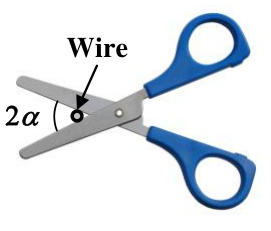
- (a)
- (b)
- (c)
- (d)
- (e)
Fonte: Testo (PDF) — p.7 Topic: Rigid Body Statics Metodi: Free-Body Diagram, Vector Decomposition Competenze: Physical Reasoning Objects: Wire
Qualcuno sta usando una forbice per tagliare un filo di sezione incrociata circolare e di peso trascurabile. Il filo scivola in direzione lontana dalla cerniera fino a quando l’angolo tra le lame delle forbici diventa . Trova il coefficiente di attrito tra le lame e il filo.
- (a)
- (b)
- (c)
- (d)
- (e)
Fonte: Testo (PDF) — p.7 Topic: Rigid Body Statics Metodi: Free-Body Diagram, Vector Decomposition Competenze: Physical Reasoning Objects: Wire
A person exerts a horizontal force at the upper edge of a box to push the box of uniform mass density, length , and height across the floor. The friction coefficient between the box and the floor is . If , the box will overturn before it slides. Determine the value of .
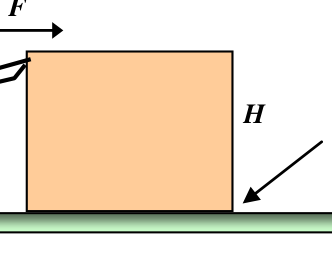
- (a)
- (b)
- (c)
- (d)
- (e)
Fonte: Testo (PDF) — p.7 Topic: Rigid Body Statics Metodi: Torque & Angular Momentum Analysis, Free-Body Diagram Competenze: Physical Reasoning Objects: Block
Una persona esercita una forza orizzontale sul bordo superiore di una scatola per spingere la scatola di densità di massa uniforme, lunghezza e altezza sul pavimento. Il coefficiente di attrito tra la scatola e il pavimento è . Se , la casella si rovesci prima di scivolare. Determinare il valore di .
- (a)
- (b)
- (c)
- (d)
- (e)
Fonte: Testo (PDF) — p.7 Topic: Rigid Body Statics Metodi: Torque & Angular Momentum Analysis, Free-Body Diagram Competenze: Physical Reasoning Objects: Block
A compound pendulum is made of a light and rigid rod of length with one end attached to a hinge on the ceiling. A small ball of mass is attached to the other end of the rod, and another small ball of is attached to the middle of the rod. Find the frequency of the simple harmonic oscillation of the pendulum.
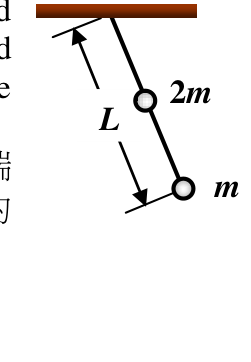
- (a)
- (b)
- (c)
- (d)
- (e)
Fonte: Testo (PDF) — p.7 Topic: Oscillations & Waves Metodi: Simple Harmonic Motion Analysis, Torque & Angular Momentum Analysis Competenze: Physical Reasoning Objects: Pendulum, Rod
Un pendolo composto è costituito da una barra leggera e rigida di lunghezza con un’estremità attaccata a una cerniera sul soffitto. Un’altra estremità della canna è collegata a una piccola palla di massa e un’altra piccola palla di è collegata al centro della canna. Trova la frequenza della semplice oscillazione armonica del pendolo.
- (a)
- (b)
- (c)
- (d)
- (e)
Fonte: Testo (PDF) — p.7 Topic: Oscillations & Waves Metodi: Simple Harmonic Motion Analysis, Torque & Angular Momentum Analysis Competenze: Physical Reasoning Objects: Pendulum, Rod
A small object is initially at the bottom of a plane inclined at an angle with the horizontal. It is projected upward along the inclined plane with an initial velocity, and reaches the maximum height after time . It then slides downward and returns to the initial position after time . If the coefficient of sliding friction between the object and the surface is , find the ratio .
- (a)
- (b)
- (c)
- (d)
- (e)
Fonte: Testo (PDF) — p.8 Topic: Newtonian Mechanics Metodi: Kinematic Equations, Free-Body Diagram Competenze: Physical Reasoning Objects: Inclined Plane
Un piccolo oggetto è inizialmente situato in fondo a un piano inclinato ad un angolo con l’orizzontale. È proiettato verso l’alto lungo il piano inclinato con una velocità iniziale e raggiunge l’altezza massima dopo il tempo . Poi scende verso il basso e ritorna alla posizione iniziale dopo il tempo . Se il coefficiente di attrito scorrevole tra l’oggetto e la superficie è , si trova il rapporto .
- (a)
- (b)
- (c)
- (d)
- (e)
Fonte: Testo (PDF) — p.8 Topic: Newtonian Mechanics Metodi: Kinematic Equations, Free-Body Diagram Competenze: Physical Reasoning Objects: Inclined Plane
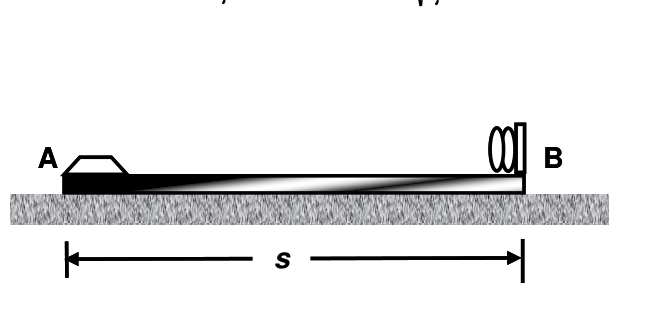
As shown in the figure, is a board of mass and length , placed on a smooth horizontal surface. A bumper of negligible mass is fixed at end . A peg of mass is placed at end . The coefficient of kinetic friction between the peg and the board is . With both the board initially at rest, the peg is ejected with an initial velocity of in contact with the board surface until it hits the bumper at end . After the collision, it just returns to end without falling off the board. Find the mechanical energy loss in the process.
- (a)
- (b)
- (c)
- (d)
- (e)
Fonte: Testo (PDF) — p.8 Topic: Conservation of Momentum ; Conservation of Energy Metodi: Conservation of Momentum, Energy Conservation Method Competenze: Physical Reasoning Objects: Block
Come mostrato nella figura, è una lavagna di massa e lunghezza , posizionata su una superficie orizzontale liscia. Un paraurti di massa trascurabile è fissato alla fine . Al termine si colloca una colla di massa . Il coefficiente di attrito cinetico tra la colletta e la lavagna è . Con entrambe le tabelle inizialmente a riposo, la cerniera viene espulsa con una velocità iniziale di in contatto con la superficie della tabella fino a colpire il paraurti alla fine . Dopo la collisione, ritorna semplicemente alla fine senza cadere dalla lavagna. Trova la perdita di energia meccanica nel processo.
- (a)
- (b)
- (c)
- (d)
- (e)
Fonte: Testo (PDF) — p.8 Topic: Conservation of Momentum ; Conservation of Energy Metodi: Conservation of Momentum, Energy Conservation Method Competenze: Physical Reasoning Objects: Block
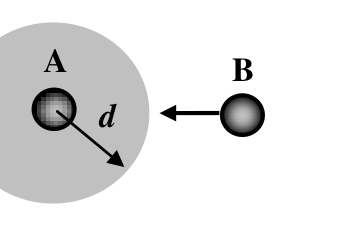
The elastic collision between two bodies, and , can be considered using the following model. and are free to move along a common line without friction. When their distance is greater than , the interacting force is zero; when their distance is less than , a constant repulsive force is present. The mass of body is and it is initially at rest; the mass of body is and it is approaching body head-on with a speed . Find the minimum distance between and .
- (a)
- (b)
- (c)
- (d)
- (e)
Fonte: Testo (PDF) — p.8 Topic: Conservation of Momentum ; Conservation of Energy Metodi: Conservation of Momentum, Conservation of Energy Competenze: Physical Reasoning Objects: —
La collisione elastica tra due corpi, e , può essere considerata utilizzando il seguente modello. e sono liberi di muoversi lungo una linea comune senza attrito. Quando la loro distanza è superiore a , la forza di interazione è zero; quando la loro distanza è inferiore a , è presente una forza repulsiva costante . La massa del corpo è ed è inizialmente a riposo; la massa del corpo è ed è in avvicinamento al corpo di fronte con una velocità . Trova la distanza minima tra e .
- (a)
- (b)
- (c)
- (d)
- (e)
Fonte: Testo (PDF) — p.8 Topic: Conservation of Momentum ; Conservation of Energy Metodi: Conservation of Momentum, Conservation of Energy Competenze: Physical Reasoning Objects: —
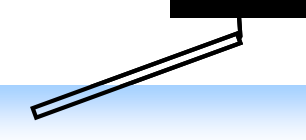
A uniform rod is hung at one end and is partially submerged in water. If the density of the rod is that of water, find the fraction of the length of the rod above water.
- (a)
- (b)
- (c)
- (d)
- (e)
Fonte: Testo (PDF) — p.8 Topic: Fluid Mechanics ; Rigid Body Statics Metodi: Torque & Angular Momentum Analysis, Hydrostatic Equilibrium Competenze: Physical Reasoning Objects: Rod
Una canna uniforme è appesa ad una estremità e è parzialmente immersa in acqua. Se la densità della canna è di quella dell’acqua, si trova la frazione della lunghezza della canna sopra l’acqua.
- (a)
- (b)
- (c)
- (d)
- (e)
Fonte: Testo (PDF) — p.8 Topic: Fluid Mechanics ; Rigid Body Statics Metodi: Torque & Angular Momentum Analysis, Hydrostatic Equilibrium Competenze: Physical Reasoning Objects: Rod
An observer stands next to the front end of the first carriage of a train. When the train starts to accelerate uniformly, it takes seconds for the first carriage to pass the observer. Assuming that all carriages are of the same length, what is the time taken by the tenth carriage to pass the observer?
- (a)
- (b)
- (c)
- (d)
- (e)
Fonte: Testo (PDF) — p.9 Topic: Newtonian Mechanics Metodi: Kinematic Equations Competenze: Physical Reasoning Objects: —
Un osservatore si trova accanto alla parte anteriore del primo vagone di un treno. Quando il treno inizia ad accelerare uniformemente, il primo vagone passa per l’osservatore in secondi. Supponendo che tutti i carri abbiano la stessa lunghezza, quanto tempo ci vuole per passare l’osservatore?
- (a)
- (b)
- (c)
- (d)
- (e)
Fonte: Testo (PDF) — p.9 Topic: Newtonian Mechanics Metodi: Kinematic Equations Competenze: Physical Reasoning Objects: —
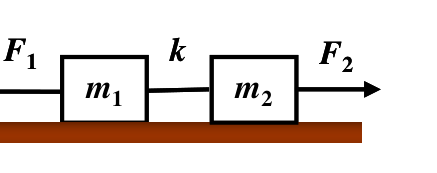
As shown in the figure, two blocks of masses and are connected by a light string, and are placed on a horizontal smooth surface. Forces of magnitude and act on them respectively, causing them to move linearly. The force constant of the light string is , and . What is the extension of the light string?
- (a)
- (b)
- (c)
- (d)
- (e)
Fonte: Testo (PDF) — p.9 Topic: Newtonian Mechanics Metodi: Free-Body Diagram, Hooke’s Law Competenze: Physical Reasoning Objects: Block, Spring
Come mostrato nella figura, due blocchi di massa e sono collegati da una corda leggera e collocati su una superficie liscia orizzontale. Le forze di magnitudo e agiscono rispettivamente su di loro, facendoli muoversi linearmente. La costante di forza della corda di luce è e . Qual è l’estensione della corda di luce?
- (a)
- (b)
- (c)
- (d)
- (e)
Fonte: Testo (PDF) — p.9 Topic: Newtonian Mechanics Metodi: Free-Body Diagram, Hooke’s Law Competenze: Physical Reasoning Objects: Block, Spring
As shown in the figure, a triangular wooden block of mass is fixed on a horizontal table. Its top angle is , and the base angles are and . Two small pieces of wood, each of mass , are located on the inclined smooth surfaces. When the wood pieces slide down the inclined surfaces, what is the normal force acting on the table by the triangular block?
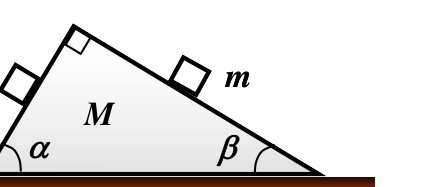
- (a)
- (b)
- (c)
- (d)
- (e)
Fonte: Testo (PDF) — p.9 Topic: Newtonian Mechanics Metodi: Free-Body Diagram, Vector Decomposition Competenze: Physical Reasoning Objects: Wedge, Inclined Plane, Block
Come mostrato nella figura, un blocco di legno triangolare di massa è fissato su una tavola orizzontale. Il suo angolo superiore è , e gli angoli di base sono e . Due piccoli pezzi di legno, ognuno di massa , sono situati sulle superfici lisce inclinate. Quando i pezzi di legno scivolano le superfici inclinate, quale è la forza normale che agisce sul tavolo da un blocco triangolare?
- (a)
- (b)
- (c)
- (d)
- (e)
Fonte: Testo (PDF) — p.9 Topic: Newtonian Mechanics Metodi: Free-Body Diagram, Vector Decomposition Competenze: Physical Reasoning Objects: Wedge, Inclined Plane, Block
(Open problem — 10 points.)
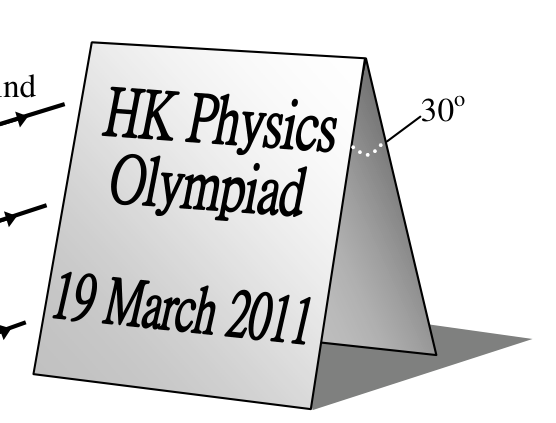
A “HK Physics Olympiad sandwich board” sign consists of two uniform pieces of metal wide and high, each of mass , joined at the top forming an angle . The sign looks like an inverted letter “V” when viewed sideways. Assume that the friction between the sign and the ground is sufficiently strong to prevent the sign from sliding on the ground, and that the board surface can stop any horizontal movement of air hitting it. The density of air is . Find the minimum wind speed above which the sign will turn over.
Fonte: Testo (PDF) — p.10 Topic: Rigid Body Statics ; Fluid Mechanics Metodi: Torque & Angular Momentum Analysis, Impulse-Momentum Theorem Competenze: Physical Reasoning Objects: —
*(Problema aperto 10 punti.) *
Un cartello “HK Physics Olympiad sandwich board” è costituito da due pezzi di metallo uniformi di larghezza e di altezza, ognuno di massa , uniti in cima formando un angolo . Il segno sembra una lettera “V” invertita quando si guarda lateralmente. Supponiamo che l’attrito tra il segnale e il terreno sia sufficientemente forte da impedire che il segnale scivoli sul terreno e che la superficie della lavagna possa fermare qualsiasi movimento orizzontale dell’aria che lo colpisca. La densità dell’aria è . Trova la velocità minima del vento sopra la quale il segnale si girerà.
Fonte: Testo (PDF) — p.10 Topic: Rigid Body Statics ; Fluid Mechanics Metodi: Torque & Angular Momentum Analysis, Impulse-Momentum Theorem Competenze: Physical Reasoning Objects: —
(Open problem — 10 points.)
Rectangular block of mass is placed on the rough surface of a table. Another block of mass with rough surfaces is placed on top of block . A light inextensible string connects blocks and , and winds through the massless smooth pulleys and fixed at the edge of the table. A massless smooth pulley hangs from the string segment between pulleys and , and block of mass hangs on pulley . Let be the coefficient of friction between all contact surfaces.
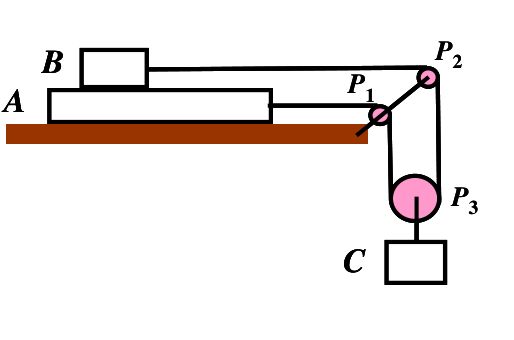
(a) Find the range of within which the system stays in equilibrium.
(b) Find the range of within which block moves downwards, while block remains stationary.
Fonte: Testo (PDF) — p.10 Topic: Newtonian Mechanics ; Rigid Body Statics Metodi: Free-Body Diagram, Vector Decomposition Competenze: Physical Reasoning Objects: Block, String, Pulley
*(Problema aperto 10 punti.) *
Il blocco rettangolare di massa è posizionato sulla superficie di un tavolo. Un altro blocco di massa con superfici rugose è posto sopra il blocco . Una corda leggera inestensibile collega i blocchi e e si snoda attraverso le pollette lisce senza massa e fissate sul bordo del tavolo. Una pollice liscia senza massa è appesa al segmento di corda tra le polli e , e il blocco di massa è appeso alla pollice . Il deve essere il coefficiente di attrito tra tutte le superfici di contatto.
(a) Trovare l’intervallo di entro il quale il sistema rimane in equilibrio.
b) Trova la gamma di entro la quale il blocco si muove verso il basso, mentre il blocco rimane fermo.
Fonte: Testo (PDF) — p.10 Topic: Newtonian Mechanics ; Rigid Body Statics Metodi: Free-Body Diagram, Vector Decomposition Competenze: Physical Reasoning Objects: Block, String, Pulley
(Open problem — 15 points.)
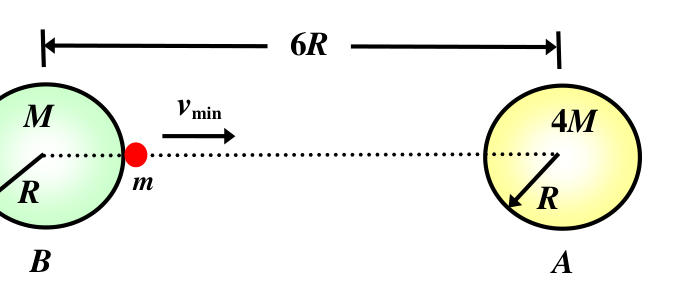
As shown in the figure, spheres and have equal radii and mass and respectively. They are separated center to center by a distance of . A projectile of mass is ejected from the surface of sphere in the direction towards the center of sphere .
(a) Find the minimum speed of the projectile so it can reach the surface of sphere .
(b) If the projectile is ejected with the minimum speed , calculate the speed of the projectile when it reaches the surface of sphere .
(c) If the projectile can be launched from the surface of sphere in any direction so as to escape to infinity, find the speed of the projectile when it leaves sphere .
Fonte: Testo (PDF) — p.11 Topic: Gravitation ; Conservation of Energy Metodi: Newton’s Law of Gravitation, Energy Conservation Method Competenze: Physical Reasoning Objects: Sphere, Projectile
*(Problema aperto 15 punti.) *
Come mostrato nella figura, le sfere e hanno rispettivamente uguali radii e massa e . Sono separati dal centro al centro da una distanza di . Un proiettile di massa viene espulso dalla superficie della sfera nella direzione verso il centro della sfera .
a) Trova la velocità minima del proiettile in modo che possa raggiungere la superficie della sfera .
b) Se il proiettile viene espulso con la velocità minima , calcolare la velocità del proiettile quando raggiunge la superficie della sfera .
c) Se il proiettile può essere lanciato dalla superficie della sfera in qualsiasi direzione in modo da fuggire all’infinito, si trova la velocità del proiettile quando lascia la sfera .
Fonte: Testo (PDF) — p.11 Topic: Gravitation ; Conservation of Energy Metodi: Newton’s Law of Gravitation, Energy Conservation Method Competenze: Physical Reasoning Objects: Sphere, Projectile
(Open problem — 15 points.)
As shown in the figure, a pendulum is made up of a bob suspended from a fixed point by a light inextensible string of length . A nail is located at a distance vertically below . The pendulum is lifted with the string taut until line is horizontal and then released. When the pendulum swings to the vertical position at point , only the portion below point can swing further.
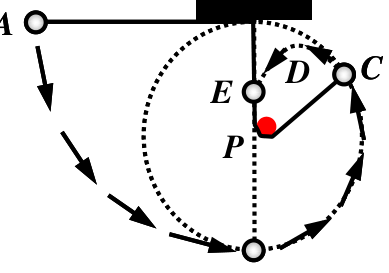
(a) When the interrupted pendulum swings further, the string becomes loose at point . Find the angle between the line and the vertical direction.
(b) After the string becomes loose, the bob continues to move and reaches its maximum height at point . Find the maximum height of the bob above point .
(c) The bob then passes through point which is right below . Find the distance between and .
Fonte: Testo (PDF) — p.11 Topic: Conservation of Energy ; Newtonian Mechanics Metodi: Energy Conservation Method, Kinematic Equations Competenze: Physical Reasoning Objects: Pendulum, String
*(Problema aperto 15 punti.) *
Come mostrato nella figura, un pendolo è costituito da una bobina sospesa da un punto fisso da una stringa di lunghezza che è poco estensibile. Un chiodo si trova a una distanza verticalmente inferiore a . Il pendolo viene sollevato con la corda stretta fino a quando la linea non è orizzontale e viene quindi rilasciata. Quando il pendolo oscilla verso la posizione verticale al punto , solo la parte inferiore al punto può oscillare ulteriormente.
(a) Quando il pendolo interrotto oscilla ulteriormente, la corda si scioglie al punto . Trova l’angolo tra la linea e la direzione verticale.
b) Dopo che la corda si è sciolta, il bob continua a muoversi e raggiunge la sua altezza massima al punto . Trova l’altezza massima del bobino sopra il punto .
c) Il bob passa quindi attraverso il punto che è appena sotto . Trova la distanza tra e .
Fonte: Testo (PDF) — p.11 Topic: Conservation of Energy ; Newtonian Mechanics Metodi: Energy Conservation Method, Kinematic Equations Competenze: Physical Reasoning Objects: Pendulum, String
(Open problem — 10 points.)
As shown in the figure, a particle of mass and carrying charge is connected by a light rigid rod of length to another particle of mass and carrying charge . The system is placed in an electric field . The electric force on a charge in an electric field is . After the system settles into equilibrium, one particle is given a small push in the transverse direction so that the rod makes a small angle with the electric field.
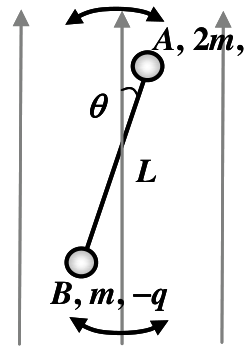
(a) Find the period of the angular oscillation.
(b) Find the maximum tension in the rod.
Fonte: Testo (PDF) — p.12 Topic: Electrostatics ; Oscillations & Waves Metodi: Simple Harmonic Motion Analysis, Torque & Angular Momentum Analysis Competenze: Physical Reasoning Objects: Point Charge, Rod
*(Problema aperto 10 punti.) *
Come mostrato nella figura, una particella di massa e carica portante è collegata da una leggera canna rigida di lunghezza ad un’altra particella di massa e carica portante . Il sistema è collocato in un campo elettrico . La forza elettrica su una carica in un campo elettrico è . Dopo che il sistema si è stabilito in equilibrio, una particella riceve una piccola spinta nella direzione trasversale in modo che la canna faccia un angolo piccolo con il campo elettrico.
(a) Trova il periodo dell’oscillazione angolare.
b) Trova la tensione massima nella canna.
Fonte: Testo (PDF) — p.12 Topic: Electrostatics ; Oscillations & Waves Metodi: Simple Harmonic Motion Analysis, Torque & Angular Momentum Analysis Competenze: Physical Reasoning Objects: Point Charge, Rod