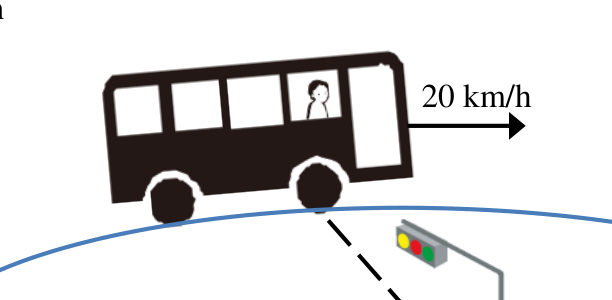
As shown in Fig. 1, a boy is riding on a bus. The bus moves with a uniform speed of in a horizontal circle, and the traffic light is located at the center of the circle. What is the velocity of the traffic light relative to the boy?
- (A) in the forward direction of the bus
- (B) in the backward direction of the bus
- (C) perpendicular to the forward direction of the bus and directed away from the bus
- (D) perpendicular to the forward direction of the bus and directed towards the bus
- (E)
Figure 1
Fonte: Testo (PDF) — p.4
Topic: Newtonian Mechanics Metodi: Vector Decomposition, Kinematic Equations Competenze: Physical Reasoning Objects: —
Come mostrato nella figura. Uno, un ragazzo è in autobus. L’autobus si muove con una velocità uniforme di in un cerchio orizzontale e il semaforo si trova al centro del cerchio. Qual è la velocità del semaforo rispetto al ragazzo?
- **(A) ** nella direzione anteriore dell’autobus
- **(B) ** nella direzione anteriore dell’autobus
- **(C) ** perpendicolare alla direzione in avanti dell’autobus e diretto lontano dall’autobus
- **(D) ** perpendicolare alla direzione in avanti dell’autobus e diretta verso l’autobus
- (E)
[figura] Figura 1
Fonte: Testo (PDF) — p.4
Topic: Newtonian Mechanics Metodi: Vector Decomposition, Kinematic Equations Competenze: Physical Reasoning Objects: —
A tennis ball machine is installed on the bus in Fig. 1. It projects tennis balls at a speed of in the direction perpendicular to the forward direction of the bus, and on the outward side of the circular path. The trajectories of the tennis balls observed by the boy are
- (A) straight lines perpendicular to the forward direction of the bus
- (B) straight lines slightly inclined towards the forward direction of the bus
- (C) straight lines slightly inclined towards the backward direction of the bus
- (D) curves slightly inclined towards the forward direction of the bus
- (E) curves slightly inclined towards the backward direction of the bus
Fonte: Testo (PDF) — p.4
Topic: Newtonian Mechanics Metodi: Vector Decomposition, Physical Modeling Competenze: Physical Reasoning Objects: Ball
Un’apparecchiatura per pallone da tennis è installata sull’autobus a Fig. 1. Proietta palline da tennis a velocità in direzione perpendicolare alla direzione in avanti dell’autobus e sul lato esterno del percorso circolare. Le traiettorie delle palle da tennis osservate dal ragazzo sono:
- **(A) ** linee rette perpendicolari alla direzione in avanti dell’autobus
- **(B) ** linee rette leggermente inclinate verso la direzione in avanti dell’autobus
- **(C) ** linee rette leggermente inclinate verso l’indietro dell’autobus
- **(D) ** curve leggermente inclinate verso la direzione in avanti dell’autobus
- **(E) ** curve leggermente inclinate verso l’indietro del bus
Fonte: Testo (PDF) — p.4
Topic: Newtonian Mechanics Metodi: Vector Decomposition, Physical Modeling Competenze: Physical Reasoning Objects: Ball
A man sits in the back of a canoe in still water. He then moves to the front of the canoe and sits there. Neglecting the damping of water, the final position and the motion of the canoe is:
- (A) forward of its original position and moving forward
- (B) forward of its original position and moving backward
- (C) rearward of its original position and moving forward
- (D) rearward of its original position and moving backward
- (E) rearward of its original position and not moving
Fonte: Testo (PDF) — p.5
Topic: Conservation of Momentum Metodi: Conservation of Momentum Competenze: Physical Reasoning Objects: —
Un uomo siede sul retro di una canoa in acqua ferma. Poi si sposta verso la parte anteriore della canoa e si siede lì. Nonostante l’ammortizzazione dell’acqua, la posizione finale e il movimento della canoa sono:
- **(A) ** avanti della sua posizione iniziale e in avanti
- **(B) ** avanti della sua posizione originaria e in ritardo
- **(C) ** verso l’indietro della sua posizione iniziale e in avanti
- **(D) ** verso l’indietro della sua posizione originaria e in ritardo
- **(E) ** verso l’indietro della sua posizione originale e non si muove
Fonte: Testo (PDF) — p.5
Topic: Conservation of Momentum Metodi: Conservation of Momentum Competenze: Physical Reasoning Objects: —
A boat is about to cross a river to the opposite bank. The river water flows at a speed of . If the speed of the boat is , what should be the angle between the boat velocity and the upstream direction of the river, so that the downstream displacement is minimum when the boat reaches the opposite bank?
- (A)
- (B)
- (C)
- (D)
- (E)
Fonte: Testo (PDF) — p.5
Topic: Newtonian Mechanics Metodi: Vector Decomposition, Kinematic Equations Competenze: Physical Reasoning Objects: —
Una barca sta per attraversare un fiume per la riva opposta. L’acqua del fiume scorre a una velocità . Se la velocità della barca è , quale dovrebbe essere l’angolo tra la velocità della barca e la direzione a monte del fiume, in modo che il spostamento a valle sia minimo quando la barca raggiunge la riva opposta?
- (A)
- (B)
- (C)
- (D)
- (E)
Fonte: Testo (PDF) — p.5
Topic: Newtonian Mechanics Metodi: Vector Decomposition, Kinematic Equations Competenze: Physical Reasoning Objects: —
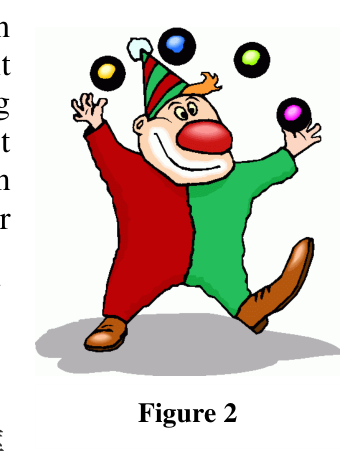
*In a talent show, a juggler juggles 4 balls simultaneously, as shown in Fig. 2. A spectator uses his high speed video tape and determines that it takes the juggler to cycle each ball through his hands (including catching, transferring and throwing) and to be ready to catch the next ball. It is noted that at most one ball must be in a hand of the juggler in each cycle of juggling. What is the minimum vertical speed the juggler must throw up each ball?
- (A)
- (B)
- (C)
- (D)
- (E)
Fonte: Testo (PDF) — p.5
Topic: Newtonian Mechanics Metodi: Kinematic Equations, Physical Modeling Competenze: Physical Reasoning Objects: Ball
In uno spettacolo di talenti, un malaio malaio 4 palle contemporaneamente, come mostrato in Figura. 2. Uno spettatore utilizza la sua nastro video ad alta velocità e determina che occorre che lo juggler cicli ogni palla attraverso le sue mani (compresi catturare, trasferire e lanciare) e essere pronto a catturare la palla successiva. Si osserva che al massimo una palla deve essere nella mano del malatiere in ogni ciclo di malatiere. Qual è la velocità verticale minima che il malato deve vomitare ogni palla?
- (A)
- (B)
- (C)
- (D)
- (E)
Fonte: Testo (PDF) — p.5
Topic: Newtonian Mechanics Metodi: Kinematic Equations, Physical Modeling Competenze: Physical Reasoning Objects: Ball
As shown in Fig. 3, the block-spring system is in equilibrium provided that the left spring is stretched by . The whole system rests on a smooth supporting surface. The coefficient of static friction between the blocks is , and the blocks have equal mass . What is the maximum amplitude of the oscillations of the system such that the top block does not slide on the bottom one?
- (A)
- (B)
- (C)
- (D)
- (E)
Figure 3
Fonte: Testo (PDF) — p.5
Topic: Oscillations & Waves Metodi: Simple Harmonic Motion Analysis, Free-Body Diagram, Hooke’s Law Competenze: Physical Reasoning Objects: Spring, Block
Come mostrato nella figura. 3, il sistema di molla di blocco è in equilibrio a condizione che la molla di sinistra sia estesa da . L’intero sistema si fonda su una superficie di supporto liscia. Il coefficiente di attrito statico tra i blocchi è e i blocchi hanno massa uguale . Qual è l’ampiezza massima delle oscillazioni del sistema in modo tale che il blocco superiore non scivoli sul blocco inferiore?
- (A)
- (B)
- (C)
- (D)
- (E)
[figura] Figura 3
Fonte: Testo (PDF) — p.5
Topic: Oscillations & Waves Metodi: Simple Harmonic Motion Analysis, Free-Body Diagram, Hooke’s Law Competenze: Physical Reasoning Objects: Spring, Block
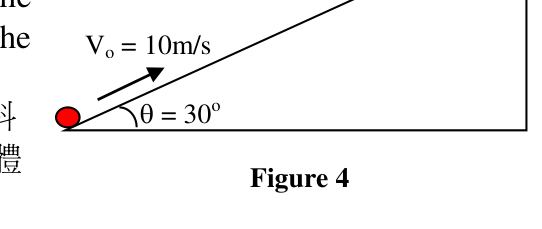
*An object is projected up an inclined plane with an initial speed of , as shown in Fig. 4. The angle of the incline is above the horizontal direction and the coefficient of the sliding friction , determine the total time for the object to return to the point of projection.
- (A)
- (B)
- (C)
- (D)
- (E)
Figure 4
Fonte: Testo (PDF) — p.6
Topic: Newtonian Mechanics Metodi: Free-Body Diagram, Kinematic Equations Competenze: Physical Reasoning Objects: Inclined Plane
*Un oggetto è proiettato su un piano inclinato con una velocità iniziale di , come mostrato nella figura. 4. L’angolo di inclinazione è sopra la direzione orizzontale e il coefficiente di attrito scorrevole determina il tempo totale per il ritorno dell’oggetto al punto di proiezione.
- (A)
- (B)
- (C)
- (D)
- (E)
[figura] Figura 4
Fonte: Testo (PDF) — p.6
Topic: Newtonian Mechanics Metodi: Free-Body Diagram, Kinematic Equations Competenze: Physical Reasoning Objects: Inclined Plane
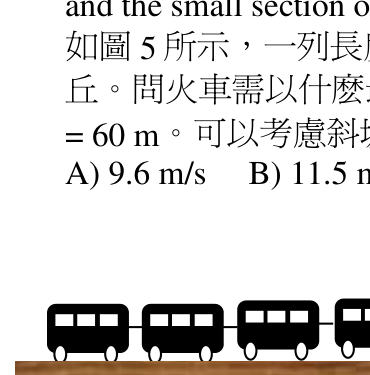
*As shown in Fig. 5, a train with a length of moves by its inertia through the horizontal section of a railroad. However, the train encounters a small hill that slopes gently. With what minimum speed can the train cross the hill? The base of the hill has a length , the lengths of the slopes are and . The slopes of the hill can be considered as straight lines and the small section of rounding at the top of the hill can be ignored. Neglect any friction.
- (A)
- (B)
- (C)
- (D)
- (E)
Figure 5
Fonte: Testo (PDF) — p.6
Topic: Conservation of Energy Metodi: Conservation of Energy, Physical Modeling Competenze: Physical Reasoning Objects: —
*As shown in Fig. 5, un treno di lunghezza si muove per inerzia attraverso la sezione orizzontale di una ferrovia. Tuttavia, il treno incontra una piccola collina che inclina lentamente. With what minimum speed can the train cross the hill? La base della collina ha una lunghezza , le lunghezze delle pendici sono e . Le pendici della collina possono essere considerate linee rette e la piccola sezione di arrotondamento in cima alla collina può essere ignorata. - Non fare frattura.
- (A)
- (B)
- (C)
- (D)
- (E)
[figura] Figura 5
Fonte: Testo (PDF) — p.6
Topic: Conservation of Energy Metodi: Conservation of Energy, Physical Modeling Competenze: Physical Reasoning Objects: —
It is given that the mass of Earth is times that of Moon, and the radius of Earth is times that of Moon. The period of a simple pendulum is . When it is carried to Moon, the period of the simple pendulum becomes
- (A)
- (B)
- (C)
- (D)
- (E)
Fonte: Testo (PDF) — p.6
Topic: Gravitation Metodi: Newton’s Law of Gravitation, Simple Harmonic Motion Analysis Competenze: Physical Reasoning Objects: Pendulum, Planet
Si dà che la massa della Terra è volte quella della Luna, e il raggio della Terra è volte quello della Luna. Il periodo di un pendolo semplice è . Quando viene trasportato sulla Luna, il periodo del semplice pendolo diventa
- (A)
- (B)
- (C)
- (D)
- (E)
Fonte: Testo (PDF) — p.6
Topic: Gravitation Metodi: Newton’s Law of Gravitation, Simple Harmonic Motion Analysis Competenze: Physical Reasoning Objects: Pendulum, Planet
There exist some triple star systems in the universe. They are more distant from other stars, and are composed of three stars of equal mass . The gravitational forces due to other stars can be neglected. A basic stable structure of triple star systems consists of three collinear stars, with two companion stars moving around a central star on a circular orbit with radius . The linear velocity of the companion stars is , where
- (A)
- (B)
- (C)
- (D)
- (E)
(End of Multiple Choice questions.)
Fonte: Testo (PDF) — p.6
Topic: Gravitation Metodi: Newton’s Law of Gravitation, Symmetry Argument Competenze: Physical Reasoning Objects: Star
Esistono alcuni sistemi stellari tripli nell’universo. Sono più lontane dalle altre stelle e sono composte da tre stelle di massa uguale . Le forze gravitazionali dovute ad altre stelle possono essere trascurate. Una struttura stabile di base dei sistemi stellari tripli consiste di tre stelle collineari, con due stelle compagne che si muovono attorno a una stella centrale in orbita circolare con raggio . La velocità lineare delle stelle compagne è , dove
- (A)
- (B)
- (C)
- (D)
- (E)
*(Fina delle domande di scelta multipla.) *
Fonte: Testo (PDF) — p.6
Topic: Gravitation Metodi: Newton’s Law of Gravitation, Symmetry Argument Competenze: Physical Reasoning Objects: Star
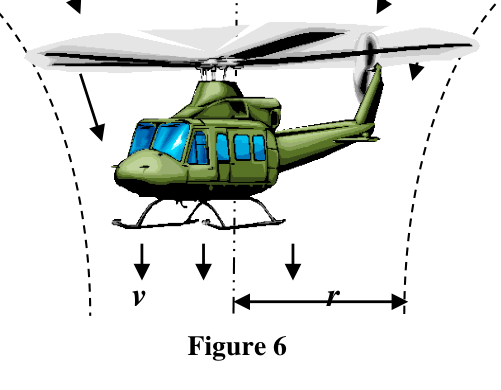
Q1* (10 points). The helicopter has a mass and maintains its height by imparting a downward momentum to a column of air defined by the slipstream boundary as shown in Fig. 6. The propeller blades can project a downward air speed , where the pressure in the stream below the blades is atmospheric and the radius of the circular cross-section of the slipstream is . Neglect any rotational energy of the air, the temperature rise due to air friction and any change in air density .
(a) Determine the power required of the engine.
(b) If the power is doubled, calculate the acceleration of the helicopter.
Figure 6
Fonte: Testo (PDF) — p.7
Topic: Conservation of Momentum, Fluid Mechanics Metodi: Impulse-Momentum Theorem, Continuity Equation, Conservation of Energy Competenze: Physical Reasoning, Mathematical Modeling Objects: —
Q1* (10 punti). L’elicottero ha una massa e mantiene la sua altezza conferendo un impulso verso il basso ad una colonna d’aria definita dal confine del flusso di scalo come mostrato nella figura. 6. Le lame dell’elica possono proiettare una velocità di aria verso il basso , dove la pressione nel flusso sotto le lame è atmosferica e il raggio della sezione incrociata circolare del flusso scivolante è . Negliodare qualsiasi energia di rotazione dell’aria, l’aumento della temperatura dovuto alla frizione dell’aria e qualsiasi variazione della densità dell’aria .
a) Determinare la potenza richiesta del motore.
b) Se la potenza è raddoppiata, calcolare l’accelerazione dell’elicottero.
[figura] Figura 6
Fonte: Testo (PDF) — p.7
Topic: Conservation of Momentum, Fluid Mechanics Metodi: Impulse-Momentum Theorem, Continuity Equation, Conservation of Energy Competenze: Physical Reasoning, Mathematical Modeling Objects: —
Q2* (10 points). As shown in Fig. 7, in a ski jumping competition on a slope with inclination angle , an athlete jumps at point with initial speed and lands at point .
(a) Find the optimum jumping angle so that the distance is maximum. (You may need to use the trigonometric identities listed on page 3.)
(b) Find the maximum distance .
Fonte: Testo (PDF) — p.7
Topic: Newtonian Mechanics Metodi: Kinematic Equations, Vector Decomposition Competenze: Physical Reasoning, Mathematical Modeling Objects: Inclined Plane
Q2* (10 punti). Come mostrato nella figura. 7, in una competizione di salto di sci su una pendice con angolo di inclinazione , un atleta salta al punto con velocità iniziale e atterra al punto .
a) Trova l’angolo di salto ottimale in modo che la distanza sia massima. (Potrebbe essere necessario utilizzare le identità trigonometriche elencate a pagina 3.)
b) Trova la distanza massima .
Fonte: Testo (PDF) — p.7
Topic: Newtonian Mechanics Metodi: Kinematic Equations, Vector Decomposition Competenze: Physical Reasoning, Mathematical Modeling Objects: Inclined Plane
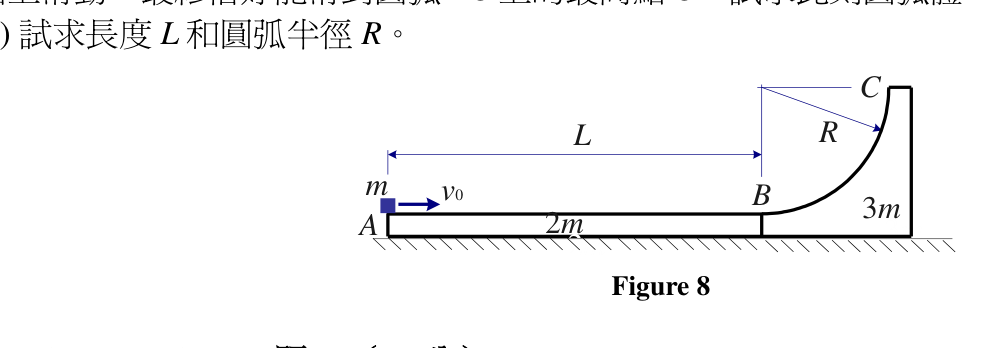
Q3* (15 points). On a smooth horizontal surface shown in Fig. 8, there is a rectangular board with mass and an arc-shaped structure with mass . The coefficient of kinetic friction of the upper surface of the rectangular board is , and the surface of the arc-shaped structure is smooth. The arc subtends a right angle with radius . The two objects touch at point .
(a) A small object of mass moves from to the right with an initial velocity on the upper surface of the rectangular block. When it reaches point , the velocity is . Calculate the velocity of the rectangular board at this instant.
(b) The small object continues to move onto the arc-shaped surface . The rectangular board loses contact with the arc-shaped structure , and the small object continues to move along the arc surface, and finally just reaches the highest point of the arc . Calculate the velocity of the arc-shaped structure .
(c) Calculate the length and the radius .
Figure 8
Fonte: Testo (PDF) — p.7
Topic: Conservation of Momentum, Conservation of Energy Metodi: Conservation of Momentum, Conservation of Energy, Free-Body Diagram Competenze: Physical Reasoning Objects: Block
Q3* (15 punti). Su una superficie orizzontale liscia mostrata nella figura. 8, si tratta di una tavola rettangolare con massa e di una struttura a forma di arco con massa . Il coefficiente di attrito cinetico della superficie superiore della lavagna rettangolare è e la superficie della struttura a forma di arco è liscia. L’arco sottolinea un angolo retto con raggio . I due oggetti si toccano al punto .
(a) Un piccolo oggetto di massa si sposta da a destra con una velocità iniziale sulla superficie superiore del blocco rettangolare. Quando raggiunge il punto , la velocità è . Calcolare la velocità della scheda rettangolare in questo istante.
b) Il piccolo oggetto continua a muoversi sulla superficie a forma di arco . La scheda rettangolare perde il contatto con la struttura a forma di arco , e il piccolo oggetto continua a muoversi lungo la superficie dell’arco, e infine raggiunge il punto più alto dell’arco . Calcolare la velocità della struttura a forma di arco .
c) Calcolare la lunghezza e il raggio .
[figura] Figura 8
Fonte: Testo (PDF) — p.7
Topic: Conservation of Momentum, Conservation of Energy Metodi: Conservation of Momentum, Conservation of Energy, Free-Body Diagram Competenze: Physical Reasoning Objects: Block
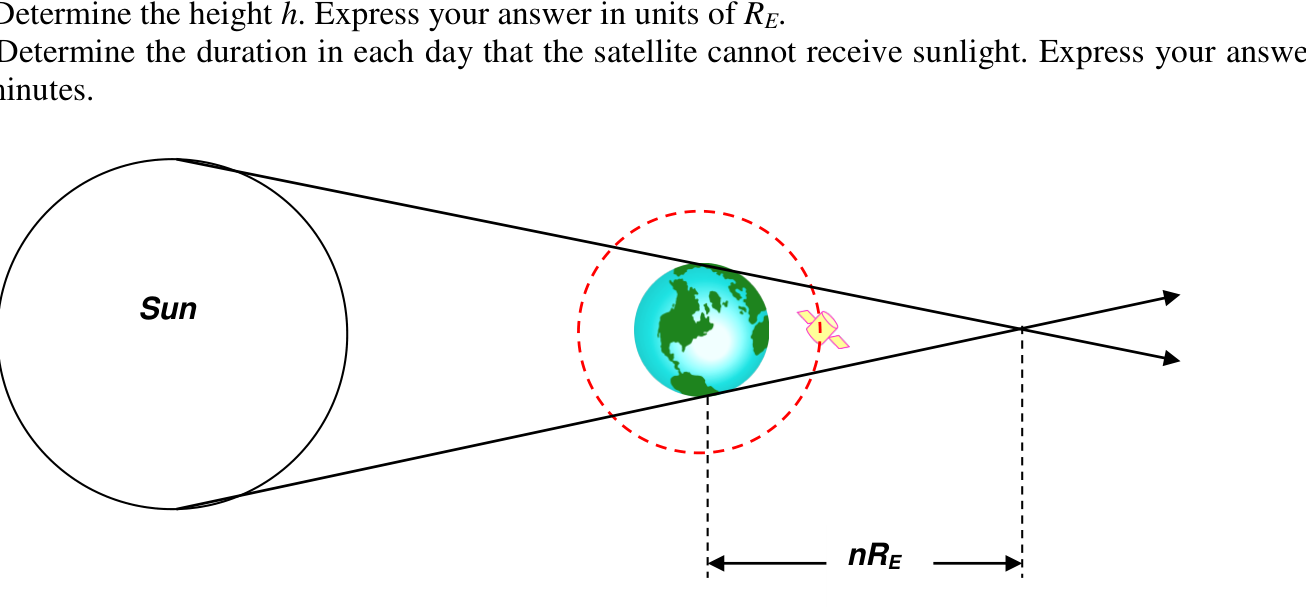
Q4* (10 points). Geosynchronous satellites have the same period as the Earth’s rotation. They are at such a height above the earth’s surface that they remain always above the same spot. Suppose a geosynchronous solar satellite, as shown in Fig. 9a, sends radio signal directly to receivers on earth.
When the satellite moves to the rear part of the earth (Fig. 9b), the light source is completely blocked by Earth in the shadow region (commonly known as an umbra). The length of the umbra is usually times () of Earth’s radius .
(a) Determine the height . Express your answer in units of .
(b) Determine the duration in each day that the satellite cannot receive sunlight. Express your answer in minutes.
Figure 9b
Fonte: Testo (PDF) — p.8
Topic: Gravitation Metodi: Newton’s Law of Gravitation, Kepler’s Laws Competenze: Physical Reasoning Objects: Satellite, Planet
**Q4* (10 punti). ** I satelliti geosincroni hanno lo stesso periodo della rotazione terrestre. They are at such a height above the earth’s surface that they remain always above the same spot. Supponiamo un satellite solare geosincrono, come mostrato nella figura. 9a, invia un segnale radio direttamente ai ricevitori sulla Terra.
Quando il satellite si sposta verso la parte posteriore della terra (Fig. 9b), la fonte luminosa è completamente bloccata dalla Terra nella regione ombra (comunemente conosciuta come umbra). La lunghezza dell’ombra è di solito volte () del raggio della Terra .
a) Determinare l’altezza . Esprimere la risposta in unità di .
b) Determinare la durata di ogni giorno in cui il satellite non può ricevere la luce solare. Esprimi la tua risposta in pochi minuti.
[figura] Figura 9b
Fonte: Testo (PDF) — p.8
Topic: Gravitation Metodi: Newton’s Law of Gravitation, Kepler’s Laws Competenze: Physical Reasoning Objects: Satellite, Planet
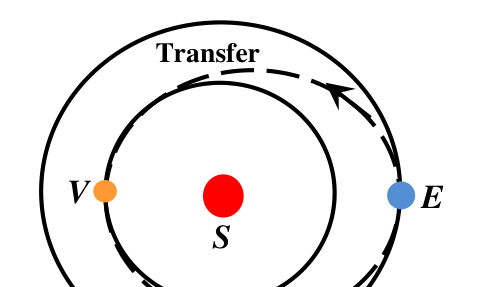
Q5* (20 points). Let be the circular orbital radius of Earth around Sun, and be the circular orbital radius of Venus around Sun. To launch a space probe from Earth to Venus, the space probe first enters Earth’s orbit and moves to a position sufficiently remote from Earth, so that the gravitational attraction of Earth is negligible when compared with the gravitational attraction of Sun. Then, the following manoeuvres as shown in Fig. 10 are performed:
(1) The kinetic energy of the space probe is reduced by , where is the kinetic energy of the space probe at that instant. This is done by switching on the engine for a short time and then switching it off. The space probe then enters a transfer orbit around the Sun. The transfer orbit is tangential to Earth’s orbit at its near end and to Venus’s orbit at its far end.
(2) When the space probe touches Venus’s orbit, the space probe is traveling too fast for it to land on Venus. For the second time, the kinetic energy is reduced by switching on the engine for a short time and then switching it off. The space probe then travels at the orbital velocity of Venus.
(a) Calculate the orbital speed of Earth and Venus. Express your answer in km/s.
(b) Calculate the speed (in km/s) of the space probe in the transfer orbit at point .
(c) Calculate the speed (in km/s) of the space probe in the transfer orbit at point .
(d) Calculate the fractional reduction of the kinetic energy of the space probe at point .
Figure 10
Fonte: Testo (PDF) — p.9
Topic: Gravitation Metodi: Kepler’s Laws, Conservation of Energy, Newton’s Law of Gravitation Competenze: Physical Reasoning, Mathematical Modeling Objects: Satellite, Planet, Star
**Q5* (20 punti). ** sia il raggio orbitale circolare della Terra attorno al Sole, e sia il raggio orbitale circolare di Venere attorno al Sole. Per lanciare una sonda spaziale dalla Terra a Venere, la sonda spaziale entra prima nell’orbita terrestre e si muove in una posizione abbastanza remota dalla Terra, in modo che l’attrazione gravitazionale della Terra sia trascurabile rispetto all’attrazione gravitazionale del Sole. Poi, le manovre seguenti come mostrato in Figura. 10 sono eseguite:
(1) L’energia cinetica della sonda spaziale è ridotta di , dove è l’energia cinetica della sonda spaziale in quel momento. Questo si fa accendendo il motore per un breve periodo e poi spegnendolo. La sonda spaziale entra quindi in un’orbita di trasferimento attorno al Sole. L’orbita di trasferimento è tangenziale all’orbita terrestre alla sua fine vicina e all’orbita di Venere alla sua fine lontana.
(2) Quando la sonda spaziale tocca l’orbita di Venere, la sonda spaziale viaggia troppo velocemente per poter atterrare su Venere. Per la seconda volta, l’energia cinetica viene ridotta accendendo il motore per un breve periodo e poi spegnendolo. La sonda spaziale viaggia quindi alla velocità orbitale di Venere.
(a) Calcolare la velocità orbitale della Terra e di Venere. Esprimi la tua risposta in km/s.
b) Calcolare la velocità (in km/s) della sonda spaziale nell’orbita di trasferimento al punto .
c) Calcolare la velocità (in km/s) della sonda spaziale nell’orbita di trasferimento al punto .
d) Calcolare la riduzione frazionaria dell’energia cinetica della sonda spaziale al punto .
[figura] Figura 10
Fonte: Testo (PDF) — p.9
Topic: Gravitation Metodi: Kepler’s Laws, Conservation of Energy, Newton’s Law of Gravitation Competenze: Physical Reasoning, Mathematical Modeling Objects: Satellite, Planet, Star
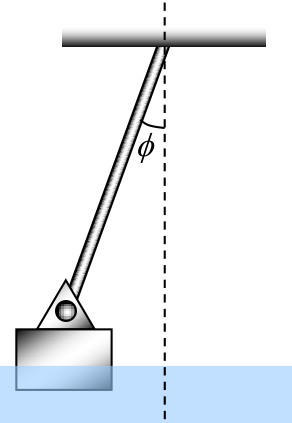
Q6 (15 points). As shown in Fig. 11, a pendulum consists of a massive cubic block with side length and density hung by a light rigid rod with length . The hinge connecting the rod and the block maintains the block at the same orientation when it swings. The block is partially immersed in a liquid with density , with greater than . The immersion depth of the block in the liquid is .
(a) Calculate the period of the pendulum for small oscillation angles when is sufficiently small. You may assume that the damping of the liquid during oscillations is negligible, and the change of the immersion depth during oscillations is negligible.
(b) When liquid is added, the liquid level rises, and the value of reaches a threshold value , above which the pendulum rod is no longer vertical. What is the expression of ?
(c) When is above , the pendulum oscillates about a non-zero angle . Calculate the period of the pendulum for small oscillations when the liquid level has risen to one that corresponds to .
Figure 11
Fonte: Testo (PDF) — p.10
Topic: Oscillations & Waves, Fluid Mechanics Metodi: Simple Harmonic Motion Analysis, Hydrostatic Equilibrium, Small-Angle Approximation Competenze: Physical Reasoning, Mathematical Modeling Objects: Pendulum, Block
Q6 (15 punti). Come mostrato nella figura. 11, un pendolo è costituito da un massiccio blocco cubo con lunghezza laterale e densità appeso da una canna rigida leggera con lunghezza . La cerniera che collega la canna e il blocco mantiene il blocco nello stesso orientamento quando oscilla. Il blocco è in parte immerso in un liquido di densità , con superiore a . La profondità di immersione del blocco nel liquido è .
a) Calcolare il periodo del pendolo per angoli di oscillazione quando è sufficientemente piccolo. Si può presumere che l’ammortizzazione del liquido durante le oscillazioni sia trascurabile e il cambiamento della profondità di immersione durante le oscillazioni sia trascurabile.
b) Quando viene aggiunto il liquido, il livello del liquido aumenta e il valore di raggiunge un valore soglia , al di sopra del quale la barra del pendolo non è più verticale. Qual è l’ espressione di ?
c) Quando è superiore a , il pendolo oscilla intorno ad un angolo non zero . Calcolare il periodo del pendolo per piccole oscillazioni quando il livello del liquido è salito a quello corrispondente a .
[figura] Figura 11
Fonte: Testo (PDF) — p.10
Topic: Oscillations & Waves, Fluid Mechanics Metodi: Simple Harmonic Motion Analysis, Hydrostatic Equilibrium, Small-Angle Approximation Competenze: Physical Reasoning, Mathematical Modeling Objects: Pendulum, Block